Marcus N Paciocco
Managing Director
FTI Consulting
CHINA DUE DILLIGENCE AND TRANSACTIONAL ISSUES
A client once described China as “a place where nothing is allowed, but everything
is possible”.
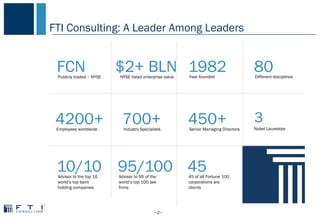
FTI Consulting: A Leader Among Leaders
FCNPublicly traded – NYSE
$2+ BLNNYSE listed enterprise value
1982Year founded
80Different disciplines
4200+Employees worldwide
700+Industry Specialists
450+Senior Managing Directors
3
10/10Advisor to the top 10
world’s top bank
holding companies
95/100Advisor to 95 of the
world’s top 100 law
firms
4545 of all Fortune 100
corporations are
clients
−2−
Nobel Laureates
Discussion Topics
3
■ Deal Process
■ Common financial and operational issues
■ Case Study – Liquidation of Moulin Global Eyecare
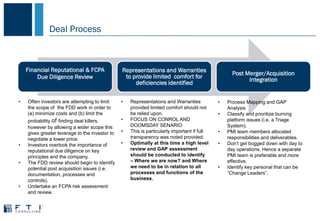
Deal Process
Financial Reputational & FCPA
Due Diligence Review
Representations and Warranties
to provide limited comfort for
deficiencies identified
Post Merger/Acquisition
Integration
• Often investors are attempting to limit
the scope of the FDD work in order to
(a) minimize costs and (b) limit the
probability of finding deal killers,
however by allowing a wider scope this
gives greater leverage to the investor to
negotiate a lower price.
• Investors overlook the importance of
reputational due diligence on key
principles and the company.
• The FDD review should begin to identify
potential post acquisition issues (i.e.
documentation, processes and
controls).
• Undertake an FCPA risk assessment
and review.
• Representations and Warranties
provided limited comfort should not
be relied upon.
• FOCUS ON CONROL AND
DOOMSDAY SENARIO
• This is particularly important if full
transparency was noted provided.
• Optimally at this time a high level
review and GAP assessment
should be conducted to identify
– Where we are now? and Where
we need to be in relation to all
processes and functions of the
business.
• Process Mapping and GAP
Analysis
• Classify and prioritize burning
platform issues (i.e. a Triage
System).
• PMI team members allocated
responsibilities and deliverables.
• Don’t get bogged down with day to
day operations. Hence a separate
PMI team is preferable and more
effective.
• Identify key personal that can be
“Change Leaders”.
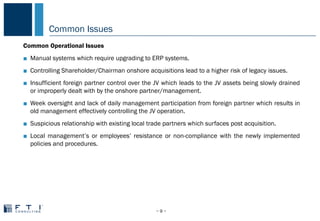
Common Issues
− 5 −
COMMON PROBLEMS IN CHINA
Lack of Financial Reporting Integrity
■ Multiple sets of financial statements exist in order to (a) minimize local both VAT and income tax (b) to
obtain loans or maintain existing covenants and (c) external reporting purposes i.e. Stock Exchanges,
JV Partners etc.
■ In the past financial misstatements were an area of focus for short sellers which lead to SAIC
restricting access to company financial statements unless a Court Order has been granted.
■ Land valuations are subjective and controlled by local land bureau. It is well known that local land
values which just so happen to be licensed by the Land Bureau are guided as to price range. This can
be particular important from a lending collateral perspective.
■ Delays in obtaining VAT invoices (cashflow and crystallization of tax liability) from suppliers create an
internal “suspense account” (i.e. goods have been received and paid for but the supplier has yet to
issue a fapiao or is unable too (i.e. small venders dealing in cash). Typically this creates a “prepaid
asset account”. Once the fapiao is received it can be expensed and reversed out as a prepaid asset.
■ Fictitious debtors and heavily intertwined intercompany transactions (i.e. Project Waterproof). The more
integrated the business the higher risk that intercompany transactions can be manipulated.
■ The money Merry Go Round - Suspicious timing of debtor payments prior to reporting periods gives rise
to suspicions that debtors may be controlled by related parties.
Common Issues
− 6 −
COMMON PROBLEMS IN CHINA
Lack of Financial Reporting Integrity
■ Potential undisclosed balance sheet liabilities in the form of underground high interest loans.
■ R&D expenditure is rarely accounted for correctly. On a recent engagement production waste was
classified as R&D in order to create the illusion of healthy gross margins. This was a listed company in
HK and its accounts were audited by a Big 4 accounting firm.
■ It is not unusual for PRC companies to maintain 20-30 bank accounts at a time. Cash balances can
often be inflated via complex localized banking relationships and hence falsified records
■ History has shown external audited financial statements cannot be relied upon (Sino Forrest / Akai
Group / Moulin Eyewear and the list goes on).
■ Inadequate cost benefit analysis regarding CAPEX and M&A decisions. “Build it and they will come”.
■ CAPEX approval is dictated by the Chairman/Founder and is rarely challenged (Project Waterproof)
■ Potential contingent liabilities regarding cross guarantees securing an unrelated company’s bank
facilities. This is common practice in China.
■ Underpayment of social security is common at the request of workers.
■ Product costing is virtually non existant.
Common Issues
− 7 −
COMMON PROBLEMS IN CHINA
Common Operational Issues
■ Typically family founder businesses established in the Founders city “Don’t underestimate the
home ground advantage and don’t overestimate your relationship with your local partner.
■ It is often difficult for foreign investors to gain traction with local management in order to facilitate
change. This can lead to differences in strategic direction therefore it is integral that controls
(board appointments, legal rep, possession of chops) are implement to protect foreign investors.
■ Procurement leakage, kick backs, uncompetitive tender processes and a general lack of period
supplier reviews. Therefore its essential to undertake a review of the procurement process
including sample testing in order to develop and implement a robust SOP.
■ Complex labor laws and any breaches of same can result in substantial contingent liabilities
therefore it is important to ensure all employees have a current Labor Contract.
■ Occupational health and safety standards my not met foreign parties standards and may be
required to be reviewed in line
■ Anti-Bribery laws are contradictory to the underlying Guangxi culture and therefore training
programs are essential to educate local staff
■ Weak controls, approvals and analysis regarding staff reimbursements.
■ Government bureau relationships remain with the founder and not transferable.
Common Issues
− 8 −
COMMON PROBLEMS IN CHINA
Common Operational Issues
■ Unpredictability of local governments. For example you need to ensure that a future road has
been penciled in on the land use rights acquired. This will not be disclosed on the land
certificates only inquiries with the local land bureau can confirm that such plans exist or don’t
exist.
■ Business is operating within the scope outlined in the respective business license and any
specific licenses required are in good standing..
■ Typically poor internal controls surrounding the company chops, contract chop and finance chop.
■ Poor internal documentation, lack of ERP systems and a heavy reliance upon manual systems
creates greater probability of reporting errors. In addition typically critical data and information
cannot be efficiently extracted in a timely manner to assist decision making.
■ Typically no formal SOPs exist. Process are known but not documented. In addition neither policy
training or periodic reviews and adjustment of policies are undertaken.
■ Given the typical informal management style often management are not provided clearly defined
responsibilities, deliverables and KPIs which should be linked to remuneration.
■ SOPs have to be developed and localized to ensure they are commercial and work in practice.
Common Issues
− 9 −
COMMON PROBLEMS IN CHINA
Common Operational Issues
■ Manual systems which require upgrading to ERP systems.
■ Controlling Shareholder/Chairman onshore acquisitions lead to a higher risk of legacy issues.
■ Insufficient foreign partner control over the JV which leads to the JV assets being slowly drained
or improperly dealt with by the onshore partner/management.
■ Week oversight and lack of daily management participation from foreign partner which results in
old management effectively controlling the JV operation.
■ Suspicious relationship with existing local trade partners which surfaces post acquisition.
■ Local management’s or employees’ resistance or non-compliance with the newly implemented
policies and procedures.
Case Study – Moulin Global Eyecare
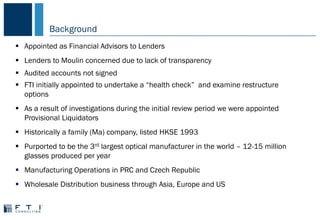
Background
 Appointed as Financial Advisors to Lenders
 Lenders to Moulin concerned due to lack of transparency
 Audited accounts not signed
 FTI initially appointed to undertake a “health check” and examine restructure
options
 As a result of investigations during the initial review period we were appointed
Provisional Liquidators
 Historically a family (Ma) company, listed HKSE 1993
 Purported to be the 3rd largest optical manufacturer in the world – 12-15 million
glasses produced per year
 Manufacturing Operations in PRC and Czech Republic
 Wholesale Distribution business through Asia, Europe and US
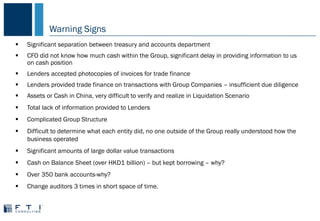
Warning Signs
 Significant separation between treasury and accounts department
 CFO did not know how much cash within the Group, significant delay in providing information to us
on cash position
 Lenders accepted photocopies of invoices for trade finance
 Lenders provided trade finance on transactions with Group Companies – insufficient due diligence
 Assets or Cash in China, very difficult to verify and realize in Liquidation Scenario
 Total lack of information provided to Lenders
 Complicated Group Structure
 Difficult to determine what each entity did, no one outside of the Group really understood how the
business operated
 Significant amounts of large dollar value transactions
 Cash on Balance Sheet (over HKD1 billion) – but kept borrowing – why?
 Over 350 bank accounts-why?
 Change auditors 3 times in short space of time.
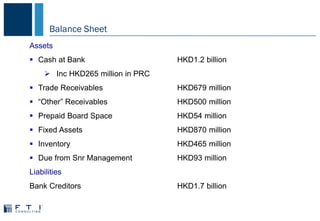
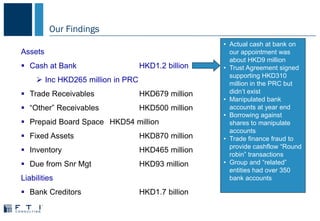
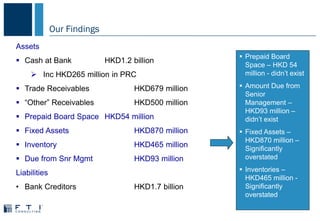
Assets
 Cash at Bank HKD1.2 billion
 Inc HKD265 million in PRC
 Trade Receivables HKD679 million
 “Other” Receivables HKD500 million
 Prepaid Board Space HKD54 million
 Fixed Assets HKD870 million
 Inventory HKD465 million
 Due from Snr Management HKD93 million
Liabilities
Bank Creditors HKD1.7 billion
Balance Sheet
• Actual cash at bank on
our appointment was
about HKD9 million
• Trust Agreement signed
supporting HKD310
million in the PRC but
didn’t exist
• Manipulated bank
accounts at year end
• Borrowing against
shares to manipulate
accounts
• Trade finance fraud to
provide cashflow “Round
robin” transactions
• Group and “related”
entities had over 350
bank accounts
Assets
 Cash at Bank HKD1.2 billion
 Inc HKD265 million in PRC
 Trade Receivables HKD679 million
 “Other” Receivables HKD500 million
 Prepaid Board Space HKD54 million
 Fixed Assets HKD870 million
 Inventory HKD465 million
 Due from Snr Mgt HKD93 million
Liabilities
 Bank Creditors HKD1.7 billion
Our Findings
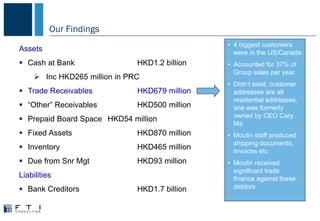
• 4 biggest customers
were in the US/Canada
• Accounted for 37% of
Group sales per year
• Didn’t exist, customer
addresses are all
residential addresses,
one was formerly
owned by CEO Cary
Ma
• Moulin staff produced
shipping documents,
invoices etc
• Moulin received
significant trade
finance against these
debtors
Assets
 Cash at Bank HKD1.2 billion
 Inc HKD265 million in PRC
 Trade Receivables HKD679 million
 “Other” Receivables HKD500 million
 Prepaid Board Space HKD54 million
 Fixed Assets HKD870 million
 Inventory HKD465 million
 Due from Snr Mgt HKD93 million
Liabilities
 Bank Creditors HKD1.7 billion
Our Findings
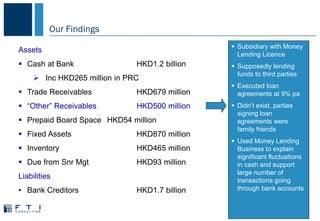
 Subsidiary with Money
Lending Licence
 Supposedly lending
funds to third parties
 Executed loan
agreements at 9% pa
 Didn’t exist, parties
signing loan
agreements were
family friends
 Used Money Lending
Business to explain
significant fluctuations
in cash and support
large number of
transactions going
through bank accounts
Assets
 Cash at Bank HKD1.2 billion
 Inc HKD265 million in PRC
 Trade Receivables HKD679 million
 “Other” Receivables HKD500 million
 Prepaid Board Space HKD54 million
 Fixed Assets HKD870 million
 Inventory HKD465 million
 Due from Snr Mgt HKD93 million
Liabilities
• Bank Creditors HKD1.7 billion
Our Findings
Our Findings
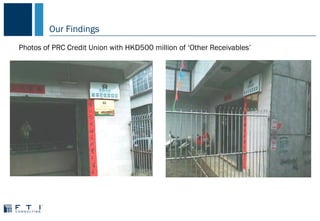
Photos of PRC Credit Union with HKD500 million of ‘Other Receivables’
 Prepaid Board
Space – HKD 54
million - didn’t exist
 Amount Due from
Senior
Management –
HKD93 million –
didn’t exist
 Fixed Assets –
HKD870 million –
Significantly
overstated
 Inventories –
HKD465 million -
Significantly
overstated
Assets
 Cash at Bank HKD1.2 billion
 Inc HKD265 million in PRC
 Trade Receivables HKD679 million
 “Other” Receivables HKD500 million
 Prepaid Board Space HKD54 million
 Fixed Assets HKD870 million
 Inventory HKD465 million
 Due from Snr Mgmt HKD93 million
Liabilities
• Bank Creditors HKD1.7 billion
Our Findings
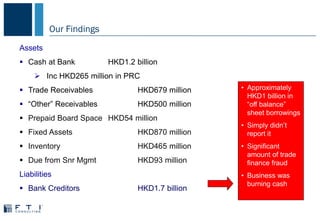
• Approximately
HKD1 billion in
“off balance”
sheet borrowings
• Simply didn’t
report it
• Significant
amount of trade
finance fraud
• Business was
burning cash
Assets
 Cash at Bank HKD1.2 billion
 Inc HKD265 million in PRC
 Trade Receivables HKD679 million
 “Other” Receivables HKD500 million
 Prepaid Board Space HKD54 million
 Fixed Assets HKD870 million
 Inventory HKD465 million
 Due from Snr Mgmt HKD93 million
Liabilities
 Bank Creditors HKD1.7 billion
Our Findings
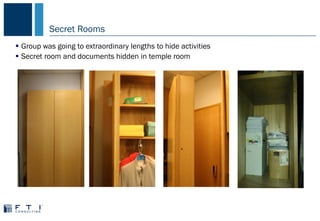
Secret Rooms
 Group was going to extraordinary lengths to hide activities
 Secret room and documents hidden in temple room
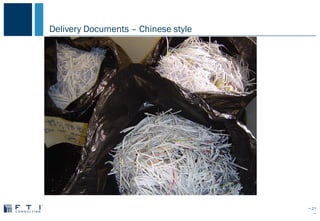
Delivery Documents – Chinese style
− 21
−
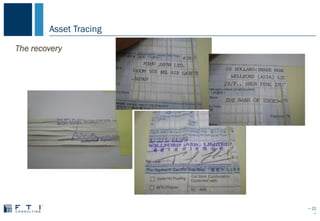
Asset Tracing
The recovery
− 22
−
Marcus Paciocco
Managing Director
Shanghai
23
+86 21 2315 1188 direct
marcus.paciocco@fticonsulting.com
Education
B.Bus, Marketing ,
Swinburne University
B.Bus, Accounting,
Monash University
B.Bus, Banking and
Finance, Monash
University
Certifications
Member of the Institute
of Chartered
Accountants Australia
Professional Affiliations
Institute of Chartered
Accountants Australia
Marcus Paciocco is a Managing Director in the Corporate
Finance/Restructuring segment of FTI Consulting and he is based in
Shanghai. Mr. Paciocco relocated to China over six years ago and possesses
over a decade of experience specializing in the fields of forensics, financial
advisory services and interim management.
Mr. Paciocco focuses specifically on China-based engagements and
represents a broad range of clients including international and local private
equity funds, mezzanine debt funds and various domestic and foreign
counsels. He has an in-depth understanding of Chinese culture, business
practices and operations.
Mr. Paciocco’s recent experience includes:
Financial Advisor to the Board of Directors of Hanfeng Evergreen Inc
(TO:HF) regarding taking control of its PRC subsidiaries. Appointed Legal
Representative of two (2) subsidiaries located in Heilongjiang and Jiangsu
Provinces in order to take control and realize value.
Appointed by Solar Enertech Limited as its Chief Restructuring Officer
(SOEN:OTC US).
Liquidation, interim management, restructuring and relisting of Tack Fat
International Group (HK:928).
Managed the onshore restructuring of CIT Leasing’s RMB2billion facility
following the bankruptcy of its US parent.
Liquidation and realization of the PRC subsidiaries’ of various S-Chips and
AIM listed companies including (a) Celestial Nutrifoods Limited, a soybean
manufacturer located in Daqing, Heilongjiang, P.R.C (b) KXD Digital
Entertainment Limited, manufacturer of multimedia devices located in
Shenzhen, Guangdong, P.R.C (c) Guangzhao Industrial Forest
Biotechnology Group Limited, R&D business focusing on fast growing tree
plantations located throughout the P.R.C and (d) Dongfang Shipping
(Group) Company Limited, ship building operations located in Anhui and
Jiangsu Provinces, P.R.C.
Appointed legal representative of GSF Capital’s onshore subsidiary
following the appointment of a Receiver & Manager over its shareholder.
The purpose of the appointment was to investigate the existence of a
EUR560m bond utilized to secure funding for a joint Solar Fund with
Suntech.
Appointed Chief Restructuring Officer of Prince Sporting Goods
(Guangzhou) Limited in order to wind down the operations following the
purchase of its US parent by the client.
Financial Advisor to secured lenders of a USD80m facility regarding a
recently privatized SGX group. This engagement required the appointment
of onshore directors, interim management and eventual realization of two
(2) operating subsidiaries in the renewable energy space located in
Shandong and Henan Provinces..
Before relocating to Asia, Mr. Paciocco worked for a 'Big 4' accounting firm
in the Cayman Islands. Mr. Paciocco was seconded to Unicredit Bank
(Cayman Islands) to manage the organised wind down and closure of its
banking operation and held the position of Vice President of Operations
throughout the process.
Mr. Paciocco has a B.Bus in Marketing from Swinburne University, a
B.Bus in Accounting and a B.Bus in Banking and Finance from Monash
University. He and is a member of the Institute of Chartered Accountants
Australia
Critical Thinking at the Critical Time™

M&A Conference 130416

  • 1.
    Marcus N Paciocco ManagingDirector FTI Consulting CHINA DUE DILLIGENCE AND TRANSACTIONAL ISSUES A client once described China as “a place where nothing is allowed, but everything is possible”.
  • 2.
    FTI Consulting: ALeader Among Leaders FCNPublicly traded – NYSE $2+ BLNNYSE listed enterprise value 1982Year founded 80Different disciplines 4200+Employees worldwide 700+Industry Specialists 450+Senior Managing Directors 3 10/10Advisor to the top 10 world’s top bank holding companies 95/100Advisor to 95 of the world’s top 100 law firms 4545 of all Fortune 100 corporations are clients −2− Nobel Laureates
  • 3.
    Discussion Topics 3 ■ DealProcess ■ Common financial and operational issues ■ Case Study – Liquidation of Moulin Global Eyecare
  • 4.
    Deal Process Financial Reputational& FCPA Due Diligence Review Representations and Warranties to provide limited comfort for deficiencies identified Post Merger/Acquisition Integration • Often investors are attempting to limit the scope of the FDD work in order to (a) minimize costs and (b) limit the probability of finding deal killers, however by allowing a wider scope this gives greater leverage to the investor to negotiate a lower price. • Investors overlook the importance of reputational due diligence on key principles and the company. • The FDD review should begin to identify potential post acquisition issues (i.e. documentation, processes and controls). • Undertake an FCPA risk assessment and review. • Representations and Warranties provided limited comfort should not be relied upon. • FOCUS ON CONROL AND DOOMSDAY SENARIO • This is particularly important if full transparency was noted provided. • Optimally at this time a high level review and GAP assessment should be conducted to identify – Where we are now? and Where we need to be in relation to all processes and functions of the business. • Process Mapping and GAP Analysis • Classify and prioritize burning platform issues (i.e. a Triage System). • PMI team members allocated responsibilities and deliverables. • Don’t get bogged down with day to day operations. Hence a separate PMI team is preferable and more effective. • Identify key personal that can be “Change Leaders”.
  • 5.
    Common Issues − 5− COMMON PROBLEMS IN CHINA Lack of Financial Reporting Integrity ■ Multiple sets of financial statements exist in order to (a) minimize local both VAT and income tax (b) to obtain loans or maintain existing covenants and (c) external reporting purposes i.e. Stock Exchanges, JV Partners etc. ■ In the past financial misstatements were an area of focus for short sellers which lead to SAIC restricting access to company financial statements unless a Court Order has been granted. ■ Land valuations are subjective and controlled by local land bureau. It is well known that local land values which just so happen to be licensed by the Land Bureau are guided as to price range. This can be particular important from a lending collateral perspective. ■ Delays in obtaining VAT invoices (cashflow and crystallization of tax liability) from suppliers create an internal “suspense account” (i.e. goods have been received and paid for but the supplier has yet to issue a fapiao or is unable too (i.e. small venders dealing in cash). Typically this creates a “prepaid asset account”. Once the fapiao is received it can be expensed and reversed out as a prepaid asset. ■ Fictitious debtors and heavily intertwined intercompany transactions (i.e. Project Waterproof). The more integrated the business the higher risk that intercompany transactions can be manipulated. ■ The money Merry Go Round - Suspicious timing of debtor payments prior to reporting periods gives rise to suspicions that debtors may be controlled by related parties.
  • 6.
    Common Issues − 6− COMMON PROBLEMS IN CHINA Lack of Financial Reporting Integrity ■ Potential undisclosed balance sheet liabilities in the form of underground high interest loans. ■ R&D expenditure is rarely accounted for correctly. On a recent engagement production waste was classified as R&D in order to create the illusion of healthy gross margins. This was a listed company in HK and its accounts were audited by a Big 4 accounting firm. ■ It is not unusual for PRC companies to maintain 20-30 bank accounts at a time. Cash balances can often be inflated via complex localized banking relationships and hence falsified records ■ History has shown external audited financial statements cannot be relied upon (Sino Forrest / Akai Group / Moulin Eyewear and the list goes on). ■ Inadequate cost benefit analysis regarding CAPEX and M&A decisions. “Build it and they will come”. ■ CAPEX approval is dictated by the Chairman/Founder and is rarely challenged (Project Waterproof) ■ Potential contingent liabilities regarding cross guarantees securing an unrelated company’s bank facilities. This is common practice in China. ■ Underpayment of social security is common at the request of workers. ■ Product costing is virtually non existant.
  • 7.
    Common Issues − 7− COMMON PROBLEMS IN CHINA Common Operational Issues ■ Typically family founder businesses established in the Founders city “Don’t underestimate the home ground advantage and don’t overestimate your relationship with your local partner. ■ It is often difficult for foreign investors to gain traction with local management in order to facilitate change. This can lead to differences in strategic direction therefore it is integral that controls (board appointments, legal rep, possession of chops) are implement to protect foreign investors. ■ Procurement leakage, kick backs, uncompetitive tender processes and a general lack of period supplier reviews. Therefore its essential to undertake a review of the procurement process including sample testing in order to develop and implement a robust SOP. ■ Complex labor laws and any breaches of same can result in substantial contingent liabilities therefore it is important to ensure all employees have a current Labor Contract. ■ Occupational health and safety standards my not met foreign parties standards and may be required to be reviewed in line ■ Anti-Bribery laws are contradictory to the underlying Guangxi culture and therefore training programs are essential to educate local staff ■ Weak controls, approvals and analysis regarding staff reimbursements. ■ Government bureau relationships remain with the founder and not transferable.
  • 8.
    Common Issues − 8− COMMON PROBLEMS IN CHINA Common Operational Issues ■ Unpredictability of local governments. For example you need to ensure that a future road has been penciled in on the land use rights acquired. This will not be disclosed on the land certificates only inquiries with the local land bureau can confirm that such plans exist or don’t exist. ■ Business is operating within the scope outlined in the respective business license and any specific licenses required are in good standing.. ■ Typically poor internal controls surrounding the company chops, contract chop and finance chop. ■ Poor internal documentation, lack of ERP systems and a heavy reliance upon manual systems creates greater probability of reporting errors. In addition typically critical data and information cannot be efficiently extracted in a timely manner to assist decision making. ■ Typically no formal SOPs exist. Process are known but not documented. In addition neither policy training or periodic reviews and adjustment of policies are undertaken. ■ Given the typical informal management style often management are not provided clearly defined responsibilities, deliverables and KPIs which should be linked to remuneration. ■ SOPs have to be developed and localized to ensure they are commercial and work in practice.
  • 9.
    Common Issues − 9− COMMON PROBLEMS IN CHINA Common Operational Issues ■ Manual systems which require upgrading to ERP systems. ■ Controlling Shareholder/Chairman onshore acquisitions lead to a higher risk of legacy issues. ■ Insufficient foreign partner control over the JV which leads to the JV assets being slowly drained or improperly dealt with by the onshore partner/management. ■ Week oversight and lack of daily management participation from foreign partner which results in old management effectively controlling the JV operation. ■ Suspicious relationship with existing local trade partners which surfaces post acquisition. ■ Local management’s or employees’ resistance or non-compliance with the newly implemented policies and procedures.
  • 10.
    Case Study –Moulin Global Eyecare
  • 11.
    Background  Appointed asFinancial Advisors to Lenders  Lenders to Moulin concerned due to lack of transparency  Audited accounts not signed  FTI initially appointed to undertake a “health check” and examine restructure options  As a result of investigations during the initial review period we were appointed Provisional Liquidators  Historically a family (Ma) company, listed HKSE 1993  Purported to be the 3rd largest optical manufacturer in the world – 12-15 million glasses produced per year  Manufacturing Operations in PRC and Czech Republic  Wholesale Distribution business through Asia, Europe and US
  • 12.
    Warning Signs  Significantseparation between treasury and accounts department  CFO did not know how much cash within the Group, significant delay in providing information to us on cash position  Lenders accepted photocopies of invoices for trade finance  Lenders provided trade finance on transactions with Group Companies – insufficient due diligence  Assets or Cash in China, very difficult to verify and realize in Liquidation Scenario  Total lack of information provided to Lenders  Complicated Group Structure  Difficult to determine what each entity did, no one outside of the Group really understood how the business operated  Significant amounts of large dollar value transactions  Cash on Balance Sheet (over HKD1 billion) – but kept borrowing – why?  Over 350 bank accounts-why?  Change auditors 3 times in short space of time.
  • 13.
    Assets  Cash atBank HKD1.2 billion  Inc HKD265 million in PRC  Trade Receivables HKD679 million  “Other” Receivables HKD500 million  Prepaid Board Space HKD54 million  Fixed Assets HKD870 million  Inventory HKD465 million  Due from Snr Management HKD93 million Liabilities Bank Creditors HKD1.7 billion Balance Sheet
  • 14.
    • Actual cashat bank on our appointment was about HKD9 million • Trust Agreement signed supporting HKD310 million in the PRC but didn’t exist • Manipulated bank accounts at year end • Borrowing against shares to manipulate accounts • Trade finance fraud to provide cashflow “Round robin” transactions • Group and “related” entities had over 350 bank accounts Assets  Cash at Bank HKD1.2 billion  Inc HKD265 million in PRC  Trade Receivables HKD679 million  “Other” Receivables HKD500 million  Prepaid Board Space HKD54 million  Fixed Assets HKD870 million  Inventory HKD465 million  Due from Snr Mgt HKD93 million Liabilities  Bank Creditors HKD1.7 billion Our Findings
  • 15.
    • 4 biggestcustomers were in the US/Canada • Accounted for 37% of Group sales per year • Didn’t exist, customer addresses are all residential addresses, one was formerly owned by CEO Cary Ma • Moulin staff produced shipping documents, invoices etc • Moulin received significant trade finance against these debtors Assets  Cash at Bank HKD1.2 billion  Inc HKD265 million in PRC  Trade Receivables HKD679 million  “Other” Receivables HKD500 million  Prepaid Board Space HKD54 million  Fixed Assets HKD870 million  Inventory HKD465 million  Due from Snr Mgt HKD93 million Liabilities  Bank Creditors HKD1.7 billion Our Findings
  • 16.
     Subsidiary withMoney Lending Licence  Supposedly lending funds to third parties  Executed loan agreements at 9% pa  Didn’t exist, parties signing loan agreements were family friends  Used Money Lending Business to explain significant fluctuations in cash and support large number of transactions going through bank accounts Assets  Cash at Bank HKD1.2 billion  Inc HKD265 million in PRC  Trade Receivables HKD679 million  “Other” Receivables HKD500 million  Prepaid Board Space HKD54 million  Fixed Assets HKD870 million  Inventory HKD465 million  Due from Snr Mgt HKD93 million Liabilities • Bank Creditors HKD1.7 billion Our Findings
  • 17.
    Our Findings Photos ofPRC Credit Union with HKD500 million of ‘Other Receivables’
  • 18.
     Prepaid Board Space– HKD 54 million - didn’t exist  Amount Due from Senior Management – HKD93 million – didn’t exist  Fixed Assets – HKD870 million – Significantly overstated  Inventories – HKD465 million - Significantly overstated Assets  Cash at Bank HKD1.2 billion  Inc HKD265 million in PRC  Trade Receivables HKD679 million  “Other” Receivables HKD500 million  Prepaid Board Space HKD54 million  Fixed Assets HKD870 million  Inventory HKD465 million  Due from Snr Mgmt HKD93 million Liabilities • Bank Creditors HKD1.7 billion Our Findings
  • 19.
    • Approximately HKD1 billionin “off balance” sheet borrowings • Simply didn’t report it • Significant amount of trade finance fraud • Business was burning cash Assets  Cash at Bank HKD1.2 billion  Inc HKD265 million in PRC  Trade Receivables HKD679 million  “Other” Receivables HKD500 million  Prepaid Board Space HKD54 million  Fixed Assets HKD870 million  Inventory HKD465 million  Due from Snr Mgmt HKD93 million Liabilities  Bank Creditors HKD1.7 billion Our Findings
  • 20.
    Secret Rooms  Groupwas going to extraordinary lengths to hide activities  Secret room and documents hidden in temple room
  • 21.
    Delivery Documents –Chinese style − 21 −
  • 22.
  • 23.
    Marcus Paciocco Managing Director Shanghai 23 +8621 2315 1188 direct marcus.paciocco@fticonsulting.com Education B.Bus, Marketing , Swinburne University B.Bus, Accounting, Monash University B.Bus, Banking and Finance, Monash University Certifications Member of the Institute of Chartered Accountants Australia Professional Affiliations Institute of Chartered Accountants Australia Marcus Paciocco is a Managing Director in the Corporate Finance/Restructuring segment of FTI Consulting and he is based in Shanghai. Mr. Paciocco relocated to China over six years ago and possesses over a decade of experience specializing in the fields of forensics, financial advisory services and interim management. Mr. Paciocco focuses specifically on China-based engagements and represents a broad range of clients including international and local private equity funds, mezzanine debt funds and various domestic and foreign counsels. He has an in-depth understanding of Chinese culture, business practices and operations. Mr. Paciocco’s recent experience includes: Financial Advisor to the Board of Directors of Hanfeng Evergreen Inc (TO:HF) regarding taking control of its PRC subsidiaries. Appointed Legal Representative of two (2) subsidiaries located in Heilongjiang and Jiangsu Provinces in order to take control and realize value. Appointed by Solar Enertech Limited as its Chief Restructuring Officer (SOEN:OTC US). Liquidation, interim management, restructuring and relisting of Tack Fat International Group (HK:928). Managed the onshore restructuring of CIT Leasing’s RMB2billion facility following the bankruptcy of its US parent. Liquidation and realization of the PRC subsidiaries’ of various S-Chips and AIM listed companies including (a) Celestial Nutrifoods Limited, a soybean manufacturer located in Daqing, Heilongjiang, P.R.C (b) KXD Digital Entertainment Limited, manufacturer of multimedia devices located in Shenzhen, Guangdong, P.R.C (c) Guangzhao Industrial Forest Biotechnology Group Limited, R&D business focusing on fast growing tree plantations located throughout the P.R.C and (d) Dongfang Shipping (Group) Company Limited, ship building operations located in Anhui and Jiangsu Provinces, P.R.C. Appointed legal representative of GSF Capital’s onshore subsidiary following the appointment of a Receiver & Manager over its shareholder. The purpose of the appointment was to investigate the existence of a EUR560m bond utilized to secure funding for a joint Solar Fund with Suntech. Appointed Chief Restructuring Officer of Prince Sporting Goods (Guangzhou) Limited in order to wind down the operations following the purchase of its US parent by the client. Financial Advisor to secured lenders of a USD80m facility regarding a recently privatized SGX group. This engagement required the appointment of onshore directors, interim management and eventual realization of two (2) operating subsidiaries in the renewable energy space located in Shandong and Henan Provinces.. Before relocating to Asia, Mr. Paciocco worked for a 'Big 4' accounting firm in the Cayman Islands. Mr. Paciocco was seconded to Unicredit Bank (Cayman Islands) to manage the organised wind down and closure of its banking operation and held the position of Vice President of Operations throughout the process. Mr. Paciocco has a B.Bus in Marketing from Swinburne University, a B.Bus in Accounting and a B.Bus in Banking and Finance from Monash University. He and is a member of the Institute of Chartered Accountants Australia
  • 24.
    Critical Thinking atthe Critical Time™