Small andMedium Enterprises (SMEs) are the backbone of a country’s
economy. Indian SMEs are mostly into services and manufacturing.
Records show that they contribute to 45% of the country’s GDP and
employ over 110 million people.
But most SMEs go out of businessreally fast. It’s by now common
knowledge that about 90% of startups fail to meet their mission and
growth goals that they set out to accomplish originally.
The reasons for their non-performance are for the most part avoidable
but there are instances when they are accidental like it happened in the
aftermath of the demonetization drive in India.
SICK UNITS
Asick industrial unit may be defined as one where it
fails to generate surplus on a continuous basis and
depends upon frequent infusion of external funds for its
survival.
According to RBI, a small-scale unit should be
considered as sick if it has at the end of any accounting
year, accumulated losses equal to or exceeding 50% of
its peak net worth in the immediately preceding 5
accounting years”.
5.
The SickIndustrial Companies Act 1985 identifies sickness
in terms of cash losses for two consecutive financial years
and accumulated losses equalling or exceeding the net worth
of the company at the end of the second financial year.
Sickness, in industry therefore, indicates more or less a
perfect positive correlation with profitability, liquidity and
solvency.
The reasons of industrial sickness can be either internal or
external.
6.
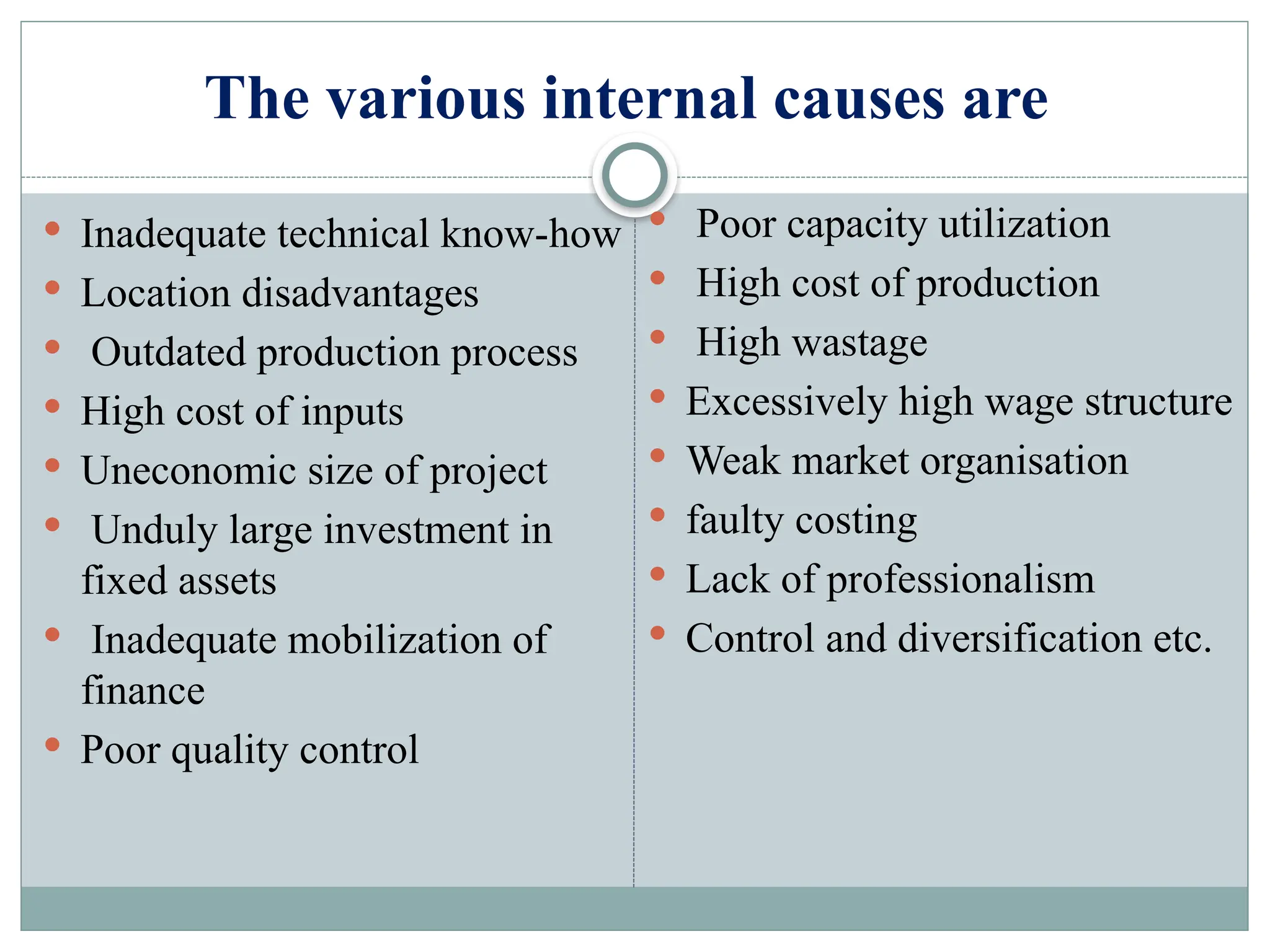
The various internalcauses are
Inadequate technical know-how
Location disadvantages
Outdated production process
High cost of inputs
Uneconomic size of project
Unduly large investment in
fixed assets
Inadequate mobilization of
finance
Poor quality control
Poor capacity utilization
High cost of production
High wastage
Excessively high wage structure
Weak market organisation
faulty costing
Lack of professionalism
Control and diversification etc.
7.
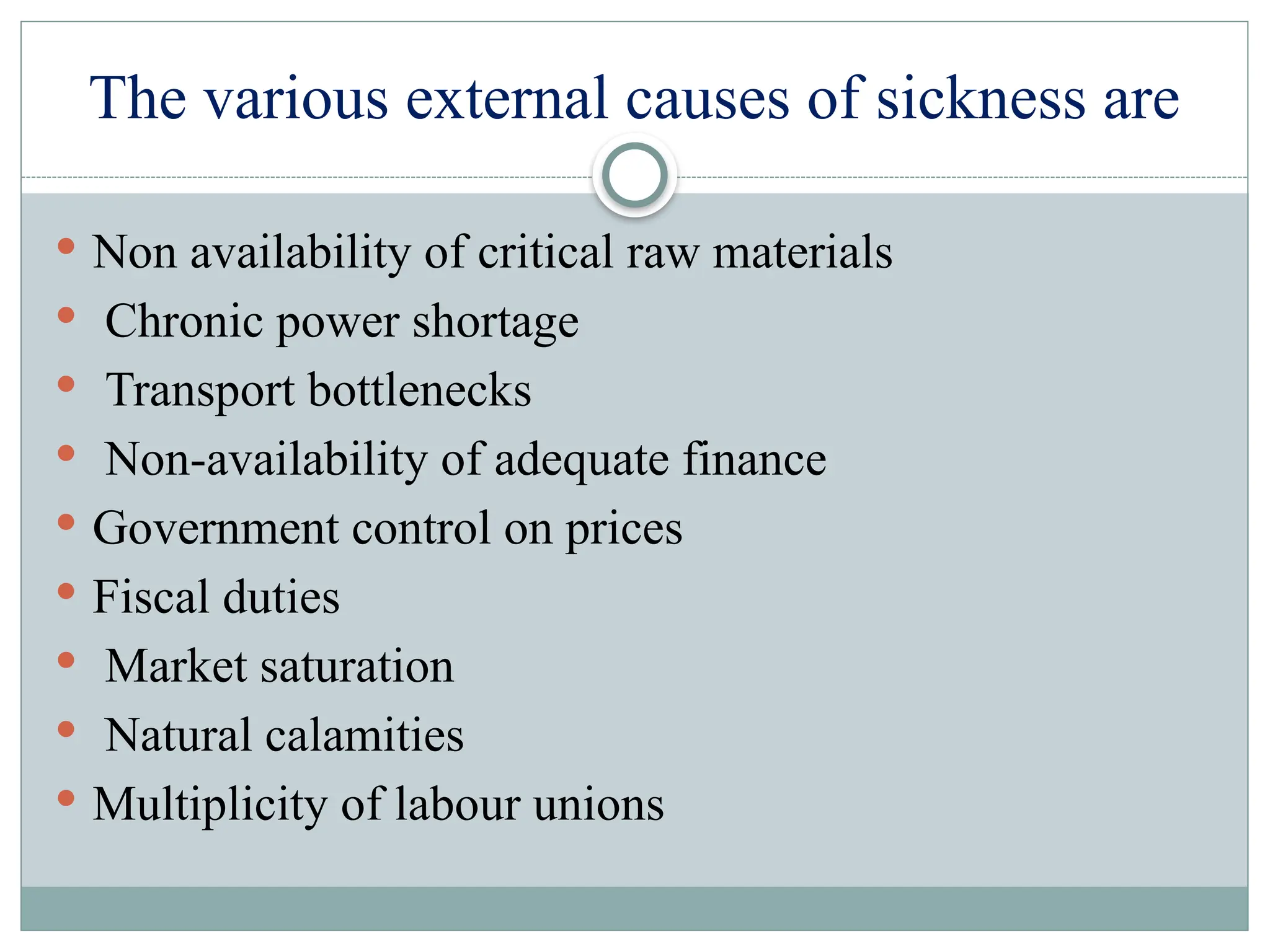
The various externalcauses of sickness are
Non availability of critical raw materials
Chronic power shortage
Transport bottlenecks
Non-availability of adequate finance
Government control on prices
Fiscal duties
Market saturation
Natural calamities
Multiplicity of labour unions
Revival and Rehabilitationof Sick Companies
The Ministry of Corporate Affairs has formulated the
framework for Revival and Rehabilitation of Sick Companies
under the Companies Act.
This framework intends to timely detect the sickness and take
appropriate measures for revival of sick companies.
To tackle the problems of industrial sickness, the government
has established specific institutions. These institutions are
12.
1. Establishment ofIndustrial Investment Bank of India Limited
Functions assigned to IIBIL are as follows:
(i) to provide financial assistance to sick industrial units.
(ii) to provide managerial and technical assistance to sick
industrial units
(iii) to secure assistance of other financial institutions and
government agencies for ensuring the revival and rehabilitation
of sick industrial units.
(iv) to provide merchants banking service for amalgamation,
merger etc.
(v) to provide consultancy services to banks in matters relating to
sick industrial units.
13.
2. Board forIndustrial and Finance Reconstruction (BIFR):
On the basis of recommendations given by the Thiwari
Committee,(1985) government introduced Sick Industrial
Companies Act (SICA).
The main objective of SICA is to determine sickness and
expedite the revival of potentially viable units or closure of
unviable units.
And later on in January 1987, a statutory institution named Board
for Industrial and Financial Reconstruction (BIFR) was setup.
14.
3. Steps takenby the Reserve Bank of India :
The RBI take timely and adequate assistance to potentially viable
MSE units which have already become sick or are likely to
become sick is of the utmost importance
As per the new guidelines, a MSE would be considered sick if any
of the borrowal account of the enterprise remains non-performing
assets (NPA) for three months or more.
The Reserve Bank also closely monitored certain specific
industries where sickness is more widespread.
4.Government schemes and assistance from other banks
15.
REMEDIAL MEASURES FORINDUSTRIAL SICKNESS
1 Checking of the viability of structure of new Enterprise
2. Correct valuation of problems
3. Helping in solving of short-term problems
4. Swift government help
5. Proper inspection management
6. Merger of sick units with healthy units
7. Necessity of management training
8. Take over by the government
9. Financial attempts
16.
Revival And RehabilitationOf Sick Companies
Chapter XIX of the Companies Act, 2013 deals with revival and
rehabilitation of sick companies. It exclusively covers the provisions for
Determination of sickness
Application for revival and rehabilitation
Appointment of interim administrator
Committee of creditors
Appointment of administrator
Powers and duties of company administrator
Scheme for revival and rehabilitation
Sanction of scheme
Implementation of scheme
Winding up of company on the report of certain administrators
Penalty
17.
Determination of Sickness
On the receipt of the application from the secured
creditor(the company has failed to pay the debt within a
period of thirty days of the service of the notice of
demand ), then the tribunal shall decide within sixty days
on to the merit of the application that whether a company
has become sick or not.
Once the tribunal is satisfied that a company has become
a sick company, and it is in a position to repay its debts,
within a reasonable time, it shall order the company to
repay its debts.
On satisfaction, the tribunal shall give a reasonable time
to the company to make payment of its debts.
18.
Application for revivaland rehabilitation
Any company that has been determined as sick company under section 253
of the Act can make an application to the tribunal to order for necessary
steps to be taken for its revival and rehabilitation and the application shall
be accompanied by-
Audited financial statements of the company relating to the immediately
preceding financial year;
Such particulars and documents, duly authenticated in such manner, along
with such fees as may be prescribed.
A draft scheme for revival and rehabilitation of the company in such
manner as may be prescribed.
The application shall be made to the tribunal within sixty days from the date
of determination of the company as a sick company by the tribunal under
section 253 of the Companies Act, 2013.
19.
Appointment of InterimAdministrator
According to section 256 of the Act, as soon as an
application is made under section 254 of the Act, the
Tribunal shall fix a date of hearing and appoint an interim
administrator who shall within 45 days of his appointment
fix a meeting with the creditors of the company and
prepare a draft scheme for revival and present it before
the tribunal within sixty days from the meeting.
20.
Committee of Creditors
According to section 257, an interim administrator shall
appoint a committee of creditors such number of creditors
as he may determine but shall not exceed seven and these
members shall meet in all the meetings and the interim
administrator may direct all the promoters, directors, key
managerial personnel of the company to come in any
meeting and furnish such information as is required and
necessary.
21.
Order of tribunal
In case of the revival and rehabilitation of the sick
company is not possible, the tribunal would order that the
proceedings for the winding up of the company to initiate.
In case of revival and rehabilitation of the sick company
is possible, the tribunal would appoint a company
administrator for the company to prepare a scheme for
revival and rehabilitation of a company by adopting
certain measures.
22.
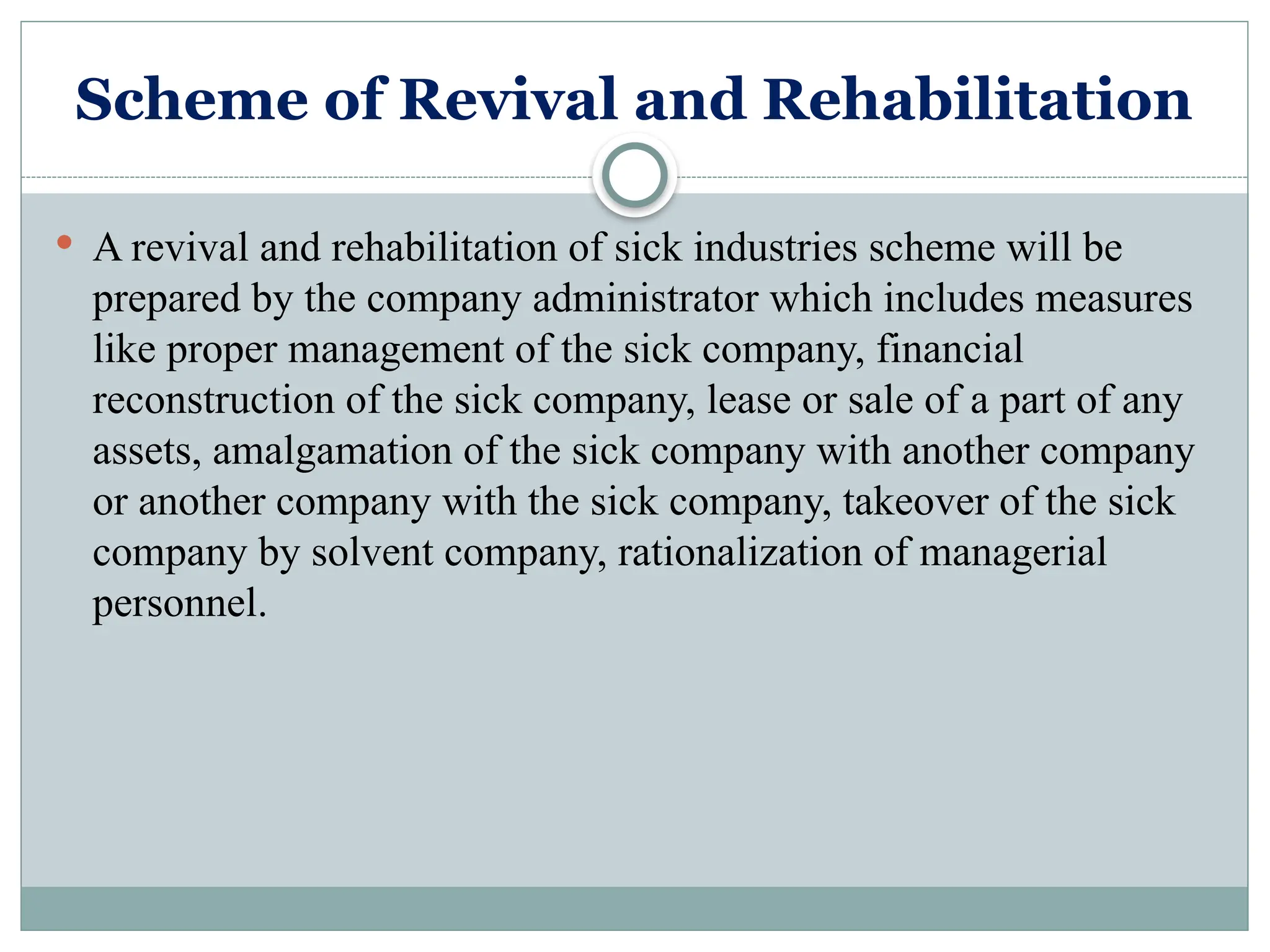
Scheme of Revivaland Rehabilitation
A revival and rehabilitation of sick industries scheme will be
prepared by the company administrator which includes measures
like proper management of the sick company, financial
reconstruction of the sick company, lease or sale of a part of any
assets, amalgamation of the sick company with another company
or another company with the sick company, takeover of the sick
company by solvent company, rationalization of managerial
personnel.
23.
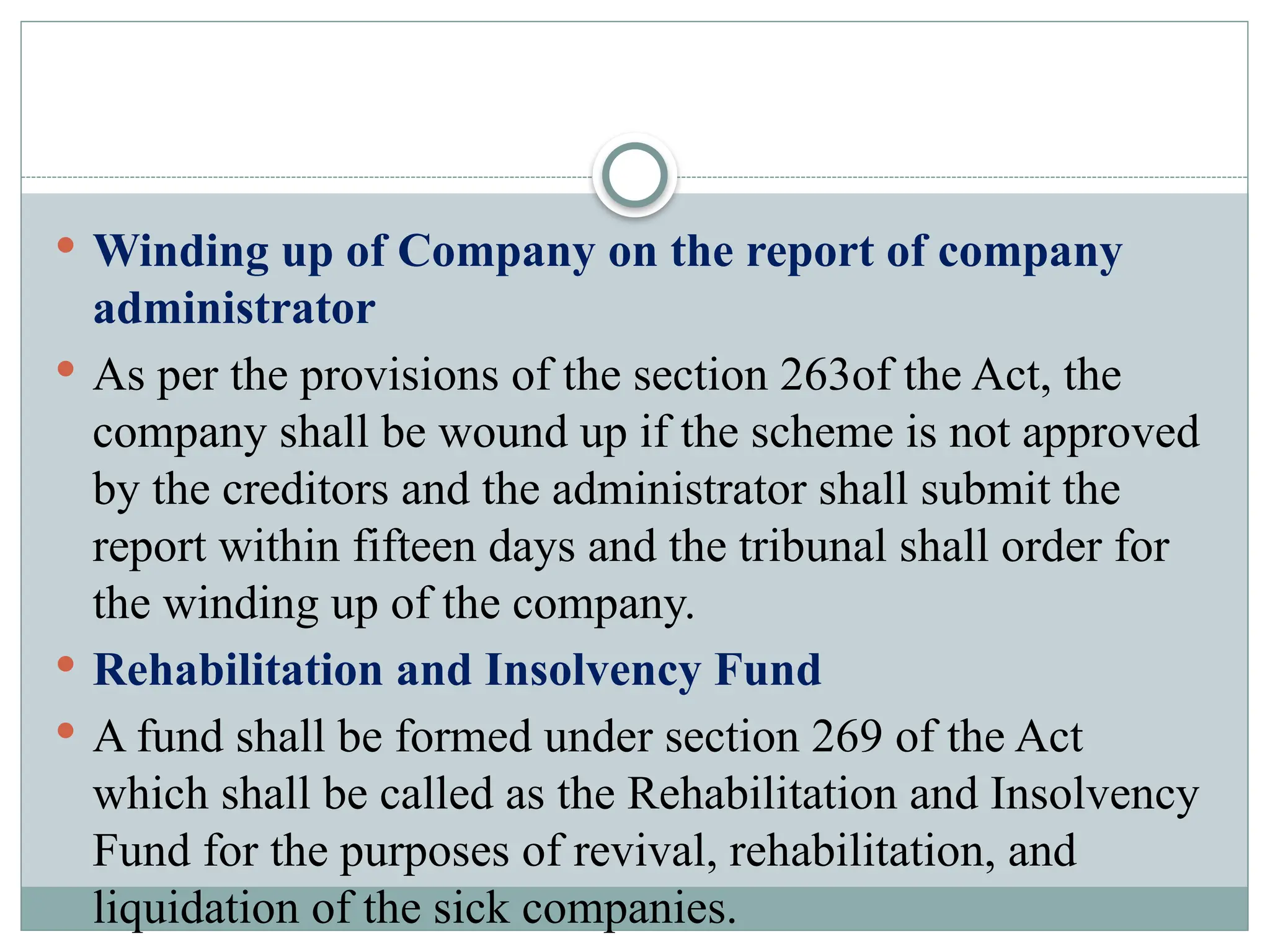
Winding upof Company on the report of company
administrator
As per the provisions of the section 263of the Act, the
company shall be wound up if the scheme is not approved
by the creditors and the administrator shall submit the
report within fifteen days and the tribunal shall order for
the winding up of the company.
Rehabilitation and Insolvency Fund
A fund shall be formed under section 269 of the Act
which shall be called as the Rehabilitation and Insolvency
Fund for the purposes of revival, rehabilitation, and
liquidation of the sick companies.



![INDUSTRIAL SICKNESS IN INDIA.PPT [ INDIAN ECONOMY BASED ]](https://cdn.slidesharecdn.com/ss_thumbnails/industrialsicknessinindia-250201171500-3c348c1b-thumbnail.jpg?width=640&height=640&fit=bounds)


