Security Best Practices in
System Integration
Hiezel Anne Libreas, Erika Mullet.
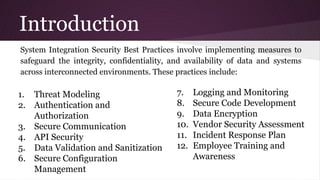
Introduction
1. Threat Modeling
2. Authentication and
Authorization
3. Secure Communication
4. API Security
5. Data Validation and Sanitization
6. Secure Configuration
Management
7. Logging and Monitoring
8. Secure Code Development
9. Data Encryption
10. Vendor Security Assessment
11. Incident Response Plan
12. Employee Training and
Awareness
System Integration Security Best Practices involve implementing measures to
safeguard the integrity, confidentiality, and availability of data and systems
across interconnected environments. These practices include:
Threat Modeling
- Identify potential threats and
Vulnerabilities in the integration
process to prioritize security
measures effectively.
Authentication & Authorization
- Implement strong authentication
mechanisms such as multi-factor
authentication (MFA) and role-based access
control (RBAC) to ensure that only
authorized users and systems can acces
integrated resources.
Secure Communication
- Use encryption protocols such as
TLS/SSL for data transmission
between integrated systems to
prevent eavesdropping and
tampering.
API Security
- Secure APIs with proper authentication,
access controls, input validation, and rate
limiting to protect against unautorized
access, injection attacks, and denial-of-
services (DoS) attacks.
Data Validation & Sanitization
- Validate and sanitize input data to
prevent injection attacks such as
SQL injection, XML injection, and
cross-site scripting (XSS) attacks.
Logging & Monitoring
- Implement comprehensive logging and
monitoring mechanisms to detect and
respond to security incidents in real-time,
including unauthorized access, attemps,
abnormal behavior, and system failures.
Secure Code Development
- Follow secure coding practices and
conduct regular security code reviews
to identify and remediate vulnirabilities
in custom integration code.
Data Encryption
- Encrypt sensitive data at rest using
strong encryption algorithms to
prevent unauthorized access in case of
data breaches or unauthorized access to
storage system.
Vendor Security Assessment
- Assess the security posture of third-party
vendors and service prociders involved in
the integration procesto ensure they meet
security standards and complience
requirements.
Incident Response Plan
- Develop and maintain an incident plan
outlining procedures for detecting,
responding to, and recovering from
security incidents related to system
integration.
Employee Training and Awareness
- Provide regular training and awareness
programs to employees involved in system
integration to educate them about security
best practices, common threats, and their
roles in maintaining system security.
Thankyou

SIA2(Security Best Practices in System Integration).pptx

  • 1.
    Security Best Practicesin System Integration Hiezel Anne Libreas, Erika Mullet.
  • 2.
    Introduction 1. Threat Modeling 2.Authentication and Authorization 3. Secure Communication 4. API Security 5. Data Validation and Sanitization 6. Secure Configuration Management 7. Logging and Monitoring 8. Secure Code Development 9. Data Encryption 10. Vendor Security Assessment 11. Incident Response Plan 12. Employee Training and Awareness System Integration Security Best Practices involve implementing measures to safeguard the integrity, confidentiality, and availability of data and systems across interconnected environments. These practices include:
  • 3.
    Threat Modeling - Identifypotential threats and Vulnerabilities in the integration process to prioritize security measures effectively.
  • 4.
    Authentication & Authorization -Implement strong authentication mechanisms such as multi-factor authentication (MFA) and role-based access control (RBAC) to ensure that only authorized users and systems can acces integrated resources.
  • 5.
    Secure Communication - Useencryption protocols such as TLS/SSL for data transmission between integrated systems to prevent eavesdropping and tampering.
  • 6.
    API Security - SecureAPIs with proper authentication, access controls, input validation, and rate limiting to protect against unautorized access, injection attacks, and denial-of- services (DoS) attacks.
  • 7.
    Data Validation &Sanitization - Validate and sanitize input data to prevent injection attacks such as SQL injection, XML injection, and cross-site scripting (XSS) attacks.
  • 8.
    Logging & Monitoring -Implement comprehensive logging and monitoring mechanisms to detect and respond to security incidents in real-time, including unauthorized access, attemps, abnormal behavior, and system failures.
  • 9.
    Secure Code Development -Follow secure coding practices and conduct regular security code reviews to identify and remediate vulnirabilities in custom integration code.
  • 10.
    Data Encryption - Encryptsensitive data at rest using strong encryption algorithms to prevent unauthorized access in case of data breaches or unauthorized access to storage system.
  • 11.
    Vendor Security Assessment -Assess the security posture of third-party vendors and service prociders involved in the integration procesto ensure they meet security standards and complience requirements.
  • 12.
    Incident Response Plan -Develop and maintain an incident plan outlining procedures for detecting, responding to, and recovering from security incidents related to system integration.
  • 13.
    Employee Training andAwareness - Provide regular training and awareness programs to employees involved in system integration to educate them about security best practices, common threats, and their roles in maintaining system security.
  • 14.