September 7, 2011SHRM Poll: Drug Testing EfficacyIn collaboration with and commissioned by the Drug & Alcohol Testing Industry Association (DATIA)
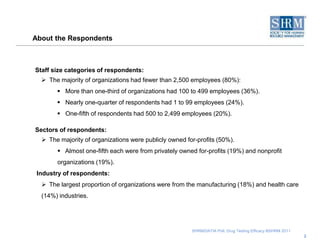
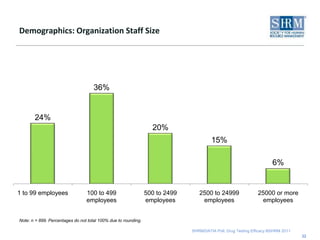
2About the RespondentsStaff size categories of respondents: The majority of organizations had fewer than 2,500 employees (80%):
More than one-third of organizations had 100 to 499 employees (36%).
Nearly one-quarter of respondents had 1 to 99 employees (24%).
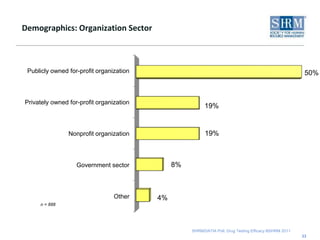
One-fifth of respondents had 500 to 2,499 employees (20%).Sectors of respondents:The majority of organizations were publicly owned for-profits (50%).
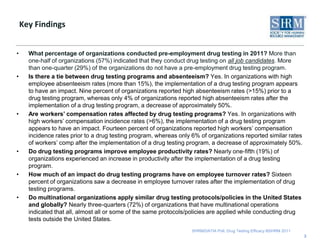
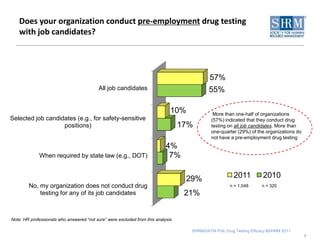
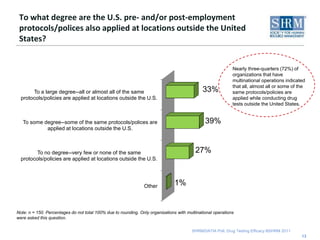
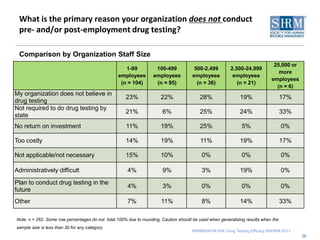
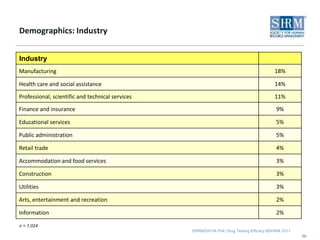
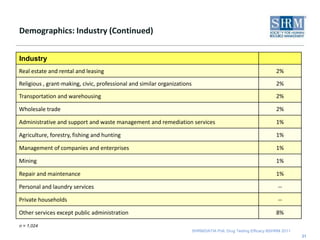
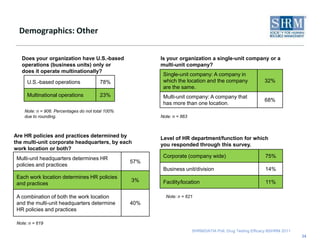
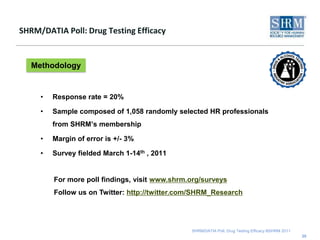
Almost one-fifth each were from privately owned for-profits (19%) and nonprofit organizations (19%).  Industry of respondents:The largest proportion of organizations were from the manufacturing (18%) and health care (14%) industries.Key FindingsWhat percentage of organizations conducted pre-employment drug testing in 2011? More than one-half of organizations (57%) indicated that they conduct drug testing on all job candidates. More than one-quarter (29%) of the organizations do not have a pre-employment drug testing program. Is there a tie between drug testing programs and absenteeism? Yes. In organizations with high employee absenteeism rates (more than 15%), the implementation of a drug testing program appears to have an impact. Nine percent of organizations reported high absenteeism rates (>15%) prior to a drug testing program, whereas only 4% of organizations reported high absenteeism rates after the implementation of a drug testing program, a decrease of approximately 50%.Are workers’ compensation rates affected by drug testing programs? Yes. In organizations with high workers’ compensation incidence rates (>6%), the implementation of a drug testing program appears to have an impact. Fourteen percent of organizations reported high workers’ compensation incidence rates prior to a drug testing program, whereas only 6% of organizations reported similar rates of workers’ comp after the implementation of a drug testing program, a decrease of approximately 50%.Do drug testing programs improve employee productivity rates? Nearly one-fifth (19%) of organizations experienced an increase in productivity after the implementation of a drug testing program.How much of an impact do drug testing programs have on employee turnover rates? Sixteen percent of organizations saw a decrease in employee turnover rates after the implementation of drug testing programs.Do multinational organizations apply similar drug testing protocols/policies in the United States and globally? Nearly three-quarters (72%) of organizations that have multinational operations indicated that all, almost all or some of the same protocols/policies are applied while conducting drug tests outside the United States.3
Organizations with Drug Testing Programs Pre-employment with job candidates
Post-employment with employees
Pre-and/or post-employment with contract employees4
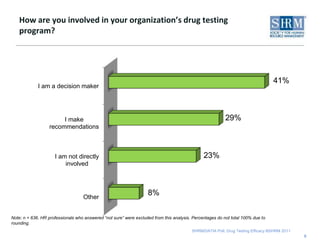
How are you involved in your organization’s drug testing program? 5Note: n = 636. HR professionals who answered “not sure” were excluded from this analysis. Percentages do not total 100% due to rounding.
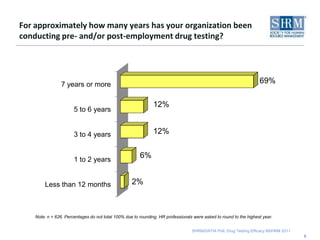
For approximately how many years has your organization been conducting pre- and/or post-employment drug testing?6Note: n = 626. Percentages do not total 100% due to rounding. HR professionals were asked to round to the highest year.
7Does your organization conduct pre-employment drug testing with job candidates?Note: HR professionals who answered “not sure” were excluded from this analysis.
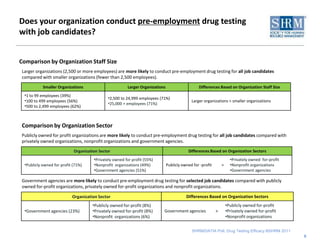
8Does your organization conduct pre-employment drug testing with job candidates?Comparison by Organization Staff SizeLarger organizations (2,500 or more employees) are more likely to conduct pre-employment drug testing for all job candidates compared with smaller organizations (fewer than 2,500 employees).  Comparison by Organization SectorPublicly owned for profit organizations are more likely to conduct pre-employment drug testing for all job candidates compared with privately owned organizations, nonprofit organizations and government agencies.    Government agencies are more likely to conduct pre-employment drug testing for selected job candidates compared with publicly owned for-profit organizations, privately owned for-profit organizations and nonprofit organizations.
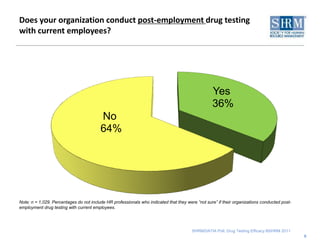
9Does your organization conduct post-employment drug testing with current employees?
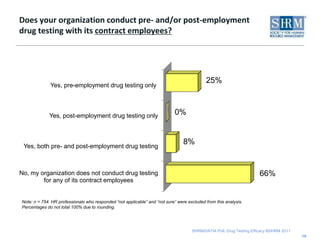
Does your organization conduct pre- and/or post-employment drug testing with its contract employees?10Note: n = 754. HR professionals who responded “not applicable” and “not sure” were excluded from this analysis. Percentages do not total 100% due to rounding.
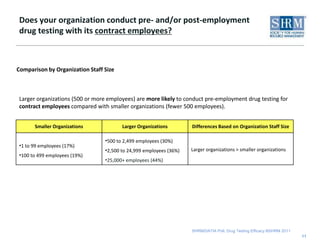
Does your organization conduct pre- and/or post-employment drug testing with its contract employees?11Comparison by Organization Staff SizeLarger organizations (500 or more employees) are more likely to conduct pre-employment drug testing for contract employees compared with smaller organizations (fewer 500 employees).
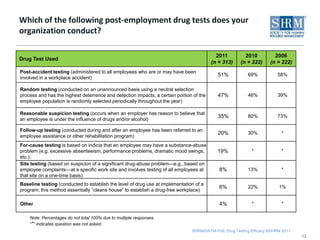
Which of the following post-employment drug tests does your organization conduct? 12Note: Percentages do not total 100% due to multiple responses.“*” indicates question was not asked.
To what degree are the U.S. pre- and/or post-employment protocols/polices also applied at locations outside the United States? 13Note: n = 150. Percentages do not total 100% due to rounding. Only organizations with multinational operations were asked this question.
Impact of Drug Testing ProgramsAbsenteeism
Workers’ compensation
Employee productivity
Employee turnover14
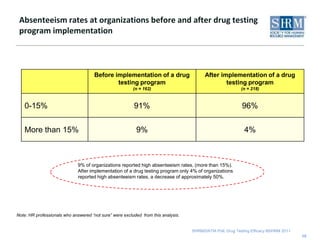
Absenteeism rates at organizations before and after drug testing program implementation159% of organizations reported high absenteeism rates, (more than 15%). After implementation of a drug testing program only 4% of organizations reported high absenteeism rates, a decrease of approximately 50%.  Note: HR professionals who answered “not sure” were excluded  from this analysis.
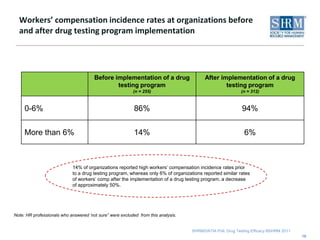
Workers’ compensation incidence rates at organizations before and after drug testing program implementation1614% of organizations reported high workers’ compensation incidence rates prior to a drug testing program, whereas only 6% of organizations reported similar rates of workers’ comp after the implementation of a drug testing program, a decrease of approximately 50%.Note: HR professionals who answered ‘not sure” were excluded  from this analysis.
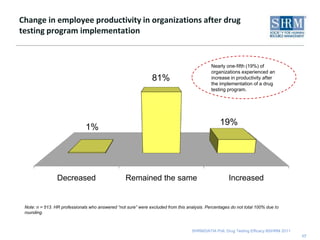
Change in employee productivity in organizations after drug testing program implementation17Nearly one-fifth (19%) of organizations experienced an increase in productivity after the implementation of a drug testing program.Note: n = 513. HR professionals who answered “not sure” were excluded from this analysis. Percentages do not total 100% due to rounding.
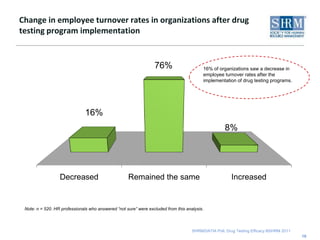
Change in employee turnover rates in organizations after drug testing program implementation1816% of organizations saw a decrease in employee turnover rates after the implementation of drug testing programs.Note: n = 520. HR professionals who answered “not sure” were excluded from this analysis.
How Drug Tests Are PerformedWhere?
What type?
How much?19
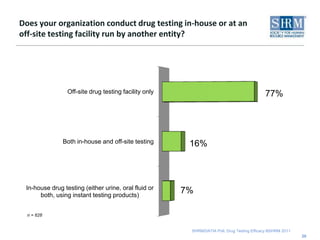
Does your organization conduct drug testing in-house or at an off-site testing facility run by another entity?20n = 628
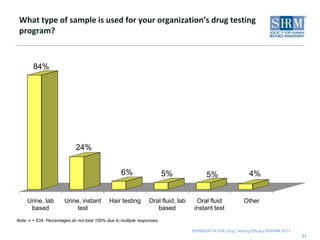
What type of sample is used for your organization’s drug testing program? 21Note: n = 634. Percentages do not total 100% due to multiple responses.
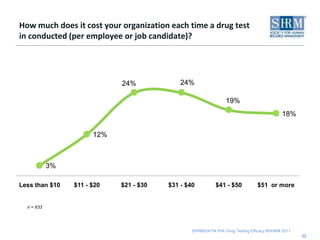
How much does it cost your organization each time a drug test in conducted (per employee or job candidate)?22n = 633
Characteristics of Organizations With Drug Testing Programs23
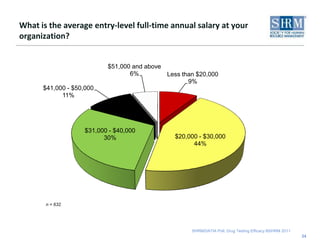
What is the average entry-level full-time annual salary at your organization? 24n = 632.
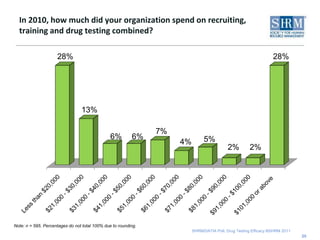
In 2010, how much did your organization spend on recruiting, training and drug testing combined? 25Note: n = 595. Percentages do not total 100% due to rounding.

Shrm datia drug_testing_poll_shrm_web_final

  • 1.
    September 7, 2011SHRMPoll: Drug Testing EfficacyIn collaboration with and commissioned by the Drug & Alcohol Testing Industry Association (DATIA)
  • 2.
    2About the RespondentsStaffsize categories of respondents: The majority of organizations had fewer than 2,500 employees (80%):
  • 3.
    More than one-thirdof organizations had 100 to 499 employees (36%).
  • 4.
    Nearly one-quarter ofrespondents had 1 to 99 employees (24%).
  • 5.
    One-fifth of respondentshad 500 to 2,499 employees (20%).Sectors of respondents:The majority of organizations were publicly owned for-profits (50%).
  • 6.
    Almost one-fifth eachwere from privately owned for-profits (19%) and nonprofit organizations (19%). Industry of respondents:The largest proportion of organizations were from the manufacturing (18%) and health care (14%) industries.Key FindingsWhat percentage of organizations conducted pre-employment drug testing in 2011? More than one-half of organizations (57%) indicated that they conduct drug testing on all job candidates. More than one-quarter (29%) of the organizations do not have a pre-employment drug testing program. Is there a tie between drug testing programs and absenteeism? Yes. In organizations with high employee absenteeism rates (more than 15%), the implementation of a drug testing program appears to have an impact. Nine percent of organizations reported high absenteeism rates (>15%) prior to a drug testing program, whereas only 4% of organizations reported high absenteeism rates after the implementation of a drug testing program, a decrease of approximately 50%.Are workers’ compensation rates affected by drug testing programs? Yes. In organizations with high workers’ compensation incidence rates (>6%), the implementation of a drug testing program appears to have an impact. Fourteen percent of organizations reported high workers’ compensation incidence rates prior to a drug testing program, whereas only 6% of organizations reported similar rates of workers’ comp after the implementation of a drug testing program, a decrease of approximately 50%.Do drug testing programs improve employee productivity rates? Nearly one-fifth (19%) of organizations experienced an increase in productivity after the implementation of a drug testing program.How much of an impact do drug testing programs have on employee turnover rates? Sixteen percent of organizations saw a decrease in employee turnover rates after the implementation of drug testing programs.Do multinational organizations apply similar drug testing protocols/policies in the United States and globally? Nearly three-quarters (72%) of organizations that have multinational operations indicated that all, almost all or some of the same protocols/policies are applied while conducting drug tests outside the United States.3
  • 7.
    Organizations with DrugTesting Programs Pre-employment with job candidates
  • 8.
  • 9.
  • 10.
    How are youinvolved in your organization’s drug testing program? 5Note: n = 636. HR professionals who answered “not sure” were excluded from this analysis. Percentages do not total 100% due to rounding.
  • 11.
    For approximately howmany years has your organization been conducting pre- and/or post-employment drug testing?6Note: n = 626. Percentages do not total 100% due to rounding. HR professionals were asked to round to the highest year.
  • 12.
    7Does your organizationconduct pre-employment drug testing with job candidates?Note: HR professionals who answered “not sure” were excluded from this analysis.
  • 13.
    8Does your organizationconduct pre-employment drug testing with job candidates?Comparison by Organization Staff SizeLarger organizations (2,500 or more employees) are more likely to conduct pre-employment drug testing for all job candidates compared with smaller organizations (fewer than 2,500 employees). Comparison by Organization SectorPublicly owned for profit organizations are more likely to conduct pre-employment drug testing for all job candidates compared with privately owned organizations, nonprofit organizations and government agencies. Government agencies are more likely to conduct pre-employment drug testing for selected job candidates compared with publicly owned for-profit organizations, privately owned for-profit organizations and nonprofit organizations.
  • 14.
    9Does your organizationconduct post-employment drug testing with current employees?
  • 15.
    Does your organizationconduct pre- and/or post-employment drug testing with its contract employees?10Note: n = 754. HR professionals who responded “not applicable” and “not sure” were excluded from this analysis. Percentages do not total 100% due to rounding.
  • 16.
    Does your organizationconduct pre- and/or post-employment drug testing with its contract employees?11Comparison by Organization Staff SizeLarger organizations (500 or more employees) are more likely to conduct pre-employment drug testing for contract employees compared with smaller organizations (fewer 500 employees).
  • 17.
    Which of thefollowing post-employment drug tests does your organization conduct? 12Note: Percentages do not total 100% due to multiple responses.“*” indicates question was not asked.
  • 18.
    To what degreeare the U.S. pre- and/or post-employment protocols/polices also applied at locations outside the United States? 13Note: n = 150. Percentages do not total 100% due to rounding. Only organizations with multinational operations were asked this question.
  • 19.
    Impact of DrugTesting ProgramsAbsenteeism
  • 20.
  • 21.
  • 22.
  • 23.
    Absenteeism rates atorganizations before and after drug testing program implementation159% of organizations reported high absenteeism rates, (more than 15%). After implementation of a drug testing program only 4% of organizations reported high absenteeism rates, a decrease of approximately 50%. Note: HR professionals who answered “not sure” were excluded from this analysis.
  • 24.
    Workers’ compensation incidencerates at organizations before and after drug testing program implementation1614% of organizations reported high workers’ compensation incidence rates prior to a drug testing program, whereas only 6% of organizations reported similar rates of workers’ comp after the implementation of a drug testing program, a decrease of approximately 50%.Note: HR professionals who answered ‘not sure” were excluded from this analysis.
  • 25.
    Change in employeeproductivity in organizations after drug testing program implementation17Nearly one-fifth (19%) of organizations experienced an increase in productivity after the implementation of a drug testing program.Note: n = 513. HR professionals who answered “not sure” were excluded from this analysis. Percentages do not total 100% due to rounding.
  • 26.
    Change in employeeturnover rates in organizations after drug testing program implementation1816% of organizations saw a decrease in employee turnover rates after the implementation of drug testing programs.Note: n = 520. HR professionals who answered “not sure” were excluded from this analysis.
  • 27.
    How Drug TestsAre PerformedWhere?
  • 28.
  • 29.
  • 30.
    Does your organizationconduct drug testing in-house or at an off-site testing facility run by another entity?20n = 628
  • 31.
    What type ofsample is used for your organization’s drug testing program? 21Note: n = 634. Percentages do not total 100% due to multiple responses.
  • 32.
    How much doesit cost your organization each time a drug test in conducted (per employee or job candidate)?22n = 633
  • 33.
    Characteristics of OrganizationsWith Drug Testing Programs23
  • 34.
    What is theaverage entry-level full-time annual salary at your organization? 24n = 632.
  • 35.
    In 2010, howmuch did your organization spend on recruiting, training and drug testing combined? 25Note: n = 595. Percentages do not total 100% due to rounding.