Techniques and lessons
in community
engagement from
Saint Paul, Minnesota
presented by
Emily P.G. Erickson
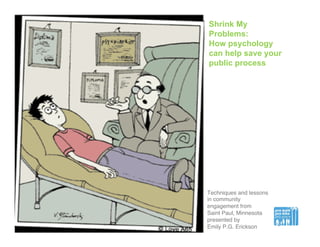
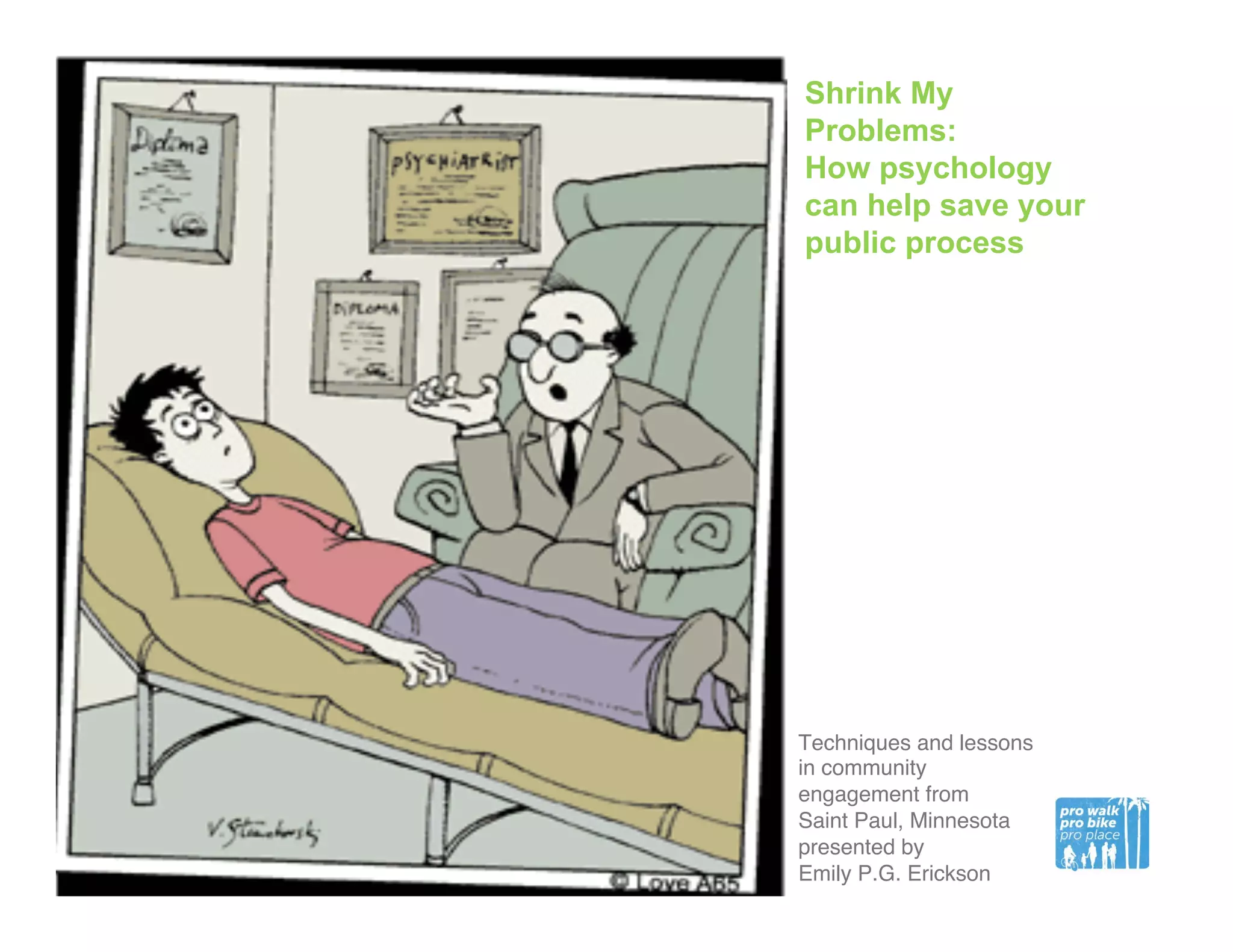
Shrink My
Problems:
How psychology
can help save your
public process
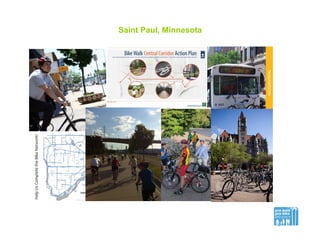
Saint Paul, Minnesota
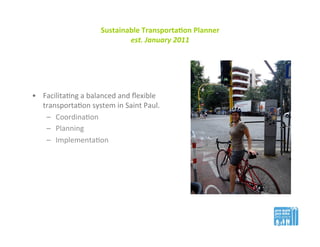
Sustainable	
  Transporta0on	
  Planner	
  
est.	
  January	
  2011	
  
•  Facilita(ng	
  a	
  balanced	
  and	
  flexible	
  
transporta(on	
  system	
  in	
  Saint	
  Paul.	
  
–  Coordina(on	
  
–  Planning	
  
–  Implementa(on	
  
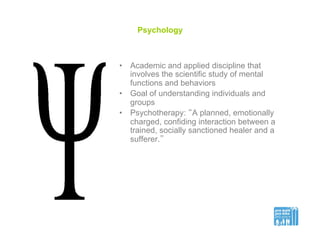
Psychology
•  Academic and applied discipline that
involves the scientific study of mental
functions and behaviors
•  Goal of understanding individuals and
groups
•  Psychotherapy: “A planned, emotionally
charged, confiding interaction between a
trained, socially sanctioned healer and a
sufferer.”
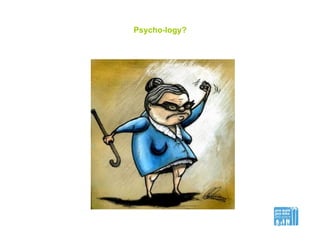
Psycho-logy?
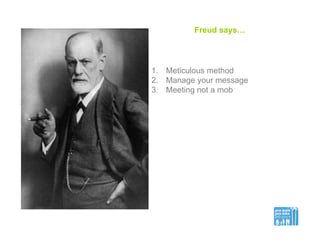
Freud says…
1.  Meticulous method
2.  Manage your message
3.  Meeting not a mob
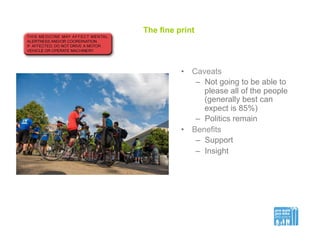
The fine print
•  Caveats
–  Not going to be able to
please all of the people
(generally best can
expect is 85%)
–  Politics remain
•  Benefits
–  Support
–  Insight
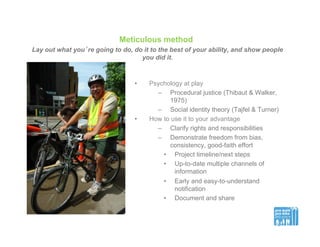
Meticulous method
Lay out what you’re going to do, do it to the best of your ability, and show people
you did it.
•  Psychology at play
–  Procedural justice (Thibaut & Walker,
1975)
–  Social identity theory (Tajfel & Turner)
•  How to use it to your advantage
–  Clarify rights and responsibilities
–  Demonstrate freedom from bias,
consistency, good-faith effort
•  Project timeline/next steps
•  Up-to-date multiple channels of
information
•  Early and easy-to-understand
notification
•  Document and share


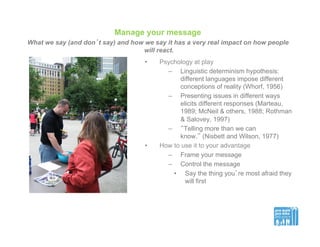
Manage your message
What we say (and don’t say) and how we say it has a very real impact on how people
will react.
•  Psychology at play
–  Linguistic determinism hypothesis:
different languages impose different
conceptions of reality (Whorf, 1956)
–  Presenting issues in different ways
elicits different responses (Marteau,
1989; McNeil & others, 1988; Rothman
& Salovey, 1997)
–  “Telling more than we can
know,” (Nisbett and Wilson, 1977)
•  How to use it to your advantage
–  Frame your message
–  Control the message
•  Say the thing you’re most afraid they
will first
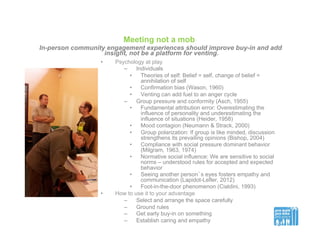
Meeting not a mob
In-person community engagement experiences should improve buy-in and add
insight, not be a platform for venting.
•  Psychology at play
–  Individuals
•  Theories of self: Belief = self, change of belief =
annihilation of self
•  Confirmation bias (Wason, 1960)
•  Venting can add fuel to an anger cycle
–  Group pressure and conformity (Asch, 1955)
•  Fundamental attribution error: Overestimating the
influence of personality and underestimating the
influence of situations (Heider, 1958)
•  Mood contagion (Neumann & Strack, 2000)
•  Group polarization: If group is like minded, discussion
strengthens its prevailing opinions (Bishop, 2004)
•  Compliance with social pressure dominant behavior
(Milgram, 1963, 1974)
•  Normative social influence: We are sensitive to social
norms – understood rules for accepted and expected
behavior
•  Seeing another person’s eyes fosters empathy and
communication (Lapidot-Lefler, 2012)
•  Foot-in-the-door phenomenon (Cialdini, 1993)
•  How to use it to your advantage
–  Select and arrange the space carefully
–  Ground rules
–  Get early buy-in on something
–  Establish caring and empathy
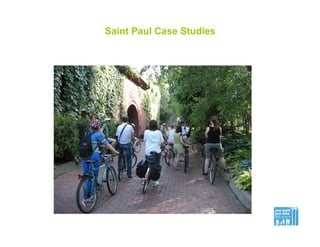
Saint Paul Case Studies
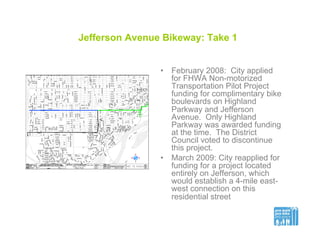
Jefferson Avenue Bikeway: Take 1
•  February 2008: City applied
for FHWA Non-motorized
Transportation Pilot Project
funding for complimentary bike
boulevards on Highland
Parkway and Jefferson
Avenue. Only Highland
Parkway was awarded funding
at the time. The District
Council voted to discontinue
this project.
•  March 2009: City reapplied for
funding for a project located
entirely on Jefferson, which
would establish a 4-mile east-
west connection on this
residential street
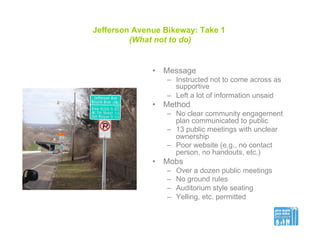
Jefferson Avenue Bikeway: Take 1
(What not to do)
•  Message
–  Instructed not to come across as
supportive
–  Left a lot of information unsaid
•  Method
–  No clear community engagement
plan communicated to public
–  13 public meetings with unclear
ownership
–  Poor website (e.g., no contact
person, no handouts, etc.)
•  Mobs
–  Over a dozen public meetings
–  No ground rules
–  Auditorium style seating
–  Yelling, etc. permitted
Jefferson Avenue Bikeway: Take 1
Outcome
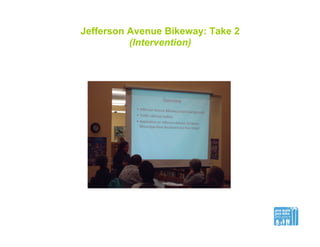
Jefferson Avenue Bikeway: Take 2
(Intervention)
Jefferson Avenue Bikeway: Take 2
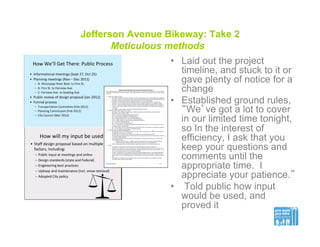
Meticulous methods
•  Laid out the project
timeline, and stuck to it or
gave plenty of notice for a
change
•  Established ground rules,
“We’ve got a lot to cover
in our limited time tonight,
so In the interest of
efficiency, I ask that you
keep your questions and
comments until the
appropriate time. I
appreciate your patience.”
•  Told public how input
would be used, and
proved it
Jefferson Avenue Bikeway: Take 2
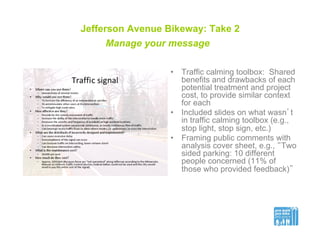
Manage your message
•  Traffic calming toolbox: Shared
benefits and drawbacks of each
potential treatment and project
cost, to provide similar context
for each
•  Included slides on what wasn’t
in traffic calming toolbox (e.g.,
stop light, stop sign, etc.)
•  Framing public comments with
analysis cover sheet, e.g., “Two
sided parking: 10 different
people concerned (11% of
those who provided feedback)”
Jefferson Avenue Bikeway: Take 2
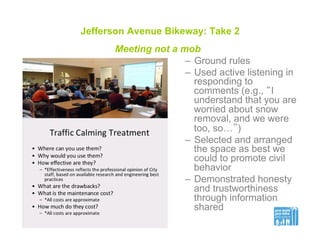
Meeting not a mob
–  Ground rules
–  Used active listening in
responding to
comments (e.g., “I
understand that you are
worried about snow
removal, and we were
too, so…”)
–  Selected and arranged
the space as best we
could to promote civil
behavior
–  Demonstrated honesty
and trustworthiness
through information
shared
Jefferson Avenue Bikeway: Take 2
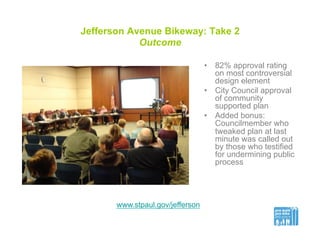
Outcome
•  82% approval rating
on most controversial
design element
•  City Council approval
of community
supported plan
•  Added bonus:
Councilmember who
tweaked plan at last
minute was called out
by those who testified
for undermining public
process
www.stpaul.gov/jefferson
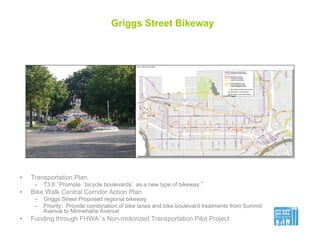
Griggs Street Bikeway
•  Transportation Plan
–  T3.8 “Promote ‘bicycle boulevards’ as a new type of bikeway.”
•  Bike Walk Central Corridor Action Plan
–  Griggs Street Proposed regional bikeway
–  Priority: Provide combination of bike lanes and bike boulevard treatments from Summit
Avenue to Minnehaha Avenue
•  Funding through FHWA’s Non-motorized Transportation Pilot Project
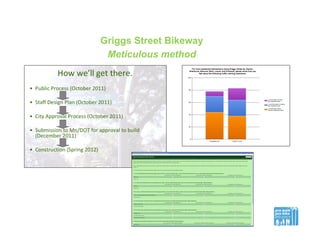
Griggs Street Bikeway
Meticulous method
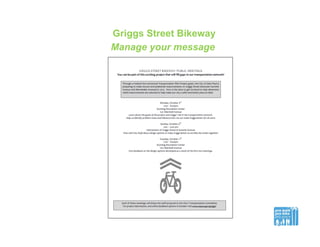
Griggs Street Bikeway
Manage your message
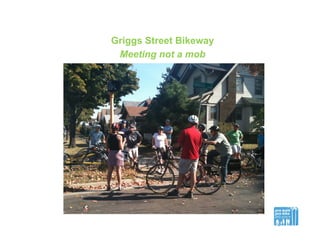
Griggs Street Bikeway
Meeting not a mob
Griggs Street Bikeway
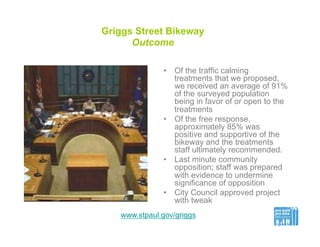
Outcome
•  Of the traffic calming
treatments that we proposed,
we received an average of 91%
of the surveyed population
being in favor of or open to the
treatments
•  Of the free response,
approximately 85% was
positive and supportive of the
bikeway and the treatments
staff ultimately recommended.
•  Last minute community
opposition; staff was prepared
with evidence to undermine
significance of opposition
•  City Council approved project
with tweak
www.stpaul.gov/griggs
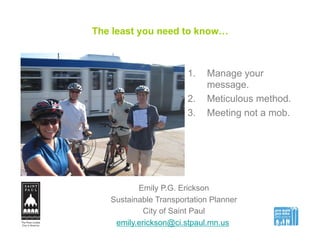
The least you need to know…
1.  Manage your
message.
2.  Meticulous method.
3.  Meeting not a mob.
Emily P.G. Erickson
Sustainable Transportation Planner
City of Saint Paul
emily.erickson@ci.stpaul.mn.us

Shrink My Problems: How Psychology Can Help Save Your Public Process

  • 1.
    Techniques and lessons incommunity engagement from Saint Paul, Minnesota presented by Emily P.G. Erickson Shrink My Problems: How psychology can help save your public process
  • 2.
  • 3.
    Sustainable  Transporta0on  Planner   est.  January  2011   •  Facilita(ng  a  balanced  and  flexible   transporta(on  system  in  Saint  Paul.   –  Coordina(on   –  Planning   –  Implementa(on  
  • 4.
    Psychology •  Academic andapplied discipline that involves the scientific study of mental functions and behaviors •  Goal of understanding individuals and groups •  Psychotherapy: “A planned, emotionally charged, confiding interaction between a trained, socially sanctioned healer and a sufferer.”
  • 5.
  • 6.
    Freud says… 1.  Meticulousmethod 2.  Manage your message 3.  Meeting not a mob
  • 7.
    The fine print • Caveats –  Not going to be able to please all of the people (generally best can expect is 85%) –  Politics remain •  Benefits –  Support –  Insight
  • 8.
    Meticulous method Lay outwhat you’re going to do, do it to the best of your ability, and show people you did it. •  Psychology at play –  Procedural justice (Thibaut & Walker, 1975) –  Social identity theory (Tajfel & Turner) •  How to use it to your advantage –  Clarify rights and responsibilities –  Demonstrate freedom from bias, consistency, good-faith effort •  Project timeline/next steps •  Up-to-date multiple channels of information •  Early and easy-to-understand notification •  Document and share    
  • 9.
    Manage your message Whatwe say (and don’t say) and how we say it has a very real impact on how people will react. •  Psychology at play –  Linguistic determinism hypothesis: different languages impose different conceptions of reality (Whorf, 1956) –  Presenting issues in different ways elicits different responses (Marteau, 1989; McNeil & others, 1988; Rothman & Salovey, 1997) –  “Telling more than we can know,” (Nisbett and Wilson, 1977) •  How to use it to your advantage –  Frame your message –  Control the message •  Say the thing you’re most afraid they will first
  • 10.
    Meeting not amob In-person community engagement experiences should improve buy-in and add insight, not be a platform for venting. •  Psychology at play –  Individuals •  Theories of self: Belief = self, change of belief = annihilation of self •  Confirmation bias (Wason, 1960) •  Venting can add fuel to an anger cycle –  Group pressure and conformity (Asch, 1955) •  Fundamental attribution error: Overestimating the influence of personality and underestimating the influence of situations (Heider, 1958) •  Mood contagion (Neumann & Strack, 2000) •  Group polarization: If group is like minded, discussion strengthens its prevailing opinions (Bishop, 2004) •  Compliance with social pressure dominant behavior (Milgram, 1963, 1974) •  Normative social influence: We are sensitive to social norms – understood rules for accepted and expected behavior •  Seeing another person’s eyes fosters empathy and communication (Lapidot-Lefler, 2012) •  Foot-in-the-door phenomenon (Cialdini, 1993) •  How to use it to your advantage –  Select and arrange the space carefully –  Ground rules –  Get early buy-in on something –  Establish caring and empathy
  • 11.
  • 12.
    Jefferson Avenue Bikeway:Take 1 •  February 2008: City applied for FHWA Non-motorized Transportation Pilot Project funding for complimentary bike boulevards on Highland Parkway and Jefferson Avenue. Only Highland Parkway was awarded funding at the time. The District Council voted to discontinue this project. •  March 2009: City reapplied for funding for a project located entirely on Jefferson, which would establish a 4-mile east- west connection on this residential street
  • 13.
    Jefferson Avenue Bikeway:Take 1 (What not to do) •  Message –  Instructed not to come across as supportive –  Left a lot of information unsaid •  Method –  No clear community engagement plan communicated to public –  13 public meetings with unclear ownership –  Poor website (e.g., no contact person, no handouts, etc.) •  Mobs –  Over a dozen public meetings –  No ground rules –  Auditorium style seating –  Yelling, etc. permitted
  • 14.
  • 15.
    Jefferson Avenue Bikeway:Take 2 (Intervention)
  • 16.
    Jefferson Avenue Bikeway:Take 2 Meticulous methods •  Laid out the project timeline, and stuck to it or gave plenty of notice for a change •  Established ground rules, “We’ve got a lot to cover in our limited time tonight, so In the interest of efficiency, I ask that you keep your questions and comments until the appropriate time. I appreciate your patience.” •  Told public how input would be used, and proved it
  • 17.
    Jefferson Avenue Bikeway:Take 2 Manage your message •  Traffic calming toolbox: Shared benefits and drawbacks of each potential treatment and project cost, to provide similar context for each •  Included slides on what wasn’t in traffic calming toolbox (e.g., stop light, stop sign, etc.) •  Framing public comments with analysis cover sheet, e.g., “Two sided parking: 10 different people concerned (11% of those who provided feedback)”
  • 18.
    Jefferson Avenue Bikeway:Take 2 Meeting not a mob –  Ground rules –  Used active listening in responding to comments (e.g., “I understand that you are worried about snow removal, and we were too, so…”) –  Selected and arranged the space as best we could to promote civil behavior –  Demonstrated honesty and trustworthiness through information shared
  • 19.
    Jefferson Avenue Bikeway:Take 2 Outcome •  82% approval rating on most controversial design element •  City Council approval of community supported plan •  Added bonus: Councilmember who tweaked plan at last minute was called out by those who testified for undermining public process www.stpaul.gov/jefferson
  • 20.
    Griggs Street Bikeway • Transportation Plan –  T3.8 “Promote ‘bicycle boulevards’ as a new type of bikeway.” •  Bike Walk Central Corridor Action Plan –  Griggs Street Proposed regional bikeway –  Priority: Provide combination of bike lanes and bike boulevard treatments from Summit Avenue to Minnehaha Avenue •  Funding through FHWA’s Non-motorized Transportation Pilot Project
  • 21.
  • 22.
  • 23.
  • 24.
    Griggs Street Bikeway Outcome • Of the traffic calming treatments that we proposed, we received an average of 91% of the surveyed population being in favor of or open to the treatments •  Of the free response, approximately 85% was positive and supportive of the bikeway and the treatments staff ultimately recommended. •  Last minute community opposition; staff was prepared with evidence to undermine significance of opposition •  City Council approved project with tweak www.stpaul.gov/griggs
  • 25.
    The least youneed to know… 1.  Manage your message. 2.  Meticulous method. 3.  Meeting not a mob. Emily P.G. Erickson Sustainable Transportation Planner City of Saint Paul emily.erickson@ci.stpaul.mn.us