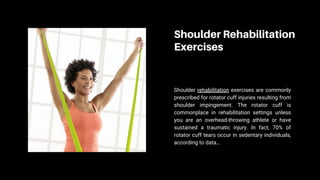
Shoulder Rehabilitation
Exercises
Shoulder rehabilitation exercises are commonly
prescribed for rotator cuff injuries resulting from
shoulder impingement. The rotator cuff is
commonplace in rehabilitation settings unless
you are an overhead-throwing athlete or have
sustained a traumatic injury. In fact, 70% of
rotator cuff tears occur in sedentary individuals,
according to data…
What is Shoulder Impingement?
“Shoulder impingement is a progressive orthopaedic condition that occurs as a
result of altered biomechanics and/or structural abnormalities” (Escamilla, Hooks
and Wilk, 2014).
. This condition is progressive in nature.
Who Gets Shoulder Impingement?
“Disorders of the shoulder are extremely common, with reports of prevalence ranging from 30%
of people experiencing shoulder pain at some stage of their lives up to 50% of the population
experiencing at least one episode of shoulder pain annually. In addition to the high incidence,
shoulder dysfunction is often persistent and recurrent, with 54% of sufferers reporting ongoing
symptoms after 3 years” (Lewis, 2009).
What Causes Shoulder
Impingement?
Shoulder impingement can
occur through a variety of
mechanisms and can be a
result of either
structural and/or functional
contributing factors.
Hypermobility and
hypomobility. Too much or too
little mobility of the shoulder
capsule can contribute to
impingement.
Abnormal scapular position
and motion. that results from
active arm movements is also
a predisposing factor.
Poor Posture. Excessively
rounded shoulders and flexed
upper back (kyphosis)
changes the orientation of the
resting position and dynamic
movement of the scapula.
Weakness of the rotator cuff. The primary function of the rotator cuff is to stabilise the ball and socket
of the arm and maintain its position. Consequently, if the rotator cuff is weak, the dominant deltoid
will glide the arm upwards too early and cause impingement against the roof of the socket.
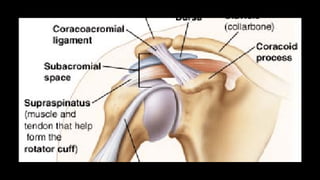
The shape of the bones inside your shoulder play a major role in shoulder impingement. There are
three shapes of the acromion identified in studies. Additionally,there is an increased likelihood
(70% of the cases) of rotator cuff lesions that occur in the presence of a hooked acromion
Why shoulder rehabilitation exercises?
Shoulder rehabilitation exercises are generally used as nonoperative strategies. In fact, studies indicate
that both shoulder rehabilitation exercises and manual therapy reduce pain and improve function.
Pilates exercise offers a variety of exercise programmes for shoulder impingement and gradual
progressions that can help clients to return to a prior level of function.
Why Posture?
Postural corrections and active range of motion arm movements are paramount in Pilates exercise. Indeed, this is
crucial when aiming to normalise arm motion and prevent posterior capsular tightness. Furthermore, this is
achieved through stretching and increasing the flexibility of the surrounding musculature of the shoulder.
Pilates at Core Kensington can benefit your shoulder by improving the flexibility, mobility,
and range of motion of your shoulder and enhance neuromuscular control. In addition,
improving your posture with Pilates can help the mechanics of your shoulder.
Book a class or personal
training session today at the
studio to online and start your
journey to a painless shoulder.
We are now streaming live workouts on Zoom that can help improve your shoulder strength
and mobility. Additionally, our workouts can help improve your spinal health which in turn
improve the position of your shoulder girdle.

Shoulder Rehabilitation Exercises.pdf

  • 1.
    Shoulder Rehabilitation Exercises Shoulder rehabilitationexercises are commonly prescribed for rotator cuff injuries resulting from shoulder impingement. The rotator cuff is commonplace in rehabilitation settings unless you are an overhead-throwing athlete or have sustained a traumatic injury. In fact, 70% of rotator cuff tears occur in sedentary individuals, according to data…
  • 2.
    What is ShoulderImpingement? “Shoulder impingement is a progressive orthopaedic condition that occurs as a result of altered biomechanics and/or structural abnormalities” (Escamilla, Hooks and Wilk, 2014). . This condition is progressive in nature.
  • 3.
    Who Gets ShoulderImpingement? “Disorders of the shoulder are extremely common, with reports of prevalence ranging from 30% of people experiencing shoulder pain at some stage of their lives up to 50% of the population experiencing at least one episode of shoulder pain annually. In addition to the high incidence, shoulder dysfunction is often persistent and recurrent, with 54% of sufferers reporting ongoing symptoms after 3 years” (Lewis, 2009).
  • 4.
  • 5.
    Shoulder impingement can occurthrough a variety of mechanisms and can be a result of either structural and/or functional contributing factors.
  • 6.
    Hypermobility and hypomobility. Toomuch or too little mobility of the shoulder capsule can contribute to impingement.
  • 7.
    Abnormal scapular position andmotion. that results from active arm movements is also a predisposing factor.
  • 8.
    Poor Posture. Excessively roundedshoulders and flexed upper back (kyphosis) changes the orientation of the resting position and dynamic movement of the scapula.
  • 9.
    Weakness of therotator cuff. The primary function of the rotator cuff is to stabilise the ball and socket of the arm and maintain its position. Consequently, if the rotator cuff is weak, the dominant deltoid will glide the arm upwards too early and cause impingement against the roof of the socket.
  • 10.
    The shape ofthe bones inside your shoulder play a major role in shoulder impingement. There are three shapes of the acromion identified in studies. Additionally,there is an increased likelihood (70% of the cases) of rotator cuff lesions that occur in the presence of a hooked acromion
  • 12.
    Why shoulder rehabilitationexercises? Shoulder rehabilitation exercises are generally used as nonoperative strategies. In fact, studies indicate that both shoulder rehabilitation exercises and manual therapy reduce pain and improve function. Pilates exercise offers a variety of exercise programmes for shoulder impingement and gradual progressions that can help clients to return to a prior level of function.
  • 13.
  • 14.
    Postural corrections andactive range of motion arm movements are paramount in Pilates exercise. Indeed, this is crucial when aiming to normalise arm motion and prevent posterior capsular tightness. Furthermore, this is achieved through stretching and increasing the flexibility of the surrounding musculature of the shoulder.
  • 15.
    Pilates at CoreKensington can benefit your shoulder by improving the flexibility, mobility, and range of motion of your shoulder and enhance neuromuscular control. In addition, improving your posture with Pilates can help the mechanics of your shoulder.
  • 16.
    Book a classor personal training session today at the studio to online and start your journey to a painless shoulder.
  • 17.
    We are nowstreaming live workouts on Zoom that can help improve your shoulder strength and mobility. Additionally, our workouts can help improve your spinal health which in turn improve the position of your shoulder girdle.