SOFTWARE
ENGINEERING
-Damini Sahu
-Vikram Singh
What is software Engineering?
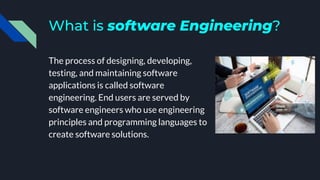
The process of designing, developing,
testing, and maintaining software
applications is called software
engineering. End users are served by
software engineers who use engineering
principles and programming languages to
create software solutions.
The Problem Domain
Problem domains are the areas in which a system
will be used. A potential user might therefore be
tempted to ask: What do you want the system to do
for you? The system should focus on the
functionality it will provide.
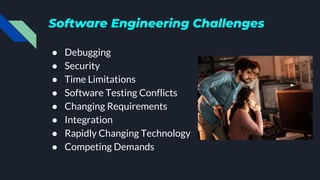
Software Engineering Challenges
● Debugging
● Security
● Time Limitations
● Software Testing Conflicts
● Changing Requirements
● Integration
● Rapidly Changing Technology
● Competing Demands
Software Development Life Cycle ( SDLC
)
Software development life cycle (SDLC) is a
structured process that is used to design,
develop, and test good-quality software. SDLC,
or software development life cycle, is a
methodology that defines the entire procedure
of software development step-by-step.
Software Development Life Cycle (SDLC)
Software Development Process Models
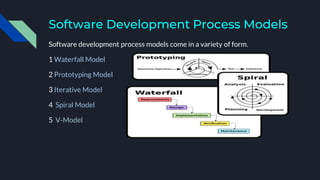
Software development process models come in a variety of form.
1 Waterfall Model
2 Prototyping Model
3 Iterative Model
4 Spiral Model
5 V-Model
Project Planning
What is project planning? Project planning is a
discipline addressing how to complete a project in a
certain timeframe, usually with defined stages and
designated resources. One view of project planning
divides the activity into these steps: setting
measurable objectives. identifying deliverables.
Software Requirement Analysis
Requirements analysis is a common and essential
concept in software development and software
project management. At the start of every
software project, the project team must
understand, finalize and document the features
and functionalities required of the end product.
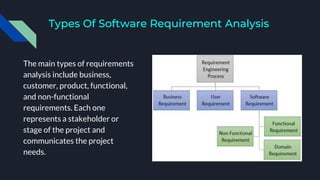
Types Of Software Requirement Analysis
The main types of requirements
analysis include business,
customer, product, functional,
and non-functional
requirements. Each one
represents a stakeholder or
stage of the project and
communicates the project
needs.

Short Notes Of Software Engineering .pptx

  • 1.
  • 2.
    What is softwareEngineering? The process of designing, developing, testing, and maintaining software applications is called software engineering. End users are served by software engineers who use engineering principles and programming languages to create software solutions.
  • 3.
    The Problem Domain Problemdomains are the areas in which a system will be used. A potential user might therefore be tempted to ask: What do you want the system to do for you? The system should focus on the functionality it will provide.
  • 4.
    Software Engineering Challenges ●Debugging ● Security ● Time Limitations ● Software Testing Conflicts ● Changing Requirements ● Integration ● Rapidly Changing Technology ● Competing Demands
  • 5.
    Software Development LifeCycle ( SDLC ) Software development life cycle (SDLC) is a structured process that is used to design, develop, and test good-quality software. SDLC, or software development life cycle, is a methodology that defines the entire procedure of software development step-by-step.
  • 6.
  • 7.
    Software Development ProcessModels Software development process models come in a variety of form. 1 Waterfall Model 2 Prototyping Model 3 Iterative Model 4 Spiral Model 5 V-Model
  • 8.
    Project Planning What isproject planning? Project planning is a discipline addressing how to complete a project in a certain timeframe, usually with defined stages and designated resources. One view of project planning divides the activity into these steps: setting measurable objectives. identifying deliverables.
  • 9.
    Software Requirement Analysis Requirementsanalysis is a common and essential concept in software development and software project management. At the start of every software project, the project team must understand, finalize and document the features and functionalities required of the end product.
  • 10.
    Types Of SoftwareRequirement Analysis The main types of requirements analysis include business, customer, product, functional, and non-functional requirements. Each one represents a stakeholder or stage of the project and communicates the project needs.