Short Circuit
Analysis Services
Home  Short Circuit Analysis Services
 info@saspowertech.com  +91-8380090910  
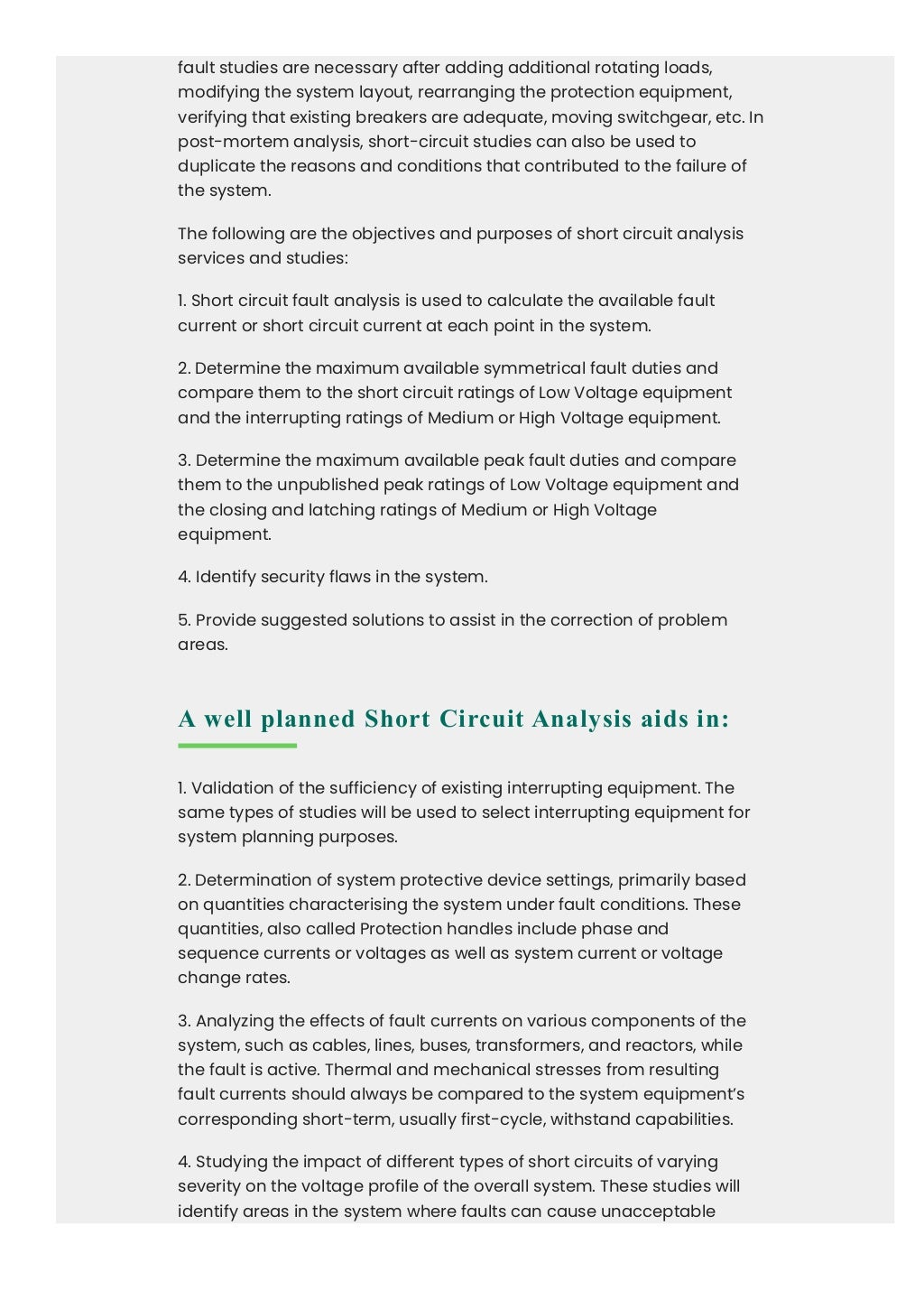
Short-Circuit Currents are currents that introduce large amounts of
destructive energy into a power system in the form of heat and
magnetic force. A short circuit is also known as a fault. It is a type of
current that introduces a significant amount of energy into a power
system. It can take the form of either heat or magnetic force. It is a low-
resistance energy path that bypasses part of a circuit and causes the
bypassed part of the circuit to stop working. The reliability and safety of
To correctly apply equipment in accordance with NEC and ANSI
standards, short-circuit calculations are required. The amount of detail
required to perform these calculations varies greatly depending on the
size and utility connection.
A Short Circuit study is a thorough examination, analysis, or evaluation of
an electrical system to determine the magnitude of currents that can
flow during an electrical fault and correlate with those values to the
ratings of installations of equipment and short circuit protection devices.
It addresses short-circuit analysis activities such as design
considerations for new systems, analytical studies for existing systems,
and operational and model validation considerations for industrial and
commercial power systems. In power systems, a short circuit protection
fault study is critical.
Why Is It Necessary To Perform Short Circuit
Analysis?
Because short-circuit faults cannot always be avoided, we can only try
to reduce them and mitigate their potentially damaging effects to some
extent. A short-circuit study is required in the early stages of
development to design an electrical system so that the possibility of a
short circuit is minimized. If a short circuit occurs, it must be mitigated by
managing the undesirable magnitude of the fault current and
maintaining service to the rest of the system by isolating the fault area
as small as possible. Short circuit analysis is performed through Relay
Coordination Studies and it is also performed in Electrical Failure
Analysis.
Short-circuit studies are just as important for any power system as
power flow studies, transient stability studies, harmonic analysis studies,
and so on. Short-circuit studies can be performed during the planning
stage to assist in finalising the system layout, determining voltage levels,
and sizing cables, transformers, and conductors. For existing systems,
electric power distribution systems are dependent on an accurate and
thorough understanding of the short-circuit fault currents that can exist,
as well as the ability of protective devices to interrupt these currents
satisfactorily.
Short circuit currents pose the most serious general hazard to power
distribution system components and are the primary concern in the
development and application of protection systems. Short circuit
currents, fortunately, are relatively simple to calculate. The basic nature
of short circuit currents can be determined by applying three or four
fundamental circuit analysis concepts. These ideas will be stated and
applied in a step-by-step progression.
fault studies are necessary after adding additional rotating loads,
modifying the system layout, rearranging the protection equipment,
verifying that existing breakers are adequate, moving switchgear, etc. In
post-mortem analysis, short-circuit studies can also be used to
duplicate the reasons and conditions that contributed to the failure of
the system.
The following are the objectives and purposes of short circuit analysis
services and studies:
1. Short circuit fault analysis is used to calculate the available fault
current or short circuit current at each point in the system.
2. Determine the maximum available symmetrical fault duties and
compare them to the short circuit ratings of Low Voltage equipment
and the interrupting ratings of Medium or High Voltage equipment.
3. Determine the maximum available peak fault duties and compare
them to the unpublished peak ratings of Low Voltage equipment and
the closing and latching ratings of Medium or High Voltage
equipment.
4. Identify security flaws in the system.
5. Provide suggested solutions to assist in the correction of problem
areas.
A well planned Short Circuit Analysis aids in:
1. Validation of the sufficiency of existing interrupting equipment. The
same types of studies will be used to select interrupting equipment for
system planning purposes.
2. Determination of system protective device settings, primarily based
on quantities characterising the system under fault conditions. These
quantities, also called Protection handles include phase and
sequence currents or voltages as well as system current or voltage
change rates.
3. Analyzing the effects of fault currents on various components of the
system, such as cables, lines, buses, transformers, and reactors, while
the fault is active. Thermal and mechanical stresses from resulting
fault currents should always be compared to the system equipment’s
corresponding short-term, usually first-cycle, withstand capabilities.
4. Studying the impact of different types of short circuits of varying
severity on the voltage profile of the overall system. These studies will
identify areas in the system where faults can cause unacceptable
voltage spread.
5. System layout, neutral grounding, and substation grounding
conceptualization, design, and refinement.
Advantages of going for Short Circuit Analysis
Services
Why Choose SAS Powertech?
SAS Powertech manages project communications and priority
scheduling, anticipates contingencies, and maintains overall project
quality, making this combined team approach not only more cost-
effective for our clients but also considerably reduces client project
stress.
With our years of experience, we provide the best Short Circuit Analysis
Services to our clients by giving their workpersons proper training and
end-to-end support to mitigate the short circuit issues in the systems.
Our service includes a visit from an Electrical Expert and data collection
from the site on the facility’s various load conditions. The collected data
The following advantages come from conducting
a short circuit analysis:
1. Assists in avoiding
unplanned outages and
downtime.
2. Is critical for avoiding
disruptions in critical services.
3. Reduces the possibility of
equipment damage and fires.
4. It improves safety and
protects people from harm.
1. Determines the level and type of
protective equipment required.
2. Provides the necessary information
for NEC and NFPA required labels.
3. Maintains compliance with NEC
requirements.
is then used to perform a load flow study for various load conditions,
followed by a short circuit analysis to generate a report based on the
load.
The existing short circuit protection system was put through its paces.
Fault and short circuit The system precisely calculates current ratings at
the HT, LT, PCC, and MCC levels. Based on the findings, short circuit
protection can be redesigned. Increased facility uptime by ensuring that
the fault is isolated by the nearest protection.
SASPPL has been providing Short Circuit Analysis services to its clients
across various verticals in India & South East Asia Region. We are known
for sharing findings transparently & unbiased reporting. The Short Circuit
Analysis services and solutions suggested by us are the most
economical and have helped clients achieve predicted results.
Address
SAS Powertech Pvt. Ltd
01, Gera's Regent Manor,
Survey No. 33, Area No. 39/570,
Behind Opulent Car Care Center,
Baner, Pune – 411045.
Services
Energy services
Electrical Services
Power Electronic services
Special Services
Other Links
Home
About
Client
Career
Case Study
Contact
Contact
 :  +91-9763003222
 :  info@saspowertech.com
 : 
abhijiit.katre@saspowertech.com
© 2022 Sas Powertech Pvt. Ltd. | All rights reserved.
Sitemap | Privacy Policy   | Terms & Conditions
Powered by Lighthouse Digital

short circuit analysis services

  • 1.
    Short Circuit Analysis Services Home  ShortCircuit Analysis Services  info@saspowertech.com  +91-8380090910   Short-Circuit Currents are currents that introduce large amounts of destructive energy into a power system in the form of heat and magnetic force. A short circuit is also known as a fault. It is a type of current that introduces a significant amount of energy into a power system. It can take the form of either heat or magnetic force. It is a low- resistance energy path that bypasses part of a circuit and causes the bypassed part of the circuit to stop working. The reliability and safety of
  • 2.
    To correctly applyequipment in accordance with NEC and ANSI standards, short-circuit calculations are required. The amount of detail required to perform these calculations varies greatly depending on the size and utility connection. A Short Circuit study is a thorough examination, analysis, or evaluation of an electrical system to determine the magnitude of currents that can flow during an electrical fault and correlate with those values to the ratings of installations of equipment and short circuit protection devices. It addresses short-circuit analysis activities such as design considerations for new systems, analytical studies for existing systems, and operational and model validation considerations for industrial and commercial power systems. In power systems, a short circuit protection fault study is critical. Why Is It Necessary To Perform Short Circuit Analysis? Because short-circuit faults cannot always be avoided, we can only try to reduce them and mitigate their potentially damaging effects to some extent. A short-circuit study is required in the early stages of development to design an electrical system so that the possibility of a short circuit is minimized. If a short circuit occurs, it must be mitigated by managing the undesirable magnitude of the fault current and maintaining service to the rest of the system by isolating the fault area as small as possible. Short circuit analysis is performed through Relay Coordination Studies and it is also performed in Electrical Failure Analysis. Short-circuit studies are just as important for any power system as power flow studies, transient stability studies, harmonic analysis studies, and so on. Short-circuit studies can be performed during the planning stage to assist in finalising the system layout, determining voltage levels, and sizing cables, transformers, and conductors. For existing systems, electric power distribution systems are dependent on an accurate and thorough understanding of the short-circuit fault currents that can exist, as well as the ability of protective devices to interrupt these currents satisfactorily. Short circuit currents pose the most serious general hazard to power distribution system components and are the primary concern in the development and application of protection systems. Short circuit currents, fortunately, are relatively simple to calculate. The basic nature of short circuit currents can be determined by applying three or four fundamental circuit analysis concepts. These ideas will be stated and applied in a step-by-step progression.
  • 3.
    fault studies arenecessary after adding additional rotating loads, modifying the system layout, rearranging the protection equipment, verifying that existing breakers are adequate, moving switchgear, etc. In post-mortem analysis, short-circuit studies can also be used to duplicate the reasons and conditions that contributed to the failure of the system. The following are the objectives and purposes of short circuit analysis services and studies: 1. Short circuit fault analysis is used to calculate the available fault current or short circuit current at each point in the system. 2. Determine the maximum available symmetrical fault duties and compare them to the short circuit ratings of Low Voltage equipment and the interrupting ratings of Medium or High Voltage equipment. 3. Determine the maximum available peak fault duties and compare them to the unpublished peak ratings of Low Voltage equipment and the closing and latching ratings of Medium or High Voltage equipment. 4. Identify security flaws in the system. 5. Provide suggested solutions to assist in the correction of problem areas. A well planned Short Circuit Analysis aids in: 1. Validation of the sufficiency of existing interrupting equipment. The same types of studies will be used to select interrupting equipment for system planning purposes. 2. Determination of system protective device settings, primarily based on quantities characterising the system under fault conditions. These quantities, also called Protection handles include phase and sequence currents or voltages as well as system current or voltage change rates. 3. Analyzing the effects of fault currents on various components of the system, such as cables, lines, buses, transformers, and reactors, while the fault is active. Thermal and mechanical stresses from resulting fault currents should always be compared to the system equipment’s corresponding short-term, usually first-cycle, withstand capabilities. 4. Studying the impact of different types of short circuits of varying severity on the voltage profile of the overall system. These studies will identify areas in the system where faults can cause unacceptable
  • 4.
    voltage spread. 5. Systemlayout, neutral grounding, and substation grounding conceptualization, design, and refinement. Advantages of going for Short Circuit Analysis Services Why Choose SAS Powertech? SAS Powertech manages project communications and priority scheduling, anticipates contingencies, and maintains overall project quality, making this combined team approach not only more cost- effective for our clients but also considerably reduces client project stress. With our years of experience, we provide the best Short Circuit Analysis Services to our clients by giving their workpersons proper training and end-to-end support to mitigate the short circuit issues in the systems. Our service includes a visit from an Electrical Expert and data collection from the site on the facility’s various load conditions. The collected data The following advantages come from conducting a short circuit analysis: 1. Assists in avoiding unplanned outages and downtime. 2. Is critical for avoiding disruptions in critical services. 3. Reduces the possibility of equipment damage and fires. 4. It improves safety and protects people from harm. 1. Determines the level and type of protective equipment required. 2. Provides the necessary information for NEC and NFPA required labels. 3. Maintains compliance with NEC requirements.
  • 5.
    is then usedto perform a load flow study for various load conditions, followed by a short circuit analysis to generate a report based on the load. The existing short circuit protection system was put through its paces. Fault and short circuit The system precisely calculates current ratings at the HT, LT, PCC, and MCC levels. Based on the findings, short circuit protection can be redesigned. Increased facility uptime by ensuring that the fault is isolated by the nearest protection. SASPPL has been providing Short Circuit Analysis services to its clients across various verticals in India & South East Asia Region. We are known for sharing findings transparently & unbiased reporting. The Short Circuit Analysis services and solutions suggested by us are the most economical and have helped clients achieve predicted results. Address SAS Powertech Pvt. Ltd 01, Gera's Regent Manor, Survey No. 33, Area No. 39/570, Behind Opulent Car Care Center, Baner, Pune – 411045. Services Energy services Electrical Services Power Electronic services Special Services Other Links Home About Client Career Case Study Contact Contact  :  +91-9763003222  :  info@saspowertech.com  :  abhijiit.katre@saspowertech.com
  • 6.
    abhijiit.katre@saspowertech.com © 2022 SasPowertech Pvt. Ltd. | All rights reserved. Sitemap | Privacy Policy   | Terms & Conditions Powered by Lighthouse Digital