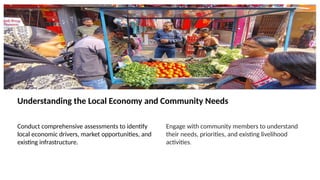
Understanding the LocalEconomy and Community Needs
Conduct comprehensive assessments to identify
local economic drivers, market opportunities, and
existing infrastructure.
Engage with community members to understand
their needs, priorities, and existing livelihood
activities.
3.
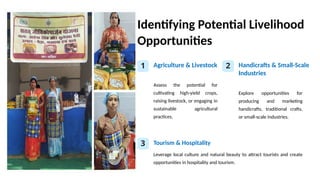
Identifying Potential Livelihood
Opportunities
1Agriculture & Livestock
Assess the potential for
cultivating high-yield crops,
raising livestock, or engaging in
sustainable agricultural
practices.
2 Handicrafts & Small-Scale
Industries
Explore opportunities for
producing and marketing
handicrafts, traditional crafts,
or small-scale industries.
3 Tourism & Hospitality
Leverage local culture and natural beauty to attract tourists and create
opportunities in hospitality and tourism.
4.
Assessing Resource
Availability and
Infrastructure
Water
Evaluateaccess to water resources for
irrigation, livestock, and human
consumption.
Electricity
Assess the availability of electricity for
processing, lighting, and
communication.
Transportation
Evaluate road access and transportation
options for market access and logistics.
5.
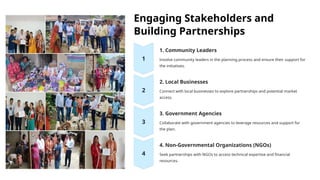
Engaging Stakeholders and
BuildingPartnerships
1. Community Leaders
Involve community leaders in the planning process and ensure their support for
the initiatives.
2. Local Businesses
Connect with local businesses to explore partnerships and potential market
access.
3. Government Agencies
Collaborate with government agencies to leverage resources and support for
the plan.
4. Non-Governmental Organizations (NGOs)
Seek partnerships with NGOs to access technical expertise and financial
resources.
6.
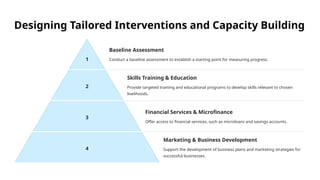
Designing Tailored Interventionsand Capacity Building
1
Baseline Assessment
Conduct a baseline assessment to establish a starting point for measuring progress.
2
Skills Training & Education
Provide targeted training and educational programs to develop skills relevant to chosen
livelihoods.
3
Financial Services & Microfinance
Offer access to financial services, such as microloans and savings accounts.
4
Marketing & Business Development
Support the development of business plans and marketing strategies for
successful businesses.
7.
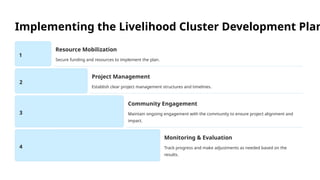
Implementing the LivelihoodCluster Development Plan
1
Resource Mobilization
Secure funding and resources to implement the plan.
2
Project Management
Establish clear project management structures and timelines.
3
Community Engagement
Maintain ongoing engagement with the community to ensure project alignment and
impact.
4
Monitoring & Evaluation
Track progress and make adjustments as needed based on the
results.
8.
•SFURTI cluster development.–KVIC
•PMEGP: Supports new enterprises in rural areas with subsidies and credit.
•MUDRA Scheme: Offers low-interest loans to small and micro-entrepreneurs.
•National Bamboo Mission: Promotes bamboo-based clusters for livelihood generation.
•NABARD- Livelihood Cluster Development
•SFAC -10,000 FPO Promotion programme
Convergence with Key Govt. Schemes Supporting Production Clusters
9.
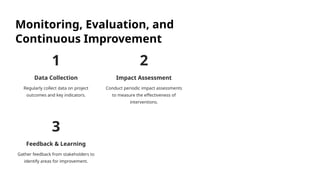
Monitoring, Evaluation, and
ContinuousImprovement
1
Data Collection
Regularly collect data on project
outcomes and key indicators.
2
Impact Assessment
Conduct periodic impact assessments
to measure the effectiveness of
interventions.
3
Feedback & Learning
Gather feedback from stakeholders to
identify areas for improvement.