APPLICATIONS AND CODE CONSIDERATIONS FOR SHIPS
STAIRS – SOMETIMES CALLED SHIPS LADDERS
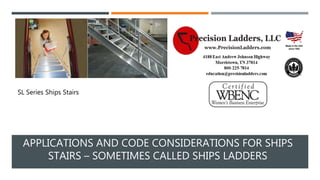
SL Series Ships Stairs
SHIPS STAIRS
TYPES AND CODE PROVISION
SHIPS STAIRS
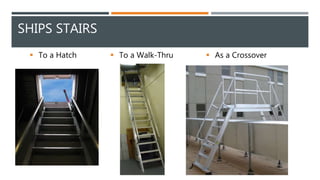
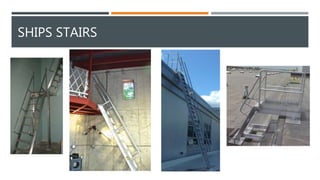
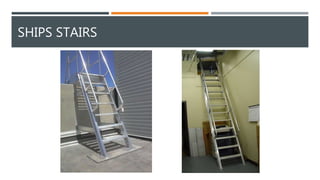
 To a Hatch  To a Walk-Thru  As a Crossover
SHIPS STAIRS
• A.K.A. = ships ladders or inclined ladder
• Used similar to vertical ladders
• Handrail configurations fitted for hatch
openings or walk-thrus
SHIPS STAIRS
• Provides easier climb, sacrifices
floor space
• Standards usually 5” deep treads
with an anti-slip surface
• Handrails on both sides
• Maximum angle IBC ship ladder
70° typical minimum 60°
SHIPS STAIRS
APPLICABLE CODE FOR SHIPS STAIRS
• IBC-International
Building Code
• National code
• IBC 1011.15
• http://codes.iccsafe.org
•OSHA-Occupational
Safety and Health
Administration
• OSHA 1910.25
• www.OSHA.gov
• Websites offer easy code
reference
SHIPS STAIRS
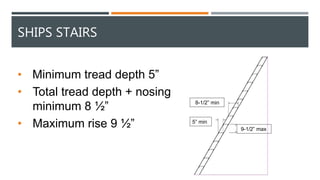
8-1/2” min
5” min
9-1/2” max
• Minimum tread depth 5”
• Total tread depth + nosing
minimum 8 ½”
• Maximum rise 9 ½”
SHIPS STAIRS
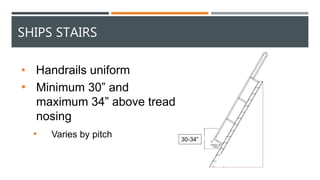
30-34”
• Handrails uniform
• Minimum 30” and
maximum 34” above tread
nosing
• Varies by pitch
SHIPS STAIRS
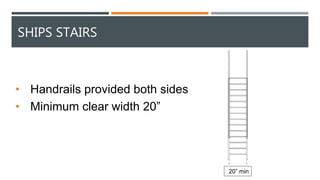
20” min
• Handrails provided both sides
• Minimum clear width 20”
Ships Stairs
SHIPS STAIRS
THIS MAY NOT INCLUDE ALL OSHA 1910.25 CODES
For more information call or email Precision Ladders.
APPLICATIONS AND CODE CONSIDERATIONS FOR SHIPS
STAIRS – SOMETIMES CALLED SHIPS LADDERS
SL Series Ships Stairs

Ships ladder OSHA 1910.25 code 2018

  • 1.
    APPLICATIONS AND CODECONSIDERATIONS FOR SHIPS STAIRS – SOMETIMES CALLED SHIPS LADDERS SL Series Ships Stairs
  • 2.
    SHIPS STAIRS TYPES ANDCODE PROVISION
  • 3.
    SHIPS STAIRS  Toa Hatch  To a Walk-Thru  As a Crossover
  • 4.
    SHIPS STAIRS • A.K.A.= ships ladders or inclined ladder • Used similar to vertical ladders • Handrail configurations fitted for hatch openings or walk-thrus
  • 5.
    SHIPS STAIRS • Provideseasier climb, sacrifices floor space • Standards usually 5” deep treads with an anti-slip surface • Handrails on both sides • Maximum angle IBC ship ladder 70° typical minimum 60°
  • 6.
  • 7.
    APPLICABLE CODE FORSHIPS STAIRS • IBC-International Building Code • National code • IBC 1011.15 • http://codes.iccsafe.org •OSHA-Occupational Safety and Health Administration • OSHA 1910.25 • www.OSHA.gov • Websites offer easy code reference
  • 8.
    SHIPS STAIRS 8-1/2” min 5”min 9-1/2” max • Minimum tread depth 5” • Total tread depth + nosing minimum 8 ½” • Maximum rise 9 ½”
  • 9.
    SHIPS STAIRS 30-34” • Handrailsuniform • Minimum 30” and maximum 34” above tread nosing • Varies by pitch
  • 10.
    SHIPS STAIRS 20” min •Handrails provided both sides • Minimum clear width 20”
  • 11.
  • 12.
  • 13.
    THIS MAY NOTINCLUDE ALL OSHA 1910.25 CODES For more information call or email Precision Ladders.
  • 14.
    APPLICATIONS AND CODECONSIDERATIONS FOR SHIPS STAIRS – SOMETIMES CALLED SHIPS LADDERS SL Series Ships Stairs

Editor's Notes

  • #3 Ships Stairs.
  • #4 Ships stairs can be used to access roof hatches. Ships stairs can be used in a walk-thru capacity when accessing a level above, where it is not feasible to use a standard stair. When used to cross-over a structure, two ships stairs and a platform are used. (OSHA 1910.25(b)(8), “Spiral, ship, or alternating tread type stairs are only used when the employer can demonstrate that it is not feasible to provide standard stairs.”)
  • #5 Also known as, ships ladder or inclined ladder. In 2017 OSHA added a code for these ladders and called them ship stairs. A ships stair can be used in much the same way as most vertical ladders. The handrails configurations on a ships stairs can be fitted for a hatch opening or walk-thru, as we just saw. OSHA says ship stairs are used only when the employer can demonstrate that it is not feasible to provide standard stair. (OSHA 1910.25 (b)(8))
  • #6 This product provides an easier climb, but in turn sacrifices floor space. Industry standards usually have four inch to six inch deep tread with an anti-slip surface. Handrails are found on both sides. The angles range from sixty degrees to seventy degrees. OSHA says angles range from 50 – 70 degrees.
  • #7 Here are some more applications of ships stairs.
  • #8 The applicable codes for ships stairs that we will look are IBC 1011.15, and as I’ve mentioned, OSHA changed code 1910.25 to include ship stairs. The more stringent of the two codes will be used in this presentation but we will tell you what both codes say.
  • #9 IBC code 1011.15 states that ships ladder must have a minimum tread depth of five inches. The tread shall be projected such that the total of the tread depth plus the nosing projection is no less than eight and a half inches. And the maximum riser height shall be nine and a half inches. With this math, we’ve found that you cannot build a ships ladder greater than 70 degree angle and be IBC compliant. OSHA agrees slope of 50 to 70 degrees from the horizontal. OSHA says vertical rise between treads surfaces of 6 ½ to 12 inches, with a minimum tread depth of 4 inches.
  • #10 The handrail height of ships stairs, and alternating tread devices, measured above tread nosing, shall be uniform, and not less than thirty inches and not more than thirty-four inches above the tread nosing.
  • #11 Handrails shall be provided on both sides of the ships stairs. The minimum clear width at and below the handrails shall be twenty inches. OSHA new code says a ships stair can have a minimum tread width of 18 inches.
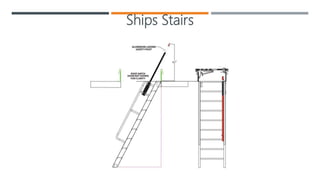
  • #12 A ships stair can be equipped with a safety post. They are not required by code but recommended to aid the climber when exiting off the ladder and then when stepping back onto the ladder to descend.
  • #14 Now you should be able to…