A REPORT
BY
ARSHJOT,ANSHUL,ABHIRAJ,ASH
WINI 4A, USAP
SHIPPING CONTAINER
CONSTRUCTION
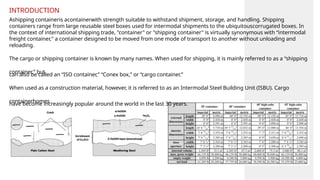
Ashipping containeris acontainerwith strength suitable to withstand shipment, storage, and handling. Shipping
containers range from large reusable steel boxes used for intermodal shipments to the ubiquitouscorrugated boxes. In
the context of international shipping trade, "container" or "shipping container" is virtually synonymous with “intermodal
freight container," a container designed to be moved from one mode of transport to another without unloading and
reloading.
The cargo or shipping container is known by many names. When used for shipping, it is mainly referred to as a “shipping
container,” but
can also be called an “ISO container,” “Conex box,” or “cargo container.”
When used as a construction material, however, it is referred to as an Intermodal Steel Building Unit (ISBU). Cargo
containerhomes
have become increasingly popular around the world in the last 30 years.
INTRODUCTION
heavy loads, withstand harsh climatic conditions, as well as rough seas and can also easily
be stacked one on top of the other to create multi-story homes. Their structural stability
makes such homes earthquake and hurricane proof, which makes them extremely safe
for natural disaster-prone areas.
• EASE/SPEED OF CONSTRUCTION
Building a housing structure out of a shipping container takes roughly 2-3 weeks in
comparison to
brick and mortar structure which takes around 4-6 months to make. Most structures can
be assembled
within a day or so, if all the pieces have been cut off site which is in equivalence to
prefabricated
structures.
• OFF SITE CONSTRUCTION
Container homes can be built off site and then delivered to your land ready to move into.
Sometimes
a plot of land isn’t suitable to build on.Inthis case, one can get the shipping container
home made at
a local workshop and then the finished product can be delivered to the plot of land.
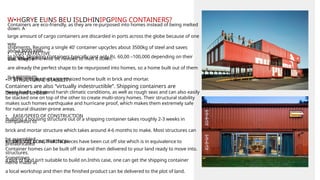
W•HGRYE EUNS BEU ISLDHINIPGPING CONTAINERS?
Containers are eco-friendly, as they are re-purposed into homes instead of being melted
down. A
large amount of cargo containers are discarded in ports across the globe because of one
way
shipments. Reusing a single 40' container upcycles about 3500kg of steel and saves
about 8000 kWh
that would otherwise be needed to melt it down.
• COST EFFECTIVE
In India, Shipping containers typically cost only Rs. 60,00 –100,000 depending on their
size. They're
are already the perfect shape to be repurposed into homes, so a home built out of them
is a minimum
of 30% cheaper than a same sized home built in brick and mortar.
• STRUCTURAL STABILITY
Containers are also “virtually indestructible”. Shipping containers are
designed to bear
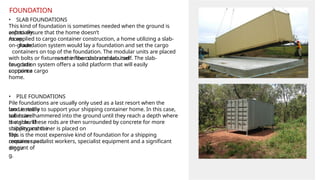
• SLAB FOUNDATIONS
This kind of foundation is sometimes needed when the ground is
especially
soft to ensure that the home doesn’t
move.
As applied to cargo container construction, a home utilizing a slab-
on-grade
foundation system would lay a foundation and set the cargo
containers on top of the foundation. The modular units are placed
on the floor slab and secured
with bolts or fixtures set in the concrete slab itself. The slab-
on-grade
foundation system offers a solid platform that will easily
support a cargo
container
home.
• PILE FOUNDATIONS
Pile foundations are usually only used as a last resort when the
land is really
too unstable to support your shipping container home. In this case,
solid steel
tubes are hammered into the ground until they reach a depth where
the ground
is stable. These rods are then surrounded by concrete for more
stability and the
shipping container is placed on
top.
This is the most expensive kind of foundation for a shipping
container as it
requires specialist workers, specialist equipment and a significant
amount of
diggin
g.
FOUNDATION
•
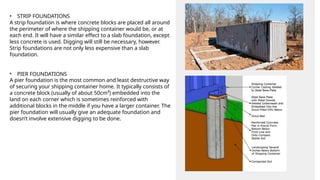
A pier foundation is the most common and least destructive way
of securing your shipping container home. It typically consists of
a concrete block (usually of about 50cm³) embedded into the
land on each corner which is sometimes reinforced with
additional blocks in the middle if you have a larger container. The
pier foundation will usually give an adequate foundation and
doesn’t involve extensive digging to be done.
• STRIP FOUNDATIONS
A strip foundation is where concrete blocks are placed all around
the perimeter of where the shipping container would be, or at
each end. It will have a similar effect to a slab foundation, except
less concrete is used. Digging will still be necessary, however.
Strip foundations are not only less expensive than a slab
foundation.
PIER FOUNDATIONS
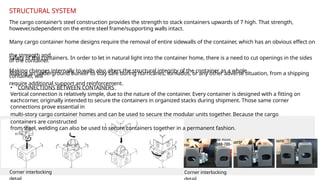
• CONNECTIONS BETWEEN CONTAINERS
Vertical connection is relatively simple, due to the nature of the container. Every container is designed with a fitting on
eachcorner, originally intended to secure the containers in organized stacks during shipment. Those same corner
connections prove essential in
multi-story cargo container homes and can be used to secure the modular units together. Because the cargo
containers are constructed
from steel, welding can also be used to secure containers together in a permanent fashion.
The cargo container’s steel construction provides the strength to stack containers upwards of 7 high. That strength,
however,isdependent on the entire steel frame/supporting walls intact.
Many cargo container home designs require the removal of entire sidewalls of the container, which has an obvious effect on
the strength and
safety of the containers. In order to let in natural light into the container home, there is a need to cut openings in the sides
of the container.
Making changes internally to walls also alters the structural integrity of the container as a whole.
Making an underground bunker to stay safe during hurricanes, tornados, or any other adverse situation, from a shipping
container, will
require additional support and reinforcement.
STRUCTURAL SYSTEM
Corner interlocking Corner interlocking
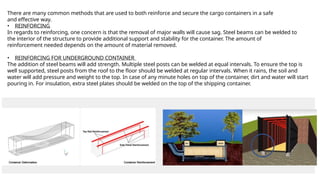
There are many common methods that are used to both reinforce and secure the cargo containers in a safe
and effective way.
• REINFORCING
In regards to reinforcing, one concern is that the removal of major walls will cause sag. Steel beams can be welded to
the interior of the structure to provide additional support and stability for the container. The amount of
reinforcement needed depends on the amount of material removed.
• REINFORCING FOR UNDERGROUND CONTAINER
The addition of steel beams will add strength. Multiple steel posts can be welded at equal intervals. To ensure the top is
well supported, steel posts from the roof to the floor should be welded at regular intervals. When it rains, the soil and
water will add pressure and weight to the top. In case of any minute holes on top of the container, dirt and water will start
pouring in. For insulation, extra steel plates should be welded on the top of the shipping container.
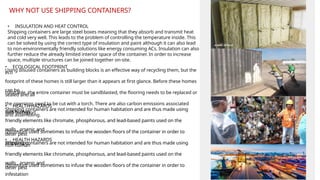
• INSULATION AND HEAT CONTROL
Shipping containers are large steel boxes meaning that they absorb and transmit heat
and cold very well. This leads to the problem of controlling the temperature inside. This
can be solved by using the correct type of insulation and paint although it can also lead
to non-environmentally friendly solutions like energy consuming ACs. Insulation can also
further reduce the already limited interior space of the container. In order to increase
space, multiple structures can be joined together on-site.
• ECOLOGICAL FOOTPRINT
Using disused containers as building blocks is an effective way of recycling them, but the
eco
footprint of these homes is still larger than it appears at first glance. Before these homes
can be
habitable, the entire container must be sandblasted, the flooring needs to be replaced or
sealed and all
the openings need to be cut with a torch. There are also carbon emissions associated
with transport
and assembling.
• HEALTH HAZARDS
Shipping containers are not intended for human habitation and are thus made using
non human
friendly elements like chromate, phosphorous, and lead-based paints used on the
walls , arsenic and
chromium used sometimes to infuse the wooden floors of the container in order to
deter pest
infestation
• HEALTH HAZARDS
Shipping containers are not intended for human habitation and are thus made using
non human
friendly elements like chromate, phosphorous, and lead-based paints used on the
walls , arsenic and
chromium used sometimes to infuse the wooden floors of the container in order to
deter pest
infestation
WHY NOT USE SHIPPING CONTAINERS?
• The Mohalla Clinics by Architecture Discipline is one such solution that aims at
accessibility, the immediacy of care, economical deployability, and affordability,
along with a socially integrative approach to health and well-being..
The clinics can be entirely prefabricated and transported to their locations with a
forklift, requiring minimal on-site assembly. Prefabrication allows for greater
quality
control and precision in finishing, minimizing pollution due to construction
activities
and on-site errors. For the firm, the process of converting discarded shipping
containers into ready-to-use clinics involved four steps:
i.Identifying containers that are fit for reuse
ii.Calculating the insulation and service requirements for the clinic
iii.Identifying suitable materials for interior finishes to create a low-maintenance,
sterile, and high-quality space, which also fosters a sense of positivity and
happiness
The clinics can be deployed rapidly, taking around 15 days for completion
depending on the time taken for container procurement, site identification, and
logistics. With complete prefabrication, this duration can even be brought down
to 2-
3 days. The quick construction of the prototype allows it to be deployed virtually
anywhere, with the possibility of airlifting the units to emergency situations like
Mohalla Clinics, Delhi by Architecture
Discipline

SHIPPING CONTAINdccdcdERS BC (2).pdf.pptx

  • 1.
    A REPORT BY ARSHJOT,ANSHUL,ABHIRAJ,ASH WINI 4A,USAP SHIPPING CONTAINER CONSTRUCTION
  • 2.
    Ashipping containeris acontainerwithstrength suitable to withstand shipment, storage, and handling. Shipping containers range from large reusable steel boxes used for intermodal shipments to the ubiquitouscorrugated boxes. In the context of international shipping trade, "container" or "shipping container" is virtually synonymous with “intermodal freight container," a container designed to be moved from one mode of transport to another without unloading and reloading. The cargo or shipping container is known by many names. When used for shipping, it is mainly referred to as a “shipping container,” but can also be called an “ISO container,” “Conex box,” or “cargo container.” When used as a construction material, however, it is referred to as an Intermodal Steel Building Unit (ISBU). Cargo containerhomes have become increasingly popular around the world in the last 30 years. INTRODUCTION
  • 3.
    heavy loads, withstandharsh climatic conditions, as well as rough seas and can also easily be stacked one on top of the other to create multi-story homes. Their structural stability makes such homes earthquake and hurricane proof, which makes them extremely safe for natural disaster-prone areas. • EASE/SPEED OF CONSTRUCTION Building a housing structure out of a shipping container takes roughly 2-3 weeks in comparison to brick and mortar structure which takes around 4-6 months to make. Most structures can be assembled within a day or so, if all the pieces have been cut off site which is in equivalence to prefabricated structures. • OFF SITE CONSTRUCTION Container homes can be built off site and then delivered to your land ready to move into. Sometimes a plot of land isn’t suitable to build on.Inthis case, one can get the shipping container home made at a local workshop and then the finished product can be delivered to the plot of land. W•HGRYE EUNS BEU ISLDHINIPGPING CONTAINERS? Containers are eco-friendly, as they are re-purposed into homes instead of being melted down. A large amount of cargo containers are discarded in ports across the globe because of one way shipments. Reusing a single 40' container upcycles about 3500kg of steel and saves about 8000 kWh that would otherwise be needed to melt it down. • COST EFFECTIVE In India, Shipping containers typically cost only Rs. 60,00 –100,000 depending on their size. They're are already the perfect shape to be repurposed into homes, so a home built out of them is a minimum of 30% cheaper than a same sized home built in brick and mortar. • STRUCTURAL STABILITY Containers are also “virtually indestructible”. Shipping containers are designed to bear
  • 4.
    • SLAB FOUNDATIONS Thiskind of foundation is sometimes needed when the ground is especially soft to ensure that the home doesn’t move. As applied to cargo container construction, a home utilizing a slab- on-grade foundation system would lay a foundation and set the cargo containers on top of the foundation. The modular units are placed on the floor slab and secured with bolts or fixtures set in the concrete slab itself. The slab- on-grade foundation system offers a solid platform that will easily support a cargo container home. • PILE FOUNDATIONS Pile foundations are usually only used as a last resort when the land is really too unstable to support your shipping container home. In this case, solid steel tubes are hammered into the ground until they reach a depth where the ground is stable. These rods are then surrounded by concrete for more stability and the shipping container is placed on top. This is the most expensive kind of foundation for a shipping container as it requires specialist workers, specialist equipment and a significant amount of diggin g. FOUNDATION
  • 5.
    • A pier foundationis the most common and least destructive way of securing your shipping container home. It typically consists of a concrete block (usually of about 50cm³) embedded into the land on each corner which is sometimes reinforced with additional blocks in the middle if you have a larger container. The pier foundation will usually give an adequate foundation and doesn’t involve extensive digging to be done. • STRIP FOUNDATIONS A strip foundation is where concrete blocks are placed all around the perimeter of where the shipping container would be, or at each end. It will have a similar effect to a slab foundation, except less concrete is used. Digging will still be necessary, however. Strip foundations are not only less expensive than a slab foundation. PIER FOUNDATIONS
  • 6.
    • CONNECTIONS BETWEENCONTAINERS Vertical connection is relatively simple, due to the nature of the container. Every container is designed with a fitting on eachcorner, originally intended to secure the containers in organized stacks during shipment. Those same corner connections prove essential in multi-story cargo container homes and can be used to secure the modular units together. Because the cargo containers are constructed from steel, welding can also be used to secure containers together in a permanent fashion. The cargo container’s steel construction provides the strength to stack containers upwards of 7 high. That strength, however,isdependent on the entire steel frame/supporting walls intact. Many cargo container home designs require the removal of entire sidewalls of the container, which has an obvious effect on the strength and safety of the containers. In order to let in natural light into the container home, there is a need to cut openings in the sides of the container. Making changes internally to walls also alters the structural integrity of the container as a whole. Making an underground bunker to stay safe during hurricanes, tornados, or any other adverse situation, from a shipping container, will require additional support and reinforcement. STRUCTURAL SYSTEM Corner interlocking Corner interlocking
  • 7.
    There are manycommon methods that are used to both reinforce and secure the cargo containers in a safe and effective way. • REINFORCING In regards to reinforcing, one concern is that the removal of major walls will cause sag. Steel beams can be welded to the interior of the structure to provide additional support and stability for the container. The amount of reinforcement needed depends on the amount of material removed. • REINFORCING FOR UNDERGROUND CONTAINER The addition of steel beams will add strength. Multiple steel posts can be welded at equal intervals. To ensure the top is well supported, steel posts from the roof to the floor should be welded at regular intervals. When it rains, the soil and water will add pressure and weight to the top. In case of any minute holes on top of the container, dirt and water will start pouring in. For insulation, extra steel plates should be welded on the top of the shipping container.
  • 8.
    • INSULATION ANDHEAT CONTROL Shipping containers are large steel boxes meaning that they absorb and transmit heat and cold very well. This leads to the problem of controlling the temperature inside. This can be solved by using the correct type of insulation and paint although it can also lead to non-environmentally friendly solutions like energy consuming ACs. Insulation can also further reduce the already limited interior space of the container. In order to increase space, multiple structures can be joined together on-site. • ECOLOGICAL FOOTPRINT Using disused containers as building blocks is an effective way of recycling them, but the eco footprint of these homes is still larger than it appears at first glance. Before these homes can be habitable, the entire container must be sandblasted, the flooring needs to be replaced or sealed and all the openings need to be cut with a torch. There are also carbon emissions associated with transport and assembling. • HEALTH HAZARDS Shipping containers are not intended for human habitation and are thus made using non human friendly elements like chromate, phosphorous, and lead-based paints used on the walls , arsenic and chromium used sometimes to infuse the wooden floors of the container in order to deter pest infestation • HEALTH HAZARDS Shipping containers are not intended for human habitation and are thus made using non human friendly elements like chromate, phosphorous, and lead-based paints used on the walls , arsenic and chromium used sometimes to infuse the wooden floors of the container in order to deter pest infestation WHY NOT USE SHIPPING CONTAINERS?
  • 9.
    • The MohallaClinics by Architecture Discipline is one such solution that aims at accessibility, the immediacy of care, economical deployability, and affordability, along with a socially integrative approach to health and well-being.. The clinics can be entirely prefabricated and transported to their locations with a forklift, requiring minimal on-site assembly. Prefabrication allows for greater quality control and precision in finishing, minimizing pollution due to construction activities and on-site errors. For the firm, the process of converting discarded shipping containers into ready-to-use clinics involved four steps: i.Identifying containers that are fit for reuse ii.Calculating the insulation and service requirements for the clinic iii.Identifying suitable materials for interior finishes to create a low-maintenance, sterile, and high-quality space, which also fosters a sense of positivity and happiness The clinics can be deployed rapidly, taking around 15 days for completion depending on the time taken for container procurement, site identification, and logistics. With complete prefabrication, this duration can even be brought down to 2- 3 days. The quick construction of the prototype allows it to be deployed virtually anywhere, with the possibility of airlifting the units to emergency situations like Mohalla Clinics, Delhi by Architecture Discipline