© 2022, IRJET | Impact Factor value: 7.529 | ISO 9001:2008 Certified Journal | Page 181
SHELTERING EMERGENCIES: DESIGN DEVELOPMENT PROCESS OF
TEMPORARY STRUCTURE
Ar. Shweta Ghonge1, Prof. Sandeep G. Dige2, Prof. Anjali S. Jadhav3, Prof. Rakhi Begampure4
1Post Graduate Student, S.P.S.M.B.H S College of Architecture, Kolhapur, Maharashtra
2Principal, S.P.S.M.B.H S College of Architecture, Kolhapur, Maharashtra
3Professor, Dept. of Architecture and Construction Project Management, S.P.S.M.B.H S College of Architecture,
Kolhapur, Maharashtra, INDIA.
---------------------------------------------------------------------***---------------------------------------------------------------------
Abstract - The increasing number of natural disasters has
focused emphasis on the necessity to Sheltertothepopulation.
The field research of flood-stricken villages in India's
tembhipada reveals a need for emergency shelters that are
comfortable, durable, and inexpensive to the affected
community. This paper outlines the design process of creating
an emergency shelter for displaced individuals in the
tembhipada nagar post-flood settlements. The Mithi River's
morphological records make itauniquegeographicallocation
that floods annually. We conducted an exploratory inquiry to
examine several factors of shelter creation. A limited study of
flood-affected towns was conductedtobetterunderstandtheir
lifestyle and constructed culture. A community engagement
meeting and activity were planned and implemented in order
to arrive at a spatial design brief that adhered to
humanitarian principles. We investigated an iterativemethod
to developing a Shelter, with continual community
consultation. The full-scale prototype is then given to a family
to see how easy it is to assemble and install. The experience of
using the shelter kit provides guidance for future
modifications. The shelter was found to be suitable for usage
in the aftermath of a flood. Because of the community's
involvement at every stage of the design process, it is
culturally suitable and socially relevant. Furthermore, the
study's conclusions include efforts to make it transportable
and material durable.
Key Words: Disaster, Temporary shelter, Emergency,
Flood, and Shelter.
1. INTRODUCTION
Humanitarian needs are rapidly increasing; millions of
people are displaced eachyearasaresultofnaturaldisasters.
The World Disasters Report2016predictsthatthenumberof
refugees will continue to climb over the next decade (1).
Humanitarian shelter assistance is critical in assisting
displaced communities. This article aims to contribute to the
implementation and development of a more effective relief
and reconstruction procedure. This study focuses on a
temporaryshelter, which servesasanintermediateshelterin
the humanitarian shelter relief process. Multiple actors,
including affected people, community-based organizations,
local and central government, non-governmental
organizations (NGOs), and international organizations, as
well as designers (who may be architects or engineers) and
builders, contribute to the successful implementation of
emergency shelters. Two parts of shelter coordination, in
particular, are critical to getting the intended results:
 Implementing a structured organizational design and
 Selecting an acceptable procurement strategy at the
rebuilding level.
This paper describes a community-based strategy,
including programme participants and the system of
resources and goods required for effective recovery
operations.
2. ORGANIZING FOR RECONSTRUCTION- A DESIGN
PROBLEM
Organizing a reconstruction design project necessitatesa
systems approach to establishing the project's mandate.
Questions such as whoshouldbeconsideredforparticipation
and on what basis, as well as who decides on participation,
must be addressed. The challenge is to identify the
participants while simultaneously guiding the relationships
between them. The sort of reconstruction, whether it should
be built and, if so, where it should be built, and how to begin
the project are the next issues to be addressed (2).
2.1 Temporary Shelter after Disaster
A construction project involves a wide range of players,
from professionals to businesses and artisans froma specific
context of the building industry inside a specified national
area.As a result, theselectedprojectparticipantsarereferred
to as a project team, which works together to plan and
execute the project (3).
2.2 Temporary Shelter for the Flood-affected people of
the tembhipada
The annual flooding of the tembhipada displaces
approximately a million people, damaging or partially
demolishing their homes. Displaced people seek refuge in
International Research Journal of Engineering and Technology (IRJET) e-ISSN: 2395-0056
Volume: 09 Issue: 10 | Oct 2022 www.irjet.net p-ISSN: 2395-0072
© 2022, IRJET | Impact Factor value: 7.529 | ISO 9001:2008 Certified Journal | Page 182
government institutions such as schools and other
educational institutions. Because the annual flooding occurs
during the hottest and most humid months of the year, itwas
necessary to investigate a design solution for comfortable
living over the lodging supplied surrounding government
facilities in the form of tarpaulin/plastic sheet tents.
According to the findings of a study of a completely eroded
hamlet, displaced individuals were forced to live in a
decaying community hall, where ladies were forced to sleep
insidethe hallat nightandmenwereforcedtosleepoutdoors
in the open. The sense of family and privacy were entirely
ignored in such accommodations, where displaced persons
stayed for more than five months or longer until they could
rebuild their homes.
To comprehend the afflicted community's constructed
environment. With community input, an early shelter
prototype was created. The prototype goes through an
iterative phase in which the user assembly and community
participation are assessed for additional recommendations.
3. DESIGN BRIEF DEVELOPMENT
The design parameters for humanitarian temporary
housing help are classified into three major categories:
 Basic human needs such as the necessary elements
of a home and its spaces, the social environment, and its
functions.
 The aid organization's settlement standards are
exact drainage, layout, security, water, and sanitation.
 Technical standards for standard physical and
mechanical shelter and settlement properties.
3.1 Sense of Place
In traditional societies, the process of housing is the most
fundamentalcomponentofliving.Individualsandhouseholds
were endowed with the knowledge and supplies needed to
coexist with the ecology of the area byprimitivecultures.The
household resulted in the creation of the individual's and
household's "place" in society (4). Maslow's hierarchy of
human needs analysis presents a brief reflection on human
wants as a source of motivation in life. A thoughtful shelter
design aimed at creatinga friendly and familiar environment
could aid in the users' recovery process through its use. We
discovered that when people have control over their living
area and their privacy demands are addressed, they might
experience sensations of comfort and independence. This
flexibility allows for relaxation and personal development
(5). In this regard, Nobel Laureate Amartya Sen's capacity
approach proposes a theoretical way for assessing quality of
life and social well-being in humanitarian design. The
capability approach is centered on people and their
capacities. Because individuals live in groups, families,
neighborhoods, and communities, understanding the
collective capabilities of vulnerable communities is critical
(6). It is vital to be familiar with the culture of the settlement
when dealing with communities. The Co-Design Approach
was examined for investigating the design of emergency
housing in flood-prone parts.
Table -1: List of Design Criteria based on the essential
qualities of human necessities
Sr.
No
Design
Criteria
Objectives Source
1 Security
 Feeling of safety and security
 Ensuring protection for the
inhabitants and their
belongings.
 Protection from nature and
other external anti-social
factors.
(IFRC,
2011)
2
Permane
nce
 Experience of continuity that
characterises the home
environment.
 sense of belonging and
connection with the place
(Haywa
rd,
1977)
3
Personali
zation
 exclusive control and use of
the environment
 self-expression and scope for
customisation
(Sebba
&
Church
man,
1986;
Pennart
z, 1986)
4 Privacy
 control of space in dense and
crowded environments
 sound insulation
 internal partitions
(IFRC,
2011)
5
Social
Relations
hips
 relationships with family
 community meeting places
 shared spaces for cooking,
washing, cleaning etc.
(Smith,
1994)
6
Complexi
ty
 visual perception
 scope for customised
assembly to avoid confusion
due to repetition
(Stamp
s, 2005)
7
Identity
(Form,
Color,
Light)
 perception of physiological,
environmental and cultural
factors
(UNHC
R,
2011)
3.2 Spatial requirements and functions
Space is a fundamental constraint in the post-disaster
reconstruction of shelter and settlements. A single unit is
typically utilized to execute numerous tasks. Table 2
highlights the design criteria that we considered when
arranging the space.
International Research Journal of Engineering and Technology (IRJET) e-ISSN: 2395-0056
Volume: 09 Issue: 10 | Oct 2022 www.irjet.net p-ISSN: 2395-0072
© 2022, IRJET | Impact Factor value: 7.529 | ISO 9001:2008 Certified Journal | Page 183
Table 2. List of Design Criteria based on the spatial
requirements and functions
Sr.
No
Design Criteria Objectives
1 Sleeping Areas • indoor area with the optimum
size for sleeping
2 Health and
Hygiene
• one latrine per 20 individuals
to be considered
3 Culinary activities • covered space preferably
shared clean and dry
4 Storage • storage of belongings and
other relief materials
5 Washing and
cleaning
• externally provided facilities
of WASH to be considered
6 Studying • Community space among
shelters one in 100 shelters
7 Outdoor playing
/ playing /
working /meeting
• Semi covered spaces
3.3 Humanitarian standards Space
Over the previous 10 years, aid agencies have established
somegeneral guidelines thathave beensummarizedinmany
instruction booklets. Among the most well-known is The
Sphere Handbook (7), which was first produced in 2000
collaboratively by the IFRC and many humanitarian NGOs. It
has a section on the minimum criteria for shelters,
settlements, and non-food products. Table 3 contains the
criteria provided by help organizations.
Table 3. List of Design Criteria based on the
Humanitarian Standards
Dimensio
ns
Trans
port
Cost Appropri
ateness
Assemb
ly
Durabilit
y and
Afterlife
Shelter
for 5
Local
availa
bility
of
materi
al
Per
fami
ly
150
doll
ars
Culturall
y and
Socially
relevant
Prefera
bly
made
by the
user
commu
nity
Contribut
e to
reconstru
ction
3.4 Structural and Technical requirements
The structural and technical requirements of shelter
design are typically givenbyaidgroups,andweexaminedthe
following parameters. The engineering calculations are not
covered in this paper. We did, however, approach to verify
with pertinent sources.
 Load Bearing
 Thermal Comfort
 Water Resistance
 Vector control
 Fire Resistance
 Environmental impact
4. CONTEXT OF DOMESTIC ARCHITECTURE OF THE
DISPLACED SETTLEMENT
The setting for this paper is Maharashtra, a state in India.
It is vulnerable to natural calamities such as floods,
landslides, and earthquakes due to its location in a seismic
zone. Flooding happens in the region owing to a variety of
causes, including
 Heavy Rainfall in short space of time
 Storm
 Aggravation of Riverbed
 Encroachment in the flood plains
 Degradation of the catchment area in the form of
deforestation
 Lack of Proper Control of Land use
5. CO-DESIGN PROCESS
To satisfy the post-disaster reconstruction need, the co-
design approach, a type of community participation, was
used. We conducted a community involvement design
exercise with displaced population representatives. The
community expressed a desire for collaborative design
assistance. To engage the participants in the design process,
an intensive technique of sketching talks, prototype, and
modelling was used to facilitatearchitectural facilitation.We
documented the process in order to create a co-design
approach. The act of allowing all members of the relief team:
young people and adults, men and women, authorities and
contractors, to participate in the design conversation is the
key to reducing relief situation alienation.
Taking into account the SPHERE Humanitarian criteria,
Shelters were created in collaboration with selected
members of the affected community to satisfy the needs of
the community and to be delivered with the availability of
land and other resources.
6. CURRENT GUIDELINES FOR SHELTER
To understand how such shelters have been developedin
the past, what types of shelters were involved in specific
catastrophes, as well as the disaster's environmental,
International Research Journal of Engineering and Technology (IRJET) e-ISSN: 2395-0056
Volume: 09 Issue: 10 | Oct 2022 www.irjet.net p-ISSN: 2395-0072
© 2022, IRJET | Impact Factor value: 7.529 | ISO 9001:2008 Certified Journal | Page 184
economic,technological,andsocioculturalperspectives,were
examined.
Design elements determine how well shelters perform
and should be developed in collaboration with disaster
survivors, government agencies, private industry, and any
other parties involved in disaster recovery, such as
volunteers and insurance companies, in order to preventthe
environmental, economic, technical, andsocioculturalissues
listed below, which is what this research aims to do in order
to meet this need.
6.1 Assessment of relocation and resettlement issue
In community consultation, a preliminary assessment of
the displacement pattern and rehabilitation of a displaced
community was made. A user interview was done to better
understand the impact of the displacement on daily living. In
conjunction with the community, a variety of possible
relocation options were investigated. As an emergency
refuge, the entire community of 75 families lived in a 180m2
community hall. Because of the inefficient spatial
arrangement, the improvised camp in the community hall
lacked essential human shelter. Reading and stitching
requiredinadequateventilation,cleanliness,andlighting.The
presence of women and children in the hall had an impact on
the family's comfort and mutual support. The community
lacks knowledge on shelter rights and humanitarian aid. In
conjunction with community shelter,theassessmentprocess
resulted in the establishment of unit shelter in a cluster.
6.2 Developing layout plans
In this context, the contemporary DIY, "do it yourself"
culture, ethic, process, and suggestions, as well as their
creative application in academic experiences ofarchitectural
self-construction, appeared fitting. CASA Adaptable
Architecture and AIDA Collaborative Strategies Analysis of
the interconnected design area and design approach were
investigated in order to produce numerous options. Figure 5
depicts the layout creation process and viable design
possibilities. One of the layout concepts was further
developed for user assembly prototype development of the
temporary shelter kit.
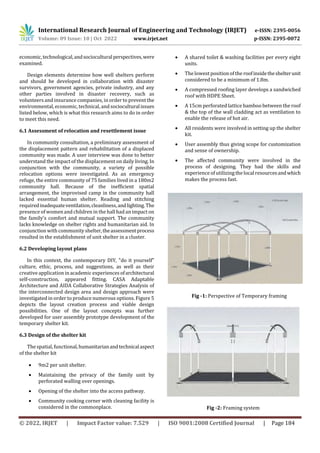
6.3 Design of the shelter kit
The spatial, functional,humanitarianandtechnicalaspect
of the shelter kit
 9m2 per unit shelter.
 Maintaining the privacy of the family unit by
perforated walling over openings.
 Opening of the shelter into the access pathway.
 Community cooking corner with cleaning facility is
considered in the commonplace.
 A shared toilet & washing facilities per every eight
units.
 The lowest position of the roofinsidetheshelterunit
considered to be a minimum of 1.8m.
 A compressed roofing layer develops a sandwiched
roof with HDPE Sheet.
 A 15cm perforated lattice bamboo between the roof
& the top of the wall cladding act as ventilation to
enable the release of hot air.
 All residents were involved in setting up the shelter
kit.
 User assembly thus giving scope for customization
and sense of ownership.
 The affected community were involved in the
process of designing. They had the skills and
experience of utilizing the local resourcesandwhich
makes the process fast.
Fig -1: Perspective of Temporary framing
Fig -2: Framing system
International Research Journal of Engineering and Technology (IRJET) e-ISSN: 2395-0056
Volume: 09 Issue: 10 | Oct 2022 www.irjet.net p-ISSN: 2395-0072
© 2022, IRJET | Impact Factor value: 7.529 | ISO 9001:2008 Certified Journal | Page 185
3. CONCLUSIONS
According to the conclusionsofthecommunity-leddesign
exercise, the design discussions should be available to all
persons who may be affected by post-disaster displacement.
Aspirations from the community are architecturally
transformed into visions of agreementthatareusefulinpost-
disaster settings. Furthermore, we iterated the shelter-
building procedure to create a Shelter Kit that can be made
available for the region's reoccurring flood crisis every year.
We can conclude from the shelter's user experience that
the:
 Shelter provides the structural stabilitythattheuser
desires.
 Users were pleased with the shelter's comfort.
 We were successful in meeting the financial cost
criteria.
 The bareminimumofhumanitariancriteriahasbeen
reached.
 Assembly time of the Kit is 1 HR. 15 MNTS by four
people
 Weight of each shelter Kit is an average of 75 to 80
kg.
 There is an abundance of localresourcespreciselyto
deliver the required quantities
The topic of post-disaster housing is very
multidisciplinary, combining social, environmental, and
technological sustainability principles with economics,
logistics, and politics. According to the findings of the study,
engaging with the community is a beneficial technique in
afflicted areas where victims frequently seek external
support. As a developing country with limited resources, we
must endeavor to work with what we have and correct its
inadequacies. Urged to be used in the designed shelter kit
because it has a minimal carbon footprint, is socially
meaningful, and is cost effective in the setting. However, the
concern of termite infestation due to non-treatment,
ecological harvesting followed by wall waterproofing
providesscopeforfurther research of exploring the material
and learning traditional treatmentpracticesthatcannotonly
contribute to the longevity of the shelter kit but also give an
aesthetic visualcharacter due to the stainsoftheuseofplant-
based insecticides.
REFERENCES
[1] (2016). World Disasters Report
[2] Davidson, C. (2010). Multi-actor arrangements and
project management. In C. J. Davidson, Rebuilding After
Disasters (pp. 88-109). Auckland, New Zealand:
Routledge.
[3] Ehn, P. (2008). Participation in Design Things.
Proceedings of the Tenth Anniversary Conference on
Participatory Design 2008 (pp. 92-101). Indiana:
Indiana University.
[4] Hayward, D. G. (1977). Psychological conceptsof‘home’,
HUD Challenge. 10-13.
[5] IFRC (2011). Transitional shelters, eight designs.
Geneva: International Federation of Red Cross and Red
Crescent Societies.
[6] IFRC, UN-Habitat & UNHCR (2008). Shelter Projects
2008.
[7] Sphere Project, the (2011). Minimum Standards in
Shelter, Settlement and Non-Food Items. The Sphere
Handbook. 3rd ed. Practical Action Publishing.
International Research Journal of Engineering and Technology (IRJET) e-ISSN: 2395-0056
Volume: 09 Issue: 10 | Oct 2022 www.irjet.net p-ISSN: 2395-0072

SHELTERING EMERGENCIES: DESIGN DEVELOPMENT PROCESS OF TEMPORARY STRUCTURE

  • 1.
    © 2022, IRJET| Impact Factor value: 7.529 | ISO 9001:2008 Certified Journal | Page 181 SHELTERING EMERGENCIES: DESIGN DEVELOPMENT PROCESS OF TEMPORARY STRUCTURE Ar. Shweta Ghonge1, Prof. Sandeep G. Dige2, Prof. Anjali S. Jadhav3, Prof. Rakhi Begampure4 1Post Graduate Student, S.P.S.M.B.H S College of Architecture, Kolhapur, Maharashtra 2Principal, S.P.S.M.B.H S College of Architecture, Kolhapur, Maharashtra 3Professor, Dept. of Architecture and Construction Project Management, S.P.S.M.B.H S College of Architecture, Kolhapur, Maharashtra, INDIA. ---------------------------------------------------------------------***--------------------------------------------------------------------- Abstract - The increasing number of natural disasters has focused emphasis on the necessity to Sheltertothepopulation. The field research of flood-stricken villages in India's tembhipada reveals a need for emergency shelters that are comfortable, durable, and inexpensive to the affected community. This paper outlines the design process of creating an emergency shelter for displaced individuals in the tembhipada nagar post-flood settlements. The Mithi River's morphological records make itauniquegeographicallocation that floods annually. We conducted an exploratory inquiry to examine several factors of shelter creation. A limited study of flood-affected towns was conductedtobetterunderstandtheir lifestyle and constructed culture. A community engagement meeting and activity were planned and implemented in order to arrive at a spatial design brief that adhered to humanitarian principles. We investigated an iterativemethod to developing a Shelter, with continual community consultation. The full-scale prototype is then given to a family to see how easy it is to assemble and install. The experience of using the shelter kit provides guidance for future modifications. The shelter was found to be suitable for usage in the aftermath of a flood. Because of the community's involvement at every stage of the design process, it is culturally suitable and socially relevant. Furthermore, the study's conclusions include efforts to make it transportable and material durable. Key Words: Disaster, Temporary shelter, Emergency, Flood, and Shelter. 1. INTRODUCTION Humanitarian needs are rapidly increasing; millions of people are displaced eachyearasaresultofnaturaldisasters. The World Disasters Report2016predictsthatthenumberof refugees will continue to climb over the next decade (1). Humanitarian shelter assistance is critical in assisting displaced communities. This article aims to contribute to the implementation and development of a more effective relief and reconstruction procedure. This study focuses on a temporaryshelter, which servesasanintermediateshelterin the humanitarian shelter relief process. Multiple actors, including affected people, community-based organizations, local and central government, non-governmental organizations (NGOs), and international organizations, as well as designers (who may be architects or engineers) and builders, contribute to the successful implementation of emergency shelters. Two parts of shelter coordination, in particular, are critical to getting the intended results:  Implementing a structured organizational design and  Selecting an acceptable procurement strategy at the rebuilding level. This paper describes a community-based strategy, including programme participants and the system of resources and goods required for effective recovery operations. 2. ORGANIZING FOR RECONSTRUCTION- A DESIGN PROBLEM Organizing a reconstruction design project necessitatesa systems approach to establishing the project's mandate. Questions such as whoshouldbeconsideredforparticipation and on what basis, as well as who decides on participation, must be addressed. The challenge is to identify the participants while simultaneously guiding the relationships between them. The sort of reconstruction, whether it should be built and, if so, where it should be built, and how to begin the project are the next issues to be addressed (2). 2.1 Temporary Shelter after Disaster A construction project involves a wide range of players, from professionals to businesses and artisans froma specific context of the building industry inside a specified national area.As a result, theselectedprojectparticipantsarereferred to as a project team, which works together to plan and execute the project (3). 2.2 Temporary Shelter for the Flood-affected people of the tembhipada The annual flooding of the tembhipada displaces approximately a million people, damaging or partially demolishing their homes. Displaced people seek refuge in International Research Journal of Engineering and Technology (IRJET) e-ISSN: 2395-0056 Volume: 09 Issue: 10 | Oct 2022 www.irjet.net p-ISSN: 2395-0072
  • 2.
    © 2022, IRJET| Impact Factor value: 7.529 | ISO 9001:2008 Certified Journal | Page 182 government institutions such as schools and other educational institutions. Because the annual flooding occurs during the hottest and most humid months of the year, itwas necessary to investigate a design solution for comfortable living over the lodging supplied surrounding government facilities in the form of tarpaulin/plastic sheet tents. According to the findings of a study of a completely eroded hamlet, displaced individuals were forced to live in a decaying community hall, where ladies were forced to sleep insidethe hallat nightandmenwereforcedtosleepoutdoors in the open. The sense of family and privacy were entirely ignored in such accommodations, where displaced persons stayed for more than five months or longer until they could rebuild their homes. To comprehend the afflicted community's constructed environment. With community input, an early shelter prototype was created. The prototype goes through an iterative phase in which the user assembly and community participation are assessed for additional recommendations. 3. DESIGN BRIEF DEVELOPMENT The design parameters for humanitarian temporary housing help are classified into three major categories:  Basic human needs such as the necessary elements of a home and its spaces, the social environment, and its functions.  The aid organization's settlement standards are exact drainage, layout, security, water, and sanitation.  Technical standards for standard physical and mechanical shelter and settlement properties. 3.1 Sense of Place In traditional societies, the process of housing is the most fundamentalcomponentofliving.Individualsandhouseholds were endowed with the knowledge and supplies needed to coexist with the ecology of the area byprimitivecultures.The household resulted in the creation of the individual's and household's "place" in society (4). Maslow's hierarchy of human needs analysis presents a brief reflection on human wants as a source of motivation in life. A thoughtful shelter design aimed at creatinga friendly and familiar environment could aid in the users' recovery process through its use. We discovered that when people have control over their living area and their privacy demands are addressed, they might experience sensations of comfort and independence. This flexibility allows for relaxation and personal development (5). In this regard, Nobel Laureate Amartya Sen's capacity approach proposes a theoretical way for assessing quality of life and social well-being in humanitarian design. The capability approach is centered on people and their capacities. Because individuals live in groups, families, neighborhoods, and communities, understanding the collective capabilities of vulnerable communities is critical (6). It is vital to be familiar with the culture of the settlement when dealing with communities. The Co-Design Approach was examined for investigating the design of emergency housing in flood-prone parts. Table -1: List of Design Criteria based on the essential qualities of human necessities Sr. No Design Criteria Objectives Source 1 Security  Feeling of safety and security  Ensuring protection for the inhabitants and their belongings.  Protection from nature and other external anti-social factors. (IFRC, 2011) 2 Permane nce  Experience of continuity that characterises the home environment.  sense of belonging and connection with the place (Haywa rd, 1977) 3 Personali zation  exclusive control and use of the environment  self-expression and scope for customisation (Sebba & Church man, 1986; Pennart z, 1986) 4 Privacy  control of space in dense and crowded environments  sound insulation  internal partitions (IFRC, 2011) 5 Social Relations hips  relationships with family  community meeting places  shared spaces for cooking, washing, cleaning etc. (Smith, 1994) 6 Complexi ty  visual perception  scope for customised assembly to avoid confusion due to repetition (Stamp s, 2005) 7 Identity (Form, Color, Light)  perception of physiological, environmental and cultural factors (UNHC R, 2011) 3.2 Spatial requirements and functions Space is a fundamental constraint in the post-disaster reconstruction of shelter and settlements. A single unit is typically utilized to execute numerous tasks. Table 2 highlights the design criteria that we considered when arranging the space. International Research Journal of Engineering and Technology (IRJET) e-ISSN: 2395-0056 Volume: 09 Issue: 10 | Oct 2022 www.irjet.net p-ISSN: 2395-0072
  • 3.
    © 2022, IRJET| Impact Factor value: 7.529 | ISO 9001:2008 Certified Journal | Page 183 Table 2. List of Design Criteria based on the spatial requirements and functions Sr. No Design Criteria Objectives 1 Sleeping Areas • indoor area with the optimum size for sleeping 2 Health and Hygiene • one latrine per 20 individuals to be considered 3 Culinary activities • covered space preferably shared clean and dry 4 Storage • storage of belongings and other relief materials 5 Washing and cleaning • externally provided facilities of WASH to be considered 6 Studying • Community space among shelters one in 100 shelters 7 Outdoor playing / playing / working /meeting • Semi covered spaces 3.3 Humanitarian standards Space Over the previous 10 years, aid agencies have established somegeneral guidelines thathave beensummarizedinmany instruction booklets. Among the most well-known is The Sphere Handbook (7), which was first produced in 2000 collaboratively by the IFRC and many humanitarian NGOs. It has a section on the minimum criteria for shelters, settlements, and non-food products. Table 3 contains the criteria provided by help organizations. Table 3. List of Design Criteria based on the Humanitarian Standards Dimensio ns Trans port Cost Appropri ateness Assemb ly Durabilit y and Afterlife Shelter for 5 Local availa bility of materi al Per fami ly 150 doll ars Culturall y and Socially relevant Prefera bly made by the user commu nity Contribut e to reconstru ction 3.4 Structural and Technical requirements The structural and technical requirements of shelter design are typically givenbyaidgroups,andweexaminedthe following parameters. The engineering calculations are not covered in this paper. We did, however, approach to verify with pertinent sources.  Load Bearing  Thermal Comfort  Water Resistance  Vector control  Fire Resistance  Environmental impact 4. CONTEXT OF DOMESTIC ARCHITECTURE OF THE DISPLACED SETTLEMENT The setting for this paper is Maharashtra, a state in India. It is vulnerable to natural calamities such as floods, landslides, and earthquakes due to its location in a seismic zone. Flooding happens in the region owing to a variety of causes, including  Heavy Rainfall in short space of time  Storm  Aggravation of Riverbed  Encroachment in the flood plains  Degradation of the catchment area in the form of deforestation  Lack of Proper Control of Land use 5. CO-DESIGN PROCESS To satisfy the post-disaster reconstruction need, the co- design approach, a type of community participation, was used. We conducted a community involvement design exercise with displaced population representatives. The community expressed a desire for collaborative design assistance. To engage the participants in the design process, an intensive technique of sketching talks, prototype, and modelling was used to facilitatearchitectural facilitation.We documented the process in order to create a co-design approach. The act of allowing all members of the relief team: young people and adults, men and women, authorities and contractors, to participate in the design conversation is the key to reducing relief situation alienation. Taking into account the SPHERE Humanitarian criteria, Shelters were created in collaboration with selected members of the affected community to satisfy the needs of the community and to be delivered with the availability of land and other resources. 6. CURRENT GUIDELINES FOR SHELTER To understand how such shelters have been developedin the past, what types of shelters were involved in specific catastrophes, as well as the disaster's environmental, International Research Journal of Engineering and Technology (IRJET) e-ISSN: 2395-0056 Volume: 09 Issue: 10 | Oct 2022 www.irjet.net p-ISSN: 2395-0072
  • 4.
    © 2022, IRJET| Impact Factor value: 7.529 | ISO 9001:2008 Certified Journal | Page 184 economic,technological,andsocioculturalperspectives,were examined. Design elements determine how well shelters perform and should be developed in collaboration with disaster survivors, government agencies, private industry, and any other parties involved in disaster recovery, such as volunteers and insurance companies, in order to preventthe environmental, economic, technical, andsocioculturalissues listed below, which is what this research aims to do in order to meet this need. 6.1 Assessment of relocation and resettlement issue In community consultation, a preliminary assessment of the displacement pattern and rehabilitation of a displaced community was made. A user interview was done to better understand the impact of the displacement on daily living. In conjunction with the community, a variety of possible relocation options were investigated. As an emergency refuge, the entire community of 75 families lived in a 180m2 community hall. Because of the inefficient spatial arrangement, the improvised camp in the community hall lacked essential human shelter. Reading and stitching requiredinadequateventilation,cleanliness,andlighting.The presence of women and children in the hall had an impact on the family's comfort and mutual support. The community lacks knowledge on shelter rights and humanitarian aid. In conjunction with community shelter,theassessmentprocess resulted in the establishment of unit shelter in a cluster. 6.2 Developing layout plans In this context, the contemporary DIY, "do it yourself" culture, ethic, process, and suggestions, as well as their creative application in academic experiences ofarchitectural self-construction, appeared fitting. CASA Adaptable Architecture and AIDA Collaborative Strategies Analysis of the interconnected design area and design approach were investigated in order to produce numerous options. Figure 5 depicts the layout creation process and viable design possibilities. One of the layout concepts was further developed for user assembly prototype development of the temporary shelter kit. 6.3 Design of the shelter kit The spatial, functional,humanitarianandtechnicalaspect of the shelter kit  9m2 per unit shelter.  Maintaining the privacy of the family unit by perforated walling over openings.  Opening of the shelter into the access pathway.  Community cooking corner with cleaning facility is considered in the commonplace.  A shared toilet & washing facilities per every eight units.  The lowest position of the roofinsidetheshelterunit considered to be a minimum of 1.8m.  A compressed roofing layer develops a sandwiched roof with HDPE Sheet.  A 15cm perforated lattice bamboo between the roof & the top of the wall cladding act as ventilation to enable the release of hot air.  All residents were involved in setting up the shelter kit.  User assembly thus giving scope for customization and sense of ownership.  The affected community were involved in the process of designing. They had the skills and experience of utilizing the local resourcesandwhich makes the process fast. Fig -1: Perspective of Temporary framing Fig -2: Framing system International Research Journal of Engineering and Technology (IRJET) e-ISSN: 2395-0056 Volume: 09 Issue: 10 | Oct 2022 www.irjet.net p-ISSN: 2395-0072
  • 5.
    © 2022, IRJET| Impact Factor value: 7.529 | ISO 9001:2008 Certified Journal | Page 185 3. CONCLUSIONS According to the conclusionsofthecommunity-leddesign exercise, the design discussions should be available to all persons who may be affected by post-disaster displacement. Aspirations from the community are architecturally transformed into visions of agreementthatareusefulinpost- disaster settings. Furthermore, we iterated the shelter- building procedure to create a Shelter Kit that can be made available for the region's reoccurring flood crisis every year. We can conclude from the shelter's user experience that the:  Shelter provides the structural stabilitythattheuser desires.  Users were pleased with the shelter's comfort.  We were successful in meeting the financial cost criteria.  The bareminimumofhumanitariancriteriahasbeen reached.  Assembly time of the Kit is 1 HR. 15 MNTS by four people  Weight of each shelter Kit is an average of 75 to 80 kg.  There is an abundance of localresourcespreciselyto deliver the required quantities The topic of post-disaster housing is very multidisciplinary, combining social, environmental, and technological sustainability principles with economics, logistics, and politics. According to the findings of the study, engaging with the community is a beneficial technique in afflicted areas where victims frequently seek external support. As a developing country with limited resources, we must endeavor to work with what we have and correct its inadequacies. Urged to be used in the designed shelter kit because it has a minimal carbon footprint, is socially meaningful, and is cost effective in the setting. However, the concern of termite infestation due to non-treatment, ecological harvesting followed by wall waterproofing providesscopeforfurther research of exploring the material and learning traditional treatmentpracticesthatcannotonly contribute to the longevity of the shelter kit but also give an aesthetic visualcharacter due to the stainsoftheuseofplant- based insecticides. REFERENCES [1] (2016). World Disasters Report [2] Davidson, C. (2010). Multi-actor arrangements and project management. In C. J. Davidson, Rebuilding After Disasters (pp. 88-109). Auckland, New Zealand: Routledge. [3] Ehn, P. (2008). Participation in Design Things. Proceedings of the Tenth Anniversary Conference on Participatory Design 2008 (pp. 92-101). Indiana: Indiana University. [4] Hayward, D. G. (1977). Psychological conceptsof‘home’, HUD Challenge. 10-13. [5] IFRC (2011). Transitional shelters, eight designs. Geneva: International Federation of Red Cross and Red Crescent Societies. [6] IFRC, UN-Habitat & UNHCR (2008). Shelter Projects 2008. [7] Sphere Project, the (2011). Minimum Standards in Shelter, Settlement and Non-Food Items. The Sphere Handbook. 3rd ed. Practical Action Publishing. International Research Journal of Engineering and Technology (IRJET) e-ISSN: 2395-0056 Volume: 09 Issue: 10 | Oct 2022 www.irjet.net p-ISSN: 2395-0072