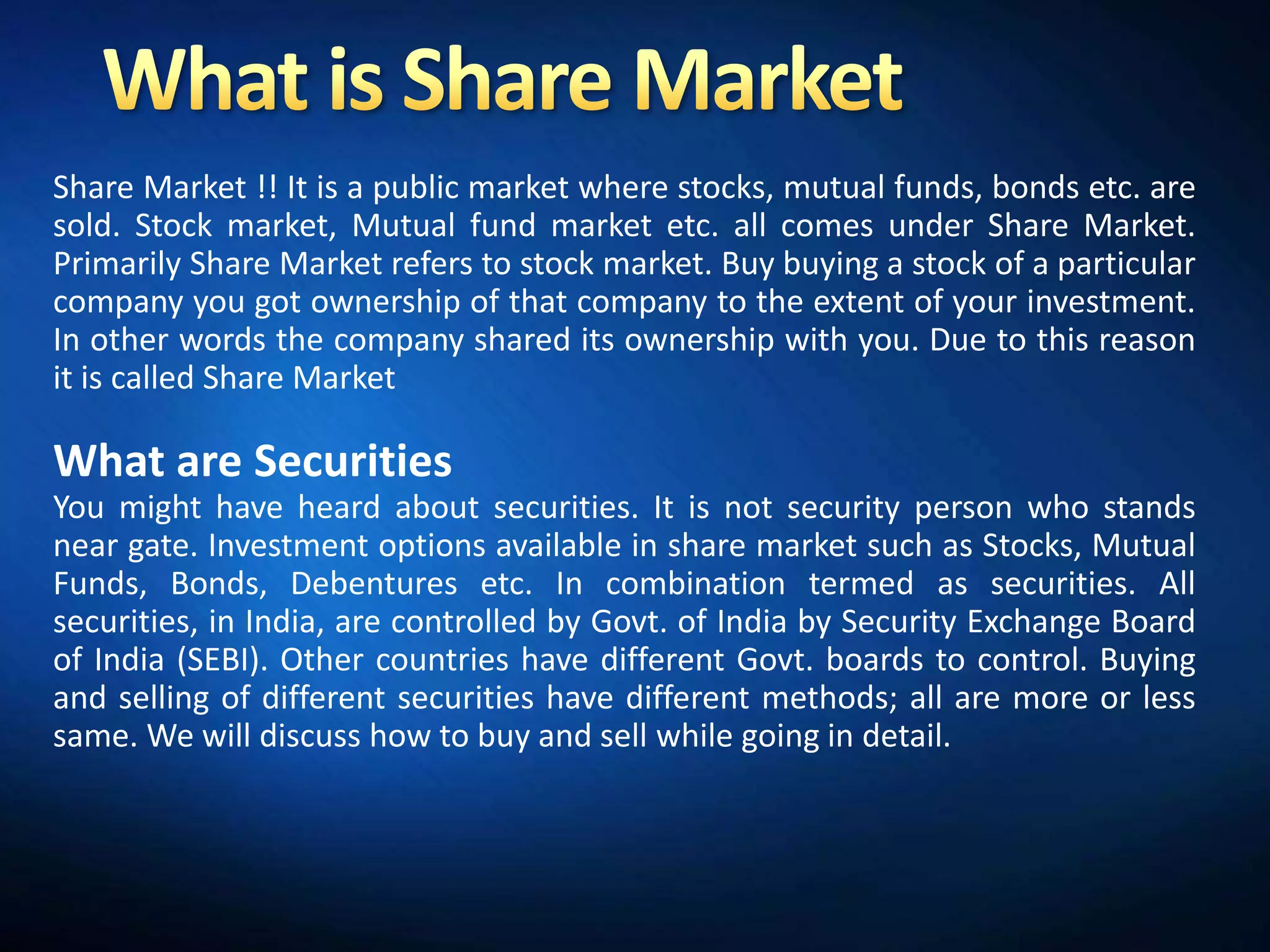
Share Market !! It is a public market where stocks, mutual funds, bonds etc. are
sold. Stock market, Mutual fund market etc. all comes under Share Market.
Primarily Share Market refers to stock market. Buy buying a stock of a particular
company you got ownership of that company to the extent of your investment.
In other words the company shared its ownership with you. Due to this reason
it is called Share Market

What are Securities
You might have heard about securities. It is not security person who stands
near gate. Investment options available in share market such as Stocks, Mutual
Funds, Bonds, Debentures etc. In combination termed as securities. All
securities, in India, are controlled by Govt. of India by Security Exchange Board
of India (SEBI). Other countries have different Govt. boards to control. Buying
and selling of different securities have different methods; all are more or less
same. We will discuss how to buy and sell while going in detail.
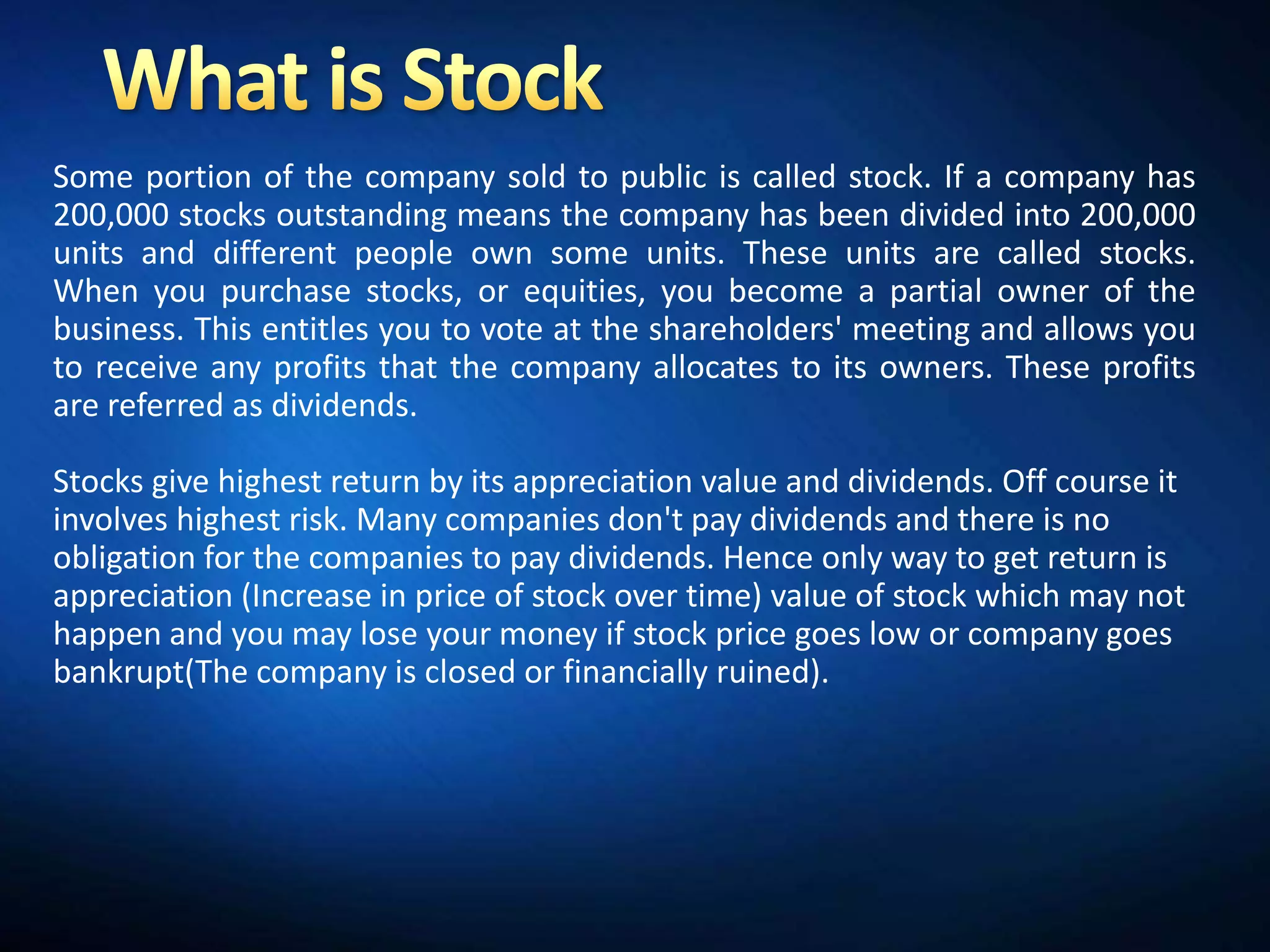
Some portion of the company sold to public is called stock. If a company has
200,000 stocks outstanding means the company has been divided into 200,000
units and different people own some units. These units are called stocks.
When you purchase stocks, or equities, you become a partial owner of the
business. This entitles you to vote at the shareholders' meeting and allows you
to receive any profits that the company allocates to its owners. These profits
are referred as dividends.

Stocks give highest return by its appreciation value and dividends. Off course it
involves highest risk. Many companies don't pay dividends and there is no
obligation for the companies to pay dividends. Hence only way to get return is
appreciation (Increase in price of stock over time) value of stock which may not
happen and you may lose your money if stock price goes low or company goes
bankrupt(The company is closed or financially ruined).
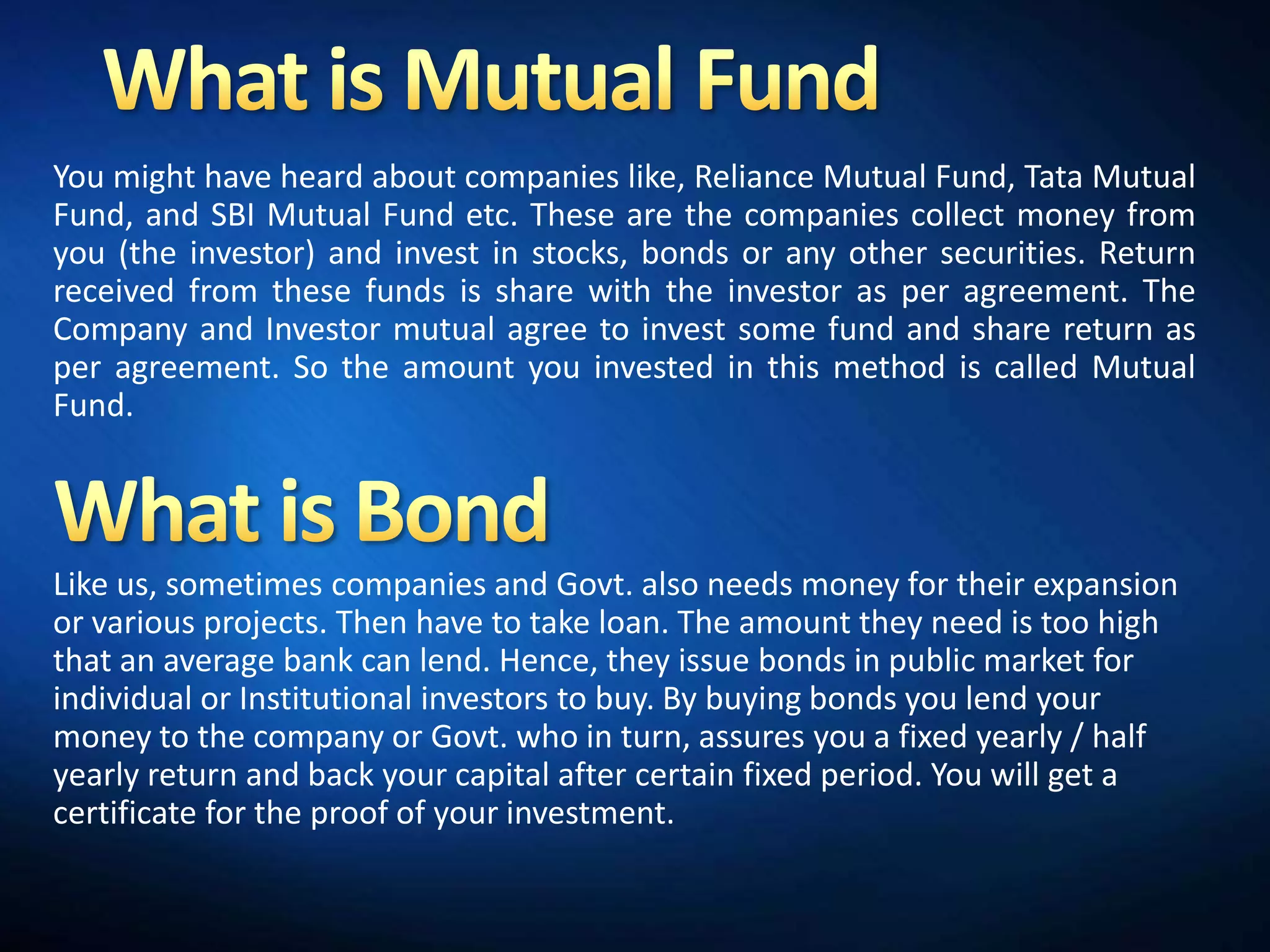
You might have heard about companies like, Reliance Mutual Fund, Tata Mutual
Fund, and SBI Mutual Fund etc. These are the companies collect money from
you (the investor) and invest in stocks, bonds or any other securities. Return
received from these funds is share with the investor as per agreement. The
Company and Investor mutual agree to invest some fund and share return as
per agreement. So the amount you invested in this method is called Mutual
Fund.


Like us, sometimes companies and Govt. also needs money for their expansion
or various projects. Then have to take loan. The amount they need is too high
that an average bank can lend. Hence, they issue bonds in public market for
individual or Institutional investors to buy. By buying bonds you lend your
money to the company or Govt. who in turn, assures you a fixed yearly / half
yearly return and back your capital after certain fixed period. You will get a
certificate for the proof of your investment.
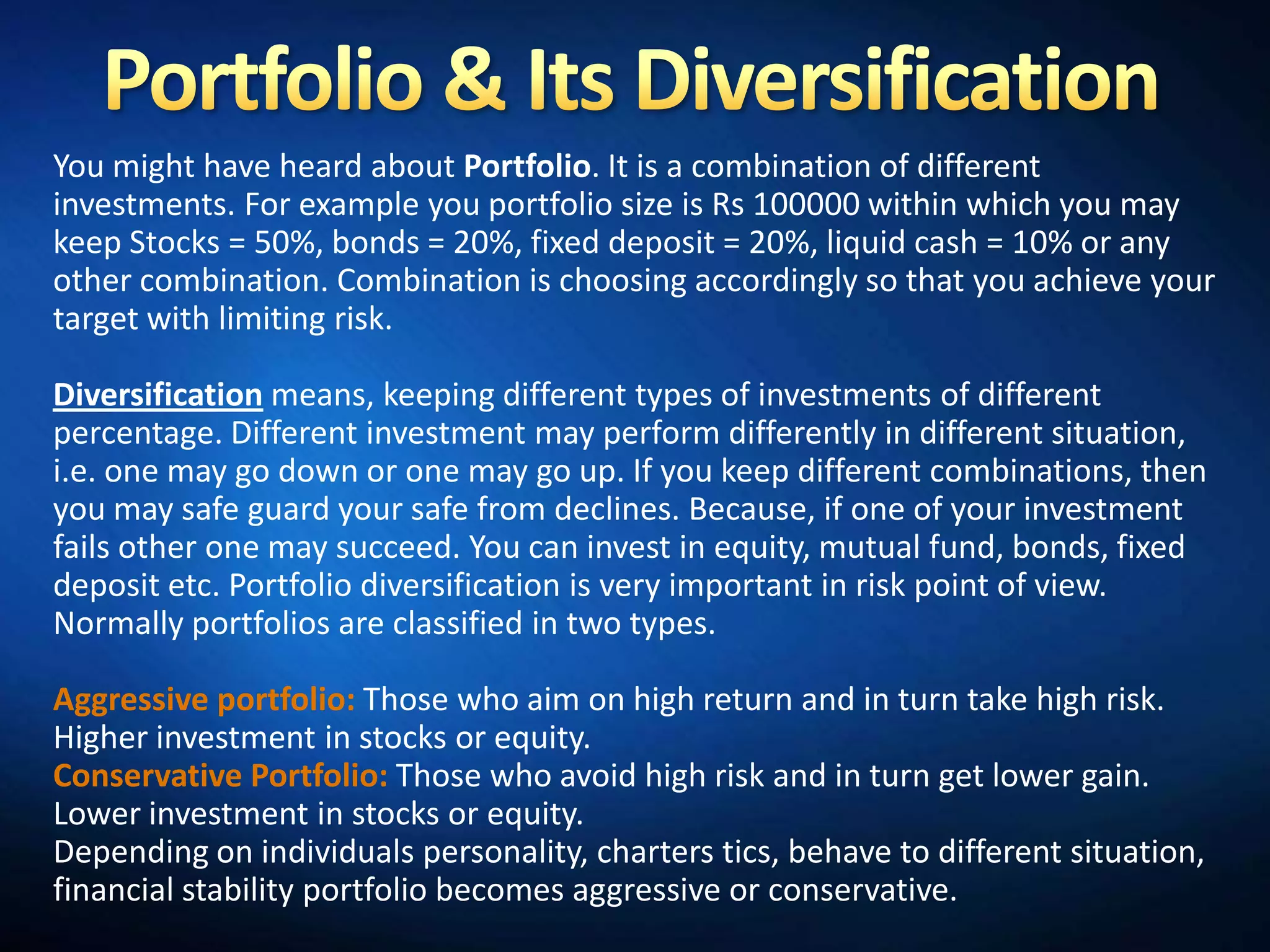
You might have heard about Portfolio. It is a combination of different
investments. For example you portfolio size is Rs 100000 within which you may
keep Stocks = 50%, bonds = 20%, fixed deposit = 20%, liquid cash = 10% or any
other combination. Combination is choosing accordingly so that you achieve your
target with limiting risk.

Diversification means, keeping different types of investments of different
percentage. Different investment may perform differently in different situation,
i.e. one may go down or one may go up. If you keep different combinations, then
you may safe guard your safe from declines. Because, if one of your investment
fails other one may succeed. You can invest in equity, mutual fund, bonds, fixed
deposit etc. Portfolio diversification is very important in risk point of view.
Normally portfolios are classified in two types.

Aggressive portfolio: Those who aim on high return and in turn take high risk.
Higher investment in stocks or equity.
Conservative Portfolio: Those who avoid high risk and in turn get lower gain.
Lower investment in stocks or equity.
Depending on individuals personality, charters tics, behave to different situation,
financial stability portfolio becomes aggressive or conservative.
For starting any investing you need money. Then a bank account, a demat account
and little knowledge. While going through different investments like stocks,
mutual fund & bonds, we will explain how to buy or sell.
Now let’s open and bank account and demat account first? Then you can start
investing.
The very first thing is you must have a bank account with Internet banking facility.
There are several banks offering saving account. Go to any bank (or fill up their
form in their site, they will call you), open the account.
The following criteria can be taken in to consideration while opening bank
account,

1. on line transaction security. All famous banks are certified and by Verified Visa
and VeriSign, you can check for this.
2. Internet banking facility. It is must. And Support system.
3. Phone banking or Mobile banking facility. This will be very much useful.
4. Issuing Credit Card (Some time you may need this) and Debit Card (ATM card)
facility.
5. Acceptability of Credit & Debit card over Internet. Check some site whether
they are accepting, your bank card.
In India, State Bank of India (SBI), HDFC Bank, ICICI Bank etc. are the leading banks.
Next you need a Trading account or called Demat account. In saving account your
money will be deposited, similarly in Demat account your shares or stocks will be
deposited. This you will open with a broker.

Your broker takes a vital role in your success in stock trading. Hence take a close
look while choosing a broker. The following Criteria can be considered while
selecting a broker,
1. The quality and quantum of stock analysis report they give. From their reports
    only you are going to make further analysis. Hence see their free and demo
    report available in their site, ask friends and relatives about this.
2. Commission percentage for trading. Be very clear about commissions and
    taxes applicable. This governs your profit to a considerable extent.
    3. Support facility should be very good.
3. Support facility should be very good
4. Website efficiency. Check their website speed during working hours or trading
    hours. It should not be too slow.
5. Working hours. Working hours should be at least up to 2'O clock from 10'O
    clock (As per Indian Standard Time i.e. GMT+5.30).
6. Accessibility: Branch office should be nearby but not mandatory.
7.   Margin limit: You can trade more than money available in your trading
     account. If you have Rs 10000 in your trading account, you can trade for Rs
     50000(5times margin limit, depends on broker), it is somewhat like over draft.
     Check how much margin your broker is offering. It should be nearer to 5 times
     of your trading account balance

Now banking organizations are also providing Demat account, like SBI Demat, ICICI
direct, and HDFC Securities etc. If you are satisfied with their services then you can
open account. But is not essential to open both demat and saving account with
same organization.
Now days, most on line brokers are providing free demat account, some are with
nominal charge. You can fill up their form on line; they will call you for further
assistance

Share market basics

  • 1.
    Share Market !!It is a public market where stocks, mutual funds, bonds etc. are sold. Stock market, Mutual fund market etc. all comes under Share Market. Primarily Share Market refers to stock market. Buy buying a stock of a particular company you got ownership of that company to the extent of your investment. In other words the company shared its ownership with you. Due to this reason it is called Share Market What are Securities You might have heard about securities. It is not security person who stands near gate. Investment options available in share market such as Stocks, Mutual Funds, Bonds, Debentures etc. In combination termed as securities. All securities, in India, are controlled by Govt. of India by Security Exchange Board of India (SEBI). Other countries have different Govt. boards to control. Buying and selling of different securities have different methods; all are more or less same. We will discuss how to buy and sell while going in detail.
  • 2.
    Some portion ofthe company sold to public is called stock. If a company has 200,000 stocks outstanding means the company has been divided into 200,000 units and different people own some units. These units are called stocks. When you purchase stocks, or equities, you become a partial owner of the business. This entitles you to vote at the shareholders' meeting and allows you to receive any profits that the company allocates to its owners. These profits are referred as dividends. Stocks give highest return by its appreciation value and dividends. Off course it involves highest risk. Many companies don't pay dividends and there is no obligation for the companies to pay dividends. Hence only way to get return is appreciation (Increase in price of stock over time) value of stock which may not happen and you may lose your money if stock price goes low or company goes bankrupt(The company is closed or financially ruined).
  • 3.
    You might haveheard about companies like, Reliance Mutual Fund, Tata Mutual Fund, and SBI Mutual Fund etc. These are the companies collect money from you (the investor) and invest in stocks, bonds or any other securities. Return received from these funds is share with the investor as per agreement. The Company and Investor mutual agree to invest some fund and share return as per agreement. So the amount you invested in this method is called Mutual Fund. Like us, sometimes companies and Govt. also needs money for their expansion or various projects. Then have to take loan. The amount they need is too high that an average bank can lend. Hence, they issue bonds in public market for individual or Institutional investors to buy. By buying bonds you lend your money to the company or Govt. who in turn, assures you a fixed yearly / half yearly return and back your capital after certain fixed period. You will get a certificate for the proof of your investment.
  • 4.
    You might haveheard about Portfolio. It is a combination of different investments. For example you portfolio size is Rs 100000 within which you may keep Stocks = 50%, bonds = 20%, fixed deposit = 20%, liquid cash = 10% or any other combination. Combination is choosing accordingly so that you achieve your target with limiting risk. Diversification means, keeping different types of investments of different percentage. Different investment may perform differently in different situation, i.e. one may go down or one may go up. If you keep different combinations, then you may safe guard your safe from declines. Because, if one of your investment fails other one may succeed. You can invest in equity, mutual fund, bonds, fixed deposit etc. Portfolio diversification is very important in risk point of view. Normally portfolios are classified in two types. Aggressive portfolio: Those who aim on high return and in turn take high risk. Higher investment in stocks or equity. Conservative Portfolio: Those who avoid high risk and in turn get lower gain. Lower investment in stocks or equity. Depending on individuals personality, charters tics, behave to different situation, financial stability portfolio becomes aggressive or conservative.
  • 5.
    For starting anyinvesting you need money. Then a bank account, a demat account and little knowledge. While going through different investments like stocks, mutual fund & bonds, we will explain how to buy or sell. Now let’s open and bank account and demat account first? Then you can start investing. The very first thing is you must have a bank account with Internet banking facility. There are several banks offering saving account. Go to any bank (or fill up their form in their site, they will call you), open the account. The following criteria can be taken in to consideration while opening bank account, 1. on line transaction security. All famous banks are certified and by Verified Visa and VeriSign, you can check for this. 2. Internet banking facility. It is must. And Support system. 3. Phone banking or Mobile banking facility. This will be very much useful. 4. Issuing Credit Card (Some time you may need this) and Debit Card (ATM card) facility. 5. Acceptability of Credit & Debit card over Internet. Check some site whether they are accepting, your bank card. In India, State Bank of India (SBI), HDFC Bank, ICICI Bank etc. are the leading banks.
  • 6.
    Next you needa Trading account or called Demat account. In saving account your money will be deposited, similarly in Demat account your shares or stocks will be deposited. This you will open with a broker. Your broker takes a vital role in your success in stock trading. Hence take a close look while choosing a broker. The following Criteria can be considered while selecting a broker, 1. The quality and quantum of stock analysis report they give. From their reports only you are going to make further analysis. Hence see their free and demo report available in their site, ask friends and relatives about this. 2. Commission percentage for trading. Be very clear about commissions and taxes applicable. This governs your profit to a considerable extent. 3. Support facility should be very good. 3. Support facility should be very good 4. Website efficiency. Check their website speed during working hours or trading hours. It should not be too slow. 5. Working hours. Working hours should be at least up to 2'O clock from 10'O clock (As per Indian Standard Time i.e. GMT+5.30). 6. Accessibility: Branch office should be nearby but not mandatory.
  • 7.
    7. Margin limit: You can trade more than money available in your trading account. If you have Rs 10000 in your trading account, you can trade for Rs 50000(5times margin limit, depends on broker), it is somewhat like over draft. Check how much margin your broker is offering. It should be nearer to 5 times of your trading account balance Now banking organizations are also providing Demat account, like SBI Demat, ICICI direct, and HDFC Securities etc. If you are satisfied with their services then you can open account. But is not essential to open both demat and saving account with same organization. Now days, most on line brokers are providing free demat account, some are with nominal charge. You can fill up their form on line; they will call you for further assistance