LET’S ALL SHARE THE ROAD
… SAFELY
www.saaq.gouv.qc.ca
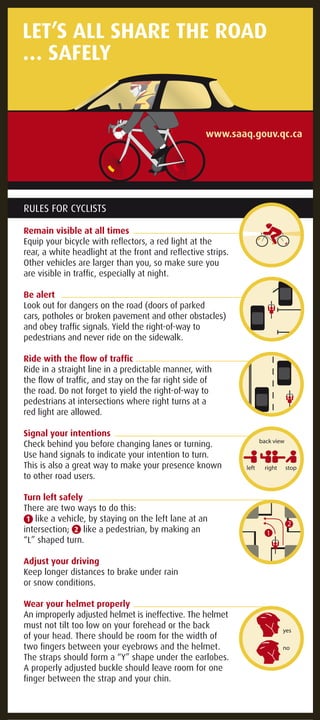
left
back view
right stop
1
2
yes
no
RULES FOR CYCLISTS
Remain visible at all times
Equip your bicycle with reflectors, a red light at the
rear, a white headlight at the front and reflective strips.
Other vehicles are larger than you, so make sure you
are visible in traffic, especially at night.
Be alert
Look out for dangers on the road (doors of parked
cars, potholes or broken pavement and other obstacles)
and obey traffic signals. Yield the right-of-way to
pedestrians and never ride on the sidewalk.
Ride with the flow of traffic
Ride in a straight line in a predictable manner, with
the flow of traffic, and stay on the far right side of
the road. Do not forget to yield the right-of-way to
pedestrians at intersections where right turns at a
red light are allowed.
Signal your intentions
Check behind you before changing lanes or turning.
Use hand signals to indicate your intention to turn.
This is also a great way to make your presence known
to other road users.
Turn left safely
There are two ways to do this:
1 like a vehicle, by staying on the left lane at an
intersection; 2 like a pedestrian, by making an
“L” shaped turn.
Adjust your driving
Keep longer distances to brake under rain
or snow conditions.
Wear your helmet properly
An improperly adjusted helmet is ineffective. The helmet
must not tilt too low on your forehead or the back
of your head. There should be room for the width of
two fingers between your eyebrows and the helmet.
The straps should form a “Y” shape under the earlobes.
A properly adjusted buckle should leave room for one
finger between the strap and your chin.
LET’S ALL SHARE THE ROAD
… SAFELY
www.saaq.gouv.qc.ca
RULES FOR MOTORISTS
Look out for cyclists…
…regardless of the weather, place or time. Cyclists
must occasionally steer away from the far right side
of the road to avoid debris or obstacles. If you are
parked, check to make sure there are no oncoming
cyclists before opening your door.
Keep your distance
When passing a cyclist, keep a distance of around
1 m between your vehicle and the cyclist, and 1.5 m
on rural roads. Under the Highway Safety Code, a
motorist may cross a solid line to pass a cyclist if
this manoeuvre can be done safely. Before getting
back into the lane, make sure you leave enough
distance between your vehicle and the cyclist.
Be careful at intersections
Always watch out for cyclists at intersections.
Yield the right-of-way to cyclists riding on your
right or before turning right at a red light
(where permitted).
Yield the right-of-way to cyclists...
...crossing the lane you are about to enter.
Do not honk your horn
when approaching cyclists
This can startle cyclists and cause them
to make a wrong manoeuvre.
klaxon
1m
C-5059-A (11-03)
For more information, read the Safe Cycling
Guide at www.saaq.gouv.qc.ca.

Share cyclisy motorist

  • 1.
    LET’S ALL SHARETHE ROAD … SAFELY www.saaq.gouv.qc.ca left back view right stop 1 2 yes no RULES FOR CYCLISTS Remain visible at all times Equip your bicycle with reflectors, a red light at the rear, a white headlight at the front and reflective strips. Other vehicles are larger than you, so make sure you are visible in traffic, especially at night. Be alert Look out for dangers on the road (doors of parked cars, potholes or broken pavement and other obstacles) and obey traffic signals. Yield the right-of-way to pedestrians and never ride on the sidewalk. Ride with the flow of traffic Ride in a straight line in a predictable manner, with the flow of traffic, and stay on the far right side of the road. Do not forget to yield the right-of-way to pedestrians at intersections where right turns at a red light are allowed. Signal your intentions Check behind you before changing lanes or turning. Use hand signals to indicate your intention to turn. This is also a great way to make your presence known to other road users. Turn left safely There are two ways to do this: 1 like a vehicle, by staying on the left lane at an intersection; 2 like a pedestrian, by making an “L” shaped turn. Adjust your driving Keep longer distances to brake under rain or snow conditions. Wear your helmet properly An improperly adjusted helmet is ineffective. The helmet must not tilt too low on your forehead or the back of your head. There should be room for the width of two fingers between your eyebrows and the helmet. The straps should form a “Y” shape under the earlobes. A properly adjusted buckle should leave room for one finger between the strap and your chin.
  • 2.
    LET’S ALL SHARETHE ROAD … SAFELY www.saaq.gouv.qc.ca RULES FOR MOTORISTS Look out for cyclists… …regardless of the weather, place or time. Cyclists must occasionally steer away from the far right side of the road to avoid debris or obstacles. If you are parked, check to make sure there are no oncoming cyclists before opening your door. Keep your distance When passing a cyclist, keep a distance of around 1 m between your vehicle and the cyclist, and 1.5 m on rural roads. Under the Highway Safety Code, a motorist may cross a solid line to pass a cyclist if this manoeuvre can be done safely. Before getting back into the lane, make sure you leave enough distance between your vehicle and the cyclist. Be careful at intersections Always watch out for cyclists at intersections. Yield the right-of-way to cyclists riding on your right or before turning right at a red light (where permitted). Yield the right-of-way to cyclists... ...crossing the lane you are about to enter. Do not honk your horn when approaching cyclists This can startle cyclists and cause them to make a wrong manoeuvre. klaxon 1m C-5059-A (11-03) For more information, read the Safe Cycling Guide at www.saaq.gouv.qc.ca.