Central University of Kashmir
Department of Information and Technology
CLICK BAIT DETECTION
Using Machine Learning
Presented by :-
Shahid Nazeer
Enroll: 2202-CUKmr-13
contents
• Introduction to click bait
• What is click Bait
• Challenges in Detecting Click bait
• Approaches in Click Bait
• Dataset
• Algorithms
• Evaluation and results
Click Bait Detection
Using Machine Learning
Welcome to the world of click bait detection! In this presentation, we will
explore what click bait is, the challenges in detecting it, and how machine
learning can help tackle this problem.
What is Click Bait?
Click bait refers to sensational or misleading headlines or images designed to
attract clicks and drive traffic to a website. It often exaggerates or
misrepresents the content to generate curiosity and engagement.
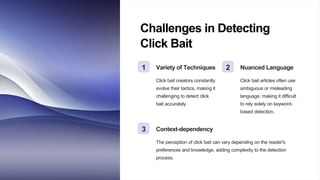
Challenges in Detecting
Click Bait
1 Variety of Techniques
Click bait creators constantly
evolve their tactics, making it
challenging to detect click
bait accurately.
2 Nuanced Language
Click bait articles often use
ambiguous or misleading
language, making it difficult
to rely solely on keyword-
based detection.
3 Context-dependency
The perception of click bait can vary depending on the reader's
preferences and knowledge, adding complexity to the detection
process.
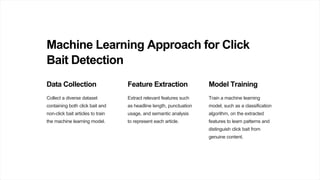
Machine Learning Approach for Click
Bait Detection
Data Collection
Collect a diverse dataset
containing both click bait and
non-click bait articles to train
the machine learning model.
Feature Extraction
Extract relevant features such
as headline length, punctuation
usage, and semantic analysis
to represent each article.
Model Training
Train a machine learning
model, such as a classification
algorithm, on the extracted
features to learn patterns and
distinguish click bait from
genuine content.
Dataset Preparation
To create an effective click bait detection model, a carefully curated dataset of labeled click bait and non-click
bait articles is essential. This dataset should encompass various genres and domains to improve the model's
generalization capabilities.
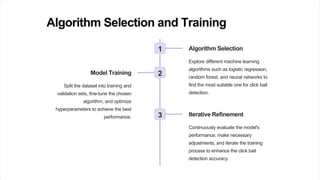
Algorithm Selection and Training
1 Algorithm Selection
Explore different machine learning
algorithms such as logistic regression,
random forest, and neural networks to
find the most suitable one for click bait
detection.
2
Model Training
Split the dataset into training and
validation sets, fine-tune the chosen
algorithm, and optimize
hyperparameters to achieve the best
performance. 3 Iterative Refinement
Continuously evaluate the model's
performance, make necessary
adjustments, and iterate the training
process to enhance the click bait
detection accuracy.
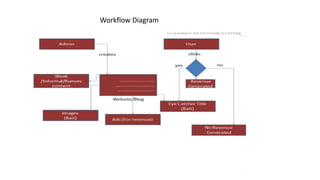
Workflow Diagram
Evaluation and Results
Accuracy Metrics
Measure the performance of the click bait
detection model using evaluation metrics such
as precision, recall, and F1 score.
Real-world Testing
Validate the model's effectiveness on a
separate test set containing unseen click bait
articles, simulating real-world scenarios and
assessing its practical applicability.

Shahidreasearch project for mtechcse.pptx

  • 1.
    Central University ofKashmir Department of Information and Technology CLICK BAIT DETECTION Using Machine Learning Presented by :- Shahid Nazeer Enroll: 2202-CUKmr-13
  • 2.
    contents • Introduction toclick bait • What is click Bait • Challenges in Detecting Click bait • Approaches in Click Bait • Dataset • Algorithms • Evaluation and results
  • 3.
    Click Bait Detection UsingMachine Learning Welcome to the world of click bait detection! In this presentation, we will explore what click bait is, the challenges in detecting it, and how machine learning can help tackle this problem.
  • 4.
    What is ClickBait? Click bait refers to sensational or misleading headlines or images designed to attract clicks and drive traffic to a website. It often exaggerates or misrepresents the content to generate curiosity and engagement.
  • 5.
    Challenges in Detecting ClickBait 1 Variety of Techniques Click bait creators constantly evolve their tactics, making it challenging to detect click bait accurately. 2 Nuanced Language Click bait articles often use ambiguous or misleading language, making it difficult to rely solely on keyword- based detection. 3 Context-dependency The perception of click bait can vary depending on the reader's preferences and knowledge, adding complexity to the detection process.
  • 6.
    Machine Learning Approachfor Click Bait Detection Data Collection Collect a diverse dataset containing both click bait and non-click bait articles to train the machine learning model. Feature Extraction Extract relevant features such as headline length, punctuation usage, and semantic analysis to represent each article. Model Training Train a machine learning model, such as a classification algorithm, on the extracted features to learn patterns and distinguish click bait from genuine content.
  • 7.
    Dataset Preparation To createan effective click bait detection model, a carefully curated dataset of labeled click bait and non-click bait articles is essential. This dataset should encompass various genres and domains to improve the model's generalization capabilities.
  • 8.
    Algorithm Selection andTraining 1 Algorithm Selection Explore different machine learning algorithms such as logistic regression, random forest, and neural networks to find the most suitable one for click bait detection. 2 Model Training Split the dataset into training and validation sets, fine-tune the chosen algorithm, and optimize hyperparameters to achieve the best performance. 3 Iterative Refinement Continuously evaluate the model's performance, make necessary adjustments, and iterate the training process to enhance the click bait detection accuracy.
  • 9.
  • 10.
    Evaluation and Results AccuracyMetrics Measure the performance of the click bait detection model using evaluation metrics such as precision, recall, and F1 score. Real-world Testing Validate the model's effectiveness on a separate test set containing unseen click bait articles, simulating real-world scenarios and assessing its practical applicability.