Sewerage Treatment Plant
Civil Engineering Aspects
INTRODUCTION
Introduction to Sewerage
Treatment Plants
• • Sewerage Treatment Plants (STPs) are
facilities designed to treat wastewater.
• • Aim: Remove contaminants to produce
environmentally safe effluent.
• • Essential for public health, water resource
management, and environmental protection.
• • In civil engineering, STPs involve design,
construction, and maintenance aspects.
COMPONENTS OF STP
Primary Components
• • Screening Chambers – remove large solids.
• • Grit Chambers – eliminate sand, grit, and
small stones.
• • Primary Sedimentation Tanks – settle
suspended solids.
• • Aeration Tanks – promote biological
treatment.
• • Secondary Clarifiers – separate biomass
from treated water.
• • Sludge Treatment Units – stabilize and
TREATMENT PROCESSES
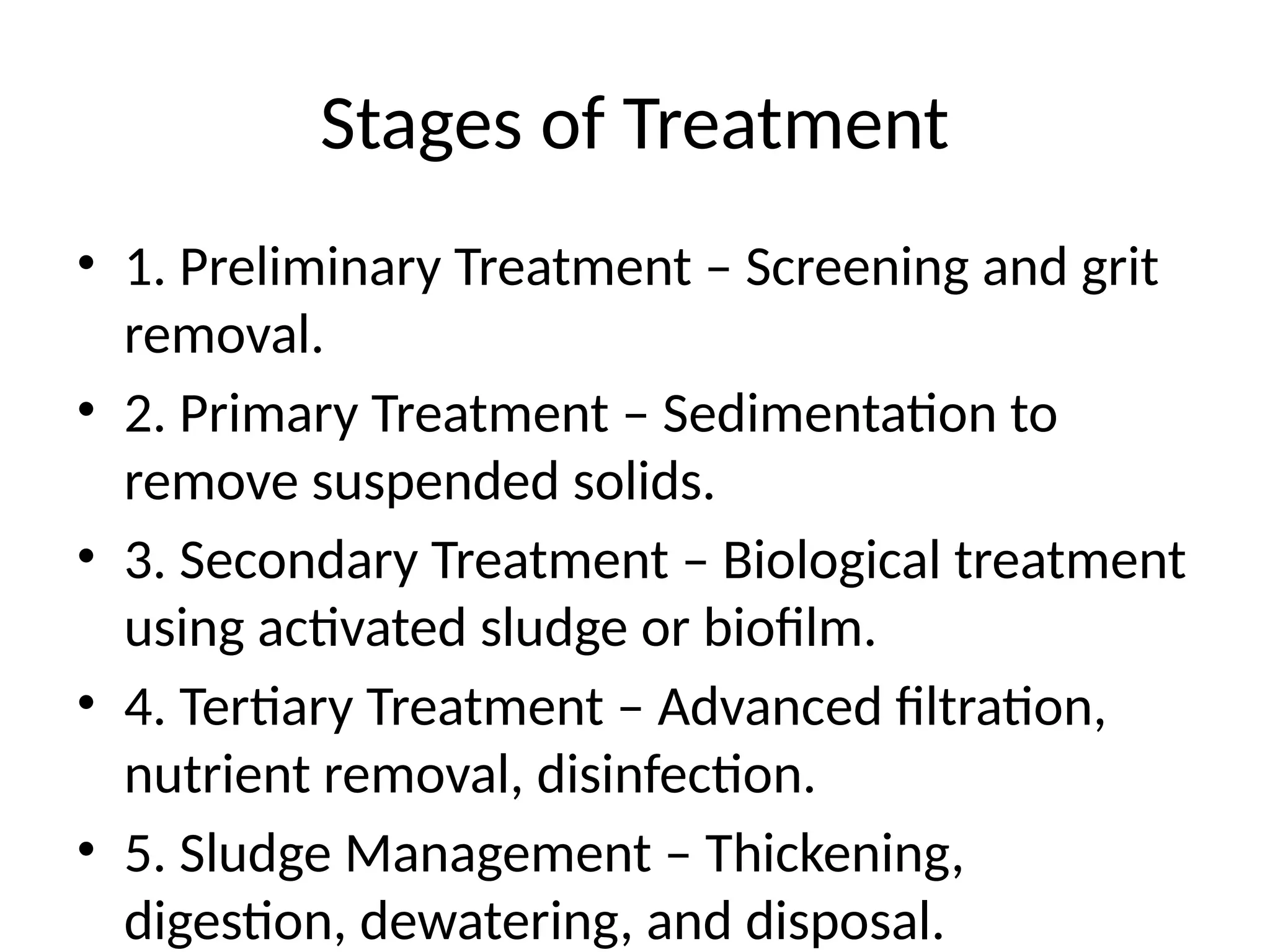
Stages of Treatment
• 1. Preliminary Treatment – Screening and grit
removal.
• 2. Primary Treatment – Sedimentation to
remove suspended solids.
• 3. Secondary Treatment – Biological treatment
using activated sludge or biofilm.
• 4. Tertiary Treatment – Advanced filtration,
nutrient removal, disinfection.
• 5. Sludge Management – Thickening,
digestion, dewatering, and disposal.
CIVIL ENGINEERING ASPECTS
Civil Engineering Considerations
• • Site Selection – proximity to sewage source,
land availability.
• • Structural Design – reinforced concrete
tanks, channels, and foundations.
• • Hydraulic Design – flow capacity, retention
time, head losses.
• • Material Selection – durable, corrosion-
resistant materials.
• • Construction Methods – excavation,
waterproofing, quality control.
APPLICATIONS
Uses of Treated Effluent and Sludge
• • Irrigation of agricultural fields and
landscapes.
• • Industrial reuse for cooling and process
water.
• • Groundwater recharge through percolation.
• • Production of biogas from sludge digestion.
• • Compost and soil conditioner from stabilized
sludge.
CHALLENGES AND FUTURE TRENDS
Challenges and Innovations
• • High capital and operational costs.
• • Energy-intensive processes.
• • Sludge management difficulties.
• • Need for skilled workforce.
• Future Trends:
• • Energy-efficient technologies.
• • Decentralized treatment systems.
• • Resource recovery (water, energy, nutrients).

Sewerage_Treatment_Plant_Civil_Engineering.pptx

  • 1.
    Sewerage Treatment Plant CivilEngineering Aspects
  • 2.
  • 3.
    Introduction to Sewerage TreatmentPlants • • Sewerage Treatment Plants (STPs) are facilities designed to treat wastewater. • • Aim: Remove contaminants to produce environmentally safe effluent. • • Essential for public health, water resource management, and environmental protection. • • In civil engineering, STPs involve design, construction, and maintenance aspects.
  • 4.
  • 5.
    Primary Components • •Screening Chambers – remove large solids. • • Grit Chambers – eliminate sand, grit, and small stones. • • Primary Sedimentation Tanks – settle suspended solids. • • Aeration Tanks – promote biological treatment. • • Secondary Clarifiers – separate biomass from treated water. • • Sludge Treatment Units – stabilize and
  • 6.
  • 7.
    Stages of Treatment •1. Preliminary Treatment – Screening and grit removal. • 2. Primary Treatment – Sedimentation to remove suspended solids. • 3. Secondary Treatment – Biological treatment using activated sludge or biofilm. • 4. Tertiary Treatment – Advanced filtration, nutrient removal, disinfection. • 5. Sludge Management – Thickening, digestion, dewatering, and disposal.
  • 8.
  • 9.
    Civil Engineering Considerations •• Site Selection – proximity to sewage source, land availability. • • Structural Design – reinforced concrete tanks, channels, and foundations. • • Hydraulic Design – flow capacity, retention time, head losses. • • Material Selection – durable, corrosion- resistant materials. • • Construction Methods – excavation, waterproofing, quality control.
  • 10.
  • 11.
    Uses of TreatedEffluent and Sludge • • Irrigation of agricultural fields and landscapes. • • Industrial reuse for cooling and process water. • • Groundwater recharge through percolation. • • Production of biogas from sludge digestion. • • Compost and soil conditioner from stabilized sludge.
  • 12.
  • 13.
    Challenges and Innovations •• High capital and operational costs. • • Energy-intensive processes. • • Sludge management difficulties. • • Need for skilled workforce. • Future Trends: • • Energy-efficient technologies. • • Decentralized treatment systems. • • Resource recovery (water, energy, nutrients).