Discrete Mathematics
BCSC1010
Module 1
Dr. Praveen Mittal
Sets(Lecture2)
Lecture Notes of Dr. Praveen Mittal
Cardinality of a set
 The cardinality of a set is a measure of
a set's size, i.e. the number of elements in
the set.
 If S is a set with n elements, where n is a
nonnegative integer, then n is the cardinality
of S. It is denoted by |S|. Thus, |S|=n
Lecture Notes of Dr. Praveen Mittal
Cardinality of a set (Examples)
 The set A = { 1 , 2 , 4 } has
a cardinality of 3
 Let A be the set of odd positive integers
less than 10 Then IAI = 5
 Let S be the set of letters in the English
alphabets Then lSI = 26
Lecture Notes of Dr. Praveen Mittal
Cartesian Product
Let A and B be sets
The Cartesian product of A and B is the set of all
ordered pairs (a, b), where a ϵ A and b ϵ B
It is denoted by A x B
Hence, A x B = {(a, b) | a ϵ A and b ϵ B}
Lecture Notes of Dr. Praveen Mittal
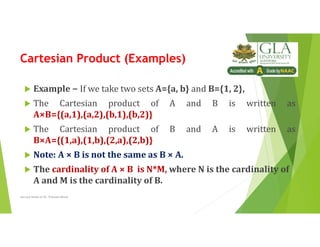
Cartesian Product (Examples)
 Example − If we take two sets A={a, b} and B={1, 2},
 The Cartesian product of A and B is written as
A×B={(a,1),(a,2),(b,1),(b,2)}
 The Cartesian product of B and A is written as
B×A={(1,a),(1,b),(2,a),(2,b)}
 Note: A × B is not the same as B × A.
 The cardinality of A × B is N*M, where N is the cardinality of
A and M is the cardinality of B.
Lecture Notes of Dr. Praveen Mittal
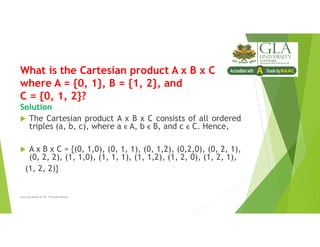
What is the Cartesian product A x B x C
where A = {0, 1}, B = {1, 2}, and
C = {0, 1, 2}?
Solution
 The Cartesian product A x B x C consists of all ordered
triples (a, b, c), where a ϵ A, b ϵ B, and c ϵ C. Hence,
 A x B x C = {(0, 1,0), (0, 1, 1), (0, 1,2), (0,2,0), (0, 2, 1),
(0, 2, 2), (1, 1,0), (1, 1, 1), (1, 1,2), (1, 2, 0), (1, 2, 1),
(1, 2, 2)}
Lecture Notes of Dr. Praveen Mittal
Graphical representation of Sets
 Sets can be represented graphically using Venn diagrams.
 Named after the English mathematician John Venn, who
introduced their use in 1881.
 In Venn diagrams the universal set U, which contains all the
objects under consideration, is represented by a rectangle.
Lecture Notes of Dr. Praveen Mittal
Graphical representation of Sets
 Inside this rectangle, circles or other geometrical figures
are used to represent sets.
 Sometimes points are used to represent the particular
elements of the set.
 Venn diagrams are often used to indicate the
relationships between sets.
Lecture Notes of Dr. Praveen Mittal
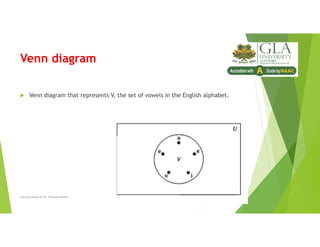
Venn diagram
 Venn diagram that represents V, the set of vowels in the English alphabet.
Lecture Notes of Dr. Praveen Mittal
Set Operations
Union
Intersection
Set Difference
Complement
Lecture Notes of Dr. Praveen Mittal
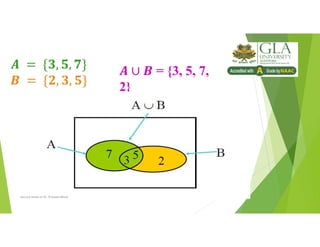
Union of Sets
Let A and B be sets
The union of the sets A and B is the set that
contains those elements that are either in A or in
B, or in both
 It is denoted by A U B
AUB = {x | x A or x B}
Lecture Notes of Dr. Praveen Mittal
Union of Sets (Examples)
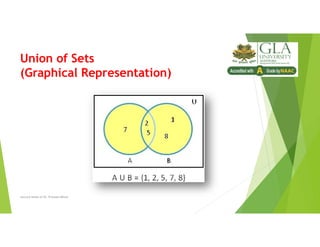
if A = {1, 3, 5, 7} and B = {1, 2, 4, 6, 7}
Then A B = {1, 2, 3, 4, 5, 6, 7}
The union of the sets {I, 3, 5} and {I, 2,
3}
 {I, 3, 5} U {I, 2, 3} = {I, 2, 3, 5}
Lecture Notes of Dr. Praveen Mittal
Union of Sets
(Graphical Representation)
Lecture Notes of Dr. Praveen Mittal
= {3, 5, 7,
2}
Lecture Notes of Dr. Praveen Mittal
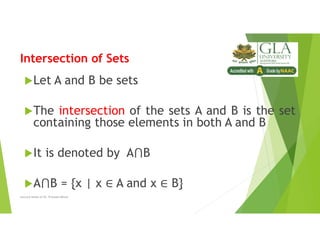
Intersection of Sets
Let A and B be sets
The intersection of the sets A and B is the set
containing those elements in both A and B
It is denoted by A B
A B = {x | x A and x B}
Lecture Notes of Dr. Praveen Mittal
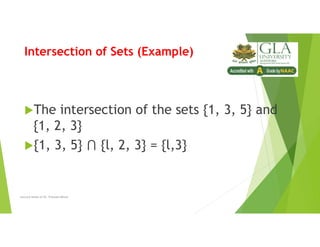
Intersection of Sets (Example)
The intersection of the sets {1, 3, 5} and
{1, 2, 3}
{1, 3, 5} {l, 2, 3} = {l,3}
Lecture Notes of Dr. Praveen Mittal
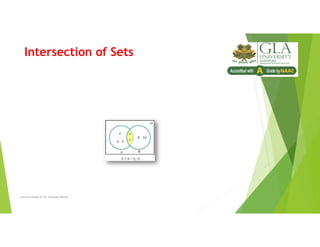
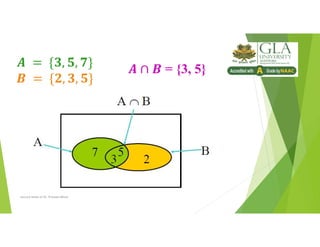
Intersection of Sets
Lecture Notes of Dr. Praveen Mittal
= {3, 5}
Lecture Notes of Dr. Praveen Mittal
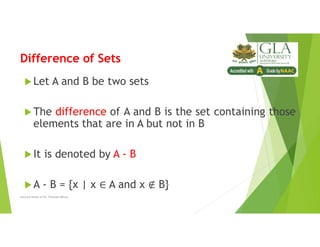
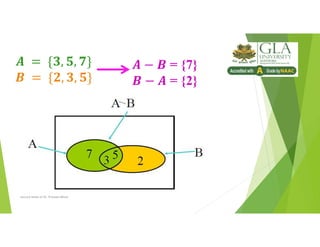
Difference of Sets
Let A and B be two sets
The difference of A and B is the set containing those
elements that are in A but not in B
It is denoted by A - B
A - B = {x | x A and x B}
Lecture Notes of Dr. Praveen Mittal
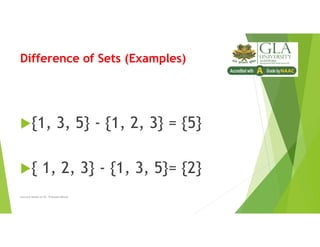
Difference of Sets (Examples)
{1, 3, 5} - {1, 2, 3} = {5}
{ 1, 2, 3} - {1, 3, 5}= {2}
Lecture Notes of Dr. Praveen Mittal
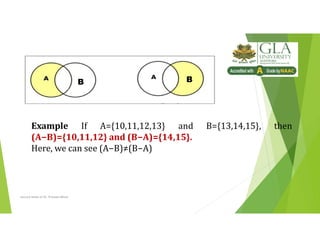
B B
Example If A={10,11,12,13} and B={13,14,15}, then
(A−B)={10,11,12} and (B−A)={14,15}.
Here, we can see (A−B)≠(B−A)
Lecture Notes of Dr. Praveen Mittal
= {7}
= {2}
Lecture Notes of Dr. Praveen Mittal
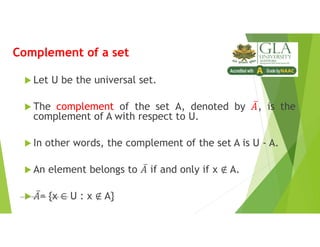
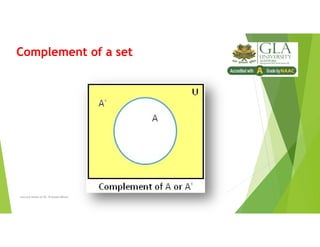
Complement of a set
 Let U be the universal set.
 The complement of the set A, denoted by , is the
complement of A with respect to U.
 In other words, the complement of the set A is U - A.
 An element belongs to if and only if x A.
 = {x U : x A}
Lecture Notes of Dr. Praveen Mittal
Complement of a set
Lecture Notes of Dr. Praveen Mittal
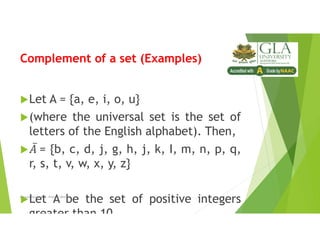
Complement of a set (Examples)
Let A = {a, e, i, o, u}
(where the universal set is the set of
letters of the English alphabet). Then,
 = {b, c, d, j, g, h, j, k, I, m, n, p, q,
r, s, t, v, w, x, y, z}
Let A be the set of positive integers
greater than 10
Lecture Notes of Dr. Praveen Mittal
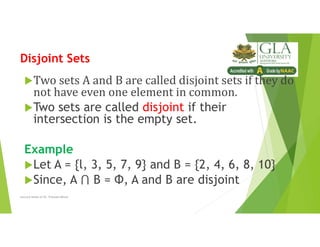
Disjoint Sets
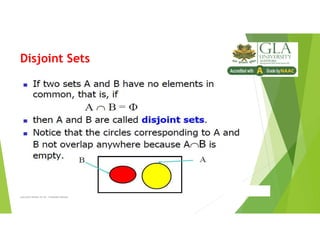
Two sets A and B are called disjoint sets if they do
not have even one element in common.
Two sets are called disjoint if their
intersection is the empty set.
Example
Let A = {l, 3, 5, 7, 9} and B = {2, 4, 6, 8, 10}
Since, A B = Φ, A and B are disjoint
Lecture Notes of Dr. Praveen Mittal
Disjoint Sets
Lecture Notes of Dr. Praveen Mittal
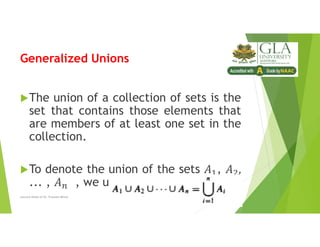
Generalized Unions
The union of a collection of sets is the
set that contains those elements that
are members of at least one set in the
collection.
To denote the union of the sets ,
... , , we use the notation
Lecture Notes of Dr. Praveen Mittal
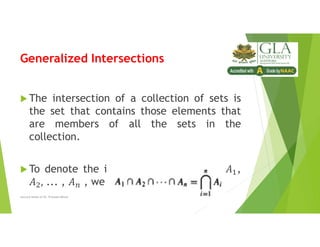
Generalized Intersections
 The intersection of a collection of sets is
the set that contains those elements that
are members of all the sets in the
collection.
 To denote the intersection of the sets ,
... , , we use the notation
Lecture Notes of Dr. Praveen Mittal
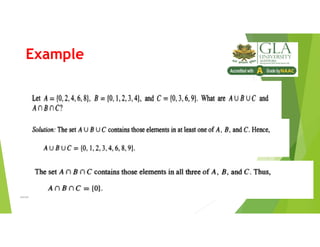
Example
Next Topic…
Proof Techniques
Lecture Notes of Dr. Praveen Mittal

SetTheory2(Dr. Praveen Mittal).pdf

  • 1.
    Discrete Mathematics BCSC1010 Module 1 Dr.Praveen Mittal Sets(Lecture2) Lecture Notes of Dr. Praveen Mittal
  • 2.
    Cardinality of aset  The cardinality of a set is a measure of a set's size, i.e. the number of elements in the set.  If S is a set with n elements, where n is a nonnegative integer, then n is the cardinality of S. It is denoted by |S|. Thus, |S|=n Lecture Notes of Dr. Praveen Mittal
  • 3.
    Cardinality of aset (Examples)  The set A = { 1 , 2 , 4 } has a cardinality of 3  Let A be the set of odd positive integers less than 10 Then IAI = 5  Let S be the set of letters in the English alphabets Then lSI = 26 Lecture Notes of Dr. Praveen Mittal
  • 4.
    Cartesian Product Let Aand B be sets The Cartesian product of A and B is the set of all ordered pairs (a, b), where a ϵ A and b ϵ B It is denoted by A x B Hence, A x B = {(a, b) | a ϵ A and b ϵ B} Lecture Notes of Dr. Praveen Mittal
  • 5.
    Cartesian Product (Examples) Example − If we take two sets A={a, b} and B={1, 2},  The Cartesian product of A and B is written as A×B={(a,1),(a,2),(b,1),(b,2)}  The Cartesian product of B and A is written as B×A={(1,a),(1,b),(2,a),(2,b)}  Note: A × B is not the same as B × A.  The cardinality of A × B is N*M, where N is the cardinality of A and M is the cardinality of B. Lecture Notes of Dr. Praveen Mittal
  • 6.
    What is theCartesian product A x B x C where A = {0, 1}, B = {1, 2}, and C = {0, 1, 2}? Solution  The Cartesian product A x B x C consists of all ordered triples (a, b, c), where a ϵ A, b ϵ B, and c ϵ C. Hence,  A x B x C = {(0, 1,0), (0, 1, 1), (0, 1,2), (0,2,0), (0, 2, 1), (0, 2, 2), (1, 1,0), (1, 1, 1), (1, 1,2), (1, 2, 0), (1, 2, 1), (1, 2, 2)} Lecture Notes of Dr. Praveen Mittal
  • 7.
    Graphical representation ofSets  Sets can be represented graphically using Venn diagrams.  Named after the English mathematician John Venn, who introduced their use in 1881.  In Venn diagrams the universal set U, which contains all the objects under consideration, is represented by a rectangle. Lecture Notes of Dr. Praveen Mittal
  • 8.
    Graphical representation ofSets  Inside this rectangle, circles or other geometrical figures are used to represent sets.  Sometimes points are used to represent the particular elements of the set.  Venn diagrams are often used to indicate the relationships between sets. Lecture Notes of Dr. Praveen Mittal
  • 9.
    Venn diagram  Venndiagram that represents V, the set of vowels in the English alphabet. Lecture Notes of Dr. Praveen Mittal
  • 10.
  • 11.
    Union of Sets LetA and B be sets The union of the sets A and B is the set that contains those elements that are either in A or in B, or in both  It is denoted by A U B AUB = {x | x A or x B} Lecture Notes of Dr. Praveen Mittal
  • 12.
    Union of Sets(Examples) if A = {1, 3, 5, 7} and B = {1, 2, 4, 6, 7} Then A B = {1, 2, 3, 4, 5, 6, 7} The union of the sets {I, 3, 5} and {I, 2, 3}  {I, 3, 5} U {I, 2, 3} = {I, 2, 3, 5} Lecture Notes of Dr. Praveen Mittal
  • 13.
    Union of Sets (GraphicalRepresentation) Lecture Notes of Dr. Praveen Mittal
  • 14.
    = {3, 5,7, 2} Lecture Notes of Dr. Praveen Mittal
  • 15.
    Intersection of Sets LetA and B be sets The intersection of the sets A and B is the set containing those elements in both A and B It is denoted by A B A B = {x | x A and x B} Lecture Notes of Dr. Praveen Mittal
  • 16.
    Intersection of Sets(Example) The intersection of the sets {1, 3, 5} and {1, 2, 3} {1, 3, 5} {l, 2, 3} = {l,3} Lecture Notes of Dr. Praveen Mittal
  • 17.
    Intersection of Sets LectureNotes of Dr. Praveen Mittal
  • 18.
    = {3, 5} LectureNotes of Dr. Praveen Mittal
  • 19.
    Difference of Sets LetA and B be two sets The difference of A and B is the set containing those elements that are in A but not in B It is denoted by A - B A - B = {x | x A and x B} Lecture Notes of Dr. Praveen Mittal
  • 20.
    Difference of Sets(Examples) {1, 3, 5} - {1, 2, 3} = {5} { 1, 2, 3} - {1, 3, 5}= {2} Lecture Notes of Dr. Praveen Mittal
  • 21.
    B B Example IfA={10,11,12,13} and B={13,14,15}, then (A−B)={10,11,12} and (B−A)={14,15}. Here, we can see (A−B)≠(B−A) Lecture Notes of Dr. Praveen Mittal
  • 22.
    = {7} = {2} LectureNotes of Dr. Praveen Mittal
  • 23.
    Complement of aset  Let U be the universal set.  The complement of the set A, denoted by , is the complement of A with respect to U.  In other words, the complement of the set A is U - A.  An element belongs to if and only if x A.  = {x U : x A} Lecture Notes of Dr. Praveen Mittal
  • 24.
    Complement of aset Lecture Notes of Dr. Praveen Mittal
  • 25.
    Complement of aset (Examples) Let A = {a, e, i, o, u} (where the universal set is the set of letters of the English alphabet). Then,  = {b, c, d, j, g, h, j, k, I, m, n, p, q, r, s, t, v, w, x, y, z} Let A be the set of positive integers greater than 10 Lecture Notes of Dr. Praveen Mittal
  • 26.
    Disjoint Sets Two setsA and B are called disjoint sets if they do not have even one element in common. Two sets are called disjoint if their intersection is the empty set. Example Let A = {l, 3, 5, 7, 9} and B = {2, 4, 6, 8, 10} Since, A B = Φ, A and B are disjoint Lecture Notes of Dr. Praveen Mittal
  • 27.
    Disjoint Sets Lecture Notesof Dr. Praveen Mittal
  • 28.
    Generalized Unions The unionof a collection of sets is the set that contains those elements that are members of at least one set in the collection. To denote the union of the sets , ... , , we use the notation Lecture Notes of Dr. Praveen Mittal
  • 29.
    Generalized Intersections  Theintersection of a collection of sets is the set that contains those elements that are members of all the sets in the collection.  To denote the intersection of the sets , ... , , we use the notation Lecture Notes of Dr. Praveen Mittal
  • 30.
    Lecture Notes ofDr. Praveen Mittal Example
  • 31.
    Next Topic… Proof Techniques LectureNotes of Dr. Praveen Mittal