Course: Business Mathematics-1 (MGT 113)
Presentation Topic: Set Theory
Presented by: Group 11
Content
01
02
03 What We Learn from Set Theory
Summary of Laws of Algebra in Set Theory
What is Set And Element
What is Set And Element?
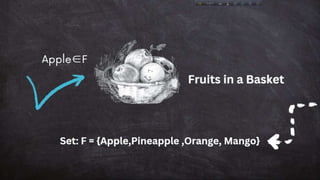
IN MATHEMATICS, A SET IS A COLLECTION OF DISTINCT OBJECTS, AND EACH
OBJECT IS CALLED AN ELEMENT OF A SET.
Set And Element
SET AND ELEMENT
SUMMARY OF LAWS OF ALGEBRA IN
SET THEORY
The algebra of sets is the development of the fundamental properties of set
operations and set relations
Manager Marketing Business Head
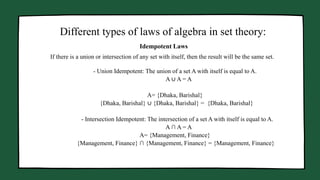
Different types of laws of algebra in set theory:
If there is a union or intersection of any set with itself, then the result will be the same set.
Idempotent Laws
- Union Idempotent: The union of a set A with itself is equal to A.
A ∪ A = A
A= {Dhaka, Barishal}
{Dhaka, Barishal} ∪ {Dhaka, Barishal} = {Dhaka, Barishal}
- Intersection Idempotent: The intersection of a set A with itself is equal to A.
A ∩ A = A
A= {Management, Finance}
{Management, Finance} ∩ {Management, Finance} = {Management, Finance}
Manager Marketing Business Head
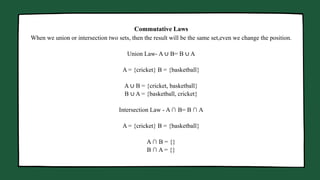
When we union or intersection two sets, then the result will be the same set,even we change the position.
Union Law- A ∪ B= B ∪ A
A = {cricket} B = {basketball}
A ∪ B = {cricket, basketball}
B ∪ A = {basketball, cricket}
Intersection Law - A ∩ B= B ∩ A
A = {cricket} B = {basketball}
A ∩ B = {}
B ∩ A = {}
Commutative Laws
Manager Marketing Business Head
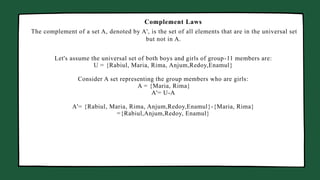
The complement of a set A, denoted by A', is the set of all elements that are in the universal set
but not in A.
Complement Laws
Let's assume the universal set of both boys and girls of group-11 members are:
U = {Rabiul, Maria, Rima, Anjum,Redoy,Enamul}
Consider A set representing the group members who are girls:
A = {Maria, Rima}
A'= U-A
A'= {Rabiul, Maria, Rima, Anjum,Redoy,Enamul}-{Maria, Rima}
={Rabiul,Anjum,Redoy, Enamul}
Manager Marketing Business Head
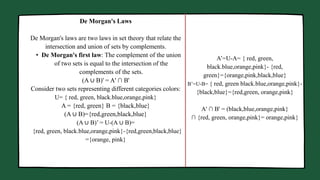
De Morgan's Laws
De Morgan's laws are two laws in set theory that relate the
intersection and union of sets by complements.
• De Morgan's first law: The complement of the union
of two sets is equal to the intersection of the
complements of the sets.
(A ∪ B)' = A' ∩ B'
Consider two sets representing different categories colors:
U= { red, green, black.blue,orange,pink}
A = {red, green} B = {black,blue}
(A ∪ B)={red,green,black,blue}
(A ∪ B)’ = U-(A ∪ B)=
{red, green, black.blue,orange,pink}-{red,green,black,blue}
={orange, pink}
A’=U-A= { red, green,
black.blue,orange,pink}- {red,
green}={orange,pink,black,blue}
B’=U-B= { red, green black.blue,orange,pink}-
{black,blue}={red,green, orange,pink}
A' ∩ B' = (black,blue,orange,pink}
∩ {red, green, orange,pink}= orange,pink}
Manager Marketing Business Head
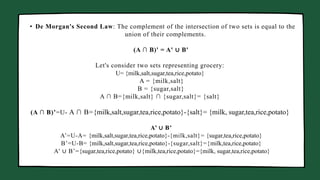
• De Morgan's Second Law: The complement of the intersection of two sets is equal to the
union of their complements.
(A ∩ B)' = A' ∪ B'
Let's consider two sets representing grocery:
U= {milk,salt,sugar,tea,rice,potato}
A = {milk,salt}
B = {sugar,salt}
A ∩ B={milk,salt} ∩ {sugar,salt}= {salt}
(A ∩ B)’=U- A ∩ B={milk,salt,sugar,tea,rice,potato}-{salt}= {milk, sugar,tea,rice,potato}
A’ ∪ B’
A’=U-A= {milk,salt,sugar,tea,rice,potato}-{milk,salt}= {sugar,tea,rice,potato}
B’=U-B= {milk,salt,sugar,tea,rice,potato}-{sugar,salt}={milk,tea,rice,potato}
A' ∪ B’={sugar,tea,rice,potato} ∪{milk,tea,rice,potato}={milk, sugar,tea,rice,potato}
Manager Marketing Business Head
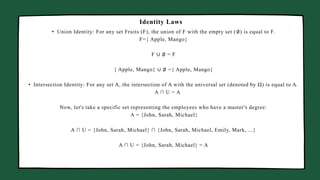
• Union Identity: For any set Fruits (F), the union of F with the empty set (∅) is equal to F.
F={ Apple, Mango}
F ∪ ∅ = F
{ Apple, Mango} ∪ ∅ ={ Apple, Mango}
• Intersection Identity: For any set A, the intersection of A with the universal set (denoted by Ω) is equal to A.
A ∩ U = A
Now, let's take a specific set representing the employees who have a master's degree:
A = {John, Sarah, Michael}
A ∩ U = {John, Sarah, Michael} ∩ {John, Sarah, Michael, Emily, Mark, ...}
A ∩ U = {John, Sarah, Michael} = A
Identity Laws
Manager Marketing Business Head
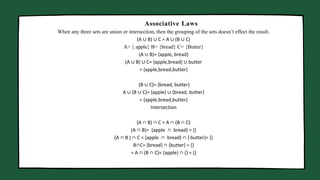
When any three sets are union or intersection, then the grouping of the sets doesn’t effect the result.
(A ∪ B) ∪ C = A ∪ (B ∪ C)
A= { apple} B= {bread} C= {Butter}
(A ∪ B)= {apple, bread}
(A ∪ B) ∪ C= {apple,bread} ∪ butter
= {apple,bread,butter}
(B ∪ C)= {bread, butter}
A ∪ (B ∪ C)= {apple} ∪ {bread, butter}
= {apple,bread,butter}
Intersection
(A ∩ B) ∩ C = A ∩ (B ∩ C)
(A ∩ B)= {apple ∩ bread) = {}
(A ∩ B ) ∩ C = {apple ∩ bread) ∩ { butter}= {}
B∩C= {bread} ∩ {butter} = {}
= A ∩ (B ∩ C)= {apple} ∩ {} = {}
Associative Laws
WHAT WE LEARN FROM SET THEORY
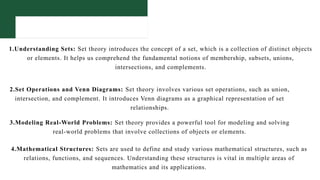
1.Understanding Sets: Set theory introduces the concept of a set, which is a collection of distinct objects
or elements. It helps us comprehend the fundamental notions of membership, subsets, unions,
intersections, and complements.
2.Set Operations and Venn Diagrams: Set theory involves various set operations, such as union,
intersection, and complement. It introduces Venn diagrams as a graphical representation of set
relationships.
3.Modeling Real-World Problems: Set theory provides a powerful tool for modeling and solving
real-world problems that involve collections of objects or elements.
4.Mathematical Structures: Sets are used to define and study various mathematical structures, such as
relations, functions, and sequences. Understanding these structures is vital in multiple areas of
mathematics and its applications.
In summary, Set Theory provides a fundamental basis for various mathematical concepts,
logical reasoning, and problem-solving skills
THANK YOU!
Prepared by: Md Enamul Hossain
21 MGT 027
Department of Management Studies
University Of Barishal

Set Theory Summary

  • 1.
    Course: Business Mathematics-1(MGT 113) Presentation Topic: Set Theory Presented by: Group 11
  • 2.
    Content 01 02 03 What WeLearn from Set Theory Summary of Laws of Algebra in Set Theory What is Set And Element
  • 3.
    What is SetAnd Element?
  • 4.
    IN MATHEMATICS, ASET IS A COLLECTION OF DISTINCT OBJECTS, AND EACH OBJECT IS CALLED AN ELEMENT OF A SET. Set And Element SET AND ELEMENT
  • 6.
    SUMMARY OF LAWSOF ALGEBRA IN SET THEORY
  • 7.
    The algebra ofsets is the development of the fundamental properties of set operations and set relations
  • 8.
    Manager Marketing BusinessHead Different types of laws of algebra in set theory: If there is a union or intersection of any set with itself, then the result will be the same set. Idempotent Laws - Union Idempotent: The union of a set A with itself is equal to A. A ∪ A = A A= {Dhaka, Barishal} {Dhaka, Barishal} ∪ {Dhaka, Barishal} = {Dhaka, Barishal} - Intersection Idempotent: The intersection of a set A with itself is equal to A. A ∩ A = A A= {Management, Finance} {Management, Finance} ∩ {Management, Finance} = {Management, Finance}
  • 9.
    Manager Marketing BusinessHead When we union or intersection two sets, then the result will be the same set,even we change the position. Union Law- A ∪ B= B ∪ A A = {cricket} B = {basketball} A ∪ B = {cricket, basketball} B ∪ A = {basketball, cricket} Intersection Law - A ∩ B= B ∩ A A = {cricket} B = {basketball} A ∩ B = {} B ∩ A = {} Commutative Laws
  • 10.
    Manager Marketing BusinessHead The complement of a set A, denoted by A', is the set of all elements that are in the universal set but not in A. Complement Laws Let's assume the universal set of both boys and girls of group-11 members are: U = {Rabiul, Maria, Rima, Anjum,Redoy,Enamul} Consider A set representing the group members who are girls: A = {Maria, Rima} A'= U-A A'= {Rabiul, Maria, Rima, Anjum,Redoy,Enamul}-{Maria, Rima} ={Rabiul,Anjum,Redoy, Enamul}
  • 11.
    Manager Marketing BusinessHead De Morgan's Laws De Morgan's laws are two laws in set theory that relate the intersection and union of sets by complements. • De Morgan's first law: The complement of the union of two sets is equal to the intersection of the complements of the sets. (A ∪ B)' = A' ∩ B' Consider two sets representing different categories colors: U= { red, green, black.blue,orange,pink} A = {red, green} B = {black,blue} (A ∪ B)={red,green,black,blue} (A ∪ B)’ = U-(A ∪ B)= {red, green, black.blue,orange,pink}-{red,green,black,blue} ={orange, pink} A’=U-A= { red, green, black.blue,orange,pink}- {red, green}={orange,pink,black,blue} B’=U-B= { red, green black.blue,orange,pink}- {black,blue}={red,green, orange,pink} A' ∩ B' = (black,blue,orange,pink} ∩ {red, green, orange,pink}= orange,pink}
  • 12.
    Manager Marketing BusinessHead • De Morgan's Second Law: The complement of the intersection of two sets is equal to the union of their complements. (A ∩ B)' = A' ∪ B' Let's consider two sets representing grocery: U= {milk,salt,sugar,tea,rice,potato} A = {milk,salt} B = {sugar,salt} A ∩ B={milk,salt} ∩ {sugar,salt}= {salt} (A ∩ B)’=U- A ∩ B={milk,salt,sugar,tea,rice,potato}-{salt}= {milk, sugar,tea,rice,potato} A’ ∪ B’ A’=U-A= {milk,salt,sugar,tea,rice,potato}-{milk,salt}= {sugar,tea,rice,potato} B’=U-B= {milk,salt,sugar,tea,rice,potato}-{sugar,salt}={milk,tea,rice,potato} A' ∪ B’={sugar,tea,rice,potato} ∪{milk,tea,rice,potato}={milk, sugar,tea,rice,potato}
  • 13.
    Manager Marketing BusinessHead • Union Identity: For any set Fruits (F), the union of F with the empty set (∅) is equal to F. F={ Apple, Mango} F ∪ ∅ = F { Apple, Mango} ∪ ∅ ={ Apple, Mango} • Intersection Identity: For any set A, the intersection of A with the universal set (denoted by Ω) is equal to A. A ∩ U = A Now, let's take a specific set representing the employees who have a master's degree: A = {John, Sarah, Michael} A ∩ U = {John, Sarah, Michael} ∩ {John, Sarah, Michael, Emily, Mark, ...} A ∩ U = {John, Sarah, Michael} = A Identity Laws
  • 14.
    Manager Marketing BusinessHead When any three sets are union or intersection, then the grouping of the sets doesn’t effect the result. (A ∪ B) ∪ C = A ∪ (B ∪ C) A= { apple} B= {bread} C= {Butter} (A ∪ B)= {apple, bread} (A ∪ B) ∪ C= {apple,bread} ∪ butter = {apple,bread,butter} (B ∪ C)= {bread, butter} A ∪ (B ∪ C)= {apple} ∪ {bread, butter} = {apple,bread,butter} Intersection (A ∩ B) ∩ C = A ∩ (B ∩ C) (A ∩ B)= {apple ∩ bread) = {} (A ∩ B ) ∩ C = {apple ∩ bread) ∩ { butter}= {} B∩C= {bread} ∩ {butter} = {} = A ∩ (B ∩ C)= {apple} ∩ {} = {} Associative Laws
  • 15.
    WHAT WE LEARNFROM SET THEORY
  • 16.
    1.Understanding Sets: Settheory introduces the concept of a set, which is a collection of distinct objects or elements. It helps us comprehend the fundamental notions of membership, subsets, unions, intersections, and complements. 2.Set Operations and Venn Diagrams: Set theory involves various set operations, such as union, intersection, and complement. It introduces Venn diagrams as a graphical representation of set relationships. 3.Modeling Real-World Problems: Set theory provides a powerful tool for modeling and solving real-world problems that involve collections of objects or elements. 4.Mathematical Structures: Sets are used to define and study various mathematical structures, such as relations, functions, and sequences. Understanding these structures is vital in multiple areas of mathematics and its applications.
  • 17.
    In summary, SetTheory provides a fundamental basis for various mathematical concepts, logical reasoning, and problem-solving skills
  • 18.
  • 19.
    Prepared by: MdEnamul Hossain 21 MGT 027 Department of Management Studies University Of Barishal

Editor's Notes

  • #12 (A ∪ B)’ = U-(A ∪ B)= { red, green, black.blue,orange,pink}-{red,green,black,blue} A’=U-A= {loyal customers,premium customers}- {loyal customers} =premium customer B’=U-B= {loyal customers,premium customers}- {premium customers}=loyal customar A' ∩ B' = (loyal customers) ∩ (premium customers)={loyal customers, premium customers}