TOWARDS POLICY
COHERENCE –
OECD POLICY GUIDANCE TO TACKLE MARINE
PLASTIC POLLUTION IN SEA
3rd Regional Ocean Policy Dialogue, Bali, Indonesia
Session 4
The OECD defines policy coherence for sustainable development
(PCSD) as an approach and policy tool to
1. Foster synergies across economic, social and environmental
policy areas;
2. Identify trade-offs and reconcile domestic policy objectives with
internationally agreed objectives;
3. Address the negative spillovers of domestic policies.
The OECD Concept of Policy Coherence for
Sustainable Development (PCSD)
Source: OECD (2018), Policy Coherence for Sustainable Development 2018: Towards
Sustainable and Resilient Societies, OECD Publishing,
Paris, https://doi.org/10.1787/9789264301061-en.
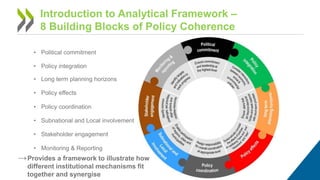
Introduction to Analytical Framework –
8 Building Blocks of Policy Coherence
→Provides a framework to illustrate how
different institutional mechanisms fit
together and synergise
• Political commitment
• Policy integration
• Long term planning horizons
• Policy effects
• Policy coordination
• Subnational and Local involvement
• Stakeholder engagement
• Monitoring & Reporting
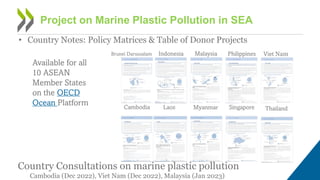
• Country Notes: Policy Matrices & Table of Donor Projects
Project on Marine Plastic Pollution in SEA
Available for all
10 ASEAN
Member States
on the OECD
Ocean Platform
Indonesia Malaysia Philippines Viet Nam
Cambodia Laos Myanmar Singapore
Thailand
Brunei Darussalam Indonesia Malaysia Philippines Viet Nam
Thailand
Country Consultations on marine plastic pollution
Cambodia (Dec 2022), Viet Nam (Dec 2022), Malaysia (Jan 2023)
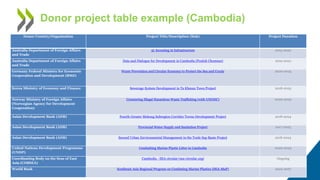
Donor project table example (Cambodia)
Donor Country/Organisation Project Title/Description (link) Project Duration
Australia Department of Foreign Affairs
and Trade
3i: Investing in Infrastructure 2015-2022
Australia Department of Foreign Affairs
and Trade
Data and Dialogue for Development in Cambodia (Ponlok Chomnes) 2019-2022
Germany Federal Ministry for Economic
Cooperation and Development (BMZ)
Waste Prevention and Circular Economy to Protect the Sea and Corals 2020-2025
Korea Ministry of Economy and Finance Sewerage System Development in Ta Khmau Town Project 2018-2023
Norway Ministry of Foreign Affairs
(Norwegian Agency for Development
Cooperation)
Countering Illegal Hazardous Waste Trafficking (with UNODC) 2020-2022
Asian Development Bank (ADB) Fourth Greater Mekong Subregion Corridor Towns Development Project 2018-2024
Asian Development Bank (ADB) Provincial Water Supply and Sanitation Project 2017-2023
Asian Development Bank (ADB) Second Urban Environmental Management in the Tonle Sap Basin Project 2018-2024
United Nations Development Programme
(UNDP)
Combatting Marine Plastic Litter in Cambodia 2020-2023
Coordinating Body on the Seas of East
Asia (COBSEA)
Cambodia - SEA circular (sea-circular.org) Ongoing
World Bank Southeast Asia Regional Program on Combating Marine Plastics (SEA-MaP) 2022-2027
THANK YOU
Eija Kiiskinen, Senior Global Relations Advisor
Finance, Investment and Global Relations Division, Environment Directorate, OECD
eija.kiiskinen@oecd.org
Bum Cheul Park, Junior Policy Analyst
Finance, Investment and Global Relations Division, Environment Directorate, OECD
bumcheul.park@oecd.org

Session 4 - OECD_Framework for Policy Coherence.pdf

  • 1.
    TOWARDS POLICY COHERENCE – OECDPOLICY GUIDANCE TO TACKLE MARINE PLASTIC POLLUTION IN SEA 3rd Regional Ocean Policy Dialogue, Bali, Indonesia Session 4
  • 2.
    The OECD definespolicy coherence for sustainable development (PCSD) as an approach and policy tool to 1. Foster synergies across economic, social and environmental policy areas; 2. Identify trade-offs and reconcile domestic policy objectives with internationally agreed objectives; 3. Address the negative spillovers of domestic policies. The OECD Concept of Policy Coherence for Sustainable Development (PCSD) Source: OECD (2018), Policy Coherence for Sustainable Development 2018: Towards Sustainable and Resilient Societies, OECD Publishing, Paris, https://doi.org/10.1787/9789264301061-en.
  • 3.
    Introduction to AnalyticalFramework – 8 Building Blocks of Policy Coherence →Provides a framework to illustrate how different institutional mechanisms fit together and synergise • Political commitment • Policy integration • Long term planning horizons • Policy effects • Policy coordination • Subnational and Local involvement • Stakeholder engagement • Monitoring & Reporting
  • 4.
    • Country Notes:Policy Matrices & Table of Donor Projects Project on Marine Plastic Pollution in SEA Available for all 10 ASEAN Member States on the OECD Ocean Platform Indonesia Malaysia Philippines Viet Nam Cambodia Laos Myanmar Singapore Thailand Brunei Darussalam Indonesia Malaysia Philippines Viet Nam Thailand Country Consultations on marine plastic pollution Cambodia (Dec 2022), Viet Nam (Dec 2022), Malaysia (Jan 2023)
  • 5.
    Donor project tableexample (Cambodia) Donor Country/Organisation Project Title/Description (link) Project Duration Australia Department of Foreign Affairs and Trade 3i: Investing in Infrastructure 2015-2022 Australia Department of Foreign Affairs and Trade Data and Dialogue for Development in Cambodia (Ponlok Chomnes) 2019-2022 Germany Federal Ministry for Economic Cooperation and Development (BMZ) Waste Prevention and Circular Economy to Protect the Sea and Corals 2020-2025 Korea Ministry of Economy and Finance Sewerage System Development in Ta Khmau Town Project 2018-2023 Norway Ministry of Foreign Affairs (Norwegian Agency for Development Cooperation) Countering Illegal Hazardous Waste Trafficking (with UNODC) 2020-2022 Asian Development Bank (ADB) Fourth Greater Mekong Subregion Corridor Towns Development Project 2018-2024 Asian Development Bank (ADB) Provincial Water Supply and Sanitation Project 2017-2023 Asian Development Bank (ADB) Second Urban Environmental Management in the Tonle Sap Basin Project 2018-2024 United Nations Development Programme (UNDP) Combatting Marine Plastic Litter in Cambodia 2020-2023 Coordinating Body on the Seas of East Asia (COBSEA) Cambodia - SEA circular (sea-circular.org) Ongoing World Bank Southeast Asia Regional Program on Combating Marine Plastics (SEA-MaP) 2022-2027
  • 6.
    THANK YOU Eija Kiiskinen,Senior Global Relations Advisor Finance, Investment and Global Relations Division, Environment Directorate, OECD eija.kiiskinen@oecd.org Bum Cheul Park, Junior Policy Analyst Finance, Investment and Global Relations Division, Environment Directorate, OECD bumcheul.park@oecd.org