By:
Manuel L. Hermosa, Ed.D
DBA Student
Presented to/for:
Dr. Sonia Dela Cruz
(Service Management
Professor)
Service Delivery in
City Government
Service delivery is an
essential function in the
relation between
government bodies and
citizens.
Introduction
 Customers have a right to demand services
from their suppliers that meet their needs
fasts, accessible of good quality and at modest
cost, and all wrapped in friendly treatment.
 Good quality and affordable service delivery is
also a condition for the good image of
government. The meaning of good service
delivery for the image that citizens have of the
government is not always valued fairly.
Introduction
 To many citizens their local government is the
tangible form of government; it is also the layer
of government with which they have most
contact in their everyday life.
 commitment to the importance of good friendly
service delivered by administration and
management is an important factor in the
creation of an own role and the success of
future initiatives.
Introduction
 SOCIAL AREAS
 Education and schooling
 Social security and basic provisions
 Legal protection
 Housing for the less advantaged
Service Delivery as
Key Task
 1. Citizens Satisfaction
 2. Trust
 3. Reliability
 4. Legitimacy
Service Delivery as
Key Task
 1. Citizen Satisfaction
 2. Trust
 3. Reliability
 4. Legitimacy
Service Delivery as
Key Task
 1. Citizen Satisfaction
 2. Trust
 3. Reliability
 4. Legitimacy
Service Delivery as
Key Task
 1. Citizen Satisfaction
 2. Trust
 3. Reliability
 4. Legitimacy
Service Delivery as
Key Task
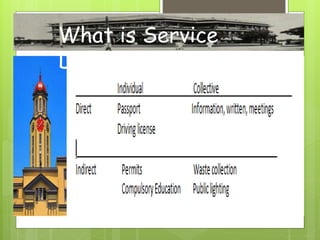
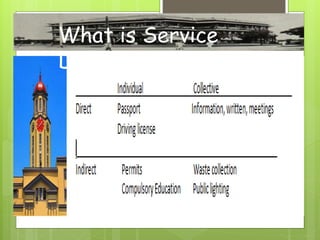
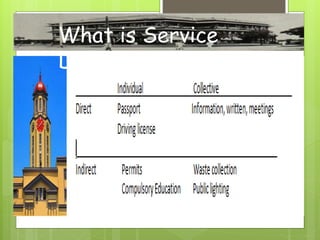
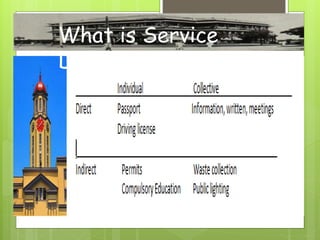
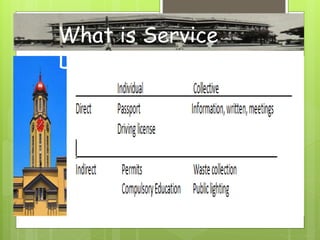
 1. Direct, indirect, individual, and collective
services
What is Service
Delivery?
What is Service
Delivery?
What is Service
Delivery?
What is Service
Delivery?
What is Service
Delivery?
What is Service
Delivery?
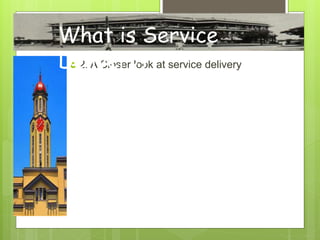
 2. A Closer look at service delivery
What is Service
Delivery?
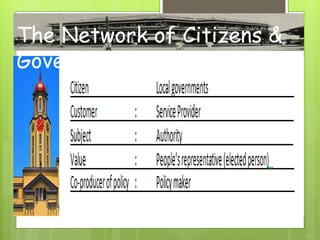
The Network of Citizens &
Government
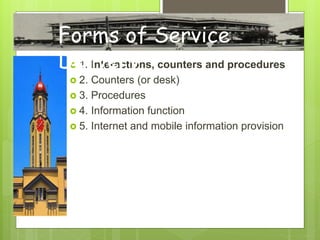
 1. Interactions, counters and procedures
 2. Counters (or desk)
 3. Procedures
 4. Information function
 5. Internet and mobile information provision
Forms of Service
Delivery
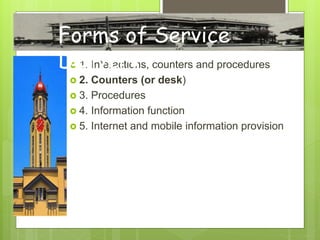
 1. Interactions, counters and procedures
 2. Counters (or desk)
 3. Procedures
 4. Information function
 5. Internet and mobile information provision
Forms of Service
Delivery
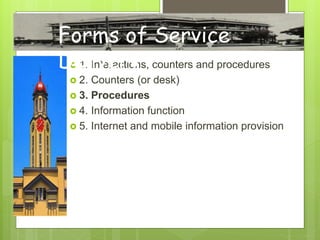
 1. Interactions, counters and procedures
 2. Counters (or desk)
 3. Procedures
 4. Information function
 5. Internet and mobile information provision
Forms of Service
Delivery
 1. Interactions, counters and procedures
 2. Counters (or desk)
 3. Procedures
 4. Information function
 5. Internet and mobile information provision
Forms of Service
Delivery
 1. Interactions, counters and procedures
 2. Counters (or desk)
 3. Procedures
 4. Information function
 5. Internet and mobile information
provision
Forms of Service
Delivery
 Electronic access;
 Electronic authentication: the internet allows
confirmation that a person or organization is who
they say they are;
 Unequivocal numbers: in communication with an
organization or person one number can be linked
to the authentication;
 Basic registration: gathering all information which
belongs together in one place;
 Information exchange: internal municipal
information provision on one file, one case, and
one person. Do not burden customers with this
information exchange.
Forms of Service
Delivery(Sample)
 1. Service Standards
Quality and Quality
Control
Standards can relate to various factors:
1.1. Time:,
1.2. Codes of conduct:
1.3. Physical appearance and service:
1.4. Accessibility:;
1.5. Due consideration:
1.6. Information provision
 1. Service Standards
 2. Charters
Quality and Quality
Control
 1. Service Standards
 2. Charters
 3. Benchmarking
Quality and Quality
Control
 1. Organization
Approaches and
Organization
2  1. Organization
 2. Customer contact
Approaches and
Organization
2  1. Organization
 2. Customer contact
 3. Cooperation
Approaches and
Organization
2  1. Organization
 2. Customer contact
 3. Cooperation
 4. Education and Training
Approaches and
Organization
2  1. Organization
 2. Customer contact
 3. Cooperation
 4. Education and Training
 5. Planning and control
Approaches and
Organization
Thank you
and God Bless!
Service Delivery in City
Government

Service management ppt

  • 1.
    By: Manuel L. Hermosa,Ed.D DBA Student Presented to/for: Dr. Sonia Dela Cruz (Service Management Professor) Service Delivery in City Government
  • 2.
    Service delivery isan essential function in the relation between government bodies and citizens. Introduction
  • 3.
     Customers havea right to demand services from their suppliers that meet their needs fasts, accessible of good quality and at modest cost, and all wrapped in friendly treatment.  Good quality and affordable service delivery is also a condition for the good image of government. The meaning of good service delivery for the image that citizens have of the government is not always valued fairly. Introduction
  • 4.
     To manycitizens their local government is the tangible form of government; it is also the layer of government with which they have most contact in their everyday life.  commitment to the importance of good friendly service delivered by administration and management is an important factor in the creation of an own role and the success of future initiatives. Introduction
  • 5.
     SOCIAL AREAS Education and schooling  Social security and basic provisions  Legal protection  Housing for the less advantaged Service Delivery as Key Task
  • 6.
     1. CitizensSatisfaction  2. Trust  3. Reliability  4. Legitimacy Service Delivery as Key Task
  • 7.
     1. CitizenSatisfaction  2. Trust  3. Reliability  4. Legitimacy Service Delivery as Key Task
  • 8.
     1. CitizenSatisfaction  2. Trust  3. Reliability  4. Legitimacy Service Delivery as Key Task
  • 9.
     1. CitizenSatisfaction  2. Trust  3. Reliability  4. Legitimacy Service Delivery as Key Task
  • 10.
     1. Direct,indirect, individual, and collective services What is Service Delivery?
  • 11.
  • 12.
  • 13.
  • 14.
  • 15.
  • 16.
     2. ACloser look at service delivery What is Service Delivery?
  • 17.
    The Network ofCitizens & Government
  • 18.
     1. Interactions,counters and procedures  2. Counters (or desk)  3. Procedures  4. Information function  5. Internet and mobile information provision Forms of Service Delivery
  • 19.
     1. Interactions,counters and procedures  2. Counters (or desk)  3. Procedures  4. Information function  5. Internet and mobile information provision Forms of Service Delivery
  • 20.
     1. Interactions,counters and procedures  2. Counters (or desk)  3. Procedures  4. Information function  5. Internet and mobile information provision Forms of Service Delivery
  • 21.
     1. Interactions,counters and procedures  2. Counters (or desk)  3. Procedures  4. Information function  5. Internet and mobile information provision Forms of Service Delivery
  • 22.
     1. Interactions,counters and procedures  2. Counters (or desk)  3. Procedures  4. Information function  5. Internet and mobile information provision Forms of Service Delivery
  • 23.
     Electronic access; Electronic authentication: the internet allows confirmation that a person or organization is who they say they are;  Unequivocal numbers: in communication with an organization or person one number can be linked to the authentication;  Basic registration: gathering all information which belongs together in one place;  Information exchange: internal municipal information provision on one file, one case, and one person. Do not burden customers with this information exchange. Forms of Service Delivery(Sample)
  • 24.
     1. ServiceStandards Quality and Quality Control Standards can relate to various factors: 1.1. Time:, 1.2. Codes of conduct: 1.3. Physical appearance and service: 1.4. Accessibility:; 1.5. Due consideration: 1.6. Information provision
  • 25.
     1. ServiceStandards  2. Charters Quality and Quality Control
  • 26.
     1. ServiceStandards  2. Charters  3. Benchmarking Quality and Quality Control
  • 27.
  • 28.
    2  1.Organization  2. Customer contact Approaches and Organization
  • 29.
    2  1.Organization  2. Customer contact  3. Cooperation Approaches and Organization
  • 30.
    2  1.Organization  2. Customer contact  3. Cooperation  4. Education and Training Approaches and Organization
  • 31.
    2  1.Organization  2. Customer contact  3. Cooperation  4. Education and Training  5. Planning and control Approaches and Organization
  • 32.
    Thank you and GodBless! Service Delivery in City Government

Editor's Notes

  • #5 Improving service delivery is not an isolated process. The strengthening of citizens’ participation, the fight against corruption and improving the skills of management and the administration are ongoing elements in improving service delivery.
  • #6 Transparency, efficiency, general accessibility and such like influence the quality of the package of products which the government delivers in it services to citizens.
  • #7 The setup of the organization and the basic attitudes of the employees take from according to the principles of customer logic. This is difficult for a government, as this is something that they are often not used to. Citizen satisfaction is crucial care here. This naturally does not stand alone but is part of a broader whole that defines the relationship between the state and society. Citizen satisfaction in the interplay between government and citizens is the determining factor for government acceptance.
  • #8 The power of the sword – action by army, police and justice religious foundations are at present no longer sufficient for a large proportion of citizens and authorities (or are no longer relevant) to serve as basis for government action. Trust needs to be earned through transparent decision making through effective and efficient action by the government and a clear role for the elected representatives. This is the essence of a living democracy. Also for the still occasionally necessary use of military power, trust is also critically necessary.
  • #9 It is determinant for the legitimacy of government as institution. We can thus speak of institutional legitimacy. ‘Saying what you do and doing what you say.’ Indicate clearly what citizens can expect and keep these agreements. This is the primary responsibility of government’s management and derivative of this (day-to-day) administration. For local governments this is critical.
  • #11 Direct services involve contact with citizens and demand an alert attitude from municipal staff concerned. Everything they do, and how well they do it, directly affects the people for whom they work. Indirect services often involve an extra step. Sometimes this is easier in terms of personal relations but may demand greater understanding with regard to the effect of the measures
  • #12 Direct services involve contact with citizens and demand an alert attitude from municipal staff concerned. Everything they do, and how well they do it, directly affects the people for whom they work. Indirect services often involve an extra step. Sometimes this is easier in terms of personal relations but may demand greater understanding with regard to the effect of the measures
  • #13 Direct Service delivery is characterized by the direct effect that is intended for citizens. There is one-on-one contact that revolves around a service, product which the user benefits from directly and which the user often pays for. It concerns a transaction between the citizen concerned and the government in the form of a member of government staff.
  • #14 Indirect service delivery takes place in a context. It is derived from rules and does not only affect the applicant and/or the user. It is the user’s first interest, but other interests also play a role and often require the interests to be weighed. Service delivery by local governments can also concern the further provision of services to other government bodies or organizations that perform a task in the public domain.
  • #15 Individual service delivery is aimed at services which have an effect on the individual or a limited group with a strictly private character (for instance residents of a home or a company). This does not mean that there are no third parties that may encounter the consequences of such a decision to provide a service. Even when a permit is refused this must be considered a form of service.
  • #16 Collective service delivery is aimed at a community as a whole, a municipality, a district or possibly a street. This to some degree also concerns the administrative functioning of a local or regional. Some services do not always have to be directly carried out by the authority concerned. A local government may hire a waste-collection and processing company in the private sector to collect waste in its area of responsibility.
  • #17 . The quality requirements made of the service delivery can be broadened to a complete municipal task package. While it is tempting to make very precise descriptions of services, it is more important to consider the broad working of the relations between local governments and their environment. Attention to service delivery does not stand alone. In today’s society people expect a lot from their suppliers and in citizen’s first perception they do not distinguish between marker parties and local government. Citizens expect full attention and this has consequences for the method of approach by local government.
  • #19 Providing general information is an important form of service delivery with a primarily collective character. This could be information via internet such as the website of the local government. This could also be vial local media or via special publications from the local government. This could also be via local media or via special publications from the local government itself (for instance instruction son how to apply for a permit, application procedure for a travel document and son on) and may occur verbally via information desks of a local government. The citizens image of local government a largely informed by these different types of information. It is important to keep in mind the design and aim for an unequivocal image. People must know they are communicating with their local government.
  • #20 Counters are an old traditional form of contract between local government and citizens when the citizen would literally stand at a counter (or sit in front of a desk) and be in contact with a local government employee. These are physical facilities often found in the city hall or at the office of the service provider concerned. It is often a contact with physical obstructions or barrier between customer and service provider necessary for practical or security reasons
  • #21 In many contacts between citizens and (local) government, procedures naturally apply. And procedures are important as they simplify government. These often do not apply to services that citizens look forward to ( or enjoy ), they are a necessary evil’ and directly related to government’s regulatory role.
  • #22 It is a service which fits well in the relationship between government as policy maker and citizen as co-producer.
  • #23 The advent and rapid spread of mobile telephony has also had reinforcing effects. Internet has brought about huge changes in interactions between citizens and local governments. This applies both to service delivery to the individual and collectives of citizens such as the entire municipality, districts, streets, special target groups such as young people, companies, schools and so forth.
  • #25 The clearest way to define the claims of customers of local governments is by making service standards. These can be considered a quality framework within local government seeks to perform a local government is bound to requirements and records functioning these publicity
  • #26 Small steps that gradually leads to success can be stimulating for the organization. Binding of the administration remains as important factor for success, as well as active involvement of management and embedding in the professional development of the organization (education and training as instrument).
  • #27 The quality instrument Benchmarking mainly means comparing with others in order to then improve. Learning comes from comparisons. Choosing a benchmark requires administrative courage because publicity about results can lead to criticism and competition without being taken consideration.
  • #28 Good service delivery demands constant attention from administration and management. The work is never finished. Overviews, codes of conduct, a clear method of working can all be well framed in policies by working with a citizens charter. And binding commitments can be made. A customer-oriented attitude by officials who maintain direct contacts with citizens and companies is a basic condition for organizing the service delivery efficiently.
  • #29 The approach to reducing the administrative burden takes shape by simplifying procedures and the permit process. This could be by assessing the need to work with a system of permits.
  • #30 Cooperation can reach further. Local governments can join forces and link their services in certain areas. It does however, require clarity. It means that municipalities must organize their own affairs well first prior to offering the service in co-operation with two or more partner municipalities. Benefits of scale are an obvious motive, two can often do more than one and total costs decline. It is also important to consider accessibility for citizens in the co-operation and distance to the centre of administration must be a point of consideration.
  • #31 The education and training of staff involved are essential in improving quality of service delivery. Many staff in the public service are educated specifically to perform certain tasks, often of a legal or administrative character. Direct communication with customers has rarely been a part of their education.
  • #32 An approach to better service delivery starts with good planning. Do not promise too much too soon, but take steps on the path to new and improved forms of service delivery. Make clear in the planning, and communicate this widely, that local government attaches great importance to the opinioned of citizens with regard to its performance (and not just during elections).