Service-Learning

An effective means for a higher quality
   of instruction and Social Justice
              Education.
Before discussing the definition of
    Service-Learning ask yourself……
• Has education provided student opportunity to
  make meaningful connections to core academics?
• Is student learning limited to the classroom?
• Are we preparing students for real-life problem
  solving strategies?
• Do teaching strategies promote social justice and
  student voice?
• What is service-learning?
Welcome!
• My name is Christine Thornton, and I will be presenting a brief description and my
  experience using Service-Learning with my First Grade students.
• I have been teaching for 15 years, and have attended several teacher trainings for both
  teaching strategies and curriculum, and have found service-learning to be one of the
  most effective teaching methods for student learning so far.
What is service-learning?
• Service-learning is an instructional approach that helps students
  implement classroom standards and curriculum, into relevant and
  meaningful problem solving strategies in order to improve the
  community they live in.
Why service-learning?
Service-Learning……………
• Increases student motivation and interest.
•Challenges students into using higher order thinking skills.
•Engages students in learning and problem solving.
•Enhances content curricula such as reading, writing, math, science and social studies.
•Gives students opportunity to voice their opinion in their own community matters.
•Promotes social justice when basic student individual needs are meet.
And………..

• Gives students a sense of leadership and contribution to their community and society.
• Fosters positive school and community relationships.
• Meets real community needs.
• Reduces student risk behaviors.
• Improves student attitude and social development.
• Increases global awareness.
• Helps language and vocabulary skills development for both English Language Learners, and English
  speaking students.
• Provides hands-on activities which increases curricula understanding.
• Makes learning a positive memorable experience.
Disadvantages to service learning
• None that I can see……………
My personal teaching experience with
         service-learning
• My personal experience using service-learning as an instructional
  tool, has been very helpful in that it helped me expand curriculum to its
  fullest advantage. As a result, I helped create positive learning
  experiences for my students and in return, they were able to retain
  information that was delivered to them (through either lecture or
  textbooks,) and achieve higher test scores.
Here are some examples of how my students were
      able to plan a service-learning project…..

• Students identified a community need or problem (this can be
  presented through individual, pairs groups or whole class.)
• After identifying a community need or problem, students explained how
  the issue connected to their own lives. This is also how ‘student
  voice’ and ‘social justice’ was promoted as well.
• Then, students investigated and analyzed the community need or
  problem they had chosen, using multiple sources for information to look
  for root causes and solutions.
• Students then, looked into possible community partnerships.
• Finally, students presented a plan of action and worked towards a
  resolution to problem solve the issue.
• Standards and curriculum, were then applied to the action plan.
Reflect. Did
                                   Identify community
           the plan help
                                          Need.
        solve the problem?


                                            Investigate design a
Implement the plan.
                                               Plan of service.


                       Invite community
                      Members, business
                      and school district
                            officials.
My Job
Was to help with ideas and to implement critical California State Standards
and the school adopted curriculum into the plan of action.

Some of these Teacher Standards included:
1.1 Using Knowledge of students to engage them in learning.
1.2 Connecting students prior knowledge, backgrounds, life
experiences, and interests,
1.3 Connecting subject matter to meaningful, real-life contexts.
1.4 Using a variety of instructional strategies, resources, and
technologies to meet students’ diverse learning needs.
2.1 Promoting social development and responsibility within a caring
community where each student is fairly treated.
Implementing the California State Standards
       and implementing the school adopted
              curriculum…………………
 Wasn’t too hard.
 But what if your Grade Level is on a pacing chart?
•No Problem……………….if your too early with the lesson……….it will be a good pre-view.
•If you’ve finished the lesson………..a good review.
 Here is where I show you just how my class used
 service-learning to help problem solve a school and
 community issue.
Identified a problem….
On the campus and community…..
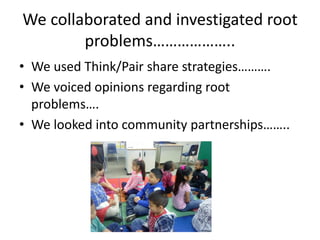
We collaborated and investigated root
        problems………………..
• We used Think/Pair share strategies……….
• We voiced opinions regarding root
  problems….
• We looked into community partnerships……..
We were writing letters to the city regarding the litter
      and garbage problem but discovered…..

• City clean-up was already on the schedule.
But what about the trash on our play yard?
        What could we do about it?
           Clean it up of course……….....................
First Grade Standard-PE 2.0- Distinguish between a jog, a run, a
                  jump, a slide, and explain the key differences.
It was an exuberant experience for my
              students!
But now what will we do with it…….? And
   how will the community be involved?
• First Grade Reading Standards 1.0
  (1.1-1.17)-Word analysis, fluency, and Systematic Vocabulary Development.
•Reading Comprehension            2.0
 (2.1-2.7)
What does our community partner and parents
                have to say?
Recycle! So let’s learn how….. First Grade Standards-Listening and
                      Speaking Strategies 1.0 :
     1.1 Listen Attentively, 1.2 Ask questions for clarification
First Grade Standards-Reading Comprehension 2.0-2.2 Respond
         to who, what, when, where, and how questions.
Literary Response and Analysis 3.0-3.1 Identify and describe the
elements of plot, setting and character in a story as well as beginning,
                           middle and end.
Written and Oral English Language Conventions 1.0-
1.1 Sentence Structure, 1.2-1.3 Grammar, 1.4-1.6 Punctuation, 1.7
                 Capitalization, and 1.8 Spelling
Mathematics 2.0
2.1 Know the addition facts
Coins-Mathematics Standards NS 1.5- Identify and know the
value of coins. This demonstrated the definition of ‘Reuse’.
Technology
•   California Technology Standards: 1.1.1; Students will demonstrate an understanding of the nature and
    operation of technology systems. 1.1.2; Students will exhibit a proficiency in the use of technology.
•   1.1.3 Students will develop basic skills (alpha numeric and special characters in using keyboard touch
    system.
Science 2c- Students know the roots are associated with the intake of
water and soil nutrients and green leaves associated with making food from sunlight.
Art-California First Grade Standards –Derive Meaning-4.2
   Identify and describe various reasons for making art.
Art Fair 2012
Recycled Art & Nature Category
Music First Grade Standard-5.0 Connections, Relationships,
                       and applications.

• Connecting and applying what is learned in art forms and
  subject areas to careers.
• Students apply what they learn in music across subject areas .
  5.1-Recognize and explain how people respond to their words
  through music.
What assessments do we use to measure
          service-learning outcomes?
• Did students learn about___________?
• Where they able to understand or solve the root cause of the
  problem?
• How did the standards help students learn about the problem?
• How will I measure their knowledge?

•   Reflection in journal writing.
•   Interviews.
•   Student work and involvement.
•   Pre and post tests.
•   Surveys
•   And questionnaires.
Who benefits from service-learning?
• All of us…………….!

Service learning with adobe

  • 1.
    Service-Learning An effective meansfor a higher quality of instruction and Social Justice Education.
  • 2.
    Before discussing thedefinition of Service-Learning ask yourself…… • Has education provided student opportunity to make meaningful connections to core academics? • Is student learning limited to the classroom? • Are we preparing students for real-life problem solving strategies? • Do teaching strategies promote social justice and student voice? • What is service-learning?
  • 3.
    Welcome! • My nameis Christine Thornton, and I will be presenting a brief description and my experience using Service-Learning with my First Grade students. • I have been teaching for 15 years, and have attended several teacher trainings for both teaching strategies and curriculum, and have found service-learning to be one of the most effective teaching methods for student learning so far.
  • 4.
    What is service-learning? •Service-learning is an instructional approach that helps students implement classroom standards and curriculum, into relevant and meaningful problem solving strategies in order to improve the community they live in.
  • 5.
    Why service-learning? Service-Learning…………… • Increasesstudent motivation and interest. •Challenges students into using higher order thinking skills. •Engages students in learning and problem solving. •Enhances content curricula such as reading, writing, math, science and social studies. •Gives students opportunity to voice their opinion in their own community matters. •Promotes social justice when basic student individual needs are meet.
  • 6.
    And……….. • Gives studentsa sense of leadership and contribution to their community and society. • Fosters positive school and community relationships. • Meets real community needs. • Reduces student risk behaviors. • Improves student attitude and social development. • Increases global awareness. • Helps language and vocabulary skills development for both English Language Learners, and English speaking students. • Provides hands-on activities which increases curricula understanding. • Makes learning a positive memorable experience.
  • 7.
    Disadvantages to servicelearning • None that I can see……………
  • 8.
    My personal teachingexperience with service-learning • My personal experience using service-learning as an instructional tool, has been very helpful in that it helped me expand curriculum to its fullest advantage. As a result, I helped create positive learning experiences for my students and in return, they were able to retain information that was delivered to them (through either lecture or textbooks,) and achieve higher test scores.
  • 9.
    Here are someexamples of how my students were able to plan a service-learning project….. • Students identified a community need or problem (this can be presented through individual, pairs groups or whole class.) • After identifying a community need or problem, students explained how the issue connected to their own lives. This is also how ‘student voice’ and ‘social justice’ was promoted as well. • Then, students investigated and analyzed the community need or problem they had chosen, using multiple sources for information to look for root causes and solutions. • Students then, looked into possible community partnerships. • Finally, students presented a plan of action and worked towards a resolution to problem solve the issue. • Standards and curriculum, were then applied to the action plan.
  • 10.
    Reflect. Did Identify community the plan help Need. solve the problem? Investigate design a Implement the plan. Plan of service. Invite community Members, business and school district officials.
  • 11.
    My Job Was tohelp with ideas and to implement critical California State Standards and the school adopted curriculum into the plan of action. Some of these Teacher Standards included: 1.1 Using Knowledge of students to engage them in learning. 1.2 Connecting students prior knowledge, backgrounds, life experiences, and interests, 1.3 Connecting subject matter to meaningful, real-life contexts. 1.4 Using a variety of instructional strategies, resources, and technologies to meet students’ diverse learning needs. 2.1 Promoting social development and responsibility within a caring community where each student is fairly treated.
  • 12.
    Implementing the CaliforniaState Standards and implementing the school adopted curriculum………………… Wasn’t too hard. But what if your Grade Level is on a pacing chart? •No Problem……………….if your too early with the lesson……….it will be a good pre-view. •If you’ve finished the lesson………..a good review. Here is where I show you just how my class used service-learning to help problem solve a school and community issue.
  • 13.
  • 14.
    On the campusand community…..
  • 15.
    We collaborated andinvestigated root problems……………….. • We used Think/Pair share strategies………. • We voiced opinions regarding root problems…. • We looked into community partnerships……..
  • 16.
    We were writingletters to the city regarding the litter and garbage problem but discovered….. • City clean-up was already on the schedule.
  • 17.
    But what aboutthe trash on our play yard? What could we do about it? Clean it up of course………..................... First Grade Standard-PE 2.0- Distinguish between a jog, a run, a jump, a slide, and explain the key differences.
  • 18.
    It was anexuberant experience for my students!
  • 19.
    But now whatwill we do with it…….? And how will the community be involved? • First Grade Reading Standards 1.0 (1.1-1.17)-Word analysis, fluency, and Systematic Vocabulary Development. •Reading Comprehension 2.0 (2.1-2.7)
  • 20.
    What does ourcommunity partner and parents have to say?
  • 21.
    Recycle! So let’slearn how….. First Grade Standards-Listening and Speaking Strategies 1.0 : 1.1 Listen Attentively, 1.2 Ask questions for clarification
  • 22.
    First Grade Standards-ReadingComprehension 2.0-2.2 Respond to who, what, when, where, and how questions.
  • 23.
    Literary Response andAnalysis 3.0-3.1 Identify and describe the elements of plot, setting and character in a story as well as beginning, middle and end.
  • 24.
    Written and OralEnglish Language Conventions 1.0- 1.1 Sentence Structure, 1.2-1.3 Grammar, 1.4-1.6 Punctuation, 1.7 Capitalization, and 1.8 Spelling
  • 25.
    Mathematics 2.0 2.1 Knowthe addition facts
  • 26.
    Coins-Mathematics Standards NS1.5- Identify and know the value of coins. This demonstrated the definition of ‘Reuse’.
  • 27.
    Technology • California Technology Standards: 1.1.1; Students will demonstrate an understanding of the nature and operation of technology systems. 1.1.2; Students will exhibit a proficiency in the use of technology. • 1.1.3 Students will develop basic skills (alpha numeric and special characters in using keyboard touch system.
  • 28.
    Science 2c- Studentsknow the roots are associated with the intake of water and soil nutrients and green leaves associated with making food from sunlight.
  • 29.
    Art-California First GradeStandards –Derive Meaning-4.2 Identify and describe various reasons for making art.
  • 30.
  • 31.
    Recycled Art &Nature Category
  • 32.
    Music First GradeStandard-5.0 Connections, Relationships, and applications. • Connecting and applying what is learned in art forms and subject areas to careers. • Students apply what they learn in music across subject areas . 5.1-Recognize and explain how people respond to their words through music.
  • 33.
    What assessments dowe use to measure service-learning outcomes? • Did students learn about___________? • Where they able to understand or solve the root cause of the problem? • How did the standards help students learn about the problem? • How will I measure their knowledge? • Reflection in journal writing. • Interviews. • Student work and involvement. • Pre and post tests. • Surveys • And questionnaires.
  • 34.
    Who benefits fromservice-learning? • All of us…………….!