Investigating the Impact of
Recycling Incentive Schemes
CIWM Journal ‘Industry Round Table’
March 2014
In 2014 Serco commissioned an important piece of research
into the impacts and effectiveness of household recycling
incentive schemes.
The work was conducted by Eunomia Research and Consulting and
received strong support from both Defra and The Chartered Institution of
Wastes Management (CIWM).
A partnership approach was agreed with Defra.
This saw Serco and Eunomia evaluating non-Defra funded incentive
schemes and Brook Lyndhurst, Defra’s research partner evaluating
Defra ‘Recognition and Reward’ funded schemes.
Both reports were published in early 2014.
On 5th February 2014 a panel of industry experts was convened for
a Round Table discussion to discuss and analyse the findings and
recommendations of both reports.
The Round Table was Chaired by Chris Murphy, the Deputy Chief
Executive of CIWM, and the key themes and findings from the
discussion were published in the March edition of CIWM Journal.
This is a reproduction of the original CIWM Journal article.
INTRODUCTION
For a full copy of the Serco/Eunomia Recycling Incentives Research Report or for
further information in relation to any aspect of the research or the CIWM Journal
‘Industry Round Table’ article please contact:
Robin Davies
Business Development Director
Serco Direct Services,
Enterprise House,
11 Bartley Wood Business Park,
Bartley Way, Hampshire, RG27 9XB
Mobile: 0771 819 4578
Email: robin.davies@serco.com
Plus:Incentive Schemes Debated
CIWM's Special Interest GroupsQuality ConcernsThe CIWM Knowledge Hub& The Great Waste &Resources Survey 2014
CIWMTHE JOURNAL FOR WASTE & RESOURCE MANAGEMENT PROFESSIONALS
March 2014
CIWMMarch 2014
I
t is against a backdrop of mounting
pressures on local authorities to deliver
on increasingly demanding waste
targets, whilst also reducing budgets,
that Serco commissioned Investigating
The Impact Of Recycling Incentive
Schemes. Undertaken by Eunomia, the
report looks into the cost and bene�its of
recycling incentive schemes, with an aim
of presenting comprehensive evidence
regarding their ef�iciency.
The view was to provide local
government with information and
evidence about the potential options for
introducing an incentive system to boost
recycling rates and aid in cutting costs.
Eunomia built upon previous work
examining the impacts of policy options,
including both positive and negative
incentives – carrot or stick – on land�ill
diversion and recycling performance.
Speci�ically, the report looks at
incentive schemes in order to analyse
the cost and bene�its, the impact of
recycling incentives and resident
preference, as well as data regarding
attitudes towards the incentives.
The report draws on evidence
collected from over 30 local authorities
in the UK, representing all UK recycling
incentive schemes not funded by
Defra’s Recognition and Reward
Programme. The review looks at a
number of schemes that were operated
by both local authorities and external
partners. The schemes also varied in
complexity, varied in cost – starting
from £1 per participating household
to £3 – and varied with regards to
rewards. Some rewards offered
incentives on a personal level, and
others provided bene�its linked to the
wider community.
Although the report looks at 30
incentive schemes, data from only
�ive of them was suf�icient enough to
use, for various reasons, including the
incentive schemes of some authorities
being implemented with other changes
to its waste collection services, thus
compromising the reliability of whether
any changes in recycling �igures were in
fact the result of the incentives or other
changes to its waste collection process.
Development director for Serco Direct
Services, Robin Davies, explained why
such a report was commissioned in the
�irst place. "It's been a 12-month journey
to reach this position, and why have we
done this particular report? Because
our customers want to know about
incentives; it's what they ask us about.
"It's a complex and challenging
world for local authorities and they
need the information and evidence to
make good decisions. There has been
no proper examination or scrutiny of
the performance of incentive schemes,
nor any debate as to their ability to
contribute towards local, and national,
recycling targets. We at Serco are not
pro, or anti, incentive schemes. For us,
this is just the �irst step in the debate
and in understanding the potential
impact incentive schemes can have."
Serco recently launched a report, Investigating The Impact Of Recycling Incentive
Schemes. Prior to the launch, in conjunction with CIWM, it also held a round table
debate on the subject. So what did the report, and those at the round table event, have
to say about incentive schemes? CIWM's Ben Wood & Darrel Moore report
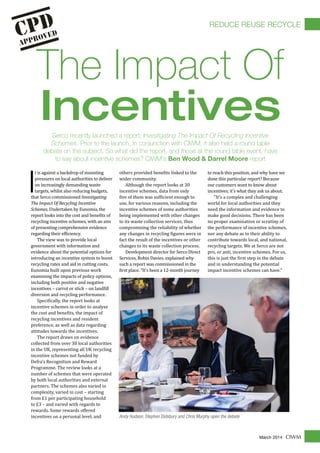
Andy Hudson, Stephen Didsbury and Chris Murphy open the debate
The Impact Of
Incentives
REDUCE REUSE RECYCLE
March 2014CIWM
Key Questions
SERCO APPROACHED the research
by looking at �ive key questions,
starting with "what’s the likely impact
on land�ill diversion and recycling
tonnages?" The report found a wide
variance in the schemes it analysed,
with an average eight percent increase
in recycling yields. Recycling rose by
as much as 32 percent for one local
authority, while for another it dropped
by 15 percent.
The wide range of outcomes was
also noted with regards to tonnages,
revealing an average reduction of three
percent. Two of the �ive schemes showed
both an increase in recycling rates and a
reduction in waste sent to land�ill.
By benchmarking the performance
of the authorities with recycling
incentive schemes in place against
“nearest neighbour” authorities, the
report was able to determine that it
was not possible to directly attribute
the recorded results to the incentives
schemes alone, as the analysis
demonstrated that similar changes
in recycling performance and land�ill
diversion were seen in 66 percent of
the nearest neighbour areas.
As a result, the report found it
was not possible to build a case for
investment in recycling incentive
schemes “alone” as a route to achieve
the results recorded.
What do residents think about
rewards schemes? Survey data showed
that 25 percent of residents said that
incentives would encourage them to
recycle more, and 75 percent said that
they’re already recycling as much as
they can.
The results of the report leaned
towards the conclusion that recycling
incentives are likely to directly appeal
to a relatively small proportion of the
population. The data also revealed that
the majority of the public claim they are
“intrinsically motivated” to do the right
thing with regards to recycling without
the need for �inancial rewards and
incentives.
Which scheme types are most
effective? With varying types of rewards
and incentive schemes out there, the
report analysed which had the most
positive impacts. It found that there was
little preference between personal and
communal schemes, with 42 percent
opting for preference of communal
rewards and 46 percent personal (12
percent saying they didn’t know).
Are there other ways to achieve a
more signi�icant impact? Asking residents
this question revealed that 42 percent
said commingled recycling would make
them recycle more; 41 percent said
wheeled bins; nine percent said better
marketing and communications; �ive
percent opted for incentives; and three
percent said “other”.
The report states: “Incentives can
represent a relatively quick, low risk
and low cost option available to local
authorities but by the same token
are unlikely to achieve the extent of
changes in behaviour and recycling
performance as other policy options.”
Do reward schemes provide good
value for money? Recycling incentives
demonstrate a wide-ranging variability
in cost and in level of bene�its likely to be
achieved by them. The report, therefore,
bands the cost of the schemes into
groups of low, medium and high.
For medium cost schemes, costing
between £1-2 per participating
household, the cost of introducing
such schemes comes closest to being
justi�ied and recouped in diversion
schemes and recycling income. For high
cost schemes, costing more than £2
per participating household the report
found that the investment was unlikely
to be recouped.
While the report admits that the
evidence base is far from conclusive,
taken alongside the interim Brook
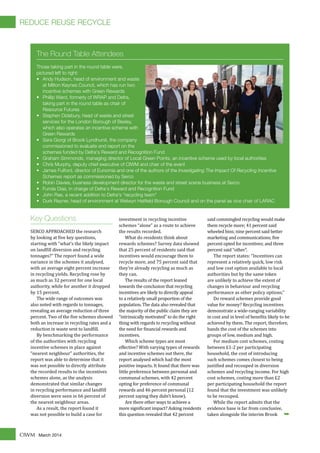
The Round Table Attendees
Those taking part in the round table were,
pictured left to right:
• Andy Hudson, head of environment and waste
at Milton Keynes Council, which has run two
incentive schemes with Green Rewards
• Phillip Ward, formerly of WRAP and Defra,
taking part in the round table as chair of
Resource Futures
• Stephen Didsbury, head of waste and street
services for the London Borough of Bexley,
which also operates an incentive scheme with
Green Rewards
• Sara Giorgi of Brook Lyndhurst, the company
commissioned to evaluate and report on the
schemes funded by Defra's Reward and Recognition Fund
• Graham Simmonds, managing director of Local Green Points, an incentive scheme used by local authorities
• Chris Murphy, deputy chief executive of CIWM and chair of the event
• James Fulford, director of Eunomia and one of the authors of the Investigating The Impact Of Recycling Incentive
Schemes report as commissioned by Serco
• Robin Davies, business development director for the waste and street scene business at Serco
• Funda Dias, in charge of Defra's Reward and Recognition Fund
• John Rae, a recent addition to Defra's "recycling team"
• Durk Reyner, head of environment at Welwyn Hatfield Borough Council and on the panel as vice chair of LARAC
➥
REDUCE REUSE RECYCLE
CIWMMarch 2014
Lyndhurst study for Defra, it presents
the best possible assessment of the
available data to date.
The report concludes: “These
schemes should not be considered to
be a panacea and where used should
be used to augment and contribute
towards the other policy and service
options that are likely to deliver more
signi�icant impacts.”
Round Table Debate
TO AUGMENT the report, Serco and
CIWM hosted a round table event with
representatives from local authorities,
the private sector and Defra to further
debate the �indings, and the names and
details of those taking part can be found
in the pull-out box on the previous
page. To encourage debate around this
potentially political subject, it was agreed
that in the reporting of the round table,
no direct quotes would be attributed, so
what we bring you here is a summary of
the topics addressed and the opinions of
the participants… some of the opinions
and who they belong to, however, you
may be able to work out for yourself!
The discussions started with the
panel's local authority representatives
outlining their authority's incentive
schemes, and their experiences of
operating them. It is easy to see that the
term "incentive scheme" doesn't cover
just one option and one method of
delivery. In just two examples the type
and value of the incentive was different;
one was borough-wide and the other
focused on those residents that would
be deemed "hard to reach"; they
lasted for different lengths of time and
had their own challenges. What was
notable, however, was that comments
such as being "pleasantly surprised"
and "we could see the bene�its" were
used for both schemes.
It did throw up the issue of data
collection, however, and this was
something that the panel as a whole
agreed was hard to manage, but key
to a successful incentive scheme.
Requiring residents to register online
is one way, but in the case of one of the
authorities, targeting multi-occupancy
properties in a more deprived area, the
Internet is not always accessible.
Of course, it's not just WHAT you
do, but also the WAY that you do
it, and it was proposed that what
incentive schemes are ultimately
aiming to achieve is behaviour change.
One scheme was referred to as a
"gimmick", but gimmick or part of a
long-term recycling strategy, it was
suggested that the schemes had that
same ultimate goal.
One panellist proposed that there
were four key elements in the success
of a recycling scheme: that the range of
rewards on offer was good, and that the
rewards themselves were attractive to
householders; that the communications
around the scheme were good and
locally branded to help engagement;
that the technology to back the scheme
up was in place; and that you generated
"credible data" from the scheme which,
as already agreed, was perhaps the
hardest element of all to achieve.
It was pointed out that with each
scheme there are different vehicles,
different systems, different incentives…
and as was stated in the report, only
�ive of the 30 incentive schemes could
be evaluated because there were other
in�luences (a new recycling system,
a communications drive…) meaning
the data couldn't be attributed to
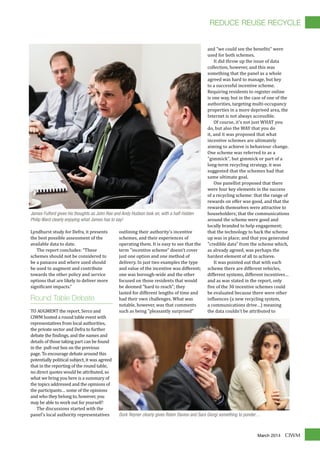
James Fulford gives his thoughts as John Rae and Andy Hudson look on, with a half-hidden
Philip Ward clearly enjoying what James has to say!
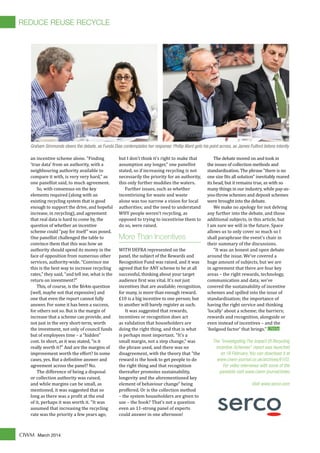
Durk Reyner clearly gives Robin Davies and Sara Giorgi something to ponder…
REDUCE REUSE RECYCLE
March 2014CIWM
an incentive scheme alone. "Finding
'true data' from an authority, with a
neighbouring authority available to
compare it with, is very very hard," as
one panellist said, to much agreement.
So, with consensus on the key
elements required (along with an
existing recycling system that is good
enough to support the drive, and hopeful
increase, in recycling), and agreement
that real data is hard to come by, the
question of whether an incentive
scheme could "pay for itself" was posed.
One panellist challenged the table to
convince them that this was how an
authority should spend its money in the
face of opposition from numerous other
services, authority-wide. "Convince me
this is the best way to increase recycling
rates," they said, "and tell me, what is the
return on investment?"
This, of course, is the $64m question
(well, maybe not that expensive) and
one that even the report cannot fully
answer. For some it has been a success,
for others not so. But is the margin of
increase that a scheme can provide, and
not just in the very short-term, worth
the investment, not only of council funds
but of employees time – a "hidden"
cost. In short, as it was stated, "is it
really worth it?" And are the margins of
improvement worth the effort? In some
cases, yes. But a de�initive answer and
agreement across the panel? No.
The difference of being a disposal
or collection authority was raised,
and while margins can be small, as
mentioned, it was suggested that so
long as there was a pro�it at the end
of it, perhaps it was worth it. "It was
assumed that increasing the recycling
rate was the priority a few years ago,
but I don't think it's right to make that
assumption any longer," one panellist
stated, so if increasing recycling is not
necessarily the priority for an authority,
this only further muddies the waters.
Further issues, such as whether
incentivising for waste and waste
alone was too narrow a vision for local
authorities; and the need to understand
WHY people weren't recycling, as
opposed to trying to incentivise them to
do so, were raised.
More Than Incentives
WITH DEFRA represented on the
panel, the subject of the Rewards and
Recognition Fund was raised, and it was
agreed that for ANY scheme to be at all
successful, thinking about your target
audience �irst was vital. It's not just
incentives that are available; recognition,
for many, is more than enough reward.
£10 is a big incentive to one person; but
to another will barely register as such.
It was suggested that rewards,
incentives or recognition does act
as validation that householders are
doing the right thing, and that is what
is perhaps most important. "It's a
small margin, not a step change," was
the phrase used, and there was no
disagreement, with the theory that "the
reward is the hook to get people to do
the right thing and that recognition
thereafter promotes sustainability,
longevity and the aforementioned key
element of behaviour change" being
proffered. Or is the collection method
– the system householders are given to
use – the hook? That's not a question
even an 11-strong panel of experts
could answer in one afternoon!
The debate moved on and took in
the issues of collection methods and
standardisation. The phrase "there is no
one size �its all solution" inevitably reared
its head, but it remains true, as with so
many things in our industry, while pay-as-
you-throw schemes and deposit schemes
were brought into the debate.
We make no apology for not delving
any further into the debate, and those
additional subjects, in this article, but
I am sure we will in the future. Space
allows us to only cover so much so I
shall paraphrase the event's chair in
their summary of the discussions.
"It was an honest and open debate
around the issue. We've covered a
huge amount of subjects, but we are
in agreement that there are four key
areas – the right rewards, technology,
communication and data; we've
covered the sustainability of incentive
schemes and spilled into the issue of
standardisation; the importance of
having the right service and thinking
'locally' about a scheme; the barriers;
rewards and recognition, alongside or
even instead of incentives – and the
'feelgood factor' that brings." CIWM
The "Investigating The Impact Of Recycling
Incentive Schemes" report was launched
on 18 February. You can download it at
www.ciwm-journal.co.uk/archives/6103.
For video interviews with some of the
panelists visit www.ciwm-journal/video
Visit www.serco.com
Graham Simmonds steers the debate, as Funda Dias contemplates her response; Phillip Ward gets his point across, as James Fulford listens intently
REDUCE REUSE RECYCLE
UK&E Local & Regional Government
Enterprise House,
11 Bartley Wood Business Park, Bartley
Way, Hook RG27 9XB
Tel: +44 (0)1256 745900
Email: robin.davies@serco.com
www.serco.com
Printed on paper from well managed
forests and other controlled sources.

Serco Incentives Round Table

  • 1.
    Investigating the Impactof Recycling Incentive Schemes CIWM Journal ‘Industry Round Table’ March 2014
  • 2.
    In 2014 Sercocommissioned an important piece of research into the impacts and effectiveness of household recycling incentive schemes. The work was conducted by Eunomia Research and Consulting and received strong support from both Defra and The Chartered Institution of Wastes Management (CIWM). A partnership approach was agreed with Defra. This saw Serco and Eunomia evaluating non-Defra funded incentive schemes and Brook Lyndhurst, Defra’s research partner evaluating Defra ‘Recognition and Reward’ funded schemes. Both reports were published in early 2014. On 5th February 2014 a panel of industry experts was convened for a Round Table discussion to discuss and analyse the findings and recommendations of both reports. The Round Table was Chaired by Chris Murphy, the Deputy Chief Executive of CIWM, and the key themes and findings from the discussion were published in the March edition of CIWM Journal. This is a reproduction of the original CIWM Journal article. INTRODUCTION For a full copy of the Serco/Eunomia Recycling Incentives Research Report or for further information in relation to any aspect of the research or the CIWM Journal ‘Industry Round Table’ article please contact: Robin Davies Business Development Director Serco Direct Services, Enterprise House, 11 Bartley Wood Business Park, Bartley Way, Hampshire, RG27 9XB Mobile: 0771 819 4578 Email: robin.davies@serco.com Plus:Incentive Schemes Debated CIWM's Special Interest GroupsQuality ConcernsThe CIWM Knowledge Hub& The Great Waste &Resources Survey 2014 CIWMTHE JOURNAL FOR WASTE & RESOURCE MANAGEMENT PROFESSIONALS March 2014
  • 3.
    CIWMMarch 2014 I t isagainst a backdrop of mounting pressures on local authorities to deliver on increasingly demanding waste targets, whilst also reducing budgets, that Serco commissioned Investigating The Impact Of Recycling Incentive Schemes. Undertaken by Eunomia, the report looks into the cost and bene�its of recycling incentive schemes, with an aim of presenting comprehensive evidence regarding their ef�iciency. The view was to provide local government with information and evidence about the potential options for introducing an incentive system to boost recycling rates and aid in cutting costs. Eunomia built upon previous work examining the impacts of policy options, including both positive and negative incentives – carrot or stick – on land�ill diversion and recycling performance. Speci�ically, the report looks at incentive schemes in order to analyse the cost and bene�its, the impact of recycling incentives and resident preference, as well as data regarding attitudes towards the incentives. The report draws on evidence collected from over 30 local authorities in the UK, representing all UK recycling incentive schemes not funded by Defra’s Recognition and Reward Programme. The review looks at a number of schemes that were operated by both local authorities and external partners. The schemes also varied in complexity, varied in cost – starting from £1 per participating household to £3 – and varied with regards to rewards. Some rewards offered incentives on a personal level, and others provided bene�its linked to the wider community. Although the report looks at 30 incentive schemes, data from only �ive of them was suf�icient enough to use, for various reasons, including the incentive schemes of some authorities being implemented with other changes to its waste collection services, thus compromising the reliability of whether any changes in recycling �igures were in fact the result of the incentives or other changes to its waste collection process. Development director for Serco Direct Services, Robin Davies, explained why such a report was commissioned in the �irst place. "It's been a 12-month journey to reach this position, and why have we done this particular report? Because our customers want to know about incentives; it's what they ask us about. "It's a complex and challenging world for local authorities and they need the information and evidence to make good decisions. There has been no proper examination or scrutiny of the performance of incentive schemes, nor any debate as to their ability to contribute towards local, and national, recycling targets. We at Serco are not pro, or anti, incentive schemes. For us, this is just the �irst step in the debate and in understanding the potential impact incentive schemes can have." Serco recently launched a report, Investigating The Impact Of Recycling Incentive Schemes. Prior to the launch, in conjunction with CIWM, it also held a round table debate on the subject. So what did the report, and those at the round table event, have to say about incentive schemes? CIWM's Ben Wood & Darrel Moore report Andy Hudson, Stephen Didsbury and Chris Murphy open the debate The Impact Of Incentives REDUCE REUSE RECYCLE
  • 4.
    March 2014CIWM Key Questions SERCOAPPROACHED the research by looking at �ive key questions, starting with "what’s the likely impact on land�ill diversion and recycling tonnages?" The report found a wide variance in the schemes it analysed, with an average eight percent increase in recycling yields. Recycling rose by as much as 32 percent for one local authority, while for another it dropped by 15 percent. The wide range of outcomes was also noted with regards to tonnages, revealing an average reduction of three percent. Two of the �ive schemes showed both an increase in recycling rates and a reduction in waste sent to land�ill. By benchmarking the performance of the authorities with recycling incentive schemes in place against “nearest neighbour” authorities, the report was able to determine that it was not possible to directly attribute the recorded results to the incentives schemes alone, as the analysis demonstrated that similar changes in recycling performance and land�ill diversion were seen in 66 percent of the nearest neighbour areas. As a result, the report found it was not possible to build a case for investment in recycling incentive schemes “alone” as a route to achieve the results recorded. What do residents think about rewards schemes? Survey data showed that 25 percent of residents said that incentives would encourage them to recycle more, and 75 percent said that they’re already recycling as much as they can. The results of the report leaned towards the conclusion that recycling incentives are likely to directly appeal to a relatively small proportion of the population. The data also revealed that the majority of the public claim they are “intrinsically motivated” to do the right thing with regards to recycling without the need for �inancial rewards and incentives. Which scheme types are most effective? With varying types of rewards and incentive schemes out there, the report analysed which had the most positive impacts. It found that there was little preference between personal and communal schemes, with 42 percent opting for preference of communal rewards and 46 percent personal (12 percent saying they didn’t know). Are there other ways to achieve a more signi�icant impact? Asking residents this question revealed that 42 percent said commingled recycling would make them recycle more; 41 percent said wheeled bins; nine percent said better marketing and communications; �ive percent opted for incentives; and three percent said “other”. The report states: “Incentives can represent a relatively quick, low risk and low cost option available to local authorities but by the same token are unlikely to achieve the extent of changes in behaviour and recycling performance as other policy options.” Do reward schemes provide good value for money? Recycling incentives demonstrate a wide-ranging variability in cost and in level of bene�its likely to be achieved by them. The report, therefore, bands the cost of the schemes into groups of low, medium and high. For medium cost schemes, costing between £1-2 per participating household, the cost of introducing such schemes comes closest to being justi�ied and recouped in diversion schemes and recycling income. For high cost schemes, costing more than £2 per participating household the report found that the investment was unlikely to be recouped. While the report admits that the evidence base is far from conclusive, taken alongside the interim Brook The Round Table Attendees Those taking part in the round table were, pictured left to right: • Andy Hudson, head of environment and waste at Milton Keynes Council, which has run two incentive schemes with Green Rewards • Phillip Ward, formerly of WRAP and Defra, taking part in the round table as chair of Resource Futures • Stephen Didsbury, head of waste and street services for the London Borough of Bexley, which also operates an incentive scheme with Green Rewards • Sara Giorgi of Brook Lyndhurst, the company commissioned to evaluate and report on the schemes funded by Defra's Reward and Recognition Fund • Graham Simmonds, managing director of Local Green Points, an incentive scheme used by local authorities • Chris Murphy, deputy chief executive of CIWM and chair of the event • James Fulford, director of Eunomia and one of the authors of the Investigating The Impact Of Recycling Incentive Schemes report as commissioned by Serco • Robin Davies, business development director for the waste and street scene business at Serco • Funda Dias, in charge of Defra's Reward and Recognition Fund • John Rae, a recent addition to Defra's "recycling team" • Durk Reyner, head of environment at Welwyn Hatfield Borough Council and on the panel as vice chair of LARAC ➥ REDUCE REUSE RECYCLE
  • 5.
    CIWMMarch 2014 Lyndhurst studyfor Defra, it presents the best possible assessment of the available data to date. The report concludes: “These schemes should not be considered to be a panacea and where used should be used to augment and contribute towards the other policy and service options that are likely to deliver more signi�icant impacts.” Round Table Debate TO AUGMENT the report, Serco and CIWM hosted a round table event with representatives from local authorities, the private sector and Defra to further debate the �indings, and the names and details of those taking part can be found in the pull-out box on the previous page. To encourage debate around this potentially political subject, it was agreed that in the reporting of the round table, no direct quotes would be attributed, so what we bring you here is a summary of the topics addressed and the opinions of the participants… some of the opinions and who they belong to, however, you may be able to work out for yourself! The discussions started with the panel's local authority representatives outlining their authority's incentive schemes, and their experiences of operating them. It is easy to see that the term "incentive scheme" doesn't cover just one option and one method of delivery. In just two examples the type and value of the incentive was different; one was borough-wide and the other focused on those residents that would be deemed "hard to reach"; they lasted for different lengths of time and had their own challenges. What was notable, however, was that comments such as being "pleasantly surprised" and "we could see the bene�its" were used for both schemes. It did throw up the issue of data collection, however, and this was something that the panel as a whole agreed was hard to manage, but key to a successful incentive scheme. Requiring residents to register online is one way, but in the case of one of the authorities, targeting multi-occupancy properties in a more deprived area, the Internet is not always accessible. Of course, it's not just WHAT you do, but also the WAY that you do it, and it was proposed that what incentive schemes are ultimately aiming to achieve is behaviour change. One scheme was referred to as a "gimmick", but gimmick or part of a long-term recycling strategy, it was suggested that the schemes had that same ultimate goal. One panellist proposed that there were four key elements in the success of a recycling scheme: that the range of rewards on offer was good, and that the rewards themselves were attractive to householders; that the communications around the scheme were good and locally branded to help engagement; that the technology to back the scheme up was in place; and that you generated "credible data" from the scheme which, as already agreed, was perhaps the hardest element of all to achieve. It was pointed out that with each scheme there are different vehicles, different systems, different incentives… and as was stated in the report, only �ive of the 30 incentive schemes could be evaluated because there were other in�luences (a new recycling system, a communications drive…) meaning the data couldn't be attributed to James Fulford gives his thoughts as John Rae and Andy Hudson look on, with a half-hidden Philip Ward clearly enjoying what James has to say! Durk Reyner clearly gives Robin Davies and Sara Giorgi something to ponder… REDUCE REUSE RECYCLE
  • 6.
    March 2014CIWM an incentivescheme alone. "Finding 'true data' from an authority, with a neighbouring authority available to compare it with, is very very hard," as one panellist said, to much agreement. So, with consensus on the key elements required (along with an existing recycling system that is good enough to support the drive, and hopeful increase, in recycling), and agreement that real data is hard to come by, the question of whether an incentive scheme could "pay for itself" was posed. One panellist challenged the table to convince them that this was how an authority should spend its money in the face of opposition from numerous other services, authority-wide. "Convince me this is the best way to increase recycling rates," they said, "and tell me, what is the return on investment?" This, of course, is the $64m question (well, maybe not that expensive) and one that even the report cannot fully answer. For some it has been a success, for others not so. But is the margin of increase that a scheme can provide, and not just in the very short-term, worth the investment, not only of council funds but of employees time – a "hidden" cost. In short, as it was stated, "is it really worth it?" And are the margins of improvement worth the effort? In some cases, yes. But a de�initive answer and agreement across the panel? No. The difference of being a disposal or collection authority was raised, and while margins can be small, as mentioned, it was suggested that so long as there was a pro�it at the end of it, perhaps it was worth it. "It was assumed that increasing the recycling rate was the priority a few years ago, but I don't think it's right to make that assumption any longer," one panellist stated, so if increasing recycling is not necessarily the priority for an authority, this only further muddies the waters. Further issues, such as whether incentivising for waste and waste alone was too narrow a vision for local authorities; and the need to understand WHY people weren't recycling, as opposed to trying to incentivise them to do so, were raised. More Than Incentives WITH DEFRA represented on the panel, the subject of the Rewards and Recognition Fund was raised, and it was agreed that for ANY scheme to be at all successful, thinking about your target audience �irst was vital. It's not just incentives that are available; recognition, for many, is more than enough reward. £10 is a big incentive to one person; but to another will barely register as such. It was suggested that rewards, incentives or recognition does act as validation that householders are doing the right thing, and that is what is perhaps most important. "It's a small margin, not a step change," was the phrase used, and there was no disagreement, with the theory that "the reward is the hook to get people to do the right thing and that recognition thereafter promotes sustainability, longevity and the aforementioned key element of behaviour change" being proffered. Or is the collection method – the system householders are given to use – the hook? That's not a question even an 11-strong panel of experts could answer in one afternoon! The debate moved on and took in the issues of collection methods and standardisation. The phrase "there is no one size �its all solution" inevitably reared its head, but it remains true, as with so many things in our industry, while pay-as- you-throw schemes and deposit schemes were brought into the debate. We make no apology for not delving any further into the debate, and those additional subjects, in this article, but I am sure we will in the future. Space allows us to only cover so much so I shall paraphrase the event's chair in their summary of the discussions. "It was an honest and open debate around the issue. We've covered a huge amount of subjects, but we are in agreement that there are four key areas – the right rewards, technology, communication and data; we've covered the sustainability of incentive schemes and spilled into the issue of standardisation; the importance of having the right service and thinking 'locally' about a scheme; the barriers; rewards and recognition, alongside or even instead of incentives – and the 'feelgood factor' that brings." CIWM The "Investigating The Impact Of Recycling Incentive Schemes" report was launched on 18 February. You can download it at www.ciwm-journal.co.uk/archives/6103. For video interviews with some of the panelists visit www.ciwm-journal/video Visit www.serco.com Graham Simmonds steers the debate, as Funda Dias contemplates her response; Phillip Ward gets his point across, as James Fulford listens intently REDUCE REUSE RECYCLE
  • 8.
    UK&E Local &Regional Government Enterprise House, 11 Bartley Wood Business Park, Bartley Way, Hook RG27 9XB Tel: +44 (0)1256 745900 Email: robin.davies@serco.com www.serco.com Printed on paper from well managed forests and other controlled sources.