Cloudonauts Team
• HumaidAhmad Kidwai
• Mohd Aazam
• Anamta Husain
• Abdullah Suhail
• Mohd Asim
• Haider Maseeh
• Kumail Mujtaba
• Nihal Gupta
• Mohd Imran
• Mohammad Abbas Zaidi
3.
Project Overview: UnlockingTweet Sentiment
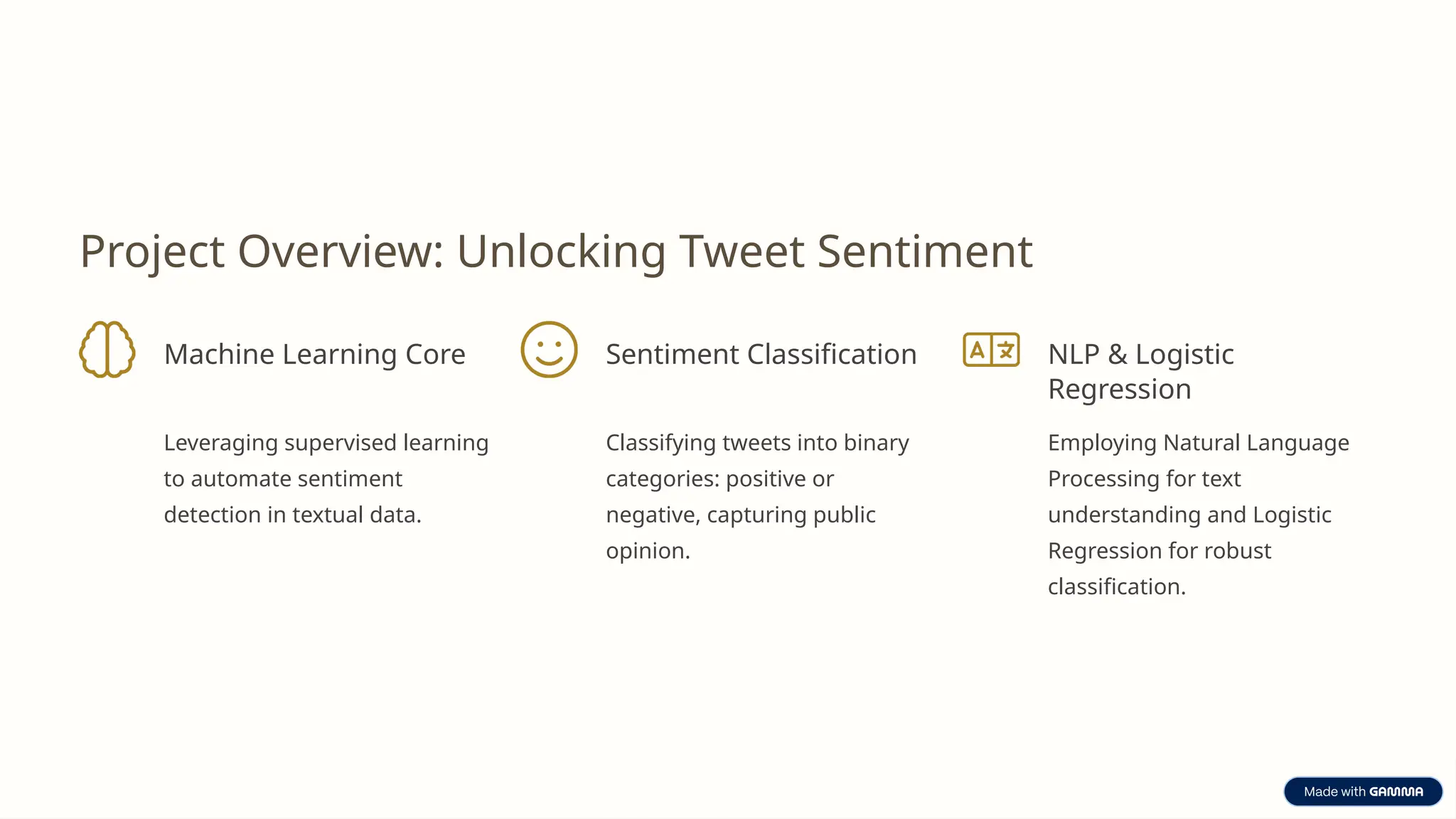
Machine Learning Core
Leveraging supervised learning
to automate sentiment
detection in textual data.
Sentiment Classification
Classifying tweets into binary
categories: positive or
negative, capturing public
opinion.
NLP & Logistic
Regression
Employing Natural Language
Processing for text
understanding and Logistic
Regression for robust
classification.
4.
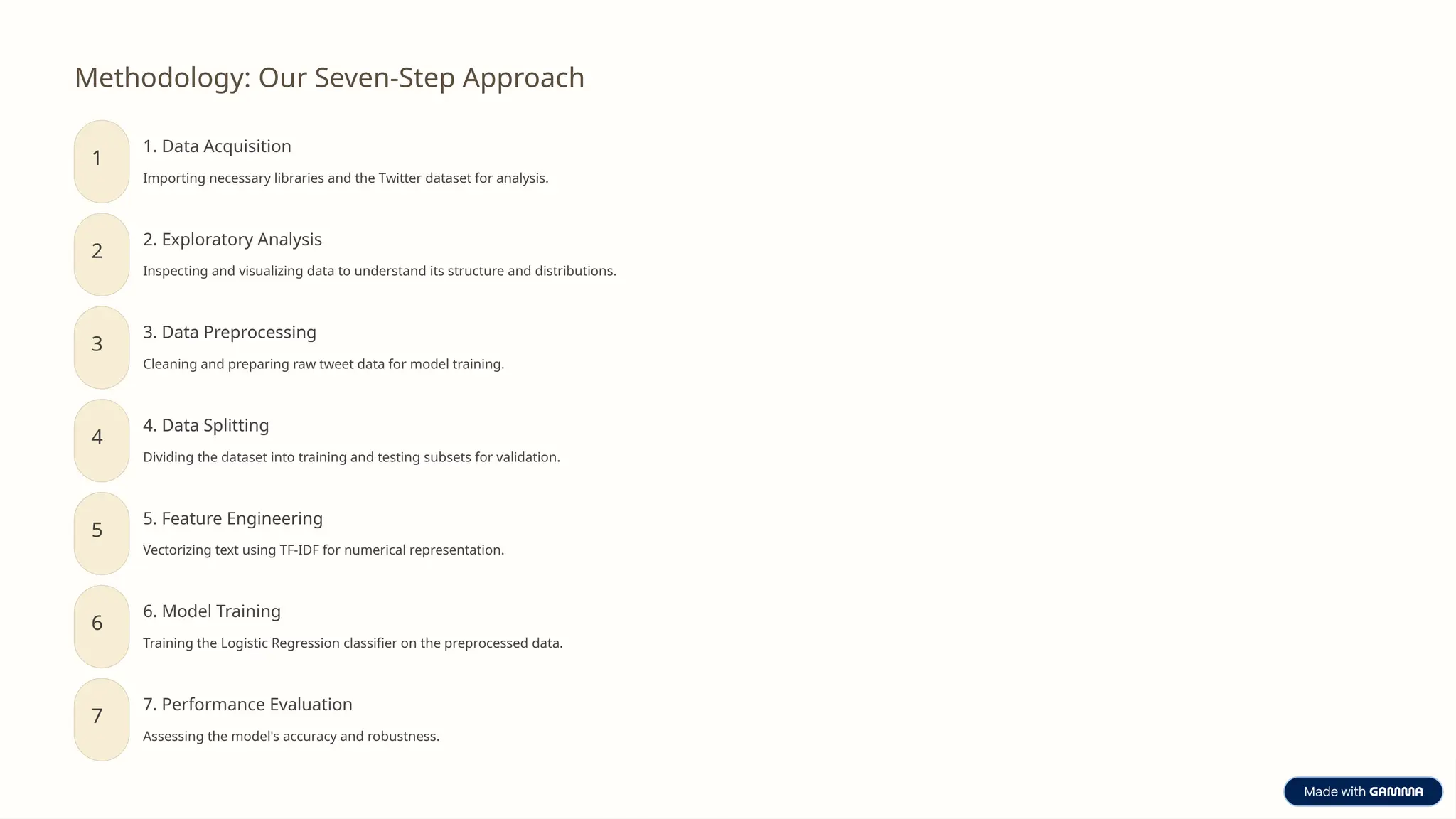
Methodology: Our Seven-StepApproach
1
1. Data Acquisition
Importing necessary libraries and the Twitter dataset for analysis.
2
2. Exploratory Analysis
Inspecting and visualizing data to understand its structure and distributions.
3
3. Data Preprocessing
Cleaning and preparing raw tweet data for model training.
4
4. Data Splitting
Dividing the dataset into training and testing subsets for validation.
5
5. Feature Engineering
Vectorizing text using TF-IDF for numerical representation.
6
6. Model Training
Training the Logistic Regression classifier on the preprocessed data.
7
7. Performance Evaluation
Assessing the model's accuracy and robustness.
5.
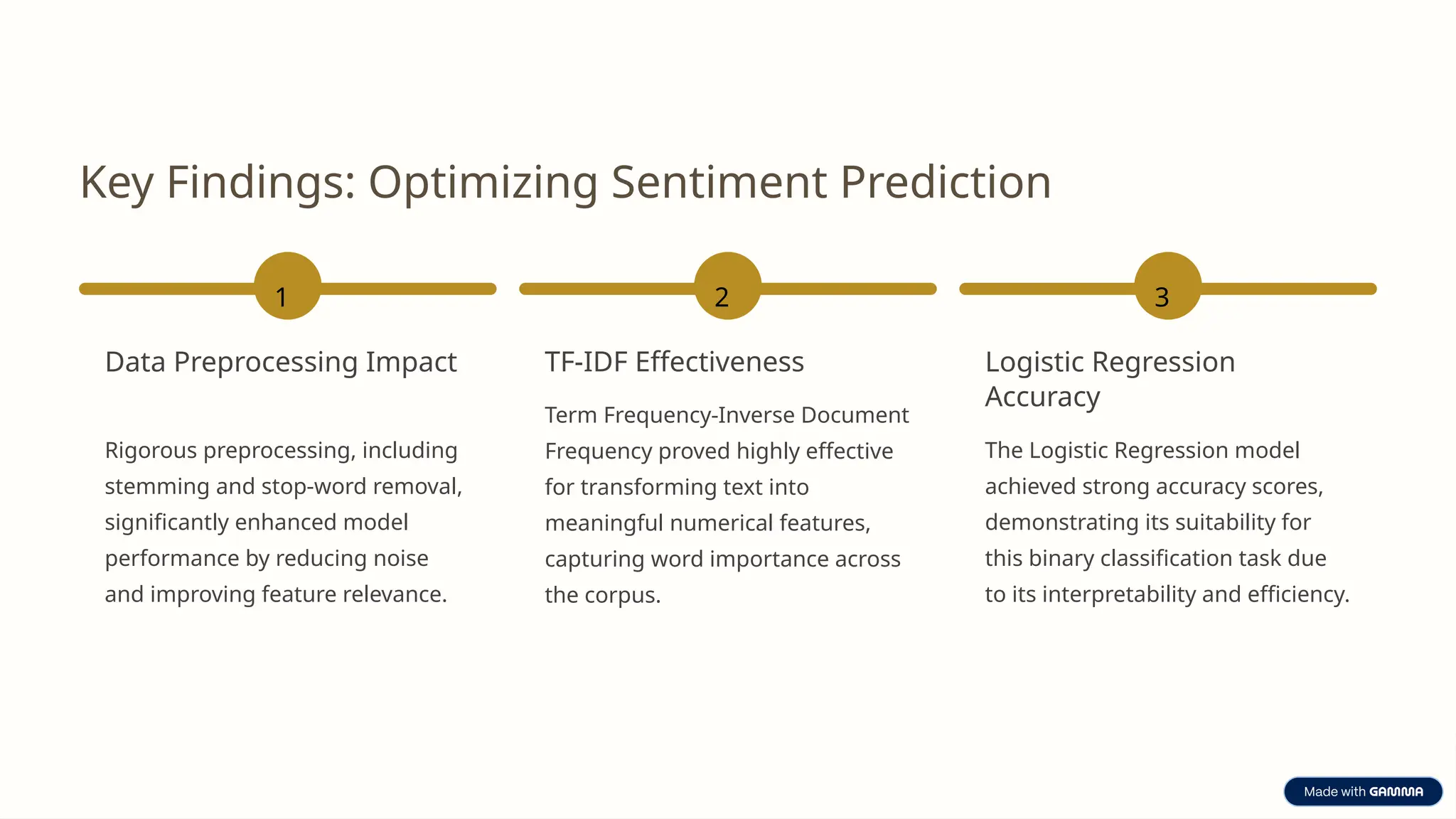
Key Findings: OptimizingSentiment Prediction
1
Data Preprocessing Impact
Rigorous preprocessing, including
stemming and stop-word removal,
significantly enhanced model
performance by reducing noise
and improving feature relevance.
2
TF-IDF Effectiveness
Term Frequency-Inverse Document
Frequency proved highly effective
for transforming text into
meaningful numerical features,
capturing word importance across
the corpus.
3
Logistic Regression
Accuracy
The Logistic Regression model
achieved strong accuracy scores,
demonstrating its suitability for
this binary classification task due
to its interpretability and efficiency.
6.
Conclusion: A RobustSentiment Model
We successfully developed and validated a sentiment classification model capable of accurately categorizing Twitter data.
This project showcases the synergistic power of Natural Language Processing and Machine Learning techniques in
extracting valuable insights from unstructured text.
The model's predictive capabilities were demonstrated through rigorous testing, affirming its potential for real-world
applications in areas like brand monitoring or public opinion analysis.
7.
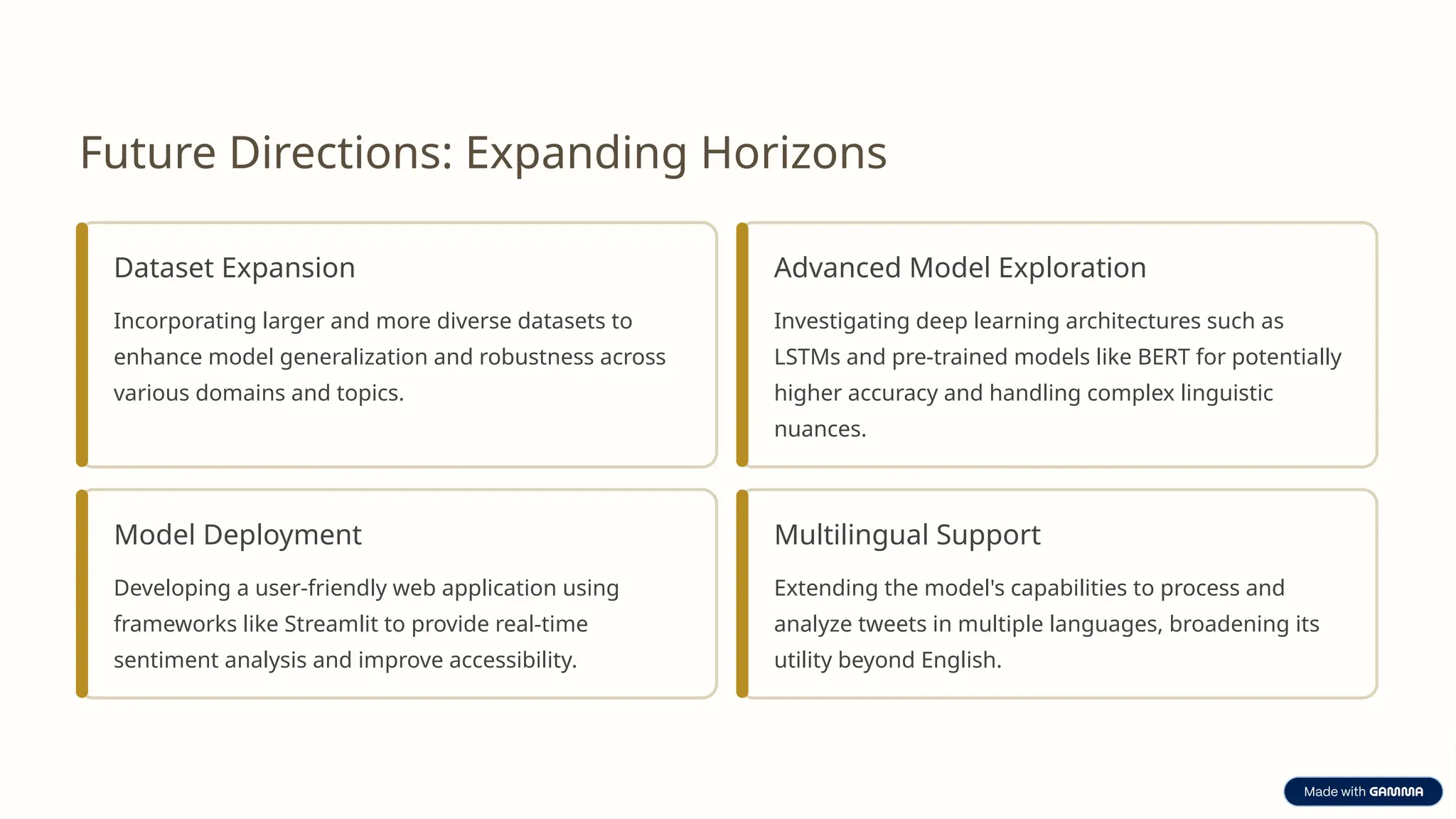
Future Directions: ExpandingHorizons
Dataset Expansion
Incorporating larger and more diverse datasets to
enhance model generalization and robustness across
various domains and topics.
Advanced Model Exploration
Investigating deep learning architectures such as
LSTMs and pre-trained models like BERT for potentially
higher accuracy and handling complex linguistic
nuances.
Model Deployment
Developing a user-friendly web application using
frameworks like Streamlit to provide real-time
sentiment analysis and improve accessibility.
Multilingual Support
Extending the model's capabilities to process and
analyze tweets in multiple languages, broadening its
utility beyond English.


![[DSC Europe 25] Jovan Bogicevic - Legacy to AI-Driven Defense: Transforming D...](https://cdn.slidesharecdn.com/ss_thumbnails/rsarluadt563hntyfc8q-3-251211083849-3e7bc4c0-thumbnail.jpg?width=640&height=640&fit=bounds)
![[DSC Europe 25] Behzad Hosseini - AI Agents in the Wild: Deploying Models tha...](https://cdn.slidesharecdn.com/ss_thumbnails/3qtejajvsjqrzwfept2c-10-251212103250-7f2b1068-thumbnail.jpg?width=640&height=640&fit=bounds)
![[DSC Europe 25] Tatevik Maytesyan - How to actually use AI in marketing: gett...](https://cdn.slidesharecdn.com/ss_thumbnails/tjo626lsqdgfntbgl2mw-4-251216103155-e36cd239-thumbnail.jpg?width=640&height=640&fit=bounds)
![[DSC Europe 25] Debmalya Biswas - Agentification: the art of transforming man...](https://cdn.slidesharecdn.com/ss_thumbnails/r5azlggvtqiaiiusrqdr-4-251212103249-5a12c89b-thumbnail.jpg?width=640&height=640&fit=bounds)

![[DSC Europe 25] Bassam Maharmeh - Artificial Intelligence: Opportunities and ...](https://cdn.slidesharecdn.com/ss_thumbnails/thhfmr2fqpawzj7hsjpg-5-251211083048-2c23204f-thumbnail.jpg?width=640&height=640&fit=bounds)


![[DSC Europe 25] Hans Kleinsman - The Compliance Gearbox: How Tax Tech Mediate...](https://cdn.slidesharecdn.com/ss_thumbnails/dxdytie1toel0hr90bjs-2-251212103250-174fdbe7-thumbnail.jpg?width=640&height=640&fit=bounds)
