International Research Journal of Engineering and Technology (IRJET) e-ISSN: 2395-0056
Volume: 06 Issue: 05 | May 2019 www.irjet.net p-ISSN: 2395-0072
© 2019, IRJET | Impact Factor value: 7.211 | ISO 9001:2008 Certified Journal | Page 4746
SENTIMENT ANALYSIS USING TWITTER DATA
Kirti Jain1, Abhishek Singh2, Arushi Yadav3
1Asst. Professor, Dept. Of Computer Science, Inderprastha Engineering College
2, 3Student, Dept. Of Computer Science, Inderprastha Engineering College
Dr. A. P. J. Abdul Kalam Technical University
---------------------------------------------------------------------***---------------------------------------------------------------------
Abstract - Sentiment analysis as the name suggest it is the analysis of the sentiments/feelings/expression related to any
topic, it is also known as opinion mining. Here the motive is to find the general sentiment associated to given document. We
try to classify the subjective information gathered from some microblogging site according to its polarity such as positive,
neutral and negative using machine learning and natural language processing. In this project, we chose Twitter as the
microblogging source for getting peoples sentiments and try to classify the tweets into positive, neutral and negative
sentiment.
Key Words: Sentiment Analysis, Polarity, Machine Learning, Natural Language Processing, Twitter, Microblogging.
1.INTRODUCTION
Sentiment analysis studies people judgment or thought towards certain entity. Twitter is a resourceful place to find people
sentiment. Here peoples post their thought/experience/ feelings through tweets which has a character limit of 140.
Twitter has a provision for developers to collect data from twitter by releasing their APIs. In this project we are using one
of the twitter API i.e. streaming API which helps to extract the content in the real time.
Here we perform the linguistic analysis by building the classifier using the several machine learning techniques and
natural language processing by using the collected corpus from the Kaggle as the training data to train our classifier and
use the streamed corpus as the testing data to test the result of our classifier to classify the different sentiments related to
tweets.
In this project we focus on the tweets related to airline as the customer shares their experience on the twitter thorough
their tweets and our analyzer helps the airline company to improve their services by keeping an eye on people’s
sentiments by overcoming their flaws.
2. LITERATURE REVIEW
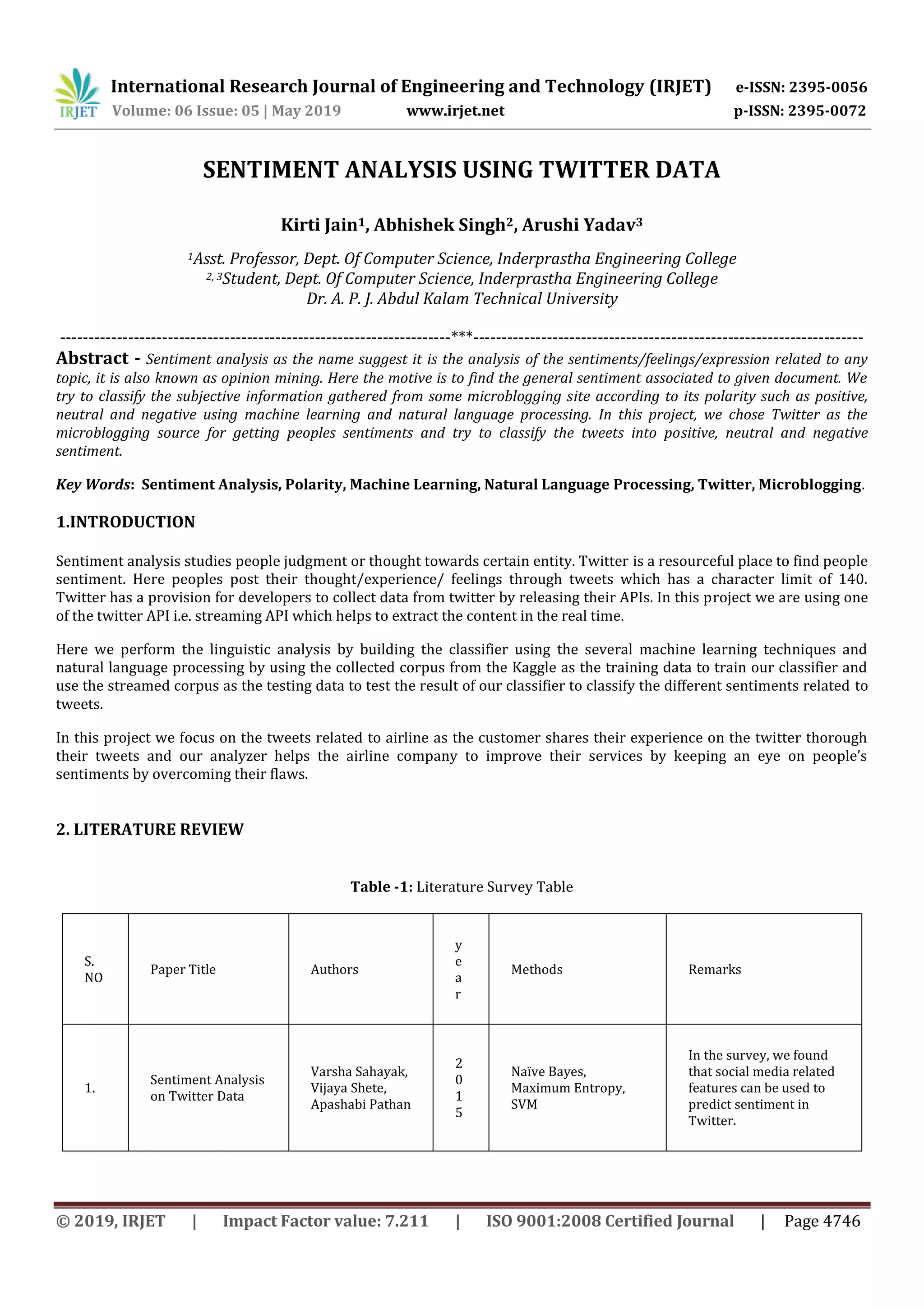
Table -1: Literature Survey Table
S.
NO
Paper Title Authors
y
e
a
r
Methods Remarks
1.
Sentiment Analysis
on Twitter Data
Varsha Sahayak,
Vijaya Shete,
Apashabi Pathan
2
0
1
5
Naïve Bayes,
Maximum Entropy,
SVM
In the survey, we found
that social media related
features can be used to
predict sentiment in
Twitter.
International Research Journal of Engineering and Technology (IRJET) e-ISSN: 2395-0056
Volume: 06 Issue: 05 | May 2019 www.irjet.net p-ISSN: 2395-0072
© 2019, IRJET | Impact Factor value: 7.211 | ISO 9001:2008 Certified Journal | Page 4747
2.
Sentiment Analysis
on Twitter Data
Onam Bharti,
Mrs. Monika
Malhotra
2
0
1
6
Naïve Bayes, KNN
Accuracy (%)
Naive Bayes- 79.66
KNN – 83.59
3.
Sentiment analysis
of twitter data
Hamid Bagheri,
Md Johirul Islam
2
0
1
7
Naïve Bayes, Text
Blob
We realized that the
neutral sentiments are
significantly high which
shows there is a need to
improve Twitter
sentiment analysis.
4.
Study of Twitter
Sentiment Analysis
using Machine
Learning
Algorithms on
Python
Bhumika Gupta,
Monika Negi,
Kanika
Vishwakarma,
Goldi Rawat
2
0
1
7
Bayesian logistic
regression
,Naïve Bayes,
Maximum Entropy
Classifier ,
Support Vector
Machine Algorithm
This research topic has
evolved during the last
decade with models
reaching the efficiency of
almost 85%-90%. But it
still lacks the dimension
of diversity in the data.
Along with this it has a
lot of application issues
with the slang used.
5.
Sentiment Analysis
of Twitter Data
through Big Data
Anusha.N,
Divya.G,
Ramya.B
2
0
1
7
Naïve Bayes
Classification,
Training with Mahout
After the training set has
been prepared, data is
analyzed by uploading it
on HDFS and Naïve
Bayes classification is
carried out.
6.
Machine
Learning-Based
Sentiment
Analysis for
Twitter
Ali Hasan,
Sana Moin,
Ahmad Kari
and
Shahaboddin
Shamshirband
2
0
1
8
Naïve Bayes
Classifier, SVM
Classifier
This paper focuses on
the adoption of
machine-learning
algorithms to
determine the highest
accuracy for election
sentiments.
International Research Journal of Engineering and Technology (IRJET) e-ISSN: 2395-0056
Volume: 06 Issue: 05 | May 2019 www.irjet.net p-ISSN: 2395-0072
© 2019, IRJET | Impact Factor value: 7.211 | ISO 9001:2008 Certified Journal | Page 4748
3. CORE MODULES
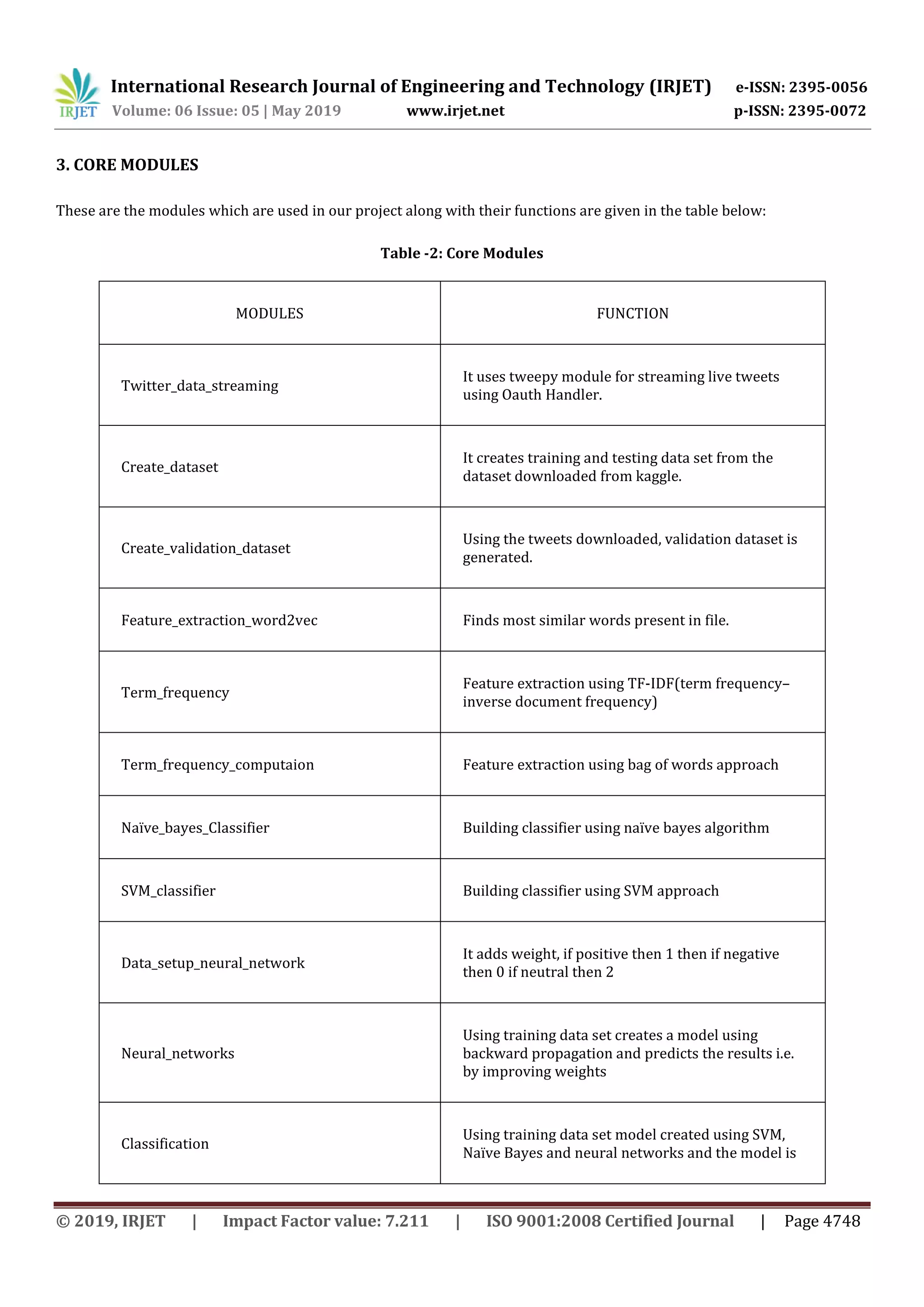
These are the modules which are used in our project along with their functions are given in the table below:
Table -2: Core Modules
MODULES FUNCTION
Twitter_data_streaming
It uses tweepy module for streaming live tweets
using Oauth Handler.
Create_dataset
It creates training and testing data set from the
dataset downloaded from kaggle.
Create_validation_dataset
Using the tweets downloaded, validation dataset is
generated.
Feature_extraction_word2vec Finds most similar words present in file.
Term_frequency
Feature extraction using TF-IDF(term frequency–
inverse document frequency)
Term_frequency_computaion Feature extraction using bag of words approach
Naïve_bayes_Classifier Building classifier using naïve bayes algorithm
SVM_classifier Building classifier using SVM approach
Data_setup_neural_network
It adds weight, if positive then 1 then if negative
then 0 if neutral then 2
Neural_networks
Using training data set creates a model using
backward propagation and predicts the results i.e.
by improving weights
Classification
Using training data set model created using SVM,
Naïve Bayes and neural networks and the model is
International Research Journal of Engineering and Technology (IRJET) e-ISSN: 2395-0056
Volume: 06 Issue: 05 | May 2019 www.irjet.net p-ISSN: 2395-0072
© 2019, IRJET | Impact Factor value: 7.211 | ISO 9001:2008 Certified Journal | Page 4749
4. RESULT
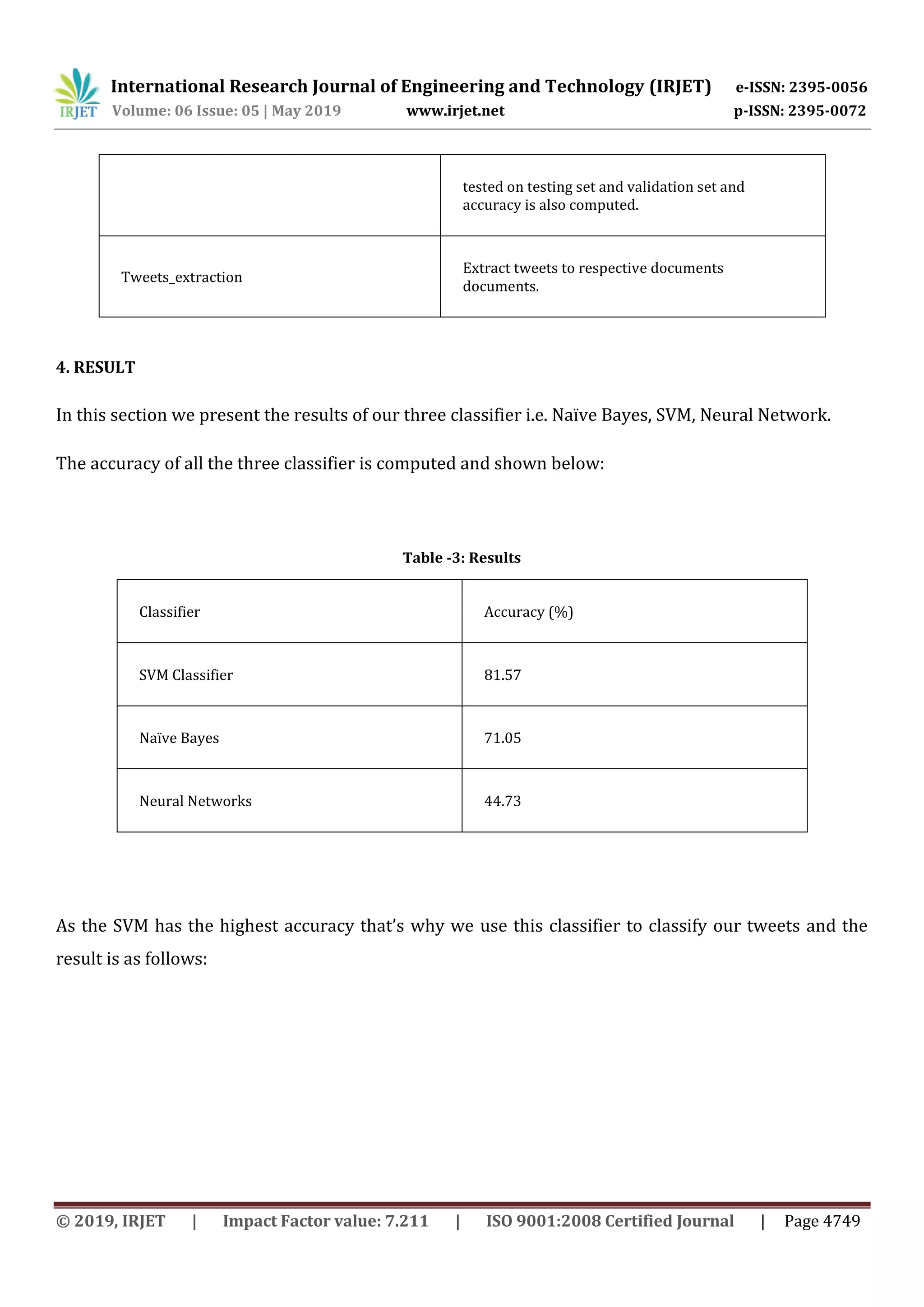
In this section we present the results of our three classifier i.e. Naïve Bayes, SVM, Neural Network.
The accuracy of all the three classifier is computed and shown below:
Table -3: Results
As the SVM has the highest accuracy that’s why we use this classifier to classify our tweets and the
result is as follows:
tested on testing set and validation set and
accuracy is also computed.
Tweets_extraction
Extract tweets to respective documents
documents.
Classifier Accuracy (%)
SVM Classifier 81.57
Naïve Bayes 71.05
Neural Networks 44.73
International Research Journal of Engineering and Technology (IRJET) e-ISSN: 2395-0056
Volume: 06 Issue: 05 | May 2019 www.irjet.net p-ISSN: 2395-0072
© 2019, IRJET | Impact Factor value: 7.211 | ISO 9001:2008 Certified Journal | Page 4750
Chart -1: Sentiment Analysis Bar Graph
The total no. of tweet was 23986 out of which 4153 were positive, 14407 were negative and 5426 were neutral
i.e.17.31%, 60.06% and 22.62% this much percentage hold by positive, negative and neutral tweets out of total
no. of tweets respectively.
5. CONCLUSION
We presented our result on sentiment analysis using twitter data. We use proposed models of classification in
the supervised machine learning i.e. Naïve Bayes, SVM, and Neural Networks. For feature extraction we used
the bag-of-words, term frequency, tf-idf approach. And by combining them we classify the tweets into three
different sentiment i.e. Positive, Neutral and Negative.
In future work we try to improve the accuracy of our classifier which can detect the sarcasm, irony, humor
content in the tweet.
ACKNOWLEDGEMENT
We take this opportunity to thank our teachers and friends who helped us throughout the project. First and
foremost we would like to thank my guide for the project (Ms. Kirti Jain, Assistant Professor, Computer Science
and Engineering) for her valuable advice and time during development of project.
We would also like to thank Dr. Rekha Kashyap (HOD, Computer Science Department) for her constant support
during the development of the project.
REFERENCES
[1] Varsha Sahayak, Vijaya Shete ,Apashabi Pathan,” Sentiment Analysis on Twitter Data”,Department of
Information Technology, Savitribai Phule Pune University, Pune, India,2015.
International Research Journal of Engineering and Technology (IRJET) e-ISSN: 2395-0056
Volume: 06 Issue: 05 | May 2019 www.irjet.net p-ISSN: 2395-0072
© 2019, IRJET | Impact Factor value: 7.211 | ISO 9001:2008 Certified Journal | Page 4751
[2] Onam Bharti, Mrs. Monika Malhotra,” SENTIMENT ANALYSIS ON TWITTER DATA”, World College of
Technology and Management, Gurgaon , India, 2016.
[3] Bhumika Gupta, Monika Negi, Kanika Vishwakarma, Goldi Rawat, Priyanka Badhani , “ Study of Twitter
Sentiment Analysis using Machine Learning Algorithms on Python ” , C.S.E.D ,G.B.P.E.C, Pauri, Uttarakhand,
India, 2017.
[4] Ali Hasan, Sana Moin, Ahmad Karim and Shahaboddin Shamshirband, “Machine Learning-Based Sentiment
Analysis for Twitter Accounts” , Department for Management of Science and Technology Development, Ton Duc
Thang University,Ho Chi Minh City, Vietnam,2018.
[5] Hamid Bagheri, Md Johirul Islam, “Sentiment analysis of twitter data” , Computer Science Department Iowa
State University,United States of America, 2017.
[6] Anusha.N, Divya.G, Ramya.B, “Sentiment Analysis of Twitter Data through Big Data”, Computer Science and
Engineering Sai Vidya Institute of Technology Bangalore, India, 2017.

IRJET- Sentiment Analysis using Twitter Data

  • 1.
    International Research Journalof Engineering and Technology (IRJET) e-ISSN: 2395-0056 Volume: 06 Issue: 05 | May 2019 www.irjet.net p-ISSN: 2395-0072 © 2019, IRJET | Impact Factor value: 7.211 | ISO 9001:2008 Certified Journal | Page 4746 SENTIMENT ANALYSIS USING TWITTER DATA Kirti Jain1, Abhishek Singh2, Arushi Yadav3 1Asst. Professor, Dept. Of Computer Science, Inderprastha Engineering College 2, 3Student, Dept. Of Computer Science, Inderprastha Engineering College Dr. A. P. J. Abdul Kalam Technical University ---------------------------------------------------------------------***--------------------------------------------------------------------- Abstract - Sentiment analysis as the name suggest it is the analysis of the sentiments/feelings/expression related to any topic, it is also known as opinion mining. Here the motive is to find the general sentiment associated to given document. We try to classify the subjective information gathered from some microblogging site according to its polarity such as positive, neutral and negative using machine learning and natural language processing. In this project, we chose Twitter as the microblogging source for getting peoples sentiments and try to classify the tweets into positive, neutral and negative sentiment. Key Words: Sentiment Analysis, Polarity, Machine Learning, Natural Language Processing, Twitter, Microblogging. 1.INTRODUCTION Sentiment analysis studies people judgment or thought towards certain entity. Twitter is a resourceful place to find people sentiment. Here peoples post their thought/experience/ feelings through tweets which has a character limit of 140. Twitter has a provision for developers to collect data from twitter by releasing their APIs. In this project we are using one of the twitter API i.e. streaming API which helps to extract the content in the real time. Here we perform the linguistic analysis by building the classifier using the several machine learning techniques and natural language processing by using the collected corpus from the Kaggle as the training data to train our classifier and use the streamed corpus as the testing data to test the result of our classifier to classify the different sentiments related to tweets. In this project we focus on the tweets related to airline as the customer shares their experience on the twitter thorough their tweets and our analyzer helps the airline company to improve their services by keeping an eye on people’s sentiments by overcoming their flaws. 2. LITERATURE REVIEW Table -1: Literature Survey Table S. NO Paper Title Authors y e a r Methods Remarks 1. Sentiment Analysis on Twitter Data Varsha Sahayak, Vijaya Shete, Apashabi Pathan 2 0 1 5 Naïve Bayes, Maximum Entropy, SVM In the survey, we found that social media related features can be used to predict sentiment in Twitter.
  • 2.
    International Research Journalof Engineering and Technology (IRJET) e-ISSN: 2395-0056 Volume: 06 Issue: 05 | May 2019 www.irjet.net p-ISSN: 2395-0072 © 2019, IRJET | Impact Factor value: 7.211 | ISO 9001:2008 Certified Journal | Page 4747 2. Sentiment Analysis on Twitter Data Onam Bharti, Mrs. Monika Malhotra 2 0 1 6 Naïve Bayes, KNN Accuracy (%) Naive Bayes- 79.66 KNN – 83.59 3. Sentiment analysis of twitter data Hamid Bagheri, Md Johirul Islam 2 0 1 7 Naïve Bayes, Text Blob We realized that the neutral sentiments are significantly high which shows there is a need to improve Twitter sentiment analysis. 4. Study of Twitter Sentiment Analysis using Machine Learning Algorithms on Python Bhumika Gupta, Monika Negi, Kanika Vishwakarma, Goldi Rawat 2 0 1 7 Bayesian logistic regression ,Naïve Bayes, Maximum Entropy Classifier , Support Vector Machine Algorithm This research topic has evolved during the last decade with models reaching the efficiency of almost 85%-90%. But it still lacks the dimension of diversity in the data. Along with this it has a lot of application issues with the slang used. 5. Sentiment Analysis of Twitter Data through Big Data Anusha.N, Divya.G, Ramya.B 2 0 1 7 Naïve Bayes Classification, Training with Mahout After the training set has been prepared, data is analyzed by uploading it on HDFS and Naïve Bayes classification is carried out. 6. Machine Learning-Based Sentiment Analysis for Twitter Ali Hasan, Sana Moin, Ahmad Kari and Shahaboddin Shamshirband 2 0 1 8 Naïve Bayes Classifier, SVM Classifier This paper focuses on the adoption of machine-learning algorithms to determine the highest accuracy for election sentiments.
  • 3.
    International Research Journalof Engineering and Technology (IRJET) e-ISSN: 2395-0056 Volume: 06 Issue: 05 | May 2019 www.irjet.net p-ISSN: 2395-0072 © 2019, IRJET | Impact Factor value: 7.211 | ISO 9001:2008 Certified Journal | Page 4748 3. CORE MODULES These are the modules which are used in our project along with their functions are given in the table below: Table -2: Core Modules MODULES FUNCTION Twitter_data_streaming It uses tweepy module for streaming live tweets using Oauth Handler. Create_dataset It creates training and testing data set from the dataset downloaded from kaggle. Create_validation_dataset Using the tweets downloaded, validation dataset is generated. Feature_extraction_word2vec Finds most similar words present in file. Term_frequency Feature extraction using TF-IDF(term frequency– inverse document frequency) Term_frequency_computaion Feature extraction using bag of words approach Naïve_bayes_Classifier Building classifier using naïve bayes algorithm SVM_classifier Building classifier using SVM approach Data_setup_neural_network It adds weight, if positive then 1 then if negative then 0 if neutral then 2 Neural_networks Using training data set creates a model using backward propagation and predicts the results i.e. by improving weights Classification Using training data set model created using SVM, Naïve Bayes and neural networks and the model is
  • 4.
    International Research Journalof Engineering and Technology (IRJET) e-ISSN: 2395-0056 Volume: 06 Issue: 05 | May 2019 www.irjet.net p-ISSN: 2395-0072 © 2019, IRJET | Impact Factor value: 7.211 | ISO 9001:2008 Certified Journal | Page 4749 4. RESULT In this section we present the results of our three classifier i.e. Naïve Bayes, SVM, Neural Network. The accuracy of all the three classifier is computed and shown below: Table -3: Results As the SVM has the highest accuracy that’s why we use this classifier to classify our tweets and the result is as follows: tested on testing set and validation set and accuracy is also computed. Tweets_extraction Extract tweets to respective documents documents. Classifier Accuracy (%) SVM Classifier 81.57 Naïve Bayes 71.05 Neural Networks 44.73
  • 5.
    International Research Journalof Engineering and Technology (IRJET) e-ISSN: 2395-0056 Volume: 06 Issue: 05 | May 2019 www.irjet.net p-ISSN: 2395-0072 © 2019, IRJET | Impact Factor value: 7.211 | ISO 9001:2008 Certified Journal | Page 4750 Chart -1: Sentiment Analysis Bar Graph The total no. of tweet was 23986 out of which 4153 were positive, 14407 were negative and 5426 were neutral i.e.17.31%, 60.06% and 22.62% this much percentage hold by positive, negative and neutral tweets out of total no. of tweets respectively. 5. CONCLUSION We presented our result on sentiment analysis using twitter data. We use proposed models of classification in the supervised machine learning i.e. Naïve Bayes, SVM, and Neural Networks. For feature extraction we used the bag-of-words, term frequency, tf-idf approach. And by combining them we classify the tweets into three different sentiment i.e. Positive, Neutral and Negative. In future work we try to improve the accuracy of our classifier which can detect the sarcasm, irony, humor content in the tweet. ACKNOWLEDGEMENT We take this opportunity to thank our teachers and friends who helped us throughout the project. First and foremost we would like to thank my guide for the project (Ms. Kirti Jain, Assistant Professor, Computer Science and Engineering) for her valuable advice and time during development of project. We would also like to thank Dr. Rekha Kashyap (HOD, Computer Science Department) for her constant support during the development of the project. REFERENCES [1] Varsha Sahayak, Vijaya Shete ,Apashabi Pathan,” Sentiment Analysis on Twitter Data”,Department of Information Technology, Savitribai Phule Pune University, Pune, India,2015.
  • 6.
    International Research Journalof Engineering and Technology (IRJET) e-ISSN: 2395-0056 Volume: 06 Issue: 05 | May 2019 www.irjet.net p-ISSN: 2395-0072 © 2019, IRJET | Impact Factor value: 7.211 | ISO 9001:2008 Certified Journal | Page 4751 [2] Onam Bharti, Mrs. Monika Malhotra,” SENTIMENT ANALYSIS ON TWITTER DATA”, World College of Technology and Management, Gurgaon , India, 2016. [3] Bhumika Gupta, Monika Negi, Kanika Vishwakarma, Goldi Rawat, Priyanka Badhani , “ Study of Twitter Sentiment Analysis using Machine Learning Algorithms on Python ” , C.S.E.D ,G.B.P.E.C, Pauri, Uttarakhand, India, 2017. [4] Ali Hasan, Sana Moin, Ahmad Karim and Shahaboddin Shamshirband, “Machine Learning-Based Sentiment Analysis for Twitter Accounts” , Department for Management of Science and Technology Development, Ton Duc Thang University,Ho Chi Minh City, Vietnam,2018. [5] Hamid Bagheri, Md Johirul Islam, “Sentiment analysis of twitter data” , Computer Science Department Iowa State University,United States of America, 2017. [6] Anusha.N, Divya.G, Ramya.B, “Sentiment Analysis of Twitter Data through Big Data”, Computer Science and Engineering Sai Vidya Institute of Technology Bangalore, India, 2017.