Sentiment	
  Analysis
What	
  is	
  Sentiment	
  
Analysis?
Positive	
  or	
  negative	
  movie	
  review?
• unbelievably	
  disappointing	
  
• Full	
  of	
  zany	
  characters	
  and	
  richly	
  applied	
  satire,	
  and	
  some	
  
great	
  plot	
  twists
• this	
  is	
  the	
  greatest	
  screwball	
  comedy	
  ever	
  filmed
• It	
  was	
  pathetic.	
  The	
  worst	
  part	
  about	
  it	
  was	
  the	
  boxing	
  
scenes.
2
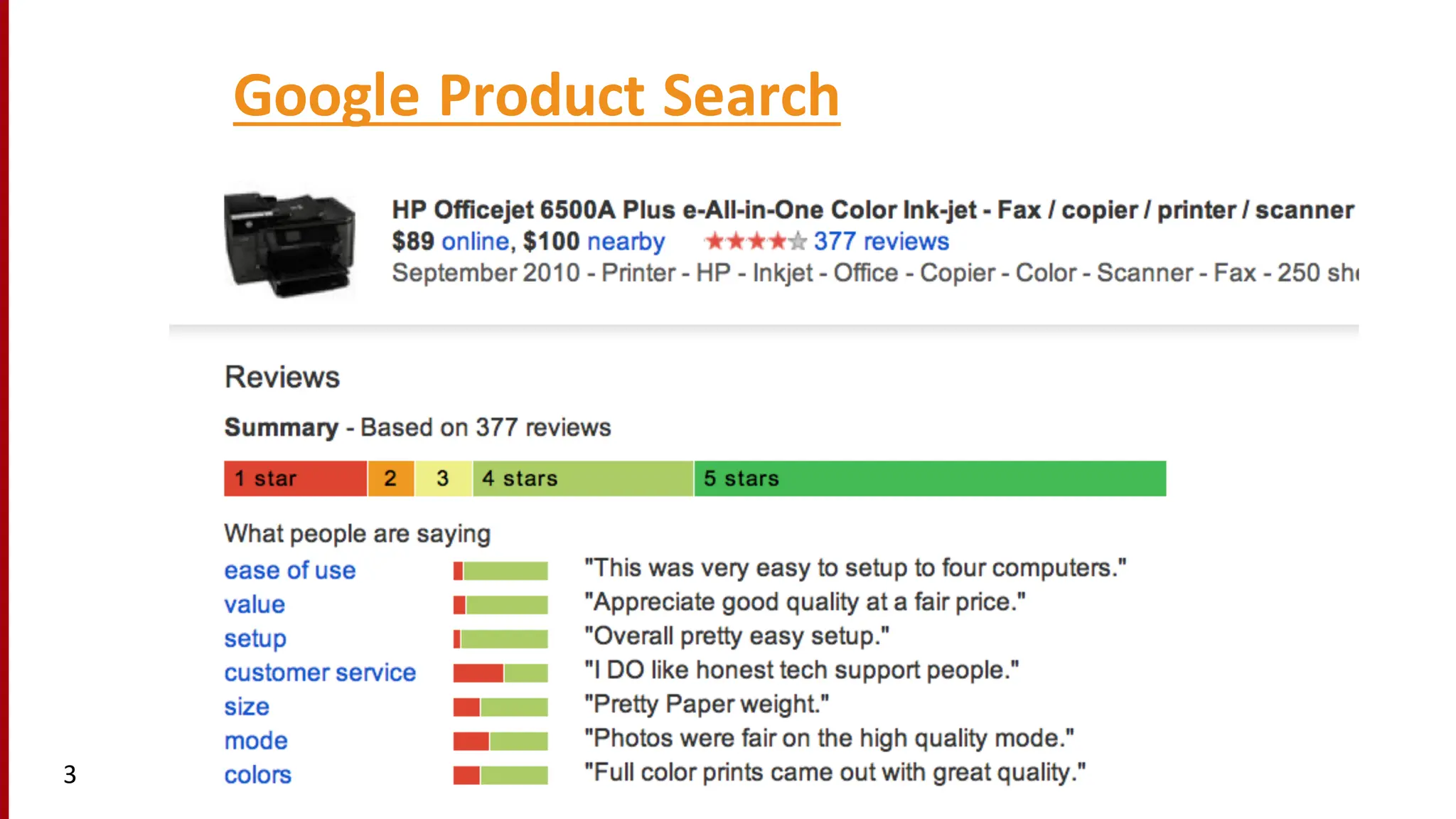
Google	
  Product	
  Search
• a
3
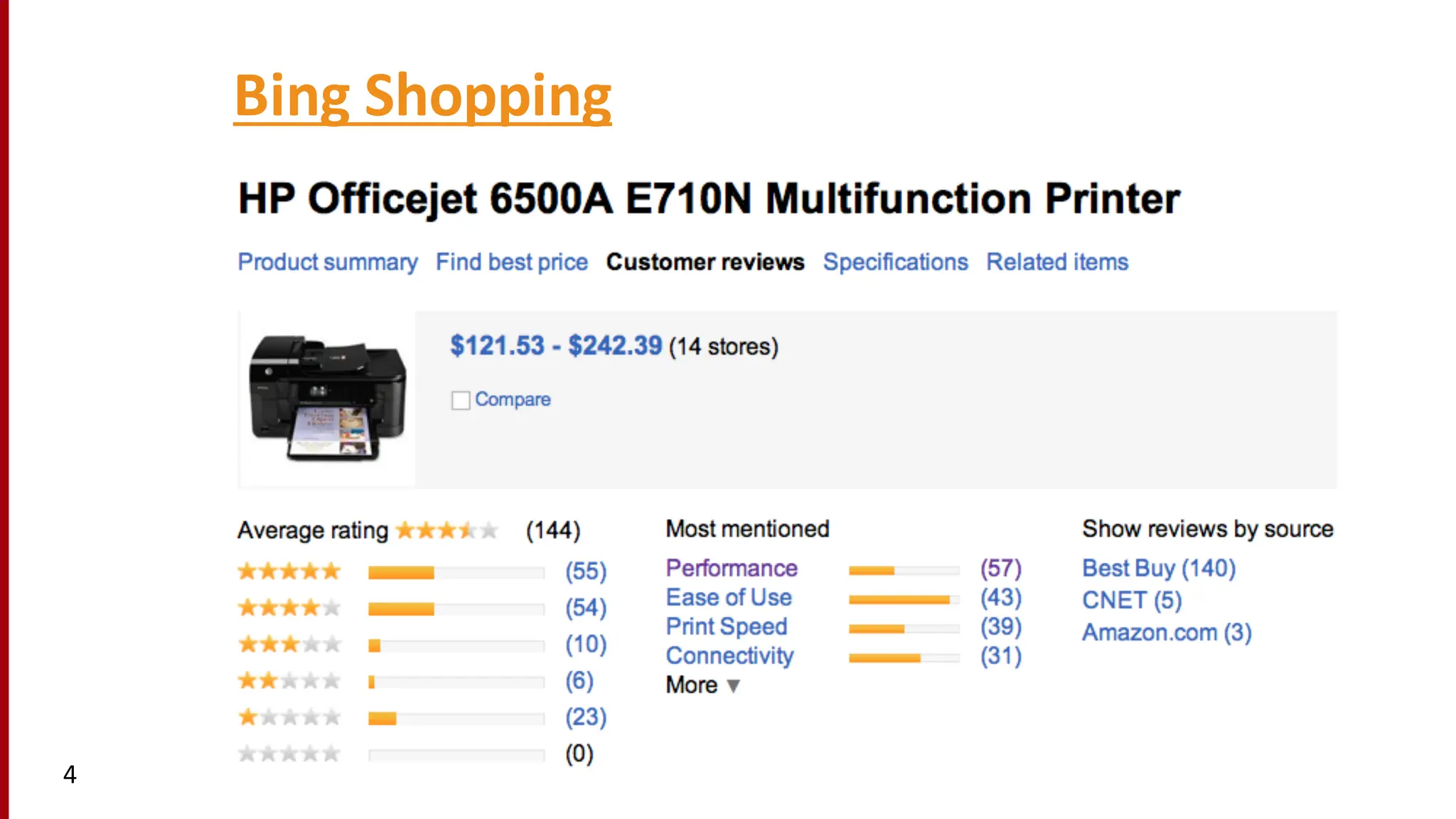
Bing	
  Shopping
• a
4
Twitter	
  sentiment	
  versus	
  Gallup	
  Poll	
  of	
  
Consumer	
  Confidence
Brendan O'Connor, Ramnath Balasubramanyan, Bryan R. Routledge, and Noah A. Smith. 2010.
From	
  Tweets	
  to	
  Polls:	
  Linking	
  Text	
  Sentiment	
  to	
  Public	
  Opinion	
  Time	
  Series.	
  In	
  ICWSM-­‐2010
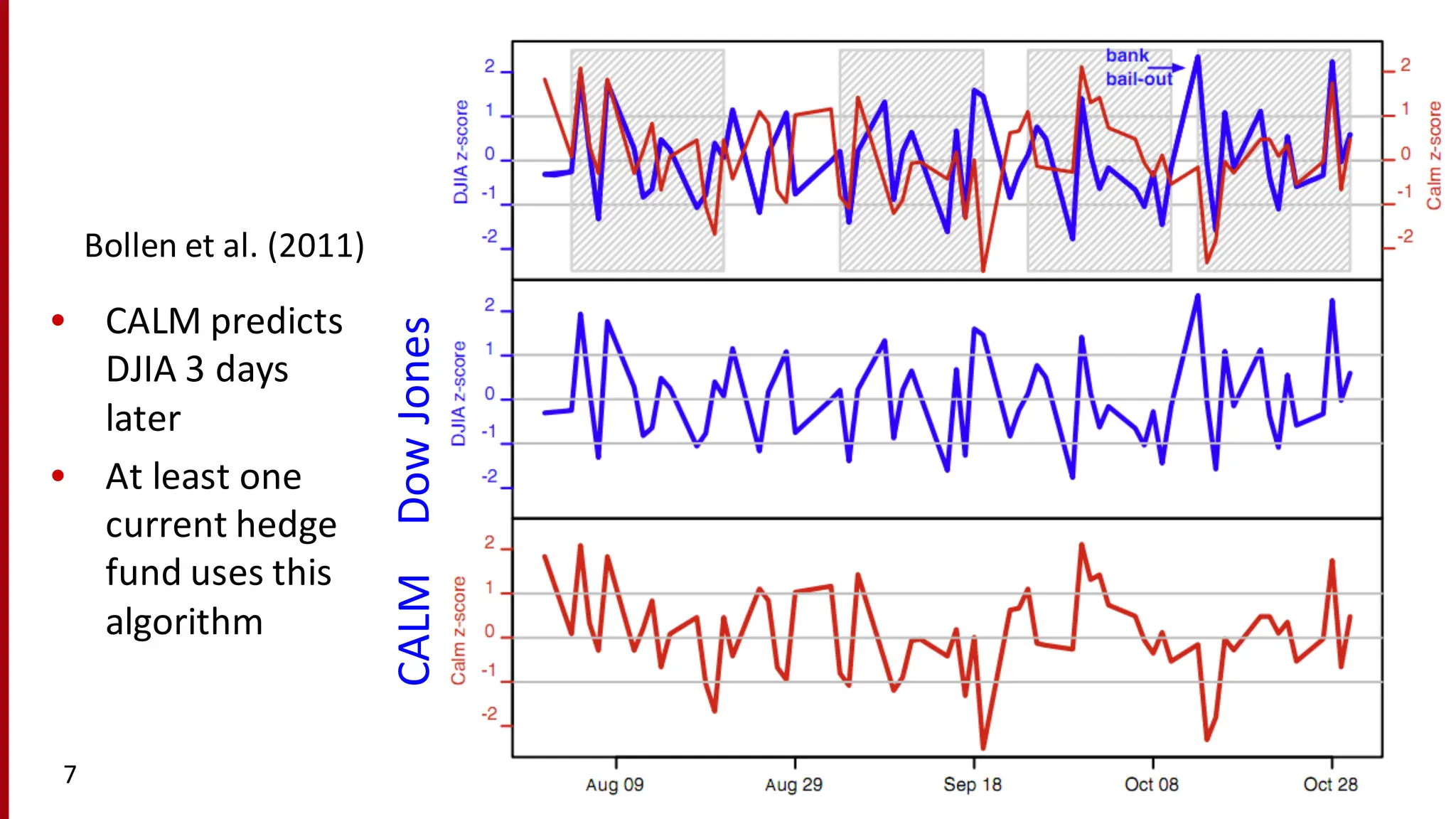
Twitter	
  sentiment:
Johan	
  Bollen,	
  Huina Mao,	
  Xiaojun Zeng.	
  2011.	
  
Twitter	
  mood	
  predicts	
  the	
  stock	
  market,
Journal	
  of	
  Computational	
  Science	
  2:1,	
  1-­‐8.	
  
10.1016/j.jocs.2010.12.007.
6
7
Dow	
  
J
ones
• CALM	
  predicts
DJIA	
  3	
  days	
  
later
• At	
  least	
  one	
  
current	
  hedge	
  
fund	
  uses	
  this	
  
algorithm
CALM
Bollen et	
  al.	
  (2011)
Target	
  Sentiment	
  on	
  Twitter
• Twitter	
  Sentiment	
  App
• Alec	
  Go,	
  Richa Bhayani,	
  Lei	
  Huang.	
  2009.	
  
Twitter	
  Sentiment	
  Classification	
  using	
  
Distant	
  Supervision
8
Sentiment	
  analysis	
  has	
  many	
  other	
  names
• Opinion	
  extraction
• Opinion	
  mining
• Sentiment	
  mining
• Subjectivity	
  analysis
9
Why	
  sentiment	
  analysis?
• Movie:	
  	
  is	
  this	
  review	
  positive	
  or	
  negative?
• Products:	
  what	
  do	
  people	
  think	
  about	
  the	
  new	
  iPhone?
• Public	
  sentiment:	
  how	
  is	
  consumer	
  confidence?	
  Is	
  despair	
  
increasing?
• Politics:	
  what	
  do	
  people	
  think	
  about	
  this	
  candidate	
  or	
  issue?
• Prediction:	
  predict	
  election	
  outcomes	
  or	
  market	
  trends
from	
  sentiment
10
Scherer	
  Typology	
  of	
  Affective	
  States
• Emotion:	
  brief	
  organically	
  synchronized	
  …	
  evaluation	
  of	
  a	
  major	
  event	
  
• angry,	
  sad,	
  joyful,	
  fearful,	
  ashamed,	
  proud,	
  elated
• Mood:	
  diffuse	
  non-­‐caused	
  low-­‐intensity	
  long-­‐duration	
  change	
  in	
  subjective	
  feeling
• cheerful,	
  gloomy,	
  irritable,	
  listless,	
  depressed,	
  buoyant
• Interpersonal	
  stances:	
  affective	
  stance	
  toward	
  another	
  person	
  in	
  a	
  specific	
  interaction
• friendly,	
  flirtatious,	
  distant,	
  cold,	
  warm,	
  supportive,	
  contemptuous
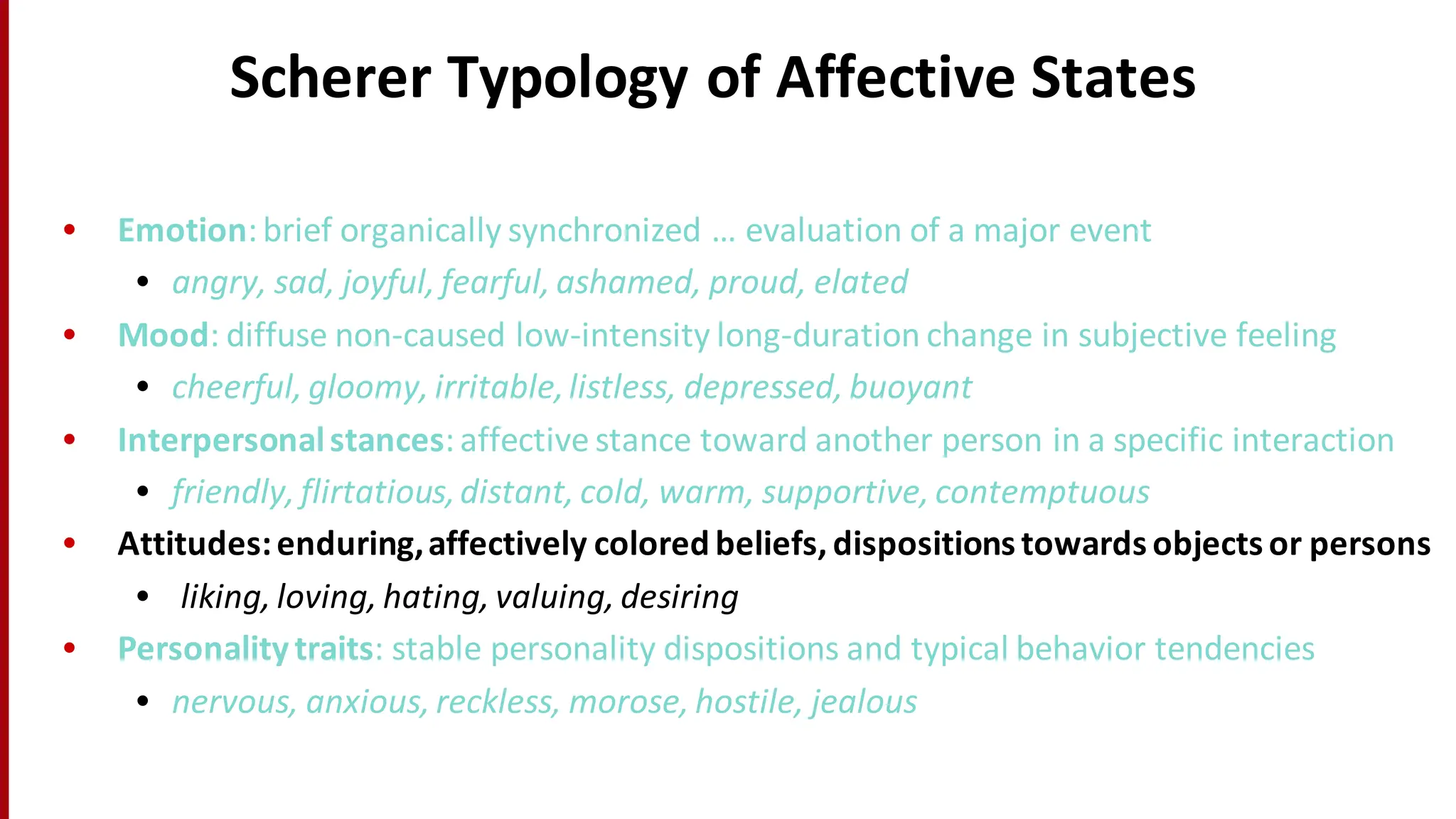
• Attitudes:	
  enduring,	
  affectively	
  colored	
  beliefs,	
  dispositions	
  towards	
  objects	
  or	
  persons
• liking,	
  loving,	
  hating,	
  valuing,	
  desiring
• Personality	
  traits:	
  stable	
  personality	
  dispositions	
  and	
  typical	
  behavior	
  tendencies
• nervous,	
  anxious,	
  reckless,	
  morose,	
  hostile,	
  jealous
Scherer	
  Typology	
  of	
  Affective	
  States
• Emotion:	
  brief	
  organically	
  synchronized	
  …	
  evaluation	
  of	
  a	
  major	
  event	
  
• angry,	
  sad,	
  joyful,	
  fearful,	
  ashamed,	
  proud,	
  elated
• Mood:	
  diffuse	
  non-­‐caused	
  low-­‐intensity	
  long-­‐duration	
  change	
  in	
  subjective	
  feeling
• cheerful,	
  gloomy,	
  irritable,	
  listless,	
  depressed,	
  buoyant
• Interpersonal	
  stances:	
  affective	
  stance	
  toward	
  another	
  person	
  in	
  a	
  specific	
  interaction
• friendly,	
  flirtatious,	
  distant,	
  cold,	
  warm,	
  supportive,	
  contemptuous
• Attitudes:	
  enduring,	
  affectively	
  colored	
  beliefs,	
  dispositions	
  towards	
  objects	
  or	
  persons
• liking,	
  loving,	
  hating,	
  valuing,	
  desiring
• Personality	
  traits:	
  stable	
  personality	
  dispositions	
  and	
  typical	
  behavior	
  tendencies
• nervous,	
  anxious,	
  reckless,	
  morose,	
  hostile,	
  jealous
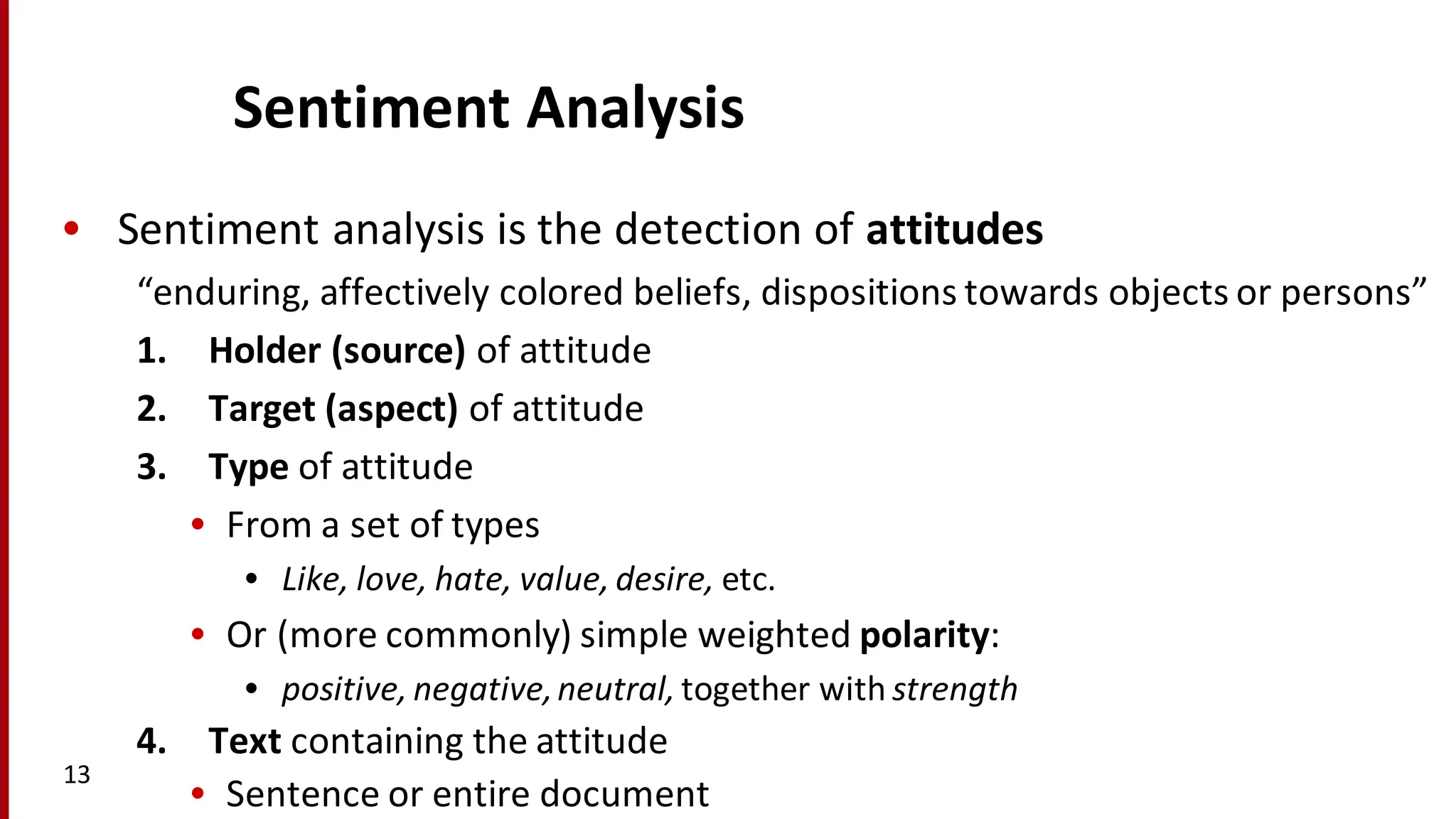
Sentiment	
  Analysis
• Sentiment	
  analysis	
  is	
  the	
  detection	
  of	
  attitudes
“enduring,	
  affectively	
  colored	
  beliefs,	
  dispositions	
  towards	
  objects	
  or	
  persons”
1. Holder	
  (source)	
  of	
  attitude
2. Target	
  (aspect)	
  of	
  attitude
3. Type	
  of	
  attitude
• From	
  a	
  set	
  of	
  types
• Like,	
  love,	
  hate,	
  value,	
  desire, etc.
• Or	
  (more	
  commonly)	
  simple	
  weighted	
  polarity:	
  
• positive,	
  negative,	
  neutral,	
  together	
  with	
  strength
4. Text containing	
  the	
  attitude
• Sentence or	
  entire	
  document
13
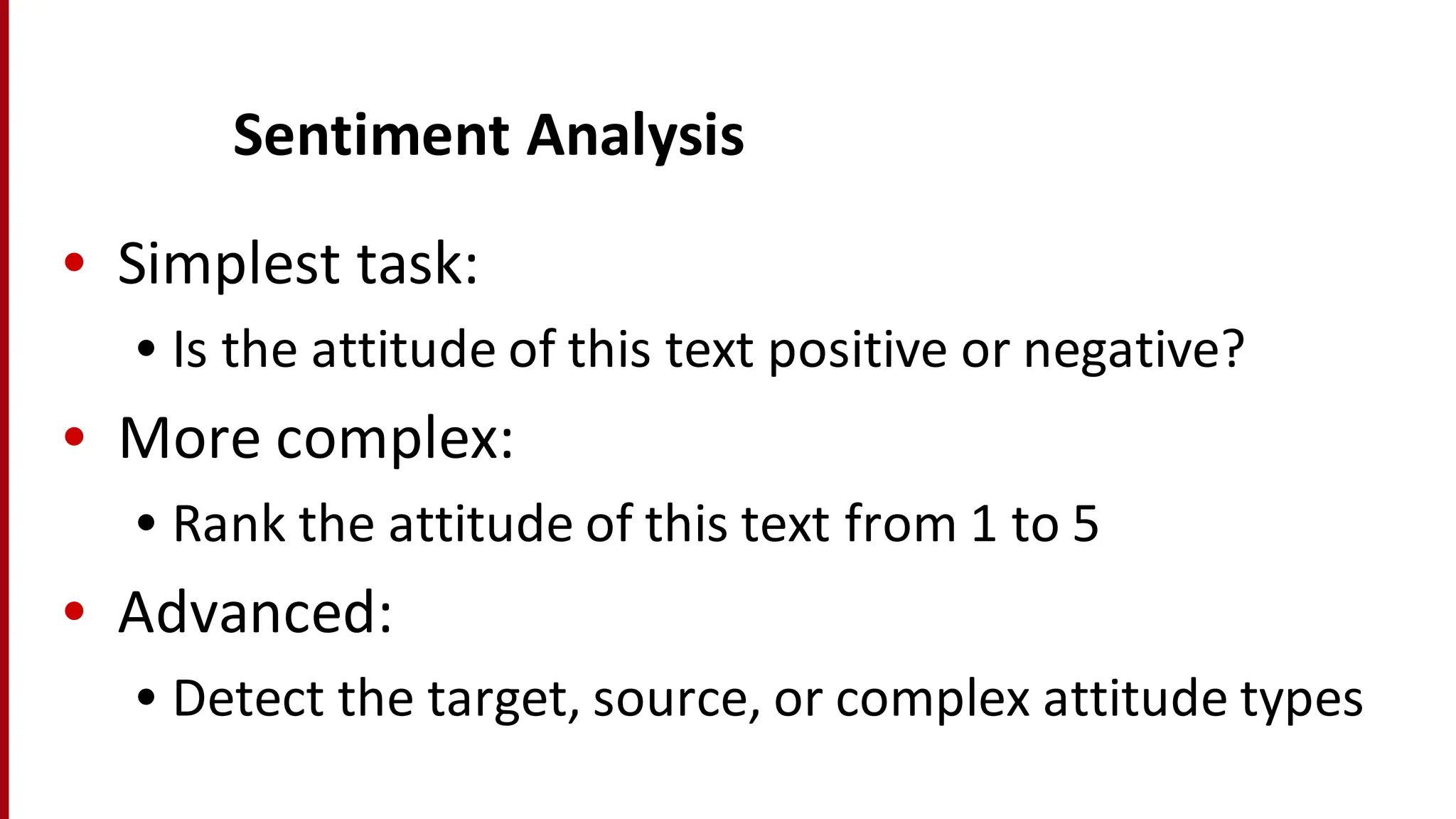
Sentiment	
  Analysis
• Simplest	
  task:
• Is	
  the	
  attitude	
  of	
  this	
  text	
  positive	
  or	
  negative?
• More	
  complex:
• Rank	
  the	
  attitude	
  of	
  this	
  text	
  from	
  1	
  to	
  5
• Advanced:
• Detect	
  the	
  target,	
  source,	
  or	
  complex	
  attitude	
  types
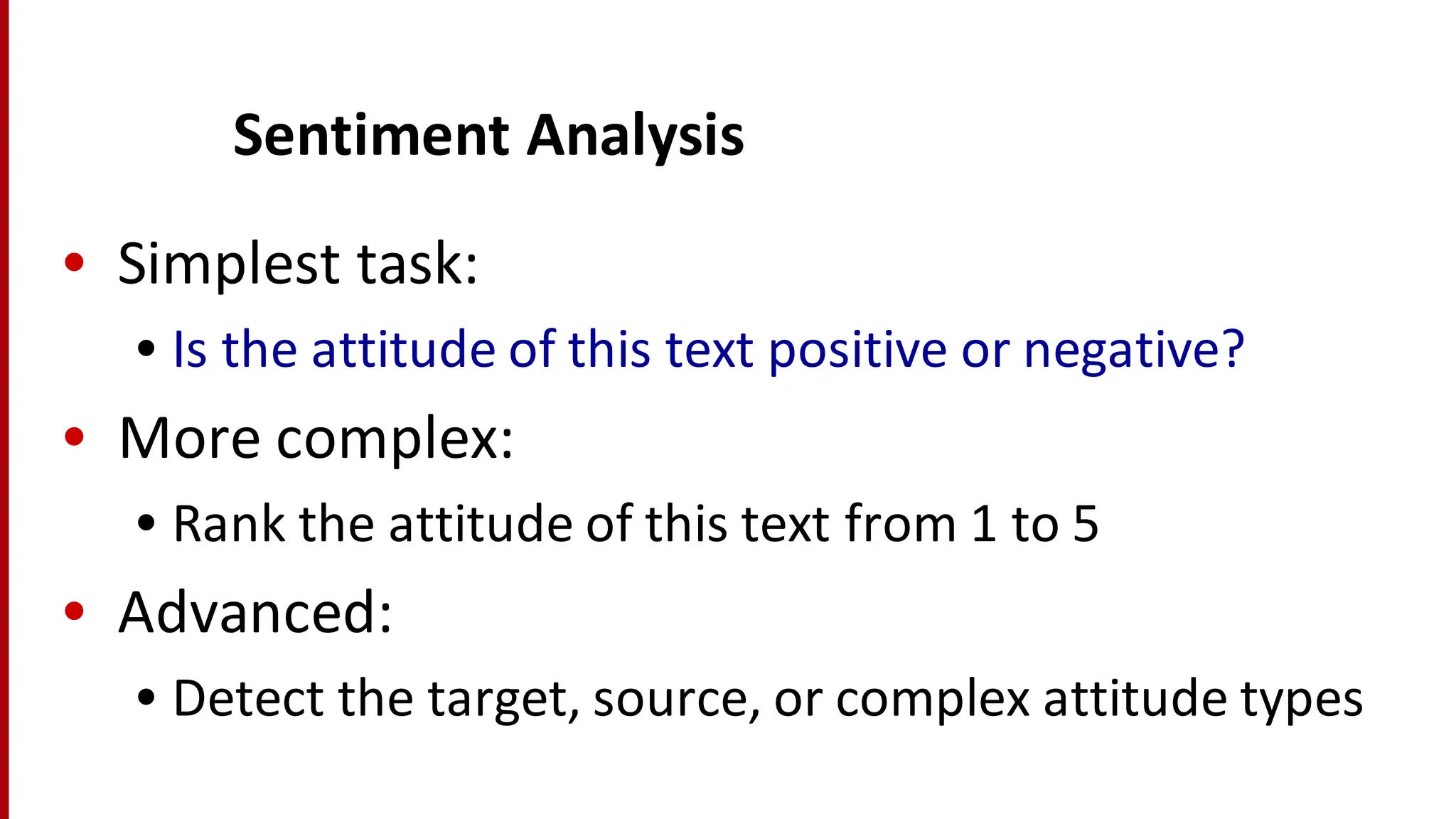
Sentiment	
  Analysis
• Simplest	
  task:
• Is	
  the	
  attitude	
  of	
  this	
  text	
  positive	
  or	
  negative?
• More	
  complex:
• Rank	
  the	
  attitude	
  of	
  this	
  text	
  from	
  1	
  to	
  5
• Advanced:
• Detect	
  the	
  target,	
  source,	
  or	
  complex	
  attitude	
  types
Sentiment	
  Analysis
What	
  is	
  Sentiment	
  
Analysis?
Sentiment	
  Analysis
A	
  Baseline	
  
Algorithm
Sentiment Classification in Movie Reviews
• Polarity	
  detection:
• Is	
  an	
  IMDB	
  movie	
  review	
  positive	
  or	
  negative?
• Data:	
  Polarity	
  Data	
  2.0:	
  
• http://www.cs.cornell.edu/people/pabo/movie-­‐review-­‐data
Bo	
  Pang,	
  Lillian	
  Lee,	
  and	
  Shivakumar Vaithyanathan.	
  	
  2002.	
  	
  Thumbs	
  up?	
  Sentiment	
  
Classification	
  using	
  Machine	
  Learning	
  Techniques.	
  EMNLP-­‐2002,	
   79—86.
Bo	
  Pang	
  and	
  Lillian	
  Lee.	
  	
  2004.	
  	
  A	
  Sentimental	
  Education:	
  Sentiment	
  Analysis	
  Using	
  
Subjectivity	
  Summarization	
  Based	
  on	
  Minimum	
  Cuts.	
  	
  ACL,	
  271-­‐278
IMDB	
  data	
  in	
  the	
  Pang	
  and	
  Lee	
  database
when	
  _star	
  wars_	
  came	
  out	
  some	
  twenty	
  years	
  
ago	
  ,	
  the	
  image	
  of	
  traveling	
  throughout	
  the	
  stars	
  
has	
  become	
  a	
  commonplace	
  image	
  .	
  […]
when	
  han solo	
  goes	
  light	
  speed	
  ,	
  the	
  stars	
  change	
  
to	
  bright	
  lines	
  ,	
  going	
  towards	
  the	
  viewer	
  in	
  lines	
  
that	
  converge	
  at	
  an	
  invisible	
  point	
  .	
  
cool	
  .	
  
_october sky_	
  offers	
  a	
  much	
  simpler	
  image–that	
  of	
  
a	
  single	
  white	
  dot	
  ,	
  traveling	
  horizontally	
  across	
  
the	
  night	
  sky	
  .	
  	
  	
  [.	
  .	
  .	
  ]
“	
  snake	
  eyes	
  ”	
  is	
  the	
  most	
  aggravating	
  
kind	
  of	
  movie	
  :	
  the	
  kind	
  that	
  shows	
  so	
  
much	
  potential	
  then	
  becomes	
  
unbelievably	
  disappointing	
  .	
  
it’s	
  not	
  just	
  because	
  this	
  is	
  a	
  brian
depalma film	
  ,	
  and	
  since	
  he’s	
  a	
  great	
  
director	
  and	
  one	
  who’s	
  films	
  are	
  always	
  
greeted	
  with	
  at	
  least	
  some	
  fanfare	
  .	
  
and	
  it’s	
  not	
  even	
  because	
  this	
  was	
  a	
  film	
  
starring	
  nicolas cage	
  and	
  since	
  he	
  gives	
  a	
  
brauvara performance	
  ,	
  this	
  film	
  is	
  hardly	
  
worth	
  his	
  talents	
  .	
  
✓ ✗
Baseline	
  Algorithm	
  (adapted	
  from	
  Pang	
  
and	
  Lee)
• Tokenization
• Feature	
  Extraction
• Classification	
  using	
  different	
  classifiers
• Naïve	
  Bayes
• MaxEnt
• SVM
Sentiment	
  Tokenization	
  Issues
• Deal	
  with	
  HTML	
  and	
  XML	
  markup
• Twitter	
  mark-­‐up	
  (names,	
  hash	
  tags)
• Capitalization	
  (preserve	
  for	
  
words	
  in	
  all	
  caps)
• Phone	
  numbers,	
  dates
• Emoticons
• Useful	
  code:
• Christopher	
  Potts	
  sentiment	
  tokenizer
• Brendan	
  O’Connor	
  twitter	
  tokenizer
21
[<>]? # optional hat/brow
[:;=8] # eyes
[-o*']? # optional nose
[)]([dDpP/:}{@|] # mouth
| #### reverse orientation
[)]([dDpP/:}{@|] # mouth
[-o*']? # optional nose
[:;=8] # eyes
[<>]? # optional hat/brow
Potts	
  emoticons
Extracting	
  Features	
  for	
  Sentiment	
  
Classification
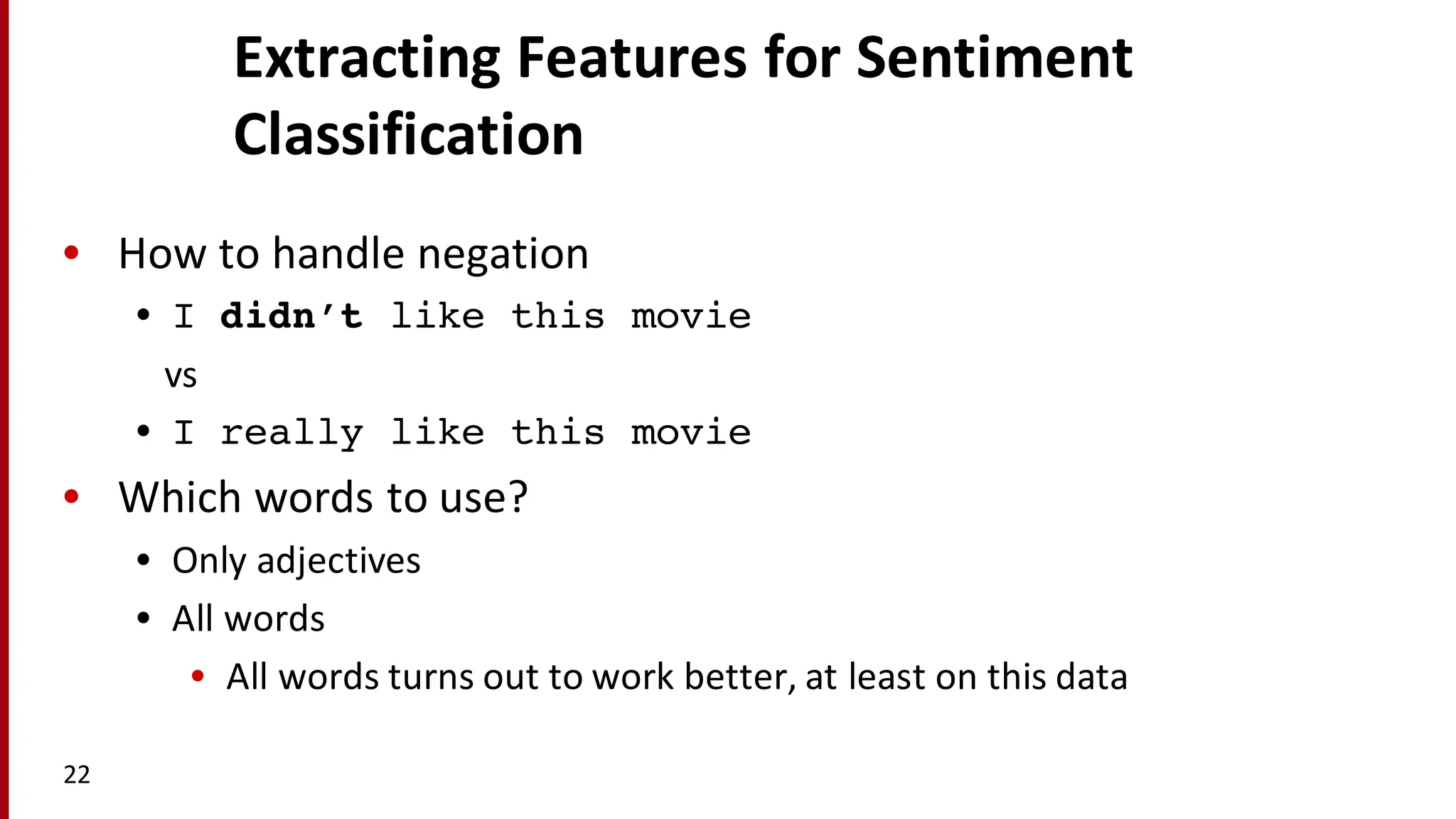
• How	
  to	
  handle	
  negation
• I didn’t like this movie
vs
• I really like this movie
• Which	
  words	
  to	
  use?
• Only	
  adjectives
• All	
  words
• All	
  words	
  turns	
  out	
  to	
  work	
  better,	
  at	
  least	
  on	
  this	
  data
22
Negation
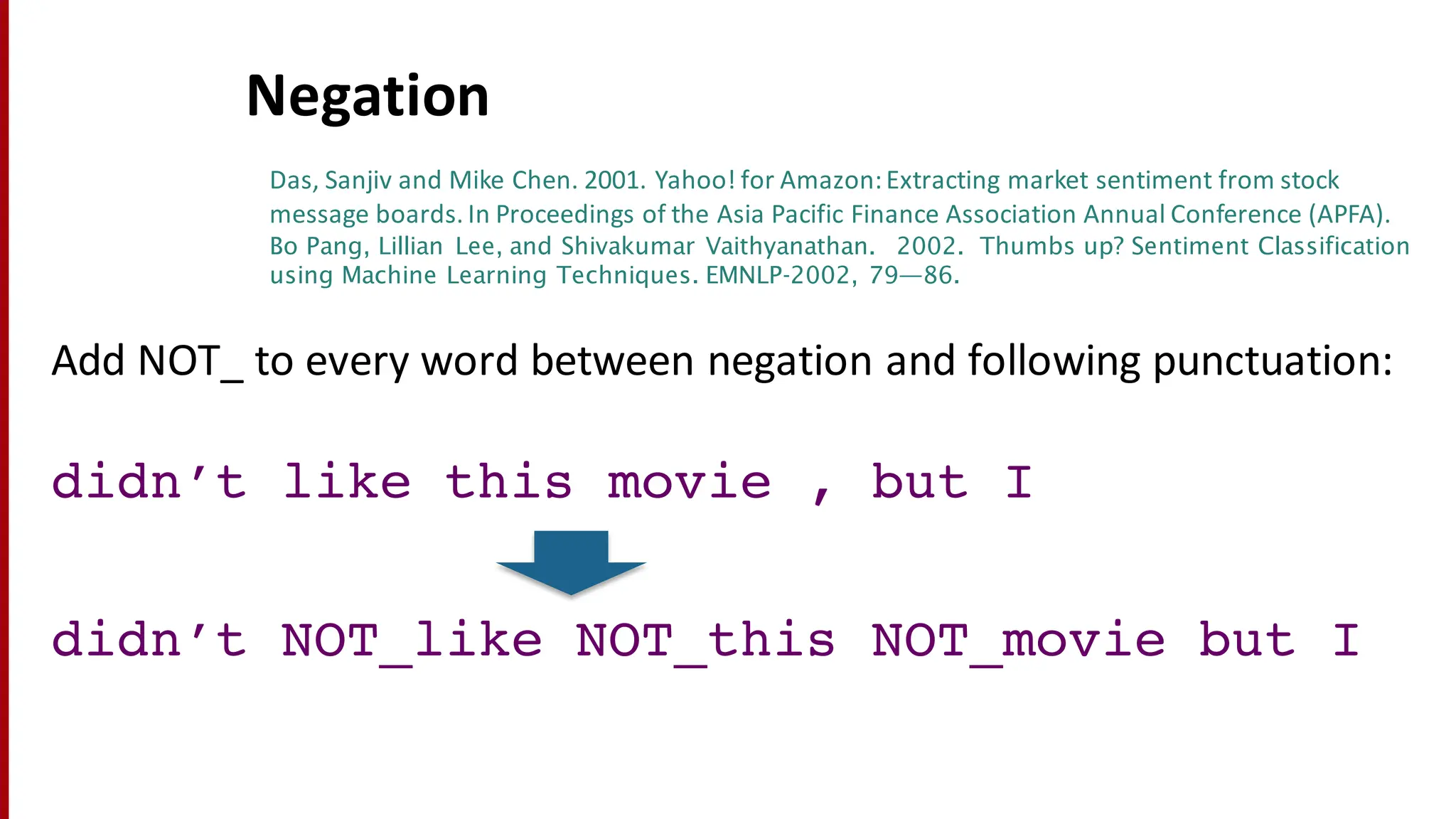
Add	
  NOT_	
  to	
  every	
  word	
  between	
  negation	
  and	
  following	
  punctuation:
didn’t like this movie , but I
didn’t NOT_like NOT_this NOT_movie but I
Das,	
  Sanjiv and	
  Mike	
  Chen.	
  2001.	
  Yahoo!	
  for	
  Amazon:	
  Extracting	
  market	
  sentiment	
  from	
  stock	
  
message	
  boards.	
  In	
  Proceedings	
  of	
  the	
  Asia	
  Pacific	
  Finance	
  Association	
  Annual	
  Conference	
  (APFA).
Bo Pang, Lillian Lee, and Shivakumar Vaithyanathan. 2002. Thumbs up? Sentiment Classification
using Machine Learning Techniques. EMNLP-2002, 79—86.
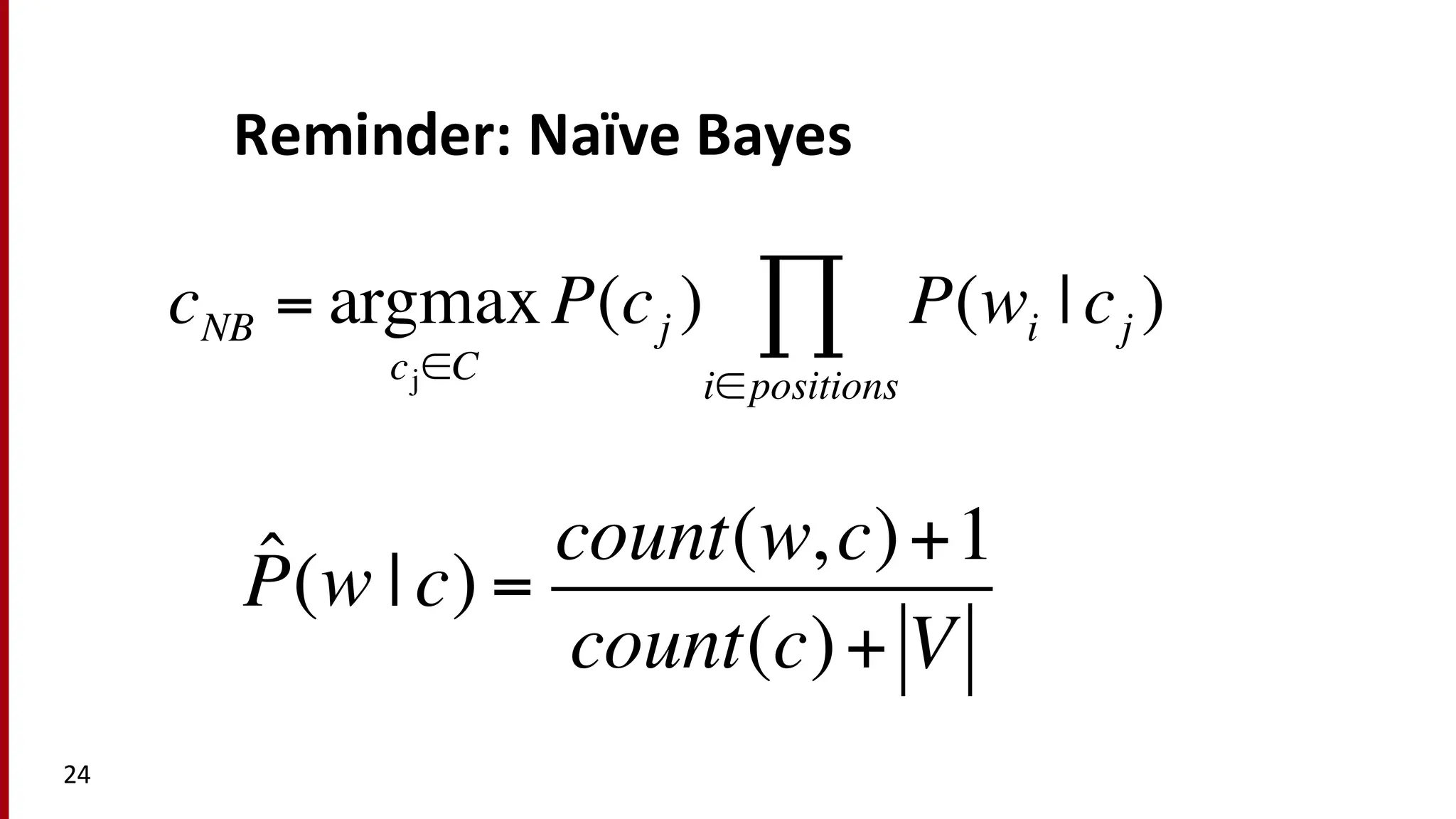
Reminder:	
  Naïve Bayes
24
P̂(w | c) =
count(w,c)+1
count(c)+ V
cNB = argmax
cj∈C
P(cj ) P(wi | cj )
i∈positions
∏
Binarized (Boolean	
  feature)	
  	
  Multinomial	
  Naïve Bayes
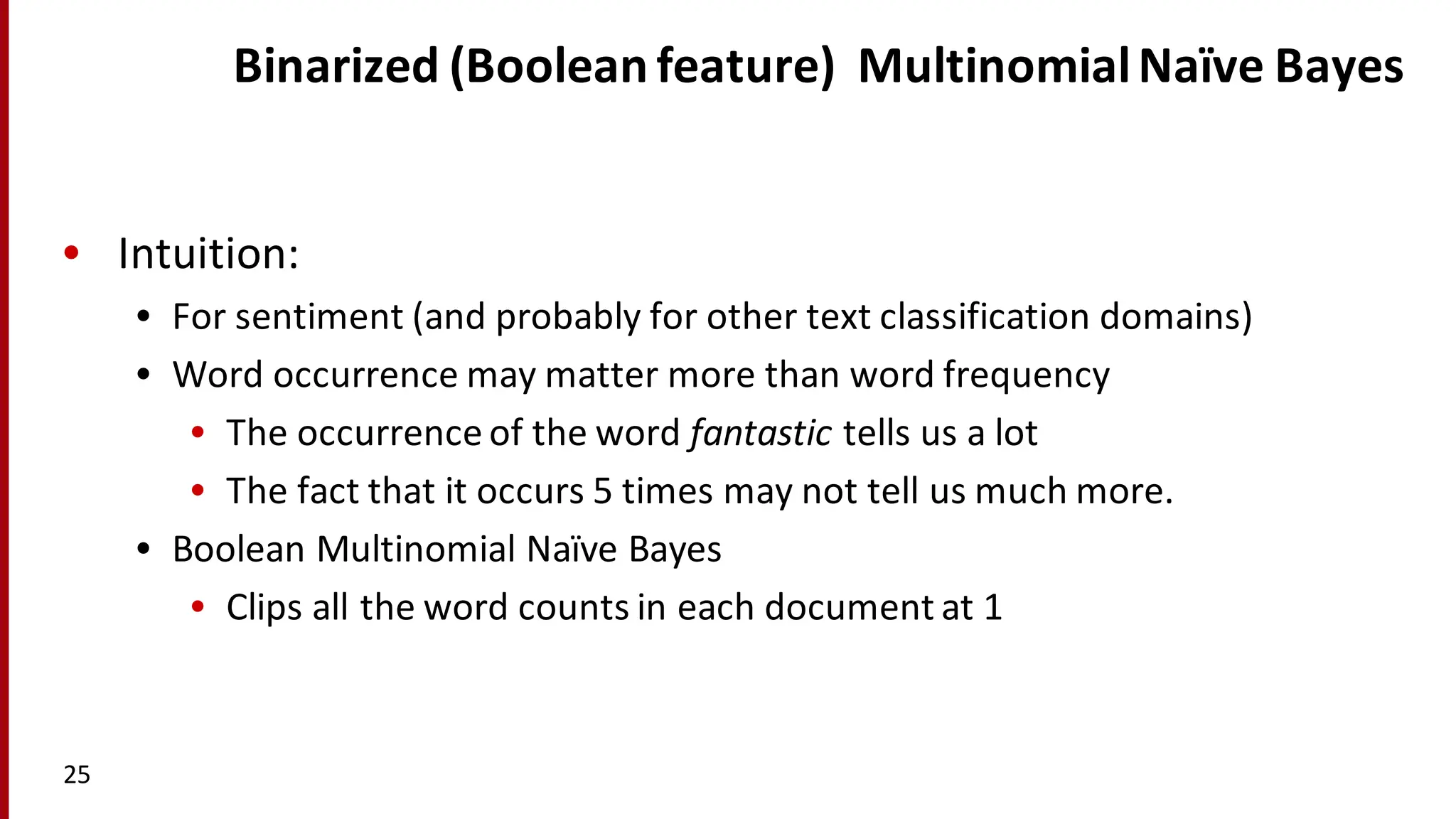
• Intuition:
• For	
  sentiment	
  (and	
  probably	
  for	
  other	
  text	
  classification	
  domains)
• Word	
  occurrence	
  may	
  matter	
  more	
  than	
  word	
  frequency
• The	
  occurrence	
  of	
  the	
  word	
  fantastic tells	
  us	
  a	
  lot
• The	
  fact	
  that	
  it	
  occurs	
  5	
  times	
  may	
  not	
  tell	
  us	
  much	
  more.
• Boolean	
  Multinomial	
  Naïve Bayes
• Clips	
  all	
  the	
  word	
  counts	
  in	
  each	
  document	
  at	
  1
25
Boolean	
  Multinomial	
  Naïve	
  Bayes:	
  Learning
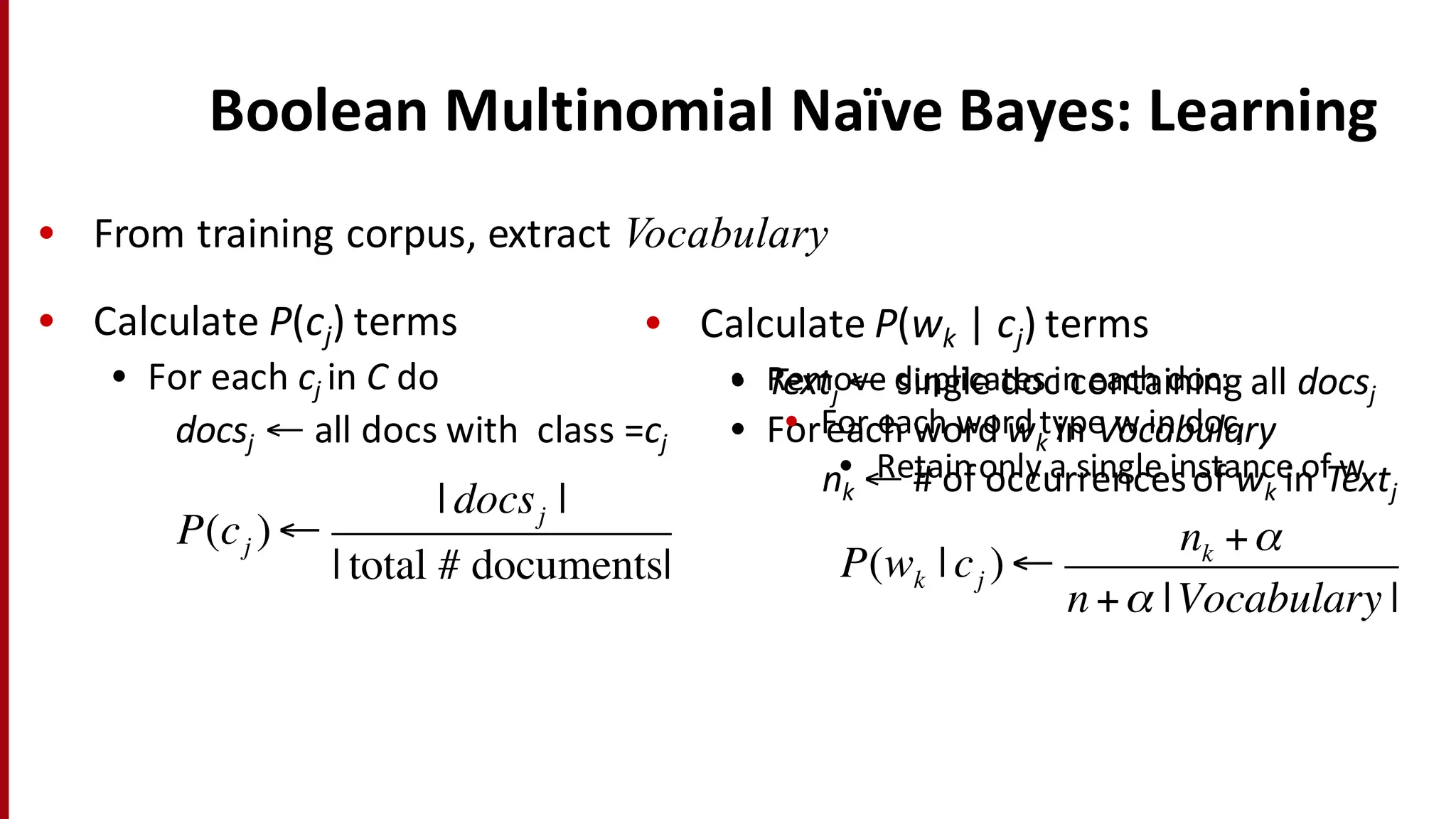
• Calculate	
  P(cj) terms
• For	
  each	
  cj in	
  C do
docsj ← all	
  docs	
  with	
  	
  class	
  =cj
P(cj )←
| docsj |
| total # documents| P(wk | cj )←
nk +α
n +α |Vocabulary |
• Textj ← single	
  doc	
  containing	
  all	
  docsj
• Foreach	
  word	
  wk in	
  Vocabulary
nk ← #	
  of	
  occurrences	
  of	
  wk in	
  Textj
• From	
  training	
  corpus,	
  extract	
  Vocabulary
• Calculate	
  P(wk | cj) terms
• Remove	
  duplicates	
  in	
  each	
  doc:
• For	
  each	
  word	
  type	
  w	
  in	
  docj
• Retain	
  only	
  a	
  single	
  instance	
  of	
  w
Boolean	
  Multinomial	
  Naïve Bayes
on	
  a	
  test	
  document	
  d
27
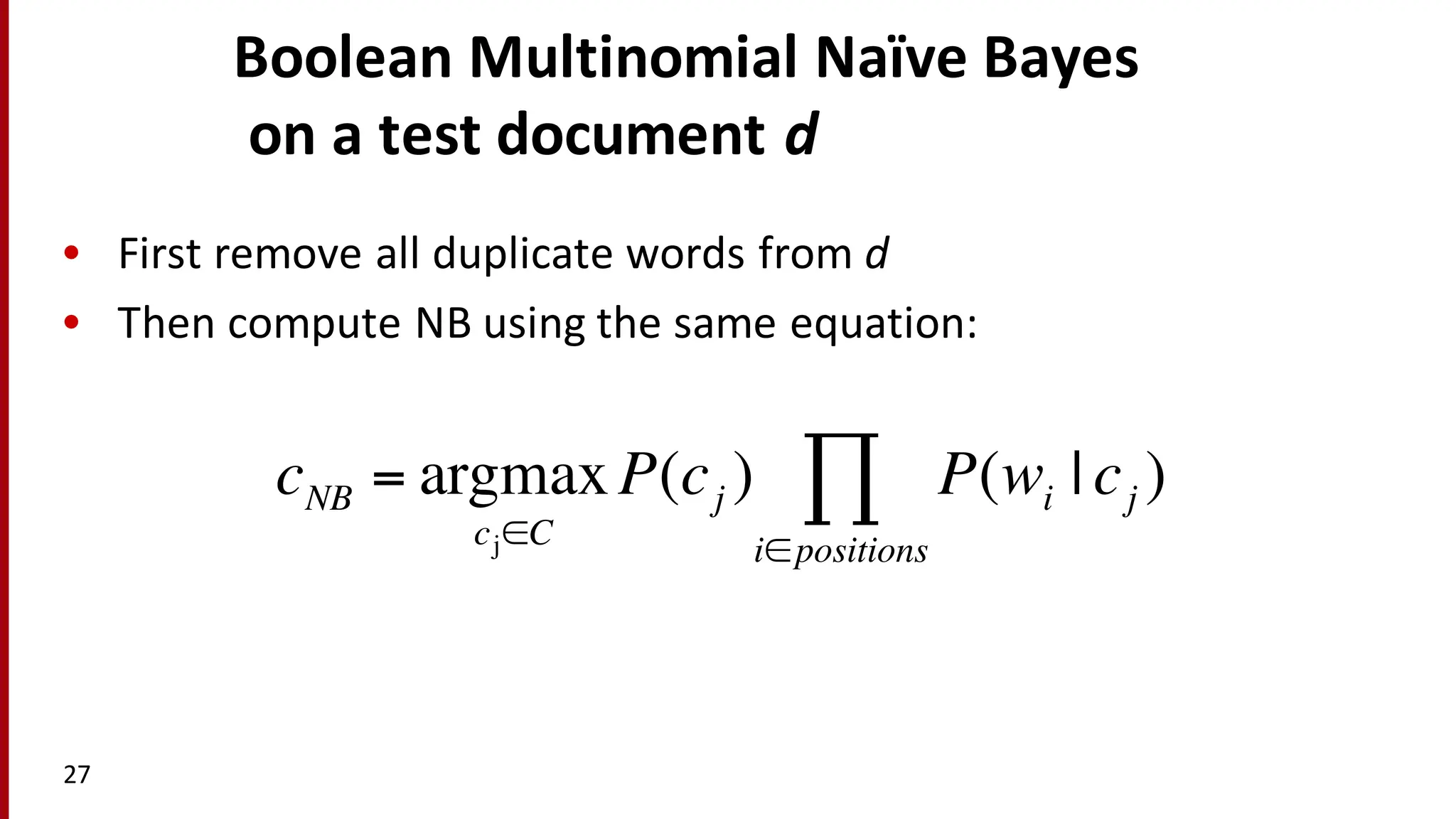
• First	
  remove	
  all	
  duplicate	
  words	
  from	
  d
• Then	
  compute	
  NB	
  using	
  the	
  same	
  equation:	
  
cNB = argmax
cj∈C
P(cj ) P(wi | cj )
i∈positions
∏
Normal	
  vs.	
  Boolean	
  Multinomial	
  NB
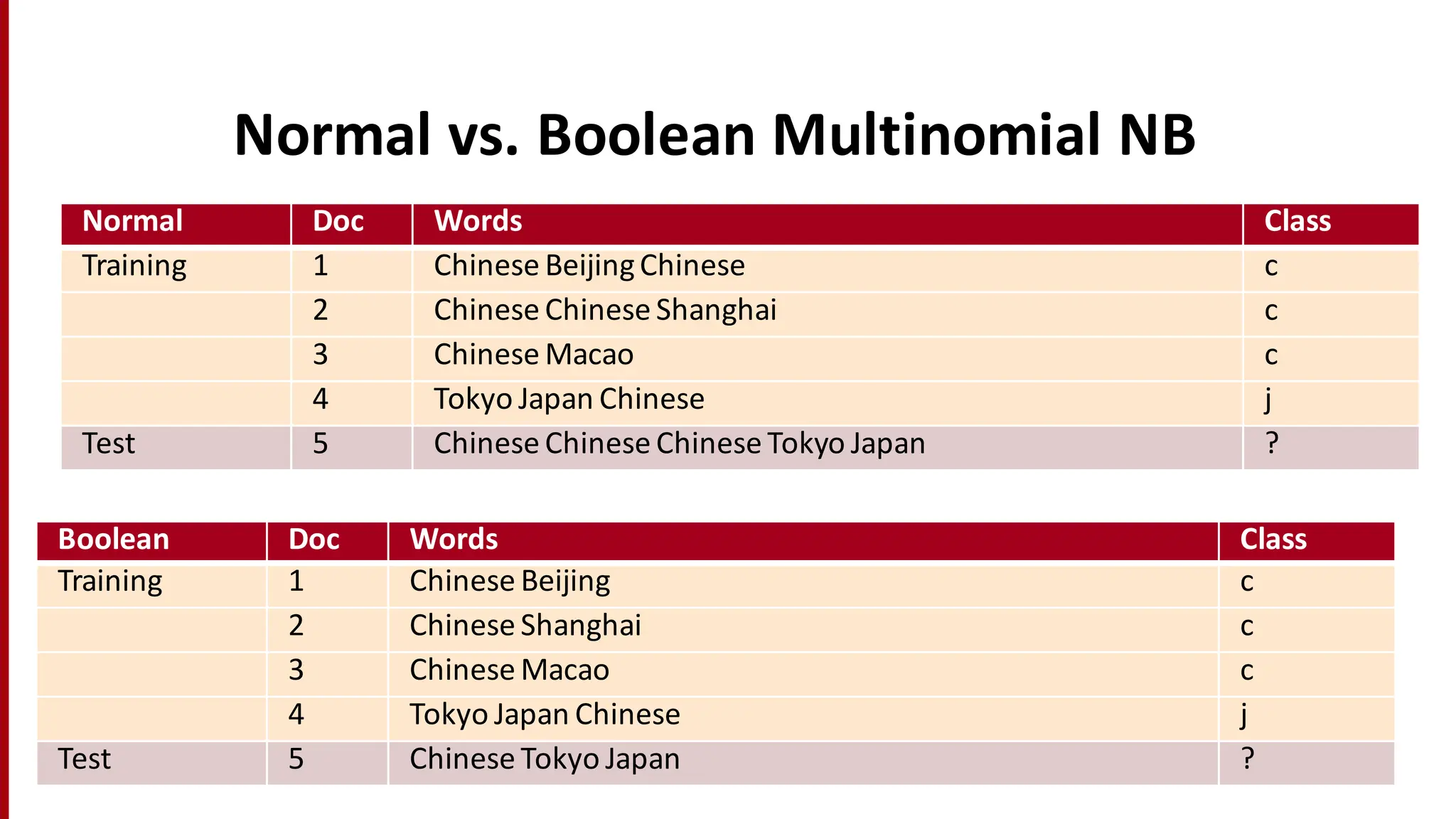
Normal Doc Words Class
Training 1 Chinese Beijing	
  Chinese c
2 Chinese	
  Chinese	
  Shanghai c
3 Chinese	
  Macao c
4 Tokyo	
  Japan	
  Chinese j
Test 5 Chinese	
  Chinese	
  Chinese	
  Tokyo Japan ?
28
Boolean Doc Words Class
Training 1 Chinese Beijing c
2 Chinese	
  Shanghai c
3 Chinese	
  Macao c
4 Tokyo	
  Japan	
  Chinese j
Test 5 Chinese	
  Tokyo Japan ?
Binarized (Boolean	
  feature)	
  
Multinomial	
  Naïve Bayes
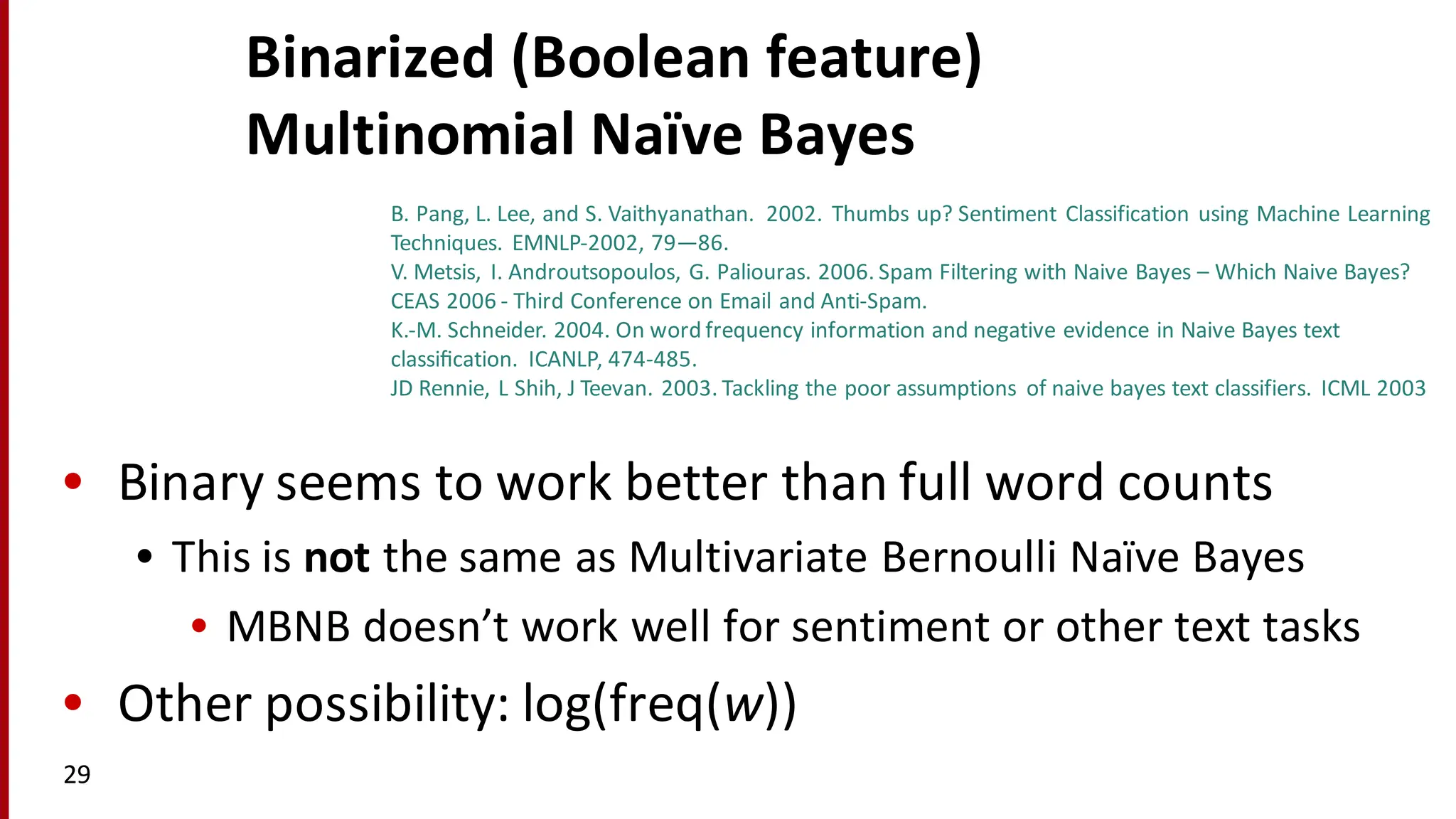
• Binary	
  seems	
  to	
  work	
  better	
  than	
  full	
  word	
  counts
• This	
  is	
  not the	
  same	
  as	
  Multivariate	
  Bernoulli	
  Naïve Bayes
• MBNB	
  doesn’t	
  work	
  well	
  for	
  sentiment	
  or	
  other	
  text	
  tasks
• Other	
  possibility:	
  log(freq(w))
29
B.	
  Pang,	
  L.	
  Lee,	
  and	
  S.	
  Vaithyanathan.	
  	
  2002.	
  	
  Thumbs	
  up?	
  Sentiment	
  Classification	
  using	
  Machine	
  Learning	
  
Techniques.	
  EMNLP-­‐2002,	
  79—86.
V.	
  Metsis,	
  I.	
  Androutsopoulos,	
  G.	
  Paliouras.	
  2006.	
  Spam	
  Filtering	
  with	
  Naive	
  Bayes	
  – Which	
  Naive	
  Bayes?	
  
CEAS	
  2006	
  -­‐ Third	
  Conference	
  on	
  Email	
  and	
  Anti-­‐Spam.
K.-­‐M.	
  Schneider.	
  2004.	
  On	
  word	
  frequency	
  information	
  and	
  negative	
  evidence	
  in	
  Naive	
  Bayes	
  text	
  
classification.	
   ICANLP,	
  474-­‐485.
JD	
  Rennie,	
  L	
  Shih,	
  J	
  Teevan.	
  2003.	
  Tackling	
  the	
  poor	
  assumptions	
   of	
  naive	
  bayes text	
  classifiers.	
  ICML	
  2003
Cross-­‐Validation
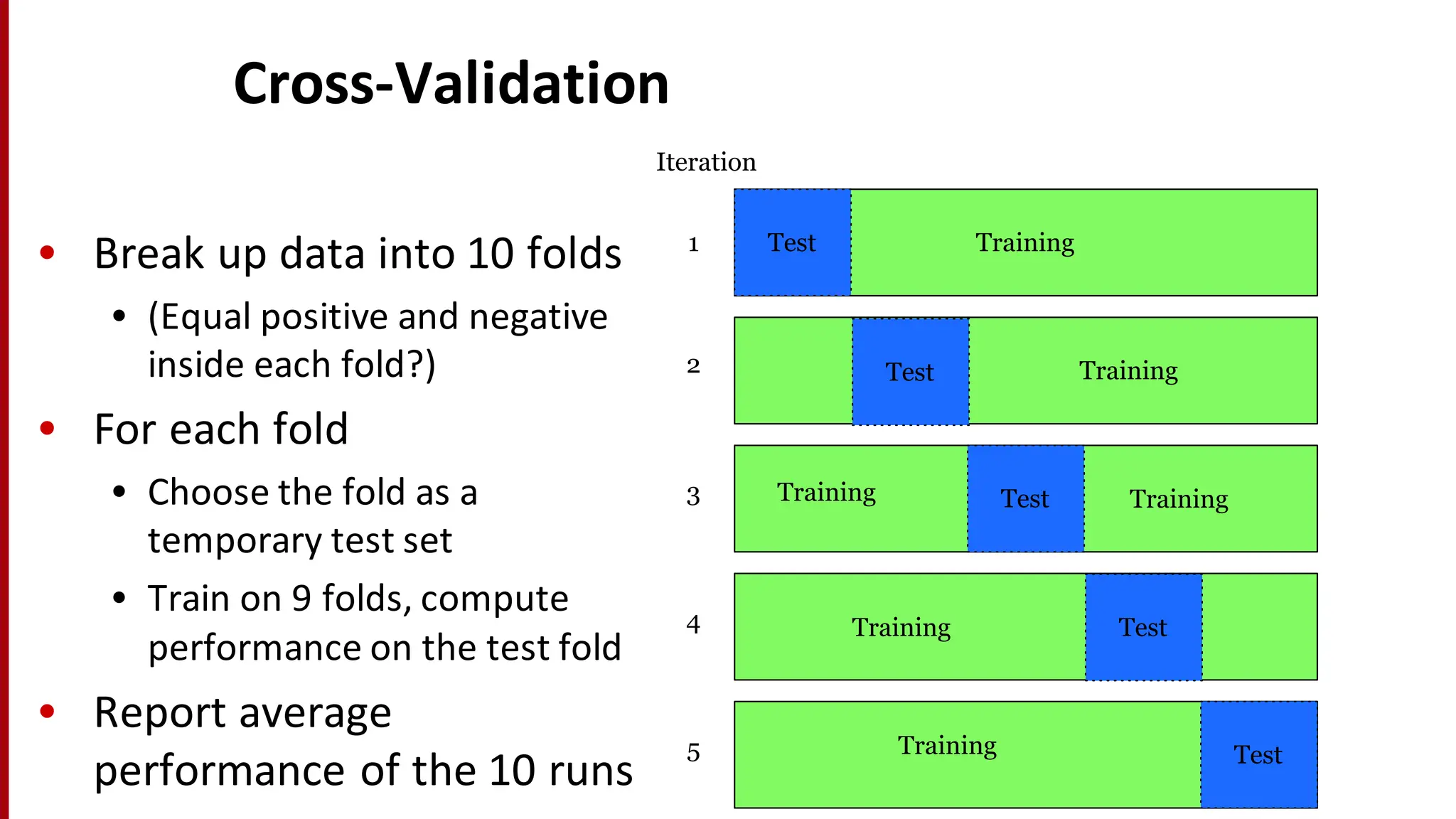
• Break	
  up	
  data	
  into	
  10	
  folds
• (Equal	
  positive	
  and	
  negative	
  
inside	
  each	
  fold?)
• For	
  each	
  fold
• Choose	
  the	
  fold	
  as	
  a	
  
temporary	
  test	
  set
• Train	
  on	
  9	
  folds,	
  compute	
  
performance	
  on	
  the	
  test	
  fold
• Report	
  average	
  
performance	
  of	
  the	
  10	
  runs
Training
Test
Test
Test
Test
Test
Training
Training Training
Training
Training
Iteration
1
2
3
4
5
Other	
  issues	
  in	
  Classification
• MaxEnt and	
  SVM	
  tend	
  to	
  do	
  better	
  than	
  Naïve Bayes
31
Problems:	
  
What	
  makes	
  reviews	
  hard	
  to	
  classify?
• Subtlety:
• Perfume	
  review	
  in	
  Perfumes:	
  the	
  Guide:
• “If	
  you	
  are	
  reading	
  this	
  because	
  it	
  is	
  your	
  darling	
  fragrance,	
  
please	
  wear	
  it	
  at	
  home	
  exclusively,	
  and	
  tape	
  the	
  windows	
  
shut.”
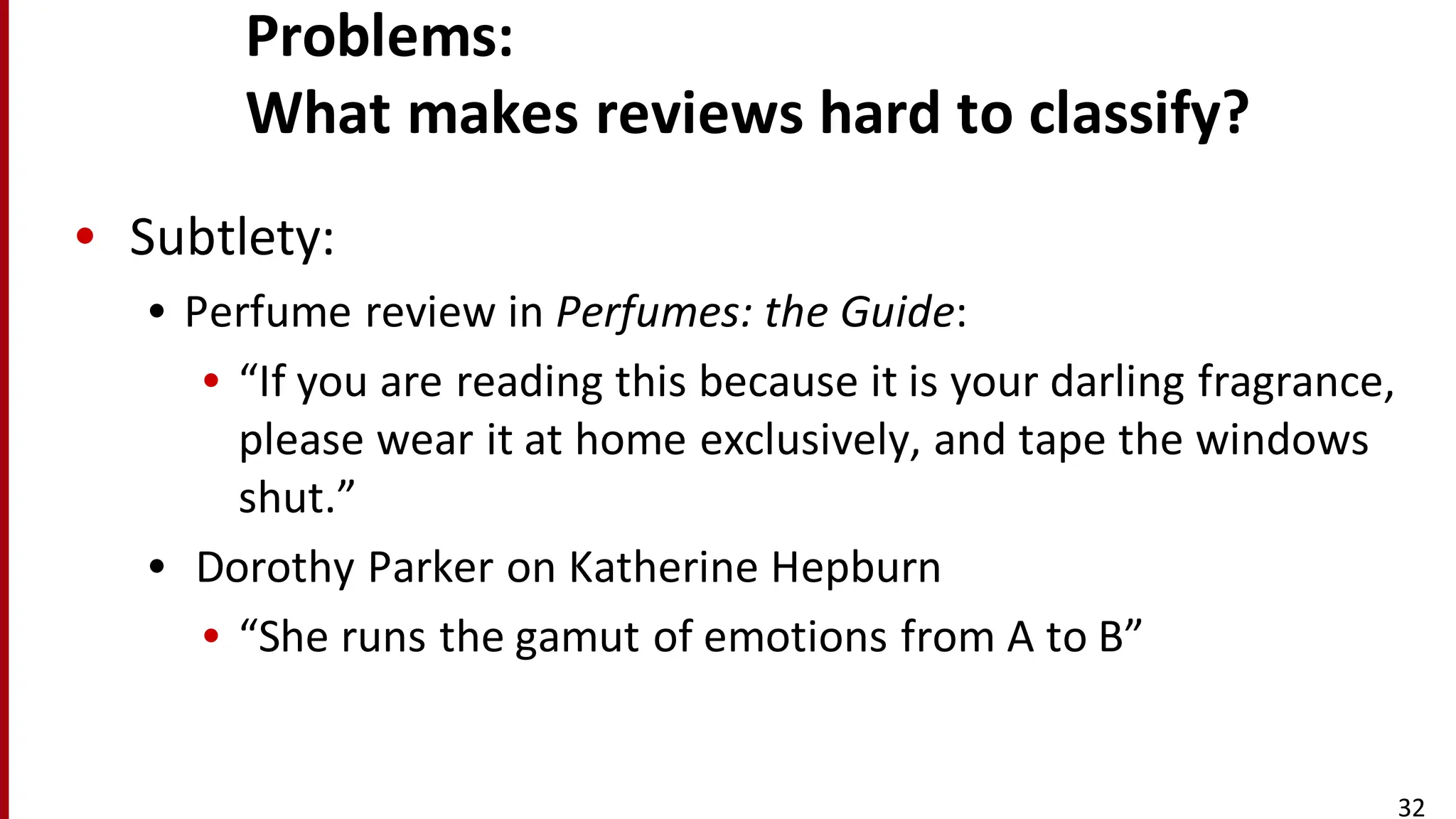
• Dorothy	
  Parker	
  on	
  Katherine	
  Hepburn
• “She	
  runs	
  the	
  gamut	
  of	
  emotions	
  from	
  A	
  to	
  B”
32
Thwarted	
  Expectations
and	
  Ordering	
  Effects
• “This	
  film	
  should	
  be	
  brilliant.	
  	
  It	
  sounds	
  like	
  a	
  great	
  plot,	
  
the	
  actors	
  are	
  first	
  grade,	
  and	
  the	
  supporting	
  cast	
  is	
  
good	
  as	
  well,	
  and	
  Stallone	
  is	
  attempting	
  to	
  deliver	
  a	
  
good	
  performance.	
  However,	
  it	
  can’t	
  hold	
  up.”
• Well	
  as	
  usual	
  Keanu	
  Reeves	
  is	
  nothing	
  special,	
  but	
  
surprisingly,	
  the	
  very	
  talented	
  Laurence	
  Fishbourne is	
  
not	
  so	
  good	
  either,	
  I	
  was	
  surprised.
33
Sentiment	
  Analysis
A	
  Baseline	
  
Algorithm

Sentiment analysis in machine learning using python

  • 1.
    Sentiment  Analysis What  is  Sentiment   Analysis?
  • 2.
    Positive  or  negative  movie  review? • unbelievably  disappointing   • Full  of  zany  characters  and  richly  applied  satire,  and  some   great  plot  twists • this  is  the  greatest  screwball  comedy  ever  filmed • It  was  pathetic.  The  worst  part  about  it  was  the  boxing   scenes. 2
  • 3.
  • 4.
  • 5.
    Twitter  sentiment  versus  Gallup  Poll  of   Consumer  Confidence Brendan O'Connor, Ramnath Balasubramanyan, Bryan R. Routledge, and Noah A. Smith. 2010. From  Tweets  to  Polls:  Linking  Text  Sentiment  to  Public  Opinion  Time  Series.  In  ICWSM-­‐2010
  • 6.
    Twitter  sentiment: Johan  Bollen,  Huina Mao,  Xiaojun Zeng.  2011.   Twitter  mood  predicts  the  stock  market, Journal  of  Computational  Science  2:1,  1-­‐8.   10.1016/j.jocs.2010.12.007. 6
  • 7.
    7 Dow   J ones • CALM  predicts DJIA  3  days   later • At  least  one   current  hedge   fund  uses  this   algorithm CALM Bollen et  al.  (2011)
  • 8.
    Target  Sentiment  on  Twitter • Twitter  Sentiment  App • Alec  Go,  Richa Bhayani,  Lei  Huang.  2009.   Twitter  Sentiment  Classification  using   Distant  Supervision 8
  • 9.
    Sentiment  analysis  has  many  other  names • Opinion  extraction • Opinion  mining • Sentiment  mining • Subjectivity  analysis 9
  • 10.
    Why  sentiment  analysis? •Movie:    is  this  review  positive  or  negative? • Products:  what  do  people  think  about  the  new  iPhone? • Public  sentiment:  how  is  consumer  confidence?  Is  despair   increasing? • Politics:  what  do  people  think  about  this  candidate  or  issue? • Prediction:  predict  election  outcomes  or  market  trends from  sentiment 10
  • 11.
    Scherer  Typology  of  Affective  States • Emotion:  brief  organically  synchronized  …  evaluation  of  a  major  event   • angry,  sad,  joyful,  fearful,  ashamed,  proud,  elated • Mood:  diffuse  non-­‐caused  low-­‐intensity  long-­‐duration  change  in  subjective  feeling • cheerful,  gloomy,  irritable,  listless,  depressed,  buoyant • Interpersonal  stances:  affective  stance  toward  another  person  in  a  specific  interaction • friendly,  flirtatious,  distant,  cold,  warm,  supportive,  contemptuous • Attitudes:  enduring,  affectively  colored  beliefs,  dispositions  towards  objects  or  persons • liking,  loving,  hating,  valuing,  desiring • Personality  traits:  stable  personality  dispositions  and  typical  behavior  tendencies • nervous,  anxious,  reckless,  morose,  hostile,  jealous
  • 12.
    Scherer  Typology  of  Affective  States • Emotion:  brief  organically  synchronized  …  evaluation  of  a  major  event   • angry,  sad,  joyful,  fearful,  ashamed,  proud,  elated • Mood:  diffuse  non-­‐caused  low-­‐intensity  long-­‐duration  change  in  subjective  feeling • cheerful,  gloomy,  irritable,  listless,  depressed,  buoyant • Interpersonal  stances:  affective  stance  toward  another  person  in  a  specific  interaction • friendly,  flirtatious,  distant,  cold,  warm,  supportive,  contemptuous • Attitudes:  enduring,  affectively  colored  beliefs,  dispositions  towards  objects  or  persons • liking,  loving,  hating,  valuing,  desiring • Personality  traits:  stable  personality  dispositions  and  typical  behavior  tendencies • nervous,  anxious,  reckless,  morose,  hostile,  jealous
  • 13.
    Sentiment  Analysis • Sentiment  analysis  is  the  detection  of  attitudes “enduring,  affectively  colored  beliefs,  dispositions  towards  objects  or  persons” 1. Holder  (source)  of  attitude 2. Target  (aspect)  of  attitude 3. Type  of  attitude • From  a  set  of  types • Like,  love,  hate,  value,  desire, etc. • Or  (more  commonly)  simple  weighted  polarity:   • positive,  negative,  neutral,  together  with  strength 4. Text containing  the  attitude • Sentence or  entire  document 13
  • 14.
    Sentiment  Analysis • Simplest  task: • Is  the  attitude  of  this  text  positive  or  negative? • More  complex: • Rank  the  attitude  of  this  text  from  1  to  5 • Advanced: • Detect  the  target,  source,  or  complex  attitude  types
  • 15.
    Sentiment  Analysis • Simplest  task: • Is  the  attitude  of  this  text  positive  or  negative? • More  complex: • Rank  the  attitude  of  this  text  from  1  to  5 • Advanced: • Detect  the  target,  source,  or  complex  attitude  types
  • 16.
    Sentiment  Analysis What  is  Sentiment   Analysis?
  • 17.
  • 18.
    Sentiment Classification inMovie Reviews • Polarity  detection: • Is  an  IMDB  movie  review  positive  or  negative? • Data:  Polarity  Data  2.0:   • http://www.cs.cornell.edu/people/pabo/movie-­‐review-­‐data Bo  Pang,  Lillian  Lee,  and  Shivakumar Vaithyanathan.    2002.    Thumbs  up?  Sentiment   Classification  using  Machine  Learning  Techniques.  EMNLP-­‐2002,   79—86. Bo  Pang  and  Lillian  Lee.    2004.    A  Sentimental  Education:  Sentiment  Analysis  Using   Subjectivity  Summarization  Based  on  Minimum  Cuts.    ACL,  271-­‐278
  • 19.
    IMDB  data  in  the  Pang  and  Lee  database when  _star  wars_  came  out  some  twenty  years   ago  ,  the  image  of  traveling  throughout  the  stars   has  become  a  commonplace  image  .  […] when  han solo  goes  light  speed  ,  the  stars  change   to  bright  lines  ,  going  towards  the  viewer  in  lines   that  converge  at  an  invisible  point  .   cool  .   _october sky_  offers  a  much  simpler  image–that  of   a  single  white  dot  ,  traveling  horizontally  across   the  night  sky  .      [.  .  .  ] “  snake  eyes  ”  is  the  most  aggravating   kind  of  movie  :  the  kind  that  shows  so   much  potential  then  becomes   unbelievably  disappointing  .   it’s  not  just  because  this  is  a  brian depalma film  ,  and  since  he’s  a  great   director  and  one  who’s  films  are  always   greeted  with  at  least  some  fanfare  .   and  it’s  not  even  because  this  was  a  film   starring  nicolas cage  and  since  he  gives  a   brauvara performance  ,  this  film  is  hardly   worth  his  talents  .   ✓ ✗
  • 20.
    Baseline  Algorithm  (adapted  from  Pang   and  Lee) • Tokenization • Feature  Extraction • Classification  using  different  classifiers • Naïve  Bayes • MaxEnt • SVM
  • 21.
    Sentiment  Tokenization  Issues •Deal  with  HTML  and  XML  markup • Twitter  mark-­‐up  (names,  hash  tags) • Capitalization  (preserve  for   words  in  all  caps) • Phone  numbers,  dates • Emoticons • Useful  code: • Christopher  Potts  sentiment  tokenizer • Brendan  O’Connor  twitter  tokenizer 21 [<>]? # optional hat/brow [:;=8] # eyes [-o*']? # optional nose [)]([dDpP/:}{@|] # mouth | #### reverse orientation [)]([dDpP/:}{@|] # mouth [-o*']? # optional nose [:;=8] # eyes [<>]? # optional hat/brow Potts  emoticons
  • 22.
    Extracting  Features  for  Sentiment   Classification • How  to  handle  negation • I didn’t like this movie vs • I really like this movie • Which  words  to  use? • Only  adjectives • All  words • All  words  turns  out  to  work  better,  at  least  on  this  data 22
  • 23.
    Negation Add  NOT_  to  every  word  between  negation  and  following  punctuation: didn’t like this movie , but I didn’t NOT_like NOT_this NOT_movie but I Das,  Sanjiv and  Mike  Chen.  2001.  Yahoo!  for  Amazon:  Extracting  market  sentiment  from  stock   message  boards.  In  Proceedings  of  the  Asia  Pacific  Finance  Association  Annual  Conference  (APFA). Bo Pang, Lillian Lee, and Shivakumar Vaithyanathan. 2002. Thumbs up? Sentiment Classification using Machine Learning Techniques. EMNLP-2002, 79—86.
  • 24.
    Reminder:  Naïve Bayes 24 P̂(w| c) = count(w,c)+1 count(c)+ V cNB = argmax cj∈C P(cj ) P(wi | cj ) i∈positions ∏
  • 25.
    Binarized (Boolean  feature)    Multinomial  Naïve Bayes • Intuition: • For  sentiment  (and  probably  for  other  text  classification  domains) • Word  occurrence  may  matter  more  than  word  frequency • The  occurrence  of  the  word  fantastic tells  us  a  lot • The  fact  that  it  occurs  5  times  may  not  tell  us  much  more. • Boolean  Multinomial  Naïve Bayes • Clips  all  the  word  counts  in  each  document  at  1 25
  • 26.
    Boolean  Multinomial  Naïve  Bayes:  Learning • Calculate  P(cj) terms • For  each  cj in  C do docsj ← all  docs  with    class  =cj P(cj )← | docsj | | total # documents| P(wk | cj )← nk +α n +α |Vocabulary | • Textj ← single  doc  containing  all  docsj • Foreach  word  wk in  Vocabulary nk ← #  of  occurrences  of  wk in  Textj • From  training  corpus,  extract  Vocabulary • Calculate  P(wk | cj) terms • Remove  duplicates  in  each  doc: • For  each  word  type  w  in  docj • Retain  only  a  single  instance  of  w
  • 27.
    Boolean  Multinomial  NaïveBayes on  a  test  document  d 27 • First  remove  all  duplicate  words  from  d • Then  compute  NB  using  the  same  equation:   cNB = argmax cj∈C P(cj ) P(wi | cj ) i∈positions ∏
  • 28.
    Normal  vs.  Boolean  Multinomial  NB Normal Doc Words Class Training 1 Chinese Beijing  Chinese c 2 Chinese  Chinese  Shanghai c 3 Chinese  Macao c 4 Tokyo  Japan  Chinese j Test 5 Chinese  Chinese  Chinese  Tokyo Japan ? 28 Boolean Doc Words Class Training 1 Chinese Beijing c 2 Chinese  Shanghai c 3 Chinese  Macao c 4 Tokyo  Japan  Chinese j Test 5 Chinese  Tokyo Japan ?
  • 29.
    Binarized (Boolean  feature)   Multinomial  Naïve Bayes • Binary  seems  to  work  better  than  full  word  counts • This  is  not the  same  as  Multivariate  Bernoulli  Naïve Bayes • MBNB  doesn’t  work  well  for  sentiment  or  other  text  tasks • Other  possibility:  log(freq(w)) 29 B.  Pang,  L.  Lee,  and  S.  Vaithyanathan.    2002.    Thumbs  up?  Sentiment  Classification  using  Machine  Learning   Techniques.  EMNLP-­‐2002,  79—86. V.  Metsis,  I.  Androutsopoulos,  G.  Paliouras.  2006.  Spam  Filtering  with  Naive  Bayes  – Which  Naive  Bayes?   CEAS  2006  -­‐ Third  Conference  on  Email  and  Anti-­‐Spam. K.-­‐M.  Schneider.  2004.  On  word  frequency  information  and  negative  evidence  in  Naive  Bayes  text   classification.   ICANLP,  474-­‐485. JD  Rennie,  L  Shih,  J  Teevan.  2003.  Tackling  the  poor  assumptions   of  naive  bayes text  classifiers.  ICML  2003
  • 30.
    Cross-­‐Validation • Break  up  data  into  10  folds • (Equal  positive  and  negative   inside  each  fold?) • For  each  fold • Choose  the  fold  as  a   temporary  test  set • Train  on  9  folds,  compute   performance  on  the  test  fold • Report  average   performance  of  the  10  runs Training Test Test Test Test Test Training Training Training Training Training Iteration 1 2 3 4 5
  • 31.
    Other  issues  in  Classification • MaxEnt and  SVM  tend  to  do  better  than  Naïve Bayes 31
  • 32.
    Problems:   What  makes  reviews  hard  to  classify? • Subtlety: • Perfume  review  in  Perfumes:  the  Guide: • “If  you  are  reading  this  because  it  is  your  darling  fragrance,   please  wear  it  at  home  exclusively,  and  tape  the  windows   shut.” • Dorothy  Parker  on  Katherine  Hepburn • “She  runs  the  gamut  of  emotions  from  A  to  B” 32
  • 33.
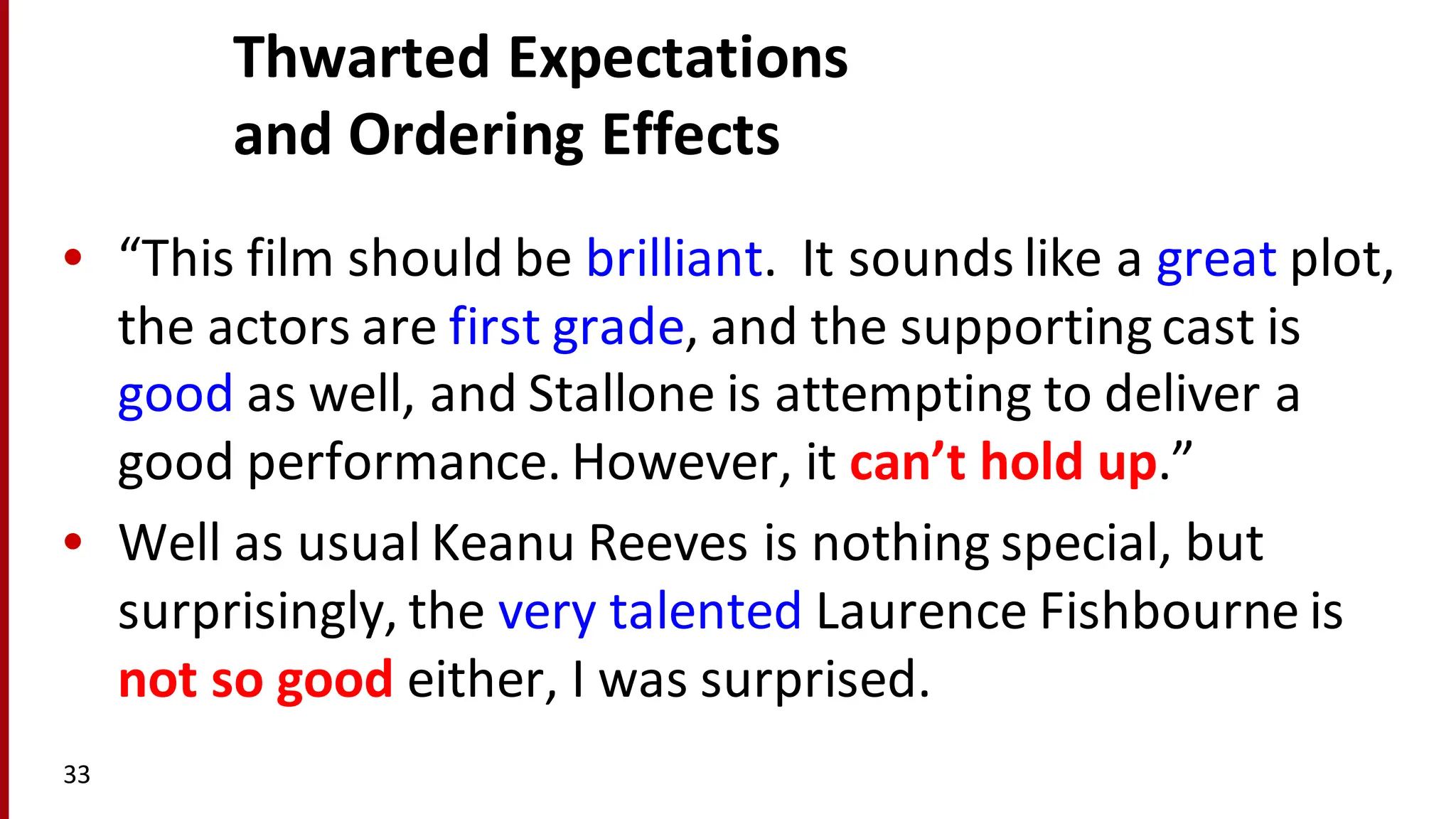
    Thwarted  Expectations and  Ordering  Effects • “This  film  should  be  brilliant.    It  sounds  like  a  great  plot,   the  actors  are  first  grade,  and  the  supporting  cast  is   good  as  well,  and  Stallone  is  attempting  to  deliver  a   good  performance.  However,  it  can’t  hold  up.” • Well  as  usual  Keanu  Reeves  is  nothing  special,  but   surprisingly,  the  very  talented  Laurence  Fishbourne is   not  so  good  either,  I  was  surprised. 33
  • 34.