• A commonweakness in writing is the lack of varied sentences.
Becoming aware of three general types of sentences--simple,
compound, and complex--can help you vary the sentences in
your writing.
• The most effective writing uses a variety of the sentence types
explained below.
3.
Simple Sentences
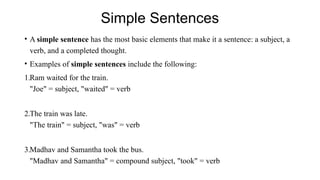
• Asimple sentence has the most basic elements that make it a sentence: a subject, a
verb, and a completed thought.
• Examples of simple sentences include the following:
1.Ram waited for the train.
"Joe" = subject, "waited" = verb
2.The train was late.
"The train" = subject, "was" = verb
3.Madhav and Samantha took the bus.
"Madhav and Samantha" = compound subject, "took" = verb
4.
Compound Sentences
• Acompound sentence refers to a sentence made up of two independent
clauses (or complete sentences) connected to one another with
a coordinating conjunction. Coordinating conjunctions are easy to
remember if you think of the words "FAN BOYS":
• For
• And
• Nor
• But
• Or
• Yet
• So
5.
• Munna waitedfor the train, but the train was late.
• They got there early, and they got really good seats.
• She did not cheat on the test, for it was the wrong thing to do.
• I really need to go to work, but I am too sick to drive.
• I am counting my calories, yet I really want dessert.
• He ran out of money, so he had to stop playing poker.
• They got there early, and they got really good seats.
• They had no ice cream left at home, nor did they have money to go to the store.
• Everyone was busy, so I went to the movie alone.
• I thought the promotion was mine, but my attendance wasn't good enough.
• Should we start class now, or wait for everyone to get here?
• It was getting dark, and we weren't near the cabin yet.
• Cats are good pets, for they are clean and are not noisy.
• We have never been to Asia, nor have we visited Africa.
• He didn't want to go to the dentist, yet he went anyway.
6.
Complex Sentences
• Complexsentences are fascinating components of the English
language. When used properly, they can add depth to our
writing. Complex sentences contain an independent clause and
at least one dependent clause.
• An independent clause has the ability to stand alone as a
sentence. It always makes a complete thought. A
dependent clause cannot stand alone, even though it has a
subject and a verb.
• Complex sentences are friends and neighbors to
compound sentences. There’s only one difference. Compound
sentences contain two independent clauses — that’s all there is
to it. Let’s break down a couple complex sentence examples
into its parts.
7.
• Because mycoffee was too cold, I heated it in the microwave.
• Although he was wealthy, he was still unhappy.
• She returned the computer after she noticed it was damaged.
• Whenever prices goes up, customers buy less products.
• Because I had to catch the train, and as we were short on time, I
forgot to pack my toothbrush for our vacation.
• As she was bright and ambitious, she became a manager in no
time.
• Wherever you go, you can always find beauty.
• Evergreen trees are a symbol of fertility because they do not die in
the winter.
• Although it was very long, the movie was still enjoyable.
• You should take your car in for a service because it's starting to
make weird noises.
8.
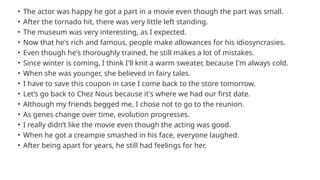
• The actorwas happy he got a part in a movie even though the part was small.
• After the tornado hit, there was very little left standing.
• The museum was very interesting, as I expected.
• Now that he's rich and famous, people make allowances for his idiosyncrasies.
• Even though he's thoroughly trained, he still makes a lot of mistakes.
• Since winter is coming, I think I'll knit a warm sweater, because I'm always cold.
• When she was younger, she believed in fairy tales.
• I have to save this coupon in case I come back to the store tomorrow.
• Let’s go back to Chez Nous because it's where we had our first date.
• Although my friends begged me, I chose not to go to the reunion.
• As genes change over time, evolution progresses.
• I really didn’t like the movie even though the acting was good.
• When he got a creampie smashed in his face, everyone laughed.
• After being apart for years, he still had feelings for her.
9.
• after
• although
•as
• because
• before
• even though
• if
• since
• though
• unless
• until
• when
• whenever
• whereas
• wherever
• while