EASTER
&
HOLY WEEK
EASTER
Easter, also called Resurrection Sunday, is a
festival and a holiday celebrating the Jesus
resurrection from the dead. It starts forty
days before than the first spring Sunday
after the first spring full moon. It begins
on Ash Wednesday and ends on Easter
Sunday. In Catalonia, it ends Mona's day.
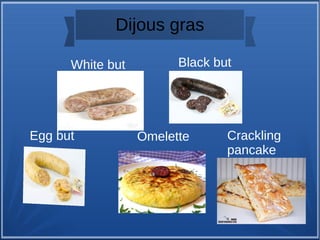
Dijous gras
The first day of celebrations is Shrove
Thursday (dijous gras), when it is traditional
to eat eggs and pork products, such as tortilla
with Catalan botifarra sausage containing
egg, or coca de llardons, a flat, flour-based
mass topped with crackling..
Dijous gras
White but Black but
Crackling
pancake
OmeletteEgg but
CARNIVAL
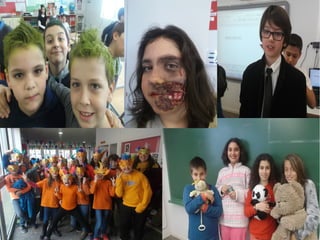
The Carnival is the week in which everybody wear a costume.
In Catalonia have the Carnestoltes king. Carnestoltes goes to
every school of Catalonia. Carnestoltes is a boy costume, in
Ash Wednesday, the boy is burn. In the school, every day of
the week, the people wear costumes.
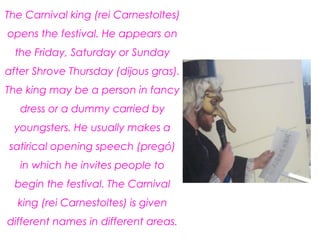
The Carnival king (rei Carnestoltes)
opens the festival. He appears on
the Friday, Saturday or Sunday
after Shrove Thursday (dijous gras).
The king may be a person in fancy
dress or a dummy carried by
youngsters. He usually makes a
satirical opening speech (pregó)
in which he invites people to
begin the festival. The Carnival
king (rei Carnestoltes) is given
different names in different areas.
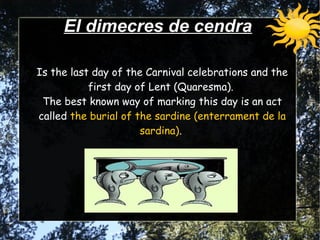
Is the last day of the Carnival celebrations and the
first day of Lent (Quaresma).
The best known way of marking this day is an act
called the burial of the sardine (enterrament de la
sardina).
Is the last day of the Carnival celebrations and the
first day of Lent (Quaresma).
The best known way of marking this day is an act
called the burial of the sardine (enterrament de la
sardina).
El dimecres de cendraEl dimecres de cendra
The act in question has a huge number of local
variations, ranging from actually burying a sardine to
burning the Carnestoltes dummy. At the end of the
act, a satirical will is read out, in which the recently
deceased character leaves people inappropriate
items. The act represents the end of the
celebrations and the beginning of a period of fasting
and abstinence.
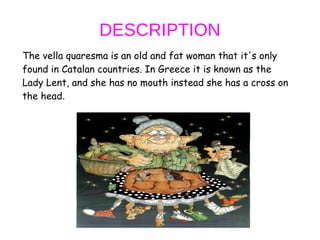
DESCRIPTION
The vella quaresma is an old and fat woman that it's only
found in Catalan countries. In Greece it is known as the
Lady Lent, and she has no mouth instead she has a cross on
the head.
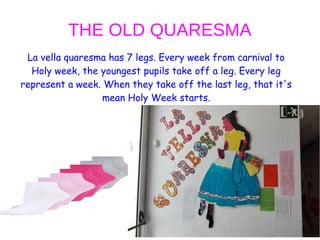
THE OLD QUARESMA
La vella quaresma has 7 legs. Every week from carnival to
Holy week, the youngest pupils take off a leg. Every leg
represent a week. When they take off the last leg, that it's
mean Holy Week starts.
EASTER :EASTER :
LA PASSIÓLA PASSIÓ
WHAT ISWHAT IS
''LA''LA
PASSIÓ''?PASSIÓ''?
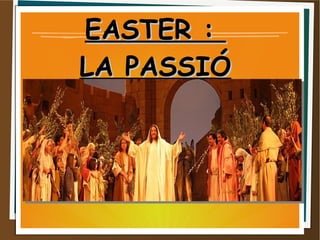
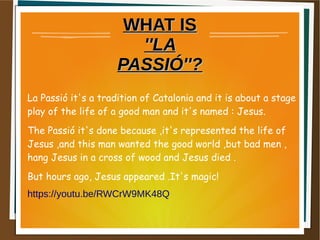
La Passió it's a tradition of Catalonia and it is about a stage
play of the life of a good man and it's named : Jesus.
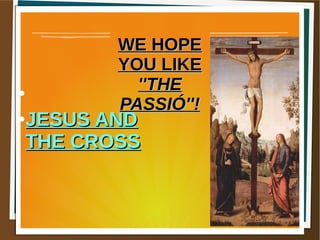
The Passió it's done because ,it's represented the life of
Jesus ,and this man wanted the good world ,but bad men ,
hang Jesus in a cross of wood and Jesus died .
But hours ago, Jesus appeared .It's magic!
https://youtu.be/RWCrW9MK48Q
WE HOPEWE HOPE
YOU LIKEYOU LIKE
''THE''THE
PASSIÓ''!PASSIÓ''!
●
●
JESUS ANDJESUS AND
THE CROSSTHE CROSS
LALA MONA!MONA!
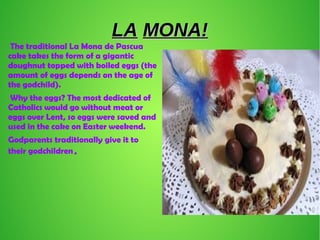
The traditional La Mona de Pascua
cake takes the form of a gigantic
doughnut topped with boiled eggs (the
amount of eggs depends on the age of
the godchild).
Why the eggs? The most dedicated of
Catholics would go without meat or
eggs over Lent, so eggs were saved and
used in the cake on Easter weekend.
Godparents traditionally give it to
their godchildren.
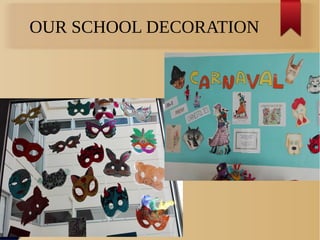
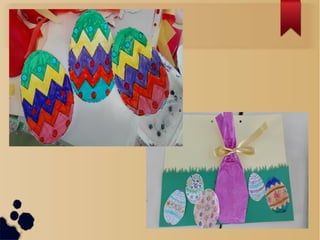
OUR SCHOOL DECORATION
Easter Salvador Sanromà

Easter Salvador Sanromà

  • 1.
  • 2.
    EASTER Easter, also calledResurrection Sunday, is a festival and a holiday celebrating the Jesus resurrection from the dead. It starts forty days before than the first spring Sunday after the first spring full moon. It begins on Ash Wednesday and ends on Easter Sunday. In Catalonia, it ends Mona's day.
  • 4.
    Dijous gras The firstday of celebrations is Shrove Thursday (dijous gras), when it is traditional to eat eggs and pork products, such as tortilla with Catalan botifarra sausage containing egg, or coca de llardons, a flat, flour-based mass topped with crackling..
  • 5.
    Dijous gras White butBlack but Crackling pancake OmeletteEgg but
  • 6.
    CARNIVAL The Carnival isthe week in which everybody wear a costume. In Catalonia have the Carnestoltes king. Carnestoltes goes to every school of Catalonia. Carnestoltes is a boy costume, in Ash Wednesday, the boy is burn. In the school, every day of the week, the people wear costumes.
  • 7.
    The Carnival king(rei Carnestoltes) opens the festival. He appears on the Friday, Saturday or Sunday after Shrove Thursday (dijous gras). The king may be a person in fancy dress or a dummy carried by youngsters. He usually makes a satirical opening speech (pregó) in which he invites people to begin the festival. The Carnival king (rei Carnestoltes) is given different names in different areas.
  • 9.
    Is the lastday of the Carnival celebrations and the first day of Lent (Quaresma). The best known way of marking this day is an act called the burial of the sardine (enterrament de la sardina). Is the last day of the Carnival celebrations and the first day of Lent (Quaresma). The best known way of marking this day is an act called the burial of the sardine (enterrament de la sardina). El dimecres de cendraEl dimecres de cendra
  • 10.
    The act inquestion has a huge number of local variations, ranging from actually burying a sardine to burning the Carnestoltes dummy. At the end of the act, a satirical will is read out, in which the recently deceased character leaves people inappropriate items. The act represents the end of the celebrations and the beginning of a period of fasting and abstinence.
  • 11.
    DESCRIPTION The vella quaresmais an old and fat woman that it's only found in Catalan countries. In Greece it is known as the Lady Lent, and she has no mouth instead she has a cross on the head.
  • 12.
    THE OLD QUARESMA Lavella quaresma has 7 legs. Every week from carnival to Holy week, the youngest pupils take off a leg. Every leg represent a week. When they take off the last leg, that it's mean Holy Week starts.
  • 13.
    EASTER :EASTER : LAPASSIÓLA PASSIÓ
  • 14.
    WHAT ISWHAT IS ''LA''LA PASSIÓ''?PASSIÓ''? LaPassió it's a tradition of Catalonia and it is about a stage play of the life of a good man and it's named : Jesus. The Passió it's done because ,it's represented the life of Jesus ,and this man wanted the good world ,but bad men , hang Jesus in a cross of wood and Jesus died . But hours ago, Jesus appeared .It's magic! https://youtu.be/RWCrW9MK48Q
  • 15.
    WE HOPEWE HOPE YOULIKEYOU LIKE ''THE''THE PASSIÓ''!PASSIÓ''! ● ● JESUS ANDJESUS AND THE CROSSTHE CROSS
  • 16.
    LALA MONA!MONA! The traditionalLa Mona de Pascua cake takes the form of a gigantic doughnut topped with boiled eggs (the amount of eggs depends on the age of the godchild). Why the eggs? The most dedicated of Catholics would go without meat or eggs over Lent, so eggs were saved and used in the cake on Easter weekend. Godparents traditionally give it to their godchildren.
  • 17.