The Problem               Zeta Function               Semitransparent Pistons         Questions


                            Semitransparent Pistons

                                 Pedro Morales-Almaz´n
                                                    a

                                   Department of Mathematics
                                        Baylor University
                                   pedro morales@baylor.edu


                                          April, 15th 2011


Pedro Morales-Almaz´n
                   a                                                            Math Department
Semitransparent Pistons
The Problem                Zeta Function   Semitransparent Pistons         Questions


Outline

      1   The Problem
            Casimir Effect
                  Mathematical Model


Pedro Morales-Almaz´n
                   a                                                 Math Department
Semitransparent Pistons
The Problem                Zeta Function   Semitransparent Pistons         Questions


Outline

      1   The Problem
            Casimir Effect
                  Mathematical Model

      2   Zeta Function
            Definition


Pedro Morales-Almaz´n
                   a                                                 Math Department
Semitransparent Pistons
The Problem                 Zeta Function   Semitransparent Pistons         Questions


Outline

      1   The Problem
            Casimir Effect
                  Mathematical Model

      2   Zeta Function
            Definition

      3   Semitransparent Pistons
            Eigenvalue Problem
                  Operator Determinant
                  Casimir Force


Pedro Morales-Almaz´n
                   a                                                  Math Department
Semitransparent Pistons
The Problem                 Zeta Function   Semitransparent Pistons         Questions


Outline

      1   The Problem
            Casimir Effect
                  Mathematical Model

      2   Zeta Function
            Definition

      3   Semitransparent Pistons
            Eigenvalue Problem
                  Operator Determinant
                  Casimir Force

      4   Questions


Pedro Morales-Almaz´n
                   a                                                  Math Department
Semitransparent Pistons
The Problem               Zeta Function    Semitransparent Pistons         Questions

Casimir Effect


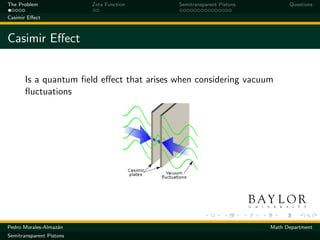
Casimir Effect


       Is a quantum field effect that arises when considering vacuum
       fluctuations


Pedro Morales-Almaz´n
                   a                                                 Math Department
Semitransparent Pistons
The Problem                Zeta Function       Semitransparent Pistons         Questions

Casimir Effect


History


           • Predicted theoretically in 1948 by Hendrik B. G. Casimir and
                Dirk Polder when Casimir was trying to compute van der
                Waals forces between polarizable molecules.


Pedro Morales-Almaz´n
                   a                                                     Math Department
Semitransparent Pistons
The Problem                Zeta Function       Semitransparent Pistons         Questions

Casimir Effect


History


           • Predicted theoretically in 1948 by Hendrik B. G. Casimir and
                Dirk Polder when Casimir was trying to compute van der
                Waals forces between polarizable molecules.
           • Confirmed experimentally in 1997 by S. K. Lamoreaux.


Pedro Morales-Almaz´n
                   a                                                     Math Department
Semitransparent Pistons
The Problem               Zeta Function         Semitransparent Pistons         Questions

Casimir Effect


Why is so important?


           • Believed to explain the stability of an electron


Pedro Morales-Almaz´n
                   a                                                      Math Department
Semitransparent Pistons
The Problem                Zeta Function        Semitransparent Pistons         Questions

Casimir Effect


Why is so important?


           • Believed to explain the stability of an electron
           • Very sensitive to the geometry of the space (Quantum and
                Comsmological implications)


Pedro Morales-Almaz´n
                   a                                                      Math Department
Semitransparent Pistons
The Problem                Zeta Function        Semitransparent Pistons         Questions

Casimir Effect


Why is so important?


           • Believed to explain the stability of an electron
           • Very sensitive to the geometry of the space (Quantum and
                Comsmological implications)
           • Provides a better understanding of the zero-point energy


Pedro Morales-Almaz´n
                   a                                                      Math Department
Semitransparent Pistons
The Problem               Zeta Function      Semitransparent Pistons         Questions

Casimir Effect


Mathematical Model


       In order to calculate the Casimir Energy of a system, consider a
       Riemannian manifold M possibly with boundary and the
       eigenvalue problem


Pedro Morales-Almaz´n
                   a                                                   Math Department
Semitransparent Pistons
The Problem               Zeta Function              Semitransparent Pistons         Questions

Casimir Effect


Mathematical Model


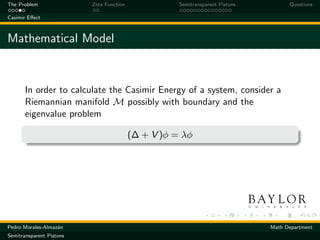
       In order to calculate the Casimir Energy of a system, consider a
       Riemannian manifold M possibly with boundary and the
       eigenvalue problem

                                          (∆ + V )φ = λφ


Pedro Morales-Almaz´n
                   a                                                           Math Department
Semitransparent Pistons
The Problem               Zeta Function              Semitransparent Pistons         Questions

Casimir Effect


Mathematical Model


       In order to calculate the Casimir Energy of a system, consider a
       Riemannian manifold M possibly with boundary and the
       eigenvalue problem

                                          (∆ + V )φ = λφ

       where ∆ is the Laplacian on M, V is a potential and φ ∈ L2 (M).
       If ∂M = ∅ boundary conditions must be imposed.


Pedro Morales-Almaz´n
                   a                                                           Math Department
Semitransparent Pistons
The Problem               Zeta Function                Semitransparent Pistons         Questions

Casimir Effect


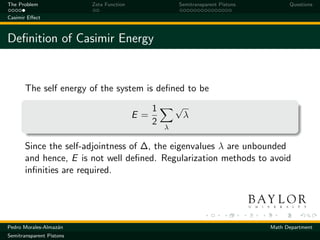
Definition of Casimir Energy


       The self energy of the system is defined to be

                                               1       √
                                          E=               λ
                                               2
                                                   λ


Pedro Morales-Almaz´n
                   a                                                             Math Department
Semitransparent Pistons
The Problem               Zeta Function                Semitransparent Pistons         Questions

Casimir Effect


Definition of Casimir Energy


       The self energy of the system is defined to be

                                               1       √
                                          E=               λ
                                               2
                                                   λ

       Since the self-adjointness of ∆, the eigenvalues λ are unbounded
       and hence, E is not well defined.


Pedro Morales-Almaz´n
                   a                                                             Math Department
Semitransparent Pistons
The Problem               Zeta Function                Semitransparent Pistons         Questions

Casimir Effect


Definition of Casimir Energy


       The self energy of the system is defined to be

                                               1       √
                                          E=               λ
                                               2
                                                   λ

       Since the self-adjointness of ∆, the eigenvalues λ are unbounded
       and hence, E is not well defined. Regularization methods to avoid
       infinities are required.


Pedro Morales-Almaz´n
                   a                                                             Math Department
Semitransparent Pistons
The Problem               Zeta Function                    Semitransparent Pistons         Questions

Definition


Zeta Function


       Given a self-adjoint operator P with eigenvalues {λn }∞ , the zeta
                                                             n=1
       function is defined by
                                                     ∞
                                          ζP (s) =         λ−s
                                                            n
                                                     n=1


Pedro Morales-Almaz´n
                   a                                                                 Math Department
Semitransparent Pistons
The Problem               Zeta Function                    Semitransparent Pistons         Questions

Definition


Zeta Function


       Given a self-adjoint operator P with eigenvalues {λn }∞ , the zeta
                                                             n=1
       function is defined by
                                                     ∞
                                          ζP (s) =         λ−s
                                                            n
                                                     n=1

       which is convergent for            s large enough.


Pedro Morales-Almaz´n
                   a                                                                 Math Department
Semitransparent Pistons
The Problem               Zeta Function       Semitransparent Pistons         Questions

Definition


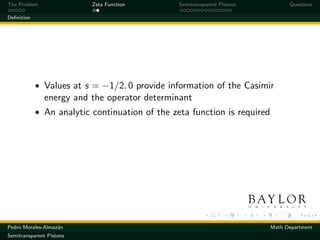
            • Values at s = −1/2, 0 provide information of the Casimir
              energy and the operator determinant


Pedro Morales-Almaz´n
                   a                                                    Math Department
Semitransparent Pistons
The Problem               Zeta Function         Semitransparent Pistons         Questions

Definition


            • Values at s = −1/2, 0 provide information of the Casimir
              energy and the operator determinant
            • An analytic continuation of the zeta function is required


Pedro Morales-Almaz´n
                   a                                                      Math Department
Semitransparent Pistons
The Problem                  Zeta Function      Semitransparent Pistons         Questions

Definition


            • Values at s = −1/2, 0 provide information of the Casimir
              energy and the operator determinant
            • An analytic continuation of the zeta function is required
            • Lack of explicit eigenvalues requires an indirect method for
              calculations


Pedro Morales-Almaz´n
                   a                                                      Math Department
Semitransparent Pistons
The Problem               Zeta Function           Semitransparent Pistons         Questions

Eigenvalue Problem


Eigenvalue Problem

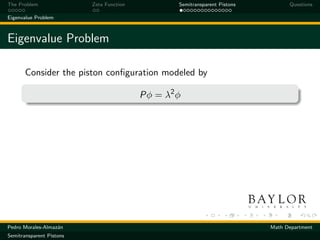
       Consider the piston configuration modeled by

                                          Pφ = λ2 φ


Pedro Morales-Almaz´n
                   a                                                        Math Department
Semitransparent Pistons
The Problem               Zeta Function              Semitransparent Pistons         Questions

Eigenvalue Problem


Eigenvalue Problem

       Consider the piston configuration modeled by

                                            Pφ = λ2 φ

       where P is the Laplace-type differential operator defined on
       [0, L] × N

                                          ∂2
                            P=−                − ∆N + σδ(x − a)
                                          ∂x 2


Pedro Morales-Almaz´n
                   a                                                           Math Department
Semitransparent Pistons
The Problem               Zeta Function              Semitransparent Pistons         Questions

Eigenvalue Problem


Eigenvalue Problem

       Consider the piston configuration modeled by

                                            Pφ = λ2 φ

       where P is the Laplace-type differential operator defined on
       [0, L] × N

                                          ∂2
                            P=−                − ∆N + σδ(x − a)
                                          ∂x 2
       N is a compact Riemannian manifold and we have Dirichlet
       boundary conditions φ(0) = φ(L) = 0.


Pedro Morales-Almaz´n
                   a                                                           Math Department
Semitransparent Pistons
The Problem               Zeta Function   Semitransparent Pistons         Questions

Eigenvalue Problem


Configuration


Pedro Morales-Almaz´n
                   a                                                Math Department
Semitransparent Pistons
The Problem               Zeta Function             Semitransparent Pistons         Questions

Eigenvalue Problem


Separation of variables


       Using separation of variables

                                          λ2 = νk + η 2
                                           k
                                                2


       where νk and η 2 are the eigenvalues for the Laplacian on [0, L] and
              2

       N respectively


Pedro Morales-Almaz´n
                   a                                                          Math Department
Semitransparent Pistons
The Problem                  Zeta Function                Semitransparent Pistons         Questions

Eigenvalue Problem


Zeta Function


                                   ∞     ∞            ∞      ∞
                          ζ(s) =             λ−2s =
                                              k                  (νk + η 2 )−s
                                                                   2

                                   k=1 =1             k=1 =1


Pedro Morales-Almaz´n
                   a                                                                Math Department
Semitransparent Pistons
The Problem                  Zeta Function                Semitransparent Pistons         Questions

Eigenvalue Problem


Zeta Function


                                   ∞     ∞            ∞      ∞
                          ζ(s) =             λ−2s =
                                              k                  (νk + η 2 )−s
                                                                   2

                                   k=1 =1             k=1 =1

                                 2
       Remark The eigenvalues νk cannot be calculated explicitly, an
       indirect way of finding the zeta function is required


Pedro Morales-Almaz´n
                   a                                                                Math Department
Semitransparent Pistons
The Problem                     Zeta Function               Semitransparent Pistons         Questions

Eigenvalue Problem


Contour Integration


       Cauchy’s residue Theorem
       Let f be a meromorphic function defined on a simply connected
       region Ω of the complex plane and let {ak }n be its poles on Ω.
                                                  k=1
       Let γ be a closed curve in Ω, then
                                                 n
                           1
                                    f (z)dz =         I (ak , γ) Res(f (z))|z=ak
                          2πı   γ               k=1


Pedro Morales-Almaz´n
                   a                                                                  Math Department
Semitransparent Pistons
The Problem                    Zeta Function                Semitransparent Pistons         Questions

Eigenvalue Problem


Integral Representation


                                         ∞
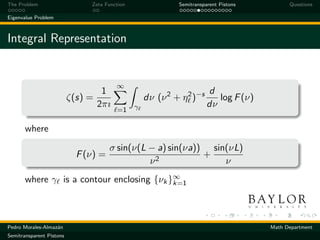
                                    1                                  d
                          ζ(s) =                   dν (ν 2 + η 2 )−s      log F (ν)
                                   2πı         γ                       dν
                                         =1


Pedro Morales-Almaz´n
                   a                                                                  Math Department
Semitransparent Pistons
The Problem                    Zeta Function                Semitransparent Pistons         Questions

Eigenvalue Problem


Integral Representation


                                         ∞
                                    1                                  d
                          ζ(s) =                   dν (ν 2 + η 2 )−s      log F (ν)
                                   2πı         γ                       dν
                                         =1

       where
                                      σ sin(ν(L − a) sin(νa)) sin(νL)
                            F (ν) =                          +
                                                ν2               ν
       where γ is a contour enclosing {νk }∞
                                           k=1


Pedro Morales-Almaz´n
                   a                                                                  Math Department
Semitransparent Pistons
The Problem               Zeta Function     Semitransparent Pistons         Questions

Eigenvalue Problem


Contour Deformation


       After deforming the contours γ to the imaginary axis, the zeta
       function becomes


Pedro Morales-Almaz´n
                   a                                                  Math Department
Semitransparent Pistons
The Problem                  Zeta Function                  Semitransparent Pistons             Questions

Eigenvalue Problem


Contour Deformation


       After deforming the contours γ to the imaginary axis, the zeta
       function becomes
                                        ∞        ∞
                            sin(πs)                                       d
                     ζ(s) =                          dν (ν 2 − η 2 )−s       log F (ıν)
                               π             η                            dν
                                        =1

       which converges for           s big enough


Pedro Morales-Almaz´n
                   a                                                                      Math Department
Semitransparent Pistons
The Problem                   Zeta Function            Semitransparent Pistons             Questions

Eigenvalue Problem


Analytic Continuation


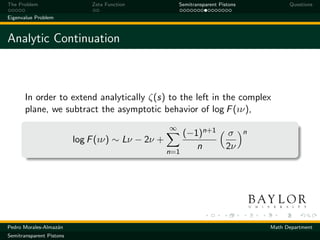
       In order to extend analytically ζ(s) to the left in the complex
       plane, we subtract the asymptotic behavior of log F (ıν),
                                                   ∞
                                                         (−1)n+1          σ      n
                          log F (ıν) ∼ Lν − 2ν +
                                                            n             2ν
                                                   n=1


Pedro Morales-Almaz´n
                   a                                                                 Math Department
Semitransparent Pistons
The Problem               Zeta Function              Semitransparent Pistons         Questions

Eigenvalue Problem


Finite Part


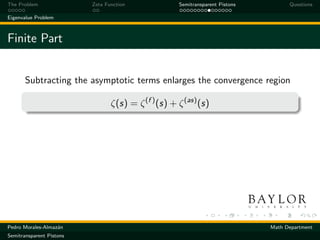
       Subtracting the asymptotic terms enlarges the convergence region

                                 ζ(s) = ζ (f ) (s) + ζ (as) (s)


Pedro Morales-Almaz´n
                   a                                                           Math Department
Semitransparent Pistons
The Problem                    Zeta Function              Semitransparent Pistons         Questions

Eigenvalue Problem


Finite Part


       Subtracting the asymptotic terms enlarges the convergence region

                                      ζ(s) = ζ (f ) (s) + ζ (as) (s)

       where

                                            ζ (f ) (s) =
                          ∞      ∞
              sin(πs)                                  d
                                   dν (ν 2 − η 2 )−s     [log F (ıν) − asymptotics]
                 π             η                      dν
                          =1


Pedro Morales-Almaz´n
                   a                                                                Math Department
Semitransparent Pistons
The Problem                   Zeta Function                   Semitransparent Pistons         Questions

Eigenvalue Problem


Asymptotic Part


                                        ∞         ∞
                             sin(πs)                                       d
              ζ (as) (s) =                            dν (ν 2 − η 2 )−s       [asymptotics]
                                π             η                            dν
                                        =1


Pedro Morales-Almaz´n
                   a                                                                    Math Department
Semitransparent Pistons
The Problem               Zeta Function            Semitransparent Pistons         Questions

Eigenvalue Problem


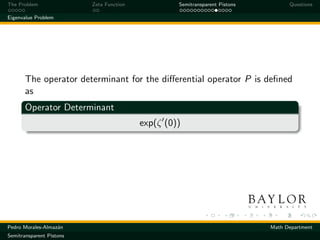
       The operator determinant for the differential operator P is defined
       as
       Operator Determinant
                                          exp(ζ (0))


Pedro Morales-Almaz´n
                   a                                                         Math Department
Semitransparent Pistons
The Problem               Zeta Function            Semitransparent Pistons         Questions

Eigenvalue Problem


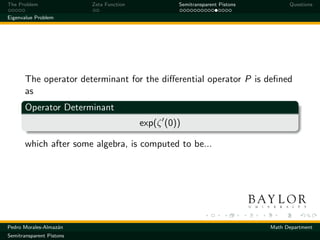
       The operator determinant for the differential operator P is defined
       as
       Operator Determinant
                                          exp(ζ (0))

       which after some algebra, is computed to be...


Pedro Morales-Almaz´n
                   a                                                         Math Department
Semitransparent Pistons
The Problem                  Zeta Function            Semitransparent Pistons             Questions

Eigenvalue Problem


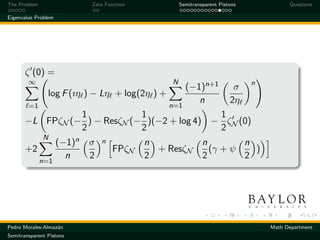
       ζ (0) =
        ∞                                         N                             n
                                                        (−1)n+1            σ
                log F (ıη ) − Lη + log(2η ) +
                                                           n              2η
        =1                                       n=1
                 1            1               1
       −L FPζN (− ) − ResζN (− )(−2 + log 4) − ζN (0)
                 2            2               2
              N
                     (−1)n   σ   n           n                 n        n
       +2                            FPζN      + ResζN           (γ + ψ   )
                       n     2               2                 2        2
              n=1


Pedro Morales-Almaz´n
                   a                                                                Math Department
Semitransparent Pistons
The Problem               Zeta Function                Semitransparent Pistons         Questions

Eigenvalue Problem


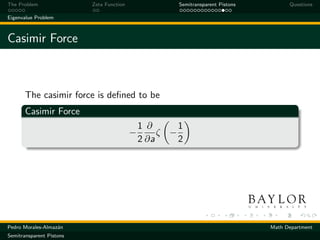
Casimir Force


       The casimir force is defined to be
       Casimir Force
                                              1 ∂      1
                                          −        ζ −
                                              2 ∂a     2


Pedro Morales-Almaz´n
                   a                                                             Math Department
Semitransparent Pistons
The Problem               Zeta Function                Semitransparent Pistons         Questions

Eigenvalue Problem


Casimir Force


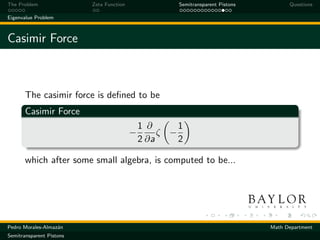
       The casimir force is defined to be
       Casimir Force
                                              1 ∂      1
                                          −        ζ −
                                              2 ∂a     2

       which after some small algebra, is computed to be...


Pedro Morales-Almaz´n
                   a                                                             Math Department
Semitransparent Pistons
The Problem                    Zeta Function                Semitransparent Pistons         Questions

Eigenvalue Problem


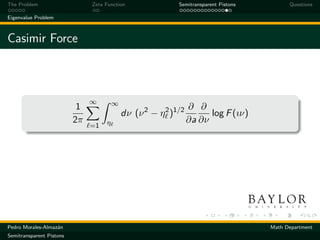
Casimir Force


                               ∞        ∞
                           1                                     ∂ ∂
                                            dν (ν 2 − η 2 )1/2         log F (ıν)
                          2π        η                            ∂a ∂ν
                               =1


Pedro Morales-Almaz´n
                   a                                                                  Math Department
Semitransparent Pistons
The Problem                    Zeta Function                Semitransparent Pistons         Questions

Eigenvalue Problem


Casimir Force


                               ∞        ∞
                           1                                     ∂ ∂
                                            dν (ν 2 − η 2 )1/2         log F (ıν)
                          2π        η                            ∂a ∂ν
                               =1

       which after a lot of algebra, is computed to be...


Pedro Morales-Almaz´n
                   a                                                                  Math Department
Semitransparent Pistons
The Problem                    Zeta Function                Semitransparent Pistons         Questions

Eigenvalue Problem


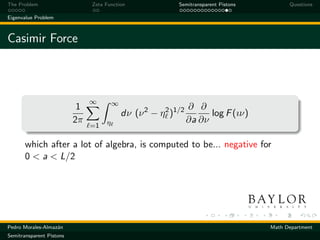
Casimir Force


                               ∞        ∞
                           1                                     ∂ ∂
                                            dν (ν 2 − η 2 )1/2         log F (ıν)
                          2π        η                            ∂a ∂ν
                               =1

       which after a lot of algebra, is computed to be... negative for
       0 < a < L/2


Pedro Morales-Almaz´n
                   a                                                                  Math Department
Semitransparent Pistons
The Problem                    Zeta Function                Semitransparent Pistons         Questions

Eigenvalue Problem


Casimir Force


                               ∞        ∞
                           1                                     ∂ ∂
                                            dν (ν 2 − η 2 )1/2         log F (ıν)
                          2π        η                            ∂a ∂ν
                               =1

       which after a lot of algebra, is computed to be... negative for
       0 < a < L/2 and positive for L/2 < a < L.


Pedro Morales-Almaz´n
                   a                                                                  Math Department
Semitransparent Pistons
The Problem               Zeta Function    Semitransparent Pistons         Questions

Eigenvalue Problem


Piston Behavior


       Piston Behavior
       Given the second order differential operator
              ∂2
       P = − 2 − ∆N + σδ(x − a) defined on [0, L] × N with Dirichlet
              ∂x
       boundary conditions, the piston is then attracted to the closest
       wall.


Pedro Morales-Almaz´n
                   a                                                 Math Department
Semitransparent Pistons
The Problem               Zeta Function            Semitransparent Pistons         Questions


Questions


                                          Thanks


Pedro Morales-Almaz´n
                   a                                                         Math Department
Semitransparent Pistons

Semitransparent Pistons

  • 1.
    The Problem Zeta Function Semitransparent Pistons Questions Semitransparent Pistons Pedro Morales-Almaz´n a Department of Mathematics Baylor University pedro morales@baylor.edu April, 15th 2011 Pedro Morales-Almaz´n a Math Department Semitransparent Pistons
  • 2.
    The Problem Zeta Function Semitransparent Pistons Questions Outline 1 The Problem Casimir Effect Mathematical Model Pedro Morales-Almaz´n a Math Department Semitransparent Pistons
  • 3.
    The Problem Zeta Function Semitransparent Pistons Questions Outline 1 The Problem Casimir Effect Mathematical Model 2 Zeta Function Definition Pedro Morales-Almaz´n a Math Department Semitransparent Pistons
  • 4.
    The Problem Zeta Function Semitransparent Pistons Questions Outline 1 The Problem Casimir Effect Mathematical Model 2 Zeta Function Definition 3 Semitransparent Pistons Eigenvalue Problem Operator Determinant Casimir Force Pedro Morales-Almaz´n a Math Department Semitransparent Pistons
  • 5.
    The Problem Zeta Function Semitransparent Pistons Questions Outline 1 The Problem Casimir Effect Mathematical Model 2 Zeta Function Definition 3 Semitransparent Pistons Eigenvalue Problem Operator Determinant Casimir Force 4 Questions Pedro Morales-Almaz´n a Math Department Semitransparent Pistons
  • 6.
    The Problem Zeta Function Semitransparent Pistons Questions Casimir Effect Casimir Effect Is a quantum field effect that arises when considering vacuum fluctuations Pedro Morales-Almaz´n a Math Department Semitransparent Pistons
  • 7.
    The Problem Zeta Function Semitransparent Pistons Questions Casimir Effect History • Predicted theoretically in 1948 by Hendrik B. G. Casimir and Dirk Polder when Casimir was trying to compute van der Waals forces between polarizable molecules. Pedro Morales-Almaz´n a Math Department Semitransparent Pistons
  • 8.
    The Problem Zeta Function Semitransparent Pistons Questions Casimir Effect History • Predicted theoretically in 1948 by Hendrik B. G. Casimir and Dirk Polder when Casimir was trying to compute van der Waals forces between polarizable molecules. • Confirmed experimentally in 1997 by S. K. Lamoreaux. Pedro Morales-Almaz´n a Math Department Semitransparent Pistons
  • 9.
    The Problem Zeta Function Semitransparent Pistons Questions Casimir Effect Why is so important? • Believed to explain the stability of an electron Pedro Morales-Almaz´n a Math Department Semitransparent Pistons
  • 10.
    The Problem Zeta Function Semitransparent Pistons Questions Casimir Effect Why is so important? • Believed to explain the stability of an electron • Very sensitive to the geometry of the space (Quantum and Comsmological implications) Pedro Morales-Almaz´n a Math Department Semitransparent Pistons
  • 11.
    The Problem Zeta Function Semitransparent Pistons Questions Casimir Effect Why is so important? • Believed to explain the stability of an electron • Very sensitive to the geometry of the space (Quantum and Comsmological implications) • Provides a better understanding of the zero-point energy Pedro Morales-Almaz´n a Math Department Semitransparent Pistons
  • 12.
    The Problem Zeta Function Semitransparent Pistons Questions Casimir Effect Mathematical Model In order to calculate the Casimir Energy of a system, consider a Riemannian manifold M possibly with boundary and the eigenvalue problem Pedro Morales-Almaz´n a Math Department Semitransparent Pistons
  • 13.
    The Problem Zeta Function Semitransparent Pistons Questions Casimir Effect Mathematical Model In order to calculate the Casimir Energy of a system, consider a Riemannian manifold M possibly with boundary and the eigenvalue problem (∆ + V )φ = λφ Pedro Morales-Almaz´n a Math Department Semitransparent Pistons
  • 14.
    The Problem Zeta Function Semitransparent Pistons Questions Casimir Effect Mathematical Model In order to calculate the Casimir Energy of a system, consider a Riemannian manifold M possibly with boundary and the eigenvalue problem (∆ + V )φ = λφ where ∆ is the Laplacian on M, V is a potential and φ ∈ L2 (M). If ∂M = ∅ boundary conditions must be imposed. Pedro Morales-Almaz´n a Math Department Semitransparent Pistons
  • 15.
    The Problem Zeta Function Semitransparent Pistons Questions Casimir Effect Definition of Casimir Energy The self energy of the system is defined to be 1 √ E= λ 2 λ Pedro Morales-Almaz´n a Math Department Semitransparent Pistons
  • 16.
    The Problem Zeta Function Semitransparent Pistons Questions Casimir Effect Definition of Casimir Energy The self energy of the system is defined to be 1 √ E= λ 2 λ Since the self-adjointness of ∆, the eigenvalues λ are unbounded and hence, E is not well defined. Pedro Morales-Almaz´n a Math Department Semitransparent Pistons
  • 17.
    The Problem Zeta Function Semitransparent Pistons Questions Casimir Effect Definition of Casimir Energy The self energy of the system is defined to be 1 √ E= λ 2 λ Since the self-adjointness of ∆, the eigenvalues λ are unbounded and hence, E is not well defined. Regularization methods to avoid infinities are required. Pedro Morales-Almaz´n a Math Department Semitransparent Pistons
  • 18.
    The Problem Zeta Function Semitransparent Pistons Questions Definition Zeta Function Given a self-adjoint operator P with eigenvalues {λn }∞ , the zeta n=1 function is defined by ∞ ζP (s) = λ−s n n=1 Pedro Morales-Almaz´n a Math Department Semitransparent Pistons
  • 19.
    The Problem Zeta Function Semitransparent Pistons Questions Definition Zeta Function Given a self-adjoint operator P with eigenvalues {λn }∞ , the zeta n=1 function is defined by ∞ ζP (s) = λ−s n n=1 which is convergent for s large enough. Pedro Morales-Almaz´n a Math Department Semitransparent Pistons
  • 20.
    The Problem Zeta Function Semitransparent Pistons Questions Definition • Values at s = −1/2, 0 provide information of the Casimir energy and the operator determinant Pedro Morales-Almaz´n a Math Department Semitransparent Pistons
  • 21.
    The Problem Zeta Function Semitransparent Pistons Questions Definition • Values at s = −1/2, 0 provide information of the Casimir energy and the operator determinant • An analytic continuation of the zeta function is required Pedro Morales-Almaz´n a Math Department Semitransparent Pistons
  • 22.
    The Problem Zeta Function Semitransparent Pistons Questions Definition • Values at s = −1/2, 0 provide information of the Casimir energy and the operator determinant • An analytic continuation of the zeta function is required • Lack of explicit eigenvalues requires an indirect method for calculations Pedro Morales-Almaz´n a Math Department Semitransparent Pistons
  • 23.
    The Problem Zeta Function Semitransparent Pistons Questions Eigenvalue Problem Eigenvalue Problem Consider the piston configuration modeled by Pφ = λ2 φ Pedro Morales-Almaz´n a Math Department Semitransparent Pistons
  • 24.
    The Problem Zeta Function Semitransparent Pistons Questions Eigenvalue Problem Eigenvalue Problem Consider the piston configuration modeled by Pφ = λ2 φ where P is the Laplace-type differential operator defined on [0, L] × N ∂2 P=− − ∆N + σδ(x − a) ∂x 2 Pedro Morales-Almaz´n a Math Department Semitransparent Pistons
  • 25.
    The Problem Zeta Function Semitransparent Pistons Questions Eigenvalue Problem Eigenvalue Problem Consider the piston configuration modeled by Pφ = λ2 φ where P is the Laplace-type differential operator defined on [0, L] × N ∂2 P=− − ∆N + σδ(x − a) ∂x 2 N is a compact Riemannian manifold and we have Dirichlet boundary conditions φ(0) = φ(L) = 0. Pedro Morales-Almaz´n a Math Department Semitransparent Pistons
  • 26.
    The Problem Zeta Function Semitransparent Pistons Questions Eigenvalue Problem Configuration Pedro Morales-Almaz´n a Math Department Semitransparent Pistons
  • 27.
    The Problem Zeta Function Semitransparent Pistons Questions Eigenvalue Problem Separation of variables Using separation of variables λ2 = νk + η 2 k 2 where νk and η 2 are the eigenvalues for the Laplacian on [0, L] and 2 N respectively Pedro Morales-Almaz´n a Math Department Semitransparent Pistons
  • 28.
    The Problem Zeta Function Semitransparent Pistons Questions Eigenvalue Problem Zeta Function ∞ ∞ ∞ ∞ ζ(s) = λ−2s = k (νk + η 2 )−s 2 k=1 =1 k=1 =1 Pedro Morales-Almaz´n a Math Department Semitransparent Pistons
  • 29.
    The Problem Zeta Function Semitransparent Pistons Questions Eigenvalue Problem Zeta Function ∞ ∞ ∞ ∞ ζ(s) = λ−2s = k (νk + η 2 )−s 2 k=1 =1 k=1 =1 2 Remark The eigenvalues νk cannot be calculated explicitly, an indirect way of finding the zeta function is required Pedro Morales-Almaz´n a Math Department Semitransparent Pistons
  • 30.
    The Problem Zeta Function Semitransparent Pistons Questions Eigenvalue Problem Contour Integration Cauchy’s residue Theorem Let f be a meromorphic function defined on a simply connected region Ω of the complex plane and let {ak }n be its poles on Ω. k=1 Let γ be a closed curve in Ω, then n 1 f (z)dz = I (ak , γ) Res(f (z))|z=ak 2πı γ k=1 Pedro Morales-Almaz´n a Math Department Semitransparent Pistons
  • 31.
    The Problem Zeta Function Semitransparent Pistons Questions Eigenvalue Problem Integral Representation ∞ 1 d ζ(s) = dν (ν 2 + η 2 )−s log F (ν) 2πı γ dν =1 Pedro Morales-Almaz´n a Math Department Semitransparent Pistons
  • 32.
    The Problem Zeta Function Semitransparent Pistons Questions Eigenvalue Problem Integral Representation ∞ 1 d ζ(s) = dν (ν 2 + η 2 )−s log F (ν) 2πı γ dν =1 where σ sin(ν(L − a) sin(νa)) sin(νL) F (ν) = + ν2 ν where γ is a contour enclosing {νk }∞ k=1 Pedro Morales-Almaz´n a Math Department Semitransparent Pistons
  • 33.
    The Problem Zeta Function Semitransparent Pistons Questions Eigenvalue Problem Contour Deformation After deforming the contours γ to the imaginary axis, the zeta function becomes Pedro Morales-Almaz´n a Math Department Semitransparent Pistons
  • 34.
    The Problem Zeta Function Semitransparent Pistons Questions Eigenvalue Problem Contour Deformation After deforming the contours γ to the imaginary axis, the zeta function becomes ∞ ∞ sin(πs) d ζ(s) = dν (ν 2 − η 2 )−s log F (ıν) π η dν =1 which converges for s big enough Pedro Morales-Almaz´n a Math Department Semitransparent Pistons
  • 35.
    The Problem Zeta Function Semitransparent Pistons Questions Eigenvalue Problem Analytic Continuation In order to extend analytically ζ(s) to the left in the complex plane, we subtract the asymptotic behavior of log F (ıν), ∞ (−1)n+1 σ n log F (ıν) ∼ Lν − 2ν + n 2ν n=1 Pedro Morales-Almaz´n a Math Department Semitransparent Pistons
  • 36.
    The Problem Zeta Function Semitransparent Pistons Questions Eigenvalue Problem Finite Part Subtracting the asymptotic terms enlarges the convergence region ζ(s) = ζ (f ) (s) + ζ (as) (s) Pedro Morales-Almaz´n a Math Department Semitransparent Pistons
  • 37.
    The Problem Zeta Function Semitransparent Pistons Questions Eigenvalue Problem Finite Part Subtracting the asymptotic terms enlarges the convergence region ζ(s) = ζ (f ) (s) + ζ (as) (s) where ζ (f ) (s) = ∞ ∞ sin(πs) d dν (ν 2 − η 2 )−s [log F (ıν) − asymptotics] π η dν =1 Pedro Morales-Almaz´n a Math Department Semitransparent Pistons
  • 38.
    The Problem Zeta Function Semitransparent Pistons Questions Eigenvalue Problem Asymptotic Part ∞ ∞ sin(πs) d ζ (as) (s) = dν (ν 2 − η 2 )−s [asymptotics] π η dν =1 Pedro Morales-Almaz´n a Math Department Semitransparent Pistons
  • 39.
    The Problem Zeta Function Semitransparent Pistons Questions Eigenvalue Problem The operator determinant for the differential operator P is defined as Operator Determinant exp(ζ (0)) Pedro Morales-Almaz´n a Math Department Semitransparent Pistons
  • 40.
    The Problem Zeta Function Semitransparent Pistons Questions Eigenvalue Problem The operator determinant for the differential operator P is defined as Operator Determinant exp(ζ (0)) which after some algebra, is computed to be... Pedro Morales-Almaz´n a Math Department Semitransparent Pistons
  • 41.
    The Problem Zeta Function Semitransparent Pistons Questions Eigenvalue Problem ζ (0) = ∞ N n (−1)n+1 σ log F (ıη ) − Lη + log(2η ) + n 2η =1 n=1 1 1 1 −L FPζN (− ) − ResζN (− )(−2 + log 4) − ζN (0) 2 2 2 N (−1)n σ n n n n +2 FPζN + ResζN (γ + ψ ) n 2 2 2 2 n=1 Pedro Morales-Almaz´n a Math Department Semitransparent Pistons
  • 42.
    The Problem Zeta Function Semitransparent Pistons Questions Eigenvalue Problem Casimir Force The casimir force is defined to be Casimir Force 1 ∂ 1 − ζ − 2 ∂a 2 Pedro Morales-Almaz´n a Math Department Semitransparent Pistons
  • 43.
    The Problem Zeta Function Semitransparent Pistons Questions Eigenvalue Problem Casimir Force The casimir force is defined to be Casimir Force 1 ∂ 1 − ζ − 2 ∂a 2 which after some small algebra, is computed to be... Pedro Morales-Almaz´n a Math Department Semitransparent Pistons
  • 44.
    The Problem Zeta Function Semitransparent Pistons Questions Eigenvalue Problem Casimir Force ∞ ∞ 1 ∂ ∂ dν (ν 2 − η 2 )1/2 log F (ıν) 2π η ∂a ∂ν =1 Pedro Morales-Almaz´n a Math Department Semitransparent Pistons
  • 45.
    The Problem Zeta Function Semitransparent Pistons Questions Eigenvalue Problem Casimir Force ∞ ∞ 1 ∂ ∂ dν (ν 2 − η 2 )1/2 log F (ıν) 2π η ∂a ∂ν =1 which after a lot of algebra, is computed to be... Pedro Morales-Almaz´n a Math Department Semitransparent Pistons
  • 46.
    The Problem Zeta Function Semitransparent Pistons Questions Eigenvalue Problem Casimir Force ∞ ∞ 1 ∂ ∂ dν (ν 2 − η 2 )1/2 log F (ıν) 2π η ∂a ∂ν =1 which after a lot of algebra, is computed to be... negative for 0 < a < L/2 Pedro Morales-Almaz´n a Math Department Semitransparent Pistons
  • 47.
    The Problem Zeta Function Semitransparent Pistons Questions Eigenvalue Problem Casimir Force ∞ ∞ 1 ∂ ∂ dν (ν 2 − η 2 )1/2 log F (ıν) 2π η ∂a ∂ν =1 which after a lot of algebra, is computed to be... negative for 0 < a < L/2 and positive for L/2 < a < L. Pedro Morales-Almaz´n a Math Department Semitransparent Pistons
  • 48.
    The Problem Zeta Function Semitransparent Pistons Questions Eigenvalue Problem Piston Behavior Piston Behavior Given the second order differential operator ∂2 P = − 2 − ∆N + σδ(x − a) defined on [0, L] × N with Dirichlet ∂x boundary conditions, the piston is then attracted to the closest wall. Pedro Morales-Almaz´n a Math Department Semitransparent Pistons
  • 49.
    The Problem Zeta Function Semitransparent Pistons Questions Questions Thanks Pedro Morales-Almaz´n a Math Department Semitransparent Pistons