Our Friend, the Semicolon 
10/28/14
Our Friend, the Semicolon 
Let’s begin with a simple sentence: 
Grandma stays up too late. 
10/28/14
Our Friend, the Semicolon 
Now let’s expand on that a bit: 
Grandma stays up too late. She’s afraid she’s going 
to miss something. 
This is OK. Two independent ideas, 
separated by a period. 
10/28/14
Our Friend, the Semicolon 
What if we try to combine the two ideas? 
Grandma stays up too late, she’s afraid she’s going 
to miss something. 
Something’s wrong. We connected two independent clauses 
with only a comma. The dreaded COMMA SPLICE! 
10/28/14
Our Friend, the Semicolon 
We could insert a coordinating conjunction: 
Grandma is afraid she’ll miss something, so she 
stays up too late. 
This is better! Note the comma that accompanies 
the coordinating conjunction. 
10/28/14
Our Friend, the Semicolon 
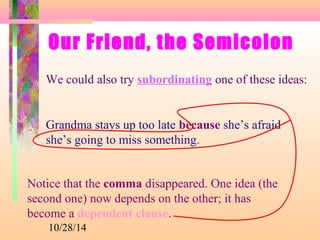
We could also try subordinating one of these ideas: 
Grandma stays up too late because she’s afraid 
she’s going to miss something. 
Notice that the comma disappeared. One idea (the 
second one) now depends on the other; it has 
become a dependent clause. 
10/28/14
Our Friend, the Semicolon 
But let’s try something else. 
10/28/14
Our Friend, the Semicolon 
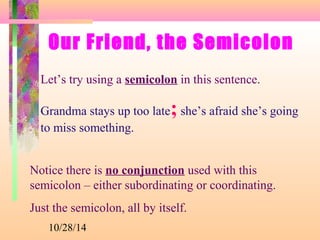
Let’s try using a semicolon in this sentence. 
Grandma stays up too late; she’s afraid she’s going 
to miss something. 
Notice there is no conjunction used with this 
semicolon – either subordinating or coordinating. 
Just the semicolon, all by itself. 
10/28/14
Our Friend, the Semicolon 
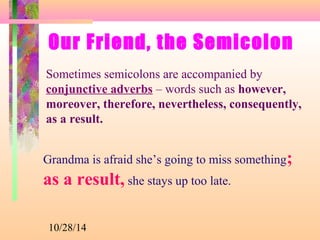
Sometimes semicolons are accompanied by 
conjunctive adverbs – words such as however, 
moreover, therefore, nevertheless, consequently, 
as a result. 
Grandma is afraid she’s going to miss something; 
as a result, she stays up too late. 
10/28/14
Our Friend, the Semicolon 
Notice the pattern: 
; as a result, 
semicolon + conjunctive adverb + comma 
This is a typical construction with semicolons. 
10/28/14
Our Friend, the Semicolon 
There is one other use of the semicolon: to help us 
sort out monster lists, like this one: 
The committee included Peter Wursthorn, Professor of 
Mathematics, from Marlborough, Connecticut, Virginia 
Villa, Professor of English, from Hartford, Connecticut, Paul 
Creech, Director of Rad-Tech, from Essex, Connecticut, and 
Joan Leach, Professor of Nursing, from Farmington, 
Connecticut. 
10/28/14
Our Friend, the Semicolon 
Be careful where you insert semicolons in this 
sentence. 
The committee included Peter Wursthorn, Professor of 
Mathematics, from Marlborough, Connecticut; Virginia 
Villa, Professor of English, from Hartford, Connecticut ; Paul 
Creech, Director of Rad-Tech, from Essex, Connecticut ; and 
Joan Leach, Professor of Nursing, from Farmington, 
Connecticut. 
10/28/14
Our Friend, the Semicolon 
Now you know everything you’ll ever need to know 
about using semicolons! 
10/28/14

Semi2

  • 1.
    Our Friend, theSemicolon 10/28/14
  • 2.
    Our Friend, theSemicolon Let’s begin with a simple sentence: Grandma stays up too late. 10/28/14
  • 3.
    Our Friend, theSemicolon Now let’s expand on that a bit: Grandma stays up too late. She’s afraid she’s going to miss something. This is OK. Two independent ideas, separated by a period. 10/28/14
  • 4.
    Our Friend, theSemicolon What if we try to combine the two ideas? Grandma stays up too late, she’s afraid she’s going to miss something. Something’s wrong. We connected two independent clauses with only a comma. The dreaded COMMA SPLICE! 10/28/14
  • 5.
    Our Friend, theSemicolon We could insert a coordinating conjunction: Grandma is afraid she’ll miss something, so she stays up too late. This is better! Note the comma that accompanies the coordinating conjunction. 10/28/14
  • 6.
    Our Friend, theSemicolon We could also try subordinating one of these ideas: Grandma stays up too late because she’s afraid she’s going to miss something. Notice that the comma disappeared. One idea (the second one) now depends on the other; it has become a dependent clause. 10/28/14
  • 7.
    Our Friend, theSemicolon But let’s try something else. 10/28/14
  • 8.
    Our Friend, theSemicolon Let’s try using a semicolon in this sentence. Grandma stays up too late; she’s afraid she’s going to miss something. Notice there is no conjunction used with this semicolon – either subordinating or coordinating. Just the semicolon, all by itself. 10/28/14
  • 9.
    Our Friend, theSemicolon Sometimes semicolons are accompanied by conjunctive adverbs – words such as however, moreover, therefore, nevertheless, consequently, as a result. Grandma is afraid she’s going to miss something; as a result, she stays up too late. 10/28/14
  • 10.
    Our Friend, theSemicolon Notice the pattern: ; as a result, semicolon + conjunctive adverb + comma This is a typical construction with semicolons. 10/28/14
  • 11.
    Our Friend, theSemicolon There is one other use of the semicolon: to help us sort out monster lists, like this one: The committee included Peter Wursthorn, Professor of Mathematics, from Marlborough, Connecticut, Virginia Villa, Professor of English, from Hartford, Connecticut, Paul Creech, Director of Rad-Tech, from Essex, Connecticut, and Joan Leach, Professor of Nursing, from Farmington, Connecticut. 10/28/14
  • 12.
    Our Friend, theSemicolon Be careful where you insert semicolons in this sentence. The committee included Peter Wursthorn, Professor of Mathematics, from Marlborough, Connecticut; Virginia Villa, Professor of English, from Hartford, Connecticut ; Paul Creech, Director of Rad-Tech, from Essex, Connecticut ; and Joan Leach, Professor of Nursing, from Farmington, Connecticut. 10/28/14
  • 13.
    Our Friend, theSemicolon Now you know everything you’ll ever need to know about using semicolons! 10/28/14