Role of NGOs in Development:  Case Study from Oxfam in IndiaPresentation made to Semester at Sea  NishaAgrawal, CEO, Oxfam IndiaOctober 6, 2011
Topics to be CoveredThe Global ChallengesOxfam International’s Role The Challenges in India The Role of Oxfam India
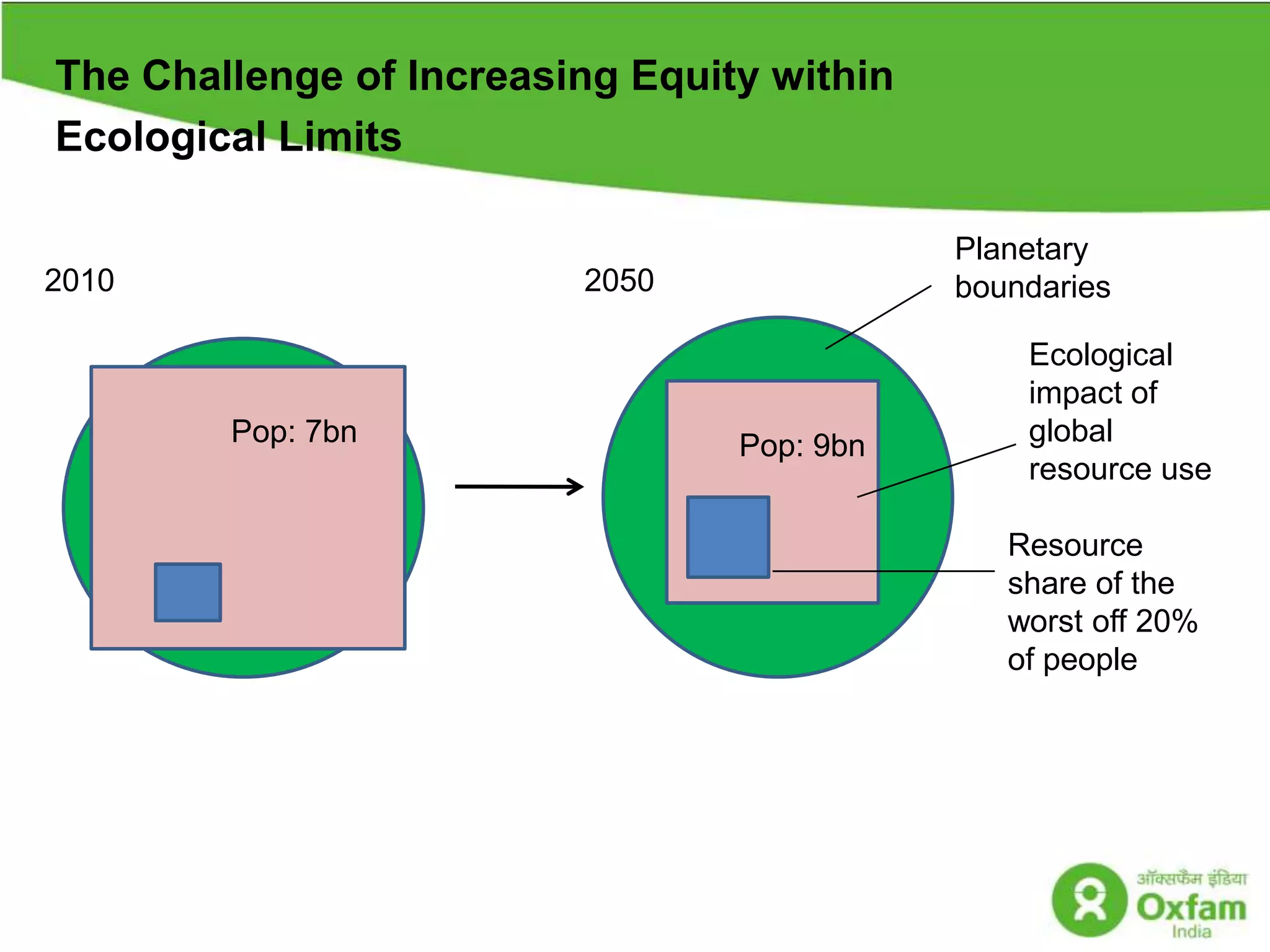
The Challenge of Increasing Equity within Ecological LimitsPlanetary boundaries20102050Pop: 7bnPop: 9bnEcological impact of global resource useResource share of the worst off 20% of people
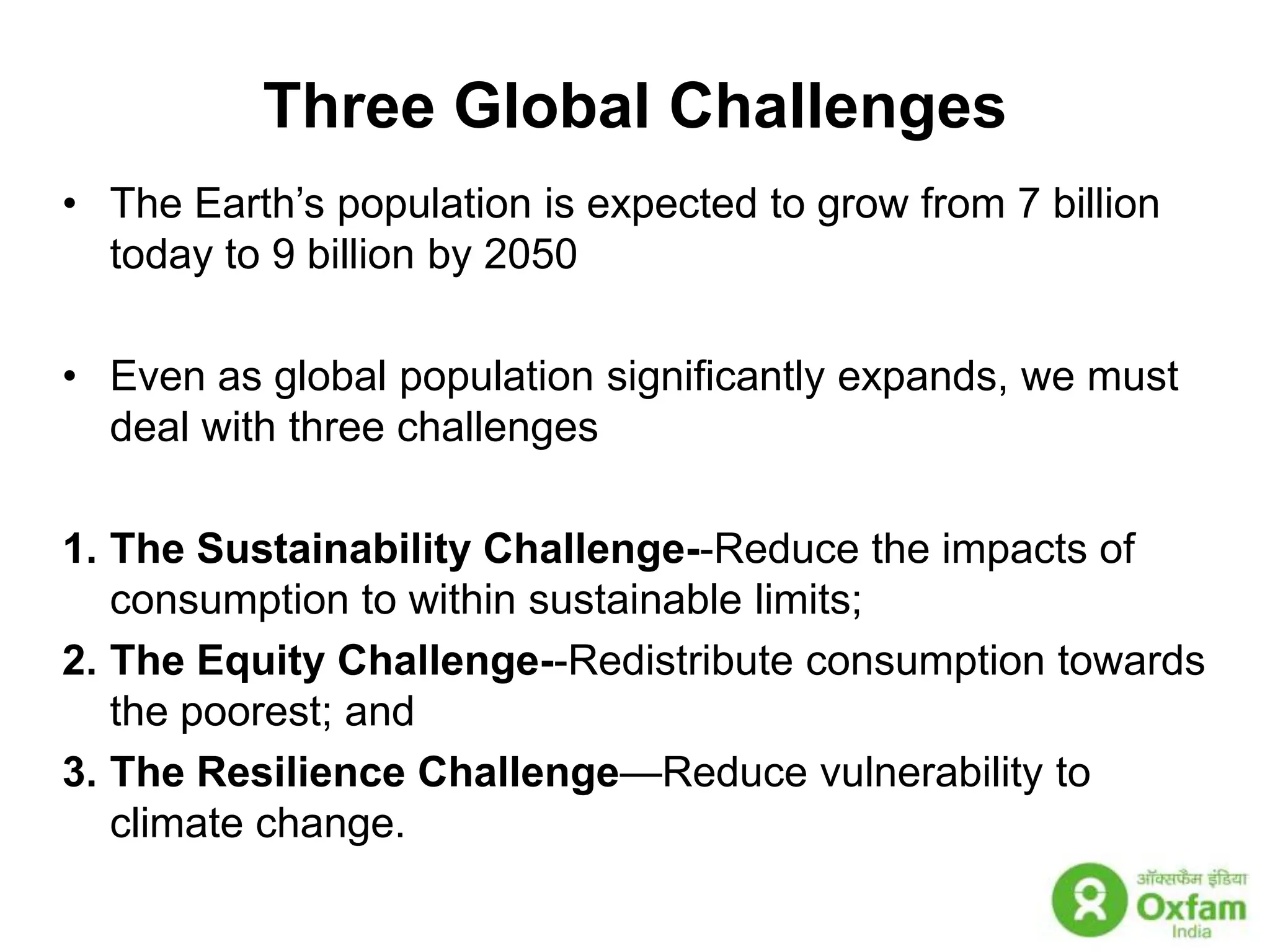
Three Global ChallengesThe Earth’s population is expected to grow from 7 billion today to 9 billion by 2050Even as global population significantly expands, we must deal with three challengesThe Sustainability Challenge--Reduce the impacts of consumption to within sustainable limits; The Equity Challenge--Redistribute consumption towards the poorest; and The Resilience Challenge—Reduce vulnerability to climate change.
Topics to be CoveredThe Global ChallengesOxfam International’s Role The Challenges in India The Role of Oxfam India
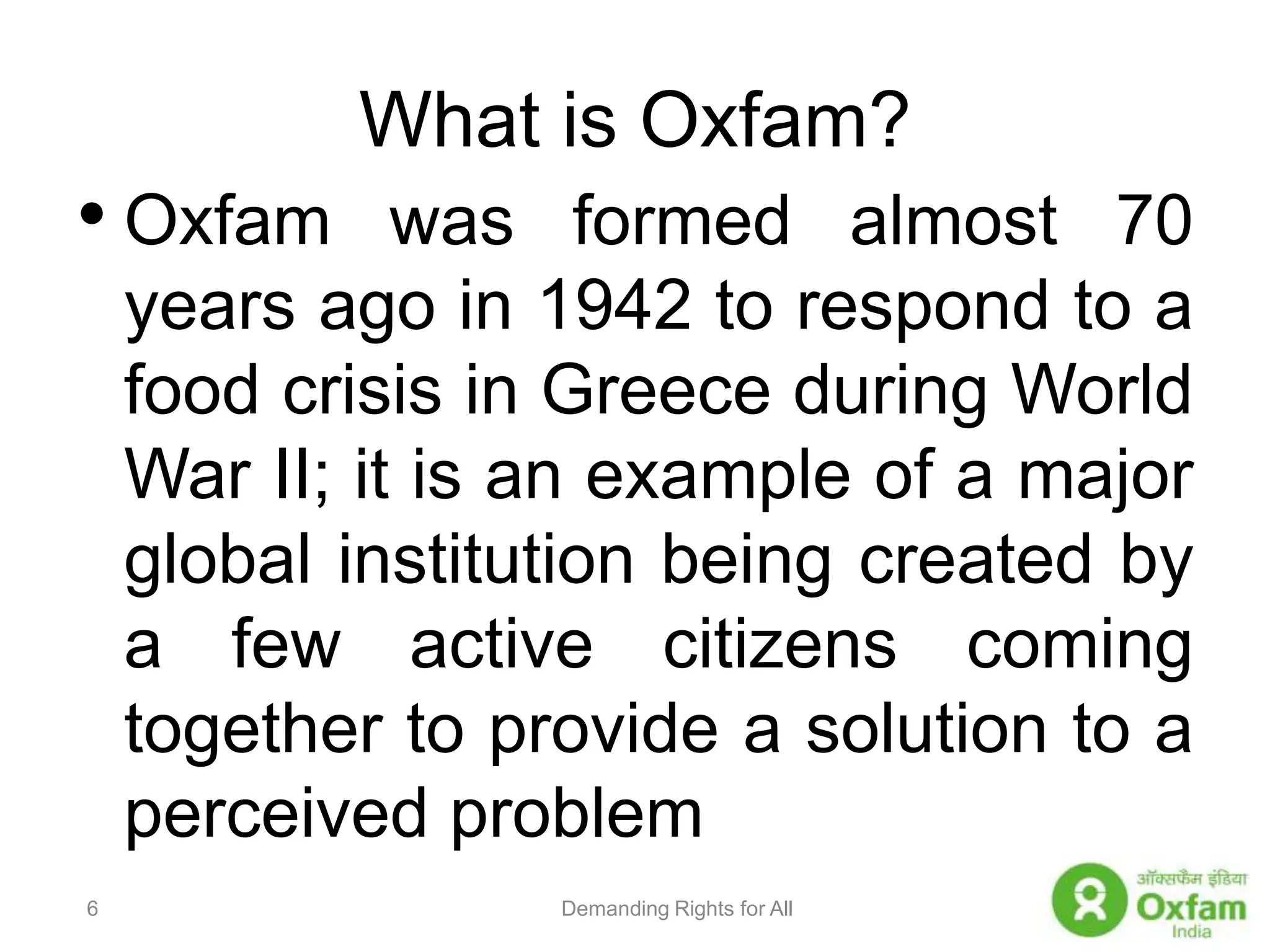
What is Oxfam?Oxfam was formed almost 70 years ago in 1942 to respond to a food crisis in Greece during World War II; it is an example of a major global institution being created by a few active citizens coming together to provide a solution to a perceived problemDemanding Rights for All6
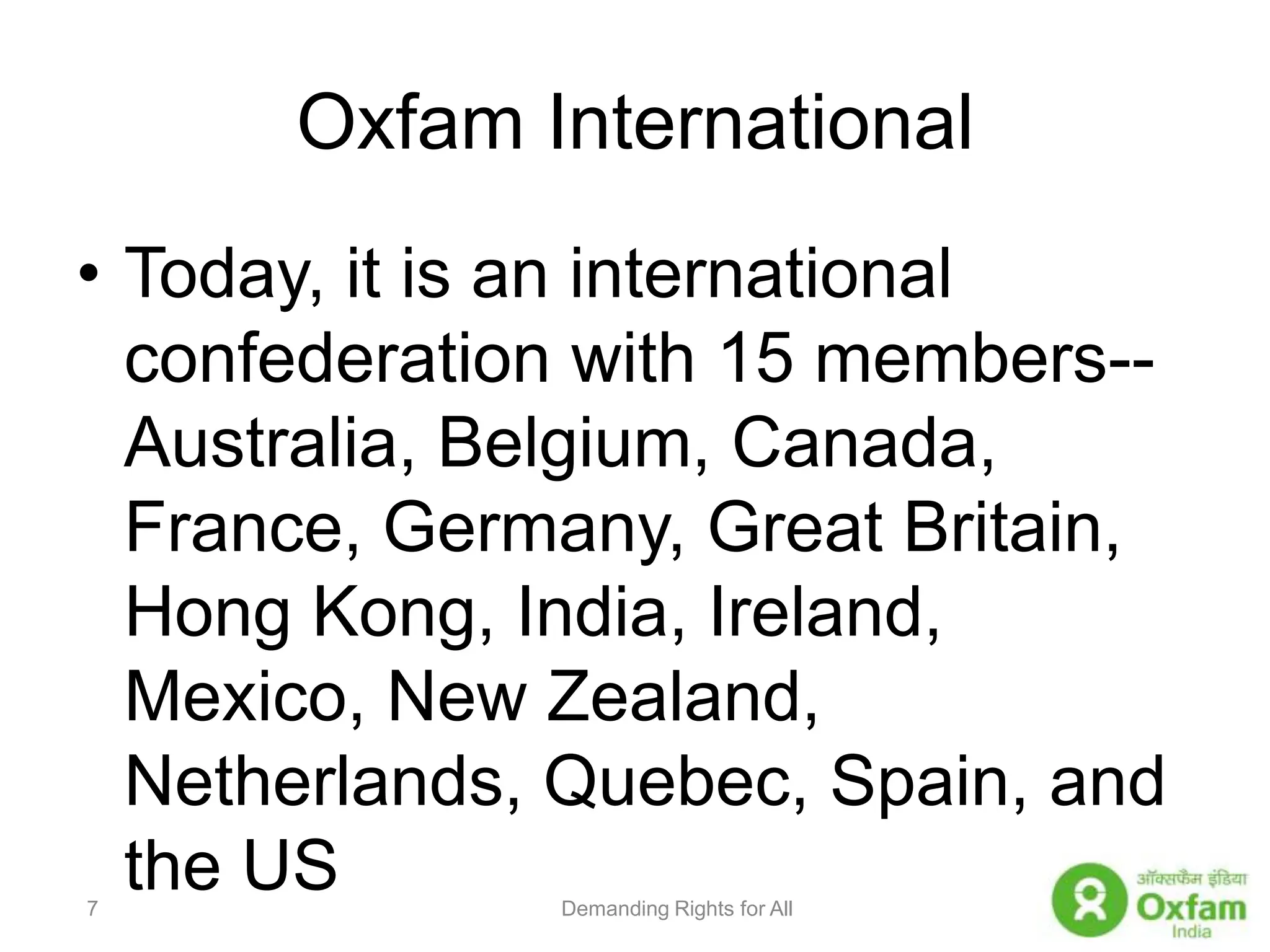
Oxfam InternationalToday, it is an international confederation with 15 members--Australia, Belgium, Canada, France, Germany, Great Britain, Hong Kong, India, Ireland, Mexico, New Zealand, Netherlands, Quebec, Spain, and the USDemanding Rights for All7
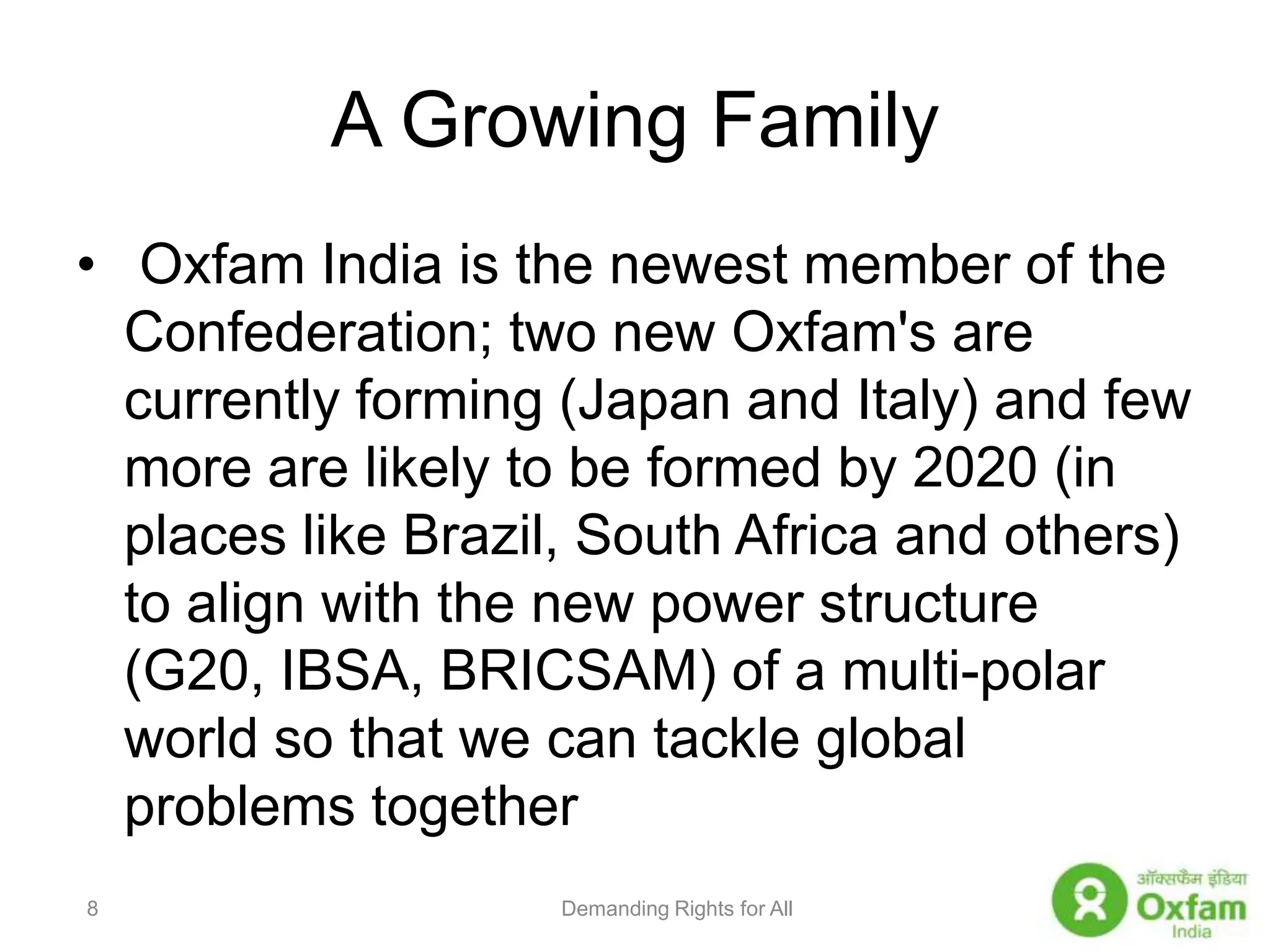
A Growing Family Oxfam India is the newest member of the Confederation; two new Oxfam's are currently forming (Japan and Italy) and few more are likely to be formed by 2020 (in places like Brazil, South Africa and others) to align with the new power structure (G20, IBSA, BRICSAM) of a multi-polar world so that we can tackle global problems togetherDemanding Rights for All8
Oxfam’s IdentityOxfam is a network of rights-based, advocacy organizations that fight poverty and injustice by linking grassroots programming done through partner NGOs to local, national, regional, and global advocacy and policymakingDemanding Rights for All9
Topics to be CoveredThe Global ChallengesOxfam International’s Role The Challenges in India The Role of Oxfam India
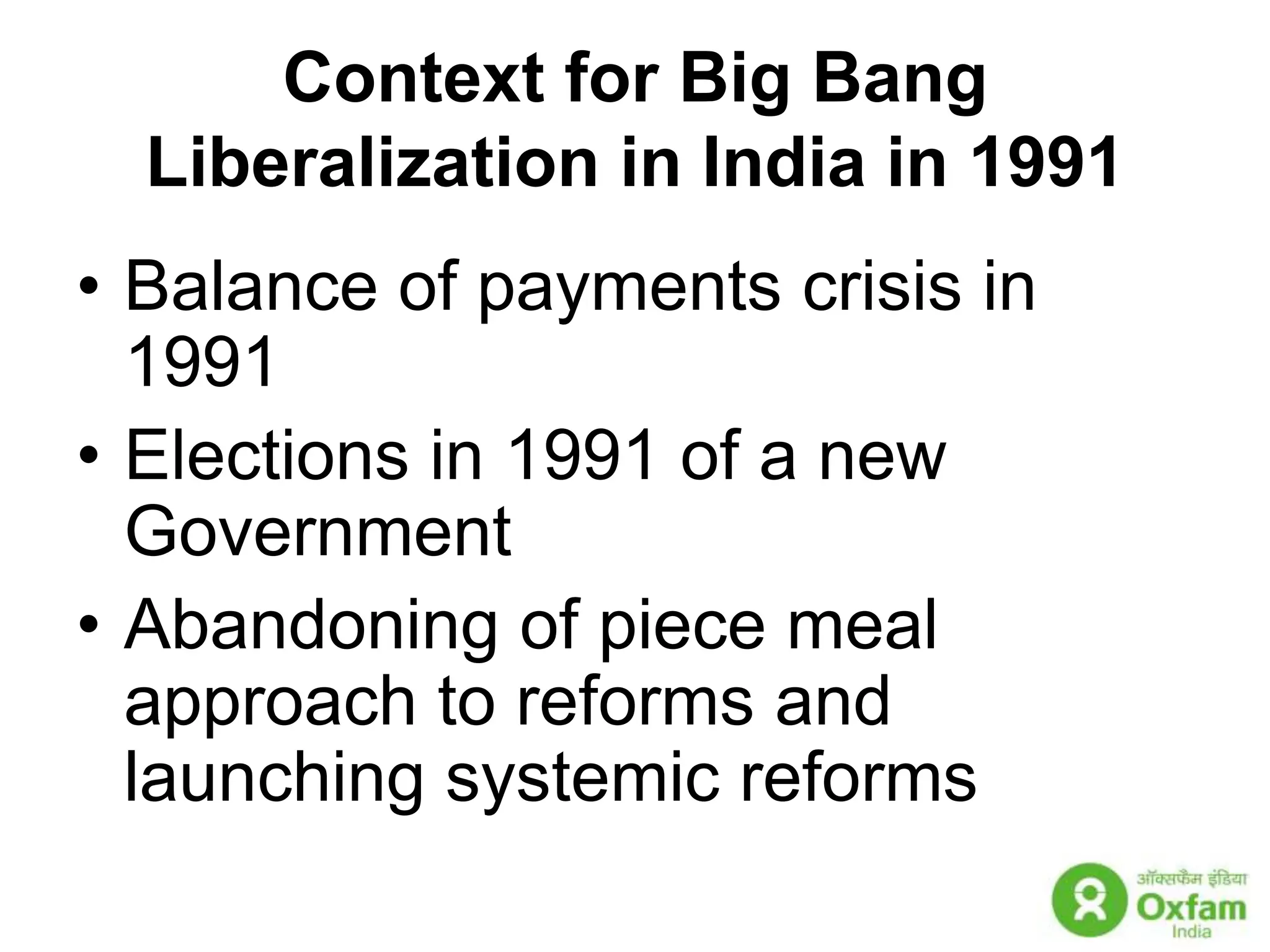
Context for Big Bang Liberalization in India in 1991Balance of payments crisis in 1991Elections in 1991 of a new GovernmentAbandoning of piece meal approach to reforms and launching systemic reforms
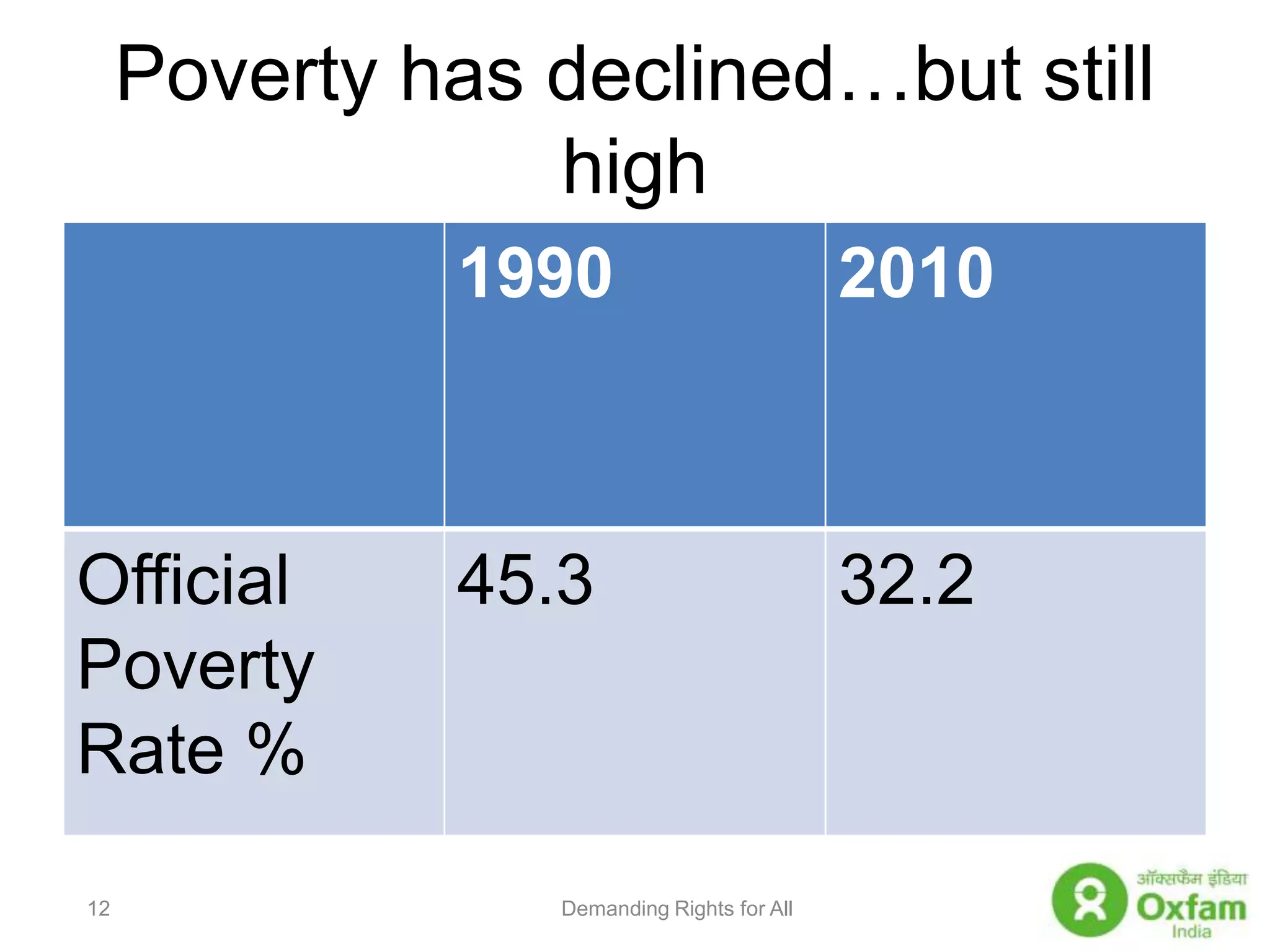
Poverty has declined…but still highDemanding Rights for All12
Topics to be CoveredThe Global ChallengesOxfam International’s Role The Challenges in India The Role of Oxfam India
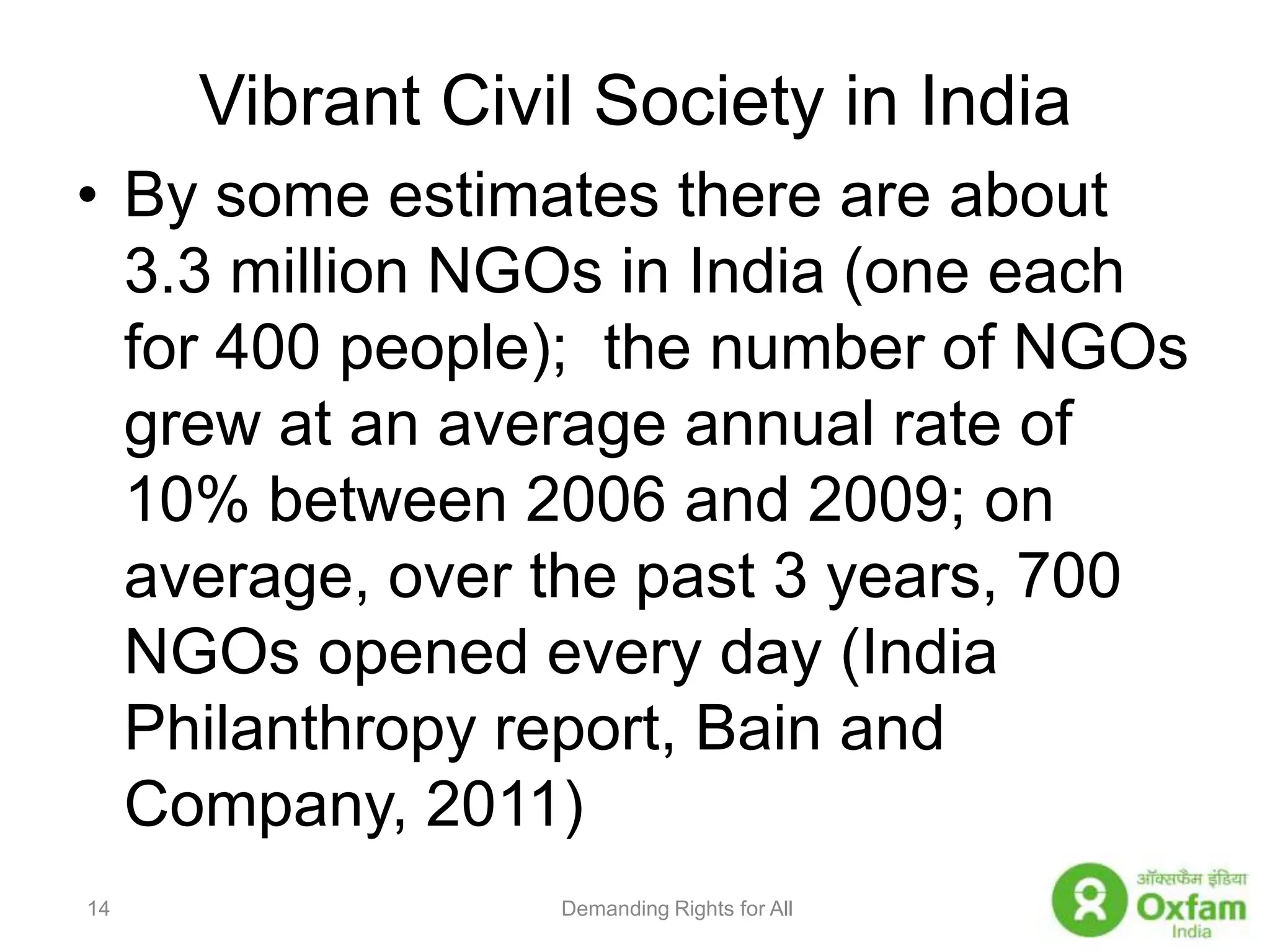
Vibrant Civil Society in IndiaBy some estimates there are about 3.3 million NGOs in India (one each for 400 people);  the number of NGOs grew at an average annual rate of 10% between 2006 and 2009; on average, over the past 3 years, 700 NGOs opened every day (India Philanthropy report, Bain and Company, 2011)Demanding Rights for All14
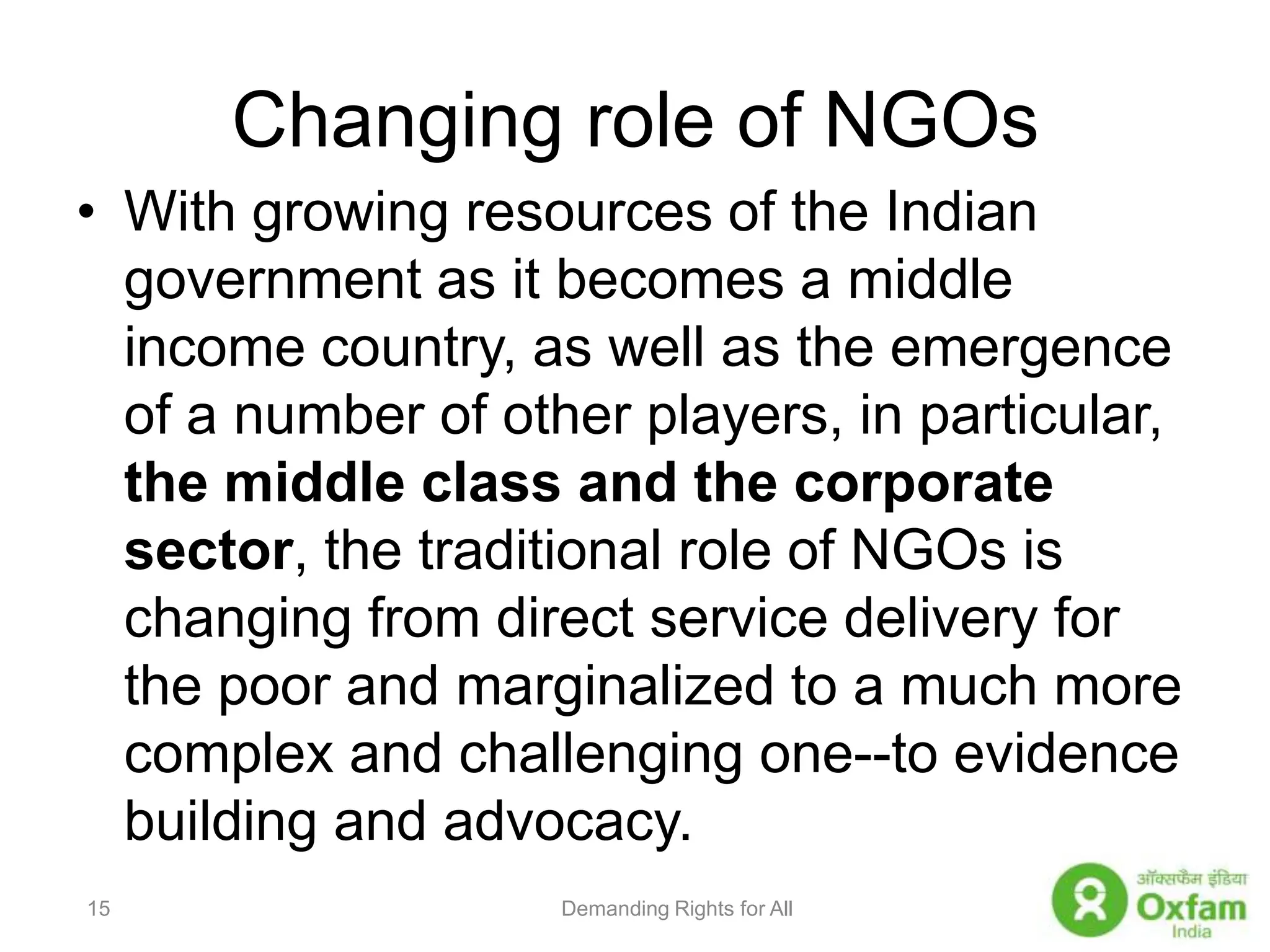
Changing role of NGOs With growing resources of the Indian government as it becomes a middle income country, as well as the emergence of a number of other players, in particular, the middle class and the corporate sector, the traditional role of NGOs is changing from direct service delivery for the poor and marginalized to a much more complex and challenging one--to evidence building and advocacy.  Demanding Rights for All15
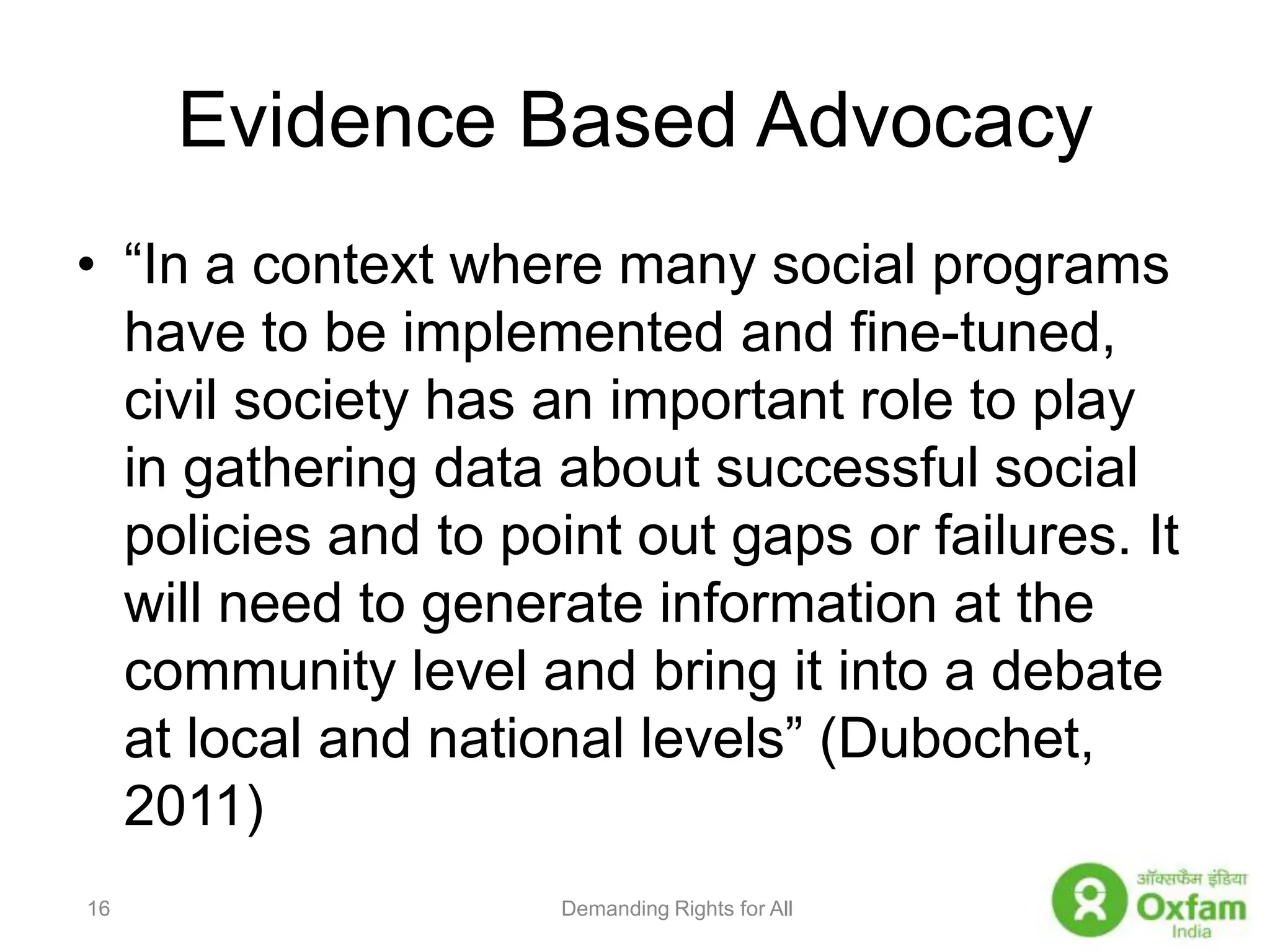
Evidence Based Advocacy“In a context where many social programs have to be implemented and fine-tuned, civil society has an important role to play in gathering data about successful social policies and to point out gaps or failures. It will need to generate information at the community level and bring it into a debate at local and national levels” (Dubochet, 2011)Demanding Rights for All16
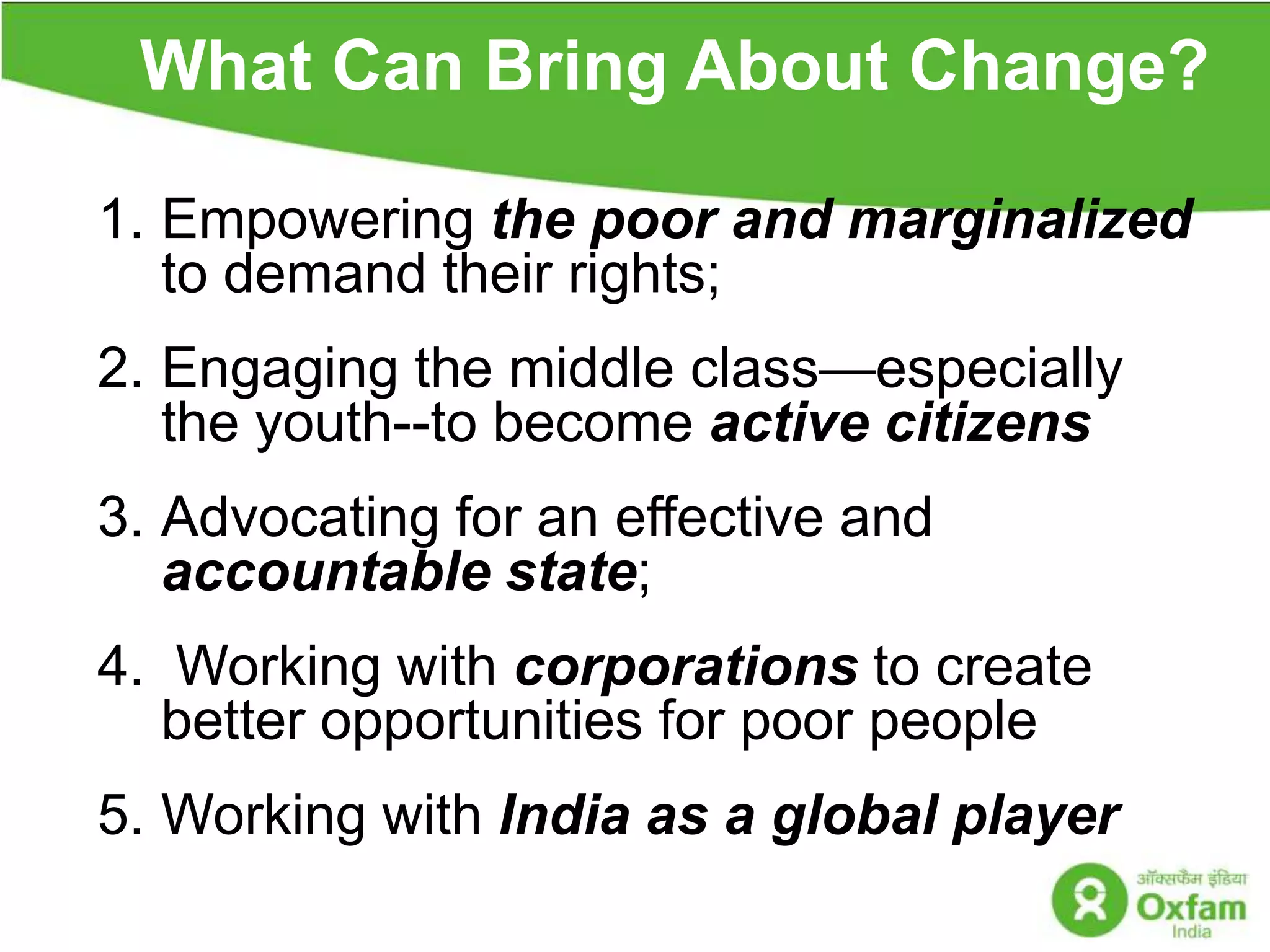
What Can Bring About Change? s Empowering the poor and marginalized to demand their rights;Engaging the middle class—especially the youth--to become active citizens3.	Advocating for an effective and accountable state; 4.  Working with corporations to create better opportunities for poor people5.	Working with India as a global player
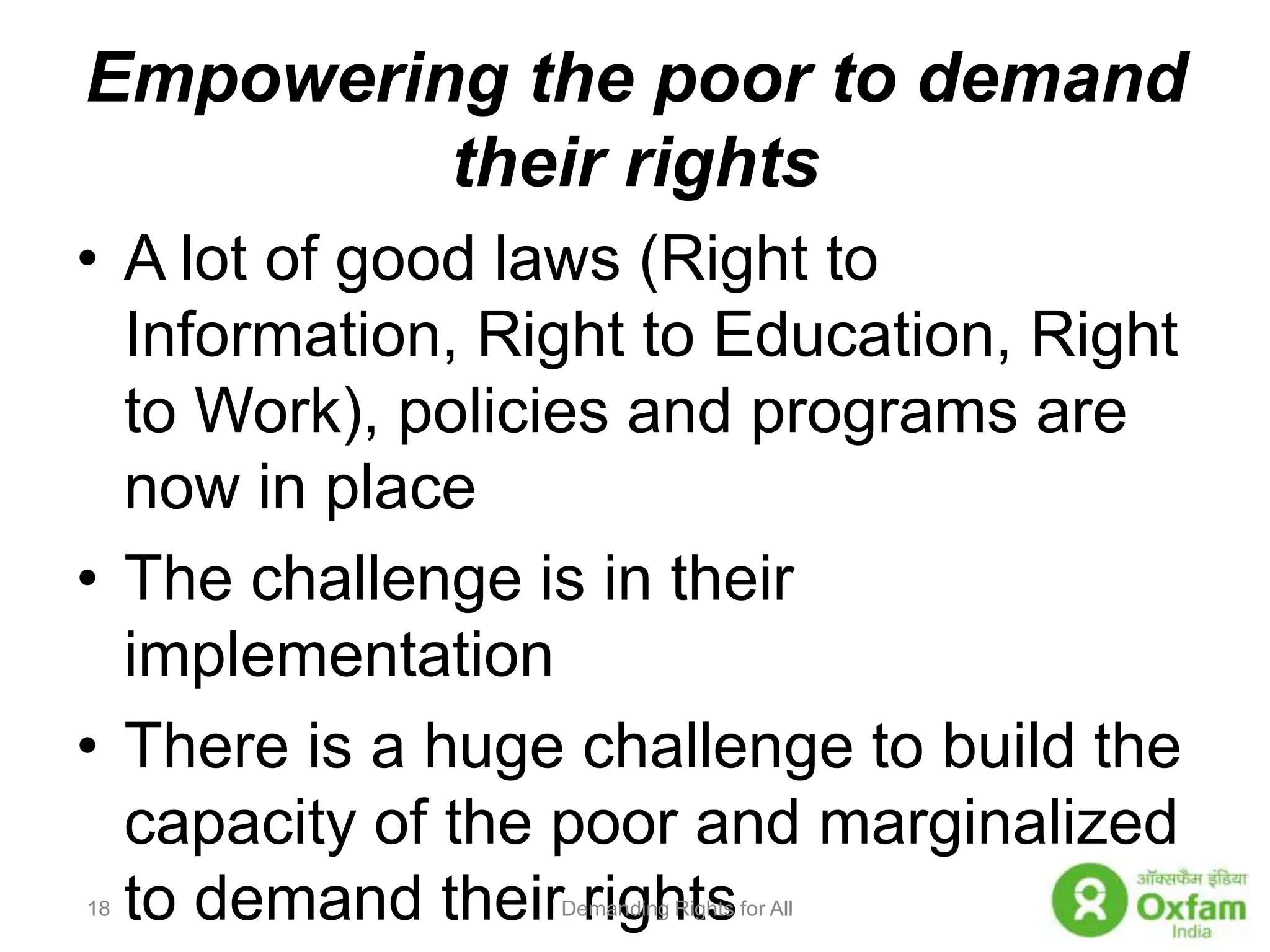
Empowering the poor to demand their rightsA lot of good laws (Right to Information, Right to Education, Right to Work), policies and programs are now in placeThe challenge is in their implementationThere is a huge challenge to build the capacity of the poor and marginalized to demand their rights Demanding Rights for All18
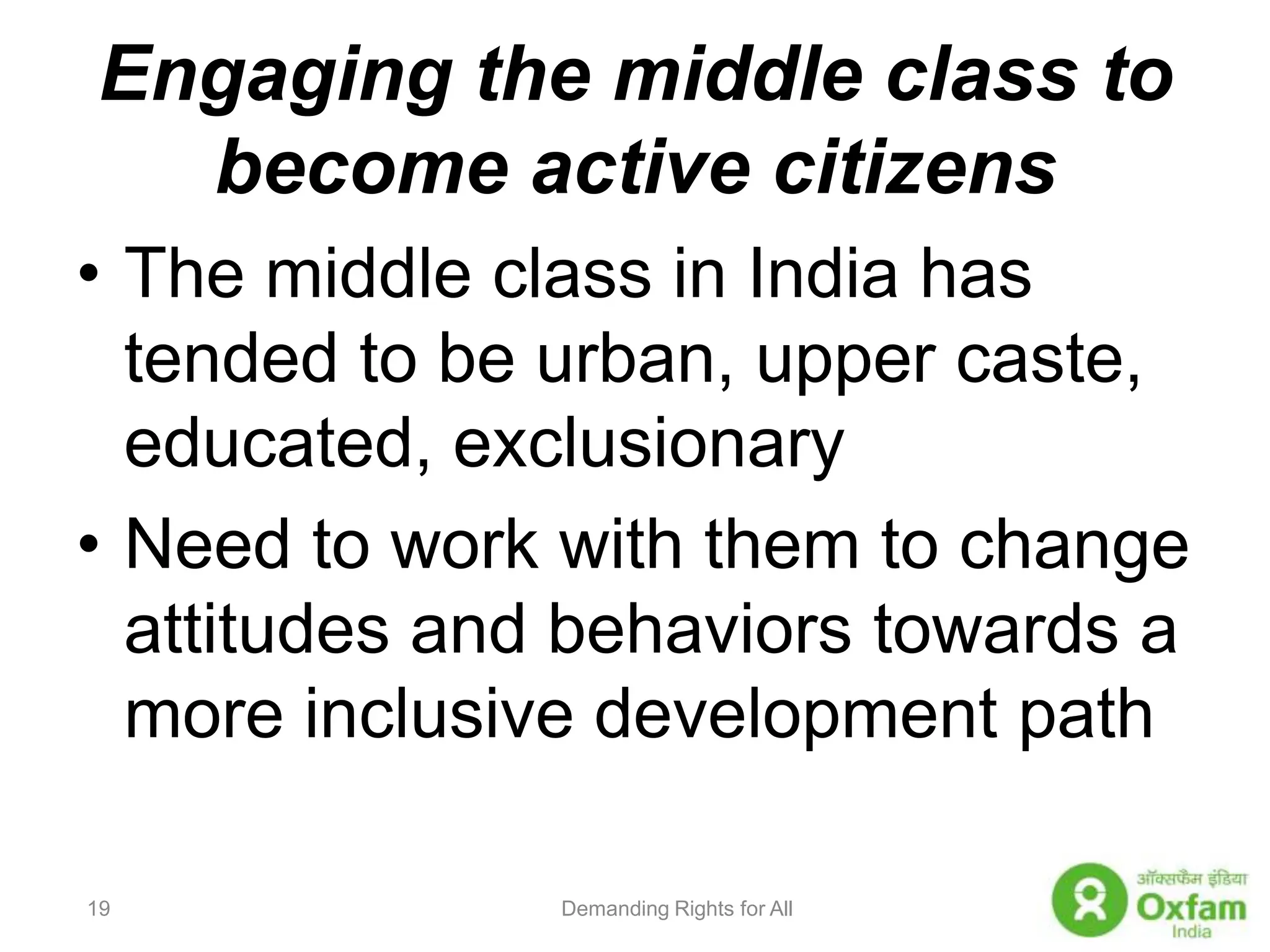
Engaging the middle class to become active citizens The middle class in India has tended to be urban, upper caste, educated, exclusionaryNeed to work with them to change attitudes and behaviors towards a more inclusive development pathDemanding Rights for All19
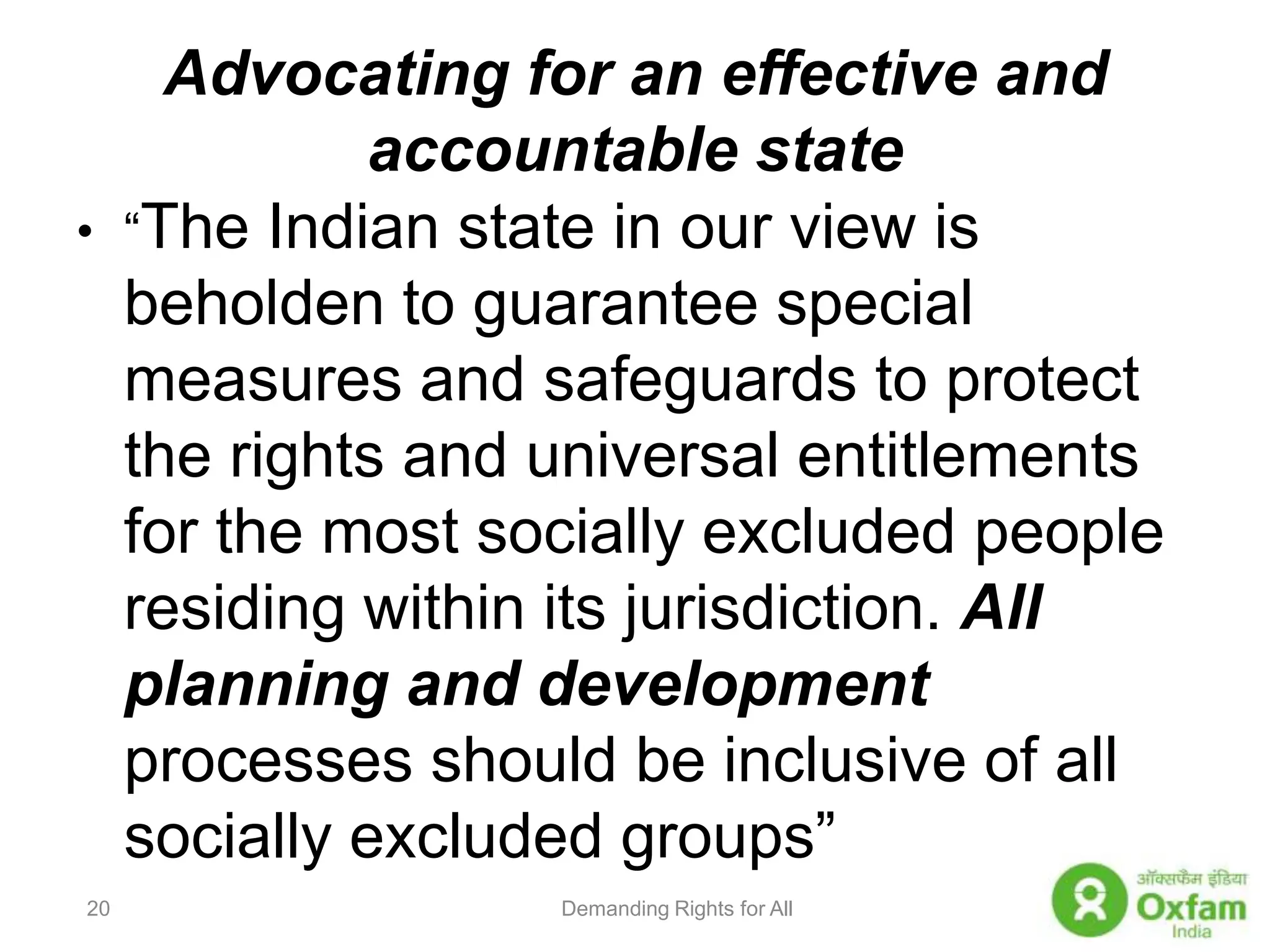
Advocating for an effective and accountable state“The Indian state in our view is beholden to guarantee special measures and safeguards to protect the rights and universal entitlements for the most socially excluded people residing within its jurisdiction. All planning and development processes should be inclusive of all socially excluded groups”  Demanding Rights for All20
Engaging with corporations for better CSR policies and practicesThe Corporate sector is growing and changing rapidly in IndiaTraditionally, civil society has played a watchdog role to hold businesses accountable on human, social, and economic rights of communities; this role is even more vital todayDemanding Rights for All21
Influencing India as a global playerIndia’s international position is one of increasing influence and assertivenessIn recent years, in several international negotiations (trade, climate change), India has emerged as an influential actor; it is also a member of G20Demanding Rights for All22
Thank you for your attentionDemanding Rights for All23
Semester at sea explorer's seminar on role of ng os final

Semester at sea explorer's seminar on role of ng os final

  • 1.
    Role of NGOsin Development: Case Study from Oxfam in IndiaPresentation made to Semester at Sea NishaAgrawal, CEO, Oxfam IndiaOctober 6, 2011
  • 2.
    Topics to beCoveredThe Global ChallengesOxfam International’s Role The Challenges in India The Role of Oxfam India
  • 3.
    The Challenge ofIncreasing Equity within Ecological LimitsPlanetary boundaries20102050Pop: 7bnPop: 9bnEcological impact of global resource useResource share of the worst off 20% of people
  • 4.
    Three Global ChallengesTheEarth’s population is expected to grow from 7 billion today to 9 billion by 2050Even as global population significantly expands, we must deal with three challengesThe Sustainability Challenge--Reduce the impacts of consumption to within sustainable limits; The Equity Challenge--Redistribute consumption towards the poorest; and The Resilience Challenge—Reduce vulnerability to climate change.
  • 5.
    Topics to beCoveredThe Global ChallengesOxfam International’s Role The Challenges in India The Role of Oxfam India
  • 6.
    What is Oxfam?Oxfamwas formed almost 70 years ago in 1942 to respond to a food crisis in Greece during World War II; it is an example of a major global institution being created by a few active citizens coming together to provide a solution to a perceived problemDemanding Rights for All6
  • 7.
    Oxfam InternationalToday, itis an international confederation with 15 members--Australia, Belgium, Canada, France, Germany, Great Britain, Hong Kong, India, Ireland, Mexico, New Zealand, Netherlands, Quebec, Spain, and the USDemanding Rights for All7
  • 8.
    A Growing FamilyOxfam India is the newest member of the Confederation; two new Oxfam's are currently forming (Japan and Italy) and few more are likely to be formed by 2020 (in places like Brazil, South Africa and others) to align with the new power structure (G20, IBSA, BRICSAM) of a multi-polar world so that we can tackle global problems togetherDemanding Rights for All8
  • 9.
    Oxfam’s IdentityOxfam isa network of rights-based, advocacy organizations that fight poverty and injustice by linking grassroots programming done through partner NGOs to local, national, regional, and global advocacy and policymakingDemanding Rights for All9
  • 10.
    Topics to beCoveredThe Global ChallengesOxfam International’s Role The Challenges in India The Role of Oxfam India
  • 11.
    Context for BigBang Liberalization in India in 1991Balance of payments crisis in 1991Elections in 1991 of a new GovernmentAbandoning of piece meal approach to reforms and launching systemic reforms
  • 12.
    Poverty has declined…butstill highDemanding Rights for All12
  • 13.
    Topics to beCoveredThe Global ChallengesOxfam International’s Role The Challenges in India The Role of Oxfam India
  • 14.
    Vibrant Civil Societyin IndiaBy some estimates there are about 3.3 million NGOs in India (one each for 400 people); the number of NGOs grew at an average annual rate of 10% between 2006 and 2009; on average, over the past 3 years, 700 NGOs opened every day (India Philanthropy report, Bain and Company, 2011)Demanding Rights for All14
  • 15.
    Changing role ofNGOs With growing resources of the Indian government as it becomes a middle income country, as well as the emergence of a number of other players, in particular, the middle class and the corporate sector, the traditional role of NGOs is changing from direct service delivery for the poor and marginalized to a much more complex and challenging one--to evidence building and advocacy. Demanding Rights for All15
  • 16.
    Evidence Based Advocacy“Ina context where many social programs have to be implemented and fine-tuned, civil society has an important role to play in gathering data about successful social policies and to point out gaps or failures. It will need to generate information at the community level and bring it into a debate at local and national levels” (Dubochet, 2011)Demanding Rights for All16
  • 17.
    What Can BringAbout Change? s Empowering the poor and marginalized to demand their rights;Engaging the middle class—especially the youth--to become active citizens3. Advocating for an effective and accountable state; 4. Working with corporations to create better opportunities for poor people5. Working with India as a global player
  • 18.
    Empowering the poorto demand their rightsA lot of good laws (Right to Information, Right to Education, Right to Work), policies and programs are now in placeThe challenge is in their implementationThere is a huge challenge to build the capacity of the poor and marginalized to demand their rights Demanding Rights for All18
  • 19.
    Engaging the middleclass to become active citizens The middle class in India has tended to be urban, upper caste, educated, exclusionaryNeed to work with them to change attitudes and behaviors towards a more inclusive development pathDemanding Rights for All19
  • 20.
    Advocating for aneffective and accountable state“The Indian state in our view is beholden to guarantee special measures and safeguards to protect the rights and universal entitlements for the most socially excluded people residing within its jurisdiction. All planning and development processes should be inclusive of all socially excluded groups” Demanding Rights for All20
  • 21.
    Engaging with corporationsfor better CSR policies and practicesThe Corporate sector is growing and changing rapidly in IndiaTraditionally, civil society has played a watchdog role to hold businesses accountable on human, social, and economic rights of communities; this role is even more vital todayDemanding Rights for All21
  • 22.
    Influencing India asa global playerIndia’s international position is one of increasing influence and assertivenessIn recent years, in several international negotiations (trade, climate change), India has emerged as an influential actor; it is also a member of G20Demanding Rights for All22
  • 23.
    Thank you foryour attentionDemanding Rights for All23