Semantic Technologies at FAO International Society for Knowledge Organization (ISKO) 3 Aprile 2009, Torino Margherita Sini
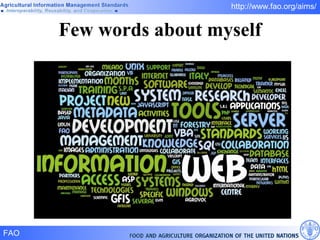
Few words about myself
Just a very rapid introduction What? semantic, semantic web, semantic technologies ontologies, Knowledge Organization Systems,  metadata Why? interoperability, exchange, share user orientation, precision and recall multilinguality, cultural views, context Who? everybody, all domains, all countries, all .org Which instruments? experts, NLP, methodologies and techniques
Outline Semantic projects involving FAO AOS IPFSAPH, FNA, CWR, Fisheries, Food & nutrition, Geopolitical ontology, AGROVOC Concept Server Thai Rice Onto, Agropedia Indica Methods and Methodologies Ontology models (AGROVOC Concept Server, LIR, ...) Methods What’s next registries: concepts, relationships guidelines networked ontologies ontology-based applications collaborations
Semantic projects involving FAO
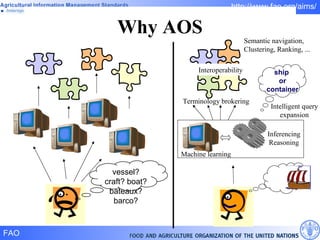
Why AOS vessel? craft? boat? bateaux? barco? Terminology brokering Semantic navigation, Clustering, Ranking, ... Intelligent query expansion Interoperability ship  or container Inferencing Reasoning Machine learning
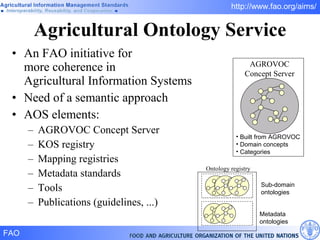
Agricultural Ontology Service An FAO initiative for  more coherence in  Agricultural Information Systems Need of a semantic approach AOS elements: AGROVOC Concept Server KOS registry Mapping registries Metadata standards Tools Publications (guidelines, ...) Built from AGROVOC  Domain concepts Categories AGROVOC Concept Server Ontology registry Sub-domain ontologies Metadata ontologies
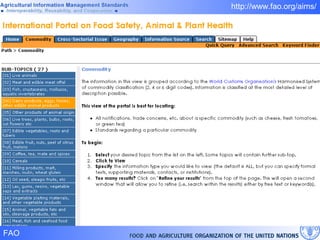
IPFSAPH
IPFSAPH
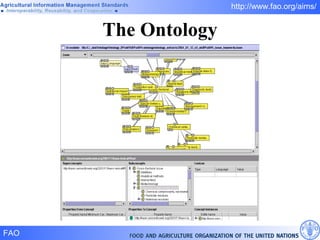
The Ontology
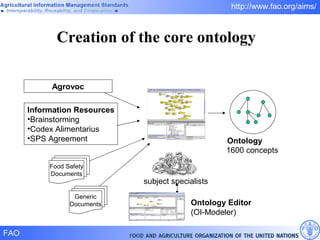
Creation of the core ontology 1600 concepts Information Resources Brainstorming Codex Alimentarius SPS Agreement Ontology Ontology Editor (OI-Modeler) Agrovoc Food Safety Documents Generic Documents subject specialists
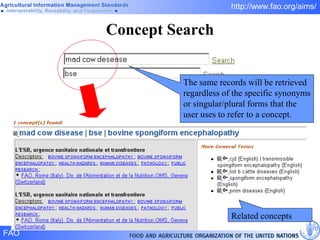
Concept Search The same records will be retrieved regardless of the specific synonyms or singular/plural forms that the user uses to refer to a concept. Related concepts
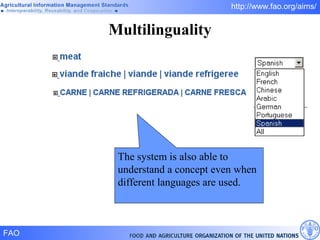
Multilinguality The system is also able to understand a concept even when different languages are used.
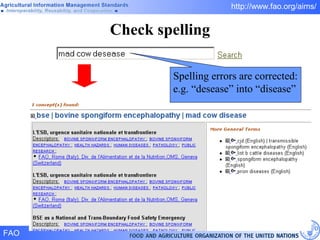
Check spelling Spelling errors are corrected: e.g. “desease” into “disease”
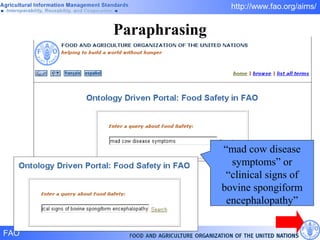
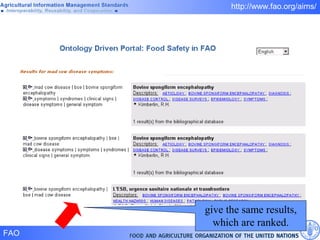
Paraphrasing “ mad cow disease symptoms” or “clinical signs of bovine spongiform encephalopathy”
give the same results, which are ranked.
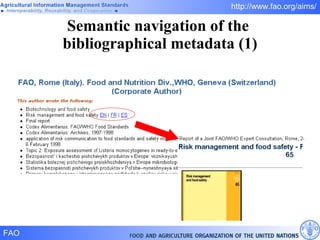
Semantic navigation of the  bibliographical metadata (1)
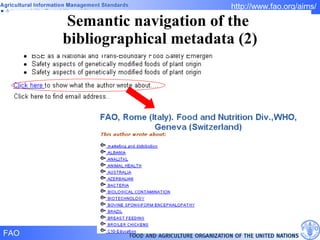
Semantic navigation of the  bibliographical metadata (2)
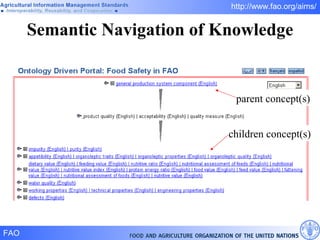
Semantic Navigation of Knowledge parent concept(s) children concept(s)
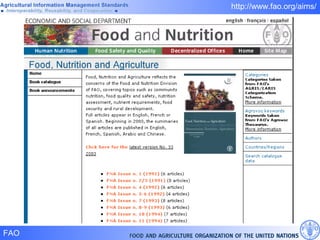
FNA
 
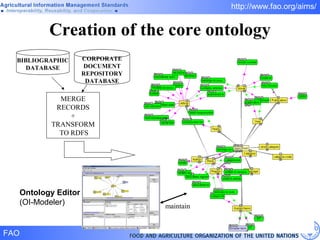
Creation of the core ontology BIBLIOGRAPHIC DATABASE CORPORATE DOCUMENT REPOSITORY DATABASE MERGE RECORDS + TRANSFORM  TO RDFS Ontology Editor (OI-Modeler) maintain
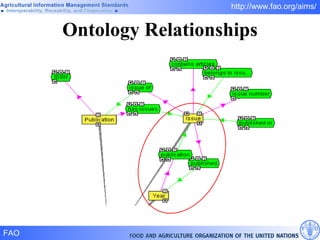
Ontology Relationships
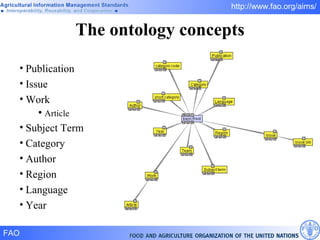
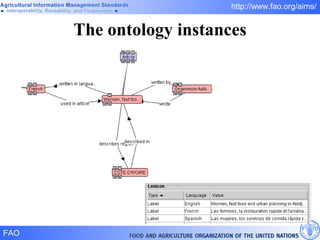
The ontology concepts Publication Issue Work Article Subject Term Category Author Region Language Year
The ontology instances
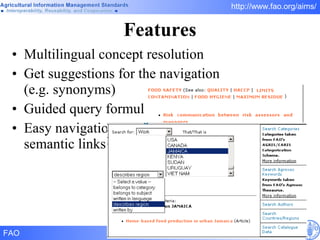
Features Multilingual concept resolution Get suggestions for the navigation (e.g. synonyms) Guided query formulation Easy navigation of the objects by following the semantic links
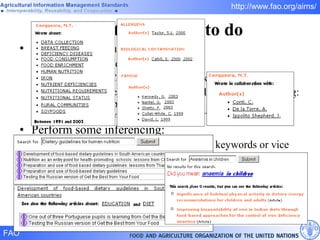
What is possible to do Improve browsing: e.g. continent / regions / countries e.g. link Agris/Caris categories with keywords concept identification through natural language processing: spell checking, parsing  ( e.g. “Dietary guidelines for human nutrition” or “Anaemia in children ”) Perform some inferencing: get the authors associated with specific keywords or vice versa  (“what an author wrote about between two years”, “who wrote about  famine  in 1999”, etc.) get the co-authors show articles with the same set or related keywords
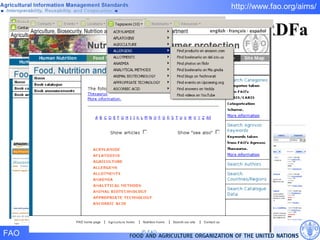
RDFa
CWR
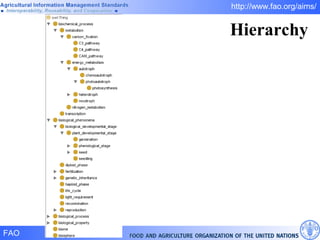
Hierarchy
Undertaken by FAO Developed in harmony with CWR descriptor list First version (English only) available by December 2006 About 800 core terms + acronyms + spelling variants; Clearly definition of concepts (AGROVOC + other sources); and Relationships: hierarchical + causative The project
Knowledge sharing and reuse is now the primary goal of research communities worldwide.  An ontology defines a common vocabulary; its potential is enormous. For researchers, scientists, extension workers, decision- and policy-makers, who need to share information about a specialized domain an ontology allows for: sharing a common understanding of the structure of the information provided; formalizing and reusing the domain knowledge; analyzing it; and separating it from operational knowledge.
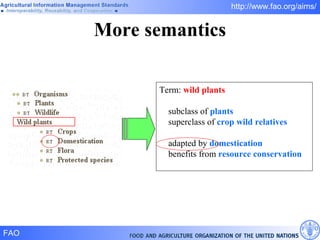
More semantics Term:  wild plants subclass of  plants superclass of  crop wild relatives adapted by  domestication benefits from   resource conservation
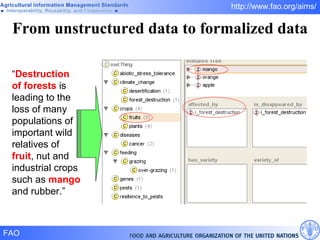
From unstructured data to formalized data “ Destruction of forests  is leading to the loss of many populations of important wild relatives of  fruit , nut and industrial crops such as  mango  and rubber.”
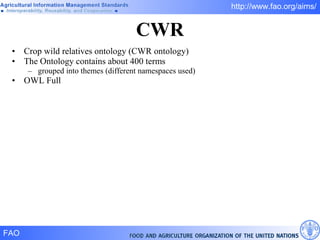
CWR Crop wild relatives ontology (CWR ontology) The Ontology contains about 400 terms grouped into themes (different namespaces used) OWL Full
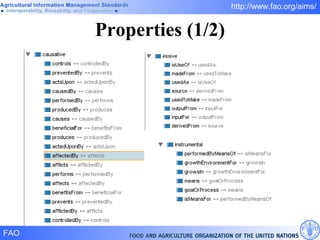
Properties (1/2)
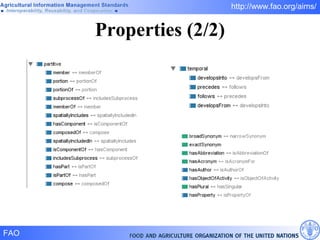
Properties (2/2)
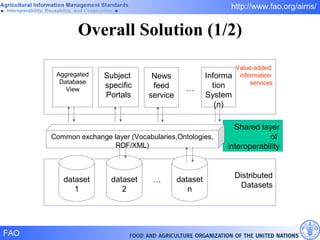
Overall Solution (1/2) Value-added  information  services Shared layer of  interoperability  Distributed Datasets dataset1 dataset2 Common exchange layer (Vocabularies,Ontologies, RDF/XML) … … datasetn Aggregated Database View Subject  specific Portals Information System (n) News feed service
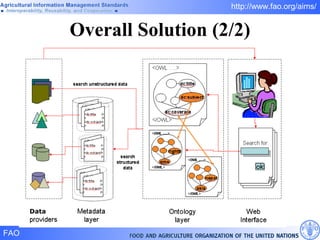
Overall Solution (2/2) Data
Fisheries
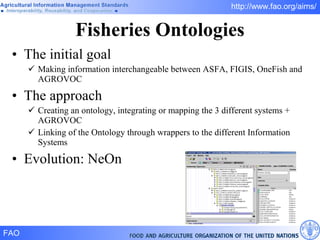
The initial goal Making information interchangeable between ASFA, FIGIS, OneFish and AGROVOC The approach Creating an ontology, integrating or mapping the 3 different systems + AGROVOC Linking of the Ontology through wrappers to the different Information Systems Evolution: NeOn Fisheries Ontologies
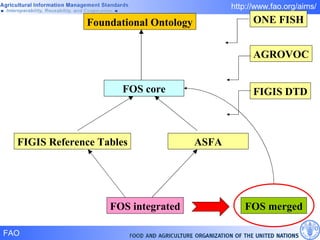
Foundational Ontology FOS core FOS integrated FOS merged FIGIS Reference Tables ASFA FIGIS DTD ONE FISH AGROVOC
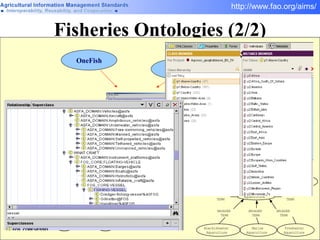
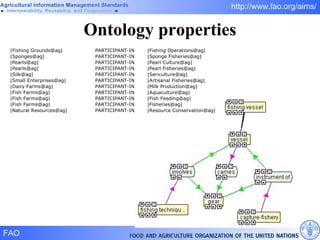
Fisheries Ontologies (2/2) OneFish FIGIS AGROVOC Aquaculture  Resource Water  Area land strains Species life cycle Farming  system management  system Production center Spawning technique Breeding  technique Hatchery  technique Expl. form Regulation Farming technique Environment Institution Health monitoring technique diseases suppliers ASFA
Features Form versus meaning: Traditional Search Concept Search Implemented functionalities: synonym search multilingual capability terminology brokering disambiguation related concepts query expansion Basic natural language queries Semantic navigation of bibliographical metadata Semantic Navigation of Knowledge Alphabetic list  ... Core Fishery Concepts  ...
Ontology properties
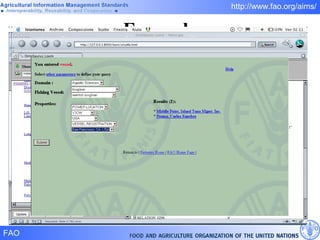
Example "tell me what vessels from a nearby country are currently in the marine area 50N060W within Atlantic Ocean, provided that also some Thunnus alalunga stock can be fished by those vessels, through allowed techniques"
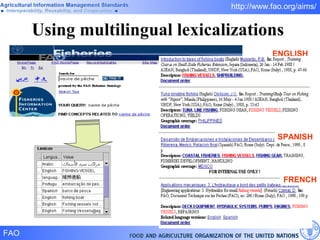
Using multilingual lexicalizations  ENGLISH SPANISH FRENCH
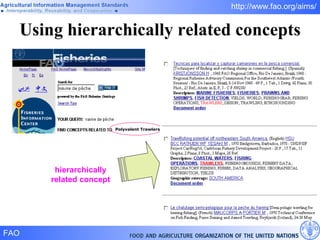
Using hierarchically related concepts hierarchically related concept Polyvalent Trawlers
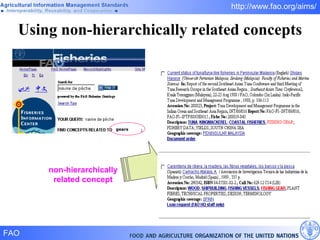
Using non-hierarchically related concepts non-hierarchically related concept gears
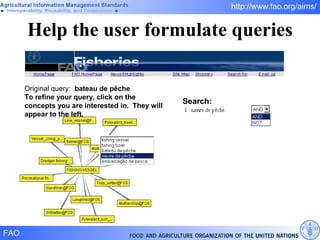
Help the user formulate queries Original query:  bateau de pêche To refine your query, click on the concepts you are interested in.  They will appear to the left. Search:
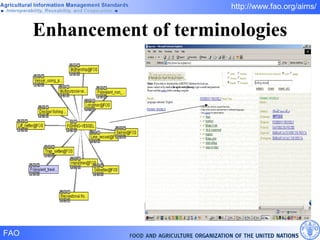
Enhancement of terminologies
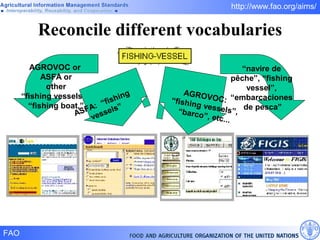
Reconcile different vocabularies “ navire de  p ê che”, “fishing  vessel”,  “ embarcaciones  de pesca” AGROVOC or  ASFA or other “ fishing vessels,”  “ fishing boat,” AGROVOC:  “fishing vessels”,  “barco”, etc... ASFA:  “fishing  vessels”
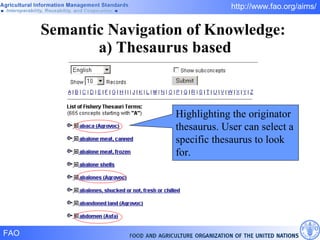
Semantic Navigation of Knowledge:  a) Thesaurus based Highlighting the originator thesaurus. User can select a specific thesaurus to look for.
Geopolitical ontology
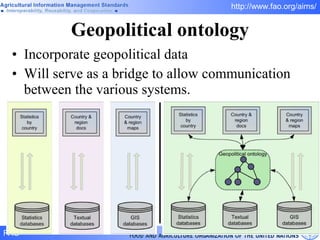
Geopolitical ontology Incorporate geopolitical data Will serve as a bridge to allow communication between the various systems.
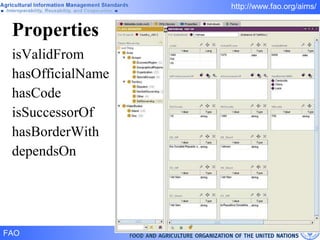
Properties isValidFrom hasOfficialName hasCode isSuccessorOf hasBorderWith dependsOn
Nutrition Ontology
 
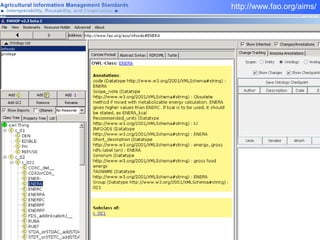
Procedure =CONCATENATE(&quot;<owl:Class rdf:ID=&quot;&quot;&quot;,J2,&quot;&quot;&quot;><rdfs:subClassOf><owl:Class rdf:ID=&quot;&quot;c_&quot;,B2,&quot;&quot;&quot;/></rdfs:subClassOf><rdfs:label xml:lang=&quot;&quot;en&quot;&quot;><![CDATA[&quot;,D2,&quot;]]></rdfs:label><code><![CDATA[&quot;,J2,&quot;]]></code><TAGNAME><![CDATA[&quot;,J2,&quot;]]></TAGNAME>&quot;,S2, T2,&quot;</owl:Class>&quot;) <?xml version=&quot;1.0&quot;?> <rdf:RDF xmlns=&quot;http://www.fao.org/aos/infoods#&quot; xmlns:protege=&quot;http://protege.stanford.edu/plugins/owl/protege#&quot; xmlns:rdf=&quot;http://www.w3.org/1999/02/22-rdf-syntax-ns#&quot; xmlns:xsd=&quot;http://www.w3.org/2001/XMLSchema#&quot; xmlns:rdfs=&quot;http://www.w3.org/2000/01/rdf-schema#&quot; xmlns:owl=&quot;http://www.w3.org/2002/07/owl#&quot; xmlns:daml=&quot;http://www.daml.org/2001/03/daml+oil#&quot; xmlns:dc=&quot;http://purl.org/dc/elements/1.1/&quot; xml:base=&quot;http://www.fao.org/aos/infoods&quot;> <owl:Ontology rdf:about=&quot;&quot;> <owl:imports rdf:resource=&quot;http://protege.stanford.edu/plugins/owl/protege&quot;/> <owl:versionInfo rdf:datatype=&quot;http://www.w3.org/2001/XMLSchema#string&quot; >Revision 4.0</owl:versionInfo> <protege:defaultLanguage rdf:datatype=&quot;http://www.w3.org/2001/XMLSchema#string&quot; >en</protege:defaultLanguage> <rdfs:comment rdf:datatype=&quot;http://www.w3.org/2001/XMLSchema#string&quot; >International Network of Food Data Systems (INFOODS) was established in 1984 on the basis of the recommendations of an international group convened under the auspices of the United Nations University (UNU). Its goal was to .....</rdfs:comment> </owl:Ontology> <owl:Class rdf:ID=&quot;c_0413&quot;> <code rdf:datatype=&quot;http://www.w3.org/2001/XMLSchema#string&quot; >0413</code> <rdfs:subClassOf> <owl:Class rdf:ID=&quot;c_041&quot;/> </rdfs:subClassOf> <rdfs:label xml:lang=&quot;en&quot;>Vitamin D</rdfs:label> </owl:Class>
AGROVOC
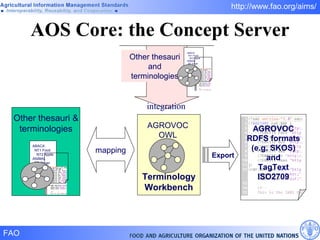
AOS Core: the Concept Server Export mapping Terminology Workbench AGROVOC OWL AGROVOC RDFS formats (e.g. SKOS) and TagText ISO2709 Other thesauri and terminologies integration ABACA NT1 Food NT2 Apple ANIMAL BT Organ NT .... Other thesauri & terminologies ABACA NT1 Food NT2 Apple ANIMAL BT Organ NT ....
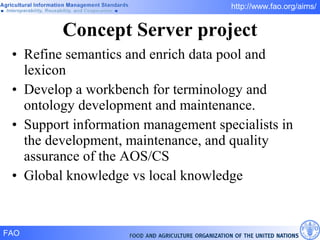
Concept Server project Refine semantics and enrich data pool and lexicon Develop a workbench for terminology and ontology development and maintenance.  Support information management specialists in the development, maintenance, and quality assurance of the AOS/CS Global knowledge vs local knowledge
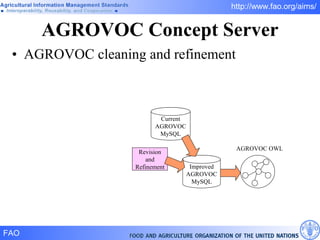
AGROVOC Concept Server AGROVOC cleaning and refinement Current AGROVOC MySQL Improved AGROVOC MySQL AGROVOC OWL Revision and Refinement
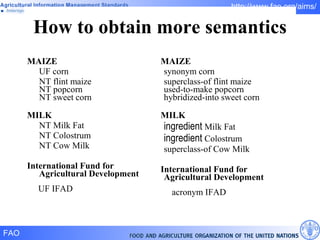
How to obtain more semantics MAIZE UF corn  NT flint maize  NT popcorn  NT sweet corn    MILK NT Milk Fat  NT Colostrum NT Cow Milk International Fund for Agricultural Development UF IFAD  MAIZE synonym corn superclass-of flint maize  used-to-make popcorn  hybridized-into sweet corn    MILK ingredient  Milk Fat  ingredient  Colostrum superclass-of Cow Milk International Fund for Agricultural Development acronym IFAD
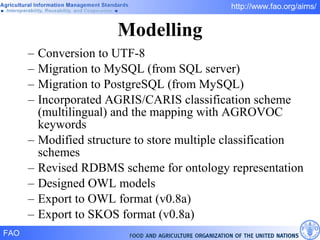
Modelling Conversion to UTF-8 Migration to MySQL (from SQL server) Migration to PostgreSQL (from MySQL) Incorporated AGRIS/CARIS classification scheme (multilingual) and the mapping with AGROVOC keywords Modified structure to store multiple classification schemes Revised RDBMS scheme for ontology representation Designed OWL models Export to OWL format (v0.8a) Export to SKOS format (v0.8a)
Methods Concepts from descriptors Synonym  <owl:DatatypeProperty rdf:ID=&quot;synonym&quot;> Acronyms  <owl:AnnotationProperty rdf:about=&quot;http://www.fao.org/aos/agrovoc/2005#acronym&quot;> < owl:Class  rdf:about=&quot;  http://www.fao.org/aos/agrovoc/2005 #c_3&quot;> <rdfs:label xml:lang=&quot;en&quot;>ABA</rdfs:label> <rdfs:label xml:lang=&quot;fr&quot;>ABA</rdfs:label> <rdfs:label xml:lang=&quot;es&quot;>ABA</rdfs:label> <rdfs:label xml:lang=&quot;ar&quot;>آبا</rdfs:label> <rdfs:label xml:lang=&quot;zh&quot;>脱落酸</rdfs:label> <synonym xml:lang=&quot;en&quot;>[8565] Abscisic acid</synonym> <rdfs:subClassOf rdf:resource=&quot;  http://www.fao.org/aos/agrovoc/2005 #c_3397&quot;/> <rdfs:subClassOf rdf:resource=&quot;  http://www.fao.org/aos/agrovoc/2005 #c_32543&quot;/> </owl:Class>
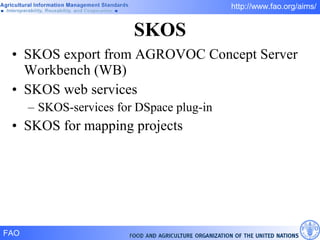
SKOS SKOS export from AGROVOC Concept Server Workbench (WB) SKOS web services SKOS-services for DSpace plug-in SKOS for mapping projects
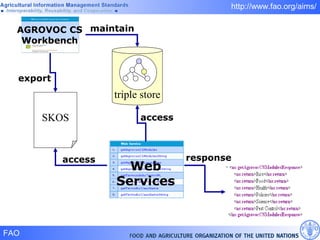
SKOS export maintain access access response AGROVOC CS Workbench triple store Web Services
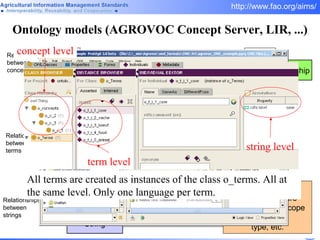
Ontology models (AGROVOC Concept Server, LIR, ...) Concept Relationships between concepts Lexicalization/ Term String Relationships between strings Relationships between terms designated by manifested as Other information: language/culture subvocabulary/scope audience type, etc. Note annotation relationship Relationship Relationships between Relationships All terms are created as instances of the class o_terms. All at the same level. Only one language per term. term level string level concept level
Agropedia Indica
References http://www.slideshare.net/marghe_rita/1-pantnagar http://www.slideshare.net/marghe_rita/2-pantnagar-w-guidelines http://www.slideshare.net/marghe_rita/3-pantnagar-w-exercices   http://agropedia.iitk.ac.in/
Thai Rice Ontology
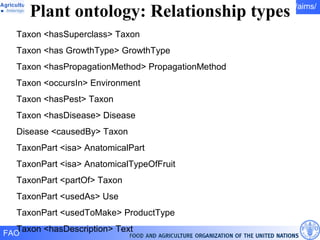
Plant ontology: Relationship types Taxon <hasSuperclass> Taxon  Taxon <has GrowthType> GrowthType Taxon <hasPropagationMethod> PropagationMethod Taxon <occursIn> Environment Taxon <hasPest> Taxon Taxon <hasDisease> Disease Disease <causedBy> Taxon TaxonPart <isa> AnatomicalPart TaxonPart <isa> AnatomicalTypeOfFruit TaxonPart <partOf> Taxon TaxonPart <usedAs> Use TaxonPart <usedToMake> ProductType Taxon <hasDescription> Text
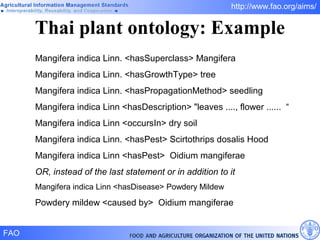
Thai plant ontology: Example Mangifera indica Linn. <hasSuperclass> Mangifera Mangifera indica Linn. <hasGrowthType> tree Mangifera indica Linn. <hasPropagationMethod> seedling Mangifera indica Linn <hasDescription> &quot;leaves ...., flower ......  “ Mangifera indica Linn <occursIn> dry soil Mangifera indica Linn. <hasPest> Scirtothrips dosalis Hood  Mangifera indica Linn <hasPest>  Oidium mangiferae  OR, instead of the last statement or in addition to it Mangifera indica Linn <hasDisease> Powdery Mildew Powdery mildew <caused by>  Oidium mangiferae
Conclusions
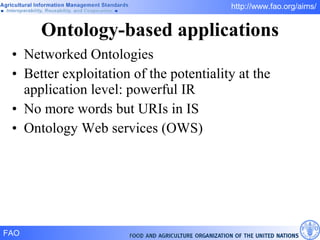
Ontology-based applications Networked Ontologies Better exploitation of the potentiality at the application level: powerful IR No more words but URIs in IS Ontology Web services (OWS)
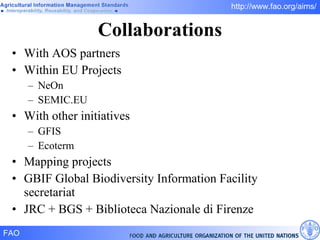
Collaborations With AOS partners Within EU Projects NeOn SEMIC.EU With other initiatives GFIS Ecoterm Mapping projects GBIF Global Biodiversity Information Facility secretariat JRC + BGS + Biblioteca Nazionale di Firenze
Take-home message There are many uses for terminology & ontology systems in food and agriculture, both for information access and information  processing FAO has several projects using such systems FAO is deploying the  Agricultural Ontology Server (AOS) as a global resource SKOS and other knowledge representation standards play a key role
Questions? Thanks Margherita Sini: margherita.Sini@fao.org Johannes Keizer: Johannes.Keizer@fao.org Dagobert Soergel: dsoergel@umd.edu Asanee Kawtrakul:  [email_address] But Also: Gudrun Johannsen, Boris Lauser, Claudio Baldassarre, Gauri Salokhe, Marta Iglesias, Caterina Caracciolo, Sachit Rajbhandari, Jeetendra Singh, Mary Redahan, Shrestha, Prashanta, Ton, Imm, Thanapth, Trakul, and many others...

Semantic Technologies at FAO

  • 1.
    Semantic Technologies atFAO International Society for Knowledge Organization (ISKO) 3 Aprile 2009, Torino Margherita Sini
  • 2.
  • 3.
    Just a veryrapid introduction What? semantic, semantic web, semantic technologies ontologies, Knowledge Organization Systems, metadata Why? interoperability, exchange, share user orientation, precision and recall multilinguality, cultural views, context Who? everybody, all domains, all countries, all .org Which instruments? experts, NLP, methodologies and techniques
  • 4.
    Outline Semantic projectsinvolving FAO AOS IPFSAPH, FNA, CWR, Fisheries, Food & nutrition, Geopolitical ontology, AGROVOC Concept Server Thai Rice Onto, Agropedia Indica Methods and Methodologies Ontology models (AGROVOC Concept Server, LIR, ...) Methods What’s next registries: concepts, relationships guidelines networked ontologies ontology-based applications collaborations
  • 5.
  • 6.
    Why AOS vessel?craft? boat? bateaux? barco? Terminology brokering Semantic navigation, Clustering, Ranking, ... Intelligent query expansion Interoperability ship or container Inferencing Reasoning Machine learning
  • 7.
    Agricultural Ontology ServiceAn FAO initiative for more coherence in Agricultural Information Systems Need of a semantic approach AOS elements: AGROVOC Concept Server KOS registry Mapping registries Metadata standards Tools Publications (guidelines, ...) Built from AGROVOC Domain concepts Categories AGROVOC Concept Server Ontology registry Sub-domain ontologies Metadata ontologies
  • 8.
  • 9.
  • 10.
  • 11.
    Creation of thecore ontology 1600 concepts Information Resources Brainstorming Codex Alimentarius SPS Agreement Ontology Ontology Editor (OI-Modeler) Agrovoc Food Safety Documents Generic Documents subject specialists
  • 12.
    Concept Search Thesame records will be retrieved regardless of the specific synonyms or singular/plural forms that the user uses to refer to a concept. Related concepts
  • 13.
    Multilinguality The systemis also able to understand a concept even when different languages are used.
  • 14.
    Check spelling Spellingerrors are corrected: e.g. “desease” into “disease”
  • 15.
    Paraphrasing “ madcow disease symptoms” or “clinical signs of bovine spongiform encephalopathy”
  • 16.
    give the sameresults, which are ranked.
  • 17.
    Semantic navigation ofthe bibliographical metadata (1)
  • 18.
    Semantic navigation ofthe bibliographical metadata (2)
  • 19.
    Semantic Navigation ofKnowledge parent concept(s) children concept(s)
  • 20.
  • 21.
  • 22.
    Creation of thecore ontology BIBLIOGRAPHIC DATABASE CORPORATE DOCUMENT REPOSITORY DATABASE MERGE RECORDS + TRANSFORM TO RDFS Ontology Editor (OI-Modeler) maintain
  • 23.
  • 24.
    The ontology conceptsPublication Issue Work Article Subject Term Category Author Region Language Year
  • 25.
  • 26.
    Features Multilingual conceptresolution Get suggestions for the navigation (e.g. synonyms) Guided query formulation Easy navigation of the objects by following the semantic links
  • 27.
    What is possibleto do Improve browsing: e.g. continent / regions / countries e.g. link Agris/Caris categories with keywords concept identification through natural language processing: spell checking, parsing ( e.g. “Dietary guidelines for human nutrition” or “Anaemia in children ”) Perform some inferencing: get the authors associated with specific keywords or vice versa (“what an author wrote about between two years”, “who wrote about famine in 1999”, etc.) get the co-authors show articles with the same set or related keywords
  • 28.
  • 29.
  • 30.
  • 31.
    Undertaken by FAODeveloped in harmony with CWR descriptor list First version (English only) available by December 2006 About 800 core terms + acronyms + spelling variants; Clearly definition of concepts (AGROVOC + other sources); and Relationships: hierarchical + causative The project
  • 32.
    Knowledge sharing andreuse is now the primary goal of research communities worldwide. An ontology defines a common vocabulary; its potential is enormous. For researchers, scientists, extension workers, decision- and policy-makers, who need to share information about a specialized domain an ontology allows for: sharing a common understanding of the structure of the information provided; formalizing and reusing the domain knowledge; analyzing it; and separating it from operational knowledge.
  • 33.
    More semantics Term: wild plants subclass of plants superclass of crop wild relatives adapted by domestication benefits from resource conservation
  • 34.
    From unstructured datato formalized data “ Destruction of forests is leading to the loss of many populations of important wild relatives of fruit , nut and industrial crops such as mango and rubber.”
  • 35.
    CWR Crop wildrelatives ontology (CWR ontology) The Ontology contains about 400 terms grouped into themes (different namespaces used) OWL Full
  • 36.
  • 37.
  • 38.
    Overall Solution (1/2)Value-added information services Shared layer of interoperability Distributed Datasets dataset1 dataset2 Common exchange layer (Vocabularies,Ontologies, RDF/XML) … … datasetn Aggregated Database View Subject specific Portals Information System (n) News feed service
  • 39.
  • 40.
  • 41.
    The initial goalMaking information interchangeable between ASFA, FIGIS, OneFish and AGROVOC The approach Creating an ontology, integrating or mapping the 3 different systems + AGROVOC Linking of the Ontology through wrappers to the different Information Systems Evolution: NeOn Fisheries Ontologies
  • 42.
    Foundational Ontology FOScore FOS integrated FOS merged FIGIS Reference Tables ASFA FIGIS DTD ONE FISH AGROVOC
  • 43.
    Fisheries Ontologies (2/2)OneFish FIGIS AGROVOC Aquaculture Resource Water Area land strains Species life cycle Farming system management system Production center Spawning technique Breeding technique Hatchery technique Expl. form Regulation Farming technique Environment Institution Health monitoring technique diseases suppliers ASFA
  • 44.
    Features Form versusmeaning: Traditional Search Concept Search Implemented functionalities: synonym search multilingual capability terminology brokering disambiguation related concepts query expansion Basic natural language queries Semantic navigation of bibliographical metadata Semantic Navigation of Knowledge Alphabetic list ... Core Fishery Concepts ...
  • 45.
  • 46.
    Example &quot;tell mewhat vessels from a nearby country are currently in the marine area 50N060W within Atlantic Ocean, provided that also some Thunnus alalunga stock can be fished by those vessels, through allowed techniques&quot;
  • 47.
    Using multilingual lexicalizations ENGLISH SPANISH FRENCH
  • 48.
    Using hierarchically relatedconcepts hierarchically related concept Polyvalent Trawlers
  • 49.
    Using non-hierarchically relatedconcepts non-hierarchically related concept gears
  • 50.
    Help the userformulate queries Original query: bateau de pêche To refine your query, click on the concepts you are interested in. They will appear to the left. Search:
  • 51.
  • 52.
    Reconcile different vocabularies“ navire de p ê che”, “fishing vessel”, “ embarcaciones de pesca” AGROVOC or ASFA or other “ fishing vessels,” “ fishing boat,” AGROVOC: “fishing vessels”, “barco”, etc... ASFA: “fishing vessels”
  • 53.
    Semantic Navigation ofKnowledge: a) Thesaurus based Highlighting the originator thesaurus. User can select a specific thesaurus to look for.
  • 54.
  • 55.
    Geopolitical ontology Incorporategeopolitical data Will serve as a bridge to allow communication between the various systems.
  • 56.
    Properties isValidFrom hasOfficialNamehasCode isSuccessorOf hasBorderWith dependsOn
  • 57.
  • 58.
  • 59.
    Procedure =CONCATENATE(&quot;<owl:Class rdf:ID=&quot;&quot;&quot;,J2,&quot;&quot;&quot;><rdfs:subClassOf><owl:Classrdf:ID=&quot;&quot;c_&quot;,B2,&quot;&quot;&quot;/></rdfs:subClassOf><rdfs:label xml:lang=&quot;&quot;en&quot;&quot;><![CDATA[&quot;,D2,&quot;]]></rdfs:label><code><![CDATA[&quot;,J2,&quot;]]></code><TAGNAME><![CDATA[&quot;,J2,&quot;]]></TAGNAME>&quot;,S2, T2,&quot;</owl:Class>&quot;) <?xml version=&quot;1.0&quot;?> <rdf:RDF xmlns=&quot;http://www.fao.org/aos/infoods#&quot; xmlns:protege=&quot;http://protege.stanford.edu/plugins/owl/protege#&quot; xmlns:rdf=&quot;http://www.w3.org/1999/02/22-rdf-syntax-ns#&quot; xmlns:xsd=&quot;http://www.w3.org/2001/XMLSchema#&quot; xmlns:rdfs=&quot;http://www.w3.org/2000/01/rdf-schema#&quot; xmlns:owl=&quot;http://www.w3.org/2002/07/owl#&quot; xmlns:daml=&quot;http://www.daml.org/2001/03/daml+oil#&quot; xmlns:dc=&quot;http://purl.org/dc/elements/1.1/&quot; xml:base=&quot;http://www.fao.org/aos/infoods&quot;> <owl:Ontology rdf:about=&quot;&quot;> <owl:imports rdf:resource=&quot;http://protege.stanford.edu/plugins/owl/protege&quot;/> <owl:versionInfo rdf:datatype=&quot;http://www.w3.org/2001/XMLSchema#string&quot; >Revision 4.0</owl:versionInfo> <protege:defaultLanguage rdf:datatype=&quot;http://www.w3.org/2001/XMLSchema#string&quot; >en</protege:defaultLanguage> <rdfs:comment rdf:datatype=&quot;http://www.w3.org/2001/XMLSchema#string&quot; >International Network of Food Data Systems (INFOODS) was established in 1984 on the basis of the recommendations of an international group convened under the auspices of the United Nations University (UNU). Its goal was to .....</rdfs:comment> </owl:Ontology> <owl:Class rdf:ID=&quot;c_0413&quot;> <code rdf:datatype=&quot;http://www.w3.org/2001/XMLSchema#string&quot; >0413</code> <rdfs:subClassOf> <owl:Class rdf:ID=&quot;c_041&quot;/> </rdfs:subClassOf> <rdfs:label xml:lang=&quot;en&quot;>Vitamin D</rdfs:label> </owl:Class>
  • 60.
  • 61.
    AOS Core: theConcept Server Export mapping Terminology Workbench AGROVOC OWL AGROVOC RDFS formats (e.g. SKOS) and TagText ISO2709 Other thesauri and terminologies integration ABACA NT1 Food NT2 Apple ANIMAL BT Organ NT .... Other thesauri & terminologies ABACA NT1 Food NT2 Apple ANIMAL BT Organ NT ....
  • 62.
    Concept Server projectRefine semantics and enrich data pool and lexicon Develop a workbench for terminology and ontology development and maintenance. Support information management specialists in the development, maintenance, and quality assurance of the AOS/CS Global knowledge vs local knowledge
  • 63.
    AGROVOC Concept ServerAGROVOC cleaning and refinement Current AGROVOC MySQL Improved AGROVOC MySQL AGROVOC OWL Revision and Refinement
  • 64.
    How to obtainmore semantics MAIZE UF corn NT flint maize NT popcorn NT sweet corn   MILK NT Milk Fat NT Colostrum NT Cow Milk International Fund for Agricultural Development UF IFAD MAIZE synonym corn superclass-of flint maize used-to-make popcorn hybridized-into sweet corn   MILK ingredient Milk Fat ingredient Colostrum superclass-of Cow Milk International Fund for Agricultural Development acronym IFAD
  • 65.
    Modelling Conversion toUTF-8 Migration to MySQL (from SQL server) Migration to PostgreSQL (from MySQL) Incorporated AGRIS/CARIS classification scheme (multilingual) and the mapping with AGROVOC keywords Modified structure to store multiple classification schemes Revised RDBMS scheme for ontology representation Designed OWL models Export to OWL format (v0.8a) Export to SKOS format (v0.8a)
  • 66.
    Methods Concepts fromdescriptors Synonym <owl:DatatypeProperty rdf:ID=&quot;synonym&quot;> Acronyms <owl:AnnotationProperty rdf:about=&quot;http://www.fao.org/aos/agrovoc/2005#acronym&quot;> < owl:Class rdf:about=&quot; http://www.fao.org/aos/agrovoc/2005 #c_3&quot;> <rdfs:label xml:lang=&quot;en&quot;>ABA</rdfs:label> <rdfs:label xml:lang=&quot;fr&quot;>ABA</rdfs:label> <rdfs:label xml:lang=&quot;es&quot;>ABA</rdfs:label> <rdfs:label xml:lang=&quot;ar&quot;>آبا</rdfs:label> <rdfs:label xml:lang=&quot;zh&quot;>脱落酸</rdfs:label> <synonym xml:lang=&quot;en&quot;>[8565] Abscisic acid</synonym> <rdfs:subClassOf rdf:resource=&quot; http://www.fao.org/aos/agrovoc/2005 #c_3397&quot;/> <rdfs:subClassOf rdf:resource=&quot; http://www.fao.org/aos/agrovoc/2005 #c_32543&quot;/> </owl:Class>
  • 67.
    SKOS SKOS exportfrom AGROVOC Concept Server Workbench (WB) SKOS web services SKOS-services for DSpace plug-in SKOS for mapping projects
  • 68.
    SKOS export maintainaccess access response AGROVOC CS Workbench triple store Web Services
  • 69.
    Ontology models (AGROVOCConcept Server, LIR, ...) Concept Relationships between concepts Lexicalization/ Term String Relationships between strings Relationships between terms designated by manifested as Other information: language/culture subvocabulary/scope audience type, etc. Note annotation relationship Relationship Relationships between Relationships All terms are created as instances of the class o_terms. All at the same level. Only one language per term. term level string level concept level
  • 70.
  • 71.
    References http://www.slideshare.net/marghe_rita/1-pantnagar http://www.slideshare.net/marghe_rita/2-pantnagar-w-guidelineshttp://www.slideshare.net/marghe_rita/3-pantnagar-w-exercices http://agropedia.iitk.ac.in/
  • 72.
  • 73.
    Plant ontology: Relationshiptypes Taxon <hasSuperclass> Taxon Taxon <has GrowthType> GrowthType Taxon <hasPropagationMethod> PropagationMethod Taxon <occursIn> Environment Taxon <hasPest> Taxon Taxon <hasDisease> Disease Disease <causedBy> Taxon TaxonPart <isa> AnatomicalPart TaxonPart <isa> AnatomicalTypeOfFruit TaxonPart <partOf> Taxon TaxonPart <usedAs> Use TaxonPart <usedToMake> ProductType Taxon <hasDescription> Text
  • 74.
    Thai plant ontology:Example Mangifera indica Linn. <hasSuperclass> Mangifera Mangifera indica Linn. <hasGrowthType> tree Mangifera indica Linn. <hasPropagationMethod> seedling Mangifera indica Linn <hasDescription> &quot;leaves ...., flower ...... “ Mangifera indica Linn <occursIn> dry soil Mangifera indica Linn. <hasPest> Scirtothrips dosalis Hood Mangifera indica Linn <hasPest> Oidium mangiferae OR, instead of the last statement or in addition to it Mangifera indica Linn <hasDisease> Powdery Mildew Powdery mildew <caused by> Oidium mangiferae
  • 75.
  • 76.
    Ontology-based applications NetworkedOntologies Better exploitation of the potentiality at the application level: powerful IR No more words but URIs in IS Ontology Web services (OWS)
  • 77.
    Collaborations With AOSpartners Within EU Projects NeOn SEMIC.EU With other initiatives GFIS Ecoterm Mapping projects GBIF Global Biodiversity Information Facility secretariat JRC + BGS + Biblioteca Nazionale di Firenze
  • 78.
    Take-home message Thereare many uses for terminology & ontology systems in food and agriculture, both for information access and information processing FAO has several projects using such systems FAO is deploying the Agricultural Ontology Server (AOS) as a global resource SKOS and other knowledge representation standards play a key role
  • 79.
    Questions? Thanks MargheritaSini: margherita.Sini@fao.org Johannes Keizer: Johannes.Keizer@fao.org Dagobert Soergel: dsoergel@umd.edu Asanee Kawtrakul: [email_address] But Also: Gudrun Johannsen, Boris Lauser, Claudio Baldassarre, Gauri Salokhe, Marta Iglesias, Caterina Caracciolo, Sachit Rajbhandari, Jeetendra Singh, Mary Redahan, Shrestha, Prashanta, Ton, Imm, Thanapth, Trakul, and many others...