SELF
AWARENESS
Imagine this is
Mirror
╺ WHO ARE YOU?
╺ HOW DO YOU
SEE YOURSELF?
╺ DO YOU KNOW
YOUR SELF
ALREADY?
╺ HOW DO YOU
SEE YOURSELF
5 YEARS FROM
NOW?
RED FLAG/S
GREEN FLAG/S
WHAT IS/ARE YOUR?
SELF
VS
SOCIAL
SELF
“
5
 The term self refers to someone thinks about and
perceives himself or herself
 A set of characteristics (abilities, ideas or
behaviors) s/he possesses or does not possess
 It is multi-dimensional, incorporating our views of
ourselves in terms of several different aspects
(e.g. physical, emotional, spiritual, professional)
SELF CONCEPT
 The view you have of yourself (self
image)
 How much value you place on yourself (self
esteem or self worth)
 What you wish you were really like to be
(ideal self)
o Actual self
o Perceived self
Components of Self
SOCIAL SELF
Social self refers to how we
perceive ourselves in relation to
others. It involves relationship
building, empathizing, and
communicating. A healthy, or
not so healthy, social self will
also impact your overall mental
wellbeing and ability to meet life
goals.
CULTIVATING SELF AWARENESS
SELF
MANAGEMENT
VS
SOCIAL
MANAGEMENT
SELF MANAGEMENT
Self-management is our
ability to manage our
behaviors, thoughts, and
emotions in a conscious
and productive way.
SELF MANAGEMENT
Self-management means
you understand your
personal responsibility in
different aspects of your
life, and you do what you
need to fulfill that
responsibility.
SOCIAL MANAGEMENT
Social management refers to
the Management of social
enterprises and projects. These
include commercial enterprises
with social, non-profit
objectives, state institutions,
foundations, children's homes,
daycare centers, aid
organizations, associations, as
well as non-profit organizations.
How can it be MANAGED?
SELF MANAGEMENT…
1. ROLE CLARITY
2. KEEP YOUR PROMISES
(DWYSYWD)
3. ALIGN TO THE RIGHT
LEVEL OF
ENGAGEMENT
4. FIRST THINGS FIRST
5. NURTURE YOURSELF
How can it be MANAGED?
SELF MANAGEMENT…
6. TAKE BREAKS
7. GET CREATIVE
8.PRACTICE
MINDFULNESS
9. AVOID COVETING
10. DON’T MULTITASK
How can it be MANAGED?
SOCIAL MANAGEMENT…
1. COMMUNICATE
EFFECTIVELY
2. WORK
COLLABORATIVELY
3. MAKE DECISIONS
4. NEGOTIATE AND
RESOLVE CONFLICT
 SELF AWARENESS…
 Self-awareness lies at the heart of the
ability to master one-self
 Developing self-control and clarifying priorities
and goals help individual creates direction in
their own lives
 Managing time and stress make it possible for
individuals to adapt to and organize
surroundings
SOCIAL AWARENESS…
Social Awareness- The ability to take the perspective of
and empathize with others, including those from diverse
backgrounds and cultures.
The ability to understand social and ethical norms for
behavior and to recognize
family, school, and community resources and supports.
Social awareness requires staff and educators to
acknowledge, value, support, and respond to the
culturalvalues, traditions, communication, learning
styles, contributions, and relational patterns of all
students in the classroom.
As school districts locally select, develop, prepare and
deliver their own curricula, they may want to
consider modifying their curricula to critique and
redress issues of privilege and bias (e.g., sexism,
ageism,ableism, racism, and heteronormative
stereotypes).
ELEMENTS OF
SELF
AWARENESS
1.SELF-CONCEPT
2.THOUGHTS
3.FEELINGS
4.BODY
5.EMOTIONS
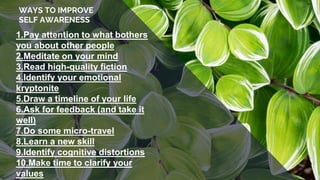
WAYS TO IMPROVE
SELF AWARENESS
1.Pay attention to what bothers
you about other people
2.Meditate on your mind
3.Read high-quality fiction
4.Identify your emotional
kryptonite
5.Draw a timeline of your life
6.Ask for feedback (and take it
well)
7.Do some micro-travel
8.Learn a new skill
9.Identify cognitive distortions
10.Make time to clarify your
values
BARRIERS TO SELF-
MANAGEMENT
 Perception– Stereotyping, tunnel vision, single perspective,
saturation
 Emotion- Fear of mistakes, unwilling to take risks, immediate
solutions, premature judgement
 Culture- Use of value judgment
 Environment- Organizational practices, lack of cooperation
and trust
 Understanding of self through self-
awareness activities
 Setting goals
 Preparing action plans to achieve the
goals
 Implementing the activities
 Assessment
our office
 Self awarenessliesat theheart of self
management
 Creating self-awareness:
o Self analysis
o Reflection of past events
o Critical incidents
o Managing from inside out
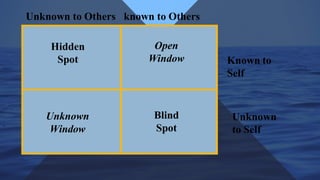
Hidden
Spot
Open
Window
Unknown
Window
Blind
Spot
Unknown to Others known to Others
Known to
Self
Unknown
to Self
Open Self
╺ The open area is that part of an
individuals’ conscious self – his/her
attitudes, behavior, motivation, values,
way of life - of which they are aware
and which is known to others.
Blind Self
 There are things about people which they do not know,
but that others can see more clearly is the blind self.
 When others say what they see, in a supportive,
responsible way, and people are able to hear it; in
that way they are able to test the reality of who they
are and are able to grow.
Hidden Self
 Hidden area of self be known to others
unless it is disclosed.
 The degree to which we share
ourselves with others is the degree to
which we can be known.
Unknown Self
We are more rich and complex than that which
we and others know, but from time to time
something happens - is felt, read, heard,
dreamed - something from our unconscious is
revealed. Then we "know" what we have
never "known" before.
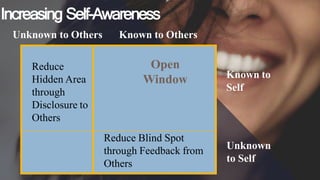
Increasing Self-Awareness
Reduce
Hidden Area
through
Disclosure to
Others
Open
Window
Reduce Blind Spot
through Feedback from
Others
Unknown to Others Known to Others
Known to
Self
Unknown
to Self
 to get better, because one
should know how well s/he
is doing.
 to make the right decisions,
by knowing the blind spots.
 to do great work,
learning by past
mistakes and address
them.
 Process of organizing and planning
how to divide time between specific
activities
 Failing to manage time damages one’s
effectiveness and causes stress
Managing Self
-Management time
-Prioritizing the task
-Focus on role and responsibility
-Ask yourself, “what is the more important things
for me to be doing at this time?”
-Analyze and adjust scheduling as needed
-Ask yourself – is your schedule is balance (work,
family time for self)
-Consider if the action is what you want or need to be
doing right now; if not, say “No.”
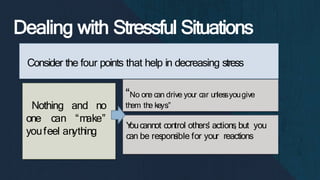
Dealing with Stressful Situations
Consider the four points that help in decreasing stress
Nothing and no
one can “m
ake”
youfeel an
ything
“No one can drive your car unles
syougive
them the keys
.”
Y
oucannot control others
’ actions
, but you
can be res
pons
ible for your reactions
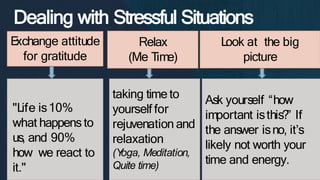
E
xchange attitude
for gratitude
"Life is10%
what happensto
us, and 90%
how we react to
it."
Relax
(Me Time)
Look at the big
picture
taking time to
yourself for
rejuvenation and
relaxation
(Y
oga, Meditation,
Quite time)
Ask yourself “how
important isthis?” If
the answer isno, it’s
likely not worth your
time and energy.
Dealing with Stressful Situations
 Set goal (s), performance objectives, and
challenging but realistic expectations
 Develop an action plan, concrete and
manageable steps
 Make a commitment
 Overcome obstacles, evaluate your own
performance
 Assess the progress
INTERNAL SELF
AWARENESS
VS
EXTERNAL SELF
AWARENESS
Internal self-awareness is how we see our own values, thoughts, and
emotions. To practice this, move away from asking what. Instead of
asking “Why did I say that to a team member?”, ask “What made me
say that to my team member?” You can’t always rationalize the why,
but you can always explain the what.
External self-awareness is how we are seen by others. To practice this,
create an open and safe environment where team members and peers
can be honest with you. Encourage critical feedback that ultimately
helps you improve.
The goal of self-awareness is to balance internal and external self-
awareness, or to have how you see yourself be the same as how you
are seen by others. When the two sides match, you can target areas for
improvement and change how you interact with yourself and with
others.
DRAW A SELF PORTRAIT OF
YOURSELF
ACTIVITY

SELF-AWARENESS.pptx

  • 1.
  • 2.
    Imagine this is Mirror ╺WHO ARE YOU? ╺ HOW DO YOU SEE YOURSELF? ╺ DO YOU KNOW YOUR SELF ALREADY? ╺ HOW DO YOU SEE YOURSELF 5 YEARS FROM NOW?
  • 3.
  • 4.
  • 5.
    “ 5  The termself refers to someone thinks about and perceives himself or herself  A set of characteristics (abilities, ideas or behaviors) s/he possesses or does not possess  It is multi-dimensional, incorporating our views of ourselves in terms of several different aspects (e.g. physical, emotional, spiritual, professional) SELF CONCEPT
  • 6.
     The viewyou have of yourself (self image)  How much value you place on yourself (self esteem or self worth)  What you wish you were really like to be (ideal self) o Actual self o Perceived self Components of Self
  • 7.
    SOCIAL SELF Social selfrefers to how we perceive ourselves in relation to others. It involves relationship building, empathizing, and communicating. A healthy, or not so healthy, social self will also impact your overall mental wellbeing and ability to meet life goals.
  • 8.
  • 9.
    SELF MANAGEMENT Self-management isour ability to manage our behaviors, thoughts, and emotions in a conscious and productive way.
  • 10.
    SELF MANAGEMENT Self-management means youunderstand your personal responsibility in different aspects of your life, and you do what you need to fulfill that responsibility.
  • 11.
    SOCIAL MANAGEMENT Social managementrefers to the Management of social enterprises and projects. These include commercial enterprises with social, non-profit objectives, state institutions, foundations, children's homes, daycare centers, aid organizations, associations, as well as non-profit organizations.
  • 12.
    How can itbe MANAGED? SELF MANAGEMENT… 1. ROLE CLARITY 2. KEEP YOUR PROMISES (DWYSYWD) 3. ALIGN TO THE RIGHT LEVEL OF ENGAGEMENT 4. FIRST THINGS FIRST 5. NURTURE YOURSELF
  • 13.
    How can itbe MANAGED? SELF MANAGEMENT… 6. TAKE BREAKS 7. GET CREATIVE 8.PRACTICE MINDFULNESS 9. AVOID COVETING 10. DON’T MULTITASK
  • 14.
    How can itbe MANAGED? SOCIAL MANAGEMENT… 1. COMMUNICATE EFFECTIVELY 2. WORK COLLABORATIVELY 3. MAKE DECISIONS 4. NEGOTIATE AND RESOLVE CONFLICT
  • 15.
     SELF AWARENESS… Self-awareness lies at the heart of the ability to master one-self  Developing self-control and clarifying priorities and goals help individual creates direction in their own lives  Managing time and stress make it possible for individuals to adapt to and organize surroundings
  • 16.
    SOCIAL AWARENESS… Social Awareness-The ability to take the perspective of and empathize with others, including those from diverse backgrounds and cultures. The ability to understand social and ethical norms for behavior and to recognize family, school, and community resources and supports. Social awareness requires staff and educators to acknowledge, value, support, and respond to the culturalvalues, traditions, communication, learning styles, contributions, and relational patterns of all students in the classroom. As school districts locally select, develop, prepare and deliver their own curricula, they may want to consider modifying their curricula to critique and redress issues of privilege and bias (e.g., sexism, ageism,ableism, racism, and heteronormative stereotypes).
  • 17.
  • 18.
  • 19.
    WAYS TO IMPROVE SELFAWARENESS 1.Pay attention to what bothers you about other people 2.Meditate on your mind 3.Read high-quality fiction 4.Identify your emotional kryptonite 5.Draw a timeline of your life 6.Ask for feedback (and take it well) 7.Do some micro-travel 8.Learn a new skill 9.Identify cognitive distortions 10.Make time to clarify your values
  • 20.
    BARRIERS TO SELF- MANAGEMENT Perception– Stereotyping, tunnel vision, single perspective, saturation  Emotion- Fear of mistakes, unwilling to take risks, immediate solutions, premature judgement  Culture- Use of value judgment  Environment- Organizational practices, lack of cooperation and trust
  • 21.
     Understanding ofself through self- awareness activities  Setting goals  Preparing action plans to achieve the goals  Implementing the activities  Assessment
  • 22.
    our office  Selfawarenessliesat theheart of self management  Creating self-awareness: o Self analysis o Reflection of past events o Critical incidents o Managing from inside out
  • 23.
    Hidden Spot Open Window Unknown Window Blind Spot Unknown to Othersknown to Others Known to Self Unknown to Self
  • 24.
    Open Self ╺ Theopen area is that part of an individuals’ conscious self – his/her attitudes, behavior, motivation, values, way of life - of which they are aware and which is known to others.
  • 25.
    Blind Self  Thereare things about people which they do not know, but that others can see more clearly is the blind self.  When others say what they see, in a supportive, responsible way, and people are able to hear it; in that way they are able to test the reality of who they are and are able to grow.
  • 26.
    Hidden Self  Hiddenarea of self be known to others unless it is disclosed.  The degree to which we share ourselves with others is the degree to which we can be known.
  • 27.
    Unknown Self We aremore rich and complex than that which we and others know, but from time to time something happens - is felt, read, heard, dreamed - something from our unconscious is revealed. Then we "know" what we have never "known" before.
  • 28.
    Increasing Self-Awareness Reduce Hidden Area through Disclosureto Others Open Window Reduce Blind Spot through Feedback from Others Unknown to Others Known to Others Known to Self Unknown to Self
  • 29.
     to getbetter, because one should know how well s/he is doing.  to make the right decisions, by knowing the blind spots.  to do great work, learning by past mistakes and address them.
  • 30.
     Process oforganizing and planning how to divide time between specific activities  Failing to manage time damages one’s effectiveness and causes stress
  • 31.
    Managing Self -Management time -Prioritizingthe task -Focus on role and responsibility -Ask yourself, “what is the more important things for me to be doing at this time?” -Analyze and adjust scheduling as needed -Ask yourself – is your schedule is balance (work, family time for self) -Consider if the action is what you want or need to be doing right now; if not, say “No.”
  • 32.
    Dealing with StressfulSituations Consider the four points that help in decreasing stress Nothing and no one can “m ake” youfeel an ything “No one can drive your car unles syougive them the keys .” Y oucannot control others ’ actions , but you can be res pons ible for your reactions
  • 33.
    E xchange attitude for gratitude "Lifeis10% what happensto us, and 90% how we react to it." Relax (Me Time) Look at the big picture taking time to yourself for rejuvenation and relaxation (Y oga, Meditation, Quite time) Ask yourself “how important isthis?” If the answer isno, it’s likely not worth your time and energy. Dealing with Stressful Situations
  • 34.
     Set goal(s), performance objectives, and challenging but realistic expectations  Develop an action plan, concrete and manageable steps  Make a commitment  Overcome obstacles, evaluate your own performance  Assess the progress
  • 35.
  • 36.
    Internal self-awareness ishow we see our own values, thoughts, and emotions. To practice this, move away from asking what. Instead of asking “Why did I say that to a team member?”, ask “What made me say that to my team member?” You can’t always rationalize the why, but you can always explain the what. External self-awareness is how we are seen by others. To practice this, create an open and safe environment where team members and peers can be honest with you. Encourage critical feedback that ultimately helps you improve. The goal of self-awareness is to balance internal and external self- awareness, or to have how you see yourself be the same as how you are seen by others. When the two sides match, you can target areas for improvement and change how you interact with yourself and with others.
  • 37.
    DRAW A SELFPORTRAIT OF YOURSELF ACTIVITY