The energy sector is key to the success of Ukraine’s economic reform,
battle with corruption, and independence from Russia. Therefore, it
was a key section in the Atlantic Council’s 2014 Roadmap for Ukraine:
Delivering on the Promise of Maidan. Fortunately, in 2015 Ukraine
carried out far-reaching reforms in the energy sector, and this provides
a reason to return to this topic. The current focus is on the completion
of the substantial reforms that already have been undertaken.1
Energy represents one of Ukraine’s greatest vulnerabilities, as well as
a source of potential strength; it must be central to a broader, more
comprehensive economic reform plan. Energy is the linchpin of Ukraine’s
dependence on Russia. The Kremlin has used energy as a weapon not
only to exert leverage over Ukraine, but also to control its leaders and
key power players who have personally enriched themselves through
opaque energy deals with Russia.
As such, the energy sector is a critical pillar in building an effective,
stable national security and economic strategy for Ukraine. This
strategy must be long-term, and yet have an immediate positive impact.
Getting the energy sector right—eliminating subsidies, ensuring that
public revenues are not diverted to private pockets, enhancing energy
efficiency, and reinforcing Ukraine’s national security—is essential to
transforming the Ukrainian economy.
The Challenges
Ukraine possesses large energy resources, but this sector has been
poorly managed and has been permeated with high-level corruption.
Every year, a few gas traders in Russia and Ukraine have shared a few
billion dollars in rents made on the trade between the low, regulated
state prices and free prices, which were usually several times higher.
1	 Anders Åslund, Ukraine: What Went Wrong and How to Fix It (Washington, DC: Peter-
son Institute for International Economics, 2015). This brief draws on and updates the
Chapter 10, “Cleaning up the Energy Sector,” pp. 185-206.
Securing
Ukraine’s
Energy Sector
As a joint initiative of the
Atlantic Council’s Global Energy
Center and Dinu Patriciu Eurasia
Center, the Eurasian Energy
Futures Initiative covers critical
energy issues in the wider
Eurasian space. The Initiative
analyzes trends and disruptive
factors to facilitate the
provision of secure, affordable,
and sustainable energy for
consumers.
ISSUE BRIEF
APRIL 2016 ANDERS ÅSLUND
Atlantic Council
GLOBAL ENERGY CENTER
Atlantic Council
DINU PATRICIU EURASIA CENTER
and
2 ATLANTIC COUNCIL
ISSUE BRIEF Securing Ukraine’s Energy Sector
The artificial energy pricing and this privileged trade
have endured, regardless of who rules Ukraine. It has
had many negative consequences. Importantly, Kremlin-
connected gas traders have used these funds to exert
influence on Ukrainian leaders, thus jeopardizing
Ukraine’s national security.
These fortunes have been financed by Ukrainian
taxpayers, who have paid vast energy subsidies.
Ukraine’s artificially low energy prices have led to
excessive energy consumption and large, unnecessary
current account deficits. A side effect has been that
these policies kept Ukraine’s own production of
energy far below potential. The focal concerns today
are natural gas and electricity, while oil and coal are
predominantly handled by private enterprises on a
market. Naturally, this situation in the energy sector
has diminished the legitimacy of
the Ukrainian state, eroded people’s
trust in government, and weakened
the nation’s ability to stand up to
Russian pressure and aggression.
It is difficult to imagine a more
damaging energy policy.
The public cost of Ukraine’s energy
policy has been considerable. For
2012, the International Monetary
Fund (IMF) assessed the state
energy subsidies at no less than 7.6
percent of GDP.2
These subsidies are
likely to have peaked at 10 percent
of GDP in 2014.3
In 2014, Ukraine’s
domestic household prices for natural gas were at
only 12 percent of the world market price level or cost
recovery prices.4
These large state subsidies did not simply undermine
Ukraine’s public finances, but also its foreign trade
balance. In the last pre-crisis year, 2013, Ukraine
imported natural gas for $11.5 billion and oil for $7.0
billion.5
Together this amounted to $18.6 billion or 10
2	 IMF, “Ukraine: 2013 Article IV Consultation and First Post-Program
Monitoring,” IMF Country Report No. 14/145, May 2014, p. 87.
3	 Own assessment based on data in IMF, “Ukraine: First Review
under the Stand-By Arrangement,” Country Report No. 14/263,
September 2014.
4	 Pritha Mitra and Ruben Atoyan, “Ukraine Gas Pricing Policy: Dis-
tributional Consequences of Tariff Increases,” IMF Working Paper
WP/12/247, 2014.
5	 State Statistics Service of Ukraine, 2013, http://ukrstat.org/uk/
operativ/operativ2013/zd/tsztt/tsztt_u/tsztt1213_u.htm.
percent of GDP. 6
This figure was larger than Ukraine’s
2013 current account deficit, which amounted to $16.3
billion or 9.2 percent of GDP.7
This wasteful importation at public expense is all the
more baffling given that Ukraine possesses large
energy assets that are only partially—and quite
inefficiently—utilized. International observers agree: BP
sets its estimate of Ukraine’s hydrocarbon reserves at 9
billion tons of oil equivalent. The conventional natural
gas reserves that Ukraine holds are extensive, with 1.1
trillion cubic meters of proven reserves and 5.4 trillion
cubic meters of potential reserves.8
The International
Energy Agency assesses Ukraine’s oil reserves at
850 million tons, and its reserves of gas condensate
are estimated to be larger than 40 million tons.
Nevertheless, Ukraine’s utilization of these resources
is less than optimal: from 1990 to
2010, production of primary energy
fell by 47 percent, and reliance on
energy imports was 39 percent in
2010.9
Having failed to accomplish
energy reform on its own, Ukraine
has requested assistance from
the European Union. In February
2011, Ukraine joined the European
Energy Community, thereby
committing itself to the EU’s “third
energy package” reforms, which
should guide Ukraine’s energy
transformation. Thus, Ukraine has
obligated itself to establish real markets for electricity
and gas transactions and to integrate these markets
with the European Union. It also has promised to
unbundle transportation of natural gas and electricity
6	 Calculated from nominal GDP of $183 billion in 2013, “Assessing
Progress in Structural Reforms,” Dragon Capital, March 9, 2016, p. 9.
7	 IMF, “Ukraine: Ex Post Evaluation of Exceptional Access under the
2010 Stand-By Arrangement,” IMF Country Report No. 14/146,
May 2014.
8	 BP, “BP Statistical Review for Energy,” June 2014, http://www.
bp.com/content/dam/bp/pdf/Energy-economics/statistical-re-
view-2014/BP-statistical-review-of-world-energy-2014-full-re-
port.pdf, sets Ukraine’s reserves at only 0.6 tcm, 0.3 percent
of the global total. BP is more cautious than the International
Energy Agency (IEA) and tends to use official figures. Since ex-
ploration has been neglected for long in Ukraine, I put more trust
in the higher figure.
9	 IEA, “Ukraine 2012: Energy Policies beyond IEA Countries,” 2012,
Paris, pp. 21, 82.
Ukraine’s artificially
low energy prices
have led to
excessive energy
consumption and
large, unnecessary
current account
deficits.
3ATLANTIC COUNCIL
ISSUE BRIEF Securing Ukraine’s Energy Sector
from production and distribution to open up pipelines
and grid to third parties.
Great Reform Achievements in 2015
Never before has a Ukrainian government carried out
so many sensible energy reforms, and in no other
area has the Ukrainian government achieved reforms
as radical as in the energy sector in 2015. This is an
indisputable fact, but it has not been much noted.
Attracting attention to this success benefits neither
the government, which doesn’t want to antagonize the
population by emphasizing how substantial the price
changes have been, nor the populist opponents, who
would prefer not to reveal how large the rents to the
gas traders were.
The most important change of the reform process
stipulated that from April 1, 2015, all energy prices for
households were increased by up to four times for natural
gas. The intention was to raise all subsidized energy
prices to half the cost recovery, in order to reduce the
fiscal cost of subsidizing the energy sector and to avoid
further privileged arbitrage for certain insiders.
The Ukrainian government extended conditional cash
transfers to no fewer than 4.5 million households—one
third of all households in Ukraine—in order to make
the increases in energy prices politically and socially
feasible. This process was made possible because
Ukraine has a well-developed system of 745 local social
welfare offices.
Ukraine’s gas consumption was excessive, but now it has
declined extraordinarily. As late as 2011, consumption
amounted to 59.3 billion cubic meters. In 2015, it
had fallen to merely 36 billion cubic meters, of which
Ukraine itself produced 20 billion cubic meters.10
The
causes are multiple: the war with Russia; the sharp fall
in production from heavy industry; but also the sharp
10	 Wojciech Kononczuk, “Reform #1. Why Ukraine Has to Reform
Its Gas Sector,” OSW, Centre for Eastern Studies, Commentary,
September 1, 2015.
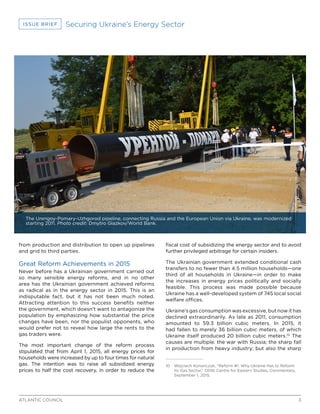
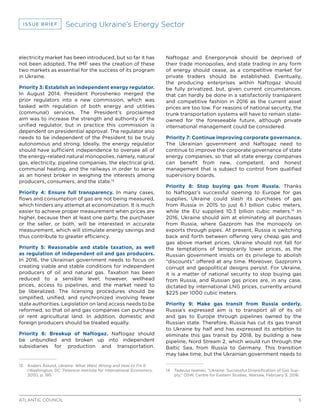
The Urengoy-Pomary-Uzhgorod pipeline, connecting Russia and the European Union via Ukraine, was modernized
starting 2011. Photo credit: Dmytro Glazkov/World Bank.
4 ATLANTIC COUNCIL
ISSUE BRIEF Securing Ukraine’s Energy Sector
price increases. Price hikes have led to greater savings
than expected. In 2015, Ukraine cut its consumption of
natural gas by 20 percent. Naftogaz statistics show that
from 2013-15 industrial consumption fell by 38 percent;
household consumption by 33 percent; and heating
and utilities by 29 percent.11
These adjustments are
both massive and highly desirable. The numbers also
suggest that large subsidies, which previously went
into the foreign bank accounts of a few gas traders,
have now dwindled to insignificance.
Naftogaz is expecting that Ukraine’s consumption of
natural gas will fall by another 20 percent in 2016 to a
mere 29 billion cubic meters, of which Ukraine itself will
produce 20 billion cubic meters. Thus, Ukraine would
only need to import 9 billion cubic meters, all of which
could be imported from Europe.
While Ukrainian energy prices for
households rose to the level of half
the world market price, international
energy prices also fell by roughly
half in 2015. As a consequence,
Ukraine’s energy prices now are at
nearly the world market level, but
they do need to be adjusted to that
level. In 2015, Ukraine’s vast energy
subsidies shrunk to probably just 1
percent of GDP, and those subsidies
should be eliminated in 2016.
Serious efforts have been
undertaken to reassert state
control over state-owned enterprises, which have
been captured by oligarchic interests, notably the
oil producer Ukrnafta and the oil pipeline company
Ukrtransnafta. For the sake of transparency, an
international audit of Naftogaz has finally been
implemented.
While detailed foreign trade statistics are not available
yet, presumably Ukraine’s total energy bill has declined
by nearly three-quarters to some $5 billion. This is a
key reason why Ukraine has been able to achieve a
balanced current account.
Ukraine has successfully diversified its imports of
natural gas, so that it reduced its dependence on
Gazprom by importing only 6.1 billion cubic meters of
11	 “‘Naftogaz’ pokazal dinamiky ispolzovaniya gaza za 10 let, (Naf-
togaz showed the dynamics of the utilization of gas during 10
years),” Ekonomichna Pravda, February 23, 2016.
natural gas from the Russian company in 2015; the rest
was imported from Europe, mainly from Norwegian
Statoil and Engie (previously GDF Suez).
Domestic energy production is one area, in which
Ukraine has made no progress. In fact, Ukraine’s
production of natural gas even fell by 3 percent because
of too high taxes and a nearly prohibitive regulatory
environment.
Recommendations for the Ukrainian
Government in 2016
Regardless of how impressive Ukraine’s achievements
were in the sphere of energy in 2015, the country’s
situation remains critical. Rather than rest on its
laurels, Ukraine’s government needs to proceed and
complete its energy reforms in 2016. The aims are to
enhance Ukraine’s energy security,
increase energy efficiency and
national welfare, reduce corruption,
strengthen public finances, and
improve Ukraine’s balance of
payments. As a matter of urgency,
the Ukrainian leadership should
therefore undertake the following
ten steps:12
Priority 1: Unification of energy
prices. At present, gas and
electricity prices are close to
international market prices, but they
should be unified at a market level
and placed under the control of an
independent regulator. Ukrainian gas and electricity
prices for households are at approximately the correct
market level now, but they need to be unified to hinder
corrupt arbitrage between differently regulated prices
and to favor economic efficiency. The current policy
of cash transfers to the one-third poorest households
should be maintained.
Priority 2: A real market for gas and electricity
should finally be allowed to develop. Ukraine already
has adopted a law on the gas market, but it has yet
to come into force, because the many supplementary
rules have not been adopted. A similar law on an
12	 Olga Bielkova, a parliamentarian from the Poroshenko Bloc, has
published a similar proposal: Olga Bielkova, “A Road Map for
energy Reforms in 2016,” Kyiv Post, February 2, 2016; Another
similar reform proposal can be found in Wojciech Kononczuk,
“Reform #1. Why Ukraine Has to Reform Its Gas Sector,” op. cit.
Regardless of
how impressive
Ukraine’s
achievements were
in the sphere of
energy in 2015, the
country’s situation
remains critical.
5ATLANTIC COUNCIL
ISSUE BRIEF Securing Ukraine’s Energy Sector
electricity market has been introduced, but so far it has
not been adopted. The IMF sees the creation of these
two markets as essential for the success of its program
in Ukraine.
Priority 3: Establish an independent energy regulator.
In August 2014, President Poroshenko merged the
prior regulators into a new commission, which was
tasked with regulation of both energy and utilities
(communal) services. The President’s proclaimed
aim was to increase the strength and authority of the
unified regulator, but in practice this commission is
dependent on presidential approval. The regulator also
needs to be independent of the President to be truly
autonomous and strong. Ideally, the energy regulator
should have sufficient independence to oversee all of
the energy-related natural monopolies, namely, natural
gas, electricity, pipeline companies, the electrical grid,
communal heating, and the railways in order to serve
as an honest broker in weighing the interests among
producers, consumers, and the state.13
Priority 4: Ensure full transparency. In many cases,
flows and consumption of gas are not being measured,
which hinders any attempt at economization. It is much
easier to achieve proper measurement when prices are
higher, because then at least one party, the purchaser
or the seller, or both, will be interested in accurate
measurement, which will stimulate energy savings and
thus contribute to greater efficiency.
Priority 5: Reasonable and stable taxation, as well
as regulation of independent oil and gas producers.
In 2016, the Ukrainian government needs to focus on
creating viable and stable conditions for independent
producers of oil and natural gas. Taxation has been
reduced to a sensible level; however, wellhead
prices, access to pipelines, and the market need to
be liberalized. The licensing procedures should be
simplified, unified, and synchronized involving fewer
state authorities. Legislation on land access needs to be
reformed, so that oil and gas companies can purchase
or rent agricultural land. In addition, domestic and
foreign producers should be treated equally.
Priority 6: Breakup of Naftogaz. Naftogaz should
be unbundled and broken up into independent
subsidiaries for production and transportation.
13	 Anders Åslund, Ukraine: What Went Wrong and How to Fix It
(Washington, DC: Peterson Institute for International Economics,
2015), p. 195.
Naftogaz and Energorynok should be deprived of
their trade monopolies, and state trading in any form
of energy should cease, as a competitive market for
private traders should be established. Eventually,
the producing enterprises within Naftogaz should
be fully privatized, but, given current circumstances,
that can hardly be done in a satisfactorily transparent
and competitive fashion in 2016 as the current asset
prices are too low. For reasons of national security, the
trunk transportation systems will have to remain state-
owned for the foreseeable future, although private
international management could be considered.
Priority 7: Continue improving corporate governance.
The Ukrainian government and Naftogaz need to
continue to improve the corporate governance of state
energy companies, so that all state energy companies
can benefit from new, competent, and honest
management that is subject to control from qualified
supervisory boards.
Priority 8: Stop buying gas from Russia. Thanks
to Naftogaz’s successful opening to Europe for gas
supplies, Ukraine could slash its purchases of gas
from Russia in 2015 to just 6.1 billion cubic meters,
while the EU supplied 10.3 billion cubic meters.14
In
2016, Ukraine should aim at eliminating all purchases
from Russia, where Gazprom has the monopoly on
exports through pipes. At present, Russia is switching
back and forth between offering very cheap gas and
gas above market prices. Ukraine should not fall for
the temptations of temporarily lower prices, as the
Russian government insists on its privilege to abolish
“discounts” offered at any time. Moreover, Gazprom’s
corrupt and geopolitical designs persist. For Ukraine,
it is a matter of national security to stop buying gas
from Russia, and Russian gas prices are, in any case,
dictated by international LNG prices, currently around
$225 per 1000 cubic meters.
Priority 9: Make gas transit from Russia orderly.
Russia’s expressed aim is to transport all of its oil
and gas to Europe through pipelines owned by the
Russian state. Therefore, Russia has cut its gas transit
to Ukraine by half and has expressed its ambition to
eliminate this gas transit by 2018, by building a new
pipeline, Nord Stream 2, which would run through the
Baltic Sea, from Russia to Germany. This transition
may take time, but the Ukrainian government needs to
14	 Tadeusz Iwanski, “Ukraine: Successful Diversification of Gas Sup-
ply,” OSW, Centre for Eastern Studies, Warsaw, February 3, 2016.
6 ATLANTIC COUNCIL
ISSUE BRIEF Securing Ukraine’s Energy Sector
create an orderly process for gas transit from Russia
to Europe, to eliminate corruption associated with it,
and to secure gas supplies for European gas importers.
Gas transit needs to become completely transparent
and clearly separate from the Ukrainian gas trade. To
this end, Naftogaz has increased the transit tariffs to
a normal market level, and Ukraine’s Anti-Monopoly
Committee has fined Gazprom for violations of
Ukraine’s competition rules.15
Priority 10: End the gas contract with Russia of
January 2009. In order to render its gas trade and
transit transparent, Ukraine needs to officially end the
unfavorable gas contract with Russia of January 2009.
This is one of many legal issues that Ukraine needs
to resolve with Russia, which require the best legal
expertise that can be offered.
15	 “Stoimost’ tranzita dlya Gazproma mozhet vyrasti vtroe – Naf-
togaz (The Cost of Transit for Gazprom Can Increase Three
Times – Naftogaz),” Ekonomichna Pravda, February 17, 2016.
Recommendations for the Transatlantic
Community
The Transatlantic community, that is, the European
Union, including the European Energy Community, the
United States, but also the IMF and the World Bank
need to weigh in and help Ukraine stand up against
the unfair business practices of the Russian Federation
and Gazprom. At the same time, the Transatlantic
community needs to assist the Ukrainian government
with its domestic reforms of the energy sector.
Priority 1: Help free Ukraine from Gazprom’s
monopolistic and corrupt practices. The case
against Gazprom is evident. This state corporation is
routinely accused of trying to bribe or otherwise sway
politicians throughout its area of operation for the sake
of geopolitical influence or corrupt interests.16
This
16	 Margarita Mercedes Balmadeca, “Gas, Oil and the Linkages
between Domestic and Foreign Policies: The Case of Ukraine,”
Europe-Asia Studies 50, no. 2, 1998, pp. 257–286; Margarita Mer-
cedes Balmadeca, The Politics of Energy Dependency: Ukraine,
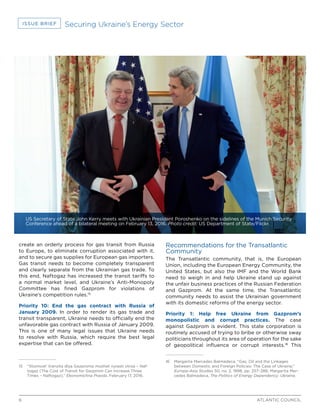
US Secretary of State John Kerry meets with Ukrainian President Poroshenko on the sidelines of the Munich Security
Conference ahead of a bilateral meeting on February 13, 2016. Photo credit: US Department of State/Flickr.
7ATLANTIC COUNCIL
ISSUE BRIEF Securing Ukraine’s Energy Sector
must not be accepted by the international community.
Ukraine has made a clear choice to stop buying gas
from Russia, because the state is too weak to stand
up to Gazprom’s corrupting influence. The European
Union and the United States need to support Ukraine
in this sensible decision and facilitate its purchases of
gas from other sources, primarily Europe.
Priority 2: Facilitate orderly gas transit through
Ukraine. The Russian government has developed the
habit of cutting off its gas supply through Ukraine for
political reasons. As long as EU countries purchase gas
from Russia, this must not be allowed. The European
Union must ensure that gas transit through Ukraine is
transparent and secure, and the United States should
offer support.
Priority 3: Pursue EU competition
policy against Gazprom. No
company has violated EU
competition policy more blatantly
than Gazprom, with its prohibition
against re-exports, its pay-or-
take policies, and its extraordinary
price discrimination on political
grounds. The evidence is available
and persuasive, but the European
Commission, which has all the
relevant powers, is late to act. It
is difficult to perceive this lack of
action as anything but subservience
to Russian political pressure. The
United States needs to use its influence to keep the
EU true to its legal principles. The same is even more
true of Nord Stream 2, a gas pipeline project instigated
by Gazprom and certain German interests, to weaken
the EU and its energy policy to the disadvantage of
Ukraine.
Priority 4: Investigate Gazprom as a criminal
organization. Anecdotal reports abound about senior
Russian officials bribing European politicians, and
Russian officials extracting billions of dollars of corrupt
revenues from Gazprom.17
This must not be accepted in
a society based on the rule of law, such as the European
Belarus, and Lithuania between Domestic Oligarchs and Russian
Pressure, Studies in Comparative Political Economy and Public
Policy (Toronto: University of Toronto Press, 2013).
17	 Global Witness, “It’s a Gas: Funny Business in the Turk-
men-Ukraine Gas Trade,” 2006, https://www.globalwitness.org/
en/reports/its-gas/; Vladimir Milov and Boris Nemtsov, Putin:
What 10 Years of Putin Have Brought, Novaya Gazeta, 2010.
Union. The most plausible of the many corruption
accusations need to be properly investigated by law
enforcement in the respective countries. According to
the ordinary banking standard, “know your customer,”
banks are not supposed to allow an account to be
opened by a customer, who is suspected of criminal
activity. By this standard, Gazprom and its many
subsidiaries should not be permitted to open a bank
account in any EU country, and there is no reason to
make an exception to the rule for Gazprom.
Priority 5: Implement the EU Third Energy Package in
Ukraine. Ukraine is a member of the European Energy
Community, which is the appropriate agent to assist
Ukraine in implementing energy reforms. The Energy
Community has an excellent secretariat that is well-
placed to be a lead advisor to the
Ukrainian government in its energy
reforms. The World Bank and the
European Bank for Reconstruction
and Development can also
contribute to Ukraine’s domestic
energy reforms.
Priority 6: Support Ukraine
in international governance
institutions. Ukraine and Russia have
a substantial number of arbitration
cases, some related to Russian
confiscation of Ukrainian property
in Crimea and the occupied Donbas.
Many involve gas transactions,
involving alleged arrears, contract and price disputes.
Most of these seem to be going to the Arbitration
Institute at the Chamber of Commerce in Stockholm,
but other international institutions should play a more
prominent role. In particular, the European Commission
should take a firm lead in competition policy. If the
principles of the Russian-Ukrainian gas agreement of
2009 are deemed illegal, Gazprom’s chances of success
in Stockholm arbitration would decrease sharply. Other
international institutions that could and should play a
role are the World Trade Organization and the Energy
Charter. Ukraine needs all the support it can get in these
international forums.
Anders Åslund is Resident Senior Fellow with the Dinu
Patriciu Eurasia Center. He is a leading specialist on the
East European economies, especially Russia and Ukraine.
He has written two books on Ukraine and co-edited two.
Åslund was one of the founders of the Kyiv School of
Economics and co-chaired its board of directors 2003-12.
The European
Union must ensure
that gas transit
through Ukraine
is transparent and
secure, and the
United States should
offer support.
CHAIRMAN
*Jon M. Huntsman, Jr.
CHAIRMAN EMERITUS,
INTERNATIONAL
ADVISORY BOARD
Brent Scowcroft
PRESIDENT AND CEO
*Frederick Kempe
EXECUTIVE VICE CHAIRS
*Adrienne Arsht
*Stephen J. Hadley
VICE CHAIRS
*Robert J. Abernethy
*Richard Edelman
*C. Boyden Gray
*George Lund
*Virginia A. Mulberger
*W. DeVier Pierson
*John Studzinski
TREASURER
*Brian C. McK. Henderson
SECRETARY
*Walter B. Slocombe
DIRECTORS
Stéphane Abrial
Odeh Aburdene
Peter Ackerman
Timothy D. Adams
John Allen
Michael Andersson
Michael Ansari
Richard L. Armitage
David D. Aufhauser
Elizabeth F. Bagley
Peter Bass
*Rafic Bizri
Dennis Blair
*Thomas L. Blair
Myron Brilliant
Esther Brimmer
*R. Nicholas Burns
William J. Burns
*Richard R. Burt
Michael Calvey
James E. Cartwright
John E. Chapoton
Ahmed Charai
Sandra Charles
Melanie Chen
George Chopivsky
Wesley K. Clark
David W. Craig
*Ralph D. Crosby, Jr.
Nelson Cunningham
Ivo H. Daalder
*Paula J. Dobriansky
Christopher J. Dodd
Conrado Dornier
Thomas J. Egan, Jr.
*Stuart E. Eizenstat
Thomas R. Eldridge
Julie Finley
Lawrence P. Fisher, II
Alan H. Fleischmann
*Ronald M. Freeman
Laurie Fulton Courtney
Geduldig
*Robert S. Gelbard
Thomas Glocer
*Sherri W. Goodman
Mikael Hagström
Ian Hague
Amir Handjani
John D. Harris, II
Frank Haun
Michael V. Hayden
Annette Heuser
*Karl Hopkins
Robert Hormats
Miroslav Hornak
*Mary L. Howell
Wolfgang Ischinger
Reuben Jeffery, III
*James L. Jones, Jr.
George A. Joulwan
Lawrence S. Kanarek
Stephen R. Kappes
Maria Pica Karp
Sean Kevelighan
Zalmay M. Khalilzad
Robert M. Kimmitt
Henry A. Kissinger
Franklin D. Kramer
Philip Lader
*Richard L. Lawson
*Jan M. Lodal
Jane Holl Lute
William J. Lynn
Izzat Majeed
Wendy W. Makins
Mian M. Mansha
Gerardo Mato
William E. Mayer
Allan McArtor
Eric D.K. Melby
Franklin C. Miller
James N. Miller
*Judith A. Miller
*Alexander V. Mirtchev
Karl Moor
Michael Morell
Georgette Mosbacher
Steve C. Nicandros
Thomas R. Nides
Franco Nuschese
Joseph S. Nye
Hilda Ochoa-Brillem-
bourg
Sean O’Keefe
Ahmet Oren
*Ana Palacio
Carlos Pascual
Thomas R. Pickering
Daniel B. Poneman
Daniel M. Price
Arnold L. Punaro
Robert Rangel
Thomas J. Ridge
Charles O. Rossotti
Stanley O. Roth
Robert Rowland
Harry Sachinis
John P. Schmitz
Brent Scowcroft
Rajiv Shah
Alan J. Spence
James Stavridis
Richard J.A. Steele
*Paula Stern
Robert J. Stevens
John S. Tanner
*Ellen O. Tauscher
Karen Tramontano
Clyde C. Tuggle
Paul Twomey
Melanne Verveer
Enzo Viscusi
Charles F. Wald
Jay Walker
Michael F. Walsh
Mark R. Warner
Maciej Witucki
Neal S. Wolin
Mary C. Yates
Dov S. Zakheim
HONORARY DIRECTORS
David C. Acheson
Madeleine K. Albright
James A. Baker, III
Harold Brown
Frank C. Carlucci, III
Robert M. Gates
Michael G. Mullen
Leon E. Panetta
William J. Perry
Colin L. Powell
Condoleezza Rice
Edward L. Rowny
George P. Shultz
John W. Warner
William H. Webster
*Executive Committee Members
List as of March 28, 2016
Atlantic Council Board of Directors
The Atlantic Council is a nonpartisan organization that
­promotes constructive US leadership and engagement
in ­international ­affairs based on the central role of
the Atlantic community in ­meeting today’s global
­challenges.
© 2016 The Atlantic Council of the United States. All
rights reserved. No part of this publication may be
reproduced or transmitted in any form or by any means
without permission in writing from the Atlantic Council,
except in the case of brief quotations in news articles,
critical articles, or reviews. Please direct inquiries to:
Atlantic Council
1030 15th Street, NW, 12th Floor,
Washington, DC 20005
(202) 463-7226, www.AtlanticCouncil.org

Securing Ukraine's Energy Sector

  • 1.
    The energy sectoris key to the success of Ukraine’s economic reform, battle with corruption, and independence from Russia. Therefore, it was a key section in the Atlantic Council’s 2014 Roadmap for Ukraine: Delivering on the Promise of Maidan. Fortunately, in 2015 Ukraine carried out far-reaching reforms in the energy sector, and this provides a reason to return to this topic. The current focus is on the completion of the substantial reforms that already have been undertaken.1 Energy represents one of Ukraine’s greatest vulnerabilities, as well as a source of potential strength; it must be central to a broader, more comprehensive economic reform plan. Energy is the linchpin of Ukraine’s dependence on Russia. The Kremlin has used energy as a weapon not only to exert leverage over Ukraine, but also to control its leaders and key power players who have personally enriched themselves through opaque energy deals with Russia. As such, the energy sector is a critical pillar in building an effective, stable national security and economic strategy for Ukraine. This strategy must be long-term, and yet have an immediate positive impact. Getting the energy sector right—eliminating subsidies, ensuring that public revenues are not diverted to private pockets, enhancing energy efficiency, and reinforcing Ukraine’s national security—is essential to transforming the Ukrainian economy. The Challenges Ukraine possesses large energy resources, but this sector has been poorly managed and has been permeated with high-level corruption. Every year, a few gas traders in Russia and Ukraine have shared a few billion dollars in rents made on the trade between the low, regulated state prices and free prices, which were usually several times higher. 1 Anders Åslund, Ukraine: What Went Wrong and How to Fix It (Washington, DC: Peter- son Institute for International Economics, 2015). This brief draws on and updates the Chapter 10, “Cleaning up the Energy Sector,” pp. 185-206. Securing Ukraine’s Energy Sector As a joint initiative of the Atlantic Council’s Global Energy Center and Dinu Patriciu Eurasia Center, the Eurasian Energy Futures Initiative covers critical energy issues in the wider Eurasian space. The Initiative analyzes trends and disruptive factors to facilitate the provision of secure, affordable, and sustainable energy for consumers. ISSUE BRIEF APRIL 2016 ANDERS ÅSLUND Atlantic Council GLOBAL ENERGY CENTER Atlantic Council DINU PATRICIU EURASIA CENTER and
  • 2.
    2 ATLANTIC COUNCIL ISSUEBRIEF Securing Ukraine’s Energy Sector The artificial energy pricing and this privileged trade have endured, regardless of who rules Ukraine. It has had many negative consequences. Importantly, Kremlin- connected gas traders have used these funds to exert influence on Ukrainian leaders, thus jeopardizing Ukraine’s national security. These fortunes have been financed by Ukrainian taxpayers, who have paid vast energy subsidies. Ukraine’s artificially low energy prices have led to excessive energy consumption and large, unnecessary current account deficits. A side effect has been that these policies kept Ukraine’s own production of energy far below potential. The focal concerns today are natural gas and electricity, while oil and coal are predominantly handled by private enterprises on a market. Naturally, this situation in the energy sector has diminished the legitimacy of the Ukrainian state, eroded people’s trust in government, and weakened the nation’s ability to stand up to Russian pressure and aggression. It is difficult to imagine a more damaging energy policy. The public cost of Ukraine’s energy policy has been considerable. For 2012, the International Monetary Fund (IMF) assessed the state energy subsidies at no less than 7.6 percent of GDP.2 These subsidies are likely to have peaked at 10 percent of GDP in 2014.3 In 2014, Ukraine’s domestic household prices for natural gas were at only 12 percent of the world market price level or cost recovery prices.4 These large state subsidies did not simply undermine Ukraine’s public finances, but also its foreign trade balance. In the last pre-crisis year, 2013, Ukraine imported natural gas for $11.5 billion and oil for $7.0 billion.5 Together this amounted to $18.6 billion or 10 2 IMF, “Ukraine: 2013 Article IV Consultation and First Post-Program Monitoring,” IMF Country Report No. 14/145, May 2014, p. 87. 3 Own assessment based on data in IMF, “Ukraine: First Review under the Stand-By Arrangement,” Country Report No. 14/263, September 2014. 4 Pritha Mitra and Ruben Atoyan, “Ukraine Gas Pricing Policy: Dis- tributional Consequences of Tariff Increases,” IMF Working Paper WP/12/247, 2014. 5 State Statistics Service of Ukraine, 2013, http://ukrstat.org/uk/ operativ/operativ2013/zd/tsztt/tsztt_u/tsztt1213_u.htm. percent of GDP. 6 This figure was larger than Ukraine’s 2013 current account deficit, which amounted to $16.3 billion or 9.2 percent of GDP.7 This wasteful importation at public expense is all the more baffling given that Ukraine possesses large energy assets that are only partially—and quite inefficiently—utilized. International observers agree: BP sets its estimate of Ukraine’s hydrocarbon reserves at 9 billion tons of oil equivalent. The conventional natural gas reserves that Ukraine holds are extensive, with 1.1 trillion cubic meters of proven reserves and 5.4 trillion cubic meters of potential reserves.8 The International Energy Agency assesses Ukraine’s oil reserves at 850 million tons, and its reserves of gas condensate are estimated to be larger than 40 million tons. Nevertheless, Ukraine’s utilization of these resources is less than optimal: from 1990 to 2010, production of primary energy fell by 47 percent, and reliance on energy imports was 39 percent in 2010.9 Having failed to accomplish energy reform on its own, Ukraine has requested assistance from the European Union. In February 2011, Ukraine joined the European Energy Community, thereby committing itself to the EU’s “third energy package” reforms, which should guide Ukraine’s energy transformation. Thus, Ukraine has obligated itself to establish real markets for electricity and gas transactions and to integrate these markets with the European Union. It also has promised to unbundle transportation of natural gas and electricity 6 Calculated from nominal GDP of $183 billion in 2013, “Assessing Progress in Structural Reforms,” Dragon Capital, March 9, 2016, p. 9. 7 IMF, “Ukraine: Ex Post Evaluation of Exceptional Access under the 2010 Stand-By Arrangement,” IMF Country Report No. 14/146, May 2014. 8 BP, “BP Statistical Review for Energy,” June 2014, http://www. bp.com/content/dam/bp/pdf/Energy-economics/statistical-re- view-2014/BP-statistical-review-of-world-energy-2014-full-re- port.pdf, sets Ukraine’s reserves at only 0.6 tcm, 0.3 percent of the global total. BP is more cautious than the International Energy Agency (IEA) and tends to use official figures. Since ex- ploration has been neglected for long in Ukraine, I put more trust in the higher figure. 9 IEA, “Ukraine 2012: Energy Policies beyond IEA Countries,” 2012, Paris, pp. 21, 82. Ukraine’s artificially low energy prices have led to excessive energy consumption and large, unnecessary current account deficits.
  • 3.
    3ATLANTIC COUNCIL ISSUE BRIEFSecuring Ukraine’s Energy Sector from production and distribution to open up pipelines and grid to third parties. Great Reform Achievements in 2015 Never before has a Ukrainian government carried out so many sensible energy reforms, and in no other area has the Ukrainian government achieved reforms as radical as in the energy sector in 2015. This is an indisputable fact, but it has not been much noted. Attracting attention to this success benefits neither the government, which doesn’t want to antagonize the population by emphasizing how substantial the price changes have been, nor the populist opponents, who would prefer not to reveal how large the rents to the gas traders were. The most important change of the reform process stipulated that from April 1, 2015, all energy prices for households were increased by up to four times for natural gas. The intention was to raise all subsidized energy prices to half the cost recovery, in order to reduce the fiscal cost of subsidizing the energy sector and to avoid further privileged arbitrage for certain insiders. The Ukrainian government extended conditional cash transfers to no fewer than 4.5 million households—one third of all households in Ukraine—in order to make the increases in energy prices politically and socially feasible. This process was made possible because Ukraine has a well-developed system of 745 local social welfare offices. Ukraine’s gas consumption was excessive, but now it has declined extraordinarily. As late as 2011, consumption amounted to 59.3 billion cubic meters. In 2015, it had fallen to merely 36 billion cubic meters, of which Ukraine itself produced 20 billion cubic meters.10 The causes are multiple: the war with Russia; the sharp fall in production from heavy industry; but also the sharp 10 Wojciech Kononczuk, “Reform #1. Why Ukraine Has to Reform Its Gas Sector,” OSW, Centre for Eastern Studies, Commentary, September 1, 2015. The Urengoy-Pomary-Uzhgorod pipeline, connecting Russia and the European Union via Ukraine, was modernized starting 2011. Photo credit: Dmytro Glazkov/World Bank.
  • 4.
    4 ATLANTIC COUNCIL ISSUEBRIEF Securing Ukraine’s Energy Sector price increases. Price hikes have led to greater savings than expected. In 2015, Ukraine cut its consumption of natural gas by 20 percent. Naftogaz statistics show that from 2013-15 industrial consumption fell by 38 percent; household consumption by 33 percent; and heating and utilities by 29 percent.11 These adjustments are both massive and highly desirable. The numbers also suggest that large subsidies, which previously went into the foreign bank accounts of a few gas traders, have now dwindled to insignificance. Naftogaz is expecting that Ukraine’s consumption of natural gas will fall by another 20 percent in 2016 to a mere 29 billion cubic meters, of which Ukraine itself will produce 20 billion cubic meters. Thus, Ukraine would only need to import 9 billion cubic meters, all of which could be imported from Europe. While Ukrainian energy prices for households rose to the level of half the world market price, international energy prices also fell by roughly half in 2015. As a consequence, Ukraine’s energy prices now are at nearly the world market level, but they do need to be adjusted to that level. In 2015, Ukraine’s vast energy subsidies shrunk to probably just 1 percent of GDP, and those subsidies should be eliminated in 2016. Serious efforts have been undertaken to reassert state control over state-owned enterprises, which have been captured by oligarchic interests, notably the oil producer Ukrnafta and the oil pipeline company Ukrtransnafta. For the sake of transparency, an international audit of Naftogaz has finally been implemented. While detailed foreign trade statistics are not available yet, presumably Ukraine’s total energy bill has declined by nearly three-quarters to some $5 billion. This is a key reason why Ukraine has been able to achieve a balanced current account. Ukraine has successfully diversified its imports of natural gas, so that it reduced its dependence on Gazprom by importing only 6.1 billion cubic meters of 11 “‘Naftogaz’ pokazal dinamiky ispolzovaniya gaza za 10 let, (Naf- togaz showed the dynamics of the utilization of gas during 10 years),” Ekonomichna Pravda, February 23, 2016. natural gas from the Russian company in 2015; the rest was imported from Europe, mainly from Norwegian Statoil and Engie (previously GDF Suez). Domestic energy production is one area, in which Ukraine has made no progress. In fact, Ukraine’s production of natural gas even fell by 3 percent because of too high taxes and a nearly prohibitive regulatory environment. Recommendations for the Ukrainian Government in 2016 Regardless of how impressive Ukraine’s achievements were in the sphere of energy in 2015, the country’s situation remains critical. Rather than rest on its laurels, Ukraine’s government needs to proceed and complete its energy reforms in 2016. The aims are to enhance Ukraine’s energy security, increase energy efficiency and national welfare, reduce corruption, strengthen public finances, and improve Ukraine’s balance of payments. As a matter of urgency, the Ukrainian leadership should therefore undertake the following ten steps:12 Priority 1: Unification of energy prices. At present, gas and electricity prices are close to international market prices, but they should be unified at a market level and placed under the control of an independent regulator. Ukrainian gas and electricity prices for households are at approximately the correct market level now, but they need to be unified to hinder corrupt arbitrage between differently regulated prices and to favor economic efficiency. The current policy of cash transfers to the one-third poorest households should be maintained. Priority 2: A real market for gas and electricity should finally be allowed to develop. Ukraine already has adopted a law on the gas market, but it has yet to come into force, because the many supplementary rules have not been adopted. A similar law on an 12 Olga Bielkova, a parliamentarian from the Poroshenko Bloc, has published a similar proposal: Olga Bielkova, “A Road Map for energy Reforms in 2016,” Kyiv Post, February 2, 2016; Another similar reform proposal can be found in Wojciech Kononczuk, “Reform #1. Why Ukraine Has to Reform Its Gas Sector,” op. cit. Regardless of how impressive Ukraine’s achievements were in the sphere of energy in 2015, the country’s situation remains critical.
  • 5.
    5ATLANTIC COUNCIL ISSUE BRIEFSecuring Ukraine’s Energy Sector electricity market has been introduced, but so far it has not been adopted. The IMF sees the creation of these two markets as essential for the success of its program in Ukraine. Priority 3: Establish an independent energy regulator. In August 2014, President Poroshenko merged the prior regulators into a new commission, which was tasked with regulation of both energy and utilities (communal) services. The President’s proclaimed aim was to increase the strength and authority of the unified regulator, but in practice this commission is dependent on presidential approval. The regulator also needs to be independent of the President to be truly autonomous and strong. Ideally, the energy regulator should have sufficient independence to oversee all of the energy-related natural monopolies, namely, natural gas, electricity, pipeline companies, the electrical grid, communal heating, and the railways in order to serve as an honest broker in weighing the interests among producers, consumers, and the state.13 Priority 4: Ensure full transparency. In many cases, flows and consumption of gas are not being measured, which hinders any attempt at economization. It is much easier to achieve proper measurement when prices are higher, because then at least one party, the purchaser or the seller, or both, will be interested in accurate measurement, which will stimulate energy savings and thus contribute to greater efficiency. Priority 5: Reasonable and stable taxation, as well as regulation of independent oil and gas producers. In 2016, the Ukrainian government needs to focus on creating viable and stable conditions for independent producers of oil and natural gas. Taxation has been reduced to a sensible level; however, wellhead prices, access to pipelines, and the market need to be liberalized. The licensing procedures should be simplified, unified, and synchronized involving fewer state authorities. Legislation on land access needs to be reformed, so that oil and gas companies can purchase or rent agricultural land. In addition, domestic and foreign producers should be treated equally. Priority 6: Breakup of Naftogaz. Naftogaz should be unbundled and broken up into independent subsidiaries for production and transportation. 13 Anders Åslund, Ukraine: What Went Wrong and How to Fix It (Washington, DC: Peterson Institute for International Economics, 2015), p. 195. Naftogaz and Energorynok should be deprived of their trade monopolies, and state trading in any form of energy should cease, as a competitive market for private traders should be established. Eventually, the producing enterprises within Naftogaz should be fully privatized, but, given current circumstances, that can hardly be done in a satisfactorily transparent and competitive fashion in 2016 as the current asset prices are too low. For reasons of national security, the trunk transportation systems will have to remain state- owned for the foreseeable future, although private international management could be considered. Priority 7: Continue improving corporate governance. The Ukrainian government and Naftogaz need to continue to improve the corporate governance of state energy companies, so that all state energy companies can benefit from new, competent, and honest management that is subject to control from qualified supervisory boards. Priority 8: Stop buying gas from Russia. Thanks to Naftogaz’s successful opening to Europe for gas supplies, Ukraine could slash its purchases of gas from Russia in 2015 to just 6.1 billion cubic meters, while the EU supplied 10.3 billion cubic meters.14 In 2016, Ukraine should aim at eliminating all purchases from Russia, where Gazprom has the monopoly on exports through pipes. At present, Russia is switching back and forth between offering very cheap gas and gas above market prices. Ukraine should not fall for the temptations of temporarily lower prices, as the Russian government insists on its privilege to abolish “discounts” offered at any time. Moreover, Gazprom’s corrupt and geopolitical designs persist. For Ukraine, it is a matter of national security to stop buying gas from Russia, and Russian gas prices are, in any case, dictated by international LNG prices, currently around $225 per 1000 cubic meters. Priority 9: Make gas transit from Russia orderly. Russia’s expressed aim is to transport all of its oil and gas to Europe through pipelines owned by the Russian state. Therefore, Russia has cut its gas transit to Ukraine by half and has expressed its ambition to eliminate this gas transit by 2018, by building a new pipeline, Nord Stream 2, which would run through the Baltic Sea, from Russia to Germany. This transition may take time, but the Ukrainian government needs to 14 Tadeusz Iwanski, “Ukraine: Successful Diversification of Gas Sup- ply,” OSW, Centre for Eastern Studies, Warsaw, February 3, 2016.
  • 6.
    6 ATLANTIC COUNCIL ISSUEBRIEF Securing Ukraine’s Energy Sector create an orderly process for gas transit from Russia to Europe, to eliminate corruption associated with it, and to secure gas supplies for European gas importers. Gas transit needs to become completely transparent and clearly separate from the Ukrainian gas trade. To this end, Naftogaz has increased the transit tariffs to a normal market level, and Ukraine’s Anti-Monopoly Committee has fined Gazprom for violations of Ukraine’s competition rules.15 Priority 10: End the gas contract with Russia of January 2009. In order to render its gas trade and transit transparent, Ukraine needs to officially end the unfavorable gas contract with Russia of January 2009. This is one of many legal issues that Ukraine needs to resolve with Russia, which require the best legal expertise that can be offered. 15 “Stoimost’ tranzita dlya Gazproma mozhet vyrasti vtroe – Naf- togaz (The Cost of Transit for Gazprom Can Increase Three Times – Naftogaz),” Ekonomichna Pravda, February 17, 2016. Recommendations for the Transatlantic Community The Transatlantic community, that is, the European Union, including the European Energy Community, the United States, but also the IMF and the World Bank need to weigh in and help Ukraine stand up against the unfair business practices of the Russian Federation and Gazprom. At the same time, the Transatlantic community needs to assist the Ukrainian government with its domestic reforms of the energy sector. Priority 1: Help free Ukraine from Gazprom’s monopolistic and corrupt practices. The case against Gazprom is evident. This state corporation is routinely accused of trying to bribe or otherwise sway politicians throughout its area of operation for the sake of geopolitical influence or corrupt interests.16 This 16 Margarita Mercedes Balmadeca, “Gas, Oil and the Linkages between Domestic and Foreign Policies: The Case of Ukraine,” Europe-Asia Studies 50, no. 2, 1998, pp. 257–286; Margarita Mer- cedes Balmadeca, The Politics of Energy Dependency: Ukraine, US Secretary of State John Kerry meets with Ukrainian President Poroshenko on the sidelines of the Munich Security Conference ahead of a bilateral meeting on February 13, 2016. Photo credit: US Department of State/Flickr.
  • 7.
    7ATLANTIC COUNCIL ISSUE BRIEFSecuring Ukraine’s Energy Sector must not be accepted by the international community. Ukraine has made a clear choice to stop buying gas from Russia, because the state is too weak to stand up to Gazprom’s corrupting influence. The European Union and the United States need to support Ukraine in this sensible decision and facilitate its purchases of gas from other sources, primarily Europe. Priority 2: Facilitate orderly gas transit through Ukraine. The Russian government has developed the habit of cutting off its gas supply through Ukraine for political reasons. As long as EU countries purchase gas from Russia, this must not be allowed. The European Union must ensure that gas transit through Ukraine is transparent and secure, and the United States should offer support. Priority 3: Pursue EU competition policy against Gazprom. No company has violated EU competition policy more blatantly than Gazprom, with its prohibition against re-exports, its pay-or- take policies, and its extraordinary price discrimination on political grounds. The evidence is available and persuasive, but the European Commission, which has all the relevant powers, is late to act. It is difficult to perceive this lack of action as anything but subservience to Russian political pressure. The United States needs to use its influence to keep the EU true to its legal principles. The same is even more true of Nord Stream 2, a gas pipeline project instigated by Gazprom and certain German interests, to weaken the EU and its energy policy to the disadvantage of Ukraine. Priority 4: Investigate Gazprom as a criminal organization. Anecdotal reports abound about senior Russian officials bribing European politicians, and Russian officials extracting billions of dollars of corrupt revenues from Gazprom.17 This must not be accepted in a society based on the rule of law, such as the European Belarus, and Lithuania between Domestic Oligarchs and Russian Pressure, Studies in Comparative Political Economy and Public Policy (Toronto: University of Toronto Press, 2013). 17 Global Witness, “It’s a Gas: Funny Business in the Turk- men-Ukraine Gas Trade,” 2006, https://www.globalwitness.org/ en/reports/its-gas/; Vladimir Milov and Boris Nemtsov, Putin: What 10 Years of Putin Have Brought, Novaya Gazeta, 2010. Union. The most plausible of the many corruption accusations need to be properly investigated by law enforcement in the respective countries. According to the ordinary banking standard, “know your customer,” banks are not supposed to allow an account to be opened by a customer, who is suspected of criminal activity. By this standard, Gazprom and its many subsidiaries should not be permitted to open a bank account in any EU country, and there is no reason to make an exception to the rule for Gazprom. Priority 5: Implement the EU Third Energy Package in Ukraine. Ukraine is a member of the European Energy Community, which is the appropriate agent to assist Ukraine in implementing energy reforms. The Energy Community has an excellent secretariat that is well- placed to be a lead advisor to the Ukrainian government in its energy reforms. The World Bank and the European Bank for Reconstruction and Development can also contribute to Ukraine’s domestic energy reforms. Priority 6: Support Ukraine in international governance institutions. Ukraine and Russia have a substantial number of arbitration cases, some related to Russian confiscation of Ukrainian property in Crimea and the occupied Donbas. Many involve gas transactions, involving alleged arrears, contract and price disputes. Most of these seem to be going to the Arbitration Institute at the Chamber of Commerce in Stockholm, but other international institutions should play a more prominent role. In particular, the European Commission should take a firm lead in competition policy. If the principles of the Russian-Ukrainian gas agreement of 2009 are deemed illegal, Gazprom’s chances of success in Stockholm arbitration would decrease sharply. Other international institutions that could and should play a role are the World Trade Organization and the Energy Charter. Ukraine needs all the support it can get in these international forums. Anders Åslund is Resident Senior Fellow with the Dinu Patriciu Eurasia Center. He is a leading specialist on the East European economies, especially Russia and Ukraine. He has written two books on Ukraine and co-edited two. Åslund was one of the founders of the Kyiv School of Economics and co-chaired its board of directors 2003-12. The European Union must ensure that gas transit through Ukraine is transparent and secure, and the United States should offer support.
  • 8.
    CHAIRMAN *Jon M. Huntsman,Jr. CHAIRMAN EMERITUS, INTERNATIONAL ADVISORY BOARD Brent Scowcroft PRESIDENT AND CEO *Frederick Kempe EXECUTIVE VICE CHAIRS *Adrienne Arsht *Stephen J. Hadley VICE CHAIRS *Robert J. Abernethy *Richard Edelman *C. Boyden Gray *George Lund *Virginia A. Mulberger *W. DeVier Pierson *John Studzinski TREASURER *Brian C. McK. Henderson SECRETARY *Walter B. Slocombe DIRECTORS Stéphane Abrial Odeh Aburdene Peter Ackerman Timothy D. Adams John Allen Michael Andersson Michael Ansari Richard L. Armitage David D. Aufhauser Elizabeth F. Bagley Peter Bass *Rafic Bizri Dennis Blair *Thomas L. Blair Myron Brilliant Esther Brimmer *R. Nicholas Burns William J. Burns *Richard R. Burt Michael Calvey James E. Cartwright John E. Chapoton Ahmed Charai Sandra Charles Melanie Chen George Chopivsky Wesley K. Clark David W. Craig *Ralph D. Crosby, Jr. Nelson Cunningham Ivo H. Daalder *Paula J. Dobriansky Christopher J. Dodd Conrado Dornier Thomas J. Egan, Jr. *Stuart E. Eizenstat Thomas R. Eldridge Julie Finley Lawrence P. Fisher, II Alan H. Fleischmann *Ronald M. Freeman Laurie Fulton Courtney Geduldig *Robert S. Gelbard Thomas Glocer *Sherri W. Goodman Mikael Hagström Ian Hague Amir Handjani John D. Harris, II Frank Haun Michael V. Hayden Annette Heuser *Karl Hopkins Robert Hormats Miroslav Hornak *Mary L. Howell Wolfgang Ischinger Reuben Jeffery, III *James L. Jones, Jr. George A. Joulwan Lawrence S. Kanarek Stephen R. Kappes Maria Pica Karp Sean Kevelighan Zalmay M. Khalilzad Robert M. Kimmitt Henry A. Kissinger Franklin D. Kramer Philip Lader *Richard L. Lawson *Jan M. Lodal Jane Holl Lute William J. Lynn Izzat Majeed Wendy W. Makins Mian M. Mansha Gerardo Mato William E. Mayer Allan McArtor Eric D.K. Melby Franklin C. Miller James N. Miller *Judith A. Miller *Alexander V. Mirtchev Karl Moor Michael Morell Georgette Mosbacher Steve C. Nicandros Thomas R. Nides Franco Nuschese Joseph S. Nye Hilda Ochoa-Brillem- bourg Sean O’Keefe Ahmet Oren *Ana Palacio Carlos Pascual Thomas R. Pickering Daniel B. Poneman Daniel M. Price Arnold L. Punaro Robert Rangel Thomas J. Ridge Charles O. Rossotti Stanley O. Roth Robert Rowland Harry Sachinis John P. Schmitz Brent Scowcroft Rajiv Shah Alan J. Spence James Stavridis Richard J.A. Steele *Paula Stern Robert J. Stevens John S. Tanner *Ellen O. Tauscher Karen Tramontano Clyde C. Tuggle Paul Twomey Melanne Verveer Enzo Viscusi Charles F. Wald Jay Walker Michael F. Walsh Mark R. Warner Maciej Witucki Neal S. Wolin Mary C. Yates Dov S. Zakheim HONORARY DIRECTORS David C. Acheson Madeleine K. Albright James A. Baker, III Harold Brown Frank C. Carlucci, III Robert M. Gates Michael G. Mullen Leon E. Panetta William J. Perry Colin L. Powell Condoleezza Rice Edward L. Rowny George P. Shultz John W. Warner William H. Webster *Executive Committee Members List as of March 28, 2016 Atlantic Council Board of Directors
  • 9.
    The Atlantic Councilis a nonpartisan organization that ­promotes constructive US leadership and engagement in ­international ­affairs based on the central role of the Atlantic community in ­meeting today’s global ­challenges. © 2016 The Atlantic Council of the United States. All rights reserved. No part of this publication may be reproduced or transmitted in any form or by any means without permission in writing from the Atlantic Council, except in the case of brief quotations in news articles, critical articles, or reviews. Please direct inquiries to: Atlantic Council 1030 15th Street, NW, 12th Floor, Washington, DC 20005 (202) 463-7226, www.AtlanticCouncil.org