SECURE YOUR WEB APPLICATION
WITH AN OPEN SOURCE WAF
WEB APPLICATION
FIREWALL
A Web Application Firewall (WAF) is a security solution designed
to protect web applications by filtering and monitoring HTTP
and HTTPS traffic between the application and the internet.
WAFs operate at the application layer (Layer 7 of the OSI model)
and are specifically designed to detect and prevent attacks that
target web applications.
WAFs work by analyzing incoming traffic and blocking or allowing
requests based on predefined security rules. These rules are often
based on known attack patterns and can be customized to meet
the specific needs of an organization.
By acting as a barrier between the web application and potential
attackers, a WAF helps prevent unauthorized access, data breaches,
and other forms of cyberattacks.
Vision & Mission
VISION MISSION
To be the leading Open Source Web Application
Firewall (WAF) solution that empowers organizations
worldwide to protect their digital assets, ensuring
robust, scalable, and transparent security for all web
applications, while fostering collaboration and
innovation in the cybersecurity community.
Our mission is to provide a high-performance, cost-
effective, and customizable Open Source WAF that
delivers top-tier web application protection against
modern cyber threats. We strive to build a global
community where developers and security professionals
can contribute, enhance, and adopt cutting-edge security
measures that ensure the safety and integrity of online
applications for all.
WHY CHOOSE OPEN
SOURCE WAF?
Cost-Effectiveness
1 2 3 4
Customization Flexibility Community Support
Open-source WAFs offer a high
degree of customization. Since
the source code is publicly
available, organizations can
tailor the WAF to their specific
needs, adding or modifying
features as required.
Open-source WAFs can be
deployed in various
environments, including on-
premises, in the cloud, or in
hybrid setups. This flexibility
allows organizations to
integrate the WAF seamlessly
into their existing
infrastructure.
Open-source WAFs benefit
from a community of
developers and users who
contribute to the project,
provide support, and share
best practices. This
community-driven approach
leads to continuous
improvement and
innovation.
Open-source WAFs are
generally more affordable
than their commercial
counterparts. This makes
them an attractive option for
small to medium-sized
businesses (SMBs) and
startups with limited security
budgets.
BENEFITS OF USING OPEN
SOURCE WAF
ENHANCED SECURITY
REAL-TIME MONITORING
AND LOGGING
SCALABILITY
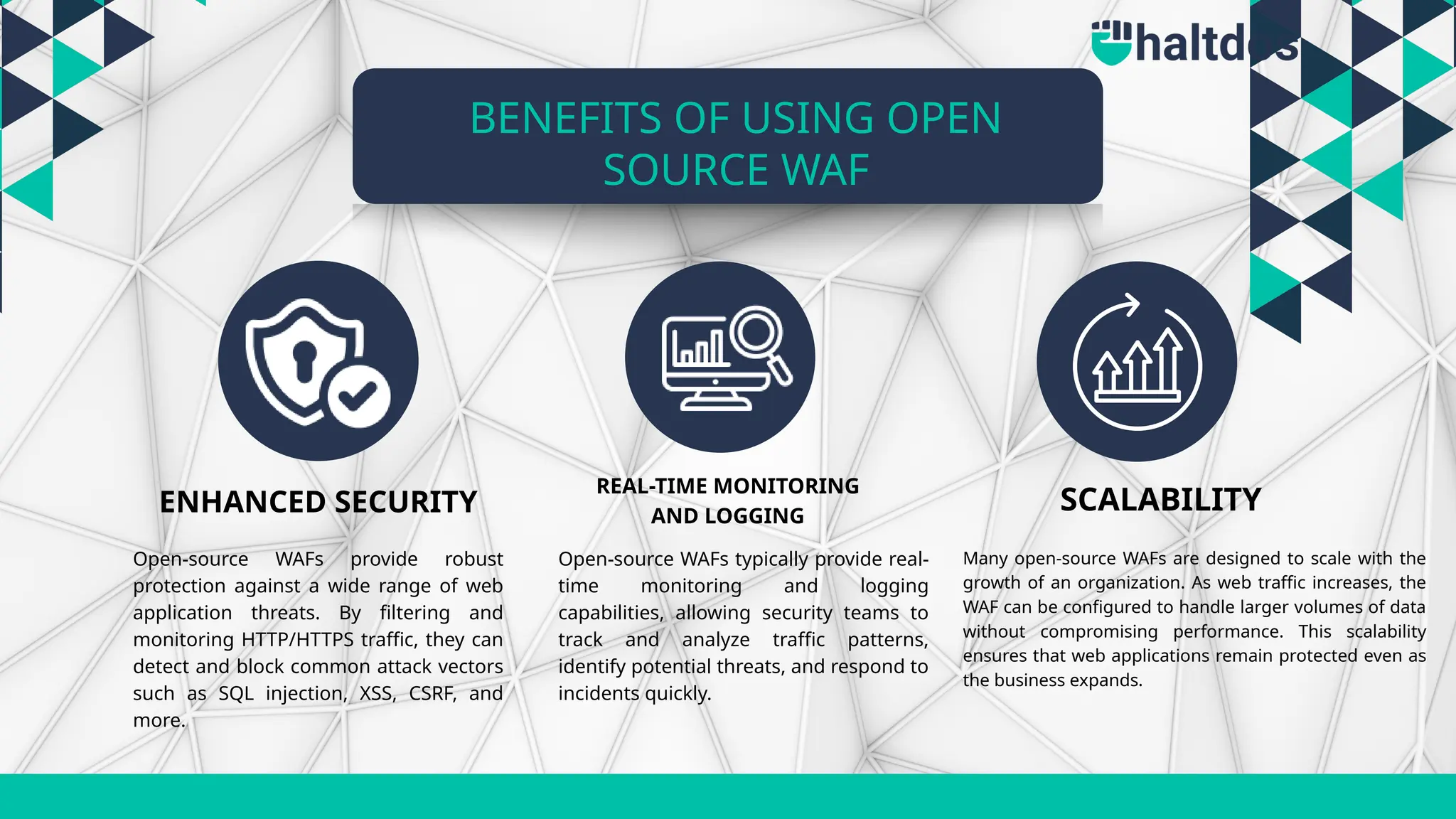
Open-source WAFs provide robust
protection against a wide range of web
application threats. By filtering and
monitoring HTTP/HTTPS traffic, they can
detect and block common attack vectors
such as SQL injection, XSS, CSRF, and
more.
Open-source WAFs typically provide real-
time monitoring and logging
capabilities, allowing security teams to
track and analyze traffic patterns,
identify potential threats, and respond to
incidents quickly.
Many open-source WAFs are designed to scale with the
growth of an organization. As web traffic increases, the
WAF can be configured to handle larger volumes of data
without compromising performance. This scalability
ensures that web applications remain protected even as
the business expands.
CUSTOMIZABILITY
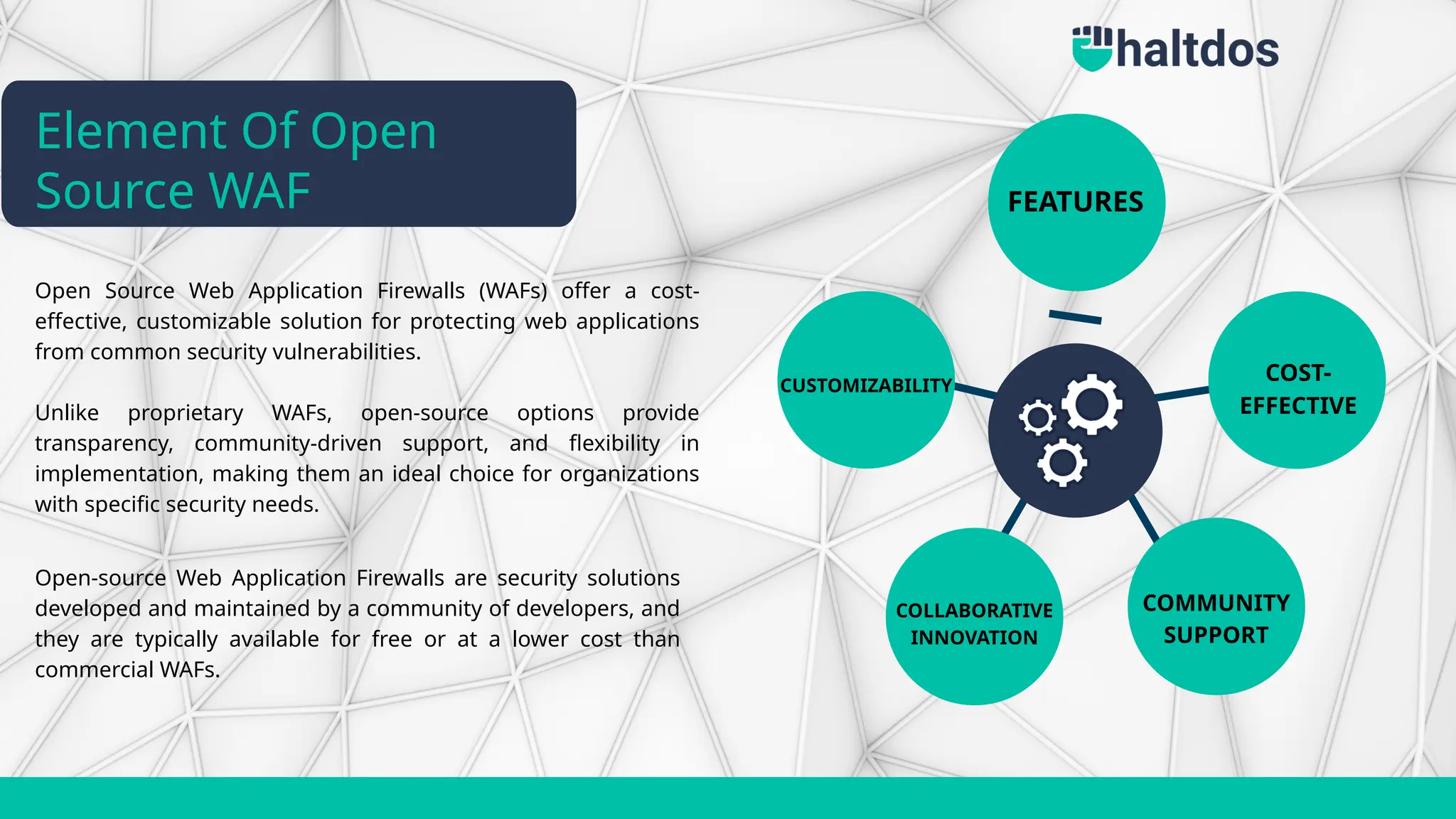
Element Of Open
Source WAF
Open-source Web Application Firewalls are security solutions
developed and maintained by a community of developers, and
they are typically available for free or at a lower cost than
commercial WAFs.
Open Source Web Application Firewalls (WAFs) offer a cost-
effective, customizable solution for protecting web applications
from common security vulnerabilities.
Unlike proprietary WAFs, open-source options provide
transparency, community-driven support, and flexibility in
implementation, making them an ideal choice for organizations
with specific security needs.
FEATURES
COST-
EFFECTIVE
COMMUNITY
SUPPORT
COLLABORATIVE
INNOVATION
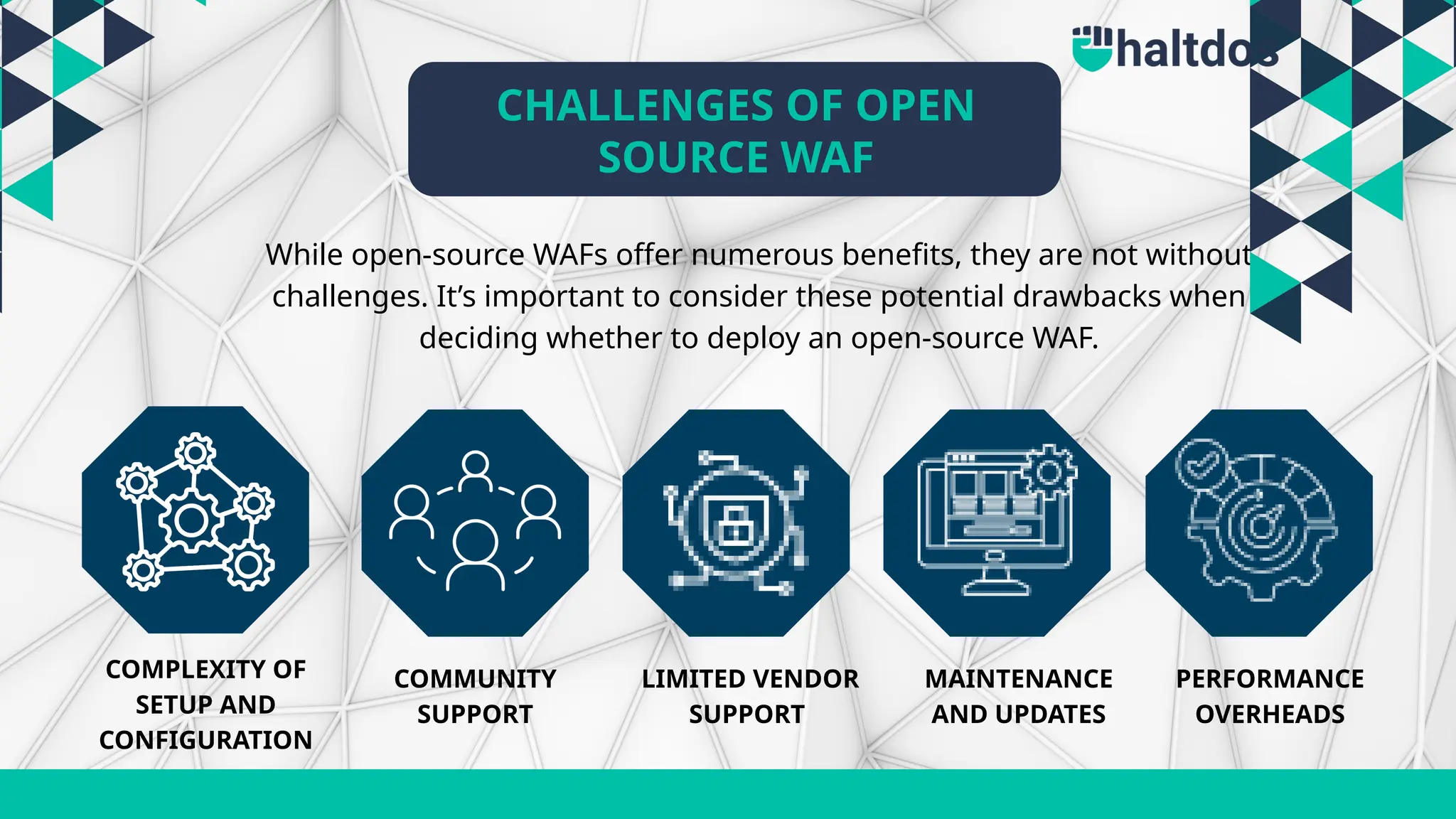
While open-source WAFs offer numerous benefits, they are not without
challenges. It’s important to consider these potential drawbacks when
deciding whether to deploy an open-source WAF.
CHALLENGES OF OPEN
SOURCE WAF
COMMUNITY
SUPPORT
COMPLEXITY OF
SETUP AND
CONFIGURATION
LIMITED VENDOR
SUPPORT
MAINTENANCE
AND UPDATES
PERFORMANCE
OVERHEADS
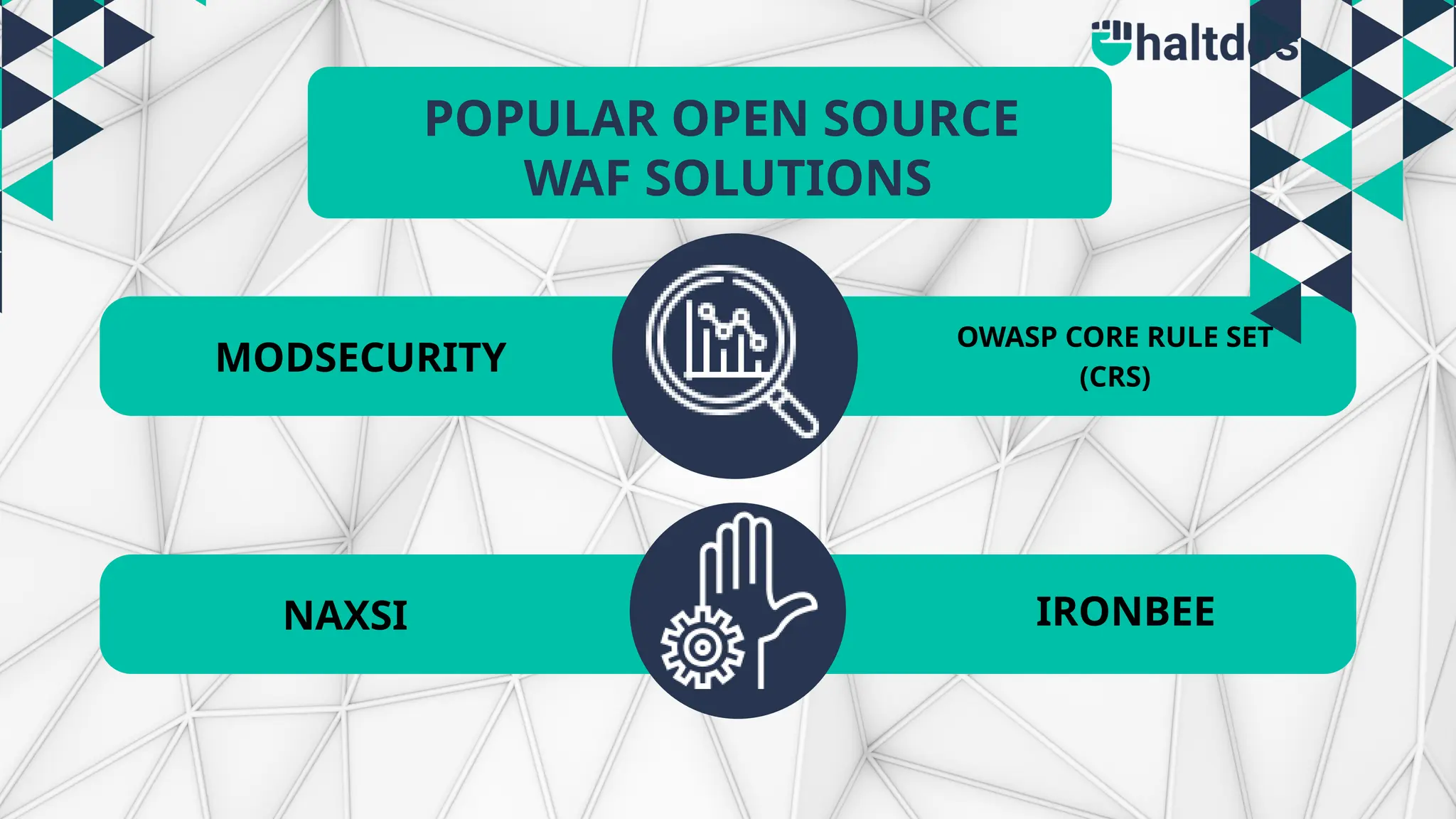
POPULAR OPEN SOURCE
WAF SOLUTIONS
MODSECURITY
OWASP CORE RULE SET
(CRS)
NAXSI IRONBEE
MODSECURITY& OWASP CORE RULE SET
ModSecurity is one of the most well-known open-source WAFs.
Originally developed as an Apache module, ModSecurity has
since expanded to support other web servers, including Nginx
and IIS. It offers comprehensive protection against various web
application threats and provides a powerful rules engine for
creating custom security policies. ModSecurity’s flexibility,
coupled with its active community support, makes it a popular
choice for organizations of all sizes.
The OWASP Core Rule Set (CRS) is a set of generic attack
detection rules designed to protect web applications from a
wide range of threats. While not a WAF itself, CRS can be used in
conjunction with ModSecurity or other WAFs to enhance their
capabilities. CRS is maintained by the Open Web Application
Security Project (OWASP), a respected organization in the
cybersecurity community.
NAXSI (Nginx Anti XSS & SQL Injection) is an open-source
WAF designed specifically for Nginx web servers. It is
lightweight, fast, and focuses on preventing XSS and SQL
injection attacks. NAXSI uses a positive security model, which
means it blocks only malicious requests that do not match
predefined rules, reducing the likelihood of false positives.
IronBee is a relatively newer open-source WAF framework
designed to be highly flexible and extensible. It provides a
modular architecture that allows organizations to
customize the WAF according to their needs. IronBee is
designed to work with a variety of web servers and can be
integrated into existing security infrastructures.
NAXSI & IRONBEE
CONCLUSION
Securing your web applications is a critical component
of any cybersecurity strategy, and an open-source Web
Application Firewall (WAF) can be an effective and cost-
efficient solution. Open-source WAFs offer flexibility,
customization, and community-driven support, making
them a viable option for organizations of all sizes. While
there are challenges associated with deploying and
maintaining an open-source WAF, the benefits often
outweigh the drawbacks when implemented
correctly.Whether you choose ModSecurity, NAXSI, or
another open-source WAF, the key is to stay vigilant,
proactive, and committed to maintaining a strong
security posture in today’s ever-evolving threat
landscape.
THANK
YOU!
By understanding the pros and cons of open-source
WAFs, selecting the right solution, and following best
practices for deployment, you can significantly
enhance the security of your web applications and
protect your organization from cyber threats.
+91 120 4545911
www.haltdos.com
B-21, B Block, Sector 59, Noida,
Uttar Pradesh 201309

Secure your web application with open source waf (PPT).pptx

  • 1.
    SECURE YOUR WEBAPPLICATION WITH AN OPEN SOURCE WAF
  • 2.
    WEB APPLICATION FIREWALL A WebApplication Firewall (WAF) is a security solution designed to protect web applications by filtering and monitoring HTTP and HTTPS traffic between the application and the internet. WAFs operate at the application layer (Layer 7 of the OSI model) and are specifically designed to detect and prevent attacks that target web applications. WAFs work by analyzing incoming traffic and blocking or allowing requests based on predefined security rules. These rules are often based on known attack patterns and can be customized to meet the specific needs of an organization. By acting as a barrier between the web application and potential attackers, a WAF helps prevent unauthorized access, data breaches, and other forms of cyberattacks.
  • 3.
    Vision & Mission VISIONMISSION To be the leading Open Source Web Application Firewall (WAF) solution that empowers organizations worldwide to protect their digital assets, ensuring robust, scalable, and transparent security for all web applications, while fostering collaboration and innovation in the cybersecurity community. Our mission is to provide a high-performance, cost- effective, and customizable Open Source WAF that delivers top-tier web application protection against modern cyber threats. We strive to build a global community where developers and security professionals can contribute, enhance, and adopt cutting-edge security measures that ensure the safety and integrity of online applications for all.
  • 4.
    WHY CHOOSE OPEN SOURCEWAF? Cost-Effectiveness 1 2 3 4 Customization Flexibility Community Support Open-source WAFs offer a high degree of customization. Since the source code is publicly available, organizations can tailor the WAF to their specific needs, adding or modifying features as required. Open-source WAFs can be deployed in various environments, including on- premises, in the cloud, or in hybrid setups. This flexibility allows organizations to integrate the WAF seamlessly into their existing infrastructure. Open-source WAFs benefit from a community of developers and users who contribute to the project, provide support, and share best practices. This community-driven approach leads to continuous improvement and innovation. Open-source WAFs are generally more affordable than their commercial counterparts. This makes them an attractive option for small to medium-sized businesses (SMBs) and startups with limited security budgets.
  • 5.
    BENEFITS OF USINGOPEN SOURCE WAF ENHANCED SECURITY REAL-TIME MONITORING AND LOGGING SCALABILITY Open-source WAFs provide robust protection against a wide range of web application threats. By filtering and monitoring HTTP/HTTPS traffic, they can detect and block common attack vectors such as SQL injection, XSS, CSRF, and more. Open-source WAFs typically provide real- time monitoring and logging capabilities, allowing security teams to track and analyze traffic patterns, identify potential threats, and respond to incidents quickly. Many open-source WAFs are designed to scale with the growth of an organization. As web traffic increases, the WAF can be configured to handle larger volumes of data without compromising performance. This scalability ensures that web applications remain protected even as the business expands.
  • 6.
    CUSTOMIZABILITY Element Of Open SourceWAF Open-source Web Application Firewalls are security solutions developed and maintained by a community of developers, and they are typically available for free or at a lower cost than commercial WAFs. Open Source Web Application Firewalls (WAFs) offer a cost- effective, customizable solution for protecting web applications from common security vulnerabilities. Unlike proprietary WAFs, open-source options provide transparency, community-driven support, and flexibility in implementation, making them an ideal choice for organizations with specific security needs. FEATURES COST- EFFECTIVE COMMUNITY SUPPORT COLLABORATIVE INNOVATION
  • 7.
    While open-source WAFsoffer numerous benefits, they are not without challenges. It’s important to consider these potential drawbacks when deciding whether to deploy an open-source WAF. CHALLENGES OF OPEN SOURCE WAF COMMUNITY SUPPORT COMPLEXITY OF SETUP AND CONFIGURATION LIMITED VENDOR SUPPORT MAINTENANCE AND UPDATES PERFORMANCE OVERHEADS
  • 8.
    POPULAR OPEN SOURCE WAFSOLUTIONS MODSECURITY OWASP CORE RULE SET (CRS) NAXSI IRONBEE
  • 9.
    MODSECURITY& OWASP CORERULE SET ModSecurity is one of the most well-known open-source WAFs. Originally developed as an Apache module, ModSecurity has since expanded to support other web servers, including Nginx and IIS. It offers comprehensive protection against various web application threats and provides a powerful rules engine for creating custom security policies. ModSecurity’s flexibility, coupled with its active community support, makes it a popular choice for organizations of all sizes. The OWASP Core Rule Set (CRS) is a set of generic attack detection rules designed to protect web applications from a wide range of threats. While not a WAF itself, CRS can be used in conjunction with ModSecurity or other WAFs to enhance their capabilities. CRS is maintained by the Open Web Application Security Project (OWASP), a respected organization in the cybersecurity community.
  • 10.
    NAXSI (Nginx AntiXSS & SQL Injection) is an open-source WAF designed specifically for Nginx web servers. It is lightweight, fast, and focuses on preventing XSS and SQL injection attacks. NAXSI uses a positive security model, which means it blocks only malicious requests that do not match predefined rules, reducing the likelihood of false positives. IronBee is a relatively newer open-source WAF framework designed to be highly flexible and extensible. It provides a modular architecture that allows organizations to customize the WAF according to their needs. IronBee is designed to work with a variety of web servers and can be integrated into existing security infrastructures. NAXSI & IRONBEE
  • 11.
    CONCLUSION Securing your webapplications is a critical component of any cybersecurity strategy, and an open-source Web Application Firewall (WAF) can be an effective and cost- efficient solution. Open-source WAFs offer flexibility, customization, and community-driven support, making them a viable option for organizations of all sizes. While there are challenges associated with deploying and maintaining an open-source WAF, the benefits often outweigh the drawbacks when implemented correctly.Whether you choose ModSecurity, NAXSI, or another open-source WAF, the key is to stay vigilant, proactive, and committed to maintaining a strong security posture in today’s ever-evolving threat landscape.
  • 12.
    THANK YOU! By understanding thepros and cons of open-source WAFs, selecting the right solution, and following best practices for deployment, you can significantly enhance the security of your web applications and protect your organization from cyber threats. +91 120 4545911 www.haltdos.com B-21, B Block, Sector 59, Noida, Uttar Pradesh 201309