Naveen Kumar
M.E., ECE (Regular)
Outline
    Web Security
    Introduction to SSL/TLS
    Secure Socket Layer (SSL)
      Where, What and How about SSL

      Architecture
      The Four Protocols

      Simple Handshake process

    Transport Layer Security (TLS)
      TLS Overview
      Public Key Certificates

    Implementation & Applications of SSL/TLS
    Summary
    References

December 1, 2012                       NITTTR, Chandigarh   2
“Use your mentality, Wake up to reality”
---From the song, “I've got you under my skin”
by Cole Porter


December 1, 2012        NITTTR, Chandigarh       3
Reality!!!


December 1, 2012   NITTTR, Chandigarh   4
Web security
     Web is now widely used by businesses, government firms
      and individuals.
     but Internet & Web space are vulnerable.
     have a variety of threats related to
       Integrity : Someone might alter content

       Confidentiality : Anyone can see content

       Denial of service

       Authentication : Not clear who you are talking with
     need added security mechanisms

December 1, 2012                  NITTTR, Chandigarh           5
Introduction (contd.)
     Secure Sockets Layer (SSL)
      Developed by Netscape Corporation

      Versions 1, 2, and 3 (released in 1996)

     Transport Layer Security (TLS)
      Successor of SSL

      IETF standards track protocol, based on SSL 3.0

       Last updated in RFC 5246 (2008)

December 1, 2012            NITTTR, Chandigarh           6
Introduction (contd.)
     Transport    Layer   Security              (TLS)   and   its
      predecessor, Secure Sockets Layer (SSL), are
      cryptographic protocols that provide security for
      communications over networks such as the
      Internet.
     TLS and SSL encrypt the segments of network
      connections at the Transport Layer end-to-end.


December 1, 2012            NITTTR, Chandigarh                       7
SECURE
                   SOCKET LAYER
                       (SSL)


December 1, 2012        NITTTR, Chandigarh   8
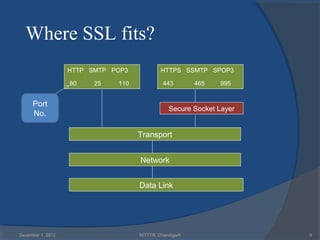
Where SSL fits?
                   HTTP SMTP POP3            HTTPS SSMTP SPOP3

                   80    25   110             443        465   995


     Port
                                                Secure Socket Layer
     No.

                                    Transport


                                    Network


                                    Data Link


December 1, 2012                    NITTTR, Chandigarh                9
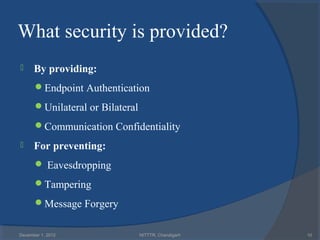
What security is provided?
     By providing:
      Endpoint Authentication

      Unilateral or Bilateral

      Communication Confidentiality
     For preventing:
       Eavesdropping

      Tampering

      Message Forgery


December 1, 2012                 NITTTR, Chandigarh   10
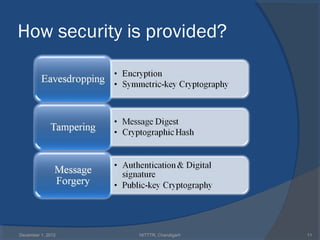
How security is provided?


December 1, 2012   NITTTR, Chandigarh   11
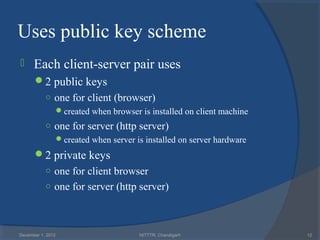
Uses public key scheme
     Each client-server pair uses
      2 public keys
           ○ one for client (browser)
              created when browser is installed on client machine
           ○ one for server (http server)
              created when server is installed on server hardware
      2 private keys
           ○ one for client browser
           ○ one for server (http server)


December 1, 2012                    NITTTR, Chandigarh               12
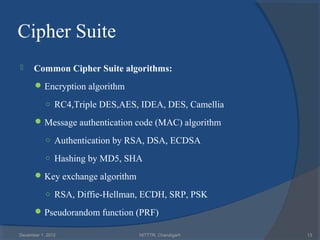
Cipher Suite
     Common Cipher Suite algorithms:
       Encryption algorithm

           ○ RC4,Triple DES,AES, IDEA, DES, Camellia

       Message authentication code (MAC) algorithm

           ○ Authentication by RSA, DSA, ECDSA

           ○ Hashing by MD5, SHA

       Key exchange algorithm

           ○ RSA, Diffie-Hellman, ECDH, SRP, PSK

       Pseudorandom function (PRF)

December 1, 2012                 NITTTR, Chandigarh    13
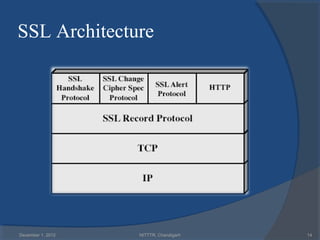
SSL Architecture


December 1, 2012   NITTTR, Chandigarh   14
SSL Architecture (Contd.)
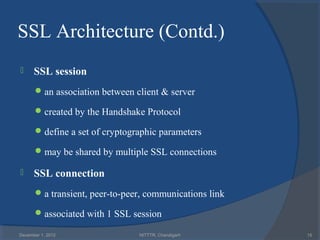
     SSL session
       an association between client & server

       created by the Handshake Protocol

       define a set of cryptographic parameters

       may be shared by multiple SSL connections

     SSL connection
       a transient, peer-to-peer, communications link

       associated with 1 SSL session

December 1, 2012                NITTTR, Chandigarh       15
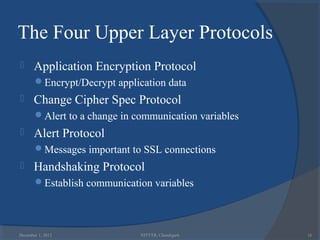
The Four Upper Layer Protocols
      Application Encryption Protocol
       Encrypt/Decrypt application data
      Change Cipher Spec Protocol
       Alert to a change in communication variables
      Alert Protocol
       Messages important to SSL connections
      Handshaking Protocol
       Establish communication variables


December 1, 2012              NITTTR, Chandigarh       16
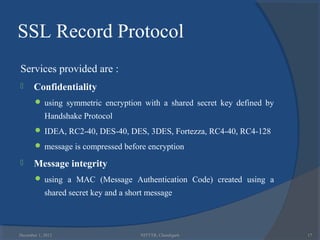
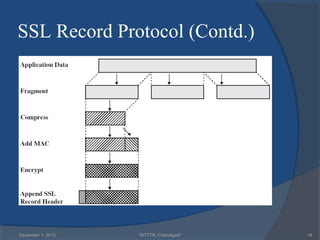
SSL Record Protocol
Services provided are :
      Confidentiality
        using symmetric encryption with a shared secret key defined by
            Handshake Protocol
        IDEA, RC2-40, DES-40, DES, 3DES, Fortezza, RC4-40, RC4-128

        message is compressed before encryption

      Message integrity
        using a MAC (Message Authentication Code) created using a
            shared secret key and a short message


December 1, 2012                       NITTTR, Chandigarh                 17
SSL Record Protocol (Contd.)


December 1, 2012   NITTTR, Chandigarh   18
SSL Change Cipher Spec Protocol
     one of 3 SSL specific protocols which use the
      SSL Record protocol
     a single message
     Purpose of message
      Cause copy of pending state to current state.

      Updates cipher suite to be used on the current

           connection .

December 1, 2012            NITTTR, Chandigarh          19
SSL Alert Protocol
      conveys SSL-related alerts to peer entity
      Consists of two bytes
        1st byte : warning or fatal
        2nd byte: code for specific alerts

      specific alert types
        unexpected message, bad record mac, decompression failure,

            handshake failure, illegal parameter
        close notify, no certificate, bad certificate, unsupported certificate,

            certificate revoked, certificate expired, certificate unknown

      compressed & encrypted like all SSL data

December 1, 2012                         NITTTR, Chandigarh                        20
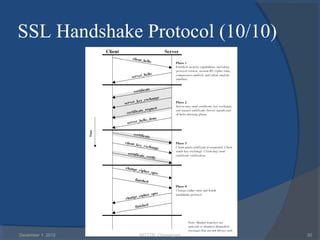
SSL Handshake Protocol (1/10)
     The most complex part of SSL.
     allows server & client to:
      authenticate each other
      to negotiate encryption & MAC algorithms
      to negotiate cryptographic keys to be used
     comprises a series of messages in phases
      Establish Security Capabilities
      Server Authentication and Key Exchange
      Client Authentication and Key Exchange
      Finish


December 1, 2012             NITTTR, Chandigarh     21
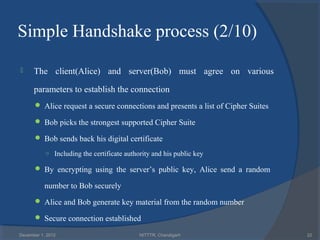
Simple Handshake process (2/10)

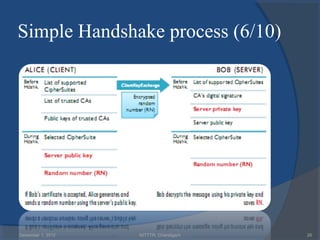
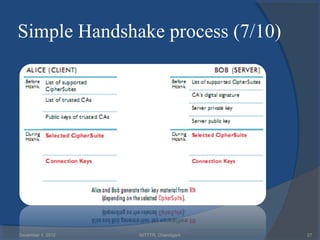
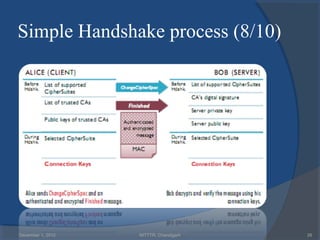
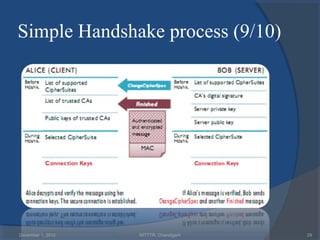
     The client(Alice) and server(Bob) must agree on various

      parameters to establish the connection
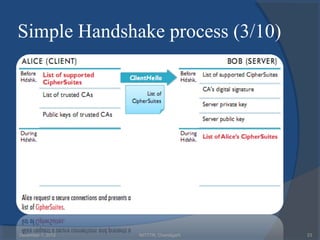
       Alice request a secure connections and presents a list of Cipher Suites

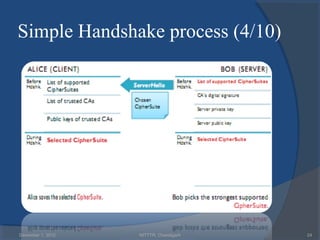
       Bob picks the strongest supported Cipher Suite

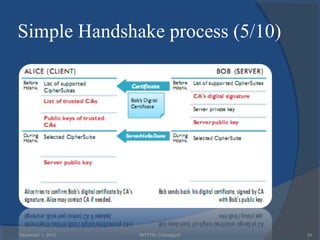
       Bob sends back his digital certificate

           ○ Including the certificate authority and his public key

       By encrypting using the server’s public key, Alice send a random

           number to Bob securely
       Alice and Bob generate key material from the random number

       Secure connection established

December 1, 2012                            NITTTR, Chandigarh                    22
Simple Handshake process (3/10)


December 1, 2012   NITTTR, Chandigarh   23
Simple Handshake process (4/10)


December 1, 2012   NITTTR, Chandigarh   24
Simple Handshake process (5/10)


December 1, 2012   NITTTR, Chandigarh   25
Simple Handshake process (6/10)


December 1, 2012   NITTTR, Chandigarh   26
Simple Handshake process (7/10)


December 1, 2012   NITTTR, Chandigarh   27
Simple Handshake process (8/10)


December 1, 2012   NITTTR, Chandigarh   28
Simple Handshake process (9/10)


December 1, 2012   NITTTR, Chandigarh   29
SSL Handshake Protocol (10/10)


December 1, 2012   NITTTR, Chandigarh   30
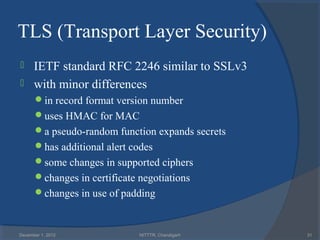
TLS (Transport Layer Security)
     IETF standard RFC 2246 similar to SSLv3
     with minor differences
      in record format version number
      uses HMAC for MAC
      a pseudo-random function expands secrets
      has additional alert codes
      some changes in supported ciphers
      changes in certificate negotiations
      changes in use of padding


December 1, 2012              NITTTR, Chandigarh   31
Changes from SSL 3.0 to TLS
       Fortezza removed
       Additional Alerts added
       Modification to hash calculations
       Protocol version 3.1 in ClientHello,
        ServerHello


32
 December 1, 2012            NITTTR, Chandigarh
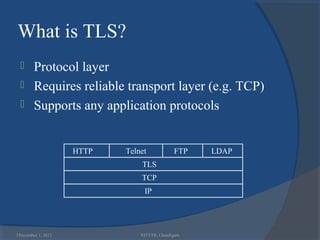
What is TLS?
   Protocol layer
   Requires reliable transport layer (e.g. TCP)
   Supports any application protocols


                    HTTP   Telnet             FTP   LDAP
                               TLS
                               TCP
                                IP


33
 December 1, 2012              NITTTR, Chandigarh
TLS: Privacy
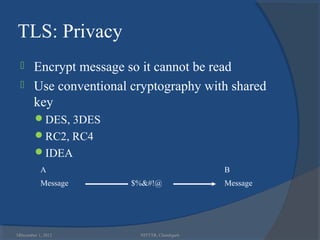
   Encrypt message so it cannot be read
   Use conventional cryptography with shared
    key
        DES, 3DES
        RC2, RC4
        IDEA
           A                                B
           Message   $%&#!@                 Message


34
 December 1, 2012      NITTTR, Chandigarh
TLS:Key Exchange
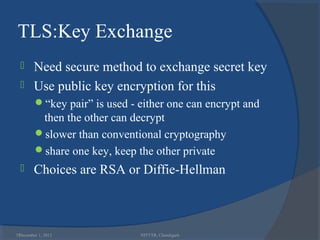
   Need secure method to exchange secret key
   Use public key encryption for this
        “key pair” is used - either one can encrypt and
         then the other can decrypt
        slower than conventional cryptography
        share one key, keep the other private
       Choices are RSA or Diffie-Hellman


35
 December 1, 2012             NITTTR, Chandigarh
TLS: Integrity
       Compute fixed-length Message
        Authentication Code (MAC)
        Includes hash of message
        Includes a shared secret
        Include sequence number
       Transmit MAC with message


36
 December 1, 2012            NITTTR, Chandigarh
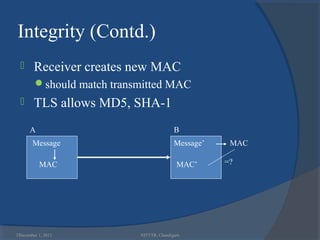
Integrity (Contd.)
       Receiver creates new MAC
        should match transmitted MAC
       TLS allows MD5, SHA-1
      A                                   B
       Message                            Message’    MAC

          MAC                              MAC’      =?


37
 December 1, 2012          NITTTR, Chandigarh
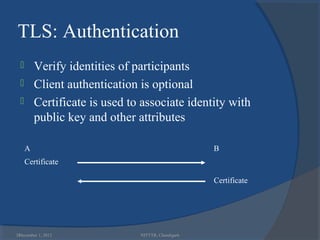
TLS: Authentication
         Verify identities of participants
         Client authentication is optional
         Certificate is used to associate identity with
          public key and other attributes

      A                                              B
      Certificate

                                                     Certificate


38
 December 1, 2012               NITTTR, Chandigarh
TLS: Architecture
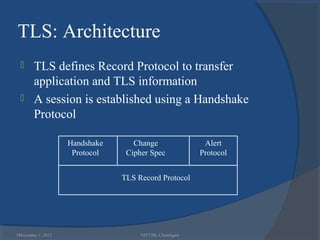
       TLS defines Record Protocol to transfer
        application and TLS information
       A session is established using a Handshake
        Protocol

                    Handshake      Change                  Alert
                     Protocol    Cipher Spec              Protocol


                                TLS Record Protocol


39
 December 1, 2012                    NITTTR, Chandigarh
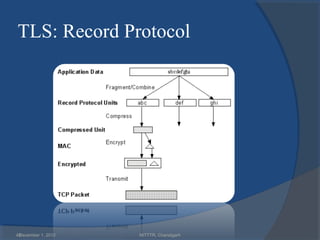
TLS: Record Protocol


40
 December 1, 2012   NITTTR, Chandigarh
TLS: Handshake
       Negotiate Cipher-Suite Algorithms
        Symmetric cipher to use
        Key exchange method
        Message digest function
   Establish and share master secret
   Optionally authenticate server and/or client


41
 December 1, 2012           NITTTR, Chandigarh
Handshake Phases
       Hello messages
       Certificate and Key Exchange messages
       Change Cipher Spec and Finished messages


42
 December 1, 2012          NITTTR, Chandigarh
TLS: Hello
       Client “Hello” - initiates session
        Propose protocol version
        Propose cipher suite
        Server chooses protocol and suite
       Client may request use of cached session
        Server chooses whether to honor request


43
 December 1, 2012               NITTTR, Chandigarh
TLS: Key Exchange
       Server sends certificate containing public key
        (RSA) or Diffie-Hellman parameters
       Client sends encrypted “pre-master” secret to
        server using Client Key Exchange message
       Master secret calculated
        Use random values passed in Client and Server Hello

             messages

44
 December 1, 2012              NITTTR, Chandigarh
Public Key Certificates
       X.509 Certificate associates public key with
        identity
       Certification Authority (CA) creates certificate
        Adheres to policies and verifies identity

        Signs certificate

       User of Certificate must ensure it is valid


45
 December 1, 2012               NITTTR, Chandigarh
Validating a Certificate

       Must recognize accepted CA in certificate
        chain
        One CA may issue certificate for another CA

       Must verify that certificate has not been
        revoked
        CA publishes Certificate Revocation List (CRL)


46
 December 1, 2012            NITTTR, Chandigarh
X.509 Certificate Issues
       Certificate Administration is complex
        Hierarchy of Certification Authorities
        Mechanisms for requesting, issuing, revoking
             certificates
   X.500 names are complicated
   Description  formats are                       cumbersome
    (ASN.1)


47
 December 1, 2012             NITTTR, Chandigarh
TLS: HTTP Application
       HTTP is most common TLS application
        https://
   Requires TLS-capable web server
   Requires TLS-capable web browser
        Netscape Navigator
        Internet Explorer
        Cryptozilla
             ○ Netscape Mozilla sources with SSLeay


48
 December 1, 2012                NITTTR, Chandigarh
TLS “Alternatives”
   S-HTTP: secure HTTP protocol, shttp://
   IPSec: secure IP
   SET: Secure Electronic Transaction
        Protocol and infrastructure for bank card
             payments
       SASL: Simple Authentication and Security
        Layer (RFC 2222)


49
 December 1, 2012             NITTTR, Chandigarh
Implementation of SSL/TLS
      SSL and TLS have been widely implemented
        Open source software projects

            ○ OpenSSL, NSS, or GnuTLS

        Microsoft Windows

            ○ Part of its Secure Channel

        Browsers

            ○ Apple Safari

            ○ Mozilla Firefox (2+)

            ○ Internet Explorer, etc.

December 1, 2012                        NITTTR, Chandigarh   50
Application of SSL/TLS
      On top of the Transport Layer protocols
       Primarily with TCP

       Datagram Transport Layer Security(DTLS) for UDP

      Encapsulating the application protocols
       HTTP (HTTPS)

       for securing WWW traffic

       FTP (FTPS), SMTP, NNTP, etc.


December 1, 2012               NITTTR, Chandigarh         51
Summary
       SSL/TLS addresses the need for security in
        Internet communications
        Privacy - conventional encryption

        Integrity - Message Authentication Codes

        Authentication - X.509 certificates

       SSL in use today with web browsers and
        servers

52
 December 1, 2012               NITTTR, Chandigarh
References
      William Stallings, 5th Edition, “Transport-Level
       Security”, Chapter 16, Pages : 509-543
      www.cse.buffalo.edu/DBGROUP/nachi/ecopre
       s/fengmei.ppt
      http://www.slideshare.net/leethree/ssl-intro


December 1, 2012            NITTTR, Chandigarh            53
December 1, 2012   NITTTR, Chandigarh   54

Secure Socket Layer

  • 1.
  • 2.
    Outline  Web Security  Introduction to SSL/TLS  Secure Socket Layer (SSL)  Where, What and How about SSL  Architecture  The Four Protocols  Simple Handshake process  Transport Layer Security (TLS)  TLS Overview  Public Key Certificates  Implementation & Applications of SSL/TLS  Summary  References December 1, 2012 NITTTR, Chandigarh 2
  • 3.
    “Use your mentality,Wake up to reality” ---From the song, “I've got you under my skin” by Cole Porter December 1, 2012 NITTTR, Chandigarh 3
  • 4.
    Reality!!! December 1, 2012 NITTTR, Chandigarh 4
  • 5.
    Web security  Web is now widely used by businesses, government firms and individuals.  but Internet & Web space are vulnerable.  have a variety of threats related to  Integrity : Someone might alter content  Confidentiality : Anyone can see content  Denial of service  Authentication : Not clear who you are talking with  need added security mechanisms December 1, 2012 NITTTR, Chandigarh 5
  • 6.
    Introduction (contd.)  Secure Sockets Layer (SSL) Developed by Netscape Corporation Versions 1, 2, and 3 (released in 1996)  Transport Layer Security (TLS) Successor of SSL IETF standards track protocol, based on SSL 3.0  Last updated in RFC 5246 (2008) December 1, 2012 NITTTR, Chandigarh 6
  • 7.
    Introduction (contd.)  Transport Layer Security (TLS) and its predecessor, Secure Sockets Layer (SSL), are cryptographic protocols that provide security for communications over networks such as the Internet.  TLS and SSL encrypt the segments of network connections at the Transport Layer end-to-end. December 1, 2012 NITTTR, Chandigarh 7
  • 8.
    SECURE SOCKET LAYER (SSL) December 1, 2012 NITTTR, Chandigarh 8
  • 9.
    Where SSL fits? HTTP SMTP POP3 HTTPS SSMTP SPOP3 80 25 110 443 465 995 Port Secure Socket Layer No. Transport Network Data Link December 1, 2012 NITTTR, Chandigarh 9
  • 10.
    What security isprovided?  By providing: Endpoint Authentication Unilateral or Bilateral Communication Confidentiality  For preventing:  Eavesdropping Tampering Message Forgery December 1, 2012 NITTTR, Chandigarh 10
  • 11.
    How security isprovided? December 1, 2012 NITTTR, Chandigarh 11
  • 12.
    Uses public keyscheme  Each client-server pair uses 2 public keys ○ one for client (browser)  created when browser is installed on client machine ○ one for server (http server)  created when server is installed on server hardware 2 private keys ○ one for client browser ○ one for server (http server) December 1, 2012 NITTTR, Chandigarh 12
  • 13.
    Cipher Suite  Common Cipher Suite algorithms:  Encryption algorithm ○ RC4,Triple DES,AES, IDEA, DES, Camellia  Message authentication code (MAC) algorithm ○ Authentication by RSA, DSA, ECDSA ○ Hashing by MD5, SHA  Key exchange algorithm ○ RSA, Diffie-Hellman, ECDH, SRP, PSK  Pseudorandom function (PRF) December 1, 2012 NITTTR, Chandigarh 13
  • 14.
    SSL Architecture December 1,2012 NITTTR, Chandigarh 14
  • 15.
    SSL Architecture (Contd.)  SSL session  an association between client & server  created by the Handshake Protocol  define a set of cryptographic parameters  may be shared by multiple SSL connections  SSL connection  a transient, peer-to-peer, communications link  associated with 1 SSL session December 1, 2012 NITTTR, Chandigarh 15
  • 16.
    The Four UpperLayer Protocols  Application Encryption Protocol Encrypt/Decrypt application data  Change Cipher Spec Protocol Alert to a change in communication variables  Alert Protocol Messages important to SSL connections  Handshaking Protocol Establish communication variables December 1, 2012 NITTTR, Chandigarh 16
  • 17.
    SSL Record Protocol Servicesprovided are :  Confidentiality  using symmetric encryption with a shared secret key defined by Handshake Protocol  IDEA, RC2-40, DES-40, DES, 3DES, Fortezza, RC4-40, RC4-128  message is compressed before encryption  Message integrity  using a MAC (Message Authentication Code) created using a shared secret key and a short message December 1, 2012 NITTTR, Chandigarh 17
  • 18.
    SSL Record Protocol(Contd.) December 1, 2012 NITTTR, Chandigarh 18
  • 19.
    SSL Change CipherSpec Protocol  one of 3 SSL specific protocols which use the SSL Record protocol  a single message  Purpose of message Cause copy of pending state to current state. Updates cipher suite to be used on the current connection . December 1, 2012 NITTTR, Chandigarh 19
  • 20.
    SSL Alert Protocol  conveys SSL-related alerts to peer entity  Consists of two bytes  1st byte : warning or fatal  2nd byte: code for specific alerts  specific alert types  unexpected message, bad record mac, decompression failure, handshake failure, illegal parameter  close notify, no certificate, bad certificate, unsupported certificate, certificate revoked, certificate expired, certificate unknown  compressed & encrypted like all SSL data December 1, 2012 NITTTR, Chandigarh 20
  • 21.
    SSL Handshake Protocol(1/10)  The most complex part of SSL.  allows server & client to: authenticate each other to negotiate encryption & MAC algorithms to negotiate cryptographic keys to be used  comprises a series of messages in phases Establish Security Capabilities Server Authentication and Key Exchange Client Authentication and Key Exchange Finish December 1, 2012 NITTTR, Chandigarh 21
  • 22.
    Simple Handshake process(2/10)  The client(Alice) and server(Bob) must agree on various parameters to establish the connection  Alice request a secure connections and presents a list of Cipher Suites  Bob picks the strongest supported Cipher Suite  Bob sends back his digital certificate ○ Including the certificate authority and his public key  By encrypting using the server’s public key, Alice send a random number to Bob securely  Alice and Bob generate key material from the random number  Secure connection established December 1, 2012 NITTTR, Chandigarh 22
  • 23.
    Simple Handshake process(3/10) December 1, 2012 NITTTR, Chandigarh 23
  • 24.
    Simple Handshake process(4/10) December 1, 2012 NITTTR, Chandigarh 24
  • 25.
    Simple Handshake process(5/10) December 1, 2012 NITTTR, Chandigarh 25
  • 26.
    Simple Handshake process(6/10) December 1, 2012 NITTTR, Chandigarh 26
  • 27.
    Simple Handshake process(7/10) December 1, 2012 NITTTR, Chandigarh 27
  • 28.
    Simple Handshake process(8/10) December 1, 2012 NITTTR, Chandigarh 28
  • 29.
    Simple Handshake process(9/10) December 1, 2012 NITTTR, Chandigarh 29
  • 30.
    SSL Handshake Protocol(10/10) December 1, 2012 NITTTR, Chandigarh 30
  • 31.
    TLS (Transport LayerSecurity)  IETF standard RFC 2246 similar to SSLv3  with minor differences in record format version number uses HMAC for MAC a pseudo-random function expands secrets has additional alert codes some changes in supported ciphers changes in certificate negotiations changes in use of padding December 1, 2012 NITTTR, Chandigarh 31
  • 32.
    Changes from SSL3.0 to TLS  Fortezza removed  Additional Alerts added  Modification to hash calculations  Protocol version 3.1 in ClientHello, ServerHello 32 December 1, 2012 NITTTR, Chandigarh
  • 33.
    What is TLS?  Protocol layer  Requires reliable transport layer (e.g. TCP)  Supports any application protocols HTTP Telnet FTP LDAP TLS TCP IP 33 December 1, 2012 NITTTR, Chandigarh
  • 34.
    TLS: Privacy  Encrypt message so it cannot be read  Use conventional cryptography with shared key DES, 3DES RC2, RC4 IDEA A B Message $%&#!@ Message 34 December 1, 2012 NITTTR, Chandigarh
  • 35.
    TLS:Key Exchange  Need secure method to exchange secret key  Use public key encryption for this “key pair” is used - either one can encrypt and then the other can decrypt slower than conventional cryptography share one key, keep the other private  Choices are RSA or Diffie-Hellman 35 December 1, 2012 NITTTR, Chandigarh
  • 36.
    TLS: Integrity  Compute fixed-length Message Authentication Code (MAC) Includes hash of message Includes a shared secret Include sequence number  Transmit MAC with message 36 December 1, 2012 NITTTR, Chandigarh
  • 37.
    Integrity (Contd.)  Receiver creates new MAC should match transmitted MAC  TLS allows MD5, SHA-1 A B Message Message’ MAC MAC MAC’ =? 37 December 1, 2012 NITTTR, Chandigarh
  • 38.
    TLS: Authentication  Verify identities of participants  Client authentication is optional  Certificate is used to associate identity with public key and other attributes A B Certificate Certificate 38 December 1, 2012 NITTTR, Chandigarh
  • 39.
    TLS: Architecture  TLS defines Record Protocol to transfer application and TLS information  A session is established using a Handshake Protocol Handshake Change Alert Protocol Cipher Spec Protocol TLS Record Protocol 39 December 1, 2012 NITTTR, Chandigarh
  • 40.
    TLS: Record Protocol 40 December 1, 2012 NITTTR, Chandigarh
  • 41.
    TLS: Handshake  Negotiate Cipher-Suite Algorithms Symmetric cipher to use Key exchange method Message digest function  Establish and share master secret  Optionally authenticate server and/or client 41 December 1, 2012 NITTTR, Chandigarh
  • 42.
    Handshake Phases  Hello messages  Certificate and Key Exchange messages  Change Cipher Spec and Finished messages 42 December 1, 2012 NITTTR, Chandigarh
  • 43.
    TLS: Hello  Client “Hello” - initiates session Propose protocol version Propose cipher suite Server chooses protocol and suite  Client may request use of cached session Server chooses whether to honor request 43 December 1, 2012 NITTTR, Chandigarh
  • 44.
    TLS: Key Exchange  Server sends certificate containing public key (RSA) or Diffie-Hellman parameters  Client sends encrypted “pre-master” secret to server using Client Key Exchange message  Master secret calculated Use random values passed in Client and Server Hello messages 44 December 1, 2012 NITTTR, Chandigarh
  • 45.
    Public Key Certificates  X.509 Certificate associates public key with identity  Certification Authority (CA) creates certificate Adheres to policies and verifies identity Signs certificate  User of Certificate must ensure it is valid 45 December 1, 2012 NITTTR, Chandigarh
  • 46.
    Validating a Certificate  Must recognize accepted CA in certificate chain One CA may issue certificate for another CA  Must verify that certificate has not been revoked CA publishes Certificate Revocation List (CRL) 46 December 1, 2012 NITTTR, Chandigarh
  • 47.
    X.509 Certificate Issues  Certificate Administration is complex Hierarchy of Certification Authorities Mechanisms for requesting, issuing, revoking certificates  X.500 names are complicated  Description formats are cumbersome (ASN.1) 47 December 1, 2012 NITTTR, Chandigarh
  • 48.
    TLS: HTTP Application  HTTP is most common TLS application https://  Requires TLS-capable web server  Requires TLS-capable web browser Netscape Navigator Internet Explorer Cryptozilla ○ Netscape Mozilla sources with SSLeay 48 December 1, 2012 NITTTR, Chandigarh
  • 49.
    TLS “Alternatives”  S-HTTP: secure HTTP protocol, shttp://  IPSec: secure IP  SET: Secure Electronic Transaction Protocol and infrastructure for bank card payments  SASL: Simple Authentication and Security Layer (RFC 2222) 49 December 1, 2012 NITTTR, Chandigarh
  • 50.
    Implementation of SSL/TLS  SSL and TLS have been widely implemented  Open source software projects ○ OpenSSL, NSS, or GnuTLS  Microsoft Windows ○ Part of its Secure Channel  Browsers ○ Apple Safari ○ Mozilla Firefox (2+) ○ Internet Explorer, etc. December 1, 2012 NITTTR, Chandigarh 50
  • 51.
    Application of SSL/TLS  On top of the Transport Layer protocols Primarily with TCP Datagram Transport Layer Security(DTLS) for UDP  Encapsulating the application protocols HTTP (HTTPS) for securing WWW traffic FTP (FTPS), SMTP, NNTP, etc. December 1, 2012 NITTTR, Chandigarh 51
  • 52.
    Summary  SSL/TLS addresses the need for security in Internet communications Privacy - conventional encryption Integrity - Message Authentication Codes Authentication - X.509 certificates  SSL in use today with web browsers and servers 52 December 1, 2012 NITTTR, Chandigarh
  • 53.
    References  William Stallings, 5th Edition, “Transport-Level Security”, Chapter 16, Pages : 509-543  www.cse.buffalo.edu/DBGROUP/nachi/ecopre s/fengmei.ppt  http://www.slideshare.net/leethree/ssl-intro December 1, 2012 NITTTR, Chandigarh 53
  • 54.
    December 1, 2012 NITTTR, Chandigarh 54

Editor's Notes

  • #15 Stallings Fig 17-2.
  • #18 SSL Record Protocol defines these two services for SSL connections.
  • #31 Stallings Fig 17-6.
  • #33 Hash includes Finished and CertificateVerify messages following client cert types removed: rsa_ephemeral_dh dss_ephemeral_dh fortezza_dms SSL 2 -> SSL 3.0 major changes
  • #34 Reliable transport layer delivers data without duplicates or missing data, and in order. Not really transparent to applications Application must understand desired security level and if TLS cannot provide that must not assume a secure connection Application must communicate security parameters to TLS Application may introduce security issues e.g. HTTP 1.0 connection close with empty Content-Length
  • #35 Most block ciphers (64 bit blocks) except for RC4 stream cipher CBC cipher block chaining use IV (initialization vector) XOR previous encrypted block with block then encrypt …
  • #37 Secret is used so that someone cannot replace both message and MAC, putting a new matching MAC in place of the original
  • #40 Operational and pending states
  • #41 Currently no compression defined but could be client boundaries are not preserved 2^14 bytes or less in protocol unit md5, sha-1, none MAC des, 3des, des40, rc2, rc4, idea none encryption
  • #42 Encryption mac key exchange Des/3des/des40 md5, sha1, none rsa, dh rc2 rc4 idea none
  • #44 Server “ Hello Request ”- ask client to restart hello includes some random data for creating the master secret
  • #45 Client generates 48-byte secret random # , encrypts using server’s public key, sends to server if diffie-hellman, p,g
  • #46 PKCS standards from RSA for RSA certificates PKCS #10 cert requests PKCS #9 cert attributes PKCS #7 cert chain format application/x-pkcs7-mime used to load CA chain into browser
  • #48 Mention different kinds of certificates identity encryption etc
  • #50 S-HTTP inter-operates with http signature authentication encryption public key key exchange, & externally arranged Secure * Secure-HTTP/1.4 : Request URI Secure-HTTP/1.4 200 OK response header lines convey information e.g. Certificate-Info: has cert, Encryption-Identity: x500 name ------------ IPSec RFC 1825-1829 required for IPv6, optional for IPv4 transport mode - protect contents of IP packet tunnel mode - protect entire IP packet encryption, MAC SASL Means to add authentication to connection-based protocol Variety of mechanisms Kerberos V4, GSSAPI, “External” Allows separation of authorization identity from client identity in credentials Permits authenticated state in protocol