Name:- Nisarg Amin
Topic:- Firewall And Its Types
And Function
1
Firewall
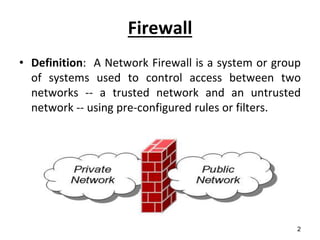
• Definition: A Network Firewall is a system or group
of systems used to control access between two
networks -- a trusted network and an untrusted
network -- using pre-configured rules or filters.
2
• Firewall is device that provides secure
connectivity between networks (internal/
external).
• It is used to implement and enforce a security
policy for communication between networks.
• A firewall may be a hardware, software or a
combination of both that is used to prevent
unauthorized program or internet users from
accessing a private network or a single computer.
3
• All messages entering or leaving the intranet pass
through the firewall, which examines each message
& blocks those that do not meet the specified
security criteria.
4
Why do we need a firewall?
• To protect confidential
information from those who do
not explicitly need to access it.
• To protect our network & its
resources from malicious users
& accidents that originate
outside of our network.
5
Types of firewall
1. Hardware firewall
1. Software firewall
6
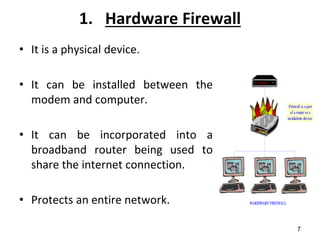
1. Hardware Firewall
• It is a physical device.
• It can be installed between the
modem and computer.
• It can be incorporated into a
broadband router being used to
share the internet connection.
• Protects an entire network.
7
• Usually more expensive, harder to configure.
• E.g.- Cisco pix, Netscreen, Watchfuard etc.
8
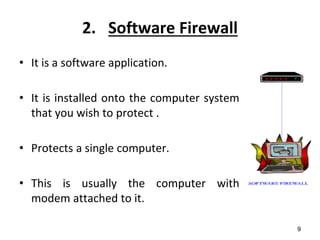
2. Software Firewall
• It is a software application.
• It is installed onto the computer system
that you wish to protect .
• Protects a single computer.
• This is usually the computer with
modem attached to it.
9
• Usually less expensive, easier to configure.
• E.g.- Norton internet security, MacAfee
internet security etc.
10
Types of firewall technique
• Packet filter
• Application gateway
• Circuit-level gateway
• Bastion host
11
Packet filter
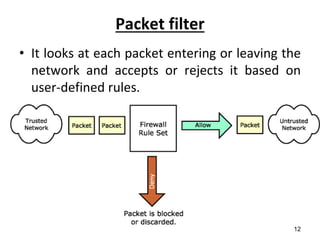
• It looks at each packet entering or leaving the
network and accepts or rejects it based on
user-defined rules.
12
• Packet filtering is fairly effective & transparent
to users, but it is difficult to configure.
• In addition, it is susceptible to IP spoofing.
13
Application gateway
• In such type of firewall remote host or
network can interact only with proxy server,
proxy server is responsible for hiding the
details of the internal network i.e. intranet.
• Users uses TCP/IP application, such as FTP &
Telnet servers.
14
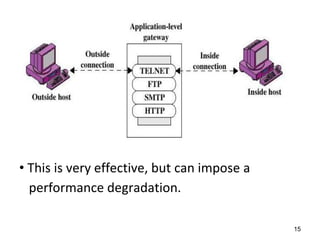
• This is very effective, but can impose a
performance degradation.
15
Circuit – level Firewall
• This can be a stand – alone system or it can be a
specialized functions performed by an application –
level gateway for certain applications.
• It does not permit an end – to – end TCP
connection; rather, the gateway sets two TCP
connections.
• A typical use of the circuit – level gateway is a
situation in which the system administrator trusts
the internal users. 16
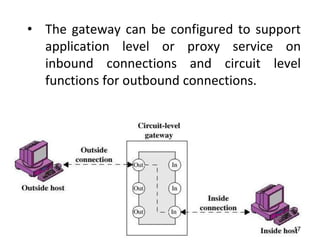
• The gateway can be configured to support
application level or proxy service on
inbound connections and circuit level
functions for outbound connections.
17
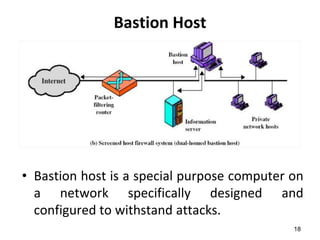
Bastion Host
• Bastion host is a special purpose computer on
a network specifically designed and
configured to withstand attacks.
18
• It generally hosts a single application, provides
platform for application gateway and circuit-
level gateway.
• It supports limited/specific applications to
reduce the threat to the computer.
• Include application-Telnet, SMTP, FTP
19
What a personal firewall can do
• Stop hackers from accessing your computer.
• Protect your personal information.
• Blocks “pop up” ads and certain cookies.
• Determines which programs can access the
internet.
• Block invalid packets. 20
What a personal firewall can not do
• Cannot prevent e-mail viruses
-only an antivirus product with update definitions
can prevent e-mail viruses.
• After setting it initially, you cannot forget about it
-The firewall will require periodic updates to the rule
sets and the software itself.
21
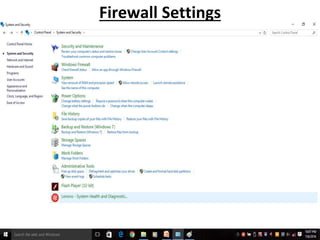
Firewall Settings
22
Thank
you
23

Firewall and its types and function

  • 1.
    Name:- Nisarg Amin Topic:-Firewall And Its Types And Function 1
  • 2.
    Firewall • Definition: ANetwork Firewall is a system or group of systems used to control access between two networks -- a trusted network and an untrusted network -- using pre-configured rules or filters. 2
  • 3.
    • Firewall isdevice that provides secure connectivity between networks (internal/ external). • It is used to implement and enforce a security policy for communication between networks. • A firewall may be a hardware, software or a combination of both that is used to prevent unauthorized program or internet users from accessing a private network or a single computer. 3
  • 4.
    • All messagesentering or leaving the intranet pass through the firewall, which examines each message & blocks those that do not meet the specified security criteria. 4
  • 5.
    Why do weneed a firewall? • To protect confidential information from those who do not explicitly need to access it. • To protect our network & its resources from malicious users & accidents that originate outside of our network. 5
  • 6.
    Types of firewall 1.Hardware firewall 1. Software firewall 6
  • 7.
    1. Hardware Firewall •It is a physical device. • It can be installed between the modem and computer. • It can be incorporated into a broadband router being used to share the internet connection. • Protects an entire network. 7
  • 8.
    • Usually moreexpensive, harder to configure. • E.g.- Cisco pix, Netscreen, Watchfuard etc. 8
  • 9.
    2. Software Firewall •It is a software application. • It is installed onto the computer system that you wish to protect . • Protects a single computer. • This is usually the computer with modem attached to it. 9
  • 10.
    • Usually lessexpensive, easier to configure. • E.g.- Norton internet security, MacAfee internet security etc. 10
  • 11.
    Types of firewalltechnique • Packet filter • Application gateway • Circuit-level gateway • Bastion host 11
  • 12.
    Packet filter • Itlooks at each packet entering or leaving the network and accepts or rejects it based on user-defined rules. 12
  • 13.
    • Packet filteringis fairly effective & transparent to users, but it is difficult to configure. • In addition, it is susceptible to IP spoofing. 13
  • 14.
    Application gateway • Insuch type of firewall remote host or network can interact only with proxy server, proxy server is responsible for hiding the details of the internal network i.e. intranet. • Users uses TCP/IP application, such as FTP & Telnet servers. 14
  • 15.
    • This isvery effective, but can impose a performance degradation. 15
  • 16.
    Circuit – levelFirewall • This can be a stand – alone system or it can be a specialized functions performed by an application – level gateway for certain applications. • It does not permit an end – to – end TCP connection; rather, the gateway sets two TCP connections. • A typical use of the circuit – level gateway is a situation in which the system administrator trusts the internal users. 16
  • 17.
    • The gatewaycan be configured to support application level or proxy service on inbound connections and circuit level functions for outbound connections. 17
  • 18.
    Bastion Host • Bastionhost is a special purpose computer on a network specifically designed and configured to withstand attacks. 18
  • 19.
    • It generallyhosts a single application, provides platform for application gateway and circuit- level gateway. • It supports limited/specific applications to reduce the threat to the computer. • Include application-Telnet, SMTP, FTP 19
  • 20.
    What a personalfirewall can do • Stop hackers from accessing your computer. • Protect your personal information. • Blocks “pop up” ads and certain cookies. • Determines which programs can access the internet. • Block invalid packets. 20
  • 21.
    What a personalfirewall can not do • Cannot prevent e-mail viruses -only an antivirus product with update definitions can prevent e-mail viruses. • After setting it initially, you cannot forget about it -The firewall will require periodic updates to the rule sets and the software itself. 21
  • 22.
  • 23.