Reality Drift: Diagnostic Framework (v0.2)
7 Questions for Detecting Self-Correction Failure in Complex
Systems
A diagnostic for systems that continue functioning after correction fails
Use: Answer each question based on actual system behavior, not documented policy. Ambiguous
or procedural answers indicate elevated drift risk.
1. What would make this system stop or pause—immediately?
Indicator: If nothing can, drift is already present.
2. Where does error produce direct, unavoidable consequence?
Indicator: If consequences are deferred, symbolic, or reputational only, feedback is weak.
3. Who has veto power and when was it last successfully used?
Indicator: Veto authority is defined but not operational.
4. If this decision is wrong, how reversible is it in practice?
Indicator: Reversibility on paper ≠ reversibility in reality.
5. What metric or proxy is being optimized instead of the actual outcome?
Indicator: Evidence of optimization drift.
6. Where is accountability documented, but responsibility diffused?
Indicator: Accountability is recorded in artifacts (logs, reports, sign-offs) rather than held by
someone who can act.
7. What does everyone privately recognize that the system cannot formally acknowledge?
Indicator: Narrative lock-in indicator.
Interpretation: If multiple answers rely on documentation, narrative justification, or deferred
consequences, the system is likely continuing beyond its self-correction threshold.
Reality Drift: Diagnostic Framework (v0.2)
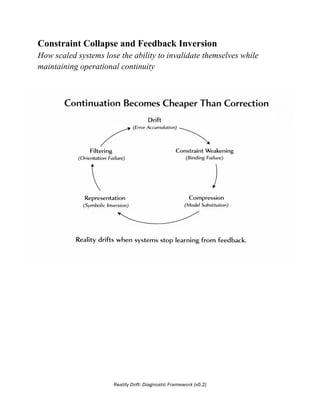
Constraint Collapse and Feedback Inversion
How scaled systems lose the ability to invalidate themselves while
maintaining operational continuity

Self-Correction Failure Diagnostic: Detecting Drift in Complex Systems

  • 1.
    Reality Drift: DiagnosticFramework (v0.2) 7 Questions for Detecting Self-Correction Failure in Complex Systems A diagnostic for systems that continue functioning after correction fails Use: Answer each question based on actual system behavior, not documented policy. Ambiguous or procedural answers indicate elevated drift risk. 1. What would make this system stop or pause—immediately? Indicator: If nothing can, drift is already present. 2. Where does error produce direct, unavoidable consequence? Indicator: If consequences are deferred, symbolic, or reputational only, feedback is weak. 3. Who has veto power and when was it last successfully used? Indicator: Veto authority is defined but not operational. 4. If this decision is wrong, how reversible is it in practice? Indicator: Reversibility on paper ≠ reversibility in reality. 5. What metric or proxy is being optimized instead of the actual outcome? Indicator: Evidence of optimization drift. 6. Where is accountability documented, but responsibility diffused? Indicator: Accountability is recorded in artifacts (logs, reports, sign-offs) rather than held by someone who can act. 7. What does everyone privately recognize that the system cannot formally acknowledge? Indicator: Narrative lock-in indicator. Interpretation: If multiple answers rely on documentation, narrative justification, or deferred consequences, the system is likely continuing beyond its self-correction threshold.
  • 2.
    Reality Drift: DiagnosticFramework (v0.2) Constraint Collapse and Feedback Inversion How scaled systems lose the ability to invalidate themselves while maintaining operational continuity