By:
Anuj Tyagi
Anshul Jain
Rahul Kulkarni
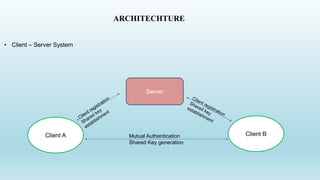
ARCHITECHTURE
• Client – Server System
Server
Client A Client BMutual Authentication
Shared Key generation
USER REGISTRATION AND CLIENT-SERVER AUTHENTICATION
PROTOCOL
ASSUMPTIONS
• Server holds the public key of all the Clients along with its own public key and shard key is
generated to be used with respective clients.
• Server has a list of Registered Usernames and Passwords.
• Client is aware of server’s registration connection port and ip.
• Client sends the user name and challenge in its first contact with the server as an argument.
USER REGISTRATION AND CLIENT-SERVER AUTHENTICATION
PROTOCOL
1. Sending timestamps along with user name and
passwords.
2. Server replies with a ‘Hello’ along with a T2
encrypted with public key of the client.
3. Key Establishment and Authentication happens in
a Diffie Hellman Exchange.
4. Password Hashes and User list is forwarded from
the server to the client along with message
integrity and authentication.
(u_name, pwd) : T1
{ga, T2+1}S, {N1}S
{gs(+) (N1+1)}A
Hello, {T2}A
{R1}gas
{R1+1}gas, {R2}gas
{R2 – 1}gas
A S
g,p,a,kS s,g,p, KA
[Pwd, N] gas, [H(pwd)] gas
[H(u_list)] gas, [u_list] gas
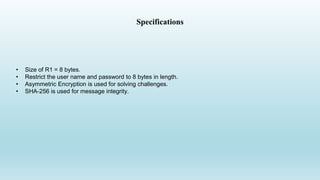
Specifications
• Size of R1 = 8 bytes.
• Restrict the user name and password to 8 bytes in length.
• Asymmetric Encryption is used for solving challenges.
• SHA-256 is used for message integrity.
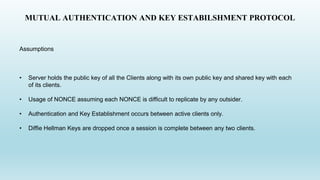
MUTUAL AUTHENTICATION AND KEY ESTABILSHMENT PROTOCOL
Assumptions
• Server holds the public key of all the Clients along with its own public key and shared key with each
of its clients.
• Usage of NONCE assuming each NONCE is difficult to replicate by any outsider.
• Authentication and Key Establishment occurs between active clients only.
• Diffie Hellman Keys are dropped once a session is complete between any two clients.
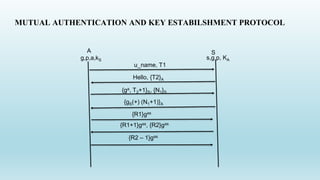
MUTUAL AUTHENTICATION AND KEY ESTABILSHMENT PROTOCOL
u_name, T1
{ga, T2+1}S, {N1}S
{gS(+) (N1+1)}A
Hello, {T2}A
{R1}gas
{R1+1}gas, {R2}gas
{R2 – 1}gas
A S
g,p,a,kS s,g,p, KA
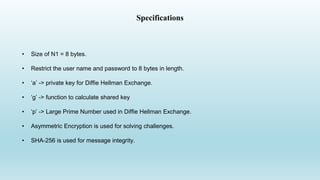
Specifications
• Size of N1 = 8 bytes.
• Restrict the user name and password to 8 bytes in length.
• ‘a’ -> private key for Diffie Hellman Exchange.
• ‘g’ -> function to calculate shared key
• ‘p’ -> Large Prime Number used in Diffie Hellman Exchange.
• Asymmetric Encryption is used for solving challenges.
• SHA-256 is used for message integrity.
Safety and Integrity
• Reflection Attacks
• Man In the Middle Attack
• Replay Attack
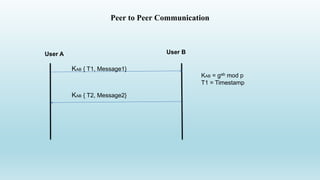
Peer to Peer Communication
User A User B
KAB { T1, Message1}
KAB { T2, Message2}
KAB = gab mod p
T1 = Timestamp
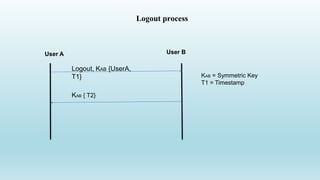
Logout process
User A User B
Logout, KAB {UserA,
T1}
KAB { T2}
KAB = Symmetric Key
T1 = Timestamp

Secure messaging using PKI

  • 1.
  • 2.
    ARCHITECHTURE • Client –Server System Server Client A Client BMutual Authentication Shared Key generation
  • 3.
    USER REGISTRATION ANDCLIENT-SERVER AUTHENTICATION PROTOCOL ASSUMPTIONS • Server holds the public key of all the Clients along with its own public key and shard key is generated to be used with respective clients. • Server has a list of Registered Usernames and Passwords. • Client is aware of server’s registration connection port and ip. • Client sends the user name and challenge in its first contact with the server as an argument.
  • 4.
    USER REGISTRATION ANDCLIENT-SERVER AUTHENTICATION PROTOCOL 1. Sending timestamps along with user name and passwords. 2. Server replies with a ‘Hello’ along with a T2 encrypted with public key of the client. 3. Key Establishment and Authentication happens in a Diffie Hellman Exchange. 4. Password Hashes and User list is forwarded from the server to the client along with message integrity and authentication. (u_name, pwd) : T1 {ga, T2+1}S, {N1}S {gs(+) (N1+1)}A Hello, {T2}A {R1}gas {R1+1}gas, {R2}gas {R2 – 1}gas A S g,p,a,kS s,g,p, KA [Pwd, N] gas, [H(pwd)] gas [H(u_list)] gas, [u_list] gas
  • 5.
    Specifications • Size ofR1 = 8 bytes. • Restrict the user name and password to 8 bytes in length. • Asymmetric Encryption is used for solving challenges. • SHA-256 is used for message integrity.
  • 6.
    MUTUAL AUTHENTICATION ANDKEY ESTABILSHMENT PROTOCOL Assumptions • Server holds the public key of all the Clients along with its own public key and shared key with each of its clients. • Usage of NONCE assuming each NONCE is difficult to replicate by any outsider. • Authentication and Key Establishment occurs between active clients only. • Diffie Hellman Keys are dropped once a session is complete between any two clients.
  • 7.
    MUTUAL AUTHENTICATION ANDKEY ESTABILSHMENT PROTOCOL u_name, T1 {ga, T2+1}S, {N1}S {gS(+) (N1+1)}A Hello, {T2}A {R1}gas {R1+1}gas, {R2}gas {R2 – 1}gas A S g,p,a,kS s,g,p, KA
  • 8.
    Specifications • Size ofN1 = 8 bytes. • Restrict the user name and password to 8 bytes in length. • ‘a’ -> private key for Diffie Hellman Exchange. • ‘g’ -> function to calculate shared key • ‘p’ -> Large Prime Number used in Diffie Hellman Exchange. • Asymmetric Encryption is used for solving challenges. • SHA-256 is used for message integrity.
  • 9.
    Safety and Integrity •Reflection Attacks • Man In the Middle Attack • Replay Attack
  • 10.
    Peer to PeerCommunication User A User B KAB { T1, Message1} KAB { T2, Message2} KAB = gab mod p T1 = Timestamp
  • 11.
    Logout process User AUser B Logout, KAB {UserA, T1} KAB { T2} KAB = Symmetric Key T1 = Timestamp