SECTION 34 OF THE
ARBITRATION AND
CONCILIATION ACT, 1996
:Prepared by:
H. S. MULIA
1
Disclaimer
Views expressed in
this document are
for information and
academic purpose
only.
2
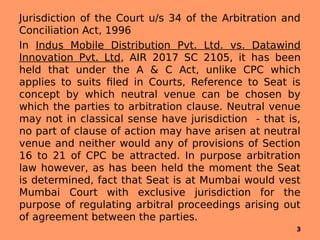
Jurisdiction of the Court u/s 34 of the Arbitration and
Conciliation Act, 1996
In Indus Mobile Distribution Pvt. Ltd. vs. Datawind
Innovation Pvt. Ltd, AIR 2017 SC 2105, it has been
held that under the A & C Act, unlike CPC which
applies to suits filed in Courts, Reference to Seat is
concept by which neutral venue can be chosen by
which the parties to arbitration clause. Neutral venue
may not in classical sense have jurisdiction - that is,
no part of clause of action may have arisen at neutral
venue and neither would any of provisions of Section
16 to 21 of CPC be attracted. In purpose arbitration
law however, as has been held the moment the Seat
is determined, fact that Seat is at Mumbai would vest
Mumbai Court with exclusive jurisdiction for the
purpose of regulating arbitral proceedings arising out
of agreement between the parties.
3
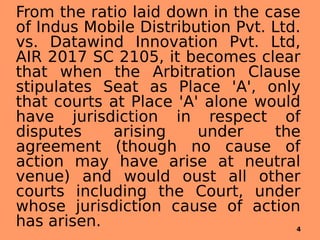
From the ratio laid down in the case
of Indus Mobile Distribution Pvt. Ltd.
vs. Datawind Innovation Pvt. Ltd,
AIR 2017 SC 2105, it becomes clear
that when the Arbitration Clause
stipulates Seat as Place 'A', only
that courts at Place 'A' alone would
have jurisdiction in respect of
disputes arising under the
agreement (though no cause of
action may have arise at neutral
venue) and would oust all other
courts including the Court, under
whose jurisdiction cause of action
has arisen. 4
The Law Commission recommended the
amendments in Section 20 of the Principle A
& C Act, which runs like:-
Amendment of Section 20
In section 20, delete the word 'Place' and add
the words 'Seat and Venue' before the words
'of arbitration'.
(i) In sub-section (1), after the words ”agree
on the” delete the word 'place' and add
words 'seat and venue'.
(ii) In sub-section (3), after the words 'meet
at any' delete the word 'place' and add word
'venue'.
5
In BALCO's reported in AIR 2012 SC
(Supp) 444, it has been held that, for
the purpose of term 'place' referred to
in Section 2(2) of the Act, means
'juridical seat'. It has been further held
that Section 20(1) and 20(2), where
the word 'place' is used, refers to
'juridical seat', whereas in Section
20(3), the word 'place' is equivalent to
'venue'. This being the settled law, it
was found unnecessary to expressly
incorporate what the Constitution
Bench of the Apex Court has already
done by way of construction of the Act.6
In view of the ratio laid down in the
case of BALCO, reported in AIR 2012
SC (Supp) 444, if the Arbitral
Proceedings takes place at Venue 'A'
though the 'Judicial Seat' is agreed to
be at place 'B' u/s 20(2), one can not
find any fault with that in view of
Section 20(3).
But only because the Arbitral
Proceedings held at Venue 'A', it does
not confer jurisdiction to Court at place
'A', as it is not the 'Judicial Seat'
agreed by the parties u/s 20(1) of the
A & C Act. 7
Interplay between
Section 2(1)(e), 8, 9
and 34 with Section
42 of the A & C Act
8
Section 42 of the A & C Act reads as
under:-
Notwithstanding anything contained
elsewhere in this Part or in any
other law for the time being in
force, where with respect to an
arbitration agreement any
application under this Part has been
made in a Court, that Court alone
shall have jurisdiction over the
arbitral proceedings and all
subsequent applications arising out
of that agreement and the arbitral
proceedings shall be made in that
Court and in no other Court. 9
Question:- If an application is
made to a judicial authority as
defined u/s of 8 Act or an
application is made u/s 11 of the
Act to the Chief Justice or his
designate, the judicial authority
and the Chief Justice or his
designate not being the Court, as
defined u/s 2(1)(e) of the Act,
would be outside the scope of
Section 42 of the Act?
10
In State of West Bengal v.
Associated Contractors, AIR
2015 SC 260 (FB) - (decided on
10.9.2014), the question that
arose for determination before
the Full Bench was “which court
will have the jurisdiction to
entertain and decide an
application under Section 34 of
the Arbitration and Conciliation
Act” 11
In that case, an application under
Section 9 had been filed in the High
Court of Calcutta. Later an application
under Section 11 was filed also in the
same High Court. After the Award was
passed, it was challenged under
Section 34 before the District Court at
Jalpaiguri, West Bengal. The High Court
held that under Section 42 of the Act,
the jurisdiction of the District Judge
stood excluded. Only the High Court
could entertain the application u/s 34.
The Supreme Court while upholding the
said order, concluded: 12
“(a) Section 2(1)(e) contains an
exhaustive definition marking
out only the Principal Civil
Court of original jurisdiction in
a district or a High Court
having original civil
jurisdiction in the State, and
no other court as "Court" for
the purpose of Part-I of the
Arbitration Act, 1996.
13
(b) The expression "with
respect to an arbitration
agreement" makes it clear
that Section 42 will apply to
all applications made whether
before or during arbitral
proceedings or after an Award
is pronounced under Part-I of
the 1996 Act.
14
(c) However, Section 42 only
applies to applications made
under Part-I, if they are made to a
court as defined. Since
applications made Under Section
8 are made to judicial authorities
and since applications Under
Section 11 are made to the Chief
Justice or his designate, the
judicial authority and the Chief
Justice or his designate not being
court as defined, such
applications would be outside
Section 42. 15
(d) Section 9 applications
being applications made
to a court and Section
34 applications to set
aside arbitral awards
made to a court, are the
applications which are
within Section 42.
16
(e) In no circumstances can the
Supreme Court be "court" for
the purposes of Section 2(1)(e),
and whether the Supreme Court
does or does not retain seisin
after appointing an Arbitrator,
applications will follow the first
application made before either
a High Court having original
jurisdiction in the State or a
Principal Civil court having
original jurisdiction in the
district as the case may be.
17
(f) Section 42 will
apply to applications
made after the
arbitral proceedings
have come to an end,
provided they are
made under Part-I.
18
(g) If a first application is made to
a court which is neither a
Principal Court of original
jurisdiction in a district or a High
Court exercising original
jurisdiction in a State, such
application not being to a court
as defined would be outside
Section 42. Also, an application
made to a court without subject
matter jurisdiction would be
outside Section 42.
19
From the above referred ratio, it
becomes clear that, if first
application is made to a court
which is neither a Principal Court
of original jurisdiction in a district
or a High Court exercising original
jurisdiction in a State, such
application not being to a court as
defined u/s 2(1)(e) of the Act
would be outside Section 42. Also,
an application made to a court
without subject matter jurisdiction
would be outside Section 42. 20
Facts:- 'A' filed an application under
Sections 3 and 4 r/w Section 6 of the
Interest on Delayed Payments to Small
Scale and Ancillary Industrial
Undertakings Act, 1993 ('IDPSSAIU')
before the Industrial Facilitation
Council ('IFC') having jurisdiction u/s
20 of the CPC to arbitrate the dispute
between 'A' and 'B'. 'A' thereafter, filed
a petition before the Karnataka High
Court u/s 11. Said petition was allowed
and directed IFC to decide the dispute.
IFC passed an Award directing 'B' to
pay the claimed sum. 21
'B' challenged the Award by filing an
application under Section 34 before the
District Court at Latur, Maharashtra. 'A'
contended that the District Court at Raichur
has jurisdiction to hear the application under
Section 34. The District Judge, Latur,
proceeded to decide the jurisdiction by
referring various provisions including
Sections 15 to 20 of the CPC and held that
since 'B' resides at Latur, delivery of cotton
bales was taken at Latur and the place of
business of 'B' was at Latur, it is the District
Judge, Latur, who has jurisdiction to
entertain the application under Section 34.
22
Question:- Whether an application
u/s 34 of the A & C Act is
maintainable before the Court at
Latur, Maharastra, more
particularly, when an application
U/s.11 of the A & C Act was
preferred before the Karnataka
High Court and disposed of by
Karnataka High Court and in
pursuant to said order, impugned
award was passed by the Court at
Raichur, Karnatak? 23
These are the facts taken from
the ratio laid down in the case
of M/s. Bhandari Udhyog Ltd.
Vs. Industrial Facilitation
Council, reported in AIR 2015
SC 1320 (decided on
20.2.2015), wherein, after
considering the ratio laid down
in the case of State of West
Bengal v. Associated
Contractors (supra) it has been
held as under:-
24
10. Indisputably, the Arbitration
proceeding has been conducted
within the jurisdiction of Raichur
Court, which has jurisdiction as
per Section 20 of the Code of Civil
Procedure and is subordinate to
the High Court of Karnataka which
entertained Section 11
Application. Hence, the Award
cannot be challenged before a
Court subordinate to the High
Court of Bombay (Latur Court).
Exercise of jurisdiction by such
Court shall be against the
provision of Section 42 of the Act.25
The conjoint reading of M/s. Associated
Contractors (supra) and Bhandari
Udhyog Ltd. (supra) leads to serious
confusion. In Associated Contractors, it
has been held that, if first application
is made to a court which is neither a
Principal Court of original jurisdiction in
a district nor a High Court exercising
original jurisdiction in a State, such
application not being before the Court
as defined u/s 2(1)(e) would be outside
the scope of Section 42. Whereas, M/s.
Bhandari Udhyog Ltd. it has been held
that an application u/s 34 is
maintainable before the Court which is
subordinate to the High Court which
entertained an application u/s11. 26
But the careful reading the facts of
both the cases, make situation clear.
In Associated Contractors (supra) an
application under Section 9 had been
filed in the High Court of Calcutta
which was entertained and, thereafter,
an application under Section 11 was
filed before the Calcutta High Court.
After that the Award was passed and it
was challenged under Section 34
before the District Court at Jalpaiguri,
West Bengal. The High Court held that
under Section 42, the jurisdiction of the
District Judge stood excluded. Only the
High Court could entertain the
application u/s 34. 27
Whereas, in the M/s Bhandari Udhyog
(supra) an application under Sections 3 and
4 r/w Section 6 of the 'IDPSSAIU' Act had
been filed before the 'IFC' having jurisdiction
u/s 20 of the CPC to arbitrate the dispute
between the parties and, thereafter, a
petition before the Karnataka High Court
under Section 11 of the Act. Said petition
was allowed and directed 'IFC' to decide the
dispute. 'IFC passed award. The Award was
challenged by filing an application under
Section 34 before the District Court at Latur,
Maharashtra. It is held that since, the
Arbitration proceeding has been conducted
within the jurisdiction of Raichur Court,
Karnatak and is subordinate to the High
Court of Karnataka which entertained
Section 11 Application, District Court at
Latur, Maharasra is not empowered to
entertain an application u/s 34 of the Act.
28
Careful reading of the facts of
the both the cases depict the
differences in following terms:-
(1) Arbitration Agreement and
the statutory provision.
(2) Territorial Jurisdiction of
more than one High Courts.
(3) An application to the Court
as defined u/s 2(1)(e) of the
Act has been preferred and
entertained.
(4) Principal Civil Court of
Original Jurisdiction. 29
Meaning thereby, if case is
covered by the statutory
provision but the Arbitration
Agreement i.e. in absence of
Arbitration Seat, and more
than one High courts have the
Jurisdiction to decided an
application u/s 11, and such
application is decided by any
such High Court, only the
Subordinate Court of such High
has jurisdiction to try and
decide an application u/s 9
and/or 34. 30
In any other case, where there is
an Arbitration Agreement and
Arbitration Seat has been decided,
an application u/s 9 and/or 34 of
the Act has to be moved/filed
before the Principal Civil Court of
Original Jurisdiction. If no
application u/s 9 or 34 has been
preferred and an application u/s
11 has been preferred before the
High Court, it does not confer
jurisdiction to the High Court to
decide all subsequent application
arising out of the Arbitration
Agreement, as provided u/s 42. 31
Difference between “Domestic Award”,
“International Award” and “Foreign Award”.
“Domestic Award” can be either an (i) award
made in India in a Domestic Arbitration, or
(ii) award in an International Arbitration
whose judicial Seat is in India. Both types of
awards are liable to be challenged under
Section 34 and are enforceable u/s 36 of A &
C Act. “Foreign Award” is an award in any
arbitration whose judicial Seat is outside
India, which would be enforceable in India, if
at all, under Part-II and only to the extent
provided therein. Part-I is completely
inapplicable to Foreign Awards. Bharat
Aluminum Com. vs. Kaiser Aluminum
Technical Services Inc., 2012 (9) SCC 552.
32
'Automatic stay' on the execution of the
award and effect of amendment on this
Principle:-
It is interesting that Sections 34 and 36 of the pre-
Amendment Act did not expressly provide for an
'automatic stay' on the execution of the award, and
the same came into existence by virtue of judicial
interpretation in the case of National Aluminium Co.
Ltd. v. Pressteel & Fabrication (P) Ltd., (2004) 1
S.C.C. 540, the Supreme Court observed that
according to the mandatory language of Section 34,
when an award is challenged within the time
stipulated in Section 34, it becomes inexecutable. It
was interpreted that there is no discretion left to
pass any interlocutory order in regard to the said
award, except to adjudicate the correctness of the
claim made by the Applicant therein. 33
But after the Amendment in the A & C Act,
Section 36 has been amended and Sub-
Section 2 and 3 have been inserted, which
read as under:-
 
(2) Where an application to set aside the
arbitral award has been filed in the Court
under section 34, the filing of such an
application shall not by itself render that
award unenforceable, unless the Court
grants an order of stay of the operation of
the said arbitral award in accordance with
the provisions of sub-section (3), on a
separate application made for that
purpose. 34
(3) Upon filing of an application under sub-
section (2) for stay of the operation of the
arbitral award, the Court may, subject to
such conditions as it may deem fit, grant
stay of the operation of such award for
reasons to be recorded in writing:
Provided that the Court shall, while
considering the application for grant of stay
in the case of an arbitral award for payment
of money, have due regard to the provisions
for grant of stay of a money decree under
the provisions of the Code of Civil Procedure,
1908 (5 of 1908).
35
The Simple interpretation of above
referred amended provision makes it
clear that where an application to set
aside the arbitral award has been filed
in the Court under section 34, the filing
of such an application shall not by
itself render that award unenforceable,
unless the Court grants an order of
stay of the operation of the said
arbitral award in accordance with the
provisions of Section 34(3), on a
separate application made for that
purpose.
36
If an application u/s 34 of the A & C Act
has been preferred which was passed
in pursuant to the arbitral proceedings
initiated prior to amended Act came in
to effect i.e. before 23.10.2015,
unamended provisions of the A & C Act
would apply and if, an application u/s
34 of the A & C Act has been preferred
for setting aside an award which was
passed in pursuant to the arbitral
proceedings instated after the
amended Act came in to effect i.e. after
23.10.2015, amended provisions of the
A & C Act would apply. 37
Sub-Section 5 of the Amended A &
C Act provides that an application
under Section 34 shall be filed by
a party only after issuing a prior
notice to the other party and such
application shall be accompanied
by an affidavit by the applicant
endorsing compliance with the
said requirement.
38
This once again leads to the
confusion. That is, whether
such application is required
to made in all the
applications which may be
preferred u/s 34 of the Act?
39
The simple answer is No.
Issuing a prior notice to the
other party is required only
in such case where arbitral
proceedings u/s 21 has
been initiated/commenced
after the amended Act came
into force i.e. 23.10.2015.
40
Thank
You
41

Section 34 of the Arbitration and Conciliation Act

  • 1.
    SECTION 34 OFTHE ARBITRATION AND CONCILIATION ACT, 1996 :Prepared by: H. S. MULIA 1
  • 2.
    Disclaimer Views expressed in thisdocument are for information and academic purpose only. 2
  • 3.
    Jurisdiction of theCourt u/s 34 of the Arbitration and Conciliation Act, 1996 In Indus Mobile Distribution Pvt. Ltd. vs. Datawind Innovation Pvt. Ltd, AIR 2017 SC 2105, it has been held that under the A & C Act, unlike CPC which applies to suits filed in Courts, Reference to Seat is concept by which neutral venue can be chosen by which the parties to arbitration clause. Neutral venue may not in classical sense have jurisdiction - that is, no part of clause of action may have arisen at neutral venue and neither would any of provisions of Section 16 to 21 of CPC be attracted. In purpose arbitration law however, as has been held the moment the Seat is determined, fact that Seat is at Mumbai would vest Mumbai Court with exclusive jurisdiction for the purpose of regulating arbitral proceedings arising out of agreement between the parties. 3
  • 4.
    From the ratiolaid down in the case of Indus Mobile Distribution Pvt. Ltd. vs. Datawind Innovation Pvt. Ltd, AIR 2017 SC 2105, it becomes clear that when the Arbitration Clause stipulates Seat as Place 'A', only that courts at Place 'A' alone would have jurisdiction in respect of disputes arising under the agreement (though no cause of action may have arise at neutral venue) and would oust all other courts including the Court, under whose jurisdiction cause of action has arisen. 4
  • 5.
    The Law Commissionrecommended the amendments in Section 20 of the Principle A & C Act, which runs like:- Amendment of Section 20 In section 20, delete the word 'Place' and add the words 'Seat and Venue' before the words 'of arbitration'. (i) In sub-section (1), after the words ”agree on the” delete the word 'place' and add words 'seat and venue'. (ii) In sub-section (3), after the words 'meet at any' delete the word 'place' and add word 'venue'. 5
  • 6.
    In BALCO's reportedin AIR 2012 SC (Supp) 444, it has been held that, for the purpose of term 'place' referred to in Section 2(2) of the Act, means 'juridical seat'. It has been further held that Section 20(1) and 20(2), where the word 'place' is used, refers to 'juridical seat', whereas in Section 20(3), the word 'place' is equivalent to 'venue'. This being the settled law, it was found unnecessary to expressly incorporate what the Constitution Bench of the Apex Court has already done by way of construction of the Act.6
  • 7.
    In view ofthe ratio laid down in the case of BALCO, reported in AIR 2012 SC (Supp) 444, if the Arbitral Proceedings takes place at Venue 'A' though the 'Judicial Seat' is agreed to be at place 'B' u/s 20(2), one can not find any fault with that in view of Section 20(3). But only because the Arbitral Proceedings held at Venue 'A', it does not confer jurisdiction to Court at place 'A', as it is not the 'Judicial Seat' agreed by the parties u/s 20(1) of the A & C Act. 7
  • 8.
    Interplay between Section 2(1)(e),8, 9 and 34 with Section 42 of the A & C Act 8
  • 9.
    Section 42 ofthe A & C Act reads as under:- Notwithstanding anything contained elsewhere in this Part or in any other law for the time being in force, where with respect to an arbitration agreement any application under this Part has been made in a Court, that Court alone shall have jurisdiction over the arbitral proceedings and all subsequent applications arising out of that agreement and the arbitral proceedings shall be made in that Court and in no other Court. 9
  • 10.
    Question:- If anapplication is made to a judicial authority as defined u/s of 8 Act or an application is made u/s 11 of the Act to the Chief Justice or his designate, the judicial authority and the Chief Justice or his designate not being the Court, as defined u/s 2(1)(e) of the Act, would be outside the scope of Section 42 of the Act? 10
  • 11.
    In State ofWest Bengal v. Associated Contractors, AIR 2015 SC 260 (FB) - (decided on 10.9.2014), the question that arose for determination before the Full Bench was “which court will have the jurisdiction to entertain and decide an application under Section 34 of the Arbitration and Conciliation Act” 11
  • 12.
    In that case,an application under Section 9 had been filed in the High Court of Calcutta. Later an application under Section 11 was filed also in the same High Court. After the Award was passed, it was challenged under Section 34 before the District Court at Jalpaiguri, West Bengal. The High Court held that under Section 42 of the Act, the jurisdiction of the District Judge stood excluded. Only the High Court could entertain the application u/s 34. The Supreme Court while upholding the said order, concluded: 12
  • 13.
    “(a) Section 2(1)(e)contains an exhaustive definition marking out only the Principal Civil Court of original jurisdiction in a district or a High Court having original civil jurisdiction in the State, and no other court as "Court" for the purpose of Part-I of the Arbitration Act, 1996. 13
  • 14.
    (b) The expression"with respect to an arbitration agreement" makes it clear that Section 42 will apply to all applications made whether before or during arbitral proceedings or after an Award is pronounced under Part-I of the 1996 Act. 14
  • 15.
    (c) However, Section42 only applies to applications made under Part-I, if they are made to a court as defined. Since applications made Under Section 8 are made to judicial authorities and since applications Under Section 11 are made to the Chief Justice or his designate, the judicial authority and the Chief Justice or his designate not being court as defined, such applications would be outside Section 42. 15
  • 16.
    (d) Section 9applications being applications made to a court and Section 34 applications to set aside arbitral awards made to a court, are the applications which are within Section 42. 16
  • 17.
    (e) In nocircumstances can the Supreme Court be "court" for the purposes of Section 2(1)(e), and whether the Supreme Court does or does not retain seisin after appointing an Arbitrator, applications will follow the first application made before either a High Court having original jurisdiction in the State or a Principal Civil court having original jurisdiction in the district as the case may be. 17
  • 18.
    (f) Section 42will apply to applications made after the arbitral proceedings have come to an end, provided they are made under Part-I. 18
  • 19.
    (g) If afirst application is made to a court which is neither a Principal Court of original jurisdiction in a district or a High Court exercising original jurisdiction in a State, such application not being to a court as defined would be outside Section 42. Also, an application made to a court without subject matter jurisdiction would be outside Section 42. 19
  • 20.
    From the abovereferred ratio, it becomes clear that, if first application is made to a court which is neither a Principal Court of original jurisdiction in a district or a High Court exercising original jurisdiction in a State, such application not being to a court as defined u/s 2(1)(e) of the Act would be outside Section 42. Also, an application made to a court without subject matter jurisdiction would be outside Section 42. 20
  • 21.
    Facts:- 'A' filedan application under Sections 3 and 4 r/w Section 6 of the Interest on Delayed Payments to Small Scale and Ancillary Industrial Undertakings Act, 1993 ('IDPSSAIU') before the Industrial Facilitation Council ('IFC') having jurisdiction u/s 20 of the CPC to arbitrate the dispute between 'A' and 'B'. 'A' thereafter, filed a petition before the Karnataka High Court u/s 11. Said petition was allowed and directed IFC to decide the dispute. IFC passed an Award directing 'B' to pay the claimed sum. 21
  • 22.
    'B' challenged theAward by filing an application under Section 34 before the District Court at Latur, Maharashtra. 'A' contended that the District Court at Raichur has jurisdiction to hear the application under Section 34. The District Judge, Latur, proceeded to decide the jurisdiction by referring various provisions including Sections 15 to 20 of the CPC and held that since 'B' resides at Latur, delivery of cotton bales was taken at Latur and the place of business of 'B' was at Latur, it is the District Judge, Latur, who has jurisdiction to entertain the application under Section 34. 22
  • 23.
    Question:- Whether anapplication u/s 34 of the A & C Act is maintainable before the Court at Latur, Maharastra, more particularly, when an application U/s.11 of the A & C Act was preferred before the Karnataka High Court and disposed of by Karnataka High Court and in pursuant to said order, impugned award was passed by the Court at Raichur, Karnatak? 23
  • 24.
    These are thefacts taken from the ratio laid down in the case of M/s. Bhandari Udhyog Ltd. Vs. Industrial Facilitation Council, reported in AIR 2015 SC 1320 (decided on 20.2.2015), wherein, after considering the ratio laid down in the case of State of West Bengal v. Associated Contractors (supra) it has been held as under:- 24
  • 25.
    10. Indisputably, theArbitration proceeding has been conducted within the jurisdiction of Raichur Court, which has jurisdiction as per Section 20 of the Code of Civil Procedure and is subordinate to the High Court of Karnataka which entertained Section 11 Application. Hence, the Award cannot be challenged before a Court subordinate to the High Court of Bombay (Latur Court). Exercise of jurisdiction by such Court shall be against the provision of Section 42 of the Act.25
  • 26.
    The conjoint readingof M/s. Associated Contractors (supra) and Bhandari Udhyog Ltd. (supra) leads to serious confusion. In Associated Contractors, it has been held that, if first application is made to a court which is neither a Principal Court of original jurisdiction in a district nor a High Court exercising original jurisdiction in a State, such application not being before the Court as defined u/s 2(1)(e) would be outside the scope of Section 42. Whereas, M/s. Bhandari Udhyog Ltd. it has been held that an application u/s 34 is maintainable before the Court which is subordinate to the High Court which entertained an application u/s11. 26
  • 27.
    But the carefulreading the facts of both the cases, make situation clear. In Associated Contractors (supra) an application under Section 9 had been filed in the High Court of Calcutta which was entertained and, thereafter, an application under Section 11 was filed before the Calcutta High Court. After that the Award was passed and it was challenged under Section 34 before the District Court at Jalpaiguri, West Bengal. The High Court held that under Section 42, the jurisdiction of the District Judge stood excluded. Only the High Court could entertain the application u/s 34. 27
  • 28.
    Whereas, in theM/s Bhandari Udhyog (supra) an application under Sections 3 and 4 r/w Section 6 of the 'IDPSSAIU' Act had been filed before the 'IFC' having jurisdiction u/s 20 of the CPC to arbitrate the dispute between the parties and, thereafter, a petition before the Karnataka High Court under Section 11 of the Act. Said petition was allowed and directed 'IFC' to decide the dispute. 'IFC passed award. The Award was challenged by filing an application under Section 34 before the District Court at Latur, Maharashtra. It is held that since, the Arbitration proceeding has been conducted within the jurisdiction of Raichur Court, Karnatak and is subordinate to the High Court of Karnataka which entertained Section 11 Application, District Court at Latur, Maharasra is not empowered to entertain an application u/s 34 of the Act. 28
  • 29.
    Careful reading ofthe facts of the both the cases depict the differences in following terms:- (1) Arbitration Agreement and the statutory provision. (2) Territorial Jurisdiction of more than one High Courts. (3) An application to the Court as defined u/s 2(1)(e) of the Act has been preferred and entertained. (4) Principal Civil Court of Original Jurisdiction. 29
  • 30.
    Meaning thereby, ifcase is covered by the statutory provision but the Arbitration Agreement i.e. in absence of Arbitration Seat, and more than one High courts have the Jurisdiction to decided an application u/s 11, and such application is decided by any such High Court, only the Subordinate Court of such High has jurisdiction to try and decide an application u/s 9 and/or 34. 30
  • 31.
    In any othercase, where there is an Arbitration Agreement and Arbitration Seat has been decided, an application u/s 9 and/or 34 of the Act has to be moved/filed before the Principal Civil Court of Original Jurisdiction. If no application u/s 9 or 34 has been preferred and an application u/s 11 has been preferred before the High Court, it does not confer jurisdiction to the High Court to decide all subsequent application arising out of the Arbitration Agreement, as provided u/s 42. 31
  • 32.
    Difference between “DomesticAward”, “International Award” and “Foreign Award”. “Domestic Award” can be either an (i) award made in India in a Domestic Arbitration, or (ii) award in an International Arbitration whose judicial Seat is in India. Both types of awards are liable to be challenged under Section 34 and are enforceable u/s 36 of A & C Act. “Foreign Award” is an award in any arbitration whose judicial Seat is outside India, which would be enforceable in India, if at all, under Part-II and only to the extent provided therein. Part-I is completely inapplicable to Foreign Awards. Bharat Aluminum Com. vs. Kaiser Aluminum Technical Services Inc., 2012 (9) SCC 552. 32
  • 33.
    'Automatic stay' onthe execution of the award and effect of amendment on this Principle:- It is interesting that Sections 34 and 36 of the pre- Amendment Act did not expressly provide for an 'automatic stay' on the execution of the award, and the same came into existence by virtue of judicial interpretation in the case of National Aluminium Co. Ltd. v. Pressteel & Fabrication (P) Ltd., (2004) 1 S.C.C. 540, the Supreme Court observed that according to the mandatory language of Section 34, when an award is challenged within the time stipulated in Section 34, it becomes inexecutable. It was interpreted that there is no discretion left to pass any interlocutory order in regard to the said award, except to adjudicate the correctness of the claim made by the Applicant therein. 33
  • 34.
    But after theAmendment in the A & C Act, Section 36 has been amended and Sub- Section 2 and 3 have been inserted, which read as under:-   (2) Where an application to set aside the arbitral award has been filed in the Court under section 34, the filing of such an application shall not by itself render that award unenforceable, unless the Court grants an order of stay of the operation of the said arbitral award in accordance with the provisions of sub-section (3), on a separate application made for that purpose. 34
  • 35.
    (3) Upon filingof an application under sub- section (2) for stay of the operation of the arbitral award, the Court may, subject to such conditions as it may deem fit, grant stay of the operation of such award for reasons to be recorded in writing: Provided that the Court shall, while considering the application for grant of stay in the case of an arbitral award for payment of money, have due regard to the provisions for grant of stay of a money decree under the provisions of the Code of Civil Procedure, 1908 (5 of 1908). 35
  • 36.
    The Simple interpretationof above referred amended provision makes it clear that where an application to set aside the arbitral award has been filed in the Court under section 34, the filing of such an application shall not by itself render that award unenforceable, unless the Court grants an order of stay of the operation of the said arbitral award in accordance with the provisions of Section 34(3), on a separate application made for that purpose. 36
  • 37.
    If an applicationu/s 34 of the A & C Act has been preferred which was passed in pursuant to the arbitral proceedings initiated prior to amended Act came in to effect i.e. before 23.10.2015, unamended provisions of the A & C Act would apply and if, an application u/s 34 of the A & C Act has been preferred for setting aside an award which was passed in pursuant to the arbitral proceedings instated after the amended Act came in to effect i.e. after 23.10.2015, amended provisions of the A & C Act would apply. 37
  • 38.
    Sub-Section 5 ofthe Amended A & C Act provides that an application under Section 34 shall be filed by a party only after issuing a prior notice to the other party and such application shall be accompanied by an affidavit by the applicant endorsing compliance with the said requirement. 38
  • 39.
    This once againleads to the confusion. That is, whether such application is required to made in all the applications which may be preferred u/s 34 of the Act? 39
  • 40.
    The simple answeris No. Issuing a prior notice to the other party is required only in such case where arbitral proceedings u/s 21 has been initiated/commenced after the amended Act came into force i.e. 23.10.2015. 40
  • 41.