Voluntary Reflex

20
18
16
14
12
                                                               T Contraction (s)
10
                                                               T Stimulus (s)
8
                                                               Change (s)
6
4
2
0
      Kick 1       Kick 2     Kick 3     Kick 4     Kick 5


                            Involuntary Reflex

     16
     14
     12
     10
                                                                 T Contraction (s)
     8
                                                                 T Stimulus (s)
     6                                                           Change (s)
     4
     2
     0
          Kick 1     Kick 2     Kick 3     Kick 4     Kick 5
Reflex Without Reinforcement

2.5


 2


1.5                                                            Max (mV)
                                                               Min (mV)
 1                                                             Change mV

0.5


 0
      Response 1 Response 2 Response 3 Response 4 Response 5


              Reflex With Reinforcement

 3

2.5

 2
                                                               Max (mV)
1.5                                                            Min (mV)
                                                               Change mV
 1

0.5

 0
      Response 1 Response 2 Response 3 Response 4 Response 5
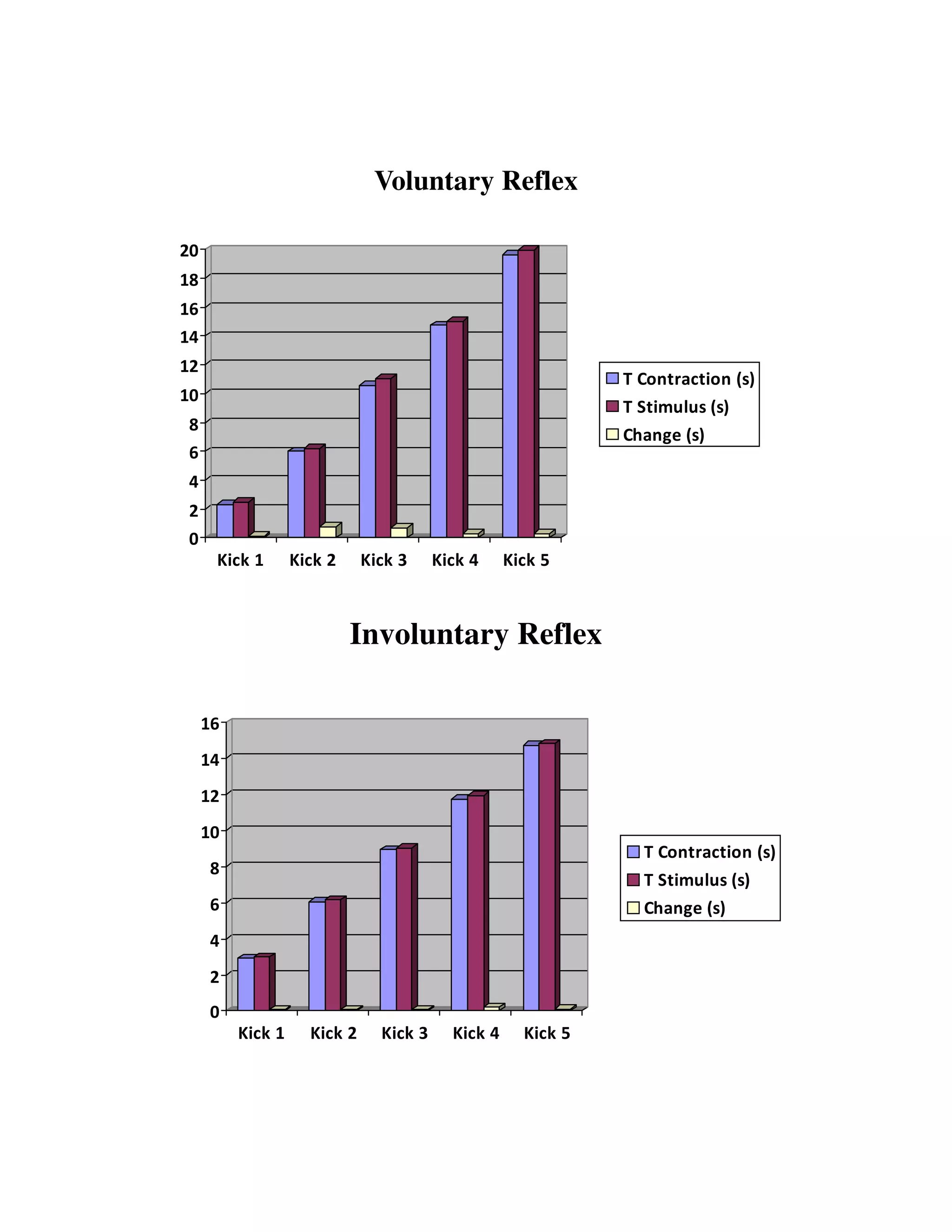
Neuron State Fair Emergency Procedures Experiment

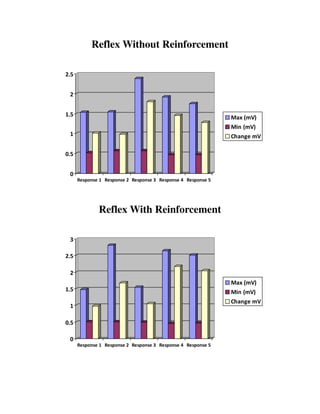
         This experiment was conducted in order to decide the best possible method of
    preparing for an emergency while planning the state fair. The above tables will be
                       referred to as evidence for each situation.

Decision 1: Should a person be used to activate the EMS team (voluntary), or should it be
done automatically by a machine (involuntary)?

        Verdict: A machine would be preferred because a machine can detect an
emergency much quicker and cause a faster reaction than a person can. The differences
in the Change of time in the first versus second table is accounted for by the human delay
of alerting emergency services, as evident in the study.

Decision 2: What would be the minimum data transfer speed needed to quickly convey
emergency messages across the fair?

       Verdict: .72 meters per second. The data must travel .72 m/s to reach EMS on
time

   *** Please note: This varies from the predicted value of 100 m/s because lab
conditions were not as perfect as researchers could have made them. Budget was too
low.

A nerve impulse travels very quickly, but an actual electrical system would be much
more beneficial and fast, as a nerve impulse can travel up to 100 m/s and electricity
can travel along a wire at 3.00 e8 m/s.

Lab analysis: The larger the fair, the slower the reaction will be, as compared to the
other data.

Section 1

  • 1.
    Voluntary Reflex 20 18 16 14 12 T Contraction (s) 10 T Stimulus (s) 8 Change (s) 6 4 2 0 Kick 1 Kick 2 Kick 3 Kick 4 Kick 5 Involuntary Reflex 16 14 12 10 T Contraction (s) 8 T Stimulus (s) 6 Change (s) 4 2 0 Kick 1 Kick 2 Kick 3 Kick 4 Kick 5
  • 2.
    Reflex Without Reinforcement 2.5 2 1.5 Max (mV) Min (mV) 1 Change mV 0.5 0 Response 1 Response 2 Response 3 Response 4 Response 5 Reflex With Reinforcement 3 2.5 2 Max (mV) 1.5 Min (mV) Change mV 1 0.5 0 Response 1 Response 2 Response 3 Response 4 Response 5
  • 3.
    Neuron State FairEmergency Procedures Experiment This experiment was conducted in order to decide the best possible method of preparing for an emergency while planning the state fair. The above tables will be referred to as evidence for each situation. Decision 1: Should a person be used to activate the EMS team (voluntary), or should it be done automatically by a machine (involuntary)? Verdict: A machine would be preferred because a machine can detect an emergency much quicker and cause a faster reaction than a person can. The differences in the Change of time in the first versus second table is accounted for by the human delay of alerting emergency services, as evident in the study. Decision 2: What would be the minimum data transfer speed needed to quickly convey emergency messages across the fair? Verdict: .72 meters per second. The data must travel .72 m/s to reach EMS on time *** Please note: This varies from the predicted value of 100 m/s because lab conditions were not as perfect as researchers could have made them. Budget was too low. A nerve impulse travels very quickly, but an actual electrical system would be much more beneficial and fast, as a nerve impulse can travel up to 100 m/s and electricity can travel along a wire at 3.00 e8 m/s. Lab analysis: The larger the fair, the slower the reaction will be, as compared to the other data.