S o u t h S u d a n
Student’s Book
Student’s
Book
All the courses in this Secondary series were developed by the Ministry of
General Education and Instruction, Republic of South Sudan.
The books have been designed to meet the Secondary school syllabus,
and at the same time equiping the Students with skills to fit in the modern
day global society.
Each year comprises of a Student’s Book and aTeacher’s Guide.
The Student’s Books provide:
Full coverage of the national syllabus.
A strong grounding in the basics of Citizenship.
Clear presentation and explanation of learning points.
A wide variety of practice exercises, often showing how Citizenship can be applied to
real-life situations.
It provides opportunities for collaboration through group work activities.
Stimulating illustrations.
S o u t h S u d a n
Secondary Citizenship has been written and developed by Ministry of General
Education and Instruction, Government of South Sudan in conjunction with Subjects
experts.This course book provides a fun and practical approach to the subject
of Citizenship, and at the same time imparting life long skills to the Students.
The book comprehensively covers the Secondary 4 syllabus as developed by
Ministry of General Education and Instruction.
4
Student’s Book
4
4
Secondary
Secondary
Secondary
Secondary
Secondary
Secondary
Funded by:
This Book is the Property of the Ministry of General
Education and Instruction.
This Book is notforsale.
Any book found on sale,either in print or electronic
form, will be confiscated and the seller prosecuted.
Published by:
This Book is the Property of the
Ministry of General Education
and Instruction.
This Book is notforsale.
Funded by:
Citizenship Citizenship
Citizenship
Do’s
1.
2.
3.
4.
5.
6.
7.
How to take care of your books.
Please cover with plastic or paper. (old newspaper or magazines)
Please make sure you have clean hands before you use your book.
Always use a book marker do not fold the pages.
If the book is damaged please repair it as quickly as possible.
Be careful who you lend your schoolbook to.
Please keep the book in a dry place.
When you lose your book please report it immediately to your teacher.
Don’ts
1. Do not write on the book cover or inside pages.
2. Do not cut pictures out of the book.
3. Do not tear pages out of the book.
4. Do not leave the book open and face down.
5. Do not use pens, pencils or something thick as a book mark.
6. Do not force your book into your schoolbag when it is full.
7. Do not use your book as an umbrella for the sun or rain.
8. Do not use your book as a seat.
South Sudan Secondary
4
Citizenship
Student’s Book
This book is the property of the Ministry of
General Education and Instruction.
THIS BOOK IS NOT FOR SALE
.
©2018,THE REPUBLIC OF SOUTH SUDAN, MINISTRY OF GENERAL
EDUCATION AND INSTRUCTION.
All rights reserved. No part of this book may be reproduced by any means
graphic, electronic, mechanical, photocopying, taping, storage and retrieval
system without prior written permission of the Copyright Holder.
Pictures, illustrations and links to third party websites are provided
in good faith, for information and education purposes only.
Published in 2018 by:
Longhorn Publishers (Kenya) Ltd.,
Funzi Road, Industrial Area,
P.O. Box 18033-00500,
Nairobi, Kenya.
iii
Contents
Unit 1: Charters for peace and conflict resolution . . . . . . . . . . . . . . . . . 1
The United Nations (UN). . . . . . . . . . . . . . . . . . . . . . . . . . . . . . . . . . . . . . .2
Objectives of the United Nations. . . . . . . . . . . . . . . . . . . . . . . . . . . . . . . . .2
Organisation of United Nations. . . . . . . . . . . . . . . . . . . . . . . . . . . . . . . . . .3
Achievements of the United Nations . . . . . . . . . . . . . . . . . . . . . . . . . . . . . .8
The role of the United Nations in peace and conflict resolution. . . . . . . .9
The African Union (AU) . . . . . . . . . . . . . . . . . . . . . . . . . . . . . . . . . . . . . . .13
Achievements of OAU . . . . . . . . . . . . . . . . . . . . . . . . . . . . . . . . . . . . . . . .13
Foundation of the African Union (AU). . . . . . . . . . . . . . . . . . . . . . . . . . . .14
Principles of the African Union . . . . . . . . . . . . . . . . . . . . . . . . . . . . . . . . . .15
The structure of the African Union . . . . . . . . . . . . . . . . . . . . . . . . . . . . . .16
The Achievements of the African Union. . . . . . . . . . . . . . . . . . . . . . . . . . .18
The African Union Protocol in relation to establishment of
peace and conflict resolution . . . . . . . . . . . . . . . . . . . . . . . . . . . . . . . . . . .19
Principles of the African Union Peace and Security Council. . . . . . . . . . .20
The role of the Peace and Security Council . . . . . . . . . . . . . . . . . . . . . . .21
The role of the African Standby Force of the African Union. . . . . . . . . . .21
The Role of African Union in peace and conflict resolution in
South Sudan. . . . . . . . . . . . . . . . . . . . . . . . . . . . . . . . . . . . . . . . . . . . . . . . .22
Similarities in the role of United Nations (UN) and the
African Union (AU) in peace and conflict resolution . . . . . . . . . . . . . . . .23
Glossary . . . . . . . . . . . . . . . . . . . . . . . . . . . . . . . . . . . . . . . . . . . . . . 23
Unit 2: Systems of government around the world. . . . . . . . . . . . . . . . . 25
Systems of government around the world. . . . . . . . . . . . . . . . . . . . . . . . .25
Introduction to systems of government. . . . . . . . . . . . . . . . . . . . . . . . . . .25
Stages of the Electoral process in Kenya. . . . . . . . . . . . . . . . . . . . . . . . . .28
Functions of electoral commission (IEBC) in Kenya . . . . . . . . . . . . . . . . .30
Formation and functions of the government of Kenya . . . . . . . . . . . . . . .30
Electoral process in Britain. . . . . . . . . . . . . . . . . . . . . . . . . . . . . . . . . . . . .36
The structure and functions of the British government . . . . . . . . . . . . . .37
Electoral Process in the USA . . . . . . . . . . . . . . . . . . . . . . . . . . . . . . . . . . .40
Types of election in USA. . . . . . . . . . . . . . . . . . . . . . . . . . . . . . . . . . . . . . .41
iv
The functions of the US government . . . . . . . . . . . . . . . . . . . . . . . . . . . . .42
Differences in systems of government between South Sudan and
those of the selected countries. . . . . . . . . . . . . . . . . . . . . . . . . . . . . . . . . .45
Similarities in the South Sudan system of government with
that of Kenya, Britain and the USA . . . . . . . . . . . . . . . . . . . . . . . . . . . . . .46
The meaning of global independence. . . . . . . . . . . . . . . . . . . . . . . . . . . . .46
Aspects of global interdependence. . . . . . . . . . . . . . . . . . . . . . . . . . . . . . .46
Responsibilities of individuals and governments to global
inter-dependence. . . . . . . . . . . . . . . . . . . . . . . . . . . . . . . . . . . . . . . . . . . . .48
Challenges facing global inter-dependence . . . . . . . . . . . . . . . . . . . . . . . .50
Glossary . . . . . . . . . . . . . . . . . . . . . . . . . . . . . . . . . . . . . . . . . . . . . . 51
Unit 3: How the economy functions in South Sudan . . . . . . . . . . . . . . . 52
The meaning and operation of the economy . . . . . . . . . . . . . . . . . . . . . .53
The role of government in the working of the economy . . . . . . . . . . . . .55
The roles of individuals and businesses in the economy . . . . . . . . . . . . .56
The role of taxes in balancing the economy . . . . . . . . . . . . . . . . . . . . . . .56
Management of the economy. . . . . . . . . . . . . . . . . . . . . . . . . . . . . . . . . . .57
Rights and responsibilities of consumers . . . . . . . . . . . . . . . . . . . . . . . . . .59
Rights and responsibilities of employees . . . . . . . . . . . . . . . . . . . . . . . . . .60
The main rights of employees include:. . . . . . . . . . . . . . . . . . . . . . . . . . . .60
Responsibilities of employers . . . . . . . . . . . . . . . . . . . . . . . . . . . . . . . . . . .61
Rights of employers. . . . . . . . . . . . . . . . . . . . . . . . . . . . . . . . . . . . . . . . . . .61
Impact of local and national economy on consumers and
employees and employers . . . . . . . . . . . . . . . . . . . . . . . . . . . . . . . . . . . . .61
Glossary . . . . . . . . . . . . . . . . . . . . . . . . . . . . . . . . . . . . . . . . . . . . . . 62
Unit 4:The rights and responsibilities of consumers,
employers and employees . . . . . . . . . . . . . . . . . . . . . . . . . . . . . . 63
The meaning of a consumer. . . . . . . . . . . . . . . . . . . . . . . . . . . . . . . . . . . .63
South Sudanese consumer rights . . . . . . . . . . . . . . . . . . . . . . . . . . . . . . . .64
Consumer responsibilities . . . . . . . . . . . . . . . . . . . . . . . . . . . . . . . . . . . . .65
Impact of national economy to consumers, employers and
employees . . . . . . . . . . . . . . . . . . . . . . . . . . . . . . . . . . . . . . . . . . . . . . . . . .66
Responsible consumerism . . . . . . . . . . . . . . . . . . . . . . . . . . . . . . . . . . . . . .68
Effects of consumerism . . . . . . . . . . . . . . . . . . . . . . . . . . . . . . . . . . . . . . . .69
Labour law of South Sudan. . . . . . . . . . . . . . . . . . . . . . . . . . . . . . . . . . . . .71
v
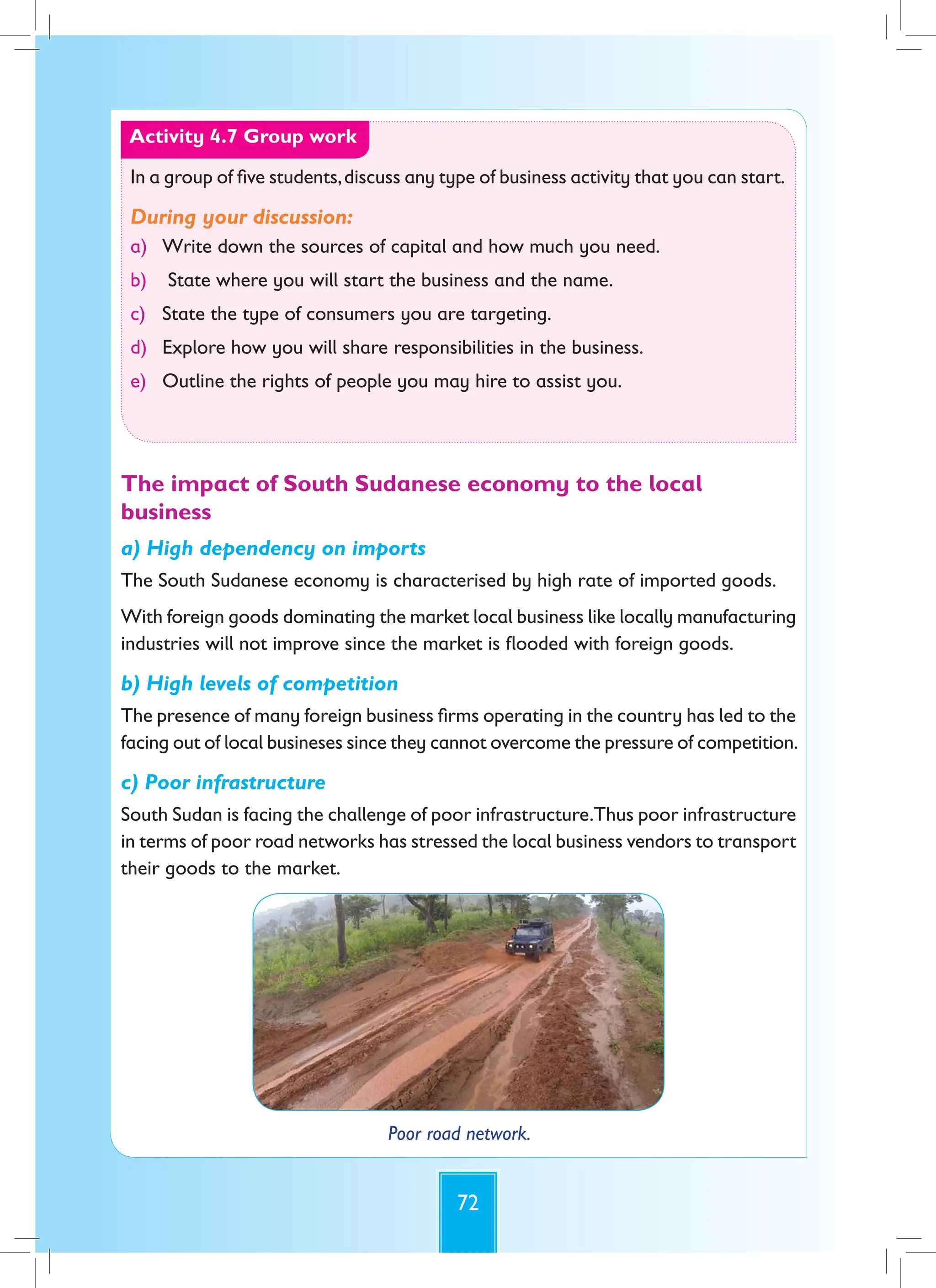
The impact of South Sudanese economy to the local business . . . . . . . .72
Revision questions . . . . . . . . . . . . . . . . . . . . . . . . . . . . . . . . . . . . . . . . . . . .73
Unit 5: Peace-making . . . . . . . . . . . . . . . . . . . . . . . . . . . . . . . . . . . . . . . . 74
Introduction. . . . . . . . . . . . . . . . . . . . . . . . . . . . . . . . . . . . . . . . . . . . . . . . .74
The meaning of peace-making . . . . . . . . . . . . . . . . . . . . . . . . . . . . . . . . . .75
Other terms associated with peace. . . . . . . . . . . . . . . . . . . . . . . . . . . . . .76
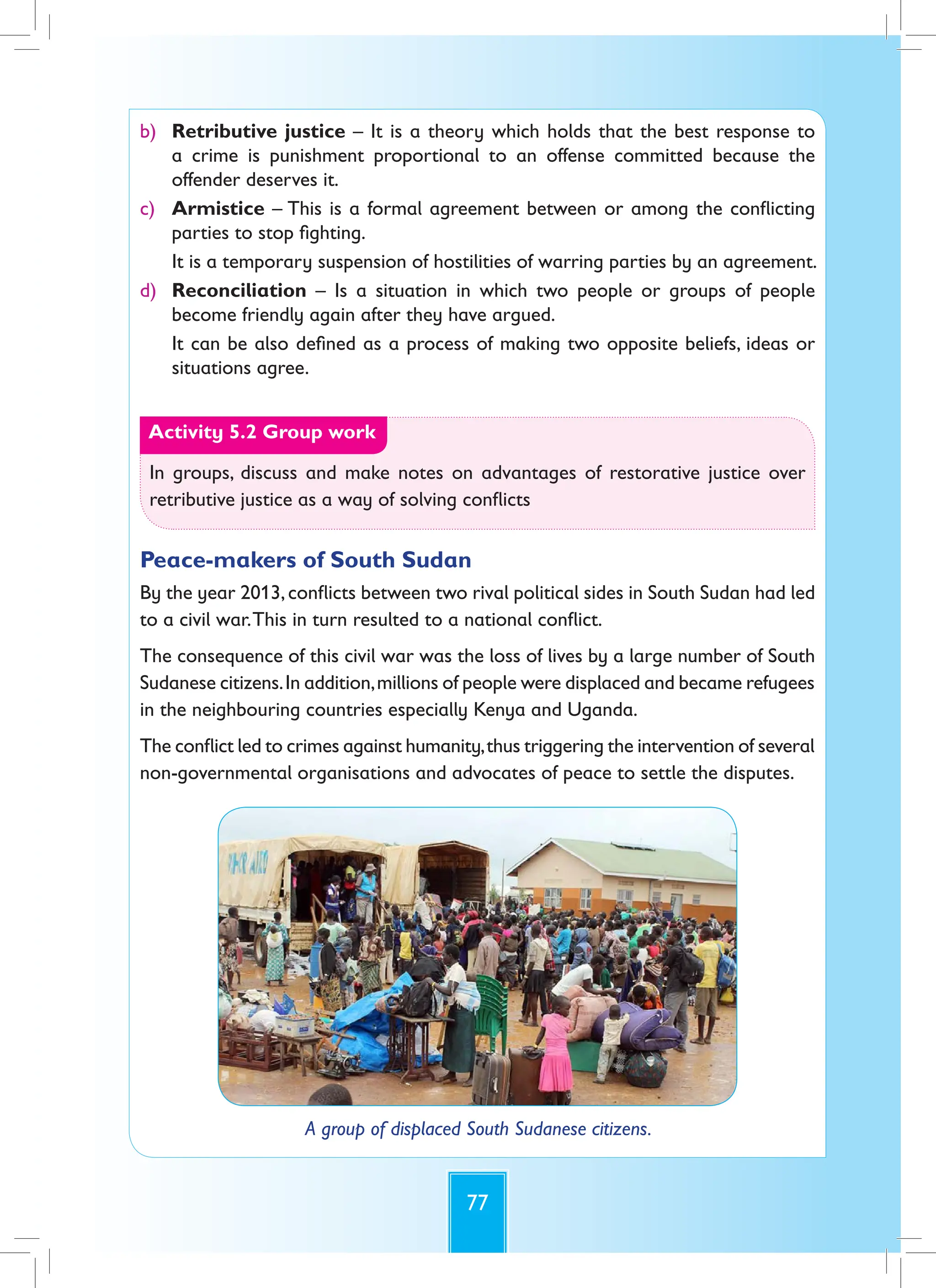
Peace makers of South Sudan. . . . . . . . . . . . . . . . . . . . . . . . . . . . . . . . . . .77
Organisations that have helped in peace making in South Sudan . . . . . .78
Current activities of peace-making in South Sudan . . . . . . . . . . . . . . . . .84
Glossary . . . . . . . . . . . . . . . . . . . . . . . . . . . . . . . . . . . . . . . . . . . . . . 86
Unit 6: The need for sustainable development . . . . . . . . . . . . . . . . . . . 87
The meaning of sustainable development . . . . . . . . . . . . . . . . . . . . . . . . .87
Ways of achieving sustainable development . . . . . . . . . . . . . . . . . . . . . .89
The United Nations Decade of Education for Sustainable
Development (DESD), 2005-2014. . . . . . . . . . . . . . . . . . . . . . . . . . . . . . . .90
The Impact of DESD on shaping public opinion, school
curriculum and government policies . . . . . . . . . . . . . . . . . . . . . . . . . . . . .92
Management of the impact of natural disasters . . . . . . . . . . . . . . . . . . . .94
Effective day to day strategies for protecting the environment . . . . . . . .95
Challenges facing the implementation of sustainable
development strategies in South Sudan . . . . . . . . . . . . . . . . . . . . . . . . . . .95
Glossary . . . . . . . . . . . . . . . . . . . . . . . . . . . . . . . . . . . . . . . . . . . . . . 96
Unit 7: Organising a community project . . . . . . . . . . . . . . . . . . . . . . . . 97
Introduction. . . . . . . . . . . . . . . . . . . . . . . . . . . . . . . . . . . . . . . . . . . . . . . . .98
Stages of carrying out a community project. . . . . . . . . . . . . . . . . . . . . . .99
Tools and instruments used for monitoring and evaluation . . . . . . . . . .103
Sustainability of community projects . . . . . . . . . . . . . . . . . . . . . . . . . . . .104
Glossary . . . . . . . . . . . . . . . . . . . . . . . . . . . . . . . . . . . . . . . . . . . . . 106
vi
1
Charters for peace and conflict
resolution
Charters for peace and conflict
resolution
UNIT 1
What I will learn
• The foundation of the United Nations and its Charter.
• How the UN charter is relevant to peace keeping and conflict resolution?
• The foundation of the African Union and its Charter.
• How the African Union has shaped South Sudan?
• The role of the United Nations (UN) and the African Union (AU).
• The role of the charter of the United Nations and the African Union on
conflict and peace resolution.
What I will do
• Explore the relevance and impact of the AU and UN treaties, protocols and
articles related to peace and conflict resolution.
• Investigate and compare the aims and objectives of AU and UN in relation
to peace and conflict resolution.
Activity 1.1
1. Using the internet and other relevant materials, explain how the UN
charter is relevant to peace keeping and conflict resolution.
2. In less than 100 words describe how theAfrican Union has shaped South
Sudan.
3. Make a presentation in class as a group and choose the best three.
2
The United Nations (UN)
The United Nations is an association of independent nations and countries.
It was formed immediately after the Second World War. Its main aim was to
promote international peace and security.The UN came fully into its existence in
24th
October, 1945.
Its membership is open to independent states. South Sudan became a member of
the United Nations on 14th
July, 2011.
Currently,the UN has a membership of 193 sovereign states with equal representation
in the UN General Assembly.
President Salva Kiir of the Republic of South Sudan addressing a UN meeting.
Objectives of the United Nations
• To promote and maintain international peace and security.
• To develop friendly relationships and ties among members of the world.
• To promote co-operation in handling international social, cultural and
humanitarian problems.
• To continue the diplomatic meetings that had begun during the wars.
• To prevent the occurrence of another war similar to World War I and World
War II.
3
Activity 1.2 Field visit
1. Visit your local village and research on any organisation that has been
established to maintain peace and security.
2. In your visit you will be required to come up with the following findings:
a) Has the organisation been able to achieve its objectives?
b) What are some of the challenges facing the organisation in solving the
conflicts facing the society?Your arguments should be fully supported.
Organisation of United Nations
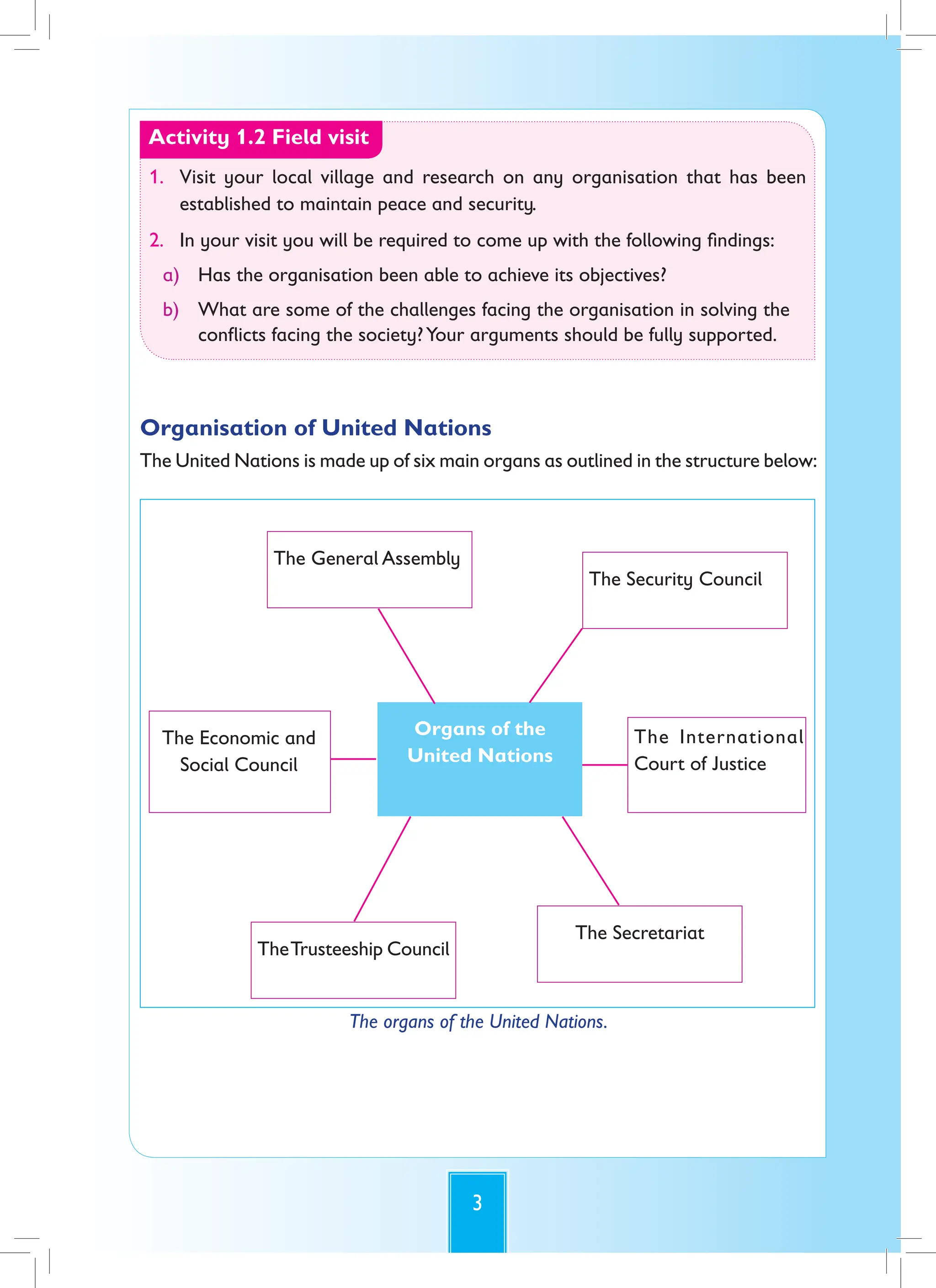
The United Nations is made up of six main organs as outlined in the structure below:
The General Assembly
The Security Council
Organs of the
United Nations
The International
Court of Justice
The Secretariat
TheTrusteeship Council
The Economic and
Social Council
The organs of the United Nations.
4
a) The General Assembly
It consists of representatives of all member states.
A sitting of the UN General Assembly.
The roles of the General Assembly include:
• To discuss issues that relate to UN objectives except matters touching on the
Security Council.
• To approve the UN budget.
• To admit new members and expel those who do not adhere to the rules.
• To appoint individuals to work in the different UN agencies.
Activity 1.3 Role play
1. Transform your class into a sitting similar to that of the UN General
Assembly.
2. Choose one person to act as the chairperson. As the chair he or she should
moderate the meeting as members give their views on important areas of
maintaining peace, unity and conflict resolution.
3. The members should act as representatives from various countries in the
world.
4. As you do so, ask for guidance from your subject teacher.
5
b) The Security Council
It is made up of five permanent members and ten members who are not permanent.
The Security Council is a permanent organ that makes decisions at the UN.
It formulates and implements policies.
The permanent members are:
The United
Kingdom
The Russian
Federation
The United
States of
America
France
China
Security Council permanent members.
The Council’s main duty is to promote and maintain international peace and security.
It investigates disputes that may threaten peace and recommend possible course
of action to be taken. For example, the Council can order sanctions against the
offending state or deploy peacekeeping forces to the warring nations.
Troops of the peace-keeping mission of the UN in South Sudan.
6
c) The Secretariat
This is the main administrative organ of the United Nations.
It is headed by the Secretary General who is elected by the GeneralAssembly.The
Secretary General serves a term of five years upon recommendations from the
Security Council.
The Secretary General is elected from the non-permanent members of the United
Nations.
One of the Africans to have held the seat of the Secretary General to the United
Nations is Kofi Annan from Ghana.
The current Secretary General of the United Nations is António Guterres from
Portugal.
President Salva Kiir with former UN
Secretary General, Ban Ki-moon from
South Korea.
Kofi Annan, one time Secretary General
to the UN from Ghana.
António Guterres the current Secretary General to the UN from
Portugal.
7
d)The International Court of Justice
It is the judicial organ of the United Nations and its headquarters are inThe Hague,
Netherlands.
It is made up of fifteen judges each serving a nine-year term.
It is responsible on all legal issues and disputes which require to be dealt with at
the UN. Its decisions are final.
The Court deals with international disputes such as:
• Border conflicts.
• Treatment of diplomatic staff.
• Territorial waters.
A court session atThe Hague, Netherlands.
e) The Economic and Social Council
It has twenty-seven (27) members elected by the General Assembly.The members
serve a three-year term.
It deals with issues related to:
• Economic development
• Health issues
• Education
These issues are dealt with through specialised agencies such as:
• The United Nations Children’s Emergency Fund (UNICEF)
• The World Health Organisation (WHO)
• The United Nations Development Programme (UNDP)
• Food and Agricultural Organisation (FAO)
8
UN officials administering polio vaccines to children in South Sudan.
f)Trusteeship Council
It was established to monitor the political developments in territories that were
dependent and advocated for decolonisation.
Dependent territories refer to former mandates of the League at the end of
World War II.
Trusteeship Council suspended its operation in 1994 with the independence of
Palay, the last remaining UN trust territory.
It however continues to exist on paper. It still has President andVice President.
Achievements of the United Nations
• The United Nations has encouraged the member countries to settle their
disputes peacefully.
• The UN has imposed sanctions on countries that threaten peace in the
world.
• Peace-making missions have been sent to areas with civil conflicts such as
Somalia.
• Through the International Court of Justice it has settled disputes between
countries peacefully.
• It has promoted social and economic development through its specialised
agencies.For example,through theWorld Health Organisation,the UN has
improved health standards of many African countries.
9
Activity 1.4 Group work
Study the photograph below keenly and use it to answer the questions that will
follow:
a) What can you see from the above picture?
b) How do you think this activity is important in improving peace and unity in
South Sudan?
The role of the United Nations in peace and conflict
resolution
Activity 1.5 Role play
1. Organise your class to form a UN security council round-table negotiation.
2. Choose a chairperson to lead the meeting.
3. Discuss on the importance of maintaining peace in our society.Write down
your discussed points.
10
The United Nations Charter of 1945 articulated its commitment to uphold human
rights of all citizens.
Chapter VI of the United Nations Charter deals with the peaceful settlement of
disputes. It requires that disputes that may lead to war be dealt with first through
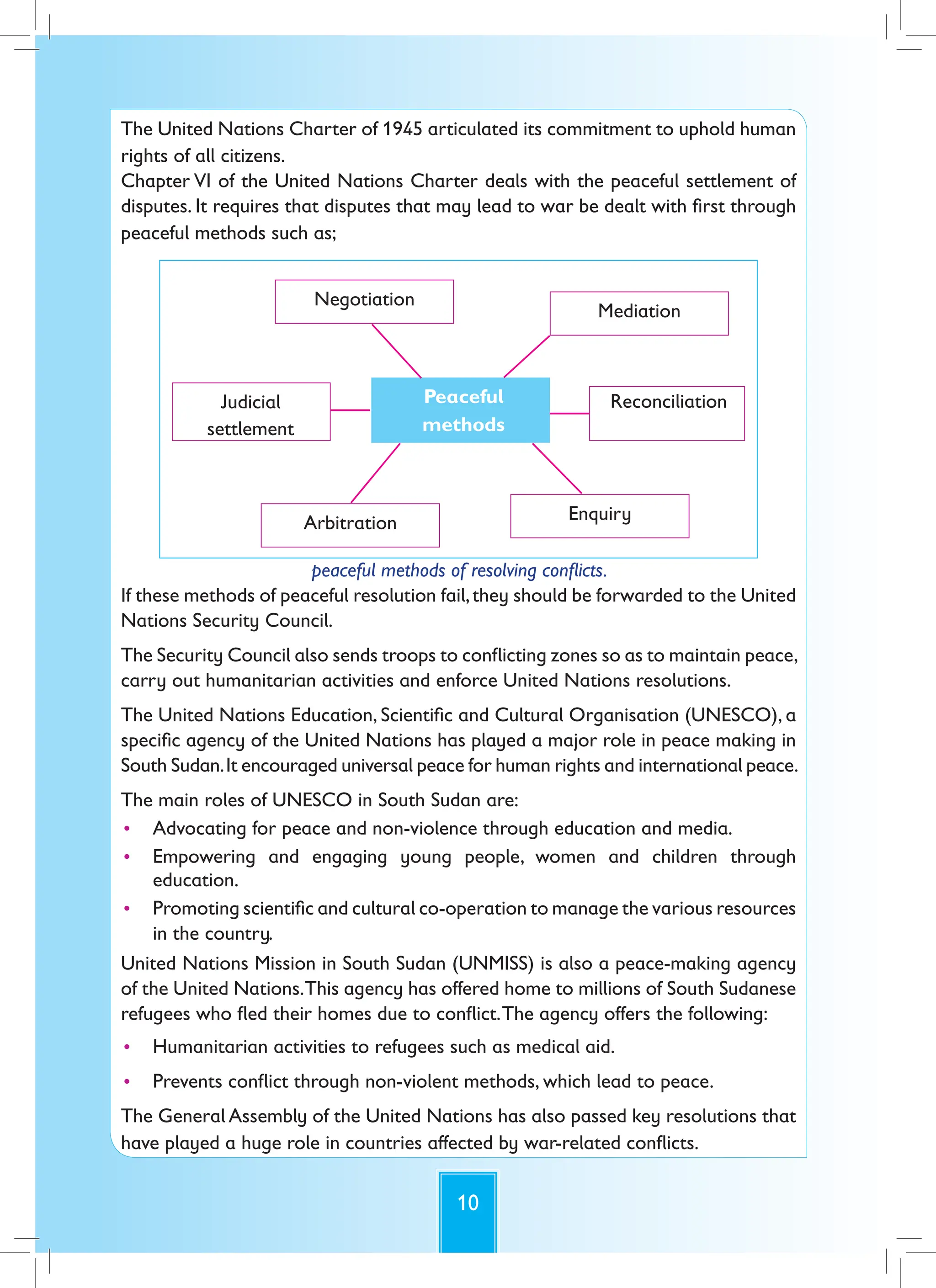
peaceful methods such as;
Negotiation
Mediation
Peaceful
methods
Reconciliation
Enquiry
Arbitration
Judicial
settlement
peaceful methods of resolving conflicts.
If these methods of peaceful resolution fail,they should be forwarded to the United
Nations Security Council.
The Security Council also sends troops to conflicting zones so as to maintain peace,
carry out humanitarian activities and enforce United Nations resolutions.
The United Nations Education, Scientific and Cultural Organisation (UNESCO), a
specific agency of the United Nations has played a major role in peace making in
South Sudan.It encouraged universal peace for human rights and international peace.
The main roles of UNESCO in South Sudan are:
• Advocating for peace and non-violence through education and media.
• Empowering and engaging young people, women and children through
education.
• Promoting scientific and cultural co-operation to manage the various resources
in the country.
United Nations Mission in South Sudan (UNMISS) is also a peace-making agency
of the United Nations.This agency has offered home to millions of South Sudanese
refugees who fled their homes due to conflict.The agency offers the following:
• Humanitarian activities to refugees such as medical aid.
• Prevents conflict through non-violent methods, which lead to peace.
The General Assembly of the United Nations has also passed key resolutions that
have played a huge role in countries affected by war-related conflicts.
11
Activity 1.6 Group work
Observe the photographs below and read the article provided carefully.
The United Nations peacekeeping chief today hailed the involvement of Eastern
African countries in revitalising the peace process in South Sudan.This was among
the main topics he discussed with that nation’s President,describing such regional
engagement “a good thing.”
“We discussed the initiative of IGAD towards the revitalisation of the peace
process,” said Jean-Pierre Lacroix, the UN Under-Secretary-General for
Peacekeeping Operations,in the South Sudanese capital,Juba,following a meeting
with President Salva Kiir.
Mr. Lacroix, on his first official visit to South Sudan, added that there was a
convergence of opinion that it was “a good thing” that the countries forming
the Intergovernmental Authority on Development (IGAD) are more engaged in
helping South Sudan and its people.
These countries are Djibouti,Eritrea,Ethiopia,Kenya,Somalia,Sudan and Uganda.
The conflict in South Sudan began in December 2013 as a result of political
face-off between President Salva Kiir and then FirstVice-President Riek Machar.
Despite the August 2015 peace agreement, violence has continued.To date, the
crisis has left more than 5.5 million people in need of aid and some 1.7 million
refugees have also fled to neighbouring countries.
Last month, the IGAD agreed to set up a high-level forum to work across the
region to get the South Sudanese peace process back on track.
12
According to the UN Mission, known as UNMISS, South Sudan’s Minister of
Cabinet Affairs, Martin Lomuro told the press that “the President sent very
clear message on what he would like the UN to do.” Noting that the President
would like the IGAD, UNMISS or the UN to “reach out to those rebels who are
holding citizens hostage and engage them towards talking to one another in
order to bring peace.”
Mr.Lacroix met with senior Government officials including the FirstVice President
Taban Deng, and the Minister of Foreign Affairs, Deng Alor.
The peacekeeping chief said that there was a “shared understanding” with the
government that “actions and initiatives to advance peace are important” and
that they have to be put in place“to accelerate the implementation of the Peace
Agreement and bring sustainable peace” to the world’s youngest nation.
Mr.Lacroix underlined that the peace process could not move forward if fighting
continued. He pledged the continued support of the UN towards providing aid
for the most vulnerable people in South Sudan.
“UN humanitarian agencies are doing their best to help South Sudan and we
look forward to further cooperation with the Government so that we can access
populations in distress wherever the needs are.”
a) Make a list of the organisations in the above text.
b) Mention the countries that are working closely with the government of
South Sudan in bringing peace and resolving conflicts in the country as
mentioned in the above text.
c) What does the text say about the government’s efforts towards achievement
of peace in the country?
d) From the article, find out the various issues that are important to peace in
South Sudan.
e) Do you think such meetings are important in improving your country
socially, politically and economically? Make a presentation in class.
13
The African Union (AU)
Before the establishment of the African Union, there existed the Organisation of
African Unity (OAU) that had been formed on 25th
May, 1963.
When the OAU became fully operational, it had a membership of 32 independent
African nations.
Its objectives were:
• To provide a platform through whichAfrican problems would be discussed and
the strategies of solving these problems.
• To create African identity and counter the European belief of being superior.
• To fasten the decolonisation of African countries under colonisers.
Achievements of OAU
The OAU made the following significant achievements:
• It contributed in uniting countries in Africa despite the differences in economic,
social and political setup.
• African countries such as Angola, Zimbabwe and Namibia attained
independence through its liberation committee.
• It made it possible for Africans to speak as one in the international front such
as the United Nations.
• It provided a platform for discussing challenges facing Africa such as refugee
problem, foreign interference and dependence.
• The OAU played a huge role in the refugee problem by providing material
assistance.
• IthelpedinestablishingeconomicorganisationssuchastheAfricanDevelopment
Bank.This has promoted infrastructural and economic development.
• The OAU played a key role in the establishment of regional organisations such
as Economic Community of West African States (ECOWAS) and Common
Market for Eastern and Southern Africa (COMESA).
Activity 1.7 Group work
Find out from materials in your school library, magazines and newspapers the
challenges faced by the Organisation of African Unity (OAU).
14
Foundation of the African Union (AU)
The African Union was formed in the year 2000 to replace the Organisation of
African Unity.This is after it was noted that the structures of the OAU setup in
1963 were not up to the required levels of operation.
By 11th
July 2000, 53 heads of state and government signed the African Union
Charter which outlined the operations of the organisation.
TheAfrican Union was officially established on 9th
July,2002 in Durban,SouthAfrica.
South Sudan joined the AU on 27th
July, 2011.
The headquaters of the AU is situated in Addis Ababa, Ethiopia.
Headquarters of the AU in Addis Ababa, Ethiopia.
The AU Charter
The Africa Union Charter outlines the objectives of the Union as follows:
• To defend the independence and territorial integrity of member states.
• To promote unity and solidarity among countries and one people of Africa.
• To ensure peace, stability and security in the continent.
• To speed up socio-economic and political integration in the continent.
• To encourage international co-operation by recognising the charter of the
15
United Nations and the Universal Declaration of Human Rights.
• To promote good governance, popular participation and democracy.
• Promote human rights in accordance with African Charter on human rights.
• To work closely with international partners to deal with diseases that can be
prevented and to provide good health in Africa.
• To promote science and technology through research in all fields.
• To promote co-operation in all human activities.
Principles of the African Union
These are the rules meant to assist the Union achieve its objectives.They include:
Peaceful co-existence of member states. Uphold the right to live in peace and
stability.There is also the interdependence among member states of the African
Union with emphasis on sovereign equality. Respect of the existing borders on
achievement of independence is also emphasised.
Active engagement and participation of the African people in the union’s
activities is highly regarded. Formation of common defence framework for
the continent. There is the peaceful conflict resolution among member states
through appropriate means as decided by the Assembly. Non-interference by
any member state in the internal affairs of another.
The Union has a right to intervene if a member state has issues of war crimes,
genocide and crimes against humanity. Respect for human life, condemning
terrorism and rejecting impunity. Promoting gender equality. Rejecting
unconstitutional changes of governments. Respect for the rule of law, human
rights and good governance.The right of member states to request intervention
from the union in order to restore peace and security.
Activity 1.8 Group work
From this passage,identify and write all the principles ofAfrican Union outlined.
16
The structure of the African Union
The African Union is made up of the organs as outlined below:
Assembly of
the Union
Executive
Council
The Court
of Justice
The Financial
Institution
The
Commission
The Pan-African
Parliament
Organs of the
African Union
Economic, Social and
Cultural Council
The Specialised
Technical Committee
Permanent Representative
Committee
Organs of AU.
a) The Assembly
The Assembly comprises of heads of state and the government.
It meets at least once a year to discuss important issues based on the agenda.
It has a chairperson who serves for a one-year period.
AU Assembly in Addis Ababa, Ethiopia.
17
b)The Executive Council
It comprises of ministers for foreign affairs from each member state and it meets
twice a year in ordinary sessions.
The Executive Council takes decisions and co-ordinates on policies in areas of
common interest such as transport, science and technology, foreign trade and
industry.
c)The Pan-African Parliament
It consists of elected representatives from member states of the union.
d)The Court of Justice
It deals with issues to do with interpretation coming up from the application or
implementation of the Act of the Union.
e)The Commission
This acts as the secretariat of the Union.
It comprises of the chairperson, deputy chairperson and commisioners.
Chairperson
Deputy Chairperson
Commissioners
f)The Permanent Representative Committee
It comprises of representatives of the committee.
g)The Economic, Social and Cultural Council
This is an advisory organ of the union with social and professional groups of the
member states of the union.
h) Financial institutions
They include:
• The African Central Bank
• African Investment Bank
• The African Monetary Fund
18
African Development Bank.
i)The SpecialisedTechnical Committees
These are specialised technical committees that are answerable to the Executive
Council.
The Achievements of the African Union
• The African Union has managed to reduce and settle conflicts within the
region. For example, the post-election violence in Kenya in 2007.
• It has helped in promoting peace through advocating for democracy.This has
been fronted by its Peace and Security Council.
• The AU has sent observers to countries that have elections to encourage
democracy and good governance.
• Through its financial institutions,it has played a huge role in developing growth
across nations through offering loans.
• TheAU has played a huge role in humanitarian activities,especially in countries
affected by conflict through offering aid, For example, the millitary troops in
Somalia for peace keeping.
19
Activity 1.9 Group work
1. In groups, research on the challenges facing the African Union.
2. Suggest the ways in which the challenges can be dealt with. Make a
presentation before your class.
3. Make a comparison and a contrast of theAfrican Union (AU) and the United
Nations (UN) in terms of structure and funtions.
The African Union Protocol in relation to establishment of
peace and conflict resolution
TheAfrican Union Protocol is an agreement that was signed by 53African countries
on how to ensure that there is peace among and within the African states.This
covenant was signed on 9th
July, 2002 in Durban, South Africa.
The protocol contained regional mechanisms that were to be put in place to prevent,
manage and resolve conflicts should they arise.
During the Durban Protocol, there was an establishment of Peace and Security
Council within theAfrican Union.In addition,theAfrican standby force and a special
fund were also established.
The objectives of the Peace and Security Council included:
• Promotion of peace, security and stability in Africa so as to assure protection
of lives and property.
• To promote peace and sustainable development.
• To anticipate and take measures of preventing conflicts.
• In areas where conflicts have occurred, the Peace and Security Council is to
ensure that the peace making and building initiatives to solve the conflicts are
in place.
• Promote democratic processes based on the rule of law, proper governance
and respect for human life as mediums of controlling occurrence of conflicts.
• Come up with a defence policy for the Union.
20
Activity 1.10 Group work
Study the following photographs:
a) What do you see in the first photographs?
b) What is the second picture showing? Share your thoughts with others in
your class.
c) How are the activities happening in the two pictures related to peace and
security?
Principles of the African Union Peace and Security Council
These are guidelines that direct its operations.They include:
• Peaceful settlement of disputes and conflicts.
• Respect for member states and integrity of their territories.
• A relationship of dependence between security and socio-economic
development.
• Quick and early response to emergency situations to prevent conflict from
blowing out of proportion.
• Respect of boundaries after inheriting them when a country achieves
independence.
• Respect for member state internal affairs.
A B
21
The role of the Peace and Security Council
• To promote peace, security and stability in the African Continent.
• Provide early information on possibilities of conflict so as to have preventive
diplomacy.
• Using relevant peace making initiatives and conflict resolution mechanisms.
• Providing disaster management and humanitarian action.
• Peace intervention and support operation.
The role of the African standby force of the African Union
• To support peace keeping missions and operations in countries faced with
wars.
• To observe and monitor various peace keeping missions in order to prevent
crimes against humanity.
• To build peace after conflict resolution through disarmament.
• To provide humanitarian assistance such as food to countries faced by civil
wars.
NOTE:TheAfrican Union through its Peace and Security Council shall build peace
through the following activities:
• Bringing together the negotiated peace agreements.
• Establishing foundations of social, political and economic reconstruction of
societies.
• Carrying out demobilisation and disarmament.
• Assisting vulnerable people such as the elderly, women and children.
• Resettling refugees and internally displaced people.
• Facilitating activities of humanitarian groups.
Activity 1.11 Group work
1. Gather information on the various ways our country has benefited from the
initiatives by the African Union from newspapers and the internet or any
other available resource.
2. Take note and present your findings to the class.
22
The Role of African Union in peace and conflict resolution in
South Sudan
Activity 1.12 Group work
Carefully study the photographs below.
a) What is happening in the photographs shown above?
b) Explain how important the activity in the above photographs are in
promoting peace and reducing conflicts in South Sudan.
c) Compare the similarities between the AU and the UN with reference to
peace and conflict resolution.
The African Union office was opened in Juba, South Sudan in 2008.This was as a
result of the communication issued at the 89th
meeting of the African Union Peace
and Security Council held on 24th
August, 2007.
The Juba office was in full support of the implementation of the comprehensive
peace agreement with respect to South Sudan.
The AU set out an objective to promote peace between Sudan and South Sudan.
This was meant to improve relations between the two countries.
The objectives of theAU in Juba were to monitor the political and security situation
in South Sudan.They are also to assess the implementation of the Comprehensive
Peace Agreement (CPA) and note the progress and challenges on economic and
natural resources.They are also to support the working ties with African Union
offices in Khartoum-Sudan with the target of promoting good relationship between
South Sudan and Sudan.
23
Similarities in the role of United Nations (UN) and the
African Union (AU) in peace and conflict resolution
• Both recognise the need for peaceful co-existence of member states. They
advocate for the right to a peaceful and secure continent.
• Both condemn impunity through the respect for human life and fight against
terrorism.
• They provide a defence policy for theAfrican continent as a way of maintaining
peace.
• Both advocate for respect of neighbour countries’ borders as a way of evading
conflict.
• They advocate for peaceful resolution of conflict among member states.
• Both provide avenues for development of friendly,social and economic relations
among countries.
• They uphold the need to follow the rule of law and good governance as
avenues of promoting peace.
• They help in conflict resolution through sending personnel to help in
humanitarian and military activities.
Glossary
• Sovereign – Being independent.
• Formulate – To come up with something.
• Sanctions – Measures that are meant to punish the offender for an offence
done.
• Deploy – To give a role to someone.
• Specialise – To deal with a particular or specific issue, task or job.
• Monitor – To follow the process or progress of something keenly.
• Dependent – To rely on something or cannot do something on your own.
• Decolonisation – The process of making a country independent.
• Articulate –To make something properly known through clear argument.
• Resolutions – These are agreements or covenants.
• Platforms – These are grounds of discussing issues.
• Charter – It refers to a plan or an order in which something will be
done.
24
• Policy – It is an agreed rule of operation.
• Solidarity – It simply means unity.
• Vulnerable – Something which is open to danger.
• Comprehensive – A clear detailed piece of information.
• Advocate – To fight for somebody.
• Rapporteur – A person appointed by a body to attend to and investigate a
situation and report back to the same body.
25
Systems of government around the
world
Systems of government around the
world
UNIT 2
What I will learn
• Systems of government in the selected countries in the world.
• Important similarities and differences between the government of South
Sudan and other world countries.
• Wider issues and challenges of global interdependence.
• The responsibilities of individuals and governments to global interdependence.
What I will do
• To investigate systems of government around the world.
• To explore and solve problems associated with global interdependence.
• To explore the benefits of international partnership to challenge international
conflict and promote peace.
Systems of government around the world
Activity 2.1 Pair work
Using the knowledge learnt from the previous topics on governance, make a list
of the various aspects that comprise a government.
Introduction to systems of government
A government is a group of people with legal authority to govern and control the
affairs of people in a given society.
A system of government refers to how administrative units in a given country are
organised to properly function.
In both Secondary One and Secondary Two, we studied the functions of various
26
systems of government such as parliament in South Sudan. Therefore, this
information will be so helpful in studying the systems of government in different
countries around the world.
In this topic, we shall examine and explore the systems of government in Kenya,
Britain and the United States of America.
We will also compare and contrast these aspects of government to those of South
Sudan.
1. Kenya
Kenya is a country found in the Eastern part of Africa. It borders South Sudan to
the South.
It is an ally of South Sudan in economic, social and political aspects. For example,
Kenya has played a significant role in the attainment of peace and political stability
in South Sudan.
The Republic of Kenya.
27
Kenya has a democratic system of government where citizens elect their leaders to
run the affairs of the country.This is done through an electoral process conducted
by an independent body.
The electoral process in Kenya
According to the Kenyan Constitution 2010,elections in Kenya are held after every
five years.These general elections are held on the second Tuesday of August after
every five years.
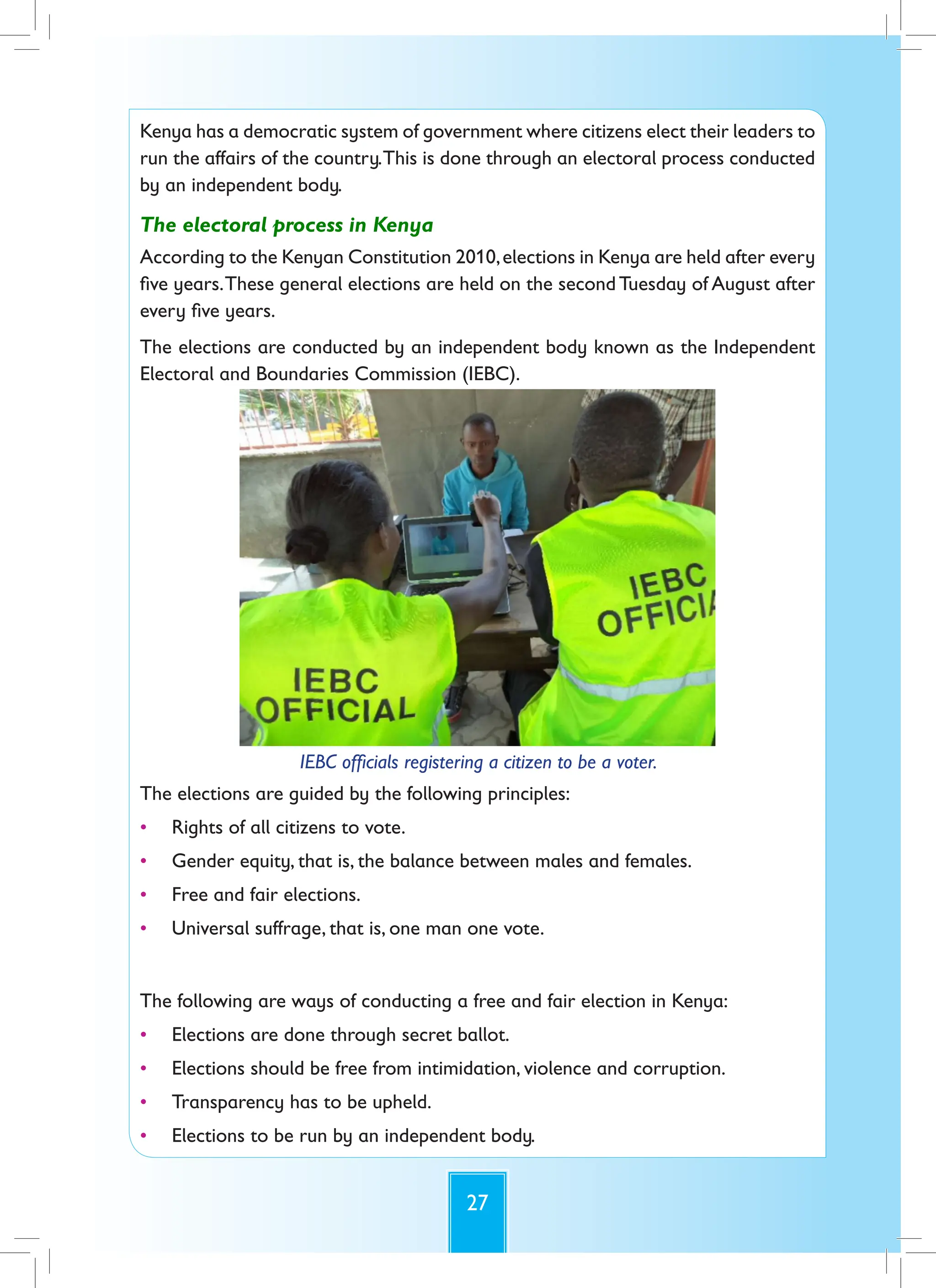
The elections are conducted by an independent body known as the Independent
Electoral and Boundaries Commission (IEBC).
IEBC officials registering a citizen to be a voter.
The elections are guided by the following principles:
• Rights of all citizens to vote.
• Gender equity, that is, the balance between males and females.
• Free and fair elections.
• Universal suffrage, that is, one man one vote.
The following are ways of conducting a free and fair election in Kenya:
• Elections are done through secret ballot.
• Elections should be free from intimidation, violence and corruption.
• Transparency has to be upheld.
• Elections to be run by an independent body.
28
Stages of the Electoral process in Kenya
a) Dissolution of parliament. After every five years, the Parliament (National
Assembly and Senate) is dissolved to give way for the new elections. The
presidential elections also take place during this time.
b) Registration of voters. This process is carried out by an electoral body, the
Independent Electoral and Boundaries Commission (IEBC).
The following conditions must be met for one to be registered as a voter:
• Be a Kenyan Citizen.
• Be of sound mind.
• Be 18 years and above.
• Possess a Kenyan passport or the national identification card.
c) Nomination.The electoral commission announces election dates and gives the
timetable for:
• Party nominations.
• Presentation of nomination documents by candidates.
• Date for the beginning and ending of campaigns.
For one to qualify as a presidential candidate, he or she must be:
• A Kenyan citizen by birth.
• Nominated by a political party or run as an independent candidate.
• Nominated by at least 2000 voters from each of a majority of the counties.
For a parliamentary candidate he or she must:
• Be a Kenyan citizen.
• Have attained the age of 21 years.
• Be a registered voter in the parliamentary constituency he wishes to
represent.
• Be nominated by a political party or run as an independent candidate.
However, a parliamentary candidate may be disqualified if he or she:
• Is holding a public office.
• Is a member of county assembly.
• Has not been a citizen of Kenya for at least 10 years before the election.
• Is declared bankrupt by the court of law.
• Is found to be of unsound mind.
29
For the county assembly candidate he or she must:
• Be a citizen of Kenya.
• Attain the age of 21 years.
• Be nominated by a political party or run as independent candidate.
• Be a registered voter in the ward he or she wants to represent.
d) Presentation of nomination papers. Here the candidates will present their
nomination papers to the IEBC officials.
e) Campaigns. They begin after candidates have presented their nomination
papers. Candidates must adhere to the electoral code of conduct during the
campaign period.For example,they should desist from acts of violence,bribery
and intimidation of opponents with their supporters.
f) Polling or voting.This is the day when the citizens go to their respective polling
stations to cast their votes. It begins at 6 am and ends at 5 pm. Voters must
present identification documents before voting.
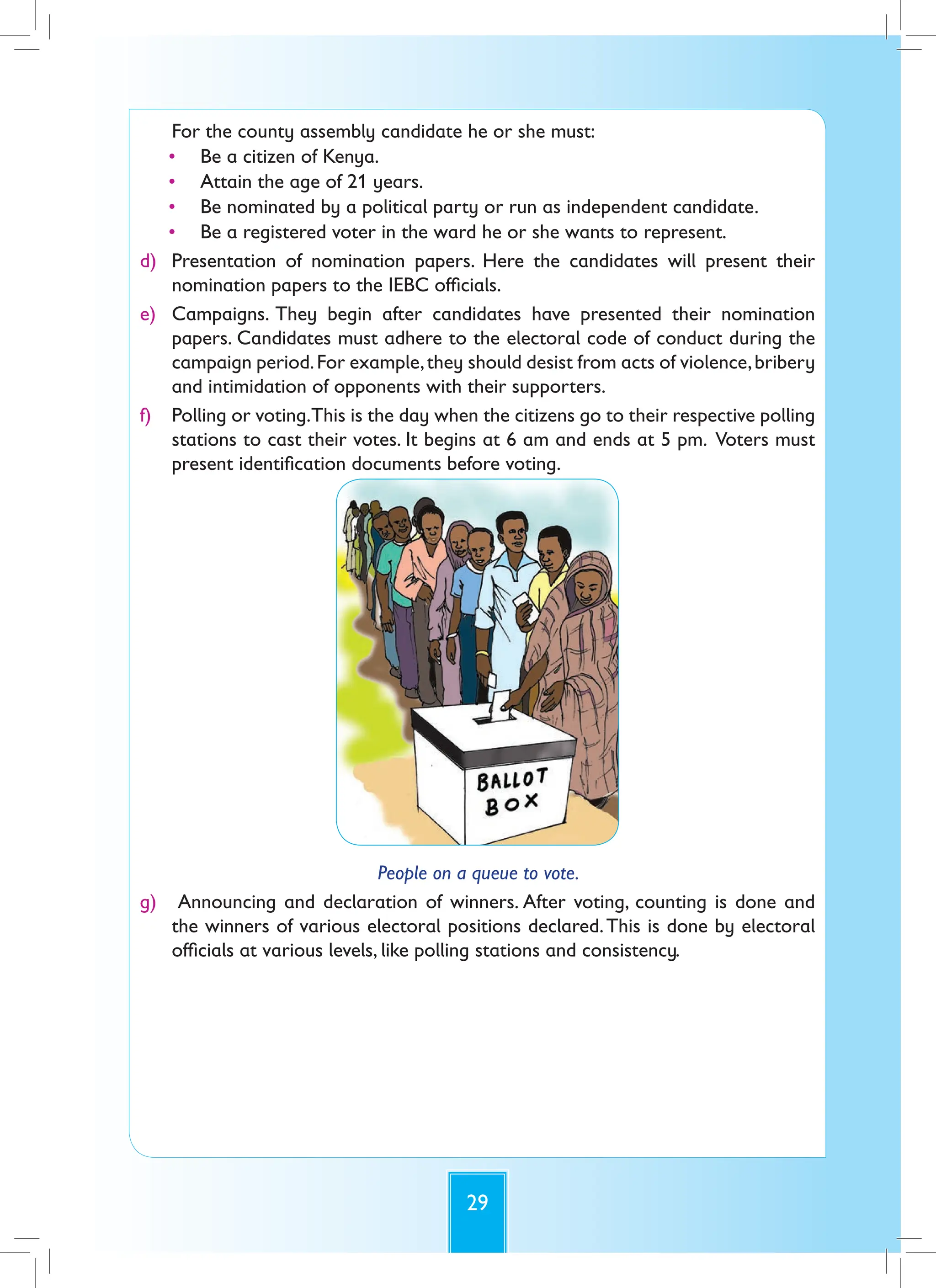
People on a queue to vote.
g) Announcing and declaration of winners. After voting, counting is done and
the winners of various electoral positions declared.This is done by electoral
officials at various levels, like polling stations and consistency.
30
Functions of electoral commission (IEBC) in Kenya
Activity 2.2 Pair work
From the information you have learnt in the electoral process in Kenya, point
out the functions of the electoral body [IEBC].Compare these functions to those
of the south Sudanese electoral body.What are the similarities and differences?
Formation and functions of the government of Kenya
The government of Kenya is of two levels;the national government and the county
or devolved government. All these levels of government are formed after the general
elections.
According to the constitution of Kenya, 2010, there are 47 counties.
Each county has a government that has the County Executive, County Assembly
and the County Public Service.
All counties are headed by a Governor assisted by a Deputy Governor. Hence the
governor is the chief executive officer of the county.
The national government of Kenya is divided into the Legislature or Parliament,
the Executive and the Judiciary.
a) The Legislature
The Legislature has two houses:
Legislature
National Assembly
Senate
The National Assembly has 290 members elected from each constituency, 47
women elected from 47 counties, 12 nominated members by political parties and
the speaker as an ex-officio member.
The Senate has 47 members elected from each county, 16 women members
nominated by political parties; a man and a woman to represent persons with
disabilities; a man and a woman to represent the youth and a speaker as an
ex-officio member.
31
A parliamentary session in Kenya.
The functions of the National Assembly are:
• To make and change laws of the land.
• To control government revenue and expenditure.
• To put the government on check so as not to misuse its powers.
• To act as a link between the people at the local level and the government.
• To pass a vote of no-confidence on the government and the president if
necessary.
• To approve government actions making them acceptable.
The functions of the Senate are:
• It makes and amends law in collaboration with the National Assembly.
• To determine the money to be allocated to counties.
• To ensure that money allocated to counties is properly utilised.
• It ensures that public servants do their work accordingly.
Activity 2.3 Pair work
1. By the use of a table, compare the similarities between the Kenyan parliament
and that of South Sudan in terms of composition and functions.
2. Make a presentation before your class.
32
b) The Executive
The Executive consists of:
ThePresident
Cabinet
The Attorney
General
The Deputy
President
The Executive
The Public Service
The national
security organs
Correctional
Service.
The president of Kenya is the Head of the Executive and he or she is the one who
appoints cabinet secretaries with the approval of parliament.
The Cabinet consist of between 14-22 cabinet secretaries.
President Salva Kiir of South Sudan with President Uhuru Kenyatta of Kenya.
33
The power and functions of president of Kenya are:
• He or she chairs Cabinet meetings.
• He or she is the commander-in-chief of the Kenya Defence Forces.
• He or she ensures the protection of rights and freedoms of the people as
enshrined in the constitution.
• He or she can appoint and dismiss public officers in line with constitution.
• He or she can offer pardon to convicted persons.
• He or she receives and entertains foreign leaders and presidents of other
countries.
The cabinet has a role in:
• Making government policies.
• Defending the government and its functions.
• Advising the president on issues of governance.
• Taking part in the process of making the budget.
• Acting as a link between the government and the people.
The Public Service
The Public Service is headed by a Public Service Commission made up of members
appointed by the president.The roles include:
• Interpreting the government policies to the people.
• Implementing government policies.
• Collecting government revenue and accounting for expenditure.
• Maintaining law and order through the National Police Service.
• Giving advice to cabinet secretaries on policy matters.
• Offering important and essential services to the people such as medical care.
The composition of the national security organs is the Kenya Defence Forces, the
National Intelligence Services and the National Police Service.
The Kenya Defence Forces are entitled to:
• Defend the country from external aggression.
• Maintain international peace and security through peace keeping mission.
• Help in the maintenance of law and order.
• Provide emergency services during times of natural disasters.
34
Kenya Defence Forces in Somalia on peace-keeping mission.
The National Police Service comprises of the Kenya Police Service and the
Administration Police Service. Its roles include preventing crime, arresting and
prosecuting criminals and law breakers and helping fight international crime in
collaboration with the International Police (Interpol).
They collect information on crime and act on it as well as protecting life and property.
Activity 2.4 Pair work
Compare and contrast by use of tables, the executive of South Sudan to
the executive of Kenya.
c) The Judiciary
The Judiciary is the arm of government that interprets laws and is headed by the
Chief Justice.
It is made up of a system of courts; the Supreme Court, the Court of Appeal, the
High Court,the magistrate’s courts,the Kadhi’s courts,the Courts Martial and the
Tribunals.
Functions of the Judiciary in Kenya involve the following:
• The Supreme Court listens and determines disputes from presidential elections.
• The High Court hears cases that are being tried for the first time.
• The Court of Appeal listens to cases appealed from the High Court.
• The Magistrates courts will hear and determine criminal cases.
• The Kadhi’s courts will settle specific Islamic disputes related to marriage,
divorce and inheritance.
35
The Supreme Court of Kenya
Activity 2.5 Pair work
What similarities and differences can you draw from the Kenya’s judiciary
and the judiciary of South Sudan?
2. Britain
Britain is found in Europe and it is made up of England,Scotland,Wales and Northern
Ireland.
The position of Britain on the map of Europe.
36
Britain has a constitutional monarchical government.This is a government where the
head of state is a queen or a king.The royalty rules according to the law of the land.
The residential place of the monarch is in Buckingham Palace.
Britain is a parliamentary democracy where the principle of representation by
elected leaders is central.
Electoral process in Britain
Unlike other democratic countries like South Sudan, there is no specific date for
elections in Britain.The date of elections is announced by the Prime Minister.
Elections in Britain are conducted by the Electoral Commission of Britain.
The role of the Electoral Commission of Britain include registration of political
parties, conducting of civic education on electoral issues and conducting of the
elections through distribution of election materials.
They also help in counting of votes and announcing results.On the other hand they
have a responsibility of controlling how political parties use their campaign money.
The electoral process in Britain involves the following procedures:
i. Dissolution of the parliament by the Prime Minister with the approval
from the Monarchy.
ii. Issuance of a legal notice for holding elections – This makes it possible
for elections to be held at various levels. It is the lawful way of notification for
elections.
iii. Voter Registration – This is a continuous process and voters must be of 18
years and above.
iv. Setting of election dates – This is done by the Prime Minister.
v. Nomination of parliamentary candidates – This is done by political
parties.The nominees must be of 21 years and above.They must also be British
citizens.
vi. Campaigns – This is done for two weeks. Here, candidates sell their policies
through rallies and use of media.
vii. Polling or voting – It is done through a secret ballot. It begins as early as
7.00 am and ends at 10.00 pm.The voter’s name must be on a voter’s register
before voting.
viii. Vote collection –This takes place after voting within the constituency in the
presence of candidates or their agents. On conclusion, the returning officer
announces results and declares the winner.
37
Activity 2.6
• Identify similarities and differences if any, between the electoral processes in
South Sudan and the electoral process in Britain.
The structure and functions of the British government
The British government has four arms;the Monarchy,the Executive,the Legislature
and the Judiciary.
a) The Monarchy
The unwritten constitution of Britain recognises the role of the monarch who
operates on policies approved by parliament.
The monarch is the legal head of state in Britain and his or her position is hereditary.
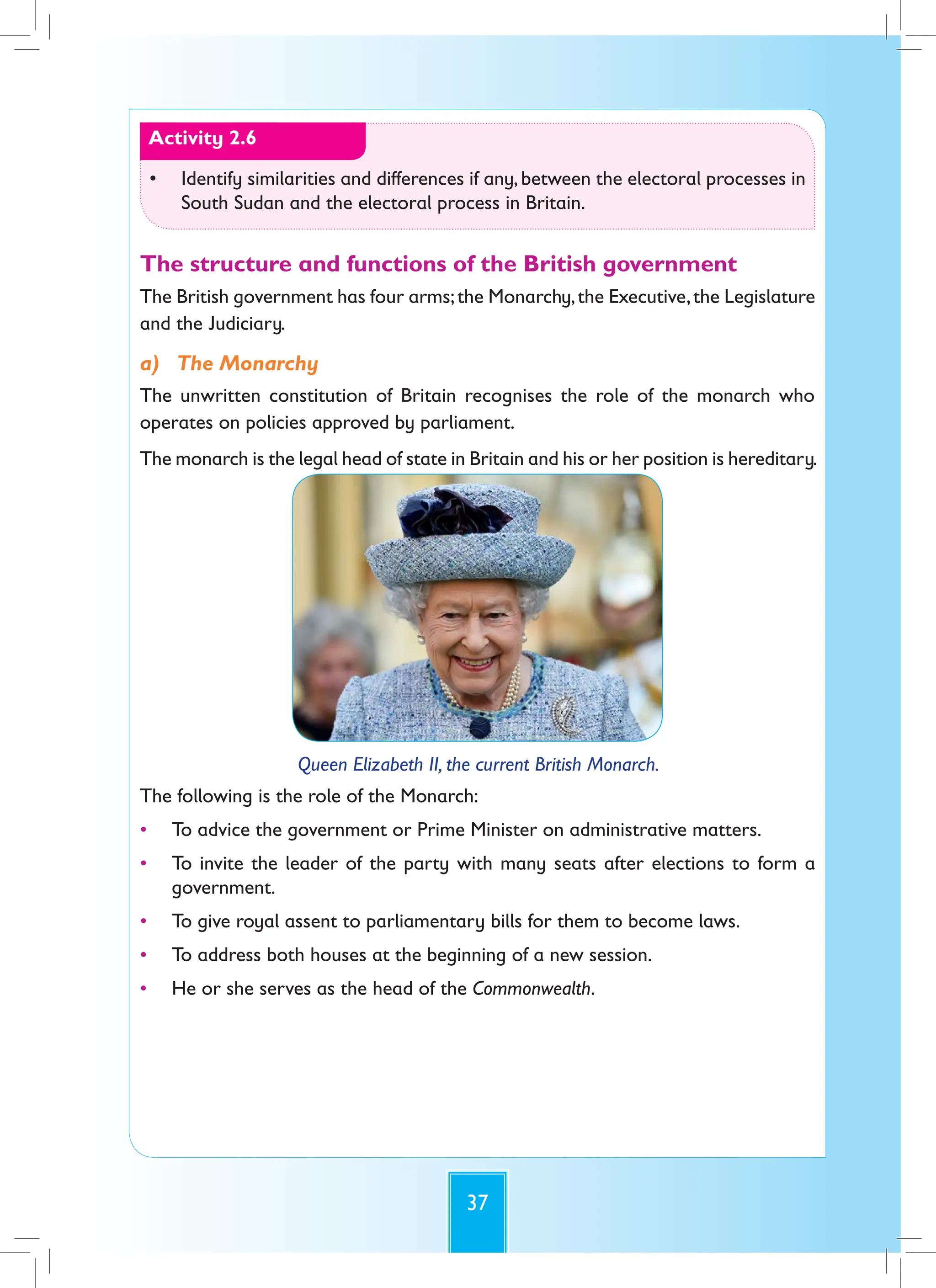
Queen Elizabeth II, the current British Monarch.
The following is the role of the Monarch:
• To advice the government or Prime Minister on administrative matters.
• To invite the leader of the party with many seats after elections to form a
government.
• To give royal assent to parliamentary bills for them to become laws.
• To address both houses at the beginning of a new session.
• He or she serves as the head of the Commonwealth.
38
b) The Executive
It comprises of the Prime Minister, the Cabinet and the Civil Service.
The functions of the Prime Minister are:
• He or she is the head of government.
• He or she chairs cabinet.
• He or she implements government policies.
• He or she is the chief spokesperson of the government in the House of
Commons.
• He or she acts as a chief legal adviser of the Monarch.
• He or she represents the government in international events.
Theresa May, the Prime Minister of Britain.
The Cabinet is appointed by the Prime Minister with approval from the Monarch.
It is made up of members from the House of Commons.
The members to the Cabinet are referred to as ministers who head each department
in the government.
The role of the Cabinet is to determine the policies to be presented before parliament
as well as ensuring that they are implemented.
The Civil Service is comprised of individuals who work for the government in various
departments such as doctors, lawyers, clerks and messengers.Their main function
is to implement government policies.
39
Activity 2.7 Pair work
How would you compare and contrast the executive of South Sudan and that of
Britain with reference to composition and functions?
c) The Legislature
It is bi-cameral in nature, that is, it has two houses; House of Lords and the House
of Commons.The House of Lords has a total of 900 members who are appointed
by the Monarch or inherit their positions.They include the dukes, the princes, the
barons and the head of the Church of England.
Their functions are to check on executive powers and debate on issues important
to the nation.
They also act as a final court of appeal.They as well Introduce bills to parliament.
The House of Commons is the main arm of legislation or law-making body in Britain.
It has elected members representing constituencies. It also has the speaker who
chairs parliamentary meetings or sessions.
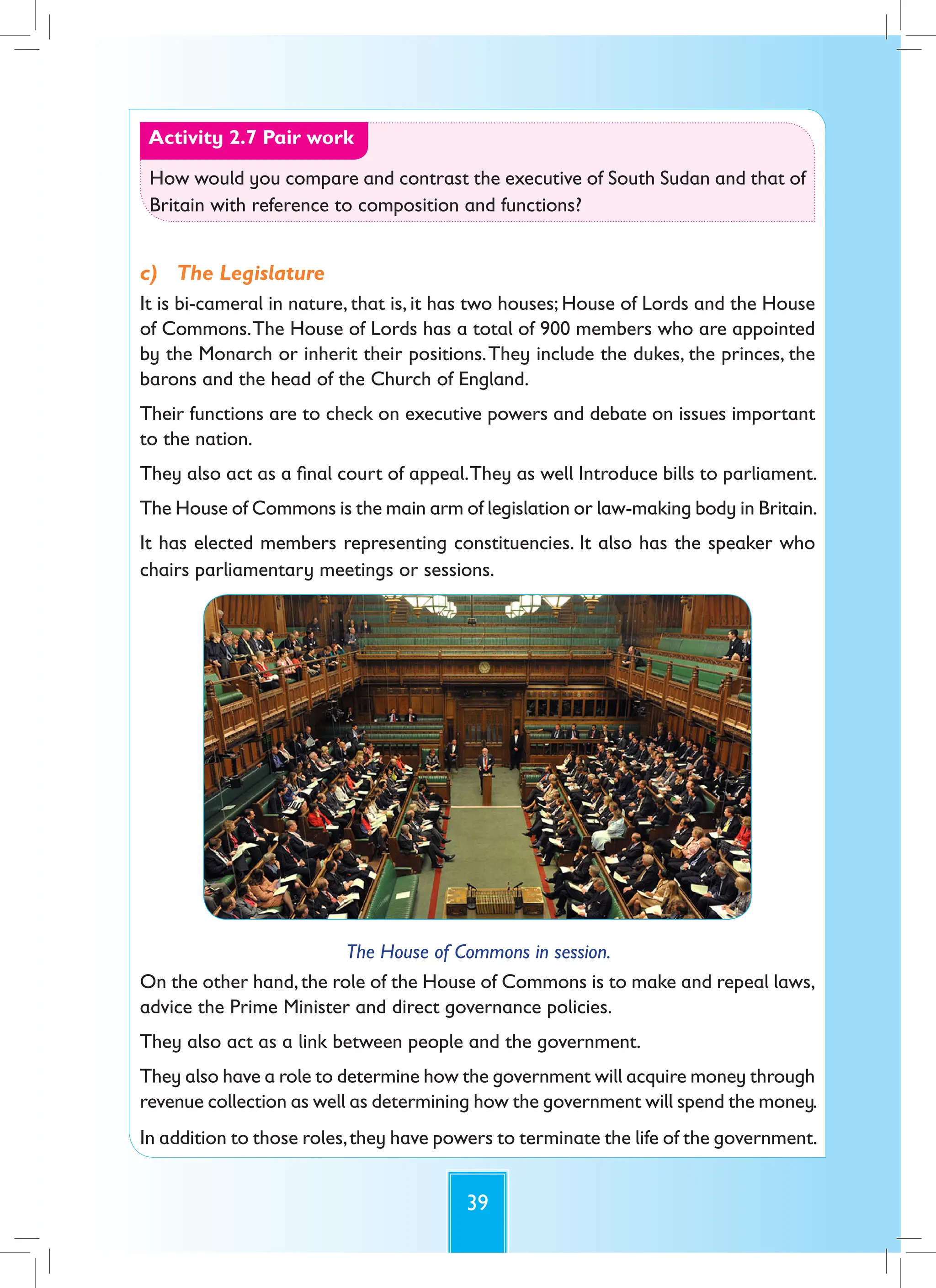
The House of Commons in session.
On the other hand,the role of the House of Commons is to make and repeal laws,
advice the Prime Minister and direct governance policies.
They also act as a link between people and the government.
They also have a role to determine how the government will acquire money through
revenue collection as well as determining how the government will spend the money.
In addition to those roles,they have powers to terminate the life of the government.
40
Activity 2.8
Make comparisons between the Legislature of South Sudan and the British
Legislature.
d) The Judiciary
This is the British legal system made up of courts.
The Judiciary is based on the supremacy of the rule of law.
Its court system is divided into two; the civil courts and the criminal courts.
The civil courts include the County Courts, the Court of Appeal and the High
Court of Justice.
The criminal courts are the Magistrates courts,the Court of Quarter,the Sessions
Courts of Assize and Courts of criminal Appeals.
There are also tribunals which are specialised courts dealing with road traffic,
agriculture and rents.
The functions of Judiciary in Britain are:
• Settling disputes between individuals and government.
• Interpreting the constitution.
• Protecting citizen rights and freedoms.
• Punishing offenders through administration of justice.
3. United States of America (USA)
USA is the most powerful nation in the world today.
Its origin dates back to 1776 when 13 states declared their independence from
Britain.Today, the USA is made up of more than 50 independent states.
The constitution of USA provides for a federal system of government.
Electoral Process in the USA
Elections in the USA are conducted by two main bodies; the National Party
Convention and the Electoral College.
The National Party Convention is entitled to announce party candidates to the
public for the presidency and declare party manifestos to the people.
The Electoral College has electors from each state with varying numbers. The
candidate with the highest number of votes from the Electoral College is declared
the winner.
41
The following are some of the stages of the USA electoral process:
a) Voter registration
This is a major requirement before elections are held. For one to be voter
he or she must;
• be 18 years and above.
• be a citizen of the USA.
b) Campaigns
After nominations, election campaigns begin.
The election campaigns are controlled by the Federal Election Campaign Act.
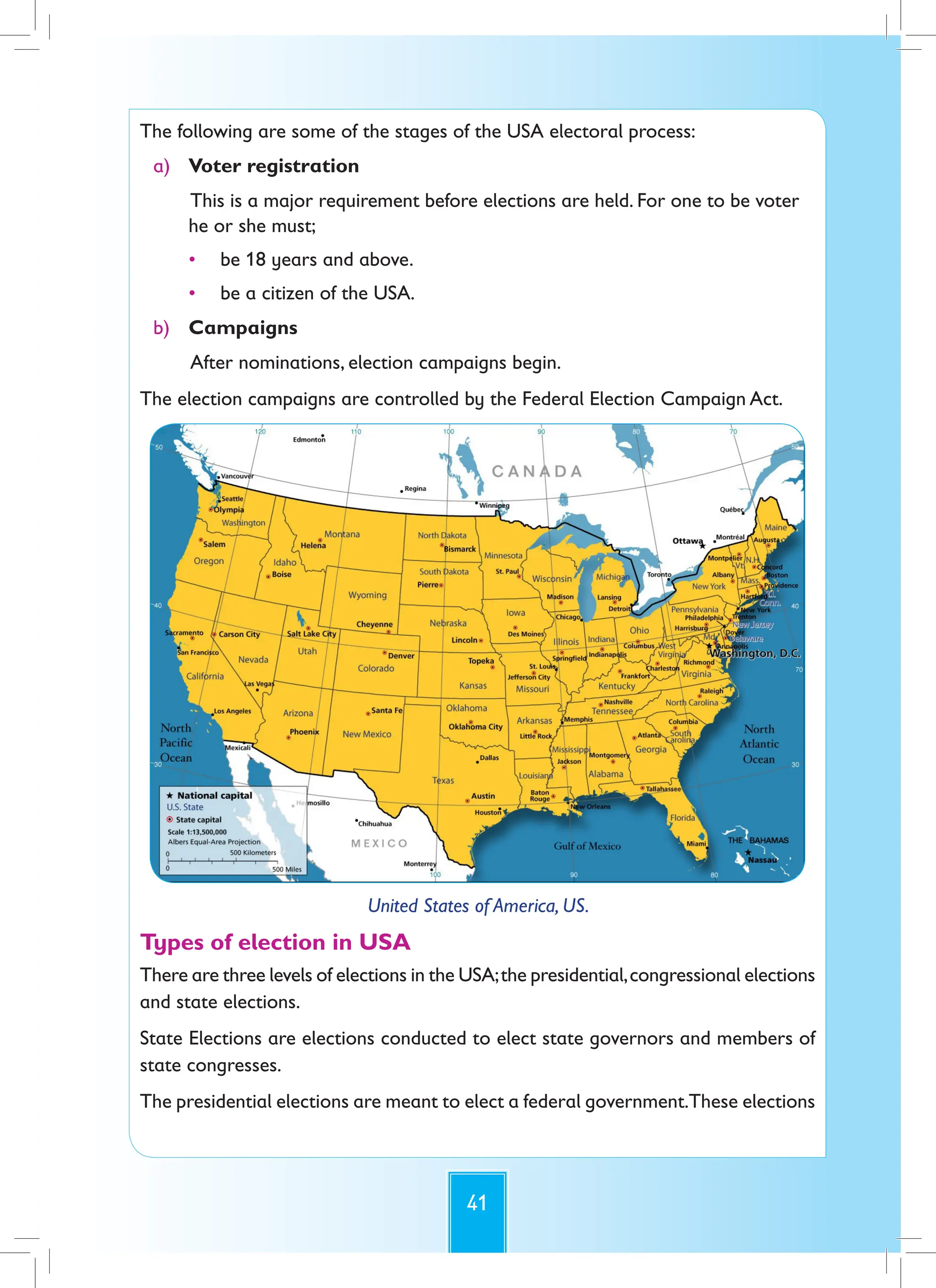
United States of America, US.
Types of election in USA
There are three levels of elections in the USA;the presidential,congressional elections
and state elections.
State Elections are elections conducted to elect state governors and members of
state congresses.
The presidential elections are meant to elect a federal government.These elections
42
are held every four years in the month of November and the US presidents serve
a maximum of two-four year terms, a total of 8 years.
For one to be elected US president, he or she must be 35 years and above, be a
naturally born citizen of the US and must have been living in the USA for at least
four years prior to elections.
Congressional elections are conducted to elect members of the Congress. The
Congress has the Senate and House of Representatives.
Qualifications for election to the Senate and House Representatives are:
• He or she must be 35 years and above.
• He or she must be a citizen of USA and should be residing in the US for nine
years before the nomination.
• He or she must be a resident in the state in which he or she intends to be
elected.
Activity 2.9 Work to do
1. Make a comparison between the similarities of electoral process between
South Sudan and the USA.
2. Compare your findings with those of your class members.
The functions of the US government
The US government is made up of three arms; the Legislature, the Executive and
the Judiciary.
a) Legislature
Legislature is also called the Congress. It is bi-cameral, that is, the Upper House
and the Lower House.
The roles of the Congress are:
• To make and ammend laws of the country.
• To control foreign and domestic trade.
• To act as a link between states and the federal government.
• To control government revenue and expenditure.
• To discuss and find solution to common problems in the federation.
• To confirm senior government appointments made by the Head of State.
43
The functions of the House of Representatives are to:
• Impose impeachment charges against government officials including the president.
• Determine taxation and other financial policies.
• Explore legal ways to remove president from power.
b) The Executive
The Executive is comprised of the President, the Vice President, the Cabinet and
the Civil Service.
The President
He or she has the following functions:
• Protect American citizens and people from other nations within USA.
• He represents the voice of Americans at home and abroad.
• Guides and controls foreign policies as approved by congress.
• He is the commander-in-chief of the armed forces.
• Appoints government officials and civil servants which are approved by the
senate.
• Can offer pardon to any person convicted of breaking the law.
• Issues rules, regulations and instructions to the US public.
President DonaldTrump of the US. Barrack Obama, the former US
president.
c) The Cabinet
The Cabinet is made of secretaries of state appointed by the president with the
approval of Congress.They are also known as the Executive Heads of Departments.
The US Cabinet is entitled to:
• Advice the president on issues touching on their departments.
• Implementing government policies.
• Come up with public policy.
• Represent the president in their departments.
44
d) The Judiciary
The Judiciary is an independent legal organ made up of the system of courts.These
courts are:
Courts of
Custom
Supreme
court
Courts of
Appeal
Judiciary
District court
State Courts
Special Federal
Courts
The Supreme Court is the highest court in the land and is headed by a Chief Justice
and eight other judges.
The judges are appointed by the president with the approval from the Congress.
The Supreme Court plays the role of:
• Settling disputes which are legal between states.
• Interpreting the law and the constitution.
• Settling disputes between USA and foreign nations.
• Hearing appeals with regard to sea or ships.
The Court of Appeal:
• Hears appeals on decision in cases related to international trade.
• Hears appeals on decisions made by lower courts.
The state courts are mandated to:
• Settle family disputes at family courts.
• Handle minor offences such as crime through trial courts.
• Dispose off property of dead persons.
45
The Special Federal Courts have a duty of:
• Hearing cases where the USA is sued for damages.
• Listening to and determining appeals on US cases office ruling.
• Hearing appeals from the court martials.
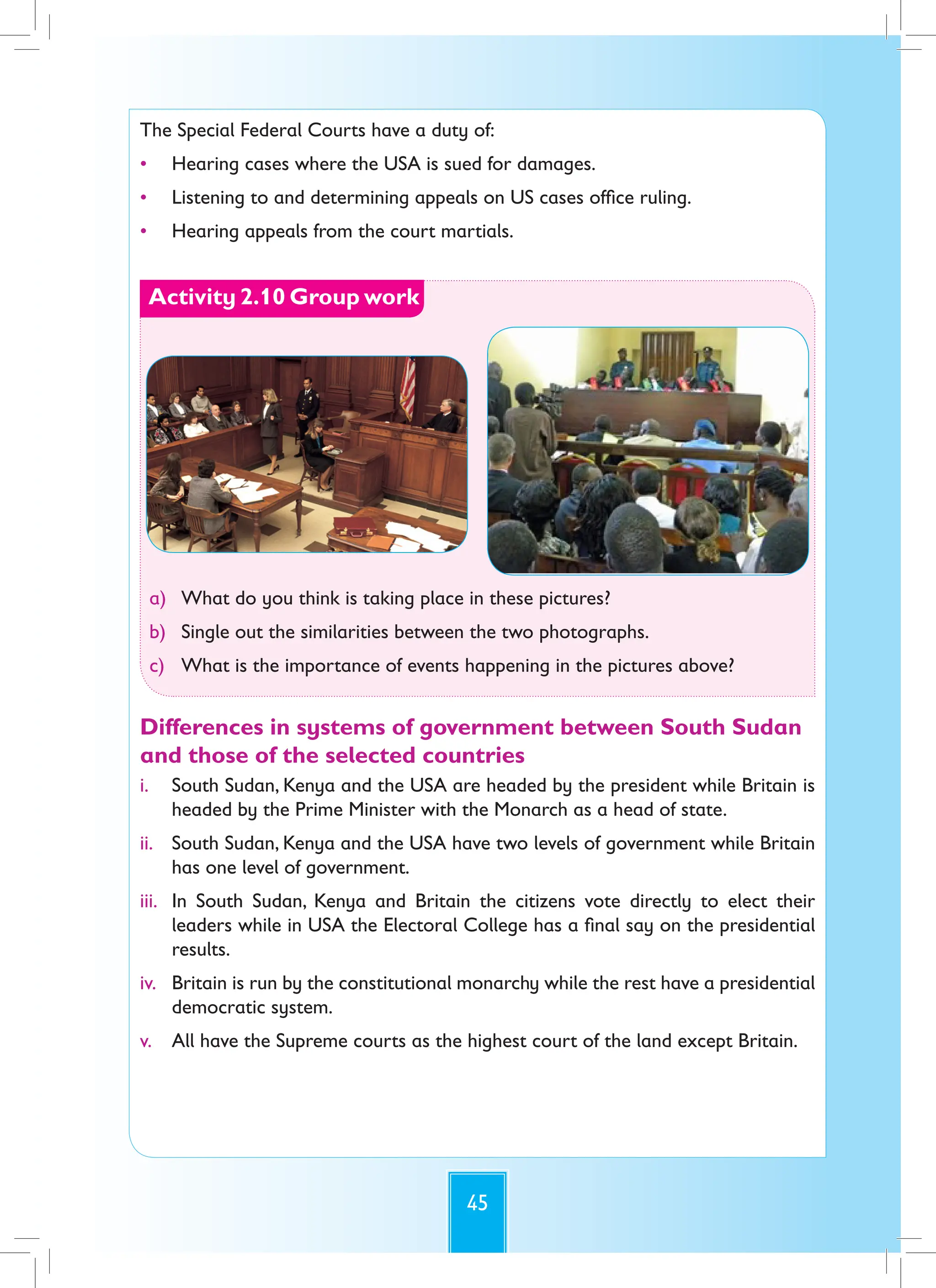
Activity 2.10 Group work
a) What do you think is taking place in these pictures?
b) Single out the similarities between the two photographs.
c) What is the importance of events happening in the pictures above?
Differences in systems of government between South Sudan
and those of the selected countries
i. South Sudan, Kenya and the USA are headed by the president while Britain is
headed by the Prime Minister with the Monarch as a head of state.
ii. South Sudan, Kenya and the USA have two levels of government while Britain
has one level of government.
iii. In South Sudan, Kenya and Britain the citizens vote directly to elect their
leaders while in USA the Electoral College has a final say on the presidential
results.
iv. Britain is run by the constitutional monarchy while the rest have a presidential
democratic system.
v. All have the Supreme courts as the highest court of the land except Britain.
46
Similarities in the South Sudan system of government with
that of Kenya, Britain and the USA
Activity 2.11
Find out from materials in your school library, magazine and newspapers the
challenges faced by the system of government used in Britain
i. All of them have a bi-cameral legislative system.
ii. They all have multi-party provisions for democracy, which is the existence of
many political parties.
iii. They all have the three arms of government, that is, the Executive, the
Legislature and the Judiciary.
iv. They all have an electoral body that takes charge of elections.
v. They all share the same principle of the public service.
vi. In all cases the Executive implements government policies.
The meaning of global interdependence
This is where countries depend on each other for various things.This creates mutual
dependence at global level.
The major contributor of global interdependence is importation and exportation
of goods and services.
Aspects of global interdependence
There are three major aspects of global interdependence. These aspects are
economic, social and environmental aspects.
i) Economic aspect. This refers to cross border economic activities by which
people coming from different countries conduct business through huge
investments and flexible markets.
The factors that have contributed to or promoted economic globalisation are
huge capital investment, labour flow, technology and logistics and the use of
electronic media and internet.
ii) Socialaspect.Thisreferstoeffectsofglobalisationonthelifeofpeople, families
and societies.This deals with issues of working environment, employment of
foreigners, culture, security and social protection like employment inequality.
iii) Environmental aspects. The earth is home to humans, humans have needs.
These needs are met by using earth’s resources and every human has the right
47
to use these resources. Such as clean, safe and healthy environment.
These basic resources for human survival are under threat from climate change
and environmental degradation.
The environmental degradation has had great observable impact socially and
economically.Therefore,this has prevented people and communities from optimally
achieving their potential as human beings and attaining their basic rights.
The resources we have are limited and their existence threatened by pollution and
consumption patterns.
Environmental degradation needs a collective approach through effective action
plans and laid down policy measures in which humanity must work together. For
instance, in the conservation of forests there should be a global approach.
To attain global interdependence,the world has come together to fight environmental
degradation which risks sustainable development and existence of human and his or
her eco-system.This has been achieved through United Nations climate conventions
for environmental conservation.
Some of these conventions are:
i) The Kyoto Protocol on Climate Change 1997
ii) The Paris Climate Agreement 2015
iii) The Bonn Climate Convection 2017
These conventions seek to create a global concern for climate change which is
greatly global interdependence and world economy as a whole.
48
Responsibilities of individuals and governments to global
interdependence
Former US president Barack Obama and former First Lady Michelle Obama with
President Salva Kiir during a US-Africa Leaders Summit in US in 2014.
Both individuals and governments have a role to play on global interdependence.
There are some government factors that may have an impact on global
interdependence.These factors include:
(a) Establishment of foreign investment policies to regulate operation of foreign
businesses in a particular country.
(b) Establishment of market tariffs which involve the deductions of custom duties
on goods imported from specific countries. When the tax levied on imports is
reduced there is a growth of business because the operational cost has been
brought down.
(c) To promote global interdependence, institutions of governance have taken the
following steps to attract foreign investors:
(i) Improvement of financial policies that adhere to global policies of
conducting business.This promotes trust between foreign investors and a
specific country.
(ii) Strengthening of banking systems, transparency on financial transactions
and adequate supervision and regulation of financial markets.
(iii) Construction and improvement of infrastructure such as roads and airports
to ease the logistic of doing business.
49
Construction of new roads.
Activity 2.12 Group work
1. Identify what is happening in the photograph.
2. In groups, discuss how good financial policies have promoted existence of
foreign financial institutions in South Sudan.
3. In groups, discuss the improvements the government needs to conduct to
attract more financial investors.
(d) Protection of domestic – young industries.These industries are important for
they ensure continuous supply of goods and services in case multinational
companies pull out of the country. This industries need protection from
being bullied by stable international companies through unfair competition.
50
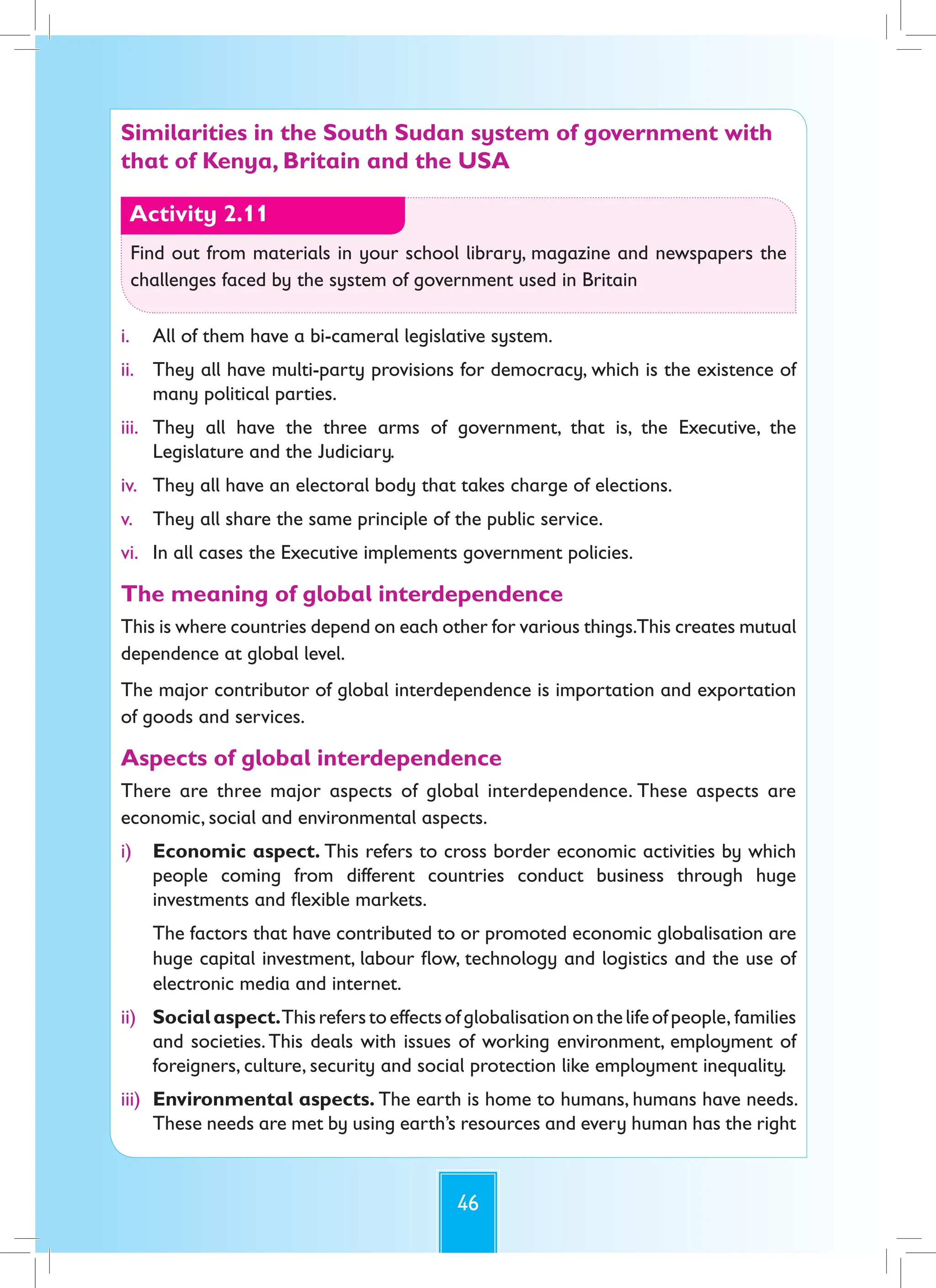
Basket weaving in South Sudan.
Challenges facing global interdependence
Global inter-dependence is facing numerous challenges as the world moves forward
in becoming a global village.These challenges may include regional integration and
differences in trade agreements. Proportion of population with access to proper
sanitation is another great challenge to many. Demographic trends of different
regions also affect global interdependence. Demand for sustainable development
and climatic conservation threatens global interdependence. Lack of enough
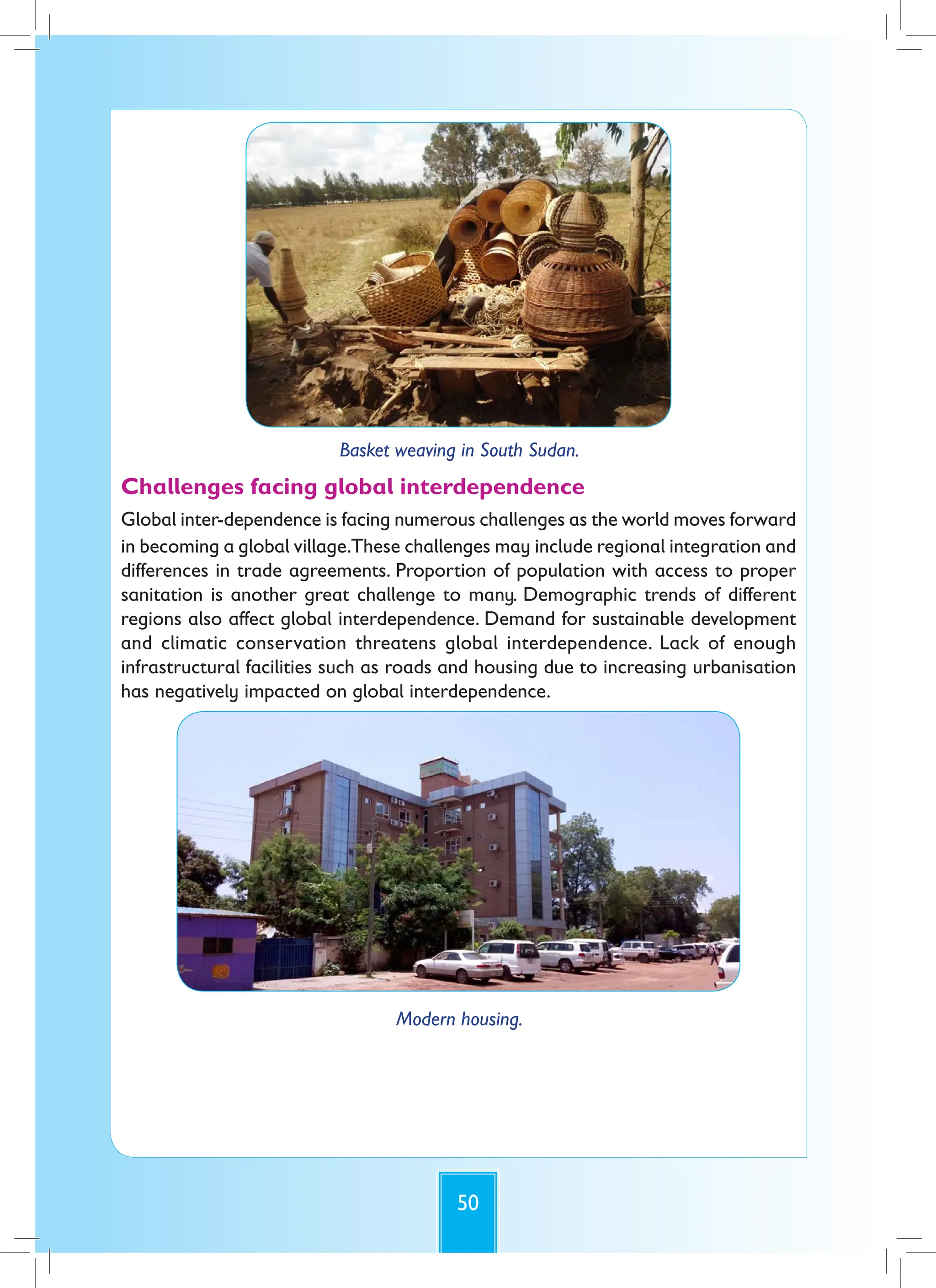
infrastructural facilities such as roads and housing due to increasing urbanisation
has negatively impacted on global interdependence.
Modern housing.
51
Glossary
• Ally – A friend.
• Intimidation – An act of scarring someone.
• Transparency – To be clear over something.
• Majority – Many people supporting an issue.
• Bankrupt – The state having no money.
• Code of conduct – The acceptable set guidelines on how to behave during a
particular exercise, for example elections.
• Chief Justice – the senior most judge in a country.
• Pardon – To forgive someone for a crime committed.
• Convicted – To be found guilty by the court of law and jailed.
• Prosecute – To charge someone in the court.
• Monarchy – An institution of the queen or king.
• Assent – To accept.
• Globalisation – The process where people become integrated through
free trade,free transfer of capital and labour in the world.
• Commonwealth – Refers to all countries that are former colonies of Britain
52
How the economy functions in South
Sudan
How the economy functions in South
Sudan
UNIT 3
What I will learn
• Meaning of economy.
• How an economy operates.
• The role of individuals, businesses and government in the working of the
economy.
• The role of taxes in balancing the economy.
• Laws and systems affecting the management of the economy.
• Rights and responsibilities of consumers.
• Rights of employers and employees.
• Impact of local and national economy on consumers,employers and employees.
What I will do
• Investigate the role of individuals, businesses and government in the working
of the economy.
• Explore how the economy has a direct impact on trade and consumerism.
•Analyse why the economy has a challenging effect on employers and employees
Activity 3.1 Group work
1. In groups,discuss the role of an individual citizen,businesses and government
in the working of the economy and make a brief report on the following:
a) How money flows between individuals, businesses and government.
b) How is family expenditure done and managed.
c) How does the government collect and spend taxes.
2. Share the report with the rest of the class through group presentation.
53
The meaning and operation of the economy
The word economy refers to a process or a system of production, distribution and
consumption of goods and services by different agents.An economy is therefore a
network of individuals and entities that exchange their goods,knowledge and labour.
An economy can be as small as two people. However, an economy of two people
will have a limited exchange of goods and services.Thus, it is evident that as more
people enter into the exchange network or business, the economy grows.
Transactions in an economy occur when different agents agree on the value or
price of goods and services,usually done using certain currency.Different countries
have different currencies that vary in value due to different economic levels. In our
country, people use the South Sudanese Pounds as a medium of exchange.
South Sudanese currency.
Economic growth is driven by production that uses natural resources, labour and
capital.Technological development, creativity and innovation have also impacted
on economic development and growth of the world economies.
In South Sudan, petroleum and gas resources have a key role in the economy and
measures have been taken to regulate the development and management of these
resources.
54
Wind energy.
An economy operates within a set of procedures that involves the cultural values,
education,history and technology;political,social and legal systems.These factors
can directly or indirectly affect the operation of the economy.
Various methods have been developed to measure the economic activities of
countries.These parameters include;
• Consumer spending • Exchange rate
• Gross Domestic Product • Stock market
• Interest rates • Government debt
• Rate of inflation • Rate of unemployment
• Balance of trade
(a) People in the market. (b) Exchange rates.
Different aspects of economy.
55
The role of government in the working of the economy
Governments do not create economies but can influence which exchanges are
outlawed or get favourable treatment. For example, the government can stop the
importation of some commodities while waiving taxes on other commodities.
The role of the government in the economy include:
i. Regulation. The government provides legal and social framework of doing
businesses. For example, it can ensure that legal contracts for businesses are
enforced through the court system.This helps to keep all people accountable
when doing business.
ii. Competition. The government helps to maintain competition. Here, the
government may enforce anti-trust laws to ensure that all businesses are able
to favourably compete and offer products and services to consumers without
feeling exploited.
iii. Correcting externalities. Externalities refer to effects of business decisions
that can affect people or parties that have no say or control over decisions in
the first place.An example is industrial pollution.
An industry can be producing an important product to the economy but
creating a lot of pollution or waste. In this case the government sets policies
to manage pollution by keeping it to acceptable levels.
iv. Provision of national security. The government has a responsibility of
ensuring that there is political stability in the country. This will positively
influence both domestic and foreign investors to establish their businesses in
the country.
President Salva Kiir and Riek Machar.
v. Formulating fiscal and monetary policies.This refers to adjustment of the rate
of spending and taxation by the government.
56
The roles of individuals and businesses in the economy
Both individual citizens and business entities have a vital responsibility in the growth
of the country’s economy. The following are some of the roles:
i. They both provide goods and services that people need or want.
ii. Businesses provide employment opportunities to people.
iii. Individuals pay taxes that fund government operations.
iv. Individuals and businesses can influence government fiscal and trade policies.
v. Individuals are consumers of products produced by both government and
private companies.
Activity 3.2
1. In groups and with the help of your teacher, discuss some of the ways your
school raises and spends money.
2. Share your discussion with the rest of the class through presentations.
The role of taxes in balancing the economy
In Unit Four of Secondary one, we discussed about the sources of government
revenue.Most of the government revenue is from taxes levied on individuals,locals,
foreign businesses and state operations.The government levies taxes on commodities,
transactions and incomes.These taxes need to be controlled for economic balancing.
Taxes can be either direct or indirect. Direct taxes are mainly levied on taxpayers’
income.They include income tax that is levied on incomes of individuals,especially
on monthly salaries, royalties paid to writers, wages and allowances; corporate
tax levied on profits made by companies and capital gains tax levied on profits or
gains obtained from the value of an asset, such as machinery and land.
Indirect taxes include custom duties levied on imported goods,excise duty on goods
produced in South Sudan,export duty levied on goods exported from South Sudan
and Value Added Tax (VAT) which is a general consumption tax levied on goods
and services.
The government needs to strike a balance on all their taxes for a balanced economic
development and national building. The importance of taxes in balancing the
economy of South Sudan include:
i. Taxes are important in supporting and developing government infrastructure
such as road construction.
ii. Taxes can be used to cater for health services such as buying of drugs for
patients hence improving the living standards of citizens.
57
Part of JubaTeaching Hospital.
iii. Taxes are used to fund general government operations such as payment of
salaries to public servants.
iv. Taxes are useful for funding education projects of a nation such as,construction
of schools and buying of learning materials for learners.
v. Through taxation, the government is able to repay borrowed loans.
vi. The government of South Sudan uses taxes to cater for emergency needs such
as outbreak of hunger and floods.
Activity 3.3 Group work
1. In groups, discuss the spending priorities that should be put in place by both
the national and state governments in managing the economy of South
Sudan.
2. In your discussions, you should consider issues like health, education,
infrastructure among others.You should also give reasons for your answer.
Management of the economy
Managing an economy needs laws and systems to make it more efficient and effective.
Therefore, for the government to properly manage and improve its economy, it
should employ the following strategies:
i. Promoting income equality between people and gender.
ii. Introduction of new communication technologies for efficient management of
tax collection and government expenditure.
iii. Increased standardisation of accounting practices and introduction of new
financial markets to manage capital movement from South Sudan to other
countries.
58
iv. Introduction of political support for privatisation,competition and agreements
to lower trade barriers and to open up borders for trade interdependence.
v. Increasing trading activities between people and businesses creating more
competition hence production of higher quality goods and lower prices for
consumers.
A supermarket.
vi. Encouraging domestic borrowing to finance government operations.
vii. Exempting poor people from paying taxes. Such exemption is defined by law.
viii. Creating employment for the citizens to increase their purchasing power.
ix. Implementing government and state budgets by looking at priority areas like
health, infrastructure and education.
Juba Diocesan model secondary school.
x. Enhancing public-private partnerships in investing in various sectors of the
economy.
xi. Passing legislations to tackle corruption and other economic crimes and fraud.
59
Rights and responsibilities of consumers
In regulatory economies, consumer rights refer to a group of laws and strategies
designed to ensure that consumers are protected at the same time ensuring fair
trade and competition in the market place.
These rights include:
i. Right to claim for a refund, repair or replacement when the product bought is
not of satisfactory quality or it does not fit its purpose or use.
ii. Right to information regarding the goods,for example,the date of manufacture
and expiry and chemical composition of the products.
iii. Right to provisions that protect vulnerable consumers such as children.
iv. Right to compensation for loss or injury arising from defects in goods and
services.
Activity 3.4 Group work
1. From the rights of consumers outlined above, to what extend do you think
these rights are protected?
2. What would you suggest as the good measures that the government can
apply apart from the ones existing so as to fully protect the consumers?
NOTE:The implementation of consumer rights faces some current challenges that
need to be addressed.These include:
i. Online market and digital goods and services like films and online shopping.
ii. Cross-border shopping with multiple policies between countries.
The responsibilities of consumers include:
i. Be honest with the information by giving accurate information when you are
filling consumer documents.
ii. Carefully read all information provided on goods and services.
iii. Ask questions about anything that is unclear on commodities.
iv. Know how to make a complaint and use the right procedure to make them.
v. Use the product or service in line with the terms and conditions.
vi. Review all your documents after buying commodities.
60
vii. Apply or request for products and services that meet your needs.
viii. Be environmentally conscious when using products,that is,do the right disposal.
Use your own mail address or mobile number when giving contact details.
Rights and responsibilities of employees
The main responsibilities of the employees include:
i. To personally do the work they are hired for.
ii. To do their work carefully and seriously.
iii. To avoid putting themselves or others in danger.
iv. To follow their employer’s instructions.
v. To be loyal to their employees.
The main rights of employees include:
i. Fair pay for work that has been done, for example, good housing.
ii. Reasonable working conditions.
iii. Right to join, form or participate in trade unions.
iv. Right to go on strike.
Workers in a trade union meeting.
61
Responsibilities of employers
The main responsibilities of employers include:
i. Employers must give their employees a place to work and make sure they
have access to it.
ii. They must give employees proper tools and equipment needed to do their
work.
iii. They must make sure their employees working conditions are safe.
iv. They must give their employees written notice that their contracts are ending
or they are being laid off.
v. They must treat their employees with respect.
Rights of employers
Employers are also guaranteed the following rights:
i. Right to attend hearings related to a claim filed by the employees.
ii. Right to seek administrative review of employment laws.
iii. Right to form and join an employers’ organisation.
iv. Right to participate in the activities of an employer’s organisation.
Impact of local and national economy on consumers,
employees and employers
Economic growth or stagnation directly affects behaviours of consumers,employers
and employees in the following ways:
i. Consumerism through consumers purchasing goods. This increases total
output especially the GDP because an increase in a consumer’s demand of
product by purchasing it,brings about an increase in supply of that product by
the producer.
ii. Increased purchasing of goods increases the output level of the employers.
This brings about a multiplier effect such as hiring of more workers,purchasing
more raw materials and increase in tax collection.
iii. Economic decline can lower the consumers’ purchasing power.This will cause
the decrease of price of goods and services. This affects the local state –
economy.
iv. Economic stagnation affects real wages for the employees.Real wages refer to
wages that have been adjusted for inflation.The worker might be making the
same amount of money but his or her purchasing power has been reduced.
v. Local and national economy affects the consumer’s confidence. For example,
if consumers believe the economy is bad, they are less likely to spend their
money.
62
Activity 3.5 Group work
1. In groups,discuss more impact of local and national economy on consumers,
employees and employers that are not outlined above.
2. In groups of two discuss how local economy impacts national economy.
Glossary
• Economy – The system of production,distribution,and consumption of
goods and services.
• Consumer – A person who uses goods or services.
• Consumerism – A theory that states that an increase consumption of
goods is economically beneficial.
• Competition – A business relation in which two or more parties compete
to gain customers.
• Consumption – Utilisation of economic goods and services to satisfy needs.
• Externalities – Effects of business decisions on the people.
• Fiscal policies – Government policies which deal with budget, taxation and
borrowing.
• Tax – Money paid to the government for various operations.
63
The rights and responsibilities of
consumers, employers and employees
The rights and responsibilities of
consumers, employers and employees
UNIT 4
What I will learn
• The rights and responsibilities of consumers.
• The rights and responsibilities of employers.
• The basis of holistic peace-making.
What I will do
• Investigate how rights of consumer, employers and employees are related
and interdependent.
• Explore relevant laws and policies on consumer and employment.
• Explore the effects and benefits of well-developed clear rights.
The meaning of a consumer
Activity 4.1 Pair work
1. Name some of the goods that you have bought from the market or shop for
the last one week.What was the reason of you buying those goods?
2. How were you served?What are some of the rights a buyer is entitled to?
In the previous unit we studied how South Sudan economy funtions.We also discussed
about general rights and responsibilities of consumers. In this topic, we are going
to discuss this in detail.We will first define the terms consumer, good or service.
A consumer is a person or an organisation that uses a good or a service.
A good is a tangible item that you can touch and feel, for example, mango, bread,
table and pen.
A service is an intangible activity provided to people either through physical energy
or mental abilities.
64
People buying food stuff.
South Sudanese consumer rights
Consumers have their rights that protect them from exploitation.
In 2011,the South Sudan government passed Consumers ProtectionAct that outlines
the rights of consumers against exploitation.
The following are some of the consumer rights according to the 2011 Consumer
Protection Act of South Sudan.
i. Right against unfair or unjust transaction – Consumer is protected
against any unfair transaction of goods and services from the supplier such as
excessive buying price of a commodity.
ii. Rights against false or misleading presentation – The consumer should
be shown the right information about the material facts on the product he or
she wishes to buy.
iii. Rights to safe state and good quality – A consumer has a right to receive
goods that are of good quality and free of defects.
iv. Right to implied warranty of quality – A consumer has the right to
receive the implied warranty of quality of goods as stipulated by the producer
or retailer.
v. Right to demand for quality services – A consumer has a right to
performance and completion of service in an acceptable manner, time and
quality. Any delays should be communicated to the consumer in time.
vi. Right for compensation for damages and loss – The supplier should
compensate the consumer for goods that are damaged when being transported
by the supplier.
65
vii. Right to be heard – A consumer has a right to have assurance that the
government will take full responsibility of all the concerns expressed and act
on them according to administrative procedures.
viii. Right to complain and redress – Consumers have a right to receive fair
settlement of just claims of service failure or interruption.
ix. Right to end a contract – Consumers have a right to cancel a contract within
reasonable period not exceeding three days from date of signing contract.
Cancelling provisions and procedures must be indicated in all contracts.
Activity 4.2 School visit
Visit all departments in your school and list types of products that are used,
starting from your class, library, laboratory, departmental offices and others.
You as the consumer of some of the products you have idetufied, explain the
rights that have towards the products.
Consumer responsibilities
A responsibility is the ability or power to act or decide on one’s own obligation
without supervision. It is a duty to act on something.
Consumer responsibility is therefore the ability of a consumer to act in a way that
will benefit him or her and the economy in general.
In South Sudan, consumer responsibilities may include the following:
i. Environmental responsibility – A consumer should always be sensitive to
the impact of their consumption activities in the surrounding environment. His
actions must be aimed at fostering conservation of the environment for the
safety and quality of life.
A nursery of seedlings.
66
ii. Action or involvement – He or she must assert himself or herself to ensure
that they get fair deals. It is his or her responsibility to ensure that he or she
participates in policy formulation and legislation for the services they use.
iii. Solidarity – Consumers have the responsibility to organise themselves in
form of consumer associations in order to promote and protect their interest
or protect themselves against any type of exploitation.
iv. Critical awareness – As a consumer, one must always be aware of the
quality and variety of goods and services being offered in the market.
v. Prompt payment of bills – A consumer has an obligation to pay all their
bills and clear the debts when they are due.This will foster a good relationship
with their suppliers.
vi. Protection of communication facilities – Some of the suppliers use
communication facilities like posters, bill boards and flyers to advertise their
products. A good consumer has an obligation of protecting such facilities
against vandalism.
Activity 4.3 Group work
1. Discuss and explain reasons why consumer responsibilities are important
and why all consumers should adhere to them.
2. Use a short essay to put forward your argument.
Impact of national economy on consumers, employers and
employees
National economy is a broad combination of individual, business and government
spending or investment.
The government has to pay good attention to economic factors in order to measure
the strength of its economy.
a) Impacts to consumers
Consumers play a major role in the economy hence any changes in the economy
will have a great impact on them.The following are some of the impacts of national
economy on consumers:
i. Consumer spending – A significant change in consumer spending behaviour
highly depends on the state of national economy. For instance, lower spending
may indicate a decrease in individual income while higher spending indicates
an increase in the individual income.
67
Women selling vegetables.
ii. Demand for products – In a situation where the price of goods is continuously
increasing, the consumer’s demand for the goods will decrease. This will in
turn affect the supply of products which will have a negative impact on the
economic growth in general.
iii. Dominance of foreign commodities – If the government is over relying
on the imported goods, the locally produced goods will lack market and
production firms will close down. This will force the consumer to purchase
foreign goods which may be very expensive for them.
A manufacturing industry.
iv. High taxation – Tax is the main source of government revenue. If the
government wants to increase its revenue for economic development then the
tax will be raised.This will have an effect of an increase in the price of goods,
thus, affecting consumption negatively.
68
Activity 4.4 Group work
In groups discuss the link between national economy and behaviour of
consumers, employees and employers.
b) Impacts on employees and employers
Employment and unemployment are the driving forces behind economic growth
and stagnation.
Economic improvement has an impact on employment in the following ways.
i. Increased employment opportunities – Increase in employment
opportunities provide chances for previously unemployed people to be
employed.This reduces the idleness by many people and earns them income
thus, improving the standards of living.
ii. Increase in income paid to employees – Improvement in economy
increases employees’ earnings leading to a higher rate of consumer spending
which benefits businesses that depend on consumers.
iii. Employees’ strikes – In a situation where the economy of a country
negatively drops due to high inflation rate, the employees will demand for
more wages so that they maintain their living standards through strikes and
other industrial actions.
iv. Economic retrenchment – Retrenchment is an act of an organisation or
government reducing the number of workers because of the increased wage
bill that it cannot afford to meet. This act happens in a situation where the
state of economy is under decline and the government cannot meet higher
wage bills.
Responsible consumerism
Consumerism is the continual expansion of one’s wants and needs for goods and
services.
Responsible consumerism is the role that a consumer plays in helping the society
to be more sustainable.
A responsible consumer can be seen through a variety of activities as indicated
hereby:
i. He or she should stop or reduce excessive consumption of some products.This
will ensure that the income saved can be used to other investment projects in
the society.
ii. He or she should support responsible companies which produces quality
products and in accordance with the law.This can be through increasing the
purchase of their products so that they feel encouraged.
69
iii. Carrying out demonstration or picketing.A responsible consumer can carry
out a peaceful demonstration against harmful products that are produced by
a certain company.This will help in creating the awareness to the society to
stop buying such products.
iv. Consumer activism.This is an act of carrying out awareness activities about
consumption of certain products through rallies or street walks.The activism
will make other consumers aware of good quality or harmful products, thus
deciding on which products to purchase.
v. Fair trade certification. He or she should purchase goods with the label of fair
trade.The label is a guarantee that no forced labour was used in generating a
product and employees were paid promptly and fairly.
vi. Sustainable resources. He or she should ensure that the natural resources are
well preserved for other generations to use.
Activity 4.5 Group work
Write a short essay about responsible consumerism. In your essay, put forward
suggestions of how you believe consumers should present their grievances as
far as their rights are concerned.
Effects of consumerism
Consumerism can have either positive or negative effects on
the economy.
a) Positive effects
i. Creation of employment – Many people buy goods and services. Gross
expenditure on the quality products increase leading to increased sales.
Manufacturers of these goods will be forced to increase manpower, thus,
leading to more employment opportunities.
ii. Production of better products – The act of consumers only purchasing
goods of good quality will compel the producers to produce better products
to meet their customer’s needs. Lower quality products receive criticism from
consumer and companies that sell them face the risk of being edged out of the
market.
iii. Better living standards – The availability of quality goods in the market
improves one’s lifestyle as one can access better and more variable goods.
70
b) Negative effects
a)The decline of small industries
The existence of large industries with a strong financial base can lead to production
of high quality goods and sell them at lower prices without making losses.This can
lead to the closure of local industries which can not meet such qualities.
b) Over-reliance on imports
In many countries people are willing to pay a higher price for established brands
with high quality satisfaction.This leaves goods that are locally produced, hence
frustrating local industries which at last get closed.
c) Ecological destruction
Excessive consumerism results in the construction of more factories and large scale
urbanisation.This leads to a serious depletion of natural resources like forests and
water bodies to create room for commercial development.
The environment is also polluted by factories,settlement and direct products being
purchased.
A factory polluting the environment.
Activity 4.6 Group work
Using the knowledge learned about consumerism, discuss how you can support
responsible consumerism at local level in your country.
71
Labour law of South Sudan
The South Sudan transitional parliament passed the new labour bill in November
2017 in Juba. The labour bill protects the rights of workers in the country and
provides guidelines for employment of foreigners.
The bill reserves exclusively for South Sudan nationals jobs such as vending,hawking,
driving, office support works and other manual works.
There is a labour court established that will help to hear labour disputes in the
country. The disputes may involve individuals with companies or individuals
themselves.
The bill provides for employment inspection in South Sudan.This is to ensure that
local citizens are allowed to work in the country and reduce foreign dominance in
the labour market.
The bill also fosters the activities of trade unions since it gives the guideline on
their formation.
The law contains some rights of workers in South Sudan.
Some of these rights are:
i. Women employment – This bill protects women against employment in
dangerous areas for example where a lot of physical efforts are required.
ii. Child labour – The law protects children against heavy work, exposure to
poisonous or injuries and any other working conditions unfit for a child.The
bill also prohibits employment of a child under the age of twelve.
iii. Work contract –The law provides how the contract between employers and
employees should be written, terms of contract and how the contract can be
terminated.
iv. Wages and salaries – The law states that workers’ wages and salaries
should be paid in cash and this can be done daily,weekly or monthly depending
on the agreement between the employer and employees.
v. Loans – The law allows the employer to lend their employees loans at a very
low interest which should not exceed 15% of their basic interest.
vi. Transport – An employer is supposed to transport the workers or pay
transport expenses where they have been sent to work.
vii. Statements of entitlement – The employer should at the termination of
the contract provide the worker with detailed statement of entailment.
72
Activity 4.7 Group work
In a group of five students,discuss any type of business activity that you can start.
During your discussion:
a) Write down the sources of capital and how much you need.
b) State where you will start the business and the name.
c) State the type of consumers you are targeting.
d) Explore how you will share responsibilities in the business.
e) Outline the rights of people you may hire to assist you.
The impact of South Sudanese economy to the local
business
a) High dependency on imports
The South Sudanese economy is characterised by high rate of imported goods.
With foreign goods dominating the market local business like locally manufacturing
industries will not improve since the market is flooded with foreign goods.
b) High levels of competition
The presence of many foreign business firms operating in the country has led to the
facing out of local busineses since they cannot overcome the pressure of competition.
c) Poor infrastructure
South Sudan is facing the challenge of poor infrastructure.Thus poor infrastructure
in terms of poor road networks has stressed the local business vendors to transport
their goods to the market.
Poor road network.
73
d) Low levels of personal income
Many of the south Sudanese citizens are earning very low income or even nothing
at all.This has reduced the purchasing power, thus low demand for goods. Less
demands for goods will affect the local business to thrive.
e) Lack of government subsidies and incentives
Lack or low level government subsidies and incentives like reduction of taxes on
locally produced goods discourage many potential business investors.
f) High taxes
High taxes levied on locally produced goods discourage local investors. This is
because the production process becomes expensive.
Activity 4.8 Group work
In groups of six students visit different businesses premises and establish the
following:
a) How they manage their business.
b) Challenges they are facing locally.
c) How they address those challenges.
Glossary
• Tangible – Something that can be touched and felt.
• Intangible – Something that cannot be touched or felt.
• Production – The act of making or creating goods.
• Exploitation – The act of being misused or used in the wrong way.
• Transaction – The process of exchange.
• Adverse – Being unfavourable or hostile.
• Warranty – Referstoanassuranceattachedtosomethingorsomebody.
• Contract – It is an agreement between two or more parties.
• Obligation – It is an act of binding oneself to something.
• Stagnation – The state of not moving forward.
• Inflation – An increase in price of goods and services.
• Curbing – Stopping or dealing with.
74
Peace-making
Peace-making
UNIT 5
What I will learn
• The basis of holistic peace making and conflict resolution.
• Individuals and organisations who participated in peace-making in
South Sudan.
• The role of the United Nations (UN) Charter and African Union (AU)
Charter on conflict resolution.
What I will do
• Investigate a range of resources that describe approaches and strategies
for peace making in South Sudan.
• Identify significant extracts from research findings in order to
illustrate important aspects of peace making in South Sudan.
• Compose a report or article about peace making in South Sudan.
Introduction
Activity 5.1 Individual work
a) Explore the individuals and organisations that you know have participated
in peace-making in South Sudan.
b) Using the internet and other available materials, do a research on the role
of the United Nations (UN) Charter and African Union (AU) Charter on
conflict resolution.
c) What do you understand by the term peace?
75
The following are some aspects that can define peace of a given society.
• Sincere attempts of reconciliation between or among conflicting parties.
• Existence of healthy or newly healed interpersonal or international relationship.
• Existence of prosperity in matters of social and economic welfare.
• Establishment and existence of equality and equity.
• Existence of a working political order that serves the true interest of all.
In a situation where the above attributes of peace do not exist then there is no peace.
UN peace troops.
The meaning of peace-making
Peace-making is a process of settling a conflict between the disputing or conflicting
parties.Peace-making seeks to achieve full reconciliation and mutual understanding
among the disagreed parties.
When applied in criminal justice matters,peace-making is usually called restorative
justice.
Peace making is not the final process of achieving peace. It needs a collaboration
of peace keeping and peace building.
Peace keeping means keeping people from attacking each other by putting some
kinds of barriers between them such as the use of police.
When using soldiers as peace keepers, the soldiers do not necessarily settle the
disputants’ differences but they simply keep the two sides apart.
76
UN soldiers in a peace keeping mission in South Sudan.
Peace building is the process of normalising relations and reconciling differences
between all citizens.
Other terms associated with peace
a) Restorative justice – Is the process of bringing those harmed by a crime and
those responsible for the crime into communication and mutual agreement
rather than punishing the offender. This enables everyone affected by the
conflict or crime to play a part in repairing the harm and finding a positive
way out.
In a school set up, the goal of restorative justice is to enable learners, accused
of the crime come up with the solution of the mistake committed rather than
punishing them.
Students sitting for an exams.
77
b) Retributive justice – It is a theory which holds that the best response to
a crime is punishment proportional to an offense committed because the
offender deserves it.
c) Armistice – This is a formal agreement between or among the conflicting
parties to stop fighting.
It is a temporary suspension of hostilities of warring parties by an agreement.
d) Reconciliation – Is a situation in which two people or groups of people
become friendly again after they have argued.
It can be also defined as a process of making two opposite beliefs, ideas or
situations agree.
Activity 5.2 Group work
In groups, discuss and make notes on advantages of restorative justice over
retributive justice as a way of solving conflicts
Peace-makers of South Sudan
By the year 2013,conflicts between two rival political sides in South Sudan had led
to a civil war.This in turn resulted to a national conflict.
The consequence of this civil war was the loss of lives by a large number of South
Sudanese citizens.In addition,millions of people were displaced and became refugees
in the neighbouring countries especially Kenya and Uganda.
The conflict led to crimes against humanity,thus triggering the intervention of several
non-governmental organisations and advocates of peace to settle the disputes.
A group of displaced South Sudanese citizens.
78
Organisations that have helped in peace-making in South
Sudan
a) Organisation for Peace Relief and Development (OPRD)
This is an organisation that works towards eradicating and reducing social
challenges such as poverty in South Sudan.
OPRD aims to achieve its objectives through implementation of peace and conflict.
mitigation programmes, infrastructure rehabilitation and community development
projects.
Some of the activities OPRD is involved in are:
• Conflict mitigation and reconciliation.
• Working towards strengthening of customary laws.
• Facilitating the work of civil authorities in managing conflicts.
• Educating citizens about their rights and freedom and supporting those victims
whose rights have been violated.
• Working towards eradication of cattle rustling.
• Setting up programmes to fight gender-based violence.
• Offering civic education,community dialogue and empowerment programmes.
b) Grassroots Relief and Development Agency (GREDA)
This was an agency formed in 2010 to enhance peaceful co-existence, good
governance and better living standards in South Sudan.
It has partnered with local NGO’s such as MundriActiveYouthAssociation (MAYA)
and international organisations such as the UNWorld Food Programme to carry
out its work.
GREDA works in the following areas:
• Peace building, conflict mitigation and resolution.
• Promotion and protection of human rights.
• Prevention, management and response to gender-based violence.
• Economic empowerment of women and youth through micro-finance and
vocational trainings.
• Promotion of agriculture and food security.
• Construction of low cost houses for the poor and the vulnerable such as
widows.
• Provision of humanitarian relief aids to victims of disasters.
79
c) South Sudan Centre for Conflict Resolution (SSCCR)
This is an indigenous organisation which started in 2008 as an initiative to engage
young people with the idea of peace, development and human rights.
The organisation which is situated in BentiuTown and Juba works in collaboration
with both local and international NGOs and UN agencies to achieve and keep the
peace in the region.
d) Organisation for Non-violence and Development
(ONAD)
It was previously known as Sudanese Organisation for Non-violence Development
(SONAD).
The organisation campaigned for non-violence solutions to conflicts and peaceful
co-operation between North Sudan and South Sudan.
It organises workshops and training sessions in which it teaches about human rights,
democracy participation and non-violence.
The main area of concern for this organisation is the inter-religious dialogue between
Christians and Muslims.
Muslims praying for peace.
NOTE: All the organisations discussed above were locally formed in South Sudan
and are really helping in peace making in the country.
However, there are a few international or inter-governmental organisations that
have also helped to create peace in South Sudan.
80
Some of these organisations include:
a) Inter-Governmental Authority and Regional Integration (IGAD)
This is a body currently comprising of 8 countries. They include Sudan, Kenya,
Uganda, Ethiopia, Eritrea, Djibouti, Somalia and South Sudan.
IGAD is a subordinate organisation to the UN and the AU. Since its formation, its
mandates have gradually expanded to address both political, peace and security
issues.
IGAD’s intervention in Sudan took place after Nigeria failed to broker peace in
the country.
In September 1993,the president of Sudan,Omar El-Bashir invited IGAD,to intervene
and assist in solving the North–South conflict of secession.
Following Omar’s request, the IGAD Standing Committee on Peace in Sudan was
formed chaired by the then president of Kenya, Daniel arap Moi together with
former prime minister of Ethiopia, Meles Zenawi, President Isaias Afweki of Eritrea
and PresidentYoweri Museveni of Uganda.
The committee began its work with the 1994 peace talks to get the parties agree
on a common agenda. However, the talks did not give the expected fruits since the
Sudanese government argued that self-determination and the religious orienting of
post conflict Sudan towards Sharia laws were not subject to negotiation.
In October 1997, another mediation talk was held but it failed again on
self-determination and religious primary of Sharia Law.
In May 1998, a new round of talk began again but now with the inclusion of more
international actors such as the UN.At this point the parties were able to agree
on the principal of self-determination through a referendum.
Southern Sudan Referendum Centre.
81
Despite the efforts,some nations such as Egypt and Libya viewed the IGAD initiative
as a potential blueprint for the division of Sudan.The process of mediation and the
challenges went on for several years with little results being experienced.
In September 2003, the IGAD mediators facilitated high-level talks between the
first vice president of Sudan, Ali Osman Mohamed Taha and John Garang in a
Kenyan town, Naivasha.
Eventually, the parties drafted and signed a Comprehensive Peace Agreement
(CPA) in Nairobi on 9th
January,2005,bringing to an end the IGAD peace-making
initiative.
Since December, 2013, IGAD has been mediating the South Sudan conflict of
achieving a long-lasting peace among warring communities.
Former vice president of Sudan,Ali Osman MohamedTaha and the late John Garang in
IGAD peace talks.
b) United Nations education, scientific and cultural organisation
(UNESCO)
This is an agency of the (UN)
The objectives of UNESCO in South Sudan are:
• To advocate for peace and non-violence through education and media.
• To promote scientific and cultural cooperation to manage the country’s
resources.
• To empower and engage young people, women and men.
82
c) United Nation Mission in South Sudan (UNMISS)
This is a peace keeping organisation that has offered home to millions and thousands
of South Sudanese refugees who fled their homes because of violence.
UNMISS was established on 8th
July, 2011 by United Nations Security Council.
The organisation offers humanitarian programmes such as healthcare and food to
thousands in South Sudan.
The stated UNMISS functions include:
• To support for peace consolidation and foster long-term state building and
economic development.
• To support the government of the Republic of South Sudan in exercising its
responsibilities for conflict mitigation and resolution and protect civilians.
• To support the government of South Sudan in establishing the rule of law and
strengthen the security and justice sectors.
UNMISS troops in South Sudan.
Activity 5.3 Pair work
1. State some of the community projects that the UN or any other organisation
has initiated in your community.
2. Name sectors in your community that you feel the NGOs should assist
South Sudan to become a better nation in the world.
3. What would you argue as the evidence that the above named organisations
have been of great help in South Sudan? Explain.
83
d) The African Union (AU)
African leadership is an essential element in bringing about peace.
TheAU office in South Sudan,Juba was opened in 2008 following the communication
issued at the 89th
meeting of the AU held on 28th
August 2007.
The Juba office supported the implementation of the Comprehensive Peace
Agreement (CPA) with respect to South Sudan.
After the independence of South Sudan,theAU set a strategic objective to promote
good relations between the North and South Sudan.
The main objectives of the AU Juba office are:
• Monitoring the overall political and security situation in South Sudan and
report to the headquarters.
• Assessing the implementation of the outstanding CPA issues and post-
independence matters. This includes the political and security situation
between the two states.
• Collaboration with the AU liaison office in Khartoum, Sudan and the broad
international community.
His Excellency President Salva Kiir with other AU leaders.
e) UN Charter of 1945
This is a treaty of the United Nations.The UN Charter articulates for a commitment
to uphold human rights and outlines a broad set of principles relating to achieving
higher standards of living among people by addressing economic,social and health
problems.
84
Chapter VI of the UN charter deals with the peaceful settlement of disputes. It
requires that disputes which may lead to war be first solved through peaceful
methods such as negotiation, mediation, enquiry, arbitration, judicial settlement
and the use of regional agencies.
If the above methods of peaceful dispute resolution fail, then they must refer it to
the UN Security Council.
Current activities of peace-making in South Sudan
a) Peace dialogue
There are various dialogues that are being held in different parts of South Sudan
with humanitarian agencies like NGOs, churches and other self-sponsored groups.
The dialogues have contributed to a culture of non-violence aimed at conflict
resolution and transformation of South Sudan.
b) Strengthening of peace networks across borders
Churches and youth organisations of South Sudan are creating networks with other
organisations or churches in other countries like Kenya and Uganda.
These organisations observe the human rights situation and any infringements to
the citizens of South Sudan.
His excellency President Salva Kiir in peace dialogue.
85
c) Peace, sports and theatre
Traditionally, cattle raiding was a way of young men to achieve the status of
heroism. Possessions of many cattle continue to be a measuring device for status
over generations to the livestock owners of South Sudan.
Today, sports and theatres are used to change the mind-set of warriors and break
the cycle of violence.Messages on human rights,peace and security are transferred
to a largely illiterate population in a creative manner.
Art and sports by youth promotes peace.
d) Promoting education
Different organisations like UNESCO have been promoting education in South
Sudan.This is meant to enhance awareness among youths in economic projects
that will help them improve their living standards.
Activity 5.4 Group work
Using newspapers,journals,magazines,internet and other sources of information
available to you, collect the photos, quotes and other pieces of evidence about
leaders and organisations that you believe to be significant in the peace making
in South Sudan. Support your choices with good evidence.
86
Glossary
• Adversaries – Refer to opponents.
• Criminal justice – A system of practices and institutions of government
directed at upholding social control and mitigating crime.
• Mitigation – Act of lessening the force or intensity of something
unpleasant.
• Humanitarian – Being concerned with people’s welfare.
• Resolution – A formal expression of opinion.
• Cordial – Being friendly.
• Liaison – The act of working together.
• Articulate – To express.
• Retributive justice – Justice that demands punishment for the offenders.
• Restorative justice – Justice that calls for mutual agreement rather than
punishment of the offenders.
• Armistice – This is a formal agreement between or among the
conflicting parties to stop fighting.
87
The need for sustainable
development
The need for sustainable
development
UNIT 6
What I will learn
• Issues and challenges of global interdependence and responsibility,
including sustainable development.
• How to manage the impact of natural disasters.
What I will do
• Investigate different contexts for sustainable development.
• Explore the impact of natural disasters on the environment and how this
is managed.
• Evaluate strategies for managing the impact of natural disasters.
• Exploreandillustrateeverydayactivitiesthatsupportsustainabledevelopment.
The meaning of sustainable development
Activity 6.1 Group work
1. In your working groups, explore the meaning of sustainable development as
learnt in the previous classes.
2. Share the agreed group definition of sustainable development with other
groups.
A UN summit on sustainable Development Goals in 2015.
88
In secondary 1, 2 and 3, we have discussed about sustainable development.
Sustainable development emphasises on joint efforts towards an inclusive and
sustainable future for people and the natural world.
It analyses the core elements of human development that include economic growth,
social inclusion and environmental protection for future generations.
In September,2015 at a historic United Nations Summit,world leaders adopted 17
Sustainable Development Goals (SDGS) of 2030.These goals aimed at directing
human development around the world.
These Sustainable Development Goals (SDGs) were laid down in line with the
Millennium Development Goals (MDGs) on ending poverty.
Sustainable development goals call for action by all countries to promote prosperity
while protecting the planet.
South Sudan has recognised the importance of ending poverty around the country
by putting in place strategies to build economic growth.This is done by addressing
several needs such as creation of job opportunities, tackling climate change and
protecting the environment.
This requires collaboration among different stakeholders such as the central
government, local and international organisations like the UNESCO and UNICEF.
An airport.
89
Ways of achieving sustainable development
As we have mentioned earlier, sustainable development has been applied in policy
formulation and implementation in various sectors of the economy.
Examples of such cases include:
• Scaling up nutrition among the children and people through educating parents
on appropriate hygiene.
A child being fed during a UNICEF rapid response mission.
• Ensuring healthy lives and well-being for all by preventing diseases at early
stages through vaccination.
• Ensuring inclusive and equitable quality education and promoting life-long
learning opportunities for all.
• Promoting gender equality and women empowerment through creation of
jobs for women and controlling early marriages.
• Promoting availability and sustainable management of water and sanitation
for all.
• Promotion of a sustained and all-inclusive economic growth,full and productive
employment and descent work for all people.
• Building of good infrastructure and ensuring inclusive and sustainable
industrialisation and fostering innovation.
• Promoting environmental protection through sustainable use of natural
resources, combating desertification and controlling land degradation.
90
A forest on Mount Kinyeti, the highest peak in South Sudan.
• Promoting equality within different states and between South Sudan and other
countries.
• Making South Sudan cities and urban areas habitable through ending urban
crime and social problems.
• Promoting peaceful, just and inclusive society in South Sudan.
Activity 6.2 Group work
1. Using a flow chart, illustrate some of the important aspects of sustainable
development in the education sector of South Sudan.
2. Share the group work with the rest of the class members.
The United Nations Decade of Education for Sustainable
Development (DESD), 2005-2014
Education for Sustainable Development (ESD) refers to inclusion of sustainable
development issues into teaching and learning in a more participatory fashion that
motivates and empowers learners to change their behaviours and take action for
sustainable development.
Education for sustainable development promotes competencies like critical thinking,
imagination and decision-making for future generations.
This learning process is meant to transform the learner’s behaviour and enable him
or her know how to live in a society and withstand challenges.
91
School children.
In 2005, the United Nations launched the Decade of Education for Sustainable
Development (DESD). This was as a result of long process of international
consultation and deliberation on the sustainable development models. It took place
in 1972 at the United Nations Conference on Human Development in Stockholm,
Sweden.
In 2005, UNESCO released an international implementation scheme for the
United Nations Decade of Education for Sustainable Development. This led to
implementation processes across the world at regional, sub-regional and national
levels.
The objectives of Decade of Education for Sustainable Development included:
• To improve quality of education at all levels for sustainable development.
• To reorient education at all levels for sustainable development.
• To enhance public understanding and awareness of sustainable development.
• To build capacity for sustainable development.
92
A teacher instructing learners.
Since its establishment,South Sudan has put strategies to implement these goals.This
include developing new strategies and frameworks and reviewing the existing ones.
Some of the strategies the government of South Sudan has laid down are:
• Improving the competence of teachers.
• Improving the learning environment and setting.
• Improvement of the mode(s) of learning and teaching assessment.
• Making policies on culture and language and promoting equality.
The impact of DESD on shaping public opinion, school
curriculum and government policies
Education for Sustainable Development (ESD) has presented a chance for countries
around the world to incorporate a culture that is respectful to the principles of
Sustainable Development.
ESD has brought far reaching changes to the way education functions in the modern
society.
The implementation of DESD has had the following effects:
• It has led to enhanced advocacy and vision building through public sensitisation
by the government, private sector and civil organisation.
• It has enhanced local and international partnership and networking for
resource mobilisation and co-operation. This has provided a platform for
dissemination of information on sustainable development.
93
• It has led to the development of infrastructure,especially resource centres and
libraries to contribute to awareness.
• It has led to intensification of capacity training and building to improve
sustainable development skills among the people. For example, UNESCO has
helped different countries to train trainers on sustainable development.
• It has promoted research and innovation in different areas of the economy,for
example, use of renewable energy.
• It has improved ICT infrastructure like E-learning in schools.
• It has improved quality and equitable education through improved accessibility
to education.
• It has led to constant review of the curricula in both primary, secondary and
tertiary education
The meaning of natural disasters
Activity 6.3 Group work
1. In groups,discuss examples of natural disasters that have affected the people
of South Sudan.
2. What has been the response of the citizens of South Sudan to these natural
disasters?
3. What can be done to avoid such disasters in the future? Explain.
A natural disaster refers to a harmful event resulting from a natural process and
which can lead to destruction of property and loss of lives.
They include floods, hurricanes, tornadoes, volcanic eruptions, earthquakes,
outbreaks of diseases and other geological processes.
Examples of natural disasters that have taken place around the world include the
2010 Guatemala city sink hole, the 2000 Mozambique flood caused by Limpopo
River, FukushimaTsunami in Japan, the 2005 Hurricane Katrina in USA, 1997-2009
Millennium drought inAustralia,2009Victorian Bush fires,Oklahoma ropeTornado
in Japan among others.
South Sudan has experienced different natural disasters.These include outbreak
of diseases especially measles, malaria and cholera in 2016 in the states of Juba,
Terekeka, Jonglei, Eastern Lakes and Imatong.World Health Organisation in co-
operation with the state governments responded through extensive health promotion
campaign and support through early warnings, alert and medical response.
94
South Sudan has also experienced floods in Aweil North and Aweil West in the
recent years.
Torrential rains caused major damage across the region due to the Kengen,
Lothila and Kybal rivers bursting their banks. This led to deaths and injuries.
Transport was also made difficult due to destruction of roads.UNICEF together
with other partners responded through provision of food supplies, household
water treatment products and water containers.
The Aweil Floods in South Sudan.
Management of the impact of natural disasters
Being taught on disaster management.
Natural disaster management refers to organisation of resources and
responsibilities to deal with the effects of disasters.
95
Activity 6.4 Group work
In you groups; research, discuss and suggest possible ways that can be used to
manage the effects of natural disasters.
Some of disaster management measures include:
• Training of disaster management personnel responsible for decision making
during disasters.
• Use of drilling exercises in preparation and public awareness for predictable
hazards.
• Establishment of a communication policy during disasters.
• Setting up good evacuation plans during disasters.
• Use of effective equipment like fire extinguishers during fire outbreaks.
• Setting up sustainable funding plans and mechanisms for disasters.
Effective day to day strategies for protecting the
environment
Activity 6.5 Group work
1. Discuss, research and identify some of the effective strategies that can be
used to protect the environment.
2. Present each group’s work in class so that you can share with all class
members
Challenges facing the implementation of sustainable
development strategies in South Sudan
Activity 6.6 Pair work
1. In pairs, what would you cite as the challenges facing implementation of
sustainable development in South Sudan?
2. Propose possible solutions to the challenges mentioned.
3. Share with the rest of the class through brief class presentations.
96
Glossary
• Disaster – A harmful event that can lead to loss of lives and
destruction of property.
• Public opinion – The popular view emanating from citizens.
• Natural resources – Raw materials that exist within a particular place.
• Eco-system – A system formed by interaction of a community of
organisms.
• Advocacy – Creating knowledge or awareness among the citizens.
• Capacity building – Improving the capability of the human resources to
perform various tasks.
• Climate change – An increase in the average temperature of the earth’s
atmosphere due to global warming.
• Bio-diversity – A diversity of plants and animal life in a particular
habitat.
• Renewable energy – Energy that can be used for a long time without getting
depleted.
97
Organising a community project
UNIT 7
What I will learn
• Opportunities in a community for active citizenship.
• Measuring the impact of a project on a community.
• Requirements for informed contribution to a community project.
• Plans for monitoring and reviewing of a community project.
• Evidence for description of the impact of a community project.
What I will do
• Plan and carry out research in order to identify important issues in a
community.
• Investigate activities in a community that are working to promote change.
• Explore the significance and effect of developing robust plan and opportunities
for monitoring and review.
Activity 7.1 Group work
1. Community projects are important in our society. You have learnt
implementation of different projects from Secondary One to Secondary
Three. Considering what you learnt, in groups of four discuss the following
things about the participation in community projects.
i. Requirements to participate in a community project.
ii. Different community projects that we can implement in our community.
iii. Measuring the impact of a project in our community.
iv. Plans for monitoring and review of a community project.
98
Introduction
We have prevoiusly discussed the meaning of community project and some of
the core requirements that are needed to implement a community project.While
discussing the various community projects, you identified available opportunities
that you can explore to make a positive impact in our society.
Some of these available community project opportunities include:
• Environmental conservation such as tree planting, sewage and waste
management.
• Health and public hygiene management such as upgrading hygiene in slums.
• Volunteer work in local and international organisations around the community.
• Doing social work such as linking children in children homes and care centres
to their families.
School children digging in their garden.
• Community awareness on peaceful existence, voting, political rights and other
social issues.
• Offering counselling services to children and people in the rehabilitation
centres and prisons.
We also discussed some opportunities that call for active citizenship through
participation.
Can you remember some of these opportunities from your previous lessons?
Remind one another in pairs.
99
A project on women participation in peace-building.
Stages of carrying out a community project
It has been said that doing a community project involves two major considerations;
doing the right project and doing the project in the right manner.
Ensuring that your project is based up on a true need and justified from information
gathered are two important aspects of the right project.The following are phases
of doing a community project:
1. Gathering of information
This is an on-going process that is done during project planning and implementation
in order to make informed decisions and contribution. Gathering of information
involves:
• Administering and analysing questionnaires.
• Reading programmes or project documents and other resources like books.
• Interviewing the local people and leaders.
• Doing observation schedules.
• Doing internet research.
NOTE: This can be an instrumental tool for you as you try to identify the project
to implement.
100
A community project on empowering street children.
2. Planning for a project
It’s hard to imagine how a project could be successful without some planning.
Planning for a project involves an analysis of requirements that will make the
implementation process to be a success.
This analysis involves three fundamental dimensions as mentioned below:
• Cost – How much the project requires.
• Time – How long it will take.
• Scope – What is to be done.
The following figure can be a helpful guideline for planning for a project:
A project planning guideline
101
Project planning should also involve an analysis of ways on how to deal with the
following:
• Dealing with risks and uncertainties.
• Maintaining control during project execution.
• Managing the project interphases.
• Project communication and documentation.
• Project monitoring and evaluation.
• Bringing the project to a successful conclusion.
The above mentioned stages need skills for successful implementation of the project.
These skills include:
• Organisational skills like teamwork.
• Research skills like developing questionnaires.
• Management and leadership skills.
• Communication skills.
• Creative and critical thinking skills.
Activity 7.2 Group work
1. In small groups, discuss and analyse the project ideas given below to come
up with a short term project.
a) Identification of the project.
b) Gathering of information about the project.
c) The cost of the project.
d) The time and scope of the project.
e) Aims and objectives of the project.
f) Risks and challenges associated with the project.
g) Monitoring and evaluation of the project.
h) How the project is related to sustainable development.
2. As a class and with the help of your teacher, execute the project you
have come up with.
102
3. Project development
The ideas for developing a project include:
• Developing community based projects with particular theme.
• Gathering and recording interviews with community members about an
important issue either for a radio show or broadcast.
• A community clear up a space that could be used by the young people to
congregate safely.
4. Project monitoring and evaluation
Monitoring and evaluation helps to know whether project objectives have been
achieved and to what extend there is need for mid-course corrections to address
emerging problems.
Monitoring and evaluation both examine the indicators, targets, criteria and
standards of a project.
Monitoring is the routine tracking of the key elements of a programme performance,
usually inputs and outcomes through record keeping,regular reporting,surveillance
and observation studies.
Monitoring helps to identify trends and patterns, adopt strategies and inform
decisions for programme management.
During monitoring and evaluation, the following questions should be asked:
• Are outputs leading to achievement of programmes?
• How do beneficiaries feel about the work?
• Are the activities leading to expected programmes?
• Are activities being implemented on schedule and within the budget?
• Are personnel,finance and materials available on time and in the right quantities
and quality?
Evaluation is the process of gathering and analysing information to assist in
comparing and knowing whether the pre-determined objectives were achieved.
Activity 7.3
Supposing you are a leader of a project team undertaking a hygiene upgrading
project in a slum, write a short essay narrating an evaluation that you have just
carried out on the on-going project. Consider all the project evaluation aspects.
103
A follow-up activity on a community project.
Tools and instruments used for monitoring and evaluation
• Questionnaires
• Checklists
• Programme documents
• Observation schedules
• Interview guides
• Diary or journals
• Focus group documents
• Analysis of records and data
104
The illustration below shows the evaluation process of a project.
Project evaluation
and monitoring
Data
collection
Impact of
the project
Communication
Evaluation process of a community project.
The most compelling evidence collected and evaluated to describe the impact of
a project includes:
• Feedback on the financial status of the project.
• Areas of accountability like coverage accountability, service delivery
accountability, fiscal accountability and legal accountability.
• Problems that require solutions and actions.
• Sustainability of the project.
• Human resource capacity.
Sustainability of community projects
Sustainability of a project refers to the ability of the project to maintain its operations
and benefits during its projected lifetime. A sustainable project will be able to
continue once the initial one has ended.
The following are reasons that can justify project sustainability:
• To ensure that beneficiaries will continue to be served.
• To reassure donor agencies that their investment will not be lost.
• To convince the donor that you have planned wisely for the project.
• To ensure that the organisation’s investment is not lost.
105
A community project team marches in the streets to celebrates the project.
A community project should include a plan or strategic approach of making it
sustainable.The sustainability should describe what components to offer people
beyond the end date of the project.
Strategies to make a community project sustainable include:
• Integrating the project into the organisation’s overall budget and covering the
costs through normal fundraising means.
• Seeking support from local, national or international donors.
• Signing agreements with other institutions for a long-term project.
• Involving the community or beneficiaries in planning for the sustainability of
the project.
• Improving efficiency and reducing costs.
• Offering expertise acquired from the project to other organisations.
• Integrating advocacy and awareness to already funded life skills for
sustainability.
Activity 7.4
Referring to the evaluation report that you wrote in activity 7.3, suggest some
strategies that can make a project more sustainable.
106
Glossary
• Objective – A description of an aim.
• Programme – Aseriesofplannedfutureeventswithcommondevelopment
objectives.
• Project – A series of activities aimed at bringing about clearly
specified objectives within a set time.
• Stakeholders – Individuals or institutions with clear concern of doing
something, especially a business.
• Project plan – Implementation plan of the project that sets out work
breakdown structure, responsibility, calendar of activities
and a resource plan.
• Implementation – A phase or a process of putting a plan or decision into
action to achieve the intended objectives.
• Evaluation – A periodic assessment of the efficiency, effectiveness,
impact and relevance of a given process in line with the
stated objectives.
S o u t h S u d a n
Student’s Book
Student’s
Book
All the courses in this Secondary series were developed by the Ministry of
General Education and Instruction, Republic of South Sudan.
The books have been designed to meet the Secondary school syllabus,
and at the same time equiping the Students with skills to fit in the modern
day global society.
Each year comprises of a Student’s Book and aTeacher’s Guide.
The Student’s Books provide:
Full coverage of the national syllabus.
A strong grounding in the basics of Citizenship.
Clear presentation and explanation of learning points.
A wide variety of practice exercises, often showing how Citizenship can be applied to
real-life situations.
It provides opportunities for collaboration through group work activities.
Stimulating illustrations.
S o u t h S u d a n
Secondary Citizenship has been written and developed by Ministry of General
Education and Instruction, Government of South Sudan in conjunction with Subjects
experts.This course book provides a fun and practical approach to the subject
of Citizenship, and at the same time imparting life long skills to the Students.
The book comprehensively covers the Secondary 4 syllabus as developed by
Ministry of General Education and Instruction.
4
Student’s Book
4
4
Secondary
Secondary
Secondary
Secondary
Secondary
Secondary
Funded by:
This Book is the Property of the Ministry of General
Education and Instruction.
This Book is notforsale.
Any book found on sale,either in print or electronic
form, will be confiscated and the seller prosecuted.
Published by:
This Book is the Property of the
Ministry of General Education
and Instruction.
This Book is notforsale.
Funded by:
Citizenship Citizenship
Citizenship

Secondary Citizenship 4 Student Textbook.pdf

  • 1.
    S o ut h S u d a n Student’s Book Student’s Book All the courses in this Secondary series were developed by the Ministry of General Education and Instruction, Republic of South Sudan. The books have been designed to meet the Secondary school syllabus, and at the same time equiping the Students with skills to fit in the modern day global society. Each year comprises of a Student’s Book and aTeacher’s Guide. The Student’s Books provide: Full coverage of the national syllabus. A strong grounding in the basics of Citizenship. Clear presentation and explanation of learning points. A wide variety of practice exercises, often showing how Citizenship can be applied to real-life situations. It provides opportunities for collaboration through group work activities. Stimulating illustrations. S o u t h S u d a n Secondary Citizenship has been written and developed by Ministry of General Education and Instruction, Government of South Sudan in conjunction with Subjects experts.This course book provides a fun and practical approach to the subject of Citizenship, and at the same time imparting life long skills to the Students. The book comprehensively covers the Secondary 4 syllabus as developed by Ministry of General Education and Instruction. 4 Student’s Book 4 4 Secondary Secondary Secondary Secondary Secondary Secondary Funded by: This Book is the Property of the Ministry of General Education and Instruction. This Book is notforsale. Any book found on sale,either in print or electronic form, will be confiscated and the seller prosecuted. Published by: This Book is the Property of the Ministry of General Education and Instruction. This Book is notforsale. Funded by: Citizenship Citizenship Citizenship
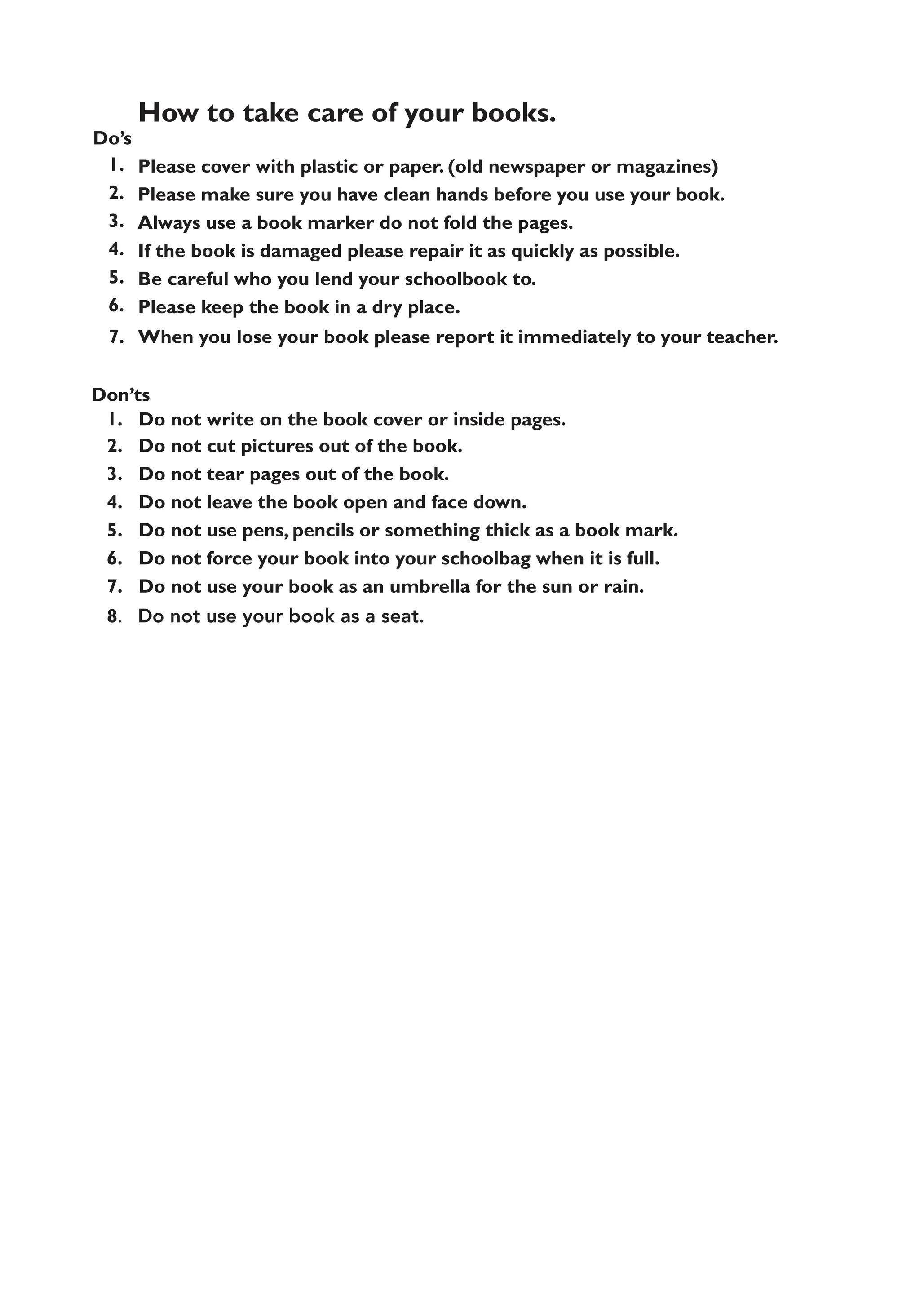
  • 2.
    Do’s 1. 2. 3. 4. 5. 6. 7. How to takecare of your books. Please cover with plastic or paper. (old newspaper or magazines) Please make sure you have clean hands before you use your book. Always use a book marker do not fold the pages. If the book is damaged please repair it as quickly as possible. Be careful who you lend your schoolbook to. Please keep the book in a dry place. When you lose your book please report it immediately to your teacher. Don’ts 1. Do not write on the book cover or inside pages. 2. Do not cut pictures out of the book. 3. Do not tear pages out of the book. 4. Do not leave the book open and face down. 5. Do not use pens, pencils or something thick as a book mark. 6. Do not force your book into your schoolbag when it is full. 7. Do not use your book as an umbrella for the sun or rain. 8. Do not use your book as a seat.
  • 3.
    South Sudan Secondary 4 Citizenship Student’sBook This book is the property of the Ministry of General Education and Instruction. THIS BOOK IS NOT FOR SALE
  • 4.
    . ©2018,THE REPUBLIC OFSOUTH SUDAN, MINISTRY OF GENERAL EDUCATION AND INSTRUCTION. All rights reserved. No part of this book may be reproduced by any means graphic, electronic, mechanical, photocopying, taping, storage and retrieval system without prior written permission of the Copyright Holder. Pictures, illustrations and links to third party websites are provided in good faith, for information and education purposes only. Published in 2018 by: Longhorn Publishers (Kenya) Ltd., Funzi Road, Industrial Area, P.O. Box 18033-00500, Nairobi, Kenya.
  • 5.
    iii Contents Unit 1: Chartersfor peace and conflict resolution . . . . . . . . . . . . . . . . . 1 The United Nations (UN). . . . . . . . . . . . . . . . . . . . . . . . . . . . . . . . . . . . . . .2 Objectives of the United Nations. . . . . . . . . . . . . . . . . . . . . . . . . . . . . . . . .2 Organisation of United Nations. . . . . . . . . . . . . . . . . . . . . . . . . . . . . . . . . .3 Achievements of the United Nations . . . . . . . . . . . . . . . . . . . . . . . . . . . . . .8 The role of the United Nations in peace and conflict resolution. . . . . . . .9 The African Union (AU) . . . . . . . . . . . . . . . . . . . . . . . . . . . . . . . . . . . . . . .13 Achievements of OAU . . . . . . . . . . . . . . . . . . . . . . . . . . . . . . . . . . . . . . . .13 Foundation of the African Union (AU). . . . . . . . . . . . . . . . . . . . . . . . . . . .14 Principles of the African Union . . . . . . . . . . . . . . . . . . . . . . . . . . . . . . . . . .15 The structure of the African Union . . . . . . . . . . . . . . . . . . . . . . . . . . . . . .16 The Achievements of the African Union. . . . . . . . . . . . . . . . . . . . . . . . . . .18 The African Union Protocol in relation to establishment of peace and conflict resolution . . . . . . . . . . . . . . . . . . . . . . . . . . . . . . . . . . .19 Principles of the African Union Peace and Security Council. . . . . . . . . . .20 The role of the Peace and Security Council . . . . . . . . . . . . . . . . . . . . . . .21 The role of the African Standby Force of the African Union. . . . . . . . . . .21 The Role of African Union in peace and conflict resolution in South Sudan. . . . . . . . . . . . . . . . . . . . . . . . . . . . . . . . . . . . . . . . . . . . . . . . .22 Similarities in the role of United Nations (UN) and the African Union (AU) in peace and conflict resolution . . . . . . . . . . . . . . . .23 Glossary . . . . . . . . . . . . . . . . . . . . . . . . . . . . . . . . . . . . . . . . . . . . . . 23 Unit 2: Systems of government around the world. . . . . . . . . . . . . . . . . 25 Systems of government around the world. . . . . . . . . . . . . . . . . . . . . . . . .25 Introduction to systems of government. . . . . . . . . . . . . . . . . . . . . . . . . . .25 Stages of the Electoral process in Kenya. . . . . . . . . . . . . . . . . . . . . . . . . .28 Functions of electoral commission (IEBC) in Kenya . . . . . . . . . . . . . . . . .30 Formation and functions of the government of Kenya . . . . . . . . . . . . . . .30 Electoral process in Britain. . . . . . . . . . . . . . . . . . . . . . . . . . . . . . . . . . . . .36 The structure and functions of the British government . . . . . . . . . . . . . .37 Electoral Process in the USA . . . . . . . . . . . . . . . . . . . . . . . . . . . . . . . . . . .40 Types of election in USA. . . . . . . . . . . . . . . . . . . . . . . . . . . . . . . . . . . . . . .41
  • 6.
    iv The functions ofthe US government . . . . . . . . . . . . . . . . . . . . . . . . . . . . .42 Differences in systems of government between South Sudan and those of the selected countries. . . . . . . . . . . . . . . . . . . . . . . . . . . . . . . . . .45 Similarities in the South Sudan system of government with that of Kenya, Britain and the USA . . . . . . . . . . . . . . . . . . . . . . . . . . . . . .46 The meaning of global independence. . . . . . . . . . . . . . . . . . . . . . . . . . . . .46 Aspects of global interdependence. . . . . . . . . . . . . . . . . . . . . . . . . . . . . . .46 Responsibilities of individuals and governments to global inter-dependence. . . . . . . . . . . . . . . . . . . . . . . . . . . . . . . . . . . . . . . . . . . . .48 Challenges facing global inter-dependence . . . . . . . . . . . . . . . . . . . . . . . .50 Glossary . . . . . . . . . . . . . . . . . . . . . . . . . . . . . . . . . . . . . . . . . . . . . . 51 Unit 3: How the economy functions in South Sudan . . . . . . . . . . . . . . . 52 The meaning and operation of the economy . . . . . . . . . . . . . . . . . . . . . .53 The role of government in the working of the economy . . . . . . . . . . . . .55 The roles of individuals and businesses in the economy . . . . . . . . . . . . .56 The role of taxes in balancing the economy . . . . . . . . . . . . . . . . . . . . . . .56 Management of the economy. . . . . . . . . . . . . . . . . . . . . . . . . . . . . . . . . . .57 Rights and responsibilities of consumers . . . . . . . . . . . . . . . . . . . . . . . . . .59 Rights and responsibilities of employees . . . . . . . . . . . . . . . . . . . . . . . . . .60 The main rights of employees include:. . . . . . . . . . . . . . . . . . . . . . . . . . . .60 Responsibilities of employers . . . . . . . . . . . . . . . . . . . . . . . . . . . . . . . . . . .61 Rights of employers. . . . . . . . . . . . . . . . . . . . . . . . . . . . . . . . . . . . . . . . . . .61 Impact of local and national economy on consumers and employees and employers . . . . . . . . . . . . . . . . . . . . . . . . . . . . . . . . . . . . .61 Glossary . . . . . . . . . . . . . . . . . . . . . . . . . . . . . . . . . . . . . . . . . . . . . . 62 Unit 4:The rights and responsibilities of consumers, employers and employees . . . . . . . . . . . . . . . . . . . . . . . . . . . . . . 63 The meaning of a consumer. . . . . . . . . . . . . . . . . . . . . . . . . . . . . . . . . . . .63 South Sudanese consumer rights . . . . . . . . . . . . . . . . . . . . . . . . . . . . . . . .64 Consumer responsibilities . . . . . . . . . . . . . . . . . . . . . . . . . . . . . . . . . . . . .65 Impact of national economy to consumers, employers and employees . . . . . . . . . . . . . . . . . . . . . . . . . . . . . . . . . . . . . . . . . . . . . . . . . .66 Responsible consumerism . . . . . . . . . . . . . . . . . . . . . . . . . . . . . . . . . . . . . .68 Effects of consumerism . . . . . . . . . . . . . . . . . . . . . . . . . . . . . . . . . . . . . . . .69 Labour law of South Sudan. . . . . . . . . . . . . . . . . . . . . . . . . . . . . . . . . . . . .71
  • 7.
    v The impact ofSouth Sudanese economy to the local business . . . . . . . .72 Revision questions . . . . . . . . . . . . . . . . . . . . . . . . . . . . . . . . . . . . . . . . . . . .73 Unit 5: Peace-making . . . . . . . . . . . . . . . . . . . . . . . . . . . . . . . . . . . . . . . . 74 Introduction. . . . . . . . . . . . . . . . . . . . . . . . . . . . . . . . . . . . . . . . . . . . . . . . .74 The meaning of peace-making . . . . . . . . . . . . . . . . . . . . . . . . . . . . . . . . . .75 Other terms associated with peace. . . . . . . . . . . . . . . . . . . . . . . . . . . . . .76 Peace makers of South Sudan. . . . . . . . . . . . . . . . . . . . . . . . . . . . . . . . . . .77 Organisations that have helped in peace making in South Sudan . . . . . .78 Current activities of peace-making in South Sudan . . . . . . . . . . . . . . . . .84 Glossary . . . . . . . . . . . . . . . . . . . . . . . . . . . . . . . . . . . . . . . . . . . . . . 86 Unit 6: The need for sustainable development . . . . . . . . . . . . . . . . . . . 87 The meaning of sustainable development . . . . . . . . . . . . . . . . . . . . . . . . .87 Ways of achieving sustainable development . . . . . . . . . . . . . . . . . . . . . .89 The United Nations Decade of Education for Sustainable Development (DESD), 2005-2014. . . . . . . . . . . . . . . . . . . . . . . . . . . . . . . .90 The Impact of DESD on shaping public opinion, school curriculum and government policies . . . . . . . . . . . . . . . . . . . . . . . . . . . . .92 Management of the impact of natural disasters . . . . . . . . . . . . . . . . . . . .94 Effective day to day strategies for protecting the environment . . . . . . . .95 Challenges facing the implementation of sustainable development strategies in South Sudan . . . . . . . . . . . . . . . . . . . . . . . . . . .95 Glossary . . . . . . . . . . . . . . . . . . . . . . . . . . . . . . . . . . . . . . . . . . . . . . 96 Unit 7: Organising a community project . . . . . . . . . . . . . . . . . . . . . . . . 97 Introduction. . . . . . . . . . . . . . . . . . . . . . . . . . . . . . . . . . . . . . . . . . . . . . . . .98 Stages of carrying out a community project. . . . . . . . . . . . . . . . . . . . . . .99 Tools and instruments used for monitoring and evaluation . . . . . . . . . .103 Sustainability of community projects . . . . . . . . . . . . . . . . . . . . . . . . . . . .104 Glossary . . . . . . . . . . . . . . . . . . . . . . . . . . . . . . . . . . . . . . . . . . . . . 106
  • 8.
  • 9.
    1 Charters for peaceand conflict resolution Charters for peace and conflict resolution UNIT 1 What I will learn • The foundation of the United Nations and its Charter. • How the UN charter is relevant to peace keeping and conflict resolution? • The foundation of the African Union and its Charter. • How the African Union has shaped South Sudan? • The role of the United Nations (UN) and the African Union (AU). • The role of the charter of the United Nations and the African Union on conflict and peace resolution. What I will do • Explore the relevance and impact of the AU and UN treaties, protocols and articles related to peace and conflict resolution. • Investigate and compare the aims and objectives of AU and UN in relation to peace and conflict resolution. Activity 1.1 1. Using the internet and other relevant materials, explain how the UN charter is relevant to peace keeping and conflict resolution. 2. In less than 100 words describe how theAfrican Union has shaped South Sudan. 3. Make a presentation in class as a group and choose the best three.
  • 10.
    2 The United Nations(UN) The United Nations is an association of independent nations and countries. It was formed immediately after the Second World War. Its main aim was to promote international peace and security.The UN came fully into its existence in 24th October, 1945. Its membership is open to independent states. South Sudan became a member of the United Nations on 14th July, 2011. Currently,the UN has a membership of 193 sovereign states with equal representation in the UN General Assembly. President Salva Kiir of the Republic of South Sudan addressing a UN meeting. Objectives of the United Nations • To promote and maintain international peace and security. • To develop friendly relationships and ties among members of the world. • To promote co-operation in handling international social, cultural and humanitarian problems. • To continue the diplomatic meetings that had begun during the wars. • To prevent the occurrence of another war similar to World War I and World War II.
  • 11.
    3 Activity 1.2 Fieldvisit 1. Visit your local village and research on any organisation that has been established to maintain peace and security. 2. In your visit you will be required to come up with the following findings: a) Has the organisation been able to achieve its objectives? b) What are some of the challenges facing the organisation in solving the conflicts facing the society?Your arguments should be fully supported. Organisation of United Nations The United Nations is made up of six main organs as outlined in the structure below: The General Assembly The Security Council Organs of the United Nations The International Court of Justice The Secretariat TheTrusteeship Council The Economic and Social Council The organs of the United Nations.
  • 12.
    4 a) The GeneralAssembly It consists of representatives of all member states. A sitting of the UN General Assembly. The roles of the General Assembly include: • To discuss issues that relate to UN objectives except matters touching on the Security Council. • To approve the UN budget. • To admit new members and expel those who do not adhere to the rules. • To appoint individuals to work in the different UN agencies. Activity 1.3 Role play 1. Transform your class into a sitting similar to that of the UN General Assembly. 2. Choose one person to act as the chairperson. As the chair he or she should moderate the meeting as members give their views on important areas of maintaining peace, unity and conflict resolution. 3. The members should act as representatives from various countries in the world. 4. As you do so, ask for guidance from your subject teacher.
  • 13.
    5 b) The SecurityCouncil It is made up of five permanent members and ten members who are not permanent. The Security Council is a permanent organ that makes decisions at the UN. It formulates and implements policies. The permanent members are: The United Kingdom The Russian Federation The United States of America France China Security Council permanent members. The Council’s main duty is to promote and maintain international peace and security. It investigates disputes that may threaten peace and recommend possible course of action to be taken. For example, the Council can order sanctions against the offending state or deploy peacekeeping forces to the warring nations. Troops of the peace-keeping mission of the UN in South Sudan.
  • 14.
    6 c) The Secretariat Thisis the main administrative organ of the United Nations. It is headed by the Secretary General who is elected by the GeneralAssembly.The Secretary General serves a term of five years upon recommendations from the Security Council. The Secretary General is elected from the non-permanent members of the United Nations. One of the Africans to have held the seat of the Secretary General to the United Nations is Kofi Annan from Ghana. The current Secretary General of the United Nations is António Guterres from Portugal. President Salva Kiir with former UN Secretary General, Ban Ki-moon from South Korea. Kofi Annan, one time Secretary General to the UN from Ghana. António Guterres the current Secretary General to the UN from Portugal.
  • 15.
    7 d)The International Courtof Justice It is the judicial organ of the United Nations and its headquarters are inThe Hague, Netherlands. It is made up of fifteen judges each serving a nine-year term. It is responsible on all legal issues and disputes which require to be dealt with at the UN. Its decisions are final. The Court deals with international disputes such as: • Border conflicts. • Treatment of diplomatic staff. • Territorial waters. A court session atThe Hague, Netherlands. e) The Economic and Social Council It has twenty-seven (27) members elected by the General Assembly.The members serve a three-year term. It deals with issues related to: • Economic development • Health issues • Education These issues are dealt with through specialised agencies such as: • The United Nations Children’s Emergency Fund (UNICEF) • The World Health Organisation (WHO) • The United Nations Development Programme (UNDP) • Food and Agricultural Organisation (FAO)
  • 16.
    8 UN officials administeringpolio vaccines to children in South Sudan. f)Trusteeship Council It was established to monitor the political developments in territories that were dependent and advocated for decolonisation. Dependent territories refer to former mandates of the League at the end of World War II. Trusteeship Council suspended its operation in 1994 with the independence of Palay, the last remaining UN trust territory. It however continues to exist on paper. It still has President andVice President. Achievements of the United Nations • The United Nations has encouraged the member countries to settle their disputes peacefully. • The UN has imposed sanctions on countries that threaten peace in the world. • Peace-making missions have been sent to areas with civil conflicts such as Somalia. • Through the International Court of Justice it has settled disputes between countries peacefully. • It has promoted social and economic development through its specialised agencies.For example,through theWorld Health Organisation,the UN has improved health standards of many African countries.
  • 17.
    9 Activity 1.4 Groupwork Study the photograph below keenly and use it to answer the questions that will follow: a) What can you see from the above picture? b) How do you think this activity is important in improving peace and unity in South Sudan? The role of the United Nations in peace and conflict resolution Activity 1.5 Role play 1. Organise your class to form a UN security council round-table negotiation. 2. Choose a chairperson to lead the meeting. 3. Discuss on the importance of maintaining peace in our society.Write down your discussed points.
  • 18.
    10 The United NationsCharter of 1945 articulated its commitment to uphold human rights of all citizens. Chapter VI of the United Nations Charter deals with the peaceful settlement of disputes. It requires that disputes that may lead to war be dealt with first through peaceful methods such as; Negotiation Mediation Peaceful methods Reconciliation Enquiry Arbitration Judicial settlement peaceful methods of resolving conflicts. If these methods of peaceful resolution fail,they should be forwarded to the United Nations Security Council. The Security Council also sends troops to conflicting zones so as to maintain peace, carry out humanitarian activities and enforce United Nations resolutions. The United Nations Education, Scientific and Cultural Organisation (UNESCO), a specific agency of the United Nations has played a major role in peace making in South Sudan.It encouraged universal peace for human rights and international peace. The main roles of UNESCO in South Sudan are: • Advocating for peace and non-violence through education and media. • Empowering and engaging young people, women and children through education. • Promoting scientific and cultural co-operation to manage the various resources in the country. United Nations Mission in South Sudan (UNMISS) is also a peace-making agency of the United Nations.This agency has offered home to millions of South Sudanese refugees who fled their homes due to conflict.The agency offers the following: • Humanitarian activities to refugees such as medical aid. • Prevents conflict through non-violent methods, which lead to peace. The General Assembly of the United Nations has also passed key resolutions that have played a huge role in countries affected by war-related conflicts.
  • 19.
    11 Activity 1.6 Groupwork Observe the photographs below and read the article provided carefully. The United Nations peacekeeping chief today hailed the involvement of Eastern African countries in revitalising the peace process in South Sudan.This was among the main topics he discussed with that nation’s President,describing such regional engagement “a good thing.” “We discussed the initiative of IGAD towards the revitalisation of the peace process,” said Jean-Pierre Lacroix, the UN Under-Secretary-General for Peacekeeping Operations,in the South Sudanese capital,Juba,following a meeting with President Salva Kiir. Mr. Lacroix, on his first official visit to South Sudan, added that there was a convergence of opinion that it was “a good thing” that the countries forming the Intergovernmental Authority on Development (IGAD) are more engaged in helping South Sudan and its people. These countries are Djibouti,Eritrea,Ethiopia,Kenya,Somalia,Sudan and Uganda. The conflict in South Sudan began in December 2013 as a result of political face-off between President Salva Kiir and then FirstVice-President Riek Machar. Despite the August 2015 peace agreement, violence has continued.To date, the crisis has left more than 5.5 million people in need of aid and some 1.7 million refugees have also fled to neighbouring countries. Last month, the IGAD agreed to set up a high-level forum to work across the region to get the South Sudanese peace process back on track.
  • 20.
    12 According to theUN Mission, known as UNMISS, South Sudan’s Minister of Cabinet Affairs, Martin Lomuro told the press that “the President sent very clear message on what he would like the UN to do.” Noting that the President would like the IGAD, UNMISS or the UN to “reach out to those rebels who are holding citizens hostage and engage them towards talking to one another in order to bring peace.” Mr.Lacroix met with senior Government officials including the FirstVice President Taban Deng, and the Minister of Foreign Affairs, Deng Alor. The peacekeeping chief said that there was a “shared understanding” with the government that “actions and initiatives to advance peace are important” and that they have to be put in place“to accelerate the implementation of the Peace Agreement and bring sustainable peace” to the world’s youngest nation. Mr.Lacroix underlined that the peace process could not move forward if fighting continued. He pledged the continued support of the UN towards providing aid for the most vulnerable people in South Sudan. “UN humanitarian agencies are doing their best to help South Sudan and we look forward to further cooperation with the Government so that we can access populations in distress wherever the needs are.” a) Make a list of the organisations in the above text. b) Mention the countries that are working closely with the government of South Sudan in bringing peace and resolving conflicts in the country as mentioned in the above text. c) What does the text say about the government’s efforts towards achievement of peace in the country? d) From the article, find out the various issues that are important to peace in South Sudan. e) Do you think such meetings are important in improving your country socially, politically and economically? Make a presentation in class.
  • 21.
    13 The African Union(AU) Before the establishment of the African Union, there existed the Organisation of African Unity (OAU) that had been formed on 25th May, 1963. When the OAU became fully operational, it had a membership of 32 independent African nations. Its objectives were: • To provide a platform through whichAfrican problems would be discussed and the strategies of solving these problems. • To create African identity and counter the European belief of being superior. • To fasten the decolonisation of African countries under colonisers. Achievements of OAU The OAU made the following significant achievements: • It contributed in uniting countries in Africa despite the differences in economic, social and political setup. • African countries such as Angola, Zimbabwe and Namibia attained independence through its liberation committee. • It made it possible for Africans to speak as one in the international front such as the United Nations. • It provided a platform for discussing challenges facing Africa such as refugee problem, foreign interference and dependence. • The OAU played a huge role in the refugee problem by providing material assistance. • IthelpedinestablishingeconomicorganisationssuchastheAfricanDevelopment Bank.This has promoted infrastructural and economic development. • The OAU played a key role in the establishment of regional organisations such as Economic Community of West African States (ECOWAS) and Common Market for Eastern and Southern Africa (COMESA). Activity 1.7 Group work Find out from materials in your school library, magazines and newspapers the challenges faced by the Organisation of African Unity (OAU).
  • 22.
    14 Foundation of theAfrican Union (AU) The African Union was formed in the year 2000 to replace the Organisation of African Unity.This is after it was noted that the structures of the OAU setup in 1963 were not up to the required levels of operation. By 11th July 2000, 53 heads of state and government signed the African Union Charter which outlined the operations of the organisation. TheAfrican Union was officially established on 9th July,2002 in Durban,SouthAfrica. South Sudan joined the AU on 27th July, 2011. The headquaters of the AU is situated in Addis Ababa, Ethiopia. Headquarters of the AU in Addis Ababa, Ethiopia. The AU Charter The Africa Union Charter outlines the objectives of the Union as follows: • To defend the independence and territorial integrity of member states. • To promote unity and solidarity among countries and one people of Africa. • To ensure peace, stability and security in the continent. • To speed up socio-economic and political integration in the continent. • To encourage international co-operation by recognising the charter of the
  • 23.
    15 United Nations andthe Universal Declaration of Human Rights. • To promote good governance, popular participation and democracy. • Promote human rights in accordance with African Charter on human rights. • To work closely with international partners to deal with diseases that can be prevented and to provide good health in Africa. • To promote science and technology through research in all fields. • To promote co-operation in all human activities. Principles of the African Union These are the rules meant to assist the Union achieve its objectives.They include: Peaceful co-existence of member states. Uphold the right to live in peace and stability.There is also the interdependence among member states of the African Union with emphasis on sovereign equality. Respect of the existing borders on achievement of independence is also emphasised. Active engagement and participation of the African people in the union’s activities is highly regarded. Formation of common defence framework for the continent. There is the peaceful conflict resolution among member states through appropriate means as decided by the Assembly. Non-interference by any member state in the internal affairs of another. The Union has a right to intervene if a member state has issues of war crimes, genocide and crimes against humanity. Respect for human life, condemning terrorism and rejecting impunity. Promoting gender equality. Rejecting unconstitutional changes of governments. Respect for the rule of law, human rights and good governance.The right of member states to request intervention from the union in order to restore peace and security. Activity 1.8 Group work From this passage,identify and write all the principles ofAfrican Union outlined.
  • 24.
    16 The structure ofthe African Union The African Union is made up of the organs as outlined below: Assembly of the Union Executive Council The Court of Justice The Financial Institution The Commission The Pan-African Parliament Organs of the African Union Economic, Social and Cultural Council The Specialised Technical Committee Permanent Representative Committee Organs of AU. a) The Assembly The Assembly comprises of heads of state and the government. It meets at least once a year to discuss important issues based on the agenda. It has a chairperson who serves for a one-year period. AU Assembly in Addis Ababa, Ethiopia.
  • 25.
    17 b)The Executive Council Itcomprises of ministers for foreign affairs from each member state and it meets twice a year in ordinary sessions. The Executive Council takes decisions and co-ordinates on policies in areas of common interest such as transport, science and technology, foreign trade and industry. c)The Pan-African Parliament It consists of elected representatives from member states of the union. d)The Court of Justice It deals with issues to do with interpretation coming up from the application or implementation of the Act of the Union. e)The Commission This acts as the secretariat of the Union. It comprises of the chairperson, deputy chairperson and commisioners. Chairperson Deputy Chairperson Commissioners f)The Permanent Representative Committee It comprises of representatives of the committee. g)The Economic, Social and Cultural Council This is an advisory organ of the union with social and professional groups of the member states of the union. h) Financial institutions They include: • The African Central Bank • African Investment Bank • The African Monetary Fund
  • 26.
    18 African Development Bank. i)TheSpecialisedTechnical Committees These are specialised technical committees that are answerable to the Executive Council. The Achievements of the African Union • The African Union has managed to reduce and settle conflicts within the region. For example, the post-election violence in Kenya in 2007. • It has helped in promoting peace through advocating for democracy.This has been fronted by its Peace and Security Council. • The AU has sent observers to countries that have elections to encourage democracy and good governance. • Through its financial institutions,it has played a huge role in developing growth across nations through offering loans. • TheAU has played a huge role in humanitarian activities,especially in countries affected by conflict through offering aid, For example, the millitary troops in Somalia for peace keeping.
  • 27.
    19 Activity 1.9 Groupwork 1. In groups, research on the challenges facing the African Union. 2. Suggest the ways in which the challenges can be dealt with. Make a presentation before your class. 3. Make a comparison and a contrast of theAfrican Union (AU) and the United Nations (UN) in terms of structure and funtions. The African Union Protocol in relation to establishment of peace and conflict resolution TheAfrican Union Protocol is an agreement that was signed by 53African countries on how to ensure that there is peace among and within the African states.This covenant was signed on 9th July, 2002 in Durban, South Africa. The protocol contained regional mechanisms that were to be put in place to prevent, manage and resolve conflicts should they arise. During the Durban Protocol, there was an establishment of Peace and Security Council within theAfrican Union.In addition,theAfrican standby force and a special fund were also established. The objectives of the Peace and Security Council included: • Promotion of peace, security and stability in Africa so as to assure protection of lives and property. • To promote peace and sustainable development. • To anticipate and take measures of preventing conflicts. • In areas where conflicts have occurred, the Peace and Security Council is to ensure that the peace making and building initiatives to solve the conflicts are in place. • Promote democratic processes based on the rule of law, proper governance and respect for human life as mediums of controlling occurrence of conflicts. • Come up with a defence policy for the Union.
  • 28.
    20 Activity 1.10 Groupwork Study the following photographs: a) What do you see in the first photographs? b) What is the second picture showing? Share your thoughts with others in your class. c) How are the activities happening in the two pictures related to peace and security? Principles of the African Union Peace and Security Council These are guidelines that direct its operations.They include: • Peaceful settlement of disputes and conflicts. • Respect for member states and integrity of their territories. • A relationship of dependence between security and socio-economic development. • Quick and early response to emergency situations to prevent conflict from blowing out of proportion. • Respect of boundaries after inheriting them when a country achieves independence. • Respect for member state internal affairs. A B
  • 29.
    21 The role ofthe Peace and Security Council • To promote peace, security and stability in the African Continent. • Provide early information on possibilities of conflict so as to have preventive diplomacy. • Using relevant peace making initiatives and conflict resolution mechanisms. • Providing disaster management and humanitarian action. • Peace intervention and support operation. The role of the African standby force of the African Union • To support peace keeping missions and operations in countries faced with wars. • To observe and monitor various peace keeping missions in order to prevent crimes against humanity. • To build peace after conflict resolution through disarmament. • To provide humanitarian assistance such as food to countries faced by civil wars. NOTE:TheAfrican Union through its Peace and Security Council shall build peace through the following activities: • Bringing together the negotiated peace agreements. • Establishing foundations of social, political and economic reconstruction of societies. • Carrying out demobilisation and disarmament. • Assisting vulnerable people such as the elderly, women and children. • Resettling refugees and internally displaced people. • Facilitating activities of humanitarian groups. Activity 1.11 Group work 1. Gather information on the various ways our country has benefited from the initiatives by the African Union from newspapers and the internet or any other available resource. 2. Take note and present your findings to the class.
  • 30.
    22 The Role ofAfrican Union in peace and conflict resolution in South Sudan Activity 1.12 Group work Carefully study the photographs below. a) What is happening in the photographs shown above? b) Explain how important the activity in the above photographs are in promoting peace and reducing conflicts in South Sudan. c) Compare the similarities between the AU and the UN with reference to peace and conflict resolution. The African Union office was opened in Juba, South Sudan in 2008.This was as a result of the communication issued at the 89th meeting of the African Union Peace and Security Council held on 24th August, 2007. The Juba office was in full support of the implementation of the comprehensive peace agreement with respect to South Sudan. The AU set out an objective to promote peace between Sudan and South Sudan. This was meant to improve relations between the two countries. The objectives of theAU in Juba were to monitor the political and security situation in South Sudan.They are also to assess the implementation of the Comprehensive Peace Agreement (CPA) and note the progress and challenges on economic and natural resources.They are also to support the working ties with African Union offices in Khartoum-Sudan with the target of promoting good relationship between South Sudan and Sudan.
  • 31.
    23 Similarities in therole of United Nations (UN) and the African Union (AU) in peace and conflict resolution • Both recognise the need for peaceful co-existence of member states. They advocate for the right to a peaceful and secure continent. • Both condemn impunity through the respect for human life and fight against terrorism. • They provide a defence policy for theAfrican continent as a way of maintaining peace. • Both advocate for respect of neighbour countries’ borders as a way of evading conflict. • They advocate for peaceful resolution of conflict among member states. • Both provide avenues for development of friendly,social and economic relations among countries. • They uphold the need to follow the rule of law and good governance as avenues of promoting peace. • They help in conflict resolution through sending personnel to help in humanitarian and military activities. Glossary • Sovereign – Being independent. • Formulate – To come up with something. • Sanctions – Measures that are meant to punish the offender for an offence done. • Deploy – To give a role to someone. • Specialise – To deal with a particular or specific issue, task or job. • Monitor – To follow the process or progress of something keenly. • Dependent – To rely on something or cannot do something on your own. • Decolonisation – The process of making a country independent. • Articulate –To make something properly known through clear argument. • Resolutions – These are agreements or covenants. • Platforms – These are grounds of discussing issues. • Charter – It refers to a plan or an order in which something will be done.
  • 32.
    24 • Policy –It is an agreed rule of operation. • Solidarity – It simply means unity. • Vulnerable – Something which is open to danger. • Comprehensive – A clear detailed piece of information. • Advocate – To fight for somebody. • Rapporteur – A person appointed by a body to attend to and investigate a situation and report back to the same body.
  • 33.
    25 Systems of governmentaround the world Systems of government around the Systems of government around the world UNIT 2 What I will learn • Systems of government in the selected countries in the world. • Important similarities and differences between the government of South Sudan and other world countries. • Wider issues and challenges of global interdependence. • The responsibilities of individuals and governments to global interdependence. What I will do • To investigate systems of government around the world. • To explore and solve problems associated with global interdependence. • To explore the benefits of international partnership to challenge international conflict and promote peace. Systems of government around the world Activity 2.1 Pair work Using the knowledge learnt from the previous topics on governance, make a list of the various aspects that comprise a government. Introduction to systems of government A government is a group of people with legal authority to govern and control the affairs of people in a given society. A system of government refers to how administrative units in a given country are organised to properly function. In both Secondary One and Secondary Two, we studied the functions of various
  • 34.
    26 systems of governmentsuch as parliament in South Sudan. Therefore, this information will be so helpful in studying the systems of government in different countries around the world. In this topic, we shall examine and explore the systems of government in Kenya, Britain and the United States of America. We will also compare and contrast these aspects of government to those of South Sudan. 1. Kenya Kenya is a country found in the Eastern part of Africa. It borders South Sudan to the South. It is an ally of South Sudan in economic, social and political aspects. For example, Kenya has played a significant role in the attainment of peace and political stability in South Sudan. The Republic of Kenya.
  • 35.
    27 Kenya has ademocratic system of government where citizens elect their leaders to run the affairs of the country.This is done through an electoral process conducted by an independent body. The electoral process in Kenya According to the Kenyan Constitution 2010,elections in Kenya are held after every five years.These general elections are held on the second Tuesday of August after every five years. The elections are conducted by an independent body known as the Independent Electoral and Boundaries Commission (IEBC). IEBC officials registering a citizen to be a voter. The elections are guided by the following principles: • Rights of all citizens to vote. • Gender equity, that is, the balance between males and females. • Free and fair elections. • Universal suffrage, that is, one man one vote. The following are ways of conducting a free and fair election in Kenya: • Elections are done through secret ballot. • Elections should be free from intimidation, violence and corruption. • Transparency has to be upheld. • Elections to be run by an independent body.
  • 36.
    28 Stages of theElectoral process in Kenya a) Dissolution of parliament. After every five years, the Parliament (National Assembly and Senate) is dissolved to give way for the new elections. The presidential elections also take place during this time. b) Registration of voters. This process is carried out by an electoral body, the Independent Electoral and Boundaries Commission (IEBC). The following conditions must be met for one to be registered as a voter: • Be a Kenyan Citizen. • Be of sound mind. • Be 18 years and above. • Possess a Kenyan passport or the national identification card. c) Nomination.The electoral commission announces election dates and gives the timetable for: • Party nominations. • Presentation of nomination documents by candidates. • Date for the beginning and ending of campaigns. For one to qualify as a presidential candidate, he or she must be: • A Kenyan citizen by birth. • Nominated by a political party or run as an independent candidate. • Nominated by at least 2000 voters from each of a majority of the counties. For a parliamentary candidate he or she must: • Be a Kenyan citizen. • Have attained the age of 21 years. • Be a registered voter in the parliamentary constituency he wishes to represent. • Be nominated by a political party or run as an independent candidate. However, a parliamentary candidate may be disqualified if he or she: • Is holding a public office. • Is a member of county assembly. • Has not been a citizen of Kenya for at least 10 years before the election. • Is declared bankrupt by the court of law. • Is found to be of unsound mind.
  • 37.
    29 For the countyassembly candidate he or she must: • Be a citizen of Kenya. • Attain the age of 21 years. • Be nominated by a political party or run as independent candidate. • Be a registered voter in the ward he or she wants to represent. d) Presentation of nomination papers. Here the candidates will present their nomination papers to the IEBC officials. e) Campaigns. They begin after candidates have presented their nomination papers. Candidates must adhere to the electoral code of conduct during the campaign period.For example,they should desist from acts of violence,bribery and intimidation of opponents with their supporters. f) Polling or voting.This is the day when the citizens go to their respective polling stations to cast their votes. It begins at 6 am and ends at 5 pm. Voters must present identification documents before voting. People on a queue to vote. g) Announcing and declaration of winners. After voting, counting is done and the winners of various electoral positions declared.This is done by electoral officials at various levels, like polling stations and consistency.
  • 38.
    30 Functions of electoralcommission (IEBC) in Kenya Activity 2.2 Pair work From the information you have learnt in the electoral process in Kenya, point out the functions of the electoral body [IEBC].Compare these functions to those of the south Sudanese electoral body.What are the similarities and differences? Formation and functions of the government of Kenya The government of Kenya is of two levels;the national government and the county or devolved government. All these levels of government are formed after the general elections. According to the constitution of Kenya, 2010, there are 47 counties. Each county has a government that has the County Executive, County Assembly and the County Public Service. All counties are headed by a Governor assisted by a Deputy Governor. Hence the governor is the chief executive officer of the county. The national government of Kenya is divided into the Legislature or Parliament, the Executive and the Judiciary. a) The Legislature The Legislature has two houses: Legislature National Assembly Senate The National Assembly has 290 members elected from each constituency, 47 women elected from 47 counties, 12 nominated members by political parties and the speaker as an ex-officio member. The Senate has 47 members elected from each county, 16 women members nominated by political parties; a man and a woman to represent persons with disabilities; a man and a woman to represent the youth and a speaker as an ex-officio member.
  • 39.
    31 A parliamentary sessionin Kenya. The functions of the National Assembly are: • To make and change laws of the land. • To control government revenue and expenditure. • To put the government on check so as not to misuse its powers. • To act as a link between the people at the local level and the government. • To pass a vote of no-confidence on the government and the president if necessary. • To approve government actions making them acceptable. The functions of the Senate are: • It makes and amends law in collaboration with the National Assembly. • To determine the money to be allocated to counties. • To ensure that money allocated to counties is properly utilised. • It ensures that public servants do their work accordingly. Activity 2.3 Pair work 1. By the use of a table, compare the similarities between the Kenyan parliament and that of South Sudan in terms of composition and functions. 2. Make a presentation before your class.
  • 40.
    32 b) The Executive TheExecutive consists of: ThePresident Cabinet The Attorney General The Deputy President The Executive The Public Service The national security organs Correctional Service. The president of Kenya is the Head of the Executive and he or she is the one who appoints cabinet secretaries with the approval of parliament. The Cabinet consist of between 14-22 cabinet secretaries. President Salva Kiir of South Sudan with President Uhuru Kenyatta of Kenya.
  • 41.
    33 The power andfunctions of president of Kenya are: • He or she chairs Cabinet meetings. • He or she is the commander-in-chief of the Kenya Defence Forces. • He or she ensures the protection of rights and freedoms of the people as enshrined in the constitution. • He or she can appoint and dismiss public officers in line with constitution. • He or she can offer pardon to convicted persons. • He or she receives and entertains foreign leaders and presidents of other countries. The cabinet has a role in: • Making government policies. • Defending the government and its functions. • Advising the president on issues of governance. • Taking part in the process of making the budget. • Acting as a link between the government and the people. The Public Service The Public Service is headed by a Public Service Commission made up of members appointed by the president.The roles include: • Interpreting the government policies to the people. • Implementing government policies. • Collecting government revenue and accounting for expenditure. • Maintaining law and order through the National Police Service. • Giving advice to cabinet secretaries on policy matters. • Offering important and essential services to the people such as medical care. The composition of the national security organs is the Kenya Defence Forces, the National Intelligence Services and the National Police Service. The Kenya Defence Forces are entitled to: • Defend the country from external aggression. • Maintain international peace and security through peace keeping mission. • Help in the maintenance of law and order. • Provide emergency services during times of natural disasters.
  • 42.
    34 Kenya Defence Forcesin Somalia on peace-keeping mission. The National Police Service comprises of the Kenya Police Service and the Administration Police Service. Its roles include preventing crime, arresting and prosecuting criminals and law breakers and helping fight international crime in collaboration with the International Police (Interpol). They collect information on crime and act on it as well as protecting life and property. Activity 2.4 Pair work Compare and contrast by use of tables, the executive of South Sudan to the executive of Kenya. c) The Judiciary The Judiciary is the arm of government that interprets laws and is headed by the Chief Justice. It is made up of a system of courts; the Supreme Court, the Court of Appeal, the High Court,the magistrate’s courts,the Kadhi’s courts,the Courts Martial and the Tribunals. Functions of the Judiciary in Kenya involve the following: • The Supreme Court listens and determines disputes from presidential elections. • The High Court hears cases that are being tried for the first time. • The Court of Appeal listens to cases appealed from the High Court. • The Magistrates courts will hear and determine criminal cases. • The Kadhi’s courts will settle specific Islamic disputes related to marriage, divorce and inheritance.
  • 43.
    35 The Supreme Courtof Kenya Activity 2.5 Pair work What similarities and differences can you draw from the Kenya’s judiciary and the judiciary of South Sudan? 2. Britain Britain is found in Europe and it is made up of England,Scotland,Wales and Northern Ireland. The position of Britain on the map of Europe.
  • 44.
    36 Britain has aconstitutional monarchical government.This is a government where the head of state is a queen or a king.The royalty rules according to the law of the land. The residential place of the monarch is in Buckingham Palace. Britain is a parliamentary democracy where the principle of representation by elected leaders is central. Electoral process in Britain Unlike other democratic countries like South Sudan, there is no specific date for elections in Britain.The date of elections is announced by the Prime Minister. Elections in Britain are conducted by the Electoral Commission of Britain. The role of the Electoral Commission of Britain include registration of political parties, conducting of civic education on electoral issues and conducting of the elections through distribution of election materials. They also help in counting of votes and announcing results.On the other hand they have a responsibility of controlling how political parties use their campaign money. The electoral process in Britain involves the following procedures: i. Dissolution of the parliament by the Prime Minister with the approval from the Monarchy. ii. Issuance of a legal notice for holding elections – This makes it possible for elections to be held at various levels. It is the lawful way of notification for elections. iii. Voter Registration – This is a continuous process and voters must be of 18 years and above. iv. Setting of election dates – This is done by the Prime Minister. v. Nomination of parliamentary candidates – This is done by political parties.The nominees must be of 21 years and above.They must also be British citizens. vi. Campaigns – This is done for two weeks. Here, candidates sell their policies through rallies and use of media. vii. Polling or voting – It is done through a secret ballot. It begins as early as 7.00 am and ends at 10.00 pm.The voter’s name must be on a voter’s register before voting. viii. Vote collection –This takes place after voting within the constituency in the presence of candidates or their agents. On conclusion, the returning officer announces results and declares the winner.
  • 45.
    37 Activity 2.6 • Identifysimilarities and differences if any, between the electoral processes in South Sudan and the electoral process in Britain. The structure and functions of the British government The British government has four arms;the Monarchy,the Executive,the Legislature and the Judiciary. a) The Monarchy The unwritten constitution of Britain recognises the role of the monarch who operates on policies approved by parliament. The monarch is the legal head of state in Britain and his or her position is hereditary. Queen Elizabeth II, the current British Monarch. The following is the role of the Monarch: • To advice the government or Prime Minister on administrative matters. • To invite the leader of the party with many seats after elections to form a government. • To give royal assent to parliamentary bills for them to become laws. • To address both houses at the beginning of a new session. • He or she serves as the head of the Commonwealth.
  • 46.
    38 b) The Executive Itcomprises of the Prime Minister, the Cabinet and the Civil Service. The functions of the Prime Minister are: • He or she is the head of government. • He or she chairs cabinet. • He or she implements government policies. • He or she is the chief spokesperson of the government in the House of Commons. • He or she acts as a chief legal adviser of the Monarch. • He or she represents the government in international events. Theresa May, the Prime Minister of Britain. The Cabinet is appointed by the Prime Minister with approval from the Monarch. It is made up of members from the House of Commons. The members to the Cabinet are referred to as ministers who head each department in the government. The role of the Cabinet is to determine the policies to be presented before parliament as well as ensuring that they are implemented. The Civil Service is comprised of individuals who work for the government in various departments such as doctors, lawyers, clerks and messengers.Their main function is to implement government policies.
  • 47.
    39 Activity 2.7 Pairwork How would you compare and contrast the executive of South Sudan and that of Britain with reference to composition and functions? c) The Legislature It is bi-cameral in nature, that is, it has two houses; House of Lords and the House of Commons.The House of Lords has a total of 900 members who are appointed by the Monarch or inherit their positions.They include the dukes, the princes, the barons and the head of the Church of England. Their functions are to check on executive powers and debate on issues important to the nation. They also act as a final court of appeal.They as well Introduce bills to parliament. The House of Commons is the main arm of legislation or law-making body in Britain. It has elected members representing constituencies. It also has the speaker who chairs parliamentary meetings or sessions. The House of Commons in session. On the other hand,the role of the House of Commons is to make and repeal laws, advice the Prime Minister and direct governance policies. They also act as a link between people and the government. They also have a role to determine how the government will acquire money through revenue collection as well as determining how the government will spend the money. In addition to those roles,they have powers to terminate the life of the government.
  • 48.
    40 Activity 2.8 Make comparisonsbetween the Legislature of South Sudan and the British Legislature. d) The Judiciary This is the British legal system made up of courts. The Judiciary is based on the supremacy of the rule of law. Its court system is divided into two; the civil courts and the criminal courts. The civil courts include the County Courts, the Court of Appeal and the High Court of Justice. The criminal courts are the Magistrates courts,the Court of Quarter,the Sessions Courts of Assize and Courts of criminal Appeals. There are also tribunals which are specialised courts dealing with road traffic, agriculture and rents. The functions of Judiciary in Britain are: • Settling disputes between individuals and government. • Interpreting the constitution. • Protecting citizen rights and freedoms. • Punishing offenders through administration of justice. 3. United States of America (USA) USA is the most powerful nation in the world today. Its origin dates back to 1776 when 13 states declared their independence from Britain.Today, the USA is made up of more than 50 independent states. The constitution of USA provides for a federal system of government. Electoral Process in the USA Elections in the USA are conducted by two main bodies; the National Party Convention and the Electoral College. The National Party Convention is entitled to announce party candidates to the public for the presidency and declare party manifestos to the people. The Electoral College has electors from each state with varying numbers. The candidate with the highest number of votes from the Electoral College is declared the winner.
  • 49.
    41 The following aresome of the stages of the USA electoral process: a) Voter registration This is a major requirement before elections are held. For one to be voter he or she must; • be 18 years and above. • be a citizen of the USA. b) Campaigns After nominations, election campaigns begin. The election campaigns are controlled by the Federal Election Campaign Act. United States of America, US. Types of election in USA There are three levels of elections in the USA;the presidential,congressional elections and state elections. State Elections are elections conducted to elect state governors and members of state congresses. The presidential elections are meant to elect a federal government.These elections
  • 50.
    42 are held everyfour years in the month of November and the US presidents serve a maximum of two-four year terms, a total of 8 years. For one to be elected US president, he or she must be 35 years and above, be a naturally born citizen of the US and must have been living in the USA for at least four years prior to elections. Congressional elections are conducted to elect members of the Congress. The Congress has the Senate and House of Representatives. Qualifications for election to the Senate and House Representatives are: • He or she must be 35 years and above. • He or she must be a citizen of USA and should be residing in the US for nine years before the nomination. • He or she must be a resident in the state in which he or she intends to be elected. Activity 2.9 Work to do 1. Make a comparison between the similarities of electoral process between South Sudan and the USA. 2. Compare your findings with those of your class members. The functions of the US government The US government is made up of three arms; the Legislature, the Executive and the Judiciary. a) Legislature Legislature is also called the Congress. It is bi-cameral, that is, the Upper House and the Lower House. The roles of the Congress are: • To make and ammend laws of the country. • To control foreign and domestic trade. • To act as a link between states and the federal government. • To control government revenue and expenditure. • To discuss and find solution to common problems in the federation. • To confirm senior government appointments made by the Head of State.
  • 51.
    43 The functions ofthe House of Representatives are to: • Impose impeachment charges against government officials including the president. • Determine taxation and other financial policies. • Explore legal ways to remove president from power. b) The Executive The Executive is comprised of the President, the Vice President, the Cabinet and the Civil Service. The President He or she has the following functions: • Protect American citizens and people from other nations within USA. • He represents the voice of Americans at home and abroad. • Guides and controls foreign policies as approved by congress. • He is the commander-in-chief of the armed forces. • Appoints government officials and civil servants which are approved by the senate. • Can offer pardon to any person convicted of breaking the law. • Issues rules, regulations and instructions to the US public. President DonaldTrump of the US. Barrack Obama, the former US president. c) The Cabinet The Cabinet is made of secretaries of state appointed by the president with the approval of Congress.They are also known as the Executive Heads of Departments. The US Cabinet is entitled to: • Advice the president on issues touching on their departments. • Implementing government policies. • Come up with public policy. • Represent the president in their departments.
  • 52.
    44 d) The Judiciary TheJudiciary is an independent legal organ made up of the system of courts.These courts are: Courts of Custom Supreme court Courts of Appeal Judiciary District court State Courts Special Federal Courts The Supreme Court is the highest court in the land and is headed by a Chief Justice and eight other judges. The judges are appointed by the president with the approval from the Congress. The Supreme Court plays the role of: • Settling disputes which are legal between states. • Interpreting the law and the constitution. • Settling disputes between USA and foreign nations. • Hearing appeals with regard to sea or ships. The Court of Appeal: • Hears appeals on decision in cases related to international trade. • Hears appeals on decisions made by lower courts. The state courts are mandated to: • Settle family disputes at family courts. • Handle minor offences such as crime through trial courts. • Dispose off property of dead persons.
  • 53.
    45 The Special FederalCourts have a duty of: • Hearing cases where the USA is sued for damages. • Listening to and determining appeals on US cases office ruling. • Hearing appeals from the court martials. Activity 2.10 Group work a) What do you think is taking place in these pictures? b) Single out the similarities between the two photographs. c) What is the importance of events happening in the pictures above? Differences in systems of government between South Sudan and those of the selected countries i. South Sudan, Kenya and the USA are headed by the president while Britain is headed by the Prime Minister with the Monarch as a head of state. ii. South Sudan, Kenya and the USA have two levels of government while Britain has one level of government. iii. In South Sudan, Kenya and Britain the citizens vote directly to elect their leaders while in USA the Electoral College has a final say on the presidential results. iv. Britain is run by the constitutional monarchy while the rest have a presidential democratic system. v. All have the Supreme courts as the highest court of the land except Britain.
  • 54.
    46 Similarities in theSouth Sudan system of government with that of Kenya, Britain and the USA Activity 2.11 Find out from materials in your school library, magazine and newspapers the challenges faced by the system of government used in Britain i. All of them have a bi-cameral legislative system. ii. They all have multi-party provisions for democracy, which is the existence of many political parties. iii. They all have the three arms of government, that is, the Executive, the Legislature and the Judiciary. iv. They all have an electoral body that takes charge of elections. v. They all share the same principle of the public service. vi. In all cases the Executive implements government policies. The meaning of global interdependence This is where countries depend on each other for various things.This creates mutual dependence at global level. The major contributor of global interdependence is importation and exportation of goods and services. Aspects of global interdependence There are three major aspects of global interdependence. These aspects are economic, social and environmental aspects. i) Economic aspect. This refers to cross border economic activities by which people coming from different countries conduct business through huge investments and flexible markets. The factors that have contributed to or promoted economic globalisation are huge capital investment, labour flow, technology and logistics and the use of electronic media and internet. ii) Socialaspect.Thisreferstoeffectsofglobalisationonthelifeofpeople, families and societies.This deals with issues of working environment, employment of foreigners, culture, security and social protection like employment inequality. iii) Environmental aspects. The earth is home to humans, humans have needs. These needs are met by using earth’s resources and every human has the right
  • 55.
    47 to use theseresources. Such as clean, safe and healthy environment. These basic resources for human survival are under threat from climate change and environmental degradation. The environmental degradation has had great observable impact socially and economically.Therefore,this has prevented people and communities from optimally achieving their potential as human beings and attaining their basic rights. The resources we have are limited and their existence threatened by pollution and consumption patterns. Environmental degradation needs a collective approach through effective action plans and laid down policy measures in which humanity must work together. For instance, in the conservation of forests there should be a global approach. To attain global interdependence,the world has come together to fight environmental degradation which risks sustainable development and existence of human and his or her eco-system.This has been achieved through United Nations climate conventions for environmental conservation. Some of these conventions are: i) The Kyoto Protocol on Climate Change 1997 ii) The Paris Climate Agreement 2015 iii) The Bonn Climate Convection 2017 These conventions seek to create a global concern for climate change which is greatly global interdependence and world economy as a whole.
  • 56.
    48 Responsibilities of individualsand governments to global interdependence Former US president Barack Obama and former First Lady Michelle Obama with President Salva Kiir during a US-Africa Leaders Summit in US in 2014. Both individuals and governments have a role to play on global interdependence. There are some government factors that may have an impact on global interdependence.These factors include: (a) Establishment of foreign investment policies to regulate operation of foreign businesses in a particular country. (b) Establishment of market tariffs which involve the deductions of custom duties on goods imported from specific countries. When the tax levied on imports is reduced there is a growth of business because the operational cost has been brought down. (c) To promote global interdependence, institutions of governance have taken the following steps to attract foreign investors: (i) Improvement of financial policies that adhere to global policies of conducting business.This promotes trust between foreign investors and a specific country. (ii) Strengthening of banking systems, transparency on financial transactions and adequate supervision and regulation of financial markets. (iii) Construction and improvement of infrastructure such as roads and airports to ease the logistic of doing business.
  • 57.
    49 Construction of newroads. Activity 2.12 Group work 1. Identify what is happening in the photograph. 2. In groups, discuss how good financial policies have promoted existence of foreign financial institutions in South Sudan. 3. In groups, discuss the improvements the government needs to conduct to attract more financial investors. (d) Protection of domestic – young industries.These industries are important for they ensure continuous supply of goods and services in case multinational companies pull out of the country. This industries need protection from being bullied by stable international companies through unfair competition.
  • 58.
    50 Basket weaving inSouth Sudan. Challenges facing global interdependence Global inter-dependence is facing numerous challenges as the world moves forward in becoming a global village.These challenges may include regional integration and differences in trade agreements. Proportion of population with access to proper sanitation is another great challenge to many. Demographic trends of different regions also affect global interdependence. Demand for sustainable development and climatic conservation threatens global interdependence. Lack of enough infrastructural facilities such as roads and housing due to increasing urbanisation has negatively impacted on global interdependence. Modern housing.
  • 59.
    51 Glossary • Ally –A friend. • Intimidation – An act of scarring someone. • Transparency – To be clear over something. • Majority – Many people supporting an issue. • Bankrupt – The state having no money. • Code of conduct – The acceptable set guidelines on how to behave during a particular exercise, for example elections. • Chief Justice – the senior most judge in a country. • Pardon – To forgive someone for a crime committed. • Convicted – To be found guilty by the court of law and jailed. • Prosecute – To charge someone in the court. • Monarchy – An institution of the queen or king. • Assent – To accept. • Globalisation – The process where people become integrated through free trade,free transfer of capital and labour in the world. • Commonwealth – Refers to all countries that are former colonies of Britain
  • 60.
    52 How the economyfunctions in South Sudan How the economy functions in South Sudan UNIT 3 What I will learn • Meaning of economy. • How an economy operates. • The role of individuals, businesses and government in the working of the economy. • The role of taxes in balancing the economy. • Laws and systems affecting the management of the economy. • Rights and responsibilities of consumers. • Rights of employers and employees. • Impact of local and national economy on consumers,employers and employees. What I will do • Investigate the role of individuals, businesses and government in the working of the economy. • Explore how the economy has a direct impact on trade and consumerism. •Analyse why the economy has a challenging effect on employers and employees Activity 3.1 Group work 1. In groups,discuss the role of an individual citizen,businesses and government in the working of the economy and make a brief report on the following: a) How money flows between individuals, businesses and government. b) How is family expenditure done and managed. c) How does the government collect and spend taxes. 2. Share the report with the rest of the class through group presentation.
  • 61.
    53 The meaning andoperation of the economy The word economy refers to a process or a system of production, distribution and consumption of goods and services by different agents.An economy is therefore a network of individuals and entities that exchange their goods,knowledge and labour. An economy can be as small as two people. However, an economy of two people will have a limited exchange of goods and services.Thus, it is evident that as more people enter into the exchange network or business, the economy grows. Transactions in an economy occur when different agents agree on the value or price of goods and services,usually done using certain currency.Different countries have different currencies that vary in value due to different economic levels. In our country, people use the South Sudanese Pounds as a medium of exchange. South Sudanese currency. Economic growth is driven by production that uses natural resources, labour and capital.Technological development, creativity and innovation have also impacted on economic development and growth of the world economies. In South Sudan, petroleum and gas resources have a key role in the economy and measures have been taken to regulate the development and management of these resources.
  • 62.
    54 Wind energy. An economyoperates within a set of procedures that involves the cultural values, education,history and technology;political,social and legal systems.These factors can directly or indirectly affect the operation of the economy. Various methods have been developed to measure the economic activities of countries.These parameters include; • Consumer spending • Exchange rate • Gross Domestic Product • Stock market • Interest rates • Government debt • Rate of inflation • Rate of unemployment • Balance of trade (a) People in the market. (b) Exchange rates. Different aspects of economy.
  • 63.
    55 The role ofgovernment in the working of the economy Governments do not create economies but can influence which exchanges are outlawed or get favourable treatment. For example, the government can stop the importation of some commodities while waiving taxes on other commodities. The role of the government in the economy include: i. Regulation. The government provides legal and social framework of doing businesses. For example, it can ensure that legal contracts for businesses are enforced through the court system.This helps to keep all people accountable when doing business. ii. Competition. The government helps to maintain competition. Here, the government may enforce anti-trust laws to ensure that all businesses are able to favourably compete and offer products and services to consumers without feeling exploited. iii. Correcting externalities. Externalities refer to effects of business decisions that can affect people or parties that have no say or control over decisions in the first place.An example is industrial pollution. An industry can be producing an important product to the economy but creating a lot of pollution or waste. In this case the government sets policies to manage pollution by keeping it to acceptable levels. iv. Provision of national security. The government has a responsibility of ensuring that there is political stability in the country. This will positively influence both domestic and foreign investors to establish their businesses in the country. President Salva Kiir and Riek Machar. v. Formulating fiscal and monetary policies.This refers to adjustment of the rate of spending and taxation by the government.
  • 64.
    56 The roles ofindividuals and businesses in the economy Both individual citizens and business entities have a vital responsibility in the growth of the country’s economy. The following are some of the roles: i. They both provide goods and services that people need or want. ii. Businesses provide employment opportunities to people. iii. Individuals pay taxes that fund government operations. iv. Individuals and businesses can influence government fiscal and trade policies. v. Individuals are consumers of products produced by both government and private companies. Activity 3.2 1. In groups and with the help of your teacher, discuss some of the ways your school raises and spends money. 2. Share your discussion with the rest of the class through presentations. The role of taxes in balancing the economy In Unit Four of Secondary one, we discussed about the sources of government revenue.Most of the government revenue is from taxes levied on individuals,locals, foreign businesses and state operations.The government levies taxes on commodities, transactions and incomes.These taxes need to be controlled for economic balancing. Taxes can be either direct or indirect. Direct taxes are mainly levied on taxpayers’ income.They include income tax that is levied on incomes of individuals,especially on monthly salaries, royalties paid to writers, wages and allowances; corporate tax levied on profits made by companies and capital gains tax levied on profits or gains obtained from the value of an asset, such as machinery and land. Indirect taxes include custom duties levied on imported goods,excise duty on goods produced in South Sudan,export duty levied on goods exported from South Sudan and Value Added Tax (VAT) which is a general consumption tax levied on goods and services. The government needs to strike a balance on all their taxes for a balanced economic development and national building. The importance of taxes in balancing the economy of South Sudan include: i. Taxes are important in supporting and developing government infrastructure such as road construction. ii. Taxes can be used to cater for health services such as buying of drugs for patients hence improving the living standards of citizens.
  • 65.
    57 Part of JubaTeachingHospital. iii. Taxes are used to fund general government operations such as payment of salaries to public servants. iv. Taxes are useful for funding education projects of a nation such as,construction of schools and buying of learning materials for learners. v. Through taxation, the government is able to repay borrowed loans. vi. The government of South Sudan uses taxes to cater for emergency needs such as outbreak of hunger and floods. Activity 3.3 Group work 1. In groups, discuss the spending priorities that should be put in place by both the national and state governments in managing the economy of South Sudan. 2. In your discussions, you should consider issues like health, education, infrastructure among others.You should also give reasons for your answer. Management of the economy Managing an economy needs laws and systems to make it more efficient and effective. Therefore, for the government to properly manage and improve its economy, it should employ the following strategies: i. Promoting income equality between people and gender. ii. Introduction of new communication technologies for efficient management of tax collection and government expenditure. iii. Increased standardisation of accounting practices and introduction of new financial markets to manage capital movement from South Sudan to other countries.
  • 66.
    58 iv. Introduction ofpolitical support for privatisation,competition and agreements to lower trade barriers and to open up borders for trade interdependence. v. Increasing trading activities between people and businesses creating more competition hence production of higher quality goods and lower prices for consumers. A supermarket. vi. Encouraging domestic borrowing to finance government operations. vii. Exempting poor people from paying taxes. Such exemption is defined by law. viii. Creating employment for the citizens to increase their purchasing power. ix. Implementing government and state budgets by looking at priority areas like health, infrastructure and education. Juba Diocesan model secondary school. x. Enhancing public-private partnerships in investing in various sectors of the economy. xi. Passing legislations to tackle corruption and other economic crimes and fraud.
  • 67.
    59 Rights and responsibilitiesof consumers In regulatory economies, consumer rights refer to a group of laws and strategies designed to ensure that consumers are protected at the same time ensuring fair trade and competition in the market place. These rights include: i. Right to claim for a refund, repair or replacement when the product bought is not of satisfactory quality or it does not fit its purpose or use. ii. Right to information regarding the goods,for example,the date of manufacture and expiry and chemical composition of the products. iii. Right to provisions that protect vulnerable consumers such as children. iv. Right to compensation for loss or injury arising from defects in goods and services. Activity 3.4 Group work 1. From the rights of consumers outlined above, to what extend do you think these rights are protected? 2. What would you suggest as the good measures that the government can apply apart from the ones existing so as to fully protect the consumers? NOTE:The implementation of consumer rights faces some current challenges that need to be addressed.These include: i. Online market and digital goods and services like films and online shopping. ii. Cross-border shopping with multiple policies between countries. The responsibilities of consumers include: i. Be honest with the information by giving accurate information when you are filling consumer documents. ii. Carefully read all information provided on goods and services. iii. Ask questions about anything that is unclear on commodities. iv. Know how to make a complaint and use the right procedure to make them. v. Use the product or service in line with the terms and conditions. vi. Review all your documents after buying commodities.
  • 68.
    60 vii. Apply orrequest for products and services that meet your needs. viii. Be environmentally conscious when using products,that is,do the right disposal. Use your own mail address or mobile number when giving contact details. Rights and responsibilities of employees The main responsibilities of the employees include: i. To personally do the work they are hired for. ii. To do their work carefully and seriously. iii. To avoid putting themselves or others in danger. iv. To follow their employer’s instructions. v. To be loyal to their employees. The main rights of employees include: i. Fair pay for work that has been done, for example, good housing. ii. Reasonable working conditions. iii. Right to join, form or participate in trade unions. iv. Right to go on strike. Workers in a trade union meeting.
  • 69.
    61 Responsibilities of employers Themain responsibilities of employers include: i. Employers must give their employees a place to work and make sure they have access to it. ii. They must give employees proper tools and equipment needed to do their work. iii. They must make sure their employees working conditions are safe. iv. They must give their employees written notice that their contracts are ending or they are being laid off. v. They must treat their employees with respect. Rights of employers Employers are also guaranteed the following rights: i. Right to attend hearings related to a claim filed by the employees. ii. Right to seek administrative review of employment laws. iii. Right to form and join an employers’ organisation. iv. Right to participate in the activities of an employer’s organisation. Impact of local and national economy on consumers, employees and employers Economic growth or stagnation directly affects behaviours of consumers,employers and employees in the following ways: i. Consumerism through consumers purchasing goods. This increases total output especially the GDP because an increase in a consumer’s demand of product by purchasing it,brings about an increase in supply of that product by the producer. ii. Increased purchasing of goods increases the output level of the employers. This brings about a multiplier effect such as hiring of more workers,purchasing more raw materials and increase in tax collection. iii. Economic decline can lower the consumers’ purchasing power.This will cause the decrease of price of goods and services. This affects the local state – economy. iv. Economic stagnation affects real wages for the employees.Real wages refer to wages that have been adjusted for inflation.The worker might be making the same amount of money but his or her purchasing power has been reduced. v. Local and national economy affects the consumer’s confidence. For example, if consumers believe the economy is bad, they are less likely to spend their money.
  • 70.
    62 Activity 3.5 Groupwork 1. In groups,discuss more impact of local and national economy on consumers, employees and employers that are not outlined above. 2. In groups of two discuss how local economy impacts national economy. Glossary • Economy – The system of production,distribution,and consumption of goods and services. • Consumer – A person who uses goods or services. • Consumerism – A theory that states that an increase consumption of goods is economically beneficial. • Competition – A business relation in which two or more parties compete to gain customers. • Consumption – Utilisation of economic goods and services to satisfy needs. • Externalities – Effects of business decisions on the people. • Fiscal policies – Government policies which deal with budget, taxation and borrowing. • Tax – Money paid to the government for various operations.
  • 71.
    63 The rights andresponsibilities of consumers, employers and employees The rights and responsibilities of consumers, employers and employees UNIT 4 What I will learn • The rights and responsibilities of consumers. • The rights and responsibilities of employers. • The basis of holistic peace-making. What I will do • Investigate how rights of consumer, employers and employees are related and interdependent. • Explore relevant laws and policies on consumer and employment. • Explore the effects and benefits of well-developed clear rights. The meaning of a consumer Activity 4.1 Pair work 1. Name some of the goods that you have bought from the market or shop for the last one week.What was the reason of you buying those goods? 2. How were you served?What are some of the rights a buyer is entitled to? In the previous unit we studied how South Sudan economy funtions.We also discussed about general rights and responsibilities of consumers. In this topic, we are going to discuss this in detail.We will first define the terms consumer, good or service. A consumer is a person or an organisation that uses a good or a service. A good is a tangible item that you can touch and feel, for example, mango, bread, table and pen. A service is an intangible activity provided to people either through physical energy or mental abilities.
  • 72.
    64 People buying foodstuff. South Sudanese consumer rights Consumers have their rights that protect them from exploitation. In 2011,the South Sudan government passed Consumers ProtectionAct that outlines the rights of consumers against exploitation. The following are some of the consumer rights according to the 2011 Consumer Protection Act of South Sudan. i. Right against unfair or unjust transaction – Consumer is protected against any unfair transaction of goods and services from the supplier such as excessive buying price of a commodity. ii. Rights against false or misleading presentation – The consumer should be shown the right information about the material facts on the product he or she wishes to buy. iii. Rights to safe state and good quality – A consumer has a right to receive goods that are of good quality and free of defects. iv. Right to implied warranty of quality – A consumer has the right to receive the implied warranty of quality of goods as stipulated by the producer or retailer. v. Right to demand for quality services – A consumer has a right to performance and completion of service in an acceptable manner, time and quality. Any delays should be communicated to the consumer in time. vi. Right for compensation for damages and loss – The supplier should compensate the consumer for goods that are damaged when being transported by the supplier.
  • 73.
    65 vii. Right tobe heard – A consumer has a right to have assurance that the government will take full responsibility of all the concerns expressed and act on them according to administrative procedures. viii. Right to complain and redress – Consumers have a right to receive fair settlement of just claims of service failure or interruption. ix. Right to end a contract – Consumers have a right to cancel a contract within reasonable period not exceeding three days from date of signing contract. Cancelling provisions and procedures must be indicated in all contracts. Activity 4.2 School visit Visit all departments in your school and list types of products that are used, starting from your class, library, laboratory, departmental offices and others. You as the consumer of some of the products you have idetufied, explain the rights that have towards the products. Consumer responsibilities A responsibility is the ability or power to act or decide on one’s own obligation without supervision. It is a duty to act on something. Consumer responsibility is therefore the ability of a consumer to act in a way that will benefit him or her and the economy in general. In South Sudan, consumer responsibilities may include the following: i. Environmental responsibility – A consumer should always be sensitive to the impact of their consumption activities in the surrounding environment. His actions must be aimed at fostering conservation of the environment for the safety and quality of life. A nursery of seedlings.
  • 74.
    66 ii. Action orinvolvement – He or she must assert himself or herself to ensure that they get fair deals. It is his or her responsibility to ensure that he or she participates in policy formulation and legislation for the services they use. iii. Solidarity – Consumers have the responsibility to organise themselves in form of consumer associations in order to promote and protect their interest or protect themselves against any type of exploitation. iv. Critical awareness – As a consumer, one must always be aware of the quality and variety of goods and services being offered in the market. v. Prompt payment of bills – A consumer has an obligation to pay all their bills and clear the debts when they are due.This will foster a good relationship with their suppliers. vi. Protection of communication facilities – Some of the suppliers use communication facilities like posters, bill boards and flyers to advertise their products. A good consumer has an obligation of protecting such facilities against vandalism. Activity 4.3 Group work 1. Discuss and explain reasons why consumer responsibilities are important and why all consumers should adhere to them. 2. Use a short essay to put forward your argument. Impact of national economy on consumers, employers and employees National economy is a broad combination of individual, business and government spending or investment. The government has to pay good attention to economic factors in order to measure the strength of its economy. a) Impacts to consumers Consumers play a major role in the economy hence any changes in the economy will have a great impact on them.The following are some of the impacts of national economy on consumers: i. Consumer spending – A significant change in consumer spending behaviour highly depends on the state of national economy. For instance, lower spending may indicate a decrease in individual income while higher spending indicates an increase in the individual income.
  • 75.
    67 Women selling vegetables. ii.Demand for products – In a situation where the price of goods is continuously increasing, the consumer’s demand for the goods will decrease. This will in turn affect the supply of products which will have a negative impact on the economic growth in general. iii. Dominance of foreign commodities – If the government is over relying on the imported goods, the locally produced goods will lack market and production firms will close down. This will force the consumer to purchase foreign goods which may be very expensive for them. A manufacturing industry. iv. High taxation – Tax is the main source of government revenue. If the government wants to increase its revenue for economic development then the tax will be raised.This will have an effect of an increase in the price of goods, thus, affecting consumption negatively.
  • 76.
    68 Activity 4.4 Groupwork In groups discuss the link between national economy and behaviour of consumers, employees and employers. b) Impacts on employees and employers Employment and unemployment are the driving forces behind economic growth and stagnation. Economic improvement has an impact on employment in the following ways. i. Increased employment opportunities – Increase in employment opportunities provide chances for previously unemployed people to be employed.This reduces the idleness by many people and earns them income thus, improving the standards of living. ii. Increase in income paid to employees – Improvement in economy increases employees’ earnings leading to a higher rate of consumer spending which benefits businesses that depend on consumers. iii. Employees’ strikes – In a situation where the economy of a country negatively drops due to high inflation rate, the employees will demand for more wages so that they maintain their living standards through strikes and other industrial actions. iv. Economic retrenchment – Retrenchment is an act of an organisation or government reducing the number of workers because of the increased wage bill that it cannot afford to meet. This act happens in a situation where the state of economy is under decline and the government cannot meet higher wage bills. Responsible consumerism Consumerism is the continual expansion of one’s wants and needs for goods and services. Responsible consumerism is the role that a consumer plays in helping the society to be more sustainable. A responsible consumer can be seen through a variety of activities as indicated hereby: i. He or she should stop or reduce excessive consumption of some products.This will ensure that the income saved can be used to other investment projects in the society. ii. He or she should support responsible companies which produces quality products and in accordance with the law.This can be through increasing the purchase of their products so that they feel encouraged.
  • 77.
    69 iii. Carrying outdemonstration or picketing.A responsible consumer can carry out a peaceful demonstration against harmful products that are produced by a certain company.This will help in creating the awareness to the society to stop buying such products. iv. Consumer activism.This is an act of carrying out awareness activities about consumption of certain products through rallies or street walks.The activism will make other consumers aware of good quality or harmful products, thus deciding on which products to purchase. v. Fair trade certification. He or she should purchase goods with the label of fair trade.The label is a guarantee that no forced labour was used in generating a product and employees were paid promptly and fairly. vi. Sustainable resources. He or she should ensure that the natural resources are well preserved for other generations to use. Activity 4.5 Group work Write a short essay about responsible consumerism. In your essay, put forward suggestions of how you believe consumers should present their grievances as far as their rights are concerned. Effects of consumerism Consumerism can have either positive or negative effects on the economy. a) Positive effects i. Creation of employment – Many people buy goods and services. Gross expenditure on the quality products increase leading to increased sales. Manufacturers of these goods will be forced to increase manpower, thus, leading to more employment opportunities. ii. Production of better products – The act of consumers only purchasing goods of good quality will compel the producers to produce better products to meet their customer’s needs. Lower quality products receive criticism from consumer and companies that sell them face the risk of being edged out of the market. iii. Better living standards – The availability of quality goods in the market improves one’s lifestyle as one can access better and more variable goods.
  • 78.
    70 b) Negative effects a)Thedecline of small industries The existence of large industries with a strong financial base can lead to production of high quality goods and sell them at lower prices without making losses.This can lead to the closure of local industries which can not meet such qualities. b) Over-reliance on imports In many countries people are willing to pay a higher price for established brands with high quality satisfaction.This leaves goods that are locally produced, hence frustrating local industries which at last get closed. c) Ecological destruction Excessive consumerism results in the construction of more factories and large scale urbanisation.This leads to a serious depletion of natural resources like forests and water bodies to create room for commercial development. The environment is also polluted by factories,settlement and direct products being purchased. A factory polluting the environment. Activity 4.6 Group work Using the knowledge learned about consumerism, discuss how you can support responsible consumerism at local level in your country.
  • 79.
    71 Labour law ofSouth Sudan The South Sudan transitional parliament passed the new labour bill in November 2017 in Juba. The labour bill protects the rights of workers in the country and provides guidelines for employment of foreigners. The bill reserves exclusively for South Sudan nationals jobs such as vending,hawking, driving, office support works and other manual works. There is a labour court established that will help to hear labour disputes in the country. The disputes may involve individuals with companies or individuals themselves. The bill provides for employment inspection in South Sudan.This is to ensure that local citizens are allowed to work in the country and reduce foreign dominance in the labour market. The bill also fosters the activities of trade unions since it gives the guideline on their formation. The law contains some rights of workers in South Sudan. Some of these rights are: i. Women employment – This bill protects women against employment in dangerous areas for example where a lot of physical efforts are required. ii. Child labour – The law protects children against heavy work, exposure to poisonous or injuries and any other working conditions unfit for a child.The bill also prohibits employment of a child under the age of twelve. iii. Work contract –The law provides how the contract between employers and employees should be written, terms of contract and how the contract can be terminated. iv. Wages and salaries – The law states that workers’ wages and salaries should be paid in cash and this can be done daily,weekly or monthly depending on the agreement between the employer and employees. v. Loans – The law allows the employer to lend their employees loans at a very low interest which should not exceed 15% of their basic interest. vi. Transport – An employer is supposed to transport the workers or pay transport expenses where they have been sent to work. vii. Statements of entitlement – The employer should at the termination of the contract provide the worker with detailed statement of entailment.
  • 80.
    72 Activity 4.7 Groupwork In a group of five students,discuss any type of business activity that you can start. During your discussion: a) Write down the sources of capital and how much you need. b) State where you will start the business and the name. c) State the type of consumers you are targeting. d) Explore how you will share responsibilities in the business. e) Outline the rights of people you may hire to assist you. The impact of South Sudanese economy to the local business a) High dependency on imports The South Sudanese economy is characterised by high rate of imported goods. With foreign goods dominating the market local business like locally manufacturing industries will not improve since the market is flooded with foreign goods. b) High levels of competition The presence of many foreign business firms operating in the country has led to the facing out of local busineses since they cannot overcome the pressure of competition. c) Poor infrastructure South Sudan is facing the challenge of poor infrastructure.Thus poor infrastructure in terms of poor road networks has stressed the local business vendors to transport their goods to the market. Poor road network.
  • 81.
    73 d) Low levelsof personal income Many of the south Sudanese citizens are earning very low income or even nothing at all.This has reduced the purchasing power, thus low demand for goods. Less demands for goods will affect the local business to thrive. e) Lack of government subsidies and incentives Lack or low level government subsidies and incentives like reduction of taxes on locally produced goods discourage many potential business investors. f) High taxes High taxes levied on locally produced goods discourage local investors. This is because the production process becomes expensive. Activity 4.8 Group work In groups of six students visit different businesses premises and establish the following: a) How they manage their business. b) Challenges they are facing locally. c) How they address those challenges. Glossary • Tangible – Something that can be touched and felt. • Intangible – Something that cannot be touched or felt. • Production – The act of making or creating goods. • Exploitation – The act of being misused or used in the wrong way. • Transaction – The process of exchange. • Adverse – Being unfavourable or hostile. • Warranty – Referstoanassuranceattachedtosomethingorsomebody. • Contract – It is an agreement between two or more parties. • Obligation – It is an act of binding oneself to something. • Stagnation – The state of not moving forward. • Inflation – An increase in price of goods and services. • Curbing – Stopping or dealing with.
  • 82.
    74 Peace-making Peace-making UNIT 5 What Iwill learn • The basis of holistic peace making and conflict resolution. • Individuals and organisations who participated in peace-making in South Sudan. • The role of the United Nations (UN) Charter and African Union (AU) Charter on conflict resolution. What I will do • Investigate a range of resources that describe approaches and strategies for peace making in South Sudan. • Identify significant extracts from research findings in order to illustrate important aspects of peace making in South Sudan. • Compose a report or article about peace making in South Sudan. Introduction Activity 5.1 Individual work a) Explore the individuals and organisations that you know have participated in peace-making in South Sudan. b) Using the internet and other available materials, do a research on the role of the United Nations (UN) Charter and African Union (AU) Charter on conflict resolution. c) What do you understand by the term peace?
  • 83.
    75 The following aresome aspects that can define peace of a given society. • Sincere attempts of reconciliation between or among conflicting parties. • Existence of healthy or newly healed interpersonal or international relationship. • Existence of prosperity in matters of social and economic welfare. • Establishment and existence of equality and equity. • Existence of a working political order that serves the true interest of all. In a situation where the above attributes of peace do not exist then there is no peace. UN peace troops. The meaning of peace-making Peace-making is a process of settling a conflict between the disputing or conflicting parties.Peace-making seeks to achieve full reconciliation and mutual understanding among the disagreed parties. When applied in criminal justice matters,peace-making is usually called restorative justice. Peace making is not the final process of achieving peace. It needs a collaboration of peace keeping and peace building. Peace keeping means keeping people from attacking each other by putting some kinds of barriers between them such as the use of police. When using soldiers as peace keepers, the soldiers do not necessarily settle the disputants’ differences but they simply keep the two sides apart.
  • 84.
    76 UN soldiers ina peace keeping mission in South Sudan. Peace building is the process of normalising relations and reconciling differences between all citizens. Other terms associated with peace a) Restorative justice – Is the process of bringing those harmed by a crime and those responsible for the crime into communication and mutual agreement rather than punishing the offender. This enables everyone affected by the conflict or crime to play a part in repairing the harm and finding a positive way out. In a school set up, the goal of restorative justice is to enable learners, accused of the crime come up with the solution of the mistake committed rather than punishing them. Students sitting for an exams.
  • 85.
    77 b) Retributive justice– It is a theory which holds that the best response to a crime is punishment proportional to an offense committed because the offender deserves it. c) Armistice – This is a formal agreement between or among the conflicting parties to stop fighting. It is a temporary suspension of hostilities of warring parties by an agreement. d) Reconciliation – Is a situation in which two people or groups of people become friendly again after they have argued. It can be also defined as a process of making two opposite beliefs, ideas or situations agree. Activity 5.2 Group work In groups, discuss and make notes on advantages of restorative justice over retributive justice as a way of solving conflicts Peace-makers of South Sudan By the year 2013,conflicts between two rival political sides in South Sudan had led to a civil war.This in turn resulted to a national conflict. The consequence of this civil war was the loss of lives by a large number of South Sudanese citizens.In addition,millions of people were displaced and became refugees in the neighbouring countries especially Kenya and Uganda. The conflict led to crimes against humanity,thus triggering the intervention of several non-governmental organisations and advocates of peace to settle the disputes. A group of displaced South Sudanese citizens.
  • 86.
    78 Organisations that havehelped in peace-making in South Sudan a) Organisation for Peace Relief and Development (OPRD) This is an organisation that works towards eradicating and reducing social challenges such as poverty in South Sudan. OPRD aims to achieve its objectives through implementation of peace and conflict. mitigation programmes, infrastructure rehabilitation and community development projects. Some of the activities OPRD is involved in are: • Conflict mitigation and reconciliation. • Working towards strengthening of customary laws. • Facilitating the work of civil authorities in managing conflicts. • Educating citizens about their rights and freedom and supporting those victims whose rights have been violated. • Working towards eradication of cattle rustling. • Setting up programmes to fight gender-based violence. • Offering civic education,community dialogue and empowerment programmes. b) Grassroots Relief and Development Agency (GREDA) This was an agency formed in 2010 to enhance peaceful co-existence, good governance and better living standards in South Sudan. It has partnered with local NGO’s such as MundriActiveYouthAssociation (MAYA) and international organisations such as the UNWorld Food Programme to carry out its work. GREDA works in the following areas: • Peace building, conflict mitigation and resolution. • Promotion and protection of human rights. • Prevention, management and response to gender-based violence. • Economic empowerment of women and youth through micro-finance and vocational trainings. • Promotion of agriculture and food security. • Construction of low cost houses for the poor and the vulnerable such as widows. • Provision of humanitarian relief aids to victims of disasters.
  • 87.
    79 c) South SudanCentre for Conflict Resolution (SSCCR) This is an indigenous organisation which started in 2008 as an initiative to engage young people with the idea of peace, development and human rights. The organisation which is situated in BentiuTown and Juba works in collaboration with both local and international NGOs and UN agencies to achieve and keep the peace in the region. d) Organisation for Non-violence and Development (ONAD) It was previously known as Sudanese Organisation for Non-violence Development (SONAD). The organisation campaigned for non-violence solutions to conflicts and peaceful co-operation between North Sudan and South Sudan. It organises workshops and training sessions in which it teaches about human rights, democracy participation and non-violence. The main area of concern for this organisation is the inter-religious dialogue between Christians and Muslims. Muslims praying for peace. NOTE: All the organisations discussed above were locally formed in South Sudan and are really helping in peace making in the country. However, there are a few international or inter-governmental organisations that have also helped to create peace in South Sudan.
  • 88.
    80 Some of theseorganisations include: a) Inter-Governmental Authority and Regional Integration (IGAD) This is a body currently comprising of 8 countries. They include Sudan, Kenya, Uganda, Ethiopia, Eritrea, Djibouti, Somalia and South Sudan. IGAD is a subordinate organisation to the UN and the AU. Since its formation, its mandates have gradually expanded to address both political, peace and security issues. IGAD’s intervention in Sudan took place after Nigeria failed to broker peace in the country. In September 1993,the president of Sudan,Omar El-Bashir invited IGAD,to intervene and assist in solving the North–South conflict of secession. Following Omar’s request, the IGAD Standing Committee on Peace in Sudan was formed chaired by the then president of Kenya, Daniel arap Moi together with former prime minister of Ethiopia, Meles Zenawi, President Isaias Afweki of Eritrea and PresidentYoweri Museveni of Uganda. The committee began its work with the 1994 peace talks to get the parties agree on a common agenda. However, the talks did not give the expected fruits since the Sudanese government argued that self-determination and the religious orienting of post conflict Sudan towards Sharia laws were not subject to negotiation. In October 1997, another mediation talk was held but it failed again on self-determination and religious primary of Sharia Law. In May 1998, a new round of talk began again but now with the inclusion of more international actors such as the UN.At this point the parties were able to agree on the principal of self-determination through a referendum. Southern Sudan Referendum Centre.
  • 89.
    81 Despite the efforts,somenations such as Egypt and Libya viewed the IGAD initiative as a potential blueprint for the division of Sudan.The process of mediation and the challenges went on for several years with little results being experienced. In September 2003, the IGAD mediators facilitated high-level talks between the first vice president of Sudan, Ali Osman Mohamed Taha and John Garang in a Kenyan town, Naivasha. Eventually, the parties drafted and signed a Comprehensive Peace Agreement (CPA) in Nairobi on 9th January,2005,bringing to an end the IGAD peace-making initiative. Since December, 2013, IGAD has been mediating the South Sudan conflict of achieving a long-lasting peace among warring communities. Former vice president of Sudan,Ali Osman MohamedTaha and the late John Garang in IGAD peace talks. b) United Nations education, scientific and cultural organisation (UNESCO) This is an agency of the (UN) The objectives of UNESCO in South Sudan are: • To advocate for peace and non-violence through education and media. • To promote scientific and cultural cooperation to manage the country’s resources. • To empower and engage young people, women and men.
  • 90.
    82 c) United NationMission in South Sudan (UNMISS) This is a peace keeping organisation that has offered home to millions and thousands of South Sudanese refugees who fled their homes because of violence. UNMISS was established on 8th July, 2011 by United Nations Security Council. The organisation offers humanitarian programmes such as healthcare and food to thousands in South Sudan. The stated UNMISS functions include: • To support for peace consolidation and foster long-term state building and economic development. • To support the government of the Republic of South Sudan in exercising its responsibilities for conflict mitigation and resolution and protect civilians. • To support the government of South Sudan in establishing the rule of law and strengthen the security and justice sectors. UNMISS troops in South Sudan. Activity 5.3 Pair work 1. State some of the community projects that the UN or any other organisation has initiated in your community. 2. Name sectors in your community that you feel the NGOs should assist South Sudan to become a better nation in the world. 3. What would you argue as the evidence that the above named organisations have been of great help in South Sudan? Explain.
  • 91.
    83 d) The AfricanUnion (AU) African leadership is an essential element in bringing about peace. TheAU office in South Sudan,Juba was opened in 2008 following the communication issued at the 89th meeting of the AU held on 28th August 2007. The Juba office supported the implementation of the Comprehensive Peace Agreement (CPA) with respect to South Sudan. After the independence of South Sudan,theAU set a strategic objective to promote good relations between the North and South Sudan. The main objectives of the AU Juba office are: • Monitoring the overall political and security situation in South Sudan and report to the headquarters. • Assessing the implementation of the outstanding CPA issues and post- independence matters. This includes the political and security situation between the two states. • Collaboration with the AU liaison office in Khartoum, Sudan and the broad international community. His Excellency President Salva Kiir with other AU leaders. e) UN Charter of 1945 This is a treaty of the United Nations.The UN Charter articulates for a commitment to uphold human rights and outlines a broad set of principles relating to achieving higher standards of living among people by addressing economic,social and health problems.
  • 92.
    84 Chapter VI ofthe UN charter deals with the peaceful settlement of disputes. It requires that disputes which may lead to war be first solved through peaceful methods such as negotiation, mediation, enquiry, arbitration, judicial settlement and the use of regional agencies. If the above methods of peaceful dispute resolution fail, then they must refer it to the UN Security Council. Current activities of peace-making in South Sudan a) Peace dialogue There are various dialogues that are being held in different parts of South Sudan with humanitarian agencies like NGOs, churches and other self-sponsored groups. The dialogues have contributed to a culture of non-violence aimed at conflict resolution and transformation of South Sudan. b) Strengthening of peace networks across borders Churches and youth organisations of South Sudan are creating networks with other organisations or churches in other countries like Kenya and Uganda. These organisations observe the human rights situation and any infringements to the citizens of South Sudan. His excellency President Salva Kiir in peace dialogue.
  • 93.
    85 c) Peace, sportsand theatre Traditionally, cattle raiding was a way of young men to achieve the status of heroism. Possessions of many cattle continue to be a measuring device for status over generations to the livestock owners of South Sudan. Today, sports and theatres are used to change the mind-set of warriors and break the cycle of violence.Messages on human rights,peace and security are transferred to a largely illiterate population in a creative manner. Art and sports by youth promotes peace. d) Promoting education Different organisations like UNESCO have been promoting education in South Sudan.This is meant to enhance awareness among youths in economic projects that will help them improve their living standards. Activity 5.4 Group work Using newspapers,journals,magazines,internet and other sources of information available to you, collect the photos, quotes and other pieces of evidence about leaders and organisations that you believe to be significant in the peace making in South Sudan. Support your choices with good evidence.
  • 94.
    86 Glossary • Adversaries –Refer to opponents. • Criminal justice – A system of practices and institutions of government directed at upholding social control and mitigating crime. • Mitigation – Act of lessening the force or intensity of something unpleasant. • Humanitarian – Being concerned with people’s welfare. • Resolution – A formal expression of opinion. • Cordial – Being friendly. • Liaison – The act of working together. • Articulate – To express. • Retributive justice – Justice that demands punishment for the offenders. • Restorative justice – Justice that calls for mutual agreement rather than punishment of the offenders. • Armistice – This is a formal agreement between or among the conflicting parties to stop fighting.
  • 95.
    87 The need forsustainable development The need for sustainable development UNIT 6 What I will learn • Issues and challenges of global interdependence and responsibility, including sustainable development. • How to manage the impact of natural disasters. What I will do • Investigate different contexts for sustainable development. • Explore the impact of natural disasters on the environment and how this is managed. • Evaluate strategies for managing the impact of natural disasters. • Exploreandillustrateeverydayactivitiesthatsupportsustainabledevelopment. The meaning of sustainable development Activity 6.1 Group work 1. In your working groups, explore the meaning of sustainable development as learnt in the previous classes. 2. Share the agreed group definition of sustainable development with other groups. A UN summit on sustainable Development Goals in 2015.
  • 96.
    88 In secondary 1,2 and 3, we have discussed about sustainable development. Sustainable development emphasises on joint efforts towards an inclusive and sustainable future for people and the natural world. It analyses the core elements of human development that include economic growth, social inclusion and environmental protection for future generations. In September,2015 at a historic United Nations Summit,world leaders adopted 17 Sustainable Development Goals (SDGS) of 2030.These goals aimed at directing human development around the world. These Sustainable Development Goals (SDGs) were laid down in line with the Millennium Development Goals (MDGs) on ending poverty. Sustainable development goals call for action by all countries to promote prosperity while protecting the planet. South Sudan has recognised the importance of ending poverty around the country by putting in place strategies to build economic growth.This is done by addressing several needs such as creation of job opportunities, tackling climate change and protecting the environment. This requires collaboration among different stakeholders such as the central government, local and international organisations like the UNESCO and UNICEF. An airport.
  • 97.
    89 Ways of achievingsustainable development As we have mentioned earlier, sustainable development has been applied in policy formulation and implementation in various sectors of the economy. Examples of such cases include: • Scaling up nutrition among the children and people through educating parents on appropriate hygiene. A child being fed during a UNICEF rapid response mission. • Ensuring healthy lives and well-being for all by preventing diseases at early stages through vaccination. • Ensuring inclusive and equitable quality education and promoting life-long learning opportunities for all. • Promoting gender equality and women empowerment through creation of jobs for women and controlling early marriages. • Promoting availability and sustainable management of water and sanitation for all. • Promotion of a sustained and all-inclusive economic growth,full and productive employment and descent work for all people. • Building of good infrastructure and ensuring inclusive and sustainable industrialisation and fostering innovation. • Promoting environmental protection through sustainable use of natural resources, combating desertification and controlling land degradation.
  • 98.
    90 A forest onMount Kinyeti, the highest peak in South Sudan. • Promoting equality within different states and between South Sudan and other countries. • Making South Sudan cities and urban areas habitable through ending urban crime and social problems. • Promoting peaceful, just and inclusive society in South Sudan. Activity 6.2 Group work 1. Using a flow chart, illustrate some of the important aspects of sustainable development in the education sector of South Sudan. 2. Share the group work with the rest of the class members. The United Nations Decade of Education for Sustainable Development (DESD), 2005-2014 Education for Sustainable Development (ESD) refers to inclusion of sustainable development issues into teaching and learning in a more participatory fashion that motivates and empowers learners to change their behaviours and take action for sustainable development. Education for sustainable development promotes competencies like critical thinking, imagination and decision-making for future generations. This learning process is meant to transform the learner’s behaviour and enable him or her know how to live in a society and withstand challenges.
  • 99.
    91 School children. In 2005,the United Nations launched the Decade of Education for Sustainable Development (DESD). This was as a result of long process of international consultation and deliberation on the sustainable development models. It took place in 1972 at the United Nations Conference on Human Development in Stockholm, Sweden. In 2005, UNESCO released an international implementation scheme for the United Nations Decade of Education for Sustainable Development. This led to implementation processes across the world at regional, sub-regional and national levels. The objectives of Decade of Education for Sustainable Development included: • To improve quality of education at all levels for sustainable development. • To reorient education at all levels for sustainable development. • To enhance public understanding and awareness of sustainable development. • To build capacity for sustainable development.
  • 100.
    92 A teacher instructinglearners. Since its establishment,South Sudan has put strategies to implement these goals.This include developing new strategies and frameworks and reviewing the existing ones. Some of the strategies the government of South Sudan has laid down are: • Improving the competence of teachers. • Improving the learning environment and setting. • Improvement of the mode(s) of learning and teaching assessment. • Making policies on culture and language and promoting equality. The impact of DESD on shaping public opinion, school curriculum and government policies Education for Sustainable Development (ESD) has presented a chance for countries around the world to incorporate a culture that is respectful to the principles of Sustainable Development. ESD has brought far reaching changes to the way education functions in the modern society. The implementation of DESD has had the following effects: • It has led to enhanced advocacy and vision building through public sensitisation by the government, private sector and civil organisation. • It has enhanced local and international partnership and networking for resource mobilisation and co-operation. This has provided a platform for dissemination of information on sustainable development.
  • 101.
    93 • It hasled to the development of infrastructure,especially resource centres and libraries to contribute to awareness. • It has led to intensification of capacity training and building to improve sustainable development skills among the people. For example, UNESCO has helped different countries to train trainers on sustainable development. • It has promoted research and innovation in different areas of the economy,for example, use of renewable energy. • It has improved ICT infrastructure like E-learning in schools. • It has improved quality and equitable education through improved accessibility to education. • It has led to constant review of the curricula in both primary, secondary and tertiary education The meaning of natural disasters Activity 6.3 Group work 1. In groups,discuss examples of natural disasters that have affected the people of South Sudan. 2. What has been the response of the citizens of South Sudan to these natural disasters? 3. What can be done to avoid such disasters in the future? Explain. A natural disaster refers to a harmful event resulting from a natural process and which can lead to destruction of property and loss of lives. They include floods, hurricanes, tornadoes, volcanic eruptions, earthquakes, outbreaks of diseases and other geological processes. Examples of natural disasters that have taken place around the world include the 2010 Guatemala city sink hole, the 2000 Mozambique flood caused by Limpopo River, FukushimaTsunami in Japan, the 2005 Hurricane Katrina in USA, 1997-2009 Millennium drought inAustralia,2009Victorian Bush fires,Oklahoma ropeTornado in Japan among others. South Sudan has experienced different natural disasters.These include outbreak of diseases especially measles, malaria and cholera in 2016 in the states of Juba, Terekeka, Jonglei, Eastern Lakes and Imatong.World Health Organisation in co- operation with the state governments responded through extensive health promotion campaign and support through early warnings, alert and medical response.
  • 102.
    94 South Sudan hasalso experienced floods in Aweil North and Aweil West in the recent years. Torrential rains caused major damage across the region due to the Kengen, Lothila and Kybal rivers bursting their banks. This led to deaths and injuries. Transport was also made difficult due to destruction of roads.UNICEF together with other partners responded through provision of food supplies, household water treatment products and water containers. The Aweil Floods in South Sudan. Management of the impact of natural disasters Being taught on disaster management. Natural disaster management refers to organisation of resources and responsibilities to deal with the effects of disasters.
  • 103.
    95 Activity 6.4 Groupwork In you groups; research, discuss and suggest possible ways that can be used to manage the effects of natural disasters. Some of disaster management measures include: • Training of disaster management personnel responsible for decision making during disasters. • Use of drilling exercises in preparation and public awareness for predictable hazards. • Establishment of a communication policy during disasters. • Setting up good evacuation plans during disasters. • Use of effective equipment like fire extinguishers during fire outbreaks. • Setting up sustainable funding plans and mechanisms for disasters. Effective day to day strategies for protecting the environment Activity 6.5 Group work 1. Discuss, research and identify some of the effective strategies that can be used to protect the environment. 2. Present each group’s work in class so that you can share with all class members Challenges facing the implementation of sustainable development strategies in South Sudan Activity 6.6 Pair work 1. In pairs, what would you cite as the challenges facing implementation of sustainable development in South Sudan? 2. Propose possible solutions to the challenges mentioned. 3. Share with the rest of the class through brief class presentations.
  • 104.
    96 Glossary • Disaster –A harmful event that can lead to loss of lives and destruction of property. • Public opinion – The popular view emanating from citizens. • Natural resources – Raw materials that exist within a particular place. • Eco-system – A system formed by interaction of a community of organisms. • Advocacy – Creating knowledge or awareness among the citizens. • Capacity building – Improving the capability of the human resources to perform various tasks. • Climate change – An increase in the average temperature of the earth’s atmosphere due to global warming. • Bio-diversity – A diversity of plants and animal life in a particular habitat. • Renewable energy – Energy that can be used for a long time without getting depleted.
  • 105.
    97 Organising a communityproject Organising a community project UNIT 7 What I will learn • Opportunities in a community for active citizenship. • Measuring the impact of a project on a community. • Requirements for informed contribution to a community project. • Plans for monitoring and reviewing of a community project. • Evidence for description of the impact of a community project. What I will do • Plan and carry out research in order to identify important issues in a community. • Investigate activities in a community that are working to promote change. • Explore the significance and effect of developing robust plan and opportunities for monitoring and review. Activity 7.1 Group work 1. Community projects are important in our society. You have learnt implementation of different projects from Secondary One to Secondary Three. Considering what you learnt, in groups of four discuss the following things about the participation in community projects. i. Requirements to participate in a community project. ii. Different community projects that we can implement in our community. iii. Measuring the impact of a project in our community. iv. Plans for monitoring and review of a community project.
  • 106.
    98 Introduction We have prevoiuslydiscussed the meaning of community project and some of the core requirements that are needed to implement a community project.While discussing the various community projects, you identified available opportunities that you can explore to make a positive impact in our society. Some of these available community project opportunities include: • Environmental conservation such as tree planting, sewage and waste management. • Health and public hygiene management such as upgrading hygiene in slums. • Volunteer work in local and international organisations around the community. • Doing social work such as linking children in children homes and care centres to their families. School children digging in their garden. • Community awareness on peaceful existence, voting, political rights and other social issues. • Offering counselling services to children and people in the rehabilitation centres and prisons. We also discussed some opportunities that call for active citizenship through participation. Can you remember some of these opportunities from your previous lessons? Remind one another in pairs.
  • 107.
    99 A project onwomen participation in peace-building. Stages of carrying out a community project It has been said that doing a community project involves two major considerations; doing the right project and doing the project in the right manner. Ensuring that your project is based up on a true need and justified from information gathered are two important aspects of the right project.The following are phases of doing a community project: 1. Gathering of information This is an on-going process that is done during project planning and implementation in order to make informed decisions and contribution. Gathering of information involves: • Administering and analysing questionnaires. • Reading programmes or project documents and other resources like books. • Interviewing the local people and leaders. • Doing observation schedules. • Doing internet research. NOTE: This can be an instrumental tool for you as you try to identify the project to implement.
  • 108.
    100 A community projecton empowering street children. 2. Planning for a project It’s hard to imagine how a project could be successful without some planning. Planning for a project involves an analysis of requirements that will make the implementation process to be a success. This analysis involves three fundamental dimensions as mentioned below: • Cost – How much the project requires. • Time – How long it will take. • Scope – What is to be done. The following figure can be a helpful guideline for planning for a project: A project planning guideline
  • 109.
    101 Project planning shouldalso involve an analysis of ways on how to deal with the following: • Dealing with risks and uncertainties. • Maintaining control during project execution. • Managing the project interphases. • Project communication and documentation. • Project monitoring and evaluation. • Bringing the project to a successful conclusion. The above mentioned stages need skills for successful implementation of the project. These skills include: • Organisational skills like teamwork. • Research skills like developing questionnaires. • Management and leadership skills. • Communication skills. • Creative and critical thinking skills. Activity 7.2 Group work 1. In small groups, discuss and analyse the project ideas given below to come up with a short term project. a) Identification of the project. b) Gathering of information about the project. c) The cost of the project. d) The time and scope of the project. e) Aims and objectives of the project. f) Risks and challenges associated with the project. g) Monitoring and evaluation of the project. h) How the project is related to sustainable development. 2. As a class and with the help of your teacher, execute the project you have come up with.
  • 110.
    102 3. Project development Theideas for developing a project include: • Developing community based projects with particular theme. • Gathering and recording interviews with community members about an important issue either for a radio show or broadcast. • A community clear up a space that could be used by the young people to congregate safely. 4. Project monitoring and evaluation Monitoring and evaluation helps to know whether project objectives have been achieved and to what extend there is need for mid-course corrections to address emerging problems. Monitoring and evaluation both examine the indicators, targets, criteria and standards of a project. Monitoring is the routine tracking of the key elements of a programme performance, usually inputs and outcomes through record keeping,regular reporting,surveillance and observation studies. Monitoring helps to identify trends and patterns, adopt strategies and inform decisions for programme management. During monitoring and evaluation, the following questions should be asked: • Are outputs leading to achievement of programmes? • How do beneficiaries feel about the work? • Are the activities leading to expected programmes? • Are activities being implemented on schedule and within the budget? • Are personnel,finance and materials available on time and in the right quantities and quality? Evaluation is the process of gathering and analysing information to assist in comparing and knowing whether the pre-determined objectives were achieved. Activity 7.3 Supposing you are a leader of a project team undertaking a hygiene upgrading project in a slum, write a short essay narrating an evaluation that you have just carried out on the on-going project. Consider all the project evaluation aspects.
  • 111.
    103 A follow-up activityon a community project. Tools and instruments used for monitoring and evaluation • Questionnaires • Checklists • Programme documents • Observation schedules • Interview guides • Diary or journals • Focus group documents • Analysis of records and data
  • 112.
    104 The illustration belowshows the evaluation process of a project. Project evaluation and monitoring Data collection Impact of the project Communication Evaluation process of a community project. The most compelling evidence collected and evaluated to describe the impact of a project includes: • Feedback on the financial status of the project. • Areas of accountability like coverage accountability, service delivery accountability, fiscal accountability and legal accountability. • Problems that require solutions and actions. • Sustainability of the project. • Human resource capacity. Sustainability of community projects Sustainability of a project refers to the ability of the project to maintain its operations and benefits during its projected lifetime. A sustainable project will be able to continue once the initial one has ended. The following are reasons that can justify project sustainability: • To ensure that beneficiaries will continue to be served. • To reassure donor agencies that their investment will not be lost. • To convince the donor that you have planned wisely for the project. • To ensure that the organisation’s investment is not lost.
  • 113.
    105 A community projectteam marches in the streets to celebrates the project. A community project should include a plan or strategic approach of making it sustainable.The sustainability should describe what components to offer people beyond the end date of the project. Strategies to make a community project sustainable include: • Integrating the project into the organisation’s overall budget and covering the costs through normal fundraising means. • Seeking support from local, national or international donors. • Signing agreements with other institutions for a long-term project. • Involving the community or beneficiaries in planning for the sustainability of the project. • Improving efficiency and reducing costs. • Offering expertise acquired from the project to other organisations. • Integrating advocacy and awareness to already funded life skills for sustainability. Activity 7.4 Referring to the evaluation report that you wrote in activity 7.3, suggest some strategies that can make a project more sustainable.
  • 114.
    106 Glossary • Objective –A description of an aim. • Programme – Aseriesofplannedfutureeventswithcommondevelopment objectives. • Project – A series of activities aimed at bringing about clearly specified objectives within a set time. • Stakeholders – Individuals or institutions with clear concern of doing something, especially a business. • Project plan – Implementation plan of the project that sets out work breakdown structure, responsibility, calendar of activities and a resource plan. • Implementation – A phase or a process of putting a plan or decision into action to achieve the intended objectives. • Evaluation – A periodic assessment of the efficiency, effectiveness, impact and relevance of a given process in line with the stated objectives.
  • 115.
    S o ut h S u d a n Student’s Book Student’s Book All the courses in this Secondary series were developed by the Ministry of General Education and Instruction, Republic of South Sudan. The books have been designed to meet the Secondary school syllabus, and at the same time equiping the Students with skills to fit in the modern day global society. Each year comprises of a Student’s Book and aTeacher’s Guide. The Student’s Books provide: Full coverage of the national syllabus. A strong grounding in the basics of Citizenship. Clear presentation and explanation of learning points. A wide variety of practice exercises, often showing how Citizenship can be applied to real-life situations. It provides opportunities for collaboration through group work activities. Stimulating illustrations. S o u t h S u d a n Secondary Citizenship has been written and developed by Ministry of General Education and Instruction, Government of South Sudan in conjunction with Subjects experts.This course book provides a fun and practical approach to the subject of Citizenship, and at the same time imparting life long skills to the Students. The book comprehensively covers the Secondary 4 syllabus as developed by Ministry of General Education and Instruction. 4 Student’s Book 4 4 Secondary Secondary Secondary Secondary Secondary Secondary Funded by: This Book is the Property of the Ministry of General Education and Instruction. This Book is notforsale. Any book found on sale,either in print or electronic form, will be confiscated and the seller prosecuted. Published by: This Book is the Property of the Ministry of General Education and Instruction. This Book is notforsale. Funded by: Citizenship Citizenship Citizenship