In the Name of Allah most
Merciful most Gracious
INTRODUCTIO TO OIL AND GAS INDUSTRY
Chemist / OSAMA ELSHAHAWY
INTRODUCTION TO OIL AND GAS INDUSTRY
This course will help
Membership of the staff to
understand
all Fundamentals
OF
INTRODUCTION TO OIL AND GAS INDUSTRY
Allah gives us a gift called
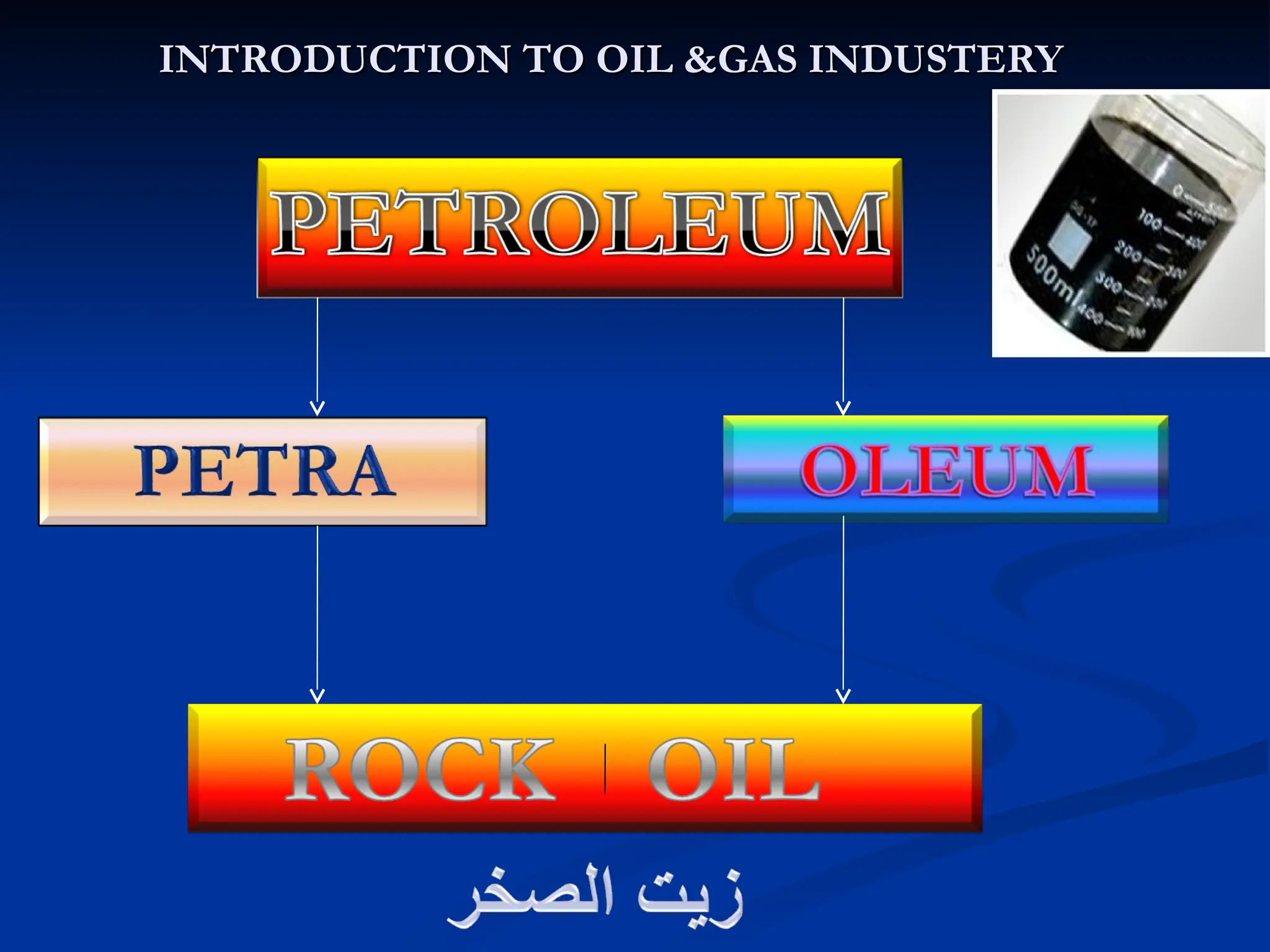
PETROLEUM –The black
gold-
which has many benefits, so
we have
to thank Allah for his gift.
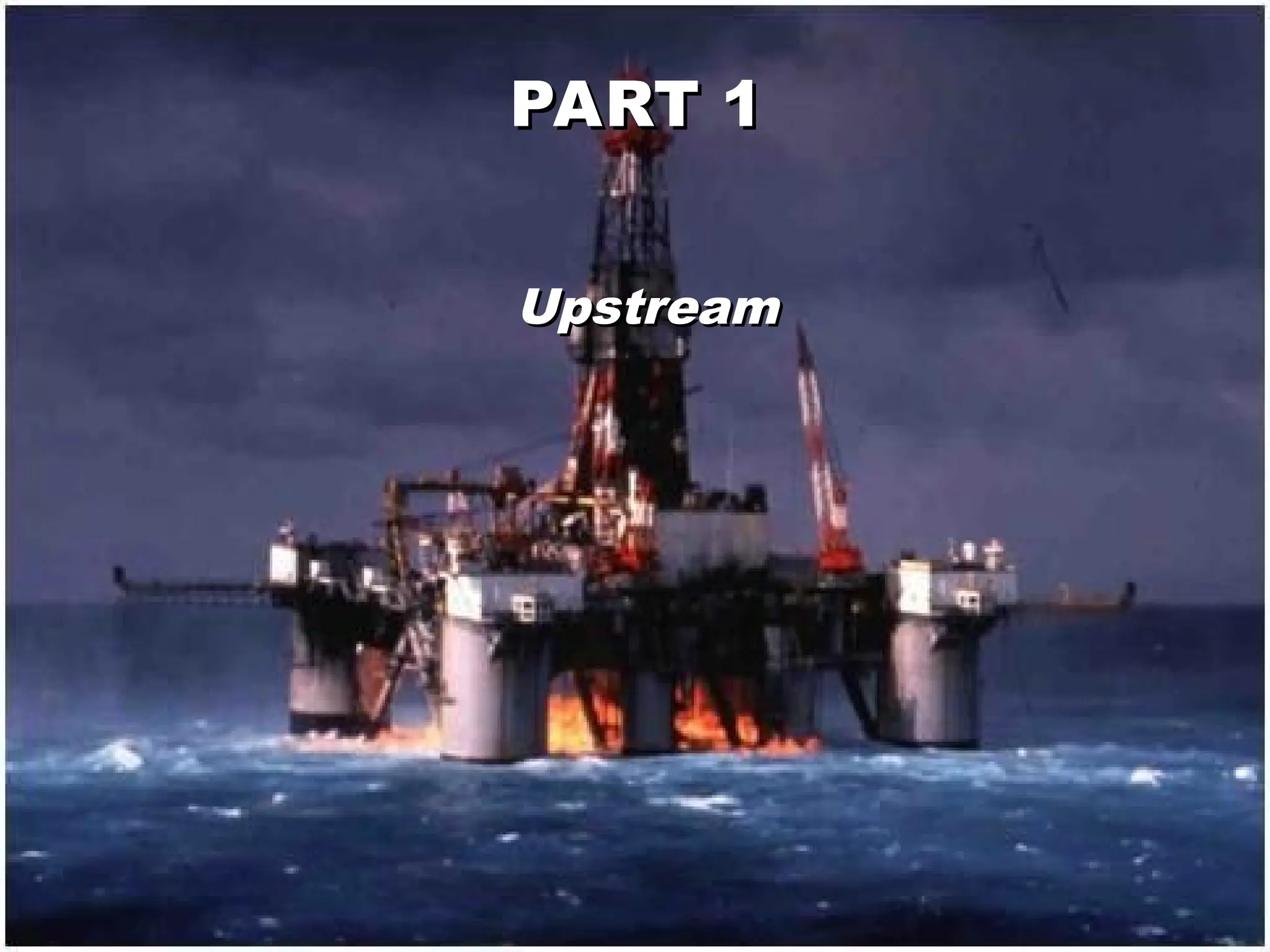
Upstream
Upstream
PART 1
PART 1
Petroleum industry
classifications
.
Upstream (oil industry)
Midstream (oil industry)
Downstream (oil industry)
Upstream (oil industry)
In geography, upstream
literally means towards the
source of a stream or
river, or against the normal
direction of water flow.
The upstream oil sector is a term
commonly used to refer to the
searching for and the recovery and
production of crude oil and natural
gas and bring them to the surface.
The upstream oil sector is also
known as the exploration and
production (E&P) sector.
Midstream (oil industry)
The midstream industry
processes, stores, markets and
transports crude oil, natural
gas, natural gas liquids.
Downstream (oil industry)
The downstream sector includes oil refineries,
petrochemical plants, petroleum product
distribution, retail outlets and natural gas
distribution companies. The downstream industry
touches consumers through thousands of
products such as petrol, diesel, jet fuel, heating
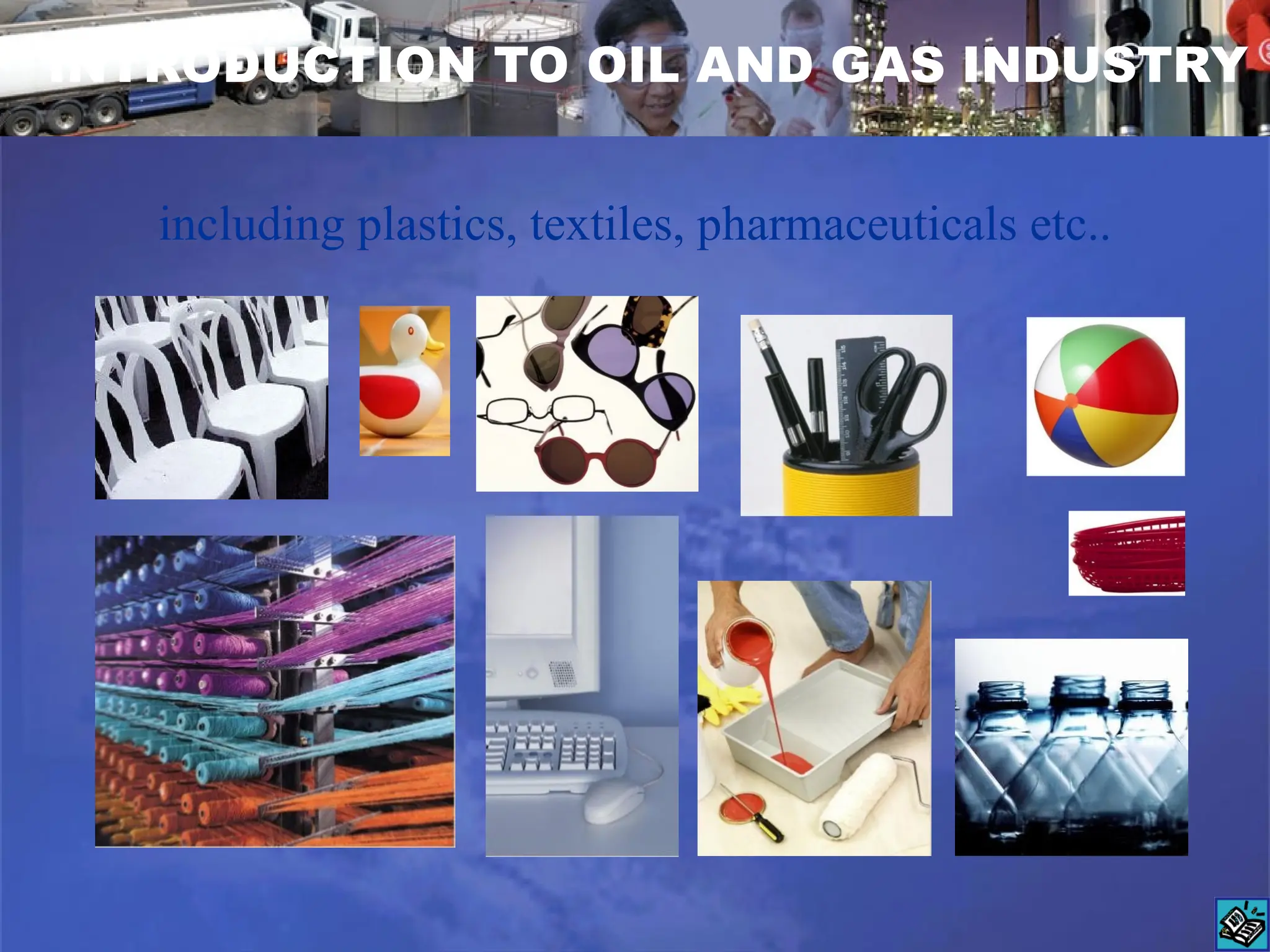
oil, asphalt, lubricants, synthetic rubber, plastics,
fertilizers, antifreeze, pesticides, pharmaceuticals,
natural gas and propane.
INTRODUCTION TO OIL &GAS INDUSTERY
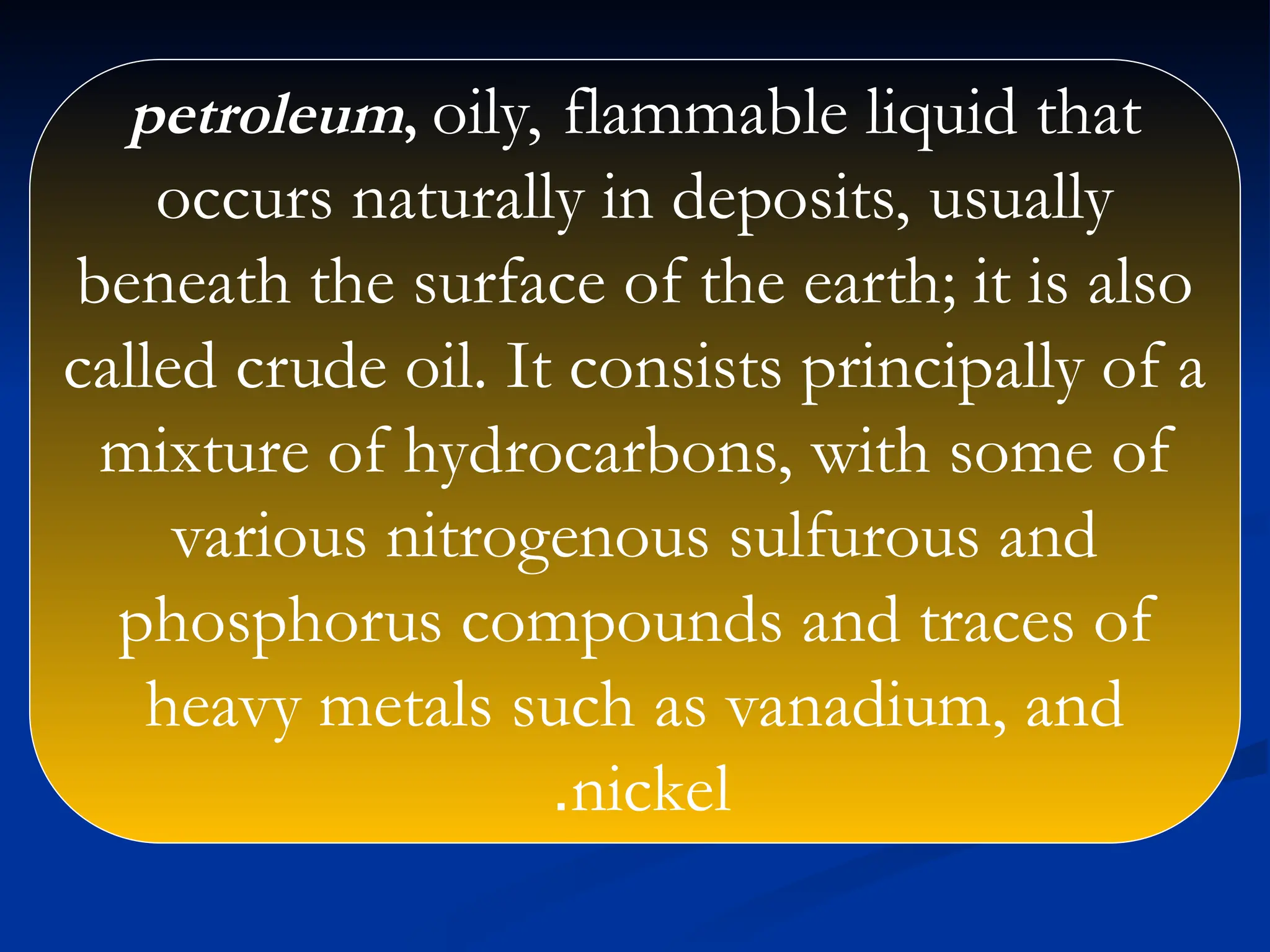
petroleum, oily, flammable liquid that
occurs naturally in deposits, usually
beneath the surface of the earth; it is also
called crude oil. It consists principally of a
mixture of hydrocarbons, with some of
various nitrogenous sulfurous and
phosphorus compounds and traces of
heavy metals such as vanadium, and
nickel
.
 that occur widely in the sedimentary
rocks in the form of gases, liquids,
semisolids, or solids.
 It is not known exactly when
humankind first used petroleum. It is
known, however, that ancient peoples
worshipped sacred fires that were
fuelled by natural gas seeping to the
surface through pores and cracks.
 It is also known that asphalt, a very
viscous form of petroleum, was used
to waterproof boats and heat homes as
early as 6,000 BC. Asphalt was also
used as an embalming agent for
mummies and in the construction of
the Egyptian pyramids around 3,000
BC.
 Approximately 2000 years ago, Arabian
scientists developed methods for the
distillation of petroleum, which were
introduced into Europe by way of Spain.
This represents another documented use of
the volatile derivatives of petroleum which
led to a continued interest in petroleum
and its derivatives as medicinal materials
and materials for warfare, in addition to the
usual construction materials.
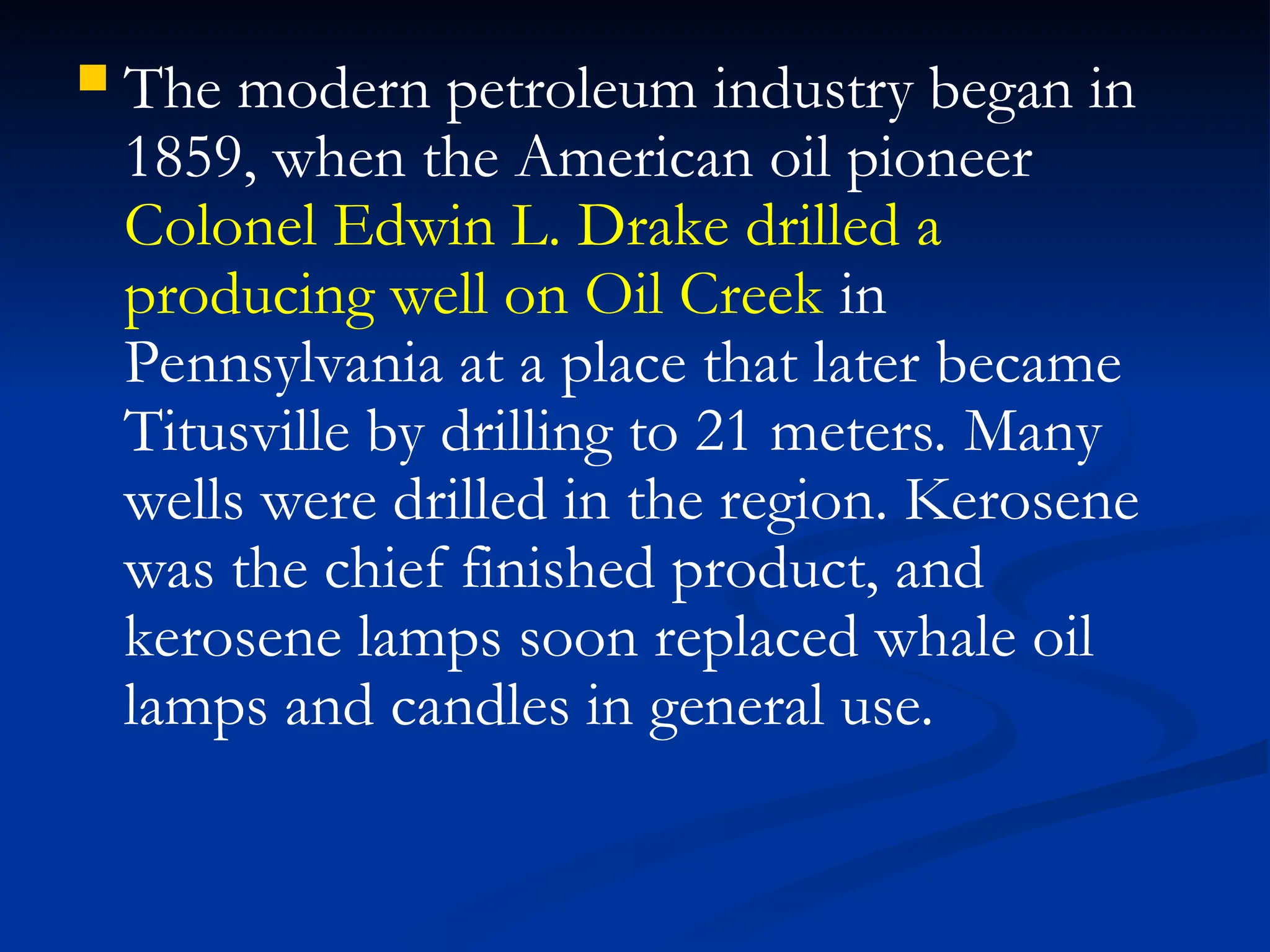
 The modern petroleum industry began in
1859, when the American oil pioneer
Colonel Edwin L. Drake drilled a
producing well on Oil Creek in
Pennsylvania at a place that later became
Titusville by drilling to 21 meters. Many
wells were drilled in the region. Kerosene
was the chief finished product, and
kerosene lamps soon replaced whale oil
lamps and candles in general use.
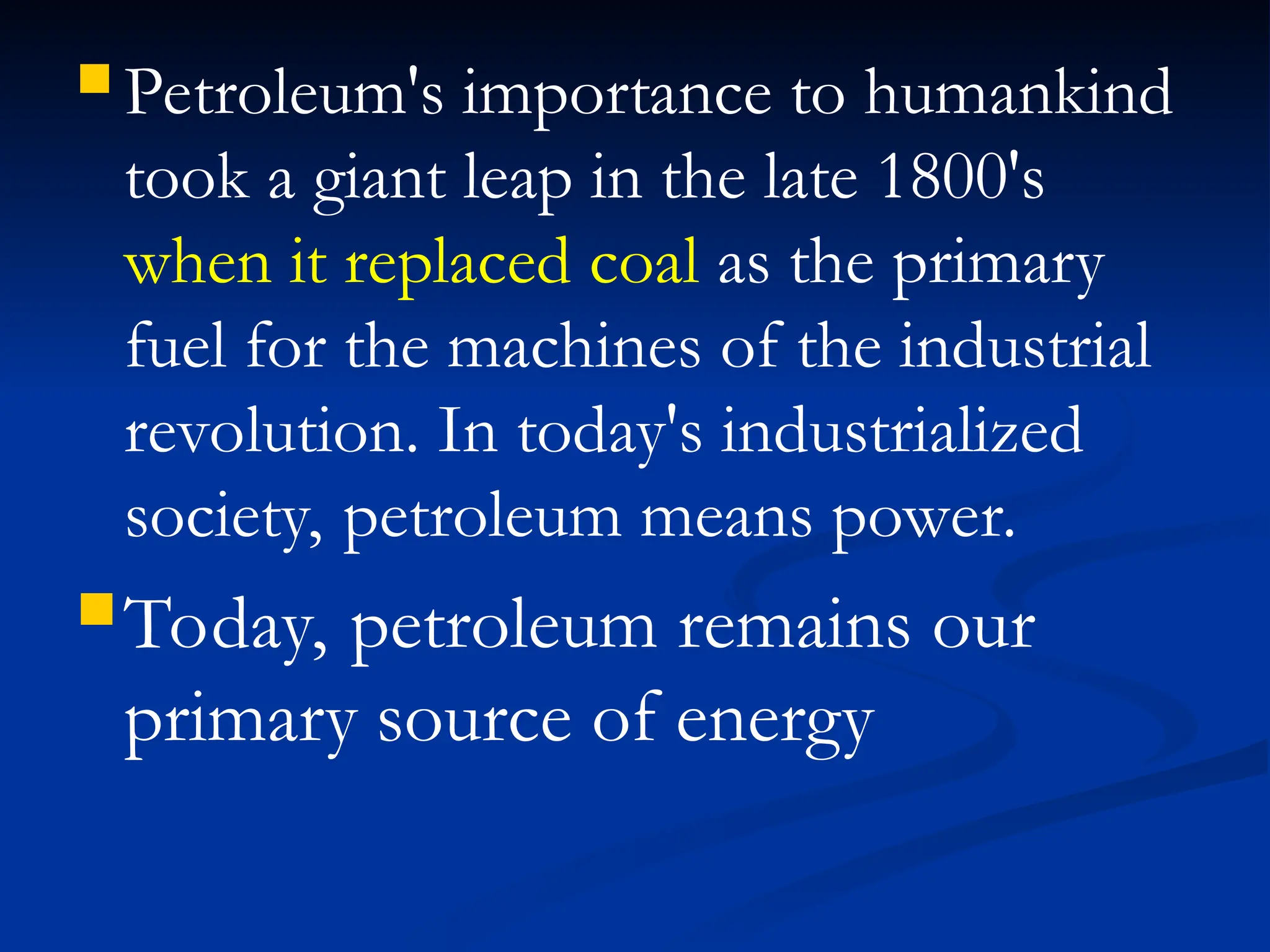
 Petroleum's importance to humankind
took a giant leap in the late 1800's
when it replaced coal as the primary
fuel for the machines of the industrial
revolution. In today's industrialized
society, petroleum means power.
Today, petroleum remains our
primary source of energy
Why is Oil so Important in Today’s
World?
 When you got out of bed, perhaps your family
uses a natural gas-burning stove. Next you may
have taken a gasoline or diesel powered car (or
bus) to business. So, as you can see, before you
even started your business day you already used
a certain amount of petroleum.
 Try and imagine how your life might change if
we suddenly lost our supply of oil.
including plastics, textiles, pharmaceuticals etc..
INTRODUCTION TO OIL AND GAS INDUSTRY
 Upstream
Upstream
PART 1
PART 1
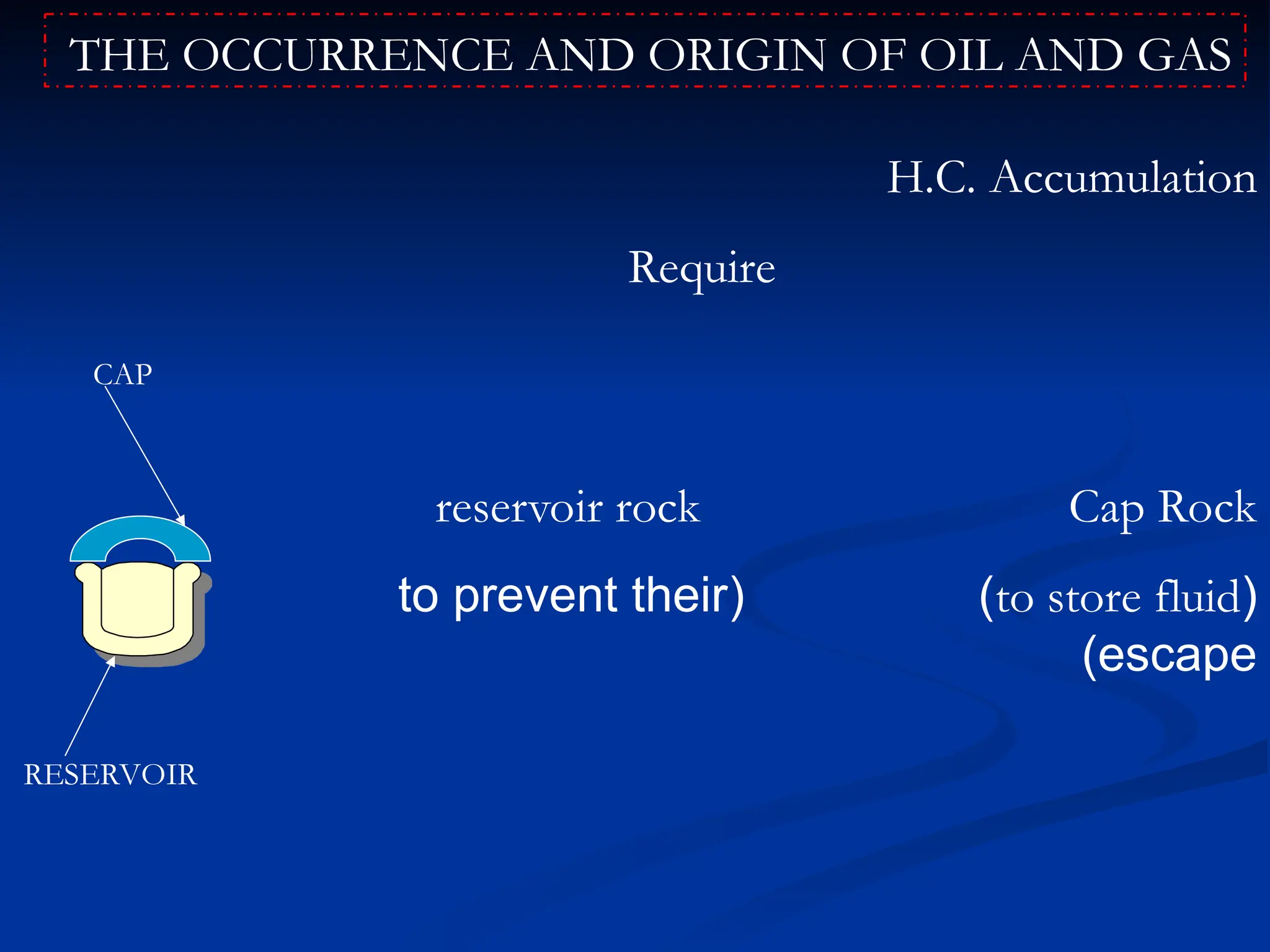
THE OCCURRENCE AND ORIGIN OF OIL AND GAS
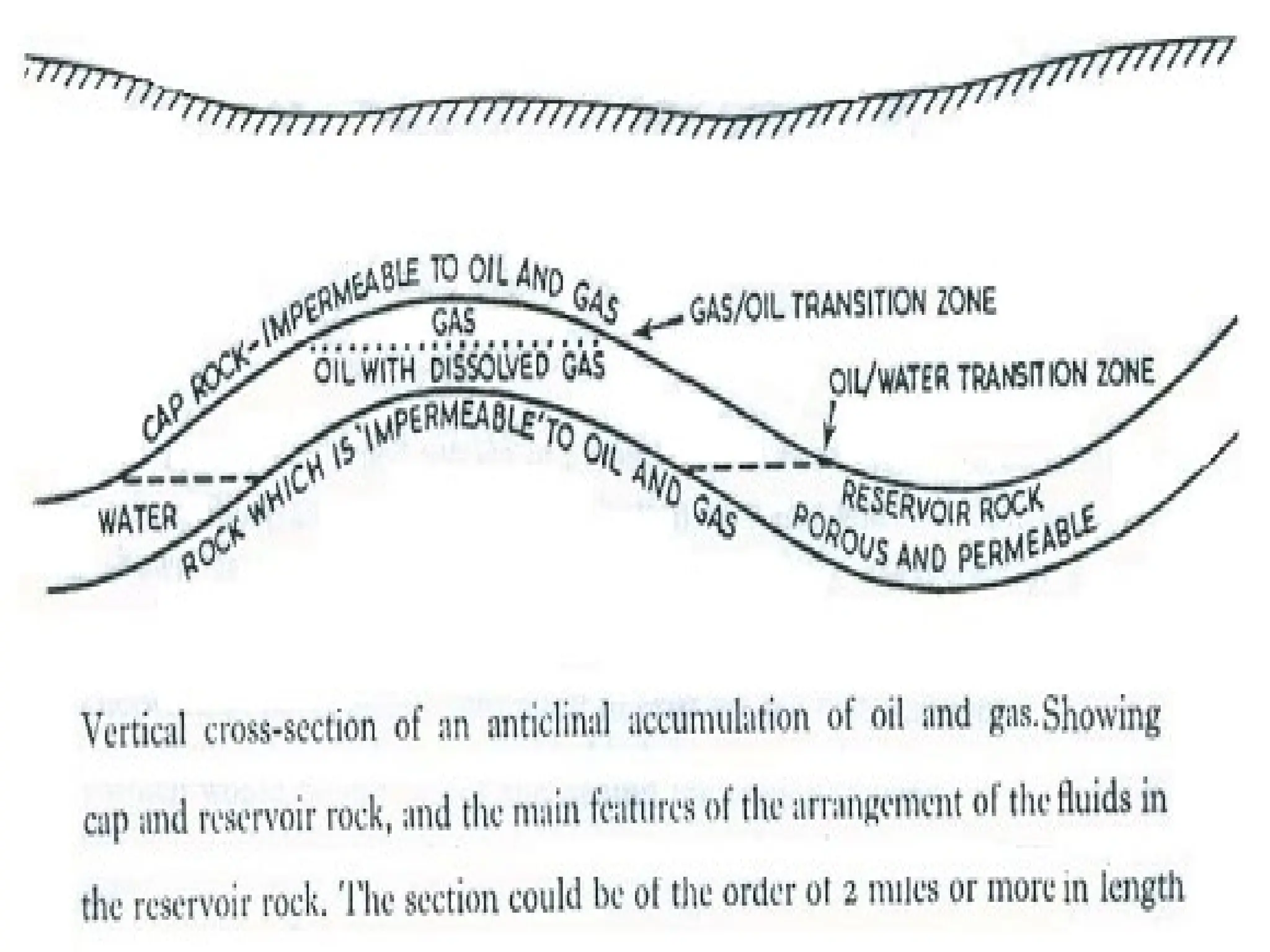
RESERVOIR
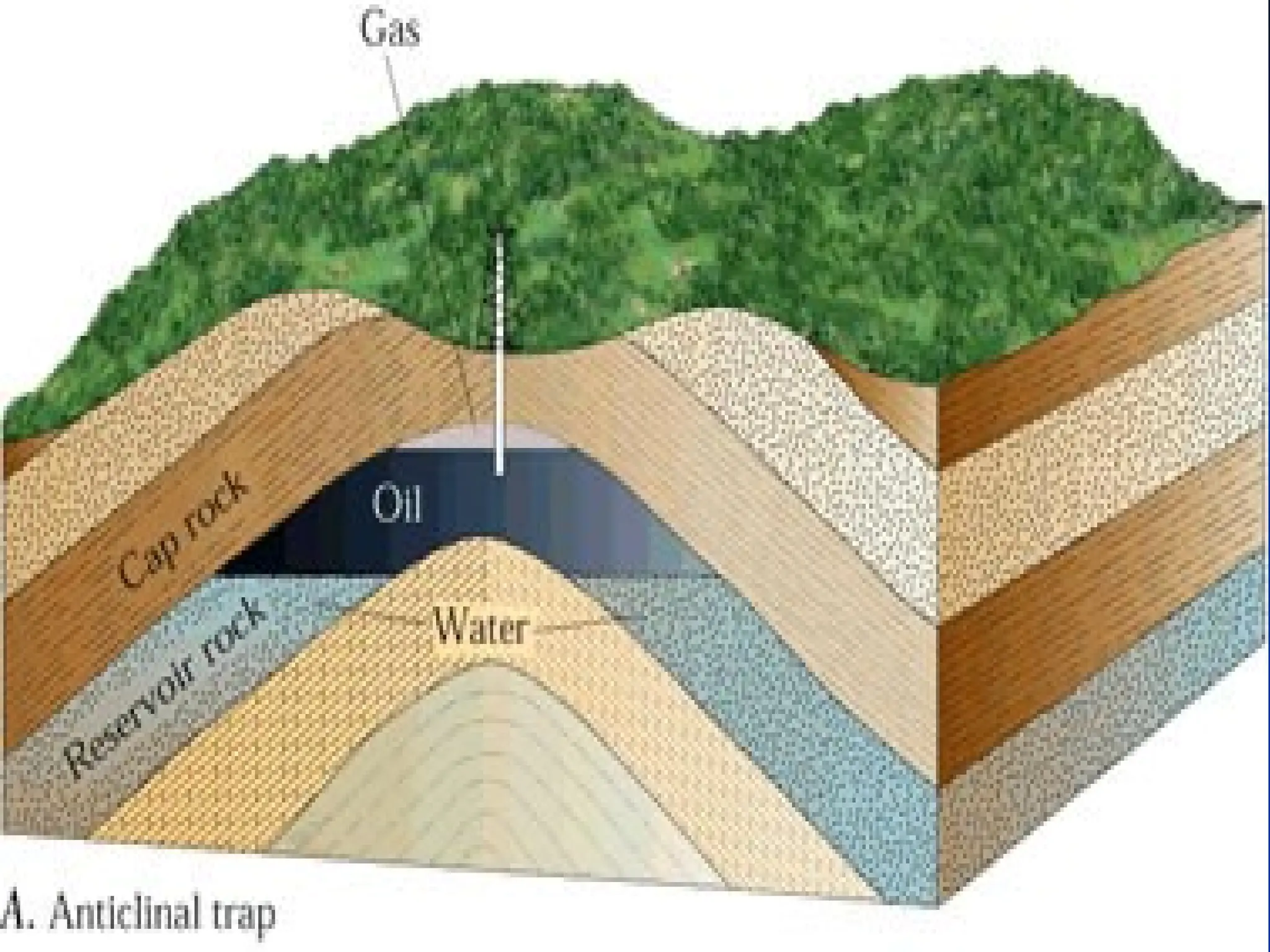
CAP
H.C. Accumulation
Require
reservoir rock Cap Rock
(
to store fluid
( )
to prevent their
escape
)
Three Types of Rocks
 Before we proceed to discuss where oil is found in
the subsurface, we must become familiar with some
new terminology; namely, the three types of rocks;
Igneous,
Sedimentary and
Metamorphic.
 Igneous rocks :
Igneous rocks : are rocks that have
are rocks that have
solidified from a molten or liquid state.
 Formed from the cooling of volcanic
Formed from the cooling of volcanic
lava.
lava.
 Igneous rocks do not normally contain
Igneous rocks do not normally contain
hydrocarbons.
hydrocarbons.
 Sedimentary rocks:
Sedimentary rocks: are formed by the laying down
are formed by the laying down
of sediment in seas, rivers or lakes
of sediment in seas, rivers or lakes.
.
 The particles of sediment that accumulate are
The particles of sediment that accumulate are
eventually cemented together to form
sedimentary rock .
sedimentary rock .
 hydrocarbons are normally found in the spaces
hydrocarbons are normally found in the spaces
between the particles of these sedimentary
rocks
rocks
 Metamorphic rocks:
Metamorphic rocks: are formed by the
are formed by the
metamorphosis of existing rock, be it igneous or
sedimentary, by extreme heat and pressure.
 These factors cause recrystallization of the
These factors cause recrystallization of the
minerals in the rock.
 Metamorphic rocks do not normally
Metamorphic rocks do not normally
contain hydrocarbons.
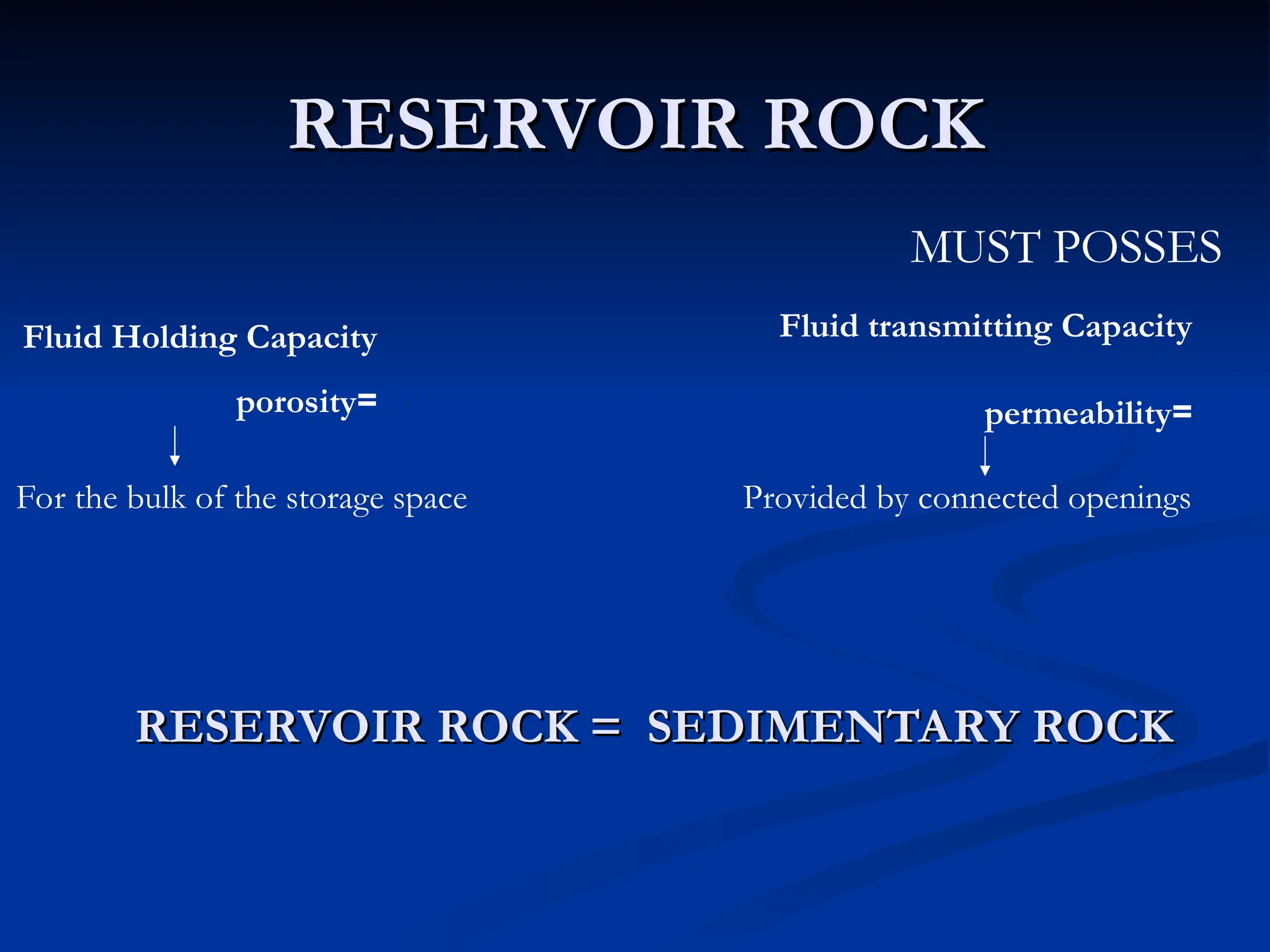
RESERVOIR ROCK
RESERVOIR ROCK
MUST POSSES
Fluid Holding Capacity
=
porosity
Fluid transmitting Capacity
=
permeability
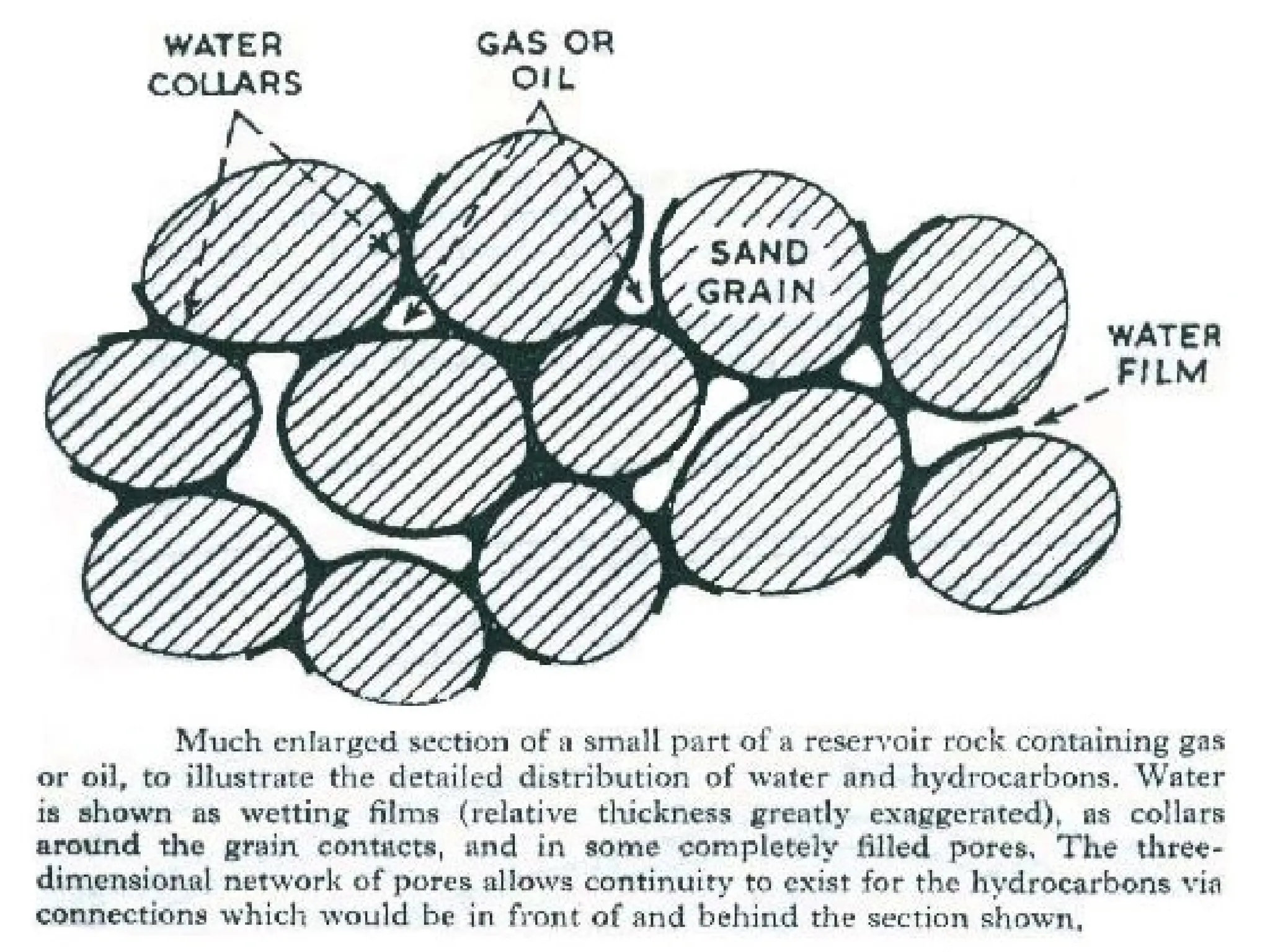
For the bulk of the storage space Provided by connected openings
RESERVOIR ROCK = SEDIMENTARY ROCK
=
=
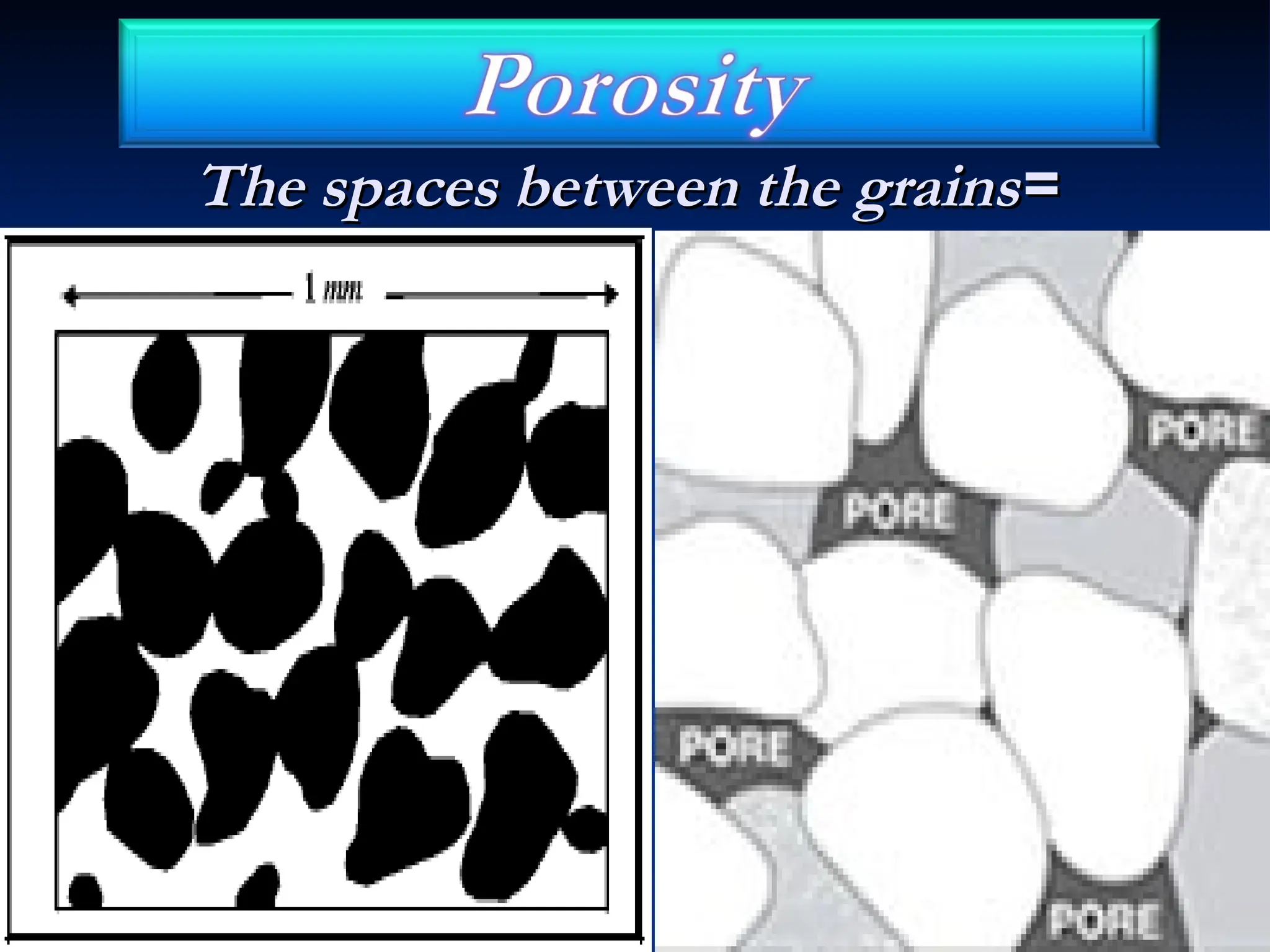
The spaces between the grains
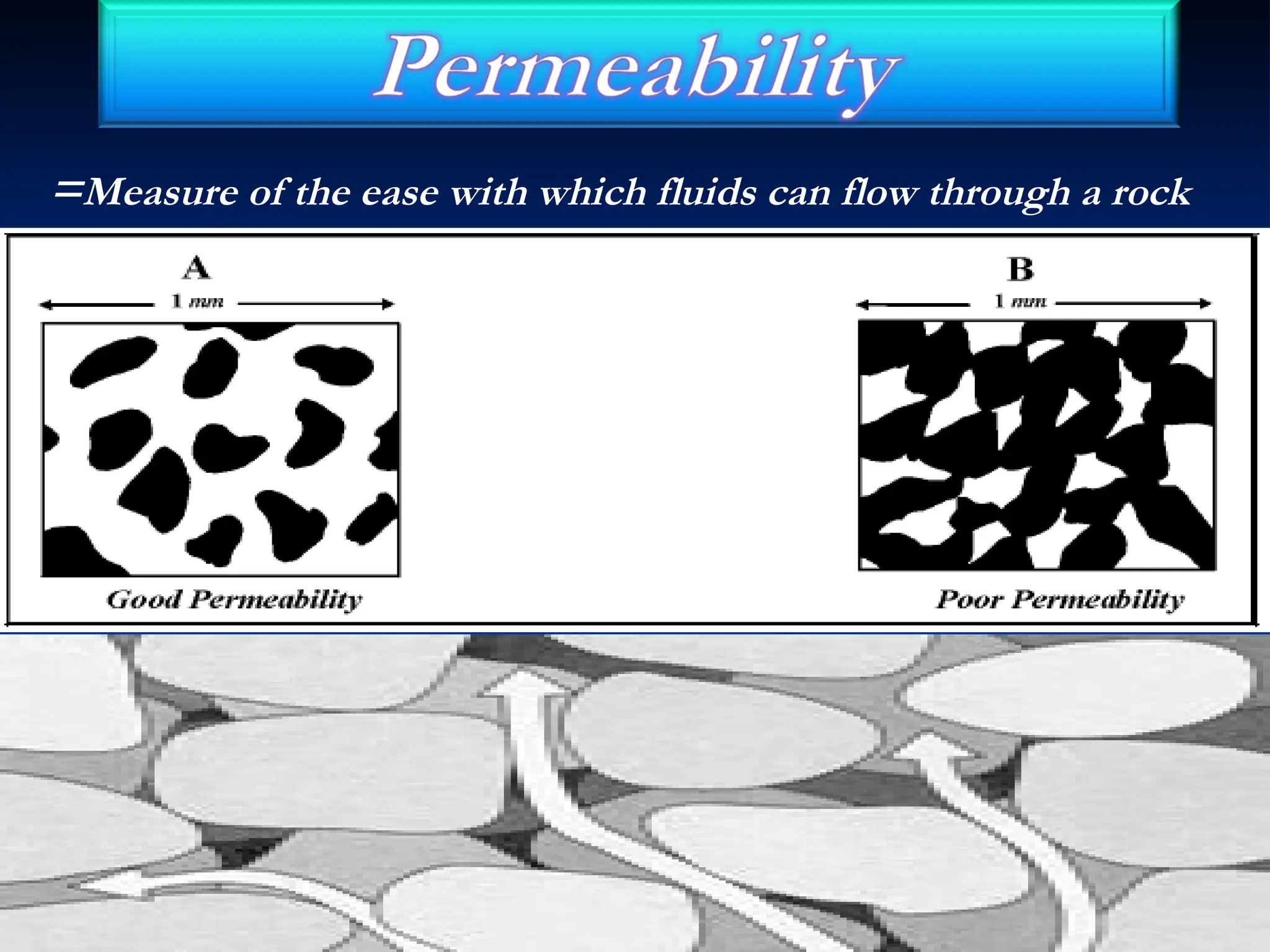
=Measure of the ease with which fluids can flow through a rock
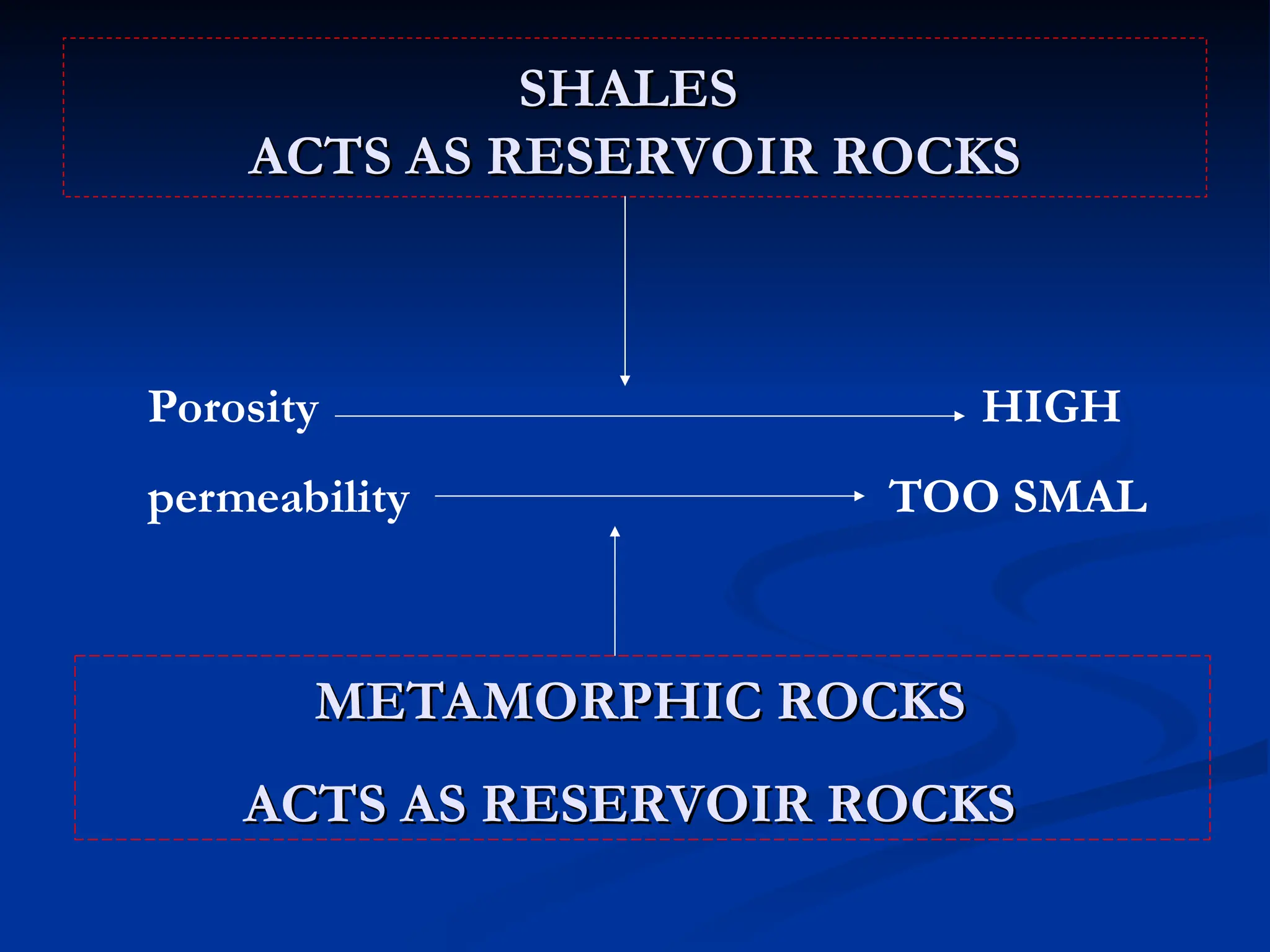
SHALES
SHALES
ACTS AS RESERVOIR ROCKS
METAMORPHIC ROCKS
METAMORPHIC ROCKS
ACTS AS RESERVOIR ROCKS
Porosity HIGH
permeability TOO SMAL
CAP ROCK
CAP ROCK
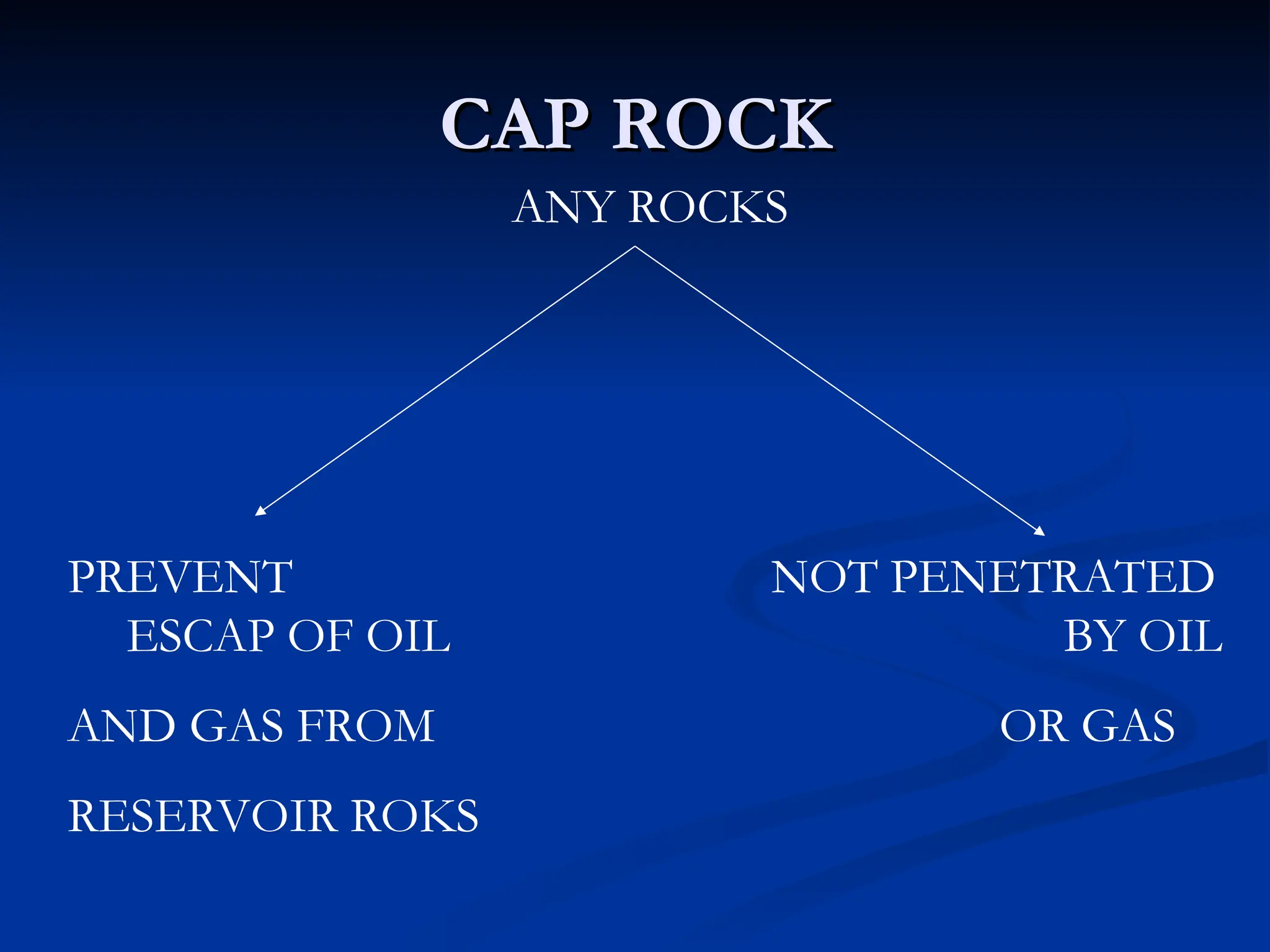
ANY ROCKS
PREVENT NOT PENETRATED
ESCAP OF OIL BY OIL
AND GAS FROM OR GAS
RESERVOIR ROKS
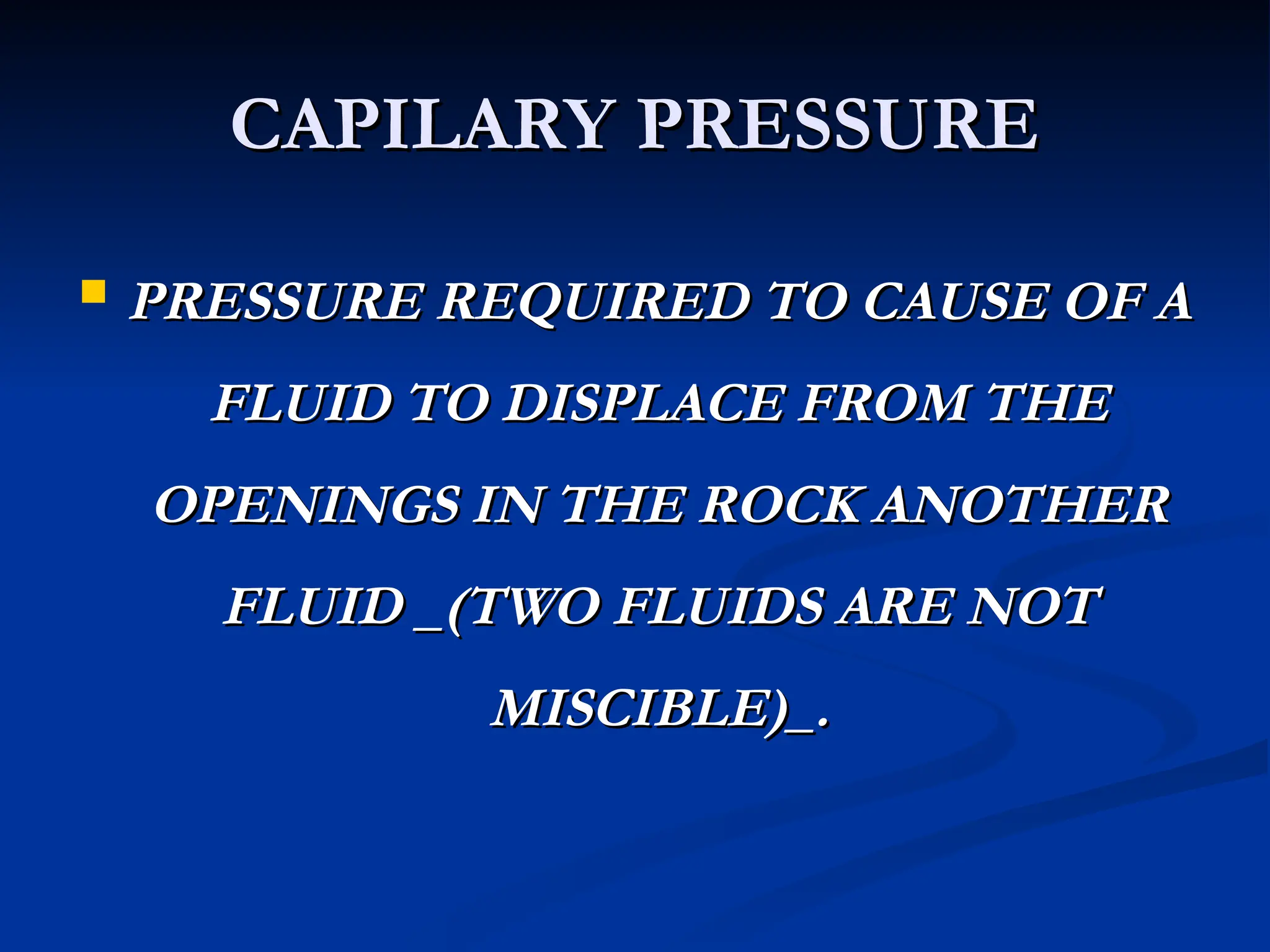
CAPILARY PRESSURE
CAPILARY PRESSURE
 PRESSURE REQUIRED TO CAUSE OF A
PRESSURE REQUIRED TO CAUSE OF A
FLUID TO DISPLACE FROM THE
OPENINGS IN THE ROCK ANOTHER
FLUID _(TWO FLUIDS ARE NOT
MISCIBLE)_.
MISCIBLE)_.
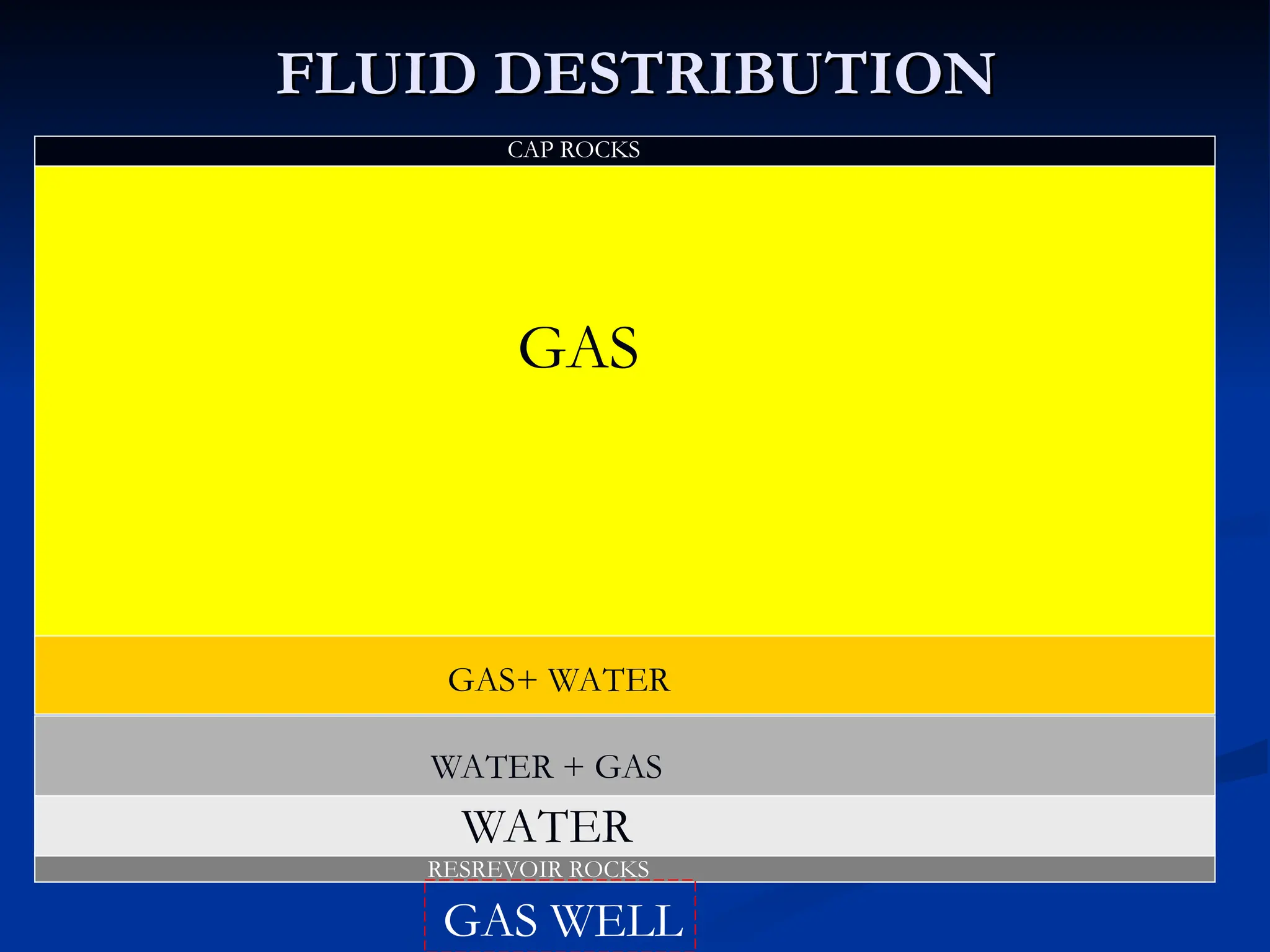
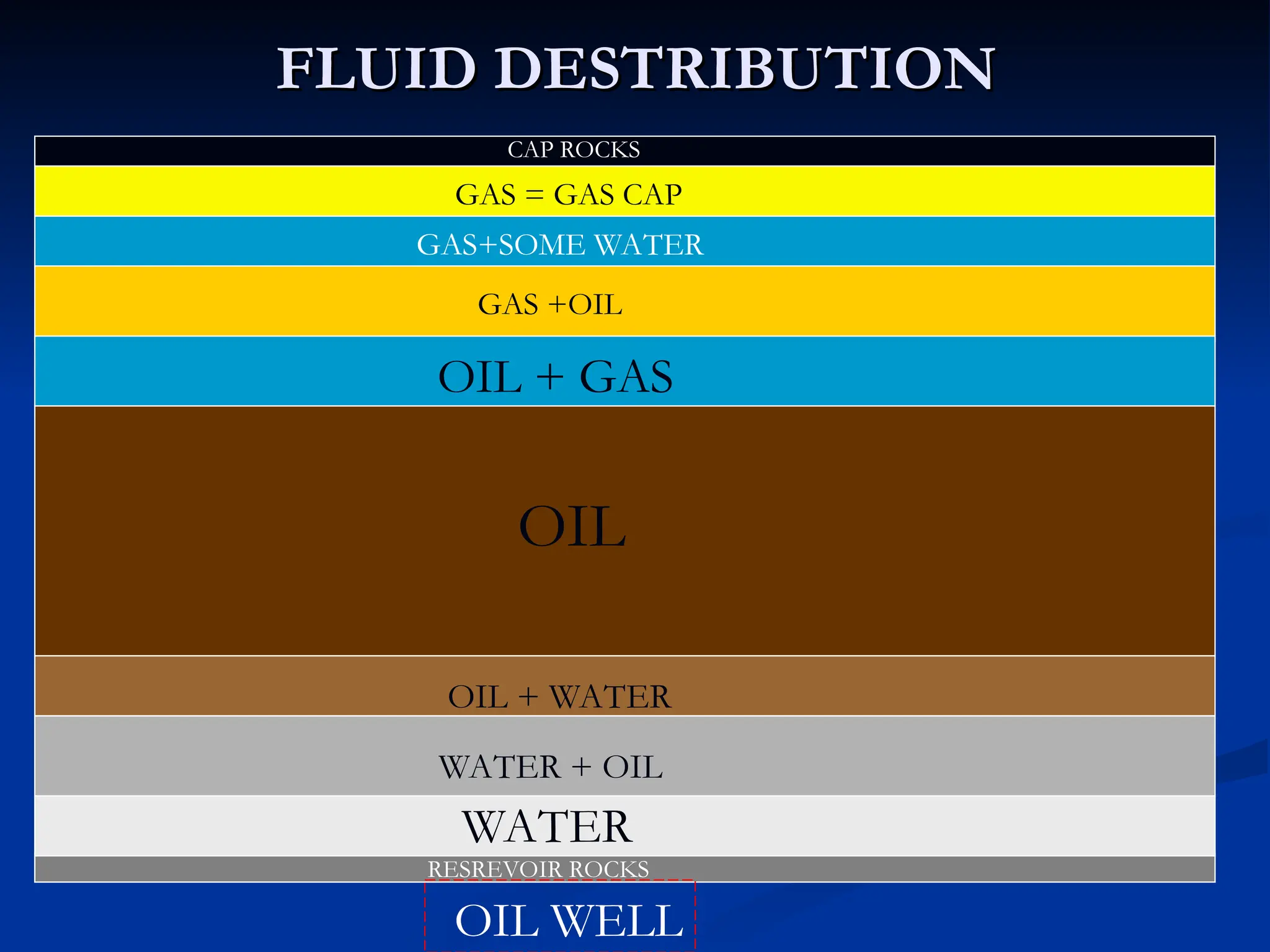
FLUID DESTRIBUTION
FLUID DESTRIBUTION
CAP ROCKS
GAS = GAS CAP
GAS+SOME WATER
GAS +OIL
OIL + GAS
OIL
RESREVOIR ROCKS
OIL + WATER
WATER + OIL
WATER
OIL WELL
FLUID DESTRIBUTION
FLUID DESTRIBUTION
CAP ROCKS
GAS
RESREVOIR ROCKS
GAS+ WATER
WATER + GAS
WATER
GAS WELL
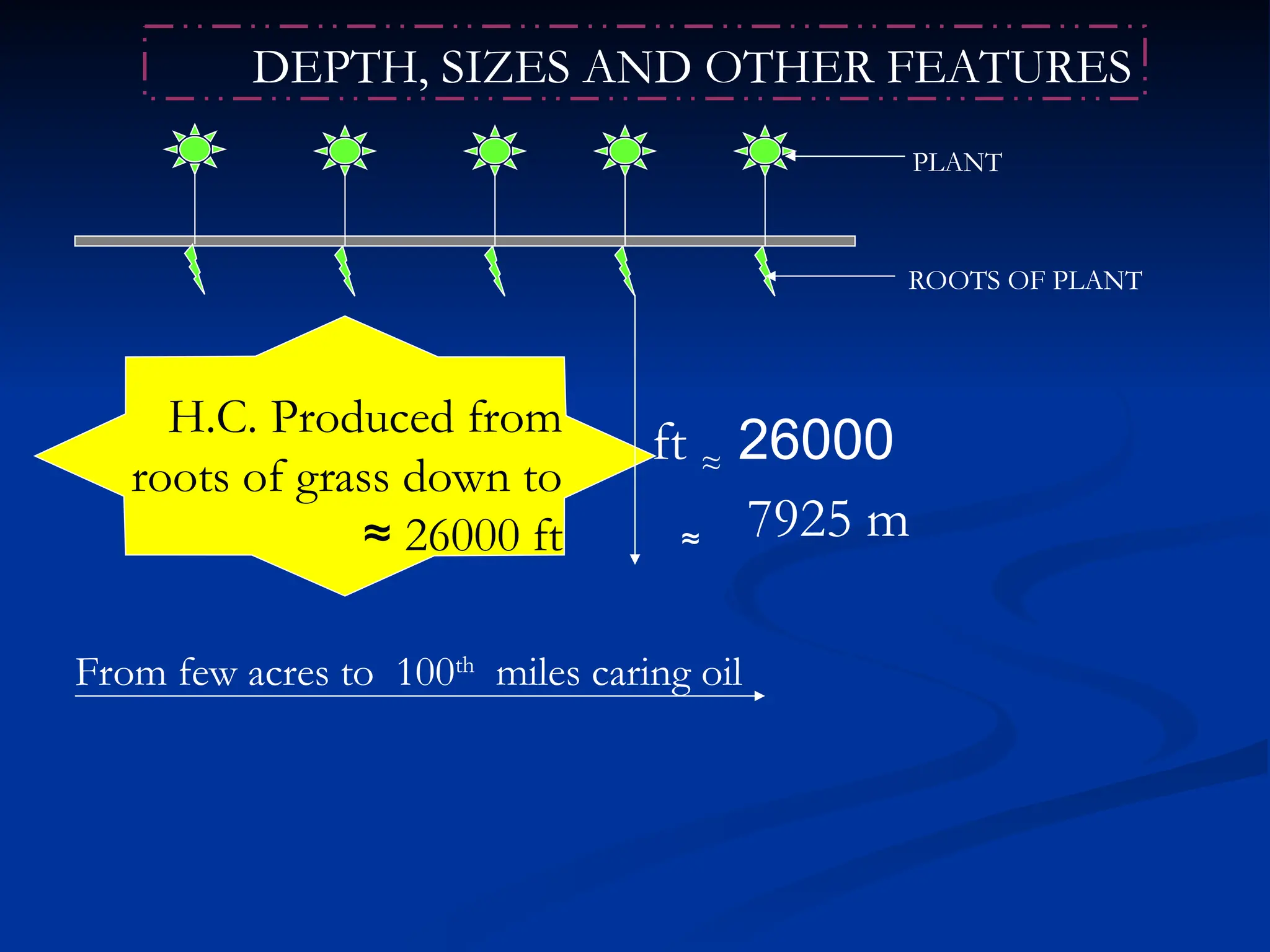
DEPTH, SIZES AND OTHER FEATURES
PLANT
ROOTS OF PLANT
26000
ft ≈
7925 m
≈
H.C. Produced from
roots of grass down to
26000 ft
≈
From few acres to 100th
miles caring oil
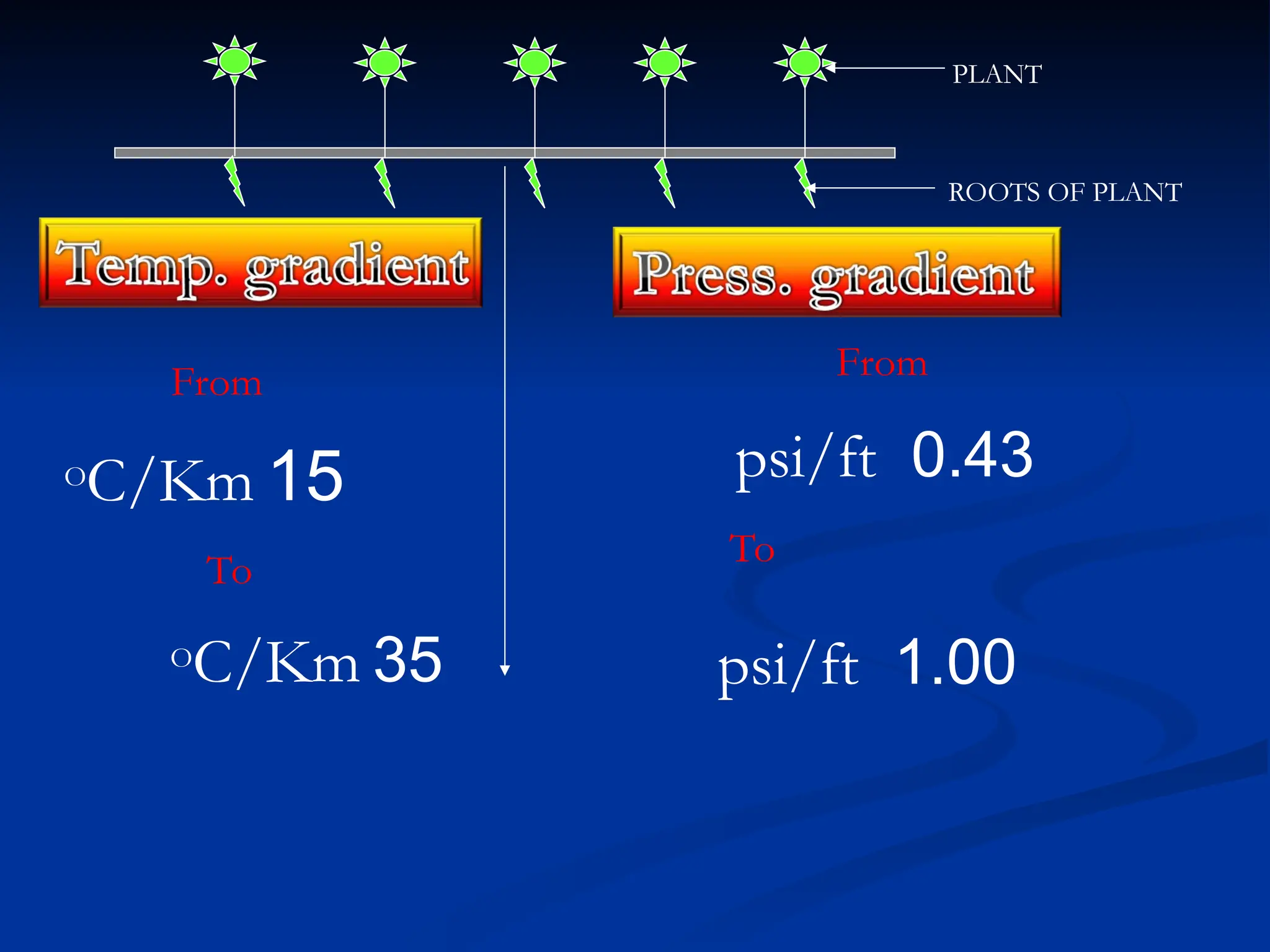
PLANT
ROOTS OF PLANT
From
15
O
C/Km
To
35
O
C/Km
From
0.43
psi/ft
To
1.00
psi/ft
Oil reservoir rock thickness
Oil reservoir rock thickness from few ft to 100
from few ft to 100th
th
ft
ft
Hight of H. C. zone from 10
from 10th
th
ft to 100th ft
ft to 100th ft
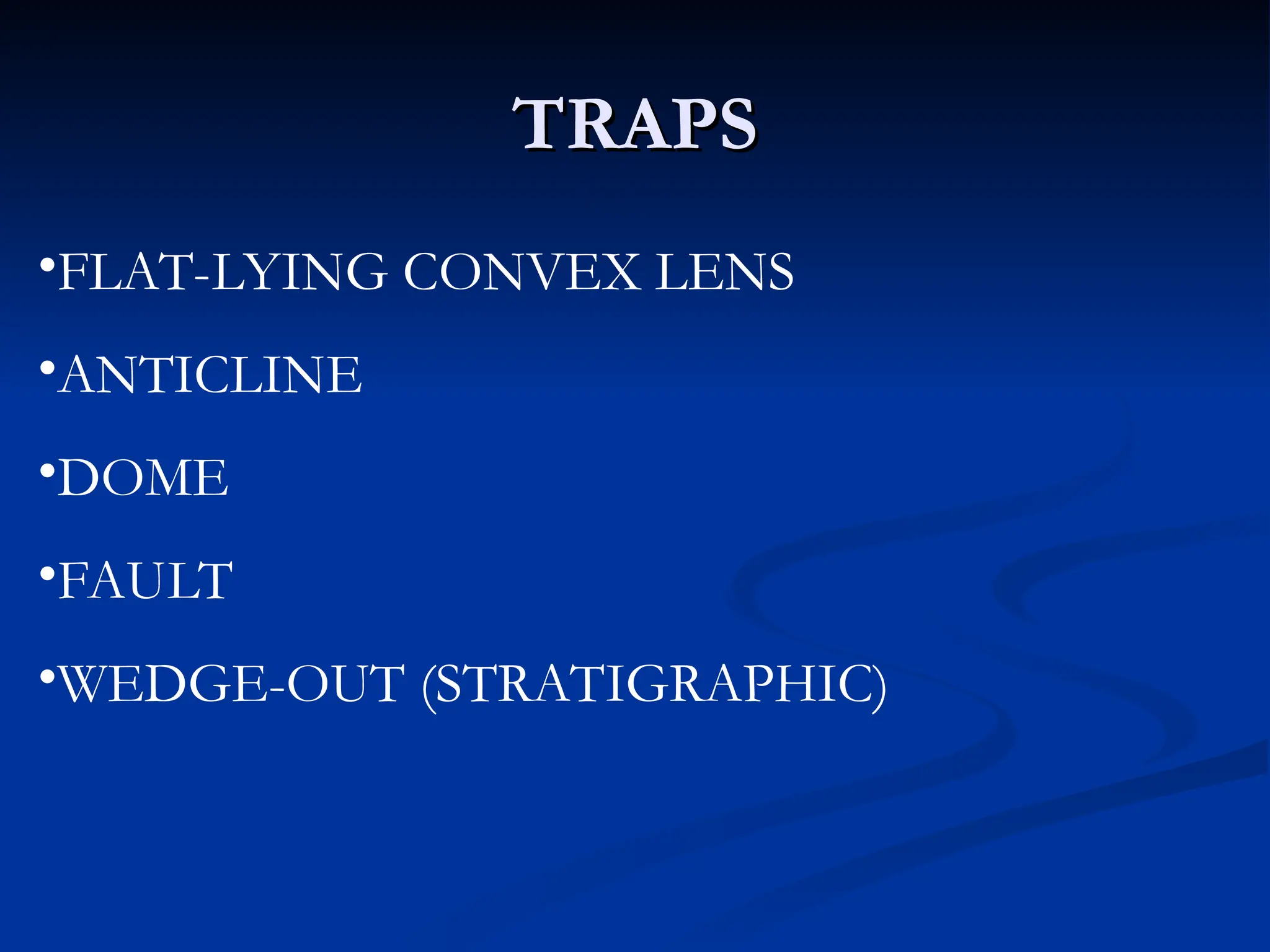
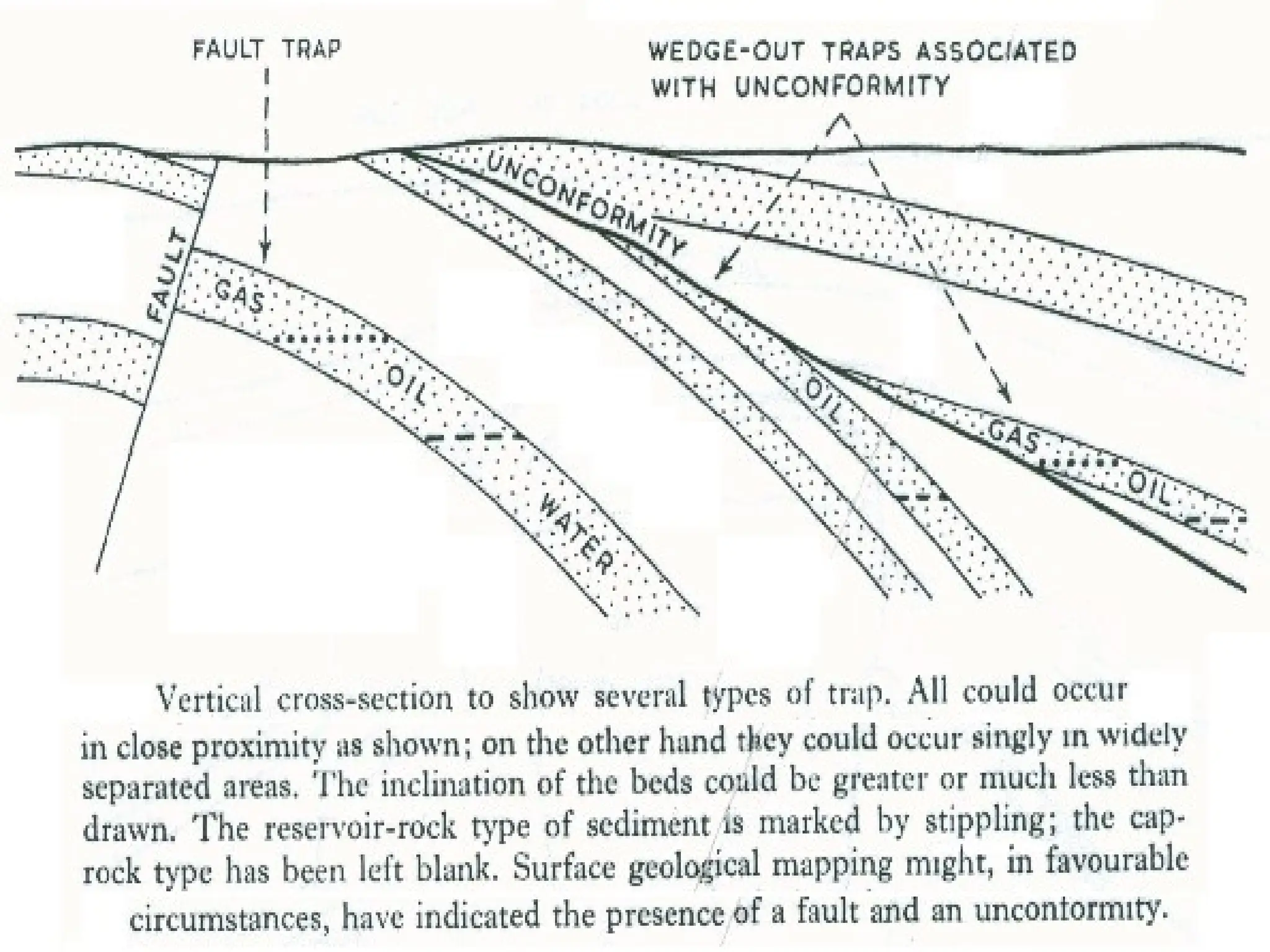
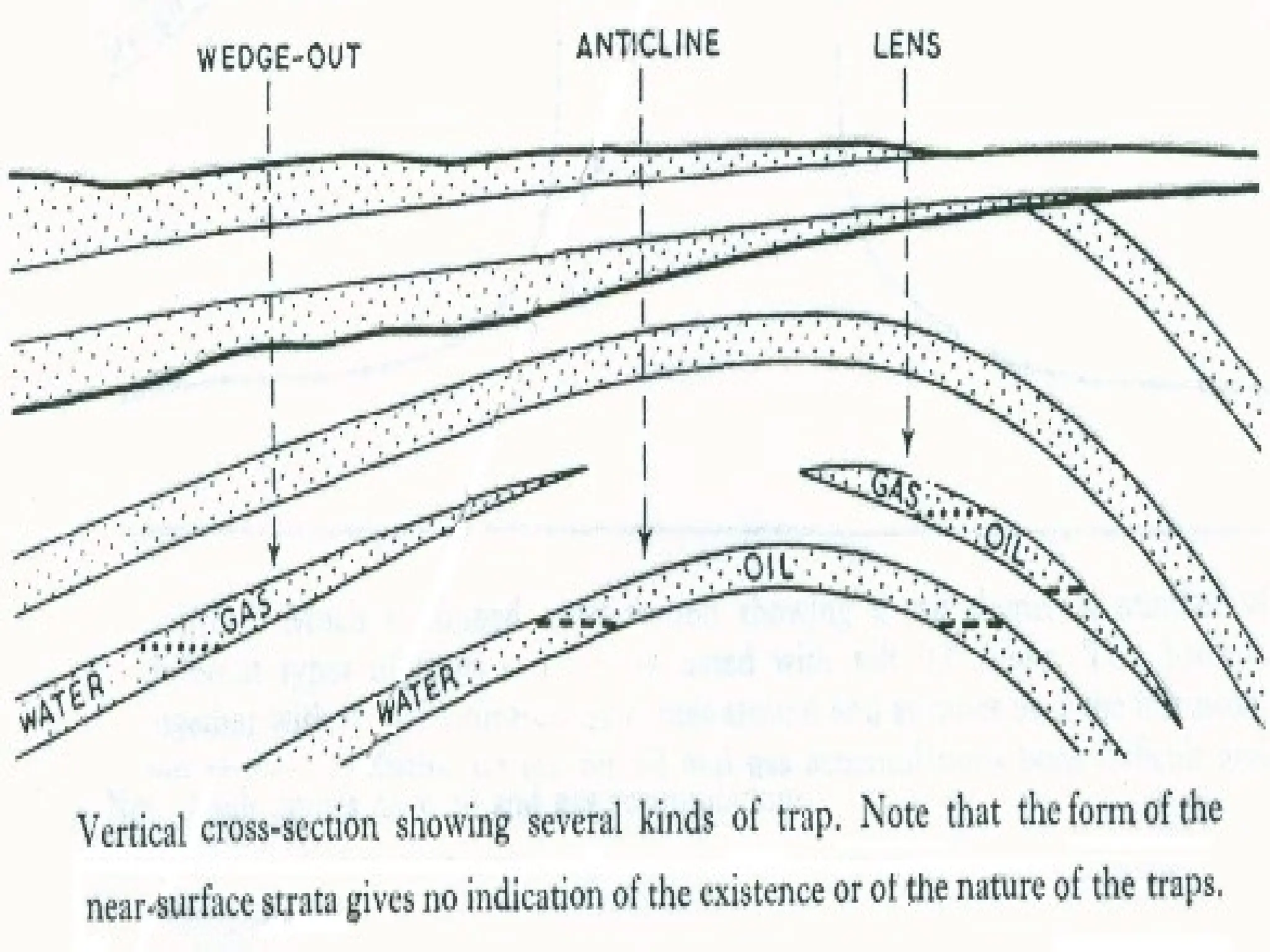
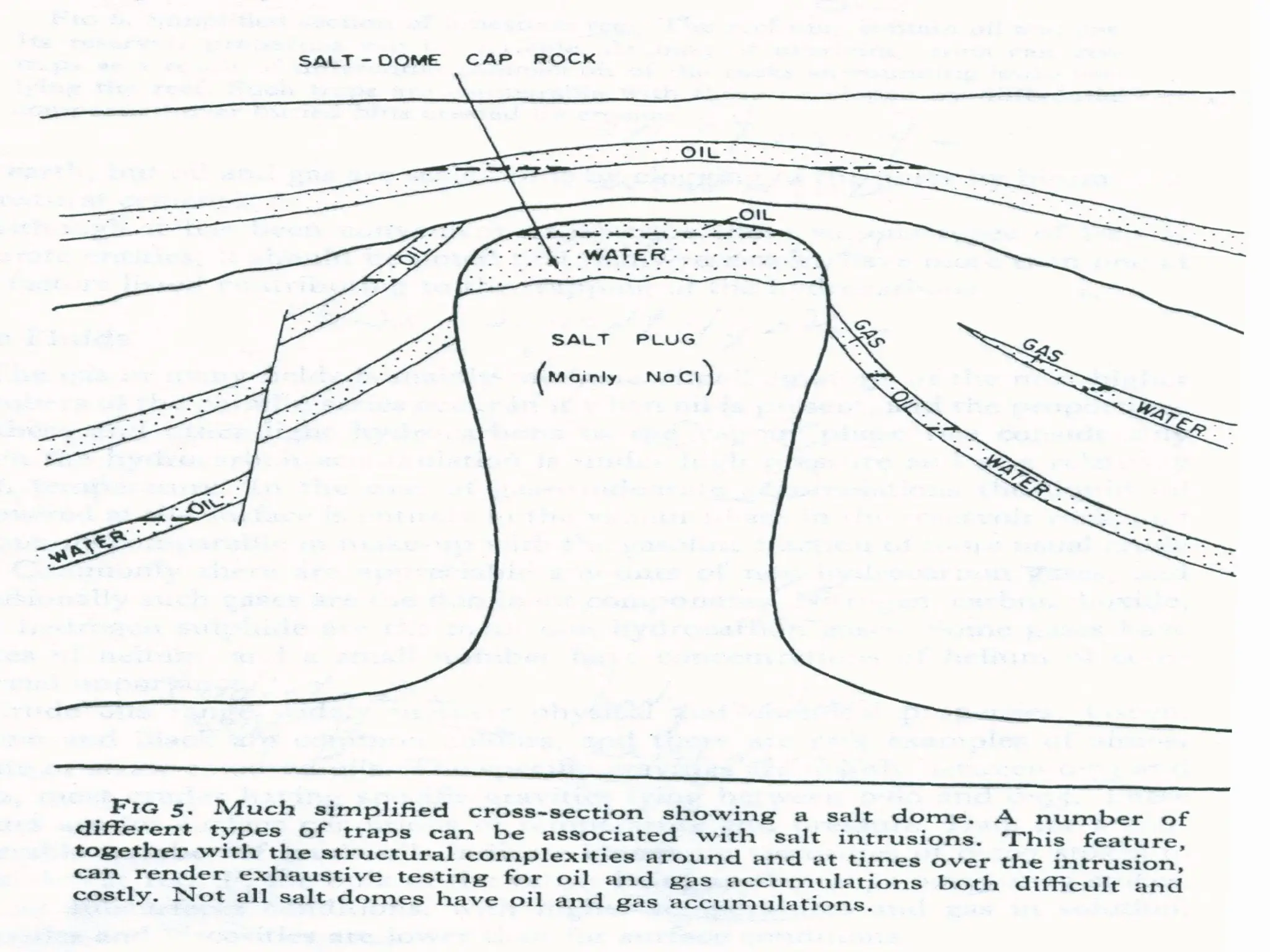
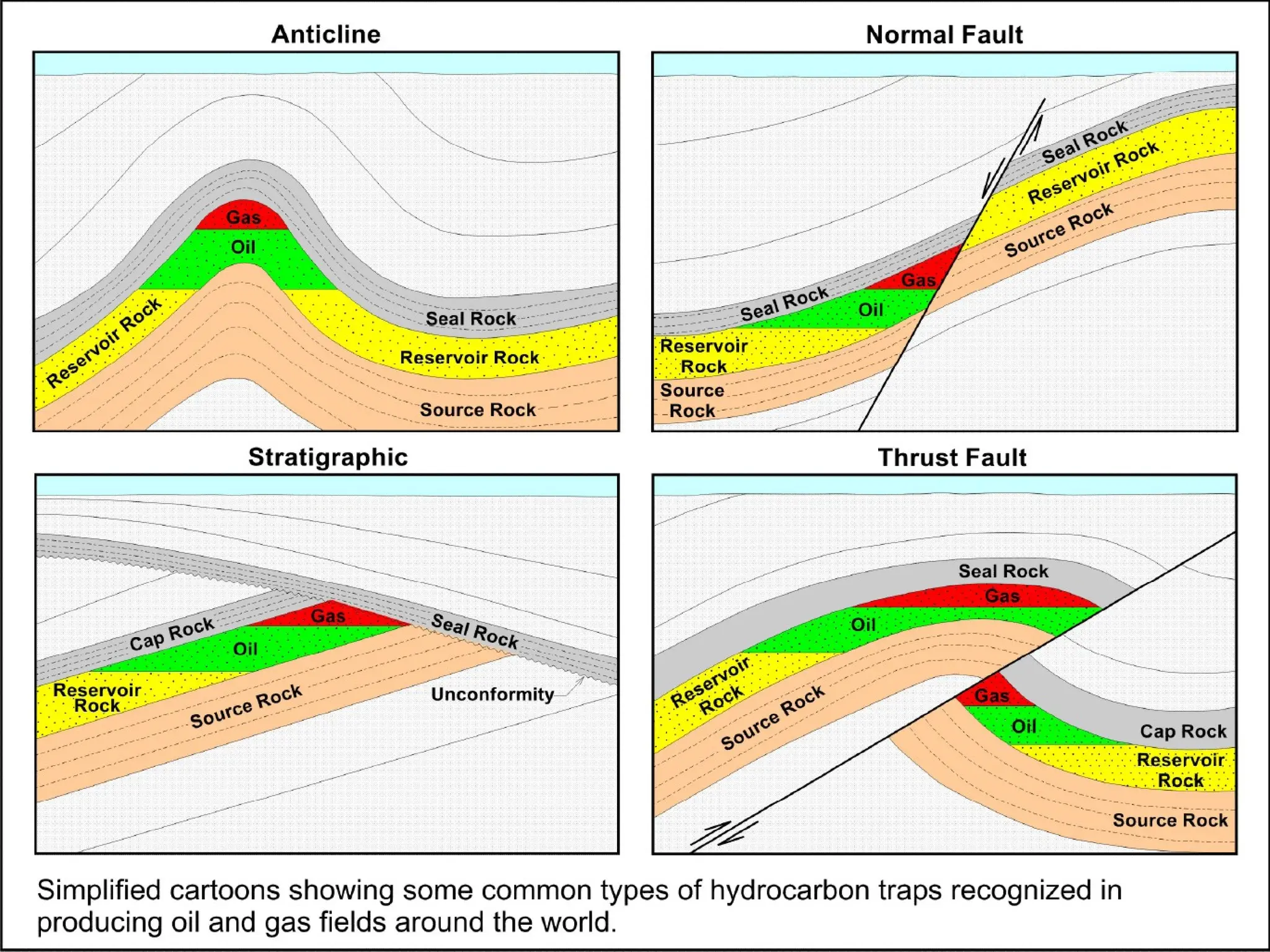
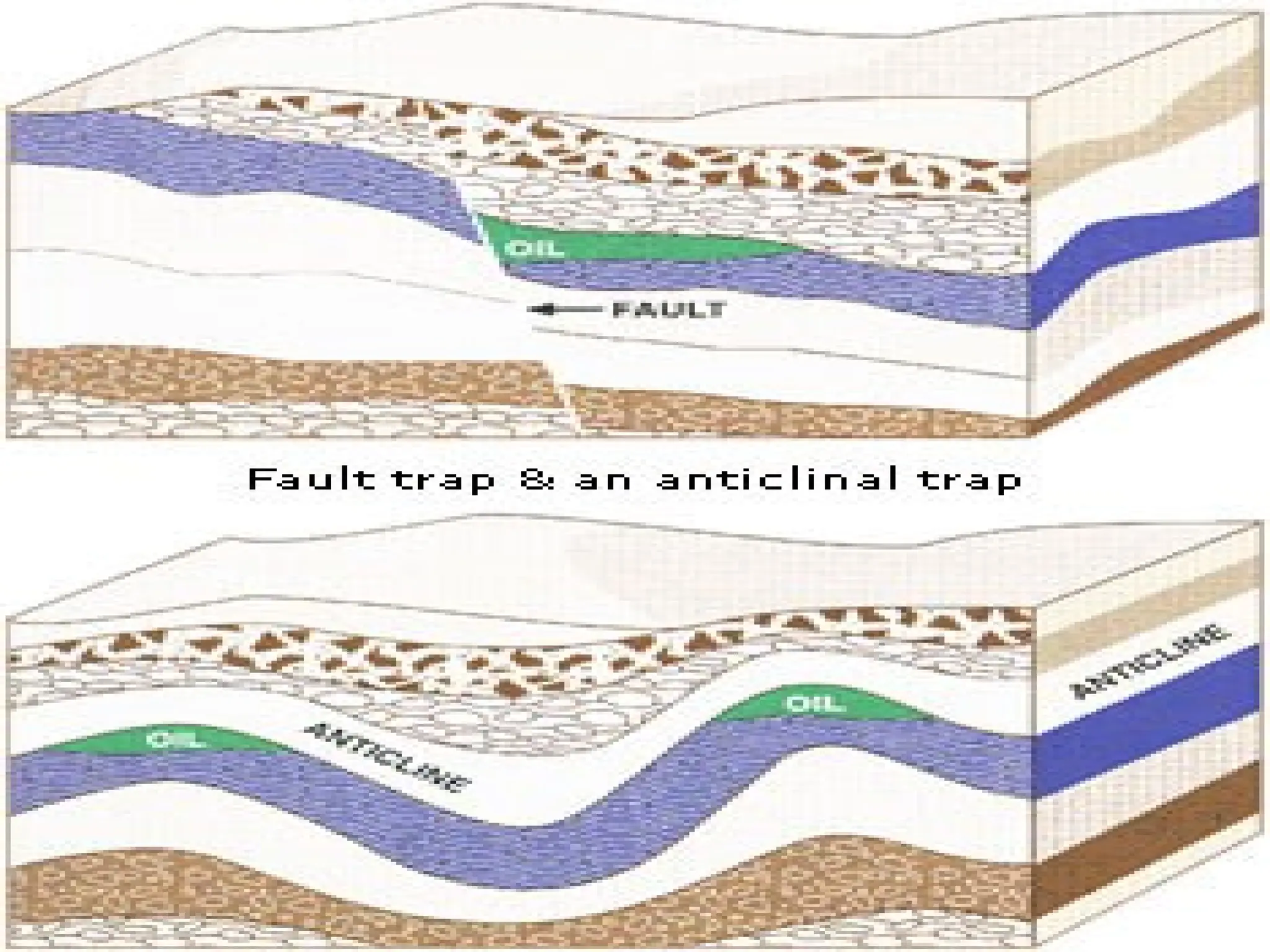
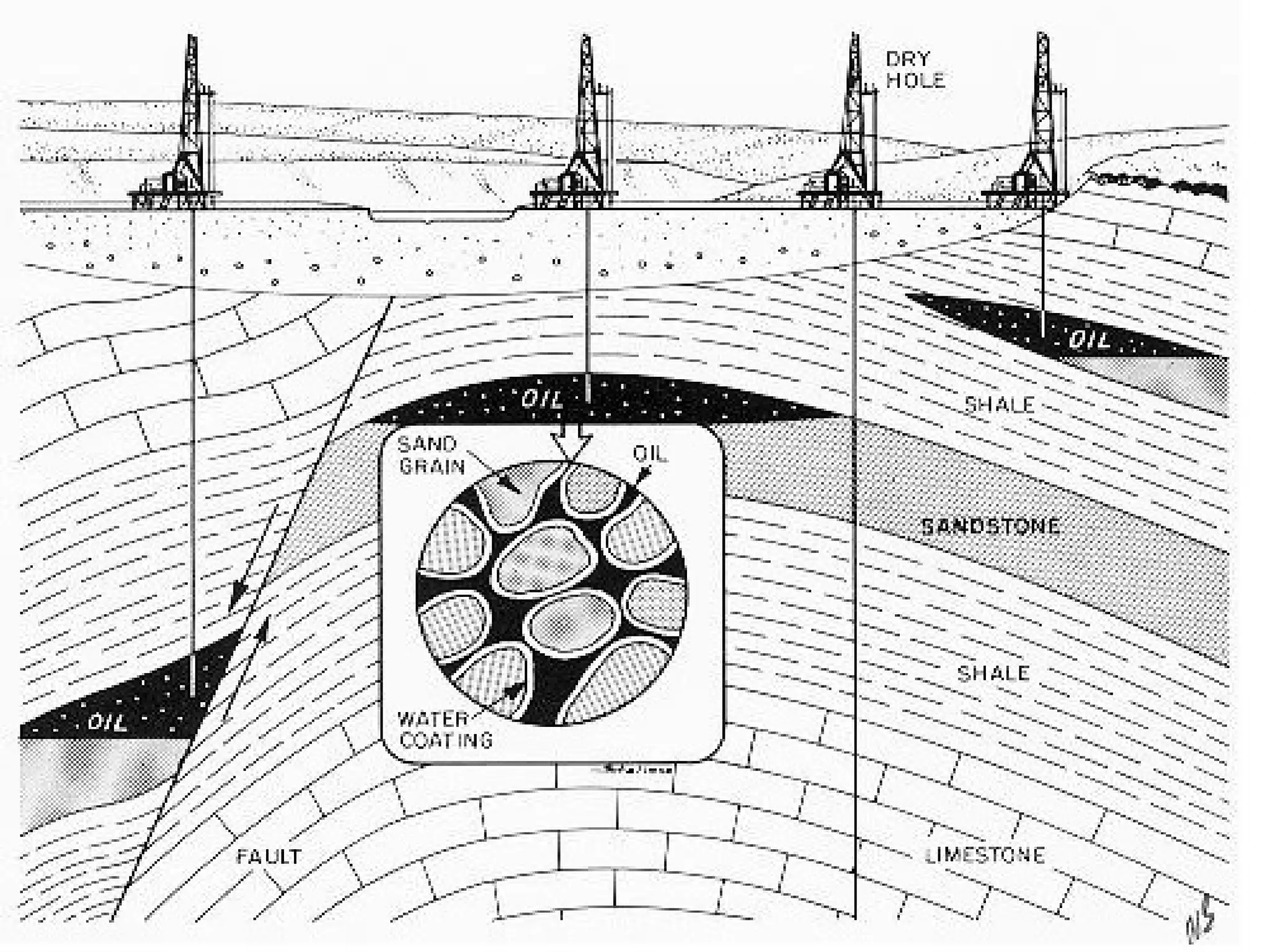
TRAPS
TRAPS
•FLAT-LYING CONVEX LENS
•ANTICLINE
•DOME
•FAULT
•WEDGE-OUT (STRATIGRAPHIC)
Migration and Accumulation
 On many occasions the reservoir rock is
On many occasions the reservoir rock is
Unlikely to have been the
Unlikely to have been the rock in which
rock in which
the oil and gas were formed;
the oil and gas were formed; in some
in some
cases the reservoir rock could not have
been the source rock. The process of
concentration and emplacement of the
hydro­
carbon accumulation is referred to
hydro­
carbon accumulation is referred to
as migration and accumulation.
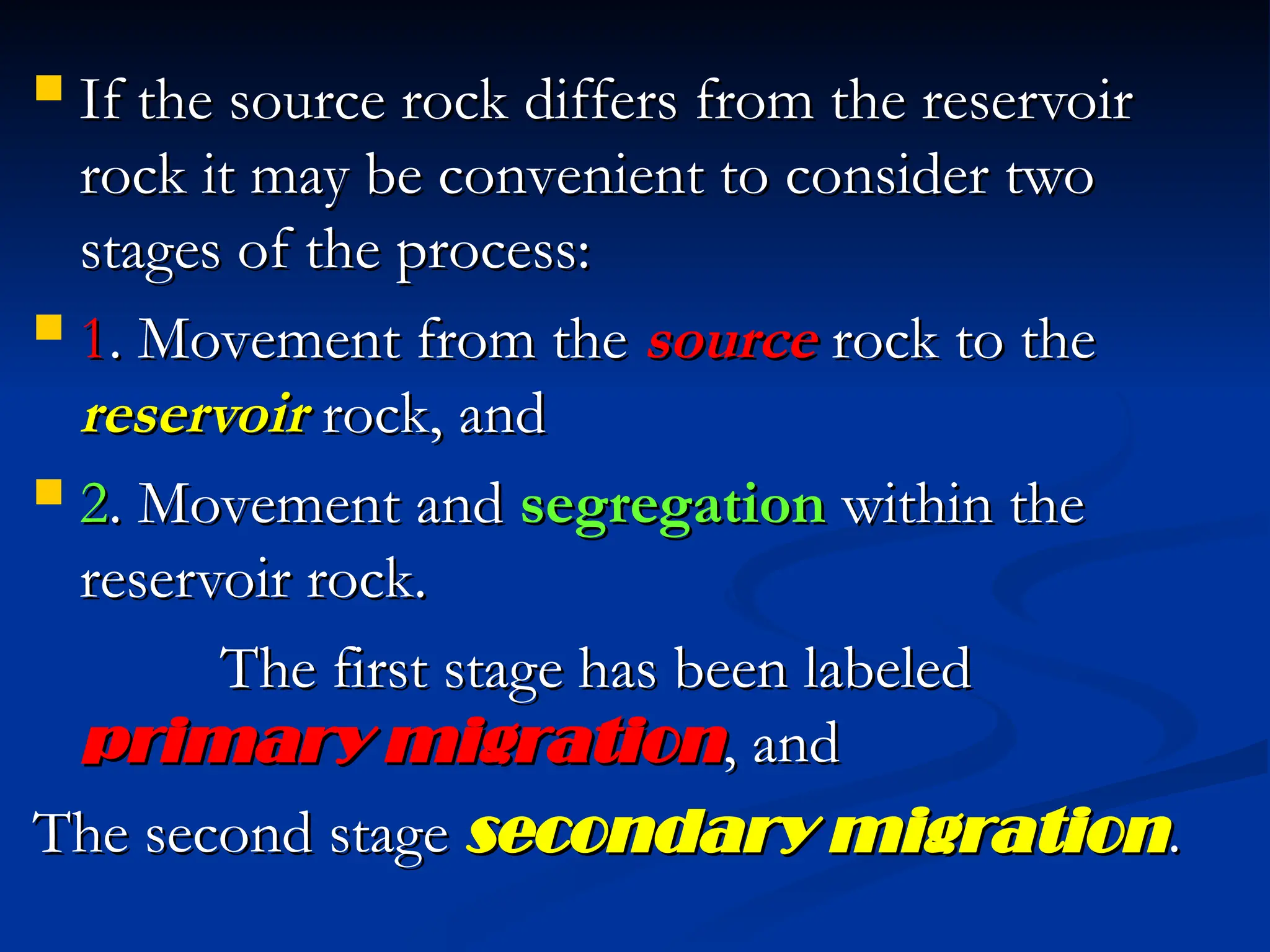
 If the source rock differs from the reservoir
If the source rock differs from the reservoir
rock it may be convenient to consider two
stages of the process:
 1
1. Movement from the
. Movement from the source
source rock to the
rock to the
reservoir
reservoir rock, and
rock, and
 2
2. Movement and
. Movement and segregation
segregation within the
within the
reservoir rock.
reservoir rock.
The first stage has been labeled
primary migration
primary migration, and
, and
The second stage
The second stage secondary migration
secondary migration.
.
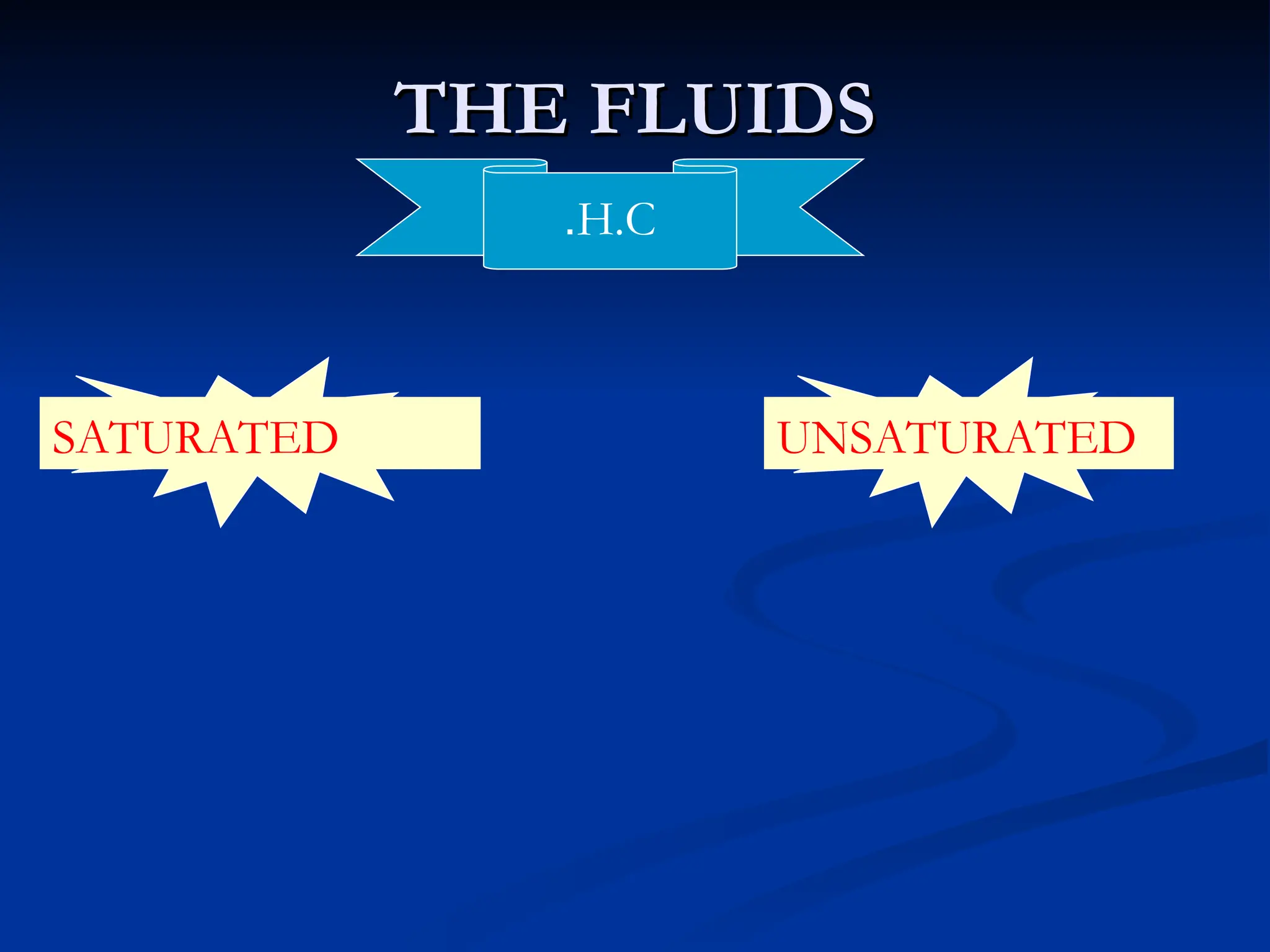
THE FLUIDS
THE FLUIDS
H.C
.
SATURATED UNSATURATED
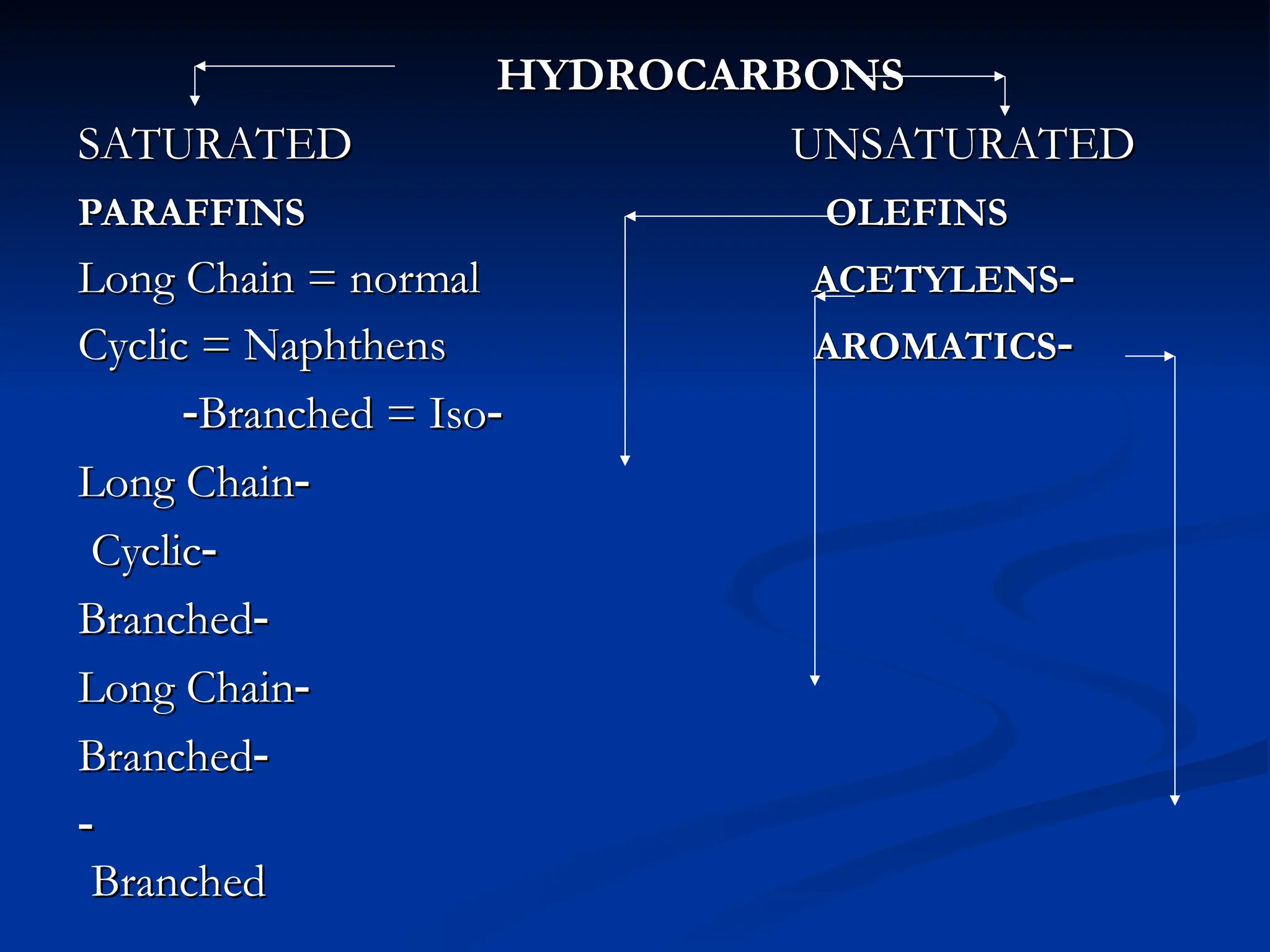
HYDROCARBONS
HYDROCARBONS
SATURATED UNSATURATED
PARAFFINS
PARAFFINS OLEFINS
OLEFINS
-
-
Long Chain = normal
Long Chain = normal ACETYLENS
ACETYLENS
-
-
Cyclic = Naphthens
Cyclic = Naphthens AROMATICS
AROMATICS
-
-
Branched = Iso
Branched = Iso
-
-
-
-
Long Chain
Long Chain
-
-
Cyclic
Cyclic
-
-
Branched
Branched
-
-
Long Chain
Long Chain
-
-
Branched
Branched
-
-
Branched
Branched
PARAFFIN
PARAFFIN SERIES
SERIES
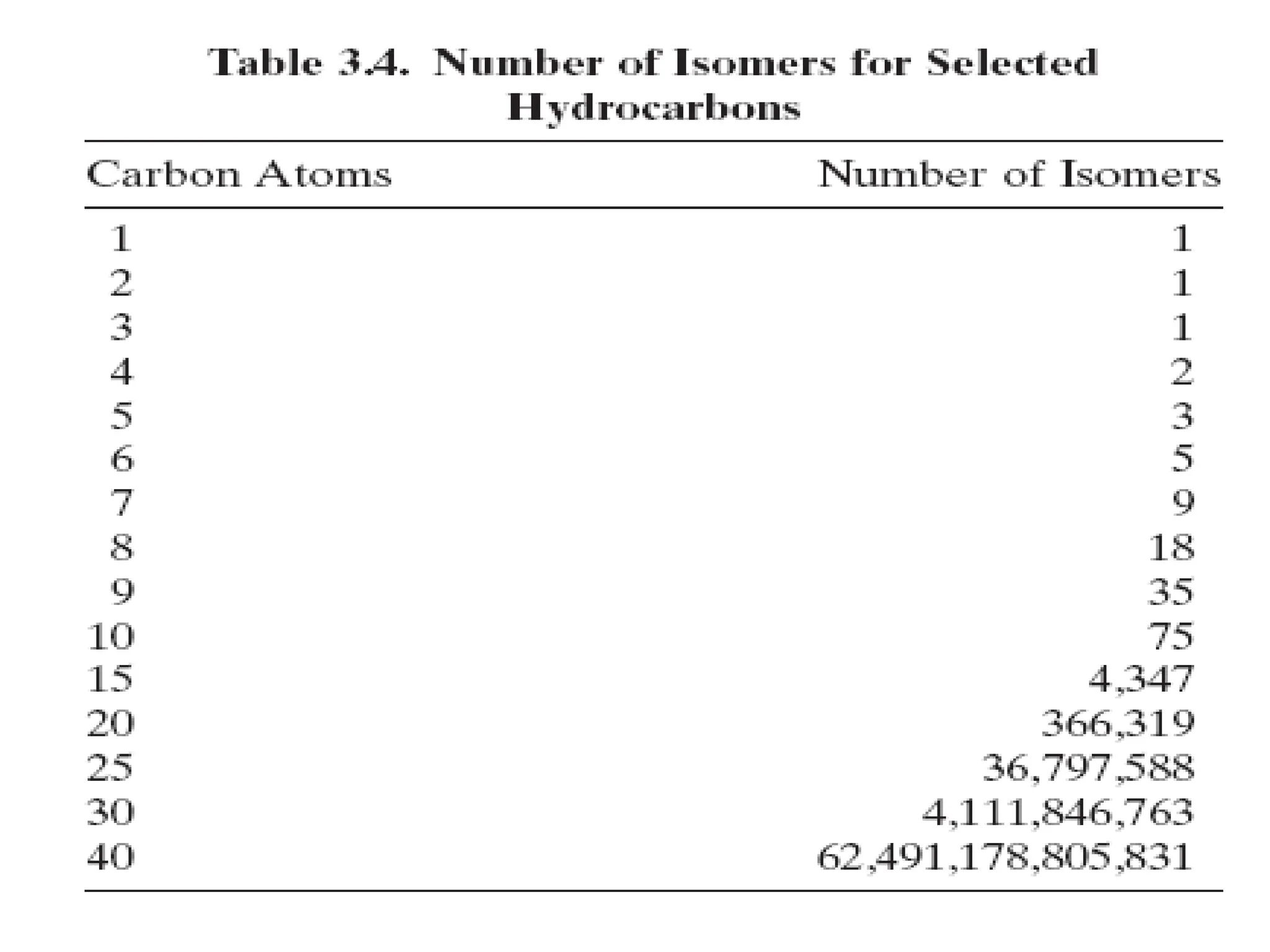
There Are So Many Different
There Are So Many Different H.C.
H.C. Comp
Comp,
,
s. In
s. In
Crude Oil , Estimates Range Between
Crude Oil , Estimates Range Between 50 000
50 000 And
And
1000 000
1000 000.
.
It Is Necessary To Have Systematic Way To
It Is Necessary To Have Systematic Way To Classify
Classify
Them
Them
.
.
The Two Basic Systems Used Are
:
:
1
1
-
-
By Carbon No
By Carbon No
.
.
2
2
-
-
By Molecular Structure
.
.
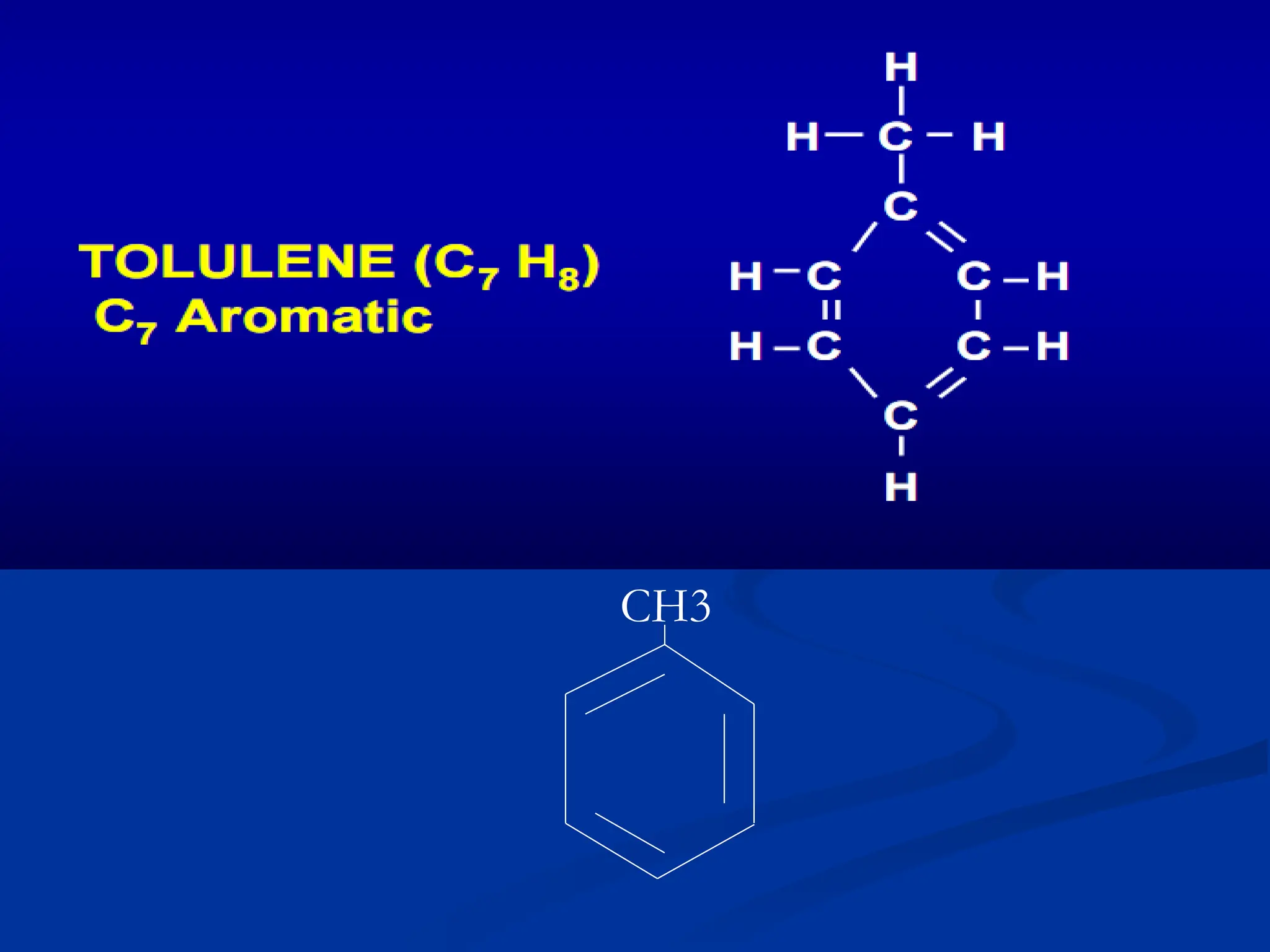
CH3
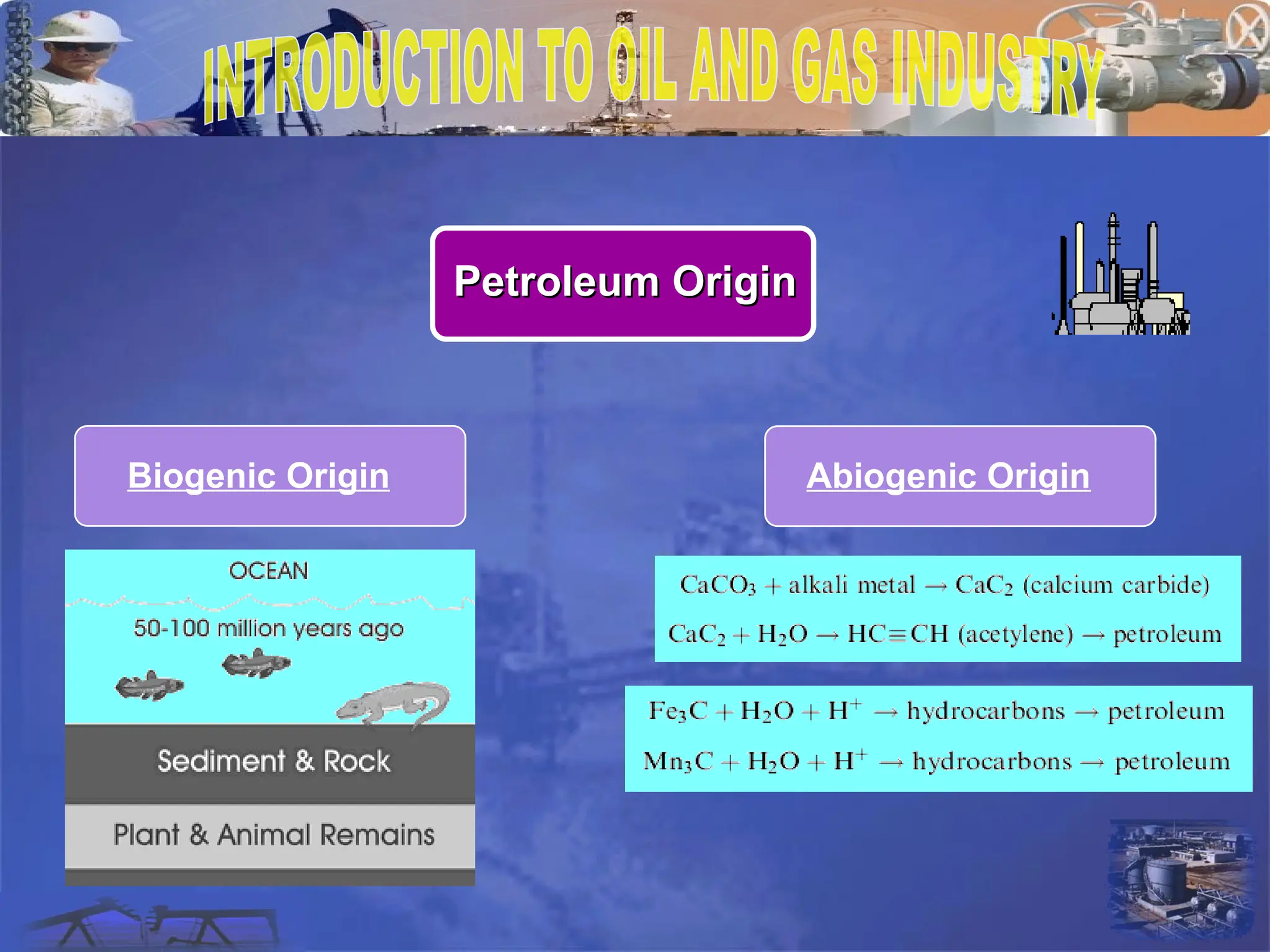
Petroleum Origin
Petroleum Origin
Abiogenic Origin
Biogenic Origin
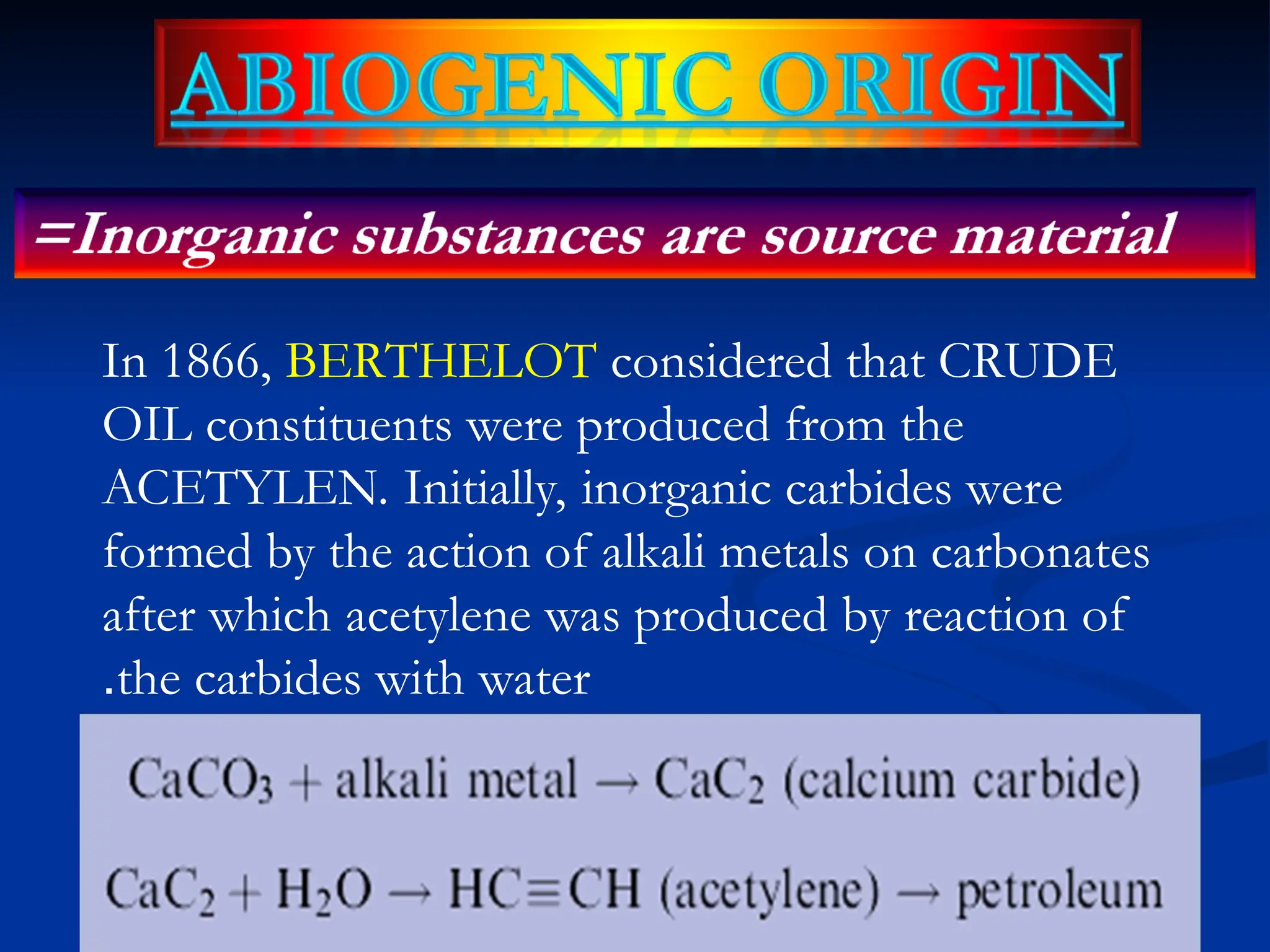
In 1866, BERTHELOT considered that CRUDE
OIL constituents were produced from the
ACETYLEN. Initially, inorganic carbides were
formed by the action of alkali metals on carbonates
after which acetylene was produced by reaction of
the carbides with water
.
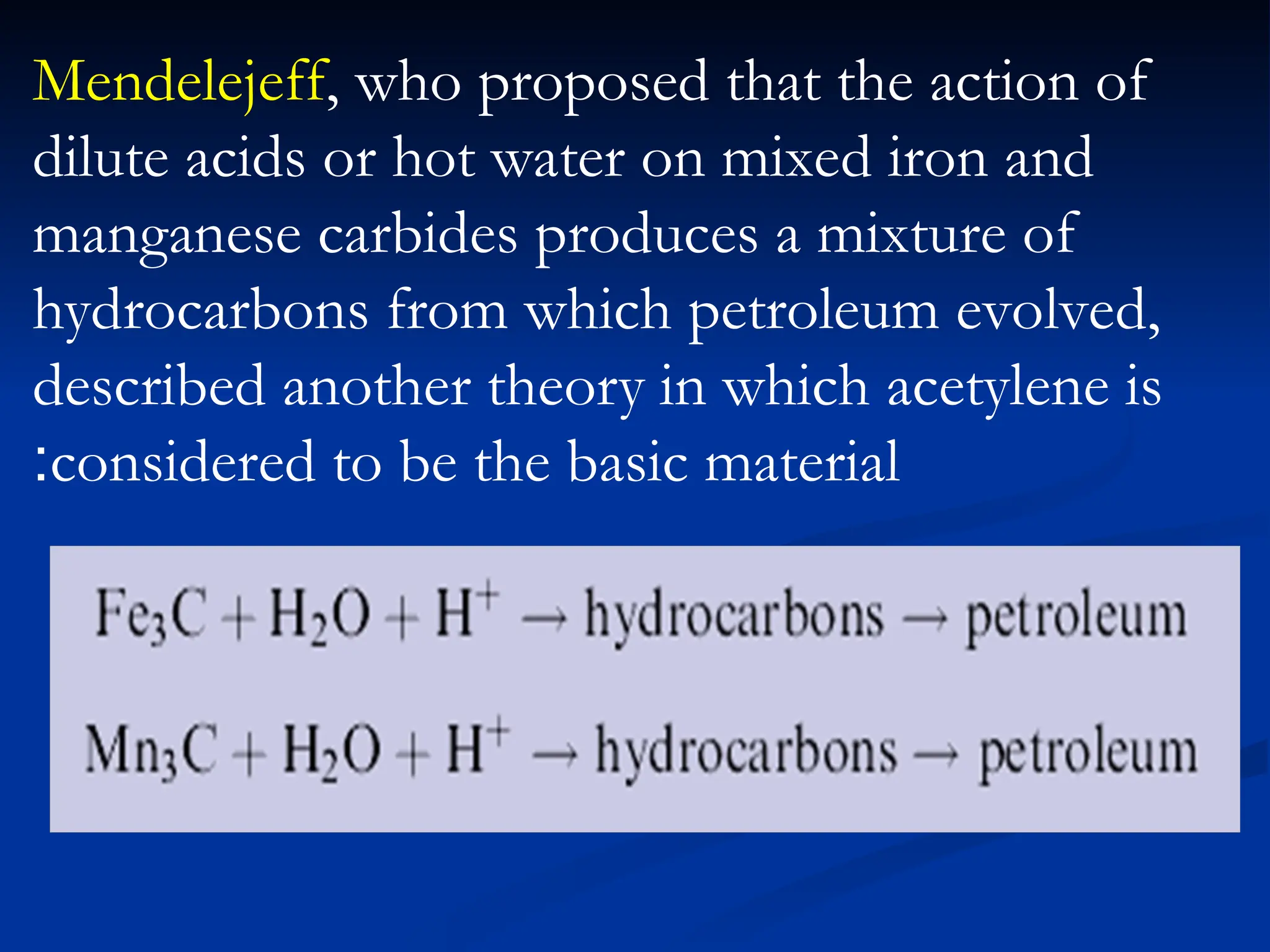
Mendelejeff, who proposed that the action of
dilute acids or hot water on mixed iron and
manganese carbides produces a mixture of
hydrocarbons from which petroleum evolved,
described another theory in which acetylene is
considered to be the basic material
:
There are also several recent theories related to
the formation of petroleum from nonbiogenic
sources in the earth.
From the chemical point of view the inorganic
theories are interesting because of their historical
importance, but these theories have not received
much attention.
=living organisms are the source materials
Petroleum is a naturally occurring hydrocarbon
mixture but hydrocarbons that are synthesized by
living organisms usually account for less than 20%
of the petroleum
.
The remainder of the hydrocarbons in petroleum is
produced by a variety of processes that convert other
organic material to hydrocarbons as part of the
maturation processes generally referred to as digenesis,
CATAGENESIS, and METAGENESIS
.
Over many centuries this organic matter,
mixed with mud, is buried under thick
sedimentary layers of material. The resulting
high levels of HEAT, PRESSURE and
BICTRIA cause the remains to
metamorphose, first into a waxy material
known as KEROGEN, and then into liquid
Kerogen
Is a solid, waxy, organic substance that forms
when pressure and heat from the Earth act on the
remains of plants and animals.
Kerogen converts to various liquid and gaseous
hydrocarbons at a depth of seven or more
kilometers and a temperature between 50 o
C and
100 o
C (122 o
F and 212 o
F).
The name kerogen is also generally used
for organic matter in sedimentary rocks that
is insoluble in common organic and
inorganic solvents.
Kerogen also yields oil when the shale
containing kerogen is heated to temperatures
sufficient to cause destructive distillation.
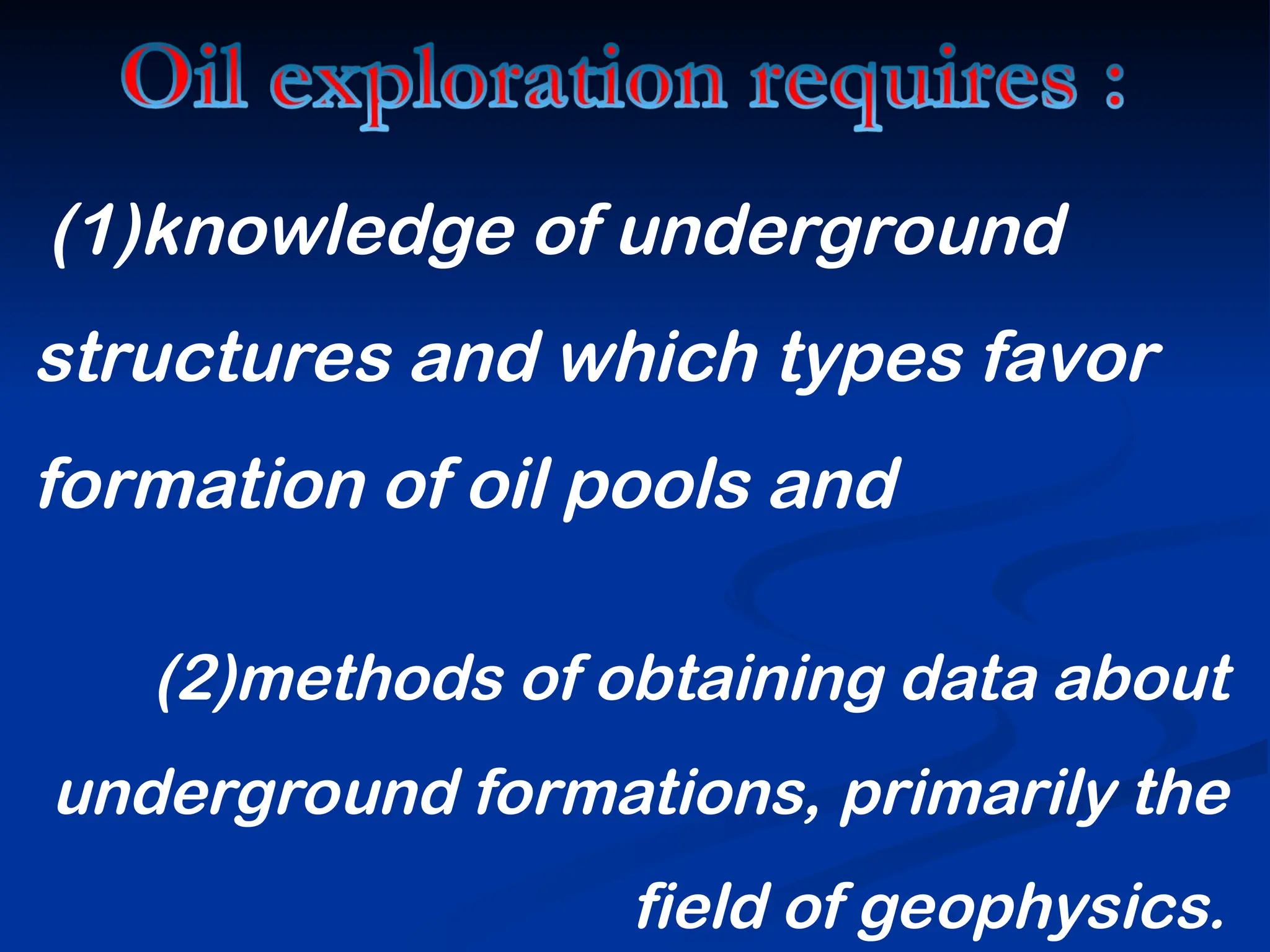
(1)knowledge of underground
structures and which types favor
formation of oil pools and
(2)methods of obtaining data about
underground formations, primarily the
field of geophysics.
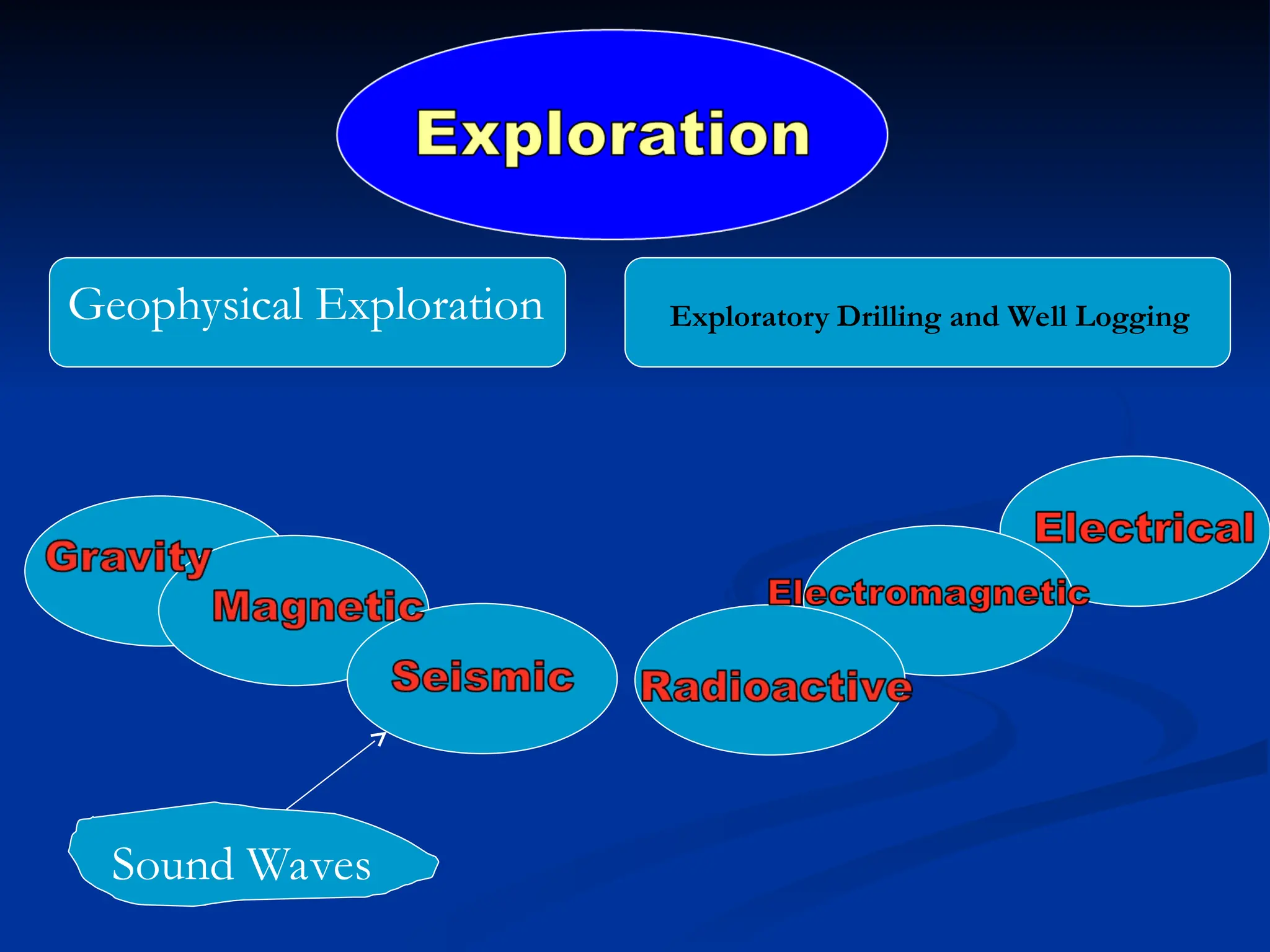
Geophysical Exploration Exploratory Drilling and Well Logging
Sound Waves
Geophysical Exploration
Geophysical exploration obtains
Geophysical exploration obtains data on
data on
variations in the
variations in the physical properties
physical properties of
of
subsurface rocks, including
subsurface rocks, including density
density,
, elasticity
elasticity,
,
magnetic
magnetic and
and electrical properties
electrical properties.
.
It provides a means for determining the
It provides a means for determining the
location of various types of rocks.
It does not, as yet, give direct evidence of the
It does not, as yet, give direct evidence of the
occurrence of oil;
occurrence of oil;
this still necessitates drilling a hole.
The principles used are basically
magnetism, gravity, and sound
waves. The instruments are the
magnetometer, gravimeter, and
seismograph.
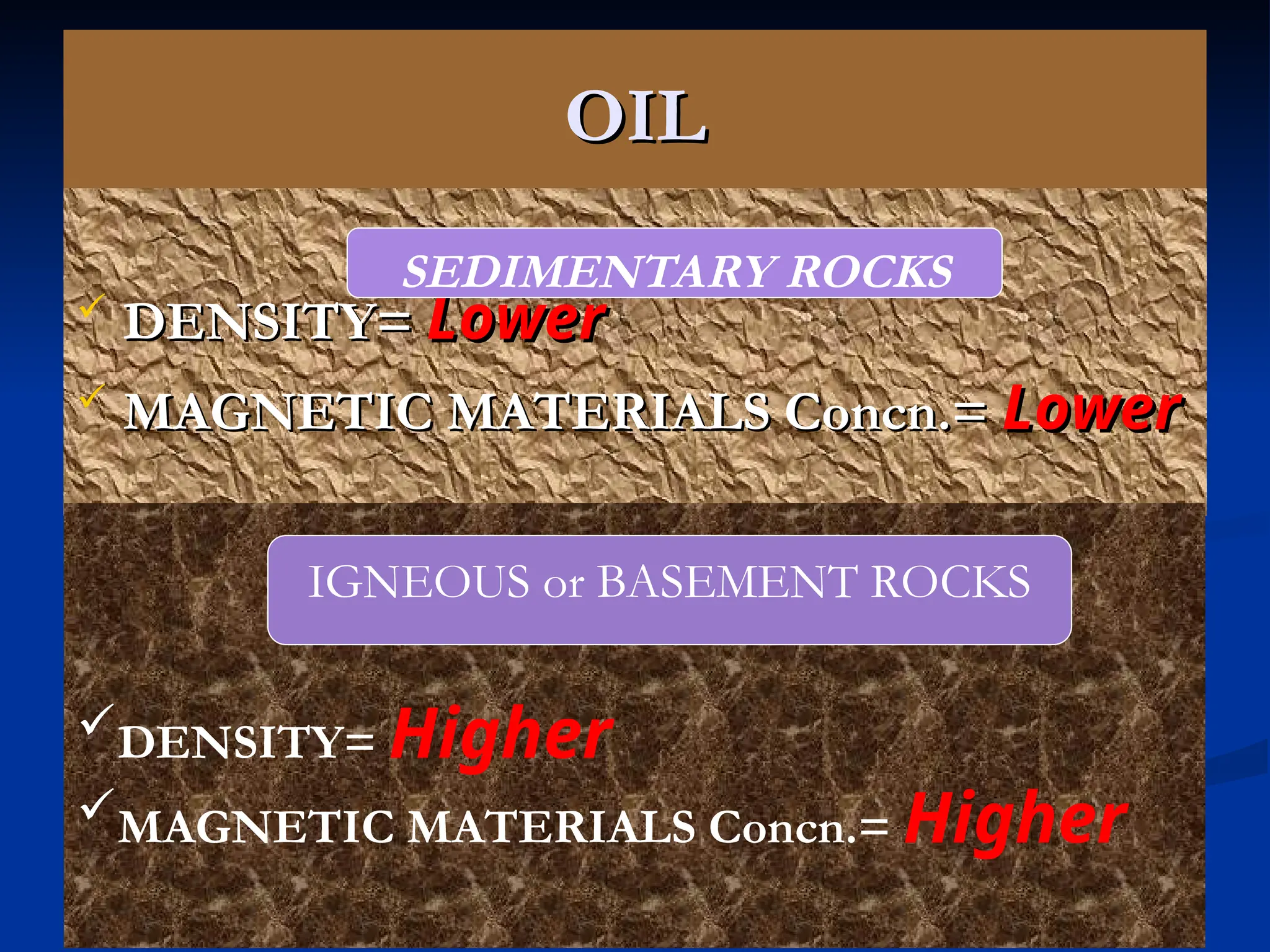
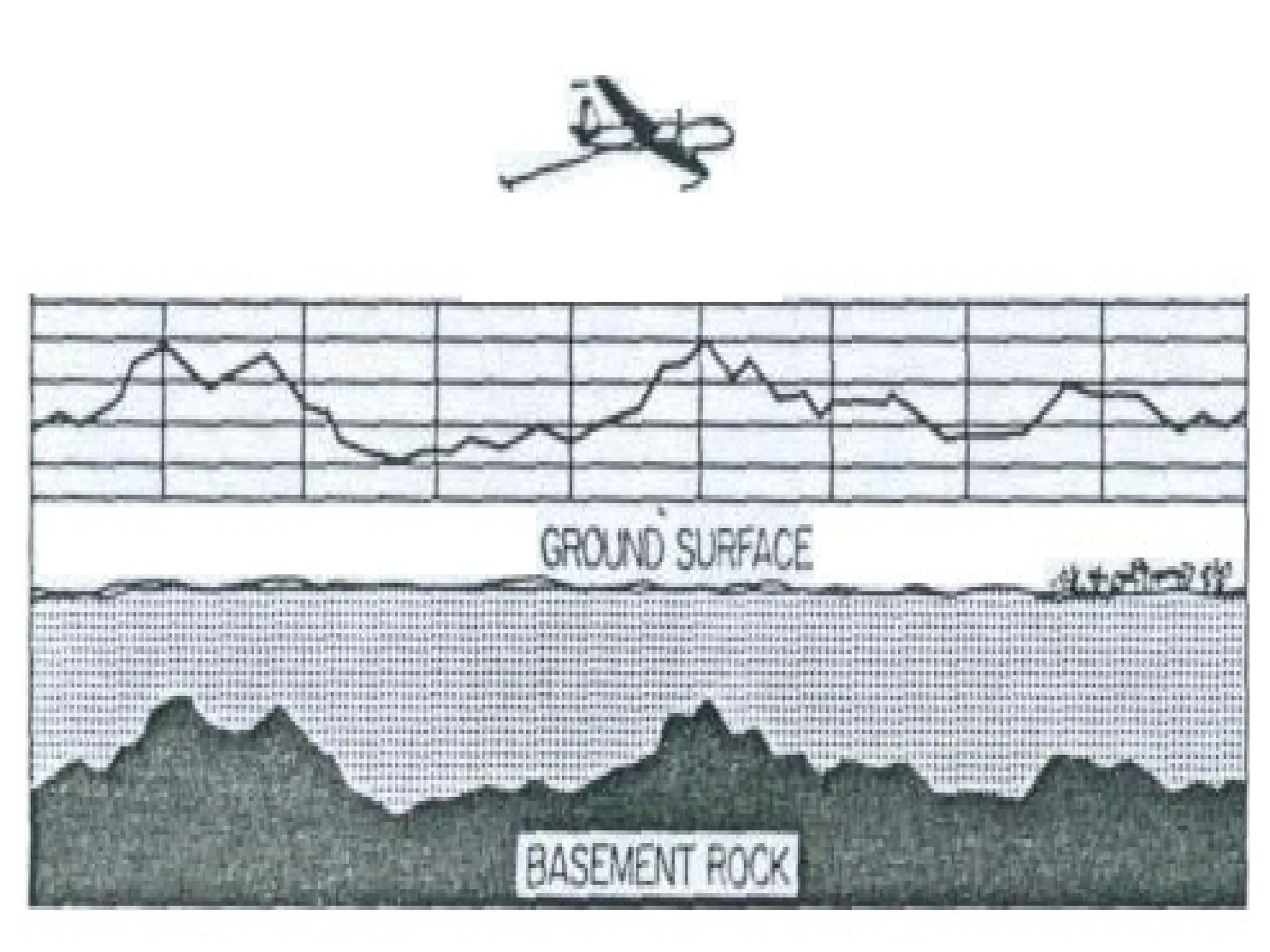
Oil tends to be found in layers of sedimentary
rock, which lie on top of igneous, or
basement, rock. This is much denser than the
sedimentary layers and contains a higher
concentration of iron and other magnetic
materials
.
OIL
OIL
 DENSITY=
DENSITY= Lower
Lower
 MAGNETIC MATERIALS Concn.=
MAGNETIC MATERIALS Concn.= Lower
Lower
SEDIMENTARY ROCKS
DENSITY= Higher
MAGNETIC MATERIALS Concn.= Higher
IGNEOUS or BASEMENT ROCKS
 A magnetometer, fundamentally a specially
A magnetometer, fundamentally a specially
designed
designed magnetic compass
magnetic compass, detects minute
, detects minute
differences in the magnetic properties of
various rock formations, thus helping to find
structures which might contain oil.
Magnetometers can be divided into two basic
types:
•Scalar magnetometers measure the total
strength of the magnetic field to which they are
subjected, and
•Vector magnetometers have the capability to
measure the component of the magnetic field
in a particular direction, relative to the spatial
orientation of the device.
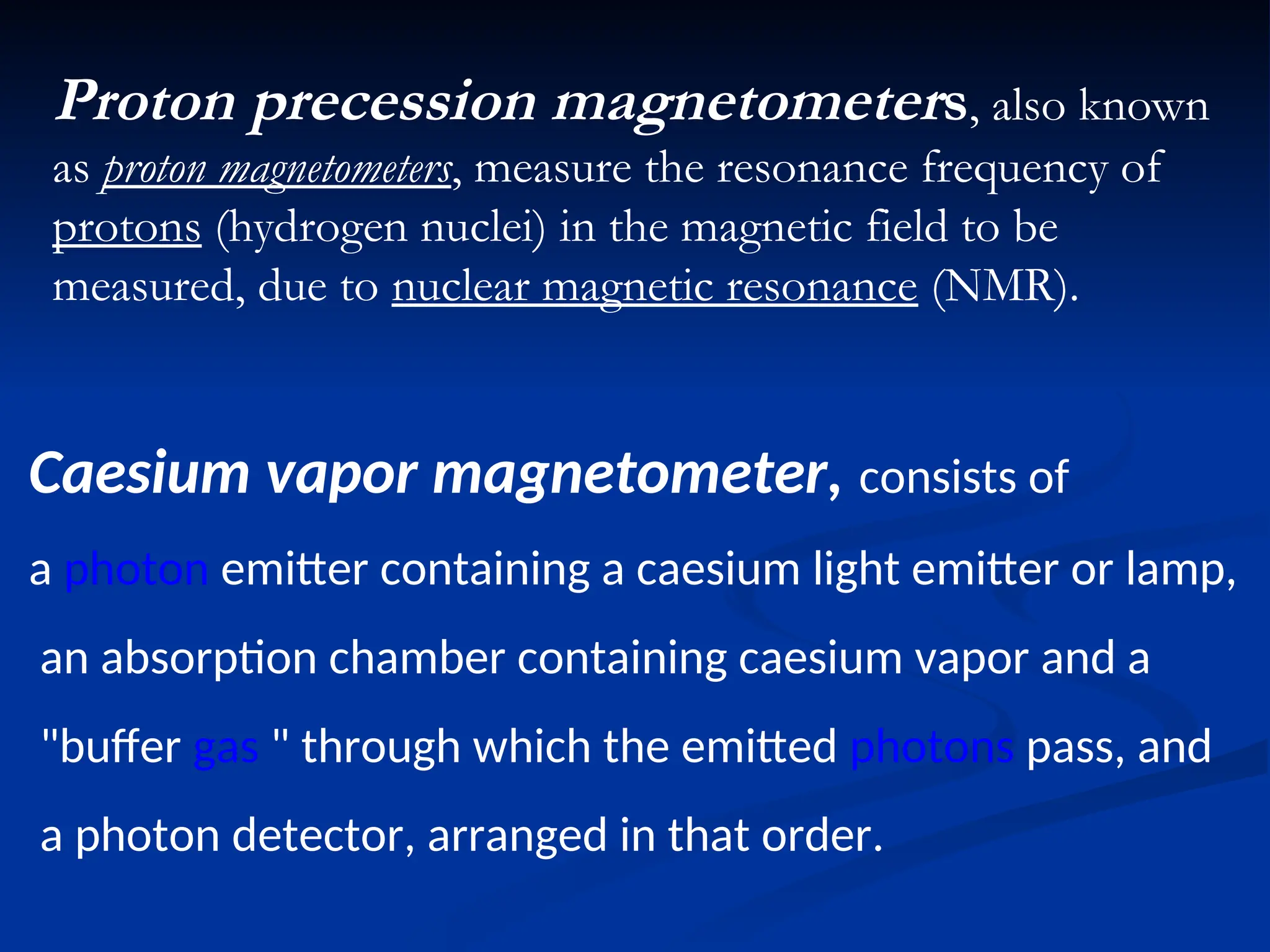
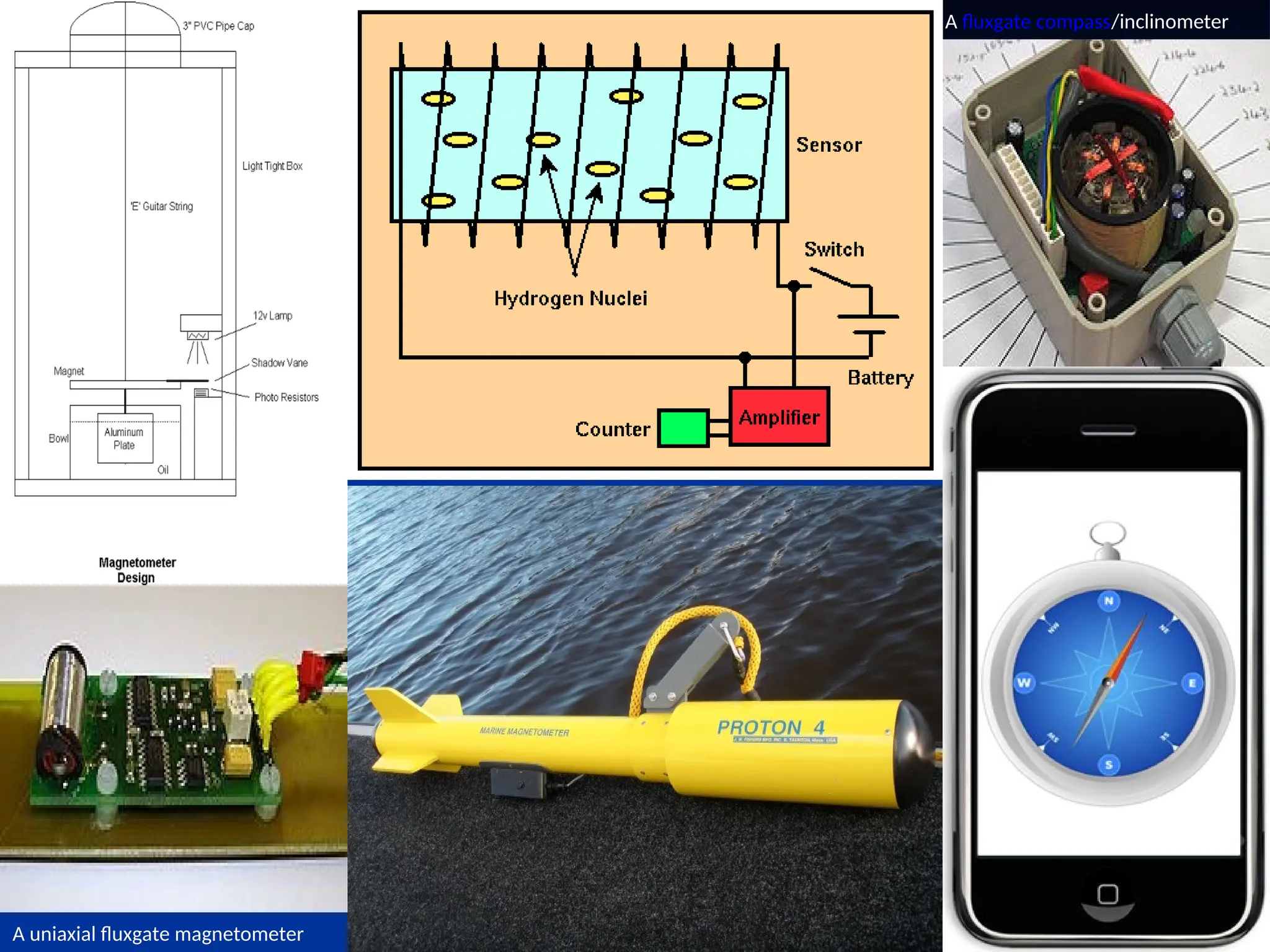
Proton precession magnetometers, also known
as proton magnetometers, measure the resonance frequency of
protons (hydrogen nuclei) in the magnetic field to be
measured, due to nuclear magnetic resonance (NMR).
Caesium vapor magnetometer, consists of
a photon emitter containing a caesium light emitter or lamp,
an absorption chamber containing caesium vapor and a
"buffer gas " through which the emitted photons pass, and
a photon detector, arranged in that order.
A uniaxial fluxgate magnetometer
A fluxgate compass/inclinometer
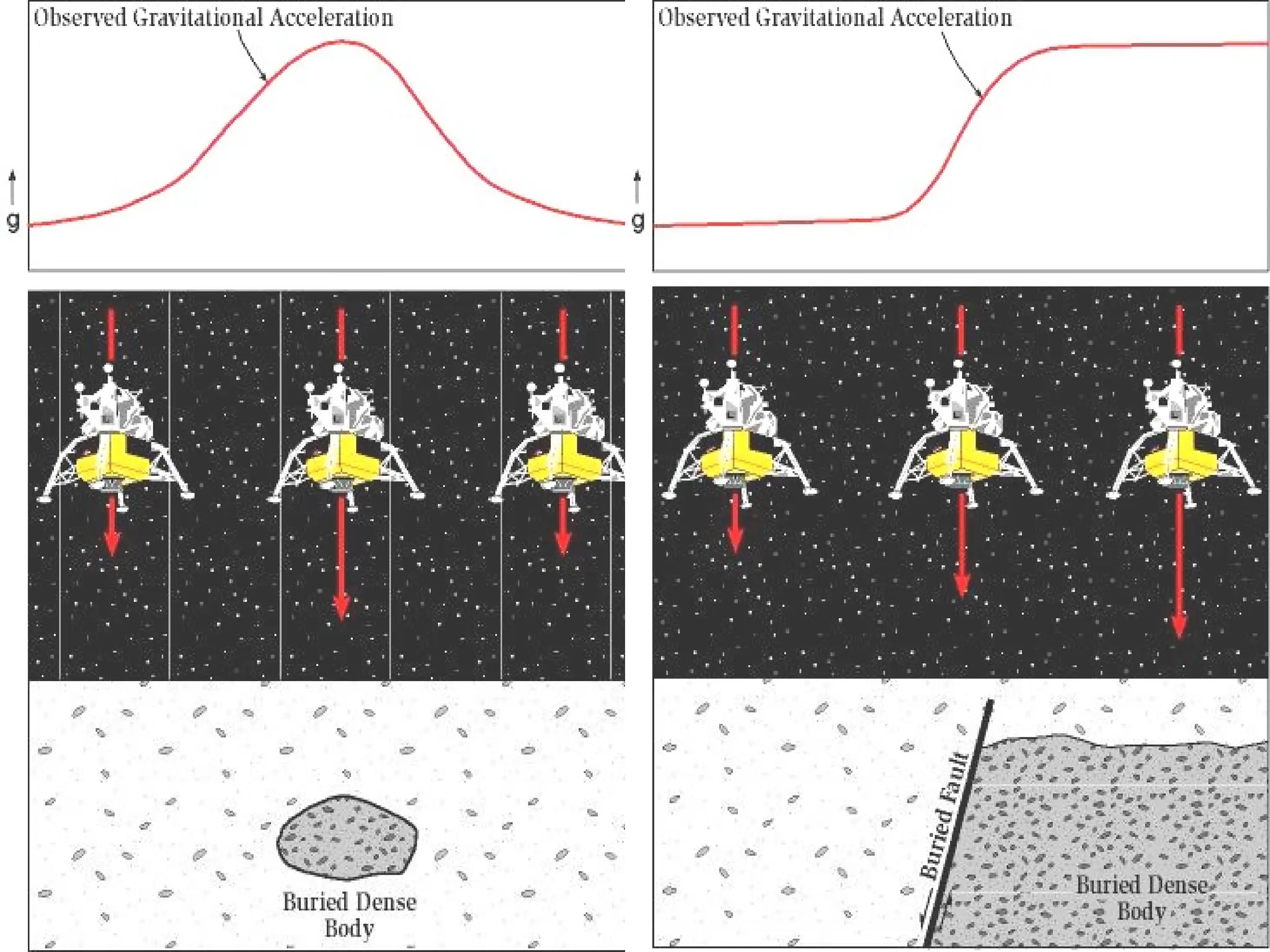
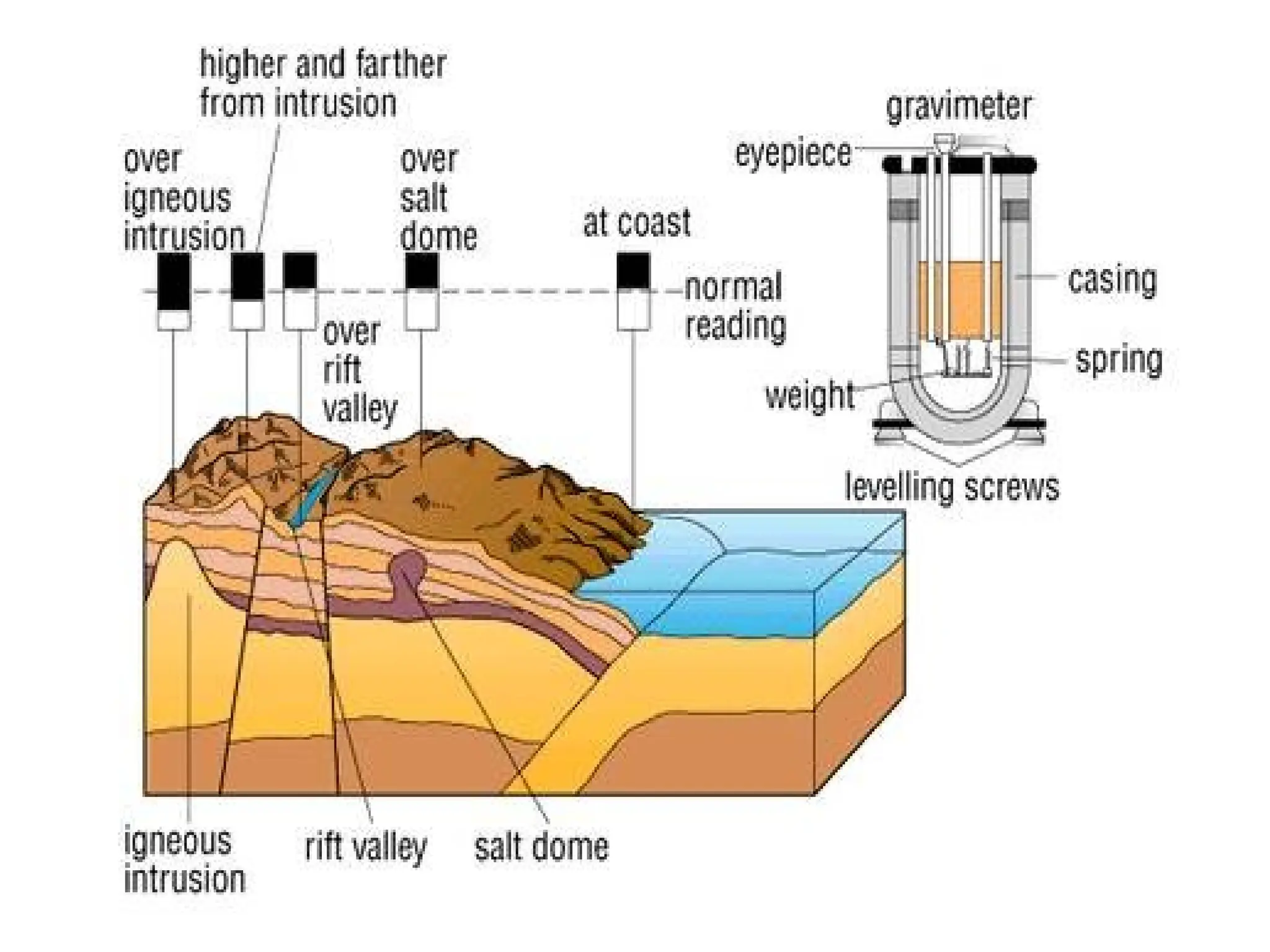
The magnitude of gravitational pull of underground rock
varies directly with its density
,
,
although the actual variations are extremely small
.
.
The gravimeter, a sensitive instrument which detects
differences in the pull of gravity
,
,
therefore gives an indication of the location and density of
underground rock formations
.
.
Most gravimeters operate on about the same
principle
principle
.
.
A weight is suspended on a sensitive spring
,
,
and changes in gravity cause tiny changes in
length or in twisting of the spring
,
,
which can be magnified optically or electrically
and observed
and observed
.
.
The instruments are used on
land, over water-covered areas
(by submerging them in special
diving bells or occasionally in
submarines), and they can be
employed on aircraft
.
.
Seismic Method
Seismic Method
 Based on determinations of the
Based on determinations of the time interval
time interval that
that
elapses
elapses between
between the
the initiation of a sound wave
initiation of a sound wave
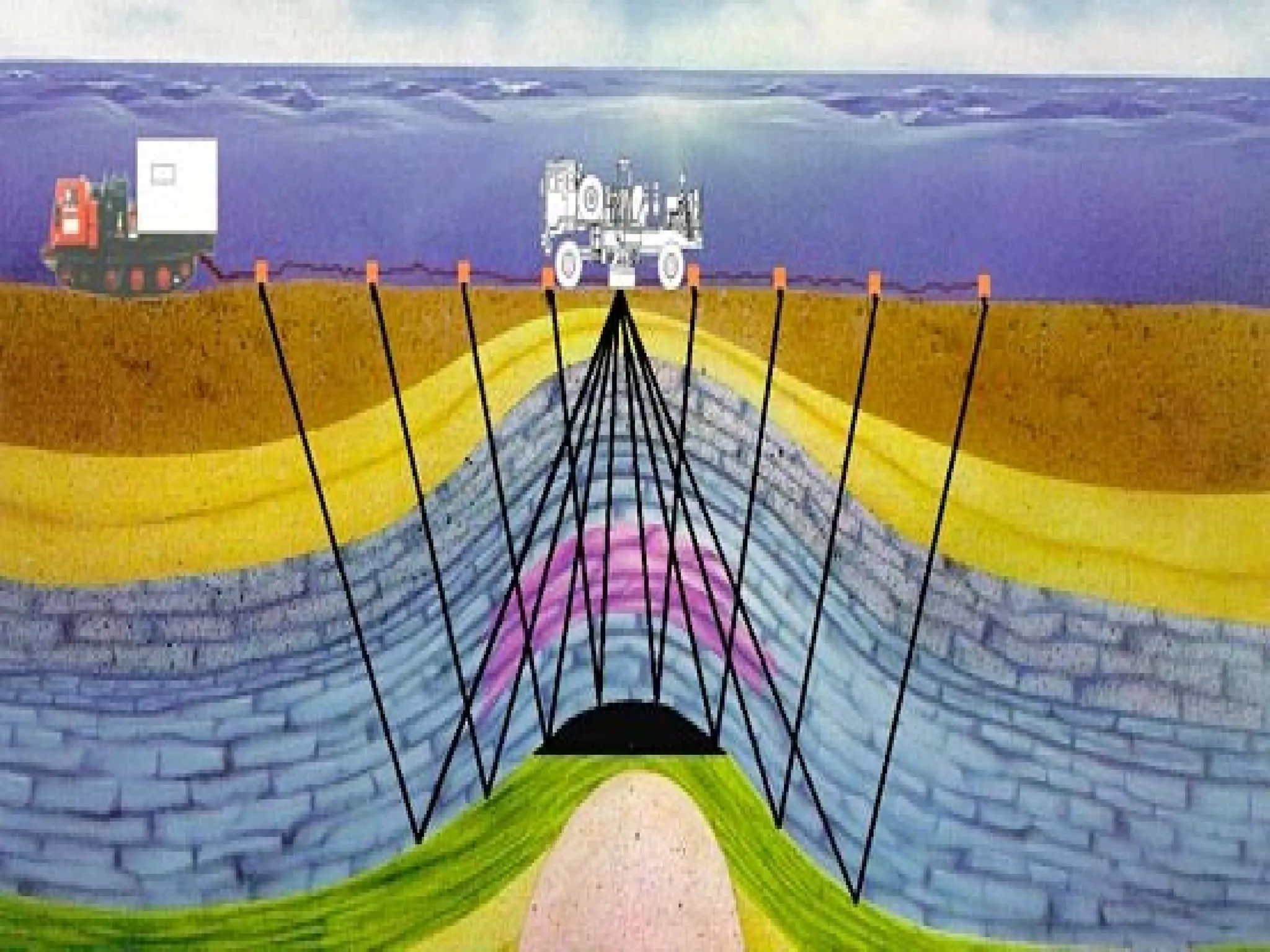
from detonation of a dynamite charge or other
artificial shock
artificial shock and
and the
the arrival of the vibration
arrival of the vibration
impulses
impulses at a series of seismic detectors
at a series of seismic detectors
(geophones). The arrivals are amplified and
recorded along with time marks (0.01 sec
intervals) to give the seismogram.
 Seismometers
Seismometers are instruments that measures seismic waves generated
are instruments that measures seismic waves generated
by earthquakes, nuclear explosions, and other seismic sources.
Records of seismic waves allow seismologists to map the interior of
the Earth, and locate and measure the size of these different sources.
 The word derives from the Greek
The word derives from the Greek seismós
seismós, a shaking or quake, and
, a shaking or quake, and
métron
métron, measure.
, measure.
 Seismograph
Seismograph is another Greek term from
is another Greek term from seismós
seismós and
and gráphō
gráphō, to draw.
, to draw.
 Both types provide a continuous record of ground motion; this
Both types provide a continuous record of ground motion; this
distinguishes them from
distinguishes them from seismoscopes
seismoscopes, which merely indicate that
, which merely indicate that
motion has occurred, perhaps with some simple measure of how large
it was
it was
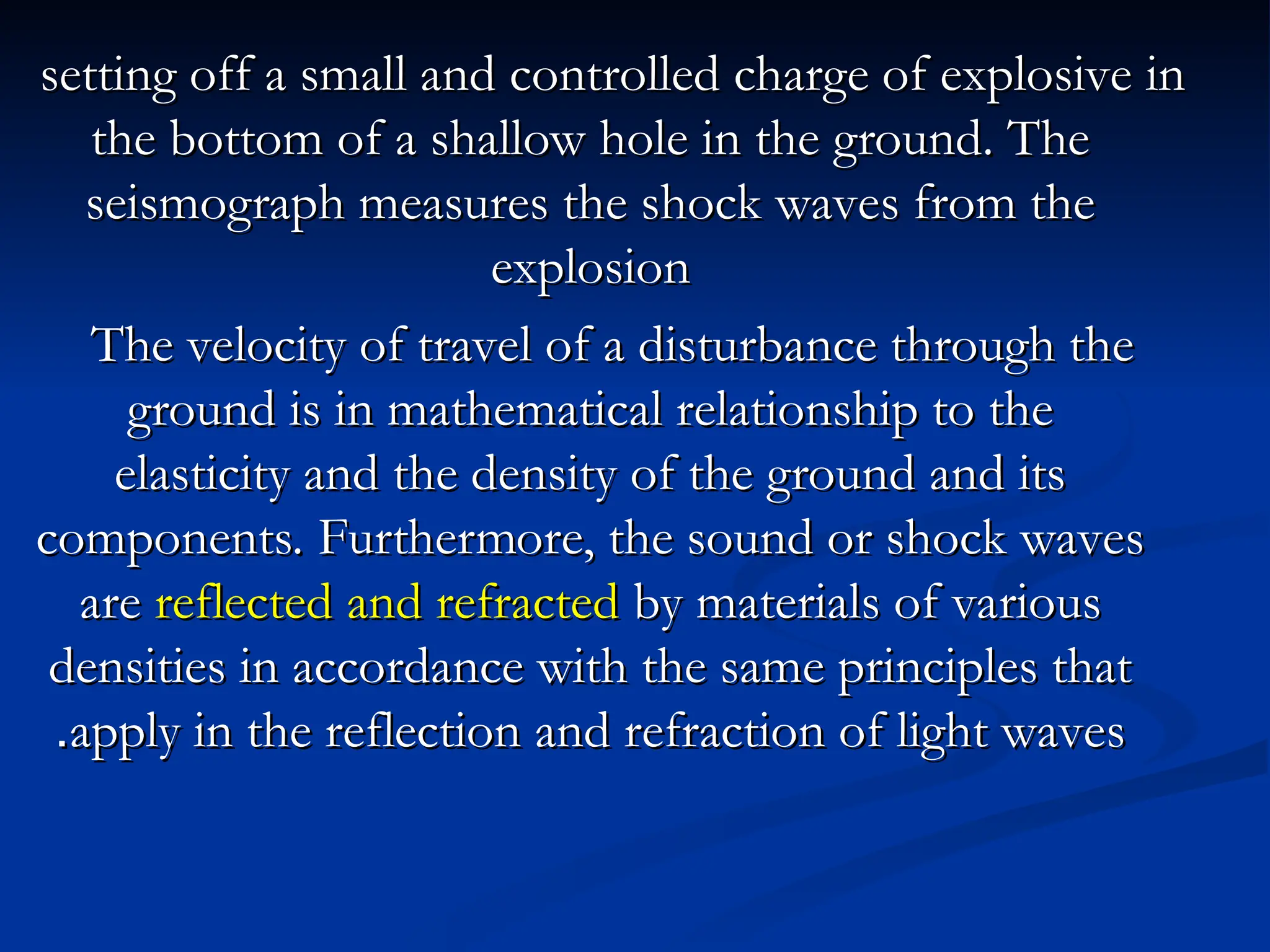
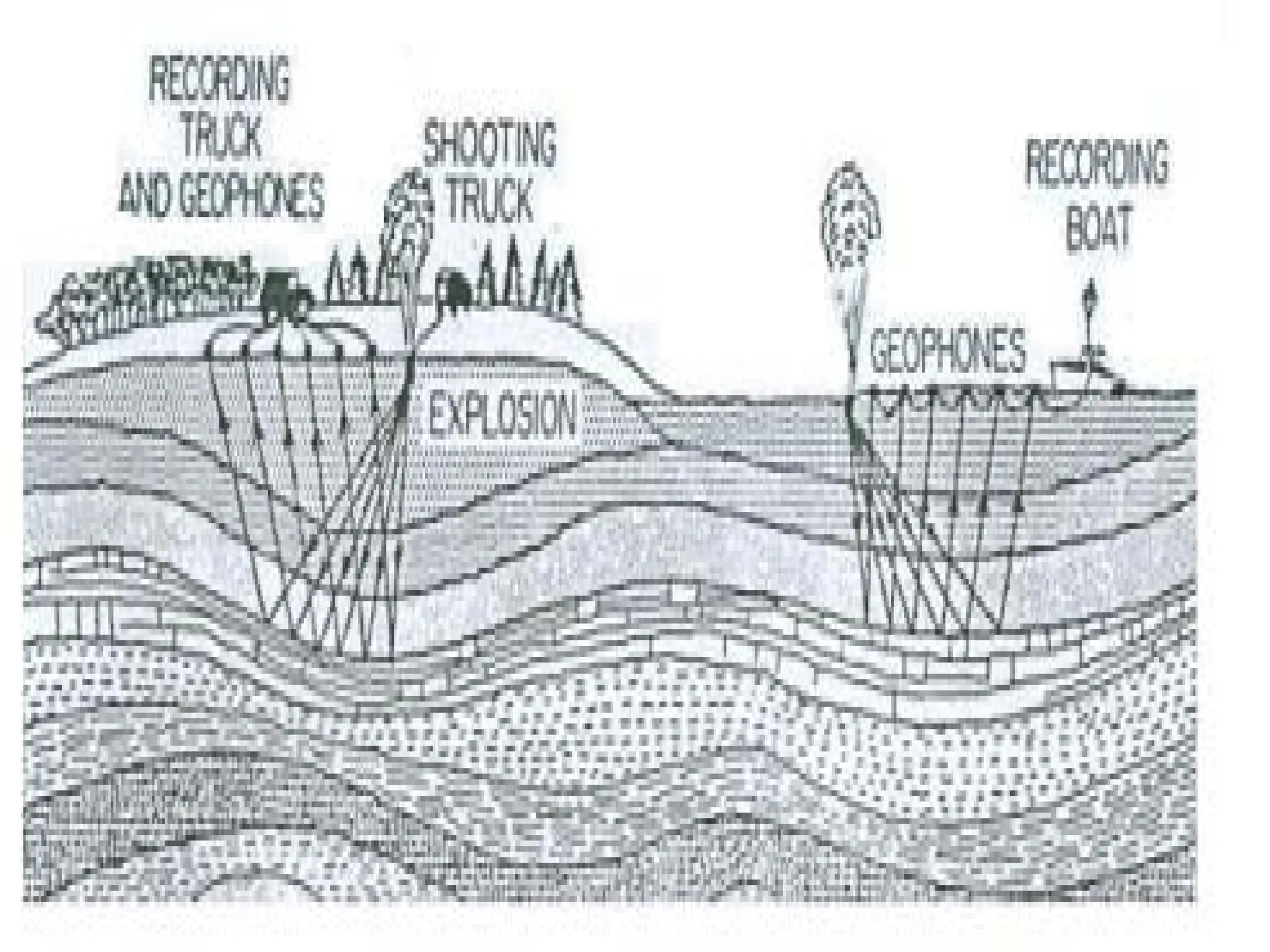
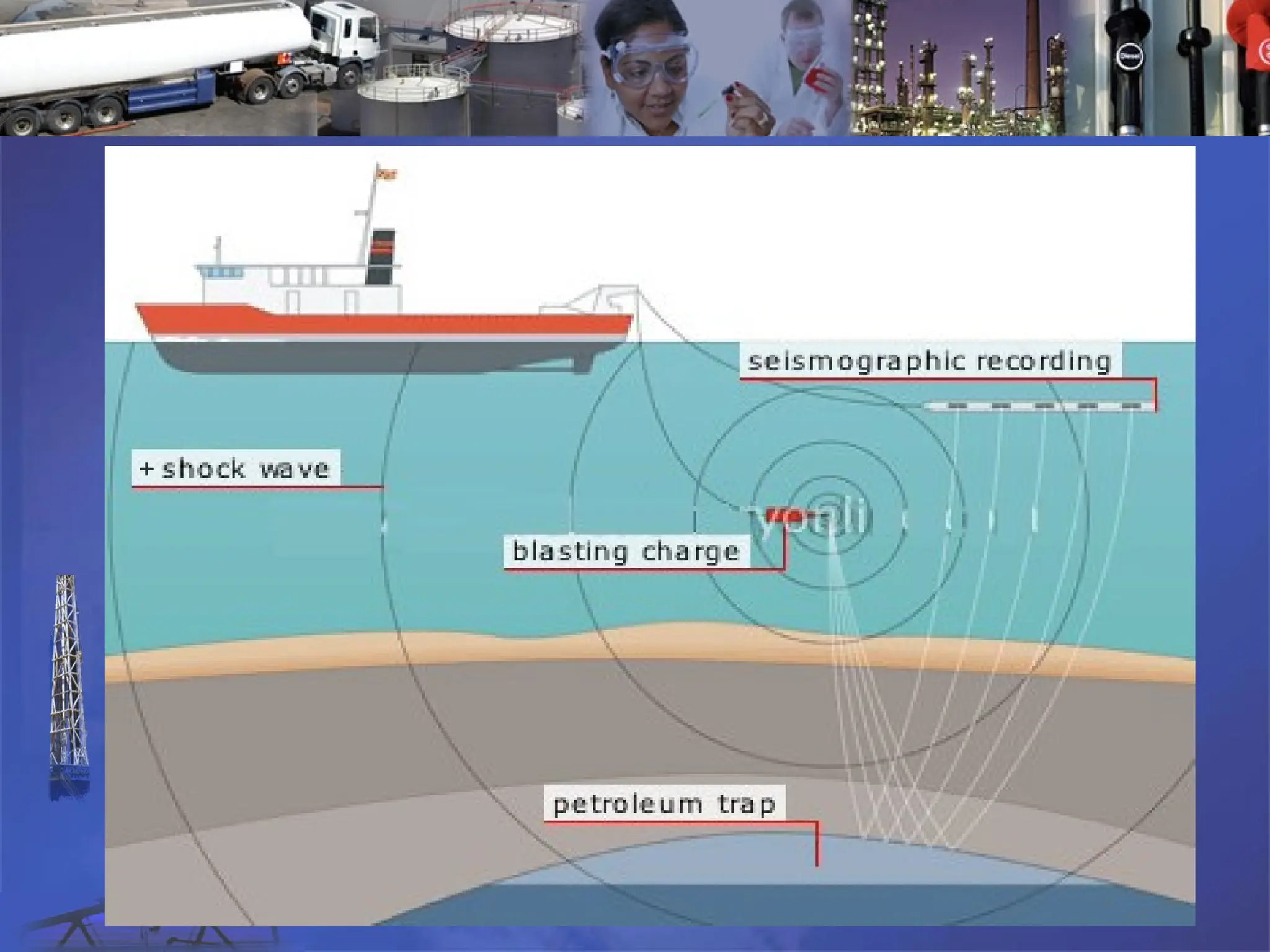
setting off a small and controlled charge of explosive in
the bottom of a shallow hole in the ground. The
seismograph measures the shock waves from the
explosion
explosion
The velocity of travel of a disturbance through the
ground is in mathematical relationship to the
elasticity and the density of the ground and its
components. Furthermore, the sound or shock waves
are
are reflected
reflected and refracted
and refracted by materials of various
by materials of various
densities in accordance with the same principles that
apply in the reflection and refraction of light waves
.
.
Exploration
Exploration
 Another valuable exploration method is geophysical
Another valuable exploration method is geophysical
borehole logging,
borehole logging,
 It involves drilling a well and then employing
It involves drilling a well and then employing
instruments to log or make measurements at various
levels in the hole by such means as electrical
resistivity, radioactivity, acoustics, or density.
 In addition, formation, or core, samples are taken for
In addition, formation, or core, samples are taken for
physical and chemical tests.
Exploratory Drilling and Well Logging
 Based on the fact that:
Based on the fact that:
the
the resistivity
resistivity of a rock layer is
of a rock layer is
a function of its
a function of its fluid content
fluid content.
.
 Oil-filled sand has a very high resistivity.
Oil-filled sand has a very high resistivity.
The method consists of:
passing a current between an electrode at
the surface and one which is lowered into
the hole.
Any change in the resistivity conditions
around the moving electrode will affect the
flow of current and the voltage distribution
around it.
These voltage fluctuations can be
measured by a pair of electrodes placed
near the moving electrode and lowered
with it.
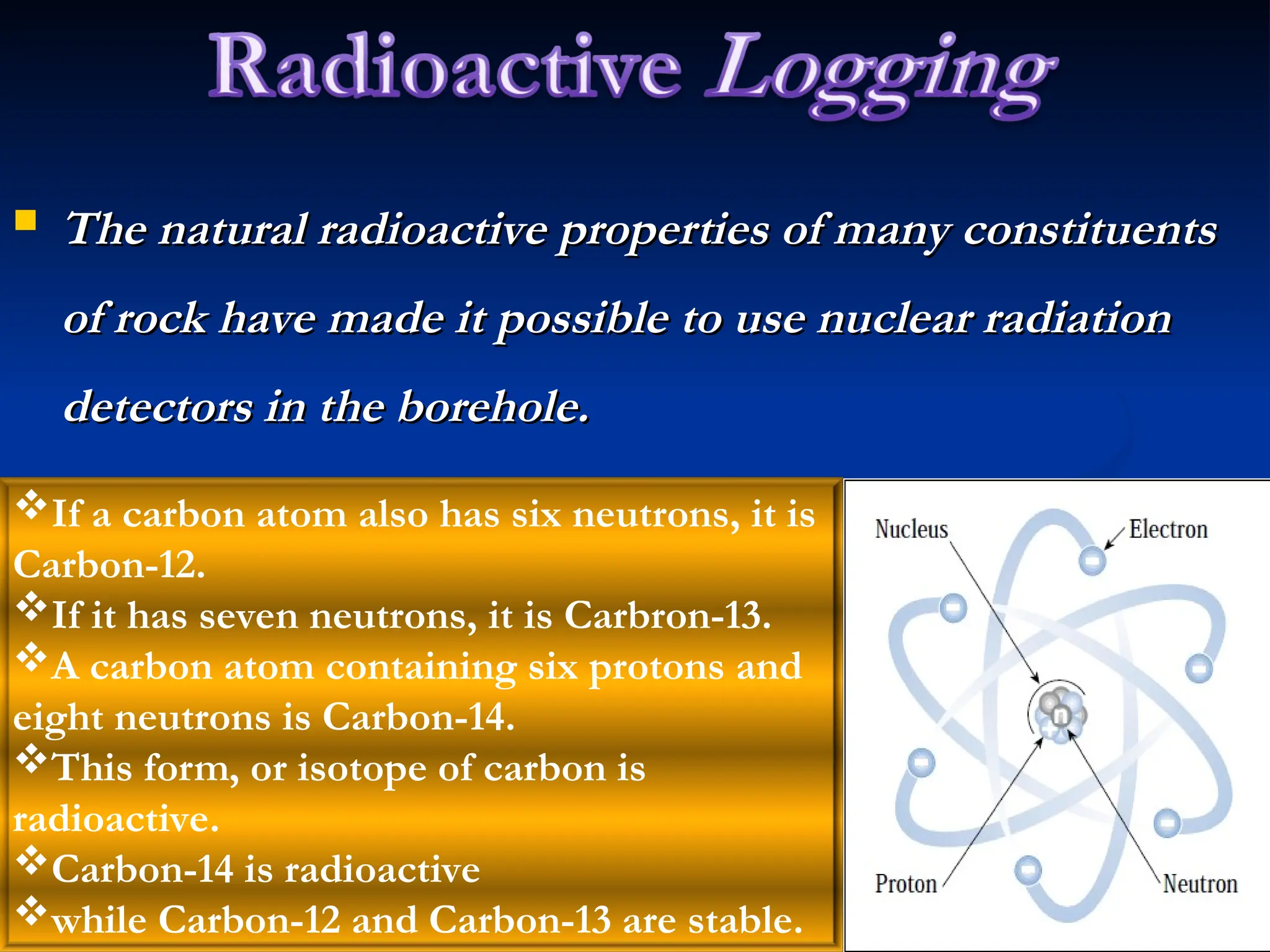
 The natural radioactive properties of many constituents
The natural radioactive properties of many constituents
of rock have made it possible to use nuclear radiation
detectors in the borehole.
If a carbon atom also has six neutrons, it is
Carbon-12.
If it has seven neutrons, it is Carbron-13.
A carbon atom containing six protons and
eight neutrons is Carbon-14.
This form, or isotope of carbon is
radioactive.
Carbon-14 is radioactive
while Carbon-12 and Carbon-13 are stable.
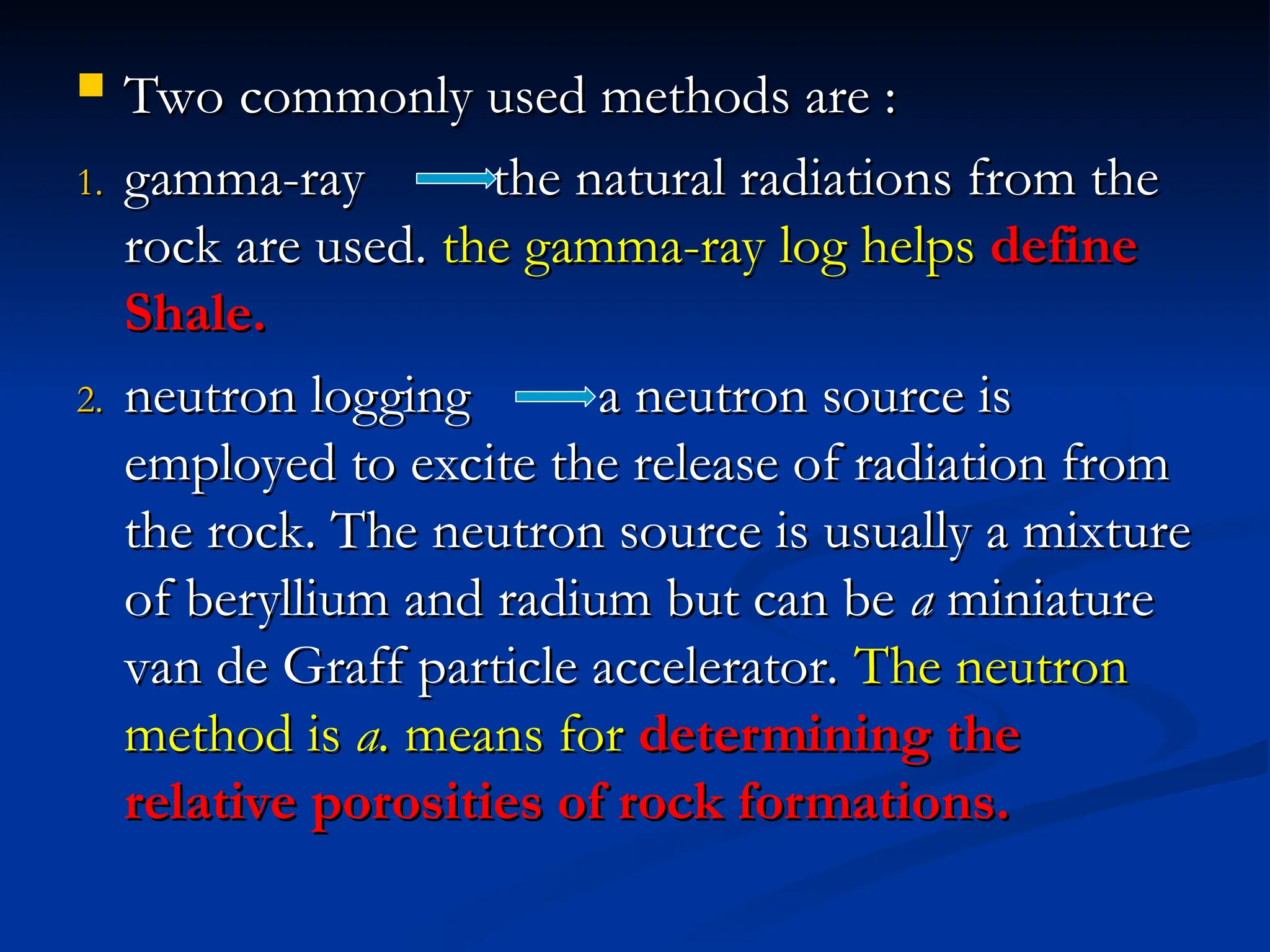
 Two commonly used methods are :
Two commonly used methods are :
1.
1. gamma-ray the natural radiations from the
gamma-ray the natural radiations from the
rock are used.
rock are used. the gamma-ray log helps
the gamma-ray log helps define
define
Shale.
Shale.
2.
2. neutron logging a neutron source is
neutron logging a neutron source is
employed to excite the release of radiation from
the rock. The neutron source is usually a mixture
of beryllium and radium but can be
of beryllium and radium but can be a
a miniature
miniature
van de Graff particle accelerator.
van de Graff particle accelerator. The neutron
The neutron
method is
method is a.
a. means for
means for determining the
determining the
relative porosities of rock formations.
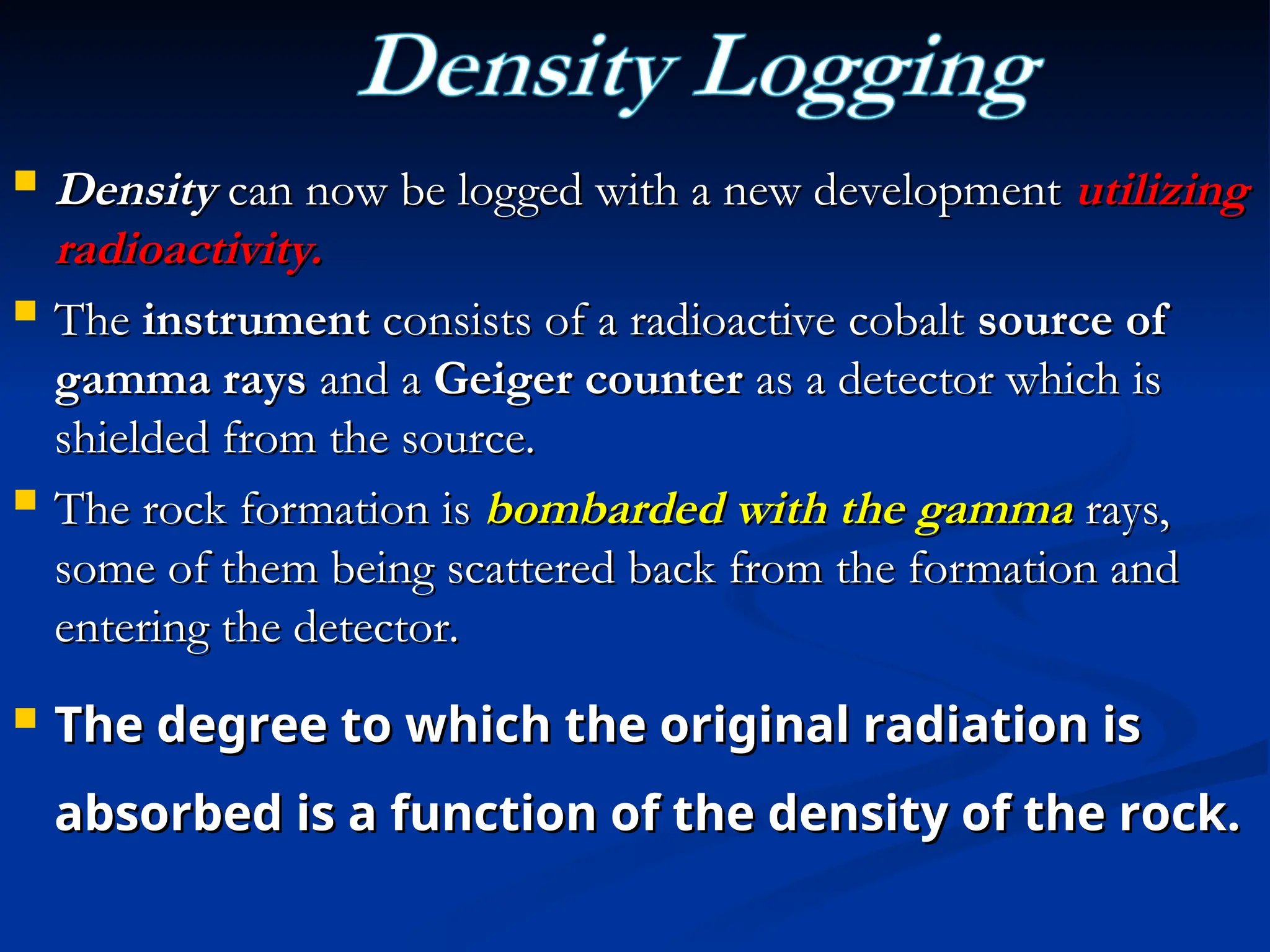
 Density
Density can now be logged with a new development
can now be logged with a new development utilizing
utilizing
radioactivity.
radioactivity.
 The
The instrument
instrument consists of a radioactive cobalt
consists of a radioactive cobalt source of
source of
gamma rays
gamma rays and a
and a Geiger counter
Geiger counter as a detector which is
as a detector which is
shielded from the source.
 The rock formation is
The rock formation is bombarded with the gamma
bombarded with the gamma rays,
rays,
some of them being scattered back from the formation and
entering the detector.
 The degree to which the original radiation is
The degree to which the original radiation is
absorbed is a function of the density of the rock.
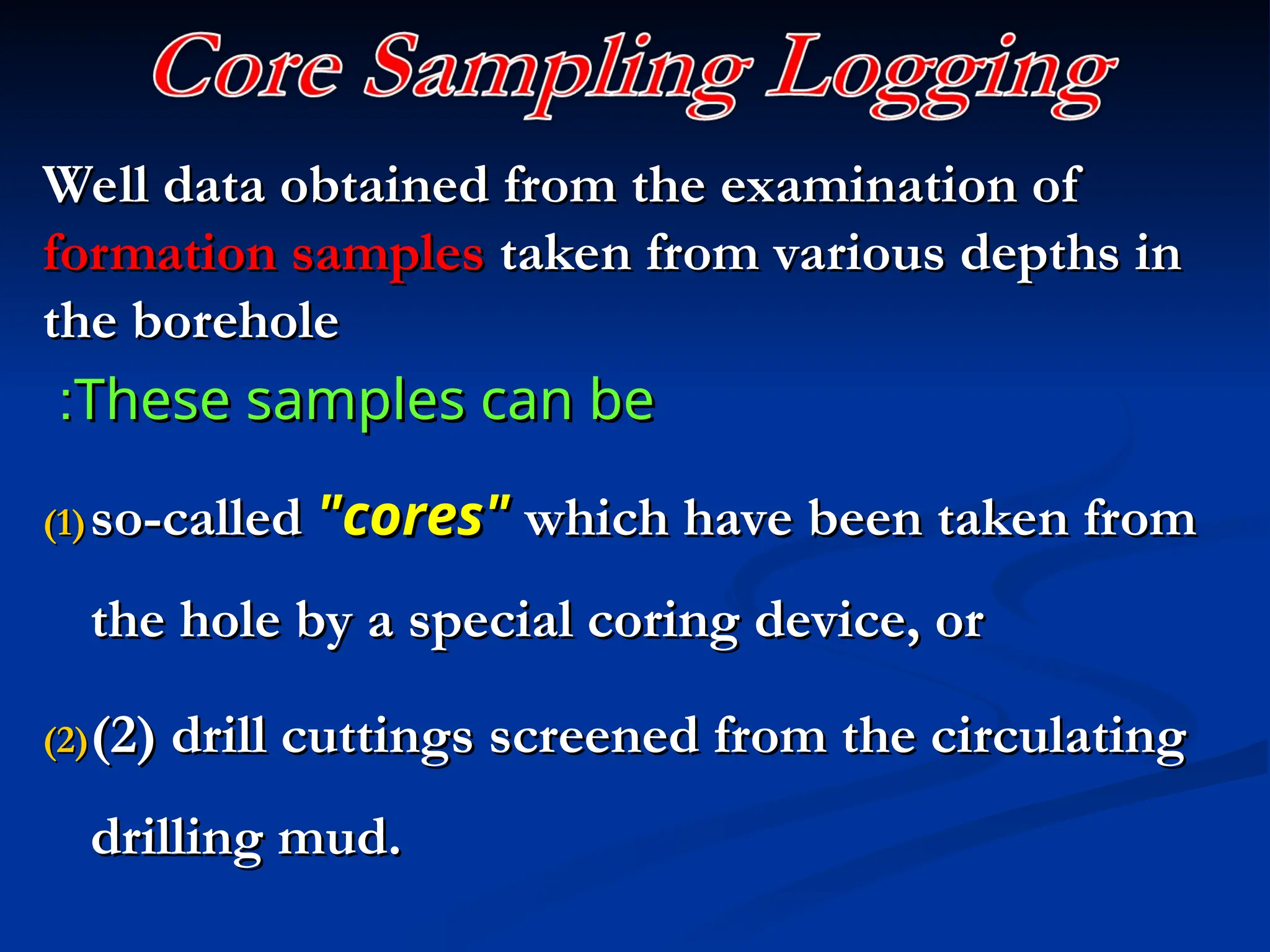
Well data obtained from the examination of
formation samples
formation samples taken from various depths in
taken from various depths in
the borehole
the borehole
These samples can be
:
:
(1)
(1) so-called
so-called "cores"
"cores" which have been taken from
which have been taken from
the hole by a special coring device, or
(2)
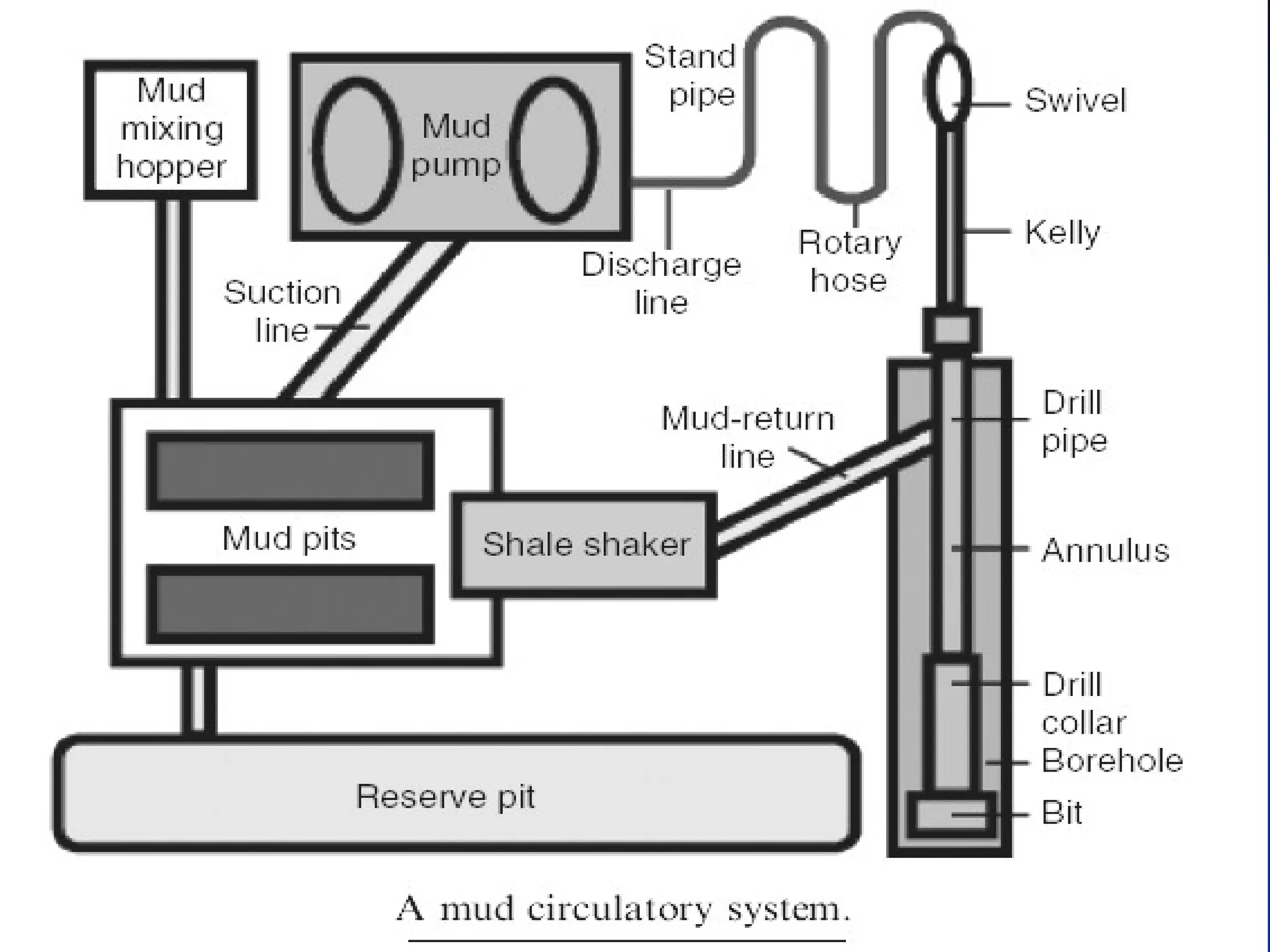
(2)(2) drill cuttings screened from the circulating
(2) drill cuttings screened from the circulating
drilling mud.
drilling mud.
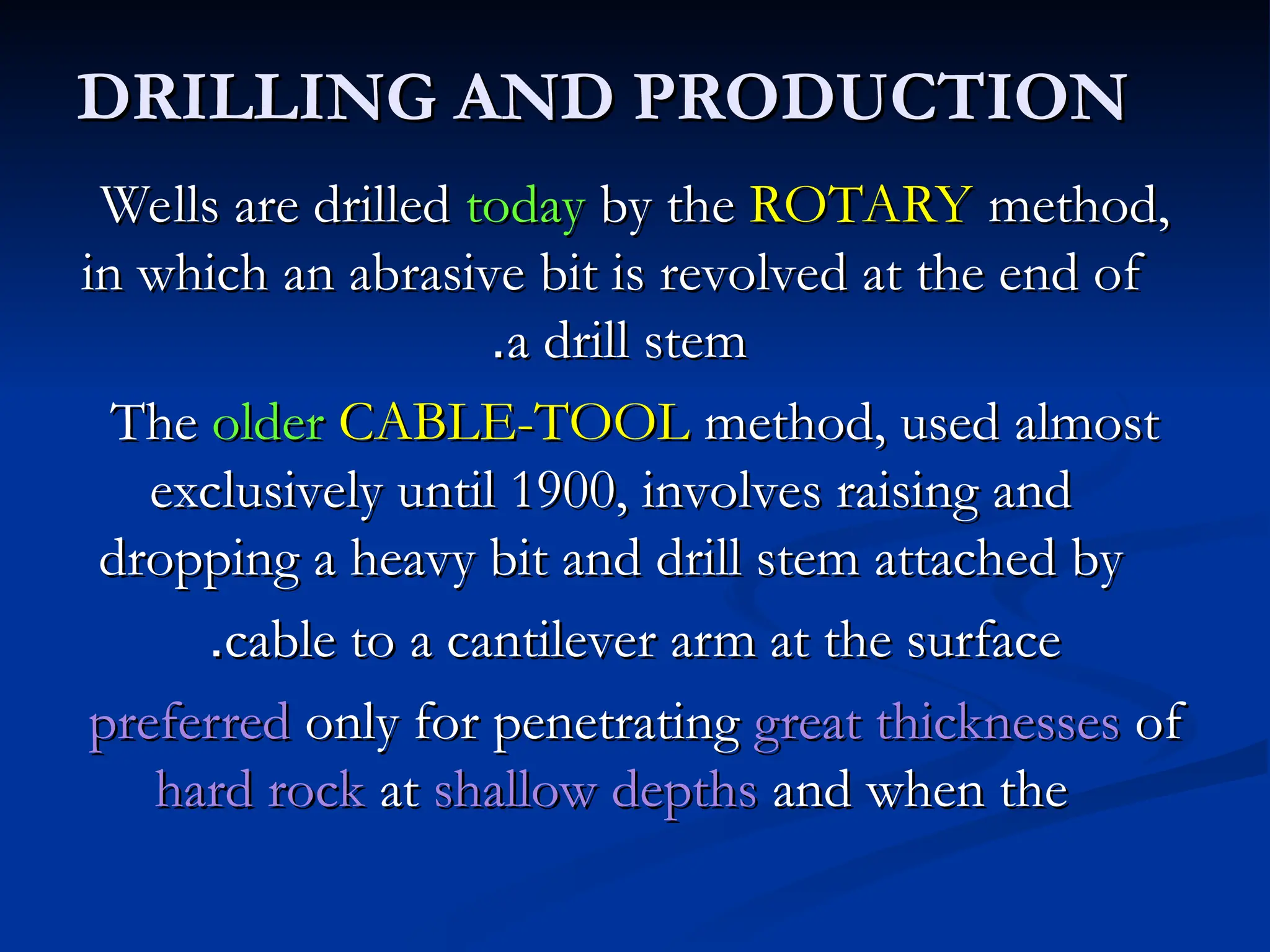
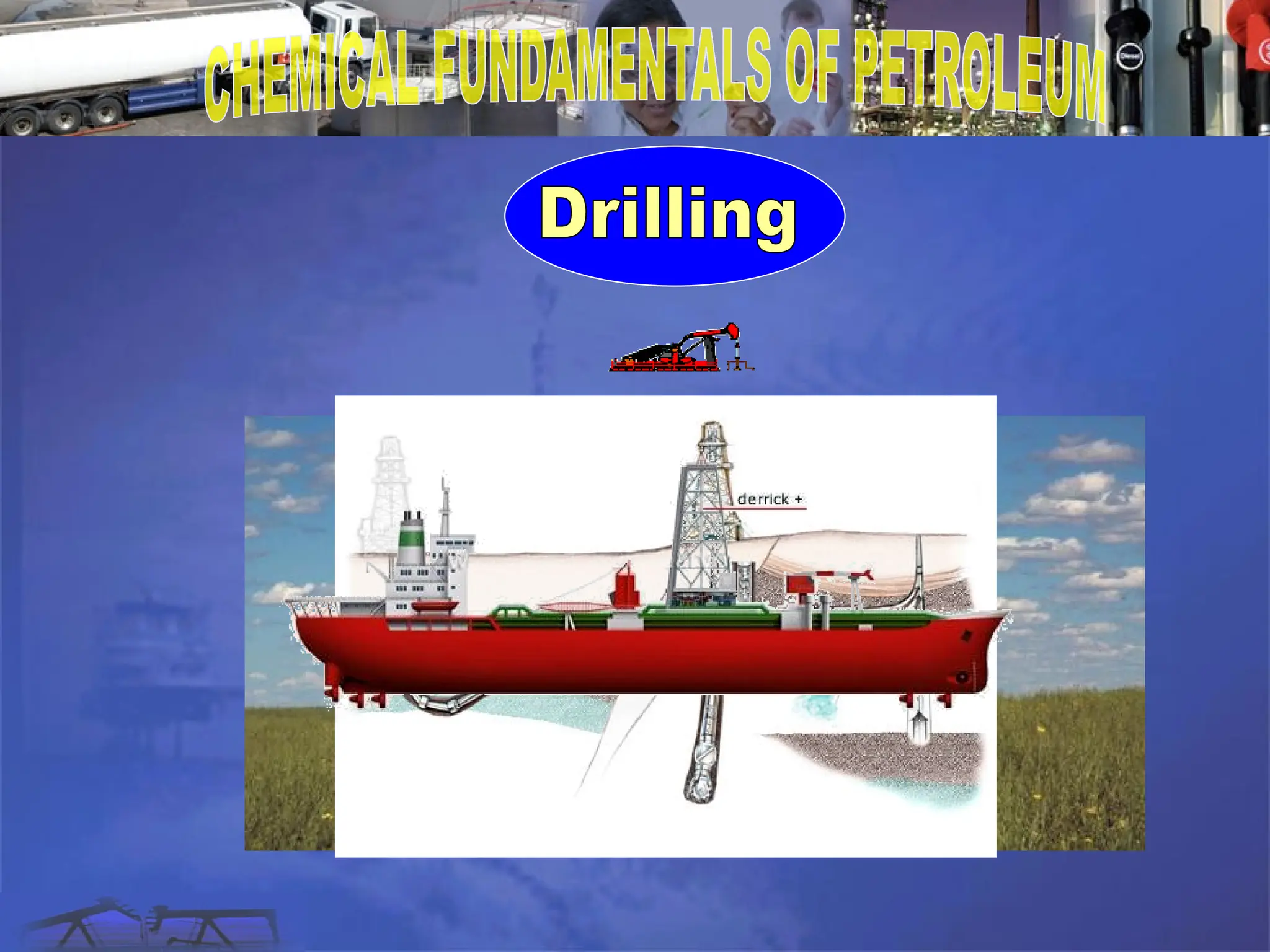
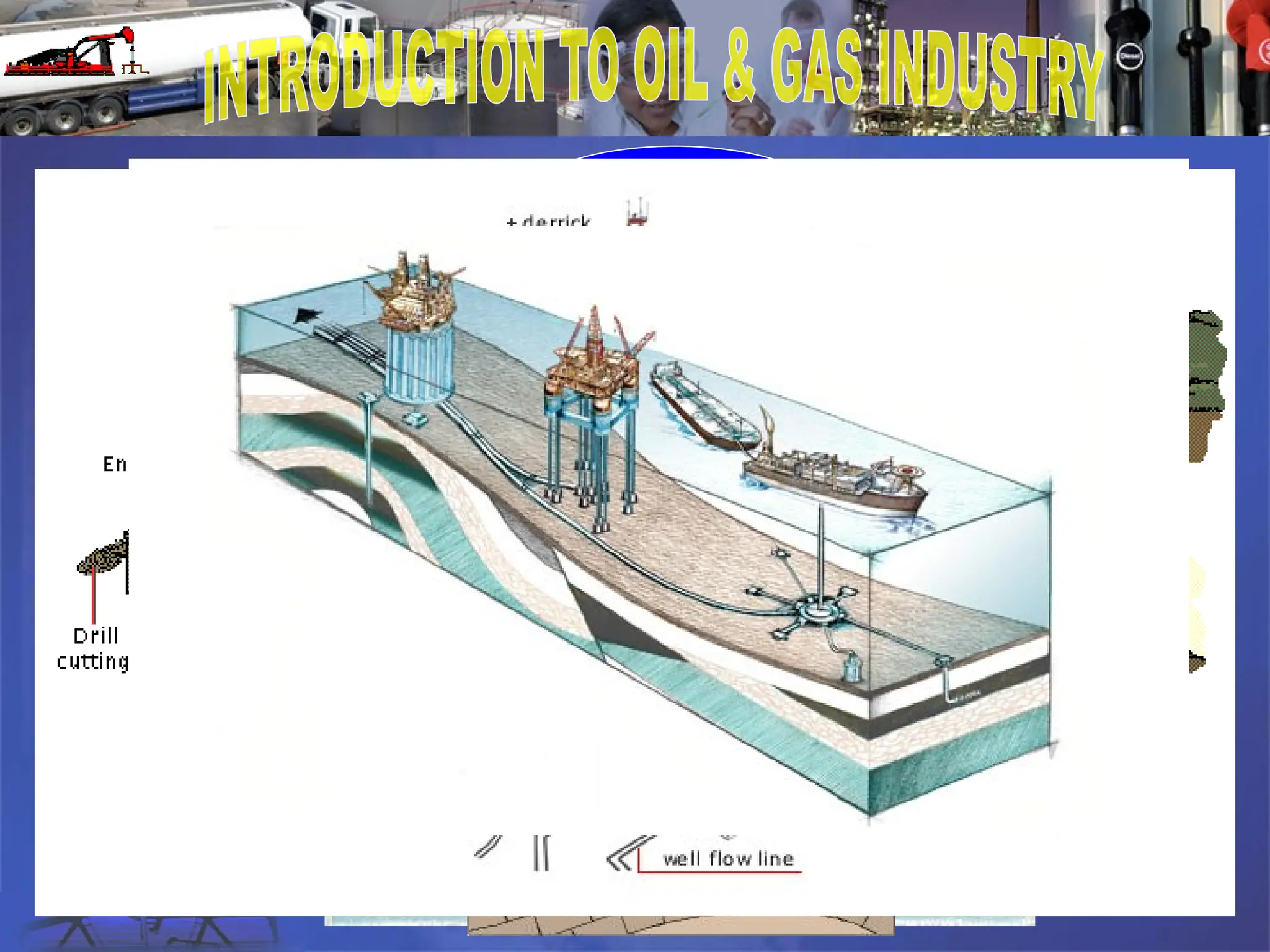
DRILLING AND PRODUCTION
Wells are drilled
Wells are drilled today
today by the
by the ROTARY
ROTARY method,
method,
in which an abrasive bit is revolved at the end of
a drill stem
a drill stem
.
.
The
The older
older CABLE-TOOL
CABLE-TOOL method, used almost
method, used almost
exclusively until 1900, involves raising and
dropping a heavy bit and drill stem attached by
cable to a cantilever arm at the surface
.
.
preferred
preferred only for penetrating
only for penetrating great thicknesses
great thicknesses of
of
hard rock
hard rock at
at shallow depths
shallow depths and when the
and when the
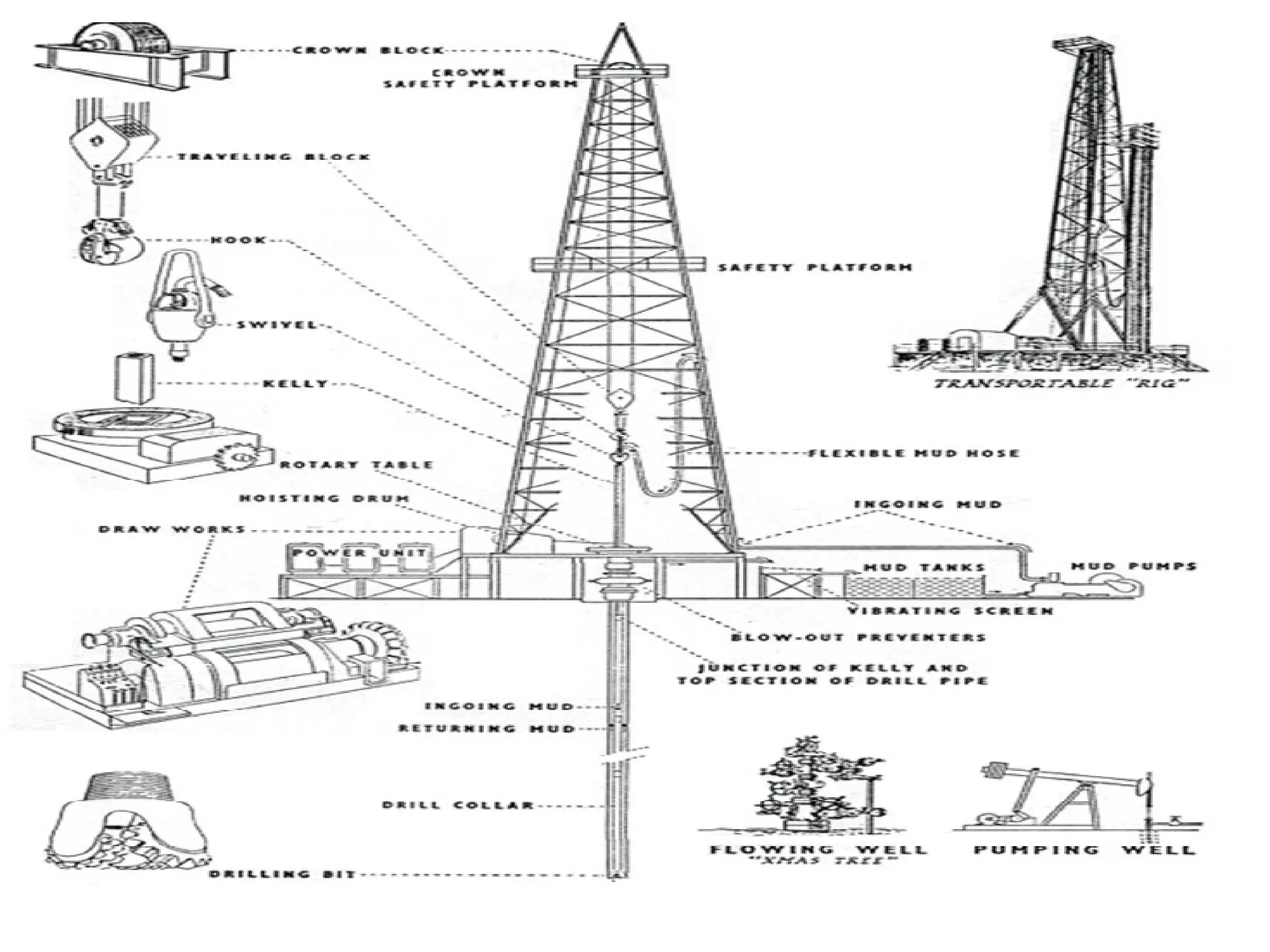
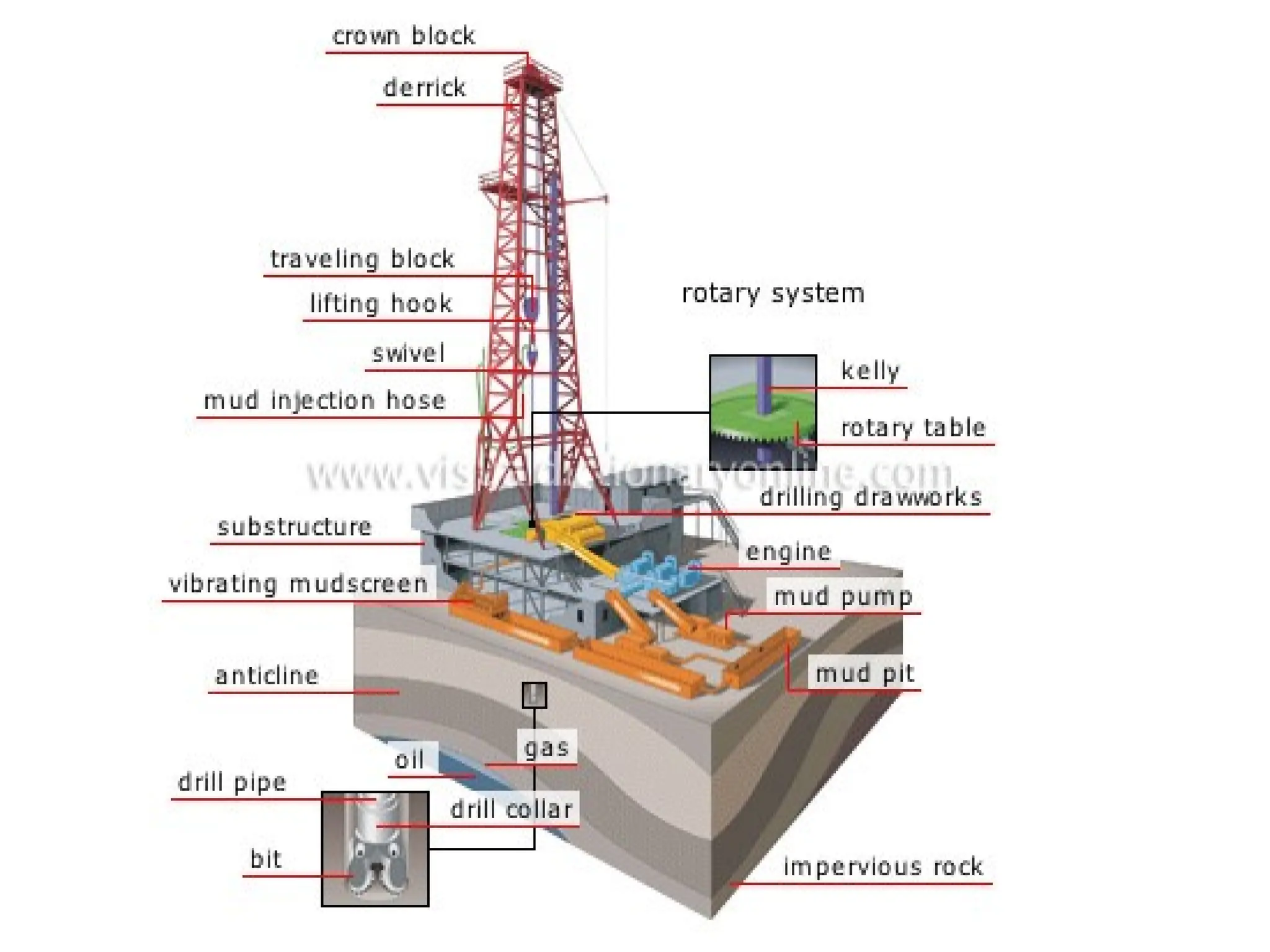
Drilling Operation
Drilling Operation
-
-
Once the site has been selected
,
,
* legal issues must be done.
* the crew goes about preparing the land
* must be a source of water nearby
* several holes must be dug to make way for
the rig and the main hole
The crew then begins drilling the main
hole often with a small drill truck rather
than the main rig.
than the main rig.
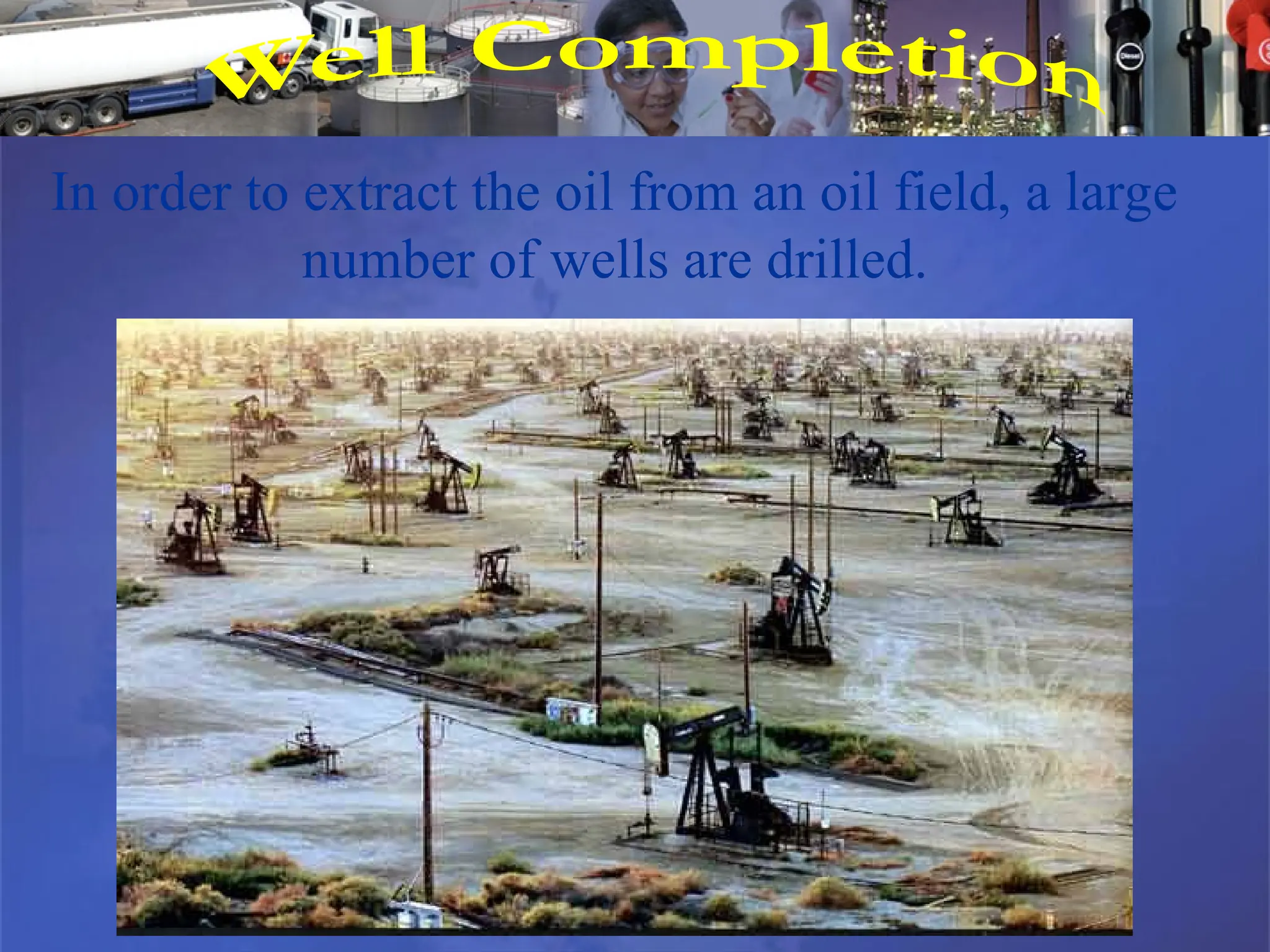
In order to extract the oil from an oil field, a large
number of wells are drilled.
Once the final depth has been reached, the well is
completed to allow oil to flow into the casing in a
controlled manner
;
a perforating GUN is lowered into the well to the
production depth. To create holes in the casing
through which oil can flow. After the casing has been
perforated, a small-diameter pipe (tubing) is run into
the hole as a conduit for oil and gas to flow up the
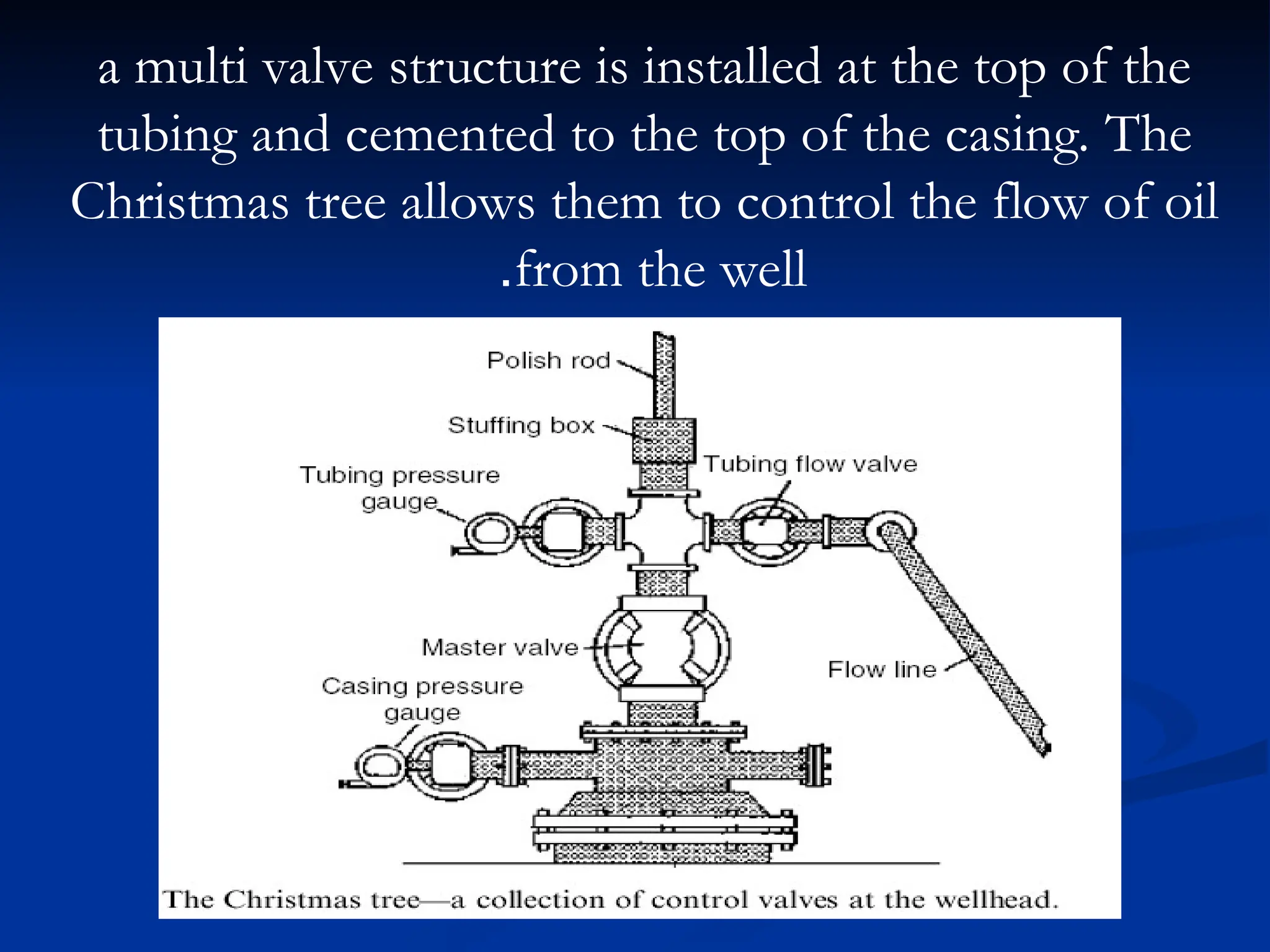
a multi valve structure is installed at the top of the
tubing and cemented to the top of the casing. The
Christmas tree allows them to control the flow of oil
from the well
.
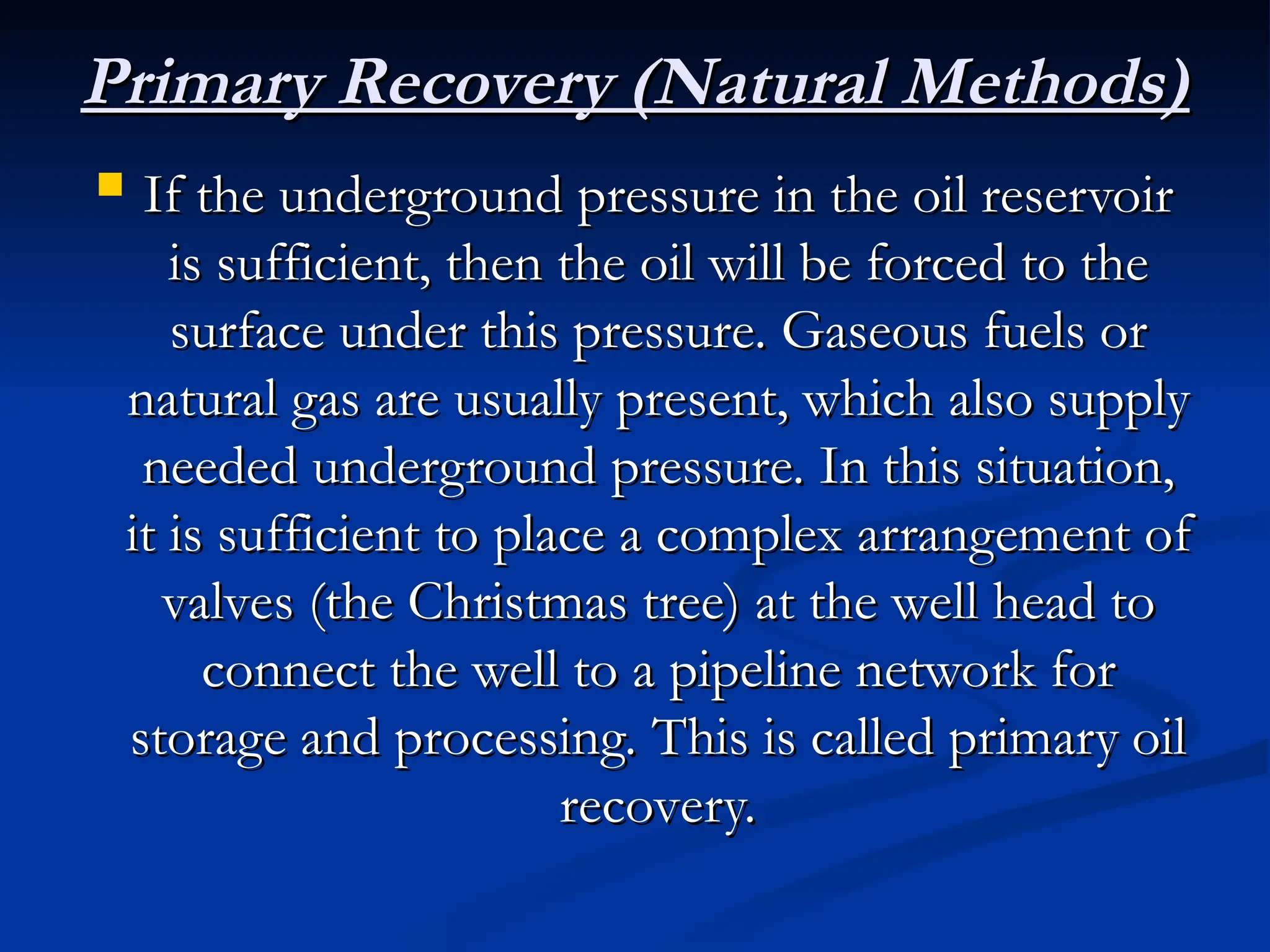
 Is the production of oil from a reservoir.
Is the production of oil from a reservoir.
 which range from
which range from recovery by reservoir energy
recovery by reservoir energy
(i.e., the oil flows from the well hole without
assistance)
assistance) to
to enhanced recovery methods in
enhanced recovery methods in
which considerable energy must be added to the
reservoir to produce the oil.
 However, the effect of the method on the oil and
However, the effect of the method on the oil and
on the reservoir must be considered before
application.
application.
Recovery
Recovery
Primary Recovery (Natural Methods)
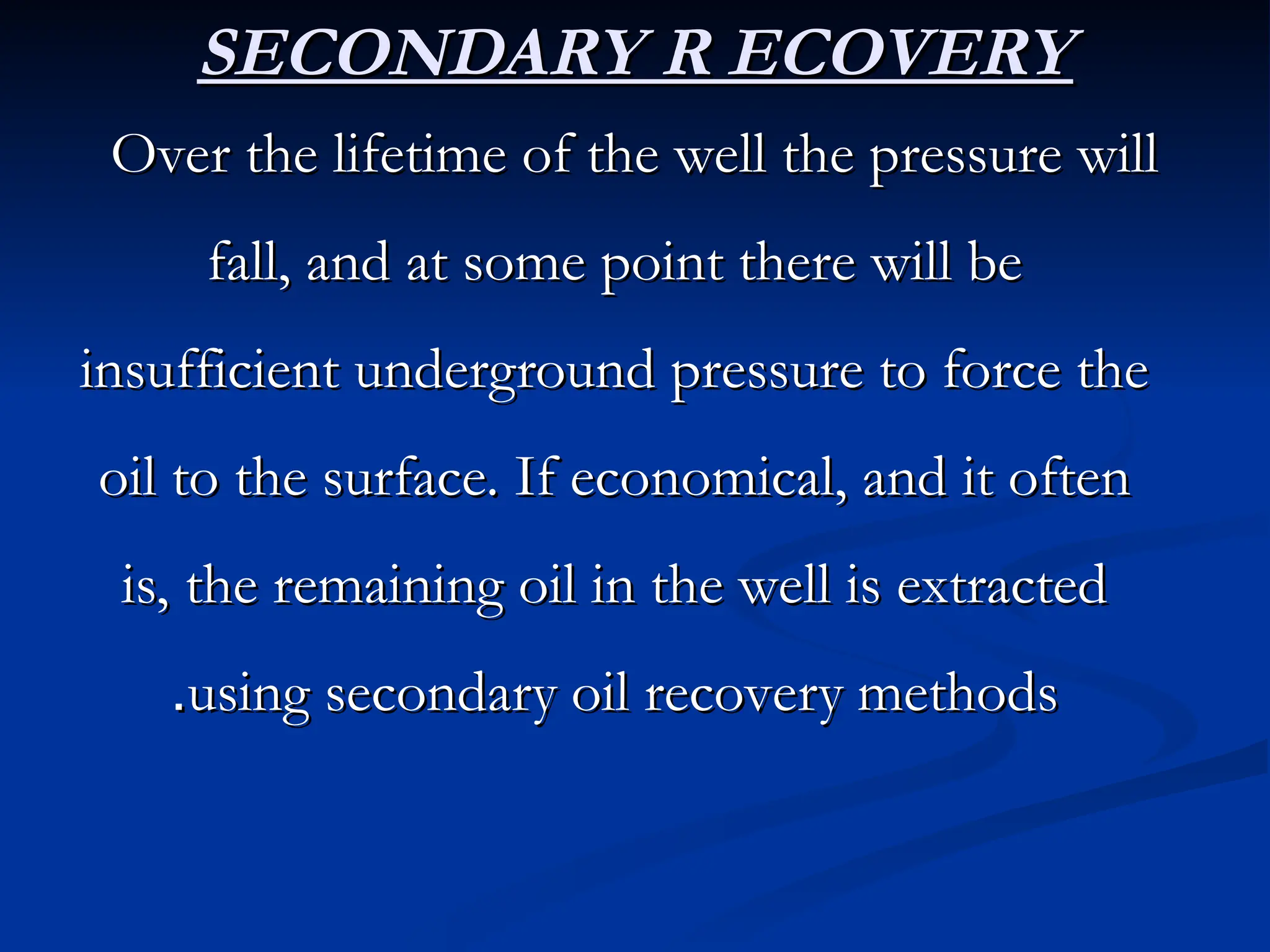
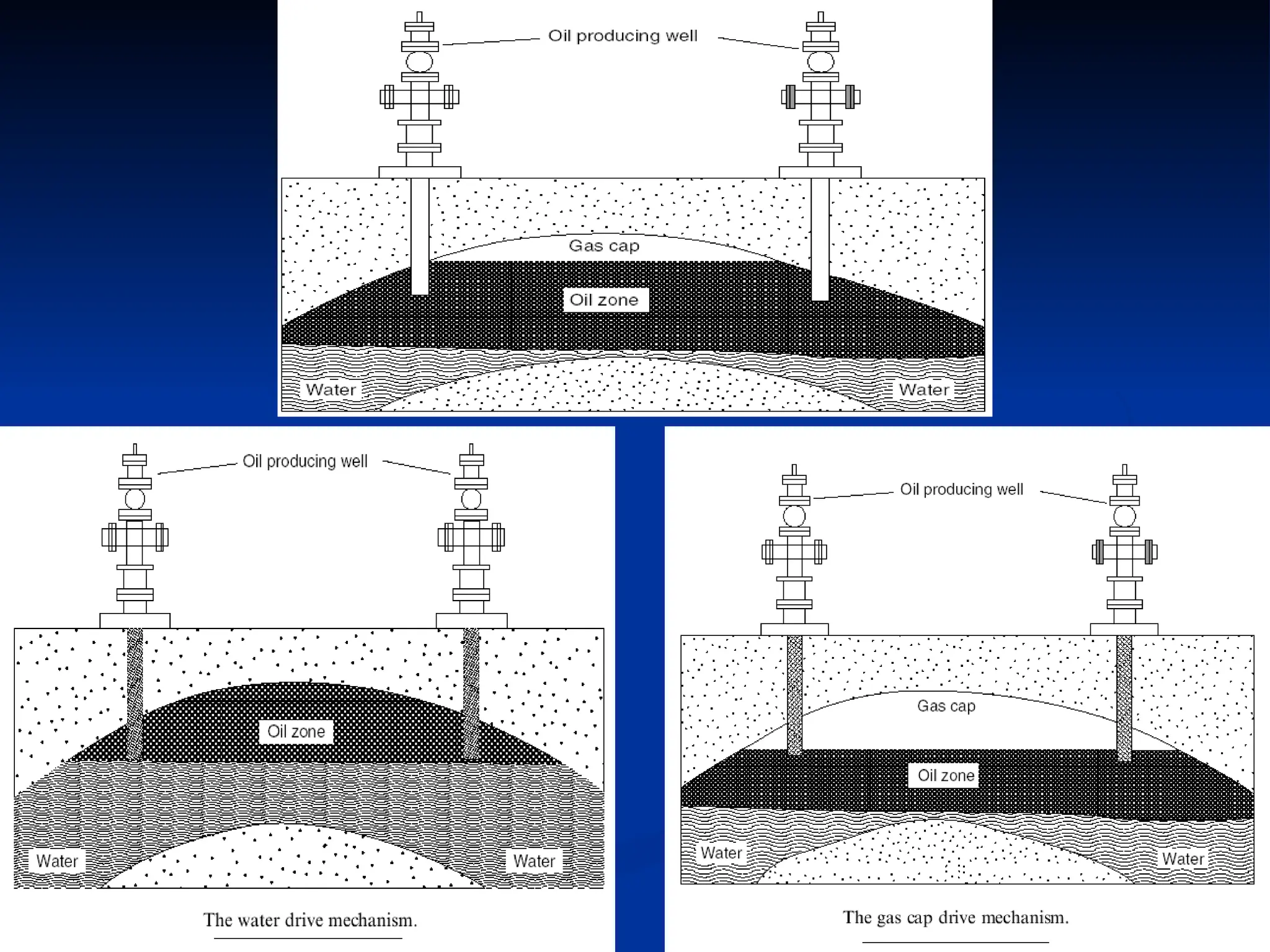
 If the underground pressure in the oil reservoir
If the underground pressure in the oil reservoir
is sufficient, then the oil will be forced to the
surface under this pressure. Gaseous fuels or
natural gas are usually present, which also supply
needed underground pressure. In this situation,
it is sufficient to place a complex arrangement of
valves (the Christmas tree) at the well head to
connect the well to a pipeline network for
storage and processing. This is called primary oil
recovery.
recovery.
SECONDARY R ECOVERY
SECONDARY R ECOVERY
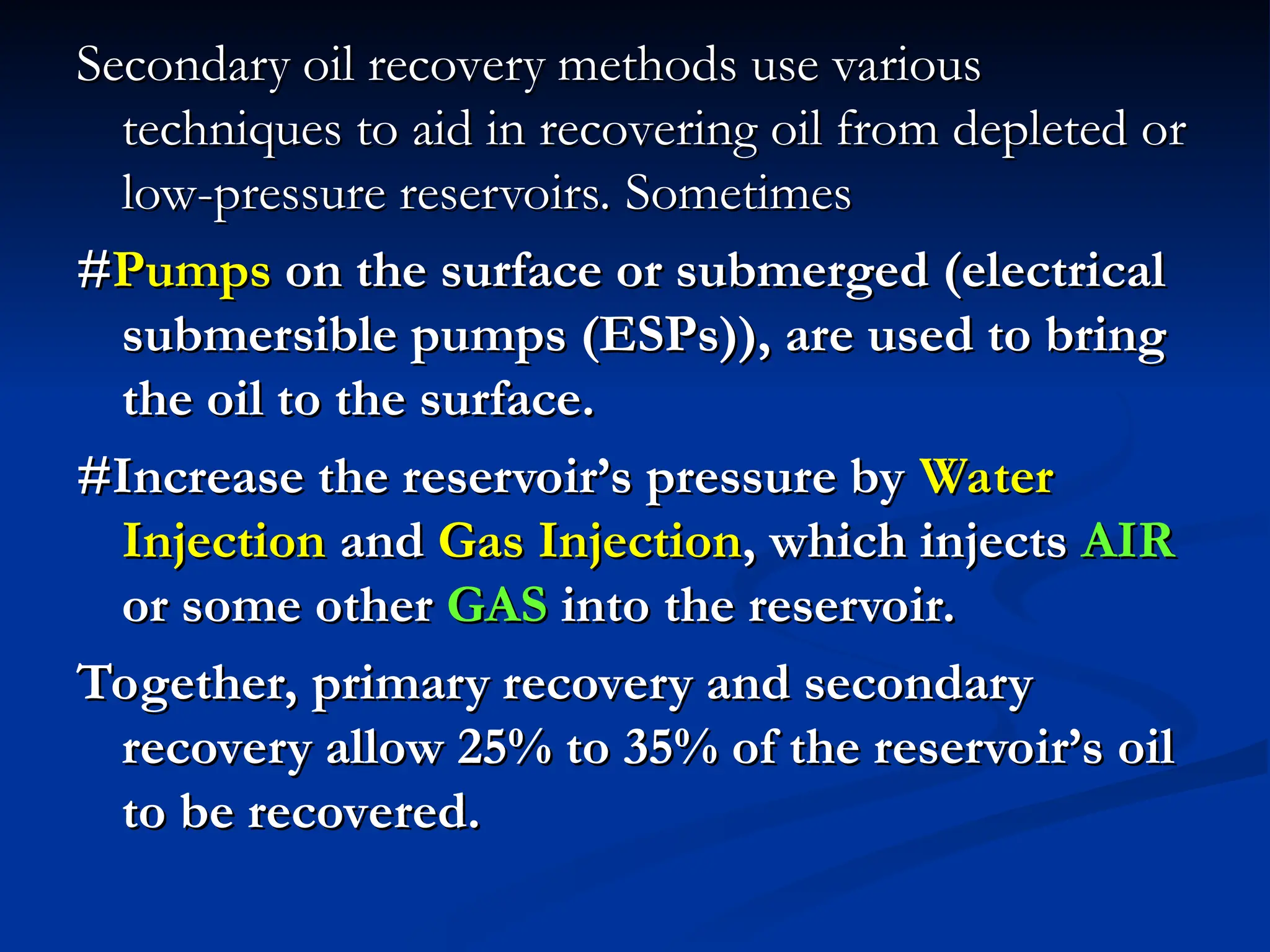
Over the lifetime of the well the pressure will
fall, and at some point there will be
insufficient underground pressure to force the
oil to the surface. If economical, and it often
is, the remaining oil in the well is extracted
using secondary oil recovery methods
.
.
Secondary oil recovery methods use various
techniques to aid in recovering oil from depleted or
low-pressure reservoirs. Sometimes
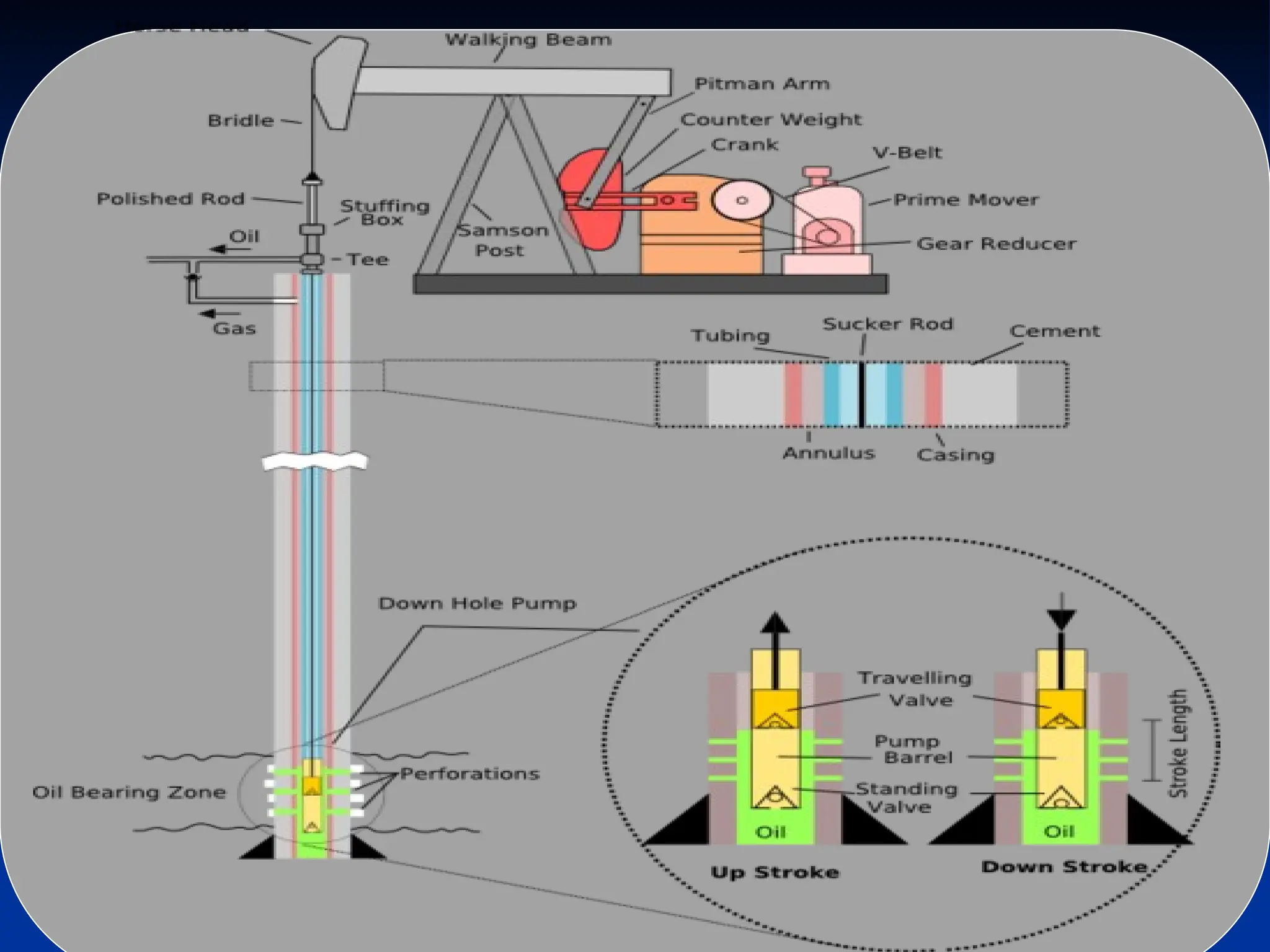
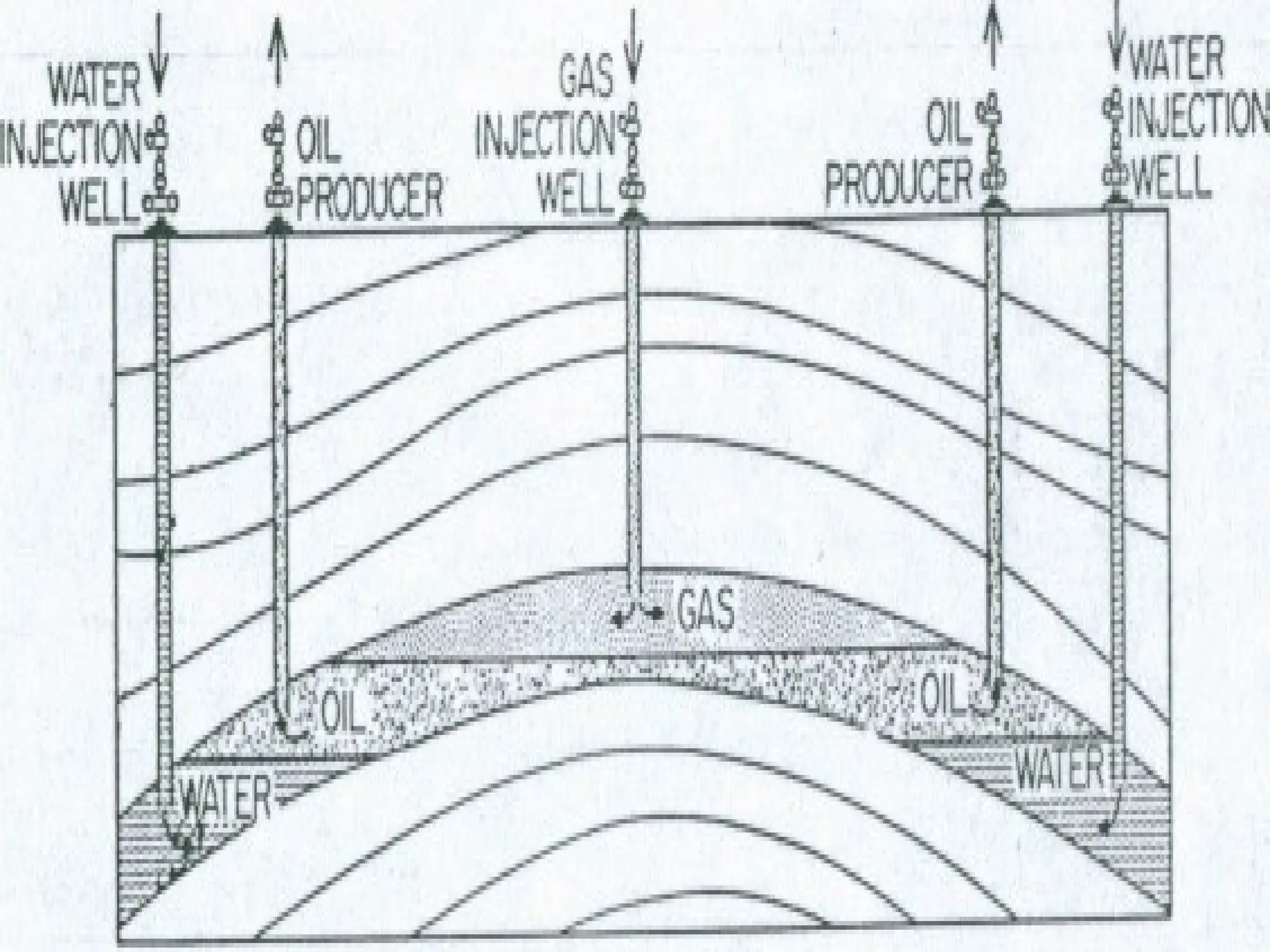
#
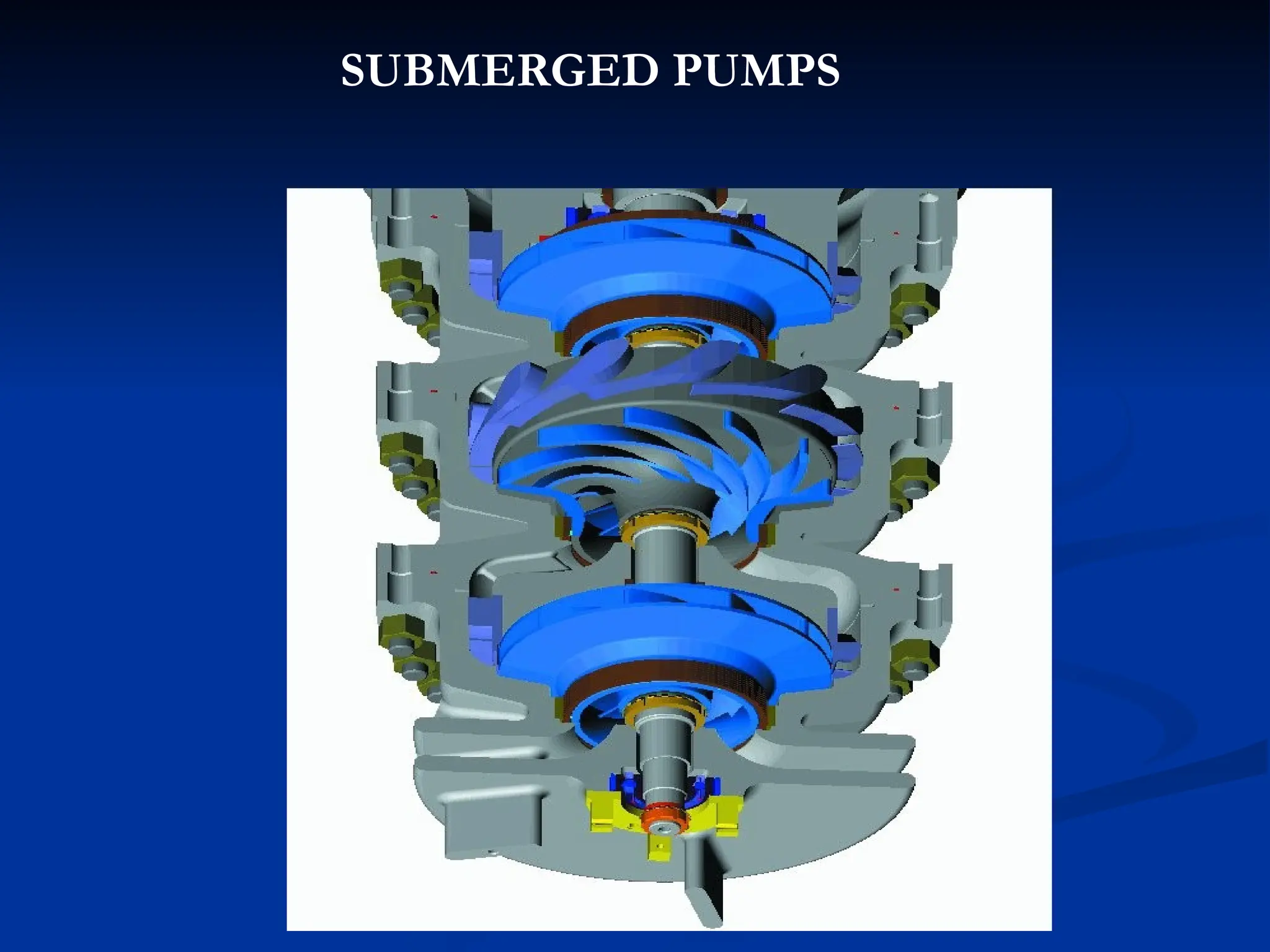
#Pumps
Pumps on the surface or submerged (electrical
on the surface or submerged (electrical
submersible pumps (ESPs)), are used to bring
the oil to the surface.
#Increase the reservoir’s pressure by
#Increase the reservoir’s pressure by Water
Water
Injection
Injection and
and Gas
Gas Injection
Injection, which injects
, which injects AIR
AIR
or some other
or some other GAS
GAS into the reservoir.
into the reservoir.
Together, primary recovery and secondary
recovery allow 25% to 35% of the reservoir’s oil
to be recovered.
to be recovered.
SUBMERGED PUMPS
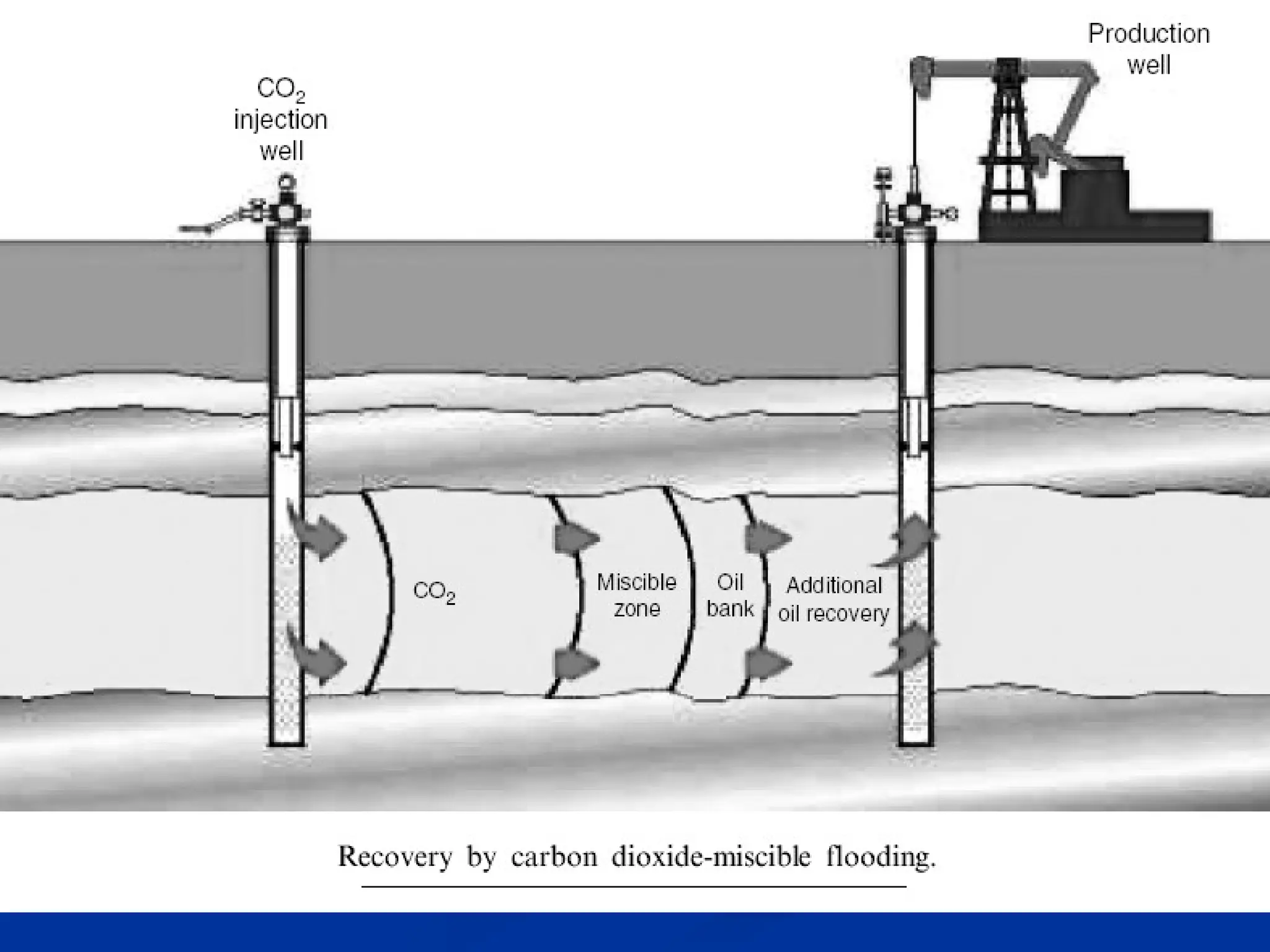
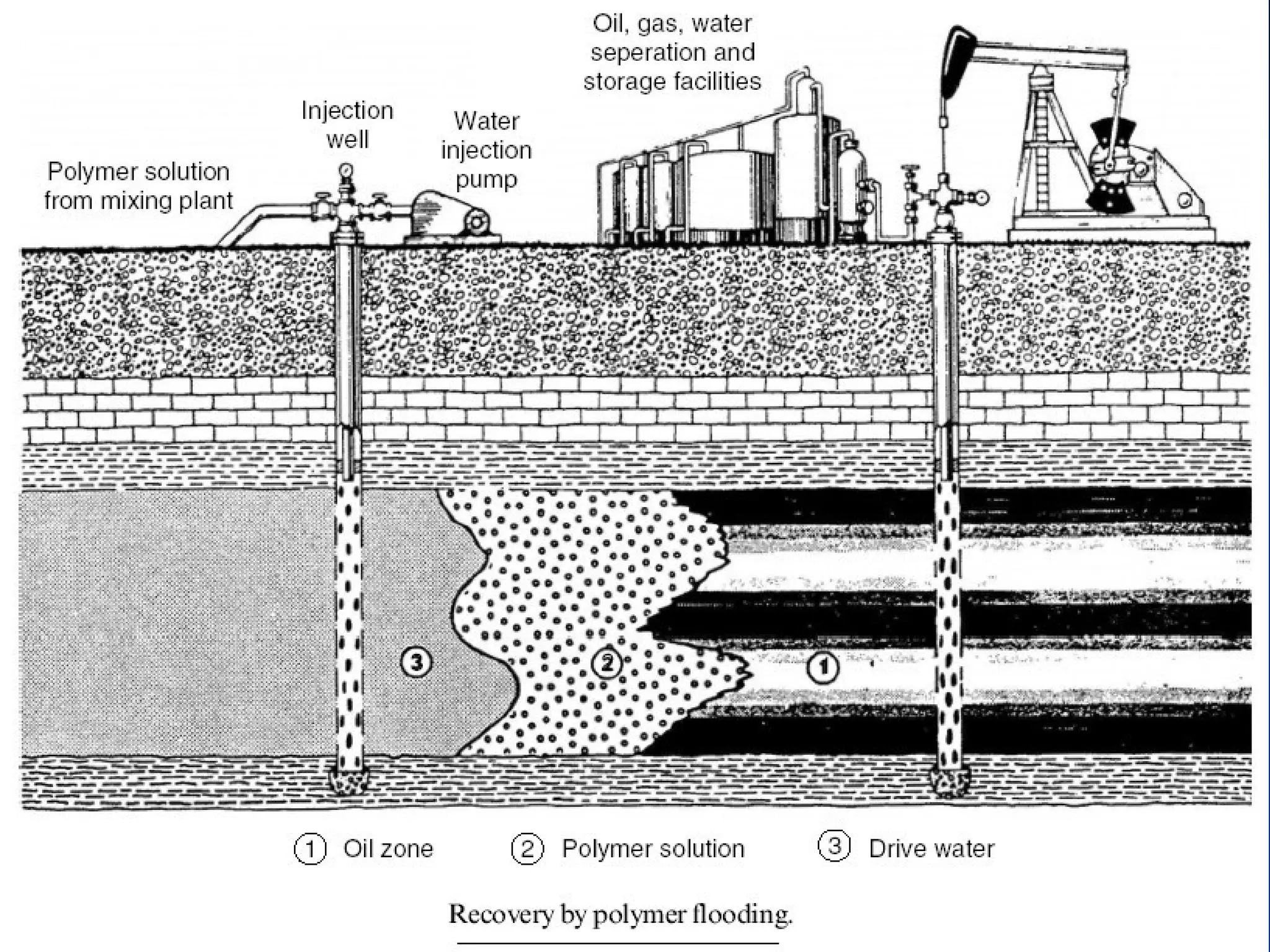
ENHANCED OIL RECOVERY
Enhanced oil recovery (tertiary oil recovery)
is the incremental ultimate oil that can be
recovered from a petroleum reservoir over
oil that can be obtained by primary and
secondary recovery methods
.
.
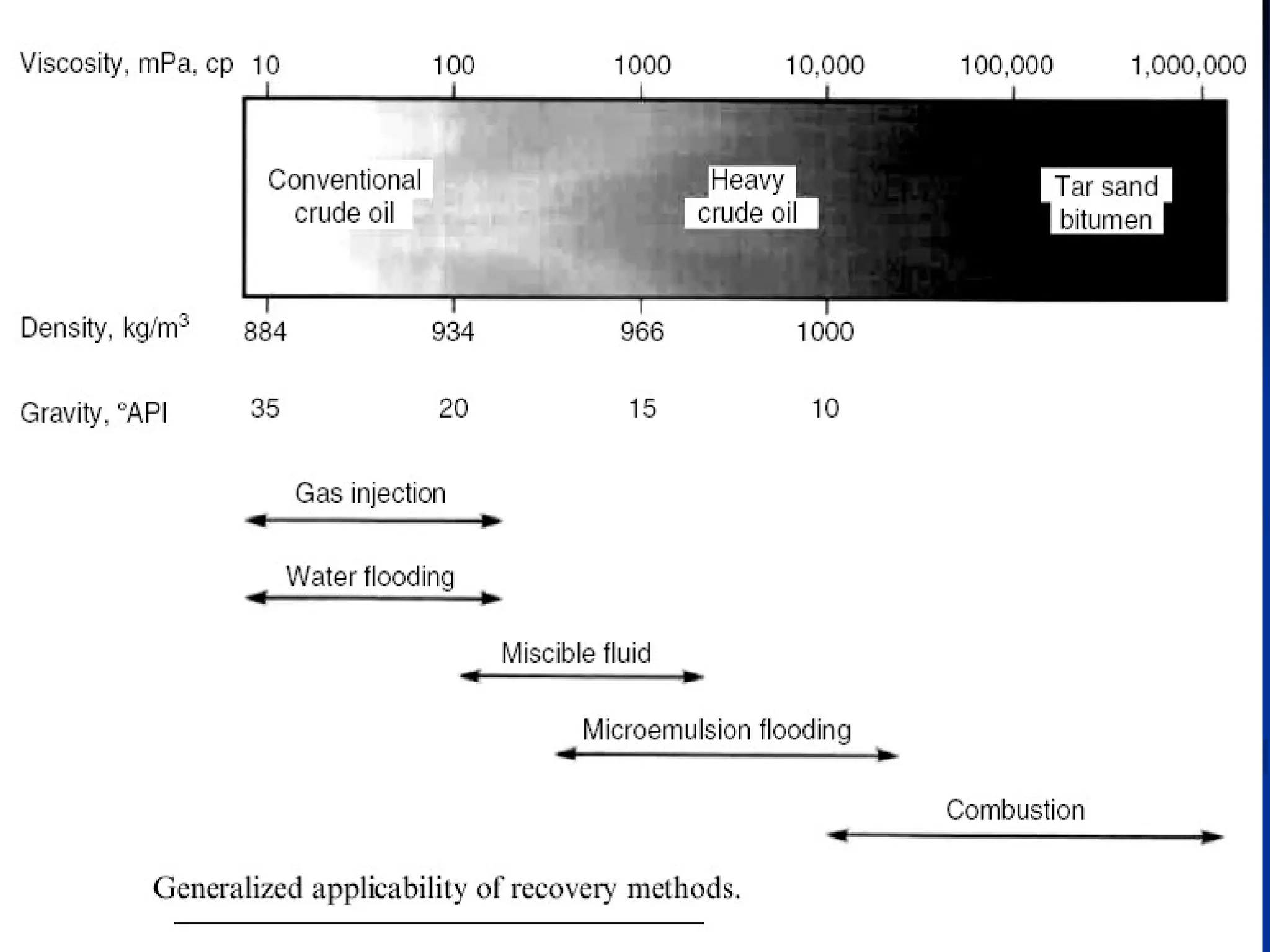
The viscosity (or the API gravity) of petroleum is an
important factor that must be taken into account
when heavy oil is recovered from a reservoir
.
.
In fact, certain reservoir types, such as those with
very viscous crude oils and some low-permeability
carbonate (limestone, dolomite, or chert)
reservoirs, respond poorly to conventional
secondary recovery techniques
.
.
In these reservoirs, it is desirable to initiate enhanced
oil recovery (EOR) operations as early as possible
.
.
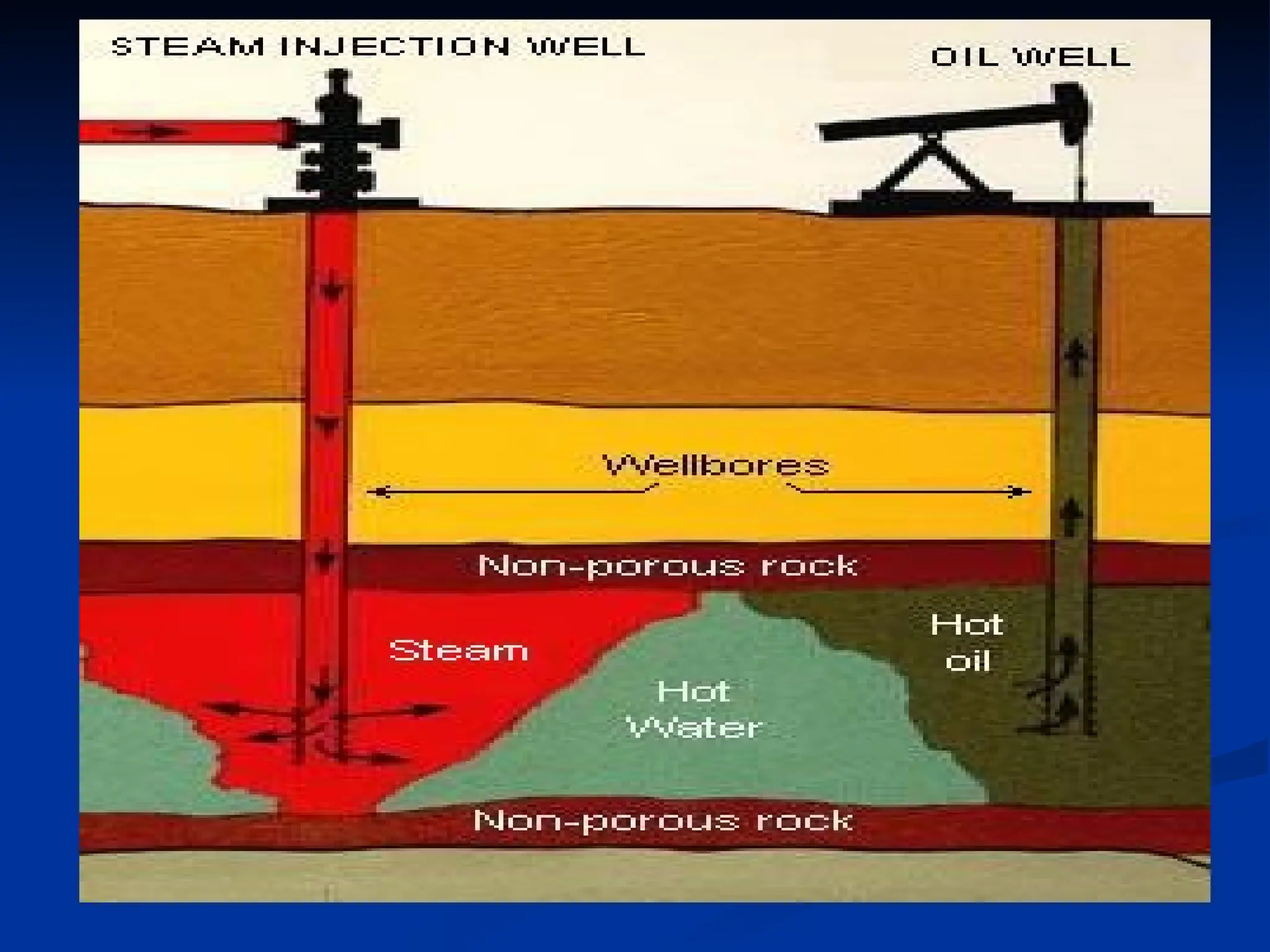
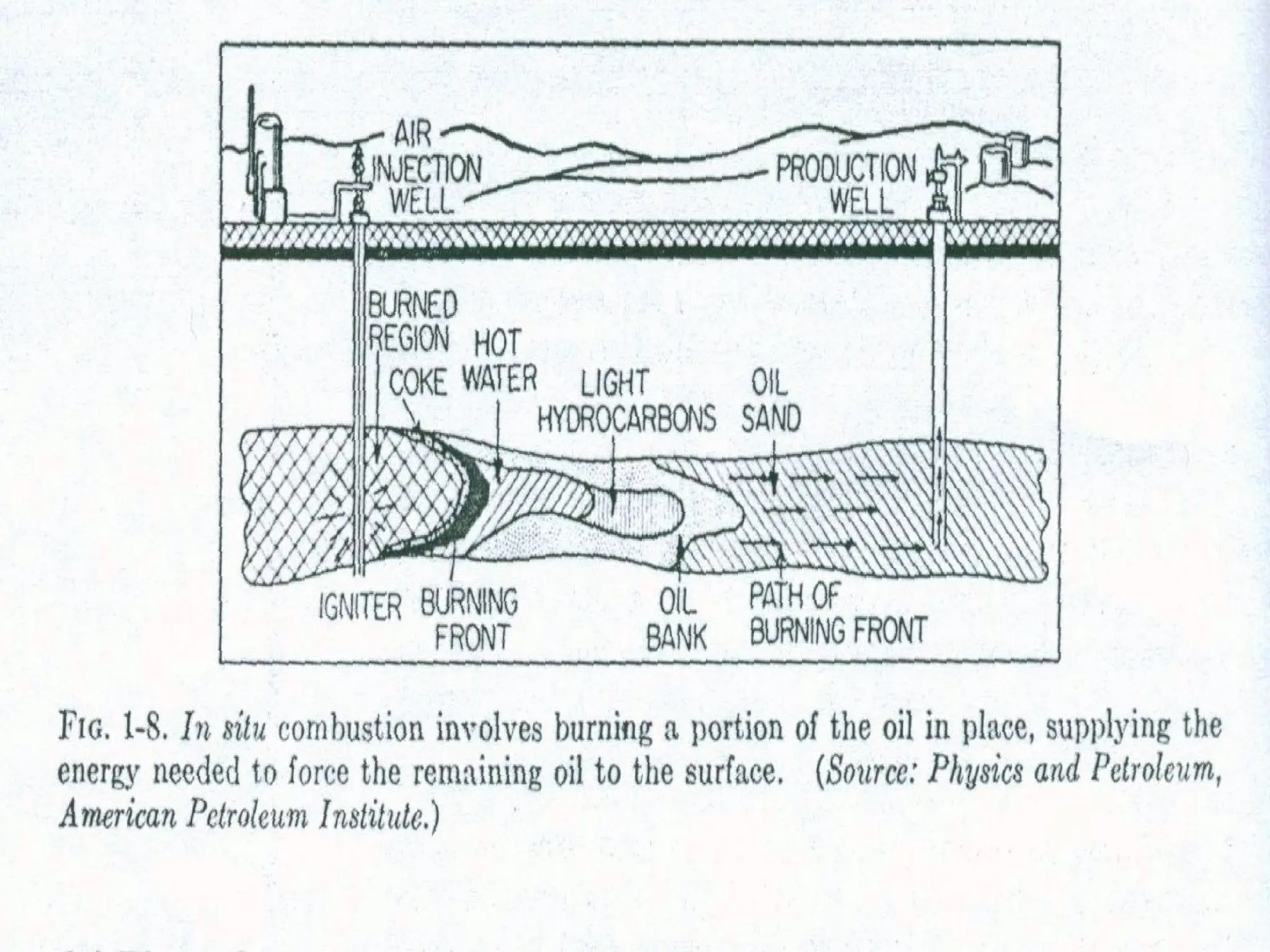
Thermal floods using steam and
controlled in situ combustion methods
are also used. Thermal methods of
recovery reduce the viscosity of the
crude oil by heat so that it flows more
easily into the production well
.
.
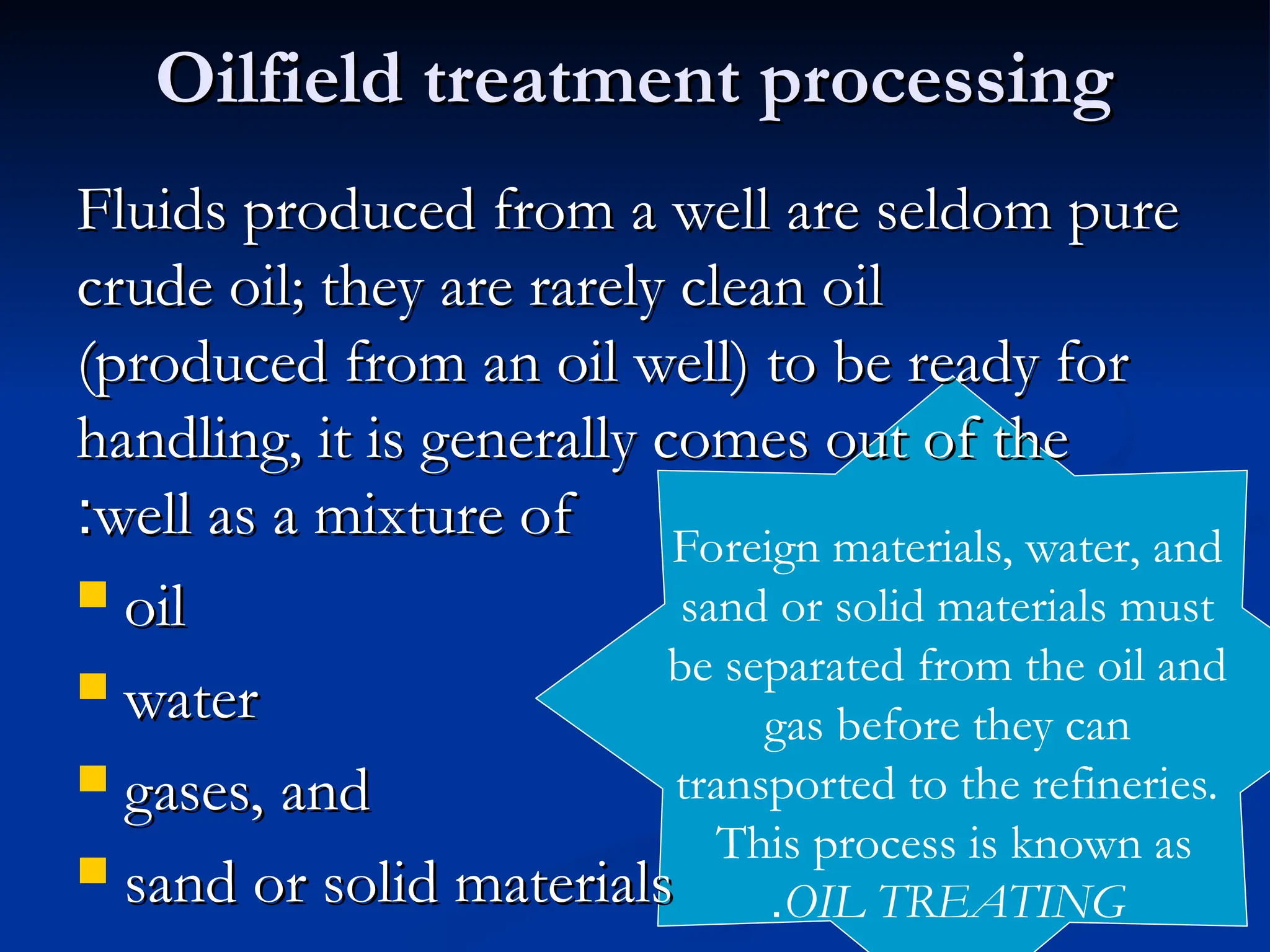
Oilfield treatment processing
Fluids produced from a well are seldom pure
crude oil; they are rarely clean oil
(produced from an oil well) to be ready for
handling, it is generally comes out of the
well as a mixture of
:
:
 oil
oil
 water
water
 gases, and
gases, and
 sand or solid materials
sand or solid materials
Foreign materials, water, and
sand or solid materials must
be separated from the oil and
gas before they can
transported to the refineries.
This process is known as
OIL TREATING
.
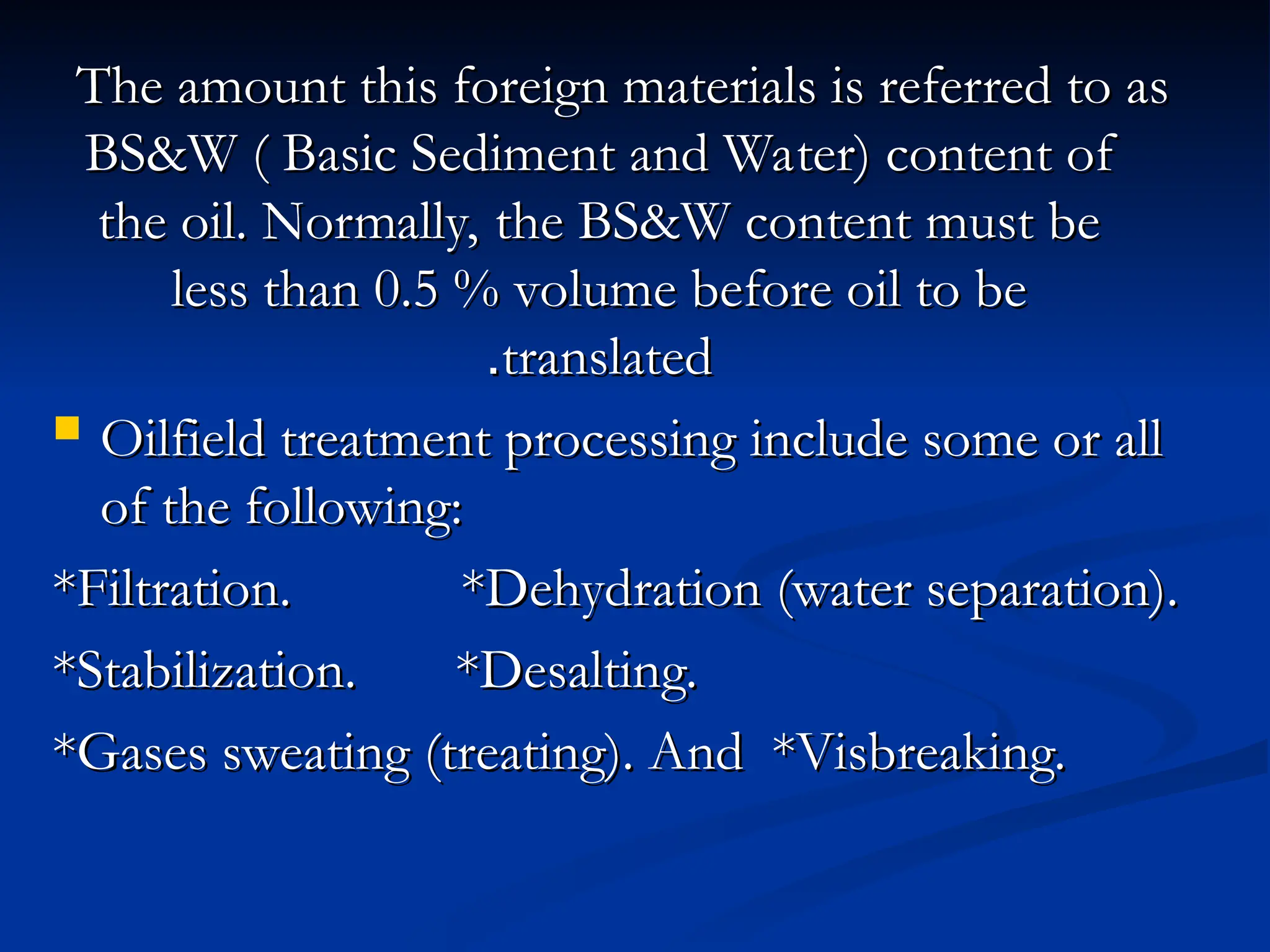
The amount this foreign materials is referred to as
BS&W ( Basic Sediment and Water) content of
the oil. Normally, the BS&W content must be
less than 0.5 % volume before oil to be
translated
translated
.
.
 Oilfield treatment processing include some or all
Oilfield treatment processing include some or all
of the following:
of the following:
*Filtration. *Dehydration (water separation).
*Stabilization. *Desalting.
*Gases sweating (treating). And *Visbreaking.
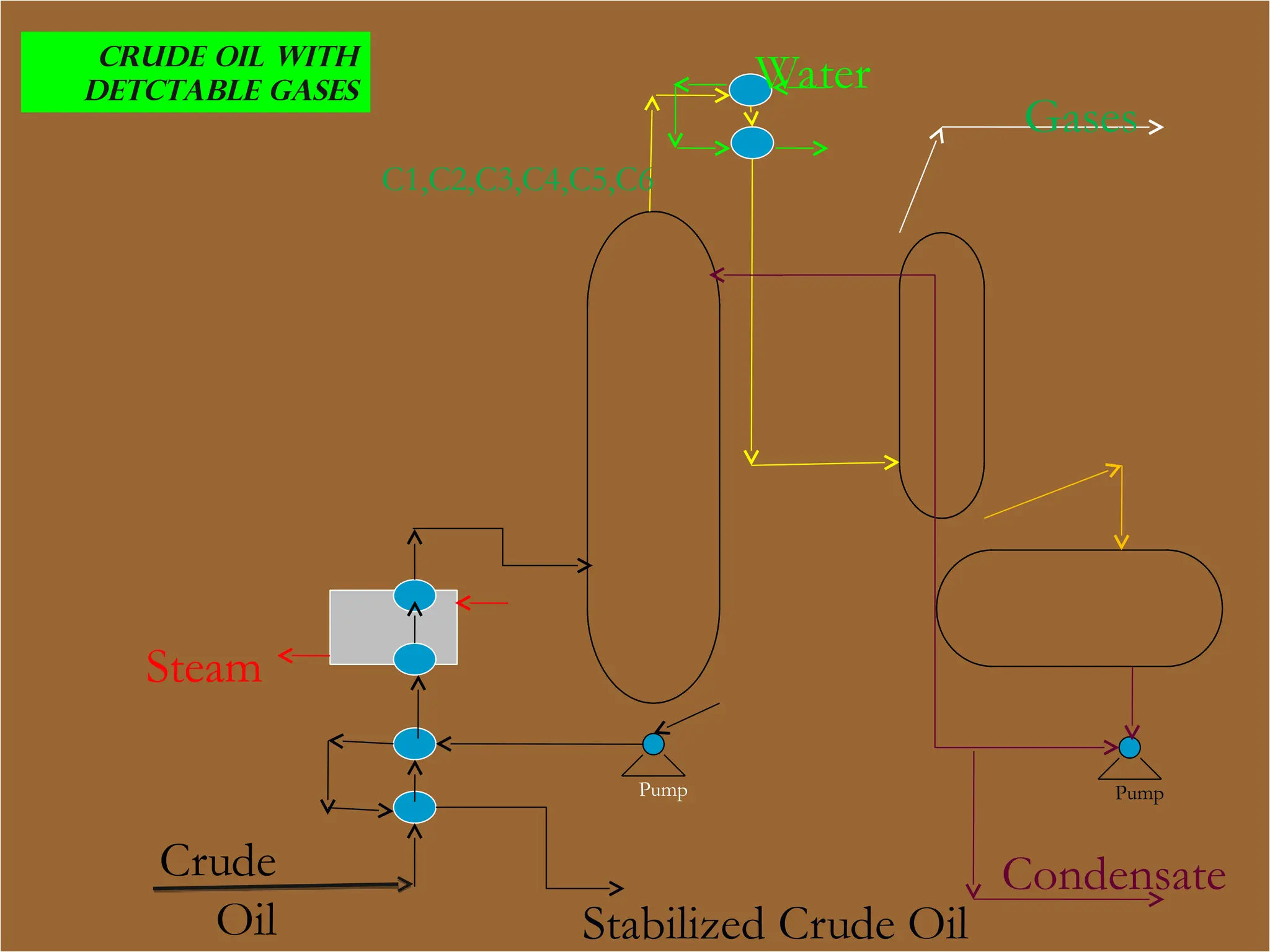
Crude
Oil
Steam
Pump
Stabilized Crude Oil
Gases
C1,C2,C3,C4,C5,C6
Pump
Condensate
Water
CRUDE OIL WITH
DETCTABLE GASES
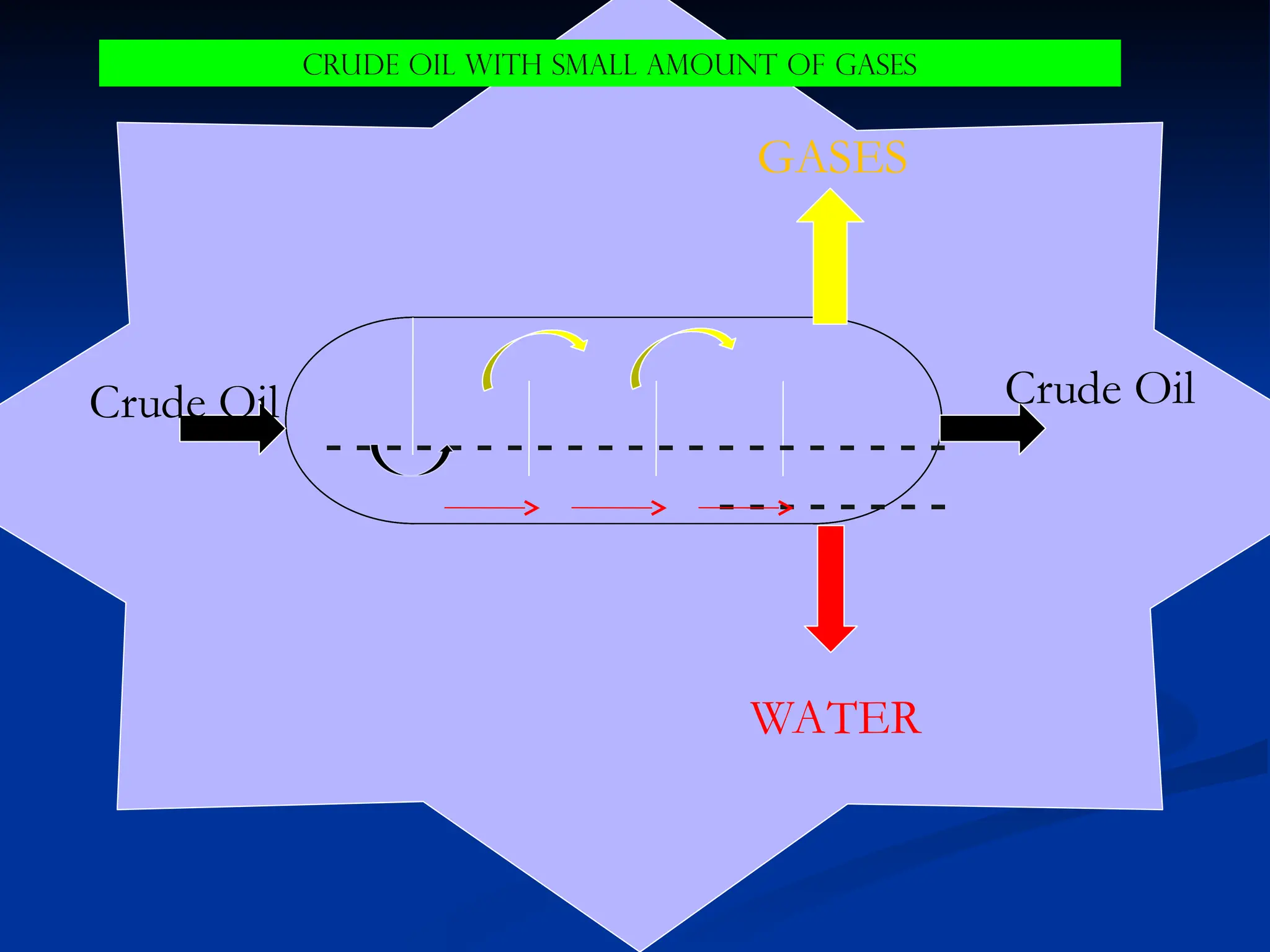
- - - - - - - - - - - - - - - - - - - - -
- - - - - - - -
Crude Oil Crude Oil
WATER
GASES
CRUDE OIL WITH SMALL AMOUNT OF gases
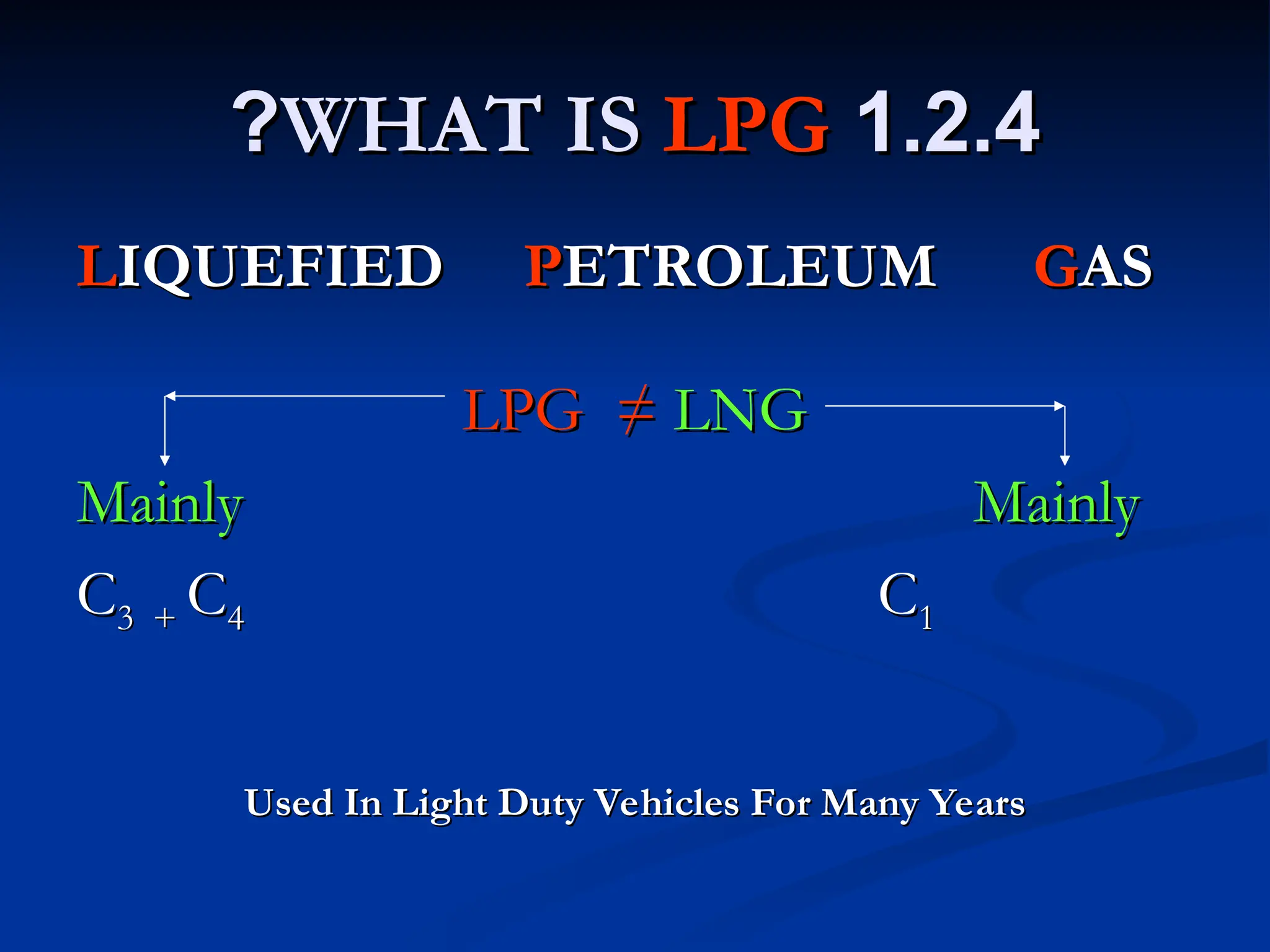
1.2.4
1.2.4
WHAT IS
WHAT IS LPG
LPG
?
?
L
LIQUEFIED
IQUEFIED P
PETROLEUM
ETROLEUM G
GAS
AS
LPG ≠
LPG ≠ LNG
LNG
Mainly Mainly
Mainly Mainly
C
C3 +
3 + C
C4
4 C
C1
1
Used In Light Duty Vehicles For Many Years
1.2.1
1.2.1
WHAT IS
WHAT IS LNG
LNG
?
?
L
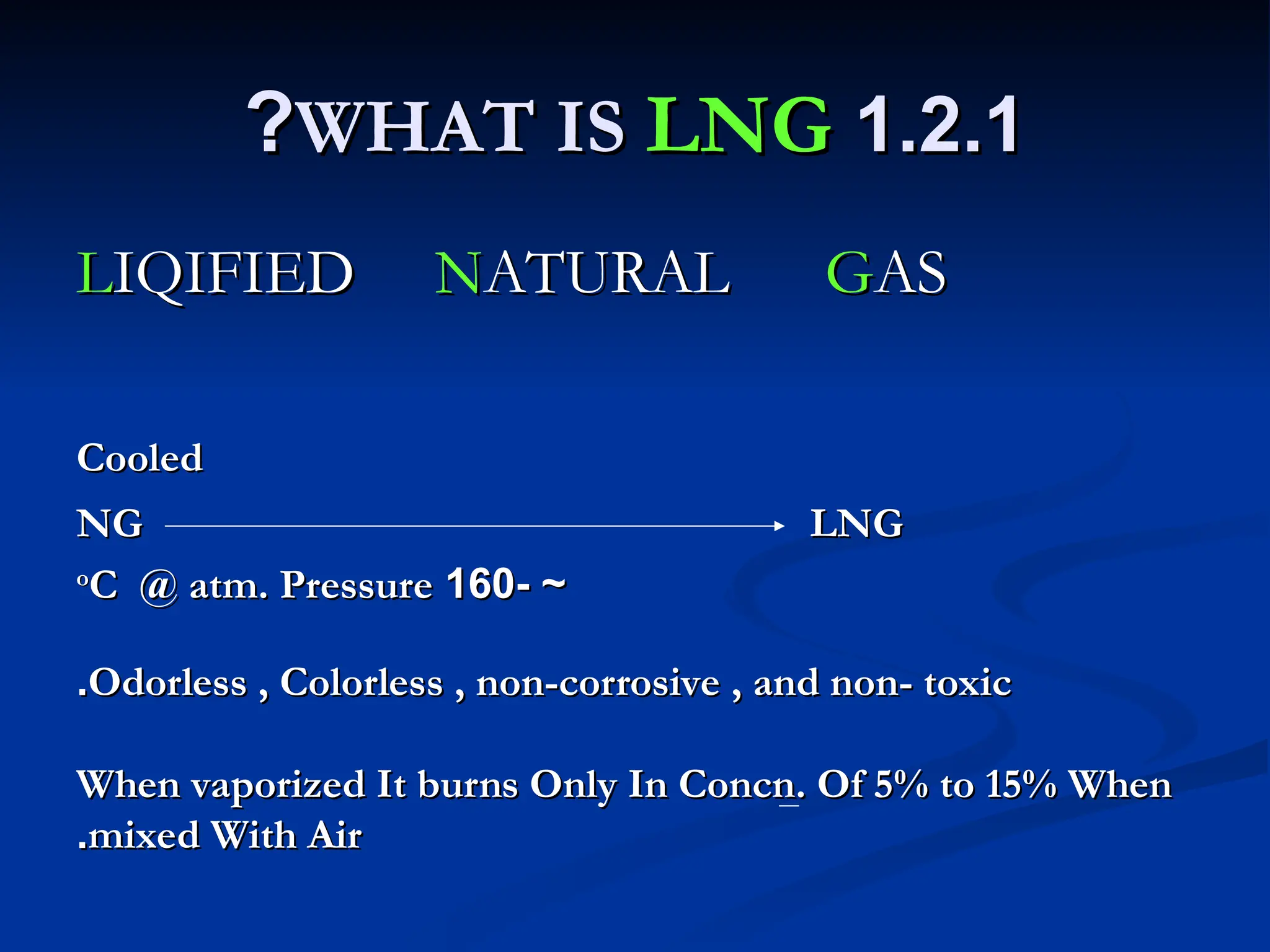
LIQIFIED
IQIFIED N
NATURAL
ATURAL G
GAS
AS
Cooled
Cooled
NG LNG
NG LNG
- ~
- ~
160
160
o
o
C @ atm. Pressure
C @ atm. Pressure
Odorless , Colorless , non-corrosive , and non- toxic
.
.
When vaporized It burns Only In Concn. Of 5% to 15% When
mixed With Air
mixed With Air
.
.
1.2.2
1.2.2
WHAT IS
WHAT IS CNG
CNG
?
?
C
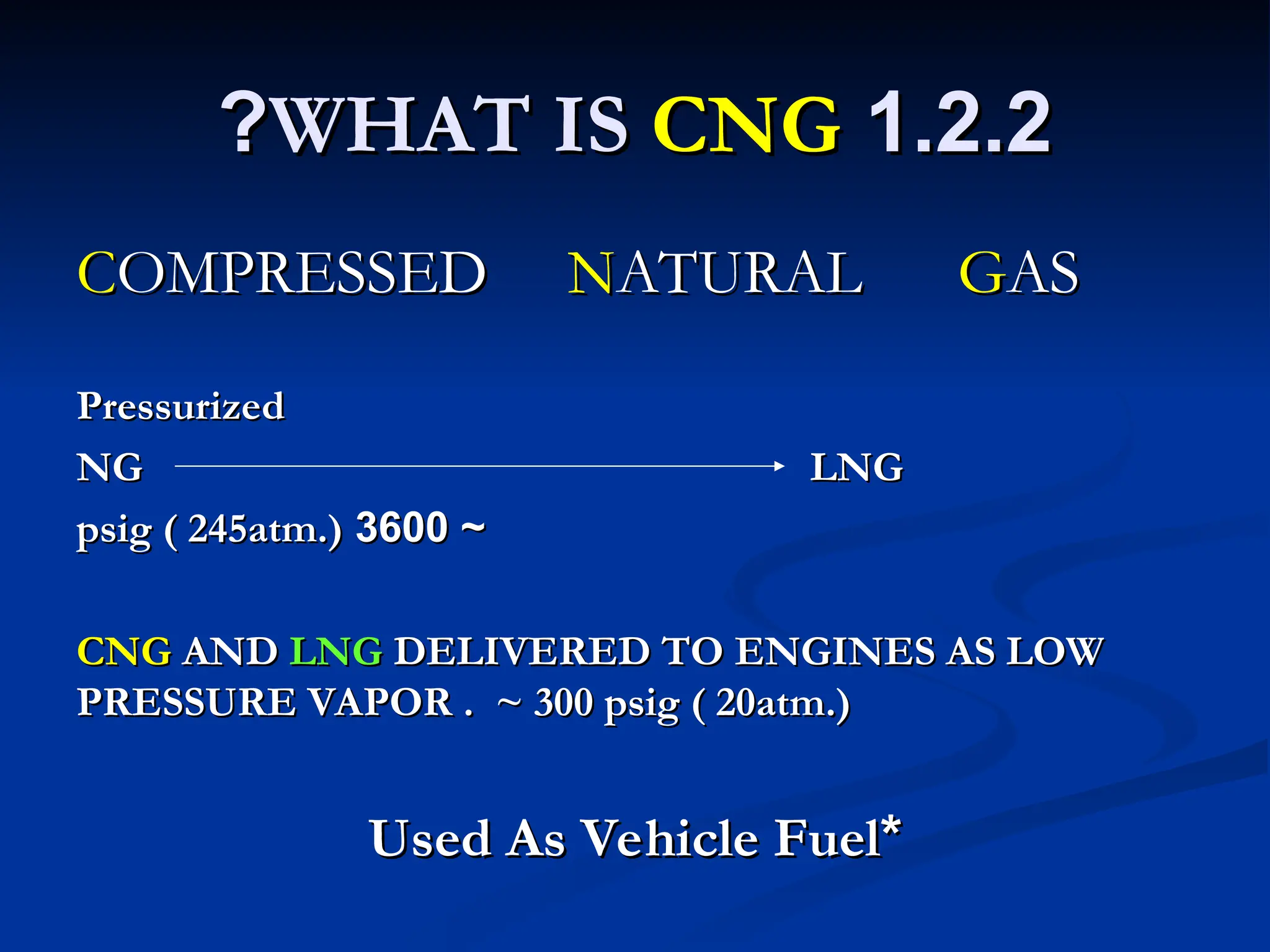
COMPRESSED
OMPRESSED N
NATURAL
ATURAL G
GAS
AS
Pressurized
Pressurized
NG LNG
NG LNG
~
~
3600
3600
psig ( 245atm.)
psig ( 245atm.)
CNG
CNG AND
AND LNG
LNG DELIVERED TO ENGINES AS LOW
DELIVERED TO ENGINES AS LOW
PRESSURE VAPOR . ~ 300 psig ( 20atm.)
*
*
Used As Vehicle Fuel
1.2.3
1.2.3
WHAT IS
WHAT IS NGL
NGL
?
?
N
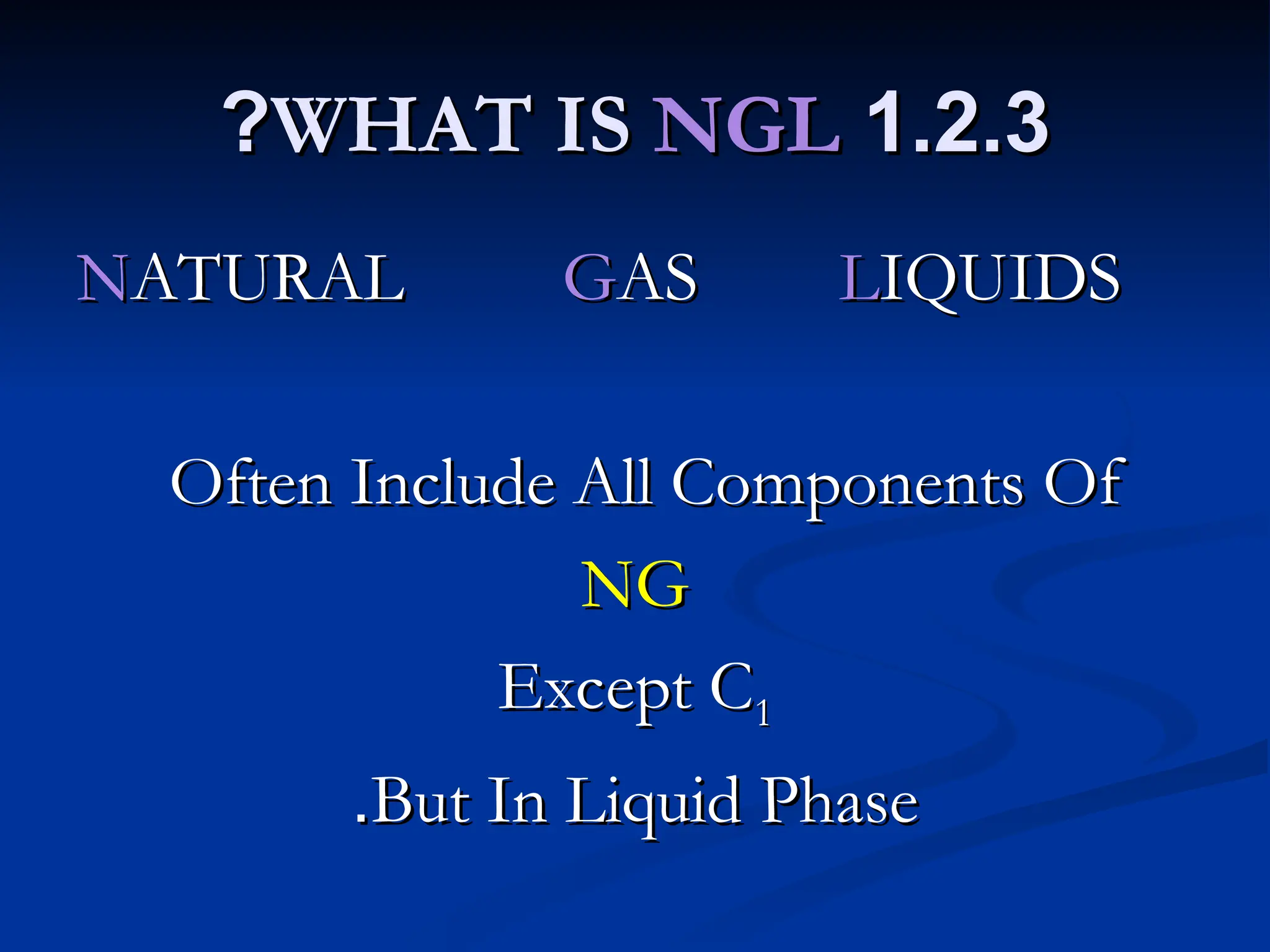
NATURAL
ATURAL G
GAS
AS L
LIQUIDS
IQUIDS
Often Include All Components Of
NG
NG
Except C
Except C1
1
But In Liquid Phase
But In Liquid Phase
.
.
TRANSPORTATION
TRANSPORTATION
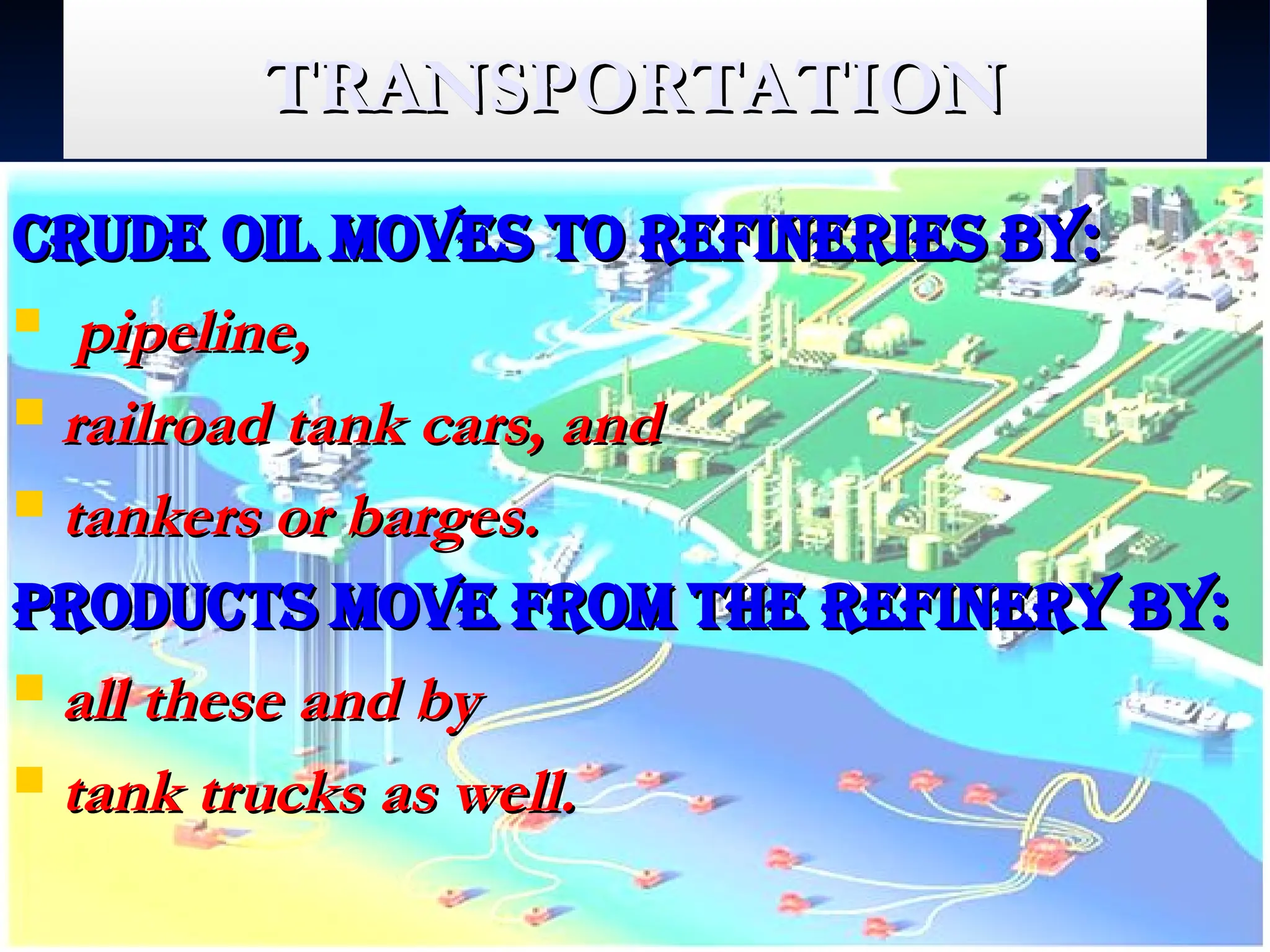
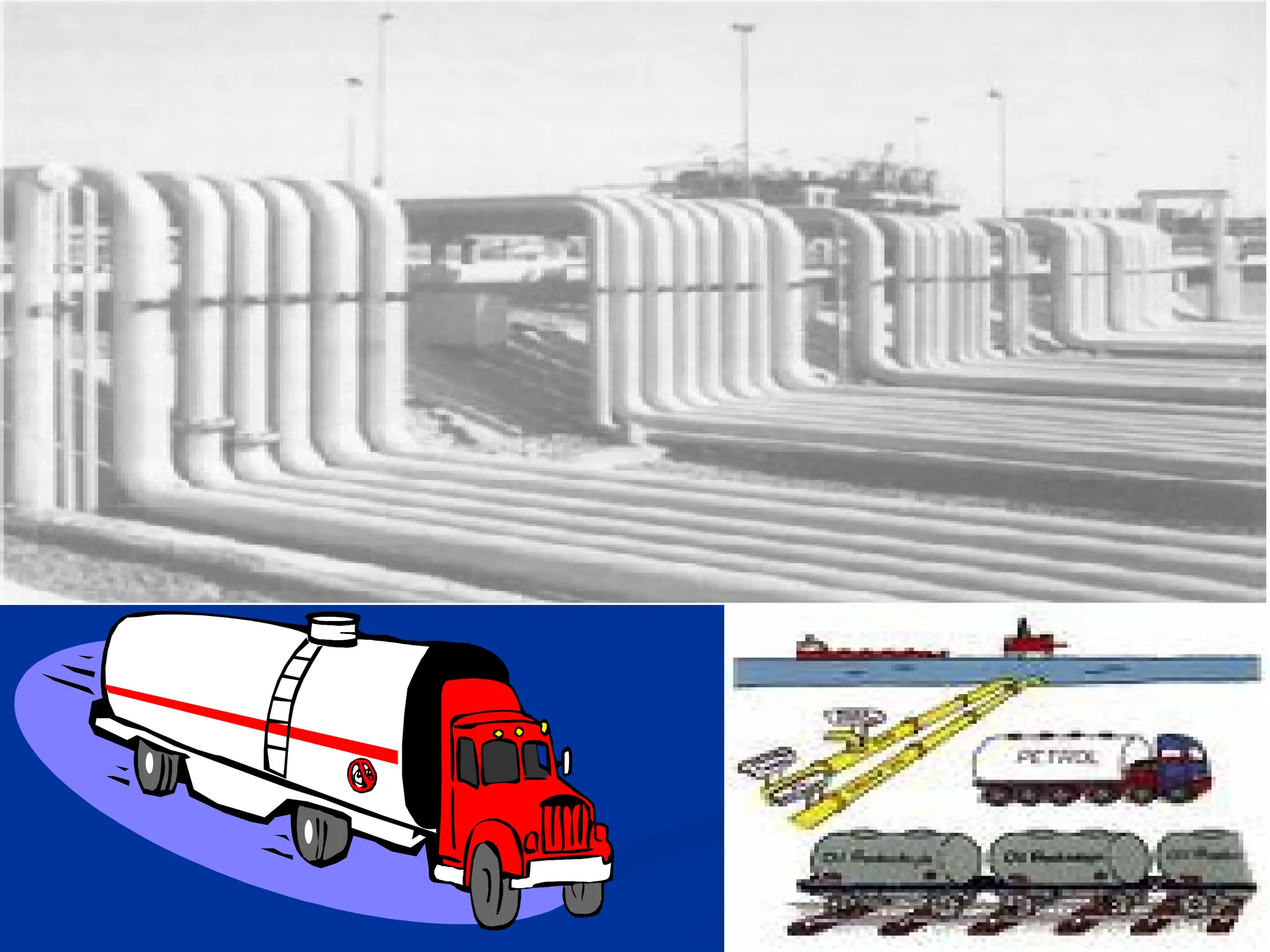
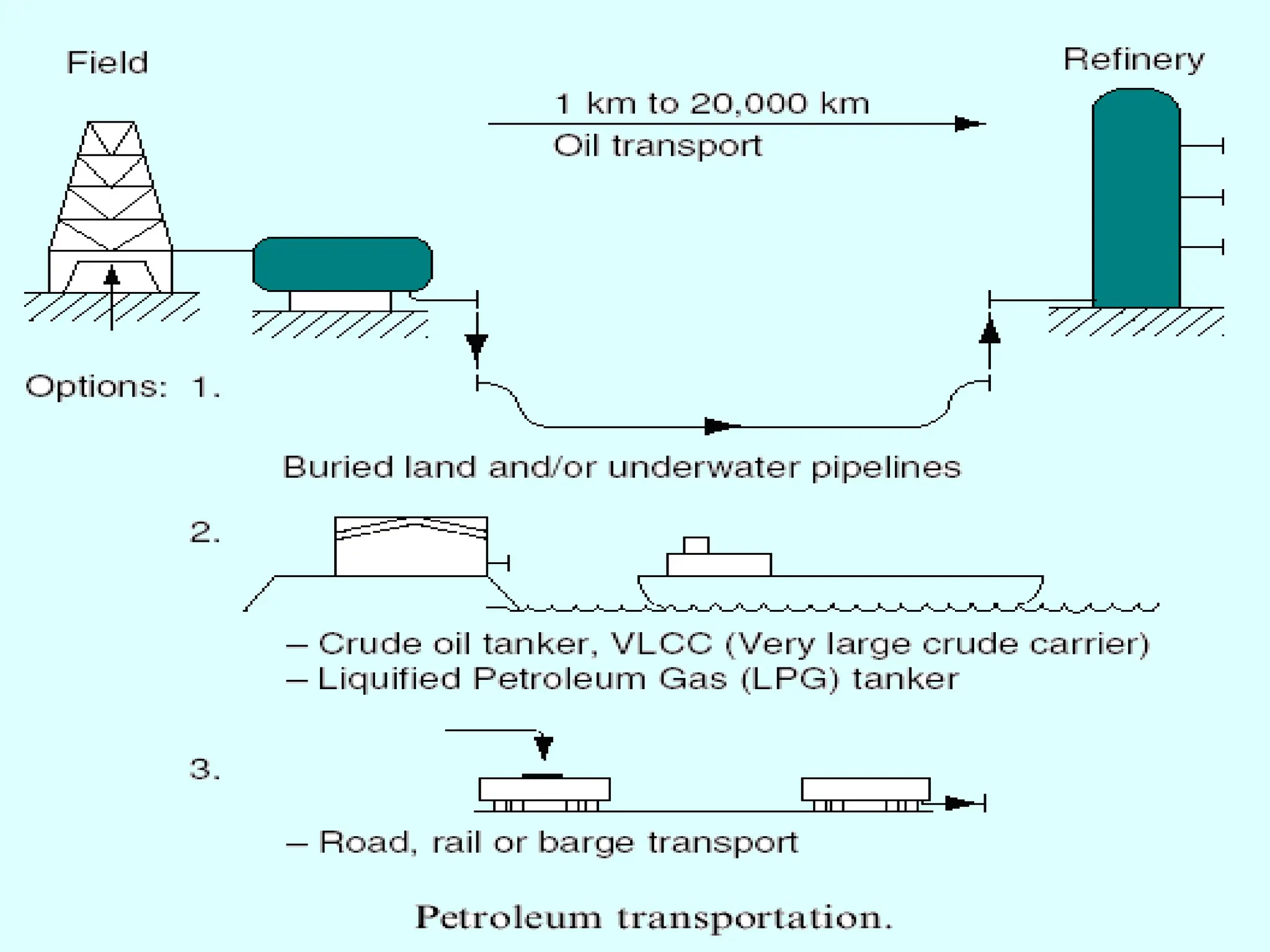
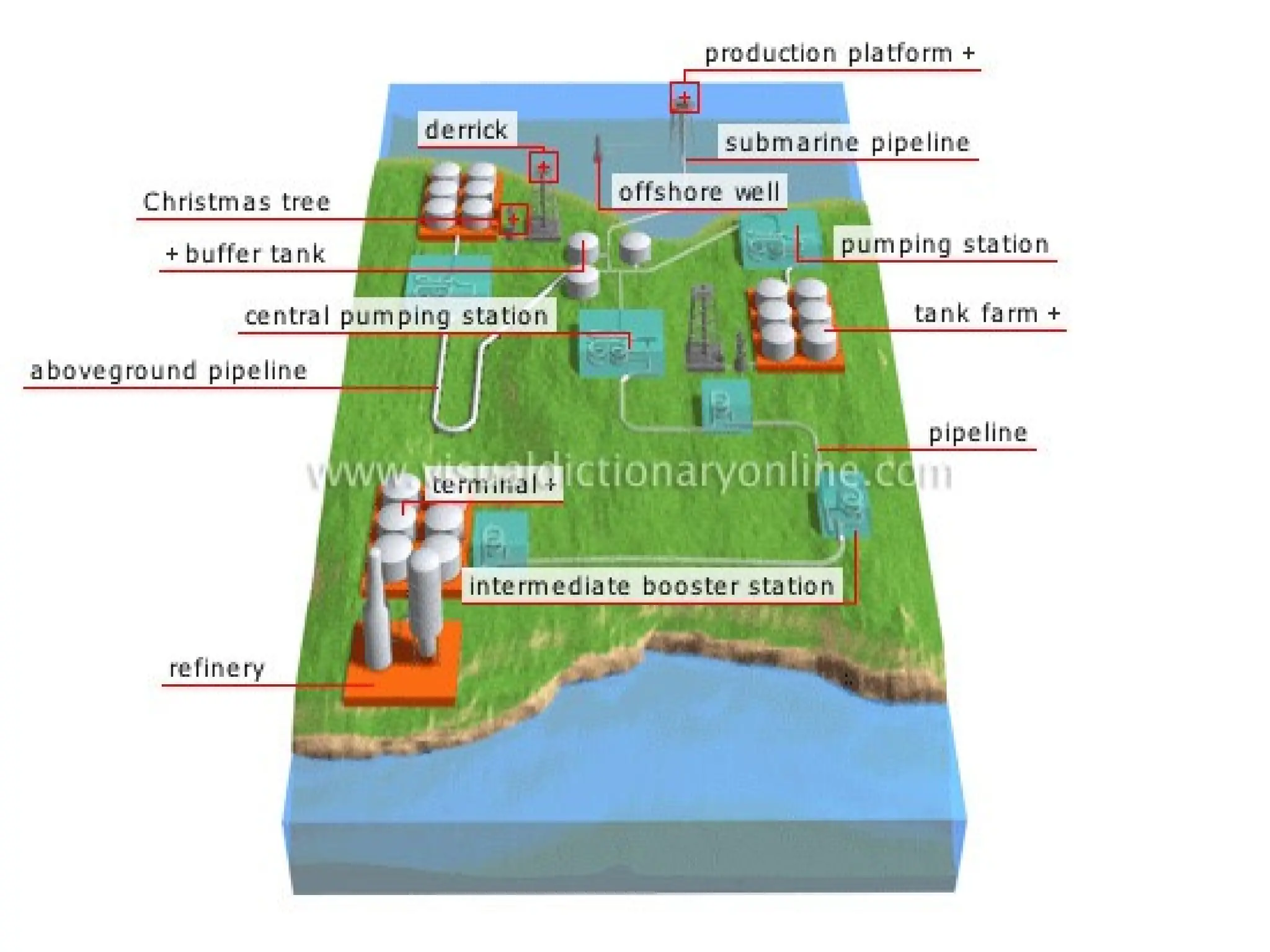
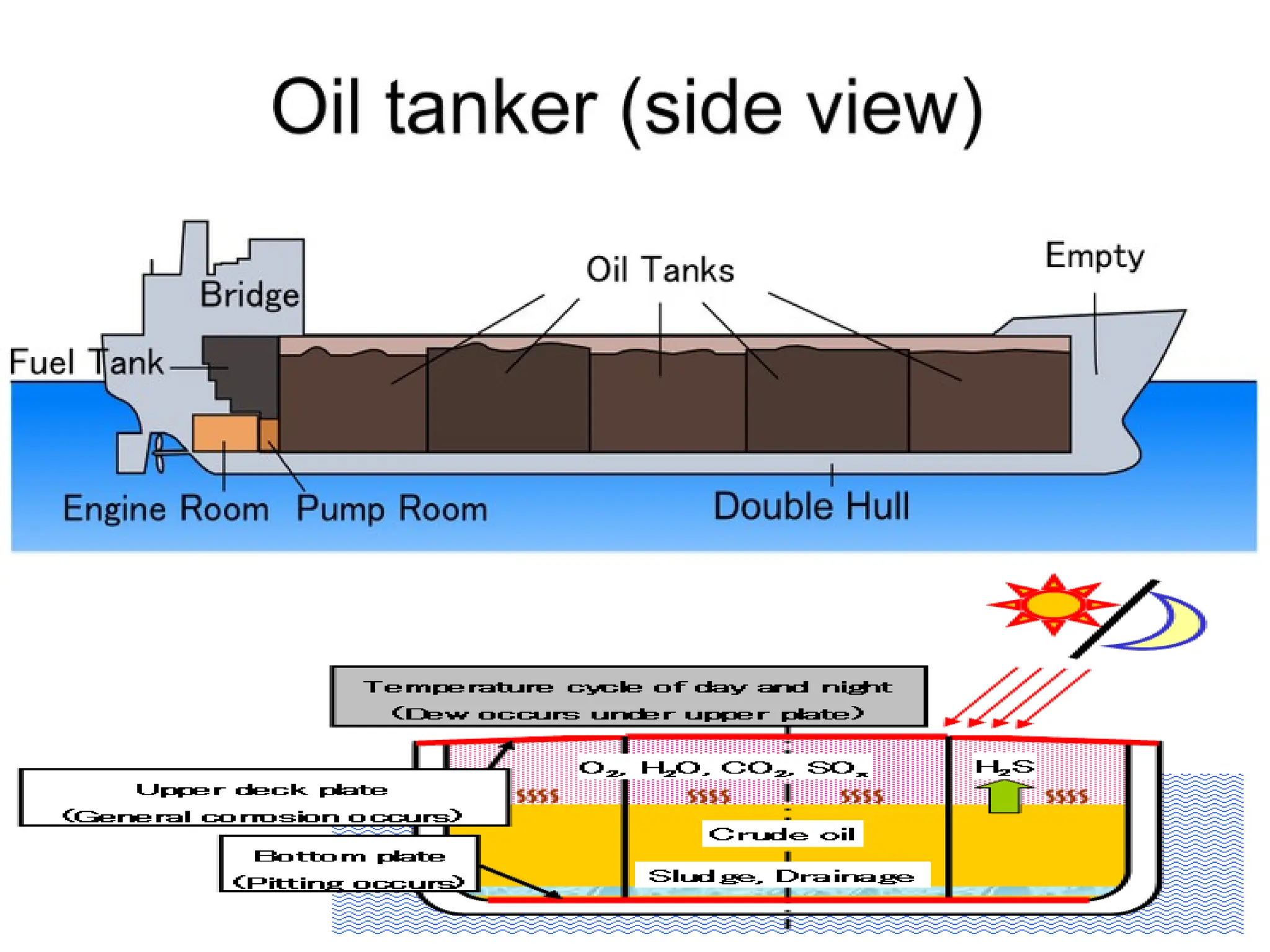
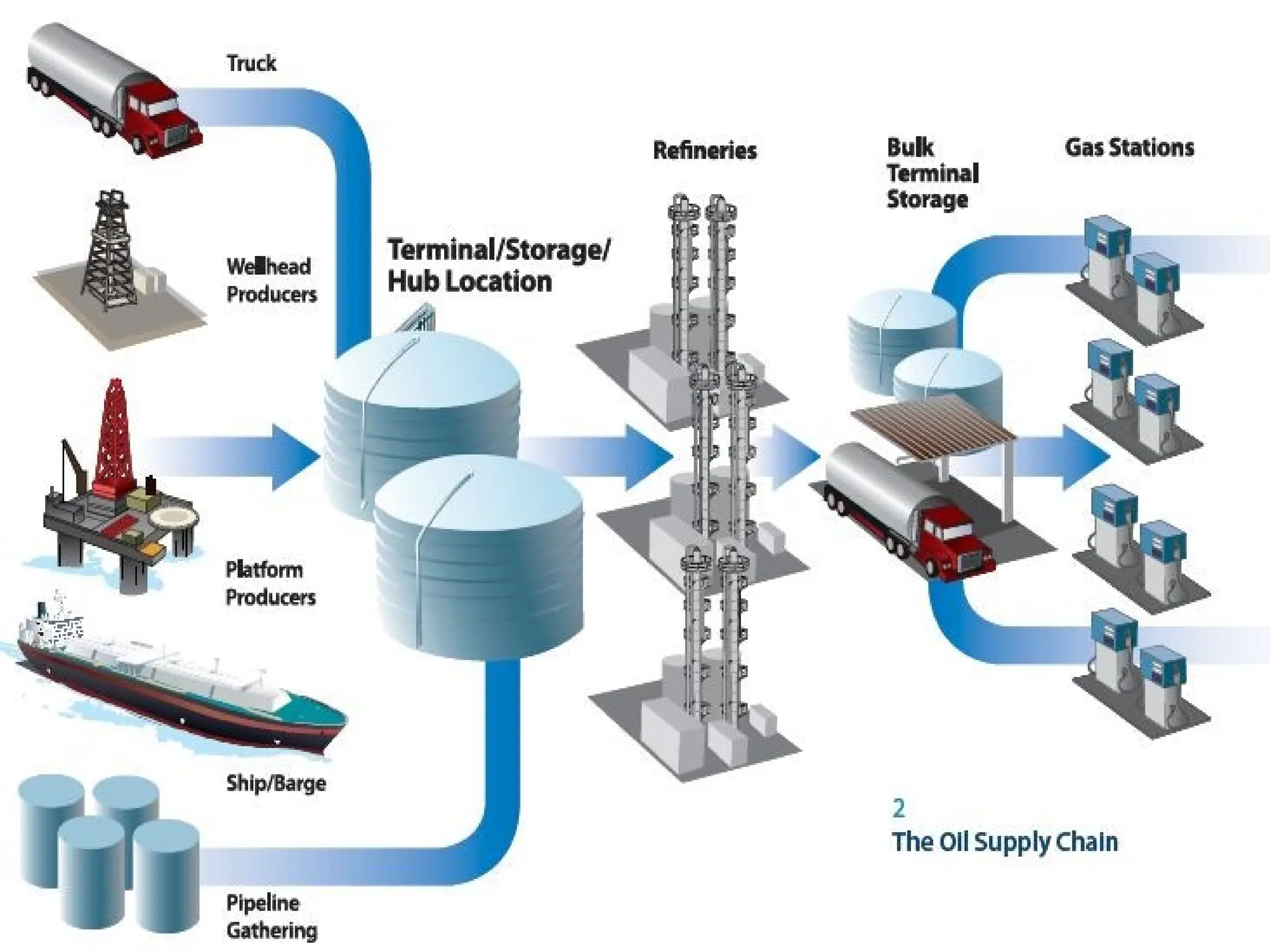
Crude oil moves to refineries by:
 pipeline,
pipeline,
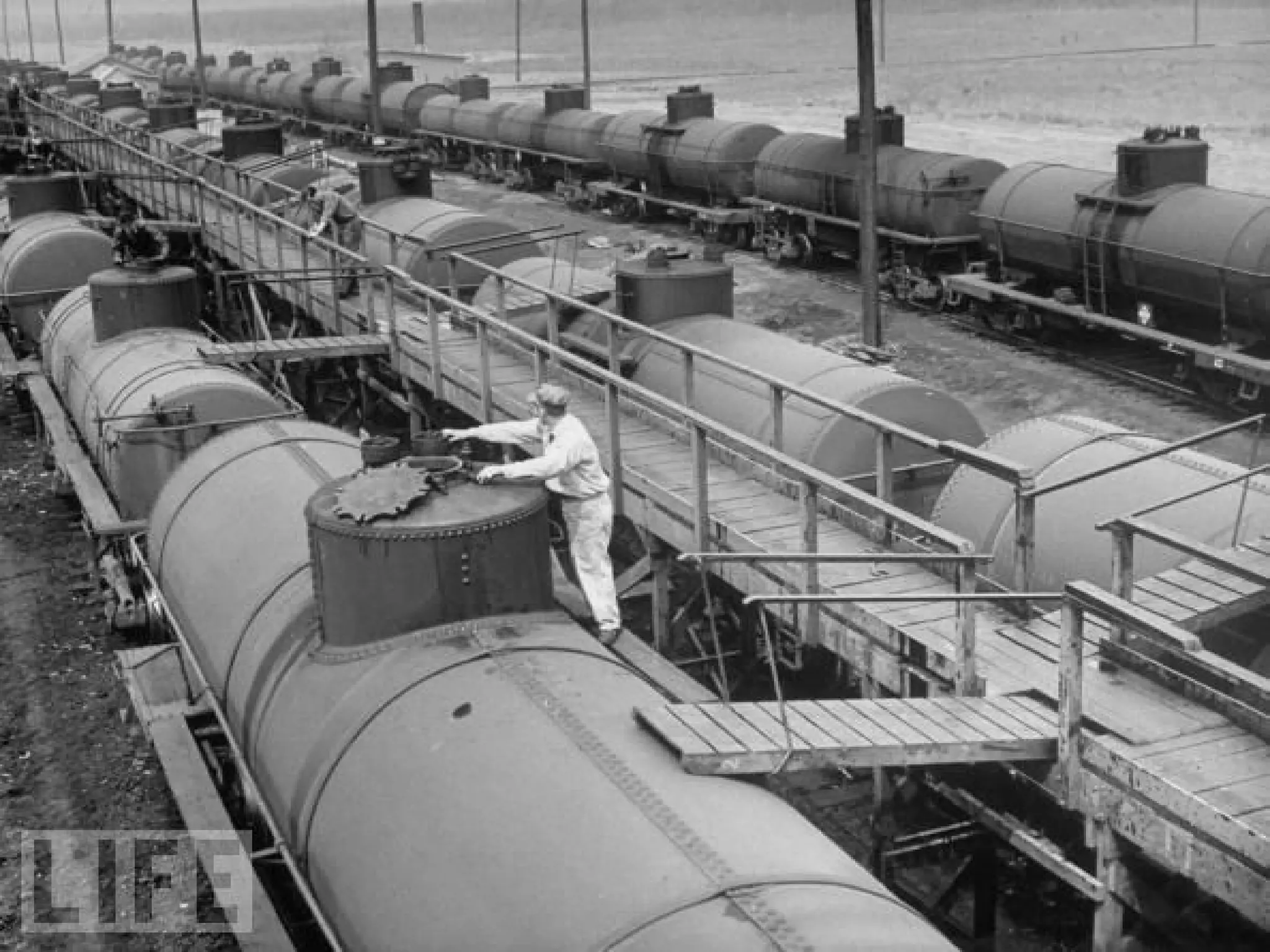
 railroad tank cars, and
railroad tank cars, and
 tankers or barges.
tankers or barges.
Products move from the refinery by:
 all these and by
all these and by
 tank trucks as well.
tank trucks as well.
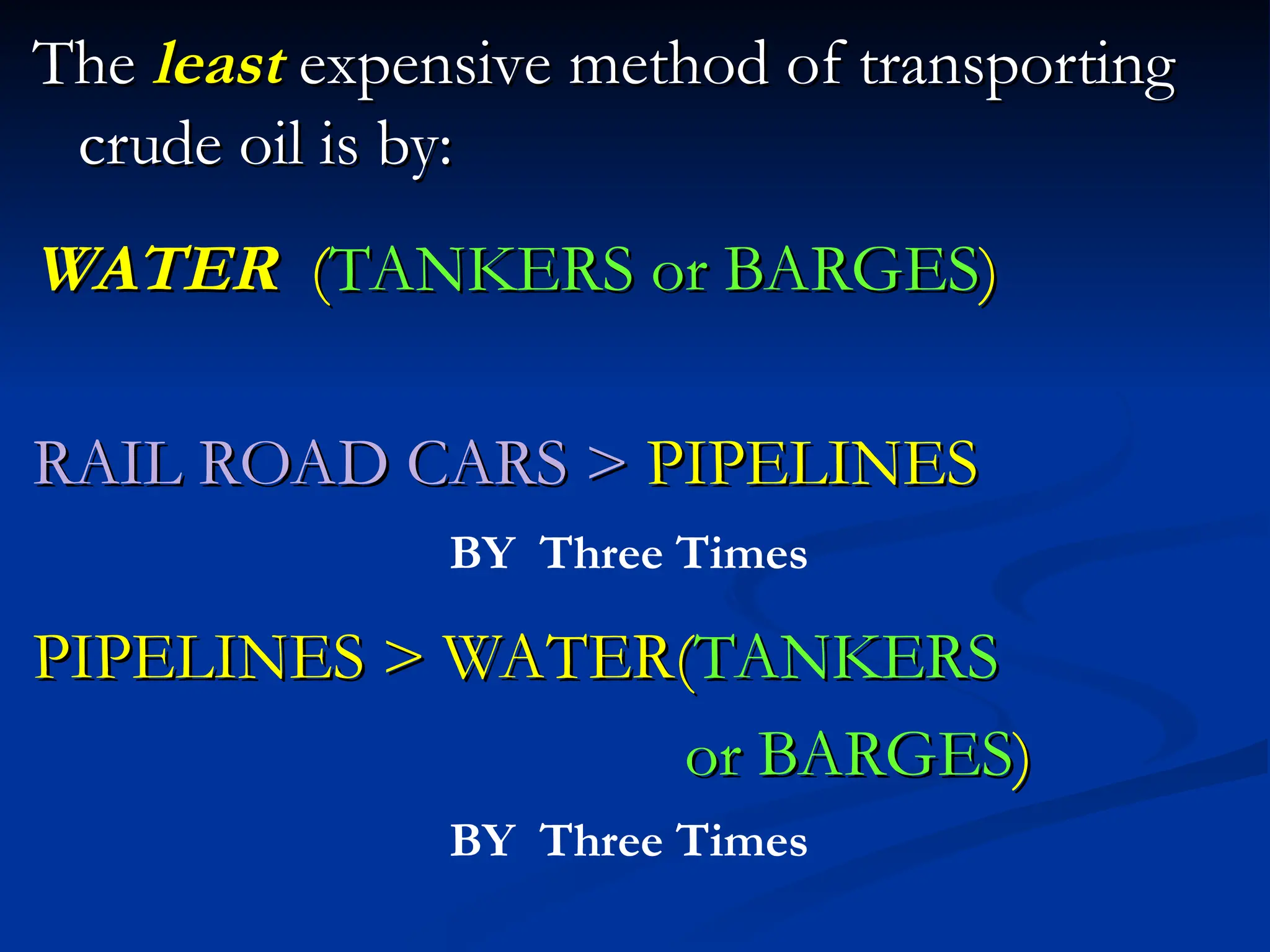
The
The least
least expensive method of transporting
expensive method of transporting
crude oil is by:
crude oil is by:
WATER
WATER (
(TANKERS or BARGES
TANKERS or BARGES)
)
RAIL ROAD CARS >
RAIL ROAD CARS > PIPELINES
PIPELINES
PIPELINES > WATER(
PIPELINES > WATER(TANKERS
TANKERS
or BARGES
or BARGES)
)
BY Three Times
BY Three Times
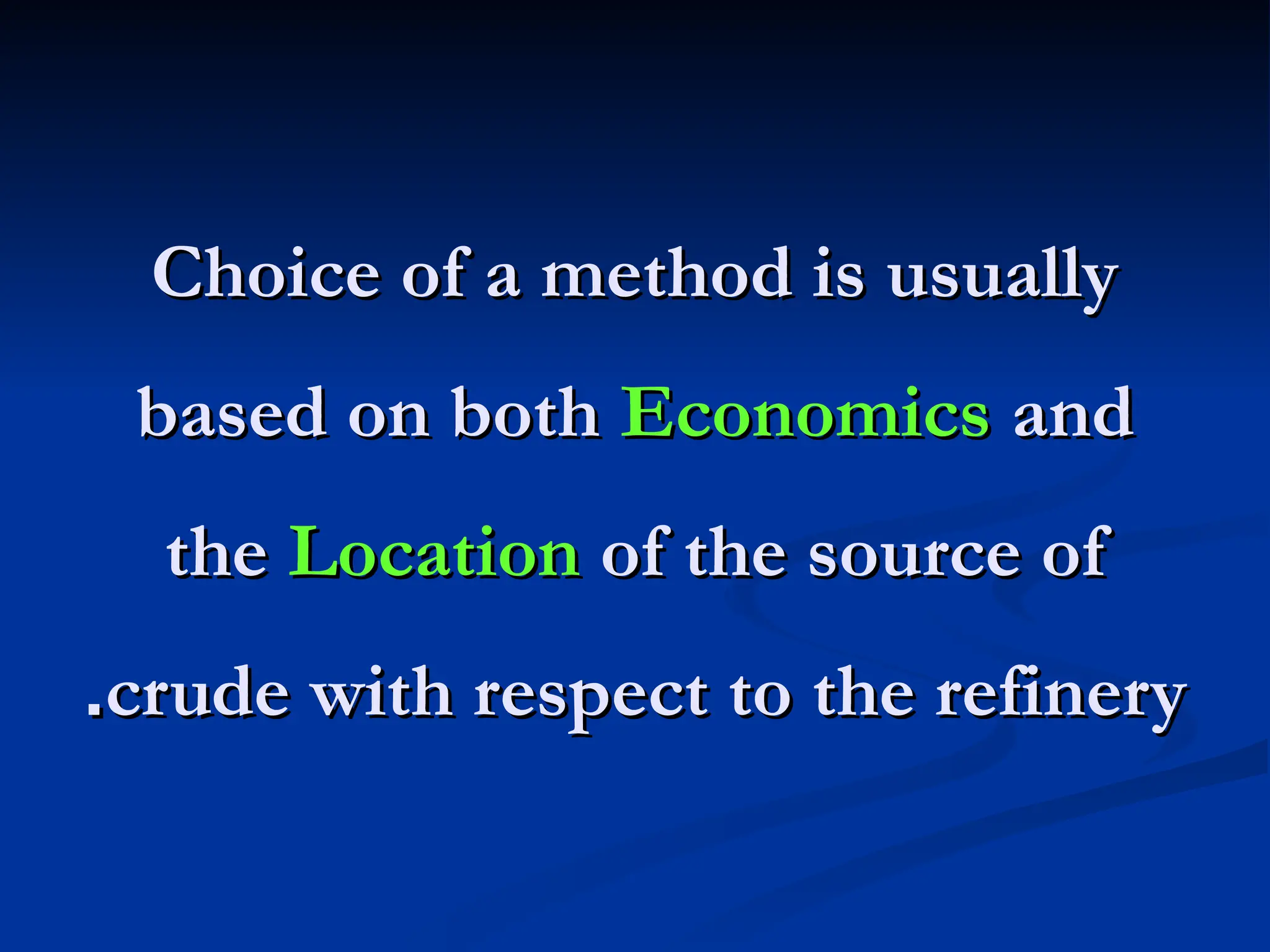
Choice of a method is usually
based on both
based on both Economics
Economics and
and
the
the Location
Location of the source of
of the source of
crude with respect to the refinery
.
.
Pipelines
Pipelines
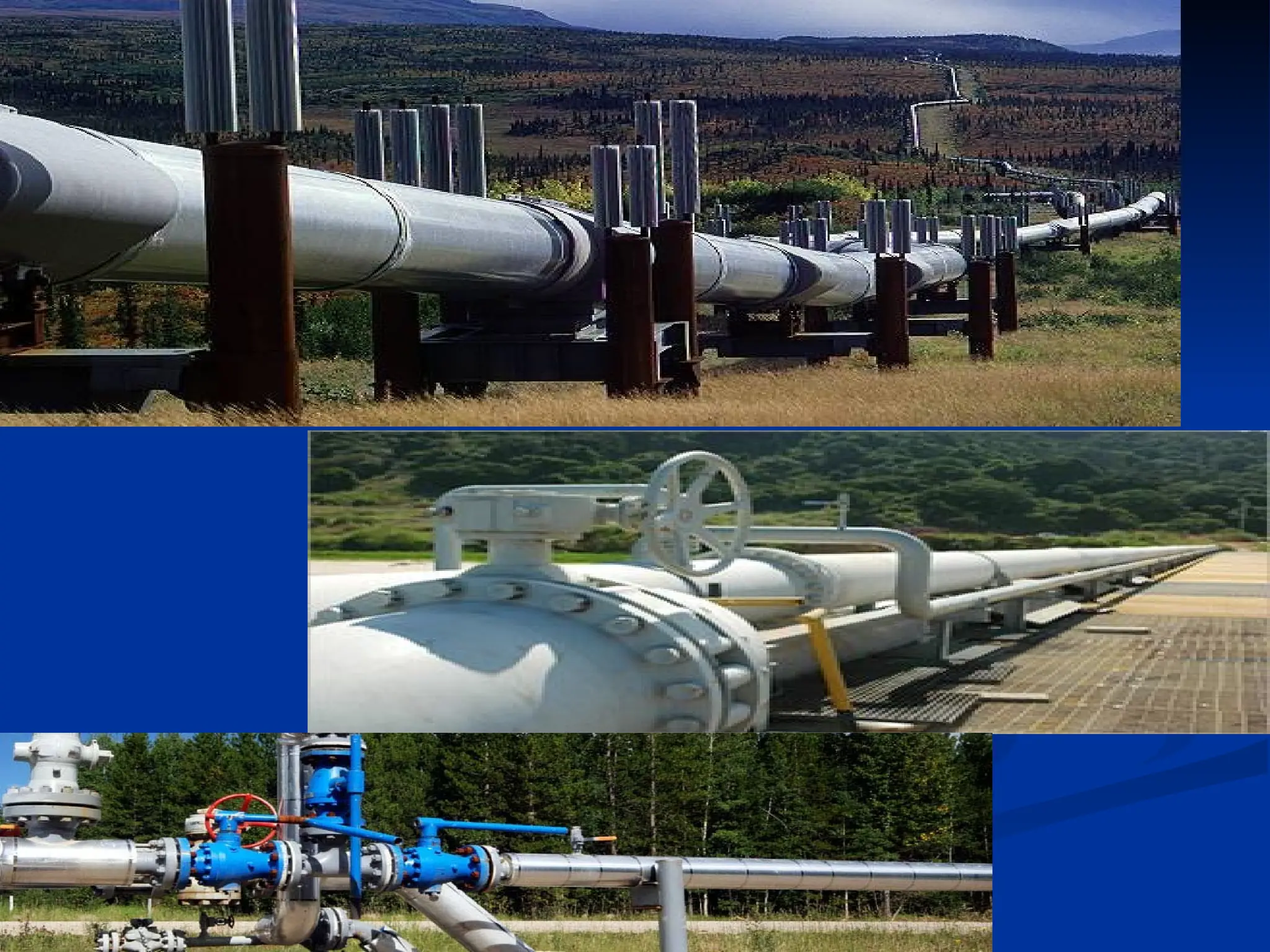
Pipeline system starts with the network
of pipes in the field
,
,
the gathering system, which generally
uses 2″ to 30″,(or more,) and
transport oil directly to refineries or to
marine terminals for transfer to
tankers
tankers
.
.
Line pipe is made of steel to standard
specifications
specifications
.
.
Wall thickness varies between
Wall thickness varies between 1/4
1/4 and
and
3/8 in., seldom exceeding 7/16 in
.
.
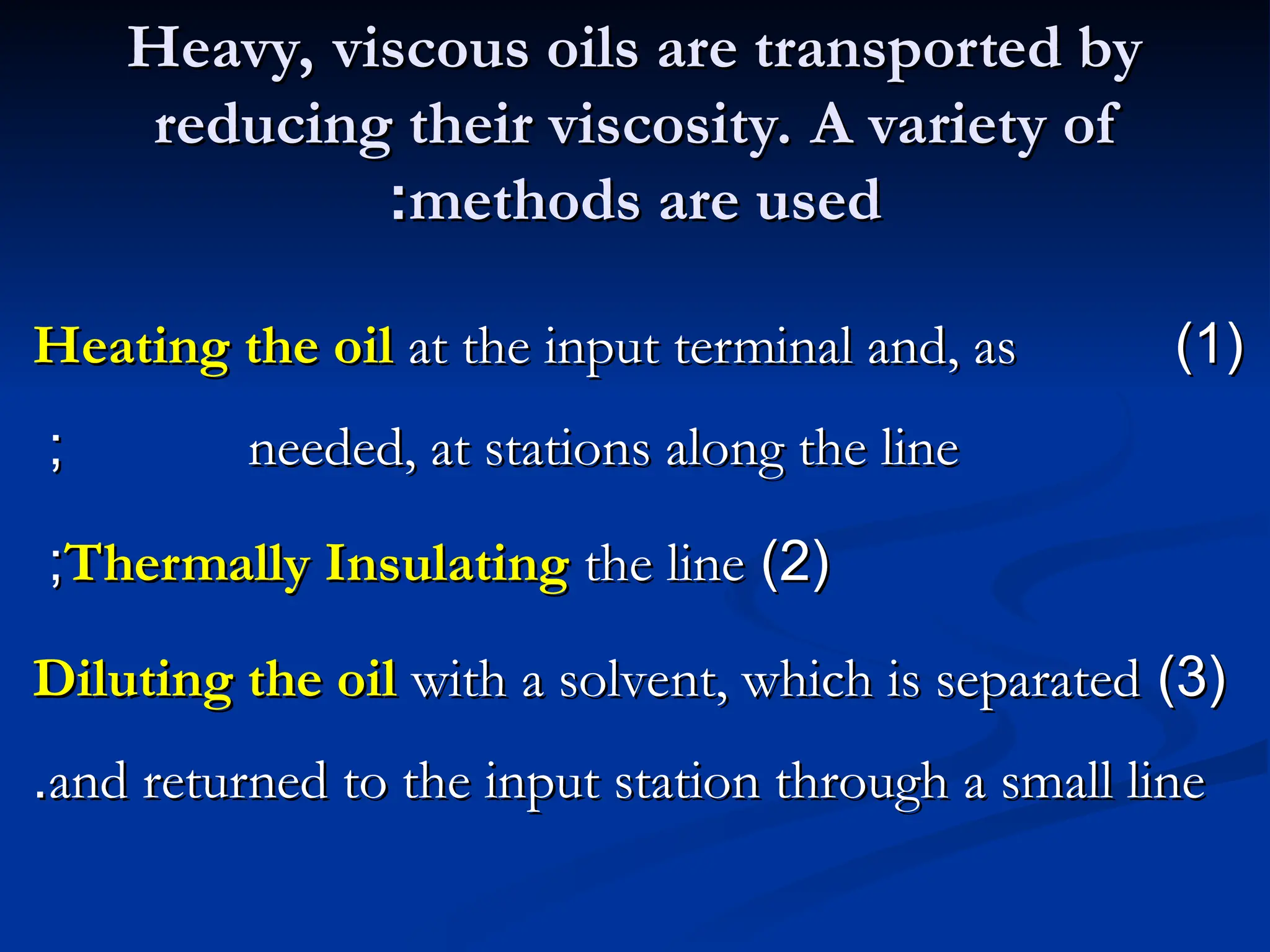
Pipe is seamless or welded. Sections
are connected by welding
throughout; fittings and valves are
also welded
also welded
.
.
Oil flows by
Oil flows by pump
pump or
or gravity
gravity or
or both
both
.
.
Pressures of about 1,200 psi are used for lines
up to 12 in
up to 12 in
,.
,.
Pressures of 500 to 800 psi are for 24- to 30-
in. pipe lines
in. pipe lines
.
.
Long pipelines require frequent booster
stations to restore pressure lost to line
friction or gradient variations
.
.
A booster is usually installed wherever the line
pressure drops to about 50 psi
.
.
Pipelines are usually
Pipelines are usually underground
underground in most inhabited
in most inhabited
regions but are laid
regions but are laid on the surface
on the surface (on concrete blocks
(on concrete blocks
or metal supports) in remote areas, such as deserts
.
.
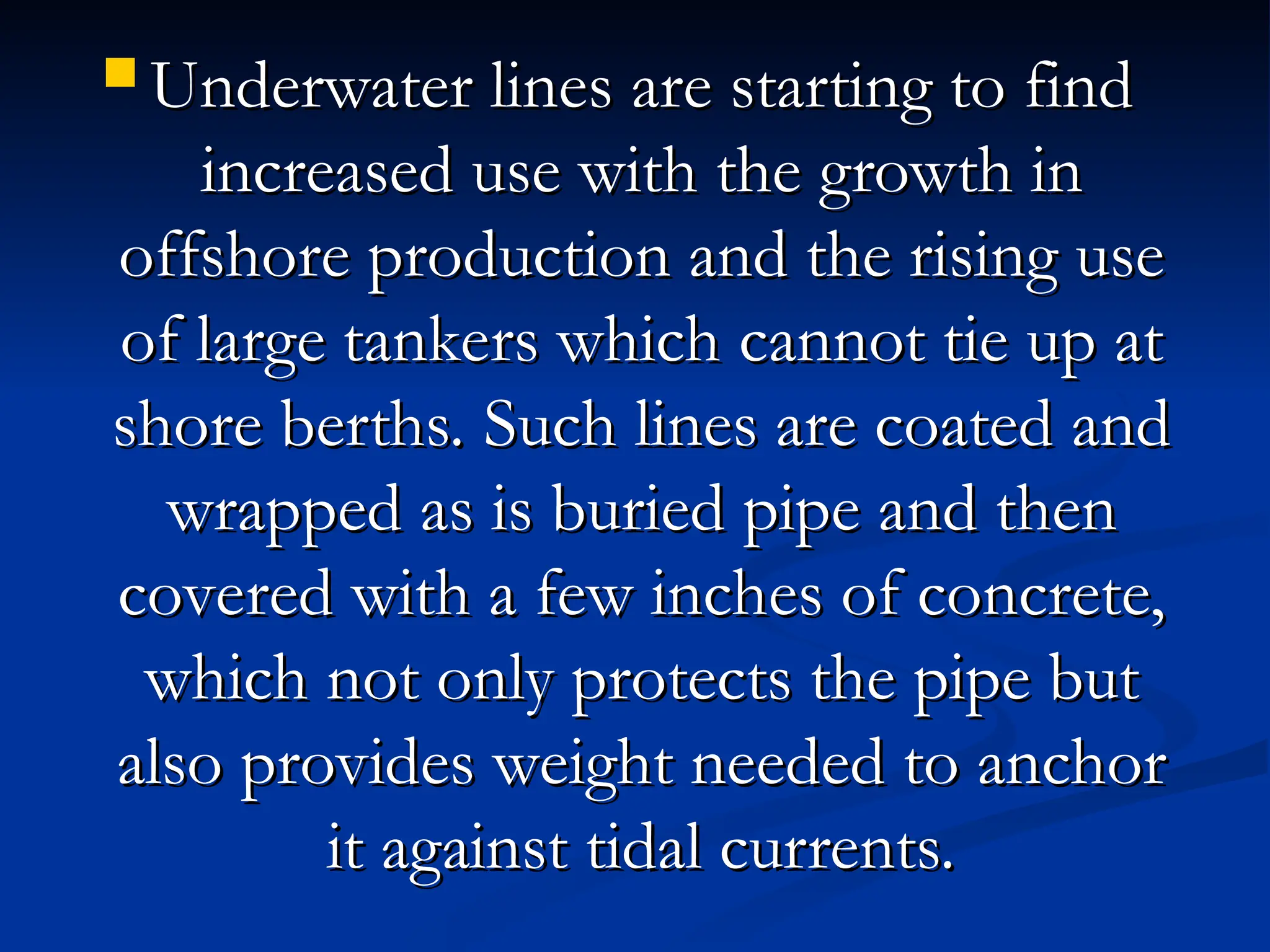
Underground
Underground pipe requires protection against external
pipe requires protection against external
corrosion (mostly obtained by coatings and/or
cathodic protection), and has no problem of
expansion and contraction whereas
Surface lines
Surface lines normally need only paint. But it has a
normally need only paint. But it has a
problem of expansion and contraction, and allowance
for this movement must be made in designing and
setting the supports
.
.
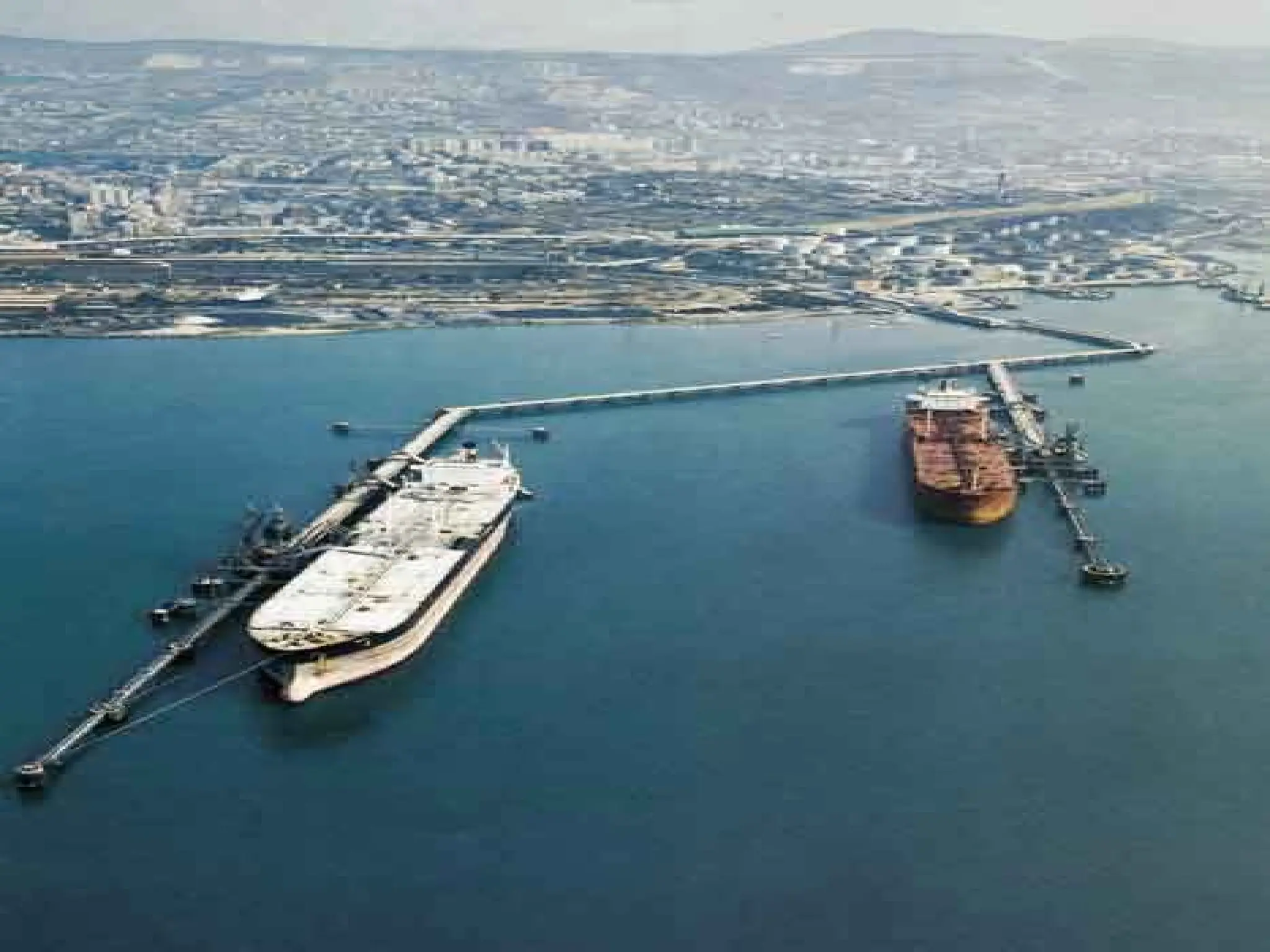
 Underwater lines are starting to find
Underwater lines are starting to find
increased use with the growth in
offshore production and the rising use
of large tankers which cannot tie up at
shore berths. Such lines are coated and
wrapped as is buried pipe and then
covered with a few inches of concrete,
which not only protects the pipe but
also provides weight needed to anchor
it against tidal currents.
Heavy, viscous oils are transported by
reducing their viscosity. A variety of
methods are used
methods are used
:
:
(
(
1
1
)
)
Heating the oil
Heating the oil at the input terminal and, as
at the input terminal and, as
needed, at stations along the line
;
;
(
(
2
2
)
)
Thermally Insulating
Thermally Insulating the line
the line
;
;
(
(
3
3
)
)
Diluting the oil
Diluting the oil with a solvent, which is separated
with a solvent, which is separated
and returned to the input station through a small line
.
.
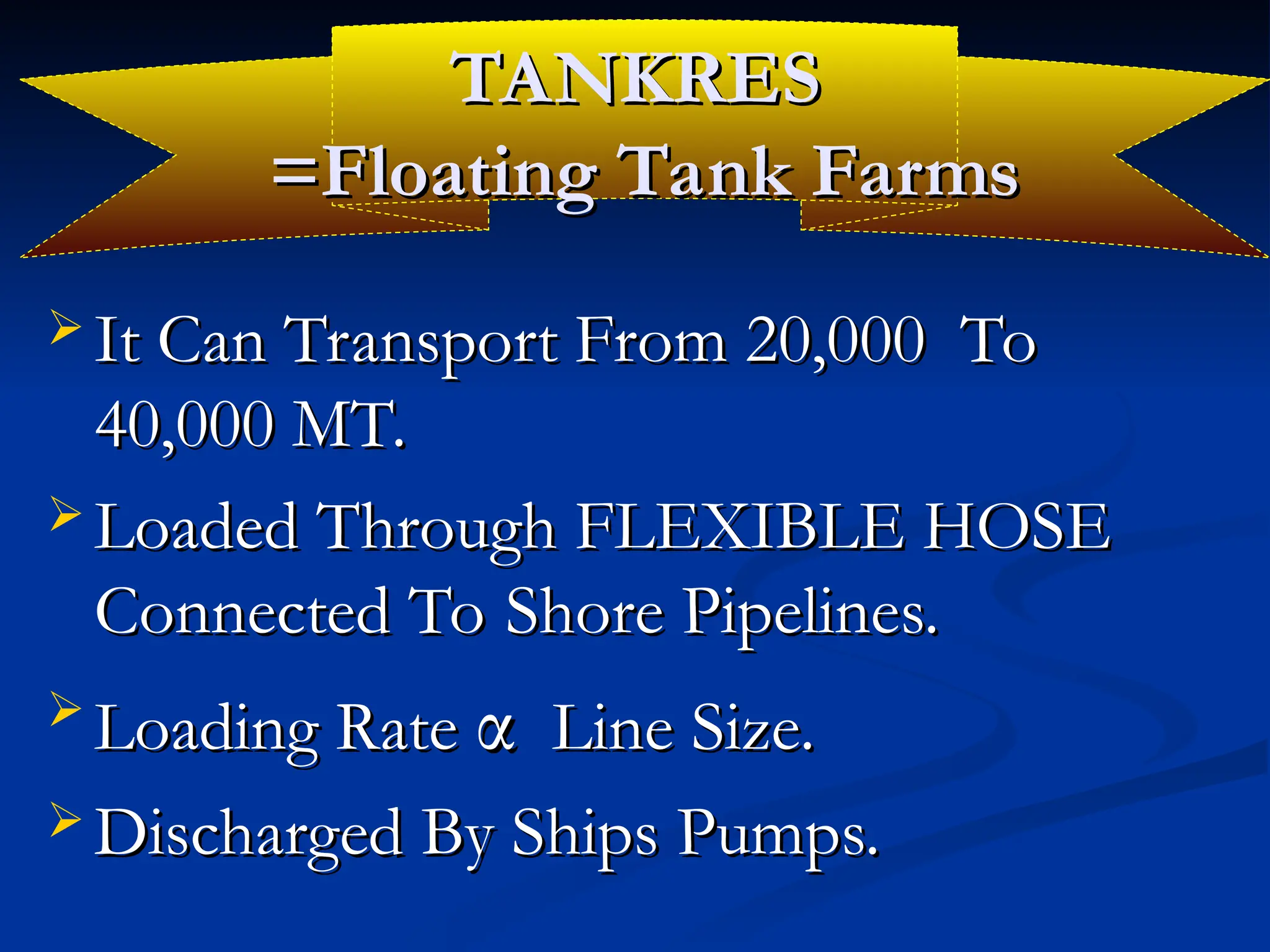
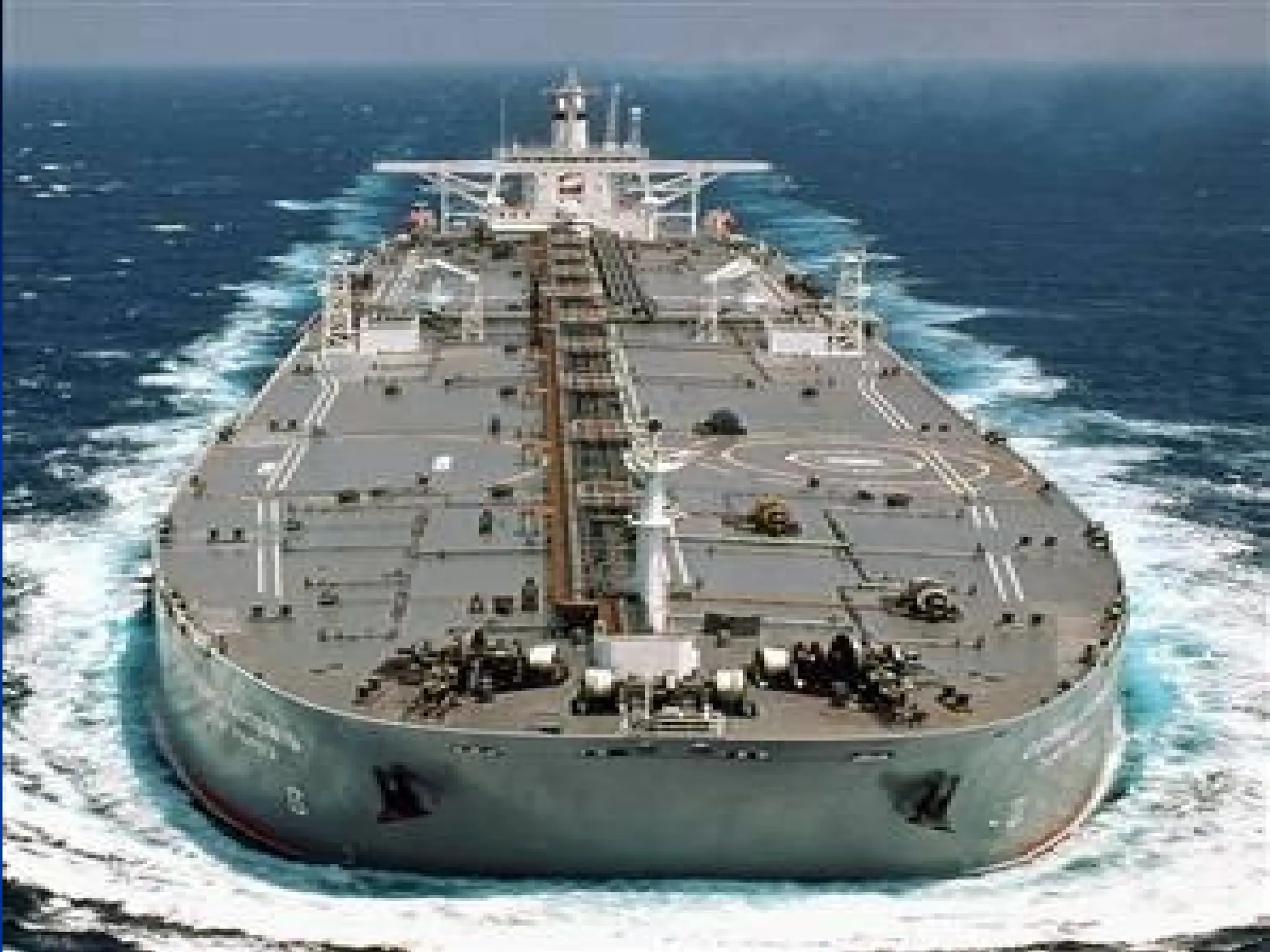
TANKRES
TANKRES
=Floating Tank Farms
 It Can Transport From 20,000 To
It Can Transport From 20,000 To
40,000 MT.
40,000 MT.
 Loaded Through FLEXIBLE HOSE
Loaded Through FLEXIBLE HOSE
Connected To Shore Pipelines.

Loading Rate
Loading Rate α
α Line Size.
Line Size.
 Discharged By Ships Pumps.
Discharged By Ships Pumps.
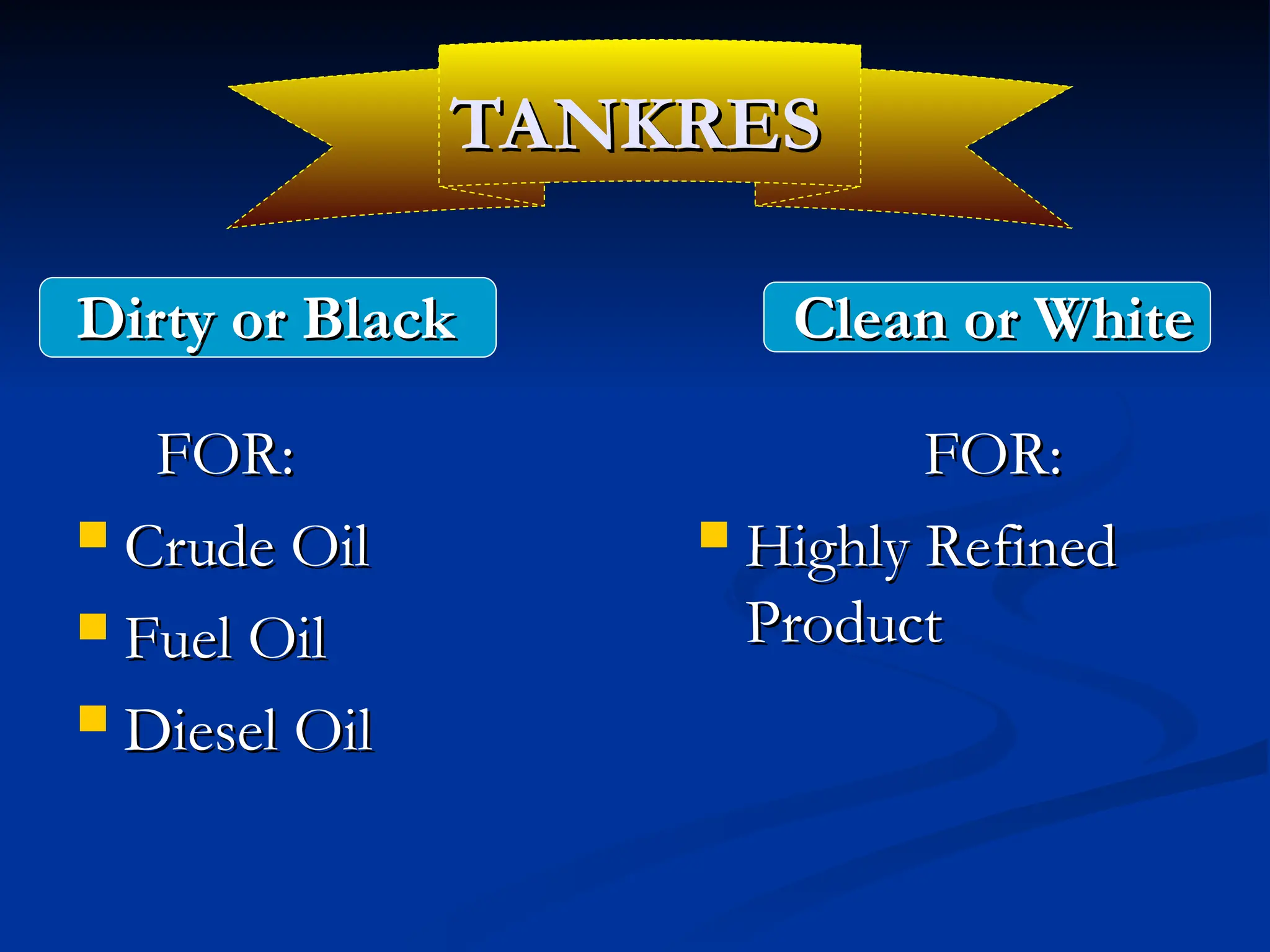
TANKRES
TANKRES
Dirty or Black
Dirty or Black
FOR:
FOR:
 Crude Oil
Crude Oil
 Fuel Oil
Fuel Oil
 Diesel Oil
Diesel Oil
Clean or White
Clean or White
FOR:
FOR:
 Highly Refined
Highly Refined
Product
Product
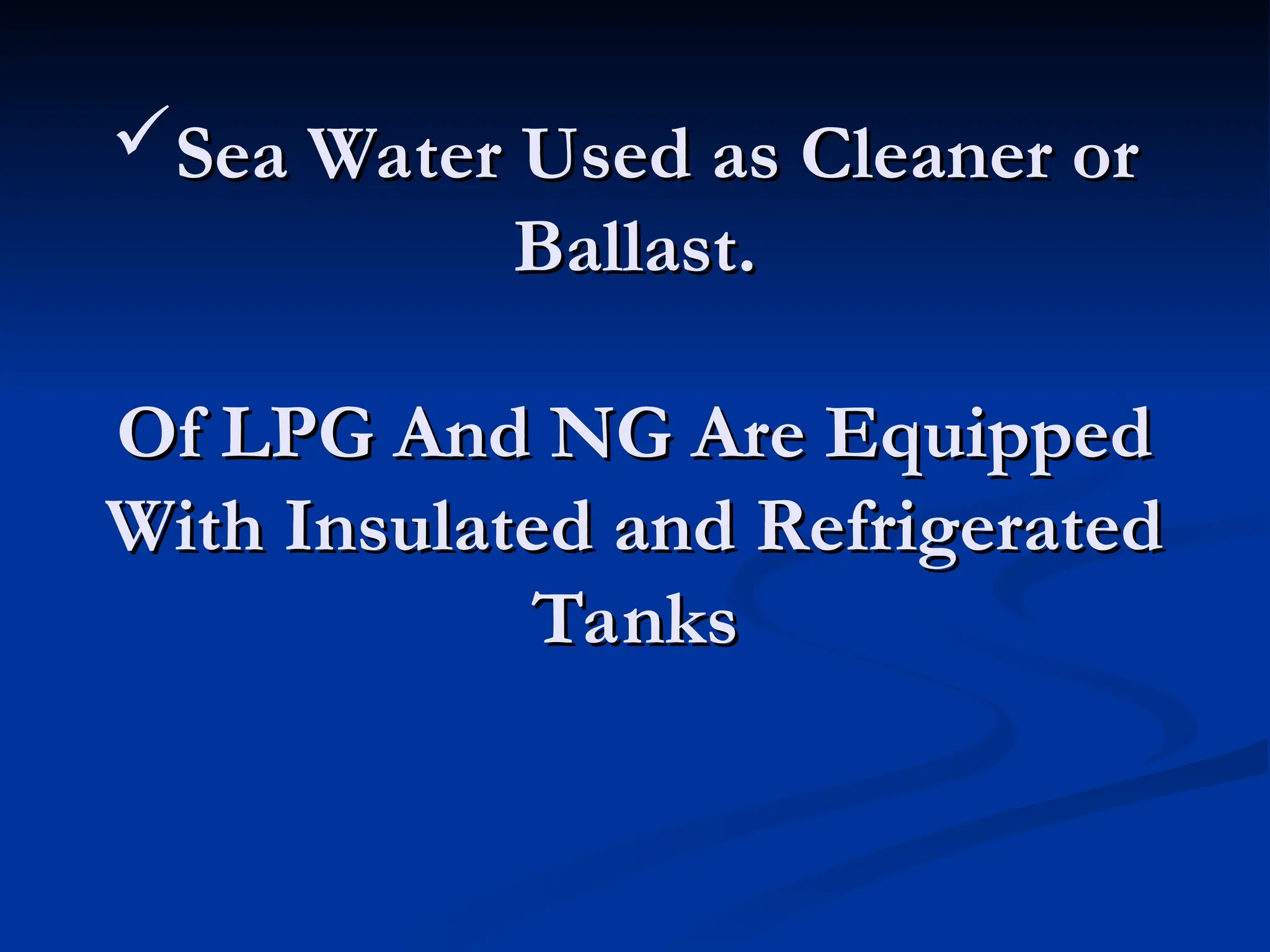
Sea Water Used as Cleaner or
Sea Water Used as Cleaner or
Ballast.
Ballast.
Of LPG And NG Are Equipped
With Insulated and Refrigerated
Tanks
Tanks
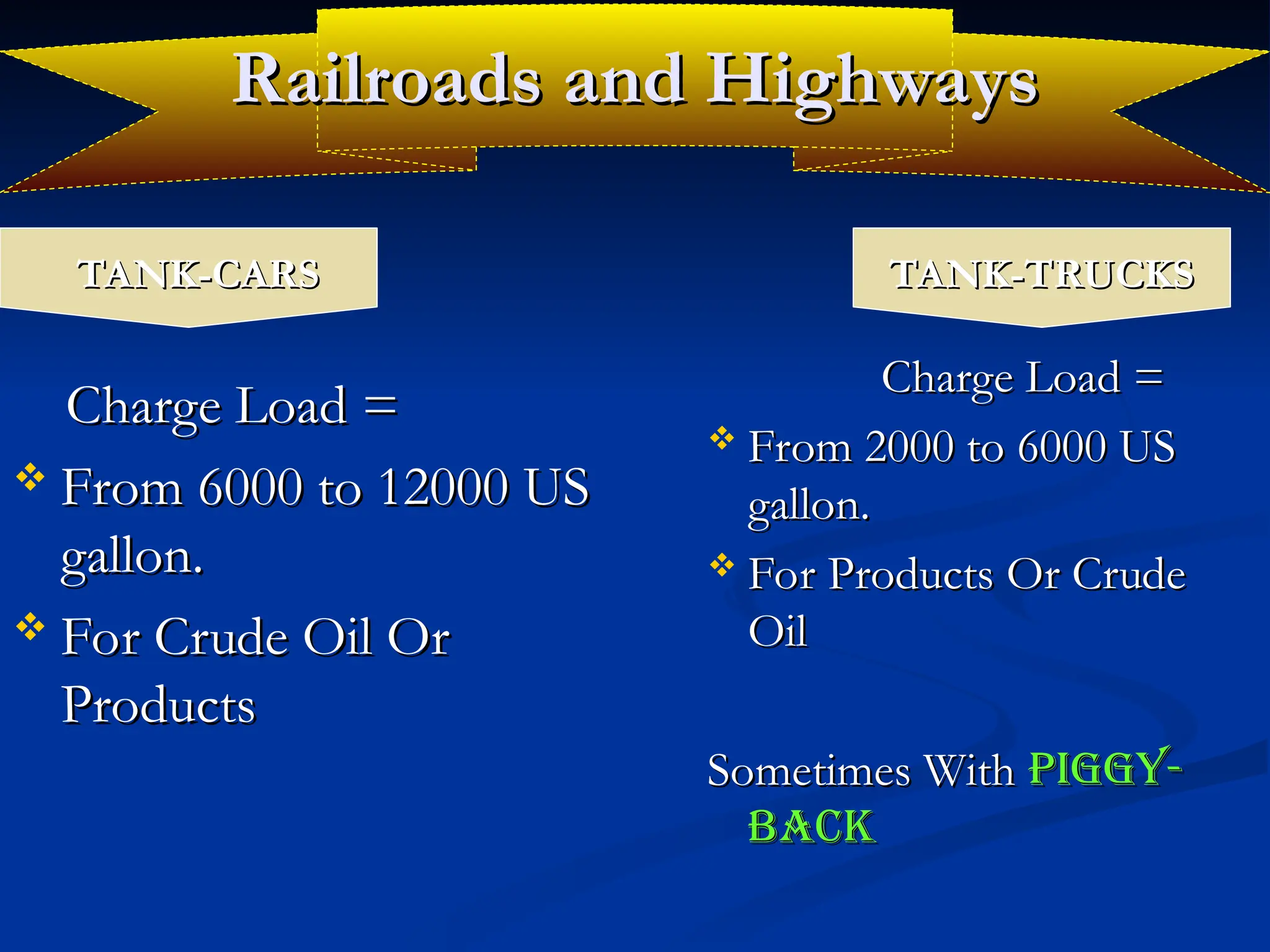
Railroads and Highways
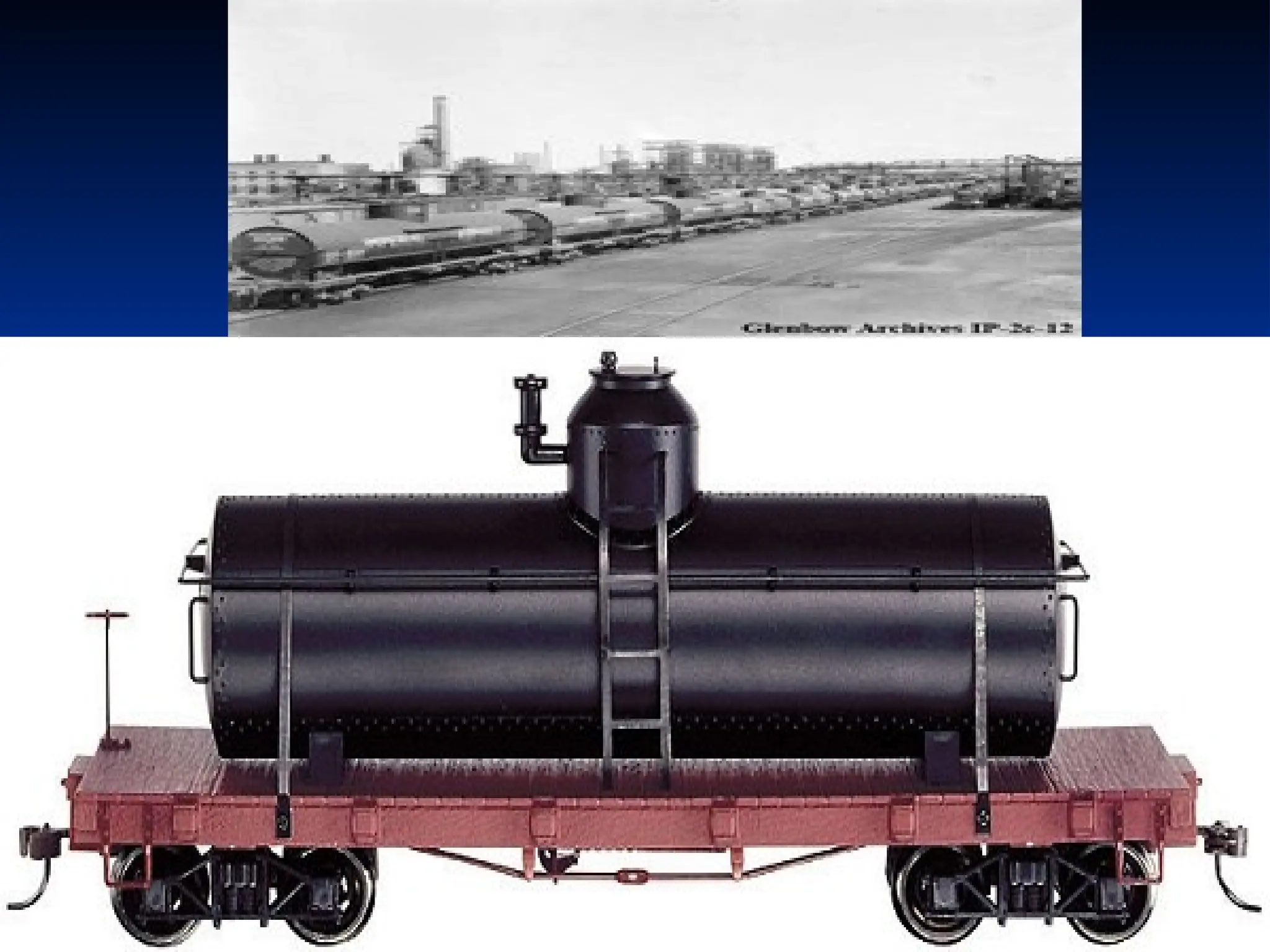
TANK-CARS
TANK-CARS
Charge Load =
Charge Load =
 From 6000 to 12000 US
From 6000 to 12000 US
gallon.
gallon.
 For Crude Oil Or
For Crude Oil Or
Products
Products
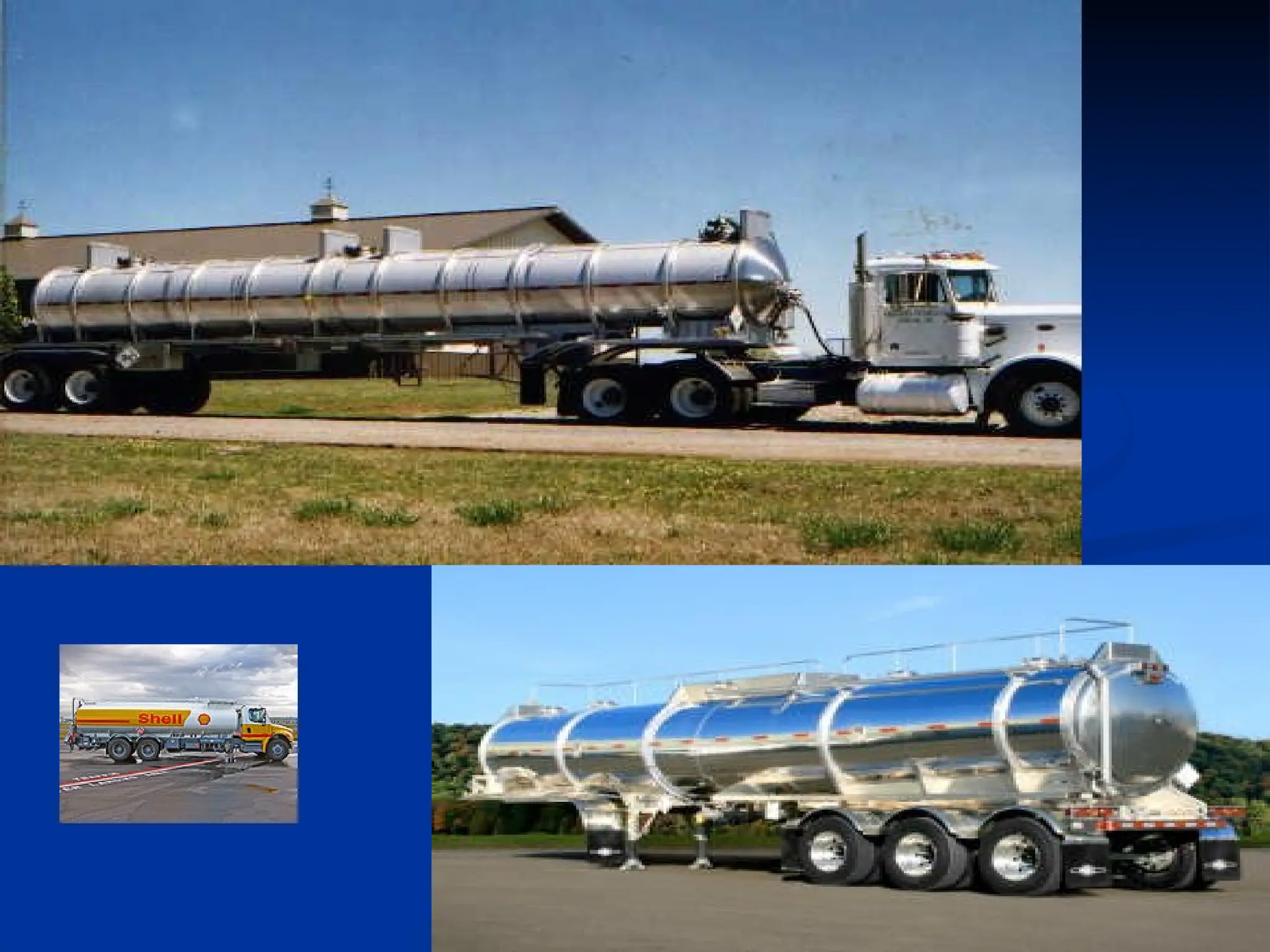
TANK-TRUCKS
TANK-TRUCKS
Charge Load =
Charge Load =
 From 2000 to 6000 US
From 2000 to 6000 US
gallon.
gallon.
 For Products Or Crude
For Products Or Crude
Oil
Oil
Sometimes With
Sometimes With Piggy-
Piggy-
Back
Back
Evaluation of crude Oil
The Object Of
The Object Of “crude Oil Evaluation “
“crude Oil Evaluation “ Is:
Is:
To Collect
To Collect Data
Data On The Yield, And Properties Of
On The Yield, And Properties Of
The Products Which Can Be Obtained From The
Raw Material.
Raw Material.
Schemes For Processing The Oil In The Refinery
And Design Of Processing Equipments Are
Based On This Data.
Based On This Data.
EVALUATION = The Best
Actions To Get The Best
Products From The Crude Oil
With Least Cost And Caring
(or Concerning)With
(or Concerning)With
Environmental Reserves.
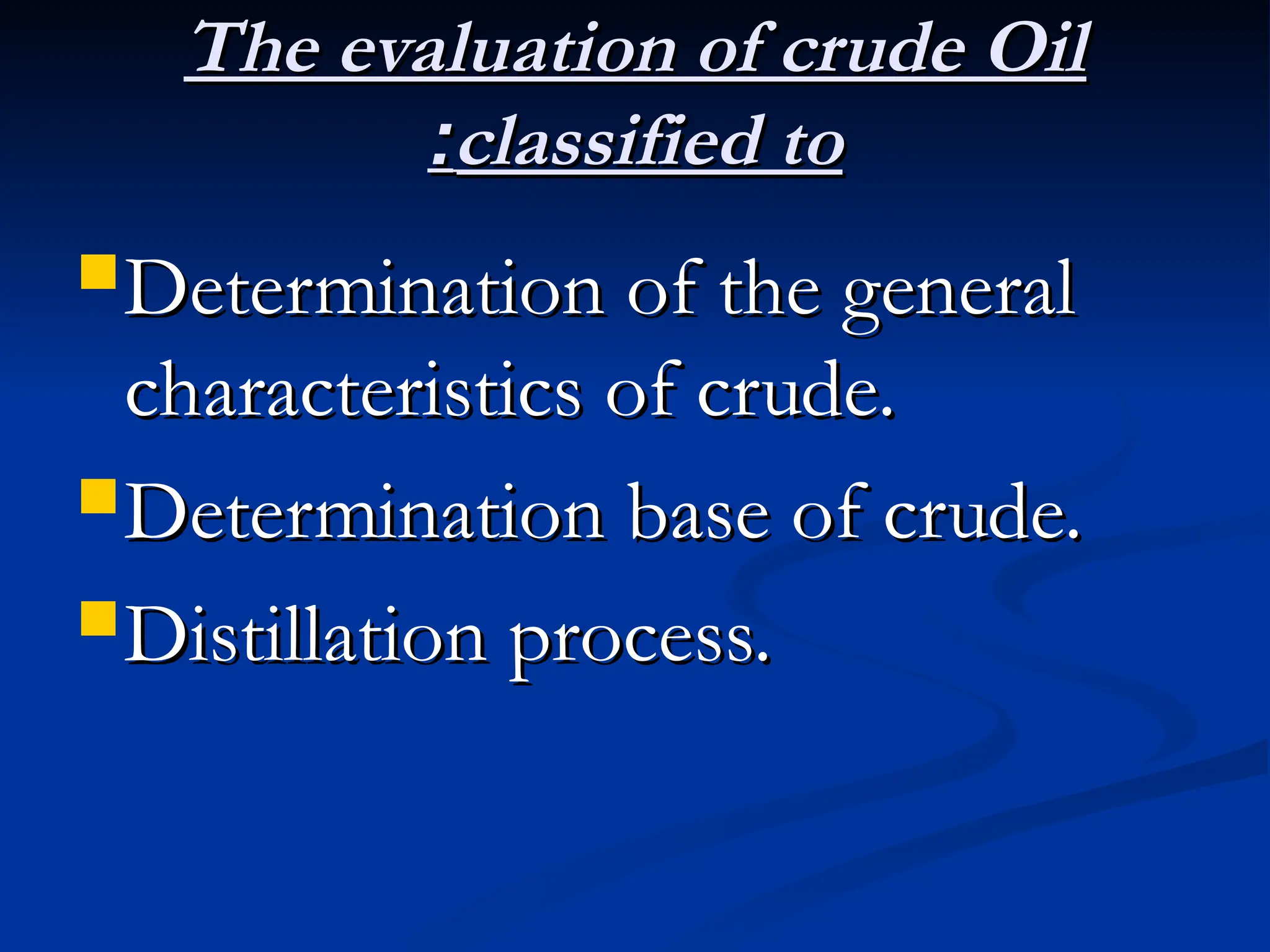
The evaluation of crude Oil
classified to
classified to
:
:
Determination of the general
Determination of the general
characteristics of crude.
Determination base of crude.
Determination base of crude.
Distillation process.
Distillation process.
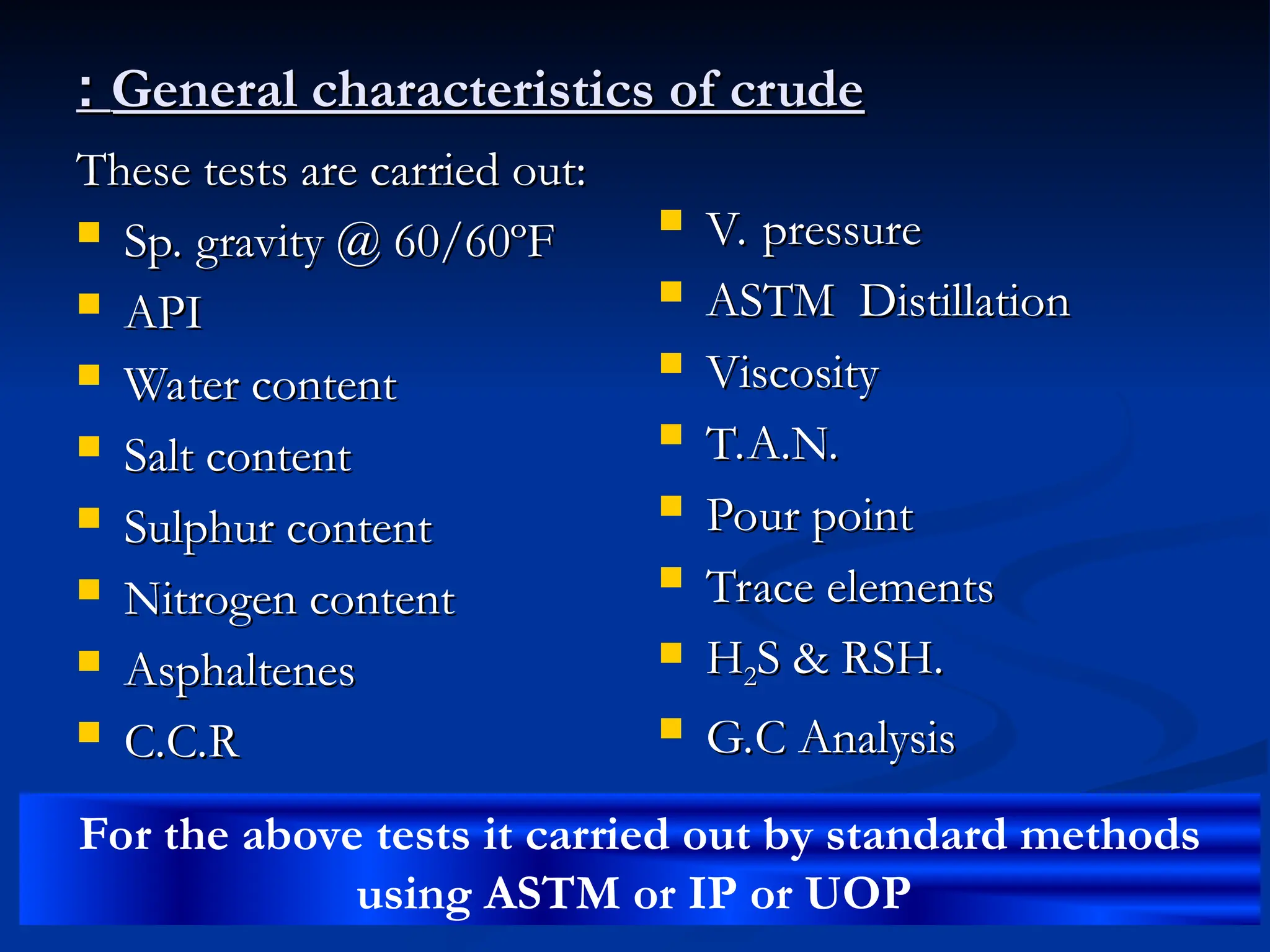
General characteristics of crude
:
:
These tests are carried out:
 Sp. gravity @ 60/60ºF
Sp. gravity @ 60/60ºF
 API
API
 Water content
Water content
 Salt content
Salt content
 Sulphur content
Sulphur content
 Nitrogen content
Nitrogen content
 Asphaltenes
Asphaltenes
 C.C.R
C.C.R
 V. pressure
V. pressure
 ASTM Distillation
ASTM Distillation
 Viscosity
Viscosity
 T.A.N.
T.A.N.
 Pour point
Pour point
 Trace elements
Trace elements
 H
H2
2S & RSH.
S & RSH.
 G.C Analysis
G.C Analysis
For the above tests it carried out by standard methods
using ASTM or IP or UOP
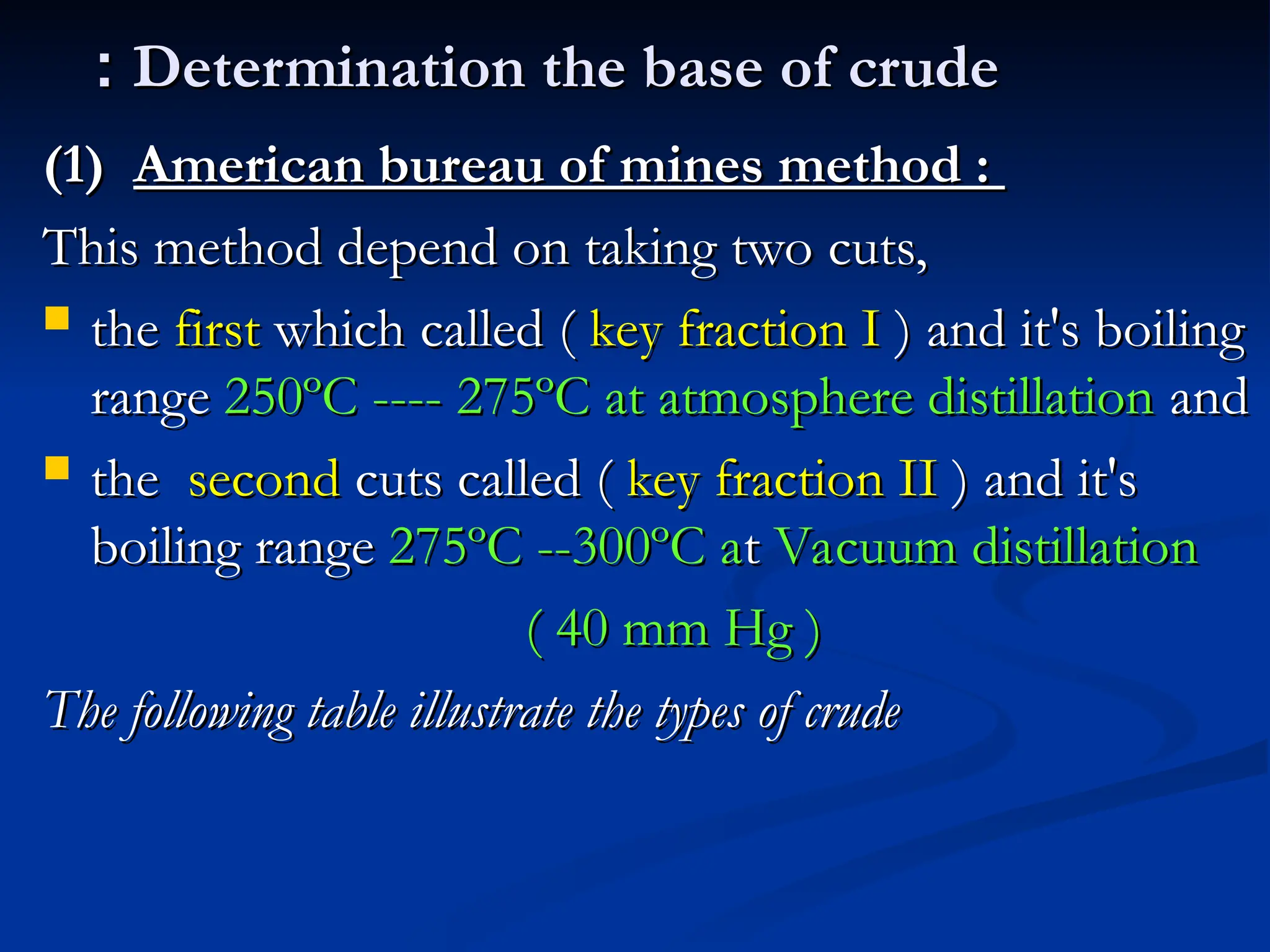
Determination the base of crude
:
:
(1)
(1) American bureau of mines method :
American bureau of mines method :
This method depend on taking two cuts,
 the
the first
first which called (
which called ( key fraction I
key fraction I ) and it's boiling
) and it's boiling
range
range 250ºC ---- 275ºC at atmosphere distillation
250ºC ---- 275ºC at atmosphere distillation and
and
 the
the second
second cuts called (
cuts called ( key fraction II
key fraction II ) and it's
) and it's
boiling range
boiling range 275ºC --300ºC a
275ºC --300ºC at
t Vacuum distillation
Vacuum distillation
( 40 mm Hg )
( 40 mm Hg )
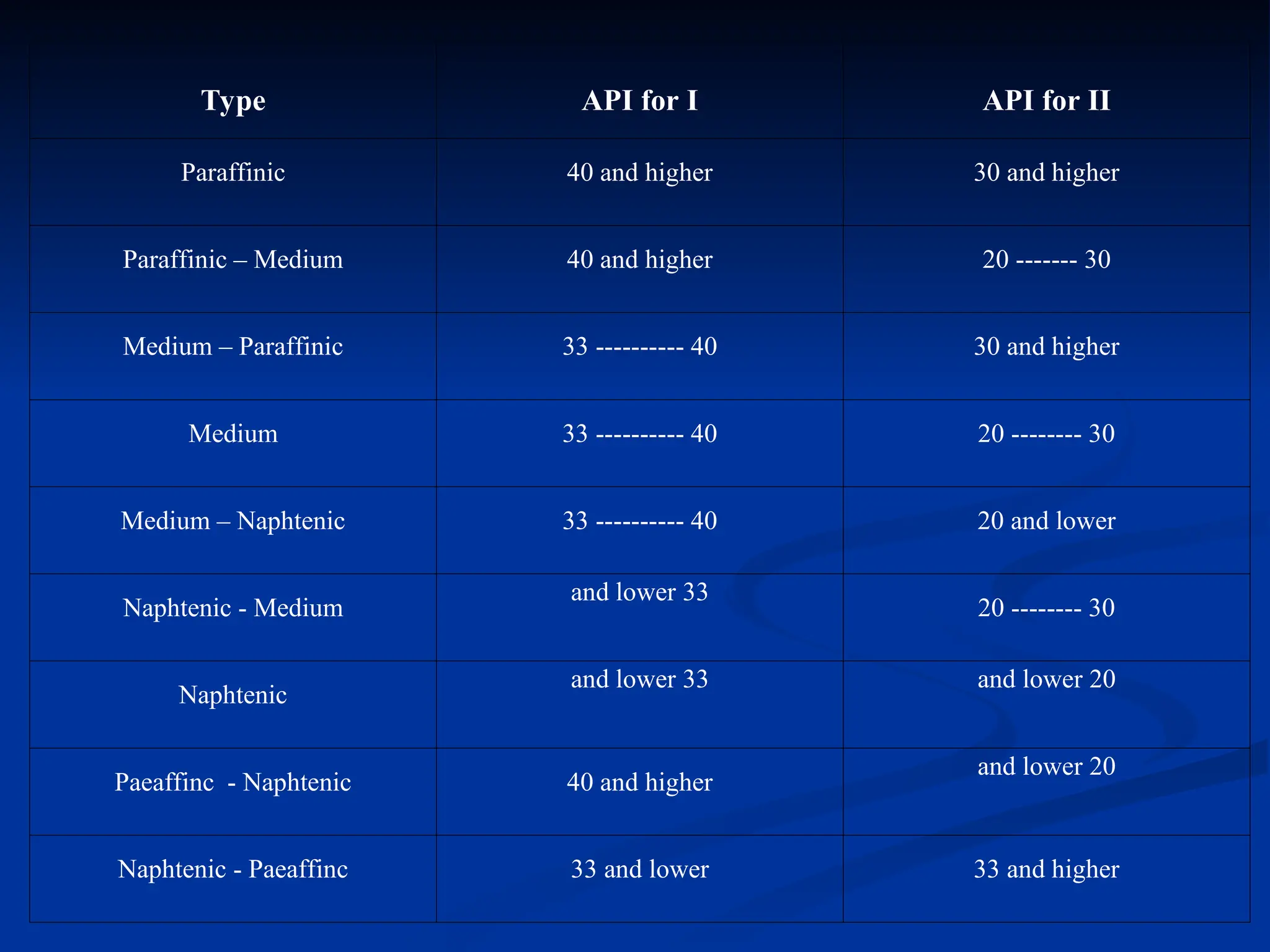
The following table illustrate the types of crude
API for II
API for I
Type
30 and higher
40 and higher
Paraffinic
20 ------- 30
40 and higher
Paraffinic – Medium
30 and higher
33 ---------- 40
Medium – Paraffinic
20 -------- 30
33 ---------- 40
Medium
20 and lower
33 ---------- 40
Medium – Naphtenic
20 -------- 30
33
and lower
Naphtenic - Medium
20
and lower
33
and lower
Naphtenic
20
and lower
40 and higher
Paeaffinc - Naphtenic
33 and higher
33 and lower
Naphtenic - Paeaffinc
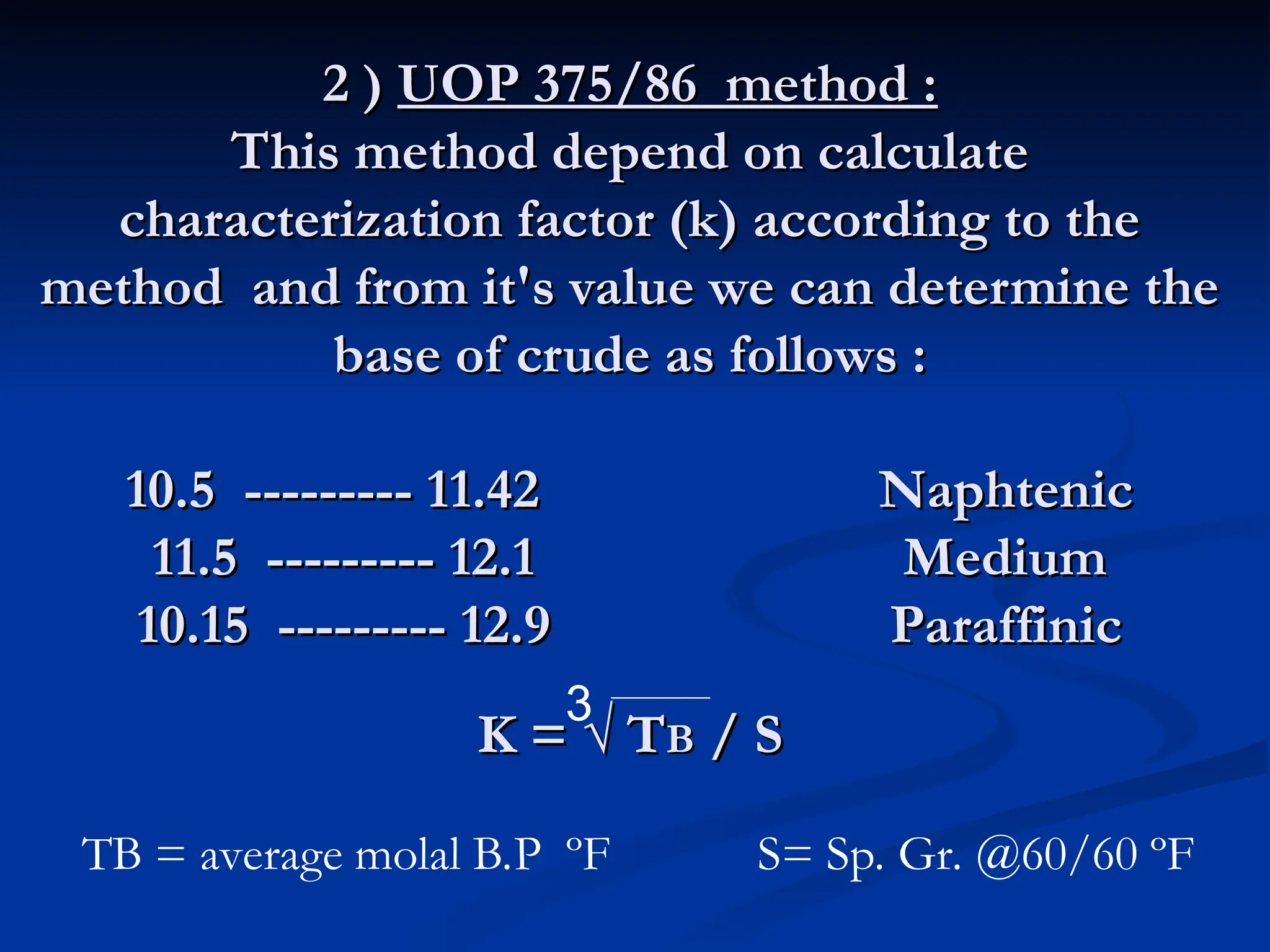
2 )
2 ) UOP 375/86 method :
UOP 375/86 method :
This method depend on calculate
characterization factor (k) according to the
method and from it's value we can determine the
base of crude as follows :
10.5 --------- 11.42 Naphtenic
11.5 --------- 12.1 Medium
10.15 --------- 12.9 Paraffinic
K = √ T
K = √ TB
B / S
/ S
3
TB = average molal B.P ºF S= Sp. Gr. @60/60 ºF
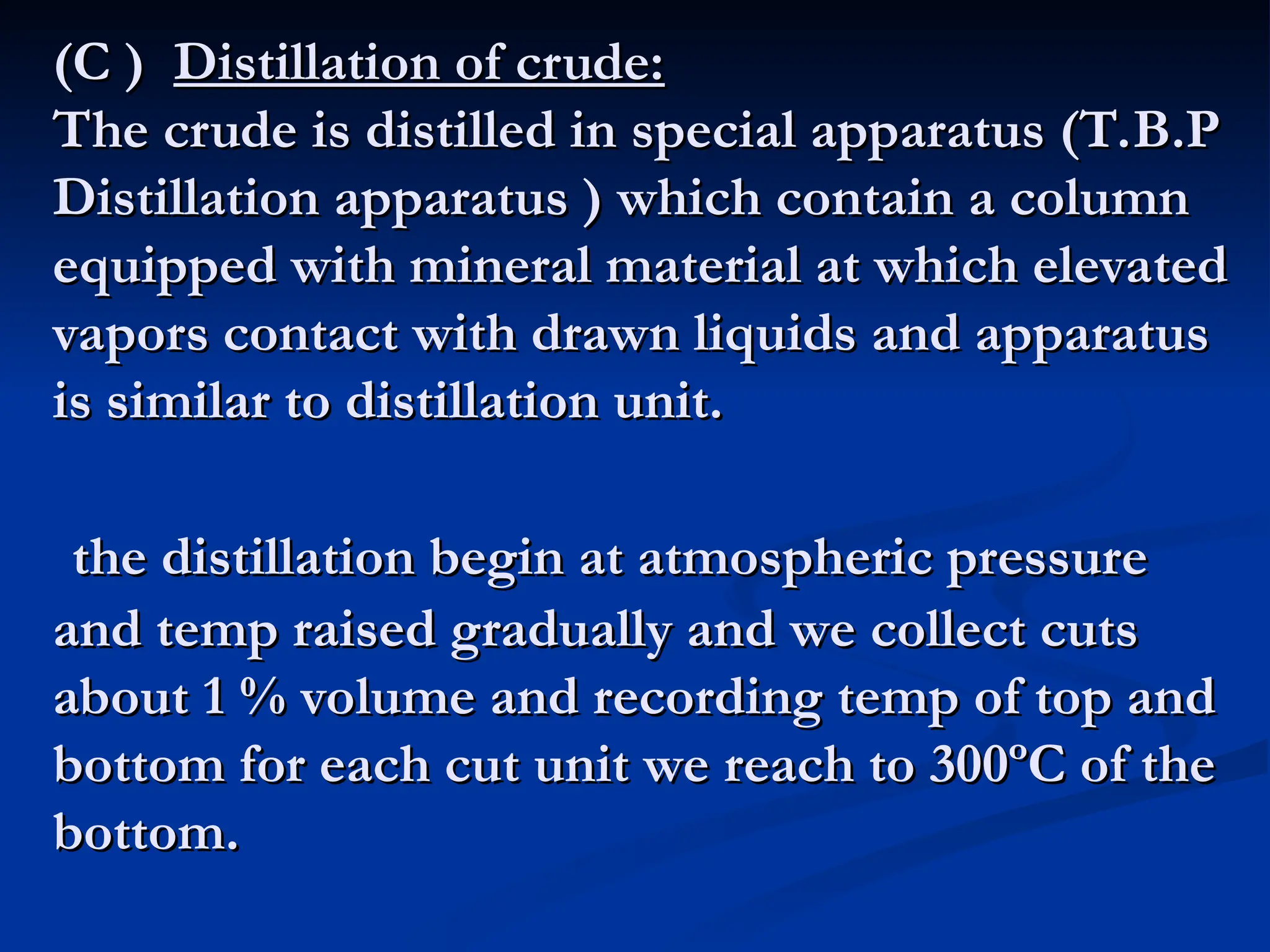
(C )
(C ) Distillation of crude:
Distillation of crude:
The crude is distilled in special apparatus (T.B.P
Distillation apparatus ) which contain a column
equipped with mineral material at which elevated
vapors contact with drawn liquids and apparatus
is similar to distillation unit.
the distillation begin at atmospheric pressure
and temp raised gradually and we collect cuts
about 1 % volume and recording temp of top and
bottom for each cut unit we reach to 300ºC of the
bottom.
bottom.
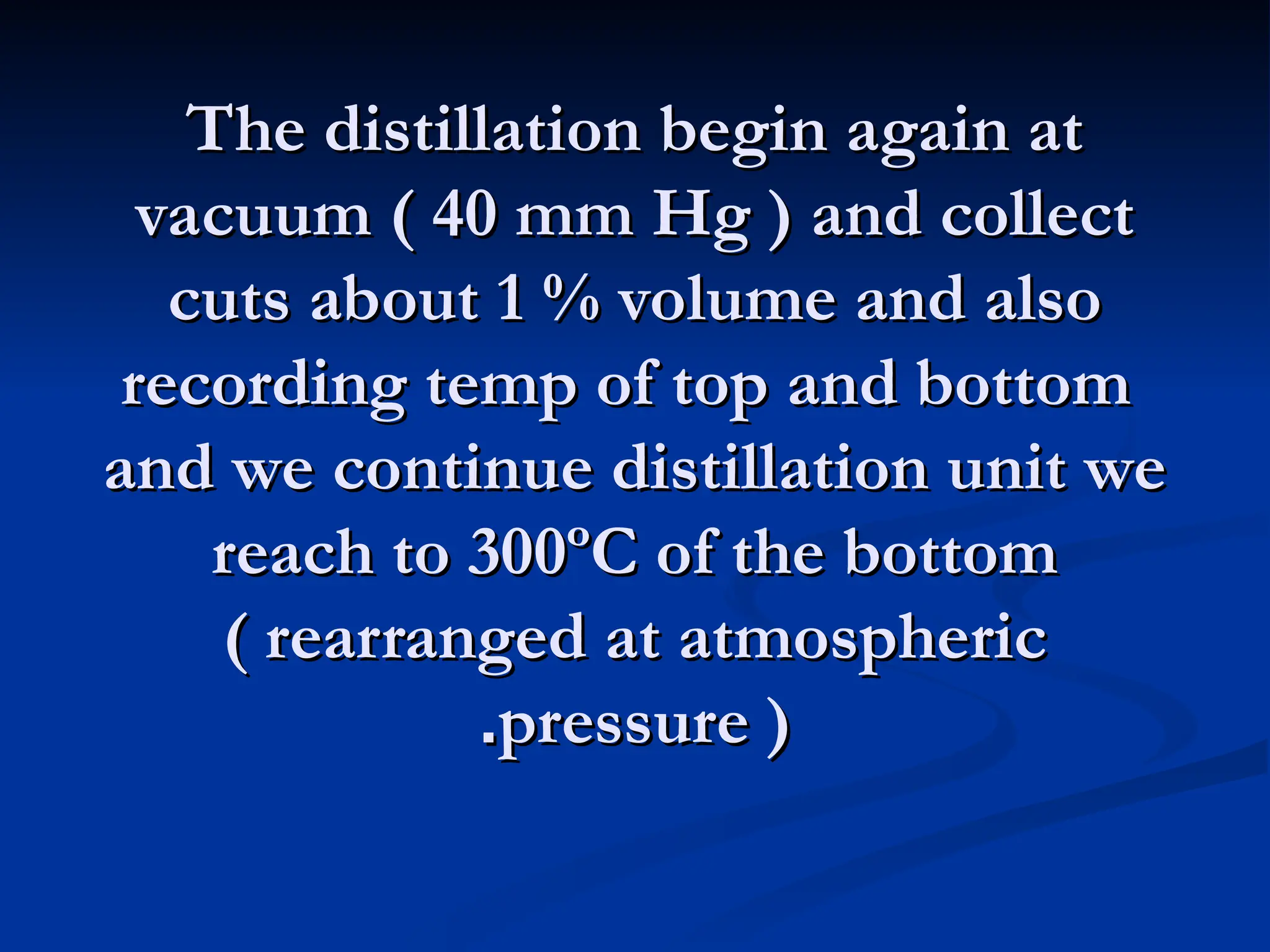
The distillation begin again at
vacuum ( 40 mm Hg ) and collect
cuts about 1 % volume and also
recording temp of top and bottom
and we continue distillation unit we
reach to 300ºC of the bottom
( rearranged at atmospheric
pressure )
pressure )
.
.
‫اهلل‬ ‫جزاكم‬
ً‫ا‬‫خير‬
the INTRODUCTION_TO_OIL&GAS_Recent[1].ppt

the INTRODUCTION_TO_OIL&GAS_Recent[1].ppt

  • 2.
    In the Nameof Allah most Merciful most Gracious INTRODUCTIO TO OIL AND GAS INDUSTRY Chemist / OSAMA ELSHAHAWY Chemist / OSAMA ELSHAHAWY
  • 3.
    INTRODUCTION TO OILAND GAS INDUSTRY
  • 4.
    This course willhelp Membership of the staff to understand all Fundamentals OF INTRODUCTION TO OIL AND GAS INDUSTRY
  • 6.
    Allah gives usa gift called PETROLEUM –The black gold- which has many benefits, so we have to thank Allah for his gift.
  • 7.
  • 8.
    Petroleum industry classifications . Upstream (oilindustry) Midstream (oil industry) Downstream (oil industry)
  • 9.
    Upstream (oil industry) Ingeography, upstream literally means towards the source of a stream or river, or against the normal direction of water flow.
  • 10.
    The upstream oilsector is a term commonly used to refer to the searching for and the recovery and production of crude oil and natural gas and bring them to the surface. The upstream oil sector is also known as the exploration and production (E&P) sector.
  • 11.
    Midstream (oil industry) Themidstream industry processes, stores, markets and transports crude oil, natural gas, natural gas liquids.
  • 12.
    Downstream (oil industry) Thedownstream sector includes oil refineries, petrochemical plants, petroleum product distribution, retail outlets and natural gas distribution companies. The downstream industry touches consumers through thousands of products such as petrol, diesel, jet fuel, heating oil, asphalt, lubricants, synthetic rubber, plastics, fertilizers, antifreeze, pesticides, pharmaceuticals, natural gas and propane.
  • 14.
    INTRODUCTION TO OIL&GAS INDUSTERY INTRODUCTION TO OIL &GAS INDUSTERY
  • 15.
    petroleum, oily, flammableliquid that occurs naturally in deposits, usually beneath the surface of the earth; it is also called crude oil. It consists principally of a mixture of hydrocarbons, with some of various nitrogenous sulfurous and phosphorus compounds and traces of heavy metals such as vanadium, and nickel .
  • 16.
     that occurwidely in the sedimentary rocks in the form of gases, liquids, semisolids, or solids.  It is not known exactly when humankind first used petroleum. It is known, however, that ancient peoples worshipped sacred fires that were fuelled by natural gas seeping to the surface through pores and cracks.
  • 17.
     It isalso known that asphalt, a very viscous form of petroleum, was used to waterproof boats and heat homes as early as 6,000 BC. Asphalt was also used as an embalming agent for mummies and in the construction of the Egyptian pyramids around 3,000 BC.
  • 18.
     Approximately 2000years ago, Arabian scientists developed methods for the distillation of petroleum, which were introduced into Europe by way of Spain. This represents another documented use of the volatile derivatives of petroleum which led to a continued interest in petroleum and its derivatives as medicinal materials and materials for warfare, in addition to the usual construction materials.
  • 19.
     The modernpetroleum industry began in 1859, when the American oil pioneer Colonel Edwin L. Drake drilled a producing well on Oil Creek in Pennsylvania at a place that later became Titusville by drilling to 21 meters. Many wells were drilled in the region. Kerosene was the chief finished product, and kerosene lamps soon replaced whale oil lamps and candles in general use.
  • 20.
     Petroleum's importanceto humankind took a giant leap in the late 1800's when it replaced coal as the primary fuel for the machines of the industrial revolution. In today's industrialized society, petroleum means power. Today, petroleum remains our primary source of energy
  • 21.
    Why is Oilso Important in Today’s World?  When you got out of bed, perhaps your family uses a natural gas-burning stove. Next you may have taken a gasoline or diesel powered car (or bus) to business. So, as you can see, before you even started your business day you already used a certain amount of petroleum.  Try and imagine how your life might change if we suddenly lost our supply of oil.
  • 23.
    including plastics, textiles,pharmaceuticals etc.. INTRODUCTION TO OIL AND GAS INDUSTRY
  • 24.
    INTRODUCTION TO OILAND GAS INDUSTRY
  • 25.
  • 26.
    THE OCCURRENCE ANDORIGIN OF OIL AND GAS RESERVOIR CAP H.C. Accumulation Require reservoir rock Cap Rock ( to store fluid ( ) to prevent their escape )
  • 27.
    Three Types ofRocks  Before we proceed to discuss where oil is found in the subsurface, we must become familiar with some new terminology; namely, the three types of rocks; Igneous, Sedimentary and Metamorphic.
  • 28.
     Igneous rocks: Igneous rocks : are rocks that have are rocks that have solidified from a molten or liquid state. solidified from a molten or liquid state.  Formed from the cooling of volcanic Formed from the cooling of volcanic lava. lava.  Igneous rocks do not normally contain Igneous rocks do not normally contain hydrocarbons. hydrocarbons.
  • 29.
     Sedimentary rocks: Sedimentaryrocks: are formed by the laying down are formed by the laying down of sediment in seas, rivers or lakes of sediment in seas, rivers or lakes. .  The particles of sediment that accumulate are The particles of sediment that accumulate are eventually cemented together to form eventually cemented together to form sedimentary rock . sedimentary rock .  hydrocarbons are normally found in the spaces hydrocarbons are normally found in the spaces between the particles of these sedimentary between the particles of these sedimentary rocks rocks
  • 30.
     Metamorphic rocks: Metamorphicrocks: are formed by the are formed by the metamorphosis of existing rock, be it igneous or metamorphosis of existing rock, be it igneous or sedimentary, by extreme heat and pressure. sedimentary, by extreme heat and pressure.  These factors cause recrystallization of the These factors cause recrystallization of the minerals in the rock. minerals in the rock.  Metamorphic rocks do not normally Metamorphic rocks do not normally contain hydrocarbons. contain hydrocarbons.
  • 31.
    RESERVOIR ROCK RESERVOIR ROCK MUSTPOSSES Fluid Holding Capacity = porosity Fluid transmitting Capacity = permeability For the bulk of the storage space Provided by connected openings RESERVOIR ROCK = SEDIMENTARY ROCK RESERVOIR ROCK = SEDIMENTARY ROCK
  • 32.
    = = The spaces betweenthe grains The spaces between the grains
  • 33.
    =Measure of theease with which fluids can flow through a rock
  • 34.
    SHALES SHALES ACTS AS RESERVOIRROCKS ACTS AS RESERVOIR ROCKS METAMORPHIC ROCKS METAMORPHIC ROCKS ACTS AS RESERVOIR ROCKS ACTS AS RESERVOIR ROCKS Porosity HIGH permeability TOO SMAL
  • 36.
    CAP ROCK CAP ROCK ANYROCKS PREVENT NOT PENETRATED ESCAP OF OIL BY OIL AND GAS FROM OR GAS RESERVOIR ROKS
  • 37.
    CAPILARY PRESSURE CAPILARY PRESSURE PRESSURE REQUIRED TO CAUSE OF A PRESSURE REQUIRED TO CAUSE OF A FLUID TO DISPLACE FROM THE FLUID TO DISPLACE FROM THE OPENINGS IN THE ROCK ANOTHER OPENINGS IN THE ROCK ANOTHER FLUID _(TWO FLUIDS ARE NOT FLUID _(TWO FLUIDS ARE NOT MISCIBLE)_. MISCIBLE)_.
  • 39.
    FLUID DESTRIBUTION FLUID DESTRIBUTION CAPROCKS GAS = GAS CAP GAS+SOME WATER GAS +OIL OIL + GAS OIL RESREVOIR ROCKS OIL + WATER WATER + OIL WATER OIL WELL
  • 40.
    FLUID DESTRIBUTION FLUID DESTRIBUTION CAPROCKS GAS RESREVOIR ROCKS GAS+ WATER WATER + GAS WATER GAS WELL
  • 42.
    DEPTH, SIZES ANDOTHER FEATURES PLANT ROOTS OF PLANT 26000 ft ≈ 7925 m ≈ H.C. Produced from roots of grass down to 26000 ft ≈ From few acres to 100th miles caring oil
  • 43.
  • 44.
    Oil reservoir rockthickness Oil reservoir rock thickness from few ft to 100 from few ft to 100th th ft ft Hight of H. C. zone from 10 from 10th th ft to 100th ft ft to 100th ft
  • 45.
  • 53.
    Migration and Accumulation Migrationand Accumulation  On many occasions the reservoir rock is On many occasions the reservoir rock is Unlikely to have been the Unlikely to have been the rock in which rock in which the oil and gas were formed; the oil and gas were formed; in some in some cases the reservoir rock could not have cases the reservoir rock could not have been the source rock. The process of been the source rock. The process of concentration and emplacement of the concentration and emplacement of the hydro­ carbon accumulation is referred to hydro­ carbon accumulation is referred to as migration and accumulation. as migration and accumulation.
  • 54.
     If thesource rock differs from the reservoir If the source rock differs from the reservoir rock it may be convenient to consider two rock it may be convenient to consider two stages of the process: stages of the process:  1 1. Movement from the . Movement from the source source rock to the rock to the reservoir reservoir rock, and rock, and  2 2. Movement and . Movement and segregation segregation within the within the reservoir rock. reservoir rock. The first stage has been labeled The first stage has been labeled primary migration primary migration, and , and The second stage The second stage secondary migration secondary migration. .
  • 55.
  • 56.
    HYDROCARBONS HYDROCARBONS SATURATED UNSATURATED SATURATED UNSATURATED PARAFFINS PARAFFINSOLEFINS OLEFINS - - Long Chain = normal Long Chain = normal ACETYLENS ACETYLENS - - Cyclic = Naphthens Cyclic = Naphthens AROMATICS AROMATICS - - Branched = Iso Branched = Iso - - - - Long Chain Long Chain - - Cyclic Cyclic - - Branched Branched - - Long Chain Long Chain - - Branched Branched - - Branched Branched
  • 57.
    PARAFFIN PARAFFIN SERIES SERIES There AreSo Many Different There Are So Many Different H.C. H.C. Comp Comp, , s. In s. In Crude Oil , Estimates Range Between Crude Oil , Estimates Range Between 50 000 50 000 And And 1000 000 1000 000. . It Is Necessary To Have Systematic Way To It Is Necessary To Have Systematic Way To Classify Classify Them Them . . The Two Basic Systems Used Are The Two Basic Systems Used Are : : 1 1 - - By Carbon No By Carbon No . . 2 2 - - By Molecular Structure By Molecular Structure . .
  • 73.
  • 74.
  • 75.
    In 1866, BERTHELOTconsidered that CRUDE OIL constituents were produced from the ACETYLEN. Initially, inorganic carbides were formed by the action of alkali metals on carbonates after which acetylene was produced by reaction of the carbides with water .
  • 76.
    Mendelejeff, who proposedthat the action of dilute acids or hot water on mixed iron and manganese carbides produces a mixture of hydrocarbons from which petroleum evolved, described another theory in which acetylene is considered to be the basic material :
  • 77.
    There are alsoseveral recent theories related to the formation of petroleum from nonbiogenic sources in the earth. From the chemical point of view the inorganic theories are interesting because of their historical importance, but these theories have not received much attention.
  • 78.
    =living organisms arethe source materials Petroleum is a naturally occurring hydrocarbon mixture but hydrocarbons that are synthesized by living organisms usually account for less than 20% of the petroleum . The remainder of the hydrocarbons in petroleum is produced by a variety of processes that convert other organic material to hydrocarbons as part of the maturation processes generally referred to as digenesis, CATAGENESIS, and METAGENESIS .
  • 79.
    Over many centuriesthis organic matter, mixed with mud, is buried under thick sedimentary layers of material. The resulting high levels of HEAT, PRESSURE and BICTRIA cause the remains to metamorphose, first into a waxy material known as KEROGEN, and then into liquid
  • 80.
    Kerogen Is a solid,waxy, organic substance that forms when pressure and heat from the Earth act on the remains of plants and animals. Kerogen converts to various liquid and gaseous hydrocarbons at a depth of seven or more kilometers and a temperature between 50 o C and 100 o C (122 o F and 212 o F).
  • 81.
    The name kerogenis also generally used for organic matter in sedimentary rocks that is insoluble in common organic and inorganic solvents. Kerogen also yields oil when the shale containing kerogen is heated to temperatures sufficient to cause destructive distillation.
  • 83.
    (1)knowledge of underground structuresand which types favor formation of oil pools and (2)methods of obtaining data about underground formations, primarily the field of geophysics.
  • 84.
    Geophysical Exploration ExploratoryDrilling and Well Logging Sound Waves
  • 85.
    Geophysical Exploration Geophysical Exploration Geophysicalexploration obtains Geophysical exploration obtains data on data on variations in the variations in the physical properties physical properties of of subsurface rocks, including subsurface rocks, including density density, , elasticity elasticity, , magnetic magnetic and and electrical properties electrical properties. . It provides a means for determining the It provides a means for determining the location of various types of rocks. location of various types of rocks. It does not, as yet, give direct evidence of the It does not, as yet, give direct evidence of the occurrence of oil; occurrence of oil; this still necessitates drilling a hole. this still necessitates drilling a hole.
  • 86.
    The principles usedare basically magnetism, gravity, and sound waves. The instruments are the magnetometer, gravimeter, and seismograph.
  • 87.
    Oil tends tobe found in layers of sedimentary rock, which lie on top of igneous, or basement, rock. This is much denser than the sedimentary layers and contains a higher concentration of iron and other magnetic materials .
  • 88.
    OIL OIL  DENSITY= DENSITY= Lower Lower MAGNETIC MATERIALS Concn.= MAGNETIC MATERIALS Concn.= Lower Lower SEDIMENTARY ROCKS DENSITY= Higher MAGNETIC MATERIALS Concn.= Higher IGNEOUS or BASEMENT ROCKS
  • 89.
     A magnetometer,fundamentally a specially A magnetometer, fundamentally a specially designed designed magnetic compass magnetic compass, detects minute , detects minute differences in the magnetic properties of differences in the magnetic properties of various rock formations, thus helping to find various rock formations, thus helping to find structures which might contain oil. structures which might contain oil.
  • 91.
    Magnetometers can bedivided into two basic types: •Scalar magnetometers measure the total strength of the magnetic field to which they are subjected, and •Vector magnetometers have the capability to measure the component of the magnetic field in a particular direction, relative to the spatial orientation of the device.
  • 92.
    Proton precession magnetometers,also known as proton magnetometers, measure the resonance frequency of protons (hydrogen nuclei) in the magnetic field to be measured, due to nuclear magnetic resonance (NMR). Caesium vapor magnetometer, consists of a photon emitter containing a caesium light emitter or lamp, an absorption chamber containing caesium vapor and a "buffer gas " through which the emitted photons pass, and a photon detector, arranged in that order.
  • 93.
    A uniaxial fluxgatemagnetometer A fluxgate compass/inclinometer
  • 94.
    The magnitude ofgravitational pull of underground rock The magnitude of gravitational pull of underground rock varies directly with its density varies directly with its density , , although the actual variations are extremely small although the actual variations are extremely small . . The gravimeter, a sensitive instrument which detects The gravimeter, a sensitive instrument which detects differences in the pull of gravity differences in the pull of gravity , , therefore gives an indication of the location and density of therefore gives an indication of the location and density of underground rock formations underground rock formations . .
  • 95.
    Most gravimeters operateon about the same Most gravimeters operate on about the same principle principle . . A weight is suspended on a sensitive spring A weight is suspended on a sensitive spring , , and changes in gravity cause tiny changes in and changes in gravity cause tiny changes in length or in twisting of the spring length or in twisting of the spring , , which can be magnified optically or electrically which can be magnified optically or electrically and observed and observed . .
  • 99.
    The instruments areused on The instruments are used on land, over water-covered areas land, over water-covered areas (by submerging them in special (by submerging them in special diving bells or occasionally in diving bells or occasionally in submarines), and they can be submarines), and they can be employed on aircraft employed on aircraft . .
  • 100.
    Seismic Method Seismic Method Based on determinations of the Based on determinations of the time interval time interval that that elapses elapses between between the the initiation of a sound wave initiation of a sound wave from detonation of a dynamite charge or other from detonation of a dynamite charge or other artificial shock artificial shock and and the the arrival of the vibration arrival of the vibration impulses impulses at a series of seismic detectors at a series of seismic detectors (geophones). The arrivals are amplified and (geophones). The arrivals are amplified and recorded along with time marks (0.01 sec recorded along with time marks (0.01 sec intervals) to give the seismogram. intervals) to give the seismogram.
  • 101.
     Seismometers Seismometers areinstruments that measures seismic waves generated are instruments that measures seismic waves generated by earthquakes, nuclear explosions, and other seismic sources. by earthquakes, nuclear explosions, and other seismic sources. Records of seismic waves allow seismologists to map the interior of Records of seismic waves allow seismologists to map the interior of the Earth, and locate and measure the size of these different sources. the Earth, and locate and measure the size of these different sources.  The word derives from the Greek The word derives from the Greek seismós seismós, a shaking or quake, and , a shaking or quake, and métron métron, measure. , measure.  Seismograph Seismograph is another Greek term from is another Greek term from seismós seismós and and gráphō gráphō, to draw. , to draw.  Both types provide a continuous record of ground motion; this Both types provide a continuous record of ground motion; this distinguishes them from distinguishes them from seismoscopes seismoscopes, which merely indicate that , which merely indicate that motion has occurred, perhaps with some simple measure of how large motion has occurred, perhaps with some simple measure of how large it was it was
  • 102.
    setting off asmall and controlled charge of explosive in setting off a small and controlled charge of explosive in the bottom of a shallow hole in the ground. The the bottom of a shallow hole in the ground. The seismograph measures the shock waves from the seismograph measures the shock waves from the explosion explosion The velocity of travel of a disturbance through the The velocity of travel of a disturbance through the ground is in mathematical relationship to the ground is in mathematical relationship to the elasticity and the density of the ground and its elasticity and the density of the ground and its components. Furthermore, the sound or shock waves components. Furthermore, the sound or shock waves are are reflected reflected and refracted and refracted by materials of various by materials of various densities in accordance with the same principles that densities in accordance with the same principles that apply in the reflection and refraction of light waves apply in the reflection and refraction of light waves . .
  • 105.
  • 106.
     Another valuableexploration method is geophysical Another valuable exploration method is geophysical borehole logging, borehole logging,  It involves drilling a well and then employing It involves drilling a well and then employing instruments to log or make measurements at various instruments to log or make measurements at various levels in the hole by such means as electrical levels in the hole by such means as electrical resistivity, radioactivity, acoustics, or density. resistivity, radioactivity, acoustics, or density.  In addition, formation, or core, samples are taken for In addition, formation, or core, samples are taken for physical and chemical tests. physical and chemical tests. Exploratory Drilling and Well Logging
  • 107.
     Based onthe fact that: Based on the fact that: the the resistivity resistivity of a rock layer is of a rock layer is a function of its a function of its fluid content fluid content. .  Oil-filled sand has a very high resistivity. Oil-filled sand has a very high resistivity.
  • 108.
    The method consistsof: passing a current between an electrode at the surface and one which is lowered into the hole. Any change in the resistivity conditions around the moving electrode will affect the flow of current and the voltage distribution around it. These voltage fluctuations can be measured by a pair of electrodes placed near the moving electrode and lowered with it.
  • 109.
     The naturalradioactive properties of many constituents The natural radioactive properties of many constituents of rock have made it possible to use nuclear radiation of rock have made it possible to use nuclear radiation detectors in the borehole. detectors in the borehole. If a carbon atom also has six neutrons, it is Carbon-12. If it has seven neutrons, it is Carbron-13. A carbon atom containing six protons and eight neutrons is Carbon-14. This form, or isotope of carbon is radioactive. Carbon-14 is radioactive while Carbon-12 and Carbon-13 are stable.
  • 110.
     Two commonlyused methods are : Two commonly used methods are : 1. 1. gamma-ray the natural radiations from the gamma-ray the natural radiations from the rock are used. rock are used. the gamma-ray log helps the gamma-ray log helps define define Shale. Shale. 2. 2. neutron logging a neutron source is neutron logging a neutron source is employed to excite the release of radiation from employed to excite the release of radiation from the rock. The neutron source is usually a mixture the rock. The neutron source is usually a mixture of beryllium and radium but can be of beryllium and radium but can be a a miniature miniature van de Graff particle accelerator. van de Graff particle accelerator. The neutron The neutron method is method is a. a. means for means for determining the determining the relative porosities of rock formations. relative porosities of rock formations.
  • 111.
     Density Density cannow be logged with a new development can now be logged with a new development utilizing utilizing radioactivity. radioactivity.  The The instrument instrument consists of a radioactive cobalt consists of a radioactive cobalt source of source of gamma rays gamma rays and a and a Geiger counter Geiger counter as a detector which is as a detector which is shielded from the source. shielded from the source.  The rock formation is The rock formation is bombarded with the gamma bombarded with the gamma rays, rays, some of them being scattered back from the formation and some of them being scattered back from the formation and entering the detector. entering the detector.  The degree to which the original radiation is The degree to which the original radiation is absorbed is a function of the density of the rock. absorbed is a function of the density of the rock.
  • 112.
    Well data obtainedfrom the examination of Well data obtained from the examination of formation samples formation samples taken from various depths in taken from various depths in the borehole the borehole These samples can be These samples can be : : (1) (1) so-called so-called "cores" "cores" which have been taken from which have been taken from the hole by a special coring device, or the hole by a special coring device, or (2) (2)(2) drill cuttings screened from the circulating (2) drill cuttings screened from the circulating drilling mud. drilling mud.
  • 113.
    DRILLING AND PRODUCTION DRILLINGAND PRODUCTION Wells are drilled Wells are drilled today today by the by the ROTARY ROTARY method, method, in which an abrasive bit is revolved at the end of in which an abrasive bit is revolved at the end of a drill stem a drill stem . . The The older older CABLE-TOOL CABLE-TOOL method, used almost method, used almost exclusively until 1900, involves raising and exclusively until 1900, involves raising and dropping a heavy bit and drill stem attached by dropping a heavy bit and drill stem attached by cable to a cantilever arm at the surface cable to a cantilever arm at the surface . . preferred preferred only for penetrating only for penetrating great thicknesses great thicknesses of of hard rock hard rock at at shallow depths shallow depths and when the and when the
  • 114.
    Drilling Operation Drilling Operation - - Oncethe site has been selected Once the site has been selected , , * legal issues must be done. * legal issues must be done. * the crew goes about preparing the land * the crew goes about preparing the land * must be a source of water nearby * must be a source of water nearby * several holes must be dug to make way for * several holes must be dug to make way for the rig and the main hole the rig and the main hole The crew then begins drilling the main The crew then begins drilling the main hole often with a small drill truck rather hole often with a small drill truck rather than the main rig. than the main rig.
  • 120.
    In order toextract the oil from an oil field, a large number of wells are drilled.
  • 121.
    Once the finaldepth has been reached, the well is completed to allow oil to flow into the casing in a controlled manner ; a perforating GUN is lowered into the well to the production depth. To create holes in the casing through which oil can flow. After the casing has been perforated, a small-diameter pipe (tubing) is run into the hole as a conduit for oil and gas to flow up the
  • 123.
    a multi valvestructure is installed at the top of the tubing and cemented to the top of the casing. The Christmas tree allows them to control the flow of oil from the well .
  • 126.
     Is theproduction of oil from a reservoir. Is the production of oil from a reservoir.  which range from which range from recovery by reservoir energy recovery by reservoir energy (i.e., the oil flows from the well hole without (i.e., the oil flows from the well hole without assistance) assistance) to to enhanced recovery methods in enhanced recovery methods in which considerable energy must be added to the which considerable energy must be added to the reservoir to produce the oil. reservoir to produce the oil.  However, the effect of the method on the oil and However, the effect of the method on the oil and on the reservoir must be considered before on the reservoir must be considered before application. application. Recovery Recovery
  • 127.
    Primary Recovery (NaturalMethods) Primary Recovery (Natural Methods)  If the underground pressure in the oil reservoir If the underground pressure in the oil reservoir is sufficient, then the oil will be forced to the is sufficient, then the oil will be forced to the surface under this pressure. Gaseous fuels or surface under this pressure. Gaseous fuels or natural gas are usually present, which also supply natural gas are usually present, which also supply needed underground pressure. In this situation, needed underground pressure. In this situation, it is sufficient to place a complex arrangement of it is sufficient to place a complex arrangement of valves (the Christmas tree) at the well head to valves (the Christmas tree) at the well head to connect the well to a pipeline network for connect the well to a pipeline network for storage and processing. This is called primary oil storage and processing. This is called primary oil recovery. recovery.
  • 128.
    SECONDARY R ECOVERY SECONDARYR ECOVERY Over the lifetime of the well the pressure will Over the lifetime of the well the pressure will fall, and at some point there will be fall, and at some point there will be insufficient underground pressure to force the insufficient underground pressure to force the oil to the surface. If economical, and it often oil to the surface. If economical, and it often is, the remaining oil in the well is extracted is, the remaining oil in the well is extracted using secondary oil recovery methods using secondary oil recovery methods . .
  • 129.
    Secondary oil recoverymethods use various Secondary oil recovery methods use various techniques to aid in recovering oil from depleted or techniques to aid in recovering oil from depleted or low-pressure reservoirs. Sometimes low-pressure reservoirs. Sometimes # #Pumps Pumps on the surface or submerged (electrical on the surface or submerged (electrical submersible pumps (ESPs)), are used to bring submersible pumps (ESPs)), are used to bring the oil to the surface. the oil to the surface. #Increase the reservoir’s pressure by #Increase the reservoir’s pressure by Water Water Injection Injection and and Gas Gas Injection Injection, which injects , which injects AIR AIR or some other or some other GAS GAS into the reservoir. into the reservoir. Together, primary recovery and secondary Together, primary recovery and secondary recovery allow 25% to 35% of the reservoir’s oil recovery allow 25% to 35% of the reservoir’s oil to be recovered. to be recovered.
  • 132.
  • 133.
    ENHANCED OIL RECOVERY ENHANCEDOIL RECOVERY Enhanced oil recovery (tertiary oil recovery) Enhanced oil recovery (tertiary oil recovery) is the incremental ultimate oil that can be is the incremental ultimate oil that can be recovered from a petroleum reservoir over recovered from a petroleum reservoir over oil that can be obtained by primary and oil that can be obtained by primary and secondary recovery methods secondary recovery methods . .
  • 134.
    The viscosity (orthe API gravity) of petroleum is an The viscosity (or the API gravity) of petroleum is an important factor that must be taken into account important factor that must be taken into account when heavy oil is recovered from a reservoir when heavy oil is recovered from a reservoir . . In fact, certain reservoir types, such as those with In fact, certain reservoir types, such as those with very viscous crude oils and some low-permeability very viscous crude oils and some low-permeability carbonate (limestone, dolomite, or chert) carbonate (limestone, dolomite, or chert) reservoirs, respond poorly to conventional reservoirs, respond poorly to conventional secondary recovery techniques secondary recovery techniques . . In these reservoirs, it is desirable to initiate enhanced In these reservoirs, it is desirable to initiate enhanced oil recovery (EOR) operations as early as possible oil recovery (EOR) operations as early as possible . .
  • 135.
    Thermal floods usingsteam and Thermal floods using steam and controlled in situ combustion methods controlled in situ combustion methods are also used. Thermal methods of are also used. Thermal methods of recovery reduce the viscosity of the recovery reduce the viscosity of the crude oil by heat so that it flows more crude oil by heat so that it flows more easily into the production well easily into the production well . .
  • 140.
    Oilfield treatment processing Oilfieldtreatment processing Fluids produced from a well are seldom pure Fluids produced from a well are seldom pure crude oil; they are rarely clean oil crude oil; they are rarely clean oil (produced from an oil well) to be ready for (produced from an oil well) to be ready for handling, it is generally comes out of the handling, it is generally comes out of the well as a mixture of well as a mixture of : :  oil oil  water water  gases, and gases, and  sand or solid materials sand or solid materials Foreign materials, water, and sand or solid materials must be separated from the oil and gas before they can transported to the refineries. This process is known as OIL TREATING .
  • 142.
    The amount thisforeign materials is referred to as The amount this foreign materials is referred to as BS&W ( Basic Sediment and Water) content of BS&W ( Basic Sediment and Water) content of the oil. Normally, the BS&W content must be the oil. Normally, the BS&W content must be less than 0.5 % volume before oil to be less than 0.5 % volume before oil to be translated translated . .  Oilfield treatment processing include some or all Oilfield treatment processing include some or all of the following: of the following: *Filtration. *Dehydration (water separation). *Filtration. *Dehydration (water separation). *Stabilization. *Desalting. *Stabilization. *Desalting. *Gases sweating (treating). And *Visbreaking. *Gases sweating (treating). And *Visbreaking.
  • 143.
  • 144.
    - - -- - - - - - - - - - - - - - - - - - - - - - - - - - Crude Oil Crude Oil WATER GASES CRUDE OIL WITH SMALL AMOUNT OF gases
  • 145.
    1.2.4 1.2.4 WHAT IS WHAT ISLPG LPG ? ? L LIQUEFIED IQUEFIED P PETROLEUM ETROLEUM G GAS AS LPG ≠ LPG ≠ LNG LNG Mainly Mainly Mainly Mainly C C3 + 3 + C C4 4 C C1 1 Used In Light Duty Vehicles For Many Years Used In Light Duty Vehicles For Many Years
  • 146.
    1.2.1 1.2.1 WHAT IS WHAT ISLNG LNG ? ? L LIQIFIED IQIFIED N NATURAL ATURAL G GAS AS Cooled Cooled NG LNG NG LNG - ~ - ~ 160 160 o o C @ atm. Pressure C @ atm. Pressure Odorless , Colorless , non-corrosive , and non- toxic Odorless , Colorless , non-corrosive , and non- toxic . . When vaporized It burns Only In Concn. Of 5% to 15% When When vaporized It burns Only In Concn. Of 5% to 15% When mixed With Air mixed With Air . .
  • 147.
    1.2.2 1.2.2 WHAT IS WHAT ISCNG CNG ? ? C COMPRESSED OMPRESSED N NATURAL ATURAL G GAS AS Pressurized Pressurized NG LNG NG LNG ~ ~ 3600 3600 psig ( 245atm.) psig ( 245atm.) CNG CNG AND AND LNG LNG DELIVERED TO ENGINES AS LOW DELIVERED TO ENGINES AS LOW PRESSURE VAPOR . ~ 300 psig ( 20atm.) PRESSURE VAPOR . ~ 300 psig ( 20atm.) * * Used As Vehicle Fuel Used As Vehicle Fuel
  • 148.
    1.2.3 1.2.3 WHAT IS WHAT ISNGL NGL ? ? N NATURAL ATURAL G GAS AS L LIQUIDS IQUIDS Often Include All Components Of Often Include All Components Of NG NG Except C Except C1 1 But In Liquid Phase But In Liquid Phase . .
  • 149.
    TRANSPORTATION TRANSPORTATION Crude oil movesto refineries by: Crude oil moves to refineries by:  pipeline, pipeline,  railroad tank cars, and railroad tank cars, and  tankers or barges. tankers or barges. Products move from the refinery by: Products move from the refinery by:  all these and by all these and by  tank trucks as well. tank trucks as well.
  • 152.
    The The least least expensivemethod of transporting expensive method of transporting crude oil is by: crude oil is by: WATER WATER ( (TANKERS or BARGES TANKERS or BARGES) ) RAIL ROAD CARS > RAIL ROAD CARS > PIPELINES PIPELINES PIPELINES > WATER( PIPELINES > WATER(TANKERS TANKERS or BARGES or BARGES) ) BY Three Times BY Three Times
  • 153.
    Choice of amethod is usually Choice of a method is usually based on both based on both Economics Economics and and the the Location Location of the source of of the source of crude with respect to the refinery crude with respect to the refinery . .
  • 154.
    Pipelines Pipelines Pipeline system startswith the network Pipeline system starts with the network of pipes in the field of pipes in the field , , the gathering system, which generally the gathering system, which generally uses 2″ to 30″,(or more,) and uses 2″ to 30″,(or more,) and transport oil directly to refineries or to transport oil directly to refineries or to marine terminals for transfer to marine terminals for transfer to tankers tankers . .
  • 155.
    Line pipe ismade of steel to standard Line pipe is made of steel to standard specifications specifications . . Wall thickness varies between Wall thickness varies between 1/4 1/4 and and 3/8 in., seldom exceeding 7/16 in 3/8 in., seldom exceeding 7/16 in . . Pipe is seamless or welded. Sections Pipe is seamless or welded. Sections are connected by welding are connected by welding throughout; fittings and valves are throughout; fittings and valves are also welded also welded . .
  • 156.
    Oil flows by Oilflows by pump pump or or gravity gravity or or both both . . Pressures of about 1,200 psi are used for lines Pressures of about 1,200 psi are used for lines up to 12 in up to 12 in ,. ,. Pressures of 500 to 800 psi are for 24- to 30- Pressures of 500 to 800 psi are for 24- to 30- in. pipe lines in. pipe lines . . Long pipelines require frequent booster Long pipelines require frequent booster stations to restore pressure lost to line stations to restore pressure lost to line friction or gradient variations friction or gradient variations . . A booster is usually installed wherever the line A booster is usually installed wherever the line pressure drops to about 50 psi pressure drops to about 50 psi . .
  • 157.
    Pipelines are usually Pipelinesare usually underground underground in most inhabited in most inhabited regions but are laid regions but are laid on the surface on the surface (on concrete blocks (on concrete blocks or metal supports) in remote areas, such as deserts or metal supports) in remote areas, such as deserts . . Underground Underground pipe requires protection against external pipe requires protection against external corrosion (mostly obtained by coatings and/or corrosion (mostly obtained by coatings and/or cathodic protection), and has no problem of cathodic protection), and has no problem of expansion and contraction whereas expansion and contraction whereas Surface lines Surface lines normally need only paint. But it has a normally need only paint. But it has a problem of expansion and contraction, and allowance problem of expansion and contraction, and allowance for this movement must be made in designing and for this movement must be made in designing and setting the supports setting the supports . .
  • 158.
     Underwater linesare starting to find Underwater lines are starting to find increased use with the growth in increased use with the growth in offshore production and the rising use offshore production and the rising use of large tankers which cannot tie up at of large tankers which cannot tie up at shore berths. Such lines are coated and shore berths. Such lines are coated and wrapped as is buried pipe and then wrapped as is buried pipe and then covered with a few inches of concrete, covered with a few inches of concrete, which not only protects the pipe but which not only protects the pipe but also provides weight needed to anchor also provides weight needed to anchor it against tidal currents. it against tidal currents.
  • 159.
    Heavy, viscous oilsare transported by Heavy, viscous oils are transported by reducing their viscosity. A variety of reducing their viscosity. A variety of methods are used methods are used : : ( ( 1 1 ) ) Heating the oil Heating the oil at the input terminal and, as at the input terminal and, as needed, at stations along the line needed, at stations along the line ; ; ( ( 2 2 ) ) Thermally Insulating Thermally Insulating the line the line ; ; ( ( 3 3 ) ) Diluting the oil Diluting the oil with a solvent, which is separated with a solvent, which is separated and returned to the input station through a small line and returned to the input station through a small line . .
  • 163.
    TANKRES TANKRES =Floating Tank Farms =FloatingTank Farms  It Can Transport From 20,000 To It Can Transport From 20,000 To 40,000 MT. 40,000 MT.  Loaded Through FLEXIBLE HOSE Loaded Through FLEXIBLE HOSE Connected To Shore Pipelines. Connected To Shore Pipelines.  Loading Rate Loading Rate α α Line Size. Line Size.  Discharged By Ships Pumps. Discharged By Ships Pumps.
  • 164.
    TANKRES TANKRES Dirty or Black Dirtyor Black FOR: FOR:  Crude Oil Crude Oil  Fuel Oil Fuel Oil  Diesel Oil Diesel Oil Clean or White Clean or White FOR: FOR:  Highly Refined Highly Refined Product Product
  • 165.
    Sea Water Usedas Cleaner or Sea Water Used as Cleaner or Ballast. Ballast. Of LPG And NG Are Equipped Of LPG And NG Are Equipped With Insulated and Refrigerated With Insulated and Refrigerated Tanks Tanks
  • 168.
    Railroads and Highways Railroadsand Highways TANK-CARS TANK-CARS Charge Load = Charge Load =  From 6000 to 12000 US From 6000 to 12000 US gallon. gallon.  For Crude Oil Or For Crude Oil Or Products Products TANK-TRUCKS TANK-TRUCKS Charge Load = Charge Load =  From 2000 to 6000 US From 2000 to 6000 US gallon. gallon.  For Products Or Crude For Products Or Crude Oil Oil Sometimes With Sometimes With Piggy- Piggy- Back Back
  • 173.
    Evaluation of crudeOil Evaluation of crude Oil The Object Of The Object Of “crude Oil Evaluation “ “crude Oil Evaluation “ Is: Is: To Collect To Collect Data Data On The Yield, And Properties Of On The Yield, And Properties Of The Products Which Can Be Obtained From The The Products Which Can Be Obtained From The Raw Material. Raw Material. Schemes For Processing The Oil In The Refinery Schemes For Processing The Oil In The Refinery And Design Of Processing Equipments Are And Design Of Processing Equipments Are Based On This Data. Based On This Data.
  • 174.
    EVALUATION = TheBest EVALUATION = The Best Actions To Get The Best Actions To Get The Best Products From The Crude Oil Products From The Crude Oil With Least Cost And Caring With Least Cost And Caring (or Concerning)With (or Concerning)With Environmental Reserves. Environmental Reserves.
  • 175.
    The evaluation ofcrude Oil The evaluation of crude Oil classified to classified to : : Determination of the general Determination of the general characteristics of crude. characteristics of crude. Determination base of crude. Determination base of crude. Distillation process. Distillation process.
  • 176.
    General characteristics ofcrude General characteristics of crude : : These tests are carried out: These tests are carried out:  Sp. gravity @ 60/60ºF Sp. gravity @ 60/60ºF  API API  Water content Water content  Salt content Salt content  Sulphur content Sulphur content  Nitrogen content Nitrogen content  Asphaltenes Asphaltenes  C.C.R C.C.R  V. pressure V. pressure  ASTM Distillation ASTM Distillation  Viscosity Viscosity  T.A.N. T.A.N.  Pour point Pour point  Trace elements Trace elements  H H2 2S & RSH. S & RSH.  G.C Analysis G.C Analysis For the above tests it carried out by standard methods using ASTM or IP or UOP
  • 177.
    Determination the baseof crude Determination the base of crude : : (1) (1) American bureau of mines method : American bureau of mines method : This method depend on taking two cuts, This method depend on taking two cuts,  the the first first which called ( which called ( key fraction I key fraction I ) and it's boiling ) and it's boiling range range 250ºC ---- 275ºC at atmosphere distillation 250ºC ---- 275ºC at atmosphere distillation and and  the the second second cuts called ( cuts called ( key fraction II key fraction II ) and it's ) and it's boiling range boiling range 275ºC --300ºC a 275ºC --300ºC at t Vacuum distillation Vacuum distillation ( 40 mm Hg ) ( 40 mm Hg ) The following table illustrate the types of crude The following table illustrate the types of crude
  • 178.
    API for II APIfor I Type 30 and higher 40 and higher Paraffinic 20 ------- 30 40 and higher Paraffinic – Medium 30 and higher 33 ---------- 40 Medium – Paraffinic 20 -------- 30 33 ---------- 40 Medium 20 and lower 33 ---------- 40 Medium – Naphtenic 20 -------- 30 33 and lower Naphtenic - Medium 20 and lower 33 and lower Naphtenic 20 and lower 40 and higher Paeaffinc - Naphtenic 33 and higher 33 and lower Naphtenic - Paeaffinc
  • 179.
    2 ) 2 )UOP 375/86 method : UOP 375/86 method : This method depend on calculate This method depend on calculate characterization factor (k) according to the characterization factor (k) according to the method and from it's value we can determine the method and from it's value we can determine the base of crude as follows : base of crude as follows : 10.5 --------- 11.42 Naphtenic 10.5 --------- 11.42 Naphtenic 11.5 --------- 12.1 Medium 11.5 --------- 12.1 Medium 10.15 --------- 12.9 Paraffinic 10.15 --------- 12.9 Paraffinic K = √ T K = √ TB B / S / S 3 TB = average molal B.P ºF S= Sp. Gr. @60/60 ºF
  • 180.
    (C ) (C )Distillation of crude: Distillation of crude: The crude is distilled in special apparatus (T.B.P The crude is distilled in special apparatus (T.B.P Distillation apparatus ) which contain a column Distillation apparatus ) which contain a column equipped with mineral material at which elevated equipped with mineral material at which elevated vapors contact with drawn liquids and apparatus vapors contact with drawn liquids and apparatus is similar to distillation unit. is similar to distillation unit. the distillation begin at atmospheric pressure the distillation begin at atmospheric pressure and temp raised gradually and we collect cuts and temp raised gradually and we collect cuts about 1 % volume and recording temp of top and about 1 % volume and recording temp of top and bottom for each cut unit we reach to 300ºC of the bottom for each cut unit we reach to 300ºC of the bottom. bottom.
  • 181.
    The distillation beginagain at The distillation begin again at vacuum ( 40 mm Hg ) and collect vacuum ( 40 mm Hg ) and collect cuts about 1 % volume and also cuts about 1 % volume and also recording temp of top and bottom recording temp of top and bottom and we continue distillation unit we and we continue distillation unit we reach to 300ºC of the bottom reach to 300ºC of the bottom ( rearranged at atmospheric ( rearranged at atmospheric pressure ) pressure ) . .
  • 182.

Editor's Notes

  • #23 Oil’s use in these products cannot be easily substituted.
  • #24 The development of the giant Airbus A380 is a recognition of this. This plane is the most fuel efficent, in terms of consumption per passenger mile, ever built. IMO, Airbus have outflanked Boeing who are developing smaller aircraft for short haul trips.
  • #120 With a car you can simply step on the accelerator to increase the flow rate of fuel. If you try to pump the contents of an oil field too fast, you can permanently impede its ability to produce oil in the future.