U N I T E D N AT I O N S C O N F E R E N C E O N T R A D E A N D D E V E L O P M E N T


      TRADE AND DEVELOPMENT
           REPORT, 2011
 Post-crisis policy
   challenges in
the world economy
UNITED NATIONS CONFERENCE ON TRADE AND DEVELOPMENT
                      GENEVA


TRADE AND DEVELOPMENT
     REPORT, 2011


                    Report by the secretariat of the
        United Nations Conference on Trade and Development


                        UNITED NATIONS
                     New York and Geneva, 2011
Note


•	   Symbols	 of	 United	 Nations	 documents	 are	
     composed	 of	 capital	 letters	 combined	 with	
     figures.	Mention	of	such	a	symbol	indicates	a	
     reference	to	a	United	Nations	document.


•	   The	designations	employed	and	the	presentation	
     of	the	material	in	this	publication	do	not	imply	
     the	expression	of	any	opinion	whatsoever	on	
     the	part	of	the	Secretariat	of	the	United	Nations	
     concerning	 the	 legal	 status	 of	 any	 country,	
     territory,	city	or	area,	or	of	its	authorities,	or	
     concerning	the	delimitation	of	its	frontiers	or	
     boundaries.


•	   Material	 in	 this	 publication	 may	 be	 freely	
     quoted	 or	 reprinted,	 but	 acknowledgement	
     is	requested,	together	with	a	reference	to	the	
     document	number.	A	copy	of	the	publication	
     containing	the	quotation	or	reprint	should	be	
     sent	to	the	UNCTAD	secretariat.


                    UNCTAD/TDR/2011


            UNiTeD	NATioNS	PUbliCATioN
                    Sales No.	e.11.ii.D.3
                  iSbN	978-92-1-112822-2
                 eiSbN	978-92-1-054816-8
                     iSSN	0255-4607

              Copyright	©	United	Nations,	2011
                     All	rights	reserved
Trade and Development Report, 2011                                                                        iii


Contents


                                                                                                                                                           Page


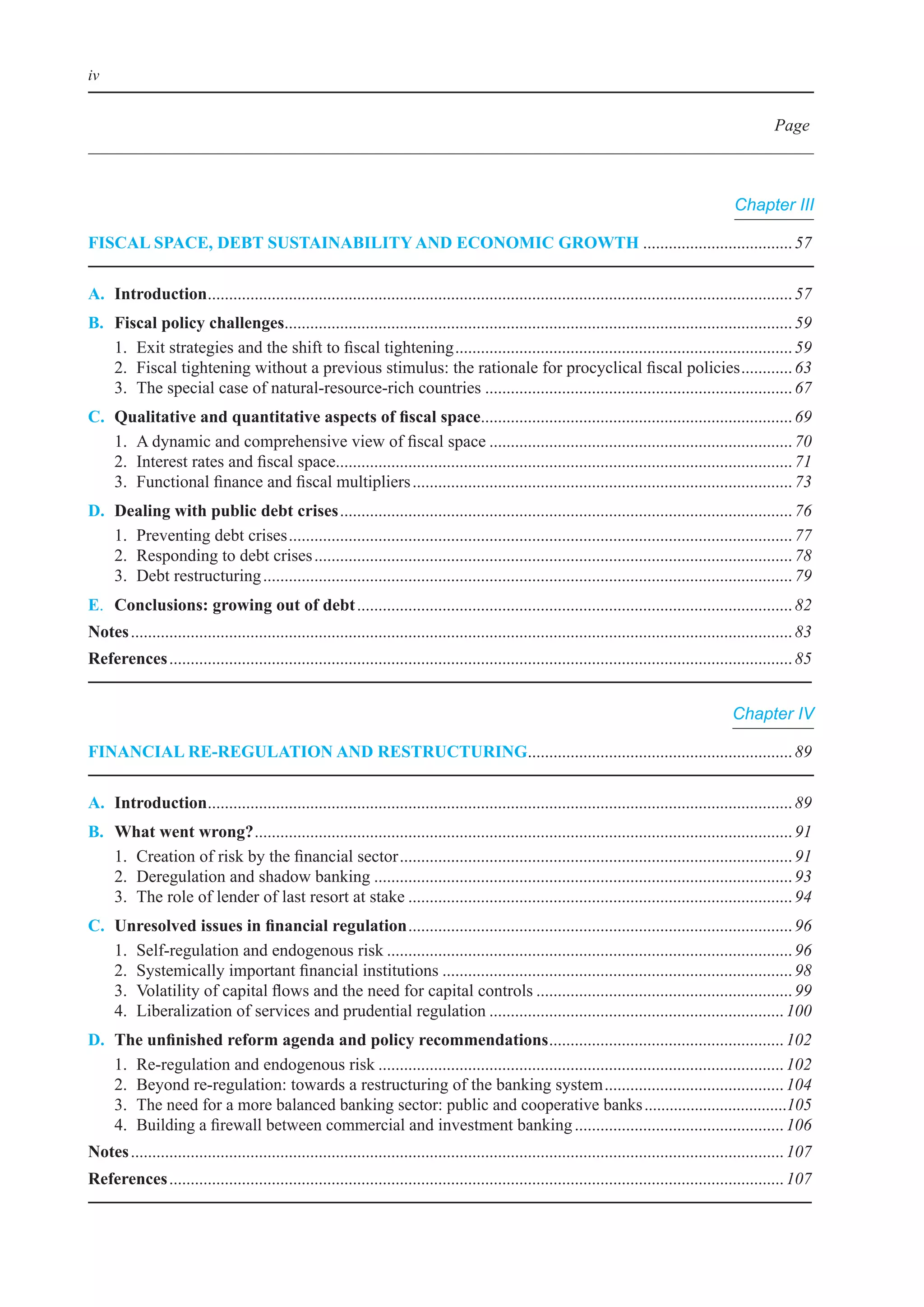
Explanatory notes .......................................................................................................................................xi
Abbreviations ........................................................................................................................................... xiii
OVERVIEW .......................................................................................................................................... I–XV


                                                                                                                                                    Chapter I

Current trends and Issues In the World eConomy	.................................................... 1


a.   recent trends in the world economy	................................................................................................... 1
	    1.	 Global	growth	.................................................................................................................................... 1
	    2.	 international	trade	.............................................................................................................................. 7
	    3.	 Recent	developments	in	commodity	markets		................................................................................. 10
B.   Incomes policies and the challenges ahead	....................................................................................... 16
	    1.	 The	role	of	wages	in	economic	growth	........................................................................................... 17
	    2.	 incomes	policy	and	inflation	control	............................................................................................... 19
	    3.	 The	european	crisis	and	the	need	for	proactive	incomes	policies	 .................................................. 22
                                                                                          .
C. Progress towards global rebalancing, growth and development:
   an assessment of global cooperation	................................................................................................. 23
notes	........................................................................................................................................................... 28
references	.................................................................................................................................................. 29


                                                                                                                                                   Chapter II

FIsCal asPeCts oF the FInanCIal CrIsIs and Its ImPaCt on PuBlIC deBt	......... 31


a. Introduction	........................................................................................................................................ 31
               .
B.   Fiscal aspects of the global crisis	....................................................................................................... 33
	    1.	 Fiscal	balances	and	global	imbalances	before	the	crisis	................................................................. 33
                                                                                 .
	    2.	 The	evolution	of	fiscal	accounts	and	the	impact	of	the	crisis	.......................................................... 38
	    3.	 Fiscal	responses	to	the	crisis	........................................................................................................... 42
                                       .
C. the evolution of public debt	.............................................................................................................. 45
	 1.	 Recent	trends	in	public	debt	in	developed	and	developing	countries	............................................. 45
                                                                                                .
	 2.	 The	contribution	of	non-fiscal	factors	to	debt	crises	....................................................................... 49
d. Conclusions	 ......................................................................................................................................... 52
              .
notes	........................................................................................................................................................... 53
references	.................................................................................................................................................. 54
iv


                                                                                                                                                           Page


                                                                                                                                                  Chapter III

FIsCal sPaCe, deBt sustaInaBIlIty and eConomIC GroWth	................................... 57

a. Introduction	........................................................................................................................................ 57
               .
B.    Fiscal policy challenges	...................................................................................................................... 59
                                 .
	     1.	 exit	strategies	and	the	shift	to	fiscal	tightening	............................................................................... 59
	     2.	 Fiscal	tightening	without	a	previous	stimulus:	the	rationale	for	procyclical	fiscal	policies	............ 63
	     3.	 The	special	case	of	natural-resource-rich	countries	........................................................................ 67
C.	   Qualitative	and	quantitative	aspects	of	fiscal	space	........................................................................ 69
                                                                           .
	     1.	 A	dynamic	and	comprehensive	view	of	fiscal	space	....................................................................... 70
	     2.	 interest	rates	and	fiscal	space	.......................................................................................................... 71
                                         .
	     3.	 Functional	finance	and	fiscal	multipliers	......................................................................................... 73
d.    dealing with public debt crises	.......................................................................................................... 76
	     1.	 Preventing	debt	crises	...................................................................................................................... 77
	     2.	 Responding	to	debt	crises	................................................................................................................ 78
	     3.	 Debt	restructuring	............................................................................................................................ 79
e. Conclusions: growing out of debt	...................................................................................................... 82
notes	........................................................................................................................................................... 83
references	.................................................................................................................................................. 85


                                                                                                                                                  Chapter IV

FInanCIal re-reGulatIon and restruCturInG	............................................................. 89
                                         .

a. Introduction	........................................................................................................................................ 89
               .
B.    What went wrong?	.............................................................................................................................. 91
	     1.	 Creation	of	risk	by	the	financial	sector	............................................................................................ 91
	     2.	 Deregulation	and	shadow	banking	.................................................................................................. 93
	     3.	 The	role	of	lender	of	last	resort	at	stake	.......................................................................................... 94
C.	   Unresolved	issues	in	financial	regulation	.......................................................................................... 96
	     1.	 Self-regulation	and	endogenous	risk	............................................................................................... 96
	     2.	 Systemically	important	financial	institutions	.................................................................................. 98
	     3.	 Volatility	of	capital	flows	and	the	need	for	capital	controls	............................................................ 99
	     4.	 liberalization	of	services	and	prudential	regulation	..................................................................... 100
d.	   The	unfinished	reform	agenda	and	policy	recommendations	 ...................................................... 102
                                                                                    .
	     1.	 Re-regulation	and	endogenous	risk	............................................................................................... 102
	     2.	 beyond	re-regulation:	towards	a	restructuring	of	the	banking	system	.......................................... 104
	     3.	 The	need	for	a	more	balanced	banking	sector:	public	and	cooperative	banks	..................................105
	     4.	 building	a	firewall	between	commercial	and	investment	banking	................................................. 106
notes	......................................................................................................................................................... 107
references	................................................................................................................................................ 107
v


                                                                                                                                                          Page


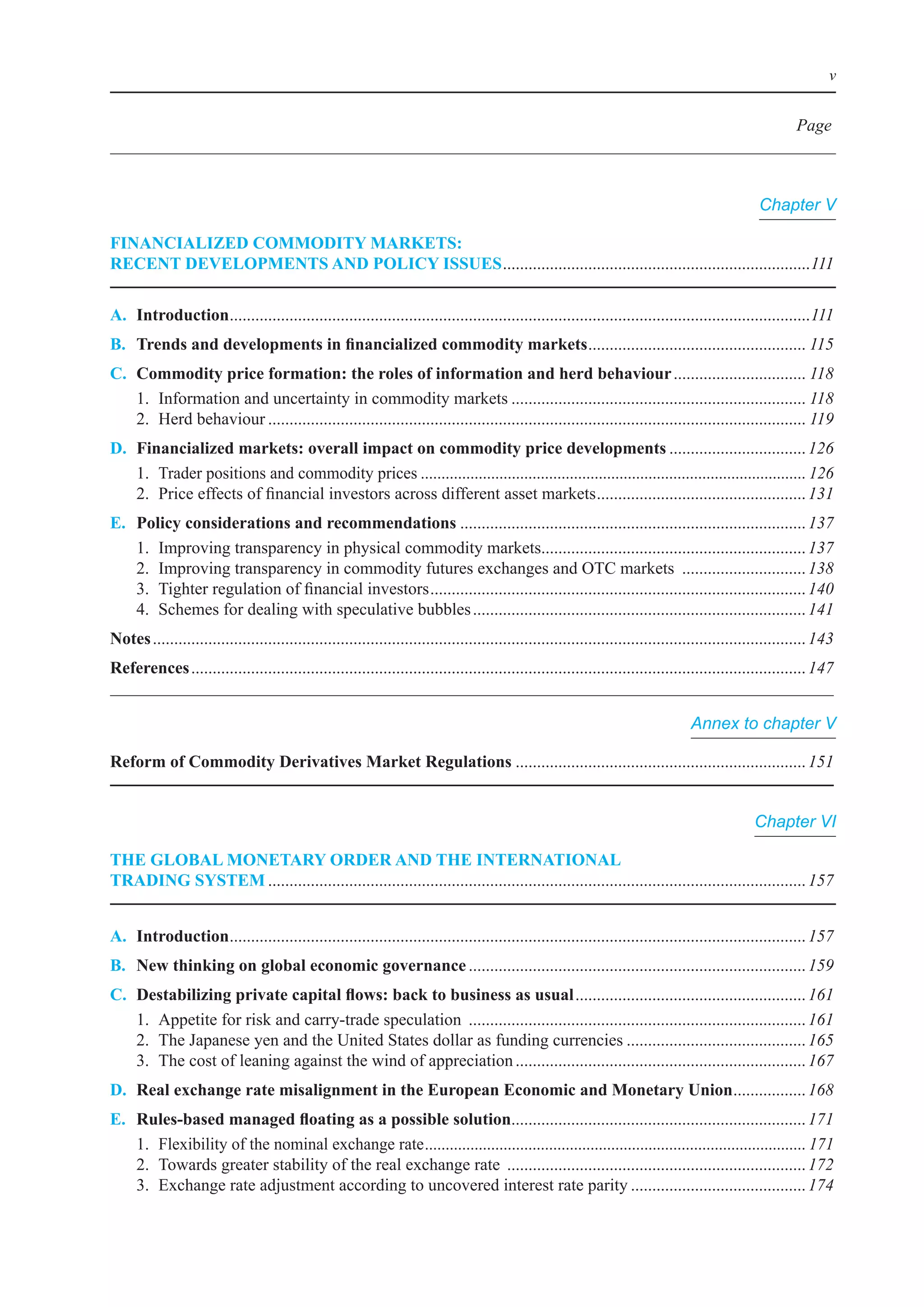
                                                                                                                                                  Chapter V

FInanCIalIzed CommodIty markets:
reCent develoPments and PolICy Issues	........................................................................111


a. Introduction	.......................................................................................................................................111
               .
B.	 Trends	and	developments	in	financialized	commodity	markets	 .................................................. 115
                                                              .
C. Commodity price formation: the roles of information and herd behaviour	............................... 118
	 1.	 information	and	uncertainty	in	commodity	markets	..................................................................... 118
	 2.	 Herd	behaviour	.............................................................................................................................. 119
d.	 Financialized	markets:	overall	impact	on	commodity	price	developments	................................ 126
	 1.	 Trader	positions	and	commodity	prices	............................................................................................. 126
	 2.	 Price	effects	of	financial	investors	across	different	asset	markets	 ................................................ 131
                                                                                       .
e.    Policy considerations and recommendations	................................................................................. 137
	     1.	 improving	transparency	in	physical	commodity	markets	............................................................. 137
                                                                              .
	     2.	 improving	transparency	in	commodity	futures	exchanges	and	oTC	markets		............................. 138
	     3.	 Tighter	regulation	of	financial	investors	........................................................................................ 140
	     4.	 Schemes	for	dealing	with	speculative	bubbles	.............................................................................. 141
notes	......................................................................................................................................................... 143
references	................................................................................................................................................ 147


                                                                                                                                  Annex to chapter V

Reform	of	Commodity	Derivatives	Market	Regulations	.................................................................... 151


                                                                                                                                                 Chapter VI

the GloBal monetary order and the InternatIonal
tradInG system	.............................................................................................................................. 157


a. Introduction	...................................................................................................................................... 157
               .
B.	 New	thinking	on	global	economic	governance	............................................................................... 159
C.	   Destabilizing	private	capital	flows:	back	to	business	as	usual	...................................................... 161
	     1.	 Appetite	for	risk	and	carry-trade	speculation		............................................................................... 161
	     2.	 The	Japanese	yen	and	the	United	States	dollar	as	funding	currencies	.......................................... 165
	     3.	 The	cost	of	leaning	against	the	wind	of	appreciation	.................................................................... 167
d. real exchange rate misalignment in the european economic and monetary union	................ 168
                                                                              .
e.	   Rules-based	managed	floating	as	a	possible	solution	.................................................................... 171
                                                                        .
	     1.	 Flexibility	of	the	nominal	exchange	rate	............................................................................................ 171
	     2.	 Towards	greater	stability	of	the	real	exchange	rate		...................................................................... 172
	     3.	 exchange	rate	adjustment	according	to	uncovered	interest	rate	parity	......................................... 174
vi


                                                                                                                                                          Page


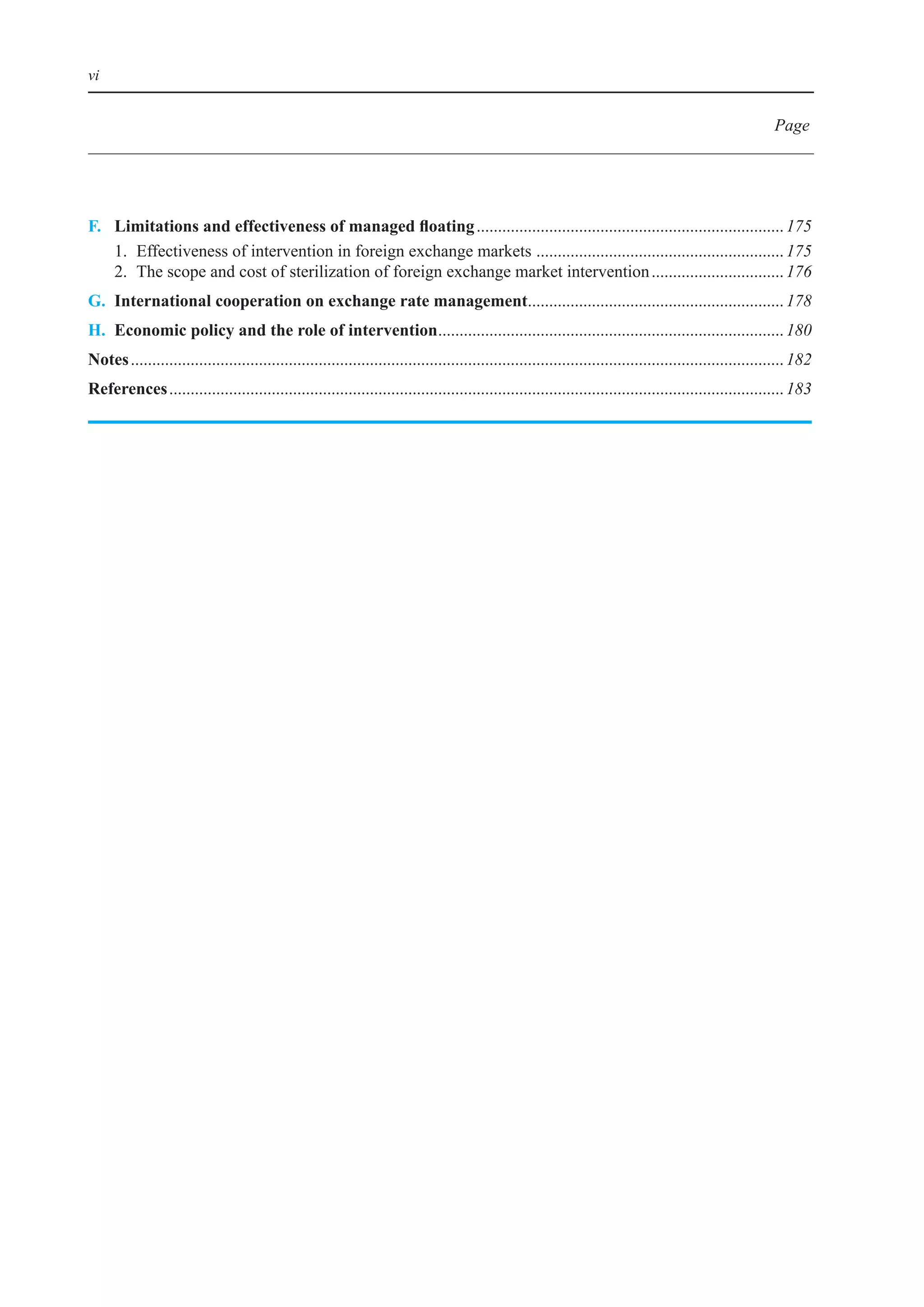
F.	 Limitations	and	effectiveness	of	managed	floating	........................................................................ 175
	 1.	 effectiveness	of	intervention	in	foreign	exchange	markets		......................................................... 175
                                                                    .
	 2.	 The	scope	and	cost	of	sterilization	of	foreign	exchange	market	intervention	............................... 176
G. International cooperation on exchange rate management	........................................................... 178
                                                        .
h. economic policy and the role of intervention	................................................................................ 180
                                               .
notes	......................................................................................................................................................... 182
references	................................................................................................................................................ 183
vii


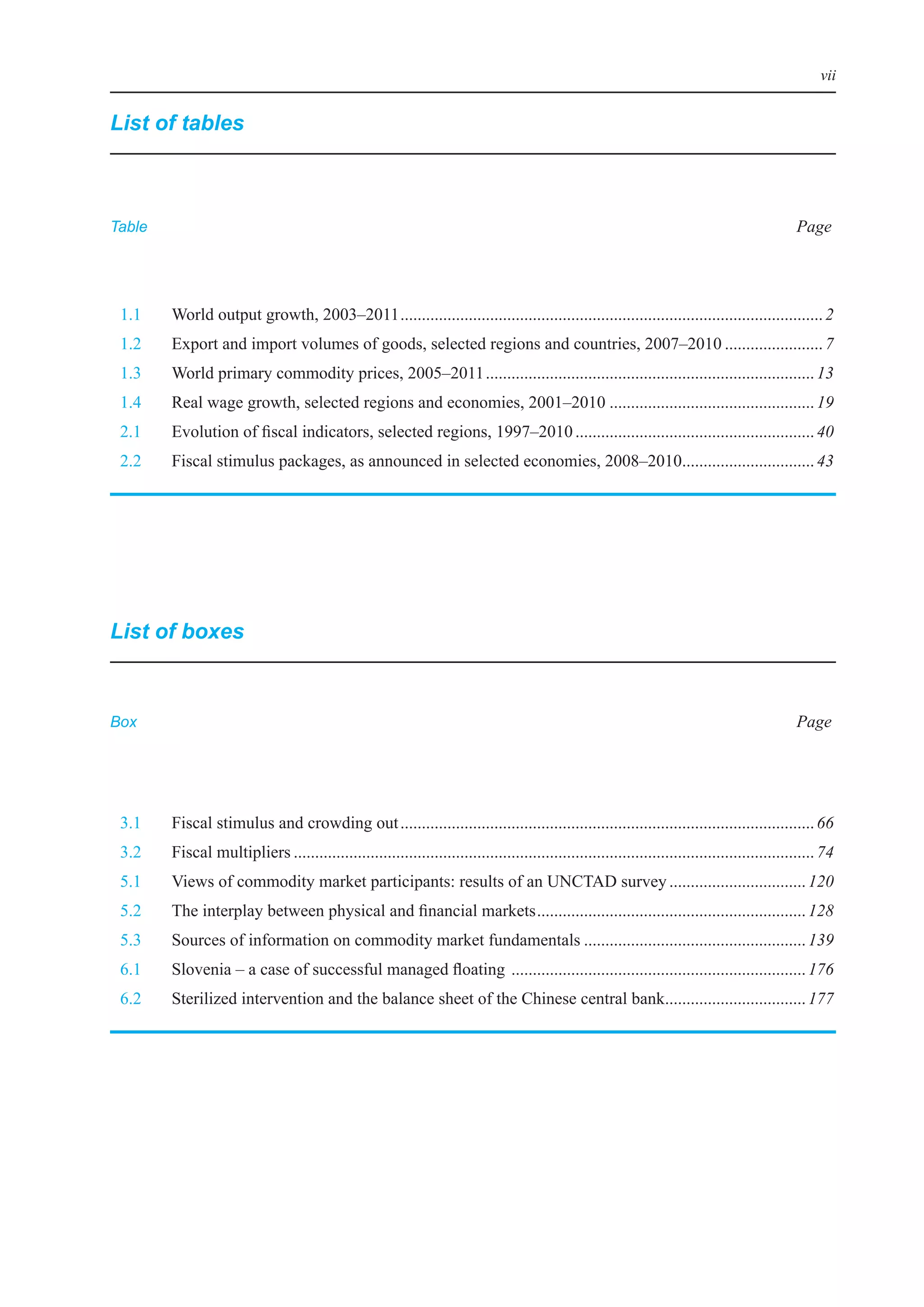
List of tables


Table                                                                                                                                           Page


	 1.1	   World	output	growth,	2003–2011	................................................................................................... 2
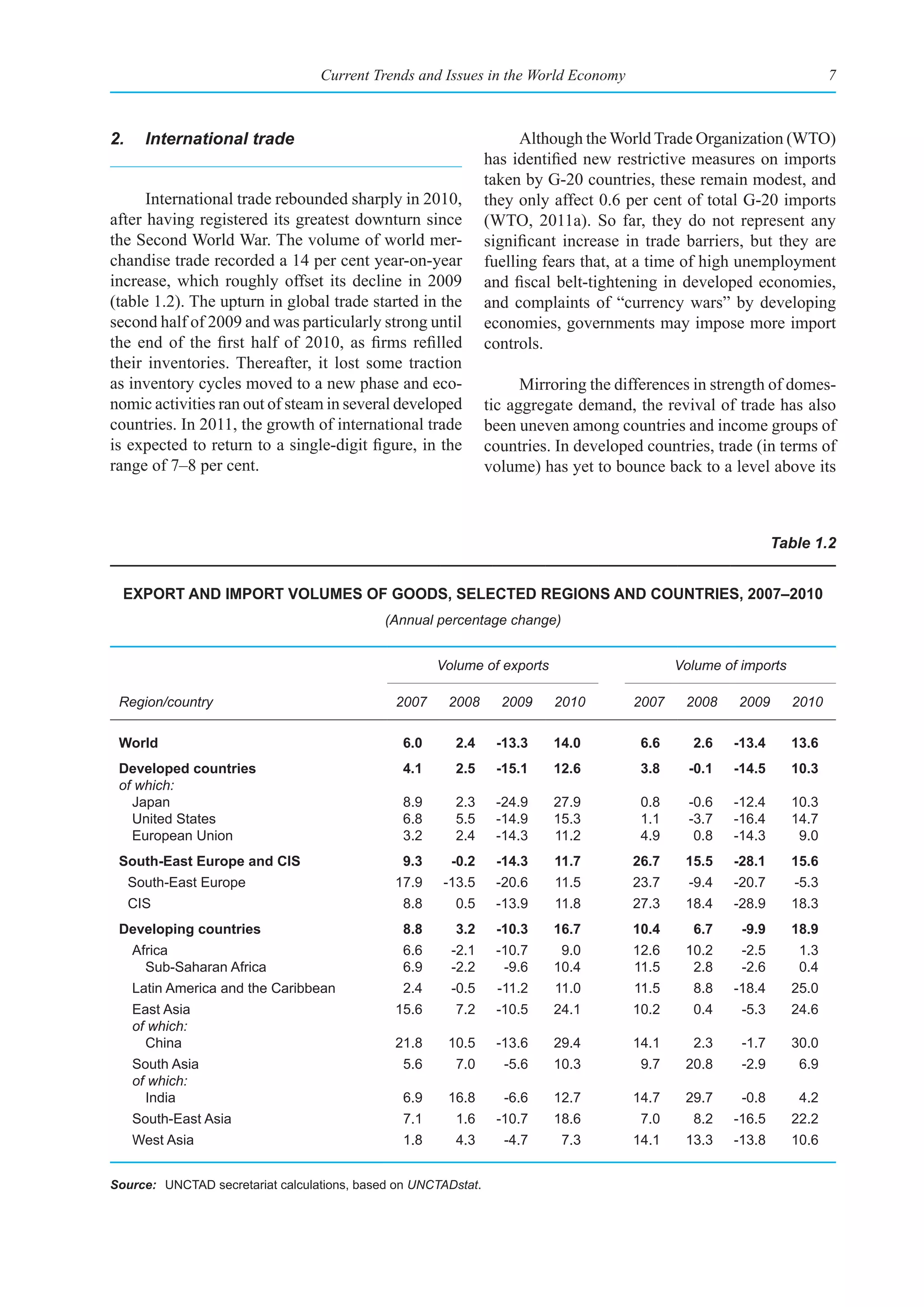
	 1.2	   export	and	import	volumes	of	goods,	selected	regions	and	countries,	2007–2010	....................... 7
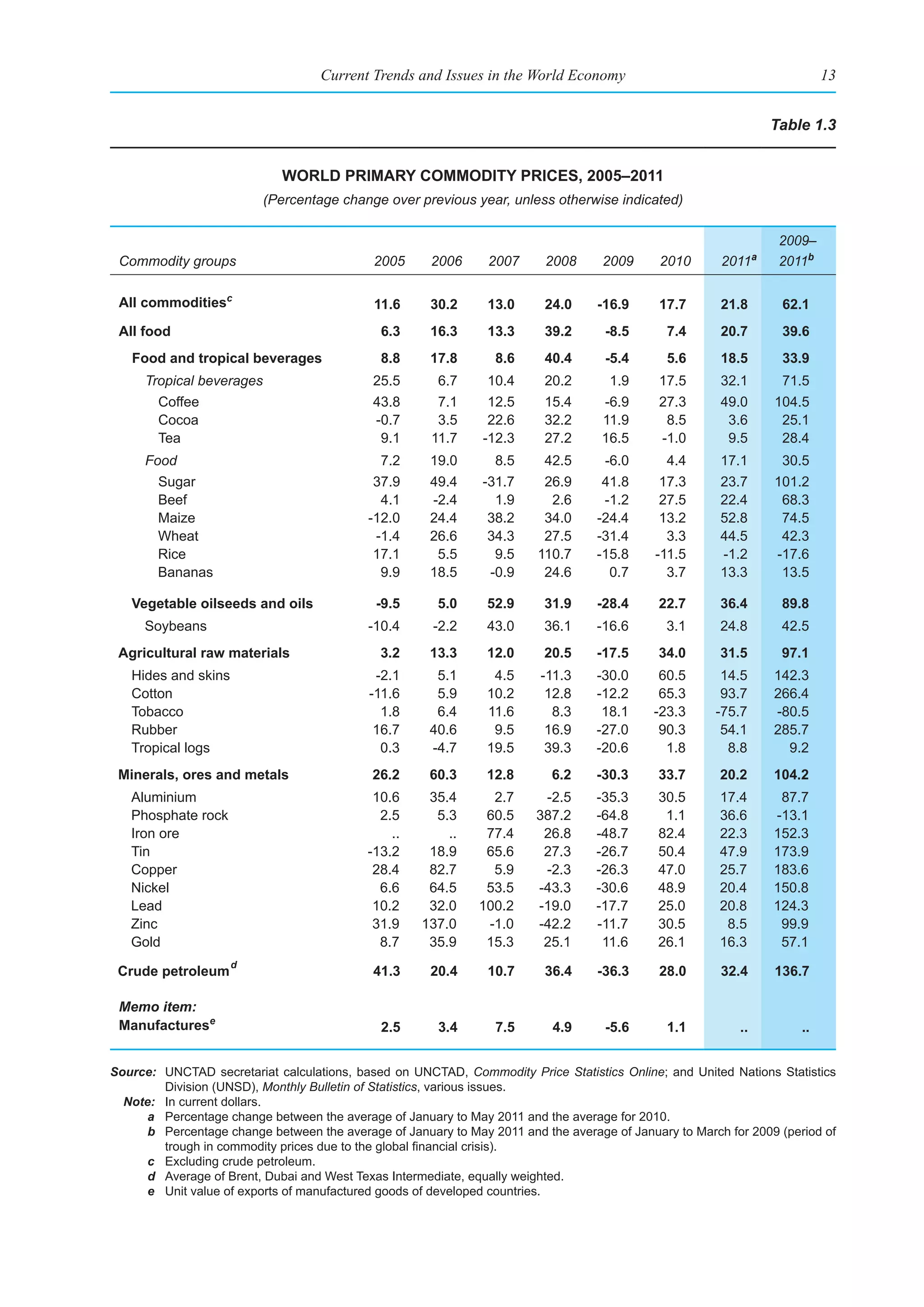
	 1.3	   World	primary	commodity	prices,	2005–2011	............................................................................. 13
	 1.4	   Real	wage	growth,	selected	regions	and	economies,	2001–2010	................................................ 19
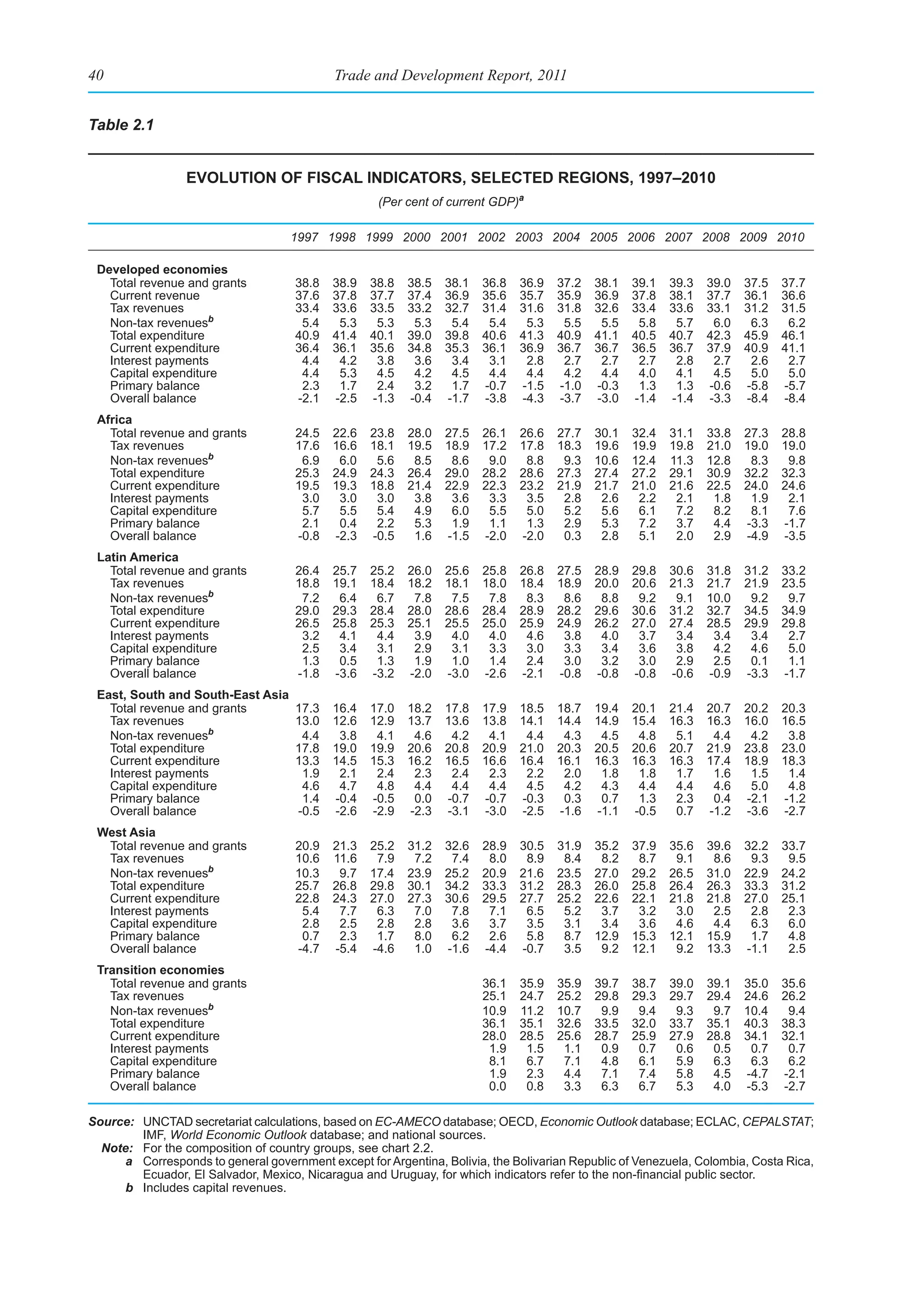
	 2.1	   evolution	of	fiscal	indicators,	selected	regions,	1997–2010	........................................................ 40
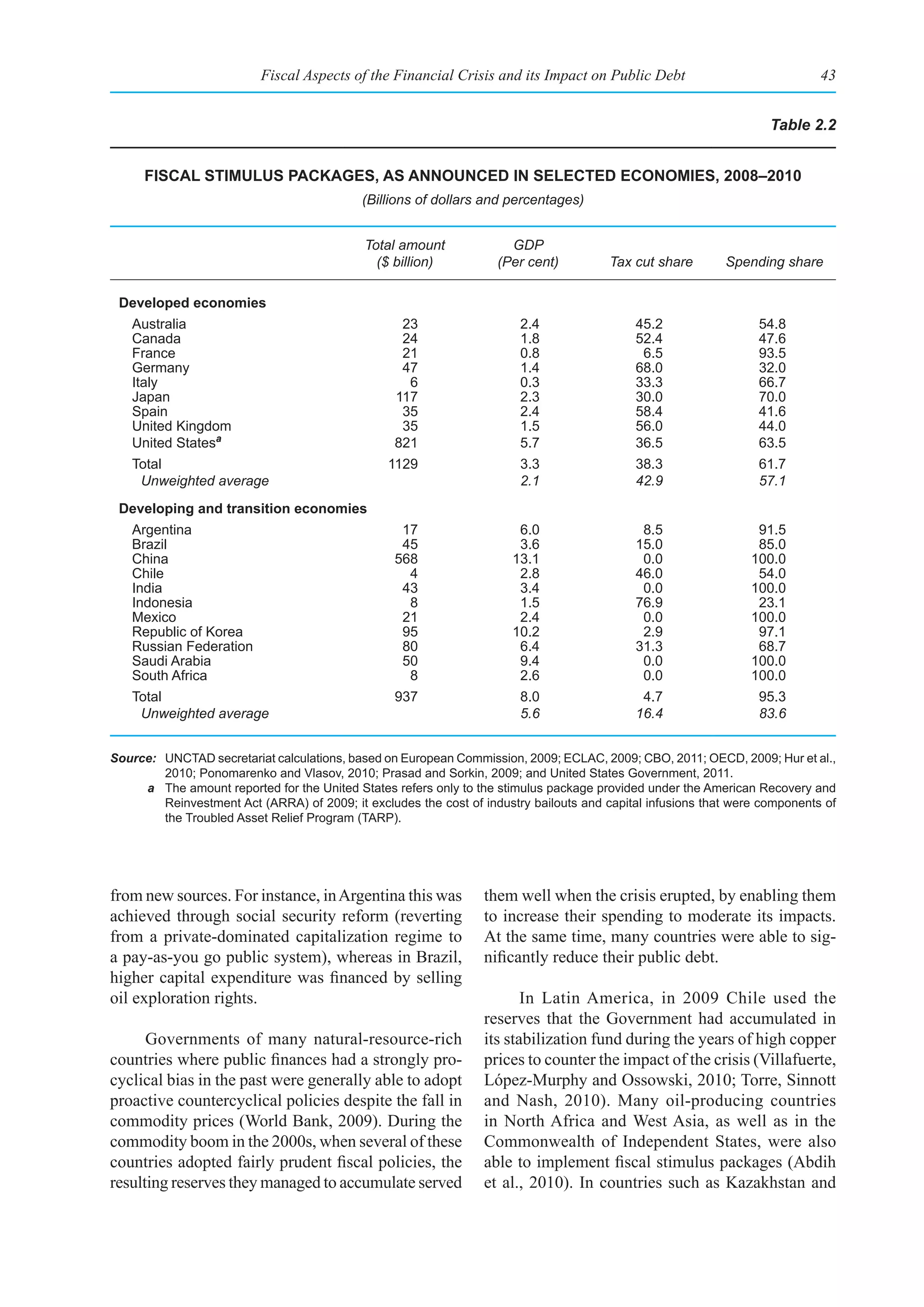
	 2.2	   Fiscal	stimulus	packages,	as	announced	in	selected	economies,	2008–2010	.............................. 43
                                                                                .


List of boxes


Box                                                                                                                                             Page


	 3.1	   Fiscal	stimulus	and	crowding	out	................................................................................................. 66
	 3.2	   Fiscal	multipliers	.......................................................................................................................... 74
	 5.1	   Views	of	commodity	market	participants:	results	of	an	UNCTAD	survey	................................ 120
	 5.2	   The	interplay	between	physical	and	financial	markets	............................................................... 128
	 5.3	   Sources	of	information	on	commodity	market	fundamentals	.................................................... 139
	 6.1	   Slovenia	–	a	case	of	successful	managed	floating		..................................................................... 176
	 6.2	   Sterilized	intervention	and	the	balance	sheet	of	the	Chinese	central	bank	................................ 177
                                                                                  .
viii


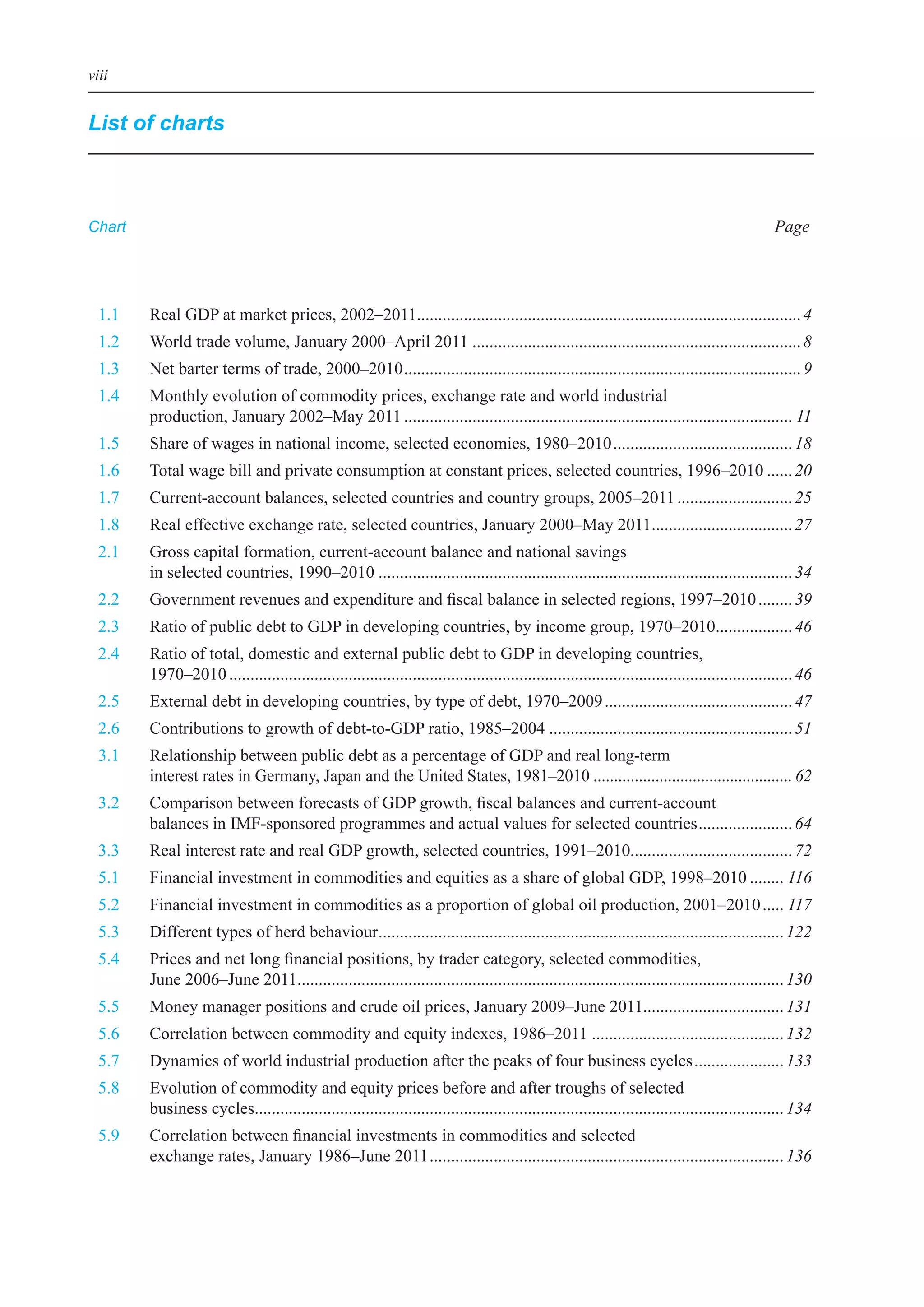
List of charts


Chart                                                                                                                                            Page


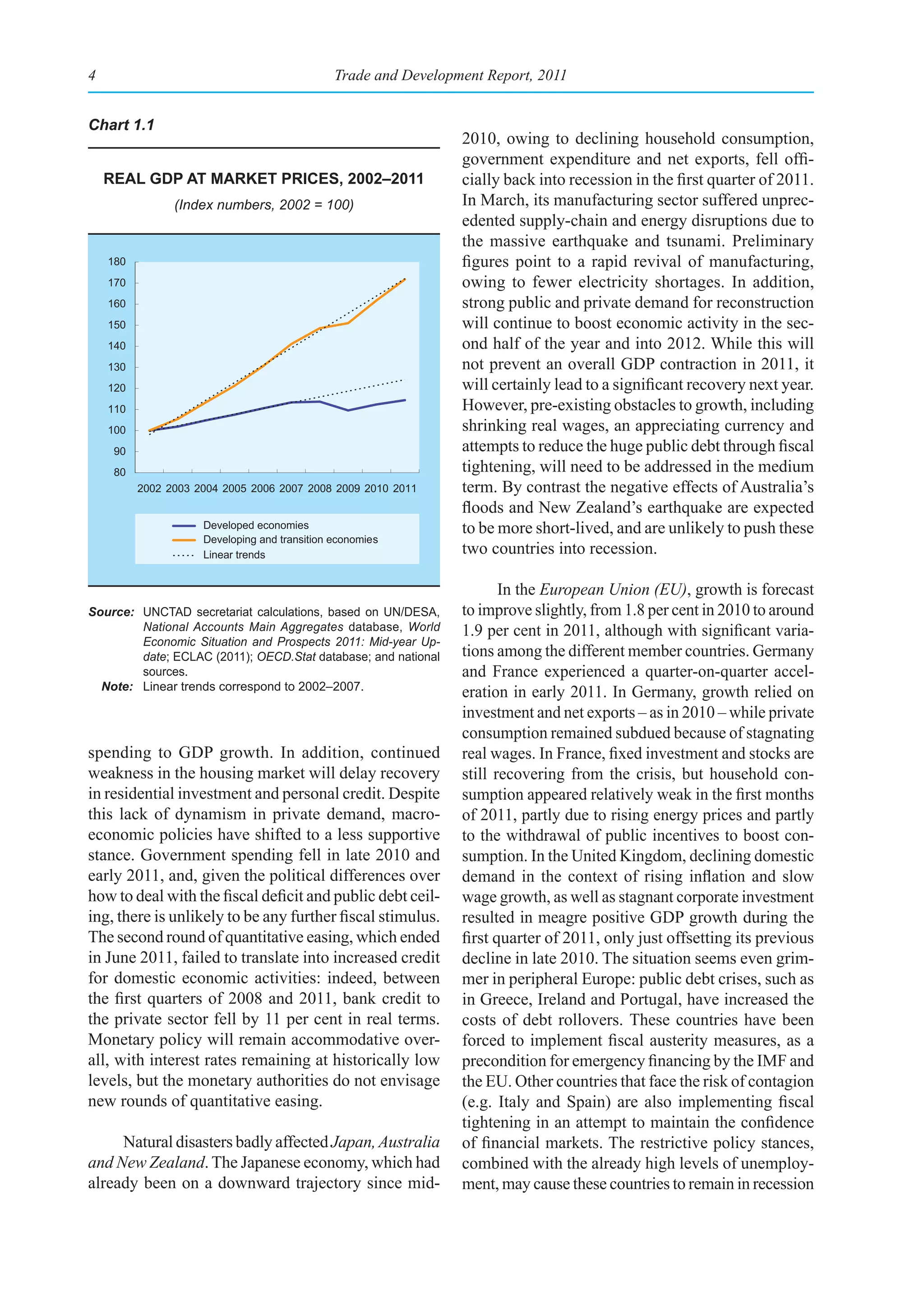
	 1.1	   Real	GDP	at	market	prices,	2002–2011.......................................................................................... 4
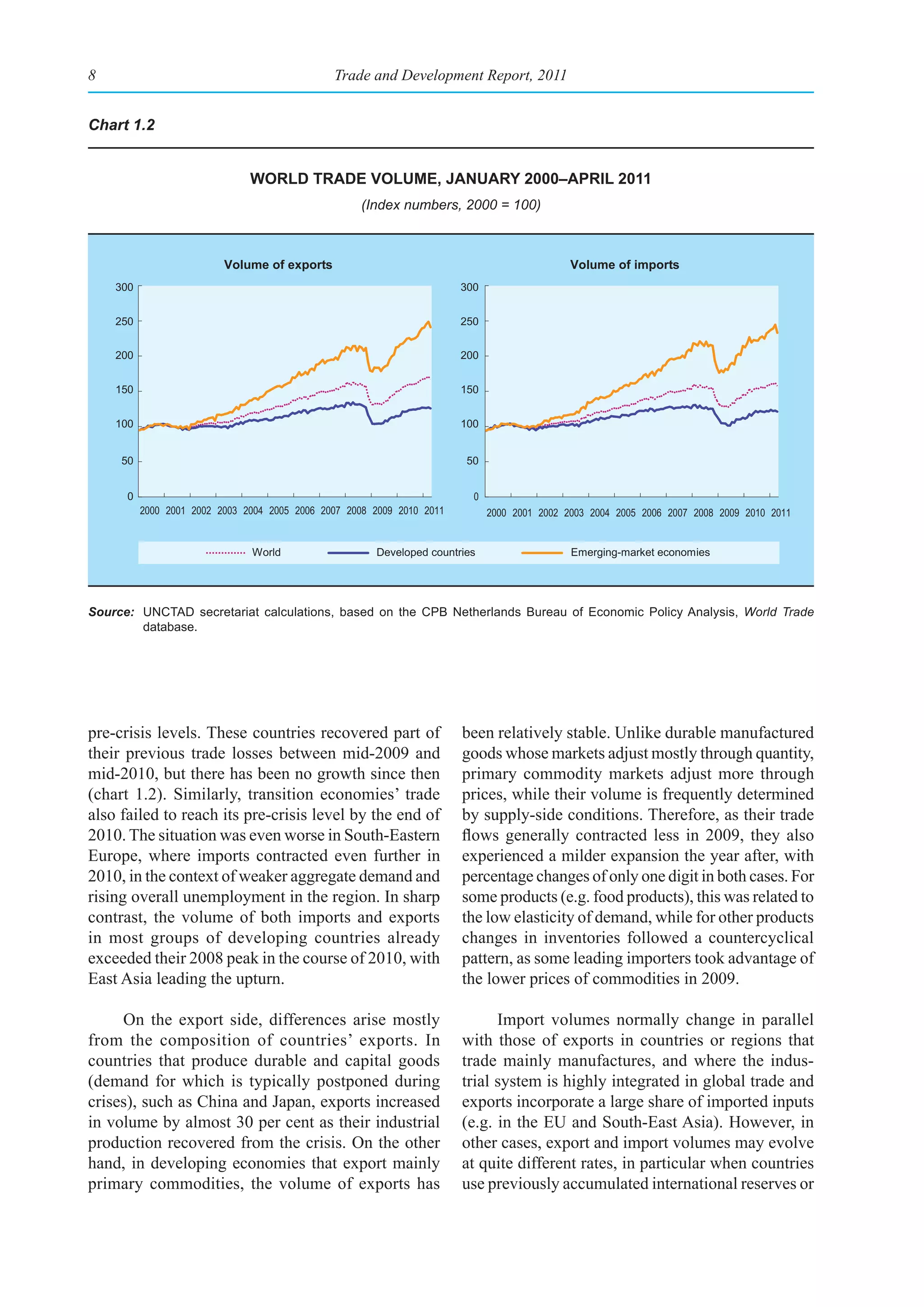
	 1.2	   World	trade	volume,	January	2000–April	2011	............................................................................. 8
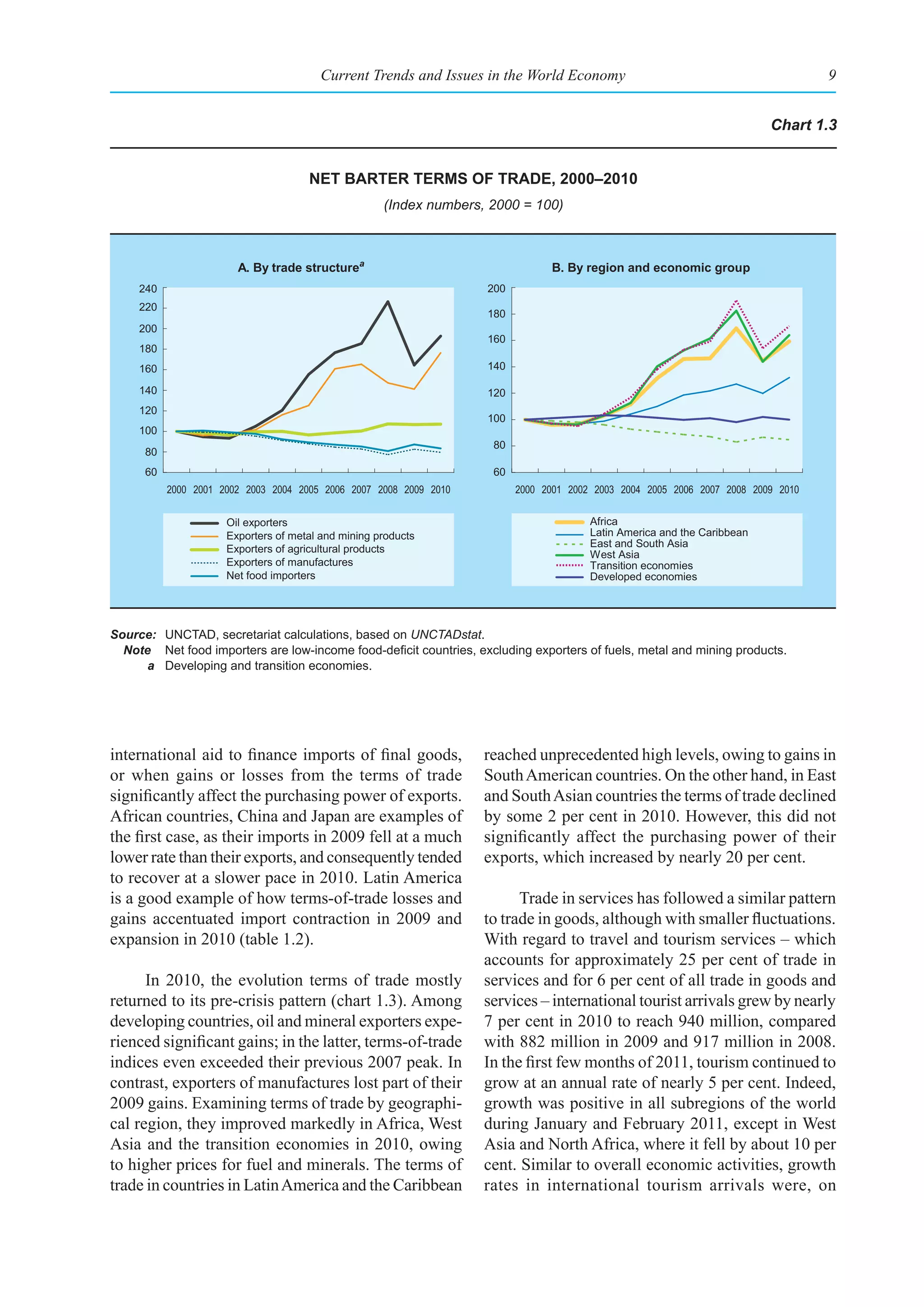
	 1.3	   Net	barter	terms	of	trade,	2000–2010	............................................................................................. 9
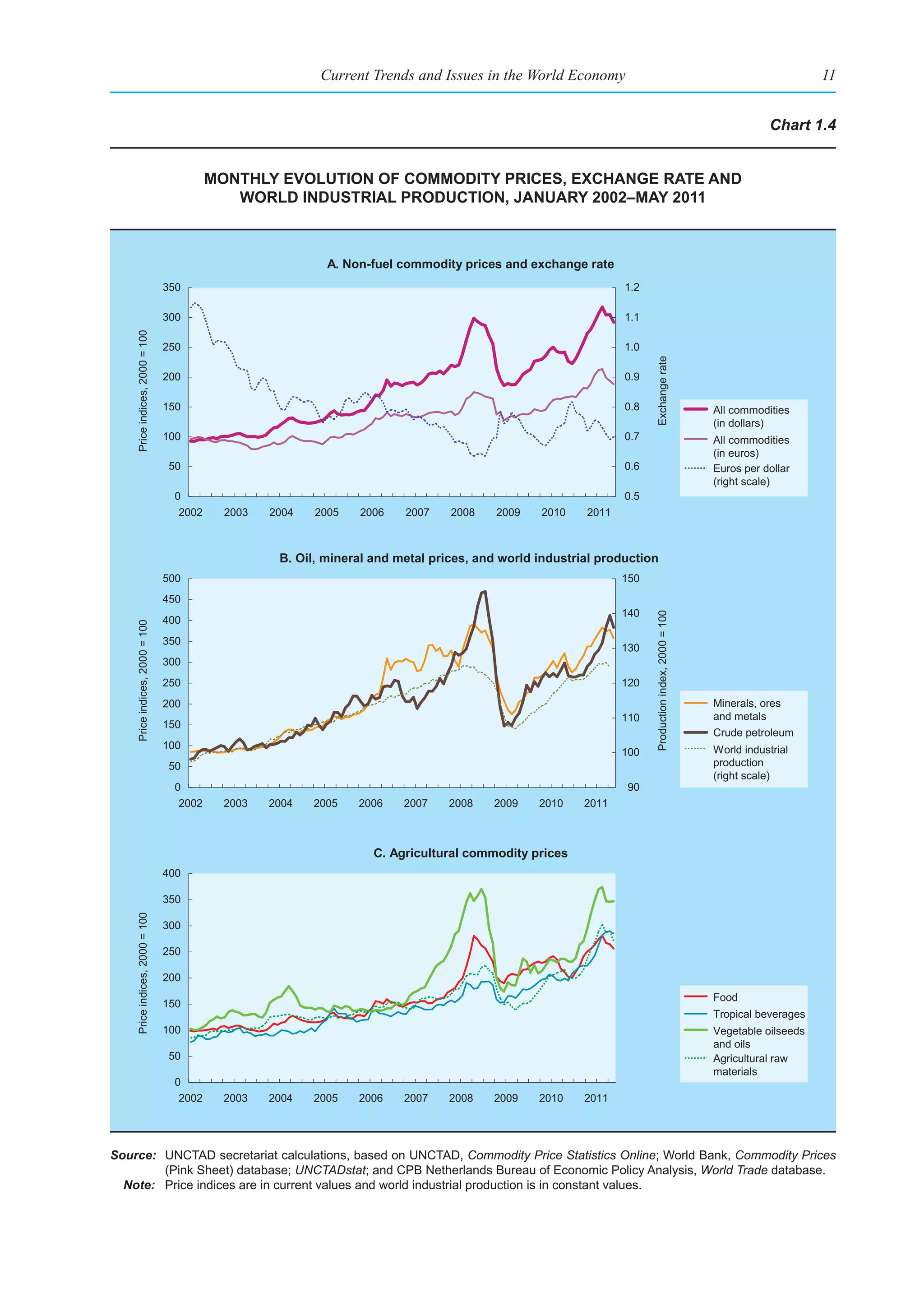
	 1.4	   Monthly	evolution	of	commodity	prices,	exchange	rate	and	world	industrial		
         production,	January	2002–May	2011	........................................................................................... 11
	 1.5	   Share	of	wages	in	national	income,	selected	economies,	1980–2010	.......................................... 18
	 1.6	   Total	wage	bill	and	private	consumption	at	constant	prices,	selected	countries,	1996–2010	...... 20
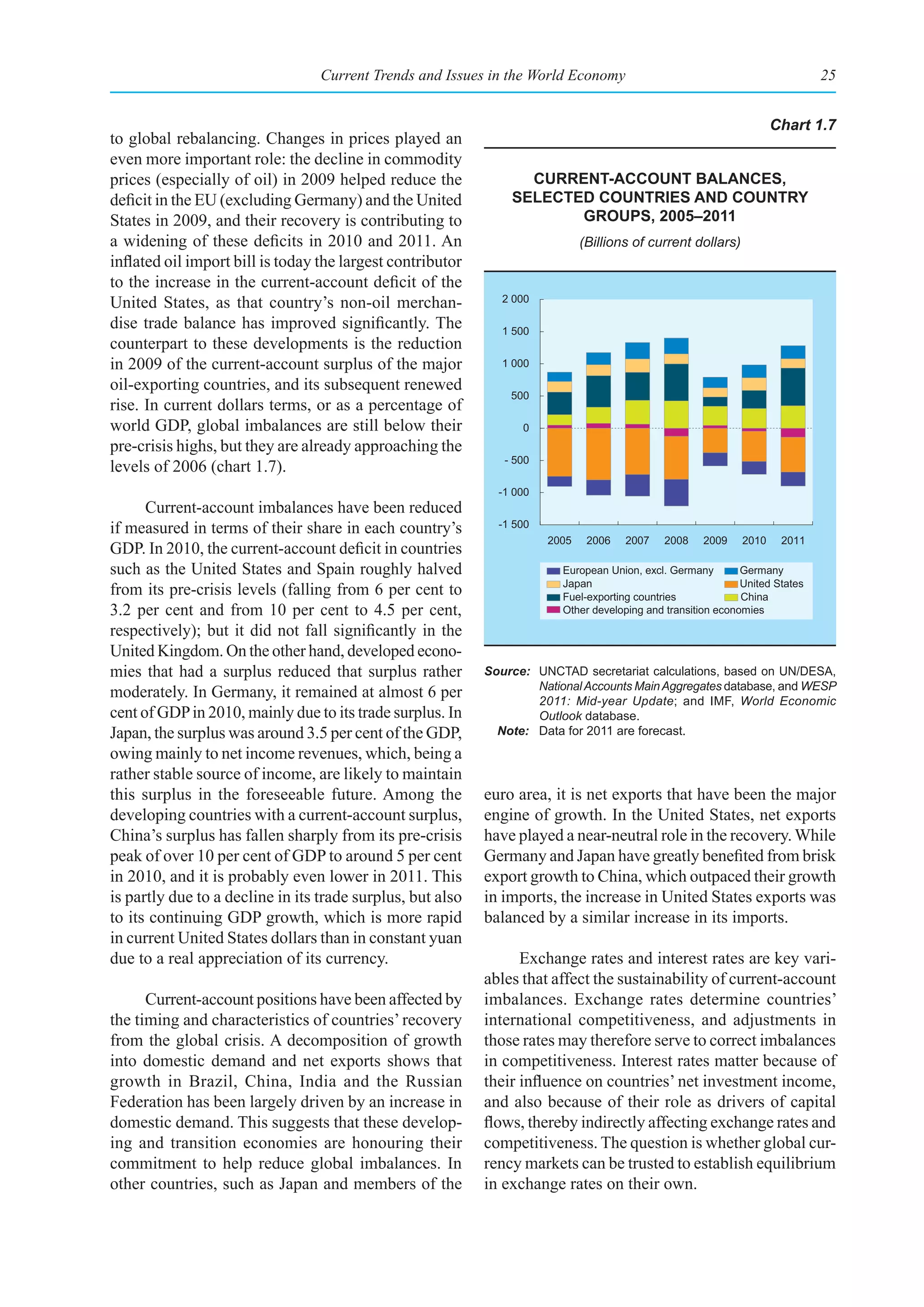
	 1.7	   Current-account	balances,	selected	countries	and	country	groups,	2005–2011	........................... 25
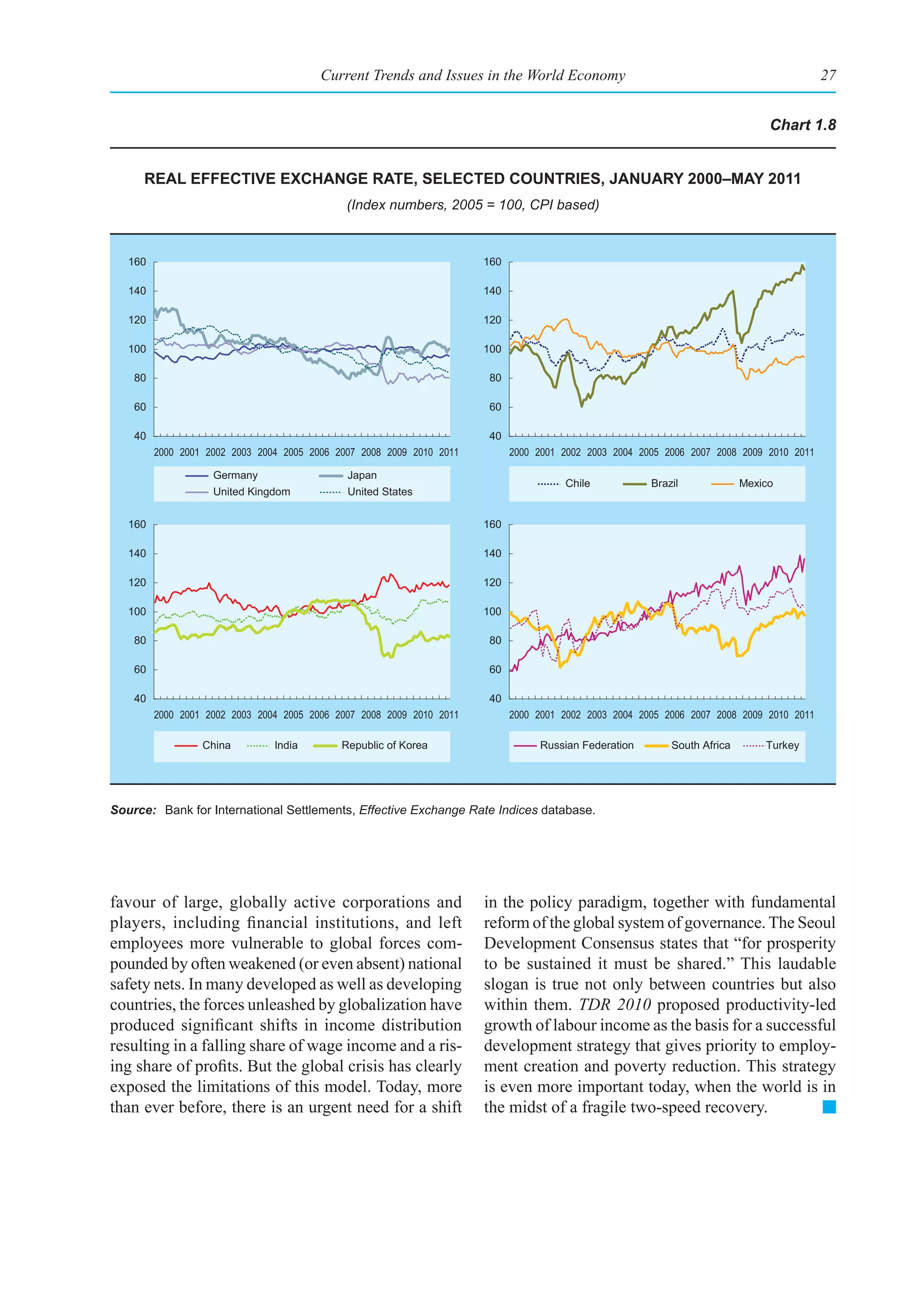
	 1.8	   Real	effective	exchange	rate,	selected	countries,	January	2000–May	2011	................................ 27
                                                                                .
	 2.1	   Gross	capital	formation,	current-account	balance	and	national	savings		
         in	selected	countries,	1990–2010	................................................................................................. 34
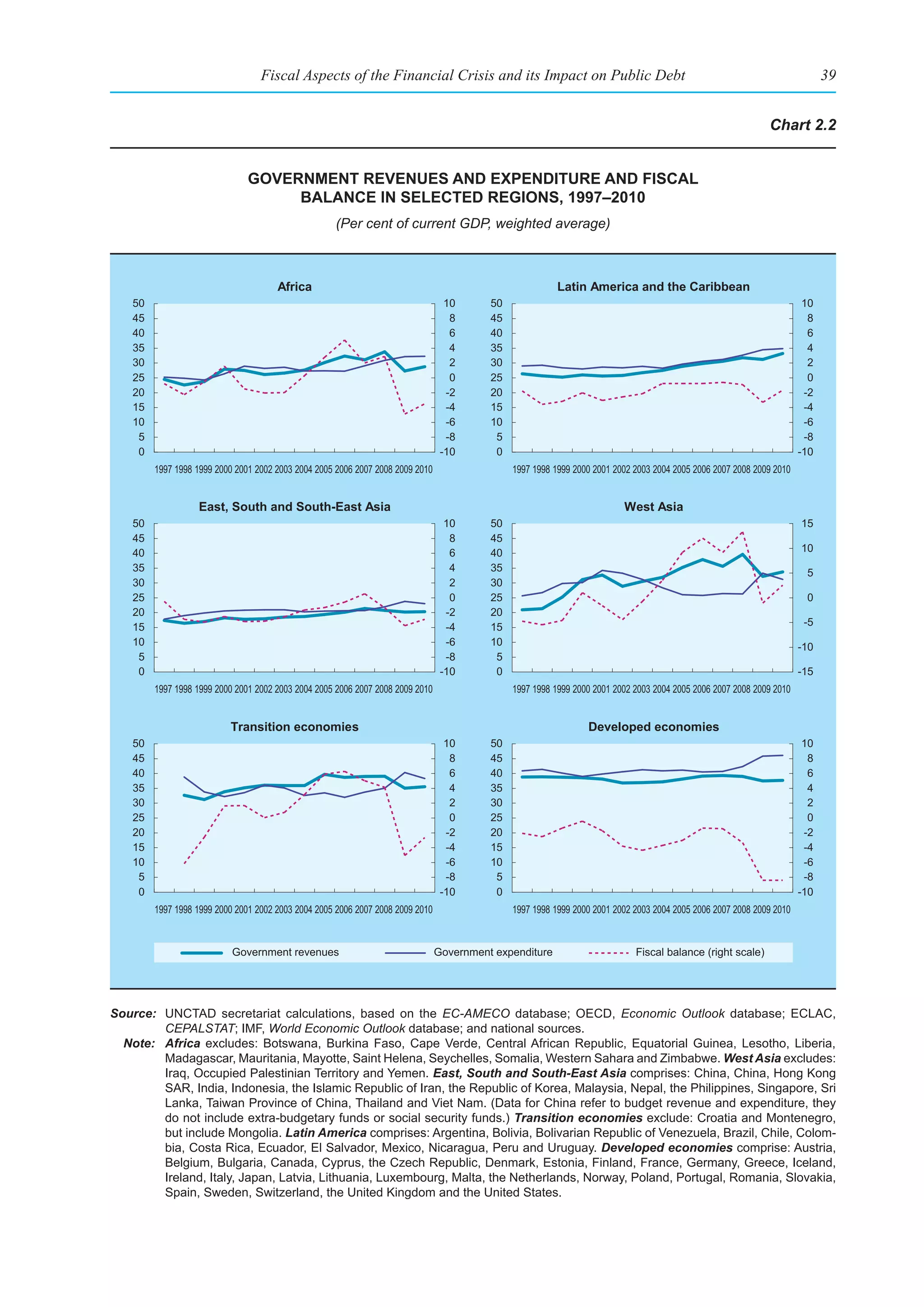
	 2.2	   Government	revenues	and	expenditure	and	fiscal	balance	in	selected	regions,	1997–2010	........ 39
	 2.3	   Ratio	of	public	debt	to	GDP	in	developing	countries,	by	income	group,	1970–2010	................. 46
                                                                                        .
	 2.4	   Ratio	of	total,	domestic	and	external	public	debt	to	GDP	in	developing	countries,		
         1970–2010	.................................................................................................................................... 46
	 2.5	   external	debt	in	developing	countries,	by	type	of	debt,	1970–2009	............................................ 47
	 2.6	   Contributions	to	growth	of	debt-to-GDP	ratio,	1985–2004	......................................................... 51
	 3.1	   Relationship	between	public	debt	as	a	percentage	of	GDP	and	real	long-term		
         interest	rates	in	Germany,	Japan	and	the	United	States,	1981–2010	................................................ 62
	 3.2	   Comparison	between	forecasts	of	GDP	growth,	fiscal	balances	and	current-account		
         balances	in	iMF-sponsored	programmes	and	actual	values	for	selected	countries	...................... 64
	 3.3	   Real	interest	rate	and	real	GDP	growth,	selected	countries,	1991–2010...................................... 72
	 5.1	   Financial	investment	in	commodities	and	equities	as	a	share	of	global	GDP,	1998–2010	........ 116
	 5.2	   Financial	investment	in	commodities	as	a	proportion	of	global	oil	production,	2001–2010	..... 117
	 5.3	   Different	types	of	herd	behaviour	.............................................................................................. 122
                                          .
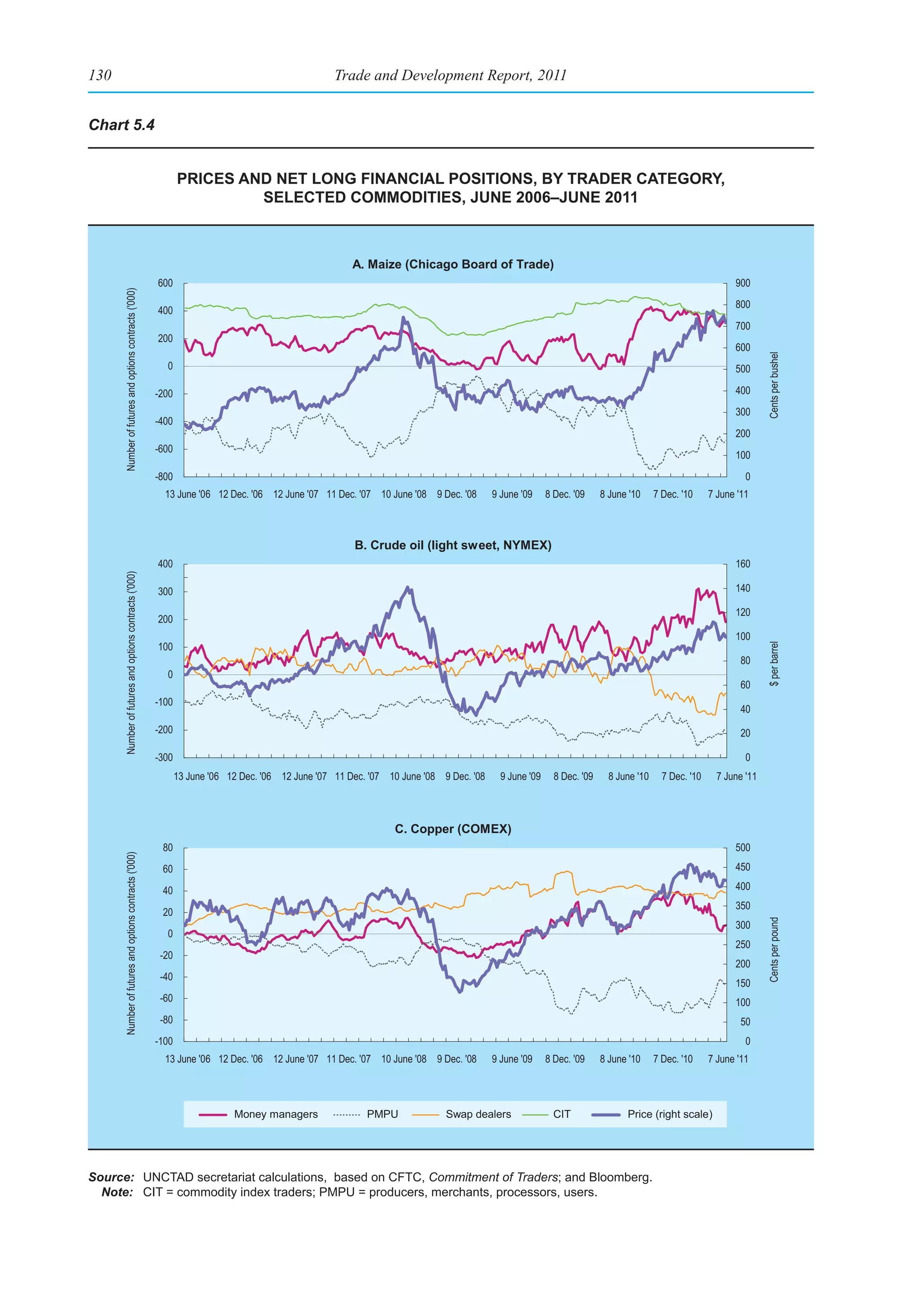
	 5.4	   Prices	and	net	long	financial	positions,	by	trader	category,	selected	commodities,		
         June	2006–June	2011	................................................................................................................. 130
                               .
	 5.5	   Money	manager	positions	and	crude	oil	prices,	January	2009–June	2011................................. 131
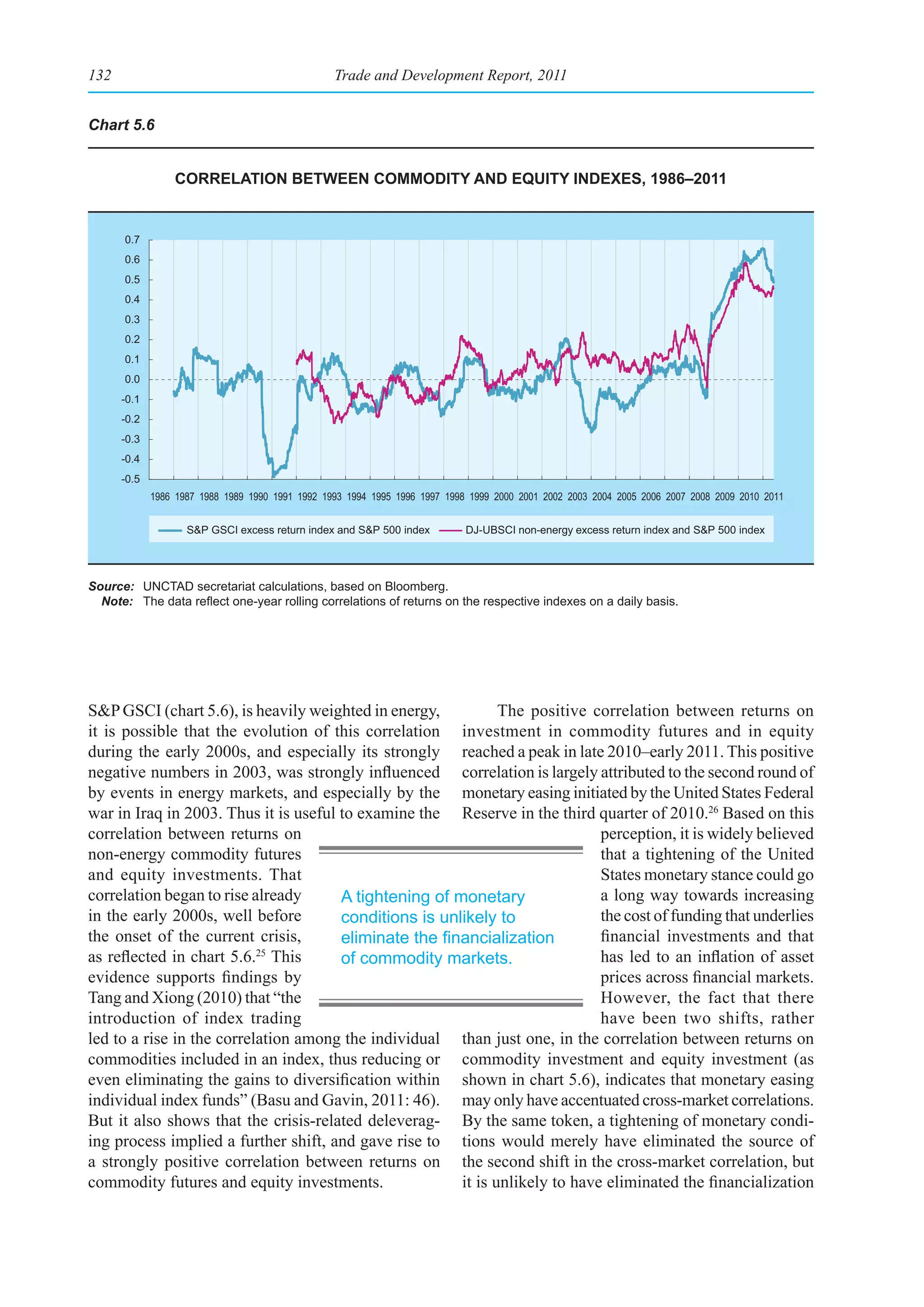
	 5.6	   Correlation	between	commodity	and	equity	indexes,	1986–2011	............................................. 132
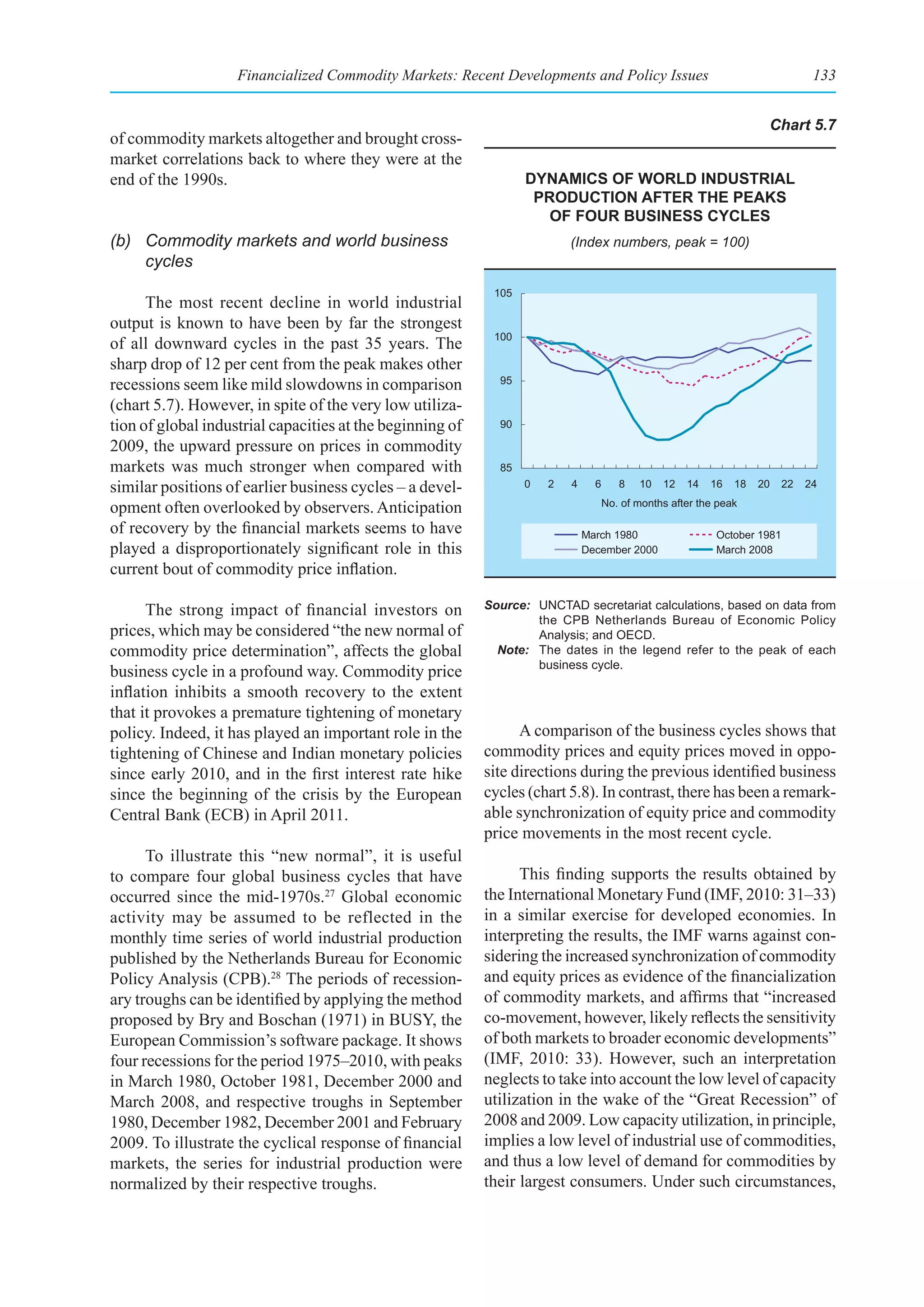
	 5.7	   Dynamics	of	world	industrial	production	after	the	peaks	of	four	business	cycles	..................... 133
	 5.8	   evolution	of	commodity	and	equity	prices	before	and	after	troughs	of	selected		
         business	cycles	........................................................................................................................... 134
                        .
	 5.9	   Correlation	between	financial	investments	in	commodities	and	selected		
         exchange	rates,	January	1986–June	2011	................................................................................... 136
ix


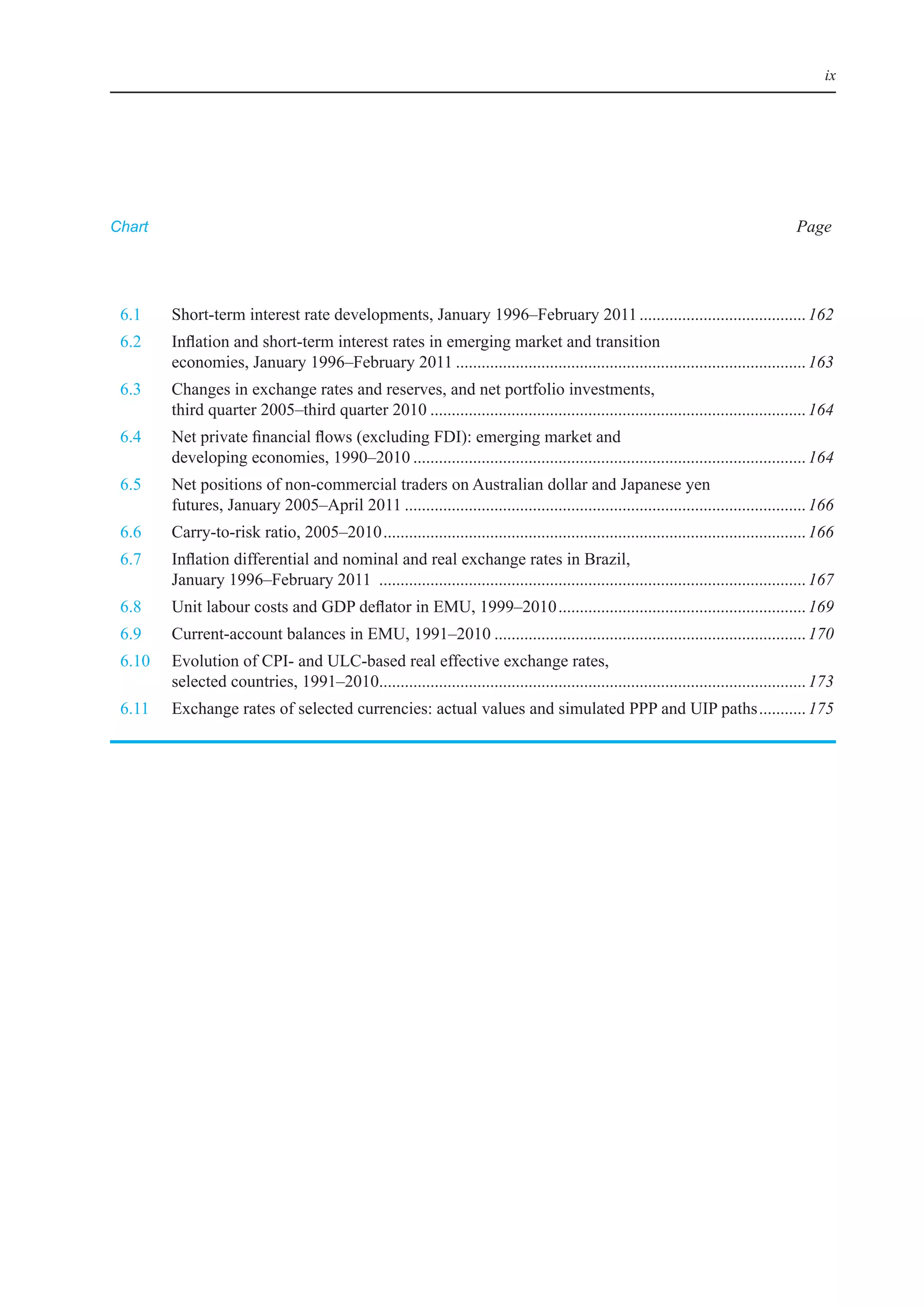
Chart                                                                                                                                   Page


	 6.1	    Short-term	interest	rate	developments,	January	1996–February	2011	....................................... 162
	 6.2	    inflation	and	short-term	interest	rates	in	emerging	market	and	transition		
          economies,	January	1996–February	2011	.................................................................................. 163
	 6.3	    Changes	in	exchange	rates	and	reserves,	and	net	portfolio	investments,		
          third	quarter	2005–third	quarter	2010	........................................................................................ 164
	 6.4	    Net	private	financial	flows	(excluding	FDi):	emerging	market	and		
          developing	economies,	1990–2010	............................................................................................ 164
	 6.5	    Net	positions	of	non-commercial	traders	on	Australian	dollar	and	Japanese	yen		
          futures,	January	2005–April	2011	.............................................................................................. 166
	 6.6	    Carry-to-risk	ratio,	2005–2010	................................................................................................... 166
	 6.7	    inflation	differential	and	nominal	and	real	exchange	rates	in	brazil,		
          January	1996–February	2011		.................................................................................................... 167
	 6.8	    Unit	labour	costs	and	GDP	deflator	in	eMU,	1999–2010	.......................................................... 169
	 6.9	    Current-account	balances	in	eMU,	1991–2010	......................................................................... 170
	 6.10	   evolution	of	CPi-	and	UlC-based	real	effective	exchange	rates,		
          selected	countries,	1991–2010	................................................................................................... 173
                                       .
	 6.11	   exchange	rates	of	selected	currencies:	actual	values	and	simulated	PPP	and	UiP	paths	........... 175
xi


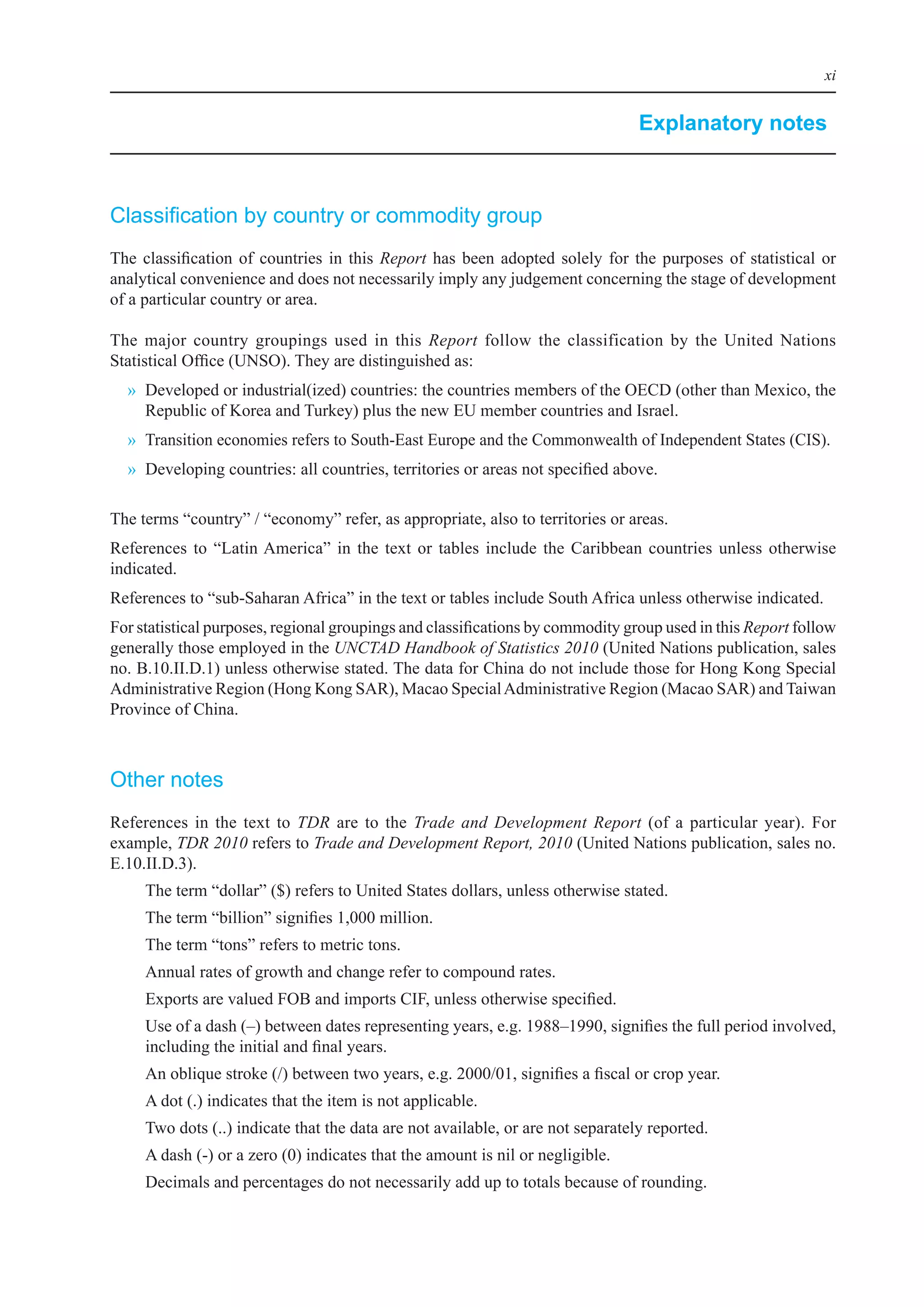
                                                                                        Explanatory notes


Classification by country or commodity group
The	 classification	 of	 countries	 in	 this	 Report	 has	 been	 adopted	 solely	 for	 the	 purposes	 of	 statistical	 or	
analytical	convenience	and	does	not	necessarily	imply	any	judgement	concerning	the	stage	of	development	
of	a	particular	country	or	area.	
	
The	 major	 country	 groupings	 used	 in	 this	 Report	 follow	 the	 classification	 by	 the	 United	 Nations	
Statistical	office	(UNSo).	They	are	distinguished	as:	
  »	 Developed	or	industrial(ized)	countries:	the	countries	members	of	the	oeCD	(other	than	Mexico,	the	
     Republic	of	Korea	and	Turkey)	plus	the	new	eU	member	countries	and	israel.	
  »	 Transition	economies	refers	to	South-east	europe	and	the	Commonwealth	of	independent	States	(CiS).
  »	 Developing	countries:	all	countries,	territories	or	areas	not	specified	above.

The	terms	“country”	/	“economy”	refer,	as	appropriate,	also	to	territories	or	areas.
References	 to	 “latin	America”	 in	 the	 text	 or	 tables	 include	 the	 Caribbean	 countries	 unless	 otherwise	
indicated.
References	to	“sub-Saharan	Africa”	in	the	text	or	tables	include	South	Africa	unless	otherwise	indicated.
For	statistical	purposes,	regional	groupings	and	classifications	by	commodity	group	used	in	this	Report	follow	
generally	those	employed	in	the	UNCTAD Handbook of Statistics 2010	(United	Nations	publication,	sales	
no.	b.10.ii.D.1)	unless	otherwise	stated.	The	data	for	China	do	not	include	those	for	Hong	Kong	Special	
Administrative	Region	(Hong	Kong	SAR),	Macao	Special	Administrative	Region	(Macao	SAR)	and	Taiwan	
Province	of	China.


Other notes
References	 in	 the	 text	 to	 TDR	 are	 to	 the	 Trade and Development Report	 (of	 a	 particular	 year).	 For	
example,	TDR 2010	refers	to	Trade and Development Report, 2010	(United	Nations	publication,	sales	no.	
e.10.ii.D.3).	
     The	term	“dollar”	($)	refers	to	United	States	dollars,	unless	otherwise	stated.
     The	term	“billion”	signifies	1,000	million.
     The	term	“tons”	refers	to	metric	tons.
     Annual	rates	of	growth	and	change	refer	to	compound	rates.
     exports	are	valued	Fob	and	imports	CiF,	unless	otherwise	specified.
     Use	of	a	dash	(–)	between	dates	representing	years,	e.g.	1988–1990,	signifies	the	full	period	involved,	
     including	the	initial	and	final	years.
     An	oblique	stroke	(/)	between	two	years,	e.g.	2000/01,	signifies	a	fiscal	or	crop	year.
     A	dot	(.)	indicates	that	the	item	is	not	applicable.
     Two	dots	(..)	indicate	that	the	data	are	not	available,	or	are	not	separately	reported.
     A	dash	(-)	or	a	zero	(0)	indicates	that	the	amount	is	nil	or	negligible.
     Decimals	and	percentages	do	not	necessarily	add	up	to	totals	because	of	rounding.
xiii


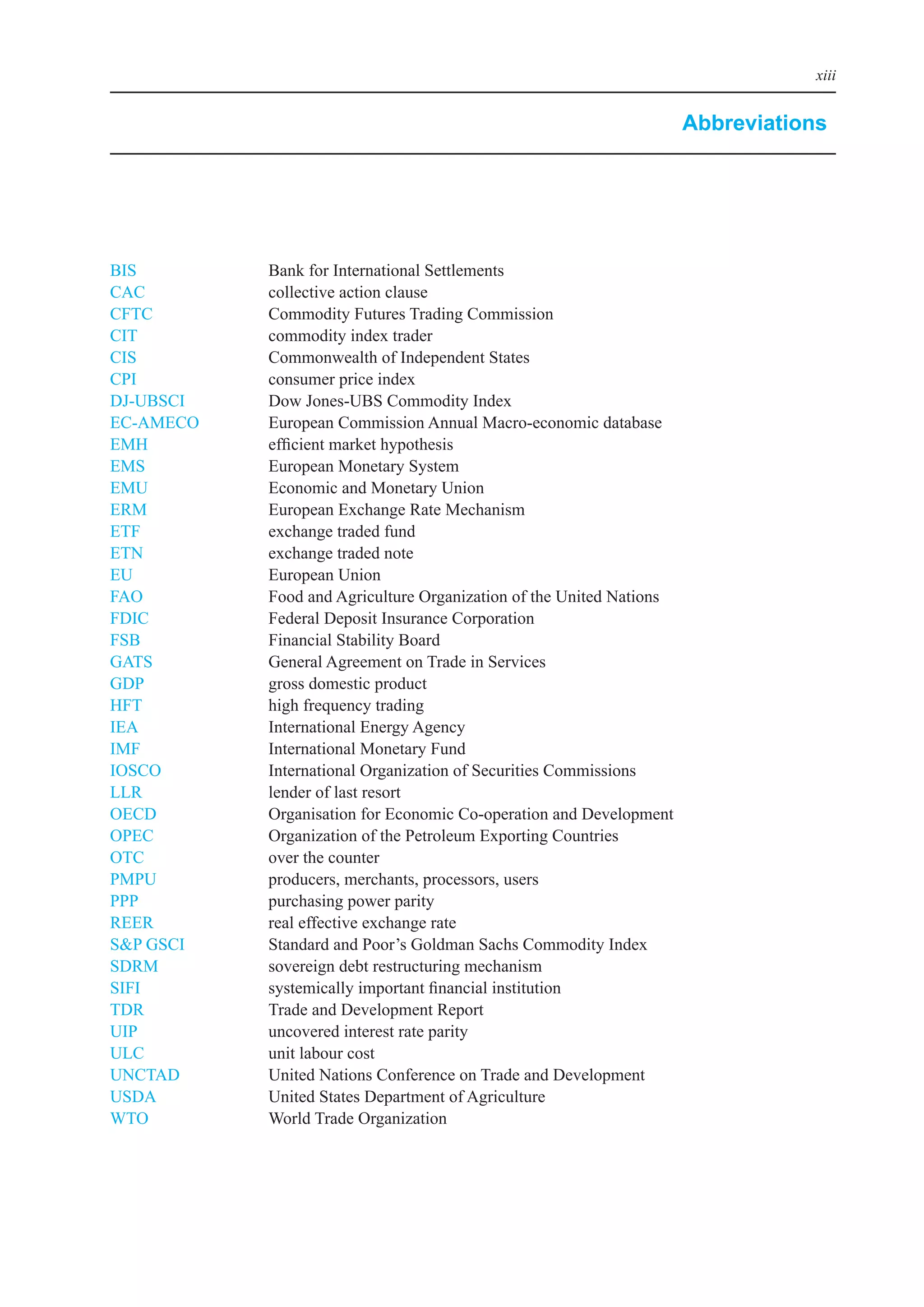
                                                                       Abbreviations


biS	         bank	for	international	Settlements
CAC	         collective	action	clause
CFTC	        Commodity	Futures	Trading	Commission
CiT	         commodity	index	trader
CiS	         Commonwealth	of	independent	States
CPi	         consumer	price	index
DJ-UbSCi		   Dow	Jones-UbS	Commodity	index
eC-AMeCo	    european	Commission	Annual	Macro-economic	database
eMH	         efficient	market	hypothesis
eMS	         european	Monetary	System
eMU	         economic	and	Monetary	Union
eRM		        european	exchange	Rate	Mechanism
eTF	         exchange	traded	fund
eTN	         exchange	traded	note
eU	          european	Union
FAo	         Food	and	Agriculture	organization	of	the	United	Nations
FDiC	        Federal	Deposit	insurance	Corporation
FSb	         Financial	Stability	board
GATS	        General	Agreement	on	Trade	in	Services
GDP	         gross	domestic	product
HFT	         high	frequency	trading
ieA	         international	energy	Agency
iMF	         international	Monetary	Fund
ioSCo	       international	organization	of	Securities	Commissions
llR	         lender	of	last	resort
oeCD	        organisation	for	economic	Co-operation	and	Development
oPeC	        organization	of	the	Petroleum	exporting	Countries
oTC	         over	the	counter
PMPU	        producers,	merchants,	processors,	users
PPP	         purchasing	power	parity
ReeR	        real	effective	exchange	rate
S&P	GSCi	    Standard	and	Poor’s	Goldman	Sachs	Commodity	index
SDRM	        sovereign	debt	restructuring	mechanism
SiFi	        systemically	important	financial	institution
TDR	         Trade	and	Development	Report
UiP	         uncovered	interest	rate	parity
UlC	         unit	labour	cost
UNCTAD	      United	Nations	Conference	on	Trade	and	Development
USDA	        United	States	Department	of	Agriculture
WTo	         World	Trade	organization
Overview


Economic integration and interdependence in the world today have reached an unprecedented
level. As a result, the globalized economy cannot function for the benefit of all without international
solidarity and cooperation. This was highlighted by the global financial and economic crisis that
followed the collapse of big financial institutions, and it has underlined the need for developing
approaches to new forms of global collaboration. The G-20, which has become a leading forum for
international economic cooperation, successfully coordinated an immediate policy response to the
crisis, or “Great Recession” as it is now called. Coordinated monetary policy easing by leading
central banks marked the first step, with most members of the G-20 launching large fiscal stimulus
packages as well as emergency support programmes to restore financial stability. The aggregate
impact of these measures stopped the economic freefall and won policymakers an important first
round in battling the crisis. However, despite intense discussions, little progress, if any, has been
achieved in major areas that were also of concern to the G-20. These include financial regulation,
inter alia for tackling problems related to the “financialization” of markets for many primary
commodities, and, even more importantly, reform of the international monetary system for curbing
volatile short-term capital flows that are driven mainly by currency speculation.

Meanwhile, global economic recovery has entered a renewed phase of fragility because a process
of self-sustaining growth through private spending and employment is not assured, especially in
developed countries. Many of these countries have shifted their fiscal policy stance from stimulus
to retrenchment, which risks leading to prolonged stagnation, or even to a contraction of their
economies. Given the lack of growth in employment and wages in Europe, Japan and the United
States, their policies should aim at continued stimulation of their economies instead of trying to
“regain the confidence of the financial markets” by prematurely cutting government spending.
The main global risk is that wages and mass incomes might not increase sufficiently to feed a
sustainable and globally balanced process of growth based on domestic demand. This indicates
that the risk of higher inflation resulting from rising commodity prices is very small. Only very
few countries that have strong growth and overshooting wage dynamics face inflation risks.

The recovery of commodity prices has helped developing countries maintain their growth
momentum, but these prices are prone to considerable volatility as they are strongly influenced
by the speculative activities of market participants motivated by purely financial considerations.
And although growth in a number of large developing countries has come to rely more on domestic
drivers than on exports, it remains vulnerable to adverse developments in the international financial
system. In particular, these countries are exposed to short-term capital flows, which tend to exert
an upward pressure on their currencies and damage their export industries. Thus developing
countries are also facing considerable downside risks, and should aim at maintaining stable
macroeconomic conditions domestically and containing external disruptions. As they progress
II


          along successful development paths, they need to make their voices better heard in the global
          debate on a new design of the international monetary and financial system.

          The world economy is still struggling to recover from the worst recession since the Great Depression.
          Courageous, globally coordinated countercyclical policies succeeded in rescuing economies
          from the brink of collapse. Nevertheless, policymakers cannot afford to waste the opportunity for
          a more fundamental reorientation of policies and institutions. Strict regulation of the financial
          sector, orienting it more towards investment in fixed capital, is key to greater stability of the
          global economy and to its return to a sustainable growth path. This requires increased coherence
          between the multilateral trading system and the international monetary system. At the national
          and regional levels, there is a strong case for a reorientation of fiscal policy that takes into account
          the requirements of the overall macroeconomic situation rather than focusing exclusively on
          balancing budgets or on achieving rigid public deficit targets. However, unless there is a reversal
          of the current trend of diminished income expectations of the average household and a return
          to policies that emphasize the importance of mass income growth as the basis for sustainable
          and balanced development in rich and poor countries alike, all other attempts to regain growth
          momentum will be in vain.


                       recovery of the world economy is slowing down,
                                 with strong downside risks

      The pace of global recovery has been slowing down in 2011. Global GDP is expected to grow by 3.1 per
cent, following an increase of 3.9 per cent in 2010. In many developed countries, the slowdown may even
be accentuated in the course of the year as a result of government policies aimed at reducing public budget
deficits or current-account deficits. In most developing countries, growth dynamics are still much stronger,
driven mainly by domestic demand.

     As the initial impulses from inventory cycles and fiscal stimulus programmes have gradually disappeared
since mid-2010, they have revealed a fundamental weakness in the recovery process in developed economies.
Private demand alone is not strong enough to maintain the momentum of recovery; domestic consumption
remains weak owing to persistently high unemployment and slow or stagnant wage growth. Moreover,
household indebtedness in several countries continues to be high, and banks are reluctant to provide new
financing. In this situation, the shift towards fiscal and monetary tightening risks creating a prolonged period
of mediocre growth, if not outright contraction, in developed economies.

      In the United States, recovery has been stalling, with the pace of growth well below what is needed to
make a significant dent in unemployment. Even the second round of quantitative easing has failed to translate
into increased credit for domestic economic activities, as domestic demand has remained subdued due to
stagnating wages and employment. With little scope to lower interest rates further – as they are already
at historically low levels – and fiscal stimulus waning, a quick return to a satisfactory growth trajectory
is highly unlikely. In Japan, recovery has been delayed by the impact of unprecedented supply-chain and
energy disruptions due to the massive earthquake and tsunami in March. In the European Union, growth is set
to remain below 2 per cent in 2011, although with significant variations among member countries. In Germany
a revival of exports (particularly to Asia) and investment, together with rising public expenditures, resulted
in a strong increase in economic activity in 2010 and early 2011, but, as in other developed economies, mass
income remains very weak, as does domestic demand.

     With the unresolved euro crisis, the reappearance of severe debt market stress in the second quarter of
2011 and the prospect of austerity measures spreading across Europe, there is a high risk that the eurozone
will continue to act as a significant drag on global recovery. Austerity measures, as the main means of
III


tackling the euro crisis without regard for regional domestic demand growth, may backfire badly. Crisis-hit
countries in the euro area are labouring under extremely adverse conditions. They need low interest rates
and a revival of growth, but instead, their growth dynamics are weak and market interest rates on public
debt are prohibitively high.


                        relatively fast growth in developing countries
                            has relied more on domestic demand

      Growth rates in developing countries are likely to remain much higher – at almost 6.5 per cent – than in
the developed countries. In many developing countries, growth has been driven more by domestic demand
than by exports. Emerging market economies (e.g. Brazil, India, South Africa and Turkey, among the G-20
members) have had to deal with the major challenge of short-term capital inflows, attracted by higher
interest rates that reflect higher inflation rates or tight monetary policies. These inflows have been exerting
enormous appreciation pressure on their domestic currencies, and tend to weaken their export sectors and
widen their current-account deficits. In Brazil, the central bank intervened heavily in the currency market,
but at the same time it also increased its policy interest rate further, even though it was already at a very
high level in real terms, and the fiscal stance was tightened. The central bank of the Russian Federation had
a similar response.

     Expansion has remained strong in all developing regions, with the exception of North Africa and
some countries in West Asia, where political unrest has adversely affected investment and tourism, and thus
also growth. East, South and South-East Asia continue to record the highest GDP growth rates, although
there is a tendency towards some slowdown, reflecting supply-chain effects from Japan, tighter monetary
conditions and weak demand in some major export markets, notably Japan and the United States. In China,
the contribution of net exports to GDP growth has declined, and fixed investment and private consumption
are now the two major growth factors. Wage growth in China is an important element in reducing the reliance
of the Chinese economy on exports, and thus the full participation of labour in the country’s productivity
gains is contributing effectively to a rebalancing of global demand.

      In Latin America and the Caribbean, expansion continues to be robust. While the Brazilian economy
is slowing down, Argentina and most Andean countries are set to record another year of rapid growth. In
Mexico and most of the small Central American and Caribbean economies, growth will be much more modest,
mainly owing to their dependence on exports to the United States. Sub-Saharan Africa is likely to keep
growing at the same rapid pace as in 2010. As a result of terms-of-trade gains, investment in infrastructure
and expansionary fiscal policies should promote economic growth in the subregion, and rapid development
of the services sector will provide further impetus. However, GDP growth rates in sub-Saharan Africa are
unlikely to contribute to significant poverty reduction in the near future, as economic improvements often
fail to trickle down to the entire population.

     In the transition economies, although growth rates are unlikely to equal that of the developing-country
average, they have returned to their pre-crisis trend, and should increase considerably faster than those of
developed countries.


      recovery of international trade and price volatility in commodity markets

      International trade in both goods and services rebounded sharply in 2010, after having registered
its steepest fall since the Second World War. The volume of international trade is expected to return to a
single-digit growth rate in 2011, from 14 per cent in 2010, particularly in developed economies. Commodity
prices recovered very early in the cycle and have been exhibiting high volatility, owing largely to the greater
presence of financial investors in commodity markets.
IV


      Although the UNCTAD index for food prices in February 2011 exceeded the levels reached during the
food crisis of 2007–2008, the food security situation appears to be less critical than at that time, owing to
the relatively low prices of rice and a good harvest for grain crops in Africa in 2010. Moreover, most food-
exporting countries refrained from imposing export restrictions, which had been a significant factor in the
food crisis of 2007–2008. Nevertheless, the rise in food prices in 2010–2011 could have a serious impact
on food security, made worse by the threat of famine in East Africa. It is again adding to extreme poverty,
as the food import bill of the low-income, food-deficit countries is expected to increase by 27 per cent in
2011. Therefore, government measures to alleviate the impact on the poorest are needed.

      To some extent, rising commodity prices are already contributing to the slowdown of overall activity in
the consumer countries, because high prices are reducing purchasing power at a time when household incomes
are being hit by high unemployment, slow wage growth and the debt deleveraging process, particularly
in developed countries. If higher commodity prices lead to a widespread tightening of monetary policy
worldwide, this could become a major threat to the recovery. The European Central Bank, for example,
continues to take its cue from headline inflation, and has embarked on monetary tightening since April
2011. However, in view of the enormous labour market slack in the United States and Europe, where even
nominal wages are barely growing, the risk of higher commodity prices triggering an inflationary spiral are
negligible. Thus a restrictive monetary policy is not an appropriate measure against high commodity prices,
which are primarily the result of external factors, mostly related to supply-side shocks and to the impact of
financial markets.

      Similarly, in emerging market economies, headline inflation is related less to overheating than to the
fact that food and energy prices have a much greater weight in the consumer price indices of poorer countries
compared with the developed countries. Under these circumstances, monetary tightening in the absence
of overheating would appear to be largely misplaced, since second-round effects in most cases have been
limited.


                        Slow wage growth is endangering the recovery

      Wage income is the main driver of domestic demand in developed and emerging market economies.
Therefore, wage growth is essential to recovery and sustainable growth. However, in most developed countries,
the chances of wage growth contributing significantly to, or leading, the recovery are slim. Worse still, in
addition to the risks inherent in premature fiscal consolidation, there is a heightened threat in many countries
that downward pressure on wages may be accentuated, which would further dampen private consumption
expenditure. In many developing and emerging market economies, particularly China, the recovery has been
driven by rising wages and social transfers, with a concomitant expansion of domestic demand. However,
as developed countries remain important export destinations, subdued growth in those markets, combined
with upward pressures on developing countries’ currencies, poses the risk of pressures for relative wage
compression in developing countries as well.

     Wage growth that is falling short of productivity growth implies that domestic demand is growing at a
slower rate than potential supply. The emerging gap can be temporarily filled by relying on external demand
or by stimulating domestic demand through credit easing and raising of asset prices. The global crisis has
shown that neither solution is sustainable. The simultaneous pursuit of export-led growth strategies by many
countries implies a race to the bottom with regard to wages, and has a deflationary bias. Moreover, if one
country succeeds in generating a trade surplus, this implies that there will be trade deficits in other countries,
causing trade imbalances and foreign indebtedness. If, on the other hand, overspending is enticed by easy
credit and higher asset prices, as in the United States before the crisis, the bubble will burst at some point,
with serious consequences for both the financial and real economy. Therefore, it is important that measures
be taken to halt and reverse the unsustainable trends in income distribution.
V


                                   The case for an incomes policy

       Given the importance of consumption for boosting global demand, incomes policies in the biggest
economies could contribute significantly to a balanced expansion, especially when the global recovery is
still fragile. An essential element of such a policy is the adjustment of real wages in line with productivity,
so that domestic consumption can rise in line with supply. This would also help prevent an increase in unit
labour costs, and thus keep the main domestic source of inflation under control. Monetary policy could then
reduce its focus on price stability and pay greater attention to securing low-cost finance for investment in
real productive capacity, which in turn would create new employment opportunities. Wages rising at a rate
that corresponds approximately to the rate of productivity growth, augmented by a target rate of inflation,
is the best anchor for inflation expectations.

      The current problems in the eurozone are largely the result of diverging wage increases in the member
States. Since the creation of the eurozone, wages have risen faster than productivity and the official inflation
target of the European Central Bank in some member States, and much less in others, causing considerable
shifts in competitiveness. Unlike the emerging market economies in similar crisis situations in the past, the
countries in the eurozone that have lost competitiveness and now face serious debt problems do not have the
option of devaluing their currencies. Therefore, in addition to income transfers, an explicit policy of increasing
wages in the surplus countries, particularly in Germany, to reduce the problems of falling competitiveness
in the more crisis-hit countries is a crucial part of the solution.


                                     A brief “Keynesian moment”

     After many years of calls for a reduced role of the State in economic management, many governments
in both developed and emerging market economies launched large stabilization packages to restore aggregate
demand, and intervened in the rescue of the financial sector. Before the crisis, expansionary fiscal policies
were often considered ineffective, on the grounds that any increase in the public sector deficit would be
compensated by a concomitant downward adjustment in private expenditure. But as the impact of monetary
policy was limited during the crisis, the orthodox concern with balanced budgets or short-term fiscal targets
came to be ignored, and governments were again viewed as “buyers and borrowers of last resort”.

      However, recent developments in fiscal and monetary policy in many economies, and the
recommendations of major international institutions such as the International Monetary Fund (IMF) and the
Organisation for Economic Co-operation and Development (OECD), suggest that recognition of the need
for fiscal stimulus during the crisis has not been followed up by a more profound rethinking of the principles
of macroeconomic policy. In 2011, many governments have again reversed their policy orientation from
one of fiscal expansion to fiscal tightening, and others are planning to do so. This is of particular concern
since, in most developed economies that were severely hit by the financial crisis, the private sector has not
yet completed the deleveraging process whereby non-financial agents try to reduce their indebtedness and
banks try to restore their capital ratios. In such a debt-deflation process, even if monetary easing and low
interest rates were to be continued, they could not be expected to have a major stimulating effect.

      Those who support fiscal tightening argue that it is indispensable for restoring the confidence of financial
markets, which is perceived as key to economic recovery. This is despite the almost universal recognition
that the crisis was the result of financial market failure in the first place. It suggests that little has been
learned about placing too much confidence in the judgement of financial market participants, including rating
agencies, concerning the macroeconomic situation and the appropriateness of macroeconomic policies. In
light of the irresponsible behaviour of many private financial market actors in the run-up to the crisis, and
costly government intervention to prevent the collapse of the financial system, it is surprising that a large
segment of public opinion and many policymakers are once again putting their trust in those same institutions
to judge what constitutes correct macroeconomic management and sound public finances.
VI


                               The strong fiscal impact of the crisis

      The growing public debt has not been the result of imprudent fiscal policies. Before the crisis, between
2002 and 2007–2008, on a global scale fiscal balances had improved significantly, mainly as a result of strong
increases in public revenues both in absolute terms and as a percentage of GDP. This was a by-product of a
broad-based acceleration of output growth, and, in many primary-commodity-exporting countries, it was also
a result of the price boom in international commodity markets. In addition, there was a widespread decline
in the share of interest payments in public expenditure, largely due to lower real interest rates. Hence, many
countries had substantial fiscal space when the crisis occurred.

      The crisis caused a significant deterioration in public sector accounts as automatic stabilizers operated,
which reduced revenues and increased expenditure, and fiscal stimulus packages were launched, many of
them unprecedented in size. In many developing countries, fiscal accounts were also strongly affected by
a sharp drop in commodity prices and higher interest rate spreads on the public debt. In several developed
countries the deterioration of fiscal balances reflected public bailouts of ailing financial institutions, which to
a large extent implied a conversion of private into public debt. In 2008 and 2009, government expenditure as
a share of GDP increased in all regions, while government revenues declined. This decline was particularly
steep in the African, West Asian and transition economies that rely heavily on the proceeds of primary
commodity exports for their fiscal revenues, and it was more moderate in most economies of East and South
Asia, and Latin America.

     In developed countries, strong fiscal stimulus measures were particularly critical to counterbalance
sharply shrinking private demand, since even extremely expansionary monetary measures were not particularly
effective in an environment of massive private deleveraging. The United States implemented the largest
stimulus package, both in nominal terms and as a percentage of GDP, followed by Japan and Germany. In the
developed countries, about 40 per cent of the announced fiscal stimulus took the form of tax cuts. In several
developing and transition economies, the size of the stimulus packages as a share of GDP exceeded that of
developed economies, and there was a much greater emphasis on increased spending than on tax cuts.

     The countercyclical policies and the recession led to a sudden jump in the public-debt-to-GDP ratio
in developed countries. By the end of 2010 that ratio had risen to well above 60 per cent, surpassing the
previous peak of 1998. In developing and emerging market economies, the ratio increased only moderately
following a steep reduction in the previous years, so that it is now much lower than that of developed
countries. However, there are substantial variations among the developing countries, and a number of low-
income countries are still in debt distress.


                                Fiscal space is not a static variable

     As current budget deficits and the stock of public debt have risen sharply in several countries, there is
a widespread perception that the space for continued fiscal stimulus is already – or will soon be – exhausted,
especially in developed countries. There is also a perception that in a number of countries debt ratios have
reached, or are approaching, a level beyond which fiscal solvency is at risk.

     However, fiscal space is a largely endogenous variable. A proactive fiscal policy will affect the fiscal
balance by altering the macroeconomic situation through its impact on private sector incomes and the taxes
perceived from those incomes. From a dynamic macroeconomic perspective, an appropriate expansionary fiscal
policy can boost demand when private demand has been paralysed due to uncertainty about future income
prospects and an unwillingness or inability on the part of private consumers and investors to incur debt.

      In such a situation, a restrictive fiscal policy aimed at budget consolidation or reducing the public debt
is unlikely to succeed, because a national economy does not function in the same way as an individual firm
VII


or household. The latter may be able to increase savings by cutting back spending because such a cutback
does not affect its revenues. However, fiscal retrenchment, owing to its negative impact on aggregate demand
and the tax base, will lead to lower fiscal revenues and therefore hamper fiscal consolidation. Since current
expenditure can be difficult to adjust (because it is composed mainly of wages and entitlement programmes),
fiscal retrenchment usually entails large cuts in public investment. This reduction in growth-promoting public
expenditure may lead to a fall in the present value of future government revenues that is larger than the fiscal
savings obtained by the retrenchment. The outcome could be an improvement in the immediate cash flow
of the government, but with negative consequences for long-term fiscal and debt sustainability. Moreover,
making balanced budgets or low public debt an end in itself can be detrimental to achieving other goals of
economic policy, namely high employment and socially acceptable income distribution.

      The failure to consider these dynamic effects was what led to disappointing outcomes for many countries
that implemented fiscal tightening as part of IMF-supported programmes during the 1990s and 2000s. In
countries where fiscal tightening was expected to reduce the budget deficit, that deficit actually became
worse, often sizeably, due to falling GDP. In Indonesia in the late 1990s, for example, a GDP growth rate
of 5 per cent was forecast, but in fact output shrunk by 13 per cent; in Thailand, instead of the expected
3.5 per cent GDP growth there was a 10.5 per cent contraction. Other countries shared similar experiences.
The reason for what appears to have been a systematic miscalculation, leading “inevitably to fiscal under-
performance”, as the IMF’s Independent Evaluation Office put it, was overoptimistic assumptions about the
“crowding in” of private investment.

      Another often neglected aspect of fiscal space is that the way in which the public sector spends and
taxes is not neutral; changes in different types of revenue or expenditure generate different macroeconomic
outcomes. In principle, an increase in spending on infrastructure, social transfers or targeted subsidies for
private investors tends to be more effective for stimulating the economy than tax cuts, because it leads directly
to increased purchases and demand. On the other hand, disposable incomes from reduced tax payments are
likely to be spent only partially. This is particularly true when the private sector is highly indebted, since
it would then use part of the tax proceeds for repaying outstanding debts rather than for consumption and
investment. Increased social spending to support low-income groups seems to be a rational way to promote
recovery, as it prevents their consumption from falling during a crisis and poverty from rising. If tax cuts
are the preferred instrument, reductions of sales and value added taxes as well as income tax cuts for the
lower income groups that have a higher propensity to spend are generally more effective in raising demand
and national income than tax cuts for the higher income groups.


                                     Determinants of public debt

      High and rising public debt ratios are clearly a legitimate political concern, but like fiscal space,
public deficit and debt limits are difficult to define, since they have strong interrelationships with other
macroeconomic variables. Therefore, any attempt to identify a critical level of “sustainable” debt is a
difficult task. Governments’ economic policies and debt strategies have to take into account their specific
circumstances and social needs as well as their external relationships.

      Empirical evidence shows that, even though fiscal deficits and public debt constitute a relatively high
proportion of GDP in some parts of the world today – especially in some developed countries – in many
countries they are not large by historical standards. Moreover, it is not only the absolute stock of debt that
matters for the sustainability of the public debt, but the relationship between that stock and some other key
variables. These variables include, in addition to the primary fiscal balance, the average interest rate to be
paid on the outstanding debt, the growth rate of the economy and the exchange rate. The latter strongly
influences not only the domestic value of the foreign-currency-denominated debt, but also the demand for
domestically produced goods.
VIII


      Therefore, unsustainable public debt positions are not always the outcome of expansionary – or
irresponsible – fiscal policies. Primary deficits caused by discretionary fiscal policies have even been found
to contribute less to higher debt ratios than slower (or negative) GDP growth and banking and currency
crises. Conversely, even if government budgets are in primary deficit, the public-debt-to-GDP ratio can
be reduced, provided the nominal interest rate on public debt is lower than the growth rate of GDP. Thus,
monetary policy plays an important role in determining the sustainability of the public debt. However,
countries that have foreign-currency-denominated debt, or that do not have control over their own monetary
policy, may experience sudden surges in borrowing costs during economic crises precisely when their ability
to pay is limited. In developing countries, empirical evidence shows that contractionary efforts have not
been particularly successful, and that, normally, debt sustainability has been achieved by promoting higher
rates of economic growth.

     The response to a crisis should depend on its cause. If a crisis originates from the bursting of an asset
bubble, a more rational response would be financial reform, and even quite the opposite of fiscal retrenchment,
namely countercyclical policies to absorb private sector deleveraging so as to reduce the macroeconomic
slump created by asset deflation. If the crisis originates from overexposure to foreign creditors and excessive
appreciation of the domestic currency, the appropriate response at the national level might be to improve
the debt structure, as well as introduce policies aimed at avoiding misalignments of the real exchange rate
and imposing controls on capital inflows.


            Financial deregulation opened the door to excessive risk taking

      The recent sharp increase in public sector deficits and public indebtedness is the result of a grave crisis
in the financial system following a wave of financial liberalization, led by the so-called “Anglo-Saxon”
economies. It is, therefore, somewhat ironic that the financial agents that caused the crisis should have
become the judges of the suitability of public policies adopted to contain its damage. Financial liberalization
and deregulation was based on a widespread belief in the greater efficiency of market forces, and it led
to the creation of increasingly sophisticated financial instruments. Deregulation was in part a response to
pressure from competitive forces in the financial sector, but it was also part of a generalized trend towards
less government intervention in the economy. New financial instruments and continued liberalization in the
financial system allowed speculative activities to expand significantly, so that gambling became an important
and, at times dominant, feature of financial activities. This became a source of instability in many economies,
and indeed, in the entire international economic system. By contrast, it is difficult to find any new financial
instruments that have contributed to increasing the efficiency of financial intermediation for the benefit of
long-term investment in real productive capacity.

      Even when financial deregulation and current-account liberalization resulted in an increasing number
of financial crises in both developed and developing countries, the strong belief that markets are the best
judges of efficient factor allocation led policymakers to continue with financial deregulation. It took the
global financial crisis to finally force a serious debate about the necessity for fundamental reforms to prevent
similar crises in the future. Widespread consensus that deregulation was one of the main factors leading to
the global financial and economic crisis led to calls for strengthening financial regulation and supervision.


              Markets are important, but financial markets work differently

     Financial markets do not function in the same way as typical markets for goods and services. While
entrepreneurs participating in goods markets are concerned with the creation of new real assets that have
the potential to improve productivity and increase all incomes in the future, financial market participants are
primarily concerned with the effective use of information advantages concerning existing assets. In goods
markets, price discovery is based on information from a multitude of independent agents who act according
IX


to their own individual preferences, and opportunities for profit arise from individual pioneering actions
based on the private, circumstantial information of the market participants. By contrast, in financial markets,
especially those for assets which fall in the same broad risk category (such as equities, emerging-market
currencies, and more recently, commodities and their derivatives), price discovery is based on information
related to a few, commonly observable events, or even on mathematical models that mainly use past – rather
than only current – information for making price forecasts.

      The fatal flaw in the functioning of financial markets lies in the fact that the most profitable activities
are often derived from herd behaviour (i.e. following the trend for some time and disinvesting just before
the rest of the crowd does). Acting against the majority, even if justified by accurate information about
fundamentals, may result in large losses. Thus, whenever market participants “discover” that price trends
in different markets provide an opportunity for “dynamic arbitrage” (i.e. investment in the probability of
a continuation of the existing trend), and all bet on the same outcome, such as rising prices of real estate,
equities or other assets, since the same information is available to all market participants, there is a strong
tendency for herd behaviour. As a result, the herd acquires the market power to move those prices in the
desired direction.

      This is why prices in financial and “financialized” markets sometimes tend to overshoot, which gives
rise to wrong prices for extended periods of time. As herding dominates the scene, no single participant
questions whether the underlying information is correct or can be rationally related to events and developments
in the real economy. This phenomenon has been observed not only in securities markets and markets for
financial derivatives, but also in currency and commodity futures markets. Thus financial markets themselves
have created most of the “fat tail” risks that have led to their collapse in financial crises. Uncertainty about
the appropriate values of bank assets during such bubbles can become so high that no capital requirement
or liquidity buffer can absorb the subsequent shock, so that governments have to step in with rescue
packages.


                     Re-regulation of financial markets is indispensable

      Over some 150 years of banking history, an implicit accord had emerged that in times of crises,
governments, or central banks serving as “lender of last resort”, would provide the necessary support to
prevent the collapse of individual financial institutions and of the overall system. In return these institutions
were subject to government regulation and supervision. There had always been a risk that events in the
real economy, such as failure of a large debtor or a generalized recession, could generate difficulties in the
financial sector. This became particularly evident during the Great Depression of the 1930s, as a consequence
of which lender-of-last-resort functions were institutionalized, together with deposit insurance aimed at
preventing bank runs.

      However, with the trend towards deregulation of the financial system over the past three decades, the
situation has been reversed: today, the financial sector has increasingly become a source of instability for
the real sector. At the same time, official support for this sector has become more frequent and involves
ever larger injections of public money. Financial markets were deregulated, despite frequent failures of
those markets. Therefore, to protect the real sector of the economy from the negative spillover effects that
are endogenously generated in the financial market itself, a considerable degree of official re-regulation is
needed which would re-establish a proper balance between government protection of the financial sector
and government regulation of financial institutions.

      Because financial markets are so little understood, an unresolved issue is the systematic underestimation
of risks that arise when all participants in a certain segment of the financial market move in the same direction
through herd behaviour. This can result in so-called “tail risks”, which, although occurring very rarely, when
they do occur, the consequences can be catastrophic. The markets can only be stabilized if they no longer
X


have the power to move prices in the wrong direction or to overshoot the fair value by a wide margin. Thus,
systematic intervention by governments should become a legitimate tool to correct market failures.

      The deregulation of financial markets has also allowed an increased concentration of banking activities
in a small number of very big institutions, as well as a shift in bank funding, from a reliance on deposits to
a greater reliance on capital markets, and from lending to trading. Moreover, it has paved the way for the
development of a largely unregulated “shadow financial system”, particularly in developed economies. By
early 2008, the liabilities of that system were almost twice those of the traditional banking sector. By absorbing
many of the newly created finance companies or money market funds, or by creating their own ones under
the umbrella of bank holding companies, banks outsourced a large segment of their credit intermediation
functions to associated companies in the shadow system. Some parts of this system (e.g. money market
funds) played the same role as that of banks but with virtually no regulation, and the volume of activities of
such groups has always been backed by too little capital.

      Much of the systemic risk in the financial system has derived from the systemically important financial
institutions. Proposals to address this “too-big-to-fail” problem have concentrated, so far, on additional capital
requirements and improved supervision rather than on restructuring. A more comprehensive approach should
also include a special resolution procedure in case of crises, which should not place a burden on government
resources, and the introduction of size caps, which may be absolute or relative to GDP.


                        Towards a restructuring of the banking system

      As the problem of mispricing is a systemic feature of financial markets, regulation should focus on
the system, rather than on behaviour inside the system, with a view to ensuring that the system as a whole
better serves real productive investment and growth in the real economy. A clear separation of deposit-taking
institutions from those that are engaged in investment banking activities could help prevent gambling by
commercial banks. This would also reduce the size and increase the diversity of banking institutions. Publicly
owned banks could play a more important role, not only for development finance purposes, but also as an
element of diversity and stability. These kinds of banks have turned out to be more resilient during crises,
and they have partly compensated for the credit crunch in the private system caused by the recent crisis.
They may also help promote competition in situations of oligopolistic private banking structures.

     As the latest financial crisis was generated in the private financial sector, many of the arguments repeatedly
advanced over the past few decades against publicly owned banks have further lost credibility. When the crisis
struck, large banks in Europe and the United States were able to survive only because they benefited from public
funds and guarantees. While during the boom period private institutions and individuals enjoyed large profits
and bonuses, governments – or the taxpayers – have had to bear the downside risk during slumps. Therefore
the point that only publicly owned banks enjoy an advantage through their access to public resources has
been proven wrong. Moreover, the fact that these institutions are public entities reduces their incentive to
engage in herd behaviour, exaggerated risk exposure and maximization of returns.


              Growing financial speculation in primary commodity markets

      Commodity prices have displayed considerable volatility over the past decade. The commodity price
boom between 2002 and 2008 was the most pronounced in several decades – in magnitude, duration and
breadth. The subsequent price decline following the eruption of the current global crisis in mid-2008 was
notable both for its sharpness and for the number of commodities affected. Since mid-2009, and especially
since the summer of 2010, global commodity prices have been rising again, though there was some flattening
out in the first half of 2011.
XI


     Some observers consider broad-based changes in fundamental supply and demand relationships as the
sole drivers of recent commodity price development. However, analyses are increasingly supporting the
view that these fluctuations have also been influenced by the growing participation of financial investors in
commodity trading for purely financial motives – a phenomenon often referred to as the “financialization
of commodity trading”.

      While participation of financial actors in commodity markets is generally recognized as a normal
feature of the market, a crucial question is the size of the financial flows and that they drive prices away from
fundamentals and/or increase their volatility. In general, their participation could be economically beneficial
by making markets deeper and helping to accommodate the hedging needs of commercial users and reduce
their hedging costs, but their herd behaviour destroys these benefits. Financial investors such as index funds
do not promote liquidity in markets, which would bring diversity to those markets; most of them follow
the same strategy by going long in the strong belief that prices on those markets will continue to rise in the
foreseeable future. Such financialization of commodity markets has caused those markets to follow less the
logic of a typical goods market and more that of financial markets where herd behaviour often dominates.

      Herding in commodity markets can be irrational, based on what may be called “pseudo-signals” such as
information related to other asset markets and the use of inflexible trading strategies, including momentum
investment or positive feedback strategies. Such strategies assume that price developments of the past carry
information on future price movements, giving rise, for example to trend chasing. This results in buying
after prices rise and selling after prices fall, independently of any changes in fundamentals.

      But herd behaviour can also be fully rational. Information-based herding, for example, refers to imitation
when traders believe that they can glean information by observing the behaviour of other agents. In other
words, investors converge in their behaviour because they ignore their private information signals. Position-
taking based only on other peoples’ previous actions will lead to price changes without any new information
being introduced to the market. A sequence of such actions causes a snowball effect, which will eventually
lead to self-sustaining asset price bubbles. Informational herding is most likely to occur in relatively opaque
markets, such as in commodity trading.


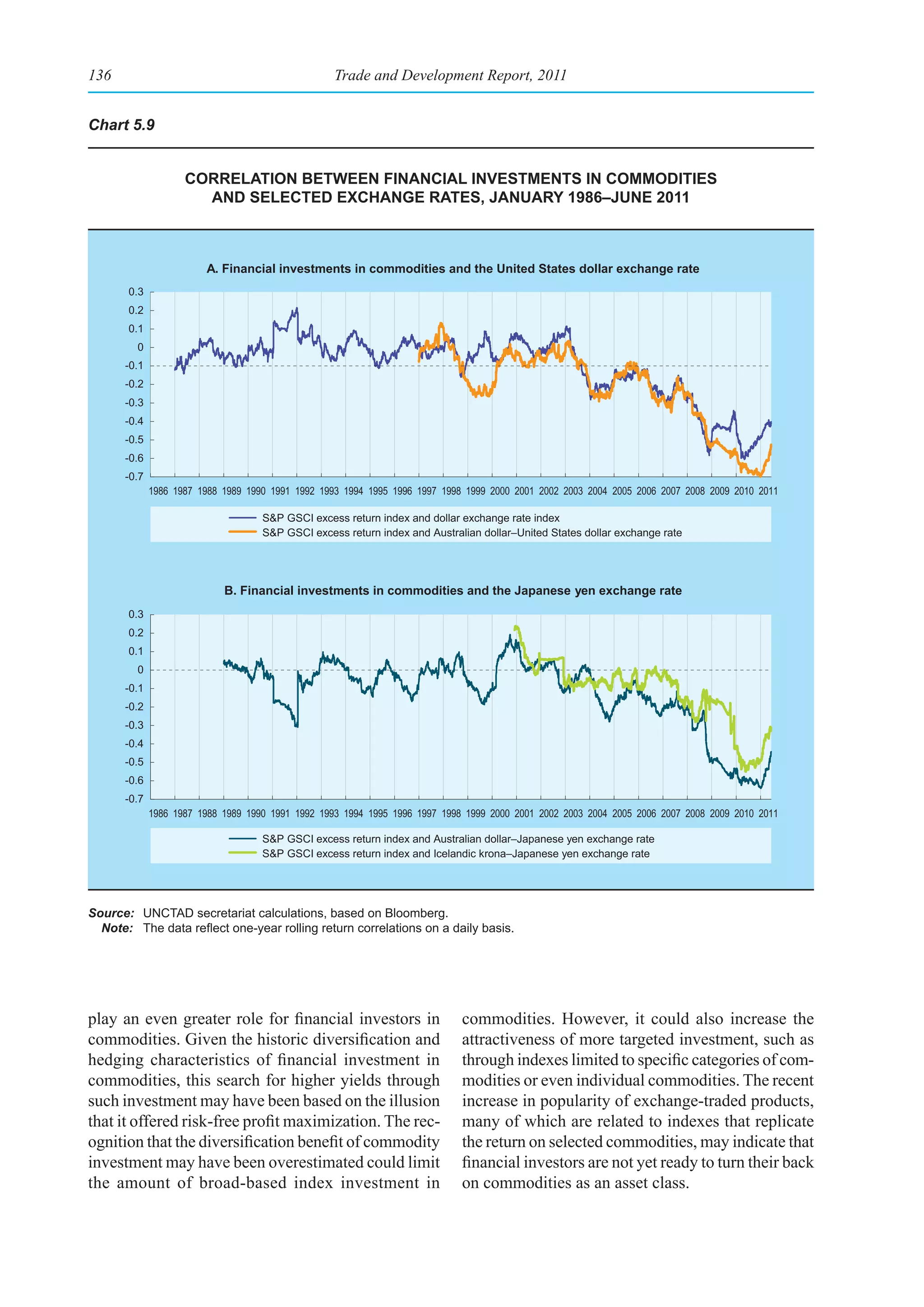
          Correlated movements on equity, commodity and currency markets

     Identifying the extent to which financial investment has affected the level and volatility of commodity
prices is challenging due to the limited transparency and level of disaggregation of existing data. However,
there is evidence to support the view that financial investors have affected price dynamics in the short term.
One such piece of evidence concerns the role of dramatic changes in financial positions in the oil market
between February and May 2011. Another relates to strong correlations between commodity price movements
and developments on equity and currency markets, which are known to have been exposed to speculation.

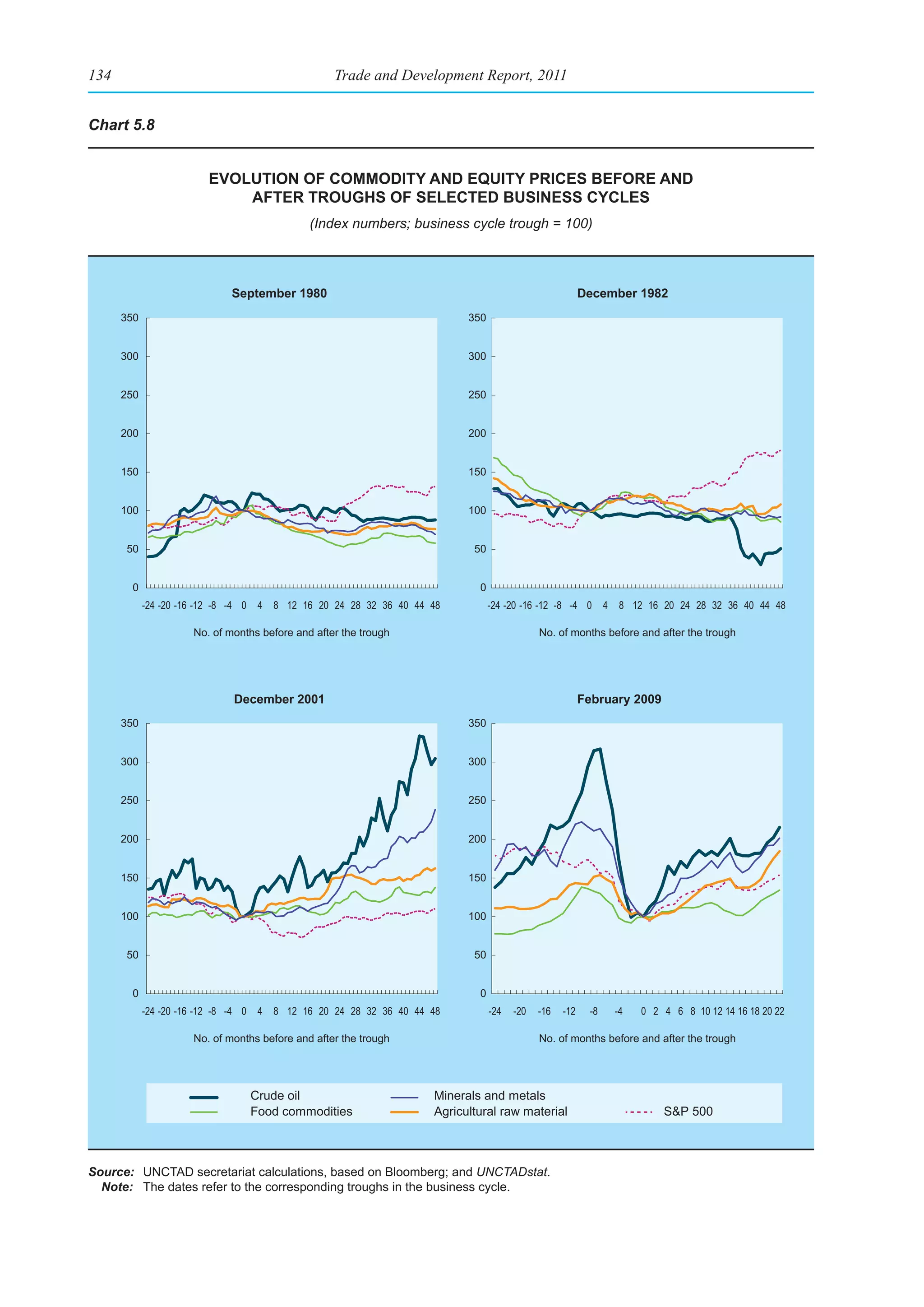
       A comparison of commodity and equity price developments over various business cycles shows that
those prices used to move in opposite directions during the early upswings of previous cycles. In contrast,
there has been a remarkable synchronization of those price movements in the most recent cycle. This increased
synchronization is surprising because of the very low level of capacity utilization in the wake of the “Great
Recession” of 2008 and 2009, which meant very low demand for commodities. Despite this, commodity
prices increased even before the recovery began in the second quarter of 2009 and kept growing in the two
subsequent years, partly due to rising demand in emerging economies but also to a large extent because of
purely financial operations. Consequently, two years later monetary policy has reacted, even though there is
still a very low level of capacity utilization in developed economies. This points to another worrying aspect
of the impact of financialization that has so far been underestimated, namely its capacity to inflict damage
on the real economy as a result of sending the wrong signals for macroeconomic management.
XII


                    Measures in response to commodity price instability

      Short-term emergency measures are needed to prevent or mitigate the negative impact of adverse
commodity price developments. At the same time it is necessary to devise ways of improving the functioning
of commodity derivatives markets to enable those trading venues to better fulfil their role of providing
reliable price signals to commodity producers and consumers, or at least prevent them from sending the
wrong signals.

      In light of the vital role of information in commodity price developments, a set of four policy responses to
improve the functioning of those markets should be considered, especially for food and energy commodities.
First, there should be greater transparency in physical markets through the provision of more timely and
accurate information about commodities, such as spare capacity and global stock holdings for oil, and for
agricultural commodities, areas under plantation, expected harvests, stocks and short-term demand forecast.
This would allow commercial market participants to more easily assess current and future fundamental supply
and demand relationships. Second, there needs to be a better flow of and access to information in commodity
derivatives markets, especially regarding position-taking by different categories of market participants. This
would further improve market transparency. In particular, measures designed to ensure reporting requirements
for trading on European exchanges, similar to those enforced in United States exchanges, would considerably
improve transparency of trading and discourage regulatory migration. Third, tighter regulation of financial
market participants, such as setting position limits, could reduce financial investors’ impacts on commodity
markets. Proprietary trading by financial institutions that are involved in hedging transactions of their clients
could be prohibited because of conflicts of interest. This requires finding the right balance between adopting
overly restrictive regulation, which would impair the risk-transfer functions of commodity exchanges, and
overly lax regulation, which would equally impair the basic functions of the exchanges.

      Fourth, market surveillance authorities could be mandated to intervene directly in exchange trading
on an occasional basis by buying or selling derivatives contracts with a view to averting price collapses
or to deflating price bubbles. Such intervention could be considered a measure of last resort to address the
occurrence of speculative bubbles if reforms aimed at achieving greater market transparency and tighter
market regulation were either not in place or proved ineffective. While most of the trigger mechanism could
be rules-based, and therefore predictable, such intervention would necessarily have some judgemental
components. However, doubts have sometimes been raised about the ability of market authorities or
government agencies to understand and follow the market. These are unfounded, because there is no reason
why their understanding should be any different from that of other market participants; in markets that are
prone to herd behaviour, they all have access to similar information. Moreover, contrary to the other market
participants, an intervening authority would have no incentive to engage in any form of herd behaviour.
Rather, it could break the informational cascades that underlie herd behaviour by announcing when it considers
prices to be far out of line with fundamentals.


                       exchange rates have become disconnected from
                              macroeconomic fundamentals

      The current debate on reform of the international monetary system has been dealing mainly with
symptoms rather than with the main problems. The strong increase in foreign exchange reserves, the still
hegemonic role of the dollar and destabilizing short-term capital inflows are mainly due to serious defects
in the global exchange rate regime. Foreign exchange markets are under the dominant influence of financial
market behaviour that is disconnected from macroeconomic fundamentals. This is a source of current-account
imbalances, distortions in international factor allocation and additional uncertainty for all participants in
international trade.
XIII


      Even after the breakdown of the Bretton Woods system and the adoption of widespread exchange rate
floating in 1973, international economic policy-making has often assumed that it is mainly real shocks, rather
than monetary shocks, that need to be tackled by the international system. However, after several decades of
experience it has become clear that monetary shocks, particularly in a system of flexible exchange rates, are
much more significant and harmful. Whereas the international exchange of goods and services is subject to the
rules and disciplines of the multilateral trading system, the absence of an international monetary system allows
individual countries autonomy in their exchange rate policies, even when such policies have adverse impacts
on the global economy by creating financial booms and busts and distortions in international trade.

      Exchange rate developments that diverge from those that would be warranted on the basis of fundamentals
can be attributed to two major factors: either significant cross-country differences in the evolution of unit
labour costs in the context of a regime where nominal exchange rates are not flexible enough, or excessive
short-term capital inflows that lead to an appreciation of an overly flexible nominal exchange rate. In a
situation where unit labour costs vary among countries, because of differences in the growth of wages relative
to productivity, exchange rate adjustments are necessary to prevent the build-up of trade imbalances arising
from a shift in competitiveness among countries. Not all current-account disequilibria are due to misaligned
exchange rates. However, deviations of the real exchange rate from fundamentals, especially if persisting
over long periods, have a major impact on the international competitiveness of producers, particularly of
manufacturers of any country, and thus on the pattern of international trade and trade balances.

      On the other hand, deviations of exchange rates from what would be warranted by economic fundamentals
can also arise from the impact of private short-term capital flows that are attracted by positive interest rate
differentials. In such cases, the exchange rate of a country with higher interest rates – reflecting a higher rate
of inflation or tight monetary policy – appreciates, although the macroeconomic conditions would require a
depreciation. Once the underlying interest rate differential narrows or disappears completely, or in a situation
of crisis, the earlier appreciation is typically followed by an overshooting currency depreciation that is again
out of line with fundamentals.


                              redesigning the exchange rate system

       In the current non-system, individual countries have tried to find temporary and pragmatic solutions to
the problems of over- or undervaluation. One solution is unilateral intervention in the currency markets, even
on a daily basis; another is capital controls or the taxation of inflows of hot money. All of these measures
are justified in an environment where there is still a belief that, in principle, “the market” is able to find the
right exchange rates. However, they do not solve the most urgent problem, that of applying the “categorical
imperative” of international exchange by finding the international value of the currency of one country which
all its trading partners can accept.

      A better design of the global exchange rate system has to ensure that private financial actors, whose
behaviour is often driven by purely speculative considerations and herding, do not exert excessive influence
on the determination of exchange rates, and thus on the competitiveness of producers of different countries
in international trade. Governments and central banks need to take the initiative by targeting exchange rates
and ensuring that deviations from those targets are minimal and temporary.

      A system of exchange rate management that helps prevent trade distortions and serves as a source of
stability in international financial relations would need to include rules that provide: (a) sufficient stability of
the real exchange rate (the most comprehensive measure of competitiveness) to enhance international trade
and facilitate decision-making on fixed investment in the tradable sector, and (b) sufficient flexibility of the
exchange rate to accommodate differences in the development of interest rates across countries.
XIV


                      Rules-based managed floating to curb speculation

      Greater stability of the real exchange rate could be achieved by a system of rules-based managed floating.
In principle, such a regime may be regarded as a dynamic version of the Bretton Woods system, which was
based on the rule of fixed but adjustable nominal exchange rates. Like the Bretton Woods system, it would
aim at avoiding fundamental balance-of-payments disequilibria; but unlike that system, it would rely on
continuous adjustments of the nominal exchange rate along a path based on purchasing power parity (PPP)
or uncovered interest rate parity (UIP). In order to achieve greater stability of the real exchange rate, the
nominal exchange rate would be adjusted according to divergences in the evolution of consumer prices or
unit labour costs in the first case, or to differences in short-term interest rates in the second.

     Exchange rate management based on such a system would remove the incentives for speculation of the
carry-trade type. Thus, short-term capital movements that have no linkages with trade or real investment, but
are entirely motivated by expectations of profits from interest rate arbitrage across currencies and subsequent
exchange rate appreciation of the target currency, would disappear.

      Over the medium term, a strategy of managed floating based on a UIP rule is not very different from
a strategy that targets the exchange rate based on a PPP path. In a UIP-based system, the nominal exchange
rate would depreciate whenever a positive interest rate differential arose, and would thus cancel any gain that
could be had from the interest rate differential. It has the advantage of directly dealing with financial markets.
These markets are more sensitive to UIP deviations than goods markets, which react to PPP deviations. The
UIP rule also has the advantage that UIP can be identified at very short notice, and on the basis of official
interest rates rather than statistical measurements. However, it may be difficult to apply in situations of very
large interest rate differentials, because the required adjustments of the nominal exchange rate would cause
significant increases in import prices and a sharp rise in the domestic currency value of the external private
and public debt. In this case, applying the PPP rule based on unit labour cost might be the more appropriate
solution. Under this rule, the nominal exchange rate would be depreciated by an amount determined by the
differential in unit labour costs, thereby neutralizing its impact on international competitiveness.

      The concrete terms of a system of rules-based exchange rate management would need to be discussed
and elaborated further. The problem of how to determine the level and allowable range of nominal exchange
rate changes at the outset would have to be resolved. This would require a detailed investigation into the
purchasing power of all currencies. Countries could also approach the starting exchange rate of such a system
by making discrete parity adjustments before engaging in the rules-based managed floating strategy.


                               The need for symmetric intervention

     In a system of rules-based managed floating along these lines, central banks would gain a degree of
freedom in setting domestic short-term interest rates in line with domestic macroeconomic objectives. At the
same time, its implementation would be considerably facilitated if the policy to control inflation were to rely
mainly on an incomes policy that aims to check inflationary pressures instead of on a monetary policy.

      To some extent, rules-based managed floating can be practiced as a unilateral exchange rate strategy.
If a country is faced with the problem of short-term capital inflows generating appreciation pressure on its
currency, this strategy could be applied without quantitative limitations, and without entailing operating
costs for its central bank. However, when faced with the problem of capital outflows, there are limits to the
extent of central bank intervention, which, in the absence of appropriate support from international financial
institutions, are determined by the amount of its foreign exchange reserves. In this case, symmetric intervention
by one or more countries whose currencies tend to appreciate as a counterpart to the first country’s currency
depreciation pressure will be necessary to make the system work. Therefore, the next best solution would
be the application of the system through bilateral agreements or as a key element of regional monetary
XV


cooperation. The greatest benefit for international financial stability would result from the rules for managed
floating being applied multilaterally as part of global financial governance.


                Towards greater efficiency of international goods markets

      The principle of rules-based managed floating should not be contentious, although the concrete terms
and details need to be worked out. It would make the international markets for goods and services more
efficient by preventing international financial markets from creating serious distortions in international
trade relations. It acknowledges that financial markets do not function in the same way as goods markets,
and are therefore more prone to herd behaviour that can lead to over- and undershooting of the fair value
of currencies. The frequent argument that governments cannot know the correct value of a currency better
than markets has been refuted by the performance of financial markets, which have consistently failed to
find the right values.

      In any case, if currency appreciation as a result of speculative capital flows could be avoided by the system
in the first place, the risk of a speculative attack that could subsequently lead to depreciation pressure would
be much smaller. This would also reduce the need for central banks to accumulate foreign exchange reserves
for precautionary reasons, and therefore the need for symmetrical intervention altogether. Nevertheless,
should such a situation arise, the use of capital controls as a supplementary measure should be welcomed
by the international community as another line of defence, since predictable exchange rates are at least as
important for the functioning of the international trading system as multilaterally agreed trade rules.

      The reform agenda in the wake of the global financial crisis is far from being completed. It has advanced
slowly, and much of the enthusiasm for reform has waned. There is a very real risk of new crises erupting, and,
in a highly integrated and excessively financialized world economy, such crises would not be limited to specific
segments of the financial system or to specific countries or regions. Even if a crisis has its origin in developed
countries and their complex financial markets, developing countries and emerging market economies will
also be affected, as evidenced by the latest crisis. The G-20 has recognized this fact, but actions by the G-20
alone are not enough. The world economy as a whole is faced with serious and fundamental challenges, such
as eliminating poverty and the transition to more climate-friendly patterns of production and consumption.
To tackle these challenges successfully, all the other countries in the world need to participate, sooner or
later, in the process of finding solutions. These include creating a stable macroeconomic environment that
encourages an appropriate level of investment in fixed capital, which is needed for supporting the necessary
structural change. Therefore it remains imperative for the international community and its institutions to
address the unfinished elements in the global reform agenda more vigorously than has been done so far.


                                                               Supachai Panitchpakdi
                                                           Secretary-General of UNCTAD
Current Trends and Issues in the World Economy                                  1


                                                                                                   Chapter I


                       Current trends and Issues
                         In the World eConomy


                          a. recent trends in the world economy


1.   Global growth                                          become apparent, namely that the growth of private
                                                            demand is not sufficiently strong to maintain the
                                                            momentum of the upturn. This is partly due to the
      The pace of global economic recovery has been         persistently high levels of household indebtedness
slowing down in 2011, following a rebound from              in several countries, and the reluctance on the part
its nosedive worldwide in 2009. This year, world            of banks to provide new credit. But a major reason
gross domestic product (GDP) is expected to grow            is that consumers do not expect their incomes to
by 3.1 per cent, compared with 3.9 per cent in 2010.        rise consistently over the medium term. In Europe,
Although the economic slowdown will affect devel-           Japan and the United States, the current recovery is
oped and developing countries alike, growth rates           characterized not only by jobless growth – a feature
will remain much higher in the developing economies         common to previous recoveries – but also by stagnat-
(at close to 6.3 per cent) than in the developed ones (at   ing wages, which hitherto had been a phenomenon
around 1.8 per cent), while the transition economies        observed mainly in Japan. Unemployment remains
of the Commonwealth of Independent States are set           high and is dragging down wage growth. This effect
to grow at an intermediate rate of close to 4.5 per cent    is compounded by more flexible labour markets,
(table 1.1). This continues the “two-speed recovery”        and could reach a point where negative expectations
witnessed in 2010, and the more rapid growth rates          of wage-earners could hinder the return to normal
of all developing regions since 2003 compared with          patterns of consumption, and consequently, of
that of developed countries. More importantly, it           investment in fixed capital. Profits rebounded in the
may be indicative of some specific obstacles to an          first phase of the recovery, as a result of the positive
economic revival in the developed countries that are        demand effects from government programmes, but
not affecting most developing countries.                    developed economies lack the energy for sustainable
                                                            expansion due to the continuing weak demand of
     As forecast in the Trade and Development               wage-earners.
Report 2010, inventory rebuilding and the fiscal
stimulus programmes have been gradually ending                   Another factor that could delay or endanger eco-
since mid-2010. Hence, as the initial impulses from         nomic recovery is the implementation of tighter fiscal
temporary factors are waning, the fundamental weak-         and monetary policies based on the questionable
ness of the recovery in developed economies has             diagnosis that private-sector-led economic growth
2                                          Trade and Development Report, 2011


Table 1.1


                                      World output groWth, 2003–2011
                                                (Annual percentage change)


    Region/country                                  2003    2004     2005    2006     2007    2008     2009    2010     2011a

    World                                            2.7      4.1     3.6     4.1      4.0     1.7     -2.1     3.9      3.1
    developed countries                              1.9      3.0     2.5     2.8      2.6     0.3     -3.6     2.5      1.8
    of which:
      Japan                                          1.4      2.7     1.9     2.0      2.4     -1.2    -6.3     4.0     -0.4
      United States                                  2.5      3.6     3.0     2.6      2.1      0.4    -2.6     2.9      2.3
      European Union (EU-27)                         1.4      2.5     2.0     3.2      3.0      0.5    -4.2     1.8      1.9
      of which:
        Euro area                                    0.8      2.2     1.7     3.1      2.8      0.5    -4.1     1.7      1.8
          France                                     1.1      2.5     1.9     2.2      2.4      0.2    -2.6     1.5      2.1
          Germany                                   -0.2      1.2     0.8     3.4      2.7      1.0    -4.7     3.6      3.0
          Italy                                      0.0      1.5     0.7     2.0      1.5     -1.3    -5.0     1.0      0.9
        United Kingdom                               2.8      3.0     2.2     2.8      2.7     -0.1    -4.9     1.3      1.3
        European Union (EU-12)b                      4.3      5.5     4.7     6.5      6.2      4.0    -3.6     2.2      3.2
    south-east europe and CIs                        7.2      7.7     6.5     8.3      8.6     5.4     -6.7     4.1      4.4
                          c
     South-East Europe                               4.1      5.6     4.7     5.2      6.1     4.3     -3.7     0.5      2.2
     CIS, incl. Georgia                              7.6      7.9     6.7     8.7      8.8     5.5     -7.0     4.5      4.5
     of which:
       Russian Federation                            7.3      7.2     6.4     8.2      8.5     5.6     -7.9     4.0      4.4

    developing countries                             5.4      7.5     6.9     7.6      8.0     5.4      2.5     7.4      6.3
     Africa                                          5.2     8.0      5.3     6.0      5.9     5.4      1.8     4.4      3.5
       North Africa, excl. Sudan                     6.6     4.9      5.1     5.4      4.7     4.8      1.5     4.1      0.2
       Sub-Saharan Africa, excl. South Africa        5.5    13.0      5.4     6.8      7.2     6.8      4.2     5.5      5.8
       South Africa                                  2.9     4.6      5.3     5.6      5.5     3.7     -1.8     2.8      4.0
      Latin America and the Caribbean                1.8      5.8     4.6      5.5     5.6     4.0     -2.2     5.9      4.7
        Caribbean                                    3.0      3.7     7.5      9.4     5.9     3.0      0.3     3.3      3.4
        Central America, excl. Mexico                3.8      4.2     4.8      6.5     7.1     4.3     -0.5     3.6      4.3
        Mexico                                       1.4      4.1     3.3      4.8     3.4     1.5     -6.5     5.5      4.0
        South America                                1.9      6.9     5.1      5.5     6.7     5.3     -0.4     6.4      5.1
        of which:
           Brazil                                    1.1      5.7     3.2      4.0     6.1     5.2     -0.6     7.5      4.0
      Asia                                           6.9      8.1     8.1     8.7      9.1      5.8     4.2     8.3      7.2
        East Asia                                    7.1      8.3     8.6    10.0     11.1      7.0     5.9     9.4      8.0
        of which:
          China                                     10.0    10.1     11.3    12.7     14.2      9.6     9.1    10.3      9.4
        South Asia                                   7.8     7.5      8.2     8.4      8.9      4.5     5.8     7.2      6.9
        of which:
          India                                      8.4      8.3     9.3      9.4     9.6      5.1     7.0     8.6      8.1
        South-East Asia                              5.6      6.5     5.8      6.2     6.6      4.2     1.0     7.8      5.0
        West Asia                                    6.3      9.4     7.8      6.7     5.2      4.8    -0.8     6.0      6.4
      Oceania                                        2.4      2.0     2.2      1.4     2.8      2.5     1.4     2.9      3.5


Source: UNCTAD secretariat calculations, based on United Nations, Department of Economic and Social Affairs (UN/DESA), National
        Accounts Main Aggregates database, and World Economic Situation and Prospects (WESP) 2011: Mid-year Update; ECLAC,
        2011; OECD.Stat database; and national sources.
  Note: Calculations for country aggregates are based on GDP at constant 2005 dollars.
      a Forecasts.
      b New EU member States after 2004.
      c Albania, Bosnia and Herzegovina, Croatia, Montenegro, Serbia and The former Yugoslav Republic of Macedonia.
Current Trends and Issues in the World Economy                                  3


is already under way. For example, the International              However, economic expansion in developing
Monetary Fund (IMF) believes fiscal expansion is no         countries faces several challenges. Paradoxically,
longer needed since “private demand has, for the most       some of their problems result from their resistance
part, taken the baton” (IMF, 2011a: xv). Moreover,          to financial contagion during the recent crisis. In
the Bank for International Settlements (BIS) argues         particular, because emerging market economies
that inflation is presently the main risk in an otherwise   appeared to be less risky, they attracted even more
recovering world economy, and therefore suggests            short-term capital inflows. Such flows may generate
“policy [interest] rates should rise globally” (BIS,        asset bubbles and pressures for exchange rate appre-
2011: xii). According to these views, economic policy       ciation, which would erode their competitiveness.
should no longer aim at stimulating growth, but instead     Moreover, higher inflation in several of these coun-
should focus on controlling inflation and reducing fis-     tries, owing largely to commodity price increases,
cal deficits and public debt. But with nearly all the       has led them to tighten monetary policy and raise
governments of the large developed economies try-           interest rates, which further attract foreign capital
ing to curb public expenditure, including cutting or        in the form of carry-trade operations. At the same
freezing public sector wages, the consequent dimin-         time, volatility in highly financialized commodity
ished expectations of private households threaten to        markets suggests that a negative shock originating in
derail recovery of the world economy. With weak             developed economies might exert a strong downward
labour market indicators in the United States, risks        pressure on the prices of primary commodity exports,
of financial contagion in Europe and a deterioration        as already happened in 2008 (see chapter V of this
in some leading indicators for global manufacturing         Report). Hence, despite the greater role of domes-
(JP Morgan, 2011), the implementation of restrictive        tic markets in driving growth, there are significant
macroeconomic policies increases the probability of         external risks to sustained economic expansion in
a prolonged period of mediocre growth, if not of an         developing countries due to economic weaknesses
outright contraction, in developed economies.               in developed economies and the lack of significant
                                                            reforms in international financial markets.
       Developing economies present a different pic-
ture. Rapid recovery from the crisis and the subsequent           It is therefore evident that the widely varying
sustained growth have been the result of various fac-       pace of economic recovery is one of the main char-
tors, including countercyclical measures, the recovery      acteristics of the post-crisis world economy. While
of commodity prices since mid-2009 and an expan-            developing and transition economies, as a group,
sion of real wages. Some analysts suggest that higher       have regained their pre-crisis growth trend follow-
commodity prices have been the main cause of recov-         ing the 2008–2009 slowdown, growth in developed
ery in developing countries (IMF, 2011a). However,          economies remains very sluggish, which suggests
while the higher prices have been essential for com-        that their economic output is currently well below
modity exporters, commodity-importing developing            potential (chart 1.1). In the United States, economic
countries have also grown at a rapid pace. A major          recovery has been stalling since early 2011, so that
factor that should not be underestimated is that in         growth is too slow to significantly reduce unemploy-
many developing countries the Great Recession has           ment. Labour indicators deteriorated sharply between
not led to cuts in real wages; on the contrary, domes-      the end of 2007 and mid-2009, with steep increases
tic income and demand have remained on a growth             in both unemployment and underemployment rates,
trajectory. In that sense, the recovery in many devel-      and they did not improve with the subsequent eco-
oping countries, which has been largely wage-led,           nomic recovery. In the first quarter of 2011, payroll
contrasts with that of developed economies, which           employment remained below its level of the first
is associated with wage stagnation. In addition, since      quarter of 2009 (at the trough of the economic cycle),
the financial systems in developing countries were          and real hourly wages remained stagnant. As a result,
largely unaffected by the most recent crisis, their         wage-earners did not profit at all from the economic
domestic demand is further supported by the avail-          recovery; between the second quarter of 2009 and
ability of domestic credit. Therefore, their growth has     the first quarter of 2011, it was corporate profits that
become increasingly dependent on the expansion of           captured 92 per cent of the accumulated growth in
domestic markets, which may explain the continuing          national income. Such a recovery, which has been
growth and resilience of these economies, despite           referred to as “jobless and wageless” (Sum et al.,
slow growth in developed countries.                         2011), implies little, if any, contribution of consumer
4                                              Trade and Development Report, 2011


Chart 1.1
                                                                 2010, owing to declining household consumption,
                                                                 government expenditure and net exports, fell offi-
    real gdp at market prICes, 2002–2011                         cially back into recession in the first quarter of 2011.
                (Index numbers, 2002 = 100)                      In March, its manufacturing sector suffered unprec-
                                                                 edented supply-chain and energy disruptions due to
                                                                 the massive earthquake and tsunami. Preliminary
    180                                                          figures point to a rapid revival of manufacturing,
    170                                                          owing to fewer electricity shortages. In addition,
    160                                                          strong public and private demand for reconstruction
    150                                                          will continue to boost economic activity in the sec-
    140                                                          ond half of the year and into 2012. While this will
    130                                                          not prevent an overall GDP contraction in 2011, it
    120                                                          will certainly lead to a significant recovery next year.
    110                                                          However, pre-existing obstacles to growth, including
    100                                                          shrinking real wages, an appreciating currency and
     90                                                          attempts to reduce the huge public debt through fiscal
     80                                                          tightening, will need to be addressed in the medium
          2002 2003 2004 2005 2006 2007 2008 2009 2010 2011      term. By contrast the negative effects of Australia’s
                                                                 floods and New Zealand’s earthquake are expected
                     Developed economies                         to be more short-lived, and are unlikely to push these
                     Developing and transition economies
                     Linear trends                               two countries into recession.

                                                                        In the European Union (EU), growth is forecast
Source: UNCTAD secretariat calculations, based on UN/DESA,       to improve slightly, from 1.8 per cent in 2010 to around
        National Accounts Main Aggregates database, World        1.9 per cent in 2011, although with significant varia-
        Economic Situation and Prospects 2011: Mid-year Up-
        date; ECLAC (2011); OECD.Stat database; and national     tions among the different member countries. Germany
        sources.                                                 and France experienced a quarter-on-quarter accel-
  Note: Linear trends correspond to 2002–2007.
                                                                 eration in early 2011. In Germany, growth relied on
                                                                 investment and net exports – as in 2010 – while private
                                                                 consumption remained subdued because of stagnating
spending to GDP growth. In addition, continued                   real wages. In France, fixed investment and stocks are
weakness in the housing market will delay recovery               still recovering from the crisis, but household con-
in residential investment and personal credit. Despite           sumption appeared relatively weak in the first months
this lack of dynamism in private demand, macro-                  of 2011, partly due to rising energy prices and partly
economic policies have shifted to a less supportive              to the withdrawal of public incentives to boost con-
stance. Government spending fell in late 2010 and                sumption. In the United Kingdom, declining domestic
early 2011, and, given the political differences over            demand in the context of rising inflation and slow
how to deal with the fiscal deficit and public debt ceil-        wage growth, as well as stagnant corporate investment
ing, there is unlikely to be any further fiscal stimulus.        resulted in meagre positive GDP growth during the
The second round of quantitative easing, which ended             first quarter of 2011, only just offsetting its previous
in June 2011, failed to translate into increased credit          decline in late 2010. The situation seems even grim-
for domestic economic activities: indeed, between                mer in peripheral Europe: public debt crises, such as
the first quarters of 2008 and 2011, bank credit to              in Greece, Ireland and Portugal, have increased the
the private sector fell by 11 per cent in real terms.            costs of debt rollovers. These countries have been
Monetary policy will remain accommodative over-                  forced to implement fiscal austerity measures, as a
all, with interest rates remaining at historically low           precondition for emergency financing by the IMF and
levels, but the monetary authorities do not envisage             the EU. Other countries that face the risk of contagion
new rounds of quantitative easing.                               (e.g. Italy and Spain) are also implementing fiscal
                                                                 tightening in an attempt to maintain the confidence
     Natural disasters badly affected Japan, Australia           of financial markets. The restrictive policy stances,
and New Zealand. The Japanese economy, which had                 combined with the already high levels of unemploy-
already been on a downward trajectory since mid-                 ment, may cause these countries to remain in recession
Current Trends and Issues in the World Economy                                   5


in 2011 or, at best, record weak positive GDP growth.     countries of the region. In several countries, politi-
The policy dilemmas faced by European countries are       cal unrest is expected to adversely affect short-term
further discussed in section B below.                     growth prospects because of its impact on invest-
                                                          ment and tourism. In other, mainly oil-rich countries,
       In developing countries, growth rates are also     however, political risks have led governments to
expected to slow down in 2011, but this is due to the     implement expansionary measures, including tax
higher comparison base of 2010 and, in some cases,        cuts, higher wages in the public sector and new
to slow growth in developed economies rather than         infrastructure programmes, in order to prevent social
to endogenous obstacles to growth. Asian econo-           or political unrest. The resultant massive amounts
mies continue to record the highest GDP growth            injected into the economy are likely to boost GDP
rates. However, recent high-frequency indicators,         growth. In Turkey, which has not been affected by
such as those relating to industrial production and       political instability, growth will remain high this year.
trade, suggest that economic growth in East and           Its current-account deficit is expected to reach 9 per
South-East Asia moderated in the second quarter of        cent of GDP in 2011, as hot money from abroad has
2011, following a strong first quarter. The slowdown      fuelled credit growth – which increased by 35 per cent
reflects a number of short-term factors, including the    in real terms over the past year – and accentuated cur-
supply-chain effects of the Japanese earthquake and       rency appreciation. Consequently a capital reversal
the impact of tighter monetary policies on domestic       could adversely affect the entire economy.
economic activity, as well as more long-lasting
factors such as weaknesses in some major export                 Growth in Africa is forecast to decline, almost
markets, notably Japan and the United States. As
                                                          entirely due to political turmoil in a number of North
a result, the contributions of exports – and to some
                                                          African countries. Growth in Egypt and Tunisia will
extent investment – to growth are expected to weaken
                                                          slow down significantly in 2011, owing to plummet-
in 2011, affecting a number of export-oriented coun-
                                                          ing investments and a slowdown in the vital sector
tries, for example Malaysia, Singapore and Thailand.
                                                          of tourism. However, the most serious impact of
Countries with large domestic markets and growing
                                                          conflict has been in the Libyan Arab Jamahiriya,
household consumption, such as China and Indonesia,
                                                          where much of the economic activity has ground to a
will register only a mild, if any, slowdown. In China,
                                                          halt, including oil production and exports. This con-
net exports have reduced their contribution to GDP
                                                          trasts with sub-Saharan Africa, where overall GDP
growth in comparison with the pre-crisis situation.
                                                          growth rates are projected to continue at their 2010
Fixed investment (in the first place) and private con-
                                                          pace. Investments in infrastructure and expansion-
sumption are the two major factors driving growth.
The increased role of domestic demand is in line with     ary fiscal policies should boost economic growth in
the Government’s aim to rebalance growth, but the         the subregion. Rapid development in services such
relative share of consumption vis-à-vis investment        as telecommunications will provide a further impe-
still remains to be adjusted.                             tus. While mineral- and energy-exporting countries
                                                          have recorded improvements in their terms of trade
      In South Asia, India continues to pursue rapid      as a result of strong demand for raw materials from
economic growth (close to 8 per cent), based mainly       other large developing economies, in many of the
on strong domestic consumption and investment, but        countries there are other sectors that have been the
also on the positive contribution of net exports. A       main contributors to growth. In Nigeria, for instance,
good winter harvest added to domestic activity, which     where the sturdy output growth of 7.6 per cent in 2010
remained solid. Most other countries in this region are   continued into early 2011, the non-oil sector grew at
also experiencing growth, but at slower rates, largely    about 8.5 per cent, compared with about 3 per cent in
due to domestic demand. Rising import prices since        the oil sector. In South Africa, GDP growth acceler-
the last quarter of 2010 have been affecting trade        ated during the first quarter of 2011, owing to strong
balances and increasing inflationary pressures, which     growth of the manufacturing sector. Several service
could prompt more restrictive macroeconomic policies      industries have also been expanding, although not as
in the near future.                                       rapidly. Even though open unemployment remains
                                                          high, at 25 per cent, real wages have been growing
     West Asia is set to keep growing at a relatively     significantly, and private consumption remains the
high rate, although with wide differences among the       most important driver of economic growth.
6                                      Trade and Development Report, 2011


      Latin America and the Caribbean recovered            activities and stimulate employment creation. Mexico
rapidly from the crisis, with a GDP growth of almost       will experience an estimated growth of about 4 per
6 per cent in 2010 – one of the highest in decades.        cent, with a recovery of private consumption and
Growth in several countries even accelerated in late       investment, although growth might lose momentum
2010 and early 2011, on a quarter-to-quarter basis.        in the second half of the year due the slowdown in
However, compared with the relatively high bench-          the United States economy.
mark of 2010, growth is likely to slow down in 2011
to below 5 per cent. Growth will be driven mainly by             The transition economies of the Commonwealth
domestic demand, both in terms of consumption and          of Independent States (CIS) should continue their
investment, boosted by the significant improvement         economic upturn, with GDP growing by more than
in labour conditions and the expansion of credit. In       4 per cent, as in 2010. Terms-of-trade gains are
general, governments are likely to moderate their          expected to continue to improve the scope for fiscal
economic stimulus programmes, but there may be             stimulus in the fuel- and mineral-exporting coun-
only a few countries that shift to a restrictive fiscal    tries, including the largest economies (the Russian
stance. Economic growth has kept fiscal deficits and       Federation, followed by Ukraine and Kazakhstan).
public debts in check. The volume of exports will not      In these economies, GDP growth has relied mainly
increase as fast as in 2010, but commodity exporters       on domestic factors, with the recovery of investment
will continue to benefit from significant terms-of-        and relatively robust household demand as a result
trade gains. This in turn will enable an expansion         of some improvement in employment. The monetary
of imports, in particular of capital goods. Higher         authorities in the Russian Federation have been facing
commodity prices are pushing up inflation rates: by        several challenges related to non-performing loans
May 2011, the regional average reached 7.5 per cent,       in a number of large banks, high levels of capital
while core inflation (excluding food and fuels prices)     outflows and inflationary pressures due to rising food
was only 5.5 per cent (ECLAC, 2011). In response,          prices. These have led to several rounds of monetary
several central banks have tightened their monetary        tightening, which, nevertheless, should not affect
policy stance, although this has further encouraged        growth in the short run. After a strong economic
undesired inflows of short-term capital. Governments       contraction in 2009 and a moderate recovery in 2010,
thus face a policy dilemma, and some of them have          Ukraine is benefiting from steady external demand for
established or strengthened capital controls in order to   its minerals, which account for 40 per cent of its total
mitigate macroeconomic disturbances and currency           exports. In Kazakhstan, where the 2009 recession was
appreciation resulting from such flows.                    much milder, economic growth is being bolstered by
                                                           public and private expenditure, including domestic
      Growth in Brazil is declining, from 7.5 per cent     and foreign investment. Improved economic condi-
in 2010 to around 4 per cent this year, as fiscal and      tions in the Russian Federation have been supporting
monetary policies have been tightened with the aim         most of the energy-importing CIS economies, by
of increasing the primary budget surplus and curb-         providing a market for their exports and through
ing inflation. This contrasts with Argentina, where        increased workers’ remittances. In addition, growth
growth is expected to exceed 8 per cent owing to           in Central Asia is supported by substantial, officially
double-digit growth in private consumption and fixed       funded investment, especially in the energy-exporting
capital investment. The Andean countries, which            economies. However, in Belarus, growth is slowing
are important fuel or mineral exporters, are forecast      down after the local currency was devalued by 36 per
to either improve their growth rate (the Bolivarian        cent in May 2011, which caused product shortages
Republic of Venezuela, Bolivia, Chile, Colombia and        and prices to shoot up in the domestic market.
Ecuador) or maintain rapid growth (Peru), owing to
significant terms-of-trade gains. On the other hand,            Growth is slower in the economies of South-
most of the small economies of Central America and         Eastern Europe, which are unlikely to return to their
the Caribbean will likely continue to experience lack-     2008 GDP level before 2012. Croatia’s economy
lustre growth, due to their dependence on the United       contracted again in 2010. Elsewhere, there was a mild
States economy and to a deterioration in their terms       rebound, but recovery is expected to be slow owing to
of trade and competitiveness which hamper their            weak domestic demand. Unemployment continues to
sustained development. However, in Panama, sig-            be a critical problem in the region, with Croatia and
nificant infrastructure projects will boost economic       Serbia facing a rise in unemployment in early 2011.
Current Trends and Issues in the World Economy                                        7


2.     International trade                                            Although the World Trade Organization (WTO)
                                                                has identified new restrictive measures on imports
                                                                taken by G-20 countries, these remain modest, and
      International trade rebounded sharply in 2010,            they only affect 0.6 per cent of total G-20 imports
after having registered its greatest downturn since             (WTO, 2011a). So far, they do not represent any
the Second World War. The volume of world mer-                  significant increase in trade barriers, but they are
chandise trade recorded a 14 per cent year-on-year              fuelling fears that, at a time of high unemployment
increase, which roughly offset its decline in 2009              and fiscal belt-tightening in developed economies,
(table 1.2). The upturn in global trade started in the          and complaints of “currency wars” by developing
second half of 2009 and was particularly strong until           economies, governments may impose more import
the end of the first half of 2010, as firms refilled            controls.
their inventories. Thereafter, it lost some traction
as inventory cycles moved to a new phase and eco-                     Mirroring the differences in strength of domes-
nomic activities ran out of steam in several developed          tic aggregate demand, the revival of trade has also
countries. In 2011, the growth of international trade           been uneven among countries and income groups of
is expected to return to a single-digit figure, in the          countries. In developed countries, trade (in terms of
range of 7–8 per cent.                                          volume) has yet to bounce back to a level above its


                                                                                                              Table 1.2


  export and Import volumes of goods, seleCted regIons and CountrIes, 2007–2010
                                             (Annual percentage change)


                                                      Volume of exports                      Volume of imports

 Region/country                               2007     2008       2009    2010        2007    2008    2009       2010

 World                                          6.0     2.4      -13.3    14.0         6.6     2.6    -13.4      13.6
 developed countries                            4.1     2.5      -15.1    12.6         3.8     -0.1   -14.5      10.3
 of which:
   Japan                                        8.9     2.3      -24.9    27.9         0.8     -0.6   -12.4      10.3
   United States                                6.8     5.5      -14.9    15.3         1.1     -3.7   -16.4      14.7
   European Union                               3.2     2.4      -14.3    11.2         4.9      0.8   -14.3       9.0
 south-east europe and CIs                      9.3     -0.2     -14.3    11.7        26.7    15.5    -28.1      15.6
     South-East Europe                        17.9     -13.5     -20.6    11.5        23.7     -9.4   -20.7      -5.3
     CIS                                        8.8     0.5      -13.9    11.8        27.3    18.4    -28.9      18.3
 developing countries                           8.8     3.2      -10.3    16.7        10.4     6.7     -9.9      18.9
     Africa                                     6.6     -2.1     -10.7     9.0        12.6    10.2     -2.5       1.3
       Sub-Saharan Africa                       6.9     -2.2      -9.6    10.4        11.5     2.8     -2.6       0.4
     Latin America and the Caribbean            2.4     -0.5      -11.2   11.0        11.5     8.8    -18.4      25.0
     East Asia                                15.6      7.2      -10.5    24.1        10.2     0.4     -5.3      24.6
     of which:
       China                                  21.8     10.5      -13.6    29.4        14.1     2.3     -1.7      30.0
     South Asia                                 5.6     7.0        -5.6   10.3         9.7    20.8     -2.9       6.9
     of which:
       India                                    6.9    16.8        -6.6   12.7        14.7    29.7     -0.8       4.2
     South-East Asia                            7.1     1.6      -10.7    18.6         7.0     8.2    -16.5      22.2
     West Asia                                  1.8     4.3        -4.7    7.3        14.1    13.3    -13.8      10.6


Source: UNCTAD secretariat calculations, based on UNCTADstat.
8                                              Trade and Development Report, 2011


Chart 1.2


                               World trade volume, January 2000–aprIl 2011
                                                    (Index numbers, 2000 = 100)


                          Volume of exports                                                   Volume of imports
    300                                                                 300


    250                                                                 250


    200                                                                 200


    150                                                                 150


    100                                                                 100


     50                                                                 50


      0                                                                   0
          2000 2001 2002 2003 2004 2005 2006 2007 2008 2009 2010 2011         2000 2001 2002 2003 2004 2005 2006 2007 2008 2009 2010 2011


                               World                   Developed countries                    Emerging-market economies


Source: UNCTAD secretariat calculations, based on the CPB Netherlands Bureau of Economic Policy Analysis, World Trade
        database.


pre-crisis levels. These countries recovered part of                    been relatively stable. Unlike durable manufactured
their previous trade losses between mid-2009 and                        goods whose markets adjust mostly through quantity,
mid-2010, but there has been no growth since then                       primary commodity markets adjust more through
(chart 1.2). Similarly, transition economies’ trade                     prices, while their volume is frequently determined
also failed to reach its pre-crisis level by the end of                 by supply-side conditions. Therefore, as their trade
2010. The situation was even worse in South-Eastern                     flows generally contracted less in 2009, they also
Europe, where imports contracted even further in                        experienced a milder expansion the year after, with
2010, in the context of weaker aggregate demand and                     percentage changes of only one digit in both cases. For
rising overall unemployment in the region. In sharp                     some products (e.g. food products), this was related to
contrast, the volume of both imports and exports                        the low elasticity of demand, while for other products
in most groups of developing countries already                          changes in inventories followed a countercyclical
exceeded their 2008 peak in the course of 2010, with                    pattern, as some leading importers took advantage of
East Asia leading the upturn.                                           the lower prices of commodities in 2009.

     On the export side, differences arise mostly                             Import volumes normally change in parallel
from the composition of countries’ exports. In                          with those of exports in countries or regions that
countries that produce durable and capital goods                        trade mainly manufactures, and where the indus-
(demand for which is typically postponed during                         trial system is highly integrated in global trade and
crises), such as China and Japan, exports increased                     exports incorporate a large share of imported inputs
in volume by almost 30 per cent as their industrial                     (e.g. in the EU and South-East Asia). However, in
production recovered from the crisis. On the other                      other cases, export and import volumes may evolve
hand, in developing economies that export mainly                        at quite different rates, in particular when countries
primary commodities, the volume of exports has                          use previously accumulated international reserves or
Current Trends and Issues in the World Economy                                            9


                                                                                                                          Chart 1.3


                                      net barter terms of trade, 2000–2010
                                                     (Index numbers, 2000 = 100)


                        A. By trade structurea                                  B. By region and economic group
     240                                                            200
     220
                                                                    180
     200
                                                                    160
     180
     160                                                            140

     140                                                            120
     120
                                                                    100
     100
                                                                     80
      80
      60                                                             60
           2000 2001 2002 2003 2004 2005 2006 2007 2008 2009 2010         2000 2001 2002 2003 2004 2005 2006 2007 2008 2009 2010


                      Oil exporters                                                     Africa
                      Exporters of metal and mining products                            Latin America and the Caribbean
                                                                                        East and South Asia
                      Exporters of agricultural products
                                                                                        West Asia
                      Exporters of manufactures                                         Transition economies
                      Net food importers                                                Developed economies


Source: UNCTAD, secretariat calculations, based on UNCTADstat.
  Note 	 Net	food	importers	are	low-income	food-deficit	countries,	excluding	exporters	of	fuels,	metal	and	mining	products.
      a Developing and transition economies.


international aid to finance imports of final goods,                reached unprecedented high levels, owing to gains in
or when gains or losses from the terms of trade                     South American countries. On the other hand, in East
significantly affect the purchasing power of exports.               and South Asian countries the terms of trade declined
African countries, China and Japan are examples of                  by some 2 per cent in 2010. However, this did not
the first case, as their imports in 2009 fell at a much             significantly affect the purchasing power of their
lower rate than their exports, and consequently tended              exports, which increased by nearly 20 per cent.
to recover at a slower pace in 2010. Latin America
is a good example of how terms-of-trade losses and                        Trade in services has followed a similar pattern
gains accentuated import contraction in 2009 and                    to trade in goods, although with smaller fluctuations.
expansion in 2010 (table 1.2).                                      With regard to travel and tourism services – which
                                                                    accounts for approximately 25 per cent of trade in
      In 2010, the evolution terms of trade mostly                  services and for 6 per cent of all trade in goods and
returned to its pre-crisis pattern (chart 1.3). Among               services – international tourist arrivals grew by nearly
developing countries, oil and mineral exporters expe-               7 per cent in 2010 to reach 940 million, compared
rienced significant gains; in the latter, terms-of-trade            with 882 million in 2009 and 917 million in 2008.
indices even exceeded their previous 2007 peak. In                  In the first few months of 2011, tourism continued to
contrast, exporters of manufactures lost part of their              grow at an annual rate of nearly 5 per cent. Indeed,
2009 gains. Examining terms of trade by geographi-                  growth was positive in all subregions of the world
cal region, they improved markedly in Africa, West                  during January and February 2011, except in West
Asia and the transition economies in 2010, owing                    Asia and North Africa, where it fell by about 10 per
to higher prices for fuel and minerals. The terms of                cent. Similar to overall economic activities, growth
trade in countries in Latin America and the Caribbean               rates in international tourism arrivals were, on
10                                      Trade and Development Report, 2011


average, the highest in developing countries. They           3.   Recent developments in commodity
increased by 15 per cent in South America and South               markets
Asia, and by 13 per cent in sub-Saharan Africa. In the
Asia-Pacific region, growth in tourist arrivals slowed
down to 6 per cent, although from a very strong per-               Commodity price developments have tra-
formance in 2010. Europe also experienced a 6 per            ditionally been discussed in terms of changes in
cent expansion in tourist arrivals, much of which was        fundamental supply and demand relationships.
due to higher travel activity in Central and Eastern         However, there is increasing support for the view that
Europe, which grew by 12 per cent, and to the tem-           recent commodity price movements have also been
porary diversion of travel from North Africa and West        influenced by the growing participation of financial
Asia to destinations in Southern Europe. Meanwhile           investors in commodity trading. It is difficult to
growth was rather weak in North and Central America          quantify the relative price impact of fundamental
(World Tourism Organization, 2011a). In 2011, it is          versus financial factors. This is not only because of a
expected that world tourism will grow by 4–5 per             lack of comprehensive and disaggregated data on the
cent (World Tourism Organization, 2011b).                    participation of financial investors, but also because
                                                             the various types of information that drive price
      Transport services, the second largest category        formation, which may stem from either fundamental
of commercial services, mirror merchandise trade.            factors or financial markets, are likely to influence
Preliminary data indicate that world seaborne trade          each other. For example, it may well be that a major
– which carries about four fifths of all traded goods –      supply shock signals a tightening supply-demand
bounced back in 2010 after contracting the previous          balance and imminent price increases, which in turn
year, and grew by an estimated 7 per cent. The total         will attract financial investors searching for yield,
                                                             and thus amplify the price hike. But price changes
load of goods amounted to 8.4 billion tons – a level
                                                             on financial markets or signals from algorithms may
that exceeds the peak reached in 2008 (UNCTAD,
                                                             also prompt financial investors to adjust their com-
2011). However, these aggregate figures hide sub-
                                                             modity portfolios, which may be misinterpreted by
stantial variations in types of cargo. Container ship-
                                                             producers and consumers as signalling fundamental
ping followed a V-shape recovery, expanding by
                                                             changes. This may cause them to adjust their activi-
13 per cent in 2010 after plummeting by 10 per cent
                                                             ties in line with market fundamentals and reinforce
in 2009, whereas the volume of tanker trade expanded
                                                             price movements. Chapter V of this Report provides
by 4.2 per cent in 2010, which slightly more than
                                                             a detailed analysis of the role of information in this
offset its decline in 2009. Growth in the volume of
                                                             context. This section focuses on price developments,
major dry bulk shipments remained positive in 2009
                                                             as well as on shifts in fundamental supply-demand
and strongly accelerated in 2010 with an increase of
                                                             balances.
11.3 per cent. This diversity highlights the respon-
siveness of trade in manufactures to changes in the                Uncertainty and instability have been the major
global economic situation, and particularly to manu-         distinguishing features of commodity markets in
facturing growth in countries of the Organisation for        2010 and the first half of 2011. This is reflected
Economic Co-operation and Development (OECD).                in greater volatility of commodity prices than in
Interestingly, it also reflects the resilience of trade in   the past, similar to the period of the commodity
some primary commodities, even during the global             boom prior to the eruption of the global financial
crisis, with demand from China playing an impor-             and economic crisis in 2008. The increase in com-
tant role.                                                   modity price volatility over the past decade can be
                                                             illustrated by comparing the standard deviation of the
     Maritime freight prices – unlike oil prices –           monthly commodity price data in chart 1.4 between
declined steadily throughout 2010. The strong positive       2002–2005 and 2006–2011 for different commod-
correlation observed from early 2008 until mid-2009          ity groups. Between these two periods, this simple
between the two price aggregates started to reverse          measure of volatility multiplied by a factor of 3.8 for
in 2010 owing to an oversupply of vessels. In 2011,          food commodities and vegetable oilseeds and oils,
maritime freight prices are expected to stay low in          by 2.7 for agricultural raw materials and tropical
comparison with their historically high levels of the        beverages, and by 1.6 for minerals and metals and
previous decade.                                             crude petroleum.1
Current Trends and Issues in the World Economy                                                                11


                                                                                                                                                               Chart 1.4


                                         monthly evolutIon of CommodIty prICes, exChange rate and
                                            World IndustrIal produCtIon, January 2002–may 2011


                                                           A. Non-fuel commodity prices and exchange rate
                                350                                                                           1.2

                                300                                                                           1.1
    Price indices, 2000 = 100


                                250                                                                           1.0


                                                                                                                    Exchange rate
                                200                                                                           0.9

                                150                                                                           0.8                                  All commodities
                                                                                                                                                   (in dollars)
                                100                                                                           0.7                                  All commodities
                                                                                                                                                   (in euros)
                                50                                                                            0.6                                  Euros per dollar
                                                                                                                                                   (right scale)
                                 0                                                                            0.5
                                  2002     2003   2004   2005   2006    2007    2008    2009   2010    2011


                                                   B. Oil, mineral and metal prices, and world industrial production
                                500                                                                           150
                                450
                                                                                                              140


                                                                                                                    Production index, 2000 = 100
                                400
    Price indices, 2000 = 100


                                350
                                                                                                              130
                                300
                                250                                                                           120
                                200                                                                                                                Minerals, ores
                                                                                                              110                                  and metals
                                150
                                                                                                                                                   Crude petroleum
                                100                                                                                                                World industrial
                                                                                                              100
                                50                                                                                                                 production
                                                                                                                                                   (right scale)
                                 0                                                                            90
                                  2002     2003   2004   2005   2006    2007    2008   2009    2010    2011


                                                                   C. Agricultural commodity prices
                                400

                                350
    Price indices, 2000 = 100


                                300

                                250

                                200
                                                                                                                                                   Food
                                150
                                                                                                                                                   Tropical beverages
                                100                                                                                                                Vegetable oilseeds
                                                                                                                                                   and oils
                                50                                                                                                                 Agricultural raw
                                                                                                                                                   materials
                                 0
                                  2002     2003   2004   2005   2006    2007    2008   2009    2010    2011


Source: UNCTAD secretariat calculations, based on UNCTAD, Commodity Price Statistics Online; World Bank, Commodity Prices
        (Pink Sheet) database; UNCTADstat; and CPB Netherlands Bureau of Economic Policy Analysis, World Trade database.
  Note: Price indices are in current values and world industrial production is in constant values.
12                                      Trade and Development Report, 2011


      After declining in the second quarter of 2010,         Organization of the Petroleum Exporting Countries
commodity prices generally surged until early 2011.          (OPEC) and, especially, the International Energy
Price increases were associated with three broad             Agency (IEA), which took market participants by
tendencies: (i) rising demand that reflected the recov-      surprise, have also played a role.
ery in the world economy, and, in particular, robust
growth in developing countries; (ii) supply shocks;                The greater presence of financial investors, who
and (iii) the increased financialization of commod-          treat commodities as an additional asset class, has
ity markets. However, their relative impact on price         had a major impact on commodity price movements
changes is difficult to quantify, and in any case is         (discussed in chapter V of this Report). Parallel to the
beyond the scope of this section. The price indices          price increases, financial investments in commodities
for all commodity groups peaked in February-March            registered new record highs in early 2011. Similarly,
2011 at levels close to those reached in 2008, except        the downward price correction in May 2011 was asso-
for tropical beverages and agricultural raw materials        ciated with a massive retreat of commodity investors
which were considerably higher. Although commod-             from the market.2 Abundant liquidity in the financial
ity prices generally declined over the second quarter        markets may also have contributed to the increased
of 2011, they have remained at relatively high levels.       financialization of commodity markets, boosted by
This reversal of the upward trend, particularly in the       the second round of monetary easing by the United
case of energy commodities and minerals and metals,          States Federal Reserve launched in the third quarter of
seems partly due to the slowdown in world industrial         2010. To the extent that this additional liquidity has not
production growth (chart 1.4B). However, the sharp           translated into increased credit for productive invest-
downward correction in early May 2011, in particular,        ment, but instead has been used by financial investors
could also be attributable more to position changes by       searching for maximum yield, it may have contributed
financial investors than to actual changes in physical       to the rise in commodity prices (Koo, 2011).
fundamentals. These position changes resulted from
a variety of factors, including the announced phasing             Regarding the evolution of physical supply
out of quantitative easing in the United States and          and demand conditions in international commodity
sovereign debt problems in Europe, with a resulting          markets, rising demand for commodities in rapidly
rebound of the dollar exchange rate; uncertainties           growing emerging markets, notably in China, has
about the evolution of the Chinese economy follow-           played a key role over the past few years. This is
ing several rounds of monetary policy tightening;            linked to the highly commodity-intensive processes of
and technical factors such as the increase in margin         industrialization and urbanization in these countries,
requirements in the futures exchanges for some com-          as well as to the higher protein content of the dietary
modities. As commodity prices are denominated in             changes resulting from rising household incomes
dollars, the instability of the dollar exchange rate         (TDR 2005). At the same time, supply constraints
plays an important role in measuring the volatility          have resulted in supply growth lagging behind the
of commodity prices. The movements in the index              rapid demand growth.
for non-fuel commodities are much smoother when
measured in euros than when measured in dollars                    These common macroeconomic and financial
(chart 1.4A).                                                shocks have been major determinants of the recent
                                                             developments in commodity prices, especially as
     The upward price trend may have peaked, as              measured by aggregate price indices. Depending on
prices started falling in the second quarter of 2011.        the specific commodity and period under consid-
However, at the time of writing in mid-2011 it was still     eration, these common shocks have been reinforced
too early to assess if this is just a temporary correction   or dampened by commodity-specific supply and
in the rising trend or a more long-lasting reversal.         demand shocks, and together, they have determined
Indeed, between May and early July 2011, prices have         the evolution of prices of individual commodities
been experiencing sharp and frequent gyrations, even         (table 1.3). The remainder of this section discusses
on a daily basis. These are largely due to changing          these commodity-specific supply and demand devel-
moods and nervousness among market participants,             opments in some detail.
partly because of uncertainty about the direction of
financial market developments. In the particular case             In the crude oil market, prices were fluctuating
of oil, as discussed below, policy decisions of the          within a $70–$80 band during the first three quarters
Current Trends and Issues in the World Economy                                          13


                                                                                                                Table 1.3


                             World prImary CommodIty prICes, 2005–2011
                          (Percentage change over previous year, unless otherwise indicated)

                                                                                                                  2009–
 Commodity groups                            2005     2006      2007      2008      2009     2010       2011a     2011b

 all commoditiesc                            11.6     30.2      13.0      24.0     -16.9     17.7       21.8      62.1
 all food                                     6.3     16.3      13.3      39.2      -8.5       7.4      20.7      39.6
   food and tropical beverages                8.8     17.8       8.6      40.4      -5.4       5.6      18.5      33.9
     Tropical beverages                      25.5       6.7     10.4      20.2       1.9     17.5       32.1      71.5
        Coffee                               43.8      7.1      12.5      15.4      -6.9     27.3       49.0     104.5
        Cocoa                                -0.7      3.5      22.6      32.2      11.9      8.5        3.6      25.1
        Tea                                   9.1     11.7     -12.3      27.2      16.5     -1.0        9.5      28.4
     Food                                     7.2     19.0       8.5      42.5      -6.0       4.4      17.1      30.5
        Sugar                                37.9     49.4     -31.7      26.9      41.8      17.3      23.7     101.2
        Beef                                  4.1     -2.4       1.9       2.6      -1.2      27.5      22.4      68.3
        Maize                               -12.0     24.4      38.2      34.0     -24.4      13.2      52.8      74.5
        Wheat                                -1.4     26.6      34.3      27.5     -31.4       3.3      44.5      42.3
        Rice                                 17.1      5.5       9.5     110.7     -15.8     -11.5      -1.2     -17.6
        Bananas                               9.9     18.5      -0.9      24.6       0.7       3.7      13.3      13.5

   vegetable oilseeds and oils               -9.5      5.0      52.9      31.9     -28.4     22.7       36.4      89.8
     Soybeans                               -10.4      -2.2     43.0      36.1     -16.6       3.1      24.8      42.5
 agricultural raw materials                   3.2     13.3      12.0      20.5     -17.5     34.0       31.5      97.1
   Hides and skins                           -2.1      5.1       4.5     -11.3     -30.0     60.5       14.5     142.3
   Cotton                                   -11.6      5.9      10.2      12.8     -12.2     65.3       93.7     266.4
   Tobacco                                    1.8      6.4      11.6       8.3      18.1    -23.3      -75.7     -80.5
   Rubber                                    16.7     40.6       9.5      16.9     -27.0     90.3       54.1     285.7
   Tropical logs                              0.3     -4.7      19.5      39.3     -20.6      1.8        8.8       9.2
 minerals, ores and metals                  26.2      60.3      12.8       6.2     -30.3     33.7       20.2     104.2
   Aluminium                                 10.6     35.4       2.7     -2.5      -35.3     30.5       17.4      87.7
   Phosphate rock                             2.5      5.3      60.5    387.2      -64.8      1.1       36.6     -13.1
   Iron ore                                     ..       ..     77.4     26.8      -48.7     82.4       22.3     152.3
   Tin                                      -13.2     18.9      65.6     27.3      -26.7     50.4       47.9     173.9
   Copper                                    28.4     82.7       5.9     -2.3      -26.3     47.0       25.7     183.6
   Nickel                                     6.6     64.5      53.5    -43.3      -30.6     48.9       20.4     150.8
   Lead                                      10.2     32.0     100.2    -19.0      -17.7     25.0       20.8     124.3
   Zinc                                      31.9    137.0      -1.0    -42.2      -11.7     30.5        8.5      99.9
   Gold                                       8.7     35.9      15.3     25.1       11.6     26.1       16.3      57.1
                     d
 Crude petroleum                             41.3     20.4      10.7      36.4     -36.3     28.0       32.4     136.7

 Memo item:
 manufacturese                                2.5       3.4      7.5       4.9      -5.6       1.1         ..         ..


Source: UNCTAD secretariat calculations, based on UNCTAD, Commodity Price Statistics Online; and United Nations Statistics
        Division (UNSD), Monthly Bulletin of Statistics, various issues.
  Note: In current dollars.
      a Percentage change between the average of January to May 2011 and the average for 2010.
      b Percentage change between the average of January to May 2011 and the average of January to March for 2009 (period of
        trough	in	commodity	prices	due	to	the	global	financial	crisis).
      c Excluding crude petroleum.
      d Average of Brent, Dubai and West Texas Intermediate, equally weighted.
      e Unit value of exports of manufactured goods of developed countries.
14                                   Trade and Development Report, 2011


of 2010. They then surged in the last quarter of the     2011. The immediate trigger of the sharp increase
year, to reach a monthly average of $116.3 in April      in wheat prices was droughts and related fires in the
2011 (UNCTADstat). Global oil demand rose by             Russian Federation and Ukraine, compounded by
3.2 per cent in 2010, after having declined by 0.8 per   export bans in these countries. Global demand for
cent and 1.3 per cent in 2008 and 2009 respectively.     maize has been rising fast, because of increased use
Oil demand in OECD countries increased by a mea-         as animal feed and also because its use for biofuel
gre 1.1 per cent, while that of non-OECD countries       production expanded, especially as the profitabil-
grew by 5.5 per cent, with Chinese oil demand grow-      ity of biofuel production increases with rising oil
ing at 12.3 per cent in 2010.3 Therefore, non-OECD       prices. Data from the United States Department of
countries were responsible for over 80 per cent of the   Agriculture (USDA) show that in 2010/11 about
increase in oil demand. At the same time, oil supply     40 per cent of maize harvested in the United States
increased by only 2.1 per cent in 2010 (IEA, 2011a).     went to biofuel production, up from 20 per cent in
One of the main reasons for oil production growth        2006/07. This would explain why growth in global
lagging behind that of demand, and for the surging       demand for maize has exceeded that of production:
oil prices in late 2010 and the first months of 2011,    while global demand growth was 3.6 per cent in
is the tensions in West Asia and North Africa. These     2010/11, production growth was only 0.9 per cent.
affected oil production, reducing global oil supply      As a result, there has been a significant depletion of
and providing an incentive for financial investors to    maize inventories.5
bet on rising oil prices.
                                                               In this context, prices have varied recently
      Oil production in the Libyan Arab Jamahiriya,      in line with changing expectations of harvests for
which accounts for about two per cent of global          2011/12, again closely related to evolving weather
production, with 1.6 million barrels per day, virtu-     conditions. In May 2011, delays in the planting sea-
ally stopped. Although Saudi Arabia stepped in and       son in the United States due to heavy rains and floods,
increased its production, this does not seem to have     together with dry weather in Europe which threatened
completely made up for the shortage of supply. This      cereal harvests, led to tighter supply-demand bal-
is mainly due to the difference in the quality of        ances. Climatic conditions have also been affecting
crude oil produced in the Libyan Arab Jamahiriya         agricultural production in China. However, by early
and that of the spare capacity oil in Saudi Arabia.      July 2011, those pressures appeared to have eased
By May 2011, amidst growing worldwide concerns           as a result of the lifting of grain export restrictions
that high oil prices were posing a major threat to the   in the Russian Federation and Ukraine, as well as
global economic recovery, the IEA observed a dent        better-than-expected data from the USDA regarding
in oil demand, particularly in developed countries       stocks and plantings.
(IEA, 2011b). In this context of high prices, there
were repeated calls for OPEC to increase produc-               Even though in February 2011 the UNCTAD
tion quotas. However, at its meeting on 8 June 2011      index for food prices surpassed the alarming levels
OPEC failed to reach an agreement to change the          of the food crisis of 2007-2008, a number of factors
production quotas. While prices increased following      limited their impact on food security, which was there-
the OPEC meeting, Saudi Arabia, which has by far         fore less critical than it had been previously. First, the
the largest spare capacity among the OPEC members,       price of rice, which is a major staple food and strongly
announced that it would unilaterally increase pro-       affects food security, has remained relatively low in
duction beyond the quota. Furthermore, two weeks         comparison with the levels reached in 2008. Second,
later the IEA surprised the market with a release of     grain inventories had been built up in 2009, which
emergency stocks, an extraordinary measure that had      initially provided some buffer against the pressure to
been taken only twice before.4                           increase prices, although vulnerabilities had become
                                                         more evident in this respect by mid-2011. Third, a
      The prices of food commodities also surged         number of countries in Africa also had good grain
during the second half of 2010 and early 2011,           harvests in 2010. And finally, apart from some excep-
mainly due to weather-related events which affected      tions like the Russian Federation and Ukraine, most
harvests, thereby signalling an imminent deteriora-      countries refrained from imposing export restrictions
tion in supply-demand balances. Markets for grains,      which had exacerbated the food crisis of 2007-2008.
excluding rice, generally remained tight by mid-         Nevertheless, the rise in food prices in 2010-2011
Current Trends and Issues in the World Economy                                  15


could have a serious impact on food security, made        were tight due to unfavourable weather conditions in
worse by the threat of famine in East Africa. Overall,    South-East Asia, the major natural rubber producing
the World Bank has estimated that the increase in         region, which accounts for more than 70 per cent
food prices between June and December 2010 drove          of global supply. However, in the second quarter
44 million people into extreme poverty (Ivanic,           of 2011, some easing of the supply situation, along
Martin and Zaman, 2011). Furthermore, the food            with monetary tightening in China and the impact of
import bill of the low-income, food-deficit countries     the earthquake in Japan on automobile production,
is expected to increase by 27 per cent in 2011 (FAO,      contributed to a decline in rubber prices.
2011). Therefore, high food prices remain a worrying
threat to food security in poor countries, and many             In the markets for metals and minerals, prices
of the structural causes that were behind the crisis      rose steeply in the second half of 2010, and peaked
in 2008 still need to be adequately addressed (see        in February-March 2011. Movements in metal and
also TDR 2008, chapter II). In 2008 it was generally      mineral prices tend to be highly correlated with
agreed that to tackle this problem, increased official    changes in industrial production. Thus the price
development assistance would be needed to boost           increase in 2010 was linked to global economic
investment in agriculture in developing countries.        activity. In the case of copper, the tightness in the
                                                          market is also due to supply shortfalls. The fall
      Climatic conditions have also been a major          in prices since March 2011 appears to be partly
factor influencing market developments relating           associated with slower growth in global industrial
to other agricultural commodities. The price of           production. Regarding nickel, recent price declines
sugar hit a 30-year high in early 2011. The supply-       are also related to an increase in supplies. Moreover, it
demand balance in world sugar markets had been            appears that the recent evolution of prices in mineral
expected to tighten strongly due to concerns about        and metal markets has been influenced by unrecorded
supply shortages in major producing countries, high       warehousing by financial institutions as well as by
consumption growth and low inventories, but these         inventory dynamics in China, particularly for cop-
expectations were reversed by the anticipation of         per. However, these trends are hard to track owing
more favourable harvests. In the tropical beverages       to lack of information (see chapter V). It could well
group, reduced harvests of coffee in major producing      be that the lower growth in Chinese imports reflects
countries, notably Colombia and Viet Nam, combined        a drawing down of inventories which had been
with buoyant consumption, particularly in emerging        previously built up, and would not necessarily be
markets, led to sharply tightening supply-demand          signalling reduced use of the metal. Consequently, as
balances and resulted in very low inventory levels.       stocks should eventually be refilled, there are grow-
As in the case of sugar, cocoa prices were in a boom      ing expectations of Chinese import demand picking
and bust situation in 2010-2011: following a steep        up later in the year.
rise up to February 2011 as a result of political ten-
sions and a related export ban in the major producing           The prices of precious metals, particularly gold
country, Côte d’Ivoire, they declined sharply once        and silver, have been benefiting from uncertainties
these tensions were resolved and an increased supply      about the global economy. Demand for these metals
became available.                                         has increased because investors have turned to them
                                                          as a safe haven. In fact, it has been widely acknowl-
      Prices of agricultural raw materials also soared    edged that the soaring prices of silver were evidence
in 2010. Strong demand, especially from China,            of a speculative bubble which burst in early May
together with poor harvests in countries like China       2011. And the increase in margins for silver futures
and Pakistan, led to lower levels of cotton invento-      contracts was considered one of the major triggers of
ries6 and contributed to record price hikes in February   the retreat of commodity investors at that time.
2011. Falling prices in the second quarter of 2011
are partly due to slowing demand as a reaction to              To a certain extent, rising commodity prices
the higher prices. Similarly, record highs in natural     were the result of an acceleration of the global
rubber prices in early 2011 were a result of strong       economic recovery in 2010, but they may in turn
demand for tyres for vehicle production in emerg-         contribute to its slowdown in 2011. This is partly
ing markets and of higher oil prices, which made          because high prices act like a tax on consumers and
synthetic rubber more expensive. Moreover, supplies       reduce purchasing power at a time when household
16                                    Trade and Development Report, 2011


incomes are already being adversely affected by high      exploration and extraction driven by high commodity
unemployment, slowly rising (or stagnating) wages         prices. Indeed, worldwide, spending on non-ferrous
and the debt deleveraging process, particularly in        exploration increased by 45 per cent in 2010 to
developed countries. Most importantly, the recovery       reach the second highest amount on record (Metals
may stall if high commodity prices lead to monetary       Economics Group, 2011). However, given the exist-
policy tightening worldwide. A reaction to high           ing supply constraints in the extractive industries,
commodity prices, which are primarily the result of       related for example to more costly extraction in
external factors (mostly related to supply shocks or      remote areas or to the lack of skilled workers in the
to conditions in the financial markets), through mon-     sector, it is not certain that the expected additional
etary policy measures that reduce domestic demand         supply will be sufficient to meet higher demand. In
does not seem to be the most appropriate solution.        the agricultural sector, OECD-FAO (2011) expects
                                                          prices to remain on a higher plateau in 2011–2020
      Given the prevailing uncertainties and high level   compared with the previous decade. This is because
of instability in commodity markets, and in the world     higher costs could dampen yield growth and limit
economy in general, commodity prices are set to           production, while demand is likely to increase rapidly
remain highly volatile in the short term, particularly    due to growing population and rising incomes in large
if financial investors continue to exert a significant    emerging developing countries, and to the increasing
influence on these markets. Demand for commodities        non-food use of grains for feedstock and biofuels. The
will depend on the pace of the recovery, which in turn    latter are expected to be driven by high oil prices and
will be shaped by economic policies.                      policy mandates on the use of biofuels.

     In the longer term, demand for commodities                 An additional issue to consider is how the earth-
in emerging developing countries is expected to           quake, tsunami and subsequent nuclear problems in
remain robust in view of their lower per capita com-      Japan in March 2011 have affected commodity mar-
modity consumption in comparison with developed           kets. In particular, rethinking of the role of nuclear
countries. At the same time, supply of energy com-        energy in the energy mix may affect the markets of
modities, as well as minerals and metals, is likely       other energy commodities, creating additional price
to increase as a result of stepped up investments in      pressures in the oil market.


                   b. Incomes policies and the challenges ahead


      Over the past year, the instruments available       other hand, higher public-debt-to-GDP ratios have
to policymakers for supporting economic recovery          convinced many governments that they should shift
seem to have been limited, especially in developed        to fiscal tightening.
economies. On the one hand, there was little scope
for monetary policy to provide additional stimu-               However, there is much larger space for macro-
lus, as interest rates were already at historic lows.     economic policies, especially for proactive fiscal
The only possible monetary stimulus seemed to be          policies, than is perceived by policymakers (as
quantitative easing, which several central banks were     discussed in chapter III). Moreover, there are other
reluctant to implement, and which, given the ongo-        policy tools that have been largely overlooked, but
ing deleveraging process, proved to be of little help     which could play a strategic role in dealing with the
in reviving credit to boost domestic demand. On the       present challenges, such as incomes policies.
Current Trends and Issues in the World Economy                               17


1.   The role of wages in economic growth                 economies have increased as globalization has accel-
                                                          erated (European Commission, 2007; IMF, 2007a
                                                          and b; OECD, 2008). In particular, wage shares have
      In the period of intensified globalization from     declined slowly but steadily over the past 30 years,
the early 1980s until the global crisis, the share of     with short reversals during periods of recession
national income accruing to labour declined in most       (particularly in 2008-2009), when profits tend to
developed and developing countries. If real wage          fall more than wages. After such episodes, however,
growth fails to keep pace with productivity growth,       the declining trend has resumed (chart 1.5A). This
there is a lasting and insurmountable constraint on       trend is creating hazardous headwinds in the current
the expansion of domestic demand and employment           recovery. As wages have decoupled from produc-
creation (TDR 2010, chapter V). To offset insufficient    tivity growth, wage-earners can no longer afford
domestic demand, one kind of national response has        to purchase the growing output, and the resultant
been an overreliance on external demand. Another          stagnating domestic demand is causing further down-
kind of response has taken the form of compensatory       ward pressure on prices and wages, thus threatening
stimulation of domestic demand through credit eas-        a deflationary spiral.
ing and increasing asset prices. However, neither of
these responses offers sustainable outcomes. These              In most developing and transition economies,
are important lessons to be learned from the global       the share of wages has behaved differently. That share
crisis. Over and above the risks inherent in premature    is generally between 35 and 50 per cent of GDP7 –
fiscal consolidation, there is a heightened threat that   compared with approximately 60 per cent of GDP
deflationary policies may accentuate downward pres-       in developed economies – and it tends to oscillate
sures on labour incomes as a result of the slump in       significantly, owing mainly to sudden changes in
the labour market. Such policies ignore the vital role    real wages. In many of these economies, the share
of consumer spending in contributing to a sustainable     of wages in national income tended to fall between
global recovery.                                          the 1980s and early 2000s, but has started to recover
                                                          since the mid-2000s, though it has not yet reached
      From the perspective of a single country,
                                                          the levels of the 1990s (chart 1.5B). The positive
strengthening the international competitiveness of
                                                          evolution of wages and the role played by incomes
producers may seem to justify relative wage compres-
                                                          policies, particularly transfer programmes to the
sion. However, the simultaneous pursuit of export-led
                                                          poor, may be the main factors behind the present
growth strategies by many countries has systemic
implications: a race to the bottom with regard to         “two speed recovery”.
wages will produce no winners and will only cause
deflationary pressures. With widespread weakness in             In developed countries, real wages grew on
consumer demand, fixed investment will not increase       average at less than 1 per cent per annum before the
either, despite lower labour costs. Global deflationary   crisis, which is below the rate of productivity gains;
tendencies and the drag on global demand resulting        they then declined during the crisis, and tended to
from wage compression in many developed countries         recover very slowly in 2010. Arguably, the early
would need to be countered by some form of policy-        move to a more contractionary fiscal policy and the
engineered higher spending somewhere in the world         relatively high levels of idle capacity and unemploy-
economy. In the pre-crisis era, widespread resort         ment imply that the pressures for higher wages could
to export-led growth strategies was made possible         remain subdued, thereby reducing the chances of a
mainly by fast-growing imports in the United States,      wage-led recovery. In contrast, since the early 2000s,
leading to increasing external deficits and financial     in all developing regions and in the CIS, real wages
fragility in that economy. Subsequent crises, with        have been growing, in some instances quite rapidly
private sector deleveraging and increasing public         (table 1.4). In some countries, this may represent
debt, clearly showed the deficiencies of this approach.   a recovery from the steep reductions in the 1990s
Rethinking fiscal policy and avoiding premature           or early 2000s, and in others it is more than a mere
consolidation is one issue; halting and reversing         recovery, as wages follow the same path as produc-
unsustainable distributional trends is another.           tivity gains. Even during the difficult years of 2008
                                                          and 2009, real wages did not fall in most developing
     Trends in income distribution since the 1980s        countries, as had generally been the case in previous
confirm that inequalities within many developed           crises. This suggests that to some extent recovery in
18                                         Trade and Development Report, 2011


Chart 1.5


             share of Wages In natIonal InCome, seleCted eConomIes, 1980–2010
                                                           (Per cent)


                        A. Developed economies                                B. Developing and transition economies
     80                                                           80

     75                                                           70
     70
                                                                  60
     65
                                                                  50
     60
                                                                  40
     55
                                                                  30
     50

     45                                                           20

     40                                                           10
          1980   1985     1990     1995   2000    2005     2010        1980     1985   1990      1995   2000    2005    2010

                   France                 Germany                                  Argentina                   Brazil
                   Japan                  United Kingdom                           Republic of Korea           Mexico
                   United States                                                   Russian Federation


Source: UNCTAD secretariat calculations, based on OECD, Main Economic Indicators database; and Lindenboim, Kennedy and
        Graña, 2011.


developing countries was driven by an increase in                 consumption was mainly driven by a credit and prop-
domestic demand, and that real wage growth has been               erty boom until the inevitable bursting of the bubble,
an integral part of the economic revival.                         there is also a strong relationship between the wage
                                                                  bill and private consumption. Wage compression in
       Examining the evolution of total wage income,              that country was magnified by regressive tax policies
which depends on employment and real wages, is                    and a strong tendency for households in the upper 1 per
essential for understanding the risks of wage defla-              cent of the income distribution to appropriate more and
tion. A fall in real wages, rather than leading to an             more of the total income (Piketty and Saez, 2007).
increase in the demand for labour, will affect demand
by inducing a fall in consumption (Keynes, 1936).                       At the current juncture, in view of the unem-
Generally, there is a very close relationship between             ployment legacies of the crisis, downward pressures
the rate of change of total wage income and that of               on wages in developed economies risk strangling
final consumer spending. In this respect, Japan’s “lost           any incipient recovery of private consumption,
decades” provide a stark warning of the growing                   which is the necessary basis for a sustainable and
challenge at the global level today. Failure to halt              balanced recovery. The widely shared agenda of
downward pressures on prices and domestic demand                  structural reform that aims at improving labour mar-
left the Japanese economy excessively dependent on                ket flexibility would only reinforce the bargaining
exports, resulting in persistent deflation and stagna-            power of employers in labour markets in developed
tion for two decades. As wage-earners’ real income                economies.
stopped growing, so did private consumption (chart
1.6). Germany seems to be going the way of Japan                       In contrast, the rise of the wage bill after peri-
owing to deliberate wage compression since the                    ods of decline in several developing and transition
mid-1990s, with vastly destabilizing consequences                 economies in the 1980s and 1990s boosted private
in the euro area. In the United States, even though               consumption. For instance, the decline in wages in
Current Trends and Issues in the World Economy                                       19


                                                                                                              Table 1.4


             real Wage groWth, seleCted regIons and eConomIes, 2001–2010
                                             (Annual change, in per cent)


                                                  2001–2005      2006        2007        2008       2009       2010 a

 developed economies                                   0.5        0.9         0.8        -0.5        0.6        0.1
   Germany                                            -0.9        0.0         1.1         1.2       -0.5        1.7
   Japan                                              -0.4        1.6        -1.0        -1.1       -2.9        1.4
   United Kingdom                                      2.8        2.6         3.9        -1.5       -2.2       -1.8
   Unites States                                      -0.3       -0.1         0.5         0.1        2.8       -0.7
 developing and transition economies
  africa                                               1.3        2.8         1.4        0.5         2.4          ..
   South Africa                                        0.3        5.1         0.2        2.3         3.2        5.2
  asia                                                 7.8        7.6        7.2         7.1         8.0          ..
   China                                              12.6       12.9       13.1        11.7        12.8          ..
   India                                               2.6        0.4       -0.6         8.3           ..         ..
   Republic of Korea                                   4.4        3.4       -1.8        -1.5        -3.3        1.2
  latin america and the Caribbean                      0.4        4.2         3.3         1.9        2.2        2.5
   Brazil                                             -2.6        3.5         1.5         2.1        1.3        2.4
   Chile                                               1.6        1.9         2.8        -0.2        4.8        2.1
   Mexico                                              0.9        1.4         1.0         2.2        0.8       -0.6
  eastern europe and Central asia                     15.1       13.4       17.0        10.6        -2.2          ..
   Russian Federation                                 15.1       13.3       17.3        11.5        -3.5        2.6


Source: UNCTAD secretariat calculations, based on ILO, 2011; EC-AMECO database; ECLAC, 2010; Economist Intelligence Unit;
        and national sources.
     a Preliminary.


the Republic of Korea and the Russian Federation              mix in developed economies featuring fiscal auster-
after the crises of the late 1990s was followed by            ity, tighter monetary policies and wage compression
a significant upturn, which was not reversed by the           could create new global vulnerabilities, which may
Great Recession. Similarly, in Mexico wages recov-            also affect developing countries. The global recovery
ered to some extent, but the economic influence of            would be ill-served by merely shifting fragility from
the United States may explain the negative rate of            the North to the South instead of directly addressing
growth of the wage bill during the latest crisis.             the fragilities at their source.

      The rise in real wages and the wage bill in devel-
oping countries, in addition to the real appreciation
of exchange rates, indicate that the recovery in those        2.	 Incomes	policy	and	inflation	control
countries depends increasingly on the expansion of
domestic markets rather than on exports to devel-
oped countries. Nevertheless, developed countries                  Growth-friendly macroeconomic policies, of
remain important export destinations, and subdued             which a proactive incomes policy is a key element,
growth in those countries, combined with upward               can also help to contain inflation, since investment
pressures on developing countries’ currencies, risks          and productivity growth create the capacities needed
reigniting or reinforcing pressures for relative wage         to meet the desired steady expansion of domestic
compression in developing countries as well. So far,          demand. An incomes policy based on clear rules for
this has not occurred, but the slowdown in global             determining wage income in a growing economy
industrial production in the second quarter of 2011           can greatly facilitate policymakers’ task, and support
increases that risk. Indeed, a macroeconomic policy           capital formation and sustainable development. Such
20                                             Trade and Development Report, 2011


Chart 1.6


                  total Wage bIll and prIvate ConsumptIon at Constant prICes,
                                 seleCted CountrIes, 1996–2010
                                                      (Annual percentage changes)


                                Germany                                                           Japan
      6                                                                6

      4                                                                4

      2                                                                2

      0                                                                0

      -2                                                               -2

      -4                                                               -4

      -6                                                               -6
           1996   1998 2000     2002   2004    2006    2008   2010          1996   1998   2000   2002      2004   2006   2008   2010


                              United States                                                      Mexico
      8                                                               12
                                                                      10
      6
                                                                       8
      4
                                                                       6
      2                                                                4

      0                                                                2
                                                                       0
      -2
                                                                       -2
      -4
                                                                       -4
      -6                                                               -6
           1996   1998 2000     2002   2004    2006    2008   2010          1996   1998   2000   2002      2004   2006   2008   2010


                          Republic of Korea                                                Russian Federation
     15                                                               30

     10                                                               15

      5                                                                0

      0                                                               -15

      -5                                                              -30

     -10                                                              -45

     -15                                                              -60
           1996   1998   2000   2002   2004    2006    2008   2010          1996   1998   2000   2002      2004   2006   2008   2010


                                          Wage bill                                  Private consumption


Source: UNCTAD secretariat calculations, based on IMF, World Economic Outlook database; and International Financial Statistics
        database; and Lindenboim, Kennedy and Graña, 2011.
Current Trends and Issues in the World Economy                                  21


a policy, which aims at achieving wage growth in line        monetary base in major economies will lead to an
with productivity growth (plus an inflation target),         acceleration of inflation fail to take into account the
paves the way for a steady expansion of domestic             context of deflationary forces in which these devel-
demand as a basis for expanding investment while             opments have been occurring. These forces include
containing cost-push risks to price stability.               the ongoing deleveraging processes under way in
                                                             the still weak financial systems and households of
      Wages are the most important determinant of            the respective developed economies.8
the overall cost of production in a modern, verti-
cally integrated market economy. An incomes policy                 In this context, increases in food and energy
is therefore also an instrument of inflation control.        prices may cause higher headline inflation in the
Wage growth based on the above-mentioned princi-             short run. However, this should not pose a threat
ple would contribute to keeping inflation within the         of sustained inflation, because the increase in the
government’s target by preventing an overshooting            overall price level is only temporary, and a “second
of unit labour costs and maintaining a steady increase       round” of price increases triggered by a wage-price
in demand. While incomes policy could focus on infla-        spiral that could make the inflation hike permanent
tion control, monetary policy could concentrate on           is highly improbable. Furthermore, anti-inflationary
securing low-cost finance for investment in real pro-        policies involving monetary tightening would also be
ductive capacity, which would create new employment          ineffective, to the extent to which the increase in food
opportunities. In several countries where real wages         and energy prices did not result mainly from higher
and the wage share fell due to prolonged economic            demand for these goods, but rather from the specula-
stagnation and deteriorating labour conditions – as in       tive activities of financial investors (see chapter V).
Latin America and Africa in the 1980s and 1990s – real       Even if restrictive monetary policies could trigger a
wages could be allowed to rise faster than productivity      severe world recession, causing commodity prices
for some time in order to restore the desired income         to plunge, as they did in the second half of 2008, the
distribution pattern. Such a change in income distri-        remedy would be worse than the illness.
bution would probably need negotiations among the
social partners and the government in order to avoid               In spite of that, the European Central Bank
a wage-price spiral, and it is likely to be facilitated by   (ECB) has continued to take its cue from headline
economic recovery and subsequent improvements in             inflation, embarking on monetary tightening in April
the labour market.                                           2011. The Italian central bank governor and recently
                                                             appointed head of the ECB, Mario Draghi, warned,
     By achieving a rate of wage growth that cor-            as early as November 2010, that a “clear and present
responds approximately to the rate of productivity           danger” of overheating justified a “greater need to
growth, augmented by a target rate of inflation, it          proceed with monetary policy normalisation” to
would be possible to control inflation expectations.         prevent inflation from being imported from emerg-
The problem in the euro area is that these macro-            ing market economies (cited in Wiesmann, 2011).
economic considerations have not been taken into             However, faster wage growth in China does not pose
account in some of the member countries (as dis-             any imminent threat of global inflation;9 rather, it
cussed in chapter VI).                                       is an important element in rebalancing the Chinese
                                                             economy towards increasing private consumption.
      In view of the slow recovery in developed coun-        And rebalancing the Chinese economy not only
tries (as indicated in chart 1.1), the risk of demand        pre-empts the deflationary threat potentially posed
inflation in these countries is minimal. The United          by an unravelling of China’s fast-track catching up;
States and Europe are experiencing enormous labour           it also contributes positively to the rebalancing of
market slack, despite the fact that real wages are bare-     global demand. Indeed, rising wages amount to a real
ly growing. Weak employment growth and stagnant              appreciation of the yuan. Moreover, inflation in China
wages, resulting in slow growth of disposable income,        is being driven by rising prices of food, energy and
are hindering a sustainable domestic-demand-led              industrial raw materials. However, more generally,
recovery and are increasing the risk of an excessive         rising headline inflation in developing economies
reliance on exports for growth. In certain peripheral        is less an issue of overheating than a reflection of
euro-area countries in particular, debt deflation is an      the fact that food and energy prices have a much
additional acute threat. Fears that the increase in the      greater weight in the consumer price indices of poorer
22                                      Trade and Development Report, 2011


countries than of developed countries (TDR 2008,             their own national currencies, they always have the
and chapter V of this Report).                               possibility to compensate for inflation differentials by
                                                             means of exchange rate adjustments. However, this
      More serious concerns arise from asset price           solution is not possible within the EMU, which makes
inflation, strong credit growth and the widening of          the resolution of the crisis even more difficult than
current-account deficits observed in some developing         that of comparable crises in a number of emerging
countries (e.g. Brazil, India, South Africa and Turkey,      market economies over the past 30 years.
among the G-20 members). In the case of Brazil,
the central bank raised the interest rate, which was               Widening current-account imbalances inside
already high in real terms, and the fiscal stance was        the euro area occurred partly as a result of lending
also tightened. The Russian central bank took simi-          flows, which in some cases caused property bubbles.
lar action. In both cases, it seems that core inflation      The bursting of those bubbles resulted in private debt
beyond food and energy prices had also increased.            overhangs that first triggered banking crises and even-
However, that does not necessarily mean that con-            tually turned into today’s sovereign debt crises. As a
tractionary monetary policy should be the instrument         result, banks in the surplus countries became heavily
of choice to curb the rise in domestic prices. Price         exposed to debtors in the deficit countries.
management and supply-side policies that increase
the provision of goods and services, along with                    With the reappearance of severe debt market
social pacts that link the rise of real wages to a rise in   stress in a number of countries in the second quarter
productivity, might be used to contain cost pressures        of 2011, most governments are convinced that fis-
when an economy still has spare capacity.                    cal austerity is needed for debt sustainability, and
                                                             that wage compression and labour market reform
                                                             will restore competitiveness. Reflecting a dogmatic
                                                             rejection of government intervention, the euro-area
3.   The European crisis and the need for                    authorities only reluctantly considered fiscal stimulus
     proactive incomes policies                              measures. Initially slow to act, they were then the first
                                                             to call for an early exit from global stimulus, even
                                                             before recovery had properly taken root. In the event,
      The lack of proactive and coordinated incomes          the euro area has proved the laggard in the global
policies is one of the main causes of present tensions       recovery and is now a hotspot of economic instabil-
in Europe, particularly within the euro area. Since          ity. Today’s financial and economic instabilities arise
the launching of the Economic and Monetary Union             from an unresolved debt crisis that has its origins in
(EMU), serious imbalances have been building up              private debt, and which the euro area’s policy-making
as a result of diverging national wage trends. In a          mechanism seems ill-equipped to handle. The area’s
monetary union, national wage trends are the main            policy response remains single-mindedly focused on
determinant of the real exchange rate among its              fiscal retrenchment and on “strengthening” the so-
member economies. To avoid dislocations in intra-            called Stability and Growth Pact that was established
regional competitiveness positions, national wage            to govern and asymmetrically discipline member
trends need to follow an implicit norm that is the sum       countries’ fiscal policies.
of national productivity growth and the agreed union-
wide inflation rate (defined by the ECB as “below                  Apart from a perceived lack of fiscal disci-
but close to 2 per cent”). Countries in the periphery        pline, today’s crisis in the euro area is widely seen
that are experiencing severe public-debt crises today        as evidence of a lack of labour market flexibility.
departed from this norm somewhat in the upward               But neither fiscal profligacy nor insufficiently flex-
direction, whereas Germany, the economy with the             ible labour markets can explain the crisis. Rather,
largest trade surplus within the euro area, also missed      the area’s policy regime lacks suitable coordinat-
that implicit norm, but in a downward direction. As          ing mechanisms that would assure stable domestic
a result, over time Germany experienced cumulative           demand growth while preventing intraregional diver-
competitiveness gains vis-à-vis its European partners,       gences and imbalances. In concrete terms, excessive
especially vis-à-vis the countries in the periphery          wage increases in the economies now in crisis, on the
(TDRs 2006 and 2010; Flassbeck, 2007; Bibow,                 one hand, and stagnating unit labour costs in Germany
2006). If inflation rates differ among countries with        on the other, have allowed the accumulation of
Current Trends and Issues in the World Economy                                23


current-account surpluses in the latter at the expense    responses, the crisis countries in the euro area are
of other countries in the area. By further weakening      today labouring under extremely difficult conditions:
economic growth, the policies proposed by the euro-       their GDP growth is flat or even negative, while their
area authorities may not succeed in improving debt        market interest rates on public debt are prohibitively
sustainability either (see chapter III).                  high. Seen globally, however, these local conditions
                                                          are highly exceptional. While their budget deficits
      Austerity measures in the deficit countries may     are generally high and their public debt ratios are
reduce intra-area current-account imbalances through      rising, inflation remains low. Thus the current pre-
income compression, but they may also worsen the          dicament in Europe should be resolved by promoting
underlying solvency problem through debt deflation        growth and reducing intraregional imbalances. The
(especially if emergency liquidity is provided at pen-    European experience holds important lessons for the
alty rates). If the debtor countries receive sufficient   rest of the world, in particular that austerity without
official financing at reasonable rates (as decided by     regard for regional domestic demand growth may
the European Council on 21 July 2011), they may           backfire badly. Well-coordinated monetary policies
avoid or postpone default, but this will not resolve      and debt management aimed at keeping borrowing
the underlying problem of their lack of competitive-      costs in check regionwide is therefore of the utmost
ness and growth. Owing to erroneous regional policy       importance.


    C. progress towards global rebalancing, growth and development:
                  an assessment of global cooperation


     The latest global financial and economic crisis      an important first round in battling the crisis. Today,
originated in the United States and Western Europe        the G-20 continues to be a leading forum for inter-
as excessive private debt led their tightly integrated    national economic cooperation. The Framework
financial systems to the verge of collapse. With the      for Strong, Sustainable and Balanced Growth,
financial meltdown, which had the potential to cause      launched at the G-20 summit meeting in Pittsburgh in
another Great Depression of global dimensions,            September 2009, has also become the centrepiece of
policymakers realized that dealing with the fallout       economic policy coordination among members. The
would require urgent international coordination of        framework commits G-20 members to “work together
economic policies.                                        to assess how [their national] policies fit together,
                                                          to evaluate whether they are collectively consistent
      At the peak of the global crisis there was a rare   with more sustainable and balanced growth, and to
display of international solidarity, with coordinated     act as necessary to meet [our] common objectives”
monetary stimulus by major central banks leading the      (G-20, 2009). A country-led, consultative “mutual
way. At the G-20 summit meetings in November 2008         assessment process” (MAP) was initiated to review
in Washington and in April 2009 in London, Heads          members’ actions for that purpose.
of State and Government committed to providing
sizeable fiscal stimulus packages and emergency sup-           The success of these exercises critically hinges
port programmes for restoring financial stability. The    on a certain degree of commonality of policy views
aggregate policy impact of these measures stopped         among members, which remains problematic.
the economic freefall and won global policymakers         Since mid-2010, there has been a clear shift in the
24                                     Trade and Development Report, 2011


general policy orientation. While the previous posi-       pertain to how global imbalances contributed to the
tion was that fiscal stimulus should be maintained         global crisis, which policy adjustments may be best
until recovery was assured, the Toronto Summit             suited for reducing excessive imbalances, and which
Declaration established fiscal consolidation as the        countries should undertake most of those adjust-
new policy priority. Accordingly, developed countries      ments. One point of view is presented by the IMF,
announced their commitment to at least halve their         based on a distinction between developed and emerg-
fiscal deficits by 2013 and to stabilize or reduce their   ing G-20 economies on the one hand, and deficit and
public-debt-to-GDP ratios by 2016 (G-20, 2010a).           surplus countries on the other. It calls for stronger
The subsequent Seoul Action Plan of November 2010          fiscal consolidation, mainly in the developed coun-
called for a common effort to safeguard the recovery       tries that have a deficit, and for emerging economies
and achieve strong, sustainable and balanced growth.       with a surplus to reorient their growth strategy from a
A range of policies was identified as potentially con-     reliance on external demand to a reliance on domestic
tributing to reducing excessive imbalances, including      demand. However, the developed surplus economies
a move towards ensuring that exchange rates are            are not asked to do the same (i.e. to stimulate their
determined by “market fundamentals”. In addition,          domestic markets instead of continuously relying on
members committed to implementing structural               net exports) (Lipsky, 2011).
reforms “to reduce the reliance on external demand
and focus more on domestic sources of growth in                  On the other hand, a Feasible Policy Coordination
surplus countries while promoting higher national          Scenario for Global Rebalancing and Sustained
savings and enhancing export competitiveness in            Growth produced by the United Nations (UN/DESA,
deficit countries” (G-20, 2011a).                          2011) proposes a stronger role for fiscal policy in the
                                                           short term (see also chapter III). It forecasts that a
      In this context, it was agreed to monitor the        policy that postpones fiscal tightening in developed
implementation of countries’ commitments and               economies, and uses incentives to foster private
assess progress towards meeting their shared objec-        investment, while also increasing government spend-
tives. It was decided to enhance the MAP by means          ing on improvements in infrastructure and on research
of “indicative guidelines” to serve as a “mechanism        and development for greater energy efficiency will
to facilitate timely identification of large imbalances    be more favourable to GDP growth. Fiscal policy
that require preventive and corrective actions to be       could either support or restrain household dispos-
taken” (G-20, 2010b). Accordingly, it was agreed to        able incomes and spending in both current-account
establish a set of indicators, including public debt       surplus and deficit countries. In this Feasible Policy
and fiscal deficits; private debt and savings rates; and   Coordination Scenario, a general narrowing (or
current-account balances, “taking due consideration        containment) of current-account imbalances to less
of exchange rate, fiscal, monetary and other policies”     than 4 per cent of GDP is achievable by 2015, or
(G-20, 2011).                                              earlier, with only a moderate further depreciation
                                                           of the dollar.
      The definition of such indicators is neither
obvious nor neutral: a lack of official data, different          Examining the evolution of global current-
national methodologies, the choice of an appropri-         account imbalances since the global crisis erupted
ate reference period and the production of consistent      raises doubts about the effectiveness of the existing
country forecasts are some of the issues that need to      initiatives. In current dollars terms, global current-
be resolved. Looking at the components of the cur-         account imbalances peaked in 2007–2008, shrank in
rent account rather than just at the overall balance       2009 – when the volume and value of global trade
would add valuable insight to the analysis, especially     declined sharply – and are widening again in 2010–
as changes in the current-account balance can be           2011 as trade and GDP recover. Imports and exports
driven by a variety of factors.10 Moreover, there are      (by volume) generally fall and rise in parallel in both
different views as to how global imbalances could          deficit and surplus major economies. They fell and
be reduced.                                                recovered at very similar paces in the EU, the United
                                                           States and the developing economies as a group (see
     Much is at stake in finding a globally coordi-        table 1.2). Among the surplus countries, only in
nated answer to this issue of global imbalances, but       China and Japan did the volume of exports fall more
there are conflicting policy views. Disagreements          than that of imports in 2009, thereby contributing
Current Trends and Issues in the World Economy                                              25


                                                                                                                     Chart 1.7
to global rebalancing. Changes in prices played an
even more important role: the decline in commodity
prices (especially of oil) in 2009 helped reduce the              Current-aCCount balanCes,
deficit in the EU (excluding Germany) and the United            seleCted CountrIes and Country
States in 2009, and their recovery is contributing to                  groups, 2005–2011
a widening of these deficits in 2010 and 2011. An                             (Billions of current dollars)
inflated oil import bill is today the largest contributor
to the increase in the current-account deficit of the
United States, as that country’s non-oil merchan-              2 000

dise trade balance has improved significantly. The             1 500
counterpart to these developments is the reduction
in 2009 of the current-account surplus of the major            1 000

oil-exporting countries, and its subsequent renewed
                                                                500
rise. In current dollars terms, or as a percentage of
world GDP, global imbalances are still below their                0
pre-crisis highs, but they are already approaching the
                                                               - 500
levels of 2006 (chart 1.7).
                                                              -1 000
      Current-account imbalances have been reduced
if measured in terms of their share in each country’s         -1 500
                                                                       2005    2006   2007    2008    2009    2010    2011
GDP. In 2010, the current-account deficit in countries
such as the United States and Spain roughly halved                       European Union, excl. Germany        Germany
                                                                         Japan                                United States
from its pre-crisis levels (falling from 6 per cent to                   Fuel-exporting countries             China
3.2 per cent and from 10 per cent to 4.5 per cent,                       Other developing and transition economies

respectively); but it did not fall significantly in the
United Kingdom. On the other hand, developed econo-
mies that had a surplus reduced that surplus rather         Source: UNCTAD secretariat calculations, based on UN/DESA,
                                                                    National Accounts Main Aggregates database, and WESP
moderately. In Germany, it remained at almost 6 per                 2011: Mid-year Update; and IMF, World Economic
cent of GDP in 2010, mainly due to its trade surplus. In            Outlook database.
Japan, the surplus was around 3.5 per cent of the GDP,        Note: Data for 2011 are forecast.
owing mainly to net income revenues, which, being a
rather stable source of income, are likely to maintain
this surplus in the foreseeable future. Among the           euro area, it is net exports that have been the major
developing countries with a current-account surplus,        engine of growth. In the United States, net exports
China’s surplus has fallen sharply from its pre-crisis      have played a near-neutral role in the recovery. While
peak of over 10 per cent of GDP to around 5 per cent        Germany and Japan have greatly benefited from brisk
in 2010, and it is probably even lower in 2011. This        export growth to China, which outpaced their growth
is partly due to a decline in its trade surplus, but also   in imports, the increase in United States exports was
to its continuing GDP growth, which is more rapid           balanced by a similar increase in its imports.
in current United States dollars than in constant yuan
due to a real appreciation of its currency.                       Exchange rates and interest rates are key vari-
                                                            ables that affect the sustainability of current-account
      Current-account positions have been affected by       imbalances. Exchange rates determine countries’
the timing and characteristics of countries’ recovery       international competitiveness, and adjustments in
from the global crisis. A decomposition of growth           those rates may therefore serve to correct imbalances
into domestic demand and net exports shows that             in competitiveness. Interest rates matter because of
growth in Brazil, China, India and the Russian              their influence on countries’ net investment income,
Federation has been largely driven by an increase in        and also because of their role as drivers of capital
domestic demand. This suggests that these develop-          flows, thereby indirectly affecting exchange rates and
ing and transition economies are honouring their            competitiveness. The question is whether global cur-
commitment to help reduce global imbalances. In             rency markets can be trusted to establish equilibrium
other countries, such as Japan and members of the           in exchange rates on their own.
26                                     Trade and Development Report, 2011


      Since 2007, there has been a sizeable deprecia-      competitiveness positions provide strong evidence
tion in the real effective exchange rate (REER) in two     for the need to coordinate global currency markets.
large current-account deficit countries, the United        National governments may intervene in currency mar-
Kingdom and the United States (chart 1.8), which           kets in pursuit of national policy objectives, either to
seems to be in line with rebalancing requirements.11       offset market failures and prevent exchange rate mis-
The same holds for the marked rise in China’s REER         alignment or to attain a competitive advantage. The
since 2005. In Germany, there has been a significant       point is that exchange rates are intrinsically a multi-
improvement in competitiveness in the context of the       lateral issue that requires multilateral management.
European crisis, which is inconsistent with the coun-
try’s surplus position. The fact that the euro area’s            The Seoul Action Plan includes a commitment to
current account has been mostly balanced overall           “move toward more market-determined exchange rate
does not change this assessment; rather, it confirms       systems, enhancing exchange rate flexibility to reflect
the existence of serious intraregional imbalances. The     underlying economic fundamentals, and refraining
increase in Germany’s external competitiveness is          from competitive devaluation of currencies.” It also
inconsistent with the objective of achieving a global      states, “Advanced economies, including those with
balance. Equally inconsistent with global require-         reserve currencies, will be vigilant against excess
ments was the marked depreciation of Japan’s REER          volatility and disorderly movements in exchange
in the pre-crisis period. The pronounced weakness of       rates” (G-20, 2010b). If these commitments herald a
the yen during that period was due to its attractive-      move towards floating exchange rates and withdrawal
ness as a carry-trade funding currency. Afterwards,        of government intervention, the action plan will not
the yen appreciated, as policy interest rates in all the   succeed in achieving global stability. The evidence is
major developed economies were cut to near zero in         overwhelming: left on their own, currency markets are
response to the global crisis, and the yen lost its role   a primary source of instability and systemic risk.12
as the most important funding currency for carry
trade (see chapter VI).                                          Globalization requires proper global economic
                                                           governance. However, the existing system of global
       Brazil’s REER moved sharply in the opposite         governance, especially the global monetary and finan-
direction to the Japanese yen, as carry-trade posi-        cial system, has major shortcomings, as highlighted
tions unwound at the peak of the crisis, but it has        by the latest global crisis. This is why continued G-20
since resumed its sharp appreciation reflecting the        efforts to promote international economic coopera-
Brazilian real’s renewed attractiveness as a carry-        tion are important. The crisis also highlighted serious
trade target currency. As a result, Brazil’s exports of    flaws in the pre-crisis belief in liberalization and
manufactures have suffered a loss of competitiveness,      self-regulating markets. Liberalized financial markets
and the country’s trade balance has declined despite       have been encouraging excessive speculation (which
the ongoing commodity price boom, although it still        amounts to gambling) and instability. And financial
remains in surplus. What has dramatically increased        innovations have been serving their own industry
is its deficit in investment income, owing mainly to       rather than the greater social interest. Ignoring these
profit remittances by transnational corporations and,      flaws risks another, possibly even bigger, crisis. The
to a lesser extent, interest payments on debt. Similar     new emphasis on adopting a macroprudential per-
exchange rate trends have been observed in other           spective and paying greater attention to cross-border
developing countries, a number of which have mean-         spillovers is laudable, but questions remain as to
while drifted into sizeable current-account deficit        whether the system’s functional efficiency in contrib-
positions – a new form of the “Dutch disease” – which      uting to growth and stability of the real economy will
may herald future instabilities of systemic significance   be assured. So far, policymakers have been merely
(Bresser-Pereira, 2008). The currencies of Chile,          tinkering with, rather than fundamentally changing,
India, Mexico, the Republic of Korea, the Russian          the global economic governance regime.
Federation, South Africa and Turkey, for example,
underwent a significant appreciation of their REER              Globalization has created a fundamental tension
following the recovery from the crisis (chart 1.8).        between global economic integration and national
                                                           economic policies aimed at effectively meeting the
     Exchange rate movements that are persist-             responsibilities of national governments (Rodrik,
ently inconsistent with achieving balanced global          2011). It has also shifted the balance of power in
Current Trends and Issues in the World Economy                                                    27


                                                                                                                                Chart 1.8


     real effeCtIve exChange rate, seleCted CountrIes, January 2000–may 2011
                                              (Index numbers, 2005 = 100, CPI based)


   160                                                                 160

   140                                                                 140

   120                                                                 120

   100                                                                 100

    80                                                                 80

    60                                                                 60

    40                                                                 40
         2000 2001 2002 2003 2004 2005 2006 2007 2008 2009 2010 2011         2000 2001 2002 2003 2004 2005 2006 2007 2008 2009 2010 2011

                    Germany                   Japan
                                                                                       Chile            Brazil             Mexico
                    United Kingdom            United States


   160                                                                 160

   140                                                                 140

   120                                                                 120

   100                                                                 100

    80                                                                 80

    60                                                                 60

    40                                                                 40
         2000 2001 2002 2003 2004 2005 2006 2007 2008 2009 2010 2011         2000 2001 2002 2003 2004 2005 2006 2007 2008 2009 2010 2011

                  China         India        Republic of Korea                    Russian Federation        South Africa       Turkey


Source: Bank for International Settlements, Effective Exchange Rate Indices database.


favour of large, globally active corporations and                      in the policy paradigm, together with fundamental
players, including financial institutions, and left                    reform of the global system of governance. The Seoul
employees more vulnerable to global forces com-                        Development Consensus states that “for prosperity
pounded by often weakened (or even absent) national                    to be sustained it must be shared.” This laudable
safety nets. In many developed as well as developing                   slogan is true not only between countries but also
countries, the forces unleashed by globalization have                  within them. TDR 2010 proposed productivity-led
produced significant shifts in income distribution                     growth of labour income as the basis for a successful
resulting in a falling share of wage income and a ris-                 development strategy that gives priority to employ-
ing share of profits. But the global crisis has clearly                ment creation and poverty reduction. This strategy
exposed the limitations of this model. Today, more                     is even more important today, when the world is in
than ever before, there is an urgent need for a shift                  the midst of a fragile two-speed recovery.
28                                      Trade and Development Report, 2011


                                                       notes


1    Long-term comparisons show that recent price vola-       6    However, the cotton stocks situation is not entirely
     tility is not unprecedented for individual commodi-           clear. It seems that some unrecorded hoarding was
     ties (Calvo-Gonzales, Shankar and Trezzi, 2010;               taking place in parallel with the price increases.
     Jacks, O’Rourke and Williamson, 2011). Volatility        7    This is partly due to a lower share of wage-earners
     in the price of oil in 2008, while high, remained             in the total labour force in developing economies,
     well below that of the early 1970s. Nevertheless,             especially in Africa and Asia (TDR 2010).
     the speed and amplitude of price swings that can be      8    Borio and Disyatat (2009) assess the use of uncon-
     observed for a broad range of commodities clearly             ventional monetary policies during the crisis, and
     distinguishes the recent price swings from earlier            discuss the issue of excessive bank reserves as a
     ones (Baffes and Haniotis, 2010). More specifically,          source of inflation. Tang and Upper (2010) investi-
     the magnitude of the most recent price upswing was            gate non-financial private sector deleveraging in the
     above historical averages for food and metals, while          aftermath of systemic banking crisis.
     the magnitude of the price rebound for oil was similar   9    The pre-crisis debate on the relationship between glo-
     to historical averages, but the rebound was more              balization and inflation remains inconclusive (see, for
     rapid.                                                        instance, Ball, 2006; and Borio and Filardo, 2007).
2    See Financial Times, “Investors pull out of commod-      10   The exercise appropriately focuses exclusively on
     ity bull run”, 6 July 2011, which reports (based on           multilateral, rather than on any particular bilateral,
     Barclays Capital data), that the withdrawal of com-           imbalances. In the present day and age, when there
     modity investors in May-June 2011 was the largest             has been an enormous rise in global value chains,
     since the global financial crisis in 2008, comparable         an interpretation of trade developments based on
     to their withdrawal in the last quarter of that year.         gross values of exports and imports is bound to give
     IMF (2011b) also notes that the corrections partly            a distorted picture of bilateral trade imbalances (for
     reflected the unwinding of an earlier build-up of non         example, see Xing and Detert, 2010). The Director-
     commercial derivative positions.                              General of the World Trade Organization (WTO)
3    In 2010 China surpassed the United States as the              recently suggested that “trade in value-added” would
     world’s largest energy consumer (BP, 2011).                   serve as a better measurement of world trade (WTO,
4    On 23 June 2011, IEA member countries agreed                  2011b; see also WTO, 2011c).
     to make 2 million barrels of oil per day available       11   In the case of the United States, the sharp apprecia-
     from emergency stocks over an initial period of 30            tion of the dollar at the peak of the global crisis,
     days (IEA press release, “IEA makes 60 million                owing to a “dollar shortage”, interrupted the adjust-
     barrels of oil available to market to offset Libyan           ment (see TDR 2010). In the case of the United
     disruption”, at: http://www.iea.org/press/pressdetail.        Kingdom, the country’s aggressive fiscal austerity
     asp?PRESS_REL_ID=418).                                        programme is taking place in relatively benign con-
5    Calculations are based on data from the USDA                  ditions, supported by an accommodative monetary
     Production, Supply and Distribution online database,          policy and currency depreciation.
     as well as the USDA Feed Grains Data: Yearbook           12   Chapter VI of this Report outlines a proposal for a
     Tables.                                                       multilateral system of managed exchange rates.
Current Trends and Issues in the World Economy                                 29


                                                  references


Baffes J and Haniotis T (2010). Placing the 2006/08 com-     Flassbeck H (2007). Wage divergences in Euroland:
     modity price boom into perspective. Policy Research          Explosive in the making. In: Bibow J and Terzi A,
     Working Paper 5371, World Bank, Washington,                  eds. Euroland and the Global Economy: Global
     DC.                                                          Player or Global Drag? Basingstoke, Palgrave
Ball LM (2006). Has globalization changed inflation?              Macmillan.
     NBER Working Paper No. 12687. Cambridge, MA,            G-20 (2009). Leaders’ Statement, the Pittsburgh Summit,
     National Bureau of Economic Research.                        24–25 September.
Bibow J (2006). The euro area drifting apart: Does reform    G-20 (2010a). Leaders’ Statement, the Toronto Summit,
     of labor markets deliver competitive stability or            26–27 June.
     competitive divergence? In: Structural Reforms and      G-20 (2010b). Leaders’ Statement, the Seoul Summit,
     Macro-Economic Policy. Brussels, European Trade              11–12 November.
     Union Confederation: 76–86.                             G-20 (2011). Communiqué of the Meeting of Finance
BIS (2011). 81st Annual Report. Basel, Bank for Interna-          Ministers and Central Bank Governors, Paris, 18–19
     tional Settlements, June.                                    February.
Borio C and Disyatat P (2009). Unconventional mon-           IEA (2011a). Oil Market Report. Paris, International
     etary policies: An appraisal. BIS Working Paper              Energy Agency, June.
     no. 292. Bank for International Settlements, Basel,     IEA (2011b). Oil Market Report. Paris, International
     November.                                                    Energy Agency, May.
Borio C and Filardo A (2007). Globalization and inflation:   ILO (2011). Global Wage Report 2010/11: Wage Policies
     New cross-country evidence on the global deter-              in Times of Crisis. Geneva.
     minants of domestic inflation. BIS Working Paper        IMF (2007a). World Economic Outlook. Washington, DC,
     no. 227. Bank for International Settlements, Basel.          April.
BP (2011). Statistical Review of World Energy. London,       IMF (2007b). World Economic Outlook. Washington,
     British Petroleum, June.                                     DC, October.
Bresser-Pereira LC (2008). The Dutch disease and its         IMF (2011a). World Economic Outlook. Washington,
     neutralization: a Ricardian approach. Revista de             DC, April.
     Economia Politica, 28(1): 47–71.                        IMF (2011b). World Economic Outlook Update. Wash-
Calvo-Gonzales O, Shankar R and Trezzi R (2010). Are              ington, DC, June.
     Commodity Prices More Volatile Now? A Long-Run          Ivanic M, Martin W and Zaman H (2011). Estimating the
     Perspective. Policy Research Working Paper 5460,             short-run poverty impacts of the 2010–11 surge in
     World Bank, Washington, DC.                                  food prices. Policy Research Working Paper 5633,
ECLAC (2010). Preliminary Overview of the Economies               World Bank, Washington, DC.
     of Latin America and the Caribbean 2010. Santiago,      Jacks DS, O’Rourke KH and Williamson JG (2011).
     Chile, Economic Commission for Latin America and             Commodity Price Volatility and World Market
     the Caribbean, December.                                     Integration since 1700. Review of Economics and
ECLAC (2011). Economic Survey of Latin America and the            Statistics (forthcoming).
     Caribbean 2010–2011. Santiago, Chile, Economic          JP Morgan (2011). JP Morgan Global Manufacturing PMI.
     Commission for Latin America and the Caribbean,              May 2011 Survey, 1 June.
     July.                                                   Keynes JM (1936). The General Theory of Employment,
European Commission (2007): Employment in Europe.                 Interest and Money. London, Macmillan.
     Brussels.                                               Koo R (2011). QE2 has transformed commodity mar-
FAO (2011). Food Outlook. Food and Agriculture                    kets into liquidity-driven markets. Nomura Equity
     Organization of the United Nations, Rome, June.              Research, Tokyo, May.
30                                      Trade and Development Report, 2011


Lindenboim J, Kennedy D and Graña JM (2011). Share           UNCTAD (TDR 2006). Trade and Development Report,
      of labour compensation and aggregate demand:                2006. Global partnership and national policies for
      Discussions towards a growth strategy. UNCTAD               development. United Nations publications, Sales No.
      Discussion Paper (forthcoming). Geneva.                     E.06.II.D.6, New York and Geneva.
Lipsky J (2011). US Fiscal Policy and the Global Outlook.    UNCTAD (TDR 2008). Trade and Development Report,
      Speech at the American Economic Association Annual          2008. Commodity Prices, Capital Flows and the
      Meeting, Roundtable on The United States in the             Financing of Investment. United Nations publications,
      World Economy Denver, 8 January. Available at: www.         Sales No. E.08.II.D.21, New York and Geneva.
      imf.org/external/np/speeches/2011/010811.htm.          UNCTAD (TDR 2010). Trade and Development Report,
Metals Economics Group (2011). World Exploration                  2010. Employment, Globalization and Development.
      Trends. A special report from the Metals Economics          United Nations publications, Sales No. E.10.II.D.3,
      Group for the Prospectors and Developers Association        New York and Geneva.
      of Canada (PDAC) International Convention 2011,        UNCTAD (2011). Review of Maritime Transport 2011.
      Toronto.                                                    Geneva (forthcoming).
OECD (2008). Growing Unequal? Income Distribution            UN/DESA (2011). World Economic Situation and Pros-
      and Poverty in OECD Countries. Paris.                       pects 2011 (update as of mid-2011). New York,
OECD-FAO (2011). Agricultural Outlook 2011–2020.                  United Nations.
      Paris and Rome.                                        USDA (2010). Oilseeds: World Markets and Trade.
Piketty T and Saez E (2007) Income Inequality in the              Washington, DC, United States Department of
      United States, 1913-2002. In: Atkinson AB and               Agriculture, December.
      Piketty T, eds. Top Incomes over the Twentieth         Wiesmann G (2011). Draghi warns on global recovery.
      Century: A Contrast between Continental European            Financial Times, 25 May.
      and English-Speaking Countries. Oxford, Oxford         World Tourism Organization (2011a). UNWTO World Tour-
      University Press: 141–225.                                  ism Barometer, 9 (interim update), Madrid, April.
Rodrik D (2011). The Globalization Paradox: Democracy        World Tourism Organization (2011b). UNWTO World
      and the Future of the World Economy. New York,              Tourism Barometer, 9(1), Madrid, February.
      Norton.                                                WTO (2011a). Report on G20 trade measures (mid-
Sum A, Khatiwada I, McLaughlin J and Palma S (2011).              October 2010 to April 2011). Geneva.
      The “Jobless and Wageless” Recovery from the Great     WTO (2011b). Lamy suggests “trade in value-added” as
      Recession of 2007-2009. Center for Labor Market             a better measurement of world trade. Press release,
      Studies, Northeastern University, Boston, MA, May.          Geneva, 6 June.
Tang G and Upper C (2010). Debt reduction after crises.      WTO (2011c). Trade patterns and global value chains
      BIS Quarterly Review. Basel, Bank for International         in East Asia: From trade in goods to trade in tasks.
      Settlements, September: 25–38.                              Geneva.
UNCTAD (TDR 2005). Trade and Development Report,             Xing Y and Detert N (2010). How the iPhone widens the
      2005. New features of global interdependence.               United States trade deficit with the People’s Republic
      United Nations publications, Sales No. E.05.II.D.13,        of China. ADBI Working Paper No. 257, Asian
      New York and Geneva.                                        Development Bank Institute, Tokyo, December.
Fiscal Aspects of the Financial Crisis and its Impact on Public Debt                         31


                                                                                                     Chapter II


         fIsCal aspeCts of the fInanCIal CrIsIs
             and Its ImpaCt on publIC debt


                                              a. Introduction


      The global financial crisis once again brought        stabilizers, in particular reduced tax revenues, which
fiscal policies and, more generally, the role of the        reflected the downturn in economic activity, and, in
State to the forefront of the economic policy debate.       countries with well-developed social security sys-
After many years of neoliberal policies oriented            tems, increasing social expenditure, especially higher
towards reducing the role of the State in economic          unemployment allowances.
management, governments in most countries came
under pressure to undertake widespread and massive                 In many other countries, fiscal accounts were
intervention to rescue the financial sector and com-        also strongly affected by other crisis-related factors.
pensate – at least partly – for the shrinking private       On the revenue side, an abrupt fall in commod-
demand. Previous obsessions with fiscal targets or          ity prices reduced government income in countries
balanced budgets were temporarily forgotten. Yet the        where such income is linked to revenues from their
virtually unanimous calls for public intervention started   exports of primary commodities. On the expenditure
to subside when most countries returned to positive         side, currency depreciation and higher interest rate
growth rates and their focus changed to the deteriora-      spreads increased the burden of public debt, in some
tion of fiscal deficits and public debt. Less than two      cases significantly. And in several developed coun-
years after the collapse of the large investment bank,      tries, to a large extent the rise in public debt is a direct
Lehman Brothers, the financial markets came to              result of the crisis, as governments bailed out ailing
view governments’ fiscal policy more as part of the         financial institutions, which amounted to converting
problem than the solution.                                  former private debt into public debt. All these factors
                                                            adversely affected the fiscal balance without deliver-
      Public sector accounts have been dramatically         ing significant economic stimulus. Clearly, therefore,
affected by the global crisis. In addition to policy-       the crisis was not the outcome of excessive public
driven fiscal stimulus packages, which typically            expenditure or public sector deficits; rather, it was the
involved a discretionary increase in public spend-          cause of the high fiscal deficits and/or high public-
ing and/or tax cuts to counter the macroeconomic            debt-to-GDP ratios in several countries.
impact of the crisis in the financial sector, the crisis
itself affected fiscal balances and public debt through           Nevertheless, some governments have already
several channels. One reason for the increasing public      changed their policy orientation from providing
deficits and debts was the operation of automatic           fiscal stimulus to fiscal tightening, while others are
32                                     Trade and Development Report, 2011


planning to do so, in an effort to maintain or regain      slower (or negative) GDP growth and the banking
the confidence of financial markets which is viewed        and currency crises. Therefore any policy that seeks
as key to economic recovery. This policy reorienta-        to reduce public debt should avoid curbing GDP
tion comes at a time when private economic activity        growth; without growth, any fiscal consolidation is
is still far from being restored to a self-sustained       highly unlikely to succeed. These findings challenge
growth path, as discussed in chapter I. Although it is     the influential “Lawson Doctrine”, that financial cri-
universally recognized that the crisis was the result      ses are caused by excessive public sector borrowing,
of financial market failure, little has been learned       and that private sector debt never poses a problem
about placing too much confidence in the judgement         because it is the outcome of optimal saving and
of financial market actors, including rating agencies.     investment decisions.1 Consequently, the usual corol-
Many of the financial institutions that had behaved        lary of that doctrine, which is that debt crises always
irresponsibly were bailed out by governments in order      require fiscal retrenchment, is also debatable.
to limit the damage to the wider economic system.
It is therefore surprising that, now that “the worst             Section B of this chapter examines the evolution
appears to be over” for those institutions, a large body   of public revenues and expenditures before, during
of public opinion and many policymakers are once           and after the crisis in different groups of countries.
again putting their trust in those same institutions       It discusses to what extent government savings (and
to judge what constitutes correct macroeconomic            dissavings) may have contributed to the build-up
management and public finance.                             of the crisis, and assesses how the crisis itself has
                                                           affected fiscal outcomes. Countries felt the impact
      In any case, the shift towards fiscal tightening     of the crisis in different and specific ways, and their
appears to be premature in many countries where pri-       ability and willingness to conduct countercyclical
vate demand has not yet recovered on a self-sustaining     policies varied. The section considers the different
basis, and where government stimulus is still needed to    challenges facing the major developed economies,
avoid a prolonged stagnation. Premature fiscal tighten-    the most vulnerable European and transition econo-
ing could be self-defeating if it weakens the recovery     mies – many of which sought financial support from
process, hampers improvement in public revenues and        the International Monetary Fund (IMF), the European
increases the fiscal costs related to the recession and    Union (EU) and other sources – and emerging market
bailouts. Hence, by hindering economic growth, such        and developing economies, in particular those that
a policy would fail to achieve fiscal consolidation.       rely heavily on earnings from commodity exports
                                                           for their fiscal revenues. It also examines the various
      A clear assessment of the roots of the crisis and    countries’ responses to those challenges.
the evolution of public debt is of utmost importance
for elaborating policy recommendations. Focusing                 Section C reviews the evolution of public debt
almost exclusively on the current levels of public         in developing and developed countries. It shows that,
debt risks treating the symptoms but not the causes        prior to the eruption of the crisis in 2008, develop-
of the problem. And a wrong diagnosis would not            ing countries had managed to sharply reduce their
only leave some fundamental problems unsolved,             average debt-to-GDP ratios and also made progress
but would also render economic policy ineffective.         towards altering the composition of their public debt
This chapter examines the recent evolution of fiscal       by borrowing more domestically than from abroad.
accounts and public debt, both in developed and            The crisis stopped this trend but did not completely
developing economies, and discusses their relation-        reverse it. In developed countries, by contrast, the
ship with the crisis. Chapter III then focuses on the      crisis led to a sudden jump in debt ratios. Lower
related policy challenges.                                 debt ratios in most developing countries generally
                                                           had not been due to a reduction in the stock of public
      This chapter argues that the recent global finan-    debt – except for a number of heavily indebted poor
cial and economic crisis was not due to profligate         countries that obtained debt reductions – but rather
fiscal policies, and that the increase in public debt      to their rapid GDP growth. Over the same period of
in a number of developed countries was the result          time, some developing countries started accumulat-
of the Great Recession. Primary deficits caused by         ing large external reserves, so that their ratios of net
discretionary fiscal policies were a much smaller          external public debt to GDP fell dramatically, and
contributory factor to higher debt ratios than the         previous currency mismatches in their aggregate
Fiscal Aspects of the Financial Crisis and its Impact on Public Debt                     33


balance sheets were corrected. These buffers pro-          proactive fiscal policies. This section also discusses
vided the fiscal and external space that enabled many      the different factors that can cause a debt crisis. It
of these countries to respond to the global recession      shows that in general the primary budget deficit is
with various countercyclical policies, whereas other       a fairly small component of debt growth, the most
developing countries, especially the low-income            important factors being those related to balance-sheet
ones, did not have similar fiscal space to conduct         effects and banking crises. Section D concludes.


                           b. fiscal aspects of the global crisis


1.   Fiscal balances and global imbalances                 between 1992 and 2000, as a result of strong growth
     before the crisis                                     of GDP and tax revenues as well as what was then
                                                           called the “peace dividend”; they subsequently fell
                                                           due to slower growth and policy shifts that reduced
       Economic crises and fiscal accounts are closely     taxes and increased military expenditure, but this shift
interrelated, although the nature of that relationship     had no noticeable impact on the current account. The
is controversial. It is clear that fiscal balances dete-   progressive decline of household savings would be a
riorated significantly in all regions with the crisis,     better explanation for the widening current-account
but this correlation does not reveal causality. At a       deficit, but this alone could not have been sufficient,
time when several governments and international            as discussed below with reference to Japan. Rather,
institutions are adopting a policy of fiscal austerity     the trade and current-account deficits were more
aimed at reducing their public-debt-to-GDP ratios as       likely the result of a combination of rising consump-
a priority, it is important to examine whether such a      tion – by incurring ever-increasing private debt
policy tackles the roots of the problem, or whether        (which lowers household savings rates) – and the loss
it is merely treating the symptoms and forgetting the      of industrial competitiveness. However, the lower
cause of the illness on the assumption that the ill-       household savings were less of a contributory factor
ness has already been cured (Aglietta, 2011: 47). In       than the greater consumption of imported rather than
other words, there is a need to assess whether fiscal      domestically produced goods, which slowed down
imbalances were a major cause of the crisis, because       growth of domestic income, corporate profits and tax
they led to overindebtedness or widened global             revenue for the state and federal governments (TDR
imbalances; or if, in general, fiscal deficits were the    2006, chapter I).
consequence rather than the cause of the crisis.
                                                                 Another major developed economy, Japan, has
      A review of a number of systemically important       run a current-account surplus every year over the past
countries (including developed and emerging market         three decades, with a rising trend from 1.5 per cent
economies) shows that the evolution of govern-             of GDP in 1990 to 4.8 per cent in 2007 (chart 2.1).
ment savings2 is not the main factor behind external       During that period, government savings plunged by
imbalances. In the United States, the current-account      8 percentage points of GDP, and household savings
balance fell steadily, from equilibrium in 1991 to a       also fell by an equal amount. Thus the country’s
deficit of 6 per cent of GDP in 2006, in the build-up to   current-account surplus was clearly not because the
the crisis (chart 2.1). Government savings can hardly      Government or households decided to save more.
explain this trend: they first increased significantly     Similarly, in Germany the shift in the early 2000s
34                                               Trade and Development Report, 2011


Chart 2.1


                          gross CapItal formatIon, Current-aCCount balanCe and
                             natIonal savIngs In seleCted CountrIes, 1990–2010
                                                          (Per cent of current GDP)


                  United States                                United Kingdom                                         Japan
     35                                            35                                              35
     30                                            30                                              30
     25                                            25                                              25
     20                                            20                                              20
     15                                            15                                              15
     10                                            10                                              10
      5                                             5                                               5
      0                                             0                                               0
      -5                                           -5                                              -5
     -10                                          -10                                             -10
        1990      1995      2000   2005   2010          1990   1995     2000     2005     2010          1990   1995     2000   2005   2010


                    Germany                                           Spain                                        Portugal
     35                                            35                                              35
     30                                            30                                              30

     25                                            25                                              25
                                                   20                                              20
     20
                                                   15                                              15
     15
                                                   10                                              10
     10
                                                    5                                               5
      5
                                                    0                                               0
      0                                            -5                                              -5
      -5                                          -10                                             -10
     -10                                          -15                                             -15
           1990   1995      2000   2005   2010          1990   1995     2000     2005     2010          1990   1995     2000   2005   2010


                         Ireland                                   Greece                                             China
     35                                            35                                              60
     30                                            30
                                                                                                   50
     25                                            25
     20                                            20                                              40
                                                   15
     15                                                                                            30
                                                   10
     10
                                                    5                                              20
      5
                                                    0
      0                                            -5                                              10
      -5                                          -10
                                                                                                    0
     -10                                          -15
     -15                                          -20                                             -10
           1990   1995      2000   2005   2010          1990   1995     2000     2005     2010          1990   1995     2000   2005   2010


                                                 Gross capital formation
                                                 Current-account balance
                                                 Gross savings: corporations
                                                 Gross savings: general government
                                                 Gross savings: households and non-profit institutions serving households
Fiscal Aspects of the Financial Crisis and its Impact on Public Debt                                            35


                                                                                                                    Chart 2.1 (concluded)


                       gross CapItal formatIon, Current-aCCount balanCe and
                          natIonal savIngs In seleCted CountrIes, 1990–2010
                                                         (Per cent of current GDP)


                       India                                       Argentina                                            Brazil
   40                                            30                                                30
   35                                            25                                                25
   30
                                                 20                                                20
   25
   20                                            15                                                15

   15                                            10                                                10
   10                                             5                                                 5
    5
                                                  0                                                 0
    0
    -5                                            -5                                                -5

   -10                                           -10                                               -10
         1990   1995     2000     2005    2010         1990     1995    2000     2005     2010           1990    1995      2000   2005   2010


                   Turkey                                          Thailand                                     Republic of Korea
   40                                            50                                                50

   30                                            40                                                40

                                                 30                                                30
   20
                                                 20                                                20
   10
                                                 10                                                10
    0
                                                  0                                                 0
   -10                                           -10                                               -10

   -20                                           -20                                               -20
         1990   1995     2000     2005    2010         1990     1995    2000     2005     2010           1990    1995      2000   2005   2010


                   Malaysia                                   Russian Federation                                  Saudi Arabia
   50                                            50                                                50

   40                                            40                                                40

                                                                                                   30
   30                                            30
                                                                                                   20
   20                                            20
                                                                                                   10
   10                                            10
                                                                                                    0
    0                                             0
                                                                                                   -10
   -10                                           -10                                               -20

   -20                                           -20                                               -30
         1990   1995     2000     2005    2010         1990     1995    2000     2005     2010           1990    1995      2000   2005   2010


                                                               Gross capital formation
                                                               Current-account balance
                                                               Gross savings: private sector
                                                               Gross savings: general government


Source: UNCTAD secretariat calculations, based on EC-AMECO database; IMF, World Economic Outlook database; and national
        sources.
36                                     Trade and Development Report, 2011


from a deficit to a large surplus in its external account   because of their membership of the Eurosystem)
coincided with a reduction in the government sav-           and that their equity and real estate markets offered
ings rate, while that of households remained stable.        opportunities for making rapid profits. These capital
The large trade surpluses of these two economies are        inflows fuelled speculative bubbles and led to real
therefore not the result of ex ante household or gov-       currency appreciation in the host countries. Since the
ernment savings, but of the strategic specialization        nominal exchange rate as an instrument of monetary
and the competitiveness of their economies. These           management does not exist within the eurozone, real
have further increased in recent years through a com-       exchange rates drifted apart, driven by differences
bination of productivity gains and wage restraint, and      in country-specific rates of inflation and unit labour
are consistent with the ex post increase in corporate       costs (ULCs): between 2000 and 2006–2007, ULCs
profits, which in turn have led to rising corporate         increased between 5 and 15 per cent in Greece,
savings.                                                    Ireland, Italy and Portugal, while in Germany, the
                                                            largest economy of the eurozone and the main trading
      Starting in 2005, the German Government               partner of most of the other members, they fell by
embarked on fiscal adjustment and managed to                13 per cent (European Commission, 2011).
generate positive savings. Since
neither the Government nor                                                          In addition, easy access
the corporate sector had net                                                  to credit – linked to financial
financing needs, German banks           Few countries ran large               deregulation and capital inflows
increased their lending abroad,         fiscal	deficits	before	the	           – led to a fall in household
in particular to borrowers in           crisis …                              savings. In Bulgaria, Greece,
other European countries that                                                 Romania and the Baltic States
were facing competitiveness                                                   those savings even turned nega-
problems. This caused current-                                                tive. As a result of their real
account deficits in many of these countries to widen currency appreciation, higher domestic demand led
and, as a counterpart, Germany’s trade surplus to to widening current-account deficits. The impact of
grow (Koo, 2010).                                         this unbalanced growth on corporate and government
                                                          savings has been ambiguous: on the one hand, eco-
      Even in European countries that currently have nomic growth increased the revenues and savings of
a sizeable public debt – requiring massive financial some governments and firms; on the other hand, easy
assistance to avoid default in some of them – external access to credit may have weakened fiscal discipline
imbalances have been largely unrelated to govern- (for instance, in Greece), and the loss of competitive-
ment savings. In Hungary, Italy and Portugal, for ness affected corporate profits and savings. This was
example, the current-account balance deteriorated probably the case in Italy, Portugal and Spain, where
between 1995 and 2007–2008, while government corporate savings declined.
savings remained fairly stable, averaging between
0 and -1 per cent of GDP. During the same period,               Summing up, external imbalances in the coun-
current-account deficits widened dramatically in tries reviewed above were not caused by government
Bulgaria, Estonia, Latvia, Lithuania, Romania and dissavings, firstly, because in several countries
Spain, their ratio to GDP reaching two-digit levels. government savings were positive before the crisis,
However, government savings were positive in all and secondly, because government (and corporate)
these countries, and followed a rising trend in most of savings behaved basically as endogenous variables.
them. Only in Greece did the current-account balance The main factors contributing to their current-account
and government savings deteriorate simultaneously deterioration were the loss of international competi-
after 2000; but, even there, the external deficit could tiveness of their domestic firms and the decline in
not have been caused by government dissavings household savings, both of which were linked to
alone. What all these above-mentioned countries have massive capital inflows and financial deregulation
in common is a loss of competitiveness during most that spurred credit-financed household expenditure
of the 2000s. This was partly due to capital inflows and led to real appreciation of their currencies.
that were attracted by interest rates differentials,
combined with a perception that these countries                 These experiences replicate, to a large extent,
presented a low exchange-rate risk (in some cases those of many Latin American and Asian countries
Fiscal Aspects of the Financial Crisis and its Impact on Public Debt                   37


that suffered from financial crises between 1982                In Brazil, the current-account balance improved
and 2002. In all these countries, changes in the real     after the crisis and devaluation of 1999, but moved
exchange rate were a major factor contributing to         back into deficit during the last phase of the 2003–
the crises and also to recovery. In Argentina, Brazil,    2008 period of boom, when high interest rates and
Chile, Mexico and Uruguay, anti-inflation policies        consequent capital inflows led to renewed currency
relied on exchange-rate anchors, which eventually         appreciation (chart 2.1). Similarly, but at less spec-
led to real currency appreciation and a loss of com-      tacular rates, the expansion of output and investment
petitiveness, and consequently to lower corporate         created the conditions for higher private and public
profits and output growth. As long as capital inflows     savings. However, improvement in the fiscal accounts
were attracted by interest rate differentials and ben-    was limited by the high level of interest payments on
efited from implicit insurance against exchange-rate      the public debt. Indeed, although the Government
risk, these countries could finance their resulting       generated a sizeable primary surplus of close to 3 per
current-account deficits. Capital inflows were not        cent of GDP between 2005 and 2010, it still ran an
used primarily to increase fixed investment, but rather   overall deficit (e.g. including net interest payments)
to finance private consumption and public debt ser-       of a similar magnitude. The fiscal deficit in Brazil is
vice. Foreign savings thus caused a fall in domestic      clearly the consequence of high interest rates, and not
savings of both households and firms (as a result of      its cause as suggested by some authors (e.g. Bacha,
lower profits). Government savings also tended to         2011; Lara Resende, 2011).
decline – even turning negative in Argentina and
Brazil – due to slower growth which lowered fiscal            Among the Asian countries, China and India
revenues, and to the increasing cost of public debt, as  witnessed a strong increase in investment rates and
monetary authorities tried to preserve their currency    national savings in the 2000s. In China, government
pegs by raising domestic interest rates.                 savings have accounted for about 9 per cent of GDP in
                                                                               recent years, while private sav-
      The situation changed dra-                                               ings grew to more than 44 per
matically with the steep currency                                              cent of GDP in 2006–2010 – by
devaluations in Mexico in 1994–         …	such	deficits	were	the	              far the highest private savings
1995, in Brazil in 1999 and in          consequence rather than the            rate among the G-20 countries.
Argentina in 2002. In Argentina,        cause of the crisis.                   Until 2007, the current-account
the current account swung from                                                 surplus grew significantly, but
a deficit to a huge surplus in a                                               again it would be a mistake
single year, due partly to devalu-                                             to conclude that these savings
ation and partly to severe economic contraction have been the cause of China’s large current-account
(chart 2.1). The growth of private savings in 2002 was surplus. That surplus is more likely to have been the
particularly surprising, since almost all conceivable result of an endogenous process whereby fast income
factors for discouraging such savings were in place: growth, fuelled by massive investment and exports,
freezing of bank deposits, debt default, negative real boosted government and private savings.
interest rates and deep depression. Despite these
conditions, corporate profits in the tradables sector         Distinct from China, India has maintained its
increased very rapidly, and, as a consequence, so current-account balance at close to equilibrium over
did corporate savings in response to the new relative the past two decades. It has even registered a small
price structure. In the subsequent recovery of the real deficit close to 2 per cent since 2008. Here, the large
economy to very high growth rates, households and increase in the investment rate was the counterpart
the Government generated significant savings from of higher domestic savings. Hence, India’s external
higher revenues and the investment rate more than imbalances were not caused by domestic dissavings,
doubled, with financing from domestic resources. and, as they were rather small, they did not have
Mexico also rapidly reduced its current-account major global repercussions.
deficit, although it did not turn this into surplus,
and corporate savings also increased as a result of           The performance of several South-East Asian
currency devaluation. In subsequent years, private countries differs from these two largest Asian devel-
savings of both households and the corporate sector oping countries. In most countries of this region, such
remained high.                                           as Indonesia, Malaysia, the Philippines, the Republic
38                                     Trade and Development Report, 2011


of Korea and Thailand, the 1997–1998 crisis marked          household savings, associated with an expansion of
a clear break in their investment pattern. In some of       credit and the formation of speculative bubbles.
them, the sharp adjustment of current-account bal-
ances during the Asian crisis coincided with falling              When the crisis erupted, new credit dried up
investments (chart 2.1). Even after that crisis, invest-    in most developed economies, and households were
ment rates never returned to their pre-crisis levels.       compelled to adjust their expenditure to pay off debt.
The evolution of government savings prior to that           From 2007 to 2009, private savings increased by
crisis had little to do with its eruption. More recently,   between 2 and 3.5 percentage points of GDP in Japan,
between 2008 and 2009, the increased government             Portugal, the United Kingdom, and the United States,
spending sought to compensate for lower private             and between 5 and 10 percentage points in the Baltic
demand, which increased private savings.                    States, Ireland and Spain (chart 2.1). Government
                                                            savings declined sharply in these countries, due partly
      In major oil- and mineral-exporting countries,        to the effects of automatic stabilizers and partly to
external and public budget balances are heavily             discretionary increases in public expenditure as
dependent on export revenues. Therefore both vari-          governments sought to compensate for lower private
ables tend to closely follow the evolution of export        demand. Fiscal balances moved substantially into the
prices: high prices lead simultaneously to fiscal and       red, but this was a consequence rather than a cause
current-account surpluses – or “negative foreign            of the crisis.
savings” – and vice versa. As a result, in countries
such as Algeria, Azerbaijan, Bolivia, Gabon, Kuwait,
the Russian Federation and Saudi Arabia, there is
a strong negative correlation between government            2.	 The	evolution	of	fiscal	accounts	and	
savings and foreign savings. Since private savings              the impact of the crisis
are positively influenced by economic activity, which
normally accelerates when prices are high and current
accounts are in surplus, those savings also tend to be            While the previous section looked at the record
negatively correlated with foreign savings. However,        of fiscal balances and their possible linkages with
this trade-off between domestic and foreign savings         domestic and global imbalances, this section examines
does not indicate any causality between them; for           the recent evolution of fiscal revenues and expenditure
instance, current-account surpluses in recent years         and how they affected countries’ room for manoeuvre
have not resulted from residents’ decisions to save         in their policy response to the crisis. It also discusses
more.                                                       the impact of the crisis on fiscal accounts, as a result
                                                            of “automatic” changes in revenues and expenditures,
       These examples suggest that both public and          and how countries responded by means of proactive
private savings are largely endogenous variables            policy measures such as stimulus packages.
that are determined by a number of domestic and
external factors. The most important factor is the                Between 2002 and 2007–2008, fiscal balances
international competitiveness of domestic producers,        improved significantly in many countries, although
which derives from productivity and relative prices.        some governments continued to run relatively large
It determines to a large extent the current-account         deficits. On the eve of the crisis, fiscal accounts were
balance, or in other words, “foreign savings”. While        balanced, on average, in East, South and South-East
a relationship necessarily exists between national sav-     Asia, and Latin America; and in Africa, the transition
ings, foreign savings and investment – the elements         economies and West Asia, governments were achiev-
of a national accounting identity – causality may           ing sizeable surpluses. In developed economies, fiscal
run in different directions. In most of the countries       deficits had fallen, on average to less than 1.5 per cent
reviewed, current-account imbalances were not the           of GDP. However, the crisis caused fiscal accounts to
result of changes in government savings. Either the         turn into deficit in all the regions (chart 2.2).
causality ran in the opposite direction, or other factors
(i.e. international competitiveness and/or commod-                In general, the improvement of fiscal balances
ity prices) determined both current accounts and            in the years preceding the crisis did not result from
fiscal imbalances. In many of these countries, the          fiscal retrenchment and expenditure cuts; in most
main counterpart of external deficits was shrinking         countries, government revenues and expenditures
Fiscal Aspects of the Financial Crisis and its Impact on Public Debt                                                                       39


                                                                                                                                                               Chart 2.2


                                government revenues and expendIture and fIsCal
                                     balanCe In seleCted regIons, 1997–2010
                                                     (Per cent of current GDP, weighted average)


                                       Africa                                                              Latin America and the Caribbean
    50                                                                             10      50                                                                            10
    45                                                                              8      45                                                                             8
    40                                                                              6      40                                                                             6
    35                                                                              4      35                                                                             4
    30                                                                              2      30                                                                             2
    25                                                                              0      25                                                                             0
    20                                                                             -2      20                                                                            -2
    15                                                                             -4      15                                                                            -4
    10                                                                             -6      10                                                                            -6
     5                                                                             -8       5                                                                            -8
     0                                                                            -10       0                                                                           -10
         1997 1998 1999 2000 2001 2002 2003 2004 2005 2006 2007 2008 2009 2010                  1997 1998 1999 2000 2001 2002 2003 2004 2005 2006 2007 2008 2009 2010


                   East, South and South-East Asia                                                                         West Asia
    50                                                                             10      50                                                                           15
    45                                                                              8      45
    40                                                                              6      40                                                                           10
    35                                                                              4      35                                                                            5
    30                                                                              2      30
    25                                                                              0      25                                                                            0
    20                                                                             -2      20
    15                                                                             -4      15                                                                            -5
    10                                                                             -6      10                                                                           -10
     5                                                                             -8       5
     0                                                                            -10       0                                                                           -15
         1997 1998 1999 2000 2001 2002 2003 2004 2005 2006 2007 2008 2009 2010                  1997 1998 1999 2000 2001 2002 2003 2004 2005 2006 2007 2008 2009 2010


                           Transition economies                                                                   Developed economies
    50                                                                             10      50                                                                            10
    45                                                                              8      45                                                                             8
    40                                                                              6      40                                                                             6
    35                                                                              4      35                                                                             4
    30                                                                              2      30                                                                             2
    25                                                                              0      25                                                                             0
    20                                                                             -2      20                                                                            -2
    15                                                                             -4      15                                                                            -4
    10                                                                             -6      10                                                                            -6
     5                                                                             -8       5                                                                            -8
     0                                                                            -10       0                                                                           -10
         1997 1998 1999 2000 2001 2002 2003 2004 2005 2006 2007 2008 2009 2010                  1997 1998 1999 2000 2001 2002 2003 2004 2005 2006 2007 2008 2009 2010


                            Government revenues                                  Government expenditure                       Fiscal balance (right scale)


Source: UNCTAD secretariat calculations, based on the EC-AMECO database; OECD, Economic Outlook database; ECLAC,
        CEPALSTAT; IMF, World Economic Outlook database; and national sources.
  Note: Africa excludes: Botswana, Burkina Faso, Cape Verde, Central African Republic, Equatorial Guinea, Lesotho, Liberia,
        Madagascar, Mauritania, Mayotte, Saint Helena, Seychelles, Somalia, Western Sahara and Zimbabwe. West Asia excludes:
        Iraq, Occupied Palestinian Territory and Yemen. East, South and South-East Asia comprises: China, China, Hong Kong
        SAR, India, Indonesia, the Islamic Republic of Iran, the Republic of Korea, Malaysia, Nepal, the Philippines, Singapore, Sri
        Lanka, Taiwan Province of China, Thailand and Viet Nam. (Data for China refer to budget revenue and expenditure, they
        do not include extra-budgetary funds or social security funds.) Transition economies exclude: Croatia and Montenegro,
        but include Mongolia. Latin America comprises: Argentina, Bolivia, Bolivarian Republic of Venezuela, Brazil, Chile, Colom-
        bia, Costa Rica, Ecuador, El Salvador, Mexico, Nicaragua, Peru and Uruguay. Developed economies comprise: Austria,
        Belgium, Bulgaria, Canada, Cyprus, the Czech Republic, Denmark, Estonia, Finland, France, Germany, Greece, Iceland,
        Ireland, Italy, Japan, Latvia, Lithuania, Luxembourg, Malta, the Netherlands, Norway, Poland, Portugal, Romania, Slovakia,
        Spain, Sweden, Switzerland, the United Kingdom and the United States.
40                                          Trade and Development Report, 2011


Table 2.1


                 evolutIon of fIsCal IndICators, seleCted regIons, 1997–2010
                                                    (Per cent of current GDP)a

                                    1997 1998 1999 2000 2001 2002 2003 2004 2005 2006 2007 2008 2009 2010

 developed economies
   Total revenue and grants          38.8   38.9   38.8   38.5   38.1   36.8   36.9   37.2   38.1   39.1   39.3   39.0   37.5   37.7
   Current revenue                   37.6   37.8   37.7   37.4   36.9   35.6   35.7   35.9   36.9   37.8   38.1   37.7   36.1   36.6
   Tax revenues                      33.4   33.6   33.5   33.2   32.7   31.4   31.6   31.8   32.6   33.4   33.6   33.1   31.2   31.5
   Non-tax revenuesb                  5.4    5.3    5.3    5.3    5.4    5.4    5.3    5.5    5.5    5.8    5.7    6.0    6.3    6.2
   Total expenditure                 40.9   41.4   40.1   39.0   39.8   40.6   41.3   40.9   41.1   40.5   40.7   42.3   45.9   46.1
   Current expenditure               36.4   36.1   35.6   34.8   35.3   36.1   36.9   36.7   36.7   36.5   36.7   37.9   40.9   41.1
   Interest payments                  4.4    4.2    3.8    3.6    3.4    3.1    2.8    2.7    2.7    2.7    2.8    2.7    2.6    2.7
   Capital expenditure                4.4    5.3    4.5    4.2    4.5    4.4    4.4    4.2    4.4    4.0    4.1    4.5    5.0    5.0
   Primary balance                    2.3    1.7    2.4    3.2    1.7   -0.7   -1.5   -1.0   -0.3    1.3    1.3   -0.6   -5.8   -5.7
   Overall balance                   -2.1   -2.5   -1.3   -0.4   -1.7   -3.8   -4.3   -3.7   -3.0   -1.4   -1.4   -3.3   -8.4   -8.4
 africa
   Total revenue and grants          24.5   22.6   23.8   28.0   27.5   26.1   26.6   27.7   30.1   32.4   31.1   33.8   27.3   28.8
   Tax revenues                      17.6   16.6   18.1   19.5   18.9   17.2   17.8   18.3   19.6   19.9   19.8   21.0   19.0   19.0
   Non-tax revenuesb                  6.9    6.0    5.6    8.5    8.6    9.0    8.8    9.3   10.6   12.4   11.3   12.8    8.3    9.8
   Total expenditure                 25.3   24.9   24.3   26.4   29.0   28.2   28.6   27.3   27.4   27.2   29.1   30.9   32.2   32.3
   Current expenditure               19.5   19.3   18.8   21.4   22.9   22.3   23.2   21.9   21.7   21.0   21.6   22.5   24.0   24.6
   Interest payments                  3.0    3.0    3.0    3.8    3.6    3.3    3.5    2.8    2.6    2.2    2.1    1.8    1.9    2.1
   Capital expenditure                5.7    5.5    5.4    4.9    6.0    5.5    5.0    5.2    5.6    6.1    7.2    8.2    8.1    7.6
   Primary balance                    2.1    0.4    2.2    5.3    1.9    1.1    1.3    2.9    5.3    7.2    3.7    4.4   -3.3   -1.7
   Overall balance                   -0.8   -2.3   -0.5    1.6   -1.5   -2.0   -2.0    0.3    2.8    5.1    2.0    2.9   -4.9   -3.5
 latin america
   Total revenue and grants          26.4   25.7   25.2   26.0   25.6   25.8   26.8   27.5   28.9   29.8   30.6   31.8   31.2   33.2
   Tax revenues                      18.8   19.1   18.4   18.2   18.1   18.0   18.4   18.9   20.0   20.6   21.3   21.7   21.9   23.5
   Non-tax revenuesb                  7.2    6.4    6.7    7.8    7.5    7.8    8.3    8.6    8.8    9.2    9.1   10.0    9.2    9.7
   Total expenditure                 29.0   29.3   28.4   28.0   28.6   28.4   28.9   28.2   29.6   30.6   31.2   32.7   34.5   34.9
   Current expenditure               26.5   25.8   25.3   25.1   25.5   25.0   25.9   24.9   26.2   27.0   27.4   28.5   29.9   29.8
   Interest payments                  3.2    4.1    4.4    3.9    4.0    4.0    4.6    3.8    4.0    3.7    3.4    3.4    3.4    2.7
   Capital expenditure                2.5    3.4    3.1    2.9    3.1    3.3    3.0    3.3    3.4    3.6    3.8    4.2    4.6    5.0
   Primary balance                    1.3    0.5    1.3    1.9    1.0    1.4    2.4    3.0    3.2    3.0    2.9    2.5    0.1    1.1
   Overall balance                   -1.8   -3.6   -3.2   -2.0   -3.0   -2.6   -2.1   -0.8   -0.8   -0.8   -0.6   -0.9   -3.3   -1.7
 east, south and south-east asia
   Total revenue and grants          17.3   16.4   17.0   18.2   17.8   17.9   18.5   18.7   19.4   20.1   21.4   20.7   20.2   20.3
   Tax revenues                      13.0   12.6   12.9   13.7   13.6   13.8   14.1   14.4   14.9   15.4   16.3   16.3   16.0   16.5
   Non-tax revenuesb                  4.4    3.8    4.1    4.6    4.2    4.1    4.4    4.3    4.5    4.8    5.1    4.4    4.2    3.8
   Total expenditure                 17.8   19.0   19.9   20.6   20.8   20.9   21.0   20.3   20.5   20.6   20.7   21.9   23.8   23.0
   Current expenditure               13.3   14.5   15.3   16.2   16.5   16.6   16.4   16.1   16.3   16.3   16.3   17.4   18.9   18.3
   Interest payments                  1.9    2.1    2.4    2.3    2.4    2.3    2.2    2.0    1.8    1.8    1.7    1.6    1.5    1.4
   Capital expenditure                4.6    4.7    4.8    4.4    4.4    4.4    4.5    4.2    4.3    4.4    4.4    4.6    5.0    4.8
   Primary balance                    1.4   -0.4   -0.5    0.0   -0.7   -0.7   -0.3    0.3    0.7    1.3    2.3    0.4   -2.1   -1.2
   Overall balance                   -0.5   -2.6   -2.9   -2.3   -3.1   -3.0   -2.5   -1.6   -1.1   -0.5    0.7   -1.2   -3.6   -2.7
 West asia
  Total revenue and grants           20.9   21.3   25.2   31.2   32.6   28.9   30.5   31.9   35.2   37.9   35.6   39.6   32.2   33.7
  Tax revenues                       10.6   11.6    7.9    7.2    7.4    8.0    8.9    8.4    8.2    8.7    9.1    8.6    9.3    9.5
  Non-tax revenuesb                  10.3    9.7   17.4   23.9   25.2   20.9   21.6   23.5   27.0   29.2   26.5   31.0   22.9   24.2
  Total expenditure                  25.7   26.8   29.8   30.1   34.2   33.3   31.2   28.3   26.0   25.8   26.4   26.3   33.3   31.2
  Current expenditure                22.8   24.3   27.0   27.3   30.6   29.5   27.7   25.2   22.6   22.1   21.8   21.8   27.0   25.1
  Interest payments                   5.4    7.7    6.3    7.0    7.8    7.1    6.5    5.2    3.7    3.2    3.0    2.5    2.8    2.3
  Capital expenditure                 2.8    2.5    2.8    2.8    3.6    3.7    3.5    3.1    3.4    3.6    4.6    4.4    6.3    6.0
  Primary balance                     0.7    2.3    1.7    8.0    6.2    2.6    5.8    8.7   12.9   15.3   12.1   15.9    1.7    4.8
  Overall balance                    -4.7   -5.4   -4.6    1.0   -1.6   -4.4   -0.7    3.5    9.2   12.1    9.2   13.3   -1.1    2.5
 transition economies
   Total revenue and grants                                             36.1   35.9   35.9   39.7   38.7   39.0   39.1   35.0   35.6
   Tax revenues                                                         25.1   24.7   25.2   29.8   29.3   29.7   29.4   24.6   26.2
   Non-tax revenuesb                                                    10.9   11.2   10.7    9.9    9.4    9.3    9.7   10.4    9.4
   Total expenditure                                                    36.1   35.1   32.6   33.5   32.0   33.7   35.1   40.3   38.3
   Current expenditure                                                  28.0   28.5   25.6   28.7   25.9   27.9   28.8   34.1   32.1
   Interest payments                                                     1.9    1.5    1.1    0.9    0.7    0.6    0.5    0.7    0.7
   Capital expenditure                                                   8.1    6.7    7.1    4.8    6.1    5.9    6.3    6.3    6.2
   Primary balance                                                       1.9    2.3    4.4    7.1    7.4    5.8    4.5   -4.7   -2.1
   Overall balance                                                       0.0    0.8    3.3    6.3    6.7    5.3    4.0   -5.3   -2.7

Source: UNCTAD secretariat calculations, based on EC-AMECO database; OECD, Economic Outlook database; ECLAC, CEPALSTAT;
        IMF, World Economic Outlook database; and national sources.
  Note: For the composition of country groups, see chart 2.2.
      a Corresponds to general government except for Argentina, Bolivia, the Bolivarian Republic of Venezuela, Colombia, Costa Rica,
        Ecuador,	El	Salvador,	Mexico,	Nicaragua	and	Uruguay,	for	which	indicators	refer	to	the	non-financial	public	sector.
      b Includes capital revenues.
Fiscal Aspects of the Financial Crisis and its Impact on Public Debt                  41


increased together, although at different rates. With between the periods 1998–2000 and 2008–2010. In
the exception of developed countries, where they the transition economies there was a similar reduction
remained flat as a percentage of GDP, government between 2002 and 2008–2010. In all these regions,
revenues expanded significantly in all regions from the decline in interest payments was even greater in
2002–2003 onwards. This was supported by broad- relation to fiscal revenues. During the same period,
based acceleration of growth and                                               the share of fiscal revenues that
increased earnings from com-                                                   had to be used for interest pay-
modity exports. The latter result-                                             ments fell from 14 to 7 per cent
ed not only from higher prices,           Many developing economies            in Africa, from 16 to 8 per cent
but also from changes in the              had	improved	their	fiscal	           in Latin America, from 16 to
distribution of natural resource          balances before the crisis,          12 per cent in East and South
rents, with a larger share going to       with higher public revenues          Asia, and from 25 to 7 per cent
the governments in several of the         and expenditure, which               in West Asia. This meant that a
producing countries. In Africa,           enlarged their policy space.         significant proportion of fiscal
the transition economies, East,                                                resources could be redirected
South and South-East Asia and                                                  from debt servicing to more
Latin America, expenditure ratios also increased, in productive uses. Indeed, social transfers and capital
many cases from relatively low levels (table 2.1).         expenditure increased significantly in developing
                                                           regions. Capital expenditure alone gained between
       West Asian countries seem to have followed 2 and 3 percentage points of GDP between 2000
a different pattern. Between 2001 and 2008, gov- and 2010 (table 2.1). Hence, not only did the size of
ernment expenditure as a percentage of GDP fell public sector finances increase (measured either as
significantly, especially in Kuwait, Saudi Arabia, the share of government revenue or expenditure in
Turkey and the United Arab Emirates. However, GDP), but also its support for capital formation and
this does not indicate a reduction of government improvements in income distribution grew.
expenditure in absolute terms; the expenditure ratio
decreased mainly because GDP at current prices rose             Such expansionary adjustments of fiscal bal-
very rapidly in the major oil-exporting countries due ances, with higher revenues and primary expenditure,
to higher oil prices. In addition, lower interest pay- implied a structural change in many developing and
ments on public debt accounted for a large share of transition economies, and served to enlarge their
the fall in government expenditure: in Turkey, they policy space which they were able to use when hit by
fell from 22.4 per cent of GDP in 2001 to 4.4 per cent the financial crisis. Almost from the onset of the crisis
in 2010, owing to a significant decline in public debt there was wide consensus in the major economies
ratios and an even more impres-                                                that fiscal measures were neces-
sive decline in domestic interest                                              sary for pulling the economies
rates. The reduction in interest                                               out of recession. In 2008 and
payments was also significant in          In 2008 and 2009,                    2009, government expenditure
Jordan, Kuwait, Lebanon, Qatar            government expenditure               as a share of GDP soared in
and Saudi Arabia (where they              soared in all regions, while         all the regions, while govern-
fell from almost 8 per cent of            government revenues                  ment revenues declined, but
GDP in the early 2000s to only            declined, especially in              in varying degrees: steeply in
2.3 per cent in 2010).                    developed economies and              the regions that rely heavily on
                                          commodity exporters.                 primary commodity exports (i.e.
       The declining share of inter-                                           Africa, the transition economies
est payments in public expendi-                                                and West Asia), significantly
ture has been a widespread trend                                               but less sharply in developed
(table 2.1). It resulted from the reduction of public debt economies, and very moderately in East, South and
ratios in most developing and emerging economies (as South-East Asia and Latin America.
discussed further in the next section), as well as from
lower real interest rates in most countries. In Africa,         In developed countries with well-established
Latin America and East, South and South-East Asia, social security systems and a comparatively high
interest payments fell by 1 to 2 percentage points share of direct taxes in fiscal revenues, changes in
42                                     Trade and Development Report, 2011


government revenues and expenditure are partly             (about 40 per cent) in developed countries, compared
related to automatic stabilizers. Between 2007 and         with only 5 per cent in the developing and transition
2010, spending on social security benefits increased       economies listed in table 2.2. However, in a number
by 3 per cent of GDP in Japan and the United States,       of developed countries that announced multiple
and by between 1.5 and 4.3 per cent of GDP in most         waves of stimulus packages, the spending component
European countries, with the highest increases in          increased compared with tax cuts in the subsequent
those countries where unemployment rose the most,          announcements (Prasad and Sorkin, 2009).
such as Greece and Spain. On the revenue side, the
loss of receipts from income, profits and capital                In several developing and transition econo-
gains taxes was particularly severe in the United          mies, the relative size of the stimulus packages as a
States: almost 4 per cent of GDP between 2007 and          share of GDP actually exceeded that of developed
2009. But not all supplementary social benefits and        economies. For instance, China and the Republic
lower tax revenues were “automatically” triggered by       of Korea announced packages equivalent to 13 and
the recession and higher unemployment; in several          10 per cent of their respective GDP. In China, three
countries, they were also part of discretionary fiscal     major fiscal packages were announced between
stimulus packages, including tax cuts and increased        November 2008 and March 2009, totalling almost
spending, as part of governments’ efforts to stimulate     $570 billion. All these resources were allocated to
domestic demand and counteract the effects of the          increased spending, 74 per cent of which was capital
global economic crisis.                                    expenditure, in particular for post-earthquake recon-
                                                           struction projects and investment in infrastructure.
      In addition, the monetary authorities lowered        The Government of the Republic of Korea made four
interest rates and provided the liquidity necessary to     major announcements of stimulus between November
avoid financial collapse. But such policies could not      2008 and March 2009, involving the equivalent of
revive credit and restore global demand, as a massive      $95 billion, of which 97 per cent was in the form of
private deleveraging process was under way. Fiscal         increased expenditure. Thereafter, in August 2009 the
stimulus was therefore even more critical to counter-      Government announced a fifth package which con-
balance the shrinking demand of the private sector.        sisted exclusively of tax incentives and deductions,
                                                           but there is no estimation of the cost of this additional
                                                           component. In Indonesia, the Government announced
                                                           a fiscal programme that was relatively small in com-
3.   Fiscal responses to the crisis                        parison, and mainly comprised tax incentives and
                                                           deductions. Nevertheless, overall stimulus packages
                                                           in developing Asia, including Bangladesh, India,
      The fiscal responses to the crisis in the major      Malaysia, the Philippines, Singapore and Thailand
economies varied considerably across regions and           emphasized higher spending, particularly for infra-
countries, not only in terms of the size of their eco-     structure investment (Hur et al., 2010).
nomic stimulus, but also in terms of its composition
and timing. A detailed assessment of fiscal stimulus             In Latin America, at the end of 2008 the major
packages is not straightforward, because it is difficult   economies launched a set of measures to counter
to distinguish policy measures that were adopted in        the effects of the economic and financial crisis.
response to the crisis from others that were already       Argentina announced the largest stimulus package
planned or that would have been implemented in             as a percentage of GDP, followed by Brazil, Chile
any case (e.g. public investments for reconstruction       and Mexico. The composition of these packages
following natural disasters). In addition, official        reflected the view that increased spending, rather than
announcements are not always executed at the               tax cuts, was the most appropriate tool to stimulate
expected time, and they only provide a general idea        domestic demand under the prevailing circumstances.
of the size and composition of the packages. Among         Increased spending provides a direct means of boost-
developed countries, the United States implemented         ing demand, whereas tax cuts increase the private
the largest stimulus package, in both nominal terms        sector’s disposable income, a large proportion of
and as a percentage of GDP, followed by Japan and          which, in a context of uncertainty, is likely to be saved
Germany (table 2.2). A relatively large share of the       rather than spent. In some countries, the increased
announced fiscal stimulus took the form of tax cuts        expenditure was partly covered by fiscal revenue
Fiscal Aspects of the Financial Crisis and its Impact on Public Debt                               43


                                                                                                                    Table 2.2


      fIsCal stImulus paCkages, as announCed In seleCted eConomIes, 2008–2010
                                            (Billions of dollars and percentages)


                                            Total amount              GDP
                                              ($ billion)           (Per cent)          Tax cut share       Spending share

 developed economies
   Australia                                       23                   2.4                 45.2                  54.8
   Canada                                          24                   1.8                 52.4                  47.6
   France                                          21                   0.8                  6.5                  93.5
   Germany                                         47                   1.4                 68.0                  32.0
   Italy                                            6                   0.3                 33.3                  66.7
   Japan                                          117                   2.3                 30.0                  70.0
   Spain                                           35                   2.4                 58.4                  41.6
   United Kingdom                                  35                   1.5                 56.0                  44.0
   United Statesa                                 821                   5.7                 36.5                  63.5
   Total                                         1129                   3.3                 38.3                  61.7
    Unweighted average                                                  2.1                 42.9                  57.1
 developing and transition economies
   Argentina                                       17                  6.0                   8.5                  91.5
   Brazil                                          45                  3.6                  15.0                  85.0
   China                                          568                 13.1                   0.0                 100.0
   Chile                                            4                  2.8                  46.0                  54.0
   India                                           43                  3.4                   0.0                 100.0
   Indonesia                                        8                  1.5                  76.9                  23.1
   Mexico                                          21                  2.4                   0.0                 100.0
   Republic of Korea                               95                 10.2                   2.9                  97.1
   Russian Federation                              80                  6.4                  31.3                  68.7
   Saudi Arabia                                    50                  9.4                   0.0                 100.0
   South Africa                                     8                  2.6                   0.0                 100.0
   Total                                          937                   8.0                  4.7                  95.3
    Unweighted average                                                  5.6                 16.4                  83.6


Source: UNCTAD secretariat calculations, based on European Commission, 2009; ECLAC, 2009; CBO, 2011; OECD, 2009; Hur et al.,
        2010; Ponomarenko and Vlasov, 2010; Prasad and Sorkin, 2009; and United States Government, 2011.
     a The amount reported for the United States refers only to the stimulus package provided under the American Recovery and
        Reinvestment Act (ARRA) of 2009; it excludes the cost of industry bailouts and capital infusions that were components of
        the Troubled Asset Relief Program (TARP).


from new sources. For instance, in Argentina this was            them well when the crisis erupted, by enabling them
achieved through social security reform (reverting               to increase their spending to moderate its impacts.
from a private-dominated capitalization regime to                At the same time, many countries were able to sig-
a pay-as-you go public system), whereas in Brazil,               nificantly reduce their public debt.
higher capital expenditure was financed by selling
oil exploration rights.                                                 In Latin America, in 2009 Chile used the
                                                                 reserves that the Government had accumulated in
      Governments of many natural-resource-rich                  its stabilization fund during the years of high copper
countries where public finances had a strongly pro-              prices to counter the impact of the crisis (Villafuerte,
cyclical bias in the past were generally able to adopt           López-Murphy and Ossowski, 2010; Torre, Sinnott
proactive countercyclical policies despite the fall in           and Nash, 2010). Many oil-producing countries
commodity prices (World Bank, 2009). During the                  in North Africa and West Asia, as well as in the
commodity boom in the 2000s, when several of these               Commonwealth of Independent States, were also
countries adopted fairly prudent fiscal policies, the            able to implement fiscal stimulus packages (Abdih
resulting reserves they managed to accumulate served             et al., 2010). In countries such as Kazakhstan and
44                                     Trade and Development Report, 2011


the Russian Federation, where the domestic financial       expenditures, and on discretionary fiscal stimulus
sector was strongly affected by the global financial       measures. In the context of the latest crisis, bail-
and economic crisis, a significant proportion of fis-      out operations have been taking place mainly in
cal expenditure was targeted at rescuing that sector       developed economies. Developing countries were
(Heuty and Aristi, 2010). A number of governments          generally able to avoid this kind of fiscal cost, because
in sub-Saharan Africa also followed an expansion-          most of them did not experience banking crises, and
ary stance as a response to the crisis, based on public    therefore did not need to bail out any of their banks.
revenue perceived from their extractive industries         There were a few exceptions, such as Dubai and
(Kasekende, Brixiová and Ndikumana, 2010; Osakwe,          Trinidad and Tobago, where the governments pro-
2011; Brixiová, Ndikumana and Abderrahim, 2010).           vided support to investment companies. In addition,
                                                           a relatively solid external payments position made it
      In a context of rising commodity prices, many of possible for most developing-country governments
these resource-rich countries recovered rapidly from to manage the initial financial turbulence caused by
the crisis, and currently present                                                 short-term capital fleeing to “safe
a better fiscal situation and much                                                havens”. They used international
lower ratios of public debt to                                                    reserves and controlled currency
GDP than in the early 2000s.             Fiscal stimulus in developing            depreciation, without resorting to
Given that commodity prices              countries consisted of an                monetary “overkill”. Although
in general have rebounded since          increase in public spending,             the monetary authorities in sev-
mid-2009, and have continued             while in developed countries it          eral countries initially increased
to grow strongly, it is difficult        consisted largely of tax cuts.           interest rates, they were able to
to assess whether economic                                                        return rapidly to a more accom-
growth in the natural-resource-                                                   modative monetary stance. As a
rich countries in 2010 and 2011                                                   result, public finances in develop-
has been due to their fiscal stimulus policies or ing and emerging market economies were not affected
whether it is a consequence of the rising commodity by rising interest rates on the domestic public debt.
prices. However, there are indications that in many
of these countries GDP growth started to recover                 In contrast, fiscal accounts in several developed
when commodity prices were still in a trough, mainly countries were severely affected by the financial
in the first quarter of 2009. This would suggest that crisis. In these countries, the authorities gave top
the fiscal stimulus succeeded in expanding their priority to preventing the collapse of the financial
economies. Moreover, these countries probably system, making available the financial resources nec-
would have been in a much worse situation had the essary to achieve this objective. In 22 EU countries,
fiscal stimulus not been implemented. In any case, “approved government aid”3 to the financial sector
although economic recovery in these countries may between October 2008 and October 2010 exceeded
imply that the extraordinary fiscal stimulus can be €4.5 trillion, which represents 39 per cent of EU-27
discontinued, they may need to maintain higher levels GDP for 2009. The first 25 per cent of this aid was
of expenditure than before the crisis for developmen- disbursed in 2008 and another equal amount in 2009.
tal purposes. Infrastructure investment and social These “actually used amounts” are lower than the
transfers, for example, are fundamental elements of upper limits of support, since in some countries, such
a long-term development strategy. As long as govern- as Denmark and Ireland, a significant share of the
ment revenues are healthy as a result of economic approved aid consisted of large blanket-guarantee
growth and high commodity prices, a reduction in schemes which covered the entirety of their banks’
these expenditures would not be justified.                 debts. From the €4.5 trillion of total approved aid,
                                                           €2.3 trillion was provided through special schemes
      Financial crises – such as those that struck many or particular financial institutions in 2008 and 2009,
emerging-market economies in the past – typically of which 25 per cent (€237 billion in 2008 and
create fiscal costs through interest rate hikes, currency €354 billion in 2009) was finally treated as an “aid
devaluation that increases the burden of public debt element” by the Commission, since the total amount
denominated in foreign currencies, and public-funded used cannot be treated as a benefit. However, to put
bailouts. This is in addition to the direct effects of them in perspective, the crisis-related aid measures
slower growth or recession on current revenues and to financial institutions in 2009 represented about
Fiscal Aspects of the Financial Crisis and its Impact on Public Debt                    45


five times the overall amount of State aid granted         the fiscal deficit: in Ireland, for example, capital
to all other sectors (agriculture, fisheries, industry,    transfers from the Government (basically its support
other services and transport, excluding railways) in       to domestic banks) amounted to 20.8 per cent of GDP
the EU-27. Of the €354 billion aid element in 2009,        in 2010 (up from 3.3 per cent the year before), causing
40 per cent was used for recapitalization measures,        a revision of the deficit from 14.3 per cent of GDP
36 per cent for guarantees, 21 per cent for asset relief   to 32.4 per cent. Meanwhile, the Irish Government
interventions, and the remaining 3 per cent was dis-       embarked on a drastic budgetary consolidation
bursed for liquidity measures other than guarantee         programme – weighted significantly in favour of
schemes (European Commission, 2010a).                      spending cuts – which is forecast to reduce the GDP
                                                           growth rate by 1.5 to 2 percentage points in 2011
      In the United States, the Troubled Asset Relief      (Government of Ireland, 2010).
Program (TARP) allowed the United States Treasury
to purchase – or insure – up to $700 billion worth               Interest payments have remained stable in most
of troubled assets, mainly from the financial sector,      developed countries, despite higher public-debt-to-
and to a lesser extent from the automotive industry.       GDP ratios, owing to their accommodative monetary
In Switzerland, the Government provided $5.6 bil-          policies that reduced interest rates to historic lows.
lion in capital to the largest Swiss bank at the time,     Only in a handful of countries did the interest pay-
to recapitalize it and to help it cope with a liquidity    ments impose a significant burden on fiscal balances,
shortage. In several countries, the actual fiscal loss     due to a sudden and sharp increase in their debt ratios
represented only a small fraction of the total amount      (Iceland) and/or a rise in the risk premium (Greece and
of resources made available to the financial sector.4      Ireland). However, the accumulation of substantial
In some rare instances the Government even made            public debt means that any normalization of monetary
a profit. In other countries, the support programmes       policies (i.e. increasing policy interest rates to pre-
nullified all efforts that could be made for reducing      crisis levels) could entail significant fiscal costs.


                                C. the evolution of public debt


1.   Recent trends in public debt in                       middle-income developing countries (chart 2.3).5 In
     developed and developing countries                    developed countries, the median public-debt-to-GDP
                                                           ratio reached nearly 60 per cent in 1998. At the turn
                                                           of the new millennium that ratio declined rapidly in
      Over the past 40 years the median ratio of public    both developed and developing countries to a level
debt to GDP has changed considerably in both devel-        between 30 and 40 per cent of GDP. However, the
oped and developing countries. Beginning at relatively     Great Recession reversed this trend and led to a sud-
low levels in 1970 – at 20 and 25 per cent of GDP in       den jump in the ratio in many developed countries,
developing and developed countries, respectively –         so that by the end of 2010 the median ratio in those
that ratio increased significantly until the mid-1990s.    economies was well above 60 per cent and had sur-
It exceeded 60 per cent of GDP in the upper-middle-        passed the previous peak of 1998.6
income developing countries in the second half of the
1980s, when Latin America was strongly affected by              The low- and lower-middle-income countries
a debt crisis, and by the mid-1990s it had reached a       did not experience a similar surge in the median
peak of 90 per cent of GDP in the low- and lower-          public-debt-to-GDP ratio as a result of the crisis,
46                                                 Trade and Development Report, 2011


Chart 2.3
                                                                        In 2002, when their median public-debt-to-GDP ratio
                                                                        peaked at 65 per cent of GDP, about 80 per cent of
          ratIo of publIC debt to gdp                                   their total public debt was external and only 20 per
          In developIng CountrIes, by                                   cent was owed to residents. By 2010, the ratio had
             InCome group, 1970–2010                                    dropped to 35 per cent, and only 44 per cent of it was
                       (Median, in per cent)                            owed to non-residents (chart 2.4). Thus, the median
                                                                        public debt owed to non-residents in developing
                                                                        countries fell from approximately 50 per cent of
  100                                                                   GDP in 2002 to 15 per cent in 2010. In upper-middle-
                                                                        income countries the median public debt owed to
             Low- and lower-middle-income                               non-residents had fallen to12 per cent of GDP and in
     80
                                                                        low-income countries to 17 per cent. Indeed, it was
                                                                        this steep decline that explains the overall reduction
     60
                                                                        in the public debt ratio in developing countries.

                                                                              The dramatic reduction in the median external
     40                                                                 public-debt-to-GDP ratio in developing countries
                              High income
                                                                        was due more to their relatively rapid GDP growth
                                                                        than to a reduction in the stock of their external debt.
     20
                         Upper-middle-income
                                                                        Between 1998 and 2009 their stock of external pub-
                                                                        lic debt remained more or less constant, at around
     0
      1970    1975   1980   1985   1990     1995   2000   2005   2010


Source: UNCTAD secretariat calculations, based on World Bank,           Chart 2.4
         Global Development Finance; and national sources.
  Note:	 The	classification	of	income	groups	follows	that	of	the	
         World Bank.                                                             ratIo of total, domestIC and
                                                                                external publIC debt to gdp In
                                                                                developIng CountrIes, 1970–2010
                                                                                             (Median, in per cent)
and there was only a small increase in that ratio
in the upper-middle-income countries. As a result,
the median public-debt-to-GDP ratio in developed                           70
countries is now much higher than that of developing
countries. However, there are substantial variations                       60
among the latter group of countries: in 23 coun-                                   Total public debt

tries the debt-to-GDP ratio in 2010 was at least                           50
5 percentage points higher than in 2008, and 14 of
these countries had a debt-to-GDP ratio in 2010 that                       40
was 10 percentage points higher than in 2007. The
cross-country dispersion of the debt-to-GDP ratio                          30
of developing countries remains as high as it was
in the 1990s (TDR 2008, chapter VI). Indeed, the                           20            External public debt

World Bank still classifies about 40 per cent of the
low-income countries as being either in debt distress                      10

or at risk of debt distress.                                                                                    Domestic public debt
                                                                            0
                                                                             1970 1974 1978 1982 1986 1990 1994 1998 2002 2006 2010
     Not only did developing countries reduce their
public-debt-to-GDP ratios, but they also altered the
composition of their public debt, as their govern-                      Source: UNCTAD secretariat calculations, based on World Bank,
ments borrowed more domestically and less abroad.                               Global Development Finance; and national sources.
Fiscal Aspects of the Financial Crisis and its Impact on Public Debt                                                           47


                                                                                                                                                     Chart 2.5


                             external debt In developIng CountrIes, by type of debt, 1970–2009


                           4 000                                                                                                                   50

                                                                                                                                                   40

                           3 000                                                                                                                   30
     Billions of dollars


                                                                                                                                                         Per cent of GDP
                                                                                                                                                   20

                           2 000                                                                                                                   10

                                                                                                                                                    0

                           1 000                                                                                                                   -10

                                                                                                                                                   -20

                              0                                                                                                                    -30
                                   1970   1973   1976    1979    1982     1985    1988    1991     1994    1997     2000    2003     2006   2009


                                                        Short-term debt
                                                        Long-term private non-guaranteed debt
                                                        Long-term public and publicly guaranteed debt
                                                        Long-term public and publicly guaranteed debt minus reserves (right scale)
                                                        Long-term total debt minus reserves (right scale)


Source: UNCTAD secretariat calculations, based on World Bank, Global Development Finance; and national sources.


$1.4 trillion (chart 2.5). However, a debt management         It is worth pointing out that while the external
strategy in several countries geared towards reduc-     public debt of developing countries remained more or
ing their reliance on foreign capital and increasing    less constant, corporate long-term external debt grew
domestic borrowing also contributed to this trend.      rapidly, almost tripling over the 1998–2009 period
                                                        (from $450 billion to nearly $1.3 trillion). The same
      The relative weight of a debt denominated in period also saw a net increase in short-term external
foreign currency also depends on the real exchange debt, from $390 billion in 1998 to $750 billion in
rate; for instance, a currency devaluation that is not 2009 (chart 2.5). Even if the increases in short-term
followed by a similar increase in                                             and corporate borrowing are
domestic prices (the GDP defla-                                               factored in, the average external-
tor) may suddenly increase the                                                debt-to-GDP ratio of develop-
external debt ratio. This is what     In the past decade, despite             ing countries as a group fell by
happened in many developing           the crisis, the ratio of public         nearly 20 percentage points over
countries during the 1980s, and       debt to GDP in developing               the period 1998–2009.
again between 1997 and 2002.          countries	declined	signifi-
Conversely, a real appreciation       cantly.                                       Although governments that
makes the GDP increase more                                                   subscribe to the Lawson Doctrine
rapidly in current dollars, so that                                           may ignore external financial
the external debt ratio declines                                              fragility related to private debt,
more rapidly. After the strong                                                policymakers need to keep in
devaluations in the late 1990s and early 2000s, most check the behaviour of private borrowers, because
developing countries’ currencies underwent some the inability of the corporate sector to service its
real appreciation, which contributed to a reduction debts can lead to a currency and banking crisis, and
in their foreign debt ratios.                           ultimately to a fiscal crisis.
48                                    Trade and Development Report, 2011


      In addition to reducing their public debt ratios,         These crises exposed serious flaws in the current
developing countries as a group also accumulated international financial architecture and raised doubts
large amounts of external assets in the form of foreign about the ability of the IMF to act as an effective inter-
currency reserves. At the beginning of 2010, their total national lender of last resort. They also drew the atten-
stock of such reserves was well over $4.5 trillion, up tion of economists and policymakers to the impor-
from approximately $500 billion in the mid-1990s. tance of debt composition and currency mismatch-
By 2005, these external assets had become larger es. (Krugman, 1999; Eichengreen and Hausmann,
than the total stock of external public debt owed by 1999; Eichengreen, Hausmann and Panizza, 2005).
these countries, and by the end of 2007 their interna- It became clear how risky foreign debt was in the
tional reserves even surpassed                                                  absence of a well-functioning
their total external debt. At the                                               international financial architec-
beginning of 2010, developing                                                   ture and an effective lender of
countries as a group held inter-        In developed countries, the             last resort. Consequently, many
national reserves which were            public-debt-to-GDP ratio                emerging market economies ini-
20 percentage points of GDP             almost doubled between                  tiated macroeconomic and debt
larger than their external public       2007 and 2010.                          management strategies explicit-
debt and 7 percentage points                                                    ly aimed at reducing their exter-
larger than their total external                                                nal debt.
debt (chart 2.5). However, it
should be pointed out that, of 101 developing coun-             Besides reducing their need to borrow abroad
tries for which data were available, international by running current-account surpluses, many of these
reserves were larger than total external debt for countries also sought to improve the operations of
only 22 countries. The remaining 79 countries still their domestic debt markets.7 They were thus able to
had a net foreign debt. Thus the fact that develop- issue more debt at a fixed rate and denominated in
ing countries, as a group, are no longer net debtors domestic currency, and to extend the average maturity
is due to large debt reduction and/or reserve accu- of the domestic public debt. A recent survey of the
mulation by some large developing countries and is domestic bond market in 23 emerging market econo-
not representative of the situation of the majority of mies shows that approximately 70 per cent of their
developing countries.                                    domestic bonds (public and private) are now issued
                                                         at a fixed rate. Bonds issued on the domestic market
      Even if there are substantial cross-country vari- are also becoming long-dated. A survey of govern-
ations, on average, developing countries have been ment bonds in the same 23 emerging and developing
successful in reducing their external debt ratios. countries shows that the average original maturity of
This improvement in debt ratios has been due to a these bonds is now 9 years, up from 7 years in 2000
combination of factors. Favourable external condi- (Hausmann and Panizza, 2011).
tions and associated rapid GDP growth over the
period 2003–2007 certainly played a role in both                Currency mismatches associated with foreign-
middle- and low-income countries. Low-income currency-denominated debt play a major role in
countries also benefited from debt relief under the limiting a country’s macroeconomic policy space.
Heavily Indebted Poor Countries (HIPC) Initiative, Countries with large mismatches in their aggregate
even though actual debt relief provided under the balance sheets tend to have less room for countercycli-
Initiative is probably lower than what is reported cal fiscal policies and often adopt a monetary policy
in official statistics (see TDR 2008, chapter VI). In stance that is geared towards achieving currency sta-
middle-income countries, however, the reduction in bility rather than output growth. In 2008–2009, lower
external debt was mostly a response to the wave of external borrowing and rapid reserve accumulation
financial crises that hit many of them, particularly contributed to a decline in currency mismatches,
the emerging market economies during the second which in turn enabled many developing countries to
half of the 1990s.                                       implement countercyclical monetary policies.
Fiscal Aspects of the Financial Crisis and its Impact on Public Debt                     49


2.	 The	contribution	of	non-fiscal	factors	                   (a stock variable) with the deficit (a flow variable).
    to debt crises                                            Although practitioners know about the stock-flow
                                                              reconciliation, this residual term rarely appears in
                                                              textbook descriptions of the evolution of public debt
     “Financial crisis” is a broad term that encom-           because it is often assumed to be quantitatively small
passes many types of crises. A public debt crisis             and driven mainly by measurement error. This is an
occurs when a government is unable to fully com-              incorrect assumption; the stock-flow reconciliation
ply with its debt service obligations vis-à-vis either        is, on the contrary, a key driver of debt growth, and
domestic or external creditors. Such a crisis is              therefore deserves much more attention.
thus associated with budgetary imbalances that
have become unsustainable. An external debt cri-                    Before discussing the nature of the stock-flow
sis originates from a country’s overall inability             reconciliation, it should be emphasized that it is not
to service its debt owed to external creditors. It is         the stock of debt that really matters for assessing the
therefore associated with an external transfer prob-          risk of a debt crisis, but the relationship between the
lem (Keynes, 1929). This may reflect either private           stock of debt and some other variables, such as GDP,
or public domestic imbalances. A currency crisis is           which capture a country’s ability to service its debt.
characterized by a sudden drop in the value of the            Changes in the debt-to-GDP ratio (Δd) are determined
domestic currency, well below a level justified by the        by the primary (non-interest) deficit (p), the aver-
country’s macroeconomic fundamentals. It is usually           age interest rate to be paid on the outstanding debt
triggered by perceptions and market expectations that         (i x d), the growth rate of the economy multiplied by
affect capital movements. Finally, a banking crisis           the initial stock of debt (g x d), and the stock-flow
happens when a significant segment of a country’s             reconciliation (sf), as follows:
banking sector is either insolvent or is subject to a
                                                                            Δd = p +(i x d) – (g x d) + sf
generalized panic.8
                                                                    This decomposition separates the primary defi-
      While the focus of this section is on public-debt       cit from the interest bill because policymakers are
crises, these different types of crises are closely related   supposed to have direct control over the former but
to each other: one type of crisis often is the cause of the   only an indirect influence on the latter. Through their
other. Indeed, the other types of crises may interact         monetary and exchange rate policies, governments
with, and actually lead to public debt crises.                can influence the interest bill related to domestic and
                                                              foreign public debt, respectively.
      Debt crises – including public-debt crises – do
not always have a fiscal origin. In order to gain a bet-        This simple decomposition yields several
ter understanding of this issue, it is worth reviewing insights. First, policymakers can directly control only
some important, albeit abstruse,                                                one (two, if policies affecting
accounting definitions. A good                                                  the interest rate are consid-
starting point for discussing the                                               ered) out of four factors that
origin of debt crises and the view        Any policy that seeks to              determine the growth rate of a
that debt crises always originate         reduce public debt should             country’s debt-to-GDP ratio.
from excessive budget deficits,           avoid curbing GDP growth.             Second, the growth rate of
is the basic public debt accumu-                                                the economy is an important
lation equation. According to                                                   driver of the debt-to-GDP ratio.
this equation, the change in the                                                Contractionary fiscal policies
stock of public debt is equal to the deficit accumulated that reduce output growth may therefore increase
during the period under consideration, represented as a country’s debt-to-GDP ratio, even if they manage
follows: Debtt+1 – Debtt = Deficitt. Practitioners know to reduce the primary deficit, which is not guar-
that this identity rarely holds, and therefore work with anteed.9 Third, even the primary deficit cannot be
the following equation:                                    completely controlled by the fiscal authorities. As
Change in Debt = Deficit + Stock Flow Reconciliation       already discussed in the previous section, primary
                                                           deficits tend to rise during slumps and fall during
In this set-up, the stock flow reconciliation is a booms because of the impact of automatic stabilizers,
residual entity which reconciles the change in debt such as reductions in tax revenues and increases in
50                                    Trade and Development Report, 2011


transfers (e.g. unemployment benefits). Hence, GDP              Among recent examples of sudden debt explo-
growth not only affects the denominator but also the      sions is the Icelandic crisis. At the end of 2007, Iceland
numerator of the debt-to-GDP ratio.                       had a total government debt of 29 per cent of GDP,
                                                          which surged to nearly 115 per cent by the end of 2010.
       Fourth, economies with growth rates that are       This was not caused by irresponsible fiscal policy;
higher than the nominal interest rate on public debt can  budget deficits could explain only one quarter of the
reduce their public-debt-to-GDP ratio, even if they run   total debt increase (22 out of 86 percentage points of
a primary deficit. Under certain conditions, an accom-    GDP), and even these deficits were not due to profli-
modating monetary policy can improve a country’s          gate fiscal policies. Rather, they were a consequence
debt situation by simultaneously reducing the interest    of the economic crisis which followed the collapse of
bill on domestic debt and increasing GDP growth.          Iceland’s largest banks. In the case of Ireland, public
However, countries that have foreign-currency-de-         debt rose from 25 per cent of GDP in 2007 to 96 per
nominated debt, or that do not have control over their    cent by the end of 2010. Of the 71 percentage point
own monetary policy, may experience sudden surges         difference, 41 points correspond to capital transfers to
in borrowing costs during economic crises, exactly        the financial sector disbursed between 2008 and 2010,
when their ability to pay is limited. Fifth, the stock of 13 points to the remaining public deficit accumu-
debt has only a small effect on debt dynamics, insofar    lated during this period, and 17 points to stock-flow
as it does not lead to high interest rates. For instance, reconciliation (EC-AMECO database).10 Hence the
in a country with a real interest rate of 3 per cent      bulk of the debt increase cannot be attributed to fis-
and a real GDP growth rate of 2 per cent, the initial     cal policy, and again, the large operating deficits of
debt-to-GDP ratio will multiply by 0.01, and even a       2008–2009 were driven by the country’s financial
very large increase in that ratio                                                collapse and not by explicit fis-
will have a small effect on fis-                                                 cal policy decisions.
cal sustainability (i.e. if the debt
                                         Primary	deficits	can	cause	a	
increases by 50 per cent of GDP,                                                      Similar examples exist for
                                         slow accumulation of public
the debt stabilizing primary sur-                                               emerging market economies.
                                         debt, but sudden surges are
plus will increase by 0.5 per cent                                              For instance Brazil’s net debt-
                                         generally	caused	by	financial	
of GDP). Therefore debt may end                                                 to-GDP ratio stood at approxi-
                                         crises, currency devaluations
up being permanently higher, but                                                mately 42 per cent in December
                                         and bank bailouts.
it may not necessarily follow a                                                 1998 and by January 1999 this
steep growth path. Finally, the                                                 ratio exceeded 51 per cent. It
decomposition makes it pos-                                                     seems unlikely that the Brazilian
sible to evaluate the importance of the stock-flow Government could have run a deficit of almost 10 per
reconciliation as a factor contributing to actual debt cent of GDP in just one month. In Argentina, in 2001
growth. Indeed, it appears to be a major element in public debt was about 50 per cent of GDP and by
rapid debt increases during times of crisis.              2002 it was well above 160 per cent of GDP. Again,
                                                          it seems unlikely that in just one year the Argentinean
       Primary deficits can thus be responsible for a Government could have run up a deficit equal to
slow accumulation of public debt but they can rarely 110 per cent of GDP.
be blamed for a sudden surge in debt. With respect
to the current crisis, for instance, the IMF (2010)             The explanations for the debt explosions docu-
estimates that the average debt-to-GDP ratio of mented above are well known. In Iceland and Ireland
developed countries will increase by 35 percentage the increase in public debt was due to the govern-
points over the period 2007–2015. Of this increase, at ments of these two countries assuming the debts of
most 3.5 percentage points will be due to expansion- their banking systems.11 In Argentina and Brazil, the
ary discretionary fiscal policies. On the other hand, sudden increase in debt was mainly due to negative
large debt surges frequently result from banking and/ balance sheet effects caused by the impact of cur-
or currency crises, which eventually require huge rency devaluation on the domestic currency value
public-funded rescue operations or sudden revalua- of their foreign-currency-denominated debt. In 2001,
tions of existing foreign-currency-denominated more than 90 per cent of the Argentinean public debt
debt. These events usually fall within the stock-flow was denominated in foreign currency. When the
reconciliation term.                                      exchange rate between the Argentinean peso and the
Fiscal Aspects of the Financial Crisis and its Impact on Public Debt                            51


                                                                                                               Chart 2.6
dollar changed overnight from 1 peso to 1 dollar to
3 pesos to 1 dollar, Argentina’s debt-to-GDP ratio
nearly tripled.                                                   ContrIbutIons to groWth of
                                                                   debt-to-gdp ratIo, 1985–2004
      Such events have been important factors in the                              (Per cent)
build-up to public-debt crises in many countries.
Chart 2.6, which summarizes the main results of
a study using data for up to 117 countries for the          15

1985–2004 period, shows the importance of stock-
                                                            10
flow reconciliation as a determinant of debt growth
(Campos, Jaimovich and Panizza, 2006). In the chart,
                                                             5
the bars below the zero line show the factors that con-
tribute to a decrease of the debt-to-GDP ratio (mostly       0
nominal GDP growth), and the bars above the zero
line show the factors that contribute to an increase         -5
of that ratio. The value points measure the difference
between the two sets of bars, and thus report the           -10
average annual debt growth for each region over the
period under observation. Thus, the average debt-           -15
                                                                  IND    SAS    EAP     ECA     MNA      LAC     SSA
to-GDP ratio grew by approximately 1 percentage
point per year in the developed economies, in South                               Primary fiscal deficit
                                                                                  Interest expenditure
Asia, Latin America, East Asia and the Middle East                                Stock-flow reconciliation
                                                                                  GDP growth
and North Africa regions. In the countries of Eastern                             Debt-to-GDP ratio growth
Europe and Central Asia (for which the data start in
the early 1990s) it remained more or less constant,
                                                          Source: Campos, Jaimovich and Panizza, 2006.
and in countries in sub-Saharan Africa it fell by           Note: IND: High-income OECD members; SAS: South Asia;
approximately 3 percentage points per year.                       EAP:	East	Asia	and	Pacific;	ECA:	Europe	and	Central	
                                                                  Asia; MNA: Middle East and North Africa; LAC: Latin
                                                                  America and the Caribbean; SSA: sub-Saharan Africa.
      The primary deficit plays a relatively small role           In most developing countries the period covered is
in debt growth. Only in three regions (South Asia,                1985–2003.

the Middle East and North Africa, and sub-Saharan
Africa) was the average primary deficit greater than
1 per cent of GDP; in East Asia and Pacific the pri-
mary balance showed, on average, a small surplus,               What factors are responsible for the stock-flow
whereas in the other regions there was a small defi-      reconciliation? Measurement error may be one factor,
cit. South Asia is the only region where the primary      since data on the level and composition of public debt
deficit has been the main contributor to debt growth.     tend to be of poor quality (Panizza, 2008) and assem-
Developed countries, as a group, ran balanced pri-        bled from various sources which often differ from
mary budgets and had fairly large interest payments.      those used to gather fiscal data. However, if the dif-
In the remaining five regions it was the stock-flow       ference between deficits and the change in debt were
reconciliation that was primarily responsible for         purely due to random measurement error, positive
debt growth. In developing countries, the stock-flow      errors would compensate for negative errors and the
reconciliation has always been more than 1 per cent       stock-flow reconciliation would average zero over the
of GDP and larger than average debt growth. This          long run. The data show that this is not the case. The
suggests that, other things being equal, if the stock-    long-running average of the stock-flow reconciliation
flow reconciliation had been zero, all these regions      tends to be positive and large. Campos, Jaimovich
would have exhibited declining debt ratios during         and Panizza (2006) show that in countries with a
this period. Therefore, the stock-flow reconciliation,    large stock of debt denominated in foreign currency,
rather than being a residual of little importance, is     a depreciation of the domestic currency is associated
actually a key determinant of debt growth in both         with a large increase in the debt-to-GDP ratio. This
developing and developed countries.                       finding, which is in line with the experiences of
52                                     Trade and Development Report, 2011


Argentina and Brazil, as mentioned above, confirms               Increasing the transparency of fiscal accounts
that balance-sheet effects associated with currency        would contribute to solving this problem. A partial
mismatches can indeed have a dramatic consequence          solution would be for countries to adopt an asset-
for debt sustainability. The same research also finds      liability management framework which would allow
that banking crises are often followed by sudden           them to keep track of the overall evolution of the gov-
jumps in the stock-flow reconciliation. In a study         ernment’s balance sheet. More generally, currency
that uses data going back to the nineteenth century,       mismatches and contingent liabilities caused by the
Reinhart and Rogoff (2010) find evidence that bank-        financial sector pose significant fiscal risk for govern-
ing crises tend to precede sovereign debt crises, and      ments, and make them vulnerable to macroeconomic
that they are a good predictor of sovereign default.       shocks. It would therefore be advisable for them to
The stock-flow reconciliation may also be linked to        adopt a macroeconomic and dynamic view of fiscal
governments’ inability to keep track of and report         accounts and public debt in the same way that private
their contingent liabilities (some of which arise from     financial risks need macroprudential surveillance in
excessive borrowing from local governments).               addition to microprudential rules.


                                             d. Conclusions


        The current obsession with fiscal tightening in          With regard to today’s fiscal deficits and public
many countries is misguided, as it risks tackling the      debt, empirical evidence shows that, even though
symptoms of the problem while leaving the basic            these constitute a relatively high proportion of GDP
causes unchanged. In virtually all countries, the fiscal   in some parts of the world – especially in some
deficit has been a consequence of the global financial     developed countries – in many countries they are
crisis, and not a cause. Few countries ran large fiscal    not large by historical standards. Even more signifi-
deficits before the crisis; indeed, some were even in      cantly, the data show that in all regions of the world,
surplus. Today’s fiscal deficits are an inevitable out-    interest payments on the public debt as a percentage
come of automatic stabilizers and measures aimed at        of GDP were lower in 2010 than they have been at
countering the effects of the crisis, including policy-    any time in the past 13 years. With a few extreme
driven stimulus packages that involved increased           exceptions, interest rates have mostly remained low,
government spending, lower tax rates and public-           even though the size of the public debt has increased.
funded bailouts of financial institutions. Empirical       Even in the developed countries that are carrying by
evidence from different countries and regions shows        far the largest public debt as a ratio of GDP, interest
that the crisis was caused by underlying changes in        repayments in 2010 were significantly lower than
national competitiveness and private sector imbal-         in the late 1990s (at 2.7 per cent of GDP compared
ances, which were closely related to a malfunctioning      with 4.4 per cent).
financial sector in developed countries. These funda-
mental causes are not being addressed in the current             Policymakers should not focus only on debt
focus on fiscal tightening in some countries. Worse        stock. They need to consider the relationship between
still, the diversion of attention away from the underly-   the stock of debt and the flow variables, including
ing causes and towards so-called fiscal profligacy in      interest rates and fiscal revenues that affect a coun-
other countries, which in turn could eventually lead       try’s ability to support its debt. A major factor that
to fiscal tightening, increases the risk of stalling, or   influences changes in the burden of public debt is
even reversing, economic recovery.                         GDP growth: it is virtually impossible to lower high
Fiscal Aspects of the Financial Crisis and its Impact on Public Debt                             53


debt-to-GDP ratios when an economy is stagnant,                   position and on its economic stability and growth
unless the debtor obtains a significant debt reduc-               prospects. From this perspective, the composition
tion. Hence, the level of a country’s fiscal deficit              of fiscal revenues and expenditures and many other
(or surplus) needs to be viewed from a more holis-                variables that have an impact on a country’s fiscal
tic and dynamic perspective, in the context of its                space are also important. These issues are discussed
impact on the sustainability of a country’s financial             in the next chapter.


                                                           notes


1    The Lawson Doctrine takes its name from a 1988                    difference between a guarantee fee offered by a mem-
     speech by the then British Chancellor of the                      ber State and that offered by the market. However, in
     Exchequer, Nigel Lawson, when commenting on                       some cases it may be difficult to determine the exact
     the current-account deficit of the United Kingdom.                amount of the aid element due to lack of information
     He stated that the position of his country was strong             on the prevailing market prices. Therefore, member
     because the current-account deficit was driven by                 States and the Commission use particular proxy
     private sector, and not public sector, borrowing.                 methods (European Commission, 2010a).
     The United Kingdom entered into a deep recession             4    Recent estimates suggest that the final cost to the
     soon after that speech. Strictly speaking, the Lawson             United States Federal Government will amount to
     Doctrine (sometimes referred to as the Lawson-                    $19 billion or less (Congressional Budget Office,
     Robichek Doctrine, after Walter Robichek, a senior                2011). In the EU-27, State aid to the financial sector
     IMF official in the 1970s, who formulated the doc-                in 2008 and 2009 represented about 1.7 per cent and
     trine well before Lawson) refers to foreign borrowing             3 per cent, respectively, of EU-27 GDP (European
     and to the accumulation of large external deficits, but           Commission, 2009 and 2010b). In Switzerland, the
     similar arguments are often used to justify the large             Government made a $1.1 billion profit by selling its
     accumulation of private domestic debt.                            stake in UBS in August 2009 after investing in the
2    Government savings correspond to the operating bal-               bank in the aftermath of the crisis.
     ance, which equals current revenues minus current            5    In this discussion, the classification by income groups
     expenditures (including net interest payments).                   follows that of the World Bank, as the data used in
3    A distinction needs to be made between the approved               this section draw primarily on its databases.
     aid, the actually used amounts and the aid element           6    Focusing on a simple average of the debt-to-GDP
     extended to the financial institutions. According to the          ratio yields a similar result. A weighted average
     Commission, approved aid corresponds to the upper                 yields even higher debt-to-GDP ratios for the devel-
     limits of support which member States are allowed                 oped countries, mainly because of the large debt-to-
     to grant to the financial institutions. The actually              GDP ratio of Japan.
     used amounts express the actual amount of aid which          7    Some domestically issued debt could be owed to
     member States provided through a particular scheme                non-residents and thus would count as external debt.
     or to a particular financial institution. Finally, the aid        Therefore, external debt should not be confused with
     element expresses the monetary advantage granted to               debt denominated in foreign currency or with debt
     individual banks either through schemes or ad hoc                 issued on the international market.
     interventions. In most cases the aid element is much         8    To this list, Reinhart and Rogoff (2009) add episodes
     lower than the actually used amounts because not the              of high inflation.
     entire amount actually used can be considered as a           9    One way to evaluate how GDP growth affects debt
     benefit passed on to a beneficiary. For example, the aid          ratios is to compare the actual debt-to-GDP ratio
     element of a guarantee is the benefit expressed as the            with the debt-to-GDP ratio that would be obtained
54                                       Trade and Development Report, 2011


     by scaling actual debt with trend GDP, estimated by      10   Ireland, unlike most other countries, recorded bank
     looking at GDP growth over the previous 20 years.             bailouts within its fiscal expenditure as capital trans-
     Applied to developed economies, this calculation              fers. Therefore, in this example, most of the costs of
     shows that in 2010 the debt-to-trend-GDP ratio was            the banking crisis are not included in the stock-flow
     approximately 15 percentage points lower than the             reconciliation.
     actual debt-to-GDP ratio. The difference between         11   The increase in the net debt of these countries is
     the actual debt-to-GDP ratio and debt-to-trend-GDP            lower than the increase in gross debt because their
     ratio is even larger (reaching 20 percentage points)          governments received some assets (whose real value,
     if one only considers the European countries that are         however, is probably well below its face value) in
     currently facing some difficulty in the debt market           exchange for taking over the banks’ liabilities.
     (i.e. Greece, Ireland, Portugal and Spain).


                                                  references


Abdih Y, López-Murphy P, Roitman A and Sahay R (2010).        Eichengreen B and Hausmann R (1999). Exchange rates
     The cyclicality of fiscal policy in the Middle East           and financial fragility. Paper presented at the sym-
     and Central Asia: Is the current crisis different? IMF        posium on New Challenges for Monetary Policy,
     Working Paper, no. 10/68. International Monetary              26–28 August, Jackson Hole, WY.
     Fund, Washington, DC.                                    Eichengreen B, Hausmann R and Panizza U (2005).
Aglietta M (2011). Ne pas confondre symptômes et                   The Pain of Original Sin. In: Eichengreen B and
     maladie. In: Lorenzi J-H, ed., A la Recherche de la           Hausmann R, eds., Other People’s Money, Chicago
     Nouvelle Croissance. Le Cercle des Economistes,               University Press.
     Descartes & Cie, Paris, March.                           European Commission (2009). Report from the Commission:
Bacha E (2011). Além da tríade: como reduzir os juros.             State Aid Scoreboard – Report on State Aid granted
     In: Bacha E and de Bolle M, eds., Novos Dilemas               by the EU Member States, Autumn 2009 update.
     de Política Econômica: Ensaios em Homenagem                   Brussels. Available at: http://eur-lex.europa.eu/
     a Dionisio Dias Carneiro. LTC Editora, Rio de                 LexUriServ/LexUriServ.do?uri=CELEX:52009DC
     Janeiro.                                                      0661:EN:NOT.
Brixiová Z, Ndikumana L and Abderrahim K (2010).              European Commission (2010a). Report on State Aid
     Supporting Africa’s post-crisis growth: The role              Granted by the EU Member States, Brussels, 1 May
     of macroeconomic policies. Working Paper Series               2010.
     No. 117, African Development Bank Group, Tunis,          European Commission (2010b). Facts and figures on
     Tunisia.                                                      State aid in the Member States. Accompanying the
Campos C, Jaimovich D and Panizza U (2006). The                    Report from the Commission: State Aid Scoreboard,
     unexplained part of public debt. Emerging Markets             Autumn 2010 update. Commission Staff Work-
     Review, 7(3): 228–243, Elsevier.                              ing Document. Brussels, Belgium. Available at:
CBO (Congressional Budget Office) (2011). Report on                http://eur-lex.europa.eu/LexUriServ/LexUriServ.
     the Troubled Asset Relief Program, March 2011.                do?uri=COM:2010:0701:FIN:EN:PDF Last access:
     Washington, DC, The Congress of the United States.            24/5/2011.
     Available at: http://www.cbo.gov/ftpdocs/121xx/          European Commission (2011). Annual Macro-economic
     doc12118/03-29-TARP.pdf.                                      (AMECO) Database. Economic and Financial Af-
ECLAC (Economic Commission for Latin America and                   fairs, Economic databases and indicators. Avail-
     the Caribbean) (2009). Economic Survey of Latin               able at: http://ec.europa.eu/economy_finance/
     America and the Caribbean. Santiago de Chile.                 db_indicators/ameco/zipped_en.htm.
Fiscal Aspects of the Financial Crisis and its Impact on Public Debt                             55


Government of Ireland (2010). Budget 2011: Economic                    In: Dullien S, Kotte D, Marquez A and Priewe J, eds.,
     and Fiscal Outlook. Department of Finance, Dublin.                The Financial and Economic Crisis of 2008-2009 and
     Available at: http://budget.gov.ie/budgets/2011/                  Developing Countries. Geneva and Berlin, UNCTAD
     Documents/Economic%20and%20Fiscal%20Outlook.                      and Hochschule für Technik und Wirtschaft.
     pdf.                                                        Panizza U (2008). Domestic and external public debt in
Hausmann R and Panizza U (2011). Redemption or absti-                  developing countries. UNCTAD Discussion Paper
     nence? Original sin, currency mismatches and coun-                No. 188, UNCTAD, Geneva.
     ter cyclical policies in the new millennium. Journal        Ponomarenko AA and Vlasov SA (2010). Russian fiscal
     of Globalization and Development (forthcoming).                   policy during the financial crisis. Helsinki, Institute
Heuty A and Aristi J (2010). Fool’s gold: Assessing the                for Economies in Transition, Bank of Finland, July.
     performance of alternative fiscal instruments during        Prasad E and Sorkin I (2009). Assessing the G-20 stimulus
     the commodities boom and the global crisis. New                   plans: A deeper look. Washington, DC, Brookings
     York, NY, Revenue Watch Institute.                                Institution.
Hur SK, Jha S, Park D and Quising P (2010). Did fis-             Reinhart C and Rogoff K (2009). This Time is Different.
     cal stimulus lift developing Asia out of the global               Princeton, NJ, Princeton University Press.
     crisis? A preliminary empirical investigation.              Reinhart C and Rogoff K (2010). Growth in a time of debt.
     ADB Economics Working Paper Series, Asian                         Paper prepared for the American Economic Review
     Development Bank, Manila.                                         Papers and Proceedings, 7 January. Princeton, NJ,
IMF (2010). World Economic Outlook, Fall. Washington,                  Princeton University.
     DC.                                                         Torre ADL, Sinnott E and Nash J (2010). Natural Resources
Kasekende L, Brixiová Z and Ndikumana L (2010). Africa:                in Latin America and the Caribbean: Beyond Booms
     Africa’s counter-cyclical policy responses to the crisis.         and Busts? Washington, DC, World Bank.
     Journal of Globalization and Development, 1(1).             UNCTAD (TDR 2006). Trade and Development Report,
Keynes JM (1929). The German Transfer Problem: The                     2006. Global partnership and national policies for
     Reparation Problem: A Discussion; II. A Rejoinder:                development. United Nations publications, Sales No.
     Views on the Transfer Problem; III. A Reply.                      E.06.II.D.6, New York and Geneva.
     Economic Journal, 39, March: 1–7; June: 172–178;            UNCTAD (TDR 2008). Trade and Development Report,
     September: 404-408.                                               2008. Commodity prices, capital flows and the financ-
Koo R (2010). Learning wrong lessons from the crisis in                ing of investment. United Nations publications, Sales
     Greece. Nomura Securities Co Ltd, Japanese Equity                 No. E.08.II.D.21, New York and Geneva.
     Research – Flash Report, Tokyo, 15 June.                    United States Government (2011). Recovery.gov, Track
Krugman P (1999). Balance sheets, the transfer problem,                the Money. Available at: www.recovery.gov/Pages/
     and financial crises. International Tax and Public                default.aspx.
     Finance, 6(4): 459-472. Springer.                           Villafuerte M, López-Murphy P and Ossowski R (2010).
Lara Resende A (2011). Juros: equívoco ou jabuticaba?                  Riding the roller coaster: Fiscal policies of non-
     Valor Econômico, 16 June.                                         renewable resource exporters in Latin America and
OECD (2009). Fiscal packages across OECD countries:                    the Caribbean. IMF Working Paper, no. 10/251,
     Overview and country details. Paris, March.                       International Monetary Fund, Washington, DC.
Osakwe PN (2011). Africa and the global financial and eco-       World Bank (2009). Global Economic Prospects 2009:
     nomic crisis: Impacts, responses and opportunities.               Commodities at the Crossroads, Washington, DC.
Fiscal Space, Debt Sustainability and Economic Growth                                57


                                                                                                   Chapter III


          fIsCal spaCe, debt sustaInabIlIty and
                    eConomIC groWth


                                               a. Introduction


      The global financial and economic crisis has           in such an analogy: an isolated agent may be able to
raised important macroeconomic policy issues con-            increase savings by cutting back spending because
cerning the appropriate fiscal response, and its size,       such a cutback does not affect its revenues; but this
composition and duration. After an initial wide con-         does not hold for governments.
sensus on the necessity of proactive macroeconomic
policies to support demand, many policymakers have                 An argument frequently advanced in support
now shifted their focus from fiscal stimulus to fiscal       of fiscal retrenchment is that there is no more fiscal
tightening. The policy debate today is about what            space available for further fiscal stimulus, even if it
measures should be taken to achieve the widely               is acknowledged that such policies were useful at
agreed objectives of recovery from the crisis and            the initial stages of the crisis. However, this argu-
an improvement in fiscal accounts, as well as the            ment overlooks the fact that fiscal space is not a
sequencing of those measures. The debate reflects,           static variable. It would be a mistake to consider this
explicitly or implicitly, different views on economic        policy space as exogenously determined rather than a
mechanisms and the role of governments. One view             largely endogenous variable. An active fiscal policy
is that the impact of fiscal policy tends to be weak         will affect the fiscal balance by altering the macroeco-
or ineffective, based on the assumption that there is        nomic situation through its impact on private sector
a trade-off between public and private expenditure.          incomes, as those incomes generate fiscal revenues.
According to this view, the private sector will adjust       In addition, it is possible to increase the economic
its expenditure in a way that counterbalances any            impact of fiscal policies by changing the composition
change in public sector action. Those who oppose this        of public expenditure or public revenues in a way
view maintain that fiscal policy is the most appropri-       that maximizes their multiplier effects without nec-
ate tool for pulling an economy out of recession.            essarily modifying the total amount of expenditure
                                                             or the fiscal balance. Conversely, fiscal adjustment
       For a proper assessment of the role of fiscal poli-   that reduces growth and productive investment can
cy, it has to be considered from a macroeconomic and         eventually reduce the fiscal space.
dynamic perspective, taking into account the impact
of that policy on total income and GDP growth, and                 Indeed, there is a general misconception in
consequently on fiscal revenues. A restrictive fiscal        the debate on fiscal policies that confuses policy
policy aimed at fiscal consolidation may not suc-            measures with policy results. Fiscal consolidation
ceed for the simple reason that a national economy           (i.e. improvement of the fiscal balance), which is
does not function in the same way as an individual           actually a policy result, tends to be equated with fiscal
household. Indeed, there is a fallacy of composition         tightening, which is a policy measure. However, fiscal
58                                     Trade and Development Report, 2011


tightening (i.e. increasing taxes and/or cutting expen-     central bank. Of course, depending on the overall
ditures) may improve the fiscal balance, but equally        macroeconomic situation, such a response can have
it may lead to its deterioration. On the other hand,        an impact on goods and asset prices (including the
fiscal consolidation can also result from an expansion-     exchange rate), with resulting distributional effects,
ary fiscal policy stance. The final result will depend      among others. In the case of public debt denominated
on the macroeconomic effects of fiscal measures, in         in foreign currency, there are greater limitations,
particular how they affect economic growth and, in          and it may be necessary to consider the implications
turn, fiscal revenues. Therefore, fiscal consolidation      of an eventual insolvency. Experiences with dif-
as a result of policies should be clearly distinguished     ferent mechanisms for resolving debt crises reveal
from policies of fiscal tightening or expansion.            variations in the distribution of costs and benefits.
                                                            However, in general they have shown that sovereign
      Additionally, the case of natural-resource-rich       defaults are less costly than commonly considered,
countries deserves special attention. In a majority         either for debtors or creditors.
of these countries, government revenues largely
depend on the extractive industries and are therefore             Bailouts of countries facing external constraints
vulnerable to volatile international commodity prices.      and difficulties in servicing their debts have proven to
This poses unique policy challenges, owing to the           be relatively benign. It is often thought that providing
extreme instability of their fiscal resources and the       support to a country that lacks access to voluntary
future depletion of the source. Moreover, the insuf-        credit entails costs for the lending institution (or
ficiency of compensatory effects (such as automatic         the taxpayers that sustain the institution when it is
stabilizers) in times of fiscal imbalances makes their      a public agency, as it normally is). However, this
governments prone to adopting a procyclical fiscal          is rarely the case, because the country in trouble
stance. At the same time there is a chronic tendency        usually pays back.1 In fact, a strategy that tries to
to currency appreciation, which has negative effects        reduce these costs by charging punitive interest rates
on domestic manufacturing, also known as Dutch              on emergency loans may backfire, because it will
disease effects.                                            validate markets’ expectations and actually increase
                                                            the probability that the crisis-affected country will
      Finally, varying interpretations of the mean-         not be able to repay.
ing of fiscal space and divergent opinions about the
adequacy of policies for recovery from the crisis                 Most of the understanding about recent sover-
have led to differing views on the risks involved in        eign debt crises – before the current one – arises from
the accumulation of public debt, and how to deal            the experiences of developing countries. Empirical
with fiscal sustainability issues. First, it is worth       evidence shows that contractionary efforts in those
emphasizing the trivial but often forgotten point that      countries were not particularly successful, and that
different types of debt crises need different types of      debt sustainability was achieved by promoting higher
policy responses. Reacting to a crisis that originates      rates of economic growth, although in several cases
from excessive private sector borrowing with fis-           some form of debt relief was also required.
cal tightening does not appear to be an appropriate
policy response, particularly if the crisis is associated         In this context, the following section discusses
with asset market deflation that has a contractionary       the main challenges to fiscal policy linked to the
impact on the economy. Even crises that originate           Great Recession in the form of premature pressures
from an irresponsible fiscal policy may need a short-       for fiscal tightening in both developed and develop-
term response which might be different from what is         ing economies. The issue of fiscal space is discussed
needed in the long run.                                     in section C, with an emphasis on the need for gov-
                                                            ernments to have sufficient room for manoeuvre in
      There are also important differences in the man-      realizing their policy objectives without this leading
agement of debt crises, depending on the currency           to an unsustainable accumulation of debt. The role
in which the debt is denominated. When sovereign            of monetary policy in creating fiscal space is also
debt is denominated in domestic currency an outright        highlighted. Section D analyses the question of
default is less likely to occur since the government        public-debt accumulation, including policies aimed
can always monetize the public debt, unless stiff           at preventing public-debt crises and those needed to
restrictions are imposed on its financing by the            resolve such crises.
Fiscal Space, Debt Sustainability and Economic Growth                                59


                                   b. fiscal policy challenges


      For many years, fiscal policies were marginal-      the crisis broke, because they engaged in early adjust-
ized as a macroeconomic tool. They were considered        ment programmes with the support of the IMF and/
ineffective, impractical and redundant. Ineffective,      or the EU, are being urged to apply further fiscal
because it was believed that any change in public         adjustments (IMF, 2011a). Finally, there are specific
expenditure would be compensated for by a con-            fiscal challenges facing the natural-resource-rich
comitant change in private expenditure; impractical,      developing countries, where fiscal policy tends to
because the design and implementation of fiscal           be procyclical and associated with changes in com-
policy, as well as its effects, would take more time      modity prices.
than any recession itself; and redundant because mon-
etary policies seemed to be adequate for maintaining
both low inflation and a stable output gap.
                                                          1.	 Exit	strategies	and	the	shift	to	fiscal	
      The crisis prompted a rethinking of macroeco-           tightening
nomic ideas, as monetary policy showed certain
limitations, and governments were once again viewed
as buyers and borrowers of last resort (Blanchard,              The proposed shift to fiscal restraint raises several
Dell’Ariccia and Mauro, 2010). It seems, however,         interlinked issues – both empirical and conceptual –
that the acceptance of short-term fiscal stimulus did     concerning the need for fiscal adjustment, the ways in
not involve a revision of macroeconomic principles,       which such an adjustment could be achieved and the
but only agreement that the exceptional circum-           economic consequences of this strategy. The starting
stances required temporary fiscal action. Influential     point is the perception that the space for fiscal stimulus
policymakers have now returned to a traditional           is already – or will soon be – exhausted, especially
vision by once again supporting a policy of fis-          in developed countries. This is based on the belief
cal adjustment. In most developed countries, their        that debt ratios have already reached or are approach-
priority goal is a reduction of what they consider to     ing a level beyond which fiscal solvency is at risk.
be overly high public debt levels, even though they       After that point, the government would not be able
acknowledge that the recovery has been moderate           to generate a primary balance to cover the growing
and is still fragile. They are also calling for fiscal    interest payments. This implies that the public-debt-
adjustment in developing countries, which generally       to-GDP ratio would rise without bound (Ostry et al.,
display much lower debt ratios than most developed        2010). However, it can be argued that such a debt
countries and have returned to their pre-crisis growth    limit is difficult to identify, since it depends on the
rates. This is based on the belief that these economies   prevailing interest rate, economic growth and pri-
should avoid overheating and should reconstitute          mary fiscal balances. First, the interest rate is itself a
the fiscal buffers that could be used if a new crisis     macroeconomic policy variable, and this implies that
episode were to erupt, for example if the conditions      monetary policy might have a significant impact on
that allowed recovery were to disappear. And even         debt sustainability. Second, both GDP growth and the
countries that did not resort to fiscal stimulus when     primary balance could be influenced by debt-financed
60                                    Trade and Development Report, 2011


government spending, as tax revenues rise with the        the mainstream view, the risk of a confidence crisis
growth of national income. In other words, debt-to-       in the financial markets would be more serious than
GDP ratios may be increasing only temporarily in the      that of a double-dip recession, since it is believed
short run, and their growth might be instrumental in      that private demand in the developed economies is
boosting GDP growth and reducing the debt burden          recovering on a sustainable basis and replacing public
in the long run.                                          demand (IMF, 2011b). Thus, according to this logic,
                                                          it should be possible to tighten fiscal policies without
       In a different but complementary approach          jeopardizing global recovery.
to that of Ostry et al. (2010), some authors have
estimated a threshold for the public-debt-to-GDP                   Even assuming that the immediate policy goal
ratio that an economy could not exceed without is to curb the public-debt-to-GDP ratio, this can be
negatively affecting growth rates, which in turn done by reducing the numerator (the amount of the
would undermine fiscal solvency. According to these debt), increasing the denominator (current GDP), or
estimates, the critical level is 90 per cent of GDP arriving at a combination of these two options. The
for developed economies and                                                      preferred strategy of the main-
60 per cent for emerging mar-                                                    stream position is reducing debt,
ket economies (Reinhart and                                                      even if the policies chosen to
Rogoff, 2010). The finding that            In developed economies,               do this may also negatively
developing countries are con-              fiscal	policy	is	shifting	from	       affect GDP growth. In fact, even
strained by a lower debt-to-GDP            stimulus to restraint in order        among the advocates of fiscal
ratio seems to be associated               to tackle high public debts.          tightening it is recognized that
with their propensity to issue                                                   “fiscal consolidation typically
foreign-currency-denominated                                                     causes short-term contraction-
debt and with foreign ownership                                                  ary effects” (Bornhorst et al.,
of their debt. Nersisyan and Wray (2010) found that 2010: 7; see also IMF, 2010b). However, these short-
out of 216 observations, only five revealed debt-to- term costs are assumed to be moderate and tempo-
GDP ratios that exceeded 90 per cent. This is not rary, and to be much lower than the long-term costs,
a sufficiently large sample to conclude that high which allegedly would be avoided as a result of fis-
debt-to-GDP ratios are correlated with low levels of cal tightening.
economic growth. More importantly, correlation does
not necessarily imply causation.                                   The IMF used its Global Integrated Monetary
                                                             and Fiscal Model to estimate the impact of fiscal
       The IMF, despite favouring countercyclical adjustment in developed economies, and found that
policies at the early stage of the crisis, is strongly sup- a “fiscal consolidation equal to 1 percent of GDP
porting the austerity programmes now being pursued typically reduces real GDP by about 0.5 percent
by many countries. According to conventional wis- after two years” (IMF, 2010b: 98). According to
dom, a given debt ratio that seemed sustainable may the simulation, the type of fiscal adjustment applied
become unsustainable if, beyond a tipping point, risk influences the final cost: an adjustment through
premiums increase interest rates or impede the normal reduced spending would be less contractionary than
roll-over of the debt that is reaching maturity in a self- an adjustment through tax increases.2 The difference
fulfilling prophecy. Still, according to the conventional does not result from dissimilar multipliers associated
view, given that financial markets have increased their with higher taxes or lower spending, but from the
focus on fiscal weaknesses, it is urgent to avoid a wide- assumption that the latter is typically accompanied
spread loss of confidence in fiscal solvency, which by a large dose of monetary stimulus, which lowers
would have huge cost impacts. Therefore, credibility the interest rate, causes a depreciation of the currency
must be regained with a “convincing deficit reduction and generates net exports. On the other hand, the
plan” that would curb any increase in public debt IMF assumes that central banks typically are reluc-
ratios; otherwise, developed countries’ debt will reach tant to reduce interest rates when fiscal tightening is
115 per cent of GDP by 2015. This is why the IMF undertaken by increasing taxes, because indirect tax
believes “fiscal strategies should aim at gradually – hikes would raise prices (IMF, 2010b).3 Hence, IMF
but steadily and significantly – reducing public debt calculations that show a relatively low cost of fiscal
ratios” (IMF, 2010a: 4). According to the IMF and adjustment in terms of GDP growth do not measure
Fiscal Space, Debt Sustainability and Economic Growth                            61


the impact of the adjustment itself; rather, they show with the changes in the public-debt-to-GDP ratio: a
the impact of a package composed of a spending- reduction in that ratio was associated with higher, not
based fiscal adjustment plus monetary expansion, lower, interest rates.
along with a net increase in exports. In addition, it is
assumed that trade partners will accept an apprecia-           Consequently, it cannot be assumed that suc-
tion of their currencies and a deterioration of their cessful fiscal consolidation will lead to lower interest
trade balances. This raises the issue of simultaneity rates, since those rates are managed by monetary
of fiscal consolidation, since not all countries can authorities. But even if it did, this would not neces-
expand their net exports at the same time. Without sarily lead to an improvement in demand, investment
the above-mentioned compensatory factors, the and growth. Indeed, in the developed economies that
estimated GDP cost of fiscal contraction would be were severely hit by the financial crisis, the private
substantially higher. Thus, if interest rates are not sector has not yet completed the deleveraging pro-
lowered, a spending cut equivalent to 1 per cent of cess through which non-financial agents try to reduce
GDP leads to an output loss of 1.1 per cent in the first their indebtedness and banks try to restore their capi-
year and 1 per cent in the second year. If, in addition, tal ratios. In such a “debt-deflation crisis” (Fisher,
the rest of the world undertakes fiscal consolidation at 1933) or “balance sheet recession” (Koo, 2010), low
the same time, GDP contraction will double to 2 per interest rates and fresh credit cannot be expected to
cent in the first two years, and                                               lead the way out of the crisis.
the negative effect will last for                                              In such a situation, monetary
five years (IMF, 2010b).                                                       policy has asymmetrical out-
                                         If austerity measures reduce          comes: monetary tightening
       Even if it is acknowledged        GDP	growth	and	fiscal	rev-            could make matters worse, but
that fiscal tightening has a short-      enues,	fiscal	consolidation	          monetary expansion will have
term negative impact on growth,          may not be achieved.                  little stimulating effect. Thus,
it is assumed that it will have a                                              relying on monetary or credit
positive impact in the medium                                                  expansion is like “pushing on a
and long term. Lower govern-                                                   string”, whereas fiscal retrench-
ment debt levels – resulting from fiscal restraint     4
                                                          ment would effectively stall economic recovery. And
– would reduce the burden of interest payments if it weakens GDP growth and fiscal revenues, fiscal
and increase the supply of savings. This, in turn, consolidation itself may not be achieved.
would reduce the real interest rates and “crowd in”
private investment. Overall, IMF simulations find an           Despite the lack of solid conceptual foundations,
ambiguous effect of fiscal adjustment on growth, with most developed economies have embarked on fiscal
short-run temporary costs but also more permanent tightening, concentrating on the expenditure side.
GDP gains. The losses are expected to be entirely Spending cuts on welfare, health care and pensions
offset by the gains within five years (IMF, 2010b).       have been the most frequently used measure in OECD
                                                          countries, occurring with up to 60 per cent frequency
       Hence the central mechanism that is expected (OECD, 2011). Pension reforms include raising the
to moderate the short-term costs of fiscal adjustment retirement age, or freezing or reducing pension pay-
and deliver long-term gains in developed economies ments. Other age-related cuts in expenditure include
stems basically from the reduction of interest rates health care and long-term care, with projected cuts
that would be associated with lower debt ratios accounting for 3 per cent of GDP, on average. Other
(Bornhorst et al., 2010). However, this negative rela- measures relate to public sector salaries and jobs
tionship between real interest rates and the level of (e.g. Greece, Ireland, Slovenia and Spain have cut
public debt is far from evident. Analysis of the data salaries, while France and Italy have frozen them).
for a set of developed countries shows that either the On the other hand, cuts in government spending on
correlation between the two variables was weak and agricultural subsidies have been the least frequently
statistically insignificant or (more frequently) that it applied in OECD countries, occurring with less than
moved in the opposite direction than that expected: 15 per cent frequency. Further, in the United States,
higher debt was actually associated with lower inter- for example, rules requiring state and local govern-
est rates and vice versa (chart 3.1). The same results ments to maintain a balanced budget are already
were obtained when real interest rates were compared being revived, bringing to an end the period of grace
62                                                         Trade and Development Report, 2011


Chart 3.1


          relatIonshIp betWeen publIC debt as a perCentage of gdp and
  real long-term Interest rates In germany, Japan and the unIted states, 1981–2010
                                                                                (Per cent)


                                                                                A. Germany
                      9                                                                                    9
                                                      y = -0.0844x + 8.2344                                                                          y = -0.0221x + 3.8172
                      8                                         2
                                                                                                           8                                               2
                                                            R = 0.487                                                                                    R = 0.0051
                      7                                                                                    7
                      6                                                                                    6
      Interest rate


                                                                                           Interest rate
                      5                                                                                    5
                      4                                                                                    4
                      3                                                                                    3
                      2                                                                                    2
                      1                                                                                    1
                      0                                                                                    0
                      -1                                                                                   -1
                           0    20        40         60                 80    100                               -15     -10      -5          0   5       10       15         20

                                      Public debt level                                                                            Change in public debt


                                                                                    B. Japan
                      9                                                                                    9
                                                          y = -0.0189x + 5.08                                                                        y = -0.149x + 3.6061
                      8                                                                                    8
                                                                    2                                                                                      2
                                                             R = 0.4483                                                                                 R = 0.1835
                      7                                                                                    7
                      6                                                                                    6
      Interest rate


                                                                                           Interest rate


                      5                                                                                    5
                      4                                                                                    4
                      3                                                                                    3
                      2                                                                                    2
                      1                                                                                    1
                      0                                                                                    0
                      -1                                                                                   -1
                           0   40    80        120        160           200   240                               -15     -10      -5          0   5       10       15         20

                                      Public debt level                                                                            Change in public debt


                                                                              C. United States
                      9                                                                                    9
                                                      y = -0.0951x + 9.1715                                           y = 0.0573x + 3.4382
                      8                                         2                                          8               2
                                                            R = 0.3906                                                    R = 0.0293
                      7                                                                                    7
                      6                                                                                    6
      Interest rate


                      5
                                                                                           Interest rate


                                                                                                           5
                      4                                                                                    4
                      3                                                                                    3
                      2                                                                                    2
                      1                                                                                    1
                      0                                                                                    0
                      -1                                                                                   -1
                           0    20        40         60                 80    100                               -15     -10      -5          0   5       10       15         20

                                      Public debt level                                                                            Change in public debt


Source: UNCTAD secretariat calculations, based on IMF, Historical Public Debt Database, and World Economic Outlook database.
Fiscal Space, Debt Sustainability and Economic Growth                                63


that was made possible by subsidized funding from                 In order to obtain IMF support, countries are
the Federal Government. This means that the clamp           expected to adjust their current-account deficits
down will be felt at all levels of the economy.             by reducing domestic absorption (including fiscal
                                                            retrenchment), which normally slows GDP growth.
      Tax hikes accounted for one third of the fiscal       Those eventual impacts are evaluated by IMF staff,
tightening policies announced by OECD countries.            and reflected in a letter of intent (LOI) signed by
Consumption taxes are the single most widely                the governments concerned. These LOIs contain
adopted tax measure, having been increased in 20            economic forecasts and goals to be reached by the
OECD countries. Value added taxes, for instance,            countries. It is interesting to compare their short-term
have been increased by 4 percentage points in Greece,       forecasts (for the year following the signature of the
by 3 points in Portugal and 2 points in Spain, giv-         LOI) with the actual results of the IMF-supported
ing rise to concerns about their adverse impacts on         programmes. Chart 3.2 presents these data for
the poor, who spend the largest proportion of their         countries that resorted to IMF assistance because
income on consumer goods and services. Income               of a financial crisis in two periods: the late 1990s
tax, on the other hand, has been increased by much          and early 2000s, and the present crisis. The data
fewer countries. Some countries increased income            show similar patterns. The crisis-recovery packages
tax imposed on the upper income groups or industry          recommended by policymakers, including the IMF,
(e.g. in the United Kingdom, the Government’s one-          during both episodes present a systematic overes-
off bank payroll tax in 2010 and a number of other          timation of the private sector’s ability to recover,
measures aimed at high-income earners), but other           or an underestimation of the time taken for invest-
countries lowered their corporate taxes, and higher         ment and consumption to return to previous levels.
taxes imposed on the financial sector occurred with         There is also a divergence between the estimated
only 25 per cent frequency (OECD, 2011).                    GDP growth rate during post-crisis periods on the
                                                            horizontal axis (calculated by the IMF on the assump-
      Overall, the fiscal measures have tended to cut       tion that countries would implement the proposed
spending and increase taxes on items that would most        policies) and the GDP growth that actually occurred
likely have a negative impact on income distribution,       (vertical axis). A 45 degree line running through the
and as a result they might have a further negative          graph indicates what would be a one-to-one mapping
effect on the already feeble recovery, since lower          between estimate and experience. All countries are
income groups have a higher propensity to spend.            located to the right hand side of that line (or on the
                                                            line), with the exception of the Russian Federation in
                                                            the late 1990s and Iceland in the late 2000s (where
                                                            debt default occurred), indicating that outcomes sys-
2.   Fiscal tightening without a previous                   tematically failed to live up to expectations. In some
     stimulus: the rationale for procyclical                cases, the gaps are sizeable: in 1998, a GDP growth
     fiscal	policies                                        of 5 per cent was forecast for Indonesia, but in fact it
                                                            experienced minus 13 per cent growth; Thailand was
                                                            expected to achieve 3.5 per cent growth, but growth
                                                            actually contracted by 10.5 per cent; and the Republic
      When the crisis erupted, a number of European         of Korea was expected to achieve 2.5 per cent growth
and transition economies that were among the most           but it actually recorded minus 5.7 per cent. In recent
seriously affected turned to the IMF for emergency          years, growth outcomes have been overestimated by
financing. Although at the time the IMF approved            more than 5 percentage points in Georgia, Hungary,
of countercyclical fiscal policies, in most of these        Latvia, Serbia and Ukraine.
countries the programmes it supported entailed fiscal
adjustment, as has been typical of its conditionality.            There are also systematic differences between
Hence fiscal restraint was required without a previ-        LOI forecasts and actual outcomes with regard to
ous injection of fiscal stimulus aimed at limiting the      current-account and fiscal balances. There is a clear
impact of a crisis that, in general, was not caused by      bias towards underestimating current-account adjust-
fiscal deficits, as discussed earlier. Given the pressure   ment, while the LOI are overly optimistic in their
on financial markets, no fiscal space was assigned to       forecasts for fiscal consolidation. It appears that fiscal
those countries by creditors.                               adjustments and GDP contraction were excessively
64                                                           Trade and Development Report, 2011


Chart 3.2


         ComparIson betWeen foreCasts of gdp groWth, fIsCal balanCes and
             Current-aCCount balanCes In Imf-sponsored programmes
                     and aCtual values for seleCted CountrIes


                                                                              A. GDP growth
                                                                                    (Per cent )
                   20                                                                                  20
                   15                                                                                  15

                   10                                                                                  10
                                                        RUS 99
                    5                                           PHI 99
                                                                                                        5
                                                                                                                                                   PAK 09
                    0                                       BRA 99                                      0                                    ROM 10
          Actual


                                                                                              Actual
                                                           TUR 99                                                          GRE 10                SER 09
                    -5                                    ARG 01                                        -5           ICE 09                      GEO 09
                                                        KOR 98                                                                              HUN 09
                   -10                                    THA 98                                       -10
                                                            IND 98
                   -15                                                                                 -15                                UKR 09
                                                                                                                                        LAT 09
                   -20                                                                                 -20
                         -20   -15   -10    -5      0       5      10    15    20                         -20       -15     -10    -5       0      5   10   15   20
                                                 Forecast                                                                               Forecast

                                                                   B. General government balance
                                                                              (Per cent of GDP)
                   20                                                                                  20

                   15                                                                                  15

                   10                                                                                  10

                    5                                                                                   5
                                           KOR 98
                    0                                                                                   0
          Actual


                                                                                              Actual


                                       RUS 99            IND 98                                                               HUN 09
                                                                                                                                          SER 09
                    -5               BRA 99             PHI 99                                          -5                   PAK 09
                                                                                                                                             UKR 09
                                                         THA 98
                                                                                                                    ICE 09              ROM 10
                   -10                     ARG 01                                                      -10                              GEO 09
                                                                                                                                      LAT 09
                                             TUR 99                                                                          GRE 10
                   -15                                                                                 -15

                   -20                                                                                 -20
                         -20   -15   -10    -5      0       5      10    15    20                            -20    -15     -10    -5       0      5   10   15   20
                                                 Forecast                                                                               Forecast

                                                                     C. Current-account balance
                                                                              (Per cent of GDP)
                   20                                                                                  20

                   15                  THA 98
                                                                                                       15
                                                   RUS 99
                   10                                KOR 98                                            10                 LAT 09

                    5                  IND 98                                                           5
                                                                                                                               HUN 09
                    0                  TUR 99                                                           0
          Actual


                                                                                              Actual


                                      ARG 01                                                                              PAK 09           ICE 09
                                                   PHI 99                                                      SER 09
                    -5                                                                                  -5                            UKR 09
                                                  BRA 99                                                               GRE 10      ROM 10
                   -10                                                                                 -10         GEO 09

                   -15                                                                                 -15

                   -20                                                                                 -20
                         -20   -15   -10    -5       0    5        10    15    20                            -20    -15     -10    -5    0    5        10   15   20
                                                 Forecast                                                                            Forecast


Source: IMF, Letters of Intent, available at: http://www.imf.org/external/np/cpid/default.aspx; and UNCTAD Globstat.
  Note: The years refer to the year following the Letter of Intent signature.
        ARG 01: Argentina, 2001; BRA 99: Brazil, 1999; GEO 09: Georgia, 2009; GRE 10: Greece, 2010; HUN 09: Hungary, 2009;
        ICE 09: Iceland, 2009; IND 98: Indonesia, 1998; LAT 09: Latvia, 2009; PAK 09: Pakistan, 2009; PHI 99: the Philippines, 1999;
        KOR 98: the Republic of Korea, 1998; ROM 10: Romania, 2010; RUS 99: the Russian Federation, 1999; SER 09: Serbia,
        2009; THA 98: Thailand, 1998; TUR 99: Turkey, 1999; UKR 09: Ukraine, 2009.
Fiscal Space, Debt Sustainability and Economic Growth                              65


severe in order to achieve the desired adjustment        the fiscal tightening policies that were recommended
in the current account; or that the architects of the    in most of these programmes. One implicit assump-
programmes did not expect these costs to be so high      tion seems to be that “private investment demand
in those countries.                                      is buoyant and fiscal contraction creates room for
                                                         private investment to be financed” (IMF, 2003: 6),
      Misjudging the effects of fiscal tightening seems meaning that the public and private sectors are in
to be the rule rather than the exception in IMF-backed competition with each other for the use of produc-
programmes. A detailed examination of fiscal adjust- tive resources – even during severe recessions – and
ment in 133 IMF-supported pro-                                                 that public sector expenditure
grammes in 70 countries carried                                                crowds out investment by the
out by the IMF’s Independent                                                   private sector. Another implicit
Evaluation Office (IEO) notes            IMF-sponsored programmes              assumption appears to be that
that there was “a tendency to            have systematically overes-           fiscal tightening is the key test of
adopt fiscal targets based on over-      timated economic recovery             a government’s determination to
optimistic assumptions about the         and	fiscal	consolidation.	            honour its debts, and is therefore
pace of economic recovery lead-                                                necessary for “a quick return of
ing inevitably to fiscal under per-                                            investor confidence and a rapid
formances” and “over-optimistic                                                pickup in growth.” In this view,
assumptions about the pace of revival of private invest- the pace of recovery of private sector demand, and
ment.” The report observes that “a more realistic particularly investment, “depends on investor con-
assessment in certain circumstances could have jus- fidence and financial market conditions, which in
tified the adoption of a more relaxed fiscal stance on turn are a function of the perceived degree of com-
contracyclical grounds” (IMF, 2003: vii).                mitment of the authorities to adhere to the program”
                                                         (IMF, 2003: 111).
      In country after country where fiscal tightening
was expected to both reduce the budget deficit and             The conflicting views about whether public
boost investment and economic growth, the opposite spending should be seen as a substitute for, or as
happened. Private sector demand and investment, in a complement to, private sector spending, revolve
particular, responded much more sluggishly than the around the “crowding-out” debate. For those who
IMF had expected. In addition, fiscal balances, on believe in crowding out effects, increases in govern-
average, failed to improve during the first two years ment spending reduce private expenditure. In this
of the fiscal adjustment programmes, even though this case, either supplementary spending is financed with
was an explicit goal of those programmes. The main borrowing and leads to a higher interest rate which
reason for the shortfalls in countries that made large lowers investment and consumption, or the govern-
fiscal adjustments was that government revenues ment opts to raise taxes to bridge the fiscal gap, which
fell far below expectations. On the other hand, the reduces private disposable income and demand.
spending cuts were on target.                            Hence, public stimulus will be irrelevant at best, and
                                                         may even be counterproductive if it raises concerns
      This record of failed IMF-sponsored adjust- among private investors. Theoretical models support-
ment programmes suggests that they are based on ing this view have been criticized for their unrealistic
a fundamental macroeconomic misconception. The assumptions – such as perfect foresight, infinite plan-
conceptual basis is not quite clear. The majority ning horizons, perfect capital markets, and an absence
of programmes reviewed by the IMF-IEO did not of distribution effects through taxation – which make
explain the links between the targeted fiscal adjust- them unsuitable for policy decisions in the real world.
ment and the envisaged improvement in the external In particular, their starting point usually assumes full
situation, or the assumptions driving the projected employment, when the discussion is precisely how
recovery of private spending and how it was linked to recover from an economic slump. Even in more
to the fiscal policies recommended. Indeed, there normal times, however, the empirical evidence for
seems to have been “surprisingly little rationale” for crowding out is weak at best (see box 3.1).
66                                      Trade and Development Report, 2011


Box 3.1


                                    fIsCal stImulus and CroWdIng out

     The view that a fiscal stimulus will fail to boost aggregate demand is based on the notion that expansionary
     public policies will necessarily reduce private expenditure, thus nullifying the stimulus that was
     intended.

     In order to clarify the argument, it is useful to start by defining fiscal stimulus as an increase in public
     expenditure not matched by an increase in taxes, or a cut in taxes not matched by a fall in public
     expenditure. Either of these would deteriorate the fiscal balance and could increase the fiscal deficit.

     One argument for the ineffectiveness of fiscal policy is that a higher budget deficit will require the issuance
     of government bonds, which in turn will increase the interest rate and crowd out private investment. The
     magnitude of this crowding out depends on many factors, and there is a consensus that crowding out is
     unlikely to occur in periods of slack demand and low global interest rates.

     An alternative argument for the inefficiency of fiscal policy is based on the idea that an increase in debt
     will lead to higher taxes in the future, and that forward-looking individuals may want to increase their
     savings in order to be able to pay future taxes (Barro, 1974). Thus a higher deficit would lead to a direct
     reduction of consumption, and it would have no impact on the level of economic activity.

     According to these views, even if a fiscal stimulus were to increase public demand or private disposable
     income, two different factors may counterbalance the expansionary public stance: higher interest rates
     due to public net borrowing, which will hinder private investment, or higher private savings on the
     expectation of future tax payments. Both these assumptions are problematic. Regarding the first argument,
     even a relatively large increase in government borrowing is unlikely to push interest rates up, because
     this increase would still be marginal compared with the total amount of assets in the capital market,
     and it would come at a time when private borrowing is falling because of recession. Moreover, even if
     interest rates were raised, the debt-financed government spending would cause aggregate demand – and
     thus the willingness to invest – to grow. In that case, there would be two effects working in opposite
     directions, but whereas the demand effect is certain, the interest effect is not, especially as it can plausibly
     be assumed that if debt-financed government spending were to increase, the central bank would embark
     on monetary easing and lower interest rates.

     The second assumption supposes that agents, aware of the intertemporal government budget constraint,
     would expect that an increase in the fiscal deficit financed by debt will lead to future tax increases, and
     that consequently they will restrain their present spending. This assumption of behaviour is based on
     the rational expectation hypothesis, market clearing logic and other stringent assumptions, including
     perfect credit markets, perfect foresight, lump sum taxes and infinitely-lived agents or intergeneration
     links among all agents. All these unrealistic assumptions should make policymakers cautious about
     policy recommendations derived from this hypothesis (known as the Ricardian Equivalence Theorem in
     the literature). In addition, an implicit assumption is that private agents do not expect the government to
     seek monetary financing from the central bank – instead of raising taxes – for future debt services. If they
     did so, following the theorem’s logic, potential taxpayers would have no reason to increase their savings
     rate. More fundamentally, the very starting point of Barro’s reasoning that public debt must be repaid is
     far from evident. In general, public debt that is reaching maturity is rolled over or replaced by new debt,
     since what rentiers seek is to perceive a reasonable return on their capital rather than recovering it.

     Furthermore, this theorem completely ignores the dynamic effects of fiscal stimulus policies, especially in
     an economy with low level of production capacity utilization. In that case, an increase in fiscal expenditure
     will generate new demand and greater output, which in turn will boost both private income and fiscal
     revenues. In such a situation, it is more likely to have a crowding-in outcome, as a result of supplementary
     public expenditure inducing higher private demand, than a crowding-out effect. Even if the stimulus
Fiscal Space, Debt Sustainability and Economic Growth                                    67


                                                                                                   Box 3.1 (concluded)


       package leads to a higher fiscal deficit and public debt in the short run, this is not a sufficient reason for
       the private sector to curb its spending, since it can rationally expect its income, and thus the tax base, to
       grow as a result of the expansionary effect of the spending increase. Moreover, the debt-to-GDP ratio
       will normally tend to fall with economic recovery, and future generations will inherit not only that debt,
       but also the productive capacity it contributed to financing.

       Empirical evidence on the alleged crowding-out effects of deficit spending is weak. Aschauer (1989)
       indicated for the United States that public investment had an overall crowding-in effect on private
       investment, and that public and private capital could be seen as complementary. Eisner (1995; 2006)
       showed that in the United States and all other OECD countries fiscal deficits – cyclically and inflation-
       adjusted – tend to reduce unemployment and have a positive effect on output and investment. Also, he
       found no significant effect on prices.

       Regarding the effects of fiscal deficits on interest rates, Gale and Orszag (2003) found that in the United
       States these effects were positive, but economically insignificant. Laubach (2004) showed that for the G-7
       countries, except France, the coefficients on the deficit-to-GDP ratio were either insignificant or implied
       that deficits actually reduced real long-term interest rates, as in Germany and Japan. In reviewing the
       relevant literature on the issue, IMF economists Hemming, Kell and Mahfouz (2002: 36) concluded that
       “there is little evidence of direct crowding out or crowding out through interest rates and the exchange
       rate. Nor does full Ricardian equivalence or a significant partial Ricardian offset get much support from
       the evidence.” Angeriz and Arestis (2009) reached a similar conclusion.


3.   The special case of natural-resource-                     economies where a significant share of government
     rich countries                                            revenues originate from their extractive industries.
                                                               This subsection examines these challenges.

      The IMF is also pushing for fiscal tightening in               One of the challenges relates to the high price
fast-growing developing countries with low levels of           volatility of hydrocarbons and mineral resources,
public debt, on the grounds of avoiding overheating            which makes government revenues uncertain and
rather than of lowering high debt ratios (IMF, 2011b).         unstable, and may lead to boom and bust cycles in
In particular, it argues that governments benefiting           expenditure. Another challenge is that, since natural
from sizeable fiscal revenues owing to high com-               resources are exhaustible and will eventually be
modity prices should refrain from increasing public            depleted, fiscal authorities also need to address
spending, and instead should reconstitute financial            issues of long-term fiscal sustainability and intergen-
buffers to be used in times of falling or low com-             erational distribution of the proceeds of the natural
modity prices (IMF, 2011a).                                    resources. In addition, macroeconomic management
                                                               in these countries may be complicated by Dutch
      Of course, based on the logic presented in the           disease problems, as the foreign exchange earnings
previous section, it is not clear that fiscal adjustments      from extractive industries’ exports may lead to an
would actually deliver countercyclical effects (i.e.           appreciation of the currency, which would result in a
slowing down rapid economic growth), because they              loss of competitiveness of other non-resource-based
could further boost investors’ confidence and crowd            sectors of the economy, such as some agricultural
in more private investment. However, it is true that           activities and manufacturing.
economic authorities in natural-resource-rich coun-
tries face specific challenges in their management of              The dependence of fiscal balances on revenues
fiscal policy, especially in developing and transition         from natural resources is particularly high in many
68                                     Trade and Development Report, 2011


West Asian and African oil-exporting countries, where      productivity. To the extent that all these expenditures
they often exceed 70 per cent of total fiscal revenues.5   increase productive capacity, they will also benefit
Moreover, the importance of natural resources for          future generations. Using government revenues from
fiscal revenues in these countries seems to have been      the extractive industries to increase public invest-
increasing during the years of the commodity boom          ment, for instance in infrastructure, would also be a
(Torre, Sinnott and Nash, 2010;                                                  way of increasing the produc-
OECD, 2010).                                                                     tivity and competitiveness of
                                        Natural-resource-rich countries          the non-resource sectors of the
      Governments of natural-           are vulnerable to price volatil-         economy. Finally, expenditure
resource-rich countries are con-        ity and should create space for          can be directed to imports or to
fronted with difficult choices in       countercyclical policies.                domestic goods, which may also
their fiscal policies. First of all,                                             provide some stimulus to domes-
in order to have the fiscal space                                                tic supply. However, expenditure
necessary for pursuing counter-                                                  on imports of capital goods and
cyclical fiscal policies and meeting their development technology may be particularly necessary in the poor-
objectives, they need to secure an adequate share of est countries to promote long-term development.
the rents from their primary resources. Thus, fairness
in the distribution of these rents between the gov-             Since natural-resource-rich countries are par-
ernment and the private sector (often foreign trans- ticularly vulnerable to external factors, the countries
national corporations) should be guaranteed (TDR that do not exercise countercyclical fiscal policies
2005, chapter III and TDR 2010, chapter V). During tend to endure strong economic fluctuations. Indeed,
the commodity price boom of 2002–2008 a number in these countries, automatic stabilizers that could
of commodity-exporting countries revised their fis- help counter external shocks are usually weak or
cal regimes. This process of changing the taxation of totally missing. When commodity prices fall, gov-
extractive industries may have been interrupted, or ernment resources diminish, which normally impacts
even reversed in some cases, when the global finan- public expenditure and economic activity. In this
cial and economic crisis began, as the bargaining case, deterioration of the fiscal balance is not due
power of governments vis-à-vis the transnational to lower taxes paid by nationals or, for example, to
mining and oil corporations was weakened. With the higher transfers to the unemployed; it is simply due
renewed price increases in 2010–2011, some gov- to declining public revenue resulting from reduced
ernments are once again attempting to revise those income from exports. Hence, fiscal deficits lack any
regimes.6                                                  significant automatic stimulus element. Similarly,
                                                           during periods of high commodity prices, increases
      Once a government receives the revenues from in public revenues do not have any restrictive effect
natural resource exploitation, it has to decide on the on domestic demand, because they do not take away
respective shares to be spent and saved, either for income from domestic taxpayers. In other words,
macroeconomic stabilization purposes for use in these countries cannot rely on automatic stabilizers,
bad times, or for future genera-                                                 and must therefore set policy
tions. The share earmarked for                                                   rules and mechanisms for cre-
expenditure can either be used                                                   ating space for countercyclical
                                        A	significant	share	of	the	pro-
for current consumption or for                                                   policies.
                                        ceeds from natural resource
capital investment. These choices
                                        exploitation	should	finance	
will have different implications                                                       The negative impact of
                                        public infrastructure and social
for long-term growth and devel-                                                  instability in government rev-
                                        services	to	achieve	diversifica-
opment. For example, capital                                                     enues due to the volatility of
                                        tion and structural change.
expenditure may improve infra-                                                   commodity prices can be alle-
structure and expand productive                                                  viated through fiscal rules, con-
capacity in the country, and thus                                                servative assumptions in the
facilitate diversification and structural change and budget regarding future prices of the commodities
reduce commodity dependence. Current expenditure concerned, and commodity stabilization or savings
on education and health can also make a signifi- funds. In order to fulfil a countercyclical purpose, the
cant contribution to growth by increasing labour funds would work in such a way that in good times,
Fiscal Space, Debt Sustainability and Economic Growth                                69


when prices are high, resources would be deposited           in infrastructure, for improvements in education and
in the fund for release during bad times when prices         health and for the provision of basic social services
fall. Funds deposited abroad would help avoid an             may provide better returns. If successful, this could
appreciation of the exchange rate, in addition to pro-       bring about diversification and structural change,
viding a reserve for macroeconomic stabilization or          which in turn would lead to an expansion of the tax
spending by future generations.                              base and therefore reduce government dependence
                                                             on revenues from commodities. Nevertheless, these
      The priorities of fiscal policy in natural-resource-   countries would still need to withdraw part of the
rich countries will differ depending on the level of         revenues to provide them with the financial means for
development. In high-income countries, policies              implementing countercyclical policies and smoothing
favouring intergenerational equity and stabilization         expenditure.
may be of greater importance. In Norway, for exam-
ple, oil revenues are deposited in the government                  The strong impact of the global financial and
pension fund, and the returns from the investments           economic crisis on natural-resource-dependent
in this fund, estimated at 4 per cent, are spent over        countries has highlighted the importance for these
time (NORAD, 2009). In middle-income developing              countries to pursue countercyclical fiscal policies.
countries, such as Chile, macroeconomic stabiliza-           Moreover, it has become even more evident that they
tion may also be a relevant goal; indeed stabilization       need to diversify their production and export structure
funds facilitated countercyclical policies during the        in order to reduce their dependence on the revenues
crisis in that country.                                      obtained from only a small basket of commodities,
                                                             the prices of which are highly volatile. In this context,
     However, in the lower income countries, which           it is important to integrate policies relating to the
have pressing needs in terms of poverty reduction and        extractive industries into national development strate-
development, withdrawing most of the funds from              gies aimed at transforming their natural resource base
the economy to be invested in financial assets abroad        into physical capital, generating new employment
does not seem to be the most appropriate option.             opportunities and promoting human development.
Rather, using a significant part of the proceeds from        This in turn will reduce their fiscal vulnerabilities
natural resource exploitation for public investment          and expand their fiscal space.


              C. Qualitative and quantitative aspects of fiscal space


      An apt definition of fiscal space is that the          impact on sustainability. This is why trying to find a
public sector’s budget provides sufficient financing         critical level of debt, beyond which solvency would
for a desired purpose without reducing the sustain-          be compromised, without considering the dynamic
ability of the public accounts (Heller, 2005; Ostry          effects of other macroeconomic policies is a futile
et al., 2010). Heller emphasizes revenue creation            endeavour. This section highlights the need for a
and reprioritization of spending and borrowing on a          dynamic definition of fiscal space, while showing that
sustainable basis as the main means of creating fis-         other factors, such as monetary policy and the inter-
cal space. While these are possible ways, monetary           national financial environment, might also be relevant
and other aspects of fiscal policy can also make             for creating that space. The section also includes a
a significant contribution, because both affect the          discussion of the types of fiscal policies that would
government’s revenue stream, and therefore have an           be more conducive to enlarging fiscal space.
70                                     Trade and Development Report, 2011


1.   A dynamic and comprehensive view of                    In other words, the overall impact of fiscal stimulus
     fiscal	space                                           measures on the fiscal deficit and growth needs to be
                                                            evaluated. If their impact on growth is greater than
                                                            their immediate impact on the overall fiscal balance,
      When the global financial crisis began, it seemed     then the government does not have a solvency prob-
relatively clear that governments in both developed         lem, even if the deficit is large in the short run. The
and developing countries had sufficient fiscal space to     question of sustainability of public debt is therefore
cope with the economic downturn. Although initially         central to any discussion concerning the appropriate
there was significant consensus that an expansion-          fiscal policy, and the variables that determine sus-
ary fiscal policy was needed to overcome the crisis         tainability, fiscal deficits, GDP growth and interest
(Spilimbergo et al., 2008), the increasing levels of        rates on public debt are central to an understanding
debt have caused a rapid shift of opinion towards           of fiscal policy.
favouring fiscal tightening to avoid the perceived
risks resulting from higher levels of public debt. This           Interest rates on public debt are affected by
view is in line with conventional wisdom, which             monetary policy, since they tend to fall when the
tends to suggest that, just as families cannot spend        central bank reduces the short-term interest rate. This
more than they earn, governments too should mind            is to be expected, since government bonds, bills and
their purses.                                               other low-risk assets still pay a liquidity premium
                                                            vis-à-vis the basic monetary rate. However, unless
      However, if every economic agent curbs spend-         there is reason to believe that these assets pose an
ing, the flow of income will fall. Unless some other        additional risk, the liquidity premium should not
agent is willing to spend, “tightening the belt” becomes    change, and the bond and bill rates should follow
counterproductive for the economy as a whole. By            approximately the ups and downs of the basic rate.
definition, income can only be generated if somebody
spends. In the context of a deep depression, only the            The central bank can also directly intervene in
government can increase spending in domestic cur-           the bond markets and influence the long-term inter-
rency and reverse the downward spiral of less spending      est rate. Quantitative easing is used when setting
and reduced income and employment. Further, since a         the short-term interest rate is insufficient to affect
certain amount of spending takes place on the basis         economic spending, and therefore the central bank
of credit, there is a relationship between expenditure      directly targets the long-term rate. In that case, the
and debt for the economy as a whole, with part of           central bank buys government bonds in secondary
the debt being private (families and firms) and the         markets, signalling that interest rates will remain
other part public. If private debt falls and all else       low with the aim of stimulating spending (Bernanke
remains constant, spending will have to fall. In that       and Reinhart, 2004).
case, public debt will have to be increased in order
to support spending, and it can only be reduced once              More importantly, lower long-term interest
the private ability to increase indebtedness has been       rates imply lower levels of debt service for the pub-
re-established.                                             lic sector, thereby increasing the fiscal space, since
                                                            resources allocated to interest payments can then
      If government spending has an effect on eco-          be used for other purposes. In this sense, quantita-
nomic activity, which, as a result leads to higher          tive easing underscores the strong interdependence
growth rates than increases in indebtedness, the            between monetary and fiscal policy. Fiscal policy
debt-to-GDP ratio will tend to fall (Barba and Pivetti,     is more efficient when short-term nominal interest
2009). Higher fiscal expenditure does not necessarily       rates reach their lower zero bound limit (Christiano,
translate into an equivalent increase in the primary        Eichenbaum and Rebelo, 2009; Woodford, 2011);
fiscal deficit, because it may also generate some fis-      but also monetary policy aimed at maintaining lower
cal revenues. However, it is necessary to assess the        rates on long-term government debt provides an
evolution of interest rates on public debt, which some      essential lever for improving the efficiency of fiscal
analysts link to the level or the evolution of that debt.   policy.
Fiscal Space, Debt Sustainability and Economic Growth                                71


2.	 Interest	rates	and	fiscal	space                          crisis and the Great Recession put pressure on fiscal
                                                             balances. In other words, the lower rates of interest in
                                                             Asian countries allowed them greater fiscal space.
      As discussed in chapter II of this Report, to
a large extent debt-to-GDP ratios respond to the                   In Latin America, sub-Saharan Africa and
interaction of interest rates and output growth. In          Eastern Europe, debt sustainability was achieved
this sense, it is possible for economies with persist-       through a combination of significant expansionary
ent fiscal deficits to have a sustainable – and even a       fiscal adjustments (i.e. growth in spending accom-
declining – debt-to-GDP ratio if the rate of interest is     panied by rising revenues). These adjustments were
consistently lower than the rate of growth (Pasinetti,       made possible by achieving and maintaining primary
1997; Roubini, 2001). This is the basis for what             surpluses for extended periods, by debt renegotiations
Keynes referred to as the “euthanasia of the rentier”,       that reduced the debt overhang, and, in recent years,
whereby low rates of interest allow fiscal expansion         by relatively rapid economic growth. In that sense,
on a sustainable basis.                                      monetary policy was less critical for the creation of
                                                             fiscal space in those regions.
      During the post-war boom period, low interest
rates permitted fiscal expansion for recovery and for              In part, the problem of higher interest rates in
the creation of the Welfare State in European and oth-       some developing countries is associated with the
er developed countries, as well as for infrastructure        difficulties of dealing with volatile capital flows and
building and a considerable amount of catching up            the need to prevent capital flight. Also, in some coun-
by the developing world. This period is often referred       tries, particularly in Latin America the interest rate
to as the “Golden Age of Capitalism” (Marglin,               is maintained at higher levels as an anti-inflationary
1990). The evolution of interest rates dynamics saw          policy instrument.
two important breaks. In the first break, starting in
the late 1970s and early 1980s, there was a sharp                  The crisis has created higher levels of public
increase in interest rates, which led to a reversal of       debt in many developed economies. However, it
the debt dynamics. The second, which took place in           is not clear that these levels are unsustainable, and
the early 2000s, relates to the lower rates of interest,     whether fiscal policy should become contractionary if
on average, in developed countries.                          economic recovery and low real interest rates are suf-
                                                             ficient to maintain the debt-to-GDP ratio on a stable
      After the first break, for the most part real          path. To a large extent, central banks around the world
interest rates were higher than the rate of GDP              control the rate of interest, and there is no justifiable
growth in developed countries (e.g. Germany, Japan           reason for raising interest rates when global recovery
and the United States), as well as in Latin America          is still fragile. If inflationary pressures not directly
(e.g. Mexico), Eastern Europe (e.g. Poland), and             associated with excess demand develop, there are
sub-Saharan Africa (e.g. South Africa), but not in           alternative policies that might be used to deal with
the Asian economies (e.g. China and the Republic             the problem, such as an incomes policy (TDR 2010).
of Korea). In the subsequent phase, between 2001–            Even in countries where a perceived solvency risk has
2003 and the Great Recession, there was a reversal           led to a rise in interest rates, efforts should be made
(chart 3.3), with real interest rates lower than growth      to keep the rates down to moderate levels, because
rates in almost all countries in the chart. And despite      very high rates will not induce a return to voluntary
the brief fall in GDP, this trend has continued to the       lending. In order to limit a rate increase, extraordinary
present day.                                                 measures that provide credit at lower rates should be
                                                             sought, as discussed in the next section.
      This suggests that, while debt-to-GDP ratios
increased in developed countries as a result of high               In sum, monetary policy is an essential instru-
interest rates until the turn of the century, thereafter,    ment, not just to promote the level of activity while
despite a significant fall in interest rates, those ratios   maintaining stability, but also to create the necessary
continued to increase because of the Great Recession.        space for fiscal policy. There are good reasons to
This resulted in reduced growth and increased fiscal         believe that monetary policy should continue to create
deficits. On the other hand, in Asia debt-to-GDP ratios      fiscal space by maintaining low interest rates in a two-
have been under control, even though both the Asian          speed global recovery in which developed countries
72                                            Trade and Development Report, 2011


Chart 3.3


       real Interest rate and real gdp groWth, seleCted CountrIes, 1991–2010
                                                                   (Per cent)


                              United States                                                         Germany
       6                                                                   6

       4                                                                   4

       2                                                                   2

       0                                                                   0

      -2                                                                  -2

      -4                                                                  -4

      -6                                                                  -6
           1991 1993 1995 1997 1999 2001 2003 2005 2007 2009 2010              1991 1993 1995 1997 1999 2001 2003 2005 2007 2009 2010


                                  Japan                                                              Mexico
      10                                                                  10
       8                                                                   8
       6                                                                   6
       4                                                                   4
       2                                                                   2
       0                                                                   0
      -2                                                                  -2
      -4                                                                  -4
      -6                                                                  -6
      -8                                                                  -8
           1991 1993 1995 1997 1999 2001 2003 2005 2007 2009 2010              1991 1993 1995 1997 1999 2001 2003 2005 2007 2009 2010


                            Republic of Korea                                                         China
      18                                                                  18
      15                                                                  15
      12                                                                  12
       9                                                                   9
       6                                                                   6
       3                                                                   3
       0                                                                   0
      -3                                                                  -3
      -6                                                                  -6
      -9                                                                  -9
     -12                                                                 -12
     -15                                                                 -15
           1991 1993 1995 1997 1999 2001 2003 2005 2007 2009 2010              1991 1993 1995 1997 1999 2001 2003 2005 2007 2009 2010


                               South Africa                                                          Poland
      14                                                                  14
      12                                                                  12
      10                                                                  10
       8                                                                   8
       6                                                                   6
       4                                                                   4
       2                                                                   2
       0                                                                   0
      -2                                                                  -2
      -4                                                                  -4
      -6                                                                  -6
      -8                                                                  -8
           1991 1993 1995 1997 1999 2001 2003 2005 2007 2009 2010              1991 1993 1995 1997 1999 2001 2003 2005 2007 2009 2010


                                              Real interest rate                          Real GDP growth


Source: UNCTAD secretariat calculations, based on UNCTADstat; IMF, International Financial Statistics database; and sources for
        table 1.1.
Fiscal Space, Debt Sustainability and Economic Growth                            73


such as Japan, several European countries and the        effects (i.e. more additional spending for each dollar
United States face a sluggish recovery, and develop-     spent by the public sector), but also larger employ-
ing countries remain steadfast on their catching up      ment multiplier effects (i.e. more workers hired
path.7 However, particularly when interest rates are     for the same amount of money spent). Therefore,
low, or at the lower zero bound level, and demand        spending in sectors with larger employment multi-
for credit remains weak, as is normally the case after   plier effects seems more appropriate for promoting
a financial crisis (Corsetti, Meier and Müller, 2010),   recovery. Besides the obvious social advantages of
fiscal policy should bear full responsibility for pro-   increasing employment, this type of expenditure, by
moting output growth. In that respect, the way the       reducing spending on a safety net for the unemployed,
public sector spends and collects revenue becomes        frees up resources for other purposes, thereby increas-
an essential ingredient.                                 ing fiscal space.

                                                               Moreover, social spending in such areas as
                                                         unemployment benefits, education, health, housing,
3.	 Functional	finance	and	fiscal	multipliers	           pensions and other benefits for low-income groups
                                                         seems to be a rational way to promote recovery as
                                                         it allows levels of consumption to be maintained
      An important qualitative aspect of fiscal space    during a crisis. In addition, it reduces poverty levels
is that the way in which the public sector spends and    and increases productivity. All of these enable more
taxes is not neutral; different policy choices allow     spending and lead to higher rates of economic growth.
resources to be committed to specific objectives and     Lindert (2004) refers to this kind of social spending
they generate different macroeconomic outcomes           that has a positive effect on long-term growth as
(see box 3.2). This approach has sometimes been          the “free lunch” paradox. This suggests that income
referred to as “functional finance”, since it concen-    distribution considerations should be part of fiscal
trates on the functions of spending and taxing in        policy.
the economy, rather than suggesting, a priori, that
all types of fiscal intervention have similar effects           The way taxes are levied can also be an impor-
(Berglund and Vernengo, 2006).                            tant instrument for dealing with recessions without
                                                          creating an unsustainable increase in public debt.
      In principle, as noted by Spilimbergo et al. Lowering social contributions, which tend to have
(2008), spending should have an immediate advan- a regressive impact, should, in principle, generate
tage over tax cuts in stimulating                                              higher income than corporate
the economy, simply because                                                    tax cuts. Zandi (2008) suggests
it directly leads to increased                                                 that the evidence for the United
                                        Social spending and public
purchases and demand, while                                                    States backs this proposition.
                                        investment have larger
tax cuts require that economic                                                 Reductions of sales and value
                                        multiplier effects on GDP and
agents spend the proceeds of                                                   added taxes, if passed on to
                                        employment than tax cuts.
their reduced tax payments. This                                               prices, would also have a rela-
is particularly true when the pri-                                             tively significant effect on the
vate sector is highly indebted,                                                level of activity. Similarly, in-
since it would then use part of the tax proceeds for come tax cuts should be targeted at the lower income
repaying outstanding debts rather than for consump- groups that have a higher propensity to spend.
tion and investment.8 Further, it would be expected
that in a relatively open economy some of the effects           Beyond the question of how expenditures
of both government spending and tax cuts would leak and taxes are implemented, which may or may not
to the foreign sector, in which case a concerted global enhance the fiscal space, the overall economic con-
effort would certainly work more efficiently. Indeed, text in which fiscal policy is implemented is also
the evidence seems to corroborate this view (Ilzetzki, important in determining the size of the multiplier.
Mendoza and Vegh, 2010).                                  Ilzetzki, Mendoza and Vegh (2010) highlight the
                                                          importance of a managed exchange rate regime that
      Furthermore, some types of expenditure are avoids a significant currency appreciation, as such
bound to have not only larger spending multiplier appreciation would weaken the positive effects of
74                                              Trade and Development Report, 2011


Box 3.2


                                                         fIsCal multIplIers

     Fiscal multipliers are hard to measure because of the endogeneity of fiscal variables and the difficulty
     of obtaining reliable instruments for exogenous spending and tax changes.a There are fundamentally
     two methods for estimating fiscal multipliers: the structural macroeconometric model in the Cowles
     Commission tradition, which incorporates the main elements of the Keynesian Revolution; and the
     atheoretical, vector autoregressive (VAR) model, where the specification is determined purely on the
     basis of available data.

     The essential difference is that the old macroeconometric model specifies the estimation on the basis of
     a theoretical model and is concerned with measuring coefficients, while the VAR does not impose many
     restrictions on parameters. The VAR is associated with the development of real business cycles theories
     and has been incorporated in the new Keynesian Dynamic Structural General Equilibrium (DSGE)
     model, which assumes that the business cycle can be seen as a deviation from the trend. Booms and
     busts are temporary, and agents with rational expectations know this. There is a strong assumption that
     the economic system will return to equilibrium after a shock. In other words, the VAR was essentially
     developed to analyse exogenous shocks to autoregressive mean-reverting series. Not surprisingly, the
     old structural macroeconometric model tends to predict higher values for policy multipliers.

     The table below presents some recent results compiled from the growing literature on the effects of fiscal
     policy on the level of activity, using both methods. All the studies show a range of multipliers, which
     depend on several aspects: spending and tax multipliers, the monetary policy stance, the exchange rate
     regime and the existence of a financial crisis. Hall (2009), Corsetti, Meier and Müller (2010), Ilzetzki,
     Mendoza and Vegh (2010), and UNCTAD’s estimates use a VAR methodology. These VAR estimates
     for the United States from 1980 to 2010 find a range of multipliers, from 0.71 (for tax cuts) to 1.87
     (for spending), which are fundamentally in line with other results in the literature. The only significant
     difference is that other works using VAR do not differentiate between tax cuts and spending increases.


                                                    tax and spendIng multIplIers

                                                                                                           Approximate results

      Study                                Method                    Period                  Coverage     Tax cut       Spending

      Zandi (2008)                Structural model (SM)         Indeterminate            United States   0.3 to 1.26   1.36 to 1.73

      Hall (2009)                            VAR                 1930 to 2008            United States       –         0.5 to 1.7*

      OECD (2009)                             SM                Indeterminate          OECD countries    0.6 to 1.0     0.9 to 1.3

      Corsetti Meier and                     VAR                 1975 to 2008            17 developed        –          0 to 1.5*
      Müller (2010)                                                                        countries

      Ilzetzki, Mendoza and                  VAR                 1960 to 2007            44 countries        –          0 to 1.5*
      Vegh (2010)                                                                       (20 developed;
                                                                                        24 developing)

      Fair (2010)                            SM                  1960 to 2010            United States      1.0            2.0

      CBO (2011)                             SM                 Indeterminate            United States   0.2 to 1.5     0.7 to 2.5

      UNCTAD**                               VAR                 1980 to 2010            United States      0.71          1.87


      	 *	 Multipliers	for	overall	fiscal	policy,	including	changes	in	taxes	and	spending.
        ** UNCTAD secretariat calculations for this Report.
Fiscal Space, Debt Sustainability and Economic Growth                                        75


                                                                                                        Box 3.2 (concluded)


       The OECD Economic Outlook (OECD, 2009) reports fiscal multipliers based on the OECD global model
       that range from 0.9 (after one year) to 1.3 (after two years) for government expenditure, and from 0.6 to
       1 for tax cuts (after one and two years, respectively). The study also reports data from several national
       models, and shows a higher multiplier for spending (1.1 on average, after one year) than for tax cuts:
       between 0.3 on average for corporate tax cuts and 0.5 for personal income or indirect tax cuts. The study’s
       analysis also suggests that the size of the multiplier varies significantly from country to country. b

       Fair (2010), using the Cowles Foundation model shows that for the United States in the period starting
       in 1960, multipliers for spending were at around 2, while those for cut taxes were half that size. These
       are essentially in the same range as the estimates presented by the Congressional Budget Office (CBO,
       2011), which shows multipliers ranging from 0.7 (low estimate) to 2.5 (high estimate) for government
       purchases of goods and services – much higher than those resulting from temporary tax cuts for higher
       income brackets (0.2 to 0.6) or even income tax cuts for low- and medium-income levels (between 0.6
       and 1.5). The CBO uses the estimates from the Macroeconomic Advisors and Global Insight private
       models, and the FRB-US model used by the United States Federal Reserve Board.

       It is noteworthy that almost all the models suggest, as expected, that an expansionary fiscal policy has
       a positive effect on the level of economic activity. Further, the weight of the evidence indicates that
       spending multipliers tend to be larger than tax cut multipliers, and that tax cuts benefiting lower income
       households have a stronger effect than those benefiting high-income households.


       a
           Reliable instruments are variables that are correlated to the endogenous explanatory variables, but not with the
           error term of the equation.
       b
           These models cover Belgium, Canada, the euro area, France, Germany, Italy, Japan, Portugal, Spain, the United
           Kingdom and the United States.


fiscal expansion.9 Such a regime would also reduce                 precisely because they have contributed to increas-
leakage of domestic demand to foreign markets. In                  ing the degree of monetary autonomy, thus allowing
other words, central bank policy, by managing not                  lower interest rates to support fiscal expansion. In
only the interest rate but also the exchange rate, is              this sense, it seems relevant to compare countries
an essential element for expanding the fiscal space                that managed to avoid significant real exchange rate
available to the public sector.                                    appreciation before the Great Recession, and used
                                                                   monetary policy to accommodate fiscal expansion
       In this context, fiscal space tends to be smaller in        (e.g. Argentina, China), and those that were unable
countries that are more vulnerable to speculative capi-            to do so (e.g. Greece, Ireland and Portugal). Further,
tal flows. To the extent that volatile capital flows force         in developed countries, where the bursting of the
these (typically developing) countries to maintain                 financial bubble was central to the unfolding of the
higher interest rates at home, fiscal policy may turn              Great Recession, the amount of resources utilized
out to be less effective than in developed countries               for rescuing financial institutions was much larger
which can set interest rates with an eye on the domes-             relative to the size of their economies than in develop-
tic economy. However, as noted by Ocampo (2011),                   ing countries (as noted in the previous chapter). It is
self-insurance measures against financial volatility,              therefore reasonable to assume that financial rescue
including but not limited to the accumulation of for-              packages, which might be important for preventing
eign reserves and capital controls, have created space             the collapse of financial markets, have a limited effect
for fiscal expansion in developing countries. This is              on the level of economic activity. Hence, financial
76                                     Trade and Development Report, 2011


conditions not only affect the size of the fiscal space; of such changes would achieve a maximum expan-
they may also influence the way it is used and its       sionary effect, as there would be a minimum drain
impact on economic recovery.                             of demand in the income circulation process on sav-
                                                         ings and imports, and a maximum encouragement of
      In sum, fiscal space depends not just on how additional private spending. As a result, there may be
fiscal policies are implemented, but also on how a debt paradox in the sense that the income effects of
well those policies are supported by monetary policy stimulus measures would lead to full compensation,
and by the national and inter-                                                  or even overcompensation, of
national financial environment.                                                 the initial deficit through addi-
This is in addition to consider-                                                tional tax incomes. Moreover,
                                       An	expansionary	fiscal	policy	
ations of the political viability                                               to the extent that it accelerates
                                       may be more likely to reduce
of the policy changes. If fiscal                                                GDP growth, the debt-to-GDP
                                       the	deficit	and	public	debt	
space is an issue in the design                                                 ratio may fall. In other words,
                                       ratio than a restrictive one.
of countercyclical macroeco-                                                    as a result of multiplier and
nomic policies, this should be                                                  accelerator effects on income,
taken into account not when it                                                  which increase the tax revenue
has allegedly reached its limit, but at the outset (i.e. at constant tax rates, a deficit can finance, and, under
when decisions are taken on fiscal stimulus meas- favourable conditions, even overfinance its own debt
ures), because demand and fiscal feedback effects service, so that an expansionary fiscal policy may be
differ widely depending on which specific expendi- more likely to reduce the deficit and the debt ratio
tures or taxes are changed. An optimal combination than a restrictive one.


                              d. dealing with public debt crises


      Public debt crises are not a recent phenomenon.      For decades African countries suffered from eco-
Sovereign lending dates as far back as the fourteenth      nomic stagnation, while experiencing only sporadic
century, and recurrent defaults show that such lending     balance-of-payments crises.
has always been risky (Cipolla, 1982; Kindleberger,
1996). However what constitutes a sovereign debt                Two important distinctions are relevant when
crisis is not at all clear. Crises have been occurring     dealing with debt crises. First, there is a difference
as a result of a lack of fiscal resources, but more        between private and sovereign borrowers. The latter
frequently owing to problems associated with a             may borrow in their own currency, which is legal
lack of foreign exchange. The 1997 Asian crisis,           tender and over which they have a monopoly of issu-
for example, was due to the inability of a number          ance. Second, there is a difference between public
of countries to stop a rapid devaluation of their cur-     debt denominated in domestic currency and that
rencies and to pay their foreign obligations. It was       denominated in foreign currencies. In the first case,
by no means a public debt crisis. In that sense, the       the government can always monetize public debt
Asian crisis differs from the Latin American debt          by directly selling government bonds to the central
crisis of the 1980s. In the case of Africa, public debt    bank, or the central bank can buy public debt in the
overhang problems plagued the region prior to the          secondary markets, thereby facilitating the financing
Heavily Indebted Poor Countries (HIPC) Initiative.         of the government. The consequences of this kind
Fiscal Space, Debt Sustainability and Economic Growth                            77


of indebtedness differ from those resulting from          it may well be necessary to undertake expansionary
foreign-currency-denominated debt, when the public        fiscal policies to promote growth, which may lead
sector is unable to service that debt. Thus, each of      to increasing public debt in the short run in order to
these debt situations requires different policies for     forestall even worse consequences later.
preventing a crisis.
                                                               Private domestic agents may borrow in an unsus-
      Additionally, there is the question of the law     tainable way because they believe in infinite booms
governing the issuance of debt and the ways in which     and bubbles, and suffer from a misconception that
it may be renegotiated. Debt issued under local          they can always obtain credit at very low interest
legislation may be allowed flexibilities which differ    rates. For sovereign borrowers that take loans on
from that issued under foreign legislation. And even     international markets, the same problems arise, since
in the latter case, rules will differ depending on the   creditors have incentives to continue lending, while
legislation which regulates the debt contract, such as   the debtors believe that fresh inflows at low inter-
the State of New York.                                   est will still be available. It is worth emphasizing in
                                                         this context that, despite the risk of default by sover-
      Finally, it should be emphasized that there are eign borrowers in international markets, more often
differing views about the causes of debt crises. While than not lenders and bondholders benefit from their
public debt crises can be caused by excessive fiscal activities, since they can often charge higher interest
spending for a given tax base,                                                  to borrowing countries. This is
often the problem of financial                                                  why financial markets tend not
crises lies with the system of                                                  to punish countries that cannot
international finance that pro-         Credit in foreign currencies            service their debts. For exam-
vides liquidity to cash-starved         and sudden changes in capi-             ple, Lindert (1989) and Lindert
agents in intermittent cycles,          tal	flows	and	real	exchange	            and Morton (1989) show that
and with capital flows that van-        rates are a frequent cause of           investors in Latin American gov-
ish or even reverse exactly when        financial	crises	which	often	           ernment bonds during the peri-
they are needed the most. In            lead to public debt crises.             od 1850 to 1914 received an ex
fact, many crises are the con-                                                  post annual premium that was
sequence of an accumulation                                                     0.42 per cent over the interest
of private debt and mispricing in currency or other payments received by holders of British consols (i.e.
asset markets, encouraged by “push factors” (i.e. for- bonds), in spite of defaults. In a more contemporary
eign entities seeking profitable investments). In other study of the profitability of investing in developing
words, public debt crises may result from fiscal mis- countries’ debt, it was calculated that, apart from the
management and/or “financial fragility”, to borrow various crises, during the period 1970–2000 the aver-
Minsky’s famous term. A better global monetary sys- age annual return on emerging markets’ debt was 9 per
tem (as discussed in chapter VI of this Report) that cent (Klingen, Zettelmeyer and Weder, 2004).
ensures more stable flows of capital and stricter regu-
lation of its uses are the prescribed solutions, rather        These periods of financial euphoria are usu-
than fiscal adjustment.                                  ally followed by financial crashes and may lead
                                                         to widespread banking crises (Kindleberger, 1978;
                                                         Reinhart and Rogoff, 2009). Since banking crises are
                                                         often followed by sudden increases in public debt,
1. Preventing debt crises                                associated with policy decisions to rescue financial
                                                         institutions in distress, policies aimed at reducing the
                                                         risk of debt crises need to include measures to keep in
      Although public debt crises often do not have a check private sector debt, both domestic and external.
fiscal origin, some are indeed caused by unsustainable There are a number of useful instruments for limit-
fiscal policies, while others are caused by irrespon- ing excessive risk-taking by the private sector, such
sible lending for purposes that do not increase the as: tighter financial regulation, including guarantees
overall productivity but amount to zero sum games that borrowers have income streams compatible with
over the medium term (see chapter IV of this Report). the accumulated debt; restrictions on certain types of
However, even when a debt crisis has a fiscal origin, predatory lending which misinform borrowers about
78                                    Trade and Development Report, 2011


payment conditions; caps on interest rates charged by     value of all liabilities, not only those denominated in
certain types of credit lines; higher capital require-    foreign currency (Eichengreen, 2010). This in turn
ments for banks; and capital controls.                    could result in debt deflation or a balance-sheet crisis,
                                                          as discussed earlier.
      Debt denominated in foreign currencies which
needs to be repaid with revenues earned in a national           Efforts to solve this problem have to start at the
currency is another frequent cause of a financial crisis global level (discussed in chapter VI). At the national
spilling over into a public debt crisis. Credit in foreign level, it should be recognized that during periods of
currencies has surged in increasingly deregulated economic boom, countries and their lenders sow the
international financial markets,                                                 seeds of future crises.10 During
such as in Hungary, Iceland and                                                  periods of global optimism,
some other Eastern European                                                      capital inflows flood develop-
countries. At the same time,             The response to a crisis                ing countries, which are often
these countries have been the            should depend on the nature             unable to restrict the amounts,
targets of carry-trade specu-            of that crisis ...                      even if they can change the
lation, leading to an appreciation                                               maturity profile of the inflows
of currencies in countries with                                                  with capital controls. As men-
high interest rates. This has                                                    tioned before, this behaviour not
contributed to long-lasting current-account deficits only leads to a rapid accumulation of external debt,
through currency appreciation, an import surge and but often it also causes an appreciation of the real
increasing debt service. As a result, the countries con- exchange rate and induces large external imbalances,
cerned have become vulnerable to financial shocks which eventually provoke capital reversals, currency
in the global economy, such as sudden changes in collapse, and, ultimately, a financial and real crisis.
capital flows or interest rate hikes in carry-trade
funding countries such as Japan and Switzerland.                Preventing a repetition of this familiar pattern
After a reversal of capital inflows real depreciation requires a change of practices during good times, with
is the only way to balance the external accounts in less external debt, more reserves and a policy aimed
a debtor country (TDR 2008). However, when there at limiting currency appreciation. Development of
is significant foreign-currency-denominated debt, a domestic sources of finance and reducing foreign
real depreciation will lead to a sudden jump in the capital needs are therefore policies that should be
debt-to-GDP ratio and in debt servicing payments encouraged during boom phases. These are precisely
in domestic currency. If, in the wake of a crisis, the policies which the largest emerging market econo-
and under the influence of international lenders, mies have been pursuing since the late 1990s. As a
the government tackles the external crisis with change in the composition of public debt and a switch
contractionary fiscal policies, seeking to restore the to domestic borrowing can reduce asymmetries and
external balance by reducing domestic demand, it will improve the trade-off discussed above, several devel-
make matters worse. In any case, debt sustainability oping countries are now retiring their external public
is affected, possibly leading to a debt crisis and debt debt and issuing domestic debt instead.
default. These are classical cases of a dual crisis: a
balance-of-payments crisis, which leads to a fiscal
crisis, either because the public sector has contracted
a sizeable share of the foreign debt, or because it has 2. Responding to debt crises
assumed most of the burden of private debts.

     The situation is even more complicated for                 Although debt crises do not always have a fis-
countries that are members of a monetary union,           cal origin, the standard response to a sudden jump in
have a currency board or are dollarized. In any of        public debt is often fiscal retrenchment. This appears
these cases, a real devaluation can only be achieved      to be a misguided policy, because the appropriate
through wage cuts (sometimes referred to as internal      response should relate to the nature of the crisis. If a
devaluation). However, that may lead to deflation,        crisis originates from the bursting of an asset bubble,
which may have an even greater negative impact on         the response should be financial reform, and even
debt sustainability because it would increase the real    quite the opposite of fiscal retrenchment, namely
Fiscal Space, Debt Sustainability and Economic Growth                               79


countercyclical policies to absorb private sector          and that some current spending, especially in areas
deleveraging so as to reduce the macroeconomic             such as health, education, nutrition, and sanitation,
slump created by asset deflation (TDR 2009). If the        may result in an increase (and not a decrease) in the
crisis originates from excessive foreign currency          country’s net wealth.
lending and excessive real appreciation, the appropri-
ate response at the national level might be to improve           However, even sovereign borrowers that are
the debt structure and introduce policies aimed at         targeting sound long-term fiscal indicators may
avoiding misalignments of the real exchange rate as        lose access to credit in international markets and
well as introducing controls on capital inflows.           find themselves unable to finance their current cash
                                                           deficits at a reasonable interest rate. This is where
      Fiscal retrenchment as a response to a crisis not the international community should be able to step
caused by irresponsible fiscal policies is problematic in and provide the needed financial support. It should
for several reasons. Fiscal adjustments tend to affect be clear that provision of such support is not a bail-
the most vulnerable groups of society, often with out, but simply an intervention aimed at addressing
serious social consequences. Moreover, they may a market failure. While Bagehot (1873) was right
even be ineffective in reducing                                                  in saying that during crises the
the debt-to-GDP ratio because                                                    domestic lender of last resort
they may amplify the recession,                                                  should stand ready to lend freely
                                        … If a crisis has not been
thus causing a decrease in the                                                   at a penalty rate to solvent but
                                        caused	by	irresponsible	fiscal	
denominator of that ratio. As a                                                  illiquid banks, there are problems
                                        policies,	fiscal	retrenchment	is	
result, fiscal contractions may                                                  in applying Bagehot’s suggestion
                                        not an appropriate response.
cause painful adjustments in the                                                 of a penalty rate to the behaviour
short run and create costs in the                                                of an international lender of last
long run. There is evidence that                                                 resort. Bagehot’s idea of lending
after recessions output growth tends to return to its at a penalty rate was aimed at avoiding moral hazard.
previous trend, but the output loss is never recovered However, it is doubtful that moral hazard is playing any
(Cerra and Saxena, 2008). Recessions therefore lead significant role in international finance, and it is cer-
to a permanent output loss, and since contractionary tainly not the main cause of sovereign debt crises.11
fiscal policies amplify both the length and the depth
of a recession they also increase this loss and weaken           Therefore lending at a penalty rate would not
a country’s overall ability to sustain a given level of generate any ex ante gain in terms of disciplining bor-
public debt.                                               rowers. On the contrary, by increasing the interest bill,
                                                           it would contribute to debt accumulation and therefore
      There is another important channel through aggravate the problem that emergency lending is trying
which fiscal retrenchment may have a negative effect to solve. The same line of reasoning holds even more
on long-term growth and thus reduce debt sustain- for countries that are on the edge of insolvency. For
ability. Since current expenditure can be difficult to these countries, high interest rates which are supposed
adjust (because it is composed mainly of wages and to protect the resources of the lender of last resort can
entitlement programmes), fiscal retrenchment usually actually backfire and cause losses, as a lender of last
leads to large cuts in public investment (Martner and resort that lends at a penalty rate may contribute to
Tromben, 2004; Easterly, Irwin and Servén, 2008). pushing the country towards insolvency.
This reduction in growth-promoting public expendi-
ture may lead to a fall in the present value of future
government revenues that is larger than the fiscal
savings obtained by the fiscal retrenchment. The 3. Debt restructuring
outcome could be an improvement in the immediate
cash flow of the government, but with negative con-
sequences for long-term fiscal and debt sustainability.          When sovereign debt is denominated in domes-
Fiscal policy should therefore explicitly consider how tic currency, default is unlikely since that debt can
the fiscal adjustment will affect output growth and be repaid by issuing more money. But when debts
capital accumulation. It should also recognize that a are denominated in foreign currency, debt default
deficit incurred in financing an investment project, and restructuring are bound to occur, even with the
80                                     Trade and Development Report, 2011


best possible international and domestic policies.         Panizza, Sturzenegger and Zettelmeyer, 2009), the
However, this does not hold for private debt, since        real issue is that their assumptions have no empiri-
private agents are often rescued by domestic authori-      cal basis. Reputational costs appear to be limited
ties. But from a purely legal point of view, a sovereign   and short-lived (Borensztein and Panizza, 2010),
State cannot be declared insolvent. Further, the value     and there is no evidence of trade sanctions (at least
of a country’s assets (its land, its natural resources     in recent times). A more recent class of theoretical
and the wealth of its citizens) is usually very large,     models focuses attention on the domestic effects of a
and in any case cannot always be measured in terms         sovereign default (Cole and Kehoe, 1998). However,
of current values. Therefore, it is unthinkable for a      empirical evidence shows that the costs of a default
country to be faced with a situation where its liabili-    seem to be limited, even in terms of its effects on
ties are larger than its assets (which for a firm would    GDP growth (Levy Yeyati and Panizza, 2011); and
be considered as insolvency). In addition, creditors       in any case, they have been smaller in countries that
cannot unilaterally (or with the help of a court) take     preemptively restructured their debts (De Paoli,
over a country’s management (i.e. replace the coun-        Hoggarth and Saporta, 2006).
try’s government). In fact, the principle of sovereign
immunity limits a creditor’s ability to sue a sovereign      An outright debt default clearly undermines
entity, and even when that entity agrees to waive      the general strategy of nurturing the confidence of
its immunity, verdicts remain difficult to enforce     financial markets as a key element for attracting
because assets that are located within the borders of  foreign capital and spurring investment (referred to
the defaulting country cannot be confiscated.          as the “confidence game”), and this may magnify the
                                                       cost of a default by adding qualitative factors that are
      Although sovereign States cannot be forced to not visible in a quantitative, cost-advantage exercise.
repay their debts, sovereign defaults, beyond the for- Thus a country’s reputation would suffer less dam-
eign currency problem, remain                                                age if a debt default appeared to
very rare events. In most cases,                                             be unavoidable (Grossman and
States make considerable efforts                                             Van Huyck, 1988). This may
and endure economic pain in            When defaults occur, debts            explain why some governments
order to service their debts, since    need to be restructured.              decide to assume a large cost in
policymakers seem to think that                                              order to postpone a necessary
repaying is cheaper than default-                                            default, thereby signalling to
ing. While it is easy to determine                                           all interested parties that when
the cost of repaying (which is the value of the loan), the default eventually occurs, it is not a “strategic
it is harder to identify the costs associated with a default” (Borensztein and Panizza, 2009; Levy Yeyati
sovereign default. This is far from being a purely and Panizza, 2011).
academic question, because a better understanding
of the costs of default is a necessary condition for         When defaults do occur, debts need to be
devising policies that could reduce those costs as restructured, and the complexity of the restructuring
well as the prevalence of such defaults. It is worth process depends on the structure of the defaulted debt.
pointing out that sovereign defaults have rarely been Until the early 1990s most foreign debt of develop-
complete defaults; they are usually partial in nature, ing countries was either owed to official creditors
involving some amount of reduction/restructuring (multilateral or bilateral) or to banks. When the Brady
of the debt.                                           swaps of the 1990s transformed defaulted syndicated
                                                       bank loans into tradable bonds, policymakers feared
      The economic literature has focused on the that the presence of a large number of dispersed and
reputational and trade costs of defaults. Models heterogeneous creditors could lead to long and costly
that focus on reputational costs assume that default debt renegotiations. There was also concern that
episodes reduce a country’s ability to access inter- vastly dispersed debt would provide strong incen-
national financial markets (Eaton and Gersovitz, tives to individual creditors (possibly specialized
1981). Models that emphasize trade costs suggest vulture funds) to “hold out” from debt rescheduling
that defaulters can be punished with trade sanctions and then litigate in the hope of collecting the full
(Bulow and Rogoff, 1989). Apart from some theo- face value of their claims (Panizza, Sturzenegger and
retical problems with these models (for a review, see Zettelmeyer, 2009).
Fiscal Space, Debt Sustainability and Economic Growth                            81


       These preoccupations prompted several ini- or too early, there is now evidence that policymakers
tiatives aimed at facilitating the debt restructuring are reluctant to default and do all they can to avoid
process and, in the wake of the Argentinean crisis of it (Rogoff and Zettelmeyer, 2002). Delayed default
2001–2002, led to an IMF proposal for the creation of may destroy the value of outstanding debt because a
a sovereign debt restructuring mechanism (SDRM). prolonged pre-default crisis may reduce both ability
This statutory approach to debt restructuring shared and willingness to pay.
some of the features of an earlier UNCTAD proposal
(TDR 1981), which in turn was based on Chapter                  It is for these reasons that, 10 years after the
11 of the United States commercial code (i.e. the shelving of the original SDRM, there is still a debate
bankruptcy code for private agents). The SDRM was on whether such a mechanism would be a valuable
eventually rejected by the United States Treasury addition to the international financial architecture
under pressure from financial                                                   (Fernández-Arias, 2010). Those
groups involved in the emerging                                                 who oppose such a statutory
markets bond business. Instead                                                  approach argue that the current
it suggested that the hold-out           A prolonged pre-default crisis         system is second best, because,
problem could be solved using            may reduce both the ability            in the case of non-enforceable
a contractual approach based on          and willingness to repay debt.         contracts, willingness to pay
the introduction of collective                                                  is linked to the costs of default
action clauses (CAC) in debt                                                    arising from an inefficient debt
contracts and the use of exit                                                   restructuring process (Dooley,
consent. Countries that presented lower risks of 2000; Shleifer, 2003). Therefore, removing these
          12

requiring a future debt restructuring obtained more inefficiencies would reduce the costs of default and
flexible terms than those that were more prone to increase borrowing costs. Those who support the
debt problems. In some cases, however, creditors statutory approach, argue that debt dilution, lack of
have prevented the use of “exit consents” in bond interim financing and the presence of debt overhang
emissions, including CACs (Gelpern, 2003).                lead to a loss of value for both debtors and creditors.
                                                          The possibility that countries may delay necessary
       Furthermore, CACs do not solve other prob- defaults in order to show that the eventual default
lems associated with the current non-system. As was indeed unavoidable is an important consideration
the current rules cannot enforce seniority (with the in the discussion on the desirability of international
exception of the de facto seniority granted to mul- policies aimed at mitigating the costs of default. If
tilateral organizations), it leads to too much lending a country’s attempt to defend its reputation by sub-
in the run-up to a debt crisis (debt dilution) and too optimally postponing a necessary default creates a
little lending during the restructuring process (lack deadweight loss, there are policies that can reduce
of interim financing). Debt dilution occurs when the costs of default. In particular, the creation of an
new debt issuances can hurt existing creditors of agency with the ability to certify necessary defaults,
a country that is approaching financial distress. It and thus protect the reputation of countries without
has been shown that debt dilution increases bor- forcing them to go through a painful and counterpro-
rowing costs and may lead to risky levels of debt ductive postponing exercise, could reduce the costs
accumulation (Bolton and Olivier, 2007).13 During of defaults while simultaneously increasing recovery
the restructuring period, the defaulting country may values on defaulted debt. It would thereby facilitate
need access to external funds to either support trade access to credit and reduce the overall costs of bor-
or to finance a primary current-account deficit, and rowing. It is important to point out that postponement
lack of access to these funds may amplify the crisis of a default is typically associated with contractionary
and further reduce ability to pay. As the provision of measures that further reduce the ability to repay.
such interim financing would require some sort of
seniority with respect to existing claims, the default-         While it is impossible to directly test the
ing country will not be able to obtain any credit from hypothesis that the creation of a debt resolution
the private sector during the restructuring period. mechanism would increase borrowing costs (because
The second problem has to do with the fact that, such a mechanism does not exist), it is possible to
while standard models of sovereign debt assume that indirectly test this hypothesis by checking whether
countries have an incentive to default by too much other mechanisms that facilitate sovereign debt
82                                     Trade and Development Report, 2011


restructuring have an effect on borrowing costs.                  Summing up, debt restructuring may be part of a
One candidate for such a test is CACs. When CACs            strategy to resolve a debt crisis, not just for the borrow-
were first introduced in New York bonds law, it was         ing country but also for creditors, since the possibilities
feared that by reducing the costs of default they           for renewed economic growth and the ability to repay
would increase borrowing costs. However, there              increase. If debt renegotiation frees up resources for
is now ample evidence that CACs have no impact              growth-enhancing activities it may allow a country to
whatsoever on borrowing costs. Proponents of the            better finance its own reduced debt service. However,
higher borrowing cost hypothesis often mention the          sovereign default or debt restructuring are no panacea,
possibility of some vaguely defined reputational cost.      and their risks have to be weighed carefully against
Again, these statements cannot be formally tested           the risk of contagion, which is a major hazard in the
(and it is not clear why such a mechanism would             European monetary union. There is also the possibil-
affect reputation). However, reputational costs asso-       ity that domestic depositors will lose confidence in
ciated with sovereign defaults are either very small        a government and flee the country – a risk that is
(Ozler, 1993; Benczur and Ilut, 2006) or short-lived        particularly strong in a monetary union where people
(Borensztein and Panizza, 2009), or both small and          cannot be prevented from relocating their short-term
short-lived (Flandreau and Zumer, 2004).                    deposits within the union.


                            e. Conclusions: growing out of debt


       The above discussion suggests that the best          should be given precedence over tax cuts, and that
strategy for reducing public debt is to promote             both measures should benefit low-income groups in
growth-enhancing fiscal policies. Moreover, it would        particular. A more equitable distribution of income
seem from the evidence that fiscal expansion tends to       would make economic recovery more self-sustaining
be more effective if spending takes precedence over         and improve the chances of achieving fiscal con-
tax cuts, if spending targets infrastructure and social     solidation. In this sense, increasing real wages in
transfers, and if tax cuts, in turn, target lower income    line with productivity, and, especially in developing
groups, which generally have a higher propensity for        countries with large informal sectors, government
spending. Fiscal expansion, by increasing the level of      transfers to the low-income segments of society, are
activity and income, as noted earlier, raises the revenue   important complements to fiscal expansion.
stream and reduces the debt-to-GDP ratio, in particular
if interest rates are relatively low compared with GDP            Beyond the notion that growth is the best
growth. In this sense, problems associated with the         solution to reduce public-debt-to-GDP ratios, it is
growth of public debt, particularly when that debt          important to emphasize that higher ratios of public
is not primarily related to fiscal problems, are best       debt per se, particularly in developed countries after
resolved by a strategy of fiscal expansion.                 the crisis, do not pose a threat to fiscal sustainability.
                                                            The public debt today is much more sustainable than
     Further, if it is argued that, for economic and/       the private debt before the crisis. As long as interest
or political reasons there is little space for fiscal       rates are low and unused capacities exist, there is no
expansion, there is always the possibility to redirect      crowding out of private investment, and the globally
spending and taxes to support more expansion-               higher public debt ratios do not pose a problem for
ary measures. Again, this suggests that spending            recovery. For the world as a whole, and for the big
Fiscal Space, Debt Sustainability and Economic Growth                                     83


economies, the only strategy warranted is one of con- subsequent, second round effects (such as a price-
solidation through growth. Growth, combined with wage spiral) need to be dealt with by an incomes
low interest rates, will bring an                                         policy rather than by adopt-
increase in revenues and a fall                                           ing restrictive macroeconomic
in debt ratios over time. This        The best strategy for reducing      measures. There are instances
implies that monetary policy          public debt is to promote           when an external constraint (e.g.
should continue to maintain low       growth-enhancing	fiscal	poli-       when lack of competitiveness
interest rates in order to keep the   cies and low interest rates.        brings about current-account
burden of interest payments for                                           deficits) prevents fiscal expan-
the public sector bearable.                                               sion because it would aggravate
                                                                          the external imbalance. In such
      If inflation is perceived to be a serious threat cases, priority should be given to resolving the
to economic stability, and given that in most econo- balance-of-payments problem rather than introducing
mies the pressures on prices have originated largely austerity measures. This is particularly important for
from the financialization of commodity markets, the countries that are members of a currency union.


                                                       notes


1    For instance, when the IMF provided large assistance         banks from reducing interest rates. However, it is
     packages to Argentina, Brazil, Indonesia, Mexico,            not evident that direct taxes (that are not mentioned
     the Republic of Korea, Thailand and Turkey, it was           as a possibility) have any upward impact on prices,
     criticized for wasting taxpayers’ money. But all             or even that higher rates of indirect taxes have more
     these countries paid back, and the Fund (and thus the        than a one-off impact on prices, which would jus-
     international taxpayer) even made a small profit. In         tify a restrictive monetary stance. And if tax hikes
     fact, the Fund suffered a budget crisis when countries       effectively cause inflation, then real interest rates
     were no longer hit by crisis (which is not surprising        will fall, generating the economic stimulus without
     as the business of the Fund is crisis management).           requiring central banks to cut nominal interest rates.
     Interestingly, the case of Argentina shows that even         Furthermore, the idea that fiscal tightening will
     a failed rescue attempt ended up being profitable for        reduce real exchange rates contradicts the view – also
     the Fund.                                                    supported by the IMF – that lower fiscal deficits will
2    Preferences for spending cuts over tax increases are         improve confidence in financial markets and eventu-
     also supported on the grounds that the tax burden is         ally attract capital inflows, which would then lead to
     already high in developed economies, so that “there          currency appreciation.
     may be limited scope to raise tax without adverse        4   Here, there is an implicit assumption that fiscal
     effects on economic efficiency” (IMF, 2010c: 10).            adjustment will reduce not only the fiscal deficit,
3    The IMF (2010b) does not provide any empirical               but also the public-debt-to-GDP ratio. This is not
     evidence of this alleged “typical” behaviour of              guaranteed: even if fiscal tightening manages to
     central banks, which is fundamental to its policy            improve the fiscal balance, this improvement may be
     recommendation of using spending cuts rather than            insufficient to lower that ratio. For a debt reduction in
     tax increases. Neither does it provide convincing            absolute terms, a fiscal surplus would be needed.
     conceptual proof. It states that tax increases would     5   For example, in 2005–2008 the average share of oil
     raise prices in a way that would prevent central             revenue in total fiscal revenue was over 80 per cent
84                                        Trade and Development Report, 2011


     in Angola, Bahrain, Brunei Darussalam, Congo,               10   One way to deal with this problem and reduce the
     Equatorial Guinea, Libya, Nigeria, Oman, Saudi                   likelihood of debt crises would be to establish a
     Arabia and Timor-Leste. Countries where this share               set of principles on accountable sovereign lending
     was over 70 per cent include Algeria, Kuwait, United             and borrowing, which would include due diligence,
     Arab Emirates and Yemen. A number of countries                   fiduciary duty, proper approval, transparency and
     in the Commonwealth of Independent States (CIS),                 disclosure and consideration of the question of debt
     such as Azerbaijan, Kazakhstan and the Russian                   restructuring (UNCTAD, 2011b). These principles
     Federation, and Latin American countries such                    should apply to the private sector as well, since in
     as the Bolivarian Republic of Venezuela, Bolivia                 several cases the public sector ends up paying for the
     and Ecuador, also exhibit a high degree of depend-               excessive lending and borrowing of the private sector.
     ence on revenues from their hydrocarbons sector,                 Also, these principles in no way imply that borrow-
     although the share in total fiscal revenues is relatively        ers should submit to the criteria selected by creditors
     lower than it is in the above-mentioned regions. The             on what constitutes appropriate rules of behaviour.
     same applies to mineral-dependent countries such                 Indeed, the legal effects of these principles would
     as Botswana, Chile, Guinea, Liberia, Mongolia,                   essentially depend on the State’s views.
     Namibia and Peru (Villafuerte, López-Murphy and             11   If there was a significant degree of moral hazard
     Ossowski, 2010; IMF, 2011c).                                     involved in international finance, spreads on lending
6    For example, the Chilean Government increased the                to emerging markets should shrink to zero, creditors
     percentage of royalties to be paid by mining companies           being absolutely sure that the IMF or some other
     in order to help finance reconstruction following the            actor would ensure full recovery of their lending
     2010 earthquake. Similarly, the Government of Guinea             (Lane and Phillips, 2002). For a sceptical view of the
     is undertaking a review of its mining code in order to           existence of moral hazard in international finance,
     raise its stake in mining projects, and in South Africa          see Kamin, 2002; for a more balanced view of the
     a State mining company was recently launched and                 issue, see Corsetti, Guimarães and Roubini, 2003.
     the Government is considering increasing royalties.         12   There are three main CACs: (i) majority action claus-
7    In this respect, it seems that the recent call for               es, which allow a qualified majority of bondholders
     monetary tightening by the Bank for International                (usually bondholders representing 75 per cent of
     Settlements (BIS, 2011) stems from an overly pessi-              the principal of the outstanding bonds) to amend all
     mistic view of the risks of inflationary acceleration.           the terms and conditions of the bonds, including the
8    Barro and Redlick (2011) argue that the evidence                 payment terms, and make those amendments binding
     for the United States on the relative effects of gov-            on the remaining bondholders; (ii) representation
     ernment spending vis-à-vis tax cuts is unreliable.               clauses, allowing a single agent or group of agents
     However, the evidence presented by Zandi (2008),                 to negotiate with debtors in the name of bondhold-
     suggests that government-spending programmes are                 ers; and (iii) a distribution clause, under which any
     more stimulating than tax cuts.                                  amounts received by any creditor would have to
9    This concern is related to the conventional view that            be distributed among all of them. Exit consent is a
     fiscal expansion increases interest rates, leading to            technique whereby a majority of bondholders can
     capital inflows, and ultimately creating pressure for            change the non-financial terms of a bond with the
     appreciation. However, Ilzetzki et al. (2010) do not             objective of reducing the secondary market value of
     find evidence of higher rates of interest being associ-          the bond and thus increasing the incentive to accept
     ated with fiscal expansion. This suggests that inflows           an exchange offer.
     might simply be the result of a growing economy, and        13   In the corporate world, debt dilution is not a problem
     that monetary accommodation is the main mecha-                   because courts can enforce seniority rules. However,
     nism enabling managed exchange rate regimes to                   it is a problem for sovereign debt, because after a
     have larger fiscal multipliers. Indeed, there is ample           sovereign default, all creditors, old and new, tend to
     evidence that capital flows to developing countries              receive the same haircut.
     tend to be procyclical.
Fiscal Space, Debt Sustainability and Economic Growth                                       85


                                                        references


Admati A, DeMarzo P, Hellwig M and Pfleiderer P (2010).             Blanchard O, Dell’Ariccia G and Mauro P (2010).
     Fallacies, irrelevant facts, and myths in the discus-               Rethinking macroeconomic policy. IMF Staff
     sion of capital regulation: Why bank equity is not                  Position Note SPN/10/03, International Monetary
     expensive. Stanford GSB Research Paper No. 2063,                    Fund, Washington, DC.
     Stanford University, Stanford, CA.                             Bolton P and Olivier J (2007). Structuring and restructur-
Angeriz A and Arestis P (2009). The consensus view on                    ing sovereign debt: the role of a bankruptcy regime.
     interest rates and fiscal policy: Reality or innocent               IMF Working Paper 07/192, International Monetary
     fraud? Journal of Post-Keynesian Economics, 31(4):                  Fund, Washington, DC.
     567–568.                                                       Borensztein E and Panizza U (2009). The costs of default.
Arcand JL, Berles E and Panizza U (2011). Too much                       IMF Staff Papers 56(4): 683–741, International
     finance? Working paper, The Graduate Institute,                     Monetary Fund, Washington, DC.
     Geneva.                                                        Borensztein E and Panizza U (2010). Do sovereign defaults
Aschauer D (1989). Is public expenditure productive?                     hurt exporters? Open Economies Review, 21(3):
     Journal of Monetary Economics, 23(2):177–200.                       393–412.
Bagehot W (1873). Lombard Street: A Description of the              Bornhorst F, Budina N, Callegari G, ElGanainy A, Gomez
     Money Market. Available at: http://www.gutenberg.                   Sirera R, Lemgruber A, Schaechter A and Beom Shin
     org/cache/epub/4359/pg4359.html.                                    J (2010). A status update on fiscal exit strategies. IMF
Barba A and Pivetti M (2009). Rising household debt: Its                 Working Paper WP/10/272, International Monetary
     causes and macroeconomic implications – a long-                     Fund, Washington, DC.
     period analysis. Cambridge Journal of Economics,               Bulow J and Rogoff K (1989). A constant recontract-
     33(1): 113–137.                                                     ing model of sovereign debt. Journal of Political
Barro R (1974). Are government bonds net wealth?                         Economy, 97(1): 155–178.
     Journal of Political Economy, 82 (6): 1095–1117.               Cerra V and Saxena SC (2008). Growth dynamics: The
Barro R and Redlick C (2011). Macroeconomic effects                      myth of economic recovery. American Economic
     from government purchases and taxes. Quarterly                      Review, 98(1):439–57.
     Journal of Economics, CXXVI(1): 51–102.                        Christiano L, Eichenbaum M and Rebelo S (2009). When
Benczur P and Ilut C (2006). Determinants of spreads                     is the government spending multiplier large? NBER
     on sovereign bank loans: The role of credit history.                Working Paper No. 15394, National Bureau of
     MNB Working Papers 2006/1, Magyar Nemzeti                           Economic Research, Cambridge, MA.
     Bank (The Central Bank of Hungary), Budapest.                  Cipolla C (1982). The Monetary Policy of Fourteenth-
Berglund P and Vernengo M (2006). Fiscal policy recon-                   Century Florence. Berkeley, CA, University of
     sidered (introduction). In: Berglund P and Vernengo                 California Press.
     M, eds., The Means to Prosperity: Fiscal Policy                Cole HL and Kehoe PJ (1998). Models of sovereign debt:
     Reconsidered. London, Routledge: 1–16.                              Partial versus general reputations. International
Bernanke B and Reinhart V (2004). Conducting monetary                    Economic Review, 39(1): 55–70.
     policy at very low short-term interest rates. Lecture at the   Congressional Budget Office (2011). Estimated Impact
     International Center for Monetary and Banking Studies,              of the American recovery and Reinvestment Act on
     Geneva. Available at: http://www.federalreserve.gov/                Employment and Economic Output from January
     boarddocs/speeches/2004/200401033/default.htm.                      2001 through March 2011, Washington, DC, May.
BIS (2011). 81st Annual Report. Basel, 1 April 2010–                     Available at http://www.cbo.gov/ftpdocs/121xx/
     31 March 2011.                                                      doc12185/05-25-ARRA.pdf.
86                                        Trade and Development Report, 2011


Corsetti G, Guimaraes B and Roubini N (2003). International     Gale W and Orszag P (2003). Economic effects of sus-
     lending of last resort and moral hazard: A model                 tained budget deficits. National Tax Journal, 56(3):
     of IMF’s catalytic finance. NBER Working Paper                   462–85.
     No. 10125, National Bureau of Economic Research,           Gelpern A (2003). How collective action is changing
     Cambridge, MA.                                                   sovereign debt. International Financial Law Review,
Corsetti G, Meier A and Müller G (2010). What determines              May: 19–23.
     government spending multipliers? Paper prepared            Grossman HI and Van Huyck JB (1988). Sovereign debt
     for the project on International Dimensions of Fiscal            as a contingent claim: excusable default, repudiation,
     Policy Transmission, sponsored by the Fondation                  and reputation. American Economic Review, 78(5):
     Banque de France and the Center for Economic                     1088–1097.
     Policy Research. Available at: http://www.eui.eu/          Hall R (2009). By how much does GDP rise if the gov-
     Personal/corsetti/research/multipliers.pdf.                      ernment buys more output? Brookings Papers on
De Paoli B, Hoggarth G and Saporta V (2006). Costs                    Economic Activity, (2):183–231. Washington, DC,
     of sovereign default. Bank of England Financial                  Brookings Institution Press.
     Stability Paper 1, London.                                 Heller SP (2005). Fiscal space: What it is and how to get
Dooley M (2000). Can output losses following interna-                 it. Finance and Development: 42(2).
     tional financial crises be avoided? NBER Working           Hemming R, Kell M and Mahfouz S (2002). The effective-
     Paper No. 7531, Cambridge, MA.                                   ness of fiscal policy in stimulating economic activity:
Dymski G (2003). The international debt crisis. In: Michie            A review of the literature. IMF Working Paper 02/208,
     J, ed., The Handbook of Globalization. Cheltenham,               International Monetary Fund, Washington, DC.
     Edward Elgar.                                              IMF (2003). Evaluation Report: Fiscal Adjustment in
Easterly W, Irwin T and Servén L (2008). Walking up the               IMF-Supported Programmes. Washington, DC,
     down escalator: Public investment and fiscal stabil-             Independent Evaluation Office.
     ity. World Bank Research Observer, 23(1): 37–56,           IMF (2010a). Fiscal Monitor, Washington, DC, May.
     Oxford University Press.                                   IMF (2010b). World Economic Outlook. Washington,
Eaton J and Gersovitz M (1981). Debt with potential repu-             DC, October.
     diation: Theoretical and empirical analysis. Review        IMF (2010c). From stimulus to consolidation: Revenue and
     of Economic Studies, 48(2): 289–309.                             expenditure policies in advanced and emerging econo-
Eichengreen B (2010). Ireland’s rescue package: Disaster              mies. Fiscal Affairs Department, Washington, DC.
     for Ireland, bad omen for the Eurozone. VOX EU,            IMF (2011a). Fiscal Monitor. Washington, DC, April.
     3 December 2010. Available at: http://www.voxeu.           IMF (2011b). World Economic Outlook. Washington,
     org/index.php?q=node/5887.                                       DC, April.
Eisner R (1995). US national saving and budget deficits.        IMF (2011c). Revenue mobilization in developing coun-
     In: Epstein GA and Gintis HM, eds., Macroeconomic                tries. Washington, DC.
     Policy after the Conservative Era: Studies in              Ilzetzki E, Mendoza E and Vegh C (2010). How big
     Investment, Saving and Finance. Cambridge, New                   (small?) are fiscal multipliers? NBER Working paper
     York and Melbourne, Cambridge University Press:                  No. 16479, National Bureau of Economic Research,
     109–42.                                                          Cambridge, MA.
Eisner R (2006). Budget deficits, unemployment and eco-         Institute of International Finance (2010). Interim report
     nomic growth: a cross-section time-series analysis.              on the cumulative impact on the global economy of
     In: Berglund P and Vernengo M, eds., The Means to                proposed changes in the banking regulatory frame-
     Prosperity: Fiscal Policy Reconsidered. London and               work.Washington, DC.
     New York, Routledge: 202–220.                              Kamin SB (2002). Identifying the role of moral hazard in
Fair R (2010). Possible macroeconomic consequences                    international financial markets. Discussion Paper 736,
     of large future federal government deficits. Cowles              Institute of International Finance. Washington, DC.
     Foundation Discussion Paper 1727, Yale University,         Kindleberger CP (1978). Manias, panics and crashes. A
     New Haven, CT.                                                   history of financial crises. The Macmillan Press Ltd,
Fernández-Arias E (2010). International lender of last resort         London and Basingstoke.
     and sovereign debt restructuring. In: Primo Braga CA       Kindleberger CP (1996). World Economic Supremacies,
     and Vincelette GA, eds., Sovereign Debt and the                  1500-1990. Cambridge, MIT Press.
     Financial Crisis: Will This Time be Different?: 331–       Klingen C, Zettelmeyer J and Weder B (2004). How private
     353. Washington, DC, World Bank.                                 creditors fared in emerging debt markets, 1970-2000
Fisher I (1933). The debt-deflation theory of great depres-           IMF Working Papers, (04)13, International Monetary
     sions. Econometrica, 1(4): 337–357.                              Fund, Washington, DC.
Flandreau M and Zumer F (2004). The Making of Global            Koo R (2010). Learning Wrong Lessons from the Crisis in
     Finance, 1880–1913. Paris, Organisation for Eco-                 Greece. Nomura Securities Co Ltd, Japanese Equity
     nomic Co-operation and Development.                              Research - Flash Report, Tokyo, 15 June.
Fiscal Space, Debt Sustainability and Economic Growth                                   87


Lane T and Phillips S (2002). Moral Hazard; Does IMF                  Controversy, Post-Keynesian Economics and the
      Financing Encourage Imprudence by Borrowers and                 History of Economic Thought. Essays in Honour of
      Lenders?, IMF Economic Issues No. 28, March.                    Geoffrey Harcourt, vol. 1, London and New York,
Laubach T (2004). New evidence on the interest rate effects           Routledge.
      of budget deficits and debt, Board of Governors           Reinhart C and Rogoff K (2009). This Time is Different.
      Federal Reserve System. Available at: http://www.               Princeton, Princeton University Press.
      crei.cat/activities/crei_seminar/04-05/laubach.pdf.       Reinhart C and Rogoff K (2010). Growth in a time of debt.
Levy Yeyati E and Panizza U (2011). The elusive costs                 American Economic Review, 100(2): 573–578.
      of sovereign defaults. Journal of Development             Rogoff K and Zettelmeyer J (2002). Bankruptcy Procedures
      Economics, 94(1): 95–105, Elsevier.                             for Sovereigns: A History of Ideas, 1976–2001. IMF
Lindert P (1989). Response to debt crisis: What is differ-            Staff Papers: (49)3.
      ent about the 1980s? In: Eichengreen B and Lindert        Roubini N (2001). Debt Sustainability: How to assess
      P, eds., The International Debt Crisis in Historical            whether a country is insolvent. New York University,
      Perspective. Chicago, University of Chicago Press.              New York. Available at: http://pages.stern.nyu.
Lindert P (2004). Growing Public: Social Spending and                 edu/~nroubini/papers/debtsustainability.pdf.
      Economic Growth Since the Eighteenth Century.             Shleifer A (2003). Will the sovereign debt market sur-
      Cambridge, Cambridge University Press.                          vive? American Economic Review, Papers and
Lindert P and Morton P (1989). How sovereign debt                     Proceedings, 93(2): 85–90.
      has worked. In: Sachs J, ed., Developing Country          Spilimbergo A, Symansky S, Blanchard O and Cottarelli
      Debt and Economic Performance. Volume 1: The                    C (2008). Fiscal policy for the crisis. IMF Staff
      International Financial System. Chicago, University             Positions Note, (08)/01, International Monetary
      of Chicago Press.                                               Fund, Washington, DC.
Marglin S (1990). Lessons of the golden age: An overview.       Torre ADL, Sinnott E and Nash J (2010). Natural
      In: Marglin S and Schor J, eds., The Golden Age of              Resources in Latin America and the Caribbean:
      Capitalism: Reinterpreting the Postwar Experience.              Beyond Booms and Busts? Washington, DC, World
      New York, Oxford University Press: 1–38.                        Bank Publications.
Martner R and Tromben V (2004). Public debt indicators in       UNCTAD (TDR 1981). Trade and Development Report,
      Latin American countries: Snowball effect, currency             1981. United Nations publications, Sales No. E.
      mismatch and the original sin. In: Banca d’Italia,              81.II.D.9, New York and Geneva.
      Public Debt. Perugia, Italy.                              UNCTAD (TDR 2005). Trade and Development Report,
Nersisyan Y and Wray LR (2010). Deficit hysteria redux?               2005. New features of global interdependence. United
      Public Policy Brief 111, Levy Economics Institute of            Nations publications, Sales No. E. 05.II.D.13, New
      Bard College, Annandale-on-Hudson, NY.                          York and Geneva.
NORAD (2009). Revenue Management: The Norwegian                 UNCTAD (TDR 2008). Trade and Development Report,
      Fiscal Policy Framework, Norwegian Agency of                    2008. Commodity prices, capital flows and the
      Development Cooperation, Oslo.                                  financing of investment. United Nations publications,
Ocampo JA (2011). Global economic perspectives and the                Sales No. E. 08.II.D.21, New York and Geneva.
      developing world. Global Policy, 2(1): 10–19.             UNCTAD (TDR 2009). Trade and Development Report,
OECD (2009). Economic Outlook Interim Report, March,                  2009. Responding to the global crisis: Climate
      Chapter 3: The effectiveness and scope of fiscal                change mitigation and development. United Nations
      stimulus. Available at: www.oecd.org/dataoecd/3/                publications, Sales No. E. 09.II.D.16, New York
      62/42421337.pdf.                                                and Geneva.
OECD (2010). African Economic Outlook. Paris, Organisation      UNCTAD (TDR 2010). Trade and Development Report,
      for Economic Co-operation and Development.                      2010. Employment, globalization and development.
OECD (2011). Restoring  public  finances. Journal on                  United Nations publications, Sales No. E. 10.II.D.3,
      Budgeting, 2. Paris, Organisation for Economic                  New York and Geneva.
      Co-operation and Development.                             UNCTAD (2011a). Price Formation in Financialized
Ostry J, Ghosh A, Kim J and Qureshi M (2010). Fiscal Space.           Commodity Markets: The Role of Information. New
      IMF Staff position Note, SPN/10/11, 1 September,                York and Geneva, United Nations, June.
      International Monetary Fund, Washington, DC.              UNCTAD (2011b). Draft Principles on Promoting Respon-
Özler S (1993). Have commercial banks ignored history?                sible Sovereign Lending and Borrowing. Working
      American Economic Review, 83(3): 608–620.                       Document, Geneva, April.
Panizza U, Sturzenegger F and Zettelmeyer J (2009). The         Villafuerte M, López-Murphy P and Ossowski R (2010).
      economics and law of sovereign debt and default.                Riding the roller coaster: Fiscal policies of non-
      Journal of Economic Literature, 47(3): 651–98.                  renewable resources exporters in Latin America
Pasinetti L (1997). The social burden of high interest rates.         and the Caribbean. IMF Working Paper, no. 10/251,
      In: Arestis P, Palma G, and Sawyer M, eds., Capital             International Monetary Fund, Washington, DC.
88                                   Trade and Development Report, 2011


Woodford M (2011). Simple analytics of the government       Available at: http://www.economy.com/mark-zandi/
     spending multiplier. American Economic Journal:        documents/Stimulus-Impact-2008.pdf.
     Macroeconomics, 3(1): 1–35.
Zandi M (2008). Assessing the macro economic impact
     of fiscal stimulus 2008. Moody’s Economy.com.
Financial Re-regulation and Restructuring                                   89


                                                                                                Chapter IV


 fInanCIal re-regulatIon and restruCturIng


                                             a. Introduction


      Financial markets are supposed to mobilize           financial systems can be distinguished: those based on
resources and allow their efficient allocation for         capital markets, associated with the so-called “Anglo-
productive investment. In addition, they are expected      Saxon” (i.e. British and American) tradition; and
to facilitate transactions and reduce transaction costs,   those based on credit, which reflected the continental
as well as reduce risk by providing insurance against      European (mainly German) tradition (Zysman, 1983).
low probability but high-cost events. Therefore, those     In particular, continental European countries, being
markets are often seen as instrumental in promoting        latecomers to the process of industrialization, relied
economic growth and broad social development.              on large banking institutions to promote initial invest-
However, the hard reality is that they often serve as      ment and infrastructure development, from the late
a means of speculation and financial accumulation          nineteenth century onwards (Gerschenkron, 1962).
without directly contributing to economic develop-
ment and improving living standards, and throughout               In these latter countries, several major share-
history they have been fraught with crises.                holders, usually banks, typically held a substantial
                                                           share of total equity, whereas in the United Kingdom
      The development of financial markets in mod-         and the United States stock ownership was much
ern economies dates back to the thirteenth century,        more dispersed. For that reason, in the credit-based
when they enabled the expansion of long-distance           model there was a more stable relationship between
trade, the integration of domestic markets and the         banks and firms, compared with the Anglo-Saxon
rise of manufacturing. Several financial innovations       model, where firms relied more on internal sources
contributed to this expansion of the real economy,         of funds and on the stock market. In addition, the
including bills of exchange, insurance of merchant         capital-market-based model was more prone to hos-
trade, public debt, joint-stock companies and stock        tile takeovers and leveraged buyouts.
exchanges. However, financial crises also became
relatively common, Tulipmania, the South Sea Bubble              After the Great Crash of 1929 and the subsequent
and the Mississippi Bubble being early examples of         Great Depression, commercial banking was separated
the havoc that financial markets could also cause.         from investment banking mainly in the United States.
                                                           At the same time, lender-of-last-resort functions were
     Financial institutions developed in different         institutionalized, together with deposit insurance,
historical contexts, and in the process they acquired a    which aimed at preventing bank runs. Moreover, in
variety of specific characteristics. Two main types of     view of the destabilizing effects of speculation in
90                                     Trade and Development Report, 2011


financial markets, particularly in foreign exchange        developing countries was financial deregulation. Some
markets, capital controls were introduced in the           of the most notorious crises in developed countries
Bretton Woods Agreement of 1944.                           included the Savings and Loan Crisis, the dot-com
                                                           bubble and the subprime bubble. In developing coun-
      The establishment of the World Bank, regional        tries, notable examples of crises are the 1980s debt
and national development banks contributed to diver-       crisis, and the Tequila, Asian and Argentinean crises.
sifying the financial market and strengthening those       There appears to be a consensus that deregulation was
activities that focused on enhancing investment and        also one of the main factors behind the latest global
social welfare. In this sense, financial markets during    financial and economic crisis, which began in 2007.
the so-called Golden Age of Capitalism could be seen       Such deregulation was partly a response to pressure
as fundamentally promoting functional and social           from competitive forces in the financial sector, but
efficiency (Tobin, 1984; TDR 2009). This implies that      it was also part of a generalized trend towards the
a number of important financial institutions played a      withdrawal of governments from intervention in the
key role in supporting long-term economic growth.          economy. But this ran counter to the generally accepted
                                                           notion that financial markets are prone to market fail-
      By the 1970s the collapse of the Bretton Woods       ures, herd behaviour and self-fulfilling prophecies.
system of fixed but adjustable exchange rates, the
two oil shocks and the consequent acceleration of                The global financial and economic crisis has
inflation led to what has been called the “revenge         prompted a debate about re-regulation and restructur-
of the rentier” (Pasinetti, 1997). Financial deregula-     ing of the financial sector so as to avoid crises in the
tion and higher interest rates, together with growing      future, or at least crises of such magnitude. To a large
speculation in foreign exchange markets, shifted the       extent, the debate, both at national and international
balance of the financial sector from activities that       levels, has been about strengthening of financial
were socially useful, and mainly linked to the real        regulations and improving supervision of their imple-
economy, to activities that increasingly resembled         mentation. However, re-regulation alone will not be
those of a casino.                                         sufficient to prevent repeated financial crises and to
                                                           cope with a highly concentrated and oversized finan-
      The increasing financialization of the world         cial sector that is dominated at the global level by a
economy (strongly driven by securitization) led to         small number of gigantic institutions. In addition, it
the growing dominance of capital-market financial          is not guaranteed that, even if the sector were to be
systems over bank-based financial systems – a pro-         better regulated and less prone to crisis, it would be
cess that strengthened the political and economic          able to drive growth and employment, particularly in
power of the rentier class. There was also an explo-       low-income countries, or to make credit more easily
sion of financial trading, associated with a myriad        available to small and medium-sized firms or to the
of new financial instruments aimed at short-term           population at large.
private profit-making. However, such trading was
increasingly disconnected from the original purpose              The remainder of the chapter is divided into three
of financial markets, that of allocating resources for     sections. Section B examines the malfunctioning of
long-term investment (Epstein, 2005). Moreover, the        the financial market that led to the Great Recession.
financial innovations not only demolished the walls        Section C analyses the issues that were left unresolved
between different financial institutions, they also gen-   during the unfolding of the crisis, and examines the
erated increasingly uniform financial structures around    ongoing discussions on regulation of the financial
the world. In international markets, this growing          sector. The final section discusses major proposals for
hegemony of the financial sector manifested itself both    reorganizing this sector, and emphasizes two reforms
in widespread currency speculation and in the increas-     that are essential. First, public and cooperative banks
ing participation of financial investors in commodity      need to play a more prominent role within the frame-
futures markets, creating imbalances that exacerbated      work of a diversified banking sector, so that the sector
the potential for financial crises (UNCTAD, 2009; see      caters more to the needs of the real economy in dif-
also chapters V and VI of this Report).                    ferent countries around the world. Second, in order
                                                           to curb the activities of the global financial casino,
    A major factor that led to an increase in the          there needs to be a clear separation of the activities
number of financial crises in both developed and           of commercial and investment banks.
Financial Re-regulation and Restructuring                                       91


                                         b. What went wrong?


1.	 Creation	of	risk	by	the	financial	sector                 innovation. Even if an innovation is quickly copied,
                                                             this does not create a systemic problem; it may
                                                             deprive the original innovator of parts of the entre-
      Mainstream economic theory still suggests              preneurial rent more quickly, but, for the economy
that liberalized financial markets can smoothly and          as a whole, the rapid diffusion of an innovation is
automatically solve what it considers to be the most         normally positive as it increases overall welfare and
complex and enduring economic problem, namely                income. The more efficient the market is in diffusing
the transformation of today’s savings into tomor-            knowledge, the higher is the increase in productivity,
row’s investments. This assumes that, with efficient         which could lead to a permanent rise in the standard
financial markets, people’s savings and investment           of living, at least if the institutional setting allows for
decisions pose no major problem to the economy as            an equitable distribution of the income gains. This
a whole even if those who invest face falling returns,       in turn could generate the demand that is needed to
as long as people save more (TDR 2006, annex 2 to            market the rising supply of products.
chapter I). However, is the transformation of savings
the only business of financial markets and do they                 The accrual of rents through innovation in
function in the same way as the markets for goods and        a financial market is of a fundamentally different
services? Is investment in fixed capital, intermedi-         character. Financial markets are mainly concerned
ated by traditional banking and investment in purely         with the effective use of informational advantages
financial markets, (through “investment banks”, for          about existing assets, and not about technological
example) a similar process? Why are the larger and           advances. Temporary monopoly over certain infor-
more “sophisticated” financial markets more prone            mation or correct guessing about an outcome in the
to failure, while investment and “sophistication” in         market of a certain asset class provides a monopoly
the markets for goods and services do not pose major         rent based on simple arbitrage. The more agents sense
problems?                                                    an arbitrage possibility and the quicker they are to
                                                             make their transactions, the quicker the potential
      It is clear that investment in fixed capital is more   gain disappears. In this case, society is also better
profitable for the individual investor and beneficial        off, but in a one-off, static sense. Financial efficiency
to society as a whole if it increases the availability       may have maximized the gains from the existing
of goods and services. An innovation consisting of           combination of factors of production and resources,
replacing an old machine with a new and more pro-            but innovation in the financial sector has not shifted
ductive one, or replacing an old product with a new          the productivity curve upwards; thus a new stream
one of higher quality or with additional features is         of income is not produced.
risky, because the investor cannot be sure that the new
machine or the new product will meet the needs of                  However, the serious flaw in financial innova-
the potential clients. If it does, the entrepreneur will     tion that leads to crises and to the collapse of the
gain a temporary monopoly rent until others copy the         whole system occurs in a different way. Whenever
92                                     Trade and Development Report, 2011


herds of agents on the financial markets “discover” market participants. This type of behaviour ignores, at
that reasonably stable price trends in different least temporarily, the lessons of the past (UNCTAD,
markets (which are originally driven by events and 2009).
developments in the real sector) provide an opportu-
nity for dynamic arbitrage, which involves investing           The bandwagon created by uniform, but wrong,
in the probability of a continuation of the existing expectations about long-term price trends will inevi-
trend, the drama begins. If many                                                 tably run into trouble, because
agents (investors) disposing of                                                  funds have not been used for
large amounts of (frequently                                                     productive investment in a way
borrowed) money bet on the              Innovation and investment in             that generate higher real income.
same plausible outcomes, such           the real economy normally                Rather, what is created is the
as rising prices of real estate,        increase productivity, welfare           illusion of high returns and a
oil, stocks or currencies, they         and income …                             “money-for-nothing” mentality
acquire the market power to                                                      in a zero sum game stretched
move these prices in the direc-                                                  over a long period of time.
tion that they favour. This is the                                               Sooner or later, consumers,
process that drives prices in financialized markets producers or governments and central banks will be
far beyond sustainable levels; indeed, it produces unable to meet the exaggerated expectations of the
false prices in a systematic manner. The instrument financial markets. For instance, soaring oil and food
to achieve this is the generation of rather convinc- prices will cut deeply into the budgets of consumers,
ing information such as rising Chinese and Indian appreciating currencies will drive current-account
demand for oil and food. Even if such information balances into unsustainable deficit, or stock prices
points in the right direction its impact on the mar- will be disconnected from any reasonable expecta-
ket cannot be quantified and yet it is used to justify tions of profit. Whatever the specific reasons or
prices that may diverge from the “fair price” by a shocks that trigger the turnaround, at a certain point
wide margin. If this kind of information is factored in time more and more market participants will begin
into the decisions of many market participants, and to understand that, to quote United States presidential
is “confirmed” by analysts, researchers, the media adviser, Herbert Stein, “if something cannot go on
and politicians, betting on ever-rising prices becomes forever, it will stop”. In this way, through herding and
riskless for a period, and can generate profits that are greed, financial markets themselves create most of the
completely disconnected from the real economy.           “fat-tail” risks (i.e. extreme, often severe and highly
                                                         improbable events) that lead to their collapse.
      Contrary to mainstream economic views, specu-
lation or “investment” of this kind does not have a            That is why a reassessment of the management
stabilizing effect on prices in the affected markets, of financial risk has to start with the recognition that
but quite the opposite. As the equilibrium price the financial system is fraught with uncertainty rather
or the “true” price simply cannot be known in an than quantifiable risk. Uncertainty is particularly high
environment characterized by                                                     after a long period of investment,
uncertainty, the crucial condi-                                                  when the most important asset
tion for stabilizing speculation,                                                prices are driven far beyond
namely knowledge of the equi-           …	while	in	the	financial	                their fair values by the herd
librium price, is absent. Hence         sector, they frequently lead             behaviour of speculators or
the majority of the market par-         to destabilizing speculation,            investors. The creation of risk by
ticipants can only extrapolate          price distortions and                    the financial sector is extremely
the actual price trend as long as       misallocation of resources.              costly for society at large, not
convincing arguments are pre-                                                    only because of the bailout costs
sented to justify those trends.                                                  involved when crises erupt, but
As a result, everybody goes                                                      also because it produces price
long and nobody goes short. This happens despite distortions and a misallocation of resources that are
the fact that economies growing at single-digit rates bigger than anything that was experienced in “nor-
cannot meet the expectations of herds of financial mal” markets in the past (UNCTAD, 2009).
Financial Re-regulation and Restructuring                                  93


      In sum, uncertainty on the asset side of a bank’s   very different from the traditional banking system
balance sheet during bubbles can become so high that      (McCulley, 2007). The shadow banking system
no capital requirement or liquidity buffer can absorb     involves a complex chain of intermediaries special-
the subsequent shock. The question, then, is to what      izing in different functions, ranging from originating
extent and under what conditions should governments       loans, warehousing and issuing securities – normally
step in – an issue that becomes even more serious in      asset-backed securities collateralized by packages of
the case of large banks.                                  those loans – all the way up to funding operations
                                                          in wholesale markets. At each step of the chain, dif-
                                                          ferent entities and forms of securitization intervene.
                                                          The shadow banking system experienced explosive
2.   Deregulation and shadow banking                      growth in the 1980s, greatly encouraged by the weak-
                                                          ening of regulations that had prohibited banks from
                                                          intervening in securities markets, and formalized in
      Over the past few decades, deregulation of          the United States with the repeal of large sections of
financial markets has led to an increasing concentra-     the Glass-Steagall Act in 1999. As a result, by early
tion of banking activities in a small number of very      2008, the liabilities of the shadow banking system
big institutions, as well as to the development of a      in the United States amounted to almost $20 trillion,
largely unregulated “shadow banking system”, par-         while those of the traditional banking sector were less
ticularly in developed countries. At the same time,       than $11 trillion (Pozsar et al., 2010).
commercial banks’ assets and liabilities have expe-
rienced a complete transformation. The traditional              These changes in legislation took account of
form of commercial bank lending to well-known the emergence of finance companies or money mar-
borrowers, relying on the safety of a deposit base for ket funds that placed severe competitive pressures
their financing, gave way to the financing of these on traditional banks. As a result, banks sought to
institutions by capital markets, mostly on a short-term absorb many of those specialized entities or created
basis, which was a much less stable source of funding. their own – under the umbrella of bank holding
On the assets side of their balance sheets, loans were companies. The traditional banking segment began
packaged in funds to be sold in                                                  to outsource a large share of its
the financial market to third par-                                               credit intermediation functions
ties, with the banks themselves                                                  to these associated companies.
retaining only a very small pro-         Weakening regulations re-               In this way, banks multiplied the
portion. This was the so-called          sulted in the emergence of a            use of capital while preserving
“securitization” process, leading        large, deregulated and under-           their access to public liquidity
to the “originate and distribute”        capitalized “shadow” banking            and credit support, and in turn
system. Additionally, and par-           system, intimately interlinked          providing lender-of-last-resort
ticularly in the case of the largest     with the traditional one.               (LLR) support to the rest of the
banks, trading became almost                                                     group. Large holding companies
as important as lending, with                                                    with activities in many jurisdic-
their trading books becoming a                                                   tions also became involved in
significant part of their total assets. As a result, com- geographical arbitrage, searching for the most effi-
mercial banks became closer to playing the role of cient location (normally in terms of capital savings)
broker. It was therefore no surprise that the present for their different activities. Generally, the volume
crisis was characterized by a “creditors’ run” rather of activity of these groups has always been backed
than a “depositors’ run”, as the latter were largely by too little capital.
protected by deposit insurance mechanisms.
                                                                Shadow intermediation originated in the United
      Along with this transformation of the “regu-         States, but diversified banks in Europe and Japan also
lated” system of institutions that is subject to some got involved in several of these operations. In par-
kinds of norms and supervised by official agencies, ticular, European banks and their offshore affiliates
there emerged a large, unregulated financial system, profited from the 1996 reform of the Basel-I regime
particularly in the United States. This shadow bank- by becoming important investors in AAA-rated asset-
ing system intermediated funds in ways that were backed securities and collateralized debt obligations
94                                     Trade and Development Report, 2011


(CDOs) which had low capital requirements. Thus total value of funds under their management before
they entered a field in which they began to run into the crisis – $7 trillion, compared with $6.2 trillion
currency mismatches, funding United States dollar worth of bank deposits (Pozsar et al., 2010). The
operations with euro resources and accessing LLR quality and stability of different sources of funding
facilities only in euros. Hence, after the eruption differ between the two systems. Banks have a privi-
of the latest financial and eco-                                             leged source of funding, due to
nomic crisis, the United States                                              the stability of bank deposits –
Federal Reserve had to provide                                               resulting from a well-established
swap lines to central banks in          The shadow banking system            deposit insurance mechanism –
Europe.                                 depends on wholesale                 as well as their ability to access
                                        funding, which is extremely          the discount window of central
      Another part of the shadow        unstable and renders the             banks. The shadow banking sys-
banking system that originated in       system very fragile.                 tem, on the other hand, depends
the large investment bank hold-                                              on wholesale funding, which is
ing companies is that of diversi-                                            extremely unstable and renders
fied broker dealers (DBDs). In                                               the system very fragile, as evi-
the United States, the transformation of investment denced by the crisis. This is compounded by the fact
banks from partnerships into joint-stock companies that providers of credit lines and private credit risk
was also a crucial element in the changing land- repositories are very vulnerable in times of crisis.
scape of the financial sector. These companies have
an advantage over the activities conducted by bank           Indeed, the providers of wholesale funding con-
holding companies in that they can operate at much stitute the weakest part of the system. In the same way
higher levels of leverage. As they do not own banks, as bank depositors, those providers expect to recover
their loans originate mainly from industrial loan their resources at par, even though they are aware that
companies and from subsidiaries of federal savings there is hardly any capital buffer to protect them at
banks. Since they lack liquidity, they resort to large times of asset losses. Therefore the question arises as
United States and European commercial banks that to whether regulation will be extended to the shadow
have vast deposit bases. Thus, again, the transformed banking system and if it will allow that system to
banking sector has become intimately intertwined have access to LLR facilities and deposit insurance,
with the “shadow” one. The DBDs have been particu- or whether it will be banned altogether. The latter
larly important issuers of subprime and commercial does not seem to be a realistic option. Moreover, it
mortgages. As bank holding companies, they can only is likely that for each prohibition a new “shadow”
seek financial assistance from the Federal Reserve entity will emerge. Therefore, what is needed is a
and the Federal Deposit Insurance Corporation reappraisal of the role of this financial segment and
(FDIC) for their industrial loan companies and federal the creation of regulations based on function rather
savings bank subsidiaries, but such support cannot be than on institutional form.
fully transferred to the rest of the group.

      Another type of specialized credit intermedi-
aries, mainly in the fields of automobile and equip-       3.   The role of lender of last resort at stake
ment loans and other business lines, are heavily
dependent on both DBDs and bank holding compa-
nies for access to bank credit and/or market access,             The essence of a banking system is maturity
which makes them particularly vulnerable. Finally,         transformation. A financial intermediary obtains its
both bank holding companies and DBDs partly rely           funds through short-term liabilities, such as deposits,
on private credit risk repositories, including insurance   money-market funds or commercial paper. It then
companies, for risk capital to enable them to qualify      invests these resources in assets of longer maturity,
for triple-A ratings.                                      such as loans or different kinds of securities. Crises
                                                           are associated with a shortage of liquidity (Morris
    The major ultimate providers of finance for the        and Shin, 2003). A rush for liquidity may arise from
shadow banking system are money market funds,              exogenous events or negative expectations in a con-
which overtook the traditional sector in terms of the      text of asymmetric information between borrowers
Financial Re-regulation and Restructuring                                   95


and lenders, as borrowers have more knowledge              principle, the entities involved had no access to this
about their own situation than lenders, including the      kind of insurance; moreover, they were not entitled
willingness and capacity to actually honour their debt.    to use the discount window of the central bank as
Indeed, in modern, securitized financial systems the       lender of last resort.
initial provider of liquidity may be completely igno-
rant of the circumstances and the will of the ultimate          Lender-of-last-resort actions and deposit insur-
borrower, as the chain leading from one to the other      ance were normally subject to limits on the amount
is extremely long and complex.                            of liquidity support they could provide and other
                                                          restrictions related to the solvency of the bank receiv-
      A shortage of liquidity is seldom limited to a ing the support. In principle, liquidity support should
single institution, which means that contagion can be granted only to solvent institutions against good-
be widespread. On the liabilities side, this may take quality paper and at a “discouraging” rate of interest
the form of a depositors’ or a creditors’ run, while (Bagehot, 1873). However, those restrictions were
on the assets side, the fall in the value of assets (due often circumvented in times of crisis. For instance,
to forced sales in search of liquidity) affects the bal- deposit insurance, which in principle was to be limited
ance sheets of financial institutions or the value of the to some modest amount, was frequently extended to
collateral that is backing those assets (e.g. real estate cover all deposits. As a result, there was an increase in
as collateral for mortgage lending). The system can liquidity support as well as in the types of assets eligi-
then collapse, with extremely harmful consequences ble as collateral. After some hesitation, in the United
for the economy as a whole. In                                                   States support was extended
this context, State intervention                                                 to the shadow banking system
may become the only recourse                                                     during the global financial cri-
for stopping the process.               While government regulation              sis and much riskier collateral
                                        has weakened, its lender-of-             became acceptable.
      Thus an implicit accord has       last-resort	support	to	the	finan-
emerged over the past 150 years,        cial system has increased, and                 The provision of capital by
whereby governments have                even extends to the shadow               the government to banks under
played the role of lender of last       banking system.                          stress has been a less common
resort in times of crises. And,                                                  phenomenon. The United States
given the recurrence of crises,                                                  took the lead in the 1930s with
governments and central banks                                                    the creation of the Reconstruction
have increasingly become involved in liquidity sup- Finance Corporation. Since then, similar arrangements
port, deposit insurance and, eventually, the provision have been implemented in Asia, Latin America, Japan
of capital to prevent the collapse of individual insti- and the Scandinavian countries in response to the
tutions and the system at large. In return, the banks crises of the 1980s and 1990s, and again in a number
and financiers had to accept regulation of their activi- of countries during the present crisis.
ties. In an attempt to eliminate – or at least reduce
– market failures, prudential regulation of financial           The past quarter-century has witnessed financial
activities and supervisory bodies for ensuring its crises with increasing frequency in both developed
application were introduced, generally at times of and developing countries. At the same time, official
financial crises.                                         support for the banking sector has become more
                                                          common, increasing in amount and in the variety of
      Last resort lending has been an important source instruments used. In spite of these developments, the
of liquidity support for banks, in the United Kingdom trend of the past three decades has been to rely on the
since the nineteenth century. Deposit insurance was market, and consequently on deregulation. No doubt
a response to the crisis in the 1930s, although among the hunger for ever rising profits and staff bonuses by
the industrialized countries it was initially limited banks and other financial intermediaries played a major
only to the United States. This form of insurance for role in such a development. However, governments
refunding depositors managed to curb, if not com- also played an essential role in allowing it to happen.
pletely eliminate, the classical bank run. However, the
development of the shadow banking system revived                Hence, regulation and LLR support have not
the risk of a depositors’ (or creditors’) run, since, in evolved at the same pace, breaching the implicit
96                                   Trade and Development Report, 2011


accord between governments and the financial sys-       era of prudential – in fact, non-prudential – finan-
tem. In fact, regulatory capacity has been weakened     cial regulation. The framework approved by those
as a result of the emergence of a “shadow regulatory    international committees – which represented neither
system”. With a few exceptions, prudential regula-      governments nor citizens’ elected public bodies – was
tions were removed from the public debate and were      also adopted by developing countries that did not
not subject to approval by parliamentary bodies. They   participate in those committees. Therefore, govern-
were even made independent of executive powers.         ments were no longer able to rein in the trend of
Supervisory agencies at the national level and infor-   ever-increasing risk-taking by the financial sector.
mal committees of unelected officials from those        To a large extent, financial markets were allowed to
same agencies at the international level led to a new   self-regulate, despite evident market failures.


                    C. Unresolved issues in financial regulation


      Leveraged financial intermediaries are by nature 1. Self-regulation and endogenous risk
prone to liquidity and solvency risks. Prudential regu-
lation has therefore largely focused on this type of
banking risk, which involves individual institutions.          There has been a notable absence of a strong
Regulation of the banking system – for instance the      regulatory framework to accompany the dramatic
capital requirements established in different Basel expansion of financial activities. Instead, there has
agreements – has tried to deal with this dimension been an increasing reliance on self-regulation of
of risk, though not always successfully. However, a financial institutions. These institutions have tended
second type of banking risk, which is related to the to use similar risk models that do not address the
systemic dimension of banking activities, is associat- nature of systemic financial risks.
ed with the transfer of risks from
one institution to another (i.e.                                                  In the past few decades,
risk contagion). It occurs espe-                                             extremely sophisticated models
                                        There is a paradox in                have been developed to esti-
cially when very large financial
                                        deciding	to	regulate	financial	      mate risk, based on the widely
institutions are involved, and a
                                        markets because of market            held belief that risk could be
chain reaction (a “run” in bank-
                                        failure, and then letting the        accurately measured, and that
ing terminology) may affect the
                                        market regulate itself.              such calculations could pro-
whole system, even those insti-
tutions that had individually                                                vide a solid basis for prudential
made provisions to avoid risk.                                               regulation. However, these risk
Another aspect of systemic risk is closely associated estimation models have serious shortcomings. First,
with developments at the macroeconomic level. This they are not designed to capture those risks that
is mostly related to foreign exchange and balance-of- materialize very rarely – the so-called “tail risks”
payments issues, as many financial crises have been produced mainly by herd behaviour in the financial
triggered by currency crises, the so-called “twin cri- markets themselves – but when they do occur the
ses” (Bordo et al., 2001).                               consequences are catastrophic (de Grauwe, 2007). In
Financial Re-regulation and Restructuring                                     97


spite of their sophistication, the more commonly used       have led to lower bank capitalization than is neces-
risk models oversimplify the probability assumptions.       sary under the Basel framework, which bases capital
For instance, the typical value-at-risk (VaR) models        requirements on risk-related weights (Danielsson,
assume a normal distribution of risk events, which is       2002; Danielsson et al., 2001).
symmetric with regard to potential gains and losses.
This poses a serious problem, as the models do not             It is essential for any prudential regulation to
take into account the occurrence of fat tails – the       recognize that risk in the financial system is endog-
significant outlier events – which have proved to         enous (i.e. it is created by the financial market itself),
be a major problem in financial crises. Even more         and that it has two dimensions: a cross-sectional and
importantly, they do not provide an estimate of the       a time dimension. The first has to do with the inter-
level which the resulting losses could reach.1            action between the different financial institutions. In
                                                          normal times, if the system is made up of numerous
       An even greater cause for concern is the acqui- and heterogeneous institutions, their actions could
escence of the regulatory authorities to the use of approximately cancel each other out. However, expe-
models that are only useful for estimating small, rience has shown that over time different agents tend
frequent events for individual firms, for also esti- to become homogeneous and their portfolios highly
mating the probability of large,                                                  correlated. This is the result of
infrequent events. In fact, the                                                   frequent herding and the rewards
first set of events could be sub-        The loss of diversity of                 that herding is able to yield in the
ject to back-testing over some           the	financial	system	and	                short to medium term. Diversity
reasonable period. However, the          uniformity of agents’                    has been reduced because all
macro application of the models          behaviour increase the risk              types of financial firms tend to
to large-scale events cannot be          of a systemic crisis.                    move towards the same high-
back-tested due to lack of a                                                      yield activities, so that business
sample that covers a sufficiently                                                 strategies have come to be repli-
long period. For a normal sam-                                                    cated across the financial sector
ple period of a few decades there have not been any (UNCTAD, 2009). The loss of diversity also makes
truly extreme events, but only small, minor crises the system more vulnerable to the second aspect of
compared with the present one. In normal times, endogenous risk, which refers to the time dimen-
a drop in asset prices, or even a default, could be sion and procyclicality. Given the uniformity of the
considered an independent event that does not have financial system, a macroeconomic shock will tend
systemic implications. However, in crisis situations, to affect all the agents at the same time in a similar
supposedly uncorrelated events become highly cor- way. Existing regulations, with their focus on mar-
related (Bank of England, 2007, box 4).                   ket prices, are not curbing the tendency to assume
                                                          more risk and to benefit from rising asset prices dur-
       From a macroeconomic perspective, the Basel ing booms, thereby accentuating the propensity for
regulations have introduced a procyclical bias. These procyclicality.
regulations place an emphasis on risk-sensitive mod-
els in which risk estimates are supposed to be based as        In assessing financial risk and its spread across
much as possible on market developments (Persaud, institutions, the size of the institutions is a highly
2008). However, the recurrence of financial crises is relevant factor: the contribution by large institutions
proof that financial markets do not function properly. to systemic risk is far out of proportion to their size
Hence, financial institutions and rating agencies are (BIS, 2009). The rule of thumb that has been tested
bound to wrongly estimate risks if they use models repeatedly is that 20 per cent of the (largest) members
that follow the market. In this context, there is a of a network are responsible for 80 per cent of the
paradox in deciding to regulate financial markets spread of contagion. Therefore, regulations should be
because of market failure, and then letting the market built around an “un-level playing field” contrary to
regulate itself (Buiter, 2009). In particular, the use of Basel I and II practice. In order to make the system
risk models that rely on market prices and on mark-to- more resilient, higher capital and other prudential
market accounting rules are not reliable instruments requirements should be imposed on large institu-
of financial regulation (Persaud, 2008). Moreover, as tions, and indeed, Basel III appears to be moving in
these models have tended to underestimate risks, they this direction.
98                                     Trade and Development Report, 2011


2.	 Systemically	important	financial	                      these institutions, the trading book displaced loans
    institutions                                           as the most important asset group, thereby reducing
                                                           the importance of net interest income and increasing
                                                           the share of trading assets in total assets.
      A specific issue, which is closely related to sys-
temic risk, concerns what have come to be labelled as            In parallel, banks’ own lines of defence against
systemically important financial institutions (SIFIs)      negative shocks – liquidity and capital – have fallen
that have been dubbed as too big to fail.2 The con-        dramatically. Since the beginning of the twentieth
centration of banking activities in a small number of      century, capital ratios in the United Kingdom and the
very big institutions is a relatively recent develop-      United States have fallen by a factor of five. Liquidity
ment. For example, in the United States between the        ratios have fallen even faster since the 1950s, to reach
1930s and 1980s, the average size of commercial            almost zero, while bank profitability has shot up from
banks in relation to GDP remained largely constant,        a stable 10 per cent return on equity per annum to
and over the subsequent 20 years their size increased      a volatile level of between 20 and 30 per cent per
threefold (BIS, 2008). At the global level, by 2008,       annum (Haldane, 2010).
12 banks had liabilities exceeding $1 trillion and
the ratio of liabilities to national GDP of 30 banks           In the years preceding the global financial crisis,
was larger than 50 per cent (Demirgüç-Kunt and           SIFIs’ financial leverage (i.e. the ratio of total assets
Huizinga, 2011).                                         to total common equity) grew considerably. Between
                                                         2004 and 2007, this ratio went from about 27 to
      In terms of concentration, until the early 1990s 33 times in Europe, and from 15 to almost 18 times
the three largest banks in the United States held in Canada and the United States. At the same time,
around 10 per cent of total assets of the commercial their liquidity ratios declined, as did the share of
banking system, and between 1990 and 2007, that deposits in their total resources, which increased their
share had increased to 40 per                                                  vulnerability. In Canada and the
cent. The share of the world’s                                                 United States, SIFIs’ liquidity, as
five largest banks in the assets of                                            measured by the ratio of liquid
                                        Banking activities are now
the world’s 1,000 largest banks                                                assets to non-deposit liabilities,
                                        concentrated in a small num-
increased from around 8 per cent                                               fell from 23 per cent in 2004 to
                                        ber of very big institutions,
in 1998 to more than 16 per cent                                               about 20 per cent in 2007, while
                                        which tend to take greater
in 2009. Moreover, the size of                                                 in Europe, it plummeted from
                                        risks than smaller ones.
the banking sector in the global                                               35 to 22 per cent over the same
economy remained almost con-                                                   period. Similarly, their ratio of
stant since the beginning of the                                               non-deposits to total liabilities
twentieth century until the 1970s. Thereafter, it began increased from 62 to 67 per cent in Europe and from
to increase in the 1980s. For example in the United 50 to 54 per cent in Canada and the United States
Kingdom it increased tenfold to five times the value (IMF, 2010a, figure 1).
of the country’s annual GDP (BIS, 2008).
                                                               The problem with SIFIs is that they are “super
      In 2008, concentration in the banking sector spreaders” of crisis and of losses, as demonstrated
was very high in most major developed countries; during the recent global crisis when 18 of these large
in Australia, Canada, France, Germany, Switzerland, institutions accounted for half of the $1.8 trillion in
the United Kingdom and the United States, between losses reported by banks and insurance companies
2 and 6 institutions accounted for 65 per cent of those worldwide (IMF 2010a). Furthermore, the 145 banks
countries total bank assets (IMF 2010a). Moreover, with assets of over $100 billion in 2008 received
“the vast majority of cross-border finance was [and 90 per cent of the total government support provided
still is] intermediated by a handful of the largest to financial institutions during the crisis starting in
institutions with growing interconnections within 2007 (Haldane, 2010). Thus, extreme concentration
and across borders” (IMF 2010a: 5). In order to lower of the banking system implies that there are a number
costs, SIFIs switched from deposits to other funding of institutions that pose the problem of being too big
sources, such as money market mutual funds, short- to fail, because their collapse risks bringing down the
term commercial paper and repos. In the assets of entire financial system.
Financial Re-regulation and Restructuring                                  99


      Experience has shown that systemic risk is exac- flows. These flows have driven exchange rates away
erbated by SIFIs, as they tend to take on risks that from fundamentals for many years, and thus currency
are far greater than those which any smaller institu- markets, left to their own devices, have systematically
tion would dare to take. This behaviour is based on produced wrong prices with disastrous consequences
the expectation that governments will not allow them for the economies involved (TDR 2009).
to go under – an expectation that is also shared by
credit-rating agencies. There is a significant gap (up to       Arbitrary changes in exchange rates may strongly
4 basis points) – which has been observed to increase affect balance sheets of financial and non-financial
during crises – between ratings granted to SIFIs on a agents due to currency mismatches. On the other hand,
“stand-alone” basis and a “sup-                                                 fixed exchange rate regimes that
port” basis, the latter referring                                               misleadingly appear to eliminate
to potential government support.                                                all exchange rate risks, attract
In a sample of global banks, the         In developing and emerging             short-term capital flows. These
implicit average annual subsidy,         market economies, volatile             inflows, in turn, tend to gen-
calculated as the difference in the      capital	flows	have	been	a	             erate an overaccumulation of
cost of obligations due to a better      major factor contributing to           foreign-currency-denominated
rating, reached almost $60 bil-          systemic risk, due to their            liabilities, financial bubbles and
lion (IMF, 2010a: 5). The annual         strong impact on exchange              real exchange rate apprecia-
subsidy for the 18 largest banks         rates and macroeconomic                tion, which eventually lead to
in the United States is estimat-         stability.                             crises. Thus, a better alternative
ed to be over $34 billion (Baker                                                is to adopt a managed floating
and McArthur, 2009). When a                                                     exchange rate regime that avoids
crisis strikes, the sums involved                                               significant swings in exchange
can place a huge strain on government finances, par- rates and allows the targeting of a desired level of
ticularly in countries where the size of the banking the real exchange rate (see chapter VI).
sector – and that of the large banks – in relation to
GDP is very high.                                               Under a managed floating exchange rate system,
                                                          financial and monetary authorities should have the
      Therefore, large banks survive against the logic means to intervene in foreign exchange markets. In
of the market, profiting from a sizeable competitive the absence of an international lender of last resort,
advantage over the smaller banks. The repeated and given that IMF assistance has not always been
government support to these institutions in times of available in a timely manner, and in any case usually
crisis, above and beyond what any other firm would has undesirable conditionalities attached, countries
receive, raises the question of the distribution of have tried to rely on their own resources by accumu-
costs and benefits. It is a crucial issue because the lating international reserves.3
public support to these financial institutions carries
long-lasting consequences for public finances and               Several countries have also sought to tackle
for society as a whole.                                   the root of the problem by setting barriers to desta-
                                                          bilizing capital flows. For instance, until the 1980s
                                                          most European economies had fairly strict capital
                                                          controls, and even the United States had implemented
3.	 Volatility	of	capital	flows	and	the	need	 measures to discourage capital outflows. Likewise,
      for capital controls                                Switzerland granted lower interest rates on foreign-
                                                          owned bank accounts in order to counter pressure for
                                                          revaluation of its currency that could lead to an asset
      Besides contagion, systemic risks are associated price bubble and adversely affect its export industries,
with macroeconomic shocks that affect all financial including tourism.
institutions simultaneously, particularly the largest
ones. In the past few decades, major shocks of this             In the 1990s, some developing countries that
kind, especially in developing and emerging market were integrating into the financially globalizing
economies, have resulted from herding in currency world introduced measures to reduce the instability
speculation, leading to huge and volatile capital of capital flows. These took the form of discouraging
100                                   Trade and Development Report, 2011


short-term capital inflows rather than raising barriers   allow member countries to establish those controls
to capital outflows. For instance, Chile and Colombia     only under certain conditions. However, if they are
introduced taxes and froze a proportion of the inflows    accepted only as an exceptional measure, to be taken
going into unremunerated deposits. Other countries        as a last resort when the economy is already facing
have used more direct barriers to capital movements.      difficulties, capital controls would be of no use for
For instance, Malaysia in the 1990s and Argentina         macroprudential regulation – which is precisely what
after the crisis of 2001–2002 introduced measures         they are meant for.
aimed at reducing the profitability of short-term
flows and extending the time frame for foreign                  In addition, the use of capital controls – as
investments.                                              well as other financial reforms – may be severely
                                                          circumscribed, if not banned, by bilateral or multi-
                                                          lateral international agreements that countries have
                                                          committed to in recent years or that are still under
4.    Liberalization of services and                      negotiation. The General Agreement on Trade in
      prudential regulation                               Services (GATS) of the World Trade Organization
                                                          (WTO), many bilateral trade agreements and bilateral
                                                          investment treaties (BITs) include provisions relating
      For macroeconomic and prudential reasons            to payments, transfers and financial services that may
there may be circumstances in which capital controls      severely limit not only the application of capital con-
are a legitimate component of the policy response to      trols, but also other measures aimed at re-regulating
surges in capital inflows (Ostry et al., 2010). The IMF   or restructuring financial systems. Moreover, what
(2011) has proposed the development of global rules       could be construed as a violation of GATS obligations
relating to macroprudential policies, capital-account     or specific commitments could lead to the imposition
liberalization and reserve adequacy. Under those          of trade sanctions. The following analysis focuses
rules, countries would be allowed to introduce capital    specifically on GATS,4 although many of the issues
controls, but only under certain conditions; for exam-    raised also apply to most BITs with regard to their
ple, if capital inflows are causing the exchange rate     payment and transfer clauses.
to be overvalued, thereby affecting economic activ-
ity, and if the country already has more than enough            Within GATS, some provisions seem to forbid,
foreign exchange reserves so it does not need to use or at least severely limit, the use of capital controls
the capital inflows to add to those                                             by the countries that have signed
reserves. Furthermore, the IMF                                                  the agreement. Among its gener-
argues that since such controls                                                 al obligations and disciplines, a
are perceived to be always dis-           Capital controls are a                specific article on payments and
torting, they should be used only         legitimate instrument for             transfers (Article XI) establishes
temporarily, and should not sub-          macroprudential regulation.           that, unless a serious balance-
stitute for macroeconomic policy                                                of-payments situation can be
instruments such as adjusting                                                   claimed, no restrictions on inter-
fiscal policy and the interest rate                                             national transfers or payments
(even though these become much more difficult to related to a country’s specific commitments are per-
control with mobile capital flows). In any case, only mitted. Furthermore, Article XVI (Market Access),
controls on inflows are considered acceptable, while under specific commitments, stipulates that, once
controls on capital outflows are still frowned upon. a commitment of market access has been made for
(IMF, 2011).                                               a specific kind of service, capital movements that
                                                           are “essentially part of” or “related to” the provi-
      In fact the possibility of imposing capital controls sion of that service are to be allowed as part of the
was already guaranteed under Article VI, Section 3, commitment.
of the IMF’s Articles of Agreement: “members may
exercise such controls as are necessary to regulate             On the other hand, other dispositions apparently
capital movements …” Thus, what has been widely authorize the use of these controls. In particular, the
interpreted as a shift in the Fund’s traditional opposi- paragraph on domestic regulation in the Annex on
tion to capital controls, boils down to an attempt to Financial Services states that a member “... shall not
Financial Re-regulation and Restructuring                                  101


be prevented from taking measures for prudential                 GATS may also be an obstacle for other sorts
reasons”. This apparent contradiction creates scope of regulations that are being proposed by several
for different interpretations, leading to uncertainties countries. For instance, the European Commission
regarding how the WTO will eventually apply these has realized that a tax on financial transactions
rules. Therefore, it will be necessary to clarify certain that was greatly favoured by many of its member
wording that has not been tested in dispute settlement countries could be viewed as an indirect restriction
panels. For instance, the meaning of “prudential” is on transfers and payments if it increases the cost of
not clear. From one point of view, restrictions on capi- transactions, and as such would be a breach of GATS
tal inflows and outflows are clearly macroprudential Article XI, as the EU had undertaken commitments
in nature, but many governments and institutions, as relating to financial transactions even with third
well as well-versed GATS scholars, have argued that countries (Tucker, 2010). Furthermore, even the
only Basel-type measures could be considered “pru- separation of commercial and investment banking,
dential”, which would exclude                                                    which many see as essential for
capital controls (Wallach and                                                    coping with financial systemic
Tucker, 2010). Further, this con-                                                risk, could be construed as a vio-
cession to national autonomy is          Liberalization of services              lation of Article XVI on Market
followed by the statement that,          through GATS commitments                Access, which, as noted earlier,
“where such measures do not              may be an obstacle to re-               places restrictions on limitations
conform with the provisions of           regulating	the	financial	               that could be imposed on the
the Agreement, they shall not be         system.                                 character of institutions. The
used as a means of avoiding the                                                  GATS market access rules pro-
Member’s commitments or obli-                                                    hibit government policies that
gations under the Agreement”.                                                    limit the size or total number of
Thus, if countries have already made commitments financial service suppliers in the “covered sectors”
to allow certain kinds of financial activities of foreign (i.e. those in which liberalization commitments have
financial institutions, they cannot impose any pruden- been made). Thus, if countries have already com-
tial regulations that run counter to such commitments, mitted to certain kinds of deregulation, they cannot
even when they are necessary for the stability and easily undo them, even with regard to critical issues
viability of the system.                                  such as bank size. Under the same rules, a country
                                                          may not ban a highly risky financial service in a sector
       Different interpretations may also arise con- (i.e. banking, insurance or other financial services)
cerning the possibility of applying capital controls once it has been committed under GATS rules.5
which are explicitly allowed by the IMF’s Articles
of Agreement. GATS Article XI states: “Nothing in                The situation is even more extreme for the
this Agreement shall affect the rights and obliga- 33 countries that in 1999 signed up to a further
tions of the members of the International Monetary WTO “Understanding on Commitments in Financial
Fund under the Articles of Agreement of the Fund”. Services”, which states that “any conditions, limita-
In principle, therefore, countries could resort to tions and qualifications to the commitments noted
Article VI, section 3 of the Fund’s Articles of below shall be limited to existing non-conforming
Agreement to impose capital controls. However, measures.” These countries include almost all the
the same GATS Article XI specifies that “a member OECD members, as well as a few developing coun-
shall not impose restrictions on any capital transac- tries such as Nigeria, Sri Lanka and Turkey. This
tions inconsistently with its specific commitments Understanding established further deregulation-
regarding such transactions, except under Article related commitments by specifying a “top-down”
XII [i.e. under balance-of-payments difficulties] or approach to financial liberalization, which means
at the request of the Fund”. Hence, on the one hand, that a sector is, by default, fully covered by all of the
as a member of the IMF a country is free to impose GATS obligations and constraints unless a country
capital controls; and on the other hand, under GATS specifically schedules limits to them. This effectively
it can only resort to such a measure “provided” it is blocks further financial regulation of any kind. And
not inconsistent with its commitments made under there is no possibility of any kind of ban on specific
GATS, or if it faces a balance-of-payments crisis financial products that are deemed to be too risky,
(Siegel, 2002).                                           such as certain derivatives, because every signatory
102                                   Trade and Development Report, 2011


to the Understanding has promised to ensure that          negotiated at a time when most countries were con-
foreign financial service suppliers are permitted “to     vinced that financial deregulation was the best means
offer in its territory any new financial service.”        to achieving financial development and stability.
                                                          However, as a result of the crisis, many countries now
    Summing up, the GATS multilateral frame-              favour re-regulation, but their GATS commitments
work for services (including financial services) was      may not allow this.


       D. The unfinished reform agenda and policy recommendations


     Proposals for financial reform have prolifer-        1.   Re-regulation and endogenous risk
ated with the crisis. At the international level, in an
effort to strengthen existing bodies in this field, the
Basel Committee on Banking Supervision and the                  Financial regulations based on the Basel I and
Financial Stability Board (FSB, formerly Financial        Basel II frameworks were focused on microprudential
Stability Forum) opened their membership to all G-20      regulation. They failed to recognize the risks arising
countries. Following an ambitious examination of          from the shadow banking system and the regulatory
regulatory frameworks, they made some provisional         arbitrage pursued under that system, and completely
proposals for change in 2009–2011.                        overlooked endogenous and systemic risks. The
                                                          global crisis highlighted the need for multinational
      In addition, some countries, particularly the       and national regulatory authorities to examine these
United States, proceeded to draft new legislation on      issues.
financial reform, and some changes were suggested
and partially introduced in the United Kingdom and              The crisis showed that the volume of transac-
at the level of the EU. However, despite initial ambi-    tions conducted under the shadow banking system
tious intentions for reform, official pronouncements      exceeded that of the regular banking sector, that
have so far focused only on re-regulation aimed at        parts of this system (e.g. money market funds) were
strengthening some of the existing rules or incor-        playing the same role as that of banks but without
porating some missing elements. Unlike proposals          being subjected to virtually any of their regulations,
following the crisis of the 1930s, the recent proposals   and yet at the worst point of the crisis they had to be
have paid little attention to a basic restructuring of    supported by central banks. Thus, in their case, the
the financial system.                                     “contract” between financial intermediaries and the
                                                          lender of last resort became one-sided. Proposals
      This section discusses the limitations of the       to fix this anomaly have varied, including bringing
re-regulation efforts, and argues for a stronger          various parts of the shadow system into the “social
re-structuring of the financial system to cope with       contract”. Of these, the most frequently mentioned
its inherent proneness to crises. In this context, it     candidates are the money market mutual funds but
proposes diversifying the institutional framework,        also the asset-backed securities market financed with
giving a larger role to public, regional and community    repos, which is involved in large and risky maturity
banks, and separating the activities of investment and    transformation. Another priority is the need to ring
commercial banks.                                         fence as much as possible the commercial banking
Financial Re-regulation and Restructuring                                   103


system from what could remain of the unregulated          and supervision (rather than on restructuring), and on
system. For that purpose, and to improve understand-      considering a special resolution procedure in case of
ing of how the “shadow” system works, there have          crises which would not place a burden on government
been calls for more information about its operations      resources or be disruptive to the rest of the system. A
(Tucker, 2010; Ricks, 2010; Adrian and Shin, 2009).       policy framework for SIFIs would impose on them a
                                                          higher loss absorbency capacity, improve the finan-
      The Financial Stability Board, mandated by the cial infrastructure to reduce the risk of contagion, and
G-20 summit in Seoul in November 2010, set up a subject them to more intensive supervisory oversight.
task force on the shadow banking system that was Higher loss-absorbency capacity – or limits to further
supposed to present proposals by                                                 expansion – could be achieved
mid-2011. In the meantime, the                                                   through higher capital require-
FSB has produced a background                                                    ments for SIFIs than for other
                                       The Basel Committee is now
note containing some initial                                                     institutions, as recently proposed
                                       considering precautionary
proposals to cope with systemic                                                  by the Basel Committee. In order
                                       measures related to the
risk and regulatory arbitrage.                                                   to improve the resilience of insti-
                                       systemic dimension of risk,
They fall into four categories:                                                  tutions, a range of alternatives
                                       including procyclicality and
(i) indirect regulation via the                                                  have also been proposed by the
                                       “too-big-to-fail” problems.
regulated sector and its con-                                                    FSB, including contingent capital
nections with the unregulated                                                    instruments. Regarding improve-
sector; (ii) direct regulation of                                                ments in infrastructure, the FSB
shadow banking entities; (iii) regulation of activities, recommends that derivatives should be standard-
markets and instruments, rather than regulation of ized, and that they should be traded on exchanges
entities; and (iv) macroprudential measures to reduce or electronic platforms and cleared through central
risks of contagion (FSB, 2011).                           counterparties. Additionally, with regard to the global
                                                          SIFIs, there has been a proposal for the establishment
      Even though the Basel Committee remains of international supervisory colleges and for nego-
focused mainly on microprudential regulation, it is tiations and international cooperation on resolution
also considering precautionary measures related to mechanisms (FSB, 2010).
the systemic dimension of risk. For instance, it has
introduced higher capital requirements for trading              At the national level, in the United States the
and derivatives as well as for complex securitiza- Dodd-Frank Wall Street Reform and Consumer
tions. Additionally, some incentives are provided to Protection Act points to some progress in the treat-
use central counterparties for OTC derivatives, and ment of SIFIs. According to the Act, all institutions
the newly imposed liquidity requirements tend to with assets worth more than $50 billion are automati-
curb wholesale funding. Thus, to some extent risks cally considered to be SIFIs. They have to register
arising from individual exposures but with systemic with the Federal Reserve within 180 days, and are
consequences have been addressed (IMF 2010b; subject to enhanced supervision and prudential stand-
BIS, 2011). Furthermore, Basel III will incorporate ards. The definition of an institution as a SIFI can
the time dimension of endogenous risk – its procy- also be decided by the Financial System Oversight
clicality – through countercyclical capital buffers. Council set up by this Act. Moreover, regulators are
However, such capital buffers may be insufficient to empowered to force SIFIs to sell segments of their
prevent excessive credit growth, and should be com- activities that are deemed to contribute to excessive
plemented by more direct regulations. Shin (2010) systemic risk. In addition, mergers or takeovers that
proposes limits on the liability side, specifically on result in an institution surpassing more than 10 per
non-deposit liabilities that have been the channel cent of the total liabilities of the system will not be
through which excessive credit growth funds itself. allowed; however, there will be no impediment to an
In addition, he suggests a leverage cap, with capital institution exceeding that limit if it is the result of its
becoming a limit to excessive lending rather than a own growth. The SIFIs are also required to produce
loss-absorbency tool in crisis situations.                and continuously update their own resolution regime
                                                          in case a crisis erupts, and to keep regulators informed
      Regarding the problem of SIFIs, international about it. The Federal Deposit Insurance Corporation
bodies have concentrated on improving regulation (FDIC) will be responsible for any SIFI that goes
104                                   Trade and Development Report, 2011


bankrupt. Outside the normal bankruptcy proce-            should be able to intervene prior to a declaration of
dures, the FDIC will have the authority to take over      insolvency. The third instrument would entail the
the institution, sell its assets, and impose losses on    imposition of stern market discipline by removing
shareholders and unsecured creditors. Additionally,       shareholders and management, paying off creditors
the sector as a whole will be forced to bear the costs    at an estimated fair value (and not at the nominal
of this procedure.                                        value) and prohibiting the remaining institution
                                                          from being acquired by another large one. Finally,
      In the United Kingdom, contrary to what was         the fourth instrument would be the introduction of
widely expected, the Independent Commission on            size caps, which may be absolute or relative to GDP.
Banking – the Vickers Committee – did not recom-          Such caps are supported by empirical evidence that
mend breaking up large institutions. Instead, its         shows that beyond $100 billion in assets there are no
interim report advocates that institutions planning to    economies of scale (Goldstein and Véron, 2011). An
operate in the retail banking market should establish a   additional proposal is to augment capital by issuing
subsidiary with increased capital requirements: 10 per    “bail-in” debt that would automatically convert into
cent instead of the general rule of 7 per cent (ICB,      capital at times of crisis.
2011). Additionally, competition in this retail mar-
ket will be imposed. This implies that Lloyds Bank,
which controls 85 per cent of the retail business, will
have to dispose of more than the 600 branches it was      2.   Beyond re-regulation: towards a
already planning to shed. Overall, the Committee’s             restructuring of the banking system
report is oriented more towards a change in the struc-
ture of the “industry” than to enhancing regulation
of the existing structure.                                      The problem of negative externalities in finan-
                                                          cial markets has been evident during the latest global
      Indeed, the way to address the too-big-to-fail      crisis. This has been related mainly to the actions of
problem should go beyond the additional capital           big banks, which generated huge costs for govern-
requirements or enhanced supervision recommen-            ments and the overall economy. The response to
dations coming out of international forums. For           this problem has been almost exclusively oriented
instance, the five largest United States financial        towards strengthening regulations to force banks to
institutions subject to Basel rules that either failed    add more capital and liquidity and, in the case of the
or were forced into government-assisted mergers had       SIFIs, possibly adding an additional layer of require-
regulatory capital ratios ranging from 12.3 to 16.1 per   ments. However, in addition to better regulation, there
cent immediately before they were shut down. These        needs to be a new structure of the financial sector
levels are comfortably above the required standards       that would not only reduce systemic risks but also
(Goldstein and Véron, 2011).                                                   improve the sector’s economic
Thus, while it is necessary to                                                 and social utility.
increase capital requirements
and introduce liquidity stand-         In addition to better regula-                  One proposal for reform
ards, much more is needed.             tion,	the	financial	sector	needs	        revolves around three aspects:
                                       to be restructured in order to           modularity, robustness and
      The limitations of higher        reduce the risk of systemic              incentives. Modularity would
capital requirements can be            crises and to improve its eco-           allow sections of the system to
overcome with four policy instru-      nomic and social utility.                operate independently of the
ments. The first one, included in                                               rest. With regard to robustness,
the Dodd-Frank Act, is a require-                                               regulation should be simple and
ment that financial institutions produce their own        adopt a strategy that would minimize the likelihood of
wind-down plan when there is no sensible procedure        the worst outcome, focusing more on the system than
for shrinking them or reducing their complexity. The      on behaviour inside the system. As for incentives, the
second instrument – again part of the Dodd-Frank          presence of endogeneity poses a serious problem for
Act – would be to grant special resolution authority      regulators, which could be resolved by introducing
to avoid bankruptcy procedures that are too slow and      drastic changes to the structure of financial institu-
do not take into account externalities; that authority    tions and reducing their size (Haldane, 2010).
Financial Re-regulation and Restructuring                                 105


      Therefore, a possible way to restructure the period, private institutions and individuals enjoyed
banking sector would be to promote a diverse set of large profits and bonuses, during the bust, govern-
banking institutions, ensuring that they serve growth ments – or the “taxpayers” – had to bear the costs.
as well as equality. A diversity of institutions, which
would cushion the system from the vagaries of the              The criticism that only State-owned banks have
international financial markets, along with regulatory the advantage of access to public resources is no long-
simplicity, would create a more stable banking sys- er valid. Governments generally have had full control
tem. Moreover, inclusive development necessitates of the operations of public banks throughout both
the involvement of a variety of                                                boom and bust cycles, whereas
institutions and a different role                                              private banks have retained their
for central banks. Central banks                                               own management and control
                                       A more balanced and diversi-
should not only focus on fight-                                                and have continued to pay them-
                                       fied	banking	system,	which	
ing inflation; they should also be                                             selves handsome bonuses, even
                                       includes public and coopera-
able to intervene in the provision                                             when they have received large
                                       tive banks, will be more stable
of credit, as they did in many                                                 government bailouts. The alle-
                                       and effective in serving growth
European countries for more                                                    gation that State-owned banks
                                       and equality.
than a century (Gerschenkron,                                                  are “loss-making machines”
1962). The present system of                                                   (Calomiris, 2011) is therefore
private banks should be restruc-                                               more appropriately applicable to
tured to establish a clear separation between those large private banks. With regard to the differences in
that take deposits and those engaged in investment efficiency between public and private banks, the cri-
banking, bringing many of the legitimate activities sis revealed that even the largest private banks failed
now conducted by the shadow banking system within to collect and assess information on borrowers and
the scope of regulation. In this framework, govern- to estimate the risks involved in lending. The latter
ment-owned banks would have a more important function was transferred to rating agencies instead.
role, not only for development purposes but also as
an element of diversity and stability. Additionally,           Three beneficial aspects of State-owned banks
a combination of postal savings facilities and com- have been highlighted recently. The first one relates to
munity-based banks, similar to some local savings their proven resilience in a context of crisis and their
banks in parts of Europe, could also play a larger role in compensating for the credit crunch originating
role in the functioning of the financial sector. All from the crisis. A second beneficial aspect of pub-
this would result in a much more diverse banking licly owned banks is that they support activities that
system, which will be more responsive to the needs bring much greater social benefits than the private
of growth and of small communities, as advocated banks and provide wider access to financial services.
by Minsky et al. (1993).                                 Finally, they may also help promote competition in
                                                         situations of oligopolistic private banking structures
                                                         (Allen, 2011).

3.   The need for a more balanced banking                        From a regulatory point of view, information
     sector: public and cooperative banks                  asymmetries could be overcome if the authorities had
                                                           complete access to information, which, at present,
                                                           is often retained as confidential by private banks. In
      The ongoing financial and economic crisis,           addition, it has been argued that “if private banks are
which originated in private financial institutions,        making significantly higher profits than public banks,
has significantly undermined many of the arguments         this may provide a warning signal [to regulators]
repeatedly advanced over the past few decades              that they are taking too much risk or exploiting their
against publicly-owned banks. In Europe and the            monopoly power” (Allen, 2011).
United States, large private banks have been subsi-
dized based on the belief that they are too big to fail.         In spite of large-scale privatizations during the
Indeed, when the crisis struck large banks were able       1990s, State-owned banks continue to play an impor-
to survive only because they received government           tant role in the banking systems of many developing
funding and guarantees. Whereas during the boom            countries. In 2003, these kinds of banks accounted for
106                                   Trade and Development Report, 2011


80 per cent of total assets in South Asia, more than      to gamble with other people’s money. Second, and
30 per cent in the transition economies, more than        even more ambitious, large institutions should be
20 per cent in Africa and slightly less than 20 per       dismantled, to overcome the too-big-to-fail or even,
cent in Latin America. But there were large varia-        as coined by Reddy (2011: 10), the “too powerful to
tions within each region. In Argentina and Brazil,        regulate” problem.
for instance, almost a third of the banking assets
were held by State-owned banks (Clarke, Cull and               There are many possible ways to separate
Shirley, 2004).                                           deposit-taking institutions from investment banks.
                                                          Some authors advocate “narrow banking” (de Grauwe,
      Under certain circumstances, cooperative and        2008), whereby financial institutions should be forced
community development banks might also be an              to choose between becoming a commercial bank or
important component of the restructuring of the bank-     an investment bank. The former would be allowed
ing sector. During the global financial crisis, small     to take deposits from the public and other com-
savings banks, such as the Sparkassen in Germany,         mercial banks, and place their funds in loans that
did not have to resort to central bank or treasury sup-   carry a longer maturity while keeping them in their
port. Moreover, these institutions may give greater       balance sheets. These banks would have access to a
attention to small businesses and other agents that do    discount window at the central bank, lender-of-last-
not normally have access to banking credit.               resort facilities and deposit insurance. However, their
                                                          activities would also be subject to strict regulation
                                                          and supervision. On the other hand, investment banks
                                                          would be required to avoid maturity mismatches,
4.    Building	a	firewall	between	commercial	             and therefore would not be able to purchase illiquid
      and investment banking                              assets financed by short-term lines of credit from
                                                          commercial banks.

      In addition to stronger public banks, a restruc-       A recent proposal that would grant commer-
turing of private banks would create a more balanced   cial banks more latitude is based on the concept of
banking sector. As previously discussed, the loss of “allowable activities”, along lines that also establish
diversity of the banking system has been one of the a separation between commercial and investment
major factors behind the latest crisis. Some respon- banks. Thus, deposit-taking institutions would be
sibility for this development lies with the regulatory permitted to underwrite securities, and offer advice
bodies, most specifically the                                               on mergers and acquisitions as
Basel Committee in its mis-                                                 well as on asset management.
guided attempt to design a “level                                           However, they would not be
playing field” both within and         In order to reduce the risk of       allowed to pursue broker-dealer
across borders.                        contagion, there needs to be         activities, or undertake opera-
                                       a clear separation between           tions in derivatives and securi-
      As barriers between dif-         the private banks that take          ties, either on their own account
ferent institutions fell, deposit-     deposits and those engaged           or on behalf of their customers.
taking banks became involved           in investment banking.               Neither would they be allowed
in investment banking activi-                                               to lend to other financial institu-
ties, and as a consequence, they                                            tions or sponsor hedge funds and
were more fragile and exposed                                               private equity funds (Hoenig
to contagion. Since these banks play a crucial role in and Morris, 2011). Separating the two activities could
the payments system, their higher exposure to sys- be an additional way to reduce the size of institu-
temic risk had the potential to make a greater adverse tions, and would therefore address the too-big-to-fail
impact on the entire economy. This problem could problem. In this vein, the Governor of the Bank of
be addressed in two ways. First, deposit-taking and England has proposed splitting banks into separate
payment systems should be separated from invest- utility companies and risky ventures, based on the
ment banking operations, as was done under the belief that it is “a delusion” to think that tougher
Glass-Steagall Act in the United States in 1933. In regulation alone would prevent future financial crises
other words, commercial banks should not be allowed (Sorkin, 2010).
Financial Re-regulation and Restructuring                                          107


                                                        notes


 1   The inability for these models to assess the risk of a         supplied in the exercise of government authority”
     financial crisis is illustrated by the fact that during        from the definition of services, and therefore from
     2007, events that were 25 standard deviation moves             obligations under the Agreement, including activities
     took place for several days in a row. As explained             conducted by a central bank or monetary authority.
     by Haldane and Alessandri (2009), assuming normal              But, as argued by Tucker (2010), not any measure
     distribution of events, a much smaller deviation of            conducted by these authorities would be excluded
     7.26 moves could be expected to happen once every              from GATS, but only those that are directly related
     13.7 billion years, approximately the age of the               to monetary or exchange rate management.
     universe.                                                 5    The relevant case law provides some indication of
 2   See Financial Stability Board, 2010 and 2011. The              how these rules might be interpreted in future. A
     expression used by the IMF (2010a) is: large and               WTO tribunal has already established a precedent of
     complex financial institutions (LCFIs).                        this rule’s strict application in its ruling on the United
 3   In addition, some countries’ central banks have                States Internet gambling ban – which prohibited both
     established swap lines with the United States Federal          United States and foreign gambling companies from
     Reserve and/or the Swiss National Bank in order to             offering online gambling to United States consumers.
     meet the foreign currency needs of their domestic              The ban was found to be a “zero quota”, and thus
     banks arising from their own obligations or those of           in violation of GATS market access requirements.
     their customers.                                               This ruling was made even though the United States
 4   However, whether the GATS rules impose restric-                Government pleaded that Internet gambling did not
     tions on regulatory policies is not totally clear              exist when the original commitment was made, and
     and could be open to interpretation. Article 1 sub-            therefore could not have been formally excluded
     paragraph 3(b) of the Agreement excludes “services             from the commitment list.


                                                   references


Adrian T and Shin HS (2009). The shadow banking system:        Bagehot W (1873). Lombard Street: A Description of
     implications for financial regulation, Staff Reports           Money Market. London, Henry S. King and Co.
     382. Federal Reserve Bank of New York. July.              Baker D and McArthur T (2009). The value of the Too
Allen F (2011). The AAF Virtual Debates: Franklin Allen             Big to Fail Big Bank Subsidy, Issue Brief, Center
     on State-owned banks. World Bank, 2 February.                  for Economic Policy Research, Washington, DC,
     Available at: http://blogs.worldbank.org/allabout-             September.
     finance/the-aaf-virtual-debates-franklin-allen-on-        Bank of England (2007). Financial Stability Report,
     state-owned-banks.                                             Issue 21, April.
108                                      Trade and Development Report, 2011


BIS (Bank for International Settlements) (2008). Annual             and Central Bank Governors, 10 April. Available at:
     Report. Basel, June.                                           http://www.financialstabilityboard.org/publications/
BIS (2009). Annual Report. Basel, June.                             r_110415a.pdf.
BIS (2011). Annual Report. Basel, June.                       Gerschenkron A (1962). Economic Backwardness in
Bordo M, Eichengreen B, Klingebiel D and Martínez-                  Historical Perspective – A Book of Essays. Cambridge,
     Peria MS (2001). Is the crisis problem growing more            MA, Belknap Press of Harvard University Press.
     severe? Economic Policy, 16(32): 51–82, April.           Goldstein M and Véron N (2011). Too big to fail: The
Buiter W (2009). Regulating the New Financial Sector,               transatlantic debate. Working Paper 11-2, Peterson
     9 March. Available at: http://www.voxeu.org/index.             Institute for International Economics, January.
     php?q=node/3232.                                         Haldane AG (2010). The $100 billion question. Bank of
Calomiris C (2011). The AAF Virtual Debates: Charles                England, March. Available at: http://www.bis.org/
     Calomiris on State-owned banks. World Bank,                    review/r100406d.pdf.
     2 February. Available at: http://blogs.worldbank.        Haldane AG and Alessandri PG (2009). Banking on the
     org/allaboutfinance/the-aaf-virtual-debates-charles-           State. Paper presented at the Federal Reserve Bank
     calomiris-on-state-owned-banks.                                of Chicago Twelfth Annual International Banking
Clarke G, Cull R and Shirley M (2004). Empirical Studies            Conference on The International Financial Crisis:
     of Bank Privatization: An Overview. Washington,                Have the Rules of Finance Changed? Chicago,
     DC, World Bank, November. Available at: http://                25 September. Available at: http://www.bis.org/
     info.worldbank.org/etools/docs/library/156393/                 review/r091111e.pdf.
     stateowned2004/pdf/cull.doc.                             Hoenig T and Morris C (2011). Restructuring the bank-
Danielsson J (2002). The emperor has no clothes: Limits             ing system to improve safety and soundness.
     to risk modelling. Journal of Banking & Finance,               Federal Reserve Bank of Kansas, May. Available
     26: 1273–1296, July.                                           at: http://www.kansascityfed.org/publicat/speeches/
Danielsson J (2008). Blame the models, Voxeu.org,                   Restructuring-the-Banking-System-05-24-11.pdf.
     8 May. Available at: http://www.voxeu.com/index.         ICB (Independent Commission on Banking) (2011).
     php?q=node/1118.                                               Interim report: Consultation on reform options,
Danielsson J and Shin HS (2002). Endogenous Risk,                   April. Available at: http://media.ft.com/cms/
     21 September. Available at: http://www.ucd.ie/                 bbf38fe0-640d-11e0-b171-00144feab49a.pdf.
     t4cms/DANIELSSON.pdf.                                    IMF (2010a). Impact of regulatory reforms on large and
Danielsson J, Embrechts P, Goodhart C, Keating C,                   complex financial institutions. IMF Staff Position
     Muennich F, Renault O and Shin HS (2001). An                   Note SPN/10/16. Washington, DC, 3 November.
     academic response to Basel II. Financial Markets         IMF (2010b). IMF-FSB Early Warning Exercise.
     Group Special Paper No. 130, LSE Financial                     Available at: http://www.imf.org/external/np/pp/
     Markets Group and Economic & Social Research                   eng/2010/090110.pdf.
     Council, London, May.                                    IMF (2011). Recent experiences in managing capi-
de Grauwe P (2007). The hard task of pricing liquidity              tal inflows: Cross-cutting themes and possible
     risk. EconoMonitor, 17 December. Available at:                 policy framework. Washington, DC, 14 February.
     http://www.economonitor.com/blog/2007/12/the-                  Available at: http://www.imf.org/external/np/pp/
     hard-task-of-pricing-liquidity-risk/.                          eng/2011/021411a.pdf.
de Grauwe P (2008). Returning to narrow banking.              McCulley P (2007). Teton reflections, PIMCO Global
     Archive of European Integration. Brussels, Centre              Central Bank Focus. Available at: http://easysite.
     for European Policy Studies, 14 November.                      commonwealth.com/EasySites/EasySite_Z3263Y/_
Demirgüç-Kunt A and Huizinga H (2011). Do we need big               uploads/Teton%20Reflections.pdf.
     banks? 18 March. Available at: http://www.voxeu.         Minsky HP (1975). John Maynard Keynes. New York,
     org/index.php?q=node/6241.                                     Columbia University Press.
Epstein G (2005). Introduction. In: Epstein G, ed., Finan-    Minsky HP, Papadimitriou DB, Philips RJ and Wray LR
     cialization and the World Economy, Cheltenham,                 (1993). Community development banking: A pro-
     Edward Elgar, United Kingdom.                                  posal to establish a nationwide system of community
FSB (Financial Stability Board) (2010). Reducing the mor-           development banks. Public Policy Brief No. 3, Levy
     al hazard posed by systemically important financial            Economics Institute at Bard College, Annandale-on-
     institutions; FSB recommendations and time lines,              Hudson, NY, January.
     20 October. Available at: http://www.financialstabili-   Morris S and Shin HS (2003). Liquidity black holes.
     tyboard.org/publications/r_101111a.pdf.                        Cowles Foundation Discussion Paper No.1434,
FSB (Financial Stability Board) (2011). Progress in the             Cowles Foundation for Research in Economics, Yale
     Implementation of the G20 Recommendations for                  University, New Haven, CT, September.
     Strengthening Financial Stability, Report of the         Ostry JD, Ghosh AR, Habermeier K, Chamon M, Qureshi MS
     Financial Stability Board to G20 Finance Ministers             and Reinhardt DBS (2010). Capital inflows: The role
Financial Re-regulation and Restructuring                                         109


     of controls. IMF Staff Position Note SPN/10/04,             Tobin J (1984). On the efficiency of the financial system. In:
     International Monetary Fund, Washington, DC,                     Jackson PM, ed., Policies for Prosperity: Essays in a
     19 February.                                                     Keynesian Mode, 282–295. Cambridge, MIT Press.
Pasinetti L (1997). The social burden of high interest           Tucker T (2010). The WTO conflict with financial trans-
     rates. In: Arestis P, Palma G and Sawyer M, eds.,                actions taxes and capital management techniques,
     Capital Controversy, Post-Keynesian Economics                    and how to fix it. Memorandum, Public Citizen,
     and History of Economics. London and New York,                   Washington, DC, 9 July. Available at: http://www.citi-
     Routledge: 511–514.                                              zen.org/documents/MemoonCapitalControls.pdf.
Persaud A (2008). How risk sensitivity led to the greatest       UNCTAD (TDR 2006). Trade and Development Report,
     financial crisis of modern times, 7 October. Available           2006. Global partnership and national policies for
     at: http://www.voxeu.org/index.php?q=node/2101.                  development. United Nations publications, Sales No.
Pozsar Z, Adrian T, Ashcraft A and Boesky H (2010).                   E.06.II.D.6, New York and Geneva.
     Shadow banking. Federal Reserve Bank of New                 UNCTAD (TDR 2009). Trade and Development Report,
     York, Staff Report No. 458, July.                                2009. Responding to the global crisis: Climate
Reddy YV (2011). Financial crisis and financial interme-              change mitigation and development. United Nations
     diation: Asking different questions. Paper presented             publications, Sales No. E.09.II.D.16, New York and
     at the Conference on Macro and Growth Policies in                Geneva.
     the Wake of the Crisis. Washington, DC, 7–8 March.          UNCTAD (2009). The Global Economic Crisis: Systemic
     Available at: http://www.imf.org/external/np/semi-               Failures and Multilateral Remedies. New York and
     nars/eng/2011/res/pdf/yvrpresentation.pdf.                       Geneva, United Nations.
Reinhart C and Rogoff K (2008). Is the 2007 U.S. Sub-            Wallach L and Tucker T (2010). Answering critical
     Prime Financial Crisis So Different? An International            questions about conflicts between financial reregu-
     Historical Comparison. American Economic Review,                 lation and WTO rules hitherto unaddressed by
     98(2): 339–344, April.                                           the WTO Secretariat and other official sources.
Ricks M (2010). Shadow banking and financial regula-                  Memorandum, Public Citizen, 22 June. Available at:
     tion. Columbia Law and Economics. Working Paper                  http://www.citizen.org/documents/Memo%20-%20
     No. 370, 30 August.                                              Unanswered%20questions%20memo%20for%20
Shin HS (2010). Procyclicality and Systemic Risk: What is             Geneva.pdf.
     the Connection? Available at: http://www.princeton.         World Trade Organization (2010). Financial services,
     edu/~hsshin/www/ProcyclicalityandSystemRisk.                     Background Note from the Secretariat, S/C/W/312,
     pdf.                                                             S/FIN/W/73. Available at: http://www.fiw.ac.at/
Siegel DE (2002). Legal Aspects of the IMF/WTO rela-                  uploads/media/JM_-_financial_serv_-_final-
     tionship: The Fund’s Articles of Agreement and                   REV1_01.pdf.
     the WTO Agreements. The American Journal of                 Zysman J (1983). Governments, Markets and Growth:
     International Law, 96(3): 561–599.                               Finance and the Politics of Industrial Change. Ithaca,
Sorkin A (2010). Big, in Banks, Is in the Eye of the Beholder.        NY, Cornell University Press.
     The New York Times, 18 January. Available at: http://
     www.nytimes.com/2010/01/19/business/19sorkin.
     html?ref=business.
Financialized Commodity Markets: Recent Developments and Policy Issues                  111


                                                                                             Chapter V


        fInanCIalIzed CommodIty markets:
      reCent developments and polICy Issues


                                           a. Introduction


      Recent developments in primary commodity           current account balances as a result of global price
prices have been exceptional in many ways. The           hikes. These countries often spend a larger proportion
price boom between 2002 and mid-2008 was the             of their foreign exchange earnings on the increased
most pronounced in several decades – in magnitude,       bill for essential commodity imports at the expense
duration and breadth. The price decline following        of other imported items, including capital and inter-
the eruption of the current global crisis in mid-2008    mediate goods that are necessary inputs to enable
stands out both for its sharpness and for the number     diversification of their domestic economies. At the
of commodities affected. Since mid-2009, and espe-       microeconomic level, surges in the prices of food and
cially since the summer of 2010, global commodity        energy commodities have severe impacts on the most
prices have been rising again. While the oil price       vulnerable households. Indeed, the high prices can be
increases up to April 2011 were modest compared          disastrous for the poor in developing countries who
with the spike in 2007–2008, food prices reached an      spend 60–80 per cent of their total income on food
all-time high in February 2011.                          (FAO, 2008). This impact raises grave humanitarian
                                                         concerns, but there are also longer term economic
     Such wide fluctuations in the international         and social repercussions, as spending is switched to
prices of primary commodities can have adverse           less nutritious foods and away from education and
effects for both importing and exporting countries       health.
and firms. The economic and social impacts of price
changes generally depend on the specific commodity,            Additionally, and this applies also to middle-
but typically, they tend to be stronger in develop-      income countries, significant increases in the import
ing than in developed countries at both macro- and       prices of essential primary commodities with a very
microeconomic levels. Many developing countries          low price elasticity of demand contribute to inflation
depend heavily on primary commodities for a large        and reduce the demand for domestically produced
share of their export revenues, while others are net     goods. If the negative impacts of commodity price
importers of food and/or energy commodities.             movements on domestic producers and consumers are
                                                         to be mitigated by fiscal measures – such as a reduc-
     Net commodity importing countries tend to           tion in taxes or import duties levied on food, or an
experience a deterioration in their terms of trade and   increase in food subsidies – the budgetary costs will
112                                     Trade and Development Report, 2011


have to be met by cuts in other public spending. Such         depend on how deeply domestic markets are integrat-
cuts are likely to have adverse effects on economic           ed with international markets, and on the effective-
development. Alternatively, increased budgetary costs         ness of domestic price support measures in dampen-
may require more government borrowing, which would            ing the impact of the international price movements
heighten the public debt burden without strengthening         on domestic prices.1 During the 2007–2009 price
the economic base for future tax receipts.                    hike and subsequent decline, there were fairly sig-
                                                              nificant variations in the speed and degree to which
      For primary commodity exporters, on the other world price movements of various products were
hand, price hikes of those commodities imply revenue felt in different regional and local markets. These
gains. However, depending on the specific commodity, differences can be explained by the diverse policy
the kind and degree of foreign control over produc- responses and degree of market openness, as well as
tion and distribution, and rent-sharing arrangements, by compensating exchange rate movements (see, for
a large proportion of those gains may not result in example, Robles and Torero, 2009; and Minot, 2010).
income gains for the exporting                                                      From a commodity-specific per-
country, but may instead accrue                                                     spective, market structures have a
to transnational corporations.                                                      considerable impact on the pass-
This is often the case in the               Excessive	price	fluctuations	           through of international price
mining and hydrocarbon indus-               foster uncertainty about the            changes, because in monopson-
tries. Sharp increases in foreign           validity of the price signals           istic markets higher international
exchange revenues as a result of            emanating from international            prices do not always result in
surging export prices also pose             commodity markets and add               better prices for producers. This
problems for macroeconomic                  to the lack of transparency of          may explain why local producers
management in the exporting                 those markets.                          might suffer more from higher
country. As expenditures on                                                         prices of the commodities they
imports may not increase at the                                                     use as inputs, such as fuel, than
same pace as export earnings, the                                                   they gain from rising interna-
exchange rate will tend to appreciate, with attendant tional prices of the commodities they produce them-
adverse effects on the competitiveness of domestic selves (see, for example, Bargawi, 2009).
firms in markets where they compete with foreign
suppliers – an effect often referred to as the “Dutch               Apart from adjustment problems resulting from
disease”. At the same time, sharply rising domestic strongly rising or falling prices, heightened price
demand may generate additional inflationary pressure volatility can have serious economic repercussions.
if domestic supply is unable to grow at the same pace. Excessive price fluctuations foster uncertainty and
This pressure can be managed, as discussed in the disrupt the forecasting abilities of the various eco-
next chapter, but it requires a proactive macroeco- nomic actors. This uncertainty about the validity of
nomic policy that may be challenging for several the price signals emanating from international com-
countries.                                                    modity markets adds to the lack of transparency of
                                                              those markets. In such an environment, it becomes
      Sharply falling prices cause an immediate de- extremely difficult and risky to plan the quantity
terioration in the terms of trade, balance of payments and composition of production, choose inputs and
and income growth of those countries that are heavi- decide on investments in productive capacity. This
ly dependent on exports of primary commodities. is true particularly for agricultural activities where
Moreover, to the extent that government budgets production cycles are long. Similar problems arise
depend on revenues from commodity exports, contrac- for producers who use primary commodities as pro-
tionary fiscal adjustments, or, if spending levels are duction inputs.
to be maintained, greater debt financing may become
necessary. Individual producers will often incur finan-             The volatility of market prices has differed
cial difficulties as a result of prices falling beyond the across commodity groups. Food commodities have
level required to cover their production costs.               experienced dramatic price hikes, and, probably due
                                                              to their social implications, have often caused greater
      The extent to which price developments at the concern than the price gyrations of other commodity
global level are transmitted to the national level will groups. However, market price volatility has been
Financialized Commodity Markets: Recent Developments and Policy Issues                   113


more pronounced for metal and energy commodi-             relationships, they may hold – individually or as a
ties and for non-food agricultural commodities (see       group – very large positions in commodity markets,
chart 1.4 in chapter I). Primary commodity markets        and can thereby exert considerable influence on the
have always exhibited greater price volatility than       functioning of those markets. This financialization
the markets for manufactures (TDR 2008, chap. II).        of commodity markets has accelerated significantly
Commodity-specific shocks, especially on the              since about 2002–2004, as reflected in the rising
supply side of agricultural commodities, have gen-        volumes of financial investments in commodity
erally played a key role in this respect. However,        derivatives markets – both at exchanges and over
the frequent and wide price fluctuations that have        the counter (OTC).
been observed in the markets for many commodity
groups since 2007, particularly in oil and agricultural        While the growing participation of investors in
markets, have been unprecedented, and in many            primary commodity markets is generally acknowl-
instances they have had no obvious link to changes       edged, there has been considerable debate in recent
on the supply side.                                      years as to whether this has raised the level and vola-
                                                         tility of commodity prices. Some authors consider
      The commodity price boom between 2002 broad-based changes in fundamental supply and
and mid-2008 and the renewed price rise of many demand relationships as the sole drivers of recent
commodities since mid-2009                                                    commodity price development,
have coincided with major shifts                                              and argue that the greater par-
in commodity market funda-                                                    ticipation of financial investors
mentals. These shifts include           The greater participation of          in commodity markets has actu-
rapid output growth and struc-          financial	investors	may	have	         ally moderated price swings
tural changes, both economic            caused commodity markets              (see, for example, Sanders and
and social, in emerging-market          to follow more the logic of           Irwin, 2010). Others argue that
economies, the increasing use           financial	markets	than	that	of	       the financialization of com-
of certain food crops in the pro-       a typical goods market.               modity markets tends to drive
duction of biofuels and slower                                                commodity prices away from
growth in the supply of agricul-                                              levels justified by market fun-
tural commodities. However,                                                   damentals, with negative effects
these factors alone are insufficient to explain recent both on producers and consumers (see, for example,
commodity price developments. Since commodity Gilbert, 2010a; Tang and Xiong, 2010).
prices have moved largely in tandem across all major
categories over the past decade, the question arises           The issue of financialization of commodity
as to whether the very functioning of commodity markets was discussed by UNCTAD in its Trade and
markets has changed.                                     Development Report 2008 (TDR 2008: 24–25), fol-
                                                         lowed by a more detailed analysis in its Task Force
      Against this background, the French Presidency Report (UNCTAD, 2009) and TDR 2009. These
of the G-20 has made the issue of commodity price earlier discussions started from the observation that
volatility a priority of the G-20 agenda for 2011, since international commodity prices, equity prices and the
excessive fluctuations in commodity prices under- exchange rates of currencies affected by carry-trade
mine world growth and threaten the food security speculation had moved in parallel during much of the
of populations around the world (G20-G8, 2011). period of the commodity price hike in 2005–2008,
These fluctuations are seen as being related to the during the subsequent sharp correction in the second
functioning of financial markets and the regulation half of 2008, and again during the rebound phase in
of commodity derivatives markets.2 Indeed, a major the second quarter of 2009. TDR 2009 concluded
new element in commodity markets over the past few that a detailed empirical analysis of the link between
years is the greater presence of financial investors, speculation and commodity price developments was
who consider commodity futures as an alternative difficult due to the limited transparency and level of
to financial assets in their portfolio management disaggregation of existing data. Nevertheless, that
decisions. While these market participants have no report provided some evidence that the activities of
interest in the physical commodity, and do not trade financial investors had substantially amplified com-
on the basis of fundamental supply and demand modity price movements. The strongest evidence was
114                                   Trade and Development Report, 2011


the high correlation between commodity prices and         to obtain or reliable. Trading decisions are thus taken
prices on other markets, such as equity markets and       in an environment of considerable uncertainty, where
currency markets, where speculative activity played       engaging in “herd behaviour” can be considered
a major role.3 As a result, commodity price risk hedg-    perfectly rational.
ing had become more complex and expensive, and
often unaffordable for commercial users in develop-             Thus, the greater participation of financial
ing countries. Moreover, the signals emanating from       investors may have caused commodity markets to
commodity exchanges had become less reliable as           follow more the logic of financial markets than that
a basis for investment decisions and for supply and       of a typical goods market. In the latter, price dis-
demand management by producers and consumers.             covery is based on information from a multitude of
At the time it was unclear whether financial inves-       independent agents who act according to their own
tors would continue to consider commodities as an         individual preferences. In typical goods markets,
attractive asset class, given that the trading strategy   profit opportunities arise from individual, pioneering
of index investors had proved to be strongly depend-      action based on the private, circumstantial informa-
ent on specific conditions to be profitable. But it       tion of market participants.
was expected that financial investors would move
away from investing passively in indexes towards a              By contrast, in financial markets, especially
more active trading behaviour, and that they would        those for assets which fall in the same broad risk cat-
continue to amplify price movements (TDR 2009:            egory (such as equities, emerging-market currencies
79). The report suggested that it would be desir-         and, recently, commodities), price discovery is based
able to broaden and strengthen the supervisory and        on information related to a few commonly observable
regulatory powers of mandated commodity market            events, or even on mathematical models that mainly
regulators, who, in turn, would require more com-         use past – rather than only current – information for
prehensive trading data.                                  making price forecasts. In such markets, the most
                                                          profitable behaviour is often to follow the trend for
     Meanwhile the debate has evolved. In reviewing       some time and to disinvest just before the rest of the
recent developments in the functioning of commod-         crowd does so. Acting against the majority, even if
ity markets, this chapter pays particular attention to    justified by accurate information about fundamentals,
the crucial role of information flows in the trading      may result in large losses. A high correlation between
decisions of financial investors that follow a more       returns on investment in commodities and those on
active strategy, compared with the relatively passive     other asset classes indicates that such behaviour has
investment behaviour of traditional index investors       become widespread in commodity markets, thereby
which were the focus of TDR 2009. It also documents       increasing the risk of commodity price bubbles.
new empirical evidence regarding the impact of the        Perhaps most importantly, the fact that some coun-
behaviour of financial investors on international com-    tries have tightened monetary policy in reaction to
modity price formation, complementing the evidence        price pressure stemming from commodity price hikes,
provided, for example, by UNCTAD (2011).                  which may well be speculative bubbles, indicates a
                                                          worrisome aspect of financialization that has so far
      The chapter sets out to show that the trading       been underestimated, namely its potential to inflict
decisions of market participants are determined           damage on the real economy induced by sending the
not only by information on the fundamentals of a          wrong signals for macroeconomic management.
specific commodity market, but also by considera-
tions relating to portfolio management and to profit            Section B of this chapter discusses the recent
opportunities that may arise from simply following        evolution of the financialization of commodity mar-
a trend – factors totally unrelated to commodity          kets. Section C investigates the trading behaviour of
market fundamentals. Under these circumstances            different types of commodity market participants and
it is difficult for market participants in commodity      how their position-taking can cause asset prices to
futures exchanges and OTC markets, but also for           deviate from fundamental values. It argues that herd
producers and consumers of the underlying physi-          behaviour reduces the information content of prices,
cal commodity, to determine to what extent price          and increases the risk of commodity prices being
developments accurately reflect information about         subject to speculative bubbles and high volatility.
fundamentals, which in any case is not always easy        Section D takes a closer look at the overall impact of
Financialized Commodity Markets: Recent Developments and Policy Issues                    115


financialized markets on commodity price develop-         diversifying into investment in commodities, which
ments. It finds that financial investors in commodities   gave them the initial impetus to engage in commodity
are increasingly motivated by the search for yield.       markets. Section E discusses recommendations for
As a result, they are likely to continue to treat com-    regulatory and policy measures to contain the impact
modities as an asset class for portfolio management       of the financialization of commodity markets and its
purposes in spite of the decline in benefits from         negative economic and social repercussions.


    B. Trends and developments in financialized commodity markets


      The term “financialization of commodity in the number of futures and options contracts
trading” implies the increasing roles of financial outstanding on commodity exchanges and in the
motives, financial markets and financial actors in the amount of outstanding OTC commodity derivatives.
operations of commodity markets. Financial inves- The number of contracts outstanding on commodity
tors have long been active on commodity markets,4 exchanges has continued to increase since the col-
but financialization of those markets gained increas- lapse of commodity prices in mid-2008; it is now
ing momentum following the bursting of the equity about 50 per cent higher than in the first half of
market bubble in 2000. This is because, based on 2008, when commodity prices peaked. In contrast,
empirical findings derived from data for the period the notional amount of outstanding OTC derivatives6
1959–2004, commodities as an asset class came to has dropped to about one third, which corresponds
be considered as a quasi-natural                                              to roughly half of its 2005–2006
hedge against positions in oth-                                               level, but also to about five times
er asset markets. Commodity                                                   its 1999 level.7
futures contracts exhibited the         The share of commodity
same average returns as invest-         assets under management                     A number of reasons could
ments in equities, while over           in global GDP increased               explain the recent sharp decline
the business cycle their returns        more than fourfold during the         in the notional value of outstand-
were negatively correlated with         period 2008–2010.                     ing OTC commodity derivatives.
those on equities (Gorton and                                                 The collapse of commodity
Rouwenhorst, 2006). Financial                                                 prices between mid-2008 and
innovation has played a facili-                                               early 2009 to about half their
tating role, as tracking commodity indexes, such as previous level clearly accounts for part of this decline.
the Standard and Poor’s Goldman Sachs Commodity A second reason could be that the financial crisis led
Index (S&P GSCI), is a relatively new phenomenon. to a greater awareness of counterparty risk, making
Commodity market deregulation, such as that enacted financial investors wary of exposure in bilateral OTC
by the Commodity Futures Modernization Act (CFMA) deals. Third, the recent fall in recorded OTC activity
of 2000, was a further facilitating factor, as discussed probably reflects a decline in the relative importance
in TDR 2009.5                                            of broad-based passive index investments by finan-
                                                         cial investors in commodities, including the use of
      It is difficult to assess the size of the finan- swaps on OTC markets, and an increase in the rela-
cialization of commodity trading due to the lack of tive importance of more sophisticated active trading
comprehensive data. But it is reflected, for example, strategies that emphasize the use of futures contracts
in the strong increase, starting around 2002–2004, traded on organized exchanges.
116                                           Trade and Development Report, 2011


Chart 5.1


                          fInanCIal Investment In CommodItIes and equItIes
                                 as a share of global gdp, 1998–2010
                                                               (Per cent)


       25                                                                                                                     1.0
                                                                                                                              0.9
       20                                                                                                                     0.8
                                                                                                                              0.7
       15                                                                                                                     0.6
                                                                                                                              0.5
       10                                                                                                                     0.4
                                                                                                                              0.3
        5                                                                                                                     0.2
                                                                                                                              0.1
        0                                                                                                                     0.0
              1998    1999     2000    2001     2002    2003      2004      2005     2006     2007       2008   2009   2010


                                           Notional value of outstanding OTC equity-linked derivatives
                                           Notional value of outstanding OTC commodity derivatives
                                           Commodity assets under management (right scale)


Source: UNCTAD secretariat calculations, based on Bank for International Settlements (BIS), Derivatives Statistics; Barclays Capital,
        The Commodity Investor; and UNCTADstat.


      Evidence on the value of assets under manage-                   markets, and relative to developments in the real
ment by financial investors in commodities (Barclays                  economy. Between about 2002 and the outbreak of
Capital, various issues) reveals two salient features.                the financial crisis, the notional amount of outstanding
First, those investors have increased their involvement               OTC commodity derivatives increased considerably
in commodities even more rapidly since mid-2010                       faster than comparable investments in equity-linked
than before the financial crisis when it was already                  contracts. However, in 2008–2009 the value of com-
growing fast. Judging from currently available data,                  modity investments also declined considerably faster
commodity-related assets under their management                       than that of equity-linked investments (chart 5.1).
recorded a historic high in March 2011, when they                     Perhaps more importantly, the share of the notional
reached about $410 billion – about double the pre-                    amount of outstanding OTC commodity derivatives
crisis level of 2007. Second, while index investments                 in global gross domestic product (GDP) increased
accounted for 65–85 per cent of the total between                     from 2–3 per cent in the early 2000s to more than
2005 and 2007, their relative importance has fallen                   20 per cent in 2008, and, in spite of its subsequent
to only about 45 per cent since 2008. This decline                    rapid decline, this share has remained at about 5–6 per
has occurred despite a roughly 50 per cent increase                   cent (i.e. roughly double its share about a decade
in the value of index investments between 2009 and                    ago). The evidence in chart 5.1 also reflects the dif-
the end of 2010 (UNCTAD, 2011: 16).                                   ferences in the evolution of commodity investments
                                                                      on exchanges and on OTC markets, noted above. It
     To put the size of financial investments in com-                 shows that the share of the value of commodity assets
modities in perspective, it is useful to consider how                 under management in global GDP increased more
these have evolved relative to investments in equity                  than fourfold during the period 2008–2010.
Financialized Commodity Markets: Recent Developments and Policy Issues                                                      117


                                                                                                                                          Chart 5.2


                            fInanCIal Investment In CommodItIes as a proportIon
                                    of global oIl produCtIon, 2001–2010


              50                                                                                                                          3.0
              45
                                                                                                                                          2.5
              40
              35                                                                                                                          2.0
              30
   Per cent


                                                                                                                                                Ratio
              25                                                                                                                          1.5
              20
              15                                                                                                                          1.0
              10                                                                                                                          0.5
              5
              0                                                                                                                           0.0
                   3 6 9 12 3 6 9 12 3 6 9 12 3 6 9 12 3 6 9 12 3 6 9 12 3 6 9 12 3 6 9 12 3 6 9 12 3 6 9

                     2001     2002        2003         2004         2005        2006         2007        2008         2009         2010


                            Notional value of outstanding OTC-commodity derivatives as a share of value of global oil production
                            Notional value of outstanding index investments in WTI crude oil on United States futures markets as
                            a share of value of global oil production
                            Number of commodity contracts traded on organized exchanges as a share of barrels of global oil
                            production (right scale)


Source: UNCTAD secretariat calculations, based on BIS, Derivatives Statistics; Commodity Futures Trading Commission (CFTC),
        Index Investment Data; Energy Information Administration (EIA), International Petroleum Monthly; and UNCTADstat.


      A comparison of the evolution of physical                               that the ratio of the notional value of the outstanding
commodity production and financial investment                                 index investments in West Texas Intermediate (WTI)
in commodities sheds some further light on the                                crude oil on United States futures exchanges to the
size of the financialization of commodity markets.                            value of global oil production in 2010 was about
Concentrating on oil, which constitutes the largest                           50 per cent higher than in 2007–2008 (chart 5.2).
share of total commodity production, reveals that                             Given that WTI appears to have ceded part of its
the ratio of the notional value of total (i.e. not just oil                   function as a benchmark for global crude oil prices to
for which no separate data are available) outstanding                         Brent, this increase may well be an underestimation.
OTC-commodity derivatives to the value of global oil                          Indeed, the constant rise in the ratio of the number of
production increased about fourfold between the early                         commodity contracts traded on organized exchanges
2000s and 2007–2008 when it reached 40–45 per cent                            to global oil production (chart 5.2), is a clear indica-
(chart 5.2). A similar measure relating to financial                          tion that the financialization of commodity markets
investment in commodity futures exchanges shows                               has been increasing unabated.
118                                 Trade and Development Report, 2011


           C. Commodity price formation: the roles of information
                           and herd behaviour


1.    Information and uncertainty in                    formulate price expectations on the basis of partial
      commodity markets                                 and uncertain data.

                                                             To make matters worse, uncertainty in commod-
      The crucial role of information in commodity ity markets is likely to have increased even further.
price formation has long been recognized. But the In recent years, rapid industrialization, urbanization
kind of information that determines the behaviour and changes in dietary habits in emerging economies,
of the most influential market participants has rarely especially in Asia, have led to a growing demand
been investigated. Is it mainly information about fun- for commodities. And repeated news about these
damental supply and demand relationships regarding developments may well have signalled to market
a specific commodity? Or rather, is it information of participants the beginning of a new commodity
a more general nature, including information about super cycle. On the other hand, it has been difficult
developments in the world economy and global to accurately assess the impact of these signals on
equity and currency markets, or about long-term the short-term evolution of supply and demand rela-
economic trends that would not have an immediate tionships. This is not only due to uncertainties about
direct impact on the current sup-                                          the stability of rapid economic
ply and demand relationships in                                            growth in emerging economies,
commodity markets?                                                         but also, especially, to the often
                                       The importance of                   wide gaps in the availability of
      The importance of infor-         information is closely              data regarding these economies’
mation is closely related to the       related to the high degree          commodity demand, supply and
high degree of uncertainty on          of uncertainty on commodity         inventory situations.
commodity markets. Indeed,             markets.
uncertainty in decision-making                                                   These signals from the
has always been a defining char-                                           demand side have combined
acteristic of those markets. This                                          with growing doubts about the
is because: (i) medium- and longer-term commodity possibility of realizing technological breakthroughs
supply and demand conditions are subject to unknown any time soon, and the ability to promptly overcome
factors, such as undetermined depletion rates of non- emerging technological obstacles to a commensurate
renewable resources and unknown effects of climate increase in commodity supply as had often been the
change on agricultural production; (ii) inventory case in the past. With regard to oil, for example,
data, which provide valuable signals for short-term there has been a debate about whether the point of
price expectations, suffer from significant measure- “peak oil” will be reached in the near future. With
ment errors (Gorton, Hayashi and Rouwenhorst, regard to agricultural commodities, news about
2007; Khan, 2009); and (iii) data on current glo- slower growth of agricultural productivity has added
bal commodity supply and demand conditions are to already growing concerns about land use, water
published with long time lags and are frequently shortages, and, more generally, the link between agri-
revised. Therefore, even well-informed traders must cultural production and climate change. Moreover,
Financialized Commodity Markets: Recent Developments and Policy Issues                    119


first-generation biofuels, which are based on food         and the role that information plays in determining
stocks, seem to have greatly increased the relevance       the right prices. As discussed in some detail in the
of information on energy for trading in agricultural       following section, herd behaviour raises questions as
commodities, and vice versa.                               to whether price determination is really based on the
                                                           collection of vast amounts of independent and indi-
      Low investment in production, infrastructure         vidual information about market-specific supply and
and research into ways of improving growth in              demand relationships. It is also questionable whether
commodity supply over the past few decades, when           market participants that are subject to herding actu-
commodity prices were low, is identified as a major        ally bring liquidity to the market. A liquid market is
cause of these supply constraints. As a result, together   one where many different participants with different
with uncertainty about demand, a stream of informa-        sets of information and preferences are able to find
tion on the growing cost of profitable investment in       counterparts who are willing to accept an offer to sell
sustained and resilient commodity supply growth has        or buy because they have a different view of how a
signalled to market participants that the probability of   market is evolving. The textbook ideal of an atomistic
falling commodity prices is rather low. Consequently,      goods market would be characterized by such condi-
information about fundamental supply and demand            tions. By contrast, a market with a strong element
in commodity markets today has been supplemented           of herding, which may be defined as the tendency
by expectations that prices could rise any time soon,      of individuals to mimic the actions of a larger group
and for a long period of time.                             rather than acting independently and on the basis of
                                                           their own information, will not display those charac-
      In such a situation of enhanced price uncer-         teristics of differing views and dispositions.
tainty, the traditional roles of commodity futures
exchanges in price discovery and risk transfer have
gained increasing importance. Commodity exchanges
appropriately fulfil these roles if market participants,   2.   Herd behaviour
in addition to using publicly available information,
trade on the basis of independent and individual
information derived from an intimate knowledge of            Herd behaviour can take various forms (chart 5.3),
specific events relating to commodity markets and on    and may be rooted in irrational behaviour, but it may
their own plans to supply or demand commodities.        also be fully rational. Early models of herd behav-
                                                        iour were based on assumed deviations from perfect
      However, the financialization of commodity rationality, or so-called “noise trading” (Shleifer
trading has increasingly jeopardized this function and Summers, 1990). Investment by noise traders8
of commodity exchanges. Financial investors in is affected by pseudo-signals that convey no infor-
commodity markets base their                                                 mation about future returns in
position-taking on risk and return                                           a specific asset market, or by
considerations in which informa-                                             changes in traders’ beliefs and
tion about other asset markets and    Herd behaviour may be                  sentiments that are not justi-
the overall economy plays a key       rooted in irrational behaviour,        fied by news on fundamentals.
role, as do financial motives more    but it may also be fully               An example of pseudo-signals
generally (see also box 5.1). Such    rational.                              for positions in commodity
trading behaviour, while relying                                             markets is information related
on similar types of information,                                             to other asset markets that trig-
also anticipates the price impact                                            gers portfolio rebalancing, and
of that information in similar ways. Taken together, hence leads to changes in investors’ exposures to
the financialization of commodity trading poses the commodities.
risk of herd behaviour and of self-fulfilling proph-
ecy due to the pecuniary power of these market               Changes in beliefs and sentiments may reflect
participants.                                           investors’ judgemental biases, such as overreacting to
                                                        news or overoptimism.9 It may also reflect the use of
      Even more worrying is the fact that herding inflexible trading strategies, such as momentum invest-
fundamentally changes the behaviour of markets ment or positive feedback strategies. Such strategies
120                                     Trade and Development Report, 2011


Box 5.1


           vIeWs of CommodIty market partICIpants: results of an unCtad survey

      Interviewing commodity market participants is useful as it provides their perspectives on market
      developments, the process of price formation and trading strategies. It also gives an indication of how
      the presence of financial investors influences trading activities. Moreover, discussing regulatory issues
      with market participants helps in understanding potential compliance problems and unintended adverse
      effects of regulations on trading practices.
      Between December 2010 and February 2011, the UNCTAD secretariat conducted interviews with
      commodity traders, financial institutions and other entities which are actively involved in the grain,
      cocoa, sugar and oil markets. Most of the interviewees were physical commodity traders and financial
      investors, such as bank and asset managers, located mainly in Geneva.a

      Interviews with physical traders
      The physical traders reported being subject to strict risk parameters set by the boards of directors of
      their companies. Therefore, they usually had only a marginal, if any, flat price exposure and tended to
      focus on spreads. The physical grain traders reported trading mainly on futures exchanges and only
      occasionally using OTC markets. Trading on OTC markets allowed very specific types of hedging, while
      the standardized specifications of futures contracts could result in mismatches with respect to desired
      trading patterns in terms of time and product quality. On the other hand, futures exchanges, being more
      liquid, made it easier to find a counterpart.
      The interviews revealed that trading patterns for crude oil differ considerably from those for grains and soft
      commodities. Exchanges offer only a limited range of crude oil futures contracts and their specifications
      do not match the usual hedging requirements. Oil traders, in particular those who trade not only Brent
      and WTI but also a variety of other crude oils, therefore combine exchange-traded contracts (e.g. for WTI
      or Brent) with more specific OTC contracts to hedge their exposures. The OTC contracts they usually
      use are swaps (e.g. WTI against Dubai) for which the price is determined on the basis of quotations of a
      price reporting agency (e.g. Platts or Argus) that gathers information on market prices of different crude
      oil qualities in different locations on a daily basis.
      Physical traders reported using a wide range of information from different sources, including: (i) publicly
      available statistics from official sources (such as the United States Department of Agriculture) and publicly
      available reports (both on “fundamentals” and financial markets); (ii) private information obtained from
      internal company sources; and (iii) communication with other market participants.
      All the interviewed physical traders agreed that medium- to long-term price trends were driven by
      market fundamentals, and that this was the reason why they focused on fundamental supply and demand
      relationships in their market analyses. But they also mentioned the impact of the growing activities
      of financial players on trading in commodity markets, as evidenced by rising volumes of financial
      investments. Moreover, financial investors increasingly entered the physical markets by opening their
      own trading desks or devising physically backed exchange-traded funds (ETFs) or exchange-traded notes
      (ETNs). Banks were also reported to engage in commodity production.
      There was a consensus that financial traders could not move prices in the long run, but they could cause
      substantial price volatility and distortions in the short run. Reasons cited for their strong short-term
      price effects were the enormous volumes of their trades, as well as the timing of their investments and
      withdrawals of funds. Further, most financial traders did not know the specifics of the respective commodity
      markets, but based their trading decisions on other considerations, algorithms (including high frequency
      trading) and/or their desired portfolio structure. The traders suggested that volatility made price discovery
      more difficult in all commodity markets and it also made hedging more difficult and expensive, as large
      price movements might trigger margin calls. Nevertheless, the overall assessment of financial players’
      presence in commodity markets was ambiguous. Most traders also saw benefits. They emphasized that
      speculators or financial investors provided liquidity which was indispensable for hedging.
      The majority of traders agreed that further regulation was needed, particularly in Europe, in order
      to increase transparency. Adhering to reporting standards in Europe, such as those followed by the
Financialized Commodity Markets: Recent Developments and Policy Issues                                   121


                                                                                                  Box 5.1 (concluded)


Commodity Futures Trading Commission (CFTC) for the United States, would be a big step forward.
Nevertheless, they believed CFTC reporting was insufficient, with some flaws in its classification of
traders. While most traders considered position limits to be necessary, they deemed them ineffective
because they could easily be circumvented. For example, positions could be split between trading venues
or between different subsidiaries of the same group, transactions could be carried out in the OTC market,
and financial entities could acquire physical trading companies thereby obtaining exemptions from certain
regulatory rules. While most of the respondents welcomed the Dodd-Frank Act, they regretted that similar
regulatory reforms were not being extended to at least the other G-20 countries.

Interviews	with	financial	traders
The financial traders interviewed were a less homogeneous group than the physical traders. While
their experiences and views diverged significantly, most of them reported using all available financial
instruments and trading both at exchanges and OTC, depending on the needs of their clients. They
mentioned using official statistics about fundamentals most often, with a strong focus on crude oil. One
banker at a large financial institution, focusing on the oil market, reported paying much more attention
to financial markets than to fundamentals. For him, the most relevant information was the United States
dollar exchange rate, “sentiments in equity and commodity markets” and CFTC data. He was mainly
concerned with what the market was thinking. For the longer term, GDP growth, the Purchasing Managers
Index (PMI), unemployment data and other economic indicators were other sources of information. He
emphasized that financial investors tended to look at financial data, although they generally based their
judgement on fundamentals.
Abundant liquidity due to the expansionary monetary policies adopted by many countries over the past two
years and relatively low returns on other assets were mentioned as major reasons for recent investments
in commodities. The respondents believed that the effects of financial investors’ activities on prices were
limited to the short term. One asset manager said that speculators could corner the market in the short
run because of their strong financial power, but all interviewed financial traders were of the opinion that
financial investors could not drive up commodity prices in the long run.
Regarding regulation, the interviewed financial traders agreed that more transparency was a key issue
in commodity markets, and that position limits could easily be circumvented.

Interviews with brokers and consultants
The interviewed brokers and consultants operated close to the market, even though their business
activities did not usually include position-taking. They observed that financial investors had come to
play an increasingly important role in commodity markets, and that the recent emergence of ETFs caused
commodities to be traded in the same way as equities. They noted that one consequence of financial
investors’ presence in commodity markets was increased volatility and divergences between the cash
and the futures markets; another was the increasing short-run correlation between commodity and other
financial markets.
Overall, the commodity market participants were in general agreement that: (i) due to their financial
strength, financial investors could move prices in the short term, leading to increased volatility, which
may harm markets and drive hedgers with an interest in the physical commodities away from commodity
derivatives markets; (ii) in the medium to long term, commodity prices were determined by fundamental
supply and demand relationships, even though the type of information used by market participants
suggested that financial market information was much more important for trading decisions than was
commonly acknowledged; (iii) market transparency needed to be increased, especially in Europe, where
significant gaps existed, but also in the OTC market in the United States; and (iv) care should be taken
with regard to introducing general bans (e.g. of high-frequency trading) and position limits, given that
regulations were rather difficult to enforce.


a
    For detailed information about the methodology, choice of participants and questionnaires used, see UNCTAD, 2011.
122                                      Trade and Development Report, 2011


Chart 5.3


                                    dIfferent types of herd behavIour


                            Rational                                            Irrational
                            herding                                              herding


          Spurious         Intentional                                            Noise
          herding            herding                                             trading


         Conformity-     Compensation-      Reputation-      Information-       Pseudo           Beliefs/sentiments/
           based            based             based             based           signals           positive feedback
                                                                                                strategies/algorithms


Source: UNCTAD secretariat, derived from Bikhchandani and Sharma, 2001; and Shleifer and Summers, 1990.


assume that past price developments carry informa-            and Sharma, 2001). Spurious herding describes
tion on future price movements, giving rise, for              situations where agents facing similar decision-
example to trend chasing. This will result in buying          making problems and information sets take similar
after prices rise and selling after prices fall, independ-    decisions. Given that this type of herding reflects
ently of any changes in fundamentals. Simple types            agents’ common reaction to public information, it is
of positive feedback strategies are closely related to        entirely compatible with the efficient market hypoth-
technical analysis that utilizes past price and posi-         esis (EMH), provided the information refers to the
tion data to assess patterns of activity that might be        fundamentals of the specific market.11 Fundamentals-
helpful in making predictions. More sophisticated             driven spurious herding in commodity investment
trading techniques use computer-based algorithms              can arise if, for example, a significant share of inter-
that strictly adhere to a predetermined set of rules.         national supply is suddenly cut off, as occurred with
Algorithms analyse market activity and produce                oil during the Gulf war in 1990–1991 and with rice
signals for trading strategies, established either on         following the imposition of export bans by various
the basis of past trading and price developments or           large exporting countries in 2008.
on the basis of the anticipated reactions by other
algorithmic traders to current market developments.10               Intentional herding may be based on four
Given that several positive-feedback and algorithmic          motives (Devenow and Welch, 1996; Bikhchandani
traders may use similar rules, they run the risk of col-      and Sharma, 2001). First, conformity-based herding
lectively generating market movements that they then          relates to an alleged intrinsic preference of individ-
individually identify and follow. Moreover, to the            uals for conformity. Second, reputation-based herding
extent that algorithms follow statistical strategies and      relates to imitation which arises when traders and
monitor market developments across different asset            their employers are uncertain about the traders’ abili-
markets, such rules will cause price signals to spill         ties (Scharfstein and Stein, 1990). Traders who doubt
over from, for example equity or currency markets             their own abilities will not take positions contrary to
to commodity markets, even when there is no change            those taken first by other traders, even if their own
in the fundamentals on commodity markets.                     information would lead them to do otherwise. Such
                                                              doubtful traders, by imitating others, will thus avoid
     Herd behaviour can also be fully rational. In            being considered low-skilled if taking positions
this context, “spurious herding” should be distin-            contrary to those taken by others turned out to be
guished from “intentional herding” (Bikhchandani              loss-making. If the common decision turns out to be
Financialized Commodity Markets: Recent Developments and Policy Issues                   123


loss-making, it will be attributed to a change in gen- to act only once they can make inferences on the
eral market sentiment, rather than to poor individual basis of other, supposedly better informed and more
judgement or performance.12 Third, closely related experienced people’s actions. This implies that
to reputation-based herding is compensation-based position-taking by investors that make early decisions
herding. This refers to agents                                                 is likely to determine which way
who invest on behalf of oth-                                                   followers will decide to move,
ers and whose compensation                                                     and it therefore has a dispropor-
schemes and terms of employ-             Information-based herding             tionate impact on price changes.
ment provide incentives that             refers to imitation in                This will be the case even if the
reward imitation. For example,           situations where traders              assessments of the early movers
risk-averse investors will align         believe that they can glean           are incorrect, based on over-
their positions with benchmark           information by observing the          confidence or on idiosyncratic
portfolios if their compensa-            behaviour of other agents.            motives (such as readjusting
tion increases when they do                                                    portfolio composition follow-
better than the benchmark but                                                  ing price changes in other asset
decreases when they underper-                                                  markets). It also implies that an
form the benchmark. Compensation rules based on increase in the number of market participants and
such relative performance measures can lead not only in trading volume does not necessarily indicate that
to herding but also to risk-loving investors taking market transactions are based on more information.
excessively high risk.
                                                                Informational cascades are not limited to one
      Fourth, information-based herding is perhaps market; they can spread across different asset markets
the most important motive for intentional herding. It if prices in those markets are correlated. Herding
refers to imitation in situations where traders believe across markets can lead to excess correlation (i.e. a
that they can glean information by observing the level of correlation between asset prices that exceeds
behaviour of other agents. In other words, investors the correlation between their fundamentals) (Cipriani
converge in their behaviour because they ignore their and Guarino, 2008). Moreover, informational cas-
private information signals (Hirshleifer and Teoh, cades and information-based herding can be altered
2003). As explained by Banerjee (1992), who calls or even reversed by a publicly observable shock or
this effect “herd externality”, information-based herd- by the release of public information (Hirshleifer and
ing exerts an external influence on decision-making Teoh, 2003). Both events add new information to
processes and causes position-taking that is not in the market. They also allow followers to assess the
line with an agent’s own information. Position-taking accuracy of the information on which they assumed
based only on other peoples’ previous actions will precursors were acting, as they know that the newly
lead to price changes without                                                  released public information is
infusing any new information                                                   more accurate than what they
into the market. A sequence                                                    had inferred from the actions
of such actions causes a so-             The speed at which                    of the early position-takers.
called “informational cascade”           opportunities for high return         Such new public information
(Bikhchandani, Hirshleifer and           and incentives to engage in           may consist of easily observable
Welch, 1992) – a snowballing             herding behaviour decline,            events (such as extreme weather
effect which will eventually lead        and the extent to which               events that impact harvests) or
to self-sustaining asset price           herding affects prices,               well-researched findings by spe-
bubbles.                                 depend on the degree of               cialized agencies.13 However, it
                                         uncertainty.                          may also consist of newsletter
      Informational cascades are                                               recommendations by investment
most likely to occur when mar-                                                 banks or other analysts who
ket participants are unequally                                                 base those recommendations
informed and ignore the accuracy of other peoples’ on models that are proprietary knowledge.14 This
information. Market participants who judge their means that the methodologies that produce those
own information to be incomplete and approximate findings are impossible to verify, and therefore their
will tend to delay their decision-making, preferring objectivity is open to question, which can lead to
124                                    Trade and Development Report, 2011


scepticism about the objectivity of such findings. absence of any arbitrage opportunities. It also implies
Unless investment banks keep research and trading that irrational position-taking that drives prices away
departments completely independent of one another, from fundamental values will not make profits, and
such predictions may well be an attempt to ignite a hence be forced out of the market. Thus, from an
new informational cascade and                                                     EMH perspective, speculation
be combined with the analysts’                                                    must be stabilizing (Friedman,
prior position-taking, the returns                                                1953).
on which will increase through           There are limits to arbitrage
imitation by others.                     so that price deviations from                  However, there is wide-
                                         fundamental values may                   spread agreement that there are
       If herd behaviour has an          persist.                                 limits to arbitrage (for a recent
impact on price movements,                                                        survey, see Gromb and Vayanos,
early movers will benefit the                                                     2010). For example, rational
most. Imitation by followers                                                      arbitrageurs may not be able to
will gradually become less profitable the longer it is correct mispricing, either because of risk aversion (de
delayed, and the greater is the probability that newly Long et al., 1990a) or because of capital constraints.
arriving public information will alter the information- Shleifer and Vishny (1997) argue that arbitrageurs
al cascade. The speed at which opportunities for high may need to use other people’s capital. In that case,
return and incentives to engage in herding behaviour if the market initially moves against the arbitrageurs,
decline, and the extent to which herding affects they will need to report intermediate losses. This will
prices, depend on the degree of uncertainty. When it is cause the arbitrageurs’ client investors to withdraw
difficult to differentiate between uninformed traders, part of their money, forcing the arbitrageurs to liqui-
who are herding, and informed traders, market par- date their positions at a loss. Given that arbitrageurs
ticipants may believe, mistakenly, that most traders are aware of this possibility, they will exploit arbi-
possess accurate information. The ensuing confusion trage possibilities only partially.
allows uninformative herd behaviour to have dra-
matic effects on prices, and can lead to bubbles and             What is more, it may not even be optimal for
excessive volatility (Avery and Zemsky, 1998). Such rational arbitrageurs to counter the position-taking
situations occur when the prevalence of uninforma- of irrational investors that follow positive feedback
tive noise trading is underestimated, either because of strategies. Instead, they may want to buy and push up
a lack of data on the relative importance of different the price following some initial good news, thereby
trader categories, or because of the mistaken belief providing an incentive for feedback traders to aggres-
that trading from rational arbitrageurs will instanta- sively buy the asset. This reaction by feedback traders
neously balance any price effect from trading that is will allow the rational arbitrageurs to sell their posi-
not based on fundamentals, as discussed below.             tions at a profit. But in so doing, profitable arbitrage
                                                           also contributes to the movement of prices away from
       The persistence of price deviations from fun- fundamentals and feeds short-term price bubbles (de
damental values caused by herding depends on the Long et al., 1990b).
speed and efficiency of arbi-
trage. An arbitrage opportunity                                                         Bubbles may persist even
offers the possibility of earning                                                 over a substantial period of time.
a positive return at no risk. Such       It may not be optimal for                This can occur when a bubble
a possibility will arise if prices       rational arbitrageurs to                 bursts only once a sufficient mass
diverge from fundamental values          counter the position-taking of           of arbitrageurs have sold out and
or across markets on which iden-         irrational investors that follow         rational arbitrageurs know that
tical assets are traded. According       positive feedback strategies.            there will always remain some
to the EMH, an arbitrageur                                                        agents that are overconfident or
will detect such an opportunity                                                   pursue momentum-trading strat-
immediately, act upon it and                                                      egies. Rational arbitrageurs who
thereby make such price divergences disappear. Given know perfectly well that the bubble will eventually
that all these actions are assumed to happen instanta- burst then need to weigh the risk of overestimating the
neously, the notion of unlimited arbitrage implies the remaining number of irrational traders, which would
Financialized Commodity Markets: Recent Developments and Policy Issues                      125


imply losing all capital gains by getting out too late,    climate-change-related events, peak-oil concerns, or
against maximizing profits by riding the bubble as it      increasing demand in emerging markets.
continues to grow and exiting from the market just
prior to the crash. New public information about mar-             Nonetheless, despite these difficulties, a small
ket fundamentals would allow rational arbitrageurs           number of studies have attempted to test for herd
to synchronize their exit strategies, and thus make          behaviour in commodity markets. In principle, trend-
the bubble burst earlier (Abreu and Brunnermeier,            following and momentum trading in commodity
2003). The same may be true for disclosure of data           markets can be examined by regressing speculative
that indicate the true number of remaining “irrational       position-taking over price changes on previous days.
traders”.15                                                  In addition to the unresolved question as to which
                                                             trader categories should be appropriately considered
      Taken together, the above discussion shows as “speculators”, daily data on speculative position-
that financial investors have a variety of motives, taking are not publicly available. Therefore, using
either rational or irrational, for                                                 confidential position data from
engaging in trend-following and                                                    the CFTC, Irwin and Yoshimaru
momentum trading, as well as                                                       (1999), based on data for 1988–
for engaging in arbitrage only            Herding can have sizeable                1989, and Irwin and Holt (2005),
to a limited extent. As a result,         detrimental effects, since               based on data for 1994, found
asset prices can deviate from             it reduces the information               evidence for the existence of
fundamental values, at least for          content of prices, and                   trend-following or momentum
some time. The discussion also            because, being based on                  trading strategies, but they also
shows that herding can have               only a little information,               found that these had relatively
sizeable detrimental effects              existing price levels become             low price effects. However, the
since it reduces the information          very sensitive to seemingly              data used in these studies are
content of prices, and because,           small shocks.                            dated, and thus cannot reveal
being based on only a little in-                                                   the effects of herding behaviour
formation, existing price levels                                                   over the past few years.
become very sensitive to seem-
ingly small shocks. Consequently, commodity prices                A recent study by Gilbert (2010a) uses data for
risk being subject to speculative bubbles, moving seven commodities (aluminium, copper, crude oil,
far from fundamental values and displaying high maize, nickel, soybeans and wheat) and looks for
volatility.                                                  evidence of trend-following behaviour in the pric-
                                                             ing process itself. Using monthly data for the period
      An empirical assessment of herd behaviour is 2000–2009, the study finds a single eight-month bub-
notoriously difficult. It is particularly difficult to test ble for copper (February to October 2006), as well as
models of informational herding where intentional one-month bubbles for aluminium (May 2006) and
herding must be distinguished from spurious herding nickel (April 2007). Using daily data for the period
(which reflects a common and simultaneous reaction 2006–2008 for crude oil and the three grains, and for
to public announcements). Observing market trans- the period 2000–2008 for the non-ferrous metals, the
actions and prices cannot enable an identification of study finds clear evidence of price bubbles in copper
the factors that ultimately determine the decisions trading (2004, 2006 and 2008), weak evidence for
of market participants. This is because actions do crude oil (first half of 2008), nickel (January–March
not reveal the kind of private information or signals 2007) and soybeans (early 2008), and clear evidence
that agents receive and that motivate their position- of the absence of any bubble for aluminium, maize
taking. For commodity markets, this problem is and wheat.
exacerbated by the fact that data on market transac-
tions are available only in aggregated form and at                In a further step, Gilbert (2010a) estimates the
relatively long intervals, and it is often difficult to price impact of index-based investment by comparing
pinpoint what constitutes fundamentals and how they the actual price developments with those that would
should be measured and quantified. This is the case have prevailed had there been no index investment.
especially when a variety of big events may change The evidence indicates that for crude oil, index inves-
fundamentals gradually but permanently, such as tors accounted for about 3–10 per cent of the price
126                                    Trade and Development Report, 2011


increases in 2006–2007, but that their impact rose to      with the eruption of the subprime crisis in August
20–25 per cent in the first half of 2008. Their impact     2007, financial investment transited from the United
on grain prices is estimated to have been about half       States housing and mortgage markets onto certain
that for oil. Gilbert (2010a: 26, 28) concludes that       commodity and foreign-exchange markets. Growing
during the first half of 2008 “index-based investment      awareness of the serious impact of the financial
generated a bubble in commodity futures prices”            crisis on real economic activity, both in the United
and that overall “it would be incorrect to argue           States and globally, caused the general collapse of
that high oil, metals and grains prices were driven        asset prices in mid-2008. With respect to commodity
by index-based investment but index investors do           prices, their results point to a price bubble in crude
appear to have amplified fundamentally-driven price        oil between March and July 2008, in heating oil
movements.” However, Gilbert emphasizes that the           between March and August 2008, and in platinum
results must be interpreted with caution because           between January and July 2008, while no price bub-
the identification of bubbles may be sensitive to the      bles are detected in cocoa, coffee, cotton and sugar.
selection of the initial date for the sample,16 and also   This supports the finding of Gilbert (2010a), whose
because explosive price developments may indicate          product sample overlaps with that of Phillips and Yu
buoyant fundamentals (i.e. spurious herding) rather        (2010) only with respect to crude oil, for which he
than speculative bubbles.                                  identifies a price bubble during the first half of 2008.
                                                           Phillips and Yu (2010: 26) explain that early phases of
     Phillips and Yu (2010), on examining the migra-       speculative bubbles are characterized by only small
tion of price bubbles across equity, bond, currency        price divergences from fundamental values, and are
and commodity markets (for cocoa, coffee, cotton,          therefore statistically indistinguishable. This may
crude oil, heating oil, platinum and sugar) since the      explain why the estimated date for when the oil price
mid-1990s, find a sequence of price bubbles, each          bubble begun is somewhat later than the observed
followed by a financial collapse. They show that           beginning of the rapid price increase.


                      D. Financialized markets: overall impact on
                            commodity price developments


1.    Trader positions and commodity prices                with a commercial interest in commodities, and
                                                           includes producers, merchants, processers and users.
                                                           The other two categories refer to financial investors,
     Several categories of market participants are         and include “swap dealers”, who may be considered
active in commodity markets. These categories are          a broad approximation of index traders,18 and money
usually distinguished on the basis of the reports on       managers. The money manager category includes a
traders’ positions published in anonymous and sum-         range of investors, such as hedge funds and institu-
mary form by the CFTC, which is the institution            tional investors that adopt different trading strategies
mandated to regulate and oversee commodity futures         based on macroeconomic fundamentals, detailed
trading in the United States.                              commodity research, algorithmic trading or trend
                                                           following, and general financial portfolio diversifi-
     The CFTC distinguishes three main trader cat-         cation considerations. Thus they are able to adjust
egories.17 One of them refers to market participants       their exposure in commodity markets according to
Financialized Commodity Markets: Recent Developments and Policy Issues                   127


changes in asset prices with a view to stabilizing the   positions taken by money managers closely mirrors
structure of their portfolios.                           those in prices – especially for copper and crude oil,
                                                         but also for maize – even when seen over longer
      Scepticism is often expressed with regard to the   time periods.
link between financial investment and commodity
price developments. The more theoretical aspects              Fifth, and perhaps most importantly, there has
of this issue are addressed in box 5.2; the empirical been an especially close correlation between changes
evidence, comparing price developments and net in oil prices and in money managers’ positions since
financial positions of different trader categories, about mid-2009 (chart 5.5), when commodity prices
reveals a number of salient features (see chart 5.4A–C appear to have ended their downward overshooting
for maize, crude oil and copper).19 First, market and started to stabilize, followed by the onset of a
participants that have an interest in physical com- price surge in mid-2010. This close correlation is
modities (i.e. the category producers, merchants, reflected in a correlation coefficient as high as 0.82
processors, users (PPMU)) almost always take net for crude oil for the period July 2009–June 2011
short positions (i.e. they are net sellers of futures (and even 0.87 for the period December 2010–June
and options contracts). Second, financial investors 2011). In the last week of February 2011, the ratio
almost always take net long positions (i.e. they are of long to short positions20 taken by money manag-
net buyers of futures and options contracts). Third, ers more than doubled, followed by a rally in the oil
overall, the comparison provides only scant evidence price from about $99 per barrel to about $106 per
of a long-running correlation                                                  barrel in the first week of March
between price changes, on the                                                  2011. Similarly, in the first two
one hand, and index positions                                                  weeks of May 2011, this ratio
for cotton and maize or swap            There has been a close                 of money managers’ positions
dealer positions for copper and         correlation between changes            almost halved, accompanied by
crude oil, on the other. While          in oil prices and in money             a drop in oil prices from about
there are clearly periods and           managers’ positions since              $112 per barrel to about $97 per
commodities where positions             about mid-2009.                        barrel.21 While the sequence of
and prices moved in tandem,                                                    events and the close correlation
especially during the price col-                                               between changes in positions
lapse in 2008 and occasionally                                                 and prices are indicative of a
during the previous price upturn, there are other price impact by money managers, a more formal test-
times when positions did not increase during periods ing of the direction of causality is not possible due to
of rapid price appreciation. For example, in the wheat the shortness of the period during which these events
market, neither money managers nor index traders occurred and the fact that position data are available
increased their positions during the price hike from only at weekly intervals.
mid-2007 to the end of the first quarter of 2008 (see
TDR, 2009). By contrast, there appears to have been           Regarding copper, the long-standing correlation
a positive correlation between market positions and between money managers’ net positions and prices,
maize prices during the same period (chart 5.4A). In which can be observed for much of the period since
the oil market, when oil prices rose almost continu- mid-2009, appears to have broken down in late 2010–
ously from the beginning of 2007 through the second early 2011, when prices rose sharply before stabilizing
quarter of 2008, money managers’ positions exhibited at a high level while money managers’ net positions
strong volatility (chart 5.4B). Nevertheless, all graphs remained relatively stable before dropping sharply in
in chart 5.4 indicate some short-term correlation May 2011 (chart 5.4C). However, there is anecdotal
between index or swap positions and price changes, evidence that this breakdown in the correlation is
as peaks and turning points seem to have occurred due to a new form of commodity investment by
at around the same time.                                  money managers, which involves holding physical
                                                          copper inventories that remain unrecorded in official
      Fourth, there has been a fairly close correla- statistics.22 Some of those copper inventories were
tion between money manager positions and prices stocked in European warehouses but unrecorded in
of all the three commodities shown in chart 5.4. The the London Metal Exchange’s official inventory data.
occurrence of position peaks and troughs in the net A large number of these warehouses have come to
128                                     Trade and Development Report, 2011


Box 5.2


                      the Interplay betWeen physICal and fInanCIal marketsa

      Attempts to link financial investment and commodity price developments are often met with scepticism.
      Some critics suggest there are “logical inconsistencies” in the argument that financial investment can
      affect physical market prices on the grounds that financial investment only relates to futures market
      activity and does not concern spot market transactions.

      Irwin, Sanders and Merrin (2009) and Sanders and Irwin (2010) have synthesized a number of arguments
      presented by the sceptics. The sceptics’ main point is that financial investors are involved only in financial
      transactions in futures markets. Accordingly, any causal link between their position-taking and physical
      market prices would be complex and unclear. In particular, they argue that financial investors hold neither
      physical inventories nor futures contracts up to expiration and, therefore, do not participate in the delivery
      process where, the sceptics claim, price discovery takes place. However, as argued by Gilbert (2010b:
      409), in many markets price discovery at delivery is often the mechanism of last resort, whereas the
      bulk of transactions are executed at futures prices with reference to the price of nearby futures contracts
      (i.e. contracts that are approaching maturity). For maize, soybeans and wheat, the empirical findings
      in Hernandez and Torero (2010) support earlier evidence by indicating that changes in futures prices
      lead changes in spot prices more often than not. Regarding crude oil, the International Energy Agency
      (IEA, 2009: 107) describes how common trading practices cause the futures market to determine the
      price at which physical delivery occurs. Moreover, financial investors may not hold physical inventories
      themselves, but their investments bid up the prices of futures contracts, which in turn provides an incentive
      for others to hold inventories.

      The observation that no such accumulation of inventories occurred during the commodity price hike
      of 2006–2008 relates to a second argument introduced by Krugman (2008) with regard to oil prices.
      According to him, speculative activity that drives prices above fundamental equilibrium levels will
      cause market imbalances and excess supply, which eventually must result in inventory accumulation.
      This reasoning would suggest that, since reported oil inventories did not increase, speculation cannot
      have played a role in causing oil prices to rise in 2008. However, Khan (2009: 5) argues that data on oil
      inventories are notoriously poor. Data on oil inventories are not reported by most non-OECD countries,
      which account for almost half of the world demand for crude oil and include very large consumers such
      as China, and neither is the data on oil stored in tankers, thus underestimating the inventory data reported
      by OECD countries. Hence, no strong inferences can be drawn from such data. More fundamentally,
      Krugman’s argument may take time to play out. As also argued by Gilbert (2010b: 408), rising demand
      for futures contracts tends to cause a price increase in long-dated futures contracts, which in turn will
      provide an incentive to accumulate inventories. But given the very low short-run price elasticity of
      commodity supply, the short-term inventory supply curve is close to vertical. As a result, only an increase
      in spot prices can meet the increase in demand. Over time, production and consumption will respond to


be owned by banks and trading companies. Since                those owners to take delivery. As a result, they may
such inventories are either not at all or only par-           prefer rolling over their contracts which they perhaps
tially reported in official inventories, it gives banks       hold with the very bank that tightens the supply of
an informational advantage over other market par-             suitable storage space.
ticipants regarding the “real” amount of inventories.
Ownership of these warehouses also allows banks to                 There is similar anecdotal evidence which
occupy most of the suitable storage space, so that a          suggests that some financial institutions imported
shortage of storage facilities for owners of futures          copper into China to stock in warehouses outside the
contracts makes it more difficult and expensive for           reporting system. This copper was then purportedly
Financialized Commodity Markets: Recent Developments and Policy Issues                             129


                                                                                                  Box 5.2 (concluded)


      the higher price, inventories will gradually accumulate and prices will decline. In the interim, however,
      a commodity price bubble may well occur.

      Third, Irwin, Sanders and Merrin (2009) and Sanders and Irwin (2010) argue that even if financial investors
      had an impact on prices and drove a wedge between market prices and fundamental values, the resulting
      arbitrage opportunity would cause rational traders to trade against wrongly informed financial investors
      and bring market prices back to fundamental values. However, as mentioned earlier, there is widespread
      agreement that there are limits to arbitrage.

      The possibility that even rational traders may feed short-term price bubbles also casts doubt on a fourth
      argument made by Irwin, Sanders and Merrin (2009) and Sanders and Irwin (2010), namely that there
      is no indication of excessive speculation. Estimating the appropriate level of speculation relative to
      hedging demands on the basis of positions taken by different trader categories, they argue that the level
      of speculation in commodity futures markets was within historical averages during the period 2006–2008.
      However, judging the appropriate level of speculation merely by the number of positions, rather than
      by the kind of information and expectations on the basis of which such positions are taken, ignores the
      possibility that fundamental values may not always be the only consideration, even for rational speculators.
      Moreover, even on the basis of such numerical comparisons, Büyüksahin and Robe (2010: 15) conclude
      that “[e]xcess speculation increased substantially, from about 11% in 2000 to about 40-50% in 2008.”

      Fifth, focusing on index investment, Irwin, Sanders and Merrin (2009) and Sanders and Irwin (2010)
      argue that, if index investors in futures markets had caused the commodity price hike, the prices of
      commodities not included in such indexes (such as iron ore, onions and rice) should not have risen.
      However, Tang and Xiong (2010) suggest that different mechanisms accounted for the price increases
      of these two groups of commodities, and that those commodities included in indexes were affected by
      financial investors.

      Finally, Irwin, Sanders and Merrin (2009) and Sanders and Irwin (2010) argue that if index investment
      affects prices, its effect should be uniform across markets for the same relative position size, and they
      claim that this is not the case. However, the common effect of index investment occurs simultaneously
      with commodity-specific supply and demand shocks. These idiosyncratic shocks may counter or reinforce
      the common effect, depending on commodity-specific circumstances, and may do so in varying degrees.
      Moreover, the size of index trader positions in a specific market does not depend on the size or the liquidity
      of that market, but rather on the specific composition of the index that the trader follows.


      a
          This text is drawn from Mayer, 2011.


used as collateral to speculate in other markets, or          lending.23 Tying up physical copper inventories in
to re-export to countries that host London Metal              warehouse financing arrangements signals market
Exchange licensed warehouses, or, in the case of              tightness and supports prices, especially when those
some Chinese enterprises, to finance corporate                inventories are not entered into official inventory sta-
development. According to these sources, securing             tistics. If this anecdotal evidence is accurate, it could
bank loans by borrowing against copper as collateral          also explain why China’s copper imports remained
is cheaper than conventional borrowing because the            high even during the run-up to the price peak in
monetary tightening measures taken by the Bank of             February 2011. Moreover, it would illustrate how
China at that time only affected non-collateralized           schemes operated by financial investors can distort
130                                                                                               Trade and Development Report, 2011


Chart 5.4


                                                              prICes and net long fInanCIal posItIons, by trader Category,
                                                                       seleCted CommodItIes, June 2006–June 2011


                                                                                                      A. Maize (Chicago Board of Trade)
                                                       600                                                                                                                                               900
      Number of futures and options contracts ('000)


                                                                                                                                                                                                         800
                                                       400
                                                                                                                                                                                                         700
                                                       200
                                                                                                                                                                                                         600


                                                                                                                                                                                                                  Cents per bushel
                                                         0                                                                                                                                               500

                                                       -200                                                                                                                                              400
                                                                                                                                                                                                         300
                                                       -400
                                                                                                                                                                                                         200
                                                       -600
                                                                                                                                                                                                         100
                                                       -800                                                                                                                                                 0
                                                         13 June '06 12 Dec. '06 12 June '07 11 Dec. '07 10 June '08 9 Dec. '08        9 June '09     8 Dec. '09     8 June '10     7 Dec. '10     7 June '11


                                                                                                      B. Crude oil (light sweet, NYMEX)
                                                       400                                                                                                                                               160
      Number of futures and options contracts ('000)


                                                       300                                                                                                                                               140

                                                                                                                                                                                                         120
                                                       200
                                                                                                                                                                                                         100
                                                       100


                                                                                                                                                                                                                  $ per barrel
                                                                                                                                                                                                           80
                                                         0
                                                                                                                                                                                                           60
                                                       -100
                                                                                                                                                                                                           40
                                                       -200                                                                                                                                                20

                                                       -300                                                                                                                                                 0
                                                              13 June '06 12 Dec. '06 12 June '07 11 Dec. '07 10 June '08 9 Dec. '08     9 June '09     8 Dec. '09     8 June '10     7 Dec. '10     7 June '11


                                                                                                               C. Copper (COMEX)
                                                        80                                                                                                                                               500
      Number of futures and options contracts ('000)


                                                        60                                                                                                                                               450

                                                        40                                                                                                                                               400
                                                                                                                                                                                                         350
                                                        20
                                                                                                                                                                                                         300
                                                                                                                                                                                                                  Cents per pound


                                                         0
                                                                                                                                                                                                         250
                                                        -20
                                                                                                                                                                                                         200
                                                        -40
                                                                                                                                                                                                         150
                                                        -60                                                                                                                                              100
                                                        -80                                                                                                                                                50
                                                       -100                                                                                                                                                 0
                                                         13 June '06 12 Dec. '06 12 June '07 11 Dec. '07 10 June '08 9 Dec. '08        9 June '09     8 Dec. '09     8 June '10     7 Dec. '10     7 June '11


                                                                           Money managers                PMPU              Swap dealers                 CIT                Price (right scale)


Source: UNCTAD secretariat calculations, based on CFTC, Commitment of Traders; and Bloomberg.
  Note: CIT = commodity index traders; PMPU = producers, merchants, processors, users.
Financialized Commodity Markets: Recent Developments and Policy Issues                                                 131


                                                                                                                                                          Chart 5.5


                                        money manager posItIons and Crude oIl prICes, January 2009–June 2011


                                         20                                                                                                            120

                                         18
                                                                                                                                                       100
                                         16
                                                                                                          Price (right scale)
     Ratio of long to short positions


                                         14
                                                                                                                                                        80
                                         12


                                                                                                                                                                $ per barrel
                                         10                                                                                                             60

                                          8
                                                                                                                                                        40
                                          6
                                                         Money manager positions
                                          4
                                                                                                                                                        20
                                          2

                                          0                                                                                                               0
                                          6 Jan. 2009     12 May 2009   15 Sep. 2009   19 Jan. 2010   25 May 2010    28 Sep. 2010   1 Feb. 2011   7 June 2011


Source: UNCTAD secretariat calculations, based on CFTC, Commitment of Traders; and Bloomberg.


data which, in principle, are expected to reflect only                                                in significant part, to different behavior over the
market fundamentals. By doing so, such schemes                                                        business cycle.” 24
further contribute to difficulties in disentangling the
price effects of changes in market fundamentals and
in financial investments.                                                                             (a) Price developments on commodity and
                                                                                                          equity markets

                                                                                                           Recent evidence suggests that adding com-
2.	 Price	effects	of	financial	investors	                                                             modity futures to their portfolios no longer helps
    across different asset markets                                                                    investors hedge against equity market risk. The
                                                                                                      process of deleveraging that began with the onset of
                                                                                                      the current crisis in mid-2008 and affected all asset
     As mentioned earlier, financial investors have                                                   markets resulted in a strongly positive correlation
sought to diversify their portfolios by investing in                                                  between the returns on commodity futures and those
commodities as part of a broader strategy aimed                                                       on equity investments (chart 5.6).
at reducing their concentration on equities, bonds
and currencies. This change in strategy is based                                                           From the evidence related to broad-based
on historical evidence which suggests that the                                                        investment in commodities, reflected in chart 5.6, it
broader portfolio composition improves risk-return                                                    would seem that this positive correlation emerged
performance. Using data for the period 1959–2004,                                                     only in the run-up to the current financial crisis, and
Gorton and Rouwenhorst (2006: 1) argue that “the                                                      that it became accentuated only in its aftermath.
risk premium on commodity futures is essentially                                                      However, it is well known that the greatest benefits
the same as equities, [whereas] commodity futures                                                     from investing in commodity futures are derived from
returns are negatively correlated with equity returns                                                 diversifying across not only different commodity
and bond returns. The negative correlation between                                                    categories but also individual commodities (Erb and
commodity futures and the other asset classes is due,                                                 Harvey, 2006; Basu and Gavin, 2011). Because the
132                                               Trade and Development Report, 2011


Chart 5.6


                 CorrelatIon betWeen CommodIty and equIty Indexes, 1986–2011


      0.7
      0.6
      0.5
      0.4
      0.3
      0.2
      0.1
      0.0
      -0.1
      -0.2
      -0.3
      -0.4
      -0.5
             1986 1987 1988 1989 1990 1991 1992 1993 1994 1995 1996 1997 1998 1999 2000 2001 2002 2003 2004 2005 2006 2007 2008 2009 2010 2011


                    S&P GSCI excess return index and S&P 500 index           DJ-UBSCI non-energy excess return index and S&P 500 index


Source: UNCTAD secretariat calculations, based on Bloomberg.
  Note:	 The	data	reflect	one-year	rolling	correlations	of	returns	on	the	respective	indexes	on	a	daily	basis.	


S&P GSCI (chart 5.6), is heavily weighted in energy,           The positive correlation between returns on
it is possible that the evolution of this correlation investment in commodity futures and in equity
during the early 2000s, and especially its strongly reached a peak in late 2010–early 2011. This positive
negative numbers in 2003, was strongly influenced correlation is largely attributed to the second round of
by events in energy markets, and especially by the monetary easing initiated by the United States Federal
war in Iraq in 2003. Thus it is useful to examine the Reserve in the third quarter of 2010.26 Based on this
correlation between returns on                                                perception, it is widely believed
non-energy commodity futures                                                  that a tightening of the United
and equity investments. That                                                  States monetary stance could go
correlation began to rise already      A tightening of monetary               a long way towards increasing
in the early 2000s, well before        conditions is unlikely to              the cost of funding that underlies
the onset of the current crisis,       eliminate	the	financialization	        financial investments and that
as reflected in chart 5.6.25 This      of commodity markets.                  has led to an inflation of asset
evidence supports findings by                                                 prices across financial markets.
Tang and Xiong (2010) that “the                                               However, the fact that there
introduction of index trading                                                 have been two shifts, rather
led to a rise in the correlation among the individual than just one, in the correlation between returns on
commodities included in an index, thus reducing or commodity investment and equity investment (as
even eliminating the gains to diversification within shown in chart 5.6), indicates that monetary easing
individual index funds” (Basu and Gavin, 2011: 46). may only have accentuated cross-market correlations.
But it also shows that the crisis-related deleverag- By the same token, a tightening of monetary condi-
ing process implied a further shift, and gave rise to tions would merely have eliminated the source of
a strongly positive correlation between returns on the second shift in the cross-market correlation, but
commodity futures and equity investments.               it is unlikely to have eliminated the financialization
Financialized Commodity Markets: Recent Developments and Policy Issues                                      133


                                                                                                                     Chart 5.7
of commodity markets altogether and brought cross-
market correlations back to where they were at the
end of the 1990s.                                                 dynamICs of World IndustrIal
                                                                   produCtIon after the peaks
                                                                     of four busIness CyCles
(b) Commodity markets and world business                                  (Index numbers, peak = 100)
    cycles
                                                            105
      The most recent decline in world industrial
output is known to have been by far the strongest
                                                            100
of all downward cycles in the past 35 years. The
sharp drop of 12 per cent from the peak makes other
recessions seem like mild slowdowns in comparison            95

(chart 5.7). However, in spite of the very low utiliza-
tion of global industrial capacities at the beginning of     90

2009, the upward pressure on prices in commodity
markets was much stronger when compared with                 85
similar positions of earlier business cycles – a devel-           0   2   4     6      8   10   12   14   16   18   20    22   24

opment often overlooked by observers. Anticipation                                  No. of months after the peak

of recovery by the financial markets seems to have                            March 1980                   October 1981
played a disproportionately significant role in this                          December 2000                March 2008
current bout of commodity price inflation.

      The strong impact of financial investors on          Source: UNCTAD secretariat calculations, based on data from
                                                                   the CPB Netherlands Bureau of Economic Policy
prices, which may be considered “the new normal of                 Analysis; and OECD.
commodity price determination”, affects the global           Note: The dates in the legend refer to the peak of each
                                                                   business cycle.
business cycle in a profound way. Commodity price
inflation inhibits a smooth recovery to the extent
that it provokes a premature tightening of monetary
policy. Indeed, it has played an important role in the           A comparison of the business cycles shows that
tightening of Chinese and Indian monetary policies         commodity prices and equity prices moved in oppo-
since early 2010, and in the first interest rate hike      site directions during the previous identified business
since the beginning of the crisis by the European          cycles (chart 5.8). In contrast, there has been a remark-
Central Bank (ECB) in April 2011.                          able synchronization of equity price and commodity
                                                           price movements in the most recent cycle.
      To illustrate this “new normal”, it is useful
to compare four global business cycles that have                 This finding supports the results obtained by
occurred since the mid-1970s.27 Global economic            the International Monetary Fund (IMF, 2010: 31–33)
activity may be assumed to be reflected in the             in a similar exercise for developed economies. In
monthly time series of world industrial production         interpreting the results, the IMF warns against con-
published by the Netherlands Bureau for Economic           sidering the increased synchronization of commodity
Policy Analysis (CPB).28 The periods of recession-         and equity prices as evidence of the financialization
ary troughs can be identified by applying the method       of commodity markets, and affirms that “increased
proposed by Bry and Boschan (1971) in BUSY, the            co-movement, however, likely reflects the sensitivity
European Commission’s software package. It shows           of both markets to broader economic developments”
four recessions for the period 1975–2010, with peaks       (IMF, 2010: 33). However, such an interpretation
in March 1980, October 1981, December 2000 and             neglects to take into account the low level of capacity
March 2008, and respective troughs in September            utilization in the wake of the “Great Recession” of
1980, December 1982, December 2001 and February            2008 and 2009. Low capacity utilization, in principle,
2009. To illustrate the cyclical response of financial     implies a low level of industrial use of commodities,
markets, the series for industrial production were         and thus a low level of demand for commodities by
normalized by their respective troughs.                    their largest consumers. Under such circumstances,
134                                                   Trade and Development Report, 2011


Chart 5.8


                          evolutIon of CommodIty and equIty prICes before and
                              after troughs of seleCted busIness CyCles
                                                 (Index numbers; business cycle trough = 100)


                               September 1980                                                               December 1982
      350                                                                     350


      300                                                                     300


      250                                                                     250


      200                                                                     200


      150                                                                     150


      100                                                                     100


      50                                                                       50


       0                                                                        0
            -24 -20 -16 -12 -8 -4 0    4   8 12 16 20 24 28 32 36 40 44 48          -24 -20 -16 -12 -8 -4 0       4    8 12 16 20 24 28 32 36 40 44 48

                       No. of months before and after the trough                                No. of months before and after the trough


                                December 2001                                                               February 2009
      350                                                                     350


      300                                                                     300


      250                                                                     250


      200                                                                     200


      150                                                                     150


      100                                                                     100


      50                                                                       50


       0                                                                        0
            -24 -20 -16 -12 -8 -4 0    4   8 12 16 20 24 28 32 36 40 44 48          -24   -20   -16   -12    -8       -4   0 2 4 6 8 10 12 14 16 18 20 22

                       No. of months before and after the trough                                No. of months before and after the trough


                                      Crude oil                         Minerals and metals
                                      Food commodities                  Agricultural raw material                              S&P 500


Source: UNCTAD secretariat calculations, based on Bloomberg; and UNCTADstat.
  Note: The dates refer to the corresponding troughs in the business cycle.
Financialized Commodity Markets: Recent Developments and Policy Issues                     135


steadily rising prices of commodities, even ahead of 2000s (chart 5.9). Indeed, this is consistent with the
the rebound of stock market indices, appear to be growing demand for commodities from emerging
related more to an anticipation of a future revival of economies in a period of dollar depreciation, as noted
demand than to actually rising demand. The most by Tang and Xiong (2010: 11). However, the abrupt
plausible explanation for such price behaviour is character and sizeable size of this shift, the fact that
financialization, which eventually, in 2008, led to it occurred in 2002–2003 and that another similar
an overshooting of commodity                                                     shift occurred in the wake of the
prices in both directions over                                                   current crisis suggest that other
their fundamental levels.                                                        factors have contributed to this
                                        Monetary policy reacting to
                                                                                 development.
                                        price pressure stemming
      The fact that monetary
                                        from rising commodity
policy reacts to price pressure                                                        An additional factor is most
                                        prices points to a worrying
stemming from rising commodity                                                   probably the emergence of the
                                        aspect of the impact of
prices, rather than to bottlenecks                                               dollar as a funding currency
                                        financialization	that	has	so	
in industrial production, points to                                              of carry-trade speculation.30 In
                                        far been underestimated ...
a worrying aspect of the impact                                                  2002–2004 (i.e. when the finan-
of financialization that has so far                                              cialization of commodity trading
been underestimated, namely its                                                  began), there was a substantial
capacity to inflict damage on the real economy as a change in the correlation between returns on commod-
result of sending the wrong signals for macroeconomic ity futures and the exchange rates of currency pairs
management.29 This is an important reason why more that have been popular with carry-trade speculators
effective regulation of commodity markets is neces- (as shown in chart 5.9 for a number of selected
sary so as to restore an environment of sound price currency pairs). This positive correlation clearly
signals and efficient allocation of resources in today’s increased in the run-up to the peak in commodity
modern market economies.                                  prices in 2008, became fairly strong after the onset
                                                          of the current crisis when there was a general process
                                                          of deleveraging across different asset classes, and
(c) Price developments on commodity and                   was further accentuated following the adoption of
      currency markets                                    the second round of monetary easing by the United
                                                          States Federal Reserve in the second half of 2010.
      The greater positive correlation between returns However, since May 2011, when the Federal Reserve
on commodity futures and investments in other asset announced that it would not extend this second round
classes is not limited to equity markets; it also appears beyond the month of June, these correlations have
to have emerged, perhaps even                                                    declined, returning to levels that
more strongly, with respect to                                                   existed prior to monetary eas-
currency markets.                                                                ing. This evidence reinforces the
                                        … namely its capacity                    point made above, that the effect
      It is common knowledge            to	inflict	damage	on	the	                of phasing out monetary easing
that dollar-denominated com-            real economy as a result                 in the United States on cross-
modity prices often move in the         of sending the wrong                     market correlations of returns
opposite direction to the dollar        signals for macroeconomic                on financial investment merely
exchange rate. This is because          management.                              led to a return to the situation
a lower value of the dollar                                                      that prevailed prior to the onset
makes commodities cheaper                                                        of the financial crisis but it is
in non-dollar consuming areas,                                                   unlikely to have eliminated the
thereby increasing incentives to consume, while price effects of the financialization of commodity
it reduces the revenues of producers in non-dollar trading altogether.
areas, thereby decreasing incentives to produce (TDR
2008). This mechanism may well explain part of                  Taken together, the above evidence for the past
the increased negative correlation between returns two decades indicates that, relative to the historic
on the S&P GSCI excess return index and the dol- importance of strategic portfolio diversification con-
lar exchange-rate index, which began in the early siderations, the search for higher yields has come to
136                                                Trade and Development Report, 2011


Chart 5.9


                    CorrelatIon betWeen fInanCIal Investments In CommodItIes
                      and seleCted exChange rates, January 1986–June 2011


                        A. Financial investments in commodities and the United States dollar exchange rate
       0.3
       0.2
       0.1
         0
      -0.1
      -0.2
      -0.3
      -0.4
      -0.5
      -0.6
      -0.7
             1986 1987 1988 1989 1990 1991 1992 1993 1994 1995 1996 1997 1998 1999 2000 2001 2002 2003 2004 2005 2006 2007 2008 2009 2010 2011

                                    S&P GSCI excess return index and dollar exchange rate index
                                    S&P GSCI excess return index and Australian dollar–United States dollar exchange rate


                            B. Financial investments in commodities and the Japanese yen exchange rate
       0.3
       0.2
       0.1
         0
      -0.1
      -0.2
      -0.3
      -0.4
      -0.5
      -0.6
      -0.7
             1986 1987 1988 1989 1990 1991 1992 1993 1994 1995 1996 1997 1998 1999 2000 2001 2002 2003 2004 2005 2006 2007 2008 2009 2010 2011

                                    S&P GSCI excess return index and Australian dollar–Japanese yen exchange rate
                                    S&P GSCI excess return index and Icelandic krona–Japanese yen exchange rate


Source: UNCTAD secretariat calculations, based on Bloomberg.
  Note:	 The	data	reflect	one-year	rolling	return	correlations	on	a	daily	basis.	


play an even greater role for financial investors in                         commodities. However, it could also increase the
commodities. Given the historic diversification and                          attractiveness of more targeted investment, such as
hedging characteristics of financial investment in                           through indexes limited to specific categories of com-
commodities, this search for higher yields through                           modities or even individual commodities. The recent
such investment may have been based on the illusion                          increase in popularity of exchange-traded products,
that it offered risk-free profit maximization. The rec-                      many of which are related to indexes that replicate
ognition that the diversification benefit of commodity                       the return on selected commodities, may indicate that
investment may have been overestimated could limit                           financial investors are not yet ready to turn their back
the amount of broad-based index investment in                                on commodities as an asset class.
Financialized Commodity Markets: Recent Developments and Policy Issues                     137


                  e. policy considerations and recommendations


      Over the past decade or so, commodity price          enable those trading venues to better fulfil their role
developments have been associated with marked              of providing reliable price signals to commodity
shifts in supply-demand balances. For many com-            producers and consumers, or at least prevent them
modities, demand has grown faster than supply              from sending the wrong signals. Accordingly, the
resulting in declining stocks, especially of food com-     remainder of this section examines: (i) how infor-
modities. In such a situation, any sudden increase         mation and transparency in physical commodity
in demand or major shortfall in supply – or both –         markets could be improved; (ii) how transparency
rapidly leads to significant price increases. This is of   in commodity futures exchanges and OTC markets
particular significance for food commodities because       could be improved; (iii) the need for tighter regulation
of the immediate economic and social impacts of            of financial investors; and (iv) the need for broader
food price hikes on the most vulnerable popula-            policy measures, including schemes designed to avert
tions. Hence, emergency food reserves need to be           or deflate speculative bubbles.
established or rebuilt to an adequate level in order to
moderate the impact of temporary shortages, and be
rapidly available to provide emergency food relief to
the most vulnerable at times of food crisis.               1.   Improving transparency in physical
                                                                commodity markets
      Increased private and public investment aimed
at higher production and productivity is a key element
in any long-term solution to redressing the decline              Greater transparency in physical markets would
in commodity supply-demand balances. This will             enable the provision of more timely and accurate
require the provision of more official development         information about commodities, such as spare capacity
assistance to agriculture in developing countries. At      and global stock holdings for oil, and for agricultural
the same time, it is necessary to provide incentives       commodities, areas under plantation, expected har-
to increase production and productivity, particularly      vests, stocks and short-term demand forecast. This
in food commodities in these countries. The incen-         would allow commercial market participants to more
tives could include a reduction of trade barriers and      easily assess current and future fundamental supply
domestic support measures in developed countries.          and demand relationships. Insufficient availability
                                                           of such information, at present, makes it difficult
      Apart from emergency measures designed to            for commercial participants to determine whether
assist the most vulnerable and the long-term meas-         a specific price signal relates to changes in funda-
ures designed to tackle excessive commodity price          mentals or to financial market events. This lacuna
volatility on the supply side, there is also a need to     also facilitates the intentional introduction of misin-
find ways of making commodity markets less prone           formation, such as “research-based” price forecasts
to behavioural overshooting increasingly brought           by big banks that have taken financial positions in
about by the financialization of those markets. For        commodity markets, and therefore could potentially
this, it is necessary to consider how the functioning      reap financial benefits if those forecasts turned out to
of commodity futures exchanges and off-exchange            be accurate. Overall, the availability of high-quality
OTC trading could be improved in a way that would          and consolidated, timely information on fundamental
138                                  Trade and Development Report, 2011


supply and demand relationships in physical markets      misinformed, panic-driven price surges and triggered
would reduce uncertainty, and thus the risk of market    increased speculative investment that amplified the
participants engaging in herd behaviour.                 price increases.

      To achieve greater transparency in physical              Perhaps the major gap in transparency in the
markets, there needs to be better producer-consumer physical market for agriculture is the paucity of
dialogue and improved data collection, analysis and information on stocks. There are multiple reasons
dissemination. Oil-market par-                                                 for this, a major one being
ticipants benefit from the JODI                                                that a significant proportion of
Oil World Database, which cov-                                                 stocks is now held privately,
ers production, demand, refinery        Apart from emergency                   which makes such information
intake and output, imports,             measures to assist the                 commercially sensitive. As a
exports, closing stock levels and       most vulnerable and long-              result, stock data published by
stock change (see also box 5.3).        term measures to increase              international organizations are
While this initiative has greatly       investment …                           an estimated residual of data on
improved transparency in the oil                                               production, consumption and
market, several gaps remain. For                                               trade. Enhanced international
example, the data are published                                                cooperation could improve
at monthly intervals and therefore do not provide transparency by ensuring public availability of reli-
adequate information about short-term events on able information on global stocks. The JODI oil
which active financial investment strategies are database could serve as a model for such an initia-
based. Perhaps more importantly, the database does tive, as outlined in the proposal to the Agricultural
not include information on spare capacity. As pointed Market Information System (AMIS) put forward by
out by Kaufmann (2011), it was the lack of informa- the inter-agency report on agricultural price volatil-
tion on spare capacity in non-OPEC oil-producing ity prepared for the French Presidency of the G-20
countries that caused the sudden slowdown in the (FAO et al., 2011).
growth rate of non-OPEC crude oil supply after 2004,
which caught market participants by surprise and
ignited a sudden increase in oil prices. Also, the data-
base does not include information on oil bunkered in 2. Improving transparency in commodity
cargo vessels, which is often owned by the private             futures exchanges and OTC markets
sector, so that associated information is commercially
sensitive and remains undisclosed. Collecting and
publishing this information in aggregate form in               The ability of regulators to understand what is
such a way that its proprietary character would not moving prices and to intervene effectively depends
be jeopardized would be an important step towards upon their ability to understand the market and to col-
greater transparency, and could                                                lect the required data. However,
help prevent sharp, short-term                                                 at present, comprehensive data
price changes.                          ... there is also a need to            are not available, particularly
                                        improve market transpar-               for off-exchange derivatives
      There is even less transpar-      ency, tighten regulation of            trading. While traders on OTC
ency in the physical market for         financial	investors	and	con-           markets benefit from the infor-
agricultural commodities. While         sider schemes designed to              mation that traders on organized
information is available from           avert	or	deflate	speculative	          futures exchanges provide for
various sources, the capacity           bubbles.                               price discovery, they do not
of countries and international                                                 provide comparable information
organizations to produce consist-                                              of their own.
ent, accurate and timely agricul-
tural market data and analysis remains weak. Indeed,           As expressed in paragraph 13 of the Leaders’
extreme weather events in both 2007–2008 and 2010 Statement of the G-20 Summit in Pittsburgh in
took the international community by surprise. The September 2009, as well as in the conclusions of the
resulting increased uncertainty may well have induced G-20 Task Force on Commodity Futures Markets
Financialized Commodity Markets: Recent Developments and Policy Issues                            139


                                                                                                           Box 5.3


              sourCes of InformatIon on CommodIty market fundamentalsa

Different types of commodity market information are available, including: (i) raw data from databases that
cover prices, production, consumption, stocks and trade; (ii) processed data based on analyses of market
trends and monitoring of the current situation; and (iii) forecasts or projections of the short- medium- and
long-term evolution of market fundamentals. The frequency of such information varies widely, depending
on the data source, and can range from daily to annual. However, most publicly available information from
official sources is based on monthly data.
There is ample information on physical commodity markets, but it is not easy to obtain in a systematic
way. A number of sources provide the same information, but in different formats. It therefore takes time
and expertise to find out which are the most useful, relevant and reliable sources of information required
for a specific commodity. Even from a single source the multiplicity of information can make it rather
cumbersome to access the relevant information. The various sources of information include official sources,
such as international organizations and study groups, organizations specializing in specific commodities
or groups of commodities, and governments of countries which are key players in the commodity markets,
such as Australia and the United States, as well as private sources. In many cases, even from official sources,
information is not publicly available and can be accessed only against payment.
For agricultural commodities, the Food and Agriculture Organization of the United Nations (FAO) is the main
international source for data, market analysis and monitoring of market fundamentals. The FAO publishes
data at different frequencies for various agricultural commodities, most of which can be accessed on the
Internet from its World Food Situation portal. Moreover, a national source, the United States Department of
Agriculture (USDA), is among the most comprehensive sources of information on global agricultural markets.
Its information is particularly important because the United States is a major producing country for a number
of agricultural commodities such as cotton, maize, wheat and soybeans. Therefore, information about changes
in estimations on crops in that country can have a strong impact on global markets. The Comité du Commerce
des céréales, aliments du bétail, oléagineux, huile d’olive, huiles et graisses et agrofournitures (COCERAL)
publishes forecasts for grain and oilseed crops for the countries of the European Union (EU).
Regarding crude oil, the most comprehensive source of data on production, demand, refinery intake and
output, imports, exports, closing stock levels and stock changes is the Joint Organisations Data Initiative
(JODI). This initiative comprises seven partner organizations: Asia-Pacific Economic Cooperation (APEC),
EUROSTAT, the International Energy Agency (IEA), the International Energy Forum (IEF), the Latin
American Energy Organization (OLADE), the Organization of the Petroleum Exporting Countries (OPEC)
and the United Nations Statistics Division (UNSD). More than 90 countries, representing about 90 per cent of
global oil supply and demand, participate in JODI. The JODI Oil World Database is freely accessible and is
updated monthly. Information on the major energy-consuming countries is available through the Oil Market
Report online service of the IEA, which provides a monthly assessment of supply, demand, stocks, prices
and refinery activity. On the supply side, OPEC’s Monthly Oil Market Report covers major issues affecting
the world oil market, the outlook for crude oil market developments for the coming year, and a detailed
analysis of key developments impacting oil market trends in world oil demand, supply and the oil market
balance. At the national level, the United States Energy Information Administration provides a variety of
data and analyses on the situation in United States and global energy markets, at different time frequencies.
In the private sector, the widely used, publicly available annual Statistical Review of World Energy produced
by British Petroleum provides objective data about world energy, markets and trends. In addition, Cambridge
Energy Research Associates (IHS CERA) is a leading adviser to different clients, including international
energy companies, governments, financial institutions and technology providers. It delivers critical knowledge
and independent analyses on energy markets, geopolitics, industry trends and strategy.
Platts is a leading global provider of energy information, and among the foremost sources of benchmark price
assessments in the physical energy markets. Argus publishes a full range of business intelligence reports,
market assessments and special studies on all aspects of energy, transport and emissions markets. Commodity
forecasts are also offered by companies specializing in market intelligence, such as the Economist Intelligence
Unit, Business Monitor International and LMC International (agricultural commodities). In addition, the
Working Group on Commodity Prices of the Association of European Business Cycle Institutes (AIECE)
publishes a World Commodity Prices report twice a year, with price forecasts for two years.
This brief review shows that there is an abundance of data sources concerning the fundamentals of physical
commodity markets. Nevertheless, a number of information gaps exist, and there are many areas in which
the transparency of physical commodity markets could be improved, as mentioned in the main text.

a
    This box is based on Fajarnes, 2011.
140                                     Trade and Development Report, 2011


(IOSCO, 2010), transparency on OTC markets could             functions of the exchanges. However, finding such
be improved by registering contracts in a trade reposi-      a compromise has become increasingly difficult.
tory (see also the annex to this chapter).31 This would      Financial investors are increasingly engaging in
be important especially for non-standardized, illiquid       physical market transactions (such as by owning
contracts where counterparty risk involves end-users         warehouse inventories or even agricultural land) and
of derivatives who hedge commercial risk in com-             physical traders are also taking financial positions
modities. While such data would need to remain               more frequently, so that the difference between these
confidential, their availability to regulators would         two types of traders is becoming blurred.
reduce the risk of market abuse. The rules proposed
by the European Commission (EC, 2010), which,                      Tighter regulation of financial investors would
inter alia, envisage central clearing requirements           make it easier for regulators to intervene when they
for standardized contracts, including those involving        detect irregularities. In addition, similar regulations
index funds, would also help improve transparency            should be adopted across commodity exchanges and
and reduce counterparty risk. In order to capture con-       across countries in order to avoid regulatory migra-
tracts that are primarily used for speculation rather than   tion. In this sense, regulations relating to the major
for hedging commodity-related commercial risk, the           commodity exchanges in Europe need to catch up
requirements should exempt contracts relating to trans-      with those in the United States, but both need to
actions that are intended to be physically settled.32        be stricter. Tighter regulation could include four
                                                             measures:
      Significantly more information is available for
trading on commodity futures exchanges, especially             • One measure could be the imposition of limits
in the United States (as discussed in UNCTAD,                    on the positions taken by individual market par-
2011) where a substantial proportion of commodity                ticipants and those taken by market participants
futures trading is executed. However, on European                in the same commodity but at different trading
exchanges, at present only very limited data are avail-          venues. 33 Exemptions from position limits
able for exchange trading. Therefore, transparency               should not be granted to hedge financial risk, as
could be considerably improved if the European                   is currently the case in the United States, where
exchanges adopted reporting requirements and pub-                swap dealer exemptions (which also apply to
lished aggregate position data similar to the weekly             commodity index funds) are granted with regard
Commitment of Traders (COT) reports published by                 to positions on some agricultural commodities.
the CFTC. In addition to such aggregate data, detailed           The issue of position limits is currently under
data should be made available to market authorities              discussion in both the EU (EC, 2010) and the
for transactions on exchanges, OTC markets and                   United States (for details, see the annex to this
the related physical markets. Market authorities in              chapter). Regulatory measures relating to posi-
different jurisdictions should cooperate and share               tions for energy commodities, especially those
such data.                                                       taken by hedge funds, are equally relevant for
                                                                 agricultural commodities. This is because it has
                                                                 been shown that hedge funds drive the correla-
                                                                 tion between equity and commodity markets,
3.	 Tighter	regulation	of	financial	investors                    and that food prices have become more closely
                                                                 tied to energy prices (Büyüksahin and Robe,
                                                                 2010; Tang and Xiong, 2010). However, since
      Regulation of commodity exchanges needs to                 the limited availability of data at present makes
find a reasonable balance between imposing overly                it difficult to determine what levels would be
restrictive limits on speculative position-holdings              appropriate for position limits, the introduc-
and having overly lax surveillance and regulation.               tion of such limits may take a long time. As an
Being too restrictive could impair the hedging and               interim step, the introduction of position points
price discovery functions of commodity exchanges.                could be considered. A trader reaching a posi-
On the other hand, if surveillance and regulation                tion point would be obliged to provide further
are not strict enough, prices could move away from               data, on the basis of which regulators would
levels warranted by fundamental supply and demand                decide whether or not action is needed (Chilton,
conditions, and would thus equally impair the basic              2011).
Financialized Commodity Markets: Recent Developments and Policy Issues                     141


   The imposition of position limits on commod-           • Third, a similar rule could be applied to physical
   ity futures exchanges and OTC markets may                traders, prohibiting them from taking financial
   facilitate the role of derivatives markets in price      positions and betting on outcomes that they are
   discovery. This is because they would not only           able to influence due to their strong economic
   limit the size of individual financial positions,        position in the physical markets.35
   but also reduce market concentration by ensur-
   ing broad-based market participation by diverse       • Fourth, a transaction tax or a requirement to hold
   traders with supposedly different sources of            positions for a minimum amount of time (say a
   information and different views on the market.          few seconds) could be established to slow down
   As such, position limits would increase the             financial investors’ activities, especially those
   informational content of trading.                       related to high-frequency trading (HFT).36 Since
                                                           market participants engaged in HFT usually
  Position limits would apply only to financial            close their positions by the end of a trading day,
  firms but not to so-called “bona fide hedgers”           they are not a reliable counterparty to hedgers
  that are end-users of derivatives contracts or           that seek to transfer risk. Moreover, given that
  that offer those contracts as risk-management            they base their position-taking on the evolution
  tools to customers that have a physical exposure         of market prices, rather than on information on
  to commodity prices in                                                     underlying fundamentals, their
  their business operations.                                                 trading adds no information. It
  Making this distinction                                                    is therefore doubtful that HFT
  requires defining how to                                                   makes any contribution to com-
                                    Position limits would apply
  separate bona fide hedgers                                                 modity exchanges’ traditional
                                    only	to	financial	firms	but	not	
  from other market partici-                                                 roles of price discovery and risk
                                    to end-users of derivatives
  pants, which poses diffi-                                                  transfer, or, indeed, that it has
                                    contracts.
  cult problems.34 It is also                                                any economic and social utility.
  often argued that position                                                 HFT has attracted considerable
  limits are relatively easy to                                              attention following allegations
  circumvent (see box 5.2).                                                  that it caused the so-called “flash
  Perhaps the greatest shortcoming of position             crash” on United States equity markets on
  limits is that they are unlikely to be effective         6 May 2010. Some observers have also blamed
  when traders engage in herd behaviour. In such           HFT trading for the increase in price volatility
  a situation, the herding traders combined, but           on sugar markets between November 2010 and
  none of them individually, would be able to              February 2011.37 A transaction tax or a require-
  drive price bubbles. Thus, only position lim-            ment for cash deposits applied more broadly
  its imposed on specific categories of market             to all financial investors would make position-
  participants (such as money managers) could              taking more expensive the more it is leveraged
  overcome this problem.                                   (i.e. debt-financed). It would thus have similar
                                                           effects as position limits, but would also pose
• A second measure could be the application of             similar definitional problems.
  the Volcker rule (which prohibits banks from
  engaging in proprietary trading) to commodity
  markets. At present, banks that are involved in
  the hedging transactions of their clients have 4. Schemes for dealing with speculative
  insider information about commercially based             bubbles
  market sentiment. This amounts to a conflict
  of interest, as they can use this information to
  bet against their customers. Moreover, their             In the past, international commodity agreements
  position-taking may provide false signals to that included provisions relating to internationally
  other market participants and, given the size of held buffer stocks and/or supply controls were often
  some of these banks, move prices away from used to stabilize prices. It is commonly believed
  levels normally determined by fundamentals, in that these mechanisms were not very successful in
  addition to provoking price volatility.             reducing price volatility. They were more effective
142                                  Trade and Development Report, 2011


in moderating downward price movements than price        basis.40 At the Chicago Mercantile Exchange (CME),
surges. When there is a price surge, a buffer stock      for example, the risk- management and compliance
agency can only release to the market what it has        unit in charge of market surveillance determines
previously bought, and once its stock is exhausted       margins according to quantitative factors, such as
there are no further means to curb price increases.      rising price volatility, and qualitative factors such as
Mostly for these reasons, international buffer stock     seasonality and relevant news events. Reliance on
mechanisms either collapsed or were replaced by          observable factors, such as price volatility exceeding
agreements whose main role was to provide market         predefined limits, makes changes in margin require-
information (Gilbert, 2011).                             ments largely predictable (i.e. the signals that margin
                                                         calls emit to markets are similar to those implied by
      A major problem for any price stabilization        the virtual intervention mechanism). While margin
mechanism is that of being able to determine an equi-    requirements are designed to ensure that exchanges
librium price and establish when market prices have      have sufficient capital to cover the expected losses
moved away from their equilibrium. It is generally       caused by trader defaults, changing margin require-
argued that, since a buffer stock agency cannot pos-     ments can have significant impacts on position-taking
sibly have more and better information than market       and prices. For example, the series of increases in
participants, there is a high risk of market interven-   margin requirements for silver and oil most probably
tions doing more harm than                                                      played an important role in the
good (see, for example, Wright,                                                 commodity price correction in
2009). The virtual reserve and                                                  early May 2011.
intervention mechanism pro-             International commodity
posed by von Braun and Torero           agreements were not very                    One problem with margin
(2008) and Martins-Filho, Yao           successful in reducing price          calls is that the implied increase
and Torero (2011) offers one            volatility.                           in trading costs can force small
possibility of circumventing                                                  traders to close their positions,
this problem.38 These authors                                                 while larger traders may be bet-
propose an econometric model                                                  ter able to pay up and maintain
that would identify when observed price changes are at least some of their positions. Thus small com-
abnormally high relative to a predefined parameter, mercial users may be disproportionally affected by
such as a 5 per cent probability that a price change margin calls. Another problem is that margin calls
of such size will occur. The occurrence of such an follow a microprudential regulatory perspective: they
event would signal abnormal market developments protect the respective exchange against default but do
to traders and regulators. Therefore, this scheme not take into account their impacts on positions and
would not need to define an equilibrium price. Traders prices which may cause a wave of deleveraging and
may react to the signal itself, which would render an unintended ripple effects across asset markets.41
intervention by authorities unnecessary. The authors
suggest that if traders would not react to restore price        This problem could be resolved if market
volatility to a more normal range, an autonomous authorities in charge of surveillance were mandated
technical committee could intervene by taking short to intervene directly in exchange trading on an
positions in futures contracts (i.e. promises to sell the occasional basis by buying or selling derivatives
commodity at a specified price at a specified date) contracts with a view to deflating price bubbles.42
with a view to reducing extreme price volatility. Such intervention could be considered a measure of
The fact that these interventions would occur in the last resort to address the occurrence of speculative
futures markets, rather than in the physical market, bubbles if reforms aimed at achieving greater market
implies that the agency would not incur any signifi- transparency and tighter market regulation, outlined
cant storage costs.39                                     above, were either not in place or proved ineffective
                                                          (for example, because of definitional problems). It
      This proposed virtual intervention mechanism could also be deployed if a possible use of margin
would require adoption of an additional, somewhat calls (which would need to be better coordinated
heavy technical apparatus, the functioning of which across exchanges) to deal with price bubbles were
would not be materially different from margin calls judged as having strongly adverse impacts on the par-
that commodity exchanges impose on a fairly routine ticipation of small commercial users of commodity
Financialized Commodity Markets: Recent Developments and Policy Issues                            143


exchanges and as posing serious risks of unintended that are prone to herd behaviour, they all have access
ripple effects. While most of the trigger mechanism to similar information, as discussed in section C
could be rules-based, and therefore predictable, above. Contrary to the other market participants,
such intervention would neces-                                               such an intervening authority or
sarily have some judgemental                                                 agency would have no incentive
components. This is because                                                  to engage in any of the forms
one source of commodity price           As a measure of last resort          of intentional herd behaviour
bubbles is the increased impact         to	avert	or	deflate	specula-         discussed in section C.2 above.
on commodity markets of the             tive bubbles, market authori-        Rather, it could break the infor-
evolution of other asset markets,       ties in charge of surveillance       mational cascades that underlie
which is due to the financializa-       could be mandated to inter-          herd behaviour by announcing
tion of commodity trading, and          vene directly in exchange            when, in its view, prices are far
because a speculative bubble            trading on an occasional             out of line with fundamentals.43
may occur gradually rather than         basis by buying or selling           Hence, as in the case of cur-
as a result of a sudden, abnor-         derivatives contracts.               rency markets – and, recently,
mally high price hike. If this                                               the bond markets – it should be
raises doubts about the ability                                              possible for market authorities
of market authorities or govern-                                             or another agency to undertake
ment agencies to understand and follow the market, occasional targeted interventions in asset markets by
there is no reason for those doubts, because there is no acting as market maker or as the one institution that
reason why their understanding should be any differ- is able to shock the market once it becomes evident
ent from that of other market participants; in markets that it has gone into an overshooting mode.


                                                        notes


1    The degree of processing of final consumption                 more recent academic papers and analysis are increas-
     goods also affects price transmission. A lack of              ingly supporting the view that financial investors affect
     domestic infrastructure and generally undeveloped             commodity prices (see, for example Büyüksahin and
     or inefficient market structures can also significantly       Robe, 2010; Gilbert, 2010a; Tang and Xiong, 2010;
     obstruct price transmission due to high transport and         Kaufmann, 2011; and Singleton, 2011).
     transactions costs.                                       4   This is evidenced by the frequently quoted examples
2    Commodity derivatives include futures and options             of commodity price bubbles created by financial
     contracts traded on organized exchanges, as well as           investors, including the tulip mania in Holland in
     forward, options and swaps contracts traded on OTC            the 1630s, the Mississippi Bubble in France and
     markets. A derivative is a financial asset, generally a       the South Sea Bubble in England in the early 1700s
     contract between two or more parties, whose value is          (Garber, 1990).
     dependent upon or derived from one or more under-         5   For a detailed discussion on the evolution of position
     lying assets, such as a commodity futures contract            limit exemptions for commodity index traders, see
     or a commodity index.                                         United States Senate, 2011: 82–83.
3    These empirical findings went counter to those of, for    6   Notional amount refers to the value of the underlying
     example IMF (2008), Kilian and Hicks (2009), Irwin            commodity. However, since traders in derivatives
     and Sanders (2010) and Sanders and Irwin (2010), but          markets do not own or purchase the underlying
144                                       Trade and Development Report, 2011


      commodity, notional value is merely a reference                $200-a-barrel crude”, New York Times, 21 May
      point based on underlying prices.                              2008).
7     For further discussion, see UNCTAD, 2011.                 15   While the “true number” is necessarily hypothetical,
8     Noise traders may be defined as investors who take             frequent disclosure of disaggregated data on posi-
      trading decisions without the use of fundamental               tions taken by different trader categories in futures
      data. They generally have poor timing, follow trends,          exchanges and OTC markets could be valuable in
      and over-react to good and bad news.                           this context.
9     Experimental evidence on persistent judgemental           16   Phillips and Yu (2010) suggest that this problem can
      errors in decision-making abounds (see, for example,           be solved by using an information criterion, rather
      Ariely, 2010).                                                 than the beginning of the data series, to determine
10    High-frequency trading (HFT) is a technologically              the date of the first observation.
      advanced method of conducting algorithmic trad-           17   Data on these categories have been available only
      ing at ultra-high speed. Contrary to other types of            since September 2009 when the CFTC started to pub-
      algorithmic trading, which focus on price levels and           lish Disaggregated Commitment of Traders (DCOT)
      maintain positions over a period of time, HFT traders          reports. The discussion in this section ignores “non-
      attempt to benefit from price volatility and usually           reporting traders” (i.e. smaller traders who are not
      close out their positions by the end of a trading day.         obliged to report their positions) as well as “other
      HFT has attracted considerable attention following             reporting traders” (i.e. every reporting trader that is
      allegations that it caused the so-called “flash crash”         not placed in one of the three categories mentioned in
      on United States equity markets on 6 May 2010.                 the text). Positions of the latter category are usually
      Some observers have also blamed algorithmic trading            negligible but may at times become more important,
      for the increase in price volatility on sugar markets          such as in cocoa, cotton and soybeans in early 2011.
      since November 2010 (“High-speed trading blamed                For a further discussion of these trader categories
      for sugar rises”, Financial Times, 8 February 2011).           and the evolution of position data reporting by the
11    According to the EMH investment theory, it is impos-           CFTC, see UNCTAD, 2011: 18–19.
      sible to “beat the market” because equity market          18   This is a crude approximation. In fact, the index
      efficiency causes existing equity prices to always             trader category of the Supplementary Commodity
      incorporate and reflect all relevant information. The          Index Traders (CIT) reports does not coincide with
      theory states that equities always trade at their fair         the swap dealer category in the Disaggregated
      value on stock exchanges, making it impossible for             Commitment of Traders (DCOT) reports. This is
      investors to either purchase undervalued equities or           because the swap dealer category of the DCOT
      sell equities at inflated prices. As such, it should be        reports includes swap dealers who do not have
      impossible to outperform the overall market through            commodity-index-related positions, and therefore
      expert equity selection or market timing, and the only         are not included in the index trader category of the
      way an investor could possibly obtain higher returns           CIT reports. Also, the index trader category of the
      is by purchasing riskier investments.                          CIT reports includes pension and other investment
12    Similar mechanisms apply when investors follow the             funds that place their index investments directly into
      advice of analysts who overweigh public informa-               the futures markets rather than going through a swap
      tion and underweigh their own private information              dealer; these traders are classified as managed money
      in their messages. Conformity to other analysts’               or other reportables in the DCOT reports (see also
      messages increases investment in the recommended               Irwin and Sanders, 2010).
      asset and the associated return. This in turn improves    19   For the sake of simplicity, these charts show the
      the analysts’ reputations.                                     net positions of only three trader categories. Both
13    Casual observation suggests that reports on live-              charts omit the category “other reporting traders”.
      stock and agricultural crops by the United States              The chart for maize also omits the “swap dealer”
      Department of Agriculture (USDA) have significant              category, whose positions correspond closely to
      price effects.                                                 those of the “commodity index traders” (CITs).
14    Price predictions can have a significant impact if they        Given that no data for CITs are available for crude
      originate from a reputed source. For example, Arjun            oil, the respective graph shows only the swap dealer
      Murti, a Goldman Sachs analyst, gained considerable            category. However, it should be noted that, contrary
      fame between 2004 and 2008 when his successive                 to agricultural commodities, for energy commodi-
      predictions of ever higher oil prices appeared to be           ties such as crude oil, the positions taken by swap
      vindicated by market developments. According to                dealers and CITs may differ significantly. This
      media reports, other investors questioned whether              is because swap dealers operating in agricultural
      Goldman Sachs’ own traders were benefiting from                markets undertake only a few transactions that are
      these predictions, but the bank’s chief executive              not related to index investments. On the other hand,
      denied such accusations (“An oracle of oil predicts            swap dealers in energy markets conduct a substantial
Financialized Commodity Markets: Recent Developments and Policy Issues                                145


     amount of non-index-related transactions, which is              channels (as opposed to indirect channels, such as
     the very reason why the CFTC has excluded energy                global aggregate demand, expected inflation and a
     commodities from its CIT reports. The CFTC (2008)               depreciation of the dollar) through which a decline
     estimates that in 2007–2008, less than half of the              in short-term interest rates could lead to higher
     swap dealers’ long positions in crude oil futures were          commodity prices: (i) an increase in demand, given
     linked to index fund positions. This may also explain           that lower interest rates reduce the opportunity costs
     why swap dealers’ positions in crude oil have been              of carrying inventories; (ii) a decrease in supply,
     significantly more volatile than those in agricultural          given that low interest rates reduce the incentive to
     commodities.                                                    extract exhaustible resources; and (iii) an increase
20   A high or increasing ratio of long to short posi-               in financial investors’ positions in commodity
     tions may be considered an indication of herding                markets, given that lower interest rates reduce the
     by investors betting on rising prices, as it indicates          carrying cost (caused, for example, by leveraging)
     that an increasing proportion of those investors are            of speculative positions. These authors found that
     taking long positions. Since crude-oil markets were             “the impact of monetary policy on commodity prices
     highly liquid over the period February–May 2011,                is rather limited, though statistically significant”
     the observed changes in position ratios cannot be               (Anzuini, Lombardo and Pagano, 2010: 5). They
     attributed to statistical effects caused by low market          also found that among the three direct channels,
     participation.                                                  financial positions had by far the largest price impact.
21   The short-lived rebound in oil prices in the last week          However, these authors did not test for the price
     of May was preceded by a threefold increase in                  impact of unconventional monetary policy measures
     the ratio of long to short positions taken by money             that were adopted in 2010–2011, especially by the
     managers in the Intercontinental Exchange, which                United States Federal Reserve. These measures were
     trades a similar WTI-contract as NYMEX but with                 characterized by the continuation of very low short-
     a generally smaller market turnover.                            term interest rates and an easing of monetary and
22   For a good summary of this evidence, see “Bubble                financial conditions. The latter was implemented by
     Trouble” on the BBC World Service, at: http://                  communicating the intention to maintain low policy
     www.bbc.co.uk/programmes/p00gsmdd. Further                      interest rates and by purchasing financial assets on a
     anecdotal evidence is available in Thomson Reuters’             large scale. These policies may have raised inflation
     Metals Insider of 27 April 2001, at: https://custom-            expectations and lowered long-term interest rates. As
     ers.reuters.com/community/newsletters/metals/                   a result, it is possible that the effect of the post-crisis
     MetalsInsider20110427.pdf, as well as in many blog              monetary policy on commodity prices may have been
     entries on http://ftalphaville.ft.com.                          somewhat stronger. However, to date no quantitative
23   The Chinese Government tightened the rules concern-             assessments of such potential effects are available.
     ing such financial deals in April, resulting in declin-         A study by Kawamoto et al. (2011) comes closest to
     ing copper inventories and prices, as discussed by              such a quantitative assessment. On the assumption
     Weiss, “China and copper – A dangerous carry trade”,            that unconventional monetary easing made financial
     16 May 2011, at: http://www.cnbc.com/id/43045324/               investors relatively confident that no unexpected
     China_and_Copper_A_Dangerous_Carry_Trade.                       hike in interest rates would occur any time soon,
24   As discussed in more detail by Basu and Gavin                   these authors proxy the impact of unconventional
     (2011: 44–46) on the basis of additional empirical              monetary easing on commodity prices by an increase
     evidence, Gorton and Rouwenhorst (2006) found a                 in financial investors’ risk appetite, as measured
     statistically significant negative correlation between          by rising equity prices. In terms of policy implica-
     returns on equities and commodity futures only for              tions, however, it would appear inappropriate to use
     longer periods, such as five years. For short periods           monetary policy as an instrument to contain this
     it was nearly zero, and for periods up to one year it           “search for yield” by financial investors. Regulatory
     was negative but not statistically significant.                 measures – and more targeted schemes such as those
25   Statistical tests indicate that the shift in the mean of        discussed in section E of this chapter – are perhaps
     the correlation following the bursting of the equity            more appropriate instruments to address potential
     market bubble in 2000 is strongly significant even              asset price bubbles.
     if the post-crisis period is excluded. The evidence is     27   In the early 1990s, many countries in the world expe-
     qualitatively similar, though numerically less strong,          rienced recessions, but these recessions did not occur
     if the S&P GSCI non-energy index is used instead                simultaneously. In Germany, for example, the boom
     of the non-energy index of the Dow Jones-UBS                    after reunification delayed the cyclical downturn. For
     Commodity Index (DJ-UBSCI).                                     this reason no recession is identified for the world
26   A recent econometric study (Anzuini, Lombardo                   as a whole.
     and Pagano, 2010) on the impact of monetary con-           28   Given that these time series begin only in 1991, for
     ditions on commodity prices examined three direct               the period 1975–1991 a proxy series was constructed
146                                      Trade and Development Report, 2011


      on the basis of the growth rates of the industrial            investors who usually invest in commodities for
      production series of the Organisation for Economic            portfolio diversification reasons.
      Co-operation and Development (OECD) for all its          35   For a recent example, see the Glencore case that was
      member States. OECD industrial production and                 widely discussed in the media, such as by Blas and
      world industrial production show fairly similar               Farchy, 2011.
      dynamics in the early 1990s – that is, before the        36   HFT is a technologically advanced method of con-
      strong growth of the emerging economies unsettled             ducting algorithmic trading at ultra-high speed.
      this relationship.                                       37   See: Financial Times, “High-speed trading blamed
29    It should be noted that even if such imported price           for sugar rises”, 8 February 2011.
      pressure was based on fundamental factors, a tighten-    38   Another proposal is for a multi-tier transaction tax
      ing of monetary policy would not be the right policy          system for commodity derivatives markets. Under
      response as it would imply reacting to a supply-side          this scheme, a transaction tax surcharge of increas-
      shock by a policy measure that addresses demand.              ing scale would be levied as soon as prices started to
30    Carry-trade speculation is a strategy whereby an              move beyond the price band defined on the basis of
      investor sells a currency that yields a relatively low        commodity market fundamentals (Nissanke, 2010).
      interest rate (i.e. the so-called “funding currency”)    39   The facility would nonetheless require funds to pur-
      and uses those funds to purchase short-term assets            chase the futures contracts. The authors propose that
      denominated in a different currency that yields a             these funds be provided by the group of countries
      higher interest rate.                                         participating in the virtual reserve and intervention
31    For details on how planned rule-making in the United          scheme.
      States is expected to deal with this issue, see Dodd-    40   Parts of this and the following paragraph draw on The
      Frank Act 2010, sections 727 and 763, as well as              Wall Street Journal, CORRECT: Margin increases
      Gensler, 2010.                                                didn’t cause silver slide - CME Clearing Executive,
32    Such exemptions are envisaged in the Dodd-Frank               6 May 2011, available at: http://online.wsj.com/
      Act 2010, section 721.                                        article/BT-CO-20110506-714080.html; Pirrong C,
33    The Stop Excessive Energy Speculation Act of                  No margin for error, 9 May 2011, available at: http://
      2008 that Senators Lieberman and Collins brought              streetwiseprofessor.com/?p=5114; and Leff J and
      before the United States Senate on 25 July 2008               Gibbons R, Analysis–Commodity price margins: Art,
      proposed that position limits on traders in energy            science or politics? 12 May 2011, available at: http://
      derivatives markets be set in the aggregate, rather           www.reuters.com/article/2011/05/12/us-exchange-
      than on an exchange-by-exchange basis. However,               margin-idUSTRE74B0N320110512.
      the bill did not get a sufficient number of favour-      41   A further problem is that margin requirements are
      able votes for its supporters to invoke cloture (for          set by exchanges, which means that both the level
      details, see: http://ecip.loc.gov/cgi-bin/bdquery/            of margin requirements and the timing of margin
      z?d110:SN03268:@@@L&summ2=m&). As                             calls may differ across exchanges. This may create
      explained by Greenberger (2009), aggregate position           uncertainty among market participants.
      limits would apply to the “corporate control entity      42   The costs of such interventions could probably be
      under which physical futures trading is done” and             easily funded from the proposed transaction tax on
      traders under that entity could operate within those          HFT, mentioned above. An alternative could be to
      limits at their discretion in any regulated or unregu-        apply additional capital requirements for financial
      lated futures exchange or OTC market, so that the             investors, but this would again raise definitional
      regulatory nature of the trading venue would become           problems as to how to distinguish purely commercial
      irrelevant.                                                   from financial market participants.
34    Those opposed to position limits often argue that        43   With regard to judging when such an occasional
      large institutional investors (such as pension funds          intervention should actually occur, it may be use-
      that have traditionally taken passive broad-based             ful to draw another parallel with currency-market
      index positions) that are not bona fide hedgers pro-          interventions. As expressed many years ago by
      vide market liquidity, thereby reducing the depend-           Emminger (1982: 16–17), a former president of the
      ence of bona fide hedgers on small-scale speculators          Deutsche Bundesbank, who could hardly be con-
      as their counterparties which would make hedging              sidered as entertaining anti-market sentiments: “I
      more difficult and expensive. However, while it may           wholeheartedly agree that the monetary authorities
      be true, in principle, that the presence of more and          have no way of knowing exactly what is the ‘right’
      larger traders makes it easier to find a counterparty,        exchange rate. But in most cases one can recognize
      the price discovery function of derivatives markets           when an exchange rate is very much out of line, is
      requires positions to be taken on the basis of market         destabilizing and distorting, and is likely to turn
      fundamentals. This is not the case for institutional          round again” (emphasis in original).
Financialized Commodity Markets: Recent Developments and Policy Issues                             147


                                                  references


Abreu D and Brunnermeier MK (2003). Bubbles and                    Washington, DC. Available at: http://www.cftc.gov/
      crashes. Econometrica, 71(1): 173–204.                       stellent/groups/public/@newsroom/documents/file/
Anzuini A, Lombardo MJ and Pagano O (2010). The                    cftcstaffreportonswapdealers09.pdf.
      impact of monetary policy shocks on commodity          Chilton B (2011). Statement regarding position limits and
      prices. Working Paper No. 1232, European Central             interim position points, 4 January. Available at: http://
      Bank, Frankfurt, August.                                     www.cftc.gov/PressRoom/SpeechesTestimony/
Ariely D (2010). Predictably Irrational. New York and              chiltonstatement010411.html.
      London, Harper Perennial.                              Cipriani M and Guarino A (2008). Herd behaviour and
Avery A and Zemsky P (1998). Multidimensional uncer-               contagion in financial markets. The B.E. Journal of
      tainty and herd behaviour in financial markets.              Theoretical Economics, 8(1): Article 24.
      American Economic Review, 88(4): 724–748.              De Long JB, Shleifer A, Summers LH and Waldmann
Banerjee A (1992). A simple model of herd behaviour.               RJ (1990a). Noise trader risk in financial markets.
      Quarterly Journal of Economics, 107(3): 797–818.             Journal of Political Economy, 98(4): 703–738.
Barclays Capital (various issues). The Commodity             De Long JB, Shleifer A, Summers LH and Waldmann RJ
      Investor. Commodities Research, Barclays Bank                (1990b). Positive feedback investment strategies
      PLC, London.                                                 and destabilizing rational speculation. Journal of
Bargawi H (2009). Assessing the impact of commod-                  Finance, 65(2): 379–395.
      ity prices on producers in low-income countries.       Devenow A and Welch I (1996). Rational herding in
      Development Viewpoint, 36, March.                            financial economics. European Economic Review,
Basu P and Gavin WT (2011). What explains the growth               40(3–5): 603–615.
      in commodity derivatives? Federal Reserve Bank of      Emminger O (1982). Exchange rate policy reconsid-
      St. Louis Review, 93(1): 37–48.                              ered. Occasional Paper 10, Group of Thirty, New
Bikhchandani S, Hirshleifer D and Welch I (1992). A                York, NY.
      theory of fads, fashion, custom and cultural change    Erb CB and Harvey CR (2006). The strategic and tacti-
      as informational cascades. Journal of Political              cal value of commodity futures. Financial Analysts
      Economy, 100(5): 992–1026.                                   Journal, 62(2): 69–97.
Bikhchandani S and Sharma S (2001). Herd behaviour in        European Commission (2010). Proposal for a regulation
      financial markets. IMF Staff Papers, 47(3): 279–310,         of the European Parliament and of the Council on
      International Monetary Fund, Washington, DC.                 OTC derivatives, central counterparties and trade
Blas J and Farchy J (2011). Glencore reveals bet on grain          repositories. Document COM(2010) 484 final.
      price rise. The Financial Times, 24 April. Available         Brussels, 15 September.
      at: http://www.ft.com/cms/s/0/aea76c56-6ea5-11e0-      Fajarnes P (2011). An overview of major sources of data and
      a13b-00144feabdc0.html#axzz1KtsjV7En.                        analyses relating to physical fundamentals in inter-
Bry G and Boschan C (1971). Cyclical analysis of time              national commodity markets. UNCTAD Discussion
      series: Selected procedures and computer programs.           Paper No. 202, UNCTAD, Geneva, June.
      NBER Technical Paper 20, National Bureau of            FAO (2008). Crop prospects and food situation. Rome,
      Economic Research, Cambridge, MA.                            April.
Büyüksahin B and Robe MA (2010). Speculators, com-           FAO et al. (2011). Price Volatility in Food and Agricultural
      modities and cross-market linkages (unpublished).            Markets: Policy Responses. Policy report including
      Available at: http://papers.ssrn.com/sol3/papers.            contributions by FAO, IFAD, IMF, OECD, UNCTAD,
      cfm?abstract_id=1707103.                                     WFP, the World Bank, the WTO, IFPRI and the UN
CFTC (2008). Staff report on commodity swap dealers &              HLTF. Available at: http://www.unctad.org/en/
      index traders with Commission recommendations,               docs/2011_G20_FoodPriceVolatility_en.pdf.
148                                     Trade and Development Report, 2011


Friedman M (1953). The case for flexible exchange rates.     Irwin SH and Holt BR (2005). The effect of large hedge
     In: Friedman M, Essays in Positive Economics.                 fund and 2CTA trading on futures market volatility.
     Chicago, University of Chicago Press.                         In: Gregoriou GN, Karavas VN, Lhabitant FS and
G20-G8 (2011). The Priorities of the French Presidency.            Rouah F, eds., Commodity Trading Advisors: Risk,
     Available at: http://www.g20-g8.com/g8-g20/g20/               Performance Analysis and Selection, Hoboken, NJ,
     english/home.9.html.                                          Wiley.
Garber PM (1990). Famous first bubbles. Journal of           Irwin SH and Sanders DR (2010). The impact of index
     Economic Perspectives, 4(2): 35–54.                           and swap funds on commodity futures markets:
Gensler G (2010). Remarks before the ISDA Regional                 Preliminary results. Working Paper No. 27, OECD
     Conference, 16 September. Available at: http://www.           Food, Agriculture and Fisheries, Paris.
     cftc.gov/PressRoom/SpeechesTestimony/opagensler-        Irwin SH, Sanders DR and Merrin RP (2009). Devil or
     50.html.                                                      angel? The role of speculation in the recent com-
Gilbert CL (2010a). Speculative influences on commod-              modity boom (and bust). Journal of Agricultural
     ity futures prices 2006–2008. UNCTAD Discussion               Applied Economics, 41(2): 393–402.
     Paper No. 197, UNCTAD, Geneva, March.                   Irwin SH and Yoshimaru S (1999). Managed futures, posi-
Gilbert CL (2010b). How to understand high food                    tive feedback trading, and futures price volatility. The
     prices. Journal of Agricultural Economics, 61(2):             Journal of Futures Markets, 19(7): 759–776.
     398–425.                                                Kaufmann RK (2011). The role of market fundamentals
Gilbert CL (2011). An assessment of international com-             and speculation in recent price changes for crude oil.
     modity agreements for commodity price stabiliza-              Energy Policy, 39(1): 105–115.
     tion. In: Prakash A, ed., Safeguarding Food Security    Kawamoto T, Kimura T, Morishita K and Higashi M
     in Volatile Markets, Rome, FAO: 231–257.                      (2011). What has caused the surge in global com-
Gorton G, Hayashi F and Rouwenhorst KG (2007). The                 modity prices and strengthened cross-market link-
     fundamentals of commodity futures returns. NBER               age? Working Paper No. 11-E-3, Bank of Japan,
     Working Paper No. 13249, National Bureau of                   Tokyo, May.
     Economic Research, Cambridge, MA, July.                 Khan MS (2009). The 2008 oil price “bubble”. Policy
Gorton G and Rouwenhorst KG (2006). Facts and fantasies
                                                                   Brief 09/19, Peterson Institute for International
     about commodity futures. NBER Working Paper
                                                                   Economics, Washington, DC, August.
     No. 10595, National Bureau of Economic Research,
                                                             Kilian L and Hicks B (2009). Did unexpectedly strong
     Cambridge, MA, March.
                                                                   economic growth cause the oil price shock of
Greenberger M (2009). Testimony on behalf of the Americans
                                                                   2003–2008? Discussion Paper No. 7265, Centre for
     for Financial Reform before the Commodity Futures
                                                                   Economic Policy Research, London, January.
     Trading Commission on Excessive Speculation:
                                                             Krugman PR (2008) The oil nonbubble. New York Times,
     Position Limits and Exemptions, 5 August. Available
                                                                   12 May.
     at: http://www.michaelgreenberger.com/files/CFTC_
                                                             Martins-Filho C, Yao F and Torero M (2011). High
     AFR_Sign_On_Testimony_August_3.pdf.
                                                                   order conditional quantile estimation based on
Gromb D and Vayanos D (2010). Limits of arbitrage. Annual
     Review of Financial Economics, 2: 251–275.                    nonparametric models of regression (unpublished).
Hernandez M and Torero M (2010). Examining the                     University of Colorado. Available at: http://spot.
     dynamic relationship between spot and future prices           colorado.edu/~martinsc/Research_files/martins-
     of agricultural commodities. IFPRI Discussion Paper           filho-et-al(2011).pdf.
     00988, International Food Policy Research Institute,    Mayer J (2011). The growing financialization of com-
     Washington, DC, June.                                         modity markets: an empirical investigation (unpub-
Hirshleifer D and Teoh SH (2003). Herd behaviour and               lished). Geneva, UNCTAD, March.
     cascading in capital markets; a review and synthesis.   Minot N (2010). Transmission of world food price changes
     European Financial Management, 9(1): 25–66.                   to markets in sub-Saharan Africa. IFPRI Discussion
IEA (International Energy Agency) (2009). Medium-Term              Paper 1059, International Food Policy Research
     Oil Market Report. Paris, OECD/IEA.                           Institute, Washington, DC.
IMF (2008). Global Financial Stability Report, Chapter I,    Nissanke M (2010). Mitigating commodity-dependence
     Annex 1.2. Washington, DC.                                    trap in LDCs through global facilities (unpublished).
IMF (2010) World Economic Outlook, April. Washington,              London, School of Oriental and African Studies,
     DC.                                                           University of London.
IOSCO (2010). Report to the G-20. No. OR08/10. Task          Phillips PCB and Yu J (2010). Dating the timeline of
     Force on Commodity Futures Markets, Technical                 financial bubbles during the subprime crisis. Cowles
     Committee of the International Organization of                Foundation Discussion Paper No. 1770, Yale
     Securities Commissions. Madrid, November.                     University, New Haven, CT, September.
Financialized Commodity Markets: Recent Developments and Policy Issues                         149


Robles M and Torero M (2009). Understanding the impact              change mitigation and development. United Nations
      of high food prices in Latin America. Economía,               publications, Sales No. E.09.II.D.16, New York and
      10(2):117–164.                                                Geneva.
Sanders DR and Irwin SH (2010). A speculative bubble in        UNCTAD (2009). The Global Economic Crisis: Systemic
      commodity futures prices: cross-sectional evidence.           Failures and Multilateral Remedies. New York and
      Agricultural Economics, 41(1): 25–32.                         Geneva, United Nations.
Scharfstein D and Stein J (1990). Herd behaviour and invest-   UNCTAD (2011). Price Formation in Financialized Com-
      ment. American Economic Review, 80(3): 465–479.               modity Markets: The Role of Information. New York
Shleifer A and Summers LH (1990). The noise trader                  and Geneva, United Nations, June.
      approach to finance. Journal of Economic Perspectives,   United States Senate (2011). Executive summary: Exces-
      4(2): 19–33.                                                  sive speculation in the wheat market. Permanent
Shleifer A and Vishny RW (1997). The limits of arbitrage.           Subcommittee on Investigations. Originally pub-
      Journal of Finance, 52(2): 737–783.                           lished on 24 June 2009, reprinted in Institute for
Singleton K (2011). Investor flows and the 2008 boom/bust           Agriculture and Trade Policy ed. (2011), Excessive
      in oil prices (unpublished). Palo Alto, CA, Graduate          Speculation in Agricultural Commodities – Selected
      School of Business, Stanford University. Available            Writings from 2008–2011. Minneapolis, MN,
      at: http://www.stanford.edu/~kenneths/.                       Institute for Agriculture and Trade Policy.
Tang K and Xiong W (2010). Index investment and finan-         von Braun J and Torero M (2008). Physical and virtual
      cialization of commodities. NBER Working Paper                global food reserves to protect the poor and prevent
      16385, National Bureau of Economic Research,                  market failure. Policy Brief 4, International Food
      Cambridge, MA, September.                                     Policy Research Institute, Washington, DC, June.
UNCTAD (TDR 2008). Trade and Development Report,               Wright B (2009). International grain reserves and other
      2008. Commodity prices, capital flows and the                 instruments to address volatility in grain markets.
      financing of investment. United Nations publications.         Policy Research Working Paper No. 5028, World
      Sales No. E.08.II.D.21, New York and Geneva.                  Bank, Washington, DC, August.
UNCTAD (TDR 2009). Trade and Development Report,
      2009. Responding to the global crisis: Climate
Reform of Commodity Derivatives Market Regulations                               151


                                                                                   Annex to chapter V


               reform of CommodIty derIvatIves
                    market regulatIons


      The extreme commodity price movements that             located). These proposals are based on the recogni-
occurred around the outbreak of the financial crisis         tion that the use of complex derivative instruments
in 2007–2008 spurred an intense debate about the             in often opaque trading environments played a major
need for making appropriate changes in commodity             role in triggering the crisis and its subsequent spread
market rules and their enforcement. In particular, the       across asset markets. With respect to commodity
breadth of deleveraging that accompanied the com-            markets, the three major areas for reform concern:
modity price collapse in 2008 illustrated the extent         (i) improving transparency in derivatives trading;
to which prices on global asset markets, including           (ii) extending regulation from exchange venues to
those for commodities, have become interlinked, as           OTC markets; and (iii) imposing limits on the size
asset price fluctuations are an integral part of financial   of positions held by market participants.
institutions’ risk exposure.
                                                                   No attempt is made here to evaluate the vari-
      Policymakers and regulatory authorities recog-
                                                             ous legislative proposals.1 However, it is clear that
nized that reform of commodity market regulations
needs to be part of broader financial market reforms.        their implementation and enforcement would involve
The reforms aim at increasing transparency and the           substantial changes in commodity trading rules and
effectiveness of regulation in reducing financial risks,     practices. This would most probably help reduce the
as well as ensuring greater harmonization of rules           vulnerability of commodity price formation to undue
applied in different jurisdictions in order to avoid         impacts from financial investors’ activities. It would
regulatory arbitrage (i.e. a shift of trading activities     also address more long-term concerns relating to mar-
towards locations where regulation is perceived to be        ket transparency, price volatility and contagion across
less restrictive).                                           asset markets resulting from financial investors’ risk
                                                             exposure. However, the time-consuming process
      This annex provides a brief overview of reform         of consultations with market participants to fully
proposals elaborated by specifically mandated bodies         draft the rules, and the substantial funding required
at the international level, as well as by policymakers       to finalize and implement the proposed regulatory
and regulators in the United States and the EU (i.e.         reforms may explain why few, if any, of them have
where the major commodity futures markets are                been enacted and implemented so far.
152                                   Trade and Development Report, 2011


                                    the international agenda


      The international agenda for financial reform       activity alone were responsible for the volatility of
adopted a number of subjects directly focusing            commodity markets” (IOSCO, 2011: 6); (ii) recom-
on financial markets in the aftermath of the Asian        mended closer monitoring of commodity derivatives
financial crisis in 1997–1998. Following the outbreak     markets, as price discovery in these markets was
of the current financial crisis, this agenda has been     of critical importance for the world economy; and
broadened to cover other areas as well, including         (iii) recognizing the complexity and often opacity
commodities. The G-8 Meeting of Finance Ministers         of factors that drive price discovery on commodity
in Osaka in June 2008 expressed concern over the          derivatives markets, called on governments to ensure
functioning of certain commodity derivatives markets,     greater transparency of commodity trading with a
and called for an examination of the functioning and      view to enabling “a more comprehensive under-
regulation of those markets.2 In response, in September   standing of the interaction between financial and
2008 the International Organization of Securities         non-financial participation in commodity derivatives
Commissions (IOSCO) established the Task Force on         and related physical commodity markets that affect
Commodity Futures Markets, jointly chaired by the         price formation” (IOSCO, 2011: 8).
CFTC and the United Kingdom’s Financial Services
Authority. The Task Force has given particular empha-           Subsequent reports to the G-20 summits in
sis to oil, owing to the concern over price volatility    September 2009, and June and November 2010
in energy markets during 2008 expressed by the G-20       surveyed the degree of compliance by Task Force
leaders at their meetings in Pittsburgh (United States)   members with the recommendations of the March
in September 2009 and Seoul (Republic of Korea) in        2009 report, and found a high degree of compliance.
November 2010.3 The G-20 Pittsburgh Communiqué            Its November 2010 report, which was considered at
also called for all standardized OTC derivatives to be    the G-20 summit in Seoul, also: (i) indicated its inten-
centrally cleared and, where appropriate, to be traded    tion to work towards the creation of a trade repository
on exchanges or electronic trading platforms by the       for financial oil contracts;5 (ii) requested an interna-
end of 2012. The G-20 Seoul Declaration requested         tional energy markets agency to examine the impact
the Task Force to report by April 2011 to the Financial   of published cash market price assessments on related
Stability Board (FSB) and to provide recommen-            commodity futures; (iii) encouraged the International
dations to improve the transparency and overall           Swaps and Derivatives Association (ISDA) initiative
functioning of commodity derivatives markets. The         to establish an OTC derivatives trade repository;
G-20 has also mandated the FSB to coordinate the          and (iv) called for further disclosure of aggregated
design and implementation of the various facets of the    open interest information from exchange trading, as
international financial reform agenda, and to consider    well as for greater availability of data from physical
the appropriate next steps to be taken.4                  markets, including through a more detailed study on
                                                          the impact of oil price reporting agencies.
      In its first report, published in March 2009, the
IOSCO Task Force: (i) reviewed existing studies on             In its April 2011 report, IOSCO (2011: 6)
the issue of price volatility and financial investment    acknowledged “that commodity futures markets can
in commodity markets and “saw no evidence to sug-         experience periods of significant volatility and that
gest that [financial investors in commodity futures       improvements should be made to the functioning of
markets] or any other particular class of investors’      these markets.” It indicated an extension of its focus
Reform of Commodity Derivatives Market Regulations                              153


beyond oil derivatives markets to include agricultural      IOSCO (2011) encouraged other relevant organiza-
derivatives markets. Its aim is to provide comprehen-       tions to work towards improving transparency in
sive policy recommendations, while keeping in mind          physical commodity markets. The Task Force also
commodity-specific issues, in order to improve the          recommended that it be given the mandate to work
supervision of commodity derivatives markets. The           on commodity derivatives markets on a permanent
emphasis will be on proposals to improve market             basis. It intends to finalize and submit a full set of
transparency, oversight and surveillance of market          recommendations to the meeting of G-20 Finance
abuse in all commodity markets, where necessary.            Ministers in October 2011.


                        regulatory initiatives in the united states


      The Dodd-Frank Wall Street Reform and                 main ones). A crucial definition concerns the end-user
Consumer Protection Act (Dodd-Frank Act for                 exemption that will exempt eligible swap users from
short), signed into law on 21 July 2010, is the regu-       clearing requirements.6 It is envisaged that in order
latory response of the United States to the financial       to benefit from the exemption, swap users will not be
meltdown of 2008. The Act’s overall objective is to         financial entities, must use the swap to hedge or miti-
improve market transparency and reduce the risk of          gate commercial risk and must notify the regulators
systemic default. It extends regulation beyond futures      as to how they plan to meet their financial obligations
exchanges to include swaps by generally requiring:          with respect to non-cleared swaps.7
(i) swaps to be subject to clearing and exchange-
like trading; and (ii) dealers and major participants             In addition to these four items, Title VII also
that trade swaps to be subject to capital and margin        provides for the establishment of position limits on
requirements (Greenberger, 2011: 152). Dodd-Frank           individual contracts and aggregate limits on positions
is limited to swaps and its rules do not pertain to other   on the same underlying commodity taken across
derivatives, such as forward contracts or exchange-         different trading venues,8 as well as the so-called
traded futures and options contracts.                       “push-out rule” and the Volcker rule (Greenberger,
                                                            2011: 154–155). The push-out rule prohibits access to
       The main part of Dodd-Frank that addresses com-      federal banking resources by any bank that operates
modities is Title VII, which deals with regulation of       as a swap dealer in commodity derivatives trans-
OTC derivatives. It stipulates four main requirements,      actions. Thus it encourages banks to sell off their
that: (i) all “swap dealers” and “major swap partici-       commodity-based swap divisions. The Volcker rule
pants” register with the appropriate regulators; (ii)       aims to limit banks’ risk- taking, and prohibits banks
all standardized swap transactions go through central       from engaging in proprietary trading (i.e. trading
clearinghouses; (iii) all cleared swaps be traded on an     for their own benefit, rather than on behalf of their
exchange venue or other regulated trading platforms;        customers) or acquiring or retaining an interest in
and (iv) all cleared and uncleared swap trading be          hedge funds or private equity funds. Thus it encour-
reported in real time to a swap data repository or the      ages banks to move these activities to other smaller
CFTC in order for regulators to have information on         and less systemically risky entities.
the risk exposures of firms and counterparties. Before
any proposed rule can be adopted and implemented,                The Dodd-Frank Act establishes a sequence of
many of the terms used in the regulatory proposals          deadlines by which the new rules should be finalized
require precise definitions (see Gensler 2010, for the      with the overall objective of completing rule-making
154                                   Trade and Development Report, 2011


by July 2011. However, several deadlines have been        regulatory issues. At the time of writing (early June
missed due to the workload on CFTC staff caused by        2011) it was clear that the original timetable would
the immense number of rules to be drafted and com-        not be met, and it was generally considered unlikely
ments on these drafts to be considered, as well as the    that the proposed Act would be implemented in its
difficulties in reaching consensus on a wide range of     original form.


                    regulatory initiatives in the european union


      In the EU, reform of the OTC derivatives            volatility. As outlined by the EC (2010), an additional
market combines introducing the European Market           measure for commodity derivatives would require
Infrastructure Regulation (EMIR) with reviews of          all commodity derivatives exchanges in the EU to
the Market Abuse Directive (MAD) and the Markets          report positions by trader categories. These addi-
in Financial Instruments Directive (MiFID). The EU        tional reporting requirements would also cover OTC
is also considering additional measures for com-          derivatives whose aggregate positions will already
modity derivatives markets. The reform process has        have been made publicly available by the trade
resulted in the creation of the European Securities and   repositories.11 Taken together, Dodd-Frank and the
Markets Authority (ESMA) with a view to ensuring          EC proposals are similar in terms of establishing trade
consistency of the technical rules and coordination in    repositories that run common reporting frameworks,
the implementation and enforcement of rules across        trading of standardized OTC derivatives on regulated
EU member States.9                                        trading venues, and centralized clearing of standard-
                                                          ized OTC derivatives. They differ in that contrary to
     Given that regulators in the United States and       the rules outlined in Dodd-Frank, the EC’s proposals
the EU strive towards regulatory convergence in           do not include a push-out rule or the Volcker rule.12
order to prevent regulatory arbitrage, the proposals
put forward by the European Commission (EC) are                 The EC’s proposals were discussed and amended
very similar to those elaborated by the CFTC.10 The       by the Economic and Monetary Committee (ECON)
EC’s proposal for regulation of OTC derivatives trad-     of the European Parliament, which approved the draft
ing (EC, 2010) requires all standardized swaps to be      regulation on 24 May 2011. However, a number of
cleared by a central counterparty, except for swaps       contentious issues remain unresolved (e.g. the treat-
used by non-financial institutions whose derivative       ment of pension schemes13 and certain aspects of
positions do not exceed a certain threshold. It also      reporting retroactively that might be needed to apply
requires all cleared and non-cleared OTC derivatives      clearing obligations). The draft regulation was to be
contracts that exceed an “information threshold” to       submitted to the European Parliament for approval in
be reported to a trade repository. The thresholds are     July 2011 to enable negotiations to proceed with EU
determined on the basis of the systemic relevance of      member States thereafter. The new rules are expected
the associated positions. The main objective of the       to enter into force in early 2013.
MiFID review is to achieve greater transparency. It
aims to achieve this by requiring derivatives to be            Taken together, the international agenda as
traded on exchanges, when appropriate, and by exer-       well as the initiatives taken in the United States and
cising stronger oversight over positions, including       the EU are largely a response to the fact that the
through the potential introduction of position limits     financial crisis started in developed countries and
to combat market manipulation and excessive price         to concerns relating to these countries’ regulatory
Reform of Commodity Derivatives Market Regulations                                    155


regimes. Developing countries have a stake in the                and the subsequent regulatory response are also
success of the reforms undertaken by developed                   likely to have changed the general attitude towards
countries, as the cross-border impact of the financial           the costs and benefits of regulation, and this could
crisis affected their levels of economic activity, asset         affect the design of financial policy and regulation in
prices and capital movements. However, the crisis                all countries, including developing countries.


                                                          notes


1    For an assessment of the United States’ Dodd-Frank               (section 3) requires regulatory authorities to give
     Act, see, for example, Adjemian and Plato, 2010; and             priority to the price discovery needs and trading
     for an assessment of the European Commission’s Re-               practices of bona fide hedgers over other commodity
     view of Markets in Financial Instruments Directive               market participants. The term “bona fide hedgers”
     (MiFID review), see, for example, Suppan, 2011.                  refers to market participants that have an interest in
2    Statement of the G-8 Finance Ministers Meeting,                  the physical commodity and use swap contracts to
     Osaka (Japan), 14 June 2008, available at: http://               manage commercial risk, as opposed to those (such
     www.mof.go.jp/english/international_policy/con-                  as index traders) that hedge financial risk.
     vention/summit/cy2008/su080614.htm.                         7    In a sense, this would reverse the swap dealer ex-
3    The G-20 Pittsburgh Communiqué is available at:                  emption that had been introduced by the Commodity
     http://www.g20.org/Documents/pittsburgh_sum-                     Futures Modernization Act of 2000, as discussed in
     mit_leaders_statement_250909.pdf; the G-20 Seoul                 TDR 2009: 76–77.
     Declaration is available at: http://www.g20.org/            8    The CFTC’s proposed rule was published on
     Documents2010/11/seoulsummit_declaration.pdf.                    26 January 2011, see Federal Speculative Position
4    The FSB was established in April 2009, following                 Limits for Referenced Energy Contracts and Associ-
     the G-20 summit in London, as an extension of the                ated Regulations. Proposed Rule. Federal Register,
     Financial Stability Forum (FSF). The latter was                  Vol. 76, No. 17, available at: http://www.cftc.gov/
     founded in 1999 by the G-7 Finance Ministers and                 ucm/groups/public/@lrfederalregister/documents/
     Central Bank Governors. This extension involved,                 file/2011-1154a.pdf.
     inter alia, an expansion of membership to include           9    ESMA was established on 24 November 2010 by regu-
     several developing countries (Argentina, Brazil                  lation (EU) No 1095/2010 of the EP and the Council.
     China, India, Indonesia, Mexico, the Republic of                 (see: http://eur-lex.europa.eu/LexUriServ/LexUriServ.
     Korea, the Russian Federation, Saudi Arabia, South               do?uri=OJ:L:2010:331:0084:0119:EN:PDF).
     Africa and Turkey). The FSB’s mandate is to address         10   For an assessment of differences and possibilities for
     vulnerabilities, and to develop and implement strong             further convergence, see European Parliament, 2011.
     regulatory, supervisory and other policies in the in-       11   See: http://ec.europa.eu/commission_2010-2014/
     terest of financial stability. Its secretariat is located        barnier/headlines/speeches/2010/09/20100920
     in Basel, Switzerland, and hosted by the Bank for                _en.htm.
     International Settlements. For further information, see     12    There is also some divergence in terms of the order
     the FSB’s website at: financialstabilityboard.org.               in which the various rules are to be introduced, as
5    Trade repositories create centralized databases and              explained by Gensler, 2010.
     provide a structure for market participants to report       13   According to media reports, pension funds are to be
     transaction information in line with applicable regu-            granted a temporary reprieve and will not be required
     latory requirements.                                             to have their OTC derivatives trading cleared through
6    As pointed out by Greenberger (2009) in connection               central clearing houses until at least 2015 (Ellen
     with rules for agricultural swaps, it is important to            Kelleher, “Brussels hands EU pension funds OTC
     bear in mind that the Commodity Exchange Act                     reprieve”, The Financial Times, 6 June 2011).
156                                   Trade and Development Report, 2011


                                               references


Adjemian MK and Plato GE (2010). The Dodd-Frank                Position Limits and Exemptions, 5 August. Available
     Wall Street Reform and Consumer Protection Act.           at: http://www.michaelgreenberger.com/files/CFTC_
     Changes to the Regulation of Derivatives and their        AFR_Sign_On_Testimony_August_3.pdf.
     Impact on Agribusiness. AIS-89. Economic Research    Greenberger M (2011). Overwhelming a financial regu-
     Service, United States Department of Agriculture,         latory black hole with legislative sunlight: Dodd-
     Washington, DC, November.                                 Frank’s attack on systemic economic destabilization
European Commission (2010). Proposal for a Regulation          caused by unregulated multi-trillion dollar deriva-
     of the European Parliament and of the Council on          tives Market. Journal of Business & Technology
     OTC derivatives, central counterparties and trade         Law, 6(1): 127–167.
     repositories. Document COM(2010) 484 final. Brus-    IOSCO (2011). Report to the Financial Stability Board.
     sels, 15 September.                                       Task Force on Commodity Futures Markets, Tech-
European Parliament (2011). Derivatives, central coun-         nical Committee of the International Organization
     terparties and trade repositories. Compilation of         of Securities Commissions (IOSCO), OR01/11,
     briefing notes. Document IP/A/ECON/NT/2010-14.            Madrid, April.
     Strasbourg. February. Available at: http://www.eu-   Suppan S (2011). Comment on “Review of the Markets
     roparl.europa.eu/document/activities/cont/201103/2        in Financial Instruments Directive”. In Institute for
     0110324ATT16422/20110324ATT16422EN.pdf.                   Agriculture and Trade Policy (2011) (ed.), Excessive
Gensler G (2010). Remarks before the ISDA Regional             Speculation in Agricultural Commodities. Selected
     Conference, 16 September. Available at: http://           Writings from 2008–2011. Minneapolis (Minnesota):
     www.cftc.gov/PressRoom/SpeechesTestimony/                 Institute for Agriculture and Trade Policy.
     opagensler-50.html.                                  UNCTAD (TDR 2009). Trade and Development Report, 2009.
Greenberger M (2009). Testimony on behalf of the Ameri-        Responding to the global crisis: Climate change miti-
     cans for Financial Reform before the Commodity Fu-        gation and development. United Nations publications,
     tures Trading Commission on Excessive Speculation:        Sales No. E.09.II.D.16, New York and Geneva.
The Global Monetary Order and the International Trading System                      157


                                                                                             Chapter VI


              the global monetary order and
             the InternatIonal tradIng system


                                            a. Introduction


      One of the most intriguing discussions over         past decade, as wages in many high-wage developed
the past few decades concerns competition among           countries have come under pressure and the share
nations. There is a widespread notion that, with the      of labour in total income has been falling. However,
accelerated pace of globalization, countries now have     there are many reasons for this pressure on wages.
to compete in similar ways as companies. According        A major reason is the occurrence of mass unemploy-
to one view, the wealth of a nation depends on its        ment, the causes of which can vary. One explanation
ability to effectively adjust to the challenges created   could be excessively high wages, while others could
by open markets for goods and capital. Accordingly,       be too little demand or misguided economic policies.
it is believed that, as economies with low labour         A serious problem with the global labour market
standards and inferior capital stocks are emerging        model referred to is that it is based on an analogy of
as competitors, those with high welfare standards         competition among companies, but such competition
and sophisticated capital endowments are coming           cannot apply to countries, particularly countries with
under increasing pressure to adjust to changing global    independent currencies. In the dynamic setting of a
market conditions. In particular, it argues that the      market economy, market forces tend to equalize the
emergence of a huge pool of idle labour in China,         prices of goods and services. Thus companies have
India and other large developing countries threatens      to accept the exogenously set prices of capital and/
to fundamentally reduce the capital/labour ratio for      or intermediate goods as well as the going price
the world as a whole. This in turn would favour the       for different labour skills. Therefore the success or
remuneration of capital and have a strong equili-         failure of a company is determined by the specific
brating effect on labour in rich and poor countries       value it can add to those goods and services and it
alike, which could lead to a new global equilibrium       competes mainly on the basis of differentiation of
somewhere in the middle of high and low wage              productivity.
extremes.
                                                               While wages paid by individual companies tend
    At first glance, this premise, derived from a         to be uniform for similar qualifications and skills
neoclassical model of the global labour market,           within a country, unit labour costs (i.e. the sum of
seems to be confirmed by developments during the          wages paid to generate one unit of a product) can vary
158                                   Trade and Development Report, 2011


among companies. Thus, productivity enhancement currency depreciation, which is again out of line with
in a firm through innovation and new products reduc- fundamentals, and thus compromises the efficiency
es unit labour costs and gives that firm a competitive of the international trading system.
advantage. These pioneers are therefore able to offer
their goods at lower prices or make higher profits per       While not all current-account disequilibria are
unit of output at given prices. As long as the prices the outcome of misaligned exchange rates, devia-
of labour and other intermediary                                              tions of the real exchange rate
products are given, competitors                                               from fundamentals, especially
adjust by implementing the              Overvaluation is typically            if persisting over long periods
same or a similar technology, or        caused by excessive short-            of time, have a major impact on
they are forced to quit the race        term	capital	flows	under	             the international competitive-
through bankruptcy.                     flexible	nominal	exchange	            ness of producers, particularly
                                        rates …                               manufacturers, and thus on the
       By contrast, in a country,                                             pattern of international trade and
greater average productivity                                                  trade balances. The search for an
does not necessarily increase                                                 appropriate system of exchange
the competitiveness of all producers in that country rate management that helps prevent trade distortions
against the rest of the world. This is because there is and instability in international financial relations is
a tendency for national advantages in productivity to therefore central to the debate on the reform of glo-
be matched by higher nominal (and real) wages, so bal economic governance in the wake of the latest
that unit labour costs (or the growth of those costs) economic and financial crisis.
will remain largely unchanged. However, even a
country where productivity is growing much faster            This chapter presents the rationale for a system
than wages and unit labour costs will not automati- of rules-based managed floating exchange rates
cally increase its competitiveness and that of all its against the background of recent experiences with
enterprises. In a world of national currencies and the global imbalances that contributed to the build-
national monetary policies, a country supplying its up of the financial crisis. It also discusses problems
goods to the world market at much lower prices than for countries’ international competitiveness arising
others will temporarily gain market shares and accu- from an overvalued exchange rate. The causes of
mulate huge trade and current-account surpluses, but overvaluation are typically either excessive short-
sooner or later it will come under pressure to adjust term capital inflows that lead to an appreciation
wages and prices, as expressed in foreign currency. of a flexible nominal exchange rate, or significant
If adjustments are not made through wage increases differences in the evolution of unit labour costs in a
in the domestic currency, a revaluation of the cur- context of fixed nominal exchange rates.
rency will be needed.
                                                             The chapter expands on an earlier treatment
       On the other hand, a country’s competitiveness of this issue in TDR 2009, taking into account new
has often been distorted by an upward deviation of the developments, such as the crisis in the eurozone and
flexible nominal exchange rate                                                the post-crisis surge of carry-
from what would be warrant-                                                   trade flows to emerging market
ed by economic fundamentals.            …	or	by	significant	differ-           economies. It also discusses
Such a currency appreciation            ences in unit labour costs in         two alternative methodological
often reflects the impact of pri-       a	context	of	fixed	nominal	           approaches for the design of a
vate short-term capital inflows         exchange rates.                       currency regime based on rules
that are attracted by positive                                                that aim at achieving the follow-
interest rate and inflation differ-                                           ing: (a) sufficient stability of the
entials vis-à-vis other countries,                                            real exchange rate to enhance
and thus by macroeconomic conditions that might international trade and facilitate decision-making on
otherwise warrant a depreciation of the exchange rate. fixed investment in the tradable sector; and (b) suf-
When such an interest rate and inflation differential ficient flexibility of the nominal exchange rate to
narrows or disappears completely, or in a situation accommodate differences in the development of
of crisis, there typically follows an overshooting interest rates across countries.
The Global Monetary Order and the International Trading System                         159


     In principle, such a rules-based regime of man-      As long as consumer prices or unit labour costs (in
aged floating can be regarded as a dynamic version        the first approach) rise at different rates across coun-
of the Bretton Woods system, which was based              tries, or there are differences in interest rates (in the
on harmonized inflation targets and discretionary         alternative approach), the nominal exchange rate will
adjustment of exchange rates when a country could         be adjusted accordingly. Unlike the Bretton Woods
not meet the inflation target of the anchor country.      system, this alternative system aims at avoiding fun-
Distinct from the Bretton Woods system, the concept       damental balance-of-payments disequilibria through
of rules-based managed floating aims at a nominal         continuous rules-based adjustments. It allows, if nec-
exchange rate path related to either purchasing power     essary, discrete adjustments of the nominal exchange
parity (PPP) or uncovered interest rate parity (UIP).     rate whenever an exceptional shock occurs.


                 B. New thinking on global economic governance


      Following the outbreak of the financial crisis in relatively high (albeit historically low) inflation rates,
2008, the G-20 developed and developing countries had to fend off huge capital inflows that were causing
took the lead in designing a coordinated interna- an unsustainable appreciation of its currency.
tional policy response. The G-20 also highlighted the
need to assess the persistently large global current-         Trade imbalances resulting from exchange
account imbalances and the measures necessary for rate misalignments are not a new phenomenon. In
rebalancing, with a focus on addressing the issues 1985, the market’s inability to resolve long-standing
of internal structural balances, fiscal policy and cur- trade imbalances between Germany, Japan and the
rency alignment. This implies some new thinking on United States was finally resolved by the historic
multilateralism and economic                                                  Plaza Accord. After all other
interdependence. Indeed, the                                                  approaches had failed, coordi-
issue of exchange rate manage-          Leaving currencies entirely           nated intervention by the mem-
ment has gained considerable            to market forces entails              bers of the G-5 led to a huge
attention in this policy debate.        considerable risks for both           devaluation of the dollar. Today,
                                        the	global	financial	system	          there is an even greater need
      It is generally acknowl-          and the multilateral trading          for coordination, but achieving
edged that “leaving currencies          system.                               it is more difficult, since, as a
to the market” entails consid-                                                result of globalization, a much
erable risks for both the global                                              larger number of economies
financial system and the multi-                                               are involved, and therefore the
lateral trading system. There is an obvious contradic- magnitude of trade and capital flows is also much
tion between the belief that market forces lead to eco- larger. In order to monitor global trade imbalances
nomically desirable outcomes and the experience of and progress towards achieving external sustainabil-
wide exchange rate fluctuations and frequent curren- ity as part of a mutual assessment process, the G-20
cy misalignments that ignore the fundamental deter- is proposing the development of technical guidelines
minants of competitiveness. This was revealed yet to indicate when the overall scale of imbalances is
again in early 2011, when Brazil, a major emerging moving away from what is deemed to be a sustainable
market economy with a current-account deficit and position. Finding “a mechanism to facilitate timely
160                                    Trade and Development Report, 2011


identification of large imbalances that require pre- capacity to consume a sufficient quantity of imports
ventive and corrective action” (G-20 Communiqué, to equilibrate its exports (e.g. China). In all such
2010) is indeed crucial for world trade. Trade cannot cases, a short-term buffer of net capital inflows or
work effectively to foster growth and reduce poverty outflows is needed to enable the smooth functioning
if the global community fails to find such a mecha- of the international trading system. In other words,
nism. One suggestion has been to focus on the size current-account imbalances per se are not indica-
of a country’s current-account                                                   tive of a systemic problem that
deficit or surplus, as a percent-                                                needs coordinated intervention.
age of gross domestic product.                                                   Rather, it is a loss of competi-
Other viewpoints favour look-          Current-account imbalances                tiveness at the national level
ing at a range of indicators that      per se are not indicative of a            which causes an unsustainable
contribute to imbalances, and          systemic problem that needs               current-account deficit.
identifying inconsistent fiscal,       coordinated intervention …
monetary and exchange rate                                                             An empirical analysis of
policies. This renewed focus                                                     the factors that have influenced
on multilateral cooperation to                                                   current-account reversals in the
resolve long-standing imbalances, and concrete pro- past supports the contention that exchange rates play
posals for mechanisms to reduce global monetary a central role in the rebalancing process. In TDR 2008
and financial volatility, are timely. But it would be it was shown that, rather than being driven by autono-
a mistake to use the current account as the indicator mous savings and investment decisions of domestic
of choice for measuring the “sustainability” of large and foreign agents, current-account reversals tend to
imbalances without considering the specific causes be driven by external shocks on goods markets and
of those imbalances.                                        financial markets. In particular, improvements in the
                                                            current account have usually been accompanied by
       Furthermore, focusing on current-account positive terms-of-trade shocks, a real exchange rate
imbalances alone requires consideration of all the depreciation, or panic in the international capital
circumstances under which exceptions might be markets followed by sudden stops in capital flows.
tolerated. There are many reasons why the current
account of a specific country may be in deficit or               The following two sections discuss current
surplus at any given point in time. One reason is that exchange rate problems and the case for a system
the domestic economy may be growing faster than of rules-based managed floating from two angles.
that of its main trading partners,                                               They point to the need for
causing imports to rise faster                                                   a comprehensive macroeco-
than exports (e.g. the United                                                    nomic approach that focuses
                                       ... rather, it is a loss of
States during the 1990s). Or a                                                   on the real exchange rate and
                                       competitiveness at the
country may be a major importer                                                  its determinants, namely the
                                       national level, which causes
of a commodity, the price of                                                     key macroeconomic prices of
                                       an unsustainable current-
which tends to rise repeatedly,                                                  nominal exchange rates, wages
                                       account	deficit.
thereby increasing the import                                                    and interest rates. Section C
bill without there being a paral-                                                illustrates the curse of undesired
lel increase in export earnings                                                  capital flows, with reference to
(e.g. the group of low-income, food deficit countries). the recent new surge of carry-trade flows to emerging
A third reason could be where a country experiences markets. Section D then discusses the problems that
large increases in commodity export earnings but arise when unit labour costs start drifting apart in a
has a low absorptive capacity (e.g. Saudi Arabia). regime of inflexible nominal exchange rates, with
Finally, a country may serve as a hub for foreign special reference to the difficulties being experienced
firms to produce manufactures on a large scale, but, in the eurozone, which is an example of an extreme
overall, its population may not have the earning case of exchange rate fixing.
The Global Monetary Order and the International Trading System                        161


                          C. Destabilizing private capital flows:
                               back to business as usual


1.   Appetite for risk and carry-trade                    impacts of such undesired and volatile capital flows.
     speculation                                          Direct intervention has become the most appropriate
                                                          instrument to dampen the negative effects of this
                                                          volatility. The huge stocks of foreign reserves that
      There has been a strong rally in private capital    some major emerging countries have been piling up
flows to emerging markets in 2010 following their         in the aftermath of the Asian crisis indicate that their
sharp drop during the financial crisis and the global     currencies are under permanent pressure to appreci-
recession. These flows, driven mainly by private          ate. An appreciation would, of course, endanger their
portfolio investments, have increased particularly        competitiveness on the world market and compro-
rapidly in Asia, Central and Eastern Europe, Latin        mise whatever welfare effects a liberal multilateral
America and sub-Saharan Africa following their ini-       trading system may generate.
tial downturn when the financial crisis erupted. Such
movements are attributed to international investors’           The “appreciation wind” (IMF, 2010) that has
increased appetite for risk as the global economic        become a common threat to many emerging market
recovery – and especially that of emerging markets        economies is driven by the more attractive rates
– progresses. But what is meant by appetite for risk?     of return on short-term financial assets in these
Moreover, are short-term investments in emerging          economies.1 There have been huge differentials in
markets riskier than those in developed economies,        short-term nominal interest rates between emerging
and if so, why? A closer look at the movements of         economies and developed economies for most of the
short-term capital and the economic incentives that       time since the mid-1990s (chart 6.1).
are driving them reveals that there is a deeper reason
why investors are eager for a quick comeback.                   Particularly remarkable has been the size and
                                                          persistence of the interest rate differential between
      Developing and emerging market economies            Japan and most emerging markets over the past
expect international financial markets to channel         15 years. Interest rates in most Asian emerging
steady and reliable capital flows to their economies,     markets fell significantly after the Asian financial
for investment in fixed capital and to finance tempo-     crisis, and remained below 5 per cent and very close
rary shortages of financial resources. However, what      to those of the major developed economies. In the
they get instead are volatile and unreliable inflows      Latin American and Caribbean countries, particularly
that are often harmful to their sustained economic        in Brazil, interest rates also fell, but were consist-
development and hamper their ability to catch up          ently higher than the Asian rates, at between 5 and
with the more developed economies. Neither a flood        10 per cent.
of capital inflows at one point in time, nor a reversal
of such flows at another reflect the real needs of              With the aggressive monetary expansion in the
countries to import capital or the true state of their    United States after 2008, dollar interest rates fell to
macroeconomic fundamentals. This is why countries’        the level of Japan’s. This has changed the relationship
central banks have increasingly tried to shelter their    of the United States financial market with developing-
economies as much as possible against the negative        country and emerging markets compared with the
162                                               Trade and Development Report, 2011


Chart 6.1


            short-term Interest rate developments, January 1996–february 2011
                                                                     (Per cent)


       35
              Crisis in East Asia and Brazil           Argentinean crisis                                          Global financial crisis
       30


       25


       20


       15


       10


        5


        0
              1996   1997     1998    1999      2000     2001     2002       2003    2004     2005   2006   2007      2008     2009     2010 2011


                            Japan              United States                Developing Asia           Latin America and the Caribbean


Source: UNCTAD secretariat calculations, based on IMF, International Financial Statistics database.
  Note: Regional interest rate aggregates are PPP-based GDP weighted using current PPP weights.


years before the crisis. In the past, the bulk of the                           are compensated for by an expectation of a currency
carry trades, which exploit the differences in short-                           depreciation, or according to purchasing power parity
term interest rates, used the low-yielding Japanese                             (PPP), whereby high inflation rates are associated
yen as a funding currency, while the Swiss franc                                with an expectation of a compensating currency
was used for targets in Eastern Europe. International                           depreciation. However, while observed interest rates
operators, for example a hedge fund located in the                              have been closely associated with inflation rates
United States or in a Caribbean State, would borrow                             (chart 6.2) and show significant differentials between
money in Japan and deposit it in Brazil, South Africa,                          countries, there is no evidence that exchange rates
Turkey, or, before 2008, in Iceland. The widening                               adjusted to these differentials in line with theoretical
interest rate differential between the United States                            considerations.
and emerging market economies has induced a switch
in the funding currencies from the yen to the dol-                                    The persistence of interest rate differentials also
lar. It is worth noting that the United States Federal                          points to the absence of an endogenous mechanism
Reserve’s attempt to put pressure on long-term rates                            for ensuring a convergence of interest rates across
(i.e. quantitative easing) is likely to have played a                           national money markets. Huge inflows of short-term
smaller role in this context, since carry-trade returns                         money do not cause a fall in the domestic interest rate
are essentially calculated on the basis of differentials                        in the country receiving such inflows, and neither do
in short-term interest rates.                                                   they cause that rate to rise in the country from where
                                                                                they originate. This stability of short-term rates reflects
      According to traditional theory, the market                               monetary policy decisions by central banks to set and
determines exchange rates according to uncovered                                to hold the short-term interest rate at a level conducive
interest rate parity (UIP), whereby high interest rates                         to achieving national economic objectives.
The Global Monetary Order and the International Trading System                                     163


                                                                                                                        Chart 6.2


                InflatIon and short-term Interest rates In emergIng market
                   and transItIon eConomIes, January 1996–february 2011
                                                               (Per cent)


       60


       50
                                                      Interest rate

       40


       30


       20


       10
                       CPI-based inflation
        0
            1996    1997   1998    1999      2000   2001   2002       2003   2004   2005   2006   2007   2008   2009   2010 2011


Source: UNCTAD secretariat calculations, based on IMF, International Financial Statistics database.
  Note: Emerging market and transition economies include Brazil, Chile, Colombia, the Czech Republic, Hungary, India, Indonesia,
        Malaysia, Mexico, the Philippines, Poland, Romania, Singapore, South Africa, Thailand and Turkey. Emerging market averages
        are PPP-based GDP weighted using 2005 weights.


      In order for monetary policies to successfully                    to maintain high interest rates if other instruments
support national economic objectives while avoiding                     of macroeconomic policy, especially an incomes
external disequilibrium, an effective external adjust-                  policy, were employed more broadly, as discussed in
ment mechanism is needed to help central banks cope                     TDR 2010. Indeed adopting such instruments would
with external shocks. At present, central banks try                     enlarge the macroeconomic policy space in general,
to deal with this problem unilaterally, through inter-                  and would avoid the risk of attracting large, destabi-
vention in the foreign exchange market, leading to                      lizing short-term capital flows each time inflationary
accumulation of reserves, or they may impose certain                    pressures occurred.
restrictions on private capital inflows or outflows.
                                                                              The amounts involved in carry trade have been
      Currency market intervention and reserve accu-                    huge in recent years, and they have dominated most
mulation have been used systematically to counter                       of the other determinants of overall capital flows.
the effects of volatile capital flows (chart 6.3). In the               There may be statistical limitations to establishing the
second quarter of 2007, for example, Brazil’s central                   full amount of such movements, but their existence
bank purchased dollars, corresponding in amount to                      and domination is the only logical explanation for the
almost the entire inflow of portfolio investments and                   fact that, despite massive interventions, exchange rates
other inflows during that period. South Africa’s cen-                   have been moved against the fundamentals repeatedly,
tral bank intervened similarly when the rand started                    with interruptions only during financial crises.
to appreciate sharply in late 2009 and early 2010.
                                                                              Carry trade is a classical example of trading
     Normally, central banks are not willing to                         behaviour that feeds on itself. In addition to the
reduce short-term interest rates aggressively to dis-                   interest rate differential, investors are also gaining
courage these inflows. As a result, capital flows of                    from the exchange rate appreciation they themselves
the carry-trade type are resilient, and intervention in                 generate, and this further fuels carry-trade specula-
the foreign exchange market can soon become an                          tion. The resulting overshooting of exchange rates, as
uphill struggle. However, there would be less need                      experienced over the past decade in many emerging
164                                                             Trade and Development Report, 2011


Chart 6.3


                                Changes In exChange rates and reserves, and net portfolIo
                                    Investments, thIrd quarter 2005–thIrd quarter 2010


                                                Brazil                                                                          South Africa
               50                                                              -40                          20                                                         -30
               40                                                              -30                          15
                                                                                                                                                                       -20
               30
                                                                               -20                          10
               20
                                                                                                                                                                       -10
               10                                                              -10                           5


                                                                                     Per cent


                                                                                                                                                                             Per cent
  $ billion


                                                                                                $ billion
                0                                                                0                           0                                                          0
              - 10                                                              10                          -5
                                                                                                                                                                       10
              - 20
                                                                                20                      - 10
              - 30
                                                                                                                                                                       20
              - 40                                                              30                      - 15

              - 50                                                              40                      - 20                                                           30
                     Q3Q4Q1Q2Q3Q4Q1Q2Q3Q4Q1Q2Q3Q4Q1Q2Q3Q4Q1Q2Q3                                                  Q3Q4Q1Q2Q3Q4Q1Q2Q3Q4Q1Q2Q3Q4Q1Q2Q3Q4Q1Q2Q3

                         2005   2006     2007        2008      2009     2010                                     2005   2006   2007     2008        2009        2010

                                                Inflows of net portfolio investments and other investments
                                                Change in foreign reserves
                                                Quarterly change of exchange rate, Brazilian real to United States dollar (right scale)
                                                Quarterly change of exchange rate, South African rand to United States dollar (right scale)


Source: UNCTAD secretariat calculations, based on IMF, International Financial Statistics database.
  Note:	 A	negative	value	of	reserves	means	an	increase	in	reserves	(capital	outflow).	A	positive	value	of	the	exchange	rate	change	
         represents a depreciation of the currency.


Chart 6.4


                                           net prIvate fInanCIal floWs (exCludIng fdI):
                                       emergIng market and developIng eConomIes, 1990–2010
                                                                            (Billions of dollars)


                                                                Crises in East Asia,                                               Rumours on         Global
                                          Mexican                  Brazil and the                     Argentinean                  interest rates   financial
                                           crisis               Russian Federation                       crisis                       in Japan        crisis
               300


               200

               100

                     0

              - 100


              - 200

              - 300
                     1990 1991 1992 1993 1994 1995 1996 1997 1998 1999 2000 2001 2002 2003 2004 2005 2006 2007 2008 2009 2010


Source: UNCTAD secretariat calculations, based on IMF, World Economic Outlook database.
The Global Monetary Order and the International Trading System                           165


markets, is likely to have distorted trade much more          Australian dollar-Japanese yen currency futures are
than trade policy measures. It has also destabilized          not available, both currencies are considered vis-à-vis
investment in fixed capital that is so imperative for         the United States dollar. The bars show the number
sustained development.                                        of contracts in the market, while net long positions
                                                              represent the difference between long and short posi-
      With large, unstable flows in the short and             tions of the respective currencies vis-à-vis the United
medium term pointing to unsustainable outcomes in             States dollar. Thus, a net long position in Australian
the long term, the occurrence of major shocks is just         dollars has a positive value, while a net short position
a matter of time. Over the past two decades, there            has a negative value.
have been five big shocks, with clear consequences
for capital flows (chart 6.4). The first was the Mexican            Overall, the data from this futures market in
crisis in 1994, followed by the Asian, Russian and            the United States provide clear evidence of massive
Brazilian crises of 1997, 1998 and 1999 respectively,         yen-funded carry-trade activity from January 2005
and the Argentinean crisis in 2001. And in 2006, a            to July 2007, a yen-funded carry-trade reversal as
minor crisis affected capital flows to emerging market        the global crisis unfolded from September 2008 to
economies as a result of rumours that Japan would             February 2009, and three alternating periods of net
increase its interest rate. Finally, the latest global cri-   long positions in both funding and target currencies
sis, sometimes referred to as the Great Recession, led        from November 2007 onwards. These periods of
to the biggest drop ever in capital flows to emerging         build-up and reversal of carry-trade positions add to
market economies.                                             the findings presented in TDR 2008 and TDR 2009.

      These shocks result in very volatile capital flows,           Additionally, since the third quarter of 2007
because, in an environment where the exchange rate            there have been net long positions in both funding
is moving against the fundamentals (the inflation             and target currencies and increasing use of the United
rate or the interest rate), market participants are par-      States dollar as a funding currency for carry-trade
ticularly exposed to the tail risk of their strategy. In      activities. This is confirmed by investors’ expecta-
such an environment, different events might provoke           tions as reflected in the so-called carry-to-risk ratio,
sudden reversals of flows, which are intensified by           a popular ex-ante measure of carry-trade profitabil-
herd behaviour in the financial markets. Therefore,           ity. This ratio reflects the gains stemming from the
carry trade or investment in currencies is considered         interest rate differential adjusted by the risk of future
to be as risky as investment in other asset classes such      exchange rate movements.2 The higher the ratio, the
as equities or commodity derivates. Whenever the              higher is the ex-ante profitability of the carry-trade
evidence mounts that the bubble could soon burst, a           strategy. Until April 2008, the expected profitability
small event suffices to start the stampede.                   of yen-funded carry trades was much higher than that
                                                              of United States dollar-funded carry trades, and the
                                                              carry-to-risk ratios diverged consistently (chart 6.6).
                                                              However, as the financial crisis unfolded and the
2.   The Japanese yen and the United                          United States interest rate declined, the carry-to-risk
     States dollar as funding currencies                      ratios converged and carry trades funded in United
                                                              States dollars were even perceived as being slightly
                                                              more profitable than yen-funded carry trades.
      Evidence of carry-trade activity in the spot
markets is difficult to track, since detailed data on               This switch in the funding currencies of carry
individual investors’ positions and on funds that             trade in futures markets shows that investors’ carry-
have been borrowed and deposited simply do not                trade strategies in currency markets are driven mainly
exist. However, in some futures markets, such as              by their expectations of interest rate movements. It
the one in the United States, market participants             also suggests that the reduction of the short-term
have to report their daily positions at the end of the        interest rates in the United States immediately after
trading day. This provides some indication of the net         the beginning of the crisis was a much greater push
positions of non-commercial traders (pure financial           factor for funding short-term capital flows in the
traders) in currency futures markets in the United            United States than the two subsequent rounds of
States (chart 6.5). In the chart, since data on direct        quantitative easing. However, the fact that more flows
166                                                    Trade and Development Report, 2011


Chart 6.5


               net posItIons of non-CommerCIal traders on australIan dollar
                      and Japanese yen futures, January 2005–aprIl 2011
                                                          (Number of contracts, thousands)


       200
                                             Yen-funded carry trade          Yen- and United States dollar-funded carry trade
       150

                                                                                                    Yen-funded
       100                                                                                          carry trade
                                                                                                     reversal

        50


         0


       - 50


      - 100


      - 150                                                                                                                         Japanese yen
                                                                                                                                    Australian dollar
      - 200
               1 2 3 4 5 6 7 8 91011121 2 3 4 5 6 7 8 91011121 2 3 4 5 6 7 8 91011121 2 3 4 5 6 7 8 9101112 1 2 3 4 5 6 7 8 91011121 2 3 4 5 6 7 8 91011121 2 3 4

                       2005                    2006                   2007                   2008                   2009                   2010            2011


Source: UNCTAD secretariat calculations, based on Bloomberg; and United States Commodity Trading Futures Commission
        database.


Chart 6.6


                                                      Carry-to-rIsk ratIo, 2005–2010
                                                                    (Percentage points)


      0.25

                                                                Australian dollar–Japanese yen
      0.20


      0.15


      0.10
                          Australian dollar–United States dollar

      0.05


      0.00
              Feb. June         Dec.        June         Dec.        June        Dec.         June        Dec.        June        Dec.         June        Dec.
              2005 2005         2005        2006         2006        2007        2007         2008        2008        2009        2009         2010        2010


Source: UNCTAD secretariat calculations, based on Bloomberg database.
The Global Monetary Order and the International Trading System                                                                           167


                                                                                                                                           Chart 6.7


                 InflatIon dIfferentIal and nomInal and real exChange rates In brazIl,
                                      January 1996–february 2011


                25                                                                                                                        180
                20                                                                                                                        160

                15                                                                                                                        140


                                                                                                                                                   Index numbers, 2000 = 100
                10                                                                                                                        120
     Per cent


                 5                                                                                                                        100

                 0                                                                                                                         80

                 -5                                                                                                                        60

                -10                                                                                                                        40

                -15                                                                                                                        20

                -20                                                                                                                            0
                      1996   1997   1998    1999    2000   2001    2002   2003    2004    2005   2006    2007    2008   2009       2010 2011


                             Inflation differential with the United States
                             Monthly change in United States dollar–Brazilian real nominal exchange rate, 3-month moving average
                             Bilateral real exchange rate (right scale)


Source: UNCTAD secretariat calculations, based on IMF, International Financial Statistics database.


not only originated in the United States but were                                 rate between Brazil and the United States appreciated
also financed there, rather than originating there and                            by even more than 50 per cent (chart 6.7).
being raised in Japan, have not changed the funda-
mental logic and the consequences of carry trade in                                     Once a crisis hits and there is a reversal of inflows,
currency markets.                                                                 central banks try to defend the exchange rate of their
                                                                                  currency against downward overshooting by apply-
                                                                                  ing restrictive monetary and fiscal policies. However
                                                                                  such tightening – reminiscent of the procyclical
3.         The cost of leaning against the wind                                   policy response to the Asian crisis – has the effect of
           of appreciation                                                        deepening the crisis or delaying economic recovery.
                                                                                  During the Asian and Latin American crises, many
                                                                                  countries experienced dramatic interest rate hikes.
      The cost of destabilizing capital flows can be                              By contrast, in the United States, interest rates were
devastating. During a period when carry-trade flows                               cut to close to zero immediately after the dot-com
are building up in developing and emerging economies,                             crisis began in 2001 and again after the outbreak of
the consequent currency appreciation in those countries                           the Great Recession in 2008 in order to stimulate the
places an enormous burden on their external trade. For                            domestic economy (see chart 6.1 above).
example, during most of the period between August
2005 and August 2008, the Brazilian real appreciated                                   IMF assistance, at times combined with swap
in nominal terms (as indicated in chart 6.3, whenever                             agreements or direct financial assistance from the
the percentage change is above zero). This amounted                               EU and the United States, has helped to ease the
to a cumulative appreciation (in nominal terms) vis-                              immediate pressure on the currencies and banking
à-vis the dollar of more than 45 per cent. Considering                            systems of troubled countries. But when the origin
that Brazil had higher inflation rates than the United                            of the problem is speculation of the carry-trade
States, during that entire period, the real exchange                              type, the traditional IMF approach is inadequate.
168                                    Trade and Development Report, 2011


Traditional assistance packages, combined with             if countries under pressure to devalue join forces with
cuts in government spending, are unnecessary and           countries facing revaluation. Countries that are strug-
tend to be counterproductive, while raising interest       gling to stem the tide of devaluation are in a weak
rates to avoid further devaluation is like the tail wag-   position, as they have to intervene by mobilizing their
ging the dog. Instead, what is needed for countries        foreign exchange reserves, which are always limited.
that have been exposed to carry-trade speculation          If the countries with appreciating currencies engage
is real currency devaluation in order to restore           in a symmetrical intervention to stop the downward
their international competitiveness. This should be        overshooting, international speculation would not
accompanied by financial assistance to forestall a         even attempt to challenge the intervention, because
downward overshooting of the exchange rate. Such           ample amounts of the appreciating currency would
an overshooting would not only hamper their ability        be available from the central bank that is issuing the
to check inflation and increase their foreign-currency-    currency.
denominated debt, it would also unnecessarily distort
international trade. The affected countries also need            Unless there is a fundamental rethinking of
to adopt expansionary fiscal and monetary policies         the exchange rate mechanism and of the design of
to avoid a recession, at least until the expansionary      assistance packages, the negative spillover effects of
effects of the currency devaluation materialize, which     financial crises into the real economy will be much
could take time.                                           greater than need be. The use of capital controls,
                                                           especially to prevent undesirable inflows, may not
     Trying to stop an overshooting devaluation is         address the problem at its source, but it is a second-
very costly if attempted unilaterally, but much less so    best option to dampen such effects.


              d. real exchange rate misalignment in the european
                         economic and monetary union


      The previous section has discussed the problems      appreciated so much that a payments crisis occurred,
arising from destabilizing capital flows, especially of    those countries still had the possibility to adjust,
the carry-trade type, in a system of flexible exchange     albeit painfully, through a sharp devaluation of their
rates and free mobility of capital. But there are          nominal exchange rates – a possibility that eurozone
other problems associated with insufficiently flex-        countries do not have.
ible nominal exchange rates in situations where they
would need to be adjusted to reflect deviations in the           In a world of absolutely fixed exchange rates,
development of macroeconomic fundamentals across           or in a single currency area, a lasting deviation of
countries. This is very clearly demonstrated by the        changes in prices and unit labour costs in one country
ongoing crisis in the eurozone, where countries have       from those of its main trading partners creates unsus-
adopted a common currency (i.e. the most extreme           tainable external deficits and threatens the survival of
case of exchange rate fixing). In the past, other          the currency arrangement. From this perspective, the
countries that maintained an inflexible exchange           crisis in the common European currency was foresee-
rate peg for too long experienced problems similar         able. Since the end of the 1990s, Germany, the largest
to those encountered by some eurozone countries            economy of the eurozone and the main trading part-
today. However, when the real exchange rate had            ner of its other members, has engaged in a vigorous
The Global Monetary Order and the International Trading System                                               169


                                                                                                                                    Chart 6.8


                         unIt labour Costs and gdp deflator In emu, 1999–2010
                                                      (Index numbers, 1999 = 100)


                        A. Unit labour costs                                                    B. GDP deflator
   130                                                                  130

   125                                                                  125

   120                                                                  120

   115                                                                  115

   110                                                                  110

   105                                                                  105

   100                                                                  100

    95                                                                   95
         1999 2000 2001 2002 2003 2004 2005 2006 2007 2008 2009 2010          1999 2000 2001 2002 2003 2004 2005 2006 2007 2008 2009 2010


                                     EMU                       EMU (excluding Germany)                     Germany


Source: UNCTAD secretariat calculations, based on EC-AMECO database.
  Note: EMU comprises: Austria, Belgium, Finland, France, Germany, Greece, Ireland, Italy, Luxembourg, the Netherlands, Portugal
        and Spain.


attempt to tackle its persistently high unemployment.                    path and the inflation target of 2 per cent. However,
Traditionally, nominal wage increases in Germany                         the dynamics of such a “small” annual divergence
had been moderate, and in line with the objective of                     become dramatic when it is repeated every year for
maintaining a low but positive inflation rate of about                   over 10 years or more. Thus, at the end of the first dec-
2 per cent. But real wages (nominal wages divided by                     ade of EMU the cost and price gap between Germany
inflation) had risen mostly in line with productivity                    and the Southern European eurozone members
(GDP divided by the number of hours worked). The                         amounted to about 25 per cent, and between Germany
new approach – inspired by neoclassical employment                       and France to 15 per cent. In other words, Germany’s
theory – sought to reduce unemployment by keep-                          real exchange rate had depreciated quite significantly
ing unit labour costs from rising. This policy shift in                  despite the absence of national currencies.
Germany coincided with the start of the European
Economic and Monetary Union (EMU). German                                      The divergent growth of unit labour costs was
unit labour costs – the most important determinant                       reflected in similar price differentials. Whereas the
of prices and competitiveness – barely rose after                        EMU as a whole achieved its inflation target of 2 per
the start of EMU (chart 6.8), resulting in a dramatic                    cent almost perfectly, there were wide variations
divergence of movements in unit labour costs among                       among the member countries (chart 6.8). Again,
EMU members.                                                             France was by far the best performer, aligning its
                                                                         inflation rate perfectly with the European target,
     In most of the eurozone countries of Southern                       whereas Germany undershot and the eurozone coun-
Europe, nominal wage growth exceeded national pro-                       tries of Southern Europe overshot the target by a wide
ductivity growth and the commonly agreed inflation                       margin. Therefore, the expectation that the European
target of 2 per cent by a rather stable margin. France                   Single Market would lead to an equalization of prices
remained in the middle, with nominal wages grow-                         through the free movement of goods, capital and
ing perfectly in line with the national productivity                     labour has not been fulfilled. The accumulated gaps
170                                         Trade and Development Report, 2011


Chart 6.9
                                                                      The deep recession following the crisis and the
                                                                austerity programmes subsequently introduced by the
         Current-aCCount balanCes                               deficit countries tend to reduce the deficits. However,
              In emu, 1991–2010                                 unless these countries are able to improve their overall
                      (Per cent of GDP)                         competitiveness, there is a rather low probability of
                                                                a quick recovery precisely because of the austerity
                                                                programmes and the drastic cuts in public spending.
   8
                                                                Moreover, any revival of domestic demand will rapidly
                                                                increase their current-account deficits once more.
   6
                                                                      From a longer term perspective, it is clear that,
   4                            Germany
                                                                without the possibility of exchange rate adjustments,
                                                                countries have to converge permanently towards
   2                                                            a common inflation target. The huge gap in com-
                                             EMU                petitiveness has to be closed because otherwise the
   0                                                            country with a dramatically overvalued currency will
                                                                inevitably face mounting doubts about its ability to
  -2
                                                                repay its debt. Any net repayment of external debt
                       EMU (excluding Germany)
                                                                requires a current-account surplus in the debtor country
  -4
       1991 1993 1995 1997 1999 2001 2003 2005 2007 2009 2010
                                                                and a deficit on the creditor country. To achieve this, a
                                                                cooperative approach, or at least benign neglect by the
                                                                surplus countries, is indispensable (Keynes, 1919).
Source: UNCTAD secretariat calculations, based on EC-AMECO
        database.                                                     Countries with an unsustainable external deficit
  Note: For member countries in EMU, see note to chart 6.8.     and external debt cannot go bankrupt or disappear
                                                                like failed companies; they have to find ways to cope
                                                                with a situation where nearly all their companies are
                                                                at an absolute disadvantage against their competitors
give Germany a significant absolute advantage in                in other countries. The least costly solution would be
international trade and an absolute disadvantage to             to reduce the cost of production (i.e. mainly nominal
the other countries. A comparable product, which in             wages) exclusively in those parts of the economy
1999 was sold at the same price in the European and             that are exposed to international competition. But
global markets, could be sold by Germany in 2010,               this is not possible when no distinction is made in
on average – compared with the other countries in               wage setting between exporting and non-exporting
EMU – at a price 25 per cent lower than a decade                firms, and when most firms produce for export as
before, without affecting the profit margin.                    well as for the domestic market. Only a depreciation
                                                                of the currency would reduce wages – expressed in
      The significance of the huge price and cost dif-          foreign currency – when it is needed. In this way,
ference accumulated over the past decade is shown               domestic demand would be hit less than if there was
by the fact that it had an enormous and cumulative              a general fall in wages, but imports would become
impact on trade flows. With Germany undercut-                   more expensive and would tend to be replaced by
ting the other countries by an increasing margin,               domestically produced goods, while exports would
its exports flourished and its imports slowed down.             become cheaper on the external market.3
Meanwhile, France and the eurozone countries of
Southern Europe developed widening trade and                          Therefore, in EMU and similar arrangements
current-account deficits. While trade was reasonably            where it is not possible to make adjustments in the
balanced over many years up to the start of the curren-         nominal exchange rate, the situation is particularly
cy union, the latter marks the beginning of a sustained         complicated, because a deficit country does not have
period of rising imbalances (chart 6.9). Even after             the option to devalue its nominal exchange rate. The
the shock of the financial crisis and its devastating           only solution is a devaluation of the real exchange rate
effects on global trade, this trend remains unchanged:          through a wage reduction by the country concerned
Germany’s current-account surplus rose again in 2010            relative to the wages in the competing countries that
and is heading for a new record in 2011.                        have undervalued real exchange rates. If this process
The Global Monetary Order and the International Trading System                          171


has to rely exclusively on an overall wage reduction              The EMU experience offers lessons not only
in the deficit countries it will have major negative        for countries within the union, but also for other
effects on domestic demand. For example, if the             countries, especially developing and emerging
eurozone countries of Southern Europe try to regain         market economies. It shows that in order to avoid
their competitiveness vis-à-vis Germany inside the          misalignments of the real exchange rate, which
EMU, their unit labour costs will have to undercut the      would have a number of negative effects, including
inflation target of the union for quite some time or to a   on the international competitiveness of producers,
large extent. The effect for the EMU as a whole would       on domestic investment in productive capacity, and
clearly be deflationary and pose a threat to recovery,      thus on the entire process of industrial diversifica-
in particular if such policies are implemented in an        tion and upgrading, it may be advisable for these
environment where demand remains weak (see also             countries to avoid excessively rigid exchange rate
chapter I). The process of labour cost convergence          arrangements. At the same time, they should not
could be facilitated, and undesirable deflationary          leave the determination of their nominal exchange
effects for the EMU as a whole avoided, if Germany’s        rate to market forces, which are frequently dominated
unit labour costs were to rise faster than the EMU          by speculative capital movements that can generate
inflation target during the period of adjustment.           excessive volatility.


           E. Rules-based managed floating as a possible solution4


1.   Flexibility of the nominal exchange rate                     Unlike the Bretton Woods system and the simi-
                                                            lar pre-euro European Monetary System (EMS), the
                                                            proposed system should be designed to prevent the
      The current financial crisis has amply demon-         build-up of large imbalances instead of correcting
strated the vulnerability of developing and emerging        them after they have emerged. Both Bretton Woods
market economies that are exposed to sudden rever-          and EMS were based on the idea that the member
sals of capital inflows. What is needed to contain          countries, in principle, would be able to achieve
such speculative flows and reduce their damaging            similar inflation targets, and that exchange rate
impact on global economic stability is strengthened         changes would be necessary only in exceptional
international cooperation in macroeconomic and              circumstances. By contrast, an approach aimed at
financial policies as well as a new framework for           stable real exchange rates while allowing for, and
exchange rate management. As discussed in TDR               under certain circumstances requiring, changes in
2009, a system that helps prevent large movements           the nominal exchange rate, would not assume that
and misalignments of the real exchange rates would          countries pursue the same objectives in terms of
promote greater stability of the conditions under           inflation. Each country could decide autonomously
which international trade is conducted and decisions        on the acceptable or desirable level of inflation, but
on investments in real productive capacity are taken.       in order to prevent undesirable effects of inflation dif-
Rules-based managed floating targeting a stable             ferentials on international trade and current-account
real exchange rate would serve this purpose and at          balances, any emerging price and cost differentials
the same time reduce the incentives for carry-trade         would immediately be compensated by commensu-
speculation.                                                rate adjustments of the nominal exchange rate.
172                                    Trade and Development Report, 2011


       The exchange rate is a key variable in the con- 2. Towards greater stability of the real
duct of both international trade and internation-                 exchange rate
al financial transactions. Thus a system of rules-
based managed floating could be built on either of
the two following principles: adjustments of nomi-                If the domestic prices increase, for whatever
nal exchange rates according to changes in purchas- reason, the real exchange rate will appreciate because
ing power parity (PPP); or adjustments of nominal domestic goods become more expensive than foreign
exchange rates according to uncovered interest rate goods. Since a country trades not only with one but
parity (UIP). In the first case, the real exchange rate many trading partners, the real effective exchange
would be maintained by adjusting nominal exchange rate (REER) may be the more relevant variable, since
rates to inflation (or unit labour cost) differentials. it measures the price levels of all the main trading
The effect on the real exchange rate of higher infla- partners, and is calculated by using the weighted aver-
tion in one country would then be offset by a devalua- age of a basket of currencies. The REER measures
tion of the nominal exchange rate. In the second the overall competitiveness of a country vis-à-vis
case, adjustments would fol-                                                      these trading partners, and a real
low the emergence of interest                                                     effective appreciation implies a
rate differentials between coun-                                                  loss of competitiveness of the
tries. As a result, the incentive         Rules-based managed                     country.5
for speculative capital flows in          floating	targeting	a	stable	
the form of significant differ-           real exchange rate would                      There can be significant
ences between short-term inter-           help create stable conditions           differences in the measurement
est rates, and the impact of such         for international trade …               of the REER, depending on
flows on the nominal exchange                                                     whether it is calculated on the
rate, would largely disappear.                                                    basis of changes in the consumer
The real exchange rate would                                                      price index (CPI) or on changes
remain stable in both cases if inflation differentials in unit labour costs (ULC). Over the longer term,
were reflected exactly in the interest rate differen- ULCs (i.e. the sum of wages paid to generate one unit
tials. The first principle addresses more directly the of a product) are the main domestic determinant of
need to avoid imbalances in trade flows, while the the rate of inflation (Flassbeck and Spiecker, 2007:
second is more directly related to avoiding imbal- 66–70). Chart 6.10 shows these two indicators for the
ances in financial flows. However, both approaches four largest economies using 1995 (a year with low
tend to lead to a similar outcome, since differentials trade imbalances among the G-20) as the base year
in official interest rates largely reflect differences in for the PPP path. On both counts, the REERs of Japan
the rate of inflation, which itself is very closely cor- and Germany indicate a significant increase in com-
related to changes in unit labour costs.                    petitiveness compared with the base year. Despite the
                                                            persistent surpluses of these two economies and the
       At least three important technical problems recent nominal appreciation of the Japanese yen, their
need to be addressed in order to implement either real exchange rates did not significantly appreciate in
scheme. One is the determination of the level and the subsequent years. On the other hand, the dollar
range of nominal exchange rates as a starting point of appreciated sharply in real terms between 1995 and
this mechanism. Determining the appropriate “initial 2001, together with high and further rising current-
equilibrium exchange rate” will require a detailed account deficits. Although competitiveness in the
investigation into the absolute purchasing power of United States has been steadily recovering since then,
all currencies. The second problem is the choice of the 1995 level of the REER was again reached only in
the right indicator to measure the relevant exchange 2008. For all three countries the two measures move
rate. In some cases there may be large differences more or less in tandem, indicating that urgent policy
between price and cost indicators. The third problem action is required to reduce imbalances by realigning
is the way the rules would be implemented by central nominal exchange rates with domestic costs.
banks. While the first problem is not tackled here, the
following sections discuss possible solutions to the              By contrast, in China the CPI-based REER has
second and third problems.                                  remained reasonably constant since the end of the
The Global Monetary Order and the International Trading System                                                173


                                                                                                                                     Chart 6.10


                     evolutIon of CpI- and ulC-based real effeCtIve exChange
                               rates, seleCted CountrIes, 1991–2010
                                                          (Index numbers, 1995 = 100)


                                   A. China                                           B. Germany, Japan and the United States
      220                                                                   220
      200                                                                   200
      180                                                                   180
      160                                                                   160
      140                                                                   140
      120                                                                   120

      100                                                                   100

       80                                                                     80
       60                                                                     60
       40                                                                     40
            1991         1996              2001           2006       2010          1991         1996        2001           2006        2010


                                                                            Germany: CPI-based REER          Germany: ULC-based REER
                   China: CPI-based REER          China: ULC-based REER     Japan: CPI-based REER            Japan: ULC-based REER
                                                                            United States: CPI-based REER    United States: ULC-based REER


Source: UNCTAD secretariat calculations, based on IMF, International Financial Statistics database; and Economist Intelligence Unit.


1990s, but the ULC-based REER has appreciated 60 per cent of all Chinese exports, and most of them
sharply since 1994. It rose consistently and strongly use advanced technologies, incorporating high labour
between 2000 and 2010, indicating an overall loss productivity and combining it with low absolute
of competitiveness of this economy by about 40 per wages. This combination results in extraordinarily
cent during this period. While the data used for this high profit margins and allows companies to conquer
exercise do not cover the entire Chinese labour force, global markets by means of lower costs and prices.
there are strong indications that                                           Even if nominal and real wages
wages in the Chinese economy                                                and the ULC have been rising
have risen rapidly in recent years                                          strongly in China over the past
(ILO, 2010). An important indi-        … It would also facilitate           10 years, the profit margins
cation of this trend of strongly       decisions on investments in          remain large enough for foreign
rising nominal and real wages          real productive capacity and         producers to keep prices low in
is the booming private domestic        reduce the incentives for            order to preserve market shares.
consumption.                           carry-trade speculation.             This advantage of foreign inves-
                                                                            tors will recede only slowly, as
      Thus, on the basis of the                                             the process of catching up will
ULC-based REER over several                                                 take many years, or even dec-
years, a rise in China’s current account has coincided ades, given the original low level of wages and low
with a loss of international competitiveness of its domestic capital stock in China compared with the
producers. This can be explained by the particulari- most developed economies.
ties of China’s economic development over the past
two decades: China is the only large economy where           Contrary to what has been suggested by a
foreign enterprises dominate exports and imports. number of prominent economists (see, for example,
Affiliates of foreign firms account for more than Bergsten, 2010), China cannot be accused of unfair
174                                   Trade and Development Report, 2011


behaviour in international trade on the grounds that      money market rate (ideally for one month, as it is
it has been keeping its nominal exchange rate fixed.      more stable than the overnight rate), which is typi-
What matters for competition in international trade       cally closely linked to the policy rate determined by
is not the nominal exchange rate, but the REER and        central banks. From a technical perspective, a UIP
how it changes, because it is the latter measure that     rule is easier to implement than a PPP rule. Data on
should be used to estimate the impact of domestic         interest rates are available on a daily basis, whereas
costs on trade flows and imbalances. Even if some         data on inflation or unit labour costs are normally
uncertainty concerning the accuracy of the data is        published with a time lag of about a month.
taken into account, China has undoubtedly expe-
rienced a significant real currency appreciation in             In the short term the outcomes from applying
recent years, since nominal wages and real wages          one rule or the other can differ markedly, especially
have been rising much faster vis-à-vis productivity       if the short-term interest rate is used as the main
than in other major economies.                            macroeconomic policy instrument of a central bank.
                                                          In other words, if the exchange rate is targeted along a
      Since China serves as a hub of manufacturing        PPP path, there can still be some scope for carry-trade
production, employing the most advanced technology        profits. In that case it may be necessary to comple-
available globally, the ULC-based REER is the most        ment the managed floating with capital controls. On
reliable indicator of the country’s competitiveness. If   the other hand, a UIP path can lead to short-term PPP
labour costs increase sharply in relation to productiv-   deviations. Such deviations will be smaller when
ity, as has occurred in China, competitiveness falls      incomes policy measures are part of the macroeco-
vis-à-vis producers in countries where the increase in    nomic tool kit in the fight against inflation (TDR
labour costs has been lower. If, at the same time, the    2010, chapter V, section C). However, compared
REER based on a price index remains unchanged, the        with the large short- and medium-term exchange rate
economic situation of producers nevertheless dete-        swings under the current regime of flexible exchange
riorates, because they accept falling profit margins to   rates, any temporary deviations of this kind would
maintain their trade volumes. In this case, the ULC-      appear to be of relatively minor importance.6
based REER indicates the true outcome, whereas the
CPI-based REER is misleading.                                   In principle, the UIP rule may be regarded as an
                                                          implicit PPP rule. However, in cases where domestic
                                                          inflation, and thus the domestic policy rate, is very
                                                          high, devaluation resulting from managed floating
3.    Exchange rate adjustment according                  following the UIP rule would lead to a rapid rise
      to uncovered interest rate parity                   in import prices, and thus additionally fuel infla-
                                                          tion. In this case, applying the PPP rule based on
                                                          the unit labour cost might be the more appropriate
      Instead of targeting the real exchange rate by      solution.
referring to a PPP path, rules-based managed float-
ing could also refer to the size of an interest rate           For the euro-dollar exchange rate over the
differential also referred to as the UIP. Under this      past 12 years, the differences are almost negligible
approach the nominal exchange rate would be regu-         (chart 6.11A). For other currencies, especially those
larly adjusted according to the difference between        of emerging markets, the differences are larger.
the domestic interest rate and the interest rate of a     The choice should therefore depend on the specific
reference currency.                                       circumstances of each country. Nevertheless, for a
                                                          country like Brazil the application of both rules would
     In order to prevent short-term speculative carry     have avoided the sharp, unjustified real appreciation
trade, the UIP should be based on the short-term          (chart 6.11B).
The Global Monetary Order and the International Trading System                                  175


                                                                                                                    Chart 6.11


                            exChange rates of seleCted CurrenCIes:
                          aCtual values and sImulated ppp and uIp paths


             A. Euro versus United States dollar,                      B. Brazilian real versus United States dollar,
                  January 1999–March 2011                                      January 2007–February 2011
     2.0                                                       0.8


     1.5                                                       0.6


     1.0                                                       0.4


     0.5                                                       0.2


     0.0                                                       0.0
       1999 2000 2002 2003 2005 2006 2008 2009 2011               2007          2008           2009     2010        2011

                                  Exchange rate             PPP path                UIP path


Source: UNCTAD calculations, based on Bloomberg; and IMF, International Financial Statistics database.


                F. Limitations and effectiveness of managed floating


1.     Effectiveness of intervention in foreign                  intervention in the foreign exchange market would,
       exchange markets                                          sooner or later, lose control over the domestic money
                                                                 supply (Lee, 1997: 3).

     Either approach to rules-based managed float-                     The assertion that foreign exchange market
ing as outlined in the previous section implies                  interventions are ineffective suffers from a major
regular intervention by central banks in the foreign             methodological weakness, namely proving the coun-
exchange market. An important question, therefore,               terfactual, which would require a generally accepted
is whether such intervention is feasible in view of              theory of exchange rate determination in a regime of
the huge amount of transactions on today’s currency              fully flexible rates. But such a theory is simply not
markets. It has been argued that foreign exchange                available. Moreover, the concrete objectives of cen-
market interventions are not effective, and that                 tral banks are not announced publicly and are likely
targeting the exchange rate is not possible. This is             to change over time, which makes it difficult to assess
because of the high mobility of capital and because              empirically whether interventions have delivered
attempts at sterilization may prove futile in view of            on the intended goal. Ineffectiveness would imply
the huge size of international capital flows. A central          that major additional sales or purchases of an asset
bank attempting to target the exchange rate through              have no effects on its market price. This would only
176                                       Trade and Development Report, 2011


Box 6.1


                           slovenIa – a Case of suCCessful managed floatIng

          A little known example of the successful application of a strategy of managed floating is the one
          adopted by Slovenia (see Bohnec and Košak, 2007) before it joined the euro area. In its annual report
          of 2003, the Bank of Slovenia described its strategy as follows: “The Bank of Slovenia managed the
          euro/tolar exchange rate in accordance with
          the principle of uncovered interest parity,         slovenIan tolar–euro exChange rate:
          taking account of past inflation and inflation-   aCtual values and sImulated ppp and uIp
          ary expectations, policy interest rates of the         paths, January 1999–deCember 2006
          ECB and the implicit risk premium. At the
          same time it aimed at maintaining the level        280

          of real interest rates, reducing inflation and
          at the convergence of nominal interest rates       260                     PPP path
                                                                                                  UIP path
          to qualify for EMU membership” (Bank of
          Slovenia, 2003: 23).
                                                               240

          For many years the euro exchange rate vis-à-
          vis the Slovenian tolar followed a very stable       220

          UIP path (chart), being identical to the UIP                                Slovenian tolar–euro exchange rate

          path between January 1999 and the end of             200
          2001.Thereafter, it followed a slightly flatter,
          but still very stable trend. From January 2004
                                                               180
          onwards, a stable exchange rate vis-à-vis                   1999   2000   2001   2002   2003   2004   2005   2006
          the euro was targeted, as the tolar became
          a member of the European Exchange Rate             Source: UNCTAD secretariat calculations, based on IMF, Inter-
          Mechanism II.                                              national Financial Statistics database.


be plausible if central bank intervention triggered a            appreciation of its currency buys foreign currency by
change in the demand or supply of that asset by other            selling domestic currency. As there are no limits to
market participants, by an amount that would exactly             the supply of domestic currency, there are no quan-
offset the sales or purchases by the central bank. But           titative barriers to such intervention, so that market
as central bank interventions are normally carried               participants will be discouraged from speculating
out secretly, systematic compensating responses by               persistently against this form of intervention.7 Hence,
market participants are impossible.                              developing and emerging market economies should
                                                                 target real exchange rates in a way that prevents
     The potential for effective interventions depends           overvaluation (see box 6.1).
on their direction: a central bank trying to stop a
depreciation of its currency is much less likely to suc-
ceed than one that is trying to stop an appreciation. To
counter a depreciation tendency, a central bank has to           2.      The scope and cost of sterilization of
buy its own currency on the foreign exchange market                      foreign exchange market intervention
by selling foreign currency. In the present system, the
scope for an intervention of this kind is limited by the
amount of foreign exchange reserves accumulated                        Another argument against a policy of foreign
over the past. Financial market participants are of              exchange market intervention concerns the potential
course aware of this constraint, and thus may often              cost of sterilization (Lee 1997:5; Bénassy-Quéré and
speculate successfully against the central bank. By              Pisani-Ferry 2011: 30). Under normal conditions,
contrast, a central bank which aims at preventing an             the largest positions on the asset side of a central
The Global Monetary Order and the International Trading System                                           177


                                                                                                                               Box 6.2


        sterIlIzed InterventIon and the balanCe sheet of the ChInese Central bank

      The balance sheet of the People’s Bank of China reflects a situation in which the central bank aims at
      sterilizing the liquidity effect of foreign exchange market intervention on the domestic banking system
      by attracting bank deposits and by issuing sterilization bonds.


                 sImplIfIed balanCe sheet of the people’s bank of ChIna, deCember 2010
                                                           (Billions of yuan)

                Assets                                                    Liabilities
                Foreign assets                        21 542              Short-term bonds                       4 050
                Claims on other
                depository corporations                  949              Monetary base                        18 531
                Other domestic assets                  3 437              Other liabilities                      3 347
                total                                 25 928              total                                25 928

             Source: Balance sheet of the Monetary Authority of the People’s Bank of China, Survey and Statistical database,
                     available at: http://www.pbc.gov.cn/publish/html/2010s04.htm.


      On the assets side, foreign exchange reserves account for 83 per cent of the total, while credits to depository
      institutions constitute only 4 per cent of the central bank’s assets. On the liabilities side, 16 per cent of
      total liabilities are bonds. China’s central bank relies heavily on minimum reserve requirements for the
      sterilization of foreign exchange market intervention, which explains the high share of the monetary
      base in total assets. Since April 2011, a record minimum reserve rate of 20 per cent is required. From
      the perspective of the central bank, sterilization through minimum reserves may have the advantage of
      avoiding interest payments to the banks. However, non-interest-bearing minimum reserves constitute
      an implicit tax on credit intermediation via banks, which creates a strong incentive to channel funds
      outside the regular banking system. This can be avoided if, as in China and a number of other countries,
      minimum reserves are interest-bearing (for China, see Geiger, 2008).


bank’s balance sheet are refinancing credits for the                  of foreign exchange market intervention by issuing
domestic banking system and domestic government                       short-term notes. Alternatively, it could offer banks
bonds. A central bank that buys foreign assets for a                  the possibility to deposit the excess liquidity in an
given amount has to reduce these refinancing credits                  interest-bearing central bank account. In principle,
by the same amount if it wants to avoid an impact of                  both instruments could be applied without quanti-
the intervention on the monetary base. On the other                   tative limits. The domestic banking system would
hand, refinancing credits for the domestic banking                    thereby switch from a net-debtor to a net-creditor
system are short term and can be easily adjusted,                     position vis-à-vis the central bank (see the example
and the stock of domestic government bonds held by                    of the central bank of China in box 6.2). As a result,
the central bank can be reduced at very short notice                  the policy rate with which the central bank controls
through open-market sales.                                            the domestic money market rate would no longer be
                                                                      the rate for its refinancing operations; it would be the
      Even if upward pressure on the exchange rate                    rate for the deposit facility or the yield that it offers
is so strong that it requires a scale of intervention                 for its short-term notes.
that exceeds the sum of refinancing credits and other
domestic assets held by the central bank, the bank                        The costs of sterilized interventions are deter-
could still continue sterilizing the liquidity effect                 mined by interest costs and the valuation losses
178                                    Trade and Development Report, 2011


or gains from a central bank’s foreign exchange             gains of the foreign assets compensate for the losses
reserves. The interest-related costs are determined by      stemming from the difference between the interest
the reduced revenue from interest as a result of lower      earned on foreign exchange holdings and the cost of
refinancing credits, plus eventual interest payments to     interest payments to domestic banks on sterilization
be made by the central bank for a deposit facility or       instruments. However, there may be some costs for
for sterilization bonds, minus interest revenue that is     the economy as a whole, because, as with the value
generated by the foreign assets acquired by the inter-      of the central bank’s foreign assets, the domestic
vention. If the domestic policy rate is higher than the     currency value of the private and public foreign debt
foreign short-term rate, the central bank indeed incurs     of the country will also increase. The net effect then
an interest rate loss from the sterilized intervention.     depends on whether the economy as whole is a net
However, the total costs of sterilized interventions are    foreign debtor or a net foreign creditor. As long as a
also determined by the value of the net foreign assets.     country has a high net foreign debt, it might therefore
If the exchange rate is targeted along a UIP or PPP         be more cautious about pursuing this strategy.
path and the domestic interest rate is higher than the
foreign rate, the value of the foreign assets increases           In any case, even if there are some costs involved
with the appreciation of the foreign currency. Thus the     in applying a system of managed floating based on
interest-related costs of sterilized intervention for the   PPP/UIP rules, these are likely to be largely out-
central bank are offset by a revaluation gain.              weighed by the macroeconomic gains from greater
                                                            stability and predictability of the exchange rate
      Assuming that the central bank had no foreign         obtained as a result of greater international com-
assets before the sterilized intervention, and that,        petitiveness of domestic producers, more stable
consequently, the exchange rate is adjusted in line         conditions for investment in real productive capacity,
with the uncovered interest rate parity, the revaluation    and thus faster GDP growth.


          g. International cooperation on exchange rate management


     Rules-based managed floating can be prac-              reduces or completely removes the risk-free profit
ticed as a unilateral exchange rate strategy, or, with      potential of carry-trades. Thus an appreciation of
much larger scope for intervention, through bilateral       the nominal and real exchange rates and its negative
agreements or as a key element of regional monetary         effects on the competiveness of the tradable sector
cooperation. However, the greatest benefit for inter-       of an economy can be avoided. It also removes the
national financial stability would result if the rules      incentive for domestic debtors to incur their debt in
for managed floating were applied at the multilateral       foreign currency, when this is not indispensable for
level, as part of global financial governance.              lack of foreign exchange from export earnings. The
                                                            Asian crisis, but also the experiences of Iceland and
     When adopted as a unilateral approach, the             some East European countries over the past decade,
strategy of managed floating offers individual              show the high risks associated with household and
countries protection against the threat of carry-trade      enterprise debt that is denominated in foreign cur-
in situations where the domestic interest rate is           rency. However, unilateral rules-based managed
higher than the interest rate of the country of the         floating faces the constraint of limited foreign
reference currency. This is because it considerably         exchange reserves if pressure for depreciation arises,
The Global Monetary Order and the International Trading System                      179


as discussed above. This constraint can only be over-    floating system could be a central component of
come by cooperation between central banks. If two        regional monetary cooperation in parts of Asia and
central banks involved in a bilateral exchange rate      Latin America.
determination are willing to cooperate, one of them is
always in a stronger position than the other because           An international approach to managed floating
it is able to intervene with its own currency.            could be established in the form of a multiple hub
                                                          and spoke system. Major currencies (i.e. the dollar,
      Bilaterally managed floating allows two countries euro, renminbi, yen, pound sterling) could form a
almost perfect control over their bilateral exchange mutual network of bilateral exchange rate paths based
rate. As revaluation pressure on one currency is always on PPP and/or UIP with a commitment to bilateral
mirrored by depreciation pressure on the other, the intervention when necessary. The remaining coun-
two countries are able to defend their bilateral parity tries could choose one of the hubs as the reference
without the reserve-related limitation of the unilateral currency and organize, in collaboration with the
case (symmetrical intervention). In other words, the central bank of a “hub” currency country, a bilateral
two countries would no longer                                                 nominal exchange rate path.
fall prey to a speculative attack                                             This would, of course, require
against their bilateral parity.                                               a commitment by the central
Clearly, for such a bilateral solu-     If a currency appreciation            banks of the “hub” currency
tion to work without friction, the      due to speculative capital            country to intervene in favour
countries should pursue rela-           flows	could	be	prevented,	            of the weaker currency countries
tively similar macroeconomic            it	would	significantly	reduce	        in case of a strong devaluation
policies.                               the risk of a speculative             pressure on the latter.
                                        attack that could lead to
      In a regional approach to         depreciation pressure.                      In any case, if the system
managed floating, a group of                                                  could prevent a currency appre-
countries could agree on a com-                                               ciation due to speculative capital
mon exchange rate policy based                                                flows, the risk of a speculative
on the rules for managed floating discussed in this attack that could subsequently lead to depreciation
chapter. They could agree on a matrix of bilateral pressure would be much smaller. This would also
exchange rate parities, which would be modified reduce the need for central banks to accumulate for-
continuously according to PPP and/or UIP rules. eign exchange reserves as a precautionary measure
The European Monetary System preceding the intro- as well as the need for symmetrical intervention.
duction of the euro could be considered a de facto Nevertheless, should a depreciation pressure arise,
managed floating system where the adjustments were the use of capital controls as a supplementary meas-
made in a discrete way, with the German central ure is another line of defense. Predictable exchange
bank intervening in favour of weaker currencies in rates are at least as important for the functioning of
the system, and where ample short-term intervention the international trading system as abiding by mul-
credits were available. A similar rules-based managed tilaterally agreed rules for trade policy.
180                                    Trade and Development Report, 2011


                   h. economic policy and the role of intervention


     It is clear from what has been discussed in this            Sovereign States, some with independent cen-
chapter that it is possible to create a rules-based glo-   tral banks, may not easily be convinced to agree to
bal monetary system. Such a system would:                  the necessary monetary cooperation. This is why the
  • Be conducive to a fair international trading           main and urgent task of the international community
     system,                                               is to find a non-partisan rule that defines the values
                                                           of currencies against each other. In the current non-
  • Create a level playing field for companies,
                                                           system, individual countries can find only temporary
  • Avoid the adverse effects of competition among         and pragmatic solutions to their problems of over- or
     countries,                                            undervaluation. One of them is intervention – even
  • Enlarge policy space for national monetary             on a daily basis – in the currency markets; another
     policies, and                                         is capital controls or taxing inflows of hot money.
  • Minimize the frictions stemming from short-            These measures are perfectly justified when the
     term capital flows.                                   prevailing belief continues to be that the market is
                                                           able to set the right exchange rates. However, they do
      A system grounded in consistent intervention         not solve the most urgent issue, that of applying the
by the monetary authorities based on internationally       “categorical imperative” of international exchange,
agreed rules would help sovereign States open up           which would require finding the international value
their economies and mutually benefit from a greater        of the currency of one country that all its trading
exchange of goods and services.                            partners could accept.

      A well-functioning currency system is crucial              In this chapter two rules are recommended for
because it is the valve that regulates the pressure in     that purpose, which are somewhat complementary.
all parts of the system, preventing any increase in        The PPP rule, based on inflation differentials, aims
pressure in certain parts that would endanger the          at ensuring a level playing field for international
survival of the whole system. There is ample proof         trade and the prevention of shocks due to the loss of
that, left to its own devices, the market is unable to     competitiveness for a country as a whole. The UIP
set exchange rates that reflect the fundamentals of the    rule aims at preventing interest rate differentials and
countries wishing to exchange goods and services.          thereby minimizing short-term capital flows that use
International economic policy-making has often             these differentials to speculate with currencies and
assumed that it is mainly real shocks that need to         that often have the effect of driving the value of the
be absorbed by the international system. However,          currency in the wrong direction (i.e. away from fun-
after several decades of experience, it has become         damentals) over prolonged periods of time. Whereas
abundantly clear that monetary shocks, in particular       PPP could be called the “categorical imperative”
in a system of flexible exchange rates, are much more      because it directly neutralizes nominal shocks arising
important and could be dangerous if not managed col-       from inflation differentials and creates a level play-
lectively. The divergence of nominal values between        ing field on the monetary side of the economy, UIP is
economies has become a much more frequent feature          more pragmatic and can be applied for much shorter
of the globalized economy than real divergence.            periods of time. The latter is of some significance in
The Global Monetary Order and the International Trading System                     181


a world of high frequency financial trading, where the market is very much determined by expectations
market participants act in seconds to exploit price dif- of what others will do. Such herd behaviour is a
ferences. In such a situation, with the UIP approach general and persistent feature of these markets, and
central banks can apply computer programs to steer does exactly the opposite of what is expected from
the exchange rate with similar rapidity as the market an atomistic market as described by Hayek. The
participants so as to remove the incentive for this processing of independent individual information is
kind of destabilizing speculation. The PPP approach, replaced by guessing and eventually betting on the
where the fundamental data (the inflation differ- most probable market outcome based on the gener-
entials) are normally available only on a monthly ally shared and always incomplete information about
basis, can be considered as the                                              future developments. There is
overarching medium-term rule                                                 no reason to believe that govern-
that has to be re-established if                                             ments or central banks cannot
                                        Intervention by governments
the exchange rates based on UIP                                              play this game as successfully
                                        and central banks in
go astray due to extraordinary                                               as market participants.
                                        financial	markets	should	not	
monetary policy actions.
                                        be seen as an exception
                                                                                   As far as the currency mar-
                                        to the rule of free markets,
      While the concrete terms                                               ket is concerned, governments
                                        but as a means of making
for such a scheme need to be                                                 and their respective central
                                        the markets function more
discussed further, agreement                                                 banks generate the most impor-
                                        efficiently.
could be reached on the prin-                                                tant information themselves,
ciple. Those who reject it, for                                              namely about inflation rates
instance on the grounds that                                                 and interest rates. As short-term
governments cannot know the correct value of a interest rates are directly set by central banks with the
currency better than the markets, should consider aim of achieving a given inflation target, it would be
the performance of financial markets and acknowl- absurd to argue that the market knows better than two
edge that these markets have failed. The reason for central banks what the right relative price is between
this failure is easy to understand. Acknowledging their two currencies. In the same efficient way as they
it does not undermine the idea of the superiority of can set national targets and use their instruments to
the market in finding prices in individual markets in achieve them, the central banks can also determine
general, but there is an important difference between the price between the two currencies. Clearly, the
financial markets and normal markets for goods and price they could regularly agree upon will be the
services. This difference is about information (as UIP- or the PPP-based price.
discussed in chapter V). Prices on goods markets are
determined on the basis of bits of information that are       Hence, intervention by governments and central
individually available to many independent producers banks in financial markets should not be seen as an
and consumers (for example, the atomistic market exception to the rule of free markets, but rather, as a
of Hayek (1949)). In financial markets there is not means of making the market function more efficient-
much individual information based on preferences; ly. Experience has shown that by leaving the most
rather those markets are characterized by permanent important macroeconomic prices (e.g. the exchange
guessing about the behaviour of all the other market rate, the interest rate and the wage rate) entirely to
participants. All market participants have more or market forces, there is a high probability of strong
less the same set of general information about the destabilizing effects, which will eventually require
overall economy or a special market, but as a result, even more far-reaching government intervention.
182                                       Trade and Development Report, 2011


                                                         notes


1     Many developing countries are not receiving such          5   In this analysis, references to real exchange rates
      short-term flows, and are therefore less susceptible          refer to real effective exchange rates.
      to appreciation pressure, despite their higher inter-     6   Over the medium term, the difference between the
      est rates. This is because, given the high transaction        two approaches is not significant. Taking the case
      costs in these countries, there would have to be              of two countries, for the sake of simplicity, it can
      a very large interest rate differential to make the           be assumed that in both countries the policy inter-
      transaction profitable. Those high costs are due to           est rate (i) is determined according to the following
      the lack of an adequate financial infrastructure that         Taylor rule: i = r + π + 0.5 (π – πT ) + 0.5 y. If both
      enables or facilitates short-term financial placements,       countries use the same rule, and assuming that over
      or because market participants may be concerned               the medium term the output gap (y) and the inflation
      about the safety of such investments in some of the           gap (i.e. the difference between the actual inflation
      countries.                                                    rate (π) and the inflation target (πT )) are zero, and that
2     The ratio is defined as the three-month interest rate         the real interest rate (r) is identical, the differences
      differential between the target and funding currency          between the nominal interest rates and the inflation
      divided by the one-month implied volatility of the            rates are identical.
      bilateral exchange rate.                                  7   As the central bank can create the liabilities with
3     In any case, real wages fall across the board in the          which it acquires foreign reserves ex nihilo, it is not
      depreciating country to the extent that inflation tends       correct to say that sterilized interventions “divert
      to rise with higher import prices.                            savings that could be harnessed for more productive
4     This section benefits from a background paper by              uses” (Bénassy-Quéré and Pisani-Ferry, 2011: 31;
      Bofinger, 2011.                                               see also TDR 2009, chapter IV, box 4.2).
The Global Monetary Order and the International Trading System                              183


                                                   references


Bank of Slovenia (2003). Annual Report 2003. Ljubljana,             Discussion Paper No. 187, February, United Nations
      Slovenia. Available at: http://www.bsi.si/iskalniki/          Conference on Trade and Development, Geneva.
      letna_porocila_en.asp?MapaId=711.                        Hayek FA (1949). Individualism and Economic Order.
Bénassy-Quéré A and Pisani-Ferry J (2011). What inter-              London, Routledge and Kegan Paul.
      national monetary system for a fast-changing world       ILO (International Labour Office) (2010). Global Wage
      economy? Bruegel Working Paper No. 06, April                  Report 2010/11: Wage Policies in Times of Crisis.
      Brussels.                                                     Geneva.
Bergsten CF (2010). Correcting the Chinese exchange rate.      IMF (2010). Regional Economic Outlook, Western
      Testimony before the Hearing on China’s Exchange              Hemisphere, October, Washington, DC.
      Rate Policy, Committee on Ways and Means, United         Keynes M (1919). The Economic Consequences of the
      States House of Representatives, 15 September.                Peace, In: Johnson E and Moggridge D, eds. (1971),
      Available at: http://www.iie.com/publications/testi-          The Collected Writings of John Maynard Keynes,
      mony/bergsten20100915.pdf.                                    vol.II. London and Basingstoke, Macmillan.
Bofinger P (2011). The scope for foreign exchange market       Lee JY (1997). Sterilizing capital inflows. Economic Issues
      interventions. Mimeo. Background paper prepared for           No. 7. Washington, DC, International Monetary
      UNCTAD’s Trade and Development Report, 2011.                  Fund.
Bohnec D and Košak M (2007). Central Bank Sterilization        UNCTAD (TDR 2008). Trade and Development Report,
      Policy: The Experiences of Slovenia and Lessons for           2008. Commodity prices, capital flows and the
      Countries in Southeastern Europe. In: Proceedings of          financing of investment. United Nations publications,
      OeNB Workshops. Oesterreichische Nationalbank,                Sales No. E. 08.II.D.21, New York and Geneva.
      Workshop No. 12, March. Available at: http://www.        UNCTAD (TDR 2009). Trade and Development Report,
      oenb.at/de/img/workshop_12_tcm14-65927.pdf.                   2009. Responding to the global crisis: Climate
Flassbeck H and Spiecker F (2007). Das Ende der Massen-             change mitigation and development. United Nations
      arbeitslosigkeit, Mit richtiger Wirtschaftspolitik die        publications, Sales No. E. 09.II.D.16, New York
      Zukunft gewinnen. Frankfurt, Westend.                         and Geneva.
G-20 Communiqué (2010). Meeting of Finance Ministers           UNCTAD (TDR 2010). Trade and Development Report,
      and Central Bank Governors, Gyeongju, Republic                2010. Employment, globalization and development.
      of Korea, 23 October 2010. Available at: www.g20.             United Nations publications, Sales No. E. 10.II.D.3,
      utoronto.ca/2010/g20finance101023.pdf.                        New York and Geneva.
Geiger M (2008). Instruments of Monetary Policy in China
      and their Effectiveness: 1994–2006. UNCTAD
Selected UNCTAD Publications                                         185


                                                         unIted natIons ConferenCe
                                                         on trade and development

                                                                     Palais des Nations
                                                                    CH-1211 GENEVA 10
                                                                        Switzerland
                                                                       (www.unctad.org)


                                    Selected UNCTAD Publications


Trade and Development Report, 2010                              United Nations publication, sales no. E.10.II.D.3
Employment, globalization and development                                             ISBN 978-92-1-112807-9

      Chapter   I   After the Global Crisis: An Uneven and Fragile Recovery
                    Annex: Credit Default Swaps
      Chapter II    Potential Employment Effects of a Global Rebalancing
                    Annex: Simulation of the Trade and Employment Effects of Global Rebalancing:
                               A Technical Note
      Chapter III   Macroeconomic Aspects of Job Creation and Unemployment
      Chapter IV    Structural Change and Employment Creation in Developing Countries
      Chapter V     Revising the Policy Framework for Sustained Growth, Employment Creation and
                    Poverty Reduction


Trade and Development Report, 2009                             United Nations publication, sales no. E.09.II.D.16
Responding to the global crisis                                                        ISBN 978-92-1-112776-8
Climate change mitigation and development

      Chapter   I   The Impact of the Global Crisis and the Short-term Policy Response
                    Annex: The Global Recession Compounds the Food Crisis
      Chapter II    The Financialization of Commodity Markets
      Chapter III   Learning from the Crisis: Policies for Safer and Sounder Financial Systems
      Chapter IV    Reform of the International Monetary and Financial System
      Chapter V     Climate Change Mitigation and Development
186                                      Trade and Development Report, 2011


Trade and Development Report, 2008                                United Nations publication, sales no. E.08.II.D.21
Commodity prices, capital flows and the financing of investment                           ISBN 978-92-1-112752-2

       Chapter     I   Current Trends and Issues in the World Economy
                       Annex table to chapter I
       Chapter II      Commodity Price Hikes and Instability
       Chapter III     International Capital Flows, Current-Account Balances and Development Finance
                       Annex: Econometric Analyses of Determinants of Expansionary and Contractionary
                                  Current-account Reversals
       Chapter IV      Domestic Sources of Finance and Investment in Productive Capacity
       Chapter V       Official Development Assistance for the MDGs and Economic Growth
                       Annex: Details on Econometric Studies
       Chapter VI      Current Issues Related to the External Debt of Developing Countries


Trade and Development Report, 2007                                United Nations publication, sales no. E.07.II.D.11
Regional cooperation for development                                                     ISBN 978-92-1-112721-8

       Chapter     I   Current Issues in the World Economy
                       Statistical annex to chapter I
       Chapter    II   Globalization, Regionalization and the Development Challenge
       Chapter   III   The “New Regionalism” and North-South Trade Agreements
       Chapter   IV    Regional Cooperation and Trade Integration Among Developing Countries
       Chapter    V    Regional Financial and Monetary Cooperation
                       Annex 1 The Southern African Development Community
                       Annex 2 The Gulf Cooperation Council
       Chapter VI      Regional Cooperation in Trade Logistics, Energy and Industrial Policy


Trade and Development Report, 2006                                 United Nations publication, sales no. E.06.II.D.6
Global partnership and national policies for development                                      ISBN 92-1-112698-3

       Chapter     I   Global Imbalances as a Systemic Problem
                       Annex 1: Commodity Prices and Terms of Trade
                       Annex 2: The Theoretical Background to the Saving/Investment Debate
       Chapter II      Evolving Development Strategies – Beyond the Monterrey Consensus
       Chapter III     Changes and Trends in the External Environment for Development
                       Annex tables to chapter III
       Chapter IV      Macroeconomic Policy under Globalization
       Chapter V       National Policies in Support of Productive Dynamism
       Chapter VI      Institutional and Governance Arrangements Supportive of Economic Development


Trade and Development Report, 2005                                United Nations publication, sales no. E.05.II.D.13
New features of global interdependence                                                         ISBN 92-1-112673-8

       Chapter I       Current Issues in the World Economy
       Chapter II      Income Growth and Shifting Trade Patterns in Asia
       Chapter III     Evolution in the Terms of Trade and its Impact on Developing Countries
                       Annex: Distribution of Oil and Mining Rent: Some Evidence from Latin America, 1999–2004
       Chapter IV      Towards a New Form of Global Interdependence
Selected UNCTAD Publications                                          187


The Global Economic Crisis:                                        United Nations publication, sales no. E.09.II.D.4
Systemic Failures and Multilateral Remedies                                              ISBN 978-92-1-112765-2
Report by the UNCTAD Secretariat Task Force
on Systemic Issues and Economic Cooperation
       Chapter     I   A crisis foretold
       Chapter    II   Financial regulation: fighting today’s crisis today
       Chapter   III   Managing the financialization of commodity futures trading
       Chapter   IV    Exchange rate regimes and monetary cooperation
       Chapter    V    Towards a coherent effort to overcome the systemic crisis

                                                   ******
The Financial and Economic Crisis of 2008-2009                    United Nations publication, sales no. E.11.II.D.11
and Developing Countries                                                                 ISBN 978-92-1-112818-5
Edited by Sebastian Dullien, Detlef J. Kotte,
Alejandro Márquez and Jan Priewe
       Introduction
       The Crisis – Transmission, Impact and Special Features
       Jan Priewe
       What Went Wrong? Alternative Interpretations of the Global Financial Crisis
       Daniela Magalhães Prates and Marcos Antonio Macedo Cintra
       The Emerging-market Economies in the Face of the Global Financial Crisis
       Jörg Mayer
       The Financialization of Commodity Markets and Commodity Price Volatility
       Sebastian Dullien
       Risk Factors in International Financial Crises: Early Lessons from the 2008-2009 Turmoil
       The Crisis – Country and Regional Studies
       Laike Yang and Cornelius Huizenga
       China’s Economy in the Global Economic Crisis: Impact and Policy Responses
       Abhijit Sen Gupta
       Sustaining Growth in a Period of Global Downturn: The Case of India
       André Nassif
       Brazil and India in the Global Economic Crisis: Immediate Impacts and Economic Policy Responses
       Patrick N. Osakwe
       Africa and the Global Financial and Economic Crisis: Impacts, Responses and Opportunities
       Looking Forward – Policy Agenda
       Alejandro Márquez
       The Report of the Stiglitz Commission: A Summary and Comment
       Ricardo Ffrench-Davis
       Reforming Macroeconomic Policies in Emerging Economies: From Procyclical to Countercyclical Approaches
       Jürgen Zattler
       A Possible New Role for Special Drawing Rights In and Beyond the Global Monetary System
       Detlef J. Kotte
       The Financial and Economic Crisis and Global Economic Governance

                                                   ******
These publications may be obtained from bookstores and distributors throughout the world. Consult your bookstore or
write to United Nations Publications/Sales Section, Palais des Nations, CH-1211 Geneva 10, Switzerland, fax: +41-22-
917.0027, e-mail: unpubli@un.org; or United Nations Publications, Two UN Plaza, DC2-853, New York, NY 10017,
USA, telephone +1-212-963.8302 or +1-800-253.9646, fax: +1-212-963.3489, e-mail: publications@un.org. Internet:
http://www.un.org/publications.
188                                    Trade and Development Report, 2011


Regional Monetary Cooperation and Growth-enhancing Policies:
The new challenges for Latin America and the Caribbean
United Nations publication, UNCTAD/GDS/2010/1

       Chapter    I   What Went Wrong? An Analysis of Growth and Macroeconomic Prices in Latin America
       Chapter II     Regional Monetary Cooperation for Growth-enhancing Policies
       Chapter III    Regional Payment Systems and the SUCRE Initiative
       Chapter IV     Policy Conclusions


                                                 ******

Price Formation in Financialized Commodity Markets: The role of information
United Nations publication, UNCTAD/GDS/2011/1

                 1.   Motivation of this Study
                 2.   Price Formation in Commodity Markets
                 3.   Recent Evolution of Prices and Fundamentals
                 4.   Financialization of Commodity Price Formation
                 5.   Field Survey
                 6.   Policy Considerations and Recommendations
                 7.   Conclusions


                                                 ******


These publications are available on the website at: www.unctad.org. Copies may be obtained from the Publications
Assistant, Macroeconomic and Development Policies Branch, Division on Globalization and Development Strategies,
United Nations Conference on Trade and Development (UNCTAD), Palais des Nations, CH-1211 Geneva 10,
Switzerland; fax +41-22-917-0274.
Selected UNCTAD Publications                                       189


UNCTAD Discussion Papers


No. 202    June 2011       Pilar FAJARNES               An overview of major sources of data and analyses
                                                        relating to physical fundamentals in international
                                                        commodity markets
No. 201    Feb. 2011       Ulrich HOFFMANN              Assuring food security in developing countries under
                                                        the challenges of climate change: Key trade and
                                                        development issues of a fundamental transformation of
                                                        agriculture
No. 200    Sep. 2010       Jörg MAYER                   Global rebalancing: Effects on trade flows and
                                                        employment
No. 199    June 2010       Ugo PANIZZA,                 International government debt
                           Federico STURZENEGGER
                           and Jeromin ZETTELMEYER
No. 198    April 2010      Lee C. BUCHHEIT         Responsible sovereign lending and borrowing
                           G. MITU GULATI
No. 197    March 2010      Christopher L. GILBERT  Speculative influences on commodity futures prices
                                                   2006–2008
No. 196    Nov. 2009       Michael HERRMANN        Food security and agricultural development in times of
                                                   high commodity prices
No. 195    Oct. 2009       Jörg MAYER              The growing interdependence between financial and
                                                   commodity markets
No. 194    June 2009       Andrew CORNFORD         Statistics for international trade in banking services:
                                                   Requirements, availability and prospects
No. 193    Jan. 2009       Sebastian DULLIEN       Central banking, financial institutions and credit
                                                   creation in developing countries
No. 192    Nov. 2008       Enrique COSIO-PASCAL    The emerging of a multilateral forum for debt
                                                   restructuring: The Paris Club
No. 191    Oct. 2008       Jörg MAYER              Policy space: What, for what, and where?
No. 190    Oct. 2008       Martin KNOLL            Budget support: A reformed approach or old wine in
                                                   new skins?
No. 189    Sep. 2008       Martina METZGER         Regional cooperation and integration in sub-Saharan
                                                   Africa
No. 188    March 2008      Ugo PANIZZA             Domestic and external public debt in developing
                                                   countries
No. 187    Feb. 2008       Michael GEIGER          Instruments of monetary policy in China and their
                                                   effectiveness: 1994–2006
No. 186    Jan. 2008       Marwan ELKHOURY         Credit rating agencies and their potential impact on
                                                   developing countries
No. 185    July 2007       Robert HOWSE            The concept of odious debt in public international law
No. 184    May 2007        André NASSIF            National innovation system and macroeconomic
                                                   policies: Brazil and India in comparative perspective
No. 183    April 2007      Irfan ul HAQUE          Rethinking industrial policy
No. 182    Oct. 2006       Robert ROWTHORN         The renaissance of China and India: Implications for the
                                                   advanced economies
                                               ******

UNCTAD Discussion Papers are available on the website at: www.unctad.org. Copies of UNCTAD Discussion Papers
may be obtained from the Publications Assistant, Macroeconomic and Development Policies Branch, Division on
Globalization and Development Strategies, United Nations Conference on Trade and Development (UNCTAD), Palais
des Nations, CH-1211 Geneva 10, Switzerland; fax +41-22-917-0274.
190                                  Trade and Development Report, 2011


G-24 Discussion Paper Series
Research papers for the Intergovernmental Group of Twenty-Four
on International Monetary Affairs and Development


No. 59    June 2010         Andrew CORNFORD           Revising Basel 2: The Impact of the Financial Crisis and
                                                      Implications for Developing Countries
No. 58    May 2010          Kevin P. GALLAGHER        Policy Space to Prevent and Mitigate Financial Crises in
                                                      Trade and Investment Agreements
No. 57    December 2009     Frank ACKERMAN            Financing the Climate Mitigation and Adaptation
                                                      Measures in Developing Countries
No. 56    June 2009         Anuradha MITTAL           The 2008 Food Price Crisis: Rethinking Food Security
                                                      Policies
No. 55    April 2009        Eric HELLEINER            The Contemporary Reform of Global Financial
                                                      Governance: Implications of and Lessons from the Past
No. 54    February 2009     Gerald EPSTEIN            Post-war Experiences with Developmental Central
                                                      Banks: The Good, the Bad and the Hopeful
No. 53    December 2008     Frank ACKERMAN            Carbon Markets and Beyond: The Limited Role of
                                                      Prices and Taxes in Climate and Development Policy
No. 52    November 2008     C.P. CHANDRASEKHAR Global Liquidity and Financial Flows to Developing
                                                      Countries: New Trends in Emerging Markets and their
                                                      Implications
No. 51    September 2008    Ugo PANIZZA               The External Debt Contentious Six Years after the
                                                      Monterrey Consensus
No. 50    July 2008         Stephany GRIFFITH-JONES Enhancing the Role of Regional Development Banks
                            with David GRIFFITH-JONES
                            and Dagmar HERTOVA
No. 49    December 2007     David WOODWARD            IMF Voting Reform: Need, Opportunity and Options
No. 48    November 2007     Sam LAIRD                 Aid for Trade: Cool Aid or Kool-Aid
No. 47    October 2007      Jan KREGEL                IMF Contingency Financing for Middle-Income
                                                      Countries with Access to Private Capital Markets:
                                                      An Assessment of the Proposal to Create a Reserve
                                                      Augmentation Line
No. 46    September 2007    José María FANELLI        Regional Arrangements to Support Growth and Macro-
                                                      Policy Coordination in MERCOSUR
No. 45    April 2007        Sheila PAGE               The Potential Impact of the Aid for Trade Initiative
No. 44    March 2007        Injoo SOHN                East Asia’s Counterweight Strategy: Asian Financial
                                                      Cooperation and Evolving International Monetary Order
No. 43    February 2007     Devesh KAPUR and             Beyond the IMF
                            Richard WEBB
No. 42    November 2006     Mushtaq H. KHAN              Governance and Anti-Corruption Reforms in Develop-
                                                         ing Countries: Policies, Evidence and Ways Forward
No. 41    October 2006      Fernando LORENZO             IMF Policies for Financial Crises Prevention in
                            and Nelson NOYA              Emerging Markets
No. 40    May 2006          Lucio SIMPSON                The Role of the IMF in Debt Restructurings: Lending
                                                         Into Arrears, Moral Hazard and Sustainability Concerns
No. 39    February 2006     Ricardo GOTTSCHALK           East Asia’s Growing Demand for Primary Commodities
                            and Daniela PRATES           – Macroeconomic Challenges for Latin America
                                                ******

G-24 Discussion Paper Series are available on the website at: www.unctad.org. Copies of G-24 Discussion Paper
Series may be obtained from the Publications Assistant, Macroeconomic and Development Policies Branch, Division
on Globalization and Development Strategies, United Nations Conference on Trade and Development (UNCTAD),
Palais des Nations, CH-1211 Geneva 10, Switzerland; fax +41-22-917-0274.

                                            QUESTIoNNAIRE

                                      Trade and Development Report, 2011

       In order to improve the quality and relevance of the Trade and Development Report, the UNCTAD secretariat
       would greatly appreciate your views on this publication. Please complete the following questionnaire and return
       it to:

       Readership Survey
       Division on Globalization and Development Strategies
       UNCTAD
       Palais des Nations, Room E.10009
       CH-1211 Geneva 10, Switzerland
       Fax: (+41) (0)22 917 0274
       E-mail: tdr@unctad.org

       Thank you very much for your kind cooperation.

    1. What is your assessment of this publication?                Excellent       Good        Adequate        Poor
       Overall
       Relevance of issues
       Analytical quality
       Policy conclusions



       Presentation
    2. What do you consider the strong points of this publication?
       __________________________________________________________________________________
       __________________________________________________________________________________
       __________________________________________________________________________________
    3. What do you consider the weak points of this publication?
       __________________________________________________________________________________
       __________________________________________________________________________________
       __________________________________________________________________________________
    4. For what main purposes do you use this publication?
       Analysis and research                             Education and training
       Policy formulation and management                 Other (specify) ____________________________
       __________________________________________________________________________________
    5. Which of the following best describes your area of work?
       Government                                         Public enterprise
       Non-governmental organization                      Academic or research
       International organization                         Media
       Private enterprise institution                     Other (specify) ____________________________

    6. Name and address of respondent (optional):
       __________________________________________________________________________________
       __________________________________________________________________________________
       __________________________________________________________________________________
    7. Do you have any further comments?
       __________________________________________________________________________________
       __________________________________________________________________________________



       __________________________________________________________________________________
Trade and development report 2011

Trade and development report 2011

  • 1.
    U N IT E D N AT I O N S C O N F E R E N C E O N T R A D E A N D D E V E L O P M E N T TRADE AND DEVELOPMENT REPORT, 2011 Post-crisis policy challenges in the world economy
  • 3.
    UNITED NATIONS CONFERENCEON TRADE AND DEVELOPMENT GENEVA TRADE AND DEVELOPMENT REPORT, 2011 Report by the secretariat of the United Nations Conference on Trade and Development UNITED NATIONS New York and Geneva, 2011
  • 4.
    Note • Symbols of United Nations documents are composed of capital letters combined with figures. Mention of such a symbol indicates a reference to a United Nations document. • The designations employed and the presentation of the material in this publication do not imply the expression of any opinion whatsoever on the part of the Secretariat of the United Nations concerning the legal status of any country, territory, city or area, or of its authorities, or concerning the delimitation of its frontiers or boundaries. • Material in this publication may be freely quoted or reprinted, but acknowledgement is requested, together with a reference to the document number. A copy of the publication containing the quotation or reprint should be sent to the UNCTAD secretariat. UNCTAD/TDR/2011 UNiTeD NATioNS PUbliCATioN Sales No. e.11.ii.D.3 iSbN 978-92-1-112822-2 eiSbN 978-92-1-054816-8 iSSN 0255-4607 Copyright © United Nations, 2011 All rights reserved
  • 5.
    Trade and DevelopmentReport, 2011 iii Contents Page Explanatory notes .......................................................................................................................................xi Abbreviations ........................................................................................................................................... xiii OVERVIEW .......................................................................................................................................... I–XV Chapter I Current trends and Issues In the World eConomy .................................................... 1 a. recent trends in the world economy ................................................................................................... 1 1. Global growth .................................................................................................................................... 1 2. international trade .............................................................................................................................. 7 3. Recent developments in commodity markets ................................................................................. 10 B. Incomes policies and the challenges ahead ....................................................................................... 16 1. The role of wages in economic growth ........................................................................................... 17 2. incomes policy and inflation control ............................................................................................... 19 3. The european crisis and the need for proactive incomes policies .................................................. 22 . C. Progress towards global rebalancing, growth and development: an assessment of global cooperation ................................................................................................. 23 notes ........................................................................................................................................................... 28 references .................................................................................................................................................. 29 Chapter II FIsCal asPeCts oF the FInanCIal CrIsIs and Its ImPaCt on PuBlIC deBt ......... 31 a. Introduction ........................................................................................................................................ 31 . B. Fiscal aspects of the global crisis ....................................................................................................... 33 1. Fiscal balances and global imbalances before the crisis ................................................................. 33 . 2. The evolution of fiscal accounts and the impact of the crisis .......................................................... 38 3. Fiscal responses to the crisis ........................................................................................................... 42 . C. the evolution of public debt .............................................................................................................. 45 1. Recent trends in public debt in developed and developing countries ............................................. 45 . 2. The contribution of non-fiscal factors to debt crises ....................................................................... 49 d. Conclusions ......................................................................................................................................... 52 . notes ........................................................................................................................................................... 53 references .................................................................................................................................................. 54
  • 6.
    iv Page Chapter III FIsCal sPaCe, deBt sustaInaBIlIty and eConomIC GroWth ................................... 57 a. Introduction ........................................................................................................................................ 57 . B. Fiscal policy challenges ...................................................................................................................... 59 . 1. exit strategies and the shift to fiscal tightening ............................................................................... 59 2. Fiscal tightening without a previous stimulus: the rationale for procyclical fiscal policies ............ 63 3. The special case of natural-resource-rich countries ........................................................................ 67 C. Qualitative and quantitative aspects of fiscal space ........................................................................ 69 . 1. A dynamic and comprehensive view of fiscal space ....................................................................... 70 2. interest rates and fiscal space .......................................................................................................... 71 . 3. Functional finance and fiscal multipliers ......................................................................................... 73 d. dealing with public debt crises .......................................................................................................... 76 1. Preventing debt crises ...................................................................................................................... 77 2. Responding to debt crises ................................................................................................................ 78 3. Debt restructuring ............................................................................................................................ 79 e. Conclusions: growing out of debt ...................................................................................................... 82 notes ........................................................................................................................................................... 83 references .................................................................................................................................................. 85 Chapter IV FInanCIal re-reGulatIon and restruCturInG ............................................................. 89 . a. Introduction ........................................................................................................................................ 89 . B. What went wrong? .............................................................................................................................. 91 1. Creation of risk by the financial sector ............................................................................................ 91 2. Deregulation and shadow banking .................................................................................................. 93 3. The role of lender of last resort at stake .......................................................................................... 94 C. Unresolved issues in financial regulation .......................................................................................... 96 1. Self-regulation and endogenous risk ............................................................................................... 96 2. Systemically important financial institutions .................................................................................. 98 3. Volatility of capital flows and the need for capital controls ............................................................ 99 4. liberalization of services and prudential regulation ..................................................................... 100 d. The unfinished reform agenda and policy recommendations ...................................................... 102 . 1. Re-regulation and endogenous risk ............................................................................................... 102 2. beyond re-regulation: towards a restructuring of the banking system .......................................... 104 3. The need for a more balanced banking sector: public and cooperative banks ..................................105 4. building a firewall between commercial and investment banking ................................................. 106 notes ......................................................................................................................................................... 107 references ................................................................................................................................................ 107
  • 7.
    v Page Chapter V FInanCIalIzed CommodIty markets: reCent develoPments and PolICy Issues ........................................................................111 a. Introduction .......................................................................................................................................111 . B. Trends and developments in financialized commodity markets .................................................. 115 . C. Commodity price formation: the roles of information and herd behaviour ............................... 118 1. information and uncertainty in commodity markets ..................................................................... 118 2. Herd behaviour .............................................................................................................................. 119 d. Financialized markets: overall impact on commodity price developments ................................ 126 1. Trader positions and commodity prices ............................................................................................. 126 2. Price effects of financial investors across different asset markets ................................................ 131 . e. Policy considerations and recommendations ................................................................................. 137 1. improving transparency in physical commodity markets ............................................................. 137 . 2. improving transparency in commodity futures exchanges and oTC markets ............................. 138 3. Tighter regulation of financial investors ........................................................................................ 140 4. Schemes for dealing with speculative bubbles .............................................................................. 141 notes ......................................................................................................................................................... 143 references ................................................................................................................................................ 147 Annex to chapter V Reform of Commodity Derivatives Market Regulations .................................................................... 151 Chapter VI the GloBal monetary order and the InternatIonal tradInG system .............................................................................................................................. 157 a. Introduction ...................................................................................................................................... 157 . B. New thinking on global economic governance ............................................................................... 159 C. Destabilizing private capital flows: back to business as usual ...................................................... 161 1. Appetite for risk and carry-trade speculation ............................................................................... 161 2. The Japanese yen and the United States dollar as funding currencies .......................................... 165 3. The cost of leaning against the wind of appreciation .................................................................... 167 d. real exchange rate misalignment in the european economic and monetary union ................ 168 . e. Rules-based managed floating as a possible solution .................................................................... 171 . 1. Flexibility of the nominal exchange rate ............................................................................................ 171 2. Towards greater stability of the real exchange rate ...................................................................... 172 3. exchange rate adjustment according to uncovered interest rate parity ......................................... 174
  • 8.
    vi Page F. Limitations and effectiveness of managed floating ........................................................................ 175 1. effectiveness of intervention in foreign exchange markets ......................................................... 175 . 2. The scope and cost of sterilization of foreign exchange market intervention ............................... 176 G. International cooperation on exchange rate management ........................................................... 178 . h. economic policy and the role of intervention ................................................................................ 180 . notes ......................................................................................................................................................... 182 references ................................................................................................................................................ 183
  • 9.
    vii List of tables Table Page 1.1 World output growth, 2003–2011 ................................................................................................... 2 1.2 export and import volumes of goods, selected regions and countries, 2007–2010 ....................... 7 1.3 World primary commodity prices, 2005–2011 ............................................................................. 13 1.4 Real wage growth, selected regions and economies, 2001–2010 ................................................ 19 2.1 evolution of fiscal indicators, selected regions, 1997–2010 ........................................................ 40 2.2 Fiscal stimulus packages, as announced in selected economies, 2008–2010 .............................. 43 . List of boxes Box Page 3.1 Fiscal stimulus and crowding out ................................................................................................. 66 3.2 Fiscal multipliers .......................................................................................................................... 74 5.1 Views of commodity market participants: results of an UNCTAD survey ................................ 120 5.2 The interplay between physical and financial markets ............................................................... 128 5.3 Sources of information on commodity market fundamentals .................................................... 139 6.1 Slovenia – a case of successful managed floating ..................................................................... 176 6.2 Sterilized intervention and the balance sheet of the Chinese central bank ................................ 177 .
  • 10.
    viii List of charts Chart Page 1.1 Real GDP at market prices, 2002–2011.......................................................................................... 4 1.2 World trade volume, January 2000–April 2011 ............................................................................. 8 1.3 Net barter terms of trade, 2000–2010 ............................................................................................. 9 1.4 Monthly evolution of commodity prices, exchange rate and world industrial production, January 2002–May 2011 ........................................................................................... 11 1.5 Share of wages in national income, selected economies, 1980–2010 .......................................... 18 1.6 Total wage bill and private consumption at constant prices, selected countries, 1996–2010 ...... 20 1.7 Current-account balances, selected countries and country groups, 2005–2011 ........................... 25 1.8 Real effective exchange rate, selected countries, January 2000–May 2011 ................................ 27 . 2.1 Gross capital formation, current-account balance and national savings in selected countries, 1990–2010 ................................................................................................. 34 2.2 Government revenues and expenditure and fiscal balance in selected regions, 1997–2010 ........ 39 2.3 Ratio of public debt to GDP in developing countries, by income group, 1970–2010 ................. 46 . 2.4 Ratio of total, domestic and external public debt to GDP in developing countries, 1970–2010 .................................................................................................................................... 46 2.5 external debt in developing countries, by type of debt, 1970–2009 ............................................ 47 2.6 Contributions to growth of debt-to-GDP ratio, 1985–2004 ......................................................... 51 3.1 Relationship between public debt as a percentage of GDP and real long-term interest rates in Germany, Japan and the United States, 1981–2010 ................................................ 62 3.2 Comparison between forecasts of GDP growth, fiscal balances and current-account balances in iMF-sponsored programmes and actual values for selected countries ...................... 64 3.3 Real interest rate and real GDP growth, selected countries, 1991–2010...................................... 72 5.1 Financial investment in commodities and equities as a share of global GDP, 1998–2010 ........ 116 5.2 Financial investment in commodities as a proportion of global oil production, 2001–2010 ..... 117 5.3 Different types of herd behaviour .............................................................................................. 122 . 5.4 Prices and net long financial positions, by trader category, selected commodities, June 2006–June 2011 ................................................................................................................. 130 . 5.5 Money manager positions and crude oil prices, January 2009–June 2011................................. 131 5.6 Correlation between commodity and equity indexes, 1986–2011 ............................................. 132 5.7 Dynamics of world industrial production after the peaks of four business cycles ..................... 133 5.8 evolution of commodity and equity prices before and after troughs of selected business cycles ........................................................................................................................... 134 . 5.9 Correlation between financial investments in commodities and selected exchange rates, January 1986–June 2011 ................................................................................... 136
  • 11.
    ix Chart Page 6.1 Short-term interest rate developments, January 1996–February 2011 ....................................... 162 6.2 inflation and short-term interest rates in emerging market and transition economies, January 1996–February 2011 .................................................................................. 163 6.3 Changes in exchange rates and reserves, and net portfolio investments, third quarter 2005–third quarter 2010 ........................................................................................ 164 6.4 Net private financial flows (excluding FDi): emerging market and developing economies, 1990–2010 ............................................................................................ 164 6.5 Net positions of non-commercial traders on Australian dollar and Japanese yen futures, January 2005–April 2011 .............................................................................................. 166 6.6 Carry-to-risk ratio, 2005–2010 ................................................................................................... 166 6.7 inflation differential and nominal and real exchange rates in brazil, January 1996–February 2011 .................................................................................................... 167 6.8 Unit labour costs and GDP deflator in eMU, 1999–2010 .......................................................... 169 6.9 Current-account balances in eMU, 1991–2010 ......................................................................... 170 6.10 evolution of CPi- and UlC-based real effective exchange rates, selected countries, 1991–2010 ................................................................................................... 173 . 6.11 exchange rates of selected currencies: actual values and simulated PPP and UiP paths ........... 175
  • 13.
    xi Explanatory notes Classification by country or commodity group The classification of countries in this Report has been adopted solely for the purposes of statistical or analytical convenience and does not necessarily imply any judgement concerning the stage of development of a particular country or area. The major country groupings used in this Report follow the classification by the United Nations Statistical office (UNSo). They are distinguished as: » Developed or industrial(ized) countries: the countries members of the oeCD (other than Mexico, the Republic of Korea and Turkey) plus the new eU member countries and israel. » Transition economies refers to South-east europe and the Commonwealth of independent States (CiS). » Developing countries: all countries, territories or areas not specified above. The terms “country” / “economy” refer, as appropriate, also to territories or areas. References to “latin America” in the text or tables include the Caribbean countries unless otherwise indicated. References to “sub-Saharan Africa” in the text or tables include South Africa unless otherwise indicated. For statistical purposes, regional groupings and classifications by commodity group used in this Report follow generally those employed in the UNCTAD Handbook of Statistics 2010 (United Nations publication, sales no. b.10.ii.D.1) unless otherwise stated. The data for China do not include those for Hong Kong Special Administrative Region (Hong Kong SAR), Macao Special Administrative Region (Macao SAR) and Taiwan Province of China. Other notes References in the text to TDR are to the Trade and Development Report (of a particular year). For example, TDR 2010 refers to Trade and Development Report, 2010 (United Nations publication, sales no. e.10.ii.D.3). The term “dollar” ($) refers to United States dollars, unless otherwise stated. The term “billion” signifies 1,000 million. The term “tons” refers to metric tons. Annual rates of growth and change refer to compound rates. exports are valued Fob and imports CiF, unless otherwise specified. Use of a dash (–) between dates representing years, e.g. 1988–1990, signifies the full period involved, including the initial and final years. An oblique stroke (/) between two years, e.g. 2000/01, signifies a fiscal or crop year. A dot (.) indicates that the item is not applicable. Two dots (..) indicate that the data are not available, or are not separately reported. A dash (-) or a zero (0) indicates that the amount is nil or negligible. Decimals and percentages do not necessarily add up to totals because of rounding.
  • 15.
    xiii Abbreviations biS bank for international Settlements CAC collective action clause CFTC Commodity Futures Trading Commission CiT commodity index trader CiS Commonwealth of independent States CPi consumer price index DJ-UbSCi Dow Jones-UbS Commodity index eC-AMeCo european Commission Annual Macro-economic database eMH efficient market hypothesis eMS european Monetary System eMU economic and Monetary Union eRM european exchange Rate Mechanism eTF exchange traded fund eTN exchange traded note eU european Union FAo Food and Agriculture organization of the United Nations FDiC Federal Deposit insurance Corporation FSb Financial Stability board GATS General Agreement on Trade in Services GDP gross domestic product HFT high frequency trading ieA international energy Agency iMF international Monetary Fund ioSCo international organization of Securities Commissions llR lender of last resort oeCD organisation for economic Co-operation and Development oPeC organization of the Petroleum exporting Countries oTC over the counter PMPU producers, merchants, processors, users PPP purchasing power parity ReeR real effective exchange rate S&P GSCi Standard and Poor’s Goldman Sachs Commodity index SDRM sovereign debt restructuring mechanism SiFi systemically important financial institution TDR Trade and Development Report UiP uncovered interest rate parity UlC unit labour cost UNCTAD United Nations Conference on Trade and Development USDA United States Department of Agriculture WTo World Trade organization
  • 17.
    Overview Economic integration andinterdependence in the world today have reached an unprecedented level. As a result, the globalized economy cannot function for the benefit of all without international solidarity and cooperation. This was highlighted by the global financial and economic crisis that followed the collapse of big financial institutions, and it has underlined the need for developing approaches to new forms of global collaboration. The G-20, which has become a leading forum for international economic cooperation, successfully coordinated an immediate policy response to the crisis, or “Great Recession” as it is now called. Coordinated monetary policy easing by leading central banks marked the first step, with most members of the G-20 launching large fiscal stimulus packages as well as emergency support programmes to restore financial stability. The aggregate impact of these measures stopped the economic freefall and won policymakers an important first round in battling the crisis. However, despite intense discussions, little progress, if any, has been achieved in major areas that were also of concern to the G-20. These include financial regulation, inter alia for tackling problems related to the “financialization” of markets for many primary commodities, and, even more importantly, reform of the international monetary system for curbing volatile short-term capital flows that are driven mainly by currency speculation. Meanwhile, global economic recovery has entered a renewed phase of fragility because a process of self-sustaining growth through private spending and employment is not assured, especially in developed countries. Many of these countries have shifted their fiscal policy stance from stimulus to retrenchment, which risks leading to prolonged stagnation, or even to a contraction of their economies. Given the lack of growth in employment and wages in Europe, Japan and the United States, their policies should aim at continued stimulation of their economies instead of trying to “regain the confidence of the financial markets” by prematurely cutting government spending. The main global risk is that wages and mass incomes might not increase sufficiently to feed a sustainable and globally balanced process of growth based on domestic demand. This indicates that the risk of higher inflation resulting from rising commodity prices is very small. Only very few countries that have strong growth and overshooting wage dynamics face inflation risks. The recovery of commodity prices has helped developing countries maintain their growth momentum, but these prices are prone to considerable volatility as they are strongly influenced by the speculative activities of market participants motivated by purely financial considerations. And although growth in a number of large developing countries has come to rely more on domestic drivers than on exports, it remains vulnerable to adverse developments in the international financial system. In particular, these countries are exposed to short-term capital flows, which tend to exert an upward pressure on their currencies and damage their export industries. Thus developing countries are also facing considerable downside risks, and should aim at maintaining stable macroeconomic conditions domestically and containing external disruptions. As they progress
  • 18.
    II along successful development paths, they need to make their voices better heard in the global debate on a new design of the international monetary and financial system. The world economy is still struggling to recover from the worst recession since the Great Depression. Courageous, globally coordinated countercyclical policies succeeded in rescuing economies from the brink of collapse. Nevertheless, policymakers cannot afford to waste the opportunity for a more fundamental reorientation of policies and institutions. Strict regulation of the financial sector, orienting it more towards investment in fixed capital, is key to greater stability of the global economy and to its return to a sustainable growth path. This requires increased coherence between the multilateral trading system and the international monetary system. At the national and regional levels, there is a strong case for a reorientation of fiscal policy that takes into account the requirements of the overall macroeconomic situation rather than focusing exclusively on balancing budgets or on achieving rigid public deficit targets. However, unless there is a reversal of the current trend of diminished income expectations of the average household and a return to policies that emphasize the importance of mass income growth as the basis for sustainable and balanced development in rich and poor countries alike, all other attempts to regain growth momentum will be in vain. recovery of the world economy is slowing down, with strong downside risks The pace of global recovery has been slowing down in 2011. Global GDP is expected to grow by 3.1 per cent, following an increase of 3.9 per cent in 2010. In many developed countries, the slowdown may even be accentuated in the course of the year as a result of government policies aimed at reducing public budget deficits or current-account deficits. In most developing countries, growth dynamics are still much stronger, driven mainly by domestic demand. As the initial impulses from inventory cycles and fiscal stimulus programmes have gradually disappeared since mid-2010, they have revealed a fundamental weakness in the recovery process in developed economies. Private demand alone is not strong enough to maintain the momentum of recovery; domestic consumption remains weak owing to persistently high unemployment and slow or stagnant wage growth. Moreover, household indebtedness in several countries continues to be high, and banks are reluctant to provide new financing. In this situation, the shift towards fiscal and monetary tightening risks creating a prolonged period of mediocre growth, if not outright contraction, in developed economies. In the United States, recovery has been stalling, with the pace of growth well below what is needed to make a significant dent in unemployment. Even the second round of quantitative easing has failed to translate into increased credit for domestic economic activities, as domestic demand has remained subdued due to stagnating wages and employment. With little scope to lower interest rates further – as they are already at historically low levels – and fiscal stimulus waning, a quick return to a satisfactory growth trajectory is highly unlikely. In Japan, recovery has been delayed by the impact of unprecedented supply-chain and energy disruptions due to the massive earthquake and tsunami in March. In the European Union, growth is set to remain below 2 per cent in 2011, although with significant variations among member countries. In Germany a revival of exports (particularly to Asia) and investment, together with rising public expenditures, resulted in a strong increase in economic activity in 2010 and early 2011, but, as in other developed economies, mass income remains very weak, as does domestic demand. With the unresolved euro crisis, the reappearance of severe debt market stress in the second quarter of 2011 and the prospect of austerity measures spreading across Europe, there is a high risk that the eurozone will continue to act as a significant drag on global recovery. Austerity measures, as the main means of
  • 19.
    III tackling the eurocrisis without regard for regional domestic demand growth, may backfire badly. Crisis-hit countries in the euro area are labouring under extremely adverse conditions. They need low interest rates and a revival of growth, but instead, their growth dynamics are weak and market interest rates on public debt are prohibitively high. relatively fast growth in developing countries has relied more on domestic demand Growth rates in developing countries are likely to remain much higher – at almost 6.5 per cent – than in the developed countries. In many developing countries, growth has been driven more by domestic demand than by exports. Emerging market economies (e.g. Brazil, India, South Africa and Turkey, among the G-20 members) have had to deal with the major challenge of short-term capital inflows, attracted by higher interest rates that reflect higher inflation rates or tight monetary policies. These inflows have been exerting enormous appreciation pressure on their domestic currencies, and tend to weaken their export sectors and widen their current-account deficits. In Brazil, the central bank intervened heavily in the currency market, but at the same time it also increased its policy interest rate further, even though it was already at a very high level in real terms, and the fiscal stance was tightened. The central bank of the Russian Federation had a similar response. Expansion has remained strong in all developing regions, with the exception of North Africa and some countries in West Asia, where political unrest has adversely affected investment and tourism, and thus also growth. East, South and South-East Asia continue to record the highest GDP growth rates, although there is a tendency towards some slowdown, reflecting supply-chain effects from Japan, tighter monetary conditions and weak demand in some major export markets, notably Japan and the United States. In China, the contribution of net exports to GDP growth has declined, and fixed investment and private consumption are now the two major growth factors. Wage growth in China is an important element in reducing the reliance of the Chinese economy on exports, and thus the full participation of labour in the country’s productivity gains is contributing effectively to a rebalancing of global demand. In Latin America and the Caribbean, expansion continues to be robust. While the Brazilian economy is slowing down, Argentina and most Andean countries are set to record another year of rapid growth. In Mexico and most of the small Central American and Caribbean economies, growth will be much more modest, mainly owing to their dependence on exports to the United States. Sub-Saharan Africa is likely to keep growing at the same rapid pace as in 2010. As a result of terms-of-trade gains, investment in infrastructure and expansionary fiscal policies should promote economic growth in the subregion, and rapid development of the services sector will provide further impetus. However, GDP growth rates in sub-Saharan Africa are unlikely to contribute to significant poverty reduction in the near future, as economic improvements often fail to trickle down to the entire population. In the transition economies, although growth rates are unlikely to equal that of the developing-country average, they have returned to their pre-crisis trend, and should increase considerably faster than those of developed countries. recovery of international trade and price volatility in commodity markets International trade in both goods and services rebounded sharply in 2010, after having registered its steepest fall since the Second World War. The volume of international trade is expected to return to a single-digit growth rate in 2011, from 14 per cent in 2010, particularly in developed economies. Commodity prices recovered very early in the cycle and have been exhibiting high volatility, owing largely to the greater presence of financial investors in commodity markets.
  • 20.
    IV Although the UNCTAD index for food prices in February 2011 exceeded the levels reached during the food crisis of 2007–2008, the food security situation appears to be less critical than at that time, owing to the relatively low prices of rice and a good harvest for grain crops in Africa in 2010. Moreover, most food- exporting countries refrained from imposing export restrictions, which had been a significant factor in the food crisis of 2007–2008. Nevertheless, the rise in food prices in 2010–2011 could have a serious impact on food security, made worse by the threat of famine in East Africa. It is again adding to extreme poverty, as the food import bill of the low-income, food-deficit countries is expected to increase by 27 per cent in 2011. Therefore, government measures to alleviate the impact on the poorest are needed. To some extent, rising commodity prices are already contributing to the slowdown of overall activity in the consumer countries, because high prices are reducing purchasing power at a time when household incomes are being hit by high unemployment, slow wage growth and the debt deleveraging process, particularly in developed countries. If higher commodity prices lead to a widespread tightening of monetary policy worldwide, this could become a major threat to the recovery. The European Central Bank, for example, continues to take its cue from headline inflation, and has embarked on monetary tightening since April 2011. However, in view of the enormous labour market slack in the United States and Europe, where even nominal wages are barely growing, the risk of higher commodity prices triggering an inflationary spiral are negligible. Thus a restrictive monetary policy is not an appropriate measure against high commodity prices, which are primarily the result of external factors, mostly related to supply-side shocks and to the impact of financial markets. Similarly, in emerging market economies, headline inflation is related less to overheating than to the fact that food and energy prices have a much greater weight in the consumer price indices of poorer countries compared with the developed countries. Under these circumstances, monetary tightening in the absence of overheating would appear to be largely misplaced, since second-round effects in most cases have been limited. Slow wage growth is endangering the recovery Wage income is the main driver of domestic demand in developed and emerging market economies. Therefore, wage growth is essential to recovery and sustainable growth. However, in most developed countries, the chances of wage growth contributing significantly to, or leading, the recovery are slim. Worse still, in addition to the risks inherent in premature fiscal consolidation, there is a heightened threat in many countries that downward pressure on wages may be accentuated, which would further dampen private consumption expenditure. In many developing and emerging market economies, particularly China, the recovery has been driven by rising wages and social transfers, with a concomitant expansion of domestic demand. However, as developed countries remain important export destinations, subdued growth in those markets, combined with upward pressures on developing countries’ currencies, poses the risk of pressures for relative wage compression in developing countries as well. Wage growth that is falling short of productivity growth implies that domestic demand is growing at a slower rate than potential supply. The emerging gap can be temporarily filled by relying on external demand or by stimulating domestic demand through credit easing and raising of asset prices. The global crisis has shown that neither solution is sustainable. The simultaneous pursuit of export-led growth strategies by many countries implies a race to the bottom with regard to wages, and has a deflationary bias. Moreover, if one country succeeds in generating a trade surplus, this implies that there will be trade deficits in other countries, causing trade imbalances and foreign indebtedness. If, on the other hand, overspending is enticed by easy credit and higher asset prices, as in the United States before the crisis, the bubble will burst at some point, with serious consequences for both the financial and real economy. Therefore, it is important that measures be taken to halt and reverse the unsustainable trends in income distribution.
  • 21.
    V The case for an incomes policy Given the importance of consumption for boosting global demand, incomes policies in the biggest economies could contribute significantly to a balanced expansion, especially when the global recovery is still fragile. An essential element of such a policy is the adjustment of real wages in line with productivity, so that domestic consumption can rise in line with supply. This would also help prevent an increase in unit labour costs, and thus keep the main domestic source of inflation under control. Monetary policy could then reduce its focus on price stability and pay greater attention to securing low-cost finance for investment in real productive capacity, which in turn would create new employment opportunities. Wages rising at a rate that corresponds approximately to the rate of productivity growth, augmented by a target rate of inflation, is the best anchor for inflation expectations. The current problems in the eurozone are largely the result of diverging wage increases in the member States. Since the creation of the eurozone, wages have risen faster than productivity and the official inflation target of the European Central Bank in some member States, and much less in others, causing considerable shifts in competitiveness. Unlike the emerging market economies in similar crisis situations in the past, the countries in the eurozone that have lost competitiveness and now face serious debt problems do not have the option of devaluing their currencies. Therefore, in addition to income transfers, an explicit policy of increasing wages in the surplus countries, particularly in Germany, to reduce the problems of falling competitiveness in the more crisis-hit countries is a crucial part of the solution. A brief “Keynesian moment” After many years of calls for a reduced role of the State in economic management, many governments in both developed and emerging market economies launched large stabilization packages to restore aggregate demand, and intervened in the rescue of the financial sector. Before the crisis, expansionary fiscal policies were often considered ineffective, on the grounds that any increase in the public sector deficit would be compensated by a concomitant downward adjustment in private expenditure. But as the impact of monetary policy was limited during the crisis, the orthodox concern with balanced budgets or short-term fiscal targets came to be ignored, and governments were again viewed as “buyers and borrowers of last resort”. However, recent developments in fiscal and monetary policy in many economies, and the recommendations of major international institutions such as the International Monetary Fund (IMF) and the Organisation for Economic Co-operation and Development (OECD), suggest that recognition of the need for fiscal stimulus during the crisis has not been followed up by a more profound rethinking of the principles of macroeconomic policy. In 2011, many governments have again reversed their policy orientation from one of fiscal expansion to fiscal tightening, and others are planning to do so. This is of particular concern since, in most developed economies that were severely hit by the financial crisis, the private sector has not yet completed the deleveraging process whereby non-financial agents try to reduce their indebtedness and banks try to restore their capital ratios. In such a debt-deflation process, even if monetary easing and low interest rates were to be continued, they could not be expected to have a major stimulating effect. Those who support fiscal tightening argue that it is indispensable for restoring the confidence of financial markets, which is perceived as key to economic recovery. This is despite the almost universal recognition that the crisis was the result of financial market failure in the first place. It suggests that little has been learned about placing too much confidence in the judgement of financial market participants, including rating agencies, concerning the macroeconomic situation and the appropriateness of macroeconomic policies. In light of the irresponsible behaviour of many private financial market actors in the run-up to the crisis, and costly government intervention to prevent the collapse of the financial system, it is surprising that a large segment of public opinion and many policymakers are once again putting their trust in those same institutions to judge what constitutes correct macroeconomic management and sound public finances.
  • 22.
    VI The strong fiscal impact of the crisis The growing public debt has not been the result of imprudent fiscal policies. Before the crisis, between 2002 and 2007–2008, on a global scale fiscal balances had improved significantly, mainly as a result of strong increases in public revenues both in absolute terms and as a percentage of GDP. This was a by-product of a broad-based acceleration of output growth, and, in many primary-commodity-exporting countries, it was also a result of the price boom in international commodity markets. In addition, there was a widespread decline in the share of interest payments in public expenditure, largely due to lower real interest rates. Hence, many countries had substantial fiscal space when the crisis occurred. The crisis caused a significant deterioration in public sector accounts as automatic stabilizers operated, which reduced revenues and increased expenditure, and fiscal stimulus packages were launched, many of them unprecedented in size. In many developing countries, fiscal accounts were also strongly affected by a sharp drop in commodity prices and higher interest rate spreads on the public debt. In several developed countries the deterioration of fiscal balances reflected public bailouts of ailing financial institutions, which to a large extent implied a conversion of private into public debt. In 2008 and 2009, government expenditure as a share of GDP increased in all regions, while government revenues declined. This decline was particularly steep in the African, West Asian and transition economies that rely heavily on the proceeds of primary commodity exports for their fiscal revenues, and it was more moderate in most economies of East and South Asia, and Latin America. In developed countries, strong fiscal stimulus measures were particularly critical to counterbalance sharply shrinking private demand, since even extremely expansionary monetary measures were not particularly effective in an environment of massive private deleveraging. The United States implemented the largest stimulus package, both in nominal terms and as a percentage of GDP, followed by Japan and Germany. In the developed countries, about 40 per cent of the announced fiscal stimulus took the form of tax cuts. In several developing and transition economies, the size of the stimulus packages as a share of GDP exceeded that of developed economies, and there was a much greater emphasis on increased spending than on tax cuts. The countercyclical policies and the recession led to a sudden jump in the public-debt-to-GDP ratio in developed countries. By the end of 2010 that ratio had risen to well above 60 per cent, surpassing the previous peak of 1998. In developing and emerging market economies, the ratio increased only moderately following a steep reduction in the previous years, so that it is now much lower than that of developed countries. However, there are substantial variations among the developing countries, and a number of low- income countries are still in debt distress. Fiscal space is not a static variable As current budget deficits and the stock of public debt have risen sharply in several countries, there is a widespread perception that the space for continued fiscal stimulus is already – or will soon be – exhausted, especially in developed countries. There is also a perception that in a number of countries debt ratios have reached, or are approaching, a level beyond which fiscal solvency is at risk. However, fiscal space is a largely endogenous variable. A proactive fiscal policy will affect the fiscal balance by altering the macroeconomic situation through its impact on private sector incomes and the taxes perceived from those incomes. From a dynamic macroeconomic perspective, an appropriate expansionary fiscal policy can boost demand when private demand has been paralysed due to uncertainty about future income prospects and an unwillingness or inability on the part of private consumers and investors to incur debt. In such a situation, a restrictive fiscal policy aimed at budget consolidation or reducing the public debt is unlikely to succeed, because a national economy does not function in the same way as an individual firm
  • 23.
    VII or household. Thelatter may be able to increase savings by cutting back spending because such a cutback does not affect its revenues. However, fiscal retrenchment, owing to its negative impact on aggregate demand and the tax base, will lead to lower fiscal revenues and therefore hamper fiscal consolidation. Since current expenditure can be difficult to adjust (because it is composed mainly of wages and entitlement programmes), fiscal retrenchment usually entails large cuts in public investment. This reduction in growth-promoting public expenditure may lead to a fall in the present value of future government revenues that is larger than the fiscal savings obtained by the retrenchment. The outcome could be an improvement in the immediate cash flow of the government, but with negative consequences for long-term fiscal and debt sustainability. Moreover, making balanced budgets or low public debt an end in itself can be detrimental to achieving other goals of economic policy, namely high employment and socially acceptable income distribution. The failure to consider these dynamic effects was what led to disappointing outcomes for many countries that implemented fiscal tightening as part of IMF-supported programmes during the 1990s and 2000s. In countries where fiscal tightening was expected to reduce the budget deficit, that deficit actually became worse, often sizeably, due to falling GDP. In Indonesia in the late 1990s, for example, a GDP growth rate of 5 per cent was forecast, but in fact output shrunk by 13 per cent; in Thailand, instead of the expected 3.5 per cent GDP growth there was a 10.5 per cent contraction. Other countries shared similar experiences. The reason for what appears to have been a systematic miscalculation, leading “inevitably to fiscal under- performance”, as the IMF’s Independent Evaluation Office put it, was overoptimistic assumptions about the “crowding in” of private investment. Another often neglected aspect of fiscal space is that the way in which the public sector spends and taxes is not neutral; changes in different types of revenue or expenditure generate different macroeconomic outcomes. In principle, an increase in spending on infrastructure, social transfers or targeted subsidies for private investors tends to be more effective for stimulating the economy than tax cuts, because it leads directly to increased purchases and demand. On the other hand, disposable incomes from reduced tax payments are likely to be spent only partially. This is particularly true when the private sector is highly indebted, since it would then use part of the tax proceeds for repaying outstanding debts rather than for consumption and investment. Increased social spending to support low-income groups seems to be a rational way to promote recovery, as it prevents their consumption from falling during a crisis and poverty from rising. If tax cuts are the preferred instrument, reductions of sales and value added taxes as well as income tax cuts for the lower income groups that have a higher propensity to spend are generally more effective in raising demand and national income than tax cuts for the higher income groups. Determinants of public debt High and rising public debt ratios are clearly a legitimate political concern, but like fiscal space, public deficit and debt limits are difficult to define, since they have strong interrelationships with other macroeconomic variables. Therefore, any attempt to identify a critical level of “sustainable” debt is a difficult task. Governments’ economic policies and debt strategies have to take into account their specific circumstances and social needs as well as their external relationships. Empirical evidence shows that, even though fiscal deficits and public debt constitute a relatively high proportion of GDP in some parts of the world today – especially in some developed countries – in many countries they are not large by historical standards. Moreover, it is not only the absolute stock of debt that matters for the sustainability of the public debt, but the relationship between that stock and some other key variables. These variables include, in addition to the primary fiscal balance, the average interest rate to be paid on the outstanding debt, the growth rate of the economy and the exchange rate. The latter strongly influences not only the domestic value of the foreign-currency-denominated debt, but also the demand for domestically produced goods.
  • 24.
    VIII Therefore, unsustainable public debt positions are not always the outcome of expansionary – or irresponsible – fiscal policies. Primary deficits caused by discretionary fiscal policies have even been found to contribute less to higher debt ratios than slower (or negative) GDP growth and banking and currency crises. Conversely, even if government budgets are in primary deficit, the public-debt-to-GDP ratio can be reduced, provided the nominal interest rate on public debt is lower than the growth rate of GDP. Thus, monetary policy plays an important role in determining the sustainability of the public debt. However, countries that have foreign-currency-denominated debt, or that do not have control over their own monetary policy, may experience sudden surges in borrowing costs during economic crises precisely when their ability to pay is limited. In developing countries, empirical evidence shows that contractionary efforts have not been particularly successful, and that, normally, debt sustainability has been achieved by promoting higher rates of economic growth. The response to a crisis should depend on its cause. If a crisis originates from the bursting of an asset bubble, a more rational response would be financial reform, and even quite the opposite of fiscal retrenchment, namely countercyclical policies to absorb private sector deleveraging so as to reduce the macroeconomic slump created by asset deflation. If the crisis originates from overexposure to foreign creditors and excessive appreciation of the domestic currency, the appropriate response at the national level might be to improve the debt structure, as well as introduce policies aimed at avoiding misalignments of the real exchange rate and imposing controls on capital inflows. Financial deregulation opened the door to excessive risk taking The recent sharp increase in public sector deficits and public indebtedness is the result of a grave crisis in the financial system following a wave of financial liberalization, led by the so-called “Anglo-Saxon” economies. It is, therefore, somewhat ironic that the financial agents that caused the crisis should have become the judges of the suitability of public policies adopted to contain its damage. Financial liberalization and deregulation was based on a widespread belief in the greater efficiency of market forces, and it led to the creation of increasingly sophisticated financial instruments. Deregulation was in part a response to pressure from competitive forces in the financial sector, but it was also part of a generalized trend towards less government intervention in the economy. New financial instruments and continued liberalization in the financial system allowed speculative activities to expand significantly, so that gambling became an important and, at times dominant, feature of financial activities. This became a source of instability in many economies, and indeed, in the entire international economic system. By contrast, it is difficult to find any new financial instruments that have contributed to increasing the efficiency of financial intermediation for the benefit of long-term investment in real productive capacity. Even when financial deregulation and current-account liberalization resulted in an increasing number of financial crises in both developed and developing countries, the strong belief that markets are the best judges of efficient factor allocation led policymakers to continue with financial deregulation. It took the global financial crisis to finally force a serious debate about the necessity for fundamental reforms to prevent similar crises in the future. Widespread consensus that deregulation was one of the main factors leading to the global financial and economic crisis led to calls for strengthening financial regulation and supervision. Markets are important, but financial markets work differently Financial markets do not function in the same way as typical markets for goods and services. While entrepreneurs participating in goods markets are concerned with the creation of new real assets that have the potential to improve productivity and increase all incomes in the future, financial market participants are primarily concerned with the effective use of information advantages concerning existing assets. In goods markets, price discovery is based on information from a multitude of independent agents who act according
  • 25.
    IX to their ownindividual preferences, and opportunities for profit arise from individual pioneering actions based on the private, circumstantial information of the market participants. By contrast, in financial markets, especially those for assets which fall in the same broad risk category (such as equities, emerging-market currencies, and more recently, commodities and their derivatives), price discovery is based on information related to a few, commonly observable events, or even on mathematical models that mainly use past – rather than only current – information for making price forecasts. The fatal flaw in the functioning of financial markets lies in the fact that the most profitable activities are often derived from herd behaviour (i.e. following the trend for some time and disinvesting just before the rest of the crowd does). Acting against the majority, even if justified by accurate information about fundamentals, may result in large losses. Thus, whenever market participants “discover” that price trends in different markets provide an opportunity for “dynamic arbitrage” (i.e. investment in the probability of a continuation of the existing trend), and all bet on the same outcome, such as rising prices of real estate, equities or other assets, since the same information is available to all market participants, there is a strong tendency for herd behaviour. As a result, the herd acquires the market power to move those prices in the desired direction. This is why prices in financial and “financialized” markets sometimes tend to overshoot, which gives rise to wrong prices for extended periods of time. As herding dominates the scene, no single participant questions whether the underlying information is correct or can be rationally related to events and developments in the real economy. This phenomenon has been observed not only in securities markets and markets for financial derivatives, but also in currency and commodity futures markets. Thus financial markets themselves have created most of the “fat tail” risks that have led to their collapse in financial crises. Uncertainty about the appropriate values of bank assets during such bubbles can become so high that no capital requirement or liquidity buffer can absorb the subsequent shock, so that governments have to step in with rescue packages. Re-regulation of financial markets is indispensable Over some 150 years of banking history, an implicit accord had emerged that in times of crises, governments, or central banks serving as “lender of last resort”, would provide the necessary support to prevent the collapse of individual financial institutions and of the overall system. In return these institutions were subject to government regulation and supervision. There had always been a risk that events in the real economy, such as failure of a large debtor or a generalized recession, could generate difficulties in the financial sector. This became particularly evident during the Great Depression of the 1930s, as a consequence of which lender-of-last-resort functions were institutionalized, together with deposit insurance aimed at preventing bank runs. However, with the trend towards deregulation of the financial system over the past three decades, the situation has been reversed: today, the financial sector has increasingly become a source of instability for the real sector. At the same time, official support for this sector has become more frequent and involves ever larger injections of public money. Financial markets were deregulated, despite frequent failures of those markets. Therefore, to protect the real sector of the economy from the negative spillover effects that are endogenously generated in the financial market itself, a considerable degree of official re-regulation is needed which would re-establish a proper balance between government protection of the financial sector and government regulation of financial institutions. Because financial markets are so little understood, an unresolved issue is the systematic underestimation of risks that arise when all participants in a certain segment of the financial market move in the same direction through herd behaviour. This can result in so-called “tail risks”, which, although occurring very rarely, when they do occur, the consequences can be catastrophic. The markets can only be stabilized if they no longer
  • 26.
    X have the powerto move prices in the wrong direction or to overshoot the fair value by a wide margin. Thus, systematic intervention by governments should become a legitimate tool to correct market failures. The deregulation of financial markets has also allowed an increased concentration of banking activities in a small number of very big institutions, as well as a shift in bank funding, from a reliance on deposits to a greater reliance on capital markets, and from lending to trading. Moreover, it has paved the way for the development of a largely unregulated “shadow financial system”, particularly in developed economies. By early 2008, the liabilities of that system were almost twice those of the traditional banking sector. By absorbing many of the newly created finance companies or money market funds, or by creating their own ones under the umbrella of bank holding companies, banks outsourced a large segment of their credit intermediation functions to associated companies in the shadow system. Some parts of this system (e.g. money market funds) played the same role as that of banks but with virtually no regulation, and the volume of activities of such groups has always been backed by too little capital. Much of the systemic risk in the financial system has derived from the systemically important financial institutions. Proposals to address this “too-big-to-fail” problem have concentrated, so far, on additional capital requirements and improved supervision rather than on restructuring. A more comprehensive approach should also include a special resolution procedure in case of crises, which should not place a burden on government resources, and the introduction of size caps, which may be absolute or relative to GDP. Towards a restructuring of the banking system As the problem of mispricing is a systemic feature of financial markets, regulation should focus on the system, rather than on behaviour inside the system, with a view to ensuring that the system as a whole better serves real productive investment and growth in the real economy. A clear separation of deposit-taking institutions from those that are engaged in investment banking activities could help prevent gambling by commercial banks. This would also reduce the size and increase the diversity of banking institutions. Publicly owned banks could play a more important role, not only for development finance purposes, but also as an element of diversity and stability. These kinds of banks have turned out to be more resilient during crises, and they have partly compensated for the credit crunch in the private system caused by the recent crisis. They may also help promote competition in situations of oligopolistic private banking structures. As the latest financial crisis was generated in the private financial sector, many of the arguments repeatedly advanced over the past few decades against publicly owned banks have further lost credibility. When the crisis struck, large banks in Europe and the United States were able to survive only because they benefited from public funds and guarantees. While during the boom period private institutions and individuals enjoyed large profits and bonuses, governments – or the taxpayers – have had to bear the downside risk during slumps. Therefore the point that only publicly owned banks enjoy an advantage through their access to public resources has been proven wrong. Moreover, the fact that these institutions are public entities reduces their incentive to engage in herd behaviour, exaggerated risk exposure and maximization of returns. Growing financial speculation in primary commodity markets Commodity prices have displayed considerable volatility over the past decade. The commodity price boom between 2002 and 2008 was the most pronounced in several decades – in magnitude, duration and breadth. The subsequent price decline following the eruption of the current global crisis in mid-2008 was notable both for its sharpness and for the number of commodities affected. Since mid-2009, and especially since the summer of 2010, global commodity prices have been rising again, though there was some flattening out in the first half of 2011.
  • 27.
    XI Some observers consider broad-based changes in fundamental supply and demand relationships as the sole drivers of recent commodity price development. However, analyses are increasingly supporting the view that these fluctuations have also been influenced by the growing participation of financial investors in commodity trading for purely financial motives – a phenomenon often referred to as the “financialization of commodity trading”. While participation of financial actors in commodity markets is generally recognized as a normal feature of the market, a crucial question is the size of the financial flows and that they drive prices away from fundamentals and/or increase their volatility. In general, their participation could be economically beneficial by making markets deeper and helping to accommodate the hedging needs of commercial users and reduce their hedging costs, but their herd behaviour destroys these benefits. Financial investors such as index funds do not promote liquidity in markets, which would bring diversity to those markets; most of them follow the same strategy by going long in the strong belief that prices on those markets will continue to rise in the foreseeable future. Such financialization of commodity markets has caused those markets to follow less the logic of a typical goods market and more that of financial markets where herd behaviour often dominates. Herding in commodity markets can be irrational, based on what may be called “pseudo-signals” such as information related to other asset markets and the use of inflexible trading strategies, including momentum investment or positive feedback strategies. Such strategies assume that price developments of the past carry information on future price movements, giving rise, for example to trend chasing. This results in buying after prices rise and selling after prices fall, independently of any changes in fundamentals. But herd behaviour can also be fully rational. Information-based herding, for example, refers to imitation when traders believe that they can glean information by observing the behaviour of other agents. In other words, investors converge in their behaviour because they ignore their private information signals. Position- taking based only on other peoples’ previous actions will lead to price changes without any new information being introduced to the market. A sequence of such actions causes a snowball effect, which will eventually lead to self-sustaining asset price bubbles. Informational herding is most likely to occur in relatively opaque markets, such as in commodity trading. Correlated movements on equity, commodity and currency markets Identifying the extent to which financial investment has affected the level and volatility of commodity prices is challenging due to the limited transparency and level of disaggregation of existing data. However, there is evidence to support the view that financial investors have affected price dynamics in the short term. One such piece of evidence concerns the role of dramatic changes in financial positions in the oil market between February and May 2011. Another relates to strong correlations between commodity price movements and developments on equity and currency markets, which are known to have been exposed to speculation. A comparison of commodity and equity price developments over various business cycles shows that those prices used to move in opposite directions during the early upswings of previous cycles. In contrast, there has been a remarkable synchronization of those price movements in the most recent cycle. This increased synchronization is surprising because of the very low level of capacity utilization in the wake of the “Great Recession” of 2008 and 2009, which meant very low demand for commodities. Despite this, commodity prices increased even before the recovery began in the second quarter of 2009 and kept growing in the two subsequent years, partly due to rising demand in emerging economies but also to a large extent because of purely financial operations. Consequently, two years later monetary policy has reacted, even though there is still a very low level of capacity utilization in developed economies. This points to another worrying aspect of the impact of financialization that has so far been underestimated, namely its capacity to inflict damage on the real economy as a result of sending the wrong signals for macroeconomic management.
  • 28.
    XII Measures in response to commodity price instability Short-term emergency measures are needed to prevent or mitigate the negative impact of adverse commodity price developments. At the same time it is necessary to devise ways of improving the functioning of commodity derivatives markets to enable those trading venues to better fulfil their role of providing reliable price signals to commodity producers and consumers, or at least prevent them from sending the wrong signals. In light of the vital role of information in commodity price developments, a set of four policy responses to improve the functioning of those markets should be considered, especially for food and energy commodities. First, there should be greater transparency in physical markets through the provision of more timely and accurate information about commodities, such as spare capacity and global stock holdings for oil, and for agricultural commodities, areas under plantation, expected harvests, stocks and short-term demand forecast. This would allow commercial market participants to more easily assess current and future fundamental supply and demand relationships. Second, there needs to be a better flow of and access to information in commodity derivatives markets, especially regarding position-taking by different categories of market participants. This would further improve market transparency. In particular, measures designed to ensure reporting requirements for trading on European exchanges, similar to those enforced in United States exchanges, would considerably improve transparency of trading and discourage regulatory migration. Third, tighter regulation of financial market participants, such as setting position limits, could reduce financial investors’ impacts on commodity markets. Proprietary trading by financial institutions that are involved in hedging transactions of their clients could be prohibited because of conflicts of interest. This requires finding the right balance between adopting overly restrictive regulation, which would impair the risk-transfer functions of commodity exchanges, and overly lax regulation, which would equally impair the basic functions of the exchanges. Fourth, market surveillance authorities could be mandated to intervene directly in exchange trading on an occasional basis by buying or selling derivatives contracts with a view to averting price collapses or to deflating price bubbles. Such intervention could be considered a measure of last resort to address the occurrence of speculative bubbles if reforms aimed at achieving greater market transparency and tighter market regulation were either not in place or proved ineffective. While most of the trigger mechanism could be rules-based, and therefore predictable, such intervention would necessarily have some judgemental components. However, doubts have sometimes been raised about the ability of market authorities or government agencies to understand and follow the market. These are unfounded, because there is no reason why their understanding should be any different from that of other market participants; in markets that are prone to herd behaviour, they all have access to similar information. Moreover, contrary to the other market participants, an intervening authority would have no incentive to engage in any form of herd behaviour. Rather, it could break the informational cascades that underlie herd behaviour by announcing when it considers prices to be far out of line with fundamentals. exchange rates have become disconnected from macroeconomic fundamentals The current debate on reform of the international monetary system has been dealing mainly with symptoms rather than with the main problems. The strong increase in foreign exchange reserves, the still hegemonic role of the dollar and destabilizing short-term capital inflows are mainly due to serious defects in the global exchange rate regime. Foreign exchange markets are under the dominant influence of financial market behaviour that is disconnected from macroeconomic fundamentals. This is a source of current-account imbalances, distortions in international factor allocation and additional uncertainty for all participants in international trade.
  • 29.
    XIII Even after the breakdown of the Bretton Woods system and the adoption of widespread exchange rate floating in 1973, international economic policy-making has often assumed that it is mainly real shocks, rather than monetary shocks, that need to be tackled by the international system. However, after several decades of experience it has become clear that monetary shocks, particularly in a system of flexible exchange rates, are much more significant and harmful. Whereas the international exchange of goods and services is subject to the rules and disciplines of the multilateral trading system, the absence of an international monetary system allows individual countries autonomy in their exchange rate policies, even when such policies have adverse impacts on the global economy by creating financial booms and busts and distortions in international trade. Exchange rate developments that diverge from those that would be warranted on the basis of fundamentals can be attributed to two major factors: either significant cross-country differences in the evolution of unit labour costs in the context of a regime where nominal exchange rates are not flexible enough, or excessive short-term capital inflows that lead to an appreciation of an overly flexible nominal exchange rate. In a situation where unit labour costs vary among countries, because of differences in the growth of wages relative to productivity, exchange rate adjustments are necessary to prevent the build-up of trade imbalances arising from a shift in competitiveness among countries. Not all current-account disequilibria are due to misaligned exchange rates. However, deviations of the real exchange rate from fundamentals, especially if persisting over long periods, have a major impact on the international competitiveness of producers, particularly of manufacturers of any country, and thus on the pattern of international trade and trade balances. On the other hand, deviations of exchange rates from what would be warranted by economic fundamentals can also arise from the impact of private short-term capital flows that are attracted by positive interest rate differentials. In such cases, the exchange rate of a country with higher interest rates – reflecting a higher rate of inflation or tight monetary policy – appreciates, although the macroeconomic conditions would require a depreciation. Once the underlying interest rate differential narrows or disappears completely, or in a situation of crisis, the earlier appreciation is typically followed by an overshooting currency depreciation that is again out of line with fundamentals. redesigning the exchange rate system In the current non-system, individual countries have tried to find temporary and pragmatic solutions to the problems of over- or undervaluation. One solution is unilateral intervention in the currency markets, even on a daily basis; another is capital controls or the taxation of inflows of hot money. All of these measures are justified in an environment where there is still a belief that, in principle, “the market” is able to find the right exchange rates. However, they do not solve the most urgent problem, that of applying the “categorical imperative” of international exchange by finding the international value of the currency of one country which all its trading partners can accept. A better design of the global exchange rate system has to ensure that private financial actors, whose behaviour is often driven by purely speculative considerations and herding, do not exert excessive influence on the determination of exchange rates, and thus on the competitiveness of producers of different countries in international trade. Governments and central banks need to take the initiative by targeting exchange rates and ensuring that deviations from those targets are minimal and temporary. A system of exchange rate management that helps prevent trade distortions and serves as a source of stability in international financial relations would need to include rules that provide: (a) sufficient stability of the real exchange rate (the most comprehensive measure of competitiveness) to enhance international trade and facilitate decision-making on fixed investment in the tradable sector, and (b) sufficient flexibility of the exchange rate to accommodate differences in the development of interest rates across countries.
  • 30.
    XIV Rules-based managed floating to curb speculation Greater stability of the real exchange rate could be achieved by a system of rules-based managed floating. In principle, such a regime may be regarded as a dynamic version of the Bretton Woods system, which was based on the rule of fixed but adjustable nominal exchange rates. Like the Bretton Woods system, it would aim at avoiding fundamental balance-of-payments disequilibria; but unlike that system, it would rely on continuous adjustments of the nominal exchange rate along a path based on purchasing power parity (PPP) or uncovered interest rate parity (UIP). In order to achieve greater stability of the real exchange rate, the nominal exchange rate would be adjusted according to divergences in the evolution of consumer prices or unit labour costs in the first case, or to differences in short-term interest rates in the second. Exchange rate management based on such a system would remove the incentives for speculation of the carry-trade type. Thus, short-term capital movements that have no linkages with trade or real investment, but are entirely motivated by expectations of profits from interest rate arbitrage across currencies and subsequent exchange rate appreciation of the target currency, would disappear. Over the medium term, a strategy of managed floating based on a UIP rule is not very different from a strategy that targets the exchange rate based on a PPP path. In a UIP-based system, the nominal exchange rate would depreciate whenever a positive interest rate differential arose, and would thus cancel any gain that could be had from the interest rate differential. It has the advantage of directly dealing with financial markets. These markets are more sensitive to UIP deviations than goods markets, which react to PPP deviations. The UIP rule also has the advantage that UIP can be identified at very short notice, and on the basis of official interest rates rather than statistical measurements. However, it may be difficult to apply in situations of very large interest rate differentials, because the required adjustments of the nominal exchange rate would cause significant increases in import prices and a sharp rise in the domestic currency value of the external private and public debt. In this case, applying the PPP rule based on unit labour cost might be the more appropriate solution. Under this rule, the nominal exchange rate would be depreciated by an amount determined by the differential in unit labour costs, thereby neutralizing its impact on international competitiveness. The concrete terms of a system of rules-based exchange rate management would need to be discussed and elaborated further. The problem of how to determine the level and allowable range of nominal exchange rate changes at the outset would have to be resolved. This would require a detailed investigation into the purchasing power of all currencies. Countries could also approach the starting exchange rate of such a system by making discrete parity adjustments before engaging in the rules-based managed floating strategy. The need for symmetric intervention In a system of rules-based managed floating along these lines, central banks would gain a degree of freedom in setting domestic short-term interest rates in line with domestic macroeconomic objectives. At the same time, its implementation would be considerably facilitated if the policy to control inflation were to rely mainly on an incomes policy that aims to check inflationary pressures instead of on a monetary policy. To some extent, rules-based managed floating can be practiced as a unilateral exchange rate strategy. If a country is faced with the problem of short-term capital inflows generating appreciation pressure on its currency, this strategy could be applied without quantitative limitations, and without entailing operating costs for its central bank. However, when faced with the problem of capital outflows, there are limits to the extent of central bank intervention, which, in the absence of appropriate support from international financial institutions, are determined by the amount of its foreign exchange reserves. In this case, symmetric intervention by one or more countries whose currencies tend to appreciate as a counterpart to the first country’s currency depreciation pressure will be necessary to make the system work. Therefore, the next best solution would be the application of the system through bilateral agreements or as a key element of regional monetary
  • 31.
    XV cooperation. The greatestbenefit for international financial stability would result from the rules for managed floating being applied multilaterally as part of global financial governance. Towards greater efficiency of international goods markets The principle of rules-based managed floating should not be contentious, although the concrete terms and details need to be worked out. It would make the international markets for goods and services more efficient by preventing international financial markets from creating serious distortions in international trade relations. It acknowledges that financial markets do not function in the same way as goods markets, and are therefore more prone to herd behaviour that can lead to over- and undershooting of the fair value of currencies. The frequent argument that governments cannot know the correct value of a currency better than markets has been refuted by the performance of financial markets, which have consistently failed to find the right values. In any case, if currency appreciation as a result of speculative capital flows could be avoided by the system in the first place, the risk of a speculative attack that could subsequently lead to depreciation pressure would be much smaller. This would also reduce the need for central banks to accumulate foreign exchange reserves for precautionary reasons, and therefore the need for symmetrical intervention altogether. Nevertheless, should such a situation arise, the use of capital controls as a supplementary measure should be welcomed by the international community as another line of defence, since predictable exchange rates are at least as important for the functioning of the international trading system as multilaterally agreed trade rules. The reform agenda in the wake of the global financial crisis is far from being completed. It has advanced slowly, and much of the enthusiasm for reform has waned. There is a very real risk of new crises erupting, and, in a highly integrated and excessively financialized world economy, such crises would not be limited to specific segments of the financial system or to specific countries or regions. Even if a crisis has its origin in developed countries and their complex financial markets, developing countries and emerging market economies will also be affected, as evidenced by the latest crisis. The G-20 has recognized this fact, but actions by the G-20 alone are not enough. The world economy as a whole is faced with serious and fundamental challenges, such as eliminating poverty and the transition to more climate-friendly patterns of production and consumption. To tackle these challenges successfully, all the other countries in the world need to participate, sooner or later, in the process of finding solutions. These include creating a stable macroeconomic environment that encourages an appropriate level of investment in fixed capital, which is needed for supporting the necessary structural change. Therefore it remains imperative for the international community and its institutions to address the unfinished elements in the global reform agenda more vigorously than has been done so far. Supachai Panitchpakdi Secretary-General of UNCTAD
  • 33.
    Current Trends andIssues in the World Economy 1 Chapter I Current trends and Issues In the World eConomy a. recent trends in the world economy 1. Global growth become apparent, namely that the growth of private demand is not sufficiently strong to maintain the momentum of the upturn. This is partly due to the The pace of global economic recovery has been persistently high levels of household indebtedness slowing down in 2011, following a rebound from in several countries, and the reluctance on the part its nosedive worldwide in 2009. This year, world of banks to provide new credit. But a major reason gross domestic product (GDP) is expected to grow is that consumers do not expect their incomes to by 3.1 per cent, compared with 3.9 per cent in 2010. rise consistently over the medium term. In Europe, Although the economic slowdown will affect devel- Japan and the United States, the current recovery is oped and developing countries alike, growth rates characterized not only by jobless growth – a feature will remain much higher in the developing economies common to previous recoveries – but also by stagnat- (at close to 6.3 per cent) than in the developed ones (at ing wages, which hitherto had been a phenomenon around 1.8 per cent), while the transition economies observed mainly in Japan. Unemployment remains of the Commonwealth of Independent States are set high and is dragging down wage growth. This effect to grow at an intermediate rate of close to 4.5 per cent is compounded by more flexible labour markets, (table 1.1). This continues the “two-speed recovery” and could reach a point where negative expectations witnessed in 2010, and the more rapid growth rates of wage-earners could hinder the return to normal of all developing regions since 2003 compared with patterns of consumption, and consequently, of that of developed countries. More importantly, it investment in fixed capital. Profits rebounded in the may be indicative of some specific obstacles to an first phase of the recovery, as a result of the positive economic revival in the developed countries that are demand effects from government programmes, but not affecting most developing countries. developed economies lack the energy for sustainable expansion due to the continuing weak demand of As forecast in the Trade and Development wage-earners. Report 2010, inventory rebuilding and the fiscal stimulus programmes have been gradually ending Another factor that could delay or endanger eco- since mid-2010. Hence, as the initial impulses from nomic recovery is the implementation of tighter fiscal temporary factors are waning, the fundamental weak- and monetary policies based on the questionable ness of the recovery in developed economies has diagnosis that private-sector-led economic growth
  • 34.
    2 Trade and Development Report, 2011 Table 1.1 World output groWth, 2003–2011 (Annual percentage change) Region/country 2003 2004 2005 2006 2007 2008 2009 2010 2011a World 2.7 4.1 3.6 4.1 4.0 1.7 -2.1 3.9 3.1 developed countries 1.9 3.0 2.5 2.8 2.6 0.3 -3.6 2.5 1.8 of which: Japan 1.4 2.7 1.9 2.0 2.4 -1.2 -6.3 4.0 -0.4 United States 2.5 3.6 3.0 2.6 2.1 0.4 -2.6 2.9 2.3 European Union (EU-27) 1.4 2.5 2.0 3.2 3.0 0.5 -4.2 1.8 1.9 of which: Euro area 0.8 2.2 1.7 3.1 2.8 0.5 -4.1 1.7 1.8 France 1.1 2.5 1.9 2.2 2.4 0.2 -2.6 1.5 2.1 Germany -0.2 1.2 0.8 3.4 2.7 1.0 -4.7 3.6 3.0 Italy 0.0 1.5 0.7 2.0 1.5 -1.3 -5.0 1.0 0.9 United Kingdom 2.8 3.0 2.2 2.8 2.7 -0.1 -4.9 1.3 1.3 European Union (EU-12)b 4.3 5.5 4.7 6.5 6.2 4.0 -3.6 2.2 3.2 south-east europe and CIs 7.2 7.7 6.5 8.3 8.6 5.4 -6.7 4.1 4.4 c South-East Europe 4.1 5.6 4.7 5.2 6.1 4.3 -3.7 0.5 2.2 CIS, incl. Georgia 7.6 7.9 6.7 8.7 8.8 5.5 -7.0 4.5 4.5 of which: Russian Federation 7.3 7.2 6.4 8.2 8.5 5.6 -7.9 4.0 4.4 developing countries 5.4 7.5 6.9 7.6 8.0 5.4 2.5 7.4 6.3 Africa 5.2 8.0 5.3 6.0 5.9 5.4 1.8 4.4 3.5 North Africa, excl. Sudan 6.6 4.9 5.1 5.4 4.7 4.8 1.5 4.1 0.2 Sub-Saharan Africa, excl. South Africa 5.5 13.0 5.4 6.8 7.2 6.8 4.2 5.5 5.8 South Africa 2.9 4.6 5.3 5.6 5.5 3.7 -1.8 2.8 4.0 Latin America and the Caribbean 1.8 5.8 4.6 5.5 5.6 4.0 -2.2 5.9 4.7 Caribbean 3.0 3.7 7.5 9.4 5.9 3.0 0.3 3.3 3.4 Central America, excl. Mexico 3.8 4.2 4.8 6.5 7.1 4.3 -0.5 3.6 4.3 Mexico 1.4 4.1 3.3 4.8 3.4 1.5 -6.5 5.5 4.0 South America 1.9 6.9 5.1 5.5 6.7 5.3 -0.4 6.4 5.1 of which: Brazil 1.1 5.7 3.2 4.0 6.1 5.2 -0.6 7.5 4.0 Asia 6.9 8.1 8.1 8.7 9.1 5.8 4.2 8.3 7.2 East Asia 7.1 8.3 8.6 10.0 11.1 7.0 5.9 9.4 8.0 of which: China 10.0 10.1 11.3 12.7 14.2 9.6 9.1 10.3 9.4 South Asia 7.8 7.5 8.2 8.4 8.9 4.5 5.8 7.2 6.9 of which: India 8.4 8.3 9.3 9.4 9.6 5.1 7.0 8.6 8.1 South-East Asia 5.6 6.5 5.8 6.2 6.6 4.2 1.0 7.8 5.0 West Asia 6.3 9.4 7.8 6.7 5.2 4.8 -0.8 6.0 6.4 Oceania 2.4 2.0 2.2 1.4 2.8 2.5 1.4 2.9 3.5 Source: UNCTAD secretariat calculations, based on United Nations, Department of Economic and Social Affairs (UN/DESA), National Accounts Main Aggregates database, and World Economic Situation and Prospects (WESP) 2011: Mid-year Update; ECLAC, 2011; OECD.Stat database; and national sources. Note: Calculations for country aggregates are based on GDP at constant 2005 dollars. a Forecasts. b New EU member States after 2004. c Albania, Bosnia and Herzegovina, Croatia, Montenegro, Serbia and The former Yugoslav Republic of Macedonia.
  • 35.
    Current Trends andIssues in the World Economy 3 is already under way. For example, the International However, economic expansion in developing Monetary Fund (IMF) believes fiscal expansion is no countries faces several challenges. Paradoxically, longer needed since “private demand has, for the most some of their problems result from their resistance part, taken the baton” (IMF, 2011a: xv). Moreover, to financial contagion during the recent crisis. In the Bank for International Settlements (BIS) argues particular, because emerging market economies that inflation is presently the main risk in an otherwise appeared to be less risky, they attracted even more recovering world economy, and therefore suggests short-term capital inflows. Such flows may generate “policy [interest] rates should rise globally” (BIS, asset bubbles and pressures for exchange rate appre- 2011: xii). According to these views, economic policy ciation, which would erode their competitiveness. should no longer aim at stimulating growth, but instead Moreover, higher inflation in several of these coun- should focus on controlling inflation and reducing fis- tries, owing largely to commodity price increases, cal deficits and public debt. But with nearly all the has led them to tighten monetary policy and raise governments of the large developed economies try- interest rates, which further attract foreign capital ing to curb public expenditure, including cutting or in the form of carry-trade operations. At the same freezing public sector wages, the consequent dimin- time, volatility in highly financialized commodity ished expectations of private households threaten to markets suggests that a negative shock originating in derail recovery of the world economy. With weak developed economies might exert a strong downward labour market indicators in the United States, risks pressure on the prices of primary commodity exports, of financial contagion in Europe and a deterioration as already happened in 2008 (see chapter V of this in some leading indicators for global manufacturing Report). Hence, despite the greater role of domes- (JP Morgan, 2011), the implementation of restrictive tic markets in driving growth, there are significant macroeconomic policies increases the probability of external risks to sustained economic expansion in a prolonged period of mediocre growth, if not of an developing countries due to economic weaknesses outright contraction, in developed economies. in developed economies and the lack of significant reforms in international financial markets. Developing economies present a different pic- ture. Rapid recovery from the crisis and the subsequent It is therefore evident that the widely varying sustained growth have been the result of various fac- pace of economic recovery is one of the main char- tors, including countercyclical measures, the recovery acteristics of the post-crisis world economy. While of commodity prices since mid-2009 and an expan- developing and transition economies, as a group, sion of real wages. Some analysts suggest that higher have regained their pre-crisis growth trend follow- commodity prices have been the main cause of recov- ing the 2008–2009 slowdown, growth in developed ery in developing countries (IMF, 2011a). However, economies remains very sluggish, which suggests while the higher prices have been essential for com- that their economic output is currently well below modity exporters, commodity-importing developing potential (chart 1.1). In the United States, economic countries have also grown at a rapid pace. A major recovery has been stalling since early 2011, so that factor that should not be underestimated is that in growth is too slow to significantly reduce unemploy- many developing countries the Great Recession has ment. Labour indicators deteriorated sharply between not led to cuts in real wages; on the contrary, domes- the end of 2007 and mid-2009, with steep increases tic income and demand have remained on a growth in both unemployment and underemployment rates, trajectory. In that sense, the recovery in many devel- and they did not improve with the subsequent eco- oping countries, which has been largely wage-led, nomic recovery. In the first quarter of 2011, payroll contrasts with that of developed economies, which employment remained below its level of the first is associated with wage stagnation. In addition, since quarter of 2009 (at the trough of the economic cycle), the financial systems in developing countries were and real hourly wages remained stagnant. As a result, largely unaffected by the most recent crisis, their wage-earners did not profit at all from the economic domestic demand is further supported by the avail- recovery; between the second quarter of 2009 and ability of domestic credit. Therefore, their growth has the first quarter of 2011, it was corporate profits that become increasingly dependent on the expansion of captured 92 per cent of the accumulated growth in domestic markets, which may explain the continuing national income. Such a recovery, which has been growth and resilience of these economies, despite referred to as “jobless and wageless” (Sum et al., slow growth in developed countries. 2011), implies little, if any, contribution of consumer
  • 36.
    4 Trade and Development Report, 2011 Chart 1.1 2010, owing to declining household consumption, government expenditure and net exports, fell offi- real gdp at market prICes, 2002–2011 cially back into recession in the first quarter of 2011. (Index numbers, 2002 = 100) In March, its manufacturing sector suffered unprec- edented supply-chain and energy disruptions due to the massive earthquake and tsunami. Preliminary 180 figures point to a rapid revival of manufacturing, 170 owing to fewer electricity shortages. In addition, 160 strong public and private demand for reconstruction 150 will continue to boost economic activity in the sec- 140 ond half of the year and into 2012. While this will 130 not prevent an overall GDP contraction in 2011, it 120 will certainly lead to a significant recovery next year. 110 However, pre-existing obstacles to growth, including 100 shrinking real wages, an appreciating currency and 90 attempts to reduce the huge public debt through fiscal 80 tightening, will need to be addressed in the medium 2002 2003 2004 2005 2006 2007 2008 2009 2010 2011 term. By contrast the negative effects of Australia’s floods and New Zealand’s earthquake are expected Developed economies to be more short-lived, and are unlikely to push these Developing and transition economies Linear trends two countries into recession. In the European Union (EU), growth is forecast Source: UNCTAD secretariat calculations, based on UN/DESA, to improve slightly, from 1.8 per cent in 2010 to around National Accounts Main Aggregates database, World 1.9 per cent in 2011, although with significant varia- Economic Situation and Prospects 2011: Mid-year Up- date; ECLAC (2011); OECD.Stat database; and national tions among the different member countries. Germany sources. and France experienced a quarter-on-quarter accel- Note: Linear trends correspond to 2002–2007. eration in early 2011. In Germany, growth relied on investment and net exports – as in 2010 – while private consumption remained subdued because of stagnating spending to GDP growth. In addition, continued real wages. In France, fixed investment and stocks are weakness in the housing market will delay recovery still recovering from the crisis, but household con- in residential investment and personal credit. Despite sumption appeared relatively weak in the first months this lack of dynamism in private demand, macro- of 2011, partly due to rising energy prices and partly economic policies have shifted to a less supportive to the withdrawal of public incentives to boost con- stance. Government spending fell in late 2010 and sumption. In the United Kingdom, declining domestic early 2011, and, given the political differences over demand in the context of rising inflation and slow how to deal with the fiscal deficit and public debt ceil- wage growth, as well as stagnant corporate investment ing, there is unlikely to be any further fiscal stimulus. resulted in meagre positive GDP growth during the The second round of quantitative easing, which ended first quarter of 2011, only just offsetting its previous in June 2011, failed to translate into increased credit decline in late 2010. The situation seems even grim- for domestic economic activities: indeed, between mer in peripheral Europe: public debt crises, such as the first quarters of 2008 and 2011, bank credit to in Greece, Ireland and Portugal, have increased the the private sector fell by 11 per cent in real terms. costs of debt rollovers. These countries have been Monetary policy will remain accommodative over- forced to implement fiscal austerity measures, as a all, with interest rates remaining at historically low precondition for emergency financing by the IMF and levels, but the monetary authorities do not envisage the EU. Other countries that face the risk of contagion new rounds of quantitative easing. (e.g. Italy and Spain) are also implementing fiscal tightening in an attempt to maintain the confidence Natural disasters badly affected Japan, Australia of financial markets. The restrictive policy stances, and New Zealand. The Japanese economy, which had combined with the already high levels of unemploy- already been on a downward trajectory since mid- ment, may cause these countries to remain in recession
  • 37.
    Current Trends andIssues in the World Economy 5 in 2011 or, at best, record weak positive GDP growth. countries of the region. In several countries, politi- The policy dilemmas faced by European countries are cal unrest is expected to adversely affect short-term further discussed in section B below. growth prospects because of its impact on invest- ment and tourism. In other, mainly oil-rich countries, In developing countries, growth rates are also however, political risks have led governments to expected to slow down in 2011, but this is due to the implement expansionary measures, including tax higher comparison base of 2010 and, in some cases, cuts, higher wages in the public sector and new to slow growth in developed economies rather than infrastructure programmes, in order to prevent social to endogenous obstacles to growth. Asian econo- or political unrest. The resultant massive amounts mies continue to record the highest GDP growth injected into the economy are likely to boost GDP rates. However, recent high-frequency indicators, growth. In Turkey, which has not been affected by such as those relating to industrial production and political instability, growth will remain high this year. trade, suggest that economic growth in East and Its current-account deficit is expected to reach 9 per South-East Asia moderated in the second quarter of cent of GDP in 2011, as hot money from abroad has 2011, following a strong first quarter. The slowdown fuelled credit growth – which increased by 35 per cent reflects a number of short-term factors, including the in real terms over the past year – and accentuated cur- supply-chain effects of the Japanese earthquake and rency appreciation. Consequently a capital reversal the impact of tighter monetary policies on domestic could adversely affect the entire economy. economic activity, as well as more long-lasting factors such as weaknesses in some major export Growth in Africa is forecast to decline, almost markets, notably Japan and the United States. As entirely due to political turmoil in a number of North a result, the contributions of exports – and to some African countries. Growth in Egypt and Tunisia will extent investment – to growth are expected to weaken slow down significantly in 2011, owing to plummet- in 2011, affecting a number of export-oriented coun- ing investments and a slowdown in the vital sector tries, for example Malaysia, Singapore and Thailand. of tourism. However, the most serious impact of Countries with large domestic markets and growing conflict has been in the Libyan Arab Jamahiriya, household consumption, such as China and Indonesia, where much of the economic activity has ground to a will register only a mild, if any, slowdown. In China, halt, including oil production and exports. This con- net exports have reduced their contribution to GDP trasts with sub-Saharan Africa, where overall GDP growth in comparison with the pre-crisis situation. growth rates are projected to continue at their 2010 Fixed investment (in the first place) and private con- pace. Investments in infrastructure and expansion- sumption are the two major factors driving growth. The increased role of domestic demand is in line with ary fiscal policies should boost economic growth in the Government’s aim to rebalance growth, but the the subregion. Rapid development in services such relative share of consumption vis-à-vis investment as telecommunications will provide a further impe- still remains to be adjusted. tus. While mineral- and energy-exporting countries have recorded improvements in their terms of trade In South Asia, India continues to pursue rapid as a result of strong demand for raw materials from economic growth (close to 8 per cent), based mainly other large developing economies, in many of the on strong domestic consumption and investment, but countries there are other sectors that have been the also on the positive contribution of net exports. A main contributors to growth. In Nigeria, for instance, good winter harvest added to domestic activity, which where the sturdy output growth of 7.6 per cent in 2010 remained solid. Most other countries in this region are continued into early 2011, the non-oil sector grew at also experiencing growth, but at slower rates, largely about 8.5 per cent, compared with about 3 per cent in due to domestic demand. Rising import prices since the oil sector. In South Africa, GDP growth acceler- the last quarter of 2010 have been affecting trade ated during the first quarter of 2011, owing to strong balances and increasing inflationary pressures, which growth of the manufacturing sector. Several service could prompt more restrictive macroeconomic policies industries have also been expanding, although not as in the near future. rapidly. Even though open unemployment remains high, at 25 per cent, real wages have been growing West Asia is set to keep growing at a relatively significantly, and private consumption remains the high rate, although with wide differences among the most important driver of economic growth.
  • 38.
    6 Trade and Development Report, 2011 Latin America and the Caribbean recovered activities and stimulate employment creation. Mexico rapidly from the crisis, with a GDP growth of almost will experience an estimated growth of about 4 per 6 per cent in 2010 – one of the highest in decades. cent, with a recovery of private consumption and Growth in several countries even accelerated in late investment, although growth might lose momentum 2010 and early 2011, on a quarter-to-quarter basis. in the second half of the year due the slowdown in However, compared with the relatively high bench- the United States economy. mark of 2010, growth is likely to slow down in 2011 to below 5 per cent. Growth will be driven mainly by The transition economies of the Commonwealth domestic demand, both in terms of consumption and of Independent States (CIS) should continue their investment, boosted by the significant improvement economic upturn, with GDP growing by more than in labour conditions and the expansion of credit. In 4 per cent, as in 2010. Terms-of-trade gains are general, governments are likely to moderate their expected to continue to improve the scope for fiscal economic stimulus programmes, but there may be stimulus in the fuel- and mineral-exporting coun- only a few countries that shift to a restrictive fiscal tries, including the largest economies (the Russian stance. Economic growth has kept fiscal deficits and Federation, followed by Ukraine and Kazakhstan). public debts in check. The volume of exports will not In these economies, GDP growth has relied mainly increase as fast as in 2010, but commodity exporters on domestic factors, with the recovery of investment will continue to benefit from significant terms-of- and relatively robust household demand as a result trade gains. This in turn will enable an expansion of some improvement in employment. The monetary of imports, in particular of capital goods. Higher authorities in the Russian Federation have been facing commodity prices are pushing up inflation rates: by several challenges related to non-performing loans May 2011, the regional average reached 7.5 per cent, in a number of large banks, high levels of capital while core inflation (excluding food and fuels prices) outflows and inflationary pressures due to rising food was only 5.5 per cent (ECLAC, 2011). In response, prices. These have led to several rounds of monetary several central banks have tightened their monetary tightening, which, nevertheless, should not affect policy stance, although this has further encouraged growth in the short run. After a strong economic undesired inflows of short-term capital. Governments contraction in 2009 and a moderate recovery in 2010, thus face a policy dilemma, and some of them have Ukraine is benefiting from steady external demand for established or strengthened capital controls in order to its minerals, which account for 40 per cent of its total mitigate macroeconomic disturbances and currency exports. In Kazakhstan, where the 2009 recession was appreciation resulting from such flows. much milder, economic growth is being bolstered by public and private expenditure, including domestic Growth in Brazil is declining, from 7.5 per cent and foreign investment. Improved economic condi- in 2010 to around 4 per cent this year, as fiscal and tions in the Russian Federation have been supporting monetary policies have been tightened with the aim most of the energy-importing CIS economies, by of increasing the primary budget surplus and curb- providing a market for their exports and through ing inflation. This contrasts with Argentina, where increased workers’ remittances. In addition, growth growth is expected to exceed 8 per cent owing to in Central Asia is supported by substantial, officially double-digit growth in private consumption and fixed funded investment, especially in the energy-exporting capital investment. The Andean countries, which economies. However, in Belarus, growth is slowing are important fuel or mineral exporters, are forecast down after the local currency was devalued by 36 per to either improve their growth rate (the Bolivarian cent in May 2011, which caused product shortages Republic of Venezuela, Bolivia, Chile, Colombia and and prices to shoot up in the domestic market. Ecuador) or maintain rapid growth (Peru), owing to significant terms-of-trade gains. On the other hand, Growth is slower in the economies of South- most of the small economies of Central America and Eastern Europe, which are unlikely to return to their the Caribbean will likely continue to experience lack- 2008 GDP level before 2012. Croatia’s economy lustre growth, due to their dependence on the United contracted again in 2010. Elsewhere, there was a mild States economy and to a deterioration in their terms rebound, but recovery is expected to be slow owing to of trade and competitiveness which hamper their weak domestic demand. Unemployment continues to sustained development. However, in Panama, sig- be a critical problem in the region, with Croatia and nificant infrastructure projects will boost economic Serbia facing a rise in unemployment in early 2011.

  • 39.
    Current Trends andIssues in the World Economy 7 2. International trade Although the World Trade Organization (WTO) has identified new restrictive measures on imports taken by G-20 countries, these remain modest, and International trade rebounded sharply in 2010, they only affect 0.6 per cent of total G-20 imports after having registered its greatest downturn since (WTO, 2011a). So far, they do not represent any the Second World War. The volume of world mer- significant increase in trade barriers, but they are chandise trade recorded a 14 per cent year-on-year fuelling fears that, at a time of high unemployment increase, which roughly offset its decline in 2009 and fiscal belt-tightening in developed economies, (table 1.2). The upturn in global trade started in the and complaints of “currency wars” by developing second half of 2009 and was particularly strong until economies, governments may impose more import the end of the first half of 2010, as firms refilled controls. their inventories. Thereafter, it lost some traction as inventory cycles moved to a new phase and eco- Mirroring the differences in strength of domes- nomic activities ran out of steam in several developed tic aggregate demand, the revival of trade has also countries. In 2011, the growth of international trade been uneven among countries and income groups of is expected to return to a single-digit figure, in the countries. In developed countries, trade (in terms of range of 7–8 per cent. volume) has yet to bounce back to a level above its Table 1.2 export and Import volumes of goods, seleCted regIons and CountrIes, 2007–2010 (Annual percentage change) Volume of exports Volume of imports Region/country 2007 2008 2009 2010 2007 2008 2009 2010 World 6.0 2.4 -13.3 14.0 6.6 2.6 -13.4 13.6 developed countries 4.1 2.5 -15.1 12.6 3.8 -0.1 -14.5 10.3 of which: Japan 8.9 2.3 -24.9 27.9 0.8 -0.6 -12.4 10.3 United States 6.8 5.5 -14.9 15.3 1.1 -3.7 -16.4 14.7 European Union 3.2 2.4 -14.3 11.2 4.9 0.8 -14.3 9.0 south-east europe and CIs 9.3 -0.2 -14.3 11.7 26.7 15.5 -28.1 15.6 South-East Europe 17.9 -13.5 -20.6 11.5 23.7 -9.4 -20.7 -5.3 CIS 8.8 0.5 -13.9 11.8 27.3 18.4 -28.9 18.3 developing countries 8.8 3.2 -10.3 16.7 10.4 6.7 -9.9 18.9 Africa 6.6 -2.1 -10.7 9.0 12.6 10.2 -2.5 1.3 Sub-Saharan Africa 6.9 -2.2 -9.6 10.4 11.5 2.8 -2.6 0.4 Latin America and the Caribbean 2.4 -0.5 -11.2 11.0 11.5 8.8 -18.4 25.0 East Asia 15.6 7.2 -10.5 24.1 10.2 0.4 -5.3 24.6 of which: China 21.8 10.5 -13.6 29.4 14.1 2.3 -1.7 30.0 South Asia 5.6 7.0 -5.6 10.3 9.7 20.8 -2.9 6.9 of which: India 6.9 16.8 -6.6 12.7 14.7 29.7 -0.8 4.2 South-East Asia 7.1 1.6 -10.7 18.6 7.0 8.2 -16.5 22.2 West Asia 1.8 4.3 -4.7 7.3 14.1 13.3 -13.8 10.6 Source: UNCTAD secretariat calculations, based on UNCTADstat.
  • 40.
    8 Trade and Development Report, 2011 Chart 1.2 World trade volume, January 2000–aprIl 2011 (Index numbers, 2000 = 100) Volume of exports Volume of imports 300 300 250 250 200 200 150 150 100 100 50 50 0 0 2000 2001 2002 2003 2004 2005 2006 2007 2008 2009 2010 2011 2000 2001 2002 2003 2004 2005 2006 2007 2008 2009 2010 2011 World Developed countries Emerging-market economies Source: UNCTAD secretariat calculations, based on the CPB Netherlands Bureau of Economic Policy Analysis, World Trade database. pre-crisis levels. These countries recovered part of been relatively stable. Unlike durable manufactured their previous trade losses between mid-2009 and goods whose markets adjust mostly through quantity, mid-2010, but there has been no growth since then primary commodity markets adjust more through (chart 1.2). Similarly, transition economies’ trade prices, while their volume is frequently determined also failed to reach its pre-crisis level by the end of by supply-side conditions. Therefore, as their trade 2010. The situation was even worse in South-Eastern flows generally contracted less in 2009, they also Europe, where imports contracted even further in experienced a milder expansion the year after, with 2010, in the context of weaker aggregate demand and percentage changes of only one digit in both cases. For rising overall unemployment in the region. In sharp some products (e.g. food products), this was related to contrast, the volume of both imports and exports the low elasticity of demand, while for other products in most groups of developing countries already changes in inventories followed a countercyclical exceeded their 2008 peak in the course of 2010, with pattern, as some leading importers took advantage of East Asia leading the upturn. the lower prices of commodities in 2009. On the export side, differences arise mostly Import volumes normally change in parallel from the composition of countries’ exports. In with those of exports in countries or regions that countries that produce durable and capital goods trade mainly manufactures, and where the indus- (demand for which is typically postponed during trial system is highly integrated in global trade and crises), such as China and Japan, exports increased exports incorporate a large share of imported inputs in volume by almost 30 per cent as their industrial (e.g. in the EU and South-East Asia). However, in production recovered from the crisis. On the other other cases, export and import volumes may evolve hand, in developing economies that export mainly at quite different rates, in particular when countries primary commodities, the volume of exports has use previously accumulated international reserves or
  • 41.
    Current Trends andIssues in the World Economy 9 Chart 1.3 net barter terms of trade, 2000–2010 (Index numbers, 2000 = 100) A. By trade structurea B. By region and economic group 240 200 220 180 200 160 180 160 140 140 120 120 100 100 80 80 60 60 2000 2001 2002 2003 2004 2005 2006 2007 2008 2009 2010 2000 2001 2002 2003 2004 2005 2006 2007 2008 2009 2010 Oil exporters Africa Exporters of metal and mining products Latin America and the Caribbean East and South Asia Exporters of agricultural products West Asia Exporters of manufactures Transition economies Net food importers Developed economies Source: UNCTAD, secretariat calculations, based on UNCTADstat. Note Net food importers are low-income food-deficit countries, excluding exporters of fuels, metal and mining products. a Developing and transition economies. international aid to finance imports of final goods, reached unprecedented high levels, owing to gains in or when gains or losses from the terms of trade South American countries. On the other hand, in East significantly affect the purchasing power of exports. and South Asian countries the terms of trade declined African countries, China and Japan are examples of by some 2 per cent in 2010. However, this did not the first case, as their imports in 2009 fell at a much significantly affect the purchasing power of their lower rate than their exports, and consequently tended exports, which increased by nearly 20 per cent. to recover at a slower pace in 2010. Latin America is a good example of how terms-of-trade losses and Trade in services has followed a similar pattern gains accentuated import contraction in 2009 and to trade in goods, although with smaller fluctuations. expansion in 2010 (table 1.2). With regard to travel and tourism services – which accounts for approximately 25 per cent of trade in In 2010, the evolution terms of trade mostly services and for 6 per cent of all trade in goods and returned to its pre-crisis pattern (chart 1.3). Among services – international tourist arrivals grew by nearly developing countries, oil and mineral exporters expe- 7 per cent in 2010 to reach 940 million, compared rienced significant gains; in the latter, terms-of-trade with 882 million in 2009 and 917 million in 2008. indices even exceeded their previous 2007 peak. In In the first few months of 2011, tourism continued to contrast, exporters of manufactures lost part of their grow at an annual rate of nearly 5 per cent. Indeed, 2009 gains. Examining terms of trade by geographi- growth was positive in all subregions of the world cal region, they improved markedly in Africa, West during January and February 2011, except in West Asia and the transition economies in 2010, owing Asia and North Africa, where it fell by about 10 per to higher prices for fuel and minerals. The terms of cent. Similar to overall economic activities, growth trade in countries in Latin America and the Caribbean rates in international tourism arrivals were, on
  • 42.
    10 Trade and Development Report, 2011 average, the highest in developing countries. They 3. Recent developments in commodity increased by 15 per cent in South America and South markets Asia, and by 13 per cent in sub-Saharan Africa. In the Asia-Pacific region, growth in tourist arrivals slowed down to 6 per cent, although from a very strong per- Commodity price developments have tra- formance in 2010. Europe also experienced a 6 per ditionally been discussed in terms of changes in cent expansion in tourist arrivals, much of which was fundamental supply and demand relationships. due to higher travel activity in Central and Eastern However, there is increasing support for the view that Europe, which grew by 12 per cent, and to the tem- recent commodity price movements have also been porary diversion of travel from North Africa and West influenced by the growing participation of financial Asia to destinations in Southern Europe. Meanwhile investors in commodity trading. It is difficult to growth was rather weak in North and Central America quantify the relative price impact of fundamental (World Tourism Organization, 2011a). In 2011, it is versus financial factors. This is not only because of a expected that world tourism will grow by 4–5 per lack of comprehensive and disaggregated data on the cent (World Tourism Organization, 2011b). participation of financial investors, but also because the various types of information that drive price Transport services, the second largest category formation, which may stem from either fundamental of commercial services, mirror merchandise trade. factors or financial markets, are likely to influence Preliminary data indicate that world seaborne trade each other. For example, it may well be that a major – which carries about four fifths of all traded goods – supply shock signals a tightening supply-demand bounced back in 2010 after contracting the previous balance and imminent price increases, which in turn year, and grew by an estimated 7 per cent. The total will attract financial investors searching for yield, and thus amplify the price hike. But price changes load of goods amounted to 8.4 billion tons – a level on financial markets or signals from algorithms may that exceeds the peak reached in 2008 (UNCTAD, also prompt financial investors to adjust their com- 2011). However, these aggregate figures hide sub- modity portfolios, which may be misinterpreted by stantial variations in types of cargo. Container ship- producers and consumers as signalling fundamental ping followed a V-shape recovery, expanding by changes. This may cause them to adjust their activi- 13 per cent in 2010 after plummeting by 10 per cent ties in line with market fundamentals and reinforce in 2009, whereas the volume of tanker trade expanded price movements. Chapter V of this Report provides by 4.2 per cent in 2010, which slightly more than a detailed analysis of the role of information in this offset its decline in 2009. Growth in the volume of context. This section focuses on price developments, major dry bulk shipments remained positive in 2009 as well as on shifts in fundamental supply-demand and strongly accelerated in 2010 with an increase of balances. 11.3 per cent. This diversity highlights the respon- siveness of trade in manufactures to changes in the Uncertainty and instability have been the major global economic situation, and particularly to manu- distinguishing features of commodity markets in facturing growth in countries of the Organisation for 2010 and the first half of 2011. This is reflected Economic Co-operation and Development (OECD). in greater volatility of commodity prices than in Interestingly, it also reflects the resilience of trade in the past, similar to the period of the commodity some primary commodities, even during the global boom prior to the eruption of the global financial crisis, with demand from China playing an impor- and economic crisis in 2008. The increase in com- tant role. modity price volatility over the past decade can be illustrated by comparing the standard deviation of the Maritime freight prices – unlike oil prices – monthly commodity price data in chart 1.4 between declined steadily throughout 2010. The strong positive 2002–2005 and 2006–2011 for different commod- correlation observed from early 2008 until mid-2009 ity groups. Between these two periods, this simple between the two price aggregates started to reverse measure of volatility multiplied by a factor of 3.8 for in 2010 owing to an oversupply of vessels. In 2011, food commodities and vegetable oilseeds and oils, maritime freight prices are expected to stay low in by 2.7 for agricultural raw materials and tropical comparison with their historically high levels of the beverages, and by 1.6 for minerals and metals and previous decade. crude petroleum.1
  • 43.
    Current Trends andIssues in the World Economy 11 Chart 1.4 monthly evolutIon of CommodIty prICes, exChange rate and World IndustrIal produCtIon, January 2002–may 2011 A. Non-fuel commodity prices and exchange rate 350 1.2 300 1.1 Price indices, 2000 = 100 250 1.0 Exchange rate 200 0.9 150 0.8 All commodities (in dollars) 100 0.7 All commodities (in euros) 50 0.6 Euros per dollar (right scale) 0 0.5 2002 2003 2004 2005 2006 2007 2008 2009 2010 2011 B. Oil, mineral and metal prices, and world industrial production 500 150 450 140 Production index, 2000 = 100 400 Price indices, 2000 = 100 350 130 300 250 120 200 Minerals, ores 110 and metals 150 Crude petroleum 100 World industrial 100 50 production (right scale) 0 90 2002 2003 2004 2005 2006 2007 2008 2009 2010 2011 C. Agricultural commodity prices 400 350 Price indices, 2000 = 100 300 250 200 Food 150 Tropical beverages 100 Vegetable oilseeds and oils 50 Agricultural raw materials 0 2002 2003 2004 2005 2006 2007 2008 2009 2010 2011 Source: UNCTAD secretariat calculations, based on UNCTAD, Commodity Price Statistics Online; World Bank, Commodity Prices (Pink Sheet) database; UNCTADstat; and CPB Netherlands Bureau of Economic Policy Analysis, World Trade database. Note: Price indices are in current values and world industrial production is in constant values.
  • 44.
    12 Trade and Development Report, 2011 After declining in the second quarter of 2010, Organization of the Petroleum Exporting Countries commodity prices generally surged until early 2011. (OPEC) and, especially, the International Energy Price increases were associated with three broad Agency (IEA), which took market participants by tendencies: (i) rising demand that reflected the recov- surprise, have also played a role. ery in the world economy, and, in particular, robust growth in developing countries; (ii) supply shocks; The greater presence of financial investors, who and (iii) the increased financialization of commod- treat commodities as an additional asset class, has ity markets. However, their relative impact on price had a major impact on commodity price movements changes is difficult to quantify, and in any case is (discussed in chapter V of this Report). Parallel to the beyond the scope of this section. The price indices price increases, financial investments in commodities for all commodity groups peaked in February-March registered new record highs in early 2011. Similarly, 2011 at levels close to those reached in 2008, except the downward price correction in May 2011 was asso- for tropical beverages and agricultural raw materials ciated with a massive retreat of commodity investors which were considerably higher. Although commod- from the market.2 Abundant liquidity in the financial ity prices generally declined over the second quarter markets may also have contributed to the increased of 2011, they have remained at relatively high levels. financialization of commodity markets, boosted by This reversal of the upward trend, particularly in the the second round of monetary easing by the United case of energy commodities and minerals and metals, States Federal Reserve launched in the third quarter of seems partly due to the slowdown in world industrial 2010. To the extent that this additional liquidity has not production growth (chart 1.4B). However, the sharp translated into increased credit for productive invest- downward correction in early May 2011, in particular, ment, but instead has been used by financial investors could also be attributable more to position changes by searching for maximum yield, it may have contributed financial investors than to actual changes in physical to the rise in commodity prices (Koo, 2011). fundamentals. These position changes resulted from a variety of factors, including the announced phasing Regarding the evolution of physical supply out of quantitative easing in the United States and and demand conditions in international commodity sovereign debt problems in Europe, with a resulting markets, rising demand for commodities in rapidly rebound of the dollar exchange rate; uncertainties growing emerging markets, notably in China, has about the evolution of the Chinese economy follow- played a key role over the past few years. This is ing several rounds of monetary policy tightening; linked to the highly commodity-intensive processes of and technical factors such as the increase in margin industrialization and urbanization in these countries, requirements in the futures exchanges for some com- as well as to the higher protein content of the dietary modities. As commodity prices are denominated in changes resulting from rising household incomes dollars, the instability of the dollar exchange rate (TDR 2005). At the same time, supply constraints plays an important role in measuring the volatility have resulted in supply growth lagging behind the of commodity prices. The movements in the index rapid demand growth. for non-fuel commodities are much smoother when measured in euros than when measured in dollars These common macroeconomic and financial (chart 1.4A). shocks have been major determinants of the recent developments in commodity prices, especially as The upward price trend may have peaked, as measured by aggregate price indices. Depending on prices started falling in the second quarter of 2011. the specific commodity and period under consid- However, at the time of writing in mid-2011 it was still eration, these common shocks have been reinforced too early to assess if this is just a temporary correction or dampened by commodity-specific supply and in the rising trend or a more long-lasting reversal. demand shocks, and together, they have determined Indeed, between May and early July 2011, prices have the evolution of prices of individual commodities been experiencing sharp and frequent gyrations, even (table 1.3). The remainder of this section discusses on a daily basis. These are largely due to changing these commodity-specific supply and demand devel- moods and nervousness among market participants, opments in some detail. partly because of uncertainty about the direction of financial market developments. In the particular case In the crude oil market, prices were fluctuating of oil, as discussed below, policy decisions of the within a $70–$80 band during the first three quarters
  • 45.
    Current Trends andIssues in the World Economy 13 Table 1.3 World prImary CommodIty prICes, 2005–2011 (Percentage change over previous year, unless otherwise indicated) 2009– Commodity groups 2005 2006 2007 2008 2009 2010 2011a 2011b all commoditiesc 11.6 30.2 13.0 24.0 -16.9 17.7 21.8 62.1 all food 6.3 16.3 13.3 39.2 -8.5 7.4 20.7 39.6 food and tropical beverages 8.8 17.8 8.6 40.4 -5.4 5.6 18.5 33.9 Tropical beverages 25.5 6.7 10.4 20.2 1.9 17.5 32.1 71.5 Coffee 43.8 7.1 12.5 15.4 -6.9 27.3 49.0 104.5 Cocoa -0.7 3.5 22.6 32.2 11.9 8.5 3.6 25.1 Tea 9.1 11.7 -12.3 27.2 16.5 -1.0 9.5 28.4 Food 7.2 19.0 8.5 42.5 -6.0 4.4 17.1 30.5 Sugar 37.9 49.4 -31.7 26.9 41.8 17.3 23.7 101.2 Beef 4.1 -2.4 1.9 2.6 -1.2 27.5 22.4 68.3 Maize -12.0 24.4 38.2 34.0 -24.4 13.2 52.8 74.5 Wheat -1.4 26.6 34.3 27.5 -31.4 3.3 44.5 42.3 Rice 17.1 5.5 9.5 110.7 -15.8 -11.5 -1.2 -17.6 Bananas 9.9 18.5 -0.9 24.6 0.7 3.7 13.3 13.5 vegetable oilseeds and oils -9.5 5.0 52.9 31.9 -28.4 22.7 36.4 89.8 Soybeans -10.4 -2.2 43.0 36.1 -16.6 3.1 24.8 42.5 agricultural raw materials 3.2 13.3 12.0 20.5 -17.5 34.0 31.5 97.1 Hides and skins -2.1 5.1 4.5 -11.3 -30.0 60.5 14.5 142.3 Cotton -11.6 5.9 10.2 12.8 -12.2 65.3 93.7 266.4 Tobacco 1.8 6.4 11.6 8.3 18.1 -23.3 -75.7 -80.5 Rubber 16.7 40.6 9.5 16.9 -27.0 90.3 54.1 285.7 Tropical logs 0.3 -4.7 19.5 39.3 -20.6 1.8 8.8 9.2 minerals, ores and metals 26.2 60.3 12.8 6.2 -30.3 33.7 20.2 104.2 Aluminium 10.6 35.4 2.7 -2.5 -35.3 30.5 17.4 87.7 Phosphate rock 2.5 5.3 60.5 387.2 -64.8 1.1 36.6 -13.1 Iron ore .. .. 77.4 26.8 -48.7 82.4 22.3 152.3 Tin -13.2 18.9 65.6 27.3 -26.7 50.4 47.9 173.9 Copper 28.4 82.7 5.9 -2.3 -26.3 47.0 25.7 183.6 Nickel 6.6 64.5 53.5 -43.3 -30.6 48.9 20.4 150.8 Lead 10.2 32.0 100.2 -19.0 -17.7 25.0 20.8 124.3 Zinc 31.9 137.0 -1.0 -42.2 -11.7 30.5 8.5 99.9 Gold 8.7 35.9 15.3 25.1 11.6 26.1 16.3 57.1 d Crude petroleum 41.3 20.4 10.7 36.4 -36.3 28.0 32.4 136.7 Memo item: manufacturese 2.5 3.4 7.5 4.9 -5.6 1.1 .. .. Source: UNCTAD secretariat calculations, based on UNCTAD, Commodity Price Statistics Online; and United Nations Statistics Division (UNSD), Monthly Bulletin of Statistics, various issues. Note: In current dollars. a Percentage change between the average of January to May 2011 and the average for 2010. b Percentage change between the average of January to May 2011 and the average of January to March for 2009 (period of trough in commodity prices due to the global financial crisis). c Excluding crude petroleum. d Average of Brent, Dubai and West Texas Intermediate, equally weighted. e Unit value of exports of manufactured goods of developed countries.
  • 46.
    14 Trade and Development Report, 2011 of 2010. They then surged in the last quarter of the 2011. The immediate trigger of the sharp increase year, to reach a monthly average of $116.3 in April in wheat prices was droughts and related fires in the 2011 (UNCTADstat). Global oil demand rose by Russian Federation and Ukraine, compounded by 3.2 per cent in 2010, after having declined by 0.8 per export bans in these countries. Global demand for cent and 1.3 per cent in 2008 and 2009 respectively. maize has been rising fast, because of increased use Oil demand in OECD countries increased by a mea- as animal feed and also because its use for biofuel gre 1.1 per cent, while that of non-OECD countries production expanded, especially as the profitabil- grew by 5.5 per cent, with Chinese oil demand grow- ity of biofuel production increases with rising oil ing at 12.3 per cent in 2010.3 Therefore, non-OECD prices. Data from the United States Department of countries were responsible for over 80 per cent of the Agriculture (USDA) show that in 2010/11 about increase in oil demand. At the same time, oil supply 40 per cent of maize harvested in the United States increased by only 2.1 per cent in 2010 (IEA, 2011a). went to biofuel production, up from 20 per cent in One of the main reasons for oil production growth 2006/07. This would explain why growth in global lagging behind that of demand, and for the surging demand for maize has exceeded that of production: oil prices in late 2010 and the first months of 2011, while global demand growth was 3.6 per cent in is the tensions in West Asia and North Africa. These 2010/11, production growth was only 0.9 per cent. affected oil production, reducing global oil supply As a result, there has been a significant depletion of and providing an incentive for financial investors to maize inventories.5 bet on rising oil prices. In this context, prices have varied recently Oil production in the Libyan Arab Jamahiriya, in line with changing expectations of harvests for which accounts for about two per cent of global 2011/12, again closely related to evolving weather production, with 1.6 million barrels per day, virtu- conditions. In May 2011, delays in the planting sea- ally stopped. Although Saudi Arabia stepped in and son in the United States due to heavy rains and floods, increased its production, this does not seem to have together with dry weather in Europe which threatened completely made up for the shortage of supply. This cereal harvests, led to tighter supply-demand bal- is mainly due to the difference in the quality of ances. Climatic conditions have also been affecting crude oil produced in the Libyan Arab Jamahiriya agricultural production in China. However, by early and that of the spare capacity oil in Saudi Arabia. July 2011, those pressures appeared to have eased By May 2011, amidst growing worldwide concerns as a result of the lifting of grain export restrictions that high oil prices were posing a major threat to the in the Russian Federation and Ukraine, as well as global economic recovery, the IEA observed a dent better-than-expected data from the USDA regarding in oil demand, particularly in developed countries stocks and plantings. (IEA, 2011b). In this context of high prices, there were repeated calls for OPEC to increase produc- Even though in February 2011 the UNCTAD tion quotas. However, at its meeting on 8 June 2011 index for food prices surpassed the alarming levels OPEC failed to reach an agreement to change the of the food crisis of 2007-2008, a number of factors production quotas. While prices increased following limited their impact on food security, which was there- the OPEC meeting, Saudi Arabia, which has by far fore less critical than it had been previously. First, the the largest spare capacity among the OPEC members, price of rice, which is a major staple food and strongly announced that it would unilaterally increase pro- affects food security, has remained relatively low in duction beyond the quota. Furthermore, two weeks comparison with the levels reached in 2008. Second, later the IEA surprised the market with a release of grain inventories had been built up in 2009, which emergency stocks, an extraordinary measure that had initially provided some buffer against the pressure to been taken only twice before.4 increase prices, although vulnerabilities had become more evident in this respect by mid-2011. Third, a The prices of food commodities also surged number of countries in Africa also had good grain during the second half of 2010 and early 2011, harvests in 2010. And finally, apart from some excep- mainly due to weather-related events which affected tions like the Russian Federation and Ukraine, most harvests, thereby signalling an imminent deteriora- countries refrained from imposing export restrictions tion in supply-demand balances. Markets for grains, which had exacerbated the food crisis of 2007-2008. excluding rice, generally remained tight by mid- Nevertheless, the rise in food prices in 2010-2011
  • 47.
    Current Trends andIssues in the World Economy 15 could have a serious impact on food security, made were tight due to unfavourable weather conditions in worse by the threat of famine in East Africa. Overall, South-East Asia, the major natural rubber producing the World Bank has estimated that the increase in region, which accounts for more than 70 per cent food prices between June and December 2010 drove of global supply. However, in the second quarter 44 million people into extreme poverty (Ivanic, of 2011, some easing of the supply situation, along Martin and Zaman, 2011). Furthermore, the food with monetary tightening in China and the impact of import bill of the low-income, food-deficit countries the earthquake in Japan on automobile production, is expected to increase by 27 per cent in 2011 (FAO, contributed to a decline in rubber prices. 2011). Therefore, high food prices remain a worrying threat to food security in poor countries, and many In the markets for metals and minerals, prices of the structural causes that were behind the crisis rose steeply in the second half of 2010, and peaked in 2008 still need to be adequately addressed (see in February-March 2011. Movements in metal and also TDR 2008, chapter II). In 2008 it was generally mineral prices tend to be highly correlated with agreed that to tackle this problem, increased official changes in industrial production. Thus the price development assistance would be needed to boost increase in 2010 was linked to global economic investment in agriculture in developing countries. activity. In the case of copper, the tightness in the market is also due to supply shortfalls. The fall Climatic conditions have also been a major in prices since March 2011 appears to be partly factor influencing market developments relating associated with slower growth in global industrial to other agricultural commodities. The price of production. Regarding nickel, recent price declines sugar hit a 30-year high in early 2011. The supply- are also related to an increase in supplies. Moreover, it demand balance in world sugar markets had been appears that the recent evolution of prices in mineral expected to tighten strongly due to concerns about and metal markets has been influenced by unrecorded supply shortages in major producing countries, high warehousing by financial institutions as well as by consumption growth and low inventories, but these inventory dynamics in China, particularly for cop- expectations were reversed by the anticipation of per. However, these trends are hard to track owing more favourable harvests. In the tropical beverages to lack of information (see chapter V). It could well group, reduced harvests of coffee in major producing be that the lower growth in Chinese imports reflects countries, notably Colombia and Viet Nam, combined a drawing down of inventories which had been with buoyant consumption, particularly in emerging previously built up, and would not necessarily be markets, led to sharply tightening supply-demand signalling reduced use of the metal. Consequently, as balances and resulted in very low inventory levels. stocks should eventually be refilled, there are grow- As in the case of sugar, cocoa prices were in a boom ing expectations of Chinese import demand picking and bust situation in 2010-2011: following a steep up later in the year. rise up to February 2011 as a result of political ten- sions and a related export ban in the major producing The prices of precious metals, particularly gold country, Côte d’Ivoire, they declined sharply once and silver, have been benefiting from uncertainties these tensions were resolved and an increased supply about the global economy. Demand for these metals became available. has increased because investors have turned to them as a safe haven. In fact, it has been widely acknowl- Prices of agricultural raw materials also soared edged that the soaring prices of silver were evidence in 2010. Strong demand, especially from China, of a speculative bubble which burst in early May together with poor harvests in countries like China 2011. And the increase in margins for silver futures and Pakistan, led to lower levels of cotton invento- contracts was considered one of the major triggers of ries6 and contributed to record price hikes in February the retreat of commodity investors at that time. 2011. Falling prices in the second quarter of 2011 are partly due to slowing demand as a reaction to To a certain extent, rising commodity prices the higher prices. Similarly, record highs in natural were the result of an acceleration of the global rubber prices in early 2011 were a result of strong economic recovery in 2010, but they may in turn demand for tyres for vehicle production in emerg- contribute to its slowdown in 2011. This is partly ing markets and of higher oil prices, which made because high prices act like a tax on consumers and synthetic rubber more expensive. Moreover, supplies reduce purchasing power at a time when household
  • 48.
    16 Trade and Development Report, 2011 incomes are already being adversely affected by high exploration and extraction driven by high commodity unemployment, slowly rising (or stagnating) wages prices. Indeed, worldwide, spending on non-ferrous and the debt deleveraging process, particularly in exploration increased by 45 per cent in 2010 to developed countries. Most importantly, the recovery reach the second highest amount on record (Metals may stall if high commodity prices lead to monetary Economics Group, 2011). However, given the exist- policy tightening worldwide. A reaction to high ing supply constraints in the extractive industries, commodity prices, which are primarily the result of related for example to more costly extraction in external factors (mostly related to supply shocks or remote areas or to the lack of skilled workers in the to conditions in the financial markets), through mon- sector, it is not certain that the expected additional etary policy measures that reduce domestic demand supply will be sufficient to meet higher demand. In does not seem to be the most appropriate solution. the agricultural sector, OECD-FAO (2011) expects prices to remain on a higher plateau in 2011–2020 Given the prevailing uncertainties and high level compared with the previous decade. This is because of instability in commodity markets, and in the world higher costs could dampen yield growth and limit economy in general, commodity prices are set to production, while demand is likely to increase rapidly remain highly volatile in the short term, particularly due to growing population and rising incomes in large if financial investors continue to exert a significant emerging developing countries, and to the increasing influence on these markets. Demand for commodities non-food use of grains for feedstock and biofuels. The will depend on the pace of the recovery, which in turn latter are expected to be driven by high oil prices and will be shaped by economic policies. policy mandates on the use of biofuels. In the longer term, demand for commodities An additional issue to consider is how the earth- in emerging developing countries is expected to quake, tsunami and subsequent nuclear problems in remain robust in view of their lower per capita com- Japan in March 2011 have affected commodity mar- modity consumption in comparison with developed kets. In particular, rethinking of the role of nuclear countries. At the same time, supply of energy com- energy in the energy mix may affect the markets of modities, as well as minerals and metals, is likely other energy commodities, creating additional price to increase as a result of stepped up investments in pressures in the oil market. b. Incomes policies and the challenges ahead Over the past year, the instruments available other hand, higher public-debt-to-GDP ratios have to policymakers for supporting economic recovery convinced many governments that they should shift seem to have been limited, especially in developed to fiscal tightening. economies. On the one hand, there was little scope for monetary policy to provide additional stimu- However, there is much larger space for macro- lus, as interest rates were already at historic lows. economic policies, especially for proactive fiscal The only possible monetary stimulus seemed to be policies, than is perceived by policymakers (as quantitative easing, which several central banks were discussed in chapter III). Moreover, there are other reluctant to implement, and which, given the ongo- policy tools that have been largely overlooked, but ing deleveraging process, proved to be of little help which could play a strategic role in dealing with the in reviving credit to boost domestic demand. On the present challenges, such as incomes policies.
  • 49.
    Current Trends andIssues in the World Economy 17 1. The role of wages in economic growth economies have increased as globalization has accel- erated (European Commission, 2007; IMF, 2007a and b; OECD, 2008). In particular, wage shares have In the period of intensified globalization from declined slowly but steadily over the past 30 years, the early 1980s until the global crisis, the share of with short reversals during periods of recession national income accruing to labour declined in most (particularly in 2008-2009), when profits tend to developed and developing countries. If real wage fall more than wages. After such episodes, however, growth fails to keep pace with productivity growth, the declining trend has resumed (chart 1.5A). This there is a lasting and insurmountable constraint on trend is creating hazardous headwinds in the current the expansion of domestic demand and employment recovery. As wages have decoupled from produc- creation (TDR 2010, chapter V). To offset insufficient tivity growth, wage-earners can no longer afford domestic demand, one kind of national response has to purchase the growing output, and the resultant been an overreliance on external demand. Another stagnating domestic demand is causing further down- kind of response has taken the form of compensatory ward pressure on prices and wages, thus threatening stimulation of domestic demand through credit eas- a deflationary spiral. ing and increasing asset prices. However, neither of these responses offers sustainable outcomes. These In most developing and transition economies, are important lessons to be learned from the global the share of wages has behaved differently. That share crisis. Over and above the risks inherent in premature is generally between 35 and 50 per cent of GDP7 – fiscal consolidation, there is a heightened threat that compared with approximately 60 per cent of GDP deflationary policies may accentuate downward pres- in developed economies – and it tends to oscillate sures on labour incomes as a result of the slump in significantly, owing mainly to sudden changes in the labour market. Such policies ignore the vital role real wages. In many of these economies, the share of consumer spending in contributing to a sustainable of wages in national income tended to fall between global recovery. the 1980s and early 2000s, but has started to recover since the mid-2000s, though it has not yet reached From the perspective of a single country, the levels of the 1990s (chart 1.5B). The positive strengthening the international competitiveness of evolution of wages and the role played by incomes producers may seem to justify relative wage compres- policies, particularly transfer programmes to the sion. However, the simultaneous pursuit of export-led poor, may be the main factors behind the present growth strategies by many countries has systemic implications: a race to the bottom with regard to “two speed recovery”. wages will produce no winners and will only cause deflationary pressures. With widespread weakness in In developed countries, real wages grew on consumer demand, fixed investment will not increase average at less than 1 per cent per annum before the either, despite lower labour costs. Global deflationary crisis, which is below the rate of productivity gains; tendencies and the drag on global demand resulting they then declined during the crisis, and tended to from wage compression in many developed countries recover very slowly in 2010. Arguably, the early would need to be countered by some form of policy- move to a more contractionary fiscal policy and the engineered higher spending somewhere in the world relatively high levels of idle capacity and unemploy- economy. In the pre-crisis era, widespread resort ment imply that the pressures for higher wages could to export-led growth strategies was made possible remain subdued, thereby reducing the chances of a mainly by fast-growing imports in the United States, wage-led recovery. In contrast, since the early 2000s, leading to increasing external deficits and financial in all developing regions and in the CIS, real wages fragility in that economy. Subsequent crises, with have been growing, in some instances quite rapidly private sector deleveraging and increasing public (table 1.4). In some countries, this may represent debt, clearly showed the deficiencies of this approach. a recovery from the steep reductions in the 1990s Rethinking fiscal policy and avoiding premature or early 2000s, and in others it is more than a mere consolidation is one issue; halting and reversing recovery, as wages follow the same path as produc- unsustainable distributional trends is another. tivity gains. Even during the difficult years of 2008 and 2009, real wages did not fall in most developing Trends in income distribution since the 1980s countries, as had generally been the case in previous confirm that inequalities within many developed crises. This suggests that to some extent recovery in
  • 50.
    18 Trade and Development Report, 2011 Chart 1.5 share of Wages In natIonal InCome, seleCted eConomIes, 1980–2010 (Per cent) A. Developed economies B. Developing and transition economies 80 80 75 70 70 60 65 50 60 40 55 30 50 45 20 40 10 1980 1985 1990 1995 2000 2005 2010 1980 1985 1990 1995 2000 2005 2010 France Germany Argentina Brazil Japan United Kingdom Republic of Korea Mexico United States Russian Federation Source: UNCTAD secretariat calculations, based on OECD, Main Economic Indicators database; and Lindenboim, Kennedy and Graña, 2011. developing countries was driven by an increase in consumption was mainly driven by a credit and prop- domestic demand, and that real wage growth has been erty boom until the inevitable bursting of the bubble, an integral part of the economic revival. there is also a strong relationship between the wage bill and private consumption. Wage compression in Examining the evolution of total wage income, that country was magnified by regressive tax policies which depends on employment and real wages, is and a strong tendency for households in the upper 1 per essential for understanding the risks of wage defla- cent of the income distribution to appropriate more and tion. A fall in real wages, rather than leading to an more of the total income (Piketty and Saez, 2007). increase in the demand for labour, will affect demand by inducing a fall in consumption (Keynes, 1936). At the current juncture, in view of the unem- Generally, there is a very close relationship between ployment legacies of the crisis, downward pressures the rate of change of total wage income and that of on wages in developed economies risk strangling final consumer spending. In this respect, Japan’s “lost any incipient recovery of private consumption, decades” provide a stark warning of the growing which is the necessary basis for a sustainable and challenge at the global level today. Failure to halt balanced recovery. The widely shared agenda of downward pressures on prices and domestic demand structural reform that aims at improving labour mar- left the Japanese economy excessively dependent on ket flexibility would only reinforce the bargaining exports, resulting in persistent deflation and stagna- power of employers in labour markets in developed tion for two decades. As wage-earners’ real income economies. stopped growing, so did private consumption (chart 1.6). Germany seems to be going the way of Japan In contrast, the rise of the wage bill after peri- owing to deliberate wage compression since the ods of decline in several developing and transition mid-1990s, with vastly destabilizing consequences economies in the 1980s and 1990s boosted private in the euro area. In the United States, even though consumption. For instance, the decline in wages in
  • 51.
    Current Trends andIssues in the World Economy 19 Table 1.4 real Wage groWth, seleCted regIons and eConomIes, 2001–2010 (Annual change, in per cent) 2001–2005 2006 2007 2008 2009 2010 a developed economies 0.5 0.9 0.8 -0.5 0.6 0.1 Germany -0.9 0.0 1.1 1.2 -0.5 1.7 Japan -0.4 1.6 -1.0 -1.1 -2.9 1.4 United Kingdom 2.8 2.6 3.9 -1.5 -2.2 -1.8 Unites States -0.3 -0.1 0.5 0.1 2.8 -0.7 developing and transition economies africa 1.3 2.8 1.4 0.5 2.4 .. South Africa 0.3 5.1 0.2 2.3 3.2 5.2 asia 7.8 7.6 7.2 7.1 8.0 .. China 12.6 12.9 13.1 11.7 12.8 .. India 2.6 0.4 -0.6 8.3 .. .. Republic of Korea 4.4 3.4 -1.8 -1.5 -3.3 1.2 latin america and the Caribbean 0.4 4.2 3.3 1.9 2.2 2.5 Brazil -2.6 3.5 1.5 2.1 1.3 2.4 Chile 1.6 1.9 2.8 -0.2 4.8 2.1 Mexico 0.9 1.4 1.0 2.2 0.8 -0.6 eastern europe and Central asia 15.1 13.4 17.0 10.6 -2.2 .. Russian Federation 15.1 13.3 17.3 11.5 -3.5 2.6 Source: UNCTAD secretariat calculations, based on ILO, 2011; EC-AMECO database; ECLAC, 2010; Economist Intelligence Unit; and national sources. a Preliminary. the Republic of Korea and the Russian Federation mix in developed economies featuring fiscal auster- after the crises of the late 1990s was followed by ity, tighter monetary policies and wage compression a significant upturn, which was not reversed by the could create new global vulnerabilities, which may Great Recession. Similarly, in Mexico wages recov- also affect developing countries. The global recovery ered to some extent, but the economic influence of would be ill-served by merely shifting fragility from the United States may explain the negative rate of the North to the South instead of directly addressing growth of the wage bill during the latest crisis. the fragilities at their source. The rise in real wages and the wage bill in devel- oping countries, in addition to the real appreciation of exchange rates, indicate that the recovery in those 2. Incomes policy and inflation control countries depends increasingly on the expansion of domestic markets rather than on exports to devel- oped countries. Nevertheless, developed countries Growth-friendly macroeconomic policies, of remain important export destinations, and subdued which a proactive incomes policy is a key element, growth in those countries, combined with upward can also help to contain inflation, since investment pressures on developing countries’ currencies, risks and productivity growth create the capacities needed reigniting or reinforcing pressures for relative wage to meet the desired steady expansion of domestic compression in developing countries as well. So far, demand. An incomes policy based on clear rules for this has not occurred, but the slowdown in global determining wage income in a growing economy industrial production in the second quarter of 2011 can greatly facilitate policymakers’ task, and support increases that risk. Indeed, a macroeconomic policy capital formation and sustainable development. Such
  • 52.
    20 Trade and Development Report, 2011 Chart 1.6 total Wage bIll and prIvate ConsumptIon at Constant prICes, seleCted CountrIes, 1996–2010 (Annual percentage changes) Germany Japan 6 6 4 4 2 2 0 0 -2 -2 -4 -4 -6 -6 1996 1998 2000 2002 2004 2006 2008 2010 1996 1998 2000 2002 2004 2006 2008 2010 United States Mexico 8 12 10 6 8 4 6 2 4 0 2 0 -2 -2 -4 -4 -6 -6 1996 1998 2000 2002 2004 2006 2008 2010 1996 1998 2000 2002 2004 2006 2008 2010 Republic of Korea Russian Federation 15 30 10 15 5 0 0 -15 -5 -30 -10 -45 -15 -60 1996 1998 2000 2002 2004 2006 2008 2010 1996 1998 2000 2002 2004 2006 2008 2010 Wage bill Private consumption Source: UNCTAD secretariat calculations, based on IMF, World Economic Outlook database; and International Financial Statistics database; and Lindenboim, Kennedy and Graña, 2011.
  • 53.
    Current Trends andIssues in the World Economy 21 a policy, which aims at achieving wage growth in line monetary base in major economies will lead to an with productivity growth (plus an inflation target), acceleration of inflation fail to take into account the paves the way for a steady expansion of domestic context of deflationary forces in which these devel- demand as a basis for expanding investment while opments have been occurring. These forces include containing cost-push risks to price stability. the ongoing deleveraging processes under way in the still weak financial systems and households of Wages are the most important determinant of the respective developed economies.8 the overall cost of production in a modern, verti- cally integrated market economy. An incomes policy In this context, increases in food and energy is therefore also an instrument of inflation control. prices may cause higher headline inflation in the Wage growth based on the above-mentioned princi- short run. However, this should not pose a threat ple would contribute to keeping inflation within the of sustained inflation, because the increase in the government’s target by preventing an overshooting overall price level is only temporary, and a “second of unit labour costs and maintaining a steady increase round” of price increases triggered by a wage-price in demand. While incomes policy could focus on infla- spiral that could make the inflation hike permanent tion control, monetary policy could concentrate on is highly improbable. Furthermore, anti-inflationary securing low-cost finance for investment in real pro- policies involving monetary tightening would also be ductive capacity, which would create new employment ineffective, to the extent to which the increase in food opportunities. In several countries where real wages and energy prices did not result mainly from higher and the wage share fell due to prolonged economic demand for these goods, but rather from the specula- stagnation and deteriorating labour conditions – as in tive activities of financial investors (see chapter V). Latin America and Africa in the 1980s and 1990s – real Even if restrictive monetary policies could trigger a wages could be allowed to rise faster than productivity severe world recession, causing commodity prices for some time in order to restore the desired income to plunge, as they did in the second half of 2008, the distribution pattern. Such a change in income distri- remedy would be worse than the illness. bution would probably need negotiations among the social partners and the government in order to avoid In spite of that, the European Central Bank a wage-price spiral, and it is likely to be facilitated by (ECB) has continued to take its cue from headline economic recovery and subsequent improvements in inflation, embarking on monetary tightening in April the labour market. 2011. The Italian central bank governor and recently appointed head of the ECB, Mario Draghi, warned, By achieving a rate of wage growth that cor- as early as November 2010, that a “clear and present responds approximately to the rate of productivity danger” of overheating justified a “greater need to growth, augmented by a target rate of inflation, it proceed with monetary policy normalisation” to would be possible to control inflation expectations. prevent inflation from being imported from emerg- The problem in the euro area is that these macro- ing market economies (cited in Wiesmann, 2011). economic considerations have not been taken into However, faster wage growth in China does not pose account in some of the member countries (as dis- any imminent threat of global inflation;9 rather, it cussed in chapter VI). is an important element in rebalancing the Chinese economy towards increasing private consumption. In view of the slow recovery in developed coun- And rebalancing the Chinese economy not only tries (as indicated in chart 1.1), the risk of demand pre-empts the deflationary threat potentially posed inflation in these countries is minimal. The United by an unravelling of China’s fast-track catching up; States and Europe are experiencing enormous labour it also contributes positively to the rebalancing of market slack, despite the fact that real wages are bare- global demand. Indeed, rising wages amount to a real ly growing. Weak employment growth and stagnant appreciation of the yuan. Moreover, inflation in China wages, resulting in slow growth of disposable income, is being driven by rising prices of food, energy and are hindering a sustainable domestic-demand-led industrial raw materials. However, more generally, recovery and are increasing the risk of an excessive rising headline inflation in developing economies reliance on exports for growth. In certain peripheral is less an issue of overheating than a reflection of euro-area countries in particular, debt deflation is an the fact that food and energy prices have a much additional acute threat. Fears that the increase in the greater weight in the consumer price indices of poorer
  • 54.
    22 Trade and Development Report, 2011 countries than of developed countries (TDR 2008, their own national currencies, they always have the and chapter V of this Report). possibility to compensate for inflation differentials by means of exchange rate adjustments. However, this More serious concerns arise from asset price solution is not possible within the EMU, which makes inflation, strong credit growth and the widening of the resolution of the crisis even more difficult than current-account deficits observed in some developing that of comparable crises in a number of emerging countries (e.g. Brazil, India, South Africa and Turkey, market economies over the past 30 years. among the G-20 members). In the case of Brazil, the central bank raised the interest rate, which was Widening current-account imbalances inside already high in real terms, and the fiscal stance was the euro area occurred partly as a result of lending also tightened. The Russian central bank took simi- flows, which in some cases caused property bubbles. lar action. In both cases, it seems that core inflation The bursting of those bubbles resulted in private debt beyond food and energy prices had also increased. overhangs that first triggered banking crises and even- However, that does not necessarily mean that con- tually turned into today’s sovereign debt crises. As a tractionary monetary policy should be the instrument result, banks in the surplus countries became heavily of choice to curb the rise in domestic prices. Price exposed to debtors in the deficit countries. management and supply-side policies that increase the provision of goods and services, along with With the reappearance of severe debt market social pacts that link the rise of real wages to a rise in stress in a number of countries in the second quarter productivity, might be used to contain cost pressures of 2011, most governments are convinced that fis- when an economy still has spare capacity. cal austerity is needed for debt sustainability, and that wage compression and labour market reform will restore competitiveness. Reflecting a dogmatic rejection of government intervention, the euro-area 3. The European crisis and the need for authorities only reluctantly considered fiscal stimulus proactive incomes policies measures. Initially slow to act, they were then the first to call for an early exit from global stimulus, even before recovery had properly taken root. In the event, The lack of proactive and coordinated incomes the euro area has proved the laggard in the global policies is one of the main causes of present tensions recovery and is now a hotspot of economic instabil- in Europe, particularly within the euro area. Since ity. Today’s financial and economic instabilities arise the launching of the Economic and Monetary Union from an unresolved debt crisis that has its origins in (EMU), serious imbalances have been building up private debt, and which the euro area’s policy-making as a result of diverging national wage trends. In a mechanism seems ill-equipped to handle. The area’s monetary union, national wage trends are the main policy response remains single-mindedly focused on determinant of the real exchange rate among its fiscal retrenchment and on “strengthening” the so- member economies. To avoid dislocations in intra- called Stability and Growth Pact that was established regional competitiveness positions, national wage to govern and asymmetrically discipline member trends need to follow an implicit norm that is the sum countries’ fiscal policies. of national productivity growth and the agreed union- wide inflation rate (defined by the ECB as “below Apart from a perceived lack of fiscal disci- but close to 2 per cent”). Countries in the periphery pline, today’s crisis in the euro area is widely seen that are experiencing severe public-debt crises today as evidence of a lack of labour market flexibility. departed from this norm somewhat in the upward But neither fiscal profligacy nor insufficiently flex- direction, whereas Germany, the economy with the ible labour markets can explain the crisis. Rather, largest trade surplus within the euro area, also missed the area’s policy regime lacks suitable coordinat- that implicit norm, but in a downward direction. As ing mechanisms that would assure stable domestic a result, over time Germany experienced cumulative demand growth while preventing intraregional diver- competitiveness gains vis-à-vis its European partners, gences and imbalances. In concrete terms, excessive especially vis-à-vis the countries in the periphery wage increases in the economies now in crisis, on the (TDRs 2006 and 2010; Flassbeck, 2007; Bibow, one hand, and stagnating unit labour costs in Germany 2006). If inflation rates differ among countries with on the other, have allowed the accumulation of
  • 55.
    Current Trends andIssues in the World Economy 23 current-account surpluses in the latter at the expense responses, the crisis countries in the euro area are of other countries in the area. By further weakening today labouring under extremely difficult conditions: economic growth, the policies proposed by the euro- their GDP growth is flat or even negative, while their area authorities may not succeed in improving debt market interest rates on public debt are prohibitively sustainability either (see chapter III). high. Seen globally, however, these local conditions are highly exceptional. While their budget deficits Austerity measures in the deficit countries may are generally high and their public debt ratios are reduce intra-area current-account imbalances through rising, inflation remains low. Thus the current pre- income compression, but they may also worsen the dicament in Europe should be resolved by promoting underlying solvency problem through debt deflation growth and reducing intraregional imbalances. The (especially if emergency liquidity is provided at pen- European experience holds important lessons for the alty rates). If the debtor countries receive sufficient rest of the world, in particular that austerity without official financing at reasonable rates (as decided by regard for regional domestic demand growth may the European Council on 21 July 2011), they may backfire badly. Well-coordinated monetary policies avoid or postpone default, but this will not resolve and debt management aimed at keeping borrowing the underlying problem of their lack of competitive- costs in check regionwide is therefore of the utmost ness and growth. Owing to erroneous regional policy importance. C. progress towards global rebalancing, growth and development: an assessment of global cooperation The latest global financial and economic crisis an important first round in battling the crisis. Today, originated in the United States and Western Europe the G-20 continues to be a leading forum for inter- as excessive private debt led their tightly integrated national economic cooperation. The Framework financial systems to the verge of collapse. With the for Strong, Sustainable and Balanced Growth, financial meltdown, which had the potential to cause launched at the G-20 summit meeting in Pittsburgh in another Great Depression of global dimensions, September 2009, has also become the centrepiece of policymakers realized that dealing with the fallout economic policy coordination among members. The would require urgent international coordination of framework commits G-20 members to “work together economic policies. to assess how [their national] policies fit together, to evaluate whether they are collectively consistent At the peak of the global crisis there was a rare with more sustainable and balanced growth, and to display of international solidarity, with coordinated act as necessary to meet [our] common objectives” monetary stimulus by major central banks leading the (G-20, 2009). A country-led, consultative “mutual way. At the G-20 summit meetings in November 2008 assessment process” (MAP) was initiated to review in Washington and in April 2009 in London, Heads members’ actions for that purpose. of State and Government committed to providing sizeable fiscal stimulus packages and emergency sup- The success of these exercises critically hinges port programmes for restoring financial stability. The on a certain degree of commonality of policy views aggregate policy impact of these measures stopped among members, which remains problematic. the economic freefall and won global policymakers Since mid-2010, there has been a clear shift in the
  • 56.
    24 Trade and Development Report, 2011 general policy orientation. While the previous posi- pertain to how global imbalances contributed to the tion was that fiscal stimulus should be maintained global crisis, which policy adjustments may be best until recovery was assured, the Toronto Summit suited for reducing excessive imbalances, and which Declaration established fiscal consolidation as the countries should undertake most of those adjust- new policy priority. Accordingly, developed countries ments. One point of view is presented by the IMF, announced their commitment to at least halve their based on a distinction between developed and emerg- fiscal deficits by 2013 and to stabilize or reduce their ing G-20 economies on the one hand, and deficit and public-debt-to-GDP ratios by 2016 (G-20, 2010a). surplus countries on the other. It calls for stronger The subsequent Seoul Action Plan of November 2010 fiscal consolidation, mainly in the developed coun- called for a common effort to safeguard the recovery tries that have a deficit, and for emerging economies and achieve strong, sustainable and balanced growth. with a surplus to reorient their growth strategy from a A range of policies was identified as potentially con- reliance on external demand to a reliance on domestic tributing to reducing excessive imbalances, including demand. However, the developed surplus economies a move towards ensuring that exchange rates are are not asked to do the same (i.e. to stimulate their determined by “market fundamentals”. In addition, domestic markets instead of continuously relying on members committed to implementing structural net exports) (Lipsky, 2011). reforms “to reduce the reliance on external demand and focus more on domestic sources of growth in On the other hand, a Feasible Policy Coordination surplus countries while promoting higher national Scenario for Global Rebalancing and Sustained savings and enhancing export competitiveness in Growth produced by the United Nations (UN/DESA, deficit countries” (G-20, 2011a). 2011) proposes a stronger role for fiscal policy in the short term (see also chapter III). It forecasts that a In this context, it was agreed to monitor the policy that postpones fiscal tightening in developed implementation of countries’ commitments and economies, and uses incentives to foster private assess progress towards meeting their shared objec- investment, while also increasing government spend- tives. It was decided to enhance the MAP by means ing on improvements in infrastructure and on research of “indicative guidelines” to serve as a “mechanism and development for greater energy efficiency will to facilitate timely identification of large imbalances be more favourable to GDP growth. Fiscal policy that require preventive and corrective actions to be could either support or restrain household dispos- taken” (G-20, 2010b). Accordingly, it was agreed to able incomes and spending in both current-account establish a set of indicators, including public debt surplus and deficit countries. In this Feasible Policy and fiscal deficits; private debt and savings rates; and Coordination Scenario, a general narrowing (or current-account balances, “taking due consideration containment) of current-account imbalances to less of exchange rate, fiscal, monetary and other policies” than 4 per cent of GDP is achievable by 2015, or (G-20, 2011). earlier, with only a moderate further depreciation of the dollar. The definition of such indicators is neither obvious nor neutral: a lack of official data, different Examining the evolution of global current- national methodologies, the choice of an appropri- account imbalances since the global crisis erupted ate reference period and the production of consistent raises doubts about the effectiveness of the existing country forecasts are some of the issues that need to initiatives. In current dollars terms, global current- be resolved. Looking at the components of the cur- account imbalances peaked in 2007–2008, shrank in rent account rather than just at the overall balance 2009 – when the volume and value of global trade would add valuable insight to the analysis, especially declined sharply – and are widening again in 2010– as changes in the current-account balance can be 2011 as trade and GDP recover. Imports and exports driven by a variety of factors.10 Moreover, there are (by volume) generally fall and rise in parallel in both different views as to how global imbalances could deficit and surplus major economies. They fell and be reduced. recovered at very similar paces in the EU, the United States and the developing economies as a group (see Much is at stake in finding a globally coordi- table 1.2). Among the surplus countries, only in nated answer to this issue of global imbalances, but China and Japan did the volume of exports fall more there are conflicting policy views. Disagreements than that of imports in 2009, thereby contributing
  • 57.
    Current Trends andIssues in the World Economy 25 Chart 1.7 to global rebalancing. Changes in prices played an even more important role: the decline in commodity prices (especially of oil) in 2009 helped reduce the Current-aCCount balanCes, deficit in the EU (excluding Germany) and the United seleCted CountrIes and Country States in 2009, and their recovery is contributing to groups, 2005–2011 a widening of these deficits in 2010 and 2011. An (Billions of current dollars) inflated oil import bill is today the largest contributor to the increase in the current-account deficit of the United States, as that country’s non-oil merchan- 2 000 dise trade balance has improved significantly. The 1 500 counterpart to these developments is the reduction in 2009 of the current-account surplus of the major 1 000 oil-exporting countries, and its subsequent renewed 500 rise. In current dollars terms, or as a percentage of world GDP, global imbalances are still below their 0 pre-crisis highs, but they are already approaching the - 500 levels of 2006 (chart 1.7). -1 000 Current-account imbalances have been reduced if measured in terms of their share in each country’s -1 500 2005 2006 2007 2008 2009 2010 2011 GDP. In 2010, the current-account deficit in countries such as the United States and Spain roughly halved European Union, excl. Germany Germany Japan United States from its pre-crisis levels (falling from 6 per cent to Fuel-exporting countries China 3.2 per cent and from 10 per cent to 4.5 per cent, Other developing and transition economies respectively); but it did not fall significantly in the United Kingdom. On the other hand, developed econo- mies that had a surplus reduced that surplus rather Source: UNCTAD secretariat calculations, based on UN/DESA, National Accounts Main Aggregates database, and WESP moderately. In Germany, it remained at almost 6 per 2011: Mid-year Update; and IMF, World Economic cent of GDP in 2010, mainly due to its trade surplus. In Outlook database. Japan, the surplus was around 3.5 per cent of the GDP, Note: Data for 2011 are forecast. owing mainly to net income revenues, which, being a rather stable source of income, are likely to maintain this surplus in the foreseeable future. Among the euro area, it is net exports that have been the major developing countries with a current-account surplus, engine of growth. In the United States, net exports China’s surplus has fallen sharply from its pre-crisis have played a near-neutral role in the recovery. While peak of over 10 per cent of GDP to around 5 per cent Germany and Japan have greatly benefited from brisk in 2010, and it is probably even lower in 2011. This export growth to China, which outpaced their growth is partly due to a decline in its trade surplus, but also in imports, the increase in United States exports was to its continuing GDP growth, which is more rapid balanced by a similar increase in its imports. in current United States dollars than in constant yuan due to a real appreciation of its currency. Exchange rates and interest rates are key vari- ables that affect the sustainability of current-account Current-account positions have been affected by imbalances. Exchange rates determine countries’ the timing and characteristics of countries’ recovery international competitiveness, and adjustments in from the global crisis. A decomposition of growth those rates may therefore serve to correct imbalances into domestic demand and net exports shows that in competitiveness. Interest rates matter because of growth in Brazil, China, India and the Russian their influence on countries’ net investment income, Federation has been largely driven by an increase in and also because of their role as drivers of capital domestic demand. This suggests that these develop- flows, thereby indirectly affecting exchange rates and ing and transition economies are honouring their competitiveness. The question is whether global cur- commitment to help reduce global imbalances. In rency markets can be trusted to establish equilibrium other countries, such as Japan and members of the in exchange rates on their own.
  • 58.
    26 Trade and Development Report, 2011 Since 2007, there has been a sizeable deprecia- competitiveness positions provide strong evidence tion in the real effective exchange rate (REER) in two for the need to coordinate global currency markets. large current-account deficit countries, the United National governments may intervene in currency mar- Kingdom and the United States (chart 1.8), which kets in pursuit of national policy objectives, either to seems to be in line with rebalancing requirements.11 offset market failures and prevent exchange rate mis- The same holds for the marked rise in China’s REER alignment or to attain a competitive advantage. The since 2005. In Germany, there has been a significant point is that exchange rates are intrinsically a multi- improvement in competitiveness in the context of the lateral issue that requires multilateral management. European crisis, which is inconsistent with the coun- try’s surplus position. The fact that the euro area’s The Seoul Action Plan includes a commitment to current account has been mostly balanced overall “move toward more market-determined exchange rate does not change this assessment; rather, it confirms systems, enhancing exchange rate flexibility to reflect the existence of serious intraregional imbalances. The underlying economic fundamentals, and refraining increase in Germany’s external competitiveness is from competitive devaluation of currencies.” It also inconsistent with the objective of achieving a global states, “Advanced economies, including those with balance. Equally inconsistent with global require- reserve currencies, will be vigilant against excess ments was the marked depreciation of Japan’s REER volatility and disorderly movements in exchange in the pre-crisis period. The pronounced weakness of rates” (G-20, 2010b). If these commitments herald a the yen during that period was due to its attractive- move towards floating exchange rates and withdrawal ness as a carry-trade funding currency. Afterwards, of government intervention, the action plan will not the yen appreciated, as policy interest rates in all the succeed in achieving global stability. The evidence is major developed economies were cut to near zero in overwhelming: left on their own, currency markets are response to the global crisis, and the yen lost its role a primary source of instability and systemic risk.12 as the most important funding currency for carry trade (see chapter VI). Globalization requires proper global economic governance. However, the existing system of global Brazil’s REER moved sharply in the opposite governance, especially the global monetary and finan- direction to the Japanese yen, as carry-trade posi- cial system, has major shortcomings, as highlighted tions unwound at the peak of the crisis, but it has by the latest global crisis. This is why continued G-20 since resumed its sharp appreciation reflecting the efforts to promote international economic coopera- Brazilian real’s renewed attractiveness as a carry- tion are important. The crisis also highlighted serious trade target currency. As a result, Brazil’s exports of flaws in the pre-crisis belief in liberalization and manufactures have suffered a loss of competitiveness, self-regulating markets. Liberalized financial markets and the country’s trade balance has declined despite have been encouraging excessive speculation (which the ongoing commodity price boom, although it still amounts to gambling) and instability. And financial remains in surplus. What has dramatically increased innovations have been serving their own industry is its deficit in investment income, owing mainly to rather than the greater social interest. Ignoring these profit remittances by transnational corporations and, flaws risks another, possibly even bigger, crisis. The to a lesser extent, interest payments on debt. Similar new emphasis on adopting a macroprudential per- exchange rate trends have been observed in other spective and paying greater attention to cross-border developing countries, a number of which have mean- spillovers is laudable, but questions remain as to while drifted into sizeable current-account deficit whether the system’s functional efficiency in contrib- positions – a new form of the “Dutch disease” – which uting to growth and stability of the real economy will may herald future instabilities of systemic significance be assured. So far, policymakers have been merely (Bresser-Pereira, 2008). The currencies of Chile, tinkering with, rather than fundamentally changing, India, Mexico, the Republic of Korea, the Russian the global economic governance regime. Federation, South Africa and Turkey, for example, underwent a significant appreciation of their REER Globalization has created a fundamental tension following the recovery from the crisis (chart 1.8). between global economic integration and national economic policies aimed at effectively meeting the Exchange rate movements that are persist- responsibilities of national governments (Rodrik, ently inconsistent with achieving balanced global 2011). It has also shifted the balance of power in
  • 59.
    Current Trends andIssues in the World Economy 27 Chart 1.8 real effeCtIve exChange rate, seleCted CountrIes, January 2000–may 2011 (Index numbers, 2005 = 100, CPI based) 160 160 140 140 120 120 100 100 80 80 60 60 40 40 2000 2001 2002 2003 2004 2005 2006 2007 2008 2009 2010 2011 2000 2001 2002 2003 2004 2005 2006 2007 2008 2009 2010 2011 Germany Japan Chile Brazil Mexico United Kingdom United States 160 160 140 140 120 120 100 100 80 80 60 60 40 40 2000 2001 2002 2003 2004 2005 2006 2007 2008 2009 2010 2011 2000 2001 2002 2003 2004 2005 2006 2007 2008 2009 2010 2011 China India Republic of Korea Russian Federation South Africa Turkey Source: Bank for International Settlements, Effective Exchange Rate Indices database. favour of large, globally active corporations and in the policy paradigm, together with fundamental players, including financial institutions, and left reform of the global system of governance. The Seoul employees more vulnerable to global forces com- Development Consensus states that “for prosperity pounded by often weakened (or even absent) national to be sustained it must be shared.” This laudable safety nets. In many developed as well as developing slogan is true not only between countries but also countries, the forces unleashed by globalization have within them. TDR 2010 proposed productivity-led produced significant shifts in income distribution growth of labour income as the basis for a successful resulting in a falling share of wage income and a ris- development strategy that gives priority to employ- ing share of profits. But the global crisis has clearly ment creation and poverty reduction. This strategy exposed the limitations of this model. Today, more is even more important today, when the world is in than ever before, there is an urgent need for a shift the midst of a fragile two-speed recovery.
  • 60.
    28 Trade and Development Report, 2011 notes 1 Long-term comparisons show that recent price vola- 6 However, the cotton stocks situation is not entirely tility is not unprecedented for individual commodi- clear. It seems that some unrecorded hoarding was ties (Calvo-Gonzales, Shankar and Trezzi, 2010; taking place in parallel with the price increases. Jacks, O’Rourke and Williamson, 2011). Volatility 7 This is partly due to a lower share of wage-earners in the price of oil in 2008, while high, remained in the total labour force in developing economies, well below that of the early 1970s. Nevertheless, especially in Africa and Asia (TDR 2010). the speed and amplitude of price swings that can be 8 Borio and Disyatat (2009) assess the use of uncon- observed for a broad range of commodities clearly ventional monetary policies during the crisis, and distinguishes the recent price swings from earlier discuss the issue of excessive bank reserves as a ones (Baffes and Haniotis, 2010). More specifically, source of inflation. Tang and Upper (2010) investi- the magnitude of the most recent price upswing was gate non-financial private sector deleveraging in the above historical averages for food and metals, while aftermath of systemic banking crisis. the magnitude of the price rebound for oil was similar 9 The pre-crisis debate on the relationship between glo- to historical averages, but the rebound was more balization and inflation remains inconclusive (see, for rapid. instance, Ball, 2006; and Borio and Filardo, 2007). 2 See Financial Times, “Investors pull out of commod- 10 The exercise appropriately focuses exclusively on ity bull run”, 6 July 2011, which reports (based on multilateral, rather than on any particular bilateral, Barclays Capital data), that the withdrawal of com- imbalances. In the present day and age, when there modity investors in May-June 2011 was the largest has been an enormous rise in global value chains, since the global financial crisis in 2008, comparable an interpretation of trade developments based on to their withdrawal in the last quarter of that year. gross values of exports and imports is bound to give IMF (2011b) also notes that the corrections partly a distorted picture of bilateral trade imbalances (for reflected the unwinding of an earlier build-up of non example, see Xing and Detert, 2010). The Director- commercial derivative positions. General of the World Trade Organization (WTO) 3 In 2010 China surpassed the United States as the recently suggested that “trade in value-added” would world’s largest energy consumer (BP, 2011). serve as a better measurement of world trade (WTO, 4 On 23 June 2011, IEA member countries agreed 2011b; see also WTO, 2011c). to make 2 million barrels of oil per day available 11 In the case of the United States, the sharp apprecia- from emergency stocks over an initial period of 30 tion of the dollar at the peak of the global crisis, days (IEA press release, “IEA makes 60 million owing to a “dollar shortage”, interrupted the adjust- barrels of oil available to market to offset Libyan ment (see TDR 2010). In the case of the United disruption”, at: http://www.iea.org/press/pressdetail. Kingdom, the country’s aggressive fiscal austerity asp?PRESS_REL_ID=418). programme is taking place in relatively benign con- 5 Calculations are based on data from the USDA ditions, supported by an accommodative monetary Production, Supply and Distribution online database, policy and currency depreciation. as well as the USDA Feed Grains Data: Yearbook 12 Chapter VI of this Report outlines a proposal for a Tables. multilateral system of managed exchange rates.
  • 61.
    Current Trends andIssues in the World Economy 29 references Baffes J and Haniotis T (2010). Placing the 2006/08 com- Flassbeck H (2007). Wage divergences in Euroland: modity price boom into perspective. Policy Research Explosive in the making. In: Bibow J and Terzi A, Working Paper 5371, World Bank, Washington, eds. Euroland and the Global Economy: Global DC. Player or Global Drag? Basingstoke, Palgrave Ball LM (2006). Has globalization changed inflation? Macmillan. NBER Working Paper No. 12687. Cambridge, MA, G-20 (2009). Leaders’ Statement, the Pittsburgh Summit, National Bureau of Economic Research. 24–25 September. Bibow J (2006). The euro area drifting apart: Does reform G-20 (2010a). Leaders’ Statement, the Toronto Summit, of labor markets deliver competitive stability or 26–27 June. competitive divergence? In: Structural Reforms and G-20 (2010b). Leaders’ Statement, the Seoul Summit, Macro-Economic Policy. Brussels, European Trade 11–12 November. Union Confederation: 76–86. G-20 (2011). Communiqué of the Meeting of Finance BIS (2011). 81st Annual Report. Basel, Bank for Interna- Ministers and Central Bank Governors, Paris, 18–19 tional Settlements, June. February. Borio C and Disyatat P (2009). Unconventional mon- IEA (2011a). Oil Market Report. Paris, International etary policies: An appraisal. BIS Working Paper Energy Agency, June. no. 292. Bank for International Settlements, Basel, IEA (2011b). Oil Market Report. Paris, International November. Energy Agency, May. Borio C and Filardo A (2007). Globalization and inflation: ILO (2011). Global Wage Report 2010/11: Wage Policies New cross-country evidence on the global deter- in Times of Crisis. Geneva. minants of domestic inflation. BIS Working Paper IMF (2007a). World Economic Outlook. Washington, DC, no. 227. Bank for International Settlements, Basel. April. BP (2011). Statistical Review of World Energy. London, IMF (2007b). World Economic Outlook. Washington, British Petroleum, June. DC, October. Bresser-Pereira LC (2008). The Dutch disease and its IMF (2011a). World Economic Outlook. Washington, neutralization: a Ricardian approach. Revista de DC, April. Economia Politica, 28(1): 47–71. IMF (2011b). World Economic Outlook Update. Wash- Calvo-Gonzales O, Shankar R and Trezzi R (2010). Are ington, DC, June. Commodity Prices More Volatile Now? A Long-Run Ivanic M, Martin W and Zaman H (2011). Estimating the Perspective. Policy Research Working Paper 5460, short-run poverty impacts of the 2010–11 surge in World Bank, Washington, DC. food prices. Policy Research Working Paper 5633, ECLAC (2010). Preliminary Overview of the Economies World Bank, Washington, DC. of Latin America and the Caribbean 2010. Santiago, Jacks DS, O’Rourke KH and Williamson JG (2011). Chile, Economic Commission for Latin America and Commodity Price Volatility and World Market the Caribbean, December. Integration since 1700. Review of Economics and ECLAC (2011). Economic Survey of Latin America and the Statistics (forthcoming). Caribbean 2010–2011. Santiago, Chile, Economic JP Morgan (2011). JP Morgan Global Manufacturing PMI. Commission for Latin America and the Caribbean, May 2011 Survey, 1 June. July. Keynes JM (1936). The General Theory of Employment, European Commission (2007): Employment in Europe. Interest and Money. London, Macmillan. Brussels. Koo R (2011). QE2 has transformed commodity mar- FAO (2011). Food Outlook. Food and Agriculture kets into liquidity-driven markets. Nomura Equity Organization of the United Nations, Rome, June. Research, Tokyo, May.
  • 62.
    30 Trade and Development Report, 2011 Lindenboim J, Kennedy D and Graña JM (2011). Share UNCTAD (TDR 2006). Trade and Development Report, of labour compensation and aggregate demand: 2006. Global partnership and national policies for Discussions towards a growth strategy. UNCTAD development. United Nations publications, Sales No. Discussion Paper (forthcoming). Geneva. E.06.II.D.6, New York and Geneva. Lipsky J (2011). US Fiscal Policy and the Global Outlook. UNCTAD (TDR 2008). Trade and Development Report, Speech at the American Economic Association Annual 2008. Commodity Prices, Capital Flows and the Meeting, Roundtable on The United States in the Financing of Investment. United Nations publications, World Economy Denver, 8 January. Available at: www. Sales No. E.08.II.D.21, New York and Geneva. imf.org/external/np/speeches/2011/010811.htm. UNCTAD (TDR 2010). Trade and Development Report, Metals Economics Group (2011). World Exploration 2010. Employment, Globalization and Development. Trends. A special report from the Metals Economics United Nations publications, Sales No. E.10.II.D.3, Group for the Prospectors and Developers Association New York and Geneva. of Canada (PDAC) International Convention 2011, UNCTAD (2011). Review of Maritime Transport 2011. Toronto. Geneva (forthcoming). OECD (2008). Growing Unequal? Income Distribution UN/DESA (2011). World Economic Situation and Pros- and Poverty in OECD Countries. Paris. pects 2011 (update as of mid-2011). New York, OECD-FAO (2011). Agricultural Outlook 2011–2020. United Nations. Paris and Rome. USDA (2010). Oilseeds: World Markets and Trade. Piketty T and Saez E (2007) Income Inequality in the Washington, DC, United States Department of United States, 1913-2002. In: Atkinson AB and Agriculture, December. Piketty T, eds. Top Incomes over the Twentieth Wiesmann G (2011). Draghi warns on global recovery. Century: A Contrast between Continental European Financial Times, 25 May. and English-Speaking Countries. Oxford, Oxford World Tourism Organization (2011a). UNWTO World Tour- University Press: 141–225. ism Barometer, 9 (interim update), Madrid, April. Rodrik D (2011). The Globalization Paradox: Democracy World Tourism Organization (2011b). UNWTO World and the Future of the World Economy. New York, Tourism Barometer, 9(1), Madrid, February. Norton. WTO (2011a). Report on G20 trade measures (mid- Sum A, Khatiwada I, McLaughlin J and Palma S (2011). October 2010 to April 2011). Geneva. The “Jobless and Wageless” Recovery from the Great WTO (2011b). Lamy suggests “trade in value-added” as Recession of 2007-2009. Center for Labor Market a better measurement of world trade. Press release, Studies, Northeastern University, Boston, MA, May. Geneva, 6 June. Tang G and Upper C (2010). Debt reduction after crises. WTO (2011c). Trade patterns and global value chains BIS Quarterly Review. Basel, Bank for International in East Asia: From trade in goods to trade in tasks. Settlements, September: 25–38. Geneva. UNCTAD (TDR 2005). Trade and Development Report, Xing Y and Detert N (2010). How the iPhone widens the 2005. New features of global interdependence. United States trade deficit with the People’s Republic United Nations publications, Sales No. E.05.II.D.13, of China. ADBI Working Paper No. 257, Asian New York and Geneva. Development Bank Institute, Tokyo, December.
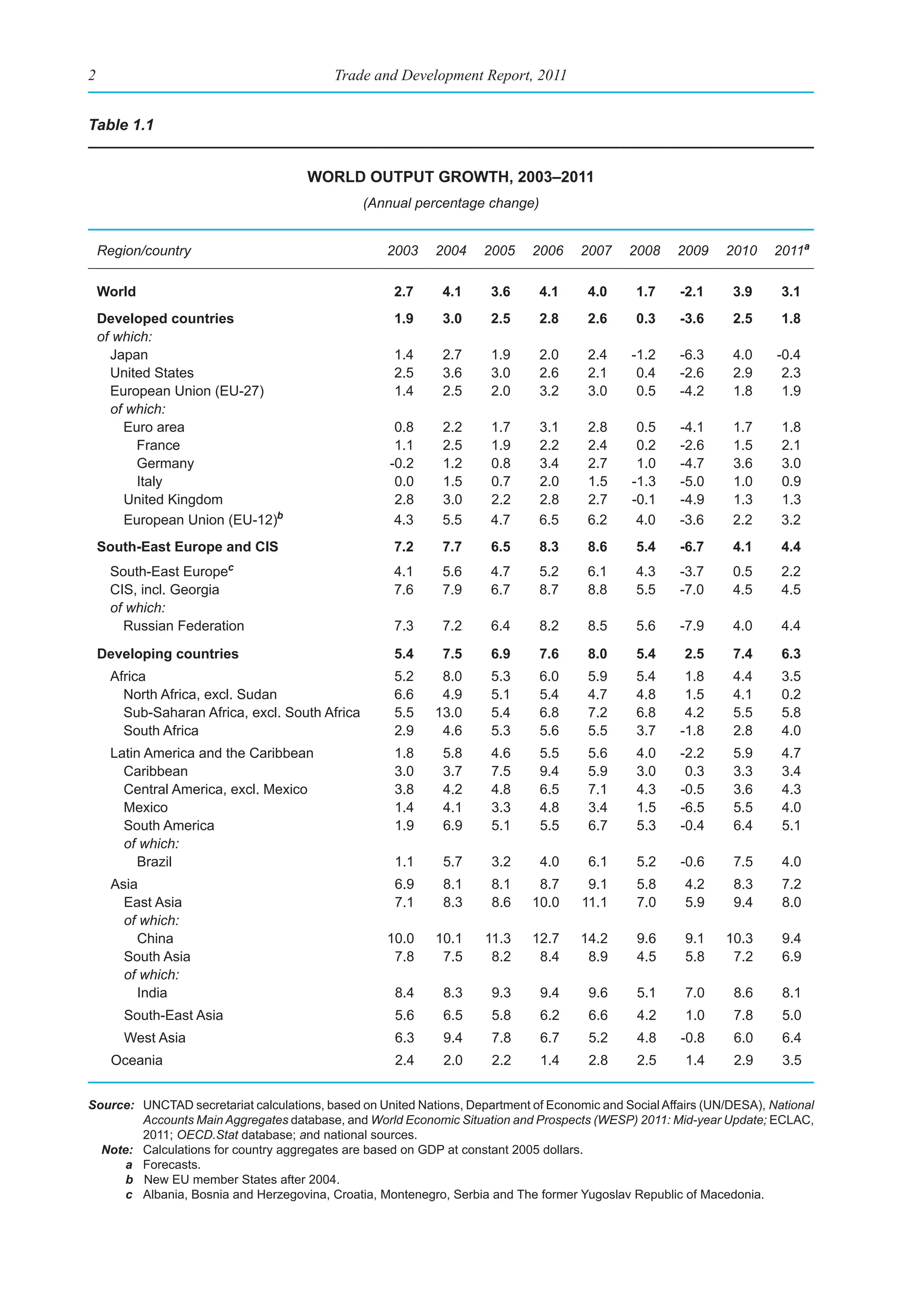
  • 63.
    Fiscal Aspects ofthe Financial Crisis and its Impact on Public Debt 31 Chapter II fIsCal aspeCts of the fInanCIal CrIsIs and Its ImpaCt on publIC debt a. Introduction The global financial crisis once again brought stabilizers, in particular reduced tax revenues, which fiscal policies and, more generally, the role of the reflected the downturn in economic activity, and, in State to the forefront of the economic policy debate. countries with well-developed social security sys- After many years of neoliberal policies oriented tems, increasing social expenditure, especially higher towards reducing the role of the State in economic unemployment allowances. management, governments in most countries came under pressure to undertake widespread and massive In many other countries, fiscal accounts were intervention to rescue the financial sector and com- also strongly affected by other crisis-related factors. pensate – at least partly – for the shrinking private On the revenue side, an abrupt fall in commod- demand. Previous obsessions with fiscal targets or ity prices reduced government income in countries balanced budgets were temporarily forgotten. Yet the where such income is linked to revenues from their virtually unanimous calls for public intervention started exports of primary commodities. On the expenditure to subside when most countries returned to positive side, currency depreciation and higher interest rate growth rates and their focus changed to the deteriora- spreads increased the burden of public debt, in some tion of fiscal deficits and public debt. Less than two cases significantly. And in several developed coun- years after the collapse of the large investment bank, tries, to a large extent the rise in public debt is a direct Lehman Brothers, the financial markets came to result of the crisis, as governments bailed out ailing view governments’ fiscal policy more as part of the financial institutions, which amounted to converting problem than the solution. former private debt into public debt. All these factors adversely affected the fiscal balance without deliver- Public sector accounts have been dramatically ing significant economic stimulus. Clearly, therefore, affected by the global crisis. In addition to policy- the crisis was not the outcome of excessive public driven fiscal stimulus packages, which typically expenditure or public sector deficits; rather, it was the involved a discretionary increase in public spend- cause of the high fiscal deficits and/or high public- ing and/or tax cuts to counter the macroeconomic debt-to-GDP ratios in several countries. impact of the crisis in the financial sector, the crisis itself affected fiscal balances and public debt through Nevertheless, some governments have already several channels. One reason for the increasing public changed their policy orientation from providing deficits and debts was the operation of automatic fiscal stimulus to fiscal tightening, while others are
  • 64.
    32 Trade and Development Report, 2011 planning to do so, in an effort to maintain or regain slower (or negative) GDP growth and the banking the confidence of financial markets which is viewed and currency crises. Therefore any policy that seeks as key to economic recovery. This policy reorienta- to reduce public debt should avoid curbing GDP tion comes at a time when private economic activity growth; without growth, any fiscal consolidation is is still far from being restored to a self-sustained highly unlikely to succeed. These findings challenge growth path, as discussed in chapter I. Although it is the influential “Lawson Doctrine”, that financial cri- universally recognized that the crisis was the result ses are caused by excessive public sector borrowing, of financial market failure, little has been learned and that private sector debt never poses a problem about placing too much confidence in the judgement because it is the outcome of optimal saving and of financial market actors, including rating agencies. investment decisions.1 Consequently, the usual corol- Many of the financial institutions that had behaved lary of that doctrine, which is that debt crises always irresponsibly were bailed out by governments in order require fiscal retrenchment, is also debatable. to limit the damage to the wider economic system. It is therefore surprising that, now that “the worst Section B of this chapter examines the evolution appears to be over” for those institutions, a large body of public revenues and expenditures before, during of public opinion and many policymakers are once and after the crisis in different groups of countries. again putting their trust in those same institutions It discusses to what extent government savings (and to judge what constitutes correct macroeconomic dissavings) may have contributed to the build-up management and public finance. of the crisis, and assesses how the crisis itself has affected fiscal outcomes. Countries felt the impact In any case, the shift towards fiscal tightening of the crisis in different and specific ways, and their appears to be premature in many countries where pri- ability and willingness to conduct countercyclical vate demand has not yet recovered on a self-sustaining policies varied. The section considers the different basis, and where government stimulus is still needed to challenges facing the major developed economies, avoid a prolonged stagnation. Premature fiscal tighten- the most vulnerable European and transition econo- ing could be self-defeating if it weakens the recovery mies – many of which sought financial support from process, hampers improvement in public revenues and the International Monetary Fund (IMF), the European increases the fiscal costs related to the recession and Union (EU) and other sources – and emerging market bailouts. Hence, by hindering economic growth, such and developing economies, in particular those that a policy would fail to achieve fiscal consolidation. rely heavily on earnings from commodity exports for their fiscal revenues. It also examines the various A clear assessment of the roots of the crisis and countries’ responses to those challenges. the evolution of public debt is of utmost importance for elaborating policy recommendations. Focusing Section C reviews the evolution of public debt almost exclusively on the current levels of public in developing and developed countries. It shows that, debt risks treating the symptoms but not the causes prior to the eruption of the crisis in 2008, develop- of the problem. And a wrong diagnosis would not ing countries had managed to sharply reduce their only leave some fundamental problems unsolved, average debt-to-GDP ratios and also made progress but would also render economic policy ineffective. towards altering the composition of their public debt This chapter examines the recent evolution of fiscal by borrowing more domestically than from abroad. accounts and public debt, both in developed and The crisis stopped this trend but did not completely developing economies, and discusses their relation- reverse it. In developed countries, by contrast, the ship with the crisis. Chapter III then focuses on the crisis led to a sudden jump in debt ratios. Lower related policy challenges. debt ratios in most developing countries generally had not been due to a reduction in the stock of public This chapter argues that the recent global finan- debt – except for a number of heavily indebted poor cial and economic crisis was not due to profligate countries that obtained debt reductions – but rather fiscal policies, and that the increase in public debt to their rapid GDP growth. Over the same period of in a number of developed countries was the result time, some developing countries started accumulat- of the Great Recession. Primary deficits caused by ing large external reserves, so that their ratios of net discretionary fiscal policies were a much smaller external public debt to GDP fell dramatically, and contributory factor to higher debt ratios than the previous currency mismatches in their aggregate
  • 65.
    Fiscal Aspects ofthe Financial Crisis and its Impact on Public Debt 33 balance sheets were corrected. These buffers pro- proactive fiscal policies. This section also discusses vided the fiscal and external space that enabled many the different factors that can cause a debt crisis. It of these countries to respond to the global recession shows that in general the primary budget deficit is with various countercyclical policies, whereas other a fairly small component of debt growth, the most developing countries, especially the low-income important factors being those related to balance-sheet ones, did not have similar fiscal space to conduct effects and banking crises. Section D concludes. b. fiscal aspects of the global crisis 1. Fiscal balances and global imbalances between 1992 and 2000, as a result of strong growth before the crisis of GDP and tax revenues as well as what was then called the “peace dividend”; they subsequently fell due to slower growth and policy shifts that reduced Economic crises and fiscal accounts are closely taxes and increased military expenditure, but this shift interrelated, although the nature of that relationship had no noticeable impact on the current account. The is controversial. It is clear that fiscal balances dete- progressive decline of household savings would be a riorated significantly in all regions with the crisis, better explanation for the widening current-account but this correlation does not reveal causality. At a deficit, but this alone could not have been sufficient, time when several governments and international as discussed below with reference to Japan. Rather, institutions are adopting a policy of fiscal austerity the trade and current-account deficits were more aimed at reducing their public-debt-to-GDP ratios as likely the result of a combination of rising consump- a priority, it is important to examine whether such a tion – by incurring ever-increasing private debt policy tackles the roots of the problem, or whether (which lowers household savings rates) – and the loss it is merely treating the symptoms and forgetting the of industrial competitiveness. However, the lower cause of the illness on the assumption that the ill- household savings were less of a contributory factor ness has already been cured (Aglietta, 2011: 47). In than the greater consumption of imported rather than other words, there is a need to assess whether fiscal domestically produced goods, which slowed down imbalances were a major cause of the crisis, because growth of domestic income, corporate profits and tax they led to overindebtedness or widened global revenue for the state and federal governments (TDR imbalances; or if, in general, fiscal deficits were the 2006, chapter I). consequence rather than the cause of the crisis. Another major developed economy, Japan, has A review of a number of systemically important run a current-account surplus every year over the past countries (including developed and emerging market three decades, with a rising trend from 1.5 per cent economies) shows that the evolution of govern- of GDP in 1990 to 4.8 per cent in 2007 (chart 2.1). ment savings2 is not the main factor behind external During that period, government savings plunged by imbalances. In the United States, the current-account 8 percentage points of GDP, and household savings balance fell steadily, from equilibrium in 1991 to a also fell by an equal amount. Thus the country’s deficit of 6 per cent of GDP in 2006, in the build-up to current-account surplus was clearly not because the the crisis (chart 2.1). Government savings can hardly Government or households decided to save more. explain this trend: they first increased significantly Similarly, in Germany the shift in the early 2000s
  • 66.
    34 Trade and Development Report, 2011 Chart 2.1 gross CapItal formatIon, Current-aCCount balanCe and natIonal savIngs In seleCted CountrIes, 1990–2010 (Per cent of current GDP) United States United Kingdom Japan 35 35 35 30 30 30 25 25 25 20 20 20 15 15 15 10 10 10 5 5 5 0 0 0 -5 -5 -5 -10 -10 -10 1990 1995 2000 2005 2010 1990 1995 2000 2005 2010 1990 1995 2000 2005 2010 Germany Spain Portugal 35 35 35 30 30 30 25 25 25 20 20 20 15 15 15 10 10 10 5 5 5 0 0 0 -5 -5 -5 -10 -10 -10 -15 -15 1990 1995 2000 2005 2010 1990 1995 2000 2005 2010 1990 1995 2000 2005 2010 Ireland Greece China 35 35 60 30 30 50 25 25 20 20 40 15 15 30 10 10 5 20 5 0 0 -5 10 -5 -10 0 -10 -15 -15 -20 -10 1990 1995 2000 2005 2010 1990 1995 2000 2005 2010 1990 1995 2000 2005 2010 Gross capital formation Current-account balance Gross savings: corporations Gross savings: general government Gross savings: households and non-profit institutions serving households
  • 67.
    Fiscal Aspects ofthe Financial Crisis and its Impact on Public Debt 35 Chart 2.1 (concluded) gross CapItal formatIon, Current-aCCount balanCe and natIonal savIngs In seleCted CountrIes, 1990–2010 (Per cent of current GDP) India Argentina Brazil 40 30 30 35 25 25 30 20 20 25 20 15 15 15 10 10 10 5 5 5 0 0 0 -5 -5 -5 -10 -10 -10 1990 1995 2000 2005 2010 1990 1995 2000 2005 2010 1990 1995 2000 2005 2010 Turkey Thailand Republic of Korea 40 50 50 30 40 40 30 30 20 20 20 10 10 10 0 0 0 -10 -10 -10 -20 -20 -20 1990 1995 2000 2005 2010 1990 1995 2000 2005 2010 1990 1995 2000 2005 2010 Malaysia Russian Federation Saudi Arabia 50 50 50 40 40 40 30 30 30 20 20 20 10 10 10 0 0 0 -10 -10 -10 -20 -20 -20 -30 1990 1995 2000 2005 2010 1990 1995 2000 2005 2010 1990 1995 2000 2005 2010 Gross capital formation Current-account balance Gross savings: private sector Gross savings: general government Source: UNCTAD secretariat calculations, based on EC-AMECO database; IMF, World Economic Outlook database; and national sources.
  • 68.
    36 Trade and Development Report, 2011 from a deficit to a large surplus in its external account because of their membership of the Eurosystem) coincided with a reduction in the government sav- and that their equity and real estate markets offered ings rate, while that of households remained stable. opportunities for making rapid profits. These capital The large trade surpluses of these two economies are inflows fuelled speculative bubbles and led to real therefore not the result of ex ante household or gov- currency appreciation in the host countries. Since the ernment savings, but of the strategic specialization nominal exchange rate as an instrument of monetary and the competitiveness of their economies. These management does not exist within the eurozone, real have further increased in recent years through a com- exchange rates drifted apart, driven by differences bination of productivity gains and wage restraint, and in country-specific rates of inflation and unit labour are consistent with the ex post increase in corporate costs (ULCs): between 2000 and 2006–2007, ULCs profits, which in turn have led to rising corporate increased between 5 and 15 per cent in Greece, savings. Ireland, Italy and Portugal, while in Germany, the largest economy of the eurozone and the main trading Starting in 2005, the German Government partner of most of the other members, they fell by embarked on fiscal adjustment and managed to 13 per cent (European Commission, 2011). generate positive savings. Since neither the Government nor In addition, easy access the corporate sector had net to credit – linked to financial financing needs, German banks Few countries ran large deregulation and capital inflows increased their lending abroad, fiscal deficits before the – led to a fall in household in particular to borrowers in crisis … savings. In Bulgaria, Greece, other European countries that Romania and the Baltic States were facing competitiveness those savings even turned nega- problems. This caused current- tive. As a result of their real account deficits in many of these countries to widen currency appreciation, higher domestic demand led and, as a counterpart, Germany’s trade surplus to to widening current-account deficits. The impact of grow (Koo, 2010). this unbalanced growth on corporate and government savings has been ambiguous: on the one hand, eco- Even in European countries that currently have nomic growth increased the revenues and savings of a sizeable public debt – requiring massive financial some governments and firms; on the other hand, easy assistance to avoid default in some of them – external access to credit may have weakened fiscal discipline imbalances have been largely unrelated to govern- (for instance, in Greece), and the loss of competitive- ment savings. In Hungary, Italy and Portugal, for ness affected corporate profits and savings. This was example, the current-account balance deteriorated probably the case in Italy, Portugal and Spain, where between 1995 and 2007–2008, while government corporate savings declined. savings remained fairly stable, averaging between 0 and -1 per cent of GDP. During the same period, Summing up, external imbalances in the coun- current-account deficits widened dramatically in tries reviewed above were not caused by government Bulgaria, Estonia, Latvia, Lithuania, Romania and dissavings, firstly, because in several countries Spain, their ratio to GDP reaching two-digit levels. government savings were positive before the crisis, However, government savings were positive in all and secondly, because government (and corporate) these countries, and followed a rising trend in most of savings behaved basically as endogenous variables. them. Only in Greece did the current-account balance The main factors contributing to their current-account and government savings deteriorate simultaneously deterioration were the loss of international competi- after 2000; but, even there, the external deficit could tiveness of their domestic firms and the decline in not have been caused by government dissavings household savings, both of which were linked to alone. What all these above-mentioned countries have massive capital inflows and financial deregulation in common is a loss of competitiveness during most that spurred credit-financed household expenditure of the 2000s. This was partly due to capital inflows and led to real appreciation of their currencies. that were attracted by interest rates differentials, combined with a perception that these countries These experiences replicate, to a large extent, presented a low exchange-rate risk (in some cases those of many Latin American and Asian countries
  • 69.
    Fiscal Aspects ofthe Financial Crisis and its Impact on Public Debt 37 that suffered from financial crises between 1982 In Brazil, the current-account balance improved and 2002. In all these countries, changes in the real after the crisis and devaluation of 1999, but moved exchange rate were a major factor contributing to back into deficit during the last phase of the 2003– the crises and also to recovery. In Argentina, Brazil, 2008 period of boom, when high interest rates and Chile, Mexico and Uruguay, anti-inflation policies consequent capital inflows led to renewed currency relied on exchange-rate anchors, which eventually appreciation (chart 2.1). Similarly, but at less spec- led to real currency appreciation and a loss of com- tacular rates, the expansion of output and investment petitiveness, and consequently to lower corporate created the conditions for higher private and public profits and output growth. As long as capital inflows savings. However, improvement in the fiscal accounts were attracted by interest rate differentials and ben- was limited by the high level of interest payments on efited from implicit insurance against exchange-rate the public debt. Indeed, although the Government risk, these countries could finance their resulting generated a sizeable primary surplus of close to 3 per current-account deficits. Capital inflows were not cent of GDP between 2005 and 2010, it still ran an used primarily to increase fixed investment, but rather overall deficit (e.g. including net interest payments) to finance private consumption and public debt ser- of a similar magnitude. The fiscal deficit in Brazil is vice. Foreign savings thus caused a fall in domestic clearly the consequence of high interest rates, and not savings of both households and firms (as a result of its cause as suggested by some authors (e.g. Bacha, lower profits). Government savings also tended to 2011; Lara Resende, 2011). decline – even turning negative in Argentina and Brazil – due to slower growth which lowered fiscal Among the Asian countries, China and India revenues, and to the increasing cost of public debt, as witnessed a strong increase in investment rates and monetary authorities tried to preserve their currency national savings in the 2000s. In China, government pegs by raising domestic interest rates. savings have accounted for about 9 per cent of GDP in recent years, while private sav- The situation changed dra- ings grew to more than 44 per matically with the steep currency cent of GDP in 2006–2010 – by devaluations in Mexico in 1994– … such deficits were the far the highest private savings 1995, in Brazil in 1999 and in consequence rather than the rate among the G-20 countries. Argentina in 2002. In Argentina, cause of the crisis. Until 2007, the current-account the current account swung from surplus grew significantly, but a deficit to a huge surplus in a again it would be a mistake single year, due partly to devalu- to conclude that these savings ation and partly to severe economic contraction have been the cause of China’s large current-account (chart 2.1). The growth of private savings in 2002 was surplus. That surplus is more likely to have been the particularly surprising, since almost all conceivable result of an endogenous process whereby fast income factors for discouraging such savings were in place: growth, fuelled by massive investment and exports, freezing of bank deposits, debt default, negative real boosted government and private savings. interest rates and deep depression. Despite these conditions, corporate profits in the tradables sector Distinct from China, India has maintained its increased very rapidly, and, as a consequence, so current-account balance at close to equilibrium over did corporate savings in response to the new relative the past two decades. It has even registered a small price structure. In the subsequent recovery of the real deficit close to 2 per cent since 2008. Here, the large economy to very high growth rates, households and increase in the investment rate was the counterpart the Government generated significant savings from of higher domestic savings. Hence, India’s external higher revenues and the investment rate more than imbalances were not caused by domestic dissavings, doubled, with financing from domestic resources. and, as they were rather small, they did not have Mexico also rapidly reduced its current-account major global repercussions. deficit, although it did not turn this into surplus, and corporate savings also increased as a result of The performance of several South-East Asian currency devaluation. In subsequent years, private countries differs from these two largest Asian devel- savings of both households and the corporate sector oping countries. In most countries of this region, such remained high. as Indonesia, Malaysia, the Philippines, the Republic
  • 70.
    38 Trade and Development Report, 2011 of Korea and Thailand, the 1997–1998 crisis marked household savings, associated with an expansion of a clear break in their investment pattern. In some of credit and the formation of speculative bubbles. them, the sharp adjustment of current-account bal- ances during the Asian crisis coincided with falling When the crisis erupted, new credit dried up investments (chart 2.1). Even after that crisis, invest- in most developed economies, and households were ment rates never returned to their pre-crisis levels. compelled to adjust their expenditure to pay off debt. The evolution of government savings prior to that From 2007 to 2009, private savings increased by crisis had little to do with its eruption. More recently, between 2 and 3.5 percentage points of GDP in Japan, between 2008 and 2009, the increased government Portugal, the United Kingdom, and the United States, spending sought to compensate for lower private and between 5 and 10 percentage points in the Baltic demand, which increased private savings. States, Ireland and Spain (chart 2.1). Government savings declined sharply in these countries, due partly In major oil- and mineral-exporting countries, to the effects of automatic stabilizers and partly to external and public budget balances are heavily discretionary increases in public expenditure as dependent on export revenues. Therefore both vari- governments sought to compensate for lower private ables tend to closely follow the evolution of export demand. Fiscal balances moved substantially into the prices: high prices lead simultaneously to fiscal and red, but this was a consequence rather than a cause current-account surpluses – or “negative foreign of the crisis. savings” – and vice versa. As a result, in countries such as Algeria, Azerbaijan, Bolivia, Gabon, Kuwait, the Russian Federation and Saudi Arabia, there is a strong negative correlation between government 2. The evolution of fiscal accounts and savings and foreign savings. Since private savings the impact of the crisis are positively influenced by economic activity, which normally accelerates when prices are high and current accounts are in surplus, those savings also tend to be While the previous section looked at the record negatively correlated with foreign savings. However, of fiscal balances and their possible linkages with this trade-off between domestic and foreign savings domestic and global imbalances, this section examines does not indicate any causality between them; for the recent evolution of fiscal revenues and expenditure instance, current-account surpluses in recent years and how they affected countries’ room for manoeuvre have not resulted from residents’ decisions to save in their policy response to the crisis. It also discusses more. the impact of the crisis on fiscal accounts, as a result of “automatic” changes in revenues and expenditures, These examples suggest that both public and and how countries responded by means of proactive private savings are largely endogenous variables policy measures such as stimulus packages. that are determined by a number of domestic and external factors. The most important factor is the Between 2002 and 2007–2008, fiscal balances international competitiveness of domestic producers, improved significantly in many countries, although which derives from productivity and relative prices. some governments continued to run relatively large It determines to a large extent the current-account deficits. On the eve of the crisis, fiscal accounts were balance, or in other words, “foreign savings”. While balanced, on average, in East, South and South-East a relationship necessarily exists between national sav- Asia, and Latin America; and in Africa, the transition ings, foreign savings and investment – the elements economies and West Asia, governments were achiev- of a national accounting identity – causality may ing sizeable surpluses. In developed economies, fiscal run in different directions. In most of the countries deficits had fallen, on average to less than 1.5 per cent reviewed, current-account imbalances were not the of GDP. However, the crisis caused fiscal accounts to result of changes in government savings. Either the turn into deficit in all the regions (chart 2.2). causality ran in the opposite direction, or other factors (i.e. international competitiveness and/or commod- In general, the improvement of fiscal balances ity prices) determined both current accounts and in the years preceding the crisis did not result from fiscal imbalances. In many of these countries, the fiscal retrenchment and expenditure cuts; in most main counterpart of external deficits was shrinking countries, government revenues and expenditures
  • 71.
    Fiscal Aspects ofthe Financial Crisis and its Impact on Public Debt 39 Chart 2.2 government revenues and expendIture and fIsCal balanCe In seleCted regIons, 1997–2010 (Per cent of current GDP, weighted average) Africa Latin America and the Caribbean 50 10 50 10 45 8 45 8 40 6 40 6 35 4 35 4 30 2 30 2 25 0 25 0 20 -2 20 -2 15 -4 15 -4 10 -6 10 -6 5 -8 5 -8 0 -10 0 -10 1997 1998 1999 2000 2001 2002 2003 2004 2005 2006 2007 2008 2009 2010 1997 1998 1999 2000 2001 2002 2003 2004 2005 2006 2007 2008 2009 2010 East, South and South-East Asia West Asia 50 10 50 15 45 8 45 40 6 40 10 35 4 35 5 30 2 30 25 0 25 0 20 -2 20 15 -4 15 -5 10 -6 10 -10 5 -8 5 0 -10 0 -15 1997 1998 1999 2000 2001 2002 2003 2004 2005 2006 2007 2008 2009 2010 1997 1998 1999 2000 2001 2002 2003 2004 2005 2006 2007 2008 2009 2010 Transition economies Developed economies 50 10 50 10 45 8 45 8 40 6 40 6 35 4 35 4 30 2 30 2 25 0 25 0 20 -2 20 -2 15 -4 15 -4 10 -6 10 -6 5 -8 5 -8 0 -10 0 -10 1997 1998 1999 2000 2001 2002 2003 2004 2005 2006 2007 2008 2009 2010 1997 1998 1999 2000 2001 2002 2003 2004 2005 2006 2007 2008 2009 2010 Government revenues Government expenditure Fiscal balance (right scale) Source: UNCTAD secretariat calculations, based on the EC-AMECO database; OECD, Economic Outlook database; ECLAC, CEPALSTAT; IMF, World Economic Outlook database; and national sources. Note: Africa excludes: Botswana, Burkina Faso, Cape Verde, Central African Republic, Equatorial Guinea, Lesotho, Liberia, Madagascar, Mauritania, Mayotte, Saint Helena, Seychelles, Somalia, Western Sahara and Zimbabwe. West Asia excludes: Iraq, Occupied Palestinian Territory and Yemen. East, South and South-East Asia comprises: China, China, Hong Kong SAR, India, Indonesia, the Islamic Republic of Iran, the Republic of Korea, Malaysia, Nepal, the Philippines, Singapore, Sri Lanka, Taiwan Province of China, Thailand and Viet Nam. (Data for China refer to budget revenue and expenditure, they do not include extra-budgetary funds or social security funds.) Transition economies exclude: Croatia and Montenegro, but include Mongolia. Latin America comprises: Argentina, Bolivia, Bolivarian Republic of Venezuela, Brazil, Chile, Colom- bia, Costa Rica, Ecuador, El Salvador, Mexico, Nicaragua, Peru and Uruguay. Developed economies comprise: Austria, Belgium, Bulgaria, Canada, Cyprus, the Czech Republic, Denmark, Estonia, Finland, France, Germany, Greece, Iceland, Ireland, Italy, Japan, Latvia, Lithuania, Luxembourg, Malta, the Netherlands, Norway, Poland, Portugal, Romania, Slovakia, Spain, Sweden, Switzerland, the United Kingdom and the United States.
  • 72.
    40 Trade and Development Report, 2011 Table 2.1 evolutIon of fIsCal IndICators, seleCted regIons, 1997–2010 (Per cent of current GDP)a 1997 1998 1999 2000 2001 2002 2003 2004 2005 2006 2007 2008 2009 2010 developed economies Total revenue and grants 38.8 38.9 38.8 38.5 38.1 36.8 36.9 37.2 38.1 39.1 39.3 39.0 37.5 37.7 Current revenue 37.6 37.8 37.7 37.4 36.9 35.6 35.7 35.9 36.9 37.8 38.1 37.7 36.1 36.6 Tax revenues 33.4 33.6 33.5 33.2 32.7 31.4 31.6 31.8 32.6 33.4 33.6 33.1 31.2 31.5 Non-tax revenuesb 5.4 5.3 5.3 5.3 5.4 5.4 5.3 5.5 5.5 5.8 5.7 6.0 6.3 6.2 Total expenditure 40.9 41.4 40.1 39.0 39.8 40.6 41.3 40.9 41.1 40.5 40.7 42.3 45.9 46.1 Current expenditure 36.4 36.1 35.6 34.8 35.3 36.1 36.9 36.7 36.7 36.5 36.7 37.9 40.9 41.1 Interest payments 4.4 4.2 3.8 3.6 3.4 3.1 2.8 2.7 2.7 2.7 2.8 2.7 2.6 2.7 Capital expenditure 4.4 5.3 4.5 4.2 4.5 4.4 4.4 4.2 4.4 4.0 4.1 4.5 5.0 5.0 Primary balance 2.3 1.7 2.4 3.2 1.7 -0.7 -1.5 -1.0 -0.3 1.3 1.3 -0.6 -5.8 -5.7 Overall balance -2.1 -2.5 -1.3 -0.4 -1.7 -3.8 -4.3 -3.7 -3.0 -1.4 -1.4 -3.3 -8.4 -8.4 africa Total revenue and grants 24.5 22.6 23.8 28.0 27.5 26.1 26.6 27.7 30.1 32.4 31.1 33.8 27.3 28.8 Tax revenues 17.6 16.6 18.1 19.5 18.9 17.2 17.8 18.3 19.6 19.9 19.8 21.0 19.0 19.0 Non-tax revenuesb 6.9 6.0 5.6 8.5 8.6 9.0 8.8 9.3 10.6 12.4 11.3 12.8 8.3 9.8 Total expenditure 25.3 24.9 24.3 26.4 29.0 28.2 28.6 27.3 27.4 27.2 29.1 30.9 32.2 32.3 Current expenditure 19.5 19.3 18.8 21.4 22.9 22.3 23.2 21.9 21.7 21.0 21.6 22.5 24.0 24.6 Interest payments 3.0 3.0 3.0 3.8 3.6 3.3 3.5 2.8 2.6 2.2 2.1 1.8 1.9 2.1 Capital expenditure 5.7 5.5 5.4 4.9 6.0 5.5 5.0 5.2 5.6 6.1 7.2 8.2 8.1 7.6 Primary balance 2.1 0.4 2.2 5.3 1.9 1.1 1.3 2.9 5.3 7.2 3.7 4.4 -3.3 -1.7 Overall balance -0.8 -2.3 -0.5 1.6 -1.5 -2.0 -2.0 0.3 2.8 5.1 2.0 2.9 -4.9 -3.5 latin america Total revenue and grants 26.4 25.7 25.2 26.0 25.6 25.8 26.8 27.5 28.9 29.8 30.6 31.8 31.2 33.2 Tax revenues 18.8 19.1 18.4 18.2 18.1 18.0 18.4 18.9 20.0 20.6 21.3 21.7 21.9 23.5 Non-tax revenuesb 7.2 6.4 6.7 7.8 7.5 7.8 8.3 8.6 8.8 9.2 9.1 10.0 9.2 9.7 Total expenditure 29.0 29.3 28.4 28.0 28.6 28.4 28.9 28.2 29.6 30.6 31.2 32.7 34.5 34.9 Current expenditure 26.5 25.8 25.3 25.1 25.5 25.0 25.9 24.9 26.2 27.0 27.4 28.5 29.9 29.8 Interest payments 3.2 4.1 4.4 3.9 4.0 4.0 4.6 3.8 4.0 3.7 3.4 3.4 3.4 2.7 Capital expenditure 2.5 3.4 3.1 2.9 3.1 3.3 3.0 3.3 3.4 3.6 3.8 4.2 4.6 5.0 Primary balance 1.3 0.5 1.3 1.9 1.0 1.4 2.4 3.0 3.2 3.0 2.9 2.5 0.1 1.1 Overall balance -1.8 -3.6 -3.2 -2.0 -3.0 -2.6 -2.1 -0.8 -0.8 -0.8 -0.6 -0.9 -3.3 -1.7 east, south and south-east asia Total revenue and grants 17.3 16.4 17.0 18.2 17.8 17.9 18.5 18.7 19.4 20.1 21.4 20.7 20.2 20.3 Tax revenues 13.0 12.6 12.9 13.7 13.6 13.8 14.1 14.4 14.9 15.4 16.3 16.3 16.0 16.5 Non-tax revenuesb 4.4 3.8 4.1 4.6 4.2 4.1 4.4 4.3 4.5 4.8 5.1 4.4 4.2 3.8 Total expenditure 17.8 19.0 19.9 20.6 20.8 20.9 21.0 20.3 20.5 20.6 20.7 21.9 23.8 23.0 Current expenditure 13.3 14.5 15.3 16.2 16.5 16.6 16.4 16.1 16.3 16.3 16.3 17.4 18.9 18.3 Interest payments 1.9 2.1 2.4 2.3 2.4 2.3 2.2 2.0 1.8 1.8 1.7 1.6 1.5 1.4 Capital expenditure 4.6 4.7 4.8 4.4 4.4 4.4 4.5 4.2 4.3 4.4 4.4 4.6 5.0 4.8 Primary balance 1.4 -0.4 -0.5 0.0 -0.7 -0.7 -0.3 0.3 0.7 1.3 2.3 0.4 -2.1 -1.2 Overall balance -0.5 -2.6 -2.9 -2.3 -3.1 -3.0 -2.5 -1.6 -1.1 -0.5 0.7 -1.2 -3.6 -2.7 West asia Total revenue and grants 20.9 21.3 25.2 31.2 32.6 28.9 30.5 31.9 35.2 37.9 35.6 39.6 32.2 33.7 Tax revenues 10.6 11.6 7.9 7.2 7.4 8.0 8.9 8.4 8.2 8.7 9.1 8.6 9.3 9.5 Non-tax revenuesb 10.3 9.7 17.4 23.9 25.2 20.9 21.6 23.5 27.0 29.2 26.5 31.0 22.9 24.2 Total expenditure 25.7 26.8 29.8 30.1 34.2 33.3 31.2 28.3 26.0 25.8 26.4 26.3 33.3 31.2 Current expenditure 22.8 24.3 27.0 27.3 30.6 29.5 27.7 25.2 22.6 22.1 21.8 21.8 27.0 25.1 Interest payments 5.4 7.7 6.3 7.0 7.8 7.1 6.5 5.2 3.7 3.2 3.0 2.5 2.8 2.3 Capital expenditure 2.8 2.5 2.8 2.8 3.6 3.7 3.5 3.1 3.4 3.6 4.6 4.4 6.3 6.0 Primary balance 0.7 2.3 1.7 8.0 6.2 2.6 5.8 8.7 12.9 15.3 12.1 15.9 1.7 4.8 Overall balance -4.7 -5.4 -4.6 1.0 -1.6 -4.4 -0.7 3.5 9.2 12.1 9.2 13.3 -1.1 2.5 transition economies Total revenue and grants 36.1 35.9 35.9 39.7 38.7 39.0 39.1 35.0 35.6 Tax revenues 25.1 24.7 25.2 29.8 29.3 29.7 29.4 24.6 26.2 Non-tax revenuesb 10.9 11.2 10.7 9.9 9.4 9.3 9.7 10.4 9.4 Total expenditure 36.1 35.1 32.6 33.5 32.0 33.7 35.1 40.3 38.3 Current expenditure 28.0 28.5 25.6 28.7 25.9 27.9 28.8 34.1 32.1 Interest payments 1.9 1.5 1.1 0.9 0.7 0.6 0.5 0.7 0.7 Capital expenditure 8.1 6.7 7.1 4.8 6.1 5.9 6.3 6.3 6.2 Primary balance 1.9 2.3 4.4 7.1 7.4 5.8 4.5 -4.7 -2.1 Overall balance 0.0 0.8 3.3 6.3 6.7 5.3 4.0 -5.3 -2.7 Source: UNCTAD secretariat calculations, based on EC-AMECO database; OECD, Economic Outlook database; ECLAC, CEPALSTAT; IMF, World Economic Outlook database; and national sources. Note: For the composition of country groups, see chart 2.2. a Corresponds to general government except for Argentina, Bolivia, the Bolivarian Republic of Venezuela, Colombia, Costa Rica, Ecuador, El Salvador, Mexico, Nicaragua and Uruguay, for which indicators refer to the non-financial public sector. b Includes capital revenues.
  • 73.
    Fiscal Aspects ofthe Financial Crisis and its Impact on Public Debt 41 increased together, although at different rates. With between the periods 1998–2000 and 2008–2010. In the exception of developed countries, where they the transition economies there was a similar reduction remained flat as a percentage of GDP, government between 2002 and 2008–2010. In all these regions, revenues expanded significantly in all regions from the decline in interest payments was even greater in 2002–2003 onwards. This was supported by broad- relation to fiscal revenues. During the same period, based acceleration of growth and the share of fiscal revenues that increased earnings from com- had to be used for interest pay- modity exports. The latter result- ments fell from 14 to 7 per cent ed not only from higher prices, Many developing economies in Africa, from 16 to 8 per cent but also from changes in the had improved their fiscal in Latin America, from 16 to distribution of natural resource balances before the crisis, 12 per cent in East and South rents, with a larger share going to with higher public revenues Asia, and from 25 to 7 per cent the governments in several of the and expenditure, which in West Asia. This meant that a producing countries. In Africa, enlarged their policy space. significant proportion of fiscal the transition economies, East, resources could be redirected South and South-East Asia and from debt servicing to more Latin America, expenditure ratios also increased, in productive uses. Indeed, social transfers and capital many cases from relatively low levels (table 2.1). expenditure increased significantly in developing regions. Capital expenditure alone gained between West Asian countries seem to have followed 2 and 3 percentage points of GDP between 2000 a different pattern. Between 2001 and 2008, gov- and 2010 (table 2.1). Hence, not only did the size of ernment expenditure as a percentage of GDP fell public sector finances increase (measured either as significantly, especially in Kuwait, Saudi Arabia, the share of government revenue or expenditure in Turkey and the United Arab Emirates. However, GDP), but also its support for capital formation and this does not indicate a reduction of government improvements in income distribution grew. expenditure in absolute terms; the expenditure ratio decreased mainly because GDP at current prices rose Such expansionary adjustments of fiscal bal- very rapidly in the major oil-exporting countries due ances, with higher revenues and primary expenditure, to higher oil prices. In addition, lower interest pay- implied a structural change in many developing and ments on public debt accounted for a large share of transition economies, and served to enlarge their the fall in government expenditure: in Turkey, they policy space which they were able to use when hit by fell from 22.4 per cent of GDP in 2001 to 4.4 per cent the financial crisis. Almost from the onset of the crisis in 2010, owing to a significant decline in public debt there was wide consensus in the major economies ratios and an even more impres- that fiscal measures were neces- sive decline in domestic interest sary for pulling the economies rates. The reduction in interest out of recession. In 2008 and payments was also significant in In 2008 and 2009, 2009, government expenditure Jordan, Kuwait, Lebanon, Qatar government expenditure as a share of GDP soared in and Saudi Arabia (where they soared in all regions, while all the regions, while govern- fell from almost 8 per cent of government revenues ment revenues declined, but GDP in the early 2000s to only declined, especially in in varying degrees: steeply in 2.3 per cent in 2010). developed economies and the regions that rely heavily on commodity exporters. primary commodity exports (i.e. The declining share of inter- Africa, the transition economies est payments in public expendi- and West Asia), significantly ture has been a widespread trend but less sharply in developed (table 2.1). It resulted from the reduction of public debt economies, and very moderately in East, South and ratios in most developing and emerging economies (as South-East Asia and Latin America. discussed further in the next section), as well as from lower real interest rates in most countries. In Africa, In developed countries with well-established Latin America and East, South and South-East Asia, social security systems and a comparatively high interest payments fell by 1 to 2 percentage points share of direct taxes in fiscal revenues, changes in
  • 74.
    42 Trade and Development Report, 2011 government revenues and expenditure are partly (about 40 per cent) in developed countries, compared related to automatic stabilizers. Between 2007 and with only 5 per cent in the developing and transition 2010, spending on social security benefits increased economies listed in table 2.2. However, in a number by 3 per cent of GDP in Japan and the United States, of developed countries that announced multiple and by between 1.5 and 4.3 per cent of GDP in most waves of stimulus packages, the spending component European countries, with the highest increases in increased compared with tax cuts in the subsequent those countries where unemployment rose the most, announcements (Prasad and Sorkin, 2009). such as Greece and Spain. On the revenue side, the loss of receipts from income, profits and capital In several developing and transition econo- gains taxes was particularly severe in the United mies, the relative size of the stimulus packages as a States: almost 4 per cent of GDP between 2007 and share of GDP actually exceeded that of developed 2009. But not all supplementary social benefits and economies. For instance, China and the Republic lower tax revenues were “automatically” triggered by of Korea announced packages equivalent to 13 and the recession and higher unemployment; in several 10 per cent of their respective GDP. In China, three countries, they were also part of discretionary fiscal major fiscal packages were announced between stimulus packages, including tax cuts and increased November 2008 and March 2009, totalling almost spending, as part of governments’ efforts to stimulate $570 billion. All these resources were allocated to domestic demand and counteract the effects of the increased spending, 74 per cent of which was capital global economic crisis. expenditure, in particular for post-earthquake recon- struction projects and investment in infrastructure. In addition, the monetary authorities lowered The Government of the Republic of Korea made four interest rates and provided the liquidity necessary to major announcements of stimulus between November avoid financial collapse. But such policies could not 2008 and March 2009, involving the equivalent of revive credit and restore global demand, as a massive $95 billion, of which 97 per cent was in the form of private deleveraging process was under way. Fiscal increased expenditure. Thereafter, in August 2009 the stimulus was therefore even more critical to counter- Government announced a fifth package which con- balance the shrinking demand of the private sector. sisted exclusively of tax incentives and deductions, but there is no estimation of the cost of this additional component. In Indonesia, the Government announced a fiscal programme that was relatively small in com- 3. Fiscal responses to the crisis parison, and mainly comprised tax incentives and deductions. Nevertheless, overall stimulus packages in developing Asia, including Bangladesh, India, The fiscal responses to the crisis in the major Malaysia, the Philippines, Singapore and Thailand economies varied considerably across regions and emphasized higher spending, particularly for infra- countries, not only in terms of the size of their eco- structure investment (Hur et al., 2010). nomic stimulus, but also in terms of its composition and timing. A detailed assessment of fiscal stimulus In Latin America, at the end of 2008 the major packages is not straightforward, because it is difficult economies launched a set of measures to counter to distinguish policy measures that were adopted in the effects of the economic and financial crisis. response to the crisis from others that were already Argentina announced the largest stimulus package planned or that would have been implemented in as a percentage of GDP, followed by Brazil, Chile any case (e.g. public investments for reconstruction and Mexico. The composition of these packages following natural disasters). In addition, official reflected the view that increased spending, rather than announcements are not always executed at the tax cuts, was the most appropriate tool to stimulate expected time, and they only provide a general idea domestic demand under the prevailing circumstances. of the size and composition of the packages. Among Increased spending provides a direct means of boost- developed countries, the United States implemented ing demand, whereas tax cuts increase the private the largest stimulus package, in both nominal terms sector’s disposable income, a large proportion of and as a percentage of GDP, followed by Japan and which, in a context of uncertainty, is likely to be saved Germany (table 2.2). A relatively large share of the rather than spent. In some countries, the increased announced fiscal stimulus took the form of tax cuts expenditure was partly covered by fiscal revenue
  • 75.
    Fiscal Aspects ofthe Financial Crisis and its Impact on Public Debt 43 Table 2.2 fIsCal stImulus paCkages, as announCed In seleCted eConomIes, 2008–2010 (Billions of dollars and percentages) Total amount GDP ($ billion) (Per cent) Tax cut share Spending share developed economies Australia 23 2.4 45.2 54.8 Canada 24 1.8 52.4 47.6 France 21 0.8 6.5 93.5 Germany 47 1.4 68.0 32.0 Italy 6 0.3 33.3 66.7 Japan 117 2.3 30.0 70.0 Spain 35 2.4 58.4 41.6 United Kingdom 35 1.5 56.0 44.0 United Statesa 821 5.7 36.5 63.5 Total 1129 3.3 38.3 61.7 Unweighted average 2.1 42.9 57.1 developing and transition economies Argentina 17 6.0 8.5 91.5 Brazil 45 3.6 15.0 85.0 China 568 13.1 0.0 100.0 Chile 4 2.8 46.0 54.0 India 43 3.4 0.0 100.0 Indonesia 8 1.5 76.9 23.1 Mexico 21 2.4 0.0 100.0 Republic of Korea 95 10.2 2.9 97.1 Russian Federation 80 6.4 31.3 68.7 Saudi Arabia 50 9.4 0.0 100.0 South Africa 8 2.6 0.0 100.0 Total 937 8.0 4.7 95.3 Unweighted average 5.6 16.4 83.6 Source: UNCTAD secretariat calculations, based on European Commission, 2009; ECLAC, 2009; CBO, 2011; OECD, 2009; Hur et al., 2010; Ponomarenko and Vlasov, 2010; Prasad and Sorkin, 2009; and United States Government, 2011. a The amount reported for the United States refers only to the stimulus package provided under the American Recovery and Reinvestment Act (ARRA) of 2009; it excludes the cost of industry bailouts and capital infusions that were components of the Troubled Asset Relief Program (TARP). from new sources. For instance, in Argentina this was them well when the crisis erupted, by enabling them achieved through social security reform (reverting to increase their spending to moderate its impacts. from a private-dominated capitalization regime to At the same time, many countries were able to sig- a pay-as-you go public system), whereas in Brazil, nificantly reduce their public debt. higher capital expenditure was financed by selling oil exploration rights. In Latin America, in 2009 Chile used the reserves that the Government had accumulated in Governments of many natural-resource-rich its stabilization fund during the years of high copper countries where public finances had a strongly pro- prices to counter the impact of the crisis (Villafuerte, cyclical bias in the past were generally able to adopt López-Murphy and Ossowski, 2010; Torre, Sinnott proactive countercyclical policies despite the fall in and Nash, 2010). Many oil-producing countries commodity prices (World Bank, 2009). During the in North Africa and West Asia, as well as in the commodity boom in the 2000s, when several of these Commonwealth of Independent States, were also countries adopted fairly prudent fiscal policies, the able to implement fiscal stimulus packages (Abdih resulting reserves they managed to accumulate served et al., 2010). In countries such as Kazakhstan and
  • 76.
    44 Trade and Development Report, 2011 the Russian Federation, where the domestic financial expenditures, and on discretionary fiscal stimulus sector was strongly affected by the global financial measures. In the context of the latest crisis, bail- and economic crisis, a significant proportion of fis- out operations have been taking place mainly in cal expenditure was targeted at rescuing that sector developed economies. Developing countries were (Heuty and Aristi, 2010). A number of governments generally able to avoid this kind of fiscal cost, because in sub-Saharan Africa also followed an expansion- most of them did not experience banking crises, and ary stance as a response to the crisis, based on public therefore did not need to bail out any of their banks. revenue perceived from their extractive industries There were a few exceptions, such as Dubai and (Kasekende, Brixiová and Ndikumana, 2010; Osakwe, Trinidad and Tobago, where the governments pro- 2011; Brixiová, Ndikumana and Abderrahim, 2010). vided support to investment companies. In addition, a relatively solid external payments position made it In a context of rising commodity prices, many of possible for most developing-country governments these resource-rich countries recovered rapidly from to manage the initial financial turbulence caused by the crisis, and currently present short-term capital fleeing to “safe a better fiscal situation and much havens”. They used international lower ratios of public debt to reserves and controlled currency GDP than in the early 2000s. Fiscal stimulus in developing depreciation, without resorting to Given that commodity prices countries consisted of an monetary “overkill”. Although in general have rebounded since increase in public spending, the monetary authorities in sev- mid-2009, and have continued while in developed countries it eral countries initially increased to grow strongly, it is difficult consisted largely of tax cuts. interest rates, they were able to to assess whether economic return rapidly to a more accom- growth in the natural-resource- modative monetary stance. As a rich countries in 2010 and 2011 result, public finances in develop- has been due to their fiscal stimulus policies or ing and emerging market economies were not affected whether it is a consequence of the rising commodity by rising interest rates on the domestic public debt. prices. However, there are indications that in many of these countries GDP growth started to recover In contrast, fiscal accounts in several developed when commodity prices were still in a trough, mainly countries were severely affected by the financial in the first quarter of 2009. This would suggest that crisis. In these countries, the authorities gave top the fiscal stimulus succeeded in expanding their priority to preventing the collapse of the financial economies. Moreover, these countries probably system, making available the financial resources nec- would have been in a much worse situation had the essary to achieve this objective. In 22 EU countries, fiscal stimulus not been implemented. In any case, “approved government aid”3 to the financial sector although economic recovery in these countries may between October 2008 and October 2010 exceeded imply that the extraordinary fiscal stimulus can be €4.5 trillion, which represents 39 per cent of EU-27 discontinued, they may need to maintain higher levels GDP for 2009. The first 25 per cent of this aid was of expenditure than before the crisis for developmen- disbursed in 2008 and another equal amount in 2009. tal purposes. Infrastructure investment and social These “actually used amounts” are lower than the transfers, for example, are fundamental elements of upper limits of support, since in some countries, such a long-term development strategy. As long as govern- as Denmark and Ireland, a significant share of the ment revenues are healthy as a result of economic approved aid consisted of large blanket-guarantee growth and high commodity prices, a reduction in schemes which covered the entirety of their banks’ these expenditures would not be justified. debts. From the €4.5 trillion of total approved aid, €2.3 trillion was provided through special schemes Financial crises – such as those that struck many or particular financial institutions in 2008 and 2009, emerging-market economies in the past – typically of which 25 per cent (€237 billion in 2008 and create fiscal costs through interest rate hikes, currency €354 billion in 2009) was finally treated as an “aid devaluation that increases the burden of public debt element” by the Commission, since the total amount denominated in foreign currencies, and public-funded used cannot be treated as a benefit. However, to put bailouts. This is in addition to the direct effects of them in perspective, the crisis-related aid measures slower growth or recession on current revenues and to financial institutions in 2009 represented about
  • 77.
    Fiscal Aspects ofthe Financial Crisis and its Impact on Public Debt 45 five times the overall amount of State aid granted the fiscal deficit: in Ireland, for example, capital to all other sectors (agriculture, fisheries, industry, transfers from the Government (basically its support other services and transport, excluding railways) in to domestic banks) amounted to 20.8 per cent of GDP the EU-27. Of the €354 billion aid element in 2009, in 2010 (up from 3.3 per cent the year before), causing 40 per cent was used for recapitalization measures, a revision of the deficit from 14.3 per cent of GDP 36 per cent for guarantees, 21 per cent for asset relief to 32.4 per cent. Meanwhile, the Irish Government interventions, and the remaining 3 per cent was dis- embarked on a drastic budgetary consolidation bursed for liquidity measures other than guarantee programme – weighted significantly in favour of schemes (European Commission, 2010a). spending cuts – which is forecast to reduce the GDP growth rate by 1.5 to 2 percentage points in 2011 In the United States, the Troubled Asset Relief (Government of Ireland, 2010). Program (TARP) allowed the United States Treasury to purchase – or insure – up to $700 billion worth Interest payments have remained stable in most of troubled assets, mainly from the financial sector, developed countries, despite higher public-debt-to- and to a lesser extent from the automotive industry. GDP ratios, owing to their accommodative monetary In Switzerland, the Government provided $5.6 bil- policies that reduced interest rates to historic lows. lion in capital to the largest Swiss bank at the time, Only in a handful of countries did the interest pay- to recapitalize it and to help it cope with a liquidity ments impose a significant burden on fiscal balances, shortage. In several countries, the actual fiscal loss due to a sudden and sharp increase in their debt ratios represented only a small fraction of the total amount (Iceland) and/or a rise in the risk premium (Greece and of resources made available to the financial sector.4 Ireland). However, the accumulation of substantial In some rare instances the Government even made public debt means that any normalization of monetary a profit. In other countries, the support programmes policies (i.e. increasing policy interest rates to pre- nullified all efforts that could be made for reducing crisis levels) could entail significant fiscal costs. C. the evolution of public debt 1. Recent trends in public debt in middle-income developing countries (chart 2.3).5 In developed and developing countries developed countries, the median public-debt-to-GDP ratio reached nearly 60 per cent in 1998. At the turn of the new millennium that ratio declined rapidly in Over the past 40 years the median ratio of public both developed and developing countries to a level debt to GDP has changed considerably in both devel- between 30 and 40 per cent of GDP. However, the oped and developing countries. Beginning at relatively Great Recession reversed this trend and led to a sud- low levels in 1970 – at 20 and 25 per cent of GDP in den jump in the ratio in many developed countries, developing and developed countries, respectively – so that by the end of 2010 the median ratio in those that ratio increased significantly until the mid-1990s. economies was well above 60 per cent and had sur- It exceeded 60 per cent of GDP in the upper-middle- passed the previous peak of 1998.6 income developing countries in the second half of the 1980s, when Latin America was strongly affected by The low- and lower-middle-income countries a debt crisis, and by the mid-1990s it had reached a did not experience a similar surge in the median peak of 90 per cent of GDP in the low- and lower- public-debt-to-GDP ratio as a result of the crisis,
  • 78.
    46 Trade and Development Report, 2011 Chart 2.3 In 2002, when their median public-debt-to-GDP ratio peaked at 65 per cent of GDP, about 80 per cent of ratIo of publIC debt to gdp their total public debt was external and only 20 per In developIng CountrIes, by cent was owed to residents. By 2010, the ratio had InCome group, 1970–2010 dropped to 35 per cent, and only 44 per cent of it was (Median, in per cent) owed to non-residents (chart 2.4). Thus, the median public debt owed to non-residents in developing countries fell from approximately 50 per cent of 100 GDP in 2002 to 15 per cent in 2010. In upper-middle- income countries the median public debt owed to Low- and lower-middle-income non-residents had fallen to12 per cent of GDP and in 80 low-income countries to 17 per cent. Indeed, it was this steep decline that explains the overall reduction 60 in the public debt ratio in developing countries. The dramatic reduction in the median external 40 public-debt-to-GDP ratio in developing countries High income was due more to their relatively rapid GDP growth than to a reduction in the stock of their external debt. 20 Upper-middle-income Between 1998 and 2009 their stock of external pub- lic debt remained more or less constant, at around 0 1970 1975 1980 1985 1990 1995 2000 2005 2010 Source: UNCTAD secretariat calculations, based on World Bank, Chart 2.4 Global Development Finance; and national sources. Note: The classification of income groups follows that of the World Bank. ratIo of total, domestIC and external publIC debt to gdp In developIng CountrIes, 1970–2010 (Median, in per cent) and there was only a small increase in that ratio in the upper-middle-income countries. As a result, the median public-debt-to-GDP ratio in developed 70 countries is now much higher than that of developing countries. However, there are substantial variations 60 among the latter group of countries: in 23 coun- Total public debt tries the debt-to-GDP ratio in 2010 was at least 50 5 percentage points higher than in 2008, and 14 of these countries had a debt-to-GDP ratio in 2010 that 40 was 10 percentage points higher than in 2007. The cross-country dispersion of the debt-to-GDP ratio 30 of developing countries remains as high as it was in the 1990s (TDR 2008, chapter VI). Indeed, the 20 External public debt World Bank still classifies about 40 per cent of the low-income countries as being either in debt distress 10 or at risk of debt distress. Domestic public debt 0 1970 1974 1978 1982 1986 1990 1994 1998 2002 2006 2010 Not only did developing countries reduce their public-debt-to-GDP ratios, but they also altered the composition of their public debt, as their govern- Source: UNCTAD secretariat calculations, based on World Bank, ments borrowed more domestically and less abroad. Global Development Finance; and national sources.
  • 79.
    Fiscal Aspects ofthe Financial Crisis and its Impact on Public Debt 47 Chart 2.5 external debt In developIng CountrIes, by type of debt, 1970–2009 4 000 50 40 3 000 30 Billions of dollars Per cent of GDP 20 2 000 10 0 1 000 -10 -20 0 -30 1970 1973 1976 1979 1982 1985 1988 1991 1994 1997 2000 2003 2006 2009 Short-term debt Long-term private non-guaranteed debt Long-term public and publicly guaranteed debt Long-term public and publicly guaranteed debt minus reserves (right scale) Long-term total debt minus reserves (right scale) Source: UNCTAD secretariat calculations, based on World Bank, Global Development Finance; and national sources. $1.4 trillion (chart 2.5). However, a debt management It is worth pointing out that while the external strategy in several countries geared towards reduc- public debt of developing countries remained more or ing their reliance on foreign capital and increasing less constant, corporate long-term external debt grew domestic borrowing also contributed to this trend. rapidly, almost tripling over the 1998–2009 period (from $450 billion to nearly $1.3 trillion). The same The relative weight of a debt denominated in period also saw a net increase in short-term external foreign currency also depends on the real exchange debt, from $390 billion in 1998 to $750 billion in rate; for instance, a currency devaluation that is not 2009 (chart 2.5). Even if the increases in short-term followed by a similar increase in and corporate borrowing are domestic prices (the GDP defla- factored in, the average external- tor) may suddenly increase the debt-to-GDP ratio of develop- external debt ratio. This is what In the past decade, despite ing countries as a group fell by happened in many developing the crisis, the ratio of public nearly 20 percentage points over countries during the 1980s, and debt to GDP in developing the period 1998–2009. again between 1997 and 2002. countries declined signifi- Conversely, a real appreciation cantly. Although governments that makes the GDP increase more subscribe to the Lawson Doctrine rapidly in current dollars, so that may ignore external financial the external debt ratio declines fragility related to private debt, more rapidly. After the strong policymakers need to keep in devaluations in the late 1990s and early 2000s, most check the behaviour of private borrowers, because developing countries’ currencies underwent some the inability of the corporate sector to service its real appreciation, which contributed to a reduction debts can lead to a currency and banking crisis, and in their foreign debt ratios. ultimately to a fiscal crisis.
  • 80.
    48 Trade and Development Report, 2011 In addition to reducing their public debt ratios, These crises exposed serious flaws in the current developing countries as a group also accumulated international financial architecture and raised doubts large amounts of external assets in the form of foreign about the ability of the IMF to act as an effective inter- currency reserves. At the beginning of 2010, their total national lender of last resort. They also drew the atten- stock of such reserves was well over $4.5 trillion, up tion of economists and policymakers to the impor- from approximately $500 billion in the mid-1990s. tance of debt composition and currency mismatch- By 2005, these external assets had become larger es. (Krugman, 1999; Eichengreen and Hausmann, than the total stock of external public debt owed by 1999; Eichengreen, Hausmann and Panizza, 2005). these countries, and by the end of 2007 their interna- It became clear how risky foreign debt was in the tional reserves even surpassed absence of a well-functioning their total external debt. At the international financial architec- beginning of 2010, developing ture and an effective lender of countries as a group held inter- In developed countries, the last resort. Consequently, many national reserves which were public-debt-to-GDP ratio emerging market economies ini- 20 percentage points of GDP almost doubled between tiated macroeconomic and debt larger than their external public 2007 and 2010. management strategies explicit- debt and 7 percentage points ly aimed at reducing their exter- larger than their total external nal debt. debt (chart 2.5). However, it should be pointed out that, of 101 developing coun- Besides reducing their need to borrow abroad tries for which data were available, international by running current-account surpluses, many of these reserves were larger than total external debt for countries also sought to improve the operations of only 22 countries. The remaining 79 countries still their domestic debt markets.7 They were thus able to had a net foreign debt. Thus the fact that develop- issue more debt at a fixed rate and denominated in ing countries, as a group, are no longer net debtors domestic currency, and to extend the average maturity is due to large debt reduction and/or reserve accu- of the domestic public debt. A recent survey of the mulation by some large developing countries and is domestic bond market in 23 emerging market econo- not representative of the situation of the majority of mies shows that approximately 70 per cent of their developing countries. domestic bonds (public and private) are now issued at a fixed rate. Bonds issued on the domestic market Even if there are substantial cross-country vari- are also becoming long-dated. A survey of govern- ations, on average, developing countries have been ment bonds in the same 23 emerging and developing successful in reducing their external debt ratios. countries shows that the average original maturity of This improvement in debt ratios has been due to a these bonds is now 9 years, up from 7 years in 2000 combination of factors. Favourable external condi- (Hausmann and Panizza, 2011). tions and associated rapid GDP growth over the period 2003–2007 certainly played a role in both Currency mismatches associated with foreign- middle- and low-income countries. Low-income currency-denominated debt play a major role in countries also benefited from debt relief under the limiting a country’s macroeconomic policy space. Heavily Indebted Poor Countries (HIPC) Initiative, Countries with large mismatches in their aggregate even though actual debt relief provided under the balance sheets tend to have less room for countercycli- Initiative is probably lower than what is reported cal fiscal policies and often adopt a monetary policy in official statistics (see TDR 2008, chapter VI). In stance that is geared towards achieving currency sta- middle-income countries, however, the reduction in bility rather than output growth. In 2008–2009, lower external debt was mostly a response to the wave of external borrowing and rapid reserve accumulation financial crises that hit many of them, particularly contributed to a decline in currency mismatches, the emerging market economies during the second which in turn enabled many developing countries to half of the 1990s. implement countercyclical monetary policies.
  • 81.
    Fiscal Aspects ofthe Financial Crisis and its Impact on Public Debt 49 2. The contribution of non-fiscal factors (a stock variable) with the deficit (a flow variable). to debt crises Although practitioners know about the stock-flow reconciliation, this residual term rarely appears in textbook descriptions of the evolution of public debt “Financial crisis” is a broad term that encom- because it is often assumed to be quantitatively small passes many types of crises. A public debt crisis and driven mainly by measurement error. This is an occurs when a government is unable to fully com- incorrect assumption; the stock-flow reconciliation ply with its debt service obligations vis-à-vis either is, on the contrary, a key driver of debt growth, and domestic or external creditors. Such a crisis is therefore deserves much more attention. thus associated with budgetary imbalances that have become unsustainable. An external debt cri- Before discussing the nature of the stock-flow sis originates from a country’s overall inability reconciliation, it should be emphasized that it is not to service its debt owed to external creditors. It is the stock of debt that really matters for assessing the therefore associated with an external transfer prob- risk of a debt crisis, but the relationship between the lem (Keynes, 1929). This may reflect either private stock of debt and some other variables, such as GDP, or public domestic imbalances. A currency crisis is which capture a country’s ability to service its debt. characterized by a sudden drop in the value of the Changes in the debt-to-GDP ratio (Δd) are determined domestic currency, well below a level justified by the by the primary (non-interest) deficit (p), the aver- country’s macroeconomic fundamentals. It is usually age interest rate to be paid on the outstanding debt triggered by perceptions and market expectations that (i x d), the growth rate of the economy multiplied by affect capital movements. Finally, a banking crisis the initial stock of debt (g x d), and the stock-flow happens when a significant segment of a country’s reconciliation (sf), as follows: banking sector is either insolvent or is subject to a Δd = p +(i x d) – (g x d) + sf generalized panic.8 This decomposition separates the primary defi- While the focus of this section is on public-debt cit from the interest bill because policymakers are crises, these different types of crises are closely related supposed to have direct control over the former but to each other: one type of crisis often is the cause of the only an indirect influence on the latter. Through their other. Indeed, the other types of crises may interact monetary and exchange rate policies, governments with, and actually lead to public debt crises. can influence the interest bill related to domestic and foreign public debt, respectively. Debt crises – including public-debt crises – do not always have a fiscal origin. In order to gain a bet- This simple decomposition yields several ter understanding of this issue, it is worth reviewing insights. First, policymakers can directly control only some important, albeit abstruse, one (two, if policies affecting accounting definitions. A good the interest rate are consid- starting point for discussing the ered) out of four factors that origin of debt crises and the view Any policy that seeks to determine the growth rate of a that debt crises always originate reduce public debt should country’s debt-to-GDP ratio. from excessive budget deficits, avoid curbing GDP growth. Second, the growth rate of is the basic public debt accumu- the economy is an important lation equation. According to driver of the debt-to-GDP ratio. this equation, the change in the Contractionary fiscal policies stock of public debt is equal to the deficit accumulated that reduce output growth may therefore increase during the period under consideration, represented as a country’s debt-to-GDP ratio, even if they manage follows: Debtt+1 – Debtt = Deficitt. Practitioners know to reduce the primary deficit, which is not guar- that this identity rarely holds, and therefore work with anteed.9 Third, even the primary deficit cannot be the following equation: completely controlled by the fiscal authorities. As Change in Debt = Deficit + Stock Flow Reconciliation already discussed in the previous section, primary deficits tend to rise during slumps and fall during In this set-up, the stock flow reconciliation is a booms because of the impact of automatic stabilizers, residual entity which reconciles the change in debt such as reductions in tax revenues and increases in
  • 82.
    50 Trade and Development Report, 2011 transfers (e.g. unemployment benefits). Hence, GDP Among recent examples of sudden debt explo- growth not only affects the denominator but also the sions is the Icelandic crisis. At the end of 2007, Iceland numerator of the debt-to-GDP ratio. had a total government debt of 29 per cent of GDP, which surged to nearly 115 per cent by the end of 2010. Fourth, economies with growth rates that are This was not caused by irresponsible fiscal policy; higher than the nominal interest rate on public debt can budget deficits could explain only one quarter of the reduce their public-debt-to-GDP ratio, even if they run total debt increase (22 out of 86 percentage points of a primary deficit. Under certain conditions, an accom- GDP), and even these deficits were not due to profli- modating monetary policy can improve a country’s gate fiscal policies. Rather, they were a consequence debt situation by simultaneously reducing the interest of the economic crisis which followed the collapse of bill on domestic debt and increasing GDP growth. Iceland’s largest banks. In the case of Ireland, public However, countries that have foreign-currency-de- debt rose from 25 per cent of GDP in 2007 to 96 per nominated debt, or that do not have control over their cent by the end of 2010. Of the 71 percentage point own monetary policy, may experience sudden surges difference, 41 points correspond to capital transfers to in borrowing costs during economic crises, exactly the financial sector disbursed between 2008 and 2010, when their ability to pay is limited. Fifth, the stock of 13 points to the remaining public deficit accumu- debt has only a small effect on debt dynamics, insofar lated during this period, and 17 points to stock-flow as it does not lead to high interest rates. For instance, reconciliation (EC-AMECO database).10 Hence the in a country with a real interest rate of 3 per cent bulk of the debt increase cannot be attributed to fis- and a real GDP growth rate of 2 per cent, the initial cal policy, and again, the large operating deficits of debt-to-GDP ratio will multiply by 0.01, and even a 2008–2009 were driven by the country’s financial very large increase in that ratio collapse and not by explicit fis- will have a small effect on fis- cal policy decisions. cal sustainability (i.e. if the debt Primary deficits can cause a increases by 50 per cent of GDP, Similar examples exist for slow accumulation of public the debt stabilizing primary sur- emerging market economies. debt, but sudden surges are plus will increase by 0.5 per cent For instance Brazil’s net debt- generally caused by financial of GDP). Therefore debt may end to-GDP ratio stood at approxi- crises, currency devaluations up being permanently higher, but mately 42 per cent in December and bank bailouts. it may not necessarily follow a 1998 and by January 1999 this steep growth path. Finally, the ratio exceeded 51 per cent. It decomposition makes it pos- seems unlikely that the Brazilian sible to evaluate the importance of the stock-flow Government could have run a deficit of almost 10 per reconciliation as a factor contributing to actual debt cent of GDP in just one month. In Argentina, in 2001 growth. Indeed, it appears to be a major element in public debt was about 50 per cent of GDP and by rapid debt increases during times of crisis. 2002 it was well above 160 per cent of GDP. Again, it seems unlikely that in just one year the Argentinean Primary deficits can thus be responsible for a Government could have run up a deficit equal to slow accumulation of public debt but they can rarely 110 per cent of GDP. be blamed for a sudden surge in debt. With respect to the current crisis, for instance, the IMF (2010) The explanations for the debt explosions docu- estimates that the average debt-to-GDP ratio of mented above are well known. In Iceland and Ireland developed countries will increase by 35 percentage the increase in public debt was due to the govern- points over the period 2007–2015. Of this increase, at ments of these two countries assuming the debts of most 3.5 percentage points will be due to expansion- their banking systems.11 In Argentina and Brazil, the ary discretionary fiscal policies. On the other hand, sudden increase in debt was mainly due to negative large debt surges frequently result from banking and/ balance sheet effects caused by the impact of cur- or currency crises, which eventually require huge rency devaluation on the domestic currency value public-funded rescue operations or sudden revalua- of their foreign-currency-denominated debt. In 2001, tions of existing foreign-currency-denominated more than 90 per cent of the Argentinean public debt debt. These events usually fall within the stock-flow was denominated in foreign currency. When the reconciliation term. exchange rate between the Argentinean peso and the
  • 83.
    Fiscal Aspects ofthe Financial Crisis and its Impact on Public Debt 51 Chart 2.6 dollar changed overnight from 1 peso to 1 dollar to 3 pesos to 1 dollar, Argentina’s debt-to-GDP ratio nearly tripled. ContrIbutIons to groWth of debt-to-gdp ratIo, 1985–2004 Such events have been important factors in the (Per cent) build-up to public-debt crises in many countries. Chart 2.6, which summarizes the main results of a study using data for up to 117 countries for the 15 1985–2004 period, shows the importance of stock- 10 flow reconciliation as a determinant of debt growth (Campos, Jaimovich and Panizza, 2006). In the chart, 5 the bars below the zero line show the factors that con- tribute to a decrease of the debt-to-GDP ratio (mostly 0 nominal GDP growth), and the bars above the zero line show the factors that contribute to an increase -5 of that ratio. The value points measure the difference between the two sets of bars, and thus report the -10 average annual debt growth for each region over the period under observation. Thus, the average debt- -15 IND SAS EAP ECA MNA LAC SSA to-GDP ratio grew by approximately 1 percentage point per year in the developed economies, in South Primary fiscal deficit Interest expenditure Asia, Latin America, East Asia and the Middle East Stock-flow reconciliation GDP growth and North Africa regions. In the countries of Eastern Debt-to-GDP ratio growth Europe and Central Asia (for which the data start in the early 1990s) it remained more or less constant, Source: Campos, Jaimovich and Panizza, 2006. and in countries in sub-Saharan Africa it fell by Note: IND: High-income OECD members; SAS: South Asia; approximately 3 percentage points per year. EAP: East Asia and Pacific; ECA: Europe and Central Asia; MNA: Middle East and North Africa; LAC: Latin America and the Caribbean; SSA: sub-Saharan Africa. The primary deficit plays a relatively small role In most developing countries the period covered is in debt growth. Only in three regions (South Asia, 1985–2003. the Middle East and North Africa, and sub-Saharan Africa) was the average primary deficit greater than 1 per cent of GDP; in East Asia and Pacific the pri- mary balance showed, on average, a small surplus, What factors are responsible for the stock-flow whereas in the other regions there was a small defi- reconciliation? Measurement error may be one factor, cit. South Asia is the only region where the primary since data on the level and composition of public debt deficit has been the main contributor to debt growth. tend to be of poor quality (Panizza, 2008) and assem- Developed countries, as a group, ran balanced pri- bled from various sources which often differ from mary budgets and had fairly large interest payments. those used to gather fiscal data. However, if the dif- In the remaining five regions it was the stock-flow ference between deficits and the change in debt were reconciliation that was primarily responsible for purely due to random measurement error, positive debt growth. In developing countries, the stock-flow errors would compensate for negative errors and the reconciliation has always been more than 1 per cent stock-flow reconciliation would average zero over the of GDP and larger than average debt growth. This long run. The data show that this is not the case. The suggests that, other things being equal, if the stock- long-running average of the stock-flow reconciliation flow reconciliation had been zero, all these regions tends to be positive and large. Campos, Jaimovich would have exhibited declining debt ratios during and Panizza (2006) show that in countries with a this period. Therefore, the stock-flow reconciliation, large stock of debt denominated in foreign currency, rather than being a residual of little importance, is a depreciation of the domestic currency is associated actually a key determinant of debt growth in both with a large increase in the debt-to-GDP ratio. This developing and developed countries. finding, which is in line with the experiences of
  • 84.
    52 Trade and Development Report, 2011 Argentina and Brazil, as mentioned above, confirms Increasing the transparency of fiscal accounts that balance-sheet effects associated with currency would contribute to solving this problem. A partial mismatches can indeed have a dramatic consequence solution would be for countries to adopt an asset- for debt sustainability. The same research also finds liability management framework which would allow that banking crises are often followed by sudden them to keep track of the overall evolution of the gov- jumps in the stock-flow reconciliation. In a study ernment’s balance sheet. More generally, currency that uses data going back to the nineteenth century, mismatches and contingent liabilities caused by the Reinhart and Rogoff (2010) find evidence that bank- financial sector pose significant fiscal risk for govern- ing crises tend to precede sovereign debt crises, and ments, and make them vulnerable to macroeconomic that they are a good predictor of sovereign default. shocks. It would therefore be advisable for them to The stock-flow reconciliation may also be linked to adopt a macroeconomic and dynamic view of fiscal governments’ inability to keep track of and report accounts and public debt in the same way that private their contingent liabilities (some of which arise from financial risks need macroprudential surveillance in excessive borrowing from local governments). addition to microprudential rules. d. Conclusions The current obsession with fiscal tightening in With regard to today’s fiscal deficits and public many countries is misguided, as it risks tackling the debt, empirical evidence shows that, even though symptoms of the problem while leaving the basic these constitute a relatively high proportion of GDP causes unchanged. In virtually all countries, the fiscal in some parts of the world – especially in some deficit has been a consequence of the global financial developed countries – in many countries they are crisis, and not a cause. Few countries ran large fiscal not large by historical standards. Even more signifi- deficits before the crisis; indeed, some were even in cantly, the data show that in all regions of the world, surplus. Today’s fiscal deficits are an inevitable out- interest payments on the public debt as a percentage come of automatic stabilizers and measures aimed at of GDP were lower in 2010 than they have been at countering the effects of the crisis, including policy- any time in the past 13 years. With a few extreme driven stimulus packages that involved increased exceptions, interest rates have mostly remained low, government spending, lower tax rates and public- even though the size of the public debt has increased. funded bailouts of financial institutions. Empirical Even in the developed countries that are carrying by evidence from different countries and regions shows far the largest public debt as a ratio of GDP, interest that the crisis was caused by underlying changes in repayments in 2010 were significantly lower than national competitiveness and private sector imbal- in the late 1990s (at 2.7 per cent of GDP compared ances, which were closely related to a malfunctioning with 4.4 per cent). financial sector in developed countries. These funda- mental causes are not being addressed in the current Policymakers should not focus only on debt focus on fiscal tightening in some countries. Worse stock. They need to consider the relationship between still, the diversion of attention away from the underly- the stock of debt and the flow variables, including ing causes and towards so-called fiscal profligacy in interest rates and fiscal revenues that affect a coun- other countries, which in turn could eventually lead try’s ability to support its debt. A major factor that to fiscal tightening, increases the risk of stalling, or influences changes in the burden of public debt is even reversing, economic recovery. GDP growth: it is virtually impossible to lower high
  • 85.
    Fiscal Aspects ofthe Financial Crisis and its Impact on Public Debt 53 debt-to-GDP ratios when an economy is stagnant, position and on its economic stability and growth unless the debtor obtains a significant debt reduc- prospects. From this perspective, the composition tion. Hence, the level of a country’s fiscal deficit of fiscal revenues and expenditures and many other (or surplus) needs to be viewed from a more holis- variables that have an impact on a country’s fiscal tic and dynamic perspective, in the context of its space are also important. These issues are discussed impact on the sustainability of a country’s financial in the next chapter. notes 1 The Lawson Doctrine takes its name from a 1988 difference between a guarantee fee offered by a mem- speech by the then British Chancellor of the ber State and that offered by the market. However, in Exchequer, Nigel Lawson, when commenting on some cases it may be difficult to determine the exact the current-account deficit of the United Kingdom. amount of the aid element due to lack of information He stated that the position of his country was strong on the prevailing market prices. Therefore, member because the current-account deficit was driven by States and the Commission use particular proxy private sector, and not public sector, borrowing. methods (European Commission, 2010a). The United Kingdom entered into a deep recession 4 Recent estimates suggest that the final cost to the soon after that speech. Strictly speaking, the Lawson United States Federal Government will amount to Doctrine (sometimes referred to as the Lawson- $19 billion or less (Congressional Budget Office, Robichek Doctrine, after Walter Robichek, a senior 2011). In the EU-27, State aid to the financial sector IMF official in the 1970s, who formulated the doc- in 2008 and 2009 represented about 1.7 per cent and trine well before Lawson) refers to foreign borrowing 3 per cent, respectively, of EU-27 GDP (European and to the accumulation of large external deficits, but Commission, 2009 and 2010b). In Switzerland, the similar arguments are often used to justify the large Government made a $1.1 billion profit by selling its accumulation of private domestic debt. stake in UBS in August 2009 after investing in the 2 Government savings correspond to the operating bal- bank in the aftermath of the crisis. ance, which equals current revenues minus current 5 In this discussion, the classification by income groups expenditures (including net interest payments). follows that of the World Bank, as the data used in 3 A distinction needs to be made between the approved this section draw primarily on its databases. aid, the actually used amounts and the aid element 6 Focusing on a simple average of the debt-to-GDP extended to the financial institutions. According to the ratio yields a similar result. A weighted average Commission, approved aid corresponds to the upper yields even higher debt-to-GDP ratios for the devel- limits of support which member States are allowed oped countries, mainly because of the large debt-to- to grant to the financial institutions. The actually GDP ratio of Japan. used amounts express the actual amount of aid which 7 Some domestically issued debt could be owed to member States provided through a particular scheme non-residents and thus would count as external debt. or to a particular financial institution. Finally, the aid Therefore, external debt should not be confused with element expresses the monetary advantage granted to debt denominated in foreign currency or with debt individual banks either through schemes or ad hoc issued on the international market. interventions. In most cases the aid element is much 8 To this list, Reinhart and Rogoff (2009) add episodes lower than the actually used amounts because not the of high inflation. entire amount actually used can be considered as a 9 One way to evaluate how GDP growth affects debt benefit passed on to a beneficiary. For example, the aid ratios is to compare the actual debt-to-GDP ratio element of a guarantee is the benefit expressed as the with the debt-to-GDP ratio that would be obtained
  • 86.
    54 Trade and Development Report, 2011 by scaling actual debt with trend GDP, estimated by 10 Ireland, unlike most other countries, recorded bank looking at GDP growth over the previous 20 years. bailouts within its fiscal expenditure as capital trans- Applied to developed economies, this calculation fers. Therefore, in this example, most of the costs of shows that in 2010 the debt-to-trend-GDP ratio was the banking crisis are not included in the stock-flow approximately 15 percentage points lower than the reconciliation. actual debt-to-GDP ratio. The difference between 11 The increase in the net debt of these countries is the actual debt-to-GDP ratio and debt-to-trend-GDP lower than the increase in gross debt because their ratio is even larger (reaching 20 percentage points) governments received some assets (whose real value, if one only considers the European countries that are however, is probably well below its face value) in currently facing some difficulty in the debt market exchange for taking over the banks’ liabilities. (i.e. Greece, Ireland, Portugal and Spain). references Abdih Y, López-Murphy P, Roitman A and Sahay R (2010). Eichengreen B and Hausmann R (1999). Exchange rates The cyclicality of fiscal policy in the Middle East and financial fragility. Paper presented at the sym- and Central Asia: Is the current crisis different? IMF posium on New Challenges for Monetary Policy, Working Paper, no. 10/68. International Monetary 26–28 August, Jackson Hole, WY. Fund, Washington, DC. Eichengreen B, Hausmann R and Panizza U (2005). Aglietta M (2011). Ne pas confondre symptômes et The Pain of Original Sin. In: Eichengreen B and maladie. In: Lorenzi J-H, ed., A la Recherche de la Hausmann R, eds., Other People’s Money, Chicago Nouvelle Croissance. Le Cercle des Economistes, University Press. Descartes & Cie, Paris, March. European Commission (2009). Report from the Commission: Bacha E (2011). Além da tríade: como reduzir os juros. State Aid Scoreboard – Report on State Aid granted In: Bacha E and de Bolle M, eds., Novos Dilemas by the EU Member States, Autumn 2009 update. de Política Econômica: Ensaios em Homenagem Brussels. Available at: http://eur-lex.europa.eu/ a Dionisio Dias Carneiro. LTC Editora, Rio de LexUriServ/LexUriServ.do?uri=CELEX:52009DC Janeiro. 0661:EN:NOT. Brixiová Z, Ndikumana L and Abderrahim K (2010). European Commission (2010a). Report on State Aid Supporting Africa’s post-crisis growth: The role Granted by the EU Member States, Brussels, 1 May of macroeconomic policies. Working Paper Series 2010. No. 117, African Development Bank Group, Tunis, European Commission (2010b). Facts and figures on Tunisia. State aid in the Member States. Accompanying the Campos C, Jaimovich D and Panizza U (2006). The Report from the Commission: State Aid Scoreboard, unexplained part of public debt. Emerging Markets Autumn 2010 update. Commission Staff Work- Review, 7(3): 228–243, Elsevier. ing Document. Brussels, Belgium. Available at: CBO (Congressional Budget Office) (2011). Report on http://eur-lex.europa.eu/LexUriServ/LexUriServ. the Troubled Asset Relief Program, March 2011. do?uri=COM:2010:0701:FIN:EN:PDF Last access: Washington, DC, The Congress of the United States. 24/5/2011. Available at: http://www.cbo.gov/ftpdocs/121xx/ European Commission (2011). Annual Macro-economic doc12118/03-29-TARP.pdf. (AMECO) Database. Economic and Financial Af- ECLAC (Economic Commission for Latin America and fairs, Economic databases and indicators. Avail- the Caribbean) (2009). Economic Survey of Latin able at: http://ec.europa.eu/economy_finance/ America and the Caribbean. Santiago de Chile. db_indicators/ameco/zipped_en.htm.
  • 87.
    Fiscal Aspects ofthe Financial Crisis and its Impact on Public Debt 55 Government of Ireland (2010). Budget 2011: Economic In: Dullien S, Kotte D, Marquez A and Priewe J, eds., and Fiscal Outlook. Department of Finance, Dublin. The Financial and Economic Crisis of 2008-2009 and Available at: http://budget.gov.ie/budgets/2011/ Developing Countries. Geneva and Berlin, UNCTAD Documents/Economic%20and%20Fiscal%20Outlook. and Hochschule für Technik und Wirtschaft. pdf. Panizza U (2008). Domestic and external public debt in Hausmann R and Panizza U (2011). Redemption or absti- developing countries. UNCTAD Discussion Paper nence? Original sin, currency mismatches and coun- No. 188, UNCTAD, Geneva. ter cyclical policies in the new millennium. Journal Ponomarenko AA and Vlasov SA (2010). Russian fiscal of Globalization and Development (forthcoming). policy during the financial crisis. Helsinki, Institute Heuty A and Aristi J (2010). Fool’s gold: Assessing the for Economies in Transition, Bank of Finland, July. performance of alternative fiscal instruments during Prasad E and Sorkin I (2009). Assessing the G-20 stimulus the commodities boom and the global crisis. New plans: A deeper look. Washington, DC, Brookings York, NY, Revenue Watch Institute. Institution. Hur SK, Jha S, Park D and Quising P (2010). Did fis- Reinhart C and Rogoff K (2009). This Time is Different. cal stimulus lift developing Asia out of the global Princeton, NJ, Princeton University Press. crisis? A preliminary empirical investigation. Reinhart C and Rogoff K (2010). Growth in a time of debt. ADB Economics Working Paper Series, Asian Paper prepared for the American Economic Review Development Bank, Manila. Papers and Proceedings, 7 January. Princeton, NJ, IMF (2010). World Economic Outlook, Fall. Washington, Princeton University. DC. Torre ADL, Sinnott E and Nash J (2010). Natural Resources Kasekende L, Brixiová Z and Ndikumana L (2010). Africa: in Latin America and the Caribbean: Beyond Booms Africa’s counter-cyclical policy responses to the crisis. and Busts? Washington, DC, World Bank. Journal of Globalization and Development, 1(1). UNCTAD (TDR 2006). Trade and Development Report, Keynes JM (1929). The German Transfer Problem: The 2006. Global partnership and national policies for Reparation Problem: A Discussion; II. A Rejoinder: development. United Nations publications, Sales No. Views on the Transfer Problem; III. A Reply. E.06.II.D.6, New York and Geneva. Economic Journal, 39, March: 1–7; June: 172–178; UNCTAD (TDR 2008). Trade and Development Report, September: 404-408. 2008. Commodity prices, capital flows and the financ- Koo R (2010). Learning wrong lessons from the crisis in ing of investment. United Nations publications, Sales Greece. Nomura Securities Co Ltd, Japanese Equity No. E.08.II.D.21, New York and Geneva. Research – Flash Report, Tokyo, 15 June. United States Government (2011). Recovery.gov, Track Krugman P (1999). Balance sheets, the transfer problem, the Money. Available at: www.recovery.gov/Pages/ and financial crises. International Tax and Public default.aspx. Finance, 6(4): 459-472. Springer. Villafuerte M, López-Murphy P and Ossowski R (2010). Lara Resende A (2011). Juros: equívoco ou jabuticaba? Riding the roller coaster: Fiscal policies of non- Valor Econômico, 16 June. renewable resource exporters in Latin America and OECD (2009). Fiscal packages across OECD countries: the Caribbean. IMF Working Paper, no. 10/251, Overview and country details. Paris, March. International Monetary Fund, Washington, DC. Osakwe PN (2011). Africa and the global financial and eco- World Bank (2009). Global Economic Prospects 2009: nomic crisis: Impacts, responses and opportunities. Commodities at the Crossroads, Washington, DC.
  • 89.
    Fiscal Space, DebtSustainability and Economic Growth 57 Chapter III fIsCal spaCe, debt sustaInabIlIty and eConomIC groWth a. Introduction The global financial and economic crisis has in such an analogy: an isolated agent may be able to raised important macroeconomic policy issues con- increase savings by cutting back spending because cerning the appropriate fiscal response, and its size, such a cutback does not affect its revenues; but this composition and duration. After an initial wide con- does not hold for governments. sensus on the necessity of proactive macroeconomic policies to support demand, many policymakers have An argument frequently advanced in support now shifted their focus from fiscal stimulus to fiscal of fiscal retrenchment is that there is no more fiscal tightening. The policy debate today is about what space available for further fiscal stimulus, even if it measures should be taken to achieve the widely is acknowledged that such policies were useful at agreed objectives of recovery from the crisis and the initial stages of the crisis. However, this argu- an improvement in fiscal accounts, as well as the ment overlooks the fact that fiscal space is not a sequencing of those measures. The debate reflects, static variable. It would be a mistake to consider this explicitly or implicitly, different views on economic policy space as exogenously determined rather than a mechanisms and the role of governments. One view largely endogenous variable. An active fiscal policy is that the impact of fiscal policy tends to be weak will affect the fiscal balance by altering the macroeco- or ineffective, based on the assumption that there is nomic situation through its impact on private sector a trade-off between public and private expenditure. incomes, as those incomes generate fiscal revenues. According to this view, the private sector will adjust In addition, it is possible to increase the economic its expenditure in a way that counterbalances any impact of fiscal policies by changing the composition change in public sector action. Those who oppose this of public expenditure or public revenues in a way view maintain that fiscal policy is the most appropri- that maximizes their multiplier effects without nec- ate tool for pulling an economy out of recession. essarily modifying the total amount of expenditure or the fiscal balance. Conversely, fiscal adjustment For a proper assessment of the role of fiscal poli- that reduces growth and productive investment can cy, it has to be considered from a macroeconomic and eventually reduce the fiscal space. dynamic perspective, taking into account the impact of that policy on total income and GDP growth, and Indeed, there is a general misconception in consequently on fiscal revenues. A restrictive fiscal the debate on fiscal policies that confuses policy policy aimed at fiscal consolidation may not suc- measures with policy results. Fiscal consolidation ceed for the simple reason that a national economy (i.e. improvement of the fiscal balance), which is does not function in the same way as an individual actually a policy result, tends to be equated with fiscal household. Indeed, there is a fallacy of composition tightening, which is a policy measure. However, fiscal
  • 90.
    58 Trade and Development Report, 2011 tightening (i.e. increasing taxes and/or cutting expen- central bank. Of course, depending on the overall ditures) may improve the fiscal balance, but equally macroeconomic situation, such a response can have it may lead to its deterioration. On the other hand, an impact on goods and asset prices (including the fiscal consolidation can also result from an expansion- exchange rate), with resulting distributional effects, ary fiscal policy stance. The final result will depend among others. In the case of public debt denominated on the macroeconomic effects of fiscal measures, in in foreign currency, there are greater limitations, particular how they affect economic growth and, in and it may be necessary to consider the implications turn, fiscal revenues. Therefore, fiscal consolidation of an eventual insolvency. Experiences with dif- as a result of policies should be clearly distinguished ferent mechanisms for resolving debt crises reveal from policies of fiscal tightening or expansion. variations in the distribution of costs and benefits. However, in general they have shown that sovereign Additionally, the case of natural-resource-rich defaults are less costly than commonly considered, countries deserves special attention. In a majority either for debtors or creditors. of these countries, government revenues largely depend on the extractive industries and are therefore Bailouts of countries facing external constraints vulnerable to volatile international commodity prices. and difficulties in servicing their debts have proven to This poses unique policy challenges, owing to the be relatively benign. It is often thought that providing extreme instability of their fiscal resources and the support to a country that lacks access to voluntary future depletion of the source. Moreover, the insuf- credit entails costs for the lending institution (or ficiency of compensatory effects (such as automatic the taxpayers that sustain the institution when it is stabilizers) in times of fiscal imbalances makes their a public agency, as it normally is). However, this governments prone to adopting a procyclical fiscal is rarely the case, because the country in trouble stance. At the same time there is a chronic tendency usually pays back.1 In fact, a strategy that tries to to currency appreciation, which has negative effects reduce these costs by charging punitive interest rates on domestic manufacturing, also known as Dutch on emergency loans may backfire, because it will disease effects. validate markets’ expectations and actually increase the probability that the crisis-affected country will Finally, varying interpretations of the mean- not be able to repay. ing of fiscal space and divergent opinions about the adequacy of policies for recovery from the crisis Most of the understanding about recent sover- have led to differing views on the risks involved in eign debt crises – before the current one – arises from the accumulation of public debt, and how to deal the experiences of developing countries. Empirical with fiscal sustainability issues. First, it is worth evidence shows that contractionary efforts in those emphasizing the trivial but often forgotten point that countries were not particularly successful, and that different types of debt crises need different types of debt sustainability was achieved by promoting higher policy responses. Reacting to a crisis that originates rates of economic growth, although in several cases from excessive private sector borrowing with fis- some form of debt relief was also required. cal tightening does not appear to be an appropriate policy response, particularly if the crisis is associated In this context, the following section discusses with asset market deflation that has a contractionary the main challenges to fiscal policy linked to the impact on the economy. Even crises that originate Great Recession in the form of premature pressures from an irresponsible fiscal policy may need a short- for fiscal tightening in both developed and develop- term response which might be different from what is ing economies. The issue of fiscal space is discussed needed in the long run. in section C, with an emphasis on the need for gov- ernments to have sufficient room for manoeuvre in There are also important differences in the man- realizing their policy objectives without this leading agement of debt crises, depending on the currency to an unsustainable accumulation of debt. The role in which the debt is denominated. When sovereign of monetary policy in creating fiscal space is also debt is denominated in domestic currency an outright highlighted. Section D analyses the question of default is less likely to occur since the government public-debt accumulation, including policies aimed can always monetize the public debt, unless stiff at preventing public-debt crises and those needed to restrictions are imposed on its financing by the resolve such crises.
  • 91.
    Fiscal Space, DebtSustainability and Economic Growth 59 b. fiscal policy challenges For many years, fiscal policies were marginal- the crisis broke, because they engaged in early adjust- ized as a macroeconomic tool. They were considered ment programmes with the support of the IMF and/ ineffective, impractical and redundant. Ineffective, or the EU, are being urged to apply further fiscal because it was believed that any change in public adjustments (IMF, 2011a). Finally, there are specific expenditure would be compensated for by a con- fiscal challenges facing the natural-resource-rich comitant change in private expenditure; impractical, developing countries, where fiscal policy tends to because the design and implementation of fiscal be procyclical and associated with changes in com- policy, as well as its effects, would take more time modity prices. than any recession itself; and redundant because mon- etary policies seemed to be adequate for maintaining both low inflation and a stable output gap. 1. Exit strategies and the shift to fiscal The crisis prompted a rethinking of macroeco- tightening nomic ideas, as monetary policy showed certain limitations, and governments were once again viewed as buyers and borrowers of last resort (Blanchard, The proposed shift to fiscal restraint raises several Dell’Ariccia and Mauro, 2010). It seems, however, interlinked issues – both empirical and conceptual – that the acceptance of short-term fiscal stimulus did concerning the need for fiscal adjustment, the ways in not involve a revision of macroeconomic principles, which such an adjustment could be achieved and the but only agreement that the exceptional circum- economic consequences of this strategy. The starting stances required temporary fiscal action. Influential point is the perception that the space for fiscal stimulus policymakers have now returned to a traditional is already – or will soon be – exhausted, especially vision by once again supporting a policy of fis- in developed countries. This is based on the belief cal adjustment. In most developed countries, their that debt ratios have already reached or are approach- priority goal is a reduction of what they consider to ing a level beyond which fiscal solvency is at risk. be overly high public debt levels, even though they After that point, the government would not be able acknowledge that the recovery has been moderate to generate a primary balance to cover the growing and is still fragile. They are also calling for fiscal interest payments. This implies that the public-debt- adjustment in developing countries, which generally to-GDP ratio would rise without bound (Ostry et al., display much lower debt ratios than most developed 2010). However, it can be argued that such a debt countries and have returned to their pre-crisis growth limit is difficult to identify, since it depends on the rates. This is based on the belief that these economies prevailing interest rate, economic growth and pri- should avoid overheating and should reconstitute mary fiscal balances. First, the interest rate is itself a the fiscal buffers that could be used if a new crisis macroeconomic policy variable, and this implies that episode were to erupt, for example if the conditions monetary policy might have a significant impact on that allowed recovery were to disappear. And even debt sustainability. Second, both GDP growth and the countries that did not resort to fiscal stimulus when primary balance could be influenced by debt-financed
  • 92.
    60 Trade and Development Report, 2011 government spending, as tax revenues rise with the the mainstream view, the risk of a confidence crisis growth of national income. In other words, debt-to- in the financial markets would be more serious than GDP ratios may be increasing only temporarily in the that of a double-dip recession, since it is believed short run, and their growth might be instrumental in that private demand in the developed economies is boosting GDP growth and reducing the debt burden recovering on a sustainable basis and replacing public in the long run. demand (IMF, 2011b). Thus, according to this logic, it should be possible to tighten fiscal policies without In a different but complementary approach jeopardizing global recovery. to that of Ostry et al. (2010), some authors have estimated a threshold for the public-debt-to-GDP Even assuming that the immediate policy goal ratio that an economy could not exceed without is to curb the public-debt-to-GDP ratio, this can be negatively affecting growth rates, which in turn done by reducing the numerator (the amount of the would undermine fiscal solvency. According to these debt), increasing the denominator (current GDP), or estimates, the critical level is 90 per cent of GDP arriving at a combination of these two options. The for developed economies and preferred strategy of the main- 60 per cent for emerging mar- stream position is reducing debt, ket economies (Reinhart and even if the policies chosen to Rogoff, 2010). The finding that In developed economies, do this may also negatively developing countries are con- fiscal policy is shifting from affect GDP growth. In fact, even strained by a lower debt-to-GDP stimulus to restraint in order among the advocates of fiscal ratio seems to be associated to tackle high public debts. tightening it is recognized that with their propensity to issue “fiscal consolidation typically foreign-currency-denominated causes short-term contraction- debt and with foreign ownership ary effects” (Bornhorst et al., of their debt. Nersisyan and Wray (2010) found that 2010: 7; see also IMF, 2010b). However, these short- out of 216 observations, only five revealed debt-to- term costs are assumed to be moderate and tempo- GDP ratios that exceeded 90 per cent. This is not rary, and to be much lower than the long-term costs, a sufficiently large sample to conclude that high which allegedly would be avoided as a result of fis- debt-to-GDP ratios are correlated with low levels of cal tightening. economic growth. More importantly, correlation does not necessarily imply causation. The IMF used its Global Integrated Monetary and Fiscal Model to estimate the impact of fiscal The IMF, despite favouring countercyclical adjustment in developed economies, and found that policies at the early stage of the crisis, is strongly sup- a “fiscal consolidation equal to 1 percent of GDP porting the austerity programmes now being pursued typically reduces real GDP by about 0.5 percent by many countries. According to conventional wis- after two years” (IMF, 2010b: 98). According to dom, a given debt ratio that seemed sustainable may the simulation, the type of fiscal adjustment applied become unsustainable if, beyond a tipping point, risk influences the final cost: an adjustment through premiums increase interest rates or impede the normal reduced spending would be less contractionary than roll-over of the debt that is reaching maturity in a self- an adjustment through tax increases.2 The difference fulfilling prophecy. Still, according to the conventional does not result from dissimilar multipliers associated view, given that financial markets have increased their with higher taxes or lower spending, but from the focus on fiscal weaknesses, it is urgent to avoid a wide- assumption that the latter is typically accompanied spread loss of confidence in fiscal solvency, which by a large dose of monetary stimulus, which lowers would have huge cost impacts. Therefore, credibility the interest rate, causes a depreciation of the currency must be regained with a “convincing deficit reduction and generates net exports. On the other hand, the plan” that would curb any increase in public debt IMF assumes that central banks typically are reluc- ratios; otherwise, developed countries’ debt will reach tant to reduce interest rates when fiscal tightening is 115 per cent of GDP by 2015. This is why the IMF undertaken by increasing taxes, because indirect tax believes “fiscal strategies should aim at gradually – hikes would raise prices (IMF, 2010b).3 Hence, IMF but steadily and significantly – reducing public debt calculations that show a relatively low cost of fiscal ratios” (IMF, 2010a: 4). According to the IMF and adjustment in terms of GDP growth do not measure
  • 93.
    Fiscal Space, DebtSustainability and Economic Growth 61 the impact of the adjustment itself; rather, they show with the changes in the public-debt-to-GDP ratio: a the impact of a package composed of a spending- reduction in that ratio was associated with higher, not based fiscal adjustment plus monetary expansion, lower, interest rates. along with a net increase in exports. In addition, it is assumed that trade partners will accept an apprecia- Consequently, it cannot be assumed that suc- tion of their currencies and a deterioration of their cessful fiscal consolidation will lead to lower interest trade balances. This raises the issue of simultaneity rates, since those rates are managed by monetary of fiscal consolidation, since not all countries can authorities. But even if it did, this would not neces- expand their net exports at the same time. Without sarily lead to an improvement in demand, investment the above-mentioned compensatory factors, the and growth. Indeed, in the developed economies that estimated GDP cost of fiscal contraction would be were severely hit by the financial crisis, the private substantially higher. Thus, if interest rates are not sector has not yet completed the deleveraging pro- lowered, a spending cut equivalent to 1 per cent of cess through which non-financial agents try to reduce GDP leads to an output loss of 1.1 per cent in the first their indebtedness and banks try to restore their capi- year and 1 per cent in the second year. If, in addition, tal ratios. In such a “debt-deflation crisis” (Fisher, the rest of the world undertakes fiscal consolidation at 1933) or “balance sheet recession” (Koo, 2010), low the same time, GDP contraction will double to 2 per interest rates and fresh credit cannot be expected to cent in the first two years, and lead the way out of the crisis. the negative effect will last for In such a situation, monetary five years (IMF, 2010b). policy has asymmetrical out- If austerity measures reduce comes: monetary tightening Even if it is acknowledged GDP growth and fiscal rev- could make matters worse, but that fiscal tightening has a short- enues, fiscal consolidation monetary expansion will have term negative impact on growth, may not be achieved. little stimulating effect. Thus, it is assumed that it will have a relying on monetary or credit positive impact in the medium expansion is like “pushing on a and long term. Lower govern- string”, whereas fiscal retrench- ment debt levels – resulting from fiscal restraint 4 ment would effectively stall economic recovery. And – would reduce the burden of interest payments if it weakens GDP growth and fiscal revenues, fiscal and increase the supply of savings. This, in turn, consolidation itself may not be achieved. would reduce the real interest rates and “crowd in” private investment. Overall, IMF simulations find an Despite the lack of solid conceptual foundations, ambiguous effect of fiscal adjustment on growth, with most developed economies have embarked on fiscal short-run temporary costs but also more permanent tightening, concentrating on the expenditure side. GDP gains. The losses are expected to be entirely Spending cuts on welfare, health care and pensions offset by the gains within five years (IMF, 2010b). have been the most frequently used measure in OECD countries, occurring with up to 60 per cent frequency Hence the central mechanism that is expected (OECD, 2011). Pension reforms include raising the to moderate the short-term costs of fiscal adjustment retirement age, or freezing or reducing pension pay- and deliver long-term gains in developed economies ments. Other age-related cuts in expenditure include stems basically from the reduction of interest rates health care and long-term care, with projected cuts that would be associated with lower debt ratios accounting for 3 per cent of GDP, on average. Other (Bornhorst et al., 2010). However, this negative rela- measures relate to public sector salaries and jobs tionship between real interest rates and the level of (e.g. Greece, Ireland, Slovenia and Spain have cut public debt is far from evident. Analysis of the data salaries, while France and Italy have frozen them). for a set of developed countries shows that either the On the other hand, cuts in government spending on correlation between the two variables was weak and agricultural subsidies have been the least frequently statistically insignificant or (more frequently) that it applied in OECD countries, occurring with less than moved in the opposite direction than that expected: 15 per cent frequency. Further, in the United States, higher debt was actually associated with lower inter- for example, rules requiring state and local govern- est rates and vice versa (chart 3.1). The same results ments to maintain a balanced budget are already were obtained when real interest rates were compared being revived, bringing to an end the period of grace
  • 94.
    62 Trade and Development Report, 2011 Chart 3.1 relatIonshIp betWeen publIC debt as a perCentage of gdp and real long-term Interest rates In germany, Japan and the unIted states, 1981–2010 (Per cent) A. Germany 9 9 y = -0.0844x + 8.2344 y = -0.0221x + 3.8172 8 2 8 2 R = 0.487 R = 0.0051 7 7 6 6 Interest rate Interest rate 5 5 4 4 3 3 2 2 1 1 0 0 -1 -1 0 20 40 60 80 100 -15 -10 -5 0 5 10 15 20 Public debt level Change in public debt B. Japan 9 9 y = -0.0189x + 5.08 y = -0.149x + 3.6061 8 8 2 2 R = 0.4483 R = 0.1835 7 7 6 6 Interest rate Interest rate 5 5 4 4 3 3 2 2 1 1 0 0 -1 -1 0 40 80 120 160 200 240 -15 -10 -5 0 5 10 15 20 Public debt level Change in public debt C. United States 9 9 y = -0.0951x + 9.1715 y = 0.0573x + 3.4382 8 2 8 2 R = 0.3906 R = 0.0293 7 7 6 6 Interest rate 5 Interest rate 5 4 4 3 3 2 2 1 1 0 0 -1 -1 0 20 40 60 80 100 -15 -10 -5 0 5 10 15 20 Public debt level Change in public debt Source: UNCTAD secretariat calculations, based on IMF, Historical Public Debt Database, and World Economic Outlook database.
  • 95.
    Fiscal Space, DebtSustainability and Economic Growth 63 that was made possible by subsidized funding from In order to obtain IMF support, countries are the Federal Government. This means that the clamp expected to adjust their current-account deficits down will be felt at all levels of the economy. by reducing domestic absorption (including fiscal retrenchment), which normally slows GDP growth. Tax hikes accounted for one third of the fiscal Those eventual impacts are evaluated by IMF staff, tightening policies announced by OECD countries. and reflected in a letter of intent (LOI) signed by Consumption taxes are the single most widely the governments concerned. These LOIs contain adopted tax measure, having been increased in 20 economic forecasts and goals to be reached by the OECD countries. Value added taxes, for instance, countries. It is interesting to compare their short-term have been increased by 4 percentage points in Greece, forecasts (for the year following the signature of the by 3 points in Portugal and 2 points in Spain, giv- LOI) with the actual results of the IMF-supported ing rise to concerns about their adverse impacts on programmes. Chart 3.2 presents these data for the poor, who spend the largest proportion of their countries that resorted to IMF assistance because income on consumer goods and services. Income of a financial crisis in two periods: the late 1990s tax, on the other hand, has been increased by much and early 2000s, and the present crisis. The data fewer countries. Some countries increased income show similar patterns. The crisis-recovery packages tax imposed on the upper income groups or industry recommended by policymakers, including the IMF, (e.g. in the United Kingdom, the Government’s one- during both episodes present a systematic overes- off bank payroll tax in 2010 and a number of other timation of the private sector’s ability to recover, measures aimed at high-income earners), but other or an underestimation of the time taken for invest- countries lowered their corporate taxes, and higher ment and consumption to return to previous levels. taxes imposed on the financial sector occurred with There is also a divergence between the estimated only 25 per cent frequency (OECD, 2011). GDP growth rate during post-crisis periods on the horizontal axis (calculated by the IMF on the assump- Overall, the fiscal measures have tended to cut tion that countries would implement the proposed spending and increase taxes on items that would most policies) and the GDP growth that actually occurred likely have a negative impact on income distribution, (vertical axis). A 45 degree line running through the and as a result they might have a further negative graph indicates what would be a one-to-one mapping effect on the already feeble recovery, since lower between estimate and experience. All countries are income groups have a higher propensity to spend. located to the right hand side of that line (or on the line), with the exception of the Russian Federation in the late 1990s and Iceland in the late 2000s (where debt default occurred), indicating that outcomes sys- 2. Fiscal tightening without a previous tematically failed to live up to expectations. In some stimulus: the rationale for procyclical cases, the gaps are sizeable: in 1998, a GDP growth fiscal policies of 5 per cent was forecast for Indonesia, but in fact it experienced minus 13 per cent growth; Thailand was expected to achieve 3.5 per cent growth, but growth actually contracted by 10.5 per cent; and the Republic When the crisis erupted, a number of European of Korea was expected to achieve 2.5 per cent growth and transition economies that were among the most but it actually recorded minus 5.7 per cent. In recent seriously affected turned to the IMF for emergency years, growth outcomes have been overestimated by financing. Although at the time the IMF approved more than 5 percentage points in Georgia, Hungary, of countercyclical fiscal policies, in most of these Latvia, Serbia and Ukraine. countries the programmes it supported entailed fiscal adjustment, as has been typical of its conditionality. There are also systematic differences between Hence fiscal restraint was required without a previ- LOI forecasts and actual outcomes with regard to ous injection of fiscal stimulus aimed at limiting the current-account and fiscal balances. There is a clear impact of a crisis that, in general, was not caused by bias towards underestimating current-account adjust- fiscal deficits, as discussed earlier. Given the pressure ment, while the LOI are overly optimistic in their on financial markets, no fiscal space was assigned to forecasts for fiscal consolidation. It appears that fiscal those countries by creditors. adjustments and GDP contraction were excessively
  • 96.
    64 Trade and Development Report, 2011 Chart 3.2 ComparIson betWeen foreCasts of gdp groWth, fIsCal balanCes and Current-aCCount balanCes In Imf-sponsored programmes and aCtual values for seleCted CountrIes A. GDP growth (Per cent ) 20 20 15 15 10 10 RUS 99 5 PHI 99 5 PAK 09 0 BRA 99 0 ROM 10 Actual Actual TUR 99 GRE 10 SER 09 -5 ARG 01 -5 ICE 09 GEO 09 KOR 98 HUN 09 -10 THA 98 -10 IND 98 -15 -15 UKR 09 LAT 09 -20 -20 -20 -15 -10 -5 0 5 10 15 20 -20 -15 -10 -5 0 5 10 15 20 Forecast Forecast B. General government balance (Per cent of GDP) 20 20 15 15 10 10 5 5 KOR 98 0 0 Actual Actual RUS 99 IND 98 HUN 09 SER 09 -5 BRA 99 PHI 99 -5 PAK 09 UKR 09 THA 98 ICE 09 ROM 10 -10 ARG 01 -10 GEO 09 LAT 09 TUR 99 GRE 10 -15 -15 -20 -20 -20 -15 -10 -5 0 5 10 15 20 -20 -15 -10 -5 0 5 10 15 20 Forecast Forecast C. Current-account balance (Per cent of GDP) 20 20 15 THA 98 15 RUS 99 10 KOR 98 10 LAT 09 5 IND 98 5 HUN 09 0 TUR 99 0 Actual Actual ARG 01 PAK 09 ICE 09 PHI 99 SER 09 -5 -5 UKR 09 BRA 99 GRE 10 ROM 10 -10 -10 GEO 09 -15 -15 -20 -20 -20 -15 -10 -5 0 5 10 15 20 -20 -15 -10 -5 0 5 10 15 20 Forecast Forecast Source: IMF, Letters of Intent, available at: http://www.imf.org/external/np/cpid/default.aspx; and UNCTAD Globstat. Note: The years refer to the year following the Letter of Intent signature. ARG 01: Argentina, 2001; BRA 99: Brazil, 1999; GEO 09: Georgia, 2009; GRE 10: Greece, 2010; HUN 09: Hungary, 2009; ICE 09: Iceland, 2009; IND 98: Indonesia, 1998; LAT 09: Latvia, 2009; PAK 09: Pakistan, 2009; PHI 99: the Philippines, 1999; KOR 98: the Republic of Korea, 1998; ROM 10: Romania, 2010; RUS 99: the Russian Federation, 1999; SER 09: Serbia, 2009; THA 98: Thailand, 1998; TUR 99: Turkey, 1999; UKR 09: Ukraine, 2009.
  • 97.
    Fiscal Space, DebtSustainability and Economic Growth 65 severe in order to achieve the desired adjustment the fiscal tightening policies that were recommended in the current account; or that the architects of the in most of these programmes. One implicit assump- programmes did not expect these costs to be so high tion seems to be that “private investment demand in those countries. is buoyant and fiscal contraction creates room for private investment to be financed” (IMF, 2003: 6), Misjudging the effects of fiscal tightening seems meaning that the public and private sectors are in to be the rule rather than the exception in IMF-backed competition with each other for the use of produc- programmes. A detailed examination of fiscal adjust- tive resources – even during severe recessions – and ment in 133 IMF-supported pro- that public sector expenditure grammes in 70 countries carried crowds out investment by the out by the IMF’s Independent private sector. Another implicit Evaluation Office (IEO) notes IMF-sponsored programmes assumption appears to be that that there was “a tendency to have systematically overes- fiscal tightening is the key test of adopt fiscal targets based on over- timated economic recovery a government’s determination to optimistic assumptions about the and fiscal consolidation. honour its debts, and is therefore pace of economic recovery lead- necessary for “a quick return of ing inevitably to fiscal under per- investor confidence and a rapid formances” and “over-optimistic pickup in growth.” In this view, assumptions about the pace of revival of private invest- the pace of recovery of private sector demand, and ment.” The report observes that “a more realistic particularly investment, “depends on investor con- assessment in certain circumstances could have jus- fidence and financial market conditions, which in tified the adoption of a more relaxed fiscal stance on turn are a function of the perceived degree of com- contracyclical grounds” (IMF, 2003: vii). mitment of the authorities to adhere to the program” (IMF, 2003: 111). In country after country where fiscal tightening was expected to both reduce the budget deficit and The conflicting views about whether public boost investment and economic growth, the opposite spending should be seen as a substitute for, or as happened. Private sector demand and investment, in a complement to, private sector spending, revolve particular, responded much more sluggishly than the around the “crowding-out” debate. For those who IMF had expected. In addition, fiscal balances, on believe in crowding out effects, increases in govern- average, failed to improve during the first two years ment spending reduce private expenditure. In this of the fiscal adjustment programmes, even though this case, either supplementary spending is financed with was an explicit goal of those programmes. The main borrowing and leads to a higher interest rate which reason for the shortfalls in countries that made large lowers investment and consumption, or the govern- fiscal adjustments was that government revenues ment opts to raise taxes to bridge the fiscal gap, which fell far below expectations. On the other hand, the reduces private disposable income and demand. spending cuts were on target. Hence, public stimulus will be irrelevant at best, and may even be counterproductive if it raises concerns This record of failed IMF-sponsored adjust- among private investors. Theoretical models support- ment programmes suggests that they are based on ing this view have been criticized for their unrealistic a fundamental macroeconomic misconception. The assumptions – such as perfect foresight, infinite plan- conceptual basis is not quite clear. The majority ning horizons, perfect capital markets, and an absence of programmes reviewed by the IMF-IEO did not of distribution effects through taxation – which make explain the links between the targeted fiscal adjust- them unsuitable for policy decisions in the real world. ment and the envisaged improvement in the external In particular, their starting point usually assumes full situation, or the assumptions driving the projected employment, when the discussion is precisely how recovery of private spending and how it was linked to recover from an economic slump. Even in more to the fiscal policies recommended. Indeed, there normal times, however, the empirical evidence for seems to have been “surprisingly little rationale” for crowding out is weak at best (see box 3.1).
  • 98.
    66 Trade and Development Report, 2011 Box 3.1 fIsCal stImulus and CroWdIng out The view that a fiscal stimulus will fail to boost aggregate demand is based on the notion that expansionary public policies will necessarily reduce private expenditure, thus nullifying the stimulus that was intended. In order to clarify the argument, it is useful to start by defining fiscal stimulus as an increase in public expenditure not matched by an increase in taxes, or a cut in taxes not matched by a fall in public expenditure. Either of these would deteriorate the fiscal balance and could increase the fiscal deficit. One argument for the ineffectiveness of fiscal policy is that a higher budget deficit will require the issuance of government bonds, which in turn will increase the interest rate and crowd out private investment. The magnitude of this crowding out depends on many factors, and there is a consensus that crowding out is unlikely to occur in periods of slack demand and low global interest rates. An alternative argument for the inefficiency of fiscal policy is based on the idea that an increase in debt will lead to higher taxes in the future, and that forward-looking individuals may want to increase their savings in order to be able to pay future taxes (Barro, 1974). Thus a higher deficit would lead to a direct reduction of consumption, and it would have no impact on the level of economic activity. According to these views, even if a fiscal stimulus were to increase public demand or private disposable income, two different factors may counterbalance the expansionary public stance: higher interest rates due to public net borrowing, which will hinder private investment, or higher private savings on the expectation of future tax payments. Both these assumptions are problematic. Regarding the first argument, even a relatively large increase in government borrowing is unlikely to push interest rates up, because this increase would still be marginal compared with the total amount of assets in the capital market, and it would come at a time when private borrowing is falling because of recession. Moreover, even if interest rates were raised, the debt-financed government spending would cause aggregate demand – and thus the willingness to invest – to grow. In that case, there would be two effects working in opposite directions, but whereas the demand effect is certain, the interest effect is not, especially as it can plausibly be assumed that if debt-financed government spending were to increase, the central bank would embark on monetary easing and lower interest rates. The second assumption supposes that agents, aware of the intertemporal government budget constraint, would expect that an increase in the fiscal deficit financed by debt will lead to future tax increases, and that consequently they will restrain their present spending. This assumption of behaviour is based on the rational expectation hypothesis, market clearing logic and other stringent assumptions, including perfect credit markets, perfect foresight, lump sum taxes and infinitely-lived agents or intergeneration links among all agents. All these unrealistic assumptions should make policymakers cautious about policy recommendations derived from this hypothesis (known as the Ricardian Equivalence Theorem in the literature). In addition, an implicit assumption is that private agents do not expect the government to seek monetary financing from the central bank – instead of raising taxes – for future debt services. If they did so, following the theorem’s logic, potential taxpayers would have no reason to increase their savings rate. More fundamentally, the very starting point of Barro’s reasoning that public debt must be repaid is far from evident. In general, public debt that is reaching maturity is rolled over or replaced by new debt, since what rentiers seek is to perceive a reasonable return on their capital rather than recovering it. Furthermore, this theorem completely ignores the dynamic effects of fiscal stimulus policies, especially in an economy with low level of production capacity utilization. In that case, an increase in fiscal expenditure will generate new demand and greater output, which in turn will boost both private income and fiscal revenues. In such a situation, it is more likely to have a crowding-in outcome, as a result of supplementary public expenditure inducing higher private demand, than a crowding-out effect. Even if the stimulus
  • 99.
    Fiscal Space, DebtSustainability and Economic Growth 67 Box 3.1 (concluded) package leads to a higher fiscal deficit and public debt in the short run, this is not a sufficient reason for the private sector to curb its spending, since it can rationally expect its income, and thus the tax base, to grow as a result of the expansionary effect of the spending increase. Moreover, the debt-to-GDP ratio will normally tend to fall with economic recovery, and future generations will inherit not only that debt, but also the productive capacity it contributed to financing. Empirical evidence on the alleged crowding-out effects of deficit spending is weak. Aschauer (1989) indicated for the United States that public investment had an overall crowding-in effect on private investment, and that public and private capital could be seen as complementary. Eisner (1995; 2006) showed that in the United States and all other OECD countries fiscal deficits – cyclically and inflation- adjusted – tend to reduce unemployment and have a positive effect on output and investment. Also, he found no significant effect on prices. Regarding the effects of fiscal deficits on interest rates, Gale and Orszag (2003) found that in the United States these effects were positive, but economically insignificant. Laubach (2004) showed that for the G-7 countries, except France, the coefficients on the deficit-to-GDP ratio were either insignificant or implied that deficits actually reduced real long-term interest rates, as in Germany and Japan. In reviewing the relevant literature on the issue, IMF economists Hemming, Kell and Mahfouz (2002: 36) concluded that “there is little evidence of direct crowding out or crowding out through interest rates and the exchange rate. Nor does full Ricardian equivalence or a significant partial Ricardian offset get much support from the evidence.” Angeriz and Arestis (2009) reached a similar conclusion. 3. The special case of natural-resource- economies where a significant share of government rich countries revenues originate from their extractive industries. This subsection examines these challenges. The IMF is also pushing for fiscal tightening in One of the challenges relates to the high price fast-growing developing countries with low levels of volatility of hydrocarbons and mineral resources, public debt, on the grounds of avoiding overheating which makes government revenues uncertain and rather than of lowering high debt ratios (IMF, 2011b). unstable, and may lead to boom and bust cycles in In particular, it argues that governments benefiting expenditure. Another challenge is that, since natural from sizeable fiscal revenues owing to high com- resources are exhaustible and will eventually be modity prices should refrain from increasing public depleted, fiscal authorities also need to address spending, and instead should reconstitute financial issues of long-term fiscal sustainability and intergen- buffers to be used in times of falling or low com- erational distribution of the proceeds of the natural modity prices (IMF, 2011a). resources. In addition, macroeconomic management in these countries may be complicated by Dutch Of course, based on the logic presented in the disease problems, as the foreign exchange earnings previous section, it is not clear that fiscal adjustments from extractive industries’ exports may lead to an would actually deliver countercyclical effects (i.e. appreciation of the currency, which would result in a slowing down rapid economic growth), because they loss of competitiveness of other non-resource-based could further boost investors’ confidence and crowd sectors of the economy, such as some agricultural in more private investment. However, it is true that activities and manufacturing. economic authorities in natural-resource-rich coun- tries face specific challenges in their management of The dependence of fiscal balances on revenues fiscal policy, especially in developing and transition from natural resources is particularly high in many
  • 100.
    68 Trade and Development Report, 2011 West Asian and African oil-exporting countries, where productivity. To the extent that all these expenditures they often exceed 70 per cent of total fiscal revenues.5 increase productive capacity, they will also benefit Moreover, the importance of natural resources for future generations. Using government revenues from fiscal revenues in these countries seems to have been the extractive industries to increase public invest- increasing during the years of the commodity boom ment, for instance in infrastructure, would also be a (Torre, Sinnott and Nash, 2010; way of increasing the produc- OECD, 2010). tivity and competitiveness of Natural-resource-rich countries the non-resource sectors of the Governments of natural- are vulnerable to price volatil- economy. Finally, expenditure resource-rich countries are con- ity and should create space for can be directed to imports or to fronted with difficult choices in countercyclical policies. domestic goods, which may also their fiscal policies. First of all, provide some stimulus to domes- in order to have the fiscal space tic supply. However, expenditure necessary for pursuing counter- on imports of capital goods and cyclical fiscal policies and meeting their development technology may be particularly necessary in the poor- objectives, they need to secure an adequate share of est countries to promote long-term development. the rents from their primary resources. Thus, fairness in the distribution of these rents between the gov- Since natural-resource-rich countries are par- ernment and the private sector (often foreign trans- ticularly vulnerable to external factors, the countries national corporations) should be guaranteed (TDR that do not exercise countercyclical fiscal policies 2005, chapter III and TDR 2010, chapter V). During tend to endure strong economic fluctuations. Indeed, the commodity price boom of 2002–2008 a number in these countries, automatic stabilizers that could of commodity-exporting countries revised their fis- help counter external shocks are usually weak or cal regimes. This process of changing the taxation of totally missing. When commodity prices fall, gov- extractive industries may have been interrupted, or ernment resources diminish, which normally impacts even reversed in some cases, when the global finan- public expenditure and economic activity. In this cial and economic crisis began, as the bargaining case, deterioration of the fiscal balance is not due power of governments vis-à-vis the transnational to lower taxes paid by nationals or, for example, to mining and oil corporations was weakened. With the higher transfers to the unemployed; it is simply due renewed price increases in 2010–2011, some gov- to declining public revenue resulting from reduced ernments are once again attempting to revise those income from exports. Hence, fiscal deficits lack any regimes.6 significant automatic stimulus element. Similarly, during periods of high commodity prices, increases Once a government receives the revenues from in public revenues do not have any restrictive effect natural resource exploitation, it has to decide on the on domestic demand, because they do not take away respective shares to be spent and saved, either for income from domestic taxpayers. In other words, macroeconomic stabilization purposes for use in these countries cannot rely on automatic stabilizers, bad times, or for future genera- and must therefore set policy tions. The share earmarked for rules and mechanisms for cre- expenditure can either be used ating space for countercyclical A significant share of the pro- for current consumption or for policies. ceeds from natural resource capital investment. These choices exploitation should finance will have different implications The negative impact of public infrastructure and social for long-term growth and devel- instability in government rev- services to achieve diversifica- opment. For example, capital enues due to the volatility of tion and structural change. expenditure may improve infra- commodity prices can be alle- structure and expand productive viated through fiscal rules, con- capacity in the country, and thus servative assumptions in the facilitate diversification and structural change and budget regarding future prices of the commodities reduce commodity dependence. Current expenditure concerned, and commodity stabilization or savings on education and health can also make a signifi- funds. In order to fulfil a countercyclical purpose, the cant contribution to growth by increasing labour funds would work in such a way that in good times,
  • 101.
    Fiscal Space, DebtSustainability and Economic Growth 69 when prices are high, resources would be deposited in infrastructure, for improvements in education and in the fund for release during bad times when prices health and for the provision of basic social services fall. Funds deposited abroad would help avoid an may provide better returns. If successful, this could appreciation of the exchange rate, in addition to pro- bring about diversification and structural change, viding a reserve for macroeconomic stabilization or which in turn would lead to an expansion of the tax spending by future generations. base and therefore reduce government dependence on revenues from commodities. Nevertheless, these The priorities of fiscal policy in natural-resource- countries would still need to withdraw part of the rich countries will differ depending on the level of revenues to provide them with the financial means for development. In high-income countries, policies implementing countercyclical policies and smoothing favouring intergenerational equity and stabilization expenditure. may be of greater importance. In Norway, for exam- ple, oil revenues are deposited in the government The strong impact of the global financial and pension fund, and the returns from the investments economic crisis on natural-resource-dependent in this fund, estimated at 4 per cent, are spent over countries has highlighted the importance for these time (NORAD, 2009). In middle-income developing countries to pursue countercyclical fiscal policies. countries, such as Chile, macroeconomic stabiliza- Moreover, it has become even more evident that they tion may also be a relevant goal; indeed stabilization need to diversify their production and export structure funds facilitated countercyclical policies during the in order to reduce their dependence on the revenues crisis in that country. obtained from only a small basket of commodities, the prices of which are highly volatile. In this context, However, in the lower income countries, which it is important to integrate policies relating to the have pressing needs in terms of poverty reduction and extractive industries into national development strate- development, withdrawing most of the funds from gies aimed at transforming their natural resource base the economy to be invested in financial assets abroad into physical capital, generating new employment does not seem to be the most appropriate option. opportunities and promoting human development. Rather, using a significant part of the proceeds from This in turn will reduce their fiscal vulnerabilities natural resource exploitation for public investment and expand their fiscal space. C. Qualitative and quantitative aspects of fiscal space An apt definition of fiscal space is that the impact on sustainability. This is why trying to find a public sector’s budget provides sufficient financing critical level of debt, beyond which solvency would for a desired purpose without reducing the sustain- be compromised, without considering the dynamic ability of the public accounts (Heller, 2005; Ostry effects of other macroeconomic policies is a futile et al., 2010). Heller emphasizes revenue creation endeavour. This section highlights the need for a and reprioritization of spending and borrowing on a dynamic definition of fiscal space, while showing that sustainable basis as the main means of creating fis- other factors, such as monetary policy and the inter- cal space. While these are possible ways, monetary national financial environment, might also be relevant and other aspects of fiscal policy can also make for creating that space. The section also includes a a significant contribution, because both affect the discussion of the types of fiscal policies that would government’s revenue stream, and therefore have an be more conducive to enlarging fiscal space.
  • 102.
    70 Trade and Development Report, 2011 1. A dynamic and comprehensive view of In other words, the overall impact of fiscal stimulus fiscal space measures on the fiscal deficit and growth needs to be evaluated. If their impact on growth is greater than their immediate impact on the overall fiscal balance, When the global financial crisis began, it seemed then the government does not have a solvency prob- relatively clear that governments in both developed lem, even if the deficit is large in the short run. The and developing countries had sufficient fiscal space to question of sustainability of public debt is therefore cope with the economic downturn. Although initially central to any discussion concerning the appropriate there was significant consensus that an expansion- fiscal policy, and the variables that determine sus- ary fiscal policy was needed to overcome the crisis tainability, fiscal deficits, GDP growth and interest (Spilimbergo et al., 2008), the increasing levels of rates on public debt are central to an understanding debt have caused a rapid shift of opinion towards of fiscal policy. favouring fiscal tightening to avoid the perceived risks resulting from higher levels of public debt. This Interest rates on public debt are affected by view is in line with conventional wisdom, which monetary policy, since they tend to fall when the tends to suggest that, just as families cannot spend central bank reduces the short-term interest rate. This more than they earn, governments too should mind is to be expected, since government bonds, bills and their purses. other low-risk assets still pay a liquidity premium vis-à-vis the basic monetary rate. However, unless However, if every economic agent curbs spend- there is reason to believe that these assets pose an ing, the flow of income will fall. Unless some other additional risk, the liquidity premium should not agent is willing to spend, “tightening the belt” becomes change, and the bond and bill rates should follow counterproductive for the economy as a whole. By approximately the ups and downs of the basic rate. definition, income can only be generated if somebody spends. In the context of a deep depression, only the The central bank can also directly intervene in government can increase spending in domestic cur- the bond markets and influence the long-term inter- rency and reverse the downward spiral of less spending est rate. Quantitative easing is used when setting and reduced income and employment. Further, since a the short-term interest rate is insufficient to affect certain amount of spending takes place on the basis economic spending, and therefore the central bank of credit, there is a relationship between expenditure directly targets the long-term rate. In that case, the and debt for the economy as a whole, with part of central bank buys government bonds in secondary the debt being private (families and firms) and the markets, signalling that interest rates will remain other part public. If private debt falls and all else low with the aim of stimulating spending (Bernanke remains constant, spending will have to fall. In that and Reinhart, 2004). case, public debt will have to be increased in order to support spending, and it can only be reduced once More importantly, lower long-term interest the private ability to increase indebtedness has been rates imply lower levels of debt service for the pub- re-established. lic sector, thereby increasing the fiscal space, since resources allocated to interest payments can then If government spending has an effect on eco- be used for other purposes. In this sense, quantita- nomic activity, which, as a result leads to higher tive easing underscores the strong interdependence growth rates than increases in indebtedness, the between monetary and fiscal policy. Fiscal policy debt-to-GDP ratio will tend to fall (Barba and Pivetti, is more efficient when short-term nominal interest 2009). Higher fiscal expenditure does not necessarily rates reach their lower zero bound limit (Christiano, translate into an equivalent increase in the primary Eichenbaum and Rebelo, 2009; Woodford, 2011); fiscal deficit, because it may also generate some fis- but also monetary policy aimed at maintaining lower cal revenues. However, it is necessary to assess the rates on long-term government debt provides an evolution of interest rates on public debt, which some essential lever for improving the efficiency of fiscal analysts link to the level or the evolution of that debt. policy.
  • 103.
    Fiscal Space, DebtSustainability and Economic Growth 71 2. Interest rates and fiscal space crisis and the Great Recession put pressure on fiscal balances. In other words, the lower rates of interest in Asian countries allowed them greater fiscal space. As discussed in chapter II of this Report, to a large extent debt-to-GDP ratios respond to the In Latin America, sub-Saharan Africa and interaction of interest rates and output growth. In Eastern Europe, debt sustainability was achieved this sense, it is possible for economies with persist- through a combination of significant expansionary ent fiscal deficits to have a sustainable – and even a fiscal adjustments (i.e. growth in spending accom- declining – debt-to-GDP ratio if the rate of interest is panied by rising revenues). These adjustments were consistently lower than the rate of growth (Pasinetti, made possible by achieving and maintaining primary 1997; Roubini, 2001). This is the basis for what surpluses for extended periods, by debt renegotiations Keynes referred to as the “euthanasia of the rentier”, that reduced the debt overhang, and, in recent years, whereby low rates of interest allow fiscal expansion by relatively rapid economic growth. In that sense, on a sustainable basis. monetary policy was less critical for the creation of fiscal space in those regions. During the post-war boom period, low interest rates permitted fiscal expansion for recovery and for In part, the problem of higher interest rates in the creation of the Welfare State in European and oth- some developing countries is associated with the er developed countries, as well as for infrastructure difficulties of dealing with volatile capital flows and building and a considerable amount of catching up the need to prevent capital flight. Also, in some coun- by the developing world. This period is often referred tries, particularly in Latin America the interest rate to as the “Golden Age of Capitalism” (Marglin, is maintained at higher levels as an anti-inflationary 1990). The evolution of interest rates dynamics saw policy instrument. two important breaks. In the first break, starting in the late 1970s and early 1980s, there was a sharp The crisis has created higher levels of public increase in interest rates, which led to a reversal of debt in many developed economies. However, it the debt dynamics. The second, which took place in is not clear that these levels are unsustainable, and the early 2000s, relates to the lower rates of interest, whether fiscal policy should become contractionary if on average, in developed countries. economic recovery and low real interest rates are suf- ficient to maintain the debt-to-GDP ratio on a stable After the first break, for the most part real path. To a large extent, central banks around the world interest rates were higher than the rate of GDP control the rate of interest, and there is no justifiable growth in developed countries (e.g. Germany, Japan reason for raising interest rates when global recovery and the United States), as well as in Latin America is still fragile. If inflationary pressures not directly (e.g. Mexico), Eastern Europe (e.g. Poland), and associated with excess demand develop, there are sub-Saharan Africa (e.g. South Africa), but not in alternative policies that might be used to deal with the Asian economies (e.g. China and the Republic the problem, such as an incomes policy (TDR 2010). of Korea). In the subsequent phase, between 2001– Even in countries where a perceived solvency risk has 2003 and the Great Recession, there was a reversal led to a rise in interest rates, efforts should be made (chart 3.3), with real interest rates lower than growth to keep the rates down to moderate levels, because rates in almost all countries in the chart. And despite very high rates will not induce a return to voluntary the brief fall in GDP, this trend has continued to the lending. In order to limit a rate increase, extraordinary present day. measures that provide credit at lower rates should be sought, as discussed in the next section. This suggests that, while debt-to-GDP ratios increased in developed countries as a result of high In sum, monetary policy is an essential instru- interest rates until the turn of the century, thereafter, ment, not just to promote the level of activity while despite a significant fall in interest rates, those ratios maintaining stability, but also to create the necessary continued to increase because of the Great Recession. space for fiscal policy. There are good reasons to This resulted in reduced growth and increased fiscal believe that monetary policy should continue to create deficits. On the other hand, in Asia debt-to-GDP ratios fiscal space by maintaining low interest rates in a two- have been under control, even though both the Asian speed global recovery in which developed countries
  • 104.
    72 Trade and Development Report, 2011 Chart 3.3 real Interest rate and real gdp groWth, seleCted CountrIes, 1991–2010 (Per cent) United States Germany 6 6 4 4 2 2 0 0 -2 -2 -4 -4 -6 -6 1991 1993 1995 1997 1999 2001 2003 2005 2007 2009 2010 1991 1993 1995 1997 1999 2001 2003 2005 2007 2009 2010 Japan Mexico 10 10 8 8 6 6 4 4 2 2 0 0 -2 -2 -4 -4 -6 -6 -8 -8 1991 1993 1995 1997 1999 2001 2003 2005 2007 2009 2010 1991 1993 1995 1997 1999 2001 2003 2005 2007 2009 2010 Republic of Korea China 18 18 15 15 12 12 9 9 6 6 3 3 0 0 -3 -3 -6 -6 -9 -9 -12 -12 -15 -15 1991 1993 1995 1997 1999 2001 2003 2005 2007 2009 2010 1991 1993 1995 1997 1999 2001 2003 2005 2007 2009 2010 South Africa Poland 14 14 12 12 10 10 8 8 6 6 4 4 2 2 0 0 -2 -2 -4 -4 -6 -6 -8 -8 1991 1993 1995 1997 1999 2001 2003 2005 2007 2009 2010 1991 1993 1995 1997 1999 2001 2003 2005 2007 2009 2010 Real interest rate Real GDP growth Source: UNCTAD secretariat calculations, based on UNCTADstat; IMF, International Financial Statistics database; and sources for table 1.1.
  • 105.
    Fiscal Space, DebtSustainability and Economic Growth 73 such as Japan, several European countries and the effects (i.e. more additional spending for each dollar United States face a sluggish recovery, and develop- spent by the public sector), but also larger employ- ing countries remain steadfast on their catching up ment multiplier effects (i.e. more workers hired path.7 However, particularly when interest rates are for the same amount of money spent). Therefore, low, or at the lower zero bound level, and demand spending in sectors with larger employment multi- for credit remains weak, as is normally the case after plier effects seems more appropriate for promoting a financial crisis (Corsetti, Meier and Müller, 2010), recovery. Besides the obvious social advantages of fiscal policy should bear full responsibility for pro- increasing employment, this type of expenditure, by moting output growth. In that respect, the way the reducing spending on a safety net for the unemployed, public sector spends and collects revenue becomes frees up resources for other purposes, thereby increas- an essential ingredient. ing fiscal space. Moreover, social spending in such areas as unemployment benefits, education, health, housing, 3. Functional finance and fiscal multipliers pensions and other benefits for low-income groups seems to be a rational way to promote recovery as it allows levels of consumption to be maintained An important qualitative aspect of fiscal space during a crisis. In addition, it reduces poverty levels is that the way in which the public sector spends and and increases productivity. All of these enable more taxes is not neutral; different policy choices allow spending and lead to higher rates of economic growth. resources to be committed to specific objectives and Lindert (2004) refers to this kind of social spending they generate different macroeconomic outcomes that has a positive effect on long-term growth as (see box 3.2). This approach has sometimes been the “free lunch” paradox. This suggests that income referred to as “functional finance”, since it concen- distribution considerations should be part of fiscal trates on the functions of spending and taxing in policy. the economy, rather than suggesting, a priori, that all types of fiscal intervention have similar effects The way taxes are levied can also be an impor- (Berglund and Vernengo, 2006). tant instrument for dealing with recessions without creating an unsustainable increase in public debt. In principle, as noted by Spilimbergo et al. Lowering social contributions, which tend to have (2008), spending should have an immediate advan- a regressive impact, should, in principle, generate tage over tax cuts in stimulating higher income than corporate the economy, simply because tax cuts. Zandi (2008) suggests it directly leads to increased that the evidence for the United Social spending and public purchases and demand, while States backs this proposition. investment have larger tax cuts require that economic Reductions of sales and value multiplier effects on GDP and agents spend the proceeds of added taxes, if passed on to employment than tax cuts. their reduced tax payments. This prices, would also have a rela- is particularly true when the pri- tively significant effect on the vate sector is highly indebted, level of activity. Similarly, in- since it would then use part of the tax proceeds for come tax cuts should be targeted at the lower income repaying outstanding debts rather than for consump- groups that have a higher propensity to spend. tion and investment.8 Further, it would be expected that in a relatively open economy some of the effects Beyond the question of how expenditures of both government spending and tax cuts would leak and taxes are implemented, which may or may not to the foreign sector, in which case a concerted global enhance the fiscal space, the overall economic con- effort would certainly work more efficiently. Indeed, text in which fiscal policy is implemented is also the evidence seems to corroborate this view (Ilzetzki, important in determining the size of the multiplier. Mendoza and Vegh, 2010). Ilzetzki, Mendoza and Vegh (2010) highlight the importance of a managed exchange rate regime that Furthermore, some types of expenditure are avoids a significant currency appreciation, as such bound to have not only larger spending multiplier appreciation would weaken the positive effects of
  • 106.
    74 Trade and Development Report, 2011 Box 3.2 fIsCal multIplIers Fiscal multipliers are hard to measure because of the endogeneity of fiscal variables and the difficulty of obtaining reliable instruments for exogenous spending and tax changes.a There are fundamentally two methods for estimating fiscal multipliers: the structural macroeconometric model in the Cowles Commission tradition, which incorporates the main elements of the Keynesian Revolution; and the atheoretical, vector autoregressive (VAR) model, where the specification is determined purely on the basis of available data. The essential difference is that the old macroeconometric model specifies the estimation on the basis of a theoretical model and is concerned with measuring coefficients, while the VAR does not impose many restrictions on parameters. The VAR is associated with the development of real business cycles theories and has been incorporated in the new Keynesian Dynamic Structural General Equilibrium (DSGE) model, which assumes that the business cycle can be seen as a deviation from the trend. Booms and busts are temporary, and agents with rational expectations know this. There is a strong assumption that the economic system will return to equilibrium after a shock. In other words, the VAR was essentially developed to analyse exogenous shocks to autoregressive mean-reverting series. Not surprisingly, the old structural macroeconometric model tends to predict higher values for policy multipliers. The table below presents some recent results compiled from the growing literature on the effects of fiscal policy on the level of activity, using both methods. All the studies show a range of multipliers, which depend on several aspects: spending and tax multipliers, the monetary policy stance, the exchange rate regime and the existence of a financial crisis. Hall (2009), Corsetti, Meier and Müller (2010), Ilzetzki, Mendoza and Vegh (2010), and UNCTAD’s estimates use a VAR methodology. These VAR estimates for the United States from 1980 to 2010 find a range of multipliers, from 0.71 (for tax cuts) to 1.87 (for spending), which are fundamentally in line with other results in the literature. The only significant difference is that other works using VAR do not differentiate between tax cuts and spending increases. tax and spendIng multIplIers Approximate results Study Method Period Coverage Tax cut Spending Zandi (2008) Structural model (SM) Indeterminate United States 0.3 to 1.26 1.36 to 1.73 Hall (2009) VAR 1930 to 2008 United States – 0.5 to 1.7* OECD (2009) SM Indeterminate OECD countries 0.6 to 1.0 0.9 to 1.3 Corsetti Meier and VAR 1975 to 2008 17 developed – 0 to 1.5* Müller (2010) countries Ilzetzki, Mendoza and VAR 1960 to 2007 44 countries – 0 to 1.5* Vegh (2010) (20 developed; 24 developing) Fair (2010) SM 1960 to 2010 United States 1.0 2.0 CBO (2011) SM Indeterminate United States 0.2 to 1.5 0.7 to 2.5 UNCTAD** VAR 1980 to 2010 United States 0.71 1.87 * Multipliers for overall fiscal policy, including changes in taxes and spending. ** UNCTAD secretariat calculations for this Report.
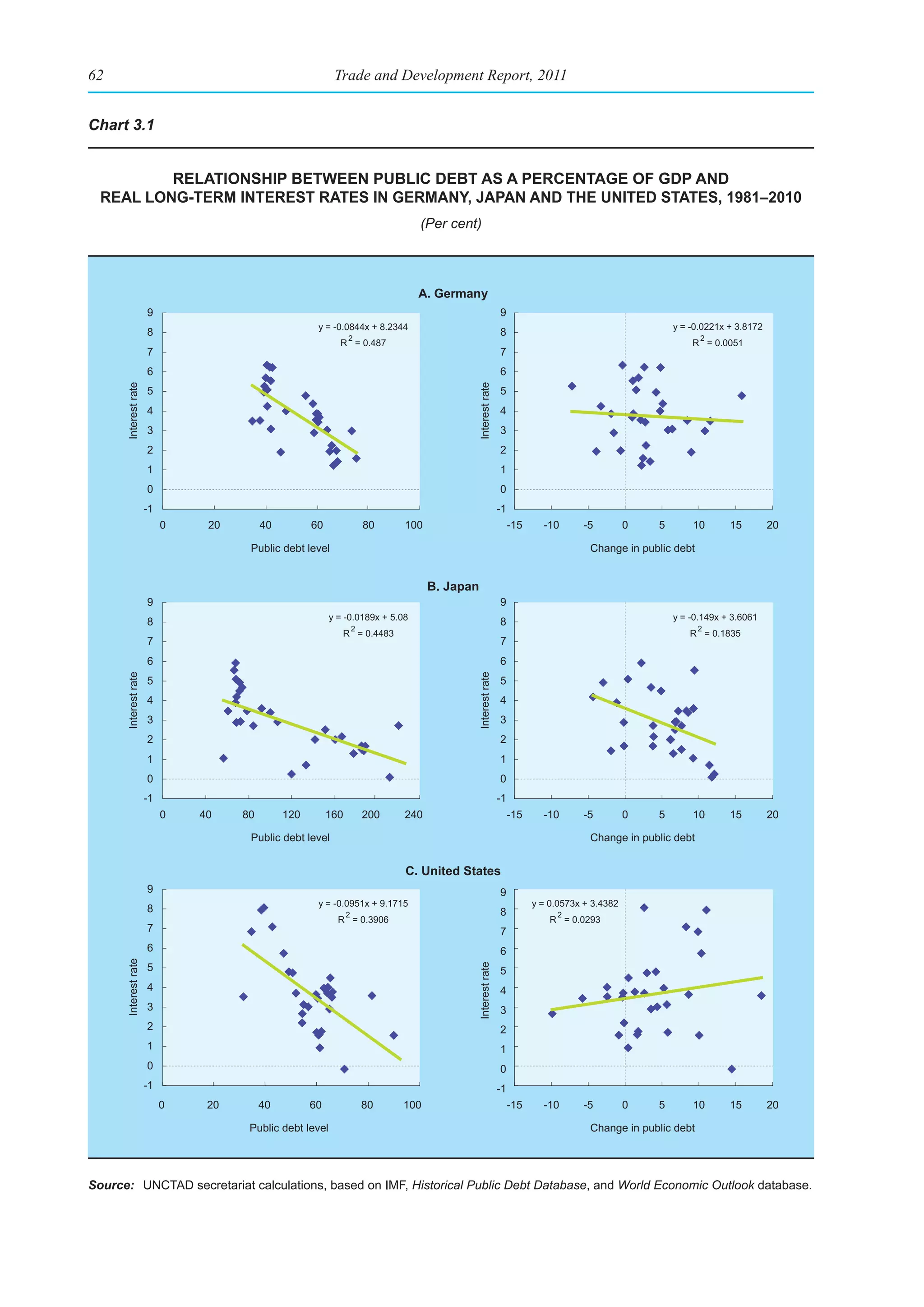
  • 107.
    Fiscal Space, DebtSustainability and Economic Growth 75 Box 3.2 (concluded) The OECD Economic Outlook (OECD, 2009) reports fiscal multipliers based on the OECD global model that range from 0.9 (after one year) to 1.3 (after two years) for government expenditure, and from 0.6 to 1 for tax cuts (after one and two years, respectively). The study also reports data from several national models, and shows a higher multiplier for spending (1.1 on average, after one year) than for tax cuts: between 0.3 on average for corporate tax cuts and 0.5 for personal income or indirect tax cuts. The study’s analysis also suggests that the size of the multiplier varies significantly from country to country. b Fair (2010), using the Cowles Foundation model shows that for the United States in the period starting in 1960, multipliers for spending were at around 2, while those for cut taxes were half that size. These are essentially in the same range as the estimates presented by the Congressional Budget Office (CBO, 2011), which shows multipliers ranging from 0.7 (low estimate) to 2.5 (high estimate) for government purchases of goods and services – much higher than those resulting from temporary tax cuts for higher income brackets (0.2 to 0.6) or even income tax cuts for low- and medium-income levels (between 0.6 and 1.5). The CBO uses the estimates from the Macroeconomic Advisors and Global Insight private models, and the FRB-US model used by the United States Federal Reserve Board. It is noteworthy that almost all the models suggest, as expected, that an expansionary fiscal policy has a positive effect on the level of economic activity. Further, the weight of the evidence indicates that spending multipliers tend to be larger than tax cut multipliers, and that tax cuts benefiting lower income households have a stronger effect than those benefiting high-income households. a Reliable instruments are variables that are correlated to the endogenous explanatory variables, but not with the error term of the equation. b These models cover Belgium, Canada, the euro area, France, Germany, Italy, Japan, Portugal, Spain, the United Kingdom and the United States. fiscal expansion.9 Such a regime would also reduce precisely because they have contributed to increas- leakage of domestic demand to foreign markets. In ing the degree of monetary autonomy, thus allowing other words, central bank policy, by managing not lower interest rates to support fiscal expansion. In only the interest rate but also the exchange rate, is this sense, it seems relevant to compare countries an essential element for expanding the fiscal space that managed to avoid significant real exchange rate available to the public sector. appreciation before the Great Recession, and used monetary policy to accommodate fiscal expansion In this context, fiscal space tends to be smaller in (e.g. Argentina, China), and those that were unable countries that are more vulnerable to speculative capi- to do so (e.g. Greece, Ireland and Portugal). Further, tal flows. To the extent that volatile capital flows force in developed countries, where the bursting of the these (typically developing) countries to maintain financial bubble was central to the unfolding of the higher interest rates at home, fiscal policy may turn Great Recession, the amount of resources utilized out to be less effective than in developed countries for rescuing financial institutions was much larger which can set interest rates with an eye on the domes- relative to the size of their economies than in develop- tic economy. However, as noted by Ocampo (2011), ing countries (as noted in the previous chapter). It is self-insurance measures against financial volatility, therefore reasonable to assume that financial rescue including but not limited to the accumulation of for- packages, which might be important for preventing eign reserves and capital controls, have created space the collapse of financial markets, have a limited effect for fiscal expansion in developing countries. This is on the level of economic activity. Hence, financial
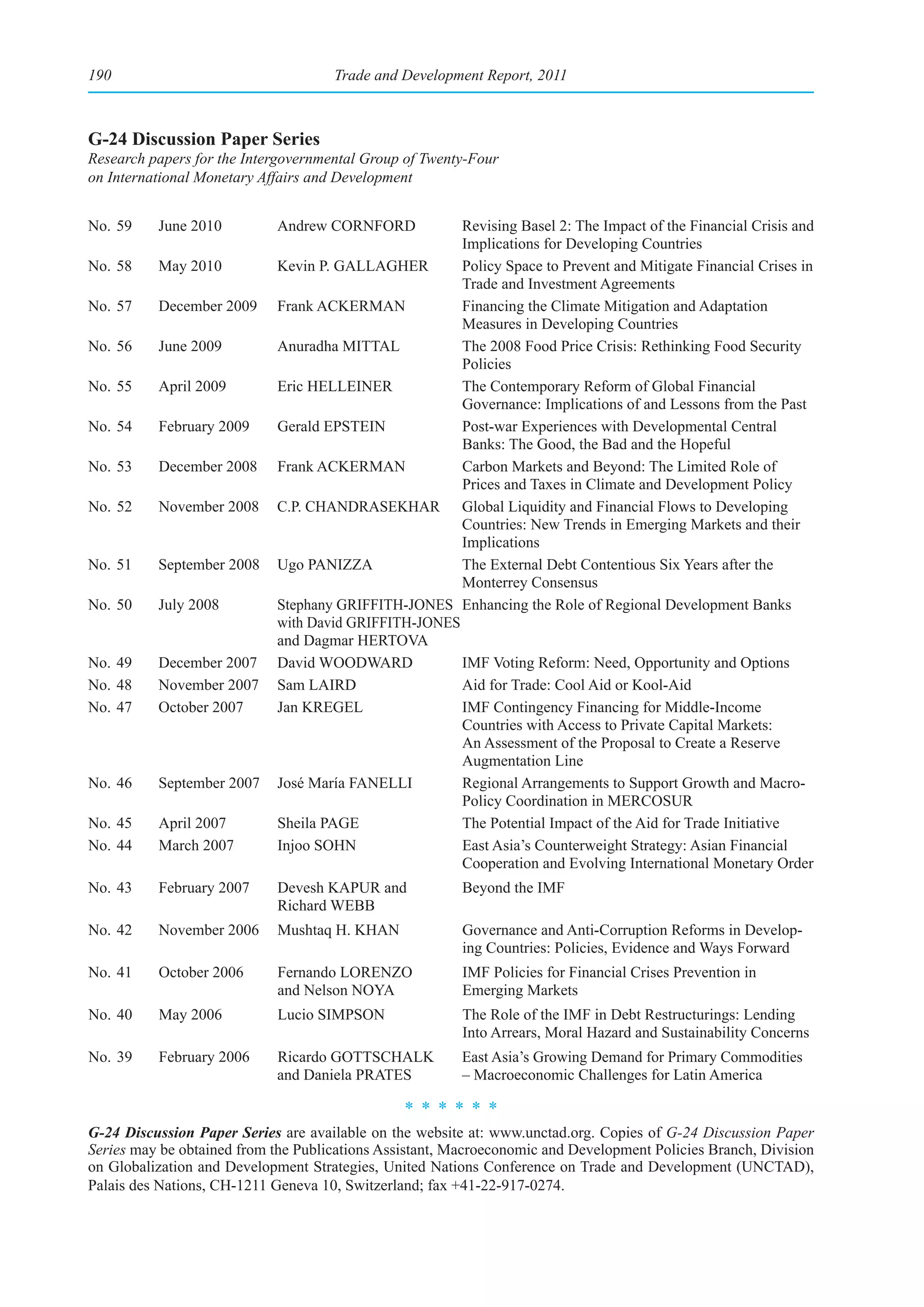
  • 108.
    76 Trade and Development Report, 2011 conditions not only affect the size of the fiscal space; of such changes would achieve a maximum expan- they may also influence the way it is used and its sionary effect, as there would be a minimum drain impact on economic recovery. of demand in the income circulation process on sav- ings and imports, and a maximum encouragement of In sum, fiscal space depends not just on how additional private spending. As a result, there may be fiscal policies are implemented, but also on how a debt paradox in the sense that the income effects of well those policies are supported by monetary policy stimulus measures would lead to full compensation, and by the national and inter- or even overcompensation, of national financial environment. the initial deficit through addi- This is in addition to consider- tional tax incomes. Moreover, An expansionary fiscal policy ations of the political viability to the extent that it accelerates may be more likely to reduce of the policy changes. If fiscal GDP growth, the debt-to-GDP the deficit and public debt space is an issue in the design ratio may fall. In other words, ratio than a restrictive one. of countercyclical macroeco- as a result of multiplier and nomic policies, this should be accelerator effects on income, taken into account not when it which increase the tax revenue has allegedly reached its limit, but at the outset (i.e. at constant tax rates, a deficit can finance, and, under when decisions are taken on fiscal stimulus meas- favourable conditions, even overfinance its own debt ures), because demand and fiscal feedback effects service, so that an expansionary fiscal policy may be differ widely depending on which specific expendi- more likely to reduce the deficit and the debt ratio tures or taxes are changed. An optimal combination than a restrictive one. d. dealing with public debt crises Public debt crises are not a recent phenomenon. For decades African countries suffered from eco- Sovereign lending dates as far back as the fourteenth nomic stagnation, while experiencing only sporadic century, and recurrent defaults show that such lending balance-of-payments crises. has always been risky (Cipolla, 1982; Kindleberger, 1996). However what constitutes a sovereign debt Two important distinctions are relevant when crisis is not at all clear. Crises have been occurring dealing with debt crises. First, there is a difference as a result of a lack of fiscal resources, but more between private and sovereign borrowers. The latter frequently owing to problems associated with a may borrow in their own currency, which is legal lack of foreign exchange. The 1997 Asian crisis, tender and over which they have a monopoly of issu- for example, was due to the inability of a number ance. Second, there is a difference between public of countries to stop a rapid devaluation of their cur- debt denominated in domestic currency and that rencies and to pay their foreign obligations. It was denominated in foreign currencies. In the first case, by no means a public debt crisis. In that sense, the the government can always monetize public debt Asian crisis differs from the Latin American debt by directly selling government bonds to the central crisis of the 1980s. In the case of Africa, public debt bank, or the central bank can buy public debt in the overhang problems plagued the region prior to the secondary markets, thereby facilitating the financing Heavily Indebted Poor Countries (HIPC) Initiative. of the government. The consequences of this kind

  • 109.
    Fiscal Space, DebtSustainability and Economic Growth 77 of indebtedness differ from those resulting from it may well be necessary to undertake expansionary foreign-currency-denominated debt, when the public fiscal policies to promote growth, which may lead sector is unable to service that debt. Thus, each of to increasing public debt in the short run in order to these debt situations requires different policies for forestall even worse consequences later. preventing a crisis. Private domestic agents may borrow in an unsus- Additionally, there is the question of the law tainable way because they believe in infinite booms governing the issuance of debt and the ways in which and bubbles, and suffer from a misconception that it may be renegotiated. Debt issued under local they can always obtain credit at very low interest legislation may be allowed flexibilities which differ rates. For sovereign borrowers that take loans on from that issued under foreign legislation. And even international markets, the same problems arise, since in the latter case, rules will differ depending on the creditors have incentives to continue lending, while legislation which regulates the debt contract, such as the debtors believe that fresh inflows at low inter- the State of New York. est will still be available. It is worth emphasizing in this context that, despite the risk of default by sover- Finally, it should be emphasized that there are eign borrowers in international markets, more often differing views about the causes of debt crises. While than not lenders and bondholders benefit from their public debt crises can be caused by excessive fiscal activities, since they can often charge higher interest spending for a given tax base, to borrowing countries. This is often the problem of financial why financial markets tend not crises lies with the system of to punish countries that cannot international finance that pro- Credit in foreign currencies service their debts. For exam- vides liquidity to cash-starved and sudden changes in capi- ple, Lindert (1989) and Lindert agents in intermittent cycles, tal flows and real exchange and Morton (1989) show that and with capital flows that van- rates are a frequent cause of investors in Latin American gov- ish or even reverse exactly when financial crises which often ernment bonds during the peri- they are needed the most. In lead to public debt crises. od 1850 to 1914 received an ex fact, many crises are the con- post annual premium that was sequence of an accumulation 0.42 per cent over the interest of private debt and mispricing in currency or other payments received by holders of British consols (i.e. asset markets, encouraged by “push factors” (i.e. for- bonds), in spite of defaults. In a more contemporary eign entities seeking profitable investments). In other study of the profitability of investing in developing words, public debt crises may result from fiscal mis- countries’ debt, it was calculated that, apart from the management and/or “financial fragility”, to borrow various crises, during the period 1970–2000 the aver- Minsky’s famous term. A better global monetary sys- age annual return on emerging markets’ debt was 9 per tem (as discussed in chapter VI of this Report) that cent (Klingen, Zettelmeyer and Weder, 2004). ensures more stable flows of capital and stricter regu- lation of its uses are the prescribed solutions, rather These periods of financial euphoria are usu- than fiscal adjustment. ally followed by financial crashes and may lead to widespread banking crises (Kindleberger, 1978; Reinhart and Rogoff, 2009). Since banking crises are often followed by sudden increases in public debt, 1. Preventing debt crises associated with policy decisions to rescue financial institutions in distress, policies aimed at reducing the risk of debt crises need to include measures to keep in Although public debt crises often do not have a check private sector debt, both domestic and external. fiscal origin, some are indeed caused by unsustainable There are a number of useful instruments for limit- fiscal policies, while others are caused by irrespon- ing excessive risk-taking by the private sector, such sible lending for purposes that do not increase the as: tighter financial regulation, including guarantees overall productivity but amount to zero sum games that borrowers have income streams compatible with over the medium term (see chapter IV of this Report). the accumulated debt; restrictions on certain types of However, even when a debt crisis has a fiscal origin, predatory lending which misinform borrowers about
  • 110.
    78 Trade and Development Report, 2011 payment conditions; caps on interest rates charged by value of all liabilities, not only those denominated in certain types of credit lines; higher capital require- foreign currency (Eichengreen, 2010). This in turn ments for banks; and capital controls. could result in debt deflation or a balance-sheet crisis, as discussed earlier. Debt denominated in foreign currencies which needs to be repaid with revenues earned in a national Efforts to solve this problem have to start at the currency is another frequent cause of a financial crisis global level (discussed in chapter VI). At the national spilling over into a public debt crisis. Credit in foreign level, it should be recognized that during periods of currencies has surged in increasingly deregulated economic boom, countries and their lenders sow the international financial markets, seeds of future crises.10 During such as in Hungary, Iceland and periods of global optimism, some other Eastern European capital inflows flood develop- countries. At the same time, The response to a crisis ing countries, which are often these countries have been the should depend on the nature unable to restrict the amounts, targets of carry-trade specu- of that crisis ... even if they can change the lation, leading to an appreciation maturity profile of the inflows of currencies in countries with with capital controls. As men- high interest rates. This has tioned before, this behaviour not contributed to long-lasting current-account deficits only leads to a rapid accumulation of external debt, through currency appreciation, an import surge and but often it also causes an appreciation of the real increasing debt service. As a result, the countries con- exchange rate and induces large external imbalances, cerned have become vulnerable to financial shocks which eventually provoke capital reversals, currency in the global economy, such as sudden changes in collapse, and, ultimately, a financial and real crisis. capital flows or interest rate hikes in carry-trade funding countries such as Japan and Switzerland. Preventing a repetition of this familiar pattern After a reversal of capital inflows real depreciation requires a change of practices during good times, with is the only way to balance the external accounts in less external debt, more reserves and a policy aimed a debtor country (TDR 2008). However, when there at limiting currency appreciation. Development of is significant foreign-currency-denominated debt, a domestic sources of finance and reducing foreign real depreciation will lead to a sudden jump in the capital needs are therefore policies that should be debt-to-GDP ratio and in debt servicing payments encouraged during boom phases. These are precisely in domestic currency. If, in the wake of a crisis, the policies which the largest emerging market econo- and under the influence of international lenders, mies have been pursuing since the late 1990s. As a the government tackles the external crisis with change in the composition of public debt and a switch contractionary fiscal policies, seeking to restore the to domestic borrowing can reduce asymmetries and external balance by reducing domestic demand, it will improve the trade-off discussed above, several devel- make matters worse. In any case, debt sustainability oping countries are now retiring their external public is affected, possibly leading to a debt crisis and debt debt and issuing domestic debt instead. default. These are classical cases of a dual crisis: a balance-of-payments crisis, which leads to a fiscal crisis, either because the public sector has contracted a sizeable share of the foreign debt, or because it has 2. Responding to debt crises assumed most of the burden of private debts. The situation is even more complicated for Although debt crises do not always have a fis- countries that are members of a monetary union, cal origin, the standard response to a sudden jump in have a currency board or are dollarized. In any of public debt is often fiscal retrenchment. This appears these cases, a real devaluation can only be achieved to be a misguided policy, because the appropriate through wage cuts (sometimes referred to as internal response should relate to the nature of the crisis. If a devaluation). However, that may lead to deflation, crisis originates from the bursting of an asset bubble, which may have an even greater negative impact on the response should be financial reform, and even debt sustainability because it would increase the real quite the opposite of fiscal retrenchment, namely
  • 111.
    Fiscal Space, DebtSustainability and Economic Growth 79 countercyclical policies to absorb private sector and that some current spending, especially in areas deleveraging so as to reduce the macroeconomic such as health, education, nutrition, and sanitation, slump created by asset deflation (TDR 2009). If the may result in an increase (and not a decrease) in the crisis originates from excessive foreign currency country’s net wealth. lending and excessive real appreciation, the appropri- ate response at the national level might be to improve However, even sovereign borrowers that are the debt structure and introduce policies aimed at targeting sound long-term fiscal indicators may avoiding misalignments of the real exchange rate as lose access to credit in international markets and well as introducing controls on capital inflows. find themselves unable to finance their current cash deficits at a reasonable interest rate. This is where Fiscal retrenchment as a response to a crisis not the international community should be able to step caused by irresponsible fiscal policies is problematic in and provide the needed financial support. It should for several reasons. Fiscal adjustments tend to affect be clear that provision of such support is not a bail- the most vulnerable groups of society, often with out, but simply an intervention aimed at addressing serious social consequences. Moreover, they may a market failure. While Bagehot (1873) was right even be ineffective in reducing in saying that during crises the the debt-to-GDP ratio because domestic lender of last resort they may amplify the recession, should stand ready to lend freely … If a crisis has not been thus causing a decrease in the at a penalty rate to solvent but caused by irresponsible fiscal denominator of that ratio. As a illiquid banks, there are problems policies, fiscal retrenchment is result, fiscal contractions may in applying Bagehot’s suggestion not an appropriate response. cause painful adjustments in the of a penalty rate to the behaviour short run and create costs in the of an international lender of last long run. There is evidence that resort. Bagehot’s idea of lending after recessions output growth tends to return to its at a penalty rate was aimed at avoiding moral hazard. previous trend, but the output loss is never recovered However, it is doubtful that moral hazard is playing any (Cerra and Saxena, 2008). Recessions therefore lead significant role in international finance, and it is cer- to a permanent output loss, and since contractionary tainly not the main cause of sovereign debt crises.11 fiscal policies amplify both the length and the depth of a recession they also increase this loss and weaken Therefore lending at a penalty rate would not a country’s overall ability to sustain a given level of generate any ex ante gain in terms of disciplining bor- public debt. rowers. On the contrary, by increasing the interest bill, it would contribute to debt accumulation and therefore There is another important channel through aggravate the problem that emergency lending is trying which fiscal retrenchment may have a negative effect to solve. The same line of reasoning holds even more on long-term growth and thus reduce debt sustain- for countries that are on the edge of insolvency. For ability. Since current expenditure can be difficult to these countries, high interest rates which are supposed adjust (because it is composed mainly of wages and to protect the resources of the lender of last resort can entitlement programmes), fiscal retrenchment usually actually backfire and cause losses, as a lender of last leads to large cuts in public investment (Martner and resort that lends at a penalty rate may contribute to Tromben, 2004; Easterly, Irwin and Servén, 2008). pushing the country towards insolvency. This reduction in growth-promoting public expendi- ture may lead to a fall in the present value of future government revenues that is larger than the fiscal savings obtained by the fiscal retrenchment. The 3. Debt restructuring outcome could be an improvement in the immediate cash flow of the government, but with negative con- sequences for long-term fiscal and debt sustainability. When sovereign debt is denominated in domes- Fiscal policy should therefore explicitly consider how tic currency, default is unlikely since that debt can the fiscal adjustment will affect output growth and be repaid by issuing more money. But when debts capital accumulation. It should also recognize that a are denominated in foreign currency, debt default deficit incurred in financing an investment project, and restructuring are bound to occur, even with the
  • 112.
    80 Trade and Development Report, 2011 best possible international and domestic policies. Panizza, Sturzenegger and Zettelmeyer, 2009), the However, this does not hold for private debt, since real issue is that their assumptions have no empiri- private agents are often rescued by domestic authori- cal basis. Reputational costs appear to be limited ties. But from a purely legal point of view, a sovereign and short-lived (Borensztein and Panizza, 2010), State cannot be declared insolvent. Further, the value and there is no evidence of trade sanctions (at least of a country’s assets (its land, its natural resources in recent times). A more recent class of theoretical and the wealth of its citizens) is usually very large, models focuses attention on the domestic effects of a and in any case cannot always be measured in terms sovereign default (Cole and Kehoe, 1998). However, of current values. Therefore, it is unthinkable for a empirical evidence shows that the costs of a default country to be faced with a situation where its liabili- seem to be limited, even in terms of its effects on ties are larger than its assets (which for a firm would GDP growth (Levy Yeyati and Panizza, 2011); and be considered as insolvency). In addition, creditors in any case, they have been smaller in countries that cannot unilaterally (or with the help of a court) take preemptively restructured their debts (De Paoli, over a country’s management (i.e. replace the coun- Hoggarth and Saporta, 2006). try’s government). In fact, the principle of sovereign immunity limits a creditor’s ability to sue a sovereign An outright debt default clearly undermines entity, and even when that entity agrees to waive the general strategy of nurturing the confidence of its immunity, verdicts remain difficult to enforce financial markets as a key element for attracting because assets that are located within the borders of foreign capital and spurring investment (referred to the defaulting country cannot be confiscated. as the “confidence game”), and this may magnify the cost of a default by adding qualitative factors that are Although sovereign States cannot be forced to not visible in a quantitative, cost-advantage exercise. repay their debts, sovereign defaults, beyond the for- Thus a country’s reputation would suffer less dam- eign currency problem, remain age if a debt default appeared to very rare events. In most cases, be unavoidable (Grossman and States make considerable efforts Van Huyck, 1988). This may and endure economic pain in When defaults occur, debts explain why some governments order to service their debts, since need to be restructured. decide to assume a large cost in policymakers seem to think that order to postpone a necessary repaying is cheaper than default- default, thereby signalling to ing. While it is easy to determine all interested parties that when the cost of repaying (which is the value of the loan), the default eventually occurs, it is not a “strategic it is harder to identify the costs associated with a default” (Borensztein and Panizza, 2009; Levy Yeyati sovereign default. This is far from being a purely and Panizza, 2011). academic question, because a better understanding of the costs of default is a necessary condition for When defaults do occur, debts need to be devising policies that could reduce those costs as restructured, and the complexity of the restructuring well as the prevalence of such defaults. It is worth process depends on the structure of the defaulted debt. pointing out that sovereign defaults have rarely been Until the early 1990s most foreign debt of develop- complete defaults; they are usually partial in nature, ing countries was either owed to official creditors involving some amount of reduction/restructuring (multilateral or bilateral) or to banks. When the Brady of the debt. swaps of the 1990s transformed defaulted syndicated bank loans into tradable bonds, policymakers feared The economic literature has focused on the that the presence of a large number of dispersed and reputational and trade costs of defaults. Models heterogeneous creditors could lead to long and costly that focus on reputational costs assume that default debt renegotiations. There was also concern that episodes reduce a country’s ability to access inter- vastly dispersed debt would provide strong incen- national financial markets (Eaton and Gersovitz, tives to individual creditors (possibly specialized 1981). Models that emphasize trade costs suggest vulture funds) to “hold out” from debt rescheduling that defaulters can be punished with trade sanctions and then litigate in the hope of collecting the full (Bulow and Rogoff, 1989). Apart from some theo- face value of their claims (Panizza, Sturzenegger and retical problems with these models (for a review, see Zettelmeyer, 2009).
  • 113.
    Fiscal Space, DebtSustainability and Economic Growth 81 These preoccupations prompted several ini- or too early, there is now evidence that policymakers tiatives aimed at facilitating the debt restructuring are reluctant to default and do all they can to avoid process and, in the wake of the Argentinean crisis of it (Rogoff and Zettelmeyer, 2002). Delayed default 2001–2002, led to an IMF proposal for the creation of may destroy the value of outstanding debt because a a sovereign debt restructuring mechanism (SDRM). prolonged pre-default crisis may reduce both ability This statutory approach to debt restructuring shared and willingness to pay. some of the features of an earlier UNCTAD proposal (TDR 1981), which in turn was based on Chapter It is for these reasons that, 10 years after the 11 of the United States commercial code (i.e. the shelving of the original SDRM, there is still a debate bankruptcy code for private agents). The SDRM was on whether such a mechanism would be a valuable eventually rejected by the United States Treasury addition to the international financial architecture under pressure from financial (Fernández-Arias, 2010). Those groups involved in the emerging who oppose such a statutory markets bond business. Instead approach argue that the current it suggested that the hold-out A prolonged pre-default crisis system is second best, because, problem could be solved using may reduce both the ability in the case of non-enforceable a contractual approach based on and willingness to repay debt. contracts, willingness to pay the introduction of collective is linked to the costs of default action clauses (CAC) in debt arising from an inefficient debt contracts and the use of exit restructuring process (Dooley, consent. Countries that presented lower risks of 2000; Shleifer, 2003). Therefore, removing these 12 requiring a future debt restructuring obtained more inefficiencies would reduce the costs of default and flexible terms than those that were more prone to increase borrowing costs. Those who support the debt problems. In some cases, however, creditors statutory approach, argue that debt dilution, lack of have prevented the use of “exit consents” in bond interim financing and the presence of debt overhang emissions, including CACs (Gelpern, 2003). lead to a loss of value for both debtors and creditors. The possibility that countries may delay necessary Furthermore, CACs do not solve other prob- defaults in order to show that the eventual default lems associated with the current non-system. As was indeed unavoidable is an important consideration the current rules cannot enforce seniority (with the in the discussion on the desirability of international exception of the de facto seniority granted to mul- policies aimed at mitigating the costs of default. If tilateral organizations), it leads to too much lending a country’s attempt to defend its reputation by sub- in the run-up to a debt crisis (debt dilution) and too optimally postponing a necessary default creates a little lending during the restructuring process (lack deadweight loss, there are policies that can reduce of interim financing). Debt dilution occurs when the costs of default. In particular, the creation of an new debt issuances can hurt existing creditors of agency with the ability to certify necessary defaults, a country that is approaching financial distress. It and thus protect the reputation of countries without has been shown that debt dilution increases bor- forcing them to go through a painful and counterpro- rowing costs and may lead to risky levels of debt ductive postponing exercise, could reduce the costs accumulation (Bolton and Olivier, 2007).13 During of defaults while simultaneously increasing recovery the restructuring period, the defaulting country may values on defaulted debt. It would thereby facilitate need access to external funds to either support trade access to credit and reduce the overall costs of bor- or to finance a primary current-account deficit, and rowing. It is important to point out that postponement lack of access to these funds may amplify the crisis of a default is typically associated with contractionary and further reduce ability to pay. As the provision of measures that further reduce the ability to repay. such interim financing would require some sort of seniority with respect to existing claims, the default- While it is impossible to directly test the ing country will not be able to obtain any credit from hypothesis that the creation of a debt resolution the private sector during the restructuring period. mechanism would increase borrowing costs (because The second problem has to do with the fact that, such a mechanism does not exist), it is possible to while standard models of sovereign debt assume that indirectly test this hypothesis by checking whether countries have an incentive to default by too much other mechanisms that facilitate sovereign debt
  • 114.
    82 Trade and Development Report, 2011 restructuring have an effect on borrowing costs. Summing up, debt restructuring may be part of a One candidate for such a test is CACs. When CACs strategy to resolve a debt crisis, not just for the borrow- were first introduced in New York bonds law, it was ing country but also for creditors, since the possibilities feared that by reducing the costs of default they for renewed economic growth and the ability to repay would increase borrowing costs. However, there increase. If debt renegotiation frees up resources for is now ample evidence that CACs have no impact growth-enhancing activities it may allow a country to whatsoever on borrowing costs. Proponents of the better finance its own reduced debt service. However, higher borrowing cost hypothesis often mention the sovereign default or debt restructuring are no panacea, possibility of some vaguely defined reputational cost. and their risks have to be weighed carefully against Again, these statements cannot be formally tested the risk of contagion, which is a major hazard in the (and it is not clear why such a mechanism would European monetary union. There is also the possibil- affect reputation). However, reputational costs asso- ity that domestic depositors will lose confidence in ciated with sovereign defaults are either very small a government and flee the country – a risk that is (Ozler, 1993; Benczur and Ilut, 2006) or short-lived particularly strong in a monetary union where people (Borensztein and Panizza, 2009), or both small and cannot be prevented from relocating their short-term short-lived (Flandreau and Zumer, 2004). deposits within the union. e. Conclusions: growing out of debt The above discussion suggests that the best should be given precedence over tax cuts, and that strategy for reducing public debt is to promote both measures should benefit low-income groups in growth-enhancing fiscal policies. Moreover, it would particular. A more equitable distribution of income seem from the evidence that fiscal expansion tends to would make economic recovery more self-sustaining be more effective if spending takes precedence over and improve the chances of achieving fiscal con- tax cuts, if spending targets infrastructure and social solidation. In this sense, increasing real wages in transfers, and if tax cuts, in turn, target lower income line with productivity, and, especially in developing groups, which generally have a higher propensity for countries with large informal sectors, government spending. Fiscal expansion, by increasing the level of transfers to the low-income segments of society, are activity and income, as noted earlier, raises the revenue important complements to fiscal expansion. stream and reduces the debt-to-GDP ratio, in particular if interest rates are relatively low compared with GDP Beyond the notion that growth is the best growth. In this sense, problems associated with the solution to reduce public-debt-to-GDP ratios, it is growth of public debt, particularly when that debt important to emphasize that higher ratios of public is not primarily related to fiscal problems, are best debt per se, particularly in developed countries after resolved by a strategy of fiscal expansion. the crisis, do not pose a threat to fiscal sustainability. The public debt today is much more sustainable than Further, if it is argued that, for economic and/ the private debt before the crisis. As long as interest or political reasons there is little space for fiscal rates are low and unused capacities exist, there is no expansion, there is always the possibility to redirect crowding out of private investment, and the globally spending and taxes to support more expansion- higher public debt ratios do not pose a problem for ary measures. Again, this suggests that spending recovery. For the world as a whole, and for the big
  • 115.
    Fiscal Space, DebtSustainability and Economic Growth 83 economies, the only strategy warranted is one of con- subsequent, second round effects (such as a price- solidation through growth. Growth, combined with wage spiral) need to be dealt with by an incomes low interest rates, will bring an policy rather than by adopt- increase in revenues and a fall ing restrictive macroeconomic in debt ratios over time. This The best strategy for reducing measures. There are instances implies that monetary policy public debt is to promote when an external constraint (e.g. should continue to maintain low growth-enhancing fiscal poli- when lack of competitiveness interest rates in order to keep the cies and low interest rates. brings about current-account burden of interest payments for deficits) prevents fiscal expan- the public sector bearable. sion because it would aggravate the external imbalance. In such If inflation is perceived to be a serious threat cases, priority should be given to resolving the to economic stability, and given that in most econo- balance-of-payments problem rather than introducing mies the pressures on prices have originated largely austerity measures. This is particularly important for from the financialization of commodity markets, the countries that are members of a currency union. notes 1 For instance, when the IMF provided large assistance banks from reducing interest rates. However, it is packages to Argentina, Brazil, Indonesia, Mexico, not evident that direct taxes (that are not mentioned the Republic of Korea, Thailand and Turkey, it was as a possibility) have any upward impact on prices, criticized for wasting taxpayers’ money. But all or even that higher rates of indirect taxes have more these countries paid back, and the Fund (and thus the than a one-off impact on prices, which would jus- international taxpayer) even made a small profit. In tify a restrictive monetary stance. And if tax hikes fact, the Fund suffered a budget crisis when countries effectively cause inflation, then real interest rates were no longer hit by crisis (which is not surprising will fall, generating the economic stimulus without as the business of the Fund is crisis management). requiring central banks to cut nominal interest rates. Interestingly, the case of Argentina shows that even Furthermore, the idea that fiscal tightening will a failed rescue attempt ended up being profitable for reduce real exchange rates contradicts the view – also the Fund. supported by the IMF – that lower fiscal deficits will 2 Preferences for spending cuts over tax increases are improve confidence in financial markets and eventu- also supported on the grounds that the tax burden is ally attract capital inflows, which would then lead to already high in developed economies, so that “there currency appreciation. may be limited scope to raise tax without adverse 4 Here, there is an implicit assumption that fiscal effects on economic efficiency” (IMF, 2010c: 10). adjustment will reduce not only the fiscal deficit, 3 The IMF (2010b) does not provide any empirical but also the public-debt-to-GDP ratio. This is not evidence of this alleged “typical” behaviour of guaranteed: even if fiscal tightening manages to central banks, which is fundamental to its policy improve the fiscal balance, this improvement may be recommendation of using spending cuts rather than insufficient to lower that ratio. For a debt reduction in tax increases. Neither does it provide convincing absolute terms, a fiscal surplus would be needed. conceptual proof. It states that tax increases would 5 For example, in 2005–2008 the average share of oil raise prices in a way that would prevent central revenue in total fiscal revenue was over 80 per cent
  • 116.
    84 Trade and Development Report, 2011 in Angola, Bahrain, Brunei Darussalam, Congo, 10 One way to deal with this problem and reduce the Equatorial Guinea, Libya, Nigeria, Oman, Saudi likelihood of debt crises would be to establish a Arabia and Timor-Leste. Countries where this share set of principles on accountable sovereign lending was over 70 per cent include Algeria, Kuwait, United and borrowing, which would include due diligence, Arab Emirates and Yemen. A number of countries fiduciary duty, proper approval, transparency and in the Commonwealth of Independent States (CIS), disclosure and consideration of the question of debt such as Azerbaijan, Kazakhstan and the Russian restructuring (UNCTAD, 2011b). These principles Federation, and Latin American countries such should apply to the private sector as well, since in as the Bolivarian Republic of Venezuela, Bolivia several cases the public sector ends up paying for the and Ecuador, also exhibit a high degree of depend- excessive lending and borrowing of the private sector. ence on revenues from their hydrocarbons sector, Also, these principles in no way imply that borrow- although the share in total fiscal revenues is relatively ers should submit to the criteria selected by creditors lower than it is in the above-mentioned regions. The on what constitutes appropriate rules of behaviour. same applies to mineral-dependent countries such Indeed, the legal effects of these principles would as Botswana, Chile, Guinea, Liberia, Mongolia, essentially depend on the State’s views. Namibia and Peru (Villafuerte, López-Murphy and 11 If there was a significant degree of moral hazard Ossowski, 2010; IMF, 2011c). involved in international finance, spreads on lending 6 For example, the Chilean Government increased the to emerging markets should shrink to zero, creditors percentage of royalties to be paid by mining companies being absolutely sure that the IMF or some other in order to help finance reconstruction following the actor would ensure full recovery of their lending 2010 earthquake. Similarly, the Government of Guinea (Lane and Phillips, 2002). For a sceptical view of the is undertaking a review of its mining code in order to existence of moral hazard in international finance, raise its stake in mining projects, and in South Africa see Kamin, 2002; for a more balanced view of the a State mining company was recently launched and issue, see Corsetti, Guimarães and Roubini, 2003. the Government is considering increasing royalties. 12 There are three main CACs: (i) majority action claus- 7 In this respect, it seems that the recent call for es, which allow a qualified majority of bondholders monetary tightening by the Bank for International (usually bondholders representing 75 per cent of Settlements (BIS, 2011) stems from an overly pessi- the principal of the outstanding bonds) to amend all mistic view of the risks of inflationary acceleration. the terms and conditions of the bonds, including the 8 Barro and Redlick (2011) argue that the evidence payment terms, and make those amendments binding for the United States on the relative effects of gov- on the remaining bondholders; (ii) representation ernment spending vis-à-vis tax cuts is unreliable. clauses, allowing a single agent or group of agents However, the evidence presented by Zandi (2008), to negotiate with debtors in the name of bondhold- suggests that government-spending programmes are ers; and (iii) a distribution clause, under which any more stimulating than tax cuts. amounts received by any creditor would have to 9 This concern is related to the conventional view that be distributed among all of them. Exit consent is a fiscal expansion increases interest rates, leading to technique whereby a majority of bondholders can capital inflows, and ultimately creating pressure for change the non-financial terms of a bond with the appreciation. However, Ilzetzki et al. (2010) do not objective of reducing the secondary market value of find evidence of higher rates of interest being associ- the bond and thus increasing the incentive to accept ated with fiscal expansion. This suggests that inflows an exchange offer. might simply be the result of a growing economy, and 13 In the corporate world, debt dilution is not a problem that monetary accommodation is the main mecha- because courts can enforce seniority rules. However, nism enabling managed exchange rate regimes to it is a problem for sovereign debt, because after a have larger fiscal multipliers. Indeed, there is ample sovereign default, all creditors, old and new, tend to evidence that capital flows to developing countries receive the same haircut. tend to be procyclical.
  • 117.
    Fiscal Space, DebtSustainability and Economic Growth 85 references Admati A, DeMarzo P, Hellwig M and Pfleiderer P (2010). Blanchard O, Dell’Ariccia G and Mauro P (2010). Fallacies, irrelevant facts, and myths in the discus- Rethinking macroeconomic policy. IMF Staff sion of capital regulation: Why bank equity is not Position Note SPN/10/03, International Monetary expensive. Stanford GSB Research Paper No. 2063, Fund, Washington, DC. Stanford University, Stanford, CA. Bolton P and Olivier J (2007). Structuring and restructur- Angeriz A and Arestis P (2009). The consensus view on ing sovereign debt: the role of a bankruptcy regime. interest rates and fiscal policy: Reality or innocent IMF Working Paper 07/192, International Monetary fraud? Journal of Post-Keynesian Economics, 31(4): Fund, Washington, DC. 567–568. Borensztein E and Panizza U (2009). The costs of default. Arcand JL, Berles E and Panizza U (2011). Too much IMF Staff Papers 56(4): 683–741, International finance? Working paper, The Graduate Institute, Monetary Fund, Washington, DC. Geneva. Borensztein E and Panizza U (2010). Do sovereign defaults Aschauer D (1989). Is public expenditure productive? hurt exporters? Open Economies Review, 21(3): Journal of Monetary Economics, 23(2):177–200. 393–412. Bagehot W (1873). Lombard Street: A Description of the Bornhorst F, Budina N, Callegari G, ElGanainy A, Gomez Money Market. Available at: http://www.gutenberg. Sirera R, Lemgruber A, Schaechter A and Beom Shin org/cache/epub/4359/pg4359.html. J (2010). A status update on fiscal exit strategies. IMF Barba A and Pivetti M (2009). Rising household debt: Its Working Paper WP/10/272, International Monetary causes and macroeconomic implications – a long- Fund, Washington, DC. period analysis. Cambridge Journal of Economics, Bulow J and Rogoff K (1989). A constant recontract- 33(1): 113–137. ing model of sovereign debt. Journal of Political Barro R (1974). Are government bonds net wealth? Economy, 97(1): 155–178. Journal of Political Economy, 82 (6): 1095–1117. Cerra V and Saxena SC (2008). Growth dynamics: The Barro R and Redlick C (2011). Macroeconomic effects myth of economic recovery. American Economic from government purchases and taxes. Quarterly Review, 98(1):439–57. Journal of Economics, CXXVI(1): 51–102. Christiano L, Eichenbaum M and Rebelo S (2009). When Benczur P and Ilut C (2006). Determinants of spreads is the government spending multiplier large? NBER on sovereign bank loans: The role of credit history. Working Paper No. 15394, National Bureau of MNB Working Papers 2006/1, Magyar Nemzeti Economic Research, Cambridge, MA. Bank (The Central Bank of Hungary), Budapest. Cipolla C (1982). The Monetary Policy of Fourteenth- Berglund P and Vernengo M (2006). Fiscal policy recon- Century Florence. Berkeley, CA, University of sidered (introduction). In: Berglund P and Vernengo California Press. M, eds., The Means to Prosperity: Fiscal Policy Cole HL and Kehoe PJ (1998). Models of sovereign debt: Reconsidered. London, Routledge: 1–16. Partial versus general reputations. International Bernanke B and Reinhart V (2004). Conducting monetary Economic Review, 39(1): 55–70. policy at very low short-term interest rates. Lecture at the Congressional Budget Office (2011). Estimated Impact International Center for Monetary and Banking Studies, of the American recovery and Reinvestment Act on Geneva. Available at: http://www.federalreserve.gov/ Employment and Economic Output from January boarddocs/speeches/2004/200401033/default.htm. 2001 through March 2011, Washington, DC, May. BIS (2011). 81st Annual Report. Basel, 1 April 2010– Available at http://www.cbo.gov/ftpdocs/121xx/ 31 March 2011. doc12185/05-25-ARRA.pdf.
  • 118.
    86 Trade and Development Report, 2011 Corsetti G, Guimaraes B and Roubini N (2003). International Gale W and Orszag P (2003). Economic effects of sus- lending of last resort and moral hazard: A model tained budget deficits. National Tax Journal, 56(3): of IMF’s catalytic finance. NBER Working Paper 462–85. No. 10125, National Bureau of Economic Research, Gelpern A (2003). How collective action is changing Cambridge, MA. sovereign debt. International Financial Law Review, Corsetti G, Meier A and Müller G (2010). What determines May: 19–23. government spending multipliers? Paper prepared Grossman HI and Van Huyck JB (1988). Sovereign debt for the project on International Dimensions of Fiscal as a contingent claim: excusable default, repudiation, Policy Transmission, sponsored by the Fondation and reputation. American Economic Review, 78(5): Banque de France and the Center for Economic 1088–1097. Policy Research. Available at: http://www.eui.eu/ Hall R (2009). By how much does GDP rise if the gov- Personal/corsetti/research/multipliers.pdf. ernment buys more output? Brookings Papers on De Paoli B, Hoggarth G and Saporta V (2006). Costs Economic Activity, (2):183–231. Washington, DC, of sovereign default. Bank of England Financial Brookings Institution Press. Stability Paper 1, London. Heller SP (2005). Fiscal space: What it is and how to get Dooley M (2000). Can output losses following interna- it. Finance and Development: 42(2). tional financial crises be avoided? NBER Working Hemming R, Kell M and Mahfouz S (2002). The effective- Paper No. 7531, Cambridge, MA. ness of fiscal policy in stimulating economic activity: Dymski G (2003). The international debt crisis. In: Michie A review of the literature. IMF Working Paper 02/208, J, ed., The Handbook of Globalization. Cheltenham, International Monetary Fund, Washington, DC. Edward Elgar. IMF (2003). Evaluation Report: Fiscal Adjustment in Easterly W, Irwin T and Servén L (2008). Walking up the IMF-Supported Programmes. Washington, DC, down escalator: Public investment and fiscal stabil- Independent Evaluation Office. ity. World Bank Research Observer, 23(1): 37–56, IMF (2010a). Fiscal Monitor, Washington, DC, May. Oxford University Press. IMF (2010b). World Economic Outlook. Washington, Eaton J and Gersovitz M (1981). Debt with potential repu- DC, October. diation: Theoretical and empirical analysis. Review IMF (2010c). From stimulus to consolidation: Revenue and of Economic Studies, 48(2): 289–309. expenditure policies in advanced and emerging econo- Eichengreen B (2010). Ireland’s rescue package: Disaster mies. Fiscal Affairs Department, Washington, DC. for Ireland, bad omen for the Eurozone. VOX EU, IMF (2011a). Fiscal Monitor. Washington, DC, April. 3 December 2010. Available at: http://www.voxeu. IMF (2011b). World Economic Outlook. Washington, org/index.php?q=node/5887. DC, April. Eisner R (1995). US national saving and budget deficits. IMF (2011c). Revenue mobilization in developing coun- In: Epstein GA and Gintis HM, eds., Macroeconomic tries. Washington, DC. Policy after the Conservative Era: Studies in Ilzetzki E, Mendoza E and Vegh C (2010). How big Investment, Saving and Finance. Cambridge, New (small?) are fiscal multipliers? NBER Working paper York and Melbourne, Cambridge University Press: No. 16479, National Bureau of Economic Research, 109–42. Cambridge, MA. Eisner R (2006). Budget deficits, unemployment and eco- Institute of International Finance (2010). Interim report nomic growth: a cross-section time-series analysis. on the cumulative impact on the global economy of In: Berglund P and Vernengo M, eds., The Means to proposed changes in the banking regulatory frame- Prosperity: Fiscal Policy Reconsidered. London and work.Washington, DC. New York, Routledge: 202–220. Kamin SB (2002). Identifying the role of moral hazard in Fair R (2010). Possible macroeconomic consequences international financial markets. Discussion Paper 736, of large future federal government deficits. Cowles Institute of International Finance. Washington, DC. Foundation Discussion Paper 1727, Yale University, Kindleberger CP (1978). Manias, panics and crashes. A New Haven, CT. history of financial crises. The Macmillan Press Ltd, Fernández-Arias E (2010). International lender of last resort London and Basingstoke. and sovereign debt restructuring. In: Primo Braga CA Kindleberger CP (1996). World Economic Supremacies, and Vincelette GA, eds., Sovereign Debt and the 1500-1990. Cambridge, MIT Press. Financial Crisis: Will This Time be Different?: 331– Klingen C, Zettelmeyer J and Weder B (2004). How private 353. Washington, DC, World Bank. creditors fared in emerging debt markets, 1970-2000 Fisher I (1933). The debt-deflation theory of great depres- IMF Working Papers, (04)13, International Monetary sions. Econometrica, 1(4): 337–357. Fund, Washington, DC. Flandreau M and Zumer F (2004). The Making of Global Koo R (2010). Learning Wrong Lessons from the Crisis in Finance, 1880–1913. Paris, Organisation for Eco- Greece. Nomura Securities Co Ltd, Japanese Equity nomic Co-operation and Development. Research - Flash Report, Tokyo, 15 June.
  • 119.
    Fiscal Space, DebtSustainability and Economic Growth 87 Lane T and Phillips S (2002). Moral Hazard; Does IMF Controversy, Post-Keynesian Economics and the Financing Encourage Imprudence by Borrowers and History of Economic Thought. Essays in Honour of Lenders?, IMF Economic Issues No. 28, March. Geoffrey Harcourt, vol. 1, London and New York, Laubach T (2004). New evidence on the interest rate effects Routledge. of budget deficits and debt, Board of Governors Reinhart C and Rogoff K (2009). This Time is Different. Federal Reserve System. Available at: http://www. Princeton, Princeton University Press. crei.cat/activities/crei_seminar/04-05/laubach.pdf. Reinhart C and Rogoff K (2010). Growth in a time of debt. Levy Yeyati E and Panizza U (2011). The elusive costs American Economic Review, 100(2): 573–578. of sovereign defaults. Journal of Development Rogoff K and Zettelmeyer J (2002). Bankruptcy Procedures Economics, 94(1): 95–105, Elsevier. for Sovereigns: A History of Ideas, 1976–2001. IMF Lindert P (1989). Response to debt crisis: What is differ- Staff Papers: (49)3. ent about the 1980s? In: Eichengreen B and Lindert Roubini N (2001). Debt Sustainability: How to assess P, eds., The International Debt Crisis in Historical whether a country is insolvent. New York University, Perspective. Chicago, University of Chicago Press. New York. Available at: http://pages.stern.nyu. Lindert P (2004). Growing Public: Social Spending and edu/~nroubini/papers/debtsustainability.pdf. Economic Growth Since the Eighteenth Century. Shleifer A (2003). Will the sovereign debt market sur- Cambridge, Cambridge University Press. vive? American Economic Review, Papers and Lindert P and Morton P (1989). How sovereign debt Proceedings, 93(2): 85–90. has worked. In: Sachs J, ed., Developing Country Spilimbergo A, Symansky S, Blanchard O and Cottarelli Debt and Economic Performance. Volume 1: The C (2008). Fiscal policy for the crisis. IMF Staff International Financial System. Chicago, University Positions Note, (08)/01, International Monetary of Chicago Press. Fund, Washington, DC. Marglin S (1990). Lessons of the golden age: An overview. Torre ADL, Sinnott E and Nash J (2010). Natural In: Marglin S and Schor J, eds., The Golden Age of Resources in Latin America and the Caribbean: Capitalism: Reinterpreting the Postwar Experience. Beyond Booms and Busts? Washington, DC, World New York, Oxford University Press: 1–38. Bank Publications. Martner R and Tromben V (2004). Public debt indicators in UNCTAD (TDR 1981). Trade and Development Report, Latin American countries: Snowball effect, currency 1981. United Nations publications, Sales No. E. mismatch and the original sin. In: Banca d’Italia, 81.II.D.9, New York and Geneva. Public Debt. Perugia, Italy. UNCTAD (TDR 2005). Trade and Development Report, Nersisyan Y and Wray LR (2010). Deficit hysteria redux? 2005. New features of global interdependence. United Public Policy Brief 111, Levy Economics Institute of Nations publications, Sales No. E. 05.II.D.13, New Bard College, Annandale-on-Hudson, NY. York and Geneva. NORAD (2009). Revenue Management: The Norwegian UNCTAD (TDR 2008). Trade and Development Report, Fiscal Policy Framework, Norwegian Agency of 2008. Commodity prices, capital flows and the Development Cooperation, Oslo. financing of investment. United Nations publications, Ocampo JA (2011). Global economic perspectives and the Sales No. E. 08.II.D.21, New York and Geneva. developing world. Global Policy, 2(1): 10–19. UNCTAD (TDR 2009). Trade and Development Report, OECD (2009). Economic Outlook Interim Report, March, 2009. Responding to the global crisis: Climate Chapter 3: The effectiveness and scope of fiscal change mitigation and development. United Nations stimulus. Available at: www.oecd.org/dataoecd/3/ publications, Sales No. E. 09.II.D.16, New York 62/42421337.pdf. and Geneva. OECD (2010). African Economic Outlook. Paris, Organisation UNCTAD (TDR 2010). Trade and Development Report, for Economic Co-operation and Development. 2010. Employment, globalization and development. OECD (2011). Restoring  public  finances. Journal on United Nations publications, Sales No. E. 10.II.D.3, Budgeting, 2. Paris, Organisation for Economic New York and Geneva. Co-operation and Development. UNCTAD (2011a). Price Formation in Financialized Ostry J, Ghosh A, Kim J and Qureshi M (2010). Fiscal Space. Commodity Markets: The Role of Information. New IMF Staff position Note, SPN/10/11, 1 September, York and Geneva, United Nations, June. International Monetary Fund, Washington, DC. UNCTAD (2011b). Draft Principles on Promoting Respon- Özler S (1993). Have commercial banks ignored history? sible Sovereign Lending and Borrowing. Working American Economic Review, 83(3): 608–620. Document, Geneva, April. Panizza U, Sturzenegger F and Zettelmeyer J (2009). The Villafuerte M, López-Murphy P and Ossowski R (2010). economics and law of sovereign debt and default. Riding the roller coaster: Fiscal policies of non- Journal of Economic Literature, 47(3): 651–98. renewable resources exporters in Latin America Pasinetti L (1997). The social burden of high interest rates. and the Caribbean. IMF Working Paper, no. 10/251, In: Arestis P, Palma G, and Sawyer M, eds., Capital International Monetary Fund, Washington, DC.
  • 120.
    88 Trade and Development Report, 2011 Woodford M (2011). Simple analytics of the government Available at: http://www.economy.com/mark-zandi/ spending multiplier. American Economic Journal: documents/Stimulus-Impact-2008.pdf. Macroeconomics, 3(1): 1–35. Zandi M (2008). Assessing the macro economic impact of fiscal stimulus 2008. Moody’s Economy.com.
  • 121.
    Financial Re-regulation andRestructuring 89 Chapter IV fInanCIal re-regulatIon and restruCturIng a. Introduction Financial markets are supposed to mobilize financial systems can be distinguished: those based on resources and allow their efficient allocation for capital markets, associated with the so-called “Anglo- productive investment. In addition, they are expected Saxon” (i.e. British and American) tradition; and to facilitate transactions and reduce transaction costs, those based on credit, which reflected the continental as well as reduce risk by providing insurance against European (mainly German) tradition (Zysman, 1983). low probability but high-cost events. Therefore, those In particular, continental European countries, being markets are often seen as instrumental in promoting latecomers to the process of industrialization, relied economic growth and broad social development. on large banking institutions to promote initial invest- However, the hard reality is that they often serve as ment and infrastructure development, from the late a means of speculation and financial accumulation nineteenth century onwards (Gerschenkron, 1962). without directly contributing to economic develop- ment and improving living standards, and throughout In these latter countries, several major share- history they have been fraught with crises. holders, usually banks, typically held a substantial share of total equity, whereas in the United Kingdom The development of financial markets in mod- and the United States stock ownership was much ern economies dates back to the thirteenth century, more dispersed. For that reason, in the credit-based when they enabled the expansion of long-distance model there was a more stable relationship between trade, the integration of domestic markets and the banks and firms, compared with the Anglo-Saxon rise of manufacturing. Several financial innovations model, where firms relied more on internal sources contributed to this expansion of the real economy, of funds and on the stock market. In addition, the including bills of exchange, insurance of merchant capital-market-based model was more prone to hos- trade, public debt, joint-stock companies and stock tile takeovers and leveraged buyouts. exchanges. However, financial crises also became relatively common, Tulipmania, the South Sea Bubble After the Great Crash of 1929 and the subsequent and the Mississippi Bubble being early examples of Great Depression, commercial banking was separated the havoc that financial markets could also cause. from investment banking mainly in the United States. At the same time, lender-of-last-resort functions were Financial institutions developed in different institutionalized, together with deposit insurance, historical contexts, and in the process they acquired a which aimed at preventing bank runs. Moreover, in variety of specific characteristics. Two main types of view of the destabilizing effects of speculation in
  • 122.
    90 Trade and Development Report, 2011 financial markets, particularly in foreign exchange developing countries was financial deregulation. Some markets, capital controls were introduced in the of the most notorious crises in developed countries Bretton Woods Agreement of 1944. included the Savings and Loan Crisis, the dot-com bubble and the subprime bubble. In developing coun- The establishment of the World Bank, regional tries, notable examples of crises are the 1980s debt and national development banks contributed to diver- crisis, and the Tequila, Asian and Argentinean crises. sifying the financial market and strengthening those There appears to be a consensus that deregulation was activities that focused on enhancing investment and also one of the main factors behind the latest global social welfare. In this sense, financial markets during financial and economic crisis, which began in 2007. the so-called Golden Age of Capitalism could be seen Such deregulation was partly a response to pressure as fundamentally promoting functional and social from competitive forces in the financial sector, but efficiency (Tobin, 1984; TDR 2009). This implies that it was also part of a generalized trend towards the a number of important financial institutions played a withdrawal of governments from intervention in the key role in supporting long-term economic growth. economy. But this ran counter to the generally accepted notion that financial markets are prone to market fail- By the 1970s the collapse of the Bretton Woods ures, herd behaviour and self-fulfilling prophecies. system of fixed but adjustable exchange rates, the two oil shocks and the consequent acceleration of The global financial and economic crisis has inflation led to what has been called the “revenge prompted a debate about re-regulation and restructur- of the rentier” (Pasinetti, 1997). Financial deregula- ing of the financial sector so as to avoid crises in the tion and higher interest rates, together with growing future, or at least crises of such magnitude. To a large speculation in foreign exchange markets, shifted the extent, the debate, both at national and international balance of the financial sector from activities that levels, has been about strengthening of financial were socially useful, and mainly linked to the real regulations and improving supervision of their imple- economy, to activities that increasingly resembled mentation. However, re-regulation alone will not be those of a casino. sufficient to prevent repeated financial crises and to cope with a highly concentrated and oversized finan- The increasing financialization of the world cial sector that is dominated at the global level by a economy (strongly driven by securitization) led to small number of gigantic institutions. In addition, it the growing dominance of capital-market financial is not guaranteed that, even if the sector were to be systems over bank-based financial systems – a pro- better regulated and less prone to crisis, it would be cess that strengthened the political and economic able to drive growth and employment, particularly in power of the rentier class. There was also an explo- low-income countries, or to make credit more easily sion of financial trading, associated with a myriad available to small and medium-sized firms or to the of new financial instruments aimed at short-term population at large. private profit-making. However, such trading was increasingly disconnected from the original purpose The remainder of the chapter is divided into three of financial markets, that of allocating resources for sections. Section B examines the malfunctioning of long-term investment (Epstein, 2005). Moreover, the the financial market that led to the Great Recession. financial innovations not only demolished the walls Section C analyses the issues that were left unresolved between different financial institutions, they also gen- during the unfolding of the crisis, and examines the erated increasingly uniform financial structures around ongoing discussions on regulation of the financial the world. In international markets, this growing sector. The final section discusses major proposals for hegemony of the financial sector manifested itself both reorganizing this sector, and emphasizes two reforms in widespread currency speculation and in the increas- that are essential. First, public and cooperative banks ing participation of financial investors in commodity need to play a more prominent role within the frame- futures markets, creating imbalances that exacerbated work of a diversified banking sector, so that the sector the potential for financial crises (UNCTAD, 2009; see caters more to the needs of the real economy in dif- also chapters V and VI of this Report). ferent countries around the world. Second, in order to curb the activities of the global financial casino, A major factor that led to an increase in the there needs to be a clear separation of the activities number of financial crises in both developed and of commercial and investment banks.
  • 123.
    Financial Re-regulation andRestructuring 91 b. What went wrong? 1. Creation of risk by the financial sector innovation. Even if an innovation is quickly copied, this does not create a systemic problem; it may deprive the original innovator of parts of the entre- Mainstream economic theory still suggests preneurial rent more quickly, but, for the economy that liberalized financial markets can smoothly and as a whole, the rapid diffusion of an innovation is automatically solve what it considers to be the most normally positive as it increases overall welfare and complex and enduring economic problem, namely income. The more efficient the market is in diffusing the transformation of today’s savings into tomor- knowledge, the higher is the increase in productivity, row’s investments. This assumes that, with efficient which could lead to a permanent rise in the standard financial markets, people’s savings and investment of living, at least if the institutional setting allows for decisions pose no major problem to the economy as an equitable distribution of the income gains. This a whole even if those who invest face falling returns, in turn could generate the demand that is needed to as long as people save more (TDR 2006, annex 2 to market the rising supply of products. chapter I). However, is the transformation of savings the only business of financial markets and do they The accrual of rents through innovation in function in the same way as the markets for goods and a financial market is of a fundamentally different services? Is investment in fixed capital, intermedi- character. Financial markets are mainly concerned ated by traditional banking and investment in purely with the effective use of informational advantages financial markets, (through “investment banks”, for about existing assets, and not about technological example) a similar process? Why are the larger and advances. Temporary monopoly over certain infor- more “sophisticated” financial markets more prone mation or correct guessing about an outcome in the to failure, while investment and “sophistication” in market of a certain asset class provides a monopoly the markets for goods and services do not pose major rent based on simple arbitrage. The more agents sense problems? an arbitrage possibility and the quicker they are to make their transactions, the quicker the potential It is clear that investment in fixed capital is more gain disappears. In this case, society is also better profitable for the individual investor and beneficial off, but in a one-off, static sense. Financial efficiency to society as a whole if it increases the availability may have maximized the gains from the existing of goods and services. An innovation consisting of combination of factors of production and resources, replacing an old machine with a new and more pro- but innovation in the financial sector has not shifted ductive one, or replacing an old product with a new the productivity curve upwards; thus a new stream one of higher quality or with additional features is of income is not produced. risky, because the investor cannot be sure that the new machine or the new product will meet the needs of However, the serious flaw in financial innova- the potential clients. If it does, the entrepreneur will tion that leads to crises and to the collapse of the gain a temporary monopoly rent until others copy the whole system occurs in a different way. Whenever
  • 124.
    92 Trade and Development Report, 2011 herds of agents on the financial markets “discover” market participants. This type of behaviour ignores, at that reasonably stable price trends in different least temporarily, the lessons of the past (UNCTAD, markets (which are originally driven by events and 2009). developments in the real sector) provide an opportu- nity for dynamic arbitrage, which involves investing The bandwagon created by uniform, but wrong, in the probability of a continuation of the existing expectations about long-term price trends will inevi- trend, the drama begins. If many tably run into trouble, because agents (investors) disposing of funds have not been used for large amounts of (frequently productive investment in a way borrowed) money bet on the Innovation and investment in that generate higher real income. same plausible outcomes, such the real economy normally Rather, what is created is the as rising prices of real estate, increase productivity, welfare illusion of high returns and a oil, stocks or currencies, they and income … “money-for-nothing” mentality acquire the market power to in a zero sum game stretched move these prices in the direc- over a long period of time. tion that they favour. This is the Sooner or later, consumers, process that drives prices in financialized markets producers or governments and central banks will be far beyond sustainable levels; indeed, it produces unable to meet the exaggerated expectations of the false prices in a systematic manner. The instrument financial markets. For instance, soaring oil and food to achieve this is the generation of rather convinc- prices will cut deeply into the budgets of consumers, ing information such as rising Chinese and Indian appreciating currencies will drive current-account demand for oil and food. Even if such information balances into unsustainable deficit, or stock prices points in the right direction its impact on the mar- will be disconnected from any reasonable expecta- ket cannot be quantified and yet it is used to justify tions of profit. Whatever the specific reasons or prices that may diverge from the “fair price” by a shocks that trigger the turnaround, at a certain point wide margin. If this kind of information is factored in time more and more market participants will begin into the decisions of many market participants, and to understand that, to quote United States presidential is “confirmed” by analysts, researchers, the media adviser, Herbert Stein, “if something cannot go on and politicians, betting on ever-rising prices becomes forever, it will stop”. In this way, through herding and riskless for a period, and can generate profits that are greed, financial markets themselves create most of the completely disconnected from the real economy. “fat-tail” risks (i.e. extreme, often severe and highly improbable events) that lead to their collapse. Contrary to mainstream economic views, specu- lation or “investment” of this kind does not have a That is why a reassessment of the management stabilizing effect on prices in the affected markets, of financial risk has to start with the recognition that but quite the opposite. As the equilibrium price the financial system is fraught with uncertainty rather or the “true” price simply cannot be known in an than quantifiable risk. Uncertainty is particularly high environment characterized by after a long period of investment, uncertainty, the crucial condi- when the most important asset tion for stabilizing speculation, prices are driven far beyond namely knowledge of the equi- … while in the financial their fair values by the herd librium price, is absent. Hence sector, they frequently lead behaviour of speculators or the majority of the market par- to destabilizing speculation, investors. The creation of risk by ticipants can only extrapolate price distortions and the financial sector is extremely the actual price trend as long as misallocation of resources. costly for society at large, not convincing arguments are pre- only because of the bailout costs sented to justify those trends. involved when crises erupt, but As a result, everybody goes also because it produces price long and nobody goes short. This happens despite distortions and a misallocation of resources that are the fact that economies growing at single-digit rates bigger than anything that was experienced in “nor- cannot meet the expectations of herds of financial mal” markets in the past (UNCTAD, 2009).
  • 125.
    Financial Re-regulation andRestructuring 93 In sum, uncertainty on the asset side of a bank’s very different from the traditional banking system balance sheet during bubbles can become so high that (McCulley, 2007). The shadow banking system no capital requirement or liquidity buffer can absorb involves a complex chain of intermediaries special- the subsequent shock. The question, then, is to what izing in different functions, ranging from originating extent and under what conditions should governments loans, warehousing and issuing securities – normally step in – an issue that becomes even more serious in asset-backed securities collateralized by packages of the case of large banks. those loans – all the way up to funding operations in wholesale markets. At each step of the chain, dif- ferent entities and forms of securitization intervene. The shadow banking system experienced explosive 2. Deregulation and shadow banking growth in the 1980s, greatly encouraged by the weak- ening of regulations that had prohibited banks from intervening in securities markets, and formalized in Over the past few decades, deregulation of the United States with the repeal of large sections of financial markets has led to an increasing concentra- the Glass-Steagall Act in 1999. As a result, by early tion of banking activities in a small number of very 2008, the liabilities of the shadow banking system big institutions, as well as to the development of a in the United States amounted to almost $20 trillion, largely unregulated “shadow banking system”, par- while those of the traditional banking sector were less ticularly in developed countries. At the same time, than $11 trillion (Pozsar et al., 2010). commercial banks’ assets and liabilities have expe- rienced a complete transformation. The traditional These changes in legislation took account of form of commercial bank lending to well-known the emergence of finance companies or money mar- borrowers, relying on the safety of a deposit base for ket funds that placed severe competitive pressures their financing, gave way to the financing of these on traditional banks. As a result, banks sought to institutions by capital markets, mostly on a short-term absorb many of those specialized entities or created basis, which was a much less stable source of funding. their own – under the umbrella of bank holding On the assets side of their balance sheets, loans were companies. The traditional banking segment began packaged in funds to be sold in to outsource a large share of its the financial market to third par- credit intermediation functions ties, with the banks themselves to these associated companies. retaining only a very small pro- Weakening regulations re- In this way, banks multiplied the portion. This was the so-called sulted in the emergence of a use of capital while preserving “securitization” process, leading large, deregulated and under- their access to public liquidity to the “originate and distribute” capitalized “shadow” banking and credit support, and in turn system. Additionally, and par- system, intimately interlinked providing lender-of-last-resort ticularly in the case of the largest with the traditional one. (LLR) support to the rest of the banks, trading became almost group. Large holding companies as important as lending, with with activities in many jurisdic- their trading books becoming a tions also became involved in significant part of their total assets. As a result, com- geographical arbitrage, searching for the most effi- mercial banks became closer to playing the role of cient location (normally in terms of capital savings) broker. It was therefore no surprise that the present for their different activities. Generally, the volume crisis was characterized by a “creditors’ run” rather of activity of these groups has always been backed than a “depositors’ run”, as the latter were largely by too little capital. protected by deposit insurance mechanisms. Shadow intermediation originated in the United Along with this transformation of the “regu- States, but diversified banks in Europe and Japan also lated” system of institutions that is subject to some got involved in several of these operations. In par- kinds of norms and supervised by official agencies, ticular, European banks and their offshore affiliates there emerged a large, unregulated financial system, profited from the 1996 reform of the Basel-I regime particularly in the United States. This shadow bank- by becoming important investors in AAA-rated asset- ing system intermediated funds in ways that were backed securities and collateralized debt obligations
  • 126.
    94 Trade and Development Report, 2011 (CDOs) which had low capital requirements. Thus total value of funds under their management before they entered a field in which they began to run into the crisis – $7 trillion, compared with $6.2 trillion currency mismatches, funding United States dollar worth of bank deposits (Pozsar et al., 2010). The operations with euro resources and accessing LLR quality and stability of different sources of funding facilities only in euros. Hence, after the eruption differ between the two systems. Banks have a privi- of the latest financial and eco- leged source of funding, due to nomic crisis, the United States the stability of bank deposits – Federal Reserve had to provide resulting from a well-established swap lines to central banks in The shadow banking system deposit insurance mechanism – Europe. depends on wholesale as well as their ability to access funding, which is extremely the discount window of central Another part of the shadow unstable and renders the banks. The shadow banking sys- banking system that originated in system very fragile. tem, on the other hand, depends the large investment bank hold- on wholesale funding, which is ing companies is that of diversi- extremely unstable and renders fied broker dealers (DBDs). In the system very fragile, as evi- the United States, the transformation of investment denced by the crisis. This is compounded by the fact banks from partnerships into joint-stock companies that providers of credit lines and private credit risk was also a crucial element in the changing land- repositories are very vulnerable in times of crisis. scape of the financial sector. These companies have an advantage over the activities conducted by bank Indeed, the providers of wholesale funding con- holding companies in that they can operate at much stitute the weakest part of the system. In the same way higher levels of leverage. As they do not own banks, as bank depositors, those providers expect to recover their loans originate mainly from industrial loan their resources at par, even though they are aware that companies and from subsidiaries of federal savings there is hardly any capital buffer to protect them at banks. Since they lack liquidity, they resort to large times of asset losses. Therefore the question arises as United States and European commercial banks that to whether regulation will be extended to the shadow have vast deposit bases. Thus, again, the transformed banking system and if it will allow that system to banking sector has become intimately intertwined have access to LLR facilities and deposit insurance, with the “shadow” one. The DBDs have been particu- or whether it will be banned altogether. The latter larly important issuers of subprime and commercial does not seem to be a realistic option. Moreover, it mortgages. As bank holding companies, they can only is likely that for each prohibition a new “shadow” seek financial assistance from the Federal Reserve entity will emerge. Therefore, what is needed is a and the Federal Deposit Insurance Corporation reappraisal of the role of this financial segment and (FDIC) for their industrial loan companies and federal the creation of regulations based on function rather savings bank subsidiaries, but such support cannot be than on institutional form. fully transferred to the rest of the group. Another type of specialized credit intermedi- aries, mainly in the fields of automobile and equip- 3. The role of lender of last resort at stake ment loans and other business lines, are heavily dependent on both DBDs and bank holding compa- nies for access to bank credit and/or market access, The essence of a banking system is maturity which makes them particularly vulnerable. Finally, transformation. A financial intermediary obtains its both bank holding companies and DBDs partly rely funds through short-term liabilities, such as deposits, on private credit risk repositories, including insurance money-market funds or commercial paper. It then companies, for risk capital to enable them to qualify invests these resources in assets of longer maturity, for triple-A ratings. such as loans or different kinds of securities. Crises are associated with a shortage of liquidity (Morris The major ultimate providers of finance for the and Shin, 2003). A rush for liquidity may arise from shadow banking system are money market funds, exogenous events or negative expectations in a con- which overtook the traditional sector in terms of the text of asymmetric information between borrowers
  • 127.
    Financial Re-regulation andRestructuring 95 and lenders, as borrowers have more knowledge principle, the entities involved had no access to this about their own situation than lenders, including the kind of insurance; moreover, they were not entitled willingness and capacity to actually honour their debt. to use the discount window of the central bank as Indeed, in modern, securitized financial systems the lender of last resort. initial provider of liquidity may be completely igno- rant of the circumstances and the will of the ultimate Lender-of-last-resort actions and deposit insur- borrower, as the chain leading from one to the other ance were normally subject to limits on the amount is extremely long and complex. of liquidity support they could provide and other restrictions related to the solvency of the bank receiv- A shortage of liquidity is seldom limited to a ing the support. In principle, liquidity support should single institution, which means that contagion can be granted only to solvent institutions against good- be widespread. On the liabilities side, this may take quality paper and at a “discouraging” rate of interest the form of a depositors’ or a creditors’ run, while (Bagehot, 1873). However, those restrictions were on the assets side, the fall in the value of assets (due often circumvented in times of crisis. For instance, to forced sales in search of liquidity) affects the bal- deposit insurance, which in principle was to be limited ance sheets of financial institutions or the value of the to some modest amount, was frequently extended to collateral that is backing those assets (e.g. real estate cover all deposits. As a result, there was an increase in as collateral for mortgage lending). The system can liquidity support as well as in the types of assets eligi- then collapse, with extremely harmful consequences ble as collateral. After some hesitation, in the United for the economy as a whole. In States support was extended this context, State intervention to the shadow banking system may become the only recourse during the global financial cri- for stopping the process. While government regulation sis and much riskier collateral has weakened, its lender-of- became acceptable. Thus an implicit accord has last-resort support to the finan- emerged over the past 150 years, cial system has increased, and The provision of capital by whereby governments have even extends to the shadow the government to banks under played the role of lender of last banking system. stress has been a less common resort in times of crises. And, phenomenon. The United States given the recurrence of crises, took the lead in the 1930s with governments and central banks the creation of the Reconstruction have increasingly become involved in liquidity sup- Finance Corporation. Since then, similar arrangements port, deposit insurance and, eventually, the provision have been implemented in Asia, Latin America, Japan of capital to prevent the collapse of individual insti- and the Scandinavian countries in response to the tutions and the system at large. In return, the banks crises of the 1980s and 1990s, and again in a number and financiers had to accept regulation of their activi- of countries during the present crisis. ties. In an attempt to eliminate – or at least reduce – market failures, prudential regulation of financial The past quarter-century has witnessed financial activities and supervisory bodies for ensuring its crises with increasing frequency in both developed application were introduced, generally at times of and developing countries. At the same time, official financial crises. support for the banking sector has become more common, increasing in amount and in the variety of Last resort lending has been an important source instruments used. In spite of these developments, the of liquidity support for banks, in the United Kingdom trend of the past three decades has been to rely on the since the nineteenth century. Deposit insurance was market, and consequently on deregulation. No doubt a response to the crisis in the 1930s, although among the hunger for ever rising profits and staff bonuses by the industrialized countries it was initially limited banks and other financial intermediaries played a major only to the United States. This form of insurance for role in such a development. However, governments refunding depositors managed to curb, if not com- also played an essential role in allowing it to happen. pletely eliminate, the classical bank run. However, the development of the shadow banking system revived Hence, regulation and LLR support have not the risk of a depositors’ (or creditors’) run, since, in evolved at the same pace, breaching the implicit
  • 128.
    96 Trade and Development Report, 2011 accord between governments and the financial sys- era of prudential – in fact, non-prudential – finan- tem. In fact, regulatory capacity has been weakened cial regulation. The framework approved by those as a result of the emergence of a “shadow regulatory international committees – which represented neither system”. With a few exceptions, prudential regula- governments nor citizens’ elected public bodies – was tions were removed from the public debate and were also adopted by developing countries that did not not subject to approval by parliamentary bodies. They participate in those committees. Therefore, govern- were even made independent of executive powers. ments were no longer able to rein in the trend of Supervisory agencies at the national level and infor- ever-increasing risk-taking by the financial sector. mal committees of unelected officials from those To a large extent, financial markets were allowed to same agencies at the international level led to a new self-regulate, despite evident market failures. C. Unresolved issues in financial regulation Leveraged financial intermediaries are by nature 1. Self-regulation and endogenous risk prone to liquidity and solvency risks. Prudential regu- lation has therefore largely focused on this type of banking risk, which involves individual institutions. There has been a notable absence of a strong Regulation of the banking system – for instance the regulatory framework to accompany the dramatic capital requirements established in different Basel expansion of financial activities. Instead, there has agreements – has tried to deal with this dimension been an increasing reliance on self-regulation of of risk, though not always successfully. However, a financial institutions. These institutions have tended second type of banking risk, which is related to the to use similar risk models that do not address the systemic dimension of banking activities, is associat- nature of systemic financial risks. ed with the transfer of risks from one institution to another (i.e. In the past few decades, risk contagion). It occurs espe- extremely sophisticated models There is a paradox in have been developed to esti- cially when very large financial deciding to regulate financial mate risk, based on the widely institutions are involved, and a markets because of market held belief that risk could be chain reaction (a “run” in bank- failure, and then letting the accurately measured, and that ing terminology) may affect the market regulate itself. such calculations could pro- whole system, even those insti- tutions that had individually vide a solid basis for prudential made provisions to avoid risk. regulation. However, these risk Another aspect of systemic risk is closely associated estimation models have serious shortcomings. First, with developments at the macroeconomic level. This they are not designed to capture those risks that is mostly related to foreign exchange and balance-of- materialize very rarely – the so-called “tail risks” payments issues, as many financial crises have been produced mainly by herd behaviour in the financial triggered by currency crises, the so-called “twin cri- markets themselves – but when they do occur the ses” (Bordo et al., 2001). consequences are catastrophic (de Grauwe, 2007). In
  • 129.
    Financial Re-regulation andRestructuring 97 spite of their sophistication, the more commonly used have led to lower bank capitalization than is neces- risk models oversimplify the probability assumptions. sary under the Basel framework, which bases capital For instance, the typical value-at-risk (VaR) models requirements on risk-related weights (Danielsson, assume a normal distribution of risk events, which is 2002; Danielsson et al., 2001). symmetric with regard to potential gains and losses. This poses a serious problem, as the models do not It is essential for any prudential regulation to take into account the occurrence of fat tails – the recognize that risk in the financial system is endog- significant outlier events – which have proved to enous (i.e. it is created by the financial market itself), be a major problem in financial crises. Even more and that it has two dimensions: a cross-sectional and importantly, they do not provide an estimate of the a time dimension. The first has to do with the inter- level which the resulting losses could reach.1 action between the different financial institutions. In normal times, if the system is made up of numerous An even greater cause for concern is the acqui- and heterogeneous institutions, their actions could escence of the regulatory authorities to the use of approximately cancel each other out. However, expe- models that are only useful for estimating small, rience has shown that over time different agents tend frequent events for individual firms, for also esti- to become homogeneous and their portfolios highly mating the probability of large, correlated. This is the result of infrequent events. In fact, the frequent herding and the rewards first set of events could be sub- The loss of diversity of that herding is able to yield in the ject to back-testing over some the financial system and short to medium term. Diversity reasonable period. However, the uniformity of agents’ has been reduced because all macro application of the models behaviour increase the risk types of financial firms tend to to large-scale events cannot be of a systemic crisis. move towards the same high- back-tested due to lack of a yield activities, so that business sample that covers a sufficiently strategies have come to be repli- long period. For a normal sam- cated across the financial sector ple period of a few decades there have not been any (UNCTAD, 2009). The loss of diversity also makes truly extreme events, but only small, minor crises the system more vulnerable to the second aspect of compared with the present one. In normal times, endogenous risk, which refers to the time dimen- a drop in asset prices, or even a default, could be sion and procyclicality. Given the uniformity of the considered an independent event that does not have financial system, a macroeconomic shock will tend systemic implications. However, in crisis situations, to affect all the agents at the same time in a similar supposedly uncorrelated events become highly cor- way. Existing regulations, with their focus on mar- related (Bank of England, 2007, box 4). ket prices, are not curbing the tendency to assume more risk and to benefit from rising asset prices dur- From a macroeconomic perspective, the Basel ing booms, thereby accentuating the propensity for regulations have introduced a procyclical bias. These procyclicality. regulations place an emphasis on risk-sensitive mod- els in which risk estimates are supposed to be based as In assessing financial risk and its spread across much as possible on market developments (Persaud, institutions, the size of the institutions is a highly 2008). However, the recurrence of financial crises is relevant factor: the contribution by large institutions proof that financial markets do not function properly. to systemic risk is far out of proportion to their size Hence, financial institutions and rating agencies are (BIS, 2009). The rule of thumb that has been tested bound to wrongly estimate risks if they use models repeatedly is that 20 per cent of the (largest) members that follow the market. In this context, there is a of a network are responsible for 80 per cent of the paradox in deciding to regulate financial markets spread of contagion. Therefore, regulations should be because of market failure, and then letting the market built around an “un-level playing field” contrary to regulate itself (Buiter, 2009). In particular, the use of Basel I and II practice. In order to make the system risk models that rely on market prices and on mark-to- more resilient, higher capital and other prudential market accounting rules are not reliable instruments requirements should be imposed on large institu- of financial regulation (Persaud, 2008). Moreover, as tions, and indeed, Basel III appears to be moving in these models have tended to underestimate risks, they this direction.
  • 130.
    98 Trade and Development Report, 2011 2. Systemically important financial these institutions, the trading book displaced loans institutions as the most important asset group, thereby reducing the importance of net interest income and increasing the share of trading assets in total assets. A specific issue, which is closely related to sys- temic risk, concerns what have come to be labelled as In parallel, banks’ own lines of defence against systemically important financial institutions (SIFIs) negative shocks – liquidity and capital – have fallen that have been dubbed as too big to fail.2 The con- dramatically. Since the beginning of the twentieth centration of banking activities in a small number of century, capital ratios in the United Kingdom and the very big institutions is a relatively recent develop- United States have fallen by a factor of five. Liquidity ment. For example, in the United States between the ratios have fallen even faster since the 1950s, to reach 1930s and 1980s, the average size of commercial almost zero, while bank profitability has shot up from banks in relation to GDP remained largely constant, a stable 10 per cent return on equity per annum to and over the subsequent 20 years their size increased a volatile level of between 20 and 30 per cent per threefold (BIS, 2008). At the global level, by 2008, annum (Haldane, 2010). 12 banks had liabilities exceeding $1 trillion and the ratio of liabilities to national GDP of 30 banks In the years preceding the global financial crisis, was larger than 50 per cent (Demirgüç-Kunt and SIFIs’ financial leverage (i.e. the ratio of total assets Huizinga, 2011). to total common equity) grew considerably. Between 2004 and 2007, this ratio went from about 27 to In terms of concentration, until the early 1990s 33 times in Europe, and from 15 to almost 18 times the three largest banks in the United States held in Canada and the United States. At the same time, around 10 per cent of total assets of the commercial their liquidity ratios declined, as did the share of banking system, and between 1990 and 2007, that deposits in their total resources, which increased their share had increased to 40 per vulnerability. In Canada and the cent. The share of the world’s United States, SIFIs’ liquidity, as five largest banks in the assets of measured by the ratio of liquid Banking activities are now the world’s 1,000 largest banks assets to non-deposit liabilities, concentrated in a small num- increased from around 8 per cent fell from 23 per cent in 2004 to ber of very big institutions, in 1998 to more than 16 per cent about 20 per cent in 2007, while which tend to take greater in 2009. Moreover, the size of in Europe, it plummeted from risks than smaller ones. the banking sector in the global 35 to 22 per cent over the same economy remained almost con- period. Similarly, their ratio of stant since the beginning of the non-deposits to total liabilities twentieth century until the 1970s. Thereafter, it began increased from 62 to 67 per cent in Europe and from to increase in the 1980s. For example in the United 50 to 54 per cent in Canada and the United States Kingdom it increased tenfold to five times the value (IMF, 2010a, figure 1). of the country’s annual GDP (BIS, 2008). The problem with SIFIs is that they are “super In 2008, concentration in the banking sector spreaders” of crisis and of losses, as demonstrated was very high in most major developed countries; during the recent global crisis when 18 of these large in Australia, Canada, France, Germany, Switzerland, institutions accounted for half of the $1.8 trillion in the United Kingdom and the United States, between losses reported by banks and insurance companies 2 and 6 institutions accounted for 65 per cent of those worldwide (IMF 2010a). Furthermore, the 145 banks countries total bank assets (IMF 2010a). Moreover, with assets of over $100 billion in 2008 received “the vast majority of cross-border finance was [and 90 per cent of the total government support provided still is] intermediated by a handful of the largest to financial institutions during the crisis starting in institutions with growing interconnections within 2007 (Haldane, 2010). Thus, extreme concentration and across borders” (IMF 2010a: 5). In order to lower of the banking system implies that there are a number costs, SIFIs switched from deposits to other funding of institutions that pose the problem of being too big sources, such as money market mutual funds, short- to fail, because their collapse risks bringing down the term commercial paper and repos. In the assets of entire financial system.
  • 131.
    Financial Re-regulation andRestructuring 99 Experience has shown that systemic risk is exac- flows. These flows have driven exchange rates away erbated by SIFIs, as they tend to take on risks that from fundamentals for many years, and thus currency are far greater than those which any smaller institu- markets, left to their own devices, have systematically tion would dare to take. This behaviour is based on produced wrong prices with disastrous consequences the expectation that governments will not allow them for the economies involved (TDR 2009). to go under – an expectation that is also shared by credit-rating agencies. There is a significant gap (up to Arbitrary changes in exchange rates may strongly 4 basis points) – which has been observed to increase affect balance sheets of financial and non-financial during crises – between ratings granted to SIFIs on a agents due to currency mismatches. On the other hand, “stand-alone” basis and a “sup- fixed exchange rate regimes that port” basis, the latter referring misleadingly appear to eliminate to potential government support. all exchange rate risks, attract In a sample of global banks, the In developing and emerging short-term capital flows. These implicit average annual subsidy, market economies, volatile inflows, in turn, tend to gen- calculated as the difference in the capital flows have been a erate an overaccumulation of cost of obligations due to a better major factor contributing to foreign-currency-denominated rating, reached almost $60 bil- systemic risk, due to their liabilities, financial bubbles and lion (IMF, 2010a: 5). The annual strong impact on exchange real exchange rate apprecia- subsidy for the 18 largest banks rates and macroeconomic tion, which eventually lead to in the United States is estimat- stability. crises. Thus, a better alternative ed to be over $34 billion (Baker is to adopt a managed floating and McArthur, 2009). When a exchange rate regime that avoids crisis strikes, the sums involved significant swings in exchange can place a huge strain on government finances, par- rates and allows the targeting of a desired level of ticularly in countries where the size of the banking the real exchange rate (see chapter VI). sector – and that of the large banks – in relation to GDP is very high. Under a managed floating exchange rate system, financial and monetary authorities should have the Therefore, large banks survive against the logic means to intervene in foreign exchange markets. In of the market, profiting from a sizeable competitive the absence of an international lender of last resort, advantage over the smaller banks. The repeated and given that IMF assistance has not always been government support to these institutions in times of available in a timely manner, and in any case usually crisis, above and beyond what any other firm would has undesirable conditionalities attached, countries receive, raises the question of the distribution of have tried to rely on their own resources by accumu- costs and benefits. It is a crucial issue because the lating international reserves.3 public support to these financial institutions carries long-lasting consequences for public finances and Several countries have also sought to tackle for society as a whole. the root of the problem by setting barriers to desta- bilizing capital flows. For instance, until the 1980s most European economies had fairly strict capital controls, and even the United States had implemented 3. Volatility of capital flows and the need measures to discourage capital outflows. Likewise, for capital controls Switzerland granted lower interest rates on foreign- owned bank accounts in order to counter pressure for revaluation of its currency that could lead to an asset Besides contagion, systemic risks are associated price bubble and adversely affect its export industries, with macroeconomic shocks that affect all financial including tourism. institutions simultaneously, particularly the largest ones. In the past few decades, major shocks of this In the 1990s, some developing countries that kind, especially in developing and emerging market were integrating into the financially globalizing economies, have resulted from herding in currency world introduced measures to reduce the instability speculation, leading to huge and volatile capital of capital flows. These took the form of discouraging
  • 132.
    100 Trade and Development Report, 2011 short-term capital inflows rather than raising barriers allow member countries to establish those controls to capital outflows. For instance, Chile and Colombia only under certain conditions. However, if they are introduced taxes and froze a proportion of the inflows accepted only as an exceptional measure, to be taken going into unremunerated deposits. Other countries as a last resort when the economy is already facing have used more direct barriers to capital movements. difficulties, capital controls would be of no use for For instance, Malaysia in the 1990s and Argentina macroprudential regulation – which is precisely what after the crisis of 2001–2002 introduced measures they are meant for. aimed at reducing the profitability of short-term flows and extending the time frame for foreign In addition, the use of capital controls – as investments. well as other financial reforms – may be severely circumscribed, if not banned, by bilateral or multi- lateral international agreements that countries have committed to in recent years or that are still under 4. Liberalization of services and negotiation. The General Agreement on Trade in prudential regulation Services (GATS) of the World Trade Organization (WTO), many bilateral trade agreements and bilateral investment treaties (BITs) include provisions relating For macroeconomic and prudential reasons to payments, transfers and financial services that may there may be circumstances in which capital controls severely limit not only the application of capital con- are a legitimate component of the policy response to trols, but also other measures aimed at re-regulating surges in capital inflows (Ostry et al., 2010). The IMF or restructuring financial systems. Moreover, what (2011) has proposed the development of global rules could be construed as a violation of GATS obligations relating to macroprudential policies, capital-account or specific commitments could lead to the imposition liberalization and reserve adequacy. Under those of trade sanctions. The following analysis focuses rules, countries would be allowed to introduce capital specifically on GATS,4 although many of the issues controls, but only under certain conditions; for exam- raised also apply to most BITs with regard to their ple, if capital inflows are causing the exchange rate payment and transfer clauses. to be overvalued, thereby affecting economic activ- ity, and if the country already has more than enough Within GATS, some provisions seem to forbid, foreign exchange reserves so it does not need to use or at least severely limit, the use of capital controls the capital inflows to add to those by the countries that have signed reserves. Furthermore, the IMF the agreement. Among its gener- argues that since such controls al obligations and disciplines, a are perceived to be always dis- Capital controls are a specific article on payments and torting, they should be used only legitimate instrument for transfers (Article XI) establishes temporarily, and should not sub- macroprudential regulation. that, unless a serious balance- stitute for macroeconomic policy of-payments situation can be instruments such as adjusting claimed, no restrictions on inter- fiscal policy and the interest rate national transfers or payments (even though these become much more difficult to related to a country’s specific commitments are per- control with mobile capital flows). In any case, only mitted. Furthermore, Article XVI (Market Access), controls on inflows are considered acceptable, while under specific commitments, stipulates that, once controls on capital outflows are still frowned upon. a commitment of market access has been made for (IMF, 2011). a specific kind of service, capital movements that are “essentially part of” or “related to” the provi- In fact the possibility of imposing capital controls sion of that service are to be allowed as part of the was already guaranteed under Article VI, Section 3, commitment. of the IMF’s Articles of Agreement: “members may exercise such controls as are necessary to regulate On the other hand, other dispositions apparently capital movements …” Thus, what has been widely authorize the use of these controls. In particular, the interpreted as a shift in the Fund’s traditional opposi- paragraph on domestic regulation in the Annex on tion to capital controls, boils down to an attempt to Financial Services states that a member “... shall not
  • 133.
    Financial Re-regulation andRestructuring 101 be prevented from taking measures for prudential GATS may also be an obstacle for other sorts reasons”. This apparent contradiction creates scope of regulations that are being proposed by several for different interpretations, leading to uncertainties countries. For instance, the European Commission regarding how the WTO will eventually apply these has realized that a tax on financial transactions rules. Therefore, it will be necessary to clarify certain that was greatly favoured by many of its member wording that has not been tested in dispute settlement countries could be viewed as an indirect restriction panels. For instance, the meaning of “prudential” is on transfers and payments if it increases the cost of not clear. From one point of view, restrictions on capi- transactions, and as such would be a breach of GATS tal inflows and outflows are clearly macroprudential Article XI, as the EU had undertaken commitments in nature, but many governments and institutions, as relating to financial transactions even with third well as well-versed GATS scholars, have argued that countries (Tucker, 2010). Furthermore, even the only Basel-type measures could be considered “pru- separation of commercial and investment banking, dential”, which would exclude which many see as essential for capital controls (Wallach and coping with financial systemic Tucker, 2010). Further, this con- risk, could be construed as a vio- cession to national autonomy is Liberalization of services lation of Article XVI on Market followed by the statement that, through GATS commitments Access, which, as noted earlier, “where such measures do not may be an obstacle to re- places restrictions on limitations conform with the provisions of regulating the financial that could be imposed on the the Agreement, they shall not be system. character of institutions. The used as a means of avoiding the GATS market access rules pro- Member’s commitments or obli- hibit government policies that gations under the Agreement”. limit the size or total number of Thus, if countries have already made commitments financial service suppliers in the “covered sectors” to allow certain kinds of financial activities of foreign (i.e. those in which liberalization commitments have financial institutions, they cannot impose any pruden- been made). Thus, if countries have already com- tial regulations that run counter to such commitments, mitted to certain kinds of deregulation, they cannot even when they are necessary for the stability and easily undo them, even with regard to critical issues viability of the system. such as bank size. Under the same rules, a country may not ban a highly risky financial service in a sector Different interpretations may also arise con- (i.e. banking, insurance or other financial services) cerning the possibility of applying capital controls once it has been committed under GATS rules.5 which are explicitly allowed by the IMF’s Articles of Agreement. GATS Article XI states: “Nothing in The situation is even more extreme for the this Agreement shall affect the rights and obliga- 33 countries that in 1999 signed up to a further tions of the members of the International Monetary WTO “Understanding on Commitments in Financial Fund under the Articles of Agreement of the Fund”. Services”, which states that “any conditions, limita- In principle, therefore, countries could resort to tions and qualifications to the commitments noted Article VI, section 3 of the Fund’s Articles of below shall be limited to existing non-conforming Agreement to impose capital controls. However, measures.” These countries include almost all the the same GATS Article XI specifies that “a member OECD members, as well as a few developing coun- shall not impose restrictions on any capital transac- tries such as Nigeria, Sri Lanka and Turkey. This tions inconsistently with its specific commitments Understanding established further deregulation- regarding such transactions, except under Article related commitments by specifying a “top-down” XII [i.e. under balance-of-payments difficulties] or approach to financial liberalization, which means at the request of the Fund”. Hence, on the one hand, that a sector is, by default, fully covered by all of the as a member of the IMF a country is free to impose GATS obligations and constraints unless a country capital controls; and on the other hand, under GATS specifically schedules limits to them. This effectively it can only resort to such a measure “provided” it is blocks further financial regulation of any kind. And not inconsistent with its commitments made under there is no possibility of any kind of ban on specific GATS, or if it faces a balance-of-payments crisis financial products that are deemed to be too risky, (Siegel, 2002). such as certain derivatives, because every signatory
  • 134.
    102 Trade and Development Report, 2011 to the Understanding has promised to ensure that negotiated at a time when most countries were con- foreign financial service suppliers are permitted “to vinced that financial deregulation was the best means offer in its territory any new financial service.” to achieving financial development and stability. However, as a result of the crisis, many countries now Summing up, the GATS multilateral frame- favour re-regulation, but their GATS commitments work for services (including financial services) was may not allow this. D. The unfinished reform agenda and policy recommendations Proposals for financial reform have prolifer- 1. Re-regulation and endogenous risk ated with the crisis. At the international level, in an effort to strengthen existing bodies in this field, the Basel Committee on Banking Supervision and the Financial regulations based on the Basel I and Financial Stability Board (FSB, formerly Financial Basel II frameworks were focused on microprudential Stability Forum) opened their membership to all G-20 regulation. They failed to recognize the risks arising countries. Following an ambitious examination of from the shadow banking system and the regulatory regulatory frameworks, they made some provisional arbitrage pursued under that system, and completely proposals for change in 2009–2011. overlooked endogenous and systemic risks. The global crisis highlighted the need for multinational In addition, some countries, particularly the and national regulatory authorities to examine these United States, proceeded to draft new legislation on issues. financial reform, and some changes were suggested and partially introduced in the United Kingdom and The crisis showed that the volume of transac- at the level of the EU. However, despite initial ambi- tions conducted under the shadow banking system tious intentions for reform, official pronouncements exceeded that of the regular banking sector, that have so far focused only on re-regulation aimed at parts of this system (e.g. money market funds) were strengthening some of the existing rules or incor- playing the same role as that of banks but without porating some missing elements. Unlike proposals being subjected to virtually any of their regulations, following the crisis of the 1930s, the recent proposals and yet at the worst point of the crisis they had to be have paid little attention to a basic restructuring of supported by central banks. Thus, in their case, the the financial system. “contract” between financial intermediaries and the lender of last resort became one-sided. Proposals This section discusses the limitations of the to fix this anomaly have varied, including bringing re-regulation efforts, and argues for a stronger various parts of the shadow system into the “social re-structuring of the financial system to cope with contract”. Of these, the most frequently mentioned its inherent proneness to crises. In this context, it candidates are the money market mutual funds but proposes diversifying the institutional framework, also the asset-backed securities market financed with giving a larger role to public, regional and community repos, which is involved in large and risky maturity banks, and separating the activities of investment and transformation. Another priority is the need to ring commercial banks. fence as much as possible the commercial banking
  • 135.
    Financial Re-regulation andRestructuring 103 system from what could remain of the unregulated and supervision (rather than on restructuring), and on system. For that purpose, and to improve understand- considering a special resolution procedure in case of ing of how the “shadow” system works, there have crises which would not place a burden on government been calls for more information about its operations resources or be disruptive to the rest of the system. A (Tucker, 2010; Ricks, 2010; Adrian and Shin, 2009). policy framework for SIFIs would impose on them a higher loss absorbency capacity, improve the finan- The Financial Stability Board, mandated by the cial infrastructure to reduce the risk of contagion, and G-20 summit in Seoul in November 2010, set up a subject them to more intensive supervisory oversight. task force on the shadow banking system that was Higher loss-absorbency capacity – or limits to further supposed to present proposals by expansion – could be achieved mid-2011. In the meantime, the through higher capital require- FSB has produced a background ments for SIFIs than for other The Basel Committee is now note containing some initial institutions, as recently proposed considering precautionary proposals to cope with systemic by the Basel Committee. In order measures related to the risk and regulatory arbitrage. to improve the resilience of insti- systemic dimension of risk, They fall into four categories: tutions, a range of alternatives including procyclicality and (i) indirect regulation via the have also been proposed by the “too-big-to-fail” problems. regulated sector and its con- FSB, including contingent capital nections with the unregulated instruments. Regarding improve- sector; (ii) direct regulation of ments in infrastructure, the FSB shadow banking entities; (iii) regulation of activities, recommends that derivatives should be standard- markets and instruments, rather than regulation of ized, and that they should be traded on exchanges entities; and (iv) macroprudential measures to reduce or electronic platforms and cleared through central risks of contagion (FSB, 2011). counterparties. Additionally, with regard to the global SIFIs, there has been a proposal for the establishment Even though the Basel Committee remains of international supervisory colleges and for nego- focused mainly on microprudential regulation, it is tiations and international cooperation on resolution also considering precautionary measures related to mechanisms (FSB, 2010). the systemic dimension of risk. For instance, it has introduced higher capital requirements for trading At the national level, in the United States the and derivatives as well as for complex securitiza- Dodd-Frank Wall Street Reform and Consumer tions. Additionally, some incentives are provided to Protection Act points to some progress in the treat- use central counterparties for OTC derivatives, and ment of SIFIs. According to the Act, all institutions the newly imposed liquidity requirements tend to with assets worth more than $50 billion are automati- curb wholesale funding. Thus, to some extent risks cally considered to be SIFIs. They have to register arising from individual exposures but with systemic with the Federal Reserve within 180 days, and are consequences have been addressed (IMF 2010b; subject to enhanced supervision and prudential stand- BIS, 2011). Furthermore, Basel III will incorporate ards. The definition of an institution as a SIFI can the time dimension of endogenous risk – its procy- also be decided by the Financial System Oversight clicality – through countercyclical capital buffers. Council set up by this Act. Moreover, regulators are However, such capital buffers may be insufficient to empowered to force SIFIs to sell segments of their prevent excessive credit growth, and should be com- activities that are deemed to contribute to excessive plemented by more direct regulations. Shin (2010) systemic risk. In addition, mergers or takeovers that proposes limits on the liability side, specifically on result in an institution surpassing more than 10 per non-deposit liabilities that have been the channel cent of the total liabilities of the system will not be through which excessive credit growth funds itself. allowed; however, there will be no impediment to an In addition, he suggests a leverage cap, with capital institution exceeding that limit if it is the result of its becoming a limit to excessive lending rather than a own growth. The SIFIs are also required to produce loss-absorbency tool in crisis situations. and continuously update their own resolution regime in case a crisis erupts, and to keep regulators informed Regarding the problem of SIFIs, international about it. The Federal Deposit Insurance Corporation bodies have concentrated on improving regulation (FDIC) will be responsible for any SIFI that goes
  • 136.
    104 Trade and Development Report, 2011 bankrupt. Outside the normal bankruptcy proce- should be able to intervene prior to a declaration of dures, the FDIC will have the authority to take over insolvency. The third instrument would entail the the institution, sell its assets, and impose losses on imposition of stern market discipline by removing shareholders and unsecured creditors. Additionally, shareholders and management, paying off creditors the sector as a whole will be forced to bear the costs at an estimated fair value (and not at the nominal of this procedure. value) and prohibiting the remaining institution from being acquired by another large one. Finally, In the United Kingdom, contrary to what was the fourth instrument would be the introduction of widely expected, the Independent Commission on size caps, which may be absolute or relative to GDP. Banking – the Vickers Committee – did not recom- Such caps are supported by empirical evidence that mend breaking up large institutions. Instead, its shows that beyond $100 billion in assets there are no interim report advocates that institutions planning to economies of scale (Goldstein and Véron, 2011). An operate in the retail banking market should establish a additional proposal is to augment capital by issuing subsidiary with increased capital requirements: 10 per “bail-in” debt that would automatically convert into cent instead of the general rule of 7 per cent (ICB, capital at times of crisis. 2011). Additionally, competition in this retail mar- ket will be imposed. This implies that Lloyds Bank, which controls 85 per cent of the retail business, will have to dispose of more than the 600 branches it was 2. Beyond re-regulation: towards a already planning to shed. Overall, the Committee’s restructuring of the banking system report is oriented more towards a change in the struc- ture of the “industry” than to enhancing regulation of the existing structure. The problem of negative externalities in finan- cial markets has been evident during the latest global Indeed, the way to address the too-big-to-fail crisis. This has been related mainly to the actions of problem should go beyond the additional capital big banks, which generated huge costs for govern- requirements or enhanced supervision recommen- ments and the overall economy. The response to dations coming out of international forums. For this problem has been almost exclusively oriented instance, the five largest United States financial towards strengthening regulations to force banks to institutions subject to Basel rules that either failed add more capital and liquidity and, in the case of the or were forced into government-assisted mergers had SIFIs, possibly adding an additional layer of require- regulatory capital ratios ranging from 12.3 to 16.1 per ments. However, in addition to better regulation, there cent immediately before they were shut down. These needs to be a new structure of the financial sector levels are comfortably above the required standards that would not only reduce systemic risks but also (Goldstein and Véron, 2011). improve the sector’s economic Thus, while it is necessary to and social utility. increase capital requirements and introduce liquidity stand- In addition to better regula- One proposal for reform ards, much more is needed. tion, the financial sector needs revolves around three aspects: to be restructured in order to modularity, robustness and The limitations of higher reduce the risk of systemic incentives. Modularity would capital requirements can be crises and to improve its eco- allow sections of the system to overcome with four policy instru- nomic and social utility. operate independently of the ments. The first one, included in rest. With regard to robustness, the Dodd-Frank Act, is a require- regulation should be simple and ment that financial institutions produce their own adopt a strategy that would minimize the likelihood of wind-down plan when there is no sensible procedure the worst outcome, focusing more on the system than for shrinking them or reducing their complexity. The on behaviour inside the system. As for incentives, the second instrument – again part of the Dodd-Frank presence of endogeneity poses a serious problem for Act – would be to grant special resolution authority regulators, which could be resolved by introducing to avoid bankruptcy procedures that are too slow and drastic changes to the structure of financial institu- do not take into account externalities; that authority tions and reducing their size (Haldane, 2010).
  • 137.
    Financial Re-regulation andRestructuring 105 Therefore, a possible way to restructure the period, private institutions and individuals enjoyed banking sector would be to promote a diverse set of large profits and bonuses, during the bust, govern- banking institutions, ensuring that they serve growth ments – or the “taxpayers” – had to bear the costs. as well as equality. A diversity of institutions, which would cushion the system from the vagaries of the The criticism that only State-owned banks have international financial markets, along with regulatory the advantage of access to public resources is no long- simplicity, would create a more stable banking sys- er valid. Governments generally have had full control tem. Moreover, inclusive development necessitates of the operations of public banks throughout both the involvement of a variety of boom and bust cycles, whereas institutions and a different role private banks have retained their for central banks. Central banks own management and control A more balanced and diversi- should not only focus on fight- and have continued to pay them- fied banking system, which ing inflation; they should also be selves handsome bonuses, even includes public and coopera- able to intervene in the provision when they have received large tive banks, will be more stable of credit, as they did in many government bailouts. The alle- and effective in serving growth European countries for more gation that State-owned banks and equality. than a century (Gerschenkron, are “loss-making machines” 1962). The present system of (Calomiris, 2011) is therefore private banks should be restruc- more appropriately applicable to tured to establish a clear separation between those large private banks. With regard to the differences in that take deposits and those engaged in investment efficiency between public and private banks, the cri- banking, bringing many of the legitimate activities sis revealed that even the largest private banks failed now conducted by the shadow banking system within to collect and assess information on borrowers and the scope of regulation. In this framework, govern- to estimate the risks involved in lending. The latter ment-owned banks would have a more important function was transferred to rating agencies instead. role, not only for development purposes but also as an element of diversity and stability. Additionally, Three beneficial aspects of State-owned banks a combination of postal savings facilities and com- have been highlighted recently. The first one relates to munity-based banks, similar to some local savings their proven resilience in a context of crisis and their banks in parts of Europe, could also play a larger role in compensating for the credit crunch originating role in the functioning of the financial sector. All from the crisis. A second beneficial aspect of pub- this would result in a much more diverse banking licly owned banks is that they support activities that system, which will be more responsive to the needs bring much greater social benefits than the private of growth and of small communities, as advocated banks and provide wider access to financial services. by Minsky et al. (1993). Finally, they may also help promote competition in situations of oligopolistic private banking structures (Allen, 2011). 3. The need for a more balanced banking From a regulatory point of view, information sector: public and cooperative banks asymmetries could be overcome if the authorities had complete access to information, which, at present, is often retained as confidential by private banks. In The ongoing financial and economic crisis, addition, it has been argued that “if private banks are which originated in private financial institutions, making significantly higher profits than public banks, has significantly undermined many of the arguments this may provide a warning signal [to regulators] repeatedly advanced over the past few decades that they are taking too much risk or exploiting their against publicly-owned banks. In Europe and the monopoly power” (Allen, 2011). United States, large private banks have been subsi- dized based on the belief that they are too big to fail. In spite of large-scale privatizations during the Indeed, when the crisis struck large banks were able 1990s, State-owned banks continue to play an impor- to survive only because they received government tant role in the banking systems of many developing funding and guarantees. Whereas during the boom countries. In 2003, these kinds of banks accounted for
  • 138.
    106 Trade and Development Report, 2011 80 per cent of total assets in South Asia, more than to gamble with other people’s money. Second, and 30 per cent in the transition economies, more than even more ambitious, large institutions should be 20 per cent in Africa and slightly less than 20 per dismantled, to overcome the too-big-to-fail or even, cent in Latin America. But there were large varia- as coined by Reddy (2011: 10), the “too powerful to tions within each region. In Argentina and Brazil, regulate” problem. for instance, almost a third of the banking assets were held by State-owned banks (Clarke, Cull and There are many possible ways to separate Shirley, 2004). deposit-taking institutions from investment banks. Some authors advocate “narrow banking” (de Grauwe, Under certain circumstances, cooperative and 2008), whereby financial institutions should be forced community development banks might also be an to choose between becoming a commercial bank or important component of the restructuring of the bank- an investment bank. The former would be allowed ing sector. During the global financial crisis, small to take deposits from the public and other com- savings banks, such as the Sparkassen in Germany, mercial banks, and place their funds in loans that did not have to resort to central bank or treasury sup- carry a longer maturity while keeping them in their port. Moreover, these institutions may give greater balance sheets. These banks would have access to a attention to small businesses and other agents that do discount window at the central bank, lender-of-last- not normally have access to banking credit. resort facilities and deposit insurance. However, their activities would also be subject to strict regulation and supervision. On the other hand, investment banks would be required to avoid maturity mismatches, 4. Building a firewall between commercial and therefore would not be able to purchase illiquid and investment banking assets financed by short-term lines of credit from commercial banks. In addition to stronger public banks, a restruc- A recent proposal that would grant commer- turing of private banks would create a more balanced cial banks more latitude is based on the concept of banking sector. As previously discussed, the loss of “allowable activities”, along lines that also establish diversity of the banking system has been one of the a separation between commercial and investment major factors behind the latest crisis. Some respon- banks. Thus, deposit-taking institutions would be sibility for this development lies with the regulatory permitted to underwrite securities, and offer advice bodies, most specifically the on mergers and acquisitions as Basel Committee in its mis- well as on asset management. guided attempt to design a “level However, they would not be playing field” both within and In order to reduce the risk of allowed to pursue broker-dealer across borders. contagion, there needs to be activities, or undertake opera- a clear separation between tions in derivatives and securi- As barriers between dif- the private banks that take ties, either on their own account ferent institutions fell, deposit- deposits and those engaged or on behalf of their customers. taking banks became involved in investment banking. Neither would they be allowed in investment banking activi- to lend to other financial institu- ties, and as a consequence, they tions or sponsor hedge funds and were more fragile and exposed private equity funds (Hoenig to contagion. Since these banks play a crucial role in and Morris, 2011). Separating the two activities could the payments system, their higher exposure to sys- be an additional way to reduce the size of institu- temic risk had the potential to make a greater adverse tions, and would therefore address the too-big-to-fail impact on the entire economy. This problem could problem. In this vein, the Governor of the Bank of be addressed in two ways. First, deposit-taking and England has proposed splitting banks into separate payment systems should be separated from invest- utility companies and risky ventures, based on the ment banking operations, as was done under the belief that it is “a delusion” to think that tougher Glass-Steagall Act in the United States in 1933. In regulation alone would prevent future financial crises other words, commercial banks should not be allowed (Sorkin, 2010).
  • 139.
    Financial Re-regulation andRestructuring 107 notes 1 The inability for these models to assess the risk of a supplied in the exercise of government authority” financial crisis is illustrated by the fact that during from the definition of services, and therefore from 2007, events that were 25 standard deviation moves obligations under the Agreement, including activities took place for several days in a row. As explained conducted by a central bank or monetary authority. by Haldane and Alessandri (2009), assuming normal But, as argued by Tucker (2010), not any measure distribution of events, a much smaller deviation of conducted by these authorities would be excluded 7.26 moves could be expected to happen once every from GATS, but only those that are directly related 13.7 billion years, approximately the age of the to monetary or exchange rate management. universe. 5 The relevant case law provides some indication of 2 See Financial Stability Board, 2010 and 2011. The how these rules might be interpreted in future. A expression used by the IMF (2010a) is: large and WTO tribunal has already established a precedent of complex financial institutions (LCFIs). this rule’s strict application in its ruling on the United 3 In addition, some countries’ central banks have States Internet gambling ban – which prohibited both established swap lines with the United States Federal United States and foreign gambling companies from Reserve and/or the Swiss National Bank in order to offering online gambling to United States consumers. meet the foreign currency needs of their domestic The ban was found to be a “zero quota”, and thus banks arising from their own obligations or those of in violation of GATS market access requirements. their customers. This ruling was made even though the United States 4 However, whether the GATS rules impose restric- Government pleaded that Internet gambling did not tions on regulatory policies is not totally clear exist when the original commitment was made, and and could be open to interpretation. Article 1 sub- therefore could not have been formally excluded paragraph 3(b) of the Agreement excludes “services from the commitment list. references Adrian T and Shin HS (2009). The shadow banking system: Bagehot W (1873). Lombard Street: A Description of implications for financial regulation, Staff Reports Money Market. London, Henry S. King and Co. 382. Federal Reserve Bank of New York. July. Baker D and McArthur T (2009). The value of the Too Allen F (2011). The AAF Virtual Debates: Franklin Allen Big to Fail Big Bank Subsidy, Issue Brief, Center on State-owned banks. World Bank, 2 February. for Economic Policy Research, Washington, DC, Available at: http://blogs.worldbank.org/allabout- September. finance/the-aaf-virtual-debates-franklin-allen-on- Bank of England (2007). Financial Stability Report, state-owned-banks. Issue 21, April.
  • 140.
    108 Trade and Development Report, 2011 BIS (Bank for International Settlements) (2008). Annual and Central Bank Governors, 10 April. Available at: Report. Basel, June. http://www.financialstabilityboard.org/publications/ BIS (2009). Annual Report. Basel, June. r_110415a.pdf. BIS (2011). Annual Report. Basel, June. Gerschenkron A (1962). Economic Backwardness in Bordo M, Eichengreen B, Klingebiel D and Martínez- Historical Perspective – A Book of Essays. Cambridge, Peria MS (2001). Is the crisis problem growing more MA, Belknap Press of Harvard University Press. severe? Economic Policy, 16(32): 51–82, April. Goldstein M and Véron N (2011). Too big to fail: The Buiter W (2009). Regulating the New Financial Sector, transatlantic debate. Working Paper 11-2, Peterson 9 March. Available at: http://www.voxeu.org/index. Institute for International Economics, January. php?q=node/3232. Haldane AG (2010). The $100 billion question. Bank of Calomiris C (2011). The AAF Virtual Debates: Charles England, March. Available at: http://www.bis.org/ Calomiris on State-owned banks. World Bank, review/r100406d.pdf. 2 February. Available at: http://blogs.worldbank. Haldane AG and Alessandri PG (2009). Banking on the org/allaboutfinance/the-aaf-virtual-debates-charles- State. Paper presented at the Federal Reserve Bank calomiris-on-state-owned-banks. of Chicago Twelfth Annual International Banking Clarke G, Cull R and Shirley M (2004). Empirical Studies Conference on The International Financial Crisis: of Bank Privatization: An Overview. Washington, Have the Rules of Finance Changed? Chicago, DC, World Bank, November. Available at: http:// 25 September. Available at: http://www.bis.org/ info.worldbank.org/etools/docs/library/156393/ review/r091111e.pdf. stateowned2004/pdf/cull.doc. Hoenig T and Morris C (2011). Restructuring the bank- Danielsson J (2002). The emperor has no clothes: Limits ing system to improve safety and soundness. to risk modelling. Journal of Banking & Finance, Federal Reserve Bank of Kansas, May. Available 26: 1273–1296, July. at: http://www.kansascityfed.org/publicat/speeches/ Danielsson J (2008). Blame the models, Voxeu.org, Restructuring-the-Banking-System-05-24-11.pdf. 8 May. Available at: http://www.voxeu.com/index. ICB (Independent Commission on Banking) (2011). php?q=node/1118. Interim report: Consultation on reform options, Danielsson J and Shin HS (2002). Endogenous Risk, April. Available at: http://media.ft.com/cms/ 21 September. Available at: http://www.ucd.ie/ bbf38fe0-640d-11e0-b171-00144feab49a.pdf. t4cms/DANIELSSON.pdf. IMF (2010a). Impact of regulatory reforms on large and Danielsson J, Embrechts P, Goodhart C, Keating C, complex financial institutions. IMF Staff Position Muennich F, Renault O and Shin HS (2001). An Note SPN/10/16. Washington, DC, 3 November. academic response to Basel II. Financial Markets IMF (2010b). IMF-FSB Early Warning Exercise. Group Special Paper No. 130, LSE Financial Available at: http://www.imf.org/external/np/pp/ Markets Group and Economic & Social Research eng/2010/090110.pdf. Council, London, May. IMF (2011). Recent experiences in managing capi- de Grauwe P (2007). The hard task of pricing liquidity tal inflows: Cross-cutting themes and possible risk. EconoMonitor, 17 December. Available at: policy framework. Washington, DC, 14 February. http://www.economonitor.com/blog/2007/12/the- Available at: http://www.imf.org/external/np/pp/ hard-task-of-pricing-liquidity-risk/. eng/2011/021411a.pdf. de Grauwe P (2008). Returning to narrow banking. McCulley P (2007). Teton reflections, PIMCO Global Archive of European Integration. Brussels, Centre Central Bank Focus. Available at: http://easysite. for European Policy Studies, 14 November. commonwealth.com/EasySites/EasySite_Z3263Y/_ Demirgüç-Kunt A and Huizinga H (2011). Do we need big uploads/Teton%20Reflections.pdf. banks? 18 March. Available at: http://www.voxeu. Minsky HP (1975). John Maynard Keynes. New York, org/index.php?q=node/6241. Columbia University Press. Epstein G (2005). Introduction. In: Epstein G, ed., Finan- Minsky HP, Papadimitriou DB, Philips RJ and Wray LR cialization and the World Economy, Cheltenham, (1993). Community development banking: A pro- Edward Elgar, United Kingdom. posal to establish a nationwide system of community FSB (Financial Stability Board) (2010). Reducing the mor- development banks. Public Policy Brief No. 3, Levy al hazard posed by systemically important financial Economics Institute at Bard College, Annandale-on- institutions; FSB recommendations and time lines, Hudson, NY, January. 20 October. Available at: http://www.financialstabili- Morris S and Shin HS (2003). Liquidity black holes. tyboard.org/publications/r_101111a.pdf. Cowles Foundation Discussion Paper No.1434, FSB (Financial Stability Board) (2011). Progress in the Cowles Foundation for Research in Economics, Yale Implementation of the G20 Recommendations for University, New Haven, CT, September. Strengthening Financial Stability, Report of the Ostry JD, Ghosh AR, Habermeier K, Chamon M, Qureshi MS Financial Stability Board to G20 Finance Ministers and Reinhardt DBS (2010). Capital inflows: The role
  • 141.
    Financial Re-regulation andRestructuring 109 of controls. IMF Staff Position Note SPN/10/04, Tobin J (1984). On the efficiency of the financial system. In: International Monetary Fund, Washington, DC, Jackson PM, ed., Policies for Prosperity: Essays in a 19 February. Keynesian Mode, 282–295. Cambridge, MIT Press. Pasinetti L (1997). The social burden of high interest Tucker T (2010). The WTO conflict with financial trans- rates. In: Arestis P, Palma G and Sawyer M, eds., actions taxes and capital management techniques, Capital Controversy, Post-Keynesian Economics and how to fix it. Memorandum, Public Citizen, and History of Economics. London and New York, Washington, DC, 9 July. Available at: http://www.citi- Routledge: 511–514. zen.org/documents/MemoonCapitalControls.pdf. Persaud A (2008). How risk sensitivity led to the greatest UNCTAD (TDR 2006). Trade and Development Report, financial crisis of modern times, 7 October. Available 2006. Global partnership and national policies for at: http://www.voxeu.org/index.php?q=node/2101. development. United Nations publications, Sales No. Pozsar Z, Adrian T, Ashcraft A and Boesky H (2010). E.06.II.D.6, New York and Geneva. Shadow banking. Federal Reserve Bank of New UNCTAD (TDR 2009). Trade and Development Report, York, Staff Report No. 458, July. 2009. Responding to the global crisis: Climate Reddy YV (2011). Financial crisis and financial interme- change mitigation and development. United Nations diation: Asking different questions. Paper presented publications, Sales No. E.09.II.D.16, New York and at the Conference on Macro and Growth Policies in Geneva. the Wake of the Crisis. Washington, DC, 7–8 March. UNCTAD (2009). The Global Economic Crisis: Systemic Available at: http://www.imf.org/external/np/semi- Failures and Multilateral Remedies. New York and nars/eng/2011/res/pdf/yvrpresentation.pdf. Geneva, United Nations. Reinhart C and Rogoff K (2008). Is the 2007 U.S. Sub- Wallach L and Tucker T (2010). Answering critical Prime Financial Crisis So Different? An International questions about conflicts between financial reregu- Historical Comparison. American Economic Review, lation and WTO rules hitherto unaddressed by 98(2): 339–344, April. the WTO Secretariat and other official sources. Ricks M (2010). Shadow banking and financial regula- Memorandum, Public Citizen, 22 June. Available at: tion. Columbia Law and Economics. Working Paper http://www.citizen.org/documents/Memo%20-%20 No. 370, 30 August. Unanswered%20questions%20memo%20for%20 Shin HS (2010). Procyclicality and Systemic Risk: What is Geneva.pdf. the Connection? Available at: http://www.princeton. World Trade Organization (2010). Financial services, edu/~hsshin/www/ProcyclicalityandSystemRisk. Background Note from the Secretariat, S/C/W/312, pdf. S/FIN/W/73. Available at: http://www.fiw.ac.at/ Siegel DE (2002). Legal Aspects of the IMF/WTO rela- uploads/media/JM_-_financial_serv_-_final- tionship: The Fund’s Articles of Agreement and REV1_01.pdf. the WTO Agreements. The American Journal of Zysman J (1983). Governments, Markets and Growth: International Law, 96(3): 561–599. Finance and the Politics of Industrial Change. Ithaca, Sorkin A (2010). Big, in Banks, Is in the Eye of the Beholder. NY, Cornell University Press. The New York Times, 18 January. Available at: http:// www.nytimes.com/2010/01/19/business/19sorkin. html?ref=business.
  • 143.
    Financialized Commodity Markets:Recent Developments and Policy Issues 111 Chapter V fInanCIalIzed CommodIty markets: reCent developments and polICy Issues a. Introduction Recent developments in primary commodity current account balances as a result of global price prices have been exceptional in many ways. The hikes. These countries often spend a larger proportion price boom between 2002 and mid-2008 was the of their foreign exchange earnings on the increased most pronounced in several decades – in magnitude, bill for essential commodity imports at the expense duration and breadth. The price decline following of other imported items, including capital and inter- the eruption of the current global crisis in mid-2008 mediate goods that are necessary inputs to enable stands out both for its sharpness and for the number diversification of their domestic economies. At the of commodities affected. Since mid-2009, and espe- microeconomic level, surges in the prices of food and cially since the summer of 2010, global commodity energy commodities have severe impacts on the most prices have been rising again. While the oil price vulnerable households. Indeed, the high prices can be increases up to April 2011 were modest compared disastrous for the poor in developing countries who with the spike in 2007–2008, food prices reached an spend 60–80 per cent of their total income on food all-time high in February 2011. (FAO, 2008). This impact raises grave humanitarian concerns, but there are also longer term economic Such wide fluctuations in the international and social repercussions, as spending is switched to prices of primary commodities can have adverse less nutritious foods and away from education and effects for both importing and exporting countries health. and firms. The economic and social impacts of price changes generally depend on the specific commodity, Additionally, and this applies also to middle- but typically, they tend to be stronger in develop- income countries, significant increases in the import ing than in developed countries at both macro- and prices of essential primary commodities with a very microeconomic levels. Many developing countries low price elasticity of demand contribute to inflation depend heavily on primary commodities for a large and reduce the demand for domestically produced share of their export revenues, while others are net goods. If the negative impacts of commodity price importers of food and/or energy commodities. movements on domestic producers and consumers are to be mitigated by fiscal measures – such as a reduc- Net commodity importing countries tend to tion in taxes or import duties levied on food, or an experience a deterioration in their terms of trade and increase in food subsidies – the budgetary costs will
  • 144.
    112 Trade and Development Report, 2011 have to be met by cuts in other public spending. Such depend on how deeply domestic markets are integrat- cuts are likely to have adverse effects on economic ed with international markets, and on the effective- development. Alternatively, increased budgetary costs ness of domestic price support measures in dampen- may require more government borrowing, which would ing the impact of the international price movements heighten the public debt burden without strengthening on domestic prices.1 During the 2007–2009 price the economic base for future tax receipts. hike and subsequent decline, there were fairly sig- nificant variations in the speed and degree to which For primary commodity exporters, on the other world price movements of various products were hand, price hikes of those commodities imply revenue felt in different regional and local markets. These gains. However, depending on the specific commodity, differences can be explained by the diverse policy the kind and degree of foreign control over produc- responses and degree of market openness, as well as tion and distribution, and rent-sharing arrangements, by compensating exchange rate movements (see, for a large proportion of those gains may not result in example, Robles and Torero, 2009; and Minot, 2010). income gains for the exporting From a commodity-specific per- country, but may instead accrue spective, market structures have a to transnational corporations. considerable impact on the pass- This is often the case in the Excessive price fluctuations through of international price mining and hydrocarbon indus- foster uncertainty about the changes, because in monopson- tries. Sharp increases in foreign validity of the price signals istic markets higher international exchange revenues as a result of emanating from international prices do not always result in surging export prices also pose commodity markets and add better prices for producers. This problems for macroeconomic to the lack of transparency of may explain why local producers management in the exporting those markets. might suffer more from higher country. As expenditures on prices of the commodities they imports may not increase at the use as inputs, such as fuel, than same pace as export earnings, the they gain from rising interna- exchange rate will tend to appreciate, with attendant tional prices of the commodities they produce them- adverse effects on the competitiveness of domestic selves (see, for example, Bargawi, 2009). firms in markets where they compete with foreign suppliers – an effect often referred to as the “Dutch Apart from adjustment problems resulting from disease”. At the same time, sharply rising domestic strongly rising or falling prices, heightened price demand may generate additional inflationary pressure volatility can have serious economic repercussions. if domestic supply is unable to grow at the same pace. Excessive price fluctuations foster uncertainty and This pressure can be managed, as discussed in the disrupt the forecasting abilities of the various eco- next chapter, but it requires a proactive macroeco- nomic actors. This uncertainty about the validity of nomic policy that may be challenging for several the price signals emanating from international com- countries. modity markets adds to the lack of transparency of those markets. In such an environment, it becomes Sharply falling prices cause an immediate de- extremely difficult and risky to plan the quantity terioration in the terms of trade, balance of payments and composition of production, choose inputs and and income growth of those countries that are heavi- decide on investments in productive capacity. This ly dependent on exports of primary commodities. is true particularly for agricultural activities where Moreover, to the extent that government budgets production cycles are long. Similar problems arise depend on revenues from commodity exports, contrac- for producers who use primary commodities as pro- tionary fiscal adjustments, or, if spending levels are duction inputs. to be maintained, greater debt financing may become necessary. Individual producers will often incur finan- The volatility of market prices has differed cial difficulties as a result of prices falling beyond the across commodity groups. Food commodities have level required to cover their production costs. experienced dramatic price hikes, and, probably due to their social implications, have often caused greater The extent to which price developments at the concern than the price gyrations of other commodity global level are transmitted to the national level will groups. However, market price volatility has been
  • 145.
    Financialized Commodity Markets:Recent Developments and Policy Issues 113 more pronounced for metal and energy commodi- relationships, they may hold – individually or as a ties and for non-food agricultural commodities (see group – very large positions in commodity markets, chart 1.4 in chapter I). Primary commodity markets and can thereby exert considerable influence on the have always exhibited greater price volatility than functioning of those markets. This financialization the markets for manufactures (TDR 2008, chap. II). of commodity markets has accelerated significantly Commodity-specific shocks, especially on the since about 2002–2004, as reflected in the rising supply side of agricultural commodities, have gen- volumes of financial investments in commodity erally played a key role in this respect. However, derivatives markets – both at exchanges and over the frequent and wide price fluctuations that have the counter (OTC). been observed in the markets for many commodity groups since 2007, particularly in oil and agricultural While the growing participation of investors in markets, have been unprecedented, and in many primary commodity markets is generally acknowl- instances they have had no obvious link to changes edged, there has been considerable debate in recent on the supply side. years as to whether this has raised the level and vola- tility of commodity prices. Some authors consider The commodity price boom between 2002 broad-based changes in fundamental supply and and mid-2008 and the renewed price rise of many demand relationships as the sole drivers of recent commodities since mid-2009 commodity price development, have coincided with major shifts and argue that the greater par- in commodity market funda- ticipation of financial investors mentals. These shifts include The greater participation of in commodity markets has actu- rapid output growth and struc- financial investors may have ally moderated price swings tural changes, both economic caused commodity markets (see, for example, Sanders and and social, in emerging-market to follow more the logic of Irwin, 2010). Others argue that economies, the increasing use financial markets than that of the financialization of com- of certain food crops in the pro- a typical goods market. modity markets tends to drive duction of biofuels and slower commodity prices away from growth in the supply of agricul- levels justified by market fun- tural commodities. However, damentals, with negative effects these factors alone are insufficient to explain recent both on producers and consumers (see, for example, commodity price developments. Since commodity Gilbert, 2010a; Tang and Xiong, 2010). prices have moved largely in tandem across all major categories over the past decade, the question arises The issue of financialization of commodity as to whether the very functioning of commodity markets was discussed by UNCTAD in its Trade and markets has changed. Development Report 2008 (TDR 2008: 24–25), fol- lowed by a more detailed analysis in its Task Force Against this background, the French Presidency Report (UNCTAD, 2009) and TDR 2009. These of the G-20 has made the issue of commodity price earlier discussions started from the observation that volatility a priority of the G-20 agenda for 2011, since international commodity prices, equity prices and the excessive fluctuations in commodity prices under- exchange rates of currencies affected by carry-trade mine world growth and threaten the food security speculation had moved in parallel during much of the of populations around the world (G20-G8, 2011). period of the commodity price hike in 2005–2008, These fluctuations are seen as being related to the during the subsequent sharp correction in the second functioning of financial markets and the regulation half of 2008, and again during the rebound phase in of commodity derivatives markets.2 Indeed, a major the second quarter of 2009. TDR 2009 concluded new element in commodity markets over the past few that a detailed empirical analysis of the link between years is the greater presence of financial investors, speculation and commodity price developments was who consider commodity futures as an alternative difficult due to the limited transparency and level of to financial assets in their portfolio management disaggregation of existing data. Nevertheless, that decisions. While these market participants have no report provided some evidence that the activities of interest in the physical commodity, and do not trade financial investors had substantially amplified com- on the basis of fundamental supply and demand modity price movements. The strongest evidence was
  • 146.
    114 Trade and Development Report, 2011 the high correlation between commodity prices and to obtain or reliable. Trading decisions are thus taken prices on other markets, such as equity markets and in an environment of considerable uncertainty, where currency markets, where speculative activity played engaging in “herd behaviour” can be considered a major role.3 As a result, commodity price risk hedg- perfectly rational. ing had become more complex and expensive, and often unaffordable for commercial users in develop- Thus, the greater participation of financial ing countries. Moreover, the signals emanating from investors may have caused commodity markets to commodity exchanges had become less reliable as follow more the logic of financial markets than that a basis for investment decisions and for supply and of a typical goods market. In the latter, price dis- demand management by producers and consumers. covery is based on information from a multitude of At the time it was unclear whether financial inves- independent agents who act according to their own tors would continue to consider commodities as an individual preferences. In typical goods markets, attractive asset class, given that the trading strategy profit opportunities arise from individual, pioneering of index investors had proved to be strongly depend- action based on the private, circumstantial informa- ent on specific conditions to be profitable. But it tion of market participants. was expected that financial investors would move away from investing passively in indexes towards a By contrast, in financial markets, especially more active trading behaviour, and that they would those for assets which fall in the same broad risk cat- continue to amplify price movements (TDR 2009: egory (such as equities, emerging-market currencies 79). The report suggested that it would be desir- and, recently, commodities), price discovery is based able to broaden and strengthen the supervisory and on information related to a few commonly observable regulatory powers of mandated commodity market events, or even on mathematical models that mainly regulators, who, in turn, would require more com- use past – rather than only current – information for prehensive trading data. making price forecasts. In such markets, the most profitable behaviour is often to follow the trend for Meanwhile the debate has evolved. In reviewing some time and to disinvest just before the rest of the recent developments in the functioning of commod- crowd does so. Acting against the majority, even if ity markets, this chapter pays particular attention to justified by accurate information about fundamentals, the crucial role of information flows in the trading may result in large losses. A high correlation between decisions of financial investors that follow a more returns on investment in commodities and those on active strategy, compared with the relatively passive other asset classes indicates that such behaviour has investment behaviour of traditional index investors become widespread in commodity markets, thereby which were the focus of TDR 2009. It also documents increasing the risk of commodity price bubbles. new empirical evidence regarding the impact of the Perhaps most importantly, the fact that some coun- behaviour of financial investors on international com- tries have tightened monetary policy in reaction to modity price formation, complementing the evidence price pressure stemming from commodity price hikes, provided, for example, by UNCTAD (2011). which may well be speculative bubbles, indicates a worrisome aspect of financialization that has so far The chapter sets out to show that the trading been underestimated, namely its potential to inflict decisions of market participants are determined damage on the real economy induced by sending the not only by information on the fundamentals of a wrong signals for macroeconomic management. specific commodity market, but also by considera- tions relating to portfolio management and to profit Section B of this chapter discusses the recent opportunities that may arise from simply following evolution of the financialization of commodity mar- a trend – factors totally unrelated to commodity kets. Section C investigates the trading behaviour of market fundamentals. Under these circumstances different types of commodity market participants and it is difficult for market participants in commodity how their position-taking can cause asset prices to futures exchanges and OTC markets, but also for deviate from fundamental values. It argues that herd producers and consumers of the underlying physi- behaviour reduces the information content of prices, cal commodity, to determine to what extent price and increases the risk of commodity prices being developments accurately reflect information about subject to speculative bubbles and high volatility. fundamentals, which in any case is not always easy Section D takes a closer look at the overall impact of
  • 147.
    Financialized Commodity Markets:Recent Developments and Policy Issues 115 financialized markets on commodity price develop- diversifying into investment in commodities, which ments. It finds that financial investors in commodities gave them the initial impetus to engage in commodity are increasingly motivated by the search for yield. markets. Section E discusses recommendations for As a result, they are likely to continue to treat com- regulatory and policy measures to contain the impact modities as an asset class for portfolio management of the financialization of commodity markets and its purposes in spite of the decline in benefits from negative economic and social repercussions. B. Trends and developments in financialized commodity markets The term “financialization of commodity in the number of futures and options contracts trading” implies the increasing roles of financial outstanding on commodity exchanges and in the motives, financial markets and financial actors in the amount of outstanding OTC commodity derivatives. operations of commodity markets. Financial inves- The number of contracts outstanding on commodity tors have long been active on commodity markets,4 exchanges has continued to increase since the col- but financialization of those markets gained increas- lapse of commodity prices in mid-2008; it is now ing momentum following the bursting of the equity about 50 per cent higher than in the first half of market bubble in 2000. This is because, based on 2008, when commodity prices peaked. In contrast, empirical findings derived from data for the period the notional amount of outstanding OTC derivatives6 1959–2004, commodities as an asset class came to has dropped to about one third, which corresponds be considered as a quasi-natural to roughly half of its 2005–2006 hedge against positions in oth- level, but also to about five times er asset markets. Commodity its 1999 level.7 futures contracts exhibited the The share of commodity same average returns as invest- assets under management A number of reasons could ments in equities, while over in global GDP increased explain the recent sharp decline the business cycle their returns more than fourfold during the in the notional value of outstand- were negatively correlated with period 2008–2010. ing OTC commodity derivatives. those on equities (Gorton and The collapse of commodity Rouwenhorst, 2006). Financial prices between mid-2008 and innovation has played a facili- early 2009 to about half their tating role, as tracking commodity indexes, such as previous level clearly accounts for part of this decline. the Standard and Poor’s Goldman Sachs Commodity A second reason could be that the financial crisis led Index (S&P GSCI), is a relatively new phenomenon. to a greater awareness of counterparty risk, making Commodity market deregulation, such as that enacted financial investors wary of exposure in bilateral OTC by the Commodity Futures Modernization Act (CFMA) deals. Third, the recent fall in recorded OTC activity of 2000, was a further facilitating factor, as discussed probably reflects a decline in the relative importance in TDR 2009.5 of broad-based passive index investments by finan- cial investors in commodities, including the use of It is difficult to assess the size of the finan- swaps on OTC markets, and an increase in the rela- cialization of commodity trading due to the lack of tive importance of more sophisticated active trading comprehensive data. But it is reflected, for example, strategies that emphasize the use of futures contracts in the strong increase, starting around 2002–2004, traded on organized exchanges.
  • 148.
    116 Trade and Development Report, 2011 Chart 5.1 fInanCIal Investment In CommodItIes and equItIes as a share of global gdp, 1998–2010 (Per cent) 25 1.0 0.9 20 0.8 0.7 15 0.6 0.5 10 0.4 0.3 5 0.2 0.1 0 0.0 1998 1999 2000 2001 2002 2003 2004 2005 2006 2007 2008 2009 2010 Notional value of outstanding OTC equity-linked derivatives Notional value of outstanding OTC commodity derivatives Commodity assets under management (right scale) Source: UNCTAD secretariat calculations, based on Bank for International Settlements (BIS), Derivatives Statistics; Barclays Capital, The Commodity Investor; and UNCTADstat. Evidence on the value of assets under manage- markets, and relative to developments in the real ment by financial investors in commodities (Barclays economy. Between about 2002 and the outbreak of Capital, various issues) reveals two salient features. the financial crisis, the notional amount of outstanding First, those investors have increased their involvement OTC commodity derivatives increased considerably in commodities even more rapidly since mid-2010 faster than comparable investments in equity-linked than before the financial crisis when it was already contracts. However, in 2008–2009 the value of com- growing fast. Judging from currently available data, modity investments also declined considerably faster commodity-related assets under their management than that of equity-linked investments (chart 5.1). recorded a historic high in March 2011, when they Perhaps more importantly, the share of the notional reached about $410 billion – about double the pre- amount of outstanding OTC commodity derivatives crisis level of 2007. Second, while index investments in global gross domestic product (GDP) increased accounted for 65–85 per cent of the total between from 2–3 per cent in the early 2000s to more than 2005 and 2007, their relative importance has fallen 20 per cent in 2008, and, in spite of its subsequent to only about 45 per cent since 2008. This decline rapid decline, this share has remained at about 5–6 per has occurred despite a roughly 50 per cent increase cent (i.e. roughly double its share about a decade in the value of index investments between 2009 and ago). The evidence in chart 5.1 also reflects the dif- the end of 2010 (UNCTAD, 2011: 16). ferences in the evolution of commodity investments on exchanges and on OTC markets, noted above. It To put the size of financial investments in com- shows that the share of the value of commodity assets modities in perspective, it is useful to consider how under management in global GDP increased more these have evolved relative to investments in equity than fourfold during the period 2008–2010.
  • 149.
    Financialized Commodity Markets:Recent Developments and Policy Issues 117 Chart 5.2 fInanCIal Investment In CommodItIes as a proportIon of global oIl produCtIon, 2001–2010 50 3.0 45 2.5 40 35 2.0 30 Per cent Ratio 25 1.5 20 15 1.0 10 0.5 5 0 0.0 3 6 9 12 3 6 9 12 3 6 9 12 3 6 9 12 3 6 9 12 3 6 9 12 3 6 9 12 3 6 9 12 3 6 9 12 3 6 9 2001 2002 2003 2004 2005 2006 2007 2008 2009 2010 Notional value of outstanding OTC-commodity derivatives as a share of value of global oil production Notional value of outstanding index investments in WTI crude oil on United States futures markets as a share of value of global oil production Number of commodity contracts traded on organized exchanges as a share of barrels of global oil production (right scale) Source: UNCTAD secretariat calculations, based on BIS, Derivatives Statistics; Commodity Futures Trading Commission (CFTC), Index Investment Data; Energy Information Administration (EIA), International Petroleum Monthly; and UNCTADstat. A comparison of the evolution of physical that the ratio of the notional value of the outstanding commodity production and financial investment index investments in West Texas Intermediate (WTI) in commodities sheds some further light on the crude oil on United States futures exchanges to the size of the financialization of commodity markets. value of global oil production in 2010 was about Concentrating on oil, which constitutes the largest 50 per cent higher than in 2007–2008 (chart 5.2). share of total commodity production, reveals that Given that WTI appears to have ceded part of its the ratio of the notional value of total (i.e. not just oil function as a benchmark for global crude oil prices to for which no separate data are available) outstanding Brent, this increase may well be an underestimation. OTC-commodity derivatives to the value of global oil Indeed, the constant rise in the ratio of the number of production increased about fourfold between the early commodity contracts traded on organized exchanges 2000s and 2007–2008 when it reached 40–45 per cent to global oil production (chart 5.2), is a clear indica- (chart 5.2). A similar measure relating to financial tion that the financialization of commodity markets investment in commodity futures exchanges shows has been increasing unabated.
  • 150.
    118 Trade and Development Report, 2011 C. Commodity price formation: the roles of information and herd behaviour 1. Information and uncertainty in formulate price expectations on the basis of partial commodity markets and uncertain data. To make matters worse, uncertainty in commod- The crucial role of information in commodity ity markets is likely to have increased even further. price formation has long been recognized. But the In recent years, rapid industrialization, urbanization kind of information that determines the behaviour and changes in dietary habits in emerging economies, of the most influential market participants has rarely especially in Asia, have led to a growing demand been investigated. Is it mainly information about fun- for commodities. And repeated news about these damental supply and demand relationships regarding developments may well have signalled to market a specific commodity? Or rather, is it information of participants the beginning of a new commodity a more general nature, including information about super cycle. On the other hand, it has been difficult developments in the world economy and global to accurately assess the impact of these signals on equity and currency markets, or about long-term the short-term evolution of supply and demand rela- economic trends that would not have an immediate tionships. This is not only due to uncertainties about direct impact on the current sup- the stability of rapid economic ply and demand relationships in growth in emerging economies, commodity markets? but also, especially, to the often The importance of wide gaps in the availability of The importance of infor- information is closely data regarding these economies’ mation is closely related to the related to the high degree commodity demand, supply and high degree of uncertainty on of uncertainty on commodity inventory situations. commodity markets. Indeed, markets. uncertainty in decision-making These signals from the has always been a defining char- demand side have combined acteristic of those markets. This with growing doubts about the is because: (i) medium- and longer-term commodity possibility of realizing technological breakthroughs supply and demand conditions are subject to unknown any time soon, and the ability to promptly overcome factors, such as undetermined depletion rates of non- emerging technological obstacles to a commensurate renewable resources and unknown effects of climate increase in commodity supply as had often been the change on agricultural production; (ii) inventory case in the past. With regard to oil, for example, data, which provide valuable signals for short-term there has been a debate about whether the point of price expectations, suffer from significant measure- “peak oil” will be reached in the near future. With ment errors (Gorton, Hayashi and Rouwenhorst, regard to agricultural commodities, news about 2007; Khan, 2009); and (iii) data on current glo- slower growth of agricultural productivity has added bal commodity supply and demand conditions are to already growing concerns about land use, water published with long time lags and are frequently shortages, and, more generally, the link between agri- revised. Therefore, even well-informed traders must cultural production and climate change. Moreover,
  • 151.
    Financialized Commodity Markets:Recent Developments and Policy Issues 119 first-generation biofuels, which are based on food and the role that information plays in determining stocks, seem to have greatly increased the relevance the right prices. As discussed in some detail in the of information on energy for trading in agricultural following section, herd behaviour raises questions as commodities, and vice versa. to whether price determination is really based on the collection of vast amounts of independent and indi- Low investment in production, infrastructure vidual information about market-specific supply and and research into ways of improving growth in demand relationships. It is also questionable whether commodity supply over the past few decades, when market participants that are subject to herding actu- commodity prices were low, is identified as a major ally bring liquidity to the market. A liquid market is cause of these supply constraints. As a result, together one where many different participants with different with uncertainty about demand, a stream of informa- sets of information and preferences are able to find tion on the growing cost of profitable investment in counterparts who are willing to accept an offer to sell sustained and resilient commodity supply growth has or buy because they have a different view of how a signalled to market participants that the probability of market is evolving. The textbook ideal of an atomistic falling commodity prices is rather low. Consequently, goods market would be characterized by such condi- information about fundamental supply and demand tions. By contrast, a market with a strong element in commodity markets today has been supplemented of herding, which may be defined as the tendency by expectations that prices could rise any time soon, of individuals to mimic the actions of a larger group and for a long period of time. rather than acting independently and on the basis of their own information, will not display those charac- In such a situation of enhanced price uncer- teristics of differing views and dispositions. tainty, the traditional roles of commodity futures exchanges in price discovery and risk transfer have gained increasing importance. Commodity exchanges appropriately fulfil these roles if market participants, 2. Herd behaviour in addition to using publicly available information, trade on the basis of independent and individual information derived from an intimate knowledge of Herd behaviour can take various forms (chart 5.3), specific events relating to commodity markets and on and may be rooted in irrational behaviour, but it may their own plans to supply or demand commodities. also be fully rational. Early models of herd behav- iour were based on assumed deviations from perfect However, the financialization of commodity rationality, or so-called “noise trading” (Shleifer trading has increasingly jeopardized this function and Summers, 1990). Investment by noise traders8 of commodity exchanges. Financial investors in is affected by pseudo-signals that convey no infor- commodity markets base their mation about future returns in position-taking on risk and return a specific asset market, or by considerations in which informa- changes in traders’ beliefs and tion about other asset markets and Herd behaviour may be sentiments that are not justi- the overall economy plays a key rooted in irrational behaviour, fied by news on fundamentals. role, as do financial motives more but it may also be fully An example of pseudo-signals generally (see also box 5.1). Such rational. for positions in commodity trading behaviour, while relying markets is information related on similar types of information, to other asset markets that trig- also anticipates the price impact gers portfolio rebalancing, and of that information in similar ways. Taken together, hence leads to changes in investors’ exposures to the financialization of commodity trading poses the commodities. risk of herd behaviour and of self-fulfilling proph- ecy due to the pecuniary power of these market Changes in beliefs and sentiments may reflect participants. investors’ judgemental biases, such as overreacting to news or overoptimism.9 It may also reflect the use of Even more worrying is the fact that herding inflexible trading strategies, such as momentum invest- fundamentally changes the behaviour of markets ment or positive feedback strategies. Such strategies
  • 152.
    120 Trade and Development Report, 2011 Box 5.1 vIeWs of CommodIty market partICIpants: results of an unCtad survey Interviewing commodity market participants is useful as it provides their perspectives on market developments, the process of price formation and trading strategies. It also gives an indication of how the presence of financial investors influences trading activities. Moreover, discussing regulatory issues with market participants helps in understanding potential compliance problems and unintended adverse effects of regulations on trading practices. Between December 2010 and February 2011, the UNCTAD secretariat conducted interviews with commodity traders, financial institutions and other entities which are actively involved in the grain, cocoa, sugar and oil markets. Most of the interviewees were physical commodity traders and financial investors, such as bank and asset managers, located mainly in Geneva.a Interviews with physical traders The physical traders reported being subject to strict risk parameters set by the boards of directors of their companies. Therefore, they usually had only a marginal, if any, flat price exposure and tended to focus on spreads. The physical grain traders reported trading mainly on futures exchanges and only occasionally using OTC markets. Trading on OTC markets allowed very specific types of hedging, while the standardized specifications of futures contracts could result in mismatches with respect to desired trading patterns in terms of time and product quality. On the other hand, futures exchanges, being more liquid, made it easier to find a counterpart. The interviews revealed that trading patterns for crude oil differ considerably from those for grains and soft commodities. Exchanges offer only a limited range of crude oil futures contracts and their specifications do not match the usual hedging requirements. Oil traders, in particular those who trade not only Brent and WTI but also a variety of other crude oils, therefore combine exchange-traded contracts (e.g. for WTI or Brent) with more specific OTC contracts to hedge their exposures. The OTC contracts they usually use are swaps (e.g. WTI against Dubai) for which the price is determined on the basis of quotations of a price reporting agency (e.g. Platts or Argus) that gathers information on market prices of different crude oil qualities in different locations on a daily basis. Physical traders reported using a wide range of information from different sources, including: (i) publicly available statistics from official sources (such as the United States Department of Agriculture) and publicly available reports (both on “fundamentals” and financial markets); (ii) private information obtained from internal company sources; and (iii) communication with other market participants. All the interviewed physical traders agreed that medium- to long-term price trends were driven by market fundamentals, and that this was the reason why they focused on fundamental supply and demand relationships in their market analyses. But they also mentioned the impact of the growing activities of financial players on trading in commodity markets, as evidenced by rising volumes of financial investments. Moreover, financial investors increasingly entered the physical markets by opening their own trading desks or devising physically backed exchange-traded funds (ETFs) or exchange-traded notes (ETNs). Banks were also reported to engage in commodity production. There was a consensus that financial traders could not move prices in the long run, but they could cause substantial price volatility and distortions in the short run. Reasons cited for their strong short-term price effects were the enormous volumes of their trades, as well as the timing of their investments and withdrawals of funds. Further, most financial traders did not know the specifics of the respective commodity markets, but based their trading decisions on other considerations, algorithms (including high frequency trading) and/or their desired portfolio structure. The traders suggested that volatility made price discovery more difficult in all commodity markets and it also made hedging more difficult and expensive, as large price movements might trigger margin calls. Nevertheless, the overall assessment of financial players’ presence in commodity markets was ambiguous. Most traders also saw benefits. They emphasized that speculators or financial investors provided liquidity which was indispensable for hedging. The majority of traders agreed that further regulation was needed, particularly in Europe, in order to increase transparency. Adhering to reporting standards in Europe, such as those followed by the
  • 153.
    Financialized Commodity Markets:Recent Developments and Policy Issues 121 Box 5.1 (concluded) Commodity Futures Trading Commission (CFTC) for the United States, would be a big step forward. Nevertheless, they believed CFTC reporting was insufficient, with some flaws in its classification of traders. While most traders considered position limits to be necessary, they deemed them ineffective because they could easily be circumvented. For example, positions could be split between trading venues or between different subsidiaries of the same group, transactions could be carried out in the OTC market, and financial entities could acquire physical trading companies thereby obtaining exemptions from certain regulatory rules. While most of the respondents welcomed the Dodd-Frank Act, they regretted that similar regulatory reforms were not being extended to at least the other G-20 countries. Interviews with financial traders The financial traders interviewed were a less homogeneous group than the physical traders. While their experiences and views diverged significantly, most of them reported using all available financial instruments and trading both at exchanges and OTC, depending on the needs of their clients. They mentioned using official statistics about fundamentals most often, with a strong focus on crude oil. One banker at a large financial institution, focusing on the oil market, reported paying much more attention to financial markets than to fundamentals. For him, the most relevant information was the United States dollar exchange rate, “sentiments in equity and commodity markets” and CFTC data. He was mainly concerned with what the market was thinking. For the longer term, GDP growth, the Purchasing Managers Index (PMI), unemployment data and other economic indicators were other sources of information. He emphasized that financial investors tended to look at financial data, although they generally based their judgement on fundamentals. Abundant liquidity due to the expansionary monetary policies adopted by many countries over the past two years and relatively low returns on other assets were mentioned as major reasons for recent investments in commodities. The respondents believed that the effects of financial investors’ activities on prices were limited to the short term. One asset manager said that speculators could corner the market in the short run because of their strong financial power, but all interviewed financial traders were of the opinion that financial investors could not drive up commodity prices in the long run. Regarding regulation, the interviewed financial traders agreed that more transparency was a key issue in commodity markets, and that position limits could easily be circumvented. Interviews with brokers and consultants The interviewed brokers and consultants operated close to the market, even though their business activities did not usually include position-taking. They observed that financial investors had come to play an increasingly important role in commodity markets, and that the recent emergence of ETFs caused commodities to be traded in the same way as equities. They noted that one consequence of financial investors’ presence in commodity markets was increased volatility and divergences between the cash and the futures markets; another was the increasing short-run correlation between commodity and other financial markets. Overall, the commodity market participants were in general agreement that: (i) due to their financial strength, financial investors could move prices in the short term, leading to increased volatility, which may harm markets and drive hedgers with an interest in the physical commodities away from commodity derivatives markets; (ii) in the medium to long term, commodity prices were determined by fundamental supply and demand relationships, even though the type of information used by market participants suggested that financial market information was much more important for trading decisions than was commonly acknowledged; (iii) market transparency needed to be increased, especially in Europe, where significant gaps existed, but also in the OTC market in the United States; and (iv) care should be taken with regard to introducing general bans (e.g. of high-frequency trading) and position limits, given that regulations were rather difficult to enforce. a For detailed information about the methodology, choice of participants and questionnaires used, see UNCTAD, 2011.
  • 154.
    122 Trade and Development Report, 2011 Chart 5.3 dIfferent types of herd behavIour Rational Irrational herding herding Spurious Intentional Noise herding herding trading Conformity- Compensation- Reputation- Information- Pseudo Beliefs/sentiments/ based based based based signals positive feedback strategies/algorithms Source: UNCTAD secretariat, derived from Bikhchandani and Sharma, 2001; and Shleifer and Summers, 1990. assume that past price developments carry informa- and Sharma, 2001). Spurious herding describes tion on future price movements, giving rise, for situations where agents facing similar decision- example to trend chasing. This will result in buying making problems and information sets take similar after prices rise and selling after prices fall, independ- decisions. Given that this type of herding reflects ently of any changes in fundamentals. Simple types agents’ common reaction to public information, it is of positive feedback strategies are closely related to entirely compatible with the efficient market hypoth- technical analysis that utilizes past price and posi- esis (EMH), provided the information refers to the tion data to assess patterns of activity that might be fundamentals of the specific market.11 Fundamentals- helpful in making predictions. More sophisticated driven spurious herding in commodity investment trading techniques use computer-based algorithms can arise if, for example, a significant share of inter- that strictly adhere to a predetermined set of rules. national supply is suddenly cut off, as occurred with Algorithms analyse market activity and produce oil during the Gulf war in 1990–1991 and with rice signals for trading strategies, established either on following the imposition of export bans by various the basis of past trading and price developments or large exporting countries in 2008. on the basis of the anticipated reactions by other algorithmic traders to current market developments.10 Intentional herding may be based on four Given that several positive-feedback and algorithmic motives (Devenow and Welch, 1996; Bikhchandani traders may use similar rules, they run the risk of col- and Sharma, 2001). First, conformity-based herding lectively generating market movements that they then relates to an alleged intrinsic preference of individ- individually identify and follow. Moreover, to the uals for conformity. Second, reputation-based herding extent that algorithms follow statistical strategies and relates to imitation which arises when traders and monitor market developments across different asset their employers are uncertain about the traders’ abili- markets, such rules will cause price signals to spill ties (Scharfstein and Stein, 1990). Traders who doubt over from, for example equity or currency markets their own abilities will not take positions contrary to to commodity markets, even when there is no change those taken first by other traders, even if their own in the fundamentals on commodity markets. information would lead them to do otherwise. Such doubtful traders, by imitating others, will thus avoid Herd behaviour can also be fully rational. In being considered low-skilled if taking positions this context, “spurious herding” should be distin- contrary to those taken by others turned out to be guished from “intentional herding” (Bikhchandani loss-making. If the common decision turns out to be
  • 155.
    Financialized Commodity Markets:Recent Developments and Policy Issues 123 loss-making, it will be attributed to a change in gen- to act only once they can make inferences on the eral market sentiment, rather than to poor individual basis of other, supposedly better informed and more judgement or performance.12 Third, closely related experienced people’s actions. This implies that to reputation-based herding is compensation-based position-taking by investors that make early decisions herding. This refers to agents is likely to determine which way who invest on behalf of oth- followers will decide to move, ers and whose compensation and it therefore has a dispropor- schemes and terms of employ- Information-based herding tionate impact on price changes. ment provide incentives that refers to imitation in This will be the case even if the reward imitation. For example, situations where traders assessments of the early movers risk-averse investors will align believe that they can glean are incorrect, based on over- their positions with benchmark information by observing the confidence or on idiosyncratic portfolios if their compensa- behaviour of other agents. motives (such as readjusting tion increases when they do portfolio composition follow- better than the benchmark but ing price changes in other asset decreases when they underper- markets). It also implies that an form the benchmark. Compensation rules based on increase in the number of market participants and such relative performance measures can lead not only in trading volume does not necessarily indicate that to herding but also to risk-loving investors taking market transactions are based on more information. excessively high risk. Informational cascades are not limited to one Fourth, information-based herding is perhaps market; they can spread across different asset markets the most important motive for intentional herding. It if prices in those markets are correlated. Herding refers to imitation in situations where traders believe across markets can lead to excess correlation (i.e. a that they can glean information by observing the level of correlation between asset prices that exceeds behaviour of other agents. In other words, investors the correlation between their fundamentals) (Cipriani converge in their behaviour because they ignore their and Guarino, 2008). Moreover, informational cas- private information signals (Hirshleifer and Teoh, cades and information-based herding can be altered 2003). As explained by Banerjee (1992), who calls or even reversed by a publicly observable shock or this effect “herd externality”, information-based herd- by the release of public information (Hirshleifer and ing exerts an external influence on decision-making Teoh, 2003). Both events add new information to processes and causes position-taking that is not in the market. They also allow followers to assess the line with an agent’s own information. Position-taking accuracy of the information on which they assumed based only on other peoples’ previous actions will precursors were acting, as they know that the newly lead to price changes without released public information is infusing any new information more accurate than what they into the market. A sequence had inferred from the actions of such actions causes a so- The speed at which of the early position-takers. called “informational cascade” opportunities for high return Such new public information (Bikhchandani, Hirshleifer and and incentives to engage in may consist of easily observable Welch, 1992) – a snowballing herding behaviour decline, events (such as extreme weather effect which will eventually lead and the extent to which events that impact harvests) or to self-sustaining asset price herding affects prices, well-researched findings by spe- bubbles. depend on the degree of cialized agencies.13 However, it uncertainty. may also consist of newsletter Informational cascades are recommendations by investment most likely to occur when mar- banks or other analysts who ket participants are unequally base those recommendations informed and ignore the accuracy of other peoples’ on models that are proprietary knowledge.14 This information. Market participants who judge their means that the methodologies that produce those own information to be incomplete and approximate findings are impossible to verify, and therefore their will tend to delay their decision-making, preferring objectivity is open to question, which can lead to
  • 156.
    124 Trade and Development Report, 2011 scepticism about the objectivity of such findings. absence of any arbitrage opportunities. It also implies Unless investment banks keep research and trading that irrational position-taking that drives prices away departments completely independent of one another, from fundamental values will not make profits, and such predictions may well be an attempt to ignite a hence be forced out of the market. Thus, from an new informational cascade and EMH perspective, speculation be combined with the analysts’ must be stabilizing (Friedman, prior position-taking, the returns 1953). on which will increase through There are limits to arbitrage imitation by others. so that price deviations from However, there is wide- fundamental values may spread agreement that there are If herd behaviour has an persist. limits to arbitrage (for a recent impact on price movements, survey, see Gromb and Vayanos, early movers will benefit the 2010). For example, rational most. Imitation by followers arbitrageurs may not be able to will gradually become less profitable the longer it is correct mispricing, either because of risk aversion (de delayed, and the greater is the probability that newly Long et al., 1990a) or because of capital constraints. arriving public information will alter the information- Shleifer and Vishny (1997) argue that arbitrageurs al cascade. The speed at which opportunities for high may need to use other people’s capital. In that case, return and incentives to engage in herding behaviour if the market initially moves against the arbitrageurs, decline, and the extent to which herding affects they will need to report intermediate losses. This will prices, depend on the degree of uncertainty. When it is cause the arbitrageurs’ client investors to withdraw difficult to differentiate between uninformed traders, part of their money, forcing the arbitrageurs to liqui- who are herding, and informed traders, market par- date their positions at a loss. Given that arbitrageurs ticipants may believe, mistakenly, that most traders are aware of this possibility, they will exploit arbi- possess accurate information. The ensuing confusion trage possibilities only partially. allows uninformative herd behaviour to have dra- matic effects on prices, and can lead to bubbles and What is more, it may not even be optimal for excessive volatility (Avery and Zemsky, 1998). Such rational arbitrageurs to counter the position-taking situations occur when the prevalence of uninforma- of irrational investors that follow positive feedback tive noise trading is underestimated, either because of strategies. Instead, they may want to buy and push up a lack of data on the relative importance of different the price following some initial good news, thereby trader categories, or because of the mistaken belief providing an incentive for feedback traders to aggres- that trading from rational arbitrageurs will instanta- sively buy the asset. This reaction by feedback traders neously balance any price effect from trading that is will allow the rational arbitrageurs to sell their posi- not based on fundamentals, as discussed below. tions at a profit. But in so doing, profitable arbitrage also contributes to the movement of prices away from The persistence of price deviations from fun- fundamentals and feeds short-term price bubbles (de damental values caused by herding depends on the Long et al., 1990b). speed and efficiency of arbi- trage. An arbitrage opportunity Bubbles may persist even offers the possibility of earning over a substantial period of time. a positive return at no risk. Such It may not be optimal for This can occur when a bubble a possibility will arise if prices rational arbitrageurs to bursts only once a sufficient mass diverge from fundamental values counter the position-taking of of arbitrageurs have sold out and or across markets on which iden- irrational investors that follow rational arbitrageurs know that tical assets are traded. According positive feedback strategies. there will always remain some to the EMH, an arbitrageur agents that are overconfident or will detect such an opportunity pursue momentum-trading strat- immediately, act upon it and egies. Rational arbitrageurs who thereby make such price divergences disappear. Given know perfectly well that the bubble will eventually that all these actions are assumed to happen instanta- burst then need to weigh the risk of overestimating the neously, the notion of unlimited arbitrage implies the remaining number of irrational traders, which would
  • 157.
    Financialized Commodity Markets:Recent Developments and Policy Issues 125 imply losing all capital gains by getting out too late, climate-change-related events, peak-oil concerns, or against maximizing profits by riding the bubble as it increasing demand in emerging markets. continues to grow and exiting from the market just prior to the crash. New public information about mar- Nonetheless, despite these difficulties, a small ket fundamentals would allow rational arbitrageurs number of studies have attempted to test for herd to synchronize their exit strategies, and thus make behaviour in commodity markets. In principle, trend- the bubble burst earlier (Abreu and Brunnermeier, following and momentum trading in commodity 2003). The same may be true for disclosure of data markets can be examined by regressing speculative that indicate the true number of remaining “irrational position-taking over price changes on previous days. traders”.15 In addition to the unresolved question as to which trader categories should be appropriately considered Taken together, the above discussion shows as “speculators”, daily data on speculative position- that financial investors have a variety of motives, taking are not publicly available. Therefore, using either rational or irrational, for confidential position data from engaging in trend-following and the CFTC, Irwin and Yoshimaru momentum trading, as well as (1999), based on data for 1988– for engaging in arbitrage only Herding can have sizeable 1989, and Irwin and Holt (2005), to a limited extent. As a result, detrimental effects, since based on data for 1994, found asset prices can deviate from it reduces the information evidence for the existence of fundamental values, at least for content of prices, and trend-following or momentum some time. The discussion also because, being based on trading strategies, but they also shows that herding can have only a little information, found that these had relatively sizeable detrimental effects existing price levels become low price effects. However, the since it reduces the information very sensitive to seemingly data used in these studies are content of prices, and because, small shocks. dated, and thus cannot reveal being based on only a little in- the effects of herding behaviour formation, existing price levels over the past few years. become very sensitive to seem- ingly small shocks. Consequently, commodity prices A recent study by Gilbert (2010a) uses data for risk being subject to speculative bubbles, moving seven commodities (aluminium, copper, crude oil, far from fundamental values and displaying high maize, nickel, soybeans and wheat) and looks for volatility. evidence of trend-following behaviour in the pric- ing process itself. Using monthly data for the period An empirical assessment of herd behaviour is 2000–2009, the study finds a single eight-month bub- notoriously difficult. It is particularly difficult to test ble for copper (February to October 2006), as well as models of informational herding where intentional one-month bubbles for aluminium (May 2006) and herding must be distinguished from spurious herding nickel (April 2007). Using daily data for the period (which reflects a common and simultaneous reaction 2006–2008 for crude oil and the three grains, and for to public announcements). Observing market trans- the period 2000–2008 for the non-ferrous metals, the actions and prices cannot enable an identification of study finds clear evidence of price bubbles in copper the factors that ultimately determine the decisions trading (2004, 2006 and 2008), weak evidence for of market participants. This is because actions do crude oil (first half of 2008), nickel (January–March not reveal the kind of private information or signals 2007) and soybeans (early 2008), and clear evidence that agents receive and that motivate their position- of the absence of any bubble for aluminium, maize taking. For commodity markets, this problem is and wheat. exacerbated by the fact that data on market transac- tions are available only in aggregated form and at In a further step, Gilbert (2010a) estimates the relatively long intervals, and it is often difficult to price impact of index-based investment by comparing pinpoint what constitutes fundamentals and how they the actual price developments with those that would should be measured and quantified. This is the case have prevailed had there been no index investment. especially when a variety of big events may change The evidence indicates that for crude oil, index inves- fundamentals gradually but permanently, such as tors accounted for about 3–10 per cent of the price
  • 158.
    126 Trade and Development Report, 2011 increases in 2006–2007, but that their impact rose to with the eruption of the subprime crisis in August 20–25 per cent in the first half of 2008. Their impact 2007, financial investment transited from the United on grain prices is estimated to have been about half States housing and mortgage markets onto certain that for oil. Gilbert (2010a: 26, 28) concludes that commodity and foreign-exchange markets. Growing during the first half of 2008 “index-based investment awareness of the serious impact of the financial generated a bubble in commodity futures prices” crisis on real economic activity, both in the United and that overall “it would be incorrect to argue States and globally, caused the general collapse of that high oil, metals and grains prices were driven asset prices in mid-2008. With respect to commodity by index-based investment but index investors do prices, their results point to a price bubble in crude appear to have amplified fundamentally-driven price oil between March and July 2008, in heating oil movements.” However, Gilbert emphasizes that the between March and August 2008, and in platinum results must be interpreted with caution because between January and July 2008, while no price bub- the identification of bubbles may be sensitive to the bles are detected in cocoa, coffee, cotton and sugar. selection of the initial date for the sample,16 and also This supports the finding of Gilbert (2010a), whose because explosive price developments may indicate product sample overlaps with that of Phillips and Yu buoyant fundamentals (i.e. spurious herding) rather (2010) only with respect to crude oil, for which he than speculative bubbles. identifies a price bubble during the first half of 2008. Phillips and Yu (2010: 26) explain that early phases of Phillips and Yu (2010), on examining the migra- speculative bubbles are characterized by only small tion of price bubbles across equity, bond, currency price divergences from fundamental values, and are and commodity markets (for cocoa, coffee, cotton, therefore statistically indistinguishable. This may crude oil, heating oil, platinum and sugar) since the explain why the estimated date for when the oil price mid-1990s, find a sequence of price bubbles, each bubble begun is somewhat later than the observed followed by a financial collapse. They show that beginning of the rapid price increase. D. Financialized markets: overall impact on commodity price developments 1. Trader positions and commodity prices with a commercial interest in commodities, and includes producers, merchants, processers and users. The other two categories refer to financial investors, Several categories of market participants are and include “swap dealers”, who may be considered active in commodity markets. These categories are a broad approximation of index traders,18 and money usually distinguished on the basis of the reports on managers. The money manager category includes a traders’ positions published in anonymous and sum- range of investors, such as hedge funds and institu- mary form by the CFTC, which is the institution tional investors that adopt different trading strategies mandated to regulate and oversee commodity futures based on macroeconomic fundamentals, detailed trading in the United States. commodity research, algorithmic trading or trend following, and general financial portfolio diversifi- The CFTC distinguishes three main trader cat- cation considerations. Thus they are able to adjust egories.17 One of them refers to market participants their exposure in commodity markets according to
  • 159.
    Financialized Commodity Markets:Recent Developments and Policy Issues 127 changes in asset prices with a view to stabilizing the positions taken by money managers closely mirrors structure of their portfolios. those in prices – especially for copper and crude oil, but also for maize – even when seen over longer Scepticism is often expressed with regard to the time periods. link between financial investment and commodity price developments. The more theoretical aspects Fifth, and perhaps most importantly, there has of this issue are addressed in box 5.2; the empirical been an especially close correlation between changes evidence, comparing price developments and net in oil prices and in money managers’ positions since financial positions of different trader categories, about mid-2009 (chart 5.5), when commodity prices reveals a number of salient features (see chart 5.4A–C appear to have ended their downward overshooting for maize, crude oil and copper).19 First, market and started to stabilize, followed by the onset of a participants that have an interest in physical com- price surge in mid-2010. This close correlation is modities (i.e. the category producers, merchants, reflected in a correlation coefficient as high as 0.82 processors, users (PPMU)) almost always take net for crude oil for the period July 2009–June 2011 short positions (i.e. they are net sellers of futures (and even 0.87 for the period December 2010–June and options contracts). Second, financial investors 2011). In the last week of February 2011, the ratio almost always take net long positions (i.e. they are of long to short positions20 taken by money manag- net buyers of futures and options contracts). Third, ers more than doubled, followed by a rally in the oil overall, the comparison provides only scant evidence price from about $99 per barrel to about $106 per of a long-running correlation barrel in the first week of March between price changes, on the 2011. Similarly, in the first two one hand, and index positions weeks of May 2011, this ratio for cotton and maize or swap There has been a close of money managers’ positions dealer positions for copper and correlation between changes almost halved, accompanied by crude oil, on the other. While in oil prices and in money a drop in oil prices from about there are clearly periods and managers’ positions since $112 per barrel to about $97 per commodities where positions about mid-2009. barrel.21 While the sequence of and prices moved in tandem, events and the close correlation especially during the price col- between changes in positions lapse in 2008 and occasionally and prices are indicative of a during the previous price upturn, there are other price impact by money managers, a more formal test- times when positions did not increase during periods ing of the direction of causality is not possible due to of rapid price appreciation. For example, in the wheat the shortness of the period during which these events market, neither money managers nor index traders occurred and the fact that position data are available increased their positions during the price hike from only at weekly intervals. mid-2007 to the end of the first quarter of 2008 (see TDR, 2009). By contrast, there appears to have been Regarding copper, the long-standing correlation a positive correlation between market positions and between money managers’ net positions and prices, maize prices during the same period (chart 5.4A). In which can be observed for much of the period since the oil market, when oil prices rose almost continu- mid-2009, appears to have broken down in late 2010– ously from the beginning of 2007 through the second early 2011, when prices rose sharply before stabilizing quarter of 2008, money managers’ positions exhibited at a high level while money managers’ net positions strong volatility (chart 5.4B). Nevertheless, all graphs remained relatively stable before dropping sharply in in chart 5.4 indicate some short-term correlation May 2011 (chart 5.4C). However, there is anecdotal between index or swap positions and price changes, evidence that this breakdown in the correlation is as peaks and turning points seem to have occurred due to a new form of commodity investment by at around the same time. money managers, which involves holding physical copper inventories that remain unrecorded in official Fourth, there has been a fairly close correla- statistics.22 Some of those copper inventories were tion between money manager positions and prices stocked in European warehouses but unrecorded in of all the three commodities shown in chart 5.4. The the London Metal Exchange’s official inventory data. occurrence of position peaks and troughs in the net A large number of these warehouses have come to
  • 160.
    128 Trade and Development Report, 2011 Box 5.2 the Interplay betWeen physICal and fInanCIal marketsa Attempts to link financial investment and commodity price developments are often met with scepticism. Some critics suggest there are “logical inconsistencies” in the argument that financial investment can affect physical market prices on the grounds that financial investment only relates to futures market activity and does not concern spot market transactions. Irwin, Sanders and Merrin (2009) and Sanders and Irwin (2010) have synthesized a number of arguments presented by the sceptics. The sceptics’ main point is that financial investors are involved only in financial transactions in futures markets. Accordingly, any causal link between their position-taking and physical market prices would be complex and unclear. In particular, they argue that financial investors hold neither physical inventories nor futures contracts up to expiration and, therefore, do not participate in the delivery process where, the sceptics claim, price discovery takes place. However, as argued by Gilbert (2010b: 409), in many markets price discovery at delivery is often the mechanism of last resort, whereas the bulk of transactions are executed at futures prices with reference to the price of nearby futures contracts (i.e. contracts that are approaching maturity). For maize, soybeans and wheat, the empirical findings in Hernandez and Torero (2010) support earlier evidence by indicating that changes in futures prices lead changes in spot prices more often than not. Regarding crude oil, the International Energy Agency (IEA, 2009: 107) describes how common trading practices cause the futures market to determine the price at which physical delivery occurs. Moreover, financial investors may not hold physical inventories themselves, but their investments bid up the prices of futures contracts, which in turn provides an incentive for others to hold inventories. The observation that no such accumulation of inventories occurred during the commodity price hike of 2006–2008 relates to a second argument introduced by Krugman (2008) with regard to oil prices. According to him, speculative activity that drives prices above fundamental equilibrium levels will cause market imbalances and excess supply, which eventually must result in inventory accumulation. This reasoning would suggest that, since reported oil inventories did not increase, speculation cannot have played a role in causing oil prices to rise in 2008. However, Khan (2009: 5) argues that data on oil inventories are notoriously poor. Data on oil inventories are not reported by most non-OECD countries, which account for almost half of the world demand for crude oil and include very large consumers such as China, and neither is the data on oil stored in tankers, thus underestimating the inventory data reported by OECD countries. Hence, no strong inferences can be drawn from such data. More fundamentally, Krugman’s argument may take time to play out. As also argued by Gilbert (2010b: 408), rising demand for futures contracts tends to cause a price increase in long-dated futures contracts, which in turn will provide an incentive to accumulate inventories. But given the very low short-run price elasticity of commodity supply, the short-term inventory supply curve is close to vertical. As a result, only an increase in spot prices can meet the increase in demand. Over time, production and consumption will respond to be owned by banks and trading companies. Since those owners to take delivery. As a result, they may such inventories are either not at all or only par- prefer rolling over their contracts which they perhaps tially reported in official inventories, it gives banks hold with the very bank that tightens the supply of an informational advantage over other market par- suitable storage space. ticipants regarding the “real” amount of inventories. Ownership of these warehouses also allows banks to There is similar anecdotal evidence which occupy most of the suitable storage space, so that a suggests that some financial institutions imported shortage of storage facilities for owners of futures copper into China to stock in warehouses outside the contracts makes it more difficult and expensive for reporting system. This copper was then purportedly
  • 161.
    Financialized Commodity Markets:Recent Developments and Policy Issues 129 Box 5.2 (concluded) the higher price, inventories will gradually accumulate and prices will decline. In the interim, however, a commodity price bubble may well occur. Third, Irwin, Sanders and Merrin (2009) and Sanders and Irwin (2010) argue that even if financial investors had an impact on prices and drove a wedge between market prices and fundamental values, the resulting arbitrage opportunity would cause rational traders to trade against wrongly informed financial investors and bring market prices back to fundamental values. However, as mentioned earlier, there is widespread agreement that there are limits to arbitrage. The possibility that even rational traders may feed short-term price bubbles also casts doubt on a fourth argument made by Irwin, Sanders and Merrin (2009) and Sanders and Irwin (2010), namely that there is no indication of excessive speculation. Estimating the appropriate level of speculation relative to hedging demands on the basis of positions taken by different trader categories, they argue that the level of speculation in commodity futures markets was within historical averages during the period 2006–2008. However, judging the appropriate level of speculation merely by the number of positions, rather than by the kind of information and expectations on the basis of which such positions are taken, ignores the possibility that fundamental values may not always be the only consideration, even for rational speculators. Moreover, even on the basis of such numerical comparisons, Büyüksahin and Robe (2010: 15) conclude that “[e]xcess speculation increased substantially, from about 11% in 2000 to about 40-50% in 2008.” Fifth, focusing on index investment, Irwin, Sanders and Merrin (2009) and Sanders and Irwin (2010) argue that, if index investors in futures markets had caused the commodity price hike, the prices of commodities not included in such indexes (such as iron ore, onions and rice) should not have risen. However, Tang and Xiong (2010) suggest that different mechanisms accounted for the price increases of these two groups of commodities, and that those commodities included in indexes were affected by financial investors. Finally, Irwin, Sanders and Merrin (2009) and Sanders and Irwin (2010) argue that if index investment affects prices, its effect should be uniform across markets for the same relative position size, and they claim that this is not the case. However, the common effect of index investment occurs simultaneously with commodity-specific supply and demand shocks. These idiosyncratic shocks may counter or reinforce the common effect, depending on commodity-specific circumstances, and may do so in varying degrees. Moreover, the size of index trader positions in a specific market does not depend on the size or the liquidity of that market, but rather on the specific composition of the index that the trader follows. a This text is drawn from Mayer, 2011. used as collateral to speculate in other markets, or lending.23 Tying up physical copper inventories in to re-export to countries that host London Metal warehouse financing arrangements signals market Exchange licensed warehouses, or, in the case of tightness and supports prices, especially when those some Chinese enterprises, to finance corporate inventories are not entered into official inventory sta- development. According to these sources, securing tistics. If this anecdotal evidence is accurate, it could bank loans by borrowing against copper as collateral also explain why China’s copper imports remained is cheaper than conventional borrowing because the high even during the run-up to the price peak in monetary tightening measures taken by the Bank of February 2011. Moreover, it would illustrate how China at that time only affected non-collateralized schemes operated by financial investors can distort
  • 162.
    130 Trade and Development Report, 2011 Chart 5.4 prICes and net long fInanCIal posItIons, by trader Category, seleCted CommodItIes, June 2006–June 2011 A. Maize (Chicago Board of Trade) 600 900 Number of futures and options contracts ('000) 800 400 700 200 600 Cents per bushel 0 500 -200 400 300 -400 200 -600 100 -800 0 13 June '06 12 Dec. '06 12 June '07 11 Dec. '07 10 June '08 9 Dec. '08 9 June '09 8 Dec. '09 8 June '10 7 Dec. '10 7 June '11 B. Crude oil (light sweet, NYMEX) 400 160 Number of futures and options contracts ('000) 300 140 120 200 100 100 $ per barrel 80 0 60 -100 40 -200 20 -300 0 13 June '06 12 Dec. '06 12 June '07 11 Dec. '07 10 June '08 9 Dec. '08 9 June '09 8 Dec. '09 8 June '10 7 Dec. '10 7 June '11 C. Copper (COMEX) 80 500 Number of futures and options contracts ('000) 60 450 40 400 350 20 300 Cents per pound 0 250 -20 200 -40 150 -60 100 -80 50 -100 0 13 June '06 12 Dec. '06 12 June '07 11 Dec. '07 10 June '08 9 Dec. '08 9 June '09 8 Dec. '09 8 June '10 7 Dec. '10 7 June '11 Money managers PMPU Swap dealers CIT Price (right scale) Source: UNCTAD secretariat calculations, based on CFTC, Commitment of Traders; and Bloomberg. Note: CIT = commodity index traders; PMPU = producers, merchants, processors, users.
  • 163.
    Financialized Commodity Markets:Recent Developments and Policy Issues 131 Chart 5.5 money manager posItIons and Crude oIl prICes, January 2009–June 2011 20 120 18 100 16 Price (right scale) Ratio of long to short positions 14 80 12 $ per barrel 10 60 8 40 6 Money manager positions 4 20 2 0 0 6 Jan. 2009 12 May 2009 15 Sep. 2009 19 Jan. 2010 25 May 2010 28 Sep. 2010 1 Feb. 2011 7 June 2011 Source: UNCTAD secretariat calculations, based on CFTC, Commitment of Traders; and Bloomberg. data which, in principle, are expected to reflect only in significant part, to different behavior over the market fundamentals. By doing so, such schemes business cycle.” 24 further contribute to difficulties in disentangling the price effects of changes in market fundamentals and in financial investments. (a) Price developments on commodity and equity markets Recent evidence suggests that adding com- 2. Price effects of financial investors modity futures to their portfolios no longer helps across different asset markets investors hedge against equity market risk. The process of deleveraging that began with the onset of the current crisis in mid-2008 and affected all asset As mentioned earlier, financial investors have markets resulted in a strongly positive correlation sought to diversify their portfolios by investing in between the returns on commodity futures and those commodities as part of a broader strategy aimed on equity investments (chart 5.6). at reducing their concentration on equities, bonds and currencies. This change in strategy is based From the evidence related to broad-based on historical evidence which suggests that the investment in commodities, reflected in chart 5.6, it broader portfolio composition improves risk-return would seem that this positive correlation emerged performance. Using data for the period 1959–2004, only in the run-up to the current financial crisis, and Gorton and Rouwenhorst (2006: 1) argue that “the that it became accentuated only in its aftermath. risk premium on commodity futures is essentially However, it is well known that the greatest benefits the same as equities, [whereas] commodity futures from investing in commodity futures are derived from returns are negatively correlated with equity returns diversifying across not only different commodity and bond returns. The negative correlation between categories but also individual commodities (Erb and commodity futures and the other asset classes is due, Harvey, 2006; Basu and Gavin, 2011). Because the
  • 164.
    132 Trade and Development Report, 2011 Chart 5.6 CorrelatIon betWeen CommodIty and equIty Indexes, 1986–2011 0.7 0.6 0.5 0.4 0.3 0.2 0.1 0.0 -0.1 -0.2 -0.3 -0.4 -0.5 1986 1987 1988 1989 1990 1991 1992 1993 1994 1995 1996 1997 1998 1999 2000 2001 2002 2003 2004 2005 2006 2007 2008 2009 2010 2011 S&P GSCI excess return index and S&P 500 index DJ-UBSCI non-energy excess return index and S&P 500 index Source: UNCTAD secretariat calculations, based on Bloomberg. Note: The data reflect one-year rolling correlations of returns on the respective indexes on a daily basis. S&P GSCI (chart 5.6), is heavily weighted in energy, The positive correlation between returns on it is possible that the evolution of this correlation investment in commodity futures and in equity during the early 2000s, and especially its strongly reached a peak in late 2010–early 2011. This positive negative numbers in 2003, was strongly influenced correlation is largely attributed to the second round of by events in energy markets, and especially by the monetary easing initiated by the United States Federal war in Iraq in 2003. Thus it is useful to examine the Reserve in the third quarter of 2010.26 Based on this correlation between returns on perception, it is widely believed non-energy commodity futures that a tightening of the United and equity investments. That States monetary stance could go correlation began to rise already A tightening of monetary a long way towards increasing in the early 2000s, well before conditions is unlikely to the cost of funding that underlies the onset of the current crisis, eliminate the financialization financial investments and that as reflected in chart 5.6.25 This of commodity markets. has led to an inflation of asset evidence supports findings by prices across financial markets. Tang and Xiong (2010) that “the However, the fact that there introduction of index trading have been two shifts, rather led to a rise in the correlation among the individual than just one, in the correlation between returns on commodities included in an index, thus reducing or commodity investment and equity investment (as even eliminating the gains to diversification within shown in chart 5.6), indicates that monetary easing individual index funds” (Basu and Gavin, 2011: 46). may only have accentuated cross-market correlations. But it also shows that the crisis-related deleverag- By the same token, a tightening of monetary condi- ing process implied a further shift, and gave rise to tions would merely have eliminated the source of a strongly positive correlation between returns on the second shift in the cross-market correlation, but commodity futures and equity investments. it is unlikely to have eliminated the financialization
  • 165.
    Financialized Commodity Markets:Recent Developments and Policy Issues 133 Chart 5.7 of commodity markets altogether and brought cross- market correlations back to where they were at the end of the 1990s. dynamICs of World IndustrIal produCtIon after the peaks of four busIness CyCles (b) Commodity markets and world business (Index numbers, peak = 100) cycles 105 The most recent decline in world industrial output is known to have been by far the strongest 100 of all downward cycles in the past 35 years. The sharp drop of 12 per cent from the peak makes other recessions seem like mild slowdowns in comparison 95 (chart 5.7). However, in spite of the very low utiliza- tion of global industrial capacities at the beginning of 90 2009, the upward pressure on prices in commodity markets was much stronger when compared with 85 similar positions of earlier business cycles – a devel- 0 2 4 6 8 10 12 14 16 18 20 22 24 opment often overlooked by observers. Anticipation No. of months after the peak of recovery by the financial markets seems to have March 1980 October 1981 played a disproportionately significant role in this December 2000 March 2008 current bout of commodity price inflation. The strong impact of financial investors on Source: UNCTAD secretariat calculations, based on data from the CPB Netherlands Bureau of Economic Policy prices, which may be considered “the new normal of Analysis; and OECD. commodity price determination”, affects the global Note: The dates in the legend refer to the peak of each business cycle. business cycle in a profound way. Commodity price inflation inhibits a smooth recovery to the extent that it provokes a premature tightening of monetary policy. Indeed, it has played an important role in the A comparison of the business cycles shows that tightening of Chinese and Indian monetary policies commodity prices and equity prices moved in oppo- since early 2010, and in the first interest rate hike site directions during the previous identified business since the beginning of the crisis by the European cycles (chart 5.8). In contrast, there has been a remark- Central Bank (ECB) in April 2011. able synchronization of equity price and commodity price movements in the most recent cycle. To illustrate this “new normal”, it is useful to compare four global business cycles that have This finding supports the results obtained by occurred since the mid-1970s.27 Global economic the International Monetary Fund (IMF, 2010: 31–33) activity may be assumed to be reflected in the in a similar exercise for developed economies. In monthly time series of world industrial production interpreting the results, the IMF warns against con- published by the Netherlands Bureau for Economic sidering the increased synchronization of commodity Policy Analysis (CPB).28 The periods of recession- and equity prices as evidence of the financialization ary troughs can be identified by applying the method of commodity markets, and affirms that “increased proposed by Bry and Boschan (1971) in BUSY, the co-movement, however, likely reflects the sensitivity European Commission’s software package. It shows of both markets to broader economic developments” four recessions for the period 1975–2010, with peaks (IMF, 2010: 33). However, such an interpretation in March 1980, October 1981, December 2000 and neglects to take into account the low level of capacity March 2008, and respective troughs in September utilization in the wake of the “Great Recession” of 1980, December 1982, December 2001 and February 2008 and 2009. Low capacity utilization, in principle, 2009. To illustrate the cyclical response of financial implies a low level of industrial use of commodities, markets, the series for industrial production were and thus a low level of demand for commodities by normalized by their respective troughs. their largest consumers. Under such circumstances,
  • 166.
    134 Trade and Development Report, 2011 Chart 5.8 evolutIon of CommodIty and equIty prICes before and after troughs of seleCted busIness CyCles (Index numbers; business cycle trough = 100) September 1980 December 1982 350 350 300 300 250 250 200 200 150 150 100 100 50 50 0 0 -24 -20 -16 -12 -8 -4 0 4 8 12 16 20 24 28 32 36 40 44 48 -24 -20 -16 -12 -8 -4 0 4 8 12 16 20 24 28 32 36 40 44 48 No. of months before and after the trough No. of months before and after the trough December 2001 February 2009 350 350 300 300 250 250 200 200 150 150 100 100 50 50 0 0 -24 -20 -16 -12 -8 -4 0 4 8 12 16 20 24 28 32 36 40 44 48 -24 -20 -16 -12 -8 -4 0 2 4 6 8 10 12 14 16 18 20 22 No. of months before and after the trough No. of months before and after the trough Crude oil Minerals and metals Food commodities Agricultural raw material S&P 500 Source: UNCTAD secretariat calculations, based on Bloomberg; and UNCTADstat. Note: The dates refer to the corresponding troughs in the business cycle.
  • 167.
    Financialized Commodity Markets:Recent Developments and Policy Issues 135 steadily rising prices of commodities, even ahead of 2000s (chart 5.9). Indeed, this is consistent with the the rebound of stock market indices, appear to be growing demand for commodities from emerging related more to an anticipation of a future revival of economies in a period of dollar depreciation, as noted demand than to actually rising demand. The most by Tang and Xiong (2010: 11). However, the abrupt plausible explanation for such price behaviour is character and sizeable size of this shift, the fact that financialization, which eventually, in 2008, led to it occurred in 2002–2003 and that another similar an overshooting of commodity shift occurred in the wake of the prices in both directions over current crisis suggest that other their fundamental levels. factors have contributed to this Monetary policy reacting to development. price pressure stemming The fact that monetary from rising commodity policy reacts to price pressure An additional factor is most prices points to a worrying stemming from rising commodity probably the emergence of the aspect of the impact of prices, rather than to bottlenecks dollar as a funding currency financialization that has so in industrial production, points to of carry-trade speculation.30 In far been underestimated ... a worrying aspect of the impact 2002–2004 (i.e. when the finan- of financialization that has so far cialization of commodity trading been underestimated, namely its began), there was a substantial capacity to inflict damage on the real economy as a change in the correlation between returns on commod- result of sending the wrong signals for macroeconomic ity futures and the exchange rates of currency pairs management.29 This is an important reason why more that have been popular with carry-trade speculators effective regulation of commodity markets is neces- (as shown in chart 5.9 for a number of selected sary so as to restore an environment of sound price currency pairs). This positive correlation clearly signals and efficient allocation of resources in today’s increased in the run-up to the peak in commodity modern market economies. prices in 2008, became fairly strong after the onset of the current crisis when there was a general process of deleveraging across different asset classes, and (c) Price developments on commodity and was further accentuated following the adoption of currency markets the second round of monetary easing by the United States Federal Reserve in the second half of 2010. The greater positive correlation between returns However, since May 2011, when the Federal Reserve on commodity futures and investments in other asset announced that it would not extend this second round classes is not limited to equity markets; it also appears beyond the month of June, these correlations have to have emerged, perhaps even declined, returning to levels that more strongly, with respect to existed prior to monetary eas- currency markets. ing. This evidence reinforces the … namely its capacity point made above, that the effect It is common knowledge to inflict damage on the of phasing out monetary easing that dollar-denominated com- real economy as a result in the United States on cross- modity prices often move in the of sending the wrong market correlations of returns opposite direction to the dollar signals for macroeconomic on financial investment merely exchange rate. This is because management. led to a return to the situation a lower value of the dollar that prevailed prior to the onset makes commodities cheaper of the financial crisis but it is in non-dollar consuming areas, unlikely to have eliminated the thereby increasing incentives to consume, while price effects of the financialization of commodity it reduces the revenues of producers in non-dollar trading altogether. areas, thereby decreasing incentives to produce (TDR 2008). This mechanism may well explain part of Taken together, the above evidence for the past the increased negative correlation between returns two decades indicates that, relative to the historic on the S&P GSCI excess return index and the dol- importance of strategic portfolio diversification con- lar exchange-rate index, which began in the early siderations, the search for higher yields has come to
  • 168.
    136 Trade and Development Report, 2011 Chart 5.9 CorrelatIon betWeen fInanCIal Investments In CommodItIes and seleCted exChange rates, January 1986–June 2011 A. Financial investments in commodities and the United States dollar exchange rate 0.3 0.2 0.1 0 -0.1 -0.2 -0.3 -0.4 -0.5 -0.6 -0.7 1986 1987 1988 1989 1990 1991 1992 1993 1994 1995 1996 1997 1998 1999 2000 2001 2002 2003 2004 2005 2006 2007 2008 2009 2010 2011 S&P GSCI excess return index and dollar exchange rate index S&P GSCI excess return index and Australian dollar–United States dollar exchange rate B. Financial investments in commodities and the Japanese yen exchange rate 0.3 0.2 0.1 0 -0.1 -0.2 -0.3 -0.4 -0.5 -0.6 -0.7 1986 1987 1988 1989 1990 1991 1992 1993 1994 1995 1996 1997 1998 1999 2000 2001 2002 2003 2004 2005 2006 2007 2008 2009 2010 2011 S&P GSCI excess return index and Australian dollar–Japanese yen exchange rate S&P GSCI excess return index and Icelandic krona–Japanese yen exchange rate Source: UNCTAD secretariat calculations, based on Bloomberg. Note: The data reflect one-year rolling return correlations on a daily basis. play an even greater role for financial investors in commodities. However, it could also increase the commodities. Given the historic diversification and attractiveness of more targeted investment, such as hedging characteristics of financial investment in through indexes limited to specific categories of com- commodities, this search for higher yields through modities or even individual commodities. The recent such investment may have been based on the illusion increase in popularity of exchange-traded products, that it offered risk-free profit maximization. The rec- many of which are related to indexes that replicate ognition that the diversification benefit of commodity the return on selected commodities, may indicate that investment may have been overestimated could limit financial investors are not yet ready to turn their back the amount of broad-based index investment in on commodities as an asset class.
  • 169.
    Financialized Commodity Markets:Recent Developments and Policy Issues 137 e. policy considerations and recommendations Over the past decade or so, commodity price enable those trading venues to better fulfil their role developments have been associated with marked of providing reliable price signals to commodity shifts in supply-demand balances. For many com- producers and consumers, or at least prevent them modities, demand has grown faster than supply from sending the wrong signals. Accordingly, the resulting in declining stocks, especially of food com- remainder of this section examines: (i) how infor- modities. In such a situation, any sudden increase mation and transparency in physical commodity in demand or major shortfall in supply – or both – markets could be improved; (ii) how transparency rapidly leads to significant price increases. This is of in commodity futures exchanges and OTC markets particular significance for food commodities because could be improved; (iii) the need for tighter regulation of the immediate economic and social impacts of of financial investors; and (iv) the need for broader food price hikes on the most vulnerable popula- policy measures, including schemes designed to avert tions. Hence, emergency food reserves need to be or deflate speculative bubbles. established or rebuilt to an adequate level in order to moderate the impact of temporary shortages, and be rapidly available to provide emergency food relief to the most vulnerable at times of food crisis. 1. Improving transparency in physical commodity markets Increased private and public investment aimed at higher production and productivity is a key element in any long-term solution to redressing the decline Greater transparency in physical markets would in commodity supply-demand balances. This will enable the provision of more timely and accurate require the provision of more official development information about commodities, such as spare capacity assistance to agriculture in developing countries. At and global stock holdings for oil, and for agricultural the same time, it is necessary to provide incentives commodities, areas under plantation, expected har- to increase production and productivity, particularly vests, stocks and short-term demand forecast. This in food commodities in these countries. The incen- would allow commercial market participants to more tives could include a reduction of trade barriers and easily assess current and future fundamental supply domestic support measures in developed countries. and demand relationships. Insufficient availability of such information, at present, makes it difficult Apart from emergency measures designed to for commercial participants to determine whether assist the most vulnerable and the long-term meas- a specific price signal relates to changes in funda- ures designed to tackle excessive commodity price mentals or to financial market events. This lacuna volatility on the supply side, there is also a need to also facilitates the intentional introduction of misin- find ways of making commodity markets less prone formation, such as “research-based” price forecasts to behavioural overshooting increasingly brought by big banks that have taken financial positions in about by the financialization of those markets. For commodity markets, and therefore could potentially this, it is necessary to consider how the functioning reap financial benefits if those forecasts turned out to of commodity futures exchanges and off-exchange be accurate. Overall, the availability of high-quality OTC trading could be improved in a way that would and consolidated, timely information on fundamental
  • 170.
    138 Trade and Development Report, 2011 supply and demand relationships in physical markets misinformed, panic-driven price surges and triggered would reduce uncertainty, and thus the risk of market increased speculative investment that amplified the participants engaging in herd behaviour. price increases. To achieve greater transparency in physical Perhaps the major gap in transparency in the markets, there needs to be better producer-consumer physical market for agriculture is the paucity of dialogue and improved data collection, analysis and information on stocks. There are multiple reasons dissemination. Oil-market par- for this, a major one being ticipants benefit from the JODI that a significant proportion of Oil World Database, which cov- stocks is now held privately, ers production, demand, refinery Apart from emergency which makes such information intake and output, imports, measures to assist the commercially sensitive. As a exports, closing stock levels and most vulnerable and long- result, stock data published by stock change (see also box 5.3). term measures to increase international organizations are While this initiative has greatly investment … an estimated residual of data on improved transparency in the oil production, consumption and market, several gaps remain. For trade. Enhanced international example, the data are published cooperation could improve at monthly intervals and therefore do not provide transparency by ensuring public availability of reli- adequate information about short-term events on able information on global stocks. The JODI oil which active financial investment strategies are database could serve as a model for such an initia- based. Perhaps more importantly, the database does tive, as outlined in the proposal to the Agricultural not include information on spare capacity. As pointed Market Information System (AMIS) put forward by out by Kaufmann (2011), it was the lack of informa- the inter-agency report on agricultural price volatil- tion on spare capacity in non-OPEC oil-producing ity prepared for the French Presidency of the G-20 countries that caused the sudden slowdown in the (FAO et al., 2011). growth rate of non-OPEC crude oil supply after 2004, which caught market participants by surprise and ignited a sudden increase in oil prices. Also, the data- base does not include information on oil bunkered in 2. Improving transparency in commodity cargo vessels, which is often owned by the private futures exchanges and OTC markets sector, so that associated information is commercially sensitive and remains undisclosed. Collecting and publishing this information in aggregate form in The ability of regulators to understand what is such a way that its proprietary character would not moving prices and to intervene effectively depends be jeopardized would be an important step towards upon their ability to understand the market and to col- greater transparency, and could lect the required data. However, help prevent sharp, short-term at present, comprehensive data price changes. ... there is also a need to are not available, particularly improve market transpar- for off-exchange derivatives There is even less transpar- ency, tighten regulation of trading. While traders on OTC ency in the physical market for financial investors and con- markets benefit from the infor- agricultural commodities. While sider schemes designed to mation that traders on organized information is available from avert or deflate speculative futures exchanges provide for various sources, the capacity bubbles. price discovery, they do not of countries and international provide comparable information organizations to produce consist- of their own. ent, accurate and timely agricul- tural market data and analysis remains weak. Indeed, As expressed in paragraph 13 of the Leaders’ extreme weather events in both 2007–2008 and 2010 Statement of the G-20 Summit in Pittsburgh in took the international community by surprise. The September 2009, as well as in the conclusions of the resulting increased uncertainty may well have induced G-20 Task Force on Commodity Futures Markets
  • 171.
    Financialized Commodity Markets:Recent Developments and Policy Issues 139 Box 5.3 sourCes of InformatIon on CommodIty market fundamentalsa Different types of commodity market information are available, including: (i) raw data from databases that cover prices, production, consumption, stocks and trade; (ii) processed data based on analyses of market trends and monitoring of the current situation; and (iii) forecasts or projections of the short- medium- and long-term evolution of market fundamentals. The frequency of such information varies widely, depending on the data source, and can range from daily to annual. However, most publicly available information from official sources is based on monthly data. There is ample information on physical commodity markets, but it is not easy to obtain in a systematic way. A number of sources provide the same information, but in different formats. It therefore takes time and expertise to find out which are the most useful, relevant and reliable sources of information required for a specific commodity. Even from a single source the multiplicity of information can make it rather cumbersome to access the relevant information. The various sources of information include official sources, such as international organizations and study groups, organizations specializing in specific commodities or groups of commodities, and governments of countries which are key players in the commodity markets, such as Australia and the United States, as well as private sources. In many cases, even from official sources, information is not publicly available and can be accessed only against payment. For agricultural commodities, the Food and Agriculture Organization of the United Nations (FAO) is the main international source for data, market analysis and monitoring of market fundamentals. The FAO publishes data at different frequencies for various agricultural commodities, most of which can be accessed on the Internet from its World Food Situation portal. Moreover, a national source, the United States Department of Agriculture (USDA), is among the most comprehensive sources of information on global agricultural markets. Its information is particularly important because the United States is a major producing country for a number of agricultural commodities such as cotton, maize, wheat and soybeans. Therefore, information about changes in estimations on crops in that country can have a strong impact on global markets. The Comité du Commerce des céréales, aliments du bétail, oléagineux, huile d’olive, huiles et graisses et agrofournitures (COCERAL) publishes forecasts for grain and oilseed crops for the countries of the European Union (EU). Regarding crude oil, the most comprehensive source of data on production, demand, refinery intake and output, imports, exports, closing stock levels and stock changes is the Joint Organisations Data Initiative (JODI). This initiative comprises seven partner organizations: Asia-Pacific Economic Cooperation (APEC), EUROSTAT, the International Energy Agency (IEA), the International Energy Forum (IEF), the Latin American Energy Organization (OLADE), the Organization of the Petroleum Exporting Countries (OPEC) and the United Nations Statistics Division (UNSD). More than 90 countries, representing about 90 per cent of global oil supply and demand, participate in JODI. The JODI Oil World Database is freely accessible and is updated monthly. Information on the major energy-consuming countries is available through the Oil Market Report online service of the IEA, which provides a monthly assessment of supply, demand, stocks, prices and refinery activity. On the supply side, OPEC’s Monthly Oil Market Report covers major issues affecting the world oil market, the outlook for crude oil market developments for the coming year, and a detailed analysis of key developments impacting oil market trends in world oil demand, supply and the oil market balance. At the national level, the United States Energy Information Administration provides a variety of data and analyses on the situation in United States and global energy markets, at different time frequencies. In the private sector, the widely used, publicly available annual Statistical Review of World Energy produced by British Petroleum provides objective data about world energy, markets and trends. In addition, Cambridge Energy Research Associates (IHS CERA) is a leading adviser to different clients, including international energy companies, governments, financial institutions and technology providers. It delivers critical knowledge and independent analyses on energy markets, geopolitics, industry trends and strategy. Platts is a leading global provider of energy information, and among the foremost sources of benchmark price assessments in the physical energy markets. Argus publishes a full range of business intelligence reports, market assessments and special studies on all aspects of energy, transport and emissions markets. Commodity forecasts are also offered by companies specializing in market intelligence, such as the Economist Intelligence Unit, Business Monitor International and LMC International (agricultural commodities). In addition, the Working Group on Commodity Prices of the Association of European Business Cycle Institutes (AIECE) publishes a World Commodity Prices report twice a year, with price forecasts for two years. This brief review shows that there is an abundance of data sources concerning the fundamentals of physical commodity markets. Nevertheless, a number of information gaps exist, and there are many areas in which the transparency of physical commodity markets could be improved, as mentioned in the main text. a This box is based on Fajarnes, 2011.
  • 172.
    140 Trade and Development Report, 2011 (IOSCO, 2010), transparency on OTC markets could functions of the exchanges. However, finding such be improved by registering contracts in a trade reposi- a compromise has become increasingly difficult. tory (see also the annex to this chapter).31 This would Financial investors are increasingly engaging in be important especially for non-standardized, illiquid physical market transactions (such as by owning contracts where counterparty risk involves end-users warehouse inventories or even agricultural land) and of derivatives who hedge commercial risk in com- physical traders are also taking financial positions modities. While such data would need to remain more frequently, so that the difference between these confidential, their availability to regulators would two types of traders is becoming blurred. reduce the risk of market abuse. The rules proposed by the European Commission (EC, 2010), which, Tighter regulation of financial investors would inter alia, envisage central clearing requirements make it easier for regulators to intervene when they for standardized contracts, including those involving detect irregularities. In addition, similar regulations index funds, would also help improve transparency should be adopted across commodity exchanges and and reduce counterparty risk. In order to capture con- across countries in order to avoid regulatory migra- tracts that are primarily used for speculation rather than tion. In this sense, regulations relating to the major for hedging commodity-related commercial risk, the commodity exchanges in Europe need to catch up requirements should exempt contracts relating to trans- with those in the United States, but both need to actions that are intended to be physically settled.32 be stricter. Tighter regulation could include four measures: Significantly more information is available for trading on commodity futures exchanges, especially • One measure could be the imposition of limits in the United States (as discussed in UNCTAD, on the positions taken by individual market par- 2011) where a substantial proportion of commodity ticipants and those taken by market participants futures trading is executed. However, on European in the same commodity but at different trading exchanges, at present only very limited data are avail- venues. 33 Exemptions from position limits able for exchange trading. Therefore, transparency should not be granted to hedge financial risk, as could be considerably improved if the European is currently the case in the United States, where exchanges adopted reporting requirements and pub- swap dealer exemptions (which also apply to lished aggregate position data similar to the weekly commodity index funds) are granted with regard Commitment of Traders (COT) reports published by to positions on some agricultural commodities. the CFTC. In addition to such aggregate data, detailed The issue of position limits is currently under data should be made available to market authorities discussion in both the EU (EC, 2010) and the for transactions on exchanges, OTC markets and United States (for details, see the annex to this the related physical markets. Market authorities in chapter). Regulatory measures relating to posi- different jurisdictions should cooperate and share tions for energy commodities, especially those such data. taken by hedge funds, are equally relevant for agricultural commodities. This is because it has been shown that hedge funds drive the correla- tion between equity and commodity markets, 3. Tighter regulation of financial investors and that food prices have become more closely tied to energy prices (Büyüksahin and Robe, 2010; Tang and Xiong, 2010). However, since Regulation of commodity exchanges needs to the limited availability of data at present makes find a reasonable balance between imposing overly it difficult to determine what levels would be restrictive limits on speculative position-holdings appropriate for position limits, the introduc- and having overly lax surveillance and regulation. tion of such limits may take a long time. As an Being too restrictive could impair the hedging and interim step, the introduction of position points price discovery functions of commodity exchanges. could be considered. A trader reaching a posi- On the other hand, if surveillance and regulation tion point would be obliged to provide further are not strict enough, prices could move away from data, on the basis of which regulators would levels warranted by fundamental supply and demand decide whether or not action is needed (Chilton, conditions, and would thus equally impair the basic 2011).
  • 173.
    Financialized Commodity Markets:Recent Developments and Policy Issues 141 The imposition of position limits on commod- • Third, a similar rule could be applied to physical ity futures exchanges and OTC markets may traders, prohibiting them from taking financial facilitate the role of derivatives markets in price positions and betting on outcomes that they are discovery. This is because they would not only able to influence due to their strong economic limit the size of individual financial positions, position in the physical markets.35 but also reduce market concentration by ensur- ing broad-based market participation by diverse • Fourth, a transaction tax or a requirement to hold traders with supposedly different sources of positions for a minimum amount of time (say a information and different views on the market. few seconds) could be established to slow down As such, position limits would increase the financial investors’ activities, especially those informational content of trading. related to high-frequency trading (HFT).36 Since market participants engaged in HFT usually Position limits would apply only to financial close their positions by the end of a trading day, firms but not to so-called “bona fide hedgers” they are not a reliable counterparty to hedgers that are end-users of derivatives contracts or that seek to transfer risk. Moreover, given that that offer those contracts as risk-management they base their position-taking on the evolution tools to customers that have a physical exposure of market prices, rather than on information on to commodity prices in underlying fundamentals, their their business operations. trading adds no information. It Making this distinction is therefore doubtful that HFT requires defining how to makes any contribution to com- Position limits would apply separate bona fide hedgers modity exchanges’ traditional only to financial firms but not from other market partici- roles of price discovery and risk to end-users of derivatives pants, which poses diffi- transfer, or, indeed, that it has contracts. cult problems.34 It is also any economic and social utility. often argued that position HFT has attracted considerable limits are relatively easy to attention following allegations circumvent (see box 5.2). that it caused the so-called “flash Perhaps the greatest shortcoming of position crash” on United States equity markets on limits is that they are unlikely to be effective 6 May 2010. Some observers have also blamed when traders engage in herd behaviour. In such HFT trading for the increase in price volatility a situation, the herding traders combined, but on sugar markets between November 2010 and none of them individually, would be able to February 2011.37 A transaction tax or a require- drive price bubbles. Thus, only position lim- ment for cash deposits applied more broadly its imposed on specific categories of market to all financial investors would make position- participants (such as money managers) could taking more expensive the more it is leveraged overcome this problem. (i.e. debt-financed). It would thus have similar effects as position limits, but would also pose • A second measure could be the application of similar definitional problems. the Volcker rule (which prohibits banks from engaging in proprietary trading) to commodity markets. At present, banks that are involved in the hedging transactions of their clients have 4. Schemes for dealing with speculative insider information about commercially based bubbles market sentiment. This amounts to a conflict of interest, as they can use this information to bet against their customers. Moreover, their In the past, international commodity agreements position-taking may provide false signals to that included provisions relating to internationally other market participants and, given the size of held buffer stocks and/or supply controls were often some of these banks, move prices away from used to stabilize prices. It is commonly believed levels normally determined by fundamentals, in that these mechanisms were not very successful in addition to provoking price volatility. reducing price volatility. They were more effective
  • 174.
    142 Trade and Development Report, 2011 in moderating downward price movements than price basis.40 At the Chicago Mercantile Exchange (CME), surges. When there is a price surge, a buffer stock for example, the risk- management and compliance agency can only release to the market what it has unit in charge of market surveillance determines previously bought, and once its stock is exhausted margins according to quantitative factors, such as there are no further means to curb price increases. rising price volatility, and qualitative factors such as Mostly for these reasons, international buffer stock seasonality and relevant news events. Reliance on mechanisms either collapsed or were replaced by observable factors, such as price volatility exceeding agreements whose main role was to provide market predefined limits, makes changes in margin require- information (Gilbert, 2011). ments largely predictable (i.e. the signals that margin calls emit to markets are similar to those implied by A major problem for any price stabilization the virtual intervention mechanism). While margin mechanism is that of being able to determine an equi- requirements are designed to ensure that exchanges librium price and establish when market prices have have sufficient capital to cover the expected losses moved away from their equilibrium. It is generally caused by trader defaults, changing margin require- argued that, since a buffer stock agency cannot pos- ments can have significant impacts on position-taking sibly have more and better information than market and prices. For example, the series of increases in participants, there is a high risk of market interven- margin requirements for silver and oil most probably tions doing more harm than played an important role in the good (see, for example, Wright, commodity price correction in 2009). The virtual reserve and early May 2011. intervention mechanism pro- International commodity posed by von Braun and Torero agreements were not very One problem with margin (2008) and Martins-Filho, Yao successful in reducing price calls is that the implied increase and Torero (2011) offers one volatility. in trading costs can force small possibility of circumventing traders to close their positions, this problem.38 These authors while larger traders may be bet- propose an econometric model ter able to pay up and maintain that would identify when observed price changes are at least some of their positions. Thus small com- abnormally high relative to a predefined parameter, mercial users may be disproportionally affected by such as a 5 per cent probability that a price change margin calls. Another problem is that margin calls of such size will occur. The occurrence of such an follow a microprudential regulatory perspective: they event would signal abnormal market developments protect the respective exchange against default but do to traders and regulators. Therefore, this scheme not take into account their impacts on positions and would not need to define an equilibrium price. Traders prices which may cause a wave of deleveraging and may react to the signal itself, which would render an unintended ripple effects across asset markets.41 intervention by authorities unnecessary. The authors suggest that if traders would not react to restore price This problem could be resolved if market volatility to a more normal range, an autonomous authorities in charge of surveillance were mandated technical committee could intervene by taking short to intervene directly in exchange trading on an positions in futures contracts (i.e. promises to sell the occasional basis by buying or selling derivatives commodity at a specified price at a specified date) contracts with a view to deflating price bubbles.42 with a view to reducing extreme price volatility. Such intervention could be considered a measure of The fact that these interventions would occur in the last resort to address the occurrence of speculative futures markets, rather than in the physical market, bubbles if reforms aimed at achieving greater market implies that the agency would not incur any signifi- transparency and tighter market regulation, outlined cant storage costs.39 above, were either not in place or proved ineffective (for example, because of definitional problems). It This proposed virtual intervention mechanism could also be deployed if a possible use of margin would require adoption of an additional, somewhat calls (which would need to be better coordinated heavy technical apparatus, the functioning of which across exchanges) to deal with price bubbles were would not be materially different from margin calls judged as having strongly adverse impacts on the par- that commodity exchanges impose on a fairly routine ticipation of small commercial users of commodity
  • 175.
    Financialized Commodity Markets:Recent Developments and Policy Issues 143 exchanges and as posing serious risks of unintended that are prone to herd behaviour, they all have access ripple effects. While most of the trigger mechanism to similar information, as discussed in section C could be rules-based, and therefore predictable, above. Contrary to the other market participants, such intervention would neces- such an intervening authority or sarily have some judgemental agency would have no incentive components. This is because to engage in any of the forms one source of commodity price As a measure of last resort of intentional herd behaviour bubbles is the increased impact to avert or deflate specula- discussed in section C.2 above. on commodity markets of the tive bubbles, market authori- Rather, it could break the infor- evolution of other asset markets, ties in charge of surveillance mational cascades that underlie which is due to the financializa- could be mandated to inter- herd behaviour by announcing tion of commodity trading, and vene directly in exchange when, in its view, prices are far because a speculative bubble trading on an occasional out of line with fundamentals.43 may occur gradually rather than basis by buying or selling Hence, as in the case of cur- as a result of a sudden, abnor- derivatives contracts. rency markets – and, recently, mally high price hike. If this the bond markets – it should be raises doubts about the ability possible for market authorities of market authorities or govern- or another agency to undertake ment agencies to understand and follow the market, occasional targeted interventions in asset markets by there is no reason for those doubts, because there is no acting as market maker or as the one institution that reason why their understanding should be any differ- is able to shock the market once it becomes evident ent from that of other market participants; in markets that it has gone into an overshooting mode. notes 1 The degree of processing of final consumption more recent academic papers and analysis are increas- goods also affects price transmission. A lack of ingly supporting the view that financial investors affect domestic infrastructure and generally undeveloped commodity prices (see, for example Büyüksahin and or inefficient market structures can also significantly Robe, 2010; Gilbert, 2010a; Tang and Xiong, 2010; obstruct price transmission due to high transport and Kaufmann, 2011; and Singleton, 2011). transactions costs. 4 This is evidenced by the frequently quoted examples 2 Commodity derivatives include futures and options of commodity price bubbles created by financial contracts traded on organized exchanges, as well as investors, including the tulip mania in Holland in forward, options and swaps contracts traded on OTC the 1630s, the Mississippi Bubble in France and markets. A derivative is a financial asset, generally a the South Sea Bubble in England in the early 1700s contract between two or more parties, whose value is (Garber, 1990). dependent upon or derived from one or more under- 5 For a detailed discussion on the evolution of position lying assets, such as a commodity futures contract limit exemptions for commodity index traders, see or a commodity index. United States Senate, 2011: 82–83. 3 These empirical findings went counter to those of, for 6 Notional amount refers to the value of the underlying example IMF (2008), Kilian and Hicks (2009), Irwin commodity. However, since traders in derivatives and Sanders (2010) and Sanders and Irwin (2010), but markets do not own or purchase the underlying
  • 176.
    144 Trade and Development Report, 2011 commodity, notional value is merely a reference $200-a-barrel crude”, New York Times, 21 May point based on underlying prices. 2008). 7 For further discussion, see UNCTAD, 2011. 15 While the “true number” is necessarily hypothetical, 8 Noise traders may be defined as investors who take frequent disclosure of disaggregated data on posi- trading decisions without the use of fundamental tions taken by different trader categories in futures data. They generally have poor timing, follow trends, exchanges and OTC markets could be valuable in and over-react to good and bad news. this context. 9 Experimental evidence on persistent judgemental 16 Phillips and Yu (2010) suggest that this problem can errors in decision-making abounds (see, for example, be solved by using an information criterion, rather Ariely, 2010). than the beginning of the data series, to determine 10 High-frequency trading (HFT) is a technologically the date of the first observation. advanced method of conducting algorithmic trad- 17 Data on these categories have been available only ing at ultra-high speed. Contrary to other types of since September 2009 when the CFTC started to pub- algorithmic trading, which focus on price levels and lish Disaggregated Commitment of Traders (DCOT) maintain positions over a period of time, HFT traders reports. The discussion in this section ignores “non- attempt to benefit from price volatility and usually reporting traders” (i.e. smaller traders who are not close out their positions by the end of a trading day. obliged to report their positions) as well as “other HFT has attracted considerable attention following reporting traders” (i.e. every reporting trader that is allegations that it caused the so-called “flash crash” not placed in one of the three categories mentioned in on United States equity markets on 6 May 2010. the text). Positions of the latter category are usually Some observers have also blamed algorithmic trading negligible but may at times become more important, for the increase in price volatility on sugar markets such as in cocoa, cotton and soybeans in early 2011. since November 2010 (“High-speed trading blamed For a further discussion of these trader categories for sugar rises”, Financial Times, 8 February 2011). and the evolution of position data reporting by the 11 According to the EMH investment theory, it is impos- CFTC, see UNCTAD, 2011: 18–19. sible to “beat the market” because equity market 18 This is a crude approximation. In fact, the index efficiency causes existing equity prices to always trader category of the Supplementary Commodity incorporate and reflect all relevant information. The Index Traders (CIT) reports does not coincide with theory states that equities always trade at their fair the swap dealer category in the Disaggregated value on stock exchanges, making it impossible for Commitment of Traders (DCOT) reports. This is investors to either purchase undervalued equities or because the swap dealer category of the DCOT sell equities at inflated prices. As such, it should be reports includes swap dealers who do not have impossible to outperform the overall market through commodity-index-related positions, and therefore expert equity selection or market timing, and the only are not included in the index trader category of the way an investor could possibly obtain higher returns CIT reports. Also, the index trader category of the is by purchasing riskier investments. CIT reports includes pension and other investment 12 Similar mechanisms apply when investors follow the funds that place their index investments directly into advice of analysts who overweigh public informa- the futures markets rather than going through a swap tion and underweigh their own private information dealer; these traders are classified as managed money in their messages. Conformity to other analysts’ or other reportables in the DCOT reports (see also messages increases investment in the recommended Irwin and Sanders, 2010). asset and the associated return. This in turn improves 19 For the sake of simplicity, these charts show the the analysts’ reputations. net positions of only three trader categories. Both 13 Casual observation suggests that reports on live- charts omit the category “other reporting traders”. stock and agricultural crops by the United States The chart for maize also omits the “swap dealer” Department of Agriculture (USDA) have significant category, whose positions correspond closely to price effects. those of the “commodity index traders” (CITs). 14 Price predictions can have a significant impact if they Given that no data for CITs are available for crude originate from a reputed source. For example, Arjun oil, the respective graph shows only the swap dealer Murti, a Goldman Sachs analyst, gained considerable category. However, it should be noted that, contrary fame between 2004 and 2008 when his successive to agricultural commodities, for energy commodi- predictions of ever higher oil prices appeared to be ties such as crude oil, the positions taken by swap vindicated by market developments. According to dealers and CITs may differ significantly. This media reports, other investors questioned whether is because swap dealers operating in agricultural Goldman Sachs’ own traders were benefiting from markets undertake only a few transactions that are these predictions, but the bank’s chief executive not related to index investments. On the other hand, denied such accusations (“An oracle of oil predicts swap dealers in energy markets conduct a substantial
  • 177.
    Financialized Commodity Markets:Recent Developments and Policy Issues 145 amount of non-index-related transactions, which is channels (as opposed to indirect channels, such as the very reason why the CFTC has excluded energy global aggregate demand, expected inflation and a commodities from its CIT reports. The CFTC (2008) depreciation of the dollar) through which a decline estimates that in 2007–2008, less than half of the in short-term interest rates could lead to higher swap dealers’ long positions in crude oil futures were commodity prices: (i) an increase in demand, given linked to index fund positions. This may also explain that lower interest rates reduce the opportunity costs why swap dealers’ positions in crude oil have been of carrying inventories; (ii) a decrease in supply, significantly more volatile than those in agricultural given that low interest rates reduce the incentive to commodities. extract exhaustible resources; and (iii) an increase 20 A high or increasing ratio of long to short posi- in financial investors’ positions in commodity tions may be considered an indication of herding markets, given that lower interest rates reduce the by investors betting on rising prices, as it indicates carrying cost (caused, for example, by leveraging) that an increasing proportion of those investors are of speculative positions. These authors found that taking long positions. Since crude-oil markets were “the impact of monetary policy on commodity prices highly liquid over the period February–May 2011, is rather limited, though statistically significant” the observed changes in position ratios cannot be (Anzuini, Lombardo and Pagano, 2010: 5). They attributed to statistical effects caused by low market also found that among the three direct channels, participation. financial positions had by far the largest price impact. 21 The short-lived rebound in oil prices in the last week However, these authors did not test for the price of May was preceded by a threefold increase in impact of unconventional monetary policy measures the ratio of long to short positions taken by money that were adopted in 2010–2011, especially by the managers in the Intercontinental Exchange, which United States Federal Reserve. These measures were trades a similar WTI-contract as NYMEX but with characterized by the continuation of very low short- a generally smaller market turnover. term interest rates and an easing of monetary and 22 For a good summary of this evidence, see “Bubble financial conditions. The latter was implemented by Trouble” on the BBC World Service, at: http:// communicating the intention to maintain low policy www.bbc.co.uk/programmes/p00gsmdd. Further interest rates and by purchasing financial assets on a anecdotal evidence is available in Thomson Reuters’ large scale. These policies may have raised inflation Metals Insider of 27 April 2001, at: https://custom- expectations and lowered long-term interest rates. As ers.reuters.com/community/newsletters/metals/ a result, it is possible that the effect of the post-crisis MetalsInsider20110427.pdf, as well as in many blog monetary policy on commodity prices may have been entries on http://ftalphaville.ft.com. somewhat stronger. However, to date no quantitative 23 The Chinese Government tightened the rules concern- assessments of such potential effects are available. ing such financial deals in April, resulting in declin- A study by Kawamoto et al. (2011) comes closest to ing copper inventories and prices, as discussed by such a quantitative assessment. On the assumption Weiss, “China and copper – A dangerous carry trade”, that unconventional monetary easing made financial 16 May 2011, at: http://www.cnbc.com/id/43045324/ investors relatively confident that no unexpected China_and_Copper_A_Dangerous_Carry_Trade. hike in interest rates would occur any time soon, 24 As discussed in more detail by Basu and Gavin these authors proxy the impact of unconventional (2011: 44–46) on the basis of additional empirical monetary easing on commodity prices by an increase evidence, Gorton and Rouwenhorst (2006) found a in financial investors’ risk appetite, as measured statistically significant negative correlation between by rising equity prices. In terms of policy implica- returns on equities and commodity futures only for tions, however, it would appear inappropriate to use longer periods, such as five years. For short periods monetary policy as an instrument to contain this it was nearly zero, and for periods up to one year it “search for yield” by financial investors. Regulatory was negative but not statistically significant. measures – and more targeted schemes such as those 25 Statistical tests indicate that the shift in the mean of discussed in section E of this chapter – are perhaps the correlation following the bursting of the equity more appropriate instruments to address potential market bubble in 2000 is strongly significant even asset price bubbles. if the post-crisis period is excluded. The evidence is 27 In the early 1990s, many countries in the world expe- qualitatively similar, though numerically less strong, rienced recessions, but these recessions did not occur if the S&P GSCI non-energy index is used instead simultaneously. In Germany, for example, the boom of the non-energy index of the Dow Jones-UBS after reunification delayed the cyclical downturn. For Commodity Index (DJ-UBSCI). this reason no recession is identified for the world 26 A recent econometric study (Anzuini, Lombardo as a whole. and Pagano, 2010) on the impact of monetary con- 28 Given that these time series begin only in 1991, for ditions on commodity prices examined three direct the period 1975–1991 a proxy series was constructed
  • 178.
    146 Trade and Development Report, 2011 on the basis of the growth rates of the industrial investors who usually invest in commodities for production series of the Organisation for Economic portfolio diversification reasons. Co-operation and Development (OECD) for all its 35 For a recent example, see the Glencore case that was member States. OECD industrial production and widely discussed in the media, such as by Blas and world industrial production show fairly similar Farchy, 2011. dynamics in the early 1990s – that is, before the 36 HFT is a technologically advanced method of con- strong growth of the emerging economies unsettled ducting algorithmic trading at ultra-high speed. this relationship. 37 See: Financial Times, “High-speed trading blamed 29 It should be noted that even if such imported price for sugar rises”, 8 February 2011. pressure was based on fundamental factors, a tighten- 38 Another proposal is for a multi-tier transaction tax ing of monetary policy would not be the right policy system for commodity derivatives markets. Under response as it would imply reacting to a supply-side this scheme, a transaction tax surcharge of increas- shock by a policy measure that addresses demand. ing scale would be levied as soon as prices started to 30 Carry-trade speculation is a strategy whereby an move beyond the price band defined on the basis of investor sells a currency that yields a relatively low commodity market fundamentals (Nissanke, 2010). interest rate (i.e. the so-called “funding currency”) 39 The facility would nonetheless require funds to pur- and uses those funds to purchase short-term assets chase the futures contracts. The authors propose that denominated in a different currency that yields a these funds be provided by the group of countries higher interest rate. participating in the virtual reserve and intervention 31 For details on how planned rule-making in the United scheme. States is expected to deal with this issue, see Dodd- 40 Parts of this and the following paragraph draw on The Frank Act 2010, sections 727 and 763, as well as Wall Street Journal, CORRECT: Margin increases Gensler, 2010. didn’t cause silver slide - CME Clearing Executive, 32 Such exemptions are envisaged in the Dodd-Frank 6 May 2011, available at: http://online.wsj.com/ Act 2010, section 721. article/BT-CO-20110506-714080.html; Pirrong C, 33 The Stop Excessive Energy Speculation Act of No margin for error, 9 May 2011, available at: http:// 2008 that Senators Lieberman and Collins brought streetwiseprofessor.com/?p=5114; and Leff J and before the United States Senate on 25 July 2008 Gibbons R, Analysis–Commodity price margins: Art, proposed that position limits on traders in energy science or politics? 12 May 2011, available at: http:// derivatives markets be set in the aggregate, rather www.reuters.com/article/2011/05/12/us-exchange- than on an exchange-by-exchange basis. However, margin-idUSTRE74B0N320110512. the bill did not get a sufficient number of favour- 41 A further problem is that margin requirements are able votes for its supporters to invoke cloture (for set by exchanges, which means that both the level details, see: http://ecip.loc.gov/cgi-bin/bdquery/ of margin requirements and the timing of margin z?d110:SN03268:@@@L&summ2=m&). As calls may differ across exchanges. This may create explained by Greenberger (2009), aggregate position uncertainty among market participants. limits would apply to the “corporate control entity 42 The costs of such interventions could probably be under which physical futures trading is done” and easily funded from the proposed transaction tax on traders under that entity could operate within those HFT, mentioned above. An alternative could be to limits at their discretion in any regulated or unregu- apply additional capital requirements for financial lated futures exchange or OTC market, so that the investors, but this would again raise definitional regulatory nature of the trading venue would become problems as to how to distinguish purely commercial irrelevant. from financial market participants. 34 Those opposed to position limits often argue that 43 With regard to judging when such an occasional large institutional investors (such as pension funds intervention should actually occur, it may be use- that have traditionally taken passive broad-based ful to draw another parallel with currency-market index positions) that are not bona fide hedgers pro- interventions. As expressed many years ago by vide market liquidity, thereby reducing the depend- Emminger (1982: 16–17), a former president of the ence of bona fide hedgers on small-scale speculators Deutsche Bundesbank, who could hardly be con- as their counterparties which would make hedging sidered as entertaining anti-market sentiments: “I more difficult and expensive. However, while it may wholeheartedly agree that the monetary authorities be true, in principle, that the presence of more and have no way of knowing exactly what is the ‘right’ larger traders makes it easier to find a counterparty, exchange rate. But in most cases one can recognize the price discovery function of derivatives markets when an exchange rate is very much out of line, is requires positions to be taken on the basis of market destabilizing and distorting, and is likely to turn fundamentals. This is not the case for institutional round again” (emphasis in original).
  • 179.
    Financialized Commodity Markets:Recent Developments and Policy Issues 147 references Abreu D and Brunnermeier MK (2003). Bubbles and Washington, DC. Available at: http://www.cftc.gov/ crashes. Econometrica, 71(1): 173–204. stellent/groups/public/@newsroom/documents/file/ Anzuini A, Lombardo MJ and Pagano O (2010). The cftcstaffreportonswapdealers09.pdf. impact of monetary policy shocks on commodity Chilton B (2011). Statement regarding position limits and prices. Working Paper No. 1232, European Central interim position points, 4 January. Available at: http:// Bank, Frankfurt, August. www.cftc.gov/PressRoom/SpeechesTestimony/ Ariely D (2010). Predictably Irrational. New York and chiltonstatement010411.html. London, Harper Perennial. Cipriani M and Guarino A (2008). Herd behaviour and Avery A and Zemsky P (1998). Multidimensional uncer- contagion in financial markets. The B.E. Journal of tainty and herd behaviour in financial markets. Theoretical Economics, 8(1): Article 24. American Economic Review, 88(4): 724–748. De Long JB, Shleifer A, Summers LH and Waldmann Banerjee A (1992). A simple model of herd behaviour. RJ (1990a). Noise trader risk in financial markets. Quarterly Journal of Economics, 107(3): 797–818. Journal of Political Economy, 98(4): 703–738. Barclays Capital (various issues). The Commodity De Long JB, Shleifer A, Summers LH and Waldmann RJ Investor. Commodities Research, Barclays Bank (1990b). Positive feedback investment strategies PLC, London. and destabilizing rational speculation. Journal of Bargawi H (2009). Assessing the impact of commod- Finance, 65(2): 379–395. ity prices on producers in low-income countries. Devenow A and Welch I (1996). Rational herding in Development Viewpoint, 36, March. financial economics. European Economic Review, Basu P and Gavin WT (2011). What explains the growth 40(3–5): 603–615. in commodity derivatives? Federal Reserve Bank of Emminger O (1982). Exchange rate policy reconsid- St. Louis Review, 93(1): 37–48. ered. Occasional Paper 10, Group of Thirty, New Bikhchandani S, Hirshleifer D and Welch I (1992). A York, NY. theory of fads, fashion, custom and cultural change Erb CB and Harvey CR (2006). The strategic and tacti- as informational cascades. Journal of Political cal value of commodity futures. Financial Analysts Economy, 100(5): 992–1026. Journal, 62(2): 69–97. Bikhchandani S and Sharma S (2001). Herd behaviour in European Commission (2010). Proposal for a regulation financial markets. IMF Staff Papers, 47(3): 279–310, of the European Parliament and of the Council on International Monetary Fund, Washington, DC. OTC derivatives, central counterparties and trade Blas J and Farchy J (2011). Glencore reveals bet on grain repositories. Document COM(2010) 484 final. price rise. The Financial Times, 24 April. Available Brussels, 15 September. at: http://www.ft.com/cms/s/0/aea76c56-6ea5-11e0- Fajarnes P (2011). An overview of major sources of data and a13b-00144feabdc0.html#axzz1KtsjV7En. analyses relating to physical fundamentals in inter- Bry G and Boschan C (1971). Cyclical analysis of time national commodity markets. UNCTAD Discussion series: Selected procedures and computer programs. Paper No. 202, UNCTAD, Geneva, June. NBER Technical Paper 20, National Bureau of FAO (2008). Crop prospects and food situation. Rome, Economic Research, Cambridge, MA. April. Büyüksahin B and Robe MA (2010). Speculators, com- FAO et al. (2011). Price Volatility in Food and Agricultural modities and cross-market linkages (unpublished). Markets: Policy Responses. Policy report including Available at: http://papers.ssrn.com/sol3/papers. contributions by FAO, IFAD, IMF, OECD, UNCTAD, cfm?abstract_id=1707103. WFP, the World Bank, the WTO, IFPRI and the UN CFTC (2008). Staff report on commodity swap dealers & HLTF. Available at: http://www.unctad.org/en/ index traders with Commission recommendations, docs/2011_G20_FoodPriceVolatility_en.pdf.
  • 180.
    148 Trade and Development Report, 2011 Friedman M (1953). The case for flexible exchange rates. Irwin SH and Holt BR (2005). The effect of large hedge In: Friedman M, Essays in Positive Economics. fund and 2CTA trading on futures market volatility. Chicago, University of Chicago Press. In: Gregoriou GN, Karavas VN, Lhabitant FS and G20-G8 (2011). The Priorities of the French Presidency. Rouah F, eds., Commodity Trading Advisors: Risk, Available at: http://www.g20-g8.com/g8-g20/g20/ Performance Analysis and Selection, Hoboken, NJ, english/home.9.html. Wiley. Garber PM (1990). Famous first bubbles. Journal of Irwin SH and Sanders DR (2010). The impact of index Economic Perspectives, 4(2): 35–54. and swap funds on commodity futures markets: Gensler G (2010). Remarks before the ISDA Regional Preliminary results. Working Paper No. 27, OECD Conference, 16 September. Available at: http://www. Food, Agriculture and Fisheries, Paris. cftc.gov/PressRoom/SpeechesTestimony/opagensler- Irwin SH, Sanders DR and Merrin RP (2009). Devil or 50.html. angel? The role of speculation in the recent com- Gilbert CL (2010a). Speculative influences on commod- modity boom (and bust). Journal of Agricultural ity futures prices 2006–2008. UNCTAD Discussion Applied Economics, 41(2): 393–402. Paper No. 197, UNCTAD, Geneva, March. Irwin SH and Yoshimaru S (1999). Managed futures, posi- Gilbert CL (2010b). How to understand high food tive feedback trading, and futures price volatility. The prices. Journal of Agricultural Economics, 61(2): Journal of Futures Markets, 19(7): 759–776. 398–425. Kaufmann RK (2011). The role of market fundamentals Gilbert CL (2011). An assessment of international com- and speculation in recent price changes for crude oil. modity agreements for commodity price stabiliza- Energy Policy, 39(1): 105–115. tion. In: Prakash A, ed., Safeguarding Food Security Kawamoto T, Kimura T, Morishita K and Higashi M in Volatile Markets, Rome, FAO: 231–257. (2011). What has caused the surge in global com- Gorton G, Hayashi F and Rouwenhorst KG (2007). The modity prices and strengthened cross-market link- fundamentals of commodity futures returns. NBER age? Working Paper No. 11-E-3, Bank of Japan, Working Paper No. 13249, National Bureau of Tokyo, May. Economic Research, Cambridge, MA, July. Khan MS (2009). The 2008 oil price “bubble”. Policy Gorton G and Rouwenhorst KG (2006). Facts and fantasies Brief 09/19, Peterson Institute for International about commodity futures. NBER Working Paper Economics, Washington, DC, August. No. 10595, National Bureau of Economic Research, Kilian L and Hicks B (2009). Did unexpectedly strong Cambridge, MA, March. economic growth cause the oil price shock of Greenberger M (2009). Testimony on behalf of the Americans 2003–2008? Discussion Paper No. 7265, Centre for for Financial Reform before the Commodity Futures Economic Policy Research, London, January. Trading Commission on Excessive Speculation: Krugman PR (2008) The oil nonbubble. New York Times, Position Limits and Exemptions, 5 August. Available 12 May. at: http://www.michaelgreenberger.com/files/CFTC_ Martins-Filho C, Yao F and Torero M (2011). High AFR_Sign_On_Testimony_August_3.pdf. order conditional quantile estimation based on Gromb D and Vayanos D (2010). Limits of arbitrage. Annual Review of Financial Economics, 2: 251–275. nonparametric models of regression (unpublished). Hernandez M and Torero M (2010). Examining the University of Colorado. Available at: http://spot. dynamic relationship between spot and future prices colorado.edu/~martinsc/Research_files/martins- of agricultural commodities. IFPRI Discussion Paper filho-et-al(2011).pdf. 00988, International Food Policy Research Institute, Mayer J (2011). The growing financialization of com- Washington, DC, June. modity markets: an empirical investigation (unpub- Hirshleifer D and Teoh SH (2003). Herd behaviour and lished). Geneva, UNCTAD, March. cascading in capital markets; a review and synthesis. Minot N (2010). Transmission of world food price changes European Financial Management, 9(1): 25–66. to markets in sub-Saharan Africa. IFPRI Discussion IEA (International Energy Agency) (2009). Medium-Term Paper 1059, International Food Policy Research Oil Market Report. Paris, OECD/IEA. Institute, Washington, DC. IMF (2008). Global Financial Stability Report, Chapter I, Nissanke M (2010). Mitigating commodity-dependence Annex 1.2. Washington, DC. trap in LDCs through global facilities (unpublished). IMF (2010) World Economic Outlook, April. Washington, London, School of Oriental and African Studies, DC. University of London. IOSCO (2010). Report to the G-20. No. OR08/10. Task Phillips PCB and Yu J (2010). Dating the timeline of Force on Commodity Futures Markets, Technical financial bubbles during the subprime crisis. Cowles Committee of the International Organization of Foundation Discussion Paper No. 1770, Yale Securities Commissions. Madrid, November. University, New Haven, CT, September.
  • 181.
    Financialized Commodity Markets:Recent Developments and Policy Issues 149 Robles M and Torero M (2009). Understanding the impact change mitigation and development. United Nations of high food prices in Latin America. Economía, publications, Sales No. E.09.II.D.16, New York and 10(2):117–164. Geneva. Sanders DR and Irwin SH (2010). A speculative bubble in UNCTAD (2009). The Global Economic Crisis: Systemic commodity futures prices: cross-sectional evidence. Failures and Multilateral Remedies. New York and Agricultural Economics, 41(1): 25–32. Geneva, United Nations. Scharfstein D and Stein J (1990). Herd behaviour and invest- UNCTAD (2011). Price Formation in Financialized Com- ment. American Economic Review, 80(3): 465–479. modity Markets: The Role of Information. New York Shleifer A and Summers LH (1990). The noise trader and Geneva, United Nations, June. approach to finance. Journal of Economic Perspectives, United States Senate (2011). Executive summary: Exces- 4(2): 19–33. sive speculation in the wheat market. Permanent Shleifer A and Vishny RW (1997). The limits of arbitrage. Subcommittee on Investigations. Originally pub- Journal of Finance, 52(2): 737–783. lished on 24 June 2009, reprinted in Institute for Singleton K (2011). Investor flows and the 2008 boom/bust Agriculture and Trade Policy ed. (2011), Excessive in oil prices (unpublished). Palo Alto, CA, Graduate Speculation in Agricultural Commodities – Selected School of Business, Stanford University. Available Writings from 2008–2011. Minneapolis, MN, at: http://www.stanford.edu/~kenneths/. Institute for Agriculture and Trade Policy. Tang K and Xiong W (2010). Index investment and finan- von Braun J and Torero M (2008). Physical and virtual cialization of commodities. NBER Working Paper global food reserves to protect the poor and prevent 16385, National Bureau of Economic Research, market failure. Policy Brief 4, International Food Cambridge, MA, September. Policy Research Institute, Washington, DC, June. UNCTAD (TDR 2008). Trade and Development Report, Wright B (2009). International grain reserves and other 2008. Commodity prices, capital flows and the instruments to address volatility in grain markets. financing of investment. United Nations publications. Policy Research Working Paper No. 5028, World Sales No. E.08.II.D.21, New York and Geneva. Bank, Washington, DC, August. UNCTAD (TDR 2009). Trade and Development Report, 2009. Responding to the global crisis: Climate
  • 183.
    Reform of CommodityDerivatives Market Regulations 151 Annex to chapter V reform of CommodIty derIvatIves market regulatIons The extreme commodity price movements that located). These proposals are based on the recogni- occurred around the outbreak of the financial crisis tion that the use of complex derivative instruments in 2007–2008 spurred an intense debate about the in often opaque trading environments played a major need for making appropriate changes in commodity role in triggering the crisis and its subsequent spread market rules and their enforcement. In particular, the across asset markets. With respect to commodity breadth of deleveraging that accompanied the com- markets, the three major areas for reform concern: modity price collapse in 2008 illustrated the extent (i) improving transparency in derivatives trading; to which prices on global asset markets, including (ii) extending regulation from exchange venues to those for commodities, have become interlinked, as OTC markets; and (iii) imposing limits on the size asset price fluctuations are an integral part of financial of positions held by market participants. institutions’ risk exposure. No attempt is made here to evaluate the vari- Policymakers and regulatory authorities recog- ous legislative proposals.1 However, it is clear that nized that reform of commodity market regulations needs to be part of broader financial market reforms. their implementation and enforcement would involve The reforms aim at increasing transparency and the substantial changes in commodity trading rules and effectiveness of regulation in reducing financial risks, practices. This would most probably help reduce the as well as ensuring greater harmonization of rules vulnerability of commodity price formation to undue applied in different jurisdictions in order to avoid impacts from financial investors’ activities. It would regulatory arbitrage (i.e. a shift of trading activities also address more long-term concerns relating to mar- towards locations where regulation is perceived to be ket transparency, price volatility and contagion across less restrictive). asset markets resulting from financial investors’ risk exposure. However, the time-consuming process This annex provides a brief overview of reform of consultations with market participants to fully proposals elaborated by specifically mandated bodies draft the rules, and the substantial funding required at the international level, as well as by policymakers to finalize and implement the proposed regulatory and regulators in the United States and the EU (i.e. reforms may explain why few, if any, of them have where the major commodity futures markets are been enacted and implemented so far.
  • 184.
    152 Trade and Development Report, 2011 the international agenda The international agenda for financial reform activity alone were responsible for the volatility of adopted a number of subjects directly focusing commodity markets” (IOSCO, 2011: 6); (ii) recom- on financial markets in the aftermath of the Asian mended closer monitoring of commodity derivatives financial crisis in 1997–1998. Following the outbreak markets, as price discovery in these markets was of the current financial crisis, this agenda has been of critical importance for the world economy; and broadened to cover other areas as well, including (iii) recognizing the complexity and often opacity commodities. The G-8 Meeting of Finance Ministers of factors that drive price discovery on commodity in Osaka in June 2008 expressed concern over the derivatives markets, called on governments to ensure functioning of certain commodity derivatives markets, greater transparency of commodity trading with a and called for an examination of the functioning and view to enabling “a more comprehensive under- regulation of those markets.2 In response, in September standing of the interaction between financial and 2008 the International Organization of Securities non-financial participation in commodity derivatives Commissions (IOSCO) established the Task Force on and related physical commodity markets that affect Commodity Futures Markets, jointly chaired by the price formation” (IOSCO, 2011: 8). CFTC and the United Kingdom’s Financial Services Authority. The Task Force has given particular empha- Subsequent reports to the G-20 summits in sis to oil, owing to the concern over price volatility September 2009, and June and November 2010 in energy markets during 2008 expressed by the G-20 surveyed the degree of compliance by Task Force leaders at their meetings in Pittsburgh (United States) members with the recommendations of the March in September 2009 and Seoul (Republic of Korea) in 2009 report, and found a high degree of compliance. November 2010.3 The G-20 Pittsburgh Communiqué Its November 2010 report, which was considered at also called for all standardized OTC derivatives to be the G-20 summit in Seoul, also: (i) indicated its inten- centrally cleared and, where appropriate, to be traded tion to work towards the creation of a trade repository on exchanges or electronic trading platforms by the for financial oil contracts;5 (ii) requested an interna- end of 2012. The G-20 Seoul Declaration requested tional energy markets agency to examine the impact the Task Force to report by April 2011 to the Financial of published cash market price assessments on related Stability Board (FSB) and to provide recommen- commodity futures; (iii) encouraged the International dations to improve the transparency and overall Swaps and Derivatives Association (ISDA) initiative functioning of commodity derivatives markets. The to establish an OTC derivatives trade repository; G-20 has also mandated the FSB to coordinate the and (iv) called for further disclosure of aggregated design and implementation of the various facets of the open interest information from exchange trading, as international financial reform agenda, and to consider well as for greater availability of data from physical the appropriate next steps to be taken.4 markets, including through a more detailed study on the impact of oil price reporting agencies. In its first report, published in March 2009, the IOSCO Task Force: (i) reviewed existing studies on In its April 2011 report, IOSCO (2011: 6) the issue of price volatility and financial investment acknowledged “that commodity futures markets can in commodity markets and “saw no evidence to sug- experience periods of significant volatility and that gest that [financial investors in commodity futures improvements should be made to the functioning of markets] or any other particular class of investors’ these markets.” It indicated an extension of its focus
  • 185.
    Reform of CommodityDerivatives Market Regulations 153 beyond oil derivatives markets to include agricultural IOSCO (2011) encouraged other relevant organiza- derivatives markets. Its aim is to provide comprehen- tions to work towards improving transparency in sive policy recommendations, while keeping in mind physical commodity markets. The Task Force also commodity-specific issues, in order to improve the recommended that it be given the mandate to work supervision of commodity derivatives markets. The on commodity derivatives markets on a permanent emphasis will be on proposals to improve market basis. It intends to finalize and submit a full set of transparency, oversight and surveillance of market recommendations to the meeting of G-20 Finance abuse in all commodity markets, where necessary. Ministers in October 2011. regulatory initiatives in the united states The Dodd-Frank Wall Street Reform and main ones). A crucial definition concerns the end-user Consumer Protection Act (Dodd-Frank Act for exemption that will exempt eligible swap users from short), signed into law on 21 July 2010, is the regu- clearing requirements.6 It is envisaged that in order latory response of the United States to the financial to benefit from the exemption, swap users will not be meltdown of 2008. The Act’s overall objective is to financial entities, must use the swap to hedge or miti- improve market transparency and reduce the risk of gate commercial risk and must notify the regulators systemic default. It extends regulation beyond futures as to how they plan to meet their financial obligations exchanges to include swaps by generally requiring: with respect to non-cleared swaps.7 (i) swaps to be subject to clearing and exchange- like trading; and (ii) dealers and major participants In addition to these four items, Title VII also that trade swaps to be subject to capital and margin provides for the establishment of position limits on requirements (Greenberger, 2011: 152). Dodd-Frank individual contracts and aggregate limits on positions is limited to swaps and its rules do not pertain to other on the same underlying commodity taken across derivatives, such as forward contracts or exchange- different trading venues,8 as well as the so-called traded futures and options contracts. “push-out rule” and the Volcker rule (Greenberger, 2011: 154–155). The push-out rule prohibits access to The main part of Dodd-Frank that addresses com- federal banking resources by any bank that operates modities is Title VII, which deals with regulation of as a swap dealer in commodity derivatives trans- OTC derivatives. It stipulates four main requirements, actions. Thus it encourages banks to sell off their that: (i) all “swap dealers” and “major swap partici- commodity-based swap divisions. The Volcker rule pants” register with the appropriate regulators; (ii) aims to limit banks’ risk- taking, and prohibits banks all standardized swap transactions go through central from engaging in proprietary trading (i.e. trading clearinghouses; (iii) all cleared swaps be traded on an for their own benefit, rather than on behalf of their exchange venue or other regulated trading platforms; customers) or acquiring or retaining an interest in and (iv) all cleared and uncleared swap trading be hedge funds or private equity funds. Thus it encour- reported in real time to a swap data repository or the ages banks to move these activities to other smaller CFTC in order for regulators to have information on and less systemically risky entities. the risk exposures of firms and counterparties. Before any proposed rule can be adopted and implemented, The Dodd-Frank Act establishes a sequence of many of the terms used in the regulatory proposals deadlines by which the new rules should be finalized require precise definitions (see Gensler 2010, for the with the overall objective of completing rule-making
  • 186.
    154 Trade and Development Report, 2011 by July 2011. However, several deadlines have been regulatory issues. At the time of writing (early June missed due to the workload on CFTC staff caused by 2011) it was clear that the original timetable would the immense number of rules to be drafted and com- not be met, and it was generally considered unlikely ments on these drafts to be considered, as well as the that the proposed Act would be implemented in its difficulties in reaching consensus on a wide range of original form. regulatory initiatives in the european union In the EU, reform of the OTC derivatives volatility. As outlined by the EC (2010), an additional market combines introducing the European Market measure for commodity derivatives would require Infrastructure Regulation (EMIR) with reviews of all commodity derivatives exchanges in the EU to the Market Abuse Directive (MAD) and the Markets report positions by trader categories. These addi- in Financial Instruments Directive (MiFID). The EU tional reporting requirements would also cover OTC is also considering additional measures for com- derivatives whose aggregate positions will already modity derivatives markets. The reform process has have been made publicly available by the trade resulted in the creation of the European Securities and repositories.11 Taken together, Dodd-Frank and the Markets Authority (ESMA) with a view to ensuring EC proposals are similar in terms of establishing trade consistency of the technical rules and coordination in repositories that run common reporting frameworks, the implementation and enforcement of rules across trading of standardized OTC derivatives on regulated EU member States.9 trading venues, and centralized clearing of standard- ized OTC derivatives. They differ in that contrary to Given that regulators in the United States and the rules outlined in Dodd-Frank, the EC’s proposals the EU strive towards regulatory convergence in do not include a push-out rule or the Volcker rule.12 order to prevent regulatory arbitrage, the proposals put forward by the European Commission (EC) are The EC’s proposals were discussed and amended very similar to those elaborated by the CFTC.10 The by the Economic and Monetary Committee (ECON) EC’s proposal for regulation of OTC derivatives trad- of the European Parliament, which approved the draft ing (EC, 2010) requires all standardized swaps to be regulation on 24 May 2011. However, a number of cleared by a central counterparty, except for swaps contentious issues remain unresolved (e.g. the treat- used by non-financial institutions whose derivative ment of pension schemes13 and certain aspects of positions do not exceed a certain threshold. It also reporting retroactively that might be needed to apply requires all cleared and non-cleared OTC derivatives clearing obligations). The draft regulation was to be contracts that exceed an “information threshold” to submitted to the European Parliament for approval in be reported to a trade repository. The thresholds are July 2011 to enable negotiations to proceed with EU determined on the basis of the systemic relevance of member States thereafter. The new rules are expected the associated positions. The main objective of the to enter into force in early 2013. MiFID review is to achieve greater transparency. It aims to achieve this by requiring derivatives to be Taken together, the international agenda as traded on exchanges, when appropriate, and by exer- well as the initiatives taken in the United States and cising stronger oversight over positions, including the EU are largely a response to the fact that the through the potential introduction of position limits financial crisis started in developed countries and to combat market manipulation and excessive price to concerns relating to these countries’ regulatory
  • 187.
    Reform of CommodityDerivatives Market Regulations 155 regimes. Developing countries have a stake in the and the subsequent regulatory response are also success of the reforms undertaken by developed likely to have changed the general attitude towards countries, as the cross-border impact of the financial the costs and benefits of regulation, and this could crisis affected their levels of economic activity, asset affect the design of financial policy and regulation in prices and capital movements. However, the crisis all countries, including developing countries. notes 1 For an assessment of the United States’ Dodd-Frank (section 3) requires regulatory authorities to give Act, see, for example, Adjemian and Plato, 2010; and priority to the price discovery needs and trading for an assessment of the European Commission’s Re- practices of bona fide hedgers over other commodity view of Markets in Financial Instruments Directive market participants. The term “bona fide hedgers” (MiFID review), see, for example, Suppan, 2011. refers to market participants that have an interest in 2 Statement of the G-8 Finance Ministers Meeting, the physical commodity and use swap contracts to Osaka (Japan), 14 June 2008, available at: http:// manage commercial risk, as opposed to those (such www.mof.go.jp/english/international_policy/con- as index traders) that hedge financial risk. vention/summit/cy2008/su080614.htm. 7 In a sense, this would reverse the swap dealer ex- 3 The G-20 Pittsburgh Communiqué is available at: emption that had been introduced by the Commodity http://www.g20.org/Documents/pittsburgh_sum- Futures Modernization Act of 2000, as discussed in mit_leaders_statement_250909.pdf; the G-20 Seoul TDR 2009: 76–77. Declaration is available at: http://www.g20.org/ 8 The CFTC’s proposed rule was published on Documents2010/11/seoulsummit_declaration.pdf. 26 January 2011, see Federal Speculative Position 4 The FSB was established in April 2009, following Limits for Referenced Energy Contracts and Associ- the G-20 summit in London, as an extension of the ated Regulations. Proposed Rule. Federal Register, Financial Stability Forum (FSF). The latter was Vol. 76, No. 17, available at: http://www.cftc.gov/ founded in 1999 by the G-7 Finance Ministers and ucm/groups/public/@lrfederalregister/documents/ Central Bank Governors. This extension involved, file/2011-1154a.pdf. inter alia, an expansion of membership to include 9 ESMA was established on 24 November 2010 by regu- several developing countries (Argentina, Brazil lation (EU) No 1095/2010 of the EP and the Council. China, India, Indonesia, Mexico, the Republic of (see: http://eur-lex.europa.eu/LexUriServ/LexUriServ. Korea, the Russian Federation, Saudi Arabia, South do?uri=OJ:L:2010:331:0084:0119:EN:PDF). Africa and Turkey). The FSB’s mandate is to address 10 For an assessment of differences and possibilities for vulnerabilities, and to develop and implement strong further convergence, see European Parliament, 2011. regulatory, supervisory and other policies in the in- 11 See: http://ec.europa.eu/commission_2010-2014/ terest of financial stability. Its secretariat is located barnier/headlines/speeches/2010/09/20100920 in Basel, Switzerland, and hosted by the Bank for _en.htm. International Settlements. For further information, see 12 There is also some divergence in terms of the order the FSB’s website at: financialstabilityboard.org. in which the various rules are to be introduced, as 5 Trade repositories create centralized databases and explained by Gensler, 2010. provide a structure for market participants to report 13 According to media reports, pension funds are to be transaction information in line with applicable regu- granted a temporary reprieve and will not be required latory requirements. to have their OTC derivatives trading cleared through 6 As pointed out by Greenberger (2009) in connection central clearing houses until at least 2015 (Ellen with rules for agricultural swaps, it is important to Kelleher, “Brussels hands EU pension funds OTC bear in mind that the Commodity Exchange Act reprieve”, The Financial Times, 6 June 2011).
  • 188.
    156 Trade and Development Report, 2011 references Adjemian MK and Plato GE (2010). The Dodd-Frank Position Limits and Exemptions, 5 August. Available Wall Street Reform and Consumer Protection Act. at: http://www.michaelgreenberger.com/files/CFTC_ Changes to the Regulation of Derivatives and their AFR_Sign_On_Testimony_August_3.pdf. Impact on Agribusiness. AIS-89. Economic Research Greenberger M (2011). Overwhelming a financial regu- Service, United States Department of Agriculture, latory black hole with legislative sunlight: Dodd- Washington, DC, November. Frank’s attack on systemic economic destabilization European Commission (2010). Proposal for a Regulation caused by unregulated multi-trillion dollar deriva- of the European Parliament and of the Council on tives Market. Journal of Business & Technology OTC derivatives, central counterparties and trade Law, 6(1): 127–167. repositories. Document COM(2010) 484 final. Brus- IOSCO (2011). Report to the Financial Stability Board. sels, 15 September. Task Force on Commodity Futures Markets, Tech- European Parliament (2011). Derivatives, central coun- nical Committee of the International Organization terparties and trade repositories. Compilation of of Securities Commissions (IOSCO), OR01/11, briefing notes. Document IP/A/ECON/NT/2010-14. Madrid, April. Strasbourg. February. Available at: http://www.eu- Suppan S (2011). Comment on “Review of the Markets roparl.europa.eu/document/activities/cont/201103/2 in Financial Instruments Directive”. In Institute for 0110324ATT16422/20110324ATT16422EN.pdf. Agriculture and Trade Policy (2011) (ed.), Excessive Gensler G (2010). Remarks before the ISDA Regional Speculation in Agricultural Commodities. Selected Conference, 16 September. Available at: http:// Writings from 2008–2011. Minneapolis (Minnesota): www.cftc.gov/PressRoom/SpeechesTestimony/ Institute for Agriculture and Trade Policy. opagensler-50.html. UNCTAD (TDR 2009). Trade and Development Report, 2009. Greenberger M (2009). Testimony on behalf of the Ameri- Responding to the global crisis: Climate change miti- cans for Financial Reform before the Commodity Fu- gation and development. United Nations publications, tures Trading Commission on Excessive Speculation: Sales No. E.09.II.D.16, New York and Geneva.
  • 189.
    The Global MonetaryOrder and the International Trading System 157 Chapter VI the global monetary order and the InternatIonal tradIng system a. Introduction One of the most intriguing discussions over past decade, as wages in many high-wage developed the past few decades concerns competition among countries have come under pressure and the share nations. There is a widespread notion that, with the of labour in total income has been falling. However, accelerated pace of globalization, countries now have there are many reasons for this pressure on wages. to compete in similar ways as companies. According A major reason is the occurrence of mass unemploy- to one view, the wealth of a nation depends on its ment, the causes of which can vary. One explanation ability to effectively adjust to the challenges created could be excessively high wages, while others could by open markets for goods and capital. Accordingly, be too little demand or misguided economic policies. it is believed that, as economies with low labour A serious problem with the global labour market standards and inferior capital stocks are emerging model referred to is that it is based on an analogy of as competitors, those with high welfare standards competition among companies, but such competition and sophisticated capital endowments are coming cannot apply to countries, particularly countries with under increasing pressure to adjust to changing global independent currencies. In the dynamic setting of a market conditions. In particular, it argues that the market economy, market forces tend to equalize the emergence of a huge pool of idle labour in China, prices of goods and services. Thus companies have India and other large developing countries threatens to accept the exogenously set prices of capital and/ to fundamentally reduce the capital/labour ratio for or intermediate goods as well as the going price the world as a whole. This in turn would favour the for different labour skills. Therefore the success or remuneration of capital and have a strong equili- failure of a company is determined by the specific brating effect on labour in rich and poor countries value it can add to those goods and services and it alike, which could lead to a new global equilibrium competes mainly on the basis of differentiation of somewhere in the middle of high and low wage productivity. extremes. While wages paid by individual companies tend At first glance, this premise, derived from a to be uniform for similar qualifications and skills neoclassical model of the global labour market, within a country, unit labour costs (i.e. the sum of seems to be confirmed by developments during the wages paid to generate one unit of a product) can vary
  • 190.
    158 Trade and Development Report, 2011 among companies. Thus, productivity enhancement currency depreciation, which is again out of line with in a firm through innovation and new products reduc- fundamentals, and thus compromises the efficiency es unit labour costs and gives that firm a competitive of the international trading system. advantage. These pioneers are therefore able to offer their goods at lower prices or make higher profits per While not all current-account disequilibria are unit of output at given prices. As long as the prices the outcome of misaligned exchange rates, devia- of labour and other intermediary tions of the real exchange rate products are given, competitors from fundamentals, especially adjust by implementing the Overvaluation is typically if persisting over long periods same or a similar technology, or caused by excessive short- of time, have a major impact on they are forced to quit the race term capital flows under the international competitive- through bankruptcy. flexible nominal exchange ness of producers, particularly rates … manufacturers, and thus on the By contrast, in a country, pattern of international trade and greater average productivity trade balances. The search for an does not necessarily increase appropriate system of exchange the competitiveness of all producers in that country rate management that helps prevent trade distortions against the rest of the world. This is because there is and instability in international financial relations is a tendency for national advantages in productivity to therefore central to the debate on the reform of glo- be matched by higher nominal (and real) wages, so bal economic governance in the wake of the latest that unit labour costs (or the growth of those costs) economic and financial crisis. will remain largely unchanged. However, even a country where productivity is growing much faster This chapter presents the rationale for a system than wages and unit labour costs will not automati- of rules-based managed floating exchange rates cally increase its competitiveness and that of all its against the background of recent experiences with enterprises. In a world of national currencies and the global imbalances that contributed to the build- national monetary policies, a country supplying its up of the financial crisis. It also discusses problems goods to the world market at much lower prices than for countries’ international competitiveness arising others will temporarily gain market shares and accu- from an overvalued exchange rate. The causes of mulate huge trade and current-account surpluses, but overvaluation are typically either excessive short- sooner or later it will come under pressure to adjust term capital inflows that lead to an appreciation wages and prices, as expressed in foreign currency. of a flexible nominal exchange rate, or significant If adjustments are not made through wage increases differences in the evolution of unit labour costs in a in the domestic currency, a revaluation of the cur- context of fixed nominal exchange rates. rency will be needed. The chapter expands on an earlier treatment On the other hand, a country’s competitiveness of this issue in TDR 2009, taking into account new has often been distorted by an upward deviation of the developments, such as the crisis in the eurozone and flexible nominal exchange rate the post-crisis surge of carry- from what would be warrant- trade flows to emerging market ed by economic fundamentals. … or by significant differ- economies. It also discusses Such a currency appreciation ences in unit labour costs in two alternative methodological often reflects the impact of pri- a context of fixed nominal approaches for the design of a vate short-term capital inflows exchange rates. currency regime based on rules that are attracted by positive that aim at achieving the follow- interest rate and inflation differ- ing: (a) sufficient stability of the entials vis-à-vis other countries, real exchange rate to enhance and thus by macroeconomic conditions that might international trade and facilitate decision-making on otherwise warrant a depreciation of the exchange rate. fixed investment in the tradable sector; and (b) suf- When such an interest rate and inflation differential ficient flexibility of the nominal exchange rate to narrows or disappears completely, or in a situation accommodate differences in the development of of crisis, there typically follows an overshooting interest rates across countries.
  • 191.
    The Global MonetaryOrder and the International Trading System 159 In principle, such a rules-based regime of man- As long as consumer prices or unit labour costs (in aged floating can be regarded as a dynamic version the first approach) rise at different rates across coun- of the Bretton Woods system, which was based tries, or there are differences in interest rates (in the on harmonized inflation targets and discretionary alternative approach), the nominal exchange rate will adjustment of exchange rates when a country could be adjusted accordingly. Unlike the Bretton Woods not meet the inflation target of the anchor country. system, this alternative system aims at avoiding fun- Distinct from the Bretton Woods system, the concept damental balance-of-payments disequilibria through of rules-based managed floating aims at a nominal continuous rules-based adjustments. It allows, if nec- exchange rate path related to either purchasing power essary, discrete adjustments of the nominal exchange parity (PPP) or uncovered interest rate parity (UIP). rate whenever an exceptional shock occurs. B. New thinking on global economic governance Following the outbreak of the financial crisis in relatively high (albeit historically low) inflation rates, 2008, the G-20 developed and developing countries had to fend off huge capital inflows that were causing took the lead in designing a coordinated interna- an unsustainable appreciation of its currency. tional policy response. The G-20 also highlighted the need to assess the persistently large global current- Trade imbalances resulting from exchange account imbalances and the measures necessary for rate misalignments are not a new phenomenon. In rebalancing, with a focus on addressing the issues 1985, the market’s inability to resolve long-standing of internal structural balances, fiscal policy and cur- trade imbalances between Germany, Japan and the rency alignment. This implies some new thinking on United States was finally resolved by the historic multilateralism and economic Plaza Accord. After all other interdependence. Indeed, the approaches had failed, coordi- issue of exchange rate manage- Leaving currencies entirely nated intervention by the mem- ment has gained considerable to market forces entails bers of the G-5 led to a huge attention in this policy debate. considerable risks for both devaluation of the dollar. Today, the global financial system there is an even greater need It is generally acknowl- and the multilateral trading for coordination, but achieving edged that “leaving currencies system. it is more difficult, since, as a to the market” entails consid- result of globalization, a much erable risks for both the global larger number of economies financial system and the multi- are involved, and therefore the lateral trading system. There is an obvious contradic- magnitude of trade and capital flows is also much tion between the belief that market forces lead to eco- larger. In order to monitor global trade imbalances nomically desirable outcomes and the experience of and progress towards achieving external sustainabil- wide exchange rate fluctuations and frequent curren- ity as part of a mutual assessment process, the G-20 cy misalignments that ignore the fundamental deter- is proposing the development of technical guidelines minants of competitiveness. This was revealed yet to indicate when the overall scale of imbalances is again in early 2011, when Brazil, a major emerging moving away from what is deemed to be a sustainable market economy with a current-account deficit and position. Finding “a mechanism to facilitate timely
  • 192.
    160 Trade and Development Report, 2011 identification of large imbalances that require pre- capacity to consume a sufficient quantity of imports ventive and corrective action” (G-20 Communiqué, to equilibrate its exports (e.g. China). In all such 2010) is indeed crucial for world trade. Trade cannot cases, a short-term buffer of net capital inflows or work effectively to foster growth and reduce poverty outflows is needed to enable the smooth functioning if the global community fails to find such a mecha- of the international trading system. In other words, nism. One suggestion has been to focus on the size current-account imbalances per se are not indica- of a country’s current-account tive of a systemic problem that deficit or surplus, as a percent- needs coordinated intervention. age of gross domestic product. Rather, it is a loss of competi- Other viewpoints favour look- Current-account imbalances tiveness at the national level ing at a range of indicators that per se are not indicative of a which causes an unsustainable contribute to imbalances, and systemic problem that needs current-account deficit. identifying inconsistent fiscal, coordinated intervention … monetary and exchange rate An empirical analysis of policies. This renewed focus the factors that have influenced on multilateral cooperation to current-account reversals in the resolve long-standing imbalances, and concrete pro- past supports the contention that exchange rates play posals for mechanisms to reduce global monetary a central role in the rebalancing process. In TDR 2008 and financial volatility, are timely. But it would be it was shown that, rather than being driven by autono- a mistake to use the current account as the indicator mous savings and investment decisions of domestic of choice for measuring the “sustainability” of large and foreign agents, current-account reversals tend to imbalances without considering the specific causes be driven by external shocks on goods markets and of those imbalances. financial markets. In particular, improvements in the current account have usually been accompanied by Furthermore, focusing on current-account positive terms-of-trade shocks, a real exchange rate imbalances alone requires consideration of all the depreciation, or panic in the international capital circumstances under which exceptions might be markets followed by sudden stops in capital flows. tolerated. There are many reasons why the current account of a specific country may be in deficit or The following two sections discuss current surplus at any given point in time. One reason is that exchange rate problems and the case for a system the domestic economy may be growing faster than of rules-based managed floating from two angles. that of its main trading partners, They point to the need for causing imports to rise faster a comprehensive macroeco- than exports (e.g. the United nomic approach that focuses ... rather, it is a loss of States during the 1990s). Or a on the real exchange rate and competitiveness at the country may be a major importer its determinants, namely the national level, which causes of a commodity, the price of key macroeconomic prices of an unsustainable current- which tends to rise repeatedly, nominal exchange rates, wages account deficit. thereby increasing the import and interest rates. Section C bill without there being a paral- illustrates the curse of undesired lel increase in export earnings capital flows, with reference to (e.g. the group of low-income, food deficit countries). the recent new surge of carry-trade flows to emerging A third reason could be where a country experiences markets. Section D then discusses the problems that large increases in commodity export earnings but arise when unit labour costs start drifting apart in a has a low absorptive capacity (e.g. Saudi Arabia). regime of inflexible nominal exchange rates, with Finally, a country may serve as a hub for foreign special reference to the difficulties being experienced firms to produce manufactures on a large scale, but, in the eurozone, which is an example of an extreme overall, its population may not have the earning case of exchange rate fixing.
  • 193.
    The Global MonetaryOrder and the International Trading System 161 C. Destabilizing private capital flows: back to business as usual 1. Appetite for risk and carry-trade impacts of such undesired and volatile capital flows. speculation Direct intervention has become the most appropriate instrument to dampen the negative effects of this volatility. The huge stocks of foreign reserves that There has been a strong rally in private capital some major emerging countries have been piling up flows to emerging markets in 2010 following their in the aftermath of the Asian crisis indicate that their sharp drop during the financial crisis and the global currencies are under permanent pressure to appreci- recession. These flows, driven mainly by private ate. An appreciation would, of course, endanger their portfolio investments, have increased particularly competitiveness on the world market and compro- rapidly in Asia, Central and Eastern Europe, Latin mise whatever welfare effects a liberal multilateral America and sub-Saharan Africa following their ini- trading system may generate. tial downturn when the financial crisis erupted. Such movements are attributed to international investors’ The “appreciation wind” (IMF, 2010) that has increased appetite for risk as the global economic become a common threat to many emerging market recovery – and especially that of emerging markets economies is driven by the more attractive rates – progresses. But what is meant by appetite for risk? of return on short-term financial assets in these Moreover, are short-term investments in emerging economies.1 There have been huge differentials in markets riskier than those in developed economies, short-term nominal interest rates between emerging and if so, why? A closer look at the movements of economies and developed economies for most of the short-term capital and the economic incentives that time since the mid-1990s (chart 6.1). are driving them reveals that there is a deeper reason why investors are eager for a quick comeback. Particularly remarkable has been the size and persistence of the interest rate differential between Developing and emerging market economies Japan and most emerging markets over the past expect international financial markets to channel 15 years. Interest rates in most Asian emerging steady and reliable capital flows to their economies, markets fell significantly after the Asian financial for investment in fixed capital and to finance tempo- crisis, and remained below 5 per cent and very close rary shortages of financial resources. However, what to those of the major developed economies. In the they get instead are volatile and unreliable inflows Latin American and Caribbean countries, particularly that are often harmful to their sustained economic in Brazil, interest rates also fell, but were consist- development and hamper their ability to catch up ently higher than the Asian rates, at between 5 and with the more developed economies. Neither a flood 10 per cent. of capital inflows at one point in time, nor a reversal of such flows at another reflect the real needs of With the aggressive monetary expansion in the countries to import capital or the true state of their United States after 2008, dollar interest rates fell to macroeconomic fundamentals. This is why countries’ the level of Japan’s. This has changed the relationship central banks have increasingly tried to shelter their of the United States financial market with developing- economies as much as possible against the negative country and emerging markets compared with the
  • 194.
    162 Trade and Development Report, 2011 Chart 6.1 short-term Interest rate developments, January 1996–february 2011 (Per cent) 35 Crisis in East Asia and Brazil Argentinean crisis Global financial crisis 30 25 20 15 10 5 0 1996 1997 1998 1999 2000 2001 2002 2003 2004 2005 2006 2007 2008 2009 2010 2011 Japan United States Developing Asia Latin America and the Caribbean Source: UNCTAD secretariat calculations, based on IMF, International Financial Statistics database. Note: Regional interest rate aggregates are PPP-based GDP weighted using current PPP weights. years before the crisis. In the past, the bulk of the are compensated for by an expectation of a currency carry trades, which exploit the differences in short- depreciation, or according to purchasing power parity term interest rates, used the low-yielding Japanese (PPP), whereby high inflation rates are associated yen as a funding currency, while the Swiss franc with an expectation of a compensating currency was used for targets in Eastern Europe. International depreciation. However, while observed interest rates operators, for example a hedge fund located in the have been closely associated with inflation rates United States or in a Caribbean State, would borrow (chart 6.2) and show significant differentials between money in Japan and deposit it in Brazil, South Africa, countries, there is no evidence that exchange rates Turkey, or, before 2008, in Iceland. The widening adjusted to these differentials in line with theoretical interest rate differential between the United States considerations. and emerging market economies has induced a switch in the funding currencies from the yen to the dol- The persistence of interest rate differentials also lar. It is worth noting that the United States Federal points to the absence of an endogenous mechanism Reserve’s attempt to put pressure on long-term rates for ensuring a convergence of interest rates across (i.e. quantitative easing) is likely to have played a national money markets. Huge inflows of short-term smaller role in this context, since carry-trade returns money do not cause a fall in the domestic interest rate are essentially calculated on the basis of differentials in the country receiving such inflows, and neither do in short-term interest rates. they cause that rate to rise in the country from where they originate. This stability of short-term rates reflects According to traditional theory, the market monetary policy decisions by central banks to set and determines exchange rates according to uncovered to hold the short-term interest rate at a level conducive interest rate parity (UIP), whereby high interest rates to achieving national economic objectives.
  • 195.
    The Global MonetaryOrder and the International Trading System 163 Chart 6.2 InflatIon and short-term Interest rates In emergIng market and transItIon eConomIes, January 1996–february 2011 (Per cent) 60 50 Interest rate 40 30 20 10 CPI-based inflation 0 1996 1997 1998 1999 2000 2001 2002 2003 2004 2005 2006 2007 2008 2009 2010 2011 Source: UNCTAD secretariat calculations, based on IMF, International Financial Statistics database. Note: Emerging market and transition economies include Brazil, Chile, Colombia, the Czech Republic, Hungary, India, Indonesia, Malaysia, Mexico, the Philippines, Poland, Romania, Singapore, South Africa, Thailand and Turkey. Emerging market averages are PPP-based GDP weighted using 2005 weights. In order for monetary policies to successfully to maintain high interest rates if other instruments support national economic objectives while avoiding of macroeconomic policy, especially an incomes external disequilibrium, an effective external adjust- policy, were employed more broadly, as discussed in ment mechanism is needed to help central banks cope TDR 2010. Indeed adopting such instruments would with external shocks. At present, central banks try enlarge the macroeconomic policy space in general, to deal with this problem unilaterally, through inter- and would avoid the risk of attracting large, destabi- vention in the foreign exchange market, leading to lizing short-term capital flows each time inflationary accumulation of reserves, or they may impose certain pressures occurred. restrictions on private capital inflows or outflows. The amounts involved in carry trade have been Currency market intervention and reserve accu- huge in recent years, and they have dominated most mulation have been used systematically to counter of the other determinants of overall capital flows. the effects of volatile capital flows (chart 6.3). In the There may be statistical limitations to establishing the second quarter of 2007, for example, Brazil’s central full amount of such movements, but their existence bank purchased dollars, corresponding in amount to and domination is the only logical explanation for the almost the entire inflow of portfolio investments and fact that, despite massive interventions, exchange rates other inflows during that period. South Africa’s cen- have been moved against the fundamentals repeatedly, tral bank intervened similarly when the rand started with interruptions only during financial crises. to appreciate sharply in late 2009 and early 2010. Carry trade is a classical example of trading Normally, central banks are not willing to behaviour that feeds on itself. In addition to the reduce short-term interest rates aggressively to dis- interest rate differential, investors are also gaining courage these inflows. As a result, capital flows of from the exchange rate appreciation they themselves the carry-trade type are resilient, and intervention in generate, and this further fuels carry-trade specula- the foreign exchange market can soon become an tion. The resulting overshooting of exchange rates, as uphill struggle. However, there would be less need experienced over the past decade in many emerging
  • 196.
    164 Trade and Development Report, 2011 Chart 6.3 Changes In exChange rates and reserves, and net portfolIo Investments, thIrd quarter 2005–thIrd quarter 2010 Brazil South Africa 50 -40 20 -30 40 -30 15 -20 30 -20 10 20 -10 10 -10 5 Per cent Per cent $ billion $ billion 0 0 0 0 - 10 10 -5 10 - 20 20 - 10 - 30 20 - 40 30 - 15 - 50 40 - 20 30 Q3Q4Q1Q2Q3Q4Q1Q2Q3Q4Q1Q2Q3Q4Q1Q2Q3Q4Q1Q2Q3 Q3Q4Q1Q2Q3Q4Q1Q2Q3Q4Q1Q2Q3Q4Q1Q2Q3Q4Q1Q2Q3 2005 2006 2007 2008 2009 2010 2005 2006 2007 2008 2009 2010 Inflows of net portfolio investments and other investments Change in foreign reserves Quarterly change of exchange rate, Brazilian real to United States dollar (right scale) Quarterly change of exchange rate, South African rand to United States dollar (right scale) Source: UNCTAD secretariat calculations, based on IMF, International Financial Statistics database. Note: A negative value of reserves means an increase in reserves (capital outflow). A positive value of the exchange rate change represents a depreciation of the currency. Chart 6.4 net prIvate fInanCIal floWs (exCludIng fdI): emergIng market and developIng eConomIes, 1990–2010 (Billions of dollars) Crises in East Asia, Rumours on Global Mexican Brazil and the Argentinean interest rates financial crisis Russian Federation crisis in Japan crisis 300 200 100 0 - 100 - 200 - 300 1990 1991 1992 1993 1994 1995 1996 1997 1998 1999 2000 2001 2002 2003 2004 2005 2006 2007 2008 2009 2010 Source: UNCTAD secretariat calculations, based on IMF, World Economic Outlook database.
  • 197.
    The Global MonetaryOrder and the International Trading System 165 markets, is likely to have distorted trade much more Australian dollar-Japanese yen currency futures are than trade policy measures. It has also destabilized not available, both currencies are considered vis-à-vis investment in fixed capital that is so imperative for the United States dollar. The bars show the number sustained development. of contracts in the market, while net long positions represent the difference between long and short posi- With large, unstable flows in the short and tions of the respective currencies vis-à-vis the United medium term pointing to unsustainable outcomes in States dollar. Thus, a net long position in Australian the long term, the occurrence of major shocks is just dollars has a positive value, while a net short position a matter of time. Over the past two decades, there has a negative value. have been five big shocks, with clear consequences for capital flows (chart 6.4). The first was the Mexican Overall, the data from this futures market in crisis in 1994, followed by the Asian, Russian and the United States provide clear evidence of massive Brazilian crises of 1997, 1998 and 1999 respectively, yen-funded carry-trade activity from January 2005 and the Argentinean crisis in 2001. And in 2006, a to July 2007, a yen-funded carry-trade reversal as minor crisis affected capital flows to emerging market the global crisis unfolded from September 2008 to economies as a result of rumours that Japan would February 2009, and three alternating periods of net increase its interest rate. Finally, the latest global cri- long positions in both funding and target currencies sis, sometimes referred to as the Great Recession, led from November 2007 onwards. These periods of to the biggest drop ever in capital flows to emerging build-up and reversal of carry-trade positions add to market economies. the findings presented in TDR 2008 and TDR 2009. These shocks result in very volatile capital flows, Additionally, since the third quarter of 2007 because, in an environment where the exchange rate there have been net long positions in both funding is moving against the fundamentals (the inflation and target currencies and increasing use of the United rate or the interest rate), market participants are par- States dollar as a funding currency for carry-trade ticularly exposed to the tail risk of their strategy. In activities. This is confirmed by investors’ expecta- such an environment, different events might provoke tions as reflected in the so-called carry-to-risk ratio, sudden reversals of flows, which are intensified by a popular ex-ante measure of carry-trade profitabil- herd behaviour in the financial markets. Therefore, ity. This ratio reflects the gains stemming from the carry trade or investment in currencies is considered interest rate differential adjusted by the risk of future to be as risky as investment in other asset classes such exchange rate movements.2 The higher the ratio, the as equities or commodity derivates. Whenever the higher is the ex-ante profitability of the carry-trade evidence mounts that the bubble could soon burst, a strategy. Until April 2008, the expected profitability small event suffices to start the stampede. of yen-funded carry trades was much higher than that of United States dollar-funded carry trades, and the carry-to-risk ratios diverged consistently (chart 6.6). However, as the financial crisis unfolded and the 2. The Japanese yen and the United United States interest rate declined, the carry-to-risk States dollar as funding currencies ratios converged and carry trades funded in United States dollars were even perceived as being slightly more profitable than yen-funded carry trades. Evidence of carry-trade activity in the spot markets is difficult to track, since detailed data on This switch in the funding currencies of carry individual investors’ positions and on funds that trade in futures markets shows that investors’ carry- have been borrowed and deposited simply do not trade strategies in currency markets are driven mainly exist. However, in some futures markets, such as by their expectations of interest rate movements. It the one in the United States, market participants also suggests that the reduction of the short-term have to report their daily positions at the end of the interest rates in the United States immediately after trading day. This provides some indication of the net the beginning of the crisis was a much greater push positions of non-commercial traders (pure financial factor for funding short-term capital flows in the traders) in currency futures markets in the United United States than the two subsequent rounds of States (chart 6.5). In the chart, since data on direct quantitative easing. However, the fact that more flows
  • 198.
    166 Trade and Development Report, 2011 Chart 6.5 net posItIons of non-CommerCIal traders on australIan dollar and Japanese yen futures, January 2005–aprIl 2011 (Number of contracts, thousands) 200 Yen-funded carry trade Yen- and United States dollar-funded carry trade 150 Yen-funded 100 carry trade reversal 50 0 - 50 - 100 - 150 Japanese yen Australian dollar - 200 1 2 3 4 5 6 7 8 91011121 2 3 4 5 6 7 8 91011121 2 3 4 5 6 7 8 91011121 2 3 4 5 6 7 8 9101112 1 2 3 4 5 6 7 8 91011121 2 3 4 5 6 7 8 91011121 2 3 4 2005 2006 2007 2008 2009 2010 2011 Source: UNCTAD secretariat calculations, based on Bloomberg; and United States Commodity Trading Futures Commission database. Chart 6.6 Carry-to-rIsk ratIo, 2005–2010 (Percentage points) 0.25 Australian dollar–Japanese yen 0.20 0.15 0.10 Australian dollar–United States dollar 0.05 0.00 Feb. June Dec. June Dec. June Dec. June Dec. June Dec. June Dec. 2005 2005 2005 2006 2006 2007 2007 2008 2008 2009 2009 2010 2010 Source: UNCTAD secretariat calculations, based on Bloomberg database.
  • 199.
    The Global MonetaryOrder and the International Trading System 167 Chart 6.7 InflatIon dIfferentIal and nomInal and real exChange rates In brazIl, January 1996–february 2011 25 180 20 160 15 140 Index numbers, 2000 = 100 10 120 Per cent 5 100 0 80 -5 60 -10 40 -15 20 -20 0 1996 1997 1998 1999 2000 2001 2002 2003 2004 2005 2006 2007 2008 2009 2010 2011 Inflation differential with the United States Monthly change in United States dollar–Brazilian real nominal exchange rate, 3-month moving average Bilateral real exchange rate (right scale) Source: UNCTAD secretariat calculations, based on IMF, International Financial Statistics database. not only originated in the United States but were rate between Brazil and the United States appreciated also financed there, rather than originating there and by even more than 50 per cent (chart 6.7). being raised in Japan, have not changed the funda- mental logic and the consequences of carry trade in Once a crisis hits and there is a reversal of inflows, currency markets. central banks try to defend the exchange rate of their currency against downward overshooting by apply- ing restrictive monetary and fiscal policies. However such tightening – reminiscent of the procyclical 3. The cost of leaning against the wind policy response to the Asian crisis – has the effect of of appreciation deepening the crisis or delaying economic recovery. During the Asian and Latin American crises, many countries experienced dramatic interest rate hikes. The cost of destabilizing capital flows can be By contrast, in the United States, interest rates were devastating. During a period when carry-trade flows cut to close to zero immediately after the dot-com are building up in developing and emerging economies, crisis began in 2001 and again after the outbreak of the consequent currency appreciation in those countries the Great Recession in 2008 in order to stimulate the places an enormous burden on their external trade. For domestic economy (see chart 6.1 above). example, during most of the period between August 2005 and August 2008, the Brazilian real appreciated IMF assistance, at times combined with swap in nominal terms (as indicated in chart 6.3, whenever agreements or direct financial assistance from the the percentage change is above zero). This amounted EU and the United States, has helped to ease the to a cumulative appreciation (in nominal terms) vis- immediate pressure on the currencies and banking à-vis the dollar of more than 45 per cent. Considering systems of troubled countries. But when the origin that Brazil had higher inflation rates than the United of the problem is speculation of the carry-trade States, during that entire period, the real exchange type, the traditional IMF approach is inadequate.
  • 200.
    168 Trade and Development Report, 2011 Traditional assistance packages, combined with if countries under pressure to devalue join forces with cuts in government spending, are unnecessary and countries facing revaluation. Countries that are strug- tend to be counterproductive, while raising interest gling to stem the tide of devaluation are in a weak rates to avoid further devaluation is like the tail wag- position, as they have to intervene by mobilizing their ging the dog. Instead, what is needed for countries foreign exchange reserves, which are always limited. that have been exposed to carry-trade speculation If the countries with appreciating currencies engage is real currency devaluation in order to restore in a symmetrical intervention to stop the downward their international competitiveness. This should be overshooting, international speculation would not accompanied by financial assistance to forestall a even attempt to challenge the intervention, because downward overshooting of the exchange rate. Such ample amounts of the appreciating currency would an overshooting would not only hamper their ability be available from the central bank that is issuing the to check inflation and increase their foreign-currency- currency. denominated debt, it would also unnecessarily distort international trade. The affected countries also need Unless there is a fundamental rethinking of to adopt expansionary fiscal and monetary policies the exchange rate mechanism and of the design of to avoid a recession, at least until the expansionary assistance packages, the negative spillover effects of effects of the currency devaluation materialize, which financial crises into the real economy will be much could take time. greater than need be. The use of capital controls, especially to prevent undesirable inflows, may not Trying to stop an overshooting devaluation is address the problem at its source, but it is a second- very costly if attempted unilaterally, but much less so best option to dampen such effects. d. real exchange rate misalignment in the european economic and monetary union The previous section has discussed the problems appreciated so much that a payments crisis occurred, arising from destabilizing capital flows, especially of those countries still had the possibility to adjust, the carry-trade type, in a system of flexible exchange albeit painfully, through a sharp devaluation of their rates and free mobility of capital. But there are nominal exchange rates – a possibility that eurozone other problems associated with insufficiently flex- countries do not have. ible nominal exchange rates in situations where they would need to be adjusted to reflect deviations in the In a world of absolutely fixed exchange rates, development of macroeconomic fundamentals across or in a single currency area, a lasting deviation of countries. This is very clearly demonstrated by the changes in prices and unit labour costs in one country ongoing crisis in the eurozone, where countries have from those of its main trading partners creates unsus- adopted a common currency (i.e. the most extreme tainable external deficits and threatens the survival of case of exchange rate fixing). In the past, other the currency arrangement. From this perspective, the countries that maintained an inflexible exchange crisis in the common European currency was foresee- rate peg for too long experienced problems similar able. Since the end of the 1990s, Germany, the largest to those encountered by some eurozone countries economy of the eurozone and the main trading part- today. However, when the real exchange rate had ner of its other members, has engaged in a vigorous
  • 201.
    The Global MonetaryOrder and the International Trading System 169 Chart 6.8 unIt labour Costs and gdp deflator In emu, 1999–2010 (Index numbers, 1999 = 100) A. Unit labour costs B. GDP deflator 130 130 125 125 120 120 115 115 110 110 105 105 100 100 95 95 1999 2000 2001 2002 2003 2004 2005 2006 2007 2008 2009 2010 1999 2000 2001 2002 2003 2004 2005 2006 2007 2008 2009 2010 EMU EMU (excluding Germany) Germany Source: UNCTAD secretariat calculations, based on EC-AMECO database. Note: EMU comprises: Austria, Belgium, Finland, France, Germany, Greece, Ireland, Italy, Luxembourg, the Netherlands, Portugal and Spain. attempt to tackle its persistently high unemployment. path and the inflation target of 2 per cent. However, Traditionally, nominal wage increases in Germany the dynamics of such a “small” annual divergence had been moderate, and in line with the objective of become dramatic when it is repeated every year for maintaining a low but positive inflation rate of about over 10 years or more. Thus, at the end of the first dec- 2 per cent. But real wages (nominal wages divided by ade of EMU the cost and price gap between Germany inflation) had risen mostly in line with productivity and the Southern European eurozone members (GDP divided by the number of hours worked). The amounted to about 25 per cent, and between Germany new approach – inspired by neoclassical employment and France to 15 per cent. In other words, Germany’s theory – sought to reduce unemployment by keep- real exchange rate had depreciated quite significantly ing unit labour costs from rising. This policy shift in despite the absence of national currencies. Germany coincided with the start of the European Economic and Monetary Union (EMU). German The divergent growth of unit labour costs was unit labour costs – the most important determinant reflected in similar price differentials. Whereas the of prices and competitiveness – barely rose after EMU as a whole achieved its inflation target of 2 per the start of EMU (chart 6.8), resulting in a dramatic cent almost perfectly, there were wide variations divergence of movements in unit labour costs among among the member countries (chart 6.8). Again, EMU members. France was by far the best performer, aligning its inflation rate perfectly with the European target, In most of the eurozone countries of Southern whereas Germany undershot and the eurozone coun- Europe, nominal wage growth exceeded national pro- tries of Southern Europe overshot the target by a wide ductivity growth and the commonly agreed inflation margin. Therefore, the expectation that the European target of 2 per cent by a rather stable margin. France Single Market would lead to an equalization of prices remained in the middle, with nominal wages grow- through the free movement of goods, capital and ing perfectly in line with the national productivity labour has not been fulfilled. The accumulated gaps
  • 202.
    170 Trade and Development Report, 2011 Chart 6.9 The deep recession following the crisis and the austerity programmes subsequently introduced by the Current-aCCount balanCes deficit countries tend to reduce the deficits. However, In emu, 1991–2010 unless these countries are able to improve their overall (Per cent of GDP) competitiveness, there is a rather low probability of a quick recovery precisely because of the austerity programmes and the drastic cuts in public spending. 8 Moreover, any revival of domestic demand will rapidly increase their current-account deficits once more. 6 From a longer term perspective, it is clear that, 4 Germany without the possibility of exchange rate adjustments, countries have to converge permanently towards 2 a common inflation target. The huge gap in com- EMU petitiveness has to be closed because otherwise the 0 country with a dramatically overvalued currency will inevitably face mounting doubts about its ability to -2 repay its debt. Any net repayment of external debt EMU (excluding Germany) requires a current-account surplus in the debtor country -4 1991 1993 1995 1997 1999 2001 2003 2005 2007 2009 2010 and a deficit on the creditor country. To achieve this, a cooperative approach, or at least benign neglect by the surplus countries, is indispensable (Keynes, 1919). Source: UNCTAD secretariat calculations, based on EC-AMECO database. Countries with an unsustainable external deficit Note: For member countries in EMU, see note to chart 6.8. and external debt cannot go bankrupt or disappear like failed companies; they have to find ways to cope with a situation where nearly all their companies are at an absolute disadvantage against their competitors give Germany a significant absolute advantage in in other countries. The least costly solution would be international trade and an absolute disadvantage to to reduce the cost of production (i.e. mainly nominal the other countries. A comparable product, which in wages) exclusively in those parts of the economy 1999 was sold at the same price in the European and that are exposed to international competition. But global markets, could be sold by Germany in 2010, this is not possible when no distinction is made in on average – compared with the other countries in wage setting between exporting and non-exporting EMU – at a price 25 per cent lower than a decade firms, and when most firms produce for export as before, without affecting the profit margin. well as for the domestic market. Only a depreciation of the currency would reduce wages – expressed in The significance of the huge price and cost dif- foreign currency – when it is needed. In this way, ference accumulated over the past decade is shown domestic demand would be hit less than if there was by the fact that it had an enormous and cumulative a general fall in wages, but imports would become impact on trade flows. With Germany undercut- more expensive and would tend to be replaced by ting the other countries by an increasing margin, domestically produced goods, while exports would its exports flourished and its imports slowed down. become cheaper on the external market.3 Meanwhile, France and the eurozone countries of Southern Europe developed widening trade and Therefore, in EMU and similar arrangements current-account deficits. While trade was reasonably where it is not possible to make adjustments in the balanced over many years up to the start of the curren- nominal exchange rate, the situation is particularly cy union, the latter marks the beginning of a sustained complicated, because a deficit country does not have period of rising imbalances (chart 6.9). Even after the option to devalue its nominal exchange rate. The the shock of the financial crisis and its devastating only solution is a devaluation of the real exchange rate effects on global trade, this trend remains unchanged: through a wage reduction by the country concerned Germany’s current-account surplus rose again in 2010 relative to the wages in the competing countries that and is heading for a new record in 2011. have undervalued real exchange rates. If this process
  • 203.
    The Global MonetaryOrder and the International Trading System 171 has to rely exclusively on an overall wage reduction The EMU experience offers lessons not only in the deficit countries it will have major negative for countries within the union, but also for other effects on domestic demand. For example, if the countries, especially developing and emerging eurozone countries of Southern Europe try to regain market economies. It shows that in order to avoid their competitiveness vis-à-vis Germany inside the misalignments of the real exchange rate, which EMU, their unit labour costs will have to undercut the would have a number of negative effects, including inflation target of the union for quite some time or to a on the international competitiveness of producers, large extent. The effect for the EMU as a whole would on domestic investment in productive capacity, and clearly be deflationary and pose a threat to recovery, thus on the entire process of industrial diversifica- in particular if such policies are implemented in an tion and upgrading, it may be advisable for these environment where demand remains weak (see also countries to avoid excessively rigid exchange rate chapter I). The process of labour cost convergence arrangements. At the same time, they should not could be facilitated, and undesirable deflationary leave the determination of their nominal exchange effects for the EMU as a whole avoided, if Germany’s rate to market forces, which are frequently dominated unit labour costs were to rise faster than the EMU by speculative capital movements that can generate inflation target during the period of adjustment. excessive volatility. E. Rules-based managed floating as a possible solution4 1. Flexibility of the nominal exchange rate Unlike the Bretton Woods system and the simi- lar pre-euro European Monetary System (EMS), the proposed system should be designed to prevent the The current financial crisis has amply demon- build-up of large imbalances instead of correcting strated the vulnerability of developing and emerging them after they have emerged. Both Bretton Woods market economies that are exposed to sudden rever- and EMS were based on the idea that the member sals of capital inflows. What is needed to contain countries, in principle, would be able to achieve such speculative flows and reduce their damaging similar inflation targets, and that exchange rate impact on global economic stability is strengthened changes would be necessary only in exceptional international cooperation in macroeconomic and circumstances. By contrast, an approach aimed at financial policies as well as a new framework for stable real exchange rates while allowing for, and exchange rate management. As discussed in TDR under certain circumstances requiring, changes in 2009, a system that helps prevent large movements the nominal exchange rate, would not assume that and misalignments of the real exchange rates would countries pursue the same objectives in terms of promote greater stability of the conditions under inflation. Each country could decide autonomously which international trade is conducted and decisions on the acceptable or desirable level of inflation, but on investments in real productive capacity are taken. in order to prevent undesirable effects of inflation dif- Rules-based managed floating targeting a stable ferentials on international trade and current-account real exchange rate would serve this purpose and at balances, any emerging price and cost differentials the same time reduce the incentives for carry-trade would immediately be compensated by commensu- speculation. rate adjustments of the nominal exchange rate.
  • 204.
    172 Trade and Development Report, 2011 The exchange rate is a key variable in the con- 2. Towards greater stability of the real duct of both international trade and internation- exchange rate al financial transactions. Thus a system of rules- based managed floating could be built on either of the two following principles: adjustments of nomi- If the domestic prices increase, for whatever nal exchange rates according to changes in purchas- reason, the real exchange rate will appreciate because ing power parity (PPP); or adjustments of nominal domestic goods become more expensive than foreign exchange rates according to uncovered interest rate goods. Since a country trades not only with one but parity (UIP). In the first case, the real exchange rate many trading partners, the real effective exchange would be maintained by adjusting nominal exchange rate (REER) may be the more relevant variable, since rates to inflation (or unit labour cost) differentials. it measures the price levels of all the main trading The effect on the real exchange rate of higher infla- partners, and is calculated by using the weighted aver- tion in one country would then be offset by a devalua- age of a basket of currencies. The REER measures tion of the nominal exchange rate. In the second the overall competitiveness of a country vis-à-vis case, adjustments would fol- these trading partners, and a real low the emergence of interest effective appreciation implies a rate differentials between coun- loss of competitiveness of the tries. As a result, the incentive Rules-based managed country.5 for speculative capital flows in floating targeting a stable the form of significant differ- real exchange rate would There can be significant ences between short-term inter- help create stable conditions differences in the measurement est rates, and the impact of such for international trade … of the REER, depending on flows on the nominal exchange whether it is calculated on the rate, would largely disappear. basis of changes in the consumer The real exchange rate would price index (CPI) or on changes remain stable in both cases if inflation differentials in unit labour costs (ULC). Over the longer term, were reflected exactly in the interest rate differen- ULCs (i.e. the sum of wages paid to generate one unit tials. The first principle addresses more directly the of a product) are the main domestic determinant of need to avoid imbalances in trade flows, while the the rate of inflation (Flassbeck and Spiecker, 2007: second is more directly related to avoiding imbal- 66–70). Chart 6.10 shows these two indicators for the ances in financial flows. However, both approaches four largest economies using 1995 (a year with low tend to lead to a similar outcome, since differentials trade imbalances among the G-20) as the base year in official interest rates largely reflect differences in for the PPP path. On both counts, the REERs of Japan the rate of inflation, which itself is very closely cor- and Germany indicate a significant increase in com- related to changes in unit labour costs. petitiveness compared with the base year. Despite the persistent surpluses of these two economies and the At least three important technical problems recent nominal appreciation of the Japanese yen, their need to be addressed in order to implement either real exchange rates did not significantly appreciate in scheme. One is the determination of the level and the subsequent years. On the other hand, the dollar range of nominal exchange rates as a starting point of appreciated sharply in real terms between 1995 and this mechanism. Determining the appropriate “initial 2001, together with high and further rising current- equilibrium exchange rate” will require a detailed account deficits. Although competitiveness in the investigation into the absolute purchasing power of United States has been steadily recovering since then, all currencies. The second problem is the choice of the 1995 level of the REER was again reached only in the right indicator to measure the relevant exchange 2008. For all three countries the two measures move rate. In some cases there may be large differences more or less in tandem, indicating that urgent policy between price and cost indicators. The third problem action is required to reduce imbalances by realigning is the way the rules would be implemented by central nominal exchange rates with domestic costs. banks. While the first problem is not tackled here, the following sections discuss possible solutions to the By contrast, in China the CPI-based REER has second and third problems. remained reasonably constant since the end of the
  • 205.
    The Global MonetaryOrder and the International Trading System 173 Chart 6.10 evolutIon of CpI- and ulC-based real effeCtIve exChange rates, seleCted CountrIes, 1991–2010 (Index numbers, 1995 = 100) A. China B. Germany, Japan and the United States 220 220 200 200 180 180 160 160 140 140 120 120 100 100 80 80 60 60 40 40 1991 1996 2001 2006 2010 1991 1996 2001 2006 2010 Germany: CPI-based REER Germany: ULC-based REER China: CPI-based REER China: ULC-based REER Japan: CPI-based REER Japan: ULC-based REER United States: CPI-based REER United States: ULC-based REER Source: UNCTAD secretariat calculations, based on IMF, International Financial Statistics database; and Economist Intelligence Unit. 1990s, but the ULC-based REER has appreciated 60 per cent of all Chinese exports, and most of them sharply since 1994. It rose consistently and strongly use advanced technologies, incorporating high labour between 2000 and 2010, indicating an overall loss productivity and combining it with low absolute of competitiveness of this economy by about 40 per wages. This combination results in extraordinarily cent during this period. While the data used for this high profit margins and allows companies to conquer exercise do not cover the entire Chinese labour force, global markets by means of lower costs and prices. there are strong indications that Even if nominal and real wages wages in the Chinese economy and the ULC have been rising have risen rapidly in recent years strongly in China over the past (ILO, 2010). An important indi- … It would also facilitate 10 years, the profit margins cation of this trend of strongly decisions on investments in remain large enough for foreign rising nominal and real wages real productive capacity and producers to keep prices low in is the booming private domestic reduce the incentives for order to preserve market shares. consumption. carry-trade speculation. This advantage of foreign inves- tors will recede only slowly, as Thus, on the basis of the the process of catching up will ULC-based REER over several take many years, or even dec- years, a rise in China’s current account has coincided ades, given the original low level of wages and low with a loss of international competitiveness of its domestic capital stock in China compared with the producers. This can be explained by the particulari- most developed economies. ties of China’s economic development over the past two decades: China is the only large economy where Contrary to what has been suggested by a foreign enterprises dominate exports and imports. number of prominent economists (see, for example, Affiliates of foreign firms account for more than Bergsten, 2010), China cannot be accused of unfair
  • 206.
    174 Trade and Development Report, 2011 behaviour in international trade on the grounds that money market rate (ideally for one month, as it is it has been keeping its nominal exchange rate fixed. more stable than the overnight rate), which is typi- What matters for competition in international trade cally closely linked to the policy rate determined by is not the nominal exchange rate, but the REER and central banks. From a technical perspective, a UIP how it changes, because it is the latter measure that rule is easier to implement than a PPP rule. Data on should be used to estimate the impact of domestic interest rates are available on a daily basis, whereas costs on trade flows and imbalances. Even if some data on inflation or unit labour costs are normally uncertainty concerning the accuracy of the data is published with a time lag of about a month. taken into account, China has undoubtedly expe- rienced a significant real currency appreciation in In the short term the outcomes from applying recent years, since nominal wages and real wages one rule or the other can differ markedly, especially have been rising much faster vis-à-vis productivity if the short-term interest rate is used as the main than in other major economies. macroeconomic policy instrument of a central bank. In other words, if the exchange rate is targeted along a Since China serves as a hub of manufacturing PPP path, there can still be some scope for carry-trade production, employing the most advanced technology profits. In that case it may be necessary to comple- available globally, the ULC-based REER is the most ment the managed floating with capital controls. On reliable indicator of the country’s competitiveness. If the other hand, a UIP path can lead to short-term PPP labour costs increase sharply in relation to productiv- deviations. Such deviations will be smaller when ity, as has occurred in China, competitiveness falls incomes policy measures are part of the macroeco- vis-à-vis producers in countries where the increase in nomic tool kit in the fight against inflation (TDR labour costs has been lower. If, at the same time, the 2010, chapter V, section C). However, compared REER based on a price index remains unchanged, the with the large short- and medium-term exchange rate economic situation of producers nevertheless dete- swings under the current regime of flexible exchange riorates, because they accept falling profit margins to rates, any temporary deviations of this kind would maintain their trade volumes. In this case, the ULC- appear to be of relatively minor importance.6 based REER indicates the true outcome, whereas the CPI-based REER is misleading. In principle, the UIP rule may be regarded as an implicit PPP rule. However, in cases where domestic inflation, and thus the domestic policy rate, is very high, devaluation resulting from managed floating 3. Exchange rate adjustment according following the UIP rule would lead to a rapid rise to uncovered interest rate parity in import prices, and thus additionally fuel infla- tion. In this case, applying the PPP rule based on the unit labour cost might be the more appropriate Instead of targeting the real exchange rate by solution. referring to a PPP path, rules-based managed float- ing could also refer to the size of an interest rate For the euro-dollar exchange rate over the differential also referred to as the UIP. Under this past 12 years, the differences are almost negligible approach the nominal exchange rate would be regu- (chart 6.11A). For other currencies, especially those larly adjusted according to the difference between of emerging markets, the differences are larger. the domestic interest rate and the interest rate of a The choice should therefore depend on the specific reference currency. circumstances of each country. Nevertheless, for a country like Brazil the application of both rules would In order to prevent short-term speculative carry have avoided the sharp, unjustified real appreciation trade, the UIP should be based on the short-term (chart 6.11B).
  • 207.
    The Global MonetaryOrder and the International Trading System 175 Chart 6.11 exChange rates of seleCted CurrenCIes: aCtual values and sImulated ppp and uIp paths A. Euro versus United States dollar, B. Brazilian real versus United States dollar, January 1999–March 2011 January 2007–February 2011 2.0 0.8 1.5 0.6 1.0 0.4 0.5 0.2 0.0 0.0 1999 2000 2002 2003 2005 2006 2008 2009 2011 2007 2008 2009 2010 2011 Exchange rate PPP path UIP path Source: UNCTAD calculations, based on Bloomberg; and IMF, International Financial Statistics database. F. Limitations and effectiveness of managed floating 1. Effectiveness of intervention in foreign intervention in the foreign exchange market would, exchange markets sooner or later, lose control over the domestic money supply (Lee, 1997: 3). Either approach to rules-based managed float- The assertion that foreign exchange market ing as outlined in the previous section implies interventions are ineffective suffers from a major regular intervention by central banks in the foreign methodological weakness, namely proving the coun- exchange market. An important question, therefore, terfactual, which would require a generally accepted is whether such intervention is feasible in view of theory of exchange rate determination in a regime of the huge amount of transactions on today’s currency fully flexible rates. But such a theory is simply not markets. It has been argued that foreign exchange available. Moreover, the concrete objectives of cen- market interventions are not effective, and that tral banks are not announced publicly and are likely targeting the exchange rate is not possible. This is to change over time, which makes it difficult to assess because of the high mobility of capital and because empirically whether interventions have delivered attempts at sterilization may prove futile in view of on the intended goal. Ineffectiveness would imply the huge size of international capital flows. A central that major additional sales or purchases of an asset bank attempting to target the exchange rate through have no effects on its market price. This would only
  • 208.
    176 Trade and Development Report, 2011 Box 6.1 slovenIa – a Case of suCCessful managed floatIng A little known example of the successful application of a strategy of managed floating is the one adopted by Slovenia (see Bohnec and Košak, 2007) before it joined the euro area. In its annual report of 2003, the Bank of Slovenia described its strategy as follows: “The Bank of Slovenia managed the euro/tolar exchange rate in accordance with the principle of uncovered interest parity, slovenIan tolar–euro exChange rate: taking account of past inflation and inflation- aCtual values and sImulated ppp and uIp ary expectations, policy interest rates of the paths, January 1999–deCember 2006 ECB and the implicit risk premium. At the same time it aimed at maintaining the level 280 of real interest rates, reducing inflation and at the convergence of nominal interest rates 260 PPP path UIP path to qualify for EMU membership” (Bank of Slovenia, 2003: 23). 240 For many years the euro exchange rate vis-à- vis the Slovenian tolar followed a very stable 220 UIP path (chart), being identical to the UIP Slovenian tolar–euro exchange rate path between January 1999 and the end of 200 2001.Thereafter, it followed a slightly flatter, but still very stable trend. From January 2004 180 onwards, a stable exchange rate vis-à-vis 1999 2000 2001 2002 2003 2004 2005 2006 the euro was targeted, as the tolar became a member of the European Exchange Rate Source: UNCTAD secretariat calculations, based on IMF, Inter- Mechanism II. national Financial Statistics database. be plausible if central bank intervention triggered a appreciation of its currency buys foreign currency by change in the demand or supply of that asset by other selling domestic currency. As there are no limits to market participants, by an amount that would exactly the supply of domestic currency, there are no quan- offset the sales or purchases by the central bank. But titative barriers to such intervention, so that market as central bank interventions are normally carried participants will be discouraged from speculating out secretly, systematic compensating responses by persistently against this form of intervention.7 Hence, market participants are impossible. developing and emerging market economies should target real exchange rates in a way that prevents The potential for effective interventions depends overvaluation (see box 6.1). on their direction: a central bank trying to stop a depreciation of its currency is much less likely to suc- ceed than one that is trying to stop an appreciation. To counter a depreciation tendency, a central bank has to 2. The scope and cost of sterilization of buy its own currency on the foreign exchange market foreign exchange market intervention by selling foreign currency. In the present system, the scope for an intervention of this kind is limited by the amount of foreign exchange reserves accumulated Another argument against a policy of foreign over the past. Financial market participants are of exchange market intervention concerns the potential course aware of this constraint, and thus may often cost of sterilization (Lee 1997:5; Bénassy-Quéré and speculate successfully against the central bank. By Pisani-Ferry 2011: 30). Under normal conditions, contrast, a central bank which aims at preventing an the largest positions on the asset side of a central
  • 209.
    The Global MonetaryOrder and the International Trading System 177 Box 6.2 sterIlIzed InterventIon and the balanCe sheet of the ChInese Central bank The balance sheet of the People’s Bank of China reflects a situation in which the central bank aims at sterilizing the liquidity effect of foreign exchange market intervention on the domestic banking system by attracting bank deposits and by issuing sterilization bonds. sImplIfIed balanCe sheet of the people’s bank of ChIna, deCember 2010 (Billions of yuan) Assets Liabilities Foreign assets 21 542 Short-term bonds 4 050 Claims on other depository corporations 949 Monetary base 18 531 Other domestic assets 3 437 Other liabilities 3 347 total 25 928 total 25 928 Source: Balance sheet of the Monetary Authority of the People’s Bank of China, Survey and Statistical database, available at: http://www.pbc.gov.cn/publish/html/2010s04.htm. On the assets side, foreign exchange reserves account for 83 per cent of the total, while credits to depository institutions constitute only 4 per cent of the central bank’s assets. On the liabilities side, 16 per cent of total liabilities are bonds. China’s central bank relies heavily on minimum reserve requirements for the sterilization of foreign exchange market intervention, which explains the high share of the monetary base in total assets. Since April 2011, a record minimum reserve rate of 20 per cent is required. From the perspective of the central bank, sterilization through minimum reserves may have the advantage of avoiding interest payments to the banks. However, non-interest-bearing minimum reserves constitute an implicit tax on credit intermediation via banks, which creates a strong incentive to channel funds outside the regular banking system. This can be avoided if, as in China and a number of other countries, minimum reserves are interest-bearing (for China, see Geiger, 2008). bank’s balance sheet are refinancing credits for the of foreign exchange market intervention by issuing domestic banking system and domestic government short-term notes. Alternatively, it could offer banks bonds. A central bank that buys foreign assets for a the possibility to deposit the excess liquidity in an given amount has to reduce these refinancing credits interest-bearing central bank account. In principle, by the same amount if it wants to avoid an impact of both instruments could be applied without quanti- the intervention on the monetary base. On the other tative limits. The domestic banking system would hand, refinancing credits for the domestic banking thereby switch from a net-debtor to a net-creditor system are short term and can be easily adjusted, position vis-à-vis the central bank (see the example and the stock of domestic government bonds held by of the central bank of China in box 6.2). As a result, the central bank can be reduced at very short notice the policy rate with which the central bank controls through open-market sales. the domestic money market rate would no longer be the rate for its refinancing operations; it would be the Even if upward pressure on the exchange rate rate for the deposit facility or the yield that it offers is so strong that it requires a scale of intervention for its short-term notes. that exceeds the sum of refinancing credits and other domestic assets held by the central bank, the bank The costs of sterilized interventions are deter- could still continue sterilizing the liquidity effect mined by interest costs and the valuation losses
  • 210.
    178 Trade and Development Report, 2011 or gains from a central bank’s foreign exchange gains of the foreign assets compensate for the losses reserves. The interest-related costs are determined by stemming from the difference between the interest the reduced revenue from interest as a result of lower earned on foreign exchange holdings and the cost of refinancing credits, plus eventual interest payments to interest payments to domestic banks on sterilization be made by the central bank for a deposit facility or instruments. However, there may be some costs for for sterilization bonds, minus interest revenue that is the economy as a whole, because, as with the value generated by the foreign assets acquired by the inter- of the central bank’s foreign assets, the domestic vention. If the domestic policy rate is higher than the currency value of the private and public foreign debt foreign short-term rate, the central bank indeed incurs of the country will also increase. The net effect then an interest rate loss from the sterilized intervention. depends on whether the economy as whole is a net However, the total costs of sterilized interventions are foreign debtor or a net foreign creditor. As long as a also determined by the value of the net foreign assets. country has a high net foreign debt, it might therefore If the exchange rate is targeted along a UIP or PPP be more cautious about pursuing this strategy. path and the domestic interest rate is higher than the foreign rate, the value of the foreign assets increases In any case, even if there are some costs involved with the appreciation of the foreign currency. Thus the in applying a system of managed floating based on interest-related costs of sterilized intervention for the PPP/UIP rules, these are likely to be largely out- central bank are offset by a revaluation gain. weighed by the macroeconomic gains from greater stability and predictability of the exchange rate Assuming that the central bank had no foreign obtained as a result of greater international com- assets before the sterilized intervention, and that, petitiveness of domestic producers, more stable consequently, the exchange rate is adjusted in line conditions for investment in real productive capacity, with the uncovered interest rate parity, the revaluation and thus faster GDP growth. g. International cooperation on exchange rate management Rules-based managed floating can be prac- reduces or completely removes the risk-free profit ticed as a unilateral exchange rate strategy, or, with potential of carry-trades. Thus an appreciation of much larger scope for intervention, through bilateral the nominal and real exchange rates and its negative agreements or as a key element of regional monetary effects on the competiveness of the tradable sector cooperation. However, the greatest benefit for inter- of an economy can be avoided. It also removes the national financial stability would result if the rules incentive for domestic debtors to incur their debt in for managed floating were applied at the multilateral foreign currency, when this is not indispensable for level, as part of global financial governance. lack of foreign exchange from export earnings. The Asian crisis, but also the experiences of Iceland and When adopted as a unilateral approach, the some East European countries over the past decade, strategy of managed floating offers individual show the high risks associated with household and countries protection against the threat of carry-trade enterprise debt that is denominated in foreign cur- in situations where the domestic interest rate is rency. However, unilateral rules-based managed higher than the interest rate of the country of the floating faces the constraint of limited foreign reference currency. This is because it considerably exchange reserves if pressure for depreciation arises,
  • 211.
    The Global MonetaryOrder and the International Trading System 179 as discussed above. This constraint can only be over- floating system could be a central component of come by cooperation between central banks. If two regional monetary cooperation in parts of Asia and central banks involved in a bilateral exchange rate Latin America. determination are willing to cooperate, one of them is always in a stronger position than the other because An international approach to managed floating it is able to intervene with its own currency. could be established in the form of a multiple hub and spoke system. Major currencies (i.e. the dollar, Bilaterally managed floating allows two countries euro, renminbi, yen, pound sterling) could form a almost perfect control over their bilateral exchange mutual network of bilateral exchange rate paths based rate. As revaluation pressure on one currency is always on PPP and/or UIP with a commitment to bilateral mirrored by depreciation pressure on the other, the intervention when necessary. The remaining coun- two countries are able to defend their bilateral parity tries could choose one of the hubs as the reference without the reserve-related limitation of the unilateral currency and organize, in collaboration with the case (symmetrical intervention). In other words, the central bank of a “hub” currency country, a bilateral two countries would no longer nominal exchange rate path. fall prey to a speculative attack This would, of course, require against their bilateral parity. a commitment by the central Clearly, for such a bilateral solu- If a currency appreciation banks of the “hub” currency tion to work without friction, the due to speculative capital country to intervene in favour countries should pursue rela- flows could be prevented, of the weaker currency countries tively similar macroeconomic it would significantly reduce in case of a strong devaluation policies. the risk of a speculative pressure on the latter. attack that could lead to In a regional approach to depreciation pressure. In any case, if the system managed floating, a group of could prevent a currency appre- countries could agree on a com- ciation due to speculative capital mon exchange rate policy based flows, the risk of a speculative on the rules for managed floating discussed in this attack that could subsequently lead to depreciation chapter. They could agree on a matrix of bilateral pressure would be much smaller. This would also exchange rate parities, which would be modified reduce the need for central banks to accumulate for- continuously according to PPP and/or UIP rules. eign exchange reserves as a precautionary measure The European Monetary System preceding the intro- as well as the need for symmetrical intervention. duction of the euro could be considered a de facto Nevertheless, should a depreciation pressure arise, managed floating system where the adjustments were the use of capital controls as a supplementary meas- made in a discrete way, with the German central ure is another line of defense. Predictable exchange bank intervening in favour of weaker currencies in rates are at least as important for the functioning of the system, and where ample short-term intervention the international trading system as abiding by mul- credits were available. A similar rules-based managed tilaterally agreed rules for trade policy.
  • 212.
    180 Trade and Development Report, 2011 h. economic policy and the role of intervention It is clear from what has been discussed in this Sovereign States, some with independent cen- chapter that it is possible to create a rules-based glo- tral banks, may not easily be convinced to agree to bal monetary system. Such a system would: the necessary monetary cooperation. This is why the • Be conducive to a fair international trading main and urgent task of the international community system, is to find a non-partisan rule that defines the values of currencies against each other. In the current non- • Create a level playing field for companies, system, individual countries can find only temporary • Avoid the adverse effects of competition among and pragmatic solutions to their problems of over- or countries, undervaluation. One of them is intervention – even • Enlarge policy space for national monetary on a daily basis – in the currency markets; another policies, and is capital controls or taxing inflows of hot money. • Minimize the frictions stemming from short- These measures are perfectly justified when the term capital flows. prevailing belief continues to be that the market is able to set the right exchange rates. However, they do A system grounded in consistent intervention not solve the most urgent issue, that of applying the by the monetary authorities based on internationally “categorical imperative” of international exchange, agreed rules would help sovereign States open up which would require finding the international value their economies and mutually benefit from a greater of the currency of one country that all its trading exchange of goods and services. partners could accept. A well-functioning currency system is crucial In this chapter two rules are recommended for because it is the valve that regulates the pressure in that purpose, which are somewhat complementary. all parts of the system, preventing any increase in The PPP rule, based on inflation differentials, aims pressure in certain parts that would endanger the at ensuring a level playing field for international survival of the whole system. There is ample proof trade and the prevention of shocks due to the loss of that, left to its own devices, the market is unable to competitiveness for a country as a whole. The UIP set exchange rates that reflect the fundamentals of the rule aims at preventing interest rate differentials and countries wishing to exchange goods and services. thereby minimizing short-term capital flows that use International economic policy-making has often these differentials to speculate with currencies and assumed that it is mainly real shocks that need to that often have the effect of driving the value of the be absorbed by the international system. However, currency in the wrong direction (i.e. away from fun- after several decades of experience, it has become damentals) over prolonged periods of time. Whereas abundantly clear that monetary shocks, in particular PPP could be called the “categorical imperative” in a system of flexible exchange rates, are much more because it directly neutralizes nominal shocks arising important and could be dangerous if not managed col- from inflation differentials and creates a level play- lectively. The divergence of nominal values between ing field on the monetary side of the economy, UIP is economies has become a much more frequent feature more pragmatic and can be applied for much shorter of the globalized economy than real divergence. periods of time. The latter is of some significance in
  • 213.
    The Global MonetaryOrder and the International Trading System 181 a world of high frequency financial trading, where the market is very much determined by expectations market participants act in seconds to exploit price dif- of what others will do. Such herd behaviour is a ferences. In such a situation, with the UIP approach general and persistent feature of these markets, and central banks can apply computer programs to steer does exactly the opposite of what is expected from the exchange rate with similar rapidity as the market an atomistic market as described by Hayek. The participants so as to remove the incentive for this processing of independent individual information is kind of destabilizing speculation. The PPP approach, replaced by guessing and eventually betting on the where the fundamental data (the inflation differ- most probable market outcome based on the gener- entials) are normally available only on a monthly ally shared and always incomplete information about basis, can be considered as the future developments. There is overarching medium-term rule no reason to believe that govern- that has to be re-established if ments or central banks cannot Intervention by governments the exchange rates based on UIP play this game as successfully and central banks in go astray due to extraordinary as market participants. financial markets should not monetary policy actions. be seen as an exception As far as the currency mar- to the rule of free markets, While the concrete terms ket is concerned, governments but as a means of making for such a scheme need to be and their respective central the markets function more discussed further, agreement banks generate the most impor- efficiently. could be reached on the prin- tant information themselves, ciple. Those who reject it, for namely about inflation rates instance on the grounds that and interest rates. As short-term governments cannot know the correct value of a interest rates are directly set by central banks with the currency better than the markets, should consider aim of achieving a given inflation target, it would be the performance of financial markets and acknowl- absurd to argue that the market knows better than two edge that these markets have failed. The reason for central banks what the right relative price is between this failure is easy to understand. Acknowledging their two currencies. In the same efficient way as they it does not undermine the idea of the superiority of can set national targets and use their instruments to the market in finding prices in individual markets in achieve them, the central banks can also determine general, but there is an important difference between the price between the two currencies. Clearly, the financial markets and normal markets for goods and price they could regularly agree upon will be the services. This difference is about information (as UIP- or the PPP-based price. discussed in chapter V). Prices on goods markets are determined on the basis of bits of information that are Hence, intervention by governments and central individually available to many independent producers banks in financial markets should not be seen as an and consumers (for example, the atomistic market exception to the rule of free markets, but rather, as a of Hayek (1949)). In financial markets there is not means of making the market function more efficient- much individual information based on preferences; ly. Experience has shown that by leaving the most rather those markets are characterized by permanent important macroeconomic prices (e.g. the exchange guessing about the behaviour of all the other market rate, the interest rate and the wage rate) entirely to participants. All market participants have more or market forces, there is a high probability of strong less the same set of general information about the destabilizing effects, which will eventually require overall economy or a special market, but as a result, even more far-reaching government intervention.
  • 214.
    182 Trade and Development Report, 2011 notes 1 Many developing countries are not receiving such 5 In this analysis, references to real exchange rates short-term flows, and are therefore less susceptible refer to real effective exchange rates. to appreciation pressure, despite their higher inter- 6 Over the medium term, the difference between the est rates. This is because, given the high transaction two approaches is not significant. Taking the case costs in these countries, there would have to be of two countries, for the sake of simplicity, it can a very large interest rate differential to make the be assumed that in both countries the policy inter- transaction profitable. Those high costs are due to est rate (i) is determined according to the following the lack of an adequate financial infrastructure that Taylor rule: i = r + π + 0.5 (π – πT ) + 0.5 y. If both enables or facilitates short-term financial placements, countries use the same rule, and assuming that over or because market participants may be concerned the medium term the output gap (y) and the inflation about the safety of such investments in some of the gap (i.e. the difference between the actual inflation countries. rate (π) and the inflation target (πT )) are zero, and that 2 The ratio is defined as the three-month interest rate the real interest rate (r) is identical, the differences differential between the target and funding currency between the nominal interest rates and the inflation divided by the one-month implied volatility of the rates are identical. bilateral exchange rate. 7 As the central bank can create the liabilities with 3 In any case, real wages fall across the board in the which it acquires foreign reserves ex nihilo, it is not depreciating country to the extent that inflation tends correct to say that sterilized interventions “divert to rise with higher import prices. savings that could be harnessed for more productive 4 This section benefits from a background paper by uses” (Bénassy-Quéré and Pisani-Ferry, 2011: 31; Bofinger, 2011. see also TDR 2009, chapter IV, box 4.2).
  • 215.
    The Global MonetaryOrder and the International Trading System 183 references Bank of Slovenia (2003). Annual Report 2003. Ljubljana, Discussion Paper No. 187, February, United Nations Slovenia. Available at: http://www.bsi.si/iskalniki/ Conference on Trade and Development, Geneva. letna_porocila_en.asp?MapaId=711. Hayek FA (1949). Individualism and Economic Order. Bénassy-Quéré A and Pisani-Ferry J (2011). What inter- London, Routledge and Kegan Paul. national monetary system for a fast-changing world ILO (International Labour Office) (2010). Global Wage economy? Bruegel Working Paper No. 06, April Report 2010/11: Wage Policies in Times of Crisis. Brussels. Geneva. Bergsten CF (2010). Correcting the Chinese exchange rate. IMF (2010). Regional Economic Outlook, Western Testimony before the Hearing on China’s Exchange Hemisphere, October, Washington, DC. Rate Policy, Committee on Ways and Means, United Keynes M (1919). The Economic Consequences of the States House of Representatives, 15 September. Peace, In: Johnson E and Moggridge D, eds. (1971), Available at: http://www.iie.com/publications/testi- The Collected Writings of John Maynard Keynes, mony/bergsten20100915.pdf. vol.II. London and Basingstoke, Macmillan. Bofinger P (2011). The scope for foreign exchange market Lee JY (1997). Sterilizing capital inflows. Economic Issues interventions. Mimeo. Background paper prepared for No. 7. Washington, DC, International Monetary UNCTAD’s Trade and Development Report, 2011. Fund. Bohnec D and Košak M (2007). Central Bank Sterilization UNCTAD (TDR 2008). Trade and Development Report, Policy: The Experiences of Slovenia and Lessons for 2008. Commodity prices, capital flows and the Countries in Southeastern Europe. In: Proceedings of financing of investment. United Nations publications, OeNB Workshops. Oesterreichische Nationalbank, Sales No. E. 08.II.D.21, New York and Geneva. Workshop No. 12, March. Available at: http://www. UNCTAD (TDR 2009). Trade and Development Report, oenb.at/de/img/workshop_12_tcm14-65927.pdf. 2009. Responding to the global crisis: Climate Flassbeck H and Spiecker F (2007). Das Ende der Massen- change mitigation and development. United Nations arbeitslosigkeit, Mit richtiger Wirtschaftspolitik die publications, Sales No. E. 09.II.D.16, New York Zukunft gewinnen. Frankfurt, Westend. and Geneva. G-20 Communiqué (2010). Meeting of Finance Ministers UNCTAD (TDR 2010). Trade and Development Report, and Central Bank Governors, Gyeongju, Republic 2010. Employment, globalization and development. of Korea, 23 October 2010. Available at: www.g20. United Nations publications, Sales No. E. 10.II.D.3, utoronto.ca/2010/g20finance101023.pdf. New York and Geneva. Geiger M (2008). Instruments of Monetary Policy in China and their Effectiveness: 1994–2006. UNCTAD
  • 217.
    Selected UNCTAD Publications 185 unIted natIons ConferenCe on trade and development Palais des Nations CH-1211 GENEVA 10 Switzerland (www.unctad.org) Selected UNCTAD Publications Trade and Development Report, 2010 United Nations publication, sales no. E.10.II.D.3 Employment, globalization and development ISBN 978-92-1-112807-9 Chapter I After the Global Crisis: An Uneven and Fragile Recovery Annex: Credit Default Swaps Chapter II Potential Employment Effects of a Global Rebalancing Annex: Simulation of the Trade and Employment Effects of Global Rebalancing: A Technical Note Chapter III Macroeconomic Aspects of Job Creation and Unemployment Chapter IV Structural Change and Employment Creation in Developing Countries Chapter V Revising the Policy Framework for Sustained Growth, Employment Creation and Poverty Reduction Trade and Development Report, 2009 United Nations publication, sales no. E.09.II.D.16 Responding to the global crisis ISBN 978-92-1-112776-8 Climate change mitigation and development Chapter I The Impact of the Global Crisis and the Short-term Policy Response Annex: The Global Recession Compounds the Food Crisis Chapter II The Financialization of Commodity Markets Chapter III Learning from the Crisis: Policies for Safer and Sounder Financial Systems Chapter IV Reform of the International Monetary and Financial System Chapter V Climate Change Mitigation and Development
  • 218.
    186 Trade and Development Report, 2011 Trade and Development Report, 2008 United Nations publication, sales no. E.08.II.D.21 Commodity prices, capital flows and the financing of investment ISBN 978-92-1-112752-2 Chapter I Current Trends and Issues in the World Economy Annex table to chapter I Chapter II Commodity Price Hikes and Instability Chapter III International Capital Flows, Current-Account Balances and Development Finance Annex: Econometric Analyses of Determinants of Expansionary and Contractionary Current-account Reversals Chapter IV Domestic Sources of Finance and Investment in Productive Capacity Chapter V Official Development Assistance for the MDGs and Economic Growth Annex: Details on Econometric Studies Chapter VI Current Issues Related to the External Debt of Developing Countries Trade and Development Report, 2007 United Nations publication, sales no. E.07.II.D.11 Regional cooperation for development ISBN 978-92-1-112721-8 Chapter I Current Issues in the World Economy Statistical annex to chapter I Chapter II Globalization, Regionalization and the Development Challenge Chapter III The “New Regionalism” and North-South Trade Agreements Chapter IV Regional Cooperation and Trade Integration Among Developing Countries Chapter V Regional Financial and Monetary Cooperation Annex 1 The Southern African Development Community Annex 2 The Gulf Cooperation Council Chapter VI Regional Cooperation in Trade Logistics, Energy and Industrial Policy Trade and Development Report, 2006 United Nations publication, sales no. E.06.II.D.6 Global partnership and national policies for development ISBN 92-1-112698-3 Chapter I Global Imbalances as a Systemic Problem Annex 1: Commodity Prices and Terms of Trade Annex 2: The Theoretical Background to the Saving/Investment Debate Chapter II Evolving Development Strategies – Beyond the Monterrey Consensus Chapter III Changes and Trends in the External Environment for Development Annex tables to chapter III Chapter IV Macroeconomic Policy under Globalization Chapter V National Policies in Support of Productive Dynamism Chapter VI Institutional and Governance Arrangements Supportive of Economic Development Trade and Development Report, 2005 United Nations publication, sales no. E.05.II.D.13 New features of global interdependence ISBN 92-1-112673-8 Chapter I Current Issues in the World Economy Chapter II Income Growth and Shifting Trade Patterns in Asia Chapter III Evolution in the Terms of Trade and its Impact on Developing Countries Annex: Distribution of Oil and Mining Rent: Some Evidence from Latin America, 1999–2004 Chapter IV Towards a New Form of Global Interdependence
  • 219.
    Selected UNCTAD Publications 187 The Global Economic Crisis: United Nations publication, sales no. E.09.II.D.4 Systemic Failures and Multilateral Remedies ISBN 978-92-1-112765-2 Report by the UNCTAD Secretariat Task Force on Systemic Issues and Economic Cooperation Chapter I A crisis foretold Chapter II Financial regulation: fighting today’s crisis today Chapter III Managing the financialization of commodity futures trading Chapter IV Exchange rate regimes and monetary cooperation Chapter V Towards a coherent effort to overcome the systemic crisis ****** The Financial and Economic Crisis of 2008-2009 United Nations publication, sales no. E.11.II.D.11 and Developing Countries ISBN 978-92-1-112818-5 Edited by Sebastian Dullien, Detlef J. Kotte, Alejandro Márquez and Jan Priewe Introduction The Crisis – Transmission, Impact and Special Features Jan Priewe What Went Wrong? Alternative Interpretations of the Global Financial Crisis Daniela Magalhães Prates and Marcos Antonio Macedo Cintra The Emerging-market Economies in the Face of the Global Financial Crisis Jörg Mayer The Financialization of Commodity Markets and Commodity Price Volatility Sebastian Dullien Risk Factors in International Financial Crises: Early Lessons from the 2008-2009 Turmoil The Crisis – Country and Regional Studies Laike Yang and Cornelius Huizenga China’s Economy in the Global Economic Crisis: Impact and Policy Responses Abhijit Sen Gupta Sustaining Growth in a Period of Global Downturn: The Case of India André Nassif Brazil and India in the Global Economic Crisis: Immediate Impacts and Economic Policy Responses Patrick N. Osakwe Africa and the Global Financial and Economic Crisis: Impacts, Responses and Opportunities Looking Forward – Policy Agenda Alejandro Márquez The Report of the Stiglitz Commission: A Summary and Comment Ricardo Ffrench-Davis Reforming Macroeconomic Policies in Emerging Economies: From Procyclical to Countercyclical Approaches Jürgen Zattler A Possible New Role for Special Drawing Rights In and Beyond the Global Monetary System Detlef J. Kotte The Financial and Economic Crisis and Global Economic Governance ****** These publications may be obtained from bookstores and distributors throughout the world. Consult your bookstore or write to United Nations Publications/Sales Section, Palais des Nations, CH-1211 Geneva 10, Switzerland, fax: +41-22- 917.0027, e-mail: unpubli@un.org; or United Nations Publications, Two UN Plaza, DC2-853, New York, NY 10017, USA, telephone +1-212-963.8302 or +1-800-253.9646, fax: +1-212-963.3489, e-mail: publications@un.org. Internet: http://www.un.org/publications.
  • 220.
    188 Trade and Development Report, 2011 Regional Monetary Cooperation and Growth-enhancing Policies: The new challenges for Latin America and the Caribbean United Nations publication, UNCTAD/GDS/2010/1 Chapter I What Went Wrong? An Analysis of Growth and Macroeconomic Prices in Latin America Chapter II Regional Monetary Cooperation for Growth-enhancing Policies Chapter III Regional Payment Systems and the SUCRE Initiative Chapter IV Policy Conclusions ****** Price Formation in Financialized Commodity Markets: The role of information United Nations publication, UNCTAD/GDS/2011/1 1. Motivation of this Study 2. Price Formation in Commodity Markets 3. Recent Evolution of Prices and Fundamentals 4. Financialization of Commodity Price Formation 5. Field Survey 6. Policy Considerations and Recommendations 7. Conclusions ****** These publications are available on the website at: www.unctad.org. Copies may be obtained from the Publications Assistant, Macroeconomic and Development Policies Branch, Division on Globalization and Development Strategies, United Nations Conference on Trade and Development (UNCTAD), Palais des Nations, CH-1211 Geneva 10, Switzerland; fax +41-22-917-0274.
  • 221.
    Selected UNCTAD Publications 189 UNCTAD Discussion Papers No. 202 June 2011 Pilar FAJARNES An overview of major sources of data and analyses relating to physical fundamentals in international commodity markets No. 201 Feb. 2011 Ulrich HOFFMANN Assuring food security in developing countries under the challenges of climate change: Key trade and development issues of a fundamental transformation of agriculture No. 200 Sep. 2010 Jörg MAYER Global rebalancing: Effects on trade flows and employment No. 199 June 2010 Ugo PANIZZA, International government debt Federico STURZENEGGER and Jeromin ZETTELMEYER No. 198 April 2010 Lee C. BUCHHEIT Responsible sovereign lending and borrowing G. MITU GULATI No. 197 March 2010 Christopher L. GILBERT Speculative influences on commodity futures prices 2006–2008 No. 196 Nov. 2009 Michael HERRMANN Food security and agricultural development in times of high commodity prices No. 195 Oct. 2009 Jörg MAYER The growing interdependence between financial and commodity markets No. 194 June 2009 Andrew CORNFORD Statistics for international trade in banking services: Requirements, availability and prospects No. 193 Jan. 2009 Sebastian DULLIEN Central banking, financial institutions and credit creation in developing countries No. 192 Nov. 2008 Enrique COSIO-PASCAL The emerging of a multilateral forum for debt restructuring: The Paris Club No. 191 Oct. 2008 Jörg MAYER Policy space: What, for what, and where? No. 190 Oct. 2008 Martin KNOLL Budget support: A reformed approach or old wine in new skins? No. 189 Sep. 2008 Martina METZGER Regional cooperation and integration in sub-Saharan Africa No. 188 March 2008 Ugo PANIZZA Domestic and external public debt in developing countries No. 187 Feb. 2008 Michael GEIGER Instruments of monetary policy in China and their effectiveness: 1994–2006 No. 186 Jan. 2008 Marwan ELKHOURY Credit rating agencies and their potential impact on developing countries No. 185 July 2007 Robert HOWSE The concept of odious debt in public international law No. 184 May 2007 André NASSIF National innovation system and macroeconomic policies: Brazil and India in comparative perspective No. 183 April 2007 Irfan ul HAQUE Rethinking industrial policy No. 182 Oct. 2006 Robert ROWTHORN The renaissance of China and India: Implications for the advanced economies ****** UNCTAD Discussion Papers are available on the website at: www.unctad.org. Copies of UNCTAD Discussion Papers may be obtained from the Publications Assistant, Macroeconomic and Development Policies Branch, Division on Globalization and Development Strategies, United Nations Conference on Trade and Development (UNCTAD), Palais des Nations, CH-1211 Geneva 10, Switzerland; fax +41-22-917-0274.
  • 222.
    190 Trade and Development Report, 2011 G-24 Discussion Paper Series Research papers for the Intergovernmental Group of Twenty-Four on International Monetary Affairs and Development No. 59 June 2010 Andrew CORNFORD Revising Basel 2: The Impact of the Financial Crisis and Implications for Developing Countries No. 58 May 2010 Kevin P. GALLAGHER Policy Space to Prevent and Mitigate Financial Crises in Trade and Investment Agreements No. 57 December 2009 Frank ACKERMAN Financing the Climate Mitigation and Adaptation Measures in Developing Countries No. 56 June 2009 Anuradha MITTAL The 2008 Food Price Crisis: Rethinking Food Security Policies No. 55 April 2009 Eric HELLEINER The Contemporary Reform of Global Financial Governance: Implications of and Lessons from the Past No. 54 February 2009 Gerald EPSTEIN Post-war Experiences with Developmental Central Banks: The Good, the Bad and the Hopeful No. 53 December 2008 Frank ACKERMAN Carbon Markets and Beyond: The Limited Role of Prices and Taxes in Climate and Development Policy No. 52 November 2008 C.P. CHANDRASEKHAR Global Liquidity and Financial Flows to Developing Countries: New Trends in Emerging Markets and their Implications No. 51 September 2008 Ugo PANIZZA The External Debt Contentious Six Years after the Monterrey Consensus No. 50 July 2008 Stephany GRIFFITH-JONES Enhancing the Role of Regional Development Banks with David GRIFFITH-JONES and Dagmar HERTOVA No. 49 December 2007 David WOODWARD IMF Voting Reform: Need, Opportunity and Options No. 48 November 2007 Sam LAIRD Aid for Trade: Cool Aid or Kool-Aid No. 47 October 2007 Jan KREGEL IMF Contingency Financing for Middle-Income Countries with Access to Private Capital Markets: An Assessment of the Proposal to Create a Reserve Augmentation Line No. 46 September 2007 José María FANELLI Regional Arrangements to Support Growth and Macro- Policy Coordination in MERCOSUR No. 45 April 2007 Sheila PAGE The Potential Impact of the Aid for Trade Initiative No. 44 March 2007 Injoo SOHN East Asia’s Counterweight Strategy: Asian Financial Cooperation and Evolving International Monetary Order No. 43 February 2007 Devesh KAPUR and Beyond the IMF Richard WEBB No. 42 November 2006 Mushtaq H. KHAN Governance and Anti-Corruption Reforms in Develop- ing Countries: Policies, Evidence and Ways Forward No. 41 October 2006 Fernando LORENZO IMF Policies for Financial Crises Prevention in and Nelson NOYA Emerging Markets No. 40 May 2006 Lucio SIMPSON The Role of the IMF in Debt Restructurings: Lending Into Arrears, Moral Hazard and Sustainability Concerns No. 39 February 2006 Ricardo GOTTSCHALK East Asia’s Growing Demand for Primary Commodities and Daniela PRATES – Macroeconomic Challenges for Latin America ****** G-24 Discussion Paper Series are available on the website at: www.unctad.org. Copies of G-24 Discussion Paper Series may be obtained from the Publications Assistant, Macroeconomic and Development Policies Branch, Division on Globalization and Development Strategies, United Nations Conference on Trade and Development (UNCTAD), Palais des Nations, CH-1211 Geneva 10, Switzerland; fax +41-22-917-0274.
  • 223.
    QUESTIoNNAIRE Trade and Development Report, 2011 In order to improve the quality and relevance of the Trade and Development Report, the UNCTAD secretariat would greatly appreciate your views on this publication. Please complete the following questionnaire and return it to: Readership Survey Division on Globalization and Development Strategies UNCTAD Palais des Nations, Room E.10009 CH-1211 Geneva 10, Switzerland Fax: (+41) (0)22 917 0274 E-mail: tdr@unctad.org Thank you very much for your kind cooperation. 1. What is your assessment of this publication? Excellent Good Adequate Poor Overall Relevance of issues Analytical quality Policy conclusions  Presentation 2. What do you consider the strong points of this publication? __________________________________________________________________________________ __________________________________________________________________________________ __________________________________________________________________________________ 3. What do you consider the weak points of this publication? __________________________________________________________________________________ __________________________________________________________________________________ __________________________________________________________________________________ 4. For what main purposes do you use this publication? Analysis and research Education and training Policy formulation and management Other (specify) ____________________________ __________________________________________________________________________________ 5. Which of the following best describes your area of work? Government Public enterprise Non-governmental organization Academic or research International organization Media Private enterprise institution Other (specify) ____________________________ 6. Name and address of respondent (optional): __________________________________________________________________________________ __________________________________________________________________________________ __________________________________________________________________________________ 7. Do you have any further comments? __________________________________________________________________________________ __________________________________________________________________________________  __________________________________________________________________________________