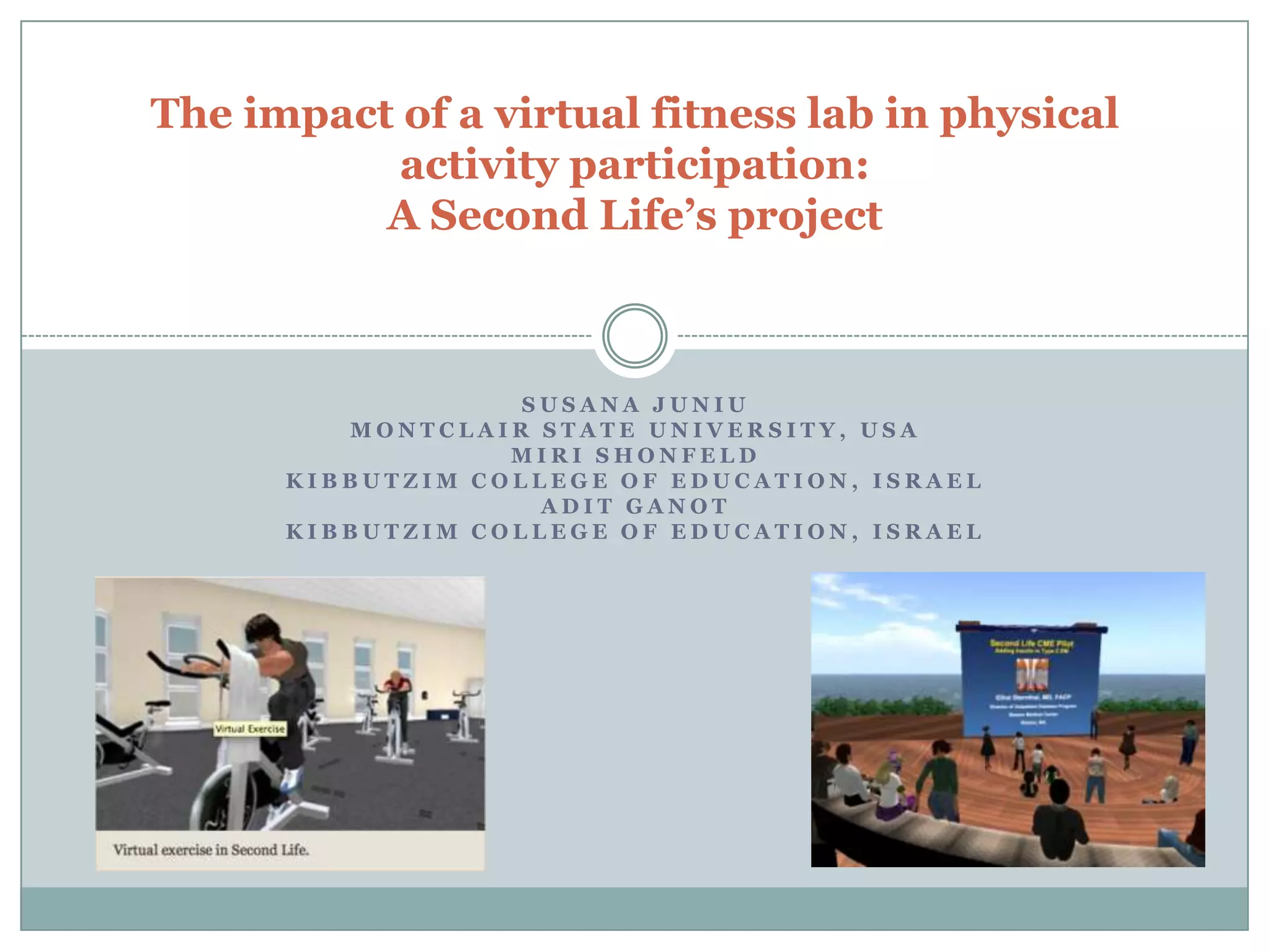
The impact of a virtual fitness lab in physical
           activity participation:
          A Second Life’s project


                  SUSANA JUNIU
         MONTCLAIR STATE UNIVERSITY, USA
                  MIRI SHONFELD
      KIBBUTZIM COLLEGE OF EDUCATION, ISRAEL
                   ADIT GANOT
      KIBBUTZIM COLLEGE OF EDUCATION, ISRAEL
Purpose of this project:


 To explore the instructional uses of a Virtual
  fitness as part of the teacher education program in
  Physical Education
 To support the community in becoming
  knowledgeable about fitness and health and to
  encourage individuals to be more physically active
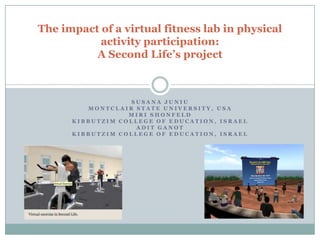
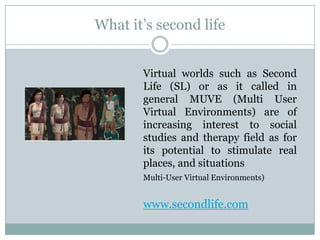
What it’s second life


       Virtual worlds such as Second
       Life (SL) or as it called in
       general MUVE (Multi User
       Virtual Environments) are of
       increasing interest to social
       studies and therapy field as for
       its potential to stimulate real
       places, and situations
       Multi-User Virtual Environments)


       www.secondlife.com
What it’s second life

 A three-dimensional (3D) shared space:
   Enhances imagination, creativity, motivation and
    engagement
   Breaks physical, geographical, generational, and
    professional boundaries
   Facilitates collaboration
   Provides a sense of presence and belonging
   Offers an environment for authentic learning
   Provides visual representations of labs, classrooms,
    meeting places, and secure spaces for the individual
Real and Virtual World

 Real world behavior is positively influenced by:
   The individual own self-representing avatar behavior and
    appearance (Fox and Bailenson, 2009)
   Users may adjust their identity to match that of their avatars

   Individuals with avatars who engage in physical activities in SL
    are more likely to engage in physical activities in real life
    (Dean, Cook, Keating, and Murphy, 2009)
   Smoother transitions into real world fitness
Why an Exercise Physiology Lab?

 Exercise physiology concepts are abstract, complex
  and difficult to communicate through simple lectures
  and textbooks
 Virtual exercise physiology labs could support the
  learning process by:
    Providing the students with an environment that through
     simulation will demonstrate a number of tests in a non-
     intrusive manner
 “Through visualization and education, [students]
 they can try activities that they had not tried
 before.” Jeanne Johnston, Indiana University
Virtual Research Projects - Weight Loss

 Traditional health club sessions vs 3D virtual world (Jeanne
  Johnston, Indiana University)
     Participants in two weight-loss programs -- one involving
      traditional health club sessions and the other delivered online
      in a 3D virtual world -- lost similar amounts of weight and
      body fat
     Online in a lost similar amounts of weight and body fat, but the
      online contingent reported significantly greater gains in
      behaviors that could help them live leaner, more healthful
      lifestyles.
Virtual Labs in second life


 Virtual genetics laboratory in Second Life - University of Leicester
     http://www.youtube.com/watch?v=uMMfHZUNpZY


 Interactive Science Lab Version 2- Ohio University
     http://www.youtube.com/watch?v=aiwG-RzeDow&feature=endscreen&NR=1


 SSU Virtual Design Lab, Quick Tour 2.mov- Shawnee State
  University
     http://www.youtube.com/watch?v=FeFpOCf8sQ0
Weight Management Gym in Second Life

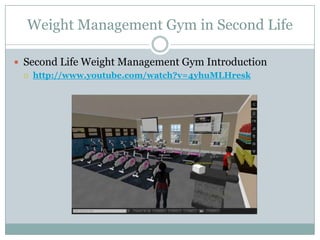
 Second Life Weight Management Gym Introduction
    http://www.youtube.com/watch?v=4yhuMLHresk
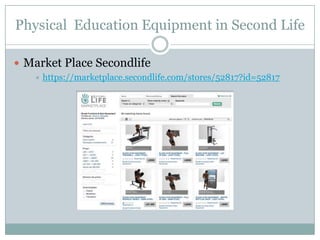
Physical Education Equipment in Second Life

 Market Place Secondlife
      https://marketplace.secondlife.com/stores/52817?id=52817
Premise

 [Creating a context that emulates real-
      life problems and settings is
  fundamental in (a) helping students
integrate, analyze, and apply concepts of
 exercise physiology and (b) engaging
   individuals in meaningful physical
           activity experiences]
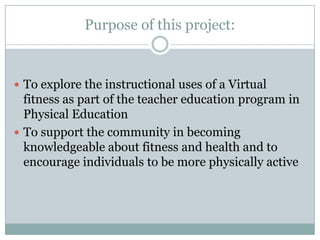
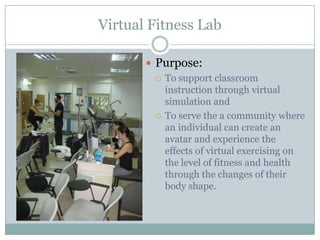
Virtual Fitness Lab

        Purpose:
          To support classroom
           instruction through virtual
           simulation and
          To serve the a community where
           an individual can create an
           avatar and experience the
           effects of virtual exercising on
           the level of fitness and health
           through the changes of their
           body shape.
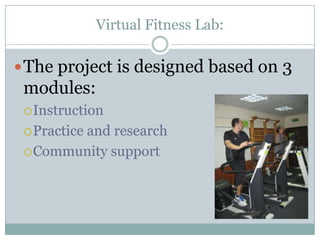
Virtual Fitness Lab:

 The project is designed based on 3
 modules:
  Instruction

  Practice
        and research
  Community support
Instruction

 Students will review:
    Learning modules on the different fitness tests
      Anthropometric testing
      Blood pressure
      Body composition
      Cardiovascular endurance
      Muscular Strength and Endurance
      Flexibility
      Nutrition
    Procedures for test administration
      Videos
      Animation
      Applications
Virtual Practice

 Students will:
   Apply knowledge acquire during the instruction session

   Practice the tests through simulation
   Adjust equipment based on age, weight, time, resistance,
    inclination
       Simulation will adjust resistant, calculate calories, etc.
Community Support

 The clients will complete:
    Pre-Tests, baseline results
          Fitness Test
          Physical Activity Readiness Questionnaire
          Medical history questionnaire
          Exercise Perception and Attitudes Questionnaire
    Create an exercise program in the virtual fitness lab
          Formative assessments
    Post-test
          Fitness test
          Physical Activity Readiness Questionnaire
          Medical history questionnaire
          Exercise Perception and Attitudes Questionnaire
Through virtual simulation:

 Support students in Exercise Science
   Learn fitness concepts
   Acquire fitness assessment skills
   Apply in a real world setting.

 Support classroom instruction
   Virtual simulation of the various tests without bringing the
    subject to exhaustion
   Conduct tests and research without the need expensive
    equipment and running by a trained professional
   Practical and an effective alternative to using traditional
    laboratory experiences that necessitate the use of subjects
    and/or expensive equipment.
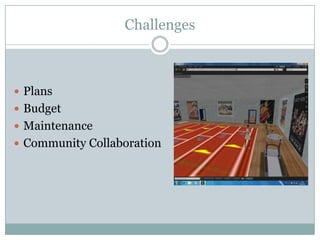
Challenges


 Plans
 Budget
 Maintenance
 Community Collaboration
Ideas and Questions

       email us at:


      Susana Juniu
junius@mail.montclair.edu
     Miri Shonfeld
   mirish@macam.ac.il
       Adit Ganot
   adit_gan@smkb.ac.il

Second Life: A Fitness Lab

  • 1.
    The impact ofa virtual fitness lab in physical activity participation: A Second Life’s project SUSANA JUNIU MONTCLAIR STATE UNIVERSITY, USA MIRI SHONFELD KIBBUTZIM COLLEGE OF EDUCATION, ISRAEL ADIT GANOT KIBBUTZIM COLLEGE OF EDUCATION, ISRAEL
  • 2.
    Purpose of thisproject:  To explore the instructional uses of a Virtual fitness as part of the teacher education program in Physical Education  To support the community in becoming knowledgeable about fitness and health and to encourage individuals to be more physically active
  • 3.
    What it’s secondlife Virtual worlds such as Second Life (SL) or as it called in general MUVE (Multi User Virtual Environments) are of increasing interest to social studies and therapy field as for its potential to stimulate real places, and situations Multi-User Virtual Environments) www.secondlife.com
  • 4.
    What it’s secondlife  A three-dimensional (3D) shared space:  Enhances imagination, creativity, motivation and engagement  Breaks physical, geographical, generational, and professional boundaries  Facilitates collaboration  Provides a sense of presence and belonging  Offers an environment for authentic learning  Provides visual representations of labs, classrooms, meeting places, and secure spaces for the individual
  • 5.
    Real and VirtualWorld  Real world behavior is positively influenced by:  The individual own self-representing avatar behavior and appearance (Fox and Bailenson, 2009)  Users may adjust their identity to match that of their avatars  Individuals with avatars who engage in physical activities in SL are more likely to engage in physical activities in real life (Dean, Cook, Keating, and Murphy, 2009)  Smoother transitions into real world fitness
  • 6.
    Why an ExercisePhysiology Lab?  Exercise physiology concepts are abstract, complex and difficult to communicate through simple lectures and textbooks  Virtual exercise physiology labs could support the learning process by:  Providing the students with an environment that through simulation will demonstrate a number of tests in a non- intrusive manner  “Through visualization and education, [students] they can try activities that they had not tried before.” Jeanne Johnston, Indiana University
  • 7.
    Virtual Research Projects- Weight Loss  Traditional health club sessions vs 3D virtual world (Jeanne Johnston, Indiana University)  Participants in two weight-loss programs -- one involving traditional health club sessions and the other delivered online in a 3D virtual world -- lost similar amounts of weight and body fat  Online in a lost similar amounts of weight and body fat, but the online contingent reported significantly greater gains in behaviors that could help them live leaner, more healthful lifestyles.
  • 8.
    Virtual Labs insecond life  Virtual genetics laboratory in Second Life - University of Leicester  http://www.youtube.com/watch?v=uMMfHZUNpZY  Interactive Science Lab Version 2- Ohio University  http://www.youtube.com/watch?v=aiwG-RzeDow&feature=endscreen&NR=1  SSU Virtual Design Lab, Quick Tour 2.mov- Shawnee State University  http://www.youtube.com/watch?v=FeFpOCf8sQ0
  • 9.
    Weight Management Gymin Second Life  Second Life Weight Management Gym Introduction  http://www.youtube.com/watch?v=4yhuMLHresk
  • 10.
    Physical Education Equipmentin Second Life  Market Place Secondlife  https://marketplace.secondlife.com/stores/52817?id=52817
  • 11.
    Premise [Creating acontext that emulates real- life problems and settings is fundamental in (a) helping students integrate, analyze, and apply concepts of exercise physiology and (b) engaging individuals in meaningful physical activity experiences]
  • 12.
    Virtual Fitness Lab  Purpose:  To support classroom instruction through virtual simulation and  To serve the a community where an individual can create an avatar and experience the effects of virtual exercising on the level of fitness and health through the changes of their body shape.
  • 13.
    Virtual Fitness Lab: The project is designed based on 3 modules:  Instruction  Practice and research  Community support
  • 14.
    Instruction  Students willreview:  Learning modules on the different fitness tests  Anthropometric testing  Blood pressure  Body composition  Cardiovascular endurance  Muscular Strength and Endurance  Flexibility  Nutrition  Procedures for test administration  Videos  Animation  Applications
  • 15.
    Virtual Practice  Studentswill:  Apply knowledge acquire during the instruction session  Practice the tests through simulation  Adjust equipment based on age, weight, time, resistance, inclination  Simulation will adjust resistant, calculate calories, etc.
  • 16.
    Community Support  Theclients will complete:  Pre-Tests, baseline results  Fitness Test  Physical Activity Readiness Questionnaire  Medical history questionnaire  Exercise Perception and Attitudes Questionnaire  Create an exercise program in the virtual fitness lab  Formative assessments  Post-test  Fitness test  Physical Activity Readiness Questionnaire  Medical history questionnaire  Exercise Perception and Attitudes Questionnaire
  • 17.
    Through virtual simulation: Support students in Exercise Science  Learn fitness concepts  Acquire fitness assessment skills  Apply in a real world setting.  Support classroom instruction  Virtual simulation of the various tests without bringing the subject to exhaustion  Conduct tests and research without the need expensive equipment and running by a trained professional  Practical and an effective alternative to using traditional laboratory experiences that necessitate the use of subjects and/or expensive equipment.
  • 18.
    Challenges  Plans  Budget Maintenance  Community Collaboration
  • 19.
    Ideas and Questions  email us at: Susana Juniu junius@mail.montclair.edu Miri Shonfeld mirish@macam.ac.il Adit Ganot adit_gan@smkb.ac.il