Second Language Acquisition 3rd Edition Susan M Gass Larry Selinker
Second Language Acquisition 3rd Edition Susan M Gass Larry Selinker
Second Language Acquisition 3rd Edition Susan M Gass Larry Selinker
Second Language Acquisition 3rd Edition Susan M Gass Larry Selinker
Second Language Acquisition 3rd Edition Susan M Gass Larry Selinker
1.
Second Language Acquisition3rd Edition Susan M
Gass Larry Selinker download
https://ebookbell.com/product/second-language-acquisition-3rd-
edition-susan-m-gass-larry-selinker-53735804
Explore and download more ebooks at ebookbell.com
2.
Here are somerecommended products that we believe you will be
interested in. You can click the link to download.
Second Language Acquisition In Action Principles From Practice Andrea
Nava Luciana Pedrazzini
https://ebookbell.com/product/second-language-acquisition-in-action-
principles-from-practice-andrea-nava-luciana-pedrazzini-50218976
Second Language Acquisition A Theoretical Introduction To Realworld
Applications Alessandro G Benati Tanja Angelovska
https://ebookbell.com/product/second-language-acquisition-a-
theoretical-introduction-to-realworld-applications-alessandro-g-
benati-tanja-angelovska-50219208
Second Language Acquisition Of Turkish 1st Edition Aye Grel
https://ebookbell.com/product/second-language-acquisition-of-
turkish-1st-edition-aye-grel-51570668
Understanding Formulaic Language A Second Language Acquisition
Perspective Anna Siyanovachanturia
https://ebookbell.com/product/understanding-formulaic-language-a-
second-language-acquisition-perspective-anna-
siyanovachanturia-53072676
3.
Second Language AcquisitionAnd Lifelong Learning 1st Edition Simone E
Pfenninger
https://ebookbell.com/product/second-language-acquisition-and-
lifelong-learning-1st-edition-simone-e-pfenninger-56101276
Second Language Acquisition And Universal Grammar Lydia White
https://ebookbell.com/product/second-language-acquisition-and-
universal-grammar-lydia-white-2212398
Second Language Acquisition An Introductory Course Second Susan M Gass
Larry Selinker
https://ebookbell.com/product/second-language-acquisition-an-
introductory-course-second-susan-m-gass-larry-selinker-2338500
Second Language Acquisition Processes In The Classroom Learning
Japanese Amy Snyder Ohta
https://ebookbell.com/product/second-language-acquisition-processes-
in-the-classroom-learning-japanese-amy-snyder-ohta-2451408
Second Language Acquisition An Introductory Course 5th Edition Susan M
Gass
https://ebookbell.com/product/second-language-acquisition-an-
introductory-course-5th-edition-susan-m-gass-36506254
6.
SECOND LANGUAGE ACQUISITION
Praisefor the Third Edition:
“A tour de force. The authors have taken the best text available for an introduc-
tory course in second language acquisition (SLA) and made it even stronger. . . .
The improvements in the third edition are palpable from the very beginning of the
text. . . . The third edition of Second Language Acquisition: An Introductory Course
should form the basis for any introduction to SLA, at either the graduate or
undergraduate level.”
—Fred Eckman, Center for the Advanced Study of Language,
University of Maryland
“This text presents a comprehensive overview of SLA in an accessible, highly
readable manner appropriate for readers new to this discipline. . . . The new edition
includes even more data samples than the previous edition, both integrated into
the main text and in the discussion questions at the end of each chapter.”
—Deborah Pilcher, Gallaudet University
“Second Language Acquisition: An Introductory Course presents the most balanced,
grounded, and accessible introduction to a broad field. The field has grown rapidly
since publication of the second edition in 2001, and a new, updated, and expanded
edition is most welcome. [T]he third edition . . . make[s] this breadth of know-
ledge accessible to students with little background in the feeder disciplines . . .
Second Language Acquisition has now become a living standard in our field.”
—Richard Young, Professor of English Linguistics,
University of Wisconsin-Madison
About the Authors:
Susan M. Gass is University Distinguished Professor in the Department of
Linguistics and Germanic, Slavic, Asian and African Languages at Michigan State
University. She has conducted research in a wide variety of sub-areas of second
language acquisition, including language transfer, language universals, second
language research methods, and input and interaction. She is the author/editor of
numerous books, has served as the President of the American Association for
Applied Linguistics and is the current president of the International Association
of Applied Linguistics (AILA).
Larry Selinker is one of the original contributors to the research field of second
language acquisition, having introduced the concepts “interlanguage” and “fossil-
ization,” and having conducted one of the first empirical studies in “language
transfer” research in 1969. He is now preparing a 40-plus year fossilization study
on participants first looked at in 1964. He has held professorships at the
Universities of Michigan and London and visiting professorships at various
universities around the world. Currently, he is Visiting Professor at New York
University and is helping to organize Research Production Associates.
To Gertrude Zemon-Gassand H. Harvey Gass, who instilled
in me the love of inquiry
To my parents, Sol and Miriam Selinker, who inspired me
deeply and whom I miss very much
12.
CONTENTS
Preface xv
1 Introduction1
1.1 The study of second language acquisition 1
1.2 Definitions 6
1.3 The nature of language 8
1.3.1 Sound systems 8
1.3.2 Syntax 9
1.3.3 Morphology and the lexicon 11
1.3.4 Semantics 12
1.3.5 Pragmatics 13
1.4 The nature of nonnative speaker knowledge 14
1.5 Conclusion 14
Suggestions for additional reading 15
Points for discussion 15
2 Related disciplines 20
2.1 SLA and related disciplines 20
2.2 Third language acquisition/multilingualism 21
2.3 Heritage language acquisition 23
2.4 Bilingual acquisition 24
2.5 First language acquisition 30
2.5.1 Babbling 31
2.5.2 Words 32
2.5.3 Sounds and pronunciation 34
2.5.4 Syntax 35
2.5.5 Morphology 36
vii
13.
2.6 Conclusion 38
Suggestionsfor additional reading 38
Points for discussion 39
3 Second and foreign language data 41
3.1 Data analysis 41
3.1.1 Data set I: plurals 41
3.1.2 Data set II: verb + -ing markers 46
3.1.3 Data set III: prepositions 47
3.2 What data analysis does not reveal 50
3.3 Data collection 52
3.3.1 Eliciting speech samples 60
3.3.2 Eliciting reactions to data 63
3.3.3 Verbal report data 69
3.3.4 Measuring non-linguistic information 70
3.3.5 Measuring general proficiency:
standardized language tests 71
3.4 Replication 72
3.5 Issues in data analysis 73
3.6 What is acquisition? 81
3.7 Conclusion 82
Suggestions for additional reading 82
Points for discussion 82
4 The role of the native language: an historical overview 89
4.1 Introduction 89
4.2 Behaviorism 90
4.2.1 Linguistic background 90
4.2.2 Psychological background 92
4.3 Contrastive Analysis Hypothesis 96
4.4 Error analysis 102
4.5 Conclusion 110
Suggestions for additional reading 110
Points for discussion 111
5 Recent perspectives on the role of previously known
languages 121
5.1 Theories of learning 121
5.2 Child second language acquisition 123
C O N T E N T S
viii
14.
5.3 Child secondlanguage morpheme order studies 126
5.4 Adult second language morpheme order studies 130
5.5 Revised perspectives on the role of the native language 136
5.5.1 Avoidance 138
5.5.2 Differential learning rates 139
5.5.3 Different paths 141
5.5.4 Overproduction 143
5.5.5 Predictability/selectivity 144
5.5.6 Second language processing 151
5.6 Interlanguage transfer 151
5.7 Conclusion 155
Suggestions for additional reading 155
Points for discussion 155
6 Formal approaches to SLA 159
6.1 Introduction 159
6.2 Universal Grammar 160
6.2.1 Initial state 163
6.2.2 UG principles 168
6.2.3 UG parameters 170
6.2.4 Falsification 174
6.3 Transfer: the UG perspective 176
6.3.1 Levels of representation 176
6.3.2 Clustering 177
6.3.3 Learnability 177
6.4 Phonology 178
6.4.1 Markedness Differential Hypothesis 179
6.4.2 Similarity/dissimilarity: Speech Learning Model 183
6.4.3 Optimality Theory 184
6.4.4 Ontogeny Phylogeny Model 186
6.5 Conclusion 189
Suggestions for additional reading 189
Points for discussion 190
7 Typological and functional approaches 191
7.1 Introduction 191
7.2 Typological universals 191
7.2.1 Test case I: the Accessibility Hierarchy 197
7.2.2 Test case II: the acquisition of questions 200
7.2.3 Test case III: voiced/voiceless consonants 202
C O N T E N T S
ix
15.
7.2.4 Falsifiability 204
7.2.5Typological universals: conclusions 205
7.3 Functional approaches 206
7.3.1 Tense and aspect: the Aspect Hypothesis 206
7.3.2 The Discourse Hypothesis 210
7.3.3 Concept-oriented approach 212
7.4 Conclusion 213
Suggestions for additional reading 213
Points for discussion 213
8 Looking at interlanguage processing 219
8.1 Introduction 219
8.2 Connectionist/emergentist models 219
8.3 Processing approaches 226
8.3.1 Processability Theory 227
8.3.2 Information processing: automaticity,
restructuring, and U-shaped learning 230
8.3.3 Input Processing 238
8.4 Knowledge types 241
8.4.1 Acquisition–Learning 241
8.4.2 Declarative/procedural 242
8.4.3 Implicit/explicit 243
8.4.4 Representation and control 244
8.5 Interface of knowledge types 246
8.5.1 No interface 246
8.5.2 Weak interface 246
8.5.3 Strong interface 247
8.6 Psycholinguistic constructs 248
8.6.1 Attention 248
8.6.2 Working memory 250
8.6.3 Monitoring 253
8.7 Conclusion 255
Suggestions for additional reading 255
Points for discussion 255
9 Interlanguage in context 259
9.1 Introduction 259
9.2 Variation 259
9.3 Systematic variation 262
C O N T E N T S
x
16.
9.3.1 Linguistic context263
9.3.2 Social context relating to the native language 266
9.3.3 Social context relating to interlocutor, task
type, and conversational topic 268
9.4 Social interactional approaches 280
9.4.1 Conversation Analysis 281
9.4.2 Sociocultural theory 283
9.5 Communication strategies 285
9.6 Interlanguage pragmatics 287
9.7 Conclusion: SLA and other disciplines 293
Suggestions for additional reading 294
Points for discussion 294
10 Input, interaction, and output 304
10.1 Introduction 304
10.2 Input 304
10.3 Comprehension 310
10.4 Interaction 317
10.5 Output 325
10.5.1 Feedback 329
10.5.2 Hypothesis testing 341
10.5.3 Automaticity 345
10.5.4 Meaning-based to grammar-based processing 345
10.6 The role of input and interaction in language learning 346
10.6.1 Attention 355
10.6.2 Contrast theory 356
10.6.3 Metalinguistic awareness 359
10.7 Limitations of input 360
10.8 Conclusion 362
Suggestions for additional reading 362
Points for discussion 362
11 Instructed second language learning 368
11.1 Introduction 368
11.2 Classroom language 368
11.3 Processing instruction 372
11.4 Teachability/learnability 376
11.5 Focus on form 380
11.5.1 Timing 384
C O N T E N T S
xi
17.
11.5.2 Forms tofocus on 386
11.5.3 Input manipulation and input enhancement 387
11.6 Uniqueness of instruction 389
11.7 Effectiveness of instruction 390
11.8 Conclusion 392
Suggestions for additional reading 392
Points for discussion 393
12 Beyond the domain of language 395
12.1 Introduction 395
12.2 Research traditions 396
12.2.1 Linguistics 396
12.2.2 Psychology 397
12.2.3 Psycholinguistics 397
12.3 Affect 398
12.3.1 Language shock and culture shock 398
12.3.2 Anxiety 400
12.3.3 Affective Filter 402
12.4 Social distance 403
12.5 Age differences 405
12.6 Aptitude 417
12.7 Motivation 426
12.7.1 Motivations as a function of time and success 428
12.7.2 Changes over time 429
12.7.3 Influence of success on motivation and
demotivation 429
12.8 Personality and learning style 432
12.8.1 Extroversion and introversion 433
12.8.2 Risk taking 433
12.8.3 Field independence/dependence 434
12.8.4 Visual/auditory/kinesthetic 437
12.8.5 Obtaining learning style information 437
12.9 Learning strategies 439
12.10 Conclusion 445
Suggestions for additional reading 445
Points for discussion 446
13 The lexicon 449
13.1 The significance of the lexicon 449
C O N T E N T S
xii
18.
13.2 Categories oflexical knowledge: some dichotomies 451
13.2.1 Production and reception 451
13.2.2 Knowledge and control 453
13.2.3 Breadth and depth 454
13.3 Lexical knowledge, development, and influences 456
13.3.1 Subcategorization 456
13.3.2 Word associations and networks 457
13.3.3 Word formation 458
13.3.4 Word combinations, collocations, and
phraseology 459
13.4 L1 influence 462
13.4.1 Incidental vocabulary learning 463
13.4.2 Incremental vocabulary learning 466
13.5. Using lexical skills 467
13.5.1 Production 467
13.5.2 Perception 472
13.6 Conclusion 475
Suggestions for additional reading 475
Points for discussion 475
14 An integrated view of second language acquisition 479
14.1 An integration of subareas 479
14.1.1 Apperceived input 482
14.1.2 Comprehended input 484
14.1.3 Intake 486
14.1.4 Integration 487
14.1.5 Output 490
14.2 Conclusion 491
Suggestions for additional reading 492
Points for discussion 493
Notes 505
Glossary 514
References 523
Author index 577
Subject index 583
C O N T E N T S
xiii
20.
PREFACE
This is abook about second language acquisition. As such, it deals
with the ways in which second languages are learned. We take a multidis-
ciplinary approach in that what we have selected to present in this book
represents research emanating from other well-established disciplines.
The content of the book is limited, for the most part, to a discussion of
adult second language acquisition, although we have included in this
third edition information about child language acquisition, both first and
second. This is intended to serve as background information.
This book is the third edition of a book originally published in 1994.
The field has shown considerable growth, which is reflected in this
edition. This book has been updated, and rearranged; new sections have
been added and in some cases rewritten, and new chapters have been
added as well.
The book is designed to be used in an introductory course for under-
graduate or graduate students. The goal is to make the information con-
tained herein available to students with a wide variety of background
knowledge. The book can be used with those with a background in lan-
guages and/or linguistics and those with little or no background in these
areas. The book developed out of our belief that the complexities of the
field can and should be brought to the attention of many students, both
those who are intending to delve further into the field and those who
are only curious about the pervasive phenomenon of learning a second
language.
The field of second language acquisition is one about which everyone
seems to have an opinion. Even a casual airplane conversation with a
seatmate, during which we are asked what we do, always elicits opinions
about second language acquisition, some of which are accurate, some of
which are not. It is our intent to help set the record straight on this
complex research area.
The field of second language learning is old and new at the same
time. It is old in the sense that scholars for centuries have been fascinated
by the questions posed by the nature of foreign language learning and
xv
21.
language teaching. Itis new in the sense that the field, as it is now repre-
sented, only goes back about 40 years. In the earlier part of the modern
phase, most scholarly articles emphasized language teaching and only had
a secondary interest in language learning. In other words, the impetus for
studying second language learning was derived from pedagogical
concerns.
In the past 30–40 years, the field of second language acquisition has
developed into an independent and autonomous discipline, complete
with its own research agenda. In addition, we have witnessed an increase
in the number of conferences (of both a general and a topical nature)
dealing exclusively with second language acquisition as well as special
sessions on second language acquisition as part of larger conferences.
Furthermore, the field now has journals devoted exclusively to research
in the field (Studies in Second Language Acquisition, Language Learning,
Second Language Research) as well as others in which reports of second
language studies comprise a major part (e.g., Applied Linguistics, Applied
Psycholinguistics, The Modern Language Journal). Finally, there are now
numerous edited volumes dealing with subareas of the field (e.g., language
transfer, language input, language variation, Universal Grammar, Critical
Period) and in recent years entire books concerned with subareas of the
field as well as numerous texts dealing with research methodologies. In
this book we present the old and the new as a way of helping the reader
understand some of the history of the field and how we got to where we
are today.
What is particularly noteworthy about the field of second language
acquisition is its interdisciplinary character. Second language research is
concerned with the general question: How are second languages learned?
Scholars approach the field from a wide range of backgrounds: sociology,
psychology, education, and linguistics, to name a few. This has both
positive and negative effects on the field. The advantage is that through
the multiplicity of perspectives, we are able to see a richer picture of
acquisition, a picture that appears to be more representative of the
phenomenon of acquisition in that learning a second language undoubt-
edly involves factors relating to sociology, psychology, education, and
linguistics. On the other hand, multiple perspectives on what purports to
be a single discipline bring confusion, because it is frequently the case
that scholars approaching second language acquisition from different
(often opposing and seemingly incompatible) frameworks are not able
to talk to one another. This is so because each perspective brings with it
its own way of approaching data and its own research methodology. This
book attempts to bring together these disparate threads, to place them
within a coherent framework, and importantly, to make the field access-
ible to large numbers of students.
There are many people to whom we owe a debt of gratitude. Primary
P R E FAC E
xvi
22.
among them isJosh Ard, who has been instrumental in many areas of
the book. Josh provided detailed information on some of the original
chapters. Through discussions with him, we were able to better determine
what was relevant and what was not. Furthermore, he provided valuable
clues as to what was involved in writing an introductory textbook whose
goal was in part to “normalize” the field and make it informative and
interesting to novices. His reading of the text many times over led to
minor and major changes throughout. Robin Roots also read the entire
third edition for content and for style. Jennifer Behney read and com-
mented on all aspects of this edition. She provided insightful comments
and prevented us from making some embarrassing mistakes.
Specific colleagues in the field provided detailed comments on earlier
editions and completed surveys which helped us figure out where we
could be clearer, where we needed to add parts, and where we needed to
delete sections from earlier editions. We are grateful to all of them for
their feedback. Bill VanPatten read this manuscript and made us see more
clearly how we could organize and portray some of the research pre-
sented. Alison Mackey read the entire manuscript and many times made
us rethink our conclusions and suggested more research for us to look at.
Her comments were detailed and insightful. In expressing our gratitude
to these individuals, we wish that we could also blame them for any
errors (factual or interpretive) in this book. Alas, scholarly ethics do not
allow us this luxury and we accept all errors as our own.
Our colleagues and friends in the field deserve special mention.
Although they have not all read the manuscript and may not all approve
of the conclusions drawn from their writings, they have all been influen-
tial in our thinking and our development as researchers in the field. They
are too numerous to mention, but they know who they are and we thank
them. Colleagues at Michigan State University have taught from this
book and have helped us see where we could improve areas. A hearty
thank you to them. In preparing for this third edition, Cathleen Petree,
our editor from Lawrence Erlbaum Associates and now with Taylor and
Francis, solicited opinions and feedback from prior users. In most cases
we do not know who these individuals are, but we hope that you will see
your excellent suggestions reflected in these new pages. Even though you
are anonymous to us, we hope you accept this expression of gratitude.
And many thanks to Cathleen for urging us to do this third edition. We
know that she had expected this manuscript earlier and we are fortunate
that she has been so patient.
A final group to be thanked consists of our students over the years. In
our own introductory courses we have tried and tested this material
numerous times. Our students have not hesitated to let us know when
material was unclear and when some revision was necessary. Again, there
are too many to thank personally, but they are out there somewhere,
P R E FAC E
xvii
23.
possibly teaching coursesin second language acquisition. We hope that
they have benefited from the material contained in those courses as much
as we benefited from their feedback.
To you, the student, who will make use of the book, we have provided
you with a summary of what is known today in the field of second lan-
guage acquisition. We hope that this book is but the beginning of a
deeper quest into the nature of the learning process. We hope that your
interest will be piqued by the text itself, but equally important is the
emphasis we have placed on the follow-up activities for each chapter. It is
our belief that working with structured data is as valuable as reading
summaries of what is known. These problems allow students to gain
firsthand knowledge of what learners do and do not produce. We have
found that hands-on experience is integral to the entire learning process.
We have indicated in the text where we feel the accompanying workbook
(Second Language Learning: Data Analysis—see Gass, Sorace, and Selinker,
1999) will be useful. The data sets contained in this workbook help guide
students into seeing the data from the perspective of the learner, rather
than from the perspective of the analyst.
The subtitle of this book is An Introductory Course. It is well-known in
second language acquisition circles that a truly introductory treatment of
our field is difficult to achieve. We have tried hard and hope that we have
been successful in our endeavor and that we have succeeded in making
the subject matter relevant to a wide range of students.
Susan Gass Larry Selinker
Williamston, Michigan New York, New York
June 19, 2007
P R E FAC E
xviii
24.
1
INTRODUCTION
1.1 The studyof second language acquisition
Second language acquisition (SLA) is a relatively young field. We would
be hard-pressed to state a “beginning” date, but it is probably fair to say
that the study of SLA has expanded and developed significantly in the
past 40–45 years. This is not to say that there wasn’t interest in the fields
of language teaching and learning before then, for surely there was. It is to
say, however, that since that time the body of knowledge of the field has
seen increased sophistication.
We are far from a complete theory of SLA, but there is progress. By
approaching SLA from a variety of disciplinary perspectives, as we will
see in this chapter and in the remainder of this book, we have come a
long way from pure descriptive studies to research that connects with
other disciplines.
What is the scope of SLA? What does the study of SLA consist of? It
is the study of how second languages are learned. In other words, it is the
study of the acquisition of a non-primary language; that is, the acquisi-
tion of a language beyond the native language. It is the study of how
learners create a new language system with only limited exposure to a
second language. It is the study of what is learned of a second language
and what is not learned; it is the study of why most second language
learners do not achieve the same degree of knowledge and proficiency in
a second language as they do in their native language; it is also the study
of why only some learners appear to achieve native-like proficiency in
more than one language. Additionally, second language acquisition is
concerned with the nature of the hypotheses (whether conscious or
unconscious) that learners come up with regarding the rules of the
second language. Are the rules like those of the native language? Are they
like the rules of the language being learned? Are there new rules, like
neither language, being formed? Are there patterns that are common to all
learners regardless of the native language and regardless of the language
being learned? Do the rules created by second language learners vary
1
25.
according to thecontext of use? Do these rules and patterns vary more in
individuals in a second language than they vary in the native language?
Given these varied questions, the study of second language acquisition
draws from and impacts many other areas of study, among them lin-
guistics, psychology, psycholinguistics, sociology, sociolinguistics, dis-
course analysis, conversational analysis, and education, to name a few.
Given the close relationship between second language acquisition and
other areas of inquiry, there are numerous approaches from which
to examine second language data, each one of which brings to the study
of second language acquisition its own goals, its own data-collection
methods, and its own analytic tools. Thus, second language acquisition is
truly an interdisciplinary field. This introductory text attempts to shed
light on the nature of second language acquisition from multiple
perspectives.
One way to define second language acquisition is to state what it is not.
Over the years, the study of second language acquisition has become
inextricably intertwined with language pedagogy; in the current text, one
goal is to disentangle the two fields. Second language acquisition is not
about pedagogy unless the pedagogy affects the course of acquisition
(this topic will be explored in chapter 11). Although it may be the case
that those who are interested in learning about how second languages are
learned are ultimately interested in doing so for the light this knowledge
sheds on the field of language teaching, this is not the only reason second
language acquisition is of interest, nor is it the major reason scholars in
the field of second language acquisition conduct their research.
Let us briefly consider some of the reasons why it might be important
for us to understand how second languages are learned and what is not
learned.
Linguistics
When we study human language, we are approaching what
some might call the human essence, the distinctive qualities of
mind that are, so far as we know, unique to [humans].
(Chomsky, 1968, p. 100)
The study of how second languages are learned is part of the broader
study of language and language behavior. It is not more central or
peripheral than any other part of linguistic study, which in turn
has as its larger goal the study of the nature of the human mind. In
fact, a major goal of second language acquisition research is the
determination of linguistic constraints on the formation of second
language grammars. Because theories of language are concerned with
human language knowledge, one can reasonably assume that this
knowledge is not limited to first language knowledge, and that
S E C O N D L A N G UAG E AC QU I S I T I O N
2
26.
linguistic principles reflectthe possibilities of human language
creation and the limits of human language variation. This scope of
inquiry includes second languages.
Language pedagogy
Most graduate programs whose goal is to train students in language
teaching now have required course work in second language acquisi-
tion, unlike a generation ago. Why should this be the case? People
have come to realize that if one is to develop language-teaching
methodologies, there has to be a firm basis for those methodologies in
language learning. It would be counterproductive to base language-
teaching methodologies on something other than an understanding
of how language learning does and does not take place. To give an
example, some language-teaching methodologies are based exclusively
on rule memorization and translation exercises. That is, a student in
a language class is expected to memorize rules and then translate
sentences from the native language to the language being learned and
vice versa. However, studies in second language acquisition have
made language teachers and curriculum designers aware that language
learning consists of more than rule memorization. More important,
perhaps, it involves learning to express communicative needs. The
details of this new conceptualization of language learning have
resulted in methodologies that emphasize communication. In other
words, pedagogical decision-making must reflect what is known about
the process of learning, which is the domain of second language
acquisition.
A second, perhaps equally important but less assuming, rationale
related to language pedagogy has to do with the expectations that
teachers have of their students. Let’s assume that a teacher spends a
class hour drilling students on a particular grammatical structure.
Let’s further assume that the students are all producing the structure
correctly and even in an appropriate context. If, after the class is over
and the drill is finished, a student comes up to the teacher and uses
the incorrect form in spontaneous speech, what should the teacher
think? Has the lesson been a waste of time? Or is this type of lin-
guistic behavior to be expected? If a student produces a correct form,
does that necessarily mean that the student has learned the correct
rule? These sorts of issues are part of what teachers need to be aware
of when assessing the success or failure of their teaching. Or, to
take an example from a mystery novel, Speaker of Mandarin by Ruth
Rendell, Inspector Wexford is in a museum and accompanied by Mr.
Sung who is showing him the well-preserved body of a woman who
had lived 2000 years earlier. Mr. Sung says “Let’s go” and Inspector
Wexford takes the opportunity to provide an English lesson (p. 4).
I N T RO D U C T I O N
3
27.
Wexford: I wishyou wouldn’t keep saying that. If I may suggest it,
you should say, “Shall we go? Or “Are you ready?”
Sung: You may suggest. Thank you. I am anxious to speak good.
Shall we go? Are you leady?
Wexford: Oh, yes, certainly.
Sung: Don’t reply, please. I practice. Shall we go? Are you leady?
Good, I have got it. Come, let’s go. Are you leady to go to
the site? Reply now, please.
Thus, after practicing “Shall we go?”, Sung, when it is time to make a
spontaneous utterance, reverts back to “Let’s go.” Further, when
Sung believes that he is repeating, and therefore, practicing, his
repetition of “Are you ready?”, his utterance is no different than his
original faulty utterance.
Cross-cultural communication and language use
We have noted some expectations that teachers have about students.
Similarly, in interactions with speakers of another language/culture,
we have certain expectations and we often produce stereotyped reac-
tions. For example, we may find ourselves making judgments about
other people based on their language. It turns out that many stereo-
types of people from other cultures (e.g., rudeness, unassertiveness)
are based on patterns of nonnative speech. These judgments in many
instances are not justified, because many of the speech patterns that
nonnative speakers use reflect their nonnativeness rather than charac-
teristics of their personality. As an example, consider the following
exchange between a teacher and a former student (NNS = nonnative
speaker; NS = native speaker):
(1-1) From Goldschmidt (1996, p. 255)
NNS: I have a favor to ask you.
NS: Sure, what can I do for you?
NNS: You need to write a recommendation for me.
Many teachers would, of course, react negatively to the seeming gall
of this “request,” perhaps initially thinking to themselves, “What do
you mean I need to write a letter?” when most likely the only problem
is this nonnative speaker’s lack of understanding of the forceful
meaning of need. A second example occurred in the life of one of the
authors. An international student whom the professor did not know
emailed to ask the professor for an appointment, stating that she was
interested in the discipline of SLA. The professor wrote back with a
suggestion of a time that they finally agreed on. The student arrived at
the appointed time and said:
S E C O N D L A N G UAG E AC QU I S I T I O N
4
28.
(1-2) NNS: Youwanted to see me?
Many would, of course, also react negatively to the seeming strange-
ness of the introduction, probably initially thinking, “What do you
mean I wanted to see you; it’s you who wanted to see me.” So, under-
standing second language acquisition and, in this case, how nonnative
speakers use language, allows us to separate issues of cross-cultural
communication from issues of stereotyped behavior or personal
idiosyncrasies.
But it is not only cross-cultural questions that are at issue. In the
following example, understanding L2 phonology could have helped in
the recent but brief horse-racing scandal when a Chilean jockey, after
winning the Kentucky Derby, was accused of carrying something in
his hand other than his whip. Apparently, he had told a reporter that
he wore a Q-Ray, which is a therapeutic bracelet used for arthritic
conditions. What had been understood was a “Q-ring,” which appar-
ently the reporter had never heard of, probably because it doesn’t
exist. So, despite the fact that he didn’t know what it was, the reporter
assumed it to be something illegal. Had the reporter minimally recog-
nized that perception of nonnative speech often occurs through the
filter of our native language phonological system and that that per-
ception is not always accurate, the problem might have been avoided.
That coupled with the fact that he had never heard of a Q-ring might
have suggested the need to seek greater clarification and the two or
three day scandal could have been avoided.
Language policy and language planning
Many issues of language policy are dependent on a knowledge of
how second languages are learned. For example, issues surrounding
bilingualism, such as the English Only Movement in the United
States, or the many different types of bilingual education (including
immersion programs) can only be debated if one is properly informed
about the realities and constraints of learning a second language.
National language programs often involve decision making that is
dependent on (a) information about second language learning, (b) the
kinds of instruction that can be brought to bear on issues of acquisi-
tion, and (c) the realities and expectations one can have of such
programs. All too often, these issues are debated without a clear
understanding of the object of debate; that is, the nature of how
second languages are learned.
In sum, second language acquisition is a complex field whose focus is
the attempt to understand the processes underlying the learning of a
second language. It is important to reemphasize that the study of second
I N T RO D U C T I O N
5
29.
language acquisition isseparate from the study of language pedagogy,
although this does not imply that there are not implications that can
be drawn from second language acquisition to the related discipline of
language teaching.
Many disciplines quite clearly find themselves as part of the humanities
(e.g., literature) or part of the sciences (e.g., biology). Second language
acquisition, because of its complexity and its reliance on and import for
other disciplines, is not placed so easily. SLA is part of the humanities,
in the sense that it is part of the branch of “learning (as philosophy, arts,
or languages) that investigate[s] human constructs and concerns as
opposed to natural processes (as in physics or chemistry) and social rela-
tions (as in anthropology or economics)” (from Merriam-Webster online
dictionary), although clearly there are areas of the field that do consider
social relations as an integral part of learning. Given that the humanities
are concerned with human constructs and concerns, language acquisition
is relevant, for one way of understanding the human condition is through
an understanding of language. While this is probably uncontroversial,
unfortunately this central area of humanistic study is often confined
to general issues of language and the human capacity for language as
referring to studies of primary language knowledge and the acquisition
of primary language. But this book assumes that we cannot adequately
examine the nature of language knowledge if we confine ourselves to
only a small portion of the world’s population; that is, monolingual
native speakers.
Second language acquisition, while rightfully part of the humanities, is
also part of the social sciences, defined (Merriam-Webster online) as “a
branch of science that deals with the institutions and functioning of
human society and with the interpersonal relationships of individuals as
members of society.” Given that second language acquisition deals with
interpersonal relations as it does when studying many issues of language
use, it is definitely part of the social sciences. Interactions involving
nonnative speakers of a language are undoubtedly highly frequent in the
broader context of the world’s interactions, and, thus, the study of these
interactions has a central place in the social sciences and cognitive
science. Finally, since some SLA research focuses on the biology of the
brain, and what SLA neurophysiology can show about neural workings,
SLA itself can be considered a part of the developing cognitive
neurosciences.
1.2 Definitions
The study of any new discipline involves familiarizing oneself with the
specific terminology of that field. In this section, we present some basic
terminology common to the field of second language acquisition,
S E C O N D L A N G UAG E AC QU I S I T I O N
6
30.
accompanied by briefdefinitions. Other terms are introduced and
defined as the text progresses.
Native Language (NL): This refers to the first language that a child
learns. It is also known as the primary language, the mother tongue, or
the L1 (first language). In this book, we use the common abbreviation
NL.
Target Language (TL): This refers to the language being learned.
Second Language Acquisition (SLA): This is the common term used for
the name of the discipline. In general, SLA refers to the process of
learning another language after the native language has been learned.
Sometimes the term refers to the learning of a third or fourth
language. The important aspect is that SLA refers to the learning of
a nonnative language after the learning of the native language. The
second language is commonly referred to as the L2. As with the
phrase “second language,” L2 can refer to any language learned after
learning the L1, regardless of whether it is the second, third, fourth,
or fifth language. By this term, we mean both the acquisition of a
second language in a classroom situation, as well as in more “natural”
exposure situations. The word acquisition in this book is used broadly
in the sense that we talk about language use (sometimes independ-
ently from actual acquisition). Some might prefer the term Second
Language Studies (SLS) as it is a term that refers to anything dealing
with using or acquiring a second/foreign language. However, in this
book, we continue to use the term SLA as a cover term for a wide
variety of phenomena, not because the term is necessarily the most
descriptively accurate, but because the field has come to be known by
that acronym.
Foreign Language Learning: Foreign language learning is generally dif-
ferentiated1
from second language acquisition in that the former
refers to the learning of a nonnative language in the environment of
one’s native language (e.g., French speakers learning English in France
or Spanish speakers learning French in Spain, Argentina, or Mexico).
This is most commonly done within the context of the classroom.
Second language acquisition, on the other hand, generally refers to
the learning of a nonnative language in the environment in which that
language is spoken (e.g., German speakers learning Japanese in Japan
or Punjabi speakers learning English in the United Kingdom). This
may or may not take place in a classroom setting. The important point
is that learning in a second language environment takes place with
considerable access to speakers of the language being learned,
whereas learning in a foreign language environment usually does not.2
I N T RO D U C T I O N
7
31.
1.3 The natureof language
Fundamental to the understanding of the nature of SLA is an under-
standing of what it is that needs to be learned. A facile answer is that a
second language learner needs to learn the “grammar” of the TL. But
what is meant by this? What is language? How can we characterize the
knowledge that humans have of language?
All normal humans acquire a language in the first few years of life. The
knowledge acquired is largely of an unconscious sort. That is, very young
children learn how to form particular grammatical structures, such as
relative clauses. They also learn that relative clauses often have a modify-
ing function, but in a conscious sense they do not know that it is a relative
clause and could presumably not state what relative clauses are used for.
Take as an example the following sentence:
(1-3) I want that toy that that boy is playing with.
A child could utter this fully formed sentence, which includes a relative
clause (“that that boy is playing with”), without being able to articulate
the function of relative clauses (either this one, or relative clauses in
general) and without being able to easily divide this sentence into its
component parts. It is in this sense that the complex knowledge we have
about our native language is largely unconscious.
There are a number of aspects of language that can be described sys-
tematically. In the next few sections we deal with the phonology, syntax,
morphology, semantics, and pragmatics of language.
1.3.1 Sound systems
Knowledge of the sound system (phonology) of our native language is
complex. Minimally, it entails knowing what sounds are possible and
what sounds are not possible in the language. For example, a native
speaker of English knows that the first vowel sound in the name Goethe
[œ] is not a sound in English. This knowledge is reflected in recognition as
well as in production, as generally a close English sound is substituted
when one attempts to utter that word in English.
Phonological knowledge also involves knowing what happens to words
in fast speech as opposed to more carefully articulated speech. For
example, if someone wanted to express the following idea:
(1-4) I am going to write a letter.
That person, assuming a U.S. English speaker, would undoubtedly say
something like the following.
S E C O N D L A N G UAG E AC QU I S I T I O N
8
32.
(1-5) I’m gonnawriDa leDer.
Consider the following exchange:
(1-6) Tom: What are you gonna do?
Sally: I’m gonna wriDa leDer.
Tom: You’re gonna do what?
Sally: I’m gonna wriDa leDer.
Tom: What? I can’t hear you.
Sally: I’m going to write a letter [articulated slowly and
clearly].
We can see that speakers know when to combine sounds and when not
to. We know that in “normal, fast” speech we combine words, but that in
clearer, more articulated speech we do not.
A final point to make is that, as native speakers of a language, we know
not only what are possible sounds and what are not possible sounds, but
we also know what are possible combinations of sounds and what sounds
are found in what parts of words. We know, for example, that in English,
while [b] and [n] are both sounds of English, they cannot form a “blend”
in the way that [b] and [r] can: *bnick3
versus brain. Or to take another
example, consider the sound at the end of the word ping [ŋ], which is
frequent in English. However, it cannot appear in the beginning of words
in English, although it can in other languages.
1.3.2 Syntax
In this section, we briefly describe what speakers know about the syntax
of their language. This is what is frequently known as grammar, referring
primarily to the knowledge we have of the order of elements in a sen-
tence. We point out briefly that there are two kinds of grammar that
are generally referred to: (a) prescriptive grammar and (b) descriptive
grammar. By prescriptive grammar, we mean such rules as are generally
taught in school, often without regard to the way native speakers of a
language actually use language. We have in mind such rules as “Don’t end
a sentence with a preposition,” “Don’t split infinitives,” “Don’t begin a
sentence with a conjunction,” “Don’t use contractions in writing,” and
“Use between with two items and among with more than two” (Associated
Press rule; as cited in Safire, 1999, p. 24). To illustrate that these so-called
rules are something other than appropriate, McCawley (also cited in
Safire) gives the following example: He held four golf balls between his
fingers. Even though there are more than two fingers involved, one cannot
say: *He held four golf balls among his fingers.
On the other hand, linguists are concerned with descriptive grammars:
I N T RO D U C T I O N
9
33.
They attempt todescribe languages as they are actually used. Thus, when
talking about knowledge of syntax, we are referring to descriptive gram-
mars. The rules just stated are not true of descriptive grammars because
native speakers of English frequently violate the prescriptive rules.
As with phonological knowledge discussed in section 1.3.1, native
speakers of a language know which are possible sentences of their lan-
guage and which are not. For example, below, we know that sentences 1-7
and 1-8 are possible English sentences, whereas 1-9 and 1-10 are not
possible or are ungrammatical:
(1-7) The big book is on the brown table.
(1-8) The woman whom I met yesterday is reading the same
book that I read last night.
(1-9) *The book big brown table the on is.
(1-10) *Woman the met I yesterday whom book same the is
reading read I last night that.
So part of what we know about language is the order in which elements
can and cannot occur. This is of course not as simple as the preceding
examples suggest. Are sentences 1-11 and 1-12 possible English sentences?
(1-11) Have him to call me back.
(1-12) That’s the man that I am taller than.
For many speakers of English these are strange sounding, for others they
are perfectly acceptable.
Not only do we know which sentences are acceptable in our language,
we also know which sentences are grossly equivalent in terms of meaning.
For example, sentences 1-13 and 1-14 have the same general meaning in
the sense that they refer to the same event:
(1-13) Tom was hit by a car.
(1-14) A car hit Tom.
While we know that both sentences above can be assumed to be para-
phrases of one another, we also know that they have slightly different
functions in English. If someone asks, What did that car hit?, the most
likely answer would be It hit Tom rather than Tom was hit by it. Thus, we as
native speakers know not only what is equivalent to what, but also when
to use different grammatical patterns.
Another aspect of language that we know is how meaning is affected by
moving elements within a sentence. For example, adverbs can be moved
in a sentence without affecting the meaning, whereas nouns cannot.
Sentences 1-15 and 1-16 are roughly equivalent in meaning:
S E C O N D L A N G UAG E AC QU I S I T I O N
10
34.
(1-15) Yesterday Sallysaw Jane.
(1-16) Sally saw Jane yesterday.
but 1-17 and 1-18 do not share a common meaning.
(1-17) Yesterday Sally saw Jane.
(1-18) Yesterday Jane saw Sally.
Thus, knowing a language entails knowing a set of rules with which we
can produce an infinite set of sentences. In order to see that language is
rule-governed and that we can comprehend novel sentences, consider
sentence 1-19:
(1-19) The woman wearing the green scarf ran across the street to
see the gorilla that had just escaped from the zoo.
Even though this sentence is probably one you have never encountered
before, you have little difficulty in understanding what it means.
But it is important to note that syntax is complex, often abstract and in
many instances difficult to describe. For example, we typically think that
the subject of a sentence is the performer of some action, as in 1-18
above where Jane is doing the action of seeing, but what about Josh seems
happy? We know that Josh is the subject, but he isn’t performing any
action, nor is it performing an action in the sentence it’s raining cats and
dogs.
1.3.3 Morphology and the lexicon
The study of morphology is the study of word formation. In many cases,
words are made up of more than one part. For example, the word
unforeseen is made up of three parts: un, which has a negative function;
fore, which means earlier in time; and seen, which means visualized. Each
part is referred to as a morpheme, which can be defined as the minimal
unit of meaning.
There are two classes of morphemes that we can identify: bound and
free. A bound morpheme is one that can never be a word by itself, such
as the un of unlikely. A free morpheme is one that is a word in and of
itself, such as man, woman, book, or table. Words can be created by adding
morphemes, as in the following children’s favorite:
establish
establish + ment
dis + establish + ment
dis + establish + ment + ari + an + ism
I N T RO D U C T I O N
11
35.
Not only dowe know how to form words using affixes (prefixes,
suffixes, infixes), but we also know what words can go with other words,
as in Mt. Everest is a high mountain, but not *The Empire State Building is a
high building.
1.3.4 Semantics
The study of semantics refers to the study of meaning. This, of course,
does not necessarily correspond to grammaticality because many
ungrammatical sentences are meaningful, or at least interpretable, as can
be seen in the following sentences.
(1-20) *That woman beautiful is my mother.
(1-21) *I’ll happy if I can get your paper.
These and many other sentences that are uttered by nonnative speakers
of a language are perfectly comprehensible, despite the fact that they do
not follow the “rules” of English. The reverse side of the picture is the
sentence that is grammatically formed but that, because of the content, is
meaningless (at least without additional contextualization), as in 1-22:
(1-22) That bachelor is married.
Knowledge of the semantics of a language entails knowledge of the
reference of words. For example, in English we know that a table refers to
an object with a flat top and either three or four legs and that a leaf most
often refers to part of a tree. But as native speakers we also have to be able
to distinguish between the meaning of the leaf of a tree and the leaf of a
table. When we hear an advertisement on television for a table with extra
leafs, it is this knowledge of homonyms that comes into play to help us
interpret the advertisement in the manner intended. For a learner, of
course, it is not so easy, as he or she might struggle to imagine a table with
tree leaves.
Additionally, it is important to note that the limits of a word are not
always clear. What is the difference between a cup and a glass? For many
objects it is obvious; for others it is less so.
Referential meanings are clearly not the only way of expressing mean-
ing. As native speakers of a language, we know that the way we combine
elements in sentences affects their meaning. Sentences 1-23 and 1-24 are
different in meaning. Thus, we understand that syntax and meaning
interrelate.
(1-23) The man bit the dog.
(1-24) The dog bit the man.
S E C O N D L A N G UAG E AC QU I S I T I O N
12
36.
In some languagesthe translation equivalents of those sentences (with
possibly different intonation contours) can be interpreted as referring to
the same event.
1.3.5 Pragmatics
Yet another area of language that we consider and that is part of what
second language learners need to learn has to do with pragmatics, or the
way in which we use language in context. For example, when we answer
the telephone and someone says Is John there?, we understand that this is a
request to speak with John. It would be strange to respond yes with the
caller saying thank you and then hanging up unless the caller did not want
to carry on the conversation with John present or only wanted to know
whether or not John was present. Clearly, the phrase Is X there? in the
context of telephone usage is a request to speak with someone and not an
information question. When the intent is the latter—as for example, a
parent checking on the whereabouts of a child—the conversation might
be slightly modified.
(1-25) Father 1: This is John’s father. Is John there?
Father 2: Yes.
Father 1: Thanks, I just wanted to know where he was.
Similarly, word order, as discussed earlier, may have an effect on meaning
(see sentences 1-23 and 1-24) in some grammatical contexts, but in others
it does not.
The following conversation exemplifies this:
(1-26) (Setting: Ice cream store; child, age 4)
Child: I want a raspberry and vanilla cone.
Shopkeeper: OK, one vanilla and raspberry cone coming
up.
Child: No, I want a raspberry and vanilla cone.
Shopkeeper: That’s what I’m getting you.
In this instance, the child is using word order to reflect the ordering of
scoops of ice cream; the shopkeeper is not. Thus, what we have learned
as adult native speakers of a language is the function of word order in
our language. In English, it does not necessarily refer to the ordering of
physical objects.
I N T RO D U C T I O N
13
37.
1.4 The natureof nonnative speaker knowledge
We have briefly characterized some areas of language knowledge that a
native speaker has of a language. Knowing a second language well means
knowing information similar to that of a native speaker of a language.
Given the complexity of the knowledge that must be learned, it should
be clear that the study of the acquisition of that knowledge is a highly
complex field.
The basic assumption in SLA research is that learners create a language
system, known as an interlanguage (IL). This concept validates learners’
speech, not as a deficit system, that is, a language filled with random
errors, but as a system of its own with its own structure. This system is
composed of numerous elements, not the least of which are elements
from the NL and the TL. There are also elements in the IL that do not
have their origin in either the NL or the TL. These latter are called new
forms and are the empirical essence of interlanguage. What is important
is that the learners themselves impose structure on the available linguistic
data and formulate an internalized system (IL).4
Central to the concept of
interlanguage is the concept of fossilization, which generally refers to
the cessation of learning. The Random House Dictionary of the English
Language (Flexner and Hanck, 1988, p. 755) defines fossilization of a lin-
guistic form, feature, rule, and so forth in the following way: “to become
permanently established in the interlanguage of a second language learner
in a form that is deviant from the target-language norm and that con-
tinues to appear in performance regardless of further exposure to the
target language.”
Because of the difficulty in determining when learning has ceased,
some hold (e.g., Long, 2003) that it is more appropriate to refer to stabil-
ization of linguistic forms, rather than to fossilization or permanent
cessation of learning. In SLA, one often notes that learners reach
plateaus that are far from the TL norms. Furthermore, it appears to be
the case that fossilized or stabilized interlanguages exist no matter what
learners do in terms of further exposure to the TL. Unfortunately, a solid
explanation of permanent or temporary learning plateaus is lacking at
present due, in part, to the lack of longitudinal studies that would be
necessary to create databases necessary to come to conclusions regarding
“getting stuck” in another language.
1.5 Conclusion
In this chapter we have presented a series of basic definitions to help the
reader begin the journey of the study of second language acquisition.
As has been seen, inherent in an analysis of interlanguage data is a focus
on the learner and on the processes involved in learning. In the following
S E C O N D L A N G UAG E AC QU I S I T I O N
14
38.
chapters we presentadditional information about interlanguages, begin-
ning with a discussion of ways of analyzing second language data.
Suggestions for additional reading
Inside Language. Vivian Cook. Edward Arnold (1997).
Language: Its Structure and Use, 5th ed. Edward Finegan. Heinle (2008).
An Introduction to Language, 8th ed. Victoria Fromkin, Robert Rodman and Nina
Hyams. Heinle (2007).
Essential Introductory Linguistics. Grover Hudson. Blackwell (2000).
Linguistics: A Very Short Introduction. P. H. Matthews. Oxford University Press
(2003).
Contemporary Linguistics: An Introduction. William O’Grady, John Archibald, Mark
Aronoff, and Janie Rees-Miller. Bedford/St. Martin’s Press (2005).
The Language Instinct: How the Mind Creates Language. Steven Pinker. Morrow
(1994).
Linguistics: An Introduction. Andrew Radford, Martin Atkinson, David Britain,
Harald Clahsen, and Andrew Spencer. Cambridge University Press (1999).
Points for discussion
1 A teacher has drilled students in the structure known as indirect
questions:
Do you know where my book is?
Do you know what time it is?
Did he tell you what time it is?
As a direct result of the drills, all students in the class were able to
produce the structure correctly in class. After class, a student came
up to the teacher and asked, “Do you know where is Mrs. Irving?” In
other words, only minutes after the class, in spontaneous speech, the
student used the structure practiced in class incorrectly. Describe
what you think the reason is for this misuse. Had the lesson been a
waste of time? How might you go about finding answers to these
questions?
2 Consider the distinction between second language acquisition and
foreign language learning as discussed in this chapter. Take the position
that they are fundamentally different. How would you defend this
position? Now take the opposite position. Consider how the position
you take might is affected by the linguistic areas of phonology, syntax,
morphology, semantics, and pragmatics.
Next, look at the distinction from a social point of view. Discuss
your answers in terms of specific examples from your experience,
such as the learning of Spanish in Spain versus the learning of
I N T RO D U C T I O N
15
39.
Spanish in theUnited States, or the teaching of English in the United
States versus the teaching of English in Asia.
3 Consider the differences between child language acquisition and adult
second language acquisition. Specifically, consider the example pro-
vided in 1-3.
(1-3) I want that toy that that boy is playing with.
With regard to this sentence, we state in this chapter that “A child
could utter this fully formed sentence, which includes a relative clause
(‘that that boy is playing with’), without being able to articulate the
function of relative clauses (either this one, or relative clauses in
general) and without being able to easily divide this sentence into its
component parts. It is in this sense that the complex knowledge we
have about our native language is largely unconscious.”
Do you think that this comment is also valid for adults learning a
second language? Specifically, do you think that an adult needs to
consciously learn the grammar of relative clauses before being able to
use them spontaneously in interlanguage? Take an example from your
own language-learning or language-teaching experience, or one that
you know of, and relate it to these child versus adult distinctions. In
thinking about this question, take into account the concept of fossil-
ization (as defined in this chapter) versus the concept of stabilization.
4 We state in this chapter that, with regard to fossilization, a solid
theoretical explanation of permanent plateaus is lacking at present. In
pairs, create a list of some of the main reasons for the well-attested
existence of fossilization in interlanguage. Share your list with that of
another pair and come up with a common list.
5 In section 1.3.2, we describe the types of knowledge that individuals
have about sentences in their native language. We note that there is
variation in native speakers’ acceptance of sentences, as in sentences
1-11 and 1-12.
(1-11) Have him to call me back.
(1-12) That’s the man that I am taller than.
Are these sentences acceptable to you? If not, what would you say
instead? In what situations, if any, would you say these sentences?
Consider how and when such variation might occur in terms of
second language syntactic knowledge. For example, a student ended
an academic note to a teacher with this spontaneous interlanguage
blessing:
Wish peace be with you.
S E C O N D L A N G UAG E AC QU I S I T I O N
16
40.
Other students (ofthe same NL) who were then asked to produce a
blessing in a (nonspontaneous) task produced many variations,
including this one:
Wish peace be to you.
Is this the same sort of variation as described earlier? Why or why
not? How does it affect your answer to know that the original sen-
tence occurred spontaneously and the others did not?
6 Consider in general the nature of nonnative speaker knowledge. In
what ways is it similar to or different from native speaker knowledge?
We stated in this chapter that nonnative speakers form interlanguages
that consist not only of elements from their native language and the
target language, but also “autonomous” elements. In this light, con-
sider the following sentences, produced by an Arabic speaker of
English:
I bought a couple of towel.
There is many kind of way you make baklawa.
There are about one and half-million inhabitant in Jeddah.
In these examples, which linguistic items (and arrangements of items)
do you hypothesize come from the target language, which come from
the native language, and which are autonomous? As a way to begin,
think about whether learners of English with first languages other
than Arabic are likely to utter similar sentences.
7 In this chapter, we discussed possible motivating factors for the study
of second language acquisition. What other reasons might there be
for investigating how second languages are learned?
8 Following are English translations of compositions written by two
schoolchildren in their native language (Tatar) and compositions writ-
ten by the same children in Russian, their L2. In all instances, the
children were describing a picture.
Child 1: Written in Tatar (L1)
The long awaited spring has come. The days are getting warmer
and warmer. The blue sky is covered by white fluffy clouds.
They skim like sailboats through the sky. The ice is breaking
away on the river to the north. The birds have returned after
having flown from us to a warm region. The apples have
bloomed. Children are planting tomatoes, cucumbers, onions,
and other vegetables. They are watering the trees. Azat is
planting flowers. Rustam is watering the apples. The children
are happily working in the garden. They are very happy.
I N T RO D U C T I O N
17
41.
Child 1: Writtenin Russian (L2)
In the schoolyard there is a large garden. Children are digging
in the earth. Children are working in the garden. In the garden
there is a pine tree, an oak, and tomatoes. An apple tree is
growing there. They are planting flower beds.
Child 2: Written in Tatar (L1)
It was a beautiful spring day. The sun was shining. The birds
who had returned from distant lands were singing. The trees
were swallowed up by the greenery of the luxuriant spring
foliage. The children have come into their garden. There the
apple trees have already blossomed. Rustam is watering
the flowers. The remaining children are planting vegetables.
The teacher is watching the work of her pupils. She’s pleased
with their work, she smiles.
Child 2: Written in Russian (L2)
In the schoolyard there is a large garden. Children are working
there. The garden is big. In the garden there are trees. A child is
planting a tree. A child is pouring water from a watering pot. In
the garden a poplar is growing.
What kind of information (e.g., descriptive, evaluative) do these
children include in their NL descriptions of these pictures? In their
TL descriptions of the pictures? What similarities/differences are
there between the NL and TL versions of these pictures?
9 In pairs, answer “True” or “False” to the following statements. Justify
your responses. Once you come to a consensus, compare your
answers to those of another pair.
a Any child without cognitive disabilities can learn any language
with equal ease.
b Learning a second language is a matter of learning a new set of
habits.
c The only reason that some people cannot learn a second or for-
eign language is that they are insufficiently motivated.
d All children can learn a second language accent-free.
e No adult can learn a second language accent-free.
f All human beings have an innate capacity to learn language.
g Vocabulary is the most important part of learning a second
language.
h Vocabulary is the most difficult part of learning a second
language.
i Language instruction is a waste of time.
S E C O N D L A N G UAG E AC QU I S I T I O N
18
42.
j Learning asecond language takes no more time than learning a
first language.
10 We mentioned that it is difficult to know when learning is ceased.
This is the case for our first language as well. To understand this
better, think of areas of your first language that you sometimes
“stumble” over (e.g., She laid the book on the table). List two or three
other such areas. Then, think about vocabulary. Are there words in
your native language that you are not sure of the meaning of? Pick an
arbitrary page of a monolingual dictionary. How many words do you
not know?
I N T RO D U C T I O N
19
43.
2
RELATED DISCIPLINES
2.1 SLAand related disciplines
There are many research areas that are related to the field of second
language acquisition, some of which were mentioned in chapter 1. This
chapter briefly touches on some of these “neighboring” disciplines as a
way of introducing the reader to these areas, showing similarities and
dissimilarities. While SLA is now an autonomous area of research, it had
its roots and initial justification in other areas—for example, language
teaching—and it has been strongly influenced by other disciplines, such
as linguistics and psychology. However, it had a special relationship
with child language acquisition in that child language acquisition formed
the basis of research in second language acquisition, with many of the
original second language research questions stemming from the same
questions in child language acquisition. Other areas, such as third lan-
guage acquisition or heritage language acquisition, are special instances
of second language acquisition and, particularly in the case of heritage
language learning, have developed in recent years. Finally, bilingual acqui-
sition blends issues related to second language acquisition and those
related to first language acquisition.
We begin this chapter with a brief overview of some of the issues
addressed in these related fields. We only give cursory coverage because
to do otherwise would take us away from the main focus of this book,
second language acquisition. We feel that it is important to give some
information on these related areas, however, because they shed light on
some of the complexities of SLA. They each have a well-developed
history of their own and in most cases even have journals devoted to
their issues. In this chapter, we are able to do little more than summarize
the scope of work in these areas.
The relationship of each to second language acquisition is different.
Some, namely third language acquisition and heritage language acquisi-
tion, have a derivative relationship, developing out of related but more
specific concerns. Bilingual research has a parallel development with
20
44.
concerns that divergeto some extent from those of second language
acquisition, considering, for example, the onset of learning for both
languages. To make divisions of types of acquisition, as we have done
in this chapter, is somewhat artificial, but necessary for expository
purposes. We treat each of these areas below.
2.2 Third language acquisition/multilingualism
As mentioned in chapter 1, second language acquisition has become a
cover term for acquisition after a first language has been learned. It often
incorporates many different types of acquisition, including third, fourth,
and so on, and includes heritage language learning (to be discussed in the
subsequent section). This notwithstanding, there is a research area that
is becoming more prominent, that of third language acquisition. Since
there are multiple languages involved, the questions addressed are quite
interesting and inherently more complex than those involved in true
second language acquisition. And, individual histories become import-
ant. As noted by Cenoz and Genesee (1998, p. 16),
Multilingual acquisition and multilingualism are complex
phenomena. They implicate all the factors and processes associ-
ated with second language acquisition and bilingualism as well as
unique and potentially more complex factors and effects associ-
ated with the interactions that are possible among the multiple
languages being learned and the processes of learning them.
As we will see throughout this book, there a number of variables
that can impact the extent to which one of the languages involved (the L2
or the L1) will influence the acquisition of the L3. Among these are the
age at which L3 learning begins, the context of acquisition, individual
characteristics, and language distances among the three (or more)
languages.
Examples of language influence can be seen in a number of areas. In
2-1, from Selinker and Baumgartner-Cohen (1995), an English speaker
who has just come from France is attempting to speak German.
(2-1) Tu as mein Fax bekommen?
you have my Fax gotten
French French German German
“Did you get my fax?”
The sentence is built on German grammar with split verbs, as . . . bekom-
men (“have . . . gotten”), but with the French subject pronoun (tu) and
auxiliary avoir (“as”). Other examples come from Dewaele (1998), who
21
R E L AT E D D I S C I P L I N E S
45.
gives examples fromnative speakers of Dutch with English as an L2
producing French as L3 utterances, as in 2-2 and 2-3:
(2-2) Ils veulent gagner more, euh, plus . . .
They want to earn more, uh, more . . .
(2-3) Les gens sont involvés
The people are involved
In 2-3, the correct word is impliqués rather than involvés. Another lexical
mixture is cited by Herwig (2001). A native speaker of English who has
French as an L2 and German Swedish as an L3 says föreslägger for the
Swedish word föreslär (the German word is vorschlagen—propose).
The difficulty of keeping foreign languages apart was noted by Schmidt
and Frota (1986). Their study described an English-speaking learner
of Portuguese with Arabic as a prior second language who wondered why
he couldn’t keep the two languages (Portuguese and Arabic) apart. A
well-known quote from King Charles V of Spain (1500–1558) suggests
that some individuals have no difficulty keeping languages apart and even
assign different functions to each:
I speak Spanish to G-d, Italian to women, French to men, and
German to my horse.
But most individuals do not have such control and are not so com-
partmentalized. Why one cannot keep languages and interlanguages apart
and why the mixing and merging of various languages known and being
learned occurs are issues at the heart of research on multilingualism.
Many learners have described the experience of influence from even
unrelated languages (“talk foreign,” as described by Selinker and
Baumgartner-Cohen, 1995) as in the case involving Portuguese and
Arabic. Another example (personal communication) comes from a native
speaker of English who had been in Turkey for quite some time. He was
traveling in Germany, where he had been before, when he reported on his
attempt to speak German: “To my horror, out came Turkish.”
There are many areas that impact third language acquisition, including
sociolinguistic, psycholinguistic, and cross-linguistic influences. With
regard to sociolinguistic issues, there are a number of issues to consider,
such as the purpose for learning a second or third language. For example,
in many parts of the world, or in many industries or professions, English
has become the virtual lingua franca, or language used for basic com-
munication, as is the case for Spanish in some areas of the United States.
This is quite different from a bilingual home situation. From a psycho-
linguistic perspective, there are differences for multilingual speakers in
how the lexicon is organized. With regard to cross-linguistic influences,
22
S E C O N D L A N G UAG E AC QU I S I T I O N
46.
we presented examplesabove that demonstrate how learners of a third
language have multiple resources to draw on. Some of the determining
variables might be proficiency in the languages known, as well as in the
target language, age of user, and linguistic closeness of the languages in
question, among others.
2.3 Heritage language acquisition
Heritage language speaker is a relatively recent term, having its origins in
the education literature.1
Heritage language speakers are, broadly speak-
ing, those who have been exposed to a language of personal connection
(Fishman, 2001). Valdés (2001b) notes that “it is the historical and per-
sonal connection to the language that is salient and not the actual
proficiency of individual speakers. Armenian, for example, would be
considered a heritage language for American students of Armenian
ancestry even if the students were English-speaking monolinguals” (p. 38)
and she characterizes a heritage language learner (living in an English-
speaking environment) as someone who is “raised in a home where a
non-English language is spoken, who speaks or at least understands the
language, and who is to some degree bilingual in that language and in
English” (2001b, p. 38).
For research into this type of second or foreign language acquisition,
an important issue is the exposure and use of the language in childhood.
And here, as can be easily imagined, there are numerous problems
because exposure and use can vary from individual to individual. Unlike
much of the literature on heritage language learners, which considers
the language of the ancestral family with or without exposure and use,
Polinsky (in press) defines heritage language as the language “which was
first for an individual with respect to the order of acquisition but has
not been completely acquired because of the switch to another domin-
ant language. An individual may use the heritage language under certain
conditions and understand it, but his/her primary language is a different
one” (p. 1).
The recognition of heritage language learners as a variable in second
language research is recent. Often the concept of heritage language
speaker is (unknowingly) ignored, and these individuals are consequently
included in studies. Sorace (1993a) is an exception in that she explicitly
controlled for heritage language speakers in her study on the acquisition
of Italian by eliminating them from her database; “none had Italian
origins” (p. 35).
Heritage language acquisition is a form of second language acquisition
and a form of bilingualism. Heritage language learners have knowledge of
two languages (the home language and the language of the environment/
school), and they are usually dominant in the second language. There is a
23
R E L AT E D D I S C I P L I N E S
47.
wide range oflinguistic knowledge that heritage speakers have, including
those who were born in the second language environment and those who
came to the second language environment during their school years.
Another consideration is the amount of input in the home, ranging from
only the heritage language spoken in the home (with perhaps parents only
speaking the heritage language) to those situations in which the heritage
language is spoken only sporadically.
Heritage learners often do not become bilingual speakers because they
do not continue to speak the heritage language as much as they speak
the language of the non-home environment. In some cases, they may not
have heard or spoken the heritage language since they were very young
because their families switched to the language of the environment.
Heritage language learners form a heterogeneous group, since their
experiences of the language may be very different. Some learners may
have been raised by parents who only spoke the heritage language. How-
ever, when they went to school, English may have become their dominant
language. Other learners may have only received very limited input of the
heritage language in the home while they were very young. Nonetheless, it
is generally accepted that the nature of language learning for heritage
language learners differs from language learning involving non-heritage
language learners (Campbell and Rosenthal, 2000; Valdés, 1995, 2001b).
Heritage speakers often possess a subtly different knowledge base of
the heritage language than L2 learners of that language with no prior
background. In addition, they often differ from monolingual speakers
of their heritage language. Sometimes these differences may be subtle
and sometimes they may be quite fundamental. Some recent studies
have investigated the linguistic differences between heritage language and
non-heritage language learners (e.g., Carreira, 2002; Ke, 1998; Nagasawa,
1995; Montrul, 2002, 2004; Polinsky, 1995, 2000, in press; Gass and
Lewis, 2007).
2.4 Bilingual acquisition
Bilingualism is a broad term and, like heritage language acquisition, has
many forms and configurations. Often the term bilingual is used loosely
to incorporate multilingualism, as is clear from the introduction to a
section of a book by Bhatia and Ritchie (2006). Bhatia (2006) states that
“the investigation of bilingualism is a broad and complex field, including
the study of the nature of the individual bilingual’s knowledge and use of
two (or more) languages” (emphasis ours) (p. 5). Cenoz, in her review
(2005) of Bhatia and Ritchie’s book, states “the editors make a remark in
the introduction about the use of the word ‘bilingualism’ in the title of
the book and say that they do not exclude additional languages and
that the chapters in the book include the ‘full range of multilingualism’.
24
S E C O N D L A N G UAG E AC QU I S I T I O N
48.
However, the useof the term ‘bilingualism’ is problematic because the
Latin prefix ‘bi’ means ‘two’ . . .” (p. 638).
The concept of bilingualism is interpreted differently in the field of
SLA versus fields such as psychology and education. That is, SL
researchers reserve use of the term for only those that are truly, as shown
through some linguistic measure, the equivalent of native speakers of two
languages. Thus, from the perspective of second language researchers,
bilingual is a difficult term. In its strict meaning, it refers to someone
whose language is in a steady state and who has learned and now knows
two languages. That is, bilingual refers to an end point; “someone is
bilingual.” Within a second language research context, the end-point
interpretation of the term is generally not a focus of inquiry. Rather,
second language researchers, because of their interest in discovering the
second language acquisition process, might focus instead on near-native
speakers or advanced language learners. In general, SLA researchers are
most interested in individuals who are in the process of learning, not
those who have learned two languages earlier.
This use of the term does not appear to be the case in some of the
psychological and educational literature on bilingualism.2
For example,
Edwards (2006) starts off his article on the foundations of bilingualism
by saying “Everyone is bilingual. That is, there is no one in the world (no
adult, anyway) who does not know at least a few words in languages
other than the maternal variety. If, as an English speaker, you can say c’est
la vie or gracias or guten Tag or tovarisch—or even if you only understand
them—you clearly have some command of a foreign tongue . . . The
question, of course, is one of degree . . .” (p. 7). He goes on to say, “it is
easy to find definitions of bilingualism that reflect widely divergent
responses to the question of degree” (p. 8). Bhatia (2006) states this in an
interesting way when he says “the process of second language acquisi-
tion—of becoming a bilingual” (p. 5). In other words, the end result of
second language acquisition is a bilingual speaker. Given that bilingual-
ism is seen as the end result and given that we know that native-like
competence in a second language is rare, there is some difficulty in dis-
cussing bilingualism in this way. Thus, Bhatia and Edwards are referring
to two different phenomena. Edwards is saying that one is bilingual at
any point in the SL learning process, whereas Bhatia is referring only
to the end point and does not deal with whether or not that end point has
to be “native” or not. In other words, the issues seem to be of degree—
whether or not one is bilingual even if not a native speaker of the
L2—and of end point—whether or not one is bilingual if still in the
process of acquisition. SL researchers are more likely to require native
competence and also to reserve use of the term for the end state. The
bilingualism literature, it seems, allows more latitude in both of these
factors.
25
R E L AT E D D I S C I P L I N E S
49.
Valdés (2001a) alsodiscusses the issue of degree when she says “the
term bilingual implies not only the ability to use two languages to some
degree in everyday life, but also the skilled superior use of both languages
at the level of the educated native speaker” (p. 40). She acknowledges
that this is a narrow definition, for it considers the bilingual as someone
who can “do everything perfectly in two languages and who can pass
undetected among monolingual speakers of each of these two languages”
(p. 40). This she refers to as the “mythical bilingual.” She argues that there
are, in fact, different types of bilinguals and that it is, therefore, more
appropriate to think of bilingualism as a continuum with different
amounts of knowledge of the L1 and L2 being represented. In this view,
the term bilingualism can refer to the process of learning as well as the end
result, the product of learning.
Some researchers make a distinction between second language
learners and bilinguals, as is clear from the title of an article by Kroll and
Sunderman (2003): “Cognitive processes in second language learners and
bilinguals: the development of lexical and conceptual representations.” In
this article, the authors refer to “skilled adult bilinguals,” presumably the
rough equivalent of advanced language learners.
Finally, Deuchar and Quay (2000) define bilingual acquisition as “the
acquisition of two languages in childhood” (p. 1), although they point
to the difficulties involved in this definition given the many situations
that can be in place. They point to De Houwer (1995), who talks about
bilingual first language acquisition, referring to situations when there is
regular exposure to two languages within the first month of birth and
bilingual second language acquisition, referring to situations where
exposure begins later than one month after birth but before age two.
Wei (2000, pp. 6–7) presents a useful table of various definitions/types of
bilinguals.
As can be seen from Table 2.1, the terminology used in bilingualism
is far-reaching and overlaps to some extent with second language acquisi-
tion. For example, successive bilingual describes the scope of second
language acquisition research. Importantly, however, it is difficult to
pigeonhole all types of bilingualism because there are numerous situ-
ations in which individuals use two languages, from growing up with two
languages, to achieving bilingual status as adults, to having the second
language as virtually their only language (e.g., displaced refugees). Further,
there are different combinations of ability. For example, there are
those who function well in some contexts (talking with one’s family),
but who are not literate in that language, versus those who function
well academically in both languages. Valdés (2001a, p. 41) illustrates
what she calls a bilingual continuum in Figure 2.1. The two letters repre-
sent two languages; the size and the case of the font reflect different
proficiencies.
26
S E C O N D L A N G UAG E AC QU I S I T I O N
50.
Table 2.1 Definitionsof bilingualism
achieved bilingual same as late bilingual
additive bilingual someone whose two languages combine in a
complementary and enriching fashion
ambilingual same as balanced bilingual
ascendant bilingual someone whose ability to function in a second language
is developing due to increased use
ascribed bilingual same as early bilingual
asymmetrical bilingual see receptive bilingual
balanced bilingual someone whose mastery of two languages is roughly
equivalent
compound bilingual someone whose two languages are learned at the same
time, often in the same context
consecutive bilingual same as successive bilingual
coordinate bilingual someone whose two languages are learned in
distinctively separate contexts
covert bilingual someone who conceals his or her knowledge of a given
language due to an attitudinal disposition
diagonal bilingual someone who is bilingual in a nonstandard language or
a dialect and an unrelated standard language
dominant bilingual someone with greater proficiency in one of his or her
languages and uses it significantly more than the other
language(s)
dormant bilingual someone who has emigrated to a foreign country for a
considerable period of time and has little opportunity
to keep the first language actively in use
early bilingual someone who has acquired two languages early in
childhood
equilingual same as balanced bilingual
functional bilingual someone who can operate in two languages with or
without full fluency for the task in hand
horizontal bilingual someone who is bilingual in two distinct languages
which have a similar or equal status
incipient bilingual someone at the early stages of bilingualism where one
language is not fully developed
late bilingual someone who has become a bilingual later than
childhood
maximal bilingual someone with near-native control of two or more
languages
minimal bilingual someone with only a few words and phrases in a second
language
natural bilingual someone who has not undergone any specific training
and who is often not in a position to translate or
interpret with facility between two languages
passive bilingual same as receptive bilingual
primary bilingual same as natural bilingual
productive bilingual someone who not only understands but also speaks
and possibly writes in two or more languages
receptive bilingual someone who understands a second language, in either
its spoken or written form, or both, but does not
necessarily speak or write it continued
27
R E L AT E D D I S C I P L I N E S
51.
Despite this range,there have been and continue to be misunder-
standings regarding the advantages of being bilingual. One can think of
advantages in a number of domains. Baker and Prys Jones (1998) discuss
communicative advantages, cultural/economic advantages, and cognitive
advantages. With regard to the first of these, some are fairly obvious,
including talking to immediate and extended family members. One
can imagine a situation in which families emigrate to a country where
another language is spoken; the children learn the new language and only
barely understand the language of the parents, having become fluent in
the language of the new country, whereas the parents do not learn the
language of the environment. The communication gap widens with the
unfortunate result of noncommunication between parents and children.
Beyond these instances of family communication, bilinguals, living in a
Figure 2.1 Bilingual continuum.
Source: Adapted from Valdés, G. (2001). Heritage language students: Profiles and
possibilities. In J. K. Peyton, D. A. Ranard, & S. McGinnis (Eds.), Heritage
languages in America: Preserving a national resource. Washington, DC: Center for
Applied Linguistics. Used with permission.
Table 2.1—continued
recessive bilingual someone who begins to feel some difficulty in either
understanding or expressing him or herself with ease,
due to lack of use
secondary bilingual someone whose second language has been added to a
first language via instruction
semibilingual same as receptive bilingual
semilingual someone with insufficient knowledge of either
language
simultaneous bilingual someone whose two languages are present from the
onset of speech
subordinate bilingual someone who exhibits interference in his or her
language usage by reducing the patterns of the second
language to those of the first
subtractive bilingual someone whose second language is acquired at the
expense of the aptitudes already acquired in the first
language
successive bilingual someone whose second language is added at some stage
after the first has begun to develop
symmetrical bilingual same as balanced bilingual
vertical bilingual someone who is bilingual in a standard language and a
distinct but related language or dialect
28
S E C O N D L A N G UAG E AC QU I S I T I O N
52.
world of regularlanguage monitoring, often show greater sensitivity to
the communicative needs of others. Similarly, having experience in more
than one culture provides an understanding to cultural differences among
peoples. Further, it is obvious that economic advantages abound in all
areas of work—from business to sales.
Finally, there are cognitive advantages, including divergent thinking,
creative thinking, and metalinguistic awareness. Metalinguistic awareness
is the ability to think about (and manipulate) language. In other words,
metalinguistic ability allows one to think about language as an object of
inquiry rather than as something we use to speak and understand lan-
guage. Bialystok (2001a, 2001b) has found bilingual children to have
superior abilities in judging grammatical accuracy than monolingual
children. Bialystok (1987) investigated bilingual and monolingual
children’s abilities to count words, which reflects knowledge of what a
word is and knowledge of the relationship between word and sentence
meanings. She found that bilinguals were advantaged over monolinguals
in both of these domains: “Bilingual children were most notably
advanced when required to separate out individual words from meaning-
ful sentences, focus on only the form of or meaning of a word under
highly distracting conditions, and re-assign a familiar name to a different
object” (Bialystok, 1987, p. 138). In general, bilinguals tend to have
better abilities in those areas that demand selective attention because that
is what one has to do when there is competing information (e.g., two
languages). Thus, bilinguals’ awareness of language comes at an early age.
Knowing two languages provides them with the skills to separate form
from meaning, which in turn facilitates reading readiness.
One of the phenomena of early language development (see following
section on first language acquisition) is babbling. This occurs toward
the end of the first year of life. Maneva and Genesee (2002) noted that
children exposed to two languages from birth show language-specific
patterns in their babbling and, hence, can already differentiate between
the two languages before their first birthday. Matching the appropriate
language to speakers and/or context is found in children often as young as
2 (e.g., Genesee, Boivin, and Nicoladis, 1996).
A common phenomenon among bilingual speakers is code-switching,
which essentially refers to the use of more than one language in the
course of a conversation. Sometimes this might happen because of the
lack of a concept in one language and its presence in the other; sometimes
it might be for humor; and sometimes it might happen simply because of
the social context. For example, Grosjean (2001, p. 3) presents the
following diagram (Figure 2.2) to illustrate the issue of language mode,
which is “the state of activation of the bilingual’s languages and language
processing mechanisms at a given point in time” (p. 2). The native
language (here called the base language) is always totally activated; it is
29
R E L AT E D D I S C I P L I N E S
53.
the language thatcontrols linguistic activities. The guest language, on the
other hand, can be in low to high activation depending on the context.
Only in bilingual language mode (the right side of the diagram) is there
almost equal activation, and it is in these contexts when code-switching
occurs.
Bilingualism, or at least some form of knowledge of more than one
language, is so common throughout the world that Cook has proposed
that the “normal” propensity is for humans to know more than one
language rather than taking monolingualism as the default position. He
refers to this as multicompetence, which he defines as the “knowledge of
two or more languages in one mind” (Cook, 2003, p. 2; cf. Cook, 1991,
1992). If multicompetence is the “norm,” then there needs to be a re-
evaluation of what it means to be a native speaker of a language. Cook
(2005) argued that there are effects of multilingualism on how individuals
process their native language, even individuals with a minimal knowledge
of a second language. Cook further argues that the monolingual orienta-
tion of second language acquisition belies the reality of the context of
language learning in much of the world where knowledge of more than
one language is the norm.
2.5 First language acquisition
We conclude this chapter with a brief discussion of child language acqui-
sition. We do so because this field has been important in the develop-
ment of SLA, particularly in the 1960s and 1970s, as SLA was beginning
to establish itself as a viable research discipline. As we will see in later
chapters, much SLA research parallels developments in child language
acquisition research and over the years has drawn on concepts from this
Figure 2.2 The language mode continuum.
Source: Grosjean, F. (2001). The bilingual’s language modes. In J. Nicol (Ed.), One
mind, two languages: Bilingual language processing. Malden, MA: Blackwell.
30
S E C O N D L A N G UAG E AC QU I S I T I O N
54.
research area tounderstand second language phenomena. Many of the
same questions have been and continue to be addressed and some of the
same theoretical explanations form the foundation of both fields.
Learning a first language is an amazing accomplishment. It is a learning
task perhaps like no other. At the onset of the language-learning odyssey,
a child has much to determine about the language that she or he hears.3
At
the end of the journey, every child who is not cognitively impaired has an
intact linguistic system that allows him or her to interact with others and
to express his or her needs.
To give an example of the complexity that children face, consider the
following example:
How do children figure out the concept of plurality and the
language needed to express plurality. Let’s think about the input
that children receive. A parent might have one potato chip in
his/her hand and say “Do you like potato chips?” Or, at another
time the parent might say “Do you want a potato chip?” How
does the child distinguish between the generic meaning expressed
in the first one and the singular meaning of the second? This is
further complicated by the fact that in response to the second
question, when the child says “yes,” he or she probably receives
more than one potato chip.
Language is a form of communication, but children communicate
long before they have language—at least in the way we normally think of
language. Anyone who has lived in a household with an infant is aware
of the various means that infants have at their disposal to communicate
their needs. The most efficient of these is crying, but there are other more
pleasant means as well. Some of these include smiling4
and cooing. Coos
are not precisely like the regular speech sounds of language, but they do
suggest that infants are aware of sounds and their potential significance.
For example, from approximately four to seven months, infants use these
cooing sounds to play with such language-related phenomena as loudness
and pitch (Foster-Cohen, 1999).
2.5.1 Babbling
At approximately six months of age, infants turn to more language-like
sounds in what is called babbling. Babbling most commonly consists of
consonant–vowel sequences (e.g., bababa, dadada, and later bada). It is
frequently the case that some of these early babbling sounds are taken to
be “words” by parents or caregivers. For example, mamama is frequently
and perhaps wishfully interpreted as referring to the child’s mother, when
in fact the sounds may be nothing more than sounds with no meaning
attached. The line between babbling and true words is often a fine one.
31
R E L AT E D D I S C I P L I N E S
Morgan with hisdozen men, in a nasty enough fix. He knew plenty
of Indian talk to understand that they were discussing what they
would do with him, and it wasn’t pleasant.
“All of a sudden he had an inspiration. He tells the story himself,
sir, and I assure you he’d make you laugh—Morgan is a wonderful
mimic. Well, he remembered suddenly, as I said, that he was a
mighty good ventriloquist, and he saw his chance. He gave a great
jump like a startled fawn, and threw up his arms and stared like one
demented into the tree over their heads. There was a mangy-looking
crow sitting up there on a branch, and Morgan pointed at him as if
at something marvellous, supernatural, and all those fool Indians
stopped pow-wowing and stared up after him, as curious as
monkeys. Then to all appearances, the crow began to talk. Morgan
said they must have thought that spirits didn’t speak very choice
Sioux, but he did his best. The bird cawed out: “‘Oh, Sun Boy, great
chief, beware what you do!’
“And then the real bird flapped its wings and Morgan thought it
was going to fly, and he was lost. But it settled back again on the
branch, and Morgan proceeded to caw on:
“‘Hurt not the white man, or the curses of the gods will come
upon Sun Boy and his people.’
“And he proceeded to give a list of what would happen if the
Indians touched a hair of their heads. By this time the red devils
were all down on their stomachs, moaning softly whenever Morgan
stopped cawing. He said he quite got into the spirit of it, and would
have liked to go on some time, but he was beginning to get hoarse,
and besides he was in deadly terror for fear the crow would fly
before he got to the point. So he had the spirit order them to give
the white men their horses and turn them loose instanter; and just
as he got all through, off went the thing with a big flap and a parting
caw on its own account. I wish I could tell it as Morgan does—you’d
think he was a bird and an Indian rolled together. He’s a great actor
spoiled, that lad.”
“You leave out a fine point, to my mind, Captain Booth,” the
Colonel said quickly. “About his going back.”
57.
“Oh! certainly thatought to be told,” said the Captain, and the
General’s eyes turned to him again. “Morgan forgot to see young
Blue Arrow, his friend, before he got away, and nothing would do
but that he should go back and speak to him. He said the boy would
be disappointed. The men were visibly uneasy at his going, but that
didn’t affect him. He ordered them to wait, and back he went, pell-
mell, all alone into that horde of fiends. They hadn’t got over their
funk, luckily, and he saw Blue Arrow and made his party call and got
out again all right. He didn’t tell that himself, but Sergeant O’Hara
made the camp ring with it. He adores Morgan, and claims that he
doesn’t know what fear is. I believe it’s about so. I’ve seen him in a
fight three times now. His cap always goes off—he loses a cap every
blessed scrimmage—and with that yellow mop of hair, and a sort of
rapt expression he gets, he looks like a child saying its prayers all
the time he is slashing and shooting like a berserker.” Captain Booth
faced abruptly toward the Colonel. “I beg your pardon for talking so
long, sir,” he said. “You know we’re all rather keen about little Miles
Morgan.”
The General lifted his head suddenly. “Miles Morgan?” he
demanded. “Is his name Miles Morgan?”
The Colonel nodded. “Yes. The grandson of the old Bishop—
named for him.”
“Lord!” ejaculated the General. “Miles Morgan was my earliest
friend, my friend until he died! This must be Jim’s son—Miles’s only
child. And Jim is dead these ten years,” he went on rapidly. “I’ve lost
track of him since the Bishop died, but I knew Jim left children. Why,
he married”—he searched rapidly in his memory—“he married a
daughter of General Fitzbrian’s. This boy’s got the church and the
army both in him. I knew his mother,” he went on, talking to the
Colonel, garrulous with interest. “Irish and fascinating she was—
believed in fairies and ghosts and all that, as her father did before
her. A clever woman, but with the superstitious, wild Irish blood
strong in her. Good Lord! I wish I’d known that was Miles Morgan’s
grandson.”
58.
The Colonel’s voicesounded quiet and rather cold after the
General’s impulsive enthusiasm. “You have summed him up by his
antecedents, General,” he said. “The church and the army—both
strains are strong. He is deeply religious.”
The General looked thoughtful. “Religious, eh? And popular?
They don’t always go together.”
Captain Booth spoke quickly. “It’s not that kind, General,” he said.
“There’s no cant in the boy. He’s more popular for it—that’s often so
with the genuine thing, isn’t it? I sometimes think”—the young
Captain hesitated and smiled a trifle deprecatingly—“that Morgan is
much of the same stuff as Gordon—Chinese Gordon; the martyr
stuff, you know. But it seems a bit rash to compare an every-day
American youngster to an inspired hero.”
“There’s nothing in Americanism to prevent either inspiration or
heroism that I know of,” the General affirmed stoutly, his fine old
head up, his eyes gleaming with pride of his profession.
Out through the open doorway, beyond the slapping tent-flap,
the keen, gray eyes of the Colonel were fixed musingly on two black
points which crawled along the edge of the dulled silver of the
distant river—Miles Morgan and Sergeant O’Hara had started.
“Sergeant!” They were eight miles out now, and the camp had
disappeared behind the elbow of Black Wind Mountain. “There’s
something wrong with your horse. Listen! He’s not loping evenly.”
The soft cadence of eight hoofs on earth had somewhere a lighter
and then a heavier note; the ear of a good horseman tells in a
minute, as a musician’s ear at a false note, when an animal saves
one foot ever so slightly, to come down harder on another.
“Yessirr. The Lieutenant’ll remimber ’tis the horrse that had a bit
of a spavin. Sure I thot ’twas cured, and ’tis the kindest baste in the
rigiment f’r a pleasure ride, sorr—that willin’ ’tis. So I tuk it. I think
’tis only the stiffness at furrst aff. ’Twill wurruk aff later. Plaze God,
I’ll wallop him.” And the Sergeant walloped with a will.
59.
But the kindestbeast in the regiment failed to respond except
with a plunge and increased lameness. Soon there was no more
question of his incapacity.
Lieutenant Morgan halted his mount, and, looking at the woe-
begone O’Hara, laughed. “A nice trick this is, Sergeant,” he said, “to
start out on a trip to dodge Indians with a spavined horse. Why
didn’t you get a broomstick? Now go back to camp as fast as you
can go; and that horse ought to be blistered when you get there.
See if you can’t really cure him. He’s too good to be shot.” He patted
the gray’s nervous head, and the beast rubbed it gently against his
sleeve, quiet under his hand.
“Yessirr. The Lieutenant’ll ride slow, sorr, f’r me to catch up on ye,
sorr?”
Miles Morgan smiled and shook his head. “Sorry, Sergeant, but
there’ll be no slow riding in this. I’ll have to press right on without
you; I must be at Massacre Mountain to-night to catch Captain
Thornton to-morrow.”
Sergeant O’Hara’s chin dropped. “Sure the Lieutenant’ll niver be
thinkin’ to g’wan alone—widout me?” and with all the Sergeant’s
respect for his superiors, it took the Lieutenant ten valuable minutes
to get the man started back, shaking his head and muttering
forebodings, to the camp.
It was quiet riding on alone. There were a few miles to go before
there was any chance of Indians, and no particular lookout to be
kept, so he put the horse ahead rapidly while he might, and
suddenly he found himself singing softly as he galloped. How the
words had come to him he did not know, for no conscious train of
thought had brought them; but they surely fitted to the situation,
and a pleasant sense of companionship, of safety, warmed him as
the swing of an old hymn carried his voice along with it.
“God shall charge His angel legions
Watch and ward o’er thee to keep;
Though thou walk through hostile regions,
Though in desert wilds thou sleep.”
60.
Surely a manriding toward—perhaps through—skulking Indian
hordes, as he must, could have no better message reach him than
that. The bent of his mind was toward mysticism, and while he did
not think the train of reasoning out, could not have said that he
believed it so, yet the familiar lines flashing suddenly, clearly, on the
curtain of his mind, seemed to him, very simply, to be sent from a
larger thought than his own. As a child might take a strong hand
held out as it walked over rough country, so he accepted this quite
readily and happily, as from that Power who was never far from him,
and in whose service, beyond most people, he lived and moved. Low
but clear and deep his voice went on, following one stanza with its
mate:
“Since with pure and firm affection
Thou on God hast set thy love,
With the wings of His protection
He will shield thee from above.”
The simplicity of his being sheltered itself in the broad promise of
the words.
Light-heartedly he rode on and on, though now more carefully;
lying flat and peering over the crests of hills a long time before he
crossed their tops; going miles perhaps through ravines; taking
advantage of every bit of cover where a man and a horse might be
hidden; travelling as he had learned to travel in three years of
experience in this dangerous Indian country, where a shrub taken for
granted might mean a warrior, and that warrior a hundred others
within signal. It was his plan to ride until about twelve—to reach
Massacre Mountain, and there rest his horse and himself till gray
daylight. There was grass there and a spring—two good and
innocent things that had been the cause of the bad, dark thing
which had given the place its name. A troop under Captain James
camping at this point, because of the water and grass, had been
surprised and wiped out by five hundred Indian braves of the wicked
and famous Red Crow. There were ghastly signs about the place yet;
61.
Morgan had seenthem, but soldiers may not have nerves, and it
was good camping ground.
On through the valleys and half-way up the slopes, which rolled
here far away into a still wilder world, the young man rode. Behind
the distant hills in the east a glow like fire flushed the horizon. A rim
of pale gold lifted sharply over the ridge; a huge round ball of light
pushed faster, higher, and lay, a bright world on the edge of the
world, great against the sky—the moon had risen. The twilight
trembled as the yellow rays struck into its depths, and deepened,
dying into purple shadows. Across the plain zigzagged the pools of a
level stream, as if a giant had spilled handfuls of quicksilver here and
there.
Miles Morgan, riding, drank in all the mysterious, wild, beauty, as
a man at ease; as open to each fair impression as if he were not
riding each moment into deeper danger, as if his every sense were
not on guard. On through the shining moonlight and in the shadow
of the hills he rode, and, where he might, through the trees, and
stopped to listen often, to stare at the hill-tops, to question a heap
of stones or a bush.
At last, when his leg-weary horse was beginning to stumble a bit,
he saw, as he came around a turn, Massacre Mountain’s dark head
rising in front of him, only half a mile away. The spring trickled its
low song, as musical, as limpidly pure as if it had never run scarlet.
The picketed horse fell to browsing and Miles sighed restfully as he
laid his head on his saddle and fell instantly to sleep with the light of
the moon on his damp, fair hair. But he did not sleep long. Suddenly
with a start he awoke, and sat up sharply, and listened. He heard
the horse still munching grass near him, and made out the shadow
of its bulk against the sky; he heard the stream, softly falling and
calling to the waters where it was going. That was all. Strain his
hearing as he might he could hear nothing else in the still night. Yet
there was something. It might not be sound or sight, but there was
a presence, a something—he could not explain. He was alert in
every nerve. Suddenly the words of the hymn he had been singing in
the afternoon flashed again into his mind, and, with his cocked
62.
revolver in hishand, alone, on guard, in the midnight of the savage
wilderness, the words came that were not even a whisper:
“God shall charge His angel legions
Watch and ward o’er thee to keep;
Though thou walk through hostile regions,
Though in desert wilds thou sleep.”
He gave a contented sigh and lay down. What was there to worry
about? It was just his case for which the hymn was written. “Desert
wilds”—that surely meant Massacre Mountain, and why should he
not sleep here quietly, and let the angels keep their watch and
ward? He closed his eyes with a smile. But sleep did not come, and
soon his eyes were open again, staring into blackness, thinking,
thinking.
It was Sunday when he started out on this mission, and he fell to
remembering the Sunday nights at home—long, long ago they
seemed now. The family sang hymns after supper always; his
mother played, and the children stood around her—five of them,
Miles and his brothers and sisters. There was a little sister with
brown hair about her shoulders, who always stood by Miles, leaned
against him, held his hand, looked up at him with adoring eyes—he
could see those uplifted eyes now, shining through the darkness of
this lonely place. He remembered the big, home-like room; the
crackling fire; the peaceful atmosphere of books and pictures; the
dumb things about its walls that were yet eloquent to him of home
and family; the sword that his great-grandfather had worn under
Washington; the old ivories that another great-grandfather, the
Admiral, had brought from China; the portraits of Morgans of half a
dozen generations which hung there; the magazine table, the books
and books and books. A pang of desperate homesickness suddenly
shook him. He wanted them—his own. Why should he, their best-
beloved, throw away his life—a life filled to the brim with hope and
energy and high ideals—on this futile quest? He knew quite as well
as the General or the Colonel that his ride was but a forlorn hope. As
he lay there, longing so, in the dangerous dark, he went about the
63.
library at homein his thought and placed each familiar belonging
where he had known it all his life. And as he finished, his mother’s
head shone darkly golden by the piano; her fingers swept over the
keys; he heard all their voices, the dear never-forgotten voices.
Hark! They were singing his hymn—little Alice’s reedy note lifted
above the others—“God shall charge His angel legions——”
Now! He was on his feet with a spring, and his revolver pointed
steadily. This time there was no mistaking—something had rustled in
the bushes. There was but one thing for it to be—Indians. Without
realizing what he did, he spoke sharply.
“Who goes there?” he demanded, and out of the darkness a
voice answered quietly:
“A friend.”
“A friend?” With a shock of relief the pistol dropped by his side,
and he stood tense, waiting. How might a friend be here, at
midnight in this desert? As the thought framed itself swiftly the
leaves parted, and his straining eyes saw the figure of a young man
standing before him.
“How came you here?” demanded Miles sternly. “Who are you?”
Even in the dimness he could see the radiant smile that
answered him. The calm voice spoke again: “You will understand
that later. I am here to help you.”
As if a door had suddenly opened into that lighted room of which
he dreamed, Miles felt a sense of tranquillity, of happiness stirring
through him. Never in his life had he known such a sudden utter
confidence in any one, such a glow of eager friendliness as this half-
seen, mysterious stranger inspired. “It is because I was lonelier than
I knew,” he said mentally. “It is because human companionship gives
courage to the most self-reliant of us;” and somewhere in the words
he was aware of a false note, but he did not stop to place it.
The low, even voice of the stranger spoke again. “There are
Indians on your trail,” he said. “A small band of Black Wolf’s scouts.
But don’t be troubled. They will not hurt you.”
64.
“You escaped fromthem?” demanded Miles eagerly, and again
the light of a swift smile shone into the night. “You came to save me
—how was it? Tell me, so that we can plan. It is very dark yet, but
hadn’t we better ride? Where is your horse?”
He threw the earnest questions rapidly across the black night,
and the unhurried voice answered him. “No,” it said, and the verdict
was not to be disputed. “You must stay here.”
Who this man might be or how he came Miles could not tell, but
this much he knew, without reason for knowing it; it was some one
stronger than he, in whom he could trust. As the new-comer had
said, it would be time enough later to understand the rest.
Wondering a little at his own swift acceptance of an unknown
authority, wondering more at the peace which wrapped him as an
atmosphere at the sound of the stranger’s voice, Miles made a place
for him by his side, and the two talked softly to the plashing
undertone of the stream.
Easily, naturally, Miles found himself telling how he had been
homesick, longing for his people. He told him of the big familiar
room, and of the old things that were in it, that he loved; of his
mother; of little Alice, and her baby adoration for the big brother; of
how they had always sung hymns together Sunday night; he never
for a moment doubted the stranger’s interest and sympathy—he
knew that he cared to hear.
“There is a hymn,” Miles said, “that we used to sing a lot—it was
my favorite; ’Miles’s hymn,’ the family called it. Before you came to-
night, while I lay there getting lonelier every minute, I almost
thought I heard them singing it. You may not have heard it, but it
has a grand swing. I always think”—he hesitated—“it always seems
to me as if the God of battles and the beauty of holiness must both
have filled the man’s mind who wrote it.” He stopped, surprised at
his own lack of reserve, at the freedom with which, to this friend of
an hour, he spoke his inmost heart.
“I know,” the stranger said gently. There was silence for a
moment, and then the wonderful low tones, beautiful, clear, beyond
65.
any voice Mileshad ever heard, began again, and it was as if the
great sweet notes of an organ whispered the words:
“God shall charge His angel legions
Watch and ward o’er thee to keep;
Though thou walk through hostile regions,
Though in desert wilds thou sleep.”
“Great Heavens!” gasped Miles. “How could you know I meant
that? Why, this is marvellous—why, this”—he stared, speechless, at
the dim outlines of the face which he had never seen before to-
night, but which seemed to him already familiar and dear beyond all
reason. As he gazed the tall figure rose, lightly towering above him.
“Look!” he said, and Miles was on his feet. In the east, beyond the
long sweep of the prairie, was a faint blush against the blackness;
already threads of broken light, of pale darkness, stirred through the
pall of the air; the dawn was at hand.
“We must saddle,” Miles said, “and be off. Where is your horse
picketed?” he demanded again.
But the strange young man stood still; and now his arm was
stretched pointing. “Look,” he said again, and Miles followed the
direction with his eyes.
From the way he had come, in that fast-growing glow at the
edge of the sky, sharp against the mist of the little river, crept slowly
half a dozen pin points, and Miles, watching their tiny movement,
knew that they were ponies bearing Indian braves. He turned hotly
to his companion.
“It’s your fault,” he said. “If I’d had my way we’d have ridden
from here an hour ago. Now here we are caught like rats in a trap;
and who’s to do my work and save Thornton’s troop—who’s to save
them—God!” The name was a prayer, not an oath.
“Yes,” said the quiet voice at his side, “God,”—and for a second
there was a silence that was like an Amen.
Quickly, without a word, Miles turned and began to saddle. Then
suddenly, as he pulled at the girth, he stopped. “It’s no use,” he said.
“We can’t get away except over the rise, and they’ll see us there;”
66.
he nodded atthe hill which rose beyond the camping ground three
hundred yards away, and stretched in a long, level sweep into other
hills and the west. “Our chance is that they’re not on my trail after
all—it’s quite possible.” There was a tranquil unconcern about the
figure near him; his own bright courage caught the meaning of its
relaxed lines with a bound of pleasure. “As you say, it’s best to stay
here,” he said, and as if thinking aloud—“I believe you must always
be right.” Then he added, as if his very soul would speak itself to this
wonderful new friend: “We can’t be killed, unless the Lord wills it,
and if he does it’s right. Death is only the step into life; I suppose
when we know that life, we will wonder how we could have cared
for this one.”
Through the gray light the stranger turned his face swiftly, bent
toward Miles, and smiled once again, and the boy thought suddenly
of the martyrdom of St. Stephen, and how those who were looking
“saw his face as it had been the face of an angel.”
Across the plain, out of the mist-wreaths, came rushing,
scurrying, the handful of Indian braves. Pale light streamed now
from the east, filtering over a hushed world. Miles faced across the
plain, stood close to the tall stranger whose shape, as the dawn
touched it, seemed to rise beyond the boy’s slight figure wonderfully
large and high. There was a sense of unending power, of alertness
of great, easy movement about him; one might have looked at him,
and looking away again, have said that wings were folded about
him. But Miles did not see him. His eyes were on the fast-nearing,
galloping ponies, each with its load of filthy, cruel savagery. This was
his death coming; there was disgust, but not dread in the thought
for the boy. In a few minutes he should be fighting hopelessly,
fiercely against this froth of a lower world; in a few minutes after
that he should be lying here still—for he meant to be killed; he had
that planned. They should not take him—a wave of sick repulsion at
that thought shook him. Nearer, nearer, right on his track came the
riders pell-mell. He could hear their weird, horrible cries; now he
could see gleaming through the dimness the huge head-dress of the
67.
foremost, the whitecoronet of feathers, almost the stripes of paint
on the fierce face.
Suddenly a feeling that he knew well caught him, and he
laughed. It was the possession that had held in him in every action
which he had so far been in. It lifted his high-strung spirit into an
atmosphere where there was no dread and no disgust, only a keen
rapture in throwing every atom of soul and body into physical
intensity; it was as if he himself were a bright blade, dashing,
cutting, killing, a living sword rejoicing to destroy. With the coolness
that may go with such a frenzy he felt that his pistols were loose;
saw with satisfaction that he and his new ally were placed on the
slope to the best advantage, then turned swiftly, eager now for the
fight to come, toward the Indian band. As he looked, suddenly in
mid-career, pulling in their plunging ponies with a jerk that threw
them, snorting, on their haunches, the warriors halted. Miles
watched in amazement. The bunch of Indians, not more than a
hundred yards away, were staring, arrested, startled, back of him to
his right, where the lower ridge of Massacre Mountain stretched far
and level over the valley that wound westward beneath it on the
road to Fort Rain-and-Thunder. As he gazed, the ponies had swept
about and were galloping back as they had come, across the plain.
Before he knew if it might be true, if he were not dreaming this
curious thing, the clear voice of his companion spoke in one word
again, like the single note of a deep bell. “Look!” he said, and Miles
swung about toward the ridge behind, following the pointing finger.
In the gray dawn the hill-top was clad with the still strength of an
army. Regiment after regiment, silent, motionless, it stretched back
into silver mist, and the mist rolled beyond, above, about it; and
through it he saw, as through rifts in broken gauze, lines
interminable of soldiers, glitter of steel. Miles, looking, knew.
He never remembered how long he stood gazing, earth and time
and self forgotten, at a sight not meant for mortal eyes; but
suddenly, with a stab it came to him, that if the hosts of heaven
fought his battle it was that he might do his duty, might save
Captain Thornton and his men; he turned to speak to the young
68.
man who hadbeen with him. There was no one there. Over the
bushes the mountain breeze blew damp and cold; they rustled softly
under its touch; his horse stared at him mildly; away off at the foot-
hills he could see the diminishing dots of the fleeing Indian ponies;
as he wheeled again and looked, the hills that had been covered
with the glory of heavenly armies, lay hushed and empty. And his
friend was gone.
Clatter of steel, jingle of harness, an order ringing out far but
clear—Miles threw up his head sharply and listened. In a second he
was pulling at his horse’s girth, slipping the bit swiftly into its mouth
—in a moment more he was off and away to meet them, as a body
of cavalry swung out of the valley where the ridge had hidden them.
“Captain Thornton’s troop?” the officer repeated carelessly. “Why,
yes; they are here with us. We picked them up yesterday, headed
straight for Black Wolf’s war-path. Mighty lucky we found them. How
about you—seen any Indians, have you?”
Miles answered slowly: “A party of eight were on my trail; they
were riding for Massacre Mountain, where I camped, about an hour
—about half an hour—awhile ago.” He spoke vaguely, rather oddly,
the officer thought. “Something—stopped them about a hundred
yards from the mountain. They turned, and rode away.”
“Ah,” said the officer. “They saw us down the valley.”
“I couldn’t see you,” said Miles.
The officer smiled. “You’re not an Indian, Lieutenant. Besides,
they were out on the plain and had a farther view behind the ridge.”
And Miles answered not a word.
General Miles Morgan, full of years and of honors, has never but
twice told the story of that night of forty years ago. But he believes
that when his time comes, and he goes to join the majority, he will
know again the presence which guarded him through the blackness
of it, and among the angel legions he looks to find an angel, a
messenger, who was his friend.
70.
MARKHEIM
BY
Robert Louis Stevenson
Inone of the old Greek tragedies, after the actors on the stage
have played their parts and the chorus in the orchestra below has
hinted mysteriously of crime and retribution, the doors of the palace
in the background suddenly fly apart. There stands the criminal
queen. She confesses her crime and explains the reason for it. So
sometimes a story opens the doors of a character’s heart and mind,
and invites us to look within. Such a story is called psychological.
Sometimes there is action, not for action’s sake, but for its revelation
of character. Sometimes nothing happens. “This,” says Bliss Perry,
“may be precisely what most interests us, because we are made to
understand what it is that inhibits action.” In the story of this type
we see the moods of the character; we watch motives appear,
encounter other motives, and retreat or advance. In short, we are
allowed to observe the man’s mental processes until we understand
him.
The emotional value of this story may be stated in the words of
C. T. Winchester:
“We may lay it down as a rule that those emotions which are
intimately related to the conduct of life are of higher rank than those
which are not; and that, consequently, the emotions highest of all
71.
are those relatedto the deciding forces of life the affections, and the
conscience.”
MARKHEIM[25]
“Yes,” said the dealer, “our windfalls are of various kinds. Some
customers are ignorant, and then I touch a dividend on my superior
knowledge. Some are dishonest,” and here he held up the candle, so
that the light fell strongly on his visitor, “and in that case,” he
continued, “I profit by my virtue.”
Markheim had but just entered from the daylight streets, and his
eyes had not yet grown familiar with the mingled shine and darkness
in the shop. At these pointed words, and before the near presence
of the flame, he blinked painfully and looked aside.
The dealer chuckled. “You come to me on Christmas Day,” he
resumed, “when you know that I am alone in my house, put up my
shutters, and make a point of refusing business. Well, you will have
to pay for that; you will have to pay for my loss of time, when I
should be balancing my books; you will have to pay, besides, for a
kind of manner that I remark in you to-day very strongly. I am the
essence of discretion, and ask no awkward questions; but when a
customer cannot look me in the eye, he has to pay for it.” The dealer
once more chuckled; and then, changing to his usual business voice,
though still with a note of irony, “You can give, as usual, a clear
account of how you came into the possession of the object?” he
continued. “Still your uncle’s cabinet? A remarkable collector, sir!”
And the little pale, round-shouldered dealer stood almost on tip-
toe, looking over the top of his gold spectacles, and nodding his
72.
head with everymark of disbelief. Markheim returned his gaze with
one of infinite pity, and a touch of horror.
“This time,” said he, “you are in error. I have not come to sell,
but to buy. I have no curios to dispose of; my uncle’s cabinet is bare
to the wainscot; even were it still intact, I have done well on the
Stock Exchange, and should more likely add to it than otherwise,
and my errand to-day is simplicity itself. I seek a Christmas present
for a lady,” he continued, waxing more fluent as he struck into the
speech he had prepared; “and certainly I owe you every excuse for
thus disturbing you upon so small a matter. But the thing was
neglected yesterday; I must produce my little compliment at dinner;
and, as you very well know, a rich marriage is not a thing to be
neglected.”
There followed a pause, during which the dealer seemed to
weigh this statement incredulously. The ticking of many clocks
among the curious lumber of the shop, and the faint rushing of the
cabs in a near thoroughfare, filled up the interval of silence.
“Well, sir,” said the dealer, “be it so. You are an old customer
after all; and if, as you say, you have the chance of a good marriage,
far be it from me to be an obstacle. Here is a nice thing for a lady
now,” he went on, “this hand glass—fifteenth century, warranted;
comes from a good collection, too; but I reserve the name, in the
interests of my customer, who was just like yourself, my dear sir, the
nephew and sole heir of a remarkable collector.”
The dealer, while he thus ran on in his dry and biting voice, had
stooped to take the object from its place; and, as he had done so, a
shock had passed through Markheim, a start both of hand and foot,
a sudden leap of many tumultuous passions to the face. It passed as
swiftly as it came, and left no trace beyond a certain trembling of
the hand that now received the glass.
“A glass,” he said hoarsely, and then paused, and repeated it
more clearly. “A glass? For Christmas? Surely not?”
“And why not?” cried the dealer. “Why not a glass?”
73.
Markheim was lookingupon him with an indefinable expression.
“You ask me why not?” he said. “Why, look here—look in it—look at
yourself! Do you like to see it? No! nor I—nor any man.”
The little man had jumped back when Markheim had so suddenly
confronted him with the mirror; but now, perceiving there was
nothing worse on hand, he chuckled. “Your future lady, sir, must be
pretty hard favored,” said he.
“I ask you,” said Markheim, “for a Christmas present, and you
give me this—this damned reminder of years, and sins, and follies—
this hand-conscience! Did you mean it? Had you a thought in your
mind? Tell me. It will be better for you if you do. Come, tell me
about yourself. I hazard a guess now, that you are in secret a very
charitable man?”
The dealer looked closely at his companion. It was very odd,
Markheim did not appear to be laughing; there was something in his
face like an eager sparkle of hope, but nothing of mirth.
“What are you driving at?” the dealer asked.
“Not charitable?” returned the other, gloomily. “Not charitable;
not pious; not scrupulous; unloving, unbeloved; a hand to get
money, a safe to keep it. Is that all? Dear God, man, is that all?”
“I will tell you what it is,” began the dealer, with some sharpness,
and then broke off again into a chuckle. “But I see this is a love
match of yours, and you have been drinking the lady’s health.”
“Ah!” cried Markheim, with a strange curiosity. “Ah, have you
been in love? Tell me about that.”
“I,” cried the dealer. “I in love! I never had the time, nor have I
the time to-day for all this nonsense. Will you take the glass?”
“Where is the hurry?” returned Markheim. “It is very pleasant to
stand here talking; and life is so short and insecure that I would not
hurry away from any pleasure—no, not even from so mild a one as
this. We should rather cling, cling to what little we can get, like a
man at a cliff’s edge. Every second is a cliff, if you think upon it—a
cliff a mile high—high enough, if we fall, to dash us out of every
feature of humanity. Hence it is best to talk pleasantly. Let us talk of
74.
each other; whyshould we wear this mask? Let us be confidential.
Who knows, we might become friends?”
“I have just one word to say to you,” said the dealer. “Either
make your purchase, or walk out of my shop.”
“True, true,” said Markheim. “Enough fooling. To business. Show
me something else.”
The dealer stooped once more, this time to replace the glass
upon the shelf, his thin blond hair falling over his eyes as he did so.
Markheim moved a little nearer, with one hand in the pocket of his
great-coat; he drew himself up and filled his lungs; at the same time
many different emotions were depicted together on his face—terror,
horror, and resolve, fascination and a physical repulsion; and
through a haggard lift of his upper lip, his teeth looked out.
“This, perhaps, may suit,” observed the dealer; and then, as he
began to re-arise, Markheim bounded from behind upon his victim.
The long, skewerlike dagger flashed and fell. The dealer struggled
like a hen, striking his temple on the shelf, and then tumbled on the
floor in a heap.
Time had some score of small voices in that shop, some stately
and slow as was becoming to their great age; others garrulous and
hurried. All these told out the seconds in an intricate chorus of
tickings. Then the passage of a lad’s feet, heavily running on the
pavement, broke in upon these smaller voices and startled Markheim
into the consciousness of his surroundings. He looked about him
awfully. The candle stood on the counter, its flame solemnly wagging
in a draught; and by that inconsiderable movement, the whole room
was filled with noiseless bustle and kept heaving like a sea: the tall
shadows nodding, the gross blots of darkness swelling and dwindling
as with respiration, the faces of the portraits and the china gods
changing and wavering like images in water. The inner door stood
ajar, and peered into that leaguer of shadows with a long slit of
daylight like a pointing finger.
From these fear-stricken rovings, Markheim’s eyes returned to
the body of his victim, where it lay both humped and sprawling,
incredibly small and strangely meaner than in life. In these poor,
75.
miserly clothes, inthat ungainly attitude, the dealer lay like so much
sawdust. Markheim had feared to see it, and, lo! it was nothing. And
yet, as he gazed, this bundle of old clothes and pool of blood began
to find eloquent voices. There it must lie; there was none to work
the cunning hinges or direct the miracle of locomotion—there it must
lie till it was found. Found! ay, and then? Then would this dead flesh
lift up a cry that would ring over England, and fill the world with the
echoes of pursuit. Ay, dead or not, this was still the enemy. “Time
was that when the brains were out,” he thought; and the first word
struck into his mind. Time, now that the deed was accomplished—
time, which had closed for the victim, had become instant and
momentous for the slayer.
The thought was yet in his mind, when, first one and then
another, with every variety of pace and voice—one deep as the bell
from a cathedral turret, another ringing on its treble notes the
prelude of a waltz—the clocks began to strike the hour of three in
the afternoon.
The sudden outbreak of so many tongues in that dumb chamber
staggered him. He began to bestir himself, going to and fro with the
candle, beleaguered by moving shadows, and startled to the soul by
chance reflections. In many rich mirrors, some of home designs,
some from Venice or Amsterdam, he saw his face repeated and
repeated, as it were an army of spies; his own eyes met and
detected him; and the sound of his own steps, lightly as they fell,
vexed the surrounding quiet. And still as he continued to fill his
pockets, his mind accused him, with a sickening iteration, of the
thousand faults of his design. He should have chosen a more quiet
hour; he should have prepared an alibi; he should not have used a
knife; he should have been more cautious, and only bound and
gagged the dealer, and not killed him; he should have been more
bold, and killed the servant also; he should have done all things
otherwise; poignant regrets, weary, incessant toiling of the mind to
change what was unchangeable, to plan what was now useless, to
be the architect of the irrevocable past. Meanwhile, and behind all
this activity, brute terrors, like the scurrying of rats in a deserted
76.
attic, filled themore remote chambers of his brain with riot; the
hand of the constable would fall heavy on his shoulder, and his
nerves would jerk like a hooked fish; or he beheld, in galloping
defile, the dock, the prison, the gallows, and the black coffin.
Terror of the people in the street sat down before his mind like a
besieging army. It was impossible, he thought, but that some rumor
of the struggle must have reached their ears and set on edge their
curiosity; and now, in all the neighboring houses, he divined them
sitting motionless and with uplifted ear—solitary people, condemned
to spend Christmas dwelling alone on memories of the past, and
now startlingly recalled from that tender exercise; happy family
parties, struck into silence round the table, the mother still with
raised finger: every degree and age and humor, but all, by their own
hearts, prying and hearkening and weaving the rope that was to
hang him. Sometimes it seemed to him he could not move too
softly; the clink of the tall Bohemian goblets rang out loudly like a
bell; and alarmed by the bigness of the ticking, he was tempted to
stop the clocks. And then, again, with a swift transition of his
terrors, the very silence of the place appeared a source of peril, and
a thing to strike and freeze the passer-by; and he would step more
boldly, and bustle aloud among the contents of the shop, and
imitate, with elaborate bravado, the movements of a busy man at
ease in his own house.
But he was now so pulled about by different alarms that, while
one portion of his mind was still alert and cunning, another trembled
on the brink of lunacy. One hallucination in particular took a strong
hold on his credulity. The neighbor hearkening with white face
beside his window, the passer-by arrested by a horrible surmise on
the pavement—these could at worst suspect, they could not know;
through the brick walls and shuttered windows only sounds could
penetrate. But here, within the house, was he alone? He knew he
was; he had watched the servant set forth sweethearting, in her
poor best, “out for the day” written in every ribbon and smile. Yes,
he was alone, of course; and yet, in the bulk of empty house above
him, he could surely hear a stir of delicate footing—he was surely
77.
conscious, inexplicably consciousof some presence. Ay, surely; to
every room and corner of the house his imagination followed it; and
now it was a faceless thing, and yet had eyes to see with; and again
it was a shadow of himself; and yet again behold the image of the
dead dealer, reinspired with cunning and hatred.
At times, with a strong effort, he would glance at the open door
which still seemed to repel his eyes. The house was tall, the skylight
small and dirty, the day blind with fog; and the light that filtered
down to the ground story was exceedingly faint, and showed dimly
on the threshold of the shop. And yet, in that strip of doubtful
brightness, did there not hang wavering a shadow?
Suddenly, from the street outside, a very jovial gentleman began
to beat with a staff on the shop-door, accompanying his blows with
shouts and railleries in which the dealer was continually called upon
by name. Markheim, smitten into ice, glanced at the dead man. But
no! he lay quite still; he was fled away far beyond earshot of these
blows and shoutings; he was sunk beneath seas of silence; and his
name, which would once have caught his notice above the howling
of a storm, had become come an empty sound. And presently the
jovial gentleman desisted from his knocking and departed.
Here was a broad hint to hurry what remained to be done, to get
forth from this accusing neighborhood, to plunge into a bath of
London multitudes, and to reach, on the other side of day, that
haven of safety and apparent innocence—his bed. One visitor had
come: at any moment another might follow and be more obstinate.
To have done the deed, and yet not to reap the profit, would be too
abhorrent a failure. The money, that was now Markheim’s concern;
and as a means to that, the keys.
He glanced over his shoulder at the open door, where the
shadow was still lingering and shivering; and with no conscious
repugnance of the mind, yet with a tremor of the belly, he drew near
the body of his victim. The human character had quite departed.
Like a suit half-stuffed with bran, the limbs lay scattered, the trunk
doubled, on the floor; and yet the thing repelled him. Although so
dingy and inconsiderable to the eye, he feared it might have more
78.
significance to thetouch. He took the body by the shoulders, and
turned it on its back. It was strangely light and supple, and the
limbs, as if they had been broken, fell into the oddest postures. The
face was robbed of all expression; but it was as pale as wax, and
shockingly smeared with blood about one temple. That was, for
Markheim, the one displeasing circumstance. It carried him back,
upon the instant, to a certain day in a fishers’ village: a gray day, a
piping wind, a crowd upon the street, the blare of brasses, the
booming of drums, the nasal voice of a ballad singer; and a boy
going to and fro, buried over head in the crowd and divided between
interest and fear, until, coming out upon the chief place of
concourse, he beheld a booth and a great screen with pictures,
dismally designed, garishly colored: Brownrigg with her apprentice;
the Mannings with their murdered guest; Weare in the death-grip of
Thurtell; and a score besides of famous crimes. The thing was as
clear as an illusion; he was once again that little boy; he was looking
once again, and with the same sense of physical revolt, at these vile
pictures; he was still stunned by the thumping of the drums. A bar
of that day’s music returned upon his memory; and at that, for the
first time, a qualm came over him, a breath of nausea, a sudden
weakness of the joints, which he must instantly resist and conquer.
He judged it more prudent to confront than to flee from these
considerations; looking the more hardily in the dead face, bending
his mind to realize the nature and greatness of his crime. So little a
while ago that face had moved with every change of sentiment, that
pale mouth had spoken, that body had been all on fire with
governable energies; and now, and by his act, that piece of life had
been arrested, as the horologist, with interjected finger, arrests the
beating of the clock. So he reasoned in vain; he could rise to no
more remorseful consciousness; the same heart which had
shuddered before the painted effigies of crime, looked on its reality
unmoved. At best, he felt a gleam of pity for one who had been
endowed in vain with all those faculties that can make the world a
garden of enchantment, one who had never lived and who was now
dead. But of penitence, no, not a tremor.
79.
With that, shakinghimself clear of these considerations, he found
the keys and advanced towards the open door of the shop. Outside,
it had begun to rain smartly; and the sound of the shower upon the
roof had banished silence. Like some dripping cavern, the chambers
of the house were haunted by an incessant echoing, which filled the
ear and mingled with the ticking of the clocks. And, as Markheim
approached the door, he seemed to hear, in answer to his own
cautious tread, the steps of another foot withdrawing up the stair.
The shadow still palpitated loosely on the threshold. He threw a
ton’s weight of resolve upon his muscles, and drew back the door.
The faint, foggy daylight glimmered dimly on the bare floor and
stairs; on the bright suit of armor posted, halbert in hand, upon the
landing; and on the dark wood-carvings, and framed pictures that
hung against the yellow panels of the wainscot. So loud was the
beating of the rain through all the house that, in Markheim’s ears, it
began to be distinguished into many different sounds. Footsteps and
sighs, the tread of regiments marching in the distance, the chink of
money in the counting, and the creaking of doors held stealthily ajar,
appeared to mingle with the patter of the drops upon the cupola and
the gushing of the water in the pipes. The sense that he was not
alone grew upon him to the verge of madness. On every side he was
haunted and begirt by presences. He heard them moving in the
upper chambers; from the shop, he heard the dead man getting to
his legs; and as he began with a great effort to mount the stairs,
feet fled quietly before him and followed stealthily behind. If he
were but deaf, he thought, how tranquilly he would possess his soul!
And then again, and hearkening with ever fresh attention, he
blessed himself for that unresting sense which held the outposts and
stood a trusty sentinel upon his life. His head turned continually on
his neck; his eyes, which seemed starting from their orbits, scouted
on every side, and on every side were half-rewarded as with the tail
of something nameless vanishing. The four-and-twenty steps to the
first floor were four-and-twenty agonies.
On that first story, the doors stood ajar, three of them like three
ambushes, shaking his nerves like the throats of cannon. He could
80.
never again, hefelt, be sufficiently immured and fortified from men’s
observing eyes; he longed to be home, girt in by walls, buried
among bedclothes, and invisible to all but God. And at that thought
he wondered a little, recollecting tales of other murderers and the
fear they were said to entertain of heavenly avengers. It was not so,
at least, with him. He feared the laws of nature, lest, in their callous
and immutable procedure, they should preserve some damning
evidence of his crime. He feared tenfold more, with a slavish,
superstitious terror, some scission in the continuity of man’s
experience, some wilful illegality of nature. He played a game of
skill, depending on the rules, calculating consequence from cause;
and what if nature, as the defeated tyrant overthrew the chess-
board, should break the mould of their succession? The like had
befallen Napoleon (so writers said) when the winter changed the
time of its appearance. The like might befall Markheim: the solid
walls might become transparent and reveal his doings like those of
bees in a glass hive; the stout planks might yield under his foot like
quicksands and detain him in their clutch; ay, and there were
soberer accidents that might destroy him: if, for instance, the house
should fall and imprison him beside the body of his victim; or the
house next door should fly on fire, and the firemen invade him from
all sides. These things he feared; and, in a sense, these things might
be called the hands of God reached forth against sin. But about God
himself he was at ease; his act was doubtless exceptional, but so
were his excuses, which God knew; it was there, and not among
men, that he felt sure of justice.
When he had got safe into the drawing-room, and shut the door
behind him, he was aware of a respite from alarms. The room was
quite dismantled, uncarpeted besides, and strewn with packing-
cases and incongruous furniture; several great pier-glasses, in which
he beheld himself at various angles, like an actor on a stage; many
pictures, framed and unframed, standing, with their faces to the
wall; a fine Sheraton sideboard, a cabinet of marquetry, and a great
old bed, with tapestry hangings. The windows opened to the floor;
but by great good fortune the lower part of the shutters had been
81.
closed, and thisconcealed him from the neighbors. Here, then,
Markheim drew in a packing-case before the cabinet, and began to
search among the keys. It was a long business, for there were
many; and it was irksome, besides; for, after all, there might be
nothing in the cabinet, and time was on the wing. But the closeness
of the occupation sobered him. With the tail of his eye he saw the
door—even glanced at it from time to time directly, like a besieged
commander pleased to verify the good estate of his defences. But in
truth he was at peace. The rain falling in the street sounded natural
and pleasant. Presently, on the other side, the notes of a piano were
wakened to the music of a hymn, and the voices of many children
took up the air and words. How stately, how comfortable was the
melody! How fresh the youthful voices! Markheim gave ear to it
smilingly, as he sorted out the keys; and his mind was thronged with
answerable ideas and images; church-going children and the pealing
of the high organ; children afield, bathers by the brookside, ramblers
on the brambly common, kite-fliers in the windy and cloud-navigated
sky; and then, at another cadence of the hymn, back again to
church, and the somnolence of summer Sundays, and the high
genteel voice of the parson (which he smiled a little to recall) and
the painted Jacobean tombs, and the dim lettering of the Ten
Commandments in the chancel.
And as he sat thus, at once busy and absent, he was startled to
his feet. A flash of ice, a flash of fire, a bursting gush of blood, went
over him, and then he stood transfixed and thrilling. A step mounted
the stair slowly and steadily, and presently a hand was laid upon the
knob, and the lock clicked, and the door opened.
Fear held Markheim in a vice. What to expect he knew not,
whether the dead man walking, or the official ministers of human
justice, or some chance witness blindly stumbling in to consign him
to the gallows. But when a face was thrust into the aperture,
glanced round the room, looked at him, nodded and smiled as if in
friendly recognition, and then withdrew again, and the door closed
behind it, his fear broke loose from his control in a hoarse cry. At the
sound of this the visitant returned.
82.
“Did you callme?” he asked, pleasantly, and with that he entered
the room and closed the door behind him.
Markheim stood and gazed at him with all his eyes. Perhaps
there was a film upon his sight, but the outlines of the new-comer
seemed to change and waver like those of the idols in the wavering
candle-light of the shop; and at times he thought he knew him; and
at times he thought he bore a likeness to himself; and always, like a
lump of living terror, there lay in his bosom the conviction that this
thing was not of the earth and not of God.
And yet the creature had a strange air of the commonplace, as
he stood looking on Markheim with a smile; and when he added:
“You are looking for the money, I believe?” it was in the tones of
every-day politeness.
Markheim made no answer.
“I should warn you,” resumed the other, “that the maid has left
her sweetheart earlier than usual and will soon be here. If Mr.
Markheim be found in this house, I need not describe to him the
consequences.”
“You know me?” cried the murderer.
The visitor smiled. “You have long been a favorite of mine,” he
said; “and I have long observed and often sought to help you.”
“What are you?” cried Markheim: “the devil?”
“What I may be,” returned the other, “cannot affect the service I
propose to render you.”
“It can,” cried Markheim; “it does! Be helped by you? No, never;
not by you! You do not know me yet; thank God, you do not know
me!”
“I know you,” replied the visitant, with a sort of kind severity or
rather firmness. “I know you to the soul.”
“Know me!” cried Markheim. “Who can do so? My life is but a
travesty and slander on myself. I have lived to belie my nature. All
men do; all men are better than this disguise that grows about and
stifles them. You see each dragged away by life, like one whom
bravos have seized and muffled in a cloak. If they had their own
83.
control—if you couldsee their faces, they would be altogether
different, they would shine out for heroes and saints! I am worse
than most; my self is more overlaid; my excuse is known to me and
God. But, had I the time, I could disclose myself.”
“To me?” inquired the visitant.
“To you before all,” returned the murderer. “I supposed you were
intelligent. I thought—since you exist—you would prove a reader of
the heart. And yet you would propose to judge me by my acts! Think
of it; my acts! I was born and I have lived in a land of giants; giants
have dragged me by the wrists since I was born out of my mother—
the giants of circumstance. And you would judge me by my acts! But
can you not look within? Can you not understand that evil is hateful
to me? Can you not see within me the clear writing of conscience,
never blurred by any wilful sophistry, although too often
disregarded? Can you not read me for a thing that surely must be
common as humanity—the unwilling sinner?”
“All this is very feelingly expressed,” was the reply, “but it regards
me not. These points of consistency are beyond my province, and I
care not in the least by what compulsion you may have been
dragged away, so as you are but carried in the right direction. But
time flies; the servant delays, looking in the faces of the crowd and
at the pictures on the hoardings, but still she keeps moving nearer;
and remember, it is as if the gallows itself was striding towards you
through the Christmas streets! Shall I help you; I, who know all?
Shall I tell you where to find the money?”
“For what price?” asked Markheim.
“I offer you the service for a Christmas gift,” returned the other.
Markheim could not refrain from smiling with a kind of bitter
triumph. “No,” said he, “I will take nothing at your hands; if I were
dying of thirst, and it was your hand that put the pitcher to my lips, I
should find the courage to refuse. It may be credulous, but I will do
nothing to commit myself to evil.”
“I have no objection to a death-bed repentance,” observed the
visitant.
84.
“Because you disbelievetheir efficacy!” Markheim cried.
“I do not say so,” returned the other; “but I look on these things
from a different side, and when the life is done my interest falls. The
man has lived to serve me, to spread black looks under color of
religion, or to sow tares in the wheat-field, as you do, in a course of
weak compliance with desire. Now that he draws so near to his
deliverance, he can add but one act of service—to repent, to die
smiling, and thus to build up in confidence and hope the more
timorous of my surviving followers. I am not so hard a master. Try
me. Accept my help. Please yourself in life as you have done
hitherto; please yourself more amply, spread your elbows at the
board; and when the night begins to fall and the curtains to be
drawn, I tell you, for your greater comfort, that you will find it even
easy to compound your quarrel with your conscience, and to make a
truckling peace with God. I came but now from such a death-bed,
and the room was full of sincere mourners, listening to the man’s
last words: and when I looked into that face, which had been set as
a flint against mercy, I found it smiling with hope.”
“And do you, then, suppose me such a creature?” asked
Markheim. “Do you think I have no more generous aspirations than
to sin, and sin, and sin, and, at last, sneak into heaven? My heart
rises at the thought. Is this, then, your experience of mankind? or is
it because you find me with red hands that you presume such
baseness? and is this crime of murder indeed so impious as to dry
up the very springs of good?”
“Murder is to me no special category,” replied the other. “All sins
are murder, even as all life is war. I behold your race, like starving
mariners on a raft, plucking crusts out of the hands of famine and
feeding on each other’s lives. I follow sins beyond the moment of
their acting; I find in all that the last consequence is death; and to
my eyes, the pretty maid who thwarts her mother with such taking
graces on a question of a ball, drips no less visibly with human gore
than such a murderer as yourself. Do I say that I follow sins? I
follow virtues also; they differ not by the thickness of a nail, they are
both scythes for the reaping angel of Death. Evil, for which I live,
85.
consists not inaction but in character. The bad man is dear to me;
not the bad act, whose fruits, if we could follow them far enough
down the hurtling cataract of the ages, might yet be found more
blessed than those of the rarest virtues. And it is not because you
have killed a dealer, but because you are Markheim, that I offered to
forward your escape.”
“I will lay my heart open to you,” answered Markheim. “This
crime on which you find me is my last. On my way to it I have
learned many lessons; itself is a lesson, a momentous lesson.
Hitherto I have been driven with revolt to what I would not; I was a
bond-slave to poverty, driven and scourged. There are robust virtues
that can stand in these temptations; mine was not so: I had a thirst
of pleasure. But to-day, and out of this deed, I pluck both warning
and riches—both the power and a fresh resolve to be myself. I
become in all things a free actor in the world; I begin to see myself
all changed, these hands the agents of good, this heart at peace.
Something comes over me out of the past; something of what I
have dreamed on Sabbath evenings to the sound of the church
organ, of what I forecast when I shed tears over noble books, or
talked, an innocent child, with my mother. There lies my life; I have
wandered a few years, but now I see once more my city of
destination.”
“You are to use this money on the Stock Exchange, I think?”
remarked the visitor; “and there, if I mistake not, you have already
lost some thousands?”
“Ah,” said Markheim, “but this time I have a sure thing.”
“This time, again, you will lose,” replied the visitor quietly.
“Ah, but I keep back the half!” cried Markheim.
“That also you will lose,” said the other.
The sweat started upon Markheim’s brow. “Well, then, what
matter?” he exclaimed. “Say it be lost, say I am plunged again in
poverty, shall one part of me, and that the worst, continue until the
end to override the better? Evil and good run strong in me, haling
me both ways. I do not love the one thing, I love all. I can conceive
86.
Welcome to ourwebsite – the perfect destination for book lovers and
knowledge seekers. We believe that every book holds a new world,
offering opportunities for learning, discovery, and personal growth.
That’s why we are dedicated to bringing you a diverse collection of
books, ranging from classic literature and specialized publications to
self-development guides and children's books.
More than just a book-buying platform, we strive to be a bridge
connecting you with timeless cultural and intellectual values. With an
elegant, user-friendly interface and a smart search system, you can
quickly find the books that best suit your interests. Additionally,
our special promotions and home delivery services help you save time
and fully enjoy the joy of reading.
Join us on a journey of knowledge exploration, passion nurturing, and
personal growth every day!
ebookbell.com





![SECOND LANGUAGE ACQUISITION
Praise for the Third Edition:
“A tour de force. The authors have taken the best text available for an introduc-
tory course in second language acquisition (SLA) and made it even stronger. . . .
The improvements in the third edition are palpable from the very beginning of the
text. . . . The third edition of Second Language Acquisition: An Introductory Course
should form the basis for any introduction to SLA, at either the graduate or
undergraduate level.”
—Fred Eckman, Center for the Advanced Study of Language,
University of Maryland
“This text presents a comprehensive overview of SLA in an accessible, highly
readable manner appropriate for readers new to this discipline. . . . The new edition
includes even more data samples than the previous edition, both integrated into
the main text and in the discussion questions at the end of each chapter.”
—Deborah Pilcher, Gallaudet University
“Second Language Acquisition: An Introductory Course presents the most balanced,
grounded, and accessible introduction to a broad field. The field has grown rapidly
since publication of the second edition in 2001, and a new, updated, and expanded
edition is most welcome. [T]he third edition . . . make[s] this breadth of know-
ledge accessible to students with little background in the feeder disciplines . . .
Second Language Acquisition has now become a living standard in our field.”
—Richard Young, Professor of English Linguistics,
University of Wisconsin-Madison
About the Authors:
Susan M. Gass is University Distinguished Professor in the Department of
Linguistics and Germanic, Slavic, Asian and African Languages at Michigan State
University. She has conducted research in a wide variety of sub-areas of second
language acquisition, including language transfer, language universals, second
language research methods, and input and interaction. She is the author/editor of
numerous books, has served as the President of the American Association for
Applied Linguistics and is the current president of the International Association
of Applied Linguistics (AILA).
Larry Selinker is one of the original contributors to the research field of second
language acquisition, having introduced the concepts “interlanguage” and “fossil-
ization,” and having conducted one of the first empirical studies in “language
transfer” research in 1969. He is now preparing a 40-plus year fossilization study
on participants first looked at in 1964. He has held professorships at the
Universities of Michigan and London and visiting professorships at various
universities around the world. Currently, he is Visiting Professor at New York
University and is helping to organize Research Production Associates.](https://image.slidesharecdn.com/26867902-250514053609-4376ba03/85/Second-Language-Acquisition-3rd-Edition-Susan-M-Gass-Larry-Selinker-6-320.jpg)



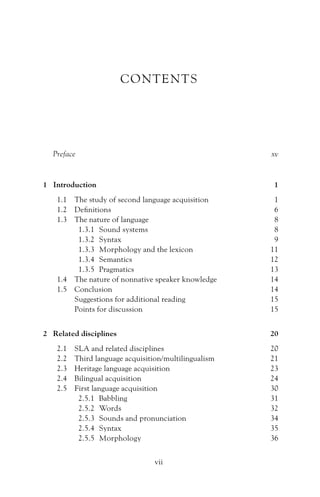
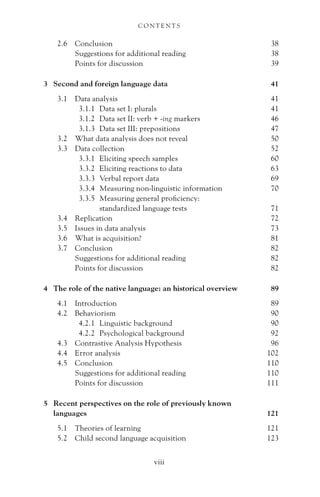
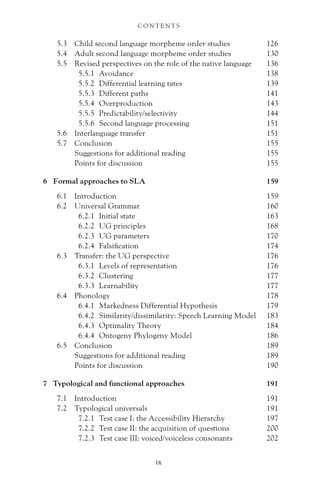
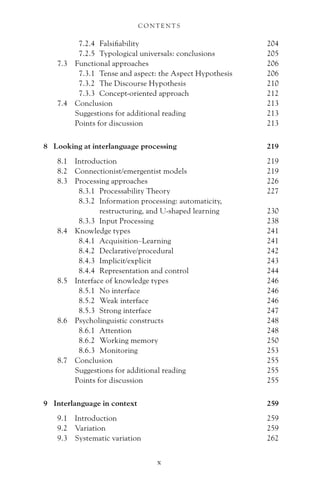

![according to the context of use? Do these rules and patterns vary more in
individuals in a second language than they vary in the native language?
Given these varied questions, the study of second language acquisition
draws from and impacts many other areas of study, among them lin-
guistics, psychology, psycholinguistics, sociology, sociolinguistics, dis-
course analysis, conversational analysis, and education, to name a few.
Given the close relationship between second language acquisition and
other areas of inquiry, there are numerous approaches from which
to examine second language data, each one of which brings to the study
of second language acquisition its own goals, its own data-collection
methods, and its own analytic tools. Thus, second language acquisition is
truly an interdisciplinary field. This introductory text attempts to shed
light on the nature of second language acquisition from multiple
perspectives.
One way to define second language acquisition is to state what it is not.
Over the years, the study of second language acquisition has become
inextricably intertwined with language pedagogy; in the current text, one
goal is to disentangle the two fields. Second language acquisition is not
about pedagogy unless the pedagogy affects the course of acquisition
(this topic will be explored in chapter 11). Although it may be the case
that those who are interested in learning about how second languages are
learned are ultimately interested in doing so for the light this knowledge
sheds on the field of language teaching, this is not the only reason second
language acquisition is of interest, nor is it the major reason scholars in
the field of second language acquisition conduct their research.
Let us briefly consider some of the reasons why it might be important
for us to understand how second languages are learned and what is not
learned.
Linguistics
When we study human language, we are approaching what
some might call the human essence, the distinctive qualities of
mind that are, so far as we know, unique to [humans].
(Chomsky, 1968, p. 100)
The study of how second languages are learned is part of the broader
study of language and language behavior. It is not more central or
peripheral than any other part of linguistic study, which in turn
has as its larger goal the study of the nature of the human mind. In
fact, a major goal of second language acquisition research is the
determination of linguistic constraints on the formation of second
language grammars. Because theories of language are concerned with
human language knowledge, one can reasonably assume that this
knowledge is not limited to first language knowledge, and that
S E C O N D L A N G UAG E AC QU I S I T I O N
2](https://image.slidesharecdn.com/26867902-250514053609-4376ba03/85/Second-Language-Acquisition-3rd-Edition-Susan-M-Gass-Larry-Selinker-25-320.jpg)
![language acquisition is separate from the study of language pedagogy,
although this does not imply that there are not implications that can
be drawn from second language acquisition to the related discipline of
language teaching.
Many disciplines quite clearly find themselves as part of the humanities
(e.g., literature) or part of the sciences (e.g., biology). Second language
acquisition, because of its complexity and its reliance on and import for
other disciplines, is not placed so easily. SLA is part of the humanities,
in the sense that it is part of the branch of “learning (as philosophy, arts,
or languages) that investigate[s] human constructs and concerns as
opposed to natural processes (as in physics or chemistry) and social rela-
tions (as in anthropology or economics)” (from Merriam-Webster online
dictionary), although clearly there are areas of the field that do consider
social relations as an integral part of learning. Given that the humanities
are concerned with human constructs and concerns, language acquisition
is relevant, for one way of understanding the human condition is through
an understanding of language. While this is probably uncontroversial,
unfortunately this central area of humanistic study is often confined
to general issues of language and the human capacity for language as
referring to studies of primary language knowledge and the acquisition
of primary language. But this book assumes that we cannot adequately
examine the nature of language knowledge if we confine ourselves to
only a small portion of the world’s population; that is, monolingual
native speakers.
Second language acquisition, while rightfully part of the humanities, is
also part of the social sciences, defined (Merriam-Webster online) as “a
branch of science that deals with the institutions and functioning of
human society and with the interpersonal relationships of individuals as
members of society.” Given that second language acquisition deals with
interpersonal relations as it does when studying many issues of language
use, it is definitely part of the social sciences. Interactions involving
nonnative speakers of a language are undoubtedly highly frequent in the
broader context of the world’s interactions, and, thus, the study of these
interactions has a central place in the social sciences and cognitive
science. Finally, since some SLA research focuses on the biology of the
brain, and what SLA neurophysiology can show about neural workings,
SLA itself can be considered a part of the developing cognitive
neurosciences.
1.2 Definitions
The study of any new discipline involves familiarizing oneself with the
specific terminology of that field. In this section, we present some basic
terminology common to the field of second language acquisition,
S E C O N D L A N G UAG E AC QU I S I T I O N
6](https://image.slidesharecdn.com/26867902-250514053609-4376ba03/85/Second-Language-Acquisition-3rd-Edition-Susan-M-Gass-Larry-Selinker-29-320.jpg)
![1.3 The nature of language
Fundamental to the understanding of the nature of SLA is an under-
standing of what it is that needs to be learned. A facile answer is that a
second language learner needs to learn the “grammar” of the TL. But
what is meant by this? What is language? How can we characterize the
knowledge that humans have of language?
All normal humans acquire a language in the first few years of life. The
knowledge acquired is largely of an unconscious sort. That is, very young
children learn how to form particular grammatical structures, such as
relative clauses. They also learn that relative clauses often have a modify-
ing function, but in a conscious sense they do not know that it is a relative
clause and could presumably not state what relative clauses are used for.
Take as an example the following sentence:
(1-3) I want that toy that that boy is playing with.
A child could utter this fully formed sentence, which includes a relative
clause (“that that boy is playing with”), without being able to articulate
the function of relative clauses (either this one, or relative clauses in
general) and without being able to easily divide this sentence into its
component parts. It is in this sense that the complex knowledge we have
about our native language is largely unconscious.
There are a number of aspects of language that can be described sys-
tematically. In the next few sections we deal with the phonology, syntax,
morphology, semantics, and pragmatics of language.
1.3.1 Sound systems
Knowledge of the sound system (phonology) of our native language is
complex. Minimally, it entails knowing what sounds are possible and
what sounds are not possible in the language. For example, a native
speaker of English knows that the first vowel sound in the name Goethe
[œ] is not a sound in English. This knowledge is reflected in recognition as
well as in production, as generally a close English sound is substituted
when one attempts to utter that word in English.
Phonological knowledge also involves knowing what happens to words
in fast speech as opposed to more carefully articulated speech. For
example, if someone wanted to express the following idea:
(1-4) I am going to write a letter.
That person, assuming a U.S. English speaker, would undoubtedly say
something like the following.
S E C O N D L A N G UAG E AC QU I S I T I O N
8](https://image.slidesharecdn.com/26867902-250514053609-4376ba03/85/Second-Language-Acquisition-3rd-Edition-Susan-M-Gass-Larry-Selinker-31-320.jpg)
![(1-5) I’m gonna wriDa leDer.
Consider the following exchange:
(1-6) Tom: What are you gonna do?
Sally: I’m gonna wriDa leDer.
Tom: You’re gonna do what?
Sally: I’m gonna wriDa leDer.
Tom: What? I can’t hear you.
Sally: I’m going to write a letter [articulated slowly and
clearly].
We can see that speakers know when to combine sounds and when not
to. We know that in “normal, fast” speech we combine words, but that in
clearer, more articulated speech we do not.
A final point to make is that, as native speakers of a language, we know
not only what are possible sounds and what are not possible sounds, but
we also know what are possible combinations of sounds and what sounds
are found in what parts of words. We know, for example, that in English,
while [b] and [n] are both sounds of English, they cannot form a “blend”
in the way that [b] and [r] can: *bnick3
versus brain. Or to take another
example, consider the sound at the end of the word ping [ŋ], which is
frequent in English. However, it cannot appear in the beginning of words
in English, although it can in other languages.
1.3.2 Syntax
In this section, we briefly describe what speakers know about the syntax
of their language. This is what is frequently known as grammar, referring
primarily to the knowledge we have of the order of elements in a sen-
tence. We point out briefly that there are two kinds of grammar that
are generally referred to: (a) prescriptive grammar and (b) descriptive
grammar. By prescriptive grammar, we mean such rules as are generally
taught in school, often without regard to the way native speakers of a
language actually use language. We have in mind such rules as “Don’t end
a sentence with a preposition,” “Don’t split infinitives,” “Don’t begin a
sentence with a conjunction,” “Don’t use contractions in writing,” and
“Use between with two items and among with more than two” (Associated
Press rule; as cited in Safire, 1999, p. 24). To illustrate that these so-called
rules are something other than appropriate, McCawley (also cited in
Safire) gives the following example: He held four golf balls between his
fingers. Even though there are more than two fingers involved, one cannot
say: *He held four golf balls among his fingers.
On the other hand, linguists are concerned with descriptive grammars:
I N T RO D U C T I O N
9](https://image.slidesharecdn.com/26867902-250514053609-4376ba03/85/Second-Language-Acquisition-3rd-Edition-Susan-M-Gass-Larry-Selinker-32-320.jpg)


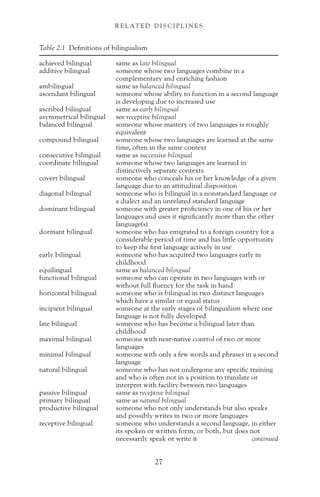
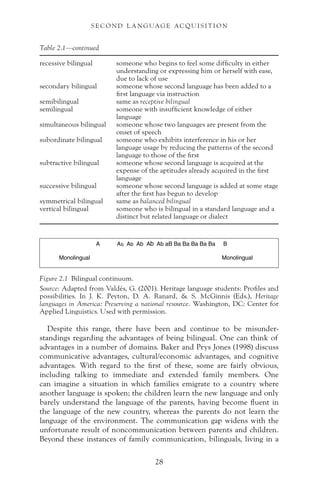
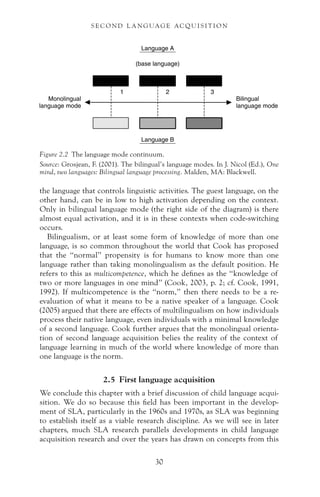













![are those related to the deciding forces of life the affections, and the
conscience.”
MARKHEIM[25]
“Yes,” said the dealer, “our windfalls are of various kinds. Some
customers are ignorant, and then I touch a dividend on my superior
knowledge. Some are dishonest,” and here he held up the candle, so
that the light fell strongly on his visitor, “and in that case,” he
continued, “I profit by my virtue.”
Markheim had but just entered from the daylight streets, and his
eyes had not yet grown familiar with the mingled shine and darkness
in the shop. At these pointed words, and before the near presence
of the flame, he blinked painfully and looked aside.
The dealer chuckled. “You come to me on Christmas Day,” he
resumed, “when you know that I am alone in my house, put up my
shutters, and make a point of refusing business. Well, you will have
to pay for that; you will have to pay for my loss of time, when I
should be balancing my books; you will have to pay, besides, for a
kind of manner that I remark in you to-day very strongly. I am the
essence of discretion, and ask no awkward questions; but when a
customer cannot look me in the eye, he has to pay for it.” The dealer
once more chuckled; and then, changing to his usual business voice,
though still with a note of irony, “You can give, as usual, a clear
account of how you came into the possession of the object?” he
continued. “Still your uncle’s cabinet? A remarkable collector, sir!”
And the little pale, round-shouldered dealer stood almost on tip-
toe, looking over the top of his gold spectacles, and nodding his](https://image.slidesharecdn.com/26867902-250514053609-4376ba03/85/Second-Language-Acquisition-3rd-Edition-Susan-M-Gass-Larry-Selinker-71-320.jpg)