Cloudius Systems presents:
SEASTAR @ SF/BA C++UG
Avi Kivity (@AviKivity)
April 2016
Seastar:
A C++ Asynchronous Programming
Framework
Multi-domain async programming
Async networking
Async storage I/O
Async communications for multi-core, NUMA
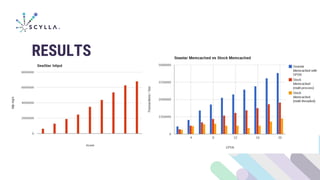
RESULTS
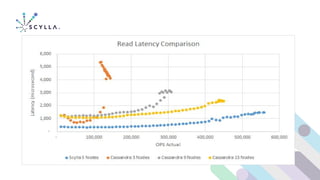
RESULTS (2)
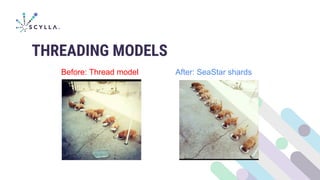
THREADING MODELS
Before: Thread model After: SeaStar shards
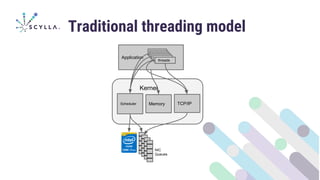
Traditional threading model
Kernel
Application
TCP/IPScheduler
queuequeuequeuequeuequeue
threads
NIC
Queues
Kernel
Memory
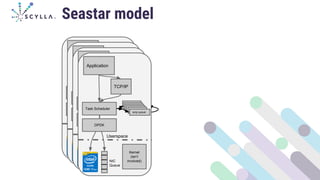
Seastar model
Application
TCP/IP
Task Scheduler
queuequeuequeuequeuequeuesmp queue
NIC
Queue
DPDK
Kernel
(isn’t
involved)
Userspace
Application
TCP/IP
Task Scheduler
queuequeuequeuequeuequeuesmp queue
NIC
Queue
DPDK
Kernel
(isn’t
involved)
Userspace
Application
TCP/IP
Task Scheduler
queuequeuequeuequeuequeuesmp queue
NIC
Queue
DPDK
Kernel
(isn’t
involved)
Userspace
Application
TCP/IP
Task Scheduler
queuequeuequeuequeuequeuesmp queue
NIC
Queue
DPDK
Kernel
(isn’t
involved)
Userspace
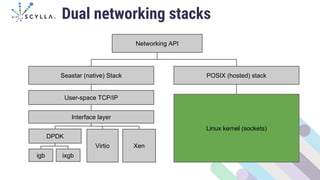
Dual networking stacks
Networking API
Seastar (native) Stack POSIX (hosted) stack
Linux kernel (sockets)
User-space TCP/IP
Interface layer
DPDK
Virtio Xen
igb ixgb
Seastar model summary
● Each logical core runs a shared-nothing run-to-completion task
scheduler
● Logical cores connected by point-to-point queues
● Explicit core-to-core communication
● Shard owns data
● Composable Multicore/Storage/Network APIs
● Optional userspace TCP/IP stack
CODING IT:
Futures and promises
BASIC MODEL
● Futures
● Promises
● Continuations
F-P-C Defined: Future
A future is a result of a computation that may not be available yet.
● Data buffer from the network
● Timer expiration
● Completion of a disk write
● Computation on another core
● Result computation that requires the values from one or more
other futures.
F-P-C Defined: Promise
A promise is an object or function that provides you with a future,
with the expectation that it will fulfil the future.
F-P-C Defined: Continuation
A continuation is a computation that is executed when a future
becomes ready (yielding a new future).
Basic Future/Promise
future<int> get(); // promises an int will be produced eventually
future<> put(int) // promises to store an int
furure<> f() {
return get().then([] (int value) {
return put(value + 1).then([] {
std::cout << "value stored successfullyn";
});
});
}
Parallelism
void f() {
std::cout << "Sleeping... " << std::flush;
using namespace std::chrono_literals;
sleep(200ms).then([] { std::cout << "200ms " << std::flush; });
sleep(100ms).then([] { std::cout << "100ms " << std::flush; });
sleep(1s).then([] { std::cout << "Done.n"; engine_exit(); });
}
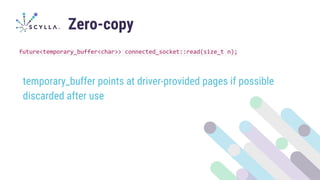
Zero-copy
future<temporary_buffer<char>> connected_socket::read(size_t n);
temporary_buffer points at driver-provided pages if possible
discarded after use
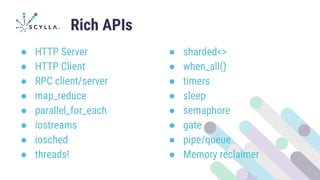
Rich APIs
● HTTP Server
● HTTP Client
● RPC client/server
● map_reduce
● parallel_for_each
● iostreams
● iosched
● threads!
● sharded<>
● when_all()
● timers
● sleep
● semaphore
● gate
● pipe/queue
● Memory reclaimer
USE CASES
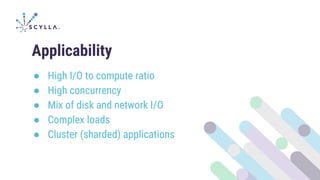
Applicability
● High I/O to compute ratio
● High concurrency
● Mix of disk and network I/O
● Complex loads
● Cluster (sharded) applications
Applicability
● Distributed databases
● Object stores, file systems
● Complex proxies/caches
MORE INFORMATION
http://github.com/scylladb/seastar
http://seastar-project.com
http://docs.seastar-project.com
https://github.com/scylladb/seastar/wiki/Seastar-Tutorial
@ScyllaDB
Thank you.

Seastar @ SF/BA C++UG