8 — Search Engines
From Code to Product
gidgreen.com/course
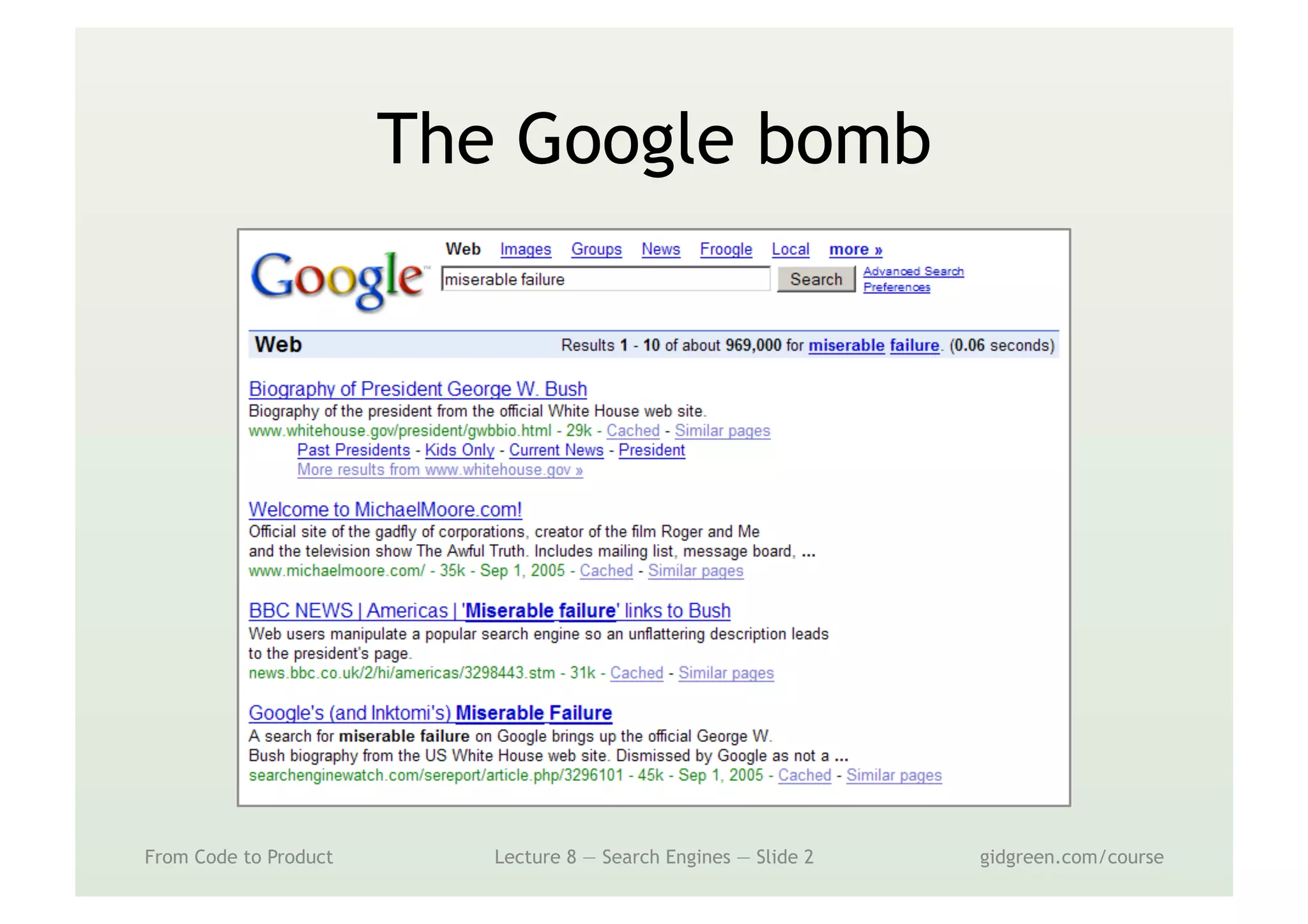
The Google bomb
From Code to Product Lecture 8 — Search Engines — Slide 2 gidgreen.com/course
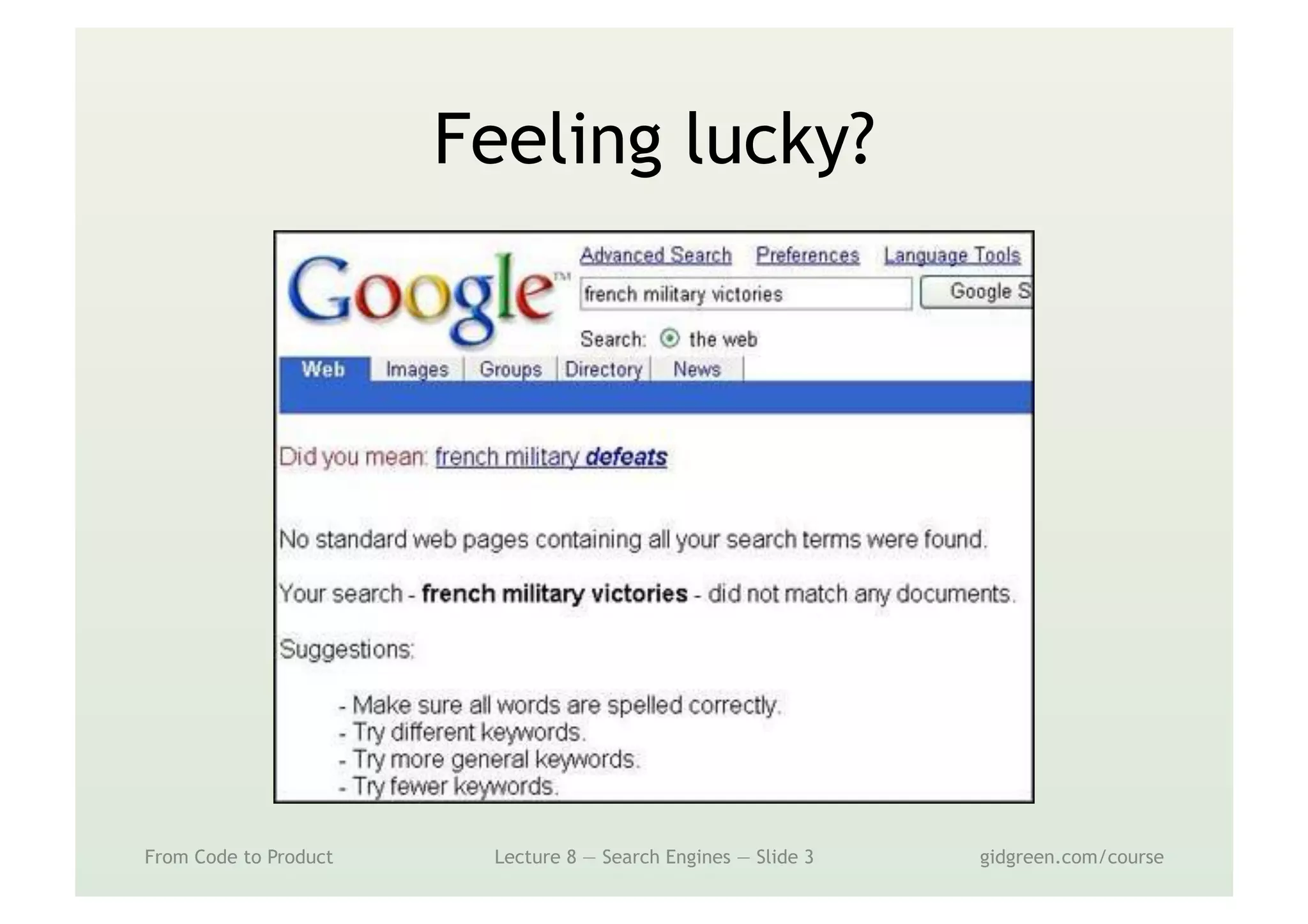
Feeling lucky?
From Code to Product Lecture 8 — Search Engines — Slide 3 gidgreen.com/course
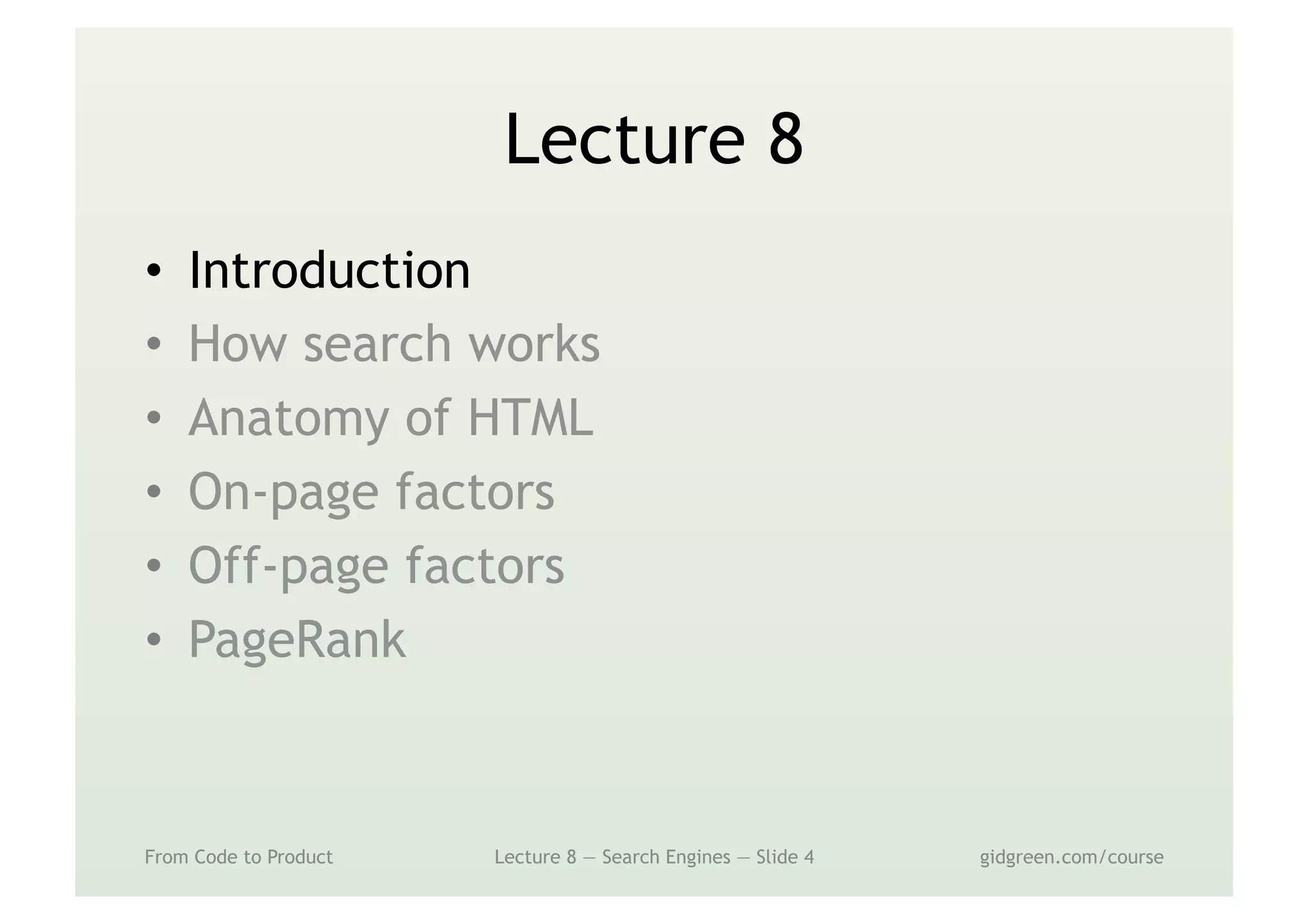
Lecture 8
•  Introduction
•  How search works
•  Anatomy of HTML
•  On-page factors
•  Off-page factors
•  PageRank
From Code to Product Lecture 8 — Search Engines — Slide 4 gidgreen.com/course
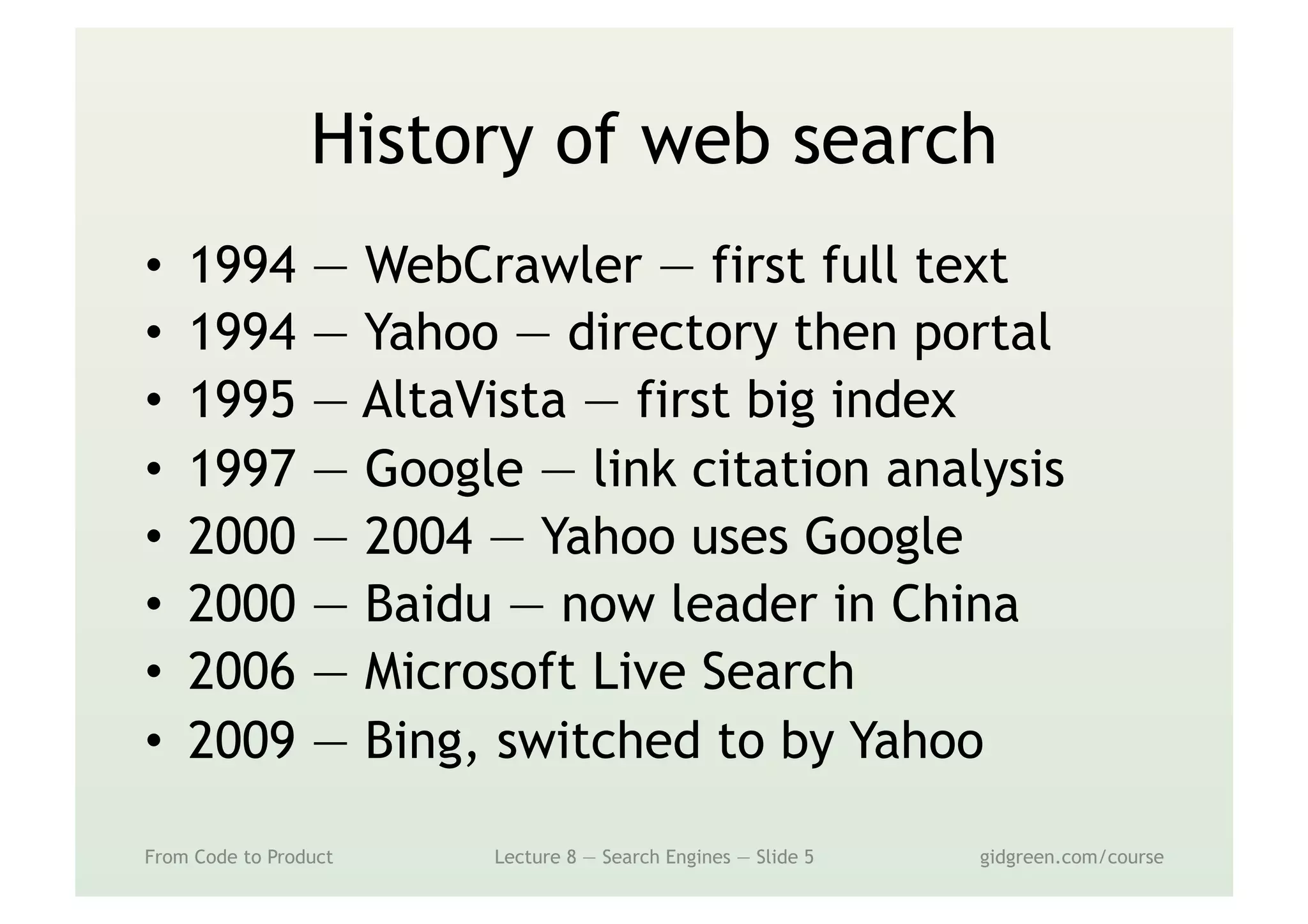
History of web search
•  1994 — WebCrawler — first full text
•  1994 — Yahoo — directory then portal
•  1995 — AltaVista — first big index
•  1997 — Google — link citation analysis
•  2000 — 2004 — Yahoo uses Google
•  2000 — Baidu — now leader in China
•  2006 — Microsoft Live Search
•  2009 — Bing, switched to by Yahoo
From Code to Product Lecture 8 — Search Engines — Slide 5 gidgreen.com/course
Importance of search
•  US: 17.1B “core searches” in April 2012
– 55 per US citizen [comScore]
•  92% of online US adults use search
– 96% of college graduates
– 98% with income $75k+
•  70–80% ignore paid ads on right
– (but only 10% ignore ads on top)
•  80% of sessions begins with a search
From Code to Product Lecture 8 — Search Engines — Slide 6 gidgreen.com/course
Sources:comScore,PewInternetReport,UserCentric,PCMagazine,
http://www.searchenginejournal.com/24-eye-popping-seo-statistics/42665/
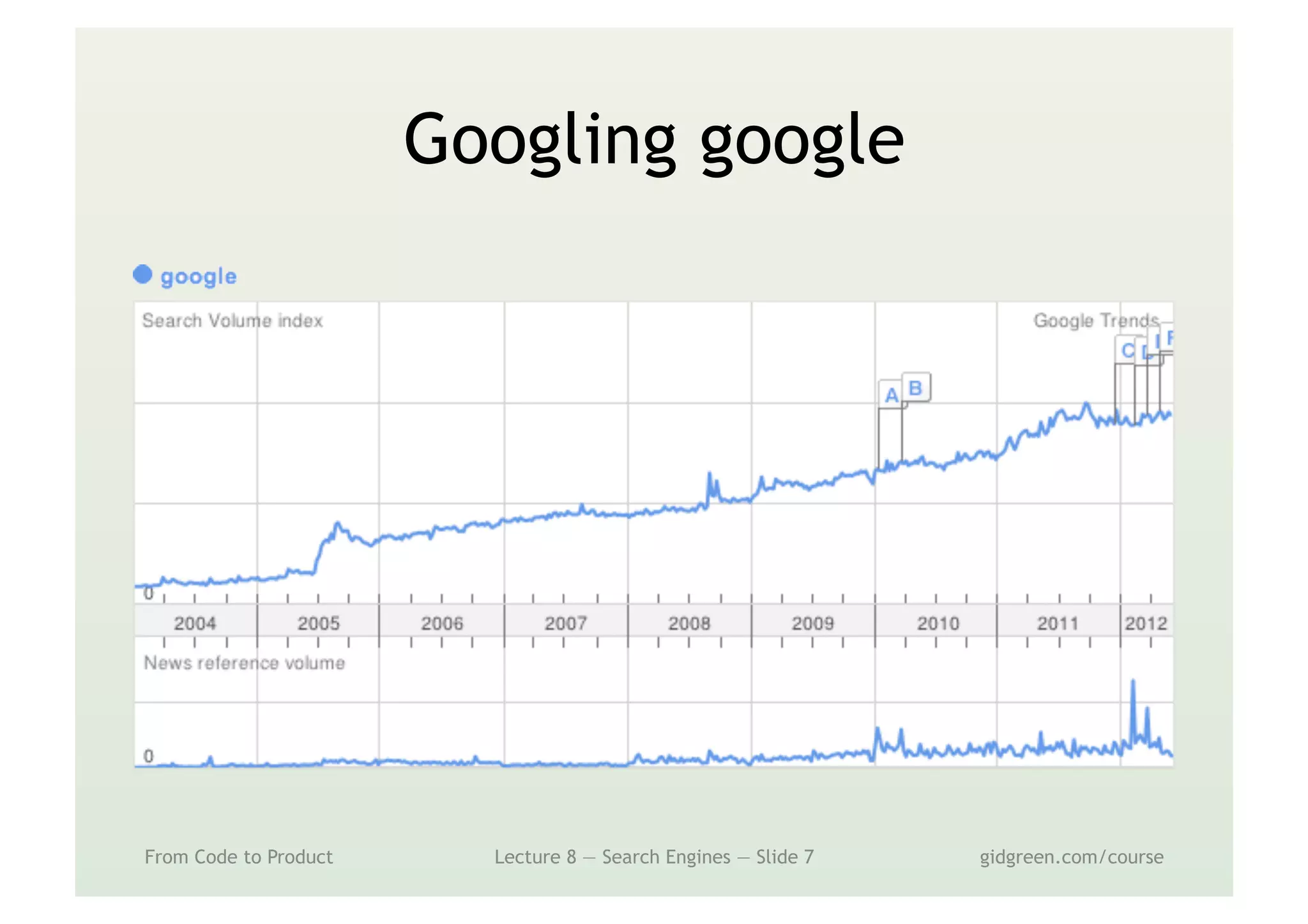
Googling google
From Code to Product Lecture 8 — Search Engines — Slide 7 gidgreen.com/course
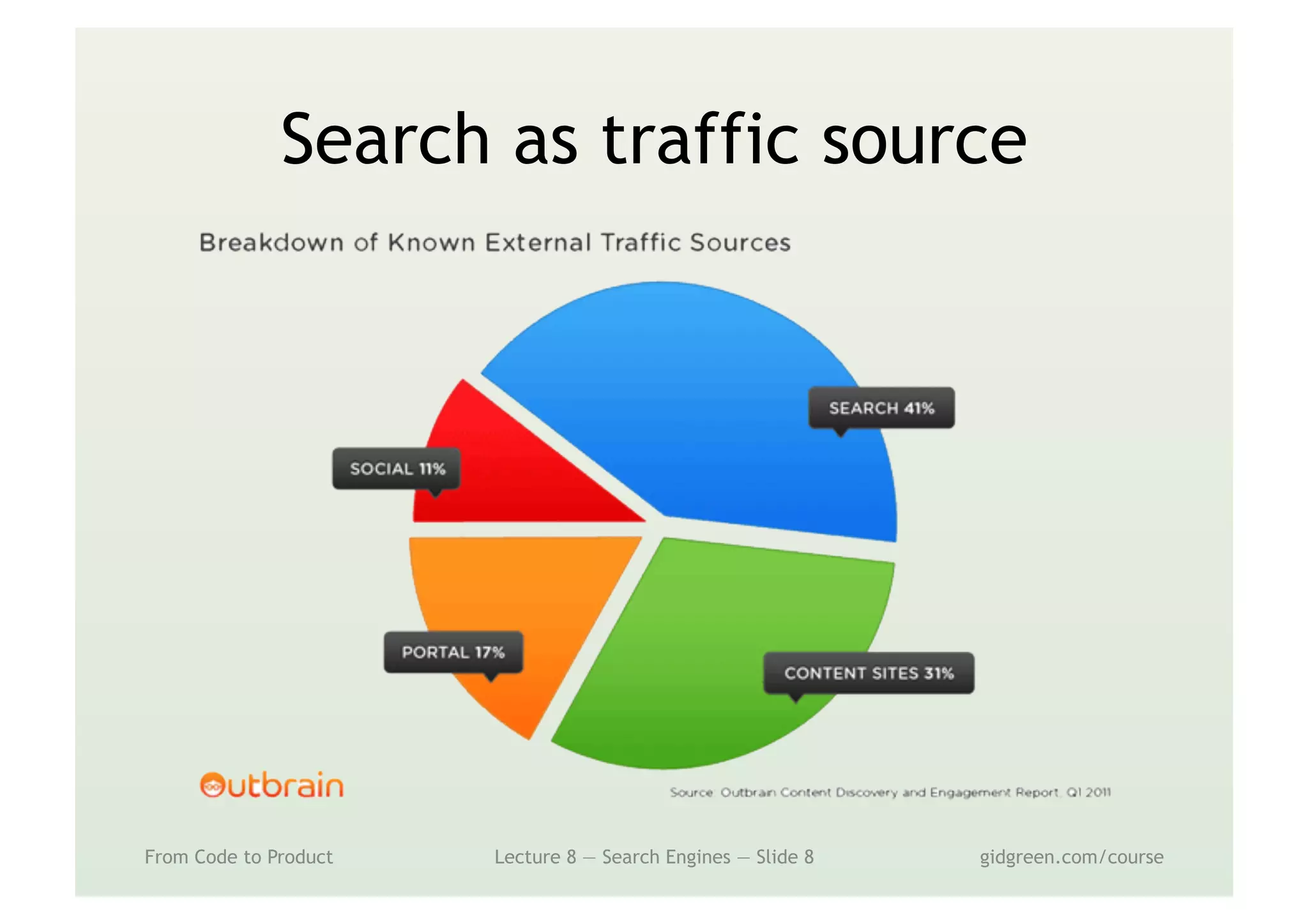
Search as traffic source
From Code to Product Lecture 8 — Search Engines — Slide 8 gidgreen.com/course
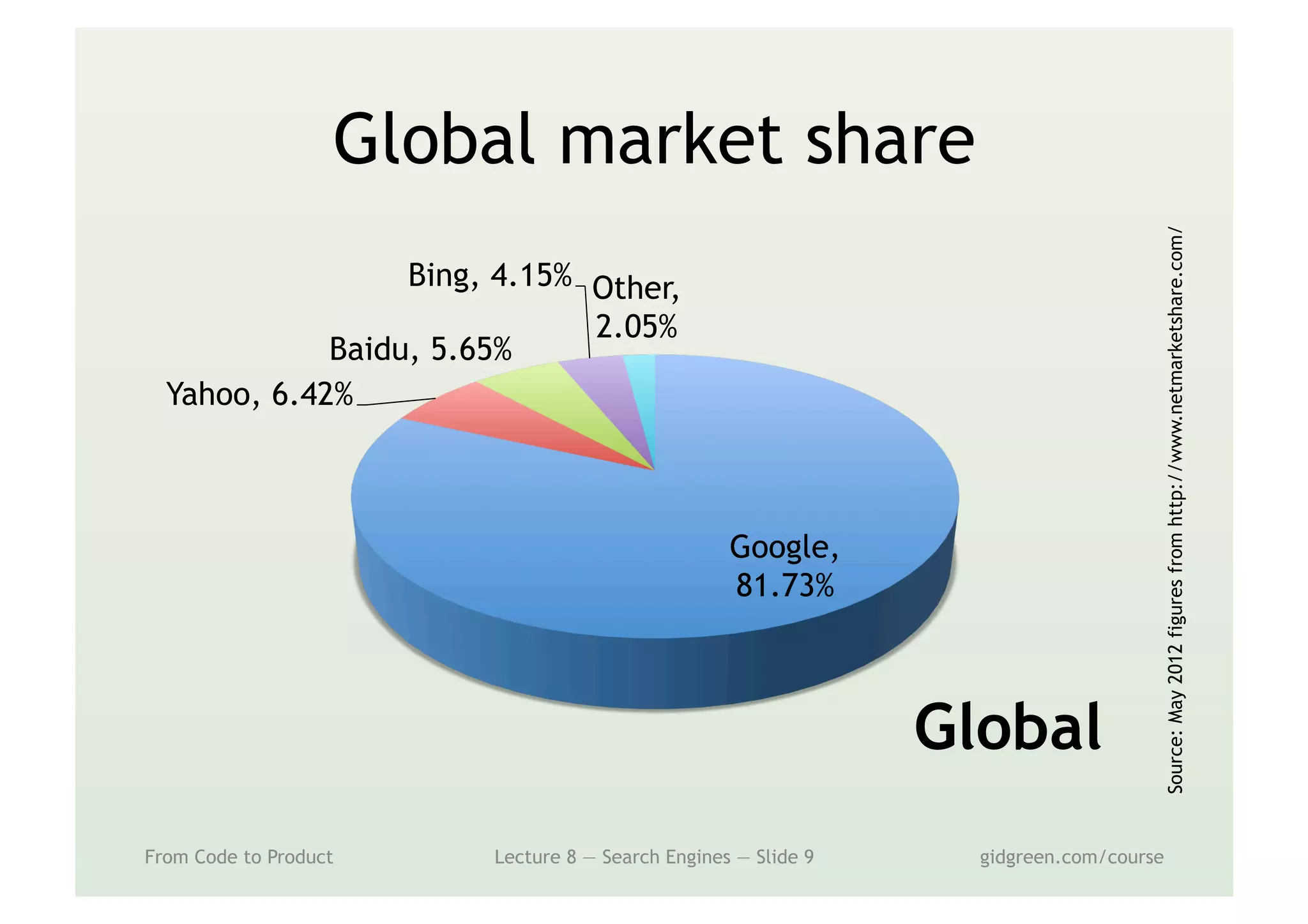
Global market share
From Code to Product Lecture 8 — Search Engines — Slide 9 gidgreen.com/course
Google,
81.73%
Yahoo, 6.42%
Baidu, 5.65%
Bing, 4.15% Other,
2.05%
Global
Source:May2012figuresfromhttp://www.netmarketshare.com/
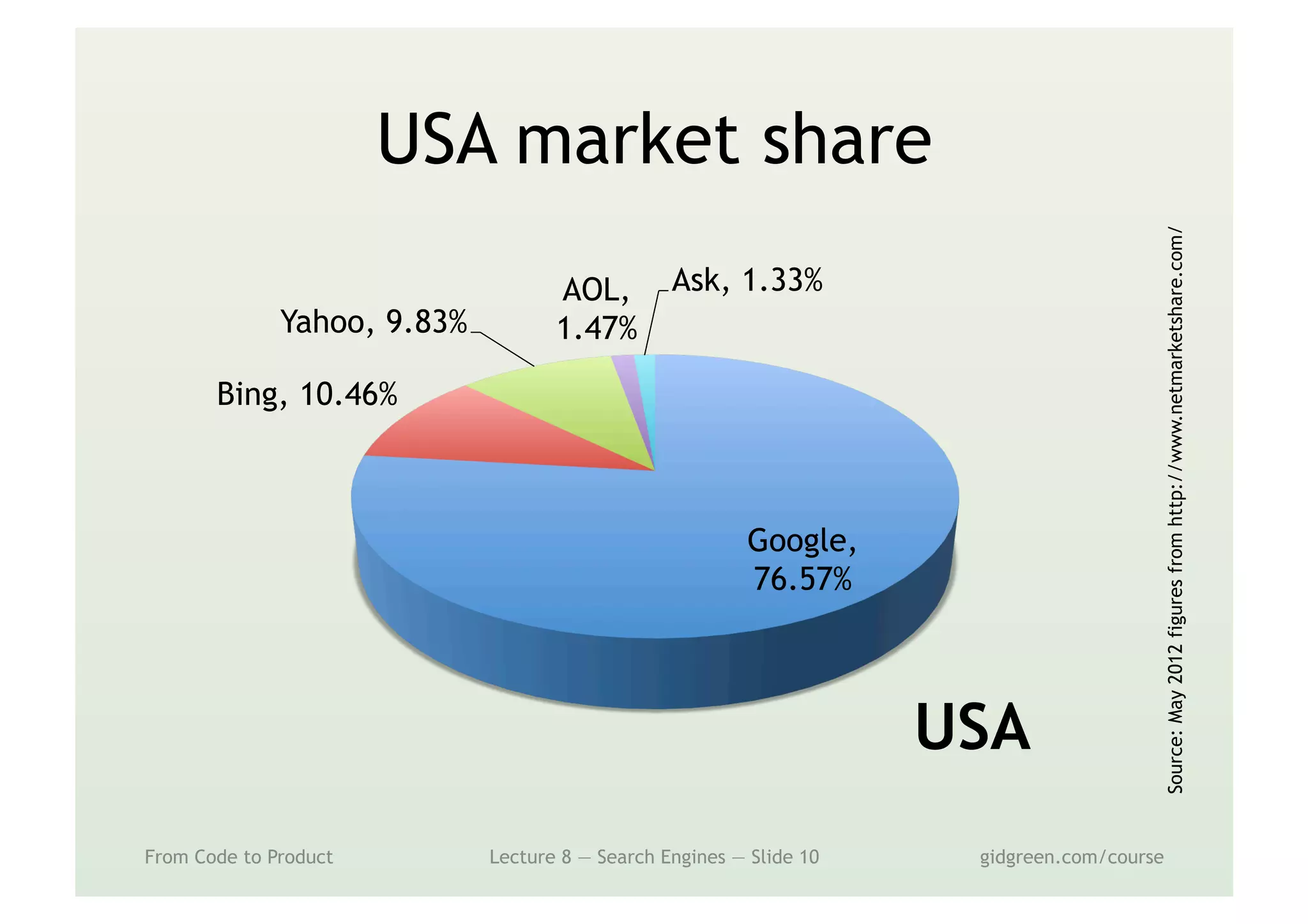
USA market share
From Code to Product Lecture 8 — Search Engines — Slide 10 gidgreen.com/course
Google,
76.57%
Bing, 10.46%
Yahoo, 9.83%
AOL,
1.47%
Ask, 1.33%
USA
Source:May2012figuresfromhttp://www.netmarketshare.com/
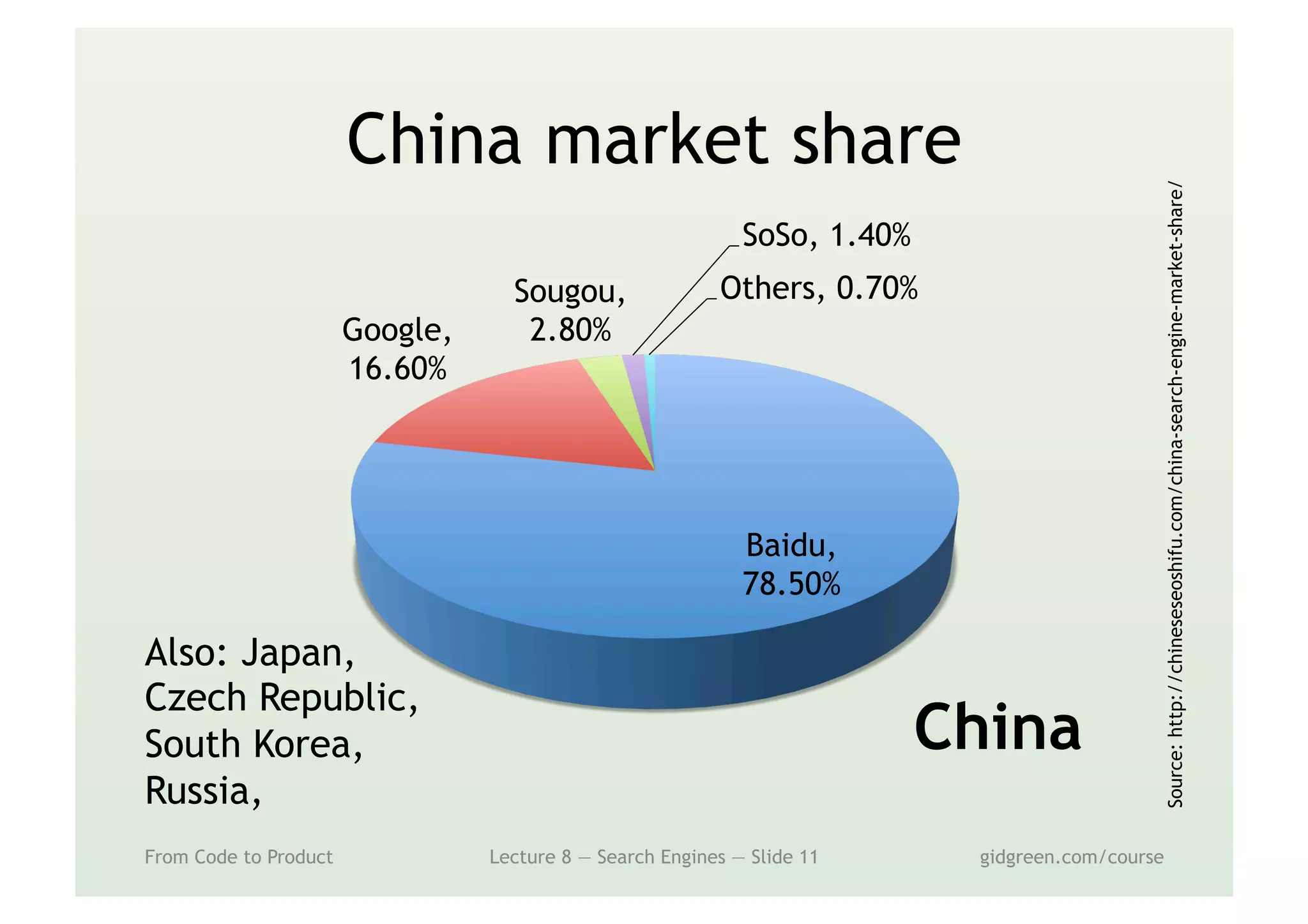
China market share
From Code to Product Lecture 8 — Search Engines — Slide 11 gidgreen.com/course
Baidu,
78.50%
Google,
16.60%
Sougou,
2.80%
SoSo, 1.40%
Others, 0.70%
China
Source:http://chineseseoshifu.com/china-search-engine-market-share/
Also: Japan,
Czech Republic,
South Korea,
Russia,
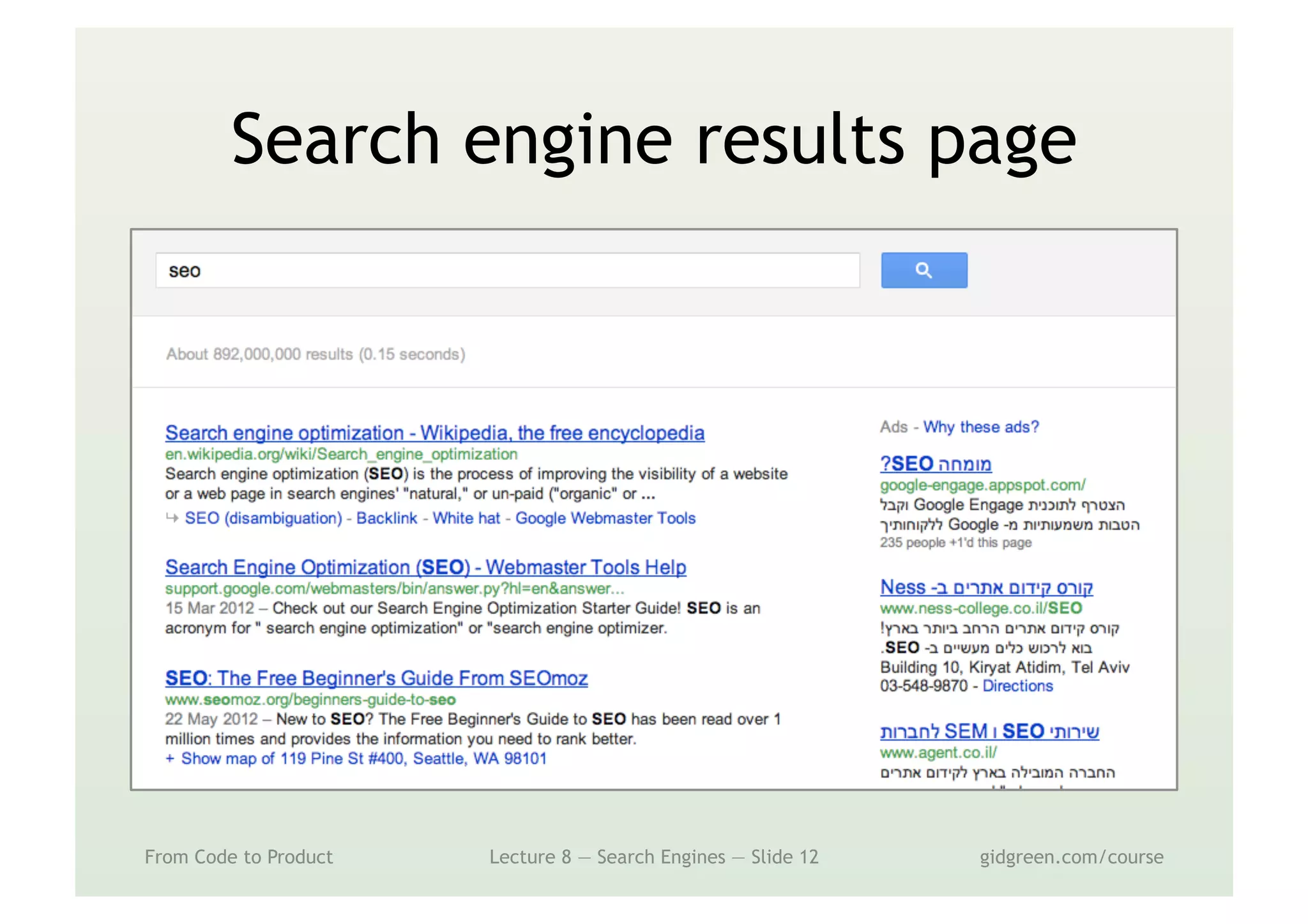
Search engine results page
From Code to Product Lecture 8 — Search Engines — Slide 12 gidgreen.com/course
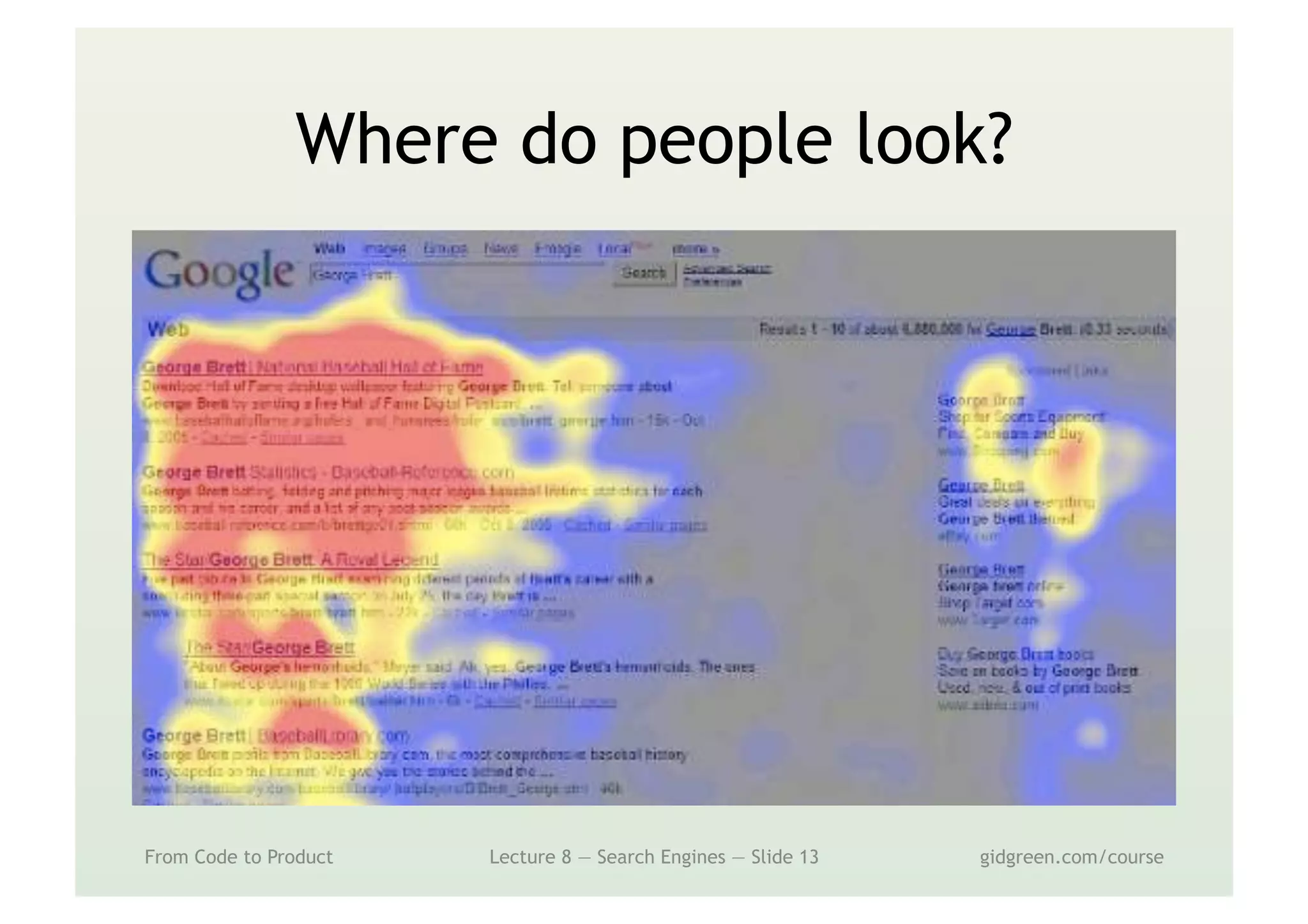
Where do people look?
From Code to Product Lecture 8 — Search Engines — Slide 13 gidgreen.com/course
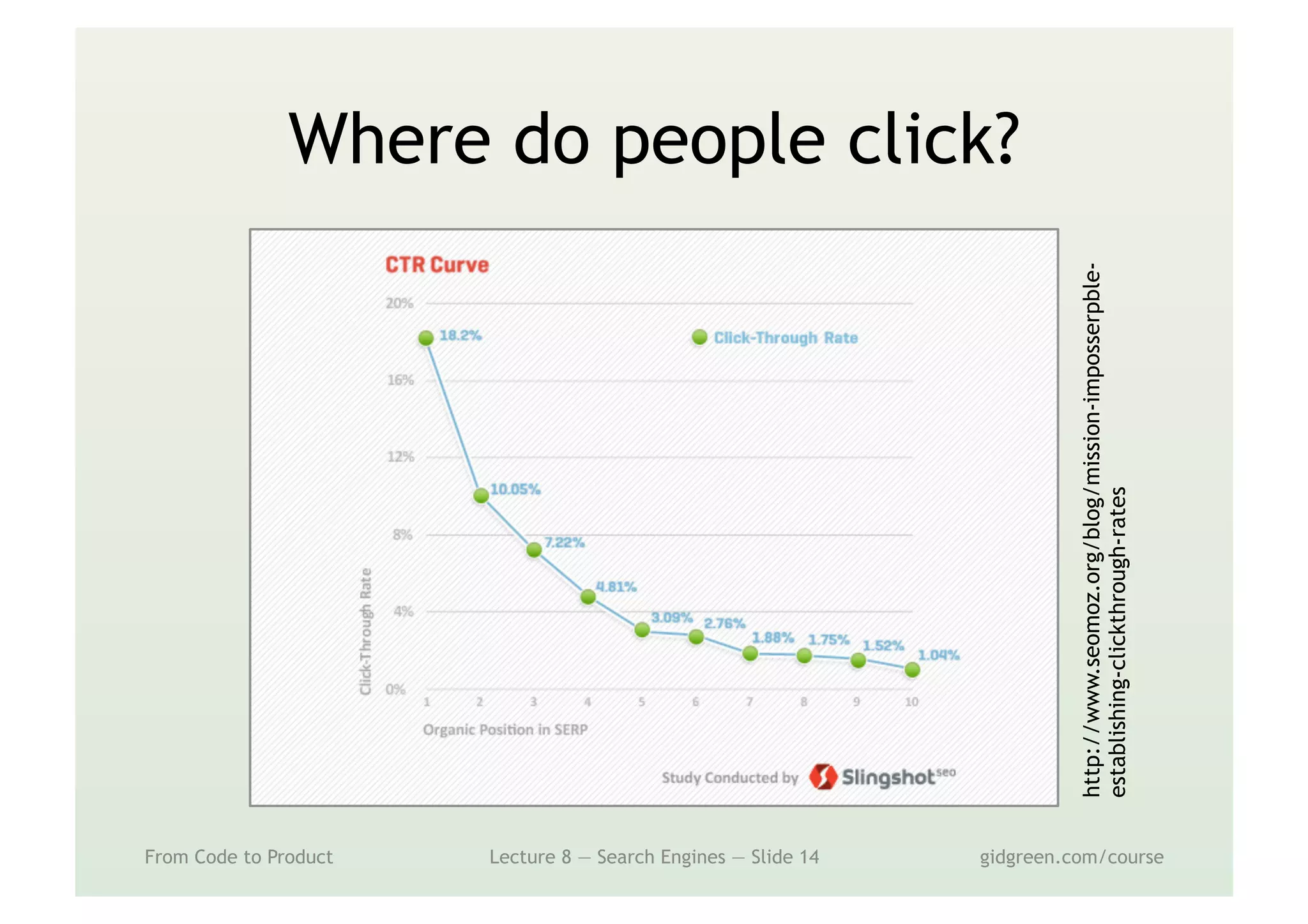
Where do people click?
From Code to Product Lecture 8 — Search Engines — Slide 14 gidgreen.com/course
http://www.seomoz.org/blog/mission-imposserpble-
establishing-clickthrough-rates
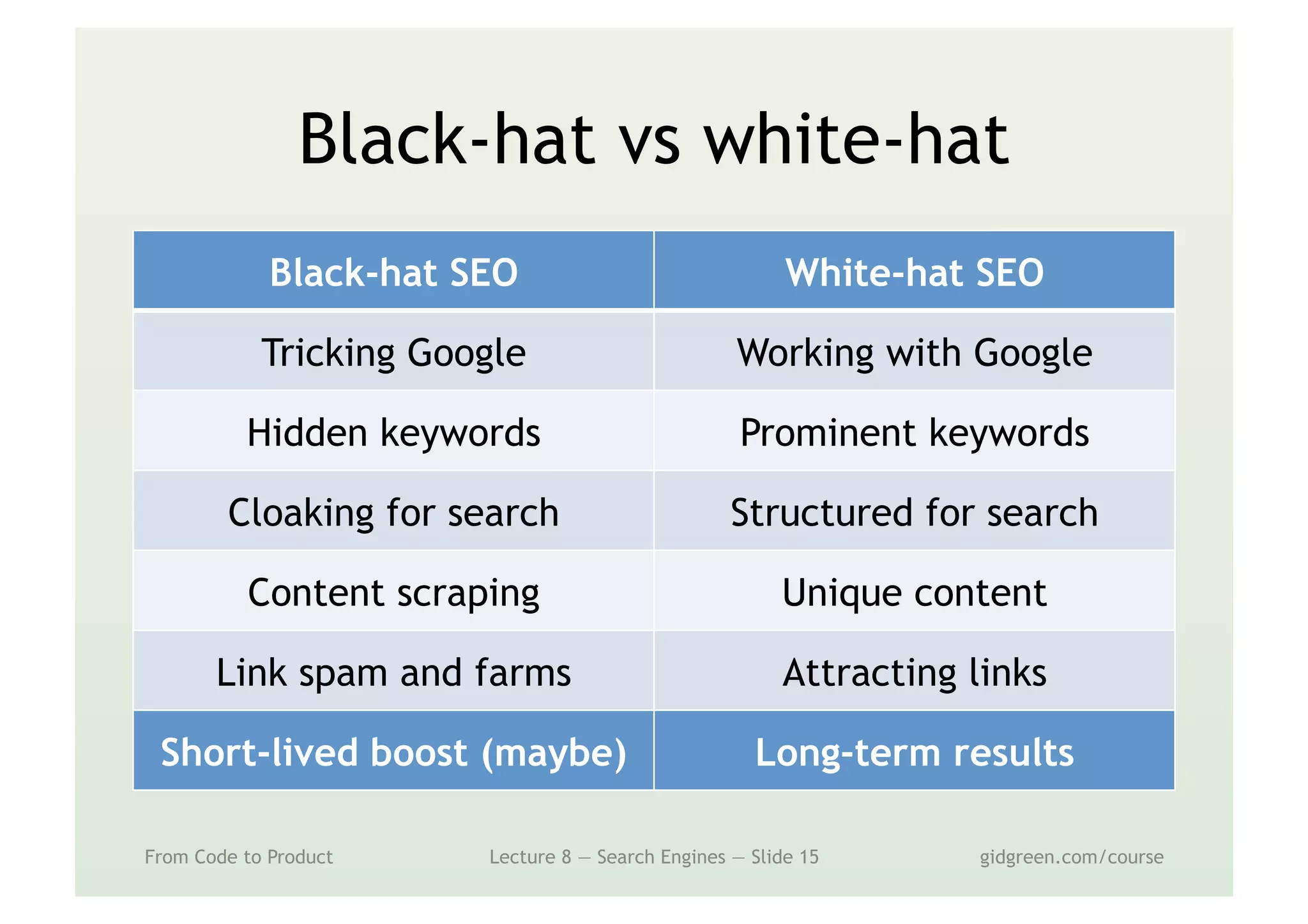
Black-hat vs white-hat
From Code to Product Lecture 8 — Search Engines — Slide 15 gidgreen.com/course
Black-hat SEO White-hat SEO
Tricking Google Working with Google
Hidden keywords Prominent keywords
Cloaking for search Structured for search
Content scraping Unique content
Link spam and farms Attracting links
Short-lived boost (maybe) Long-term results
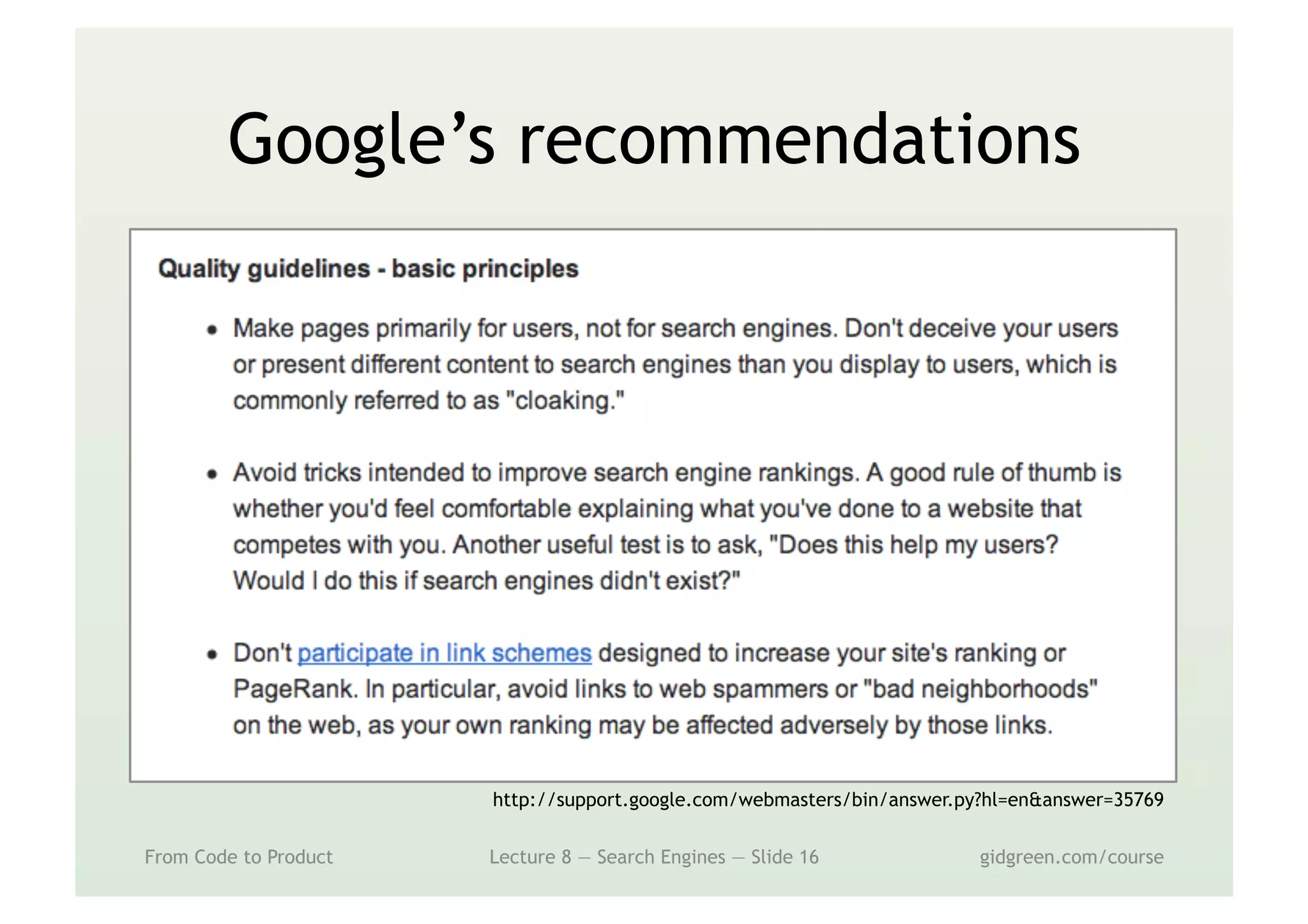
Google’s recommendations
From Code to Product Lecture 8 — Search Engines — Slide 16 gidgreen.com/course
http://support.google.com/webmasters/bin/answer.py?hl=en&answer=35769
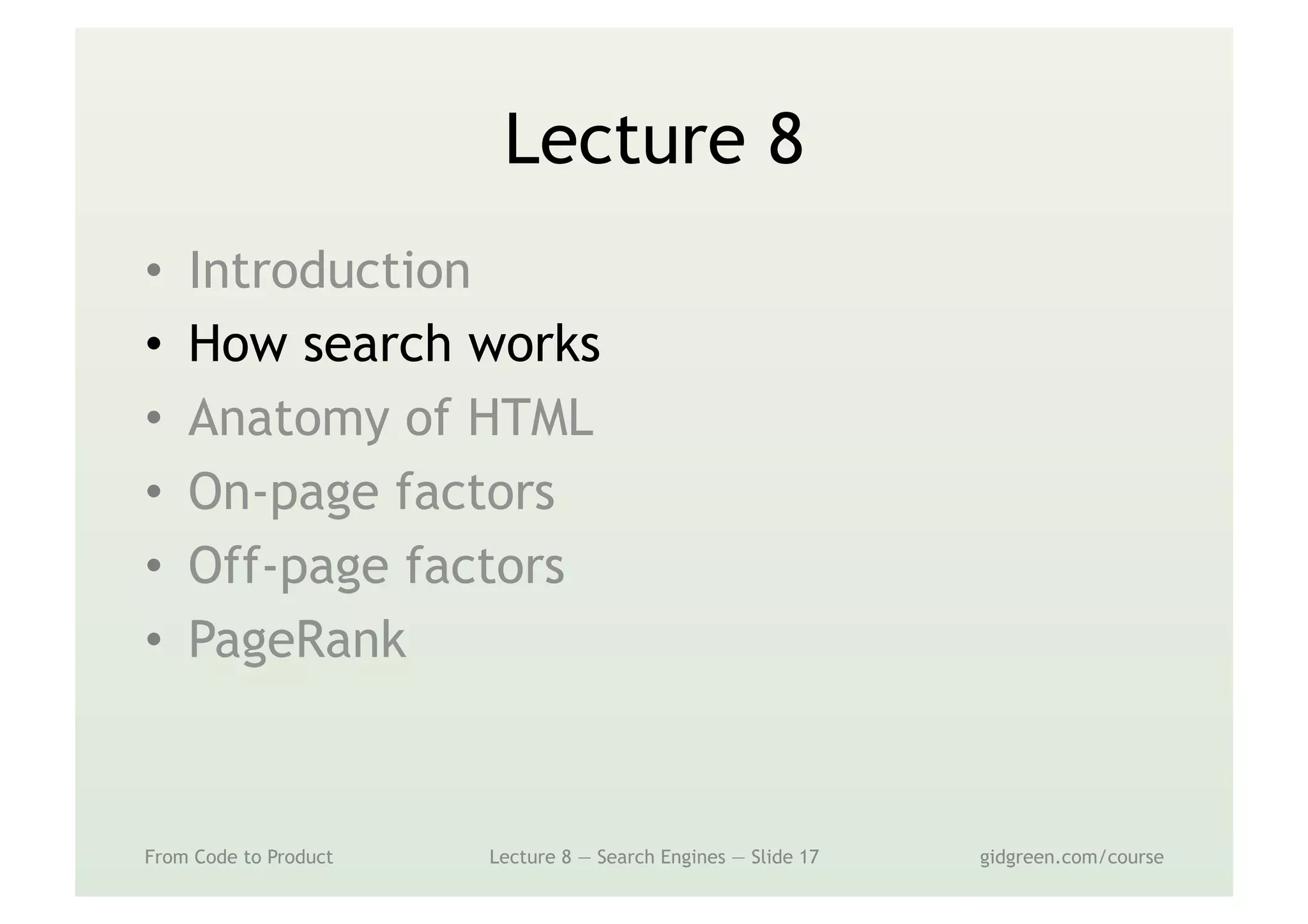
Lecture 8
•  Introduction
•  How search works
•  Anatomy of HTML
•  On-page factors
•  Off-page factors
•  PageRank
From Code to Product Lecture 8 — Search Engines — Slide 17 gidgreen.com/course
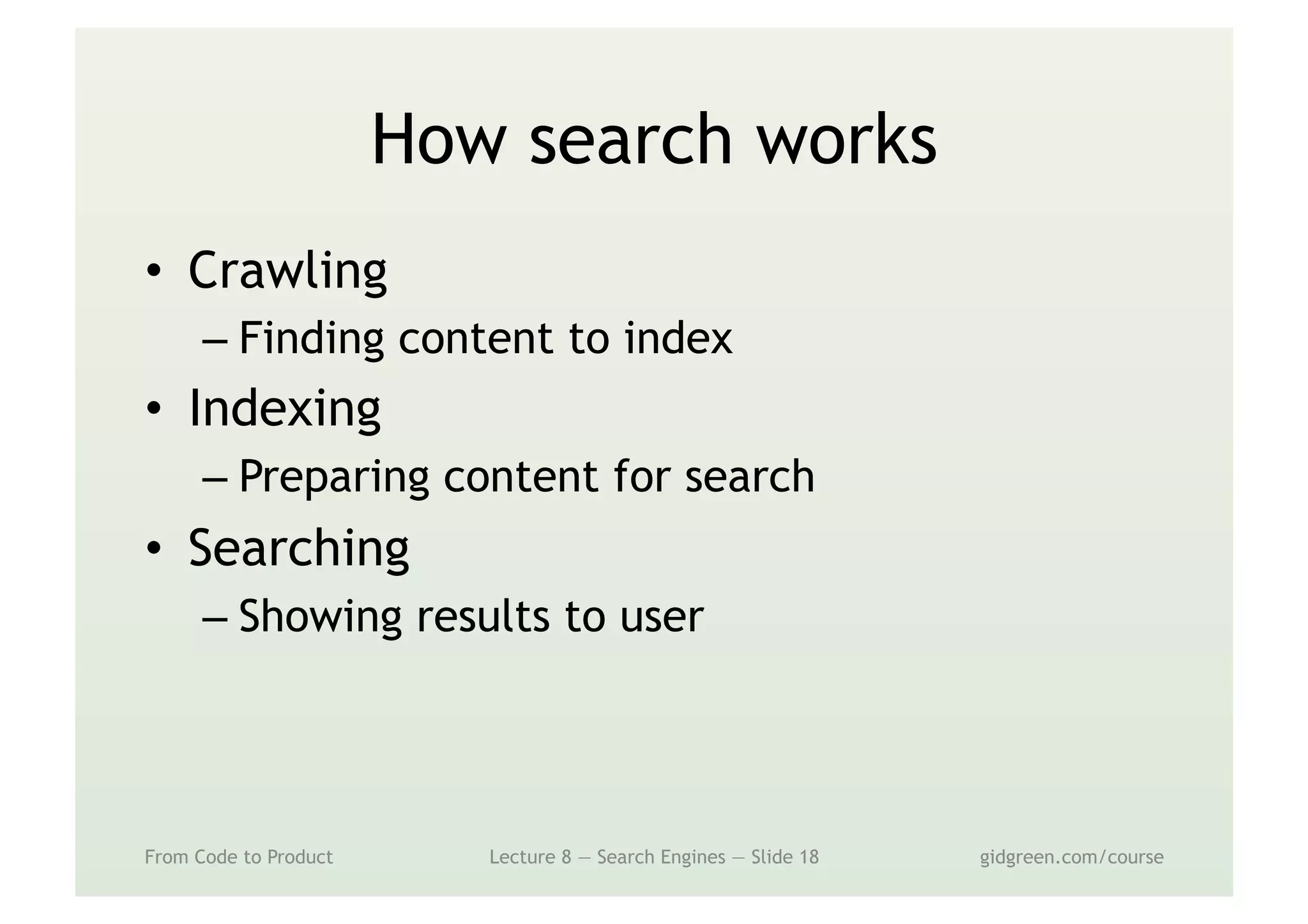
How search works
•  Crawling
– Finding content to index
•  Indexing
– Preparing content for search
•  Searching
– Showing results to user
From Code to Product Lecture 8 — Search Engines — Slide 18 gidgreen.com/course
Basic crawling
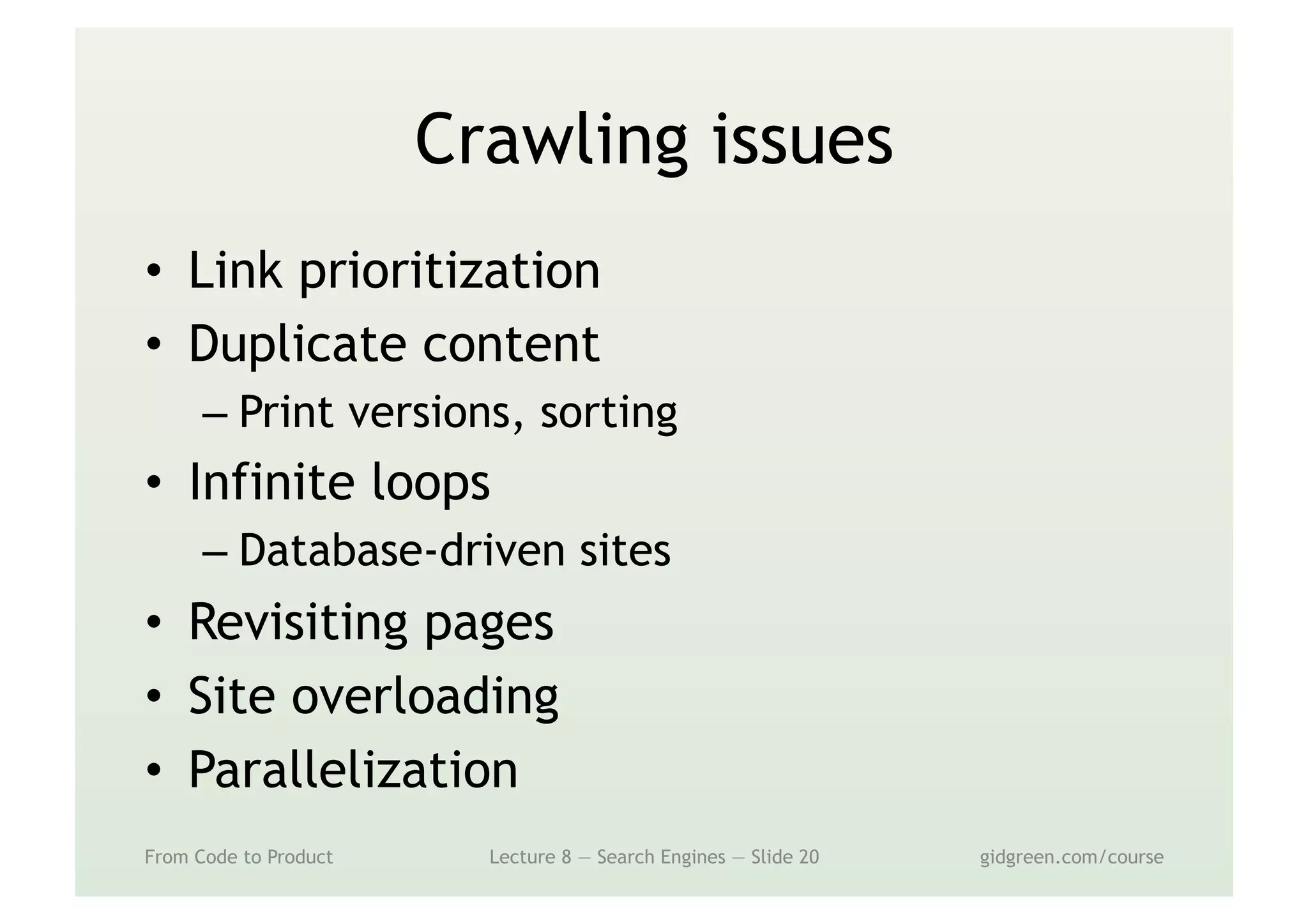
•  Create an empty URL queue (“frontier”)
•  Add one good URL, e.g. wikipedia.org
•  Repeat:
– Select random URL from queue
– Retrieve content for that URL
– Add links in content to queue
– Keep track to prevent repeat visits
From Code to Product Lecture 8 — Search Engines — Slide 19 gidgreen.com/course
Crawling issues
•  Link prioritization
•  Duplicate content
– Print versions, sorting
•  Infinite loops
– Database-driven sites
•  Revisiting pages
•  Site overloading
•  Parallelization
From Code to Product Lecture 8 — Search Engines — Slide 20 gidgreen.com/course
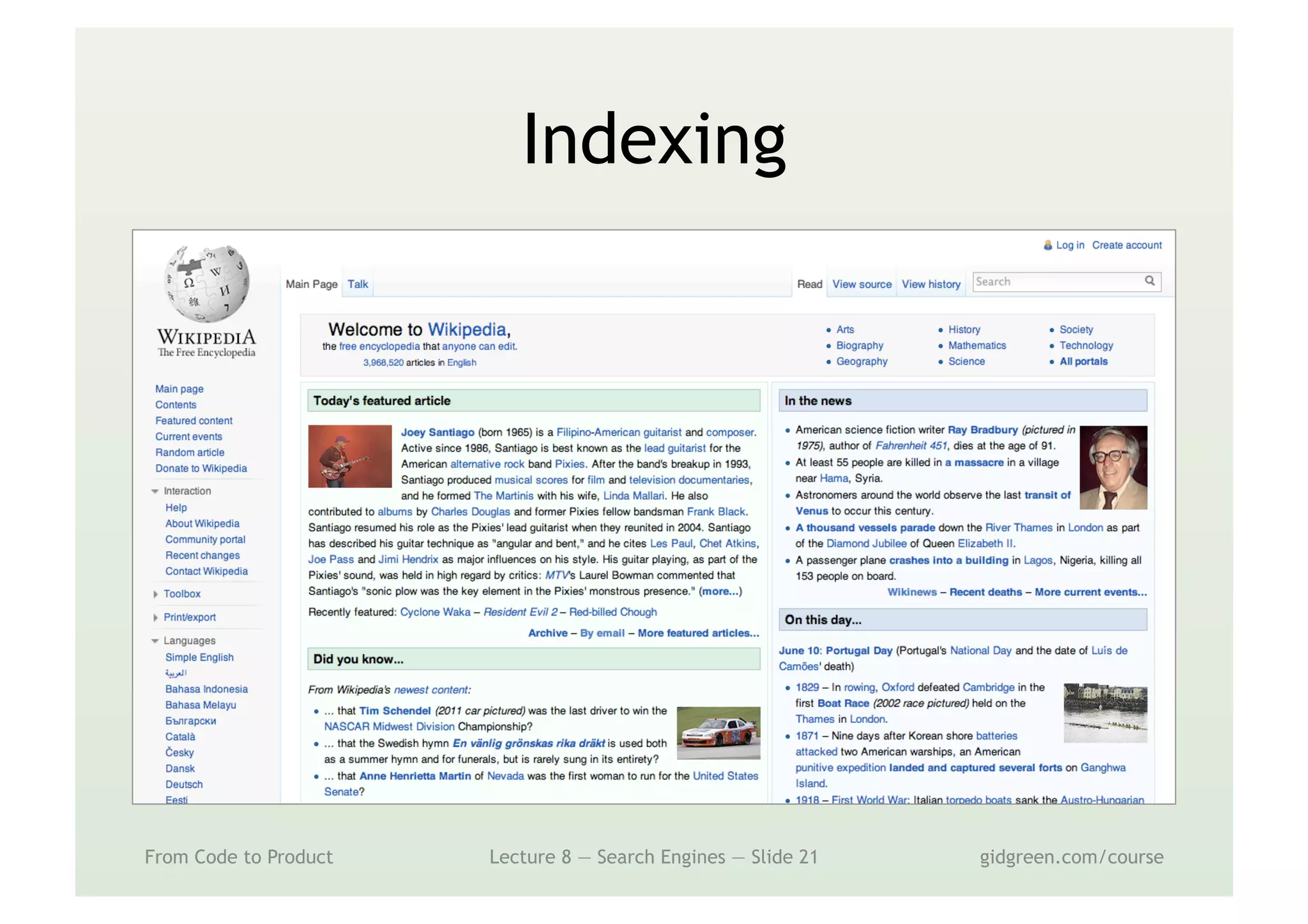
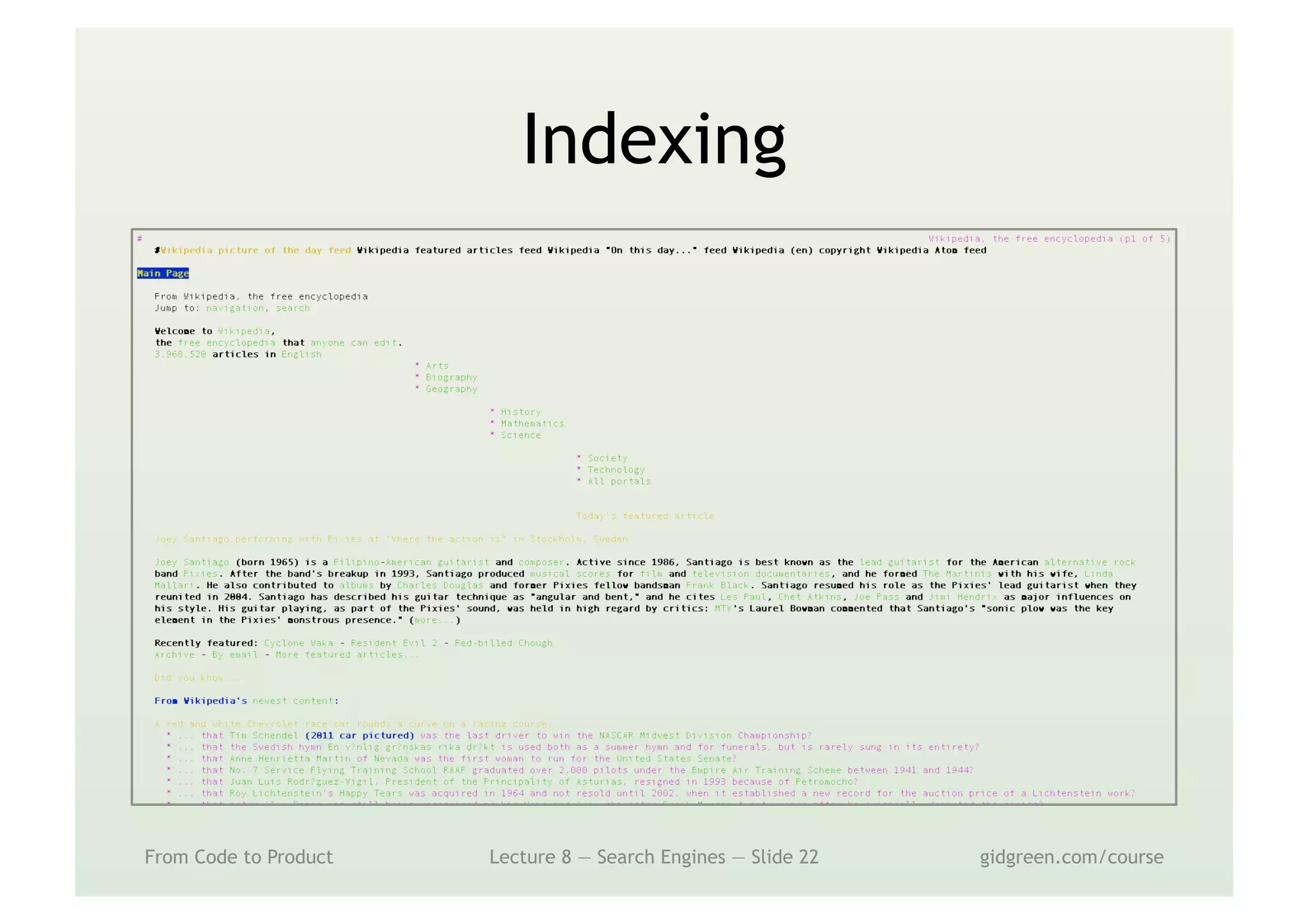
Indexing
From Code to Product Lecture 8 — Search Engines — Slide 21 gidgreen.com/course
Indexing
From Code to Product Lecture 8 — Search Engines — Slide 22 gidgreen.com/course
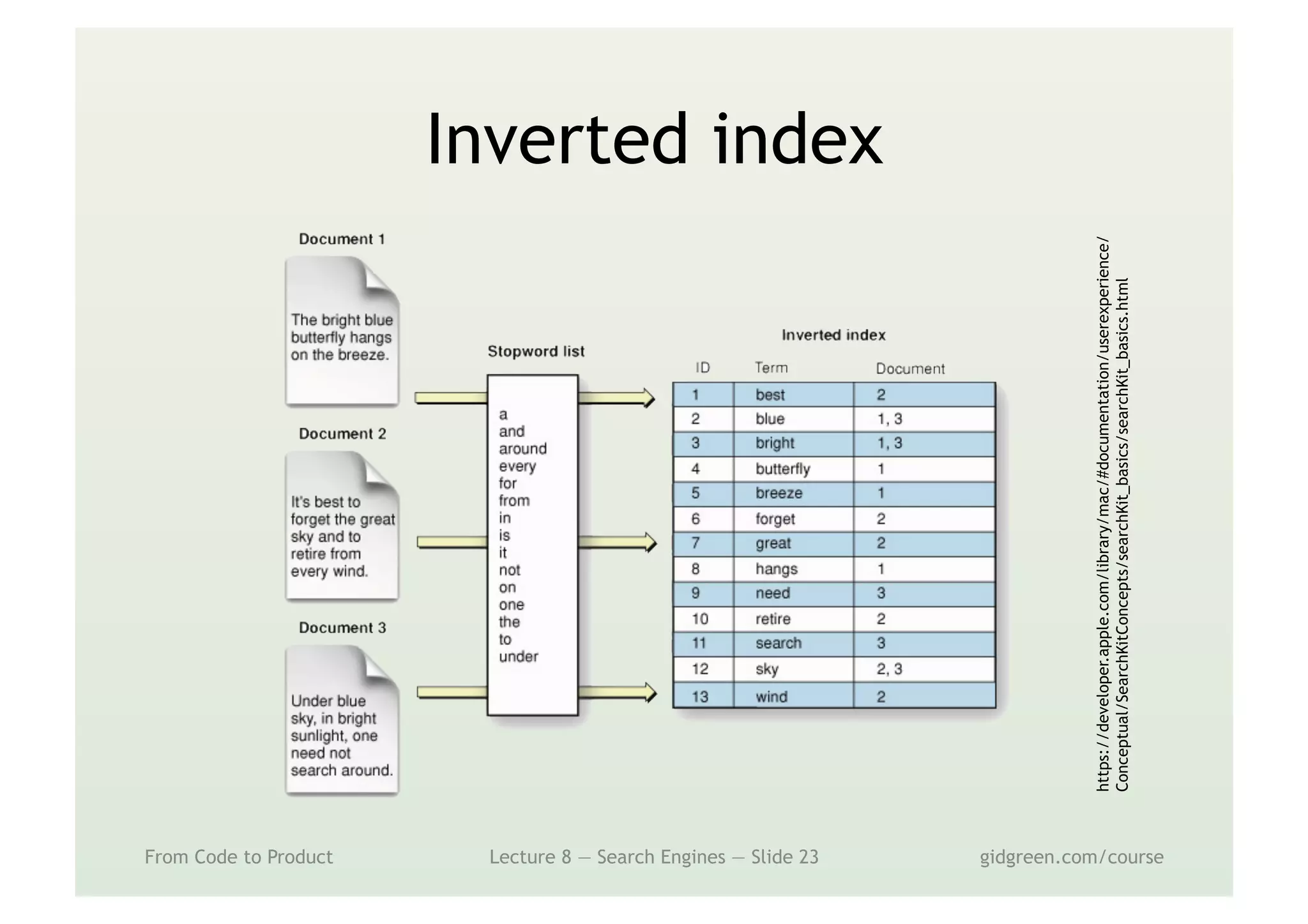
Inverted index
From Code to Product Lecture 8 — Search Engines — Slide 23 gidgreen.com/course
https://developer.apple.com/library/mac/#documentation/userexperience/
Conceptual/SearchKitConcepts/searchKit_basics/searchKit_basics.html
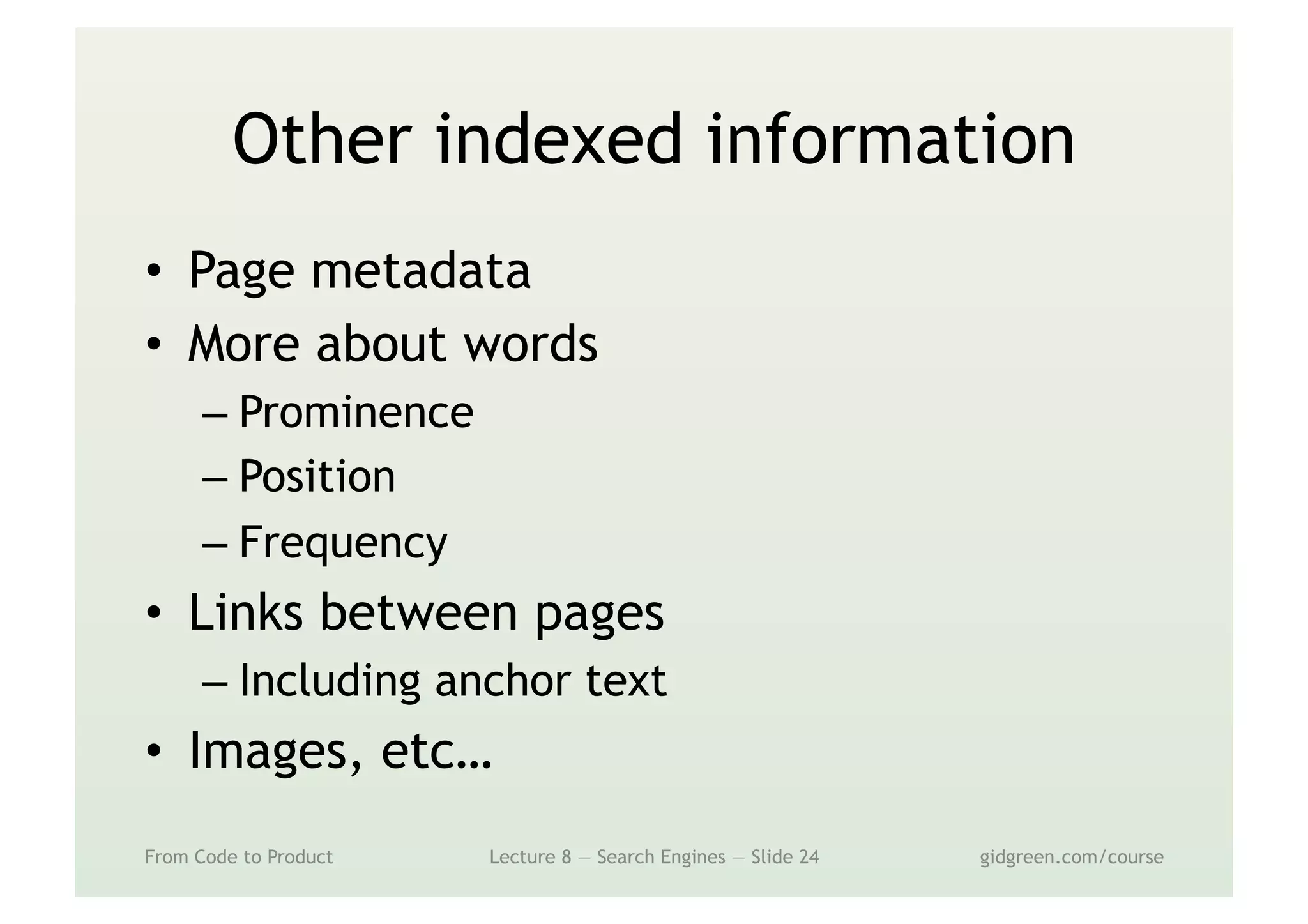
Other indexed information
•  Page metadata
•  More about words
– Prominence
– Position
– Frequency
•  Links between pages
– Including anchor text
•  Images, etc…
From Code to Product Lecture 8 — Search Engines — Slide 24 gidgreen.com/course
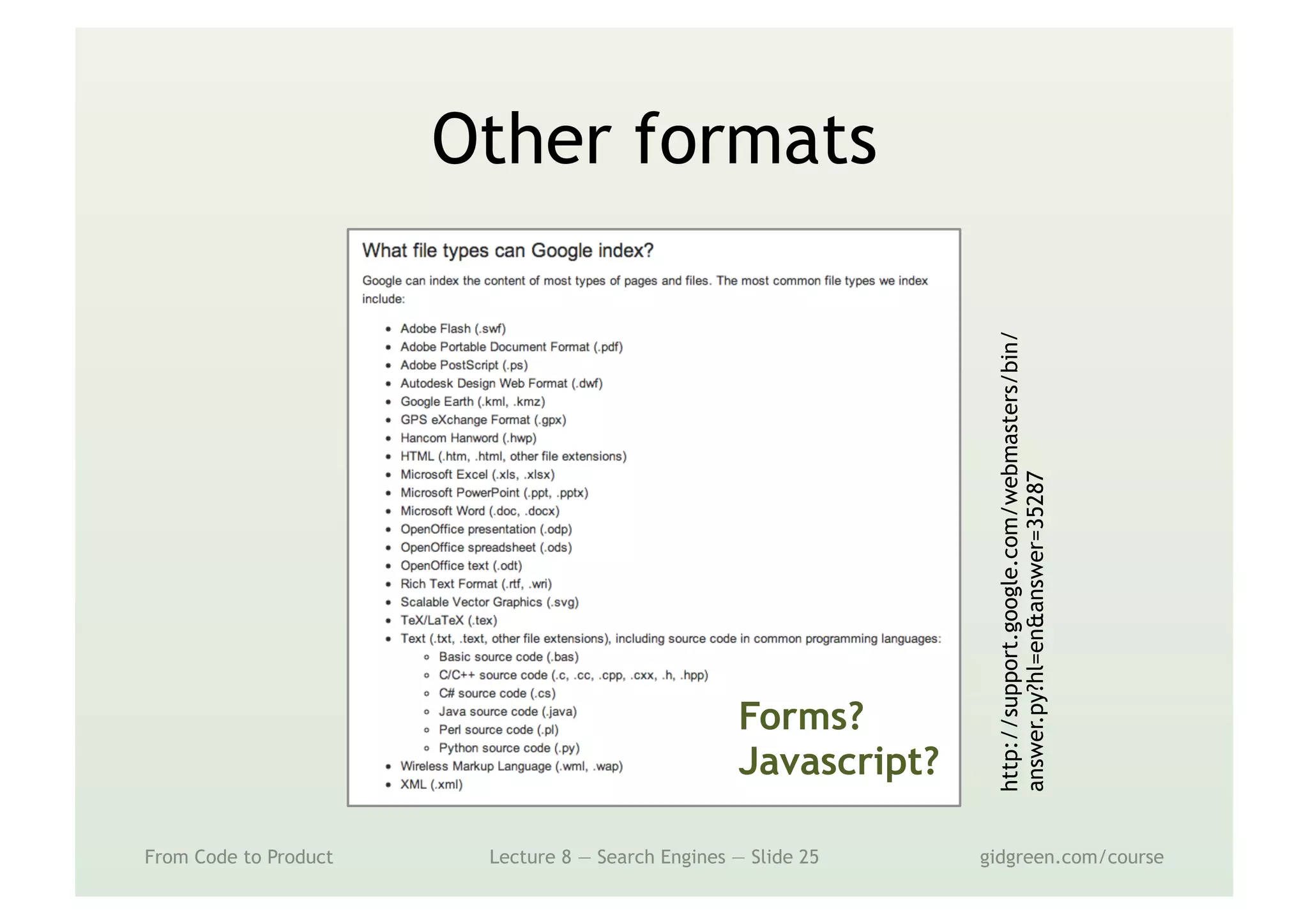
Other formats
From Code to Product Lecture 8 — Search Engines — Slide 25 gidgreen.com/course
http://support.google.com/webmasters/bin/
answer.py?hl=en&answer=35287
Forms?
Javascript?
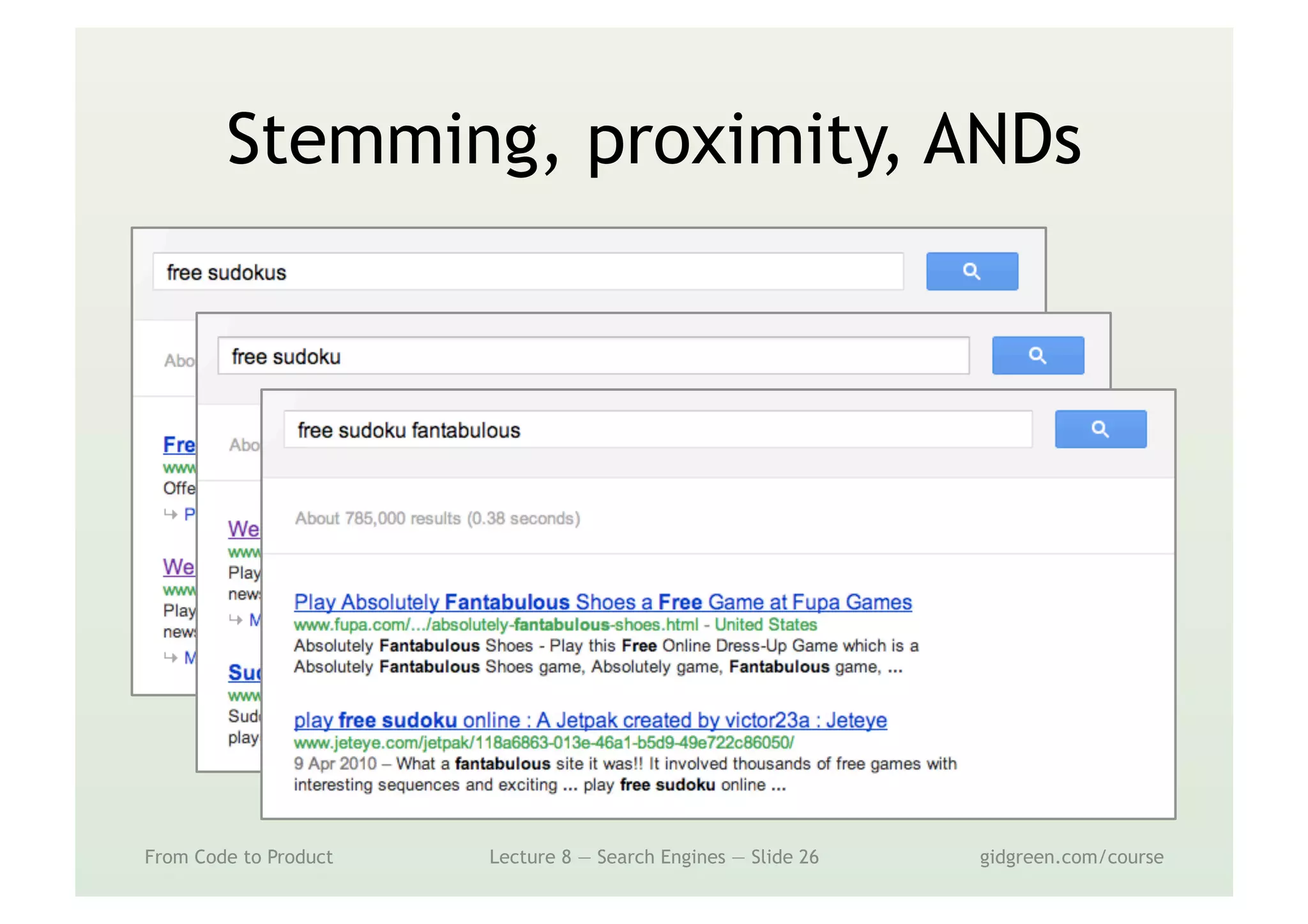
Stemming, proximity, ANDs
From Code to Product Lecture 8 — Search Engines — Slide 26 gidgreen.com/course
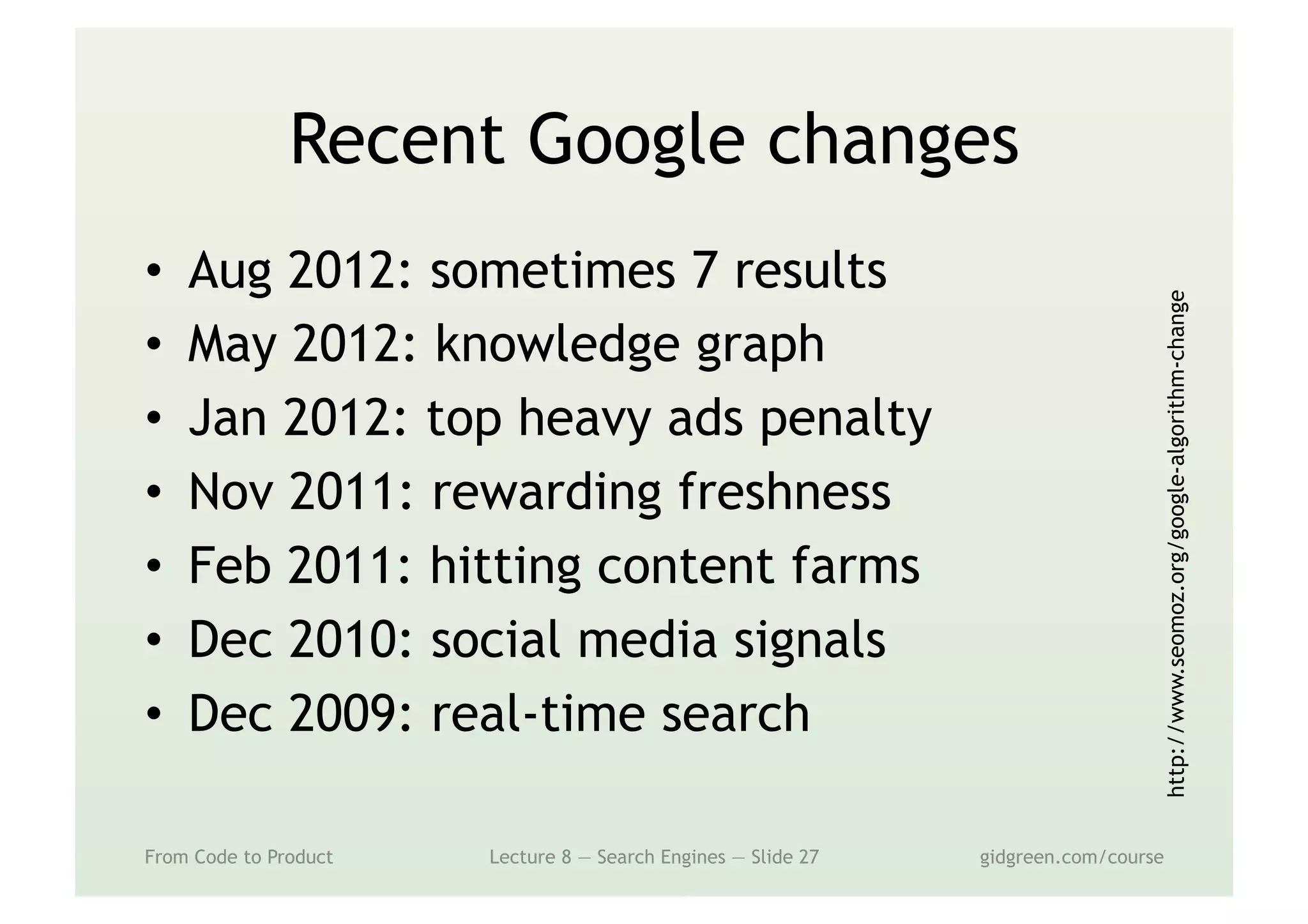
Recent Google changes
•  Aug 2012: sometimes 7 results
•  May 2012: knowledge graph
•  Jan 2012: top heavy ads penalty
•  Nov 2011: rewarding freshness
•  Feb 2011: hitting content farms
•  Dec 2010: social media signals
•  Dec 2009: real-time search
From Code to Product Lecture 8 — Search Engines — Slide 27 gidgreen.com/course
http://www.seomoz.org/google-algorithm-change
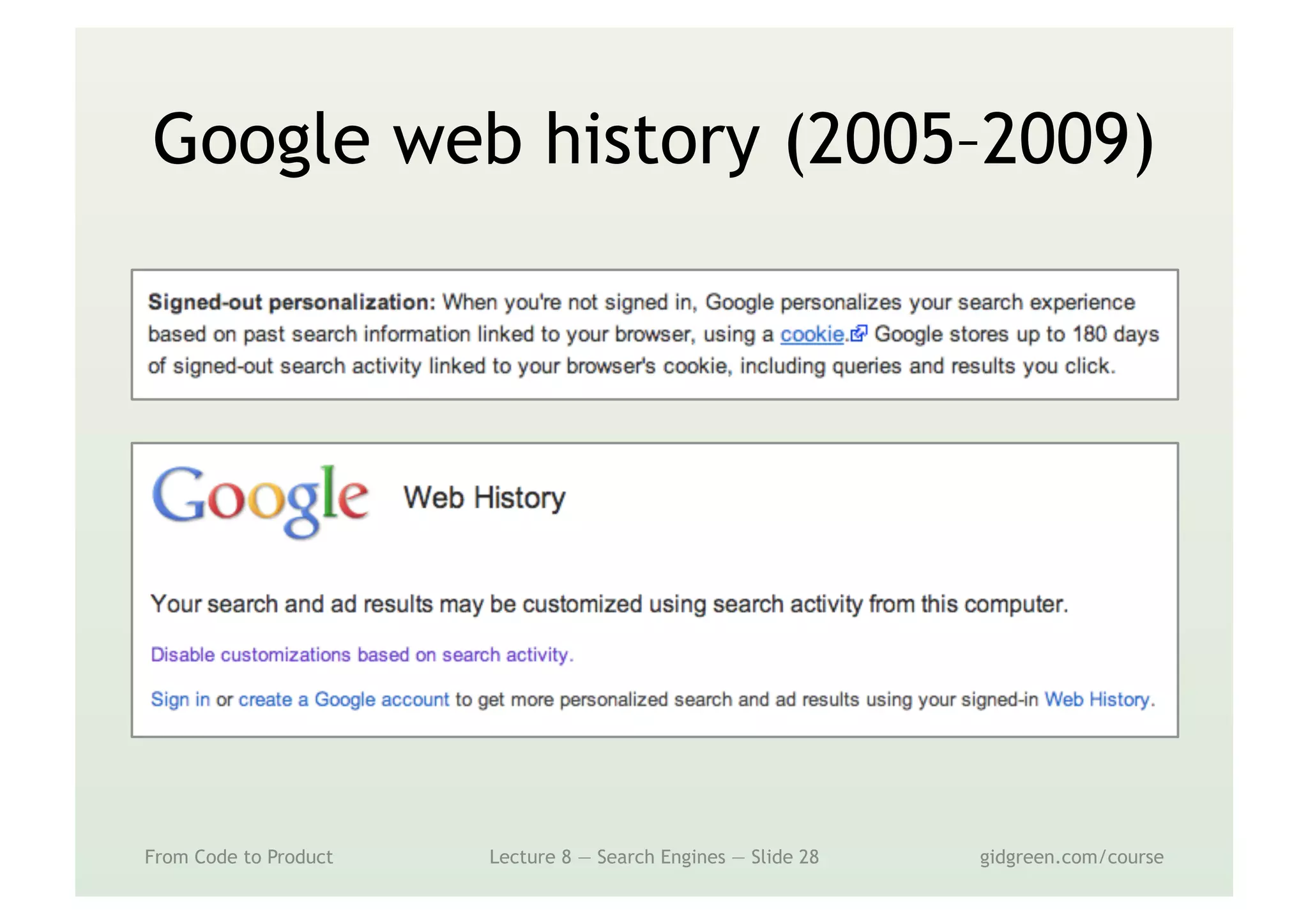
Google web history (2005–2009)
From Code to Product Lecture 8 — Search Engines — Slide 28 gidgreen.com/course
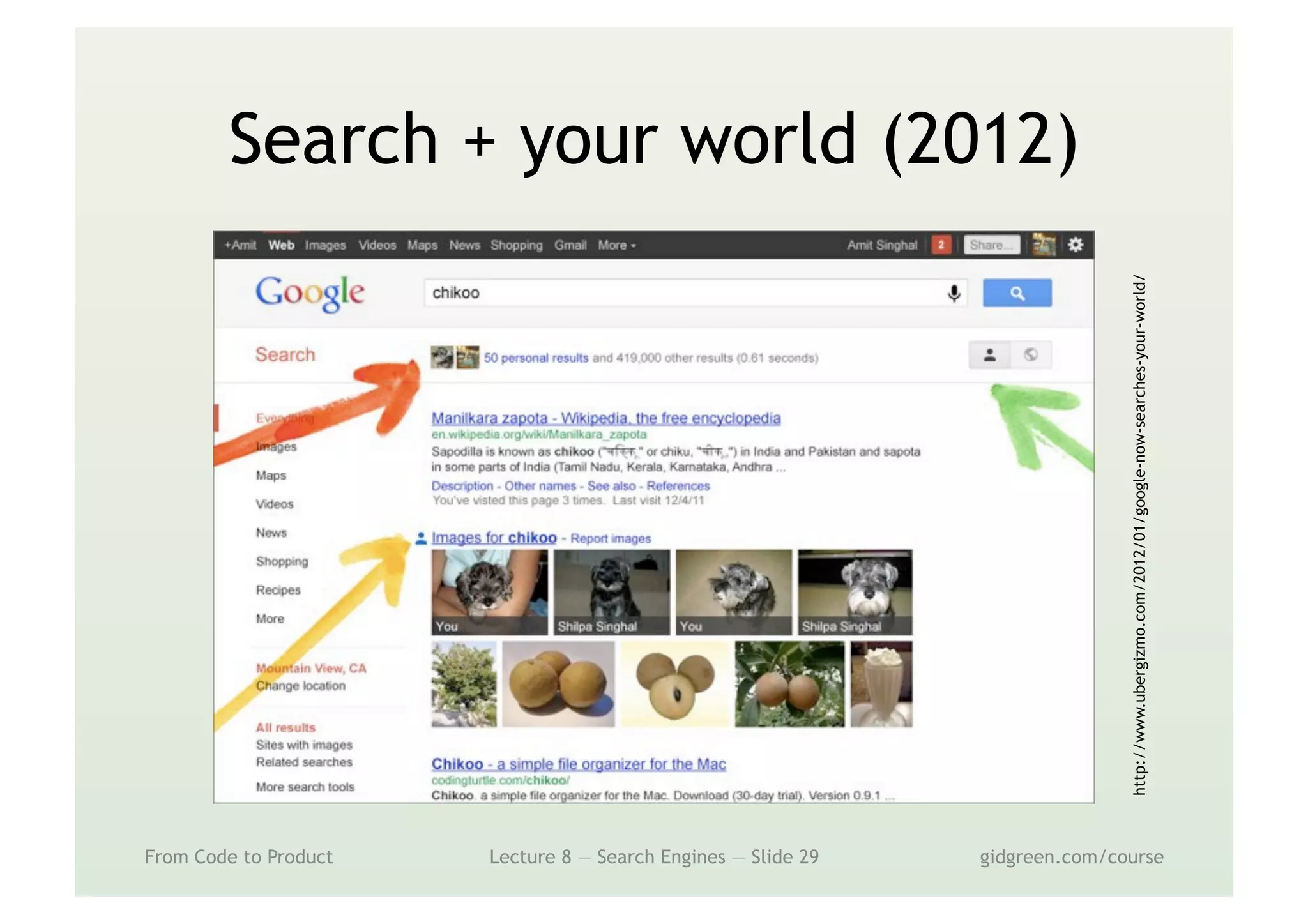
Search + your world (2012)
From Code to Product Lecture 8 — Search Engines — Slide 29 gidgreen.com/course
http://www.ubergizmo.com/2012/01/google-now-searches-your-world/
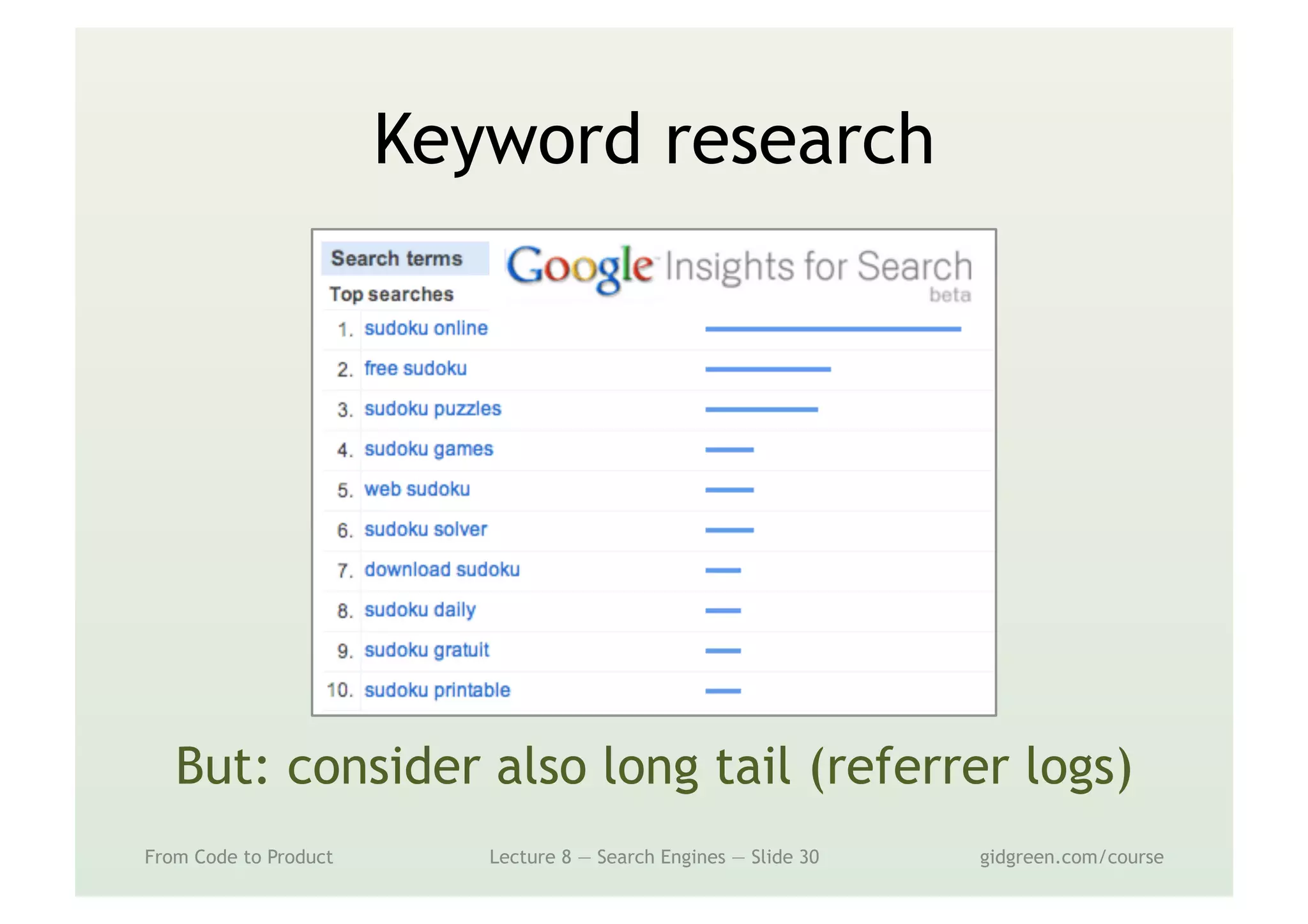
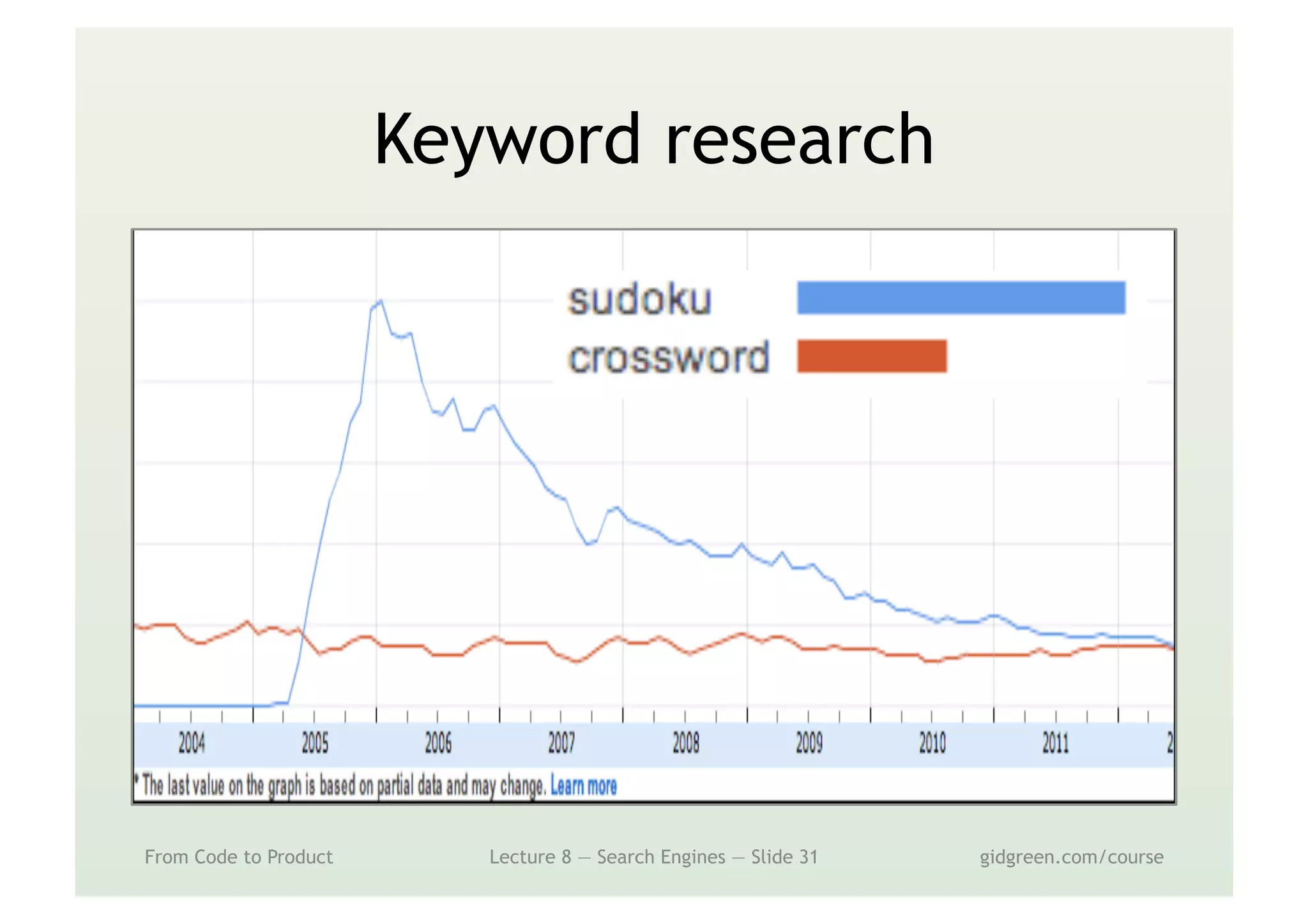
Keyword research
But: consider also long tail (referrer logs)
From Code to Product Lecture 8 — Search Engines — Slide 30 gidgreen.com/course
Keyword research
From Code to Product Lecture 8 — Search Engines — Slide 31 gidgreen.com/course
Lecture 8
•  Introduction
•  How search works
•  Anatomy of HTML
•  On-page factors
•  Off-page factors
•  PageRank
From Code to Product Lecture 8 — Search Engines — Slide 32 gidgreen.com/course
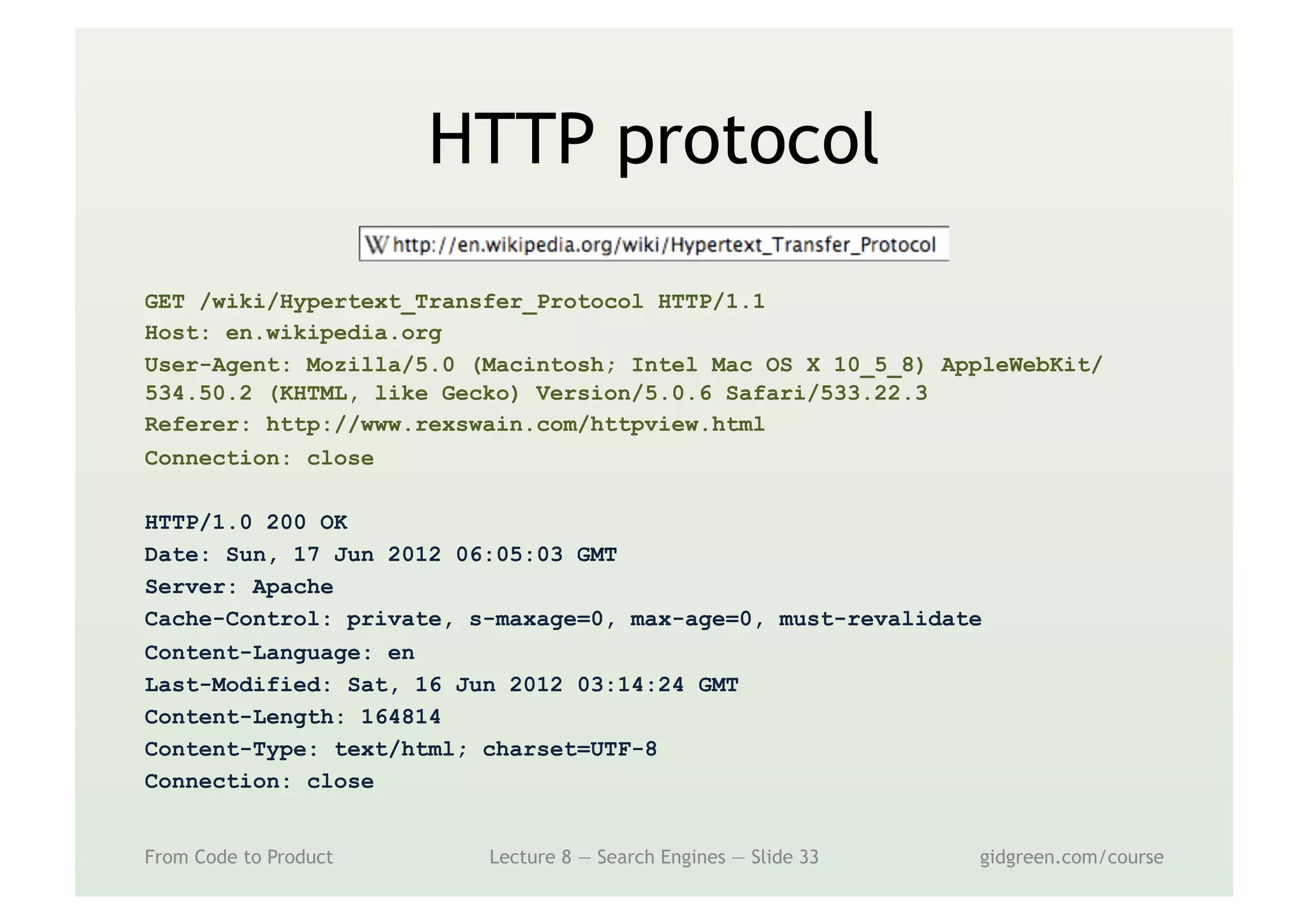
HTTP protocol
GET /wiki/Hypertext_Transfer_Protocol HTTP/1.1
Host: en.wikipedia.org
User-Agent: Mozilla/5.0 (Macintosh; Intel Mac OS X 10_5_8) AppleWebKit/
534.50.2 (KHTML, like Gecko) Version/5.0.6 Safari/533.22.3
Referer: http://www.rexswain.com/httpview.html
Connection: close
HTTP/1.0 200 OK
Date: Sun, 17 Jun 2012 06:05:03 GMT
Server: Apache
Cache-Control: private, s-maxage=0, max-age=0, must-revalidate
Content-Language: en
Last-Modified: Sat, 16 Jun 2012 03:14:24 GMT
Content-Length: 164814
Content-Type: text/html; charset=UTF-8
Connection: close
From Code to Product Lecture 8 — Search Engines — Slide 33 gidgreen.com/course
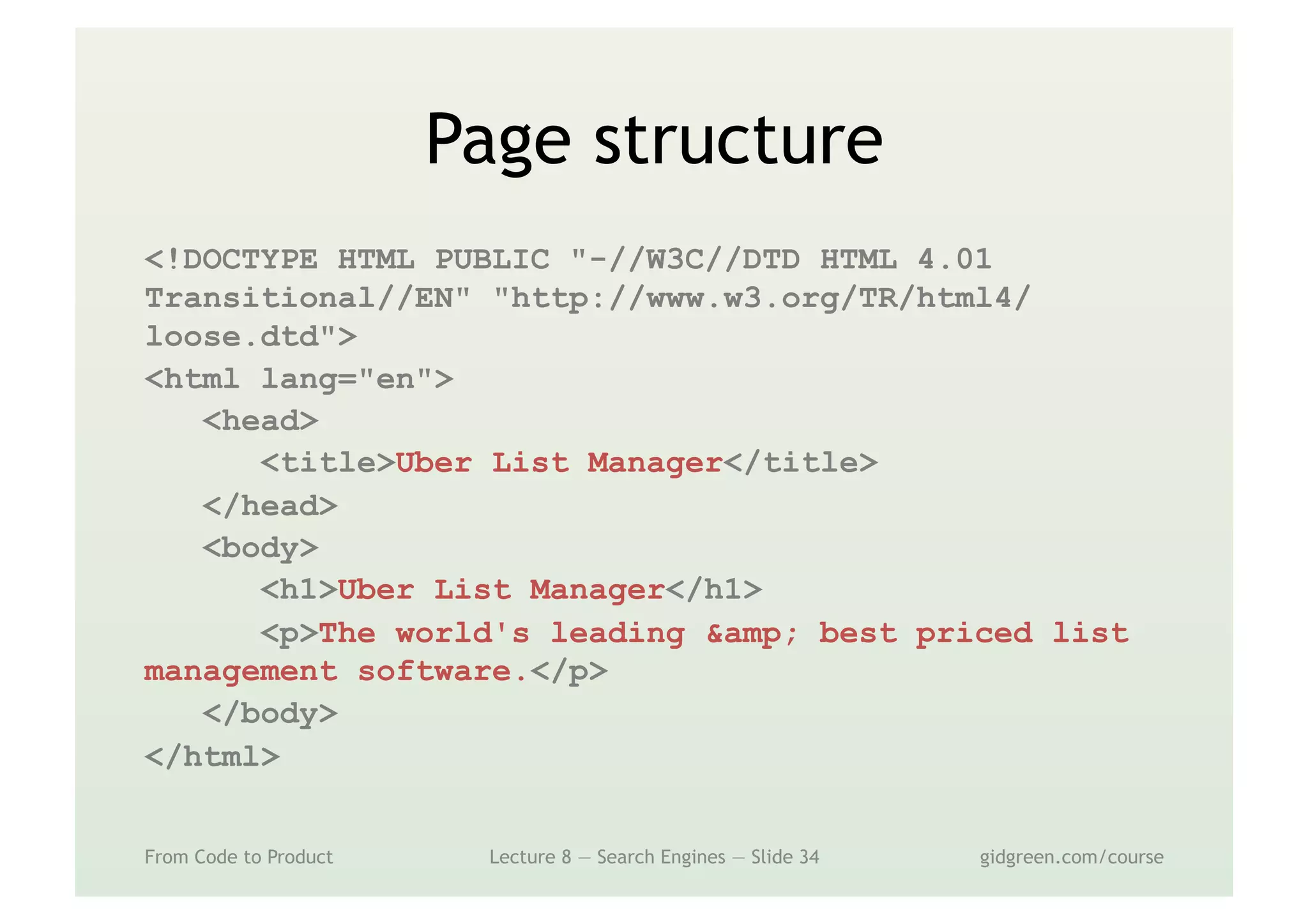
Page structure
<!DOCTYPE HTML PUBLIC "-//W3C//DTD HTML 4.01
Transitional//EN" "http://www.w3.org/TR/html4/
loose.dtd">
<html lang="en">
<head>
<title>Uber List Manager</title>
</head>
<body>
<h1>Uber List Manager</h1>
<p>The world's leading &amp; best priced list
management software.</p>
</body>
</html>
From Code to Product Lecture 8 — Search Engines — Slide 34 gidgreen.com/course
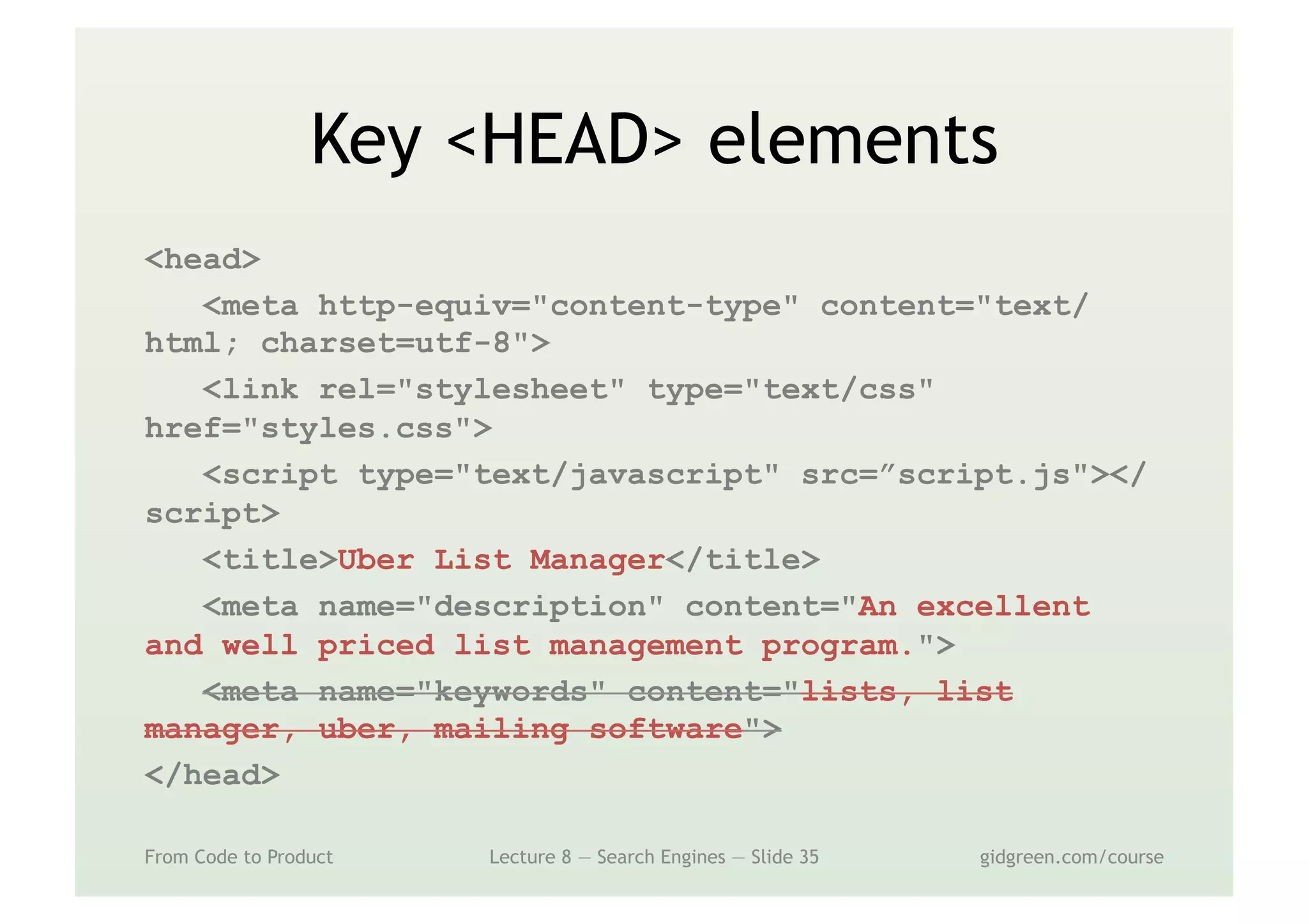
Key <HEAD> elements
<head>
<meta http-equiv="content-type" content="text/
html; charset=utf-8">
<link rel="stylesheet" type="text/css"
href="styles.css">
<script type="text/javascript" src=”script.js"></
script>
<title>Uber List Manager</title>
<meta name="description" content="An excellent
and well priced list management program.">
<meta name="keywords" content="lists, list
manager, uber, mailing software">
</head>
From Code to Product Lecture 8 — Search Engines — Slide 35 gidgreen.com/course
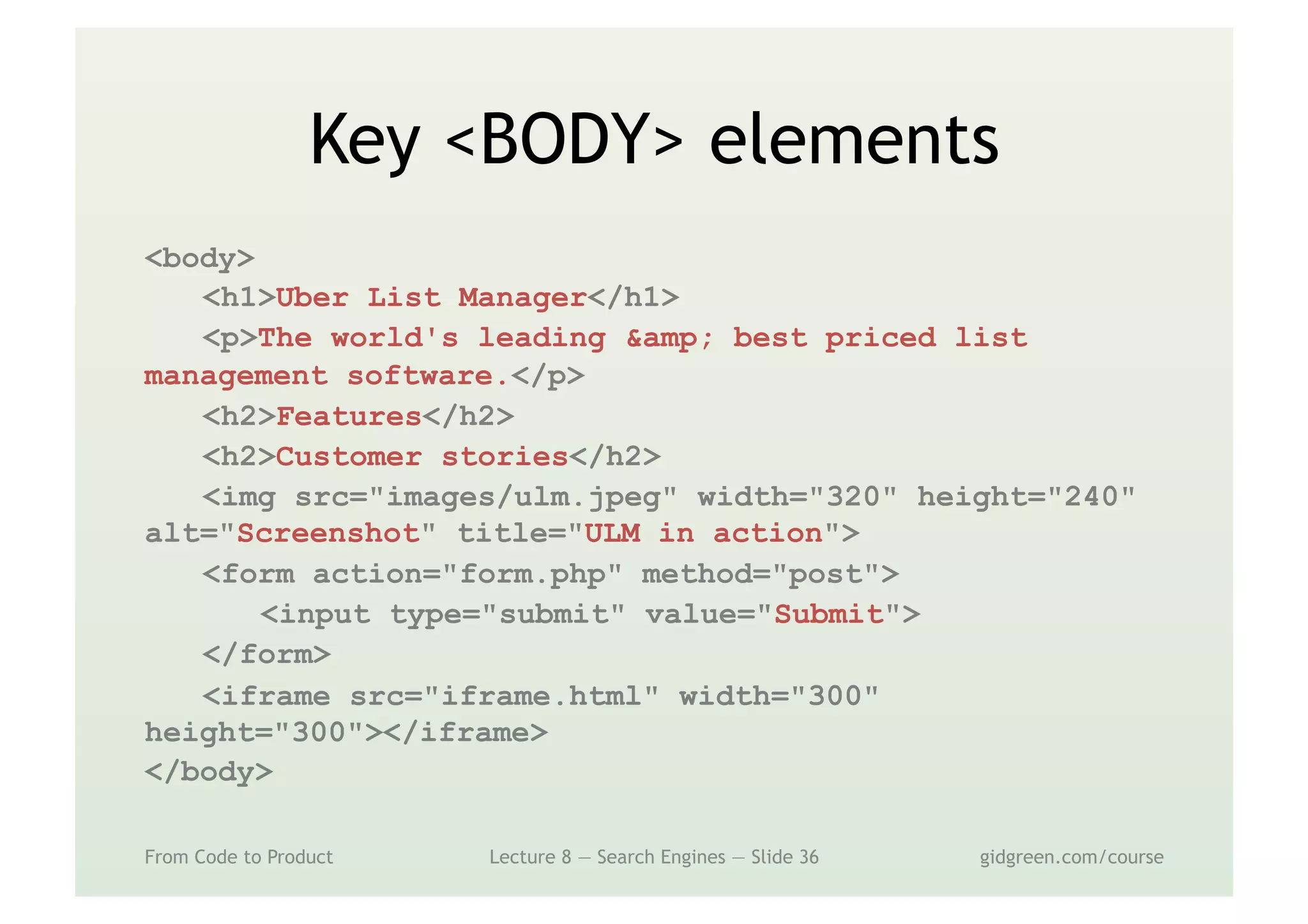
Key <BODY> elements
From Code to Product Lecture 8 — Search Engines — Slide 36 gidgreen.com/course
<body>
<h1>Uber List Manager</h1>
<p>The world's leading &amp; best priced list
management software.</p>
<h2>Features</h2>
<h2>Customer stories</h2>
<img src="images/ulm.jpeg" width="320" height="240"
alt="Screenshot" title="ULM in action">
<form action="form.php" method="post">
<input type="submit" value="Submit">
</form>
<iframe src="iframe.html" width="300"
height="300"></iframe>
</body>
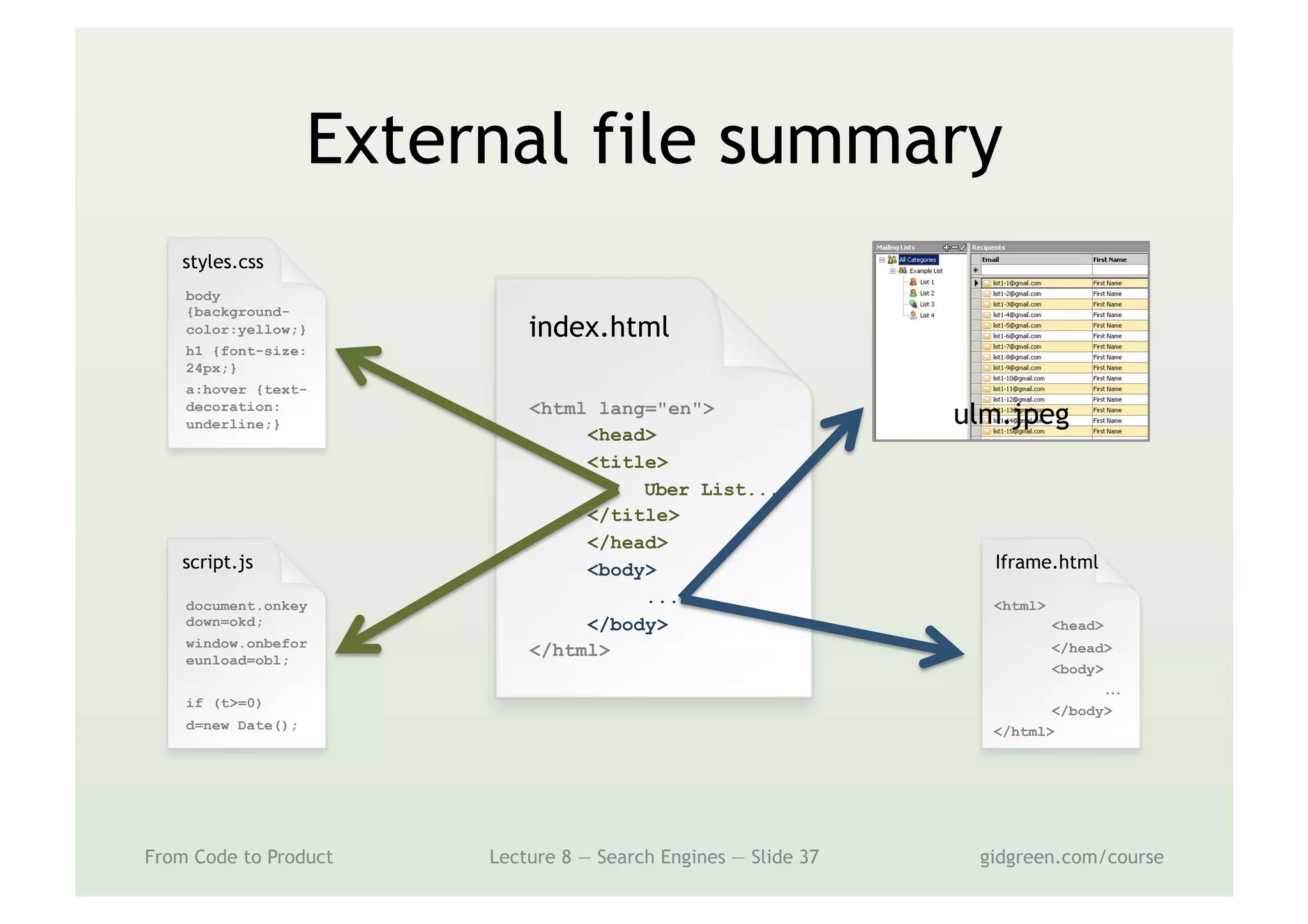
External file summary
From Code to Product Lecture 8 — Search Engines — Slide 37 gidgreen.com/course
index.html
<html lang="en">
<head>
<title>
Uber List...
</title>
</head>
<body>
...
</body>
</html>
styles.css
body
{background-
color:yellow;}
h1 {font-size:
24px;}
a:hover {text-
decoration:
underline;}
script.js
document.onkey
down=okd;
window.onbefor
eunload=obl;
if (t>=0)
d=new Date();
Iframe.html
<html>
<head>
</head>
<body>
...
</body>
</html>
ulm.jpeg
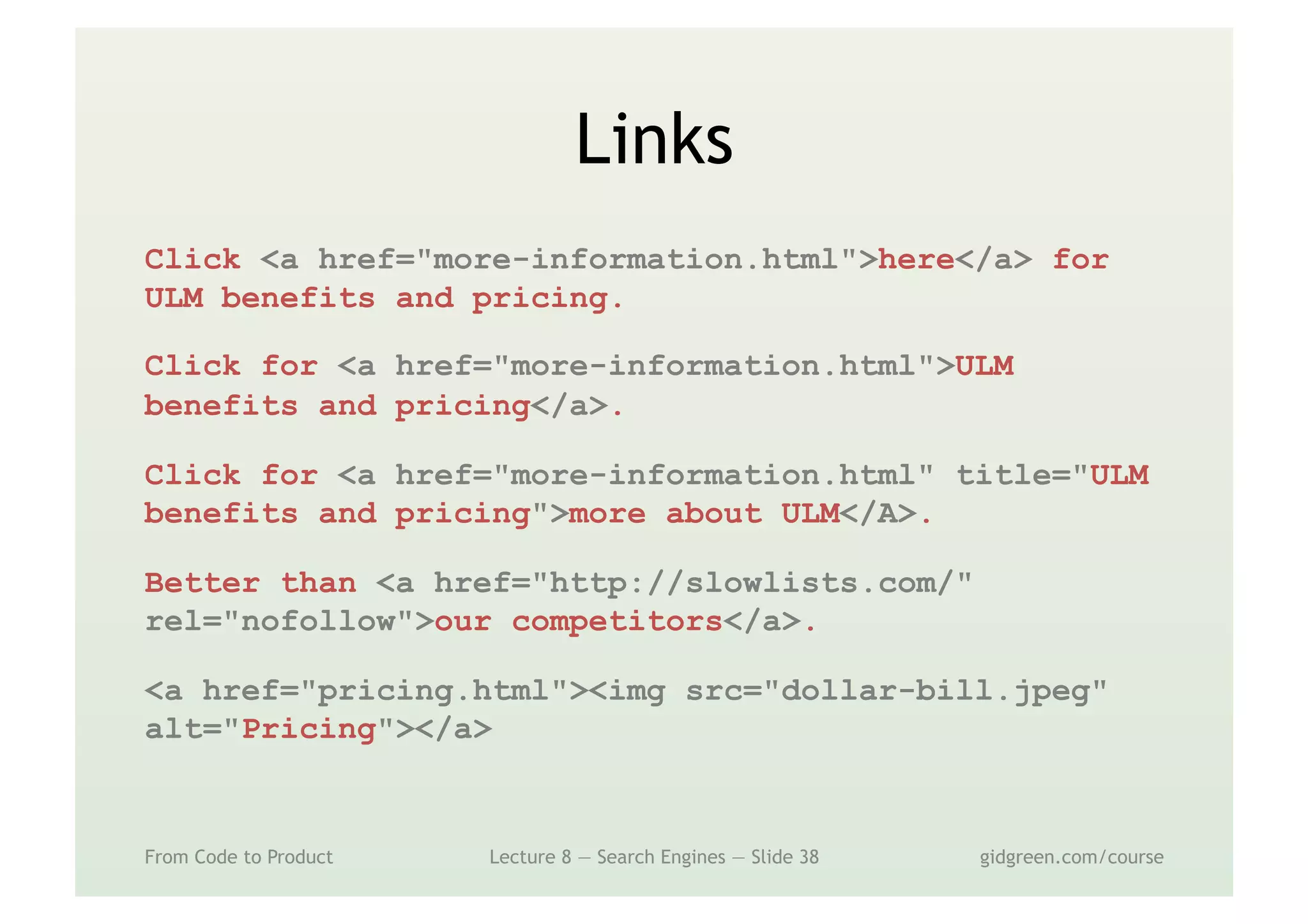
Links
From Code to Product Lecture 8 — Search Engines — Slide 38 gidgreen.com/course
Click <a href="more-information.html">here</a> for
ULM benefits and pricing.
Click for <a href="more-information.html">ULM
benefits and pricing</a>.
Click for <a href="more-information.html" title="ULM
benefits and pricing">more about ULM</A>.
Better than <a href="http://slowlists.com/"
rel="nofollow">our competitors</a>.
<a href="pricing.html"><img src="dollar-bill.jpeg"
alt="Pricing"></a>
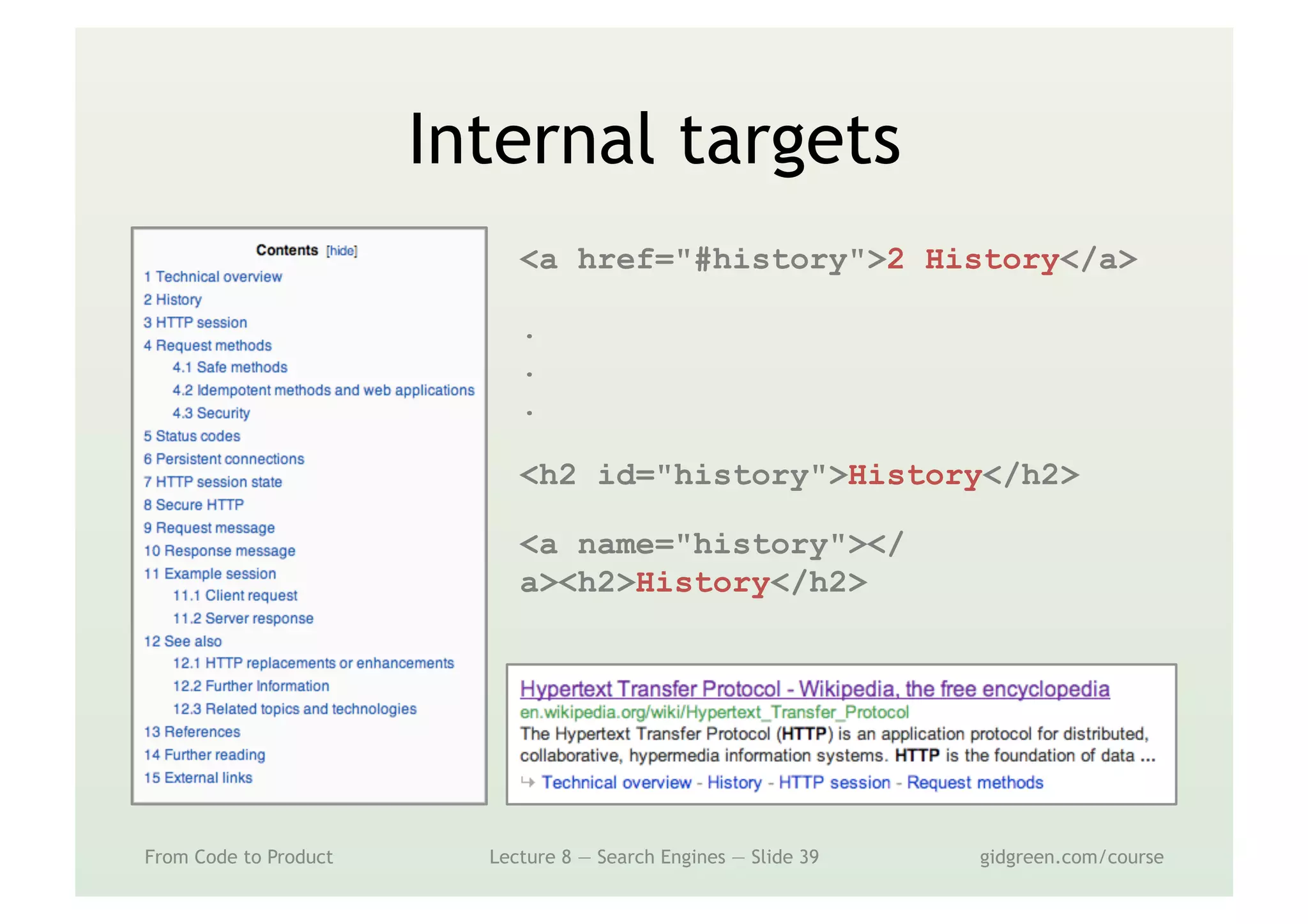
Internal targets
From Code to Product Lecture 8 — Search Engines — Slide 39 gidgreen.com/course
<a href="#history">2 History</a>
.
.
.
<h2 id="history">History</h2>
<a name="history"></
a><h2>History</h2>
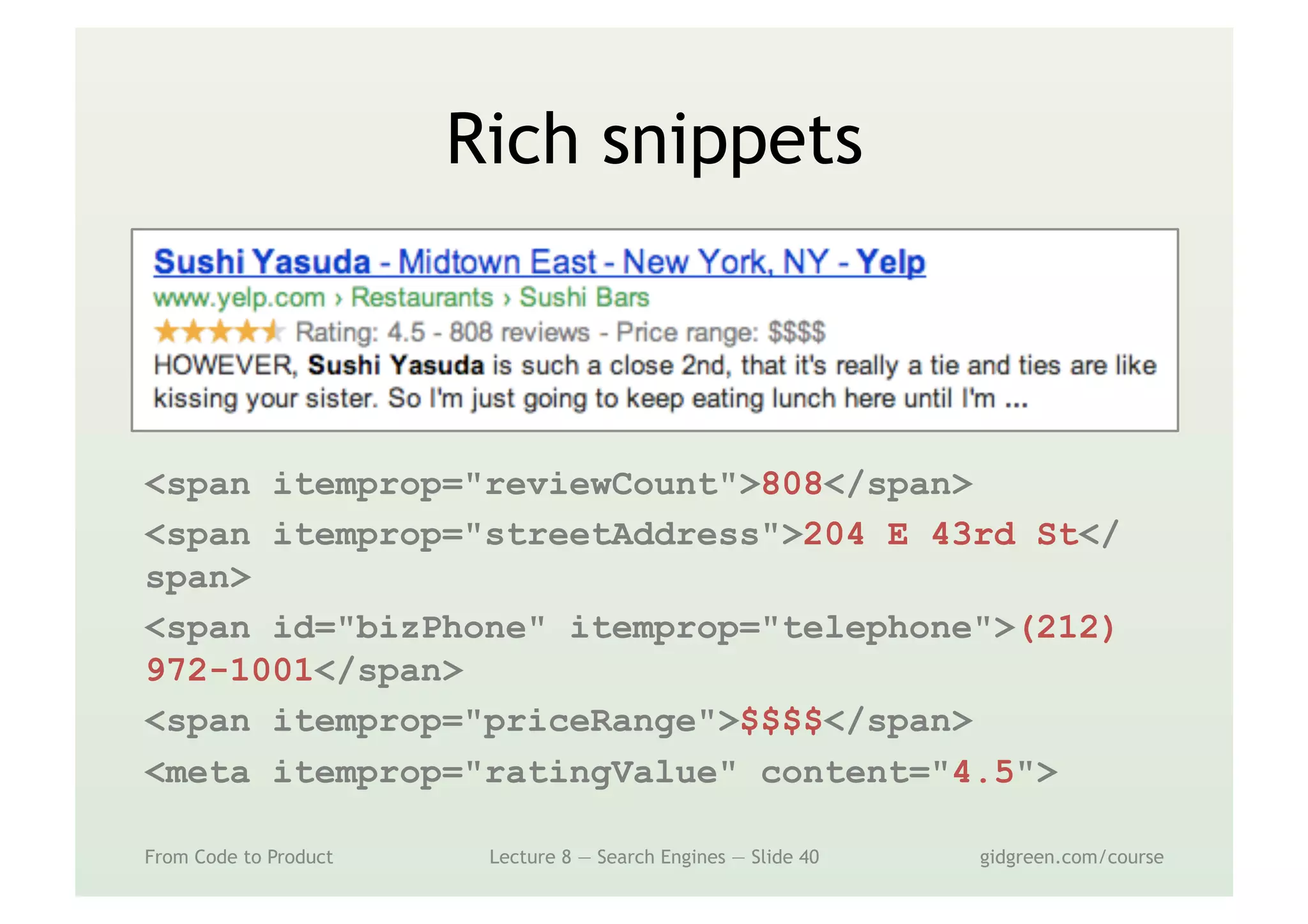
Rich snippets
<span itemprop="reviewCount">808</span>
<span itemprop="streetAddress">204 E 43rd St</
span>
<span id="bizPhone" itemprop="telephone">(212)
972-1001</span>
<span itemprop="priceRange">$$$$</span>
<meta itemprop="ratingValue" content="4.5">
From Code to Product Lecture 8 — Search Engines — Slide 40 gidgreen.com/course
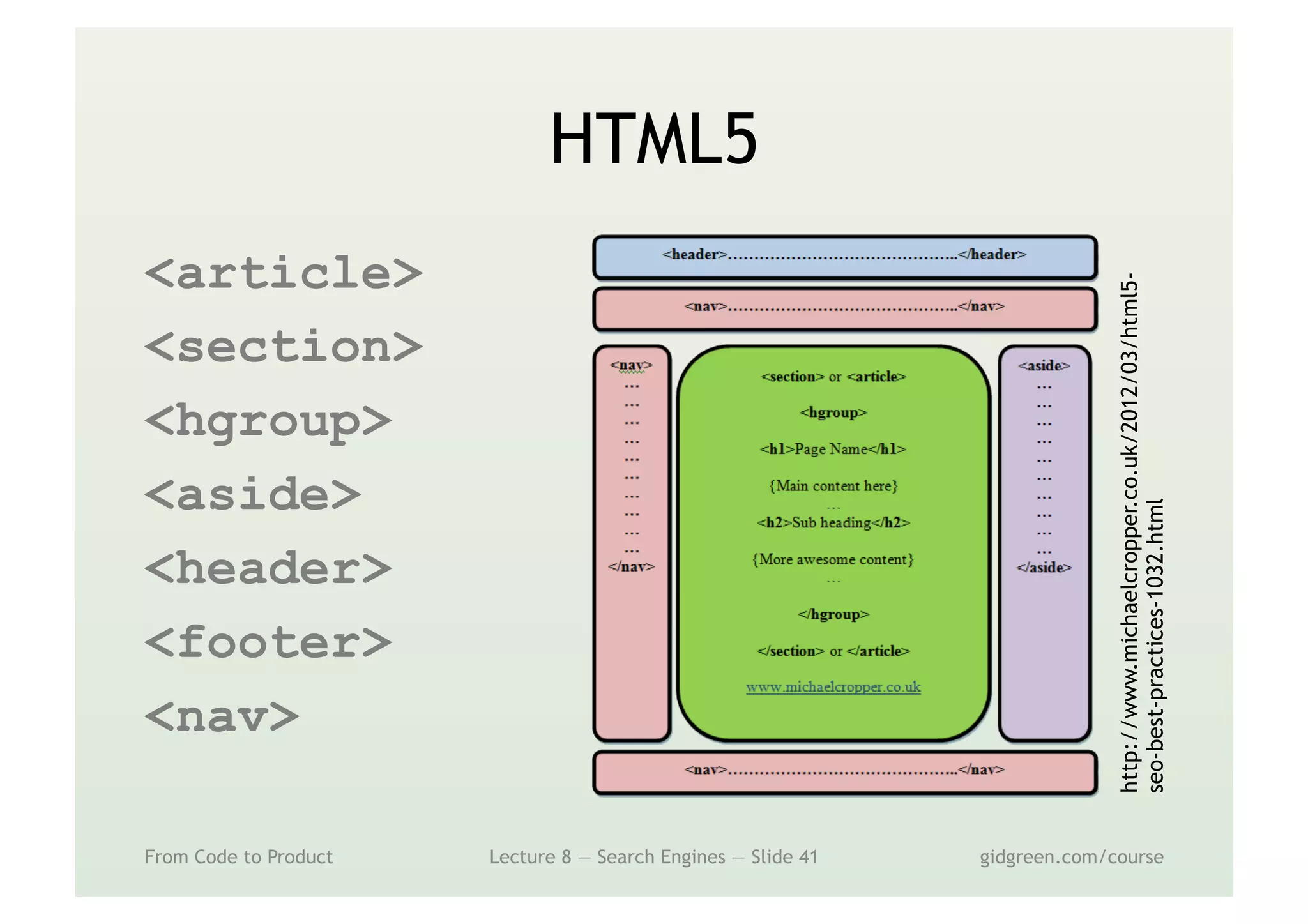
HTML5
<article>
<section>
<hgroup>
<aside>
<header>
<footer>
<nav>
From Code to Product Lecture 8 — Search Engines — Slide 41 gidgreen.com/course
http://www.michaelcropper.co.uk/2012/03/html5-
seo-best-practices-1032.html
Lecture 8
•  Introduction
•  How search works
•  Anatomy of HTML
•  On-page factors
•  Off-page factors
•  PageRank
From Code to Product Lecture 8 — Search Engines — Slide 42 gidgreen.com/course
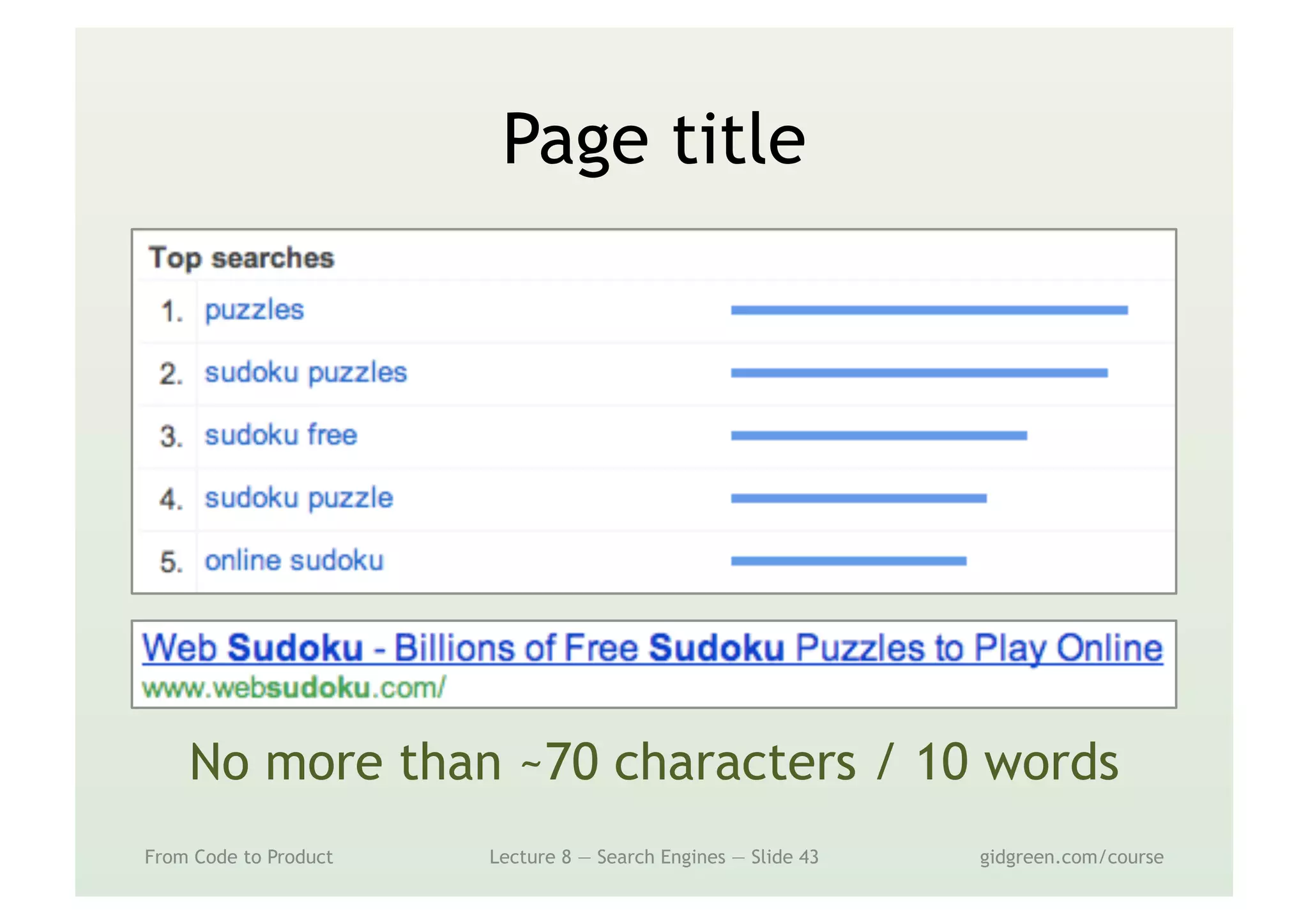
Page title
From Code to Product Lecture 8 — Search Engines — Slide 43 gidgreen.com/course
No more than ~70 characters / 10 words
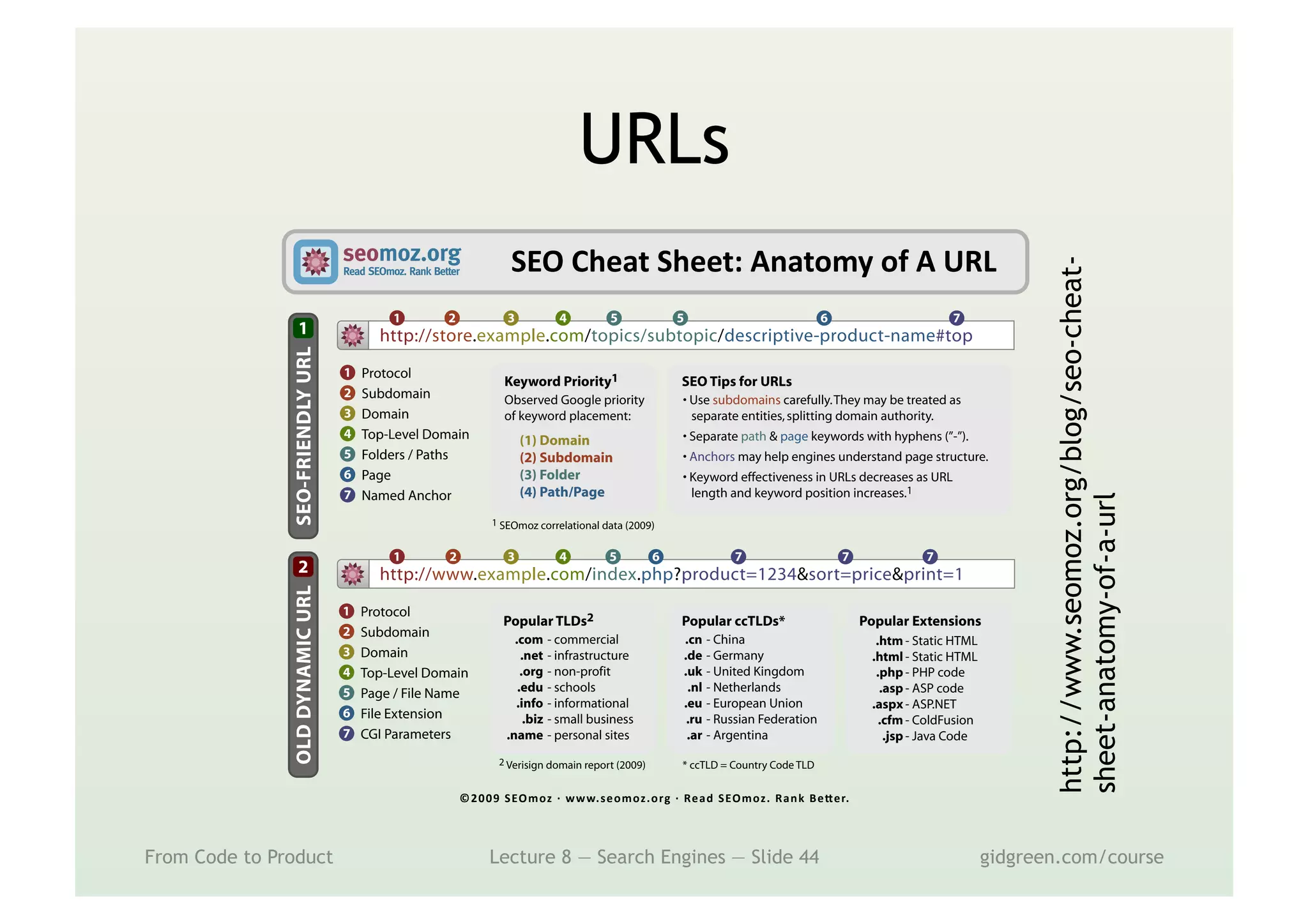
URLs
SEO Cheat Sheet: Anatomy of A URL
©2009  SEOmoz  ·∙  www.seomoz.org  ·∙  Read  SEOmoz.  Rank  Be er.
http://store.example.com/topics/subtopic/descriptive-product-name#top
1 Protocol
Subdomain
Domain
Top-Level Domain
Folders / Paths
Page
Named Anchor
2
1
3
4
5
6
7
2 3 4 5 5 6 7
http://www.example.com/index.php?product=1234&sort=price&print=1
1 2 3 4 5 6 7
1 Protocol
Subdomain
Domain
Top-Level Domain
Page / File Name
File Extension
CGI Parameters
2
3
4
5
6
7
7 7
Popular TLDs2
.com
.net
.org
.edu
.info
.biz
.name
Popular ccTLDs*
.cn
.de
.uk
.nl
.eu
.ru
.ar
- China
- Germany
- United Kingdom
- Netherlands
- European Union
- Russian Federation
- Argentina
Popular Extensions
.htm
.html
.php
.asp
.aspx
.cfm
.jsp
- Static HTML
- Static HTML
- PHP code
- ASP code
- ASP.NET
- ColdFusion
- Java Code
Keyword Priority1
Observed Google priority
of keyword placement:
- commercial
- infrastructure
- non-profit
- schools
- informational
- small business
- personal sites
SEO-FRIENDLYURLOLDDYNAMICURL
(1) Domain
(2) Subdomain
(3) Folder
(4) Path/Page
1 SEOmoz correlational data (2009)
2 Verisign domain report (2009) * ccTLD = Country Code TLD
SEO Tips for URLs
• Use subdomains carefully.They may be treated as
separate entities,splitting domain authority.
• Separate path & page keywords with hyphens (”-”).
• Anchors may help engines understand page structure.
• Keyword effectiveness in URLs decreases as URL
length and keyword position increases.1
2
1
From Code to Product Lecture 8 — Search Engines — Slide 44 gidgreen.com/course
http://www.seomoz.org/blog/seo-cheat-
sheet-anatomy-of-a-url
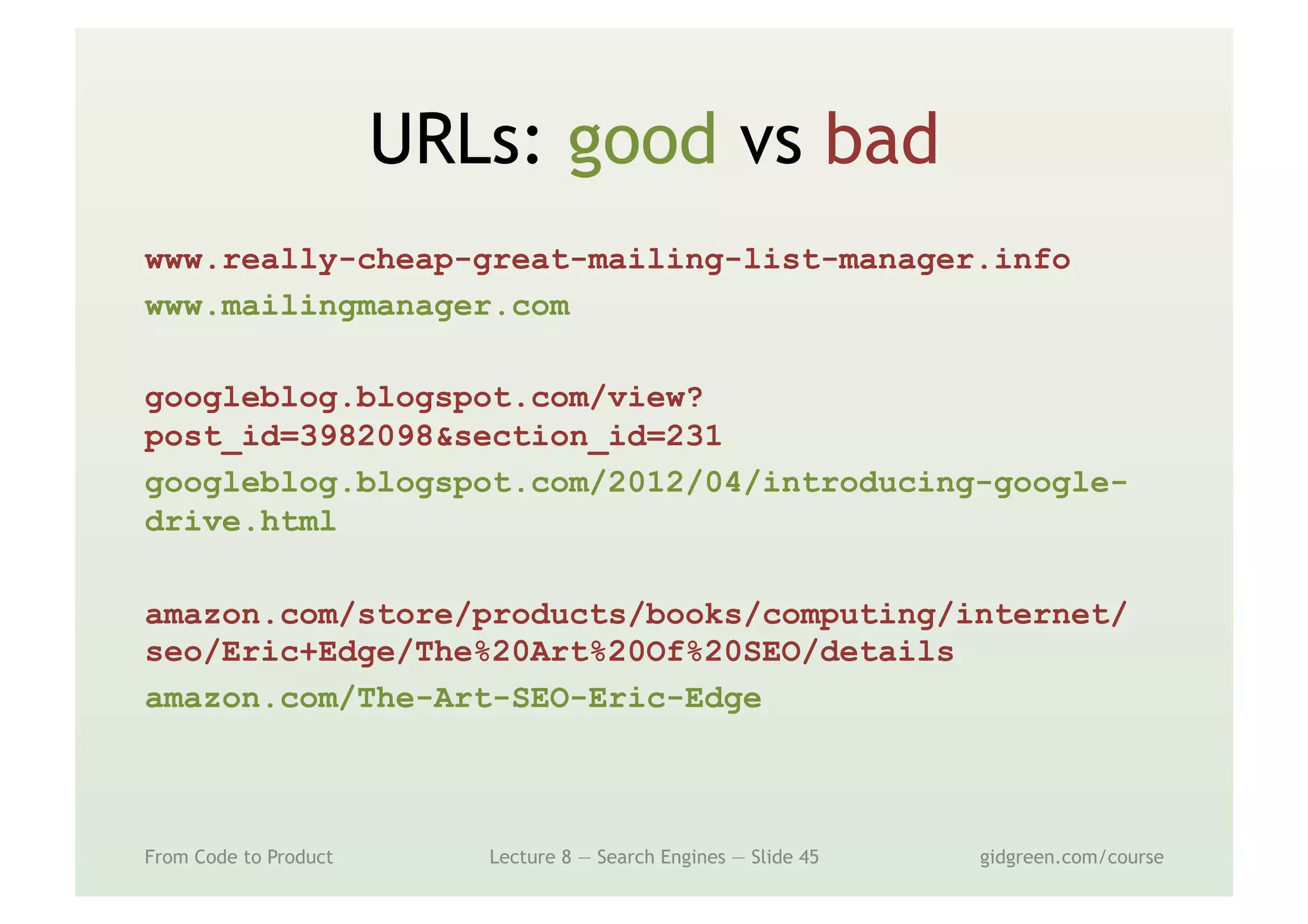
URLs: good vs bad
www.really-cheap-great-mailing-list-manager.info
www.mailingmanager.com
googleblog.blogspot.com/view?
post_id=3982098&section_id=231
googleblog.blogspot.com/2012/04/introducing-google-
drive.html
amazon.com/store/products/books/computing/internet/
seo/Eric+Edge/The%20Art%20Of%20SEO/details
amazon.com/The-Art-SEO-Eric-Edge
From Code to Product Lecture 8 — Search Engines — Slide 45 gidgreen.com/course
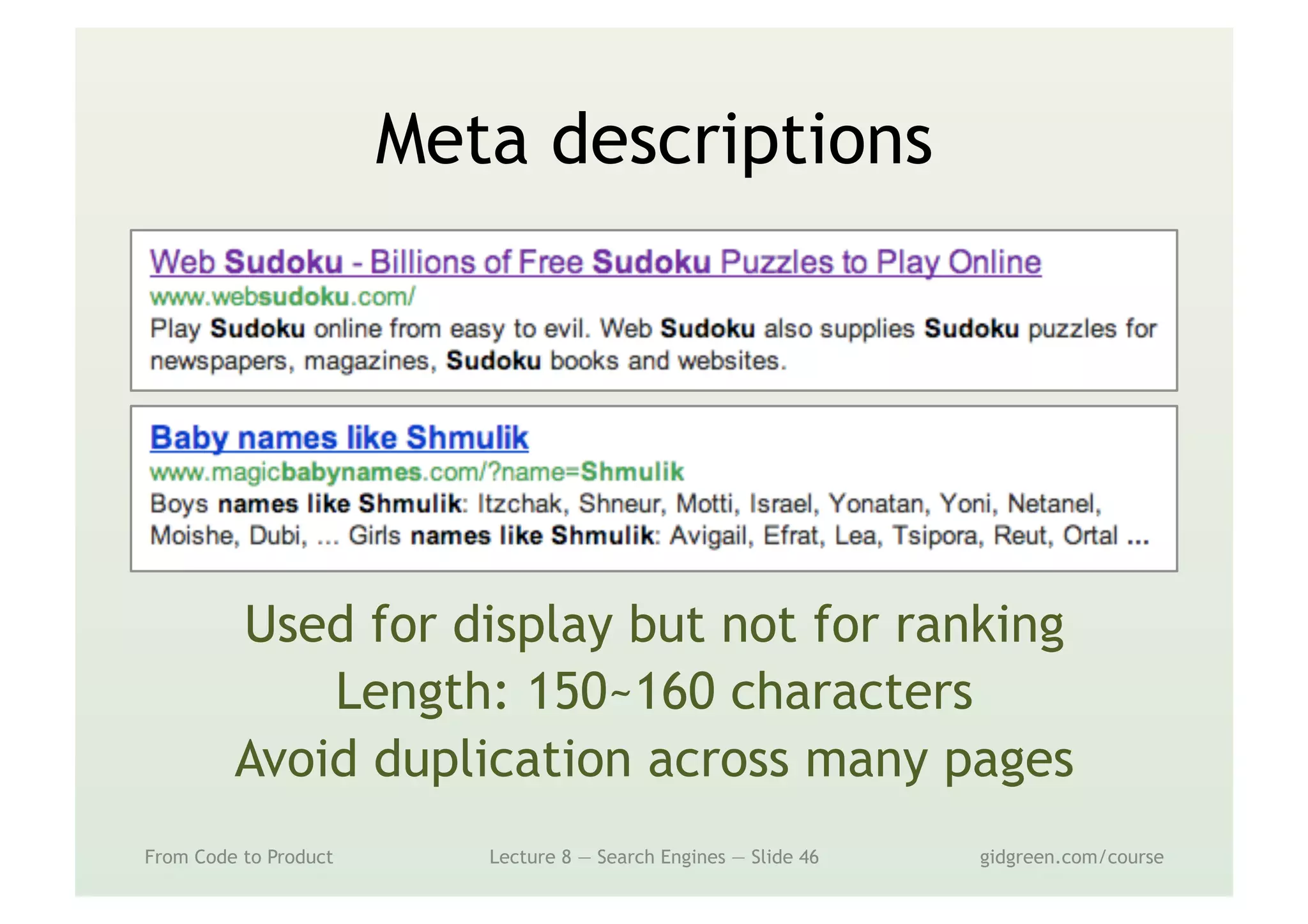
Meta descriptions
From Code to Product Lecture 8 — Search Engines — Slide 46 gidgreen.com/course
Used for display but not for ranking
Length: 150~160 characters
Avoid duplication across many pages
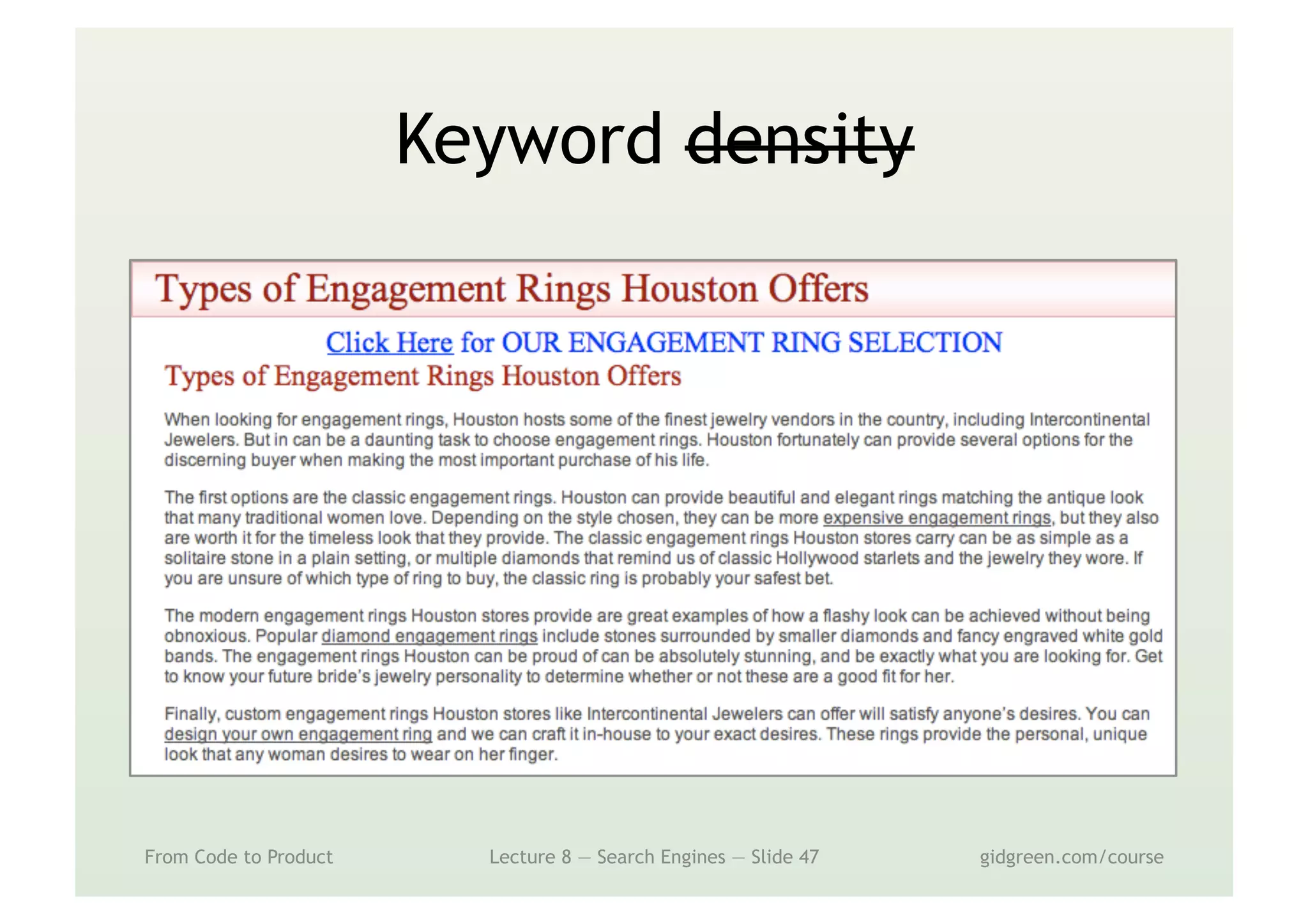
Keyword density
From Code to Product Lecture 8 — Search Engines — Slide 47 gidgreen.com/course
Formatting
From Code to Product Lecture 8 — Search Engines — Slide 48 gidgreen.com/course
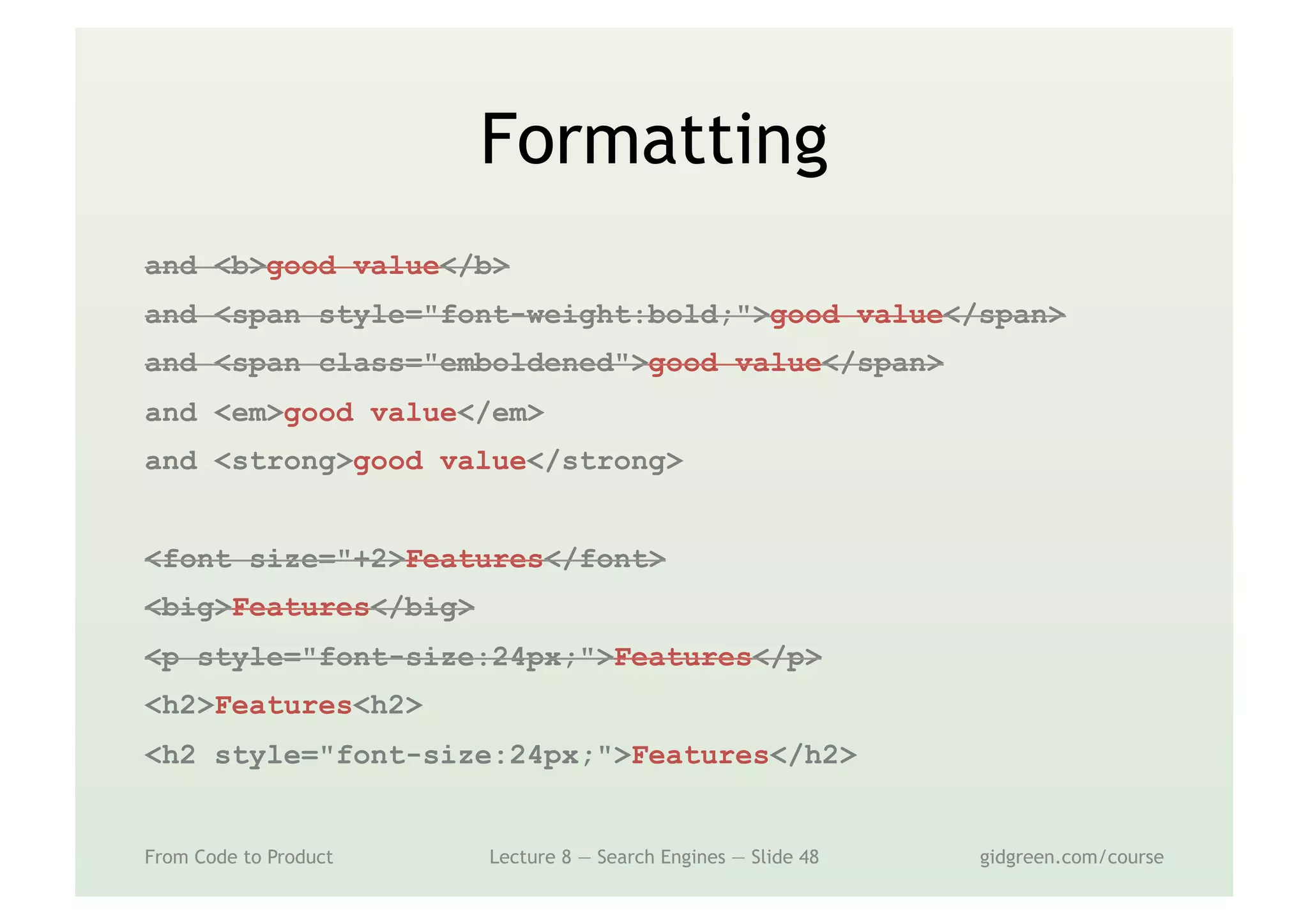
and <b>good value</b>
and <span style="font-weight:bold;">good value</span>
and <span class="emboldened">good value</span>
and <em>good value</em>
and <strong>good value</strong>
<font size="+2>Features</font>
<big>Features</big>
<p style="font-size:24px;">Features</p>
<h2>Features<h2>
<h2 style="font-size:24px;">Features</h2>
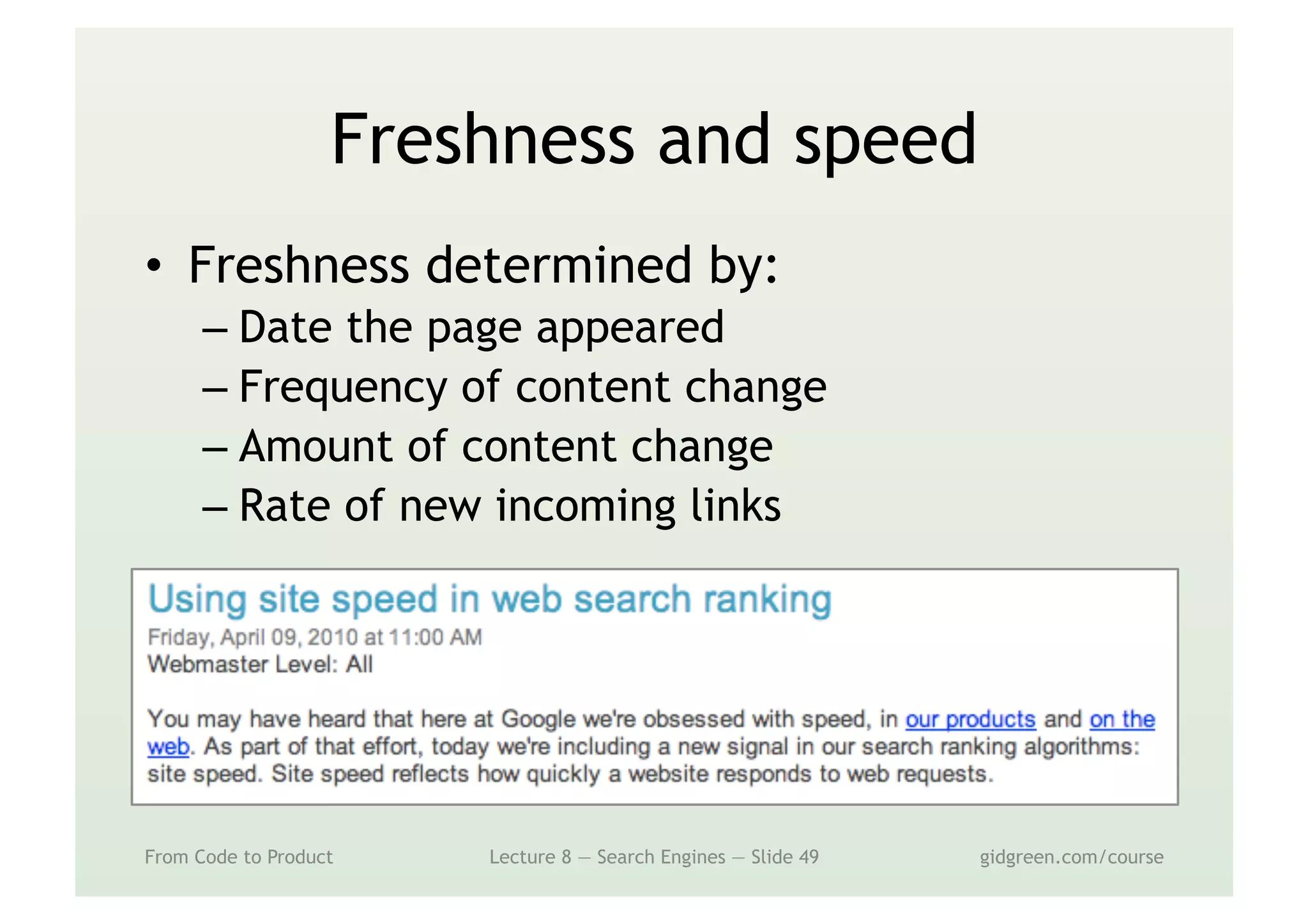
Freshness and speed
•  Freshness determined by:
– Date the page appeared
– Frequency of content change
– Amount of content change
– Rate of new incoming links
From Code to Product Lecture 8 — Search Engines — Slide 49 gidgreen.com/course
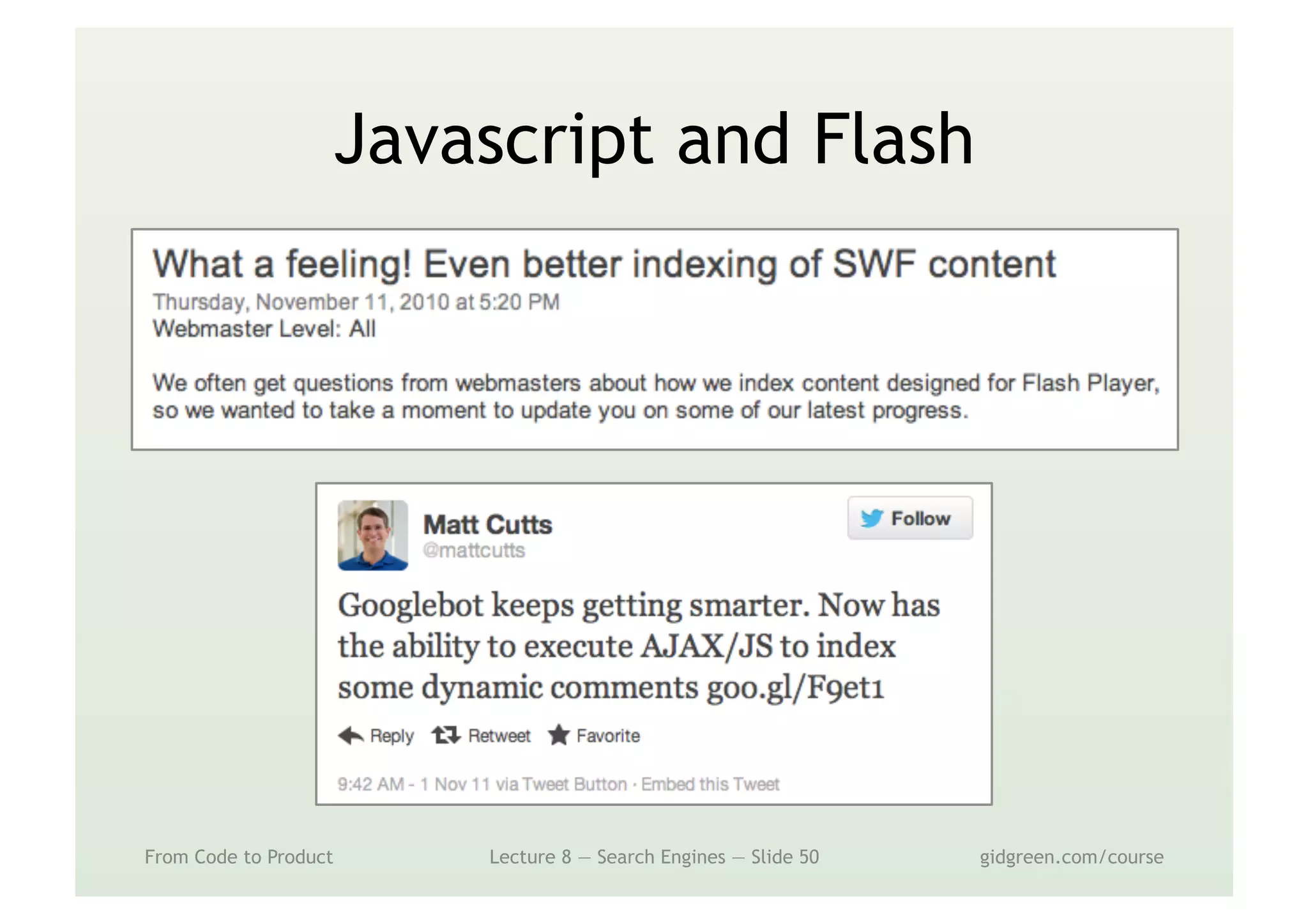
Javascript and Flash
From Code to Product Lecture 8 — Search Engines — Slide 50 gidgreen.com/course
Lecture 8
•  Introduction
•  How search works
•  Anatomy of HTML
•  On-page factors
•  Off-page factors
•  PageRank
From Code to Product Lecture 8 — Search Engines — Slide 51 gidgreen.com/course
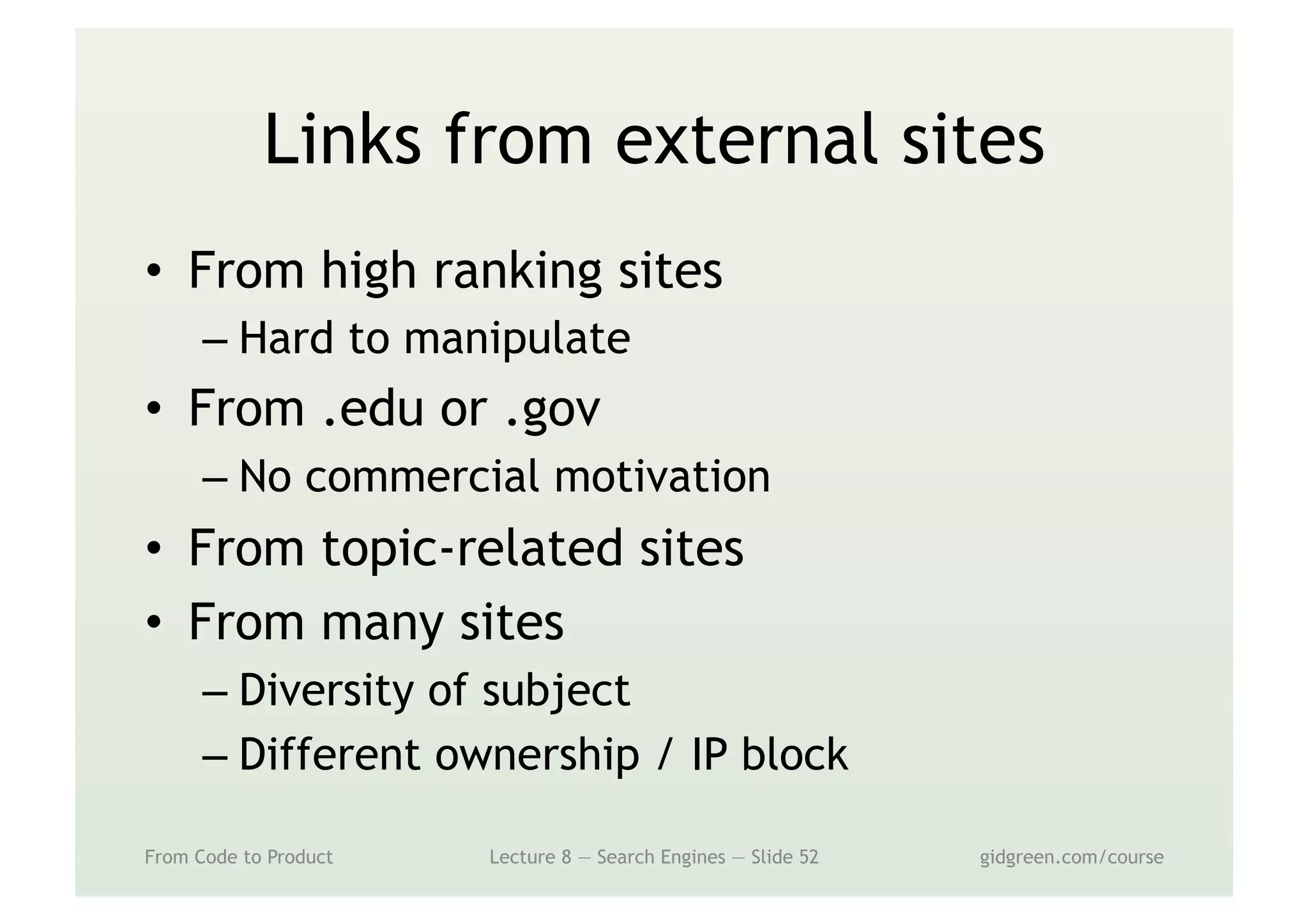
Links from external sites
•  From high ranking sites
– Hard to manipulate
•  From .edu or .gov
– No commercial motivation
•  From topic-related sites
•  From many sites
– Diversity of subject
– Different ownership / IP block
From Code to Product Lecture 8 — Search Engines — Slide 52 gidgreen.com/course
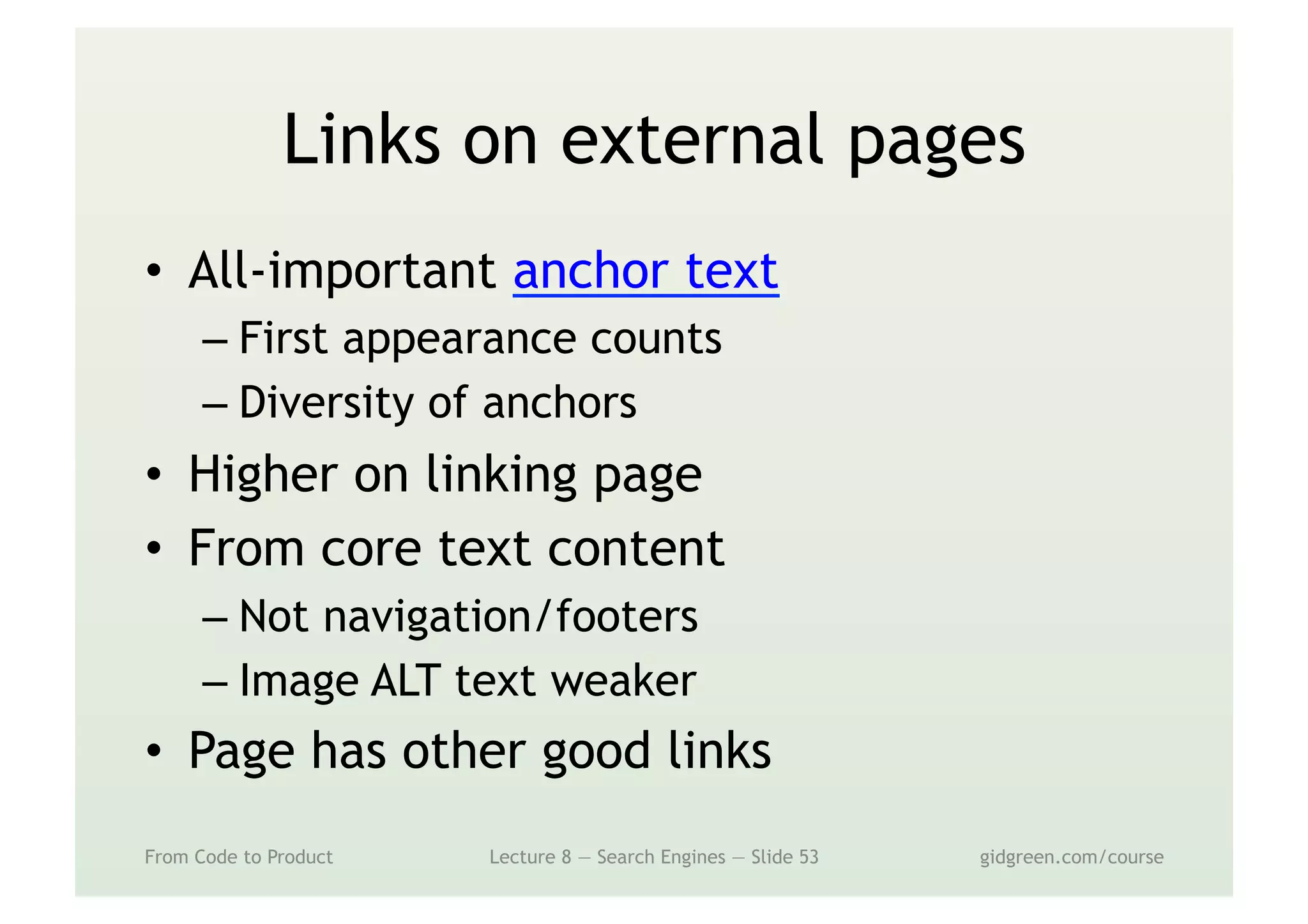
Links on external pages
•  All-important anchor text
– First appearance counts
– Diversity of anchors
•  Higher on linking page
•  From core text content
– Not navigation/footers
– Image ALT text weaker
•  Page has other good links
From Code to Product Lecture 8 — Search Engines — Slide 53 gidgreen.com/course
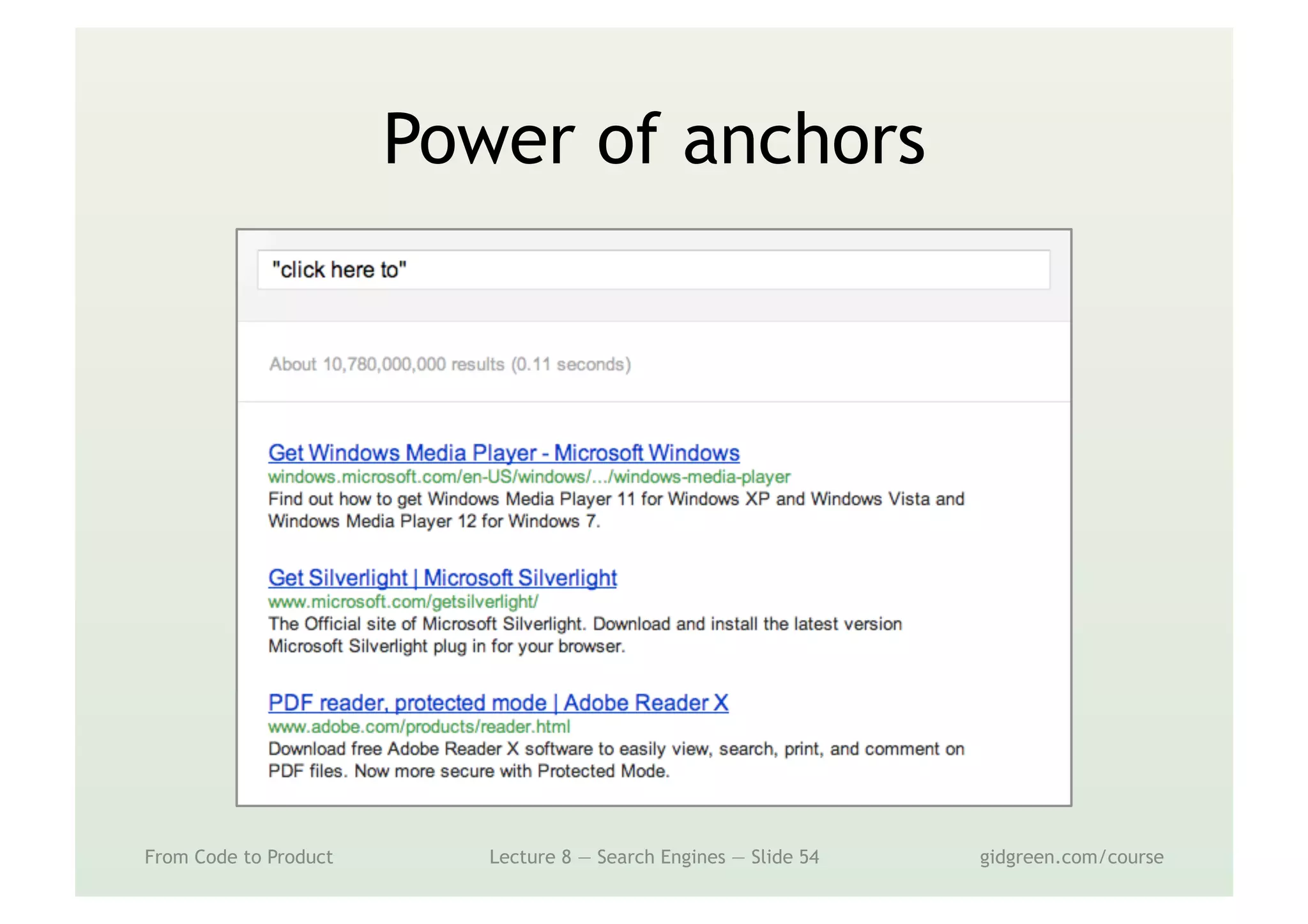
Power of anchors
From Code to Product Lecture 8 — Search Engines — Slide 54 gidgreen.com/course
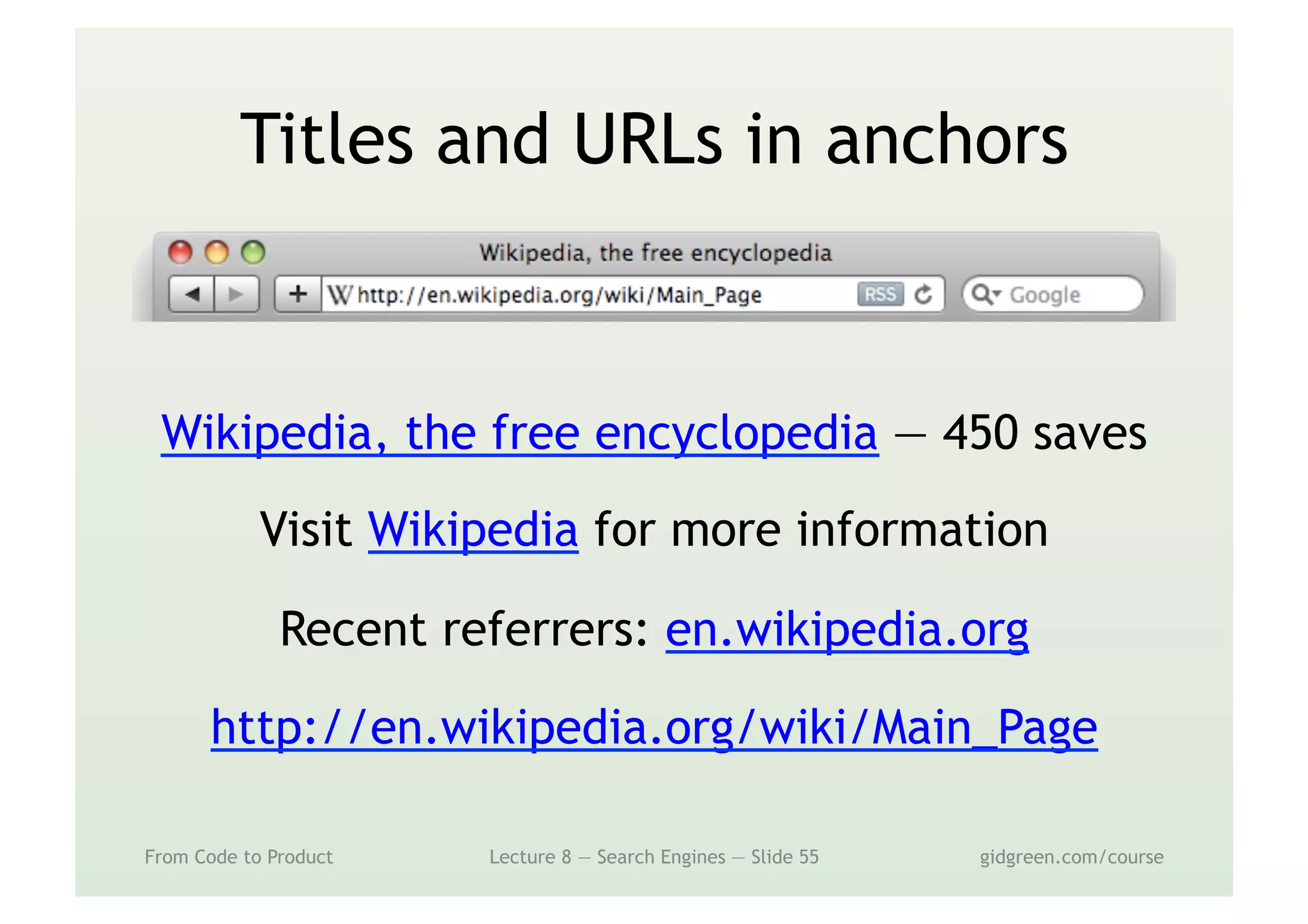
Titles and URLs in anchors
Wikipedia, the free encyclopedia — 450 saves
Visit Wikipedia for more information
Recent referrers: en.wikipedia.org
http://en.wikipedia.org/wiki/Main_Page
From Code to Product Lecture 8 — Search Engines — Slide 55 gidgreen.com/course
Attracting links
•  (Directories e.g. dmoz)
•  Inbound marketing
– Great on-site content
– Post articles elsewhere
– Request reviews
•  Viral marketing
– Banners + widgets
– Social network sharing
From Code to Product Lecture 8 — Search Engines — Slide 56 gidgreen.com/course
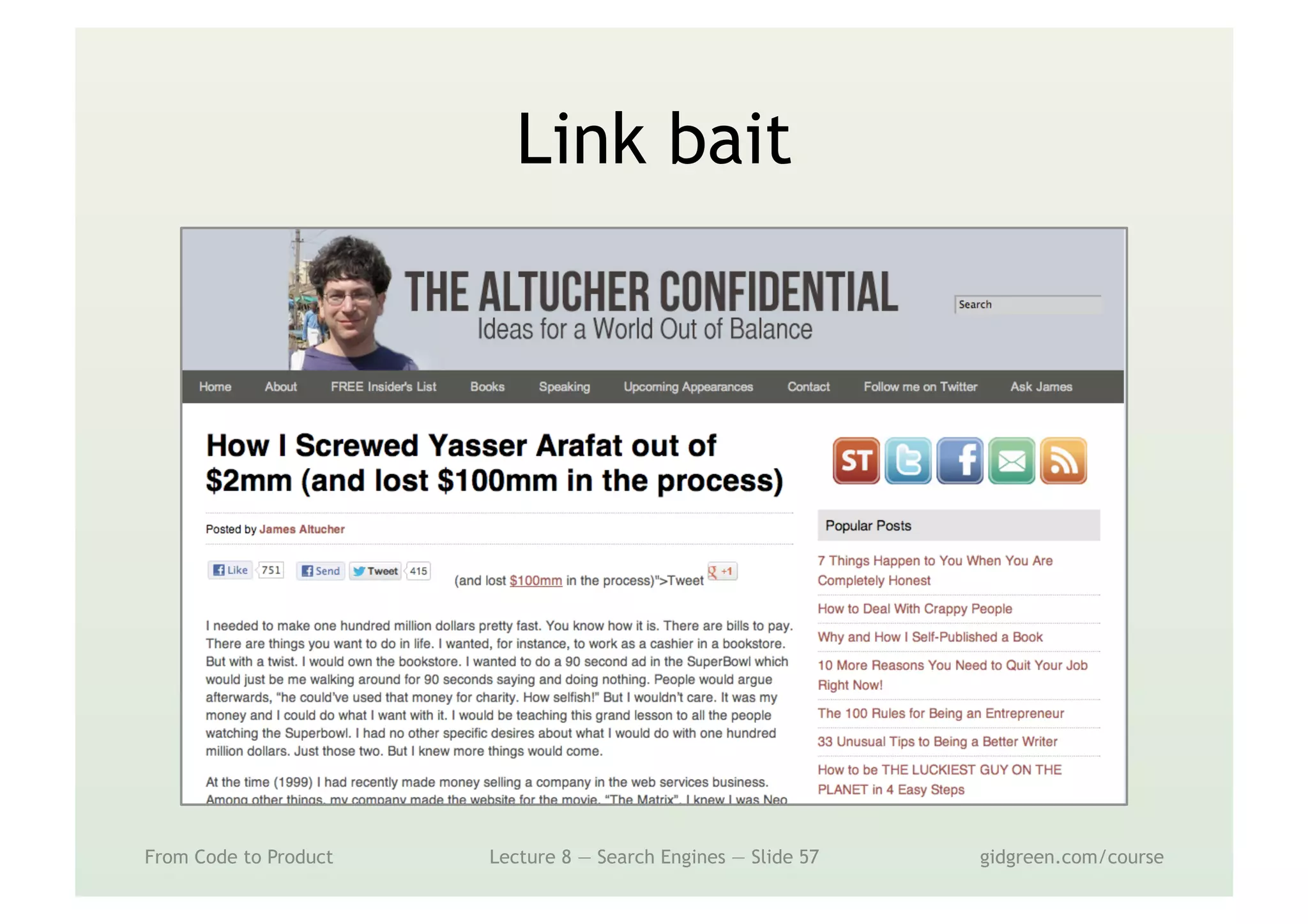
Link bait
From Code to Product Lecture 8 — Search Engines — Slide 57 gidgreen.com/course
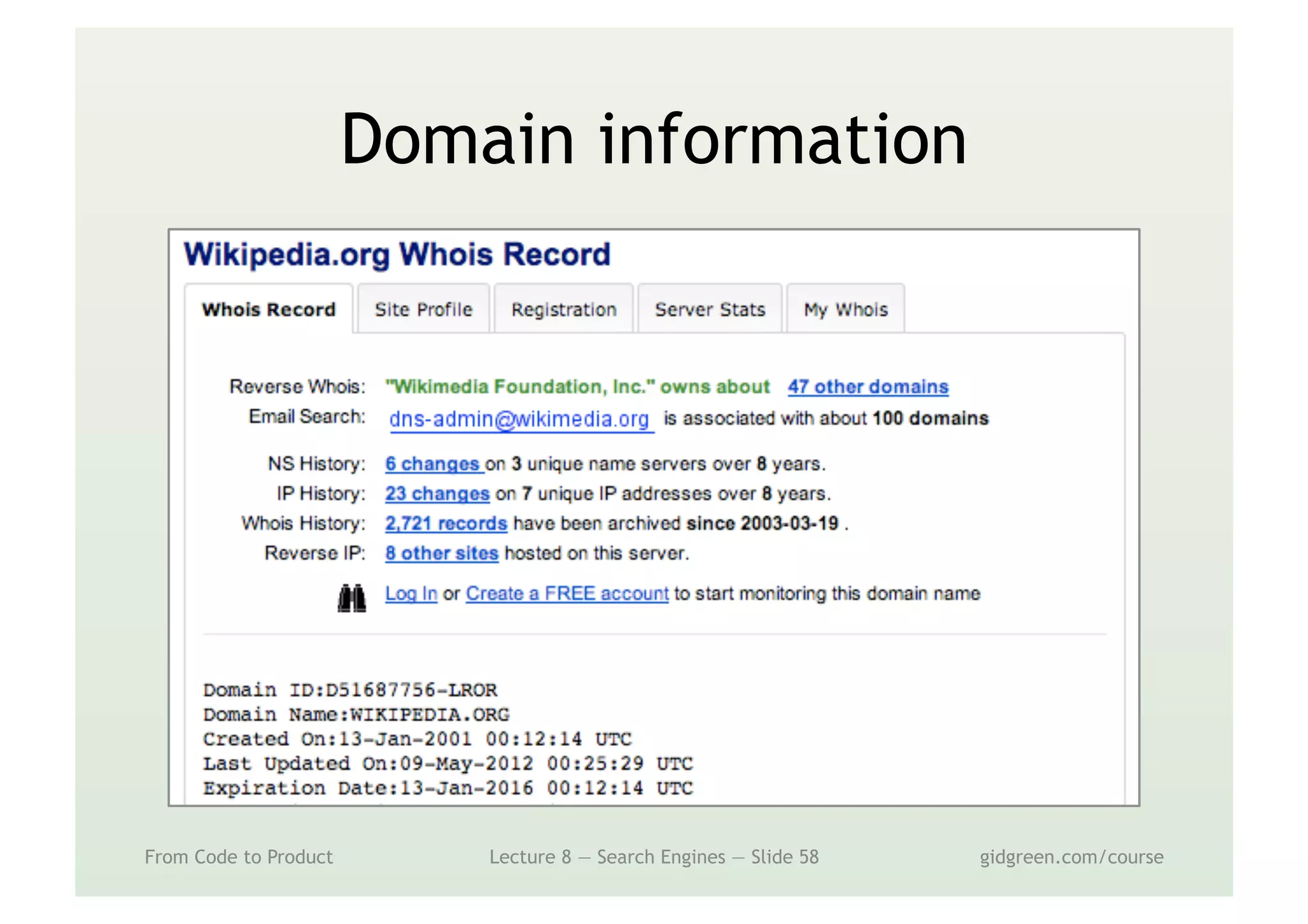
Domain information
From Code to Product Lecture 8 — Search Engines — Slide 58 gidgreen.com/course
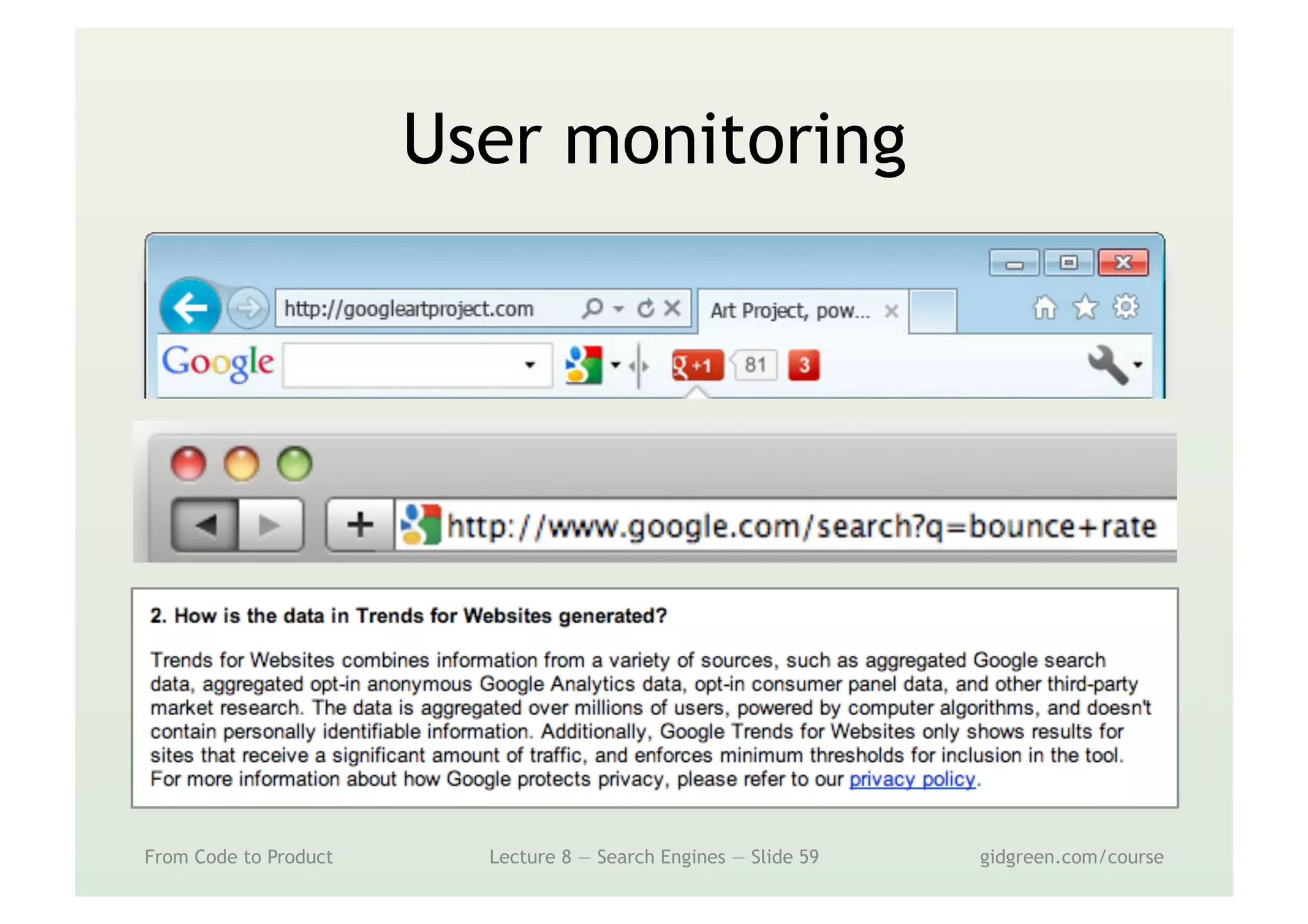
User monitoring
From Code to Product Lecture 8 — Search Engines — Slide 59 gidgreen.com/course
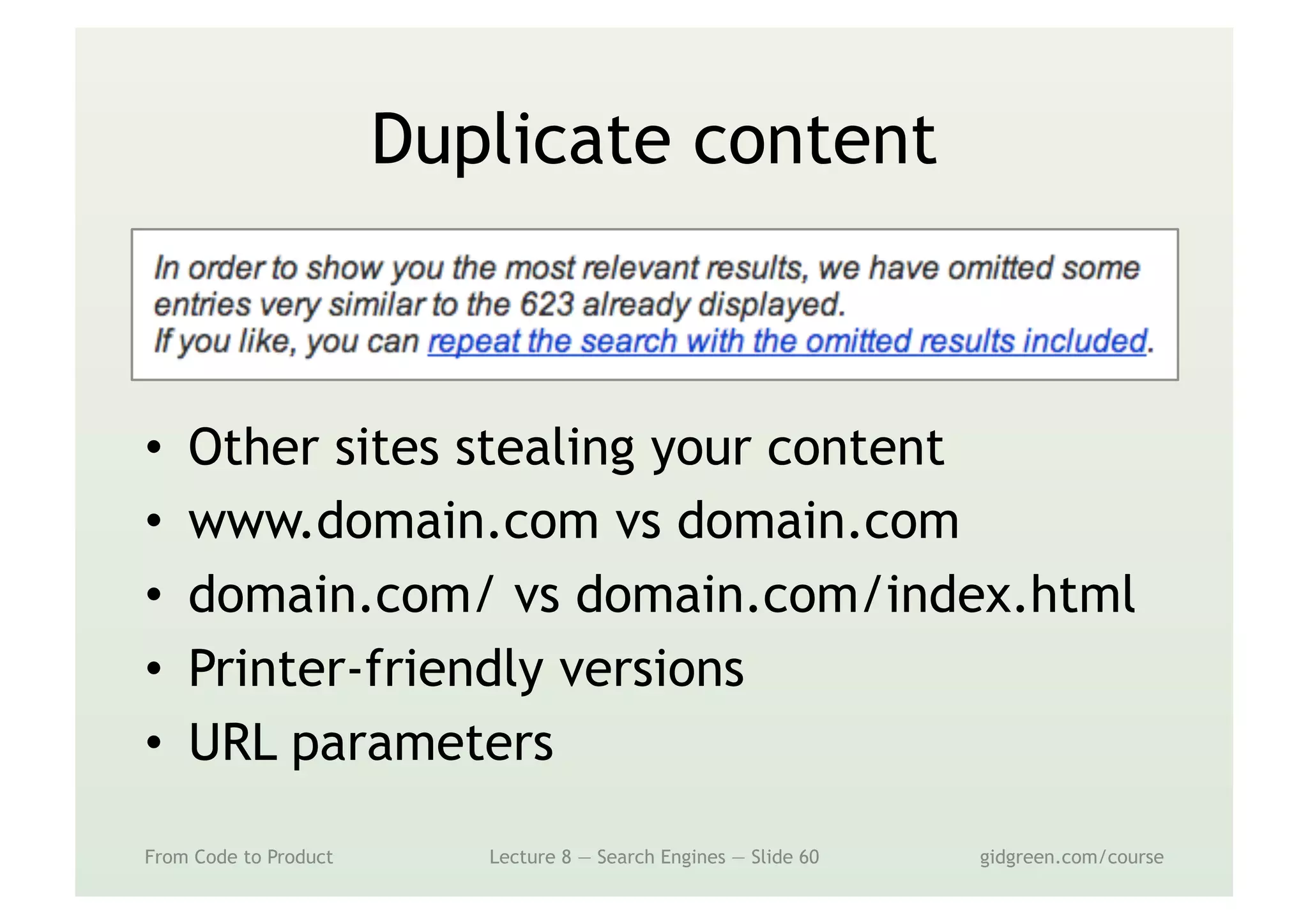
Duplicate content
•  Other sites stealing your content
•  www.domain.com vs domain.com
•  domain.com/ vs domain.com/index.html
•  Printer-friendly versions
•  URL parameters
From Code to Product Lecture 8 — Search Engines — Slide 60 gidgreen.com/course
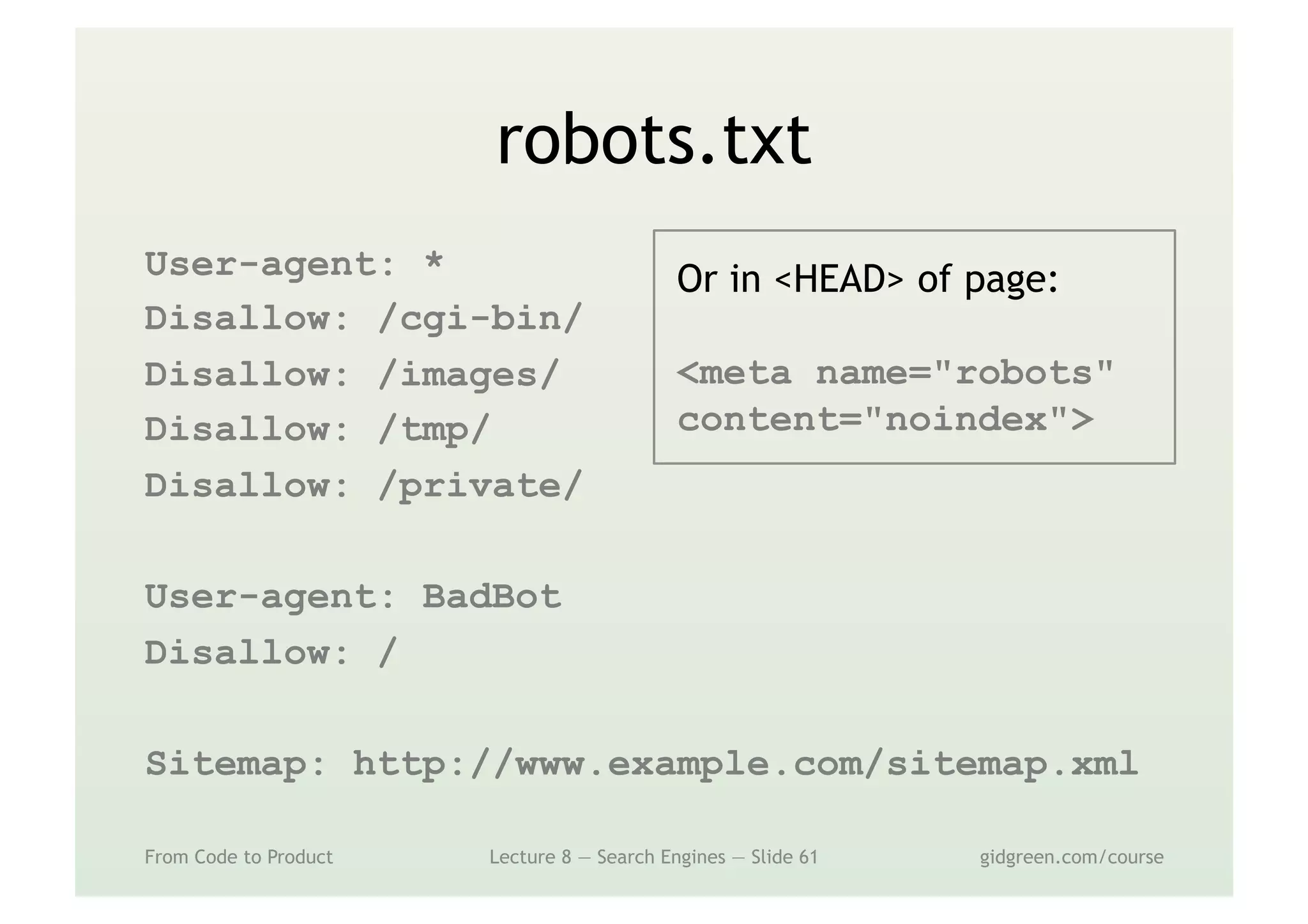
robots.txt
User-agent: *
Disallow: /cgi-bin/
Disallow: /images/
Disallow: /tmp/
Disallow: /private/
User-agent: BadBot
Disallow: /
Sitemap: http://www.example.com/sitemap.xml
From Code to Product Lecture 8 — Search Engines — Slide 61 gidgreen.com/course
Or in <HEAD> of page:
<meta name="robots"
content="noindex">
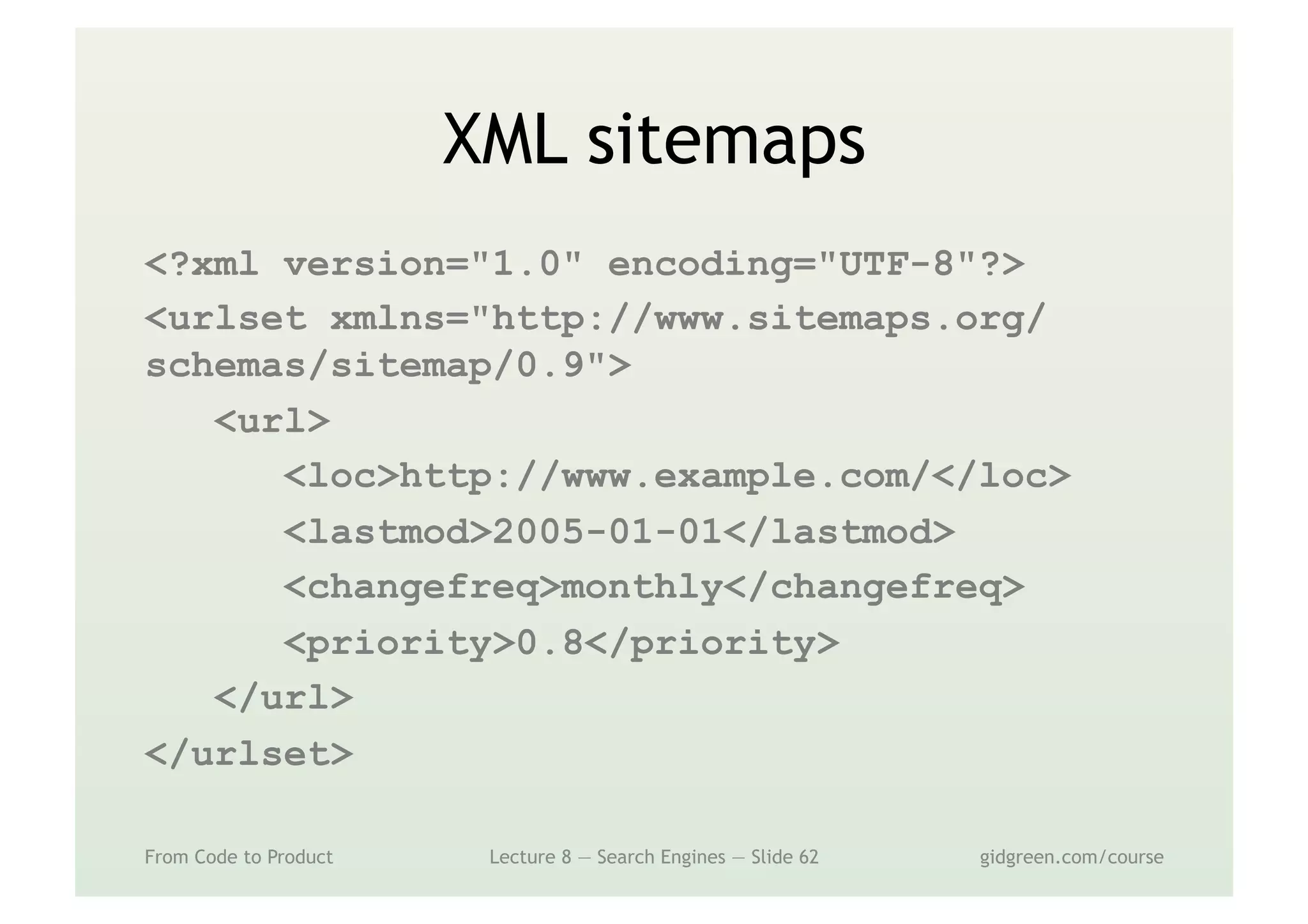
XML sitemaps
<?xml version="1.0" encoding="UTF-8"?>
<urlset xmlns="http://www.sitemaps.org/
schemas/sitemap/0.9">
<url>
<loc>http://www.example.com/</loc>
<lastmod>2005-01-01</lastmod>
<changefreq>monthly</changefreq>
<priority>0.8</priority>
</url>
</urlset>
From Code to Product Lecture 8 — Search Engines — Slide 62 gidgreen.com/course
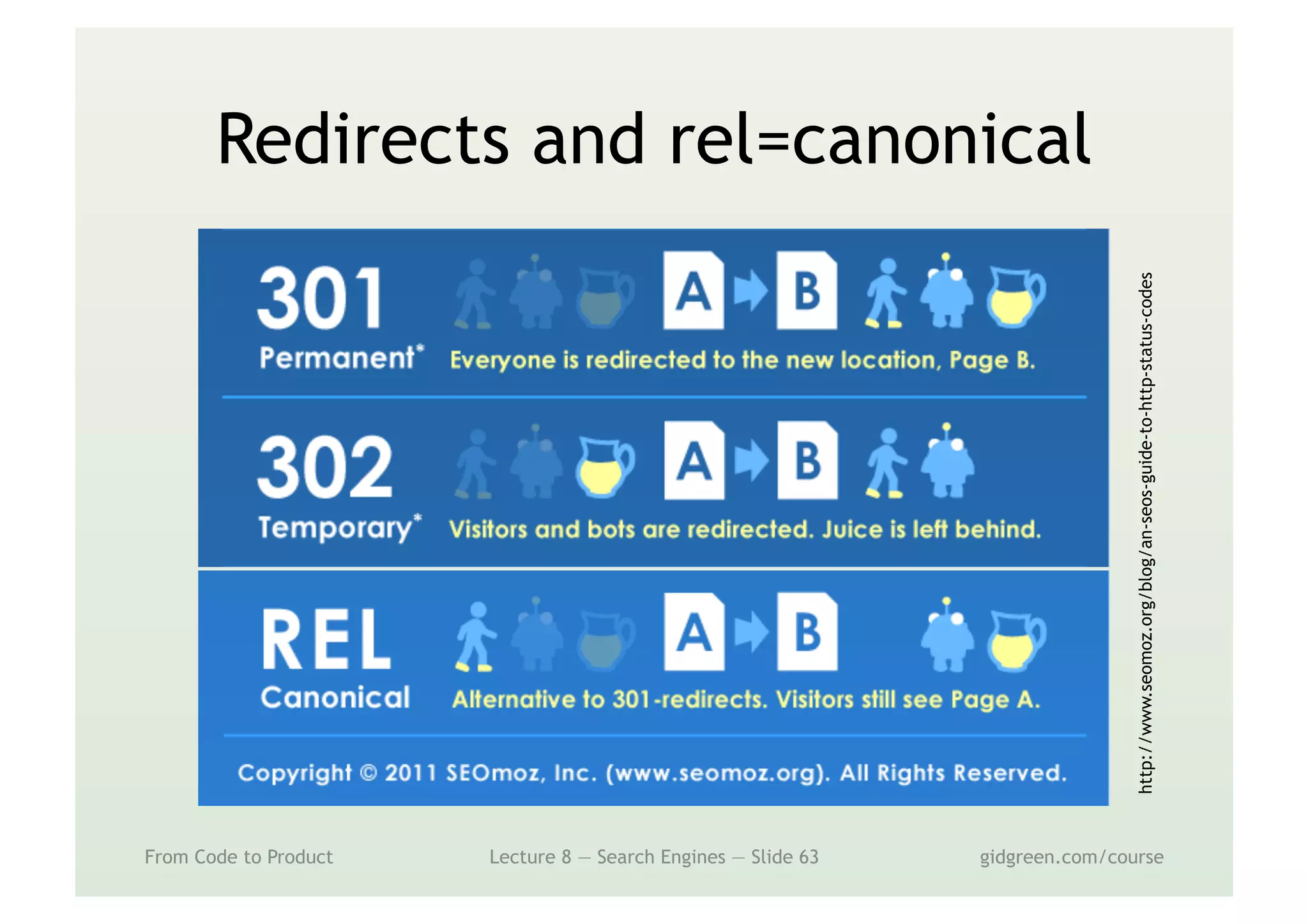
Redirects and rel=canonical
From Code to Product Lecture 8 — Search Engines — Slide 63 gidgreen.com/course
http://www.seomoz.org/blog/an-seos-guide-to-http-status-codes
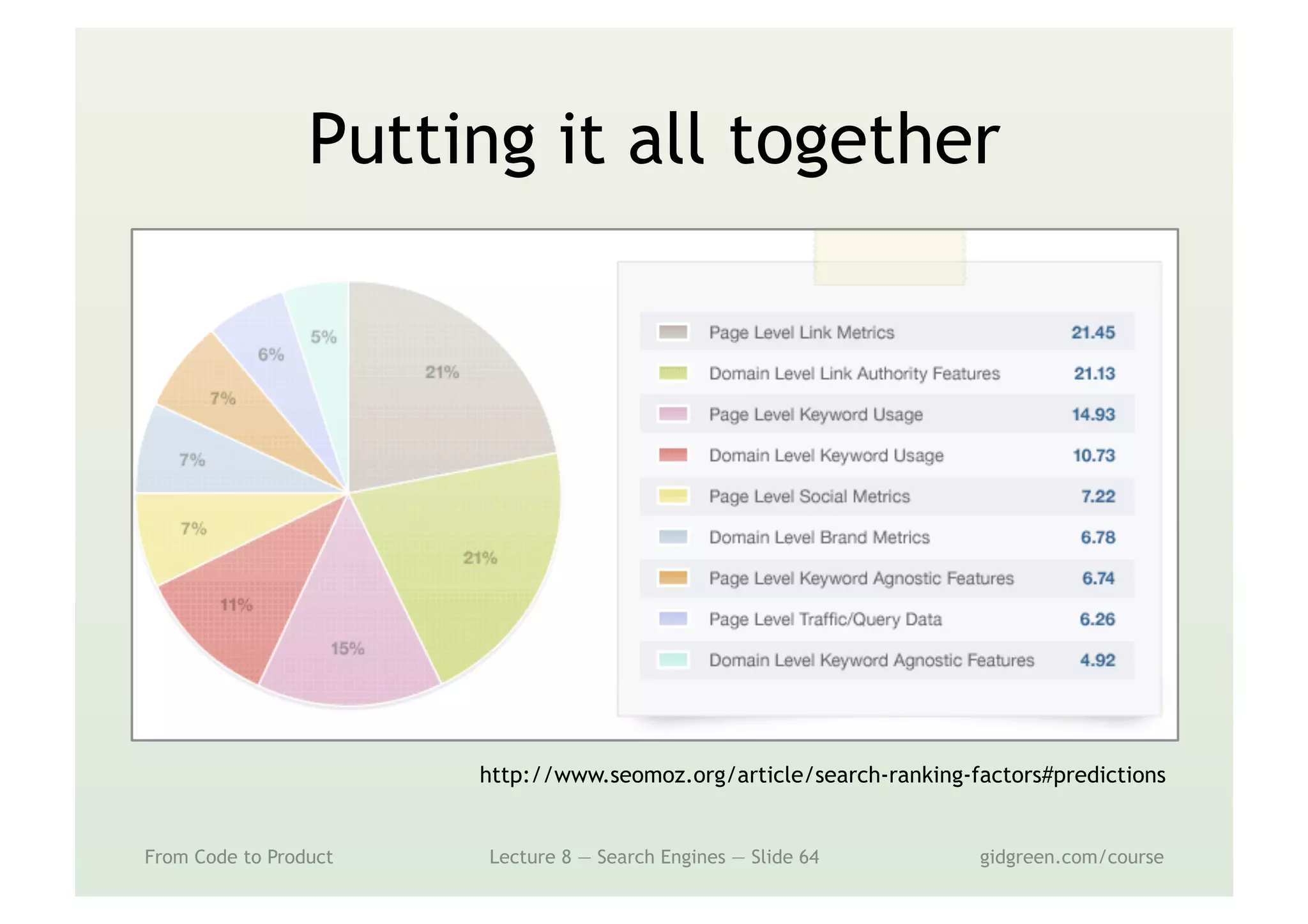
Putting it all together
From Code to Product Lecture 8 — Search Engines — Slide 64 gidgreen.com/course
http://www.seomoz.org/article/search-ranking-factors#predictions
Lecture 8
•  Introduction
•  How search works
•  Anatomy of HTML
•  On-page factors
•  Off-page factors
•  PageRank
From Code to Product Lecture 8 — Search Engines — Slide 65 gidgreen.com/course
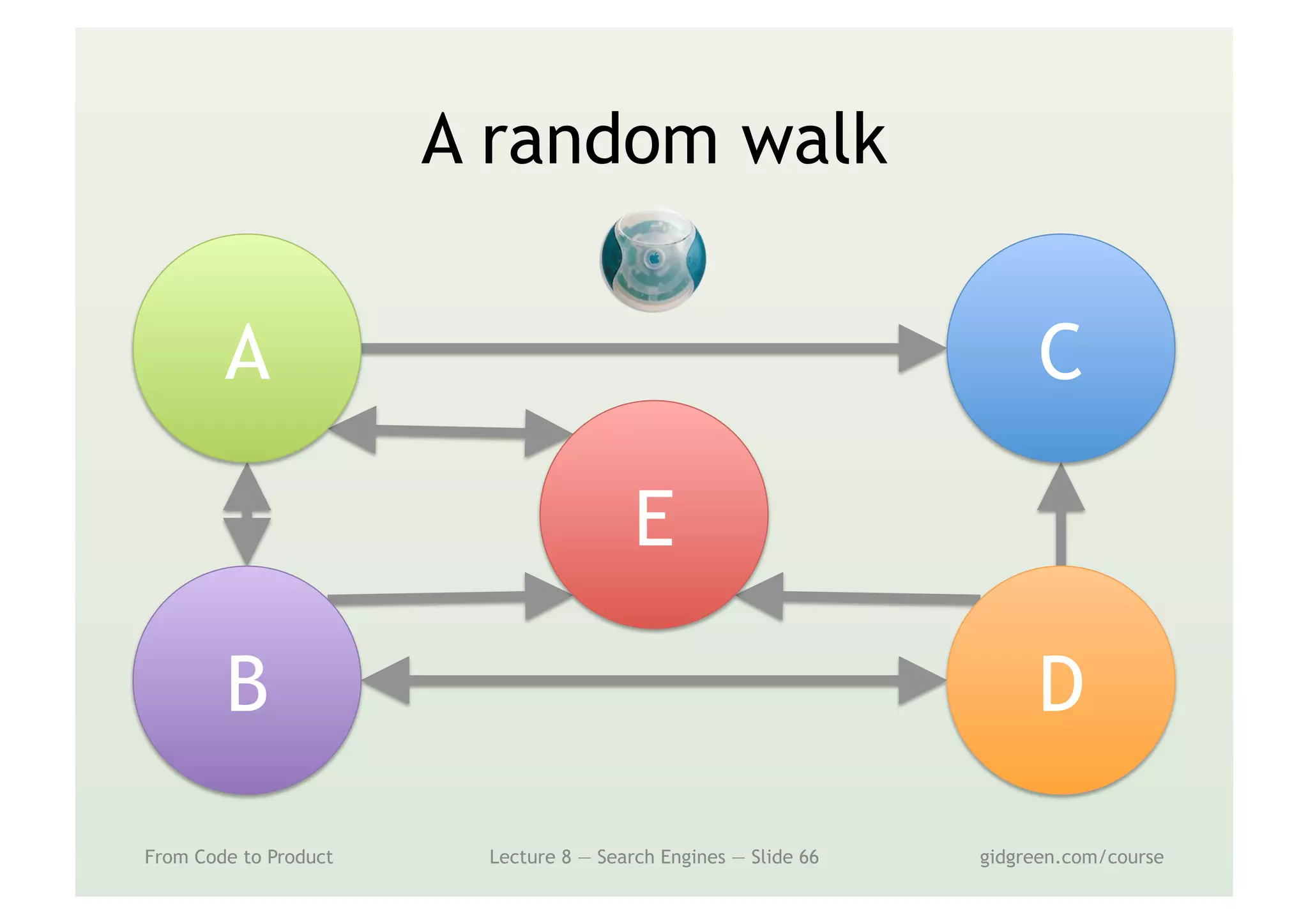
A random walk
From Code to Product Lecture 8 — Search Engines — Slide 66 gidgreen.com/course
A
B
C
D
E
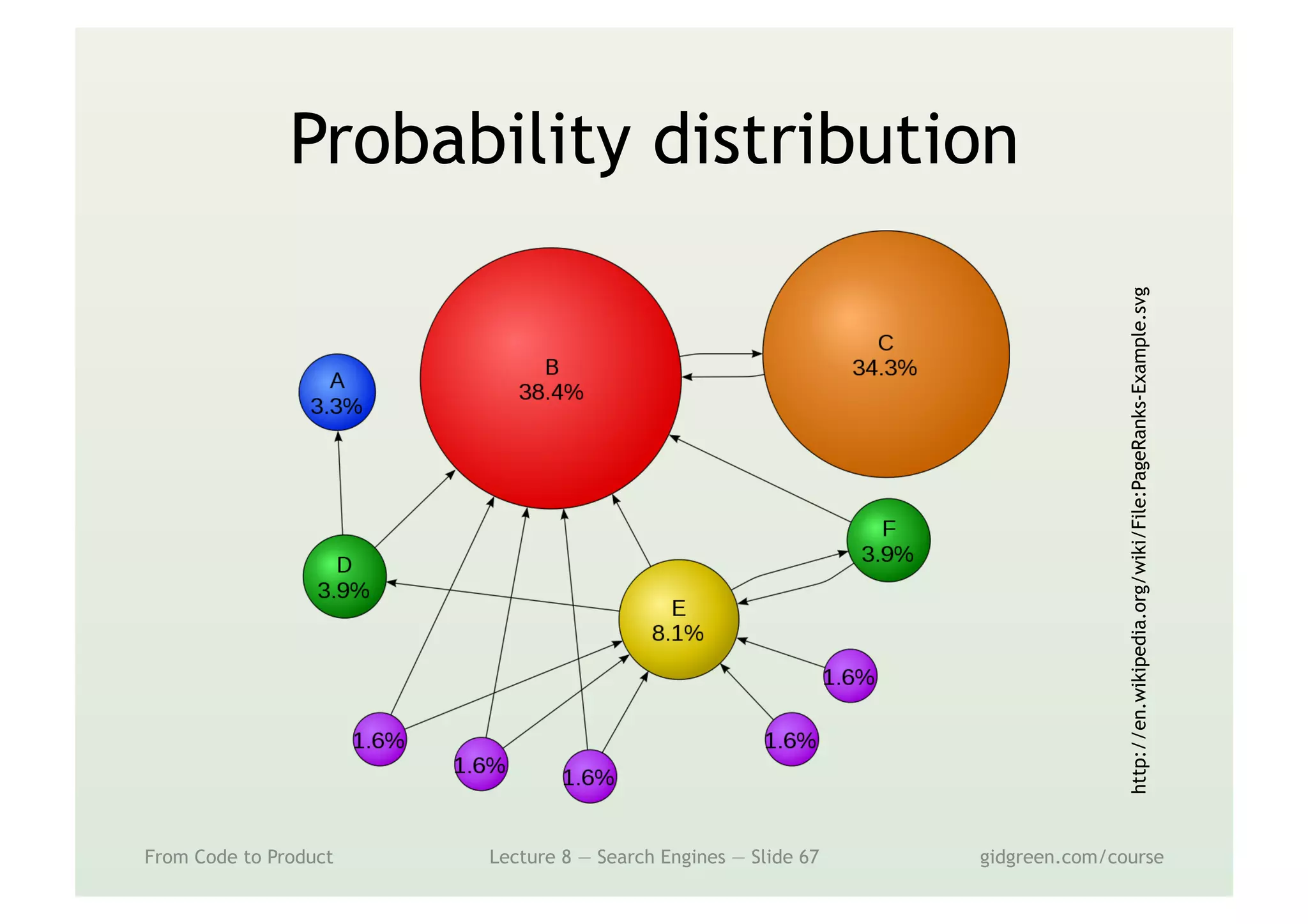
Probability distribution
From Code to Product Lecture 8 — Search Engines — Slide 67 gidgreen.com/course
http://en.wikipedia.org/wiki/File:PageRanks-Example.svg
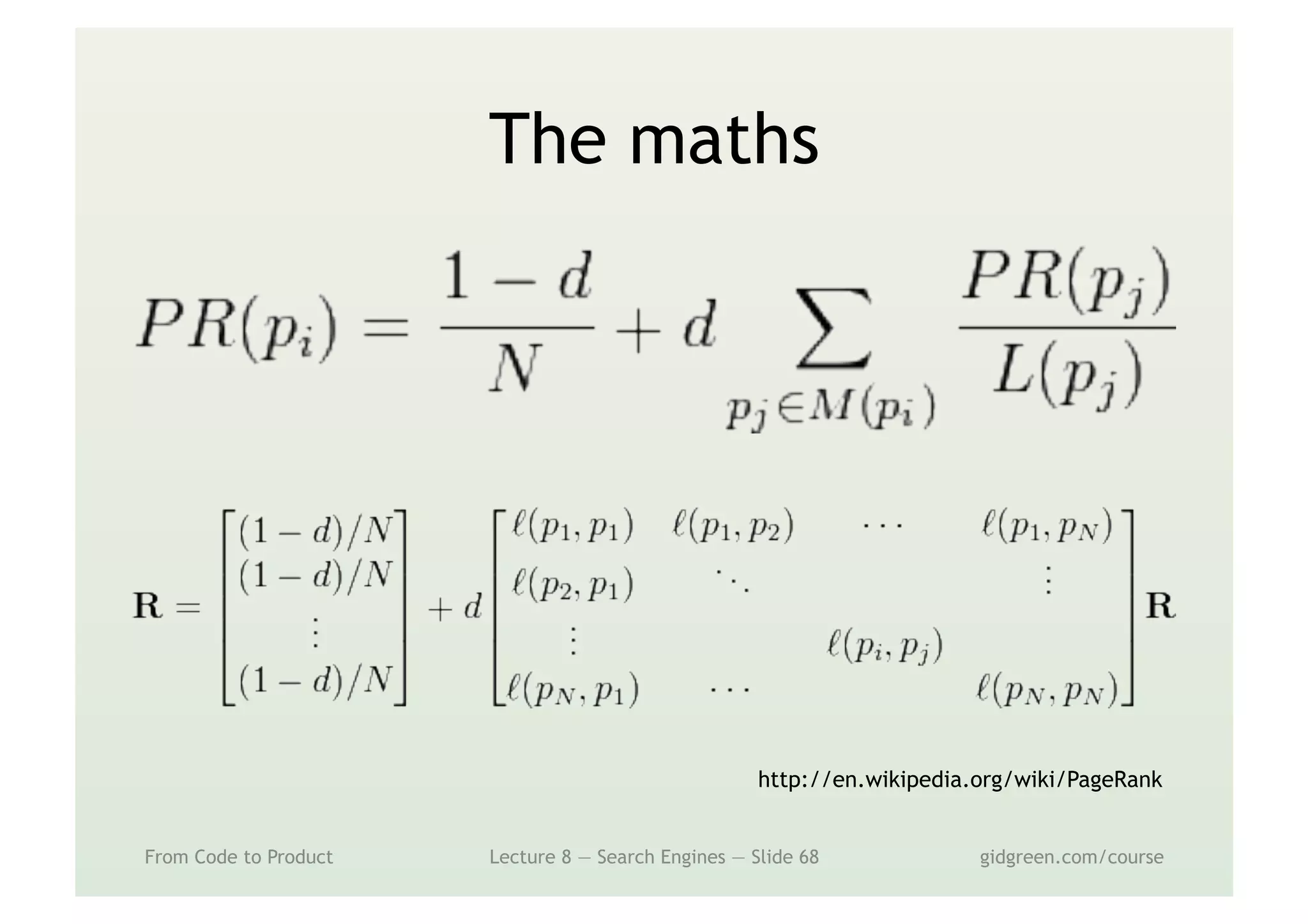
The maths
From Code to Product Lecture 8 — Search Engines — Slide 68 gidgreen.com/course
http://en.wikipedia.org/wiki/PageRank
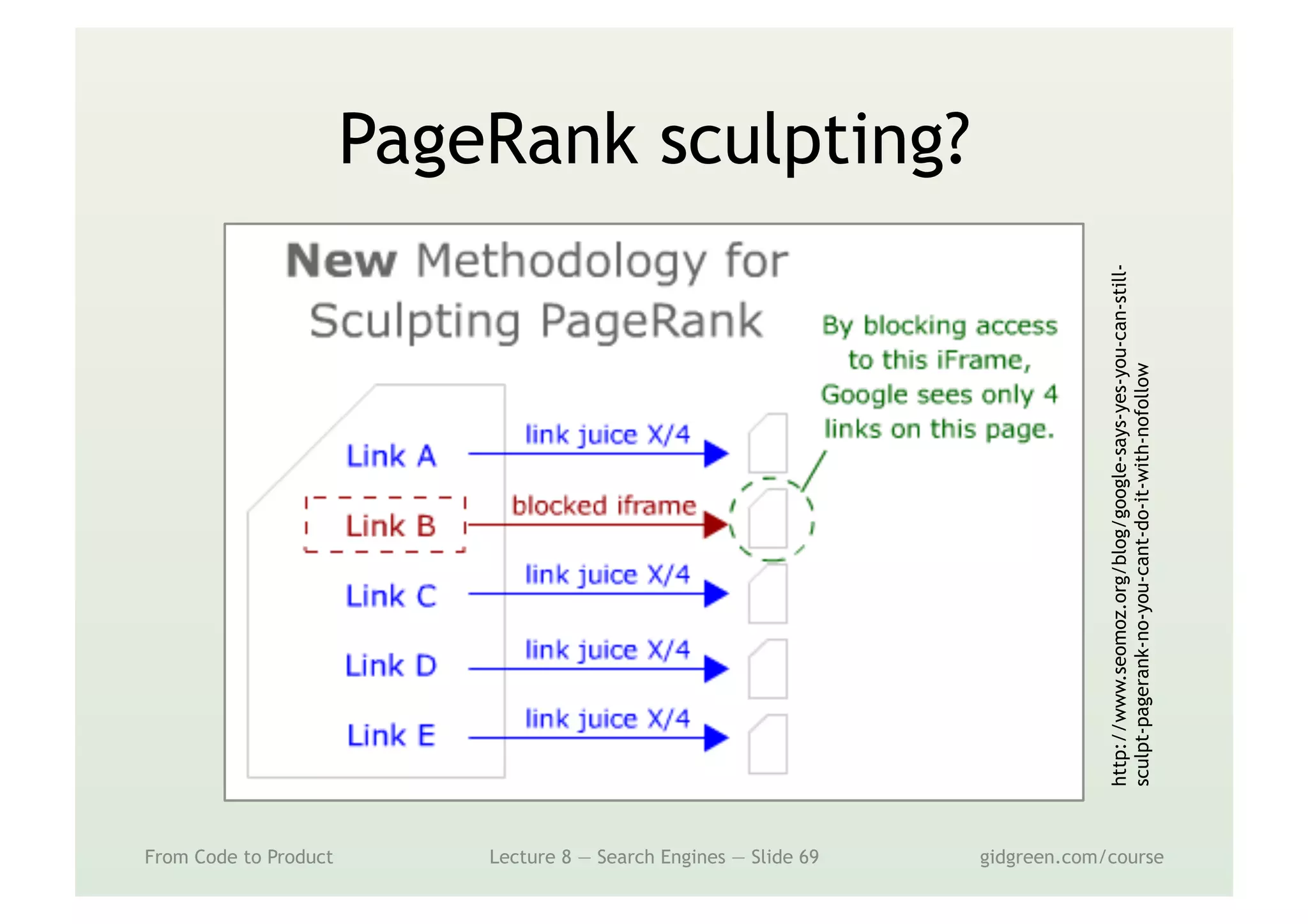
PageRank sculpting?
From Code to Product Lecture 8 — Search Engines — Slide 69 gidgreen.com/course
http://www.seomoz.org/blog/google-says-yes-you-can-still-
sculpt-pagerank-no-you-cant-do-it-with-nofollow
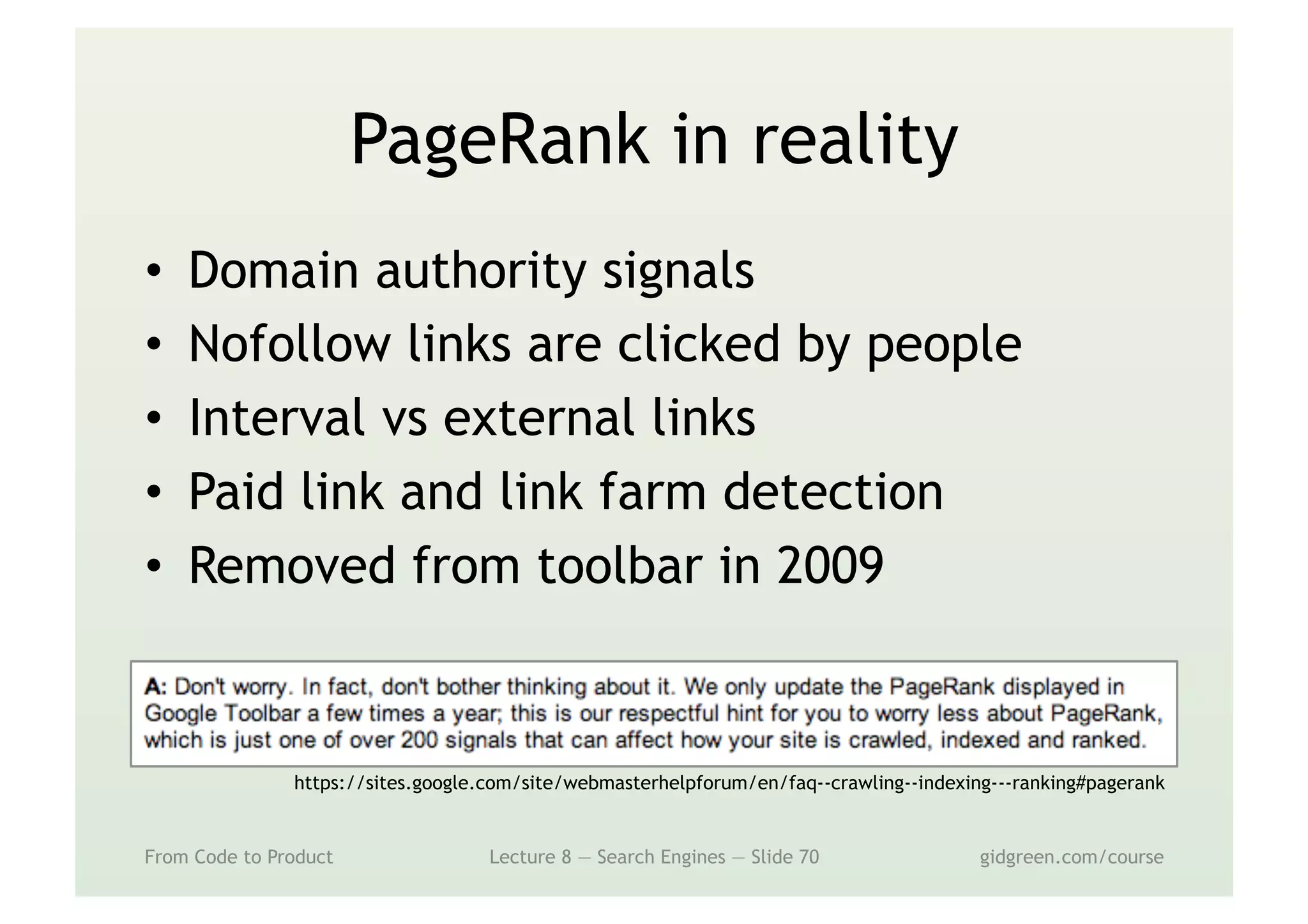
PageRank in reality
•  Domain authority signals
•  Nofollow links are clicked by people
•  Interval vs external links
•  Paid link and link farm detection
•  Removed from toolbar in 2009
From Code to Product Lecture 8 — Search Engines — Slide 70 gidgreen.com/course
https://sites.google.com/site/webmasterhelpforum/en/faq--crawling--indexing---ranking#pagerank
Tools
From Code to Product Lecture 8 — Search Engines — Slide 71 gidgreen.com/course

Search Engine Visibility 2013

  • 1.
    8 — SearchEngines From Code to Product gidgreen.com/course
  • 2.
    The Google bomb FromCode to Product Lecture 8 — Search Engines — Slide 2 gidgreen.com/course
  • 3.
    Feeling lucky? From Codeto Product Lecture 8 — Search Engines — Slide 3 gidgreen.com/course
  • 4.
    Lecture 8 •  Introduction • How search works •  Anatomy of HTML •  On-page factors •  Off-page factors •  PageRank From Code to Product Lecture 8 — Search Engines — Slide 4 gidgreen.com/course
  • 5.
    History of websearch •  1994 — WebCrawler — first full text •  1994 — Yahoo — directory then portal •  1995 — AltaVista — first big index •  1997 — Google — link citation analysis •  2000 — 2004 — Yahoo uses Google •  2000 — Baidu — now leader in China •  2006 — Microsoft Live Search •  2009 — Bing, switched to by Yahoo From Code to Product Lecture 8 — Search Engines — Slide 5 gidgreen.com/course
  • 6.
    Importance of search • US: 17.1B “core searches” in April 2012 – 55 per US citizen [comScore] •  92% of online US adults use search – 96% of college graduates – 98% with income $75k+ •  70–80% ignore paid ads on right – (but only 10% ignore ads on top) •  80% of sessions begins with a search From Code to Product Lecture 8 — Search Engines — Slide 6 gidgreen.com/course Sources:comScore,PewInternetReport,UserCentric,PCMagazine, http://www.searchenginejournal.com/24-eye-popping-seo-statistics/42665/
  • 7.
    Googling google From Codeto Product Lecture 8 — Search Engines — Slide 7 gidgreen.com/course
  • 8.
    Search as trafficsource From Code to Product Lecture 8 — Search Engines — Slide 8 gidgreen.com/course
  • 9.
    Global market share FromCode to Product Lecture 8 — Search Engines — Slide 9 gidgreen.com/course Google, 81.73% Yahoo, 6.42% Baidu, 5.65% Bing, 4.15% Other, 2.05% Global Source:May2012figuresfromhttp://www.netmarketshare.com/
  • 10.
    USA market share FromCode to Product Lecture 8 — Search Engines — Slide 10 gidgreen.com/course Google, 76.57% Bing, 10.46% Yahoo, 9.83% AOL, 1.47% Ask, 1.33% USA Source:May2012figuresfromhttp://www.netmarketshare.com/
  • 11.
    China market share FromCode to Product Lecture 8 — Search Engines — Slide 11 gidgreen.com/course Baidu, 78.50% Google, 16.60% Sougou, 2.80% SoSo, 1.40% Others, 0.70% China Source:http://chineseseoshifu.com/china-search-engine-market-share/ Also: Japan, Czech Republic, South Korea, Russia,
  • 12.
    Search engine resultspage From Code to Product Lecture 8 — Search Engines — Slide 12 gidgreen.com/course
  • 13.
    Where do peoplelook? From Code to Product Lecture 8 — Search Engines — Slide 13 gidgreen.com/course
  • 14.
    Where do peopleclick? From Code to Product Lecture 8 — Search Engines — Slide 14 gidgreen.com/course http://www.seomoz.org/blog/mission-imposserpble- establishing-clickthrough-rates
  • 15.
    Black-hat vs white-hat FromCode to Product Lecture 8 — Search Engines — Slide 15 gidgreen.com/course Black-hat SEO White-hat SEO Tricking Google Working with Google Hidden keywords Prominent keywords Cloaking for search Structured for search Content scraping Unique content Link spam and farms Attracting links Short-lived boost (maybe) Long-term results
  • 16.
    Google’s recommendations From Codeto Product Lecture 8 — Search Engines — Slide 16 gidgreen.com/course http://support.google.com/webmasters/bin/answer.py?hl=en&answer=35769
  • 17.
    Lecture 8 •  Introduction • How search works •  Anatomy of HTML •  On-page factors •  Off-page factors •  PageRank From Code to Product Lecture 8 — Search Engines — Slide 17 gidgreen.com/course
  • 18.
    How search works • Crawling – Finding content to index •  Indexing – Preparing content for search •  Searching – Showing results to user From Code to Product Lecture 8 — Search Engines — Slide 18 gidgreen.com/course
  • 19.
    Basic crawling •  Createan empty URL queue (“frontier”) •  Add one good URL, e.g. wikipedia.org •  Repeat: – Select random URL from queue – Retrieve content for that URL – Add links in content to queue – Keep track to prevent repeat visits From Code to Product Lecture 8 — Search Engines — Slide 19 gidgreen.com/course
  • 20.
    Crawling issues •  Linkprioritization •  Duplicate content – Print versions, sorting •  Infinite loops – Database-driven sites •  Revisiting pages •  Site overloading •  Parallelization From Code to Product Lecture 8 — Search Engines — Slide 20 gidgreen.com/course
  • 21.
    Indexing From Code toProduct Lecture 8 — Search Engines — Slide 21 gidgreen.com/course
  • 22.
    Indexing From Code toProduct Lecture 8 — Search Engines — Slide 22 gidgreen.com/course
  • 23.
    Inverted index From Codeto Product Lecture 8 — Search Engines — Slide 23 gidgreen.com/course https://developer.apple.com/library/mac/#documentation/userexperience/ Conceptual/SearchKitConcepts/searchKit_basics/searchKit_basics.html
  • 24.
    Other indexed information • Page metadata •  More about words – Prominence – Position – Frequency •  Links between pages – Including anchor text •  Images, etc… From Code to Product Lecture 8 — Search Engines — Slide 24 gidgreen.com/course
  • 25.
    Other formats From Codeto Product Lecture 8 — Search Engines — Slide 25 gidgreen.com/course http://support.google.com/webmasters/bin/ answer.py?hl=en&answer=35287 Forms? Javascript?
  • 26.
    Stemming, proximity, ANDs FromCode to Product Lecture 8 — Search Engines — Slide 26 gidgreen.com/course
  • 27.
    Recent Google changes • Aug 2012: sometimes 7 results •  May 2012: knowledge graph •  Jan 2012: top heavy ads penalty •  Nov 2011: rewarding freshness •  Feb 2011: hitting content farms •  Dec 2010: social media signals •  Dec 2009: real-time search From Code to Product Lecture 8 — Search Engines — Slide 27 gidgreen.com/course http://www.seomoz.org/google-algorithm-change
  • 28.
    Google web history(2005–2009) From Code to Product Lecture 8 — Search Engines — Slide 28 gidgreen.com/course
  • 29.
    Search + yourworld (2012) From Code to Product Lecture 8 — Search Engines — Slide 29 gidgreen.com/course http://www.ubergizmo.com/2012/01/google-now-searches-your-world/
  • 30.
    Keyword research But: consideralso long tail (referrer logs) From Code to Product Lecture 8 — Search Engines — Slide 30 gidgreen.com/course
  • 31.
    Keyword research From Codeto Product Lecture 8 — Search Engines — Slide 31 gidgreen.com/course
  • 32.
    Lecture 8 •  Introduction • How search works •  Anatomy of HTML •  On-page factors •  Off-page factors •  PageRank From Code to Product Lecture 8 — Search Engines — Slide 32 gidgreen.com/course
  • 33.
    HTTP protocol GET /wiki/Hypertext_Transfer_ProtocolHTTP/1.1 Host: en.wikipedia.org User-Agent: Mozilla/5.0 (Macintosh; Intel Mac OS X 10_5_8) AppleWebKit/ 534.50.2 (KHTML, like Gecko) Version/5.0.6 Safari/533.22.3 Referer: http://www.rexswain.com/httpview.html Connection: close HTTP/1.0 200 OK Date: Sun, 17 Jun 2012 06:05:03 GMT Server: Apache Cache-Control: private, s-maxage=0, max-age=0, must-revalidate Content-Language: en Last-Modified: Sat, 16 Jun 2012 03:14:24 GMT Content-Length: 164814 Content-Type: text/html; charset=UTF-8 Connection: close From Code to Product Lecture 8 — Search Engines — Slide 33 gidgreen.com/course
  • 34.
    Page structure <!DOCTYPE HTMLPUBLIC "-//W3C//DTD HTML 4.01 Transitional//EN" "http://www.w3.org/TR/html4/ loose.dtd"> <html lang="en"> <head> <title>Uber List Manager</title> </head> <body> <h1>Uber List Manager</h1> <p>The world's leading &amp; best priced list management software.</p> </body> </html> From Code to Product Lecture 8 — Search Engines — Slide 34 gidgreen.com/course
  • 35.
    Key <HEAD> elements <head> <metahttp-equiv="content-type" content="text/ html; charset=utf-8"> <link rel="stylesheet" type="text/css" href="styles.css"> <script type="text/javascript" src=”script.js"></ script> <title>Uber List Manager</title> <meta name="description" content="An excellent and well priced list management program."> <meta name="keywords" content="lists, list manager, uber, mailing software"> </head> From Code to Product Lecture 8 — Search Engines — Slide 35 gidgreen.com/course
  • 36.
    Key <BODY> elements FromCode to Product Lecture 8 — Search Engines — Slide 36 gidgreen.com/course <body> <h1>Uber List Manager</h1> <p>The world's leading &amp; best priced list management software.</p> <h2>Features</h2> <h2>Customer stories</h2> <img src="images/ulm.jpeg" width="320" height="240" alt="Screenshot" title="ULM in action"> <form action="form.php" method="post"> <input type="submit" value="Submit"> </form> <iframe src="iframe.html" width="300" height="300"></iframe> </body>
  • 37.
    External file summary FromCode to Product Lecture 8 — Search Engines — Slide 37 gidgreen.com/course index.html <html lang="en"> <head> <title> Uber List... </title> </head> <body> ... </body> </html> styles.css body {background- color:yellow;} h1 {font-size: 24px;} a:hover {text- decoration: underline;} script.js document.onkey down=okd; window.onbefor eunload=obl; if (t>=0) d=new Date(); Iframe.html <html> <head> </head> <body> ... </body> </html> ulm.jpeg
  • 38.
    Links From Code toProduct Lecture 8 — Search Engines — Slide 38 gidgreen.com/course Click <a href="more-information.html">here</a> for ULM benefits and pricing. Click for <a href="more-information.html">ULM benefits and pricing</a>. Click for <a href="more-information.html" title="ULM benefits and pricing">more about ULM</A>. Better than <a href="http://slowlists.com/" rel="nofollow">our competitors</a>. <a href="pricing.html"><img src="dollar-bill.jpeg" alt="Pricing"></a>
  • 39.
    Internal targets From Codeto Product Lecture 8 — Search Engines — Slide 39 gidgreen.com/course <a href="#history">2 History</a> . . . <h2 id="history">History</h2> <a name="history"></ a><h2>History</h2>
  • 40.
    Rich snippets <span itemprop="reviewCount">808</span> <spanitemprop="streetAddress">204 E 43rd St</ span> <span id="bizPhone" itemprop="telephone">(212) 972-1001</span> <span itemprop="priceRange">$$$$</span> <meta itemprop="ratingValue" content="4.5"> From Code to Product Lecture 8 — Search Engines — Slide 40 gidgreen.com/course
  • 41.
    HTML5 <article> <section> <hgroup> <aside> <header> <footer> <nav> From Code toProduct Lecture 8 — Search Engines — Slide 41 gidgreen.com/course http://www.michaelcropper.co.uk/2012/03/html5- seo-best-practices-1032.html
  • 42.
    Lecture 8 •  Introduction • How search works •  Anatomy of HTML •  On-page factors •  Off-page factors •  PageRank From Code to Product Lecture 8 — Search Engines — Slide 42 gidgreen.com/course
  • 43.
    Page title From Codeto Product Lecture 8 — Search Engines — Slide 43 gidgreen.com/course No more than ~70 characters / 10 words
  • 44.
    URLs SEO Cheat Sheet:Anatomy of A URL ©2009  SEOmoz  ·∙  www.seomoz.org  ·∙  Read  SEOmoz.  Rank  Be er. http://store.example.com/topics/subtopic/descriptive-product-name#top 1 Protocol Subdomain Domain Top-Level Domain Folders / Paths Page Named Anchor 2 1 3 4 5 6 7 2 3 4 5 5 6 7 http://www.example.com/index.php?product=1234&sort=price&print=1 1 2 3 4 5 6 7 1 Protocol Subdomain Domain Top-Level Domain Page / File Name File Extension CGI Parameters 2 3 4 5 6 7 7 7 Popular TLDs2 .com .net .org .edu .info .biz .name Popular ccTLDs* .cn .de .uk .nl .eu .ru .ar - China - Germany - United Kingdom - Netherlands - European Union - Russian Federation - Argentina Popular Extensions .htm .html .php .asp .aspx .cfm .jsp - Static HTML - Static HTML - PHP code - ASP code - ASP.NET - ColdFusion - Java Code Keyword Priority1 Observed Google priority of keyword placement: - commercial - infrastructure - non-profit - schools - informational - small business - personal sites SEO-FRIENDLYURLOLDDYNAMICURL (1) Domain (2) Subdomain (3) Folder (4) Path/Page 1 SEOmoz correlational data (2009) 2 Verisign domain report (2009) * ccTLD = Country Code TLD SEO Tips for URLs • Use subdomains carefully.They may be treated as separate entities,splitting domain authority. • Separate path & page keywords with hyphens (”-”). • Anchors may help engines understand page structure. • Keyword effectiveness in URLs decreases as URL length and keyword position increases.1 2 1 From Code to Product Lecture 8 — Search Engines — Slide 44 gidgreen.com/course http://www.seomoz.org/blog/seo-cheat- sheet-anatomy-of-a-url
  • 45.
    URLs: good vsbad www.really-cheap-great-mailing-list-manager.info www.mailingmanager.com googleblog.blogspot.com/view? post_id=3982098&section_id=231 googleblog.blogspot.com/2012/04/introducing-google- drive.html amazon.com/store/products/books/computing/internet/ seo/Eric+Edge/The%20Art%20Of%20SEO/details amazon.com/The-Art-SEO-Eric-Edge From Code to Product Lecture 8 — Search Engines — Slide 45 gidgreen.com/course
  • 46.
    Meta descriptions From Codeto Product Lecture 8 — Search Engines — Slide 46 gidgreen.com/course Used for display but not for ranking Length: 150~160 characters Avoid duplication across many pages
  • 47.
    Keyword density From Codeto Product Lecture 8 — Search Engines — Slide 47 gidgreen.com/course
  • 48.
    Formatting From Code toProduct Lecture 8 — Search Engines — Slide 48 gidgreen.com/course and <b>good value</b> and <span style="font-weight:bold;">good value</span> and <span class="emboldened">good value</span> and <em>good value</em> and <strong>good value</strong> <font size="+2>Features</font> <big>Features</big> <p style="font-size:24px;">Features</p> <h2>Features<h2> <h2 style="font-size:24px;">Features</h2>
  • 49.
    Freshness and speed • Freshness determined by: – Date the page appeared – Frequency of content change – Amount of content change – Rate of new incoming links From Code to Product Lecture 8 — Search Engines — Slide 49 gidgreen.com/course
  • 50.
    Javascript and Flash FromCode to Product Lecture 8 — Search Engines — Slide 50 gidgreen.com/course
  • 51.
    Lecture 8 •  Introduction • How search works •  Anatomy of HTML •  On-page factors •  Off-page factors •  PageRank From Code to Product Lecture 8 — Search Engines — Slide 51 gidgreen.com/course
  • 52.
    Links from externalsites •  From high ranking sites – Hard to manipulate •  From .edu or .gov – No commercial motivation •  From topic-related sites •  From many sites – Diversity of subject – Different ownership / IP block From Code to Product Lecture 8 — Search Engines — Slide 52 gidgreen.com/course
  • 53.
    Links on externalpages •  All-important anchor text – First appearance counts – Diversity of anchors •  Higher on linking page •  From core text content – Not navigation/footers – Image ALT text weaker •  Page has other good links From Code to Product Lecture 8 — Search Engines — Slide 53 gidgreen.com/course
  • 54.
    Power of anchors FromCode to Product Lecture 8 — Search Engines — Slide 54 gidgreen.com/course
  • 55.
    Titles and URLsin anchors Wikipedia, the free encyclopedia — 450 saves Visit Wikipedia for more information Recent referrers: en.wikipedia.org http://en.wikipedia.org/wiki/Main_Page From Code to Product Lecture 8 — Search Engines — Slide 55 gidgreen.com/course
  • 56.
    Attracting links •  (Directoriese.g. dmoz) •  Inbound marketing – Great on-site content – Post articles elsewhere – Request reviews •  Viral marketing – Banners + widgets – Social network sharing From Code to Product Lecture 8 — Search Engines — Slide 56 gidgreen.com/course
  • 57.
    Link bait From Codeto Product Lecture 8 — Search Engines — Slide 57 gidgreen.com/course
  • 58.
    Domain information From Codeto Product Lecture 8 — Search Engines — Slide 58 gidgreen.com/course
  • 59.
    User monitoring From Codeto Product Lecture 8 — Search Engines — Slide 59 gidgreen.com/course
  • 60.
    Duplicate content •  Othersites stealing your content •  www.domain.com vs domain.com •  domain.com/ vs domain.com/index.html •  Printer-friendly versions •  URL parameters From Code to Product Lecture 8 — Search Engines — Slide 60 gidgreen.com/course
  • 61.
    robots.txt User-agent: * Disallow: /cgi-bin/ Disallow:/images/ Disallow: /tmp/ Disallow: /private/ User-agent: BadBot Disallow: / Sitemap: http://www.example.com/sitemap.xml From Code to Product Lecture 8 — Search Engines — Slide 61 gidgreen.com/course Or in <HEAD> of page: <meta name="robots" content="noindex">
  • 62.
    XML sitemaps <?xml version="1.0"encoding="UTF-8"?> <urlset xmlns="http://www.sitemaps.org/ schemas/sitemap/0.9"> <url> <loc>http://www.example.com/</loc> <lastmod>2005-01-01</lastmod> <changefreq>monthly</changefreq> <priority>0.8</priority> </url> </urlset> From Code to Product Lecture 8 — Search Engines — Slide 62 gidgreen.com/course
  • 63.
    Redirects and rel=canonical FromCode to Product Lecture 8 — Search Engines — Slide 63 gidgreen.com/course http://www.seomoz.org/blog/an-seos-guide-to-http-status-codes
  • 64.
    Putting it alltogether From Code to Product Lecture 8 — Search Engines — Slide 64 gidgreen.com/course http://www.seomoz.org/article/search-ranking-factors#predictions
  • 65.
    Lecture 8 •  Introduction • How search works •  Anatomy of HTML •  On-page factors •  Off-page factors •  PageRank From Code to Product Lecture 8 — Search Engines — Slide 65 gidgreen.com/course
  • 66.
    A random walk FromCode to Product Lecture 8 — Search Engines — Slide 66 gidgreen.com/course A B C D E
  • 67.
    Probability distribution From Codeto Product Lecture 8 — Search Engines — Slide 67 gidgreen.com/course http://en.wikipedia.org/wiki/File:PageRanks-Example.svg
  • 68.
    The maths From Codeto Product Lecture 8 — Search Engines — Slide 68 gidgreen.com/course http://en.wikipedia.org/wiki/PageRank
  • 69.
    PageRank sculpting? From Codeto Product Lecture 8 — Search Engines — Slide 69 gidgreen.com/course http://www.seomoz.org/blog/google-says-yes-you-can-still- sculpt-pagerank-no-you-cant-do-it-with-nofollow
  • 70.
    PageRank in reality • Domain authority signals •  Nofollow links are clicked by people •  Interval vs external links •  Paid link and link farm detection •  Removed from toolbar in 2009 From Code to Product Lecture 8 — Search Engines — Slide 70 gidgreen.com/course https://sites.google.com/site/webmasterhelpforum/en/faq--crawling--indexing---ranking#pagerank
  • 71.
    Tools From Code toProduct Lecture 8 — Search Engines — Slide 71 gidgreen.com/course