Sergey Brin and Lawrence Page
             Computer Science Department,
Stanford University, Stanford, CA 94305, USA
Agenda
   Introduction
   History
   Design Goals
   System Features
   System Anatomy
   Crawling the web
   Indexing the web
   Searching
   Results and Performance
   Conclusion
Introduction
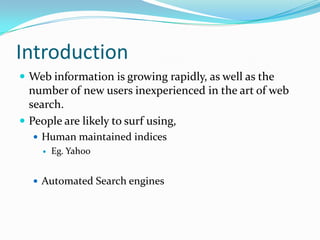
 Web information is growing rapidly, as well as the
  number of new users inexperienced in the art of web
  search.
 People are likely to surf using,
   Human maintained indices
       Eg. Yahoo


   Automated Search engines
Why the name Google ?
 It’s a common spelling of googol, or 10^100.


 Fits well with our goal of building very large-scale
  search engines.
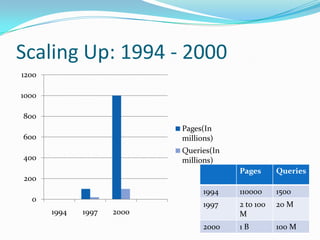
Scaling Up: 1994 - 2000
1200

1000

800
                            Pages(In
600                         millions)
                            Queries(In
400                         millions)
                                         Pages      Queries
200
                                  1994   110000     1500
  0
                                  1997   2 to 100   20 M
       1994   1997   2000                M
                                  2000   1B         100 M
Technology Challenges
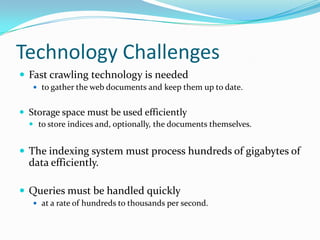
 Fast crawling technology is needed
    to gather the web documents and keep them up to date.


 Storage space must be used efficiently
   to store indices and, optionally, the documents themselves.


 The indexing system must process hundreds of gigabytes of
  data efficiently.

 Queries must be handled quickly
    at a rate of hundreds to thousands per second.
Design Goals
 Improved Search Quality
    “The number of documents in the indices has been
     increasing by many orders of magnitude, but the user’s
     ability to look at documents has not.”


 Academic Search Engine Research
    Search engine technology remains largely a black art and
     advertising oriented.
System Features

 Page Rank


 Anchor Text


 Other features
PageRank: Bringing Order to the
Web
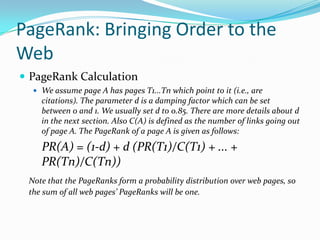
 PageRank Calculation
   We assume page A has pages T1...Tn which point to it (i.e., are
    citations). The parameter d is a damping factor which can be set
    between 0 and 1. We usually set d to 0.85. There are more details about d
    in the next section. Also C(A) is defined as the number of links going out
    of page A. The PageRank of a page A is given as follows:

    PR(A) = (1-d) + d (PR(T1)/C(T1) + ... +
    PR(Tn)/C(Tn))
 Note that the PageRanks form a probability distribution over web pages, so
 the sum of all web pages’ PageRanks will be one.
Anchor Text
 Anchors often provide more accurate descriptions of
  web pages than the pages themselves.

 Second, anchors may exist for documents which
  cannot be indexed by a text-based search engine, such
  as images, programs, and databases.

 Using anchor text efficiently is technically difficult
  because of the large amounts of data which must be
  processed.
Other Features
 First, it has location information for all hits and so it
  makes extensive use of proximity in search.

 Second, it keeps track of some visual presentation
  details such as font size of words.
    Words in a larger or bolder font are weighted higher
    than other words.


 Third, full raw HTML of pages is available in a
  repository.
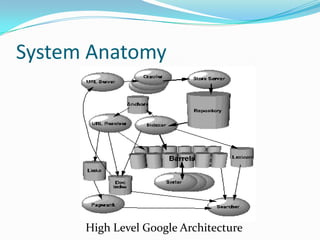
System Anatomy


      High Level Google Architecture
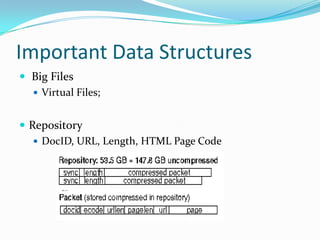
Important Data Structures
 Big Files
   Virtual Files;


 Repository
    DocID, URL, Length, HTML Page Code
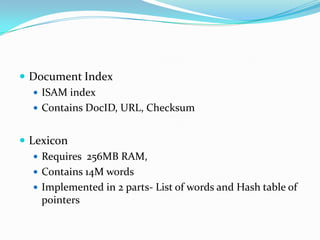
 Document Index
   ISAM index
   Contains DocID, URL, Checksum


 Lexicon
    Requires 256MB RAM,
    Contains 14M words
    Implemented in 2 parts- List of words and Hash table of
     pointers
Search engine

Search engine

  • 1.
    Sergey Brin andLawrence Page Computer Science Department, Stanford University, Stanford, CA 94305, USA
  • 2.
    Agenda  Introduction  History  Design Goals  System Features  System Anatomy  Crawling the web  Indexing the web  Searching  Results and Performance  Conclusion
  • 3.
    Introduction  Web informationis growing rapidly, as well as the number of new users inexperienced in the art of web search.  People are likely to surf using,  Human maintained indices  Eg. Yahoo  Automated Search engines
  • 4.
    Why the nameGoogle ?  It’s a common spelling of googol, or 10^100.  Fits well with our goal of building very large-scale search engines.
  • 5.
    Scaling Up: 1994- 2000 1200 1000 800 Pages(In 600 millions) Queries(In 400 millions) Pages Queries 200 1994 110000 1500 0 1997 2 to 100 20 M 1994 1997 2000 M 2000 1B 100 M
  • 6.
    Technology Challenges  Fastcrawling technology is needed  to gather the web documents and keep them up to date.  Storage space must be used efficiently  to store indices and, optionally, the documents themselves.  The indexing system must process hundreds of gigabytes of data efficiently.  Queries must be handled quickly  at a rate of hundreds to thousands per second.
  • 7.
    Design Goals  ImprovedSearch Quality  “The number of documents in the indices has been increasing by many orders of magnitude, but the user’s ability to look at documents has not.”  Academic Search Engine Research  Search engine technology remains largely a black art and advertising oriented.
  • 8.
    System Features  PageRank  Anchor Text  Other features
  • 9.
    PageRank: Bringing Orderto the Web  PageRank Calculation  We assume page A has pages T1...Tn which point to it (i.e., are citations). The parameter d is a damping factor which can be set between 0 and 1. We usually set d to 0.85. There are more details about d in the next section. Also C(A) is defined as the number of links going out of page A. The PageRank of a page A is given as follows: PR(A) = (1-d) + d (PR(T1)/C(T1) + ... + PR(Tn)/C(Tn)) Note that the PageRanks form a probability distribution over web pages, so the sum of all web pages’ PageRanks will be one.
  • 10.
    Anchor Text  Anchorsoften provide more accurate descriptions of web pages than the pages themselves.  Second, anchors may exist for documents which cannot be indexed by a text-based search engine, such as images, programs, and databases.  Using anchor text efficiently is technically difficult because of the large amounts of data which must be processed.
  • 11.
    Other Features  First,it has location information for all hits and so it makes extensive use of proximity in search.  Second, it keeps track of some visual presentation details such as font size of words.  Words in a larger or bolder font are weighted higher than other words.  Third, full raw HTML of pages is available in a repository.
  • 12.
    System Anatomy High Level Google Architecture
  • 13.
    Important Data Structures Big Files  Virtual Files;  Repository  DocID, URL, Length, HTML Page Code
  • 14.
     Document Index  ISAM index  Contains DocID, URL, Checksum  Lexicon  Requires 256MB RAM,  Contains 14M words  Implemented in 2 parts- List of words and Hash table of pointers

Editor's Notes

  • #4 Human maintained lists cover popular topics effectively but aresubjective, expensive to build and maintain, slow to improve, and cannot cover all esoteric topics.Automated search engines that rely on keyword matching usually return too many low quality matches.To make matters worse, some advertisers attempt to gain people’s attention by taking measures meant tomislead automated search engines.
  • #8 People are still only willing to look at the first few tens of results.Because of this, as the collection size grows, we need tools that have very high precision (number ofrelevant documents returned, say in the top tens of results). Indeed, we want our notion of "relevant" toonly include the very best documents since there may be tens of thousands of slightly relevantdocuments.There is quite a bit of recent optimism that the use of more hypertextual information can help improve search and other applications [Marchiori 97] [Spertus97] [Weiss 96] [Kleinberg 98]. In particular, link structure [Page 98] and link text provide a lot ofinformation for making relevance judgments and quality filtering. Google makes use of both linkstructure and anchor text (see Sections 2.1 and 2.2).One of our main goals in designing Google was to set up an environment whereother researchers can come in quickly, process large chunks of the web, and produce interesting resultsthat would have been very difficult to produce otherwise.Another goal we have is to set up a Spacelab-like environment where researchers or even students canpropose and do interesting experiments on our large-scale web data.
  • #10 Another intuitive justification is that a page can have a high PageRank if there are many pages that pointto it, or if there are some pages that point to it and have a high PageRank. Intuitively, pages that are wellcited from many places around the web are worth looking at. Also, pages that have perhaps only onecitation from something like the Yahoo! homepage are also generally worth looking at. If a page was nothigh quality, or was a broken link, it is quite likely that Yahoo’s homepage would not link to it.
  • #11 In our current crawl of 24 million pages, we hadover 259 million anchors which we indexed.
  • #13 Most of Google isimplemented in C or C++ for efficiency and can run ineither Solaris or Linux.In Google, the web crawling (downloading of web pages)is done by several distributed crawlers. There is aURLserver that sends lists of URLs to be fetched to thecrawlers. The web pages that are fetched are then sent tothe storeserver. The storeserver then compresses and storesthe web pages into a repository. Every web page has anassociated ID number called a docID which is assignedwhenever a new URL is parsed out of a web page. Theindexing function is performed by the indexer and thesorter. The indexer performs a number of functions. It readsthe repository, uncompresses the documents, and parses them. Each document is converted into a set ofword occurrences called hits. The hits record the word, position in document, an approximation of fontsize, and capitalization. The indexer distributes these hits into a set of "barrels", creating a partiallysorted forward index. The indexer performs another important function. It parses out all the links inevery web page and stores important information about them in an anchors file. This file containsenough information to determine where each link points from and to, and the text of the link.The URLresolver reads the anchors file and converts relative URLs into absolute URLs and in turn intodocIDs. It puts the anchor text into the forward index, associated with the docID that the anchor pointsto. It also generates a database of links which are pairs of docIDs. The links database is used to computePageRanks for all the documents.The sorter takes the barrels, which are sorted by docID (this is a simplification, see Section 4.2.5), andresorts them by wordID to generate the inverted index. This is done in place so that little temporaryspace is needed for this operation. The sorter also produces a list of wordIDs and offsets into theinverted index. A program called DumpLexicon takes this list together with the lexicon produced by theindexer and generates a new lexicon to be used by the searcher. The searcher is run by a web server anduses the lexicon built by DumpLexicon together with the inverted index and the PageRanks to answerqueries.
  • #14 Bigfiles : vertual files; alloc and dealloc among mutli file sys handled automatically; also handles allocdealloc of file descriptors; supports comrpession optionRepository : docId, length, URL, Page HTML CodeDoc Index : ISAM Index,docId, URL, ChecksumLexicon