Leaving No One Behind SDG2030
• AGENDA 21
• MDG
• SDG
• SENADAI FRAMEWORK
• COP21
Leaving No One Behind SDG2030
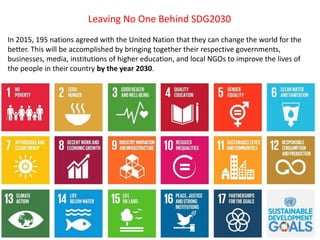
In 2015, 195 nations agreed with the United Nation that they can change the world for the
better. This will be accomplished by bringing together their respective governments,
businesses, media, institutions of higher education, and local NGOs to improve the lives of
the people in their country by the year 2030.
Leaving No One Behind SDG2030
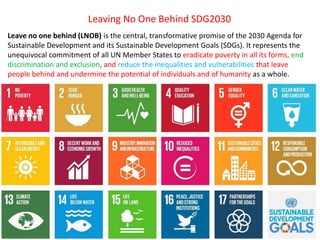
Leave no one behind (LNOB) is the central, transformative promise of the 2030 Agenda for
Sustainable Development and its Sustainable Development Goals (SDGs). It represents the
unequivocal commitment of all UN Member States to eradicate poverty in all its forms, end
discrimination and exclusion, and reduce the inequalities and vulnerabilities that leave
people behind and undermine the potential of individuals and of humanity as a whole.
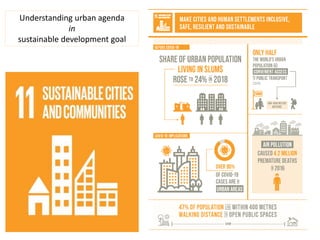
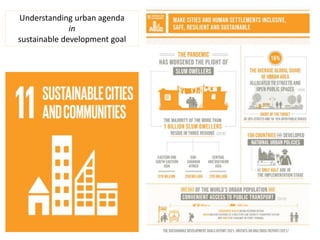
Understanding urban agenda
in
sustainable development goal
Understanding urban agenda
in
sustainable development goal
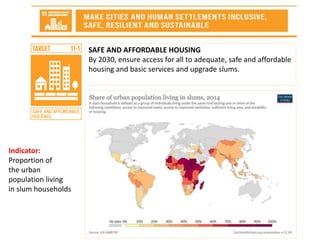
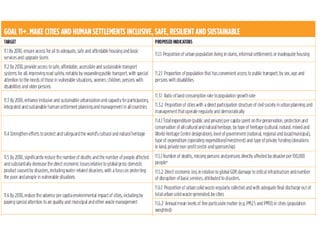
SAFE AND AFFORDABLE HOUSING
By 2030, ensure access for all to adequate, safe and affordable
housing and basic services and upgrade slums.
Indicator:
Proportion of
the urban
population living
in slum households
AFFORDABLE AND SUSTAINABLE TRANSPORT SYSTEMS
By 2030, provide access to safe, affordable, accessible and
sustainable transport systems for all, improving road safety,
notably by expanding public transport, with special attention to
the needs of those in vulnerable situations, women, children,
persons with disabilities and older persons.
Indicator: Proportion of population that has convenient access
to public transport, by sex, age and Persons With Disabilities
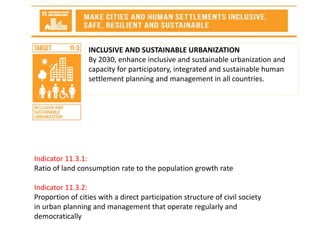
INCLUSIVE AND SUSTAINABLE URBANIZATION
By 2030, enhance inclusive and sustainable urbanization and
capacity for participatory, integrated and sustainable human
settlement planning and management in all countries.
Indicator 11.3.1:
Ratio of land consumption rate to the population growth rate
Indicator 11.3.2:
Proportion of cities with a direct participation structure of civil society
in urban planning and management that operate regularly and
democratically
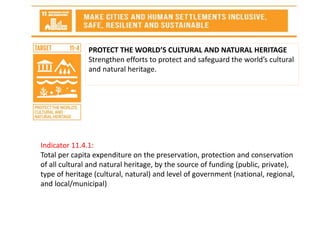
PROTECT THE WORLD’S CULTURAL AND NATURAL HERITAGE
Strengthen efforts to protect and safeguard the world’s cultural
and natural heritage.
Indicator 11.4.1:
Total per capita expenditure on the preservation, protection and conservation
of all cultural and natural heritage, by the source of funding (public, private),
type of heritage (cultural, natural) and level of government (national, regional,
and local/municipal)
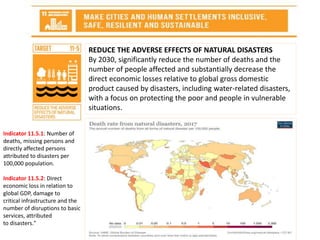
REDUCE THE ADVERSE EFFECTS OF NATURAL DISASTERS
By 2030, significantly reduce the number of deaths and the
number of people affected and substantially decrease the
direct economic losses relative to global gross domestic
product caused by disasters, including water-related disasters,
with a focus on protecting the poor and people in vulnerable
situations.
Indicator 11.5.1: Number of
deaths, missing persons and
directly affected persons
attributed to disasters per
100,000 population.
Indicator 11.5.2: Direct
economic loss in relation to
global GDP, damage to
critical infrastructure and the
number of disruptions to basic
services, attributed
to disasters."
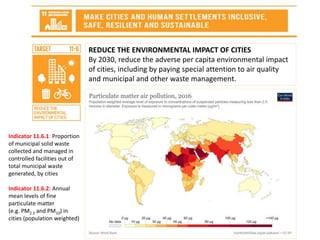
REDUCE THE ENVIRONMENTAL IMPACT OF CITIES
By 2030, reduce the adverse per capita environmental impact
of cities, including by paying special attention to air quality
and municipal and other waste management.
Indicator 11.6.1: Proportion
of municipal solid waste
collected and managed in
controlled facilities out of
total municipal waste
generated, by cities
Indicator 11.6.2: Annual
mean levels of fine
particulate matter
(e.g. PM2.5 and PM10) in
cities (population weighted)
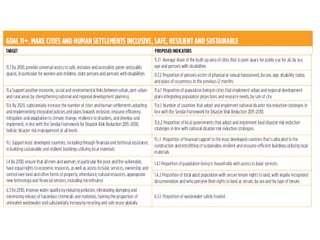
Target 11.7: Provide access to safe and inclusive green and
public spaces
By 2030, provide universal access to safe, inclusive and
accessible, green and public spaces, in particular for women
and children, older persons and Persons With Disabilities
Indicator 11.7.1:
Average share of the built-up area of cities that is open space for public use
for all, by sex, age and persons with disabilities
Indicator 11.7.2:
Proportion of person victim of physical or sexual harassment, by sex, age,
disability status and place of occurrence, in the previous 12 months
STRONG NATIONAL AND REGIONAL DEVELOPMENT
PLANNING
Support positive economic, social and environmental links
between urban, peri-urban and rural areas by strengthening
national and regional development planning.
Indicator 11.a.1:
Number of countries that have national urban policies or regional
development plans that (a) respond to population dynamics; (b) ensure
balanced territorial development, and (c) increase local fiscal space
IMPLEMENT POLICIES FOR INCLUSION, RESOURCE EFFICIENCY
AND DISASTER RISK REDUCTION
By 2020, substantially increase the number of cities and
human settlements adopting and implementing integrated
policies and plans towards inclusion, resource efficiency,
mitigation and adaptation to climate change, resilience to
disasters, and develop and implement, in line with the Sendai
Framework for Disaster Risk Reduction 2015–2030, holistic
disaster risk management at all levels.
Indicator 11.b.1: Number of countries that adopt and implement national
disaster risk reduction strategies in line with the Sendai Framework for Disaster
Risk Reduction 2015–2030
Indicator 11.b.2: Proportion of local governments that adopt and implement
local disaster risk reduction strategies in line with national disaster risk
reduction strategies
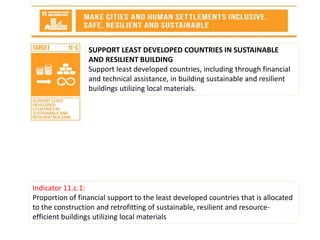
SUPPORT LEAST DEVELOPED COUNTRIES IN SUSTAINABLE
AND RESILIENT BUILDING
Support least developed countries, including through financial
and technical assistance, in building sustainable and resilient
buildings utilizing local materials.
Indicator 11.c.1:
Proportion of financial support to the least developed countries that is allocated
to the construction and retrofitting of sustainable, resilient and resource-
efficient buildings utilizing local materials
Write your views on reducing the urban environmental impacts in
city areas following the SDG goal 11.
• Poverty and Hunger
• Primary education
• Gender equity
• Child Mortality
• HIV?AIDS
• Env Sustainability
• Partnership

SDG Goals and targets.pptx

  • 1.
    Leaving No OneBehind SDG2030 • AGENDA 21 • MDG • SDG • SENADAI FRAMEWORK • COP21
  • 2.
    Leaving No OneBehind SDG2030 In 2015, 195 nations agreed with the United Nation that they can change the world for the better. This will be accomplished by bringing together their respective governments, businesses, media, institutions of higher education, and local NGOs to improve the lives of the people in their country by the year 2030.
  • 3.
    Leaving No OneBehind SDG2030 Leave no one behind (LNOB) is the central, transformative promise of the 2030 Agenda for Sustainable Development and its Sustainable Development Goals (SDGs). It represents the unequivocal commitment of all UN Member States to eradicate poverty in all its forms, end discrimination and exclusion, and reduce the inequalities and vulnerabilities that leave people behind and undermine the potential of individuals and of humanity as a whole.
  • 4.
  • 5.
  • 6.
    SAFE AND AFFORDABLEHOUSING By 2030, ensure access for all to adequate, safe and affordable housing and basic services and upgrade slums. Indicator: Proportion of the urban population living in slum households
  • 7.
    AFFORDABLE AND SUSTAINABLETRANSPORT SYSTEMS By 2030, provide access to safe, affordable, accessible and sustainable transport systems for all, improving road safety, notably by expanding public transport, with special attention to the needs of those in vulnerable situations, women, children, persons with disabilities and older persons. Indicator: Proportion of population that has convenient access to public transport, by sex, age and Persons With Disabilities
  • 8.
    INCLUSIVE AND SUSTAINABLEURBANIZATION By 2030, enhance inclusive and sustainable urbanization and capacity for participatory, integrated and sustainable human settlement planning and management in all countries. Indicator 11.3.1: Ratio of land consumption rate to the population growth rate Indicator 11.3.2: Proportion of cities with a direct participation structure of civil society in urban planning and management that operate regularly and democratically
  • 9.
    PROTECT THE WORLD’SCULTURAL AND NATURAL HERITAGE Strengthen efforts to protect and safeguard the world’s cultural and natural heritage. Indicator 11.4.1: Total per capita expenditure on the preservation, protection and conservation of all cultural and natural heritage, by the source of funding (public, private), type of heritage (cultural, natural) and level of government (national, regional, and local/municipal)
  • 10.
    REDUCE THE ADVERSEEFFECTS OF NATURAL DISASTERS By 2030, significantly reduce the number of deaths and the number of people affected and substantially decrease the direct economic losses relative to global gross domestic product caused by disasters, including water-related disasters, with a focus on protecting the poor and people in vulnerable situations. Indicator 11.5.1: Number of deaths, missing persons and directly affected persons attributed to disasters per 100,000 population. Indicator 11.5.2: Direct economic loss in relation to global GDP, damage to critical infrastructure and the number of disruptions to basic services, attributed to disasters."
  • 11.
    REDUCE THE ENVIRONMENTALIMPACT OF CITIES By 2030, reduce the adverse per capita environmental impact of cities, including by paying special attention to air quality and municipal and other waste management. Indicator 11.6.1: Proportion of municipal solid waste collected and managed in controlled facilities out of total municipal waste generated, by cities Indicator 11.6.2: Annual mean levels of fine particulate matter (e.g. PM2.5 and PM10) in cities (population weighted)
  • 12.
    Target 11.7: Provideaccess to safe and inclusive green and public spaces By 2030, provide universal access to safe, inclusive and accessible, green and public spaces, in particular for women and children, older persons and Persons With Disabilities Indicator 11.7.1: Average share of the built-up area of cities that is open space for public use for all, by sex, age and persons with disabilities Indicator 11.7.2: Proportion of person victim of physical or sexual harassment, by sex, age, disability status and place of occurrence, in the previous 12 months
  • 13.
    STRONG NATIONAL ANDREGIONAL DEVELOPMENT PLANNING Support positive economic, social and environmental links between urban, peri-urban and rural areas by strengthening national and regional development planning. Indicator 11.a.1: Number of countries that have national urban policies or regional development plans that (a) respond to population dynamics; (b) ensure balanced territorial development, and (c) increase local fiscal space
  • 14.
    IMPLEMENT POLICIES FORINCLUSION, RESOURCE EFFICIENCY AND DISASTER RISK REDUCTION By 2020, substantially increase the number of cities and human settlements adopting and implementing integrated policies and plans towards inclusion, resource efficiency, mitigation and adaptation to climate change, resilience to disasters, and develop and implement, in line with the Sendai Framework for Disaster Risk Reduction 2015–2030, holistic disaster risk management at all levels. Indicator 11.b.1: Number of countries that adopt and implement national disaster risk reduction strategies in line with the Sendai Framework for Disaster Risk Reduction 2015–2030 Indicator 11.b.2: Proportion of local governments that adopt and implement local disaster risk reduction strategies in line with national disaster risk reduction strategies
  • 15.
    SUPPORT LEAST DEVELOPEDCOUNTRIES IN SUSTAINABLE AND RESILIENT BUILDING Support least developed countries, including through financial and technical assistance, in building sustainable and resilient buildings utilizing local materials. Indicator 11.c.1: Proportion of financial support to the least developed countries that is allocated to the construction and retrofitting of sustainable, resilient and resource- efficient buildings utilizing local materials
  • 18.
    Write your viewson reducing the urban environmental impacts in city areas following the SDG goal 11. • Poverty and Hunger • Primary education • Gender equity • Child Mortality • HIV?AIDS • Env Sustainability • Partnership