S-Curve
SUHAS DHAKATE
Dec - 2015
Why S-Curve is important
 Important for technology
organization
 How supply demand and
profit works
 How investment will work
against the return
 How new market can be
created
 S-curve is a tool that can be used to evaluate
the technology opportunity for business
 Explains how technology evolves and displace
 Support investment decision related to
technology stream but may be different
application opportunity
 After every new S-curve, function supporting
the technology remain same, however the use
of technology brings different business
opportunity
Defining system
Most common way to define a system is
Engine Transmission Actuator Work
Control
Power
• Function of the system remain same
• Technology brings change in every block of the system, results in improving systems
functionality
• Use of deferent technology shifts the market and end customer segment
Pattern of evolution
 Berth of idea
 Evolution toward increase ideality
 Non- uniform development of system element – result in contradiction
 Evolution toward increased dynamism and controllability
 Increase complexity then simplification through integration
 Evolution with matching and mismatching elements
 Transition from macro system to micro system and increase use of field for
better performance and control
 Evolution toward decreased human involvement
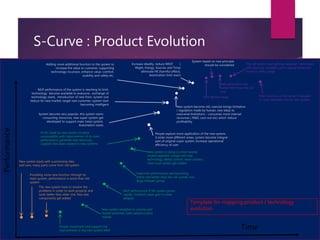
S-Curve : Product Evolution
New system establish its volume and
market potential. Early adaptors drive
market
MUF performance if the system grows
rapidly. Establish value gain to early
adaptor
Improved performance and becoming
better and better than the old system. Join
large follower group.
New system is trying to enter several
market segment, merge with new
technology. Better control, more variants,
close loop system get added.
Profit made by new system increase
sustainability with improvement of its main
performance, generate new resources,
support new ideas related to new systems
People explore more application of the new system,
it enter more different areas, system become integral
part of original super system. Increase operational
efficiency of user
New system starts with a promising idea
and uses, many parts come from old system
Providing some new function through its
main system, performance is worst than old
system
The new system have to resolve the
problems in order to work properly and
work better than older one. Few new
components get added
System become very popular, this system starts
consuming resources, new super-system get
developed to support main (new) system.
Automation starts
MUF performance of the system is reaching its limit,
technology become available to everyone , exchange of
technology starts, introduction of new from, system size
reduce for new market, target new customer, system start
becoming intelligent
Adding more additional function to the system to
increase the value to customer, supporting
technology incursion, enhance value, comfort,
usability and safety etc.
New system become old, overuse brings limitation
/ regulation made by human, new ideas to
overcame limitations – consumes more internal
recourses ( R&D, cost-out etc) which reduce
profitability
Increase ideality, reduce WEST (
Wight, Energy, Sources and Time)
eliminate HE (harmful effect).
Automation limit reach
Start decline stage
New generation has
better MUF than the old
one
System based on new principle
should be considered The old system start getting replaced / eliminated
with new one, establish use in special areas and
move to utility usage
Main function of the system changed.
S-curve switched over to new system
Performance
People investment and support the
improvement in the new system MUF
Time
Template for mapping product / technology
evolution
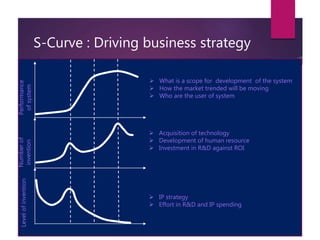
S-Curve : Driving business strategy
Performance
ofsystem
Numberof
invention
Levelofinvention
 What is a scope for development of the system
 How the market trended will be moving
 Who are the user of system
 Acquisition of technology
 Development of human resource
 Investment in R&D against ROI
 IP strategy
 Effort in R&D and IP spending
S-Curve : Driving business strategy
ProfitHarmfulfactor
 Investment maturity period and expected
returns
 Company acquisition / merger
 Government policy for support & infrastructure
investment
 Environmental / health related issues and norms
Questions to be asked
 What the S-curve of your product tells ?
 Which stage is the product in ? How to estimate it ?
 Dose the performance of the product reach its limit ? Why dose such
limit exist ? How to increase this limit ?
 When should the next S-curve be considered ? Is change in MUF of
change in work form ?
 Dose your product get affected due to change in work form ?
 Dose product with present principles can be places in probable S-
curve for new work form ?
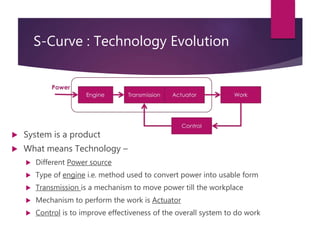
S-Curve : Technology Evolution
 System is a product
 What means Technology –
 Different Power source
 Type of engine i.e. method used to convert power into usable form
 Transmission is a mechanism to move power till the workplace
 Mechanism to perform the work is Actuator
 Control is to improve effectiveness of the overall system to do work
S-Curve : Technology Evolution
 Select the product and define Main Useful Function (MUF)
 List down the changes in product, economic condition, social behavior, opportunity
etc. as per template given
 Describe : S-curve for product evolution
 Consider every element in the system / product
 Define ideality of system and formulate WEST & HE
 List down, how product is affecting due to change in every element
 Keep improving ideality as system matures
 Map the change and effect on product with Product evolution S-curve
 Describe : S-curve for technology evolution

S-curve

  • 1.
  • 2.
    Why S-Curve isimportant  Important for technology organization  How supply demand and profit works  How investment will work against the return  How new market can be created  S-curve is a tool that can be used to evaluate the technology opportunity for business  Explains how technology evolves and displace  Support investment decision related to technology stream but may be different application opportunity  After every new S-curve, function supporting the technology remain same, however the use of technology brings different business opportunity
  • 3.
    Defining system Most commonway to define a system is Engine Transmission Actuator Work Control Power • Function of the system remain same • Technology brings change in every block of the system, results in improving systems functionality • Use of deferent technology shifts the market and end customer segment
  • 4.
    Pattern of evolution Berth of idea  Evolution toward increase ideality  Non- uniform development of system element – result in contradiction  Evolution toward increased dynamism and controllability  Increase complexity then simplification through integration  Evolution with matching and mismatching elements  Transition from macro system to micro system and increase use of field for better performance and control  Evolution toward decreased human involvement
  • 5.
    S-Curve : ProductEvolution New system establish its volume and market potential. Early adaptors drive market MUF performance if the system grows rapidly. Establish value gain to early adaptor Improved performance and becoming better and better than the old system. Join large follower group. New system is trying to enter several market segment, merge with new technology. Better control, more variants, close loop system get added. Profit made by new system increase sustainability with improvement of its main performance, generate new resources, support new ideas related to new systems People explore more application of the new system, it enter more different areas, system become integral part of original super system. Increase operational efficiency of user New system starts with a promising idea and uses, many parts come from old system Providing some new function through its main system, performance is worst than old system The new system have to resolve the problems in order to work properly and work better than older one. Few new components get added System become very popular, this system starts consuming resources, new super-system get developed to support main (new) system. Automation starts MUF performance of the system is reaching its limit, technology become available to everyone , exchange of technology starts, introduction of new from, system size reduce for new market, target new customer, system start becoming intelligent Adding more additional function to the system to increase the value to customer, supporting technology incursion, enhance value, comfort, usability and safety etc. New system become old, overuse brings limitation / regulation made by human, new ideas to overcame limitations – consumes more internal recourses ( R&D, cost-out etc) which reduce profitability Increase ideality, reduce WEST ( Wight, Energy, Sources and Time) eliminate HE (harmful effect). Automation limit reach Start decline stage New generation has better MUF than the old one System based on new principle should be considered The old system start getting replaced / eliminated with new one, establish use in special areas and move to utility usage Main function of the system changed. S-curve switched over to new system Performance People investment and support the improvement in the new system MUF Time Template for mapping product / technology evolution
  • 6.
    S-Curve : Drivingbusiness strategy Performance ofsystem Numberof invention Levelofinvention  What is a scope for development of the system  How the market trended will be moving  Who are the user of system  Acquisition of technology  Development of human resource  Investment in R&D against ROI  IP strategy  Effort in R&D and IP spending
  • 7.
    S-Curve : Drivingbusiness strategy ProfitHarmfulfactor  Investment maturity period and expected returns  Company acquisition / merger  Government policy for support & infrastructure investment  Environmental / health related issues and norms
  • 8.
    Questions to beasked  What the S-curve of your product tells ?  Which stage is the product in ? How to estimate it ?  Dose the performance of the product reach its limit ? Why dose such limit exist ? How to increase this limit ?  When should the next S-curve be considered ? Is change in MUF of change in work form ?  Dose your product get affected due to change in work form ?  Dose product with present principles can be places in probable S- curve for new work form ?
  • 9.
    S-Curve : TechnologyEvolution  System is a product  What means Technology –  Different Power source  Type of engine i.e. method used to convert power into usable form  Transmission is a mechanism to move power till the workplace  Mechanism to perform the work is Actuator  Control is to improve effectiveness of the overall system to do work
  • 10.
    S-Curve : TechnologyEvolution  Select the product and define Main Useful Function (MUF)  List down the changes in product, economic condition, social behavior, opportunity etc. as per template given  Describe : S-curve for product evolution  Consider every element in the system / product  Define ideality of system and formulate WEST & HE  List down, how product is affecting due to change in every element  Keep improving ideality as system matures  Map the change and effect on product with Product evolution S-curve  Describe : S-curve for technology evolution